Federal Court of Australia
Jian v Downing [2023] FCA 1018
Table of Corrections | |
In paragraph [34] “The first, second, third and fourth respondents” is to be replaced with “The first, second, third, fourth and fifth respondents”. | |
31 August 2023 | In paragraphs [53], [112], [114], [122] “third and fourth respondents” is to be replaced with “third and fourth applicants”. |
31 August 2023 | In paragraph [80], “29 August 2023” is to be replaced with “29 August 2022”. |
ORDERS
First Applicant HENPHARM PTY LTD ACN 612 561 421 Second Applicant MR WILLIAM HO (and another named in the Schedule) Third Applicant | ||
AND: | First Respondent MS RENAE BEARDMORE Second Respondent MS HELEN DOWLING (and others named in the Schedule) Third Respondent | |
DATE OF ORDER: |
THE COURT DECLARES THAT:
1. Pursuant to s 21 of the Federal Court of Australia Act 1976 (Cth), that:
(a) Mr Peter Downing’s participation as a Member of the Pharmaceutical Services Federal Committee of Inquiry in connection with the following referrals made by the Secretary of the Department of Health was attended with the appearance of a reasonable apprehension of bias:
(i) Ms Nancy Jian, referred on 4 August 2020;
(ii) Henpharm Pty Ltd, referred on 29 April 2021; and
(iii) Mr William Ho and Ms Louisa Young, referred on 13 July 2021.
(b) An appearance of disqualifying bias attends to the participation of Ms Renae Beardmore (as Chair), Ms Helen Dowling, Ms Juliana Sestan and Dr Nick Simpson, as Members of the Committee, by reason of their interaction with Mr Peter Downing, in connection with the referral of Ms Nancy Jian, referred on 4 August 2020.
THE COURT ORDERS THAT:
2. Pursuant to s 39B(1) and (1A) of the Judiciary Act 1903 (Cth) and s 23 of the Federal Court Act, Mr Downing be restrained from taking any further step in connection with the following referrals made to the Committee by the Secretary:
(i) Ms Nancy Jian, referred on 4 August 2020;
(ii) Henpharm Pty Ltd, referred on 29 April 2021; and
(iii) Mr William Ho and Ms Louisa Young, referred on 13 July 2021.
3. Pursuant to s 39B(1) and (1A) of the Judiciary Act and s 23 of the Federal Court Act, Ms Renae Beardmore (as Chair), Ms Helen Dowling, Ms Juliana Sestan and Dr Nick Simpson, as Members of the Committee, be restrained from taking any further step in connection with the following referral made to the Committee by the Secretary:
(i) Ms Nancy Jian, referred on 4 August 2020;
4. By 4:00 pm AEST on 4 September 2023, the applicant must file and serve any written submissions regarding costs and, to the extent that it is necessary, any further orders required by the Court.
5. By 4:00 pm AEST on 11 September 2023, the respondent must file and serve any written submissions regarding costs and, to the extent that it is necessary, any further orders required by the Court.
6. Pursuant to s 20A of the Federal Court of Australia Act 1976 (Cth), the question of costs be determined on the papers thereafter.
Note: Entry of orders is dealt with in Rule 39.32 of the Federal Court Rules 2011.
MEAGHER J
introduction
1 By originating application filed on 24 May 2022, the applicants sought an order pursuant to s 39B(1) and (1A) of the Judiciary Act 1903 (Cth) and s 23 of the Federal Court of Australia Act 1976 (Cth) restraining the respondents from taking any further steps with respect to certain referrals made to the Pharmaceutical Services Federal Committee of Inquiry by the Secretary of the Department of Health. The applicants also sought declarations pursuant to s 21 of the Federal Court Act that Mr Downing’s participation in the inquiries was attended with an appearance of disqualifying bias and that appearance extends to the participation of the other Committee members by reason of their interaction with him.
2 In their originating application, the applicants also sought a declaration that the respondents failed to observe the requirements of procedural fairness in deciding that a hypothetical fair-minded observer might reasonably apprehend that the inquiry might not be conducted as a result of the neutral evaluation of the merits. At the commencement of the hearing the applicants abandoned this ground.
legal framework
The Act
3 Section 90 of the National Health Act 1953 (Cth) provides approval for pharmacists to supply pharmaceutical benefits under the Pharmaceutical Benefits Scheme (PBS). Section 92A of the Act imposes certain conditions on approvals under s 90, including any conditions as determined by the Minister.
4 Section 113 of the Act provides that the Minister may establish the Committee, constituted by four pharmacists and the Secretary, or a delegate of the Secretary. Pursuant to s 114 of the Act, the Secretary may make a referral for the Committee to inquire into and report to the Minister regarding the conduct of, and supply of pharmaceutical benefits by, an approved provider. Proceedings conducted by the Committee are not bound by the rules of evidence, are conducted in private, and are informed by any matters that the Committee thinks fit: ss 122 and 123 of the Act.
5 The Minister’s powers under s 95 of the Act include reprimanding an approved pharmacist, or revoking or suspending the approval under s 90 of the Act. With respect to revocation of an approval, the Minister must reach a level of satisfaction that the pharmacist has engaged in conduct which contravenes their approval under s 90, such that the pharmacist is no longer fit to hold such an approval: s 95(8) of the Act. The Minister’s powers under s 95 of the Act is only enlivened after investigation and the provision of a report prepared by the Committee: s 95(7) of the Act.
6 Pursuant to s 134A of the Act, the Minister is permitted to publish the Committee's report only once the relevant appeal period lapses or, in the event of an appeal, once judgment is handed down in the appeal.
Reasonable Apprehension of Bias
7 The test for disqualification by reason of an apprehension of bias was summarised by the High Court in Ebner v Official Trustee in Bankruptcy (2000) 205 CLR 337 at [6]:
...the governing principle is that, subject to qualifications relating to waiver (which is not presently relevant) or necessity (which may be relevant to the second appeal), a judge is disqualified if a fair-minded lay observer might reasonably apprehend that the judge might not bring an impartial mind to the resolution of the question the judge is required to decide. That principle gives effect to the requirement that justice should both be done and be seen to be done, a requirement which reflects the fundamental importance of the principle that the tribunal be independent and impartial.
8 Regarding the “double might” in the test, Charlesworth J in Burgess v Minister for Immigration & Border Protection (2018) 259 FCR 197 said at [35]-[36]:
The first “might” concerns the likelihood (to be assessed by the Court) of the lay observer forming the reasonable apprehension. The second “might” concerns the content of the apprehension itself. It concerns the assessment (notionally made by the lay observer) of the likelihood of the decision-maker having a foreclosed mind (as opposed to having a predisposed opinion) and so deviating from the course of deciding a case on its merits.
Judicial statements to the effect that an allegation of apprehended bias must be distinctly made and clearly established are not to be understood as altering the degrees of likelihood inherent in the test itself: see MZZXM v Minister for Immigration & Border Protection [2016] FCA 405 at [106] and the cases cited therein. Each “might” in the double might test connotes a degree of likelihood that is lower than that which may be required by the civil standard of proof in an ordinary fact-finding context. It must nonetheless be shown that the reasonable lay observer might apprehend that the decision-maker might have a foreclosed mind. It is not sufficient to demonstrate that the observer may have “a vague sense of unease or disquiet” on the question: Jones (as President of the Victorian Farmers Federation Chicken Meat Group) v Australian Competition and Consumer Commission (2002) 76 ALD 424 at [100] (Weinberg J).
9 The High Court recently considered the reasonable apprehension of bias test in QYFM v Minister for Immigration, Citizenship, Migrant Services and Multicultural Affairs (2023) 409 ALR 65; [2023] HCA 15. This was handed down after judgment was reserved in this matter. Further submissions were invited, which were filed by the applicants and Commonwealth on 30 June 2023.
10 While QYFM was concerned with a reasonable apprehension of bias in the curial setting, it importantly reaffirmed the Ebner test. At [38], Kiefel CJ and Gageler J identified the test as:
Application of the criterion was identified in Ebner, and has been reiterated, logically to entail: (1) identification of the factor which it is said might lead a judge to resolve the question other than on its legal and factual merits; (2) articulation of the logical connection between that factor and the apprehended deviation from deciding that question on its merits; and (3) assessment of the reasonableness of that apprehension from the perspective of a fair-minded lay observer.
(Footnotes omitted)
11 The test is applied through the lens of a hypothetical fair-minded lay observer who is aware of the nature of the decision and the circumstances leading to it, the context in which it was made and the relevant statutory framework. The fair-minded lay observer is not overly sensitive or suspicious: QYFM at [47] (Kiefel CJ and Gageler J), [197] (Steward J), [255] (Gleeson J). The fair-minded lay observer is concerned with possibilities rather than probabilities which are not remote or fanciful: QYFM at [37] (Kiefel CJ and Gageler J), [69] (Gordon J), [299] (Jagot J).
12 The Courts have attributed a number of characteristics to the fair-minded lay observer. In circumstances where the statutory context of the matter is complex, the fair-minded lay observer is taken to understand the “key elements”: CNY17 v Minister for Immigration and Border Protection (2019) 268 CLR 76; [2019] HCA 50 at [59].
13 Most recently in QYFM, Kiefel CJ and Gageler J observed at [46]-[48]:
… The observer is to be placed in a contemporary setting. Uncritical attitudes of the past cannot be assumed to be those of the present.
Being “fair-minded”, the observer “is neither complacent nor unduly sensitive or suspicious” . Yet the observer is cognisant of “human frailty” and is all too aware of the reality that the judge is human. The observer understands that “information [as well as attitudes] consciously and conscientiously discarded might still sometimes have a subconscious effect on even the most professional of decision-making”.
Being “lay”, the observer “is not to be assumed to have a detailed knowledge of the law, or of the character or ability of a particular judge”.
(Footnotes omitted)
14 Gordon J at [72] articulated the knowledge of the fair-minded lay observer to be the following:
The fair-minded lay observer is taken to be aware of the nature of the decision and the context in which it was made, and the circumstances leading to the decision. The fair-minded lay observer is taken to have “a broad knowledge of the material objective facts”, as distinct from a detailed knowledge of the law or of the character and ability of the decision-maker.
(Footnotes omitted)
15 The fair-minded lay observer is “…a representative of the Australian public, the continuing confidence of which in the rule of law is secured, in part, by acceptance that judicial decisions are made by impartial and independent judges…”: QYFM at [273] (Jagot J).
16 In the non-curial context the test as to what constitutes a reasonable apprehension of bias remains the same although the standard expected of a judge, and even those acting quasi-judicially, may differ from the standard ascribed to administrative decision makers: Hot Holdings Pty Ltd v Creasy (2002) 210 CLR 438; [2002] HCA 51 at [70] (McHugh J).
17 In Isbester v Knox City Council (2015) 255 CLR 135; [2015] HCA 20, Kiefel J (as her Honour then was), Bell, Keane and Nettle JJ at [24] – [27] acknowledged that the standard of impartiality that the fair-minded lay observer reasonably expects will differ, depending on whether the decision-maker is judicial or non-judicial. This is because, in some cases, it would be artificial to attribute the expectations of a judge on, for example, a minister.
18 QYFM provides guidance that when an allegation of reasonable apprehension of bias arises in relation to a member of a Full Court, the Full Court as a whole must be satisfied that no reasonable apprehension of bias arises in the circumstances: [66] (Gordon J, with Edelman J at [109] and Steward J at [193] agreeing).
19 In Webb v The Queen (1994) 181 CLR 41, Deane J (who was not dissenting on this point) at [74] identified four overlapping categories of cases which may lead to disqualification for the appearance of bias. They are interest, association, conduct and extraneous information.
20 Disclosure is extensively discussed in Ebner by Gaudron J (who was in agreement with the majority) at [69] – [72] as follows:
As a matter of prudence and professional practice, judges should disclose interests and associations if there is a serious possibility that they are potentially disqualifying. It is common, and proper, practice for a judge who owns shares in a company which is involved in a case in which the judge is sitting to inform the parties of that fact and to give them an opportunity to raise an objection should they wish to be heard. In most cases, the outcome is that no objection is raised and, by reason of waiver, any potential problem disappears. One reason for the practice is that it gives the parties an opportunity to bring to the attention of the judge some aspect of the case, or of its possible consequences, not known to, or fully appreciated by, the judge.
It is, however, neither useful nor necessary to describe this practice in terms of rights and duties. At most, any “duty” to disclose would be a duty of imperfect obligation. A failure to disclose is relevant (if at all) only because it may be said to cast some evidentiary light on the ultimate question of reasonable apprehension of bias. A failure to disclose has no other legal significance. In particular it does not, of itself, give a litigant any right to have the judge desist from further hearing the matter or to have the ultimate decision in the matter set aside for want of procedural fairness.
To describe the practice of making disclosure as a matter of right or duty may distract attention from the fundamental question to be answered which is whether the reasonable apprehension of bias test is established. That question will be litigated on appeal from the substantive decision in the matter or in proceedings for prohibition, certiorari or similar relief. Whatever the process which the person alleging reasonable apprehension of bias may adopt, there will, in those proceedings, be a full opportunity to make whatever case for disqualification of the judge the moving party can. Inquiring whether the moving party was denied some opportunity to make submissions on the question of disqualification to the judge in question is irrelevant. The question of disqualification can and will be litigated fully in the appeal or application for prerogative or like relief and no separate question of denial of procedural fairness could arise. The point can be illustrated by what happened in Clenae. The fact that the judge did not disclose his shareholding gives no different or additional right to the present appellants. All that they were denied by the fact that there was no disclosure was an opportunity to put an argument which we consider must fail.
Disclosure of association may raise more difficult questions than are presented by the straightforward case of ownership of shares in a corporation. It is impossible to identify all of the kinds of association which might be thought to reveal a serious possibility of being potentially disqualifying. As we have said earlier, the application of the apprehension of bias principle requires identification of what it is said might lead a judge to decide a case other than on its legal and factual merits, and the articulation of the logical connection between that matter and the feared deviation from the course of deciding the case on its merits.
(Footnotes omitted)
21 In Ebner, regarding the significance of economic conflicts of interest when determining whether a reasonable apprehension of bias exists, Gleeson CJ, McHugh, Gummow and Hayne JJ considered at [58]:
For reasons already given, we accept that, in the practical application of the general test to be applied in cases of apprehended bias, economic conflicts of interest are likely to be of particular significance, and that, allowing for the imprecision of the concept, the circumstance that a judge has a not insubstantial, direct, pecuniary or proprietary interest in the outcome of litigation will ordinarily result in disqualification. That circumstance did not exist in either of the present cases.
22 As to disclosure of association, in Whalebone v Auto Panel Beaters & Radiators Pty Ltd (In liq) [2011] NSWCA 176 at [21] Giles JA (McColl and Macfarlan JA agreeing) stated “there is no reason to treat disclosure of association differently from disclosure of a shareholding in the latter respect.”
23 As to the logical connection, Merkel J observed in Aussie Airlines Pty Ltd v Australian Airlines Pty Ltd & Qantas Airlines Ltd (1996) 65 FCR 215 at 235:
…that concept is to be applied in accordance with the underlying principle that there be a cogent and rational link between the association and its capacity to influence the decision. Absent such a link, the matter is not advanced by accumulating aspects of an association each of which does not have the requisite link.
24 In Smits v Roach (2006) 227 CLR 423; [2006] HCA 36, a case concerned with association by a judge who it was claimed had an interest in the outcome of litigation, the High Court at [54] (Gleeson CJ, Heydon and Crennan JJ) and [58] (Gummow and Hayne JJ) considered the logical connection similarly necessary:
The same observations apply where the basis of the assertion is association with somebody who is said to have an interest in the litigation. The reasons of the Court of Appeal do not articulate a logical connection between the matter complained of and the feared deviation from impartial decision-making, or explain why it would have been reasonable to apprehend that McClellan J might decide the case other than on its legal and factual merits. The general principle to be applied is not in contest. In its application of the principle to the particular, and unusual, facts of the present case, the reasoning of the Court of Appeal is not compelling. If it were necessary to decide the notice of contention the argument for the respondents should succeed.
…
That treatment of the issue failed to articulate a logical connection between the matter complained of and the feared deviation by McClellan J from the course of deciding on its merits the proceeding before him. That is to say, the Court of Appeal fixed its attention upon the first of the two necessary steps required by Ebner at the expense of the second.
25 The culmination of the tests for a reasonable apprehension of bias reflects the importance of impartial decision making and maintaining public confidence in the administration of justice, and demonstrates that the fair-minded lay observer adapts to the contemporary demands of modern society: QYFM at [46] (Kiefel CJ and Gageler J). While the application of the tests may be flexible and is unique according to the circumstances of each case, disqualifying an individual by reason of an apprehension of bias is necessary to afford a party procedural fairness.
evidence
26 Mr Horton KC for the applicants read the originating application filed 24 May 2022, the affidavit of Mr Lambros affirmed on 23 May 2022 and the affidavit of Mr Gance affirmed on 30 May 2022. Mr Berger KC for the Commonwealth read the affidavit of Mr Downing affirmed on 29 August 2022, the supplementary affidavit of Mr Downing affirmed on 4 October 2022, the affidavit of Ms Sestan affirmed on 9 December 2022, and the affidavits of Mr Giugni affirmed on 1 August 2022 and 8 March 2023.
Committee Process
27 Mr Giugini, solicitor from the Australian Government Solicitor (AGS), in an affidavit dated 30 August 2022, deposes that he is “the supervising solicitor with conduct of this matter on behalf of the respondents”, and also “the supervising solicitor for work performed by the AGS to assist [the Committee] with the conduct of its inquiries”. He deposes, inter alia, to the processes adopted by the Committee.
28 The Committee meets monthly to consider referrals made by the Minister or Secretary pursuant to s 114 of the Act. The Committee is required to inquire into and report to the Minister on any matter referred to it. The process of the Committee is to consider the initial referral and materials provided in order to establish potential lines of inquiry in relation to the referral. The Committee will then notify the relevant pharmacist as to the matters being considered by the Committee. Pursuant to s 126 of the Act, the Committee has the power to, and often will, issue summonses to produce documents relevant to the established line of inquiry. This also includes to the pharmacist to whom the inquiry relates.
29 Once the material has been inspected, the Committee conducts a hearing to take oral evidence from the pharmacist the subject of the inquiry, and any other person who may be relevant. Counsel assists the Committee (Counsel Assisting) during the hearing. The pharmacist to whom the inquiry relates, either personally or by a legal representative, has the opportunity to make oral submissions, call witnesses and question witnesses.
30 The transcript of the Committee hearing regarding the first applicant was annexed to the Agreed Statement of Facts. According to it Counsel Assisting prepares written submissions to the Committee after the hearing which addresses the evidence given before the Committee, both written and oral, and the legal significance of the evidence. This submission is provided to the person to whom the inquiry relates, who is provided with an opportunity to respond.
31 The Committee then prepares a preliminary report containing its findings, which is provided to the relevant pharmacist who has the opportunity to provide a response. After having received and considered any further submission or material relied upon in response to the preliminary report, the Committee prepares and issues a final report in relation to the inquiry. The final report is provided to the relevant pharmacist and the Minister.
Statement of Agreed Facts
32 The parties filed a Statement of Agreed Facts on 23 November 2022 and a Statement of Further Agreed Facts on 22 December 2022. The Agreed Facts are attached to these reasons as Annexure A, and the Further Agreed Facts are attached to these reasons as Annexure B. There are 17 annexures to the Agreed Facts, all of which are annexures to the affidavit of Mr Lambros affirmed on 23 May 2022. The Agreed Facts and Further Agreed Facts need to be read in their entirety to properly understand the matter. Below is a brief summary only.
33 The first, second, third and fourth applicants (collectively, the applicants) are approved under s 90 of the Act to supply pharmaceutical benefits. The applicants also operate franchisees of Chemist Warehouse (CW) branded pharmacies.
34 The first, second, third, fourth and fifth respondents (collectively, the respondents) are members of the Committee established under the Act to investigate whether the applicants acted in breach of the Act and the conditions of their approvals. In this case, the investigation is specifically as to whether the applicants claimed payment of the PBS for pharmaceutical products which were not supplied from their approved premises. Each of these respondents have filed submitting notices. The Commonwealth is the sixth respondent and was joined as the contradictor in these proceedings pursuant to the Hardiman Principle: R v ABT; Ex parte Hardiman (1980) 144 CLR 13.
35 As to the location of the various pharmacies, the closest Capital Chemist Group (CC Group or CC) pharmacy to the:
Relevant pharmacy operated by the first applicant is Lockhart Pharmacy, which is approximately 379km away;
Relevant pharmacy operated by the second applicant is CC Dapto, which is approximately 97km away;
Relevant pharmacy operated by the third and fourth applicants is CC University of Canberra, which is approximately 3.1km away.
36 The only CC Group pharmacy part-owned by Mr Downing, located in the ACT, is approximately 15km away from the location of the third and fourth applicants pharmacy. The Agreed Facts contains a detailed table of the density of CW and CC pharmacies within a 5km and 10km distance from each other in the ACT, as well as the density of other pharmacies within 5km of CW pharmacies in the ACT.
37 As set out in the Agreed Facts, CW pharmacies are operated under franchisee agreements. It is the largest pharmacy group in Australia, operating in all States and Territories. As of 30 May 2022, it comprised 474 pharmacies, including five in the ACT. The CC Group consists of 21 pharmacies in the Australian Capital Territory (ACT) and 27 in NSW. It is the largest pharmacy group in the ACT, and is therefore the largest competitor of CW in the ACT. Both CC Group and CW operate their stores as retail pharmacies, however CW aims to price its products below the normal market rate. This has caused an increase in price competition between pharmacies in the ACT since CW first opened its pharmacies there.
First Applicant
38 On 9 June 2017, the first applicant was approved under s 90 of the Act to supply pharmaceutical benefits from 33 Beewar Street, Greensborough, Victoria (VIC), 3088. The first applicant is also a franchisee owner of CW Watsonia, located in VIC.
39 The Secretary issued a referral under s 114 of the Act on 4 August 2020 to inquire into whether the first applicant supplied pharmaceutical benefits from an unapproved premises, being CW Watsonia, and has therefore breached conditions to which her approval is subject under s 92A of the Act, or if she had otherwise engaged in conduct in contravention of pt VII of the Act.
40 A hearing was held in relation to this inquiry on 18 November 2021 before the Committee.
41 The Committee met on 19 November 2021 to discuss the hearing of the previous day.
42 On 27 January 2022, the Committee met to consider a draft preliminary report.
43 On 13 May 2022, the Committee issued a preliminary report.
44 The first applicant’s approval was cancelled at her request effective from 16 August 2022. Despite the cancellation, the first applicant remains a party to the proceeding. This is because there has been no indication that the inquiry will cease, and in any event the Minister’s powers under the Act include a power to reprimand, which therefore remains a live issue for the first applicant.
Second Applicant
45 On 21 June 2021, the second applicant was approved under s 90 of the Act to supply pharmaceutical benefits from 251 Church Street, Parramatta, New South Wales (NSW), 2150. The second applicant is also a franchisee owner of CW North Paramatta. To be clear 251 Church Street Parramatta and CW North Parramatta are in different locations.
46 The Secretary issued a referral under s 114 of the Act on 29 April 2021 to inquire into whether the second applicant supplied pharmaceutical benefits from an unapproved premises, being CW North Paramatta, and engaged in conduct which contravenes pt VII of the Act, including by breaching the conditions of its approval subject to s 92A of the Act.
47 The Committee first considered this referral at a meeting on 29 July 2021, and has considered the referral in varying levels of detail at subsequent monthly meetings until the end of January 2022. The Committee has not held a hearing in relation to this referral.
Third and Fourth Applicants
48 On 3 August 2020, the third and fourth applicants were approved under s 90 of the Act to supply pharmaceutical benefits from an address of T7 and T8 Loop Earth Building, 17 Market Street Belconnen, ACT 2617. Until 19 January 2021, that pharmacy was operated as CW Belconnen Markets but is now operated as Belconnen Markets Pharmacy. The third and fourth applicants are also franchisee owners of CW Belconnen Markets – Ibbott Lane, located in the ACT.
49 On 13 July 2021 the Secretary issued a referral under s 114 of the Act to inquire into whether the third and fourth applicants supplied pharmaceutical benefits from an unapproved premises in contravention of pt VII of the Act, being CW Belconnen Markets – Ibbott Lane, including by breaching the conditions of its approval subject to s 92A of the Act.
50 The Committee first considered this referral in a meeting on 22 October 2021, and subsequently considered the referral at monthly meetings on 24 November 2021 and 16 December 2021. The Committee has not held a hearing in relation to this referral.
Disclosure of Mr Downing’s interests
51 The applicants each received notice of the commencement of the Committee's inquiries by letter, which included a list of the Committee members, as well as a request to challenge, within 7 days of receipt of the notice, the appointment of any of the Committee members on the grounds of actual or apprehended bias.
52 The members of the Committee include:
Chair: Ms Renae Beardmore – pharmacist
Ms Helen Dowling – pharmacist
Ms Juliana Sestan – pharmacist
Mr Peter Downing – pharmacist
Secretary delegate: Dr Nick Simpson – medical practitioner
53 On 21 January 2022, the applicants’ solicitor, on behalf of the third and fourth applicants, sent a letter to the Committee’s legal representative, the AGS, advising that it had become aware that Mr Downing was affiliated with the CC Group, which it considered to be a major competitor of CW, and thereby a major competitor of the third and fourth applicants. Details of the operations and ownership of the CC Group, and the disclosure of those is more fully set out below.
54 A further letter was sent on 8 February 2022 from the solicitor on behalf of all of the applicants noting the potential for a reasonable apprehension of bias to arise given Mr Downing’s interest in the CC Group. The letter requested the following:
Would you please provide full details regarding Mr Peter Downing's current and recent involvement in the Capital Chemist group, including any right, privilege, claim or interest he may have in connection with the group and specific pharmacies within it. This disclosure ought to include the nature of the right, privilege, claim or interest held, the time for which it is or was held, and the benefits and risks which attend them, long with facts setting out the degree and nature of control of the Group to which Mr Downing is entitled and in what circumstances. The disclosure ought be sufficient to enable our clients and the other members of the Committee to make an informed decision about whether these matters give rise to a reasonable apprehension of the kind stated above, and, if so, how it should be dealt with from this point.
Please confirm that the Committee in each case will take no further steps until this information has been disclosed and our clients have had a reasonable opportunity to consider it.
55 On 28 February 2022, letters were sent to the first, third and fourth applicants from the AGS containing information about Mr Downing’s interests and associations, including that he held:
a. a 20% interest in Capital Chemist Kingston, in Kingston , ACT, via a family trust.
b. a 10% share in Alludallu Pty Ltd trading as Capital Chemist Ulladualla, in Ulladulla, NSW.
c. a 10% share in Havenpharm Pty Ltd trading as Beachside Pharmacy in Ulladulla , NSW.
d. a 26% share in Capital Chemist Albury Pty Ltd, trading as Albury City Pharmacy , NSW.
e. employment by Capital Chemist Pty Limited to provide services (Including as Director and Chair) to the following trustee companies:
- Pharmacy Services Venture Capital Unit Trust (PSVCUT), a pooled funding vehicle which provides loans to Capital Chemist Pharmacies for the purposes of shop fit out and business acquisition. PSVCUT currently provides loans to 21 pharmacies, including 8 pharmacies in the ACT.
- Pharmacy Services Direct Lending Pty Ltd (PSDL), which facilitates loans between investors and Capital Chemist pharmacies. PSDL currently provides loans to 5 pharmacies, including 3 pharmacies in the ACT.
f. personal investment in PSVCUT
g. via PSDL, loaner of funds to 4 pharmacies, including 2 pharmacies in the ACT.
4. These are the only interests Mr Downing has had in the pharmaceutical industry since his appointment as a member of the Committee on 1 March 2020. The only change in Mr Downing's interests since 1 March 2020 was in relation to PSDL, which was registered on 22 January 2021.
5. Mr Downing has no involvement in decision-making for the Capital Chemist group, including decisions about expansion.
(Emphasis added)
56 The letters also stated:
The Committee does not believe that a hypothetical fair-minded observer with knowledge of the factual context and the statutory framework (including that the Committee must by design include 4 pharmacists who may have some level of ongoing interest in pharmacy businesses) might reasonably apprehend that the inquiry might not be conducted as a result of the neutral evaluation of the merits.
57 A letter in the same terms was sent to the second applicant on 1 March 2022.
58 The parties agree that at no time prior to 28 February 2022 did the Committee disclose to the applicants any past or present interest or association between Mr Downing and the CC Group.
59 On 11 March 2022, the applicants’ solicitor wrote to the AGS, inter alia, raising concerns with the manner in which the Committee decided that no reasonable apprehension of bias arose in the circumstances, including that the applicants were not provided with an opportunity to be heard about the matters raised, and that the applicants considered this to raise further concerns of a reasonable apprehension of bias. The letter stated that the applicants intended to seek relief to ensure Mr Downing ceased involvement with the referrals.
60 On 7 April 2022, further information was provided by the AGS to the applicants’ solicitor relating to Mr Downing’s participation in each of the Committee's inquiries:
2. Mr Downing has had full involvement in the progress of the review in relation to Ms Jian to date.
…
3. The Committee meets monthly to discuss the referrals before it. Typically:
a. all members of the Committee attend each Committee meeting, along with the Committees Secretariat and legal advisors, although from time to time Committee members may be absent due to illness or other commitments; and
b. each Committee member participates fully In every inquiry referred to the Committee, although there have been some inquiries before the Committee in which a Committee member has not participated or ceased to participate (for example because they were unable to attend a hearing).
…
9. Following receipt of your letter of 8 February 2022, the only further step the Committee has taken in relation to this inquiry is to decide on 21 February 2022 that Mr Downing would continue to participate in the inquiry, as notified to you on 28 February 2022. Mr Downing was present during meetings on 21 February 2022 (extraordinary meeting) and 24 February 2022 when the question of whether a reasonable apprehension of bias arose from his financial interests was discussed.
61 Further details of Mr Downing’s interests, obtained through online searches, and which were not disclosed in any of the aforementioned correspondence, are contained in an affidavit of the applicant’s solicitor, Mr Lambros, sworn on 23 May 2022, including:
Mr Downing was the Group Business Manager of CC Group from January 2007 to September 2019;
As at 18 May 2022, Mr Downing had current associations with the CC Group;
Mr Downing is also a director and secretary of Alludallu Pty Ltd, which trades as Capital Chemist Ulladualla;
Mr Downing is also a director and secretary of Capital Chemist Albury Pty Ltd, which has a paid-up share capital of $1,223,500, of which Mr Downing owes 320,100 of these shares;
Mr Downing is also a director and secretary of Havenpharm Pty Ltd, which trades as Beachside Pharmacy;
Mr Andrew Topp is the current Group Business Manager of CC Group, and he is also a shareholder and director of Havenpharm Pty Ltd;
Mr Downing and Mr Topp are also a secretary and shareholder of Pharmacy Services Direct Lending Pty Ltd (PSDL);
Mr Downing is a director of Pecunium Pro Omnibus Pty Ltd, and Mr Topp is shareholder and secretary of that company;
Capital Chemist Pty Ltd and Pecunium Pro share the same registered office and principal place of business;
Mr Downing is a director of Coverbeat Pty Ltd;
Mr Downing was a director, secretary and shareholder of Capital Chemist Gregory Hills Pty Ltd until 9 January 2019, and that Mr Topp was also a shareholder and director of that company;
Mr Downing was a director, secretary and shareholder of Capital Chemist Bathurst Pty Ltd until 13 December 2019;
62 Mr Downing affirmed an affidavit on 29 August 2022 which provides yet further information which had not previously been disclosed. That affidavit was prepared with the assistance of a member of the “professional services team” of CC Group. Mr Downing claimed that the reason why this information was not disclosed earlier was because he “simply forgot” about it. When giving evidence he told the Court that he was “embarrassed” in that regard. He said that he was reminded of these additional interests and associations as a result of a conversation he had with his accountant. That affidavit confirmed the information contained in the letter referred to in paragraph [55] and included further details of Mr Downing’s interests and associations:
Capital Chemist Kingston is held through a partnership and a unit trust, the corporate trustee of which is Coverbeat Pty Ltd. The corporate trustee of his family trust holds a 20% interest in the partnership and 20% of the units in the unit trust;
CC pharmacies are owed independently, such that they enter agreements with Capital Chemist Pty Ltd to operate under the CC name and receive services;
The estimated net value of his ownership interest in Capital Chemist Kingston is $700,000-$800,000;
The estimated net value of his ownership interest in Capital Chemist Ulladulla is $400,000-$500-000;
The estimated net value of his ownership interest in Beachside Pharmacy is $200,000-$300,000;
He previously held a 26.15% interest in Capital Chemist Albury Pty Ltd which traded as Albury City Pharmacy, and was sold on 1 August 2022;
Prior to 22 June 2020, he personally held a 20% interest in the assets of a unit trust and the corporate trustee of his family trust held 20% of the units in the unit trust of Capital Chemist Southlands. Both interest were transferred on 22 June 2020 for a total sale price of approximately $1,150,000, and his two shares were transferred for $2;
The sale price of Capital Chemist Southlands was initially paid for using money lent by the trustee of his family trust, and was paid out on 21 August 2020. The trustee of his superfund is currently a creditor of the purchaser of the interest in Capital Chemist Southlands. The original loan was a 1-year interest-only loan of $288,321.80 for use in reduction of an existing loan obligation to Pharmacy Services Venture Capital Unit Trust (PSVCUT). In September 2021, the trustee entered into a new loan to the same borrower of $326,174.000, the additional value of which was used to fully discharge the borrowers loan to PSVCUT;
His interest in Capital Chemist Bathurst Pty Ltd was sold on 13 December 2019 for $533,999;
He held a 100% interest in Capital Chemist Gregory Hills Pty Ltd in anticipation of being granted approval pursuant to s 90 of the Act to supply pharmaceutical benefits, however approval was never granted and the company never traded;
He shared the Group Business Manager role with Mr Topp for a three-year period up to 1 February 2020, and worked only part time during this period;
His responsibilities as Group Business Manager included negotiating arrangements with suppliers; developing, rolling out and overseeing the provision by Capital Chemist Pty Ltd of business support services for CC pharmacies (such as marketing, payroll and point-of-sale services); dealing with “human resources” issues for the group; assisting new owners to buy equity in existing Capital Chemist pharmacy businesses; and investigating the possibility of bringing new pharmacies into the CC Group;
From 1 February 2020 until the end of May 2021, he was employed by Capital Chemist Pty Ltd as Meeting Manager, and was responsible for preparing agendas for board meetings and gathering reports, correspondence and other documents to be tabled or discussed. He attended board meetings to assist in answering questions relating to procedure and to take minutes;
His reference as a “12th man” of CC Group on his Linkedin profile was a cricket reference, meaning that after ceasing as the Group Business Manager he was “on the sidelines” and not playing a role in decision-making;
He has known Mr Topp for 20 years, and they do not discuss matters relating to Mr Topp’s role as Group Business Manager or the operation of CC Group;
His interactions with individual pharmacies in the CC Group has been limited to interactions relating to his employment as Meeting Manager, director of Pecunium Pro and PSDL.
He is currently employed with CC Pty Ltd as director and/or secretary of Pecunium Pro (the trustee of PSVCUT) and PSDL. He is the Chair of the board of directors for each company, and co-directors are all current owners of CC pharmacies;
He does not have a written contract of employment with CC Pty Ltd, and whenever he does work he makes a claim for payment at a casual rate of $62.70 per hour;
PSVCUT operates as a “pooled funding vehicle”, such that Pecunium Pro, as trustee of the unit trust, makes loans to borrowers and the return made from lending activities is returned to unitholders in proportion to their unit holdings;
PSVCUT is a lender to 19 CC pharmacies, including 11 in the ACT, with the total outstanding loans of approximately $10 million;
He has two personal investments in PSVCUT, one through his superannuation fund of approximately $378,000 and one through a family trust of approximately $101,000.
PSDL makes no return from its activities. Repayments for interest and principal are paid to investors after meeting the costs of accounting and administration services in relation to the loans. His shareholding has no real value as PSDL makes no return;
PSDL facilitates loans to 7 CC pharmacies, including 4 in the ACT; and
Through PSDL he has personally lent money to the owners of 4 CC pharmacies, including two in the ACT.
63 Even more information was provided by Mr Downing in his second affidavit affirmed a little more than a month later on 4 October 2022. It included additional information regarding his interests and associations:
His initial statements about PSDL were incorrect, although he believed them to be true at the time;
The cost of his services as director and Chair of PSDL are not invoiced to PSDL, rather they are “collectively offset by fees paid by individual borrowers (and for two loans, lenders) to CC Pty Ltd”;
For all but two loans, the fees paid to CC Pty Ltd are paid directly by the borrowers rather than PSDL;
The estimates for his earnings affirmed in his first affidavit for work done in relation to PSVCUT and PSDL were therefore incorrect, and he would have been paid more.
Mr Downing’s oral evidence
64 Mr Downing was the only witness called. In his oral evidence, he revised aspects of his affidavits to provide current information regarding the nature and value of his interests and association with the CC Group, including:
Due to an increase in business, the estimated value of his interest in CC Kingston is approximately $1.1 million;
A co-owner of PSDL sold all of their interest in CC Group and therefore no longer holds any interest in any CC Pharmacy;
PSVCUT currently has 16 loans to CC Pharmacies, including 9 in the ACT and 7 in New South Wales, the total value of which is approximately $7.11 million;
CC Kingston and CC University of Canberra no longer have loans through PSVCUT as they have been paid out;
The investment held through his family trust in PSVCUT has been redeemed;
The PSDL loan to CC University of Canberra has been paid out; and
The value of the loans through his superannuation fund has diminished.
65 The following evidence was also given by Mr Downing:
His position as Group Business Manager ended six months prior to the commencement of the referral in relation to the first applicant, however he was the “meeting manager” for CC until May 2021. That role included duties such as attending board meetings, compiling the agenda and taking minutes of the meetings;
His reference on his Linkedin as the “12th man” of the CC Group is a cricket metaphor which he intended to mean that he was “no longer participating in the game”, but accepts that others may construe it as meaning he could be a “substitute” for the CC Group;
Through his superannuation fund, he personally lent money to owners of CC pharmacies through the PSDL model, where interest is distributed back to lenders;
In response to being asked whether he disclosed any interests and associations when he was emailed by the secretariat notifying of the referral regarding the first applicant, Mr Downing stated that he advised the secretariat that in his view, he had no conflict;
He could not recall whether he disclosed his employment with the CC Group to the secretariat of the Committee;
He does not accept that CC and CW are competitors as they have different business models;
He accepts that the concept of “community pharmacist” might mean to an outsider to the pharmacy business someone working in the community, rather than someone involved in a sophisticated corporate structure, but maintains his description of himself as a community pharmacist. He said that by “community pharmacist” he was referring to “retail pharmacy”. Mr Downing said that he would describe CW as community pharmacists;
He has not worked routinely in a pharmacy since prior to 2007;
He does not recollect what prompted him to recall further details of his interests and associations, but did have a discussion with his accountant and obtained a complete list of financial interests; and
He does not recall whether he told the Committee prior to the meeting regarding his disqualification that he was employed by CC Group.
66 Mr Horton KC called for two documents during the hearing: the email from Mr Downing regarding his response to any conflict of interest relating to the first applicant, and the curriculum vitae he provided to the secretariat when he was appointed to the Committee. Both documents were produced at hearing. The first, being the email exchange between Mr Downing and the secretariat, shows that Mr Downing was provided with the details of the first applicant’s referral, including the involvement of CW, and was asked whether “any conflict of interest exists regarding this matter”. In response, Mr Downing stated “[t]o the best of my knowledge I will not have a conflict of interest in this matter”. The second document, being Mr Downing’s curriculum vitae provided to the secretariat, shows that he noted his employment with CC from March 2007 – January 2020, with no further employment detailed after that date.
Summary
67 The process by which the secretariat appointed Mr Downing to the Committee discloses a lack of rigour in obtaining information regarding past and present interests and associations. In the establishment of a Committee which appoints what some may say are “peers”, one would expect a more thorough process so as to prevent referrals to a Committee of which a member or members might have a conflict of interest such as might give rise to an apprehension of bias, or indeed, as is not alleged here an actual bias.
68 The information provided by the AGS in their letter dated 28 February 2022, being the incomplete disclosure of Mr Downing’s interests and associations, was not sufficient for the applicants to make an informed decision about whether a reasonable apprehension of bias arose.
69 Mr Downing provided incomplete and limited information to the Committee at the time of his appointment as to his involvement in the pharmaceutical industry. The curriculum vitae he provided disclosed no current employment with CC, nor current interests or associations, nor the full extent of previous interests and associations. However, he foreshadowed that should he be appointed he might benefit from more information, in respect of which he would be guided by the Committee. Nothing before me indicates any further briefing, information or education was provided to Mr Downing prior to him commencing as a Committee member and commencing the inquiry arising from the referral with respect to the first applicant.
70 According to the Agreed Facts, since its entry into the market, including in the ACT, CW has led to the discounting of pharmaceutical goods to compete with its approach of selling all products at discount prices. Mr Gance’s affidavit, which was not challenged, states:
CW’s establishment in the market has resulted in other pharmacies having to deal with new price competition. Other pharmacies have often had to reduce their prices to compete.
71 Notwithstanding that evidence, Mr Downing does not consider the CC Group to be a competitor of CW in the ACT. He considers this to be the case because they have a “different business model”.
72 I do not accept Mr Downing’s evidence that CC Group and CW are not competitors. Given that the CC Group is currently the largest pharmaceutical group in the ACT, the number of CW pharmacies in the ACT and the growth of CW in Australia, I am of the view that CW is a competitor of CC Group in the ACT. Accordingly, to the extent that there is a conflict in the evidence, I prefer that of Mr Gance.
73 Mr Downing personally lends money (from a superannuation fund held by him and his partner) to PDSL which in turn lends to pharmacies in the CC Group. PDSL receives interest on those loans which is distributed to the lenders (therefore, to Mr Downing).
74 Mr Downing holds a substantial interest in CC Kingston, a pharmacy in the ACT which makes a substantial profit. CC Kingston pays fees to CC for the use of the CC brand and services including marketing, payroll and human resources. Mr Downing, both directly and indirectly, also has a number of other substantial interests in pharmacy businesses – through ownership, as a financier and as on office holder of companies operating in the pharmacy business.
75 Mr Downing was employed as the Group Business Manager for the CC Group from 2006 – 2020. That appointment ceased six months prior to the first applicant’s referral to the Committee. Subsequent to his resignation as Group Business Manager, Mr Downing took a position in the CC Group as the “meeting manager” which ceased in May 2021. As the meeting manager Mr Downing prepared agendas and board papers and took minutes of board meetings.
76 Mr Downing described himself on his Linkedin profile as the “12th man” of the CC Group. While Mr Downing asserted that meant he is “no longer participating in the game”, in the context of a cricket analogy, I consider that it meant he was a reserve or a backup for the company particularly as a further part of his Linkedin page stated “There’s a lot in my head that I can still share!”.
77 Mr Downing continues to be employed by the CC Group at least for the purposes of processing his pay through the payroll system in relation to work undertaken for PSVCUT and PSDL of which he is the chair, director and secretary.
78 Mr Downing clearly has a wealth of knowledge about the operation of pharmacies, the business of running, and indeed financing, successful pharmacies and the pharmacy industry in Australia. His presentation was polished. However, Mr Downing did not impress as someone who is completely forthright. Despite the request by the applicants for full disclosure of his interests and associations with the CC Group, disclosure of this was made initially over a period of about seven months by way of a letter from the AGS and two affidavits affirmed by Mr Downing.
79 Mr Downing’s description of himself as a community pharmacist belied his vast financial interests in and involvement and experience in, and knowledge of operating a sophisticated pharmacy group spanning all aspects of the business, from the strictly operational to the financing, of pharmacies.
80 As well, it is difficult to accept that Mr Downing “forgot” the information contained in his affidavit of 29 August 2022. By that date the applicants, through their solicitor, had been raising concerns and seeking information about Mr Downing’s interests and associations in CC since 21 January 2022. The AGS had, since that time, provided information in that regard, in a letter dated 28 February 2022 which stated “these are all Mr Downing’s interests”. A Committee meeting had occurred, at which Mr Downing was present, and where the question had been discussed as to whether his interests and associations (as they were understood by the Committee at the time) might give rise to an apprehension of bias. It is therefore hard to understand how Mr Downing was not, by before that date, alive to the desirability of bringing to the attention of the Committee and the applicants all relevant information.
Ms Sestan’s interests and associations
81 Ms Sestan’s interests and associations, including that she is the director of Friendly Pharmacy (VIC) Pty Ltd (FPV), a group which operates in close proximity to CW pharmacies in Victoria were also identified in the affidavit of the applicant’s solicitor sworn on 23 May 2022.
82 The applicants relied on evidence of Ms Sestan’s interests and associations for context only. It formed no part of their arguments beyond that.
consideraton
Involvement of Counsel Assisting
83 During the course of this matter, the Commonwealth was added as a party to the proceeding by operation of the Hardiman Principle. Mr Berger KC, who prepared the submissions and represented the Commonwealth at the hearing, was also Counsel Assisting the Committee at the hearing in relation to the inquiry concerning the first applicant. He was briefed to appear as Counsel Assisting in relation to the inquiry concerning the second applicant. Mr Berger KC has not been briefed to assist the Committee in relation to the inquiry concerning the third and fourth applicants and does not hold a standing retainer to act as Counsel Assisting the Committee in its inquiries generally.
84 The applicants submitted that Counsel Assisting’s involvement in a curial challenge is unusual and unseemly, and is contrary to the Hardiman Principle [at 306]:
In cases of this kind the usual course is for a tribunal to submit to such order as the court may make. The course which was adopted by the Tribunal in this court is not one which we would wish to encourage. If a tribunal becomes a protagonist in this court there is the risk that by so doing it endangers the impartiality which it is expected to maintain in subsequent proceedings which take place if and when relief is granted. The presentation of a case in this court by a tribunal should be regarded as exceptional and, where it occurs should, in general, be limited to submissions going to the powers and procedures of the Tribunal.
85 The applicant submitted that the involvement of Counsel Assisting in this proceeding is a further indication of a reasonable apprehension of bias on behalf of the Committee as a whole. This is particularly so, according to the applicants, because Counsel Assisting was present at the meetings which are “hotly in contest” including the meeting on 21 February 2022 at which the Committee made the decision that no apprehension of bias attached to Mr Downing. During cross-examination, Mr Downing said that he “thought” that Counsel Assisting attended that meeting. The applicants further contended that Mr Berger KC’s statement made during submissions that “I don’t think there was any possibility I would give evidence” was a further indication of the “uncomfortableness” of his position.
86 The Hardiman Principle concerns the appropriate conduct of a statutory tribunal in curial proceedings, where their primary role is to conduct an adjudicative process between two contradicting parties. The rationale of the Hardiman Principle was expressed in terms of remitter, as was an option in that case, as the tribunal’s impartiality is tainted when it takes a role defending its own decision. To adopt a partisan position gives an apprehension that the tribunal may not, on remitter, act in its role as an independent adjudicator.
87 However, it has also been recognised that the Hardiman Principle requires some flexibility depending on the circumstances in which a matter is before the Court: Ogawa v Australian Information Commissioner [2014] FCA 229 at [23]. In R v Doogan; Ex parte Lucas-Smith (2005) 193 FLR 239, which concerned a matter where Counsel Assisting an inquest also appeared to defend a claim that arose relating to an apprehension of bias, Higgins CJ, Crispin and Bennett JJ held at [184] and [185]:
Such a party may find it convenient to brief counsel who have already been involved in the matter, because they are likely to have already done much of the work that will be necessary to prepare the case and their retention may save time and expense. There may, of course, be cases in which that is not feasible because of a perceived conflict of interest but, in the absence of any difficulty of that nature, a decision to brief the same counsel may be entirely appropriate. Furthermore, there is no reason to suppose that counsel who have been retained in that manner should not reproduce written submissions previously prepared for the purpose of addressing the same issues.
In our opinion, there is no basis whatever for a lay observer to suspect that the joinder of the Director had been exploited by Mr Burnside and Ms Neskovcin to enable them to enter the arena on behalf of the first respondent under the guise of fresh instructions.
88 In the current proceeding, there is no claim that Counsel Assisting’s role in the Committee inquiries, nor at the hearing of the first applicant’s referral, as opposed to his involvement in both the Committee inquiry and before this Court, contributed to the applicants’ substantive claim of a reasonable apprehension of bias.
89 It is a fundamental aspect of the profession that a barrister is not identified by the client for whom they accept a brief: Kostov v Director of Public Prosecutions (NSW) (No 2) [2020] NSWCA 94 at [37] (Bell P). The fair-minded lay observer would have knowledge that a barrister acting in their professional capacity could accept a brief from either side of a proceeding and does so independently, without holding any financial interest in the outcome: Aussie Airlines at 230.
90 The applicants’ submissions must be rejected. In this proceeding Mr Berger KC and his junior act for the Commonwealth and not the Committee members. The Commonwealth holds an interest in ensuring the Committee can continue with its inquiries and fulfil its statutory function. The Commonwealth is entitled to its choice of counsel and consistent with Mr Berger KC’s submissions and the principles espoused in R v Doogan, there was convenience in briefing counsel who understood the statutory framework and the factual context of the proceeding. That Mr Berger KC has given advice to the Committee is not a matter which gives rise to a reasonable apprehension of bias or conflict, as acknowledged in R v Doogan at [183]. No logical connection is established, and no fair-minded lay observer would regard Mr Berger KC’s involvement in these proceedings as giving rise to an apprehension of bias on behalf of the Committee.
91 Accordingly, I reject the applicant’s arguments that Counsel Assisting’s involvement in this proceeding further advances a reasonable apprehension of bias.
Whether Mr Downing’s participation as a member of the Committee was attended with the appearance of disqualifying bias
92 The declaratory relief sought by the applicants is directed first towards Mr Downing on the basis that his involvement in the inquiries was attended with the appearance of disqualifying bias, and secondly towards the second, third, fourth and fifth respondents (the other Committee members) whose participation, it is claimed, attends an appearance of disqualifying bias by reason of their interaction with Mr Downing in the inquiries. The Commonwealth submits that the question properly raised by that claim for relief is in fact “whether, for each of the Committee’s inquiries into the applicants, Mr Downing’s continued participation would give rise to a reasonable apprehension of bias on the part of the Committee” (emphasis in the original). The Commonwealth submitted that “[a]nswering that question requires articulation of how that effect [of Mr Downing’s interests on him] individually might in turn affect the ultimate resolution of [the Committee’s inquiry]”: Isbester at [60].
93 The Commonwealth submitted there is a need, if Mr Downing’s participation in the Committee is found to be attended with the apprehension of bias, to consider whether such participation gives rise to a reasonable apprehension of bias on the part of the Committee as constituted by the remaining members in conducting the inquiries in his absence.
94 The applicants referred to the “conflict factor” and “conduct factor” which they submit satisfies the Ebner test. The applicants submitted that the “conflict factor” arises due to CC being a major competitor of CW in the ACT and more generally Mr Downing’s clear interest in the success of the CC Group by way of his previous and ongoing associations, as well as ongoing commercial interests. The applicants submitted that these interests and associations in CW’s commercial rival lead to the fair-minded lay observer considering that he might not bring an impartial mind to making judgments about the conduct of pharmacists who are associated with CW. Furthermore, the applicants submitted that Mr Downing owes duties as a director to entities that are part of the CC Group, including in promoting their success. The applicants therefore submit that the fair-minded lay observer would accept that there is a logical risk that the “conflict factor” could influence his decision-making.
95 The applicants submitted that the above factors are compounded by the below examples of the Committee failing to act fairly and transparently to the applicants, which the applicants refer to as the “conduct factor”:
(1) Failure from the outset to volunteer any or full disclosure of Mr Downing’s interests and associations;
(2) Failure to provide full and adequate disclosure of Mr Downing’s interests and associations after being asked;
(3) Mr Downing’s self-description as a “community pharmacist” which has the real possibility of misleading the listener;
(4) Ruling on the issue of apprehended bias without providing the applicants an opportunity to be heard, contrary to their specific request;
(5) Concluding that Mr Downing had no apprehension of bias, in consultation with him; and
(6) Failing to disclose that Ms Sestan, the fourth respondent, is the director of a competitor of Chemist Warehouse pharmacies.
96 The applicants emphasised the letter sent by the solicitor on 8 February 2022, extracted above at 52, which initially requested full disclosure, and noted Mr Downing’s lack of accurate and complete disclosure in the letter sent by the AGS on 28 February 2022 and further letter of the AGS on 7 April 2022. The applicants highlighted that only once this proceeding commenced did Mr Downing make disclosure of his employment arrangements, his capacity as an officer holder and that he receives remuneration for the provision of services as an office holder.
97 The applicants contended that the Committee clearly had no proper process for identifying and managing conflicts of interest, and that the approach adopted by the Committee at the time of the referrals placed the applicant in a position where they had to make their own inquiries regarding conflicts of interest.
98 The Commonwealth did not dispute that Mr Downing has financial, employment and economic connections with the CC Group, and that the CC Group is CW’s largest competitor in the ACT. The Commonwealth also accepted that each of the applicant’s referrals involve CW to some degree. What the Commonwealth does not accept is that those factors connect in “any rational, realistic, meaningful or probative way” nor that there is a realistic possibility that those factors would lead, to a departure on behalf of Mr Downing or the Committee from impartial decision-making.
99 As to the logical connection, the applicants contended that it is comprises the “substantiality” and “materiality” of Mr Downing’s interests in CC, and the competitive nature of CC with CW in the ACT. The applicants submitted that the logical connection is clearly made out as Mr Downing sits on a Committee which determines the fate of the approval of the pharmacists the subjects of the referrals, who in this case are all competitors of the CC Group. The centrality of CW to the inquiries is evident from the referral letters to the applicants and the form of questioning and focus on CW at the hearing with respect to the first applicant.
100 The applicants distinguish this case from Ebner on the basis that Ebner only involved the non-disclosure of a judge holding 2400 shares in a public company bank, whereas this matter is concerned with more than just non-disclosure, namely Mr Downing’s direct commercial dealings with CC through his superannuation fund. There is much force to this argument – Mr Downing’s interests and associations with CC are extensive, have existed for a long time and he remains directly and indirectly as an owner, financier and office holder of entities associated with CC.
101 With respect to the role played by CW and CC, the applicants referred to the uncontradicted evidence of Mr Gance that, “Capital Chemist is a formidable competitor, as one of the oldest pharmacy brands in the ACT. With 21 store locations in Canberra, Capital Chemist has the largest store network in ACT accounting for nearly 25% of all pharmacies in the territory”. Therefore, the applicants submit this is “a macro case”, such that Mr Downing has significant interests and associations with the CC Group at a “corporate level” from the perspective of CW.
102 The applicants submitted that the fair-minded lay observer would not separate the competition between the pharmacies based on location, and further might think that by weakening a competitor in one jurisdiction it will weaken it in the jurisdiction where the direct competition occurs. I accept the substance of this submission and consider that the fair minded lay observer, cognizant “of the nature of the decision and the context in which it [is] to be made” would consider that being a competitor in one geographical location would extend to other geographical locations: QYFM at [72] (Gordon J).
103 In terms of the Committee as a whole, the applicants submitted that Mr Downing has fully participated so far in each of the inquiries, to the extent that they have occurred. In relation to the first applicant, the inquiry is well advanced – to the point where a preliminary draft report has been prepared, and involves common issues with inquiries regarding the second, third and fourth applicants which the applicants submitted may be tainted. Further, the Committee made a decision that Mr Downing was not attended with an appearance of apprehended bias, unaware of all of Mr Downing’s interests and associations including that he was employed by CC. As such, the applicants submitted it would be impossible to “unravel” participation such that the Committee absent Mr Downing could proceed with the inquiries. As is set out below I do not accept this submission in its entirety.
104 The Commonwealth submitted that the Committee’s function is limited – the ultimate decision maker is the Minister. To suspend or revoke a pharmacist’s approval, the Minister must be personally satisfied regarding the pharmacist’s relevant contravention of a condition of the approval. The Committee’s report must be considered, but is not “determinative”. No publication of the report may occur until a pharmacist’s appeal rights are exhausted, and only then if the Minister decides that all or a part of it should be published. The Commonwealth seems to suggest that, as the Minister is the ultimate decision maker, some lesser standard is applied to the Committee as the fair-minded lay observer would appreciate that the “sole fate” of the referrals are not in the hands of the Committee, but rather the Minister. This submission must be rejected.
105 The applicants relied on Oakey Coal Action Alliance Inc v New Acland Coal Pty Ltd (2021) 272 CLR 33; [2021] HCA 2 which they submitted was concerned with a legislative scheme, similar to the one in this matter, which entailed the holding of a hearing by a body which would make a recommendation to the Minister. Kiefel CJ, Bell, Gageler and Keane JJ determined in that case that a preceding report infected by bias was invalid and could not be relied upon. At [55] and [57] it was said:
The [Mineral Resources Act 1989 (Qld)] … conforms to the commonly encountered legislative model which ‘entails the holding of an inquiry by a body authorized to make a recommendation to a ... Minister [who] may make a decision rejecting the recommendation without conducting any further inquiry’ under which ‘[t]he hearing before the recommending body provides a sufficient opportunity for a party to present [its] case so that the decision-making process, viewed in its entirety, entails procedural fairness’: South Australia v O'Shea (1987) 163 CLR 378 at 389.
…
… it is apparent that the recommendation of the Land Court mandated by Ch 6 of the MRA as a precondition to the making of a decision by the Minister to grant or reject an application for a mining lease in the event of an objection is a recommendation which is the product of compliance with all of the express and implied conditions of the statutory process by which the recommendation is required to be produced. Central to those implied conditions of that statutory process by which the recommendation is required to be produced is that the Land Court observe procedural fairness in conducting the hearing and in making the recommendation.
(Footnotes omitted)
106 The Commonwealth submitted that Oakey Coal is inapplicable to the current proceeding as the role of the Minister in that matter was binary such that approval was either granted or was not. The Commonwealth submitted that this case is distinct as the Minister has a greater discretion and a statutorily mandated obligation to consider the matter for himself. Additionally, any decision made by the Minister is open to merits review by the Administrative Appeals Tribunal.
107 The applicants contend that the Minister’s role in Oakey Coal was not binary, in that the Minister could also impose conditions on approvals, and therefore this case is analogous with Oakey Coal.
108 Whether or not the Minister’s powers in Oakey Coal were binary, the High Court makes it clear that a precursor report infected with bias cannot be separated from the Minister’s discretion to exercise his powers. I am therefore of the view that bias on the part of the Committee, whether actual or apprehended, would render any subsequent decision making by the Minister invalid. It follows that in order for the Minister to exercise his power, the Committee must be free of an apprehension of bias.
109 The Commonwealth submitted that Mr Downing is only one in a Committee comprising five people, and he is not the chair of that Committee. It submitted that the Committee is an “industry body” which conducts “expert peer review”, and therefore the people primarily comprising the Committee are registered pharmacists who may have interests and associations in pharmacy businesses. The Commonwealth submitted that the fair-minded lay observer would appreciate this fact, and could not reasonably regard those interests and associations as being indicative of a possibility of bias. Further, it submitted that the Committee is a standing committee which receives referrals nationally, not one separately constituted for each referral received.
110 The Commonwealth also submitted that there would be a very substantial reduction of available pharmacists where the referral relates to CW, the largest retail pharmacy group in Australia. That may be true, although as recorded in the Further Agreed Facts, as at June 2019, there were 32,258 registered pharmacists in Australia.
111 It is difficult to see how the Commonwealth’s submissions in paragraphs [109] and [110] advance its case. The proposition that the composition of a committee is immutable and can overcome the obligation to provide procedural fairness is an unattractive one. Similarly, that avoiding a conflict of interest might result in there being a smaller body of available pharmacists to comprise the Committee is no justification. Absent a legal basis for excluding it, the Committee is obliged to ensure that pharmacists the subject of referrals are afforded procedural fairness.
112 The Commonwealth analysed the locations of each of the CW pharmacies operated by the applicants by reference to the closest CC pharmacy. With respect to the third and fourth applicants, excluding their approved pharmacy, there are twelve pharmacies located within five kilometres of their CW pharmacy (CW Belconnen Markets). The only CC pharmacy within that area is CC University of Canberra. Seven of the twelve pharmacies within that area are closer than CC University of Canberra. Therefore, the Commonwealth submitted, an adverse outcome for the third and fourth applicants does not necessarily point to any particular outcome for CW Belconnen Markets. Nor does it mean that demand at CC University of Canberra would be affected, nor would it have had an impact on its ability to service its loans to PDSL or PSVCUT (which are now repaid). Any wider impact for CC pharmacies is even more improbable.
113 As to the CW pharmacy operated by the first applicant, the nearest CC Group pharmacy is 379 kilometres away. The distance between the closest CC pharmacy to the CW pharmacy operated by the second applicant is 97 kilometres. Based on those distances, the Commonwealth submits that the arguments in relation to the third and fourth pharmacy apply even more forcefully.
114 In summary the Commonwealth submitted that there is no realistic possibility, based on CC being “in a loose sense a competitor in the same city or jurisdiction” of there being an unbroken credible connection between Mr Downing’s interests and associations with the CC Group and the particular matters the subject of the inquiry, in the eyes of the fair minded lay observer. The Commonwealth likened this case to Ebner – submitting that there is no suggestion that the revocation of an approval, even in respect of the third and fourth applicants, would affect demand at CC pharmacies.
115 It is accepted that non-disclosure alone will rarely give rise to a reasonable apprehension of bias, unless there has been “intentional concealment” or something that was “wrong about it all”: Aussie Airlines at 221; Aurora Funds Management Ltd v Australian Government Takeovers Panel (Judicial Review) [2020] FCA 496 at [113] (Perram J).
116 However, here there is more than just non-disclosure. There is conduct including ongoing incomplete disclosure of Mr Downing’s extensive involvement in CC historically and his ongoing interests and associations in light of requests for information regarding interest and association over many months. There is the assertion made on 28 February 2022, which it later emerged was incorrect, that “[t]hese are the only interests that Mr Downing has had in the pharmaceutical industry since his appointment as a member of the Committee”. An assertion that full disclosure has been made, when it has not, is different from no disclosure at all.
117 As well Mr Downing continues to be employed by and receive remuneration from the CC Group. That such payment is for work done for PDSL and PSVCUT and affected through the CC Group for payroll purposes does not matter. The fact that the amount is small also does not matter. PDSL and PSVCUT are inextricably linked with the CC Group as lenders to CC Group pharmacies. Mr Downing on his Linkedin account describes himself as CC’s twelfth man, by which, as I have found, he means he is a “substitute” for CC. There is also Mr Downing’s description of himself as a “community pharmacist” which as I have also found is at odds with the extent of Mr Downing’s financial interests, involvement, knowledge and experience in relation to the pharmacy business.
118 The Commonwealth also submitted that while disclosure of Mr Downing’s interests might be desirable, it is not a right or a duty. According to the Commonwealth, there was no deliberate intent to conceal information from the applicants – much of the information suggesting interests and associations of Mr Downing and even of Ms Sestan was publicly available on Linkedin. This is not a case where there was nondisclosure of information that could only have been known by the decision maker. However, the Commonwealth also submitted that it accepted that the applicants were not under any duty to inquire. Not all of the information was publicly available and in any case the fact that some of it was does not assist Mr Downing.
119 It is logical that the fair-minded lay observer might apprehend that Mr Downing might not decide any of the referrals on their legal and factual merits by way of his substantial and long-standing connection with the CC Group, noting the importance that the CW pharmacies plays in each of the referrals, and the apparent emphasis placed on the conduct of the CW pharmacy during the hearing of the first applicant. The fair-minded lay observer is aware of the context in which Mr Downing sits on the Committee, and the circumstances which led to the decision. Accordingly, the fair-minded lay observer would be aware that Mr Downing had not disclosed his interests and associations when joining the Committee, nor provided them to the applicants fully and frankly when requested. Rather, when disclosure was still incomplete, it was asserted that all of his interest and associations had been declared. The fair-minded lay observer, being cognisant of human frailty and attributed with the characteristics specified in paragraph [11]-[15], would acknowledge that Mr Downing’s close connection with the CC Group, as CW’s largest competition in the ACT, might consciously or subconsciously impact upon his decision-making.
120 I am therefore satisfied that the first step of the Ebner test is made out, such that the applicants have identified a factor which might lead Mr Downing to determine the matter other than on its legal and factual merits. I have come to that conclusion taking into account the interests, associations and conduct of Mr Downing. I should note that I do not consider that Mr Downing being present during the Committee’s deliberations as to whether a reasonable apprehension of bias existed is inconsistent with the process outlined by Gordon J and adopted by Edelman and Steward JJ in QYFM, noting that Mr Downing had proffered his own view already by way of email to the secretariat.
121 The logical connection between Mr Downing’s interests and associations, and the feared deviation from the course of deciding the referrals on their legal and factual merits, is also apparent. It must be shown that the fair-minded lay observer might apprehend that the decision maker might have a foreclosed mind to the matter, emphasising that the test is concerned with possibility, not probability: QYFM at [37]. It does not matter if the possible apprehension of a fair-minded lay observer involved only the possibility of a mind affected in a small degree by bias. A perception of only a little bias will invalidate a decision. Once the line of bias is crossed, there are no degrees of permissible bias. QYFM [175].
122 I accept that the density of pharmacies in ACT are such that it is questionable whether any financial gain could actually occur to the CC Group if the third and fourth applicants were to have their approvals revoked. That is even more the case in respect of the inquiries regarding the first and second applicants. However, this case is concerned with an apprehension of bias, not actual bias. Further, this is not a competition case. It is logical, and reasonable, that a fair-minded lay observer, with a broad knowledge of the material objective facts as distinct from detailed knowledge, might apprehend that despite density in the market and location, Mr Downing might not bring an impartial mind to the matter based on his historical and ongoing interests in and associations with CC Group and its competition with CW more broadly, and particularly so in the ACT, and his conduct in making those interests and associations known.
123 Consistent with Oakey Coal, regardless of whether the Minister is the “ultimate decision maker” a report that is reasonably apprehended as being infected with bias means that any subsequent actions taken by the Minister are also infected with an apprehension of bias. Accordingly, the preliminary report regarding the first applicant is infected.
The Committee as a whole
124 Consideration must be given, therefore, to whether the Committee as a whole is attended with a reasonable apprehension of bias by reason of Mr Downing’s participation. It is accepted that Mr Downing has fully participated in the inquiries as they stand, and that each inquiry has commonalities in fact and law. I accept that Mr Downing would have expressed his views to the other Committee members.
125 With respect to the first applicant, as I have already stated, the preliminary report is infected by a reasonable apprehension of bias. It is further tainted by the fact that the Committee came to a conclusion as to whether Mr Downing’s involvement was attended with a reasonable apprehension of bias on the basis of what, it is now clear, was incomplete information. Substantial deliberations have been had, in which Mr Downing fully participated. Accordingly, the inquiry must be made afresh, and I am of the view that the Committee as a whole is attended by a reasonable apprehension of bias. It is impossible to quarantine Mr Downing’s participation from the other Committee members.
126 The inquiries with respect to the second, third and fourth applicants are at early stages. None have progressed to hearing, nor has any preliminary report been drafted. There is nothing to suggest that the Committee, absent Mr Downing, is reasonably apprehended to have pre-judged these matters. While I accept that each of the inquiries have commonalities in fact and law, I am not satisfied that the Committee, absent Mr Downing, will do anything other than determine each of the remaining inquiries on their legal and factual merits. I do not accept the applicants’ submission that it is likely that the Committee will attempt to be uniform in their decision making, other than if it appropriate that they be so uniform. This submission is highly speculative. It is submitted by the Commonwealth, and I accept, that it is expected that common issues of fact and law may appear before the Committee, and it is not expected that the Committee members come to the issue with a “blank mind”, but rather that they “are open to- and are seen to be open to – persuasion”: Minister for Immigration and Multicultural Affairs v Jia (2001) 205 CLR 507 at [187] (Hayne J); Reece v Webber (2011) 192 FCR 254 at [50] – [51] (Jacobson , Flick and Reeves JJ). Accordingly I see no difficulty with the Committee as constituted, absent Mr Downing, continuing with the referrals with respect to the second, third and fourth applicants.
127 The failure by the Committee to volunteer any disclosure of Mr Downing’s interests and associations from the outset, and failure to provide full and adequate disclosure of Mr Downing’s interests and associations after being asked, while unsatisfactory, is not a factor that would give rise to a reasonable apprehension of bias on part of the entire Committee. As has been seen, the Committee and secretariat itself were not privy to all of Mr Downing’s interests and associations. Further, the incomplete disclosure was on Mr Downing’s instructions. It would not be reasonable to attribute these failings to the other members of the Committee.
conclusion
128 Mr Downing’s participation in the Committee is attended with the appearance of a reasonable apprehension of bias. With respect to the first applicant, the Committee should be reconstituted and the inquiry should start afresh. With respect to the second, and third and fourth applicants, the inquiries should continue without Mr Downing’s participation.
129 Given the outcome, I will hear from the parties as to costs.
I certify that the preceding one hundred and twenty-nine (129) numbered paragraphs are a true copy of the Reasons for Judgment of the Honourable Justice Meagher. |
Associate:
QUD 174 of 2022 | |
MS LOUISA JEAN YOUNG | |
MS JULIANA SESTAN | |
Fifth Respondent: | MR NICK SIMPSON |
Sixth Respondent: | THE COMMONWEALTH OF AUSTRALIA |
annexure a
Statement of Agreed Facts
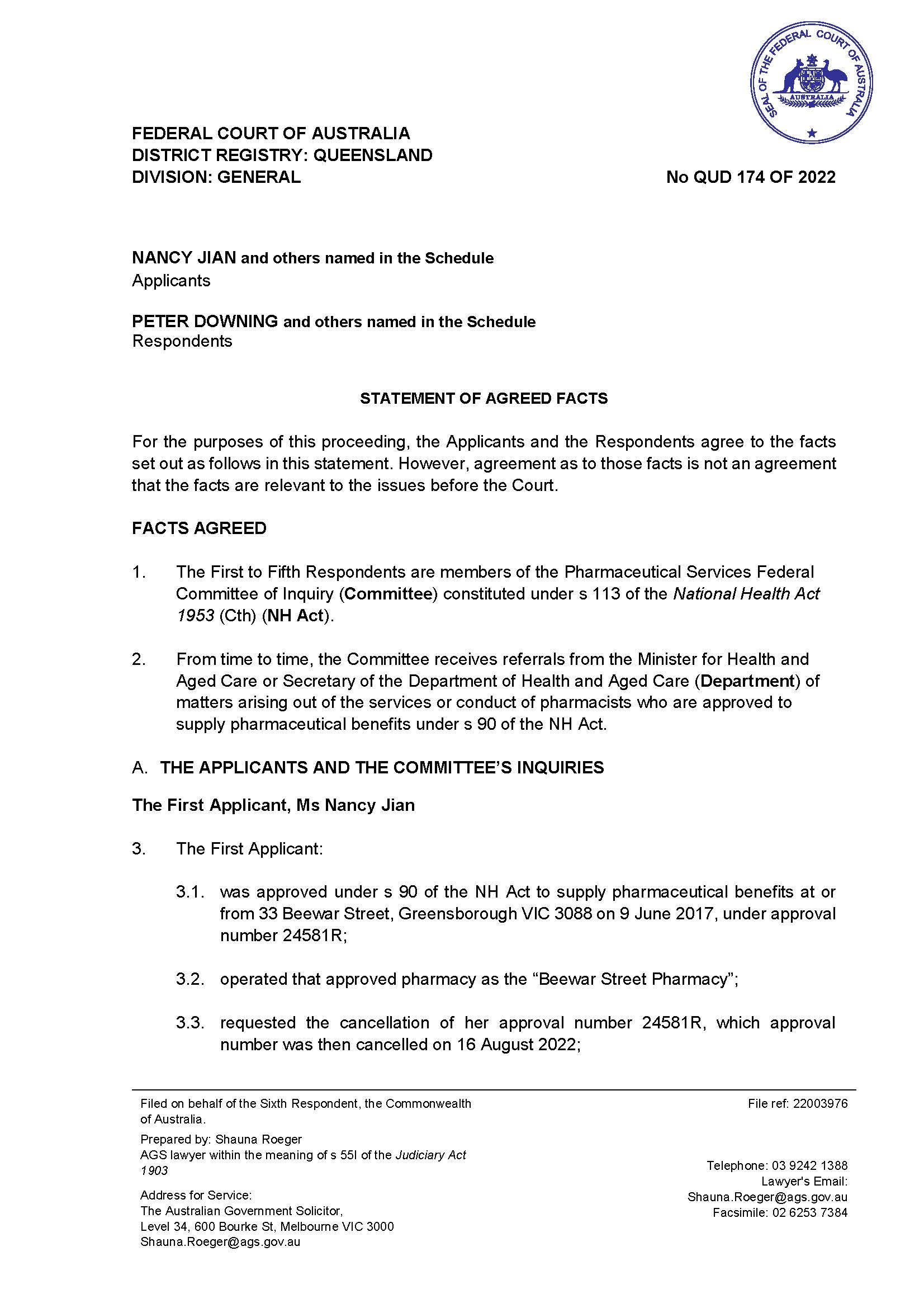
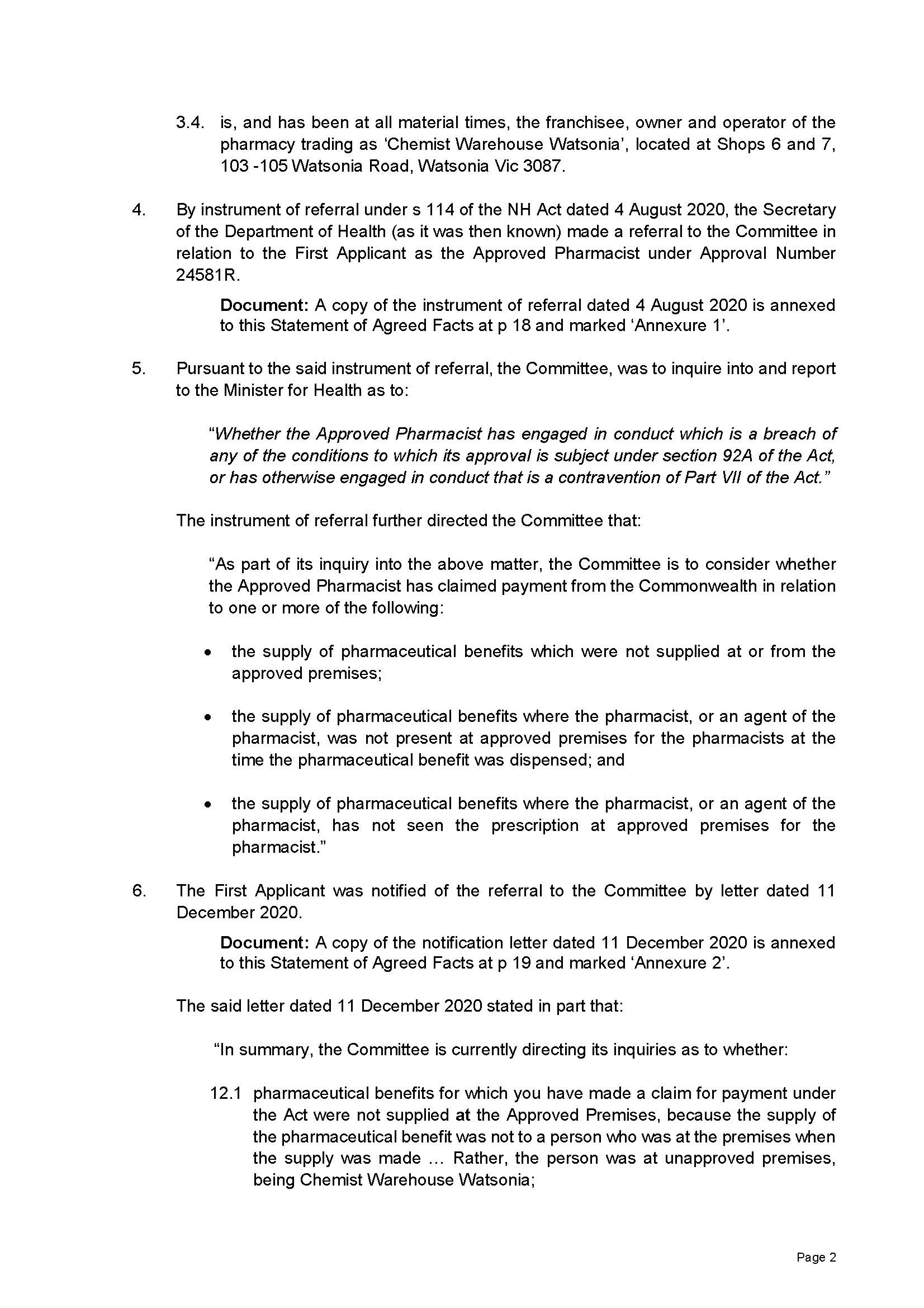
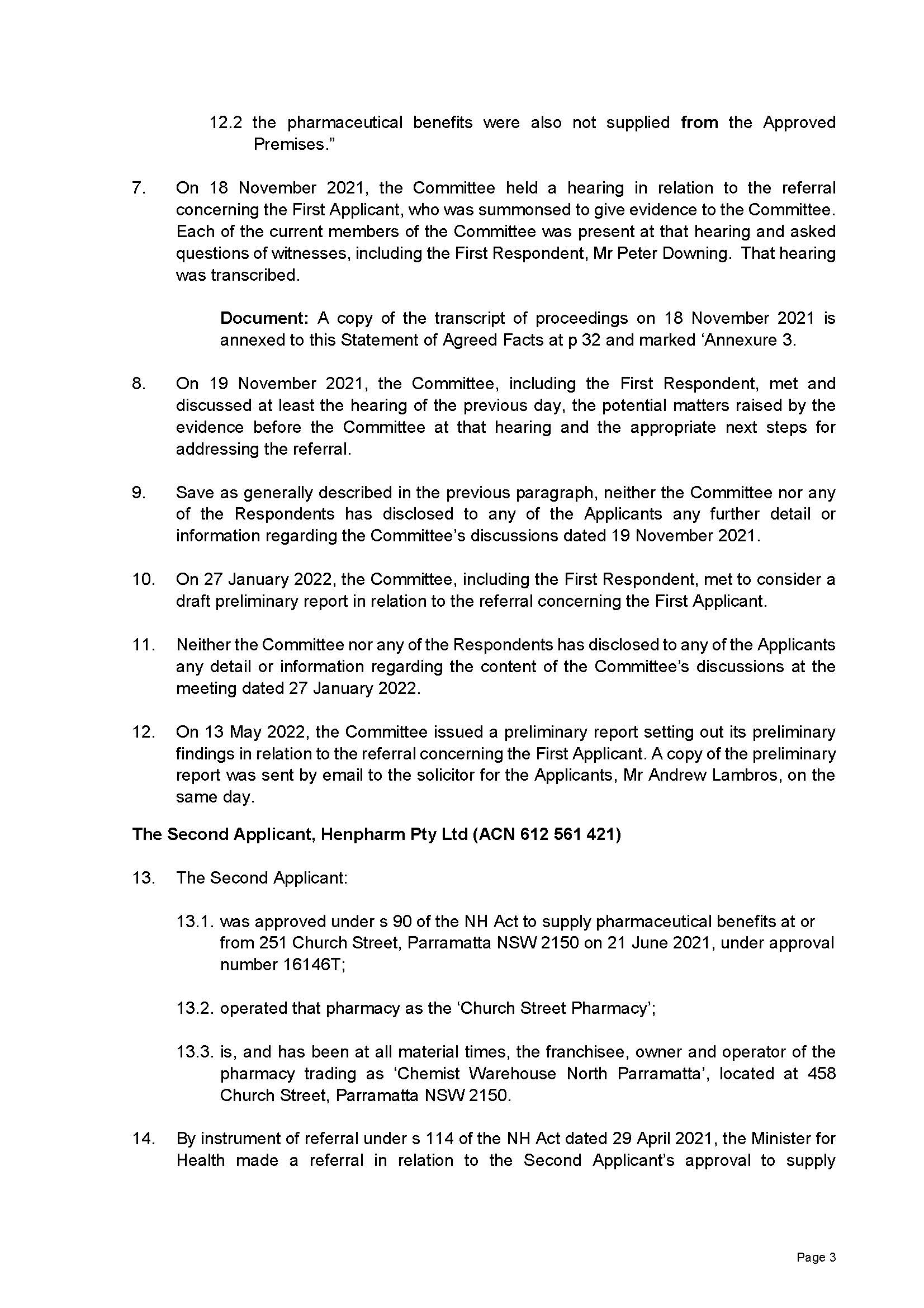
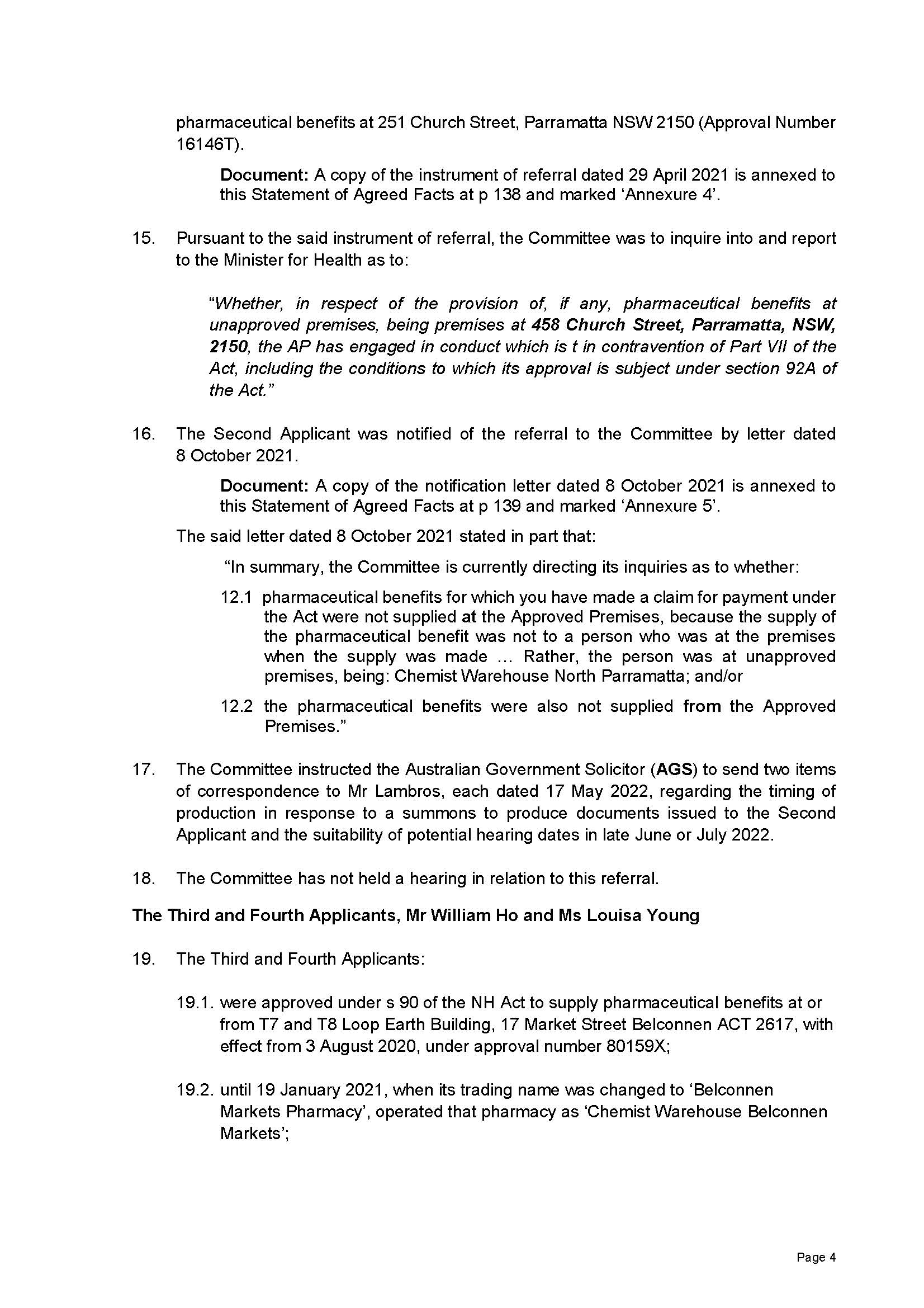
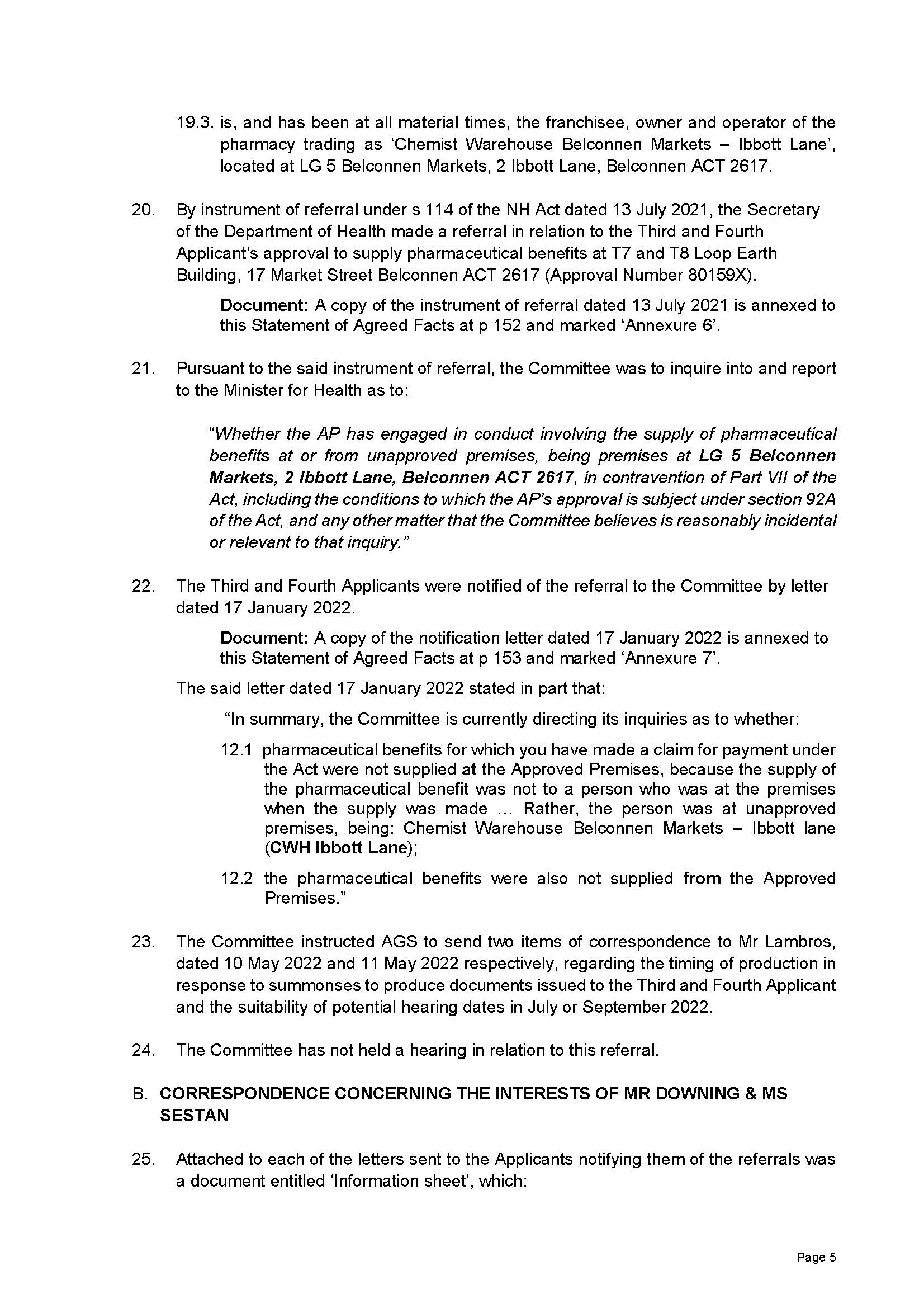
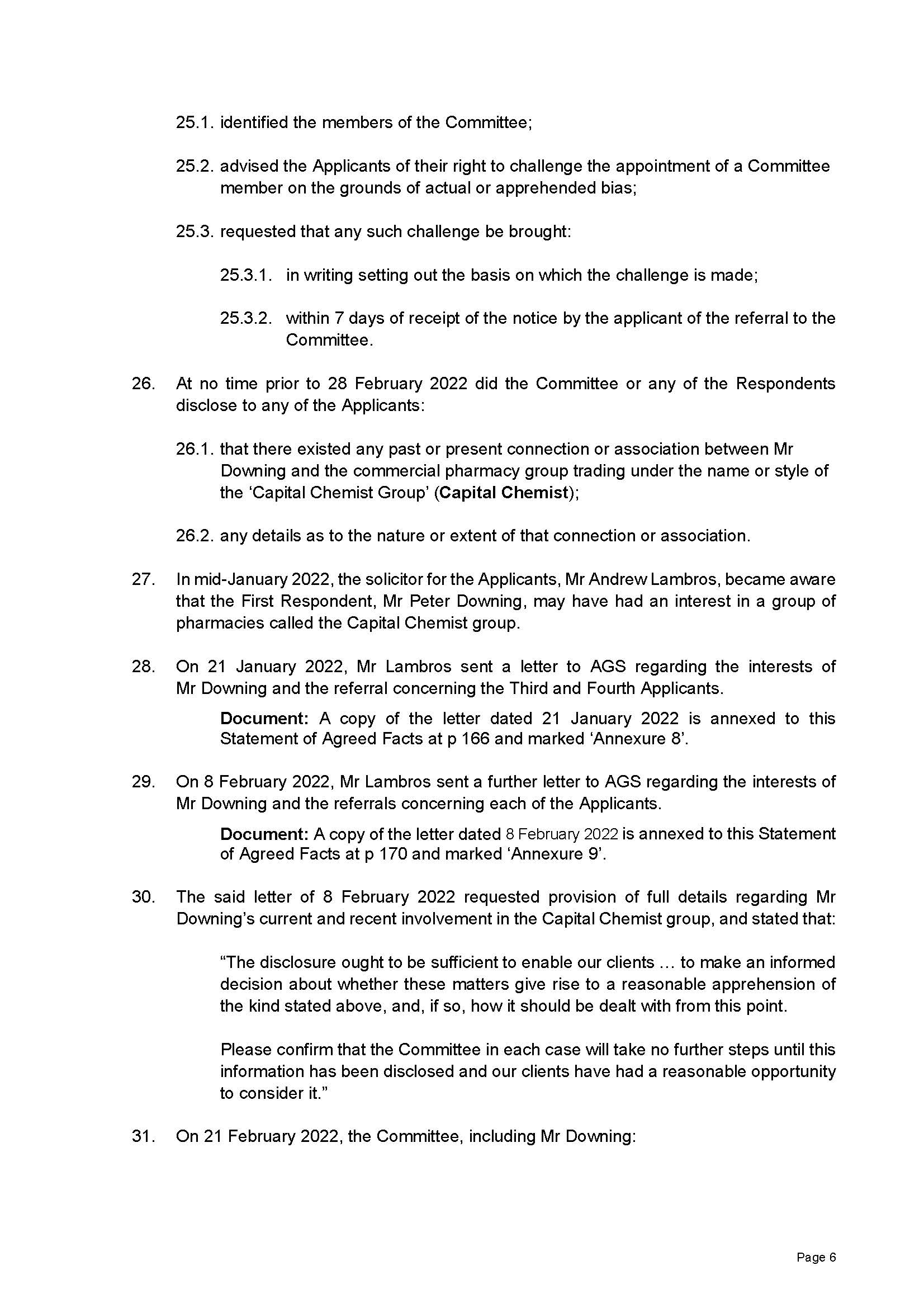
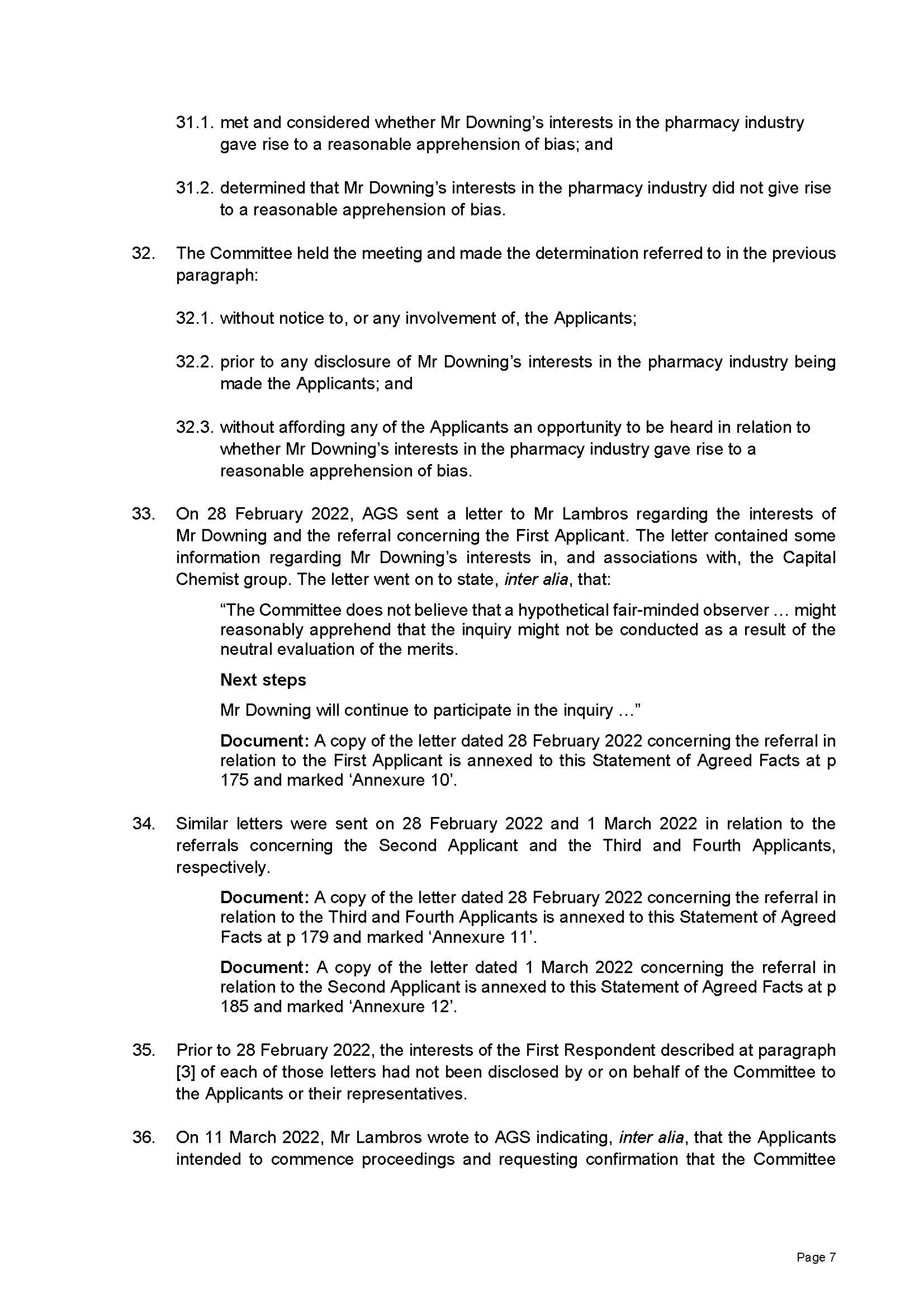
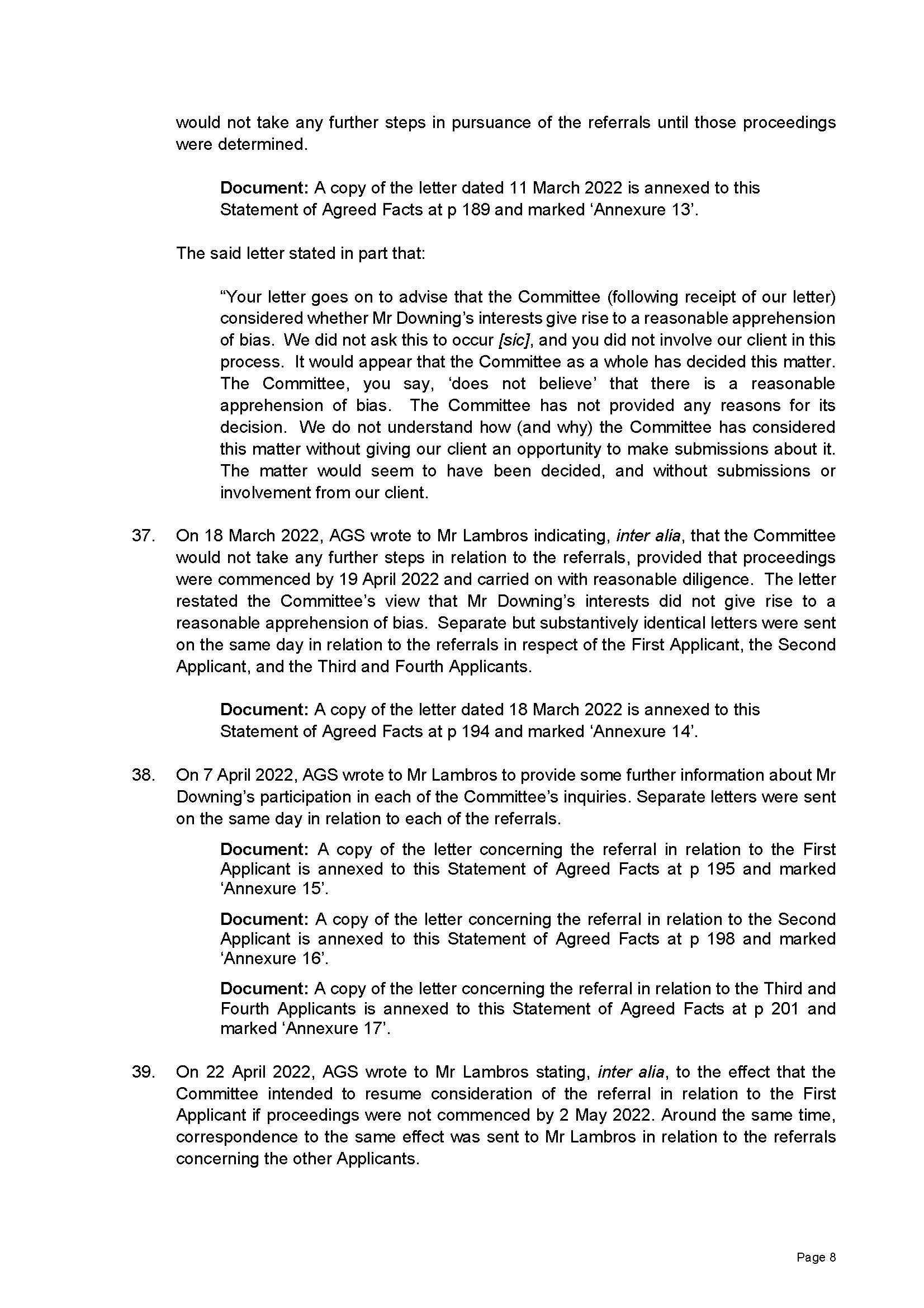
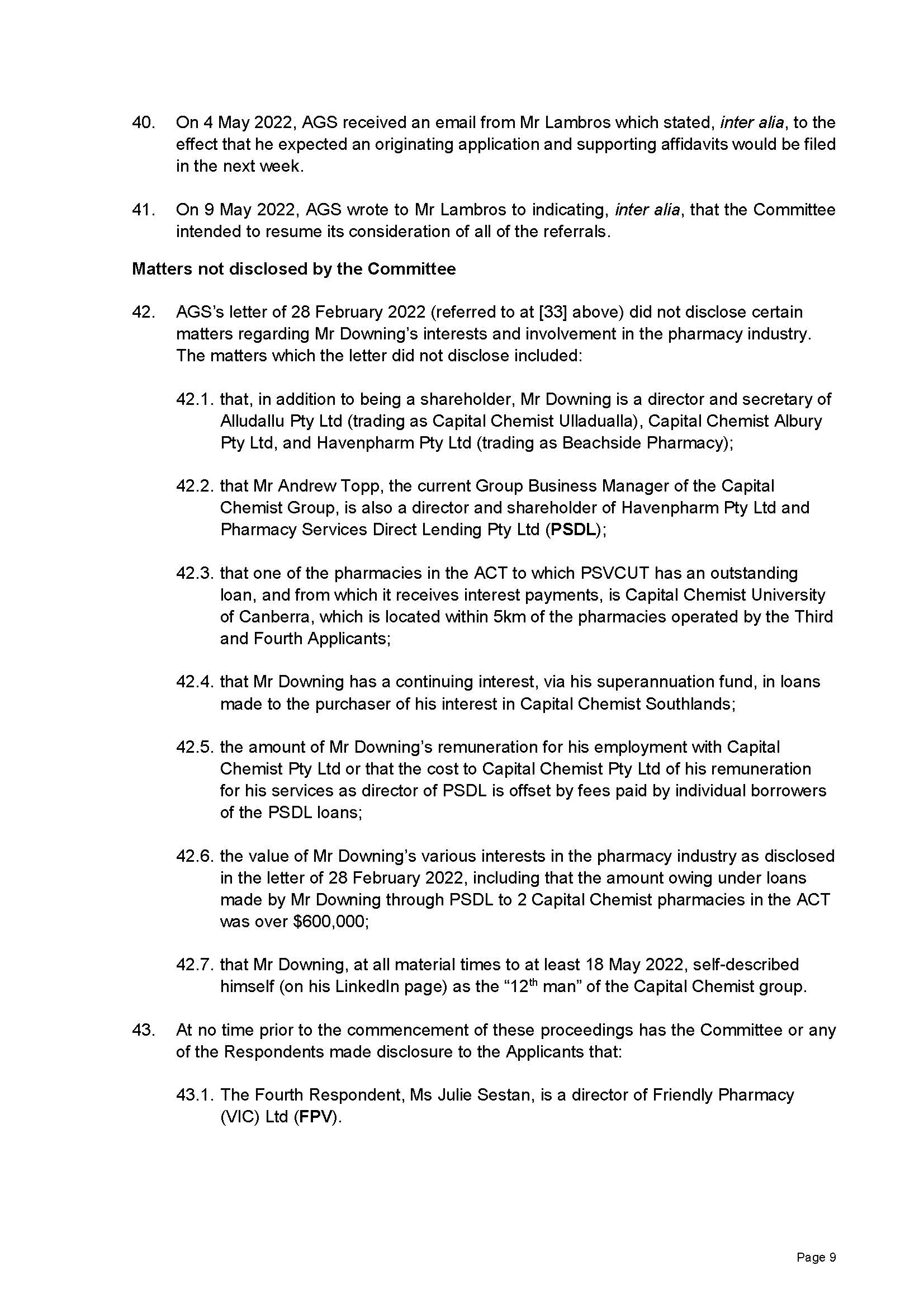
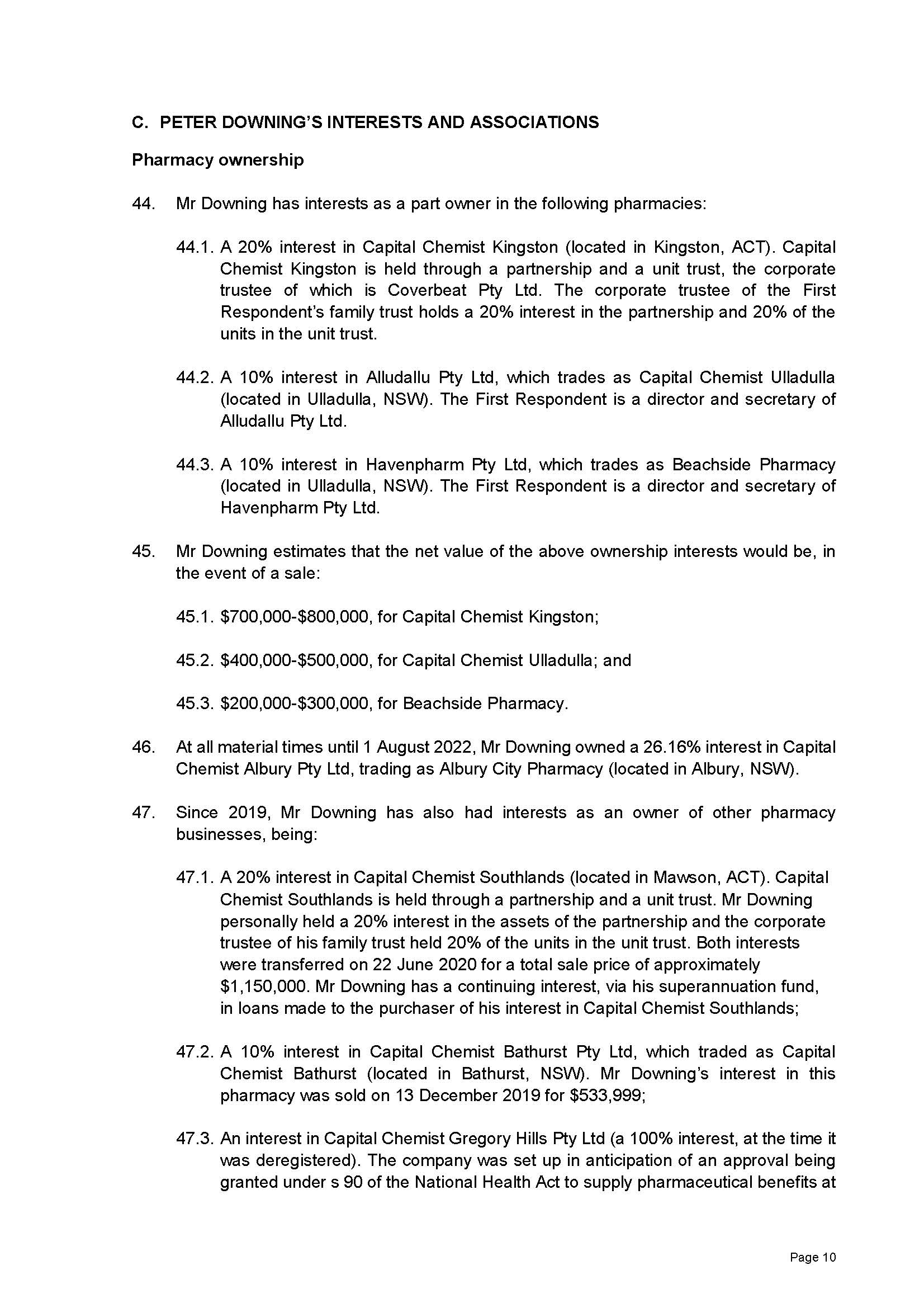
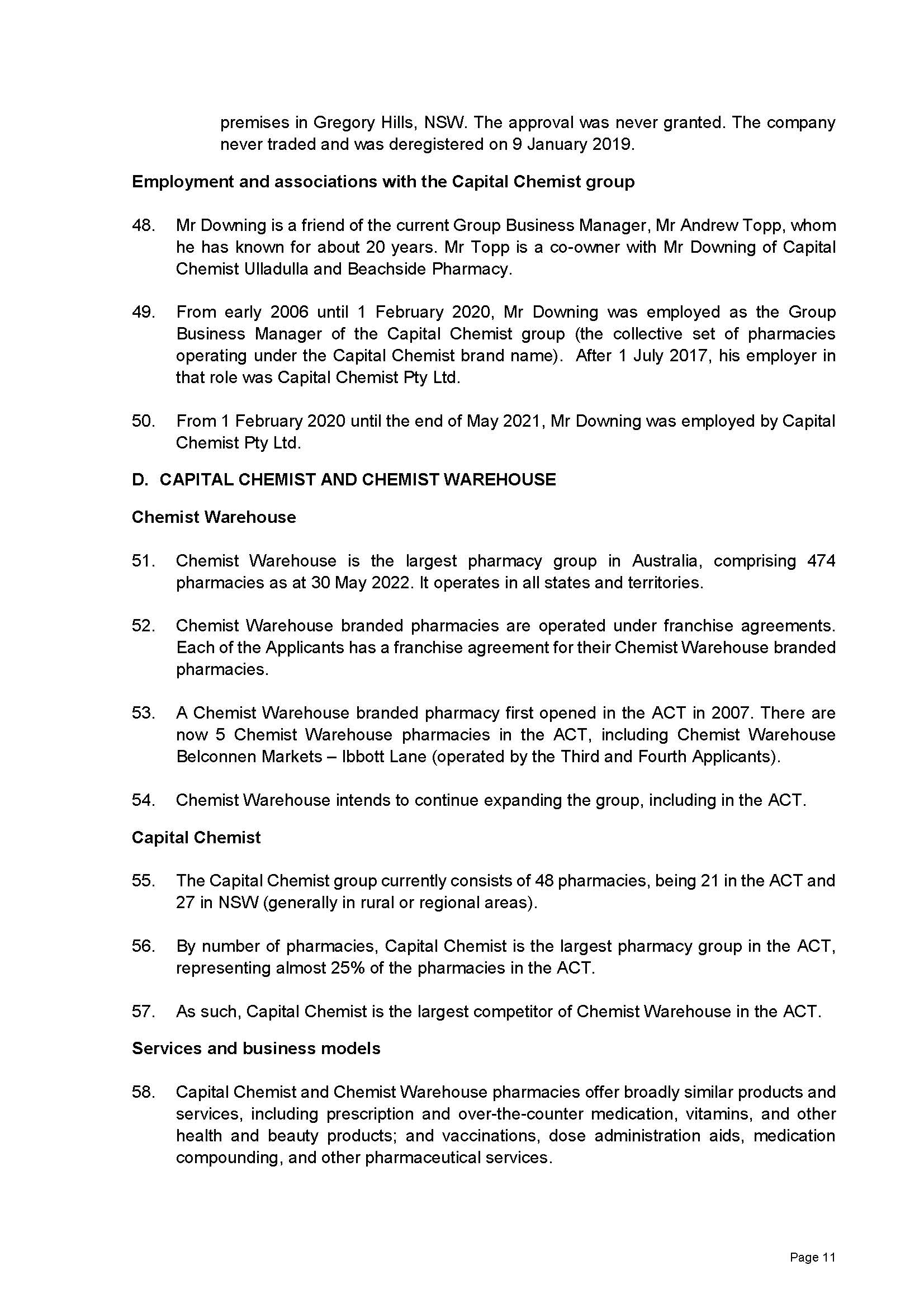
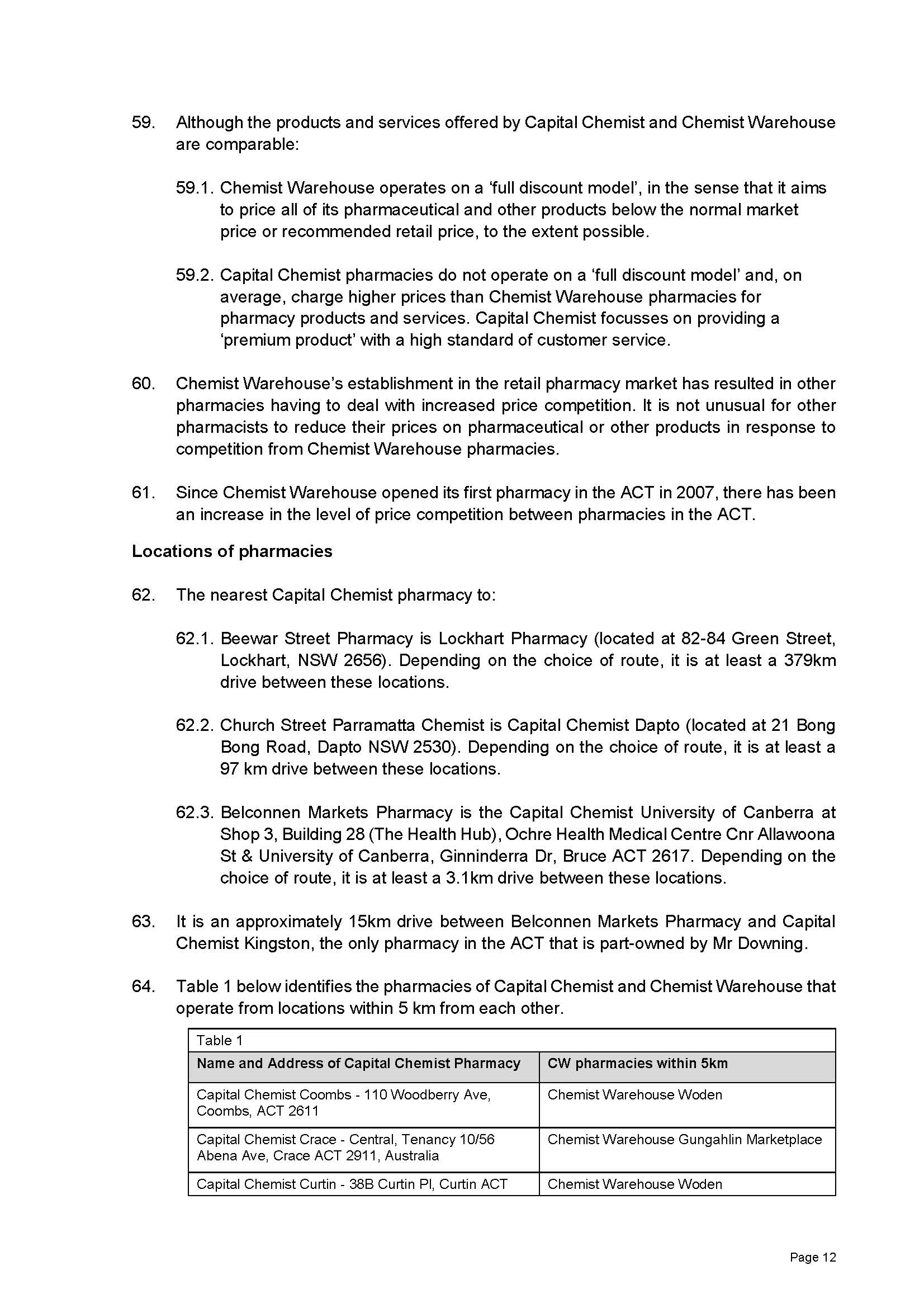
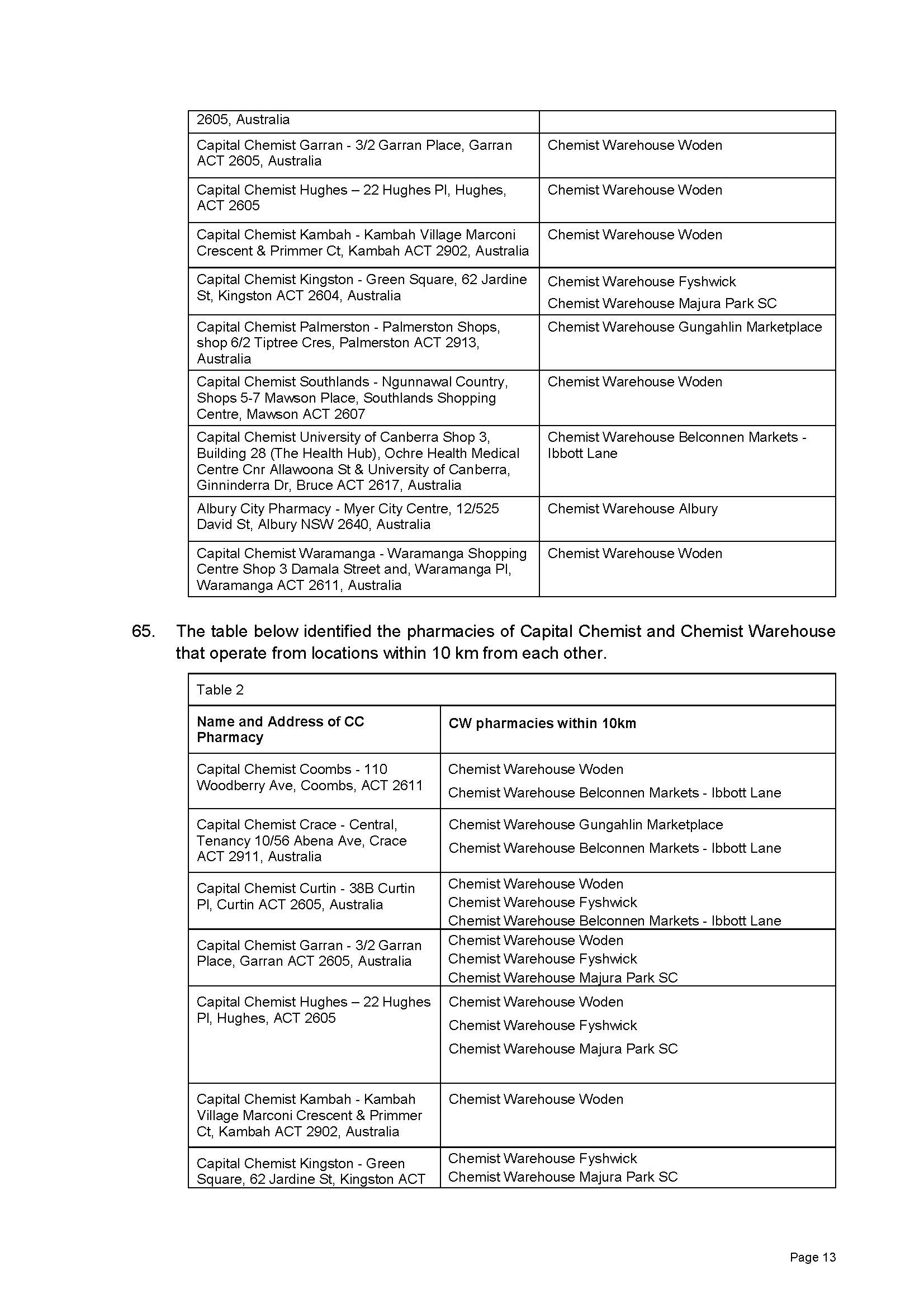
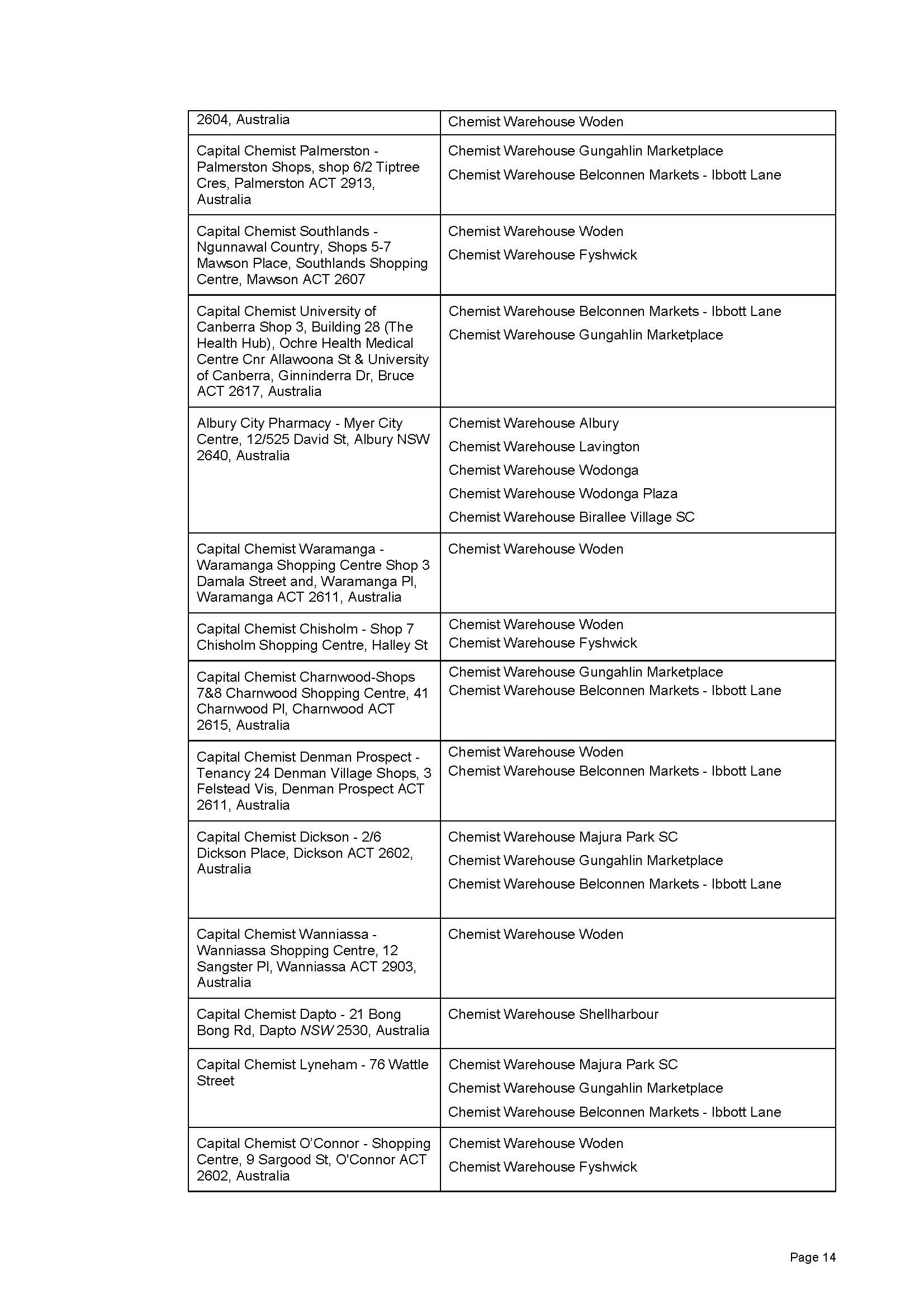
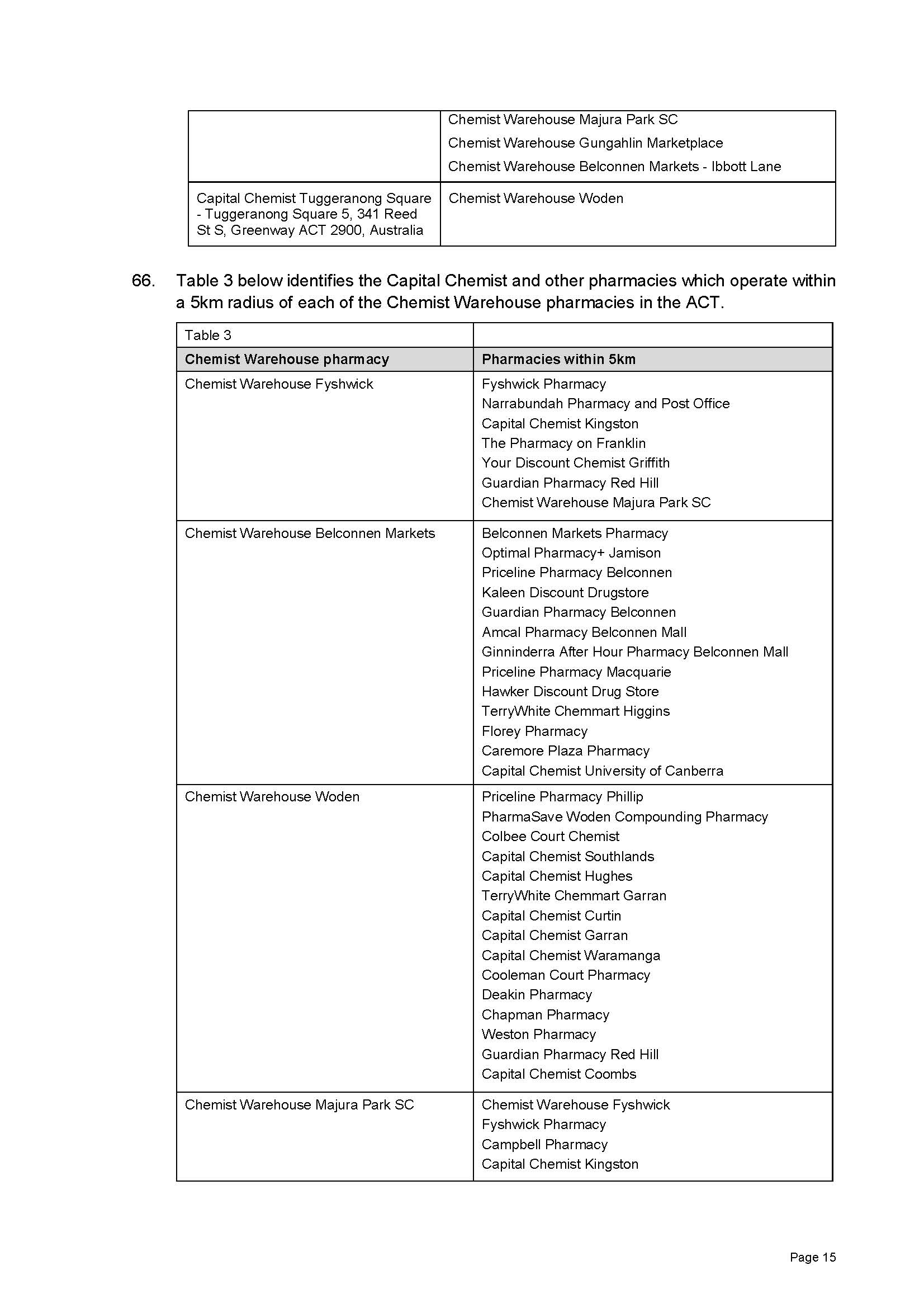
annexure B
Statement of Further Agreed Facts