

Federal Court of Australia
Dimer on behalf of the Marlinyu Ghoorlie Claim Group v State of Western Australia [2023] FCA 930
ORDERS
HENRY DIMER (and others named in the schedule) Applicant | ||
AND: | STATE OF WESTERN AUSTRALIA (and others named in the schedule) Respondents | |
DATE OF ORDER: |
the court notes that:
A. Orders have been made in each of this proceeding (the Marlinyu Ghoorlie proceeding) and proceeding WAD 38 of 2022 (the Karratjibbin proceeding) that:
(a) a separate question as to the holding of native title rights and interests be listed for hearing and determination separately from any issues of extinguishment of native title; and
(b) to the extent that the land and waters the subject of the native title claims in each proceeding overlap, the Marlinyu Ghoorlie proceeding and the Karratjibbin proceeding be heard together as one proceeding in relation to the separate question.
THE COURT ORDERS THAT:
1. The interlocutory application dated 6 June 2023, by which Sharmain Nelson, Reginald Hayden and Michael Hayden applied to be joined as parties to this proceeding, be dismissed.
2. If a party to this proceeding wishes to make a submission that Sharmain Nelson, Reginald Hayden and Michael Hayden should cease to be respondents to the Karratjibbin proceeding, the submission is to be filed and served (including on Sharmain Nelson, Reginald Hayden and Michael Hayden) by 18 August 2023.
3. Sharmain Nelson, Reginald Hayden and Michael Hayden may file any submission in reply by 1 September 2023.
4. The Court will determine whether Sharmain Nelson, Reginald Hayden and Michael Hayden should cease to be respondents to the Karratjibbin proceeding on the papers unless any party states in their submissions that they seek an opportunity to make oral submissions.
5. That part of the interlocutory application dated 2 June 2023 by which the First Respondent applied to remove Gary Cooper, Maria Bandry, Norman Cooper and Victor Cooper (the Cooper respondents) as parties to the proceeding be adjourned indefinitely, with liberty to apply.
6. That part of the interlocutory application dated 2 June 2023 by which the First Respondent applied to remove Elizabeth Sambo as a party to the proceeding be dismissed.
7. By 18 August 2023, the Applicant and the First Respondent may file and serve on the Cooper respondents a request for further and better particulars of their concise statement.
8. By 1 September 2023, the Cooper respondents are to file and serve a response to any request for further and better particulars.
9. The First Respondent has general liberty to re-apply under that part of the interlocutory application dated 2 June 2023 by which the First Respondent applied to remove the Cooper respondents as parties to the proceeding.
Note: Entry of orders is dealt with in Rule 39.32 of the Federal Court Rules 2011.
O’BRYAN J:
Introduction
1 The applicant to this proceeding claims native title rights and interests on behalf of the Karlamaya (Kalamaia) Kapurn (Gubrun, Kaparn) people, also known as Karlaku (Kalaako, Kalarku) people (Karlamaya Kapurn people) in respect of an area located in the Western Goldfields region of Western Australia (the Marlinyu Ghoorlie claim). Broadly described, the claim area takes in Kalgoorlie in the east and extends past Kalannie in the west and Southern Cross to the south.
2 Part of the area the subject of the Marlinyu Ghoorlie claim is also the subject of a second native title application which is made on behalf of the Karratjibbin people (Karratjibbin claim). The Karratjibbin claim area is wholly within the Marlinyu Ghoorlie claim area. It shares the western boundary of the Marlinyu Ghoorlie claim and extends east past Southern Cross, but does not extend as far as Coolgardie or Kalgoorlie.
3 The Marlinyu Ghoorlie claim and the Karratjibbin claim are set down for trial commencing in October 2023 in respect of separate questions which can be stated as follows:
(a) But for any question of extinguishment of native title, does native title exist in relation to any and, if so what, land and waters of the claim areas?
(b) In relation to that part of the claim areas where the answer to (a) above is in the affirmative:
(i) Who are the persons, or each group of persons, holding the common or group rights comprising the native title?
(ii) What is the nature and extent of the native title rights and interests?
4 In both proceedings, a number of respondent parties oppose the applicants’ claims on the basis of competing native title rights and interests.
5 These reasons concern two interlocutory applications made in this proceeding for, respectively, the removal and joinder of parties pursuant to s 84 of the Native Title Act 1993 (Cth) (the Act). By the first interlocutory application dated 2 June 2023, the first respondent, the State of Western Australia, seeks the removal of Mr Gary Cooper, Ms Maria Bandry, Mr Norman Cooper and Mr Victor Cooper (together, the Cooper respondents), and Ms Elizabeth Sambo as respondents to the proceeding pursuant to s 84(8) of the Act. By the second interlocutory application dated 6 June 2023 (but not filed until 21 June 2023), Ms Sharmain Nelson, Mr Reginald Hayden and Mr Michael Hayden (joinder applicants) seek to be joined as respondents to this proceeding pursuant to s 84(5) of the Act.
6 The interlocutory applications were heard together on 24 July 2023.
7 For the reasons explained below, I am not satisfied that the Court should exercise its discretion under the Act to join the joinder applicants as parties to the proceeding. Accordingly, that application will be dismissed. I will also invite further submissions on the question whether the joinder applicants should remain as respondents to the Karratjibbin proceeding. In relation to the application brought by the State for the removal of the Cooper respondents and Ms Sambo as respondents to the proceeding, I am not persuaded that an order for removal should be made. However, in the case of the Cooper respondents, I consider it appropriate to make further directions to enable the Marlinyu Ghoorlie applicant and the State to request further and better particulars of the Cooper respondents’ concise statement and for any such request to be answered. The State will have liberty to apply to re-agitate its application for the removal of the Cooper respondents after further particulars have been provided.
Background
Marlinyu Ghoorlie claim
8 The Marlinyu Ghoolie claim was filed on 22 December 2017 and entered on the Register of Native Title Claims on 28 March 2019. The claim was notified by the Native Title Registrar with a notification date of 14 August 2019. As such, it was open to persons with a sufficient interest in the proceeding to join as respondents by filing a form with the Court, pursuant to s 84(3) of the Act, by 13 November 2019.
9 The claim group comprises those persons who: are descended from one or more of four apical ancestors, being Nellie Champion, Kadee, Warada, and Lucy Sambo, or those persons and their descendants who have been incorporated into the rights-holding group in accordance with its traditional laws and customs; who identify as Kalamaia, Gubrun, Kapurn and/or Kalaako (including alternate spellings of these names, or any combination of them); and who are recognised by other members of that group.
10 The land and waters the subject of the Marlinyu Ghoorlie claim comprises an area in the Western Goldfields region that is approximately 89,797 square kilometres in size. The claim area is depicted in the map which forms Annexure A to these reasons. The map, which was attached to the further amended native title determination application filed by the Marlinyu Ghoorlie applicant in this Court on 22 June 2023, reflects the claim area at that date.
11 In respect of parts of the claim area that are unaffected by the extinguishment of native title, are not subject to certain public rights, and do not have certain other characteristics, the Marlinyu Ghoorlie applicant claims exclusive rights of possession, use and enjoyment, which encompass rights to control access to the claim area, to protect and make decisions about sites in the claim area, and to take and use resources of the claim area. In respect of all other parts of the claim area, the Marlinyu Ghoorlie applicant claims certain non-exclusive rights, including rights to live on, pass through and engage in cultural activities, and the transmission of cultural knowledge in those areas, and rights to use the traditional resources of waters of those areas.
Maduwongga claim
12 On 21 April 2017, prior to the filing of the Marlinyu Ghoorlie claim, a native title claim was filed in proceeding WAD 186 of 2017 on behalf of a group of people called the Maduwongga, which was said to comprise a distinct land-holding group descended from one apical ancestor (referred to as “KB”) (Maduwongga claim). The Maduwongga claim was registered on the Register of Native Title Claims from 3 August 2017 to 1 May 2023.
13 The area the subject of the Maduwongga claim was situated in the Goldfields region of Western Australia, and was more than 25,000 square kilometres in size. The claim area stretched from its south-western corner near Coolgardie to a north-eastern boundary by the Edjudina Range. Relevantly, the claim area overlapped in the south-west with the Marlinyu Ghoorlie claim, and in the north-east with a claim seeking a determination of native title rights and interests on behalf of the Nyalpa Pirniku claim group.
14 In late 2020 and early 2021, this Court heard evidence and submissions on a separate question, which was intended to determine a dispute between the Maduwongga applicant and the Nyalpa Pirniku respondent as to who held native title rights and interests in relation to the overlap area between the Maduwongga claim and the Nyalpa Pirniku claim.
15 By orders made on 27 March 2023, the Court determined that the apical ancestor of the Maduwongga applicant, KB, held rights and interests in the relevant overlap area under the normative system of traditional laws and customs of the Western Desert, but not under the normative system of a distinct land-holding group of which KB’s descendants are the only identifiable surviving members: Strickland on behalf of the Maduwongga Claim Group v State of Western Australia [2023] FCA 270. As a result of that decision, the Maduwongga claim was dismissed.
Karratjibbin claim
16 The Karratjibbin native title claim was filed in proceeding WAD 38 of 2022 on 18 February 2022, and was subsequently amended on 2 September 2022. On 11 November 2022, a delegate of the Native Title Registrar declined to register the amended application on the Register of Native Title Claims on the basis that it did not satisfy certain conditions for registration set out in ss 190B and 190C. The claim was notified by the Native Title Registrar on 22 March 2023. The notification period ended on 21 June 2023. It is relevant to note that, on 13 June 2023, each of Ms Sharmain Nelson, Mr Reginald Hayden and Mr Michael Hayden (referred to above in respect of the Marlinyu Ghoorlie proceeding as the joinder applicants) filed a notice of intention to become a party to the Karratjibbin proceeding pursuant to s 84(3) of the Act.
17 The Karratjibbin claim is made on behalf of all those persons who are biological descendants of Karratjibbin traditional owners and apical ancestors Polly, Billy Yambinut, Eva, Nimmo and Toby, or who have been adopted by one or more of those biological descendants in accordance with the traditional laws and customs of the Karratjibbin people.
18 In its amended form, the Karratjibbin claim concerns the land and waters within an area of more than 49,600 square kilometres. The claim area takes in Southern Cross to the south, Mukinbudin and Kalannie to the west and Mt Jackson to the north. It forms a smaller part of, and is wholly overlapped by, the Marlinyu Ghoorlie claim area. However, the Karratjibbin claim did not overlap with the Maduwongga claim prior to its dismissal. The Karratjibbin claim area is depicted in the map which forms Annexure B to these reasons. The map, which was attached to the amended native title determination application filed by the Karratjibbin applicant in this Court on 9 September 2022, reflects the claim area at that date.
19 In respect of parts of the claim area that are unaffected by the extinguishment of native title, the Karratjibbin applicant claims exclusive rights of possession, occupation, use and enjoyment. In respect of all other parts of the claim area, the Karratjibbin applicant claims certain non-exclusive rights, including rights to remain on, pass through, make decisions in relation to, and engage in cultural activities and the transmission of cultural knowledge in, those areas, and as well as rights to use the traditional resources of the land and waters for any purpose.
20 The interlocutory applications that are the subject of these reasons were filed in the Marlinyu Ghoorlie proceeding. The Karratjibbin applicant did not seek to be heard in respect of those applications.
Procedural history
21 On 5 October 2022, Bromberg J relevantly made the following orders in each of the Marlinyu Ghoorlie, Maduwongga and Karratjibbin proceedings:
(a) That the following separate question be listed for hearing and heard separately from any issues of extinguishment of native title:
Who are the holders of native title rights and interests in accordance with s 223 of the Native Title Act 1993 (Cth) in relation to the land and waters covered by the Marlinyu Ghoorlie native title determination application (WAD 647 of 2017)?
(b) That the Marlinyu Ghoorlie native title determination application, the Karratjibbin native title determination application and the Maduwongga native title determination application be heard together as one proceeding in relation to the separate question.
22 On 22 December 2022, timetabling orders for the hearing of the separate question were made in each of the proceedings. Relevantly, the orders provided for:
(a) the hearing of opening submissions and Aboriginal and other lay evidence in October 2023, followed by the hearing of expert evidence and closing oral submissions in early 2024;
(b) the filing of concise statements describing the facts and issues in relation to the identity of those persons who hold common or group rights comprising the native title in the land and waters of the trial area and the nature and extent of those rights and interests by mid-March 2023 (in respect of each applicant) and by the end of March 2023 (in respect of the State and any participating respondent);
(c) the filing of expert witness reports by the end of May 2023 (in respect of the applicants’ expert evidence) and by the end of September 2023 (in respect of the participating respondents’ expert evidence); and
(d) the filing of lay witness statements of evidence and other documents to be tendered through each lay witness by the end of June 2023 (in respect of the applicants’ evidence) and mid-July 2023 (in respect of the participating respondents’ evidence).
23 The effect of the above orders, in so far as it concerned the filing of concise statements, was to make clear that the separate question included the questions:
(a) Who are the persons, or group of persons, holding the common or group rights comprising the native title in the land and waters of the trial area?
(b) What is the nature and extent of the native title rights and interests?
24 In February 2023, on application by the Marlinyu Ghoolie applicant and Ms Elizabeth Sambo in the Marlinyu Ghoorlie proceeding, and by the Maduwongga applicant in the Maduwongga proceeding, Bromberg J received oral and written preservation evidence from three individuals. Those individuals were Brian Champion Snr (the former lead applicant in the Marlinyu Ghoorlie proceeding), Gary Sambo (the brother of Elizabeth Sambo, a respondent in the Marlinyu Ghoorlie proceeding), and Anne Joyce Nudding (the second named applicant in the Maduwongga proceeding). The preservation evidence was heard on country in Kalgoorlie over 4 days. That evidence concerned three of the central issues in this proceeding, including: whether the Karlamaya Kapurn people hold native title rights and interests in the whole of Marlinyu Ghoorlie claim area (to which I will refer, in these reasons, as the trial area); the composition of the Karlamaya Kapurn rights-holding group and, in particular, whether that group includes the Champion family; and whether the claim area extends to the west of Southern Cross.
25 As noted above, on 28 April 2023, Bromberg J made orders dismissing the Maduwongga proceeding. Accordingly, the Karratjibbin claim remains the only other native title determination application on foot in respect of the claim area the subject of this proceeding.
Opposition of Elizabeth Sambo
26 By orders of Judicial Registrar Daniel made on 25 November 2019, Ms Sambo became a respondent to this proceeding, having given notice in the prescribed form of her intention to become a party on 4 October 2019, within the notification period. Since that time, Ms Sambo has been actively involved in the proceeding.
27 Ms Sambo identifies as a member of the Kaparn people, which can be alternatively described as “Kapurn”, “Gubrun”, “Kaboon”, “Kabul” and “Kabu(d)n”. For consistency with the spelling adopted by the Marlinyu Ghoorlie applicant, and on the basis that the alternative spellings are interchangeable, I will refer in these reasons to the “Kapurn” people, where relevant. Ms Sambo contends that “Kalamaia” was a word within the Kapurn language, but does not accept that it is a descriptive term for the Kapurn people or any other group who held interests within the trial area at sovereignty. Through her ancestor, Lucy Sambo, she falls within the Marlinyu Ghoorlie claim group as defined. However, Ms Sambo opposes the Marlinyu Ghoorlie claim. Having regard to Ms Sambo’s case as stated in her concise statement filed on 28 April 2023, the bases for her opposition are twofold. First, Ms Sambo contests the extent and boundaries of the area the subject of the Marlinyu Ghoorlie claim, in respect of which the Kapurn people hold native title rights and interests. Second, Ms Sambo disputes the composition of the claim group as constituted in the Marlinyu Ghoorlie application.
28 As to the extent of the Marlinyu Ghoorlie claim area, Ms Sambo contends that the Kapurn people hold native title rights and interests in an area that encompasses the eastern boundary of the trial area from Widigiemooltha, extending north-east to just below Mulline, continuing north to Diemals, then to the west taking in Bullfinch and Southern Cross and finally continuing south to Parker Range. A map indicating the extent of this area by reference to the trial area, which forms part of the affidavit of Ms Sheila Begg dated 2 June 2023, is annexed to these reasons in Annexure C. This area comprises a portion of the trial area. Ms Sambo also contends that the eastern external boundary of this area in fact extends beyond the trial area, but accepts that this is beyond the scope of the separate question. Ms Sambo further contends that three groups hold native title rights in respect of other parts of the trial area: the Ballardong people (of the Noongar nation), the Badimaia people and the Ngadju people. Except to their geographic extent, Ms Sambo advances no position as to the nature and extent of the native title rights and interests of these groups.
29 As to the composition of the Marlinyu Ghoorlie claim group, Ms Sambo contends that the rights and interests of the Kapurn people are derived through descent from three apical ancestors, Lucy Sambo, Kadee and Warada, and not through Nellie Champion, contrary to the claim made by the Marlinyu Ghoorlie applicant. Ms Sambo contends that, at sovereignty, the rights and interests in land and waters held by the descendants of Nellie Champion were held under the normative system of laws and customs observed by the Ballardong/Noongar people. By contrast, the rights and interests held by the descendants of Lucy Sambo, Kadee and Warada were held under the normative system of laws and customs observed by the Kapurn people. These comprise two distinct and autonomous systems of laws and customs. Consequently, the rights and interests held by the descendants of Lucy Sambo, Kadee and Warada in the area identified by Ms Sambo are held exclusively from the rights and interests held by the descendants of Nellie Champion within the trial area.
30 Ms Sambo also disputes the claims made by other respondents in this proceeding, including those of the Cooper respondents.
Opposition of the Cooper respondents
31 By amended interlocutory application dated 21 December 2022, the Cooper respondents sought to be joined to this proceeding pursuant to s 84(5) of the Act, having not otherwise sought to be joined during the notification period. The application was, in substance, unopposed by any party to the proceeding and, on 20 February 2022, Bromberg J made orders for their joinder.
32 By their concise statement filed on 28 April 2023, the Cooper respondents contend that they hold native title rights and interests in the eastern portion of the trial area, which encompasses Bullabulling, Coolgardie, Kalgoorlie and Kanowna, and that the Marlinyu Ghoorlie claim group do not hold any such native title rights and interests in that area. The native title rights and interests claimed by the Cooper respondents include rights to access and use lands and waters, to speak for country, and to protect sacred sites. The Cooper respondents contend that they acquired native title rights and interests in respect of the relevant area by descent from their apical ancestor Nada Bilbear (also known as Aneida). Nada Bilbear is said to be a member of a pre-sovereignty society, the “original tribe of Kalgoorlie”, that held native title rights and interests in the eastern part of the trial area at the time of effective sovereignty. That society is separate and distinct from those which are asserted by the Marlinyu Ghoorlie and Karratjibbin applicants respectively, as well as from the peoples, laws and customs of the Western Desert. That society occupied part of an “interstitial zone” where, at effective sovereignty, the societies of the Western Desert peoples to the east, northeast and north met the societies to the west, southwest and south, which included the Kapurn, among others.
33 The Cooper respondents acknowledge that, in the present proceeding, they seek only to defensively assert their native title rights and interests as respondents. They do not seek a positive determination of their native title rights and interests, recognising that in order to seek such a determination they would be required to make an application of the kind listed in s 61(1) of the Act.
Statutory framework governing joinder and removal of parties
34 Section 84 of the Act governs the joinder and removal of parties to a proceeding in relation to which s 61 applies. This proceeding is a native title determination application to which s 61 applies. I recently explained the principles governing the application of s 84 in Wilson on behalf of the Wirangu People v State of South Australia [2022] FCA 829 (Wilson) at [8]-[21] and Weetra on behalf of the Nauo People v State of South Australia [2022] FCA 828 (Weetra) at [14]-[20]. The following section draws on, and summarises, the principles set out in Wilson and Weetra. Except in some limited respects, these principles were not in dispute in the present applications.
Joinder
35 Subsections 84(2) to (4) of the Act provide for the joinder of parties to a proceeding at, or shortly after, the commencement of a proceeding. Subsection (2) stipulates that the applicant is a party to the proceeding. Subsection (4) stipulates that, if any of the area covered by the application is within the jurisdictional limits of a State or Territory, the State Minister or Territory Minister for the State or Territory is a party to the proceedings unless the Minister gives the Federal Court written notice (within a designated period) that the Minister does not want to be a party. Subsection (3) enables third parties, who have or claim interests of a specified kind in respect of the area covered by the application, to be joined as a party to the proceeding by filing a notice in the Federal Court within the period specified in the notice given in respect of the application under s 66. Relevantly, subs (3) applies to any person who claims to hold native title in relation to land or waters in the area covered by the application or whose interest, in relation to land or waters, may be affected by a determination in the proceedings.
36 The phrase “interest, in relation to land or waters” as used in subs (3) is defined in s 253 as follows:
(a) a legal or equitable estate or interest in the land or waters; or
(b) any other right (including a right under an option and a right of redemption), charge, power or privilege over, or in connection with:
(i) the land or waters; or
(ii) an estate or interest in the land or waters; or
(c) a restriction on the use of the land or waters, whether or not annexed to other land or waters.
37 Regulation 6 of the Native Title (Federal Court) Regulations 1998 (Cth) (Regulations) provides that a notice under s 84(3) of the Native Title Act “may be in accordance with Form 5”, which form is annexed in the Schedule to the Regulations.
38 The Act contains procedures for the public notification of native title applications, the purpose of which is “to ensure, so far as appropriate, that any person who is properly interested in the potential outcome of a native title determination application is given the opportunity to participate in the conduct of that application”: CG v Western Australia (2016) 240 FCR 466 at [21] (North, Mansfield, Jagot and Mortimer JJ). Once an application under s 61 is filed with the Federal Court, s 63 requires the Court to provide a copy of the application to the Native Title Registrar. In turn, s 66 requires the Native Title Registrar to provide copies of the application to specified persons, including the relevant State or Territory Minister and the representative bodies for the area covered by the application. Section 66(3) requires the Registrar also to give notice of the details of the application to specified bodies to notify the public of the application. The public notification must specify a day as the “notification day” and is also required to include a statement to the effect that a person who wants to be a party in relation to the application must notify the Federal Court, in writing, within the period of three months starting on the notification day.
39 Section 84(5) provides a further mechanism for the joinder of a party after the commencement of a native title determination application. It provides as follows:
The Federal Court may at any time join any person as a party to the proceedings, if the Court is satisfied that the person’s interests may be affected by a determination in the proceedings and it is in the interests of justice to do so.
40 Having regard to s 84(3) and (5), it is apparent that a person whose interests may be affected by a determination in a native title proceeding is entitled to become a party to the proceeding if the person gives notice to the Court within three months of the notification of the native title application. However, if a person does not do so and seeks to become a party to the proceeding at a later point in time, s 84(5) requires the person to satisfy the Court that, first, the person’s interests may be affected by a determination in the proceeding and, second, that it is in the interests of justice to join the person as a party to the proceeding.
41 The principles which guide the exercise of the Court’s power in s 84(5) of the Act may be summarised as follows:
(a) The “interest” referred to in subs (5) is not the subject of the statutory definition of “interest, in relation to land or waters” in s 253 of the Act: Chippendale on behalf of the Wuthathi People #2 v State of Queensland [2012] FCA 310 (Chippendale) at [14] (Greenwood J). In that case, Greenwood J summarised the meaning of the word “interests” as used in subs (5) as follows (at [14])::
The interests asserted by an applicant for joinder need not be proprietary, legal or equitable in nature; must rise above an interest that an ordinary member of the public might hold; must be genuine; must reflect an affect upon the person’s interests beyond a mere emotional, conscientious or intellectual interest; and, must not lack substance: Byron Environment Centre Inc v Arakwal People (1997) 78 FCR 1; Woodridge on behalf of the Gomilaroi People v Minister for Land & Water Conservation for New South Wales (2003) 108 FCR 527; Dann (on behalf of the Amangu People) v Western Australia [2006] FCA 1249.
(b) A person who claims to hold native title rights and interests in relation to the land or waters the subject of the proceeding may have sufficient interests to justify joinder. It is not necessary for that person to have lodged a claimant application for the determination of native title under the Act: Munn (for and on behalf of the Gunggari People) v State of Queensland [2002] FCA 486 at [8] (Emmett J); Kokatha Native Title Claim v South Australia (2005) 143 FCR 544 (Kokatha) at [22], [24]-[25] (Mansfield J); Worimi Local Aboriginal Land Council v Minister for Lands (NSW) (2007) 164 FCR 181 at [10]-[11], [26] (Bennett J); and Kum Sing on behalf of Mitakoodi People # 5 v State of Queensland (No 2) [2022] FCA 248 (Kum Sing) at [14] (Perry J).
(c) A person who claims native title rights and interests in relation to the land or waters the subject of the proceeding may be joined as a respondent party to defensively assert their native title rights and interests in order to protect them from erosion, dilution or discount: Isaacs on behalf of the Turrbal People v Queensland (No 2) [2011] FCA 942 at [18] (Reeves J); Harkin on behalf of Nanatadjarra People v Western Australia [2020] FCA 1015 at [11] (Griffiths J); Blackburn v Wagonga Local Aboriginal Land Council (2021) 287 FCR 1 (Blackburn) at [54]. Such a person may not act in a representative capacity: Blackburn at [54], and they may not secure a determination of native title in their capacity as a respondent party: Commonwealth v Clifton (2007) 164 FCR 355 (Clifton) at [57]-[58].
(d) On an application for joinder, the Court is not required to embark on an assessment of contested questions of fact, or to determine on a final basis whether the applicant has an interest that may be affected by a determination of native title: Chippendale at [16]. As Greenwood J observed in Chippendale (at [16]), the question to be answered by the Court is “an analogue of whether there is a serious question of affectation of the person’s interests, to be determined”, and there must be some “factual foundation” in support of the affected interest. The Court will consider the extent to which the applicant for joinder has adduced evidence of facts capable of supporting a finding that the applicant has an interest of a kind required by s 84(5), such that a prima facie case is shown: Wakka Wakka People #2 v Queensland [2005] FCA 1578 (Wakka Wakka People #2) at [6] (Kiefel J, as her Honour then was). The evidence must rise beyond mere assertion, have some probative quality and be capable of establishing facts from which a finding of a requisite interest could be made: Sumner v State of South Australia [2014] FCA 534 (Sumner) at [25]-[26] (Mansfield J).
(e) An applicant for joinder must assert more than a remote or insubstantial interest, and it is only those persons whose interests are “genuinely, demonstrably and not indirectly affected by a determination of native title” who ought to have the status of parties to the proceeding: Gomeroi People v Attorney General of New South Wales [2013] FCA 81 at [24] (Jagot J, as her Honour then was). Her Honour further observed in that case (at [24]):
The reason for this is obvious, given that as a party to proceedings there are vested therein, by the provisions of the Native Title Act, various rights and indeed obligations which could have the effect of substantially interfering with the timely and efficient resolution of such matters.
(f) The Court’s power pursuant to s 84(5) of the Act is discretionary and requires proper consideration of the individual circumstances of each case: Kokatha at [26]. The phrase “and it is in the interests of justice to do so” was added to s 84(5) by the Native Title Amendment Act 2007 (Cth) and only applies to proceedings commenced on or after 15 April 2007: Sumner at [11]; Far West Coast Native Title Claim v South Australia (No 2) (2012) 204 FCR 542 at [37] (Mansfield J). It does not, however, add to the matters that the Court must consider in exercising its discretion to join a party under s 84(5): Barunga v Western Australia (No 2) [2011] FCA 755 (Barunga) at [163] (Gilmour J).
(g) In assessing where the interests of justice lie, it is necessary to consider the objects and purposes of the Act, as well as the overarching purpose of civil practice and procedure as expressed in ss 37M and 37N of the Federal Court of Australia Act 1976 (Cth) (FCA Act), which includes the just determination of disputes efficiently, in a timely manner and at a cost that is proportionate to the importance and complexity of the matters in dispute: Kum Sing at [17]. A further relevant consideration is whether those seeking to be joined have provided a satisfactory explanation for any delay connected with their application and the prejudice that may be caused to existing parties to the proceeding if they are joined as a party: Barunga at [219]; Jacob v State of Western Australia [2014] FCA 1106 at [51] (McKerracher J); Allen on behalf of the Nyamal People #1 v State of Western Australia [2018] FCA 320 at [56] and [75] (Barker J); Blucher on behalf of the Gaangalu Nation People v State of Queensland [2018] FCA 1369 at [23]-[27] (Rangiah J); Foster on behalf of the Gunggari People #4 v State of Queensland [2019] FCA 1300 at [12] (Reeves J).
Removal
42 Section 84(8) provides that the Court may at any time order that a person, other than the applicant, cease to be a party to the proceeding. Section 84(9) stipulates that the Court is to consider making an order under subs (8) in respect of a person if (amongst other things) the Court is satisfied that the person never had, or no longer has, interests that may be affected by a determination in the proceeding. However, the power in s 84(8) is not confined to the circumstances specified in s 84(9): Butterworth on behalf of Wiri Core Country Claim v State of Queensland (2010) 184 FCR 397 at [39] (Logan J); Starkey v South Australia (2011) 193 FCR 450 at [42]-[43] (Mansfield J).
43 The principles applicable to the exercise of the power of removal in s 84(8) are similar to those that operate with respect to the power of joinder in s 84(5), and they encompass the following:
(a) The power to remove a party to the proceeding is a broad discretionary power that must be exercised judicially. The touchstone for the exercise of the power is a decision about the interests of justice: TR (Deceased) on behalf of the Kariyarra – Pipingarra People v State of Western Australia [2016] FCA 1158 (Pipingarra) at [33] (North ACJ); Lewis on behalf of the Warrabinga-Wiradjuri People #7 v Attorney General of New South Wales (No 2) [2021] FCA 1269 (Lewis) at [10] (Griffiths J).
(b) A significant factor in the exercise of the power is the nature of the interest claimed by the party to be removed, which must be capable of clear definition, not be indirect or lacking in substance, and is of a kind that it may be affected in a demonstrable way by determination of native title: Pipingarra at [34]-[35] and the authorities referred to; Lewis at [10].
(c) A person claiming a competing native title interest which may be affected by the making of a determination in the application has an interest which justifies that person remaining a respondent to that application (as well as becoming one). Such a person is entitled to seek to protect their interest from erosion, dilution or discount: Pipingarra at [38] and the authorities referred to; Lewis at [10].
(d) The dissatisfaction of a claim group member with the institution of proceedings or the manner of their conduct does not, of itself, warrant that person being joined, or remaining, a respondent party: Alvoen (on behalf of Wakaman People #3) v Queensland [2019] FCA 1469 at [28] (Reeves J); Miller v South Australia (Far West Coast Sea Claim) (No 2) [2018] FCA 599 (Miller) at [120] (White J); Lewis at [9].
(e) However, if such a person contends that their native title rights and interests exist by reason of their membership of a different competing claim group, or where they dispute the composition of the claim group, they may be permitted to remain a respondent party: Alvoen at [28]; Miller at [121]-[129]; Lewis at [9].
44 It is convenient to address here a point of principle that proved to be a matter of considerable debate between the active parties to the present applications. As stated above, a person who claims native title rights and interests in relation to the land or waters the subject of the proceeding may be joined, or remain, as a party to that proceeding in order to defensively assert, and thus protect, their native title rights and interests. That person may not, however, act in a representative capacity; nor may they secure a determination of native title in their capacity as a respondent party. It does not follow, however, that a respondent who asserts native title rights and interests on their own behalf cannot, in opposing the claimant application, assert and adduce evidence in support of their asserted rights and interests, including those which they may hold as a member of a community that holds the same rights and interests. In doing so, a respondent does not, without more, advance a positive claim for a determination of native title; nor do they purport to act in a representative capacity. Rather, the respondent seeks to provide a legal and factual basis for their opposition to the claim and thus to negative the applicant’s claim to hold native title rights and interests on behalf of the claim group. As observed by the Full Court in Clifton at [37], in determining an application for native title made under s 13(1), the Court may be required to resolve disputes as to: (a) the true membership of a native title claim group; (b) the boundaries of the area over which the claim group holds native title; or, (c) the nature and extent of the native title rights and interests held by the claim group.
45 In the context of the present applications, it is also relevant to observe that the Court has the power to make a determination of native title on terms that differ from the terms of the application made under s 61 of the Act. For example, the Court may make a determination that reduces the boundaries of the claim area or alters the composition of the claim group (including, relevantly, the identity of apical ancestors): Ross v Queensland [2021] FCA 1464 at [41]-[43] (Mortimer J, as her Honour then was); see also Smirke on behalf of the Jurruru People v State of Western Australia (No 3) [2021] FCA 1122 (Mortimer J, as her Honour then was); State of Western Australia v Graham on behalf of the Ngadju People [2013] FCAFC 143; 305 ALR 452. A respondent’s opposition to a native title determination application on the basis of competing native title rights and interests may, therefore, meaningfully affect the outcome of the application, even if no positive determination can be made in respect of the respondent’s asserted rights and interests.
Application for joinder
The case for joinder – the joinder applicants
Evidence of the joinder applicants
46 By interlocutory application dated 6 June 2023, the joinder applicants seek to be joined as respondents to the Marlinyu Ghoorlie proceeding pursuant to s 84(5) of the Act on the basis that they each hold native title rights and interests in relation to the land or waters in the west of the Marlinyu Ghoorlie claim area, and seek to protect their interests in these proceedings from erosion, dilution or discount. The joinder applicants assert rights and interests as members of the Njaki Njaki people, a distinct society or group of people who the joinder applicants claim possess native title rights and interests in part of the Marlinyu Ghoorlie claim area.
47 In support of the application for joinder, the joinder applicants relied on the following material:
(a) three affidavits affirmed by each of the joinder applicants, comprising:
(i) the affidavit of Reginald Danny Hayden dated 9 May 2023;
(ii) the affidavit of Sharmain Connie Nelson dated 12 May 2023; and
(iii) the affidavit of Michael Edward Hayden dated 17 May 2023;
(b) two affidavits sworn by the joinder applicants’ solicitors, comprising:
(i) the affidavit of Kelsi Morgan Joan Forrest dated 7 July 2023; and
(ii) the second affidavit of Kelsi Morgan Joan Forrest dated 24 July 2023; and
(c) written submissions dated 7 July 2023.
48 The evidence of each of the joinder applicants discloses that they were born and raised in Merredin, a town located just outside the western boundary of the Marlinyu Ghoorlie claim. Mr Reginald Hayden is Mr Michael’s Hayden’s uncle (Mr Reginald Hayden is the brother of Michael Hayden Snr, the father of the joinder applicant Mr Michael Hayden). Each joinder applicant deposes to their familial connections, including their connection to Ada Foss who, in his affidavit, Mr Michael Hayden says was a Njaki Njaki woman from Kellerberrin, which is further west of Merredin. It appears that the joinder applicants contend that their membership of Njaki Njaki society arises on the basis of their descent from Ada Foss. Of the three joinder applicants, only Ms Nelson expressly deposes in her affidavit to being a Njaki Njaki person. She further deposes that her family are recognised as Njaki Njaki by the town of Merredin. Mr Michael Hayden also gives evidence that the southern and eastern borders of Njaki Njaki country are recognised by neighbouring peoples, although the northern and western borders are the subject of dispute with the Ballardong people. In her affidavit, under the heading “Law and Customs”, Ms Nelson describes in a general way some of the activities undertaken by her and her father on Njaki Njaki country, including ceremony and hunting.
49 Each of the joinder applicants provides a different description of the boundaries of Njaki Njaki country. To assist the Court, the joinder applicants prepared a map which shows the native title determination applications made in the relevant part of the Western Goldfields region, including the Marlinyu Ghoorlie claim, together with the places identified by each of the joinder applicants in their evidence as places located on Njaki Njaki country. That map was annexed to the second affidavit of Ms Forrest and a copy forms Annexure D to these reasons. It can be observed that, although the evidence before me does not uniformly demarcate the boundaries of Njaki Njaki country, it is said to extend into the western part of the area the subject of this proceeding, including particularly the area that is the subject of the Karratjibbin claim. As noted earlier, the joinder applicants have now been joined as respondents to the Karratjibbin proceeding, having filed a notice with the Court within the time prescribed by s 84(3).
Further background – the Ballardong claim
50 Before turning in more detail to the contentions advanced by the joinder applicants, it is necessary to refer to some further background concerning the Ballardong claim which was resolved as part of the South West Native Title Settlement (colloquially known as the “single Noongar settlement”).
51 The Marlinyu Ghoorlie claim is bounded to the south-west by an area which was subject to a native title determination application made on behalf of the Ballardong people (proceeding WAD 6181/1998) (Ballardong claim). The boundaries of the Ballardong claim as originally filed included a large part of the Marlinyu Ghoorlie claim area, including, for example, Mount Jackson, Southern Cross, Marvel Loch, Westonia and Kalannie. The Ballardong claim was amended in 2008 to withdraw the boundary of claim area to what is now the south-west boundary of the Marlinyu Ghoorlie claim. The Ballardong claim was subsequently resolved as part of the South West Native Title Settlement. By that settlement, the constituent groups of the Noongar nation (including the Ballardong people) resolved their respective native title claims in the south-west of Western Australia in exchange for a package of benefits. The settlement is constituted by six indigenous land use agreements (ILUAs), and was given legislative recognition in the Noongar (Koorah, Nitja, Boordahwan) (Past, Present, Future) Recognition Act 2016 (WA) (Recognition Act). The note to sch 1 of the Recognition Act identifies the groups which form the Noongar nation. Relevantly, two of the groups identified are the Balardong/Ballardong people and the Nyakinyaki people. Njaki Njaki is an alternative spelling for Nyakinyaki.
52 One of the ILUAs comprising the South West Native Title Settlement was the Ballardong People ILUA, which was entered into in or around mid-2015 between representatives of the State and the Ballardong people (among others) and which applies to the area that was the subject of the amended Ballardong claim. Mr Reginald Hayden was one of the authorised representatives who signed the Ballardong People ILUA. Mr Reginald Hayden’s father, and Mr Michael Hayden’s grandfather (on his father’s side), was Reuben Hayden. Mr Michael Hayden deposed that Reuben Hayden is Ballardong. Although Ms Nelson deposes that she is a Njaki Njaki person, she also deposes that she is descended from Dardup, one of the apical ancestors of the Ballardong people identified in sch 2 to the Ballardong People ILUA.
53 A native title determination application has never been filed on behalf of the Njaki Njaki people, and the Njaki Njaki people do not have a separate ILUA with the State in respect of Njaki Njaki country (whether as part of the South West Native Title Settlement or otherwise).
54 Each of the joinder applicants were heavily involved in the pursuit of the Ballardong claim and in the negotiation of the South West Native Title Settlement. The evidence before me indicates that Mr Reginald Hayden was an applicant in the Ballardong claim. It further discloses that both Ms Nelson and Mr Michael Hayden were members of the Ballardong working party, which worked with the South West Aboriginal Land and Sea Council (SWALSC) in respect of the Ballardong claim, and that Ms Nelson was a director of SWALSC for three years at the beginning of the negotiations regarding the South West Native Title Settlement. SWALSC was the native title representative body for the Ballardong claim and, subsequently, the central services corporation supporting the South West Native Title Settlement. Mr Michael Hayden deposes that he was involved in the Ballardong working party “on and off” for 15-17 years. He further deposes that: he was the deputy chair of the SWALSC; that he was a member of the group representing the interests of the Ballardong claim in negotiations for with the State for the South West Native Title Settlement; and that he has been a director of the Ballardong Charitable Trust for some 10 years or more.
55 Ms Nelson deposes that the Ballardong claim area, both in its original and amended form, overlapped with Njaki Njaki country and that, at least initially, the overlap was not disputed because those connected to both the Ballardong claim and the Njaki Njaki people were “all one family”.
56 Mr Michael Hayden gives evidence as to the attempts made by the Njaki Njaki to assert their rights and interests both within the context of the Ballardong claim, and beyond it. In particular, Mr Michael Hayden deposes that at a meeting with SWALSC in late 2006, it was agreed that the boundaries of the Ballardong claim would be amended and that SWALSC agreed to prepare and file a separate claim on behalf of the Njaki Njaki people. The boundaries of the Ballardong claim were subsequently amended in 2008, but no application for native title has ever been filed on behalf of the Njaki Njaki. Mr Michael Hayden gives evidence of the subsequent attempts he made to agitate Njaki Njaki interests following the amendment of the Ballardong claim, including his communications with SWALSC, his participation in a mediation process between the Ballardong and Njaki Njaki to discuss their respective interests in the eastern area of the Ballardong claim, and other attempts to secure funding. He deposes that, due to a lack of funding and SWALSC’s focus on the South West Native Title Settlement, it was difficult for him and his family to assert their rights as Njaki Njaki outside of the area the subject of the South West Native Title Settlement. It was not until December 2022, with the involvement of Native Title Services Goldfields, that the joinder applicants secured some funding and engaged legal representation.
57 With the implementation of the South West Native Title Settlement, the rights and interests in respect of what the joinder applicants identify as Njaki Njaki country to the west of the settlement border have been determined as part of the Ballardong area within the South West Native Title Settlement. By their application, the joinder applicants now seek to assert their native title rights and interests in respect of what they say is Njaki Njaki country to the east of the settlement border, and area which overlaps with the Marlinyu Ghoorlie and Karratjibbin claim areas.
Submissions of the joinder applicants
58 The joinder applicants contend that they have an interest sufficient to found their joinder pursuant to s 84(5). They assert an interest in the nature of personal native title rights and interests as Njaki Njaki people in part of the land and waters the subject of the Marlinyu Ghoorlie claim, and dispute the entitlement of the Marlinyu Ghoorlie claim group to native title in respect of Njaki Njaki country. The joinder applicants submit that their interest for the purpose of joinder is established to the standard required by s 84(5) having regard to: the express recognition of the Njaki Njaki as a people in the Recognition Act; the express acknowledgement made by the Ballardong people by means of the amendment to the boundaries of their native title claim prior to its resolution; and the balance of the evidence given by the joinder applicants in this application. The joinder applicants submit that they do not seek a positive determination in relation to Njaki Njaki people’s native title rights and interests, acknowledging that it is not within the Court’s power to grant such a determination where there is not yet a Njaki Njaki claim and the requirements of the Act have not been met.
59 The joinder applicants contend that a determination of native title in respect of Njaki Njaki country in the Marlinyu Ghoorlie claim would affect their interests in so far as it could preclude any future Njaki Njaki claim over the relevant part of the trial area.
60 The joinder applicants submit that their joinder is in the interests of justice. Having regard to the nature of the interest that they assert, they are not merely dissentient members of the Marlinyu Ghoorlie claim group, and their involvement will ensure a more accurate definition of native title rights and interests in the western portion of the trial area.
61 The joinder applicants accept that their application for joinder is attended by delay, but submit that the delay can be explained and that it should not otherwise prevent their joinder. In that regard, the joinder applicants acknowledge that there has been delay in bringing a separate native title determination application in respect of the area that was severed from the Ballardong claim and which forms part of Njaki Njaki country. The evidence of Mr Michael Hayden is that no claim was brought due to difficulties in obtaining support and funding from SWALSC for that purpose. There has also been delay in making this application for joinder. Mr Reginald Hayden and Mr Michael Hayden state in their evidence that they first became aware of the Marlinyu Ghoorlie claim between two to three years ago. Ms Nelson deposes that she only became aware that the claim encompassed Njaki Njaki country “recently”. The joinder applicants submit that this delay can be explained by a lack of support from SWALSC and a lack of funding, as well as representations that were said to have been made by the former lead applicant in the Marlinyu Ghoorlie claim, Mr Brian Champion Snr, to the effect that the joinder applicants and their family would be included in the claim group, or that they would be consulted before the claim was lodged. This evidence appears to invite the Court to infer, at least in respect of Mr Reginald Hayden and Mr Michael Hayden, they did not take steps to join the proceeding as respondents in reliance on the asserted representations. There was, however, no evidence given, and no submission made, expressly to this effect. The joinder applicants submit that, having finally obtained funding and legal representation in December 2022, they have sought to progress as expeditiously as possible the steps necessary to bring a separate claim on behalf of the Njaki Njaki and to oppose the Marlinyu Ghoorlie claim in this proceeding. Ms Nelson deposes that she has been unable to engage much with the joinder applicants’ legal representation in the first part of this year due to the ill-health of her husband.
62 The joinder applicants submit that their joinder will cause minimal prejudice to the other parties to the proceeding. Relying on the affidavit evidence of their solicitor, Ms Forrest, the joinder applicants contend that they will be able to “catch up” with existing timetabling directions within one month of the hearing of their application, and that they would be able to comply with future programming. Moreover, any prejudice to the Marlinyu Ghoorlie applicant arising from the fact that they may not have considered the Njaki Njaki applicants’ interests in preparing their evidence to date can be addressed in responsive evidence. On that basis, the existing trial dates will be maintained.
63 Finally, the joinder applicants did not contend that the Court ought to place any particular weight on their joinder to the Karratjibbin proceeding in determining the present application in this proceeding. However, they indicated that they would seek to adduce further evidence in opposition to their removal in the event that an application was made to that effect in the Karratjibbin proceeding.
The opposition to joinder
64 The State, the Marlinyu Ghoorlie applicant and Ms Sambo oppose the joinder application.
Submissions of the State
65 In opposition to the joinder application, the State relies on its outline of submissions dated 19 July 2023.
66 The State contends that the evidence adduced by the joinder applicants is insufficient to establish an interest for the purpose of joinder under s 84(5) of the Act. The evidence concerning the joinder applicants’ association or connection with the area the subject of this proceeding as Njaki Njaki people is general and lacking in detail. In short, the evidence of their native title rights and interests in the relevant area rises to the level of assertion only. During the hearing, the State emphasised that it does not contest the existence of the Njaki Njaki people or identity per se; rather, it contests the proposition that the Njaki Njaki people hold rights and interests in respect of part of the trial area.
67 The State further submits that the interests of justice do not favour joinder. The joinder would cause significant prejudice to the State, in so far as it could jeopardise the Court’s ability to answer the separate question as stated and to achieve finality in this proceeding in respect of the trial area. The State argued that, although the joinder applicants submit that they do not seek the positive vindication of their native title rights and interests on behalf of the Njaki Njaki people in respect of Njaki Njaki country within the trial area, as a matter of substance it appears that this is what they seek to do. The State does not submit that, in the present case, the Njaki Njaki’s case as respondents in this proceeding (if they were permitted to prosecute it) would infringe the principle articulated in Clifton. Nor does the State submit that, as a matter of principle, it will always be impermissible for respondents to be joined on the basis that they hold native title rights and interests in a claim area, or to oppose a claim once joined by seeking to establish those rights and interests. The State accepts that there may be certain circumstances in which this is appropriate. For example, if a person is wrongly excluded from a native title claim and is thereby unable to bring a separate claim because of a want of authorisation, they could seek to vindicate their claim on the basis that they possess rights and interests as a member of the claim group, such that no determination of native title could be made which did not recognise their inclusion in any native title holding group. The State argued that, in the present case, the only possible result of the joinder of the joinder applicants is future proceedings concerning the same trial area. Finality regarding the existence of native title rights and interests in the precise area that is said to be Njaki Njaki country could not be achieved in this proceeding. Findings in this matter as to the extent of any rights and interests of the joinder applicants would not bind parties to future proceedings concerning the same rights and interests, and there would be no ability as of right to exclude persons asserting an interest in any future proceeding from seeking to be heard or seeking findings different to those made here. The State would therefore be confronted with the oppressive prospect of re-litigating the very same issues that arise in this proceeding. The State submits that this is unsatisfactory, and is contrary to s 22 of the FCA Act (which requires the Court to determine, as far as possible, matters before it completely and finally, and to avoid a multiplicity of proceedings) and the overarching purpose as expressed in s 37M of the FCA Act (which calls for the resolution of disputes according to law as quickly, inexpensively and efficiently as possible).
68 Finally, the State submitted that the explanations advanced by the joinder applicants for their delay in either bringing a separate native title claim on behalf of the Njaki Njaki people or in seeking to join the present proceeding are inadequate and not supported by the evidence.
Evidence and submissions of the Marlinyu Ghoorlie applicant
69 In support of its opposition to the joinder application, the Marlinyu Ghoorlie applicant relies on an affidavit of Simon Blackshield dated 20 July 2023 and a written outline of submissions dated 19 July 2023. The affidavit records details of the history of the Ballardong native title application and the subsequent Ballardong People ILUA, as well as key dates in respect of the Marlinyu Ghoorlie native title application.
70 The Marlinyu Ghoorlie applicant opposes the joinder on four principal bases.
71 First, the Marlinyu Ghoorlie applicant submits that the joinder applicants have failed to adduce clear and cogent evidence that is capable of establishing the facts from which this Court may conclude that they hold an interest of the kind required by s 84(5).
72 Second, the Marlinyu Ghoorlie applicant submits joinder would be contrary to the interests of justice having regard to the joinder applicants’ long delay in bringing their application for joinder. That application was filed more than 3.5 years after the end of the notification period for the Marlinyu Ghoorlie claim, some 8 months since the Court ordered the hearing of the separate question, and some 6 months since timetabling orders were made for that hearing. The Marlinyu Ghoorlie applicant submits that no coherent explanation for the delay has been provided. Mr Reginald Hayden and Mr Michael Hayden, who have been aware of the Marlinyu Ghoorlie claim for some 2-3 years, do not expressly state that they delayed bringing their application for joinder on the basis of their alleged discussions with Brian Champion Snr, but even if that were so, no reasonable person would consider that non-Kapurn people would be included in the claim. Moreover, any decision to wait to bring an application for joinder on that basis is inconsistent with Mr Michael Hayden’s evidence that he has sought to assert Njaki Njaki rights and interests for many years. With respect to Ms Nelson, she does not state with specificity as to when she became aware of the Marlinyu Ghoorlie claim, but states that she attended a community meeting in Merredin regarding that claim in August or September 2022. Even if she only became aware of the claim at that time, some nine months elapsed before the joinder application was filed. Moreover, the evidence of the joinder applicants’ solicitor indicates that funding was received in February 2023, and no explanation is offered as to why the joinder application was not filed until June 2023.
73 Third, the Marlinyu Ghoorlie applicant submits that they will suffer significant prejudice if the application for joinder were granted. Given the late stage at which the application has been made, the Marlinyu Ghoorlie applicant has not considered Njaki Njaki interests in any meaningful way in the preparation of their case to date, including with respect to lay evidence. Further, even if the joinder applicants can comply with the existing timetable and complete their lay evidence within 1 month of the hearing of the joinder application (that is, by 24 August 2023), the Marlinyu Ghoorlie applicant estimates that they would need at least 2 weeks to respond. This would place strain on the timetable in circumstances where the trial is due to commence at the beginning of October.
74 Fourth, the Marlinyu Ghoorlie applicant submits that it is contrary to the interests of justice to permit the joinder having regard to the joinder applicants’ involvement in the Ballardong claim. The joinder applicants played an active role in that claim and its subsequent resolution as part of the South West Native Title Settlement, of which they are beneficiaries through the Ballardong People ILUA. It can be inferred therefore that they were largely content to pursue any rights and interests of the Njaki Njaki through that process, and it was for that reason that a separate claim was never filed. There can be no doubt that the joinder applicants had the knowledge and capacity to bring a separate claim had they wished to do so. They ought not to be allowed now, at this advanced stage, to pursue their asserted rights and interests in this proceeding.
75 Finally, the Marlinyu Ghoorlie applicant submits that no weight ought to be placed on the joinder of the joinder applicants to the Karratjibbin proceeding. Their joinder in that proceeding was effected by the filing of a Form 5 pursuant to s 84(3) of the Act. It does not, therefore, involve any substantive consideration of the merits of the rights and interests asserted by the joinder applicants. Moreover, the affidavit material relied on in support of the application for joinder in the Karratjibbin proceeding is the same as that which is relied on in the present application, such that there is no other better or higher evidence available. Further, if the Court were to dismiss the joinder applicants’ application in this proceeding, s 84(9) of the Act would require the Court to consider making an order for their removal in the Karratjibbin proceeding. In that instance, the Marlinyu Ghoorlie applicant submits that the proper course would be to make such an order simultaneously with any order dismissing the joinder application in this proceeding.
Ms Sambo’s submissions
76 Ms Sambo, who was unrepresented in the two interlocutory applications presently before the Court, also recorded her opposition to the joinder application in written submissions provided to the Court on 10 July 2023. The substance of Ms Sambo’s opposition to the joinder appears to be that the joinder applicants do not hold native title rights and interests in respect of the area which they now claim, and that this fact was acknowledged by them some years ago in a meeting convened by the Native Title Tribunal and the State following the amendment to the Ballardong claim.
Consideration
77 For the reasons that follow, I am not satisfied, on a prima facie basis, that the joinder applicants have interests that may be affected by a determination of native title in this proceeding. I am also not satisfied that their joinder is in the interests of justice having regard to the limitations in the evidence that has been adduced, the delay in making the application and the prejudice that would be caused to the Marlinyu Ghoorlie applicant by virtue of the late application.
78 The evidence establishes that each of the joinder applicants were actively involved in the pursuit, and eventual resolution, of the Ballardong claim over a number of years. Mr Reginald Hayden was a signatory to the Ballardong People ILUA in his capacity as a representative party. Mr Michael Hayden was involved in a number of different capacities, including as a member of the Ballardong working group, a deputy chair of SWALSC, a member of the Ballardong negotiating party in relation to the South West Native Title Settlement, and a director of the Ballardong Charitable Trust. Ms Nelson was also a member of the Ballardong working party and a director of SWALSC.
79 The evidence also shows that the Njaki Njaki people were recognised as a separate and distinct group, which formed one of the constituent groups of the Noongar nation. That is made clear by the note to sch 1 of the Recognition Act. The claims of the Njaki Njaki people with respect to their native title rights and interests in the land and waters which formed part of the single Noongar claim area were settled as part of the Ballardong People ILUA and the South West Native Title Settlement more generally.
80 However, the evidence before me does not establish that the joinder applicants have an interest of a kind that may be affected by a native title determination in this proceeding. The evidence falls far short of establishing a prima facie case that the joinder applicants have an interest of a kind required by s 84(5): Wakka Wakka People #2 at [6]. Indeed, it rises to little more than a generalised assertion that there is an area, which is not clearly or uniformly defined by the joinder applicants, within the trial area that is Njaki Njaki country. The principal defects of the joinder applicants’ evidence are as follows:
(a) There is no clear identification of Njaki Njaki people. Only Ms Nelson states expressly in evidence that she has Njaki Njaki identity. Only Mr Michael Hayden expressly identifies claimed Njaki Njaki ancestors. He deposes that his paternal grandmother, Phoebe Hayden (who was born outside of the trial area and within the area subject to the Ballardong People ILUA) was Njaki Njaki, that she in turn derived her Njaki Njaki identity from her father, William Nelson, who was Njaki Njaki through his mother, Ada Foss. Both Ms Nelson and Mr Reginald Hayden identify Ada Foss as their ancestor, but they do not state in their evidence that Ada Foss was Njaki Njaki. Each of the joinder applicants deposes that Ada Foss was born in about 1860 in Kellerberrin, which is outside of the trial area and within the Ballardong People ILUA area. There is no evidence as to any connection of, or rights and interests held by, Ada Foss within the trial area. Nor is there any evidence of her presence or activities in that area from which such connection or rights and interests may be inferred. Similarly, Mr Michael Hayden does not give such evidence in relation to Phoebe Hayden or William Nelson.
(b) There is no evidence regarding the law and customs of the Njaki Njaki that are acknowledged and observed by a community of Njaki Njaki people (including the joinder applicants) today, and from which native title rights and interests in Njaki Njaki country, and their connection to the land and waters that are said to constitute that country, derive. Ms Nelson deposes generally to activities on country undertaken by her father and her family, including hunting and gathering bush medicine, but does not identify where those activities took place. Similarly, although Ms Nelson gives evidence about her father attending a ceremony at Southern Cross as a child, she does not explain what the ceremony was about or how it is connected to Njaki Njaki law and custom.
(c) The evidence adduced as to the extent and boundaries of Njaki Njaki country within the trial area lacks detail and coherence. Many of the places identified by the joinder applicants in their evidence are located outside of the trial area and within the Ballardong People ILUA area. Of those places identified within the trial area, there was little commonality between the joinder applicants.
(d) The evidence of the joinder applicants is unsupported by any historical or ethnographical material with respect to the Njaki Njaki, their traditional country and their traditional laws and customs.
81 The deficiencies in the joinder applicants’ evidence are such that I cannot be satisfied to the standard required by s 84(5) that they have an interest sufficient to found their joinder. I have no reason to doubt that the joinder applicants’ views as to their rights and interests are genuinely and honestly held. I also accept that this evidence has been prepared on a preliminary basis for the purpose of joinder, and that efforts may be made, if joinder is allowed, to improve the body of evidence available for the purpose of trial. Nonetheless, the evidence in its current form must form a cogent and probative basis from which the facts capable of establishing an interest for the purpose of s 84(5) can be drawn. The evidence does not do so.
82 I am also not satisfied that joinder would be in the interests of justice. The joinder applicants’ delay in asserting their rights and interests, whether as respondents to this proceeding or by way of a separate native title claim, is significant. In my view, the explanation provided for that delay is inadequate. Whilst I acknowledge the difficulties posed by an absence of funding and a lack of support from relevant native title services, there were steps that could have been taken by the joinder applicants quickly and with minimal expense to preserve their position. For example, the joinder applicants could have sought to be joined as respondents during the notification period, using the administrative process contemplated in s 84(3) of the Act. Two of the joinder applicants gave evidence in relation to certain representations made to them, or expectations held by them, in relation to their inclusion in the Marlinyu Ghoorlie claim, apparently by way of explanation for the delay in taking steps in relation to this proceeding. However, I am unable to place weight on this evidence in circumstances where neither Mr Reginald Hayden nor Mr Michael Hayden expressly stated in their affidavits that they relied on these representations or expectations in refraining from taking other steps, and where the joinder applicants did not make a submission inviting the Court to draw that inference. To the contrary, the joinder applicants appeared to disavow any such submission at the hearing of the application.
83 In my view, it would cause significant prejudice to the Marlinyu Ghoorlie applicant and the other parties to the proceeding if the joinder were allowed at this late stage of the proceeding. The trial of the separate question is scheduled to commence in approximately two months’ time. The deadline for the filing of lay evidence by the Marlinyu Ghoorlie applicant has now passed. The Marlinyu Ghoorlie applicant has filed expert anthropological evidence. Preservation evidence has been taken, and preparation for trial is well underway. The work undertaken to date by the current parties has been conducted without reference to the joinder applicants’ claim. To allow joinder now would require the parties to consider several new and significant issues within a compressed timeframe. Although the joinder applicants submit that their claim could be accommodated within the existing timetable if joinder were allowed, I consider there to be a strong likelihood of disruption to that timetable and, ultimately, to the timely conduct of the hearing of the separate questions. That outcome would be unfair to the existing parties and contrary to the overarching purpose stated in s 37M of the FCA Act.
84 To be clear, I do not accept the submission advanced by the State that joinder would be impermissible or contrary to the interests of justice in circumstances where the joinder applicants seek, in substance, to defensively assert their native title rights and interests to protect them from erosion, dilution, or discount. As stated above, I do not accept that the principles articulated in Clifton and Blackburn preclude a respondent to a native title determination application from adducing positive evidence of their asserted native title rights and interests in order to negative the applicant’s case. As to the State’s expressed concerns regarding the lack of finality and the potential for re-litigation that may arise if joinder were allowed, while the concerns are justified it must be recognised that such eventualities inhere in the scheme of the Act, which permits the joinder of respondents who assert competing native title rights and interests. In that regard, I do not accept the State’s submission that the prospect of future litigation in respect of the claim area is in any sense in conflict with s 22 of the FCA Act. Section 22 confers power on the Court to grant all remedies to which any party is entitled so that, as far as possible, all matters in controversy between the parties may be completely and finally determined. The section does not confer power on the Court to grant remedies to which a party is not entitled. Further, the section does not require a party to commence a proceeding, or otherwise to agitate claims or seek remedies, that the party chooses not to pursue. A party who chooses not to agitate a claim or seek relief of a particular kind in a proceeding may be prevented by the Court from doing so in subsequent proceedings, but that will occur under general law principles of res judicata, estoppel and abuse of process, not by virtue of s 22 of the FCA Act.
85 For the reasons given above, and for the purposes of s 84(5), I am not satisfied that the joinder applicants have interests in the claim area that may be affected by a determination of native title in this proceeding, or that their joinder is in the interests of justice having regard to the limitations in the evidence adduced, the delay in making the application and the prejudice that would be occasioned to the Marlinyu Ghoorlie applicant if joinder were permitted. Accordingly, the application for joinder will be dismissed.
86 As noted earlier, the joinder applicants have recently become respondents to the Karratjibbin proceeding. Given that I have refused joinder in this proceeding on the basis that I am not satisfied to the requisite standard that the joinder applicants have interests in the claim area that may be affected by a determination of native title in this proceeding, a question arises whether the Court ought to make an order under s 84(8) that the joinder applicants cease to be a party to the Karratjibbin proceeding. In my view, the parties to the Karratjibbin proceeding (including Ms Sharmain Nelson, Mr Reginald Hayden and Mr Michael Hayden) and the parties to this proceeding ought to be afforded an opportunity to make further submissions to the Court on that question, in light of these reasons. I will therefore make directions, in both proceedings, for the filing of further submissions on that question.
Application for removal – Cooper respondents
The case for removal – the State and the Marlinyu Ghoorlie applicant
87 By its interlocutory application dated 2 June 2023, the State seeks the removal of the Cooper respondents from the proceeding pursuant to s 84(8). In support of the application, the State relies on the affidavit of Sheila Begg dated 2 June 2023 and written submissions dated 9 June 2023. Ms Begg is a solicitor in the State Solicitor’s Office. The affidavit discloses that the Cooper respondents filed their concise statement with respect to the separate questions on 28 April 2023. About 1 week later, Ms Begg wrote to Mr Pagsanjan, the solicitor for the Cooper respondents, seeking further and better particulars of the contentions contained in the concise statement. Mr Pagsanjan replied the same day refusing to provide further particulars.
88 The State submits that the Court should exercise its power of removal for the following reasons.
89 First, the State submits that the native title rights and interests asserted by the Cooper respondents, on the basis of which they were joined as respondents to the proceeding, have not been articulated, whether by concise statement, in evidence, or otherwise. The asserted rights and interests are therefore insufficient to sustain the continued joinder of the Cooper respondents in the proceeding. The Cooper respondents assert native title rights and interests on the basis of their descent from a single apical ancestor of an unnamed society that acknowledged and observed unstated traditional laws and customs. The Cooper respondents have not identified the relevant society, the content of the laws and customs, or their continued acknowledgement or observance from which their claimed rights and interests may arise. Moreover, as Ms Begg deposes in her affidavit, the Cooper respondents have expressly declined to do so in response to a written request from the State’s representatives. The Cooper respondents therefore seek a response to the separate question in this proceeding that cannot be given having regard to their case as formulated, which is that they hold native title rights and interests in respect of unspecified parts of the trial area. Accordingly, it would be contrary to the interests of justice to allow the Cooper respondents to remain as parties to the proceeding.
90 Second, the State submits that the Cooper respondents seek, in substance, to establish a positive case as to the possession of native title rights and interests relevant to the eastern portion of the area the subject of this proceeding. That is, they seek to go further than the mere defensive assertion of rights and interests. The State submits that the true purpose of the Cooper respondents’ participation in the proceeding was not made known at the time of their joinder. The State submits that the interests of justice do not favour the continued participation of the Cooper respondents. If they succeed in their opposition to the Marlinyu Ghoorlie claim, relief cannot flow with respect to their rights and interests as a positive determination of native title cannot be made. However, if no determination of native title is made in favour of any other group, the Cooper respondents preserve their ability to bring a separate native title determination application in the future, which will undermine the Court’s ability to achieve finality in this proceeding with respect to the trial area, and will result in future proceedings in which the parties will not necessarily be bound by any findings made in this proceeding. Such a result would be oppressive to the State and contrary to ss 22 and 37M of the FCA Act, especially in circumstances where the Cooper respondents have offered no compelling reason as to why they have not yet sought to bring a native title determination application to vindicate their asserted rights and interests.
91 The Marlinyu Ghoorlie applicant supports the State’s application for the removal of the Cooper respondents, and adopts the State’s submissions regarding that application.
The opposition to removal
92 In opposition to the State’s application, the Cooper respondents rely on the affidavits of Michael Pagsanjan dated 25 January 2023 and 23 June 2023 and written submissions dated 23 June 2023. As noted above, Mr Pagsanjan is the principal of MPS Law, the solicitor for the Cooper respondents.
93 Mr Pagsanjan’s affidavit of 25 January 2023 was made in support of the Cooper respondents’ application to be joined as respondents to the proceeding pursuant to s 84(5). The affidavit described the native title rights and interests claimed by the Cooper respondents’ in the claim area and the basis for the rights and interests. The application was not opposed and, on 20 February 2023, the Court made an order joining the Cooper respondents’ to the proceeding.
94 In his affidavit dated 23 June 2023, Mr Pagsanjan deposed that Native Title Services Goldfields has provided funding for the participation of the Cooper respondents in the trial of the separate questions. Using that funding, MPS Law has engaged in a programme of work to enable the Cooper respondents to comply with the timetabling orders that have been made in the proceeding. This has included the preparation of an expert anthropological report by Mr Daniel Leo. Lay witness statements are also being prepared.
95 The Cooper respondents oppose the removal application on the following bases.
96 First, the Cooper respondents submit that they have an interest of a kind that is sufficient to found their continued participation in this proceeding. That interest, which is said to be “clearly defined, direct and substantial” is constituted by the Cooper respondents’ native title rights and interests in respect of the eastern part of the trial area. The Cooper respondents submit that the State and the Marlinyu Ghoorlie recognised this interest when they consented to the Cooper respondents’ application for joinder. In support of their asserted interest, the Cooper respondents rely on the anthropological report of Mr Leo. That report draws two conclusions: that it is more likely than not that the Cooper respondents’ apical ancestor, Nada Bilbear, was a member of a pre-sovereignty society that held native title rights and interests in the eastern part of the Marlinyu Ghoorlie claim area before effective British sovereignty; and that it is highly likely that the Cooper Respondents are descended from Nada Bilbear.
97 Second, the Cooper respondents submit that their asserted interest is of a nature that may be affected by a native title determination in the present proceeding. The in rem recognition of the Marlinyu Ghoorlie applicant’s claimed rights and interests, including to possession, occupation, use and enjoyment to the exclusion of all others in those parts of the claim area where native title rights and interests are wholly recognisable, may affect the Cooper respondents’ access to and use of the lands and waters in respect of which they assert rights. Further, if the Court makes a determination that no native title exists in respect of the Marlinyu Ghoorlie claim area, this could prevent any future recognition of the Cooper respondents’ claimed interest.
98 Third, the Cooper respondents submit that their removal would be contrary to the interests of justice. Their removal would prevent the Cooper respondents from defensively asserting their native title rights and interests to protect them from erosion, dilution or discount, which is a permissible basis upon which they may participate as respondents in the proceeding. The State’s contention that they can only seek to defend their asserted rights and interests by filing a separate native title determination application is unsupported by established principle and authority. Furthermore, if the Court were to remove the Cooper respondents on that basis, and they were unable to commence a claim in time, it would be inappropriate for the Court to make a determination that no native title exists in respect of the Marlinyu Ghoorlie claim area, in circumstances where it has not had an opportunity to hear from the Cooper respondents. Therefore, the continued participation of the Cooper respondents in fact encourages certainty and finality in the present proceeding, contrary to the State’s submission. The Cooper respondents further submit that the State’s reliance on the overarching purpose expressed in s 37M and other case management considerations is misplaced. Those considerations are directed not only to the efficient resolution of disputes, but also their just resolution according to law. The Cooper respondents ought not to be deprived of their right to defend their rights and interests in the present proceeding solely in the interests of efficiency.
Consideration
99 I accept the State’s submission that the Cooper respondents’ concise statement does not adequately articulate a basis for their claimed native title rights and interests. Quite properly, the State has previously written to Mr Pagsanjan seeking better particularisation of the contentions contained in the Cooper respondents’ concise statement. I consider that Mr Pagsanjan’s refusal to provide further particulars was unhelpful.
100 Many of the contentions contained in the Cooper respondents’ concise statement are vague, and in total the contentions do not articulate a clear basis for their claimed native title rights and interests. As submitted by the State, the Cooper respondents have not identified the relevant society of which they claim to be members or the content of the traditional laws and customs acknowledged and observed by that society. Nor have they identified the area of land and waters in respect of which they hold native title rights and interests (beyond the vague description “the eastern portion of the trial area”).
101 Despite the obvious deficiencies in the Cooper respondents’ concise statement, I do not consider it appropriate, at this time, to make an order that the Cooper respondents cease to be a party to the proceeding. The Marlinyu Ghoorlie applicant and the State both consented to their joinder to the proceeding. At the time of giving that consent, there was some material before the Court supporting the Cooper respondents’ claim to hold native title rights and interests. Their concise statement is deficient, but neither the Marlinyu Ghoorlie applicant nor the State have applied to the Court for orders requiring the Cooper respondents’ to rectify the deficiencies. That is the usual first step. Removing the Cooper respondents as respondents is not a justifiable step to be taken in response to the deficiencies in the concise statement.
102 On the current timetabling orders, the Cooper respondents will shortly file their lay evidence. In a few weeks, they will file any further expert evidence. By now, the Cooper respondents should be in a position to articulate more fully the basis of their claim to hold native title rights and interests in the trial area, and to identify that area with greater specificity. In my view, the appropriate course is to make orders allowing the State and the Marlinyu Ghoorlie applicant the opportunity to make an updated request for further and better particulars, and to require the Cooper respondents to respond to that request within a period of 14 days. That will assist all parties to prepare for the forthcoming trial. If the response provided by the Cooper respondents remains unsatisfactory, the State will be able to renew this application at that time. To enable that to occur, I will not dismiss the State’s application but merely adjourn it indefinitely.
103 For completeness, and for the reasons expressed earlier, I do not accept the State’s submission that the decision of the Cooper respondents to join this proceeding as respondents in order to defend their claimed native title rights and interest is in any sense contrary to the principles in Clifton or s 22 of the FCA Act.
Application for removal – Elizabeth Sambo
The case for removal – the State and the Marlinyu Ghoorlie applicant
Submissions of the State
104 By its interlocutory application dated 2 June 2023, the State also seeks the removal of Ms Elizabeth Sambo as a respondent to this proceeding. The State contends that the removal of Ms Sambo is in the interests of justice on two alternative bases.
105 First, the State submits that, if by her opposition to the Marlinyu Ghoorlie claim Ms Sambo seeks to establish and vindicate the existence of communal or group rights and interests of the Kaparn people and certain other groups, as well as to establish and vindicate the non-existence of communal or group rights and interests held by certain members of the Marlinyu Ghoorlie claim group, then in so doing Ms Sambo seeks to act in a representative capacity. This should not, in the State’s submission, be accepted in circumstances where Ms Sambo has not been authorised by the groups on whose behalf she seeks to assert rights and interests. The Act requires Ms Sambo to advance those rights and interests by means of a separate and properly authorised native title determination application. If such authority is unlikely to be forthcoming, then it would be contrary to the interests of justice to permit Ms Sambo to assert those same rights and interests in the present proceeding as a respondent, allowing an unauthorised claim to run counter to an authorised claim and circumventing the requirements of s 61 of the Act. Ms Sambo stands in a wholly different position from a person who seeks to oppose a claim on the basis that they have been wrongly excluded from the claim group, for whom there is no means or mechanism other than to participate as a respondent by which they can advocate for their interests.
106 Second and alternatively, the State submits that, if by her opposition Ms Sambo truly only seeks to establish and vindicate rights and interests on her own behalf, Ms Sambo’s continued participation in the proceeding would undermine finality and the proper application of ss 22 and 37M of the FCA in the same manner as advanced with respect to the Cooper respondents.
Evidence and submissions of the Marlinyu Ghoorlie applicant
107 The Marlinyu Ghoorlie applicant supports the application made by the State for the removal of Ms Sambo. At the hearing, the Marlinyu Ghoorlie applicant relied on the affidavits of Simon Blackshield dated 9 June 2023 and 29 June 2023, together with written submissions dated 16 June 2023.
108 Mr Blackshield is the solicitor for the Marlinyu Ghoorlie applicant. By his affidavit dated 9 June 2023, Mr Blackshield deposes that Ms Sambo is and has always been included in the Marlinyu Ghoorlie claim group. Mr Blackshield says that Ms Sambo was originally included through her mother Linda Champion. Mr Blackshield also says that the amended application filed on 11 February 2022 added Lucy Sambo as an apical ancestor, with the effect that Ms Sambo is also now included in the claim group through her father, William Sambo. By his affidavit dated 29 June 2023, Mr Blackshield responds to a claim made by Ms Sambo in her submissions with respect to her application for funding from the Native Title Services Goldfields. It is not necessary to traverse that issue.
109 The Marlinyu Ghoorlie applicant submits that the native title rights and interests that Ms Sambo seeks to assert in the proceeding are of a kind that cannot be pursued in her capacity as a respondent. Properly characterised, Ms Sambo is a dissentient member of the Marlinyu Ghoorlie claim group who seeks to advance a different native in relation to part only of the claim area. The competing native title is the same in all material respects except that the asserted native title-holding group is smaller, being the descendants of three instead of four of the claimed apical ancestors. In substance, Ms Sambo asserts a different set of rights and interests in a representative capacity on behalf of the Kapurn people, but without authorisation. This is contrary to the principle expressed in Clifton and is therefore impermissible. The Marlinyu Ghoorlie applicant contends that Ms Sambo should seek to bring a separate native title determination application to vindicate her asserted rights and interests and that resourcing difficulties are not a sufficient explanation for failing to do so.
110 The Marlinyu Ghoorlie applicant also identifies two other factors that weigh in favour of Ms Sambo’s removal. First, a determination in favour of the Kapurn people in relation to those areas beyond those in respect of which Ms Sambo asserts rights and interests would not affect Ms Sambo’s interests because she does not claim interests in those areas. A determination in favour of the Marlinyu Ghoorlie applicant would, therefore, have at most a minor effect on Ms Sambo’s asserted rights and interests. Second, if Ms Sambo remains a party, it will be impossible for there to be a consent determination. Conversely, if Ms Sambo is removed (and the other Indigenous respondents are removed also), the prospects of a consent determination appear to be good.
The opposition to removal
111 Ms Sambo opposes the application for her removal. Although Ms Sambo has been legally represented in this proceeding in the past, she is presently unrepresented. In support of her opposition, Ms Sambo prepared, and relies on, written submissions filed on 27 June 2023. Ms Sambo also provided further submissions to the Court on 10 July 2023, to which I have had regard. At the hearing of the application, Ms Sambo appeared and made further oral submissions to the Court.
112 Ms Sambo’s submissions may be summarised as follows. First, she denies that she seeks to act in a representative capacity in this proceeding. She submits that, at the time of first European contact, there was no single identifiable community or group in the Marlinyu Ghoorlie claim area that held rights and interests in respect of the whole of that area. Instead, there were several groups, of which the Kapurn people formed one and who occupied part of the area that is currently the subject of the Marlinyu Ghoorlie claim. She further submits that the Kapurn people of today are descendants of Lucy Sambo, Kadee and Warada, being only three of the four apical ancestors identified by the Marlinyu Ghoorlie applicant. Ms Sambo states that she seeks to participate in this proceeding to defensively assert native title rights and interests that she claims on her own behalf. Ms Sambo submits that she endeavoured to prevent the inclusion of her ancestor, Lucy Sambo, in the Marlinyu Ghoorlie claim, including at an authorisation meeting of the claim group in August 2021, but that she was subject to threats of violence and actual violence at that meeting. Ms Sambo makes a number of allegations with respect to the convening and management of that meeting.
113 Second, in response to the State’s submission that the proper course is for Ms Sambo to bring a separate native title claim to vindicate her asserted rights and interests, Ms Sambo submits that she has been unable to do so by reason of her inclusion in the Marlinyu Ghoorlie claim group (through her ancestor, Lucy Sambo) and the denial of funding to secure legal representation.
114 Third, Ms Sambo contends that her removal would be contrary to the interests of justice because it would prevent the presentation by her of important evidence regarding the Marlinyu Ghoorlie claim. Ms Sambo characterises the present application for her removal as an attempt to prevent her from giving this evidence, having regard to the time at which the application has been brought, being some three years after her joinder to the proceeding.
115 Finally, at the hearing of the application, Ms Sambo made a request to the effect that the Court defer its ruling on the removal application until her further application for legal funding had been approved, so as to enable her to have the benefit of legal advice and representation.
Consideration
116 The State and the Marlinyu Ghoorlie applicant do not contest the fact that Ms Sambo holds native title rights and interests in the trial area. Indeed, they embrace that conclusion and say that Ms Sambo should be removed as a respondent because her interests are encompassed within the Marlinyu Ghoorlie claim and she is merely a dissentient member of the claim group.
117 That characterisation of the circumstances, however, is not correct. Ms Sambo claims to hold native title rights and interest as a Kapurn person, but she contends that those native title rights and interests differ from those asserted by the Marlinyu Ghoorlie claim group in two dimensions. First, they differ in relation to the composition of the claim group, and specifically whether one of the apical ancestors in the claim group definition, Nellie Champion, was a Kapurn person. Second, they differ in relation to the area of land and waters in respect of which native title rights and interest are claimed to be held. In those circumstances, a determination of native title rights and interests in the form sought by the Marlinyu Ghoorlie applicant would affect Ms Sambo’s claimed interests because there is conflict between the two.
118 I also do not accept the submissions advanced by the State and the Marlinyu Ghoorlie applicant that it is impermissible for Ms Sambo to advance the foregoing contentions as a respondent to this proceeding. Doing so is not in conflict with the principles stated in Clifton or s 22 of the FCA Act. I do not accept that Ms Sambo is seeking to act in a representative capacity or is seeking from the Court a determination of native title in her favour. Rather, she is asserting her personal native title rights and interest as a member of the Kapurn people, and is seeking to contest the Marlinyu Ghoorlie claim. She is entitled to do so. As noted earlier in these reasons, the Court has the power to make a determination of native title on terms that differ from the terms of the application made under s 61 of the Act. For example, the Court may make a determination that reduces the boundaries of the claim area or alters the composition of the claim group (including, relevantly, the identity of apical ancestors). It follows that a respondent’s opposition to a native title determination application on the basis of competing native title rights and interests may meaningfully affect the outcome of the application, even if no positive determination can be made in respect of the respondent’s asserted rights and interests.
119 It is important to emphasise that neither the State not the Marlinyu Ghoorlie submitted that the foregoing contentions advanced by Ms Sambo in her concise statement lacked foundation. There would be grounds to remove Ms Sambo as a respondent to the proceeding if that were the case, but that was not the basis on which the application was put.
120 The submission of the Marlinyu Ghoorlie applicant that it will be impossible for there to be a consent determination if Ms Sambo remains a party does not provide a proper basis for removing Ms Sambo. While the Act has many mechanisms that are designed to promote the consensual resolution of native title claims, the Act does not authorise the Court to remove a respondent from the proceeding merely because they stand in the way of a consent determination. Provided the respondent can satisfy the Court that they have an interest that may be affected by a determination of native title, the Court is not entitled to ignore that interest because it would be more convenient to the other parties. Doing so would be contrary to the interests of justice.
121 On the basis of the evidence and submissions advance by the State and the Marlinyu Ghoorlie applicant, I am not presently persuaded that it is in the interests of justice to remove Ms Sambo as a respondent to the proceeding.
Conclusion
122 In conclusion, the application for joinder made by Ms Sharmain Nelson, Mr Reginald Hayden and Mr Michael Hayden will be dismissed. I will also make orders in this proceeding and in the Karratjibbin proceeding for the filing of further submissions on the question whether the Court ought to make an order under s 84(8) that Ms Sharmain Nelson, Mr Reginald Hayden and Mr Michael Hayden cease to be a party to the Karratjibbin proceeding.
123 In relation to the application brought by the State for the removal of the Cooper respondents and Ms Sambo as respondents to the proceeding, I will adjourn indefinitely the application in so far as it relates to the Cooper respondents and dismiss the application in so far as it relates to Ms Sambo. I will also give directions for a request for further and better particulars of the Cooper respondents’ concise statement to be made and answered. The State will have liberty to apply to re-agitate its application for the removal of the Cooper respondents after further particulars have been provided.
I certify that the preceding one hundred and twenty-three (123) numbered paragraphs are a true copy of the Reasons for Judgment of the Honourable Justice O'Bryan. |
Associate:
ANNEXURE A
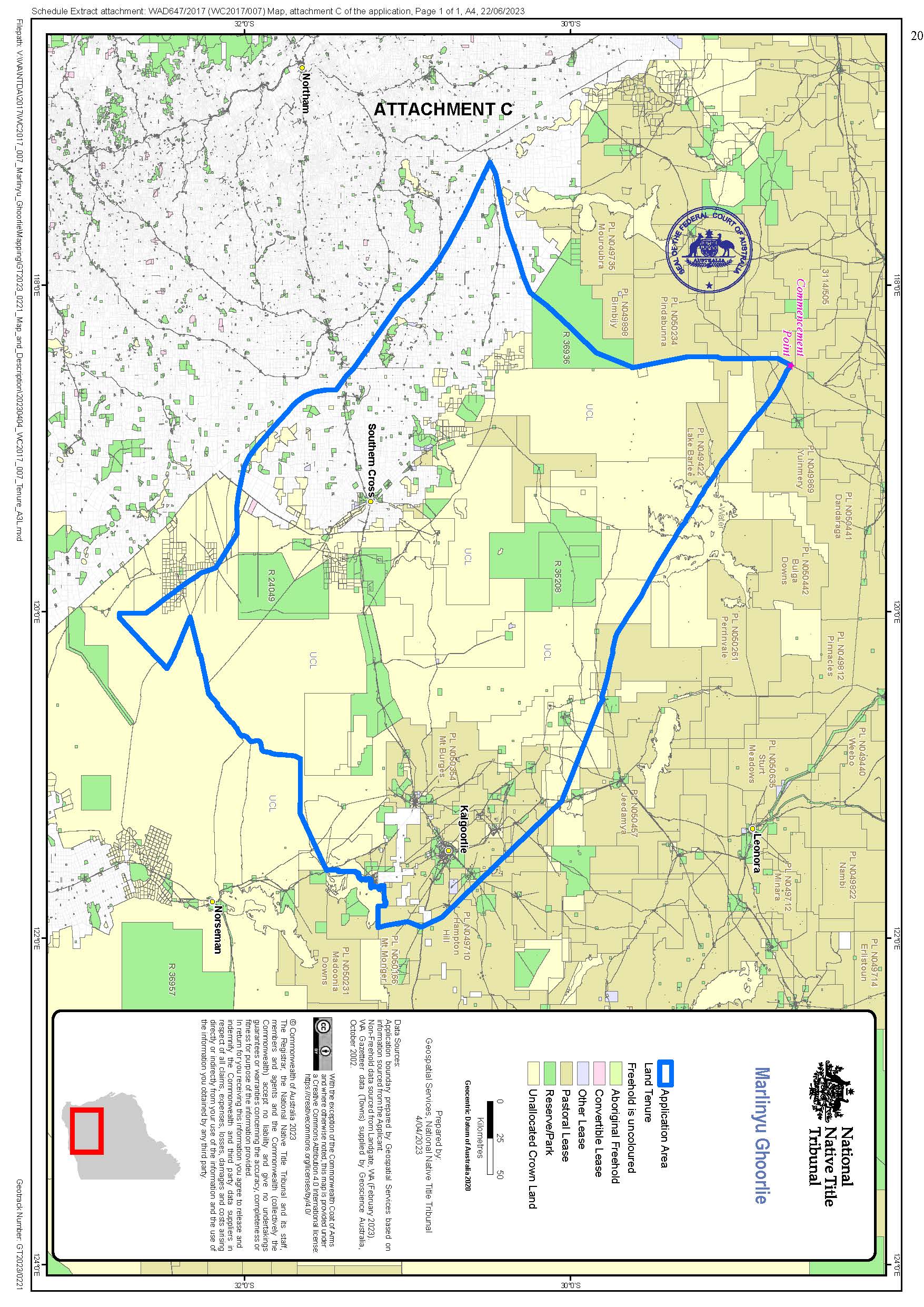
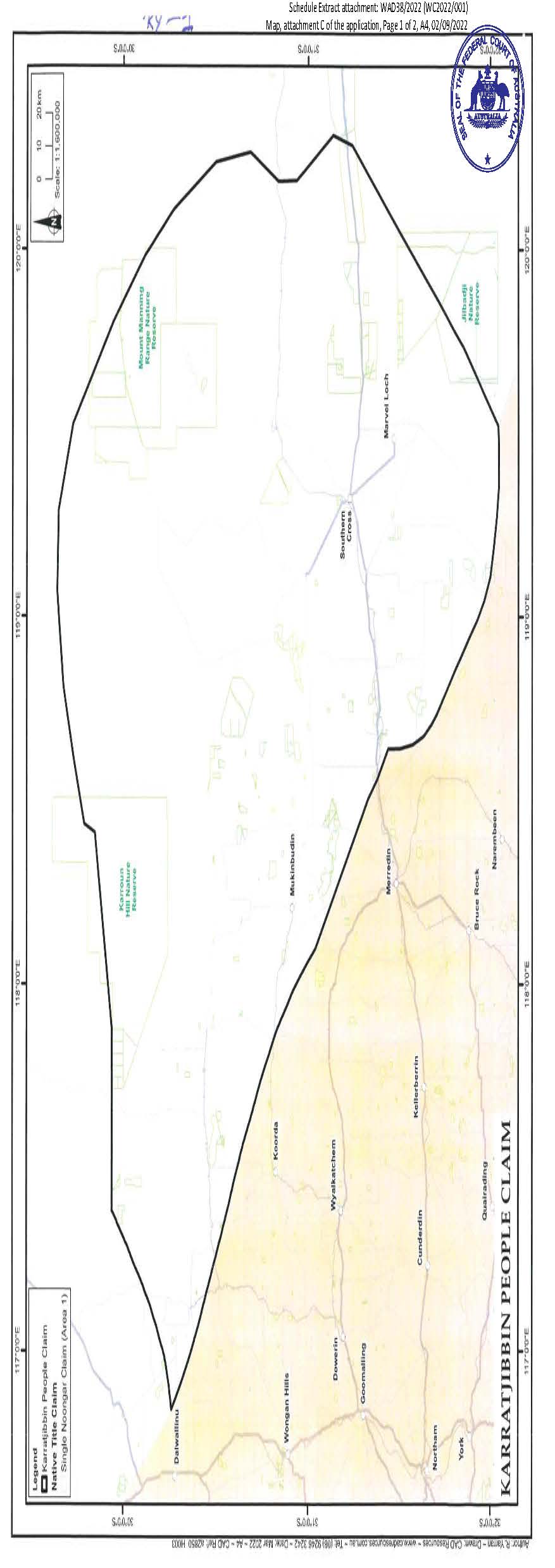
ANNEXURE C
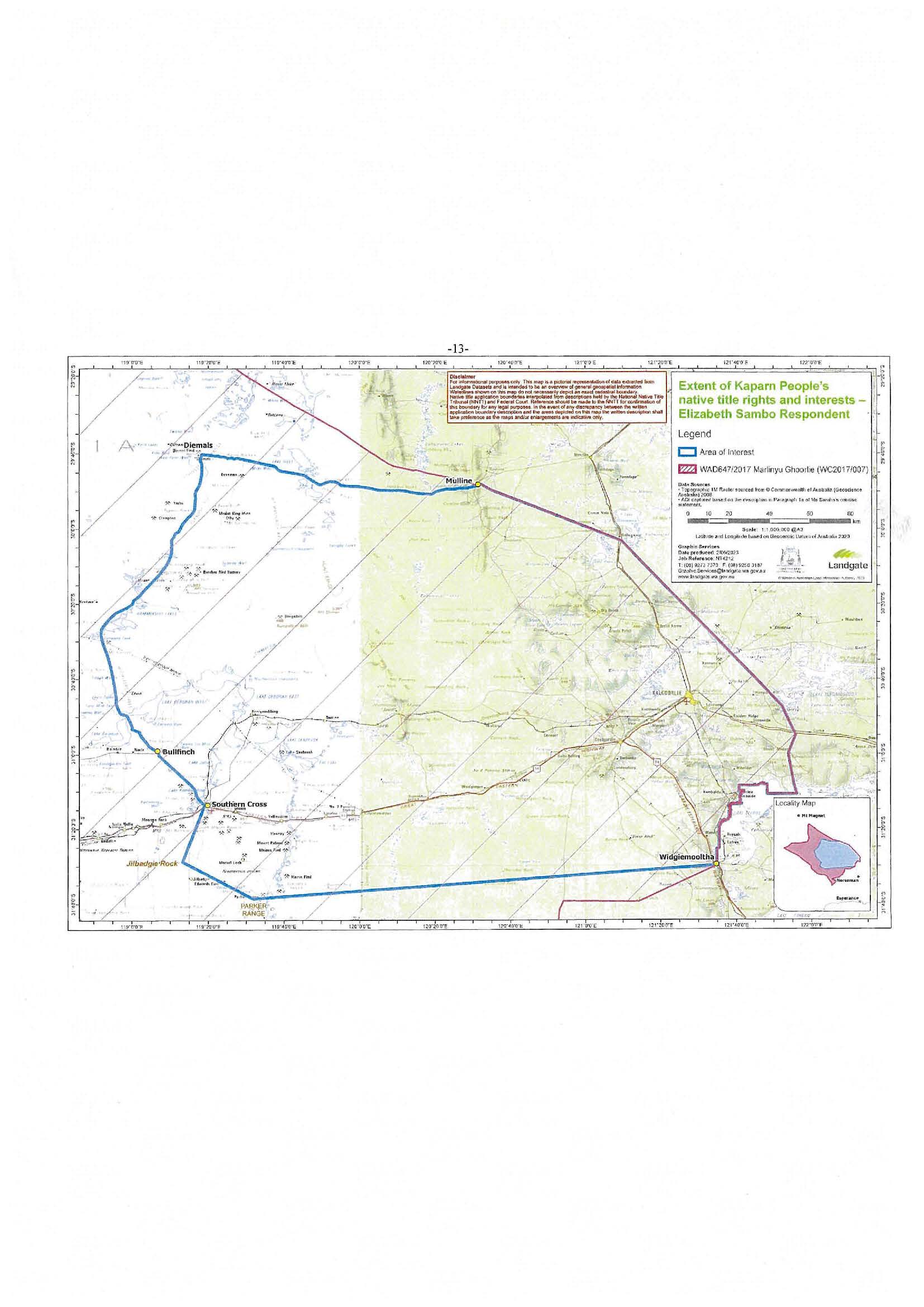
ANNEXURE D
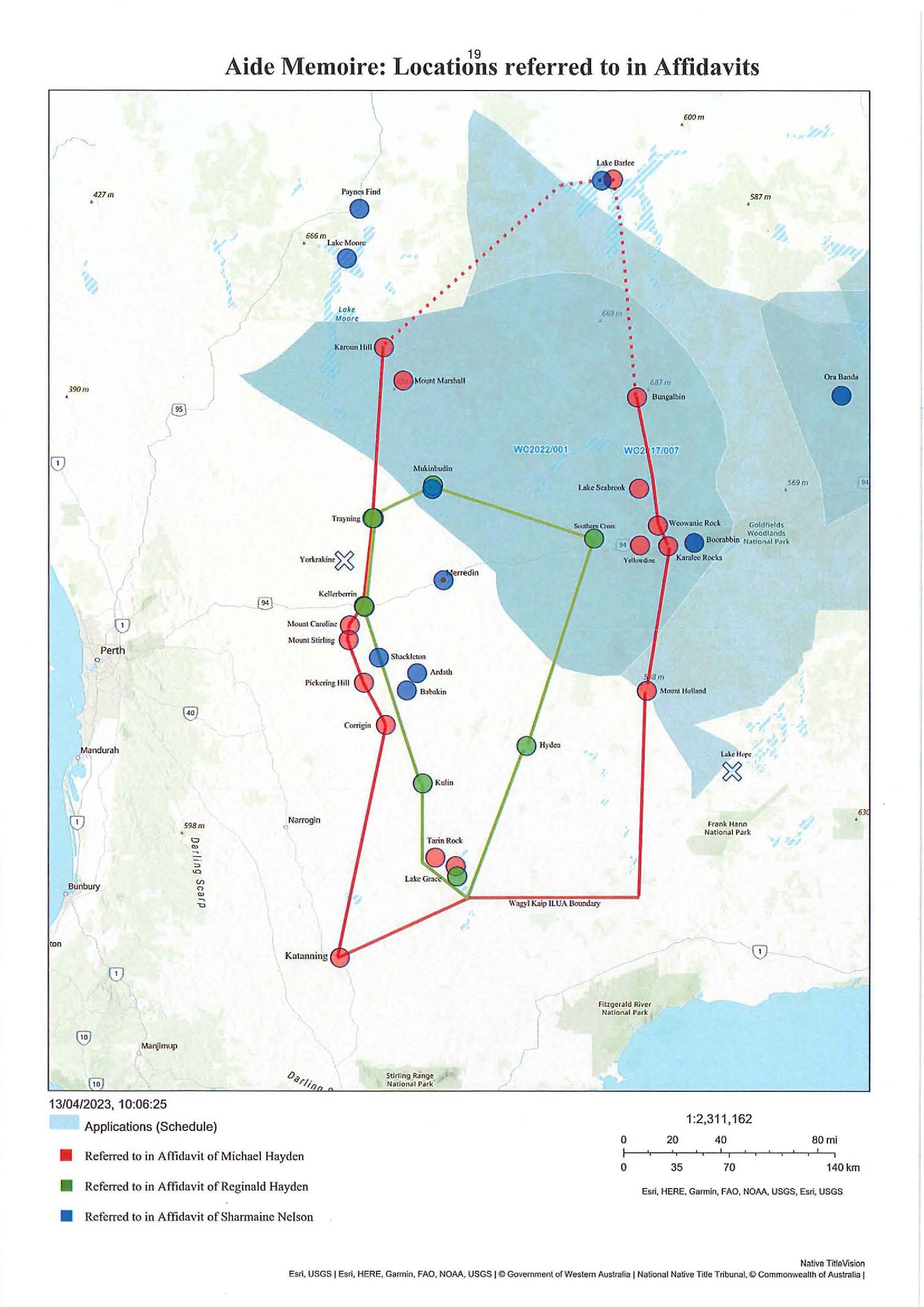
SCHEDULE OF PARTIES
No: WAD647/2017
Federal Court of Australia
District Registry: Western Australia
Division: General
Applicant
JAMES CHAMPION | |
SIMON CHAMPION | |
TANIA CHAMPION | |
MAXINE PATRICIA DIMER | |
LEECHELLE HAMMAT | |
DARREN INDICH | |
RAELENE PEEL | |
DARRYL TROTT |
Cooper Respondents
MARIA BANDRY | |
NORMAN COOPER | |
VICTOR COOPER | |
GARY COOPER |
Other Respondents
COMMONWEALTH OF AUSTRALIA | |
SHIRE OF YILGARN | |
SHIRE OF DALWALLINU | |
NATIVE TITLE SERVICES GOLDFIELDS LIMITED | |
ELIZABETH SAMBO | |
JAMES MURPHY | |
TREVOR HENRY DONALDSON | |
PETER JOHN DIMER | |
SHARON DIMER | |
ROSANNE DIMER | |
AUSTRALIAN LIVE-STOCK SUPPLIERS PTY LTD ACN 149 409 227 | |
HODSHON SUPER CO PTY LTD | |
BJ CAHOOTS PTY LTD | |
HONEY RESEARCH & DEVELOPMENT PTY LTD | |
CHARLES JENKIN | |
BARTON JONES | |
AMANDA JONES | |
BURCHELL FRANCIS CECIL JONES | |
JOHN JONES | |
KEITH MADER | |
SKATON NOMINEES PTY LTD | |
MT VETTERS PASTORAL CO (1966) PTY LTD | |
ARTHUR ROBERTS | |
BHP NICKEL WEST PTY LTD | |
CAMECO AUSTRALIA PTY LTD | |
CORONA MINERALS PTY LTD | |
ESPERANCE PIPELINE CO. PTY LIMITED | |
GPM RESOURCES PTY LTD | |
KALGOORLIE ORE TREATMENT COMPANY PTY LTD | |
LYSANDER RESOURCES PTY LTD | |
MH GOLD PTY LTD | |
MONTAGUE RESOURCES AUSTRALIA PTY LTD | |
NORTHERN STAR RESOURCES LIMITED (NST) | |
POLYMETALS (WA) PTY LTD | |
ROBERTSON RESOURCES PTY LTD ACN 118 366 653 | |
SHINE RESOURCES | |
SILVER LAKE (INTEGRA) PTY LIMITED | |
SILVER LAKE RESOURCES LIMITED | |
ST IVES GOLD MINING COMPANY PTY LIMITED | |
TONINO ZOCARO | |
TELSTRA CORPORATION LTD (ABN 33 051 775 556) | |
AMPLITEL PTY LTD |


