

FEDERAL COURT OF AUSTRALIA
Smyth v Zou [2023] FCA 409
ORDERS
Applicant | ||
AND: | Respondent | |
DATE OF ORDER: |
THE COURT ORDERS THAT:
1. The originating application dated 5 June 2019 is dismissed.
2. The applicant is to the pay the costs of the respondent.
Note: Entry of orders is dealt with in Rule 39.32 of the Federal Court Rules 2011.
HALLEY J:
INTODUCTION
1 These proceedings highlighted the fundamental challenges faced by an applicant seeking to advance claims that depend on both incoherent clauses inserted in standard form contracts without any legal assistance and oral agreements alleged to have been reached in disputed conversations occurring many years before the claims are litigated. Challenges that in these proceedings, were magnified because the applicant was a self-represented litigant with no legal training and the other party to the proceedings had limited English skills and had to be cross-examined with the assistance of an interpreter.
2 The applicant, Mr Anthony Smyth, is a commodities trader. In early 2012, Mr Smyth was introduced to the respondent, Ms Sha Zou, a Chinese national who lives in Australia, by a mutual acquaintance Mr John Li. Following several informal meetings, Mr Smyth and Ms Zou entered into a business relationship for the purpose of trading commodities. The terms of that business relationship were purported to have been documented in a written agreement drafted by Mr Smyth and entitled "International Chamber of Commerce (ICC 400/500/600) Non Circumvention, Non-Disclosure & Working Agreement)” (Contract).
3 Related companies of Ms Zou subsequently entered into several commodities contracts with third parties pursuant to arrangements reached between Mr Smyth and Ms Zou, but none were completed.
4 In these proceedings, Mr Smyth advanced claims against Ms Zou under the Australian Consumer Law, being Sch 2 to the Competition and Consumer Act 2010 (Cth) (ACL), in deceit and for breach of contract.
5 Mr Smyth alleged that Ms Zou engaged in misleading and deceptive conduct in contravention of s 18 of the ACL and in deceit by making false and misleading representations to him (Representations). The Representations are alleged to be directed at (a) the amount of funds that Australia Gloria Energy Group Pty Ltd (AGE) held in a bank account with the Hong Kong and Shanghai Banking Corporation Limited (HSBC), and (b) the amount of funds that Ms Zou held in her personal bank account with HSBC. Ms Zou was at all relevant times the sole director and shareholder of AGE.
6 In summary, Mr Smyth claimed that but for the Representations, he would have taken up a position that he had accepted with Ningbo Development & Investment Group Company Limited (Ningbo) and would not have set up a commodities trading desk and provided commodities broking services for Ms Zou and her related companies.
7 Mr Smyth sought damages for (a) the economic loss that he claimed to have suffered from the loss of remuneration from resigning or not taking up the position with Ningbo and the costs and expenses of setting up the commodities trading desk for AGE, and (b) the costs and expenses that he incurred in providing commodities broking services to AGE and Ms Zou.
8 Mr Smyth’s contractual claims were directed at the failures of Ms Zou’s related entities to complete purchases pursuant to the terms of eight contracts that they had entered into with suppliers of commodities (Commodities Contracts). He contended that these failures gave rise to breaches by Ms Zou of (a) the Contract, (b) a subsequent agreement alleged to have been entered into between Mr Smyth, Ms Zou and Aus Metals Group Pty Ltd (ACN 163 680 902) (AMG) on or about 9 September 2013 (Previous Entitlements Agreement), and (c) oral agreements for commission that he entered into with Ms Zou prior to the entry by Ms Zou’s related companies into each of the Commodities Contracts (Procurement Contracts). Mr Smyth alleged that he is also entitled to damages for the commission that he has lost by reason of the failure of Ms Zou and her related entities completing any of the Commodities Contracts.
9 Mr Smyth also claimed that by entering into two contracts for the shipment of coal in December 2013 and January 2014 respectively, Ms Zou and/or AMG breached the Contract and/or the Previous Entitlements Agreement. Ms Zou was at all material times the sole director and shareholder of AMG. Mr Smyth was a self-represented litigant with some assistance from a person in the limited capacity that is typically referred to by the Court as a McKenzie friend. Ms Zou was represented by counsel and a solicitor.
10 Mr Smyth found appearing for himself a challenging, stressful and demanding experience. In both the conduct of the hearing and in preparing these reasons for judgment, I have sought to ensure that Mr Smyth was not unfairly disadvantaged by his lack of legal representation and the personal challenges that he faced in presenting his case. At the same time, Ms Zou was entitled to proceed on the basis that the proceedings were to be conducted and determined on the basis of the claims made by Mr Smyth in his Amended Statement of Claim (ASOC).
11 For the reasons that follow, I have concluded:
(a) the Representations, as pleaded, were not made by Ms Zou to Mr Smyth at any time prior to 3 April 2012;
(b) Mr Smyth did not relevantly rely on the Representations to not take up any position with Ningbo or to establish a commodities trading desk;
(c) any cause of action for misleading or deceptive conduct or in deceit based on the Representations is statute barred;
(d) objectively construed, the parties to the Contract were Intra Mining Pty Ltd and AMG;
(e) the Contract was not enforceable against Ms Zou;
(f) Intra Mining Pty Ltd ratified the Contract following its registration as a company in June 2013;
(g) the Contract provided that Intra Mining Pty Ltd and Mr Smyth, collectively, would receive one third of any profit that might be generated by Ms Zou and her related entities entering into commodities contracts brokered by Intra Mining Pty Ltd or Mr Smyth;
(h) the Contract also provided that Intra Mining Pty Ltd and Mr Smyth were to be reimbursed for their expenses for providing those broking services;
(i) the provisions of the Contract purporting to provide that Intra Mining Pty Ltd and Mr Smyth would be given one third of AGE, Ms Zou and “its” associated entities upon entry into the Contract is void for uncertainty but can be severed from the Contract;
(j) the alleged Procurement Contracts providing for the payment of specific commissions on the entry by Ms Zou or her associated entities have not been established;
(k) the alleged Previous Entitlements Agreement has not been established;
(l) Mr Smyth has no standing to bring proceedings to enforce the Contract, any alleged Procurement Contracts, or the alleged Previous Entitlements Agreement;
(m) the entry by Ms Zou or her related entities into the Coal Contracts has not given rise to any contravention of the Contract or the alleged Procurement Contracts;
(n) the causes of action advanced with respect to the Contract and the alleged Procurement Contracts are statute barred; and
(o) if the Previous Entitlements Agreement had otherwise been established, the causes of action with respect to that agreement, would not have been statute barred.
12 By reason of these findings, the proceedings must be dismissed.
BACKGROUND
13 The following background facts were not in dispute.
14 Mr Smyth was at all material times a commodities trader.
15 Ms Zou was the sole director and shareholder of:
(a) AGE from 23 November 2010 to 21 September 2015;
(b) Hong Kong Victoria International Group (HKV) in the period between approximately 2010 and 2015; and
(c) AMG in the period between approximately May 2013 and May 2018.
16 Between late January and early February 2012, Mr Smyth, Ms Zou and Mr Li attended two informal meetings. The first meeting was at the Kam Fook Restaurant (Kam Fook meeting) and the second was at the Zilver Restaurant (Zilver meeting). Both restaurants were in Chinatown, Sydney.
17 Mr Li introduced Mr Smyth to Ms Zou as an experienced commodities trader and as a person capable of finding sellers for Australian commodities for Ms Zou’s Chinese clients.
18 On or about 7 February 2012, Mr Smyth and Ms Zou signed the Contract.
19 On or about 27 February 2012, AGE entered into a contract to buy 1,800,000 tons of steam coal over a period of 12 months from Enerse Coal Cl SAS (Enerse Contract).
20 On or about 11 March 2012, AGE entered into a contract with ZMT Resources Pty Ltd to purchase 600,000 tons of iron ore fine in 12 shipments (ZMT Resources Iron Ore Contract).
21 On or about 6 April 2012, AGE entered into a contract with Pro Petroleum Dev Inc to purchase 2,750,000 tons of diesel over a 12 month period (Pro Petroleum Contract).
22 On or around 18 April 2012, AGE entered into a contract with PT Allied Coal to purchase 600,000 tons of steam coal in 12 shipments (PT Allied Coal Contract).
23 On or about 27 April 2012, AGE entered into a contract with Glencore to purchase 130,000 tonnes of Australian steam coal under terms including delivery at the port of Newcastle (Glencore Contract). Ms Zou authorised Mr Smyth to make arrangements to charter an appropriate vessel to attend the port of Newcastle, take delivery of the relevant coal and to on-ship the coal to the port of Zhoushan in China. On 2 May 2012, Mr Smyth on behalf of AGE, entered into a voyage charter with The Sanko Steamship Company Ltd (Sanko) for the ship “Yuritamou” to deliver 130,000 tonnes of coal from Newcastle to China.
24 On or about 24 July 2012, HKV issued a letter of intent to Atlas Ore Limited to buy iron ore fines (Atlas Iron Ore LOI). Pursuant to the letter of intent, HKV was to purchase 1,800,000 tons of iron ore in 12 shipments.
25 On or about 4 July 2013, AMG issued a document to Laikera Holding Corporation LLC entitled “ICPO” (Laikera Holdings ICPO).Under the ICPO, AMG expressed an intention to purchase 1,800,000 tons of iron ore.
26 In or around February 2014, AMG signed a document entitled “Sale and Purchase Contract of Indonesian Coal” with CV ES Holding, to buy 60,000 tons of “Indonesian Steam Coal” (CV ES Holding Contract).
WITNESSES
Mr Smyth’s witnesses
27 Mr Smyth relied on four affidavits that he swore in the proceedings and affidavits from Mr Stefan Bartley, Mr Peter Quirk, Mr Hugh Keller and Mr Scott Wilson.
Mr Smyth
28 Mr Smyth gave evidence of (a) the circumstances in which he was first introduced to Ms Zou and the oral conversations he had with Ms Zou in the period leading up to entry into the Contract, (b) the specific representations that he alleged Ms Zou made to him during the conversations, (c) his alleged entitlements to commissions and compensation from Ms Zou under the Contract, (d) the Previous Entitlements Agreement and the Procurement Contracts, (e) his offer of employment from Ningbo, (f) when he first became aware of the HSBC account statements fraudulently obtained by Ms Zou which purported to substantiate that she and AGE had access to considerable funds (HSBC confirmations), and (g) the work he did to secure commodities contracts for Ms Zou and her associated companies. His affidavit evidence included lengthy and detailed recollections of conversations that he had with Ms Zou.
29 Mr Smyth was extensively cross-examined by counsel for Ms Zou.
30 Ultimately, I concluded I was unable to place any significant weight on Mr Smyth’s affidavit and oral evidence, except to the extent that it was corroborated by contemporaneous documents or was otherwise consistent with the apparent logic of events. I have reached that conclusion for the following principal reasons.
31 First, the conversations that Mr Smyth deposed to in his affidavits occurred many years before his affidavits were prepared, yet they are set forth in a level of detail and precision on critical aspects of the claims that he advanced that is implausible. This was best illustrated by his alleged recollection of Ms Zou advising him in late January and early February 2012 of the specific amounts that she and AGE held in their respective HSBC accounts.
32 Second, Mr Smyth found giving evidence in cross-examination a confronting experience. His answers were all too often, non-responsive, argumentative and long winded. This caused him to give evidence that was inconsistent with his affidavit evidence and earlier evidence given in cross-examination. I accept that, at times, these inconsistencies may have been driven, in part, by failures to listen to the question asked and providing answers too quickly and without sufficient consideration.
33 Further, the weight that could be placed on Mr Smyth’s recollection of events was also put into question due to his frequent inclination to act as an advocate in his own cause in the course of his cross examination by counsel for Ms Zou. I do not doubt that Mr Smyth genuinely believed he was answering questions truthfully to the best of his recollection, but for the foregoing reasons, I consider that his recollections were unreliable.
34 The following evidence that he gave, when pressed about when he first was shown the forged HSBC confirmations, was a fair representation of his evidence given in cross-examination:
MR LONGERGAN: …When was the first time that you saw that document?---It was either that evening or it was either – yes, I think it – it was – I think it was that evening or it was, yes, not far after, from my recollection.
Right. So, Mr Smyth, if you believe, or even if you thought, that she showed you those documents at the meeting at the Kam Fook Restaurant - - -?---Yes.
- - - in early February 2012, why didn’t you put that into your affidavit? In fact, you did four affidavit; why didn’t you put it into any of the four affidavits that you did?---Yes – yes, look, because she showed me bank documents – that’s why I am saying I am not sure. She showed me bank documents that evening, and she showed what’s called a bank comfort letter. But, Mr Lonergan, because things are in Chinese, I – I don’t know, you know. She showed me, “This is my – this is my ability to” – so what we ask for in commodities is we ask for ability to be able to trade, we ask for if - - -
HIS HONOUR: No. I think you’re not answering the question now. Mr Lonergan is trying to find out from you when you, to the best of your recollection, first saw these two documents, and he’s also asking did you see any other bank documents. But just take it one step at a time?---Sorry, your Honour. Yes.
Listen very carefully to the question, and then the cross-examination will be able to proceed far more efficiently than it is at the moment. You’re not there to have a discussion with Mr Lonergan; you’re there simply to answer his questions. So, Mr Lonergan.
MR LONERGAN: So, Mr Smyth, you have not put into any of your affidavits that you have sworn for these proceedings that you saw these documents or anything like these documents in the Kam Fook Restaurant when you met Ms Zou?---I didn’t see any - - -
Is that correct?---I didn’t see anything like these documents, but I did see bank – she gave me - - -
No. Mr Smyth, I am asking you about what you put in your affidavits?---Sure.
Right? Show me – you’ve got the court book in front of you?---Yes.
If you want to show me where in your affidavits do you say that, “I saw these documents, or anything like these documents, from Ms Zou at the” - - -?---Yes. I
- - -
- - - “Kam Fook Restaurant”?---Again, I couldn’t be – I couldn’t be 100 per cent on whether or not I did or don’t. So I would say that, no – I would say that she showed me a series of bank documents many times.
HIS HONOUR: What question are you currently answering, Mr Smyth?---I’m – I – I thought I was answering in relation to the bank documents that he’s asking in relation to when I first saw that.
No. The question that was put to you is where in your affidavits do you make any reference to being provided bank documents or bank documents of that kind at this meeting at Kam Fook?---I – I was just shown bank documents, your Honour, yes.
No. No, you’re not listening again. Where in your affidavits - - -?---There’s not. Sorry. Sorry. Sorry, Mr Lonergan. Yes.
MR LONERGAN: Right. I mean, would you not think that this is a significant piece of information to put into your affidavit?---Your Honour – sorry, Mr Lonergan, she showed me some bank documents. If it’s not those bank documents, it was others.
HIS HONOUR: But, again, you’re not listening to the question. It’s being put to you, would that not be a significant piece of information, as you understood it, to put in your affidavit?---Yes, yes, yes.
Okay. And the next question will be is, why didn’t you?
MR LONERGAN: Why didn’t you?---I can’t answer that. Only – only to say that bank documents were shown. It may not have been those documents, so – yes, it may not have been those documents.
Okay. If we go over to court book page 84? ---And to that – sorry, just to – nothing was left with me, on my presence. She just showed me documents at a - - -
HIS HONOUR: No, no. Now. Mr Smyth, that is not answering the question? ---Sorry, your Honour. I’m not used to it, obviously, yes.
It’s a very unusual exercise to sit in a witness box and simply answer what is put to you. Many people find that difficult, but please concentrate. Listen carefully to the question and just answer that question? - - - Thank you, your Honour.
Don’t try and look around corners. Don’t try and work out why it’s being asked. Simply answer the question directly.
Mr Bartley
35 Mr Stefan Bartley gave evidence that he attended a meeting with Mr Smyth and Ms Zou in Chinatown, Sydney, in January or February 2012.
36 In the course of that meeting, Mr Bartley gave evidence that Ms Zou stated that she had US$120 million in an HSBC account in her name, over US$18 billion in an HSBC account in AGE’s name and that Mr Li would provide copies of bank statements confirming those amounts. He gave evidence that he subsequently received copies of bank statements from Mr Li providing that confirmation and that he assisted Mr Smyth with the Commodities Contracts. He also gave evidence that during his dealings with Ms Zou, she made a number of representations to him including that she would pay Mr Smyth “his entitlements” and she would reimburse Mr Smyth for all his expenses in securing the Commodities Contracts.
37 Mr Bartley was cross-examined. He generally answered questions put to him directly and without equivocation.
Mr Quirk
38 Mr Peter Quirk gave evidence that that Ms Zou told him when they met in person that Mr Smyth was “her Vice President” and “third owner” of AGE, HKV and AMG and that Ms Zou represented to him that she had US$120 million in an HSBC account in her name and over US$18 billion in an HSBC account in AGE’s name. He gave evidence that he forwarded copies of documents provided by Ms Zou to relevant suppliers or sellers, including the HSBC bank account statements and copies of applications for letters of credit. He also gave evidence that he assisted Mr Smyth and Ms Zou with the Newcastle Coal Contract, the Enerse Coal Contract and the Pro Petroleum Contract.
39 Mr Quirk was cross-examined. He generally answered questions put to him directly and without equivocation. There are three matters, however, that caused me to have some concerns about the weight that I could give to Mr Quirk’s evidence.
40 First, in his affidavit sworn on 13 December 2019, Mr Quirk gave evidence of statements made by Ms Zou to him to the effect, “When I met the Respondent in person” and “throughout my face to face dealings with the Respondent”. When cross-examined, however, he gave evidence that he had never met Ms Zou in person and had only had telephone conversations with her. He sought to characterise the errors in his affidavit as “purely an omission”. This “omission” was material and, at best, casts considerable doubt on the degree of care and attention that Mr Quirk applied to the accuracy of his affidavit evidence.
41 Second, when challenged as to the inherent implausibility of him providing a post-dated bank account statement to establish proof of funds to a prospective commodities supplier, Mr Quirk’s response was troubling. He initially acknowledged, in response to my questions seeking to clarify the matter, that he would not have passed on a post-dated proof of funds document to a supplier, or only passed it on with an express caveat:
HIS HONOUR: Maybe either a mix of cross-examination or re-examination, but let’s get to the bottom of this point because it’s going to be an issue that’s going to be raised subsequently in submissions.
Mr Quirk, if you received a document from a purchaser in the course of seeking to obtain proof of funds which was post-dated, that is, a date after the date you asked for the confirmation, would you pass that on to the supplier?---Absolutely. Sometimes we receive proof of funds before the contract is signed. Sometimes we receive it after. Sometimes the – the supplier is prepared to enter into the contract in order to secure the allocation for the product, but that contract would be subject to the proof of funds.
Sorry, I think - - -? - - -There’s a process - - -
Mr Quirk, sorry, I think we’re at cross-purposes. I will put it more slowly. I want you to imagine this situation. You ask a purchaser for proof of funds. The purchase provides a document on bank letterhead. That bank letterhead has a figure for how much funds are sitting in someone’s account, but the date of the confirmation from the bank is one month into the future, not the day you’ve asked or a day prior to the day you’ve asked. Would you pass on such a bank document to your supplier as evidence of proof of funds? ---No. If the – if the date on the document clearly was in the future I would then – I would send it to the supplier with a caveat on it saying that we believe the document was fraudulent because it can’t obviously be correct if it’s dated in the future.
(Emphasis added.)
42 However, when the cross-examiner subsequently turned to the topic he stated “It’s perfectly possible that I just forwarded the document” without noticing the date:
MR WATHUKARAGE: Mr Quirk, one further question about the documents you send which is particularly the ….. document in court book 114? ---Yes
And you said to this Honour also that if the … future date probably you will not send it the supplier? ---No, I didn’t. I said to you – to his Honour that I would sent it to the supplier, with a caveat that I thought that the document would be fraudulent because it was post-dated.
You saw this date. You identified this is a document you send to Enerse Coal before 27 February? ---Yes, and if – and I picked up on the date – and, you know, whether I did or not I can’t confirm because it’s 10 years ago – but if I did pick up on the date and the inaccuracy of the document, I would have caveated my – my submission when I sent it to the supplier. It’s perfectly possible that I just forwarded the document.
(Emphasis added.)
43 In context, the evidence regarding the post-dated bank statement was implausible and reflected a lack of impartiality in Mr Quirk’s approach to providing evidence.
44 Third, having subsequently had the opportunity to observe Ms Zou’s comparatively limited spoken English while she was being cross-examined by Mr Smyth, the evidence given by Mr Quirk of his observations of Ms Zou’s fluency in English was incongruous. I consider that it reflected Mr Quirk’s apparent desire to assist Mr Smyth rather than an attempt to provide an objective assessment of Ms Zou’s language skills. It is to be noted that Ms Zou’s proficiency in English was a material issue in these proceedings, given the extent to which Mr Smyth relied on evidence of his oral conversations with Ms Zou.
Mr Keller
45 Mr Hugh Keller was a partner with Blake Dawson Waldron (now Ashurst) until he retired on 30 June 2010. He gave evidence of a meeting he attended with Mr Smyth and Ms Zou, on 19 February 2013, concerning Ms Zou’s proposals to negotiate a crude oil contract to be acquired in the Middle East and refined in Singapore and the acquisition of iron ore for a Chinese steel mill. He also gave evidence of conversations that he had with Mr Smyth between late November and December 2012 and in January, February and possibly March 2013. He also stated that he was provided with documents to assist in establishing the financial capacity and bona fides of the Ningbo group and their ability to finance crude oil and coal transactions which Mr Smyth was pursuing on their behalf.
46 Mr Keller was not cross-examined.
Mr Wilson
47 Mr Scott Wilson gave evidence of a meeting that he had with Mr Smyth, Ms Zou and Mr Adam Husband in or about February 2014. At that time, Mr Wilson was a senior broker with ICAP and a director of Orthopaedic Innovation Pty Limited. Mr Wilson described Mr Husband as “another associate” of Mr Smyth and himself.
48 Mr Wilson gave evidence of the incorporation of Intra Mining Pty Ltd, interim monthly payments to Mr Smyth of $2,500 and the offer of a salary of $200,000 to Mr Smyth from Intra Mining Pty Ltd to commence upon the receipt of commissions from Ms Zou. He also gave evidence of the broking by Mr Smyth, in or about October 2013, of a coal trade on behalf of Waratah Resources and the negotiation of two coal contracts by Intra Mining Pty Ltd on behalf of Ms Zou with NDIG and CVES Holdings in 2014.
49 Mr Wilson was cross-examined. He answered all questions put to him directly and without equivocation. He did not seek to be an advocate for Mr Smyth. I was satisfied that his evidence was consistent with the apparent logic of events and I had no reason to believe that it was not given impartially and objectively.
Ms Zou
50 Ms Zou affirmed two affidavits in the proceedings. She did not call any other witnesses. She was extensively cross-examined by Mr Smyth.
51 In her affidavit evidence, Ms Zou gave evidence of (a) her introduction to and initial conversations with Mr Smyth, (b) the circumstances in which she obtained the forged HSBC confirmations and signed the Contract, (c) her denials of the content of conversations alleged to have occurred by Mr Smyth in his affidavit evidence, and (d) the circumstances in which she caused her related companies to enter into the Commodities Contracts.
52 It was readily apparent from both her affidavits, contemporaneous emails and her cross-examination that she was not fluent in English. Both her written statements and oral responses in cross-examination were often grammatically incorrect and at times, it was difficult to discern their intended meaning. Further, her responses in cross-examination were often defensive and argumentative.
53 In assessing the weight I can give to Ms Zou’s evidence, I took into account that English is not her first language and the particular challenges faced by a witness, particularly a party to proceedings, in being cross-examined by a self-represented litigant. Mr Smyth experienced great difficulty in recognising the distinction between making submissions and asking questions and at times, the cross-examination descended into an exchange of insults.
54 Nevertheless, Ms Zou’s acknowledgment that she had procured the forged HSBC confirmations for herself and AGE, reflected poorly on her credit. She claimed in her affidavit evidence that Mr Smyth suggested to her that she purchased forged bank documents to demonstrate her access to funds. Even if that suggestion had been made by Mr Smyth, a suggestion I am not persuaded was in fact made, the purchase and provision of the forged HSBC confirmations to the supplier counterparties to the Commodities Contracts demonstrates a marked inability to act truthfully and honestly.
55 Some aspects of Ms Zou’s evidence were particularly troubling. She gave evidence in cross-examination that she first met Mr Smyth in July 2012 and in her affidavit, affirmed on 17 August 2021, the reference to her signing the Contract in February 2012 was a typographical error and should have read February 2013. This evidence was inexplicable given Ms Zou’s admission in the defence that she and Mr Smyth signed the Contract on or about 7 February 2012. Equally concerning, was Ms Zou’s claim during her cross-examination, that her email response “How much do you want to need?” on 9 September 2013 to Mr Smyth, was a response to an email that Mr Smyth had fraudulently inserted in their email chain. I considered this to be an attempt on Ms Zou’s part, to avoid facing up to the implications of what she meant in that email response.
56 Ms Zou also frequently protested that she did not recall matters. She consistently claimed in both her first affidavit, affirmed on 17 August 2021, and in her oral evidence, that Mr Smyth had told her that he was a lawyer. Mr Smyth may have told her that he would look after the preparation of the Contract and that she could trust him to do that but the suggestion that he told her that he was a lawyer was implausible. I accept that Mr Smyth may have represented that he was able to draft the Contract and Ms Zou did not need to engage a lawyer. I do not accept that Mr Smyth was so dishonest as to claim that he was in fact a lawyer.
57 I derived little assistance from her cross-examination, in large part due to the manner in which Mr Smyth had sought to question her and the generally defensive and argumentative manner in which she responded to his challenges and questioning.
58 Ultimately, for the foregoing reasons, I accepted her affidavit evidence to the extent that it was consistent with contemporaneous documents or was more consistent with the apparent logic of events than conflicting evidence given by Mr Smyth.
THE ACL AND DECEIT CASES
The pleaded cases
59 The ACL and deceit cases advanced by Mr Smyth were based on the Representations.
60 The Representations were alleged in the ASOC to have been made orally on several occasions in the course of conversations during the Kam Fook meeting, a meeting at the Starbucks in Chinatown, Sydney, and the Zilver meeting “in and from mid January 2012”. They were pleaded to have been made in the following terms:
(a) AGE had US$18 billion dollars deposited in a Hong Kong and Shanghai Banking Corporation Limited (HSBC) bank account;
(b) that the Respondent had USD$120 million in her personal HSBC bank account;
61 The Representations were alleged to be false and the conduct in making each of them was alleged to be misleading or deceptive because neither AGE nor Ms Zou had the amounts represented or any comparable amount in any of their respective bank accounts: ASOC at [4].
62 Further, it was alleged that at the time that the Representations were made, Ms Zou knew that they were false and untrue and alternatively, that she made them recklessly, not caring whether they were true or false: ASOC at [5].
Statutory provisions and principles
Misleading or deceptive conduct
63 Section 18(1) of the ACL relevantly provides:
18 Misleading or deceptive conduct
(1) A person must not, in trade or commerce, engage in conduct that is misleading or deceptive or is likely to mislead or deceive.
64 The principles and authorities in relation to s 18 of the ACL are well established and were not disputed by the parties to this proceeding.
65 First, it is necessary to identify the impugned conduct and then to consider whether that conduct, considered as a whole and in context, is misleading or deceptive or likely to mislead or deceive: Australian Competition and Consumer Commission v Coles Supermarkets Australia Pty Limited [2014] FCA 634 at [38] (Allsop CJ), citing Google Inc v Australian Competition and Consumer Commission (2013) 249 CLR 435; [2013] HCA 1 at [89], [102] and [118] (Hayne J); Campomar Sociedad, Limitada v Nike International Limited (2000) 202 CLR 45; [2000] HCA 12 at [100]-[101] (Gleeson CJ, Gaudron, McHugh, Gummow, Kirby, Hayne and Callinan JJ).
66 Second, conduct is misleading or deceptive or likely to mislead or deceive if it has the tendency to lead into error, that is, there is a sufficient causal link between the conduct and the likely error on the part of persons exposed to the conduct: Coles at [39], citing Australian Competition and Consumer Commission v TPG Internet Pty Ltd (2013) 250 CLR 640; [2013] HCA 54 at [39] (French CJ, Crennan, Bell and Keane JJ).
67 In the present case, it is necessary that acts done by the applicant in reliance upon the misrepresentation have a sufficient connexion to satisfy this concept of causation under s 18 of the ACL: Wardley Australia Ltd v Western Australia (1992) 175 CLR 514; [1992] HCA 55 at 525 (Mason CJ, Dawson, Gaudron and McHugh JJ); see also Elders Trustee & Executor Co Ltd v EG Reeves Pty Ltd (1987) 78 ALR 193 at 195 (Gummow J, as his Honour then was).
68 Third, it is necessary to view the conduct as a whole and in its proper context. In this regard, s 18 of the ACL will not protect those who fail to take reasonable care of their own interests and it would be wrong to select words or acts which are only misleading when viewed in isolation: Elders at 241 (Gummow J, as his Honour then was), citing Parkdale Custom Built Furniture Pty Ltd v Puxu Pty Ltd (1982) 149 CLR 191; [1982] HCA 44 at 199 (Gibbs CJ).
Damages under the ACL
69 Section 236(1) of the ACL entitles a claimant to recover for loss or damage suffered due to another person’s breach of s 18 of the ACL and relevantly states:
236 Actions for damages
(1) If:
(a) a person (the claimant) suffers loss or damage because of the conduct of another person; and
(b) the conduct contravened a provision of Chapter 2 or 3;
the claimant may recover the amount of the loss or damage by action against that other person, or against any person involved in the contravention.
70 Section 236(2) of the ACL states:
236 Actions for damages
(2) An action under subsection (1) may be commenced at any time within 6 years after the day on which the cause of action that relates to the conduct accrued.
(Emphasis added.)
71 In Wardley, the High Court considered the operation of s 82(2) of the Trade Practices Act 1974 (Cth) (TPA), the predecessor to s 236(2) of the ACL. The plurality relevantly held that:
(a) The period of limitation begins to run at the time when the cause of action accrues under s 82(1) of the TPA, the predecessor to s 236(1) of the ACL. The cause of action accrues when actual loss or damage is sustained: at 525.
(b) In determining when a plaintiff first suffers economic loss or damage in an action under s 82(1) based on misleading or deceptive conduct, it is necessary to have regard to the applicable measure of damages. It would be wrong to assume that the measure of damages will coincide with the measure of damages applicable in an action for deceit or negligent misrepresentation. Nevertheless, the common law measure of damages will in many cases be an appropriate guide though it will always be necessary to look to the provisions of the TPA to ascertain the relevant legislative intention: at 526.
(c) Under s 82(1), as under the common law, a plaintiff can only recover compensation for actual damage incurred, as distinct from potential damage: at 527.
(d) If a defendant’s fraudulent or negligent misrepresentation induces a plaintiff to enter into a contract and subsequently a contingent loss is suffered, the plaintiff does not sustain the contingent loss at the time the contract was entered into: at 531.
72 The High Court unanimously reiterated this approach in Murphy v Overton Investments Pty Ltd (2004) 216 CLR 388; [2004] HCA 3, stating at [46] that:
In Wardley Australia Ltd v Western Australia… a majority of the Court held that risk of loss is not itself a category of loss, and that, if a plaintiff enters a contract which exposes the plaintiff to a contingent loss or liability, that plaintiff “sustains no actual damage until the contingency is fulfilled and the loss becomes actual”. Wardley illustrates that it is necessary to identify the detriment which is said to be the loss or damage which has occurred (or, when considering the application of s 87, has occurred or is likely to occur). In that case, the mere entry into obligations which might, but need not, have had detrimental consequences in the future was held not to have occasioned loss or damage to the party making the contract.
Tort of deceit
73 The five elements that need to be established by a plaintiff for the modern tort of deceit were identified by the High Court in Magill v Magill (2006) 226 CLR 551; [2006] HCA 51 at [114] (Gummow, Kirby and Crennan JJ) as follows:
The modern tort of deceit will be established where a plaintiff can show five elements: first, that the defendant made a false representation; secondly, that the defendant made the representation with the knowledge that it was false, or that the defendant was reckless or careless as to whether the representation was false or not; thirdly, that the defendant made the representation with the intention that it be relied upon by the plaintiff; fourthly, that the plaintiff acted in reliance on the false representation; and fifthly, that the plaintiff suffered damage which was caused by reliance on the false representation. Generally, the elements of the tort have been found to exist in cases which concern pecuniary loss flowing from a false inducement and the need to satisfy each element has always been strictly enforced, because fraud is such a serious allegation.
(Footnotes omitted.)
74 This necessarily proscribes a higher threshold for a claimant to succeed in a tort of deceit claim than a claim for a contravention of s 18 of the ACL. In order to establish a contravention of s 18 it is not necessary to prove that another person knowingly engaged in conduct that was misleading or deceptive or likely to mislead or deceive.
Limitation of actions
75 Section 14(1)(b) of the Limitation Act 1969 (NSW) (Limitation Act) relevantly provides that a cause of action founded on tort, including a cause of action for damages for breach of a statutory duty, is not maintainable if brought after the expiration of a limitation period of six years, running from the date on which the cause of action first accrues to the plaintiff or to a person through whom the plaintiff claims.
76 Section 63(1) of the Limitation Act provides:
Debt, damages etc
(1) Subject to subsection (2), on the expiration of a limitation period fixed by or under this Act for a cause of action to recover any debt damages or other money, the right and title of the person formerly having the cause of action to the debt damages or other money is, as against the person against whom the cause of action formerly lay and as against the person’s successors, extinguished.
Fraud and deceit
77 Section 55 of the Limitation Act provides the following fraud and deceit exception:
55 Fraud and deceit
(1) Subject to subsection (3) where—
(a) there is a cause of action based on fraud or deceit, or
(b) a cause of action or the identity of a person against whom a cause of action lies is fraudulently concealed,
the time which elapses after a limitation period fixed by or under this Act for the cause of action commences to run and before the date on which a person having (either solely or with other persons) the cause of action first discovers, or may with reasonable diligence discover, the fraud deceit or concealment, as the case may be, does not count in the reckoning of the limitation period for an action on the cause of action by the person or by a person claiming through the person against a person answerable for the fraud deceit or concealment.
(2) Subsection (1) has effect whether the limitation period for the cause of action would, but for this section, expire before or after the date mentioned in that subsection.
(3) For the purposes of subsection (1), a person is answerable for fraud deceit or concealment if, but only if—
(a) the person is a party to the fraud deceit or concealment, or
(b) the person is, in relation to the cause of action, a successor of a party to the fraud deceit or concealment under a devolution from the party occurring after the date on which the fraud deceit or concealment first occurs.
78 A cause of action based on fraud or deceit is an action in which fraud or deceit is an essential ingredient or element of the cause of action: see Beaman v ARTS Ltd [1949] 1 KB 550 at 558; Paramasivam v Flynn (1998) 90 FCR 489; [1998] FCA 1711 at [96]-[97] (Miles, Lehane and Weinberg JJ).
The doctrine of relation back
79 I respectfully adopt the followings statements by Colvin J in Sydney Subdivision Pty Ltd (in liq) v Chow [2023] FCA 8 at [35] in connection with the application of the doctrine of relation back:
35 Ordinarily, 'an amendment, duly made, takes effect, not from the date the amendment is made, but from the date of the original document which it amends': Baldry v Jackson [1976] 2 NSWLR 415 at 419 (Samuels JA). However, an amendment to introduce a claim that may be barred by the period of limitation at the time the amendment is made is not an ordinary amendment. If it were to be allowed to relate back then it would prejudice the opposing party's ability to raise a limitation point even though the claim was out of time. Such amendments are only treated as taking effect from the date of the original document where the amendment introduces a claim that 'arises out of the same or substantially the same facts' as the claims that have been brought within time: Ethicon Sàrl v Gill [2018] FCAFC 137; (2018) 264 FCR 394 at [47] (Allsop CJ, Murphy and Lee JJ). There is some uncertainty as to the current source of the authority for this limited 'relation back' practice because it was previously to be found in an express rule concerning amendments to 'any document in the proceeding' but is now only to be found in the provision in the Federal Court Rules that is concerned with amendment of the originating application: Voxson Pty Ltd v Telstra Corporation Limited (No 7) [2017] FCA 267 at [16]-[20] (Perram J), noting the limited respect in which those views were found not to be correct in McGraw-Hill Financial, Inc v Clurname Pty Ltd [2017] FCAFC 211 at [23] (Allsop CJ, Jagot and Yates JJ). See also the analysis of the 'relation back doctrine' by Brereton J in Street v Luna Park Sydney Pty Ltd [2006] NSWSC 230 at [45]-[52].
The forged HSBC confirmations
80 Mr Smyth placed significant emphasis on Ms Zou’s admission that she had procured forged documents from HSBC, being the HSBC confirmations. The HSBC confirmations purported to confirm that AGE held US$18.6 billion in an HSBC account as at 7 March 2012 (AGE HSBC confirmation) and Ms Zou personally held US$120 million in an HSBC account as at 25 November 2010 (Zou HSBC confirmation).
81 I have extracted below the AGE HSBC confirmation:
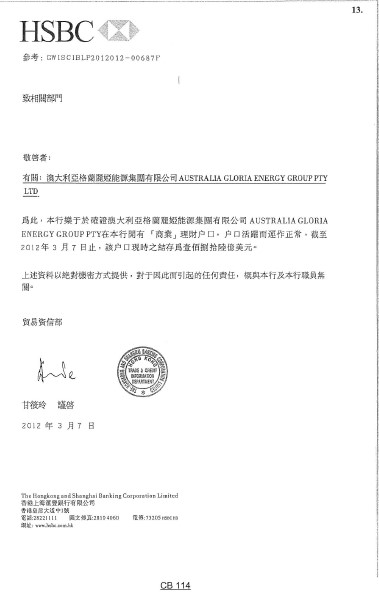
82 Other than identifying AGE by name, the date that it was signed, a date in the body of the text of the document that matched the date the document was purported to be signed and a purported HSBC seal, the AGE HSBC confirmation was exclusively in Mandarin. Significantly, there was no indication in English of any amount of money that might have been the subject of any confirmation provided by the document.
83 On 3 April 2012, Mr Li emailed Mr Szer, the Finance Director of North Clermont Coal Limited, the following translation of what he referred to as “Sally’s Bank letter”:
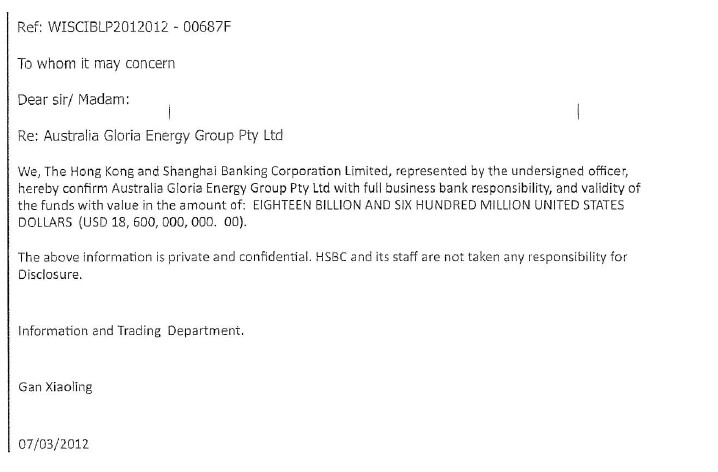
84 I have extracted below the Zou HSBC confirmation:
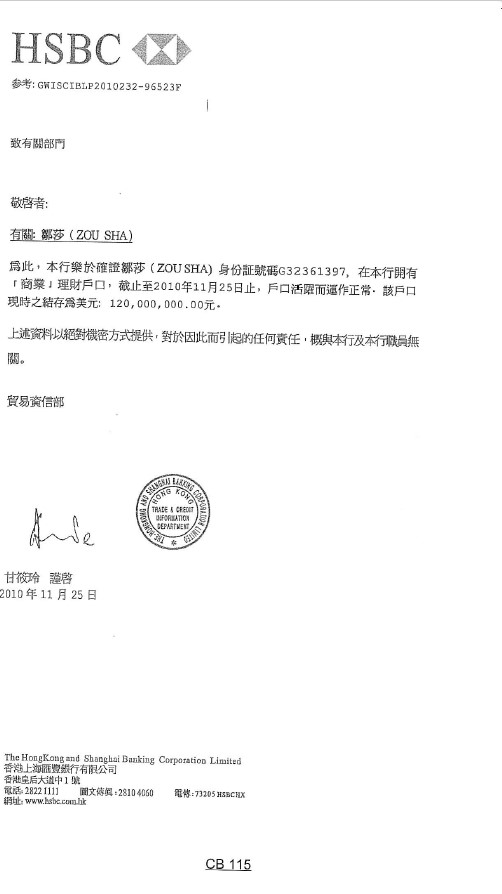
85 Unlike the AGE HSBC confirmation, the Zou HSBC confirmation includes the amount of funds which can be understood by an English speaker. The two documents are otherwise in a similar form.
86 It is not apparent when Mr Smyth was first provided with, or became aware of, the HSBC confirmations. Mr Smyth’s evidence on this issue was inherently problematic. He initially claimed that Ms Zou showed him the HSBC confirmations at the Kam Fook and Zilver meetings. He then retracted that evidence, at least in part, when he was provided with the date of the AGE HSBC confirmation and challenged on the inherent unlikelihood that he would have been able to understand the documents given they were substantially written in Mandarin.
87 There was no documentary evidence of the AGE and Zou HSBC confirmations being directly provided to Mr Smyth. Rather, it would appear that Mr Smyth received a copy of the translated AGE HSBC confirmation as part of an email chain between Mr Szer and Mr Li that was copied to him at 11.17 pm on 3 April 2012. The email from Mr Szer was a response to an email sent earlier that evening by Mr Li at 9.36 pm. In his email, Mr Szer thanked Mr Li for the “attachment re Sally”. Mr Li had stated in his email “Please find another attachment for the owner of AGE’s personal banking reference (USD 120,000,000)”. This was clearly a reference to the Zou HSBC confirmation. It is not apparent, however, whether the document remained attached to the email chain when it was sent by Mr Szer to Mr Li and copied to Mr Smyth at 11.17 pm.
88 In any event, it is not apparent when and in what circumstances the AGE HSBC confirmation was first provided by Mr Li to Mr Smyth or to anyone else. Given the email sent by Mr Li to Mr Szer at 8.53 pm on 3 April 2012 commences “Please find translated Sally’s Bank letter below” it could be inferred that Mr Li had shortly prior to that email, provided Mr Szer with a copy of the untranslated AGE HSBC confirmation. Alternatively, it could be inferred that Mr Li had advised Mr Szer of the existence of the AGE HSBC confirmation and had been asked by Mr Szer to provide a translated copy of that confirmation.
89 In the circumstances, I am satisfied that Mr Smyth became aware by 3 April 2012 that Ms Zou had procured HSBC documentation purporting to confirm that AGE held US$18.6 billion in an HSBC account as at 7 March 2012 and that Ms Zou, personally held US$120 million in an HSBC account.
90 I am not satisfied that Mr Smyth, as at 3 April 2012, had been provided with copies of either of the original untranslated HSBC confirmations. In any event, had he been provided with a copy of the Zou HSBC confirmation as an attachment to the email chain he received at 11.17 pm on 3 April 2012, he would have recognised that the confirmation was provided as at 25 November 2010.
Were the Representations made as alleged?
91 Mr Smyth does not allege in the ASOC that the Representations were made to him at the time he first became aware of the HSBC confirmations.
92 Understandably, the admission by Ms Zou that the HSBC confirmations were not genuine provided a potentially compelling deceit and ACL case for Mr Smyth to pursue against Ms Zou. It was not, however, the case pleaded by Mr Smyth, or a case that was consistent with the case that was in fact pleaded.
93 The stark reality for Mr Smyth was that he became aware of the HSBC confirmations in April 2012. Relevantly, this was after he had decided not to proceed with the alleged Ningbo employment opportunity, after he had signed the Contract and after he had established his “Intra Mining” commodities trading desk and commenced providing commodities broking services to Ms Zou and her related companies.
94 In an oft cited passage, recently cited by the Full Court of this Court in Martin v Norton Rose Fulbright Australia (2021) 289 FCR 369; [2021] FCAFC 216 at [147] (Jagot, Katzmann and Banks-Smith JJ), McLelland CJ in Eq stated in Watson v Foxman (1995) 49 NSWLR 315 at 318-19:
Where, in civil proceedings, a party alleges that the conduct of another was misleading or deceptive....it is ordinarily necessary for that party to prove to the reasonable satisfaction of the court: (1) what the alleged conduct was; and (2) circumstances which rendered the conduct misleading. Where the conduct is the speaking of words in the course of a conversation, it is necessary that the words spoken be proved with a degree of precision sufficient to enable the court to be reasonably satisfied that they were in fact misleading in the proved circumstances. In many cases (but not all) the question whether spoken words were misleading may depend upon what, if examined at the time, may have been seen to be relatively subtle nuances flowing from the use of one word, phrase or grammatical construction rather than another, or the presence or absence of some qualifying word or phrase, or condition. Furthermore, human memory of what was said in a conversation is fallible for a variety of reasons, and ordinarily the degree of fallibility increases with the passage of time, particularly where disputes or litigation intervene, and the processes of memory are overlaid, often subconsciously, by perceptions or self-interest as well as conscious consideration of what should have been said or could have been said. All too often what is actually remembered is little more than an impression from which plausible details are then, again often subconsciously, constructed. All this is a matter of ordinary human experience.
95 It is in the context of the statements by McLelland CJ in Eq that I turn to consider the evidence relied upon by Mr Smyth with respect to the making of the Representations.
96 Mr Smyth gave evidence that Ms Zou made the following statements to him during the Kam Fook meeting, noting that “AS” refers to Mr Smyth and “SZ” refers to Ms Zou:
AS: Sally you need to understand that trading in Australia is different. In Australia there are very strict take-or-pay policies. If you do not take the shipment in the Laycan period, then you are still charged often close to one million for port costs, let alone everything else.
SZ: It’s okay. I have got money, Anthony. I will not fail.
AS: Sally, that is good. But everyone in this industry has money, big money. It is a global market. The sellers will want to be satisfied that you are a genuine buyer.
SZ: I know. I used to be in banking before. I know trade, don’t worry. My company has eighteen billion US in its Hong Kong bank account and I have one hundred and twenty million US in my own personal account. John will give you letters from HSBC confirming the account balances. John is my paymaster.
97 Ms Zou gave the following evidence in response to this evidence of Mr Smyth:
In response to para 20 of his affidavit, I did not agree that conversation happened. I did not agree that we could have such long conversation in between Smyth and I alone. In addition, I would not tell Smyth how much money I had in the bank account at the first meeting. All I have left in memory was that Smyth was eager to join force with me and John, he would be responsible to find suppliers in Australia; I would be responsible for finding the Chinese buyers. Both of us would have to facilitate that trade.
98 I accept that Mr Smyth conveyed to Ms Zou in their initial meetings in early February 2012, the need for persons and entities seeking to enter into commodity trades in Australia to be in a position to demonstrate financial capacity to complete trades. I also accept that Ms Zou conveyed to Mr Smyth that she was a person with access to considerable financial resources.
99 I do not accept that Ms Zou represented to Mr Smyth in their initial meetings in early February 2012 or at any time prior to 3 April 2012, that AGE had US$18.6 billion or that she personally had US$120 million sitting in HSBC bank accounts for the following reasons.
100 First, I am satisfied that the US$18.6 billion and US$120 million figures were derived from Mr Smyth’s subsequent knowledge of the amounts in the HSBC confirmations. I do not accept that they were derived from any independent recollection of figures Ms Zou may have represented to Mr Smyth in the conversations leading up to the entry into the Contract.
101 Second, Ms Zou denies telling Mr Smyth the figures of US$18.6 billion and US$120 million, or any other figures on or prior to 7 February 2012 and there is no documentary evidence to suggest otherwise.
Ningbo offer of employment
102 Mr Smyth gave evidence that in late 2011 he was introduced to Mr Qui. Mr Smyth described Mr Qui as a member of the family trust that had founded Ningbo. He stated that Ningbo was a major state-owned corporation in the city of Ningbo in China’s Zhejiang province which controlled a group of companies operating in several industries, including energy, finance and construction.
103 Mr Smyth stated that in late 2011 or early 2012 he met with Mr Qui and had a conversation in words to the following effect:
EQ: The company wishes to offer you a role in the procurement and negotiation of coal. The salary we are offering is two hundred and sixty thousand a year, plus commissions at the rate of fifty US cents per ton for thermal coal and one US dollar per ton for coking [sic] coal – on a mine and contractual basis. You will be free to negotiate further commissions from the buyer side.
AS: Thank you, Eddie. I accept.
104 Mr Smyth stated that after that conversation, he commenced working for Mr Qui:
to procure commodities trades for Ningbo and used my contacts to set up discussions with leading coal suppliers, including GlencoreXtrata, Rio Tinto, BHP and Yancoa, for us to co-chair to discuss long term supply contracts for Ningbo.
105 Mr Smyth conceded in cross-examination that he did not have any offer letter or employment agreement from Ningbo or any other documentation demonstrating that he was employed by Ningbo.
106 I accept that Mr Smyth may well have met with Mr Qui and discussed working with him in relation to procuring commodities trades at some time. I do not, however, accept that any offer of employment with Ningbo was ever made by Mr Qui in the terms asserted by Mr Smyth or that such an offer was formally accepted by Mr Smyth in late 2011 or early 2012.
107 Mr Smyth sought to give evidence of conversations that took place more than ten years ago in circumstances where I have found that his evidence is generally coloured and influenced by the allegations that he is seeking to advance in these proceedings. The absence of any contemporaneous documents evidencing the offer or Mr Smyth’s alleged employment by Ningbo during this period is also telling. In the absence of any such corroboration or evidence from Mr Qui or anyone else at Ningbo, I am not prepared to accept Mr Smyth’s evidence, except in general terms.
108 Moreover, in rejecting this evidence I have had regard to the subsequent Ningbo authorisation document provided to Mr Smyth by Mr Qui dated 1 August 2012 (Ningbo authorisation). I consider that this document, is more likely to reflect the terms of any “offer” made by Mr Qui to Mr Smyth in late 2011 or early 2012. The document was addressed to “Management” and in the following terms:
This is a directive under full corporate authority to advise that Mr. Anthony Smith has been appointed to title to set meetings for negotiation for the sale and purchase of coal on the behalf of the Ningbo Investment and Development Group Co.,LTD (NDIG) and its affiliated partner Ningbo EDTZ Holding Co.,LTD (EDTZ), for our domestic and international coal purchase and acquisitions.
We look forward to the possibility of our groups working together.
109 The Ningbo authorisation was not an offer of employment. Rather, it was the provision by Ningbo of an authority to Mr Smyth to enable him to provide commodities broking services for the Ningbo group of companies. Significantly, it referred to “our groups working together”.
110 The Ningbo authorisation is, however, significant as it establishes that Mr Smyth proceeded on the basis that he could broker commodities contracts for entities other than entities associated with Ms Zou, notwithstanding the Contract or any other arrangements that he might have reached with Ms Zou.
111 Mr Smyth gave evidence that during the Kam Fook meeting, he informed Mr Li and Ms Zou that he was “committed to working” for Ningbo and that he was working for a relative of its Chairman. In contrast, Ms Zou gave evidence that there were no conversations at the Kam Fook meeting about Ningbo or Mr Smyth’s new position with Ningbo.
112 Irrespective of whether Mr Smyth referenced any Ningbo employment offer in conversations with Ms Zou, I am not satisfied that any alleged offer of employment from Ningbo was ever formally provided to or accepted by Mr Smyth.
Causation and damages
113 Reliance and damages contentions were advanced by Mr Smyth in the ASOC at [6] in the following terms:
Acting on the truth of each of the representations pleaded in paragraph 3 and/or the misleading or deceptive conduct pleaded in paragraph 3 in making those representations, the Applicant did not take up his position at Ningbo, set up a commodities trade desk for AGE, entered into an agreement to provide commodities broking services to AGE and the Respondent (as pleaded in paragraph 7 below) and provided commodities broking services under that agreement (as pleaded in paragraphs 9, 12, 15, 18, 21, 24, 27, 30, 33, 39, 42, 46, 48, 52, 55 and 58 below) and, as a result, suffered loss and damage because of the representations made by the Respondent which contravened s.18 of the Australian Consumer Law from the Newcastle Coal Contracts.
Particulars
Economic loss arising from the balancing of on the one hand the income and commissions earned by the Respondent in providing commodities broking services under the Working Agreement against, on the other hand, the loss of remuneration caused by not taking up the position with Ningbo the costs and expenses incurred in setting up the commodities trade desk for AGE the costs and expenses incurred in providing the commodities broking services and the lost commercial opportunity of being able to work as a commodities broker due to the failure of the Respondent's companies to complete purchases in accordance with the terms of the Enerse Coal Contract, the ZMT Resources Contract, the Pro Petroleum D2 Contract, the PT Allied Coal Contract, the Glencore Coal Contract, the Atlas Iron Ore LOI and the Laikera Holdings ICPO.
Further particulars to be provided prior to trial
114 There were five fundamental difficulties confronting the ACL and deceit cases that Mr Smyth seeks to advance.
115 First, Mr Smyth did not become aware of the content of the Representations, that is the alleged amounts the subject of the HSBC confirmations, until 3 April 2012. By that time, Mr Smyth pleads that he had already decided not to take up the position with Ningbo, he had entered into the Contract, he had established a commodities broking desk and had commenced providing broking services for Ms Zou and her related companies in relation to, at least, the Enerse Contract and the ZMT Resources Iron Ore Contract.
116 Second, the HSBC confirmations were provided by Mr Li to a commodities supplier and only copied to Mr Smyth. There was no suggestion in the contemporaneous documents that they were provided by Mr Li or Ms Zou in order to persuade Mr Smyth of the financial resources available to Ms Zou and AGE and induce entry into the Contract.
117 Third, given their form and content, Mr Smyth could not have reasonably relied on the forged HSBC confirmations to make any assessment of the financial resources of Ms Zou or AGE. The proposition that any company would hold US$18.6 billion in an HSBC bank account only has to be stated to recognise that it would be an absurd proposition. In any event, the AGE HSBC confirmation shows a balance as at 7 March 2012. It does not speak to AGE’s position as at 3 April 2012. Even more absurd, is the proposition that a reasonable person could rely on a document purporting to confirm that Ms Zou held US$120,000,000 in one HSBC bank account as at 25 November 2010 to make any assessment of Ms Zou’s financial capacity as at 3 April 2012.
118 Fourth, I am not satisfied that Mr Smyth established a commodities trading desk exclusively for the purposes of procuring commodities contracts for Ms Zou and her associated companies. As the Ningbo authorisation demonstrated, Mr Smyth acted on the basis that he could enter into commodities trading broking arrangements with parties other than Ms Zou and her associated companies.
119 Fifth, the ACL and deceit claims advanced by Mr Smyth are, in any event, statute barred by s 14(1)(b) and s 63(1) of the Limitation Act because they accrued more than six years prior to the commencement of the proceedings.
120 Mr Smyth commenced these proceedings by filing an originating application and a concise statement on 27 June 2019. He subsequently filed a statement of claim on 22 July 2019 and an amended statement of claim on 25 August 2019.
121 The alleged loss or damage was first suffered by Mr Smyth when he declined the alleged position with Ningbo on or prior to the date he signed the Contract and commenced providing commodities broking services for Ms Zou and her related companies. Mr Smyth gave evidence to this effect in his affidavit sworn on 11 May 2021 with respect to the following conversation that he had with Mr Qui which occurred prior to entry into the Contract:
AS: Eddie, I regret to say that I will not be continuing with you as I have been made an offer by Sally Zou to become her Vice President with an ownership stake in the company. As you know, this will involve working with another end-user family. I am grateful to you for the opportunity but I trust you will understand that ownership is hard to pass up.
EQ: Anthony, I cannot do that, obviously, so I understand you position but I will be sorry to have you leave.
AS: Of course, I knew that, Eddie, I did not expect any ownership interest with you, so that was what it came down to. I have enjoyed working with you.
122 Further, Mr Smyth gave evidence that following that conversation with Mr Qui, he had a telephone conversation with Ms Zou in which he informed her that he would “draw a contract up with the terms of our agreement” and asked to meet to discuss the agreement. He gave evidence that the next day, following this telephone conversation with Ms Zou on 7 February 2012, he met Ms Zou at the Hilton Hotel in Sydney where they both signed the Contract.
123 The fraud exceptions in the Limitation Act also do not assist Mr Smyth as there was no relevant reliance by Mr Smyth on the forged HSBC confirmations. The ACL and deceit claims were directed at alleged oral representations made by Ms Zou to Mr Smyth at their preliminary meetings in late January and early February 2012 and not at the provision of forged documents to a commodities supplier by Mr Li in early April 2012. The forged HSBC confirmations were not an essential ingredient or element of the misleading or deceptive conduct and deceit claims.
124 For these reasons, I have concluded that the ACL and deceit cases advanced by Mr Smyth in these proceedings have not been established.
THE BREACH OF CONTRACT CASES
Overview
125 The arrangements between Mr Smyth and Ms Zou were concerned with four categories of contracts.
126 First, there were the alleged overarching agreements purporting to reflect the “working arrangements” agreed between Mr Smyth and Ms Zou and their respective companies. These comprised the Contract and the Previous Entitlements Agreement. The Contract included terms purporting to address entitlements to specified proportions of contracts and entities that were drafted by Mr Smyth but the terms of the Contract were principally directed at exclusivity and confidentiality.
127 Second, there were the alleged oral agreements entered into by Mr Smyth and Ms Zou and their respective companies providing for specified rates of commission to Mr Smyth and “Intra Mining” under commodities contracts sourced by Mr Smyth for Ms Zou and her related companies. These were the Procurement Contracts.
128 Third, there were the contracts for the purchase of commodities entered into by Ms Zou’s related companies with sellers of commodities that had been sourced by Mr Smyth and which were typically conditional on the provision of a letter of credit by Ms Zou or her related companies. These were the Commodities Contracts.
129 Fourth, there were the back to back contracts to the Commodities Contracts to be entered into by Ms Zou and her related companies with Chinese purchasers of commodities. There was no probative evidence that any such contracts were ever entered into by Ms Zou or her related companies, or that Ms Zou or her related companies received any payments or other benefits in connection with any such back to back contracts.
130 Mr Smyth’s primary breach of contract claims were based on the proposition that it was a term of the Procurement Contracts that he was entitled to receive immediately from Ms Zou the full amount of any agreed commission upon entry by Ms Zou’s related companies into a Commodities Contracts.
131 Mr Smyth’s secondary breach of contact claims were based on alleged contraventions of the exclusivity provisions in the Contract and the Previous Entitlement Agreement.
Legal principles
The privity doctrine
132 The common law doctrine of privity incorporates the proposition that no person can have a right arising from a contract unless they were a party to the contract. A cause of action based on contract also requires that consideration moved from the promisee to the promisor.
133 In Coulls v Bagot’s Executor & Trustee Co Ltd (1967) 119 CLR 460; [1967] HCA 3 at 499, Windeyer J stated:
Suppose that A makes a contract with B that, for consideration moving from A, B will pay $500 to C, and that B fails to do so, C cannot sue B at law. Nor can he seek relief in equity unless A has become a trustee for him of his, A's, rights under the contract.
134 The combined operation of the doctrines of privity and consideration is such that “at common law no one can sue on a contract except those who are contracting parties and (if the contract is not under seal) from and between whom consideration proceeds”: Hobart International Airport Pty Ltd v Clarence City Council Australia Pacific Airports (Launceston) Pty Ltd v Northern Midlands Council [2022] HCA 5 at [57] (Gageler and Gleeson JJ), citing Coulls at 494, citing Vandepitte v Preferred Accident Insurance Corporation of New York [1933] AC 70 at 79.
Parties to a contract
Identifying parties to a contract
135 The identification of the parties to a contract is a critical issue in these proceedings.
136 As Lord Millett explained in Homburg Houtimport BV v Agrosin Private Ltd [2004] 1 AC 715; [2003] UKHL 12 at [175], in a statement recently cited with approval in BH Australia Constructions Pty Ltd v Kapeller (2019) 100 NSWLR 367; [2019] NSWSC 1086 at [102] (Leeming JA):
The identity of the parties to a contract is fundamental. It is not simply a term or condition of the contract. It goes to the very existence of the contract itself. If it is uncertain, there is no contract. Like the nature and amount of the consideration and the intention to create legal relations it is a question of fact and may be established by evidence.
137 In Toyota Motor Corporation Australia Ltd v Ken Morgan Motors Pty Ltd [1994] 2 VR 106, Brooking J stated at 132, in a statement recently cited with approval in Danckert v Tonkin [2015] NSWSC 1570 at [127] (Sackar J):
Just as possible uncertainty and incompleteness bear on intention to make a binding contract, so too does doubt as to the identity of the parties to the contract and doubt as to the identity of the person by whom some act under the contract is to be performed. As with uncertainty and incompleteness, even though it is possible to resolve the doubt as to the identity of the parties, the very doubt may in a given case be viewed as bearing on the presence or absence of intention to contract.
138 In Air Tahiti Nui Pty Ltd v McKenzie (2009) 77 NSWLR 299; [2009] NSWCA 429, Allsop P and Handley AJA (Hodgson JA agreeing) (as their Honours then were) stated:
The identity of the contracting party is to be determined looking at the matter objectively, examining and construing any relevant documents in the factual matrix in which they were created and ascertaining between whom the parties objectively intended to contract. This is, to a point, a process of construction similar to the task of identifying whether a clearly contractual document (such as a bill of lading) is made with one party or another (such as a shipowner or time charterer). Where the documents are silent or ambiguous, but there is undoubtedly a contract, the identity of the parties must be determined objectively from the surrounding circumstances.
Assignment of contractual rights
139 Section 12 of the Conveyancing Act 1919 (NSW) (Conveyancing Act) provides:
12 Assignments of debts and choses in action
Any absolute assignment by writing under the hand of the assignor (not purporting to be by way of charge only) of any debt or other legal chose in action, of which express notice in writing has been given to the debtor, trustee, or other person from whom the assignor would have been entitled to receive or claim such debt or chose in action, shall be, and be deemed to have been effectual in law (subject to all equities which would have been entitled to priority over the right of the assignee if this Act had not passed) to pass and transfer the legal right to such debt or chose in action from the date of such notice, and all legal and other remedies for the same, and the power to give a good discharge for the same without the concurrence of the assignor: Provided always that if the debtor, trustee, or other person liable in respect of such debt or chose in action has had notice that such assignment is disputed by the assignor or anyone claiming under the assignor, or of any other opposing or conflicting claims to such debt or chose in action, the debtor, trustee or other person liable shall be entitled, if he or she thinks fit, to call upon the several persons making claim thereto to interplead concerning the same, or he or she may, if he or she thinks fit, pay the same into court under and in conformity with the provisions of the Acts for the relief of trustees.
140 An effective assignment of a cause of action under s 12 of the Conveyancing Act means that an assignee would be capable of suing in its own name: see Equuscorp Pty Ltd v Haxton (2012) 246 CLR 498; [2012] HCA 7 at [57] (French CJ, Crennan and Kiefel JJ). In particular, an assignee would be entitled to recover the same remedies to which the assignor would have been entitled: Walker Group Constructions Pty Ltd v Tzaneros Investments Pty Ltd (2017) 94 NSWLR 108; [2017] NSWCA 27 at [152]-[153] (Bathurst CJ, Beazley P and Gleeson JA agreeing).
Ratification of pre-registration contracts
141 Sections 131 to 133 of the Corporations Act 2001 (Cth) (Corporations Act) provide for circumstances where a contract is purportedly entered into for a company prior to its registration.
142 Section 131(1) of the Corporations Act relevantly provides:
(1) If a person enters into, or purports to enter into, a contract on behalf of, or for the benefit of, a company before it is registered, the company becomes bound by the contract and entitled to its benefit if the company, or a company that is reasonably identifiable with it, is registered and ratifies the contract:
a. Within the time agreed to by the parties to the contract; or
b. If there is no agreed time – within a reasonable time after the contract is entered into.
143 Ratification of a pre-incorporation contract by a newly registered company may occur by way of express or implied ratification: Aztech Science Pty Ltd v Atlanta Aerospace (Woy Woy) Pty Ltd [2005] NSWCA 319 at [81]-[82] (Basten JA).
144 In Aztech at [81], Basten JA (Handley JA agreeing) cited, with approval, the following statement by the primary judge in Aztech Science Pty Ltd v Atlanta Aerospace (Woy Woy) Pty Ltd [2004] NSWSC 967, on the circumstances in which ratification may occur:
49 …Express ratification occurs when the alleged [principal] has, by unequivocal language or conduct, acknowledged that the contract is his. Implied ratification may arise in various ways. It often occurs when the alleged principal, although not expressly acknowledging the contract as his own, acts in a way which can only be explained on the basis that he accepts the contract as his own. The essence is, in either case, a manifestation of the principal’s intention to be bound.
50 Determining whether there has been ratification, in the sense relevant to the law of agency, therefore depends on an assessment of the conduct of the alleged principal.
(Emphasis added.)
145 Basten JA added two qualification to this statement at [82] and relevantly, stated the following with respect to implied ratification of pre-registration contracts:
…It is likely that conduct will more usually involve implied ratification...Where ratification is implied from conduct, it may well be conduct directed to the other party (or a third person), in circumstances where the relevant implication may reasonably be drawn by the other party.
Collateral contracts
146 In Hospital Products Ltd v United States Surgical Corporation (1984) 156 CLR 41; [1984] HCA 64, Gibbs CJ held:
A representation made in the course of negotiations which result in a binding agreement may be a warranty - i.e., it may have binding contractual force - in one of two ways: it may become a term of the agreement itself, or it may be a separate collateral contract, the consideration for which is the promise to enter into the main agreement. In either case the question whether the representation creates a binding contractual obligation depends on the intention of the parties.
147 Determining the intention of the parties is an objective enquiry to be undertaken by reference to the words and conduct of the parties. The relevant question is what a reasonable person in the position of the parties would necessarily have understood to have been intended: Crown Melbourne Limited v Cosmopolitan Hotel (Vic) Pty Ltd (2016) 260 CLR 1; [2016] HCA 26 at [22] (French CJ, Kiefel and Bell JJ); see also Ermogenous v Greek Orthodox Community of SA Inc (2002) 209 CLR 95; [2002] HCA 8 at [24]-[25] (Gaudron, McHugh, Hayne and Callinan JJ).
148 Further, the question of whether a representation has the character of a contractual promise is one of mixed fact and law because a Court must have regard to factually, “what was said and done” along with questions of law as to what the representation objectively conveyed and if it amounted to a contractual promise: Crown at [24] (French CJ, Kiefel and Bell JJ).
Construction of contractual terms
Subsequent conduct
149 In Codelfa Construction Pty Ltd v State Rail Authority of New South Wales (1982) 149 CLR 337; [1982] HCA 24 at 352, Mason J (as his Honour then was), (Stephen and Wilson JJ agreeing), stated:
The true rule is that evidence of surrounding circumstances is admissible to assist in the interpretation of the contract if the language is ambiguous or susceptible of more than one meaning. But it is not admissible to contradict the language of the contract when it has a plain meaning. Generally speaking facts existing when the contract was made will not be receivable as part of the surrounding circumstances as an aid to construction, unless they were known to both parties, although … if the facts are notorious knowledge of them will be presumed.
150 In Geebung Investments Pty Ltd v Varga Group Investments No 8 Pty Ltd [1995] NSWCA 166 at 20, Kirby P (as his Honour then was) stated that:
In order to determine in what areas the parties were, and were not, in agreement, and what matters they considered necessary in order for an agreement to exist, it is legitimate to examine their subsequent conduct.
Oral contracts
151 In the High Court’s unanimous decision in Equuscorp Pty Ltd v Glengallan Investments Pty Ltd (2004) 218 CLR 471; [2004] HCA 55 at [35] (Gleeson CJ, McHugh, Kirby, Hayne and Callinan JJ), their Honours held in relation to construction of oral agreements:
…in the nature of things, oral agreements will sometimes be disputable. Resolving such disputation is commonly difficult, time-consuming, expensive and problematic.
152 Nevertheless, the construction of an oral contract, as with a written contract, is an objective enquiry: Dubel Pty Ltd v G&A Constructions Pty Ltd [2007] NSWSC 934 at [51] (Hammerschlag J); see also Brambles Holdings Limited v Bathurst City Council (2001) 52 NSWLR 153 at [27] (Heydon JA, as his Honour then was); Ermogenous at [24]-[25] (Gaudron, McHugh, Hayne and Callinan JJ).
Uncertainty
153 A contractual term is uncertain where the language of the term is so obscure or imprecise that it does not reveal any particular contractual intention of the parties: Crown at [53] (Gageler J, in dissent but not on this point) citing Upper Hunter Country District Council v Australian Chilling & Freezing Co Ltd (1968) 118 CLR 429; [1968] HCA 8 at 437 (Barwick CJ) citing G Scammell and Nephew Ltd v Ouston [1941] AC 251 at 269 (Lord Wright). Words of approximation generally do not rise to a sufficient level of uncertainty to be rendered unenforceable, even where one party to the contract has some discretion in performance: see Edwards v Skyways Ltd [1964] 1 WLR 349 at 357-358 (Megaw J).
154 In Crown at [53], Gageler J relevantly stated:
The contractual intention required to provide contractual certainty, of course, is not the subjective intention of either or both of the parties but such mutual contractual intention as the words and conduct attributed to the parties might convey to a reasonable person having the background knowledge reasonably available to both of them.
155 In York Air Conditioning and Refrigeration (A/asia) Pty Ltd v Commonwealth (1949) 80 CLR 11; [1949] HCA 23 at 53, Latham CJ held:
When the parties have shown by their conduct that they understand and can apply the terms of a contract without difficulty, a court should be very reluctant indeed to pay no attention to such conduct by holding that the terms of the contract are unintelligible by reason of uncertainty.
156 Mere difficulty in ascertaining contractual terms will not render the terms unenforceable. In Upper Hunter at 436-7, Barwick CJ stated:
[A] contract of which there can be more than one possible meaning or which when construed can produce in its application more than one result is not therefore void for uncertainty. As long as it is capable of a meaning, it will ultimately bear that meaning which the courts, or in an appropriate case, an arbitrator, decides is its proper construction: and the court or arbitrator will decide its application. The question becomes one of construction, of ascertaining the intention of the parties, and of applying it…In the search for [contractual intention], no narrow or pedantic approach is warranted, particularly in the case of contractual arrangements. Thus will uncertainty of meaning, as distinct from absence of meaning or of intention, be resolved.
(Citations omitted.)
157 A contract will be rendered void in its entirety if an uncertain term cannot be severed either because it is essential as a matter of law or it is clear that the parties did not intend to contract unless the uncertain term or terms form are operative terms in the contract: see Whitlock v Brew (1968) 118 CLR 445; [1968] HCA 71; Mercantile Credits Ltd v Comblas (1982) 56 ALJR 449; Crown at [31] (French CJ, Kiefel and Bell JJ).
Limitation of actions
158 Section 14(1)(a) of the Limitation Act relevantly provides that a cause of action founded on contract (including quasi contract) is not maintainable if brought after the expiration of a limitation period of six years running from the date on which the cause of action first accrues to the plaintiff or to a person through whom the plaintiff claims.
Remedies
Damages for breach of contract
159 It is well-established that damages for breach of contract are compensatory and awarded to place, to the extent possible, the injured party in the same situation as if the contract had been performed: Robinson v Harman (1848) 1 Exch 850.
160 An applicant must prove on the balance of probabilities that their expectation of a certain outcome, as a result of performance of the contract, had a likelihood of attainment rather than being mere expectation: Commonwealth v Amann Aviation Pty Ltd (1991) 174 CLR 64; [1991] HCA 54, 80 (Mason CJ and Dawson J).
161 Where damages are claimed for loss of opportunity, the issues of causation and whether an applicant has suffered some loss will need to be established on the balance of probabilities and that the contravening conduct caused the loss of a commercial opportunity that had some value (not being a negligible value) and then the value of that loss then is to be quantified by reference to the degree of probabilities or possibilities: Sellars v Adelaide Petroleum NL (1994) 179 CLR 332; [1994] HCA 4 at 355 (Mason CJ, Dawson, Toohey and Gaudron JJ).
The Contract
162 It was pleaded in the ASOC that the “Working Agreement” was partly express and partly implied. To the extent that it was express, it was alleged to be partly in writing, as set out in the Contract and partly oral, in conversations between Mr Smyth and Ms Zou on or before 7 February 2012. To the extent that the “Working Agreement” was implied, it was alleged that such implications arose from the nature of the agreement, and the circumstances surrounding it, in order to give business efficacy, and by operation of law.
163 The Contract is in the form of a standard short form contract of some four operative pages and two signature pages prepared by the International Chamber of Commerce. The Contract was described in its title as a “Non-Circumvention, Non-Disclosure & Working Agreement”. It included amendments made by Mr Smyth without any apparent legal assistance.
164 Mr Smyth acknowledged during his cross-examination that the terms of his arrangements with Ms Zou were originally agreed orally in the course of the Zilver meeting and then reduced to writing pursuant to the terms of the Contract (as transcribed):
MR LONERGAN: So the working agreement is what you say is the entire agreement between you and her - - -? ---Yes.
--- that resulted from the conversation at the Zilver Restaurant? ---Yes.
And ---? ---And if you look – if we go to the ---
No no. Mr Smyth, we will get there? ---Yes, sure.
And that agreement at the Zilver Restaurant was essentially reduced by yourself into writing in this working agreement, wasn’t it? ---Correct.
So you yourself took a template working agreement and - - -? ---Correct. It’s an – yes.
- - - then inserted and modified it as needed to reflect what you believed to be the agreement reached between you and Ms Zou - - - ?---Yes, Mr Lonergan.
- - - at the Zilver Restaurant? ---Correct.
Right? ---Yes
And that agreement fully reflected what you understood to be the agreement? ---Yes. It covers everything in there, yes.
Right. So there’s nothing left out, I guess, is what you’re saying? ---No, I don’t think - - -
165 Mr Smyth subsequently clarified that the Contract incorporated all the terms of the “Working Agreement” he had reached with Ms Zou other than her offer to him to be the Vice-President of AGE (as transcribed):
MR LONERGAN: This document represents, to your understanding and to what you typed - - -? ---Yes.
--- the complete agreement as you agreed – the Zilver Restaurant? ---Yes, and – and as I stated, it – there’s – nowhere in this document it says the vice-president, to answer your question directly.
And so we can take this document as ---? ---Our working agreement.
--- a complete incorporation of the discussions you had at the Zilver Restaurant? ---Yes.
Okay? ---Well, no. No. No. No. No. We can’t take it as a – as a complete – because – no. That’s wrong because she offered me the vice-presidency. You’ll see in chains of emails when I’m talking to people that I use the term “vice-president”.
Sorry? ---So - - -
So taking outside the vice-president - - -? ---Yes.
It was a complete representation – complete - - -? - - - Yes. Well it’s a working agreement.
- - - representation of the agreement made? ---Yes. I guess what you – I don’t know the – the – the terminology that the courts would use, but it’s a – is a like a wrap or a whole – yes. It’s a – look, it’s a working agreement. It states anything she does for seven years, whether it be – because it clearly states in mining, any work we do, any fees we have, any costs we – we have, she – she –she will – she will bear. She can’t go around us. She can’t go through us. Even if she did, she’s a – this is in my speak. Even if she did, she’s a company. She is still bound because throughout this whole entire document it is associated parties and Sally Zou, separate and deliberately separate from her businesses or her companies. AGE – she can wind that up. It doesn’t matter. We say Sally Zou, we say associated parties and Sally Zou, separate and deliberately separate from her businesses or her companies. AGE – she can wind that up. It doesn’t matter. We say Sally Zou, we say associated parties.
Mr Smyth, the document will speak for itself? ---It does. It does. I believe it does. Yes.
166 Given this evidence by Mr Smyth, I have generally referred to what the parties referred to as the “Working Agreement” as the “Contract” in these reasons.
167 The principal issues that arise in relation to the construction of the Contract are (a) the identity of the parties to the Contract, (b) whether the Contract was enforceable against Ms Zou, (c) the operation of cl D.1 of the Contract and the meaning of the express term “Intra mining and Anthony Smyth will be given 1/3 of each transaction and one third (1/3) of AGE”, and (d) the enforceability of cl B.6 of the Contract and whether it entitles Mr Smyth to a legal monetary penalty against Ms Zou.
The parties submissions as to what was orally agreed between them at the Zilver meeting
168 Mr Smyth claimed that the “basics” of the business arrangement that he had agreed with Ms Zou at the Zilver meeting was that he “will own a third of your (Ms Zou’s) company and get a third of the amount to be received by the company on each transaction set up by Intra Mining”. Mr Smyth further claimed that Ms Zou orally agreed to vary the commission payable to him on a case by case basis.
169 Mr Smyth claimed that Ms Zou agreed to pay all the costs of “Intra Mining” running the trading desk, which includes overheads and wages. Mr Smyth further claimed that Ms Zou agreed that the commission to “Intra Mining” would be payable when she signed a supply contract.
170 Ms Zou denies that she agreed to “Pay (Mr Smyth)…for all the work done up front and then also pay a commission on each deal that is signed”. Ms Zou claimed that these terms were contrary to the history of business operations between Mr Smyth and her company during the time period between 2012 and 2013.
171 Ms Zou denies that she agreed to pay the costs incurred by Mr Smyth as a part of their business arrangement. Ms Zou further denies that she agreed to pay “all the costs of Intra Mining”. Ms Zou stated that the arrangement agreed at the Zilver meeting was that she and Mr Smyth were to “join forces” and share any profits that were made.
The parties to the Contract
172 Given Mr Smyth’s concession that the Contract reduced to writing all the terms of the “Working Agreement”, it is necessary to identify, with precision, the parties to the Contract. In the absence of ambiguity or imprecision, the parties to the Contract must be construed objectively by reference to the terms of the Contract.
173 The Contract was signed by Mr Smyth and Ms Zou. It is necessary to identify the specific capacity in which each signed the Contract to determine the identity of the parties to the Contract.
174 It was stated on the first page of the Contract that the document defined the “legal association of all undersigned Parties” and that it applied to:
every exchange of any information in verbal or writing initiated by or involving the Parties and incorporates all business including and not limited to any purchases, sales or transitions and any and all work performed by and for the following parties.
175 The “following parties” were then identified as:
Australia Gloria Energy, Sally Zou and any associated parties
and
Intra mining, Anthony Smyth and any associated parties
176 The Recitals to the Contract used the language of “the undersigned” and the “Parties”. The only use of lower case “parties” on the first page of the agreement was in the statement referred to above at [172].
177 The operative clauses of the Contract used the following terms “Parties”, “Party”, “Parties to this Agreement”, “Parties in this Agreement” and most relevantly, “undersigned Parties”.
178 The Contract included a section entitled “E. IMPORTANT NOTICE” that used the terms “parties” and “party” but also included the following acknowledgement:
Each representative signing below avows that he/she is duly empowered by his/her respectively named company to bind it to the commitments and obligations contained herein.
179 The two execution pages of the Contract were completed in the following terms:
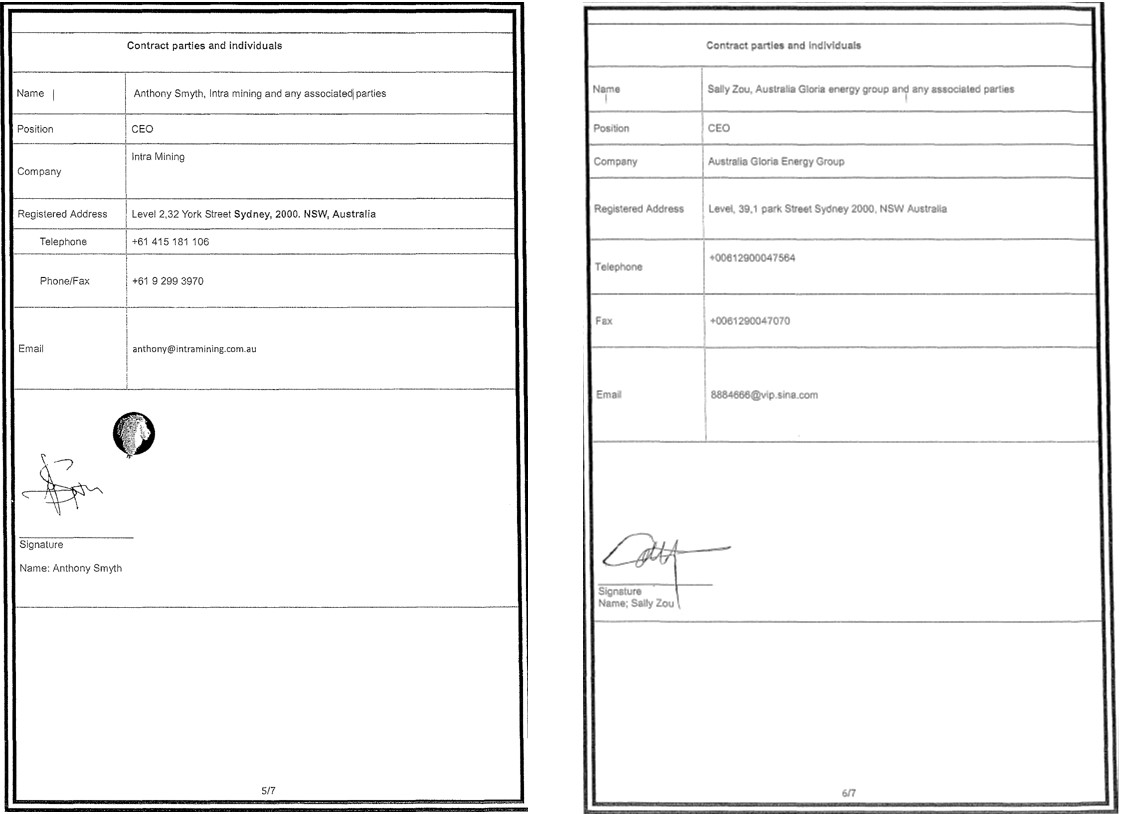
180 Significantly, the headings to the execution pages distinguish between “Contract parties” and “individuals”. If the individuals were objectively contemplated to be parties to the contract, there would be no reason to distinguish between “Contract parties” and “individuals”.
181 The execution pages also provide for the identification of the “Name” and “Position” of the individual and the identification of the “Company”. In context, the “Position” is to be construed as the position held by the “Name”, being the individual who signs the contract on behalf of the “Company”.
182 I do not accept that the entities identified as the “Company” (“Intra Mining” and “Australia Gloria Energy Group”) and “any associated parties” next to the entry for the “Name”, has the effect of making the named individuals and their “associated parties” an “undersigned party” to the Contract. The reference to the “Name” in the execution clauses is, in context, a reference to the individual who holds the position identified next to “Position” and is the person who is signing the Contract on behalf of the company that is identified next to “Company”. The inclusion of additional entities next to “Name” does not alter the fundamental textual structure of the execution clauses.
183 Objectively and read as a whole, I am satisfied that (a) the “Parties” and the “undersigned Parties” to the Contract are the two companies identified as “Intra Mining” and “Australia Gloria Energy Group”, (b) the representatives of those companies who signed the Contract on their behalf were Mr Smyth and Ms Zou respectively, and (c) the Contract extended to any and all work performed by those companies and representatives as well as any of their “associated parties”.
184 It is also objectively clear from the “Preamble” to the Contract that the alleged parties to the Contract intended to enter into legally binding arrangements with respect to the exchange of information between them in connection with their future business dealings including non-circumvention and confidentiality of their sources, contacts and intellectual property.
185 As at 7 February 2012, however, “Intra Mining” was only a business name registered to Mr Smyth, not a registered company. The company, “Intra Mining Pty Ltd”, was not registered until 27 June 2013. Mr Smyth was a director for only one day (he was appointed on 27 June 2013 and resigned on 28 June 2013) and the company was deregistered on 27 June 2014.
186 It became clear, during the hearing, if it were not already apparent, that Mr Smyth did not appreciate that (a) “Intra Mining” as a business name, could not be a party to a contract, and (b) “Intra Mining” had no legal status independently of the person to whom it was registered. Mr Smyth’s confusion was highlighted in his annotations to Ms Zou’s written outline of submissions in which his response to the privity of contract issues raised by Ms Zou included the following statements (as written):
The working agreement has 4 parties to it plus potential “associated parties”. This content of the ICC Contract makes this clear.
Clause 1, 5, 6 B.8
Sally Zou and paymaster D.1
Contract parties are separate, Sally Zou, Anthony Smyth, Age, Intra mining
Contract parties and individuals
…
As noted earlier, privity of contract does not arise because the Applicant was the owner at all material times of the Business Name Intra Mining, he was 1 of 4 primary parties to the contract issues and as pleaded in paragraph 8, FASC, these 4 parties were “jointly and severally obliged to each other under the Working Agreement”. ..
…
Proceedings were not made for AGE they were made for Sally Zou/Zou Sha.
Proceedings are for Anthony Smyth and Sally Zou that are parties to the 7 year Working agreement.
Each party is its own separate agent/party, i.e., Intra mining and AGE are separate to Anthony Smyth though both Sally Zou/Sha Zou sha is 100% owners of her companies, so to is Anthony Smyth as a 100% owner of his business name intra mining that was returned to him.
This was still a business name when proceedings commenced.
187 That misunderstanding, no doubt, caused Mr Smyth to complete the execution pages of the Contract in a legally incoherent manner. As at 7 February 2012, “Intra Mining” was not a registered company and, therefore, could not be a “Party” or an “undersigned Party” to the Contract unless the company was registered and the Contract was subsequently ratified.
Registration of Intra Mining Pty Ltd
188 Following the registration of Intra Mining Pty Ltd on 27 June 2013, Mr Smyth became an employee of the company. In the period between 27 June 2013 and July 2014, Mr Smyth was employed by Intra Mining Pty Ltd to operate its commodities trading desk. His employment agreement was in the form of a letter on the letterhead of “Intra mining [sic] Pty Ltd” dated 27 June 2013. It was signed by Mr Wilson, in his capacity as a director of the company. It relevantly provided that (as written):
It is agreed that Intra mining will employ Anthony Smyth as General Manager. Anthony is contributing his IP and contacts. Anthony will be responsible for the day-to-day activities and establishing and transacting various commodities trades both domestically and overseas.
Salary will be $200,000 p/a to commence after the completion of the first Intra mining trade. An Interim payment of minimum $2500 p/m plus expenses will be paid between.
In the event Intra mining is wound up the parties agree all IP, including documents and contacts will remain the sole property of Anthony.
189 Intra Mining Pty Ltd was deregistered on 4 June 2014 and Mr Smyth did not take any assignment of any rights that the company may have had under the Contract.
Ratification of the Contract
190 An agreement with a company that is not registered, is not an agreement that is capable of being enforced by or against that company unless it has been subsequently ratified by the company after it has been registered: s 131(1) of the Corporations Act.
191 There was no evidence of any express ratification of the Contract by Intra Mining Pty Ltd. I am satisfied, however, that there was an implied ratification of the Contract by the company during the period that it was registered. Following the registration of the company, Mr Smyth continued to provide commodity broking services to Ms Zou and her related companies in the name of “Intra Mining”.
192 During the period that Intra Mining Pty Ltd remained registered it would, therefore, have been in a position to enforce the Contract, at least against AGE as the other party to the Contract.
193 Intra Mining Pty Ltd, however, has long since been deregistered. Again, in the absence of any reinstatement, the company has no legal identity and cannot bring proceedings to enforce any alleged agreement that might have been entered in its name.
194 For the foregoing reasons, neither Mr Smyth nor Ms Zou was a party to the Contract and Mr Smyth has no standing to bring proceedings to enforce any obligations that AGE may have under the Contract. Further, the relevant entity against whom any proceedings could be brought to enforce the Contract is AGE, not Ms Zou.
195 Privity of contract issues cannot be cured by Mr Smyth bringing proceedings in his own name on the basis that Intra Mining Pty Ltd is no longer registered. Mr Smyth also took no assignment of any causes of action that might have been available to Intra Mining Pty Ltd prior to its deregistration. At most, by reason of his 27 June 2013 letter of employment and in the event of a winding up of the company, Mr Smyth would retain ownership of the intellectual property and contacts that he had “contributed” to the company.
Contractual provisions
196 In the event that I am mistaken in these findings, I now consider whether the causes of action that Mr Smyth advanced in contract are maintainable, on the assumption that Mr Smyth and Ms Zou were, personally, also parties to the Contract. This would mean that the expression the “undersigned parties” would be construed as including Mr Smyth, “Intra Mining”, Ms Zou and AGE. It is not necessary to assume also that the “associated parties” of Mr Smyth and Ms Zou would also be parties to the Contract as Mr Smyth is not purporting to advance any claims by or on behalf of any of his “associated parties” or against any of Ms Zou’s “associated parties”.
Circumvention and fee protection clauses
197 The Contract included clauses directed at preventing parties from “circumventing” the agreement and providing for the sharing of fees, commissions and other monetary amounts that might be generated by the parties to the agreement.
198 Clause B.1 of the Contract provided that the parties agreed that they would not solicit or accept any business from any source made available through the agreement without the express written consent of the party who had made the source available. Clause B.1 was directed at the “Parties intending to be legally bound”. In the context of the preamble and recitals to the Contract, they were the “undersigned Parties”.
199 In the event of any breach of the agreement, cl B.6 provided that the “circumvented party” would be entitled to a monetary penalty equal to the maximum amount that it should have realised from the impugned transaction.
200 Part C of the Contract was entitled “Fee Protection Agreement”. It relevantly included the following clauses:
1. The Parties hereby irrevocable and unconditionally agree and guarantee to honour and respect all considerations, benefits, bonuses, participation fees, wages, management fees commissions, consulting fees, compensations, remunerations and/or equity positions to be paid as a result of the contributions of the Parties in this Agreement and any funds due relating to any and all transactions, covering any Party concerned.
2. Parties unconditionally and mutually agree that any and all financial compensations are enclosed, any additional commissions or bonus are on a deal-by-deal basis, unless otherwise stipulated and agreed upon by the undersigned Parties.
Provision of one third interest clauses
201 The Contract also included the following clauses in a Part D entitled “Agreement to Terms”:
1. The undersigned Parties declare that they are acting on behalf of AGE and Sally Zou for dealings with the manufacturers, miners or sellers on one side and for account of the buyers or other mandated entities on the other side. Intra mining and Anthony Smyth will be given a 1/3 one third of each transaction and one third (1/3) of AGE, Sally Zou and any of its associated parties as part of this contract and will act in the best interests of the above said parties.
2. This agreement covers day to day operations and costs including the buying of commodities and related business and is in effect once business as prescribed commences.
3. Payments will be made for administration and management fees including contract fees, operational fees and success fees.
202 These clauses give rise to complex construction issues. It is necessary to read the clauses together as each informs how the others are to be construed.
203 The first sentence of cl D.1 purports to provide that the “undersigned Parties”, for present purposes, each of “Intra Mining”, Mr Smyth, AGE and Ms Zou declare that they are acting on behalf of “AGE and Sally Zou” in dealings with third parties. The third parties are stated to comprise “manufacturers, miners or sellers” on one side and “buyers or other mandated entities” on the other side.
204 The provision is inherently problematic. The purported declaration is not an authorisation for Mr Smyth and “Intra Mining” to act on behalf of AGE and Ms Zou in dealings with third parties. Further, no third parties are specifically identified, nor are they parties to the Contract and there is no evidence that any third party suppliers of commodities who entered into the Commodities Contracts were provided with a copy of the Contract. The second sentence of cl D.1 provides that “Intra mining” and Mr Smyth will be both given one third of each “transaction” and one third of “AGE, Sally Zou and any of its associated parties as part of this contract”.
205 I address first, the construction of the provision “one third of each transaction”.
206 Textually, the use of the conjunction “and” and the absence of “each” in the reference to “Intra mining and Anthony Smyth” is significant. It has the effect of providing that Mr Smyth and “Intra Mining” are to be given cumulatively one third of each transaction and not that each is to be given one third of each transaction.
207 There is no express definition of “transaction” in cl D.1. In context, I infer it is a reference to any dealing that the “undersigned Parties” might have engaged in on behalf of AGE and Ms Zou with “manufacturers, miners, sellers” and “buyers and other mandated entities” in connection with at least the “buying of commodities and related business”.
208 In my view, objectively construed, the reference to an entitlement to one third of each transaction in an agreement directed at the provision of broking services by a party for the benefit of another party would encompass one third of the benefits realised in connection with each transaction that had been brokered. The benefits could be represented by the commission generated on the commodities contract or the difference between the price paid for the commodities and the price paid by the end purchaser of the commodities.
209 Clause D.1 is to be contrasted with cl D.3. The latter clause focuses on the payment of “administration and management fees” and provides that these fees would include “contract fees, operational fees and success fees”. In context, it is clear that these “fees” are to be paid in addition to any entitlements that might arise under cl D.1. Rather than providing for the receipt of an interest in a transaction or any sharing of profit or revenue generated on a transaction, they are directed at the payment of fees for work of an administrative or management character undertaken under the Contract.
210 Mr Smyth contends in the ASOC at [8(i)] that it was a term of the Contract that:
The parties guaranteed that they would adhere to the terms of business and perform any contracts or agreements either written or verbal that were entered into as a result of the commodities broking services provided by the Applicant under the Working Agreement.
211 The particulars provided of the alleged term were that it was “express and in writing as evidenced by cl B.2 of the Contract.
212 I do not accept that the term alleged in the ASOC at [8(i)] is an accurate reflection of cl B.2 of the Contract. Clause B.2 relevantly provided that:
The Parties irrevocably agree and guarantee that they will adhere to to [sic] the terms of business and any contracts or agreements either written or verbal and will adhere to these terms and any and all contracts set out. In the event that there are issues within the contract or for fulling [sic] the parties signed will agree to remedy them.
213 Notwithstanding the infelicities and typographical errors in the relevant extract from cl B.2, in context, the clause as a whole is directed at “these terms” and “any and all contracts set out”. The first reference is to the express terms of the Contract being terms principally focused on “non-circumvention” and “confidentiality” as recorded in the first recital to “Preamble” of the Contract. The reference to “any and all contracts set out” is inherently opaque. No contracts are “set out” in the Contract. Contextually, I am satisfied that it would encompass, at least, contracts that might be entered into between the parties to the Contract providing for the provision of commodity broking services by “Intra Mining” to Ms Zou and her associated entities. I do not accept that it can be objectively construed as extending to a guarantee that a party would adhere to the terms and perform any contract that the party may have entered into with a third party pursuant to services that the other party might have provided under the Contract.
214 Clause B.2 provides an irrevocable guarantee that a party will adhere to the terms of business set forth in the Contract and any subsequent contracts, either written or verbal, that the parties might enter into with each other. It does not provide a basis for Mr Smyth to claim that he is entitled to damages from Ms Zou in an amount equal to the commission that he would have received if AGE, HKV and AMG had performed their respective obligations under the Commodities Contracts.
215 Given my construction of this provision and that none of the Commodities Contracts were completed, no entitlement arose to the payment of “one third of each transaction”. The claims advanced by Mr Smyth based on this provision must fail.
216 I turn now to consider the provision that Mr Smyth and “Intra Mining” are to receive one third of “AGE, Ms Zou and any of its associated parties as part of this contract”.
217 Again, textually, the use of the conjunction “and” and the absence of “each” in the reference to “Intra mining and Anthony Smyth” is interpreted to mean that Mr Smyth and “Intra Mining” are to be given cumulatively one third of each of “AGE, Ms Zou and its associated parties”. It is not clear whether “its” associated parties was objectively intended to be a reference to the associated parties of Ms Zou or of AGE. For present purposes, given that Ms Zou was the sole director and shareholder of AGE, it is unnecessary to come to any concluded view.
218 It might be possible to give some objective meaning to a one third interest in a “transaction” but the same cannot be said for the provision of an additional one third interest in AGE, Ms Zou and “its” associated parties as “part of this contract”. It is simply not possible to give the provision any commercially coherent construction. Textually, the clause purported to provide that as “part of this contract”, “Intra mining” and Mr Smyth were to receive a one third interest in each of AGE, Ms Zou and of all their associated parties. Such a construction would be commercially absurd for the following reasons.
219 First, it is simply not possible to be given a one third interest in a natural person.
220 Second, the provision of a one third interest in AGE and in any “associated entities” that are incorporated might be achieved by the acquisition of one third of the share capital of each company. I am, however, satisfied that this could not have been the objective intention of the parties in entering into the Contract. The Contract was directed at the provision of commodities broking services by Mr Smyth and “Intra Mining” for Ms Zou, AGE and her associated entities.
221 Further, the proposition that in addition to the sharing of profits generated on each transaction, that Ms Zou also intended to give Mr Smyth and “Intra Mining” a one third interest in AGE and every associated entity, irrespectively of whether they had any involvement in any commodities trading activities brokered by Mr Smyth and “Intra Mining”, is inherently implausible. It makes no commercial sense. Nor is it necessary or possible to imply any other term to similar or equivalent effect in order to give business efficacy to the Contract. It is a provision that can readily be severed from the balance of the Contract.
222 In addition, the subsequent conduct of the parties, to the extent it might assist in construing the text of the Contract, does not reveal any contemporaneous proposals for any transfer of any interest in AGE, Ms Zou or any of their associated parties to “Intra Mining” or Mr Smyth. There is no evidence that any share transfers or other documents that might have given rise to a one third interest in any of Ms Zou’s associated companies, including AGE, were ever prepared, proffered or given effect to after the execution of the Contract.
Reimbursement of Intra Mining expenses
223 Mr Smyth seeks reimbursement of expenses allegedly incurred by “Intra Mining” from Ms Zou pursuant to an invoice issued to Ms Zou and Mr Li on 29 May 2012 (2012 Invoice).
224 The 2012 Invoice was on the letterhead of “Intra Mining” addressed to:
Sally Zou
Australia Gloria Energy Pty Ltd
Level 32, Citi Group 2-26 Park Street, Sydney, Australia
2000
& John Li
JL Brothers Pty. Ltd.
225 The 2012 Invoice was stated to be for:
Acquisition of Coal and D2
Enerse Coal Colombia
Pro-Petroleum
Glencore Australia
PT Allied Coal Indonesia
226 The 2012 Invoice was undated but was directed at services provided at various periods between January and May 2012.
227 The 2012 Invoice was in an aggregate amount of $253,000.00 (inclusive of GST). The services the subject of the invoice were variously described as “Administration, Legal Fees, International Calls, Wages, Compensation, Travel” and included for PT Allied Coal Indonesia, “Preparation of coal on stockpile, mined exclusively for AGE”, “Security stockpile renting fee for coal” and “Organising of Barges and Shipping logistics”.
228 The 2012 Invoice was signed by Mr Smyth above the signature block “Anthony Smyth, CEO” and the bank details for payment were a personal account of Mr Smyth with the Commonwealth Bank of Australia. The due date for payment was specified to be Friday, 29 May 2012 and the invoice included a warning that “Failure to pay this bill will result in legal proceedings”.
229 The 2012 Invoice was emailed to Ms Zou and Mr Li on 29 May 2012 by Mr Louis Shearer. The email was addressed to Ms Zou and stated (as written):
Ms Sally Zou
I am writing to you with reference to outstanding invoices that require payment on your behalf from the Coal & D2 contracts for Enerse, Pro Petrolium, Glencore and PT Allied Coal. These obligations was agreed upon in writing by yourself for AGE and again discussed with John verbally on several dates.
With regards to the invoice detailed below, it is evident that the following costs are still outstanding and require payment.
In an effort to prevent this disagreement being taken to court I request that the money amount as outlined in the attached documentation to be deposited by Friday 2 June 2012 by 5pm. The bank account details, that I wish the deposit to be made to are also found in the attached documentation. It is a contravention of law to retain payment without a legitimate reason permitted under the legislation.
In the future we will need to strictly adhere to the contracts that we have put in place if we are to continue to trade together.
Yours sincerely
Louis Shearer
230 I infer that the reference in the covering email to the agreement “in writing by yourself for AGE” was a reference to the Contract. As explained above, I am satisfied that although the Contract was purportedly entered into by Intra Mining Pty Ltd prior to its incorporation, it was subsequently ratified by Intra Mining Pty Ltd, at least by implication following its registration.
231 As the 2012 Invoice was stated to be issued under the Contract, it follows that Intra Mining Pty Ltd, subject to any limitation issues, would be able to pursue a cause of action for recovery of the outstanding costs for broking services provided under the Commodities Contracts.
232 The profound difficulty for Mr Smyth, however, is that Intra Mining Pty Ltd was deregistered in July 2014 and there has been no assignment by Intra Mining Pty Ltd to Mr Smyth of any cause of action it might have had under the Contract against Ms Zou or any associated entities.
Limitation of actions and privity issues
233 Further, and in any event, any claims for the payment of commission pursuant to the Contract, other than the Laikera Holdings ICPO and the CV ES Holding Contract (Subsequent Commodities Contracts), would be statute barred. The alleged failures to pay commission on entry into the Commodities Contracts, other than the Subsequent Commodities Contracts, occurred more than six years prior to the commencement of proceedings on 27 June 2019.
234 Mr Smyth has no standing to seek to recover in his own name, any alleged outstanding commissions under the Laikera Holdings ICPO or the CV ES Holding Contract as both were entered into when he was providing broking services as an employee of Intra Mining Pty Ltd.
Appointment as Vice-President of AGE
235 I next need to address, briefly, a peripheral issue being the alleged appointment of Mr Smyth as the Vice-President of AGE. To the extent it had any relevance to the claims sought to be advanced by Mr Smyth, other than perhaps credit, it appeared to be deployed to buttress the contention that Ms Zou had agreed to give Mr Smyth and “Intra Mining” a one third interest in each of “AGE, Ms Zou and its associated entries” as “part of” the Contract.
236 As explained above, Mr Smyth contends that his appointment as a Vice-President of AGE was agreed during the Zilver meeting in early February 2012 but was not reduced to writing in the Contract.
237 Mr Smyth gave evidence that during the Zilver meeting, he said to Ms Zou that, “if he agreed to take part in this (trading global commodities)”, he would “need to be part of the company” and “would also need a team” that would consist of his contacts.
238 Mr Smyth gave evidence that he said the following to Ms Zou:
If I am to be the VP, I will need a good share of everything ongoing. I would want a third share in Australia Gloria Energy Group. We will set things up so it will take and make on everything, and I mean everything and ongoing. It will own a part of everything – the mine, ongoing offtakes, all deals. Finance is the easy party of this. All end-users have it. All mine buyers have it. The real work is all done up front to pull the business together. So, you will need to pay me for all the work done up front and then also pay a commission on each deal that is signed. The money to fund the contracts is not my part, that’s yours.
239 Ms Zou denied that she had ever agreed that Mr Smyth was to be a Vice-President of AGE.
240 Whatever may or may not have been said between Mr Smyth and Ms Zou about any proposal that Mr Smyth be appointed as a Vice-President of AGE, there is no evidence before me that he was in fact ever appointed or acted as the Vice-President. To the contrary, in an email sent to AGE by Mr Craig Johnston, a senior lawyer with GARD (HK) Ltd, Mr Johnston recorded in the attachment that Mr Smyth initially advised that he was the “VP Australia Gloria Energy” but subsequently stated he was “not connected with them”. GARD (HK) Ltd was acting for Sanko in relation to the default by AGE under the Glencore Contract. Mr Johnston’s email to AGE was, in turn, emailed to Mr Smyth on 29 May 2012 by Thurlestone Shipping Singapore Pte Ltd.
Procurement of the Commodities Contracts
241 Mr Smyth gave evidence that he entered into oral contracts with Ms Zou on behalf of her associated companies shortly prior to each of the Commodities Contracts (Procurement Contracts). I am not persuaded that there was any objective intention to enter into additional contractual obligations from the oral discussions that Mr Smyth may have had with Ms Zou in the course of Mr Smyth providing commodities broking services to Ms Zou and her associated entities.
242 Ms Zou accepted that Mr Smyth arranged or procured the entry by Ms Zou or AGE into each of the Commodities Contracts. The provision of that service falls within the terms of the Contract. The terms of the Contract were directed at the basis on which “Intra Mining” would provide commodities broking services to Ms Zou and her related entities.
243 Mr Smyth and Ms Zou, however, gave very different evidence about the circumstances in which Ms Zou and her related companies entered into each of the Commodities Contracts and Mr Smyth’s entitlement to any commission or other compensation arising from the Commodities Contracts.
244 Mr Smyth claimed in the ASOC at [8(f)] that the Contract provided that he would be paid one-third of the income to be received by AGE and/or Ms Zou on each of the transactions entered into as a result of the commodities broking services that he provided under the Contract.
245 In his affidavit sworn on 19 November 2019, Mr Smyth advanced additional claims for commission. He claimed that in return for him procuring commodities to satisfy orders that Ms Zou had received, she had offered to give him the following commissions (a) a “one third commissions on all profits” that she and her associated companies made on each Commodities Contract, (b) a success fee upon securing a Commodities Contract in an amount equivalent to 50% of all commissions paid on the total value of the Commodities Contracts entered into by Ms Zou or her associated companies, and (c) 50% of all commissions paid by the “agreed shipper” contracted by Ms Zou or her associated companies to ship or transport the commodity that they had purchased.
246 At the commencement of the hearing, Mr Smyth advanced alternative claims for commission. He claimed that the Procurement Contracts contained terms that Ms Zou’s associated companies were to pay him specific commissions. Alternatively, he claimed that by reason of the Contract, he was entitled to one third of the income that would have been received by Ms Zou’s associated companies from each of the Commodities Contracts. He contended that the Procurement Contracts provided that he was to receive commissions in the following amounts on the execution of each Commodities Contract:
(a) US$2.00 per tonne on the steam coal to be purchased by AGE from Enerse Coal under the Enerse Coal Contract;
(b) US$1.00 per tonne on the iron ore agreed to be purchased by AGE from ZMT under the ZMT Resources Iron Ore Contract;
(c) US$1 per tonne on the D2 diesel agreed to be purchased by AGE from Pro Petroleum Dev Inc. (Pro Petroleum) under the Pro Petroleum D2 Contract;
(d) US$1.50 per tonne on the steam coal agreed to be purchased by AGE under the PT Allied Coal Contract;
(e) US$0.66 per tonne and an additional US $150,000 on the steam coal agreed to be purchased by AGE under the Glencore Coal Contract;
(f) US$0.50 per tonne on iron ore to be purchased by HKV under the Atlas Iron Ore ILLL;
(g) US$1.00 per tonne on the iron ore to be purchased by AMG under the Laikera Holdings ICPO; and
(h) US$0.60 per tonne on the coal to be purchased by AMG under the CV ES Holding Coal Contract.
247 At the end of the hearing, Mr Smyth claimed, in the course of his closing oral submissions, that the arrangement reached with Ms Zou was that immediately upon entry into each Commodities Contract, he was to receive one third of the contract price by way of commission. This claim was not pleaded and not the subject of any evidence.
248 In her affidavit evidence, Ms Zou contended that Mr Smyth, in effect, thrust many of the Commodities Contracts on her for signing notwithstanding that she had not yet identified Chinese end purchasers who were interested in the commodities or had committed to providing letters of credit to enable the contracts to be completed. Ms Zou steadfastly maintained in her affidavit evidence and in cross-examination that she had never agreed with Mr Smyth that he would receive commission on entry into each Commodities Contract. She stated that the commission payable to Mr Smyth was only payable from the share of the profits on the successful completion of each Commodities Contract.
249 Ms Zou denied that she ever agreed to pay commissions to “Intra Mining” whenever she signed a Commodities Contract on behalf of one of her associated companies. Ms Zou gave evidence that all the oral contracts with Mr Smyth were conditional on the issuing of a letter of credit, which the ‘end buyer’ would purchase from a bank.
250 Ms Zou also disputed that the “unit of commission” identified by Mr Smyth for each of the Commodities Contracts was correct. She gave evidence that during the period 2012 to 2013, a unit of commission was “about 0.5-1 US Dollars per ton in general”.
251 As explained above at [149]-[150], the subsequent conduct of parties may assist in determining the scope of what was agreed between parties to an alleged agreement.
252 It is telling, that there are no contemporaneous documents evidencing any request for payment of commission alleged to be payable by Ms Zou or her associated companies arising from the entry by Ms Zou’s associated companies into the Commodities Contracts. The only contemporaneous document in evidence was the 2012 Invoice, being an invoice sent to Ms Zou and Mr Li in May 2012 requesting payment of expenses in connection with four of the Commodities Contracts. The 2012 Invoice and the covering email were considered above at [223] to [232] in my consideration of Mr Smyth’s claim for reimbursement of his expenses.
253 It is also telling that in the email communications in September 2013 relied upon by Mr Smyth in connection with the entry into the alleged Previous Entitlements Agreement, Mr Smyth claimed Ms Zou owed him “hundreds of thousands of dollars in real costs, lost revenue and commissions”. There was no evidence of any contemporaneous claims being made by Mr Smyth or “Intra Mining” for the payment of commissions in excess of these amounts. These email communications are considered further below at [269]-[283] in my consideration of the alleged Previous Entitlements Agreement.
254 I am not persuaded that the conversations that Mr Smyth had with Ms Zou included any express acknowledgement by Ms Zou that she had agreed to pay commissions even if the Commodities Contracts did not proceed. I am also not persuaded that there was any such acknowledgment given (a) the alleged conversations with Ms Zou took place many years ago, (b) Ms Zou’s emphatic denials of any agreement to pay commission on entry into Commodities Contracts, (c) the lack of any textual support in the Contract for such an agreement, (d) the absence of any evidence of any contemporaneous requests for payment of commissions on entry into the Commodities Contracts, and (e) my concerns generally about the weight I can place on the evidence given by Mr Smyth.
255 I am satisfied that, in substance, the arrangement that had been contemplated between Mr Smyth and Ms Zou pursuant to the Contract, and that was pursued in practice, was that (a) “Intra Mining” would locate and introduce Ms Zou to suppliers of commodities who were prepared to enter into contracts with Ms Zou’s associated companies, (b) the supplier would enter into a contract with an associated company of Ms Zou, subject to the provision of a letter of credit, (c) Ms Zou would seek to obtain a letter of credit from the end user in a back to back contract to enable the contract with the supplier to be completed, and (d) Ms Zou agreed to share the profits that might be generated on each contract with “Intra Mining”.
Limitation of actions and privity issues
256 Further, and in any event, as for the Contract, any claims for the payment of commission pursuant to the alleged Procurement Contracts arising from the Commodities Contracts other than the Laikera Holdings ICPO and the CV ES Holding Contract (Subsequent Commodities Contracts), would be statute barred. The alleged failure to pay commission occurred more than six years prior to the commencement of the proceedings.
257 Again, as for the Contract, Mr Smyth would also have no standing to seek to recover in his own name any alleged outstanding commissions under the alleged Procurement Contracts with respect to the Subsequent Commodities Contracts. The Subsequent Commodities Contracts were entered into during the period that he was providing commodities broking services as an employee of Intra Mining Pty Ltd.
Coal Contracts
258 Mr Smyth alleged that a company associated with Ms Zou entered into two separate commodities contracts in breach of the non-circumvention provisions of the Contract (Coal Contracts).
259 The first of the Coal Contracts was alleged to be an agreement reached on 28 December 2013 with an unidentified third party to purchase 60,000 tonnes of steam coal (First Coal Contract). Mr Smyth claimed that the entry by the company associated with Ms Zou was a breach of the Contract and/or the Previous Entitlements Agreement and gave rise to lost commission of US$90,000.
260 The second impugned contract was an agreement dated 17 January 2014 (Second Coal Contract). Mr Smyth claimed that the entry by the company associated with Ms Zou was a breach of the Contract and/or the Previous Entitlements Agreement and gave rise to lost commission of US$90,000.
261 Mr Smyth relied on the following text messages that he received from Ms Zou in support of his claims with respect to the Coal Contracts:
(a) A text message sent at 1.16 pm on 28 December 2013, in these terms:
Your friend introduce one cargo coal to me, and do it well now. I want to give you some commission to you. So just discuss with you. If you do not mind, pls call me back. Thanks. Sally.
(b) A text message sent at 10.17 pm on 17 January 2014, in these terms:
A little busy for these days, I can see you in next Wednesday or Thursday. I just sell 150,000 tons cooking [sic] coal to China from BHP.
262 Ms Zou denied that either of the Coal Contracts was ever completed.
263 Ms Zou accepted that Mr Smyth or “Intra Mining” was entitled to “some commission” with respect to any profit generated on the First Coal Contract because Mr Smyth’s “friend” had introduced the contract to her. She claimed, however, that the Second Coal Contract was introduced to her by Mr Li, not Mr Smyth. Ms Li was extensively cross examined by Mr Smyth about the extent to which he had introduced Ms Zou to BHP representatives in Newcastle and Port Kembla. Ultimately, the evidence was inconclusive, at least with respect to the Second Coal Contract. I am not satisfied that Mr Smyth established that he had introduced the Second Coal Contract to Ms Zou.
264 In any event, I am not satisfied that either of the Coal Contracts was completed or that any profit or commission was generated on them. Ms Zou’s email on 28 December 2013 is inherently ambiguous. The phrase, “and do it well now.” inserted between “Your friend introduce one cargo coal to me” and “I want to give you some commission to you” does not carry any necessary implication that the contract had completed and Ms Zou had received any profit or commission on it. If anything, it is a forward looking exhortation to do something rather than a statement that something has done well. Nor does the phrase, “I want to give some commission to you” necessarily convey the First Coal Contract had completed and Ms Zou now was in a positon to pay “some commission” to Mr Smyth or “Intra Mining”.
265 Given my findings that commission was only payable if the commodities contracts were completed, the claims made by Mr Smyth with respect to the Coal Contracts must fail.
266 Further, the claims with respect to the Coal Contracts must fail because Mr Smyth has no standing to seek to recover any commission with respect to these contracts. As I explain above, any entitlement to commission arose during the period that Mr Smyth was operating the commodities trading desk as an employee of Intra Mining Pty Ltd.
267 The Coal Contracts claims must also fail because they are statute barred and have been extinguished pursuant to s 14(1) and 63(1) of the Limitation Act. The First Coal Contract was alleged to have been entered into on or before 28 December 2013. The Second Coal Contract was alleged to have been entered into on or before 17 January 2014.
268 The claims made with respect to the Coal Contract were first raised by Mr Smyth in the ASOC that was filed on 25 August 2020. I am satisfied that the claims did not arise out of the same or substantially the same facts as the claims previously advanced by Mr Smyth in the proceedings. The claims that had previously been advanced were limited to claims with respect to the Commodities Contracts (other than the Pro Petroleum D2 Contract). The relation back principle, therefore, has no application to the Coal Contracts claims.
The Previous Entitlements Agreement
269 Mr Smyth contends in the ASOC at [54] that:
On or about 9 September 2013, the Applicant, AMG and the respondent agreed that, in consideration of the Applicant providing broking services to AMG and the Respondent in the same terms as the Working Agreement to broker a contract on behalf of AMG for the purchase of Indonesian steam coal, the Respondent would pay the Applicant for the services in broking a contract on behalf of AMG for the purchase of Indonesian steam coal on the same terms as the Working Agreement, would pay to the Applicant the amount of the invoice (08-626) sent to the Respondent on 29 May 2012 and would pay to the Applicant the commissions and amounts that the Applicant would have earned for providing his services on the Enerse Coal Contract, the ZMT Resources Contract, the Pro Petroleum D2 Contract, the PT Allied Coal Contract, the Glencore Coal Contract, the Atlas Iron Ore LOI and the Laikera Holdings ICPO if the respective Respondent’s company (AGE, HVI or AMG) had completed a purchase on the terms set out in those documents (the “Previous Entitlements Agreement”).
270 Mr Smyth provided the following particulars of the Previous Entitlements Agreement:
The Previous Entitlements Agreement was express, partly in writing as evidenced by emails sent between the Respondent and the Applicant between 7 September 2013 and 9 September 2013 and partly oral and formed in conversations between the Applicant and the Respondent on 9 September 2013.
271 The first issue that arises in relation to the alleged Previous Entitlements Agreement is the identity of the parties to the alleged agreement.
272 By September 2013, as explained above, Mr Smyth was providing commodities broking services as an employee of Intra Mining Pty Ltd. Hence, any commodities broking services that Mr Smyth might have provided to AMG for the purchase of Indonesian steam coal in response to Ms Zou’s requests in September 2013, would have been provided by him as an employee of Intra Mining Pty Ltd. The consideration to support the obligations of AMG and Ms Zou under the agreement would, therefore, have been provided by Intra Mining Pty Ltd, not Mr Smyth personally. The provision of broking services fell squarely within the parameters of Mr Smyth’s employment contract. Indeed, Mr Smyth’s entitlement to a $200,000 salary was to be triggered by the completion of the “first Intra mining trade”. It follows that the parties to the alleged Previous Entitlements Agreement would have been Intra Mining Pty Ltd, AMG and Ms Zou.
273 Mr Smyth would not have any standing to enforce any alleged Prior Entitlements Agreement entered into in September 2013. Given the ratification of the Contract by Intra Mining following its registration as discussed above, any alleged “prior entitlements” would have been entitlements of Intra Mining Pty Ltd.
274 In any event, I am otherwise not satisfied that an agreement was entered into between any of the parties in the form of the alleged Previous Entitlements Agreement for the following reasons.
275 First, the emails exchanged between Mr Smyth and Ms Zou in the period from 7 to 9 September 2013, do not support the existence of the Previous Entitlements Agreement.
276 On 7 September 2013, Ms Zou sent the following email to Mr Smyth (as written):
Dear Anthony,
How are you? I think You are very smart. Thanks for your hard work and warm heart.
I need Indoniesia coal 5000 – 5500 (NAR) cal, 50,000 tons per month, can you do it? I can give you some money once done.
Thank you again.
Hearted Regards!
Sally
277 On 9 September 2013, Mr Smyth sent an email in the following terms to Ms Zou in response to her 7 September 2013 email (as written):
Sally, you have failed on five contracts you have signed sealed and failed to perform on.
On top of this You owe millions for a contract in Newcastle coal alone, you also me a considerable amount of hundreds of thousands of dollars is real costs, lost revenue and commissions.
I also lost several staff and my work property due to you n]
Before anything When are you going to pay this back firstly as you said? and whata€™s (what is) your commitment on this?
278 Later that day, Ms Zou provided this response by email to Mr Smyth’s email:
A,
How much do you want to need?
S
279 The question, “How much to you want to need”, in response to an email stating “you also me a considerable amount of hundreds of thousands of dollars in real costs, lost revenue and commissions” is telling in several respects. It cannot evidence any agreement by Ms Zou to pay commissions with respect to Commodities Contracts. Further, the reference to “you want to need”, textually, is addressed at the amounts alleged to be owing to Mr Smyth, not the millions of dollars that Ms Zou may have owed to the commodities supplier on the “Newcastle coal” contract. The amount owing to Mr Smyth was stated to be in the amount of “hundreds of thousands of dollars”, not the millions of dollars in commissions claimed by Ms Smyth pursuant to the alleged Previous Entitlements Agreement.
280 Second, in his affidavit sworn on 11 May 2021, Mr Smyth gave evidence that on 9 September 2012 (which I am satisfied is a typographical error and should have been a reference to 9 September 2013), after receiving Ms Zou’s email he had a discussion with Ms Zou (I infer by telephone in the absence of any reference to a “meeting”) in words to the following effect:
AS: Sally, since you have asked me, I will tell you what I need. First of all, you need to pay that invoice that Intra Mining sent you for working on the contracts that you failed to perform.
SZ: Of course, darling. No problem.
AS: Sally, that invoice was only for the administration and management fees for the work done under our contract. You also need to pay the monies that Intra Mining would have earned on the deals under our contract if your companies had gone ahead with those deals. We are talking about all of them – Enerse coal, ZMT iron ore, the D2 contract with Pro Petroleum, Allied Coal, Atlas Iron ore and the Philippines iron ore and, most importantly, the Glencore Newcastle coal contract. You have told me again and again that you would pay this. Well, if you want me to work for you to get this Indonesian coal, then that is the deal.
SZ: Yes, yes, if you get me my coal contract.
AS: Well, Sally, just so long as we are clear. This includes the commissions I would have earned on the deals if you have gone ahead.
SZ: That is fair. My uncle will be pleased if I get this Indonesia coal contract.
281 I accept that Mr Smyth had a conversation with Ms Zou on or about 9 September 2013 in which he raised with Ms Zou his concerns that the previous Commodities Contracts with her had not completed. I accept that during this conversation, Mr Smyth raised that Ms Zou owed millions of dollars on the “Newcastle coal contract” and she owed him a considerable amount of “hundreds of thousands of dollars” referable to “real costs, lost revenue and commissions”. I also accept that Mr Smyth raised that he wanted the amounts she owed to him paid back before he would agree to source the Indonesian coal. The making of such requests were consistent with the content of his email to Ms Zou on 9 September 2013 and with the apparent logic of events. Mr Smyth had successfully procured six of the Commodities Contracts for Ms Zou but her companies had failed to complete any of them. Understandably, he would have been concerned at her ability to complete any new commodities contracts since she still owed “millions” for the “Newcastle coal contract” alone. Further, given his views as to his entitlements under the Contract requesting payment of the “hundreds of thousands of dollars” for “real costs, lost revenue and commissions” is not exceptional.
282 I also accept that Ms Zou responded to Mr Smyth’s requests in words to the effect that (a) she was confident that she was in a position to perform the proposed Indonesian coal contract, (b) she would share the commission on the contract, and (c) if the Indonesian coal contract was successful she would be able to pay him the money he was claiming.
283 I do not accept Mr Smyth’s evidence of his conversation on 9 September 2013 to the extent that it travels beyond the matters that I have outlined above at [281]-[282]. I do not accept that evidence given, (a) the passage of time since the conversation, (b) the extent to which recollections can be influenced by the exigencies of litigation, (c) the absence of any contemporaneous support for the alleged commitment to pay millions of dollars in commissions for the past Commodities Contracts, (d) Ms Zou’s denials and the inherent implausibility that Ms Zou had provided any commitment to Mr Smyth to pay millions of dollars in commissions for prior uncompleted Commodities Contracts, and (e) my general concerns about the weight I can give to Mr Smyth’s evidence.
284 In the event that I am mistaken in concluding that the Previous Entitlements Agreement has not been established and if established, Mr Smyth had no standing to bring proceedings to enforce it, it is also necessary to address Ms Zou’s contentions that any claim made under the alleged Previous Entitlements Agreement has been extinguished by reason of s 14(1) and s 63(1) of the Limitation Act.
285 The claims with respect to the Previous Entitlements Agreement were first raised in the ASOC. As explained above, the claims that had previously been advanced in the proceedings were claims limited to the Commodities Contracts (other than the Pro Petroleum D2 Contract).
286 Mr Smyth pleads various breaches of the Previous Entitlements Agreement in the ASOC at [58] to [68]. The alleged breaches focus on failures to pay commissions referable to the Commodities Contracts after he had successfully brokered the CV ES Holding Contract for AMG on 28 February 2014.
287 Contrary to the submissions advanced by Ms Zou, I accept that the claims made under the Previous Entitlements Agreement arose under the same or substantially the same facts as the claims previously advanced in the proceedings.
288 In substance, the Previous Entitlements Agreement was an attempt to advance an alternative cause of action based on the failure of the companies associated with Ms Zou to complete the Commodities Contracts. Significantly, the CV ES Holding Contract was one of the Commodities Contracts the subject of the claims previously advanced.
289 I am, therefore, satisfied that the relevant date for limitation purposes for the Previous Entitlements Agreement is 27 June 2019, by reason of the relation back principle, and not 25 August 2020, being the date of the filing of the ASOC.
Damages
290 Given that Mr Smyth has not succeeded in any of the causes of action that he advanced in the proceedings, damages issues can be dealt with briefly.
291 Notwithstanding the breadth of the damages sought by Mr Smyth, he ultimately advanced a damages case that only sought to quantify the alleged loss of commissions by reason of the failure of the Commodities Contracts to complete and the expenses in the 2012 Invoice.
292 The expenses sought in the 2012 Invoice are identified above.
293 Mr Smyth alleged in the ASOC at [65], that by reason of cl B.6 of the Contract, he was entitled to recover damages from Ms Zou on the basis that she was jointly and severally liable with AMG by reason of the first paragraph of the Contract. The contention is misconceived unless the “undersigned Parties” and “Parties” to the Contact, contrary to my findings above, included Mr Smyth, Ms Zou and AMG. The first paragraph relevantly provides that the Contract:
Defines the legal association of all undersigned Parties and shall obligate the Parties jointly and severally for the terms and conditions expressly stated and agreed herein.
294 Mr Smyth seeks damages equal to “the maximum he should have realised” had AMG performed its obligations under the Previous Entitlement Agreement with respect to the CV ES Holding Coal Contract, together with any and all expenses. Alternatively, Mr Smyth seeks general damages for breach of contract.
295 Mr Smyth then more specifically contends in the ASOC at [66] that by reason of the term of the Contract that he pleads in the ASOC at [8(i)], or alternatively “by operation of law” he was entitled to the following damages from Ms Zou:
(a) US$36,000 – representing commission that would have been payable on the CV ES Holding Coal Contract (US$0.60 per ton on 60,000 tons) or alternatively one third of the income that would have been received by AMG and/or Ms Zou on the transaction with CV ES Holding;
(b) US$3,600,000 – representing commission that would have been payable on the Enerse Coal Contract (US$2.00 per ton on 1,800,000 tons) or alternatively one third of the income that would have been received by AGE and/or Ms Zou on the transaction with Enerse Coal:
(c) US$600,000 – representing commission that would have been payable on the ZMT Resources Contract (US$1.00 per ton on 600,000 tons) or alternatively one third of the income that would have been received by AGE and/or Ms Zou on the transaction with ZMT Resources;
(d) US$2,570,000 – representing commission that would have been payable on the Pro Petroleum D2 Contract (US$1.00 per ton on 2,570,000 tons) or alternatively one third of the income that would have been received by AGE and/or Ms Zou on the transaction with Pro Petroleum;
(e) US$900,000 – representing commission that would have been payable on the PT Allied Coal Contract (US$1.50 per ton on 600,000 tons) or alternatively one third of the income that would have been received by AGE and/or Ms Zou on the transaction with PT Allied Coal;
(f) US$85,800 – representing commission that would have been payable on the Glencore Coal Contract (US$0.66 per ton on 130,000 tons) or alternatively one third of the income that would have been received by AGE and/or Ms Zou on the transaction with Glencore;
(g) US$900,000 – representing commission that would have been payable on the Atlas Iron Ore LOI (US$0.50 per ton on 1,890,000 tons) or alternatively one third of the income that would have been received by HVI and/or Ms Zou on the transaction with Atlas Iron Ore LOI; and
(h) US$1,800,000 – representing commission that would have been payable on the Laikera Holdings ICPO (US$1.00 per ton on 1,800,000 tons) or alternatively one third of the income that would have been received by AMG and/or Ms Zou on the transaction with Laikera Holdings,
(together, the Commission Payments).
296 Mr Smyth only sought to quantify damages referrable to the Commission Payments pursuant to calculations based on the specific commissions alleged to have been agreed in the Procurement Contracts. No attempt was made to quantify the income that would have been received by AGE, AMG, HVI or Ms Zou on any of the Commodities Contract.
297 Ms Zou did not advance any alternative quantification of damages case. Her position remained that (a) no entitlement to commission arose unless the Commodities Contracts were completed and she generated a profit or commission on them, and (b) she never agreed to any specific commission payment percentage as alleged by Mr Smyth under the alleged Procurement Contracts.
DISPOSITION
298 For the foregoing reasons, the originating application is to be dismissed and Mr Smyth is to pay the costs of Ms Zou. Given that Mr Smyth has been wholly unsuccessful, there is no reason why costs should not follow the event.
I certify that the preceding two hundred and ninety-eight (298) numbered paragraphs are a true copy of the Reasons for Judgment of the Honourable Justice Halley. |
Associate:


