Federal Court of Australia
RB (Hygiene Home) Australia Pty Ltd v Procter & Gamble Australia Pty Limited [2023] FCA 383
Table of Corrections: | |
In paragraphs 34 and 37, “48 tablets” and “48 tablet” have been replaced with “45 tablets” and “45 tablet”. |
ORDERS
RB (HYGIENE HOME) AUSTRALIA PTY LTD (ACN 629 549 506) Applicant | ||
AND: | PROCTER & GAMBLE AUSTRALIA PTY LIMITED (ACN 008 396 245) Respondent | |
DATE OF ORDER: |
THE COURT ORDERS THAT:
1. Pursuant to s 234 of the Australian Consumer Law (Sch 2 to the Competition and Consumer Act 2010 (Cth)), and pending the determination of this proceeding or further order of the Court, the respondent, by itself, its servants, agents, and employees, be restrained from representing that its Miracle dishwashing tablet product (referred to in paragraph 6 of the statement of claim) is better at cleaning in a 30 minute dishwashing cycle than its Platinum Plus dishwashing tablet product (referred to in paragraph 4(b) of the statement of claim).
2. Subject to further order, Order 1 not take effect until 3 May 2023.
3. The costs of the application for interim injunctive relief be the applicant’s costs in the cause.
THE COURT NOTES THAT:
4. The applicant gives the usual undertaking as to damages.
Note: Entry of orders is dealt with in Rule 39.32 of the Federal Court Rules 2011.
[1] | |
[14] | |
[15] | |
[19] | |
[22] | |
[23] | |
[32] | |
[34] | |
[44] | |
[44] | |
[44] | |
[62] | |
[67] | |
[69] | |
[74] | |
[78] | |
[81] | |
[89] | |
[94] | |
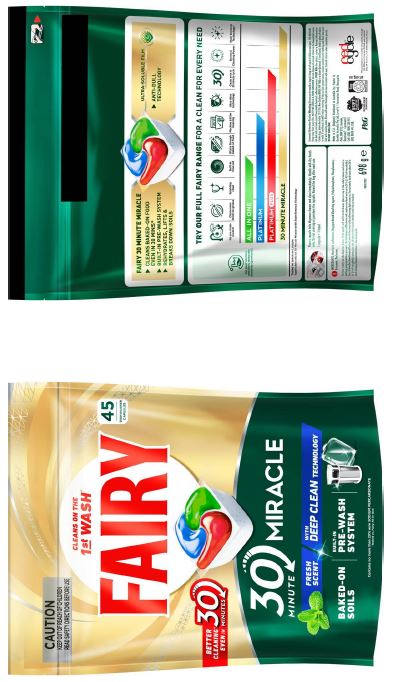
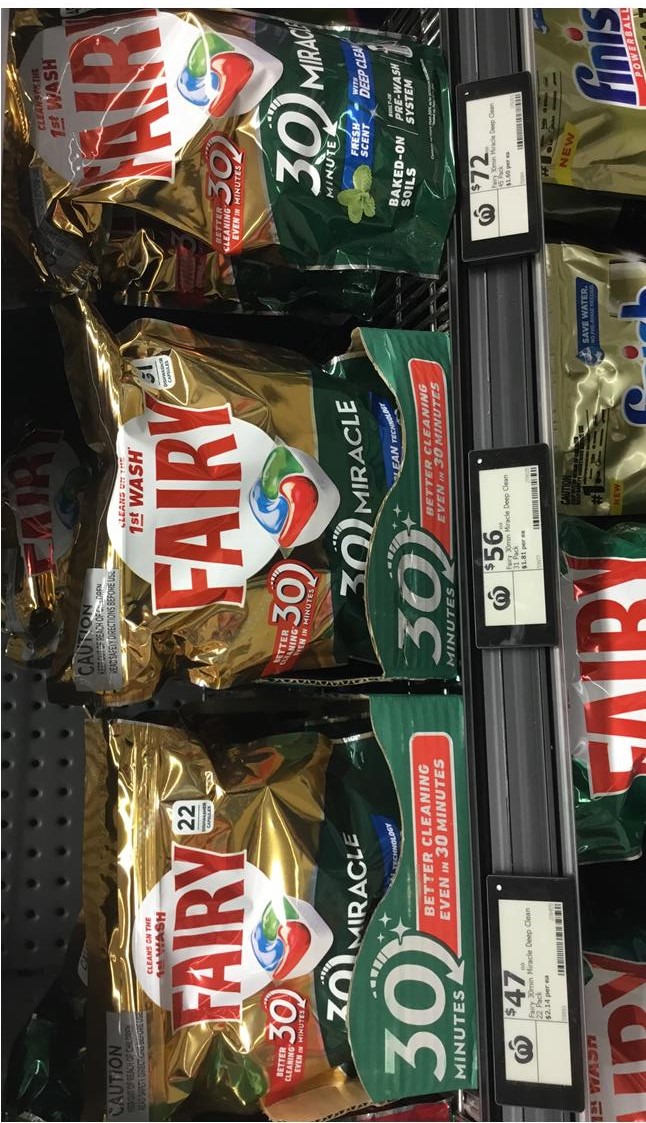
[107] | |
[107] | |
[120] | |
[131] | |
[135] | |
[135] | |
[153] | |
[164] | |
[171] | |
YATES J:
1 The applicant, RB (Hygiene Home) Australia Pty Ltd, and the respondent, Procter & Gamble Australia Pty Limited, are competitors in the Australian market for dishwashing detergents.
2 The applicant is part of the Reckitt group of companies (Reckitt), which is headed by Reckitt Benckiser Group plc. The applicant supplies “Finish” brand dishwashing detergents (Finish), including tablets for automatic dishwashers. The range of tablets includes products referred to as “Finish Ultimate Plus” and “Finish Ultimate Pro” (Ultimate Plus and Ultimate Pro, respectively). There are other products in this range. Ultimate Plus and Ultimate Pro are at the premium end of the range. Ultimate Plus is, currently, the applicant’s top tier dishwashing tablet product. Finish dishwashing detergents have a 59.4% share (by sales value) of the Australian market for dishwashing tablets (dishwashing market).
3 The respondent supplies “Fairy” brand dishwashing detergents (Fairy), including tablets for automatic dishwashers. The tablets include products referred to as “30 Minute Miracle”, “Platinum Plus”, and “All in One” (Miracle, Platinum Plus and All in One, respectively). Fairy dishwashing detergents have a 14.9% share (by sales value) of the Australian market for dishwashing tablets. Miracle is the respondent’s top tier dishwashing tablet product. All in One is its lowest tier product.
4 The respondent commenced supplying Miracle on 17 March 2023. The applicant alleges that Miracle’s packaging represents that:
(a) Miracle is better at cleaning in a 30 minute cycle than the other products in the Fairy range;
(b) Miracle is better at cleaning in a 30 minute cycle than its competitors’ products, including the applicant’s Finish products;
(c) Miracle is more effective at cleaning than the other products in the Fairy range;
(d) Miracle is more effective at cleaning than its competitors’ products, including the applicant’s Finish products; and
(e) there is a current adequate foundation in scientific knowledge for each of the above representations.
5 The applicant relies, in particular, on:
(a) the product name “30 Minute Miracle”;
(b) the statement made on the front of the packaging “Better Cleaning^even in 30 minutes”; and
(c) the depiction of Miracle and its features, in a graph, on the back of the packaging.
6 The applicant contends that these claims of efficacy are not justified by scientific testing. The applicant alleges that, by supplying Miracle in its current packaging, the respondent has contravened ss 18, 29(1)(a), 29(1)(g) and 33 of the Australian Consumer Law (ACL) (Sch 2 to the Competition and Consumer Act 2010 (Cth)) (the Act).
7 Section 18(1) of the ACL provides:
(1) A person must not, in trade or commerce, engage in conduct that is misleading or deceptive or is likely to mislead or deceive.
8 Section 29(1)(a) and (g) provide:
(1) A person must not, in trade or commerce, in connection with the supply or possible supply of goods or services or in connection with the promotion by any means of the supply or use of goods or services:
(a) make a false or misleading representation that goods are of a particular standard, quality, value, grade, composition, style or model or have had a particular history or particular previous use;
…
(g) make a false or misleading representation that goods or services have sponsorship, approval, performance characteristics, accessories, uses or benefits; …
9 Section 33 provides:
A person must not, in trade or commerce, engage in conduct that is liable to mislead the public as to the nature, the manufacturing process, the characteristics, the suitability for their purpose or the quantity of any goods.
Note: A pecuniary penalty may be imposed for a contravention of this section.
10 The respondent says that the representations alleged by the applicant are not conveyed by Miracle’s packaging. Further, the scientific testing that has been carried out on Miracle supports the claim which the respondent says is made on the packaging—that Miracle provides better cleaning than the respondent’s All in One product, in a 30 minute washing cycle.
11 The applicant seeks interim injunctive relief pursuant to s 234 of the ACL that, pending the determination of its proceeding for final relief against the respondent, the respondent be restrained from making the representations which, the applicant says, have been made through the use of Miracle’s packaging.
12 Section 234(1) provides:
(1) If an application is made under section 232, the court may, if it considers it is desirable to do so, grant an interim injunction under this subsection pending the determination of the application.
13 If any of the alleged representations have been made, and if the interim relief which the applicant seeks were to be granted, the respondent would be required to withdraw Miracle, in its current packaging, from the market. The applicant does not dispute that, in practical effect, the granting of the interim relief it seeks would be tantamount to granting final relief.
14 The parties have filed a prodigious amount of evidence in respect of the application for interim injunctive relief. I do not propose to summarise, let alone discuss in detail, all the evidence that has been filed. It is only necessary for me to record the significant parts of the evidence that bear most closely on the present application.
The automatic dishwashing tablet market
15 The applicant’s evidence is that the dishwashing market is highly competitive, with consumers most heavily influenced by the price of the products and, as a second key influence, the performance claims of the products in terms of their efficacy.
16 In this connection, the applicant says that the dishwashing market is a highly technical category in which consumers view manufacturers as experts and trust manufacturers’ communications and claims relating to product performance and superiority.
17 The applicant says that product performance claims relating to dishwashing tablets frequently focus on consumer-relevant usage occasions—meaning that the claims seek to address particular problems faced by consumers. A product claim that solves a “pain point” will be highly appealing to consumers, who are likely to believe that the claim is true and purchase in reliance on it.
18 For the major retailers, such as Woolworths and Coles, suppliers (meaning suppliers such as the applicant and the respondent) are, generally, only allowed to make changes to their ranges (such as by introducing new dishwashing products) on an annual basis. For dishwashing tablets, the window for the launch of new products, this year, was the week commencing 20 March 2023. Miracle was introduced to consumers at that time.
Dishwasher performance and cycles
19 The applicant’s evidence is that, in an automatic dishwasher, cleaning performance is a function of:
(a) the chemistry of the dishwashing product (here, a tablet);
(b) the physical characteristics of the machine (for example, the placement, design and quality of the spray heads);
(c) the water conditions (temperature and hardness); and
(d) time.
20 Consumers can control both time and temperature via their selection of different programs and program modifiers. The options available to consumers, including in respect of washing cycle duration and water temperature, differ greatly between brands of dishwasher, and within brands. However, generally speaking, there is, usually, a “heavy duty”, “normal”, and an “eco” cycle, which take about 2.5 to 3 hours to run, including a drying phase. Many machines also have a “short” or “quick” 30 minute cycle, with a short washing phase and a short rinsing phase, but no drying phase.
21 Based on an analysis of manufacturers’ manuals, the applicant’s evidence is that the 30 minute cycle is, on average, a more sustainable option than the “eco” cycle. Machines with a 30 minute cycle use less water and, on average, appear to be more energy-efficient. Thus, it can be taken that use of the 30 minute cycle has, in these terms, greater environmental benefits than use of the “eco” cycle. The applicant’s expectation is that use of the 30 minute cycle will be of increasing significance to the positioning and marketing of dishwasher tablets. This is because the cycle appears to offer the dual benefit of convenience for the consumer as well as an environmental benefit.
22 The respondent’s evidence is that Miracle is a new product with a unique formulation. It contains an additional amount of an important ingredient, which has “boosted” the formulation.
23 The concept of introducing a product, such as Miracle, had its origins, within the Procter & Gamble group, in about November 2020. It was perceived that the concept of a short/quick wash cycle had high consumer appeal and that there would be equally high appeal for a “new premium proposition”, such as Miracle, in the automatic dishwashing category.
24 In around February 2021, a formal decision was made to progress the development of such a product with a view to launching it in the Australian market. According to the respondent’s evidence, this involved considerable planning. As at June 2022, there was no automatic dishwashing product on the market in Australia that was marketed as a premium tablet with excellent cleaning in a 30 minute wash cycle.
25 In 2022, the respondent carried out consumer research in Australia which informed it that it needed to develop an easy-to-understand way to articulate the benefit of the short/quick wash concept so that it was not misunderstood as delivering lower quality dishwashing compared to washing on a “full cycle”. The “30 Minute” cycle concept evolved from this understanding. The respondent perceived that there was a need for the new product to effectively communicate its value proposition through its packaging as well as through a wider communication strategy with consumers. At the time, this benefit was not communicated in the market.
26 The respondent saw this concept as having the potential to redefine the category and create a new industry norm (i.e., washing dishes effectively on short cycles). The respondent saw the introduction of a premium product, explaining the benefits of a short wash cycle, as having the potential to grow the automatic dishwashing category as a whole, rather than only taking a share of value from products in lower tier categories.
27 As mentioned above, there is only one launch period each year during which the respondent’s major trade partners, Coles and Woolworths, provide for the launch of new products in their stores. This generally occurs in March to April each year.
28 The respondent first introduced Miracle to Woolworths and Coles in the second half of 2022, as a potential product for those customers for the new launch period in 2023. To support Woolworths and Coles in selecting Miracle as a new product with no sales history in Australia, the respondent made commitments to them regarding the minimum amounts that it would spend on marketing and promoting a successful launch of the product in their stores.
29 In early 2023, Woolworths and Coles each informed the respondent that they would accept Miracle for stocking in their stores. Orders have been placed and delivered. The process for re-organising Woolworths’ shelves to accommodate Miracle commenced on 21 March 2023. The evidence suggests that the same process in relation to Coles commenced in mid-April.
30 The respondent’s evidence is that Woolworths and Coles typically hold limited stocks of products in their distribution centres and stores. They aim to have adequate, but not excess, stock on hand at all times. This allows them to operate smaller distribution centres and not have money unnecessarily tied up in stock. Both customers update predictive orders at a frequency of about every six or seven days. For a new product, the volumes required are difficult to predict. However, once the product has become established in the market over some months, the predictive orders become much more accurate because they are based on actual data.
31 Metcash is a distribution company which distributes to independent grocery stores, such as IGA. The respondent introduced Miracle to Metcash in December 2022. Metcash agreed to stock the product in March 2023, and planning to introduce the product through Metcash is underway.
32 Miracle is positioned as a premium product. At launch, it was priced significantly above the price of the respondent’s Platinum Plus product.
33 The applicant regards its Ultimate Pro and the respondent’s Platinum Plus as products competing on the same tier. According to the applicant, the respondent has introduced Miracle at a premium tier above both Ultimate Pro and Platinum Plus.
34 Miracle is presented in soft foil packaging. It comes in three pack sizes: 22 tablets, 31 tablets and 45 tablets. A representation of the packaging of the 45 tablet product is shown in the Schedule to these reasons. An image of the packaging of the three pack sizes, as displayed in a Woolworths store on 27 March 2023, is also shown in the Schedule. The packaging of the three pack sizes is, relevantly, the same, except in one respect noted below.
35 Viewed from the front, the top part of the packaging is gold, the bottom green. The front bears, prominently, the Fairy brand in red lettering against a white circular background on the gold part of the packaging. On the green part of the packaging the name “30 Minute Miracle” appears in white lettering with a device. The applicant argues that the use of gold on the front of the pack, and the name “30 Minute Miracle”, are elements that assist in positioning Miracle as a premium dishwashing product.
36 A similar device appears in white lettering against a red background on the gold part of the packaging. This part of the packaging includes the words: “Better cleaning^even in 30 minutes”. I will refer to this as Miracle’s performance claim.
37 Lower, in the green part of the packaging, at the bottom of the packaging on the left side (for the 22 and 31 tablet products), and at the bottom of the packaging in the centre (for the 45 tablet product), the following words appear in white lettering: “^Tested vs. Fairy All in One”. This, no doubt, is an attempt to qualify Miracle’s performance claim: it is a claim about Miracle’s cleaning performance gauged against the cleaning performance of the (Fairy) All in One dishwashing tablet.
38 The respondent’s evidence is that, in the automatic dishwashing category, claims are usually presented on the front of the packaging, while the back of the packaging includes any necessary disclaimers.
39 The respondent says that, in relation to Miracle, it made a conscious decision to include the words “Tested vs. All in One” on the front of the packaging. The respondent says that this was for two reasons. First, Miracle would be introduced as an “additional line-up” to the Fairy range and would be marketed as providing the benefits of a short cycle as a point of differentiation in the automatic dishwashing category. Secondly, Miracle would be compared to another product in its own range, rather than a competing product, and it was “important to clearly and obviously identify this on packaging”.
40 Whether this aim has been achieved is a live question in this proceeding. The chevron in Miracle’s performance claim and the qualifying words are barely visible on the packaging. The image of the packaging in the Woolworths store shows that, on display, the qualifying words are completely obscured. What is more, the cardboard tray in which the displayed products are arranged also makes Miracle’s performance claim without any qualification.
41 My own inspection of the actual packaging of the 22 tablet product (Exhibit A) shows that the chevron is barely visible, except on a very close examination, prompted by the foreknowledge that the device is present. The qualification/disclaimer “Tested vs. Fairy All in One” is in very small font, and is not conspicuous. Once again, the presence of these words is only apparent on a very close examination of the packaging, prompted by the foreknowledge that the words are present.
42 Viewed from the back, the packaging contains a prominent panel which is headed: “TRY OUR FULL FAIRY RANGE FOR A CLEAN FOR EVERY NEED”. The panel lists 10 cleaning features against which All in One, Platinum, Platinum Plus and Miracle are rated. The eighth feature is: “Cleans even in 30 minute cycle”. The ninth feature is: “Boosted Cleaning Power”. The tenth feature is: “Stain Removal Technology”.
43 Miracle and Platinum Plus are each rated as having all the cleaning features up to and including the eighth feature. Thus, importantly, each is shown to possess the feature “Cleans even in a 30 minute cycle”. However, only Miracle is rated as having “Boosted Cleaning Power” and “Stain Removal Technology”.
44 The applicant has conducted testing on Miracle and Platinum Plus (the respondent’s products) and Ultimate Pro and Ultimate Plus (the applicant’s products) according to the latest 2016 IKW recommendations for assessing dishwasher performance (the IKW Test Protocol) (“IKW” refers to the German Cosmetic, Toiletry, Perfumery and Detergent Association.)
45 The applicant’s evidence is that these recommendations are the industry standard for testing dishwasher detergents, and are used by many industry participants, including the respondent.
46 The respondent’s evidence is that the IKW Test Protocol is globally recognised as a reputable and robust protocol to test the performance of dishwashing tablets.
47 The parameters of the IKW Test Protocol include requirements related to the soil types (stains) tested, the tableware items used, water hardness, the method of making the stain, the number of stained items, the presence of additional stain in the body of the dishwasher (known as ballast soil), water temperature during the wash cycle, and time. The IKW Test Protocol recommends the specific dishwashers to be used to meet these requirements.
48 The respondent’s evidence is that these parameters are intended to be uniformly applied to enable an accurate comparison between the performance of products on the market, and to create test conditions which enable differentiation in product performance.
49 The applicant’s testing was conducted by an independent, external laboratory located in Sydney—Enzyme Labs. I will refer to this as the applicant’s EL test. The products tested were the applicant’s Ultimate Plus and Ultimate Pro products, and the respondent’s Miracle and Platinum Plus products. The test report is dated 29 March 2023.
50 The testing was carried out using Fisher & Paykel DW60 model dishwashers for 30 minute wash cycles.
51 The testing used the following stains:
(a) tea;
(b) starch mix;
(c) egg yolk;
(d) minced meat;
(e) burnt on milk;
(f) pasta; and
(g) crème brûlée.
52 According to the applicant, the stains were prepared according to the IKW Test Protocol.
53 However, the dishwashers that were used were not prescribed by the protocol. The prescribed dishwashers are Miele brand dishwashers that have been modified to use an 8-minute washing cycle. According to the applicant, the IKW Test Protocol does not preclude the use of different machines and cycles. I note that there is a question raised in the evidence as to what constitutes an “8-minute cycle” under the protocol. That question does not need to be explored at the present time.
54 The applicant’s EL testing also departed from the IKW Test Protocol by conducting the testing in “soft” water.
55 To explain, water hardness is a measure of the divalent metal cations present in water. Dissolved calcium and magnesium are the only two divalent cations founded appreciable levels in most water. Water hardness is expressed as the concentration of calcium carbonate.
56 Water hardness is typically expressed in terms of parts per million (ppm) or degrees of general hardness (dH). Water is classified as “soft” if its water hardness is 0 to 60 ppm or 0 to 3.37 dH.
57 The IKW Test Protocol requires products to be tested in particular water hardness conditions. For multi-purpose products (“all in one” products that do not require the addition of salt and rinse aid), such as the dishwashing tablets in issue in this proceeding, the IKW Test Protocol requires testing to be undertaken with the highest water hardness.
58 Emmanuel Pierre Jacque Narinx holds the position of Global Innovation – AMA Home Care R&D Director at P&G Services Company NV, which is in the same group of companies as the respondent. Dr Narinx gave this evidence:
Based on my experience, it is more difficult for dishwashing tablets to clean dishes in hard water conditions compared to soft water conditions. This is because hard water contains a greater amount of calcium and magnesium in the water itself. This calcium and magnesium are considered to be “soils”. As a result, the ingredients in the dishwashing tablets act on the soils in the water as well as the soils on the dishes and in the dishwashing machine generally …
By contrast, soft water contains significantly less calcium and magnesium in the water and, in some cases, close to no minerals. Therefore, the ingredients in the dishwashing tablets are free to act on the soils on the dishes and in the dishwashing machine generally and are not required to act on the minerals in the water. This makes for much easier cleaning conditions.
59 The applicant’s position is that Enzyme Labs’ testing was carried out under “Australian conditions” which, amongst other things, justified the testing being carried out in softer water conditions.
60 Duncan McLeod Watson is the applicant’s Head of Research and Development for Hygiene and Health in Australia and New Zealand. He undertook a statistical analysis of the test results. Dr Watson said:
Statistical analysis is required in order to objectively decide if the differences between two or more sets of data (e.g. the score for cleaning tea stains for different dishwashing tablets) are significantly different and so a likely reflection of a meaningful, real-world difference. By ‘significant’ I mean that, for example, a difference in the average cleaning performance of different dishwasher products is due to real differences in the performance of the products and not simply a consequence of random variation. Simply comparing the differences in average results between products is insufficient for making a judgment of whether the difference is meaningful as it does not consider the variation in the data from which the averages are calculated. Large variation can make it difficult to find significant differences if they really exist while small variation increases the chance of finding significant differences if they exist.
61 According to Dr Watson’s analysis, there was no difference in the cleaning performance between the respondent’s two products, Miracle and Platinum Plus, in a 30 minute washing cycle. Moreover, Miracle had the same cleaning performance as Ultimate Plus and Ultimate Pro in that cycle.
The applicant’s internal testing
62 Reckitt’s Global R&D facility, located in Heidelberg, Germany, also carried out IKW cleaning performance testing in respect of four Fairy dishwashing tablets, corresponding to the respondent’s Australian products Miracle, Platinum Plus, Platinum, and All in One. (For convenience, I will refer to the products by their Australian product names and not by their European product names. The difference in product names is purely for marketing purposes in different jurisdictions.)
63 The experimental design of this testing was different from the design used in the applicant’s EL test. The main difference was that the Reckitt testing used four dishwashers to test four products, whereas Enzyme Labs used two dishwashers to test four products. Further, the test method was the latest 2016 IKW recommendations for assessing dishwasher performance with eight soil types. Miele GSL2 model dishwashers were used for “8-minute wash cycles”. Water hardness was set at 160 ppm.
64 Dr Watson’s evidence was that using the Miele GSL2/8-minute cycle to test cleaning performance was more likely to find differences between the dishwashing products, compared to testing on other, longer wash cycles. His evidence was that, if differences are not found using this cycle, he would not expect differences on testing using consumer-relevant cycles like the 30 minute, “eco” or normal wash cycles. Conversely, finding significant differences between products when testing using the Miele GSL2/8-minute cycle would not necessarily mean that a difference would be found if a more consumer-relevant cycle was used to test for differences in cleaning performance.
65 Based on his statistical analysis of the test results, Dr Watson concluded that:
(a) there was no significant difference in the cleaning performance between Miracle and Platinum Plus;
(b) overall, Platinum was a lower performing product compared to Miracle and Platinum Plus, with generally lower cleaning scores across stains, but only significantly so on egg yolk; and
(c) All in One tended to be the lowest performing product overall, with generally the lowest cleaning scores across stains (but only significantly so on egg yolk).
66 Based on the egg yolk stain testing, Mr Watson rated the Fairy range as: Miracle and Platinum Plus (tier 1); Platinum (tier 2); and All in One (tier 3).
67 The respondent contends that its own testing, including through an independent laboratory (SGS Institut Fresenius GmbH (SGS)), supports the claims made on the Miracle packaging and that the testing conducted by the applicant does not contradict that conclusion.
68 SGS conducted three tests. Dr Narinx reviewed the test results.
69 The first test was conducted in July 2022 under the IKW Test Protocol, with a modification to use the short cycle program on a Bosch SMS086 dishwasher so as to assess cleaning in a 30 minute cycle, rather than the full cycle prescribed in the protocol. According to the respondent, except for the machine and program used, the test method and conditions were as prescribed by the protocol for multi-purpose products. I will refer to this as the SGS first short cycle test. The test report is dated 11 July 2022 (report 5879862).
70 Using the Australian product names, the products tested were: Miracle; Platinum Plus; (discontinued) Platinum Plus; Platinum; All in One; and the applicant’s Ultimate product.
71 Dr Narinx’s evidence was that the SGS first short cycle test demonstrates that:
(a) Miracle had an overall better performance than All in One (Miracle performed significantly better in 5/7 stains and comparably in 2/7 stains);
(b) Miracle performed significantly better than Platinum in 3/7 samples, significantly worse for 1/7 sample, and comparably in the remaining 3/7 samples;
(c) Miracle had overall better performance than the applicant’s Ultimate product (Miracle performed significantly better than Ultimate in all samples).
72 The results of the test were subjected to statistical analysis. The results of this analysis were that:
(a) Miracle performed significantly better than All in One in 5/7 samples; and
(b) Miracle performed significantly better than Ultimate in 7/7 samples.
73 Dr Narinx made no explicit comment about the comparative performance of Miracle and Platinum Plus in this test. However, the table of results in his affidavit of 14 April 2023 (Dr Narinx’s first affidavit) records that Miracle and Platinum Plus performed comparably.
74 The second test was conducted in October and November 2022. Once again, except for the machine and program used, the test method and conditions complied with the IKW Test Protocol. This was also short cycle testing. Using the Australian product names, the products tested were: Miracle; All in One; and the applicant’s Ultimate Pro and Ultimate Pro (Lemon). I will refer to this testing as the SGS second short cycle test. The test report is dated 28 November 2022 (report 6072860).
75 Dr Narinx’s evidence was that the SGS second short cycle test demonstrates that:
(a) Miracle had overall better performance than Ultimate Pro and Ultimate Pro (Lemon) (Miracle performed significantly better in 5/7 samples and comparably in 2/7 samples); and
(b) Miracle had overall better performance than All in One (Miracle performed significantly better in 3/7 samples and comparably in 3/7 samples, and All in One performed significantly better in the remaining sample).
76 Dr Narinx said that the significantly better performance of All in One in one sample noted in (b) above is a statistical deviation which is not representative of the average test results comparing Miracle and All in One.
77 The results of the test were subjected to statistical analysis. The analysis was that:
(a) Miracle performed significantly better than All in One in 2/7 samples (one less than SGS’s analysis), comparably in 4/7 samples, and significantly worse in the remaining sample;
(b) Miracle performed significantly better than Ultimate Pro in 5/7 samples and comparably in 2/7 samples (the same as SGS’s analysis); and
(c) Miracle performed significantly better than Ultimate Pro (Lemon) in 5/7 samples and comparably in 2/7 samples (the same as SGS’s analysis).
78 The third test was also carried out in October and November 2022 as a standard cycle test. The test method and conditions complied with the IKW Test Protocol. Using the Australian product names, the products tested were: Miracle, All in One, and the applicant’s Ultimate Pro and Ultimate Pro (Lemon). I will refer to this as the SGS standard cycle test. The test report is dated 17 November 2022 (report 6070593).
79 Dr Narinx’s evidence was that the SGS standard cycle test demonstrates that:
(a) Miracle had overall better performance than All in One (Miracle performed significantly better in 5/7 samples and comparably in 2/7 samples);
(b) Miracle had overall better performance than Ultimate Pro (Miracle performed significantly better in 4/7 samples and comparably in 3/7 samples);
(c) Miracle had overall better performance than Ultimate Pro (Lemon) (Miracle performed significantly better in 6/7 samples and comparably in the remaining sample).
80 The results of the test were subjected to statistical analysis. The results of this analysis were that:
(a) Miracle performed significantly better than All in One in 6/7 samples (one more than in SGS’s analysis) and comparably in the remaining sample;
(b) Miracle performed significantly better than Ultimate Pro in 6/7 samples (two more than SGS’s analysis) and comparably in the remaining sample); and
(c) Miracle performed significantly better than Ultimate Pro (Lemon) in 6/7 samples (the same as SGS’s analysis) and comparably in the remaining sample.
The respondent’s soft water testing and hard water testing
81 The respondent also carried out internal testing on 11 and 12 April 2023. Two tests were undertaken, one in moderately hard water (89 ppm/5 dH) and one in hard water (21 dH as prescribed in the IKW Test Protocol). The tests were carried out using 30 minute washing cycles. Dr Narinx reviewed the test results.
82 The test in moderately hard water was undertaken for comparison with the applicant’s independent testing discussed above. I will refer to this as the respondent’s soft water test. The respondent was not able to replicate, consistently, the water hardness used by the applicant.
83 The test in hard water was undertaken because, according to the respondent, there are parts of Australia which only have access to medium hard or hard water. For this reason, the respondent says that it is necessary for products to be tested in hard water for the Australian market. Dr Narinx expressed the view that using the IKW Test Protocol requirement of testing at 21 dH is necessary to ensure that the product performs satisfactorily in the hardest conditions. I will refer to this as the respondent’s hard water test.
84 Using the Australian product names, the products tested in the respondent’s soft water test were: Miracle; All in One; and the applicant’s Ultimate Plus and Ultimate Pro.
85 Dr Narinx’s evidence was that the respondent’s soft water test demonstrates that:
(a) Miracle had overall better performance than All in One (Miracle performed significantly better in 4/5 samples and comparably in the remaining sample);
(b) Miracle had overall better performance than Ultimate Plus (Miracle performed significantly better in 3/5 samples and comparably in 2/5 samples); and
(c) Miracle had overall better performance than Ultimate Pro (Miracle performed significantly better in 3/5 samples and comparably in 2/5 samples).
86 The respondent’s hard water test was also carried out to assess a 30 minute washing cycle, but this time with a water hardness of 21 dH as prescribed by the IKW Test Protocol. Using the Australian product names, the products tested were: Miracle; All in One; and the applicant’s Ultimate Plus and Ultimate Pro.
87 Dr Narinx’s evidence was that the respondent’s hard water test demonstrates that:
(a) Miracle had overall better performance than All in One (Miracle performed significantly better in 5/5 samples);
(b) Miracle had and overall better performance to Ultimate Plus (Miracle performed significantly better in 2/5 samples and comparably in 3/5 samples);
(c) Miracle had overall better performance than Ultimate Pro (Miracle performed significantly better in 5/5 samples).
88 Dr Narinx’s evidence was that the respondent’s soft water test and the respondent’s hard water test showed an overall better performance of Miracle against the respondent’s Ultimate Plus and Ultimate Pro, and supports the claim that Miracle is better at cleaning in a 30 minute cycle than All in One.
89 On 7 April 2023, the respondent’s solicitors engaged Enzyme Labs to carry out testing on the performance of Miracle, All in One, and the respondent’s Ultimate Pro and Ultimate Plus.
90 The testing was carried out using the 30 minute cycle program (rather than the full cycle prescribed in the IKW Test Protocol) on a Fisher & Paykel machine. The test report is dated 19 April 2023.
91 The respondent relied on these test results even though, as I will explain below, it has concerns about the applicant’s testing using Enzyme Labs. Those concerns are in relation to Enzyme Labs’ use of soils and crockery that do not comply with the IKW Test Protocol. I will refer to this testing as the respondent’s EL test. Dr Narinx also reviewed these test results.
92 Dr Narinx’s evidence is that the respondent’s EL test demonstrates that:
(a) Miracle had overall better performance than All in One (Miracle performed significantly better in 4/7 samples and comparably in 3/7 samples);
(b) Miracle had overall better performance than Ultimate Pro (Miracle performed significantly better in 4/7 samples, comparably in 2/7 samples, and significantly worse in the remaining sample);
(c) Miracle had overall better performance than Ultimate Plus (Miracle performed significantly better in 3/7 samples and comparably in 4/7 samples); and
(d) there was no difference in overall performance between Ultimate Plus and Ultimate Pro.
93 The results of the test were subjected to statistical analysis. The results of this analysis were that:
(a) Miracle performed significantly better than All in One in 3/7 samples and comparably with All in One in 4/7 samples;
(b) Miracle performed significantly better than Ultimate Pro in 4/7 samples (the same as Enzyme Lab’s analysis) and comparably in 3/7 samples (one more than Enzyme Labs’ analysis);
(c) Miracle performed comparably with Ultimate Plus in 5/7 samples and significantly better in 2/7 samples; and
(d) there was no statistically significant difference between the performance of Ultimate Pro and Ultimate Plus on any of the seven samples.
Observations on the evidence of testing
94 At this juncture, it is convenient to make a number of observations about some aspects of the testing that has been undertaken by the parties.
95 First, with one exception, the respondent’s testing of Miracle against the applicant’s products did not include any testing of Ultimate Plus, which is, now, the applicant’s top tier dishwashing tablet. There is a simple explanation for this: Ultimate Plus only entered the Australian market on 20 March 2023. Before then, Ultimate Plus was not available to the respondent, and the applicant’s top tier dishwashing tablet was Ultimate Pro. This explains why Ultimate Pro features in the respondent’s testing undertaken in 2022, when the respondent was undertaking its development of Miracle. The exception is the respondent’s EL test, which was carried out on 14 to 18 April 2023.
96 Secondly, there is no dispute between the parties that Miracle has better dishwashing performance than All in One.
97 Thirdly, as to the testing involving Miracle and Platinum Plus, the applicant’s EL test showed that there was no difference in the cleaning performance between the two products. The applicant’s internal testing also showed that there was no significant difference in the cleaning performance between Miracle and Platinum Plus. In terms of cleaning performance, the applicant’s rating of the Fairy range of dishwashing tablets is: Miracle and Platinum Plus (tier 1); Platinum (tier 2); and All in One (tier 3).
98 With regard to the respondent’s testing, the only test in which Miracle and Platinum Plus were assessed was the SGS first short cycle test. This test, like the applicant’s tests, showed that Miracle and Platinum Plus performed comparably.
99 Fourthly, as to the testing involving Miracle and the applicant’s products Ultimate Plus and Ultimate Pro, the applicant’s EL test showed that all products had the same cleaning performance.
100 With regard to the respondent’s testing, the respondent’s soft water test and the respondent’s hard water test each showed that Miracle had overall better performance than Ultimate Plus and Ultimate Pro. The respondent’s EL test also showed that Miracle had overall better performance than Ultimate Plus and Ultimate Pro, with no statistically significant difference between the performance of Ultimate Plus and Ultimate Pro.
101 The SGS second short cycle test showed that Miracle had overall better performance than Ultimate Pro and Ultimate Pro (Lemon). The SGS standard cycle testing also showed that Miracle had overall better performance than Ultimate Pro and Ultimate Pro (Lemon). Ultimate Plus was not tested in these tests, apparently for the reason that Ultimate Plus was not available to the respondent at the time of testing: see above.
102 Fifthly, the respondent has advanced a body of evidence through Dr Narinx which criticises the applicant’s EL test because that test did not strictly follow the IKW Test Protocol. These criticisms include the fact that the applicant’s EL test was conducted in soft water conditions and that the test was not carried out using one of the dishwasher brands or models recommended by the IKW Test Protocol. In a confidential section of his first affidavit, Dr Narinx identified five other respects in which, he said, the applicant’s EL test deviated from the IKW Test Protocol. I was informed in oral submissions that one of these matters is no longer relied on.
103 The applicant disagrees with these criticisms, at least insofar as the details of those criticisms are known to it. Dr Watson’s evidence is that using a water hardness of 21 dH is not appropriate because only a small proportion of Australians experience water hardness over 11.6 dH. The applicant argues that the respondent’s approach leads to a serious departure from any consumer relevance of the test results and potentially leads to misleading claims. The applicant contends that its testing focuses on consumer relevant machines and wash cycles, with a selected water hardness of 9 dH that is relevant to a majority of Australians.
104 In evidence, the applicant also criticised the reliability and relevance of the respondent’s testing.
105 It is not possible for me to resolve the myriad issues raised by the parties as to the reliability and significance of the testing that is presently before me. Nor is it appropriate that I attempt to do so. Such matters can only be resolved at a final hearing.
106 However, as I will come to explain, despite the criticisms advanced by each party of the other’s testing, the testing undertaken by both in respect of Miracle and Platinum Plus leads to one conclusion—there is no significant difference in the cleaning performance of Miracle and Platinum Plus.
107 The respondent says that any order requiring it, in practical effect, to cease supplying Miracle until the applicant’s case for final relief can be heard and determined, is likely to cause it significant incalculable and irreparable damage. Moreover, such an order would detrimentally affect its customers (in particular, its two largest customers Coles and Woolworths), which would have ongoing effects on its relationship with those customers.
108 The respondent contends that the following consequences will ensue if such an order is made.
109 First, the respondent will be unable to fill the orders placed on it for Miracle. This means that its customers will run out of stock of the product, causing significant disruption and damage to the business of those customers, and resulting in damage to the reputation that the respondent has established with them. Further, as Miracle is a new product, the market uptake and weekly volume of sales for the product have not been established. According to the respondent, this means that it will not be possible to quantify the market share and volume of sales that Miracle would have achieved if supply were permitted to continue.
110 Secondly, the respondent has built a trust-based relationship with its customers as a reliable supplier. Because of that relationship, the respondent is able to recommend to its customers that they launch new and untested products across all categories of products that the respondent services. An order requiring the respondent to cease supplying Miracle would, according to the respondent, irreparably damage this reputation and trust, with the consequence that the respondent is likely to have significant difficulties in bringing new and innovative products to market in both the dish care category and the other categories that the respondent supplies. The respondent says that this damage cannot be calculated.
111 Thirdly, Miracle has been allocated premium shelf-space at eye level in both Woolworths and Coles. There is a risk that this shelf space will be lost to the respondent and that the empty space will be filled by products from the respondent’s competitors, including the applicant.
112 Fourthly, since Miracle is a new product, the respondent has committed to fund extensive promotional activities to support the launch. An order requiring the respondent to cease supplying Miracle would force the respondent to cancel all promotions that are within its control. It will also mean that the respondent’s customers will be disrupted in undertaking their proposed promotional activities for the product, increasing the damage to the respondent’s relationship with those customers. Further, promotional materials, for which there has been significant expenditure, will need to be abandoned, resulting in wasted time and cost.
113 Fifthly, if Miracle is not available in stores for an extended period, the respondent contends that consumers will conclude that there is a quality issue with the product, or that the respondent is not able to supply the product, or that the product has been pulled from the shelves because of low sales. The respondent contends that any of these matters will damage the image of Miracle in the eyes of consumers.
114 Sixthly, the respondent is not able to repackage the Miracle product for quality assurance reasons. According to the respondent, if it is ordered to cease supplying Miracle, it would incur the costs and logistical challenges of storing or destroying large volumes of the product. Further, if it were necessary for the respondent to change its packaging for Miracle, the change would involve lengthy lead times to plan and execute the new packaging, and to have the product supplied in its new packaging from Belgium, where the product is manufactured. The respondent’s current estimate is that this would take at least several months.
115 Further in this regard, the respondent’s evidence is that applying stickers to the current Miracle packaging, instead of replacing the product in new packaging, is not feasible. The application of stickers is likely to adversely affect the consumer’s perception of the quality of the product (the overall appeal of the product will be compromised). Also, the application of stickers is not only labour-intensive but, because the packaging is soft foil packaging with a glossy finish and a curved, uneven surface, there is a risk that stickers will not adhere properly to the packaging, and be misplaced.
116 The respondent’s evidence is that, currently, it has over 80,000 cases of stock of Miracle. Each case contains 4 to 5 individual packs of the product, depending on the pack size. This stock has already been delivered to Australia, is in transit to Australia from the Belgium manufacturing plant, or is in planned production up to the end of April 2023. The cost of scrapping the stock would be between $2 million and $2.5 million. The time that would be needed to apply stickers on the existing stock, if that were feasible, would be approximately seven months at a cost of approximately $760,000.
117 Seventhly, competition in the automatic dishwashing category would be adversely affected and the respondent would be deprived of the first-mover advantage that it currently holds, which it would be unable to recover in the event that Miracle is re-launched at a later date.
118 In this connection, the respondent’s competitors have now had the opportunity to see Miracle, its pricing, packaging, and the support it is receiving from the respondent’s trade partners. If this launch is disrupted, the respondent’s competitors will, in the respondent’s view, gain a massive competitive advantage because they can now prepare and execute their own product and marketing plans to counteract the potential success of Miracle. If the launch of Miracle is disrupted, the respondent will have to wait almost a full year to properly re-launch the product with the usual level of support from its trade partners required for a launch of that nature. In the meantime, it is likely that the competitive landscape in the automatic dishwashing category will have changed. If Miracle were to be relaunched next year, it would not have the same level of impact.
119 I have summarised these concerns at a relatively high level of generality. Each of these concerns is discussed, in detail, in affidavits made by Karim Lokhandwala, the respondent’s Executive General Manager for Grocery Sales for Australia; Basit Khan Nurani, the respondent’s Market Strategy and Planning Director of the Home and Fabric Care category for Australia and New Zealand; and Timothy James Lim, the respondent’s Senior Brand Manager Arabian Peninsula Dish Design.
120 The applicant says that the existence of Miracle in the market is to the detriment of the Finish range of dishwashing products. It will result in lost tablet sales for the applicant and, according to the applicant, more worryingly, significant damage to Finish’s brand equity in the Australian market. These concerns were advanced through an affidavit by Sachit Barooah, the applicant’s Category Marketing Manager for Finish products.
121 As to lost sales, the applicant says that Miracle offers consumers a bold performance claim which speaks as to both efficacy and convenience. According to the applicant, consumers are likely to take Miracle’s performance claim at face value and believe that they will get an improved result by using the product. The applicant argues that, by prominently leveraging this claim, the respondent will drive consumers to purchase Miracle and not the applicant’s Finish products.
122 The applicant also says that, by launching Miracle with an “impactful” and “confident” claim, the respondent has secured additional valuable shelf space with the major retailers, which the respondent is unlikely to have been given had it simply continued with its existing dishwasher tablet range. According to the applicant, by increasing its “share of shelf”, the respondent has secured the means to create a stronger brand impression of Fairy as a brand for consumers “in store”. As Mr Barooah puts it, strong brand impression, in turn, incentivises purchase.
123 The applicant says, further, that given the “compelling” nature of Miracle’s performance claim, retailers are likely to dedicate enhanced attention to it, such as by displaying it prominently and promoting it in their catalogues. The applicant argues that the obvious effect of increased shelf space and other “Miracle-focused activity” will be that the brand impression of other brands will be reduced, which will adversely affect the sale of those brands. The applicant says that, as Finish is the leading brand, with 60% market share, the applicant will suffer much of this adverse impact.
124 As to brand equity, the applicant argues that Miracle will be seen by consumers as an important and leading change in the industry—in other words, that the Fairy range of dishwashing tablets has “done something ground-breaking”. In terms of consumer sentiment, the applicant says that consumers are likely to perceive the Finish products as less innovative and, hence, inferior. The applicant argues that a weakened brand equity equates to a weakened perception of it, which can result in less sales of its Finish dishwashing products.
125 The applicant argues that a similar point can be made about brand loyalty. It says that if consumers are switched to the Fairy range of products, because they have been offered something dramatically different with Miracle, then they will stay with the Fairy brand.
126 The applicant says that damaged brand loyalty can be very hard to repair. Sometimes the damage is irreparable.
127 The applicant takes issue with the respondent in respect of the adverse consequences that the respondent said it will suffer if the interim injunctive relief that the applicant seeks were to be granted. These matters were traversed in an affidavit by Jonathon Gale, the applicant’s Sales Director.
128 The thrust of this evidence was, generally, to down-play the significance and effect of the adverse consequences to which attention was drawn in the respondent’s evidence from Messrs Lokhandwala, Nurani and Lim. I will not descend to the detail of this response, largely because, in oral submissions, the applicant accepted that there was an imperceptible difference in the consequences for the respondent if interim injunctive relief were to be granted and for the applicant if interim injunctive relief were not to be granted. There is, however, one matter to which I should briefly refer, namely the effect on the respondent’s relationship with its major customers, Woolworths and Coles, should the respondent be unable to supply Miracle.
129 As to this matter, Mr Gale expressed his belief that the existence of a single court proceeding, or the respondent’s inability to supply Miracle, would not jeopardise the respondent’s relationship with retailers. Mr Gale’s evidence was that retailers are very sophisticated in dealing with out-of-stock situations. Mr Gale agreed that the respondent is seen as a trusted and reliable supplier with retailers in Australia. While Mr Gale accepted that an injunction which effectively prevents the respondent from supplying Miracle would require the respondent to work closely with its trade partners to address the issue, this would not be an unusual issue to manage, and would not cause the respondent’s reputation to be damaged to an extent that would affect future launches or other categories of products which the respondent supplies. Mr Gale pointed to the fact that Miracle is a newly-introduced product with no widespread promotion at the present time. Mr Gale anticipated that, if an interim injunction were to be granted which had the practical effect of restraining the supply of Miracle, the current shelf space intended for Miracle would be re-allocated to other Fairy products, and not to the respondent’s competitors.
130 Understandably, the respondent is considerably more sensitive about its relationship with its major customers than the applicant’s perceptions about that issue. After all, it is the respondent, not the applicant, who is at risk in that regard.
131 It is trite that the question of whether interim injunctive relief should be granted focusses on two main enquiries: first, whether the claimant has established a prima facie case (in the relevant sense); and second, whether the balance of convenience favours the granting or refusal of that relief.
132 These organising principles were explained by Gummow and Hayne JJ in Australian Broadcasting Corporation v O’Neill [2006] HCA 46; 227 CLR 57 (O’Neill) at [65] – [72] (with which Gleeson CJ and Crennan J agreed at [19]). It is sufficient, for present purposes, to quote [65] of those reasons (omitting citations):
65 The relevant principles in Australia are those explained in Beecham Group Ltd v Bristol Laboratories Pty Ltd. This Court (Kitto, Taylor, Menzies and Owen JJ) said that on such applications the court addresses itself to two main inquiries and continued:
The first is whether the plaintiff has made out a prima facie case, in the sense that if the evidence remains as it is there is a probability that at the trial of the action the plaintiff will be held entitled to relief … The second inquiry is … whether the inconvenience or injury which the plaintiff would be likely to suffer if an injunction were refused outweighs or is outweighed by the injury which the defendant would suffer if an injunction were granted.
By using the phrase “prima facie case”, their Honours did not mean that the plaintiff must show that it is more probable than not that at trial the plaintiff will succeed; it is sufficient that the plaintiff show a sufficient likelihood of success to justify in the circumstances the preservation of the status quo pending the trial. That this was the sense in which the Court was referring to the notion of a prima facie case is apparent from an observation to that effect made by Kitto J in the course of argument. With reference to the first inquiry, the Court continued, in a statement of central importance for this appeal:
How strong the probability needs to be depends, no doubt, upon the nature of the rights [the plaintiff] asserts and the practical consequences likely to flow from the order he seeks.
133 Focussing on the last part of this quotation, the nature of the rights asserted in the present case is informed by the fact that those rights derive from statutory norms whose object is the enhancement of the welfare of Australians through the promotion of competition and fair trading, and the provision of consumer protection: s 2 of the Act. Thus, the rights in play in the present case are not merely the private interests of the parties. The public interest, in the form of consumer welfare, is also involved. Both interests must be taken into account: Reckitt Benckiser (Australia) Pty Ltd v Procter & Gamble Australia Pty Ltd [2015] FCA 753 at [46].
134 The practical consequences that would flow from granting the interim injunctive relief the applicant seeks would result, as I have said, in the withdrawal of Miracle, in its current packaging, from the market and be tantamount, in practical effect, to the granting of final relief. It has been said that, in those circumstances, the claimant for interim injunctive relief is required to demonstrate “a relatively strong case”: Samsung Electronics Co Ltd v Apple Inc [2011] FCAFC 156; 217 FCR 238 at [87]; see also O’Neill at [72].
135 The parties agree that Miracle’s performance claim is a comparative claim about Miracle’s cleaning performance in a 30 minute washing cycle.
136 According to the respondent, the representation made by Miracle’s packaging is that Miracle’s cleaning performance in a 30 minute washing cycle is better than the cleaning performance of All in One when used in the same cycle. This is because, on the packaging, Miracle’s performance claim is qualified by the chevron that is intended to direct attention to the words “Tested vs. Fairy All in One”. I note that the applicant does not dispute that Miracle does have better cleaning performance than All in One in a 30 minute washing cycle.
137 In its written submissions, the respondent says:
The ordinary supermarket shopper will encounter [Miracle] surrounded by numerous competing products with packaging cluttered with a wide range of laudatory epithets. For example, FINISH products have names reflecting an ongoing quest for higher superlatives – ULTIMATE, ULTIMATE PRO and most recently ULTIMATE PLUS. Their packaging promises numerous performance benefits such as “BOOSTED GLASS CARE AGENTS” and “OPTIMISED RELEASE TECHNOLOGY”. These are often qualified by asterisks linking to small print, usually on the rear of the package, for example “BOOSTED GLASS CARE AGENTS” is linked to a small statement on the rear reading “vs Finish Ultimate Pro All in 1”.
Consumers are accustomed to a general level of puffery in this category, and the Court may well doubt how much an ordinary consumer would undertake a detailed analysis and comparison of each claim on each product. But, in any event, those consumers who are interested to understand the precise meaning of such claims on FINISH or FAIRY products given the opportunity to do so by the common use of linked explanations.
The [Miracle] packaging gives prominence to “30 MINUTE(S)”. This conveys that the product is specially formulated for use in a 30 minute cycle, which is entirely true.
A consumer who reads the whole of the packaging will also understand that the statement “BETTER CLEANING^ EVEN IN 30 MINUTES” is a comparison to FAIRY All In One; this is explained not only by the linked statement at the bottom left of the front of the package, but also by the table appearing on the back.
138 While the respondent’s case is arguable, I think it is doubtful that, on viewing the Miracle packaging, many consumers would be cognisant of the chevron or the qualifying words (the “linked statement”), except on a studied and, I would expect, prolonged inspection of the packaging—circumstances which are unlikely to obtain in the normal shopping experience of a great many consumers.
139 I am satisfied that the applicant has established a prima facie case that, assessed from the perspective of the ordinary and reasonable consumer of dishwashing products (Self Care IP Holdings Pty Ltd v Allergan Australia Pty Ltd [2023] HCA 8 at [93]), Miracle’s packaging, seen as a whole, represents that Miracle is better at cleaning in a 30 minute cycle than the other dishwashing tablet products in the Fairy range. I am satisfied that this case has strong prospects of success at a final hearing, for the following reasons.
140 The front of the packaging is prominently labelled with the Fairy brand. It is also prominently labelled with the product name “30 Minute Miracle” and Miracle’s performance claim. Rather than searching for a barely visible disclaimer, or qualification, of the bold representation that the product gives better cleaning even in 30 minutes—a claim consistent with the name of the product itself—it is more likely that the consumer will look to the panel on the back of the packaging (where, in any event, the respondent says that disclaimers are usually located) for relevant information. That panel exhorts consumers to TRY OUR FULL FAIRY RANGE FOR A CLEAN FOR EVERY NEED. One of those “needs” is shown as a 30 minute washing cycle. Two Fairy products are shown to clean “even in [a] 30 minute cycle”—Miracle and Platinum Plus.
141 The words “even in [a] 30 minute cycle”, as shown in the panel, are a borrowing from part of Miracle’s performance claim itself. However, Miracle’s performance claim also makes the claim of “better” cleaning. This is the dominant message of the claim. The natural question that is prompted by that part of the claim is: “better” cleaning than what?
142 That question is readily answered in the panel. Even though Miracle and Platinum Plus clean “even in [a] 30 minute cycle”, Miracle, unlike Platinum Plus, also has, amongst other characteristics, “Boosted Cleaning Power” and “Stain Removal Technology”. Miracle is the only product in the Fairy range of dishwashing tablets that claims to have those particular characteristics.
143 As to “Boosted Cleaning Power”, I accept the applicant’s contention that “Boosted Cleaning Power” combines an ingredient claim (“boosted”) with an efficacy claim (“cleaning power”). This characteristic is explained in Dr Narinx’s evidence.
144 Dr Narinx’s evidence is that Miracle has a unique formulation. He says that Miracle contains an additional amount of an important ingredient. In this way, its formulation has been “boosted”. In his first affidavit, Dr Narinx provided further details of the new formulation, and its intended benefits, in a section marked “Highly Confidential”. The “Stain Removal Technology” is not explained in the evidence, so far as I can see.
145 The respondent submits that if, contrary to its contention, the packaging of Miracle represents that Miracle is better at cleaning in a 30 minute cycle than all other Fairy Products, then that statement is, nevertheless, true, including in respect of Platinum Plus. The respondent submits that the basis for representing that Miracle is “superior” to Platinum Plus is found in Dr Narinx’s evidence about Miracle’s formulation.
146 In making this submission, the respondent, in effect, puts to one side the testing to which I have referred. The difficulty for the respondent, however, is that the testing cannot be put to one side. Miracle’s performance claim is just that—a performance claim. And, in any event, the characteristic “Boosted Cleaning Power” imports an efficacy claim having a practical consequence.
147 Even though Miracle’s formulation is different to Platinum Plus’s formulation, and even though it might be argued that Miracle’s formulation has been “boosted” by an additional amount of an important ingredient which is intended to enhance dishwashing performance, the testing shows that, in fact, there is no difference in the cleaning performance of Miracle and the cleaning performance of Platinum Plus in a 30 minute washing cycle. Put another way, Miracle’s “boosted” formulation (and, for that matter, its “Stain Removal Technology”) does not translate into “better” cleaning compared to Platinum Plus, even in a 30 minute washing cycle.
148 Importantly, this was demonstrated by the respondent’s own testing—the SGS first short cycle test—which was carried out in July 2022, well before Miracle was launched on the Australian market. As I have remarked, this is the only test in which the cleaning performance of Miracle and Platinum Plus was assessed and compared by the respondent. Had there been other testing which showed that Miracle has better cleaning performance than Platinum Plus in a 30 minute washing cycle, then I have no doubt that the respondent would have adduced evidence of that testing.
149 The SGS first short cycle test was carried out under the IKW Test Protocol, with the only modifications being the machine used and the length of the cleaning cycle. It can be taken that the respondent considered the SGS first short cycle test to have been an appropriate test that was appropriately conducted, yielding a valid and reliable comparison of the cleaning performance of Miracle and Platinum Plus (as well as of the other products tested). Therefore, the respondent’s criticisms of the applicant’s testing of Miracle and Platinum Plus really go nowhere.
150 Even so, I do not accept that the applicant’s testing of the comparative cleaning performance of Miracle and Platinum Plus can be ignored. Despite the criticisms made of the conditions under which the testing was carried out (which I accept can only be judged at a final hearing), the applicant’s EL test and the applicant’s internal testing show that, even under different test conditions —including, importantly, under different conditions of water hardness—there is still no difference in cleaning performance between Miracle and Platinum Plus.
151 Assuming that, at a final hearing, the evidence remains the same, I am satisfied that the applicant has established a prima facie case that Miracle’s performance claim is, in this respect, false, or misleading or deceptive, and that, consequently, there is a prima facie case that the respondent has contravened ss 18(1), 29(1)(a), 29(1)(g), and 33 of the ACL. As I have said, that case has strong prospects of success at a final hearing.
152 Having reached this conclusion, the question is whether it is appropriate to grant interim injunctive relief.
Balance of convenience
153 With respect to the balance of convenience, the applicant accepts that, if weighed only on the basis of the applicant’s and respondent’s respective positions, the difference in their positions is “imperceptible”.
154 In oral submissions, the applicant did not doubt that, if the interim injunctive relief it seeks were to be granted, but it be found, at a final hearing, that its case does not succeed, then it would be difficult to calculate the damage to the respondent in respect of lost sales and the damage to its reputation among consumers, although the applicant doubted that there would be any adverse impact in terms of the respondent’s reputation with Woolworths and Coles.
155 Notwithstanding that recognition, the applicant strongly advances the consumer interest as tilting the balance in favour of granting interim injunctive relief. The applicant submits that, in purchasing Miracle, the consumer is paying a premium price for a dishwashing tablet that, in terms of cleaning performance, is no better than the respondent’s Platinum Plus product. Acting on the faith of Miracle’s performance claim, consumers would be misled into spending more than they need to spend. The applicant submits that, in this regard, the “consumer protective element” is of “significant importance”.
156 The applicant also submits that, by packaging and promoting Miracle in the way it has, the respondent has made its own deliberate commercial choices and “courted risk”. As the applicant would have it, the respondent cannot be heard to complain if interim injunctive relief is granted. Any prejudice the respondent might suffer because of such relief would be of its own causing.
157 For its part, the respondent submits that the applicant’s evidence says little about any prejudice the applicant would suffer if interim injunctive relief were to be refused pending the hearing and determination of its claims for final relief.
158 I accept that the imposition of the interim injunctive relief that the applicant seeks would stop the current launch of Miracle in the Australian market and would cause significant disruption to the respondent’s intended marketing. This disruption would also be visited on those retailers who plan to have Miracle displayed on their shelves and to sell that product as an important new offering.
159 I accept that, if such relief were to be granted, the applicant would also suffer loss in the form of currently packaged products that must be stored or abandoned. I accept, further, that the respondent would suffer loss in terms of the costs it has committed to the launch, which cannot, now, be avoided.
160 I also accept that it is possible that the respondent would suffer loss in terms of its reputation with its major retailers and with consumers. The existence of that loss would be difficult to determine. The calculation of that loss, if suffered, would also be difficult to quantify.
161 Inevitably, the granting of the interim injunctive relief that the applicant seeks would mean that the respondent would lose sales in respect of Miracle. This does not mean, however, that, inevitably, those lost sales would result in the respondent’s competitors gaining sales at the respondent’s expense. Absent Miracle, the real likelihood is that brand loyal consumers would purchase other Fairy dishwashing tablets, unless the respondent’s competitors make a significantly better offering in terms of price and/or product proposition. I accept, however, that determining the counterfactual, if interim injunctive relief were to be granted, would be difficult. (I should make clear my view that determining the alternative counterfactual, if interim injunctive relief were not to be granted, would be equally difficult, as would the calculation of the applicant’s damages should it succeed at a final hearing.)
162 Finally, I accept that granting interim injunctive relief would mean that the respondent might lose its first mover advantage, and that that loss, too, would be difficult to quantify.
163 The burden of these matters weighs against the granting of interim injunctive relief. However, given my assessment of the strength of the applicant’s case that Miracle’s packaging represents that Miracle is better at cleaning in a 30 minute cycle than the other products in the Fairy range, and given that the respondent’s own testing does not justify that representation in relation to Platinum Plus, I am persuaded, after some reflection, that interim injunctive relief (in the form discussed below) should be granted, on the basis of the undertaking as to damages that the applicant gives. I am persuaded that, in the particular circumstances of this case, the interests of consumers, rather than the private interests of the parties, are paramount. Those interests will not be sufficiently protected by leaving the applicant with a claim for damages.
The other aspects of the case for interim injunctive relief
164 I am able to deal with the other aspects of the applicant’s case for interim injunctive relief briefly.
165 First, whilst a case can be made that some consumers, acting reasonably, would understand Miracle’s performance claim as representing that Miracle is better at cleaning in a 30 minute cycle than its competitor’s products (including the applicant’s Finish products), I do not consider this case to be as strongly arguable as the case I have just considered.
166 Further, in respect of this case, the applicant does not contend that a dishwashing tablet—whether a Finish tablet or the tablet of another competitor—has better cleaning than Miracle in a 30 minute washing cycle. The applicant does, however, point to its own testing which shows that its Ultimate Plus and Ultimate Pro have the same cleaning performance as Miracle in a 30 minute washing cycle. Therefore, to that extent, Miracle does not provide better cleaning.
167 On the other hand, the respondent’s testing (both independent and internal) shows that Miracle has overall better cleaning performance than Ultimate Plus and Ultimate Pro in a 30 minute washing cycle. Taken at face value, the respondent’s testing would, therefore, provide some scientific justification for the alternative representation that is alleged.
168 I am not persuaded that interim injunctive relief should be granted on the basis of this aspect of the applicant’s case, taking into account the state of the evidence and my assessment of the strength of that case.
169 Secondly, whilst a case can also be made that some consumers, acting reasonably, would understand Miracle’s performance claim as representing that Miracle is more effective at cleaning than the other products in the Fairy range, or alternatively, is more effective at cleaning than its competitors’ products (including the applicant’s Finish products), I do not consider that these cases are strongly arguable, because the alleged representations do not include the criterion of a 30 minute washing cycle, which is integral to Miracle’s performance claim.
170 On the whole, I am not persuaded that interim injunctive relief should be granted on the basis of these aspects of the applicant’s case.
171 The parties did not address me on the form of the order that should be made in the event that I reached the conclusion that interim injunctive relief should be granted.
172 I do not understand it to be disputed that Miracle is better at cleaning in a 30 minute cycle than Fairy All in One and Fairy Platinum—being, apart from Platinum Plus, the other products in the Fairy range referred to in paragraph 4 of the statement of claim. Therefore, an interim order restraining the respondent from representing that Miracle is better at cleaning in a 30 minute cycle than “the other products in the Fairy range” would be too wide: see prayer 6(a) of the applicant’s interlocutory application dated 3 April 2023.
173 In light of the findings I have made, the appropriate order is that the respondent be restrained, pending the determination of this proceeding or further order of the Court, from representing that Miracle is better at cleaning in a 30 minute dishwashing cycle than Platinum Plus.
174 The costs of the application for interim injunctive relief will be the applicant’s costs in the cause.
I certify that the preceding one hundred and seventy-four (174) numbered paragraphs are a true copy of the Reasons for Judgment of the Honourable Justice Yates. |
Associate: