

Federal Court of Australia
Braun on behalf of the Jirrbal People #4 v State of Queensland [2023] FCA 306
ORDERS
ANGELA BRAUN & ORS ON BEHALF OF THE JIRRBAL PEOPLE #4 Applicant | ||
AND: | Respondent KIM BARLOW Joinder Applicant | |
DATE OF ORDER: | 24 March 2023 |
THE COURT ORDERS THAT:
1. The interlocutory application dated 4 July 2022 be dismissed.
This order is amended pursuant to Rule 39.05 of the Federal Court Rules 2011 (Cth)
Note: Entry of orders is dealt with in Rule 39.32 of the Federal Court Rules 2011.
SARAH C DERRINGTON J:
INTRODUCTION
1 Ms Barlow (the joinder applicant) has filed an interlocutory application dated 9 September 2022 in which, amongst other things, she seeks to be joined as a respondent to the principal proceedings, otherwise known as Angela Braun on behalf of the Jirrbal People #4 v State of Queensland (Jirrbal #4 claim). Ms Barlow asserts her rights as a Ngai-kungo-i person will be affected by a determination of native title in favour of the Jirrbal People (the claim applicant). The claim applicant opposes Ms Barlow’s joinder.
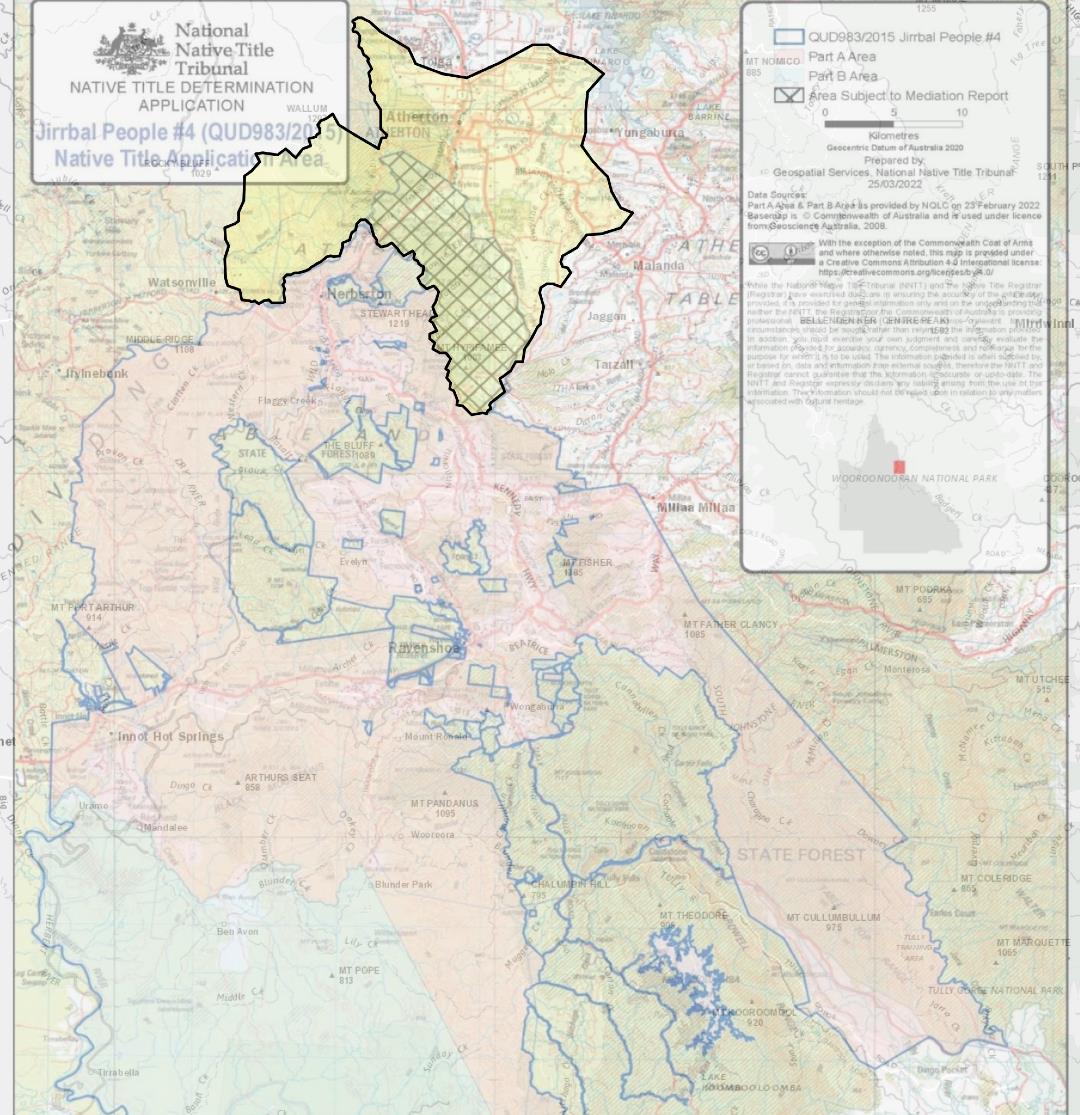
2 In essence, Ms Barlow claims that the Ngai-kungo-i People hold interests in country that overlay the Jirrbal #4 claim. The claim is illustrated by Map 03 annexed to the Report prepared by Mr Bruce William White (White Report) on behalf of Ms Barlow and filed on 19 August 2022.
3 By order of the Court dated 25 March 2022, the Jirrbal #4 claim was divided into Part A and Part B. Part A of the claim is shown in pink. Part B is shown in teal and is comprised of two areas, a larger area to the south-west, and a smaller area to the north-east. The extent of the overlap claimed by Ms Barlow is represented by the hatching.
The basis for joinder
4 Section 84(5) of the Native Title Act 1993 (Cth) (NTA) provides:
The Federal Court may at any time join any person as a party to the proceedings, if the Court is satisfied that the person’s interests may be affected by a determination in the proceedings and it is in the interests of justice to do so.
5 Pursuant to rule 34.105 of the Federal Court Rules 2011 (Cth), a joinder application must be accompanied by an affidavit outlining how the person’s interests may be affected by a determination and why it is in the interests of justice for the Court to grant the application. In support of her application, Ms Barlow relies upon an affidavit filed on 4 July 2022 (Aff-KB July) and a further affidavit filed on 18 August 2022 (Aff-KB August). Ms Barlow also seeks to rely upon the White Report.
Ms Barlow’s interest
6 Dealing, first, with Ms Barlow’s interest, a determination of native title under the NTA can only result from a native title determination. A person joined as a respondent party cannot use the status as respondent as an avenue for such a determination: Commonwealth of Australia v Clifton [2007] FCAFC 190; 164 FCR 355; Bonner on behalf of the Jagera People #2 v State of Queensland [2011] FCA 321 at [19] per Reeves J.
7 It is also well established that an interest sufficient to be joined under s 84(5) must be “genuine”, “not indirect, remote or lacking in substance”, “capable of clear definition” and “of such a character that [the holder of the interest] may be affected in a demonstrable way by a determination”: Byron Environmental Care Inc v Arakwal People [1997] FCA 797; 78 FCR 1 at 7 per Black CJ. It must also be more than an interest of “an emotional, conscientious, ideological or intellectual kind”: Arakwal People at 7-9.
8 Ms Barlow does not explicitly assert native title rights in the claim applicant’s claim area. Rather, she claims, on her own behalf and on behalf of other unspecified members of her family, to be “the direct descendants of the Ngai-kungo-i tribe” being “the traditional custodian tribe of the whole Atherton Tablelands”: (Aff-KB July, [1]-[2]). Ms Barlow is most concerned that Ngai-kungo-i people have been excluded from previous native title claims and asserts that her people have been ignored. She is obviously devastated by what she perceives to be this injustice to the Ngai-kungo-i People.
9 Nevertheless, claims to native title exist within the framework of the NTA, and it is only within that framework that Ms Barlow can advance a claim on behalf of the Ngai-kungo-i People. It is not clear that she has ever attempted to bring a substantive claim as opposed to a responsive claim.
10 To this point, Ms Barlow has not adduced any evidence of a native title holding group, the extent of such territory or group, or the content of traditional law and custom sufficient to raise even a prima facie case of the existence of native title, in the sense described by Gleeson CJ, Gummow and Hayne JJ in Yorta Yorta Aboriginal Community v Victoria (2002) 214 CLR 422 at [32] and [87]-[89].
11 Ms Barlow grounds her claim to be a direct descendant of the Ngai-kungo-i tribe on her assertion that she descends from one “Billy” Barlow (Barlow Thomas). Ms Barlow’s affidavit consists of a series of assertions as to her family history but lacks any cogent evidence that comes close to establishing the assertions. Ms Barlow’s claim to descent from Billy Barlow is contradicted by the evidence in the affidavit of Kara Christina Dunn filed on 19 September 2022 (Aff-KCD). Ms Dunn is an anthropologist who has reviewed the White Report and a report of Dr John Burton dated 4 October 2019, (Aff-KCD: KCD03) and which is also Annexure 3 to Aff-KB August. Although the anthropological evidence is untested at this stage of the proceedings, it is sufficient to cast significant doubt on Ms Barlow’s claim. Both Ms Dunn and Dr Burton opine that there is no evidence that Ms Barlow is related to Billy Barlow.
12 Similarly, the affidavits of Ms Barlow’s father, Phillip Barlow, and her sister, Amanda Obikwelu, annexed to Aff-KB August, are not evidence of a body of traditional law and custom acknowledged and observed by the Ngai-kungo-i People, by which laws and customs the group has rights or interests in land or waters that survived the Crown’s acquisition of sovereignty. Nor do they evidence the continued acknowledgement and observance of those traditional laws and customs, in a substantially uninterrupted way, from the acquisition of sovereignty until the present date. Indeed, almost to the contrary, Mr Barlow’s affidavit, at [3] suggests that whatever ancestral lands he may have laid claim to have been determined to be those of other Peoples,
with disregard to my family as Ngai-kungo-i Peoples belonging to the area with extensive history and evidence to prove our connection and history, but because of the unlawful ACT of the North Queensland Land Council and Native Title Determinations starting from the 2012 Yidinji claim up to the current Jirrbal 4 claim, that had deemed the Ngai-kungo-i as being extinct and wiped off the face of the earth…
13 Similarly, Ms Obikwelu attests, at [5], “Our identity has been wiped and many of our significant and Sacred sites are being destroyed, disregarded and lost”.
14 What evidence that does exist as to the land or waters over which the Ngai-kungo-i People have interests by reason of laws and customs that have survived sovereignty is that such lands and waters are well to the east of the claim applicant’s claim area. The affidavit of Susan Gillian Mary Walsh filed on 19 September 2022 (Aff-SGMW September) attests, at [23]-[27], to having identified the various locations identified in Aff-KB July and Aff-KB August and locates them on a map of the Jirrbal #4 claim area and surrounds (SW10). None is located within the Jirrbal #4 claim area.
15 In oral submissions, Ms Barlow contended that the Ngai-kungo-i People have rights to areas to the west of the Jirrbal 4 claim area, specifically, from Watsonville to Irvinebank. That area has, however, been the subject of a native title determination in favour of the Bar Barrum People: Malthouse on behalf of the Bar Barrum People v State of Queensland [2016] FCA 692. No weight can be given to evidence, assuming it had been properly adduced, that is inconsistent with existing determinations: Lake Torrens Overlap Proceedings (No 3) [2016] FCA 899 at [57]; Starkey v South Australia [2018] FCAFC 36; 261 FCR 143 at 204 per Reeves J.
16 Up until today, Ms Barlow has disavowed any interest in the Jirrbal #4 claim area. On 4 August 2022, Ms Barlow was ordered by the Court to file a map which outlined the areas over which she asserts native title rights and interests. On 19 August 2022, Ms Barlow filed an outline of the area from which she says her interests as a Ngai-kungo-i person arise. At the time of filing her interlocutory application, that area overlapped with a northern part of the Jirrbal #4 claim.
17 On 27 September 2022, Ms Barlow’s interlocutory application was listed for hearing before Rangiah J. At the hearing, it transpired that the claim applicant intended to reduce the claim area, the consequence of which meant there would no longer be an overlap. With the consent of Ms Barlow, his Honour adjourned the hearing of Ms Barlow’s application to allow the Jirrbal #4 claim area to be amended. It is necessary to set out the transcript of that hearing, which is Annexure SW-11 to an affidavit of Susan Gillian Mary Walsh filed on 20 March 2023 (Aff-SGMW March). Commencing at line 27 of page 9 of the transcript, the following interchange occurs:
HIS HONOUR: Now, what Mr Yarrow has told me is that that northern part B area seems likely to be removed from the Jirrbal number 4 claim, and that’s likely to happen in December this year when the Jirrbal claim group has a meeting. If the Jirrbal claim group approves removal of the northern part B area, then it seems that would satisfy your interests because the Jirrbal People would no longer be claiming the area that you claim to have an interest in.
MS BARLOW: Yes, your Honour.
HIS HONOUR: So what I’m considering doing then is just adjourning your application until after December.
MS BARLOW: Yes, your Honour.
HIS HONOUR: Because there wouldn’t seem to be a lot of point in you being joined as a respondent and then there being an application to remove you as a respondent after December on the basis that you no longer have an interest in the Jirrbal number 4 claim.
MS BARLOW: Yes, your Honour.
18 On 28 February 2023, the claim applicant filed an amended application reducing the claim area by withdrawing the northern Part B area from the claim: Aff-SGMW March at [7]. The effect is that the Jirrbal #4 claim no longer overlaps the area over which Ms Barlow asserts her rights as a Ngai-kungo-i person.
19 On 6 March 2023, the lawyers for the claim applicant wrote to Ms Barlow informing her of the amendment to the claim to withdraw the northern Part B area, enclosing a map of the revised claim area, and inviting her to withdraw this application. Despite that correspondence, Ms Barlow has pressed her application for joinder.
20 Counsel for the claim applicants submitted, and I accept, that the claim applicant relied on the representation by Ms Barlow that she would no longer have any claim over the Jirrbal #4 claim area by embracing the adjournment suggested by Rangiah J on the last occasion. In so doing, it has suffered detriment by incurring the costs of today as a consequence of incurring the costs of this resumed interlocutory application today.
21 Counsel relied on the common law principle of estoppel by representation, the purpose of which is to prevent the representee suffering a detriment if the representor were allowed to depart from the assumption conveyed by the representation on which the representee acted: Grundt v Great Boulder Pty Gold Mines Ltd (1937) 59 CLR 641 at 674 per Dixon J and Thompson v Palmer (1933) 49 CLR 507 at 547.
22 For these reasons, I am not satisfied that Ms Barlow has an interest that may be affected by a determination of native title in favour of the claim applicant for the application area.
The interests of justice
23 Given the conclusion I have reached in relation to Ms Barlow’s asserted interest, it is unnecessary for me to consider whether, had I reached a different conclusion, it would nevertheless have been in the interests of justice for me to exercise my discretion to join Ms Barlow as a party. As was observed by Mortimer J in Gunaikurnai People Native Title Claim Group v State of Victoria [2018] FCA 23 at [51]:
The joinder provisions in s 84(5) are clearly wide enough to comprehend other indigenous people who allege their interests (including native title interests) are affected by the application. However, s 84(5) is a discretionary power, so ultimately it will be a matter for the Court's discretion whether a person is joined, even if it is the case that she or he can establish her or his interests are affected. The Court must also be satisfied it is in the “interests of justice” for the person to be joined.
24 It is however desirable to record matters that would have told against the exercise of the discretion in Ms Barlow’s favour and which are also relevant to the question of whether it might have been appropriate to order costs against Ms Barlow had the claim applicant not chosen expressly not to pursue such an order.
25 In addition to the representation made by Ms Barlow during the adjourned interlocutory application hearing before Rangiah J, it is pertinent to note that Part A of the Jirrbal #4 claim area is well advanced towards resolution by a consent determination: SGMW-Aff September, [7]-[8]. In circumstances where Ms Barlow has never asserted any interest in Part A of the claim area, there would be a risk of real prejudice to the claim applicants should Ms Barlow be joined to the proceedings at this stage.
26 There is the further difficulty with Ms Barlow’s application that she apparently seeks to be joined as a respondent in a representative capacity, that is, on her own behalf and on behalf of persons unidentified otherwise than as being “descendants of Billy Barlow who are members of the Ngai-kungo-i tribe”. The NTA does not facilitate respondent parties acting in a representative capacity.
27 As Reeves J noted in Isaacs on behalf of the Turrbal People v State of Queensland (No 2) [2011] FCA 942 at [19], if a person wishes to obtain a positive determination of native title, then the native title prescribes that the only method by which that can be achieved is by an application under s 13(1) of the NTA, complying with the requirements of s 61 and s 251B of the NTA. A person cannot be joined as a respondent party if his or her purpose in being so joined is to act as a representative to assert native title rights on behalf of other people.
28 For these reasons, I am not satisfied that would be in the interests of justice for Ms Barlow to be joined to the proceedings as a respondent party, even if I had been satisfied that she had a sufficient interest in the Jirrbal #4 claim area.
Disposition
29 The appropriate order is that Ms Barlow’s interlocutory application be dismissed. The respondent did not seek its costs of the application. Consequently, there will be no order as to costs.
I certify that the preceding twenty-nine (29) numbered paragraphs are a true copy of the Reasons for Judgment of the Honourable Justice Sarah C Derrington. |
Associate:


