

FEDERAL COURT OF AUSTRALIA
Mumu v Northern Territory of Australia [2023] FCA 288
ORDERS
ROBERT MUMU AND OTHERS (named in the attached Schedule) Applicant | ||
AND: | NORTHERN TERRITORY OF AUSTRALIA AND OTHERS (named in the attached Schedule) First Respondent | |
DATE OF ORDER: |
THE COURT NOTES THAT:
A. The Applicant in this proceeding NTD3/2020 has made a native title determination application (Application) that relates to an area of land and waters which is the subject of a proposed determination of native title.
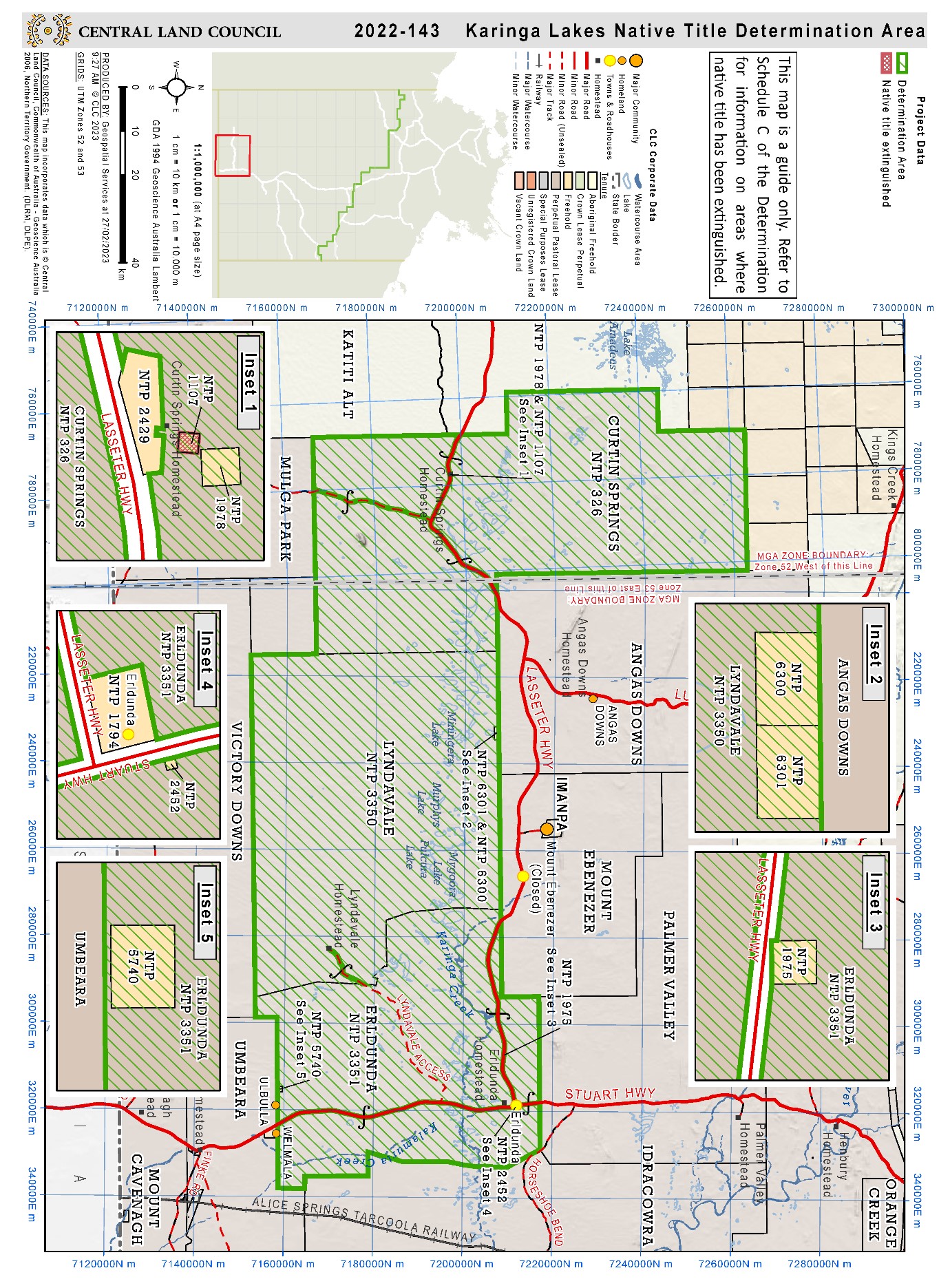
B. The parties to the proceeding have reached agreement as to the terms of the proposed determination in relation to the land and waters covered by the Application (Determination Area). The external boundaries of the Determination Area are described in Schedule One and depicted on the map at Schedule Two of the Determination which is Attachment A to these Orders.
C. Pursuant to s 87(1)(a)(i) and s 87(1)(b) of the Native Title Act 1993 (Cth) (NTA) the parties filed with the Court their agreement in writing.
D. Pursuant to s 87 and s 94A of the NTA, the terms of the parties’ agreement involve the making of consent orders for a determination that native title exists in relation to the Determination Area as provided by the Determination.
E. The parties acknowledge that the effect of the making of the Determination is that the members of the native title claim group, in accordance with the traditional laws acknowledged and the traditional customs observed by them, should be recognised as the native title holders for the Determination Area as provided by the Determination.
F. The parties have requested that the Court hear and determine this proceeding in accordance with their agreement without holding a hearing.
BEING SATISFIED that a determination of native title in the terms set out in the Determination in respect of this proceeding is within the power of the Court and, it appearing to the Court appropriate to do so, pursuant to section 87 and 94A of the NTA and by the consent of the parties:
THE COURT ORDERS THAT:
1. There be a determination of native title in the terms of the Determination set out at Attachment A.
2. The native title is not to be held on trust.
3. Iyangka Kularta Aboriginal Corporation (ICN: 9136) shall:
(a) be the prescribed body corporate for the purposes of s 57(2) of the NTA; and
(b) perform the functions outlined in s 57(3) of the NTA after becoming a registered native title body corporate.
4. The parties have liberty to apply to establish the precise location and boundaries of any public works and adjacent land and waters identified or otherwise referred to in Schedule Three of the Determination.
5. There be no order as to costs.
Note: Entry of orders is dealt with in Rule 39.32 of the Federal Court Rules 2011.
ATTACHMENT A
DETERMINATION
THE COURT ORDERS, DECLARES AND DETERMINES THAT:
The Determination Area
1. The Determination Area comprises NT Portions 326, 1107, 1975, 1978, 2452, 3350, 3351, 5740, 6300 and 6301 being the land and waters more particularly described in Schedule One and depicted on the map comprising Schedule Two.
2. Native title exists in the Determination Area as follows:
(a) NT Portions 326, 3350 and 3351: the native title rights and interests in paragraph 5;
(b) NT Portions 1975, 1978, 2452, 5740, 6300 and 6301: the native title rights and interests in paragraph 5; but they are wholly ineffective in relation to the relevant acts due to the operation of section 238(3) of the NTA.
3. Notwithstanding paragraph 2, native title does not exist in those parts of the Determination Area described in Schedule Three.
The Native Title Holders
4. The persons who hold the common or group rights comprising the native title are the Aboriginal persons who, as ngurraritja for the Determination Area, have a spiritual connection to that area and to the Tjukurpa associated with it by virtue of (usually more than one of):
(a) birth on or near the area or a Dreaming track that crosses the area;
(b) close kin or an ancestor having a connection to the area (including through birth or long-term association);
(c) adoption by a claimant or a claimant’s ancestor;
(d) knowledge of the physical landscape of the area and its sites and Dreamings;
(e) caring for the physical and spiritual attributes of the area;
(f) long-term association with the area;
(g) burial of close kin on or near the area,
and they are recognised by other ngurraritja as having rights and interests in the area under the traditional laws and customs of the Western Desert.
The Native Title Rights and Interests
5. The native title rights and interests in relation to the Determination Area comprise:
(a) the right to access and travel over any part of the land and waters;
(b) the right to live on the land and, for that purpose, to camp, erect shelters and other structures;
(c) the right to access, take and use for any purpose the natural resources of the land and waters, and natural water on or in the land and waters, including the right to share or exchange natural resources obtained on or from the land and waters;
Note: To avoid doubt, the term “natural water” is defined at paragraph 17.
(d) the right to light fires for domestic purposes, but not for the clearance of vegetation;
(e) the right to access and to maintain and protect sites and places on or in the land and waters that are important under traditional laws and customs;
(f) the right to conduct and participate in the following activities on the land and waters:
(i) cultural activities;
(ii) ceremonies;
(iii) meetings;
(iv) cultural practices relating to birth and death including burial rites; and
(v) teaching the physical and spiritual attributes of sites and places on the land and waters that are important under traditional laws and customs.
(g) the right to make decisions about the use and enjoyment of the land and waters by Aboriginal people who recognise themselves to be governed by the traditional laws and customs acknowledged by the native title holders provided that the right does not extend to making any decision that purports to control the access of such persons to the Determination Area;
(h) the right to be accompanied on the land and waters by persons who, though not native title holders, are:
(i) people required by traditional law and custom for the performance of ceremonies or cultural activities on the land and waters;
(ii) people who have rights in relation to the land and waters according to the traditional laws and customs acknowledged by the native title holders;
(iii) people required by the native title holders to assist in, observe, or record traditional activities on the areas.
(i) the right to conduct activities necessary to give effect to the rights referred to in (a) to (h) hereof.
6. The native title rights and interests do not confer:
(a) possession, occupation, use and enjoyment of the land and waters on the native title holders to the exclusion of all others; or
(b) any right to control access to, or the use of, the Determination Area or its resources.
7. The native title rights and interests are subject to and exercisable in accordance with:
(a) the valid laws of the Northern Territory of Australia and the Commonwealth of Australia;
(b) the traditional laws and customs of the native title holders.
Other Interests in the Determination Area
8. The nature and extent of the other interests in those parts of the Determination Area where native title exists are the interests created by the Crown or otherwise as follows:
(a) NT Portion 326:
(i) the rights and interests of Ashley Armstrong Severin under Perpetual Pastoral Lease No. 1092;
(ii) the interest of the Commonwealth of Australia under Right of Way Easement (Dealing No. 211648 registered on 22 December 1988);
(iii) the interest of the Commonwealth of Australia under Powerline Easement (Dealing No. 026356 registered on 6 November 1969);
(b) NT Portion 3350 – the rights and interests of John Garnaut Stanes under Perpetual Pastoral Lease 1088;
(c) NT Portion 3351:
(i) the rights and interests of Erldunda Pty Ltd as trustee for the Erldunda Land Trust and as trustee for the Erldunda Land Trust No 2 under Perpetual Pastoral Lease 1031;
(ii) the interest of the Karu Mutu Aboriginal Corporation under Right of Way “C” Easement (Dealing No. 660815 registered on 29 November 2007);
(d) NT Portion 1975 – the rights and interests of Amplitel Pty Ltd as the holder of an estate in fee simple;
(e) NT Portion 1978 – the rights and interests of Telstra Corporation Limited (as successor to the Australian Telecommunications Corporation) as the holder of an estate in fee simple;
(f) NT Portion 2452 – the rights and interests of Amplitel Pty Ltd as the holder of an estate in fee simple;
(g) NT Portion 5740 – the rights and interests of the Karu Mutu Aboriginal Corporation as the holder of an estate in fee simple (subject to the Karu Mutu Community Living Area Agreement, DI2003/003 entered on the Register of Indigenous Land Use Agreements on 30 June 2003);
(h) NT Portion 6300 – the rights and interests of the Pulkurru Aboriginal Corporation as the holder of an estate in fee simple (subject to the Pulkurru Community Living Area Agreement, DI2003/002 entered on the Register of Indigenous Land Use Agreements on 30 June 2003);
(i) NT Portion 6301 – the rights and interests of the Umalka Tjintjira Aboriginal Corporation as the holder of an estate in fee simple (subject to the Umalka Tjintjira Community Living Area Agreement, DI2003/001 entered on the Register of Indigenous Land Use Agreements on 30 June 2003);
(j) the rights and interests of the holders of the following titles granted under the Petroleum Act 1984 (NT):
No. | Date Granted | Expiry date | Holder |
EP112 | 21 July 2005 | 20 December 2024 | Santos QNT Pty Ltd and Frontier Oil & Gas Pty Ltd |
EP125 | 7 December 2005 | 6 June 2024 | Santos QNT Pty Ltd and Ordiv Petroleum Pty Ltd |
(k) the rights and interests of the holders of the following titles granted under the Mineral Titles Act 2010 (NT) (or its predecessor):
No. | Date Granted | Expiry date | Holder |
ML22854 | 17 November 2004 | 16 November 2029 | Victory Gypsum Pty Ltd |
EL32249 | 30 November 2021 | 29 November 2027 | Territory Potash Pty Ltd |
EL32250 | 30 November 2021 | 29 November 2027 | Territory Potash Pty Ltd |
EL32251 | 30 November 2021 | 29 November 2027 | Territory Potash Pty Ltd |
EL32369 | 13 August 2020 | 12 August 2026 | Enigma Mining Ltd |
EL32858 | 8 April 2022 | 7 April 2028 | Havelock Mining Pty Ltd |
EL32859 | 8 April 2022 | 7 April 2028 | Havelock Mining Pty Ltd |
(l) the rights and interests (if any) of Telstra Corporation Limited and its related bodies corporate (including Amplitel Pty Ltd) and successors in title:
(i) as the owners or operators of telecommunications facilities within the Determination Area;
(ii) created pursuant to the Post and Telegraph Act 1901 (Cth), Telecommunications Act 1975 (Cth), Australian Telecommunications Corporation Act 1989 (Cth), Telecommunications Act 1991 (Cth) and under sch 3 to the Telecommunications Act 1997 (Cth), including rights:
A. to inspect land;
B. to install, occupy and operate telecommunication facilities; and
C. to alter, remove, replace, maintain, repair and ensure the proper functioning of its telecommunication facilities; and
(iii) for their employees, agents or contractors to access their telecommunications facilities in, and in the vicinity of, the Determination Area in the performance of their duties;
(iv) under any lease, licence, permit, access agreement or easement relating to their telecommunications facilities in the Determination Area;
(m) NT Portions 326, 3350 and 3351 – the rights of Aboriginal persons (whether or not native title holders) pursuant to the reservation in favour of Aboriginal people contained in Perpetual Pastoral Lease Nos 1092, 1088 and 1031, respectively, set out in ss 38(2) to (6) of the Pastoral Land Act 1992 (NT);
(n) the rights of Aboriginal persons (whether or not native title holders) by virtue of the Northern Territory Aboriginal Sacred Sites Act 1989 (NT);
(o) rights of access by an employee, servant, agent or instrumentality of the Northern Territory of Australia, Commonwealth of Australia or other statutory authority as required in the performance of his or her statutory duties;
(p) the rights to water lawfully captured by the holders of other interests;
(q) the interests of persons to whom valid or validated rights and interests have been:
(i) granted by the Crown pursuant to statute or otherwise in the exercise of its executive power; or
(ii) conferred by statute.
Relationship between the Native Title Rights and Interests and the Other Interests
9. In relation to NT Portions 326, 3350 and 3351, the other rights and interests referred to in paragraph 8 and the doing of an activity in giving effect to them or of an activity required or permitted by them, prevail over but do not extinguish the native title rights and interests referred to in paragraph 5 and the existence and exercise of the native title rights and interests do not prevent the carrying on of any such activity.
10. In relation to NT Portions 1975 and 2452, the relationship between the native title rights and interests referred to in paragraph 5 and the rights and interests of Amplitel Pty Ltd referred to in paragraph 8 as the holder of two estates in fee simple is that the non-extinguishment principle applies. The estates in fee simple:
(a) are wholly inconsistent with the continued existence, enjoyment or exercise of the native title rights and interests;
(b) the native title continues to exist, but has no effect in relation to the grant;
(c) if the grants or their effects are wholly removed or otherwise wholly cease to operate, the native title rights and interests again have full effect;
(d) if the grants or their effects are removed to an extent, or otherwise cease to operate only to an extent, the native title rights and interests again have effect to that extent.
11. In relation to NT Portion 1978, the relationship between the native title rights and interests referred to in paragraph 5 and the rights and interests of Telstra Corporation Limited referred to in paragraph 8 as the holder of an estate in fee simple is that the non-extinguishment principle applies. The estate in fee simple:
(a) is wholly inconsistent with the continued existence, enjoyment or exercise of the native title rights and interests;
(b) the native title continues to exist, but has no effect in relation to the grant;
(c) if the grant or its effects are wholly removed or otherwise wholly cease to operate, the native title rights and interests again have full effect;
(d) if the grant or its effects are removed to an extent, or otherwise cease to operate only to an extent, the native title rights and interests again have effect to that extent.
12. In relation to NT Portion 5740, the relationship between the native title rights and interests referred to in paragraph 5 and the rights and interests of the Karu Mutu Aboriginal Corporation referred to in paragraph 8 as the holder of a fee simple estate in the land as set out in the Karu Mutu Community Living Area Agreement, DI2003/003 entered on the Register of Indigenous Land Use Agreements on 30 June 2003, is that the non-extinguishment principle applies:
(a) the grant of the estate in fee simple is wholly inconsistent with the continued existence, enjoyment or exercise of the native title rights and interests;
(b) the native title continues to exist, but has no effect in relation to the grant;
(c) if the grant or its effects are wholly removed or otherwise wholly ceases to operate, the native title rights and interests again have full effect;
(d) if the grant or its effects are removed to an extent, or otherwise ceases to operate only to an extent, the native title rights and interests again have effect to that extent.
13. In relation to NT Portion 6300, the relationship between the native title rights and interests referred to in paragraph 5 and the rights and interests of the Pulkurru Aboriginal Corporation referred to in paragraph 8 as the holder of a fee simple estate in the land as set out in the Pulkurru Community Living Area Agreement, DI2003/02 entered on the Register of Indigenous Land Use Agreements on 30 June 2003, is that the non-extinguishment principle applies:
(a) the grant of the estate in fee simple is wholly inconsistent with the continued existence, enjoyment or exercise of the native title rights and interests;
(b) the native title continues to exist, but has no effect in relation to the grant;
(c) if the grant or its effects are wholly removed or otherwise wholly ceases to operate, the native title rights and interests again have full effect;
(d) if the grant or its effects are removed to an extent, or otherwise ceases to operate only to an extent, the native title rights and interests again have effect to that extent.
14. In relation to NT Portion 6301, the relationship between the native title rights and interests referred to in paragraph 5 and the rights and interests of the Umalka Tjintjira Aboriginal Corporation referred to in paragraph 8 as the holder of a fee simple estate in the land as set out in the Umalka Tjintjira Community Living Area Agreement, DI2003/001 entered on the Register of Indigenous Land Use Agreements on 30 June 2003, is that the non-extinguishment principle applies:
(a) the grant of the estate in fee simple is wholly inconsistent with the continued existence, enjoyment or exercise of the native title rights and interests;
(b) the native title continues to exist, but has no effect in relation to the grant;
(c) if the grant or its effects are wholly removed or otherwise wholly ceases to operate, the native title rights and interests again have full effect;
(d) if the grant or its effects are removed to an extent, or otherwise ceases to operate only to an extent, the native title rights and interests again have effect to that extent.
15. In relation to the titles granted under the Petroleum Act and the Mineral Titles Act (or its predecessor) referred to in paragraph 8: the relationship between the native title rights and interests and those titles is that the titles and the doing of an activity in giving effect to them, or of an activity required or permitted by them, prevail over but do not extinguish the native title rights and interests, and the existence and exercise of the native title rights and interests do not prevent the carrying on of any such activity.
Other matters
16. There are no native title rights and interests in:
(a) minerals as defined in s 2 of the Minerals (Acquisition) Act 1953 (NT);
(b) petroleum as defined in s 5 of the Petroleum Act;
(c) prescribed substances as defined in s 5 of the Atomic Energy Act 1953 (Cth) and s 3 of the Atomic Energy (Control of Materials) Act 1946 (Cth).
17. In this determination, the term:
(a) “natural resources” does not include minerals, petroleum and prescribed substances; and
(b) “natural water”:
(i) includes springs and rockholes;
(ii) does not include any water deriving from, or in relation to, the Determination Area which, from time to time, is captured by a lessee of Perpetual Pastoral Lease Nos 1031, 1088 and 1092.
18. Unless the contrary intention appears, a word or expression used in the NTA has the same meaning in this Determination as it has in the NTA.
Schedule One
Description of the Determination Area
1. The Determination Area comprises the following areas of land and waters:
(a) NT Portion 326 comprising an area of 4,152 square kilometres held under Perpetual Pastoral Lease 1092;
(b) NT Portion 3350 comprising an area of 3,762 square kilometres held under Perpetual Pastoral Lease 1088;
(c) NT Portion 3351 comprising an area of 2,930 square kilometres 67 hectares held under Perpetual Pastoral Lease No 1031;
(d) NT Portion 1107 comprising an area of 8,360 square metres held for an estate in fee simple;
(e) NT Portion 1975 comprising an area of 4 hectares held for an estate in fee simple;
(f) NT Portion 1978 comprising an area of 2 hectares 8,900 square metres held for an estate in fee simple;
(g) NT Portion 2452 comprising an area of 2,500 square metres held for an estate in fee simple;
(h) NT Portion 5740 comprising an area of 1 square kilometre 33 hectares 4,000 square metres held for an estate in fee simple;
(i) NT Portion 6300 comprising an area of 1 square kilometre 50 hectares 9,000 square metres held for an estate in fee simple;
(j) NT Portion 6301 comprising an area of 1 square kilometre 49 hectares held for an estate in fee simple.
2. The following areas within the external boundaries of the Determination Area are not included in the Determination Area:
(a) NT Portions 1794 and 2429;
(b) The following roads constructed by or on behalf of the Northern Territory of Australia as public roads:
(i) A road 100 metres wide (Stuart Highway) which traverses NT Portion 3351 from the boundary of NT Portion 2869 (Umbeara) to the boundary of NT Portion 1991 (Palmer Valley);
(ii) A road 100 metres wide (Lasseter Highway) which traverses NT Portion 3351 from the junction with the Stuart Highway to the boundary of NT Portion 680 (Mount Ebenezer);
(iii) A road 150 metres wide (Lasseter Highway) which traverses NT Portion 326 from the boundary of NT Portion 620 (Angas Downs) to the western boundary of NT Portion 326 (not including any part of NT Portion 2429);
(iv) A road 100 metres wide (Lyndavale Access Road) which traverses NT Portion 3350 and NT Portion 3351 from the junction with the Stuart Highway to the Lyndavale Station Homestead;
(v) A road 100 metres wide (Mulga Park Road) which traverses NT Portion 326 from the junction with the Lasseter Highway to the boundary of NT Portion 325 (Mulga Park).
Schedule Two
Map of Determination Area
 Schedule Three
Areas Where Native Title Does Not Exist
Native title rights and interests have been wholly extinguished in the following areas of land and waters:
Public Works
1. NT Portion 1107.
2. Native title is extinguished over those parts of the following areas where the specified public work was constructed, established and situated (including land and waters within the meaning of s 251D of the NTA):
(a) NT Portion 1975 – works comprised in the Ippity Hanger telecommunications site;
(b) NT Portion 1978 – works comprised in the Curtin Springs telecommunications site; and
(c) NT Portion 2452 – works comprised in the Erldunda telecommunications site.
3. Those parts of the Determination Area covered by public works as defined in s 253 of the NTA that were constructed or established before 23 December 1996 or commenced to be constructed or established on or before that date (including land and waters within the meaning of s 251D of the NTA), including, if they are public works:
(a) public roads, namely, rural public roads (50 metres either side of the centreline), rural arterial roads and national highways and associated road infrastructure;
(b) community, pastoral access and other roads (including access roads and tracks to public works referred to in this clause) which are not otherwise public roads;
(c) gravel and fill pits established to maintain the roads referred to in (a) and (b) above;
(d) government bores and associated works;
(e) river and rain gauges;
(f) transmission water pipes (adjacent area 5 metres either side of the centreline);
(g) distribution water pipes measuring 150mm diameter or less (adjacent area of 1.5 metres either side of the centreline) and greater than 150mm diameter (adjacent area 5 metres either side of the centreline);
(h) sewer pipes measuring 150mm diameter or less (adjacent area 1.5 metres either side of the centreline) and greater than 150mm (adjacent area 5 metres either side of the centreline);
(i) bores, sewer pump stations, and overhead power lines.
BROMBERG J:
1 The parties have sought a consent determination under the Native Title Act 1993 (Cth) (NTA) determining that:
(a) native title exists over the lands and waters described in Schedule One and depicted on the map at Schedule Two (Determination Area) of the Determination which is Attachment A to the Orders which accompany these reasons (Orders); and
(b) the native title in the Determination Area is held by the native title holders identified in paragraph 4 of the Determination.
2 The Determination Area is 10,842 square kilometres, and located approximately 69 kilometres east of Yulara and 142 kilometres south of Hermannsburg. It is part of the eastern Western Desert language region and associated with the Yankunytjatjara dialect. To the south is the Victory Downs, Mount Cavenagh, Mulga Park and Umbeara determination: Wikilyiri on behalf of the persons who are ngurraritja for Ananta (Umbeara), Kalka (Kulgera), Watju (Mount Cavenagh), Wapirrka (Victory Downs) and Warnukula (Mulga Park) v Northern Territory of Australia [2017] FCA 446.
3 The Determination Area is over the Curtin Springs Pastoral Lease (Tjulu), the Lyndavale Pastoral Lease (Maratjura), the Erldunda Pastoral Lease (Warltunta), as well as other various NT Portions. As is the custom in the Northern Territory region, the application has been given a short title, in this instance “Karinga Lakes” for the chain of salt lakes that extend through the Determination Area.
4 The native title claim group comprises the Aboriginal persons who are ngurraritja for the country covered by the application. Ngurraritja for the Determination Area are the persons, according to the traditional laws acknowledged and customs observed by them, who have a spiritual connection to the area and to the Tjukurpa (or Dreamings) associated with it by virtue of one or more of:
(a) birth on or near the area or a Dreaming track that crosses the area;
(b) close kin or an ancestor having a connection to the area (including through birth or long-term association);
(c) adoption by a claimant or a claimant’s ancestor;
(d) knowledge of the physical landscape of the area and its sites and Dreamings;
(e) caring for the physical and spiritual attributes of the area;
(f) long-term association with the area;
(g) burial of close kin on or near the area,
and they are recognised by other ngurraritja as having rights and interests in the area under the traditional laws and customs of the Western Desert.
5 The claim group’s system of laws and customs has its foundation in Tjukurpa (Dreamings). According to Tjukurpa, the physical and cultural landscape, the legal, social, kinship and religious systems, and the conditions for their continuity, were produced by spiritual ancestors who travelled on, above or below the lands in the Dreaming. The laws and customs founded in Tjukurpa are held to be unchanged from the time of their creation and to have been transmitted from each succeeding generation by the ancestors.
6 Members of the native title claim group have been recognised as traditional Aboriginal owners of other land under the Aboriginal Land Rights (Northern Territory) Act 1976 (Cth) and as native title holders under the NTA:
(a) Claimants and their ancestors associated with the claim area in the Ulruru (Ayers Rock) National Park and Lake Amadeus/Luritja Land Claim (1980): Ulruru (Ayers Rock) National Park and Lake Amadeus/Luritja Land Claim. Report by the Aboriginal Land Commissioner, Mr Justice Toohey, to the Minister for Aboriginal Affairs and to the Minister for Home Affairs, pp 13–16, 19–23.
(b) Claimants and their ancestors associated with Victory Downs, Mount Cavenagh, Umbeara and Mulga Park Stations: Wikilyiri.
7 Members of the native title claim have also obtained freehold title to the following areas of land within the Determination Area: NT Portion 5740 Erldunda, Karu Mutu Aboriginal Corporation.
THE PARTIES AND SUPPORTING MATERIALS
8 The Karinga Lakes application was authorised at a meeting of the native title claim group on 11 and 12 September 2019 at Imanpa and filed with the Court on 13 February 2020. The application was made by Robert Mumu, David Wongaway, Malya Teamay, Johnny Tjingo, David Miller, Tony Paddy, Margaret Smith, Kathleen Luckey, Tanya Luckey, Alison Carroll, Vivian Thompson and Yaritiji Miller (collectively, the Applicant).
9 The Respondents to the application are:
(a) the Northern Territory of Australia;
(b) the Commonwealth of Australia;
(c) Frontier Oil and Gas Pty Ltd;
(d) Merlin Energy Pty Ltd;
(e) Ordiv Petroleum Pty Ltd;
(f) Territory Potash Pty Ltd;
(g) Erldunda Pty Ltd as trustee for the Erldunda Land Trust and as trustee for the Erldunda Land Trust 2;
(h) Ashley Severin;
(i) John Garnaut Stanes;
(j) Telstra Corporation Limited; and
(k) Amplitel Pty Ltd as trustee of the Towers Business Operating Trust.
10 Negotiations for a consent determination of native title have been progressing for several years. On 7 April 2021, the Applicant provided the First Respondent, the Northern Territory of Australia, with several reports prepared by expert anthropologists, including:
(a) A report concerning trade and exchange of resources by Aboriginal people in the wider central Australian region;
(b) A summary anthropology report regarding the laws and customs of the native title claimants; and
(c) A further anthropology report dealing specifically with the laws and customs in relation to the taking and use of resources.
11 The Northern Territory of Australia reviewed that material and, following a series of correspondence with the Applicant, formed the view that the requirements of s 223 of the NTA were satisfied.
12 On 13 May 2021, the Northern Territory of Australia provided the Applicant with a tenure analysis showing those parts of the claim area where it claimed native title had been extinguished. The Applicant and the Northern Territory of Australia have agreed to the recognition of non-exclusive native title rights and interests over the Determination Area, excluding any areas where native title has been wholly extinguished.
13 Earlier this year, the parties informed the Court that they had agreed on the terms of a set of proposed consent orders under s 87 of the NTA. On 3 March 2023, the parties filed an executed minute of consent (Minute) and the Applicant and the Northern Territory of Australia filed a Statement of Agreed Facts and Joint Submissions. Based on those materials, the parties have now requested the Court to make this consent determination of native title.
THE REQUIREMENTS OF S 87 OF THE NTA
Section 87(1)
14 For a determination of native title to be made pursuant to s 87 of the NTA by consent without holding a hearing, the following requirements must be satisfied:
(a) The notification period specified in the notice given under s 66 of the NTA has ended (s 87(1));
(b) The parties have reached agreement on the terms of orders relating to the proceedings, and matters arising out of those terms (s 87(1)(a) and (aa));
(c) The parties have reduced their agreement to writing, the agreement has been signed by or on behalf of the parties, and it has been filed with the Court (s 87(1)(b));
(d) The Court is satisfied that an order in, or consistent with, those terms is within the power of the Court (s 87(1)(c)); and
(e) It appears appropriate to the Court to make an order consistent with the terms of the order sought (s 87(1A) and s 87(2)).
15 I am satisfied that the requirements of s 87(1) of the NTA are met in the present application. The notification period for the Application ended on 5 August 2020 (s 87(1)). The Minute is an agreement by all of the parties on the terms of an order of the Court in relation to the proceedings (s 87(1)(a) and (aa)). The Minute is in writing, has been signed by the parties or on their behalf and was filed with the Court (s 87(1)(b)).
16 In order to be satisfied that the orders sought are within the power of the Court, consideration must be given to other requirements made by the NTA. For the following reasons, I am also satisfied that the proposed order and the terms of the proposed determination are within the Court’s power to make (s 87(1)(c)):
(a) There is no challenge to the validity of the application for a consent determination. I am satisfied that the application was authorised in a manner compliant with the NTA and is a valid application;
(b) There is no approved determination of native title in relation to the area subject to the proposed determination (s 13(1)(a) of the NTA), and the terms of s 68 of the NTA are not applicable;
(c) There are no proceedings before the Court relating to native title determination applications that cover any part of the area the subject of the proposed determination which would otherwise require orders to be made under s 67(1) of the NTA;
(d) The form of the proposed determination outlined in the Minute complies with s 94A of the NTA by setting out the details of the matters required by s 225 of the NTA;
(e) The proposed determination concerns rights and interests which the Australian common law is able to recognise (s 223(1)(c)); and
(f) The requirements of s 87 of the NTA are otherwise satisfied.
17 I turn now to consider whether the proposed order is appropriate (s 87(1A) and s 87(2)).
Whether It Is Appropriate to Make the Orders Sought
The Applicable Principles
18 The requirement that the Court be satisfied that the order is “appropriate” is present in both s 87 and s 87A of the NTA. The applicable principles are the same.
19 I set out my consideration of what the Court requires in order to be satisfied that the order is “appropriate” in Davey on behalf of the Mayala #2 Native Title Claim Group v State of Western Australia [2019] FCA 1137 as follows:
[14] As I said in Jones on behalf of the Yinhawangka People v State of Western Australia [2017] FCA 801 at [45], the focus of the Court is upon determining whether there is an agreement between the parties and whether that agreement was freely entered into on an informed basis: Hughes (on behalf of the Eastern Guruma People) v State of Western Australia [2007] FCA 365 at [9] (Bennett J). As observed by North J in Ward v State of Western Australia [2006] FCA 1848 at [8]:
The Act makes mediation the primary means of resolution of native title cases. It is designed to encourage parties to take responsibility for resolution of proceedings without the need for litigation. Section 87 must be construed in this context. The section provides a power which is exercisable only when an agreement has been made. The power must be exercised flexibly and with regard to the purpose for which the section is designed. The section should not be construed to require parties in agreement to produce evidence as if in a trial …
[15] I also said in Jones at [44] that in determining where it is appropriate to make the determination sought by the parties, the Court exercises a discretion that must be exercised judicially and within the broad boundaries ascertained by reference to the subject matter, scope and purpose of the NTA: Brown (on behalf of the Ngarla people) v State of Western Australia [2007] FCA 1025 at [22] (Bennett J).
[16] Like Mortimer J in Freddie v Northern Territory [2017] FCA 867 at [20], I accept that it is also important to see the exercise of the judicial power in ss 87 and 87A of the NTA in the context of the Court’s jurisdiction as a whole, and its foundational legislation, the Federal Court of Australia Act 1976 (Cth), and in particular s 37M and s 37N of that Act.
[17] Further, in Brown v Northern Territory of Australia [2015] FCA 1268 at [23], in describing the task to be undertaken by the Court, Mansfield J said this:
The Court is not required to embark upon an inquiry as to the merits of the claim to be itself satisfied that the orders are supported and in accordance with law: Cox on behalf of the Yungngora People v State of Western Australia [2007] FCA 588 at [3] per French J. However, the Court will consider evidence for the limited purpose of determining whether the State has made a rational decision and is acting in good faith: Munn for and on behalf of the Gunggari People v State of Queensland (2001) 115 FCR 109 at [29]-[30] per Emmett J.
[18] The State has a public responsibility to ensure that its agreement to the order proposed is in the interests of the community it represents. That responsibility involves, but it is not limited to, satisfaction by the State that there is a sufficient basis for concluding that the proposed determination is capable of satisfying the requirements of s 225 of the Native Title Act. As Mortimer J said in Freddie:
23. … A s 87 agreement may be reached on behalf of the State (or Territory), and other parties, without the level of proof required in a contested application. Inherent in parties’ agreement to resolve claims by settlement rather than litigation, as in other areas of the law, is a willingness to abide by an outcome without the exhaustive and detailed investigation that accompanies a trial of contested issues of fact and law. The public interest in an outcome of this kind is considerable: see Prior on behalf of the Juru (Cape Upstart) People v State of Queensland (No 2) [2011] FCA 819 at [26], Rares J.
24. The Court is entitled to rely on the processes established by a State (or Territory) for the assessment of claims to native title and, without abdicating its task of determining that the matters set out in s 225 are present in a particular application, is entitled to proceed on the basis the State (or Territory) has made a reasonable and rational assessment of the material to which it has access in deciding to enter into a s 87 agreement: see, in relation to a similar point with respect to s 223 of the Act, King on behalf of the Eringa Native Title Claim Group and the Eringa No 2 Native Title Claim Group v State of South Australia [2011] FCA 1387 at [21] (Keane CJ).
20 The requirements of s 87(2) of the NTA will likely be met where the Court is satisfied that a relevant government respondent — such as the Northern Territory of Australia — has, through competent legal representation, satisfied itself as to the cogency of the evidence upon which an applicant relies: Jones on behalf of the Yinhawangka People v State of Western Australia [2017] FCA 801 at [46] (Bromberg J). This requires the Court to have an understanding of the process that led to the agreement and, in particular, how the State or Territory went about assessing the underlying evidence as to the existence of native title. Other considerations relevant to whether a free and informed agreement has been reached between the parties include: whether the parties have independent and competent legal representation: Munn (for and on behalf of the Gunggari people) v State of Queensland (2001) 115 FCR 109 at [29] (Emmett J); Lovett on behalf of the Gunditjmara People v State of Victoria [2007] FCA 474 at [39]–[40] (North J); whether the terms of the proposed order are “unambiguous and certain as to the rights declared”: Munn at [32] (Emmett J); and whether the agreement has been preceded by a mediation process: Nangkiriny v State of Western Australia [2004] FCA 1156 at [6] (North J); Trevor Close on behalf of the Githabul People v Minister for Lands [2007] FCA 1847 at [6] (Branson J); Lovett at [41]–[42] (North J).
21 In their joint submissions, the Applicant and the Northern Territory of Australia submitted that it was appropriate that the Court make a determination in the terms of the parties’ agreement because:
(a) The actively participating parties were legally represented throughout;
(b) The Northern Territory of Australia, as the First Respondent, had obtained searches of land tenure, mining and other relevant interests to determine the extent of “other interests” within the proposed determination area and provided copies of those searches to all parties;
(c) The parties have agreed the nature and extent of interests in relation to the Determination Area and those interests are described at paragraphs 8 to 15 of the Minute (s 225(c));
(d) There are no other proceedings before the Court relating to native title determination applications that cover any part of the claim area which would otherwise require orders to be made under s 67(1) of the NTA (s 87(1) and (2)); and
(e) The Northern Territory of Australia, as the First Respondent, has played an active role in the negotiation of the consent determination. In doing so, the Northern Territory of Australia, acting on behalf of the community generally, having had regard to the requirements of the NTA and having conducted a thorough assessment process, is satisfied that the proposed determination is justified in all the circumstances.
22 In the Statement of Joint Agreed Facts made by the Applicant and the First Respondent, it is stated that the agreement made between them was made on the basis of the materials and information in the Application, the affidavits which accompany the Application and the anthropological reports and other materials exchanged. A summary of the key factual matters which were agreed is set out in an annexure to the Statement of Joint Agreed Facts. The annexure provides a concise summary of the facts agreed relevant to the issue of connection. Although it involves some repetition of matters already discussed, it is convenient to set out those facts by including here the text of that annexure:
Statement of matters relevant to connection
The application area
1. The application area comprises the land and waters in the Erldunda (Warltunta), Lyndavale (Maratjura) and Curtin Springs (Tjulu) pastoral leases south-west of Alice Springs. The claim area is geographically located in the eastern Western Desert language region and associated with the Yankunytjatjara dialect.
Identity and composition of the native title claim group
2. The native title claim group consists of fifteen (15) family groups who are members of the Western Desert cultural bloc, a society whose members observe a common body of traditional laws and customs that among other things govern the acquisition, maintenance and transmission of interests in land. The body of traditional Western Desert laws and customs constitutes a normative system that existed at sovereignty and continues to be observed today.
3. In the Western Desert, rights and interests (including ownership and control) in country and resources are held by those who, in accordance with traditional laws and customs, are recognised as ‘nguraritja’, meaning someone who belongs to a place. Accordingly, it denotes specific people, or groups of people, as belonging to particular tracts of country.
4. Members of the claimant group believe that their system of laws and customs is founded in the Tjukurpa (Dreamtime/Dreaming), a time in the distant past during which ancestral beings travelled across the landscape bringing all aspects of the physical world into being, including geographic features, plants and animals. The Tjukurpa is the source of the claimants’ social, cultural, jural and ritual institutions. It provides the intellectual, spiritual and political basis by which individuals define and negotiate rights in land and governs the distribution of their rights and interests in country. The claimants’ belief system is centred in the Dreaming and the Law, which together are the foundation of the normative system which governs customary behaviour and the possession of rights and interests in land.
5. The claimants are nguraritja for the country within the claim area and more specifically possess rights and interests in one or more focal areas or tracts of country containing Tjukurpa sites associated with a particular Dreaming or Dreamings.
Land tenure system
6. Members of the Western Desert society who are acknowledged and accepted as holding rights and interests in particular tracts of country speak of themselves and are recognised by others as ‘nguraritja’. Nguraritja assert connection to land and derive their authority to speak for tracts of country from their unique relationship with ancestral beings believed to reside in the land.
7. Nguraritja for country are the persons who have a spiritual connection to an area and to the Tjukurpa associated with it by virtue of, usually one or more of:
(a) birth on or near the area or a Dreaming track that crosses the area;
(b) close kin or an ancestor having a connection to the area (including through birth or long-term association);
(c) adoption by a claimant or a claimant’s ancestor;
(d) knowledge of the physical landscape of the area and its sites and Dreamings;
(e) caring for the physical and spiritual attributes of the area;
(f) long-term association with the area;
(g) burial of close kin on or near the area,
and they are recognised by other nguraritja as having rights and interests in the area under the traditional laws and customs of the Western Desert.
8. To possess rights and interests in country (and to assert such rights) nguraritja rights must also be activated, for example, through visitation or occupation of country, participation in ceremony, acquiring ritual knowledge, involvement in caring for, and making decisions about, country.
9. Because the traditional principles of land tenure operating in the Western Desert recognise multiple pathways by which people may become nguraritja, individuals may lawfully assert rights and interests in more than one tract of country, and these may be geographically discontinuous. Another consequence of this system of land tenure is that people’s rights and interests in country can overlap. Furthermore, the bases for recognition of landownership are cumulative so that individuals who possess multiple links to country can acquire stronger support from the wider community of nguraritja for the area concerned in asserting their rights and interests.
10. The people who are, in aggregate, nguraritja for a particular area are considered the owners of that area, under Western Desert laws and customs.
Connection to the application area
11. The following paragraphs contain examples of the claimants’ ongoing connection with, and occupation and use of, lands and waters in and around the application area. It is by no means an exhaustive list of the senior members of the native title claim group.
12. David Wongaway is nguraritja for Warltunta (Erldunda) and Maratjura (Lyndavale). David was born in 1957 on Palmer Valley Station adjacent to Erldunda. His three siblings and other close kin were born on Erldunda. His father was initiated at MARATJURA on Lyndavale and both he and David lived and worked on Erldunda. David is knowledgeable of sacred sites and Dreamings on Erldunda and Lyndavale. Until recently, he lived at Imanpa Community (adjacent to Lyndavale) and continues to travel to the country, care for sites such as ARINPARA (Erldunda) and KULATA (Lyndavale) and associated Dreamings, and hunt on Lyndavale and Erldunda. David teaches younger claimants, including his children, about sites and Dreamings on the Application Area. He says he often takes them hunting for kangaroo around KULATA (on Lyndavale) and teaches them about Tjukurpa.
I go hunting everywhere on Erldunda. Every part of it is good for hunting. … We camp out on the country. These days we might stay for the weekend, maybe two nights, when we can get a good car. We just camp in the bush. We like to go to Kulata on Erldunda, camp and tell stories. … We take kids out on country, have a fire and talk stories with them. Old time stories we can tell them. They really listen then – good stories. It’s important to tell the kids those stories about country. We taught our kids those things, and they have to tell their kids now. (Application Affidavit, paragraphs 39, 44–45)
13. Kathleen Luckey is nguraritja for Warltunta (Erldunda) and Maratjura (Lyndavale). Kathleen was born in 1959 and grew up on Erldunda where her father, father’s mother and brother were born and are now buried. Her father and brother both worked on Lyndavale. Kathy is knowledgeable of the sites and Dreamings on Erldunda where she looks after the burial, cultural sites and rockholes, including ARINPARA and ULBULLA. She continues to transmit her knowledge of mythology, in particular the Kuniya (Carpet Snake) Tjukurpa, to her children. With her husband David Wongaway, Kathy and their family regularly camp and hunt on Erldunda; Kathy continues to teach her grandchildren where to find bush tucker including mangata (quandong), tjala (honey ants) and maku (witchetty grubs).
14. Margaret Smith is nguraritja for Warltunta (Erldunda) and Maratjura (Lyndavale). Margaret was born in 1955 at WARLTUNTA on Erldunda on the Kuniya (Carpet Snake) Tjukurpa. Her mother was born on or adjacent to Lyndavale and her uncle (mother’s brother) at PULKURU on Lyndavale. Margaret and other close kin also grew up on Erldunda and she says her children know the Kuniya Tjukurpa and have been taught about their country ‘since they were born from mothers, fathers and grandparents. All family’. Margaret and her children and grandchildren travel around Erldunda and continue to go there camping, hunting and collecting bush tucker. Margaret continues to care for and protect country, for example, through the clearing and tending of graves at the cemetery and burial sites in the sandhills behind the cemetery (at Erldunda) and cleaning out rockholes including ULBULLA and ARINPARA.
I live in Alice Springs now, and we still go out to that country on weekends today. We go for kangaroo; we collect mangata (quandong) – there are a lot of quandong trees around the south of Erldunda station. And go for maku (witchetty grubs), bush tomato, bush raisins. Just the same as when I was little, but now we can go in car and get it. Where there is a place with good greenery, that's where we will go. (Application Affidavit, paragraph 28)
15. Malya Teamay is nguraritja for Maratjura (Lyndavale) and Tjulu (Curtin Springs). Malya was born in 1947 at PAKU PAKU, a Kuniya Tjukurpa site on Lyndavale Station. His brother was born at ANARI on Curtin Springs and with his father, mother, brothers and sisters lived at PULKURU, ANARI and TJULU (Curtin Springs). Malya cares for country from Erldunda to Curtin Springs, including men’s Tjukurpa at PURRARA (Curtin Springs). Malya acquired knowledge about country on Curtin Springs including AMIRRIRI, ANARI, TJULU, PURRARA and ININTI from his older brothers while working as a stockman and now passes on his knowledge to younger claimants during ceremonies and while travelling across the application area.
I have grandkids now and I like to take them out camping to show them my country and teach them the Tjukurpa. … I still go out hunting and collecting bush foods and medicines from my country. I know how to hunt with a spear because I was taught by the tjilpis (old men) a long time ago, but these days I have a rifle for hunting. I know how to find the kuka (meat) from the malu [kangaroo], bush turkeys, ngintaka (large lizard) and lots of other things. I know how to dig for the maku (witchetty grub) and where to find the tjala (honey ants). We get the ngintaka eggs in the proper season. We know where to find them and we can take them with us. Only us ngurraritja can hunt there on Lyndavale. … These days, I am also sharing my Tjukurpa on the canvas. I paint the Dreaming track for the Minyma Kuniya. I only paint the public stories. If people want to buy my artwork they can. (Application Affidavit, paragraphs 14, 33 and 37)
16. Niningka Lewis is nguraritja for Tjulu (Curtin Springs) and Maratjura (Lyndavale). Niningka’s parents lived and worked at Curtin Springs and Lyndavale where she and her siblings, Pantjiti Lionel, Alec Minutjukur, Malya Teamay and Mr N Minutjukur (recently deceased) grew up. Mr N Minutjukur was born at ANARI, southeast of ATILA on Curtin Springs. Niningka is a knowledgeable senior woman for the Kungkarangkalpa Tjukurpa (Seven Sisters) and plays an active role in transmitting the Kungkarangkalpa and Kungka Kutjara Dreaming stories to younger claimants, including her children, grandchildren and the children and grandchildren of her deceased brother. She continues to care for and protect country through observing ritual and ceremonial responsibilities, visiting sites including AMIRRIRI, ANARI (Curtin Springs), WITAPULA (Kungkarangkalpa site near Curtin Springs) and PAKU PAKU and by participating in Sacred Sites clearances in relation to mining and development activities on her country.
23 Having regard to the above matters, I am satisfied that the Northern Territory of Australia, acting on behalf of the broader community, has taken a real interest in the proceeding and has engaged in a thorough examination of the application such that it is properly satisfied that there is a credible basis for making the proposed determination. I am therefore satisfied that the proposed order is appropriate and that the requirements made by s 87 of the NTA have been met.
NOMINATION OF A PRESCRIBED BODY CORPORATE
24 Order 2 of the Minute is to the effect that the native title in the Determination Area is not to be held on trust. Accordingly, there is no need for me to make a nomination under s 56 of the NTA. However, in these circumstances, s 57(2) of the NTA requires certain steps to be taken to determine which prescribed body corporate is to perform the functions prescribed by s 57(3).
25 On this aspect, the Minute signed by the parties seeks a determination that the Iyangka Kularta Aboriginal Corporation (ICN: 9136) be the prescribed body corporate for the purpose of s 57(2) of the NTA and to perform the functions prescribed in s 57(3). That agreement is supported by the affidavit of Clare Louise Brereton, an anthropologist employed by the Central Land Council, in which she deposes that, at a meeting of the native title claim group held on 11 and 12 September 2019, the Iyangka Kularta Aboriginal Corporation (ICN: 9136) was nominated by the claim group to be their prescribed body corporate and that the members of the Iyangka Kularta Aboriginal Corporation consented to being so nominated.
26 Accordingly, as required by s 57(2)(b) of the NTA, I determine that the Iyangka Kularta Aboriginal Corporation is to be the prescribed body corporate to perform the functions prescribed in s 57(3).
CONCLUSION
27 I am satisfied that the requirements of the NTA are met and that it is appropriate that the orders and the determination of native title proposed by the parties should be made.
28 It is important to note that those orders do not create native title in the Determination Area. Instead, this consent determination marks the recognition by the Australian legal system of the long held and pre-existing native title in the Determination Area. It recognises that which has always existed but, regretfully, has never before been acknowledged by Australian law.
29 The Court congratulates the parties on reaching their agreement and will make orders in the terms proposed by them.
I certify that the preceding twenty-nine (29) numbered paragraphs are a true copy of the Reasons for Judgment of the Honourable Justice Bromberg. |
Associate:
NTD 3 of 2020 | |
Applicants | |
Second Applicant: | David Wongaway |
Third Applicant: | Malya Teamay |
Fourth Applicant: | Johnny Tjingo |
Fifth Applicant: | David Miller |
Sixth Applicant: | Tony Paddy |
Seventh Applicant: | Margaret Smith |
Eighth Applicant: | Kathleen Luckey |
Ninth Applicant: | Tanya Luckey |
Tenth Applicant: | Alison Carroll |
Eleventh Applicant: | Vivian Thompson |
Twelfth Applicant: | Yaritiji Miller |
Second Respondent: | Commonwealth of Australia |
Third Respondent: | Frontier Oil and Gas Pty Ltd (ABN 91 103 194 136) |
Fourth Respondent: | MERLIN ENERGY PTY LTD (ABN 95 081 592 734) |
Fifth Respondent: | Ordiv Petroleum Pty Ltd (ABN 29 111 102 697) |
Sixth Respondent: | Territory Potash Pty Ltd |
Erlunda Pty Ltd as trustee for the Erldunda land trust and as trustee for the erlunda land trust No 2 | |
Eighth Respondent: | Ashley Severin |
Ninth Respondent: | John Garnaut Stanes |
Tenth Respondent: | Telstra Corporation Limited (ABN 33 051 775 556) |
Eleventh Respondent: | Amplitel Pty Ltd as trustee of the Towers Business operating trust (ABN 75 357 171 746 |


