Federal Court of Australia
Natural Raw C Pty Ltd v Maicap Pty Ltd [2023] FCA 51
ORDERS
NATURAL RAW C PTY LTD ACN 160 678 419 Applicant | ||
AND: | MAICAP PTY LTD ACN 074 616 881 Respondent | |
DATE OF ORDER: |
THE COURT ORDERS THAT:
1. The amended originating application be dismissed.
2. Any party seeking a different costs order to that referred to in [77] of the reasons for judgment published today (“the Proposed Costs Order”) is to file a written submission (limited to 2 pages in length) within 5 days.
3. Any submission in answer (limited to 2 pages in length) is to be filed within 7 days.
4. In the event any written submission is filed pursuant to order 2 then the question of costs will be dealt with on the papers.
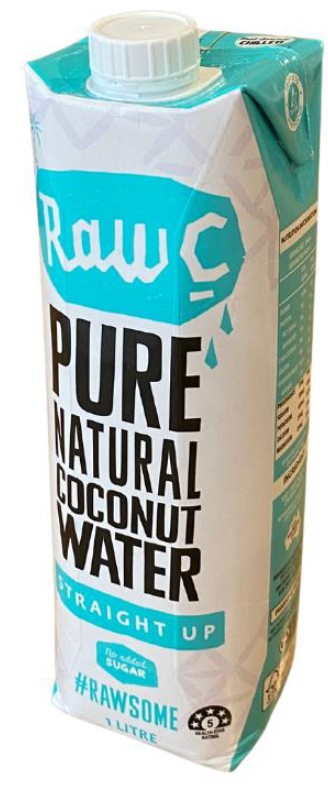
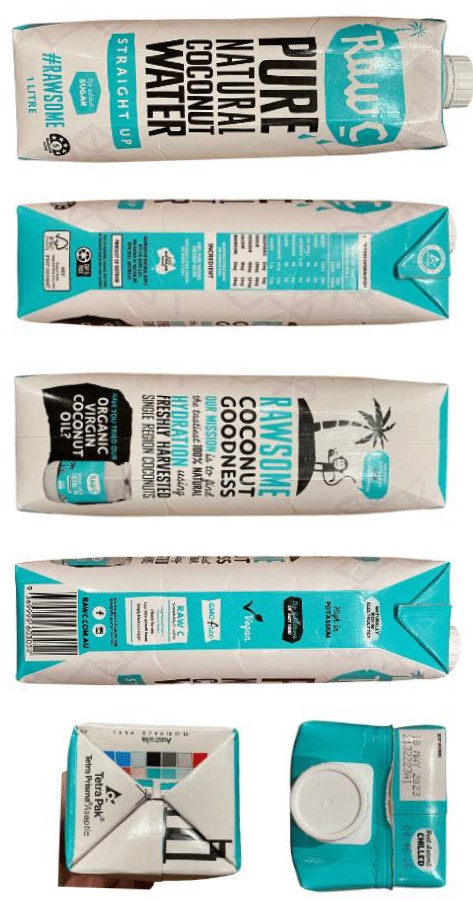
5. In the event no written submission is filed pursuant to order 2 then the Court will make the Proposed Costs Order without hearing further from the parties.
Note: Entry of orders is dealt with in Rule 39.32 of the Federal Court Rules 2011.
NICHOLAS J:
Background
1 Before the Court is an application for declaratory, injunctive and pecuniary relief in respect of what the applicant contends is the respondent’s contravention of s 18 of the Australian Consumer Law and passing off.
2 The parties engaged in a mediation in September 2022. Unfortunately, rather than resolving the proceeding, the mediation had the effect of broadening its scope. The respondent contends that the settlement agreement dated 12 September 2022 (“the Settlement Agreement”) made between the parties at that mediation now precludes the applicant from maintaining this proceeding. The applicant purported to terminate the Settlement Agreement in accordance with its terms. The respondent disputes the validity of the applicant’s termination. I will return to those competing contentions later in these reasons.
3 The applicant contends that the respondent has engaged in misleading and deceptive conduct, or conduct likely to mislead or deceive, by representing that the respondent’s coconut water sold under the “Nature’s Delight” brand was made or sold by the applicant or with its permission. The applicant’s case is based on two different types of packaging adopted by the respondent, the first is what I will refer to as the 2021 packaging, and the second is what I will refer to as the 2022 packaging. I note that the changes made by the respondent in 2022 to the 2021 packaging appear to have been adopted by the respondent prior to the mediation and in response to a letter of demand sent by the applicant to the respondent in April 2022.
Relevant legal principles
4 There is no material dispute between the parties in relation to the legal principles to be applied in this case and it is not necessary to embark on any extensive consideration of the relevant authorities. Some of the submissions made by both the applicant and the respondent focused on what are properly characterised as findings of fact made in other cases. The authorities referred to by the parties are, of course, relevant in so far as they refer to the relevant principles of law. The facts and circumstances of each case are only relevant in understanding those principles and their application in any given case.
5 The parties’ submissions focused on whether the respondent has, by selling its Nature’s Delight Coconut Water product in the 2021 and 2022 packaging, engaged in conduct that is misleading or deceptive or likely to mislead or deceive in contravention of s 18 of the Australian Consumer Law. The case was conducted by both parties on the basis that if the applicant succeeded under s 18, then it would also be entitled to succeed in its claim for passing off. In those circumstances, it is not necessary to refer to the principles relevant to passing off.
6 For the purposes of determining the present case, the relevant legal principles may be summarised as follows:
(a) The question whether conduct is misleading or deceptive or likely to mislead or deceive is a question of fact that must be determined in light of the relevant surrounding facts and circumstances: Butcher v Lachlan Elder Realty Pty Ltd (2004) 218 CLR 592 at [109] per McHugh J. In this case these will include the nature of the product, the price at which it is typically sold (eg. a relatively inexpensive or “fast moving” product), the outlets in which the product is displayed (eg. supermarkets) and the manner in which the product is displayed and promoted.
(b) A corporation may be found to have contravened s 18 even though it lacked any intention to mislead or deceive: Hornsby Building Information Centre Pty Ltd v Sydney Building Information Centre Ltd (1978) 140 CLR 216 at 228 per Stephen J.
(c) Conduct may be misleading or deceptive if it induces error but it is not sufficient to show that the conduct may give rise to confusion or cause people to wonder: Parkdale Custom Built Furniture Pty Ltd v Puxu Pty Ltd (1982) 149 CLR 191 at 198-199 per Gibbs CJ. In the present case it is necessary for the applicant to establish that the respondent’s use of the 2021 and 2022 packaging is likely to lead a not insignificant number of people into thinking that the respondent’s Nature’s Delight Coconut Water is made or sold by the applicant or with the applicant’s permission.
(d) In the case of representations alleged to have been made to the general public, or a section of the general public, it is necessary to have regard to the effect of the relevant conduct on reasonable members of the public: Campomar Sociedad Limitada v Nike International Limited (2000) 202 CLR 45 at [102]-[103] (“Campomar”).
(e) The class of person by reference to which the effect of the relevant conduct is to be assessed may be quite large. In particular, the relevant class may cover a wide range of people whose personal capacity, knowledge and experience may vary quite significantly. Nevertheless, all members of the relevant class are presumed to take reasonable care to protect their own interests, and the behaviour of those who do not, may be disregarded. The degree of care they may be expected to exercise will depend upon the circumstances of the particular case.
(f) Evidence that some people may have been misled is not essential but is admissible and may be persuasive if given: Taco Company of Australia Inc v Taco Bell Pty Ltd (1982) 42 ALR 177 at 202 per Deane and Fitzgerald JJ. But in determining what weight should be given to such evidence it may be necessary to consider the circumstances in which it occurred and the reasonableness of any inference drawn by the witness who is said to have been deceived or confused: Campomar at [105].
(g) If it is established that the corporation did intend to mislead, a court may be more likely to find that the conduct complained of was misleading: Campomar at [33]. In particular, “if a … get-up for goods is adopted for the purpose of appropriating part of the trade or reputation of a rival, it should be presumed to be fitted for the purpose and therefore likely to deceive or confuse”: Australian Woollen Mills Ltd v FS Walton & Co Ltd (1937) 58 CLR 641 at 657 per Dixon and McTiernan JJ (“Australian Woollen Mills”). However, “there is a distinction between an intention to copy and an intention to deceive. The former does not establish the latter. For the inference identified in Australian Woollen Mills to arise, the latter must be established”: Verrocchi v Direct Chemist Outlet Pty Ltd (2016) 247 FCR 570 at [104] per Nicholas, Murphy and Beach JJ. See also Campomar at [33] where the High Court observed that “… an imitation of one product by another does not necessarily bespeak an intention to deceive purchasers”.
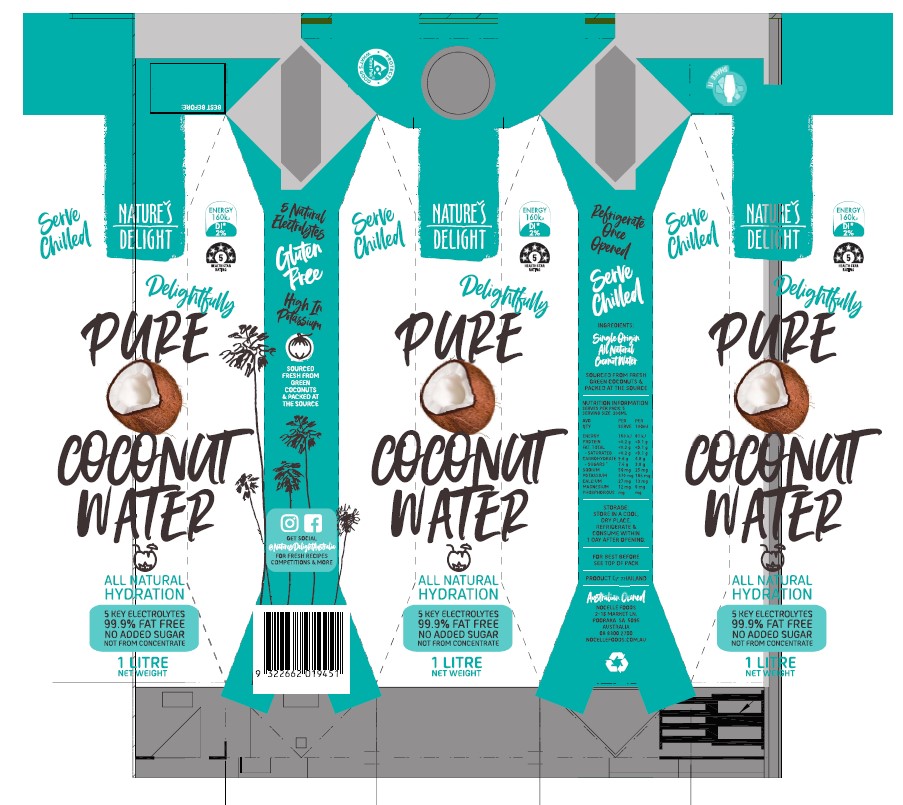
7 Leaving aside the effect of the Settlement Agreement, the first question is whether, as at December 2021 and at all material times thereafter, the sale of the Nature’s Delight product in its 2021 packaging was likely to convey a misrepresentation that the respondent’s product is made and sold by the applicant or with the applicant’s permission. The answer to the question depends on the strength of the applicant’s reputation in the get-up of its product and the extent and effect of any similarity between that get-up and the get-up adopted by the respondent for its 2021 and 2022 products. Of course, the get-up of the parties’ products as marketed and sold by them includes their respective trade marks. In the case of the applicant’s packaging this includes the Raw C device mark which the evidence indicates appears prominently around the centre or towards the top of the pack. In the case of the respondent’s product, its get-up includes the Nature’s Delight mark in the rectangular tab (discussed below) appearing on the front and towards the top of the pack.
The applicant’s reputation and get-up
8 The applicant manufactures and sells various coconut beverages and related products under the trade mark RAW C (“the Raw C device mark”). The Raw C device mark was first registered in respect of various beverages in class 32 with effect from 17 August 2012. A device mark in the form used on the applicant’s products was first registered in respect of various beverages in class 29 and 32 with effect from 26 February 2020.
9 Since 2014 the applicant has manufactured and sold Raw C Coconut Water using what the applicant says is the same, or substantially the same, get-up. The vast majority of the Raw C Coconut Water has been sold in one litre Tetra Paks® under and by reference to the Raw C device mark. The size and shape of these one litre Tetra Paks is common to the relevant product category (ie. coconut water). The fold lines and triangular flaps also reflect a design common to the product category. All examples of one litre coconut water products in evidence utilise packaging of the same construction including the same style of cap which is usually coloured white.
10 The Raw C device mark has been prominently displayed on the front of the pack in each version of the Raw C one litre packaging since December 2014. Mr Scott Mendelson, a director of the applicant, gave evidence that he engaged a creative agency in 2014 to update the design of the applicant’s packaging. He said he wanted all of the applicant’s products to have a cohesive feel and to be readily identifiable as Raw C Coconut Water.
11 There have been some changes to the get-up of the Raw C Coconut Water since December 2014. A photograph of the current version of the packaging for the Raw C Coconut Water is reproduced as Annexure A. An example of the physical product is also in evidence (Exhibit A).
12 In the first version of the packaging which was in use in around December 2014 the Raw C device mark appeared towards the centre of the pack against a white background with the words “Pure Natural” appearing above the mark and the words “Coconut Water” appearing below the mark, in both cases in a black on white capitalised block font. The combination of the Raw C device mark and the printed words, on the front of the pack had what I would regard as quite a distinctive appearance.
13 The applicant’s packaging was re-designed in around August 2020. In this version of the packaging the Raw C device is located toward the top of the front of the pack in the same position followed by the words “Pure Natural Coconut Water” in a black on white capitalised block font. There are some other slight differences between the August 2020 packaging and the applicant’s current packaging. In my view these do not affect the distinctive appearance of the packaging as it appears in various versions of the applicant’s packaging for its one litre coconut water product made and sold since December 2014. And while the first version of the packaging was somewhat different, key features of the packaging including the Raw C device mark and the black on white printed matter in capitalised block font were present in all versions of the packaging albeit in a slightly different arrangement.
14 The evidence of reputation relied on by the applicant includes sales information recording sales revenue for all of its various Raw C Coconut Water products for each of the 2019 to 2022 financial years. The figures are confidential and I do not propose to set them out in the judgment. They are reproduced in the confidential schedule to the applicant’s closing submissions. The sales figures for the applicant’s Raw C Coconut Water in the one litre Tetra Pak for the 2019 to 2022 financial years are included in that schedule. Those figures show that the product was sold in large quantities in each of those years. Millions of units of the applicant’s product were sold in each of those financial years. By the relevant date, the applicant’s Raw C Coconut Water was one of the three top selling coconut waters in Australia and sold nationally in large quantities through Woolworths, Coles and other retail outlets.
15 The applicant also relied on product endorsements by a celebrity chef, Pete Evans, and social media promotion by iron woman Courtney Hancock, who each had commercial relationships with the applicant. The evidence includes examples of promotional material featuring the Raw C Coconut Water on Instagram and Facebook.
16 The applicant also relied on market research that was undertaken by a research company (IRi) in relation to the Raw C brand. That research shows that the Raw C brand was as at the relevant date the second most popular brand of coconut water behind Cocobella Coconut Water (“Cocobella”) the market leader.
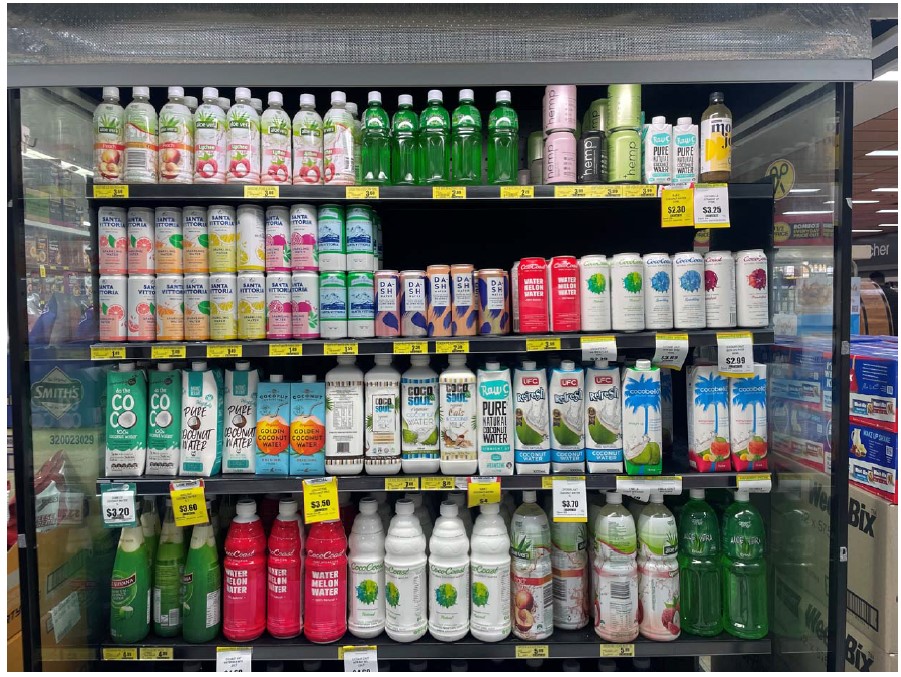
17 Cocobella is also sold in a one litre Tetra Pak with the same dimensions as the parties’ products. The Cocobella name is prominently displayed on the front of the pack toward the top of the pack. The colours used on the front of the pack are blue, green and white. The brand name Cocobella appears in white against a blue silhouette of a palm tree. Images of green coconuts appear toward the bottom of the pack. An example of the Cocobella product (Exhibit 1) is in evidence along with various other manufacturers’ products including H2 Coco Coconut Water, and Chef’s Choice Coconut Water. All of these products are packaged in one litre Tetra Paks having the same shape and white cap as the parties’ products. The Chef’s Choice product also uses capitalised block letters for the words “100% Pure Coconut Water” which are printed in blue against a white background.
18 I find that as at the relevant date, the applicant had a substantial reputation in the get-up of its one litre coconut water product. That get-up consists of a number of elements used by the applicant but always in combination with the Raw C device mark. That mark is highly distinctive and it has been prominently displayed on the front of each of the Raw C Coconut Water products sold by the applicant since 2014. The Raw C device mark is the most significant element in the get-up of the product and is the visual feature on which consumers are likely to focus when purchasing the product due to the prominent position it occupies on the front near the top of the pack. Another significant element in the get-up is the black on white capitalised block font in which the words “Pure Natural Coconut Water” appear. I note, however, that the words themselves are purely descriptive of the product.
19 The aqua colour of the Raw C device mark is distinctive, but only in combination with the word Raw C, the oval shaped device and its appendages. In fact the applicant also sells a number of other coconut water products in 330ml Tetra Paks that also display the Raw C device mark but in different colours. For example, one of the applicant’s flavoured coconut water product uses brown in place of aqua.
The respondent’s get-up
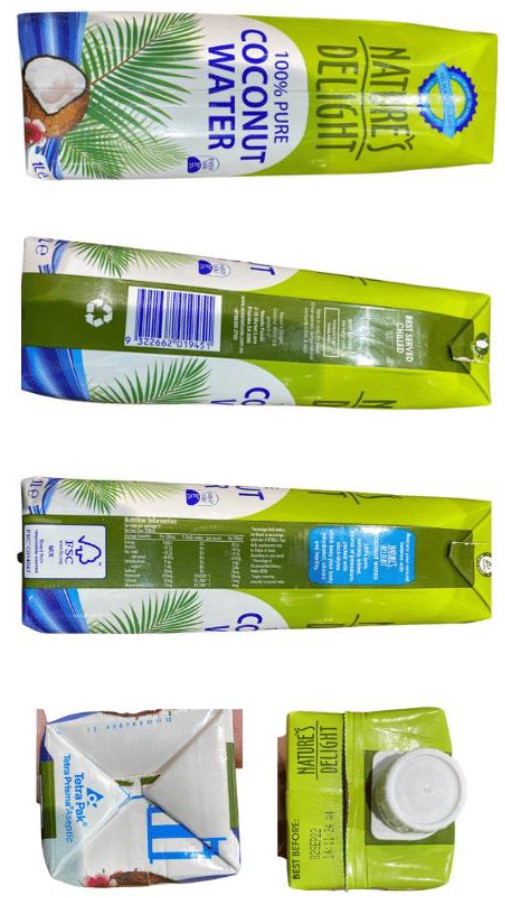
20 The respondent has manufactured and sold its own coconut water product in one litre Tetra Paks since early 2015. Until 2021, the respondent’s coconut water product was sold under the brand name “Nature’s Delight” in a get-up that was predominantly two tone green and white in colour and labelled “Nature’s Delight 100% Pure Coconut Water”. Photographs of this packaging are reproduced as Annexure B.
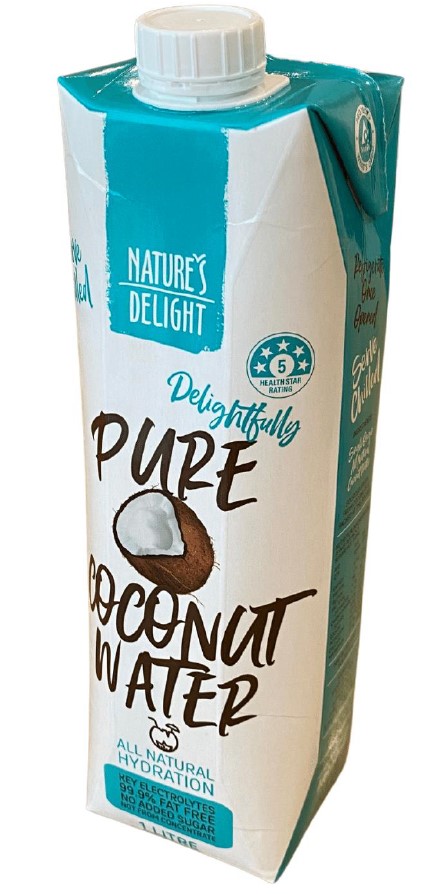
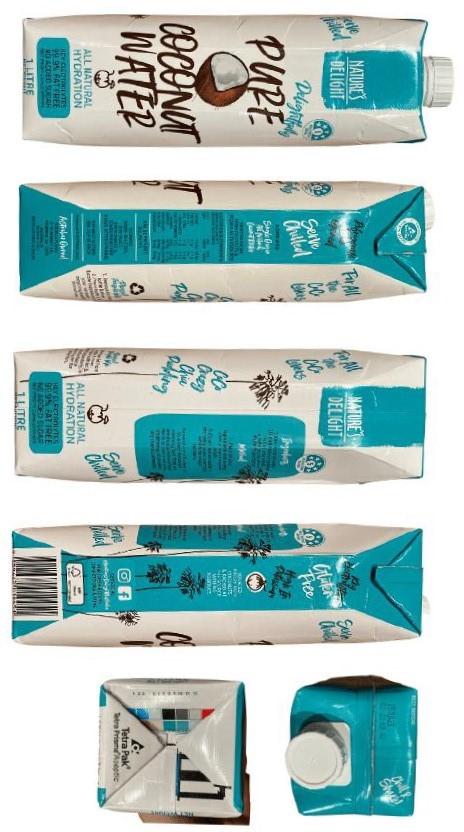
21 In 2021 the respondent re-designed the packaging for its coconut water product. The packaging for that product was re-designed by Ms Rebecca D’Arcy, the respondent’s Head of Marketing Communications and Brand. According to her evidence, Ms D’Arcy commenced work on the re-design in March 2021. The re-design was finalised soon afterwards and the product in the re-designed packaging was first made available for sale in Western Australia in December 2021. It was not until early 2022 that the respondent’s product in the new packaging first became available in other states and territories. A photograph of the Nature’s Delight coconut water product in the one litre Tetra Pak in the 2021 packaging is reproduced as Annexure C. A physical example of the product (Exhibit B) is also in evidence. Ms D’Arcy described the colour on the 2021 packaging as “aqua blue”.
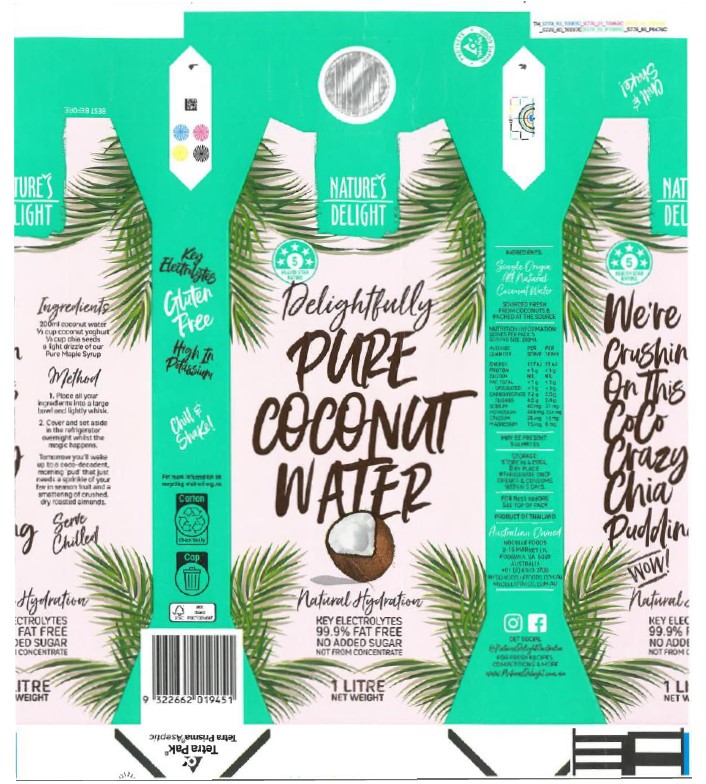
22 Following the Settlement Agreement in September 2022, the respondent commenced manufacturing and supplying its product in new packaging which utilised some different colours and artwork. An example of the respondent’s new artwork is shown in the colour photographs reproduced as Annexure D. A physical example of the new Nature’s Delight product with the 2022 packaging (Exhibit C) is also in evidence. In this version of the respondent’s packaging the colour of the background on which the words “Pure Coconut Water” is printed was changed from white to what I would describe as a very pale pink (which is apparent from a physical inspection of the products but not Annexure D). The location of the coconut separating the word “Pure” from “Coconut Water” was also moved towards the bottom of the pack. The colour of the tab on which the respondent’s Nature’s Delight mark appears was changed to a lighter shade of aqua closer to the aqua colour used in the applicant’s packaging. Ms D’Arcy called this aqua colour “mint green”. Images of palm tree fronds depicted in green also appear near the corners of the front of the pack.
23 Counsel for the applicant placed considerable reliance on the aqua blue colour used on the respondent’s 2021 packaging which, it was suggested, is very similar to the aqua colour used on the Raw C Coconut Water including on the top and on each side of the packaging. While there is some similarity in colour, the aqua blue used by the respondent in the 2021 packaging is clearly darker than the aqua colour used by the respondent in the 2022 packaging. The aqua colour used by the respondent in the 2022 packaging is closer to the applicant’s aqua blue than the aqua blue used in the 2021 packaging.
Evidence of confusion
24 There is no evidence of any consumer having been deceived or confused when purchasing or looking to purchase either the applicant’s or the respondent’s products.
25 Mr Mendelson gave an account of walking past an IGA store at Oxford Street in Paddington in September 2022. He said that he saw out of the corner of his eye an aqua and white one litre product in a Tetra Pak in the refrigerated section which he initially recognised as the applicant’s Raw C Coconut Water product. He said that he “did a double take” and walked back to the store to discover that it was actually the Nature’s Delight product. Although there was no cross-examination on the topic, this incident occurred some months after the applicant had commenced this proceeding and at a time when Mr Mendelson was well aware of the existence of the Nature’s Delight product with the 2021 packaging. Moreover, this evidence is based on what appears to have been a fleeting observation made by Mr Mendelson as he strolled past the store, and does not explain why, given that he knew of the existence of the Nature’s Delight product, he assumed that the product he saw was the applicant’s product. In any event, it is apparent that when he looked at the product a second time (though there is no indication that he entered the store for this purpose) he recognised that it was the Nature’s Delight product on display. I do not find his evidence on this topic at all persuasive.
26 Ms Katerina Ilievska, who worked as a financial assistant for the applicant, gave evidence of having seen the Nature’s Delight product with the 2021 packaging at the applicant’s office in May 2022. She said that she assumed that both products were made by the applicant “… because they had the white and teal colours, with the teal in a block at the top and the teal at the bottom and bold, texta writing in the middle”. I find it difficult to accept that Ms Ilievska could have been confused into thinking that this was a product made by the applicant given the presence of the Nature’s Delight brand on the front of the pack, the absence of the Raw C device mark, or any other mention of the applicant on the packaging. Even when Ms Ilievska noticed the Nature’s Delight mark on the front of the packaging, and the absence of any reference to Raw C, she still “thought it may have been a new variety of Raw C coconut water because the packaging was so similar”. The mental processes that lead Ms Ilievska to think that the Nature’s Delight product was the applicant’s product were not explored in cross-examination and her evidence does not explain what significance, if any, she attributed to the absence of the Raw C device mark. Ms Ilievska’s response, which assumed that the Nature’s Delight product was the applicant’s product, or a repackaged version of the applicant’s product, is not consistent with the mental processes in which a reasonable consumer who has some basic understanding of the function of a trade mark or brand name would engage when purchasing, or looking to purchase, either the applicant’s or the respondent’s products. On noticing the different brand names the reasonable consumer would not likely infer that the products came from the same manufacturer. I do not regard Ms Ilievska’s evidence as persuasive.
27 Another witness whose evidence was relied on by the applicant was Mr Christopher Richard. He was invited to look at the Nature’s Delight product in the 2021 packaging in about March or April 2022 by the applicant’s General Manager, Mr Hendra Gee. Mr Richard said that he immediately thought it was the Raw C Coconut Water because it looked like the Raw C Coconut Water packaging with which he was familiar. He said he was initially confused when looking at the Nature’s Delight product because of the similarities of the packaging. After looking at the product more closely and noticing the Nature’s Delight brand he had an exchange to the following effect with Mr Gee:
Richard: Is this another brand?
Gee: Yes
Richard: Wow, it's almost exactly like yours. It's pretty brazen, what are you going to do?
Gee: We're looking into it.
28 The difficulty I have with this evidence is that it seems that Mr Richard, like Ms Ilievska, attributes no significance at all to the fact that a different brand name appears on the product. I do not find his evidence persuasive. I do not consider either his or Ms Ilievska’s evidence of any assistance in estimating how a reasonable consumer looking to make a purchase of coconut water in a supermarket or other retail outlet would be likely to respond to the respondent’s packaging.
Evidence of intention
29 Ms D’Arcy was cross-examined in some detail concerning her design work culminating in the 2021 packaging and the Nature’s Delight Brand Guidelines. The evidence included printouts of her computer generated design file which she created using Adobe Illustrator. It was common ground that the colour reproductions in the relevant exhibit are less than perfect at least in so far as they purport to capture what Ms D’Arcy referred to in her evidence as the “aqua blue” colour used in her designs.
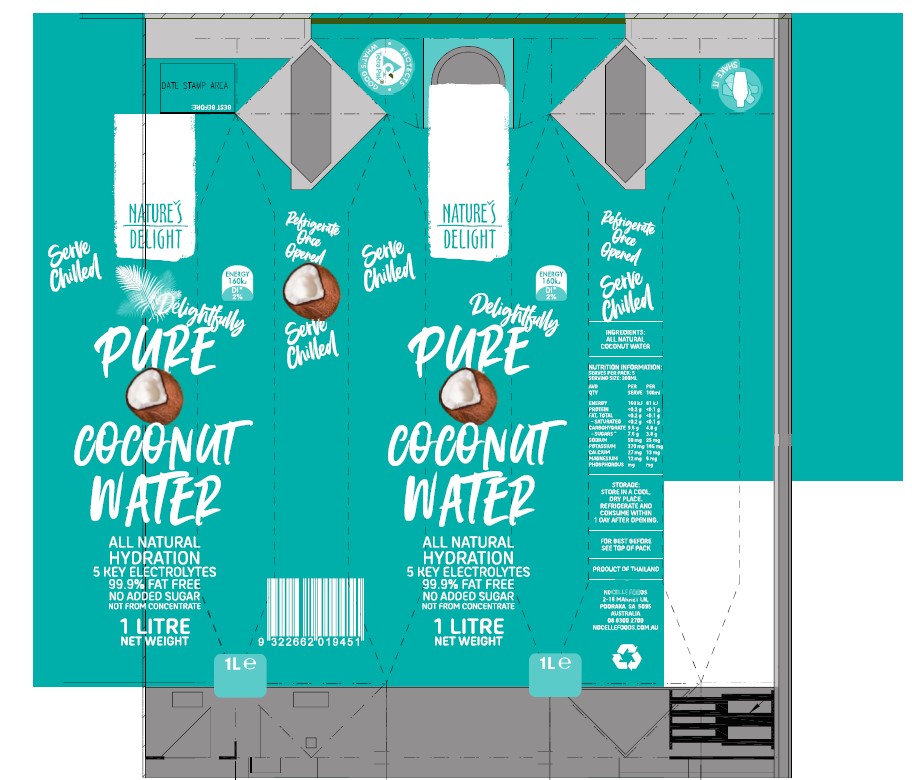
30 Ms D’Arcy’s file contains six iterations of the 2021 packaging design beginning with, in the first iteration, an entirely aqua blue coloured packaging on which the words “Pure Coconut Water” are printed in white in a stylised script coupled with the image of a coconut. The stylised script and the image of a coconut are the same as the final version of the 2021 packaging. The first iteration also includes what I will refer to as the white rectangular tab descending from the top of the pack on which the Nature’s Delight mark appears. A copy of the first iteration of the 2021 packaging is reproduced as Annexure E. The evidence indicates that it was created “in or around March 2021” and, I infer, prior to the creation of the later iterations. A second and third iteration that adopted the same general colour scheme were also created. The third iteration was created at 8.44am on 29 March 2021. It utilised two different shades of aqua blue on the front panel.
31 The fourth, fifth and six iterations of the 2021 packaging in Ms D’Arcy’s file reflect a change to the colour scheme of the front panel which was changed from white text on aqua blue with a white tab, to dark brown text on white with an aqua blue tab. A copy of the fourth iteration is reproduced as Annexure F. It was created by Ms D’Arcy at 10.47am on 29 March 2021. The fifth and sixth iterations were created on 1 April 2021 and 3 May 2021 respectively. The design of the front panel did not change between the fourth and sixth iterations, but details (eg. recipes) were added to the side panels.
32 In her affidavit evidence Ms D’Arcy referred to a visit to her local Coles supermarket in around late March 2021 when she was starting to think about the design of the Nature’s Delight Coconut Water. She said that she “took the opportunity during that visit to see what coconut waters were sold there.” She distinctly remembers seeing Cocobella Coconut Water for sale with its blue and white colour scheme but could not specifically recall seeing any other brands of coconut water for sale. She said that if she saw Raw C’s product during that visit, she did not recall having done so. In her cross-examination Ms D’Arcy accepted that it was likely she saw the Coles Home Brand product on sale also and any other brand of coconut water that was on display in the same section of the store.
33 In her cross-examination Ms D’Arcy denied any intentional copying of the Raw C product. Ms D’Arcy rejected the suggestion that she went to Coles for the purpose of seeing what would work best for the new design of the Nature’s Delight Coconut Water product. She also rejected the suggestion that she went to Coles to get ideas from other products that were on the market as to what might stand out or appeal to consumers.
34 The applicant submitted that it was likely that following her visit to Coles, that at least some of the design features adopted by Ms D’Arcy for the 2021 packaging were inspired by the Raw C product. Further, the applicant submitted that it should be inferred that Ms D’Arcy visited her local Coles supermarket on the morning of 29 March 2021 between the time she prepared the third iteration and the fourth iteration.
35 Ms D’Arcy’s evidence was that she was at Coles doing some shopping and she decided to visit the section where the coconut water products were on sale. The reasons she gave for doing so (ie. to ascertain where products stood on the shelf, price points, and how much space they took up) did not, in my view, provide a complete account of her reasons for visiting that section of the store. I consider it more likely than not that Ms D’Arcy was also seeking ideas which she might use in her re-design of the Nature’s Delight packaging. In rejecting her evidence on this point, I am satisfied that in visiting Coles when she did, she intended to and did seek to acquaint herself at least in a general way with the packaging design utilised by other producers of coconut water.
36 I think it more likely than not that Ms D’Arcy did visit the Coles store in late March 2021, most probably in the morning of 29 March 2021, and that she observed various coconut water products including the Cocobella product, the Coles Home Brand product and the Raw C product. I also consider it likely, given that fact, and some of the similarities between the 2021 packaging and the packaging of the Raw C product, that she was influenced by her observation of that product. But I am not persuaded that Ms D’Arcy deliberately copied any features of the Raw C packaging for the purpose of misleading any consumer or in order to take advantage of the applicant’s reputation in the Raw C Coconut Water product or the get-up of that product.
37 Accepting, as I think is likely, that Ms D’Arcy visited the Coles supermarket at some time after creating the third iteration of the design, it is in my view significant that the third iteration used the rectangular tab at the top of the front panel and the words “Pure Coconut Water” in the stylised script coupled with the image of the coconut. Those are features of the design which were unlikely to have been adopted due to any desire on the respondent’s part to copy the Raw C packaging.
38 The most significant change made between the third and the fourth iteration was the change in the colour scheme of the front panel. This includes changing the background from aqua blue to white, the tab with the “Nature’s Delight” branding from white to aqua blue, the text of “Nature’s Delight” on the tab from aqua blue to white and the main text stating “Pure Coconut Water” from white to dark brown. The change in the background colour of the front panel added to the design an element of “freshness” and “purity” in Ms D’Arcy’s words. The use of a predominantly white background was common across the product category. In particular, the Cocobella, the UFC, the H2 Coco, the Chef’s Choice, the Woolworth’s Macro, the Coco Soul and the Woolworths home brand one litre coconut water products all used a white background on which images of palms, coconuts and information was printed.
39 Ms D’Arcy’s decision to move to a predominantly white background is in my opinion unremarkable in the circumstances as is her choice of dark brown in which the stylised script would be printed against that predominantly white background. Even if this choice was inspired by the colour scheme of the Raw C packaging, it is not one which to my mind is explained by any desire on Ms D’Arcy’s part to copy, or take advantage of, distinctive elements of the Raw C packaging. Rather, these were design decisions and choices that in my view were attributable to her desire to produce a new design that evoked feelings of freshness and purity and which, by the use of dark brown on white, gave added prominence to the description words “Pure Natural Coconut Water”.
40 In cross-examination of Ms D’Arcy, counsel for the applicant also placed some emphasis on the sides of the 2021 packaging, each of which features the aqua blue stripe that extends outwardly toward both the top and the bottom of the pack. It was suggested to Ms D’Arcy that this style of stripe does not appear until after her visit to Coles and that it too is a feature that she copied from the Raw C packaging.
41 The answers she gave in cross-examination indicated that she regarded the use of these stripes as functionally desirable given the shape and folds of the Tetra Pak.
42 A physical inspection of the exhibits of both the Nature’s Delight and Raw C products shows that the stripe and the extensions at each of the top and bottom ends follow the folds of the Tetra Pak and that the aqua blue colouring to be used on each side of the pack terminates at those fold lines where the front and rear panels effectively begin. This reflects what seems to me to be a design choice that is largely a function of the geometry of the Tetra Pak. I note that the Woolworths Home Brand Coconut Water product has the same configuration with the fold lines delineating the predominantly white front and back panels from the green coloured top and striped sides of its packaging. The Woolworth’s Macro and the UFC products also feature the same striped sides. Again, I do not consider Ms D’Arcy’s decision to adopt the striped sides is explained by any desire on her part to copy, or take advantage of, distinctive elements of the Raw C packaging.
43 The applicant ultimately submitted that the Court should find that on the balance of probabilities Ms D’Arcy used her visit to Coles to inform her understanding of the design process of the 2021 packaging, that she saw the applicants’ Raw C product and its packaging at that time, and that significant elements incorporated into her design on 29 March 2021 were derived from the impression she retained of the Raw C product. It further submitted that it was Ms D’Arcy’s “intention to take what was best of the current market practice, best at attracting customers and making her product stand out”. The applicant submitted that coupled with Ms D’Arcy’s borrowing of features from the same source (ie. the Raw C product), the Australian Woollen Mills principle applies and that it should be presumed that the 2021 packaging was “… fit for purpose and would be likely to mislead or deceive”.
Consideration
44 I am not persuaded that the respondent adopted any part of its 2021 or 2022 packaging for the purpose of appropriating the trade or reputation of the applicant. In particular, I am not persuaded that the respondent adopted any part of such packaging with the intention of misleading or deceiving purchasers or potential purchasers of its products. Ms D’Arcy denied that she copied the packaging of the Raw C Coconut Water product. Although I am prepared to accept that she most likely saw that product on sale at Coles, and that it influenced her design of the 2021 packaging, I do not accept that she intentionally copied the applicant’s product or that she did so for the purpose of taking advantage of the applicant’s reputation or misleading consumers. On my view of the facts, the Australian Woollen Mills principle does not apply.
45 For reasons I have stated, the evidence of confusion relied on by the applicant is not persuasive. In determining whether the 2021 packaging is misleading or deceptive or likely to mislead or deceive the ordinary reasonable consumer into thinking that the respondent’s product is made by the applicant or with the applicant’s permission, I give that evidence no weight.
46 Some important similarities in the relevant products are attributable to the nature of the product and the shape and style in which products like them are commonly packaged. As Bennett J explained in Natural Waters of Viti Ltd v Dayals (Fiji) Artesian Waters Ltd (2007) 71 IPR 571 at [46]:
The fact that Natural Waters may establish reputation in the Fiji Water get-up does not mean that it has a monopoly over each aspect of that get-up. The goods are ordinary articles of consumption. By their nature, goods of different manufacturers will bear some resemblance to each other. Water is sold in bottles, frequently in transparent bottles and commonly with blue caps. The marks, brands and labels play an important part in distinguishing the goods of one manufacturer from those of another … Whether the reason for the distinctiveness of Fiji Water is one or more particular aspects of its packaging or the totality of its get-up, the offending product will only mislead or deceive consumers where it has taken the distinctive aspect(s) or so much of the totality of the get-up that the overall impression or the “gestalt” of the Fiji Water brand … is adopted. If Dayals adopted an aspect of the get-up for its product, that fact alone does not dictate a finding of passing off …
(citations omitted)
47 Bennett J recognised the difficulty that may confront an applicant who relies on a reputation in a particular get-up or packaging especially where, as is this case, different brand names are prominently displayed on the front of the packaging. Her Honour observed at [59]:
The reputation which must be proved in a case such as this is that the get-up, packaging, shape, or trade dress relied upon is associated by consumers with the applicant’s product. It takes a strong case to establish a reputation of this nature … as consumers will not necessarily associate a get-up with the applicant’s product … The requisite reputation will more readily be found where the get-up is unique or striking rather than descriptive, mundane, merely functional, or in common use.
(citations omitted)
See also the observations of Burley J in Homart Pharmaceuticals Pty Ltd v Careline Australia Pty Ltd (2017) 349 ALR 598 at [125]-[126] (“Homart”) whose decision was affirmed on appeal: Homart Pharmaceuticals Pty Ltd v Careline Australia Pty Ltd (2018) 264 FCR 422.
48 In Homart Burley J found that the cross-respondent (Careline) had engaged in misleading conduct by its use of elements of the cross-claimant’s (Homart’s) get-up despite the fact that the cross-respondent’s products displayed the cross-respondent’s own brand name (CHÉRI AUSTRALIA). However, his Honour found (at [134]) that Homart had “… established a reputation in not only the brand name Chantelle SYDNEY, but also (and separately) in the get-up of the product” (emphasis added) which extended to (at [136]) “the overall impression created from the shape and form of the box, the colouring, the internal arrangement, the sleeve and the Gold CHANTELLE carry bag” which his Honour found comprised (at [194]) a unique combination of features which he characterised as “eye-catching”. His Honour also had regard to the visual and phonetic similarities of the parties’ brand names. His Honour found (at [200]-[201]) that the Australian Woollen Mills principle applied.
49 In Sydneywide Distributors Pty Ltd v Red Bull Australia Pty Ltd (2002) 234 FCR 549 (Branson, Weinberg and Dowsett JJ) the applicant (the respondent on appeal) succeeded in a case based on a highly distinctive get-up even though the respondent’s product bore its own brand name “LiveWire”. As the reasons of Weinberg and Dowsett JJ show, the trial judge’s conclusion in favour of the applicant was influenced by the cylindrical shape of the products coupled with the manner in what they were usually stored and displayed and a finding of deliberate copying by the respondent who was seeking to “cash in” on the applicant’s reputation: see [72]-[74], [119], [130] and [133].
50 Although the applicant relied on the decisions in Red Bull and Homart, they turned on what for present purposes were significantly different facts. In particular, in each of those cases the Australian Woollen Mills principle was found to be applicable.
51 In assessing the likelihood of the ordinary reasonable consumer being misled or deceived as a result of the respondent’s use of either the 2021 or the 2022 packaging, I have had regard to the overall impression and effect likely to be conveyed by each of the applicant’s and the respondent’s packaging considered as a whole. I have also had regard to the fact that some important elements of similarity in packaging designs are common to the trade. This includes the size and shape of the pack, the type and colour of the cap, and the use of different background colours for the front, sides and top of the pack as defined by the fold lines. Furthermore, it is apparent from the evidence that shades of blue, white and green are frequently used on the packaging of coconut water, because, I infer, they have an ability to evoke feelings or sensations that may be associated with those colours (eg. feelings of freshness and purity) that a manufacturer of coconut water may wish to take advantage of in the marketing of its product. I also take into account the purely descriptive nature of the phrases “Pure Natural Coconut Water” and “Pure Coconut Water”.
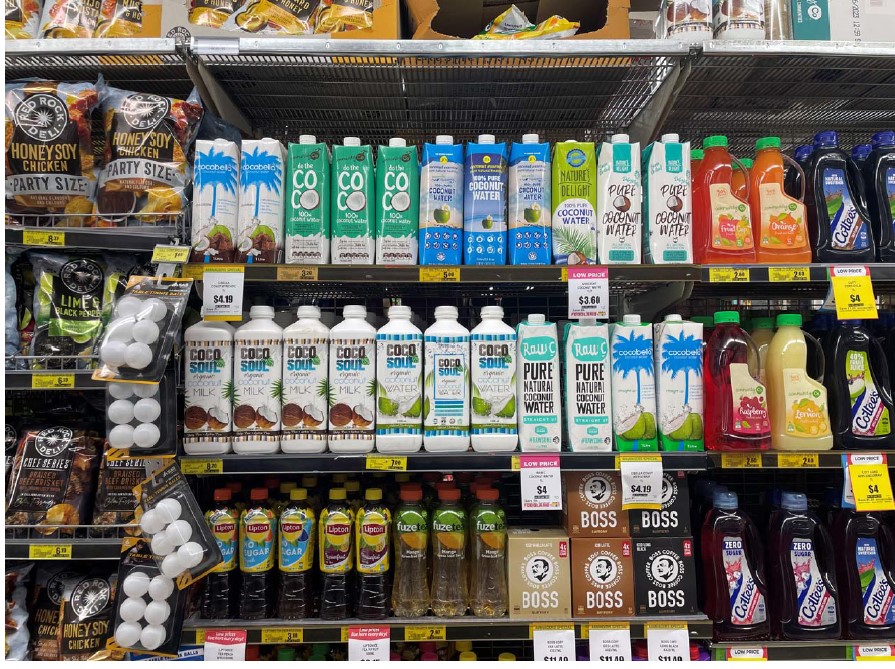
52 I have had regard to the nature of the relevant products and the circumstances in which they are displayed and sold. The products are relatively inexpensive consumer goods which the ordinary reasonable consumer is unlikely to subject to any detailed or close examination before making a purchase. However, the products are typically displayed for sale on supermarket shelves with the front of the pack exposed to the consumer in circumstances where it is unlikely that the ordinary reasonable consumer reaching for the product would not notice the brand name displayed on the front of the pack as shown in Annexure G and H. I recognise that not all products will be available at the same store and that from time to time the products are also displayed on their own separate stand when on sale or the subject of a special promotion.
53 There is no reason for an ordinary reasonable consumer to infer that a coconut water product sold under the brand name “Nature’s Delight” was one made by the applicant or with the applicant’s permission. On the contrary, in my opinion such a person would understand them to be differently branded products most likely produced by different manufacturers. Nor do I think that an ordinary and reasonable consumer would be unlikely to notice the Nature’s Delight brand as it appears in the rectangular tab. The name is prominently displayed on the front and toward the top of the pack and is, in my opinion, hard to miss.
54 In addition to the appearance of the brand name on each of the products, there are other significant differences in their get-up. The style in which the words “Pure Coconut Water” is written on the 2021 packaging and the use of the image of the brown and white coconut is very different from the simple capitalised block font without any associated imagery on the applicant’s packaging. The overall impression created by the applicant’s get-up is tidier, less cluttered and, particularly when considered in combination with the Raw C device mark, creates a quite different visual impact compared to that of the 2021 packaging.
55 It follows that I am not persuaded that the use by the respondent of its 2021 packaging is or was likely to mislead or deceive ordinary and reasonable purchasers of coconut water.
56 The 2022 packaging is less similar to the applicant’s packaging than the 2021 packaging in three significant respects. The background colour on the front and back panels has changed from white to a shade of pink. Mr Mendelsohn gave evidence that the colour difference was not observable. I do not accept that evidence. The pink is particularly noticeable when the products in the 2022 packaging are arranged on the supermarket shelf. Another change is the inclusion of the green palm tree fronds near the corners of the front and rear panels. That is a significant change that further distinguishes the 2022 packaging from the applicant’s packaging. Also, the word “Delightfully” as it appears on the front panel has been given additional prominence and changed to a dark brown colour that matches the colour of the coconut.
57 The other colour change involved a change from the aqua blue of the 2021 packaging to what Ms D’Arcy referred to as “mint green.” That change brought the background colour on which the Nature’s Delight brand name was printed, closer to the colour used in the Raw C device mark and elsewhere on the packaging of the Raw C Coconut Water product. Be that as it is, the changes made to the 2021 packaging when viewed as a whole are likely to reduce any possibility of confusion occurring.
58 The applicant submitted, that the changes made by the respondent reflected an attempt to keep the respondent’s packaging as close to the applicant’s packaging as possible. I do not accept that submission. The submission assumes, contrary to my finding, that the respondent deliberately copied the applicant’s packaging.
59 In the result, I do not consider that the use by the respondent of its 2022 packaging is likely to mislead or deceive ordinary and reasonable consumers of coconut water.
The Settlement Agreement
60 The Settlement Agreement is dated 12 September 2022 and headed “Without Prejudice Save as to Costs”. The document appears to have been prepared by the respondent’s solicitor in the form of an offer of settlement. It was common ground that it formed the basis of a legally binding agreement made between the applicant and the respondent. The respondent and the applicant are referred to in the Settlement Agreement as “our client” and “your client” respectively.
61 Clauses 1, 2, 5 and 10-13 of the Settlement Agreement provide as follows:
1. Our client [ie. the respondent] will make the following changes to the design of the packaging of its coconut water product the subject of the proceedings (the “Changes”):
1.1 remove the aqua blue colour and replace it with a colour other than aqua blue or a shade thereof;
1.2 remove the white background from the front and back of the packaging and replace it with a colour other than white (which is not aqua/teal/blue or a shade thereof); and
1.3 add colour imagery to the front and back of the packaging.
2. On the condition that your client [ie. the applicant] provides a written undertaking in the form set out in paragraph 3 below, within 2 business days of acceptance of this offer, our client will:
2.1 permit your client to view a copy of our client's new packaging in high resolution JPEG format (the “File”) over MS Teams for 5 minutes to allow your client to satisfy itself that the new packaging accords with the Changes; and
2.2 provide your client with the pantone reference numbers for the predominate colours.
…
5. If your client reasonably forms the view that:
5.1 the new packaging does not represent compliance with the Changes; or
5.2 the new packaging infringes any other intellectual property rights capable of registration held by your client in relation to your client's coconut water product; or
5.3 the new packaging infringes any copyright held by your client in relation to your client's coconut water product; or
5.4 the new packaging includes the phrase “#rawsome” or “rawsome” or a phrase that is substantially identical to the phrases in this sub-paragraph; or
5.5 the viewing does not permit your client to form an opinion (acting reasonably) on whether the new packaging represents compliance,
then your client will be at liberty to terminate the agreement with our client. Any such termination must occur in writing within 5 business days of viewing the new packaging (as provided for in paragraph 2 above) and the right to terminate will cease after this time.
…
10. Your client will release our client from any and all claims, costs and/or damages, howsoever arising, in relation to the matters set out in your client's Concise Statement.
11. The parties agree to seek orders by consent dismissing the proceedings with no orders as to costs within 14 days of our client ceasing to sell the current design of packaging as contemplated by paragraph 8 above.
12. The parties agree that they will take no further steps in the proceedings pending the entry into the Deed contemplated by paragraph 13 below and pending compliance by our client with the terms of the Deed.
13. The parties enter into a Deed of Settlement incorporating the terms set out above as soon as practicable.
62 It is common ground that the Settlement Agreement is wholly in writing. In those circumstances, its provisions are to be construed in accordance with the well settled principles which permit the Court to resolve any ambiguity in light of the surrounding circumstances known to both parties at the time the contract was made and the commercial purpose or object of the contract: Codelfa Construction Pty Ltd v State Rail Authority of NSW (1982) 149 CLR 337 at 350-352 per Mason J and Pacific Carriers Ltd v BNP Paribas (2004) 218 CLR 451 at [22].
63 It is also common ground that on 15 September 2022 the applicant purported to terminate the Settlement Agreement in accordance with cl 5 on the basis that the new packaging did not comply with the requirements of cl 1.
64 There was a dispute between the parties as to which of them bore the onus of proof on this issue. The respondent contended that it was for the applicant to show that its purported termination of the Settlement Agreement was valid. The respondent relied on Massoud v NRMA Insurance Ltd (1995) 62 NSWLR 657 at 661 per McLelland CJ in Eq, Sanpine v Koompahtoo Local Aboriginal Land Council [2005] NSWSC 365 at [181]-[185] per Campbell J and Francis Gregory Hannigan v Inghams Enterprises Pty Limited [2019] NSWSC 321 at [58]-[69] per Robb J. The applicant contended that the respondent bore the onus of proof. It relied on Warner v Hung (No 2) (2011) 297 ALR 56 at [46]-[48] per Emmett J and Gore v Australian Securities and Investment Commission [2017] FCAFC 13 at [29] per Dowsett and Gleeson JJ. It is unnecessary for me to resolve this question because I have come to the conclusion that the applicant validly terminated the Settlement Agreement without me having to resort to any question of onus.
65 For the purpose of determining whether the applicant validly terminated the Settlement Agreement, I am satisfied that it was not reasonably open to the applicant to form the view that the respondent failed to comply with subcl 1.2 or subcl 1.3. As to subcl 1.2, I am satisfied that the respondent removed the white background from the front and back of the packaging and replaced it with a colour other than white (ie. a shade of pink) that complied with requirements of that subclause. As to subcl 1.3, the respondent added colour imagery (comprising the green palm fronds) to both the front and back of the packaging. I do not consider that the applicant could reasonably hold the opinion that the respondent failed to make changes that complied with subcl 1.2 or subcl 1.3.
66 As to subcl 1.1, I think the applicant is on stronger ground. Having regard to the language of cl 5, including in particular, subcl 5.1, the question is whether it was reasonably open to the applicant to form the view that the colour change relied on by the respondent as complying with subcl 1.1 did not involve the replacement of the aqua blue colour used in the 2021 packaging “… with a colour other than aqua blue or a shade thereof”.
67 As I have mentioned, Ms D’Arcy referred in her evidence to the new colour as “mint green”. She also described the colours of the Raw C packaging, and the 2021 packaging, as “aqua blue”. However, she did not accept that the new colour was closer to the aqua blue colour used in the applicant’s packaging than what she accepted was the aqua blue used by the respondent in its 2021 packaging.
68 Whatever words might be used to describe the relevant colour of the 2021 and the 2022 packaging, it seems to me that the change that occurred brought the respondent’s colour closer to the applicant’s colour. A side by side comparison of the three products (Exhibits A, B and C) makes this abundantly clear. I do not accept Ms D’Arcy’s evidence to the contrary.
69 The commercial object of the Settlement Agreement was to agree on packaging changes that would be made by the respondent which were acceptable to the applicant. A fact known to both parties at the time the Settlement Agreement was made was that the applicant’s packaging used aqua blue and that the applicant was complaining about, among other things, the respondent’s use of a similar colour in the respondent’s 2021 packaging.
70 Another way of understanding subcl 1.1 is that it required the respondent to move from the aqua blue used in the applicant’s packaging and the respondent’s packaging to a different colour that was not aqua blue or a shade of aqua blue.
71 The reference to “aqua blue” is a descriptive term that has no definite or fixed meaning. Whether an aqua colour is aqua blue, or a shade of aqua blue, is a matter about which minds might reasonably differ. What is significant here is that both parties appear to have accepted, at the time of entering into the Settlement Agreement, that the applicant’s product, and the respondent’s product, included “aqua blue” in its packaging. In the circumstances I have some difficulty accepting that the respondent’s new colour is not aqua blue or a shade of aqua blue.
72 In circumstances where the colour change made by the respondent brought its colour closer to the colour used by the applicant, the view that the respondent failed to comply with subcl 1.1 was in my opinion one that was in the circumstances reasonably open to the applicant. In particular, I think it was reasonably open to the applicant in light of the terms of the Settlement Agreement and its commercial purpose to classify the new colour used by the respondent as “aqua blue or a shade thereof”.
73 The respondent submitted that the evidence showed that Mr Mendelson concluded that cl 1 had not been complied with without having first consulted the Pantone system (a proprietary system of colour standards and classifications). In its written submission the respondent submitted:
Instead, Mr Mendelsohn formed his view as to non-compliance with clause 1 “within a few seconds” of seeing the proposed packaging over the MS Teams stream, and the evidence discloses no further analysis of that question by him or his advisors prior to the sending of his solicitors' letter the next day. By taking that approach, Raw C did not “reasonably form the view” that the proposed packaging did not comply with clause 1. It follows that Raw C did not have the right under clause 5 to terminate the agreement.
[footnotes omitted]
74 However, in my view the relevant question is not whether the applicant acted reasonably in concluding that cl 1 had not been complied without first having regard to the Pantone system. Rather, the question is whether it was reasonably open to the applicant to form the view that cl 1 had not been complied with. If a person could reasonably form the view that the new colour was “aqua blue or a shade thereof” then the fact that he or she did not do so by reference to the Pantone system does not demonstrate that the person’s view was not reasonably formed or not reasonably open. Nothing in the Settlement Agreement required that the applicant form its view by reference to the Pantone system.
75 I find that the applicant validly terminated the Settlement Agreement pursuant to cl 5.1 by the letter dated 15 September 2022. Any defence or remedy (eg. specific performance) available to the respondent based on the Settlement Agreement was lost as a result of that termination.
Disposition
76 The amended originating application will be dismissed.
77 My provisional view is that the applicant must pay the respondent’s costs of the proceeding subject to a discount that takes account of the respondent’s lack of success in relation to the Settlement Agreement. Having regard to the evidence given on that topic and the time devoted to it in submissions, it is my provisional view that the costs to be awarded to the respondent should be reduced by 15%. However, in case any party seeks a different costs order, the order to be made will provide for the filing of brief written submissions, with the matter of costs to be dealt with by me on the papers.
78 Orders accordingly.
I certify that the preceding seventy-eight (78) numbered paragraphs are a true copy of the Reasons for Judgment of the Honourable Justice Nicholas. |
Associate:
Annexure A
Annexure B
Annexure C
Annexure D
Annexure E
Annexure F
Annexure G
Annexure H