Federal Court of Australia
SMBC Leasing and Finance, Inc v Flexirent Capital Pty Ltd (No 2) [2022] FCA 1597
ORDERS
SMBC LEASING AND FINANCE, INC. (ABRN 602 309 366) Applicant | ||
AND: | FLEXIRENT CAPITAL PTY LIMITED ACN 064 046 046 Respondent | |
DATE OF ORDER: |
THE COURT ORDERS THAT:
1. The applicant’s claim for relief by way of orders for declaratory relief and specific performance (as identified in the amended originating application filed on 8 November 2022 at prayers two and four) be dismissed.
2. Costs be reserved.
Note: Entry of orders is dealt with in Rule 39.32 of the Federal Court Rules 2011.
(Delivered ex tempore, revised from the transcript)
LEE J:
A INTRODUCTION AND BACKGROUND
1 Before the Court is an application made by the applicant, SMBC Leasing and Finance Inc (SMBC), seeking declaratory relief along with orders for specific performance against the respondent, Flexirent Capital (Flexirent), in relation to the proper construction of a Master Receivables and Acquisition Servicing Agreement dated 2 August 2018 (2018 MRASA) and a Supplemental Deed dated 2 August 2018 (Supplemental Deed). Although SMBC includes (in prayer one of its application) an order for either preliminary discovery pursuant to r 7.23 of the Federal Court Rules 2011 (Cth) (FCR) or equitable discovery, that relief, for reasons that will become clear, is not pressed this morning.
2 This application is made in the first of two proceedings (NSD 542 of 2022) (Document Proceeding), which are tangentially related to a group of proceedings listed for hearing before Cheeseman J. As I noted in my ex tempore reasons delivered on the last occasion, it is uncontroversial that the issues to be determined in this proceeding and the second proceeding (NSD 543 of 2022) (Primary Proceeding) are not dependent upon findings her Honour may make: SMBC Leasing and Finance, Inc v Flexirent Capital Pty Ltd [2022] FCA 1393 (at [1]).
3 On the last occasion, I made an order granting SMBC leave to file an amended originating application seeking declaratory relief and orders for specific performance in the nature of that sought by SMBC today. I made that order for three reasons.
4 First, the position taken by SMBC was unusual, in that it sought contractual relief together with an order for preliminary discovery or equitable discovery to determine whether to commence a proceeding against Flexirent. Secondly, and relatedly, an application for preliminary discovery under FCR 7.23 must logically follow determination of whether there is a legal or equitable right to obtain the documents sought. It is a precondition to an order for preliminary discovery that all “reasonable inquires” have been made to obtain the information necessary to decide whether to commence a proceeding seeking substantive relief. Thirdly, I considered that the originating application filed by SMBC in July 2022 did not identify with specificity the disputed construction relating to the obligations of Flexirent under the 2018 MRASA and Supplemental Deed, and therefore SMBC should have leave to file an amended originating application which truly identifies the constructional issue raised. As I said in my reasons, this will allow SMBC, if it is successful in obtaining the relief it seeks in the amended originating application, or through some other adjectival application, to consolidate the two proceedings by amending the relief sought in the Primary Proceeding: SMBC Leasing and Finance (at [6]–[7]).
5 In any event, SMBC filed its amended originating application and the proceeding was listed for hearing as soon as practicable. Importantly, by its amended originating application, SMBC seeks declaratory relief in a particular form, namely, that on proper construction of the 2018 MRASA and the Supplemental Deed, Flexirent “is obliged to provide access to [SMBC] to all documents in [Flexirent’s] possession meeting the descriptions in the Schedule to [the application]”.
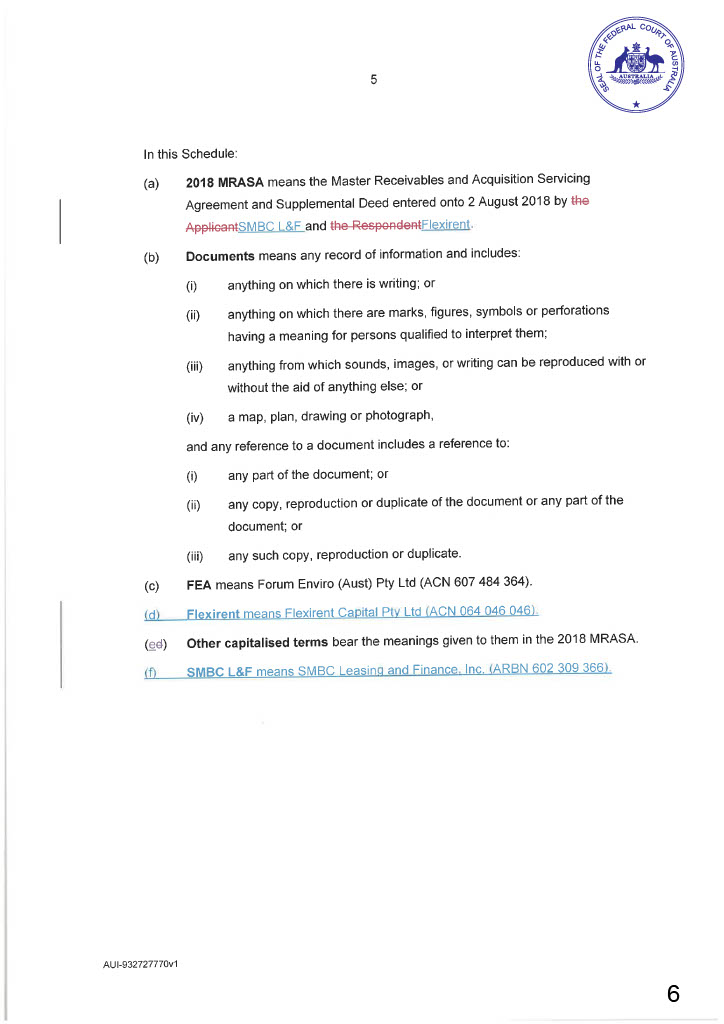
6 The proposed order for specific performance is similarly drafted, being “an order that Flexirent provide access to SMBC to all documents in Flexirent’s possession meeting the descriptions in the schedule to [the application]”. The broad ranging schedule incorporated into the prayers for relief sought by the applicant is annexed to these reasons (Schedule). It will be necessary to return to the precise relief sought by SMBC later.
7 It is fair to say that the stakes in this aspect of the proceeding are exceedingly low. As noted above, SMBC also seeks either preliminary discovery under FCR 7.23 or equitable discovery, and SMBC foreshadows that if it is unsuccessful in obtaining the documents which are the subject of this application, it will seek preliminary discovery in order to obtain the documents sought in the Schedule.
B AGREED BACKGROUND FACTS
B.1 Background and Sources of Findings
8 At the last case management hearing, I made an order requiring the parties to prepare a statement of agreed facts pursuant to s 191 of the Evidence Act 1995 (Cth), given that it appeared unlikely that the matter would venture beyond a relatively short construction dispute. An agreed statement of facts was filed by the parties with commendable efficiency.
9 With the benefit of that document, the facts underlying the dispute may be sketched as follows.
B.2 Key Transaction Documents
10 This is a matter rife with abbreviated terms and labyrinthine contractual definitions. For convenience, SMBC produced the following helpful aid which illustrates the relevant contractual arrangement:
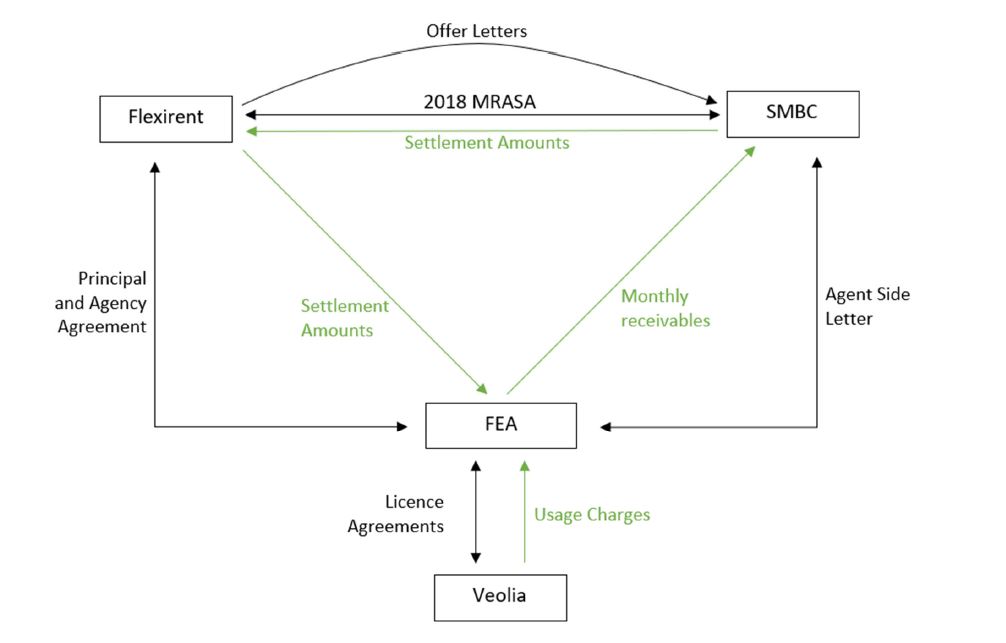
11 By way of elaboration, on 13 June 2018, Flexirent and Forum Enviro (Aust) Pty Ltd (Forum) entered into a Principal and Agency Agreement. The Principal and Agency Agreement set out the terms on which Forum acted as Flexirent’s undisclosed agent in relation to certain rental, lease and licence agreements that Flexirent was in the business of providing.
12 On 2 August 2018, Flexirent (as seller) and SMBC (as purchaser) entered into the 2018 MRASA and the Supplemental Deed. Together, these documents set out the terms on which SMBC could purchase “Receivables Rights” and “Related Assets” from Flexirent that arose under contracts purportedly entered into between Forum and Veolia Environmental Services (Australia) Pty Ltd (Veolia).
13 On the same day, Flexirent, SMBC and Forum entered into an Agent Side Letter in connexion with the 2018 MRASA whereby SMBC appointed Forum as its agent for the purposes of the collection and payment of the “Lessee Receivables”.
B.3 The Technology Licence Agreements, Offer Letters and Payment Made by SMBC
14 The contracts purportedly entered into between Forum and Veolia were called “Technology Licence Agreements” (TLAs). Each TLA provided for Forum to lease ORCA food waste management equipment to Veolia for a term of either 59 or 60 months, in respect of which Veolia was to pay a monthly “Usage Charge”.
15 Between around August 2018 and December 2018, Flexirent delivered four “Offer Letters” to SMBC, attaching and referring to certain TLAs, and SMBC made various payments to Flexirent. The Offer Letters and attached TLAs were in the same form, and in substantially the same terms. By subsequently making payments, SMBC purchased the “Receivables Rights” and the “Related Assets” referred to in each of the Offer Letters.
16 As it turned out, the five relevant TLAs had not been signed on behalf of Veolia and did not represent binding agreements. As a consequence, the usage charges were not in fact payable by Veolia and, in turn, the “Receivables” identified in the Offer Letters were not payable by Veolia and did not exist. SMBC did not receive any communication from Flexirent notifying it of these matters.
B.4 Subsequent Events
17 In July 2021, SMBC became aware of what had transpired and commenced the Primary Proceeding against Flexirent (and its parent company, Humm Group Limited) in this Court, claiming losses in relation to the 2018 MRASA.
18 SMBC seeks the documents referred to in the Schedule because they are said to be “clearly relevant to establishing the substratum of facts in relation to the entry into [the relevant] transactions, and the representations and warranties given by [Flexirent] in relation to the transactions which have proven to be untrue and incorrect”.
B.5 The Subpoena
19 On 2 August 2021, SMBC served a subpoena on Flexirent in proceeding NSD 681 of 2021 (Forum Proceeding).
20 Some 1,100 documents were produced to the Court under that subpoena. It appears, however, because of a pragmatic and informal agreement on an inter partes basis, SMBC did not press compliance with the peremptory order of the Court embodied in the subpoena, nor was any amended schedule filed to seek amendment of the subpoena order.
21 Subsequently, on 28 September 2021, and presumably to avoid any difficulties with the implied undertaking, the solicitors for SMBC sent a letter to Flexirent’s solicitors stating, among other things, that SMBC required Flexirent to reproduce all documents previously produced pursuant to SMBC’s asserted rights to access Flexirent’s documents under cl 9.2(b) of the 2018 MRASA (Reproduction Request).
22 On the following day, Flexirent produced to the Court further documents responsive to the subpoena, together with a list of objections with respect to certain documents over which Flexirent claimed legal professional privilege.
23 On 13 September 2022, SMBC requested under cl 9.2(b) of the 2018 MRASA and cl 8(f) of the Supplemental Deed that Flexirent produce or otherwise make available for inspection the documents described in the Schedule.
24 It is against this background that SMBC seeks the specified relief. It follows that at the heart of this application are two issues: first, the form of the relief sought; and secondly, the proper construction of the 2018 MRASA and the Supplemental Deed. I will address each in turn.
C THE FORM OF RELIEF
25 There is a distinction between the two forms of relief sought.
26 Despite the ancient inherited jurisdiction of Chancery to grant declaratory relief in its exclusive jurisdiction in relation to equitable rights or interests, a declaration in relation to a legal right or interest is not an equitable remedy per se. A declaration in relation to a legal right is grounded in statute and if it operates to quell a real and existing controversy and is hence utile, it will generally be granted: Bass v Permanent Trustee Company Limited [1999] HCA 9; (1999) 198 CLR 334 (at 355–357 [43]–[49] per Gleeson CJ, Gaudron, McHugh, Gummow, Hayne and Callinan JJ). Specific performance, however, is an equitable remedy and for present purposes (and in its narrow sense) can be said to have the effect of directing a party to an agreement to perform its obligations under the agreement according to its terms. Of course, like any form of equitable relief, it is a purely discretionary remedy.
27 What is common to the two forms of relief is the need for precision and certainty and, more particularly, the need to ensure the form of declaration or decree is congruent with the terms of the obligation the subject of declaratory relief, and the terms of the obligation to be enforced: see Bass v Permanent Trustee (at 357 [49] per Gleeson CJ, Gaudron, McHugh, Gummow, Hayne and Callinan JJ); Heydon J D, Leeming M J, and Turner P G, Meagher, Gummow & Lehane’s Equity: Doctrines & Remedies (5th ed, LexisNexis Butterworths, 2014) (at [19-255]).
28 When this is understood, a number of problems with the relief sought by SMBC become apparent.
29 First, the Schedule is imprecise and involves questions of degree and judgment. This can be seen most particularly at [3] of the Schedule, which refers to all “documents or communications evidencing any officer, employee or agent of Flexirent’s suspicion, awareness or belief that, or consideration of [a series of matters]”. Any order made in the terms of prayer four of the applicant’s prayers for relief would involve a recipient, at pain of non-compliance (which could amount to a contempt) making evaluative judgments as to which documents fall within the decree for specific performance. As the terms of the provisions relied upon in the 2018 MRASA and the Supplemental Deed make clear, the relevant documents required to be either collected or provided for access are documents defined by the terms of those contractual provisions. Accordingly, there is real scope for considerable disconformity between the Schedule and the documents referred to in those provisions.
30 Secondly, and relatedly, the very broad terms of the Schedule travel well beyond the documents necessary to be collected or produced to comply with the relevant contractual provisions.
31 Thirdly, prayer four, by which SMBC seeks a discretionary remedy, contemplates providing access to documents which have almost certainly already been provided, and are already in the possession of SMBC, pursuant to the subpoena issued in the Forum Proceeding. To the extent that it has not already occurred, the appropriate course would be to seek relief first from the implied undertaking in order to use those documents for any purpose foreign to the Forum Proceeding.
32 This last factor, together with the lack of precision and certainty in relation to the forms of relief, provide a sufficient basis to refuse the relief claimed in prayers two and four of the application. The declaration as sought is not a proper form of declaration. In any event, insofar as the equitable relief of a decree of specific performance is concerned, I would refuse such relief as a matter of discretion, given my concern about the inability of someone to be sure about what needs to be effectuated to comply with the relevant obligation.
33 With that said, in order to provide some assistance to the parties, it is appropriate that I proceed to deal with the issues as to construction, to which I will now turn.
D CONSTRUCTION ISSUES
D.1 Principles
34 There is no dispute that the 2018 MRASA and the Supplemental Deed are binding and enforceable. Hence, the only issue, other than as to the form of relief, concerns the proper construction of the agreements.
35 Unsurprisingly, there was no controversy between SMBC and Flexirent as to the principles applicable to the construction of commercial contracts. Three short observations may be made.
36 First, the rights and liabilities of parties under a contractual provision are to be determined objectively, by reference to its text, context and purpose: Mount Bruce Mining Pty Limited v Wright Prospecting Pty Limited [2015] HCA 37; (2015) 256 CLR 104 (at 116 [46] per French CJ, Nettle and Gordon JJ).
37 Secondly, the start and end point of the construction exercise is the language chosen by the parties to record their bargain, considered in the light of legitimate relevant surrounding circumstances: Cherry v Steele-Park [2017] NSWCA 295; (2017) 96 NSWLR 548 (at 565 [72] per Leeming JA, with whom Gleeson JA and White JA agreed). Preference will be given to a construction supplying a congruent operation to the various components of the whole of the contract: Wilkie v Gordian Runoff Limited [2005] HCA 17; (2005) 221 CLR 522 (at 529 [16] per Gleeson CJ, McHugh, Gummow and Kirby JJ).
38 Thirdly, where the language of a contractual provision admits of two constructions, the preferable construction is one which will avoid an outcome which is capricious, unreasonable, inconvenient or unjust: Australian Broadcasting Commission v Australasian Performing Right Association Limited (1973) 129 CLR 99 (at 109 per Gibbs J).
D.2 Relevant Provisions
39 The relevant clauses are cl 9.2 of the 2018 MRASA and cl 8(f) of the Supplemental Deed (while there was initially some emphasis placed on cl 6 of Supplemental Deed, this is no longer pressed).
40 Clause 9.2 of the 2018 MRASA provides:
9.2 Seller to Assist
Following the occurrence of a Title Perfection Event, the Seller will at its expense and upon request by the Purchaser:
(a) promptly give notice in a form acceptable to the Purchaser to any Lessee and any other relevant person of the assignment of the relevant Lessee Receivables to the Purchaser pursuant to this document and if requested by the Purchaser, direct that payments in respect of the Lessee Receivables be made to the account required by the Purchaser;
(b) collect all of the documents, instruments and other records (including computer software, to the extent that the collection of such is not illegal) which evidence the Lessee Receivables [that is, in connection with a Lessee, a Receivable [meaning any receivable, debt, financial asset (including without limitation a business loan or commercial loan) or any other receivable or other form of monetary obligation] referred to in an Offer Letter in connection with that Lessee which is accepted by the Purchaser unless the Purchaser has ceased to have an interest in that Receivable in accordance with the Transaction Documents in connection with the Lessee] or any payments made in respect of them or which are otherwise necessary to evidence and collect and enforce remedies in respect of such Receivables, and provide access to the records and the computer software to the Purchaser (or as it may direct); and
(c) execute all such documents and do all such acts and things as the Purchaser may reasonably require to assist the Purchaser to protect or perfect the Purchaser's interest in and title to the relevant Lessee Receivables.
41 Clause 8 of the Supplemental Deed provides:
8 Undertakings
The Seller hereby undertakes in respect of the Lessee Receivables as follows:
…
(f) permit the Purchaser or any of its agents, officers or representatives to enter and attend at its offices during normal office hours for the purposes of monitoring its compliance with this document and the Transaction Documents, including to the maximum extent permitted by law, to examine and take with them copies of all books of account, records and documents (including computerised information) relating to the Lessee Receivables and computer printouts of Lessee Receivables, records or other information as the Purchaser may reasonably require from time to time:
(i) if an Event of Default is subsisting, at any time; or
(ii) if an Event of Default is not subsisting, on ten Business Days’ notice, if the Purchaser (acting reasonably) has formed the opinion that it so requires for the purposes of monitoring compliance with the Transaction Documents in connection with the Lessee …
42 In addition to the above clauses, it is necessary to set out a handful of interrelated definitions under the 2018 MRASA and Supplemental Deed. By cl 1.1 of the Supplemental Deed, terms defined in the 2018 MRASA have the same meaning when used in the Supplemental Deed. The relevant definitions, as defined in cl 1.1 of the 2018 MRASA, are as follows:
Lessee means, in relation to a Receivable, the person or persons (other than the Agent the Servicer or the Seller) who is obliged to make payments with respect to that Receivable, whether as a principal or secondary obligation.
Lessee Receivable means, in connection with a Lessee, a Receivable referred to in an Offer Letter in connection with that Lessee which is accepted by the Purchaser unless the Purchaser has ceased to have an interest in that Receivable in accordance with the Transaction Documents in connection with the Lessee.
Receivable means any receivable, debt, financial asset (including without limitation a business loan or commercial loan) or any other receivable or other form of monetary obligation.
Title Perfection Event in connection with a Lessee, means the occurrence of an Event of Default.
Transaction Documents in connection with a Lessee means:
(a) this document [the 2018 MRASA];
…
(c) each Offer Letter for the Lessee;
43 The term “Event of Default” is defined in cl 7.1(e) of the Supplemental Deed as including:
if all or a material part of a Transaction Document or a Material Document, or a transaction in connection with it, is or becomes (or is claimed to be) void, voidable or unenforceable and such event has had or will have a Material Adverse Effect …
E CONSIDERATION
E.1 Clause 9.2 of the 2018 MRASA
44 In broad summary, Flexirent submits that nothing in the text, context or commercial purpose of the 2018 MRASA supports the conclusion that cl 9.2(b) creates a right in SMBC to compel production of the “wide-ranging” categories of documents sought. It is said that cl 9.2(b) is directed to the position after the occurrence of a Title Perfection Event, not some “broader, unconstrained inquiry” by SMBC.
45 In my view, the starting point is to recognise that cl 9.2(b) must be read in context. In the light of the clause as a whole, and consistently with the chapeau “Seller to Assist”, cl 9.2 operates for the benefit of the purchaser (that is, SMBC) by conferring a series of cumulative rights which assist the purchaser to perfect its title in the Lessee Receivables upon a Title Perfection Event (which is relevantly defined to include, in connexion with a Lessee, an Event of Default).
46 Clause 9.2(a) is important in this respect. Upon a Title Perfection Event, SMBC becomes the equitable assignee of the relevant Lessee Receivables. In order to perfect that interest, SMBC may exercise the right under cl 9.2(a) by requiring the seller (that is, Flexirent) to notify the any Lessee that the interest in the relevant Lessee Receivables had passed to SMBC. It provides that the seller must:
promptly give notice in a form acceptable to [SMBC] to any Lessee and any other relevant person of the assignment of the relevant Lessee Receivables to [SMBC] pursuant to this document and if requested by [SMBC], direct that payments in respect of the Lessee Receivables be made to the account required by [SMBC]
(Emphasis added)
47 As the Full Court explained in Szepesvary v Weston (as trustee of the bankrupt estate of Szepesvary) [2018] FCAFC 224; (2018) 363 ALR 379 (at 385 [27] per Perry, Moshinsky and Lee JJ), the giving of notice to a debtor is not, of course, essential to the validity of an assignment of a debt in equity, but it is essential for a valid assignment in law. Moreover, prior to a notification occurring pursuant to cl 9.2(a), the equitable assignee of the legal right to the Lessee Receivables (that is, SMBC) cannot, by an action at law, maintain a claim in debt. Because the legal estate at that stage remains with the Lessee, it would be necessary for the Lessee to be a party to the proceeding in which recovery is sought. Nothing about the procedural fusion of law and equity occasioned by the Judicature Act 1873 (UK) reforms affects this fundamental requirement: see Meagher, Gummow & Lehane’s Equity (at [6.520]). Clause 9.2(c) may aid in this respect by requiring the seller to do all things necessary upon the request of SMBC to effect an assignment of the legal estate, and to execute all such documents as are necessary to achieve this purpose, noting that the operation of cl 9.2(c) is qualified by the words “to protect or perfect the Purchaser's interest in and title to the relevant Lessee Receivables” (emphasis added).
48 It is in this context that one comes to understand the full ambit of the obligation under cl 9.2(b). While I recognise the force in Flexirent’s submissions, I am not persuaded that cl 9.2(b) should be narrowed in the way suggested by Flexirent. When one incorporates the definition of “Lessee Receivable” and, within that definition, the definition of a “Receivable” (as set out above at [40]), the better view is that cl 9.2(b) is sufficiently broad to encompass obtaining access to the relevant documents.
49 There are two reasons for this. First, cl 9.2(b) permits access to documents “which evidence the Lessee Receivables or any payments made in respect of them” or documents “which are otherwise necessary to evidence and collect and enforce remedies in respect of such Receivables” (emphasis added). The fact that cl 9.2 is enlivened in circumstances where Lessee Receivables are found (or claimed) to be void, voidable or unenforceable (by dint of the definition of a “Title Perfection Event”) supports the construction that cl 9.2(b) encompasses documents that refer to or provide information regarding the validity of a Lessee Receivable and any payments purportedly made in respect of a Lessee Receivable.
50 Secondly, the seller’s obligation to provide documents, instruments and other records necessary to “evidence and collect and enforce remedies in respect of such Receivables” is self-evidently broad (emphasis added). The phrase “in respect of” has a wide meaning: Unsworth v Commissioner for Railways (1958) 101 CLR 73 (at 87–88 per Fullagar J); Workers’ Compensation Board (Qld) v Technical Products Pty Ltd (1988) 165 CLR 642 (at 653–654 per Deane, Dawson and Toohey JJ). It follows that the term “remedies”, on proper construction, ought to embrace remedies against Flexirent for sale of the Receivables to SMBC, and for breach of the terms under which the Receivables were sold. If it were otherwise, cl 9.2(b) would be rendered otiose as against those parties responsible for procuring the relevant Receivables for SMBC.
51 Although I reject the submission made by SMBC that cl 9.2(b) is best characterised as an “auditing” or “monitoring” obligation, for the reasons canvassed above, I consider that the better view is that cl 9.2(b) allows SMBC to require Flexirent, upon an Event of Default, to collect all the documents identified in cl 9.2(b) necessary to “evidence and collect and enforce” remedies in respect of the receivables.
E.2 Clause 8(f) of the Supplemental Deed
52 Clause 8(f) confers on SMBC the right to enter and attend Flexirent’s offices for the purposes of monitoring its compliance with the contractual documents, including in order to:
examine and take with them copies of all books of account, records and documents (including computerised information) relating to the Lessee Receivables and computer printouts of Lessee Receivables, records or other information as the Purchaser may reasonably require from time to time
53 Flexirent’s submissions with respect to cl 8(f) were developed as follows.
54 First, it is said that the primary difficulty which confronts SMBC is the opening words of the provision: “[Flexirent] hereby undertakes in respect of the Lessee Receivables as follows” (emphasis added). SMBC’s contends that the provision extends “beyond documents relating to Lessee Receivables to ‘records and other information as [SMBC] may reasonably require from time to time’”, but that result only follows, it is said, if one ignores the opening words, as well as the recitals to the Supplemental Deed, which provide:
This document is supplemental to the [2018] MRASA and applies in connection with the Receivables Rights and Related Assets in connection with the Lessee which may be offered for sale by [Flexirent] and acquired by [SMBC] in accordance with the [2018] MRASA and this Supplemental Deed
55 Secondly, during the course of oral submissions, much of the focus of Flexirent’s argument concerned the content to be given to the following words in cl 8(f)(ii): “monitoring compliance with the Transaction Documents in connection with the Lease” (emphasis added). Flexirent submits that clause 8(f) is concerned with Flexirent’s obligation to allow SMBC to ascertain whether Flexirent is complying with the agreement.
56 In my view, Flexirent’s contention with respect to the “limitations” upon cl 8(f) is correct insofar as it goes. However, when one has regard to the broad definition of “Lessee Receivables”, which incorporates the relevant concept of a “Receivable”, the scope of the undertaking is broad. Furthermore, although there is some textual support for the argument that cl 8(f)(ii) is primarily concerned with Flexirent’s obligation to allow SMBC to monitor compliance with its obligations with respect to the transaction documents, that submission is ultimately unpersuasive.
57 Flexirent’s obligations under cl 8(f) must be understood in the light of cl 6.5(h) of the 2018 MRASA, which provides that Flexirent is to notify SMBC promptly upon becoming aware of “any representation or warranty made or taken to be made by the Seller under a Transaction Document in connection with a Lessee being materially incorrect when made or taken to be made”, or of any breach or other Event of Default. It is clear from the terms of cl 8 that the obligation exists notwithstanding an Event of Default, and notwithstanding that by reason of an Event of Default, SMBC has no obligation to purchase any receivables under the transaction documents.
58 Accordingly, I do not think a narrow construction of the undertaking in cl 8(f) is warranted, save for the fact that the documents required to be produced are documents in respect of the Lessee Receivables. Nor is it clear to me that the breadth of the documents referred to in the Schedule (to the extent that there is specificity given in the Schedule) would be encompassed by the obligation under cl 8(f).
F CONCLUSION
59 It follows that the principled result is that prayers two and four of the applicant’s amended originating application should be refused, notwithstanding the applicant has been partly successful in relation to the arguments it has made as to construction.
60 At the end of the day it is a nil-all draw. Although Flexirent’s arguments concerning the proper construction of the 2018 MRASA and Supplemental Deed have not been vindicated, I am not persuaded that SMBC should have its costs, given its prayers for relief were refused. With that said, given that there will be other costs associated with the proceeding, including in respect of any preliminary discovery application SMBC may make, I am prepared to reserve the costs of today.
61 As I said at the outset, this aspect of the proceeding is somewhat of a tempest in a tea cup. Although it seems to me that SMBC may be able to obtain access to further documents, to the extent that there are further documents which are relevant for the purposes of SMBC’s decision as to whether to seek substantive relief in this Court, then an application ought to be made for preliminary discovery under FCR 7.23.
62 With that said, that does not mean that the determination of these separate questions was a waste of time. It is, of course, necessary for SMBC to take reasonable efforts to exhaust its remedies prior to any order for preliminary discovery being made.
63 At the conclusion of oral argument, I invited the parties to indicate whether they were prepared for me to determine the application for preliminary discovery immediately. I informed them that if they were not so prepared, my inclination would be to make a direction under s 37P(2) of the Federal Court of Australia Act 1976 (Cth) (FCA Act) requiring the legal representatives of the parties to confer and, consistently with the overarching purpose, come up with some sensible resolution by which SMBC can obtain access to documents which either fall within the ambit of the contractual obligations as properly construed, or, alternatively, are likely to be required to be produced pursuant to an order for preliminary discovery.
64 Senior counsel for both parties conveyed that the parties would prefer to delay the determination of the application for preliminary discovery until after they have had the opportunity to confer. Given the conduct of the parties up to this point, I have no doubt that such conferral will take place sensibly and without the need for a direction pursuant to s 37P(2) of the FCA Act.
I certify that the preceding sixty-four (64) numbered paragraphs are a true copy of the Reasons for Judgment of the Honourable Justice Lee. |
Associate:
Dated: 12 January 2023
SCHEDULE