Federal Court of Australia
McDonald v Dakkak (No 2) [2022] FCA 1578
ORDERS
Applicant | ||
AND: | Respondent | |
DATE OF ORDER: |
THE COURT ORDERS THAT:
1. Pursuant to s 104.14(7)(b) of the Criminal Code (scheduled to the Criminal Code Act 1995 (Cth)), the interim control order made in relation to the respondent on 13 September 2022 be confirmed and varied in the terms set out in the Annexure to these Orders.
2. This confirmed control order be in force until and including 13 September 2023.
3. The respondent’s lawyer may attend the AFP Sydney office at 110 Goulburn St, Sydney NSW between 9.00am to 4.00pm, Monday to Friday in order to obtain a copy of these Orders.
THE COURT NOTES THAT:
4. This confirmed control order relates to the Respondent, Radwan Dakkak.
5. It is satisfied on the balance of probabilities that the Respondent has been convicted in Australia of an offence relating to terrorism or a terrorist act (s 104.4(1)(c)(iv) of the Criminal Code).
6. It is satisfied on the balance of probabilities that each of the obligations, prohibitions and restrictions to be imposed on the Respondent by the order is reasonably necessary, and reasonably appropriate and adapted, for the purpose of:
(a) protecting the public from a terrorist act (s 104.4(1)(d)(i) of the Criminal Code); or
(b) preventing the provision of support for or the facilitation of a terrorist act (s 104.4(1)(d)(ii) of the Criminal Code).
Note: Entry of orders is dealt with in Rule 39.32 of the Federal Court Rules 2011.
(Revised from transcript)
WIGNEY J:
1 On 9 September 2022, the Court made an interim control order (ICO) pursuant to s 104.4 of the schedule to the Criminal Code Act 1995 (Cth) (The Criminal Code) against the respondent, Mr Radwan Dakkak: McDonald v Dakkak [2022] FCA 1065 (the ICO Judgment). The applicant, Ms Amelia McDonald, a senior member of the Australian Federal Police (AFP) who holds the rank of Detective Superintendent, Enduring Risk and Disruption Investigations and Known Quantity Entity Management, now applies for confirmation of the ICO without variation pursuant to s 104.14(7)(c) of the Code.
2 Mr Dakkak does not oppose the confirmation of the ICO, though he does propose a modification to one of the controls.
3 In order to confirm the ICO, it is necessary for the Court to determine whether the conditions that must be satisfied or complied with before action can be taken under s 104.14(7) have been satisfied or complied with. It is also necessary to consider the evidence adduced and the submissions made in respect of the order.
4 Most importantly, before the ICO is confirmed, the Court must be satisfied, on the balance of probabilities, of the “matters” referred to in ss 104.4(1)(c) and (d) of the Code. In the particular circumstances of this case, those matters are, in summary, that: Mr Dakkak has been convicted in Australia of an offence related to terrorism, a terrorist organisation or a terrorist act; and the controls to be imposed on Mr Dakkak by the order are reasonably necessary and reasonably appropriate and adapted for the purposes of protecting the public from a terrorist act or preventing the provision of support for or the facilitation of a terrorist act.
5 For the reasons that follow, I am satisfied that all the requirements for confirming the ICO have been satisfied and that the ICO should be confirmed, though with a slight variation to one of the controls.
BACKGROUND TO THE APPLICATION
6 The background to this application is spelled out in detail in the ICO Judgment. This judgment should be read in conjunction with that judgment. Following is a very short summary of the relevant background facts.
7 On 18 December 2020, Mr Dakkak was convicted of two offences of associating with a terrorist organisation contrary to s 102.8 of the Code. The offences involved Mr Dakkak associating with a number of people who he knew were members of, or directed the activities of, a terrorist organisation known as Islamic State.
8 On 31 December 2020, the Court made an interim control order (the first ICO) against Mr Dakkak: Booth v Dakkak [2020] FCA 1882.
9 On 5 February 2021, Mr Dakkak was charged with an offence of contravening a control order contrary to s 104.27(1) of the Code and was remanded in custody. He was convicted of that offence on 11 April 2022 and sentenced to a period of imprisonment: R v Dakkak [2022] NSWDC 181. That period of imprisonment ended on 15 September 2022. The circumstances of the offence were that Mr Dakkak searched for, accessed, viewed and downloaded online extremist materials in contravention of the ICO then in place.
10 The ICO the subject of this confirmation application was made on 9 September 2022, shortly before Mr Dakkak was released from custody.
CONDITIONS THAT MUST BE SATISFIED BEFORE THE COURT CAN CONFIRM AN ICO UNDER S 104.14(7) OF THE CODE
11 For s 104.14 of the Code to apply, three conditions must be satisfied: s 104.14(1A) of the Code.
12 First, an ICO has been made in relation to a person: s 104.14(1A)(a) of the Code.
13 Second, an election under s 104.12A to confirm the order has been made: s 104.14(1A)(b) of the Code.
14 Third, the Court is satisfied on the balance of probabilities that s 104.12 and s 104.12A(2) have been complied with in relation to the order: s 104.14(1A)(c) of the Code. As will be seen, s 104.12 and s 104.12A include a number of separate conditions and requirements, some fairly formal and others not so formal.
The first and second conditions: ss 104.14(1A)(a) and (b)
15 I am satisfied that the conditions in ss 104.14(1A)(a) and (b) have been satisfied in this case.
16 As has already been noted, an ICO order was made against Mr Dakkak on 9 September 2022.
17 As for the election, s 104.12A(1) of the Code provides that at least 48 hours before the day specified in the ICO as the date on which the person may attend court for the court to confirm, revoke or declare the ICO to be void, the senior AFP officer who requested the ICO must elect whether to confirm the order and give a written notification of the election to the issuing court. There is evidence that on 17 November 2022, Ms McDonald signed a notification of an election to confirm the ICO made in relation to Mr Dakkak: annexures AO-1 and AO-2 to the affidavit of Aydin Ozden dated 6 December 2022 (Ozden 2).
The third condition: compliance with s 104.12 and s 104.12A(2) of the Code
18 Sections 104.12 and 104.12A(2) of the Code require certain documents to be served on the person the subject of the ICO and that the person be informed about certain matters.
19 Section 104.12(1) provides, among other things, that as soon as practicable after an ICO is made, and at least 48 hours before the day on which the person may attend court for the court to confirm, revoke or declare the ICO to be void, an AFP member must: serve the order personally on the person in relation to whom the order was made; inform the person of the information specified in s 104.12(1)(b); and ensure that the person understood that information.
20 The information specified in s 104.12(1)(b) is: the effect of the order; the period for which the order (if confirmed) is in force; the effect of ss 104.12A, 104.13, 104.14, 104.18 and 104.27 (and, if appropriate, s 104.22); that the person has a right to obtain legal advice and legal representation; that the person may have appeal and review rights in relation to the decision of the issuing court to make the order; the person’s right to attend court on the day specified for the purposes of s 104.5(1)(e); the right of the person or one or more representatives of the person to adduce evidence or make submissions under s 104.14(1) if the order is confirmed; that the person may have appeal and review rights in relation to any decision of the issuing court to confirm the order; the person’s right to apply under s 104.18 for an order revoking or varying the order if it is confirmed; and the right of the person or one or more representatives of the person to adduce evidence or make submissions under s 104.19(3) or s 104.23(4) in relation to an application to revoke or vary the order if it is confirmed.
21 Subsection 104.12A(2) provides, relevantly, that the senior AFP officer must also serve on the person in relation to whom the ICO was made a copy of the notification of election to confirm, together with the documents referred to in ss 104.2(3)(aa) and 104.3(d) of the Code. Those documents are, in summary, some of the documents that were required at the ICO stage: the statement of facts relating to why the ICO should be made; the statement of facts, if any, relating to why the ICO should not be made; the explanation as to why each of the proposed obligations, prohibitions and restrictions should be imposed; and a statement of facts relating to why any of the obligations, prohibitions or restrictions should not be imposed.
22 I am satisfied that each of the requirements or conditions in ss 104.12 and 104.12A(2) of the Code have been complied with in this case. The evidence establishes that the ICO and a document explaining the ICO were served on Mr Dakkak on 14 September 2022: affidavit of Aydin Ozden dated 4 October 2022 (Ozden 1) at [2]. The following documents were served on Mr Dakkak on 6 December 2022: the notification of election to confirm the ICO; the evidence adduced in support of the application for the ICO, including the s 104.2(3)(aa) and s 104.3(d) documents; and written submissions filed in support of the application for the ICO (according to Ozden 2 at [2]-[3]). The AFP officer who served those documents informed Mr Dakkak of the s 104.12(1)(b) information and took appropriate and satisfactory steps to ensure that Mr Dakkak understood that information: Ozden 2 at [4]-[5].
23 It follows that the conditions necessary for s 104.14 of the Code have been satisfied and the Court can entertain the application to confirm the ICO made in relation to Mr Dakkak.
THE MATERIAL THAT MUST BE CONSIDERED BEFORE ACTION IS TAKEN UNDER S 104.14(7)
24 Sections 104.14(3) and (3A) of the Code specify certain material that the Court must consider before taking any action under s 104.14 of the Code. Those subsections provide as follows:
(3) Subject to subsection (3A), before taking action under this section, the court must consider:
(a) the original request for the interim control order; and
(b) any evidence adduced, and any submissions made, under subsection (1) in respect of the order.
(3A) To avoid doubt, in proceedings under this section, the issuing court:
(a) must take judicial notice of the fact that the original request for the interim control order was made in particular terms; but
(b) may only take action on evidence adduced, and submissions made, under subsection (1) in relation to the confirmation of the order.
25 The combined effect of ss 104.14(3) and (3A) of the Code is, in summary, as follows.
26 First, before making an order confirming an ICO or otherwise, the Court must take into consideration the terms of the ICO which has been made. It is, however, unnecessary for either party to tender the ICO, as the Court must in any event take judicial notice of it.
27 Second, the Court can only act on the evidence adduced for the purposes of, and the submissions made at the hearing of, the confirmation application. It follows that, even if the evidence and circumstances remain unchanged from the time that the ICO was made, the person who applies for confirmation of the ICO is required to tender afresh the evidence relied on at the ICO stage and, it seems, repeat the submissions that were made at the ICO stage.
28 The Court has, in accordance with ss 104.14(3)(a) and (3A)(a), considered the original request for the ICO and has taken judicial notice of the fact that the original request for the ICO was made in particular terms.
29 Ms McDonald has adduced evidence in relation to the confirmation order in accordance with s 104.14(1) of the Code. That evidence included the evidence adduced at the ICO stage. Ms McDonald also made submissions in relation to the confirmation order. Those submissions included or incorporated the submissions made at the ICO stage.
30 Mr Dakkak filed an affidavit sworn by him on 17 November 2022: cf s 104.14(1)(c) of the Code. That affidavit was solely directed to Mr Dakkak’s opposition to what he contended was the “extensive broadness and restrictive nature” of control order 6. Mr Dakkak claimed that control order 6 impacted the “practice of [his] faith”. His evidence was that when he sought an exemption from the AFP in relation to a “religious book” it took over a month for the AFP to approve the exemption. Mr Dakkak proposed that control order 6 be qualified by the inclusion of the word “predominantly” and that “Australian bookstores” be added to the list of exemptions.
31 Mr Dakkak’s evidence and submissions concerning control order 6 are addressed in detail later in these reasons.
32 I have, as required by s 104.14(3), considered the original request for the ICO, the evidence adduced and the submissions made by, or on behalf of, Ms McDonald and Mr Dakkak. I have also, in compliance with s 104.14(3A), taken judicial notice of the fact that the original request for the ICO was made in particular terms, but otherwise only acted on the evidence and submissions in relation to the confirmation of the ICO.
SATISFACTION IN TERMS OF SS 104.4(1)(c) AND 104.4(1)(d) of the code
33 The effect of ss 104.14(6) and (7) is that, where s 104.14 applies, the Court may do one of four things.
34 First, the Court may declare, in writing, the ICO to be void if satisfied that, at the time of making the order, there were no grounds on which to make the order: s 104.14(6) of the Code.
35 Mr Dakkak did not contend that I should declare the ICO to be void, or that there was any basis for the Court to be satisfied that, at the time of the making of the order, there were no grounds on which to make the order.
36 Second, the Court may revoke the order if, at the time of confirming the order, the Court “is not satisfied as mentioned in” s 104.4(1)(c): s 104.14(7)(a) of the Code.
37 Third, the Court may confirm and vary the order by removing one or more obligations, prohibitions or restrictions if, at the time of confirming the order, the Court is satisfied as mentioned in s 104.4(1)(c) but is not satisfied as mentioned in s 104.4(1)(d): s 104.14(7)(b) of the Code.
38 Fourth, the Court may confirm the order without variation if, at the time of confirming the order, the Court is satisfied as mentioned in ss 104.4(1)(c) and (d): s 104.14(7)(c) of the Code.
39 Ms McDonald contended that the Court should take the fourth option and confirm the ICO without variation. She did, however, ultimately propose a variation to control order 6 to accommodate or take into account some of the concerns raised by Mr Dakkak in relation to that order.
40 Mr Dakkak, in substance or effect, contended that the Court should take the third option and confirm and vary the order. He did not oppose confirmation of the ICO and appeared to concede that the Court should be satisfied as mentioned in s 104.4(1)(c), but submitted, in effect, that the Court should not be satisfied as mentioned in s 104.4(1)(d) unless control order 6 was varied as proposed by him. He appeared to concede that the Court could be satisfied as mentioned in s 104.4(1)(d) in respect of all of the other control orders.
Satisfaction as mentioned in s 104.4(1)(c) of the Code
41 Subsection 104.4(1)(c) provides, in summary, that before making an ICO, the Court must be satisfied on the balance of probabilities of one or more specified facts or circumstances. Ms McDonald submitted that the Court should be satisfied on the balance of probabilities of the facts or circumstances specified in subparagraph (iv) – that Mr Dakkak had been convicted in Australia of an offence relating to terrorism or a terrorist act.
42 At the ICO stage, the Court accepted that Mr Dakkak had been convicted of an offence relating to terrorism: ICO Judgment at [19(e)]. Mr Dakkak did not contend that the Court erred in so concluding at the ICO stage, or submit that the offence of which he was convicted was not an offence relating to terrorism or a terrorist act.
43 The meaning of the expressions “an offence relating to terrorism” and “an offence relating to a terrorist act” was considered in McCartney v EB (2019) 263 FCR 170; [2019] FCA 183 at [29]-[33]. I am satisfied on the balance of probabilities that the offence of associating with a terrorist organisation, being the offence that Mr Dakkak was convicted of in December 2020, is an offence relating to terrorism or an offence relating to a terrorist act.
44 Accordingly, I am satisfied “as mentioned in” s 104.4(1)(c) of the Code.
Satisfaction as mentioned in s 104.4(1)(d) of the Code
45 Subsection 104.4(1)(d) of the Code provides, in summary, that the Court may make an ICO if it is satisfied on the balance of probabilities that each of the obligations, prohibitions and restrictions to be imposed on the person by the order is reasonably necessary, and reasonably appropriate and adapted, for the purpose of either: protecting the public from a terrorist act (subparagraph (i)); or preventing the provision of support for or the facilitation of a terrorist act (subparagraph (ii)); or preventing the provision of support for or the facilitation of the engagement in a hostile activity in a foreign country (subparagraph (iii)).
46 At the ICO stage, the Court considered the proposed obligations, prohibitions and restrictions to be imposed on Mr Dakkak at considerable length: ICO Judgment at [22]-[63]. The Court was ultimately satisfied, on the balance of probabilities, that each of the obligations, prohibitions and restrictions that were included in the ICO as made were reasonably necessary, and reasonably appropriate and adapted, for the purpose of preventing the provision of support for or the facilitation of a terrorist act, or preventing the provision of the support for or the facilitation of the engagement in a hostile activity in a foreign country: s 104.4(1)(d)(ii) and (iii); ICO Judgment at [66]. The orders made by the Court also indicated that the Court was satisfied, on the balance of probabilities, that each of the obligations, prohibitions and restrictions that were included in the ICO as made were reasonably necessary, and reasonably appropriate and adapted, for the purpose of protecting the public from a terrorist act: s 104.4(1)(d)(i) of the Code.
47 Mr Dakkak did not adduce any evidence, or make any submissions, concerning any of the control orders other than control order 6. I will accordingly separately address control order 6 and Mr Dakkak’s submissions concerning it.
48 As for the balance of the control orders, Mr Dakkak did not contend that the Court at the ICO stage erred in concluding that each of the obligations, prohibitions and restrictions in those were reasonably necessary, and reasonably appropriate and adapted for the purposes referred to in ss 104.4(1)(d)(i), (ii) or (iii). Nor did he submit that anything had changed since the ICO stage.
49 For essentially the same reasons as those given in the ICO Judgment, I am satisfied on the balance of probabilities that each of the obligations, prohibitions and restrictions imposed on Mr Dakkak by the ICO are reasonably necessary, and reasonably appropriate and adapted, for the purposes referred to in ss 104.4(1)(d)(i), (ii) and (iii) of the Code.
50 In making those findings, I have given particular weight to Ms McDonald’s detailed explanation of why the control orders should be imposed: affidavit of Amelia Jane McDonald sworn 17 August 2022 at [64]-[131].
51 As for control order 6, that control order prohibits Mr Dakkak from accessing, acquiring or possessing material which has certain qualities, or address or relate to certain topics, unless the material is published or broadcast by certain organisations. As noted earlier, Mr Dakkak contended, in effect, that control order 6 was not reasonably necessary, or reasonably appropriate and adapted, for the purpose of either protecting the public from a terrorist act, or preventing the provision of support for or the facilitation of a terrorist act. He claimed that control order 6 was too broad and restrictive and would impact on the practice of his faith. He submitted that control order 6 should be varied so it only prohibited him from accessing material that “predominantly” addressed or related to the specified topics and that “Australian bookstores” should be added to the list of “exemptions”. Mr Dakkak’s evidence was that it took the AFP over a month to consider an exemption request which appeared to relate to a book in an Australian bookstore.
52 Ms McDonald relied on an affidavit of another senior AFP officer, Mr Peter Fogarty, who holds the rank of Superintendent in Enduring Risk and Special Investigations. Mr Fogarty’s evidence addressed the circumstances in which Mr Dakkak had sought exemptions from control order 6 pursuant to paragraph 21 of the control orders. That evidence explained why it had taken the AFP over a month to address Mr Dakkak’s exemption request.
53 Mr Dakkak made a similar submission in respect of control order 6 at the ICO stage. The Court declined to vary control order 6 as proposed by Mr Dakkak and reasoned as follows (ICO Judgment at [44]-[48]):
In general terms, Control 6 prohibits the respondent from accessing and possessing certain material. It was the respondent’s breach of Control 6 of the first interim control order that led to his conviction for the Contravention Offence.
The respondent’s concern is that this control could be breached inadvertently or unintentionally. He appeared to suggest that the Contravention Offence was of this character or was an example of a de minimis breach.
As I stated at the hearing, I do not propose to go behind the findings of the sentencing judge in respect of the Contravention Offence. However, I accept that, in operation, it is possible that Control 6 could be breached inadvertently.
I have reflected on whether the terms of Control 6 could be modified to cater, expressly, for inadvertence, including by conditioning the control, in the case of electronic access, to exempting access for a limited time period, as the respondent suggested. I have reached the view that any attempt to modify the terms of the control, as proposed, is likely to lead to a substantial weakening of the measure, and possible uncertainty in its application. I am persuaded that the question of whether the control is breached is best determined by objective circumstances. The onus should be placed on the respondent to act responsibly and carefully, mindful of the controls placed upon him. Further, as the applicant submitted, should the respondent innocently or unwittingly access prohibited material, it is within his competence to make disclosure of that access by bringing it to the attention of the AFP in a timely fashion.
The respondent also raised the question of whether an additional exception to Control 6 should be permitted to allow him to purchase, from an Australian bookstore, a publicly available book. I am not persuaded that, at the present time, such an exception should be provided. This is because the terms of Control 6 are specific as to the subject matter in respect of which access is prohibited. Given the particular nature of the prohibited material, I do not see Control 6 as acting as a substantial impediment to the respondent purchasing or otherwise acquiring books from an Australian bookstore within the permitted scope of the control. If there is doubt whether the respondent can access a particular book from an Australian bookstore, he can request an exemption under Control 21.
54 Despite that finding at the ICO stage, Ms McDonald proposed some variations to control order 6 to meet some of concerns that had been raised by Mr Dakkak. In particular, Ms McDonald proposed that the following additional paragraphs be added to control order 6:
6.2. Control 6.1 does not apply to material in a book that you purchase from an Australian retailer of books provided that you notify the AFP Superintendent of the title of the book within 24 hours of purchasing the book.
6.3. If at any time you become aware that a book that you have notified the AFP Superintendent of pursuant to Control 6.2 contains material of a nature identified in Control 6.1(a)-(c) (Prohibited Material), you must notify the AFP Superintendent within two hours, identifying the section/s of that book that contain Prohibited Material, by reference to chapters and/or page numbers.
6.4. If the AFP Superintendent notifies you in writing that the exception in Control 6.2 will cease to apply to a specified book, Control 6.1 will apply to the material in that book from 5 pm on the next day after that notification is sent.
55 In his submissions at the hearing, Mr Dakkak initially maintained that control order 6, including the variation proposed by Ms McDonald, was still disproportionate and created a risk of him inadvertently contravening the control order. Ultimately, however, after the terms of the proposed control order were explained to Mr Dakkak and Ms McDonald agreed to a further minor variation, he appeared to accept that control order 6 was reasonable and appropriate.
56 Having considered the evidence as a whole, I am satisfied on the balance of probabilities that the obligations, prohibitions and restrictions imposed on Mr Dakkak by control order 6 as varied are reasonably necessary, and reasonably appropriate and adapted, for the purpose of protecting the public from a terrorist act and preventing the provision of support for or the facilitation of a terrorist act: s 104.4(1)(d)(i) and (ii). I am satisfied that the minor variation made to control order 6.3 reasonably and appropriately deal with Mr Dakkak’s concerns as to the breadth of the order and the possibility of inadvertent breach. That variation is appropriate, but it is not made because I am not satisfied “as mentioned in” s 104.4(1)(d), for the purposes of s 104.14(7)(c).
57 I am satisfied as mentioned in s 104.4(1)(d) of the Code in respect of the orders proposed by Ms McDonald in their entirety.
CONCLUSION IN RELATION TO CONFIRMATION
58 I am satisfied that the relevant conditions that must be satisfied before s 104.14 applies have been satisfied or complied with.
59 On the basis of the evidence adduced and the submissions made in accordance with s 104.14(1) of the Code, I am also satisfied “as mentioned in” ss 104.4(1)(c) and (d) of the Code. I therefore propose to make an order pursuant to s 104.14(7)(c) of the Code confirming the ICO with the proposed variation to control order 6.
I certify that the preceding fifty-nine (59) numbered paragraphs are a true copy of the Reasons for Judgment of the Honourable Justice Wigney. |
ANNEXURE
1. Control 1
1.1. You are required to remain at premises:
a. nominated by you within 6 hours from the time that this Interim Control Order comes into force; and
b. approved in writing by the AFP Superintendent (the specified premises), between the hours of 11:00 pm and 5:00 am (the curfew period) each day from the day on which this Interim Control Order comes into force until the day that it ceases to be in force.
1.2. You must present and identify yourself at the specified premises during the curfew period upon request by a police officer.
2. Control 2
2.1. You are required to report to a police officer every Monday and Friday between 7:00 am and 7:00 pm local time (the reporting period), at Parramatta Police Station at 95 Marsden Street, Parramatta NSW 2150, or such other Police Station as notified to you in writing by an AFP Superintendent.
3. Control 3
3.1. You are prohibited from being at any of the following areas:
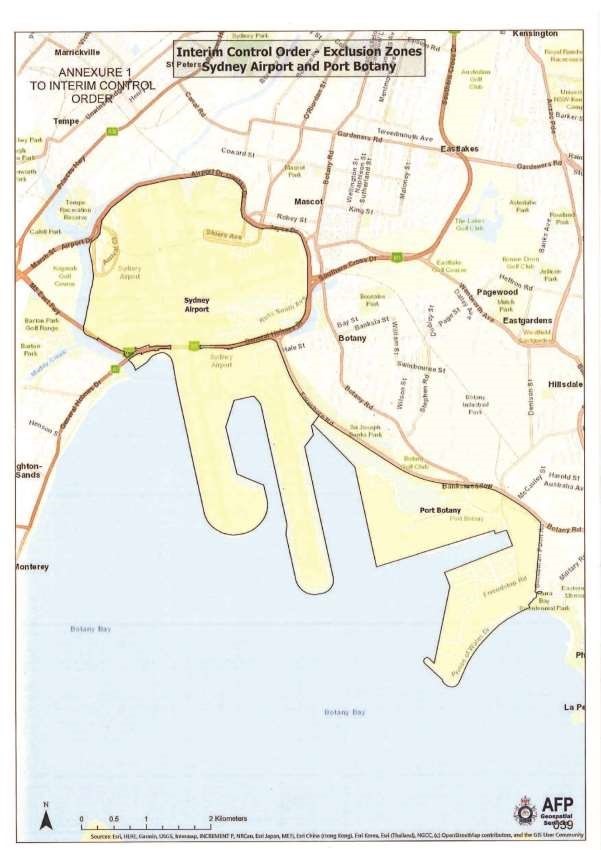
a. within the exclusion zone at Sydney Airport, as identified by yellow shading in Appendix 1;
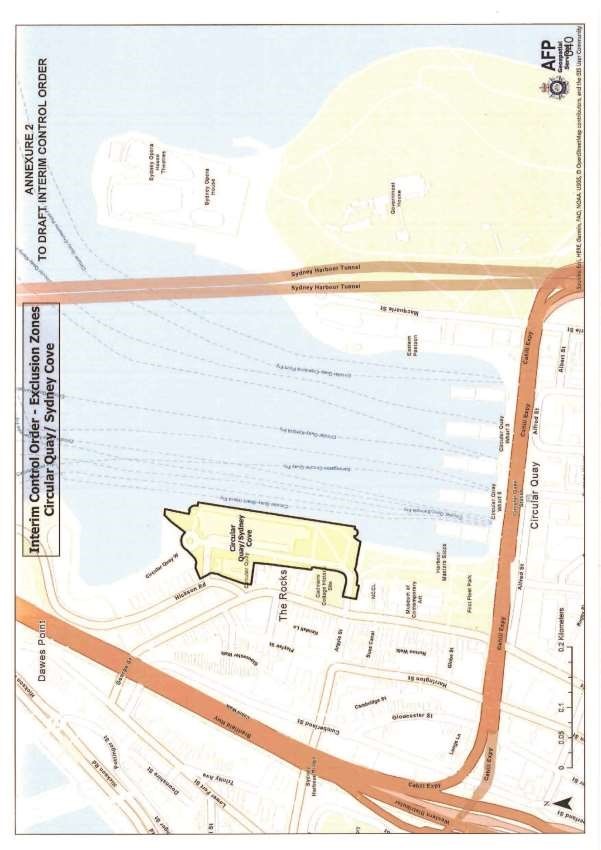
b. within the exclusion zone at Circular Quay, as identified by yellow shading in Appendix 2;
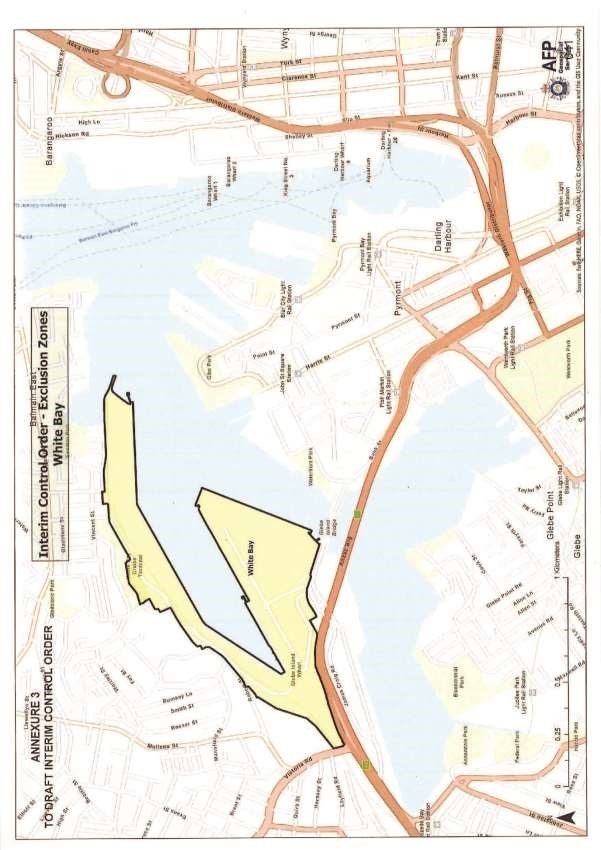
c. within the exclusion zone at White Bay, as identified in Appendix 3;
d. within 1 km of any Australian airport (besides Sydney Airport, which is addressed in Control 3.1.a) which has an international point of departure, or from which a person can board or charter a flight for an international destination;
e. within 1 km of any Australian port (besides Circular Quay and White Bay, which are addressed in Controls 3.1.b and 3.1.c) which has an international point of departure, or from which a person can board or charter a marine vessel for an international destination;
f. inside, or in the grounds of, any prison or correctional facility unless you are incarcerated there;
g. at the residence of any person with whom, by reason of Control 11, you are prohibited from communicating or associating;
h. any place in Australia outside the state of New South Wales;
i. any firing range or other place which sells or hires firearms or ammunition, or any military surplus store; and
j. attending any premises of any person, organisation or entity (not being premises occupied by an Australian police service or members thereof) where firearms or ammunition are kept or stored.
4. Control 4
4.1. You are prohibited from leaving Australia.
5. Control 5
5.1. You are prohibited from carrying out the following activities (including in respect of your work or occupation), namely:
Unlawful Activity & Activities would undermine the purpose of the Control Order
a. Committing any offence against a law of a State or Territory or the Commonwealth of Australia punishable by a term of imprisonment.
b. Providing any false information or misleading information or withholding any information about your whereabouts, activities or associations when asked by an AFP Superintendent.
Groups
c. Forming, joining or affiliating with any group, club or organisation, including any internet based social networking service, without written permission from an AFP Superintendent.
d. Forming any corporation, partnership, incorporated association, registering any business names, or operating a business without first notifying an AFP Superintendent in writing.
Financial
e. Transferring money or money’s worth to another person equal to or exceeding the value of $500 whether by cash, cheque or electronic transfer without first notifying an AFP Superintendent in writing of your intention to do so and, providing a receipt of payment thereafter.
f. Making any gift, donation, or financial contribution to any organisation, association, entity or charity howsoever described without first notifying an AFP Superintendent in writing of your intention to do so and, providing a receipt of payment thereafter.
Public Appearances, Education and Counselling Services
g. Presenting at, or appearing as a presenter or speaker at, or appearing on stage at, or providing public endorsement of any other presenter or speaker at, any public gathering that is publicly or privately broadcast via the internet or any telecommunications network, and/or attended by 5 or more people.
h. Making any public appearance or statement for publication in any form to any person, or cause any statement to be published by any person on your behalf, in relation to any of the following matters:
i. Carrying out, authorising or permitting violence;
ii. Activities of any terrorist organisation;
iii. The ideology of or any material published, produced or endorsed by any terrorist organisation;
iv. Use of weapons, firearms, ammunition or explosives;
v. Any of the matters set out in control 6.1(b)(i);
vi. Adherence to any fatwa, decree, ruling or statement of the following persons:
1. Ayman al-Zawahiri;
2. Osama bin Laden;
3. Abu Muhammad al Maqdisi;
4. Abu Bakr Al-Baghdadi;
5. Ahmad Musa Jibril;
6. Shaykh Abu Muhammad Al-‘Adnani ash-Shami;
7. Hassan Mahat Omar, aka Sheikh Hasan Hussein;
i. Providing counselling, teaching, mentoring or marriage services, whether privately or in exchange for a fee, which involves you or any person on your behalf, making any statement in relation to any of the matters set out in Control 5.1.h.
Activities Pertaining to Travel
j. Applying for travel documents for any country.
Activities Pertaining to Weapons and Firearms
k. Possessing, purchasing or using any firearms or ammunition, bow and arrows, crossbows, or spear guns.
l. Permitting storage or use of any firearms or ammunition at your place of residence.
m. Hunting or trapping any animal or game, or using any weapon in connection with hunting or related activities. This includes spear fishing but does not include fishing with a net or line
6. Control 6
6.1. You are prohibited from carrying out the following specified activities (including in respect of your work or occupation), namely: accessing, acquiring, possessing, recording, copying or storing documents (including documents in electronic form) or electronic media, or attempting to access, acquire, possess, record, copy or store documents (including documents in electronic form) or electronic media, or directing any person to access, acquire, possess, record, copy or store any document (including documents in electronic form) on your behalf, which:
a. instruct, counsel the carrying out or use of, or are supportive of the carrying out of or use of, or in that context describe:
i. anti-surveillance or counter surveillance;
ii. execution;
iii. beheading;
iv. suicide attack;
v. bombing;
vi. terrorist attack;
vii. assassination;
viii. torture;
ix. genocide; or
b. instruct, counsel the use or making of, or are supportive of the use or making of, or in that context describe:
i. explosives, explosive devices, initiation systems or firing devices;
ii. firearms, ammunition;
c. relate to any of the following:
i. propaganda and promotional material for a ‘terrorist organisation’ within the meaning of s 102.1(1) of the Schedule to the Criminal Code Act 1995 (Cth); or
ii. activities of, or associated with, any ‘terrorist organisation’ within the meaning of s 102.1(1) of the Schedule to the Criminal Code Act 1995 (Cth),
unless that material is:
d. published by a ‘constituent body’ of the Australian Press Council;
e. published by the Australian Broadcasting Corporation (ABC), Special Broadcasting Service (SBS), Al Jazeera, the British Broadcasting Corpoation (BBC), CNN or the Guardian;
f. broadcast on Australian free to air television;
g. broadcast on Australian pay television;
h. shown in a commercial movie cinema;
i. broadcast on one of the following streaming services: Netflix, STAN, ABC iView, Amazon Prime or SBS on demand or any other commercially available streaming service; or
j. contained in material that is served on you or your legal representative in relation to any legal proceedings before an Australian Court to which you are a party, including any appeal from that proceeding, provided it is accessed, acquired or possessed by you solely for a purpose connected with the proceedings and not otherwise (Court material).
6.2. Control 6.1 does not apply to material in a book that you purchase from an Australian retailer of books provided that you notify the AFP Superintendent of the title of the book within 24 hours of purchasing the book.
6.3. If at any time you become aware that a book that you have notified the AFP Superintendent of pursuant to Control 6.2 contains material of a nature identified in Control 6.1(a)-(c) (Prohibited Material), you must notify the AFP Superintendent within two hours; and you must identify the section/s of that book that contain Prohibited Material within 24 hours by reference to chapters and/or page numbers.
6.4. If the AFP Superintendent notifies you in writing that the exception in Control 6.2 will cease to apply to a specified book, Control 6.1 will apply to the material in that book from 5 pm on the next day after that notification is sent.
7. Control 7
7.1. You are prohibited from the following specified activities (including in respect of your work or occupation), namely: collating, editing, producing or distributing documents (including documents in electronic form) or electronic media relating to:
a. explosives, explosive devices, initiation systems or firing devices;
b. firearms, ammunition, bow and arrows, crossbows, spear guns or knives;
c. anti-surveillance or counter surveillance;
d. execution;
e. beheading;
f. suicide attack;
g. bombing;
h. terrorist attack;
i. assassination;
j. torture;
k. propaganda and promotional material for a ‘terrorist organisation’ within the meaning of s 102.1(1) of the Schedule to the Criminal Code Act 1995 (Cth);
l. activities of, or associated with, any ‘terrorist organisation’ within the meaning of s 102.1(1) of the Schedule to the Criminal Code Act 1995 (Cth);
m. material that is served on you or your legal representative by or on behalf of the applicant in the Federal Court proceeding related to this order including any appeal from that proceeding.
7.2. Control 7.1 does not prohibit you from storing Court material or distributing Court material to your legal representatives, to another party to the proceedings to which the material relates, or to the Australian court those proceedings are before.
8. Control 8
8.1. You are prohibited from carrying out the following specified activities (including in respect of your work or occupation), namely: renting, purchasing, or driving any vehicle which exceeds a gross vehicle mass of 4.5 tonne.
9. Control 9
9.1. You are prohibited from carrying out the following specified activities (including in respect of your work or occupation), namely: undertaking paid employment without first notifying the AFP Superintendent.
9.2. In notifying the AFP Superintendent, you must submit a written notice to the AFP Superintendent providing information about the proposed employment, including details of the employer (including their name and place of business) and the nature of the work that will be undertaken.
10. Control 10
10.1. You are prohibited from possessing or using, or causing any person to act on your behalf to possess or use, any of these specified articles or substances, namely:
a. firearms, firearm part of or ammunition within the meaning of s 4 of the Firearms Act 1996 (NSW);
b. a ‘prohibited weapon’ within the meaning of the Weapons Prohibition Act 1998 (NSW);
c. any quantity of petrol exceeding 4 litres that is not contained in the petrol tank of a vehicle that you have purchased, rented or are driving in compliance with Control 8.1;
d. any quantity of any chemical which is not consistent with reasonable domestic use;
e. an article or device, not being a firearm, capable of discharging by any means:
i. any irritant matter in liquid, powder, gas, chemical form or any dense smoke; or
ii. any substance capable of causing bodily harm; or
f. a detonator;
g. a fuse capable of use with an explosive or a detonator;
h. a knife, in a public place, without reasonable excuse;
i. anything intended, by the person having custody of the thing, to be used to injure or menace a person or damage property.
11. Control 11
11.1. You are prohibited from communicating or voluntarily associating with:
a. any person incarcerated in any correctional facility unless you yourself are incarcerated in that correctional facility;
b. any person reasonably known by you to be on parole or on bail, or in the community subject to a control order made under Division 104 or Division 105A of the Criminal Code Act 1995 (Cth) or an interim or extended supervision order made under the Terrorism (High Risk Offenders) Act 2017 (NSW);
c. any person convicted of, or currently charged with an offence relating to terrorism in Australia within the meaning of section 3(1) of the Crimes Act 1914 (Cth);
d. any person convicted of an offence under the Crimes (Foreign Incursions and Recruitment) Act 1978 (Cth) or Part 5.5 of the Criminal Code Act 1995 (Cth);
e. the following persons, either directly or indirectly using a third party: any person located in Lebanon, Jordan, Saudi Arabia, Afghanistan, Turkey, Iraq, Syria, Pakistan, India, Egypt, Somalia, The West Bank, Yemen, Sudan, Philippines or Indonesia other than a close family member as defined in s 102.1(1) of the Criminal Code Act 1995 (Cth) where the communication or association relates only to a matter that could reasonably be regarded (taking into account your cultural background) as a matter of family or domestic concern
f. any of the following specified individuals:
i. Isaac El Matari (DOB: 17 March 1990)
ii. Hozan Alou (DOB: 30 October 1999)
iii. Abdullah Azari (DOB: 16 July 1994)
iv. Adnan Elkassir (DOB: 8 December 1987)
v. Wisam Haddad (DOB: 9 May 1980)
vi. Hassan Mahat Omar aka Sheikh Hassan Hussein, Hassan Mahat Omar aka Xasaan Xuseen (DOB: 10 April 1979)
vii. Ahmad Tebya (DOB: 7 May 1989)
viii. Mohammad Junaid Thorne (DOB: 10 June 1989)
ix. Joseph ‘Yussef’ Saadieh (DOB: 1 June 1997)
x. Seeyar Siddiqi (DOB: 11 April 1996)
xi. Youssef Uweinat (DOB: 21 April 1998).
12. Control 12
12.1. You are prohibited from accessing or using, any mobile telephone device and SIM card other than a single mobile telephone device and SIM card provided by the AFP (permitted mobile phone) for your use at any one time, and your use of such a permitted mobile phone is subject to the following conditions:
a. prior to using a permitted mobile phone an AFP Superintendent will provide you with the following information in writing: the International Mobile Equipment Identity number for a permitted mobile phone, the Integrated Circuit Card Identifier for the SIM card you will use with a permitted mobile phone, the telecommunication service provider which you will use with a permitted mobile phone, the password for a permitted mobile phone and the phone number to which a permitted mobile phone will be connected;
b. you must not tamper with, damage or destroy any component of a permitted mobile phone or any equipment necessary for the operation of a permitted mobile phone, or cause or permit another person to do any of those things;
c. at any time a police officer from the AFP requests, you must present a permitted mobile phone and SIM card for inspection, repair, service or replacement as required;
d. you must not change, remove, modify or disconnect or cause any other person to change, remove, modify or disconnect on your behalf (including any employee or person acting on behalf of a telecommunications service provider) the SIM card, telecommunication service provider or phone number connected to a permitted mobile phone;
e. if you change the password for a permitted mobile phone, you must provide the new password to an AFP Superintendent, or a police officer acting under an AFP Superintendent’s direction, if you are requested to do so by an AFP Superintendent or that police officer; and
f. if you become aware that a permitted mobile phone, or any equipment necessary for the operation of the permitted mobile phone, is not in good working order, notify an AFP member as soon as practicable, but no later than twelve hours after becoming so aware.
12.2. You are prohibited from causing or permitting another person to use or access a permitted mobile phone.
12.3. You are prohibited from causing or permitting another person to use or access any mobile telephone device on your behalf in circumvention of these controls.
13. Control 13
13.1. You are prohibited from accessing or using any fixed or landline telephone service other than one service that has been approved in writing by the AFP Superintendent for you to access or use.
13.2. To seek approval, you must:
a. submit a written request to the AFP Superintendent which nominates the fixed or landline telephone service; and
b. provide any other information requested by or on behalf of the AFP Superintendent for the purpose of identifying the nominated fixed or landline telephone service.
13.3. You are prohibited from causing another person to use or access any fixed or landline telephone service on your behalf.
14. Control 14
14.1. You are prohibited from accessing or using, or causing any person to access or use on your behalf, any public telephone except in the case of an emergency, provided that you contact the AFP Superintendent as soon as possible after accessing or using such a public telephone and:
a. provide sufficient detail to the AFP Superintendent to identify the public telephone that you accessed or used, the date, time and phone number called; and
b. you explain the nature of the emergency which required you to access or use, or cause another person to access or use on your behalf, that public telephone.
15. Control 15
15.1. You are prohibited from accessing or using, or causing any person to access or use on your behalf, any satellite telephone service or UHF/VHF radio.
16. Control 16
16.1. You are prohibited from accessing or using, or causing any person to access or use on your behalf, any of the following websites, applications or computer programs (collectively, platforms), as the case may be:
a. Facebook;
b. Facebook Messenger;
c. FaceTime;
d. Google Duo;
e. Google Hangouts;
f. Google Talk;
g. Instagram;
h. KIK;
i. Signal Private Messenger;
j. Skype;
k. Snapchat;
l. Telegram;
m. Twitter;
n. Viber; and
o. WhatsApp.
16.2. In addition to the platforms listed in Control 16.1, you are prohibited from accessing or using, or causing any person to access or use on your behalf, any gaming applications or gaming software that connects to other users or servers, via the internet or Local Area Network (LAN).
16.3. In addition to the platforms listed in Control 16.1, you are prohibited from accessing or using, or causing any person to access or use on your behalf, any Voice Over Internet Protocol (VOIP) service, including any software, mobile application or hardware.
16.4. In addition to the platforms listed in Control 16.1, you are prohibited from accessing or using, or causing any person to access or use on your behalf, any internet based messaging service, including any software, mobile application or hardware.
16.5. Controls 16.1, 16.2, 16.3 and 16.4 do not prohibit you from accessing or using a website which includes an ‘instant chat’ function that allows a visitor to the website to send messages to, and receive messages from, the website host concerning customer service, e-commerce transactions or prohibit you from accessing or using such a function on a website if you do so for the purpose of obtaining or receiving customer service, or the purchase or sale of commercial or used goods, solely for the purpose of obtaining or providing customer service or purchasing or selling commercial or used goods.
16.6. Controls 16.1, 16.2, 16.3 and 16.4 do not prohibit you from accessing or using any platform, VOIP or website for the purpose of participating in any proceeding in an Australian Court to which you are a party or witness.
17. Control 17
17.1. You are prohibited from accessing or using any internet service other than:
a. a service that has been approved in writing by the AFP Superintendent for you to access or use (permitted internet service); and
b. a television connected to an internet service at the specified premises, subject to all of the existing Controls.
17.2. To seek approval:
a. you must submit a written request to the AFP Superintendent which:
i. nominates the internet service provider account; and
ii. nominates the devices you will connect to the internet service (including but not limited to computers and televisions);
b. provide any other information requested by, or on behalf of, the AFP Superintendent, in relation to, or for the purpose of identifying, the nominated account and devices.
17.3. You are prohibited from causing any other person to access or use on your behalf any other internet service.
17.4. You are prohibited from allowing any other person to access or use a permitted internet service.
17.5. You are prohibited from:
a. using a virtual private network (VPN) service);
b. using the TOR network; and
c. accessing any Darknet services (denoted by "onion" top level domain suffix).
18. Control 18
18.1. You are prohibited from accessing or using any electronic mail (email) account other than an account that has been approved in writing by the AFP superintendent for you to access or use (the permitted email account).
18.2. To seek approval:
a. you must submit a written request to the AFP Superintendent which nominates the email account; and
b. provide any other information requested by, or on behalf of, the AFP Superintendent in relation to, or for the purpose of identifying, the nominated account which you will be accessing or using.
18.3. You are prohibited from causing or permitting another person to use or access the permitted email account.
18.4. You are prohibited from causing any other person to access or use on your behalf any email account.
19. Control 19
19.1. You are prohibited from accessing or using any computer other than a computer or tablet device that has been provided by the AFP for you to access or use (the permitted computer or permitted tablet device) and your use of the permitted computer or tablet device is subject to the following conditions:
a. before using the permitted computer or tablet device for the first time, you must provide the password for the permitted computer to the AFP Superintendent; and
b. if you change the password for the permitted computer or tablet device, you must provide the new password to the AFP Superintendent, or a police officer acting under the AFP Superintendent’s direction, if you are requested to do so by the AFP Superintendent or the police officer;
c. if at any time a police officer from the AFP requests, you must present the permitted computer or permitted tablet device for inspection, repair, service or replacement as required.
19.2. You are prohibited from causing or permitting another person to access or use any computer or tablet device on your behalf in circumvention of these controls.
19.3. You are prohibited from allowing any other person to access or use the permitted computer or the permitted tablet device.
19.4. To request approval under Control 19.1 you must:
a. submit a written request to the AFP Superintendent which nominates the computer or tablet device; and
b. provide any information requested by or on behalf of the AFP Superintendent in relation to, or for the purpose of identifying and accessing, the nominated computer or tablet device.
20. Control 20
20.1. You are required to consider, in good faith, participating in counselling or education relating to your psychological and physical wellbeing, with a suitably qualified professional, for at least 60 minutes per week.
If you agree to participate in such counselling or education you must advise the AFP Superintendent in writing that you have commenced the counselling or education and provide the AFP Superintendent the name and qualifications of the professional you have engaged.
21. Exemption request by you
21.1. You may request the AFP Superintendent approve an exemption to the requirements or prohibitions (as the case may be) specified in Controls 1-20 above.
21.2. To request an exemption, you must:
a. submit a written request to the AFP Superintendent which:
i. identifies the Control in respect of which you seek an exemption;
ii. explains the extent to which you seek to be exempted from the Control; and
iii. explains your reason(s) for seeking the exemption; and
b. provide any other information requested by, or on behalf of, the AFP Superintendent for the purposes of determining whether to approve the exemption.
21.3. The AFP Superintendent may grant an exemption subject to conditions specified in writing.
21.4. You must comply with all of the conditions specified in writing by the AFP
21.5. Superintendent. If you do not comply with a condition to an exemption, the exemption is (and will be taken to have been for all purposes) of no effect.
21.6. A request for an exemption must be made before the material time and date.
21.7. If the AFP Superintendent has not approved an exemption by the material time and date, the request is deemed to have been refused.
22. Exemption granted by the AFP without a request from you
22.1. An AFP Superintendent may grant an exemption, initiated by the AFP, to the requirements or prohibitions specified in the Controls with your consent.
22.2. The AFP Superintendent may grant an exemption subject to reasonable conditions specified in writing provided on reasonable notice to you and to which you consent in writing.
22.3. You must comply with all of the conditions specified in writing by the AFP Superintendent. If you do not comply with a condition of an exemption, the exemption is (and will be taken to have been for all purposes) of no effect.
23. Interpretation
23.1. In this Interim Control Order:
a. Material time and date means:
i. in relation to a Control that requires you to do an act – the time and date that you are required to do that act;
ii. in relation to a Control to that prohibits you from doing an act – the time and date that you propose to do that act;
iii. in relation to a Control that requires to you be present at an area or place – the time and date that you are required to be present at that area or place;
iv. in relation to a Control that prohibits you from being present at an area or place – the time and date that you propose to be present at that area or place.
b. AFP Superintendent means a member of the Australian Federal Police performing the duties of a Superintendent within the Counter Terrorism portfolio and includes any AFP member or special member authorised to perform duties or functions or otherwise act on behalf of a Superintendent within the Counter Terrorism portfolio in connection with this control order.
c. Password includes but is not limited to any passcode, swipe pattern or any information or function necessary to facilitate access to the applicable device.
d. Police officer means a ‘member’ or ‘special member’ of the Australian Federal Police, as defined by the Australian Federal Police Act 1979 (Cth), or a ‘police officer’ within the meaning of the Police Act 1990 (NSW).
24. Application of controls while in custody
24.1. Controls 1-20 do not apply during any period in which you are held by or on behalf of any officer in a prison or remand centre of the Commonwealth, a State or a Territory.
24.2. Controls 1-20 resume their application at the conclusion of any period referred to in Control 24.1.
APPENDIX 1
APPENDIX 2
APPENDIX 3