

Federal Court of Australia
WCM Global Long Short Limited, in the matter of WCM Global Long Short Limited (No 2) [2022] FCA 1552
ORDERS
Plaintiff | ||
DATE OF ORDER: |
THE COURT ORDERS THAT:
1. Pursuant to subs 411(4)(b) and 411(6) of the Corporations Act 2001 (Cth), the scheme of arrangement between the plaintiff and its members agreed to by the said members at the meeting held on 12 December 2022, the terms of which are set out in Annexure SNJ-14 to the affidavit of Saxon Barbara Naulls-Johnstone affirmed on 16 December 2022, be approved (Scheme).
2. The plaintiff lodge with the Australian Securities and Investment Commission a copy of the approved Scheme at the time of lodging a copy of these Orders.
3. Pursuant to subs 411(12) of the Act, the plaintiff be exempted from compliance with sub 411(11) of the Act in relation to Order 1.
4. These Orders be entered forthwith.
Note: Entry of orders is dealt with in Rule 39.32 of the Federal Court Rules 2011.
MARKOVIC J
1 On 16 December 2022, at a second court hearing, I made orders including an order pursuant to s 411(4)(b) of the Corporations Act 2001 (Cth) approving a scheme of arrangement between the plaintiff WCM Global Long Short Limited (WLS) and its members (Scheme). These are my reasons for making those orders.
2 On 7 November 2022 at the first court hearing in relation to the Scheme I made orders (7 November Orders), including an order pursuant to s 411(1) of the Corporations Act convening a meeting of WLS’ shareholders for the purpose of considering and, if thought fit, agreeing to, with or without modification, the Scheme on the terms contained in an annexure to the explanatory statement (Scheme Booklet) and an order pursuant to s 411(1) and s 1319 of the Corporations Act approving dispatch of the Scheme Booklet.
3 The details of the Scheme are described in WCM Global Long Short Limited, in the matter of WCM Global Long Short Limited [2022] FCA 1447 at [5]-[10].
4 The Scheme meeting was held at 11 am on 12 December 2022.
5 At the meeting, chaired by Mark Kerr, the chair of WLS, the resolution to approve the Scheme was passed by 98.34% of votes cast and 94.2% of shareholders present and voting.
statutory framework and legal principles
6 Section 411(4) of the Corporations Act provides that a compromise or arrangement is binding on its creditors or on its members, as the case may be, if and only if:
(a) at a meeting convened in accordance with an order of the Court under subsection (1) or (1A):
(i) in the case of a compromise or arrangement between a body and its creditors or a class of creditors – the compromise or arrangement is agreed to by a majority in number of the creditors, or of the creditors included in that class of creditors, present and voting, either in person or by proxy, being a majority whose debts or claims against the company amount in the aggregate to at least 75% of the total amount of the debts and claims of the creditors present and voting in person or by proxy, or of the creditors included in that class present and voting in person or by proxy, as the case may be; and
(ii) in the case of a compromise or arrangement between a body and its members or a class of members – a resolution in favour of the compromise or arrangement is:
(A) unless the Court orders otherwise – passed by a majority in number of the members, or members in that class, present and voting (either in person or by proxy); and
(B) if the body has a share capital – passed by 75% of the votes cast on the resolution; and
(b) it is approved by order of the Court.
7 Section 411(6) of the Corporations Act permits a court to grant its approval to a compromise or arrangement subject to such alterations or conditions as it thinks just.
8 The Court’s role in approving a scheme of arrangement is supervisory. The Court retains a discretion as to whether to approve a scheme and is not bound to approve a scheme merely because it has previously made orders for the convening of a meeting or because the statutory majorities have been achieved: see Re Seven Network Limited (No 3) (2010) 77 ACSR 701; [2010] FCA 400 at [31].
9 In Re Seven Network at [32]-[45] Jacobson J set out the principles guiding the approach at the second court hearing. As set out in WLS’ submissions, those principles can be summarised as follows:
(1) the Court will usually approach the task of deciding whether to approve a scheme on the basis that the company’s members are better judges of what is in their commercial interest than the Court;
(2) matters considered by the Corporations and Market Advisory Committee in its December 2009 report “Members’ schemes of arrangement” which courts have taken into account in informing their discretion as to whether or not to approve a scheme are:
(a) whether those sought to be bound by the scheme have voted in good faith and not for an improper purpose;
(b) whether the proposal is at least fair and reasonable so that an intelligent and honest person who is a member of the relevant class, properly informed and acting alone might approve it;
(c) whether the plaintiff has brought to the Court’s attention under the ex parte disclosure principle all information relevant to the exercise of the Court’s discretion;
(d) whether there has been full and frank disclosure of all information material to the members’ decision; and
(e) whether minority shareholders would be oppressed by the scheme.
10 A further consideration is whether the scheme offends public policy: see Re Seven Network at [40].
Consideration
11 The evidence relied on by WLS established that all formal and procedural matters had been satisfied:
(1) the Scheme Booklet and 7 November Orders were lodged with the Australian Securities and Investments Commission (ASIC);
(2) the Scheme Booklet, substantially in the form approved at the first court hearing, was dispatched to WLS shareholders in accordance with the 7 November Orders;
(3) the Scheme meeting was held on 12 December 2022 at the time and in the manner specified in the Scheme Booklet and in accordance with the 7 November Orders;
(4) the statutory majorities were obtained at the Scheme meeting (see [5] above);
(5) a notice of the second court hearing was published in The Australian newspaper in accordance with the 7 November Orders;
(6) the evidence before me established that the solicitors for WLS had not received any communication from any party notifying an intention to appear at the second court hearing. Further, upon the matter being called three times outside the courtroom, there was no appearance by any other party;
(7) by letter dated 15 December 2022 from ASIC to the directors of WLS, ASIC indicated that, pursuant to s 411(17)(b) of the Corporations Act, it has no objection to the Scheme; and
(8) there was evidence before me that the conditions precedent certificates that were required by the terms of the Scheme had been executed by WLS and by AGP Investment Limited as responsible entity for the WCM Quality Global Growth Fund (Quote Managed Fund).
12 I was also satisfied of the following further matters.
13 I was satisfied that the scheme is fair and reasonable. An independent expert’s report prepared by Lonergan Edwards & Associates Limited was before the Court. The independent expert was appointed to assess the Scheme and expressed the view that the Scheme is fair and reasonable and thus in the best interests of WLS shareholders. There was no evidence to suggest that this opinion was not valid and did not remain valid.
14 I was also satisfied that the Scheme was reasonable. That was a matter that was prima facie established at the first court hearing subject to any new matters being brought to the Court’s attention at the second court hearing. There were no such matters.
15 There has been adequate and full disclosure by WLS. No shareholder or ASIC raised any criticism in relation to the disclosure made by WLS.
16 There was nothing in the evidence before me to suggest that those members who attended and voted in person or by proxy at the Scheme meeting voted other than in good faith, that they cast their votes for an improper purpose or that any member was treated in a way that could be characterised as oppressive. Nor was there evidence before me which would cast doubt on the procedural integrity of the Scheme meeting.
17 Finally, there was no evidence and nothing to suggest that the Scheme was contrary to public policy.
18 Having regard to its obligation of disclosure WLS brought two additional matters to my attention.
19 The first concerned dispatch of the Scheme Booklet. I was satisfied based on the evidence before me that the Scheme booklet had been dispatched as required to those shareholders who were on the share register as at 7 pm on 31 October 2022 either via email or by posting a hard copy.
20 The second matter concerned voter turnout. As senior counsel for WLS submitted the concept of voter turnout has no statutory basis but, as a matter of practice, evidence of voter turnout has been put before the Court.
21 Relevantly, voter turnout percentages for the Scheme meeting were as follows:
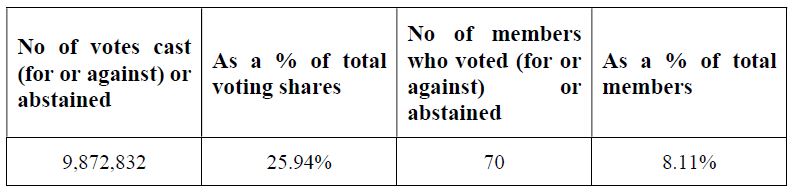
22 In Lion Nathan Limited (No. 2) [2009] FCA 1261 at [6] Emmett J noted that 64% of eligible shares had been represented and voted at the meeting in question in that case. In other cases lesser percentages of shares represented and voting at scheme meetings have been noted. For example, in Avoca Resources Limited [2011] FCA 208 at [25] Gilmour J noted a voter turnout of 72.38% of shares on issue with 11.49% of shareholders participating and in Auzex Resources Limited (No 2) [2012] QSC 101 at [18] Applegarth J noted a voter turnout of 42.3% of votes with 9.75% of persons participating. Notwithstanding that, the schemes in each case were approved. In Auzex Resources at [18] Applegarth J observed that although the percentages did not appear to be large, they were higher than the record of attendances at annual general meetings of the company.
23 While a low voter turnout percentage might suggest a flaw in the convening procedure which warrants further consideration, I was satisfied that was not the case here. WLS provided evidence of voter turnout at prior meetings, namely its 2021 and 2022 annual general meetings. That evidence disclosed that the voter turnout at those meetings was below the turnout for the Scheme meeting. In other words a low voter turnout seemed to be somewhat “usual” for WLS. In light of that and the evidence about dispatch of the Scheme Booklet I was satisfied that there was nothing to suggest that there had been any flaw in the procedure adopted to convene the Scheme meeting which would raise any concern.
24 Finally, WLS sought one alteration to the Scheme the subject of the Court’s approval, namely that the number of WLS shares on issue as at the “second court date”, as defined, being the date of the second court hearing, be included at cl 2.1(b). That number was the subject of evidence before me and I was satisfied that I could approve the Scheme subject to that alteration.
conclusion
25 For those reasons I made the orders sought by WLS at the second court hearing.
I certify that the preceding twenty-five (25) numbered paragraphs are a true copy of the Reasons for Judgment of the Honourable Justice Markovic. |
Associate:


