

FEDERAL COURT OF AUSTRALIA
Richards v Han [2022] FCA 1539
File number(s): | ACD 71 of 2019 ACD 89 of 2019 |
Judgment of: | HALLEY J |
Date of judgment: | |
Catchwords: | CONTRACT – where contractual claims advanced by applicant in Proceedings ACD 89 of 2019 (Shareholding Proceedings) turn on alleged oral contract with express term to the effect that applicant would receive a 3% equity share in a company to be listed on a stock exchange to operate a business described as an “e-commerce and retail business” (Shareholding Contract) – whether there was any agreement that applicant would receive a 3% share of any other e-commerce and retail business – whether Shareholding Contract extended to the listing of any company on any stock exchange other than the ASX – whether there was any variation to the Shareholding Contract – whether there was a repudiation of the Shareholding Contract by first respondent – where no repudiation nor breach established and Shareholding Contract found to be abandoned or discharged by agreement CONSUMER LAW – where applicant alleges that first respondent engaged in conduct that was misleading or deceptive in contravention of s 18 of Australian Consumer Law (ACL) or unconscionable conduct in contravention of ss 21 and 22 of ACL by allowing applicant to waive payments due to Web and Software Angels Pty Ltd, perform services for no charge and pay expenses in return for receiving a 3% share of company to be listed on a stock exchange (Stock Exchange Listing) in circumstances where first respondent had no intention of allocating a 3% share to applicant – where question of whether applicant has suffered loss or damage by reason of his ACL claims does not arise – where ACL claims dismissed RESTITUTION – where applicant presses a quantum meruit claim in the Shareholding Proceedings for work he performed in relation to the Stock Exchange Listing – where applicant presses a quantum meruit claim in Proceedings ACD 71 of 2019 (Lindeman Island Proceedings) for work that he undertook at request of first respondent in relation to the development by second respondent of three tourist resorts on Lindeman Island – where applicant established an entitlement to be paid an amount by way of a quantum meruit in the Lindeman Island Proceedings but only for his work as a project manager of the Lindeman Island development |
Legislation: | Competition and Consumer Act 2010 (Cth) Schedule 2 (Australian Consumer Law) ss 18, 21, 22, 236 Corporations Act 2001 (Cth) ss 131 Trade Practices Act 1974 (Cth) s 82 Legal Profession (Barristers) Rules 2021 (ACT) |
Cases cited: | Abadeen Group Pty Ltd v Bluestone Property Services Pty Ltd [2009] NSWCA 386; (2009) 14 BPR 27 ACN 070 037 599 Pty Ltd v Larvik Pty Ltd [2008] QCA 416 Arcaba v K&K Real Estate Pty Limited [2016] NSWSC 1793 Australian Competition and Consumer Commission v TPG Internet Pty Ltd (2013) 250 CLR 640; [2013] HCA 54 Australian Competition and Consumer Commission v TPG Internet Pty Ltd (2020) 278 FCR 450; [2020] FCAFC 130 Australian Woollen Mills Pty Ltd v The Commonwealth (1954) 92 CLR 424; [1954] HCA 20 Bond Corporation Pty Ltd v Thiess Contractors Pty Ltd and Others (1987) 14 FCR 215 Botros v Freedom Homes Pty Ltd [2000] 2 Qd R 377 Brambles Holdings Ltd v Bathurst City Council (2001) 53 NSWLR 153; [2001] NSWCA 61 Brendan Wilfred King v Robert Lawrence Adams [2016] NSWSC 1798 Brenner and Another v First Artists’ Management Pty. Ltd. and Another [1993] 2 VR 221 Butcher and Another v Lachlan Elder Realty Pty Limited (2004) 218 CLR 592; [2004] HCA 60 Campomar Sociedad, Limitada and Another v Nike International Limited and Another (2000) 202 CLR 45; [2000] HCA 12 Cellarit Pty Ltd v Cawarrah Holdings Pty Ltd [2018] NSWCA 213 Colin R Price & Associates Pty Ltd v Four Oaks Pty Ltd (2017) FCFCA 75 Commonwealth v Amann Aviation Pty Ltd (1991) 174 CLR 64; [1991] HCA 54 Damberg v Damberg and Others (2001) 52 NSWLR 492; [2001] NSWCA 87 Darkinjung Local Aboriginal Land Council v Darkinjung Pty Ltd (In Liq) [2010] NSWCA 351 Diransson Pty Ltd v Hassan El Dirani [2019] NSWSC 617 Equuscorp Pty Ltd v Haxton (2012) 246 CLR 498; [2012] HCA 7 Flexopack S.A. Plastics Industry v Flexopack Australia Pty Ltd [2016] FCA 235 Global Sportsman Pty Ltd v Mirror Newspapers Pty Ltd (1984) 2 FCR 82 Google Inc v Australian Competition and Consumer Commission (2013) 249 CLR 435; [2013] HCA 1 In the matter of JSMOT Pty Limited [2019] NSWSC 1184 John Holland Pty Ltd v Kellogg Brown & Root Pty Ltd [2015] NSWSC 451 Jones v Dunkel and Another (1959) 101 CLR 298; [1959] HCA 8 Lewis v Lewis [2022] QSC 208 Lumbers and Another v W Cook Builders Pty Ltd (in liquidation) (2008) 232 CLR 635; [2008] HCA 27 Mann and Another v Paterson Constructions Pty Limited (2019) 267 CLR 560; [2019] HCA 32 Melbourne Stadiums Ltd v Sautner (2015) 229 FCR 221; [2015] FCAFC 20 Millars’ Karri and Jarrah Co v Weddel, Turner & Co (1908) 14 Com Cas 25 Mushroom Composters Pty Ltd v IS & DE Robertson Pty Ltd [2015] NSWCA 1 Northside Developments Proprietary Limited v Registrar-General and Others (1990) 170 CLR 146; [1990] HCA 32 Nuhic v Rail & Road Excavations and Others [1972] 1 NSWLR 204 Pavey & Matthews Proprietary Limited v Paul (1986) 162 CLR 221; [1987] HCA 5 Peet Ltd and Others v Richmond (2011) 33 VLR 465 Quarante Pty Ltd v Owners Strata Plan No. 67212 [2008] NSWCA 258 Riverside Motors Pty. Ltd. v Abrahams [1945] VLR 45 Robinson v Harman (1848) 1 Exch 850 Sellars v Adelaide Petroleum NL (1994) 179 CLR 332; [1994] HCA 4 Shepherd v Felt & Textiles of Australia Ltd (1931) 45 CLR 359; [1931] HCA 21 Shevill v Builders Licensing Board (1982) 149 CLR 620; [1982] HCA 47 Sparway Pty Ltd v Lakkis [2017] NSWSC 1465 Taco Company of Australia Inc and Another v Taco Bell Pty Ltd and Others (1982) 42 ALR 177 Trimis v Mina (1999) 16 BCL 288 Way v Latilla [1937] 3 All ER 759 Wilson Pastoral International Pty Ltd v George Street Steel Pty Ltd [2020] SASCFC 54 |
Division: | General Division |
Registry: | New South Wales |
National Practice Area: | Commercial and Corporations |
Sub-area: | Commercial Contracts, Banking, Finance and Insurance |
Number of paragraphs: | |
Solicitor for the Applicant: | Bradley Allen Love Lawyers |
Counsel for the Respondents: | Mr MA Karam with Mr QM Noakhtar |
Solicitor for the Respondents: | McInnes Wilson Lawyers |
ORDERS
ACD 89 of 2019 | ||
Applicant | ||
AND: | First Respondent WHITE HORSE AUSTRALIA LINDEMAN PTY LTD ACN 152 242 610 Second Respondent | |
DATE OF ORDER: | 19 December 2022 |
THE COURT NOTES THAT:
1. The applicant informed the Court at the commencement of Day 5 of the hearing of the proceedings that he will disclose to the Bar Association of the Australian Capital Territory a copy of the Court’s judgment and reasons in these proceedings immediately after they have been handed down.
THE COURT ORDERS THAT:
2. The parties provide agreed draft orders, including as to costs, to give effect to the reasons for judgment delivered today and, in default of agreement, each party file and serve written submissions (limited to 5 pages), draft orders, including as to costs, they propose should be made, and any affidavit evidence in support of those orders on or before 4.00pm on Friday, 23 December 2022.
3. In the absence of any request for an oral hearing, any dispute as to the orders to be made to give effect to these reasons for judgment will be determined on the papers.
Note: Entry of orders is dealt with in Rule 39.32 of the Federal Court Rules 2011.
HALLEY J:
INTRODUCTION
1 In two related proceedings before this Court, the applicant, Mr Richards, seeks to recover damages and compensation from the first respondent, Mr Han, and related companies, in connection with the proposed float of an “e-commerce and retail business” (Shareholding Proceedings) and a proposed development of a resort on Lindeman Island (Lindeman Island Proceedings).
2 The various claims advanced by Mr Richards in the Shareholding Proceedings turn in large measure on alleged oral representations made to him by Mr Han to the effect that Mr Richards would receive a 3% equity share in a company to be listed on a stock exchange to operate the alleged “e-commerce and retail business”.
3 The only claim pressed by Mr Richards in the Lindeman Island Proceedings is a quantum meruit claim for work that he alleges he undertook at the request of Mr Han in relation to the development by the second respondent in those proceedings, White Horse Australia Lindeman Pty Ltd (WHAL) of three tourist resorts on Lindeman Island (Lindeman Island development).
4 The principal issues that arise for determination in the Shareholding Proceedings are:
(a) what constituted the alleged “e-commerce and retail business”;
(b) was a contract formed in May 2016 between Mr Richards and Mr Han on behalf of the second respondent, White Horse Global Holdings Pty Limited (White Horse Global), in the terms alleged by Mr Richards (Shareholding Contract);
(c) was the Shareholding Contract subsequently varied in July 2017;
(d) did Mr Han repudiate the Shareholding Contract in 2019 by advising Mr Richards that he would receive shares to the value of between RMB500,000 and RMB1,000,000 in the alleged “e-commerce and retail business”, rather than 3% of the total shareholding of the alleged “e-commerce and retail business”;
(e) did Mr Han engage in conduct that was misleading or deceptive in contravention of s 18 of the Australian Consumer Law, which is Schedule 2 of the Competition and Consumer Act 2010 (Cth) (ACL) or that was unconscionable contrary to ss 21 and 22 of the ACL, by allowing Mr Richards to waive payments due to Web and Software Angels Pty Ltd ACN 117 660 214 (WSA), perform services for no charge and pay expenses in return for receiving a 3% share of the alleged “e-commerce and retail business” to be listed on a stock exchange (Stock Exchange Listing) in circumstances where he had no intention of allocating a 3% share to Mr Richards;
(f) if yes to either or both of (d) and (e), what damages are payable to Mr Richards by reason of that repudiation of the Shareholding Contract or conduct in contravention of the ACL; and
(g) in the alternative, is a quantum meruit claim available for Mr Richards for the work he performed in relation to the Stock Exchange Listing and, if so, what is the appropriate quantum of the award.
5 There is a significant controversy about the nature and extent of the “e-commerce and retail business” the subject of the Shareholding Proceedings. In the balance of these reasons I have referred to the e-commerce and retail business alleged by Mr Richards as the “e-commerce and retail business” and the e-commerce and retail business that I have concluded was the subject of the 3% shareholding arrangement between Mr Richards and Mr Han as the “E-Commerce and Retail Business”.
6 The only issue that remains for determination in the Lindeman Island Proceedings is whether a quantum meruit claim is available to Mr Richards for the work he performed in relation to the Lindeman Island development and, if so, what is the appropriate quantum of the award. The contractual and ACL claims previously advanced by Mr Richards in the Lindeman Island Proceedings were abandoned during the hearing.
7 For the reasons that follow, I have concluded that:
(a) Mr Richards has established an entitlement to be paid an amount by way of a quantum meruit in the Lindeman Island Proceedings but only for his work as a project manager of the Lindeman Island development; and
(b) all the claims advanced by Mr Richards in the Shareholding Proceedings must fail.
BACKGROUND
Introduction
8 The necessary facts are set out below. They have been taken from contemporaneous business records, uncontested evidence given by Mr Richards and Mr Han that is consistent with the apparent logic of events and from admissions against interest made by Mr Richards or Mr Han in their affidavit evidence and in the course of their respective cross examinations.
Mr Richards
9 Mr Richards is the applicant in both the Shareholding Proceedings and the Lindeman Island Proceedings (together, the Proceedings). He is a barrister practising in Canberra and a senior lecturer in law at the Australian National University. At all material times he was a director of WSA.
10 Mr Richards was a director of White Horse Global, the second respondent in the Shareholding Proceedings, between 30 June 2016 and 16 October 2019.
11 In the period from approximately 25 October 2017 to 16 October 2019, Mr Richards was a director of the third to the eighth, tenth and eleventh respondents in the Shareholding Proceedings (White Horse Australian Companies). He had also alleged that he was a director of the ninth respondent but this was denied by the respondents. The company search in evidence for the ninth respondent did not identify Mr Richards as a present nor former director of the company. I have therefore proceeded on the basis that Mr Richards’ contentions do not extend to the ninth respondent and as indicated above “White Horse Australian Companies”, does not include the ninth respondent.
12 Mr Richards was a director of WHAL, the second respondent in the Lindeman Island Proceedings, in the period between 25 October 2017 and 8 October 2019.
Mr Han
13 Mr Han is the first respondent in both Proceedings. At all material times he has been a director and shareholder of White Horse Global and each of the White Horse Australian Companies. Mr Han is also a director and shareholder of WHAL.
14 Mr Han is a company director and a resident of Guangzhou, China. He is involved with numerous projects and business ventures operated by various entities under the umbrella description of “White Horse” and the “White Horse Group”. White Horse was originally established as an “advertising agency” in 1986 and later grew into a full service advertising agency before developing in its second phase into a “media company”. It presently has interests in advertising, a golf television channel, a shopping television channel and several real estate projects. It has approximately 2,300 employees.
Initial meetings between Mr Richards and Mr Han
15 Mr Richards first met Mr Han on or about 22 June 2015 whilst on a trade mission in China.
16 In late June 2015, Mr Richards emailed Mr Han expressing his interest in establishing a business relationship whereby he and Mr Dawn could source Australian products for inclusion on the White Horse www.V.com.cn website (V.com) in China. At that time, V.com existed as an extension of a shopping channel business conducted by Mr Han. The website did not have any discrete tangible revenue stream.
Initial Stock Exchange Listing proposals
17 In or about early 2016 Mr Richards and Mr Han commenced discussions about the listing of a company on a stock exchange.
18 On 5 April 2016, Mr Richards and Mr Han attended a meeting in Hong Kong with CITIC CILSA, an Asian Investment Bank.
19 On 18 April 2016, Mr Richards sent an email to Mr Han which contained a link to the listing rules of the Australian Securities Exchange (ASX). Mr Richards had a discussion with Mr Han on the same day about a “possible listing” on a stock exchange.
20 On 19 April 2016, Mr Richards and Mr Han attended a meeting in Hong Kong with CITIC CISLA and another meeting with Stevenson Wong Lawyers, to discuss the possible float.
21 On 21 April 2016, Mr Richards sent an email to Mr Han in anticipation of a further meeting in Sydney on 26 April 2016. Mr Richards referred to the cost of getting to the “first stage” and explained that the “first stage” is “a meeting with the ASX to find out what they will need from us to approve the listing and to see if we should then proceed”.
22 On 22 April 2016, Mr Han sent Mr Richards the first of a series of emails attaching projections and budgets for the company that was proposed to be listed on the ASX. They included forecasts of significant revenue being derived from wine and juice sales (exceeding one billion dollars by 2018-2019), leading to very high forecast net profit figures, which in turn formed the basis for the proposed market capitalisation figures.
23 On 23 April 2016, Mr Richards sent Mr Han an email with the subject line “Proposal”. Mr Richards stated in the email that he was confirming what he had discussed “on the phone a few minutes ago” that:
(a) it was not possible for Mr Dawn and him to receive any commissions from the products “in relation to [their] original agreement” as the ASX will “not like it” and because Mr Dawn and he thought it was “not proper” if they were to be involved with the listed company;
(b) Mr Dawn and he would like to each have a 5% shareholding in the listed company and therefore if WSA gave up its 3% commission would Mr Han agree to increase his offer of 4% of the listed company to 10% to facilitate this; and
(c) for the purposes of the ASX listing and clarity it would be necessary for the WSA Agreement to be cancelled.
24 Mr Richards accepted that the arrangements set out in his email sent on 23 April 2016, including cancellation of the WSA Agreement, would only arise if a listing occurred. He also accepted that in the absence of any deed cancelling WSA’s entitlement to the 3% commission, WSA’s rights would continue and he was concerned to ensure that WSA would not give up its rights in the event that a listing may not occur.
25 On 26 April 2016, a further meeting occurred at King & Wood Mallesons (KWM). Later that day, Ms Shannon Finch of KWM sent an email providing some initial comments and additional information. This included reference to an engagement letter that focussed on the “next initial phase – i.e. up to and including a first meeting with ASX, to explore your proposal with them”.
26 On 27 April 2016, Mr Richards sent an email to KWM, copied to Mr Han and others, summarising various matters arising from the meeting the previous day. This included, in Section E, provision of a “clear business model as to what the new entity proposes to own” in China and Australia and “a budget and cash flow forecast that is transparent and reasonable”. It was contemplated that a report from Deloitte would be needed at the ASX meeting, but there is no evidence that any such report was obtained or relied upon at the later ASX meeting.
27 On 25 May 2016, Ms Finch confirmed, by email to a representative of the ASX, that the CEO of WSA, Mr Richards, would be available for a meeting on 3 June 2016 to discuss a “potential Chinese IPO”. It was also stated in this email that WSA “operates VChina Australia” and that the attendees would bring “some introductory materials” to explain the proposal.
Shareholding Contract
28 Mr Richards gave evidence that on or before 31 May 2016, he had a discussion with Mr Han in which Mr Han said words to the following effect:
I have talked to my brothers and I will give you and Steve each 3% of the float company.
29 Mr Han does not recall the discussion but does not dispute that he had agreed that Mr Richards would receive 3% of the float company if a listing was to proceed. I am satisfied that, in the light of any dispute as to this issue and the contemporaneous documents referred to below, a conversation did take place between Mr Richards and Mr Han to the effect of that given by Mr Richards in his evidence.
30 This conversation gave rise to what was referred to by Mr Richards in his submissions as the Shareholding Contract.
31 On 31 May 2016, Mr Richards and Mr Han exchanged a series of emails including:
(a) at 9.18am, an email sent by Mr Han to Mr Richards which attached a table setting out proposed profit, market capitalisation and shareholding details for the float company, including a 3% figure shareholding for Mr Richards;
(b) at 5.49pm, an email sent by Mr Han to Mr Richards which attached a revised table with increased figures;
(c) at 6.17pm, an email sent by Mr Han to Mr Richards which attached a spreadsheet with the final version of the income and profit for the financial years ending on 30 June 2017, 2018 and 2019 (Income and Profit forecast spreadsheet), reflecting those ultimately appearing in a document subsequently presented to the ASX on 3 June 2016. On a PE multiple of 20, these projections had the market capitalisation of the proposed float company by 2019 at 4.68 billion Australian dollars; and
(d) at 7.03pm, an email sent by Mr Richards to Mr Han with the subject “List Of Accounting Documents required” The documents included an “independent Valuation of the Assets of the Company” and a “full set of financial forecasts, at least for the first year”, done “to a standard satisfactory of an ASX public company”.
Penley Estate supply agreement
32 On 2 June 2016, the day before the meeting with the ASX meeting, a supply agreement between White Horse International Ltd and Penley Estate was executed. Clause 3.1(a) of this agreement provided for the supply and purchase of “not less than the Minimum Quantity of the Products”. Schedule 1 of this agreement provided for the Minimum Quantity, which in turn was set out in an attachment to the agreement. The agreed minimum quantities were 12,000 cases of wine in 2016/7, 24,000 cases in 2017/8 and 36,000 cases in 2018/9, with provision for volume of “50% above commitment”). Penley wines produced on average at this time a total of around 45-50,000 cases per year.
Presentation to the ASX
33 On 3 June 2016, Mr Richards attended a meeting with the ASX at which he presented a document with the title “White Horse, ASX Presentation, Friday 3rd of June 2016” (ASX written presentation). Mr Richards was accompanied by the following legal and corporate advisers: Ms Finch and Mr Chen from KWM, Mr Andrew Low, International Head Corporate Finance & Capital Markets, CITIC CISLA, Hong Kong, Mr Ashley Ozols, Corporate Finance and Capital Markets, CITIC CISLA, Sydney and Mr Johan Duivenvoorde, Consultant, Deloitte Sydney.
34 On 5 June 2016, Mr Richards received or sent the following emails commenting on the 3 June 2016 meeting with the ASX:
(a) an email from Mr Low in which he provided a draft report for Mr Han and in which he stated:
Their main concern (as we expected) is that the company is a start-up and has no profit track record. We noted that Deloitte will provide a Balance Sheet for the listed entity on 30th June and then again for the nearest balance date to the Prospectus being lodged.
(b) an email from Ms Finch in which she added to the above paragraph from Mr Low’s draft report to Mr Han, the following:
They also questioned the founders’ payment.
(c) an email from Mr Duivenvoorde in which he agreed that the draft report to Mr Han was a fair summary and stated:
At some stage we should work through what contracts are in place both on supply and distribution and how that might be the basis for a short term forecast.
35 There were no further meetings with the ASX to discuss the proposed listing.
36 On 27 June 2016, Mr Richards sent an email to Stephenson Wong in Hong Kong in which he explained that the “Other Shareholders” were receiving in aggregate a 6% share of the company to be floated because they had given up:
a contractual right, through a wholly owned entity, to receive 3% of the wholesale FOB price (the commission) of all products sold by White Horse for products sourced from Australia and New Zealand for a period of 3 years from 22 October 2015, and with commission payable for 8 years for any product introduced during the period of the contract.
Incorporation of White Horse Global
37 On 30 June 2016, White Horse Global was incorporated and both Mr Richards and Mr Han were appointed as directors.
Telephone conversation between Mr Richards and Mr Han on 22 July 2017
38 On 22 July 2017, Mr Richards and Mr Han had a telephone conversation in which it is common ground that Mr Han and Mr Richards agreed that Mr Richards would take over responsibility for progressing the Lindeman Island from Mr Paul Nyholt, the then current project manager of the development.
39 The contents of this conversation are otherwise substantially in dispute. I address the evidence and make findings as to what was said below in addressing the alleged variation to the Shareholding Contract and the quantum meruit claim in the Lindeman Island Proceedings.
Meeting in Guangzhou on 23 September 2017
40 On 23 September 2017, Mr Richards attended a meeting in Guangzhou with Mr Han and Mr Dawn. Mr Richards gave the following affidavit evidence concerning what was discussed in the course of that meeting:
Mr Richards: William, Lindeman is taking a lot more time that I thought it would. I have given up lots of Barrister work. And, it’s costing me a lot in expenses for travel for Lindeman on flights and hotels. Lindeman is a long way from Canberra and there are a lot of meetings in Queensland with Government. William, also Mr Mao should pay. I don’t even know him. William, I need something every month to get by.
Mr Dawn: William, how about David gets an expense payment each month.
Mr Richards: Steve and I have talked about it William and Steve agrees.
Mr Han: How much do you think Steve.
Mr Dawn: William, if David gets $10,000 a month for expenses, sometimes he will win and sometimes he will lose.
Mr Han: Okay, David you take $10,000 a month.
Mr Richards: Thanks William, that will make life easier for me.
Mr Han: We will make a lot of money together on Lindeman.
41 In the period between 27 November 2017 and 1 May 2019, Mr Richards submitted monthly invoices for $10,000 (plus GST) for travel expenses to Ms Anne Dawn. Ms Dawn was WHAL’s bookkeeper and paid WHAL’s accounts.
42 In the period from May 2019 to September 2019, Mr Richards submitted monthly invoices to Mr Dale, after Ms Dawn ceased to be WHAL’s bookkeeper in May 2019.
Shanghai Stock Exchange proposed listing
43 In mid-2018, some preliminary work was done on advancing the possibility of a listing of a White Horse Group company on the Shanghai Stock Exchange. The preliminary work included the preparation of a document entitled “Basic Data List Task Allocation” (Shanghai Task Allocation Document) where various tasks were allocated to different individuals, including Mr Richards. There was no evidence, however, that any meaningful steps were taken to advance any listing in this period of any White Horse Group company on the Shanghai Stock Exchange (or at any later time).
White Horse Cash & Carry China
44 In late 2018, it appears that Mr Richards procured a letter from Mr Han’s assistant which was used for a finance application in relation to Lindeman Island. It is stated in this letter, among other matters, that “White Horse Cash & Carry China” was “expected to be listed on the Hong Kong stock exchange in 2019”.
45 Around the same time, Mr Richards drafted two deeds recording arrangements between Mr Dawn and Han regarding payments by Mr Dawn for a 3% shareholding in “White Horse Cash & Carry”. These deeds record that Mr Dawn paid a sum exceeding $500,000 for the shares (confirmed by Mr Han in evidence to have been paid) and made a repayment of a debt owed by White Horse to Penley Estate in the sum of $200,000 said to have been paid in July 2017. Despite drafting these documents, there is no evidence that Mr Richards asserted any similar interest in the venture at that time.
Invoices sent by Mr Richards to Mr Dale in July 2019
46 On 4 July 2019, Mr Richards received an email from Mr Dale attaching a proposed minute of a board meeting of White Horse Global with a solvency resolution.
47 On 5 July 2019, Mr Richards sent Mr Dale an email attaching two invoices each in the sum of $400,000 plus GST.
Telephone conversation between Mr Richards and Mr Han on 5 September 2019
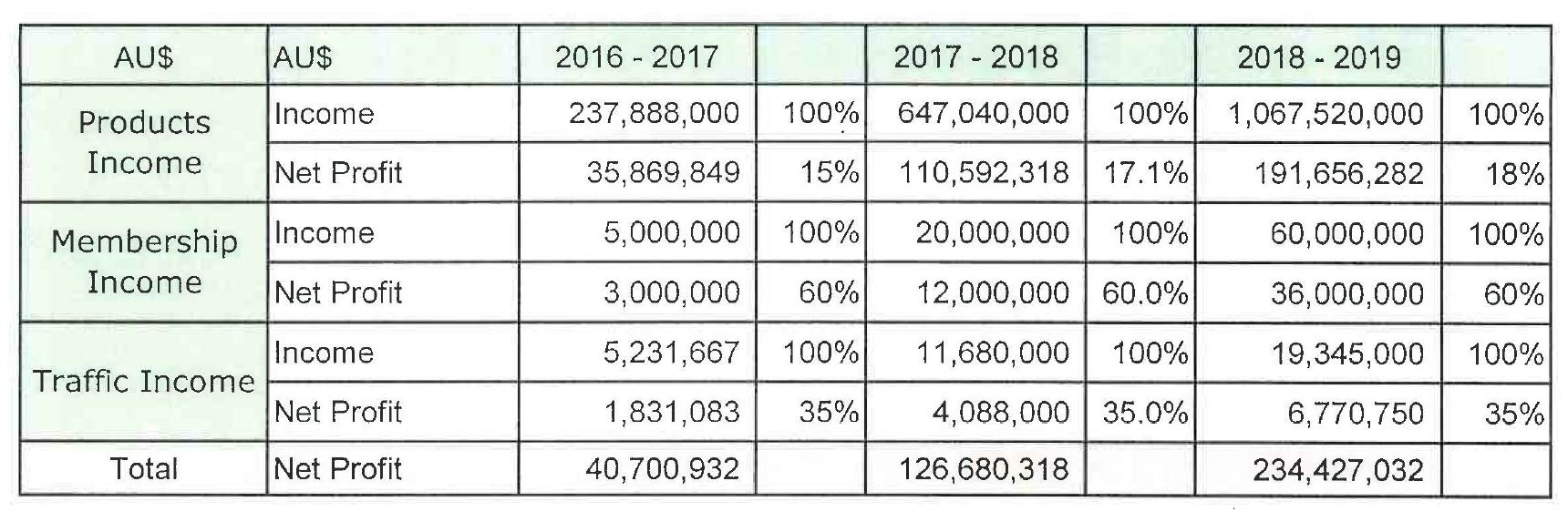
48 On 5 September 2019, Mr Richards had a telephone conversation with Mr Han. This conversation heralded the end of the commercial relationship between Mr Richards and Mr Han. I return to the specific content and ramifications of this conversation later in these reasons.
Letters of demand in October 2019
49 On 2 October 2019, Mr Richards sent an email to Mr Dale withdrawing his July 2019 invoices and resubmitting new invoices addressed to WHAL, rather than White Horse Global for his work in relation to the Lindeman Island development.
50 On 3 October 2019, Mr Richards issued a letter to Mr Han and the other directors of WHAL questioning the solvency of the company and without prejudice letters of demand on his letterhead as a barrister in relation to the matters the subject of each of the Proceedings.
51 On 8 October 2019, Mr Han sent an email to Mr Richards confirming that his invoices would not be paid as he had “canceled [sic] this arrangement with you when I spoke to you last month on Thursday 5th”.
No listing of any White Horse Group company on any stock exchange
52 It is common ground that there has not been any listing of the E-Commerce and Retail Business or any other White Horse Group e-commerce and retail business on the Shanghai Stock Exchange, or any other stock or securities exchange.
53 Mr Han gave evidence that he does not intend to float any e-commerce and retail business type company because he no longer considers that it would be viable. He stated that this was due to the poor performance of the “importing” business and significantly changed geo-political circumstances since early 2020.
EVIDENCE
Mr Richards’ witnesses
Mr Richards
54 Mr Richards affirmed eight affidavits in the proceedings. He was extensively cross-examined in person on those affidavits and related issues.
55 Mr Richards was not an impressive witness. His contemporaneous email communications raised significant credit issues. His ready concessions in cross-examination when confronted with implausible claims that he had advanced in his email communications with Mr Han and others only raised even greater concerns about how the false representations could have been advanced in the first place.
56 His affidavit evidence required careful scrutiny. He gave evidence that he had developed properties profitably and incurred extensive travel costs but ultimately conceded the properties were all developed at a loss and someone else had paid for the travel, either directly or with frequent flyer points. His claims in cross-examination that material parts of his emails and affidavits on which he was challenged were “badly worded”, might be plausible with respect to his emails but given his experience as a barrister and law lecturer they are difficult to accept with his affidavit evidence. This was demonstrated by his claim in his affidavit affirmed on 24 February 2021 that on the first occasion that he met Mr Han, on 22 June 2015, they had reached an agreement in principle to continue discussions with the view to him having an interest in the E-Commerce and Retail Business. When cross-examined on this claim, Mr Richards stated that this was intended to be a reference to a contract to supply goods from Australia into China and the affidavit was “[b]adly worded”.
57 Three matters were particularly concerning.
58 First, Mr Richards’ advanced claims, which were subsequently abandoned on Day 5 of the Hearing, that he had undertaken significant amounts of legal work for Mr Han and acted as an in-house counsel for companies within the White Horse Group. Mr Richards claimed that he had provided legal services as valuable consideration to support his contractual claims and in the alternative that he had a quantum meruit claim in respect of the legal services he provided to Mr Han and the companies within the White Horse Group. These claims were advanced notwithstanding that his practising certificate was governed by the Legal Profession (Barristers) Rules 2021 (ACT) and did not appear, or at least was not submitted by Mr Richards, to permit him to provide such legal services.
59 Second, the decision by Mr Richards, after his commercial relationship with Mr Han soured in October 2019, to send Mr Han two letters of demand on his letterhead as a barrister.
60 In his first letter, Mr Richards alleged breaches of contract by Mr Han, claimed that the value in 2019 of his 3% shareholding interest in the company proposed to be floated was estimated at $140 million, foreshadowed an application for freezing orders over Mr Han’s assets in Australia and stated that if he did not receive a “reasonable response” to the letter within 14 days he intended to commence proceedings in the Supreme Court of the Australian Capital Territory.
61 In his second letter, Mr Richards demanded payment of an alleged outstanding sum of $874,358 in relation to his work on the Lindeman Island development and stated if he did not receive payment of that amount (plus GST) within 14 days or a “reasonable response” he intended to issue proceedings against WHAL in the Supreme Court of the Australian Capital Territory and, given his alleged interest in a Queensland Government Perpetual Lease, he intended to lodge a caveat on the title of the property the subject of that lease.
62 Third, in an apparent response to an email request at 2.18 pm on 4 July 2019 for a director’s declaration of solvency sent by Mr Dale, the accountant for White Horse Global, Mr Richards emailed Mr Dale at 1.58 am on 5 July 2019, attaching an invoice addressed to WHAL on his barrister letterhead for $400,000 (plus GST) with the description “Admin and Management Lindeman Island October 2017 to October 2018 - $400,000”.
63 The email sent by Mr Richards at 1.58 am contained the following assertions made by Mr Richards to Mr Dale:
I was engaged as the Australian Manager for White Horse in September 2017. I took over from Paul Nyholt who was paid $200,000 P/a plus bonuses of $200,000 p/a. … Although the annual contract fee was substantially less than my usual hourly//daily fee, I met with William Han in Guangzhou in September 2017 and he agreed to pay me $400,000 p/a plus GST per annum, but only payable when the financing, construction commenced, or when the land was sold. Again, my fee was agreed to be paid upon the construction of the new resort, or upon financing, or upon the sale of the island. … I am happy to await for the sale of the island, but believe that my fees should be paid as I have discharged my responsibility and should be paid immediately. Please be aware that my fees are ongoing and I expect to be paid upon the sale or financing the project. Eg, if the property is sold in December 2019, I expect to be paid until December 2019.
I attach my Fee notes and look forward to the payment of my invoices in due course.
64 Mr Richards agreed that the contents of this covering email were “absolutely incorrect”. Mr Richards gave evidence of speaking with Mr Dale the following day about these invoices and states that “he did not press for them to be paid”. Mr Dale said that he did not on-send the email “at that time as David requested me not to”.
65 Later that morning on 5 July 2019, he asked Mr Dale not to pass the invoice on to Mr Han and then at 4.53 pm that afternoon he emailed Mr Dale and requested that he confirm that WHAL was solvent. The following explanation that Mr Richards gave in cross-examination for sending the invoice and then asking for it not to be passed on to Mr Han, only served to exacerbate my concerns about Mr Richards’ credibility and the manner in which he conducted himself in his commercial activities:
The explanation I think I heard from you didn’t seem to make its way into the transcript of yesterday, but - - -?---Are you asking me the explanation now?
Yes?---I just had a very long phone call with Steve Dorne [sic] where he was asking for money for things. I was very stressed about Lindeman Island because I was having to chase money all the time and I was being chased by creditors. I had had several glasses of wine while I was talking to Steve Dorne [sic], and I sent that email and woke up in the morning and realised what I had sent and rang Mr Dale straightaway.
So that’s two instances where you’ve – you would agree that you’ve asserted in corporate information agreements with Mr Han that were incorrect; correct?---Yes.
66 The second of the “instances” referred to in Mr Richards’ response extracted above was several revised invoices that Mr Richards emailed to Mr Dale in October 2019.
67 On 2 October 2019, Mr Richards sent an email to Mr Dale at midday in which he stated:
I refer to my invoices numbers 2683 and 2684 sent to you in my email dated 5 July 2018. I advise that I withdraw these invoices and attach the following invoices …
68 Three invoices were attached to the email, each was on Mr Richards’ letterhead as a barrister and addressed to WHAL, rather than White Horse Global. The description of the work in each invoice was simply stated to be “Management Lindeman Island” and then a date range. Invoices 2767 and 2768 were each in an amount of $440,000 (inclusive of GST) and were stated to be for the periods 22 July 2017 to 21 July 2018 and 22 July 2018 to 21 July 2019, respectively. Invoice 2769 was stated to be for the period 22 July 2019 to 3 December 2019 and was in the amount of $155,126.40 (inclusive of GST). The basis on which Mr Richards considered that he was entitled to send an invoice on his letterhead as a barrister on 3 October 2019 for a period from 22 July 2019 to 3 December 2019 was not explained.
69 Mr Richards also stated in his email to Mr Dale that if he did not receive payment by 17 October 2018 [sic] for the invoices numbered 2767 and 2768, each in the amount of $440,000 (including GST), he intended to take action against WHAL “without further notice”.
70 In response to a question from the Court, Mr Richards confirmed that these invoices had “no legal basis”. He said that the purpose of rendering these invoices to the company was “to hopefully enter into negotiations and to get out of Lindeman Island and be done with it”. Further, despite saying in evidence that the threat was not genuine, Mr Richards commenced the Lindeman Island Proceedings in the same month that the invoices were rendered.
71 Each of these three matters demonstrated a cavalier and aggressive willingness by Mr Richards to use his professional status as a barrister to advance his commercial interests. Making claims for the payment of money on a barrister’s letterhead, which were known not to have a legal basis, for the purpose of achieving a satisfactory commercial resolution reflects very poorly on Mr Richards’ credit and significantly diminishes the weight that I can give to Mr Richards’ evidence except to the extent that it is corroborated by other evidence or is against interest.
Mr Fardell
72 Mr Michael Fardell is a director of Screencraft Media Pty Ltd, a video production company based in the Australian Capital Territory. He affirmed an affidavit in the Shareholder Proceedings on 26 February 2021. He was not cross-examined.
73 Mr Fardell gave evidence of his meetings and discussions with Mr Han, Mr Richards and Mr Steve Dawn, together at some times with also Mr Dawn’s wife, Ms Anne Dawn and the Dawns’ son, concerning proposals to promote the sale of Australian products on the V platform for delivery into homes in China and the promotional videos that he made to assist in the marketing of these products. He also gave evidence of his involvement in the preparation of a document presented to the ASX on 3 June 2016 by Mr Richards to explain the proposed listing of the E-Commerce and Retail Business and his acquisition and subsequent disposal of a 5% shareholding in WSA.
Mr Armstrong
74 Mr Michael Armstrong is the General Manager of the winemaker, Penley Estate. He gave oral evidence in chief pursuant to a subpoena to attend issued at the request of Mr Richards. He was cross-examined.
75 Mr Armstrong was an impressive witness. He answered all questions directly, succinctly and without hesitation. I had no reason to doubt that he was giving evidence truthfully and to the best of his recollection.
76 He gave evidence of the contractual arrangements that Penley Estate had entered into with White Horse companies, the quantities of wine delivered pursuant to those arrangements and meetings and discussions that he had attended or had with Mr Richards, Mr Han, Mr Calvin Han (Mr Han’s son) and Mr Dawn.
Mr Dale
77 Mr John Dale is an accountant. In or about October 2017, Mr Dale was appointed as the accountant of the White Horse Australian companies.
78 Mr Dale attended the hearing pursuant to a subpoena to attend issued at the request of Mr Richards in order to verify a statement in chief that had been prepared for him and on which he had made handwritten annotations. He was not cross-examined.
79 Mr Dale’s statement was principally directed at his involvement with the payment of the monthly expenses for WHAL, including payments to Mr Richards, and communications that he had with Mr Richards about the solvency of WHAL from the middle of 2019.
Ms Dawn
80 Ms Anne Dawn was a former bookkeeper and accounts clerk for a number of companies including WHAL. She gave oral evidence in chief pursuant to a subpoena to attend issued at the request of Mr Richards. She was not cross-examined.
81 Ms Dawn gave evidence of the services that she undertook for WHAL at Mr Richards’ request in an eighteen month period commencing, to the best of her recollection, towards the end of 2017. The services that she provided included the payment of invoices and the preparation of monthly income and expenditure statements that she forwarded to Mr Han.
82 I was satisfied that Ms Dawn answered all questions asked of her truthfully and to the best of her recollection. I did not have any reservations about accepting her evidence.
Mr Sykes
83 Mr Andrew Sykes is a partner of RSM Australia Partners and a Director of its Business Advisory Division. He is a chartered accountant with over 20 years’ experience advising on taxation and financial affairs. He prepared a principal and supplementary expert report in each proceeding.
84 Mr Sykes was instructed to provide an expert report in the Shareholding Proceedings that assisted the Court in determining a reasonable remuneration for the services provided by Mr Richards to the respondents in the period between 17 July 2015 and 8 October 2019 on a salary basis and a reasonable value range for the 3% shareholding alleged by Mr Richards in the company to be floated to operate the E-Commerce and Retail Business, as at 5 September 2019.
85 Mr Sykes was instructed to provide an expert report in the Lindeman Island Proceedings to assist the Court in determining a reasonable remuneration for the work undertaken by Mr Richards in relation to the Lindeman Island development between 22 July 2017 and 8 October 2019. He was instructed to make that determination on a salary basis and to assess the impact of the development approvals obtained by Mr Richards on the value of the Lindeman Island development and on that basis determine a reasonable remuneration that a person in Mr Richards’ position might have expected to receive if the development had proceeded and made a profit.
86 Mr Sykes was cross-examined in person at the hearing. I was satisfied that Mr Sykes was answering the questions that were put to him truthfully and to the best of his knowledge.
87 The reports prepared by Mr Sykes were necessarily dependent upon the relatively general assumptions that he was asked to make and the documents, including an affidavit of Mr Richards, with which he was provided. Ultimately, however, I found his evidence of little assistance for the reasons that I expand upon below.
Respondents’ witnesses
Mr Han
88 Mr Han affirmed two affidavits in the Proceedings on 28 July 2021 and 11 October 2021. He was extensively cross-examined by video link on those affidavits with the assistance of an interpreter.
89 Even after making allowances for Mr Han’s lack English fluency and the difficulties of cross-examining a witness by video link with the assistance of an interpreter, it was readily apparent that Mr Han was combative, found giving evidence a confronting exercise, was inclined to express matters in absolute terms, was prone to exaggeration and appeared to have a somewhat incomplete and limited recollection of his dealings with Mr Richards.
90 Nevertheless, I was satisfied that he was doing his best to answer questions to the best of his recollection and the generality and imprecision in much of his evidence was a result of his practice of rarely reading documents, his reliance on others to read documents and then bring matters to his attention orally and his very strong preference to speak with people on business matters rather than exchange written communications.
91 I was therefore cautious in accepting his evidence on matters of detail in the absence of independent corroboration or with respect to matters against interest. I was much less concerned with and largely accepted his evidence of his general practice and approach to his pursuit of commercial and business ventures.
Mr Dransfield
92 Mr Dean Dransfield is a chartered accountant and a former registered liquidator. Since August 1995 he has been the managing director of Dransfield Hotels & Resorts (formerly D. A. Dransfield & Co), a specialist consulting and property practice providing advice to participants in the tourism and hospitality industries. He was retained by the respondents to prepare an expert report in response to the report that Mr Sykes prepared in the Lindeman Island Proceedings.
93 In his report dated 18 February 2022, Mr Dransfield concluded that the Lindeman Island development approved in the development application was not feasible and that the assumptions as to the initial sale strategy, sales value, operating revenues, capital and operating cost and funding adopted by Mr Richards in the feasibilities that he prepared did not appear reasonable. Mr Dransfield also gave evidence that statements made by Mr Sykes in his report concerning feasibility, residual land value and profitability were incorrect.
94 Mr Dransfield was cross-examined in person at the hearing. I was satisfied that Mr Dransfield was answering the questions that were put to him truthfully and to the best of his knowledge.
95 Given the extent of his specialised knowledge in the tourism and hospitality industries and the focused nature of the reasoning in his report, I found Mr Dransfield’s evidence useful in determining the objective value of the services provided by Mr Richards in relation to the Lindeman Island development.
CONTRACTUAL CLAIMS
What is the pleaded Shareholding Contract?
96 Mr Richards alleges that on or about 31 May 2016, he and Mr Han entered into the Shareholding Contract in the course of a telephone conversation. He alleges that it was an express term of the Shareholding Contract that he would receive 3% of the total shareholding of the E-Commerce and Retail Business to be listed on a stock exchange, in consideration for:
(a) Mr Richards, as a director of WSA, waiving the rights of that company to receive payments under its contract with Mr Han dated 22 October 2015;
(b) Mr Richards being appointed as a director of the company proposed to be incorporated for the listing of the E-Commerce and Retail Business (namely White Horse Global), including the management of its business and finances;
(c) Mr Richards being appointed in-house counsel, for and providing legal services to the White Horse International companies, including White Horse Global and the listing of the E-Commerce and Retail Business on a stock exchange;
(d) Mr Richards providing his services for no remuneration; and
(e) Mr Richards paying his own expenses, including office expenses in Australia and travel and accommodation expenses both within and outside Australia.
Legal Principles
Formation of contract
97 The principles governing proof of the existence of a binding oral agreement are well established and can be summarised as follows:
(a) a binding agreement is made where a reasonable person would believe that, based on their words and behaviour, the parties intended that a contract be formed: John Holland Pty Ltd v Kellogg Brown & Root Pty Ltd [2015] NSWSC 451 (Holland) at [93]-[94] (Hammerschlag J);
(b) the test is an objective one, which in most cases can be administered by determining whether there has been an offer by one party to be bound on certain terms accompanied by an unqualified acceptance of that offer communicated by the other party to the offeror: Holland at [93]-[94]; Australian Woollen Mills Pty Ltd v The Commonwealth (1954) 92 CLR 424; [1954] HCA 20, 457;
(c) consideration of surrounding circumstances and post contractual conduct is permissible when the existence or terms of an oral contract are in issue: Brendan Wilfred King v Robert Lawrence Adams [2016] NSWSC 1798, [63] (Sackar J);
(d) the conduct of the parties must be “capable of proving all the essential elements of an express contract”: Brambles Holdings Ltd v Bathurst City Council (2001) 53 NSWLR 153; [2001] NSWCA 61 (Heydon JA, as his Honour then was);
(e) where it is alleged that a binding agreement was reached during the course of a specific conversation, the Court must be persuaded that the parties intended to be bound by a contract on the terms alleged “in the course of the discussion”: Sparway Pty Ltd v Lakkis [2017] NSWSC 1465 at [55]-[67] (Darke J);
(f) in the absence of any reasonably contemporaneous memorandum or other record of the agreement, the plaintiff’s credibility in terms of both his truthfulness and reliability become a central issue in the proceedings: Arcaba v K&K Real Estate Pty Limited [2016] NSWSC 1793 (Arcaba) at [91] (Hall J);
(g) in cases where a party seeks to rely upon spoken words to show the existence of a contract, the Court must feel an “actual persuasion” of the occurrence or existence of the contract: Holland at [94] (Hammerschlag J); Diransson Pty Ltd v Hassan El Dirani [2019] NSWSC 617 (Diransson) at [465] (Sackar J);
(h) when considering conflicting accounts of events that occurred well in the past, it is pertinent to bear in mind that “with every day that passes the memory becomes fainter and the imagination becomes more active”: Lewis v Lewis [2022] QSC 208 at [176] quoting White AJA in ACN 070 037 599 Pty Ltd v Larvik Pty Ltd [2008] QCA 416 at [6]; and
(i) absent some objective and contemporaneous support, the alleged reiteration many years after the event of verbal exchanges which are said to consummate contractual relations and/or alternatively induced a particular form of conduct, are often difficult to prove: Diransson at [463] (Sackar J).
98 The following additional relevant principles emerge from Mushroom Composters Pty Ltd v IS & DE Robertson Pty Ltd [2015] NSWCA 1 at [59]-[64]:
(a) an agreement that is incomplete will not give rise to an enforceable contract;
(b) an alleged contract will fail for incompleteness if, even though the parties have used clear language, a term which is regarded as essential as a matter of law has not been agreed;
(c) if the parties have not agreed on all essential terms, for example because they have left on such term to be settled by future agreement, the contract is incomplete no matter what the parties themselves may think; and
(d) if the parties have not reached consensus on the essential terms of the contract, there will be no binding contract notwithstanding that one of the parties has commenced work referable to the agreement.
Variation and Repudiation
99 Contractual variation requires mutual intention to vary the existing contractual terms and consideration. Consideration can be found in the mutual abandonment of existing rights, the conferment of new benefits by each party on the other, or the incurring of liability to an increased detriment: Cellarit Pty Ltd v Cawarrah Holdings Pty Ltd [2018] NSWCA 213 at [231].
100 Where there is a valid and binding contract, the contract can be repudiated if one party evidences an intention no longer to be bound by it or by showing that the party intends to fulfil the contract only in a manner substantially inconsistent with their obligations and not in any other way: Shevill v Builders Licensing Board (1982) 149 CLR 620, 625-7.
101 Circumstantial inference may be employed to demonstrate repudiation, including the frequency of the breach and the likelihood of future breach: Millars’ Karri and Jarrah Co v Weddel, Turner & Co (1908) 14 Com Cas 25, 29 (Bigham J).
102 Refusal to perform the contract on the basis of an incorrect interpretation of the contract may amount to a repudiation, indeed a “contracting party is not entitled unilaterally to impose on the other party conditions of a kind for which there is no contractual warrant or authority”: Botros v Freedom Homes Pty Ltd [2000] 2 Qd R 377, 379.
103 A contract is at an end when the innocent party elects to accept the repudiation: Shepherd v Felt & Textiles of Australia Ltd (1931) 45 CLR 359; [1931] HCA 21; Melbourne Stadiums Ltd v Sautner (2015) 229 FCR 221; [2015] FCAFC 20.
Damages
104 It is well-established that damages for breach of contract are compensatory and awarded to place, to the extent possible, the injured party in the same situation as if the contract had been performed: Robinson v Harman (1848) 1 Exch 850.
105 An applicant must prove, on the balance of probabilities, that their expectation of a certain outcome, as a result of performance of the contract, had a likelihood of attainment rather than being mere expectation: Commonwealth v Amann Aviation Pty Ltd (1991) 174 CLR 64; [1991] HCA 54, 80 (Mason CJ and Dawson J).
106 Where damages are claimed for loss of opportunity, the issues of causation and whether an applicant has suffered some loss will need to be established on the balance of probabilities and that the contravening conduct caused the loss of a commercial opportunity that had some value (not being a negligible value) and then the value of that loss then is to be quantified by reference to the degree of probabilities or possibilities: Sellars v Adelaide Petroleum NL (1994) 179 CLR 332; [1994] HCA 4 at 355 (Mason CJ, Dawson, Toohey and Gaudron JJ).
Contractual issues for determination
What was the E-Commerce and Retail Business?
107 Mr Richards’ contractual case in the Shareholding Proceedings is based on an alleged agreement that he was to receive 3% of the total shareholding of the E-Commerce and Retail Business. Before considering whether the Mr Richards entered into an enforceable contract to receive that percentage, it is necessary to identify the nature and scope of the E-Commerce and Retail Business.
108 The business to be floated on the ASX is identified in the statement of claim in the Shareholding Proceedings in these terms:
From about 2015, the First Respondent commenced an e-commerce and retail business in China, Hong Kong and Macau (the e-commerce and retail business)
109 No attempt was made in the statement of claim to identify the nature or scope of the alleged e-commerce and retail business commenced by Mr Han from about 2015 in China, Hong Kong and Macau.
110 Nor do the following particulars of the alleged e-commerce and retail business subsequently supplied by Mr Richards provide any greater specificity:
a) what legal entity/entities owned the e-commerce and retail business, and in what percentage share;
Your clients are in a better position to know the ownership structure of its own enterprise, though to the knowledge of the Applicant the e-commerce and retail business is owned by the companies within the White Horse Communications Group. Having said that the e-commerce and retail business operates a number of Wechat channels, and websites including a website at http://www.v.cn.
b) what was the trading name of the e-commerce and retail business.
The e-commerce and retail business, as operated by the White Horse Communications Group companies, trades under various business names. The names include White Horse Warehouse, White Horse Cash & Carry and the Chinese name in the website http://www.v.com.cn. There continues to be a number of photographs of the Applicant in the website http://www.v.com.cn.
111 I do not accept, contrary to the case sought to be advanced by Mr Richards, that the business to be listed on a stock exchange was “an e-commerce and retail business in China, Hong Kong and Macau” that Mr Han had commenced “from about 2015”.
112 Rather, I am satisfied that the business to be floated on the ASX was a proposed joint commercial enterprise between Mr Richards and Mr Han in which Mr Richards would procure products, principally from Australia, for sale into China utilising Mr Han’s established “V” web base platform. This conclusion emerges from both the evidence of the communications between Mr Richards and Mr Han in the period leading up to 31 May 2016 and the content of the ASX written presentation. It is this business that I refer to in these reasons as the E-Commerce and Retail Business.
The E-Commerce and Retail Business discussed between Mr Richards and Mr Han
113 Mr Richards gave evidence that he had a conversation to the following effect with Mr Han in Guangzhou on 22 June 2015 (noting that Mr Richards explained that Mr Han typically used the word “productor” when referring to “products”):
Mr Han: I need someone in Australia to find products for the V site in China. Vis going to be as big as Alibaba. We could work together, and you can get paid for all productor sold on the V website (V.com.cn) that you introduce from Australia. We can make a lot of money together.
Mr Richards: What do you have in mind William?
Mr Han: A percentage, you find the productor and sign contracts for the exclusive sale in China on V.
Mr Richards: As I said, I am a Barrister in Australia and will have to see how much time I could spare to do it William. I have a friend, a really good friend called Steve, who is a business man in Canberra who owns pubs who may be able to do it with me. Steve has a famous pub in Canberra called the “Kingo”. Let me talk to Steve and I'll come back to you.
114 I accept this evidence of Mr Richards because it is supported by the content of contemporaneous documents, it is consistent with the apparent logic of events and it is ultimately against interest given Mr Richards’ contentions that the E-Commerce and Retail Business to be listed extended well beyond the sourcing of Australian products for distribution to Chinese residents on the V platform.
115 The focus on sourcing Australian products for sale on the V platform was emphasised in two emails that Mr Richards sent shortly after that meeting.
116 In an email sent to Mr Han on 29 June 2015, Mr Richards relevantly stated:
I have been thinking a great deal about our discussions and I have a number of ideas about high quality Australian products that could be included in the V web site. I have had preliminary discussions with a few producers who have expressed a keen interest. As I said in China, your business model is a “Win Win” for everyone involved form the producer, to your business, and to the consumer.
My business contacts are extensive and extend around Australia. As such I am sure I could arrange for many high quality Australia producers to become part of V.
117 The following day, on 30 June 2015, Mr Richards sent a further email to Mr Han in which amongst other representations, he stated that together with his business partner, Mr Steve Dawn:
1. We have contacts and business relationships with a number of business leaders in different states. We can meet with producer associations in each of the major capital cities to promote and identify high quality producers. …
…
3. We can arrange and conduct (at our cost) a series of conferences held in major cities in Australia where we invite producers to present their products for distribution through V. Our initial thoughts are to hold a half day, invitation only conference, in each of the cities, We can then meet the business owners personally, vet the quality of their products, and investigate their businesses to ensure it is a high quality business with high quality products compatible with V. This way we can ensure that only the highest quality products from the best businesses in Australia form an alliance with V.
118 Mr Richards’ evidence of his discussions with Mr Han in Guangzhou in June 2015 is corroborated by Mr Fardell. Mr Fardell gave evidence that he attended the meeting in Guangzhou with Mr Han and Mr Richards and he was accompanied by his staff member Mr Jimmy Logue. Mr Fardell states that Mr Han asked Mr Richards, Mr Lougue and him at one point in the course of that meeting did any of them have “any interest in sourcing Australian products for V China” and that “We all expressed interest in cooperating with Mr Han” and it “sounded to me like an exciting business prospect”.
Arrangements with WSA
119 On 16 July 2015, Mr Richards and Mr Dawn provided a written proposal to Mr Han on behalf of WSA. It was proposed that interests associated with Mr Dawn would take a 50% stake in WSA in 2015 and that Mr Dawn and his son Michael would become directors of WSA in September 2015. Mr Richards largely drafted this proposal. It was proposed that WSA would establish a service company office initially, with a view to establishing a long-term office in Canberra; WSA being appointed to act as exclusive agent for V in Australia; and WSA being remunerated via a commission arrangement.
120 On 17 July 2015, WSA and White Horse Communication Group entered into an agreement which provided for a 3-month trial period for WSA to be the Australian agent for V.com. The agreement was drafted by Mr Richards.
121 On 22 October 2015, WSA entered into a three-year agency agreement with Mr Han on behalf of White Horse Communication Group and White Horse Australia Lindeman Pty Ltd (WHAL) (WSA Agreement). Mr Richards drafted this agreement. The agreement included clauses:
(a) appointing WSA to “sign up Australian and New Zealand Producers to become sellers” on V.com and associated platforms (cl. 2);
(b) confirming that WSA would maintain, at its expense a physical business office address for the duration of the agreement (cl. 7);
(c) requiring WSA to negotiate and secure an exclusive sales agreement for White Horse within China of products from the Australian and New Zealand producers (cl. 8(b)); and
(d) providing that commissions would be paid for a period of eight years from the first sale of each product from a producer to White Horse at the rate of 3% plus GST on the wholesale FOB price (cl. 9).
122 Mr Richards drafted contracts for Mr Han prior to April or May 2016 but agreed that he was happy to work for Mr Han for nothing from an early stage because he regarded it as being beneficial to his own interests to be on good terms with Mr Han and that such work was outside of any specific arrangement.
The E-Commerce and Retail Business presented to the ASX
123 From late April and into May 2016, Mr Richards and Mr Han exchanged profit forecasts for the proposed presentation to be made to the ASX of the business to be conducted by the company to be floated on the ASX. Mr Richards accepted that he was aware that the profit forecasts were principally based on projections of sales of wine and juice as opposed to any track record of sales history. He also accepted that he knew that the projections revealed that wine and juice were “the two products that … make all the money, and the other ones are for show”. In this regard, Mr Richards also confirmed that the intention was to “turn Penley into the next Penfolds in China” and that the intention to achieve something of that nature was what gave rise to some of the higher projections and future earnings.
124 The income and profit figures in the ASX written presentation were taken from the projected income and profit figures for the following categories in the Income and Profit forecast spreadsheet:
(a) Products Income (corresponding with “The Offline Sales and Distribution Platform and Asset” in the ASX written presentation);
(b) Membership Income (corresponding with “The V-Club Membership Asset” in the ASX written presentation); and
(c) Traffic Income (corresponding with “The V Traffic and Media Asset” in the ASX written presentation).
125 The projected income and profit figures by category were summarised in the Income and Profit spreadsheet in a table in the first tab of the spreadsheet as follows:
126 The Products Income was derived from the sale of wine and juice. For the period June 2016 to May 2017 the sales revenue forecasts for the sale of wine was $169,920,000 and for the sale of juice was $67,968,000. The sales revenue for the sale of wine and juice had increased by the period June 2018 to May 2019 to $800,640,000 and $266,880,000, respectively. The relatively preliminary nature of the forecast revenue and profit figures in the Income and Profit spreadsheet is demonstrated by the errors in the number of days in each month. For example, the income and profit figures are calculated on the basis that June and November have 31 days and February has 30 days. Moreover, there are no adjustments to sale prices and costs of goods to reflect CPI increases over the three year period of the forecasts.
127 It is clear from the content of the ASX written presentation and the Revenue Forecasts that “the business” that Mr Richards and Mr Han were seeking to list on the ASX as at June 2016 was in substance the business currently being conducted by WSA pursuant to the terms of the WSA Contract. The overwhelming majority of the revenue forecast to be generated by the company was from the sale of Australian wine and juice.
128 In these reasons, as I have explained above, the references to the E-Commerce and Retail Business are to the business as described and identified in the evidence not the nebulous and amorphous alleged e-commerce and retail business advanced by Mr Richards in his pleadings, submissions and evidence.
Was there a Shareholding Contract?
Mr Richards’ contentions and submissions
129 Mr Richards contends that on or about 31 May 2016 he entered into a binding oral contract with Mr Han that included an essential term that he was to receive 3% of the E-Commerce and Retail Business.
130 Mr Richards submits that if the Court concludes that Mr Han is a party to the Shareholding Contract, Mr Han is liable, and that if the Court concludes that Mr Han made the contract on behalf of the Second Respondent, which was not yet formed, Mr Han is still liable under s 131(2) of the Corporations Act 2001 (Cth). He submits that these conclusions follow because, as admitted in paragraph 13 of the Amended Defence, White Horse Global did not ratify the contract.
Respondents’ contentions and submissions
131 The respondents contend that the alleged Shareholding Contract was not a binding contract entered into between Mr Richards and Mr Han, in his own right or on behalf of White Horse Global.
132 The respondents submit that the history of dealings between Mr Richards and Mr Han demonstrates the existence of signed, binding formal agreements. Some months before entry into the alleged Shareholding Contract, Mr Richards and Mr Han signed the WSA Contract. Some months after, Mr Richards drafted and Mr Han signed a contract described as the Better Hotel Room License (BHRL) Contract.
133 They submit that, on the applicant’s own affidavit evidence, the alleged Shareholding Contract must fail for want of evidence about its express terms. Further, the key evidence relied upon by Mr Richards regarding the conversation on 31 May 2016, when the contract was allegedly entered into, does not address the majority of express terms alleged.
134 The respondents submit that each of the following matters also assist in establishing the absence of any intention of Mr Richards and Mr Han to be legally bound by the alleged Shareholding Contract during the course of the conversation on 31 May 2016.
135 First, every aspect of the alleged Shareholding Contract would have been prospective as at 31 May 2016. The proposed “Listco” was not yet incorporated, and the structure of the proposed float was far from determined. That would be a matter of ongoing consideration and correspondence for months after 31 May 2016.
136 Second, Ms Finch’s email sent on 26 April 2016 indicates that KWM was only just being retained and foreshadowed an “engagement letter that focusses on the next initial phase - i.e. up to and including a first meeting with ASX, to explore your proposal with them.”
137 Third, Mr Richards’ email sent on 27 April 2016 likewise identified very substantial issues that would require consideration, any number of which could have temporarily or permanently hindered the proposed ASX listing. The respondents submit that it “would have been simply unbelievable” for Mr Richards to expect the ASX float to be a foregone conclusion when his email describes items requiring consideration such as “determine and finalise our business model”, describes the need for contractual relationships to be established to have certainty and notes that “we provide… [a] clear business model as to what the new entity propose[d] to own in China” and the Deloitte report which would be received “at least in draft form, within a few weeks”.
138 Fourth, Mr Richards’ correspondence with Mr Han relating to the WSA 3-month contract and WSA Contract requested that Mr Han sign the document if he agreed with its terms, and Mr Han in fact did sign both those documents (as he also subsequently did with the BHR agreement). They submit that nothing suggests that Mr Richards asked for that to be done in respect of the Shareholding arrangement, and nor did Mr Han request it.
139 Fifth, the respondents rely on Abadeen Group Pty Ltd v Bluestone Property Services Pty Ltd [2009] NSWCA 386; (2009) 14 BPR 27 (Abadeen) and state that similarly here, the alleged Shareholding Contract is one of “considerable complexity, involving large sums of money and the transfer of various forms of valuable property”: Abadeen at [133] (Sackville AJA with Hodgson JA agreeing at [1] and Campbell JA agreeing at [2]). They submit that one would expect an experienced businessman and a barrister to document in some fashion an agreement of that importance if indeed they expected it to be binding.
140 Sixth, the respondents submit that, contrary to what would be expected if the Shareholding Contract were binding and enforceable, there is scare evidence of a Mr Richards alluding to his interests or pressing for assurances. They submit that, in fact, the documentary record goes all but silent after Mr Richards’ email sent in or around September 2016 about the need for a valuation received no response.
Consideration
141 I am satisfied for the following reasons that Mr Richards and Mr Han entered into a binding and enforceable contract on or about 31 May 2016 which provided that Mr Richards would only receive a 3% shareholding in a company if a proposed float of that company on the ASX, as described in the ASX written presentation, were successful.
142 First, the existence of a binding agreement on the part of Mr Han to provide Mr Richards with a 3% interest in the company to be floated, if it succeeds, is corroborated by the information contained in the ASX written presentation. That document was presented to the ASX on 3 June 2016 and comfortably falls within the general concept of a “reasonably contemporaneous memorandum or other record” of an oral agreement: Arcaba at [91] (Hall J).
143 Second, given the contemporaneous documentary support for the offer of a 3% interest in the company to be floated, I accept the affidavit evidence of Mr Richards that, on or before 31 May 2016, Mr Han said to him words to the effect:
I have talked to my brothers and I will give you and Steve each 3% of the float company.
144 Third, the more significant of the matters alleged to be provided by Mr Richards in consideration for the 3% shareholding offer were supported by both contemporaneous and subsequent events.
145 I accept that Mr Richards did not give any evidence that the matters alleged to comprise the “consideration” for the 3% shareholding interest in the company to be floated were agreed or otherwise discussed with Mr Han in the course of any telephone call on or about 31 May 2016. Nevertheless, the principal matters advanced by Mr Richards and on which he relied to establish the existence of a binding contract were consistent with the apparent logic of events and ultimately against interest when assessing the alleged repudiation by Mr Han and Mr Richards alternative quantum meruit claim in the Shareholding Proceedings.
146 After May 2016, Mr Richards became a director of the company that was proposed to be floated, White Horse Global, and provided legal services of a general nature, including obtaining and then completing precedent contracts for use by companies within the White Horse Group.
147 At no time prior to October 2019 did Mr Richards request any remuneration from Mr Han for the work he was doing in relation to the proposed float of the company, acting as a director of the proposed company or providing legal services to the White Horse group of companies. Nor did he request any reimbursement of his own expenses, including office expenses in Australia, travel and accommodation expenses.
148 Most significantly, Mr Richards, through his company WSA, had an existing right to a 3% commission on sales made by that company to China. As Mr Richards explained in his email of 23 April 2016 to Mr Han, Mr Richards considered that it was necessary for him to relinquish that entitlement given the proposed float of the company to conduct the E-Commerce and Retail Business.
149 It was not alleged, and nor do I find, that there was any express or implied term of the Shareholding Contract that either Mr Richards or Mr Han made any warranty or other confirmation to the other that the proposed float of a company to conduct the E-Commerce and Retail Business would proceed. Such a warranty or commitment would have been contrary to the apparent logic of events, not least the relatively embryonic stage of the proposal to list the company to be floated.
150 Nor was it alleged that there were any alternative remuneration arrangements agreed if the proposed float did not proceed for any reason.
151 The contract did not include any express nor implied term that Mr Richards would receive a 3% share of any other e-commerce and retail business operated or to be operated by any of the White Horse Group of companies, nor did it extend to the listing of any company on any other stock exchange other than the ASX. Additional terms to that effect are not supported by any contemporaneous documents.
Was there a variation to the Shareholding Contract?
Mr Richards’ contentions, submissions and evidence
152 Mr Richards contends that on or about 22 July 2017 the Shareholding Contract was varied to provide that he would still receive 3% of the total shareholding of the “e-commerce and retail business to be listed on a stock exchange” but the “expectation was for that to occur on the Shanghai Stock Exchange”.
153 Mr Richards alleges that he agreed with Mr Han on 22 July 2017 that his 31 May 2016 agreement with Mr Han was varied such that, among other matters, he would receive a 3% share of the company to be listed, but that it was expected that this would now occur on the Shanghai Stock Exchange.
154 Mr Richards gave evidence that the company to be listed would operate the same business as that which was pitched to the ASX and that the same assets described in the ASIC written presentation would be floated in Shanghai. However, he later said the brand assets would be different and that it was no longer focussed on products from Australia and New Zealand. He also said that retail stores would be part of the Shanghai float but were not part of the proposed ASX float. Mr Richards also gave evidence that, by 2017, the WSA Agreement had not been terminated and remained on foot.
155 In addition, Mr Richards contends that it was agreed that he would act as a director for the White Horse Australian Companies and to provide legal services for the “White Horse International Structure” including White Horse Global and the White Horse Australian companies, in relation to “the listing of the e-commerce and retail business on a stock exchange” (extra duties).
156 Mr Richards contends that the “consideration” he received for the extra duties was a representation by Mr Han that the proposed float on the Shanghai Stock Exchange would be more profitable.
Respondents’ contentions and submissions
157 The respondents deny that there was any binding Shareholding Contract. They contend, however, that if Mr Han and/or White Horse Global had entered into a binding agreement with Mr Richards it was discharged by agreement or abandoned because by 15 July 2017, Mr Han had determined that the E-Commerce and Retail Business, as presented to the ASX, was no longer viable; he had therefore decided not to proceed with the proposed float on the ASX; and Mr Richards was aware of this.
Consideration
158 I am not satisfied that there was any variation to the Shareholding Contract.
159 First, as submitted by the respondents I am satisfied that Mr Richards was aware by at least July 2017, if not late 2016, that the proposed listing on the ASX was not going to proceed and, in the absence of any contemporaneous complaint, the Shareholding Contract was abandoned or discharged by mutual agreement.
160 The following acknowledgements by Mr Richards in cross-examination with respect to the need to obtain an independent valuation of the E-Commerce and Retail Business if the listing on the ASX were to proceed are telling:
Yes. And you can’t remember whether or not you needed an independent valuation of assets in order to go to a meeting with - - -?---I never engaged anyone to do – myself personal – to do an asset valuation.
I’m not asking whether you’ve engaged anyone. I’m asking whether you – you obviously knew you needed it - - -?---Yes.
- - - in order to advance this with ASIC as the ASX has suggested?---Yes.
And you say there that, without that valuation, the fortnightly meetings and progression towards the asset meeting are on hold. And that’s so, isn’t it?---That’s what it says, yes.
And that you’ve got – you don’t have a different recollection as you’re sitting here now?---I don’t have a different recollection. I just don’t recall that detail. I’m sorry.
And you also say that, as such, so is any progression towards the ASX float?---Yes.
And that’s also, I take it, your recollection as you sit here today as much as it was - - -?---I have no doubt to accept that – that what I said is what I knew at the time.
And so, absent this valuation, the progression towards the ASX float is on hold as at 29 September; correct?---Yes.
And you then ask in the next paragraph, or you indicate you need instructions from them, and you’ve asked whether he’s happy to obtain a quote from that company for a valuation; correct?---Yes.
And you never received such instructions, did you?---I was never asked by William to obtain a valuation that I can recall. Unless there’s a document, I can’t recall being asked.
No. And you don’t point to any document in the material that suggests that he did ask you to do that?---No.
161 Second, there was no contemporaneous documentary support for any agreement by Mr Han that Mr Richards was to receive a 3% shareholding in any e-commerce and retail business to be operated by a White Horse Company that was intended to be listed on any stock exchange other than the ASX.
162 Third, the particulars provided of the representation that the alleged float “would be more profitable” were confined to an alleged representation made by Mr Han to Mr Richards on 29 March 2018 in a meeting in Guangzhou that Mr Richards’ 3% shareholding of the “e-commerce and retail business was valued at $43,000,000”. Mr Richards did not give any evidence that such a representation was made or as to how such a value could have been calculated. Moreover, it was alleged not to have been made until some eight months after the alleged contract variation on 22 July 2017. I do not accept that any such representation was made by Mr Han to Mr Richards in the context of any alleged offer to Mr Richards of any shareholding in any e-commerce and retail business.
163 Fourth, the evidence given by Mr Richards as to the content of the discussion on 22 July 2017, even if it were accepted, falls well short of establishing the alleged variation. Mr Richards gave evidence that the following discussion took place:
Han: I have just signed cooperation agreements with some very large businesses in China for the float. We are going to make a lot of money out of the float. I want you to take over my Australian companies and be director of my companies. I want you to look after all my businesses in Australia.
Richards: No problem William, I will do anything I can to assist the float. You have enough to do getting the float business ready, and I am happy to look after all your Australian businesses for you while you work on the float in China. …
164 Any agreement to assist with a float by taking over the operation of Mr Han’s Australian businesses does not carry with it any necessary implication that Mr Han agreed to give Mr Richards 3% of any float in China of an unspecified White Horse company.
165 Fifth, such an offer was denied by Mr Han and no plausible commercial rationale was advanced by Mr Richards for why Mr Han might have offered Mr Richards 3% of any listing of a White Horse e-commerce and retail business on the Shanghai stock exchange, or indeed any other stock exchange. Such an offer would have been of a fundamentally different character to the offer that I have found was made, with respect to the 3% interest in the company that was proposed to be listed on the ASX. The E-Commerce and Retail Business to be undertaken by that company was a significantly expanded version of the similar e-commerce and retail business currently operated by WSA. It was a business that sourced products from Australia for distribution to Chinese residents on the V platform. The rationale for Mr Richards receiving a 3% interest was compelling given the company to be listed as proposed to the ASX would derive a significant proportion of its revenue from the distribution to China on the V platform of Australian wine and juice sourced by Mr Richards in Australia and in circumstances where Mr Richards would forego his existing entitlement to the 3% commission on the WSA Contract.
166 Moreover, the explanation provided by Mr Richards of the E-Commerce and Retail Business to be floated when he was pressed on the issue in cross-examination only served to highlight the inherent implausibility that there had been any variation as alleged by Richards. Initially, Mr Richards claimed that the business to be floated was the same business that had been “pitched” to the ASX and that it would include the same assets as described to the ASX. However, he subsequently stated that, unlike the business presented to the ASX, it was now proposed that “retail stores” in China would be included and “different” brands would be involved, including European brands.
167 The conflicting explanations provided by Mr Richards highlighted the inherently lack of precision in the identification of the alleged e-commerce and retail business that Mr Richards was seeking to maintain that he had been promised a 3% share of, if it were listed by Mr Han on any stock exchange.
Did Mr Han breach the Shareholding Contract?
Mr Richards’ contentions and submissions
168 It is next necessary to determine whether Mr Han breached the Shareholding Contract. On one view there could not have been any breach because it was common ground that there has never been a float on a stock exchange of any White Horse Group company to conduct the E-Commerce and Retail Business and therefore no occasion arose for Mr Richards to receive 3% of the shareholding in the company to be listed, White Horse Global.
169 Mr Richards, however, seeks to establish a breach by contending that Mr Han repudiated the Shareholding Contract on 5 September 2019 by:
(a) advising Mr Richards on 5 September 2019 that he would no longer receive 3% of the total shareholding of the E-Commerce and Retail Business but rather he would now receive between RMB500,000 and RMB1,000,000 in value of shares in an e-commerce and retail business to be listed on a stock exchange other than the ASX;
(b) affirming the repudiation by his email to Mr Richards on 8 October 2019; and
(c) removing Mr Richards as a director of White Horse Global and the White Horse Australian Companies on or about 16 October 2019.
170 Mr Richards contends that on 6 November 2019, he formally accepted Mr Han’s alleged repudiation by the letter of that date from his solicitors, BAL Lawyers to Mr Han’s solicitors, McInnes Wilson Lawyers.
Respondents’ contentions and submissions
171 The respondents submit that if the Court were to find a binding Shareholding Contract had been reached, Mr Han could not be taken to have repudiated it as it had been abandoned or discharged by agreement for the reasons stated above in relation to the alleged variation of the Shareholding Contract in July 2017.
172 Further, the respondents submit there could have been no repudiation by Mr Han of the Shareholding Contract because by the time of the alleged conversation in September 2019, there was no “importing” or “retail” business being conducted on the V platform.
Consideration
173 I do not accept that Mr Richards has established any repudiation of the Shareholding Contract by Mr Han for the following reasons.
174 First, I am satisfied that the 5 September 2019 communication relied upon by Mr Richards was not advanced by Mr Han as a substitute for the 3% shareholding offer for the long abandoned proposal to list a company on the ASX in connection with the E-Commerce and Retail Business.
175 The offer of shares to the value of RMB500,000 to RMB1,000,000 in a White Horse float in Hong Kong was made in the context of a dispute between Mr Richards and Mr Han about the work undertaken by Mr Richards in relation to the Lindeman Island development and the reimbursement of his expenses.
176 This evidence of Mr Richards was given in the context of his alleged concern that Mr Han was making a “clear statement” by this communication that Mr Han “did not intend to share any profits of the Lindeman Island development”. Mr Richards did not suggest in his affidavit evidence that this caused him any concern with respect to the Shareholding Contract. It is significant that the only references that Mr Richards made to his 5 September 2019 conversation were in affidavits addressing matters that had arisen in the Lindeman Island Proceedings.
177 On balance, I accept the version of the 5 September 2019 telephone conversation provided by Mr Han. I am satisfied that the offer made by Mr Han was in the context of a dispute that had arisen in relation to the Lindeman Island development. The immediate issue that had arisen was a dispute about the reimbursement of Mr Richards’ monthly expenses in connection with the Lindeman Island development. I do not accept that any adjustments to any alleged profit share were discussed.
178 In any event, I am not satisfied that the generality of the references to “our agreements” and “all your work for White Horse”, even if said, could give rise to a finding that Mr Han had conveyed to Mr Richards in the course of that telephone call that Mr Richards would “no longer receive 3% of the total shareholding” of the E-Commerce and Retail Business.
179 Second, Mr Richards does not point to any other act or omission of Mr Han that might constitute any breach of the Shareholding Contract. Nor does he allege that Mr Han was under any contractual obligation to proceed with the proposed listing of the company on the ASX or any other stock exchange.
180 Third, there was no evidence of any contemporaneous complaint by Mr Richards when Mr Han determined not to proceed with the float of the E-Commerce and Retail Business on the ASX.
If breach is established, what damages has Mr Richards suffered?
Mr Richards’ submissions and contentions
181 Mr Richards seeks damages as at the alleged date of breach on either 5 September 2019 or 8 October 2019 in an amount equal to 3% of the E-Commerce and Retail Business being what he would have received had the Shareholding Contract been completed according to its terms and White Horse Global had been listed and he had been issued with 3% of the shares in that company.
182 Mr Richards submits that the value of his 3% interest in the E-Commerce and Retail Business can be determined from the revenue, cost and profit projections advanced in the ASX written presentation and they “should be taken as an admission of value at that time”. He submits that Mr Han arrived at these figures after a “prolonged consideration” and that the latest iteration of these projections provided by Mr Han to Mr Richards on 31 May 2016 revealed that Mr Richards’ 3% interest in the E-Commerce and Retail Business was worth between $12,000,000 and $24,000,000 in 2017.
183 Mr Richards submits that the value derived from the ASX written presentation is consistent with the value ascribed to 30% of White Horse Cash and Carry China in a letter sent from White Horse Global to the Clean Energy Finance Corporation (CEFC) on 15 October 2018 in connection with an application for finance for the Lindeman Island development. In that letter, the major personal assets of Mr Han were represented to include a 30% interest in “White Horse Cash and Carry China”. The company was alleged to be valued at RMB3,000,000,000 with Mr Han’s “personal asset value” of the company being RMB900,000,000.
184 Mr Richards submits that, given Mr Han’s acceptance in cross-examination that the value attributed to White Horse Cash and Carry China in the letter to CEFC dated 15 October 2018 was accurate, it should be taken as an admission and evidence of the value of the E-Commerce and Retail Business as references to “Cash and Carry” were used synonymously with references to the E-Commerce and Retail Business. Mr Richards submits that if Mr Han’s 30% share of the “company” was worth $18,000,000 (after converting RMB to AUD) then it would follow that Mr Richards’ 3% share of the “company” would be worth $1,800,000. Mr Richards submits that the Court should be “fortified in its assessment because of the similarity in value between the ASX figures and letter to the CEFC and Mr Han’s endorsement of the values in it”.
185 Alternatively, Mr Richards submits that the Court can rely on Mr Sykes earnings before interest and tax (EBIT) approach to value his 3% interest and take account of the fact that the E-Commerce and Retail Business was never listed.
186 Mr Richards also submits that at a minimum the Court can regard the value of the “business” as not less than $30,000,000 as that was the minimum capitalisation for listing a company on the ASX at that time. He submits that this would result in a valuation of $900,000 for Mr Richards’ 3% interest.
187 Finally, Mr Richards asks the Court to draw a Jones v Dunkel inference by reason of the failure of the respondents to lead evidence of the value of the E-Commerce and Retail Business. He submits that this failure permits the Court to conclude that, had they done so, it would not have helped their case and therefore makes it easier for the Court to accept the submissions advanced by Mr Richards on damages.
Respondents’ contentions and submissions
188 The respondents submit that damages for any breach of the alleged Shareholding Contract would need to be determined on the basis that Mr Richards is pursuing a lost opportunity case.
189 The respondents submit that even if the alleged Shareholding Contract were binding and enforceable and that Mr Han breached the contract, Mr Richards could not recover any more than nominal damages. They submit that Mr Richards has failed to demonstrate on the balance of probabilities that any listing of the E-Commerce and Retail Business would be successful and by extension the value of the shareholding of the company to be listed.
190 The respondents submit that in seeking to quantify the damages to which he claims he is entitled, Mr Richards has conflated compensatory damages for an alleged breach of contract with what was allegedly represented to him by Mr Han. They submit that the compensatory principle, that requires an objective determination, does not permit recourse to a “subjectively ascertained” rationale for contract damages.
191 The respondents submit that, in any event, Mr Richards has failed to prove the objective value of his alleged 3% interest in the E-Commerce and Retail Business. They submit that Mr Sykes’ evidence simply rehearses the allegedly “represented” and “subjectively ascertained” values of Mr Han otherwise relied upon by Mr Richards.
Consideration
192 It is readily apparent that because the E-Commerce and Retail Business was never listed on a stock exchange, any damages for breach of contract must be assessed by reference to loss of opportunity principles. Most significantly, those principles require Mr Richards to demonstrate on the balance of probabilities that he has suffered loss, namely that on the balance of probabilities the Court can be satisfied that the listing of the E-Commerce and Retail Business would have been successful before embarking on any quantification of the lost opportunity by reference to the degree of possibilities and probabilities.
193 The fundamental difficulty for Mr Richards is that he has not sought to adduce any evidence to demonstrate that there was any objective basis on which the Court could conclude that the listing would succeed let alone that if listed, the E-Commerce and Retail Business would have been successful. As the respondents submitted, Mr Han’s evidence about the failure of the E-Commerce and Retail Business was “clear, definitive and uncontradicted by the documentary record”.
194 None of the alternative bases relied upon by Mr Richards to establish both that he has suffered loss and then the quantification of loss can succeed.
195 First, there was no evidentiary support for the forecast revenue and profit figures for the E-Commerce and Retail Business that were included in the ASX written presentation. The forecasts were based on assumptions as to the quantity of wine and juice that could be sourced by Mr Richards and Mr Dawn for sale to Chinese consumers on the V Platform operated by the White Horse group.
196 The only evidence of any commercial quantities of wine being sourced for sale by Mr Richards and Mr Dawn on the V Platform was the three year contract with Penley Wines dated 2 June 2016, the day before the presentation to the ASX. Other wine producers such as Grant Burge, Paxton Estate and Ross Hill wines were included in proposed pricing data included in spreadsheets underlying earlier iterations of the ASX Forecast Profit Spreadsheet. The evidence concerning these other wine producers was limited to April 2016 invoices for small quantities of wine addressed to entities such as “White Horse Communications Group Ltd” and entities such as the “Global V Alliance”. There was no evidence of any concluded supply agreements with any wine producer other than Penley Estate.
197 The Penley Wines contract provided for the sale of 12,000 cases in the first year (2016/17), 24,000 cases in the second year (2017/18) and 36,000 cases in the third year (2018/19), but in fact in the first year only approximately 6,000 cases were sold and in aggregate over the life of the contract only some 14,000 cases were sold.
198 In stark contrast to these sales figures, the forecast sales of wine in the ASX written presentation were 944,000 cases in the first year, 1,348,000 cases in the second year and 2,224,000 cases in the third year of the contract. These forecast sales figures accounted for more than 70% of the revenue and profit of the E-Commerce and Retail Business. The balance coming from unsubstantiated forecast sales of juice and minor contributions from “Membership Income” and “Traffic Income” as identified above.
199 The preparation and exchange of multiple iterations of the forecast revenue and profit figures in the spreadsheets incorporated in the ASX written presentation could not provide any basis for the Court to conclude that the estimates were arrived at by Mr Han after “prolonged consideration”. In context, I am satisfied that the numerous iterations were prepared and exchanged in order to present an attractive proposition to the ASX listing officers rather than any fine tuning of forecasts by reference to any actual contemporaneous reliable estimates of what sales of wine and juice might in fact be capable of being sourced by Mr Richards and Mr Dawn for sale on the V Platform.
200 The projected sales and profit figures in the ASX written presentation do not demonstrate on the balance of probabilities that the decision by Mr Han not to proceed with the listing of the E-Commerce and Retail Business on the ASX caused the loss of any viable commercial opportunity for Mr Richards. Nor could they provide anything other than most speculative basis on which any assessment of the quantum of that lost chance might be determined by reference to the probabilities and possibilities. The E-Commerce and Retail Business as described in the ASX written presentation had not processed beyond a conceptual stage.
201 Second, the EBIT valuation of the E-Commerce and Retail Business undertaken by Mr Sykes on the basis that the company operating the business was not listed. Nevertheless he relied on the net profit figures and price/earning multiples that appeared in the ASX written presentation. The methodology used by Mr Sykes to calculate his valuation of the 3% share of Mr Richards’ interest in the E-Commerce and Retail Business was to gross up the net profit figures in the ASX written presentation by 30% for the addition back of tax and increase them by an estimated $100 million to add back interest. He then discounted those grossed up figures by 60% to account for a lack of marketability of the unlisted shares.
202 As Mr Sykes acknowledged in cross-examination, he was “not expressing any other opinion other than what the company presented as its value”, he was not provided with the data that would enable him to assess the value of the company, and he had simply undertaken a “mechanical exercise” by converting a valuation undertaken by someone else to an EBIT valuation.
203 Third, any representation as to the value of Mr Han’s interest in “White Horse Cash and Carry China” in October 2018 cannot be relied upon to determine the value of Mr Richards’ 3% interest in the E-Commerce and Retail Business. Any reference to the White Horse Cash and Carry China business as an e-commerce and retail business does not carry with it any implication that it is the same business as the E-Commerce and Retail Business, being the business of sourcing predominately Australian products for sale to Chinese residents on the V Platform.
204 Fourth, the submission that the Court can proceed on the basis that the E-Commerce and Retail Business must have had a value of at least $300 million because that was the minimum capitalisation necessary for an ASX listing at the time is misconceived. It proceeds on the unstated and unproved assumptions that the listing on the ASX would have been successful and that the value of a 3% shareholding in a company can be determined by reference to the capitalisation of the company on listing.
205 Fifth, I decline to draw the Jones v Dunkel inference sought by Mr Richards arising from the failure of the respondents to lead evidence of the value of the E-Commerce and Retail Business. Once it is recognised that the E-Commerce and Retail Business, the subject of the 3% shareholding term in the Shareholding Contract, and not some other e-commerce and retail business conducted by Mr Han in China, it is readily apparent that there was nothing that Mr Han was “required to explain or contradict”, or, given the state of the evidence relied upon by Mr Richards as to the value of his interest in the E-Commerce and Retail Business, that required an explanation or contradiction: Jones v Dunkel and Another (1959) 101 CLR 298; [1959] HCA 8 at 321 (Windeyer J); Nuhic v Rail & Road Excavations and Others [1972] 1 NSWLR 204 at 221.
ACL CLAIMS
Overview
206 Mr Richards advances both misleading and deceptive conduct and unconscionable conduct claims under the ACL. The particulars relied upon for both claims are:
a. The First Respondent knowingly allowed the Applicant to:
i. on 31 May 2016 waive the right to receive payments under a contract between Web and Software Angels ACN 117660 214 and the First Respondent dated 22 October 2015; and
ii. between 31 May and 5 September 2019, at the First Respondent’s request, perform the services listed in paragraphs 8(b), 8(c), and 16(a), 16(b) above for no weekly or monthly or annual remuneration; and
iii. between 31 May and 5 September 2019, pay all of his own expenses, including office expenses in Australia, and travel and accommodation expenses within Australia, and travel and accommodation expenses outside of Australia;
for a 3% shareholding of the e-commerce and retail business, when the First Respondent had no intention of allocating a 3% shareholding of the e-commerce and retail business to be listed on a stock exchange to the Applicant;
b. In late 2016, when the decision was made not to list the e-commerce and retail business on the Australian Stock Exchange, the First Respondent misled and/or deceived the Applicant into continuing to provide the services listed in paragraphs 8(b), 8(c), and 16(a), 16(b) above, for no weekly or monthly or annual remuneration, and for the Applicant to continue to pay all of his own expenses, when the First Respondent had no intention of allocating 3% of the total shareholding of the e-commerce and retail business to be listed on the Shanghai Stock Exchange to the Applicant.
Statutory Provisions
Misleading or Deceptive Conduct
207 Section 18 of the ACL provides that:
18 Misleading or deceptive conduct
(1) A person must not, in trade or commerce, engage in conduct that is misleading or deceptive or is likely to mislead or deceive.
(2) Nothing in Part 3‑1 (which is about unfair practices) limits by implication subsection (1).
208 The principles and authorities in relation to s 18 of the ACL are well established.
209 First, it is necessary to identify the impugned conduct and then to consider whether that conduct, considered as a whole and in context, is misleading or deceptive or likely to mislead or deceive: Google Inc v Australian Competition and Consumer Commission (2013) 249 CLR 435; [2013] HCA 1 (Google) at [89], [102] and [118] (Hayne J); Campomar Sociedad, Limitada and Another v Nike International Limited and Another (2000) 202 CLR 45; [2000] HCA 12 (Campomar) at [100]–[101] (Gleeson CJ, Gaudron, McHugh, Gummow, Kirby, Hayne and Callinan JJ). As stated by McHugh J in Butcher and Another v Lachlan Elder Realty Pty Limited (2004) 218 CLR 592; [2004] HCA 60 (Butcher) at [109]:
It is determined by reference to the alleged conduct in the light of the relevant surrounding facts and circumstances. It is an objective question that the court must determine for itself. It invites error to look at isolated parts of the corporation’s conduct. The effect of any relevant statements or actions or any silence or inaction occurring in the context of a single course of conduct must be deduced from the whole course of conduct.
[Footnotes omitted.]
210 Second, in Australian Competition and Consumer Commission v TPG Internet Pty Ltd (2020) 278 FCR 450; [2020] FCAFC 130 (TPG FCAFC), the Full Court (Wigney, O’Bryan and Jackson JJ) emphasised the need to look at all relevant circumstances in order to determine whether the impugned conduct was misleading or deceptive or likely to mislead or deceive. Their Honours stated at [25]:
A question that commonly arises is whether a publication or communication is misleading when it contains a misleading statement in one place but also contains another statement, perhaps in a different place in the publication or communication, which remedies the misleading character of the first statement. Ultimately, the question is one of overall assessment of the publication or communication. The correct approach was summarised by Edelman J in Australian Competition and Consumer Commission v Valve Corporation (No 3) (2016) 337 ALR 647 (at [214]) (upheld in Valve Corporation v Australian Competition and Consumer Commission (2017) 258 FCR 190), noting that there was no challenge to his Honour’s relevant statements of principle (recorded at [158]):
211 Third, conduct is likely to mislead or deceive if there is a real or not remote chance or possibility that a person is likely to be misled or deceived: Global Sportsman Pty Ltd v Mirror Newspapers Pty Ltd (1984) 2 FCR 82 at 87 (Bowen CJ, Lockhart and Fitzgerald JJ); Butcher at [112] (McHugh J); TPG FCAFC at [22(a)] (Wigney, O’Bryan and Jackson JJ). Mere confusion or wonderment will not ordinarily establish misleading or deceptive conduct: Taco Company of Australia Inc and Another v Taco Bell Pty Ltd and Others (1982) 42 ALR 177 at 201 (Deane and Fitzgerald JJ).
212 Fourth, it is not necessary to show actual deception nor to adduce evidence from persons to show that they were actually misled or deceived: see, eg, Google at [6] and [9] (French CJ, Crennan and Kiefel JJ); Flexopack S.A. Plastics Industry v Flexopack Australia Pty Ltd [2016] FCA 235 (Flexopack) at [265] (Beach J). Further, it is not necessary to show any actual or completed transaction entered into, although the conduct must be more than merely transitory or ephemeral: Flexopack at [268]–[269] (Beach J).
Unconscionable Conduct
213 Section 21 of the ACL provides that:
21 Unconscionable conduct in connection with goods or services
(1) A person must not, in trade or commerce, in connection with:
(a) the supply or possible supply of goods or services to a person; or
(b) the acquisition or possible acquisition of goods or services from a person;
engage in conduct that is, in all the circumstances, unconscionable.
(2) This section does not apply to conduct that is engaged in only because the person engaging in the conduct:
(a) institutes legal proceedings in relation to the supply or possible supply, or in relation to the acquisition or possible acquisition; or
(b) refers to arbitration a dispute or claim in relation to the supply or possible supply, or in relation to the acquisition or possible acquisition.
(3) For the purpose of determining whether a person has contravened subsection (1):
(a) the court must not have regard to any circumstances that were not reasonably foreseeable at the time of the alleged contravention; and
(b) the court may have regard to conduct engaged in, or circumstances existing, before the commencement of this section.
(4) It is the intention of the Parliament that:
(a) this section is not limited by the unwritten law relating to unconscionable conduct; and
(b) this section is capable of applying to a system of conduct or pattern of behaviour, whether or not a particular individual is identified as having been disadvantaged by the conduct or behaviour; and
(c) in considering whether conduct to which a contract relates is unconscionable, a court’s consideration of the contract may include consideration of:
(i) the terms of the contract; and
(ii) the manner in which and the extent to which the contract is carried out;
and is not limited to consideration of the circumstances relating to formation of the contract.
214 Assessment of unconscionable conduct under s 21 involves an evaluative judgment, which must be reasoned and enunciated by reference to the values and norms recognised by the text, structure and context of the legislation, and made against the assessment of all connected circumstances: Colin R Price & Associates Pty Ltd v Four Oaks Pty Ltd (2017) FCFCA 75 at [51]-[56].
215 Section 22 sets out matters which may be taken into account for the purposes of determining whether a person has contravened s 21:
22 Matters the court may have regard to for the purposes of section 21
…
(2) Without limiting the matters to which the court may have regard for the purpose of determining whether a person (the acquirer) has contravened section 21 in connection with the acquisition or possible acquisition of goods or services from a person (the supplier), the court may have regard to:
(a) the relative strengths of the bargaining positions of the acquirer and the supplier; and
…
(d) whether any undue influence or pressure was exerted on, or any unfair tactics were used against, the supplier or a person acting on behalf of the supplier by the acquirer or a person acting on behalf of the acquirer in relation to the acquisition or possible acquisition of the goods or services; and
…
(i) the extent to which the acquirer unreasonably failed to disclose to the supplier:
(i) any intended conduct of the acquirer that might affect the interests of the supplier; and
(ii) any risks to the supplier arising from the acquirer’s intended conduct (being risks that the acquirer should have foreseen would not be apparent to the supplier); …
Damages for contraventions of the ACL
216 Section 236 of the ACL provides:
236 Action for damages
(1) If
(a) a person (the claimant) suffers loss or damage because of the conduct of another person; and
(b) the conduct contravened a provision of Chapter 2 or 3;
the claimant may recover the loss or damage by action against that other person, or against any person involved in the contravention.
217 It is not sufficient simply to allege loss and damage as a result of a contravention of a provision of Chapter 2 or 3 of the ACL. As the Courts have explained in cases concerned with s 82 of the Trade Practices Act 1974 (Cth), the equivalent provision to s 236 of the ACL, there must be a sufficient causal link between the conduct and the likely error on the part of persons exposed to the conduct: Australian Competition and Consumer Commission v TPG Internet Pty Ltd (2013) 250 CLR 640; [2013] HCA 54 (TPG HCA) at [39] (French CJ, Crennan, Bell and Keane JJ). It is necessary to plead and establish material facts that demonstrate a causal link between the alleged contravention and any damage suffered by the applicant: Bond Corporation Pty Ltd v Thiess Contractors Pty Ltd and Others (1987) 14 FCR 215 at 222 (French J, as he then was). These statements of principle are equally applicable to s 236 of the ACL: Kitoko v University of Technology Sydney [2021] FCA 360 at [69]; [124] (Griffiths J).
Was the conduct of Mr Han misleading or deceptive or unconscionable?
Submissions
218 Mr Richards submits that it was misleading for Mr Han to continue to induce him to believe that “a listing was going to occur” if that was not in fact the case or it was unconscionable within the meaning of s 21 of the ACL to either allow or induce Mr Richards to work towards the listing of “the company” if no such listing was to occur.
219 Mr Richards submits that if the Court accepts Mr Han’s evidence that there was an agreement to give him 3% of the shares of a company listed on a stock exchange after the decision not to proceed with the ASX listing in late 2016, then it follows that:
Han plainly misled and deceived Richards between late 2016 and the date of repudiation on 5 September 2019 by requesting Richards to perform duties for listing on a stock exchange, which Han, by his admission, knew would not proceed after late 2016.
220 The respondents submit that Mr Richards could not have been misled as to Mr Han’s intention with respect to the ASX float because he was aware from late 2016 that it was not going to proceed.
221 The respondents submit that the unconscionable conduct claim cannot succeed because any cancellation of the WSA Contract was dependent on the occurrence of the listing on the ASX. Mr Richards therefore did not relinquish his entitlement through WSA of the 3% commission on sales of Australian sourced products on the V platform to Chinese residents. Further, they submit that Mr Richards did not become a director of any White Horse companies other than White Horse Global until around November 2017 in the context of the work that he was undertaking in connection with the Lindeman Island development and Mr Richards otherwise personally incurred minimal travel and office expenses.
Consideration
222 It is readily apparent from the particulars supplied by Mr Richards that the critical element of both the misleading and deceptive conduct and the unconscionable conduct claims is the contention embedded in each claim that Mr Han “had no intention of allocating a 3% shareholding of the e-commerce and retail business to be listed” on “a stock exchange” (on 31 May 2016 and between 31 May and 5 September 2019) and on the Shanghai Stock Exchange (in late 2016) to Mr Richards.
223 It is also readily apparent that both limbs of the two claims are based on the concept of the e-commerce and retail business. As explained above, I have concluded that any offer made by Mr Han to Mr Richards of a shareholding in any e-commerce and retail business was limited to the business presented to the ASX in June 2016. I do not accept that Mr Han offered Mr Richards 3% of any other e-commerce and retail business that might have been listed at some stage on the Shanghai Stock Exchange or any other stock exchange.
224 As I also explain above, I am not satisfied that Mr Han requested that Mr Richards undertake any substantive work for him in relation to any listing of any company on a stock exchange other than the ASX.
225 I am satisfied, that none of the matters that it is alleged that Mr Han “knowingly allowed” Mr Richards to perform have been established nor demonstrated to have been linked to any relevant decision not to proceed with the proposed ASX listing.
226 First, there was no waiver of the rights of WSA under the WSA Contract. Mr Richards accepted during his cross-examination that the cancellation of the WSA Contract would only occur if a listing were to occur. This was demonstrated in the following exchange with his cross-examiner:
What you’re saying here is that the – and what Mr Han is – what you’re saying Mr Han has accepted is that the WSA contract would need to be cancelled in the event that the listing takes place?---Yes.
And it would be – in effect, it would be substituted by an arrangement, and you would have a share in that listed entity. Correct?---Yes. There would be a deed or something of that nature which would stop our – WSA from having any rights.
But it would only occur if there was a listing, otherwise WSA’s rights would continue?---Yes.
227 Second, Mr Richards became a director of White Horse Global prior to the decision not to proceed with the ASX listing in late 2016 and no steps were taken to register Mr Richards as a director of any other White Horse company until about November 2017. By that time, Mr Richards was aware that the listing on the ASX was not going to proceed and, as I have concluded above, there was no agreement that Mr Richards was to receive 3% of the shareholding of any other company to be listed on any other stock exchange.
228 Third, the affidavit evidence of Mr Richards concerning his travel and office expenses was contradicted by the concessions he made in cross-examination that his international travel expenses were largely paid by Mr Dawn (either in cash or frequent flyer points).
Has Mr Richards suffered any loss or damage?
229 Given my finding above that none of the matters that it is alleged that Mr Han “knowingly allowed” Mr Richards to perform have been established nor demonstrated to have been linked to any relevant decision not to proceed with the proposed ASX listing of the E-Commerce and Retail Business the question of whether Mr Richards has suffered any loss or damage by reason of his ACL claims does not arise.
230 If the finding was not correct, I note that Mr Richards contended in his statement of claim in the Shareholding Proceedings that the loss or damage he suffered was the same loss or damage that he suffered by reason of the alleged breach of the Shareholding Contract. That loss or damage claim must fail, other than for an award of nominal damages, for the same reasons that the contractual loss or damage claim must fail for the reasons that explain above.
231 In his closing written submissions, Mr Richards contended, contrary to the pleaded loss or damage, that damages should be assessed for the ACL contraventions, if established, at “a similar rate as those proposed for a quantum meruit”. That alternative claim for damages must also fail for the same reasons that I explain below in relation to the quantum meruit claim advanced by Mr Richards in the Shareholding Proceedings.
QUANTUM MERUIT CLAIMS
Legal principles
232 A restitutionary remedy assessed on a quantum meruit basis may be available to an innocent party where a defaulting party has received the benefit of services rendered by the innocent party under an ineffective contract: see, Mann and Another v Paterson Constructions Pty Limited (2019) 267 CLR 560; [2019] HCA 32 (Mann) at [76] (Gageler J).
233 In Pavey & Matthews Proprietary Limited v Paul (1986) 162 CLR 221; [1987] HCA 5 at 256 (Pavey), in a statement cited with approval by French CJ, Crennan and Kiefel JJ in Equuscorp Pty Ltd v Haxton (2012) 246 CLR 498; [2012] HCA 7 (Equuscorp) at [64], Deane J stated:
The quasi-contractual obligation to pay fair and just compensation for a benefit which has been accepted will only arise in a case where there is no applicable genuine agreement or where such an agreement is frustrated, avoided or unenforceable. In such a case, it is the very fact that there is no genuine agreement or that the genuine agreement is frustrated, avoided or unenforceable that provides the occasion for (and part of the circumstances giving rise to) the imposition by the law of the obligation to make restitution.
234 Restitutionary claims must not be inconsistent with allocations of risk or limitations of liability pursuant to applicable contracts and it is an essential step in considering a quantum meruit claim to ask whether and how that claim might fit within contracts made between the parties: Lumbers and Another v W Cook Builders Pty Ltd (in liquidation) (2008) 232 CLR 635; [2008] HCA 27 at [79] (Gummow, Hayne, Crennan and Kiefel JJ). No restitutionary claim can be brought if there is a subsisting inconsistent contractual promise between the parties in respect of the subject matter of the claim: Mann at [64] (Gageler J) quoting Trimis v Mina (1999) 16 BCL 288 at 296 at [54].
235 Nor is it sufficient to establish only the conferral of a benefit. It is also necessary to establish a valid request for the provision of the services to support a restitutionary claim by way of a quantum meruit: Lumbers at [80] (Gummow, Hayne, Crennan and Kiefel JJ). In the case of a company requesting services, it is necessary to establish that the relevant officers of the company or relevant entity had authority to make the request: Darkinjung Local Aboriginal Land Council v Darkinjung Pty Ltd (In Liq) [2010] NSWCA 351 at [76] (Tobias JA, with whom Hodgson and Macfarlan JJA agreed); Quarante Pty Ltd v Owners Strata Plan No. 67212 [2008] NSWCA 258 at [119] (Sackville AJA, with whom Campbell and Bell JJA agreed). Generally, such authority would be established by a resolution of a board of directors or an informal agreement among the directors of a company: In the matter of JSMOT Pty Limited [2019] NSWSC 1184 at [35]-[36] (Black J) referring to Northside Developments Proprietary Limited v Registrar-General and Others (1990) 170 CLR 146; [1990] HCA 32 at 198, 205.
236 To determine the fair and reasonable value of the services provided by an innocent party, the innocent party must first prove the exact nature of the work that was done: Riverside Motors Pty. Ltd. v Abrahams [1945] VLR 45 at 53 (O’Bryan J) (Riverside Motors).
237 A court may have regard previous discussions between the parties as to how the services would be remunerated as some evidence of the value each party puts upon the services: Way v Latilla [1937] 3 All ER 759 at 764 (Lord Atkin), 766 (Lord Wright) (Way); Peet Ltd and Others v Richmond (2011) 33 VLR 465; [2011] VSCA 343 at [92] (Nettle JA with Neave JA and Judd AJA agreeing) (Peet); Brenner and Another v First Artists’ Management Pty. Ltd. and Another [1993] 2 VR 221 at 223 (Byrne J) (Brenner).
238 The House of Lords in Way was concerned with a claim for work and labour done where an issue arose as to the appropriate value of services provided by an agent who had been engaged by a principal for the purpose of obtaining mining concessions. There was evidence that the agent would receive a reasonable sum in respect of any concession sourced by the agent and acquired by the principal. The agent subsequently sourced a concession which the principal acquired but the principal did not provide a share of this concession to the agent. The House of Lords held that that there was no concluded contract between the parties as to the sum that the agent would receive in circumstances where the principal acquired a concession obtained by the agent. There was, however, an implied contract of employment between the parties. The House of Lords inferred from previous conversations between the parties that the agent’s remuneration would depend on the results – if unsuccessful in obtaining concessions, the agent would have been entitled to no more than his expenses, but the evidence suggested that if the agent did obtain valuable concessions, the principal had led the agent to believe that he would be entitled to a share of the value. The House of Lords ultimately upheld the decision of the Court of Appeal but decreased the figure awarded to the agent on the basis that the agent was only entitled to a sum calculated on the basis of some reasonable participation in acquiring the concession, rather than a higher sum representing remuneration by a fixed fee.
239 The Court of Appeal of the Supreme Court of Victoria in Peet was concerned with a quantum meruit claim where the Court of Appeal concluded that a developer had been engaged by a land owner on terms that also depended on the results. The developer was engaged by a land owner pursuant to a memorandum of understanding to assist the land owner with rezoning and planning approvals. The developer brought a quantum meruit claim for the value of the services provided and for 20% of the uplift in the value of the land (20% claim). The developer contended that the 20% claim represented a share of the profit derived from development of the land however, the land had not been developed. The primary judge awarded the developer a sum representing time spent by its staff together with interest but rejected the 20% claim. The developer appealed. The Court of Appeal dismissed the appeal and concluded that there was no agreement between the parties as to the price payable for the services provided by the developer and the only agreement as to the developer’s entitlement to a profit share was that the developer would receive a share of the profits from development of the land when and if the land was developed.
240 A Court may also have regard to the following considerations in determining a quantum meruit claim:
(a) relevant industry standards and other evidence which show how similar services are normally remunerated, taking into account the standing of the person performing the services, the difficulty of the task and whether the services required creativity, which may be difficult to discern in the end product: Peet at [94]-[95] (Nettle JA with Neave JA and Judd AJA agreeing); Wilson Pastoral International Pty Ltd v George Street Steel Pty Ltd [2020] SASCFC 54 at [101] (Tilmouth AJ with Kourakis CJ and Parker J agreeing); Brenner at 223 (Byrne J);
(b) whether the services were rendered free from defects. The onus of satisfying the Court that the services were provided skilfully and without defect is on the plaintiff: Riverside Motors at 52-3 (O’Bryan J); and
(c) if the services rendered were of such a kind that makes it difficult or impossible to assess the number of hours involved or to itemise the precise services, the Court may make a global assessment of the fair and reasonable value: Brenner at 224 (Byrne J).
241 There are, however, some cases where it would not be appropriate for the Court to determine the fair and just compensation for a benefit accepted by reference to evidence which establishes the fair value of the services rendered. This includes circumstances where the benefit was “unsolicited” or the benefit was provided “officiously”: Pavey at 263 (Deane J); Damberg v Damberg and Others (2001) 52 NSWLR 492; [2001] NSWCA 87 at [194] (Heydon JA with Spigelman CJ and Sheller JA agreeing); see also Brenner at 223 (Byrne J).
Quantum meruit claim in the Shareholding Proceedings
Mr Richards’ contentions and submissions
242 Mr Richards submits that, in the alternative to other claims that he advances against the respondents in the Shareholding Proceedings, he should be paid reasonable remuneration for acting as a director of White Horse Global and the Australian White Horse companies by way of a quantum meruit.
243 Mr Richards claims an amount of $185,674 in the Shareholding Proceedings. He relies on the calculations undertaken by Mr Sykes.
Approach of Mr Sykes
244 Mr Sykes’ approach to the determination of directors’ fees was similar in both Proceedings.
245 My Sykes’ assessment was what the market would pay for a person to perform the role undertaken by Mr Richards. He gave evidence that an assessment of market value does not turn on precise matters and precise values. It is instead an exercise in synthesizing a range of characteristics. That synthesis is aided by experience in the recruitment of personnel to similar roles. Mr Sykes relied on his experience recruiting for equivalent roles.
246 Mr Sykes stated that he had regard to the following matters in his assessment of reasonable remuneration:
(a) the complexity of Mr Richards’ role, the type of duties and the complexity of work required of a director that is proposed to enter into the IPO process with the ASX. This complexity related to the ASX and continuing operations;
(b) a table of salaries from the Australian Institute of Company Directors. He did, however, use his judgement in selecting a remuneration package. It is submitted by Mr Richards that an expert is required to bring his personal judgment to bear in this way;
(c) directors ordinarily receiving one fee for a group of companies, particularly if there is one dominant company within the group and the others are either subsidiaries or substantially dormant;
(d) directors’ fees usually being set because of the director’s appointment rather than the hours worked, so long as the director is actually performing the duties of a director; and
(e) the fact that an Australian director was required for the Australian White Horse companies and it not being unusual for foreign companies to pay an Australian based individual to be a director and to require very little from that person’s services.
247 Mr Sykes stated he did not take into account work that Mr Richards had performed under the WSA Contract.
Respondents’ contentions and submissions
248 The respondents submit that once references to the provision of legal services and drafting contracts are removed there is little evidence remaining to justify any quantum meruit claim in the Shareholding Proceedings.
249 Further, the respondents submit that to the extent that any claim might exist for Mr Richards sourcing products for importation into China that claim would belong to WSA as the WSA Contract remained on foot pending any successful listing of the E-Commerce and Retail Business on the ASX.
Has Mr Richards established his quantum meruit claim in the Shareholding Proceedings?
250 I am not satisfied that Mr Richards has established the quantum meruit claim that he advances in the Shareholding Proceedings.
251 First, I am satisfied that at all relevant times, Mr Richards was seeking to pursue profitable commercial opportunities with Mr Han as a business partner, not as an employee or consultant to Mr Han. He was seeking to obtain a profit share from a business to be listed on the ASX pursuant to the terms of the Shareholding Contract, not remuneration for services rendered.
252 I am satisfied that the Shareholding Contract had been abandoned or discharged by agreement by late 2016 when the decision was taken by Mr Han, with at least the acquiescence of Mr Richards, not to proceed with the listing of White Horse Global on the ASX. No entitlement to a quantum meruit arose in circumstances where the parties had agreed that any remuneration was to paid to Mr Richards by way of a stipulated percentage share of a company by reference to a specific result, namely a successful initial public offering on the ASX that did not proceed by reason of an abandonment or discharge by agreement of the Shareholding Contract.
253 Second, the withdrawal by Mr Richards on Day 5 of the hearing of any quantum meruit claim for the provision of legal services had a profound effect on the scope of his claim in the Shareholding Proceedings. The only quantum meruit claim remaining was a composite claim of $185,674 for reasonable remuneration for acting as a director of White Horse Global and the White Horse Australian Companies. The only evidential support for that claim was provided by Mr Sykes.
254 Mr Sykes was provided with assumptions and documents, including an affidavit of Mr Richards prepared for an interlocutory hearing in 2020 but substantially in the same form as his affidavit affirmed on 24 February 2021 which purported to describe the scope of the responsibilities and duties undertaken by Mr Richards. This material, however, did not distinguish between work undertaken by Mr Richards as a director and work undertaken by him in other capacities such as a company secretary/legal counsel or an in-house legal adviser, particularly in relation to the proposed float of White Horse Global on the ASX.
255 Given the absence of any delineation between “director” specific work and “company secretary/legal counsel” specific work in the material provided to Mr Sykes and the generality of the evidence provided by Mr Sykes, it was of limited assistance. Ultimately, Mr Sykes’ evidence did not rise higher than determining a salary based remuneration for Mr Richards’ roles as a director and a company secretary/legal counsel based on published benchmark average salaries in 2016 for director fees and in 2019 for company secretary fees.
256 Third, any quantum meruit claim for directors’ fees would turn on whether White Horse Global or any of the White Horse Australian Companies had requested that Mr Richards agree to serve as a director of the company.
257 It would not be sufficient to establish that Mr Han had made a request. There was no evidence of any board resolutions passed by White Horse Global or any of the White Horse Australian Companies requesting that Mr Richards act as a director. Although it might be accepted that Mr Han and Mr Richards informally agreed that Mr Richards would act as a director of White Horse Global and the White Horse Australian Companies, there was no evidence that either had turned their mind to the payment of any directors’ fees, or that any discussion had occurred in that regard.
258 Mr Richards voluntarily assumed the duties and responsibilities of a director of White Horse Global and the White Horse Australian Companies as an incident to or pursuant to the commercial objectives that he was pursuing with Mr Han. In the absence of any specific agreement for the payment of directors’ fees or evidence that Mr Richards was an employee of White Horse Global or any of the White Horse Australian Companies it is difficult to see how the decision of Mr Richards to act as a director could be characterised as the provision of services by Mr Richards to White Horse Global and the White Horse Australian Companies.
259 Fourth, I am not satisfied that a claim for payment of services provided by a director, independent of any employment or consulting arrangement with a company, can readily be advanced as a quantum meruit claim. Given not least the fiduciary duties owed by directors to companies, it is difficult to contemplate a situation in which a director could contend that they were entitled to the payment of directors’ fees pursuant to a quantum meruit claim on the basis that there was no applicable genuine agreement covering the payment of services they provided to a company as a director. A non-executive director may of course negotiate and receive fees for acting as a director but any characterisation of the provision of services by a director, acting only as a director and not pursuant to a contract of employment or consulting agreement with the company, as the “conferment of benefits” on a company in response to “a request for services” is inherently problematic. Directors, once appointed, owe both statutory and common law fiduciary duties and duties of care, skill and diligence to the company to which they have been appointed. These duties are enlivened and subsist independently of any “request” by a company that they be provided.
260 A further problem with seeking to advance a quantum meruit claim for directors’ fees is that, as Mr Sykes explained, directors’ fees are typically set by reference to a fixed rate rather than on an hourly basis. Any assessment of the value of the work performed by a director for the purposes of a quantum meruit claim by having regard to benchmarks for directors’ fees is necessarily imprecise as it proceeds independently of any quantitative measure of the work in fact undertaken by the director. Even more difficult would be any attempt to measure the value of work performed by a director for the purposes of a quantum meruit claim by seeking to quantify the value to the company of the work undertaken by a director.
261 Fifth, the only contemporaneous evidence of any work that Mr Richards might have undertaken in connection with any proposal by Mr Han to float any e-commerce and retail business on a stock exchange other than the ASX was by way of the provision of legal services These included the tasks allocated to Mr Richards in the Shanghai Task Allocation Document, taxation and stamp duty advice, due diligence and preparing pro-forma distribution agreements. As explained above, Mr Richards has now withdrawn any quantum meruit claim for the provision of legal services to the respondents.
Quantum meruit claim in the Lindeman Island Proceedings
Mr Richards’ contentions and submissions
262 Mr Richards advances two approaches to the determination of the amount of the quantum meruit claim that he makes in the Lindeman Island Proceedings. The first relies on an assessment undertaken by Mr Sykes and the second, the remuneration paid to Mr Nyholt.
263 Mr Sykes gave evidence that a reasonable remuneration for the work undertaken by Mr Richards for the Lindeman Island development would be $139,171 for director’s fees, $664,905 for acting as a company secretary and $462,373 for acting as a project manager leading to a total remuneration of $1,266,449.
264 Mr Richards gave evidence that Mr Nyholt was on a salary of $200,000 together with an annual $50,000 bonus, a sign-on bonus in his first year of $150,000, health insurance and “bits and pieces”.
Respondents’ contentions and submissions
265 The respondents submit that the quantum meruit claim advanced by Mr Richards in the Lindeman Island Proceedings must fail for the following principal reasons.
266 First, the respondents did not request that Mr Richards provide services in relation to the Lindeman Island project or the respondents reasonably believed that the services were being provided gratuitously.
267 Second, the only agreement for remuneration anticipated by the respondents and Mr Richards was that Mr Richards would receive a share of the profits derived from the development of Lindeman Island.
268 The respondents submit that this case is analogous to the position in Way, namely Mr Richards was providing services in relation to the Lindeman Island development on the basis that he would be remunerated depending on “the result” of the services that he was providing. Here, they submit the relevant result was the successful realisation of profits from the development. As no profits have been realised from the development, consistent with the reasoning in Way, Mr Richards would only be entitled to his expenses. Given that Mr Richards received a monthly allowance of $10,000 for his expenses in relation to the Lindeman Island developments, they submit his quantum meruit claim must wholly fail.
269 Third, Mr Richards bears the onus of demonstrating that the work that he undertook on the Lindeman Island development was not negligently done and given the findings made by Mr Dransfield in his report, Mr Richards has failed to discharge that onus.
Consideration
Were the services provided by Mr Richards for the Lindeman Island development provided gratuitously?
270 Prior to the abandonment by Mr Richards of his contractual claims in the Lindeman Island Proceedings on Day 5 of the hearing, Mr Richards had pleaded that he had entered into an oral agreement with Mr Han on behalf of WHAL on or about 22 July 2017 and it was an express term of that agreement that Mr Richards would receive a reasonable percentage share of the profits from the proposed development of three tourist resorts on Lindeman Island in consideration for him:
a. obtaining Commonwealth Government and Queensland Government development approval, through an Environmental Impact Statement Process, for the development of three tourist resorts on Lindeman Island (the Development Application);
b. preparing development and construction feasibilities studies for the construction of three Tourist Resorts on Lindeman Island (the Construction Feasibilities Studies);
c. assisting with obtaining finance for the development of three tourist resorts on Lindeman Island;
d. managing Lindeman Island throughout the Development Application and Construction Feasibility Studies process;
e. managing the business and financial accounts of the Second Respondent, and Lindeman Island, throughout the Development Application and Construction Feasibility Studies process.
271 The respondents admitted in their amended defence that they had entered into an oral agreement with Mr Richards in relation to the Lindeman Island development in a series of telephone calls on or about 22 July 2017 and pleaded that it was an express term of that agreement that:
i. the applicant would perform services for the first respondent where required both in relation to the development of a project at Lindeman Island and on other matters where requested by the first respondent (the Services);
ii. in consideration for performing the Services, the applicant would be paid a share of any profits realised after successful completion of the development, or the sale, of resorts developed by the second respondent on Lindeman Island; and
iii. the share of profits payable to the applicant would be determined by the first respondent after profits were realised from the successful completion of the development, or the sale, of the resorts developed on Lindeman Island, at the first respondent’s discretion.
272 The evidence given by both Mr Richards and Mr Han was also to the effect that Mr Richards was to receive a share of any profits from the successful completion of the Lindeman Island developments.
273 Mr Richard gave the following evidence of his 22 July 2017 telephone conversation with Mr Han:
Han: Hey David, I want you to manage Lindeman and manage Paul [Nyholt, the incumbent manager]. You take over. The float we make a lot of money together. With Lindeman we can also make a lot of money together. We share the profits from Lindeman.
Richards: That’s great William. I’d be happy to take over Lindeman. I’ve had a good look at it and I think I can get the DA approved. We need to change a few things or it will never get approved.
Han: Ok. Lindeman is yours. I will ring Paul and tell him you are the boss. I will tell him to do what you tell him. You will also be Director and take over the accounts. Get the DA and send me a feaso and we talk about the profit.
274 It would appear to be common ground, and I find, that Mr Richards was not providing the services in relation to the Lindeman Island development gratuitously. The remuneration that Mr Richards was to receive for his work in relation to the Lindeman Island development was a share of any profits realised from the successful completion or sale of the resorts. The difficulty for Mr Richards in pursuing his contractual claims was the absence of any agreement as to what percentage of any profits realised from the development would be paid to him.
275 The parties turned their minds to the means by which Mr Richards was to be remunerated for the services that he was providing in relation to the Lindeman Island development and I am satisfied that each was proceeding on the basis that an as yet undetermined percentage of the profits realised from the development would be paid to Mr Richards.
276 That Mr Richards did not expect to be remunerated on any basis, other than a profit share, with respect to the provision of his services for the Lindeman Island developments is buttressed by his text message to Mr Dawn on 28 October 2017 about the sufficiency of the $10,000 monthly allowance for Mr Richards’ Lindeman Island expenses in which he stated:
The $10k will mean that yes I am receiving $ for the job but it will not be even close to what it is actually costing me. My preference is that if it is an issue don’t pay me. I will be ok without expenses. I don’t want William [Mr Han] to think I am charging him. I don’t want to be employee. As you can see this bothers me.
277 Mr Richards provided a similar explanation in an email he sent to Mr Tony He on 3 April 2019 in which he stated that he operated and managed the Lindeman Island developments from his office and Mr Dawn’s office at “no expense to White Horse” and explained:
My payment of $10,000 per month is paid as expenses. The reason for this is so there is no tax, superannuation etc. Out of this I pay all my own expenses, and have done so since taking over the island. For example, I paid my flights and accommodation to Hamilton Island on the 23rd and 24th of March. The trip to Brisbane and the further trip to Guangzhou will also be paid by me. The other reason for the payment is that 50% of the island is owned by Mr Mao. I am happy to work for the Han family for nothing and to pay all expenses myself as Steve Dawn and I have a business arrangement with William in China, however there is no reason for me to work for Mr Mao for nothing or to pay my own expenses. I have kept the payment to $10,000 per month as we have had great difficulty getting money out of China.
Has Mr Richards established any quantum merit claim in the Lindeman Island Proceedings?
278 Mr Richards advances a quantum meruit claim in the Lindeman Island Proceedings for the provision of services as a director, company secretary and project manager.
279 I do not accept that the relevant result in relation to the provision of services by Mr Richards in relation to the Lindeman Island development is the successful realisation of profits from the development. While the relevant “result” for the purpose of determining an entitlement to a percentage share of profits may have been the successful realisation of profits, any such loss of opportunity contractual claim has been abandoned by Mr Richards. Rather, Mr Richards seeks to recover, independent of any arrangement that he might have had or expected to reach with Mr Han for a share of profits, an amount by way of a quantum meruit for the services that he provided at the request of Mr Han and WHAL in relation to the Lindeman Island development. Consistent with the decision of the Court of Appeal in Peet, Mr Richards’ remaining claim was a claim for the recovery of the “value of the services provided” rather than any percentage share of a “result” that had not been realised.
280 As I have concluded above, the basis upon which Mr Richards and Mr Han had agreed that Mr Richards would be remunerated for his work on the Lindeman Island development was by way of a yet to be calculated profit share. It is best characterised as a joint commercial enterprise. Other than receiving reimbursement for the recovery of expenses, Mr Richards did not seek and was not offered any payment for his services in relation to the development. In addition, he emphasised in contemporaneous emails that he was not an employee of Mr Han and that he was not looking for any payment from Mr Han for his services because of his “commercial relationship with Mr Han”.
281 As I explain below, any arrangement for the remuneration of Mr Richards for the services that he provided in relation to the Lindeman Island development was terminated by Mr Han in the course of his telephone call with Mr Richards on 5 September 2019.
282 Both Mr Richards and Mr Han addressed the 5 September 2019 telephone conversation in their affidavit evidence. Their affidavit evidence was in similar but not identical terms.
283 Mr Richards gave evidence that Mr Han stated:
Hello David. I have decided to change our agreements. I will now give you between RMB $500,000 and RMB $1,000,000 in shares in the float for all your work for White Horse. I hope we can still be friends.
284 Mr Han gave evidence that he told Mr Richards:
I hope we can still be friends. As a friend when White Horse floats in Hong Kong, I will give you between RMB 500,000 and RMB 1,000,000 in shares.
285 Subsequently on 2 October 2019, as explained above, Mr Richards emailed invoices to Mr Dale, as the accountant for WHAL, in an aggregate amount of $1,035,126.40 for his work in relation to the Lindeman Island development.
286 On 8 October 2019, Mr Han sent an email to Mr Richards in which he stated:
David, I have been informed that you have sent the Company an invoice for fees. This will not be paid as I canceled [sic] this arrangement with you when I spoke to you last month on Thursday 5th. Regards,
287 I am satisfied that the conversation referred to in the 8 October 2019 email was the conversation between Mr Richards and Mr Han on Thursday, 5 September 2019.
288 Mr Han gave evidence that, in or about October 2019, he discovered that Mr Richards had been charging a flat $10,000 per month and that this was contrary to what the parties had agreed. He stated that he consequently terminated his arrangements with Mr Richards and, as a conciliatory gesture, offered him some shares on a float in Hong Kong. He stated at that point the focus had shifted from a sale of retail products to the supply of Chinese sourced ready meals.
289 I accept that a dispute had arisen between Mr Richards and Mr Han by this time as to whether it had been agreed and for what period it had been agreed that Mr Richards was to be paid a flat $10,000 each month for his Lindeman Island development expenses or he was only entitled to a strict reimbursement for his travelling and incidental expenses. I do not accept, however, that the conciliatory gesture by Mr Han was limited to any offer of compensation with respect to the termination of the recovery of monthly expenses. Such a conciliatory gesture would appear to be disproportionate to any dispute about the recovery of monthly expenses. Further, given that Mr Richards was removed as a director of all the White Horse Australian companies in October 2019, the more plausible inference is that it was a gesture designed to compensate Mr Richards for all his work in relation to the Lindeman Island development.
290 The drawing of this inference is supported by the proximity of the receipt by WHAL of the invoices from Mr Richards on 2 October 2019 and the 8 October 2019 email from Mr Han to Mr Richards. The reference by Mr Han to the “invoice for fees” must have been a reference to the 2 October 2019 invoices and the reference to “this arrangement” in the context of the ambit of the work claimed by Mr Richards in his 2 October 2019 invoice must have been a reference to all work that Mr Richards was undertaking in relation to the Lindeman Island development, not simply any arrangements that he had agreed upon with Mr Richards regarding the payment of Mr Richards’ expenses.
291 A necessary consequence of the termination of any such agreement by Mr Han was that there was no applicable genuine agreement for the payment of any services provided by Mr Richards in relation to the Lindeman Island development.
292 I am satisfied that the services provided by Mr Richards conferred a benefit on WHAL and that the services were provided pursuant to a request from WHAL by reason of an informal agreement between the directors of WHAL, namely Mr Han and Mr Richards.
293 I am not satisfied, however, that any alleged services provided by Mr Richards as a director or secretary relevantly conferred any specific benefit on WHAL. The generality and nature of the descriptions of the work undertaken by Mr Richards does not permit any identification of particular benefits conferred on WHAL, as a director and company secretary, over and above the benefits conferred by Mr Richards in providing services to WHAL as a project manager.
294 Further, for the reasons advanced above in response to the quantum meruit claim in the Shareholding Proceedings, I am not persuaded that a quantum meruit claim is generally available for services provided as a director independently of an employment or contracting arrangement.
What was the value of the work undertaken by Mr Richards for the Lindeman Island development?
295 Mr Richards gave evidence that the work he performed for the Lindeman Island development included obtaining approvals from the Queensland and Commonwealth Governments for the development application for three proposed tourist resorts on Lindeman Island, completing a construction tender process and an international hotel selection process, preparing construction feasibility studies, submitting finance applications and managing Lindeman Island development and the business and financial accounts for the development and WHAL.
296 Mr Richards was successful in obtaining the approvals for a development application for the three proposed tourist resorts on Lindeman Island but the Lindeman Island development did not proceed. In order to determine the value of work undertaken by Mr Richards it is therefore necessary to have regard to the quality and scope of the work undertaken to determine the feasibility of the proposed development. It cannot simply be assumed, in the absence of a successful development, that obtaining the development approval for the development in itself generates any particular value for the purposes of a quantum meruit claim.
297 Mr Dransfield gave evidence that the process adopted by Mr Richards to progress the Lindeman Island development was “quite the reverse to good practice”; Mr Richards failed to obtain an independent valuation of the villas and persisted with unrealistic assumed values even after receiving more reasonable valuations, the hotel operator residences proposal negotiated by Mr Richards would “likely have had a disastrous impact on both sale values and rates” and the feasibility studies prepared on Mr Richards’ instructions did not include capital costs, assets and resort-specific costs.
298 In a further affidavit affirmed on 10 July 2022, Mr Richards responded to the opinions expressed by Mr Dransfield. Mr Richards gave evidence that he had continued to engage with consultants that had largely been engaged prior to his involvement with the Lindeman Island development, he relied on those consultants for the Environmental Impact Statements and subsequent development applications, he did not prepare any feasibility studies, other than one page summaries for Mr Han of feasibility studies prepared by others, and he does not recall creating any initial sales strategy, sales value, operating revenues, capital and operating cost assumptions or funding assumptions. He also gave evidence that he raised specific concerns with Mr Han about the proposed $3 million sales price for the villas and he was instructed by Mr Han to “Go ahead with the DA” [sic] and he sought instructions from Mr Han on all strategic decisions that were required to be made.
299 Mr Dransfield has considerable expertise and experience in project management. Neither his expertise nor his opinions were challenged. I accept the evidence of Mr Dransfield as to the inherent deficiencies in the development during the period in which Mr Richards was the project manager. Given the extent to which the substantive decisions in the Lindeman Island development had been made prior to the involvement of Mr Richards or were referred by Mr Richards to Mr Han for resolution, Mr Dransfield’s opinions were more relevant to the abandoned contractual loss of an opportunity case than Mr Richards’ quantum meruit claims.
300 Mr Richards acted as the project manager of the Lindeman Island development between July 2017 and October 2019. Mr Richards gave evidence that in the period between July 2017 until late 2018, approximately 60% of his time was devoted to the Lindeman Island development which he claimed was on average 40 hours per week but this reduced to an average of about 25 hours per week in the period from January 2019 to about May 2019 and then about 5 hours per week from June to September 2019. I view these estimates with a considerable degree of scepticism, given the absence of any timesheets or other supporting data and that Mr Richards was a practicing barrister and university law lecturer during this time. I am, however, satisfied that Mr Richards has established that he undertook a considerable amount of work as the project manager of the Lindeman Island development. The respondents accept that this work included obtaining the approvals of the Queensland Government (on 27 March 2018) and the Commonwealth Government (on 8 November 2018) for the revised Environmental Impact Statement for the development of the three tourist resorts, preparing multiple summaries of feasibility studies, dealing with consultants, submitting applications for finance and managing the business and financial accounts of WHAL and the Lindeman Island development.
301 I accept, given the nature of the specific services provided by Mr Richards that he has established for the purposes of a quantum meruit claim that they were provided “skilfully” and were relevantly rendered “free from defects which, if existent, would render the whole work valueless”. I am satisfied the that the work undertaken by Mr Richards was directed at implementing plans and concepts developed by specialist consultants, monitoring progress, liaising with consultants, negotiating with government and ensuring that appropriate financial statements were prepared. The work did not extend to assessing the fundamental viability of the development.
302 Whatever assessment Mr Richards might have had of his abilities, Mr Richards was for all practical purposes a barrister and a law lecturer, not a property developer. His only limited forays into commercial property undertakings had been unsuccessful. He had no identifiable relevant training, study or experience that would have enabled him to provide any strategic insight into the feasibility of the Lindeman Island development.
303 Two consequences flow from this conclusion. First, Mr Dransfield’s criticisms of the strategic manner in which the Lindeman Island development was being progressed do not establish that the specific services provided by Mr Richards at the direction of Mr Han and consistently with recommendations made by specialist property consultants, were defective. Second, Mr Sykes’ opinion that the services provided by Mr Richards were in the top 10% of the range for a project manager given the “complexity” of the task set for Mr Richards cannot be accepted. The task may have been objectively complex, but given the explanations provided by Mr Richards in his affidavit affirmed on 10 July 2022, he was entirely dependent on the professional skill and experience of consultants who had previously been engaged. Further, the strategic direction of the development had been established prior to his involvement, all material decisions were made by Mr Han or others and, other than commenting on or raising matters for consideration by Mr Han, Mr Richards had little input into the proposed design and strategy for the development.
304 In all the circumstances, I am satisfied that it is not possible to assess the number of hours that Mr Richards devoted to the Lindeman Island development with any precision, nor to itemise and quantify the value of the precise services that he provided. Therefore, it is necessary to make a global assessment of the fair and reasonable value of those services.
305 I consider that the most reliable guide of the value of the services provided by Mr Richards is the remuneration paid to Mr Nyholt who was his predecessor as the project manager for the Lindeman Island development. Mr Nyholt was paid a base salary of $200,000 per annum for his work as the project manager of the development. I consider that the base salary figure best reflects the fair and reasonable value of the services provided by Mr Richards. In the absence of any objective evidence of any performance beyond a satisfactory performance of his duties as project manager for the Lindeman Island development I do not accept that the annual performance bonus of $50,000 agreed with Mr Nyholt is relevant. Nor do I accept that the bespoke sign on bonus of $150,000 payable to Mr Nyholt can be assumed to be equally relevant for Mr Richards or relevant to an assessment of the fair and reasonable value of the services provided by Mr Richards.
306 Bearing in mind the significant reduction in the relative time spent on the development by Mr Richards after December 2018 and in the context of making a broad brush global assessment of a fair and reasonable value for the services provided by Mr Richards, I have concluded that an award by way of a quantum meruit to Mr Richards in an amount of $338,500 is appropriate. This figure is comprised of the following:
(a) $290,000 for the approximately 17-month period from 22 July 2017 to 31 December 2018 (assuming the equivalent of a full time workload);
(b) $42,000 for the five month period from 1 January 2019 to 31 May 2019 (assuming the equivalent of a 50% part time workload); and
(c) $6,500 for the four month period from June to September 2019 (assuming the equivalent of a 10% part time workload).
307 I note that each of the figures has been rounded to avoid an unrealistic and artificial degree of precision that would otherwise emerge from these calculations.
DISPOSITION
308 For the foregoing reasons, there should be judgment for Mr Richards against the respondents in the Lindeman Island Proceedings but the Originating Application in the Shareholding Proceedings is to be dismissed.
309 The parties are to provide agreed orders to give effect to the reasons for judgment delivered today (including costs) in both Proceedings and, in default of agreement, each party will be given the opportunity to file and serve draft orders it proposes should be made, including as to costs, in the light of these reasons for judgment.
I certify that the preceding three hundred and nine (309) numbered paragraphs are a true copy of the Reasons for Judgment of the Honourable Justice Halley. |
Associate:


