Federal Court of Australia
Edwards v Nine Network Australia Pty Limited (No 4) [2022] FCA 1496
ORDERS
Applicant | ||
AND: | NINE NETWORK AUSTRALIA PTY LIMITED First Respondent TCN CHANNEL NINE PTY LIMITED Second Respondent STEVE MARSHALL Third Respondent | |
DATE OF ORDER: |
THE COURT ORDERS THAT:
1. Leave be granted to all parties to inspect and copy in the Registry all documents produced in response to the subpoena addressed to Mark Gillespie contained in Packet S14.
2. First access be granted to the respondents to the material contained in the envelope marked “Privileged”, being documents produced in response to the subpoena addressed to Nine Network Pty Limited (Packet S13).
3. Access be granted to the applicant to inspect and copy in the Registry the iMessage exchanges on 12 January 2021 in item 2 of Packet 13 and items 8 and 9 in Packet S13.
4. Costs of the interlocutory application heard on 7 December 2022 be costs in the cause.
Note: Entry of orders is dealt with in Rule 39.32 of the Federal Court Rules 2011.
KATZMANN J:
Introduction
1 Gina Edwards, a Sydney barrister, is bringing proceedings for defamation against Nine Network Pty Limited, TCN Channel Nine Pty Limited and Steve Marshall, an employee or agent of Nine Network and/or TCN. The proceedings relate to a story first broadcast on A Current Affair on 24 May 2021 and a follow-up broadcast on 1 June 2021, and two print articles. The subject-matter of the publications is an acrimonious custody battle between two erstwhile friends, Ms Edwards and Mark Gillespie, over an “Instagram famous” cavoodle named Oscar. The broadcasts were published on the Nine free-to-air television network and TCN 9; uploaded to the 9Now website and shared on various social media channels such as Facebook and Twitter.
2 The custody dispute was also the subject of litigation commenced by Ms Edwards and her husband, her husband, Kenneth Flavell, in 2020 in the District Court of New South Wales. Mr Gillespie was the defendant. Three proceedings were filed. The first concerned the ownership of Oscar. The other two involved defamation claims against Mr Gillespie. In August 2020 the ownership proceedings were transferred to the Supreme Court: Edwards v Gillespie [2020] NSWDC 475 (Gibson DCJ). It appears that the Supreme Court proceedings settled. On 11 November 2021 Robb J made a declaration by consent that Ms Edwards and Mr Flavell are the owners of Oscar and otherwise dismissed the proceedings on terms that neither Ms Edwards nor Mr Flavell bring fresh proceedings about the subject matter of those proceedings or which claims the same relief against Mr Gillespie as the relief claimed in those proceedings.
3 A concerns notice was served on the respondents on 24 November 2021 and the proceedings in this Court were commenced on 25 February 2022.
4 In her statement of claim, Ms Edwards alleges that the publications conveyed a number of defamatory imputations, including that she is a thief who stole Oscar; that she stole Oscar for her own financial benefit; that she deliberately delayed a court case about Oscar; and that she exploited Oscar for her own benefit. The respondents deny that any of the pleaded imputations are conveyed and raise positive defences of justification and contextual truth. The hearing was set down for seven days before Wigney J, commencing on Monday 12 December 2022.
5 On 17 November 2022, Ms Edwards served a subpoena on Mr Gillespie, who the respondents intend to call as a witness in the proceedings, and another on the Nine Network (the first respondent) on 22 November 2022. On 7 December 2022, Mr Gillespie and Nine produced various documents in response to the subpoenas. Ms Edwards applied for access to the documents. Access was granted by a Registrar of the Court to a number of documents produced by Nine but, pending further order, the Registrar refused access to materials over which the respondents claimed privilege. The claims were made over communications after the issue of the concerns notice between Mr Marshall (the third respondent) and Mr Gillespie and between Emma Croft, a lawyer with Bird & Bird, and Mr Gillespie, which appear in documents contained in Packets S13 and 14. The application for access to the documents was referred to me as duty judge and heard the same day.
Legal principles
The nature and scope of the privilege
6 Legal professional privilege (or client legal privilege as it is called in the Uniform Evidence Acts) protects the confidentiality of certain categories of communications made in connection with the provision or receipt of legal advice or the provision of legal services, including representation in proceedings in a court: Esso Australia Resources Limited v Federal Commissioner of Taxation (1999) 201 CLR 49 at [35] (Gleeson CJ, Gaudron and Gummow JJ). As the claim for privilege is made in the context of an application for pre-trial access to documents, it is governed by the common law and not the Evidence Act 1995 (Cth): Esso at [3].
7 The party claiming privilege bears the onus of proving the facts necessary to establish the relevant privilege, including that the communications or documents in question were made or created for the required dominant purpose. It is not sufficient for a party merely to assert a claim for legal professional privilege: Grant v Downs (1976) 135 CLR 674 at 689 (Stephen, Mason and Murphy JJ), Esso at [52] (Gleeson CJ, Gaudron and Gummow JJ), although inferences may be drawn from the available material: DSE (Holdings) Pty Ltd v InterTAN Inc (2003) 135 FCR 151 at [29] (Allsop J). As Stephen, Mason and Murphy JJ said in Grant v Downs at 689:
It is for the party claiming privilege to show that the documents for which the claim is made are privileged. He may succeed in achieving this objective by pointing to the nature of the documents or by evidence describing the circumstances in which they were brought into existence. But it should not be thought that the privilege is necessarily or conclusively established by resort to any verbal formula or ritual.
8 The privilege only protects the relevant kinds of communications if they were brought into existence for the dominant purpose of providing legal advice or legal services: Esso at [61] (Gleeson CJ, Gaudron and Gummow JJ). The communications in question are said to attract what is often referred to as “litigation privilege”, as opposed to “legal advice privilege”. That is, it is said that they are communications which “at their inception [came] into existence”, at the instigation of either the lawyer or the client, “for the dominant purpose of being used in aid of pending or contemplated litigation: Buttes Gas and Oil Co. v Hammer (No. 3) [1981] QB 223 at 243 (Lord Denning MR).
9 In Ventouris v Mountain [1991] 1 WLR 607 at 612 Bingham LJ said:
The courts must not in any way encroach on the right of a litigant or potential litigant to seek and obtain legal advice on his prospects and the conduct of proceedings under the seal of confidence nor on the right of such a litigant and his legal adviser to prepare for and conduct his case without, directly or indirectly, revealing the effect of that advice. In recognition of these rights, perhaps generously interpreted, proofs of witnesses, whether factual or expert, and communications with potential witnesses, have been held immune from production.
10 The difference between advice privilege and litigation privilege is that litigation privilege applies to communications with third parties but advice privilege does not and it applies to communications made otherwise than for the purpose of giving and receiving legal advice, such as gathering evidence for the purpose of litigation, and it only applies when litigation is on foot or reasonably in contemplation: JD Heydon, Cross on Evidence (13th ed, LexisNexis, 2021) [25210] fn 435.
11 The respondents claimed that the communications over which they claim privilege fall within the fifth category identified by Lockhart J in Trade Practices Commission v Sterling (1978) 36 FLR 244 at 246, which consists of:
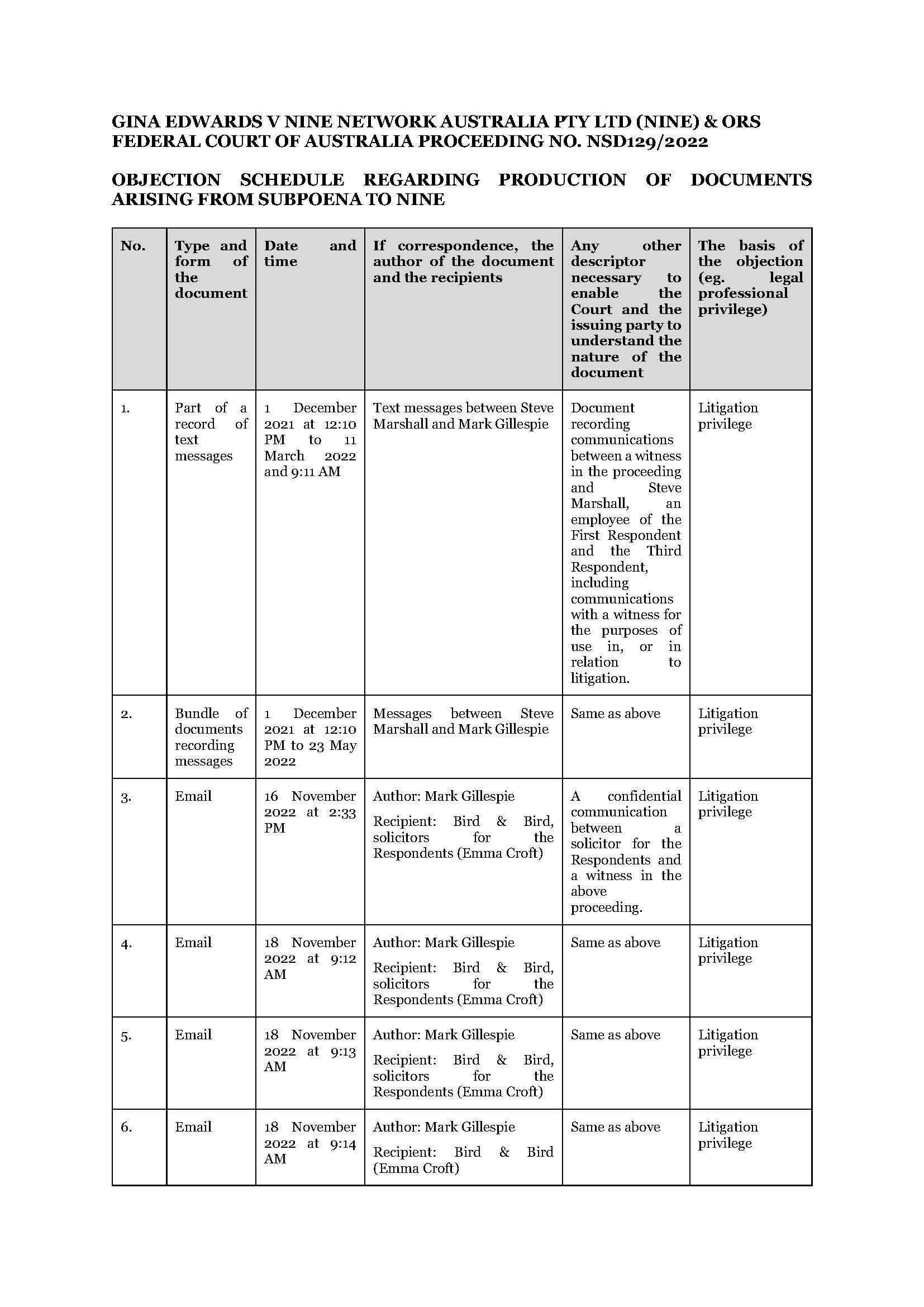
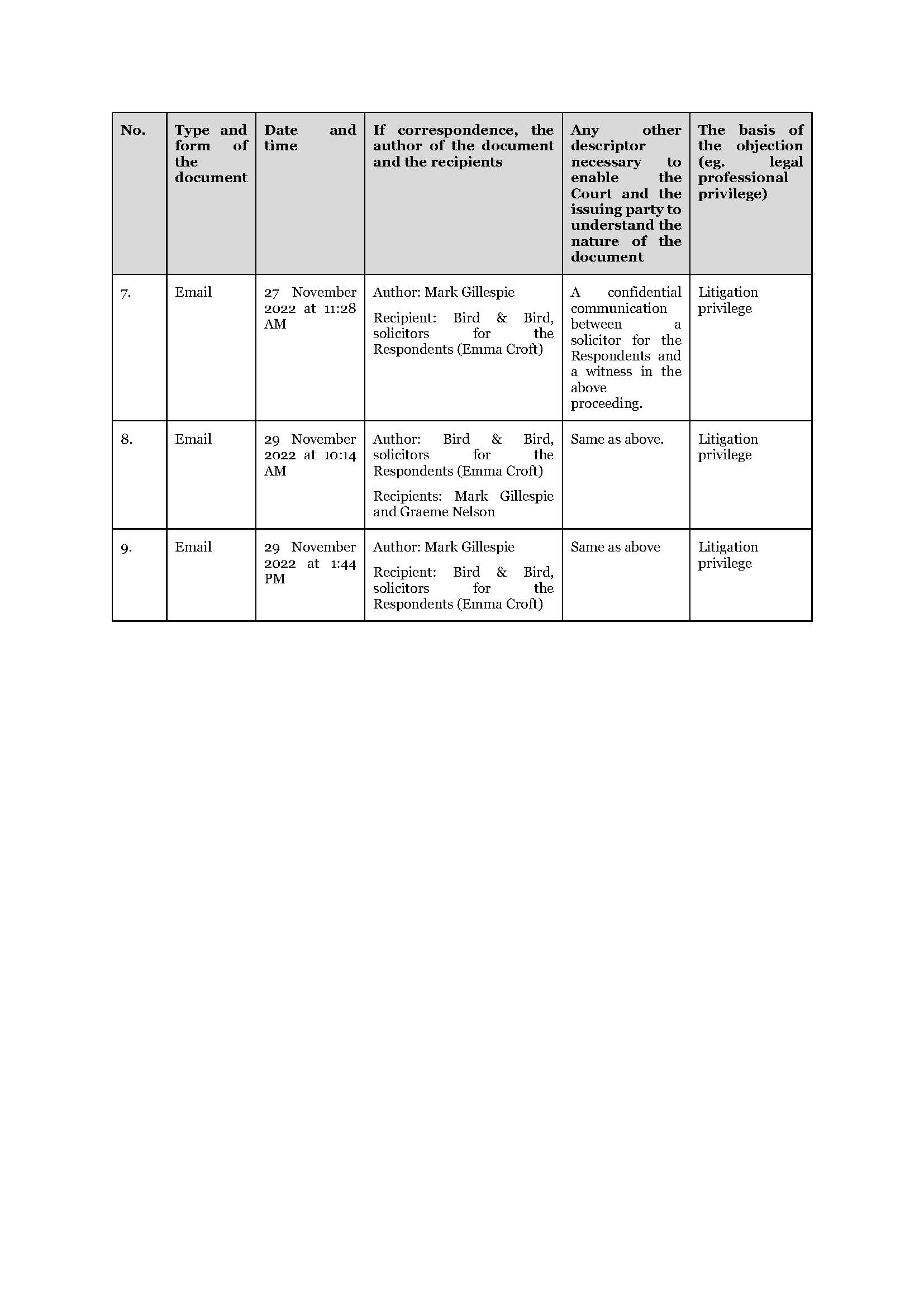
Communications and documents passing between the party’s solicitor and a third party if they are made or prepared when litigation is anticipated or commenced, for the purposes of the litigation, with a view to obtaining advice as to it or evidence to be used in it or information which may result in the obtaining of such evidence.
12 Some of the documents in packet S13 may be capable of answering this description but none of the documents in packet S14 are capable of doing so as Packet S14 only consists of text messages passing between Mr Gillespie and Mr Marshall. If those documents are protected by legal professional privilege, then they must fall into the sixth of the categories in Sterling in that they are:
Communications passing between the party and a third person (who is not the agent of the solicitor to receive the communication from the party) if they are made with reference to litigation either anticipated or commenced, and at the request or suggestion of the party’s solicitor; or, even without any such request or suggestion, they are made for the purpose of being put before the solicitor with the object of obtaining his advice or enabling him to prosecute or defend an action.
13 There is no doubt that communications must be confidential to attract legal advice privilege. Equally, it is clear that, under s 119 of the Evidence Act, in order for litigation privilege to attach to communications or documents, the communications or the contents of the document must have been confidential. The position at common law is not so clear.
14 In the present case both sides proceeded on the basis that all the communications had to be confidential. Mr Smartt, who appeared for Ms Edwards, relied on Australian Competition and Consumer Commission v Cadbury Schweppes Pty Ltd (2009) 174 FCR 547 (ACCC v Cadbury Schweppes) at [35] in which Mansfield, Kenny and Middleton JJ said at [35]:
As to confidentiality, we would have thought that the scope of the confidentiality arising from litigation privilege is different from advice privilege. We say this because when dealing with third parties, such as potential witnesses, unless there is a separate confidentiality agreement with such third parties, then, subject to the principle in Harman [1983] 1 AC 280 (as explained in Hearne v Street (2008) 235 CLR 125 at [109] per Hayne, Heydon and Crennan JJ (Hearne)), such potential witnesses would be free to discuss with others their potential evidence. Of course, the position would be different if there was a confidentiality agreement with such a potential witness, because in that case the client might seek to enforce the obligation of confidentiality arising out of such an agreement.
(Emphasis added.)
15 In the immediately preceding paragraph ([34]), however, their Honours observed that:
There has been some controversy over whether litigation privilege is confined to communications or whether it extends to documents themselves, the need for confidentiality in “litigation privilege”, and the independent existence of “litigation privilege” itself: see eg New South Wales v Jackson [2007] NSWCA 279; Public Transport Authority (WA) v Leighton Contractors Pty Ltd (2007) 34 WAR 279 at [20]; and Ligertwood A, Australian Evidence (4th ed, LexisNexis Butterworths, 2004) pp 291-292.
16 Their Honours did not discuss either of those cases or mention what was written in the text.
17 In State of New South Wales v Jackson [2007] NSWCA 279 the Court was concerned with a claim under s 119 of the Evidence Act and Giles JA, with whom Mason P and Beazley JA agreed, merely referred to the existence of a controversy over the need for confidentiality in litigation privilege at common law (at [37]). In Australian Evidence (4th ed, LexisNexis Butterworths, 2004) at pp 291–292 Andrew Ligertwood wrote:
The ambit of the litigation privilege is contentious. A statement taken from a witness for the purposes of litigation is privileged in the hands of lawyer or client. But it seems that a copy of that statement in the hands of the witness will only be privileged if the witness owes a duty of confidentiality to the party taking the statement.
18 I will come to Public Transport Authority (WA) v Leighton Contractors Pty Ltd (2007) 34 WAR 279 shortly. Before I do, however, I wish to refer to a couple of authorities discussed in it.
19 In Ritz Hotel Ltd v Charles of The Ritz Ltd (No 22) (1988) 14 NSWLR 132 at 133-4 McLelland J said:
It seems to me to be an essential element in a claim for legal professional privilege that the material, disclosure of which is sought to be precluded is, so far as the person from whom disclosure is sought is concerned, confidential. Now, whether in the case of communications between a party or its representative on the one hand and a potential witness on the other, those communications can be said to be confidential so far as the potential witness is concerned, may be a nice question in many circumstances. In the case of an independent witness to some event who is interviewed by a party or his solicitor or representative with a view to his making an affidavit or giving evidence in anticipated or pending proceedings, the details of that interview would not in my view be confidential so far as the potential witness is concerned in the absence of special circumstances, because the potential witness in that situation is not a person owing any duty of confidentiality to the party or to the party’s solicitor or representative. And in a situation of that kind, the question whether a claim for protection from disclosure of the communications on the basis of legal professional privilege should be upheld would in my opinion depend on whether the disclosure sought is, on the one hand, from the party or his solicitor or representative, in which case the claim should succeed, or, on the other hand, from the independent witness, in which case the claim should fail.
20 In Southern Equities Corporation Ltd v West Australian Government Holdings Ltd (1993) 10 WAR 1 the Supreme Court of Western Australia was concerned with an affidavit sworn by a person who had since died which was included in the plaintiff’s list of documents and over which the plaintiffs claimed litigation privilege. The defendants insisted they were entitled to inspect it as, by its nature, it was not a document prepared with the intention that it remain confidential for all time but was intended to be communicated to the court and other parties. The Master ordered the plaintiffs to produce the affidavit for inspection. On appeal, Malcolm CJ, Seaman and White JJ granted the plaintiffs leave to appeal and allowed the appeal, upholding the privilege claim. The leading judgment was given by Seaman J.
21 Seaman J held that it was enough to support the claim of litigation privilege that the affidavit was a document which passed between the plaintiff’s solicitor and the witness, was prepared when litigation was commenced, and was created solely for the purposes of advancing the litigation by obtaining evidence to be used in it (at 22). Malcolm CJ agreed (at 4), adding that evidence obtained for the purposes of litigation, whether in the form of an unsigned proof of evidence, a signed proof of evidence, or a sworn affidavit is privileged from disclosure or inspection. His Honour went on to say that privilege attaches to statements taken from potential witnesses in the hands of the solicitor, regardless of the capacity of, or potential for, the witnesses to disclose their statements to others (at 5). White J agreed with both Malcolm CJ and Seaman J (at 22).
22 The issue was discussed at length in Leighton at [20]–[35] in the judgment of McLure JA, with whom Steytler P and Miller JA agreed. That case was concerned with documents discovered by the Australian Bureau of Statistics to which Leighton sought access and over which the Authority claimed privilege. The documents were witness statements from three ABS employees. There was no express communication between the Authority’s solicitors and the ABS about the confidential status of the communications between them. The primary judge held that the communications were protected by litigation privilege only if the ABS owed a duty of confidentiality to the Authority and it did not. Leave to appeal was granted and the appeal allowed.
23 McLure JA observed that there are numerous general statements in the High Court which, on their face, are capable of applying to all categories of legal professional privilege to the effect that the privilege only attaches to confidential communications (at [22]). Her Honour referred to Goldberg v Ng (1995) 185 CLR 83 at 93, 105; Commissioner of Australian Federal Police v Propend Finance Pty Ltd (1997) 188 CLR 501 at 508; Mann v Carnell (1999) 201 CLR 1 at [28]; Esso at [35]; Daniels Corporation International Pty Ltd v Australian Competition and Consumer Commission (2002) 213 CLR 543 at [9]–[11], [44]. She also noted that the correctness of Southern Equities on the issue of confidentiality has been doubted, citing Heydon JD, Cross on Evidence (7th ed, LexisNexis Butterworths, 2004) [25225] fn 363. In principle and, having regard to these authorities, her Honour expressed her own reservations about the correctness of the proposition that litigation privilege protects non-confidential communications, although it was unnecessary to determine the question in that case (at [33]).
24 Regardless, since there is no property in witnesses, McLure JA acknowledged that there is no restriction on an independent witness who has provided a witness statement from providing the information the subject of that statement to any other person (at [31]–[32]), citing Harmony Shipping Co SA v Saudi Europe Line Ltd [1979] 1 WLR 1380 at 1384 (Lord Denning MR).
25 The reasons the Court upheld the appeal appear in [34]–[35] of her Honour’s judgment:
I am satisfied that there is sufficient confidentiality in this case to sustain the appellant’s claim for litigation privilege in relation to the documents in the hands of the ABS. The claim is for privilege from production pursuant to compulsory court process. Whether or not the witness may owe duties of confidentiality that are sourced not in the privilege but in a separate legal basis such as contract or equity is of no relevance in that context.
It is sufficient in my view if the lawyer, to the knowledge of the witness, intended the communications to be and remain private. Having regard to the nature and purpose of the activities of the appellant’s lawyers and the circumstances of privacy in which the communications occurred, it can be inferred that the appellant’s solicitors intended the communications to be and remain private, which intention must have been apparent to the ABS witnesses who, notwithstanding that they were under no obligation to do so, co-operated and provided the information sought by the appellant’s lawyers. Those circumstances, in combination with the duty of the appellant’s lawyers to keep the information confidential, are sufficient to entitle the appellant to privilege in respect of the communications in the hands of the ABS.
26 In Australian Competition and Consumer Commission v NSW Ports Operations Hold Co Pty Ltd [2020] FCA 1232 (ACCC v NSW Ports) Wigney J also reviewed the authorities. His Honour concluded at [46] that the better view appears to be that confidentiality is an essential requirement if a communication is to attract legal professional privilege. His Honour’s conclusion is supported by Heydon in the latest edition of Cross on Evidence (13th ed) (at [25225] at fn 482). His view is that “notwithstanding the interesting analysis of the cases in [Southern Equities], the prepondence of authority requires that the document be confidential in the sense that it is brought into existence with the expectation that it will not be circulated beyond the camp of the party in whose cause it was prepared, at least for a time”.
27 Having regard to the position taken by the parties, I propose to proceed on the same basis.
Waiver
28 Privilege can, of course, be waived, either expressly or by implication. As the plurality observed in Mann v Carnell at [28]–[29], waiver occurs or is effected where the conduct of the party claiming the privilege is inconsistent with maintenance of the confidentiality the privilege is intended to protect, regardless of the party’s subjective intention.
The privilege claim
29 The claim is made in an affidavit of Jonathon Williams Ellis affirmed 7 December 2022. Mr Ellis is a partner of the law firm, Bird & Bird, which acts for the respondents in these proceedings. The claim is made over documents listed in an “objection schedule”, annexed to the affidavit. A copy of the schedule is also annexed to these reasons (annexure A). They also asked the Court to inspect the relevant documents, submitting that it was apparent on the face of the documents that the communications were privileged.
30 It is well-established that a court may inspect the documents in order to rule on a claim: Grant v Downs at 677 (Barwick CJ), 688-9 (Stephen, Mason and Murphy JJ). As the High Court observed in Grant v Downs at 689, often “the character of the documents the subject of the claim will illuminate the purpose for which they were brought into existence”. The preferable explanation for this power is that it exists in order to enable a claim to be scrutinised and tested, not to facilitate proof by a claimant: Hancock v Rinehart (Privilege) [2016] NSWSC 12 at [31] (Brereton J); ACCC v NSW Ports at [50].
31 In Esso at [52] Gleeson CJ, Gaudron and Gummow JJ said that a court should not hesitate to exercise its power to inspect the documents over which a claim of privilege is made. On the other hand, Giles JA has expressed the view that, where the parties have put evidence before the court beyond the use of a verbal formula, the court should “not unnecessarily” have regard to material which cannot be known to the party challenging the claim: Woollahra Municipal Council v Westpac Banking Corporation (1994) 33 NSWLR 529 at 541–2; Jackson at [24] (Giles JA, Mason P and Beazley JA agreeing).
The evidence
32 The affidavit of Mr Ellis was read without objection and he was not required for cross-examination. The quality of Mr Ellis’s evidence is poor. When I suggested as much to the respondents’ senior counsel, Mr Sibtain SC, he indicated that Mr Ellis was in the courtroom and could be called if necessary but he did not call him.
33 With the exception of one email (item 8 of packet S14), which was copied to him, Mr Ellis was not the author, originator, sender or recipient of any of the relevant communications or documents and he does not claim, nor does the evidence indicate, that he had first-hand knowledge of the purpose of any of the relevant communications or the circumstances in which they came to be made.
34 None of the documents over which litigation privilege is claimed consist of, or include, any witness statement, affidavit or proof of evidence.
Packet S14
35 It is convenient to deal first with packet S14, which contains the documents produced by Mark Gillespie.
36 The first document in the packet is a copy of an email from Mr Gillespie to “Snax on Trax Café” dated 17 December 2017. No claim is made with respect to it and it is self-evidently not privileged. Accordingly, Ms Edwards is entitled access to it.
37 The second is a print-out of text messages exported from an iPhone in Mr Gillespie’s name. The first seven pages record text messages apparently passing between “Josh” from A Current Affair and Mr Gillespie, all of which precede the issue of the concerns notice and are not the subject of the respondents’ claim. Again, Ms Edwards is entitled to access to them.
38 The following five pages include text messages passing between Mr Marshall and Mr Gillespie both before and after the issue of the concerns notice, some of them before the first program went to air. The claim of privilege is made with respect to the messages on and from 1 December 2021 until and including the last message at 9.11 am on 11 March 2022.
39 Mr Ellis deposed that he was informed by Mr Marshall and believes that:
(a) “at all material times, [Mr Marshall] and Mr Gillespie communicated on the understanding that their communications were confidential”; and
(b) “on or around 19 May 2021, [Mr Marshall] had a discussion with Mr Gillespie [and] during that discussion [Mr Marshall] reiterated to Mr Gillespie that their communications were confidential”.
40 This evidence is unsatisfactory.
41 First, the evidence is a hearsay account of “an understanding”. In an interlocutory proceeding, such as this, the hearsay rule does not apply to evidence if the party who adduces it also adduces evidence of its source (Evidence Act, s 75). But the weight that should be attached to the evidence is another the question. What was the precise nature of the understanding? The fact that Mr Marshall reiterated to Mr Gillespie that their communications were confidential on or around 19 May 2021 rather suggests that the confidentiality related to communications they were having before the story was broadcast and were concerned with protecting his identity as a source of information. A text message from Mr Gillespie sent on 20 May 2021 emphasises “MUST NOT AIR WITHOUT PERMISSION”. Once the story was broadcast, that confidence was broken.
42 Second, it is unclear what was meant by the phrase “at all material times” and whether this was Mr Ellis’s expression or Mr Marshall’s. Since it is a phrase commonly used in pleadings by lawyers and there is no evidence to suggest that Mr Marshall is a lawyer, I infer that this was Mr Ellis’s expression. This evidence is therefore in the nature of a lay opinion. While the opinion rule does not apply to evidence of an opinion expressed by a person if the opinion is based on what the person saw, heard or perceived about a matter or event, however, and one might infer that it was based on what Mr Marshall told him, it is only admissible if the evidence of the opinion is necessary to obtain an adequate account or understanding of that person’s perception of the matter or event: Evidence Act, s 78. No objection was taken to the evidence. But the fact that the evidence was admitted without objection does not mean it is persuasive.
43 Third, on the assumption that the communications were intended to be confidential, Mr Ellis’s account is silent as to the reason for the confidence or the purpose or purposes of the communications. Mr Ellis deposed that, after the concerns notice was served, Mr Marshall “had communications with” Mr Gillespie “for the purposes of use in, or in relation to these proceedings”. But that is an opinion only. No evidence was adduced of the primary facts upon which the conclusion was based. It is scarcely sufficient to discharge the onus resting with the respondents to make out their claim. As Gleeson CJ, Gaudron and Gummow JJ observed in Esso at [52], “[a] claim for privilege is not conclusively established by the use of a verbal formula”. Mr Marshall and Mr Gillespie were communicating with each other by text for about five months before the concerns notice was served. In those circumstances the fact that they were also in communication it was served rather tends against the notion that they were communicating “for the purposes of use in, or in relation to these proceedings”.
44 The respondents argued, however, that the only reasonable inference to be drawn from the text messages themselves is that they were made for the dominant, if not sole, purpose of the litigation. Mr Sibtain submitted that they obviously related to the subject-matter of the litigation and reminded the Court of the nature of the respondents’ defences.
45 Having carefully scrutinised the text messages, I have concluded that more likely than not the message sent on 1 December 2021 at 12.10 pm was sent in connection with, and for the dominant purpose of, the litigation and so, too, the messages on 11 March 2022. I am not satisfied, however, that the messages on 12 January 2022 had anything to do with the litigation. Furthermore, I am not satisfied that any of the messages were sent at a time when there was any agreement, understanding or implied obligation of confidentiality. As I indicated earlier, the evidence on this question was poor. The basis upon which the so-called understanding was reached was not revealed. These communications took place after the broadcasts went to air. If Mr Gillespie was a party to any confidentiality or non-disclosure agreement, for example, as a result of the settlement of the Supreme Court proceedings, no such evidence was put before the Court and the documents themselves do not permit such an inference to be drawn. Access, in this instance, is being sought from the witness, not a party or the party’s solicitor or representative (see Ritz Hotel at 133). The position, however, is different with respect to the documents in packet S13 to which access is being sought from one of the parties.
Packet S13
46 It will be recalled that this packet contains documents produced in answer to the subpoena to the first respondent, the Nine Network.
47 Item 1 in this packet contains the same text messages as those in packet S14.
48 Item 2 consists of five pages of WhatsApp text messages between Mr Marshall and Mr Gillespie between 1 April 2022 and 23 May 2022, apparently while he was overseas, and copies of the text messages from 1 December 2021 until 11 March 2022 which are part of item 1 and packet S14.
49 On the face of things, the WhatsApp text messages relate to attempts to obtain information relating to the respondents’ defence and, potentially, evidence to support that defence. They would fall squarely within the sixth category in Sterling.
50 Items 3–9 are seven emails from Mr Gillespie to Ms Croft sent within the last month as the parties were preparing for the trial.
51 Mr Ellis asserted in his affidavit that, since 24 November 2021 the respondents’ solicitors “have had confidential communications with Mr Gillespie for the purposes of use in, or relation to these proceedings”. He does not purport to have been a party to any of the communications. Nor does he identify his source. Nevertheless, the respondents submitted that, “absent some compelling evidence to the contrary”, the inescapable inference is that Mr Gillespie was in communication with Ms Croft for the purpose of preparing the respondents’ defence. Mr Smartt accepted as much. That is to say, he accepted that the email communications were made for the asserted purpose. Mr Smartt argued, however, that there was no evidence that these communications were the subject of “a separate confidentiality agreement” and, in these circumstances, relying on the remarks of the Full Court in ACCC v Cadbury Schweppes at [35], he contended, the privilege claim must fail.
52 There was indeed no evidence of a separate confidentiality agreement between Mr Gillespie and Bird & Bird. Moreover, most of the emails (items 3, 4, 5 and 6) merely attach or incorporate documents and there is nothing apparently confidential about that material. Nor is there evidence from Mr Gillespie that he provided the information to Bird & Bird in confidence or from Ms Croft that it was received in confidence. Still, items 3–7 would appear to be privileged for the reasons given in Waugh v British Railways Board [1980] AC 521 at 536. There, Lord Simon of Glaisdale said:
This system of adversary forensic procedure with legal professional advice and representation demands that communications between lawyer and client should be confidential, since the lawyer is for the purpose of litigation merely the client’s alter ego. So too material which is to go into the lawyer's (i.e. the client’s) brief or file for litigation. This is the basis for the privilege against disclosure of material collected by or on behalf of a client for the use of his lawyer in pending or anticipated litigation … The report in question in this appeal undoubtedly contains material collected by or on behalf of the respondents for the use of their solicitors in anticipated litigation. The second principle thus indicates that the respondents are entitled to claim that it is confidential as between themselves and their solicitors and that they are not bound to disclose it.
53 It will be recalled that in Ritz Hotel at 133 McLelland J said a claim of legal professional privilege should succeed if the disclosure sought is from a party or the party’s solicitor or representative.
54 Thus, while the information passed on to Bird & Bird by Mr Gillespie in item 3 is not confidential and the communications within the other emails may not have been made in confidence, the communication of the information for the purpose of obtaining legal advice or for its potential use in litigation is confidential. That accords with the approach taken in Commissioner of Australian Federal Police v Propend Finance Pty Ltd (1997) 188 CLR 501 that a copy of a non-privileged original document will be privileged if is made solely for the purpose of obtaining or giving legal advice.
55 In other words, having regard to the nature and purpose of the communications, it can be inferred that the respondents’ lawyers intended the communications to be, and remain, private and that intention must have been apparent to Mr Gillespie because, although he was under no obligation to do so, cooperated and provided the information to the lawyers, at their request, whether the request was made directly or indirectly through one of the respondents: compare Leighton at [35].
56 This conclusion receives support from a much older English authority, which was cited with approval by Wood J in Nickmar Pty Ltd v Preservatrice Skandia Insurance Ltd (1985) 3 NSWLR 44 at 56–7. That is Anderson v Bank of British Columbia (1876) 2 Ch D 644. There, Jessel MR said at 649–650:
[T]he solicitor’s acts must be protected for the use of the client. The solicitor requires further information, and says, I will obtain it from a third person. That is confidential. It is obtained by him as solicitor for the purpose of the litigation, and it must be protected upon the same ground, otherwise it would be dangerous, if not impossible, to employ a solicitor. You cannot ask him what the information he obtained was.
57 I do not consider that the remarks of the Full Court in ACCC v Cadbury Schweppes at [35] are of assistance. They were obiter and little more than musings. While the Court referred to the controversy in the authorities, it did not purport to resolve it. The communications the subject of the dispute in that case were finalised proofs of evidence which had been served by the ACCC on the other parties to the proceedings. While the Court readily accepted that the documents were created and served for the purpose of those proceedings, it reasoned that they were not privileged, not because of the absence of a separate confidentiality agreement, but because they had been served on the opposing parties. The Court said at [37] that “it is impossible for litigation privilege to attach to the finalised proofs of evidence, when the finalised proofs of evidence were created for the purpose of serving them on the ACCC’s opponent and when they were in fact served on that opponent”. Later, at [102]–[103], the Court also endorsed the conclusion of the primary judge (Gordon J) that the filing and service of the finalised proofs constituted a complete waiver of privilege.
58 That leaves items 8 and 9. There does not appear to be any reason why an inference should be drawn in relation to them that the communications in those documents were made in confidence. They do not include any information or material collected by or on behalf of the respondents for use in the litigation.
59 It follows that I am persuaded that, subject to the question of waiver, the text messages exchanged between Mr Gillespie and Mr Marshall on 1 December 2021 at 12.10 pm and on 11 March 2021 in packet S13 and S14 are privileged and so, too, the items 3–7 in packet S13, but that the other communications are not.
The waiver claim
60 Ms Edwards argued that any privilege had been waived. In support of that claim she relied on a letter dated 31 March 2022 from the respondents’ solicitors, Bird & Bird, to the applicant’s solicitor, Company Giles; an affidavit of Joel Stuart Parsons affirmed 31 March 2022 and an affidavit of Sophie Jane Dawson affirmed 5 April 2022 and pages 1, 2, 4 and 5 of the transcript of the case management hearing of 7 November 2022 before the docket judge, Wigney J.
61 The foundation for the argument was said to be repeated representations made to Ms Edwards that the respondents, more particularly their lawyers, were unable to communicate with Mr Gillespie about these proceedings and that required inquiries to be made which might not otherwise have been necessary. Mr Smartt submitted:
[W]e’re not making any, you know, big, bold submission about dishonesty, but we are saying that either these communications were about the subject matter of the litigation – for the dominant purpose of the litigation – or that statement is true. They can’t go together, because if he’s communicating with a journalist about these things, he’s available, but yet we’re in this position where the respondents have told the court that he’s unavailable to us.
62 Mr Smartt pointed to:
(1) a statement in the letter that “Mr Gillespie has not been available to Nine as a witness in this proceeding to date”;
(2) Mr Parson’s statement that, since the originating application was served, Jarrad Parker-Smith made inquiries in an effort to speak with Mr Gillespie to ask him questions about the ownership of Oscar the cavoodle or proceedings in the District Court of NSW concerning the ownership of the cavoodle, which were transferred to the Supreme Court on 20 August 2020, and Mr Gillespie was unavailable;
(3) Ms Dawson’s statement that, since receiving instructions on 11 March 2021, work has been underway interviewing other potential witnesses with a view to obtaining evidence notwithstanding Mr Gillespie’s (hopefully temporary) unavailability”; and
(4) Mr Sibtain’s statements to Wigney J at the case management hearing that “we have been prevented from speaking to [Mr Gillespie]”.
63 None of these statements amounted to a representation that Mr Gillespie was unavailable to speak to Ms Edwards’ lawyers.
64 Furthermore, the statements in the letter and the affidavits need to be put in context. So, too, the statement made to Wigney J.
65 As to the former, in para 25–26 of his affidavit, Mr Parsons explained:
On 31 March 2022, Ms Dawson and I spoke with Mr Gillespie’s lawyer, Graham Nelson. Mr Nelson informed me and I believe that Mr Gillespie does not feel comfortable assisting the Respondents by providing information relevant to this matter because he is concerned to ensure he complies with the settlement deed between him and the Applicant in respect of the resolution of the Ownership Proceeding. For the avoidance of doubt, Bird & Bird have not been provided with a copy of the settlement deed.
During the course of the conversation referred to in paragraph 25 above, Ms Dawson indicated to Mr Gillespie’s lawyer that correspondence would be sent to Ms Edwards’ solicitors to seek confirmation that Mr Gillespie can provide factual information without any cause for concern in relation to the Settlement Deed.
66 As to the latter, Mr Sibtain also informed Wigney J that the respondents had obtained “an outline” of evidence from him.
67 All of the emails sent by Mr Gillespie to Ms Croft and the email from Ms Croft to Mr Gillespie and Mr Nelson were sent more than a week after the case management hearing last month and are not inconsistent with these representations. Neither are any of the text messages sent before that date.
68 I therefore reject the waiver claim.
Conclusion
69 I reject the respondents’ claim to litigation privilege over the text messages exchanged between Mr Gillespie and Mr Marshall in packet S14 but uphold the claim with respect to all items in packet S13 except for items 8 and 9. It follows that Ms Edwards should have access to the documents in packet S14, produced by Mr Gillespie, and to the iMessage exchanges on 12 January 2021 in item 2 and items 8 and 9 in packet S13. To facilitate the latter, the respondents should have first access to the documents so that the iMessage exchanges which are privileged can be redacted and items 8 and 9 isolated.
70 The costs of the interlocutory hearing should be costs in the cause.
I certify that the preceding seventy (70) numbered paragraphs are a true copy of the Reasons for Judgment of the Honourable Justice Katzmann. |
Associate:
ANNEXURE A