

FEDERAL COURT OF AUSTRALIA
Luvalot Clothing Pty Ltd v Dong [2022] FCA 1411
ORDERS
Applicant | ||
AND: | Respondent | |
DATE OF ORDER: |
THE COURT ORDERS THAT:
1. The proceeding be dismissed.
2. The Applicant pay the Respondent’s costs.
Note: Entry of orders is dealt with in Rule 39.32 of the Federal Court Rules 2011.
ANDERSON J:
INTRODUCTION
1 The Applicant (Luvalot), by an originating application filed 9 January 2018 and an amended statement of claim filed 18 September 2019 (ASOC), seeks relief against the Respondent (Ms Dong), a former sales assistant employed by Luvalot, for alleged breaches of her contract of employment, misuse of Luvalot’s confidential information and for alleged breaches of s 183 of the Corporations Act 2001 (Cth) (Act).
THE PLEADED CASE
2 Luvalot, by its ASOC, alleges that:
(a) Ms Dong was employed by Luvalot pursuant to a contract of employment which included terms that Ms Dong would not misuse Luvalot’s confidential information while employed by Luvalot and after termination of her employment;
(b) both before and after termination, Ms Dong would not improperly use confidential information she acquired by reason of her employment with Luvalot to gain an advantage for herself or someone else, or cause detriment to Luvalot;
(c) Ms Dong was only eligible to use Luvalot’s confidential information solely for the purpose of performing her duties owed to Luvalot;
(d) on termination, Ms Dong was required to return to Luvalot all confidential information in material form in her possession or control, and all records based on her incorporating confidential information in her possession or control, which included client contact lists and databases;
(e) for alternate periods of two years, one year, or six months following the termination of her employment, Ms Dong was prohibited from, in the alternate areas of Australia, New South Wales, or Sydney; to solicit, canvass, approach or accept any approach from any person or organisation at any time during the 12 months prior to Ms Dong’s employment ending, a client or customer of, a supplier or contractor to, or investor in Luvalot;
(f) Ms Dong was required to provide four weeks written notice to terminate her employment with Luvalot;
(g) Ms Dong commenced employment with Luvalot in accordance with the terms of the contract of employment on 31 July 2012;
(h) Ms Dong provided written notice purporting to resign from her employment with Luvalot on 11 January 2017, but then purported to resign immediately, without giving four weeks’ notice as required by the contract of employment;
(i) in accordance with the terms of the contract of employment, the effective date at which Ms Dong’s employment with Luvalot ceased was 7 February 2017;
(j) as a consequence of Ms Dong’s employment with Luvalot, there was a statutory duty cast upon Ms Dong that she would, before and after the termination of her employment, not improperly use confidential information she acquired by reason of her employment with Luvalot to gain an advantage for herself or someone else; or cause detriment to Luvalot;
(k) Ms Dong’s duties as a sales assistant with Luvalot included communicating with customers in relation to potential sales; encouraging and promoting such potential sales; and using and maintaining a list of existing customer contact details in order to fulfil her other duties (Customer Details List);
(l) the Customer Details List was, amongst other places, maintained and duplicated in part on Ms Dong’s personal mobile phone;
(m) the Customer Details List consisted of existing customer names of Luvalot that had made wholesale purchases from Luvalot in the past and their phone numbers;
(n) the combined information in the Customer Details List of the persons and organisations that were existing customers of Luvalot that had made wholesale purchases in the past and their contact information, including phone numbers, was at all relevant times information that was confidential to Luvalot and not in the public domain;
(o) the Customer Details List was at all relevant times confidential information belonging to Luvalot;
(p) on and from 5 June 2017, Ms Dong commenced her employment with Sasha Clothing Pty Ltd (Sasha) and both telephoned and sent emails to customers of Luvalot including White Fox Boutique Pty Ltd (White Fox) and Van & Nguyen Pty Ltd trading as Dolly Girl (Dolly Girl) offering to sell women’s clothing in her capacity as employee of Sasha;
(q) on at least 8 September, 1 November, 29 November, 4 December, 5 December, 6 December, 7 December, 8 December, 13 December and 14 December 2017, Ms Dong sent mobile text messages to Omar Jabouri, the owner and director of Prime Pacific Investments Pty Ltd trading as Zoo Clothing (Zoo Clothing) offering to sell women’s clothing to Zoo Clothing;
(r) between 28 February 2017 and 11 September 2018, Ms Dong solicited, canvassed, approached or accepted approaches from numerous persons and organisations who were customers of Luvalot during the 12 month period prior to Ms Dong’s employment with Luvalot ending (Other Communications);
(s) in order to make the Other Communications, Ms Dong used the contact information for those persons and organisations which she obtained from the Customer Details List;
(t) Ms Dong’s conduct in making offers to sell women’s clothing to White Fox, Dolly Girl and Zoo Clothing breached the terms of Ms Dong’s contract of employment, misused Luvalot’s confidential information and breached s 183 of the Act;
(u) in making the Other Communications, Ms Dong breached the terms of her contract of employment, misused confidential information belonging to Luvalot, and breached s 183 of the Act.
3 Ms Dong, by her further amended defence filed 26 September 2022:
(a) denies that the Customer Details List is confidential information as defined by the terms of the contract of employment; nor was the Customer Details List confidential information at equity;
(b) alleges that in so much of the Customer Details List as is on Ms Dong’s personal mobile phone, it was not confidential information as defined by the contract of employment nor was the Customer Details List confidential information at equity;
(c) denies misusing the Customer Details List;
(d) alleges that White Fox, Dolly Girl and Zoo Clothing are each existing customers of Sasha, and Ms Dong obtained the relevant contact information for each of these businesses from information kept by her employer, Sasha;
(e) alleges that the restraint clause in the contract of employment is void for uncertainty, alternatively, the restraint clause is not reasonably necessary to protect any genuine interest of Luvalot.
THE CONTRACT OF EMPLOYMENT
4 Ms Dong was employed by Luvalot pursuant to an undated contract of employment. Ms Dong’s contract of employment contained various terms relating to confidential information and restraint of trade. The clauses relevant to this proceeding are set out below:
9. CONFIDENTIAL INFORMATION
9.1 In this Agreement “Confidential Information” means the following whether or not in material form –
9.1.1 All confidential information (including, but not limited to, trade secrets, confidential know-how customer lists, design systems, manuals, advertising, promotional data, advisory memoranda, intellectual property and printing systems) relating to Luvalot or a related body corporate (as that term is used in the Corporations Act 2001) of Luvalot from time to time;
9.1.2 All other confidential information and know-how of which the Employee becomes aware (both before and after the date of this Agreement is signed) or generates in the course of, or in connection with, employment with Luvalot.
9.2 The Employee:
9.2.1 May use Confidential Information solely for the purpose of performing her duties owed to Luvalot;
9.2.2 Must keep Confidential Information; and
9.2.3 May only disclose Confidential Information to persons who:
9.2.3.1 Are aware and agree that the Confidential Information must be kept confidential; and
9.2.3.2 Have signed any confidentiality Agreement required by Luvalot from time to time; and
9.2.3.3 Have a need to know (and only to the extent that each has a need to know); or
9.2.3.4 Have been approved by Luvalot.
9.3 The Employee’s obligations of confidentiality do not extend to information that (whether before or after the date this Agreement is signed):
9.3.1 Is public knowledge (otherwise than as a result of a breach of this Agreement); or
9.3.2 Is required by law to be disclosed.
…
13. AFTER TERMINATION
13.1 On termination, the Employee must return to Luvalot –
13.1.1 All Confidential Information in material form;
13.1.2 Those parts of all notes and other records based on or incorporating Confidential Information;
13.1.3 All copies of Confidential Information and those parts of notes and other records referred to in Clauses 9.1.1 and 9.1.2; and
13.1.4 All Luvalot’s property,
in the Employee’s possession or control.
13.2 The Employee's obligations of confidentiality under Clause 9 owed to Luvalot continue after termination of this Agreement, except in respect of information that is part of the Employee's stock of general skill and knowledge.
13.3 At any time after termination of this Agreement the Employee must not:
13.3.1 record any Confidential Information into any form (including, but not limited to machine readable form); or
13.3.2 sell or otherwise transfer any Confidential Information.
14. RESTRICTIVE COVENANTS AFTER TERMINATION OF EMPLOYMENT
14.1 Unless the Employee has obtained Luvalot's prior written consent. The Employee must not for the period specified in Item 7 of the Schedule (the Restraint Period) after the Employee's employment ends (for whatever reason), in the areas specified in Item 8 of the Schedule (the Restraint Area):
14.1.1 solicit, canvass. approach or accept any approach from any person or organisation who was at any time during the 12 months prior 10 the Employee's employment ending, a client or customer of a supplier or contractor to, or investor in Luvalot; or
14.1.2 solicit, interfere with or endeavour to entice away from Luvalot. Any employee, contractor or consultant of Luvalot.
14.2 Each restriction in clause 14.1, the periods that comprise the Restraint Period (to the extent that more than one period is specified in item 2 of the Schedule) and the areas that comprise the Restraint Area (to the extent that more than one area is specified in item 3 of the Schedule) are intended to be separate and severable. If any one of these is found to be invalid, but would be valid if some portion were deleted, then such portions will apply with such severance as may be necessary to make them valid.
SCHEDULE
1. SALARY
A gross salary of $28,860 per annum plus superannuation at the rate specified from time to time by the Superannuation Guarantee (Administration) Act 1992 (the SGAA) rate payable in equal fortnightly instalments in arrears.
2. ANNUAL LEAVE
Four weeks paid annual leave (pro rata) each year.
3. PERSONAL/CARER’S LEAVE
Ten days paid personal/carer's leave each year (pro rata), which is accrued at the rate of 2.92 hour per fortnight; and
Two days paid compassionate leave for each permissible occasion; and
Two days unpaid carer’s leave for each permissible occasion.
4. LONG SERVICE LEAVE
The Employee will be entitled to long service leave entitlements in accordance with the long service leave legislation applicable to the Employee's employment.
5. SUPERANNUATION
At the SGAA rate.
6. EXPENSES
Luvalot must reimburse the Employee for all reasonable expenses incurred by the Employee in carrying out the Employee's duties under this Agreement.
7. RESTRAINT PERIOD
2 years: or
1 year; or
Six months.
8. RESTRAINT AREA
Australia; or
New South Wales; or
Sydney
THE EVIDENCE AND WITNESSES
5 Luvalot relies on the following affidavits in support of its claims.
(a) Affidavit of Hian Luan Khor (Cecelia) Bucoy dated 26 April 2019 together with Annexures HLKB-1 to HLKB-18 (Bucoy-1), marked exhibit 3.
(b) Affidavit of Hian Luan Khor (Cecelia) Bucoy dated 16 May 2019 together with Annexure HLKB-1 and Confidential Annexures HLKB-1 to HLKB-5 (Bucoy-2), marked exhibit 4.Affidavit of Minghan Deng dated 30 July 2019 together with Annexures MD-1 and MD-2 (Deng), marked exhibit 7.
(c) Affidavit of Hian Luan Khor (Cecilia) Bucoy dated 25 February 2020 together with Annexures HLKB-19 to HLKB-21 (Bucoy-3), marked exhibit 5.
(d) Affidavit of Taryn Jyothi Francis dated 28 September 2020 together with Annexures TFJ-1 to TFJ-8, marked exhibit 8.
(e) Affidavit of Hian Luan Khor (Cecelia) Bucoy dated 25 March 2021 together with Annexure HLKB-22 to HLKB-24 (Bucoy-4), marked exhibit 6.
6 Ms Dong relies upon the following affidavits:
(a) Affidavit of Lu Dong dated 20 December 2019 including Annexures LD-1 to LD-4 (First Dong Affidavit), marked exhibit 12;
(b) Affidavit of Yishuang Lou dated 20 December 2019 including Annexure YL-1 (Lou Affidavit), marked exhibit 16;
(c) Affidavit of Lu Dong dated 28 September 2020 including Annexures LD-1 to LD-5 (Second Dong Affidavit), marked exhibit 13;
7 The parties jointly tendered documents in a Court Book which I marked as exhibit A.
8 The trial before me proceeded on the basis of determining all questions of liability with quantum to be determined, if necessary, at a future date.
Evidence of Hian Luan Khor (Cecelia) Bucoy
Evidence in Chief
9 Ms Bucoy is the founder of Luvalot, which was incorporated on 16 June 2010. Luvalot is an independent manufacturer and wholesaler of women’s fashion, and provides production and supply services to its clients.
10 Luvalot has three locations:
(a) A head office in Melbourne located at 111-115 Langridge Street, Collingwood 3066 VIC Australia;
(b) A Sydney office and showroom located at Shop 3, 46 Kippax Street, Surry Hills 2010 NSW Australia; and
(c) A Brisbane office and showroom located at 1/249 Montague Road West End 4101 QLD, Australia.
11 Luvalot also owns and operates a factory in Guangzhou, China (Luvalot Factory) from which it designs and manufactures Luvalot’s garments.
12 Luvalot employs both in-house designers in Australia and China and has fashion buyers who work with the design team to identify sample garments from suppliers. Once a design is completed, the pattern is sent to China for samples to be produced. The samples are then sent to Luvalot’s head office in Melbourne, where Ms Bucoy personally decides which of the samples are suitable to put into full production. Ms Bucoy is directly involved in the design process and sets the direction for the overall look and feel of a particular design or collection of garments, as the case may be.
13 Luvalot sells its garments on a wholesale basis directly to retailers, and often sells its collections in bulk to its customers. Luvalot focuses on identifying samples in the wholesale market which meets its requirements for both quality and trend potential. Luvalot’s in-house design team, which includes Ms Bucoy, then considers all of the samples and ultimately decides which samples will be included in Luvalot’s products for the upcoming season. Once the designs are finalised, the Luvalot team will sell the products on a wholesale basis to various retail fashion outlets across Australia (Luvalot Customers). Luvalot Customers then sell direct to consumers. There are over 900 Luvalot Customers across Australia, with around 309 based in New South Wales.
14 Luvalot sells approximately 15,000 units of garments to Luvalot Customers every week.
15 The role of Luvalot’s sales assistants is to maintain and nurture the relationship that exists with the Luvalot Customers.
16 Luvalot’s Customer Details List, is a record that is kept by Luvalot’s employees and officers. The Customer Details List is maintained and updated in the course of doing business and acquiring new customers. Ms Bucoy’s evidence is that this Customer Details List contains details of each of the Luvalot Customers including their purchasing activity, which Ms Bucoy identifies as being confidential to Luvalot, and is not public knowledge. Ms Bucoy explained in Bucoy-1 that the Customer Details List is not disclosed to anyone other than employees of Luvalot, who are bound to keep it confidential.
17 As the sole director of Luvalot, Ms Bucoy has a policy, of offering a personalised and direct sales approach with Luvalot Customers. Ms Bucoy explained that this approach ultimately generates new and repeat customers and helps form relationships with Luvalot Customers. Luvalot’s approach involves developing and maintaining the relationship with each of the Luvalot Customers’ points of contact.
Cross-examination
18 Ms Bucoy was asked a number of questions relating to her business, its operations, and the employment of Ms Dong. In brief compass, Ms Bucoy gave evidence that:
(a) Ms Dong was offered a job as a sales assistant at Luvalot and in the course of her employment she was required to contact customers and provide them with photographs of new merchandise and also to drive the sales process;
(b) Ms Dong’s contract of employment stipulated that she was paid a gross salary of $28,860 per annum plus superannuation;
(c) Ms Dong was not provided with a work mobile phone, and used her own phone to contact customers. Luvalot did not reimburse Ms Dong for the cost of using her mobile phone to contact customers;
(d) Ms Dong conceded that there was no password or other protection which prevented anyone in Luvalot from accessing the customer information on the computer.
19 Ms Bucoy was also asked about the process surrounding the acquisition of new customers at Luvalot. Ms Bucoy explained that the usual process is to email customers or contact them by phone and send them pictures of the new stock. Ms Bucoy described how, on occasion, customers would also contact her.
20 It was put to Ms Bucoy that she did not know what Ms Dong had on her phone, in terms of contact details of existing Luvalot Customers. Ms Bucoy conceded that she did not know, but inferred that because Ms Dong was the employee charged with contacting customers that she must have had all of the customer contact information on her phone.
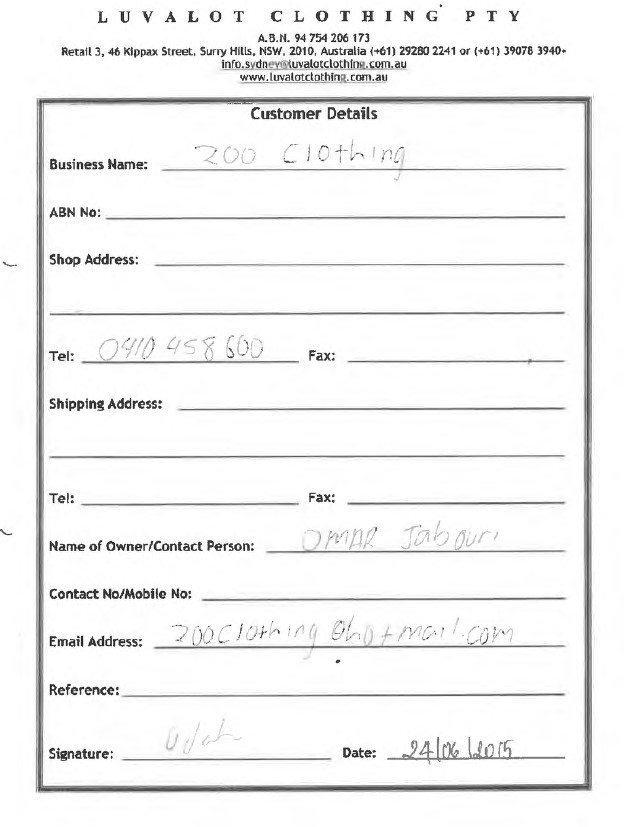
21 Ms Bucoy refused to accept, at first, that it was easy to obtain the contact details of Luvalot Customers such as Zoo Clothing. Ms Bucoy was taken to a screenshot of the Instagram account of Zoo Clothing. Ms Bucoy refused to accept that the screenshot (marked as exhibit 10) identified the mobile phone number of the contact at Zoo Clothing and identified Zoo Clothing’s stores located in Macquarie, Castle Towers, Macarthur Square and Penrith. Subsequently, during the course of cross-examination, when Ms Bucoy was directed to the Luvalot Customer Details form (Luvalot Customer Details form) (being the form that Luvalot requests its new customers to fill out with their contact details and ABN in order to check they are a wholesale customer, which is then used to compile the Customer Details List) (CB 2040) and the Instagram screenshot for Zoo Clothing (exhibit 10), Ms Bucoy accepted that the screenshot records the same mobile phone number for Zoo Clothing that is recorded in Luvalot’s Customer Details form for Zoo Clothing (CB 2040, shown directly below).
22 During the course of cross-examination, Ms Bucoy was taken to an extract of an internet search conducted of Luvalot. The screenshot from Luvalot’s website (exhibit 11) reveals a link to Luvalot’s stockists (customers who sell Luvalot clothing). Ms Bucoy was taken to the webpage containing Luvalot’s stockists and accepted that the stockists identified were Luvalot customers. However, Ms Bucoy refused to accept that details of telephone numbers of Luvalot’s stockists could be readily ascertained by an internet search.
23 It was put to Ms Bucoy during cross-examination that the Luvalot website identified customers of Luvalot and that it was easy to obtain the telephone numbers of those Luvalot customers. Ms Bucoy prevaricated and refused to answer this question and other similar questions directly.
24 It was put to Ms Bucoy in cross-examination that a member of the public could obtain the telephone number of Mr Omar Jabouri of Zoo Clothing by undertaking an internet search. Ms Bucoy prevaricated and again refused to answer this simple question directly. Ms Bucoy refused to accept that an internet search of a telephone number for Zoo Clothing revealed the same number as that recorded on Luvalot’s Customer Details form (CB 2040, extracted above). Ms Bucoy refused to accept that a member of the public that wished to contact one of Luvalot’s customers, as identified on Luvalot’s website, could easily obtain the contact details via an internet search.
25 Ms Bucoy conceded that staff working at Luvalot’s Sydney office could access the Customer Details List on the computer there. Ms Bucoy accepted that there was no password required to access the Customer Details List (T80.1-5):
Now, in your affidavit, you say that there was no password on the MYOB computer, don’t you?---Yes, no password.
And everyone could easily access it, and they could get the contact information easily, couldn’t they?---Yes, they could. Yes.
26 Ms Bucoy clearly accepted that there were no restrictions on Luvalot employees accessing the Customer Details List contained in the MYOB system and accessible on the MYOB Computer at Luvalot’s office (the “front” computer or the MYOB Computer) and that any Luvalot employee could contact customers on the Customer Details List. I accept Ms Bucoy’s evidence in this regard.
27 Ms Bucoy refused to accept the proposition that she did not know what information Ms Dong had on her personal mobile phone. Ms Bucoy’s evidence was that Ms Dong had Luvalot’s customer information in her phone because she contacted Luvalot customers.
28 It was put to Ms Bucoy in cross-examination that after Ms Dong sent her letter of resignation on 10 January 2017, Ms Bucoy had a number of conversations with Ms Dong on WeChat on 10 and 11 January 2017 (Annexure LD-1). It was put to Ms Bucoy that she threatened Ms Dong in these communications. Ms Bucoy denied this and said that she warned Ms Dong to do the right thing otherwise she would take legal action.
29 It was put to Ms Bucoy in cross-examination that she was upset with Ms Dong leaving because she had trained Ms Dong up from nothing. Ms Bucoy denied this. Ms Bucoy also denied that she was upset with Ms Dong leaving Luvalot because Ms Dong was a good sales person and that was why Ms Bucoy was upset. Ms Bucoy denied this saying she just wanted to protect her business. I do not accept these denials by Ms Bucoy.
30 I find that the communications sent by Ms Bucoy to Ms Dong on 10 and 11 January 2017 were intended to threaten Ms Dong with legal proceedings. I find that Ms Bucoy was motivated by being upset at losing a good sales person to a competitor. I find that the following statements made by Ms Bucoy to Ms Dong via WeChat were intended to threaten Ms Dong. These communications were as follows:
31 On 10 January 2017 at 23.04 (CB 1685) Ms Bucoy’s WeChat communication in part stated:
When you quit this job, there won’t be any contact between you and me & Luvalot. Besides, I think you know what kind of person I am. If I discover and know that there are any of Luvalot’s designs, clothes and company operation modes appearing in the new place in which you are working, I will sue you to compensate the company for its loss.
32 A further WeChat communication sent by Ms Bucoy on 11 January 2017 at 8.15 (CB1686) in part stated:
Now you want to leave and the explanation you gave me is that our competitor has given you a very good offer to ask you to join them. I have been betrayed by someone who I trusted and I have been stabbed in the back. You will also work at Kippax Street. It’s easy to come to find you. You’d better not let me do it.
33 Ms Bucoy sent the following WeChat communication on 11 January 2017 at 22.16 (CB 1687) in part stated:
I just do things in accordance with the law here instead of threatening you, nor do I do what I’d like to.
34 Ms Bucoy did not impress me as a witness. Ms Bucoy prevaricated and refused to answer many questions directly. Ms Bucoy was concerned to restate in cross-examination a version of events that she thought would advance her case against Ms Dong. Ms Bucoy had difficulty with recalling events and refused to make even the most obvious concessions notwithstanding the clear documentary evidence to which she was taken. I find Ms Bucoy to be an unreliable witness whose evidence I do not accept save for admissions and concessions made in cross-examination.
Evidence of Lu Dong
Evidence in Chief
35 Ms Lu Dong is a former employee of Luvalot.
36 On 31 July 2012, Ms Dong commenced employment with Luvalot as a full time sales assistant.
37 Ms Dong considered her working relationship with Ms Bucoy to be cordial and conducive to a good working environment. Ms Dong’s evidence was that her relationship with Ms Bucoy changed after she asked Ms Bucoy for a pay increase, which created tension between her and Ms Dong.
38 The relationship between Ms Bucoy and Ms Dong became more strained after Ms Dong resigned from her position at Luvalot on 10 January 2016.
39 Ms Dong commenced her new role as a Sales Manager with Sasha on 5 June 2017, where Ms Dong remains gainfully employed at Sasha to this day.
40 Both Sasha and Luvalot are located on Kippax Street in Surry Hills, Sydney. Kippax Street is a well-known hub for wholesale fashion retailers, and is an area where a considerable amount of business to business (B2B) transactions are made.
41 Because of the nature of Kippax Street, where many vendors are located in close proximity to each other, and where many of the same business customers frequent, it was Ms Dong’s evidence that “everybody knows everybody else”.
42 Despite having no previous experience in B2B fashion, in 2012 Ms Dong commenced employment as a full-time sales assistant with a company trading as Lovely Girl, one of the wholesale fashion companies located on Kippax Street. Ms Dong has, since 2012, maintained employment in sales roles in the B2B fashion industry.
43 Ms Dong gave evidence of the typical workflow and new client acquisition process that she has experienced in her roles with various B2B wholesale fashion retailers. Ms Dong deposed that when a potential customer enters the store, she will typically commence a verification process to ensure that the potential customer does indeed operate a business. This allows wholesalers to avoid direct sales to retail clients. The verification process requires the potential customer to provide their business card and ABN and then to complete a customer contact form.
44 In addition to “walk-in” customers that come directly into the showroom, it was Ms Dong’s practice to generate sales by going directly to recognised customers. Ms Dong gave evidence that she would approach prospective customers in retail shopping centres on her day off, or on the weekend.
Employment with Luvalot
45 Ms Dong gave evidence that during her employment with Luvalot, there were only two staff members that worked at the Sydney office, being herself and Ms Thi Diem Trang Phan (Kate).
46 Both Kate and Ms Dong were employed as sales assistants, however, Ms Dong was responsible for sales, whilst Kate was primarily responsible for accounts and administration. Neither Ms Dong nor Kate had any managerial responsibilities. All management decisions were made by Ms Bucoy.
47 When a new prospective customer would visit the Sydney office, Ms Dong would ask the customer to fill in a Luvalot Customer Details form and provide their business information and contact details.
48 Ms Dong would then provide the completed Luvalot Customer Details form to Kate who would create a MYOB contact entry in Luvalot’s internal system and, occasionally, a Microsoft Outlook address book entry from the information contained on the Luvalot Customer Details form. Kate would then archive the hard copy of the Luvalot Customer Details form in a file that was kept in the office. The client’s contact details were contained in the MYOB system and accessible on one of the MYOB Computer computers in Luvalot’s office.
49 Whilst working at Luvalot, Ms Dong did not have a personalised work email address. Rather, Kate and Ms Dong would share and use the company’s “info.sydney@luvalotclothing.com.au” account, as that email account was set up through Microsoft Outlook. Because Ms Dong did not have the password to access work emails remotely, Ms Dong was only able to monitor and send emails when she was in the office.
50 Ms Dong was also not provided with a company mobile phone.
51 When Ms Dong first started working for Luvalot, she would often contact prospective buyers through the company’s landline phone. The reason for this was that Ms Dong was not reimbursed for her personal mobile expenses, so she used the company phone to avoid paying for business calls.
52 Ms Dong gave evidence that she did not save or store any customer phone numbers on her personal mobile phone. Ms Dong deposed that she would not keep customer numbers on her phone other than those numbers which she was required to use in applications like WeChat, WhatsApp or Viber.
53 As the majority of buyers only approached Ms Dong because they intended to purchase new fashion garments, the process used by Luvalot was for the head office in Melbourne to prepare professional photos of the sample garments which would then be emailed to the Sydney office. Ms Dong would then email these photos to specific customers.
54 At times there were delays in receiving the professional photos from Luvalot’s head office, so on occasion, Ms Dong would take photos on her personal mobile phone from the stock in the warehouse and would send those photos to buyers that she thought would be interested in buying the products or those buyers that she knew would not check their emails frequently. Ms Dong’s evidence was that she never did this in secret, and in fact, was praised by Ms Bucoy on many occasions for taking initiative in doing so.
55 Ms Dong deposed that Luvalot did not have any rules or policies regarding the use of personal mobile phones for work purposes and Ms Bucoy would often contact her on WeChat to discuss sales or other work related matters. In her experience, the use of WeChat is quite common amongst members of the Australian Chinese community.
56 Ms Dong recalled that, on some occasions, she would receive orders on the weekend from customers that wanted to purchase garments. Ms Dong would forward the order requests via mobile to Ms Bucoy, who would then process the orders. Throughout her employment, Ms Dong was never counselled or disciplined for using her mobile phone during or outside of work for work purposes.
57 Ms Dong deposed that, from about 2014, order numbers at Luvalot increased, and a more formalised process was implemented. This process involved Ms Dong filling out an order list every Tuesday from the sales that she made during the preceding week. Ms Dong would then send the order list to the head office which would process all the orders from Melbourne. This was the process for all “floor stock” sales, which is stock that is sold under the Luvalot label and usually would have been viewed at the Luvalot showroom by the buyer.
58 The other type of order was known as “customer stock”, and this occurred when a customer requested that the stock be made with the customer’s own label. A minimum order would be placed directly with the manufacturers in China. Ms Dong completed these orders.
The use of WeChat and Viber
59 Ms Dong described WeChat as a messaging platform that is predominantly used in the Asian/Chinese speaking community. WeChat relies on a user creating a unique ID which other users on the WeChat platform can add to their WeChat contact list. Depending on the WeChat user’s privacy settings, some users require the sender to be approved by the recipient before any message can be sent. This is the typical privacy setting.
60 Ms Dong created a personal WeChat account prior to her employment with Luvalot. The account is not transferrable or accessible by anyone else. It can be best compared to an email account where each user ID is unique and only accessible by its owner. The difference between WeChat and email is that a message cannot be issued on WeChat unless the recipient of the message accepts and adds the sender to their contact list.
61 Throughout her employment with Luvalot, Ms Dong used WeChat, WhatsApp and Viber (the applications) (although, Ms Dong used WeChat far more frequently than the other two applications) to send photos of stock to prospective buyers and to communicate with buyers to make and receive orders.
62 Luvalot did not keep a record of their customer’s WeChat IDs, nor did they have a corporate WeChat account to use for communicating with buyers. All Ms Dong’s WeChat messages with clients were sent via her personal WeChat account. Ms Dong gave evidence that she had no choice but to use the applications to communicate with those customers who preferred this method of communication.
63 Ms Dong stated that she had no choice other than to take photos of the stock on her mobile phone and to send those photos to prospective buyers. Ms Dong would usually send the photos via the applications, as sending SMS would cost her money, whereas, the applications allowed her to send the photos free of charge.
64 During her maternity leave, which commenced on 1 October 2016, customers would occasionally contact Ms Dong via the applications and she would forward those messages to Kate. Ms Dong did not contact customers during her maternity leave.
65 Toward the end of December 2016, prior to Christmas, Ms Dong met “Jack”, an employee of JoJo Fashion House Pty Ltd (JoJo), which is the parent company of Sasha. The substance of this communication was to the effect of:
Jack: Hi Maggie, thanks for coming to see me, we are looking to hire a new Sales Manager and I think you would be a good fit for the role.
Ms Dong: I am interested to learn more about how your company operates and the work environment and the salary for the role.
Jack: The starting salary would be about $60,000. Have you heard of Sasha Clothing, lndicah and Lily White?
Ms Dong: Yes, I know those brands. I've frequently heard of those suppliers from customers who came into Luvalot. Where would this role be?
Jack: This would be at Sasha. There are two departments, sales and design in the Sydney Office, and you would be the only Sales Manager. Everyone is really nice and friendly, you would really enjoy it I think.
Ms Dong: Ok that sounds interesting, as you know I'm on maternity leave, I will have a think about it.
66 Shortly after this conversation, on 10 January 2017, while still on her unpaid maternity leave, Ms Dong tendered her letter of resignation to Ms Bucoy via email, with immediate effect.
67 Ms Dong was aware that her contract of employment with Luvalot contained a restraint clause. Ms Dong did not, at first, obtain any legal advice regarding her contract of employment or the restraint clause. Ms Dong gave evidence that she considered that if she were to begin new employment within 6 months after her resignation from Luvalot, she would not be in breach of her contract of employment with Luvalot.
68 From the date of her resignation, Ms Dong continued to stay at home and look after her newborn baby. It was Ms Dong’s recollection that there were a few times when she would receive messages from buyers looking to purchase clothing. Ms Dong would ignore the messages and delete the conversation. Ms Dong stated that she also deleted WhatsApp and Viber from her mobile phone because she had no use for them. Ms Dong continued to use WeChat for personal messaging with her friends and family.
69 In or around March 2017, Ms Dong began receiving letters from a law firm, Actuate IP, who are the legal representatives of the Applicant in this proceeding. Ms Dong recalled receiving several letters which threatened her with legal proceedings. Ms Dong was not employed during this time and was receiving Centrelink payments. Ms Dong gave evidence that she could not afford to obtain legal advice from a private law firm, so she went to see a pro bono lawyer from the Marrickville Legal Centre to better understand the contents of the letters which were sent to her from Actuate IP.
70 Ms Dong gave evidence that she spoke to a lawyer from the Marrickville Legal Centre. Ms Dong’s evidence is that the substance of that telephone conversation was:
Ms Dong: Can I work for another wholesale fashion seller in 6 months because the contract says I can't?
Solicitor: That restraint is not reasonable, so you don't need to worry about it.
Ms Dong: Should I respond to the lawyers, they asked me to hand in my personal phone and confidential information.
Solicitor: You can but you don't have to. Is this your personal mobile phone or a company phone?
Ms Dong: It's my personal mobile.
Solicitor: Did you keep any customer lists or confidential information?
Ms Dong: No I didn't, I don't have anything.
Solicitor: Just delete everything on your phone regarding your previous employer.
Ms Dong: Ok, I'll go through it and delete.
71 It was Ms Dong’s evidence that, after this conversation with the solicitor took place, she went through her phone messages and the conversations within the applications and deleted the messages and contact details that related to Luvalot. Ms Dong stated that she periodically also deleted photos to free up memory on her phone to store photos of her son. I accept this evidence of Ms Dong.
72 Ms Dong gave evidence that she made every effort to go through her messages and delete the conversations that related to her past employer as she felt intimidated by the letters from Actuate IP. I accept this evidence of Ms Dong.
73 Ms Dong deposed that she did not communicate with any customers of Luvalot, except Ashley who is the owner of Lynky and Callie who is the owner of Batek Boi. This is because Ms Dong considered Ashley and Callie to be personal friends outside of a work setting and she would catch up with both of them for lunch. I accept this evidence of Ms Dong.
Commencement with Sasha
74 On 5 June 2017, Ms Dong commenced her employment with Sasha as a Sales Manager.
75 When Ms Dong arrived on her first day, she signed a contract of employment and was introduced to Ms Yishuang Lou who was the previous Sales Manager at Sasha and had been promoted to Designer Manager. The layout of the showroom was that the Sales Manager was on the ground floor, and Ms Lou was upstairs on level 1.
76 During her first week, Ms Lou had introduced Ms Dong to Sasha’s email and client database system.
77 Ms Dong deposed that Sasha’s system was exactly the same as what was she had used at Luvalot. MYOB was the primary database where Sasha’s employees would access its customer contact details. There was also an email mailing list that was used to send weekly updates to current customers about new stock.
78 Similar to the Luvalot Customer Details form, Sasha also had a physical client information form for new clients who were required to provide their details when they arrived at the showroom.
79 Ms Dong recalled that Jack from JoJo (the parent company of Sasha) provided her with the MYOB password login details and the email account which contained all the contact details for buyers on Sasha’s mailing list.
80 Ms Dong gave evidence that after receiving the password, she was able to access the MYOB name card system. One of the first tasks Ms Lou asked Ms Dong to complete was to contact Sasha’s regular customers and introduce herself as the new Sales Manager.
81 Ms Dong then sent out an email to customers of Sasha who are on the Sasha mailing list and introduced herself as the new Sales Manager for Sasha.
82 Ms Dong then began calling customers via the desk phone to again introduce herself as the new Sales Manager. If Ms Dong was unable to get through to the customer via telephone, she would then follow up with a message on WhatsApp or WeChat.
83 Ms Dong’s evidence was that she only accessed Sasha’s MYOB contact list to obtain the phone numbers when she was contacting customers for Sasha.
84 Ms Dong deposed that when she went through Sasha’s MYOB contact list, she recognised names of certain customers, many of whom were familiar to her as she knew them from her time at Luvalot.
85 Ms Dong, in the Second Dong Affidavit, produced the customer list of her current employer, Sasha. Sasha’s customer] list contained the customer contact list and sales history of its major clients, many of whom are well known fashion retailers and are clients of Luvalot.
Cross-examination
86 Ms Dong accepted that her role at Luvalot involved building relationships with customers on behalf of her employer.
87 Ms Dong gave evidence that Kate was not responsible for overseeing her work during her employment with Luvalot. Rather, Ms Dong and Kate worked together as a team and helped each other in their roles at Luvalot, and Ms Bucoy was the decision maker and the person that they reported to and conferred with when any problems arose.
88 Ms Dong gave evidence that she did not use Kate’s computer during her time at Luvalot. Ms Dong explained that there are two computers at the Luvalot office, one “front” computer which was used by Kate, where the MYOB accounting system is stored; and a second computer which contained the mail account. This second computer was the computer that Ms Dong regularly used.
89 Ms Dong gave evidence that, on occasions when Kate was sick, she helped Kate take on tasks which were normally within the purview of her role, such as invoicing, which required her to use the “front” computer, however, another employee of Luvalot, Maxine, who studied accounting would often assist in these tasks.
90 Ms Dong accepted that Kate’s computer did contain customer details which were listed in the MYOB contact list, including past sales history.
91 It was put to Ms Dong in cross-examination that the MYOB software contained information about the VIP status of certain customers as well as their sales history, including whether they were active or less active customers. Ms Dong’s evidence was that the MYOB software contained only the customer information and the sales figures of the relevant client. This information was stored on the MYOB software on Kate’s computer.
92 Ms Dong outlined how she would speak with customers in both Mandarin and English, but her ability to speak English is more rudimentary and the conversations that she has in English are confined to more basic topics such as what the customers want to purchase.
93 Ms Dong gave evidence that she came to know a couple of Luvalot’s customers as friends. She connected with these customers, being Ashley from Lynky and Callie from Batek Boi, because they both emigrated from China, were of similar backgrounds and had similar interests.
94 Ms Dong gave evidence about her experience with Marrickville Legal Centre and the events that occurred around her visit there. Ms Dong agreed that the records of Marrickville Legal Centre were correct, but maintained that there was a record missing which pertained to one of her earlier visits there. Ms Dong, under cross-examination, gave evidence that the Marrickville Legal Centre failed to record this prior attendance. Ms Dong gave a detailed description of the day in question. Ms Dong gave the following evidence in cross-examination about this first visit which was prior to September 2017:
I went there – because this is my darkness. If – the experience that I have before on that day is around 4 or 5 o’clock, and the day is dark. My – my husband drive me go to the Marrickville Legal Centre and baby only six months. I was really scared about the legal letter from Luvalot. And I am receiving Centrelink payment. I cannot afford for private legal solicitor. That’s why I tried to find some free legal advice. I – because my English is not well in the law industry so I bring the document, willing to let the solicitor to see the document because I don’t want to reply without the legal, otherwise I’m worried like I will say something wrong and then she – she will give me a hard time, therefore – I still remember it’s like – my husband have to wait in with me with the baby in the car for me for almost one half hour. I went to legal centre, and I went to the reception. They asked me to fill out a form. I still remember the reception on the right-hand side. I’m waiting on the long bench. And I went to a meeting room with a senior solicitor, which is a man, and a junior solicitor beside of him, and I – I passed the document and I also read out some of my questions and then – and – and I asking him for some legal advice, and I feel like – and then he – he told me I can start work on June and then – because I don’t want to rely on the Centrelink. I need to work on my own, therefore I – after I get the legal advice I feel more like – I feel not less scared. I can take the work on June.
95 Ms Dong was taken to file notes from the Marrickville Legal Centre. Ms Dong was shown an “intake” note from the Marrickville Legal Centre dated 25 September 2017, in which Ms Dong outlined the background to her complaint with respect to Luvalot’s claim against her in this proceeding. Ms Dong’s evidence was that the advice she received from the Marrickville Legal Centre was that she did not have to respond to any of Luvalot’s letters of demand.
96 Ms Dong gave evidence that she attended the Marrickville Legal Centre for a further appointment on 16 January 2018. On this occasion the Marrickville Legal Centre could not take her case or offer her advice because, at this stage, she was earning over $60,000 which put her over the threshold with which she could receive advice from Marrickville Legal Centre.
97 Ms Dong filed the Second Dong Affidavit around three months after she received the file notes from Marrickville Legal Centre. It was put to Ms Dong that there was no mention in the Second Dong Affidavit about her receiving any legal advice from Marrickville Legal Centre prior to September 2017. Ms Dong gave evidence that this was because the First Dong Affidavit already provided all of the relevant information in relation to her visit to the Marrickville Legal Centre.
98 Ms Dong’s evidence was that she did visit the Marrickville Legal Centre prior to September 2017. Ms Dong stated that there may have been human error or some other administrative error which failed to record her visit prior to September 2017. Ms Dong was adamant that she was at the Marrickville Legal Centre for over one hour and maintained that some record (whether it was CCTV footage or otherwise) must be available.
99 Ms Dong gave evidence that she was advised by the lawyer at the Marrickville Legal Centre to delete everything on her phone regarding her previous employer. Ms Dong tried her best to delete all of the information on her phone which pertained to Luvalot and Luvalot’s clients. Ms Dong outlined how she deleted Viber and WhatsApp because she did not use these applications other than for work with Luvalot. With respect to WeChat, Ms Dong’s evidence was that she kept this application on her phone because she uses this regularly outside of work. Ms Dong described how WeChat is the most popular messaging application and is used frequently by people in the Chinese community. Ms Dong stated that this is how she keeps in contact with her friends and family, both in Australia and China. Ms Dong described how she deleted all work related chats from her phone and also tried her best to delete the contacts that she obtained during the course of her employment with Luvalot.
100 It was put to Ms Dong in cross-examination that deleting these messages would hurt her case in this proceeding and that she never received advice that she should delete those messages. Ms Dong gave evidence that she did not know this would be the case and acted only on the advice she received from the Marrickville Legal Centre’s solicitors.
101 Ms Dong outlined how she did not understand the letters of demand that she received from Luvalot, which is why she sought advice from the Marrickville Legal Centre. Ms Dong then acted on the advice that she received.
102 Ms Dong was asked about the contact details of Ashley from Lynky and it was put to Ms Dong that she did keep her contact details on her phone, despite there being an allegation against her that she used this information, which was in breach of Luvalot’s confidential information. Ms Dong gave evidence that she did understand this allegation and did keep Ashley’s details on her phone. Ms Dong also understood that this same allegation arose with respect to Omar Jabouri from Zoo Clothing as well as Hannah Nguyen from Dolly Girl, Georgia and Tiara from White Fox and also Echo from Hello Molly.
103 Ms Dong was taken to [6] of the Second Dong Affidavit, which states:
… All contact information I have used to make contact with Sasha’s clients came from Sasha’s own MYOB and email contact lists which I was first provided access to when I commenced employment in June 2017. The details contained in Sasha’s MYOB and email contact lists are all that I have used to contact customers and carry out my duties for Sasha since June 2017.
104 Ms Dong maintained that this statement was correct.
105 Ms Dong explained that she did keep Ashley from Lynky’s contact details in her phone because they are friends and have maintained a friendship over this time. Ms Dong, on various occasions met Ashley for coffee and to catch up. Ms Dong considered Ashley to be “like a sister”. Ms Dong explained that it was only after she commenced her employment with Sasha, and saw Ashley’s contact information within Sasha’s system that she made contact with her for business related purposes and began to send her photos of Sasha’s products. I accept this evidence of Ms Dong.
106 Ms Dong resigned from Luvalot on 10 January 2017 and did not contact Ashley for around seven weeks, which occurred on 28 February 2017. Ms Dong was not asked about the substance of this conversation, but it can be inferred from later questioning that this conversation on 28 February 2017 was not work related.
107 Ms Dong was asked why she had Ashley’s name saved on her phone as “Ashley (work)”. Ms Dong explained that because Ashley is a very popular anglicised name for Chinese migrants, therefore, in order to distinguish Ashley from Lynky’s name between the various other Ashley’s saved to Ms Dong’s contact book, she used the identifier “(work)” as opposed to for instance Ashley from “(church)”.
108 Ms Dong explained that she would often see Ashley on Kippax Street and would stop and chat with her, this would usually be around twice per week. Ms Dong is still in contact with Ashley and described how she sends her children to the same childcare centre as Ashley’s children attend.
109 Ms Dong was asked whether, over the period between February and March 2017, she tried to further develop her relationship with Ashley. It was also put to Ms Dong that she primarily used her relationship with Ashley to push sales with Sasha and to target Ashley for sales when she started work with Sasha in June because she knew Ashley was a good customer of Luvalot and made a lot of purchases. Ms Dong explained that she was already friends with Ashley prior to this, and that she found Ashley’s name in Sasha’s database after she commenced her employment with Sasha. It was only after commencing at Sasha that she made contact with Ashley, in a business sense and asked her to come and see her in Surry Hills at Sasha. Ms Dong maintained that she did not target Ashley, she stated that it was just common-sense to contact someone that she knows and who is already an existing client of Sasha. Ms Dong gave evidence that she never knew of Luvalot’s classification of certain customers as being VIPs. I accept this evidence of Ms Dong.
110 Ms Dong gave evidence that she made sales to Ashley after she commenced with Sasha in June 2017 and accepted that Sasha’s sales to Lynky increased in 2017. Ms Dong did not accept the proposition that sales to Luvalot decreased because of the sales that she made for Sasha.
111 Ms Dong was asked about Omar Jabouri from Zoo Clothing. Ms Dong gave evidence that she communicated with him via SMS at various times after commencing her employment with Sasha. Ms Dong contacted Mr Jabouri on her personal phone with the number that was previously saved on her phone. Ms Dong explained that it is normal procedure to email customers at first instance and if the customer does not respond then she will call their phone number. As a last resort she will send an SMS.
112 Ms Dong gave evidence that she previously deleted Mr Jabouri’s number from her phone. It was only after Ms Dong saw Mr Jabouri’s number on Sasha’s MYOB system that Ms Dong decided to contact him on 23 June 2017, for the first time since commencing her employment with Sasha. I accept this evidence of Ms Dong.
113 Ms Dong was asked to explain why, in her text message to Mr Jabouri on 23 June 2017, she had to explain to him where Sasha is located. Ms Dong gave evidence that many people who attend Sasha tend to go into the wrong door, so she wanted to clarify the exact location for his benefit. Ms Dong agreed that she made that clarification because Mr Jabouri was not a regular customer of Sasha at that time.
114 Ms Dong said that Mr Jabouri only responded to her after she sent many text messages to him.
115 When it was put to Ms Dong that she pursued Mr Jabouri from Zoo Clothing in order to acquire him as a customer. Ms Dong gave evidence that Mr Jabouri was already a customer of Sasha and was listed on the MYOB database and she contacted him through the number that was saved on the Sasha system. I accept this evidence of Ms Dong on this issue.
116 Ms Dong explained that when she began her employment with Sasha, she sent an introductory email to a number of Sasha’s clients that were listed on Sasha’s MYOB contact list. In doing so, Ms Dong explained that she recognised a number of people on this list from her previous dealings at Luvalot.
117 Ms Dong was asked about the first approach that she made to Hannah Nguyen from Dolly Girl. This occurred on 8 June 2017, after she commenced her employment a Sasha. Ms Dong explained that she found Ms Nguyen’s number in the Sasha customer database and then introduced herself as the Sasha manager (CB 1634). Ms Dong was shown WeChat correspondence that occurred between her and Ms Nguyen on 16 June 2017. The correspondence showed Ms Dong offered certain winter specials to Ms Nguyen which Sasha had on at the time. It was put to Ms Dong that this correspondence showed that Ms Dong did not delete the contact details of Ms Nguyen, Ms Dong agreed and admitted that this was a mistake on her part. Ms Dong gave evidence that she tried to delete everything from her phone but omitted to delete Ms Nguyen’s details. I accept this evidence of Ms Dong on this issue.
118 It was put to Ms Dong, and she accepted that Ms Nguyen became a regular customer of Sasha, but explained that in the wholesale industry, the quality of the product is the critical factor and if you have a quality product, wholesalers will purchase stock from the company. Ms Dong emphasised that personal relationships in the B2B fashion wholesaler industry are less important in this sense. Ms Dong maintained that there is no loyalty within the industry, it is all about who provides the best quality product and is able to predict the fashion trend of the upcoming season, so if a business has quality products that sell successfully, the customer will return to the store and purchase more stock, even if the customer service is poor.
119 Ms Dong was asked about Georgia from White Fox. Ms Dong gave evidence that, to the best of her recollection, she attained Georgia’s contact details from Sasha’s database.
120 Ms Dong was asked about the Customer Details List at Luvalot. Ms Dong stated that everybody in Luvalot’s office had access to the Customer Details List. Ms Dong described how this list was kept at the “front” computer at Luvalot and when new customers came to the store, Ms Dong would have them fill out a customer details form and would enter the new customers’ data in the system.
121 Ms Dong described her role as a sales assistant. Ms Dong outlined how, in her role, she sends photos of the company’s stock and new collections to as many potentially interested buyers as possible, by email. If the customers are interested they usually reply with which clothes they wish to order via email. In some cases, if customers do not reply, Ms Dong will usually send a text message to the potential buyer privately to try and push a sale.
122 Ms Dong, in cross-examination, was asked about the password, which counsel for the applicant alleged prevented Ms Dong from accessing the Customer Details List and Luvalot client information on the MYOB Computer. Ms Dong gave evidence that the computer used at Luvalot, which contained all of the customer information, did not have a password or a code to access the information. It should be noted at this point, that counsel for the applicant submitted in closing written submissions at [1.8(b)] that, in her answer to this question, Ms Dong gave contradictory evidence. This is because Ms Dong, in the First Dong Affidavit at [28]-[29] stated that the MYOB Computer did have a password and that she did not ordinarily have access to it. I find that Ms Dong was confused with respect to this issue. Ms Bucoy gave clear evidence, which I accept, that the MYOB Computer did not require a password and that Luvalot’s customer information that was on this computer could be freely accessed by Luvalot’s employees (see, again: T80.1-5). During cross-examination, I asked Ms Dong to clarify whether she had free access to the MYOB Computer at Luvalot, and could access this any time she wanted. Ms Dong confirmed this was the case (T172.1-15). I accept her evidence on this issue.
123 Ms Dong gave evidence that Ms Bucoy would only visit the office once per year and that it was predominantly her and Kate that would staff the Luvalot office on Kippax Street. Kate would largely do administrative work which included completing sales reports and typing invoices into the system. Ms Dong explained that they would both do the sales work together, such as calling customers. If any more high level decisions needed to be made, they would call Ms Bucoy.
124 Ms Dong agreed that she did save customer details onto her personal mobile phone in the course of her employment with Luvalot, this was because she was not provided with a work mobile phone. Ms Dong made clear that it was the usual course that she would contact customers using the company landline in order to speak with them, so that she would avoid any personal charges. Ms Dong was concerned not to use her personal mobile telephone to call customers because she did not want to take her work home with her.
125 Ms Dong was taken to her employment agreement with Luvalot and was shown cl 9.
126 Ms Dong agreed that cl 9.1.1 describes customer lists as being confidential information.
127 Ms Dong was also taken to cl 9.2.1.
128 Ms Dong accepted cl 9.2.1 states that confidential information could only be used for the purpose of performing her duties in her employment with Luvalot.
129 Ms Dong gave evidence that she received a gross salary of $28,860 per annum plus superannuation from Luvalot. Ms Dong accepted that she received a $5,500 bonus in 2015.
130 Ms Dong gave careful and considered evidence. Ms Dong readily accepted that she had communicated via email, telephone, text, WhatsApp and WeChat with a number of clothing purchasers who had been customers of Luvalot. This took place after Ms Dong had commenced her employment at Sasha in June 2017. Ms Dong explained her concern to obtain legal advice in respect of the letters of demand which she had received from Luvalot’s solicitors. I accept her evidence that she wanted to ensure that she did not breach the terms of her employment agreement and wanted legal advice as to what she should do. I accept Ms Dong’s evidence that she was advised by lawyers at the Marrickville Legal Centre to delete the details of Luvalot customers which she had stored in her personal mobile phone. I accept her evidence that in respect of the contact details of Hannah Nguyen at Dolly Girl and Omar Jabouri from Zoo Clothing that those contact details have not been deleted from Ms Dong’s mobile phone by mistake. Ms Dong was a truthful witness whose evidence I accept in its entirety.
Ms Yishuang Lou
Evidence in Chief
131 Ms Lou is the Designer Manager at Sasha. Ms Lou is employed by JoJo, which, as identified above, is the parent company for several brands including Sasha.
132 Ms Lou explained in her affidavit that both JoJo and Sasha use the MYOB accounting software, which is also used to store the name and contact details for customers that have purchased products from JoJo and Sasha.
133 Ms Lou’s evidence was that she worked as a Sales Manager at Sasha until Ms Dong commenced her employment there. Ms Lou explained that in this role she was provided with computer access to the MYOB accounting system which contained the name cards of Sasha’s customers, which included the email and contact phone numbers.
134 Ms Lou described how the majority of communication which occurs with customers is done via the applications, and most prominently with the Chinese community, via WeChat.
135 Ms Lou gave evidence that she was expected to use her personal mobile phone to contact customers of Sasha during her time as a Sales Manager as she was not provided with a company phone. Ms Lou also gave evidence that Ms Dong also uses her personal mobile phone to carry out her duties at Sasha.
136 Ms Lou explained how Kippax Street is the predominant B2B wholesale fashion district for female wholesale fashion in Sydney. Ms Lou described how Kippax Street contains well over 50 different companies that sell fashion items to retail shops both large and small. Ms Lou described how the shops are all within close proximity to each other and it is commonplace for these vendors to sell their products to anyone that walks into their shop. If a new customer attended the showroom, Ms Lou would ask them to fill out a new customer form and would then enter the customer’s details into the MYOB system.
137 Ms Lou conveyed how, in her experience, there are only a small number of new clients that become customers of Sasha each year, of which, around 20 complete new customer forms. The majority of customers are repeat buyers that frequent Sasha and JoJo.
138 Ms Lou explained that the only requirement in order to purchase products from vendors on Kippax Street is that the customer has an ABN (i.e. they are a business). There are otherwise no exclusive licensing agreements and purchasers frequently purchase products from multiple vendors on Kippax Street at any given time.
139 Ms Lou identified in her affidavit that she did not believe that the customer lists of vendors are confidential or secret as vendors can approach any retail fashion provider and sell to them.
140 Ms Lou explained how, at Sasha, she was tasked with assisting Ms Dong and introducing her to her new role, when she commenced.
141 At the start of Ms Dong’s employment with Sasha, Ms Lou explained to her what the role entailed and also how to use Sasha’s MYOB system. Ms Lou described Ms Dong as being very familiar with the process that Sasha had in place. Ms Lou recalled the following conversation with Ms Dong:
Ms Lou: Hi my name is Annie. I used to be the Sales Manager and now I'm the Design Manager.
Ms Dong: Hi Annie nice to meet you, my name's Maggie.
Ms Lou: Have you worked in Fashion previously Maggie?
Ms Dong: Yes, I worked for Luvalot for the last 5 years.
Ms Lou: Ok, so I guess you know how everything works. Here is where you'll be sitting, I'll be upstairs. Jack should have already logged in to MYOB and your email should be set up on the computer. It would be good if you could call previous buyers to offer them our new stock. I'll show you some of the new stock as well so you can get some photos to send.
Ms Dong: Ok sounds great.
Cross-examination of Ms Lou
142 Ms Lou gave evidence with the assistance of an interpreter.
143 Ms Lou gave evidence that when Ms Dong commenced her employment with Sasha, she directed her to introduce herself to some, but not all, of the customers.
144 Ms Lou was asked about a bulk email that she directed Ms Dong to send to Sasha’s customers on 9 June 2017. Ms Lou told the Court that the intention of this email was to introduce Ms Dong to Sasha’s customers. Ms Lou gave evidence that Ms Dong, in order to send this email dated 9 June 2017, used Sasha’s internal customer list.
145 Ms Lou conducted a handover with Ms Dong, which entailed showing her how to do the job and what can and cannot be done. This is standard procedure at Sasha.
146 Ms Lou described how access to the Sasha customer list was handled. Ms Lou gave evidence that the Sasha customer list is freely available on the computer and can be retrieved at any time.
147 Ms Lou was asked whether the customer list is a quick way for people at Sasha to identify who the customers are and who they need to try and sell goods to. Ms Lou gave evidence that this was incorrect, rather it is a list of all Sasha customers and a record of their past sales. The customer list did not tell Ms Lou which customers she should approach or sell to.
148 Ms Lou described how an experienced sales representative, who knows and understands their brand, would ordinarily know which customers are frequent purchasers of their products. Ms Lou stated that the customer list is mostly used to approach new customers or those customers that only have made a few purchases in the past. Ms Lou otherwise did not need to use the list because she was well acquainted with the customers of Sasha that purchased more frequently.
149 I found Ms Lou to be a careful and considered witness who gave truthful evidence which I accept entirely.
RELEVANT LEGAL PRINCIPLES
Confidential Information
150 The legal principles applying to confidentiality clauses in employment agreements were summarised in Zomojo Pty Ltd v Hurd (No 2) [2012] FCA 1458; 299 ALR 621 (Zomojo) by Gordon J at [179] as follows:
The relevant principles to be applied in determining the validity of cl 9 of the Service Agreement may be summarised as follows:
1 an obligation can be imposed by contract to keep information confidential and that obligation can extend to cover subject matter which is not protected by an equitable duty of confidence: Wright v Gasweld Pty Ltd (1991) 22 NSWLR 317 at 329, 335 and 340-341; Del Casale v Artedomus (Aust) Pty Ltd (2007) 73 IPR 326 at [34]-[36], [38], [46], [48], [50], [51], [77], [87], [92], [102], [118], [134] and [140] and Reed Business Information Pty Ltd v Seymour [2010] NSWSC 790 at [36];
2 employers are entitled to protect by contractual covenant the use of information that is the result of work, experimentation and expense: Exchange Telegraph Company Limited v Central News Limited [1897] 2 Ch 48 at 53-54; AB Consolidated Ltd v Europe Strength Food Co Pty Ltd [1978] 2 NZLR 515; Interfirm Comparison (Aust) Pty Ltd v Law Society of New South Wales [1975] 2 NSWLR 104 at 117; Industrial Furnaces Ltd v Reaves [1970] RPC 605 at 617 and International Scientific Communications Inc v Pattison [1979] FSR 429 at 434;
3 the know-how, or knowledge of how to solve particular problems or the knowledge of methods not necessarily shared by others, acquired by an employee during his or her employment, while ordinarily not protected by equity, is capable of being protected by a contractual covenant: Printers & Finishers Ltd v Holloway (No 2) [1964] 3 All ER 731 and 735-736; Wright at 329; Commercial Plastics Ltd v Vincent [1965] 1 QB 623 at 642 and Milwell Holdings Ltd v Johnson (1988) 12 IPR 378 at 391-3;
4 a contractual restraint upon the use of confidential information or know-how may be enforceable provided it is reasonable, in the sense of being necessary for the adequate protection of the interests of a party: Brightman v Lamson Paragon Ltd (1914) 18 CLR 331 at 335 and Reed Business Information at [36];
5 whether a restraint is reasonable is a question of law and not of fact: Attorney-General (Cth) v Adelaide Steamship Co Ltd (1913) 18 CLR 30 at 35; Buckley v Tutty (1971) 125 CLR 353 at 377; Amoco Australia Pty Ltd v Rocca Bros Motor Engineering Co Pty Ltd (1973) 133 CLR 288 at 317-318; Drake Personnel Ltd v Beddison [1979] VR 13 at 19 and Cream v Bushcolt Pty Ltd (2004) ATPR 42-004 at [23] and [30];
6 in determining whether a restraint is reasonable the court should consider what is necessary to protect the legitimate interests of the person asserting the restraint in the circumstances of the case, assessed from the date of making the contract and making the best possible estimate of probabilities and contingencies then foreseeable: Amoco at 318; Drake Personnel at 25; Woolworths Ltd v Olson [2004] NSWCA 372 at [40] and Reed Business Information at [36]; and
7 where, as here, the restraint concerns confidential information, the circumstances to be considered by the Court include:
7.1 the extent to which the information is known outside the business;
7.2 the skill and effort expired to collect the information;
7.3 the extent to which the information is treated as confidential by the employer;
7.4 the value of the information to competitors;
7.5 the ease or difficulty with which the information can be duplicated by others;
7.6 whether it was made known to the employee that the information was confidential; and
7.7 whether the usages and practices in the industry support the claim of confidentiality,
151 In Gold Titan Pty Ltd v Lopez [2021] FCA 918 (Gold Titan), Abraham J recently summarised what was required to establish an equitable obligation of confidence with respect to confidential information in the following terms at [83]-[89]:
83 The equitable jurisdiction to grant relief against an actual or threatened abuse of confidential information, not involving any tort or breach of contract or fiduciary duty is based on an obligation of confidence arising in the circumstances of the case: Smith Kline & French Laboratories (Aust) Ltd v Secretary, Department of Community Services and Health (1990) 22 FCR 73; (1990) 95 ALR 87 (Smith Kline & French Laboratories) at 120-121. “[E]quity will grant relief in personam not to disclose or use information other than for the purpose for which it was communicated if the nature of the information and the circumstances in which it was communicated call for that confidence to be respected by reference to notions of conscience”: Crown Resorts Ltd v Zantran Pty Ltd [2020] FCAFC 1; (2020) 374 ALR 739 at [25], citing Moorgate Tobacco Co Ltd v Philip Morris Ltd (No 2) [1984] HCA 73; (1984) 156 CLR 414 at 437–438; Commonwealth of Australia v John Fairfax & Sons Ltd [1980] HCA 44; (1980) 147 CLR 39 at 50–52; Interfirm Comparison (Australia) Pty Ltd v Law Society of New South Wales [1975] 2 NSWLR 104 at 117–119; Lord Ashburton v Pape [1913] 2 Ch 469 at 475; Saltman Engineering Co Ltd v Campbell Engineering Co Ltd (1948) 65 RPC 203 at 215; Coco v AN Clark (Engineers) Ltd (1968) 1A IPR 587; [1969] RPC 41 at 47; Talbot v General Television Corporation Pty Ltd [1980] VR 224 at 230.
84 Before an equitable obligation of confidence with respect to information arises, an applicant must establish the following four elements: Optus Networks Pty Ltd v Telstra Corp Ltd [2010] FCAFC 21; (2010) 265 ALR 281 (Optus) at [39], citing Smith Kline & French Laboratories at 87:
(1) the information must be identified with specificity;
(2) it must have the necessary quality of confidence;
(3) it must have been received in circumstances importing an obligation of confidence; and
(4) there must be an actual or threatened misuse of the information without consent.
85 First, the information must be identified with specificity and not merely in global terms: Corrs Pavey Whiting & Byrne v Collector of Customers (Vic) (1987) 14 FCR 434 at 443; Smith Kline & French Laboratories at 81.
86 Second, the information itself must have the necessary quality of confidence. This is a question of fact having regard to a range of various factors: Wright v Gasweld Pty Ltd (1991) 22 NSWLR 317 [Kirby P] at 334; Del Casale v Artedomus (Aust) Pty Ltd [2007] NSWCA 172; (2007) 165 IR 148; (Del Casale) at [40]. These factors (often arising in an employment context) include:
(1) the extent to which the information is known outside the business;
(2) the skill and effort expired to collect the information;
(3) the extent to which the information is treated as confidential by, for example, the employer;
(4) the value of the information to the applicant and its competitors;
(5) the ease or difficulty with which the information can be duplicated by others;
(6) whether it was made known, for example, to the employee that the information was confidential; and
(7) whether the usages and practices in the industry support the claim of confidentiality.
87 Third, the information must have been received by the respondents in such circumstances as to import an obligation of confidence: Smith Kline & French Laboratories at 87. In Coco v AN Clark (Engineers) Ltd [1969] RPC 41, Megarry J said at 47-48:
It seems to me that if the circumstances are such that any reasonable man standing in the shoes of the recipient of the information would have realised that upon reasonable grounds the information was being given to him in confidence, then this should suffice to impose upon him the equitable obligation of confidence. In particular, where information of commercial or industrial value is given on a business-like basis and with some avowed common object in mind, such as a joint-venture or the manufacture of articles by one party or the other, I would regard the recipient as carrying a heavy burden if he seeks to repel the contention that he was bound by an obligation of confidence ... I doubt whether equity would intervene unless the circumstances are of sufficient gravity; equity ought not be invoked merely to protect trivial tittle-tattle, however confidential.
88 This was applied in Del Casale at [104], and the cases cited therein at [105]; cf: IPC Global Pty Ltd v Pavetest Pty Ltd (No 3) [2017] FCA 82; (2017) 122 IPR 445 at [210], do not establish a different test. It is an example of the application of the principles to the particular facts in that case as to how the circumstances imported an obligation of confidence.
89 Fourth, there must be an actual or threatened misuse of the information without the owner’s consent: Smith Kline & French Laboratories at 87.
152 To the list of Kirby P in Wright v Gasweld (1991) NSWLR 317 above, may be added the following factors as expanded upon by R Dean, The Law of Trade Secrets and Personal Secrets (2002) 2 Ed, at p. 190, to include:
1 The fact that the employee has been permitted to share the information only by reason of his or her seniority or high responsibility.
2 That the owner believes these things to be true and that belief is reasonable.
3 The greater the extent to which the “confidential” material is habitually handled by an employee, the greater the obligation of the confidentiality imposed.
4 That the information can be readily identified.
153 The above additional factors were indorsed by Hodgson JA in Del Casale v Artedomus (Aust) Pty Ltd [2007] NSWCA 172; (2007) 165 IR 148 (Del Casale) at [40]. At [41] his Honour added:
In my opinion, the stronger these factors are in any particular case, the more likely it is that the particular information will be treated as a trade secret that the ex-employee is not entitled to use or divulge, but in my opinion, there is another factor or class of factors which is also extremely important to this question, namely, the extent to which the particular information can be readily isolated from the employee’s general know-how which the employee is entitled to use after the end of employment.
154 Information may be confidential even if it is derived from material that is readily available if a person has used their intelligence to produce a result that can only be replicated if somebody undertakes the same process: Saltman Engineering Co Ltd v Campbell Engineering Co (1948) 65 RPC 203 at 215 (Lord Greene MR); see also Ansell Rubber Co Pty Ltd v Allied Rubber Industries Pty Ltd [1967] VR 37 at 49 (Gowans J); Industrial Rollformers Pty Ltd v Ingersoll-Rand (Australia) Ltd [2001] NSWCA 111 at [97] (Giles JA, Priestley and Meagher JJA agreeing). An inference may arise that information is not confidential if it is mixed with information that is not confidential: Faccenda Chicken Ltd v Fowler [1987] Ch 117 at 138 (Kerr, Neill and Nourse LJJ).
155 Customer lists have been held to constitute confidential information: DC Payments Pty Ltd v Next Payments Pty Ltd (2016) 51 VR 151; [2016] VSC 315 (DC Payments) (Vickery J); Gold Titan. Not all customer lists have been found to be confidential: for example, Advanced Fuels Technology Pty Ltd v Blythe & Ors [2018] VSC 286 at [178]-[179]; Robb v Green [1895] 2 QB 315; Weldon & Co Services v Harbinson [2000] NSWSC 272 at [67]-[72].
Section 183 Corporations Act
156 In Plus One International Pty Ltd v Ching (No 3) [2020] NSWSC 1598 (Plus One), Hallen J observed at [531]-[547]:
531 Section 183(1) provides:
Use of information—directors, other officers and employees
A person who obtains information because they are, or have been, a director or other officer or employee of a corporation must not improperly use the information to:
(a) gain an advantage for themselves or someone else; or
(b) cause detriment to the corporation.
532 Relevantly, a note following the subsection provides that “[t]his duty continues after the person stops being an officer or employee of the corporation”.
533 Based upon Commissioner for Corporate Affairs v Green [1978] VR 505 at 510 (McInerney J); Forkserve Pty Limited v Jack (2001) 19 ACLC 299 at 322 [114]; [2000] NSWSC 1064 at [114] (Santow J), to establish a contravention of the section, it is necessary for the Plaintiffs to establish that one or both of the Defendants:
(1) was, at the relevant time, an employee of one or both of the Plaintiffs;
(2) acquired the relevant information;
(3) acquired that information by virtue of his and/or her position as an employee of the Plaintiffs or either of them;
(4) made improper use of that information;
(5) made that improper use in order to gain directly or indirectly an advantage;
(6) gained that advantage either for himself, herself, or for some other person or persons; and
(7) alternatively made that improper use to cause detriment to one or both of the Plaintiffs.
534 There is a question as to what information s 183 applies.
535. In Rosetex Company Pty Ltd v Licata (1994) 12 ACSR 779 at 783, Young J (as his Honour then was) limited the information to which the predecessor to s 183 applied to “that type of information which equity would restrict the director from using to his personal profit”. That is, “the sort of information which equity would protect by injunction if a director used it in breach of his fiduciary duties”: at 784.
536 Young J repeated this limitation in his Honour subsequent decision in Forkserve Pty Ltd v Pacchiarotta at [28]. His Honour explained:
As I said in Rosetex Company Pty Ltd v Licata (1994) 12 ACSR 779, the general coverage of the obligations under s 232 are not to any major extent wider than the duties under the general rules of equity. There are some extensions made by the statute in that there is taken away some problems of privity, there is conferred a statutory right to receive damages or compensation where under the general law there would only be an account of profits and other ancillary advantages. However, generally speaking, if there has been no improper use of information under the general equitable principles, there is no improper use of information under the statute. This is logically so when one remembers that sections like s 232 were originally taken by the drafters of the 1958 Victorian Companies Act and the 1961 New South Wales Companies Act from the equitable duties set out by Romer J in Re City Equitable Fire Insurance Company Ltd [1925] Ch 407.”
537 His Honour added at [29]: “Thus it follows that as there is no breach under the general rules of equity, there is no breach under s 232”.
538 His Honour’s view has been since adopted by other judges of this Court. For example, in Nuera (Australia) Pty Ltd v Bain [2005] NSWSC 24 at [39], Brownie AJ noted that no issue had been raised as to the correctness of those authorities, but nevertheless considered the reasoning therein to be persuasive.
539 Young CJ in Eq (as his Honour had by then become) repeated his view in Landmark Underwriting Agency Pty Ltd v Kilborn [2006] NSWSC 1108 at [71].
540 His Honour’s reasoning has received further approval in other jurisdictions: see, for example, Futuretronics.com.au Pty Limited v Graphix Labels Pty Ltd [2007] FCA 1621 at [159] (Besanko J); Deeson Heavy Haulage Pty Ltd v Cox (2009) 82 IPR 521 at 545 [134]–[135]; [2009] QSC 277 at [134]–[135] (McMeekin J).
541 However, in ASIC v Somerville (2009) 77 NSWLR 110 at 124 [39]; [2009] NSWSC 934, Windeyer AJ took a different view. His Honour said at [39]:
The only question is the meaning of the word ‘information’. The ordinary meaning of this word I consider to be to have knowledge of facts. That is the meaning ascribed to the word in the decision of the Full Court of the Supreme Court of South Australia in MacNamara v Flavell (1988) 13 ACLR 619. In Rosetex Co Pty Ltd v Licata (1994) 12 ACSR 779, Young J held that ‘information’ meant information which it would be a breach of fiduciary duty to disclose. This might appear to limit the term to confidential information. With respect to the learned Judge, I consider the South Australian decision to be correct.
542 The view expressed by Windeyer AJ has seemingly found favour in Victoria. In United Petroleum Australia Pty Ltd v Herbert Smith Freehills (a firm) (2018) 128 ACSR 324 at 451 [649]; [2018] VSC 347 at [649], Elliott J cited ASIC v Somerville and said:
Although breach of confidence may fall within the reach of s 183, the issue is not whether the information is confidential, but how it was acquired. The question is whether the information was acquired by virtue of being a director, officer or employee. (Citations omitted.)
543 Other authorities have also cited Windeyer AJ’s judgment without embarking on any consideration of how it differs from Young J’s earlier decisions: see Digital Cinema Network Pty Ltd v Omnilab Media Pty Limited (No 2) [2011] FCA 509 at [163] (Gordon J).
544 The learned authors of R P Austin, H A J Ford and I M Ramsay, Company Directors: Principles of Law & Corporate Governance (2005, LexisNexis) at 389 attempt to explain away Young J’s view in the following way:
In Rosetex Company Pty Ltd v Licata (1994) 12 ACSR 779, 784, Young J said that, for s 183(1) to apply, the information must be the sort of information that equity would protect by injunction if a director used it in breach of his or her fiduciary duties. It may be that this observation is best understood, not as limiting the concept of ‘information’, but rather as reinforcing the point that the subsection does not apply unless the use to which the information has been or is to be put, being in breach of fiduciary duty, would be improper.
545 In SBA Music Pty Ltd v Hall (No 3) [2015] FCA 1079, Wigney J wrote, at [28]:
Each of ss 182 and 183 of the Corporations Act effectively reflects a fiduciary obligation under the general law: Manildra at [131]; Landmark Underwriting Agency Pty Ltd v Kilborn [2006] NSWSC 1108 at [71], referring to Rosetex Company Pty Ltd v Licata (1994) 12 ACSR 779 and Forkserve Pty Ltd v Pacchiarotta (2000) 50 IPR 74; [2000] NSWSC 979 at [28]. It follows that if a breach of a general law fiduciary duty is made out, it is likely that there will also be a contravention of ss 182 and/or 183 of the Corporations Act: Manildra at [133].
546 Much like s 182, s 183 requires an element of impropriety. The formulation of the plurality in R v Byrnes, as set out above, is equally applicable to s 183: Leica Geosystems Pty Ltd v Koudstaal (No 3) (2014) 109 IPR 1 at 16 [64]; [2014] FCA 1129 at [64] (Collier J); AG Australia Holdings Limited v Burton (2002) 58 NSWLR 464 at 500 [124]–[125]; [2002] NSWSC 170 at [124]–[125] (Campbell J).
547 There is a substantial overlap between the content of an employee’s contractual duties, the equitable duty of confidence, any fiduciary duties and the statutory duty in s 183. Thus, it has been said that “[t]here will be an improper use of such information where its use would be a breach of an equitable obligation of confidence, or breach of a contractual obligation”: Andrews Advertising Pty Ltd v Andrews (2014) 99 ACSR 164 at 196 [180]; [2014] NSWSC 318 at [180] (Darke J); Del Casale v Artedomus (Aust) Pty Limited at [59]–[60] (Hodgson JA).
I respectfully adopt the above statements as accurately stating the principles applicable to a consideration of s 183 of the Act.
Restraint of Trade
157 The principles which govern the interpretation and enforceability of restraints were conveniently summarised in Just Group Limited v Peck (2016) 344 ALR 162 (Just Group) by Beach and Ferguson JJA and Riordan AJA at [30]-[36] as follows:
30 A term in a contract, which is a restraint of trade (‘a restraint clause’), is presumed to be void as contrary to public policy.
31 The presumption may be rebutted if there are special circumstances that demonstrate the covenant to be:
(a) reasonable as between the parties; and
(b) not unreasonable in the public interest.
32 The test of reasonableness varies depending on ‘the situation the parties occupy and so recognising different considerations which affect employer and employee and independent traders or business men, particularly vendor and purchaser of the goodwill of a business’. A court takes a ‘stricter view’ of restraint clauses in employment contracts; and will more readily uphold a restraint clause in favour of a purchaser of the goodwill of a business than a restraint clause in favour of an employer. In particular, a purchaser of a business is entitled to protect itself from competition by the vendor; but an employer is not entitled to protect itself from competition per se by an employee.
33 A restraint clause in favour of an employer will be reasonable as between the parties, if at the date of a contract:
(a) the restraint clause is imposed to protect a legitimate interest of the employer; and
(b) the restraint clause does no more than is reasonably necessary to protect that legitimate interest in its:
(i) duration; or
(ii) extent.
34 It is well established that employers do have a legitimate interest in protecting:
(a) confidential information and trade secrets; and
(b) the employer’s customer connections.
35 For the legitimate purpose of protecting the employer’s confidential information, a restraint clause does not need to be limited to a covenant against disclosing confidential information. It may restrain the employee from being involved with a competitive business that could use the confidential information.
36 The onus of proving the special circumstances from which the Court may infer ‘reasonableness between the parties’ is on the person seeking to enforce the covenant. However, if an employee or other covenantor alleges that the restraint clause is against the public interest, the burden of proving that proposition is on the employee/covenantor.
(Citations omitted.)
158 It was further stated in Just Group at [38(c)]:
[G]enerality does not constitute ambiguity. Accordingly, it is not permissible for the Court to approach the construction of a restraint clause by first determining what degree of restriction would be justified; and then reading down an unduly wide clause in order to preserve its validity. The Court may not adopt a restrictive interpretation for the purpose of saving the restraint clause form invalidity.
(Citations omitted.)
159 In Findex Group Limited v McKay [2020] FCAFC 182, Markovic, Banks-Smith and Anderson JJ observed the following at [76]-[87]:
76 The exercise of construction is undertaken for the purpose of ascertaining the real meaning of the restraint, independently of the rules proscribing tests of reasonableness for the purpose of ascertaining its validity: Butt v Long (1953) 88 CLR 476, 487 per Dixon CJ.
77 The Court should approach the task of construction on the basis that the parties intended to produce a commercial result, and one which makes commercial sense: Electricity Generation Corporation v Woodside Energy Ltd [2014] HCA 7; 251 CLR 640 (Woodside Energy), [35]; Ecosse Property Holdings Pty Ltd v Gee Dee Nominees Pty Ltd [2017] HCA 12; 261 CLR 544 (Ecosse Property), [17].
78 A commercial contract is to be construed so as to avoid it making commercial nonsense or working commercial inconvenience: Woodside Energy, [35]; Zhu v Treasurer (NSW) [2004] HCA 56; 218 CLR 530, [83]; Hide & Skin Trading Pty Ltd v Oceanic Meat Traders Ltd (1990) 20 NSWLR 310, 313-314.
79 Commercial contracts must be interpreted fairly and broadly, without being too astute or subtle in finding defects: Pan Foods Company Importers and Distributors Pty Ltd v Australia and New Zealand Banking [2000] HCA 20; 170 ALR 579, [14]; Australasian Performing Right Association, 109-110.
80 A construction that avoids unreasonable results is to be preferred to one that does not, even though it may not be the most obvious, or the most grammatically accurate: Australasian Performing Right Association, 109-110.
81 Determining the meaning of a contractual term normally requires consideration not only of the text, but also of the surrounding circumstances known to the parties, and the purpose and object of the transaction: Toll (FGCT) Pty Ltd v Alphapharm Pty Ltd [2004] HCA 52; 219 CLR 165, [40] (Toll); Codelfa Construction Pty Ltd v State Rail Authority (NSW) (1982) 149 CLR 337, 350; Pacific Carriers Ltd v BNP Paribas [2004] HCA 35; 218 CLR 451 (Pacific Carriers), [22]; Woodside Energy, [35]; Mount Bruce Mining Pty Ltd v Wright Prospecting Pty Ltd [2015] HCA 37; 256 CLR 104 (Mount Bruce Mining), [47] and [49]-[50]; Ecosse Property, [17].
82 Words may generally be supplied, omitted or corrected, in an instrument, where it is clearly necessary in order to avoid absurdity or inconsistency: Fitzgerald v Masters (1956) 95 CLR 420, 426-427.
83 In deciding whether there are special circumstances justifying a restraint of trade, the Court should be wary of placing weight upon “improbable and extravagant contingencies as indicating the restraint to be unreasonable”: Adamson v NSW Rugby League Ltd (1991) 31 FCR 242, 286 per Gummow J citing Haynes v Doman [1899] 2 Ch 13, 26.
84 Agreements in restraint of trade, like other agreements, must be construed with reference to the object sought to be attained by them. The object is the protection of one of the parties against rivalry in trade. Such agreements cannot be properly held to apply to cases which, although covered by the words of the agreement, cannot reasonably be supposed ever to have been contemplated by the parties, and which, on a rational view of the agreement, are excluded from its operation by falling, in truth, outside and not within its real scope: Haynes v Doman [1899] 2 Ch 13, 26.
…
86 The preferred approach is to have regard to the object and intent of the parties and read down a restraint of trade to give effect to that object and intent: Rentokil, 339; Koops Martin v Dean Reeves [2006] NSWSC 449, [40]; cf. Geraghty v Minter (1979) 142 CLR 177, 180.
87 A construction which will preserve the validity of the contract is to be preferred to one which will make it void: Pearson v HRX Holdings Pty Ltd [2012] FCAFC 111; 205 FCR 187, [45].
160 To uphold the restraint clause, it is not enough for Luvalot to point to clauses in her contract of employment concerning the non-disclosure of confidential information as sufficient to protect the interests of Luvalot. As explained by Brereton J in Cactus Imaging Pty Ltd v Peters (2006) 71 NSWLR 9 at [13]:
And as Lord Denning MR said in Littlewoods Organisation Ltd v Harris [1977] 1 WLR 1472 at 1479, [1978] 1 All ER 1026 at 1033, experience has shown that it is unsatisfactory simply to have a covenant against disclosing confidential information, because it is difficult to draw the line between information which is confidential and information which is not, and very difficult to prove a breach when the information is of such a character that an employee can carry it away in his or her head, so that the only practicable solution is to take a covenant from the employee by which he or she undertakes not to work for a trade rival. The permissibility of such restraints for that purpose is well established.
(Citations omitted.)
161 In Liberty Financial Pty Ltd v Jugovic [2021] FCA 607, Beach J, at [194]-[198], applied with approval, the above statements of principle in Just Group.
162 It was not contested that Ms Dong was employed in Luvalot’s Sydney office commencing 31 July 2012 and ceasing employment with Luvalot on 7 February 2017. Ms Dong signed the contract of employment and accepted the offer of employment in Sydney. Under s 2 of the Restraints of Trade Act 1976 (NSW) (RT Act) “restraint of trade” is defined as, inter alia, one created by contract. Section 3 of that Act excludes its operation from some contracts (such as those entered into before the Act’s dated assent) but none apply to Ms Dong’s contract of employment.
163 Under s 4(1) of the RT Act, a restraint of trade is valid to the extent to which it is not against public policy, whether it is in severable terms or not.
164 The relevant legal principles governing restraint of trade were summarised by Perry J in De Belin v Australian Rugby League Commission Limited [2019] FCA 688 at [209]-[211] as follows:
209 The starting point is the classic statement by Lord Macnaghten in Nordenfelt v Maxim Nordenfelt Guns and Ammunition Company Ltd [1894] AC 535 (Nordenfelt) at 565 that:
The public have an interest in every person’s carrying on his trade freely: so has the individual. All interference with individual liberty of action in trading, and all restraints of trade of themselves, if there is nothing more, are contrary to public policy, and therefore void. That is the general rule. But there are exceptions: restraint of trade and interference with individual liberty of action may be justified by the special circumstances of a particular case. It is a sufficient justification, and indeed it is the only justification, if the restriction is reasonable – reasonable, that is, in reference to the interests of the parties concerned and reasonable in reference to the interests of the public, so framed and so guarded as to afford adequate protection to the party in whose favour it is imposed, while at the same time it is in no way injurious to the public.
210 The statement has been endorsed by the High Court as also representing the law in Australia: Buckley v Tutty (1971) 125 CLR 353 (Tutty) at 376 (the Court); Queensland Co-operative Milling Association v Pamag Pty Limited (1973) 133 CLR 260 (Pamag) at 267-268 (Walsh J); see Amoco Australia Pty Ltd v Rocca Bros Motor Engineering Co Ltd (1973) 133 CLR 288 (Amoco) at 305-306 (Walsh J) and 315 (Gibbs J); Maggbury Pty Limited v Hafele Australia Pty Limited [2001] HCA 70; (2001) 210 CLR 181 at [69] (Kirby J). As Gleeson CJ, Gummow, Kirby and Hayne JJ held in Peters (WA) Limited v Petersville Limited [2001] HCA 45; (2001) 205 CLR 126 at [37]:
… at least since Nordenfelt, the common law in this field has fixed the appropriate balance between the competing claims and policies generally in favour of striking down restraints unless they can be justified. In this way, and by “a clear rule”, there was removed the tendency … “of placing the public policy of securing an ample freedom of contract and enforcing obligations assumed in its exercise in opposition to the public policy of preserving freedom of trade from unreasonable contractual restriction.”
(citations omitted)
211 That being so, the relevant principles were helpfully summarised in McHugh v Australian Jockey Club Ltd [2014] FCAFC 45; (2014) 314 ALR 20 at [4] (Perram J (Griffiths and White JJ agreeing)) as follows:
(a) at common law all interferences with individual liberty of action in trading and all restraints of trade themselves, if there is nothing more, are contrary to public policy and therefore void: Nordenfelt v Maxim Nordenfelt Guns and Ammunition Company Ltd [1894] AC 535 at 565 per Lord Macnaghten;
(b) such a restraint will nevertheless be valid if:
(i) it affords no more protection than is reasonably necessary to protect the interests of the party in whose favour it is imposed: Nordenfelt at 565; Amoco Australia Pty Ltd v Rocca Bros Motor Engineering Co Pty Ltd (1973) 133 CLR 288 at 315-316 per Gibbs J; and
(ii) it is reasonable having regard to the interests of the public: Nordenfelt at 565; Amoco at 315;
(c) reasonableness in those contexts is to be judged at the date the restraint was first imposed: Adamson v New South Wales Rugby League Ltd (1991) 31 FCR 242 at 285-286 per Gummow J; Sheppard J agreeing at 245;
(d) the onus of showing that the restraint is no more than reasonably necessary to protect the interests of the party having the benefit of the restraint is on that party: Esso Petroleum Co Ltd v Harper’s Garage (Stourport) Ltd [1968] AC 269 at 319 per Lord Hodson; Herbert Morris Ltd v Saxelby [1916] 1 AC 688, 700, 707-708 per Lord Atkinson and Lord Parker. There are judgments of individual Justices of the High Court to similar effect: see Lindner v Murdock’s Garage (1950) 83 CLR 628 at 646 per McTiernan J and 653 per Kitto J; Amoco at 317 per Gibbs J;
(e) the onus of showing that a contract in restraint of trade is injurious to the public lies on the party making that allegation: Herbert Morris at 700, 707-708; Esso Petroleum at 319;
(f) what is to be proved in both cases are facts, but the question of whether those facts make good the proposition that the restraint is reasonable is a question of law: Esso Petroleum at 319; Amoco at 317;
(g) in assessing what is reasonable the Court may take into account future probabilities that could have been foreseen: Adamson at 285-286; and
(h) in assessing what is reasonable, facts occurring after the restraint’s inception may, but need not, throw light on circumstances existing at the relevant date: Amoco at 318.
165 The approach to the application of s 4(1) of the RT Act was discussed by Bathurst CJ in Belflora Pty Ltd v Vinflora Pty Ltd [2021] NSWCA 178 (Belflora) at [23] as follows:
With this background it is convenient to turn to the grounds of appeal. It seems that the complaint in ground 1 was that the primary judge failed to apply the approach to s 4(1) of the Restraints of Trade Act suggested as appropriate by McLelland J in Orton v Melman [1981] 1 NSWLR 583 at 587: namely, to first determine whether the breach infringes the term of the restraint properly construed, and if so, then to determine whether the restraint as it applies to the breach infringes public policy. If the restraint as it applies to the breach is not against public policy, then by virtue of s 4(1) the restraint is to that extent valid, subject to any order which may be made under s 4(3). This approach has been accepted as correct in a considerable number of cases, including the decision of this Court in Isaac v Dargan Financial Pty Ltd at [61].
166 Brereton JA in Belflora described the application of s 4(1) of the RT Act in the following terms at [44]-[46]:
44 Although at common law a restraint of trade is contrary to public policy and void unless it is justified by the special circumstances of the particular case, in New South Wales a restraint is valid to the extent to which it is not against public policy, even if not in severable terms. The effect of the Restraints of Trade Act 1976 (NSW) (“Restraints of Trade Act”) is that, in New South Wales, one approaches this type of case by determining, first, whether the alleged or apprehended breach does or will infringe the terms of the restraint properly construed (independently of public policy considerations); secondly, whether the restraint in its application to that breach is against public policy; and thirdly, if it is not, then in its application to the alleged infringing conduct, the restraint is valid unless the court makes an order under Restraints of Trade Act, s 4(3). That is because the effect of the Restraints of Trade Act, s 4(1), is to require that, for the purpose of determining the validity of a restraint, attention be focussed on the actual or apprehended breach, rather than on imaginary or potential breaches. Thus the essential question is whether the agreement, insofar as it purports to preclude Vinflora and Mr Uppalapti from displaying flowers imported from South America at stands 49, 50, 51, and 52, and from selling flowers imported from South America at those stands, other than flowers supplied by Belflora (being the actual or apprehended breach of which Belflora complains) is void as an unreasonable restraint of trade.
45 The restraint of trade doctrine reconciles two conflicting policies, the first being “that a man should be free to use his skill and experience to the best advantage and should not be put in the position of a slave”, and the second that covenants should be observed and enforced. The fundamental principle is that a restraint of trade is not contrary to public policy if it is reasonable as between the parties, and not unreasonable in the public interest, so that while affording adequate protection to the party in whose favour it is imposed, it is not injurious to the public.
46 Whether a restraint is reasonable having regard to the interests of the parties depends on two, albeit related, considerations: first, whether the covenantee has a legitimate protectable interest, and secondly, whether the restraint is no more than reasonable for the legitimate protection of that interest. The identification of a legitimate protectable interest is fundamental; without one, no restraint is reasonable; and where one is established, it informs the extent of what is reasonable to protect it. The legitimate interests which may be the subject of protection by covenant are in the nature of proprietary subject matter, including trade secrets and confidential information, and goodwill including customer connection. It extends to information as to the identity of reliable suppliers, even though not such as to amount to a “trade secret” which would attract equitable protection in the absence of express agreement; and to connection with staff, so that “anti-poaching” covenants prohibiting a former employee from soliciting the employer’s staff have been upheld. However, it is well-established that a convenantee is not entitled to protection against mere competition.
167 I respectfully agree with the approach of Bathurst CJ and Brereton JA in Belflora to the application of s 4(1) of the RT Act.
PARTIES’ SUBMISSIONS
Luvalot’s Submissions
168 Luvalot seeks relief for both misuse of confidential information and for breach of restraint in respect of conduct relating to the following customers (Confidential Contacts):
(a) Hannah Nguyen of Dolly Girl;
(b) Omar Jabouri of Zoo Clothing; and
(c) an officer of Lynky named Ashley.
169 Although the contract of employment allows for restraints against contact and solicitation for a “restraint period” of up to two years following the end of employment, Luvalot only presses for the 12 month restraint period or, alternatively, six months’ restraint. Luvalot seeks relief for breach of restraint in respect of the following customers (collectively, the Other Contacts):
(a) Georgia Moore and Tiara Maceri of White Fox Boutique;
(b) an officer of Gingham and Heel named Britany;
(c) an officer of Myth Conception named Grace;
(d) an officer of Uniqi named Nicky;
(e) an officer of Inbetween Tangerine named Sky;
(f) an officer of Gretty Rose named Joyce;
(g) an officer of Princess Polly named Leigh;
(h) an officer of Cinchy named Marea; and
(i) an officer of Privvy named Louise.
170 Luvalot submits that Ms Dong admitted in evidence that she contacted all of the Confidential Contacts and Other Contacts whilst she was employed at Sasha and that she solicited sales from them.
171 Luvalot submits that the evidence discloses that Ms Dong obtained the contact information for Dolly Girl, Zoo Clothing and Lynky from Luvalot’s business records and entered that information into her personal mobile phone.
172 Luvalot submits that the Customer Details List was contained in a combination of a MYOB card list, a Windows Live Mail contacts list, Microsoft Outlook Address Book, customer intakes forms and a collection of MYOB customer information files. The Customer Details List contained the contact details of Luvalot’s customers located in New South Wales or otherwise recorded customers of Luvalot’s Sydney store.
173 Luvalot submits that Ms Dong had access to the Customer Details List and that Ms Dong entered the names and telephone numbers of customers from the Customer Details List into her personal mobile phone. Luvalot submits that the evidence establishes that Ms Dong was authorised by Luvalot to access the Customer Details List which was maintained on computers at Luvalot’s Sydney premises and was authorised to use her personal mobile phone to make contact with Luvalot’s customers.
174 Luvalot submits that Ms Dong was bound by cl 9 of her contract of employment to keep the information contained in the Customer Details List confidential and to the extent that part of that information had been stored on Ms Dong’s mobile phone to keep that information personal and that Ms Dong return copies (including soft copies) at the end of her employment.
175 Luvalot submits that whilst Ms Dong’s title was “sales assistant” she was employed in a sales management capacity. Luvalot submits that Ms Dong had the day to day contact with valuable customers and developed commercial relationships. For this reason, Luvalot submits the restraint clause was very important to protect Luvalot.
176 Luvalot submits that after Ms Dong commenced employment with Sasha, Luvalot became aware that Ms Dong was contacting Luvalot’s customers.
177 Luvalot submits that the evidence discloses that Ms Dong targeted Luvalot’s most valuable customers which resulted in reduced sales for Luvalot.
178 Luvalot submits that the Customer Details List satisfies the four elements necessary to establish a claim for breach of confidence in equity identified by the Full Court in Optus Networks Pty Ltd v Telstra Corporation Ltd [2010] FCAFC 21; 265 ALR 281 per Finn, Sundberg and Jacobson JJ at [39].
179 Luvalot further submits that Ms Dong was subject to a similar duty of confidentiality to that imposed by contract and equity under s 183(1) of the Act which states:
A person who obtains information because they are, or have been, a director or other officer or employee of a corporation must not improperly use the information to:
(a) gain an advantage for themselves or someone else; or
(b) cause detriment to the corporation.
Note 1: This duty continues after the person stops being an officer or employee of the corporation.
Note 2: This subsection is a civil penalty provision (see section 1317E).
180 Luvalot submits that the evidence establishes that Ms Dong made offers to Dolly Girl and Zoo Clothing for the benefit of her new employer, Sasha. Luvalot further submits that the evidence has shown the use of confidential information to approach these businesses as well as Lynky and Hello Molly which was to the detriment of Luvalot and to the benefit of Sasha. Luvalot submits that a breach of s 183(1) of the Act has been made out on the evidence.
181 Luvalot submits that the dates on which Ms Dong first contacted both the Confidential Contacts and the Other Contacts and the locations of those customers are admitted in the Further Amended Defence. The dates on which Ms Dong first made solicitations and approaches to sell goods to these customers are as follows:
(a) Dolly Girl, 8 June 2017;
(b) Myth Conception, 15 June 2017;
(c) Lynky, 16 June 2017;
(d) Zoo Clothing, 23 June 2017;
(e) Gingham & Heel, 6 July 2017;
(f) Inbetween Tangerine, 13 July 2017;
(g) Uniqi, 2 August 2017;
(h) Gretty Rose, 21 September 2017;
(i) Princess Polly, 10 October 2017;
(j) Cinchy, 8 November 2017; and
(k) Privvy, 27 December 2017.
182 Luvalot submits (and it was not contested) that Ms Dong was employed at Luvalot’s Sydney office commencing on 31 July 2012 and ceasing employment on 7 February 2017. Ms Dong signed the contract of employment, and thereby accepted the offer of employment in Sydney. Luvalot submits that it is clear that the law of New South Wales applies to this contract of employment. New South Wales was the place of employment. Luvalot submits that the RT Act applies to the contract of employment. This was accepted by Ms Dong’s counsel. Under s 4(1) of the RT Act, a restraint of trade is valid to the extent to which it is not against public policy, whether it is in severable terms or not.
183 Luvalot submits that a restraint of 12 months from the date of termination, alternatively six months from the date of termination, are levels of restraint that are not against public policy. Luvalot submits that it is, in particular, difficult to see how a restraint on solicitation would be against public policy. Ms Dong was free to solicit from a large market of fashion retailers, Ms Dong did not need to pursue Luvalot’s customers over the past 12 months.
184 Luvalot submits that, in line with public policy, an “employer’s customer connection is plainly an interest which can support a reasonable restraint of trade”: John Fairfax Publications Pty Ltd v Birt [2006] NSWSC 995 (Fairfax) per Brereton J at [35].
185 Luvalot submits that when assessing reasonableness of restraints of trade, restrictions on contact on solicitation may be treated differently. Solicitation restraints are less prohibitive and are “justifiable for a lengthier period”: Fairfax at [40].
186 Luvalot submits that the evidence establishes that Ms Dong’s role and responsibilities included the following:
(a) Ms Dong worked in a sales management capacity.
(b) Ms Dong had day to day contact with high value customers (several purchasing over $50,000 a month in goods) and develop commercial relationships.
(c) Ms Dong worked “predominantly unsupervised” in an entirely different state to her superiors.
(d) Ms Dong had a high level of responsibility when it came to customer relationships.
(e) Ms Dong’s role involved developing trust and understanding with customers, including giving them advice on purchases.
187 Luvalot submits that the role and responsibilities of Ms Dong, as outlined above, support the reasonableness of the restraint.
Ms Dong’s Submissions
188 Ms Dong submits that judgment should be given in her favour because Luvalot has failed to:
(a) establish that the alleged confidential information, as pleaded, was information of confidence that would attract the protection of the law;
(b) prove that Ms Dong misused confidential information in breach of the terms of her contract of employment or breached an equitable duty of confidence; and
(c) lead any evidence that it had suffered the particular detriment alleged in the ASOC.
189 Ms Dong further contends that the restraint of trade clause is unenforceable in its entirety as it offends against public policy.
CONSIDERATION
Misuse of confidential information claim
190 Luvalot alleges that Ms Dong has breached the terms of her contract of employment by misusing confidential information comprising the Customer Details List, breached an equitable obligation of confidence, and lastly, has breached s 183 of the Act. The task of the Court when considering the three claims advanced by Luvalot is to first ascertain the ambit of any contractual duties of confidence and whether those duties have been breached and thereafter “if necessary to do so, to determine whether any equitable duty of confidence has been breached”: Plus One at [522].
191 Campbell JA in Del Casale at [118] referred to the observations of Megarry J (as his Lordship then was) in Coco v AM Clark (Engineers) Ltd [1969] RPC at [47]:
If there was a contractual obligation that covered the topic, there would, of course, be no occasion for equity to intervene to impose its own obligation. That was recognised by Megarry J in Coco where he said, at [47]:
In cases of contract, the primary question is no doubt that of construing the contract and any terms implied in it. Where there is no contract, however, the question must be one of what it is that suffices to bring the obligation in being …
192 Gordon J in Coles Supermarkets Australia Pty Ltd v FKP Limited [2008] FCA 1915 (Coles) at [63] considered whether, as a consequence of breaches of an express contractual confidentiality provision (in circumstances where the parties relied upon the same contact to make a claim for a breach of equitable duty of confidence), the equitable obligation of confidence still existed. Gordon J, adopting what was said by Campbell JA in Del Casale at [118], found that where there is a contractual obligation covering the topic there is no occasion for equity to intervene to impose its own obligation.
193 Consistent with the approach of Campbell JA in Del Casale and Gordon J in Coles, I first turn to consider the ambit of any contractual duties of confidence and whether those duties have been breached.
Contractual duties
194 Clause 9.1 of the contract of employment contains a definition of “confidential information” which includes relevantly “customer lists”. The term “customer lists” is not defined in the contract of employment. Mobile phones and applications such as WeChat, Viber and WhatsApp are not referred to in the contract of employment.
195 The Customer Details List as defined in the ASOC at [10] does not equate to the ordinary and natural meaning of “customer lists”" as used in the contract of employment. In my opinion, Luvalot cannot rely upon the definition of “confidential information” in the contract of employment to impose a contractual obligation of confidence in respect to the Customer Details List as defined in the ASOC. There is also no basis to incorporate by implication the term “Customer Details List” into the contract of employment. The storage of contact details such as names and telephone numbers on a mobile phone or on the applications is not expressly prohibited by the terms of the contract of employment. I do not accept that storing the names and telephone numbers of Hannah Nguyen of Dolly Girl, Omar Jabouri of Zoo Clothing and Ashley of Lynky on Ms Dong’s personal mobile phone was a breach of any term of Ms Dong’s contract of employment. There was no contractual obligation of confidence imposed on customer names and telephone numbers stored on Ms Dong’s personal mobile phone. It follows that if Luvalot is to succeed on its claim of misuse of confidential information it must establish an equitable obligation of confidence alternatively establish breach of s 183 of the Act.
Equitable obligation of confidence
196 Luvalot, to establish an equitable obligation of confidence, must identify with precision the information said to be confidential.
197 In Streetscape Projects (Australia) Pty Ltd v City of Sydney [2013] NSWCA 2; (2013) 295 ALR 760 per Barrett JA (with Meagher and Ward JJA agreeing) wrote at [159]:
The need for specificity in the identification of the information said to be confidential in respect of which relief is sought comes from the fact that the court must make an assessment of the quality of that information, that is, whether it is in truth of a confidential nature. An aspect of that inquiry may turn on whether the whole or some part has become the subject of general disclosure or notoriety. Precise delineation of the subject matter is accordingly essential. The task of a plaintiff, in this respect, is, in the words of Gummow J in Smith Kline & French Laboratories (Australia) Ltd v Department of Community Services and Health (1990) 22 FCR 73 at 87, ‘to identify with specificity, and not merely in global terms, that which is said to be the information in question’.
198 In Saltman Engineering Co Ltd v Campbell Engineering Co Ltd [1963] 3 All ER 413 at 415; [1948] 65 RPC 203 at 215, the Court of Appeal stated (Lord Greene MR, Somervell LJ and Cohen J agreeing):
The information, to be confidential, must … apart from contract, have the necessary quality of confidence about it, namely, it must not be something which is public property and public knowledge. On the other hand, it is perfectly possible to have a confidential document, be it a formula, a plan, a sketch, or something of that kind, which is the result of work done by the maker upon materials which may be available for the use of anybody; but what makes it confidential is the fact that the maker of the document has used his brain and thus produced a result which can only be produced by somebody who goes through the same process.
199 In Del Casale, Hodgson JA, at [40], set out factors that may assist the Court in determining whether information is confidential. His Honour stated:
In Wright v Gasweld, at 334, Kirby P listed some factors that helped in determining whether information may be considered confidential. That list has been expanded by R Dean, The Law of Trade Secrets and Personal Secrets, (2002) 2nd ed, at 190 to include:
1. The extent to which the information is known outside the business.
2. The extent to which the [information] was known by employees and others involved in the plaintiff's business.
3. The extent of measures taken to guard the secrecy of the information.
4. The value of the information to the plaintiffs and their competitors.
5. The amount of effort or money expended by the plaintiffs in developing the information.
6. The ease or difficulty with which the information could be properly acquired or duplicated by others.
7. Whether it was plainly made known to the employee that the material was by the employer as confidential [sic].
8. The fact that the usages and practices of the industry support the assertions of confidentiality.
9. The fact that the employee has been permitted to share the information only by reason of his or her seniority or high responsibility.
10. That the owner believes these things to be true and that belief is reasonable.
11. The greater the extent to which the 'confidential' material is habitually handled by an employee, the greater the obligation of the confidentiality imposed.
12. That the information can be readily identified.
200 Luvalot alleges that Ms Dong misused Luvalot’s confidential information in the Customer Details List, which is defined in the ASOC at [10], as follows:
The Customer Details List was in writing and contained in a combination of a MYOB Card List, a Windows Live Mail Contacts List, a Microsoft Outlook Address Book, customer intakes forms and a collection of MYOB customer information files. (Emphasis added.)
201 The Customer Details List, as defined in the ASOC, was not a consolidated list of customers of Luvalot. The information said to comprise the Customer Details List could be accessed by different means namely, a MYOB Card List, a Windows Live Mail Contacts List, Microsoft Outlook Address Book, physical intake forms and a collection of MYOB customer information files. The information in the Customer Details List was accessed by using one of the computers at Luvalot’s Sydney store.
202 I am not satisfied on the evidence that Luvalot has identified, with sufficient specificity, the information which it claims to be confidential information. The definition of Customer Details List in the ASOC at [10], fails to identify, with sufficient specificity, what the confidential information entails. I accept Ms Dong’s submission that it remains unclear what information is said to compromise the Customer Details List. This is particularly the case where the definition of confidential information is said to be “a combination” of a MYOB Card List, a Windows Live Mail Contacts List, a Microsoft Outlook Address Book, customer intakes forms and “a collection” of MYOB customer information files. It may be asked – “which combination?” and “which collection?”. It is not possible, on the evidence, to ascertain which customers are on the Customer Details List.
203 I am also not satisfied on the evidence that the Customer Details List, as defined, has the necessary quality of confidence required to impose an equitable obligation of confidence. This is so in circumstances where the evidence discloses that B2B wholesale fashion retailers such as Luvalot and Sasha are located in premises along Kippax Street, Surry Hills in Sydney. The evidence is that the wholesale fashion retailers on Kippax Street compete for customers that are well-known to each other. The combination of the wholesale fashion retailers in Kippax Street being highly concentrated, as well as the manner in which the customers ordinarily go from premises to premises in search of clothing products means that the identity of the customers and the relevant purchasers are well-known to the vendors along Kippax Street. The evidence establishes that the customers of these wholesale fashion retailers readily provide their contact details including name and phone number to the vendors along Kippax Street. That contact information is not treated as confidential. The evidence establishes that the names of these customers are well-known amongst the wholesale fashion retailers along Kippax Street and that the contact details and phone numbers are readily obtainable by undertaking a Google or other similar search.
204 I am satisfied on the evidence that Ms Dong did not have the Customer Details List on her mobile phone. I am satisfied on the evidence that Ms Dong had, on her mobile phone, a WeChat entry for Ashley from Lynky, a WeChat entry for Omar Jabouri from Zoo Clothing as well as a WeChat entry for Hannah Nguyen from Dolly Girl. I find that Ms Dong deleted the other records of Luvalot customers stored on her mobile phone in accordance with the legal advice she obtained from the Marrickville Legal Centre.
205 It should be noted that counsel for the applicant submitted, in written closing submissions, that Ms Dong’s evidence that she received advice from Marrickville Legal Centre to delete this information, was fabricated, and further, that Ms Dong purposefully destroyed some, but not all, of the evidence because it would not have assisted her case. I reject this analysis entirely. I accept Ms Dong’s account that she previously visited Marrickville Legal Centre and did receive this advice and acted in accordance with it.
206 As to each of the WeChat contact entries that remained on Ms Dong’s mobile phone, I accept Ms Dong’s evidence that Ashley’s contact details remained on Ms Dong’s mobile phone because she was already a friend, and whose children attended the same childcare centre. I accept Ms Dong’s evidence that Omar Jabouri and Hannah Nguyen’s contact details remained on Ms Dong’s mobile phone by mistake. I am satisfied that Ms Dong did not seek to contact either Omar Jabouri or Hannah Nguyen until after she commenced her employment with Sasha in June 2017.
207 I find that Ms Dong did not have any customer list nor the Customer Details List as defined in the ASOC at [10] on her mobile phone.
208 With respect to Luvalot’s claim of misuse of confidential information, I find the evidence rises no higher than Ms Dong had WeChat entries for Ashley of Lynky, for Omar Jabouri of Zoo Clothing and Hannah Nguyen of Dolly Girl stored on her mobile phone. I do not accept that these WeChat entries attract the necessary quality of confidence to be considered confidential information. There is no evidence that Luvalot made known to Ms Dong that WeChat contacts were considered by Luvalot as confidential information. The evidence is to the contrary. Ms Dong was encouraged by Luvalot to use whatever means available, landline telephone, mobile phone, email, text and the applications to make contact with customers for the purpose of generating sales for Luvalot.
209 I find that Luvalot had no policy in place which restricted Ms Dong from using information which was recorded on Luvalot’s two computers at the Sydney office, including the Luvalot Customer Details List.
210 The evidence establishes that the names and contact numbers of wholesale customers such as Ashley at Lynky, Omar Jabouri at Zoo Clothing and Hannah Nguyen form Dolly Girl was known to other wholesale customers. I find that that contact information was in the public domain and readily ascertainable by undertaking basic Google and other searches of the internet.
211 Ms Bucoy accepted that the contact number of Omar Jabouri of Zoo Clothing was published on Zoo Clothing’s Instagram account and was readily accessible through a basic and free Google search.
212 The evidence establishes that the contact details for Dolly Girl, Lynky and Zoo Clothing amongst other wholesale customers were known to Ms Dong’s new employer Sasha and recorded on Sasha’s customer lists stored on Sasha’s mail list.
213 The evidence of Ms Lou corroborated Ms Dong’s evidence that the nature of the business in the wholesale fashion industry in Sydney is not one of exclusivity of arrangement or ownership of clients but in fact customers would engage with various suppliers to acquire a variety of stock for the retail stores and would visit multiple wholesale suppliers on many occasions to compare and assess stock. Ms Lou’s evidence was further supported by the fact that the bulk of clothing wholesalers are located in the same geographic location or precinct, namely Kippax Street in Surry Hills, Sydney.
214 I find that Luvalot did not take measures to safeguard the confidentiality of the Customer Details List. This list was known and fully accessible by all employees within Luvalot’s Sydney premises. Importantly, this information was not in any way limited to a particular group of employees. The evidence was that employees ranging from casual students, warehouse employees and sales staff such as Ms Dong all have unrestricted access to the Customer Details List.
215 Ms Dong’s access to the Customer Details List was not in any way related to her level of seniority. I find Ms Dong was a sales assistant and not a sales manager as contended by Luvalot. Ms Dong did not exercise any managerial responsibilities. I do not accept Ms Bucoy’s evidence that Ms Dong had a managerial role as a sales manager. The fact that Ms Dong was paid a gross salary of $28,860 per annum plainly suggests that Ms Dong had a very junior role at Luvalot. The evidence establishes that another worker in the Sydney premises of Luvalot, Kate, had a more senior role. She was responsible for maintaining the database, invoicing and processing payments.
216 I find that Luvalot did not have any policies, written procedures or an employee handbook in place during Ms Dong’s period of employment that governed or restricted the use of confidential information or the Customer Details List.
217 I find that the entirety of the information contained on Luvalot’s two computers at the Sydney premises could be accessed without any password protection and could be accessed by all staff without limitation or restriction. Further, the fact that Luvalot’s customers contact details could be readily accessed by Luvalot’s employees on the “front” computer, militates against a finding that this information attracts the necessary quality of confidence required to attract protection in equity.
218 I find that the information comprising the Customer Details List was not information which was of any particular value to Luvalot’s competitors. I find that the information sought to be characterised as confidential was available in the public domain at large.
219 Ms Dong’s evidence, which I accept, was that wholesale customers were actively approaching her and willingly volunteering their contact details. The contact details of wholesale customers was readily and freely available on websites and Instagram accounts and readily obtainable by undertaking a Google or internet search.
220 There is no allegation made by Luvalot against Ms Dong that she breached or used any information that could be classified as commercially sensitive, such as terms of trade, sales volumes, purchases, applicable discount rates, minimum volume orders or such information that would typically be regarded as commercial in confidence to the operation of a business.
221 There is no evidence that Luvalot expended any money to acquire the information comprised in the Customer Details List. The evidence was that customers would walk into Luvalot’s premises and were required to complete a customer intake form with their contact details, telephone number and ABN. This information was then entered into Luvalot’s computers maintained at Luvalot’s Sydney premises.
222 Ms Lou’s evidence was that wholesale clothing customers would frequently attend a wholesale supplier’s premises as a “walk-in” customer to browse and examine the merchandise and freely offer their contact information.
223 The evidence establishes that it was not difficult to acquire the information contained in the Customer Details List. The evidence is that it is readily duplicated by other clothing wholesalers. This was because the information was in the public domain and readily available and accessible by a basic Google or online search.
224 Indeed, Luvalot itself, published on its own website, the names of some of its customers. I find that Luvalot took no action to safeguard or protect the names and identities of its customers, but rather published their details to the world at large.
225 I find that the evidence establishes that many of Luvalot’s customers were well-known to Ms Dong’s new employer, Sasha, well before Ms Dong commenced employment in June 2017. Ms Lou’s evidence was that Sasha’s own client list contained all the relevant and necessary information for Ms Dong to perform her duties without the need to use any of Luvalot’s confidential information.
226 Ms Lou’s evidence was that she supervised Ms Dong and directed her, on 9 June 2017, to send an introductory email to some of Luvalot’s customers using Sasha’s internal customer list. Counsel for the applicant, in written closing submissions, submitted that Ms Lou’s articulation of these events evidences that Ms Lou was trying to distance herself from Ms Dong’s “wrongful conduct” and that I should give little weight to Ms Lou’s evidence. I reject this submission entirely.
227 With respect to the larger customers that Ms Dong was directed to email by Ms Lou on 9 June 2017, I accept Ms Lou’s evidence that Ms Dong used Sasha’s internal customer list which was saved in Sasha’s email system to access these contact details (T199.24-25). In any event, I also accept Ms Dong’s evidence that she already knew the names of those customers as a consequence of working for Luvalot for over four and a half years and were indeed part of her stock of general skill and knowledge, and were not confidential information of Luvalot. The evidence establishes that Ms Dong had committed at least some of those names and contact details to her memory through regular use. I find that, in circumstances where Luvalot and Sasha are in close proximity to each other on Kippax Street, and where “walk-in” customers are commonplace to wholesale clothing businesses such as Luvalot and Sasha, it is likely that personal contacts would be ongoing, names would be remembered, and indeed relationships and contacts would be maintained by Ms Dong who continued to work on Kippax Street in the same B2B fashion industry.
228 The circumstances of this case and, in particular, the manner in which the wholesale clothing trade operates in Kippax Street, satisfy me that the Customer Details List as defined in the ASOC at [10] does not have the necessary quality of confidence to import an equitable obligation of confidence.
Section 183 claim
229 I have found above that the Customer Details List as defined in the ASOC at [10] does not have the necessary quality of confidence to import an equitable obligation of confidence. Luvalot correctly concedes at [5.3] of its written closing submissions dated 3 October 2022 that, on the correct interpretation of s 183 of the Act, a breach will only be made out if the Customer Details List is held to be confidential information. I accept that this is the correct interpretation of s 183 of the Act as articulated by Hallen J in Plus One at [531]-[537] to which I have referred to above. It follows that Luvalot has not proved its claim under s 183 of the Act.
Breach of restraint of trade claims
230 It was not in dispute between the parties that the RT Act applied to Ms Dong’s contract of employment.
231 Section 4 of the RT Act provides:
(1) A restraint of trade is valid to the extent to which it is not against public policy, whether it is in severable terms or not.
(2) Subsection (1) does not affect the invalidity of a restraint of trade by reason of any matter other than public policy.
(3) Where, on application by a person subject to the restraint, it appears to the Supreme Court that a restraint of trade is, as regards its application to the applicant, against public policy to any extent by reason of, or partly by reason of, a manifest failure by a person who created or joined in creating the restraint to attempt to make the restraint a reasonable restraint, the Court, having regard to the circumstances in which the restraint was created, may, on such terms as the Court thinks fit, order that the restraint be, as regards its application to the applicant, altogether invalid or valid to such extent only (not exceeding the extent to which the restraint is not against public policy) as the Court thinks fit and any such order shall, notwithstanding sub-section (1), have effect on and from such date (not being a date earlier than the date on which the order was made) as is specified in the order.
232 Luvalot abandoned its claim for a restraint period of two years and at trial pressed for a restraint period of 12 months or, alternatively, 6 months. Luvalot pressed for a restraint area being Australia, alternatively New South Wales, or alternatively Sydney.
233 Ms Dong, by her further amended defence, admitted that she first made solicitations and approaches to sell goods to customers as follows:
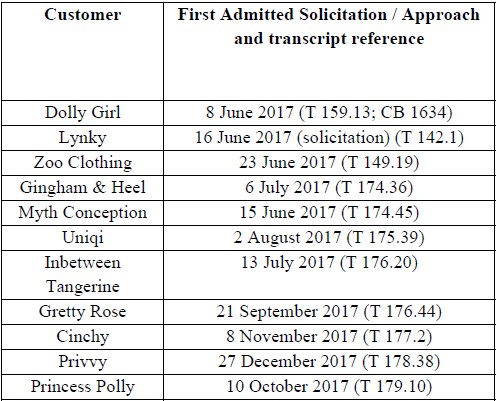
234 The above table is part of Annexure A to Luvalot’s closing written submissions dated 3 October 2022.
235 The above table does not include the contact made by Ms Dong to Georgia Moore and Tiara Maceri of White Fox Boutique on 6 June 2017 (CB135; T167).
236 I am satisfied on the evidence that the first contact Ms Dong made with customers who had previously been customers of Luvalot was on the first day of her employment with Sasha on 5 June 2017. I am satisfied on the evidence that Ms Dong used Sasha’s MYOB system to access the customer details to enable Ms Dong to send emails advising that she was the new sales manager at Sasha and provided information about Sasha’s clothing.
237 At common law, a restraint of trade is contrary to public policy and void unless it is justified by special circumstances of the particular case: Lindner v Murdock’s Garage (1950) 83 CLR 628 (Lindner) per Kitto J at 653 and Nordenfelt v Maxim Nordenfelt Guns and Ammunition Company Ltd [1894] AC 535 (Nordenfelt) per Lord Macnaghten at 565.
238 Ms Dong’s contract of employment was undated but it was not in issue that Ms Dong was employed in Luvalot’s Sydney office commencing 31 July 2012 and ceasing employment on 7 February 2017. Ms Dong signed the contract of employment and accepted the offer of employment in Sydney. It was not in dispute that the law of New South Wales applies to Ms Dong’s contract of employment. New South Wales was the place of employment.
239 In New South Wales a restraint is valid to the extent to which it is not against public policy, even if not in severable terms: s 4(1) RT Act. Consistent with the observations of Bathurst CJ at [23] and Brereton JA at [44] in Belflora, the effect of the RT Act is that, in New South Wales, the approach to determining this type of case is first, whether the alleged or apprehended breach does or will infringe the terms of the restraint properly construed (independently of public policy considerations); secondly, whether the restraint in its application to that breach is against public policy and thirdly, if it is not, then in its application to the alleged infringing conduct, the restraint is valid unless the court makes an order under the RT Act s 4(3): Woolworths Ltd v Olson [2004] NSWCA 372 at [42] (Mason P, McColl JA and Bryson JA agreeing).
240 The essential question is: whether Ms Dong’s contract of employment, in so far as it purports to preclude Ms Dong for a period of 12 months, or alternatively 6 months after termination of employment in the restraint area, being Australia, alternatively New South Wales or alternatively Sydney, from soliciting, canvassing, approaching or accepting from any person or organisation who was at any time during the 12 months prior to the employee’s termination ending a client or customer of, a supplier or contractor to, or investor in Luvalot – is void as an unreasonable restraint of trade.
241 Ms Dong’s admitted contact with the customers identified in the table above at [227] would infringe the terms of the restraint in cl 14.1 and items 7 (restraint period) and item 8 (the restraint area) of the schedule to Ms Dong’s contract of employment. The question then is whether the restraint in its application to that breach is against public policy. In my view, the restraint is unnecessarily broad and goes well beyond the scope of any restraint that is reasonable to protect the legitimate interest of Luvalot and its relationship with its customers. The restraint, in my view, is not reasonable as between the parties and is contrary to public policy as it is not reasonable in the public interest and is injurious to the public: Lindner at [53] (per Kitto J) and Nordenfelt at 565 (per Lord Macnaghten). I am of this view for the following reasons.
242 First, Luvalot has a legitimate interest in protecting its relationship with its customers. That does not extend however to precluding Ms Dong from working in the wholesale clothing industry for a period of 12 months, alternatively 6 months, in Australia, alternatively New South Wales, alternatively Sydney. Such a restraint is not reasonable to protect Luvalot’s legitimate interest being the relationship it has with its customers.
243 Second, the restraint is not reasonable in the circumstances of Ms Dong, who was a sales assistant and was paid a gross salary of $28,860 per annum. Ms Dong was a junior employee at Luvalot. Ms Dong did not hold a senior managerial role. As such, it is not reasonable to preclude Ms Dong for a period of 12 months, alternatively 6 months, from soliciting, canvassing, approaching or accepting any approach from any person or organisation who was at any time during the 12 months prior to Ms Dong’s employment with Luvalot terminating a client or customer of Luvalot. Such a restraint is not reasonable to protect the legitimate interest which Luvalot has in protecting the relationship which it has with its customers. Such a restraint is not reasonable as it would preclude Ms Dong working in the wholesale clothing business at a minimum for 6 months in Sydney.
244 Third, the restraint in cl 14.1 and items 7 and 8 to the schedule to the contract of employment would, at a minimum, preclude Ms Dong from working for 6 months at her new employer, Sasha in Kippax Street, Surry Hill, Sydney. Such a restraint is not reasonable to protect the legitimate interests of Luvalot and its relationship with its customers. Such a restraint is, in my view, contrary to public policy and injurious to the public.
245 Fourth, the restraint in cl 14.1.1, in so far as it precludes Ms Dong from soliciting, canvassing, approaching or accepting any approach from any person or organisation that is a supplier or contractor to or investor in Luvalot, is unreasonable to protect the legitimate interests of Luvalot and the relationship it has with its customers. Such a restraint goes well beyond any reasonable restraint to protect the legitimate interests of Luvalot.
246 Fifth, whilst no application has been made by Ms Dong under s 4(3) of the RT Act, I am of the view that a restraint which is not against public policy would be not more than two months. The first day of Ms Dong’s employment with Sasha was on 5 June 2017. The evidence of Ms Dong and Ms Lou, which I accept, was that she sent emails attaching Sasha’s clothing products to customers after she commenced her employment with Sasha and by using the contact information on Sasha’s MYOB system. Ms Dong’s employment with Luvalot ceased on 7 February 2017. The evidence was that the first emails which Ms Dong sent to wholesale customers was on the second day of employment on 6 June 2017, being four months less one day after ceasing her employment with Luvalot.
247 I find for the reasons given that the restraint in cl 14.1 of Ms Dong’s contract of employment is invalid for the purposes of s 4(1) of the RT Act, as it is against public policy.
DISPOSITION
248 Luvalot’s claim against Ms Dong will be dismissed. Luvalot will pay Ms Dong’s costs including any reserved costs.
I certify that the preceding two hundred and forty-eight (248) numbered paragraphs are a true copy of the Reasons for Judgment of the Honourable Justice Anderson. |


