FEDERAL COURT OF AUSTRALIA
Australian Competition and Consumer Commission v Telstra Corporation Limited [2022] FCA 1398
ORDERS
AUSTRALIAN COMPETITION AND CONSUMER COMMISSION Applicant | ||
AND: | Respondent | |
DATE OF ORDER: |
THE COURT DECLARES THAT:
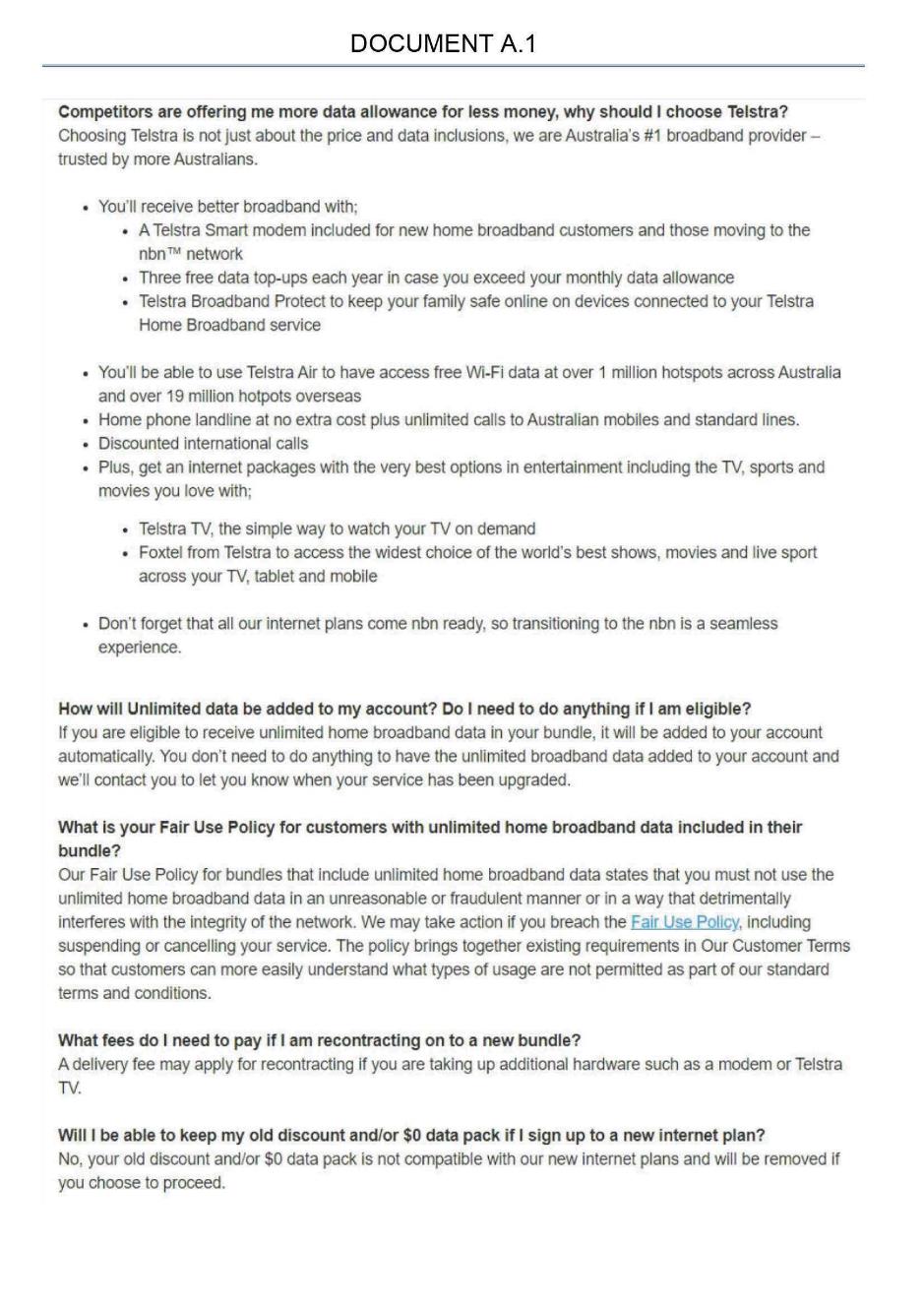
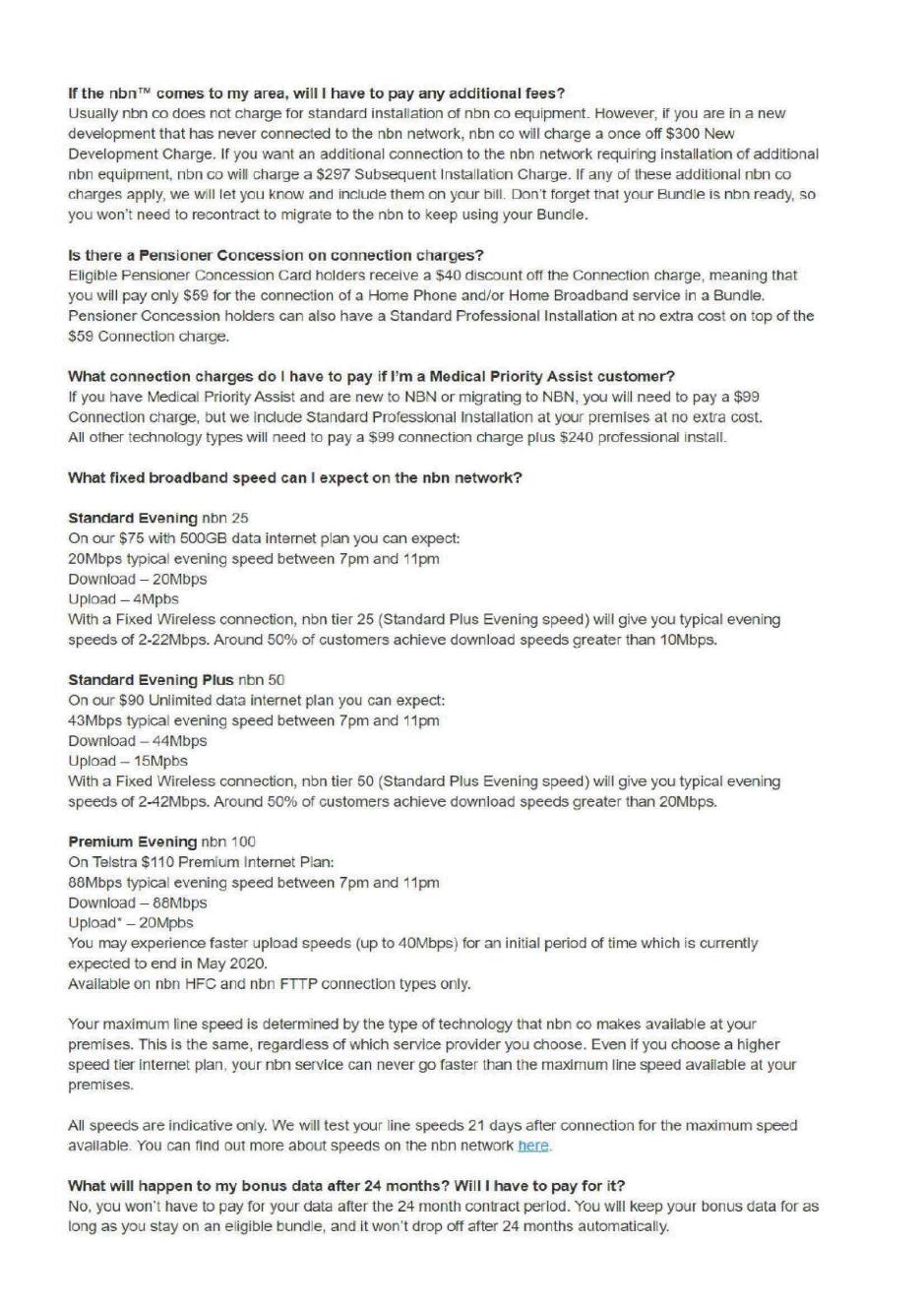
1. The respondent, Telstra Corporation Limited (Telstra), between 1 April 2019 and 30 April 2020, in trade or commerce, engaged in conduct that was misleading or deceptive or was likely to mislead or deceive in contravention of s 18 of the Australian Consumer Law (ACL) (which is Sch 2 to the Competition and Consumer Act 2010 (Cth) (CCA)) by reason of it publishing the following statements on its website:
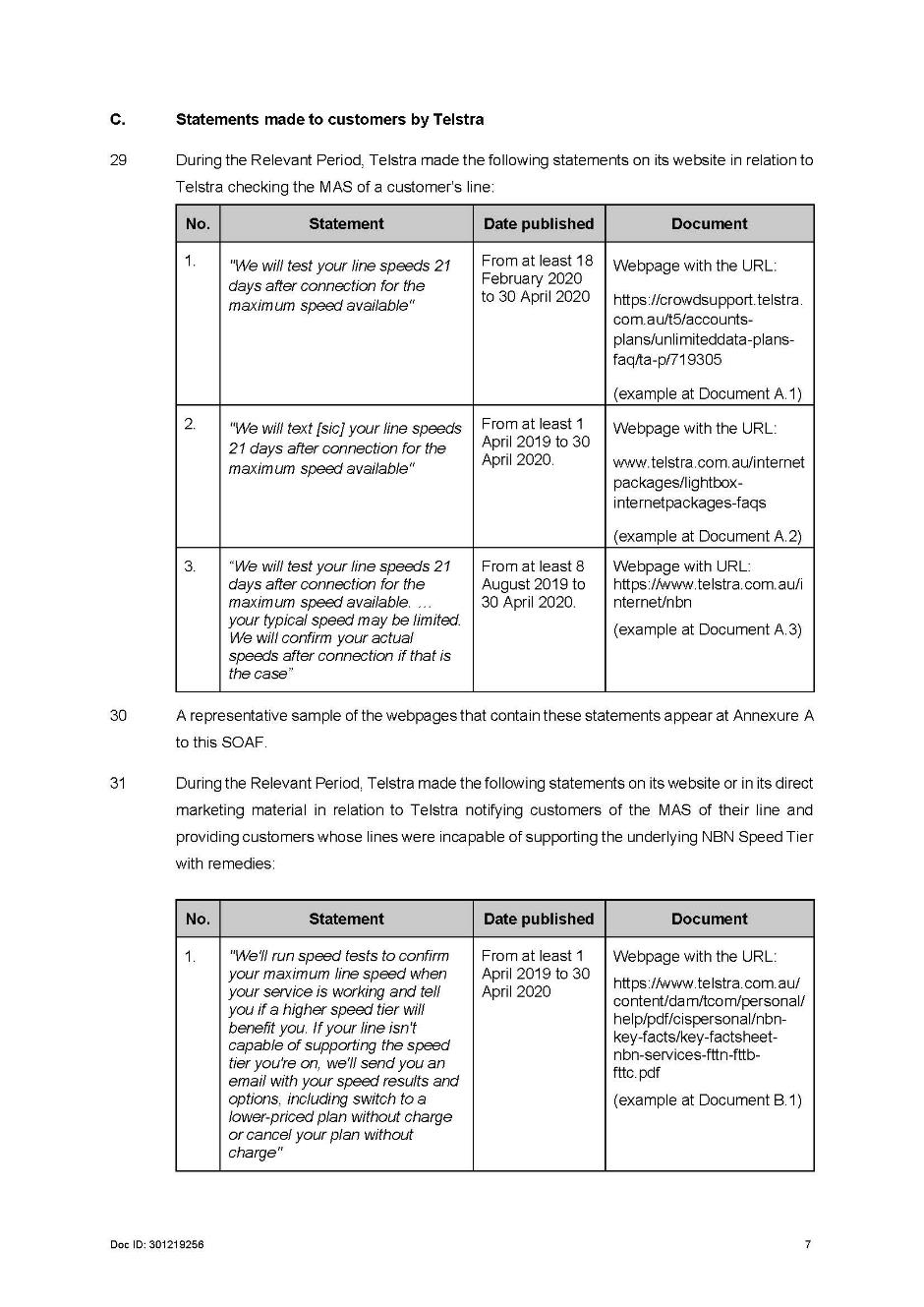
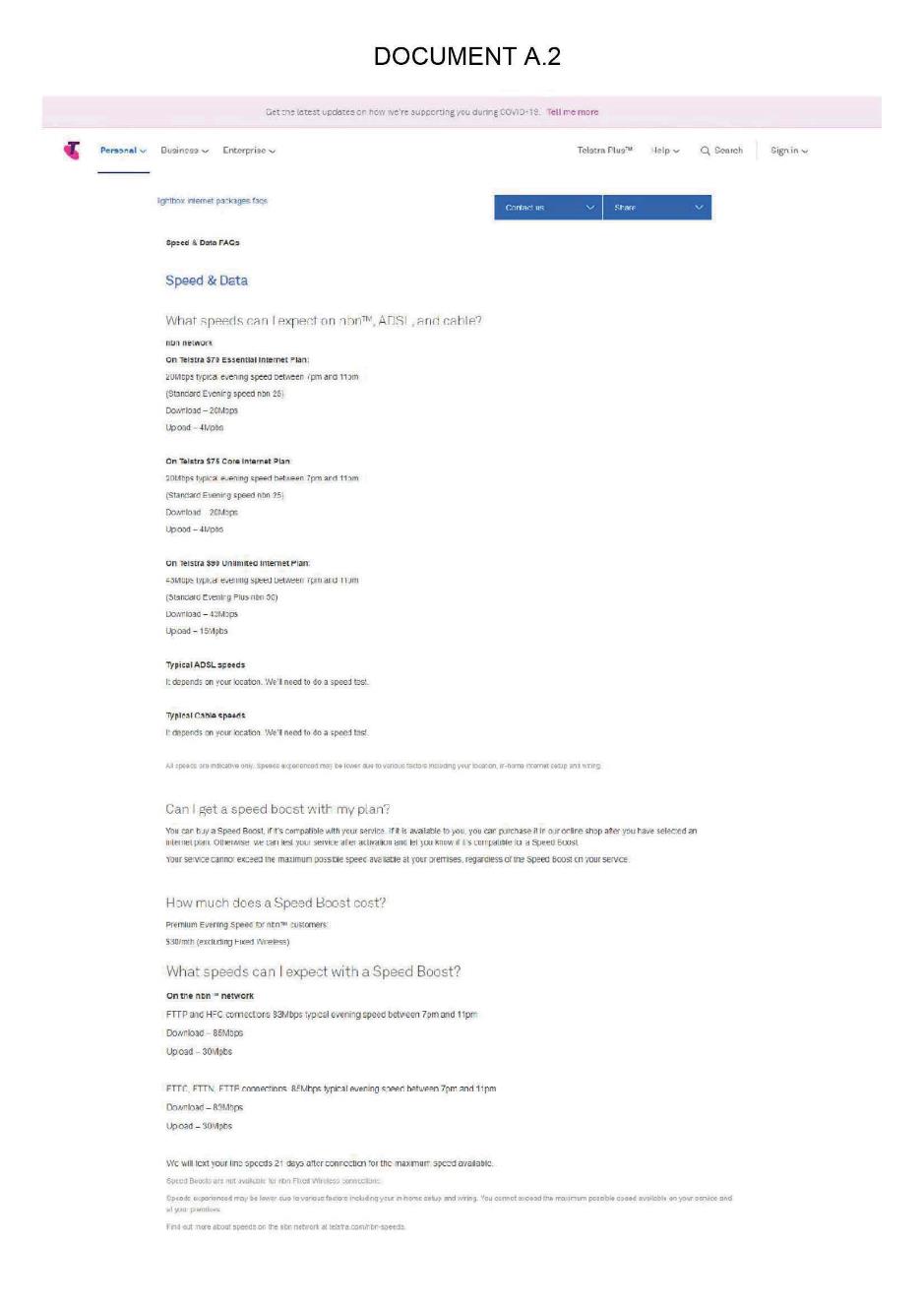
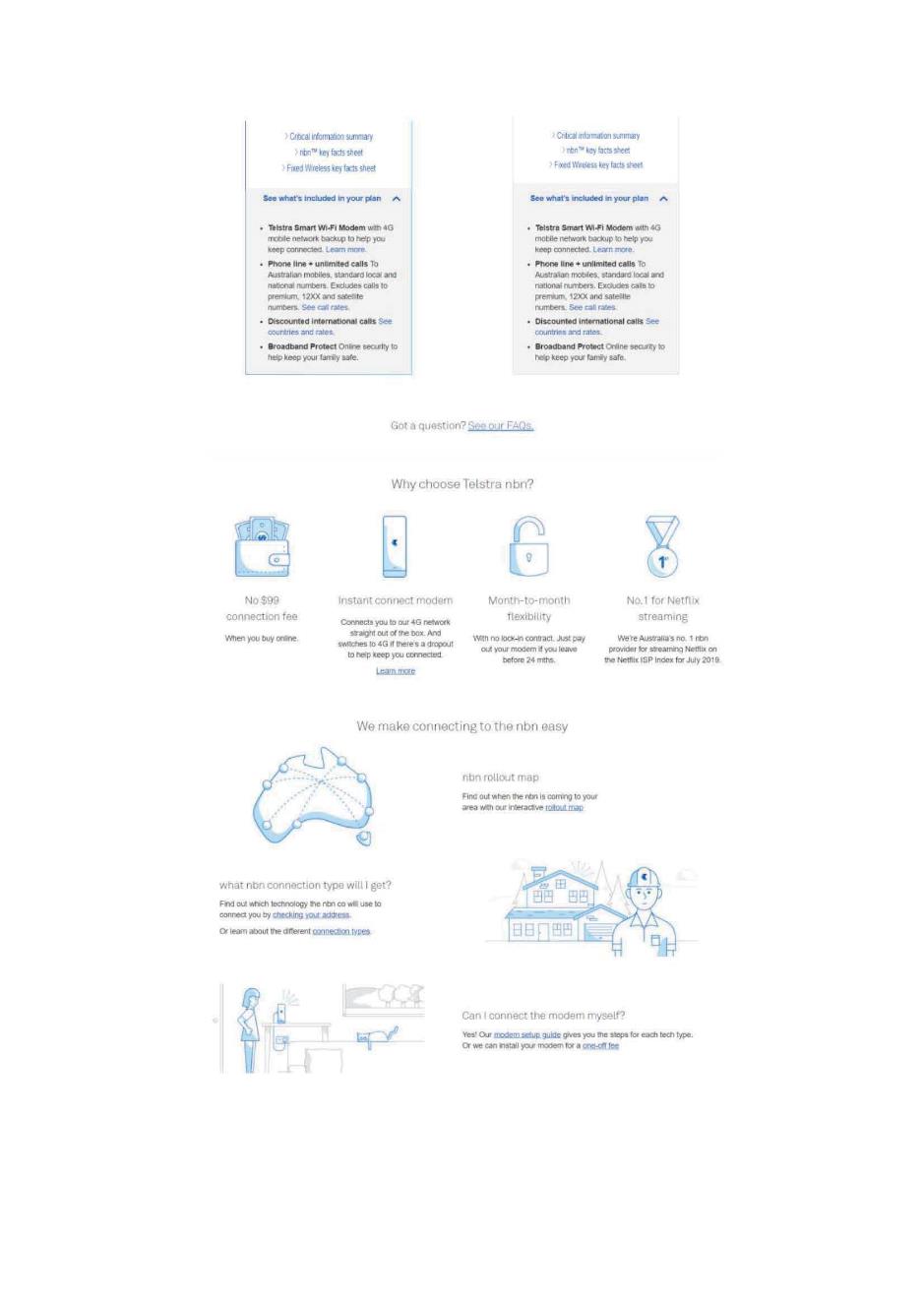
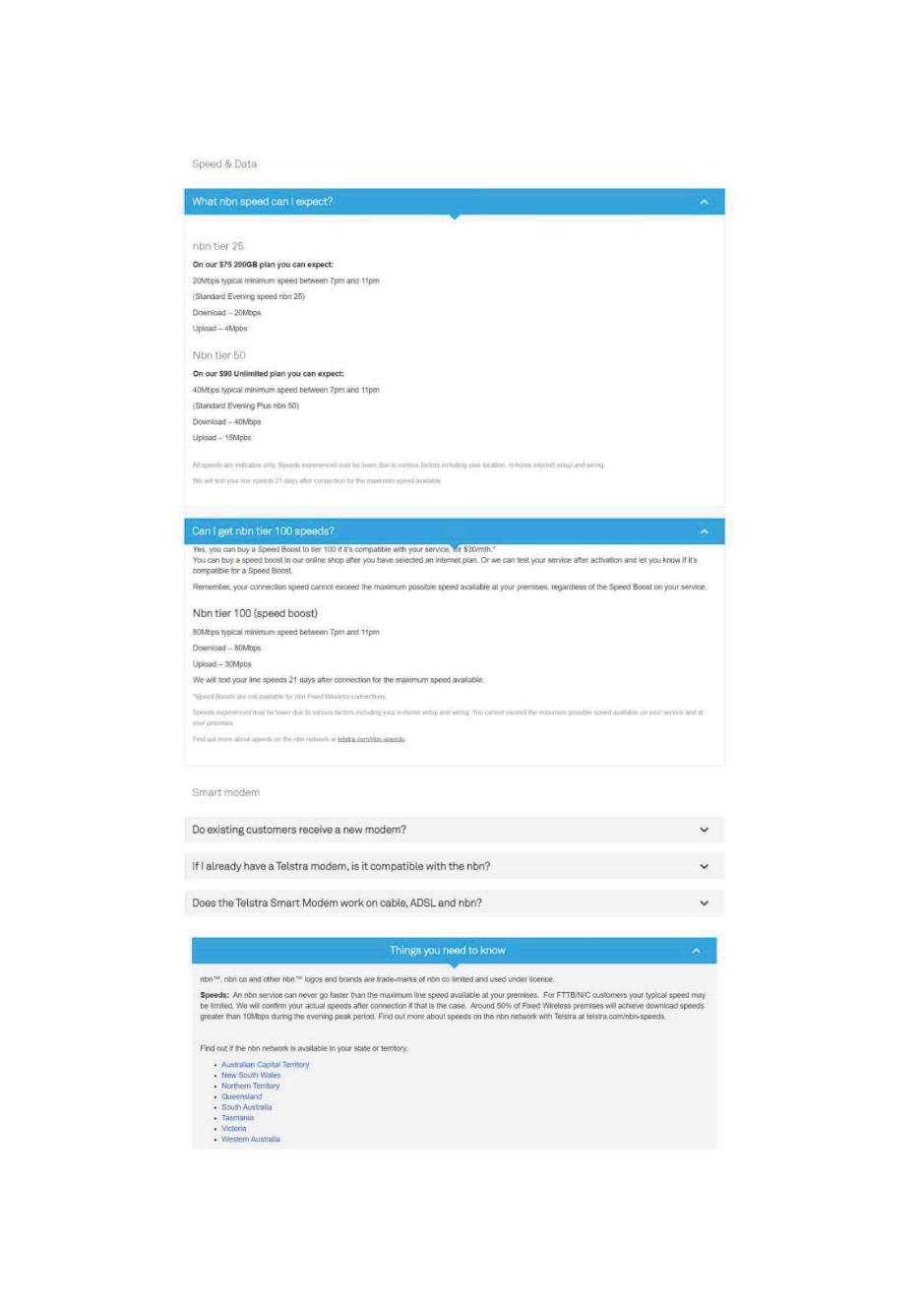
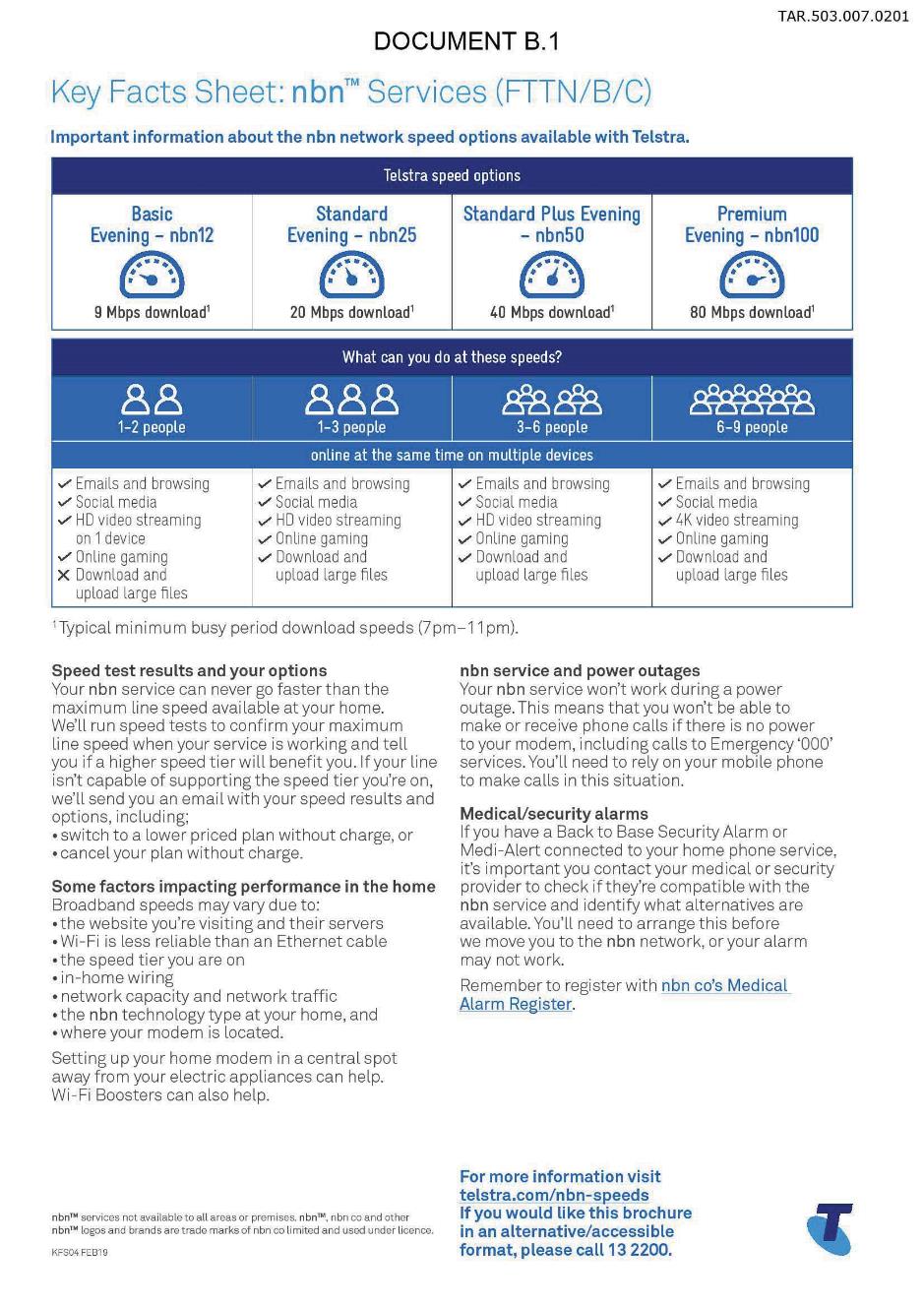
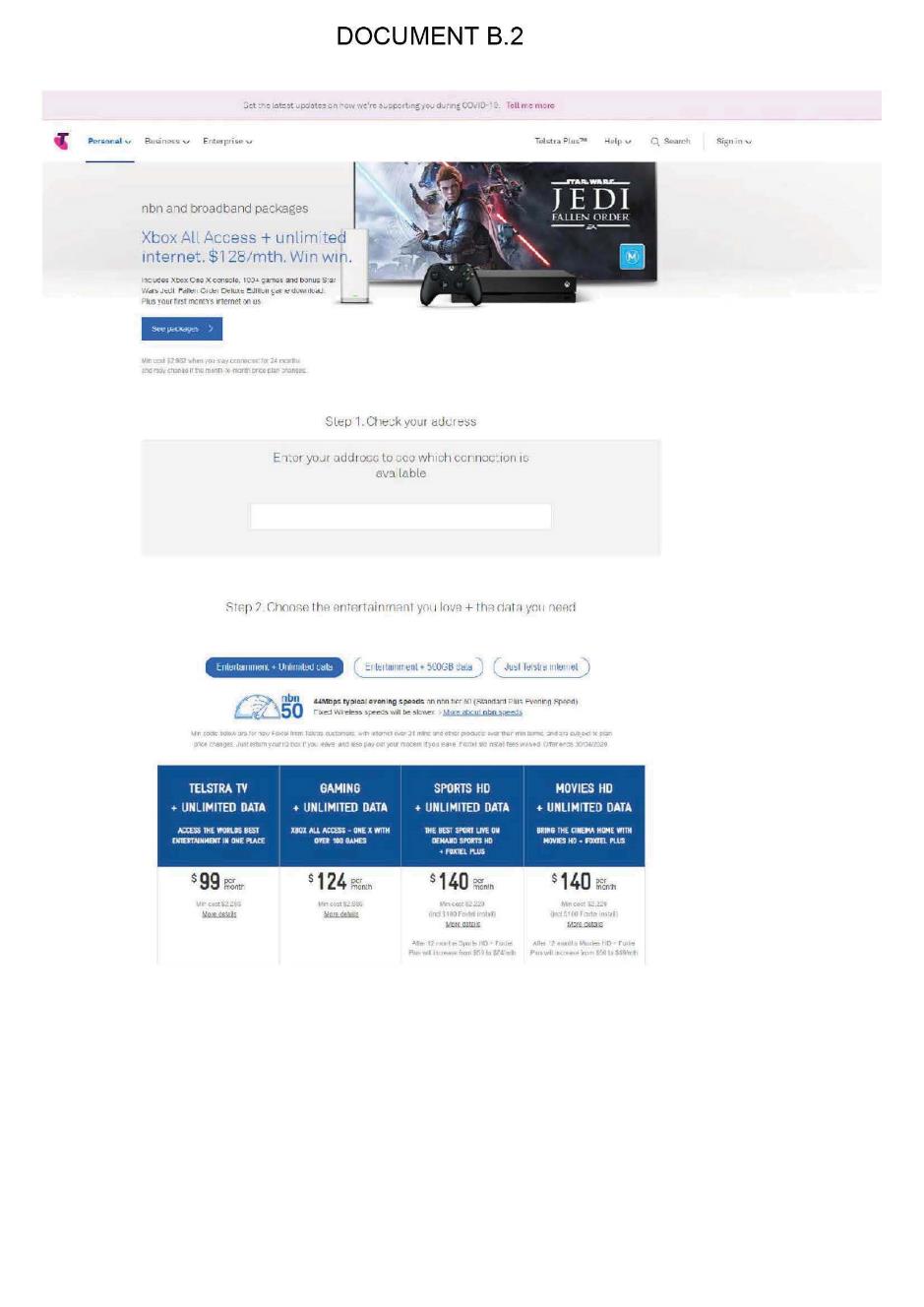
(a) “We will test your line speeds 21 days after connection for the maximum speed available”;
(b) “We will text [sic] your line speeds 21 days after connection for the maximum speed available”; and
(c) “We will test your line speeds 21 days after connection for the maximum speed available. … your typical speed may be limited. We will confirm your actual speeds after connection if that is the case”,
and thereby representing that, for customers who acquired services from Telstra using NBN fibre-to-the-node (FTTN) technology on plans configured to either the 50/20 Megabits per second (Mbps) NBN Speed Tier (NBN50 Speed Tier) and 100/40 NBN Speed Tier (NBN100 Speed Tier) (separately, the NBN50 Telstra Plan and the NBN100 Telstra Plan, and together, the Telstra Plans), Telstra would test their line’s maximum attainable speed (MAS) within a reasonable period following 21 days after connection (MAS Checking Representations), in circumstances where:
(d) Telstra did not have in place adequate systems, processes and policies to ensure that the MAS Checking Representations would be fulfilled; and
(e) Telstra thereby did not have reasonable grounds for making the MAS Checking Representations, which were representations with respect to a future matter, and which are taken to be misleading under s 4 of the ACL; and
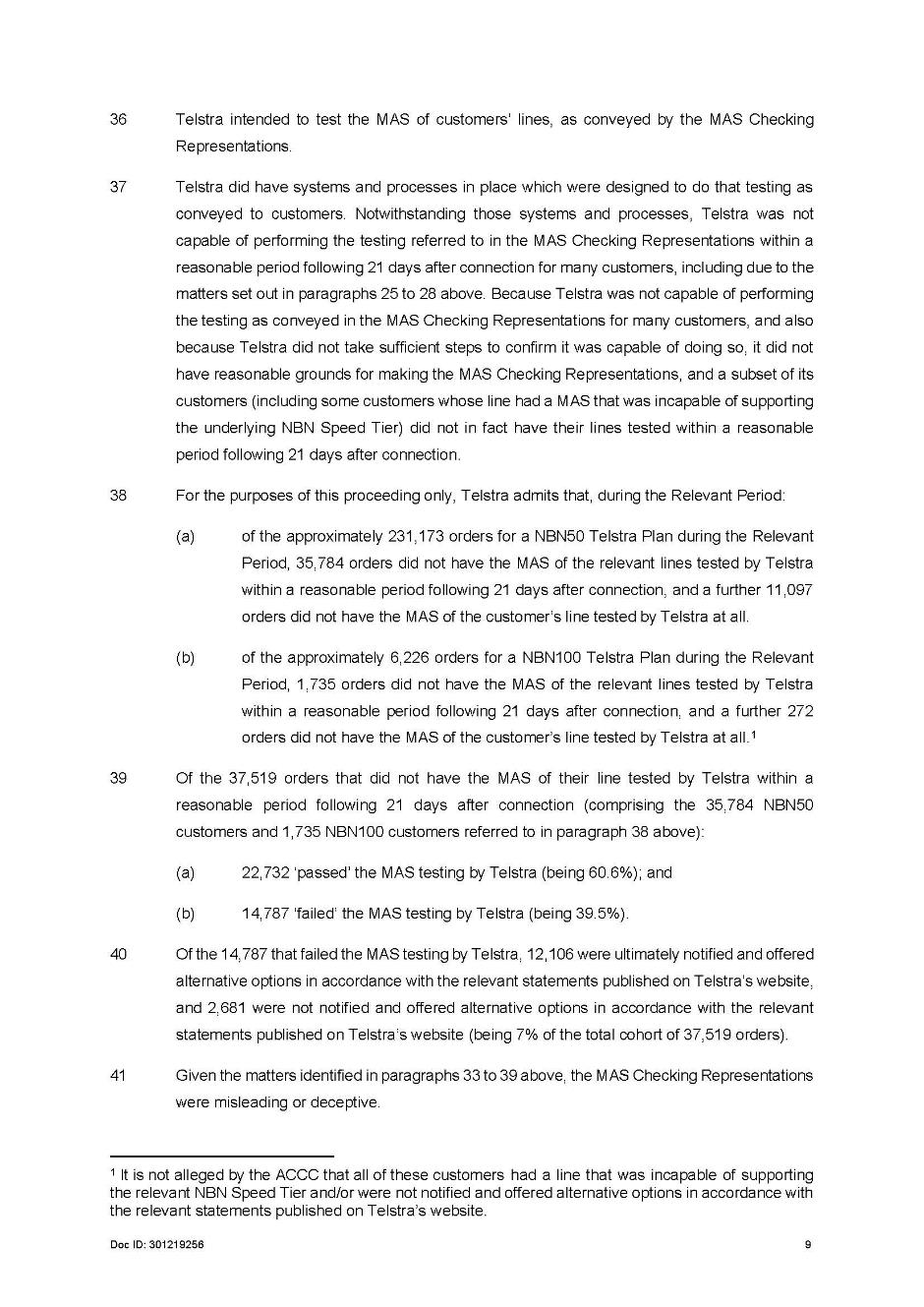
in fact, Telstra failed to test the line’s MAS for 35,784 customers on the NBN50 Telstra Plan and 1,735 customers on the NBN100 Telstra Plan within a reasonable period following 21 days after connection, and failed to test the line’s MAS for 11,097 customers with a NBN50 Telstra Plan and 272 customers with a NBN100 Telstra Plan after connection of their service at all.
2. Telstra, between 1 April 2019 and 30 April 2020, in trade or commerce, in connection with the supply or possible supply or promotion of Telstra Plans:
(a) engaged in conduct that was misleading or deceptive or was likely to mislead or deceive in contravention of s 18 of the ACL; and
(b) made false or misleading representations concerning the existence, exclusion or effect of a condition, right or remedy in contravention of s 29(1)(m) of the ACL,
by reason of it:
(c) publishing on its website: “We’ll run speed tests to confirm your maximum line speed when your service is working and tell you if a higher speed tier will benefit you. If your line isn’t capable of supporting the speed tier you’re on, we’ll send you an email with your speed results and options, including switch to a lower-priced plan without charge or cancel your plan without charge”;
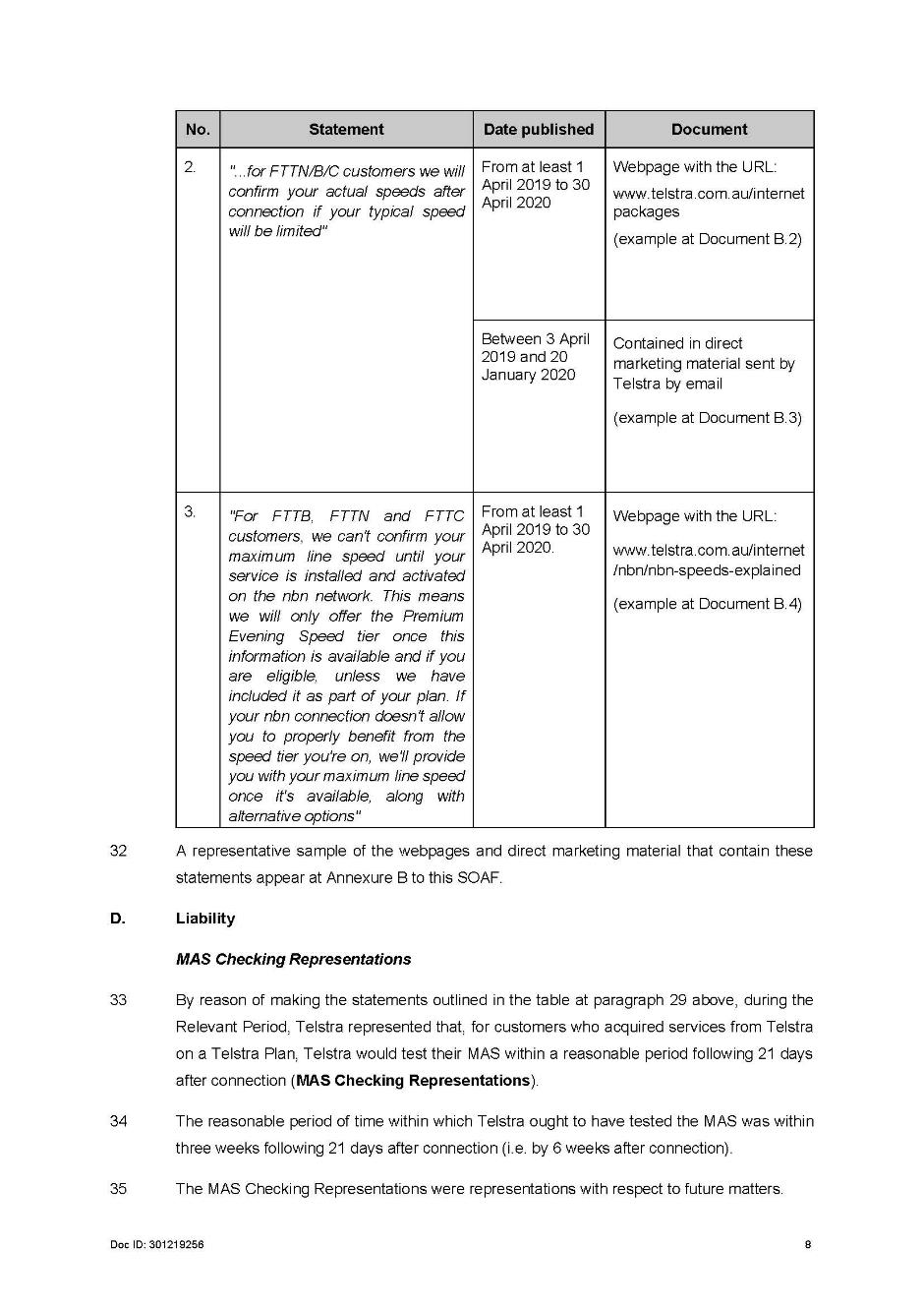
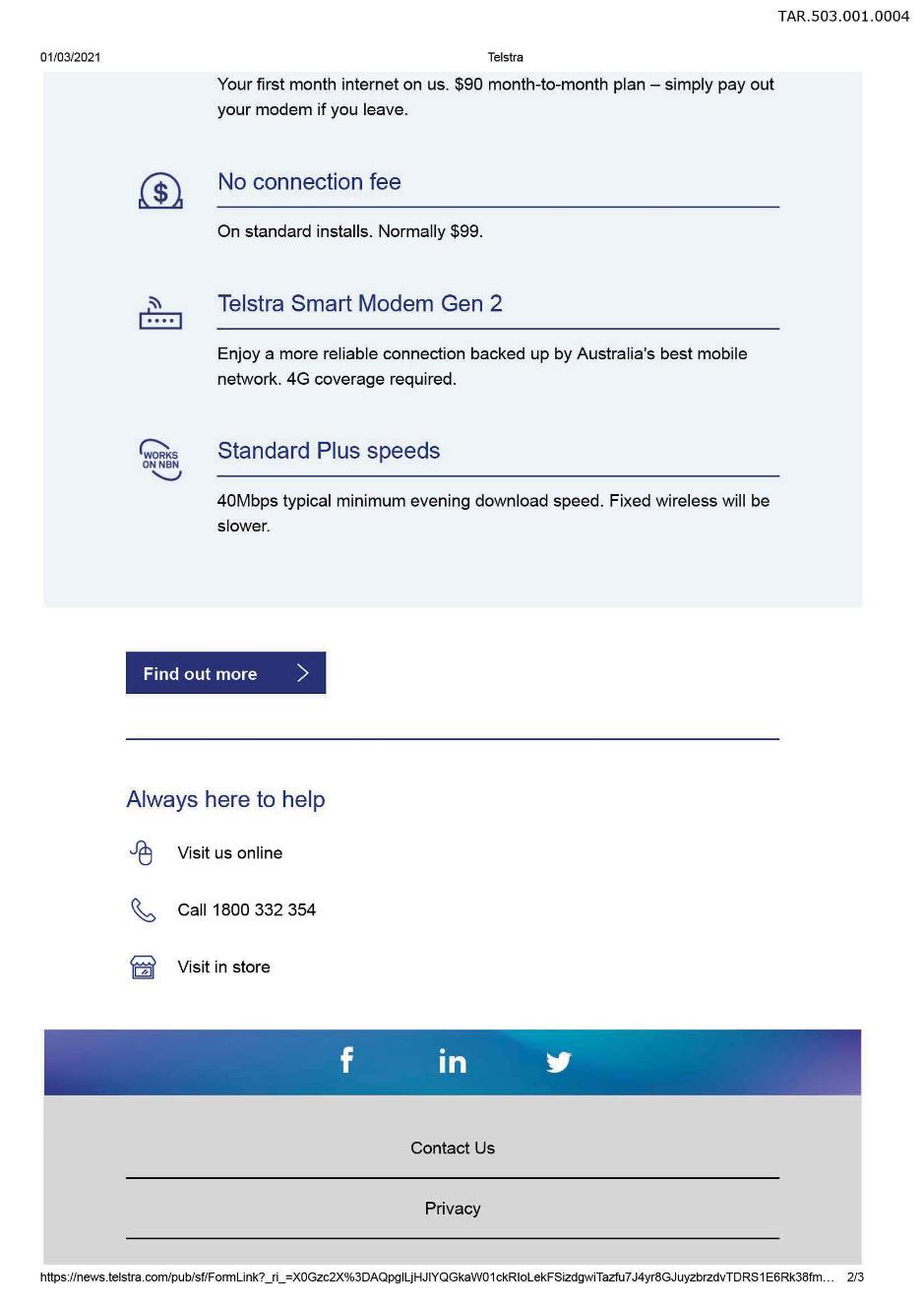
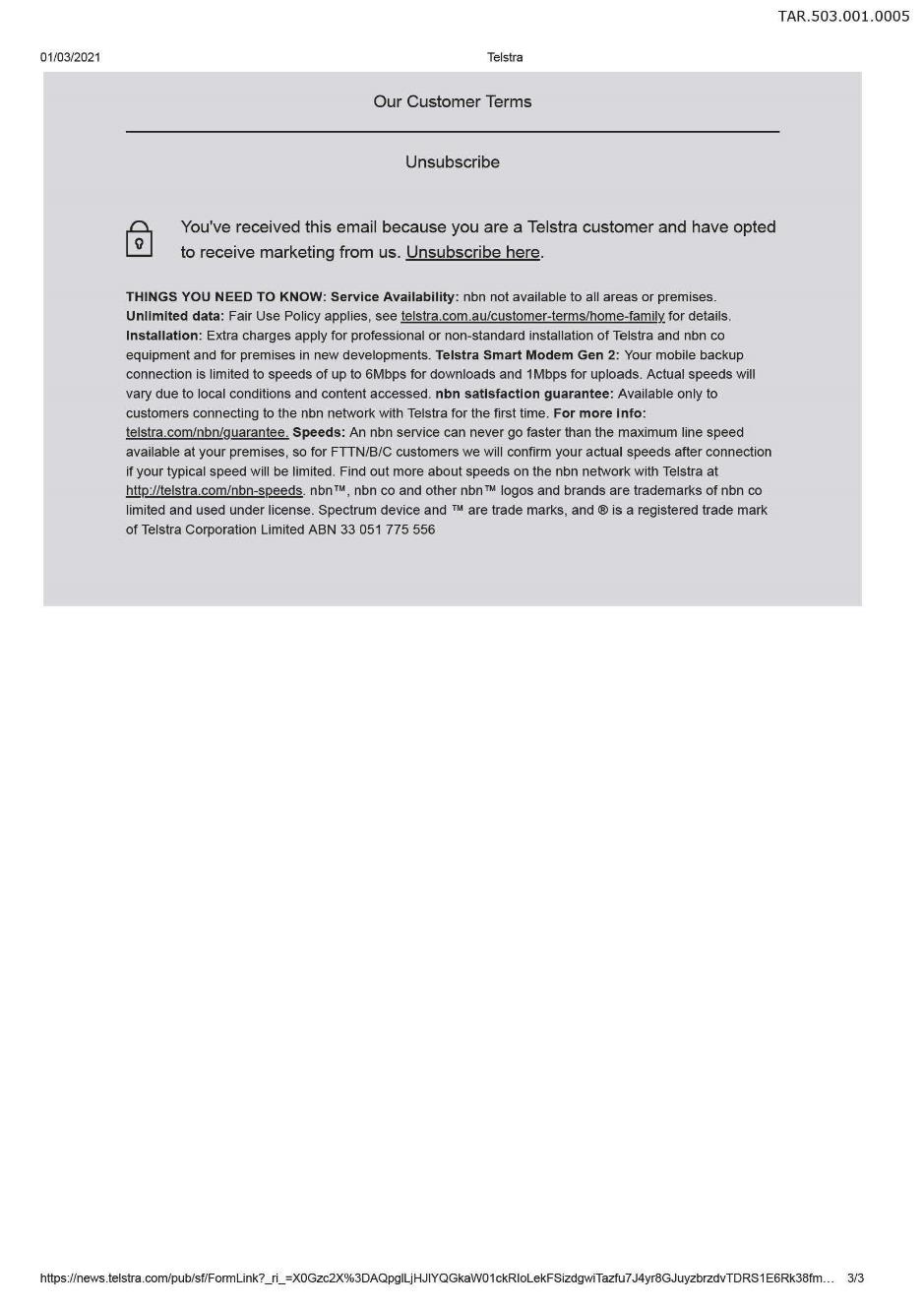
(d) publishing on its website and in direct emails to consumers: “For FTTN/B/C customers we will confirm your actual speeds after connection if your typical speed will be limited”; and
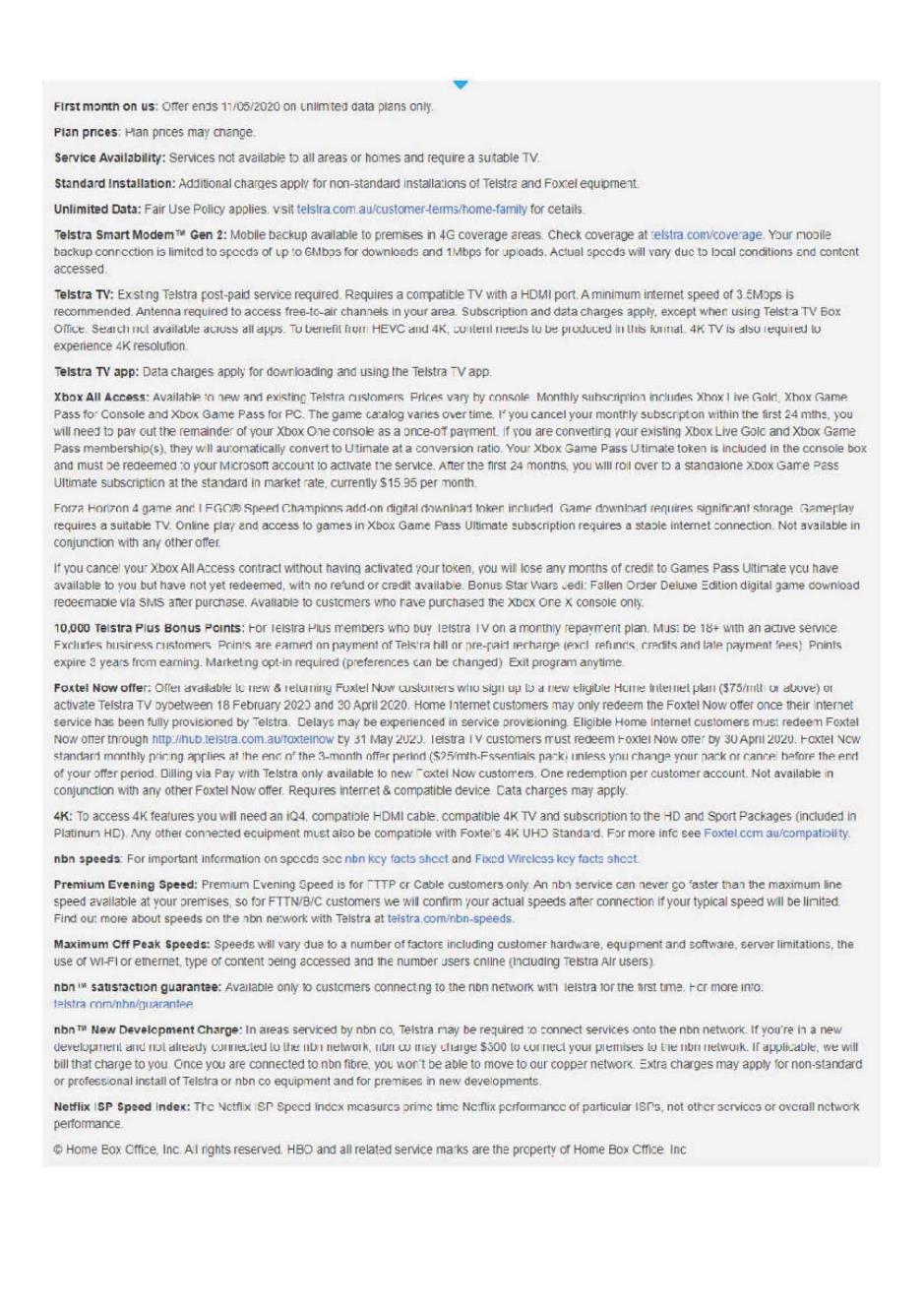
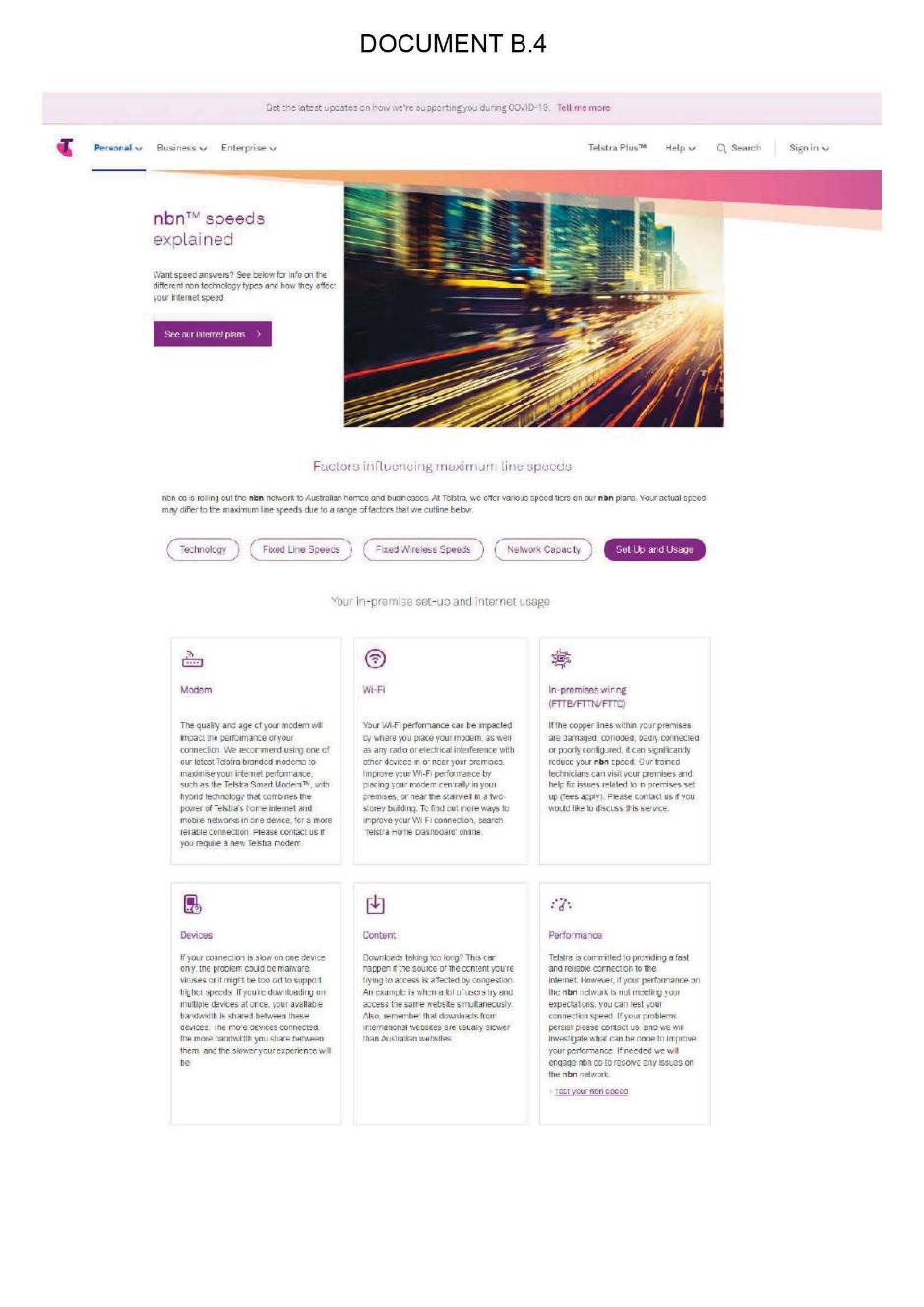
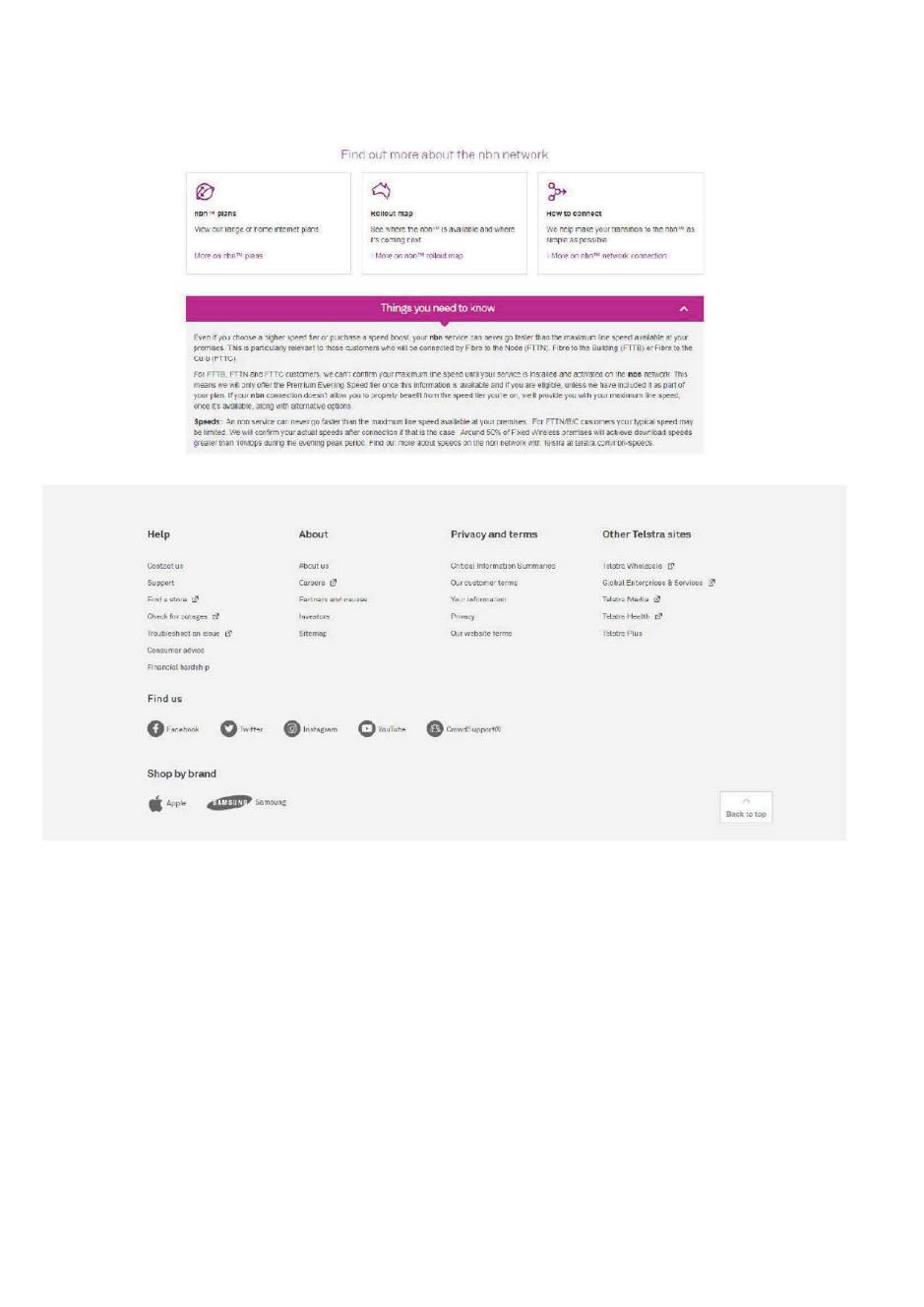
(e) publishing on its website: “For FTTB, FTTN and FTTC customers, we can’t confirm your maximum line speed until your service is installed and activated on the nbn network. This means we will only offer the Premium Evening Speed tier once this information is available and if you are eligible, unless we have included it as part of your plan. If your nbn connection doesn’t allow you to properly benefit from the speed tier you’re on, we’ll provide you with your maximum line speed once it’s available, along with alternative options”;
and thereby representing in relation to the Telstra Plans that it would notify and provide alternative options to a customer whose line had a MAS that was incapable of supporting the underlying NBN Speed Tier upon:
(f) Telstra confirming the MAS of the customer’s line; and/or
(g) the MAS of the customer’s line becoming available,
(together and individually, the MAS Notification & Remedy Representations),
in circumstances where:
(h) Telstra did not have in place adequate systems, processes and policies to ensure that the MAS Notification & Remedy Representations would be fulfilled; and
(i) Telstra thereby did not have reasonable grounds for making the MAS Notification & Remedy Representations, which were representations with respect to a future matter, and which are taken to be misleading under s 4 of the ACL; and
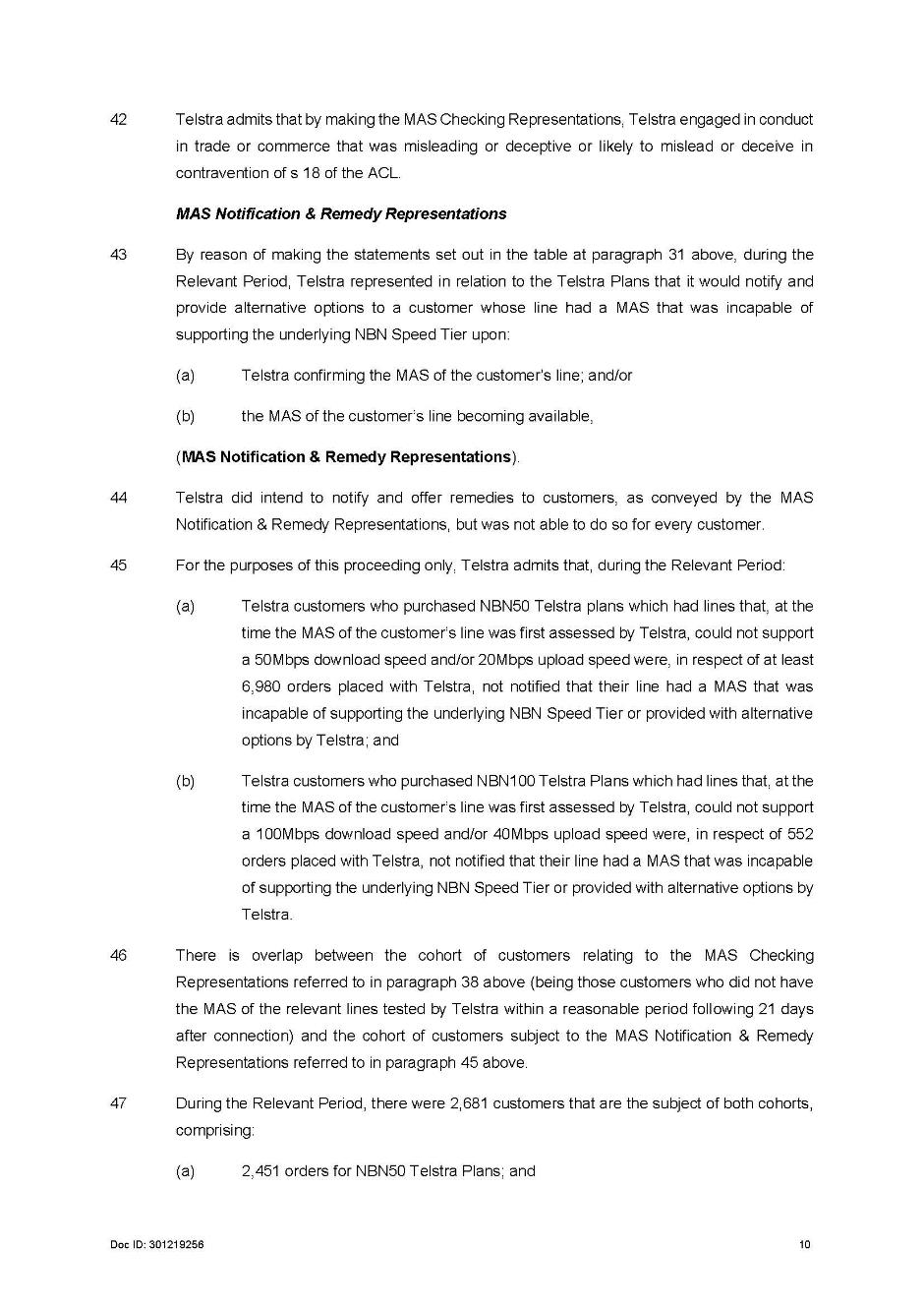
in fact, Telstra failed to notify 6,980 NBN50 Telstra Plan customers and 552 NBN100 Telstra Plan customers of their line’s MAS and provide them with alternative options.
3. Between 1 April 2019 and 30 April 2020, Telstra, in trade or commerce, in connection with the supply or possible supply or promotion of Telstra Plans:
(a) by engaging in the conduct at paragraphs 1 and 2 above; and
(b) by not notifying those customers whose line had a MAS that was incapable of supporting the underlying NBN Speed Tier of their MAS within a reasonable period following 21 days after connection or at all,
represented to those customers that their line was capable of supporting the underlying NBN Speed Tier of their Telstra Plan (Line Capability Representations), when that was not the case, and Telstra thereby:
(c) engaged in conduct that was misleading or deceptive, or likely to mislead and deceive, in contravention of s 18 of the ACL; and
(d) made false or misleading representations that the Telstra Plans had performance characteristics, uses or benefits in contravention of s 29(1)(g) of the ACL.
THE COURT ORDERS THAT:
4. Telstra pay pecuniary penalties to the Commonwealth of Australia in the total sum of $15,000,000 in respect of the contraventions of ss 29(1)(g) and 29(1)(m) of the ACL referred to in paragraphs 2 and 3 above.
5. Telstra pay $150,000 as a contribution to the applicant’s costs of and incidental to the proceeding.
Note: Entry of orders is dealt with in Rule 39.32 of the Federal Court Rules 2011.
MOSHINSKY J:
Introduction
1 On 11 November 2022, I made declarations and orders substantially in the terms proposed by the parties, including declarations that the respondent, Telstra Corporation Ltd (Telstra), contravened ss 18 and 29 of the Australian Consumer Law (ACL), being Sch 2 to the Competition and Consumer Act 2010 (Cth), and orders that Telstra pay pecuniary penalties to the Commonwealth of Australia in the total sum of $15 million, and pay $150,000 as a contribution to the costs of the applicant (the ACCC). These are my reasons for making the declarations and orders.
2 The hearing of this proceeding took place on 10 November 2022. This proceeding is one of three proceedings commenced by the ACCC against telecommunications companies in relation to representations that they made to consumers about residential broadband internet plans. The other two proceedings involve Optus Internet Pty Ltd (VID 444 of 2021) (the Optus proceeding) (which was also heard on 10 November 2022) and TPG Internet Pty Ltd (VID 446 of 2021) (which was heard on 21 September 2022). In each case, the parties reached agreement on proposed declarations and other orders, including pecuniary penalties, and made submissions in support of the proposed declarations and orders at the hearing. In each case, on 11 November 2022, I made declarations and orders.
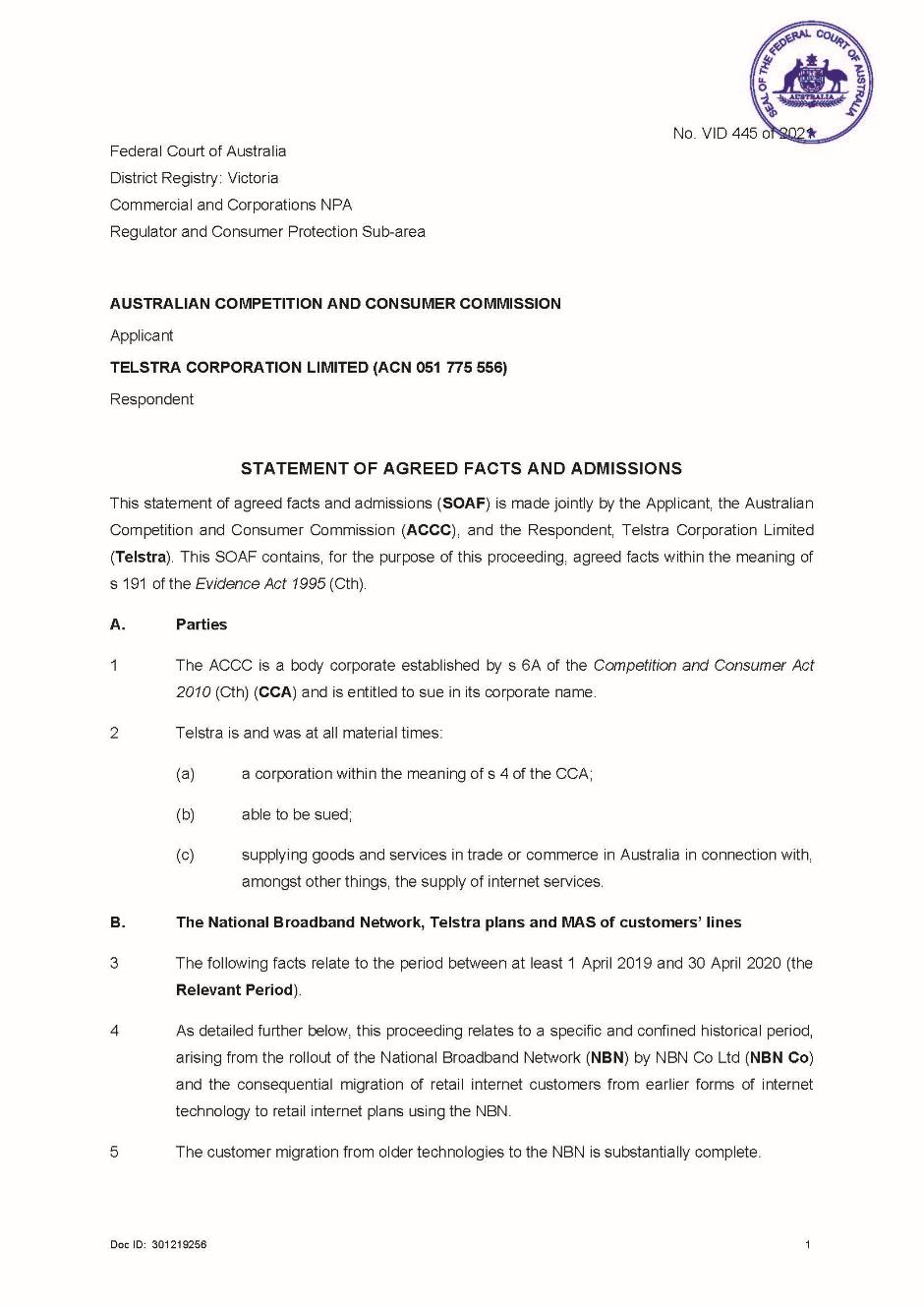
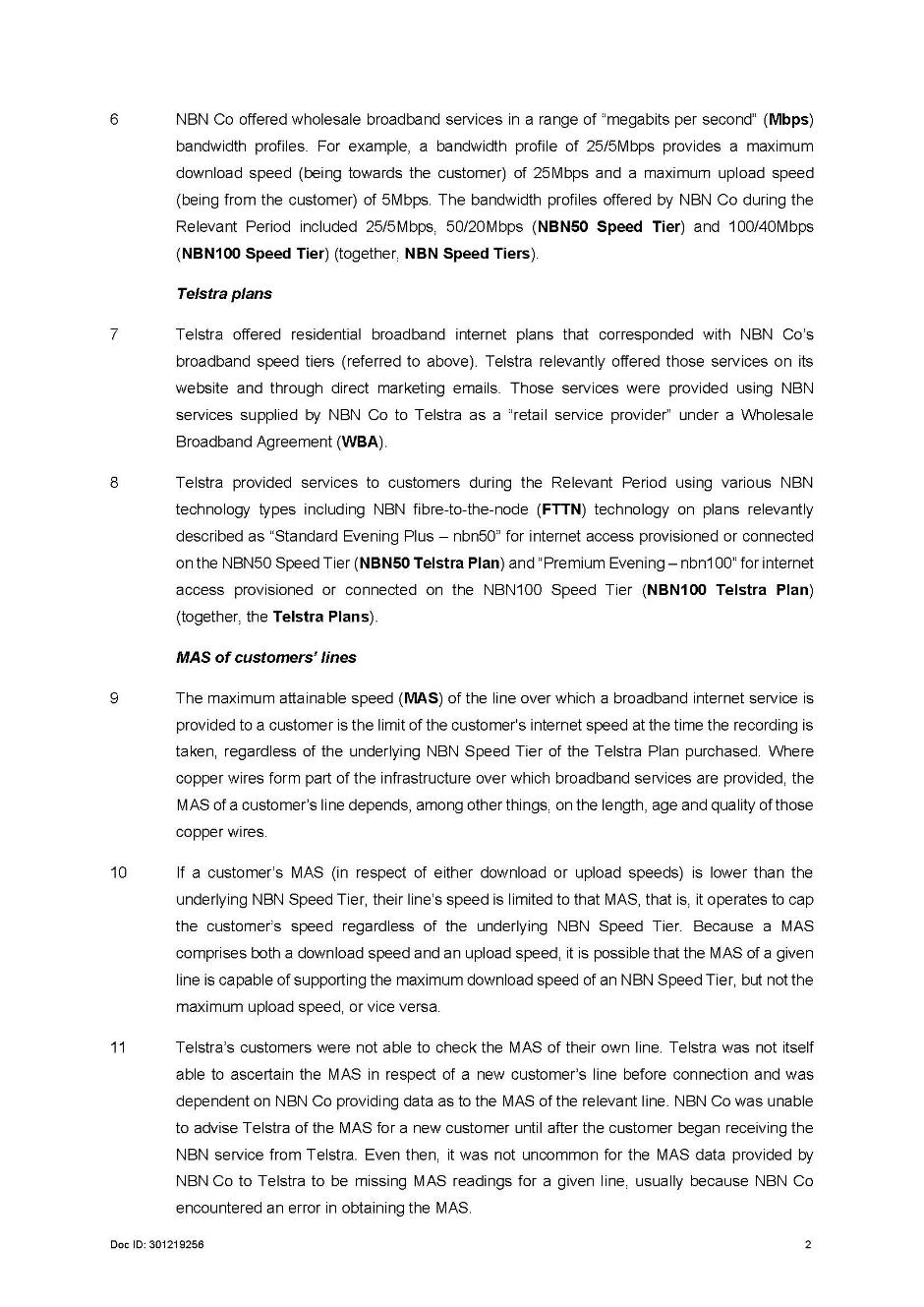
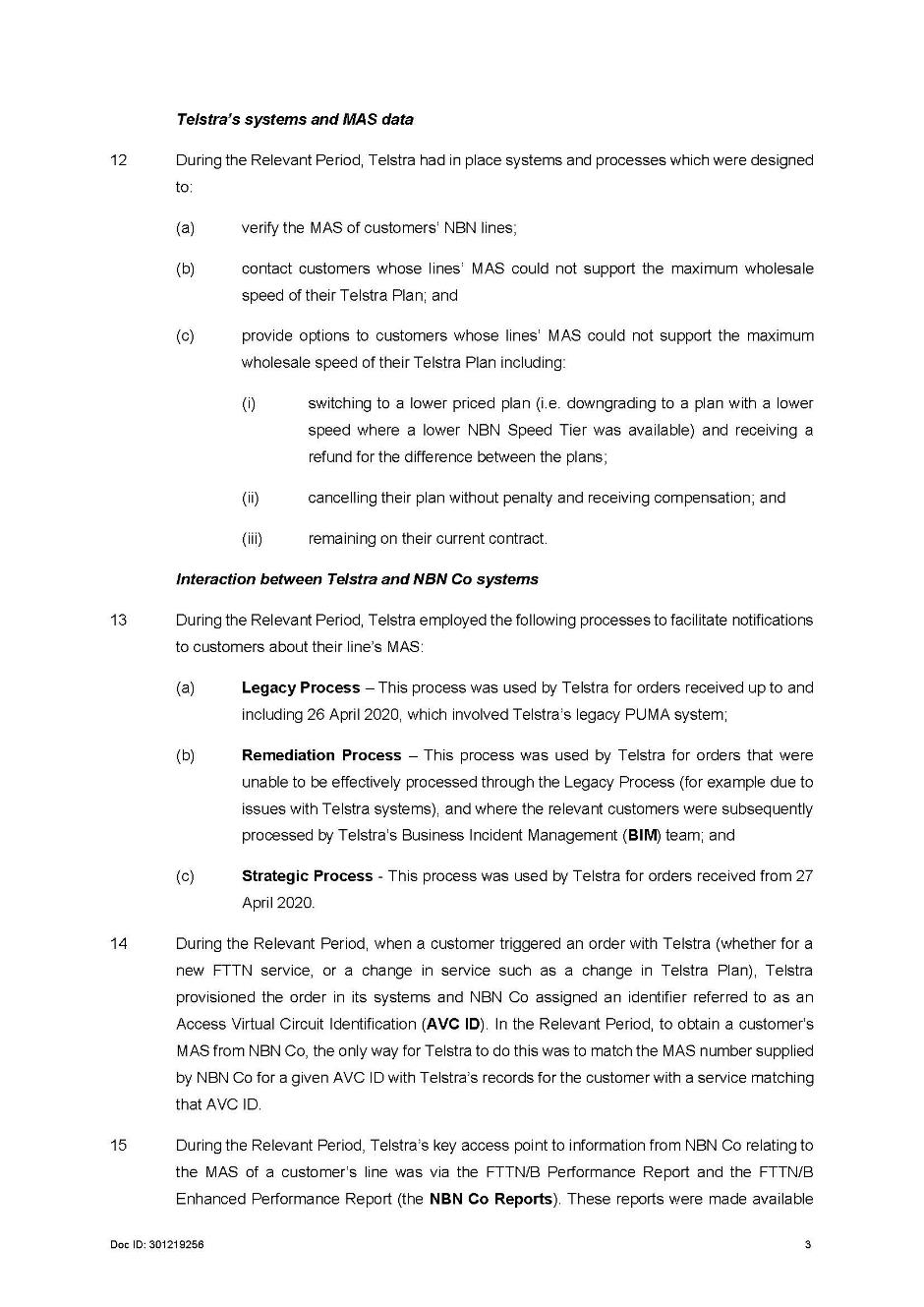
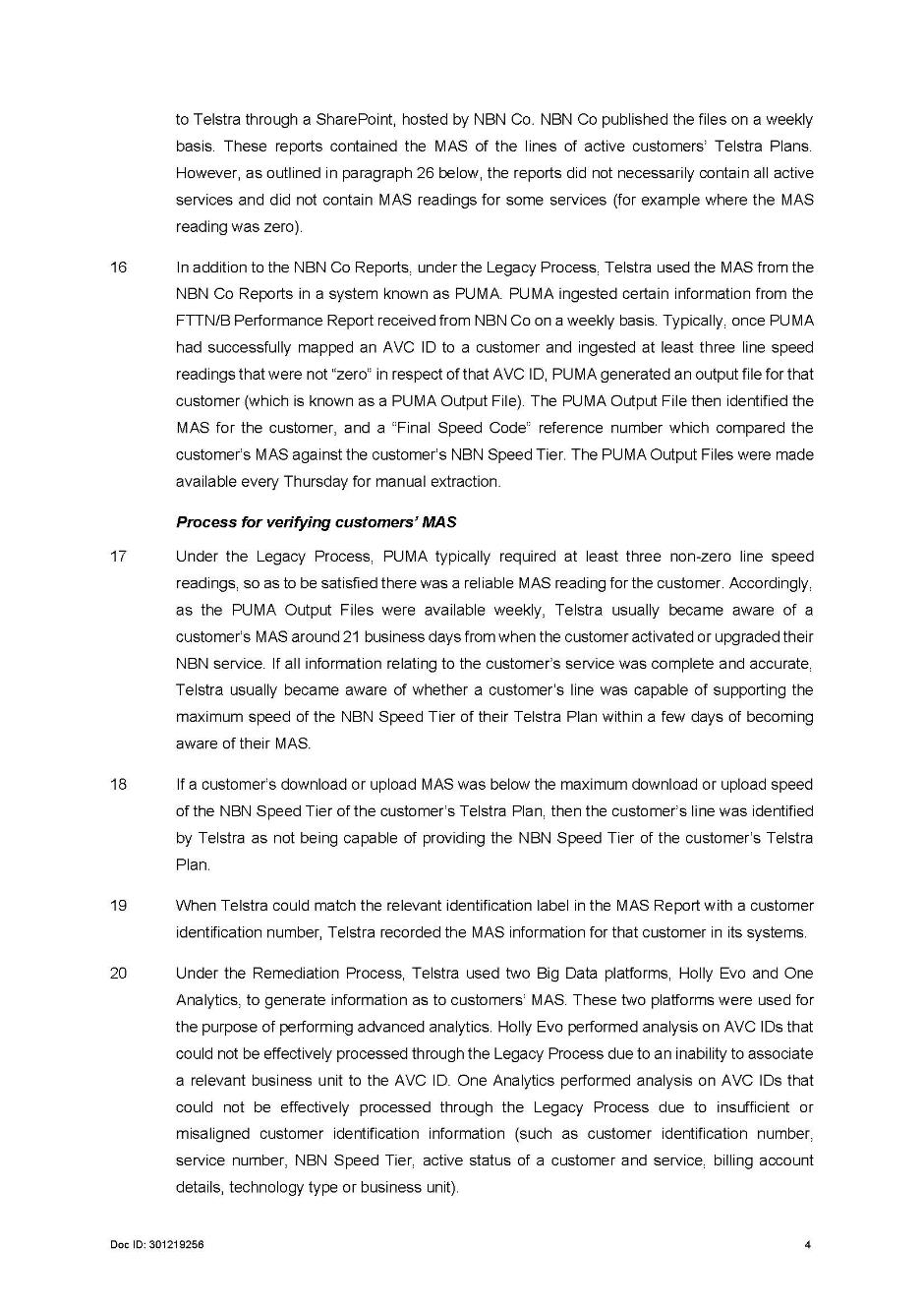
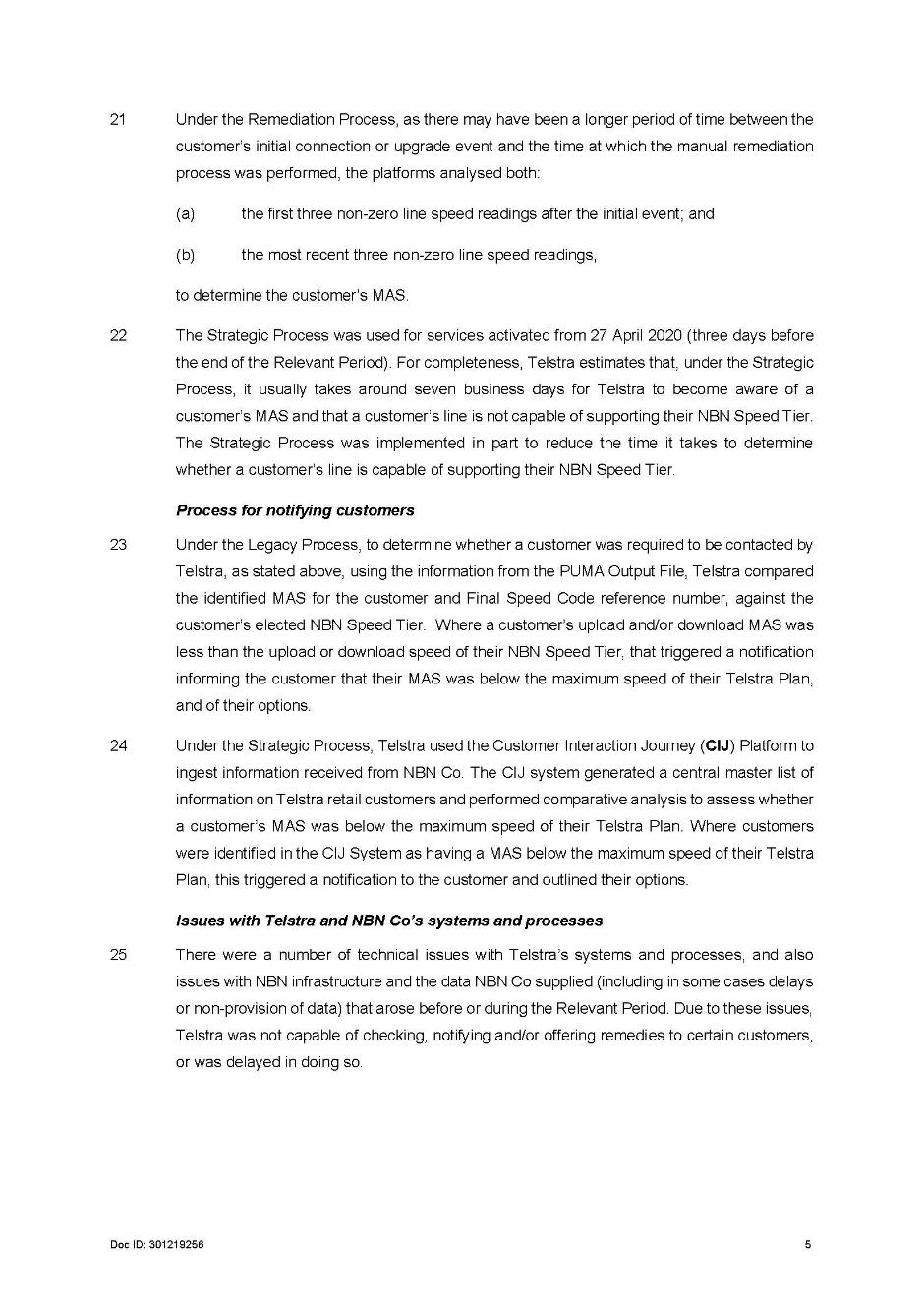
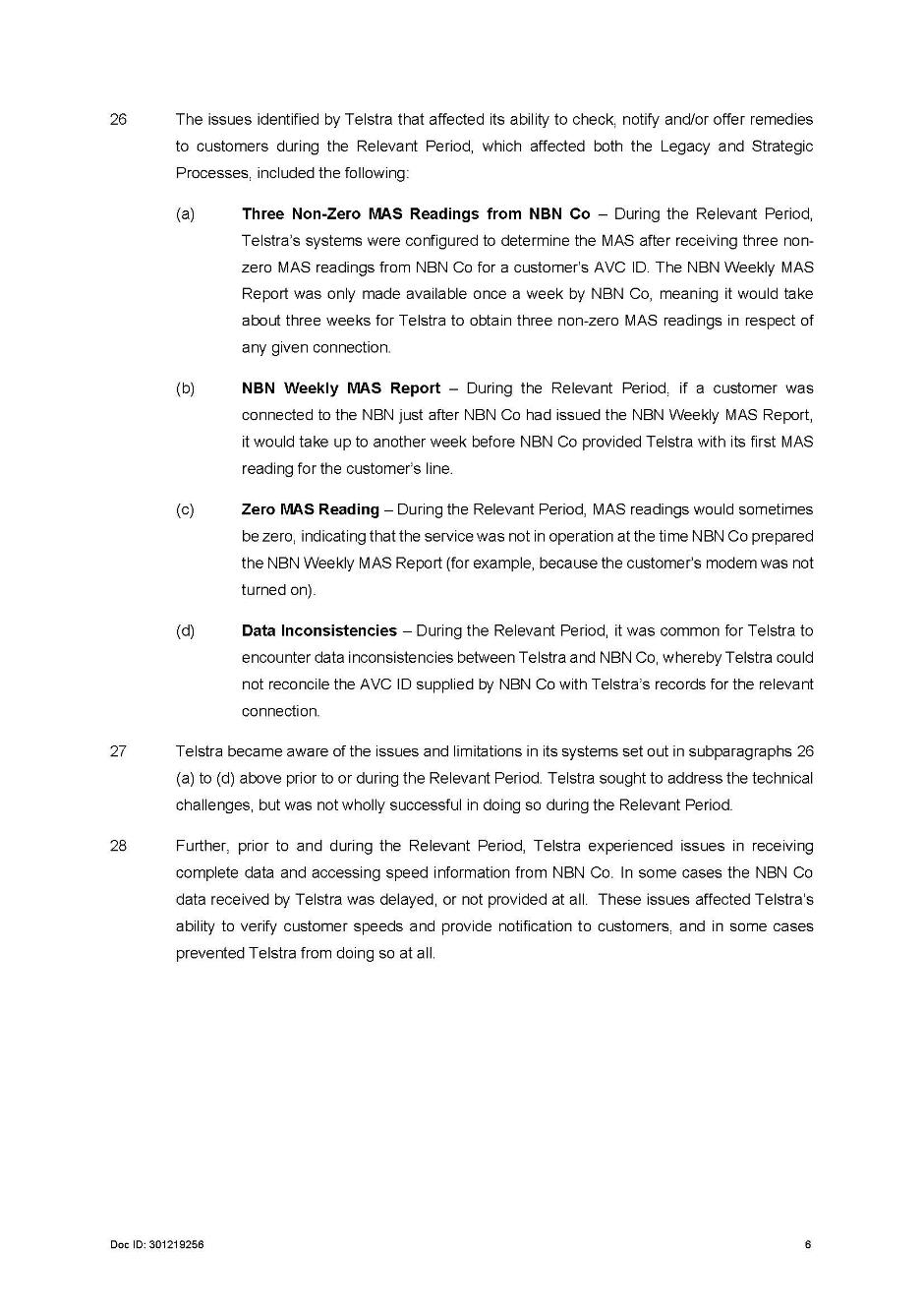
3 The material before the Court in this proceeding includes a statement of agreed facts prepared by the parties, dated 7 November 2022 (SOAF). A copy of the SOAF is annexed to these reasons for judgment. I accept as correct the statements contained in the SOAF and make findings in accordance with that document.
4 Also before the Court is an affidavit of Michael Meeve dated 7 November 2022. Mr Meeve is the Product Owner of the NBN Historical Remediation team at Telstra, a position he has held since April 2022. His affidavit provides evidence that is in addition to the material in the SOAF, and includes details of a remediation program undertaken by Telstra and the remedies that have been provided. Mr Meeve was not required to attend for cross-examination, and I accept his evidence.
5 The parties prepared and filed written joint submissions. In preparing these reasons, I have drawn substantially on those submissions.
Overview of the case and the contravening conduct
6 Between at least 1 April 2019 and 30 April 2020 (the Relevant Period), Telstra offered on its website and through direct marketing emails residential broadband internet plans that were provided using National Broadband Network (NBN) services supplied by NBN Co Ltd (NBN Co) to Telstra as a retail service provider under a Wholesale Broadband Agreement (WBA). In connection with the supply of those internet plans, Telstra made certain representations to customers as described below.
7 NBN Co offered wholesale broadband services in a range of “megabits per second” (Mbps) bandwidth profiles. For example, 25/5Mbps provides a maximum download speed (being towards the customer) of 25Mbps and a maximum upload speed (being from the customer) of 5Mbps. The bandwidth profiles offered by NBN Co during the Relevant Period included 25/5Mbps, 50/20Mbps (NBN50 Speed Tier) and 100/40Mbps (NBN100 Speed Tier) (together, the NBN Speed Tiers).
8 Telstra provided services to customers during the Relevant Period using various NBN technology types including NBN fibre-to-the-node (FTTN) technology on plans relevantly described as “Standard Evening Plus – nbn50” for internet access provisioned or connected on the NBN50 Speed Tier (NBN50 Telstra Plan) and “Premium Evening – nbn100” for internet access provisioned or connected on the NBN100 Speed Tier (NBN100 Telstra Plan) (together, the Telstra Plans).
9 In summary, during the Relevant Period, Telstra represented in statements made on its website or in its direct marketing emails that:
(a) for customers who acquired services from Telstra on a Telstra Plan, Telstra would test their line’s maximum attainable speed (MAS) within a reasonable period following 21 days after connection (the MAS Checking Representations); and
(b) in relation to the Telstra Plans, that Telstra would notify and provide alternative options to a customer whose line had a MAS that was incapable of supporting the underlying NBN Speed Tier upon:
(i) Telstra confirming the MAS of the customer’s line; or
(ii) the MAS of the customer’s line becoming available,
(the MAS Notification & Remedy Representations).
10 Each of the MAS Checking Representations and the MAS Notification & Remedy Representations were representations as to future matters. Telstra accepts that it did not have reasonable grounds for making the representations. Prior to and during the Relevant Period, there were issues:
(a) with the systems and processes that Telstra had in place that were designed to test the MAS of customers’ lines and to notify and provide alternative options to customers whose lines had a MAS that was incapable of supporting the underlying NBN Speed Tier of their Telstra Plan; and
(b) in receiving complete data and accessing speed information from NBN Co, which resulted in delays, or otherwise affected Telstra’s ability to check the MAS of customers’ lines and to notify and provide alternative options to customers whose lines were incapable of supporting the underlying NBN Speed Tier of their Telstra Plan.
11 As Telstra did not have reasonable grounds for making the MAS Checking Representations and the MAS Notification & Remedy Representations, they are taken to be misleading pursuant to s 4 of the ACL.
12 Further, Telstra accepts that:
(a) in respect of the MAS Checking Representations, a subset of Telstra’s customers (including some customers whose line had a MAS that was incapable of supporting the underlying NBN Speed Tier) did not have their lines tested within a reasonable period following 21 days after connection; and
(b) in respect of the MAS Notification & Remedy Representations, a subset of Telstra’s customers (whose lines had a MAS that was incapable of supporting the underlying NBN Speed Tier) were not notified and provided with alternative options upon Telstra confirming the MAS of the customer’s line or the MAS of the customer’s line becoming available.
13 Further, by:
(a) engaging in the conduct giving rise to the MAS Checking Representations and the MAS Notification & Remedy Representations; and
(b) not notifying those customers whose line had a MAS that was incapable of supporting the underlying NBN Speed Tier of their MAS within a reasonable period following 21 days after connection or at all,
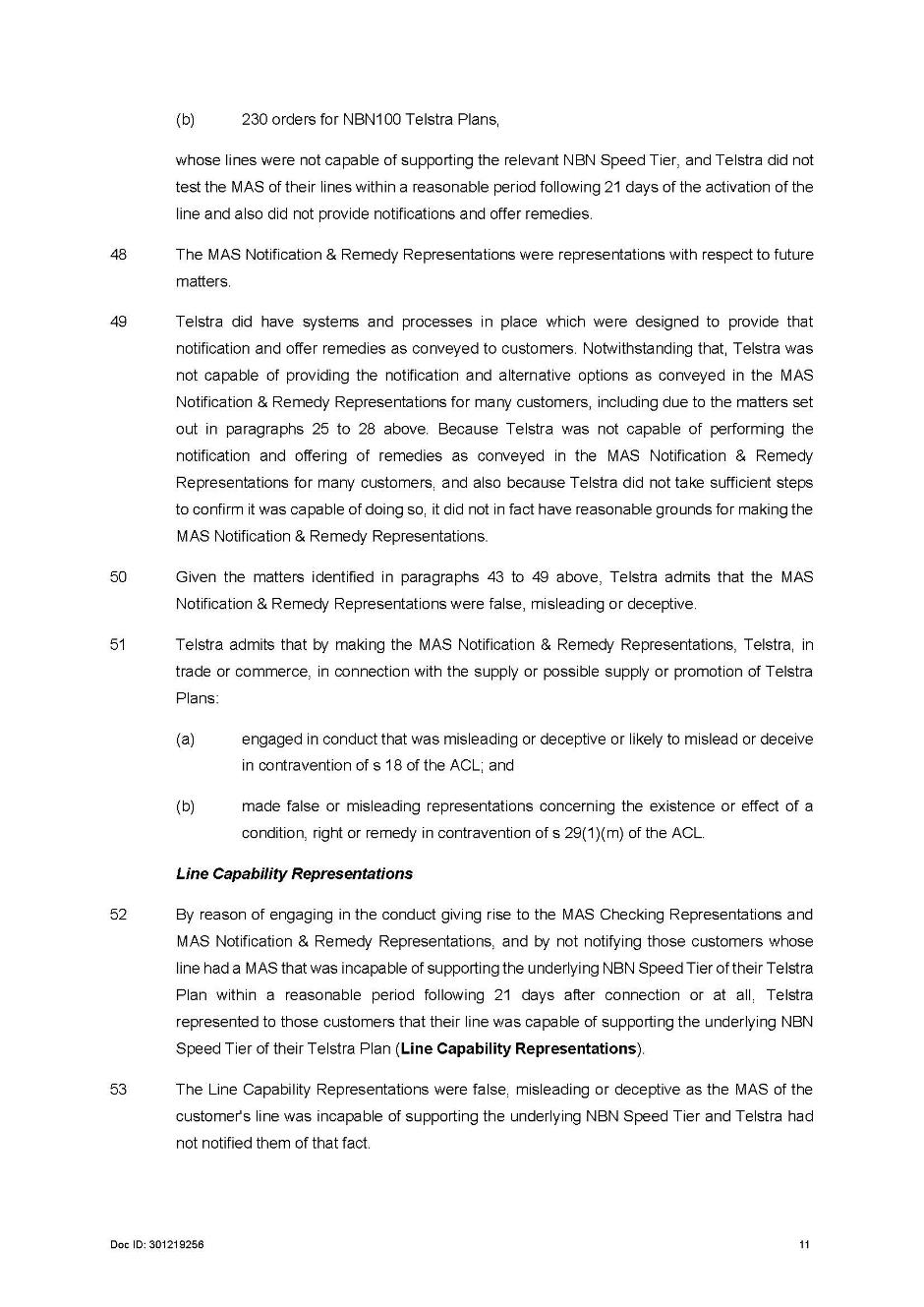
Telstra represented to those customers that their line was capable of supporting the underlying NBN Speed Tier of their Telstra Plan (the Line Capability Representations) when for some customers that was not the case.
14 During the Relevant Period, Telstra failed to:
(a) check the relevant lines of 37,519 orders within a reasonable period following 21 days after activation of the customer’s line; and a further 11,369 orders did not have the MAS of the customer’s line tested by Telstra at all; and
(b) notify and provide alternative options to 7,532 customers who acquired Telstra Plans and whose lines had a MAS that was incapable of supporting the underlying NBN Speed Tier.
15 Telstra has admitted that:
(a) by making the MAS Checking Representations, Telstra engaged in conduct that was misleading or deceptive, or likely to mislead or deceive, in contravention of s 18 of the ACL;
(b) by making the MAS Notification & Remedy Representations, Telstra engaged in conduct that was misleading or deceptive, or likely to mislead or deceive, in contravention of s 18 of the ACL, and made false or misleading representations concerning the existence or effect of a condition, right or remedy in contravention of s 29(1)(m) of the ACL; and
(c) by making the Line Capability Representations, Telstra engaged in conduct that was misleading or deceptive, or likely to mislead or deceive, in contravention of s 18 of the ACL, and made false or misleading representations that the Telstra Plans had certain performance characteristics, uses or benefits in contravention of s 29(1)(g) of the ACL.
Applicable principles
16 I refer to and adopt the statement of the applicable principles (including the statutory provisions relating to the imposition of pecuniary penalties) set out in my judgment in the Optus proceeding: see Australian Competition and Consumer Commission v Optus Internet Pty Limited [2022] FCA 1397 (ACCC v Optus) at [15]-[21] and [24]-[36]. That judgment was handed down shortly before, and on the same day as, this judgment.
17 As in the Optus proceeding, the impugned conduct the subject of this proceeding occurred after 1 September 2018.
18 The benefit obtained by Telstra from the contravening conduct cannot be determined. The maximum penalty per contravention is therefore $10 million or 10% of the annual turnover of Telstra in the 12 months before each contravention, whichever is greater.
Application of principles to this case
Declarations
19 The parties have proposed declarations that reflect the agreed contraventions as summarised above.
20 I am satisfied that the contraventions that are the subject of the proposed declarations are established by the facts and admissions set out in the SOAF.
21 I consider it appropriate to make declarations substantially in the terms proposed by the parties. The preconditions for the making of declarations, set out in ACCC v Optus at [18], are satisfied. In particular, I am satisfied that: there is a real and not a hypothetical question; the applicant has a real interest in raising the question; and there is a proper contradictor.
Civil penalties
22 The parties submit that the proposed penalty of $15 million is appropriate and should be imposed by the Court. They submit that: a penalty of this amount is appropriately tailored to the gravity of the contraventions in all the circumstances and is sufficient to achieve specific and general deterrence; this level of penalty will send a clear message of deterrence to Telstra and the business community more generally about the importance of ensuring that representations made to customers in connection with critical information about the standard or quality of essential services, such as broadband internet services, are accurate; and this assists in ensuring that customers are able to make informed decisions about their internet services.
23 The parties’ joint submissions, at [126]-[173], set out detailed reasons in support of the proposed penalty of $15 million. Having regard to those submissions, which I accept, I am satisfied that the proposed penalty is appropriate in the circumstances of this case, and meets the objectives of specific and general deterrence. In particular, I note the following matters.
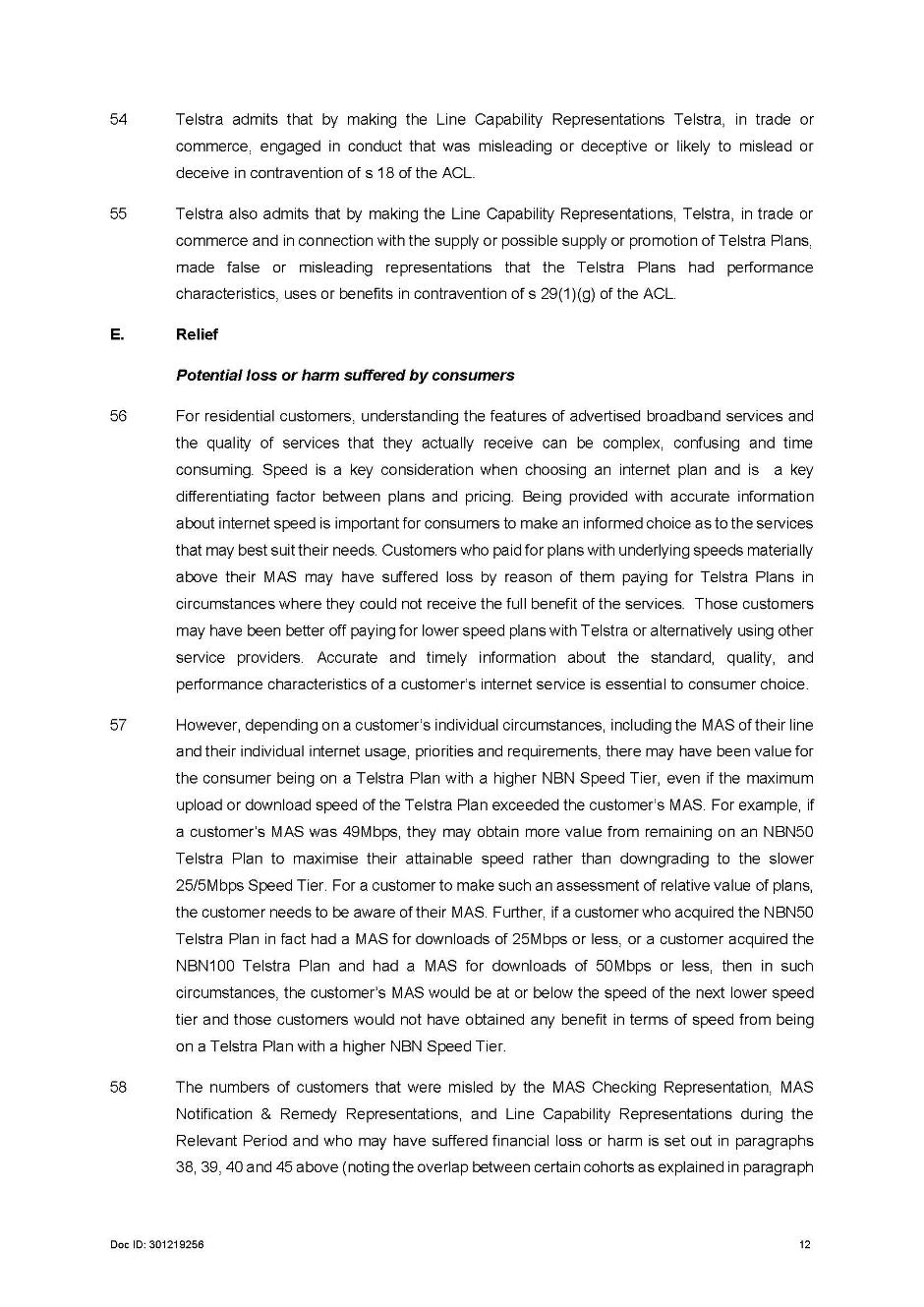
24 For residential customers, understanding the features of advertised broadband services and the quality of services that they actually receive can be complex, confusing and time consuming. Speed is a key consideration when choosing an internet plan and is a key differentiating factor between plans and pricing. Being provided with accurate information about internet speed is important for consumers to make an informed choice as to the services that may best suit their needs. Customers who paid for plans with underlying speeds materially above their MAS may have suffered loss by reason of them paying for Telstra Plans in circumstances where they could not receive the full benefit of the services. Those customers may have been better off paying for lower speed plans with Telstra or alternatively using other service providers. Accurate and timely information about the standard, quality, and performance characteristics of a customer’s internet service is essential to consumer choice.
25 However, depending on a customer’s individual circumstances, including the MAS of their line and their individual internet usage, priorities and requirements, there may have been value for the consumer being on a plan with a higher speed tier, even if the maximum upload or download speed of the plan exceeded the MAS. For example, if a customer’s MAS was 49Mbps, they may obtain more value from remaining on an NBN50 Telstra Plan rather than downgrading to the 25/5Mbps speed tier. For a customer to make such an assessment of the relative value of plans, the customer needs to be aware of their MAS. Further, if a customer who acquired the NBN50 Telstra Plan in fact had a MAS for downloads of 25Mbps or less, or a customer acquired the NBN100 Telstra Plan and had a MAS for downloads of 50Mbps or less, then in such circumstances the customer’s MAS would be at or below the speed of the lower speed tier and those customers would not have obtained any benefit in terms of speed from being on a Telstra Plan with a higher NBN Speed Tier.
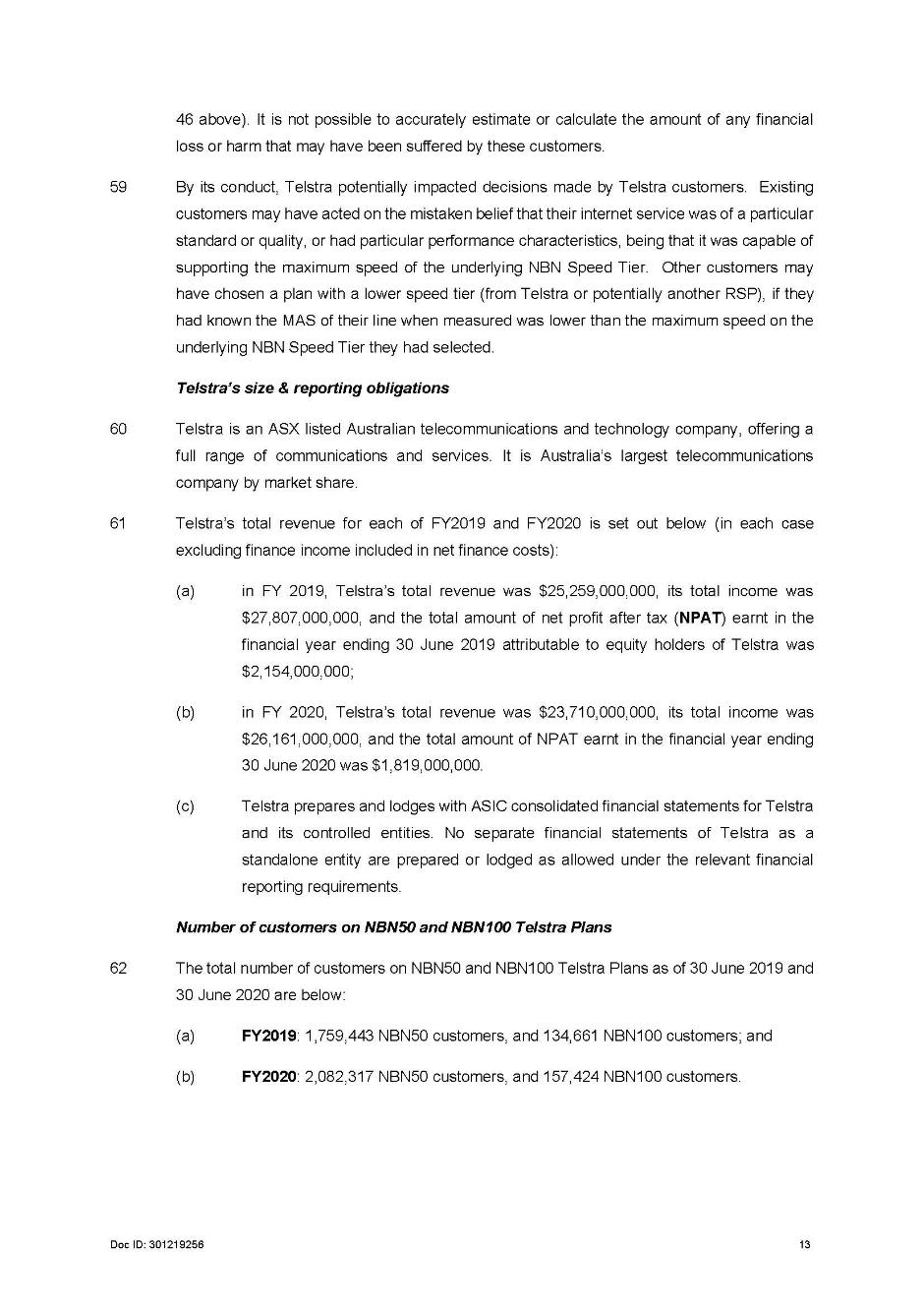
26 The number of customers who were misled by the MAS Notification & Remedy Representations during the Relevant Period and who may have suffered financial loss or harm is outlined in [14(b)] above. It is not possible to accurately estimate or calculate the amount of any financial loss or harm that may have been suffered by these customers.
27 By its conduct, Telstra potentially impacted decisions made by Telstra customers. Existing customers may have acted on the mistaken belief that their internet service was of a particular standard or quality, or had particular performance characteristics, being that it was capable of supporting the maximum speed of the underlying NBN Speed Tier. Other customers may have chosen a plan with a lower speed tier (from Telstra or potentially another retail service provider), if they had known the MAS of their line when measured was lower than the maximum speed on the underlying NBN Speed Tier they had selected.
28 The ACCC does not allege that the contravening conduct was deliberate. The contraventions stem from of failure of Telstra’s processes.
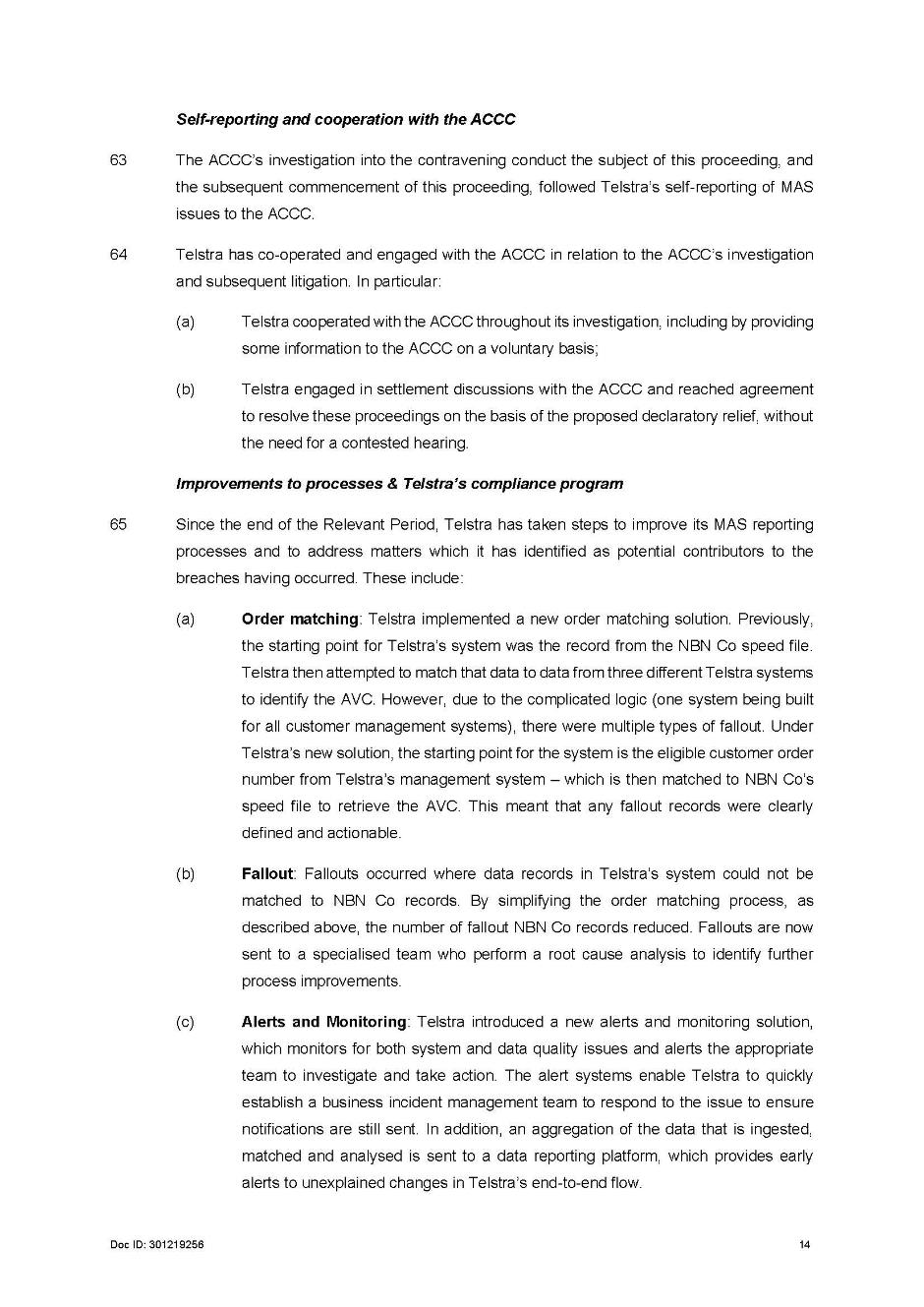
29 Telstra has made appropriate admissions and has co-operated with the ACCC during its investigation and agreed the SOAF. The ACCC’s investigation into the contravening conduct the subject of this proceeding, and the subsequent commencement of this proceeding, followed Telstra’s self-reporting of MAS issues to the ACCC. Telstra has co-operated and engaged with the ACCC in relation to the ACCC’s subsequent litigation.
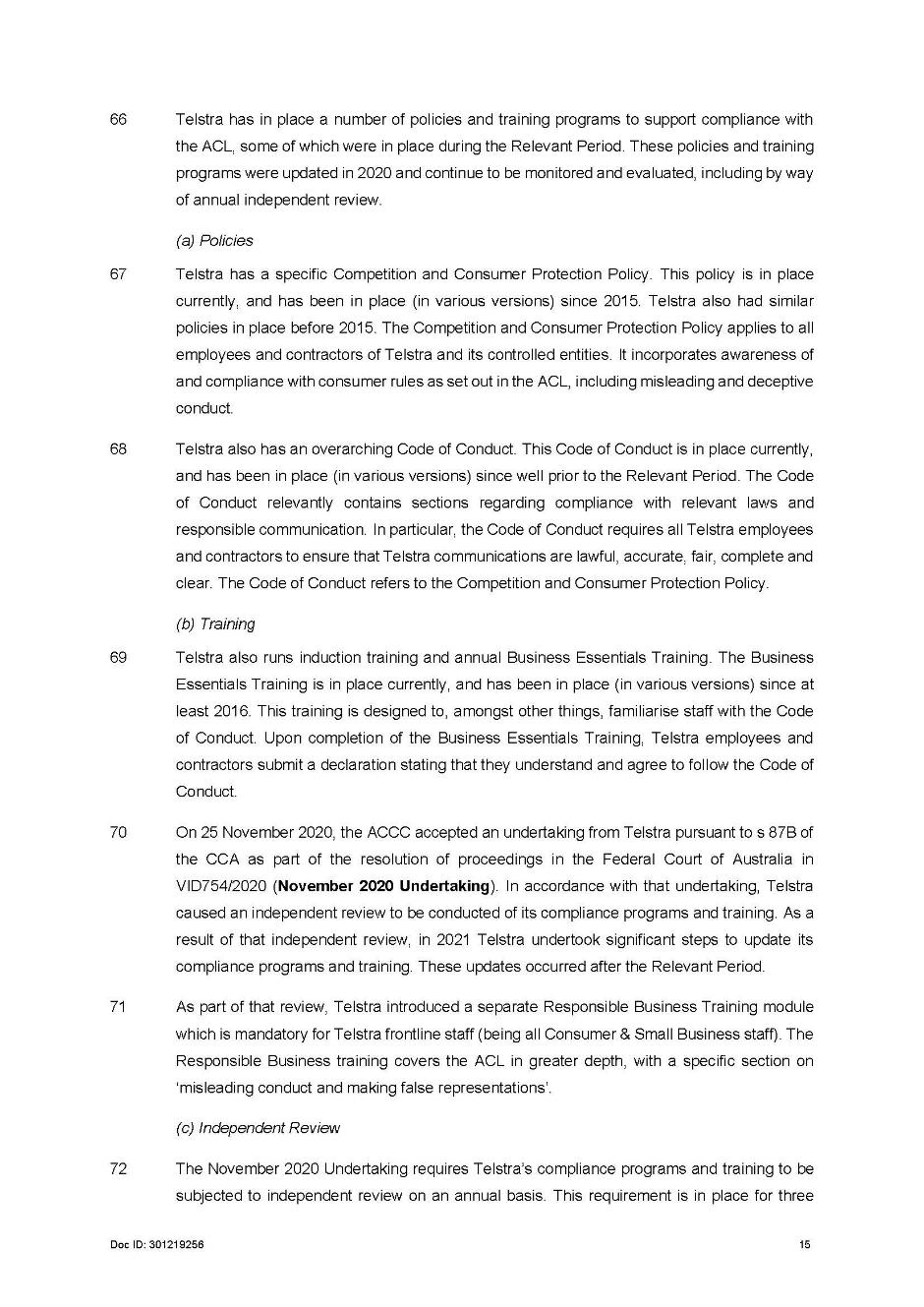
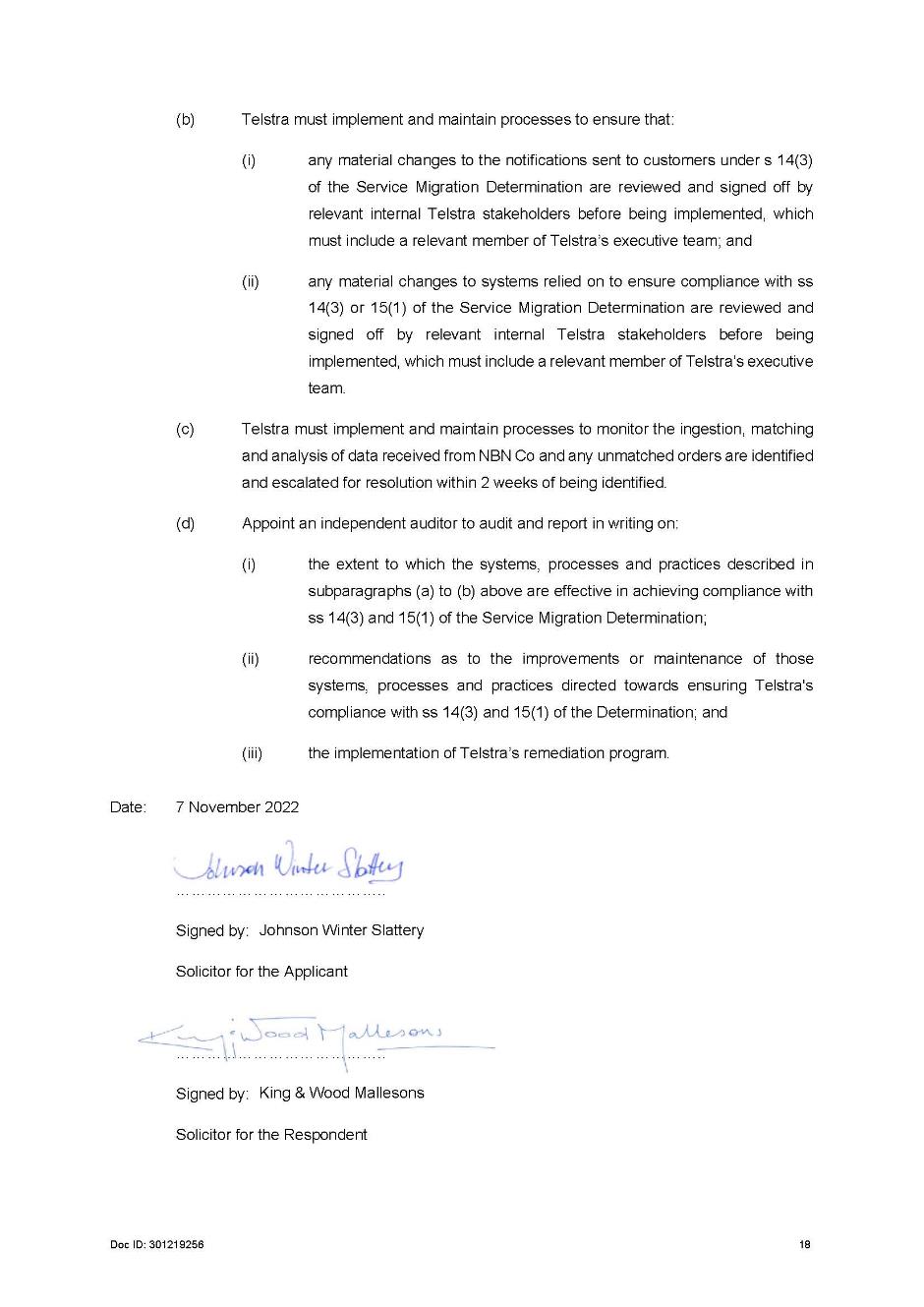
30 Since the end of the Relevant Period, Telstra has taken steps to improve its MAS reporting processes and to address matters which it has identified as potential contributors to the breaches having occurred. Telstra has in place a number of policies and training programs to support compliance with the ACL, some of which were in place during the Relevant Period. These policies and training were updated in 2020 and continue to be monitored and evaluated, including by way of annual independent review.
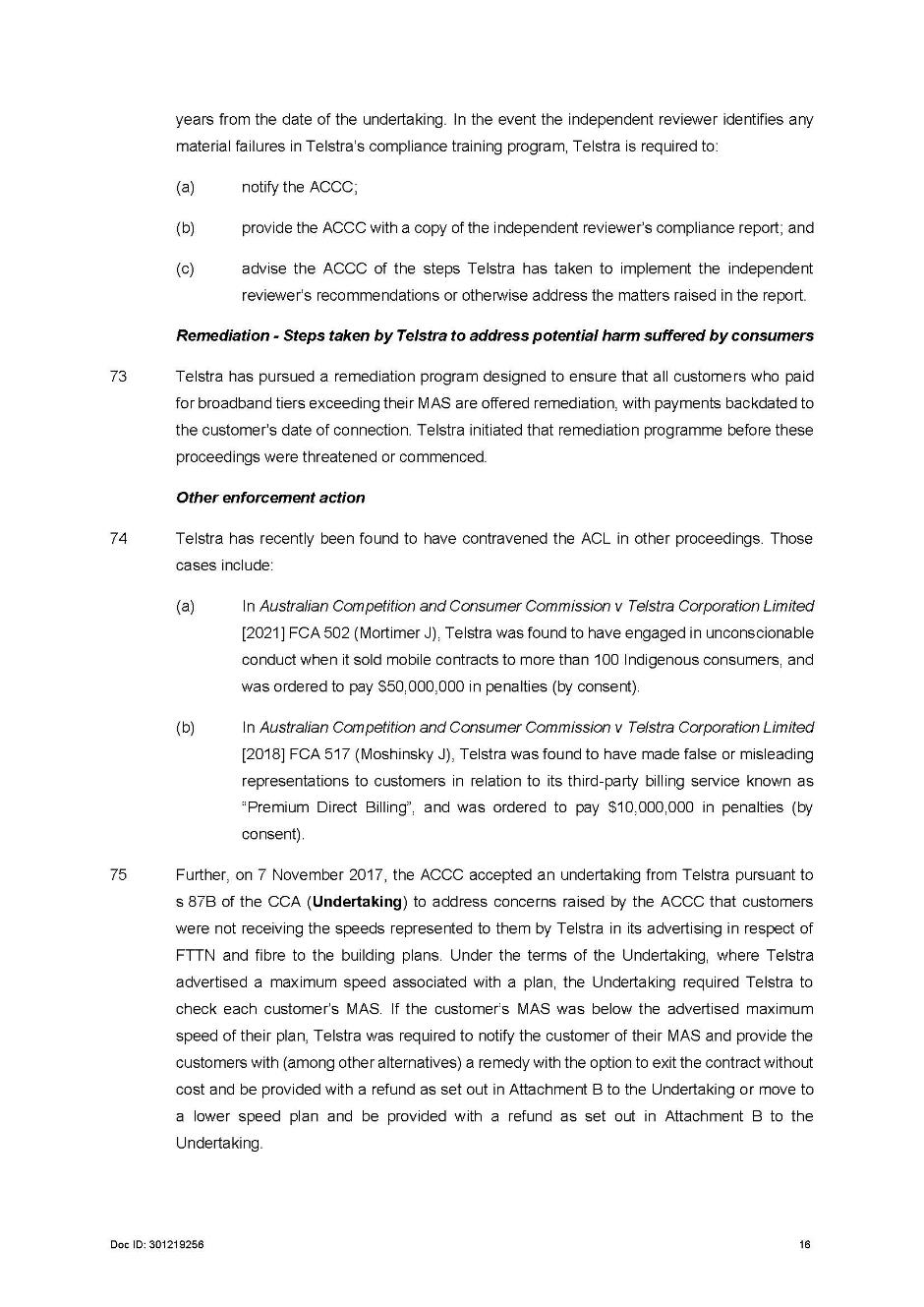
31 Telstra has pursued a remediation programme designed to ensure that all customers who paid for broadband tiers exceeding their MAS are offered remediation, with payments backdated to the customer’s date of connection. Telstra initiated that remediation programme before these proceedings were threatened or commenced.
32 Telstra has recently been found to have contravened the ACL, as detailed in the SOAF.
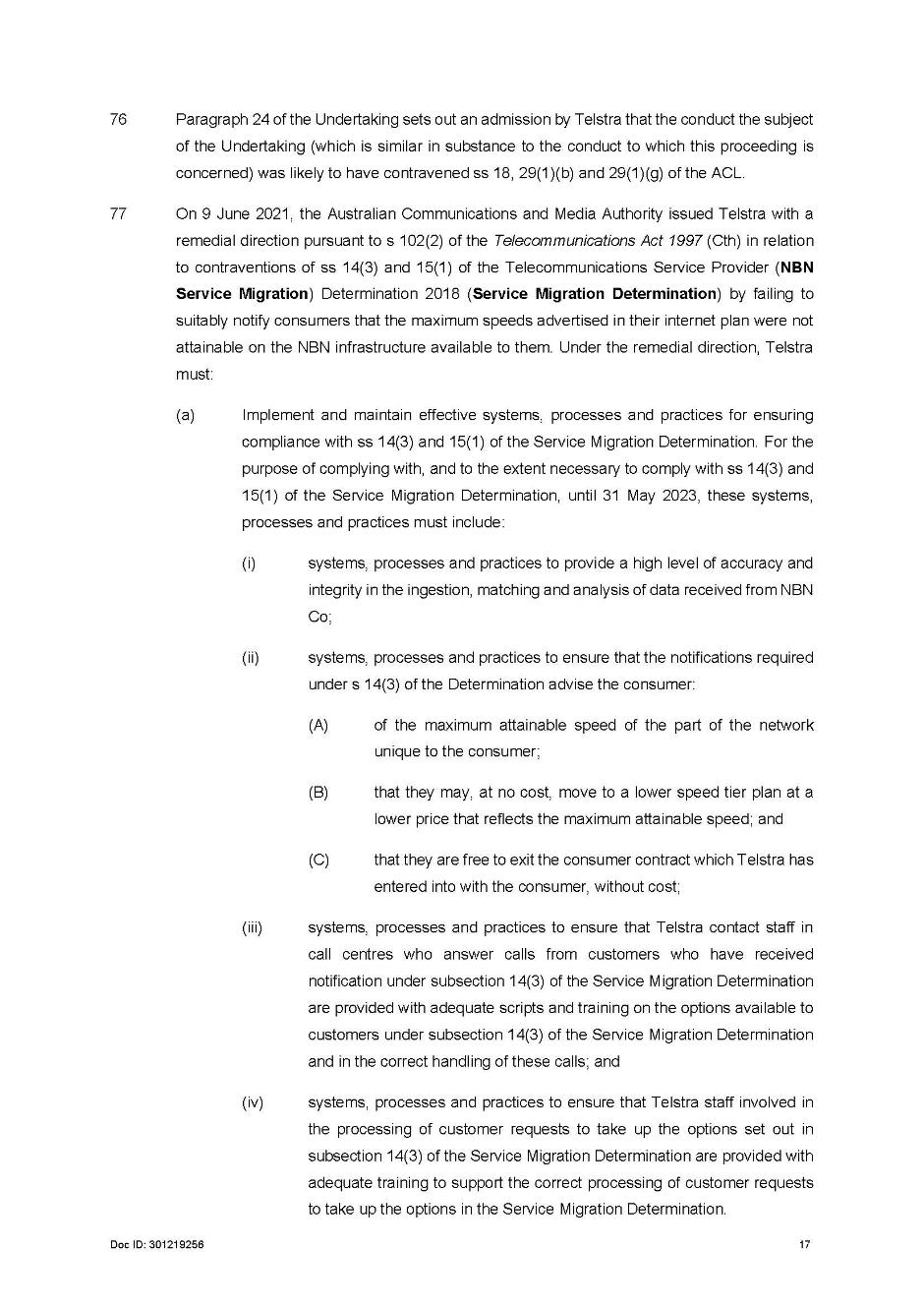
33 Further, on 7 November 2017, the ACCC accepted an undertaking from Telstra pursuant to s 87B of the Competition and Consumer Act (the Undertaking) to address concerns raised by the ACCC that customers were not receiving the speeds represented to them by Telstra in its advertising in respect of FTTN and fibre-to-the-building plans. Under the terms of the Undertaking, where Telstra advertised a maximum speed associated with a plan, the Undertaking required Telstra to check each customer’s MAS. If the customer’s MAS was below the advertised maximum speed of their plan, Telstra was required to notify the customer of their MAS and provide the customers with (among other alternatives) a remedy with the option to exit the contract without cost and be provided with a refund as set out in Attachment B to the Undertaking or move to a lower speed plan and be provided with a refund as set out in Attachment B to the Undertaking. Telstra admitted that the conduct the subject of the Undertaking, which is similar in substance to the conduct with which this proceeding is concerned, was likely to have contravened ss 18, 29(1)(b) and 29(1)(g) of the ACL. The fact that the Undertaking was not sufficient to secure Telstra’s adherence to the requirements of the ACL indicates that a more severe penalty is necessary to secure specific deterrence. However, no breach of the Undertaking is alleged in this proceeding.
34 Having regard to the above matters, and the other matters referred to in the joint submissions, I am satisfied that the proposed penalty amount is appropriate to achieve deterrence, both specific and general.
Other orders
35 The parties also propose that the Court make an order that Telstra pay $150,000 as a contribution to the ACCC’s costs of and incidental to the proceeding. I am satisfied that it is appropriate in the circumstances to make that order.
Conclusion
36 It was for the above reasons that I made the declarations and orders on 11 November 2022.
I certify that the preceding thirty-six (36) numbered paragraphs are a true copy of the Reasons for Judgment of the Honourable Justice Moshinsky. |
Associate: