

FEDERAL COURT OF AUSTRALIA
Australian Competition and Consumer Commission v Optus Internet Pty Limited [2022] FCA 1397
ORDERS
AUSTRALIAN COMPETITION AND CONSUMER COMMISSION Applicant | ||
AND: | Respondent | |
DATE OF ORDER: |
THE COURT DECLARES THAT:
1. Between 1 January 2019 and 31 December 2019, the respondent Optus Internet Pty Ltd (Optus), in trade or commerce, in respect of some residential customers who acquired NBN services from Optus where the relevant service was configured using fibre-to-the-node (FTTN) technology to either the 50/20 Megabits per second (Mbps) wholesale NBN speed tier or the 100/40 Mbps wholesale speed tier (respectively NBN50 and NBN100 and together, the Optus NBN plans), engaged in conduct that contravened s 18 of the Australian Consumer Law (ACL) (which is Sch 2 to the Competition and Consumer Act 2010 (Cth) (CCA)) by reason of it:
(a) publishing the following statements on its website:
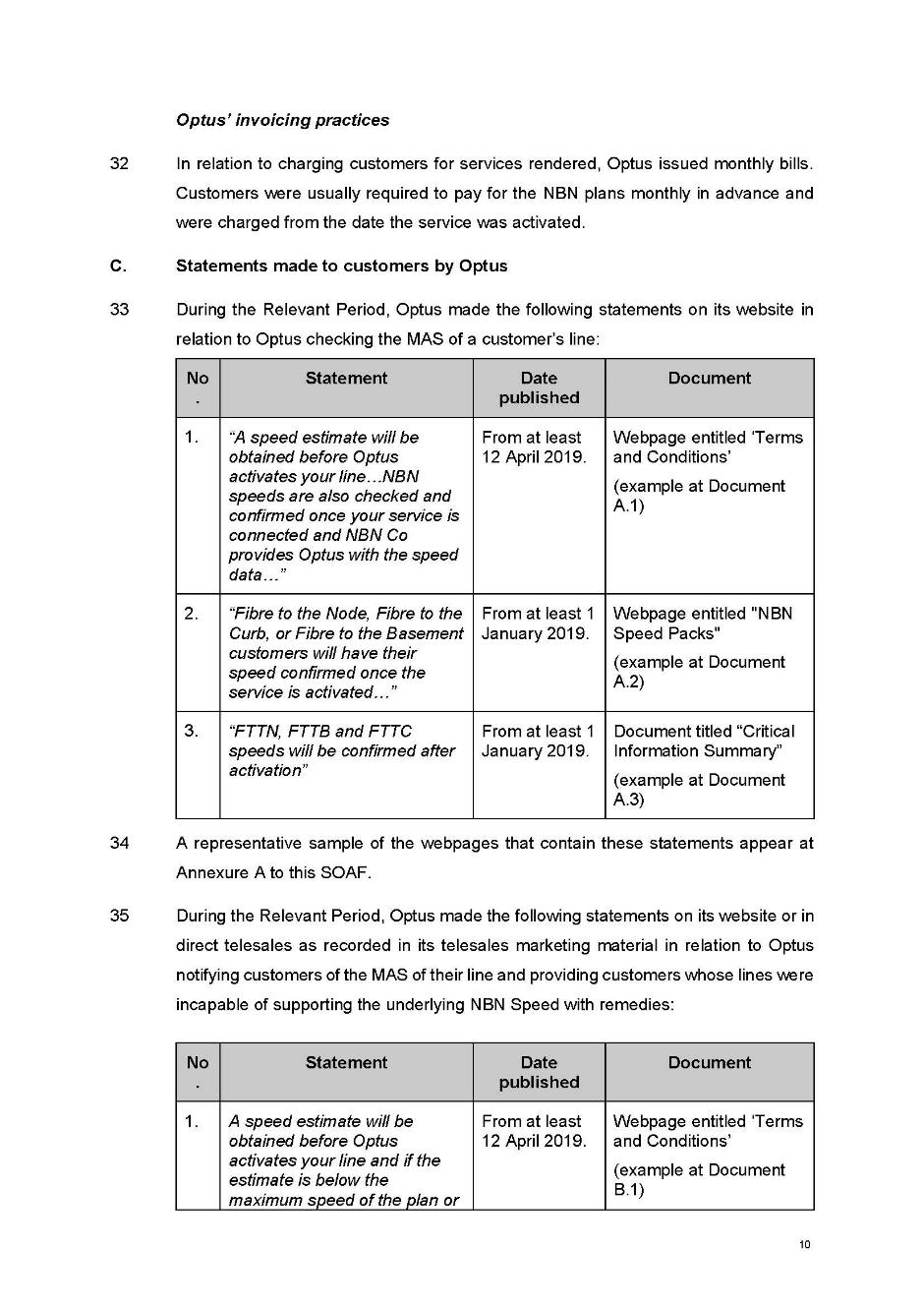
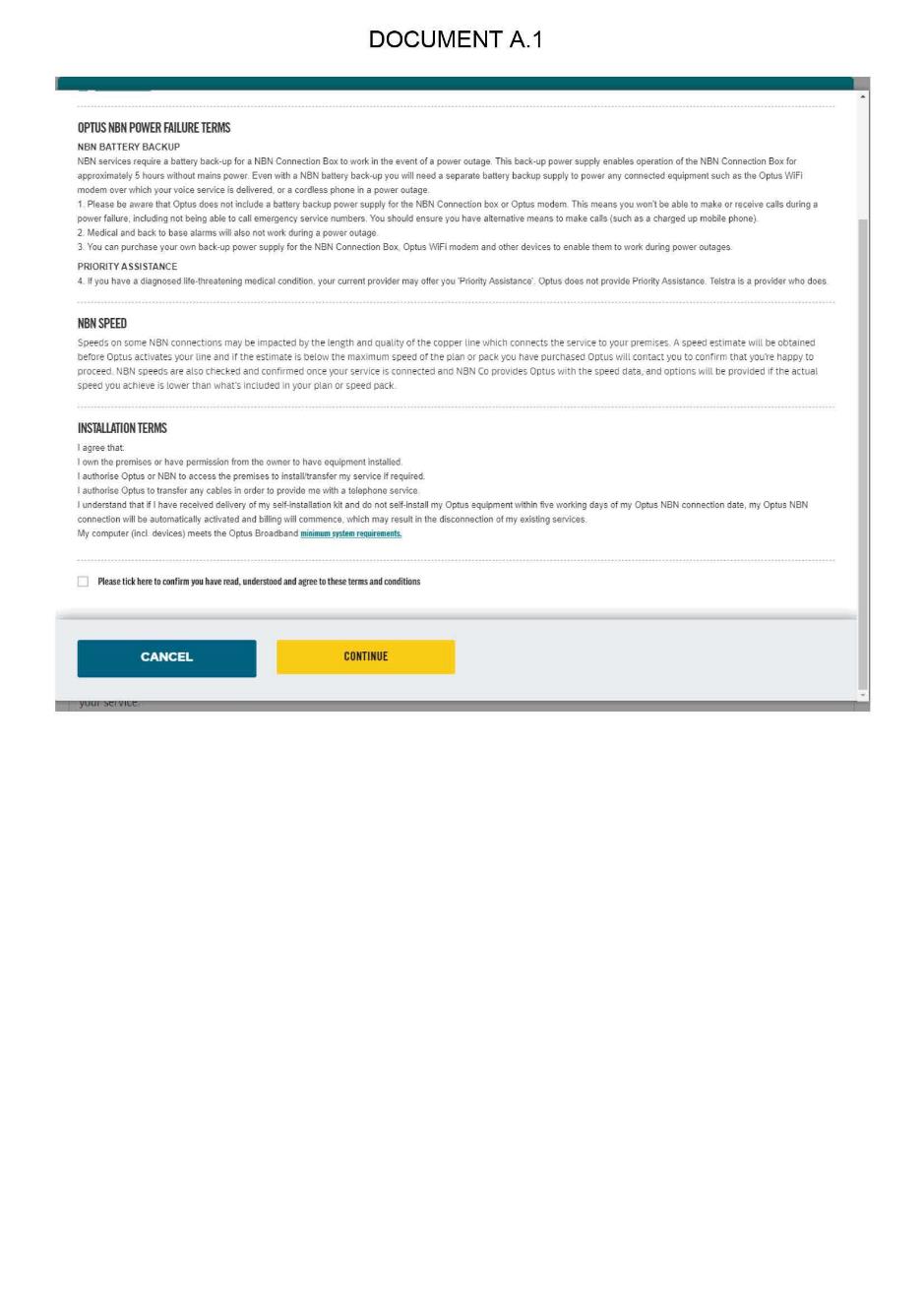
(i) “NBN speeds are also checked and confirmed once your service is connected and NBN Co provides Optus with the speed data...”;
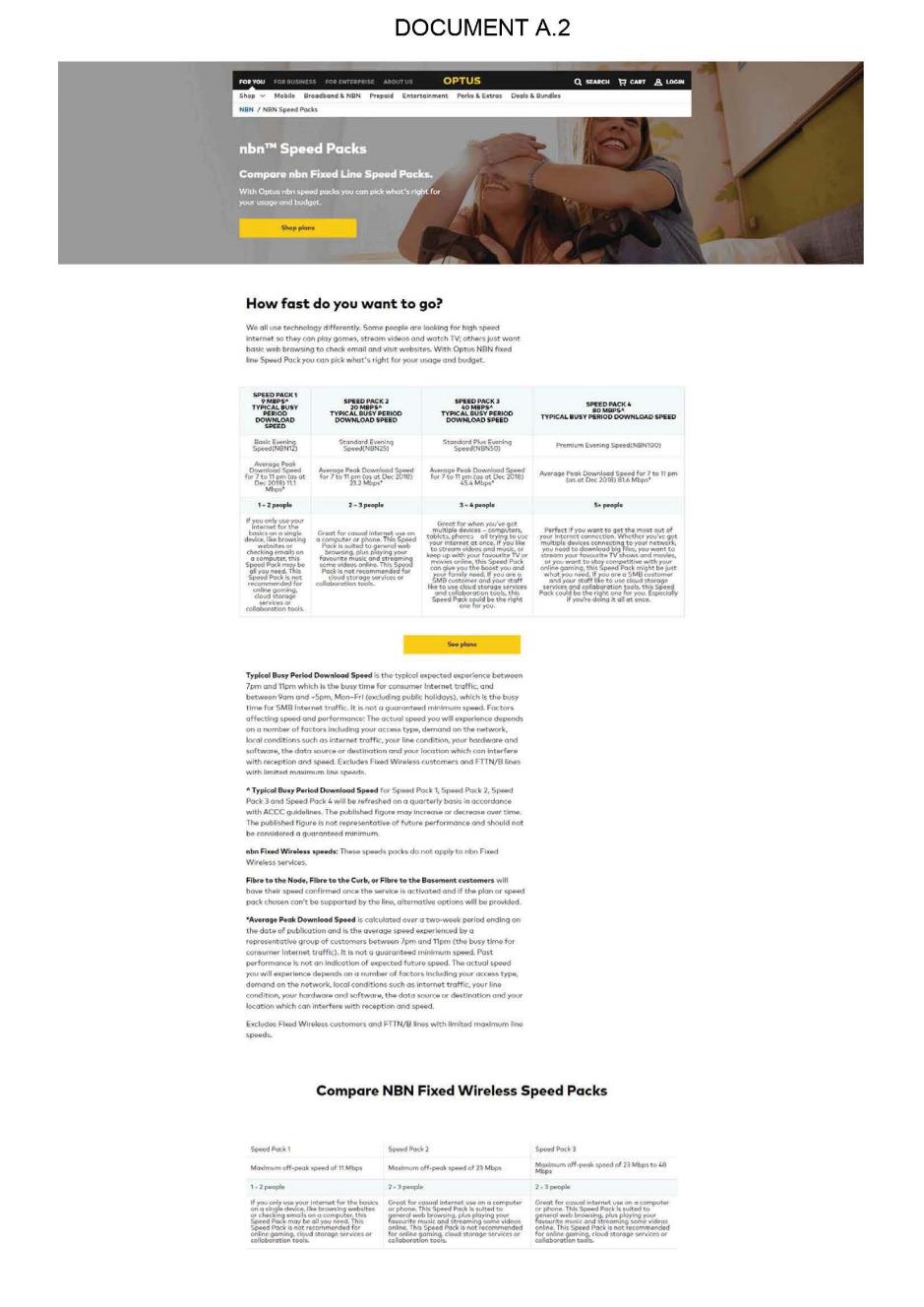
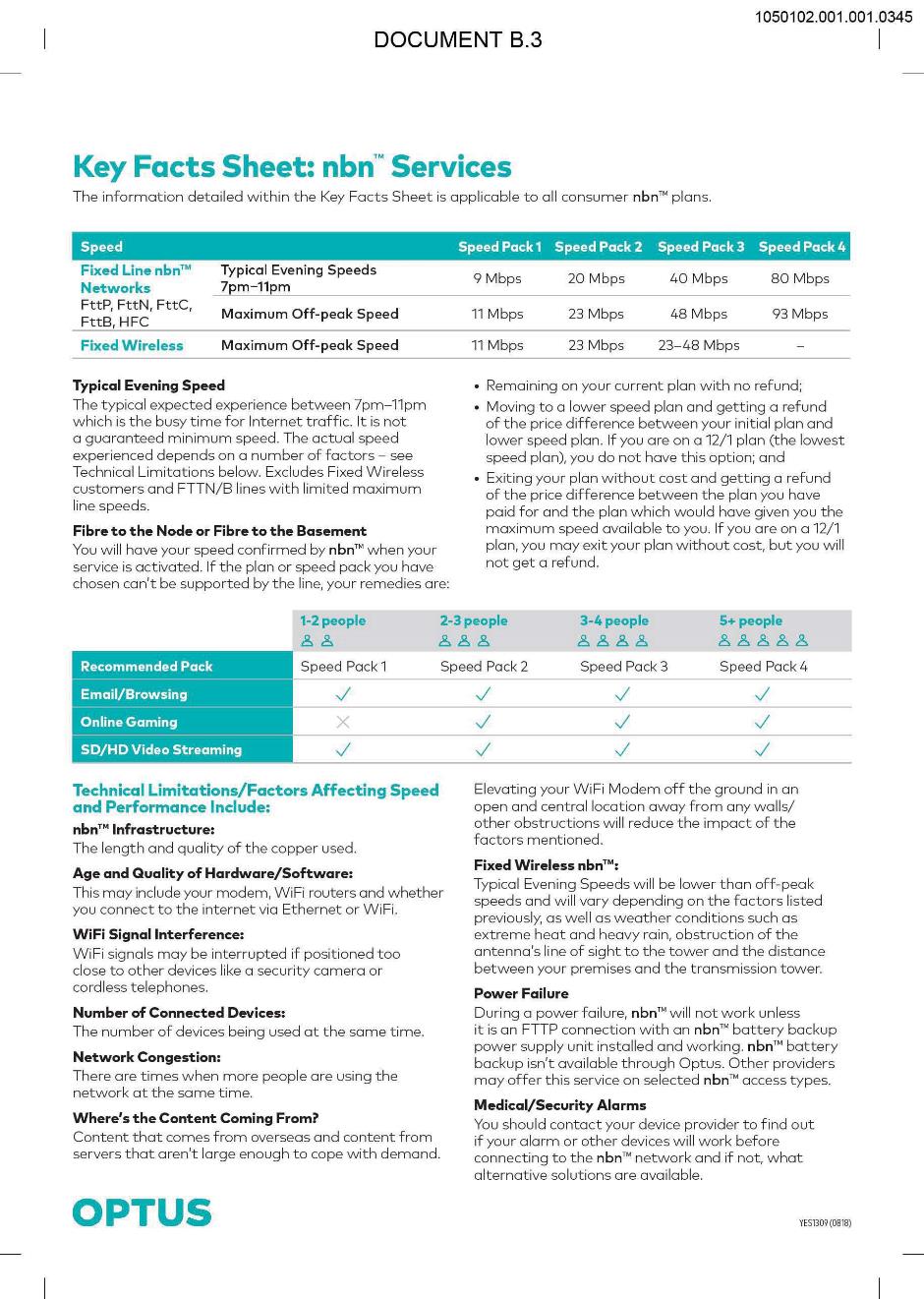
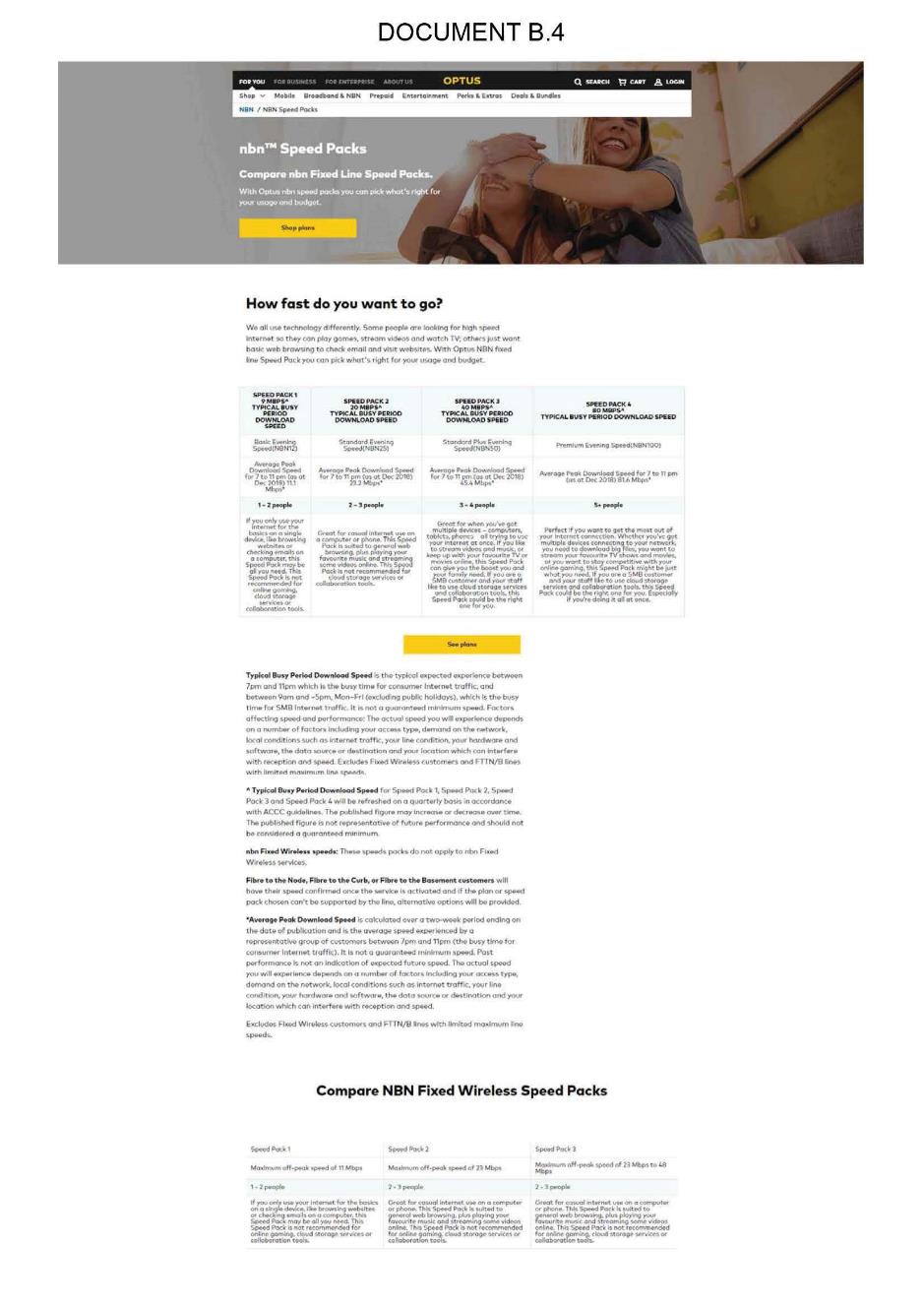
(ii) “Fibre to the Node, Fibre to the Curb, or Fibre to the Basement customers will have their speed confirmed once the service is activated...”; and
(iii) “FTTN, FTTB and FTTC speeds will be confirmed after activation”,
and thereby representing that it would, within a reasonable period of time of a customer’s service being connected, check and confirm the speed of each customer’s NBN line;
(b) when in fact:
(i) Optus did not have in place adequate systems, processes and policies to ensure that the representations would be fulfilled;
(ii) Optus thereby did not have reasonable grounds for making the representations, which were representations with respect to a future matter, and which are taken to be misleading under s 4 of the ACL; and
(iii) Optus failed to check and confirm the line speeds of a number of customers within a reasonable period of time of their service being connected.
2. Between 1 January 2019 and 31 December 2019, Optus, in trade or commerce, in connection with the supply or possible supply or promotion of Optus NBN plans engaged in conduct that contravened ss 18 and 29(1)(m) of the ACL by reason of it:
(a) making the following statements:
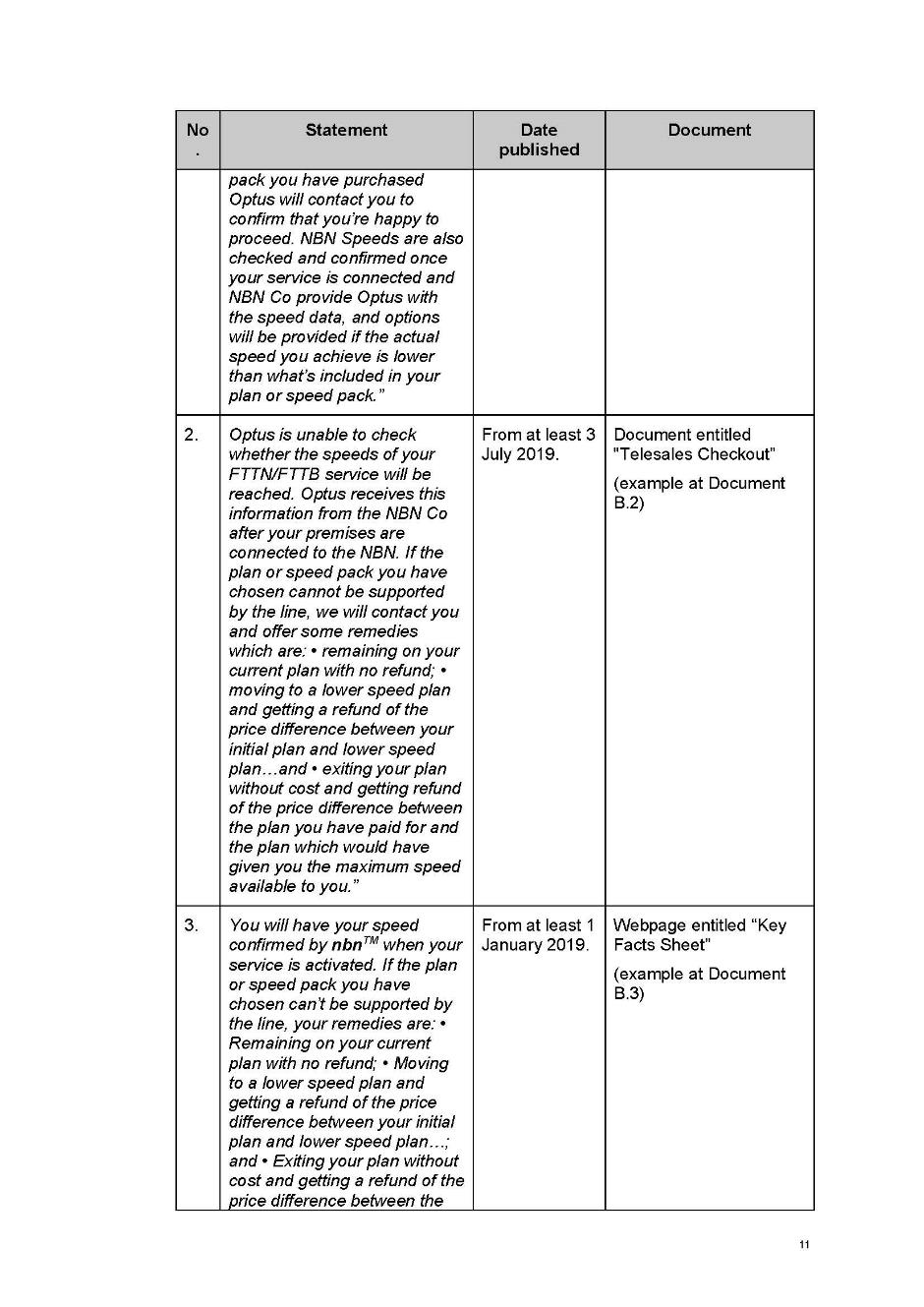
(i) on its website: “NBN Speeds are also checked and confirmed once your service is connected and NBN Co provide Optus with the speed data, and options will be provided if the actual speed you achieve is lower than what's included in your plan or speed pack.”;
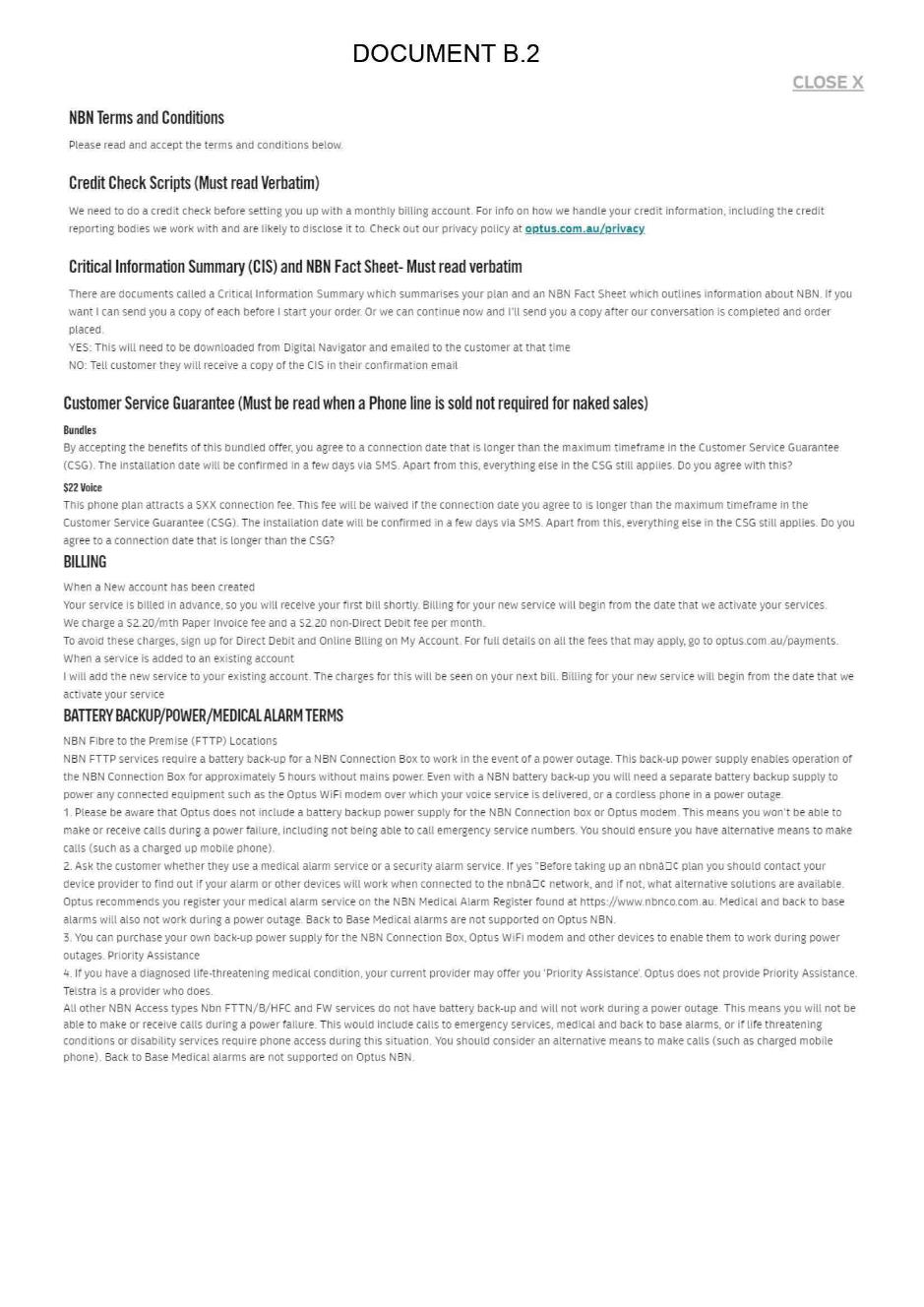
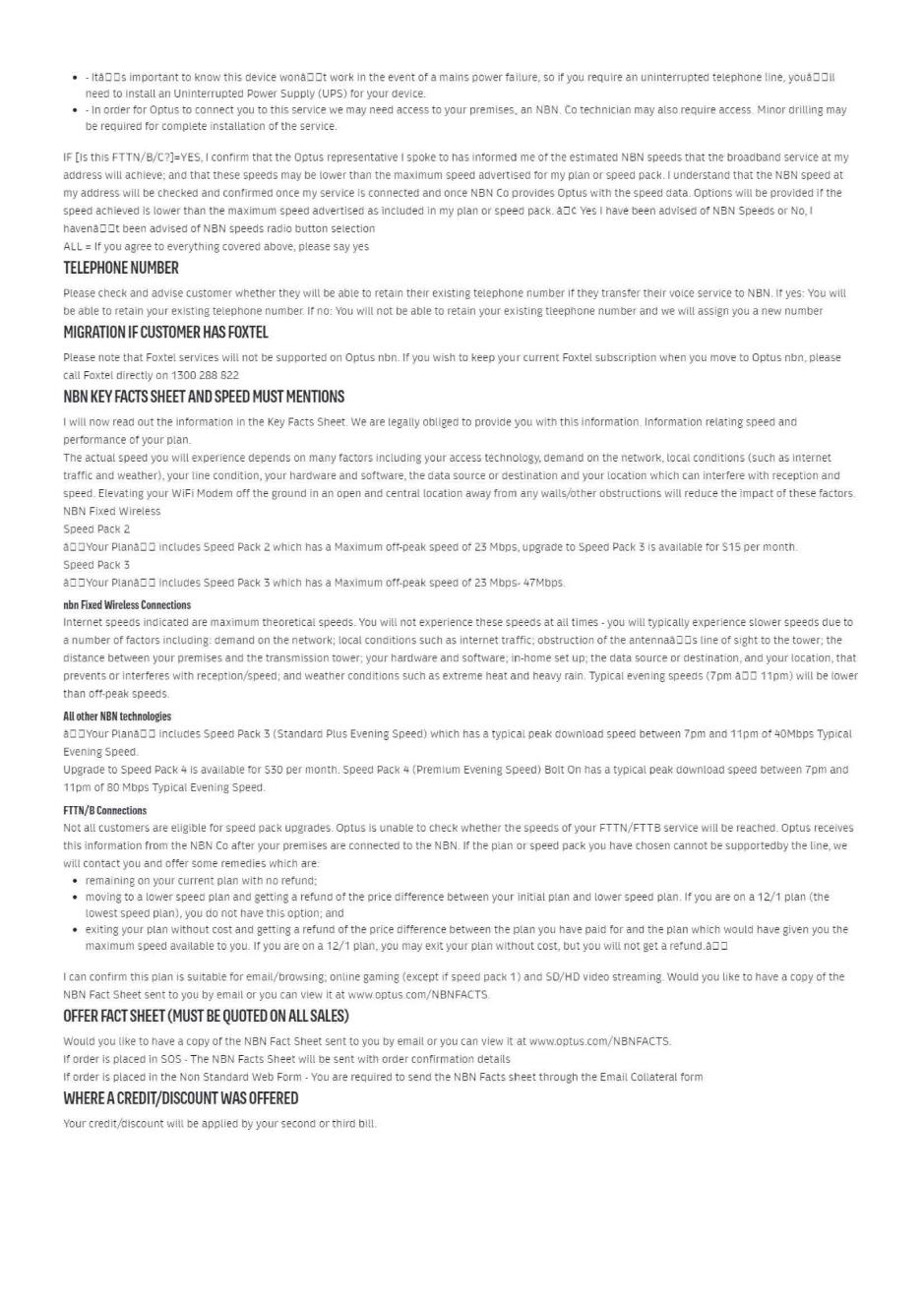
(ii) in telephone calls with consumers as recorded in its telesales marketing material: “Optus is unable to check whether the speeds of your FTTN/FTTB service will be reached. Optus receives this information from the NBN Co after your premises are connected to the NBN. If the plan or speed pack you have chosen cannot be supported by the line, we will contact you and offer some remedies which are: • remaining on your current plan with no refund; • moving to a lower speed plan and getting a refund of the price difference between your initial plan and lower speed plan...and • exiting your plan without cost and getting a refund of the price difference between the plan you have paid for and the plan which would have given you the maximum speed available to you.”;
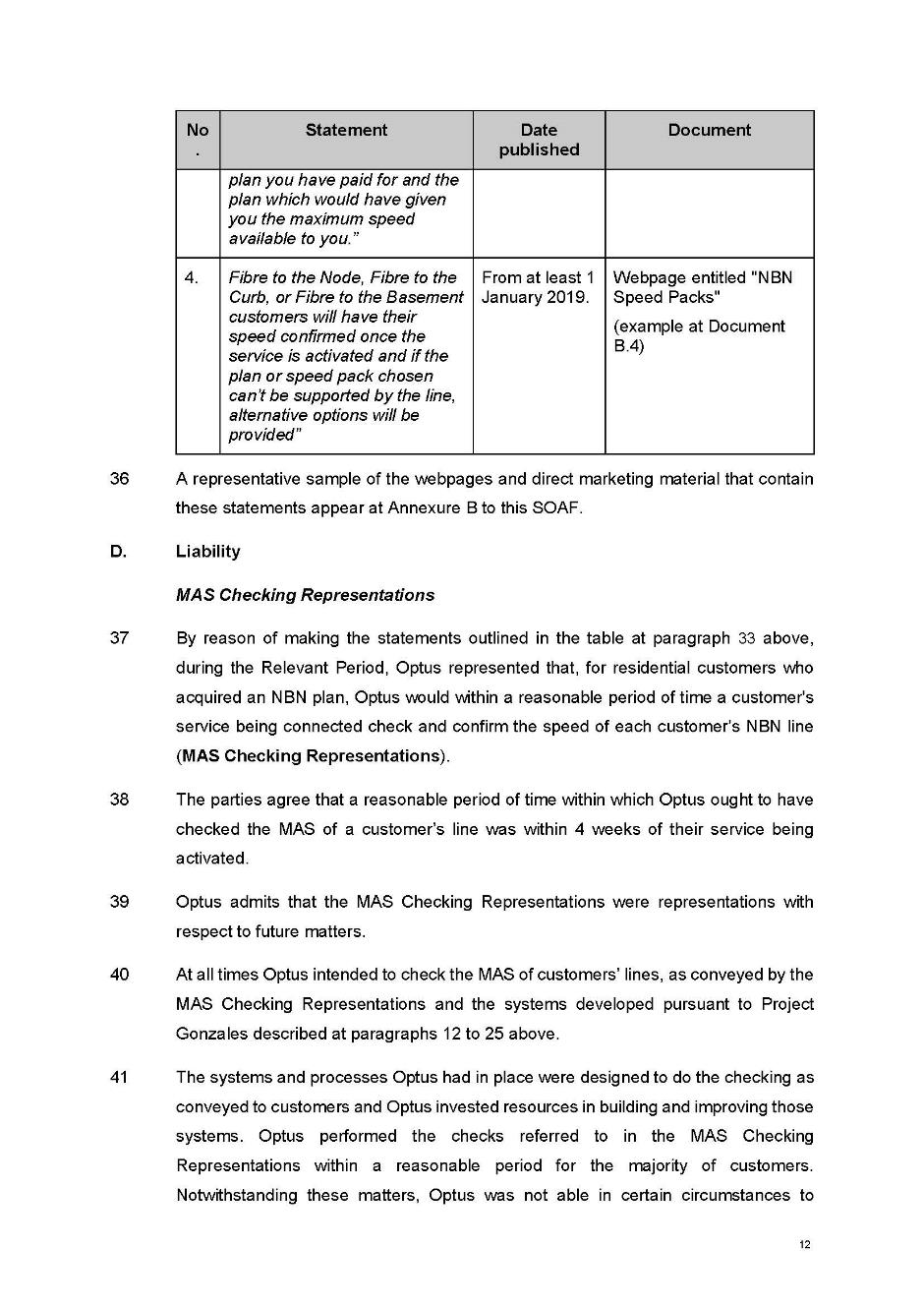
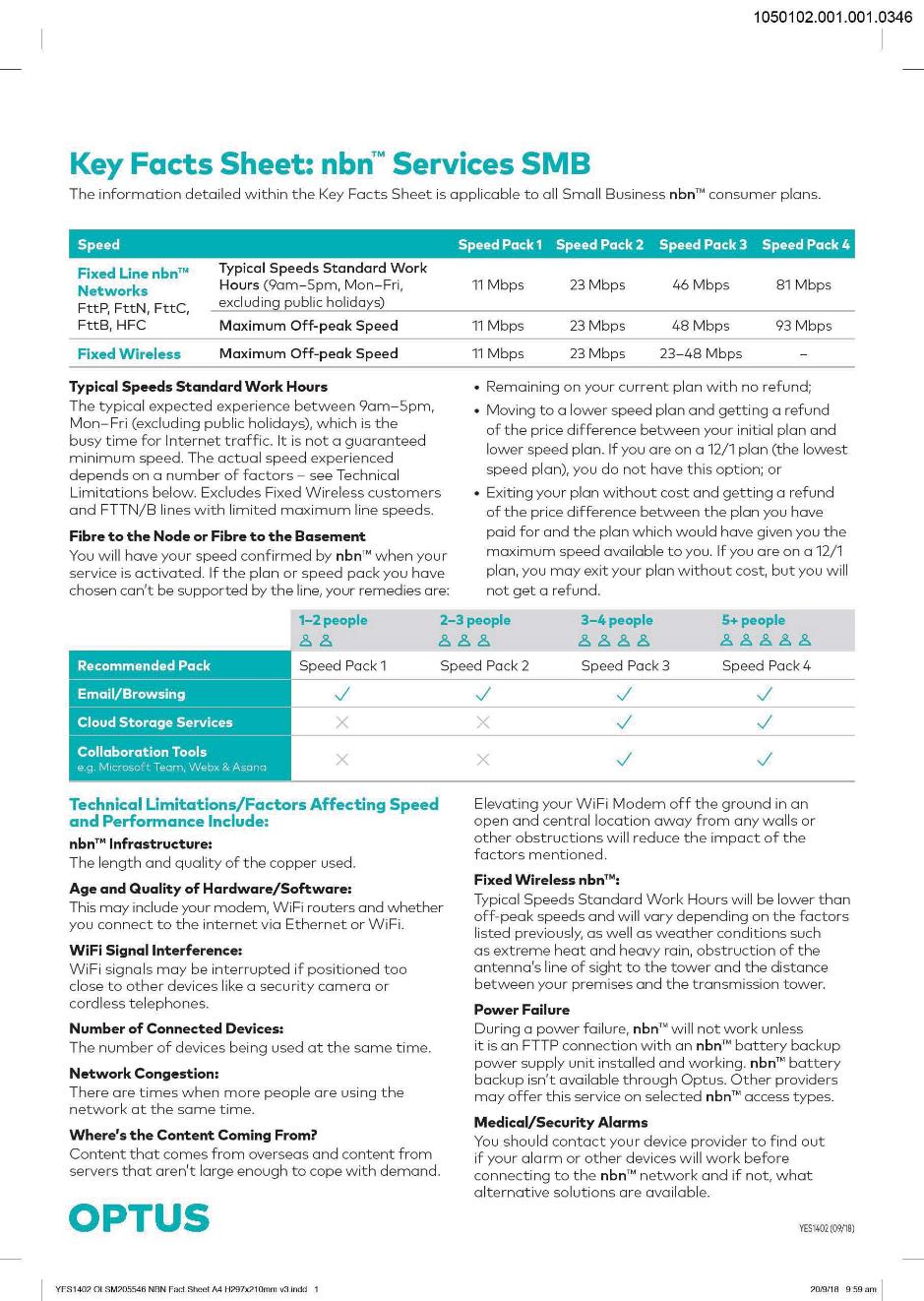
(iii) on its website: “You will have your speed confirmed by nbn™ when your service is activated. If the plan or speed pack you have chosen can't be supported by the line, your remedies are: • Remaining on your current plan with no refund; • Moving to a lower speed plan and getting a refund of the price difference between your initial plan and lower speed plan...; and • Exiting your plan without cost and getting a refund of the price difference between the plan you have paid for and the plan which would have given you the maximum speed available to you.”;
(iv) on its website: “Fibre to the Node, Fibre to the Curb, or Fibre to the Basement customers will have their speed confirmed once the service is activated and if the plan or speed pack chosen can't be supported by the line, alternative options will be provided”,
and thereby representing that it would within a reasonable period of time of a customer’s service being connected notify customers if their Optus NBN plan could not be supported by their NBN line and when notifying them, provide them with alternative options if their Optus NBN plan could not be supported by their NBN line;
(b) when in fact:
(i) Optus did not have in place adequate systems, processes and policies to ensure that the representations would be fulfilled;
(ii) Optus thereby did not have reasonable grounds for making the representations, which were representations with respect to a future matter, and which are taken to be misleading under s 4 of the ACL; and
(iii) Optus failed to notify a number of customers that their NBN lines were incapable of supporting their Optus NBN plan and provide them with alternative options within a reasonable period of time of a customer’s service being connected.
3. Between 1 January 2019 and 31 December 2019, Optus, in trade or commerce, in connection with the supply or possible supply or promotion of Optus NBN plans engaged in conduct that contravened ss 18 and 29(1)(g) of the ACL by reason of it:
(a) engaging in the conduct that gave rise to the representations in paragraphs 1 and 2 above; and
(b) issuing monthly bills to customers whose line’s maximum attainable speed (MAS) were incapable of supporting their Optus NBN plan; and
(c) by not notifying those customers of their MAS within a reasonable period of a time of their service being activated,
and thereby representing to those customers that their Optus NBN plans were able to be supported by their NBN lines, when in fact their NBN lines were incapable of supporting their Optus plans.
THE COURT ORDERS THAT:
4. Optus pay pecuniary penalties to the Commonwealth of Australia, within 28 days of these orders being made, in the total sum of $13,500,000 in respect of the contraventions of ss 29(1)(g) and 29(1)(m) of the ACL referred to in paragraphs 2 and 3 above.
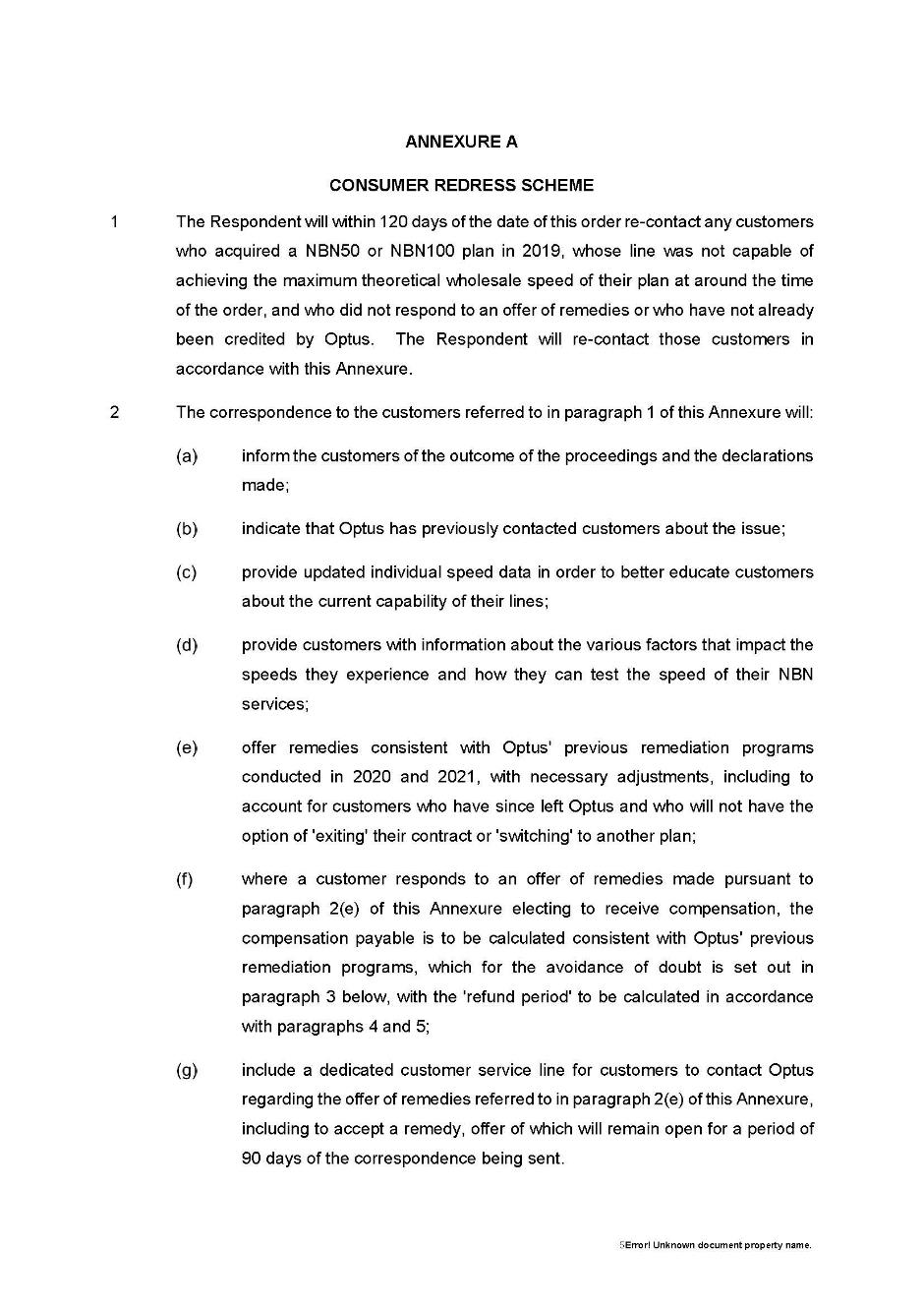
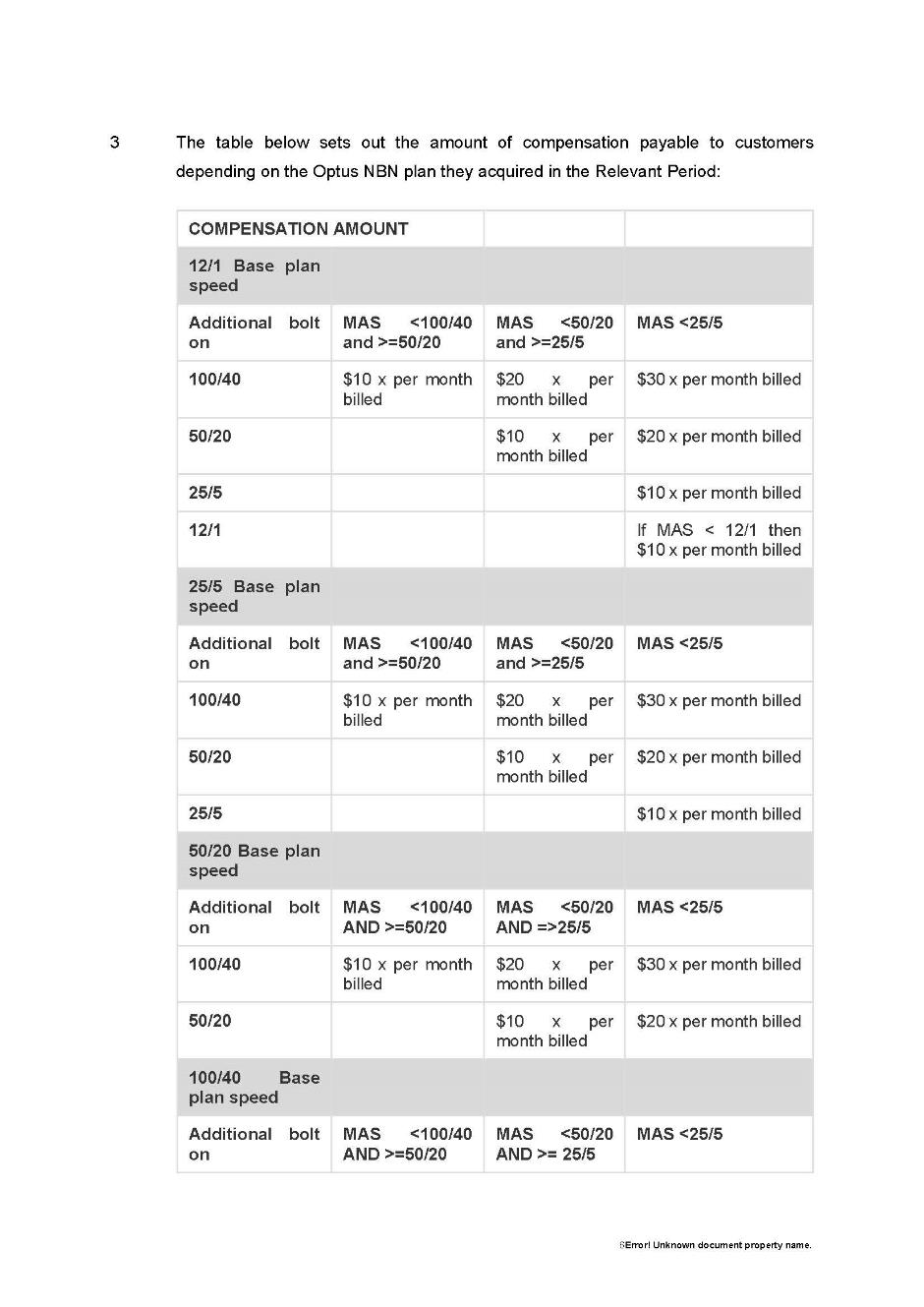
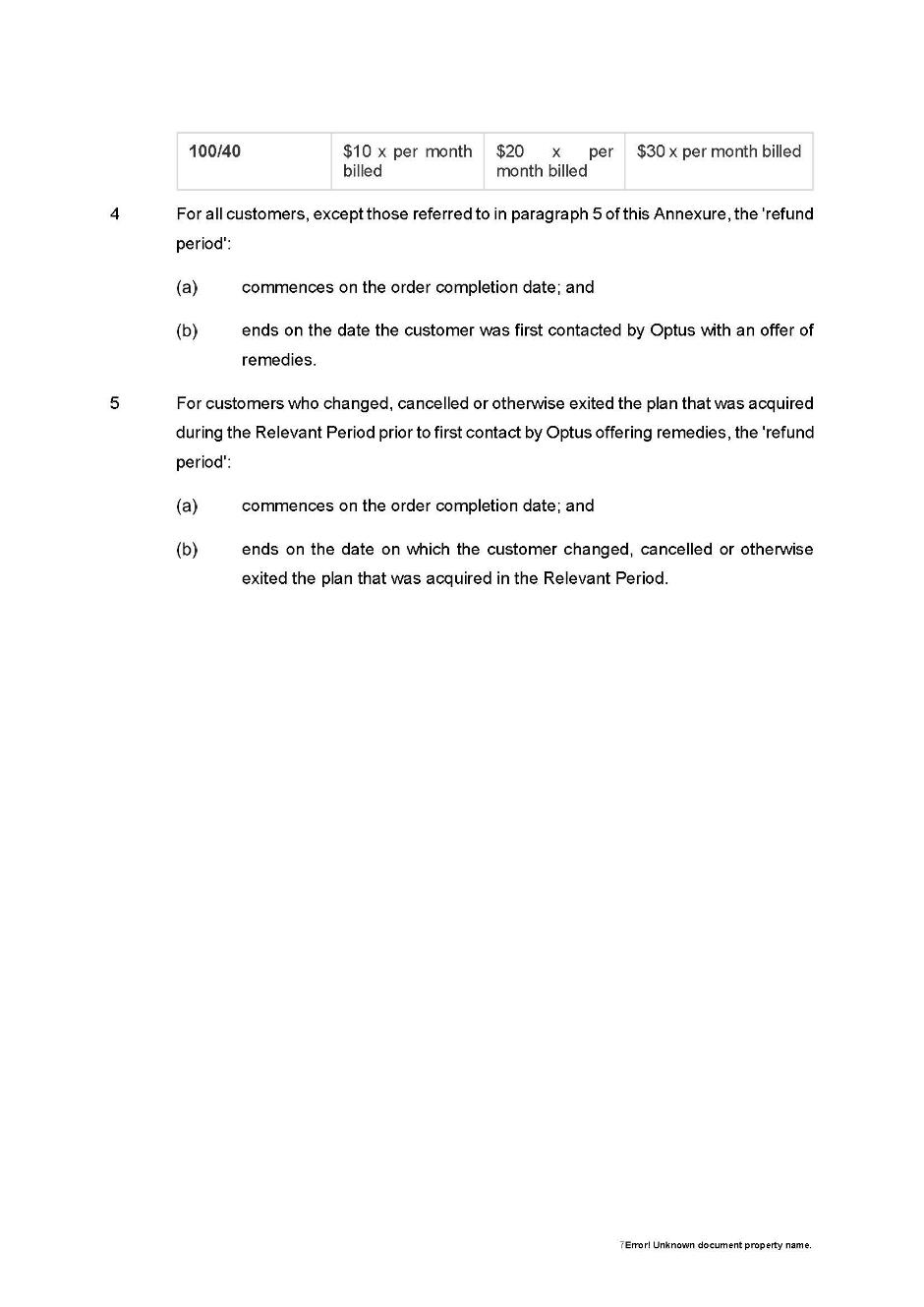
5. Pursuant to s 239 of the ACL, to redress, in whole or in part, the loss or damage suffered by the relevant non-party consumers in relation to Optus’ contraventions of ss 18, 29(1)(g) and 29(1)(m) of the ACL referred to in paragraphs 1 to 3 above, Optus implement the consumer redress regime in accordance with the terms of Annexure A to this order.
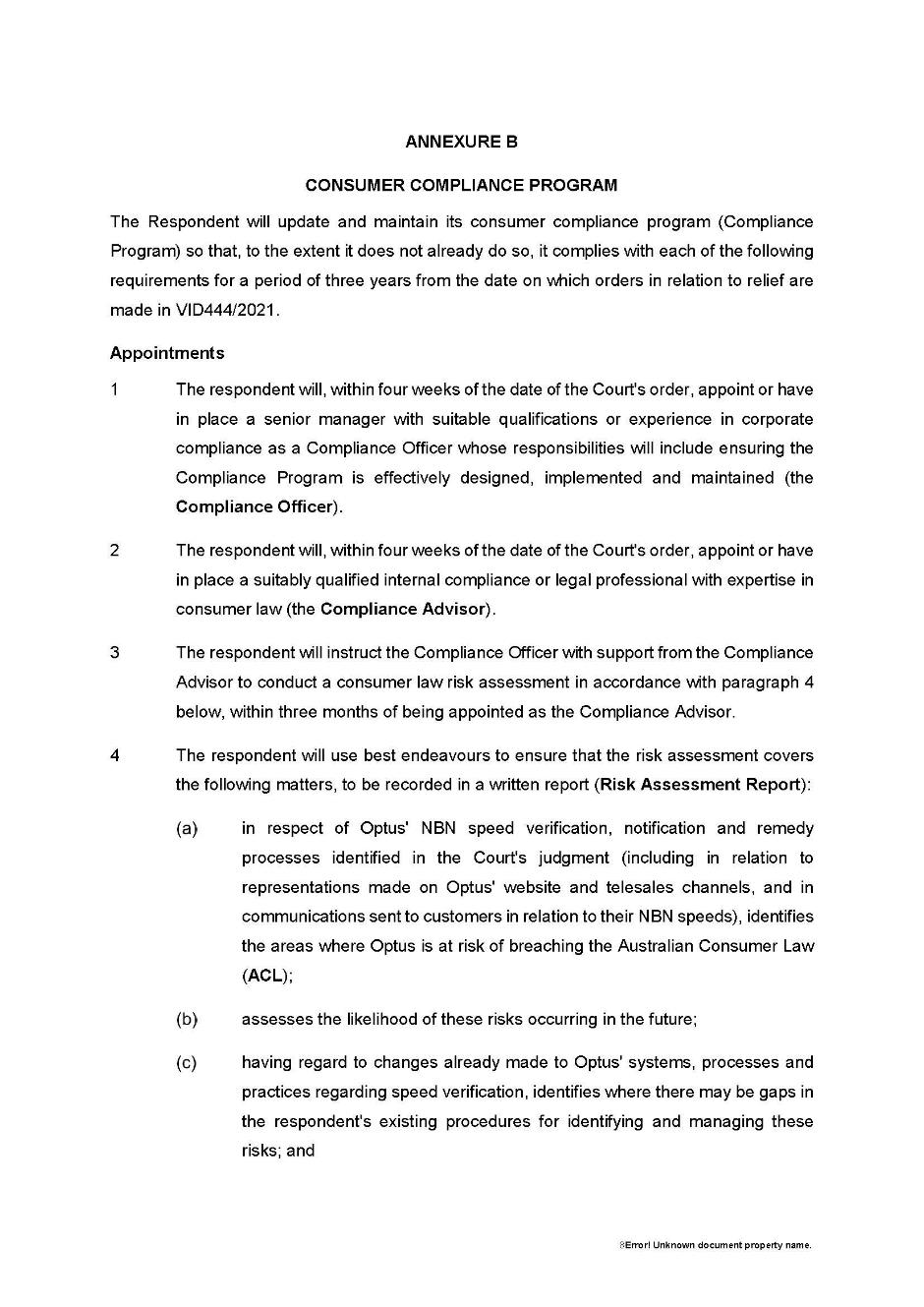
6. Pursuant to s 246(2)(b) of the ACL, Optus update and maintain its consumer compliance program so that, to the extent it does not already do so, it complies with requirements in Annexure B to this order for a period of 3 years.
7. Optus pay $100,000 as a contribution to the applicant’s costs of and incidental to the proceeding.
Note: Entry of orders is dealt with in Rule 39.32 of the Federal Court Rules 2011.
MOSHINSKY J:
Introduction
1 On 11 November 2022, I made declarations and orders in this proceeding, including declarations that the respondent, Optus Internet Pty Ltd (Optus), contravened ss 18 and 29 of the Australian Consumer Law (ACL), being Sch 2 to the Competition and Consumer Act 2010 (Cth), and orders that Optus pay pecuniary penalties to the Commonwealth of Australia in the total sum of $13.5 million, offer remedies to affected consumers in accordance with an agreed consumer redress regime, update and maintain its consumer compliance program, and pay $100,000 as a contribution to the costs of the applicant (the ACCC). Subject to one change (explained later in these reasons), the declarations and orders were substantially in the form proposed by the parties. These are my reasons for making the declarations and orders.
2 The hearing of this proceeding took place on 10 November 2022. This proceeding is one of three proceedings commenced by the ACCC against telecommunications companies in relation to representations that they made to consumers about residential broadband internet plans. The other two proceedings involve Telstra Corporation Ltd (VID 445 of 2021) (which was also heard on 10 November 2022) and TPG Internet Pty Ltd (VID 446 of 2021) (which was heard on 21 September 2022). In each case, the parties reached agreement on proposed declarations and other orders, including pecuniary penalties, and made submissions in support of the proposed declarations and orders at the hearing. In each case, on 11 November 2022, I made declarations and orders.
3 The material before the Court in this proceeding includes a statement of agreed facts prepared by the parties, dated 8 November 2022 (SOAF). A copy of the SOAF (slightly redacted, to omit certain commercially confidential material) is annexed to these reasons for judgment. I accept as correct the statements contained in the SOAF and make findings in accordance with that document.
4 Also before the Court is an affidavit of Jason Bryant Blair dated 7 November 2022. Mr Blair is the Head of Home, Marketing & Revenue at Optus. His affidavit provides evidence that is in addition to the material in the SOAF, and includes an apology on behalf of Optus for the contraventions. Mr Blair was not required to attend for cross-examination, and I accept his evidence.
5 The parties prepared and filed joint submissions on liability and relief. In preparing these reasons, I have drawn substantially on those joint submissions. I have also drawn substantially on the statements of applicable principles in my judgments in Australian Securities and Investments Commission v AMP Financial Planning Proprietary Limited [2022] FCA 1115 and Australian Competition and Consumer Commission v Optus Internet Pty Limited [2018] FCA 777.
Overview of the case and the contravening conduct
6 Between 1 January 2019 and 31 December 2019 (the Relevant Period), on its website and through direct telesales, Optus offered residential broadband internet plans that were provided using National Broadband Network (NBN) services supplied by NBN Co Ltd (NBN Co) to Optus, as a retail service provider (RSP) under a Wholesale Broadband Agreement (WBA). In connection with the supply of those internet plans, Optus made certain representations to customers as described below.
7 NBN Co offered wholesale broadband services in a range of “megabits per second” (Mbps) bandwidth profiles. The bandwidth profiles that NBN Co offered during the Relevant Period included:
(a) 50/20Mbps, which is described in the Product Description published by NBN Co that forms part of the WBA as providing a maximum peak information rate (PIR) of 25-50Mbps download, and 5-20Mbps upload (NBN50 Speed Tier).
(b) 100/40Mbps, which is described in the Product Description published by NBN Co that forms part of the WBA as providing a maximum PIR of 25-100Mbps download and 5-40Mbps upload (NBN100 Speed Tier),
(together, the NBN Speed Tiers).
8 Optus provided services to customers during the Relevant Period using various NBN technology types including NBN fibre-to-the-node (FTTN) technology on plans relevantly described as “Speed Pack 3” for internet access provisioned or connected on the NBN50 Speed Tier (NBN50 Plan) and “Speed Pack 4” for internet access provisioned or connected on the NBN100 Speed Tier (NBN100 Plan) (together, the Optus NBN plans).
9 In summary, during the Relevant Period, Optus represented in statements made on its website and in its direct telesales that:
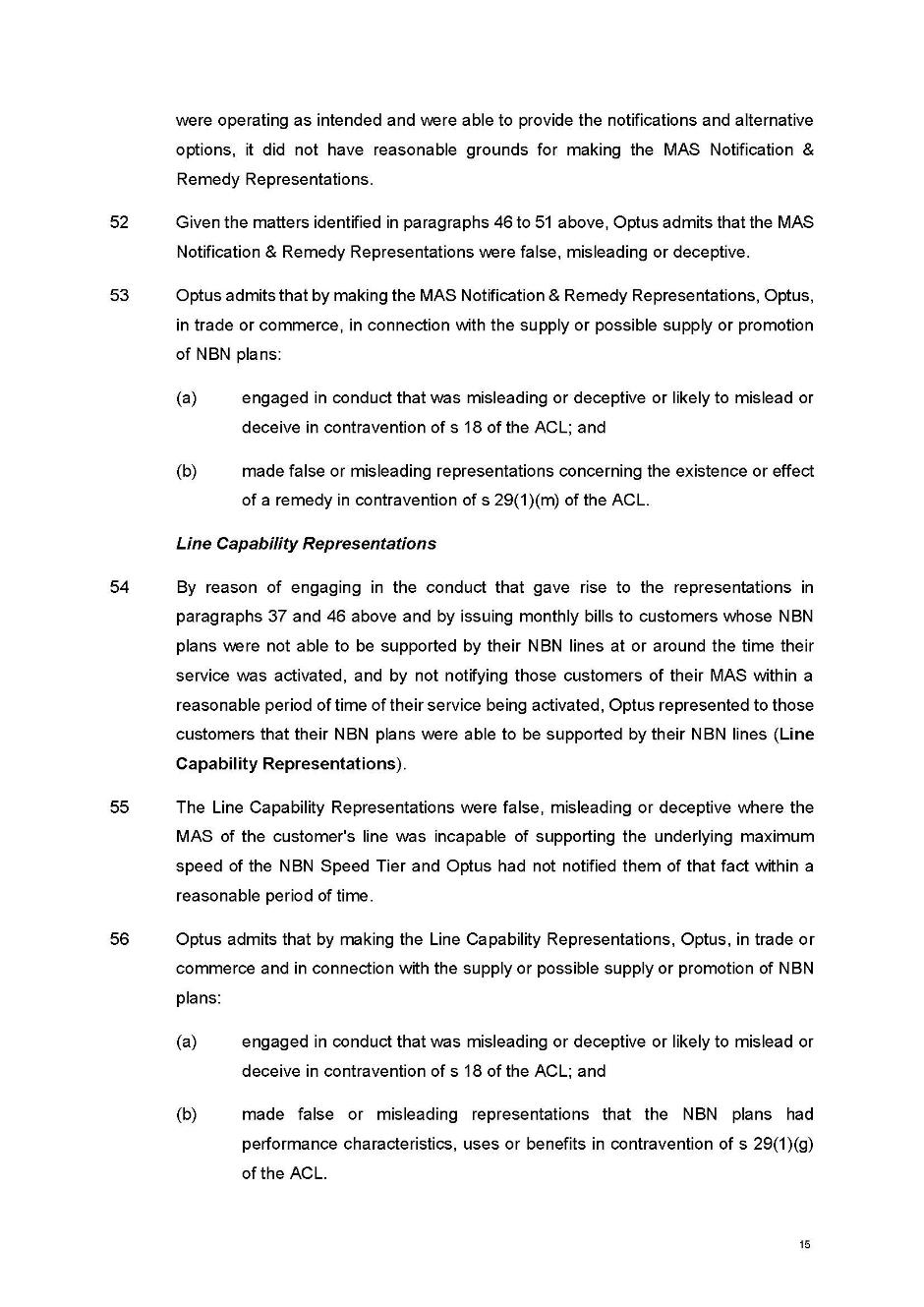
(a) Optus would, within a reasonable period of time of a customer’s service being connected, check and confirm the maximum attainable speed (MAS) of each customer’s NBN line (the MAS Checking Representations);
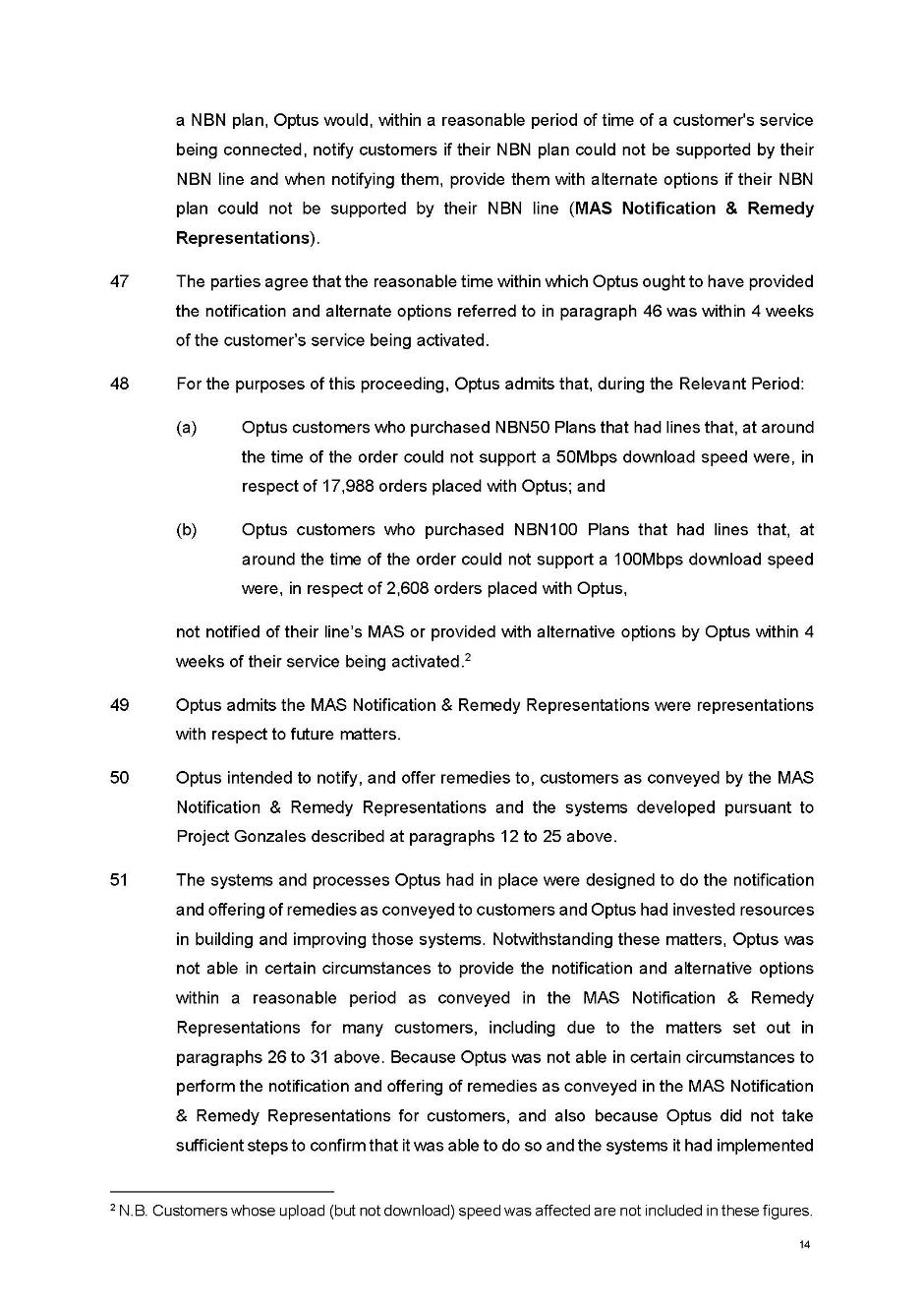
(b) Optus would, within a reasonable period of time of a customer’s service being connected, notify customers if their Optus NBN plan could not be supported by their NBN line and, when notifying them, provide them with alternative options if their Optus NBN plan could not be supported by their NBN line (the MAS Notification & Remedy Representations).
10 Each of the MAS Checking Representations and the MAS Notification & Remedy Representations were representations as to future matters, and Optus did not have reasonable grounds for making the representations. The representations are therefore taken to be misleading pursuant to s 4 of the ACL.
11 Further, by:
(a) engaging in the conduct that gave rise to the MAS Checking Representations and the MAS Notification & Remedy Representations;
(b) issuing monthly bills to customers whose lines’ MAS was incapable of supporting their Optus NBN plan; and
(c) not notifying those customers of their MAS within a reasonable period of their service being activated,
Optus represented to those customers that their Optus NBN plans were able to be supported by their NBN lines (Line Capability Representations).
12 Prior to and during the Relevant Period, there were issues:
(a) with the systems and processes that Optus had in place which were designed to check the MAS of customers’ lines, notify customers of their line’s MAS and offer remedies to customers whose lines were not capable of supporting the maximum speed of the underlying NBN Speed Tier of their NBN plan; and
(b) in receiving complete data and accessing speed information from NBN Co, which resulted in delays, or otherwise impacted Optus’s ability to check the MAS of customers’ lines, notify customers of their lines’ MAS and offer remedies to customers whose lines were not capable of supporting the maximum speed of the underlying NBN Speed Tier of their Optus NBN plan.
13 During the Relevant Period, Optus failed to:
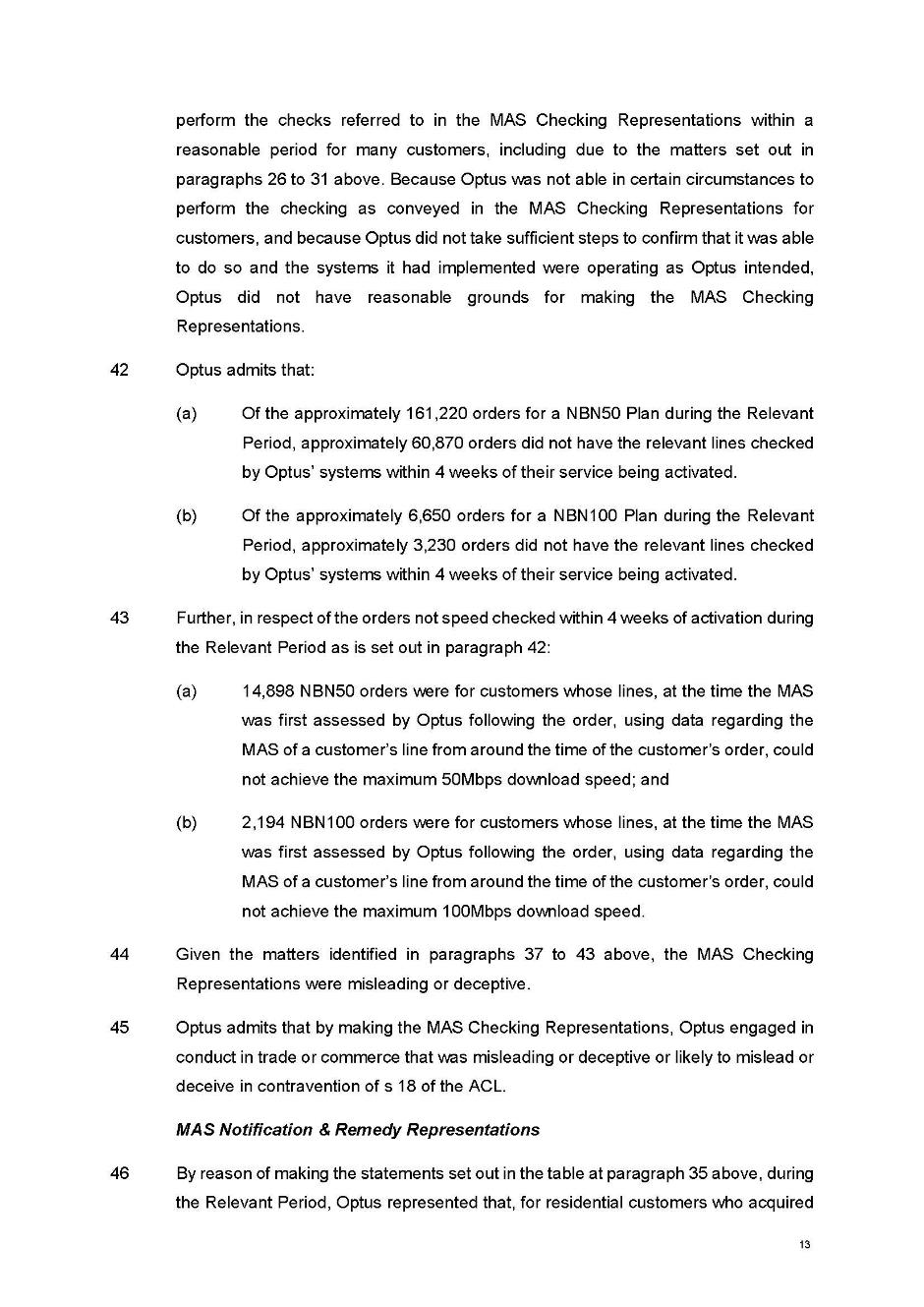
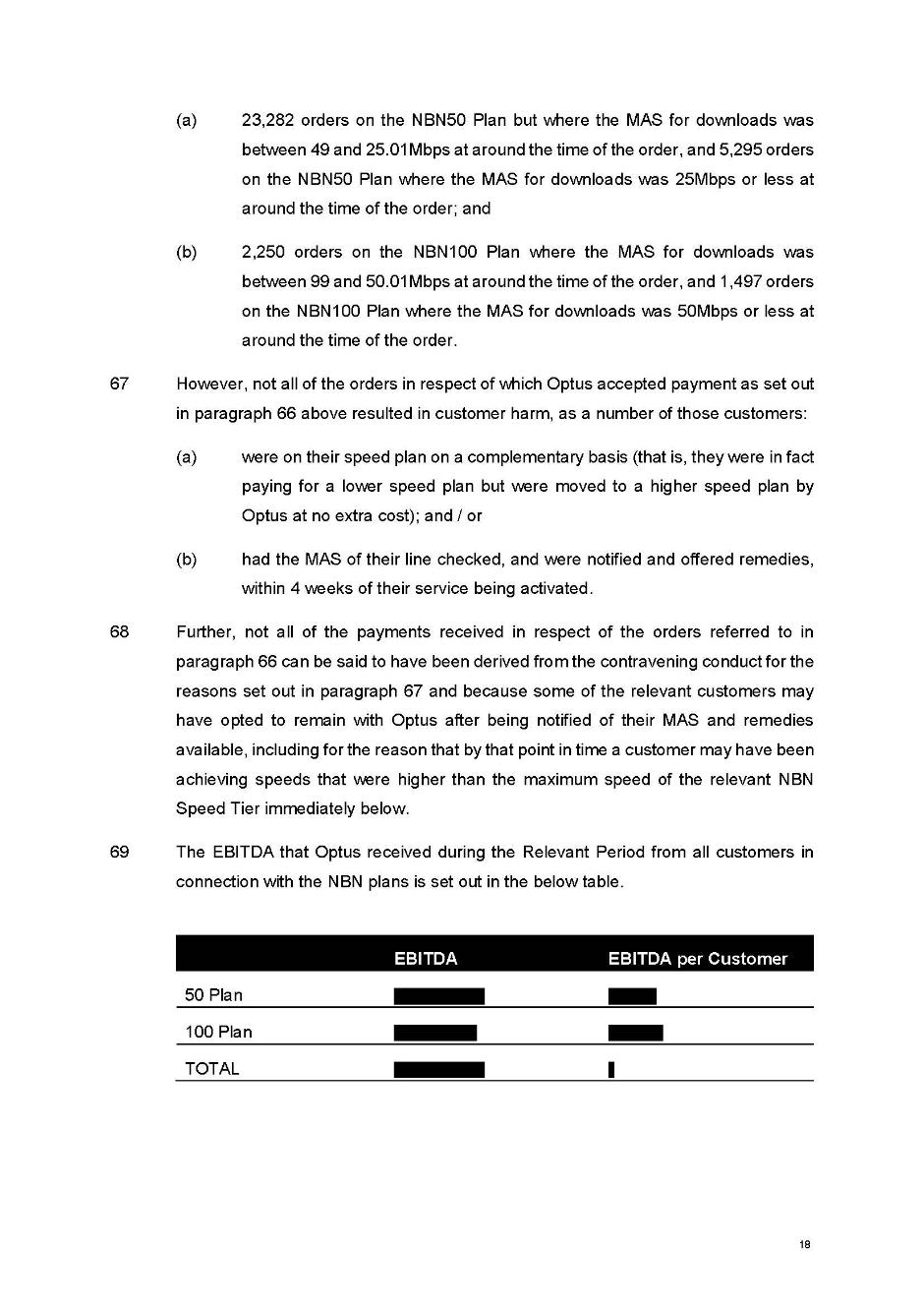
(a) check the MAS of the relevant NBN lines of approximately 64,110 NBN50 and NBN100 orders within four weeks of their service being activated, of which the MAS of the NBN lines for 17,092 orders were not capable of supporting the maximum speed of the underlying NBN Speed Tier of their Optus NBN plan at or around the time of activation of the Optus NBN plan;
(b) notify customers in respect of 20,596 NBN50 and NBN100 orders that their NBN lines that were incapable of supporting the maximum speed of the relevant NBN Speed Tier at or around the time of service activation, within four weeks of their service being activated; and
(c) offer alternative options to customers in respect of 20,596 NBN50 and NBN100 orders with NBN lines that were incapable of supporting the maximum speed of the relevant NBN Speed Tier at or around the time of activation of the Optus NBN plan, within four weeks of their service being activated.
14 Optus has admitted that:
(a) by making the MAS Checking Representations, Optus engaged in conduct that was misleading or deceptive, or likely to mislead or deceive, in contravention of s 18 of the ACL;
(b) by making the MAS Notification & Remedy Representations, Optus engaged in conduct that was misleading or deceptive, or likely to mislead or deceive, in contravention of s 18 of the ACL, and made false or misleading representations concerning the existence or effect of a remedy in contravention of s 29(1)(m) of the ACL; and
(c) by making the Line Capability Representations, Optus engaged in conduct that was misleading or deceptive, or likely to mislead or deceive, in contravention of s 18 of the ACL, and made false or misleading representations that the Optus NBN plans had performance characteristics, uses or benefits in contravention of s 29(1)(g) of the ACL.
Applicable principles
Declaratory relief
15 This Court has the power to make declarations under s 21 of the Federal Court of Australia Act 1976 (Cth).
16 In Australian Building and Construction Commissioner v Construction, Forestry, Mining and Energy Union (2017) 254 FCR 68 (ABCC v CFMEU), the Full Court stated (at [90]):
The fact that the parties have agreed that a declaration of contravention should be made does not relieve the Court of the obligation to satisfy itself that the making of the declaration is appropriate. … It is not the role of the Court to merely rubber stamp orders that are agreed as between a regulator and a person who has admitted contravening a public statute.
(Citations omitted.)
17 The Full Court continued (at [93]):
Declarations relating to contraventions of legislative provisions are likely to be appropriate where they serve to record the Court’s disapproval of the contravening conduct, vindicate the regulator’s claim that the respondent contravened the provisions, assist the regulator to carry out its duties, and deter other persons from contravening the provisions …
(Citations omitted.)
18 In Forster v Jododex Australia Pty Ltd (1972) 127 CLR 421, Gibbs J stated (at 437-438) that before making declarations three requirements should be satisfied:
(a) the question must be a real and not a hypothetical or theoretical one;
(b) the applicant must have a real interest in raising it; and
(c) there must be a proper contradictor.
Civil penalties
19 Pursuant to s 224(1)(a)(ii) of the ACL, if the Court is satisfied that a person has contravened a provision of Pt 3-1 of the ACL (which relevantly includes ss 29(1)(g) and 29(1)(m)), the Court may order the person to pay such pecuniary penalty in respect of each act or omission by the person to which the section applies, as the Court determines to be appropriate. The ACL does not empower the Court to impose a pecuniary penalty for a contravention of s 18 of the ACL.
20 Section 224(2) provides that, in determining the appropriate pecuniary penalty, the Court must have regard to all relevant matters including:
(a) the nature and extent of the act or omission and of any loss or damage suffered as a result of the act or omission; and
(b) the circumstances in which the act or omission took place; and
(c) whether the person has previously been found by a court in proceedings under Ch 4 or Pt 5-2 of the ACL to have engaged in any similar conduct.
21 From 1 September 2018, the maximum penalty for a corporation for each contravention under s 224 of the ACL increased from $1.1 million to the greater of:
(a) $10 million; or
(b) if the court can determine the value of the benefit obtained from the contravention – three times the value of the benefit; or
(c) if the court cannot determine the value of the benefit – 10% of the annual turnover of the corporation.
22 The impugned conduct the subject of this proceeding occurred after 1 September 2018.
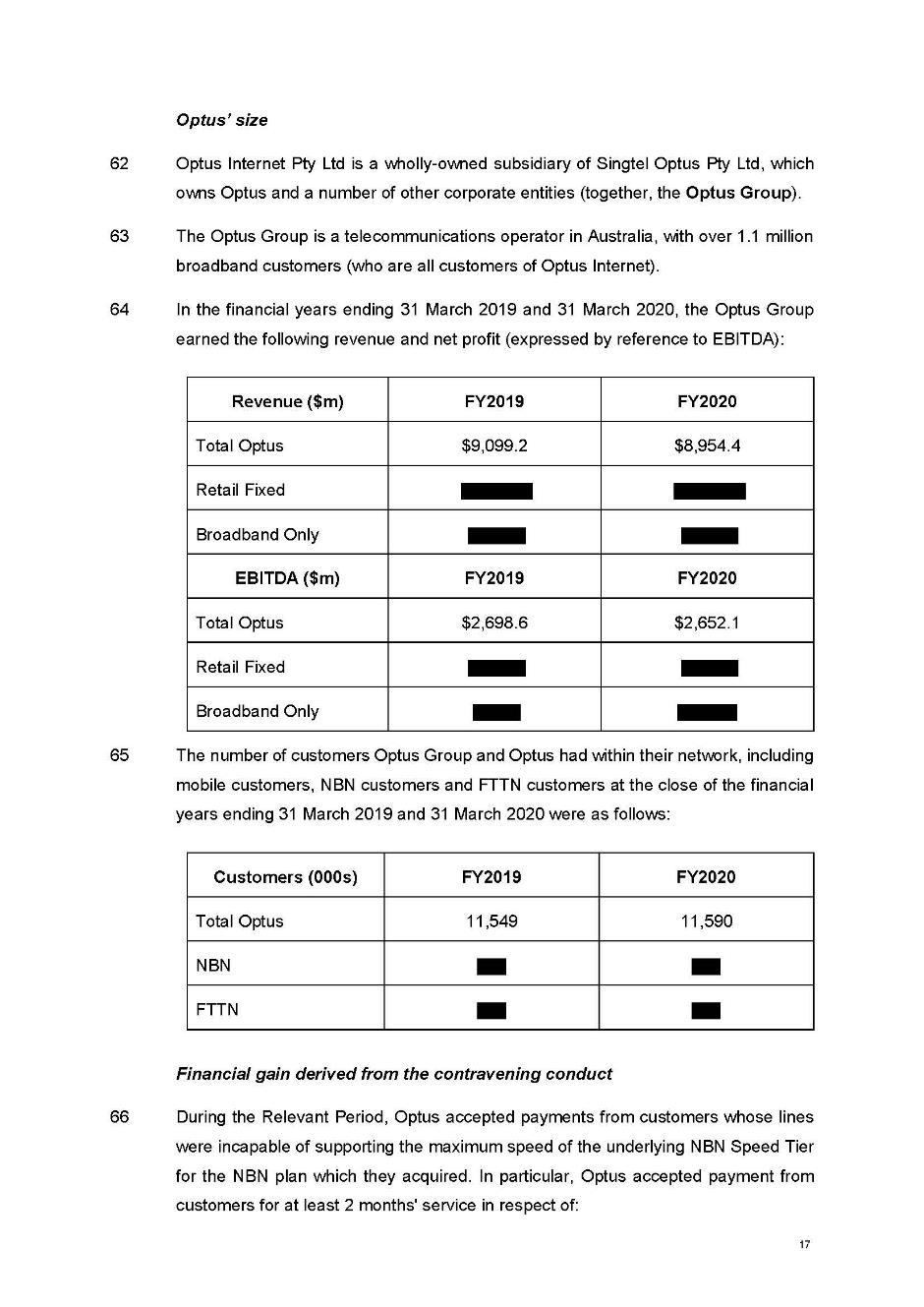
23 In the present case, the benefit obtained by Optus from the contravening conduct cannot be determined. The maximum penalty per contravention is therefore $10 million or 10% of the annual turnover of Optus in the 12 months before each contravention, whichever is greater.
24 In Commonwealth v Director, Fair Work Building Industry Inspectorate (2015) 258 CLR 482 (the Agreed Penalties Case), the High Court emphasised that the primary purpose of civil penalties is to secure deterrence. In contrast to criminal sentences, they are not concerned with retribution and rehabilitation but are “primarily if not wholly protective in promoting the public interest in compliance”: Agreed Penalties Case at [55] per French CJ, Kiefel, Bell, Nettle and Gordon JJ; see also at [110] per Keane J. This point was also emphasised by the High Court in Australian Building and Construction Commissioner v Pattinson (2022) 399 ALR 599 (Pattinson) at [15]-[16], [43], [45], [55] per Kiefel CJ, Gageler, Keane, Gordon, Steward and Gleeson JJ.
25 The plurality in Pattinson affirmed (at [18]) the well-known statements of French J, as his Honour then was, in Trade Practices Commission v CSR Ltd [1991] ATPR ¶41-076; [1990] FCA 762 (CSR). In that case, his Honour listed several factors that informed the assessment of a penalty of appropriate deterrent value under the Trade Practices Act 1974 (Cth). His Honour stated:
The assessment of a penalty of appropriate deterrent value will have regard to a number of factors which have been canvassed in the cases. These include the following:
1. The nature and extent of the contravening conduct.
2. The amount of loss or damage caused.
3. The circumstances in which the conduct took place.
4. The size of the contravening company.
5. The degree of power it has, as evidenced by its market share and ease of entry into the market.
6. The deliberateness of the contravention and the period over which it extended.
7. Whether the contravention arose out of the conduct of senior management or at a lower level.
8. Whether the company has a corporate culture conducive to compliance with the Act, as evidenced by educational programs and disciplinary or other corrective measures in response to an acknowledged contravention.
9. Whether the company has shown a disposition to co-operate with the authorities responsible for the enforcement of the Act in relation to the contravention.
26 After setting out the above passage, the plurality in Pattinson stated at [19]:
It may readily be seen that this list of factors includes matters pertaining both to the character of the contravening conduct (such as factors 1 to 3) and to the character of the contravenor (such as factors 4, 5, 8 and 9). It is important, however, not to regard the list of possible relevant considerations as a “rigid catalogue of matters for attention” as if it were a legal checklist. The court’s task remains to determine what is an “appropriate” penalty in the circumstances of the particular case.
(Footnotes omitted.)
27 The plurality in Pattinson considered the role of the prescribed maximum penalty as a yardstick in a civil penalty context, affirming (at [53]) the explanation provided by the Full Court of this Court in Australian Competition and Consumer Commission v Reckitt Benckiser (Australia) Pty Ltd (2016) 340 ALR 25 (Reckitt Benckiser) at [155]-[156]. See also Pattinson at [54]-[55].
28 In cases involving a very large number of contraventions, it may be unhelpful to seek to make a finding as to the precise number of contraventions, or to calculate a maximum aggregate penalty by reference to such a number: see Australian Competition and Consumer Commission v Coles Supermarkets Australia Pty Ltd (2015) 327 ALR 540 at [18] and [82] per Allsop CJ; ABCC v CFMEU at [143] per Dowsett, Greenwood and Wigney JJ.
29 It is relevant to refer to the course of conduct principle, which was considered by the Full Court of this Court in Australian Competition and Consumer Commission v Cement Australia Pty Ltd (2017) 258 FCR 312 at [421]-[428]. The Full Court (Middleton, Beach and Moshinsky JJ) stated at [424] that the course of conduct principle is a useful “tool” in the determination of appropriate civil penalties. The Full Court continued:
As we have already indicated, the principal object of the penalties imposed by s 76 of the [Trade Practices Act 1974 (Cth)] is that of specific and general deterrence. With this in mind, in a civil penalty context, the course of conduct principle can be conceived of as a recognition by the courts that the deterrent effect in respect of a civil penalty (at both a specific and general level) is measured by reference to the nature of the conduct for which it is imposed. It is therefore of paramount importance to identify whether multiple contraventions constitute a single course of conduct or separate instances of conduct, so as to ensure that an appropriate deterrent effect is achieved by the imposition of the penalty or penalties in respect of that particular conduct.
30 In relation to the course of conduct principle, in Australian Competition and Consumer Commission v Hillside (Australia New Media) Pty Ltd trading as Bet365 (No 2) [2016] FCA 698 (Hillside), Beach J stated at [25]:
… the “course of conduct” principle does not have paramountcy in the process of assessing an appropriate penalty. It cannot of itself operate as a de facto limit on the penalty to be imposed for contraventions of the ACL. Further, its application and utility must be tailored to the circumstances. In some cases, the contravening conduct may involve many acts of contravention that affect a very large number of consumers and a large monetary value of commerce, but the conduct might be characterised as involving a single course of conduct. Contrastingly, in other cases, there may be a small number of contraventions, affecting few consumers and having small commercial significance, but the conduct might be characterised as involving several separate courses of conduct. It might be anomalous to apply the concept to the former scenario, yet be precluded from applying it to the latter scenario. The “course of conduct” principle cannot unduly fetter the proper application of s 224.
31 The above passage was cited with approval by the Full Court in Reckitt Benckiser at [141].
32 In determining the appropriate penalty, it is relevant to consider steps taken to ameliorate loss or damage (such as payment of compensation) as potentially mitigatory considerations: Australian Competition and Consumer Commission v Woolworths Limited [2016] ATPR ¶42-251; [2016] FCA 44 at [166]-[167] per Edelman J; Australian Competition and Consumer Commission v AGL South Australia Pty Ltd (2015) 146 ALD 385; [2015] FCA 399 at [38] per White J.
33 Co-operation with authorities in the course of investigations and subsequent proceedings can properly reduce the penalty that would otherwise be imposed. The reduction reflects the fact that such co-operation: increases the likelihood of co-operation in future cases in a way that furthers the object of the legislation; frees up the regulator’s resources, thereby increasing the likelihood that other contravenors will be detected and brought to justice; and facilitates the course of justice: see, eg, Agreed Penalties Case at [46]; NW Frozen Foods Pty Ltd v Australian Competition and Consumer Commission (1996) 71 FCR 285 at 293-294 (NW Frozen Foods).
34 In the Agreed Penalties Case, the High Court held that, in the context of civil penalty provisions, it was open to the Court to receive submissions, including joint submissions, as to an appropriate penalty. French CJ, Kiefel, Bell, Nettle and Gordon JJ (with whom Keane J agreed) stated at [46] that there is “an important public policy involved in promoting predictability of outcome in civil penalty proceedings” and that “the practice of receiving and, if appropriate, accepting agreed penalty submissions increases the predictability of outcome for regulators and wrongdoers”. Their Honours stated that, as was recognised in Trade Practices Commission v Allied Mills Industries Pty Ltd (No 5) (1981) 60 FLR 38; 37 ALR 256 and determined in NW Frozen Foods, “such predictability of outcome encourages corporations to acknowledge contraventions, which, in turn, assists in avoiding lengthy and complex litigation and thus tends to free the courts to deal with other matters and to free investigating officers to turn to other areas of investigation that await their attention”.
35 Their Honours stated, at [57], that in civil proceedings there is generally very considerable scope for the parties to agree on the facts and their consequences, and that there “is also very considerable scope for them to agree upon the appropriate remedy and for the court to be persuaded that it is an appropriate remedy”. In relation to civil penalty proceedings, their Honours stated at [58]:
Subject to the court being sufficiently persuaded of the accuracy of the parties’ agreement as to facts and consequences, and that the penalty which the parties propose is an appropriate remedy in the circumstances thus revealed, it is consistent with principle and, for the reasons identified in Allied Mills, highly desirable in practice for the court to accept the parties’ proposal and therefore impose the proposed penalty.
(Footnote omitted.)
36 Their Honours in the Agreed Penalties Case also made observations, at [60]-[61], regarding submissions by a regulator in such a context.
Application of principles to this case
Declarations
37 The parties have proposed declarations that reflect the agreed contraventions as summarised above.
38 I consider it appropriate to make a change to the wording proposed by the parties. In relation to paragraphs 1(b) and 2(b) of the proposed declarations, I consider it appropriate to include wording to reflect the fact that Optus did not have reasonable grounds for making the representations at the time at which they were made. I therefore consider it appropriate to replace sub-paragraph (i) of each of those paragraphs with new sub-paragraphs 1(b)(i) and (ii). This change was reflected in the declarations made on 11 November 2022.
39 Subject to that change, I am satisfied that the contraventions that are the subject of the proposed declarations are established by the facts and admissions set out in the SOAF.
40 Further, subject to the above change, I consider it appropriate to make declarations substantially in the terms proposed by the parties. The preconditions for the making of declarations, set out above, are satisfied. In particular, I am satisfied that: there is a real and not a hypothetical question; the applicant has a real interest in raising the question; and there is a proper contradictor.
Civil penalties
41 The parties submit that the proposed penalty of $13.5 million is appropriate and should be imposed by the Court. They submit that: a penalty of this amount is appropriately tailored to the gravity of the contraventions in all the circumstances and is sufficient to achieve specific and general deterrence; this level of penalty will send a clear message of deterrence to Optus and the business community more generally about the importance of ensuring that representations made to customers in connection with critical information about the standard or quality of essential services, such as broadband internet services, are accurate; and this assists in ensuring that customers are able to make informed decisions about their internet services.
42 The parties’ joint submissions, at [103]-[165], set out detailed reasons in support of the proposed penalty of $13.5 million. Having regard to those submissions, which I accept, I am satisfied that the proposed penalty is appropriate in the circumstances of this case, and meets the objectives of specific and general deterrence. In particular, I note the following matters.
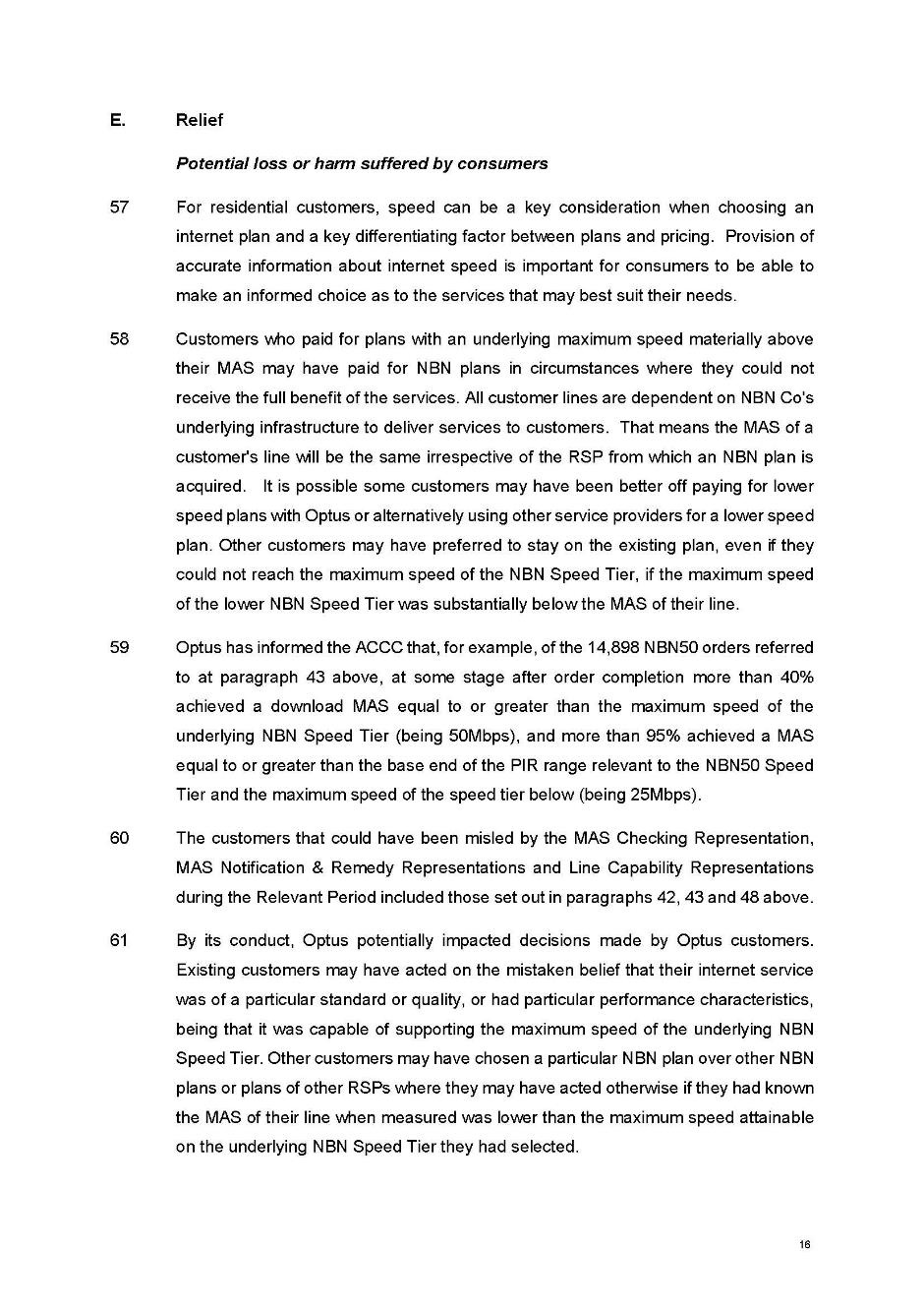
43 For residential customers, speed can be a key consideration when choosing an internet plan and is a key differentiating factor between plans and pricing. Provision of accurate information about internet speed is important for consumers to be able to make an informed choice as to the services that may best suit their needs.
44 Customers who paid for plans with underlying maximum speeds materially above their MAS may have suffered loss by reason of them paying for NBN plans in circumstances where they could not receive the full benefit of the services. However, the MAS of their line would have restricted the maximum speed available to them no matter which RSP they selected. Notwithstanding that, it is possible that some customers may have been better off paying for lower speed plans with Optus or alternatively using other service providers. Other customers may have preferred to stay on their existing plan, even if they could not reach the maximum speed of the relevant NBN Speed Tier, if the maximum speed of the lower NBN Speed Tier was substantially below the MAS of their line.
45 Nevertheless, accurate and timely information about the standard, quality, and performance characteristics of a customer’s internet service is essential to consumer choice.
46 The customers that could have been misled by the MAS Notification & Remedy Representations and the Line Capability Representations during the Relevant Period include those referred to in [13(c)] above. It is not possible to accurately estimate how many of these customers suffered harm or calculate the financial loss or harm suffered by them.
47 By its conduct, Optus potentially impacted decisions made by Optus customers. Existing customers may have acted on the mistaken belief that their internet service was of a particular standard or quality, or had particular performance characteristics, being that it was capable of supporting the maximum speed of the underlying NBN Speed Tier. Other customers may have chosen a lower NBN plan, or a lower plan of other RSPs, where they may have acted otherwise if they had known the MAS of their line when measured was lower than the maximum speed attainable on the underlying NBN Speed Tier they had selected.
48 Optus’s admitted contraventions took place despite its intention to perform the representations as made, and despite efforts and expenditure of resources on the part of Optus to perform the representations.
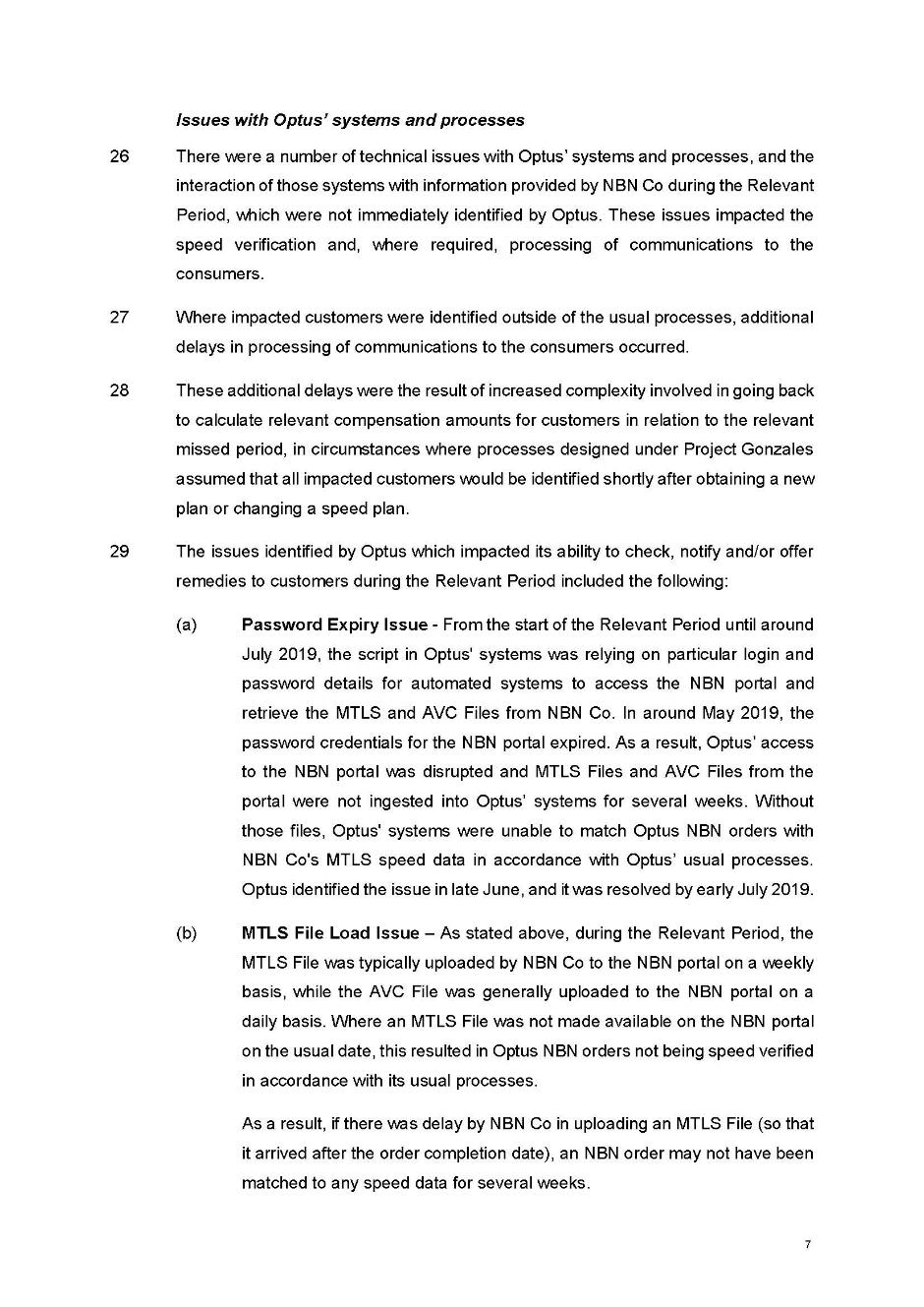
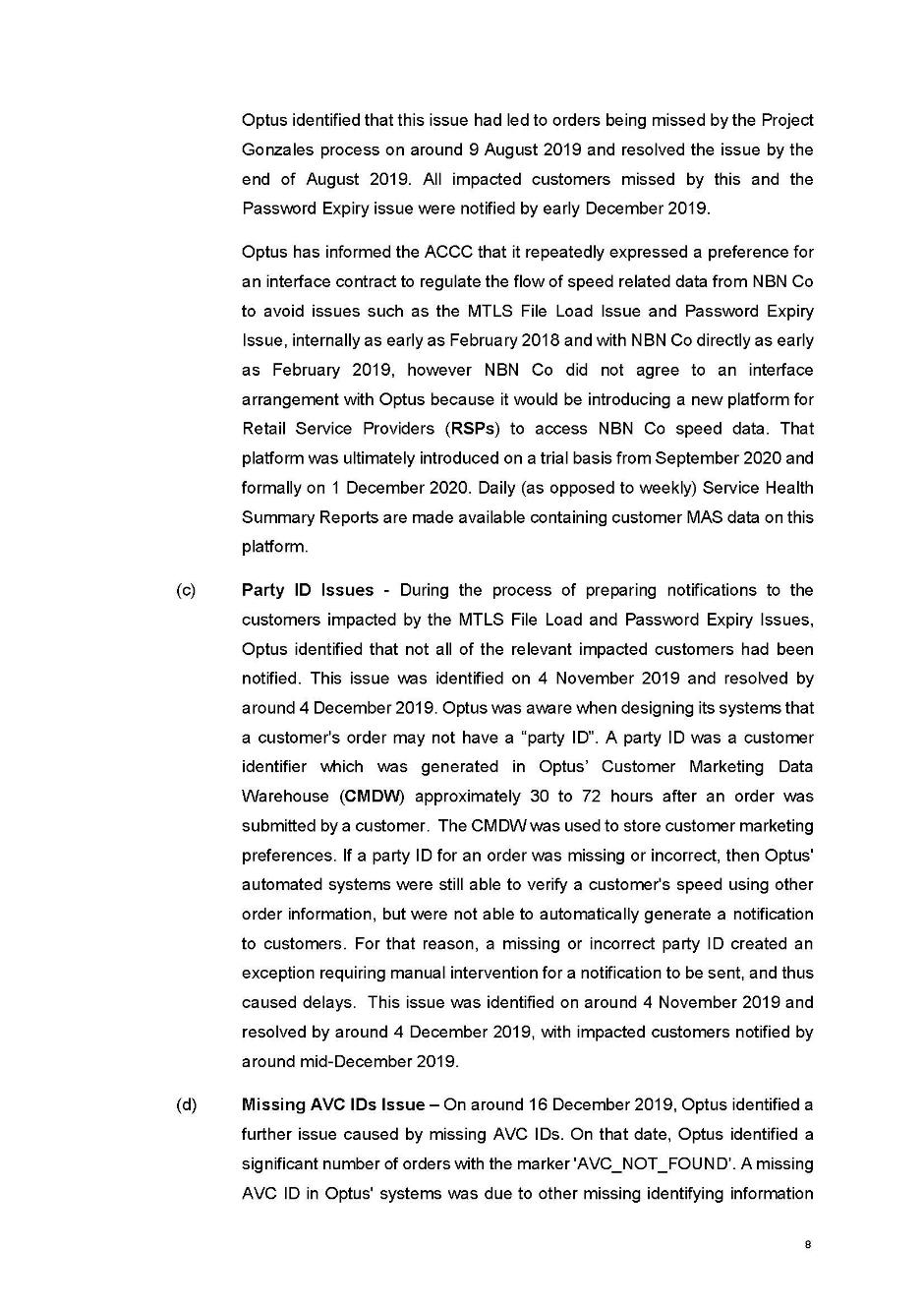
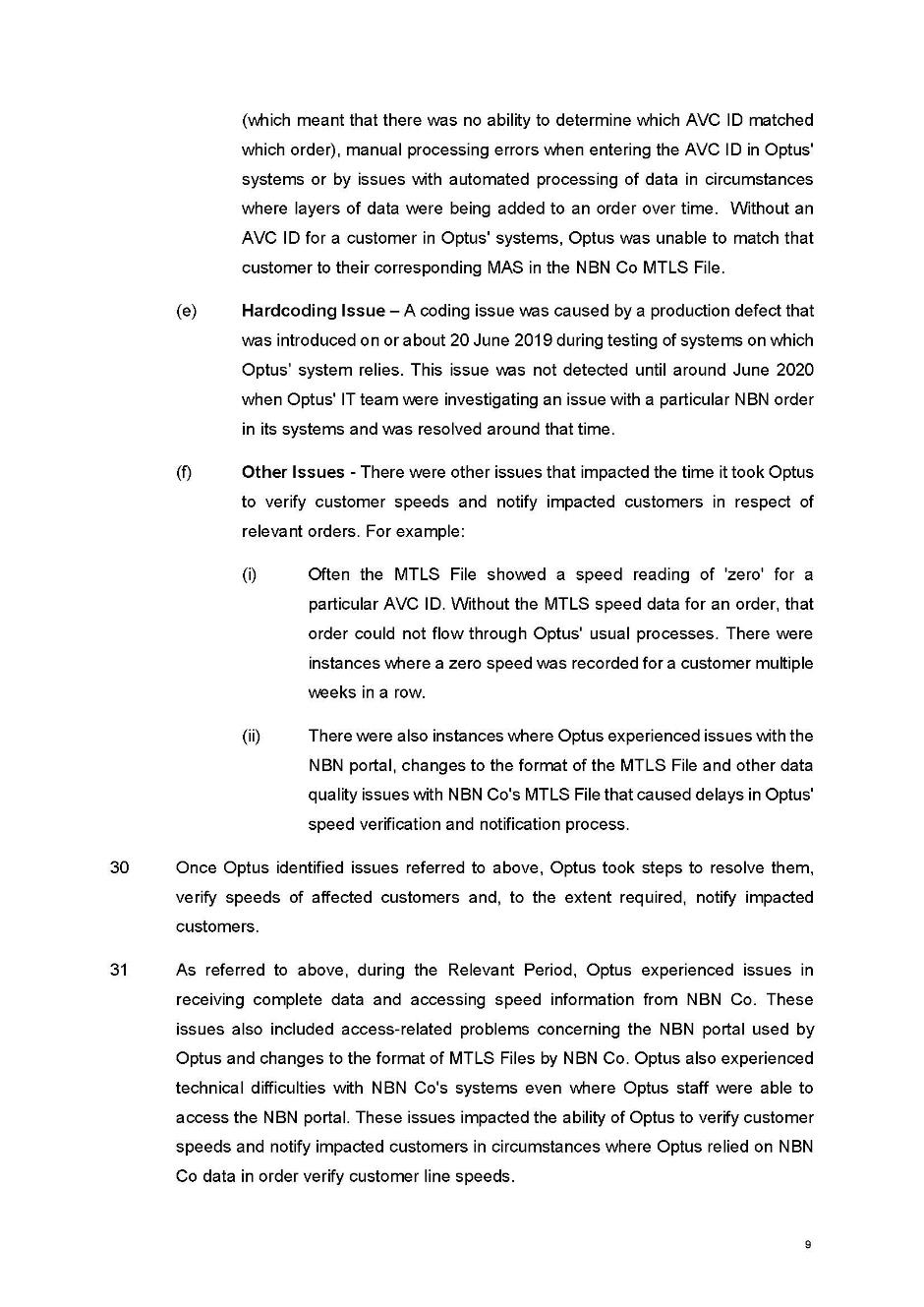
49 While the failure to perform the representations was unintentional by Optus and Optus undertook steps to ultimately do the things that it had represented it would do once it became aware that they had not been done (as detailed at paragraphs 29, 30 and 77-81 of the SOAF), there were issues with Optus’s systems and it did not take sufficient steps to confirm that its systems were operating as intended during the Relevant Period.
50 Optus has demonstrated sincere contrition for the conduct the subject of this proceeding. Optus’s apology is expressed in the affidavit of Mr Blair. Optus has also taken action in response to the identification of the issues (including before the ACCC commenced its investigation) with its systems, processes and practices. These actions, along with Optus’s engagement with the ACCC as outlined in the SOAF, are consistent with Optus’s contrition for the conduct the subject of this proceeding.
51 The ACCC does not allege, and there is no evidence to indicate that, any of the contraventions were deliberate attempts to mislead consumers, or that the conduct constituting the contraventions involved conduct by senior management.
52 Optus has previously been found to have contravened the ACL in connection with the supply of internet services, as set out in the SOAF.
53 Having regard to the above matters, and the other matters referred to in the joint submissions, I am satisfied that the proposed penalty amount is appropriate to achieve deterrence, both specific and general.
Other orders
54 The parties also propose that the Court make orders to the effect that:
(a) pursuant to s 239 of the ACL, to redress, in whole or in part, the loss or damage suffered by the relevant non-party consumers in relation to Optus’s contraventions of ss 18, 29(1)(g) and 29(1)(m) of the ACL referred to in paragraphs 1 to 3 of the declarations, Optus implement the consumer redress regime in accordance with the terms of Annexure A to the orders;
(b) pursuant to s 246(2)(b) of the ACL, Optus update and maintain its consumer compliance program so that, to the extent it does not already do so, it complies with requirements in Annexure B to the orders for a period of 3 years; and
(c) Optus pay $100,000 as a contribution to the ACCC’s costs of and incidental to the proceeding.
55 I am satisfied that it is appropriate in the circumstances to make these additional orders.
Conclusion
56 It was for the above reasons that I made the declarations and orders on 11 November 2022.
I certify that the preceding fifty-six (56) numbered paragraphs are a true copy of the Reasons for Judgment of the Honourable Justice Moshinsky. |
Associate:




 p
p


