

Federal Court of Australia
Australia and New Zealand Banking Group Limited, in the matter of Australia and New Zealand Banking Group Limited [2022] FCA 1378
ORDERS
IN THE MATTER OF AUSTRALIA AND NEW ZEALAND BANKING GROUP LIMITED | ||
AUSTRALIA AND NEW ZEALAND BANKING GROUP LIMITED (ACN 005 357 522) Plaintiff | ||
DATE OF ORDER: |
OTHER MATTERS:
A. The Court notes that the Australian Securities and Investments Commission (ASIC) was provided with at least 14 days’ notice of the hearing of this application.
B. The Court is satisfied that ASIC has had a reasonable opportunity to:
(i) examine the terms of the proposed scheme of arrangement to which the application relates and a draft explanatory statement relating to that arrangement; and
(ii) make submissions to the Court in relation to the proposed scheme of arrangement and the draft explanatory statement.
C. The Court notes the letter from ASIC to the directors of the plaintiff dated 25 October 2022 produced at the hearing.
THE COURT ORDERS THAT:
1. Pursuant to subsection 411(1) and section 1319 of the Corporations Act 2001 (Cth) (Act), the plaintiff (ANZBGL) convene and hold a meeting of its shareholders (Scheme Meeting):
(a) for the purpose of considering and, if thought fit, agreeing (with or without modification) to the scheme of arrangement (Scheme) proposed to be made between ANZBGL and its shareholders (ANZBGL Shareholders), the terms of which are set out in Annexure A to these orders;
(b) to be held on 15 December 2022 commencing at 12.30pm Melbourne time/12.00pm Adelaide time, or if the ANZBGL Annual General Meeting (AGM) on that date continues after 12.30pm Melbourne time/12.00pm Adelaide time, the Scheme Meeting is to commence so soon after the AGM concludes or is adjourned; and
(c) to be conducted in-person at the Adelaide Convention Centre, North Terrace, Adelaide, South Australia and electronically via an online platform (which is to be accessed in accordance with the instructions included in the Notice of Scheme Meeting to be sent to shareholders in accordance with order 2 below).
2. Pursuant to subsection 411(1) and section 1319 of the Act, the Scheme Meeting be convened by sending on or before 16 November 2022:
(a) to each ANZBGL shareholder who has elected to be sent documents by ANZBGL in electronic form (Email Shareholder) (or, in the case of joint holders, to the holder whose name appears first in ANZBGL’s register), an email substantially in the form which appears at pages 86 to 89 of Annexure “SMP-1” to the affidavit of Simon Mark Pordage affirmed on 21 October 2022 (Pordage Affidavit), and which contains hyperlinks to:
(i) an electronic copy of a document substantially in the form of the document which is Annexure “BCF-8” to the affidavit of Baden Charles Furphy affirmed on 25 October 2022 (Scheme Booklet) (which contains, among other things, the proposed Scheme of Arrangement at Annexure 3 and Notice of Scheme Meeting at Annexure 5);
(ii) an online portal or website that is accessible by the Email Shareholder and which enables the Email Shareholder to lodge online prior to the Scheme Meeting any proxy or direct voting instructions for the Scheme Meeting; and
(iii) an online portal or website that is accessible by the Email Shareholder to view, listen to and participate in the Scheme Meeting online;
(b) to each ANZBGL Shareholder who has elected to receive documents from ANZBGL in physical form (or, in the case of joint holders, to the holder whose name appears first in ANZBGL’s register) (Hardcopy Shareholder):
(i) a hardcopy of the Scheme Booklet;
(ii) a letter substantially in the form which appears at pages 100 to 101 of Annexure “SMP-1” to the Pordage Affidavit setting out URL addresses from which the Hardcopy Shareholder:
A. can download an electronic copy of the Scheme Booklet; and
B. is directed to an online portal or website that is accessible by the Hardcopy Shareholder to view, listen to and participate in the Scheme Meeting online and which enables the Hardcopy Shareholder to lodge online prior to the Scheme Meeting any proxy or direct voting instructions for the Scheme Meeting; and
(iii) a hard copy proxy/voting form substantially in the form which appears at pages 98 to 99 of Annexure “SMP-1” to the Pordage Affidavit (Proxy Form) and a reply-paid envelope for the Hardcopy Shareholder to lodge their Proxy Form for the Scheme Meeting;
(c) to each ANZBGL Shareholder who is not an Email Shareholder or Hardcopy Shareholder (or, in the case of joint holders, to the holder whose name appears first in ANZBGL’s register) (Postal Shareholder):
(i) a letter substantially in the form which appears at pages 96 to 97 of Annexure “SMP-1” to the Pordage Affidavit setting out URL addresses from which the Postal Shareholder:
A. can download an electronic copy of the Scheme Booklet; and
B. is directed to an online portal or website that is accessible by the Postal Shareholder to view, listen to and participate in the Scheme Meeting online and which enables the Postal Shareholder to lodge online prior to the Scheme Meeting any proxy or direct voting instructions for the Scheme Meeting; and
(ii) a Proxy Form and a reply-paid envelope for the Postal Shareholder to lodge their Proxy Form for the Scheme Meeting.
3. The documents referred to in orders 2(b) and 2(c) be sent:
(a) in the case of shareholders whose registered address is within Australia, by prepaid ordinary post addressed to the relevant addresses recorded in ANZBGL’s register; and
(b) in the case of shareholders whose registered address is outside Australia, by airmail or international courier service addressed to the relevant addresses recorded in ANZBGL’s register.
4. If it comes to the attention of the Plaintiff that any email dispatched to Email Shareholders in accordance with order 2(a) above has returned an undeliverable or undelivered receipt for an Email Shareholder's nominated email address, the Plaintiff is to dispatch to that Email Shareholder within a reasonable time thereafter the specified documents in accordance with order 2(c) above.
5. ANZBGL is not required to send a copy of the Scheme Booklet to ANZBGL shareholders with registered addresses in China, India or Papua New Guinea.
6. Compliance with r 2.15 of the Federal Court (Corporations) Rules 2000 (Cth) (Rules) be dispensed with, except in so far as that rule applies to rule 75-15(2) of the Insolvency Practice Rules (Corporations) 2016 (Cth).
7. Voting on the resolution to agree to the Scheme is to be conducted by way of a poll.
8. A proxy in respect of the Scheme Meeting will be valid and effective if, and only if, it is completed and delivered in accordance with its terms or a proxy or direct voting instruction is lodged online in accordance with the instructions on the online portal or website referred to in Order 2 and received by ANZBGL by 4.00pm Melbourne time / 3.30pm Adelaide time on 13 December 2022.
9. Paul O’Sullivan, or failing him John MacFarlane, be Chairperson of the Scheme Meeting.
10. The further hearing of the Originating Process is adjourned to the Honourable Justice O’Bryan at 10:15am (Melbourne time) on 22 December 2022 or as soon thereafter as the business of the Court allows.
Note: Entry of orders is dealt with in Rule 39.32 of the Federal Court Rules 2011.
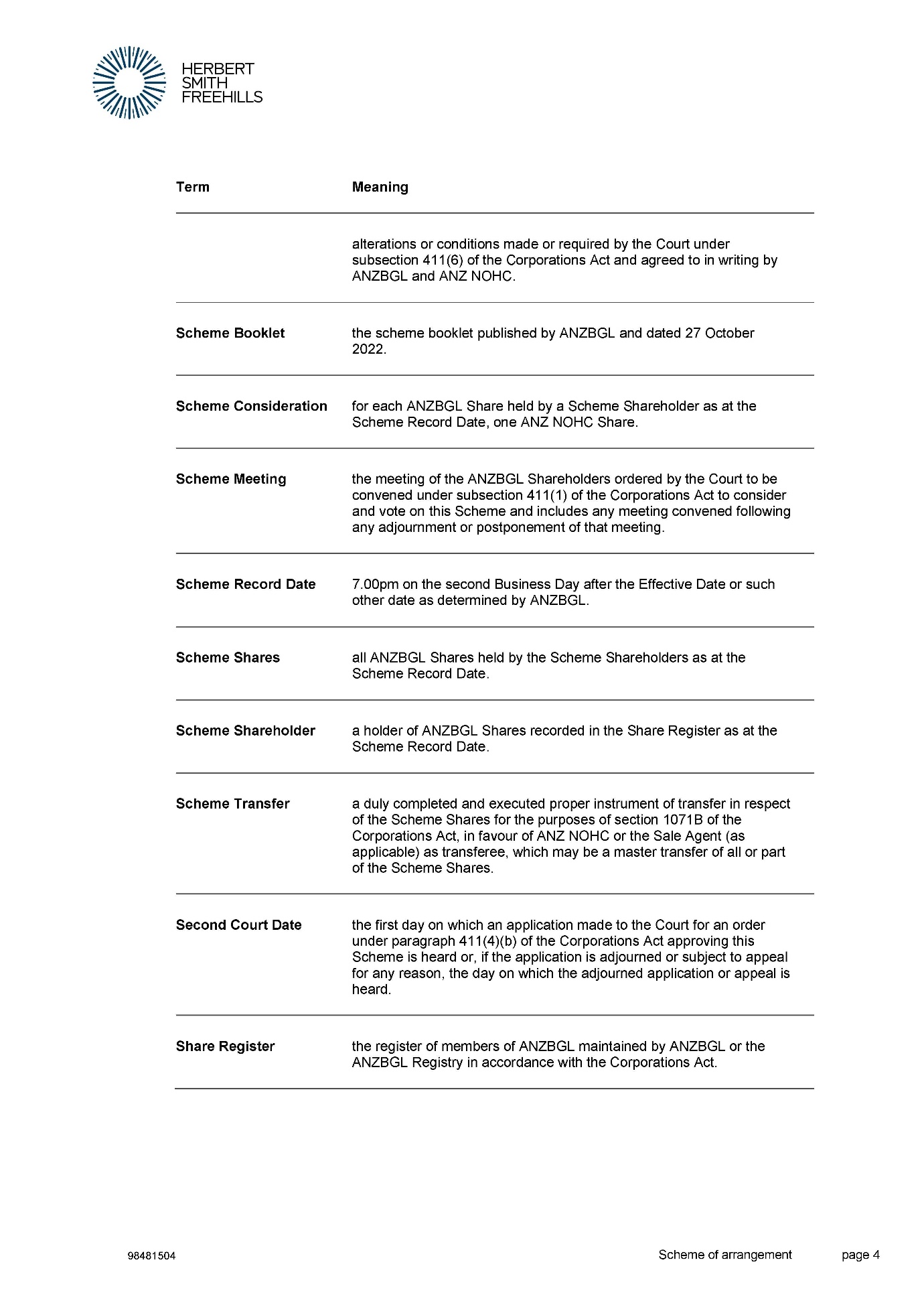
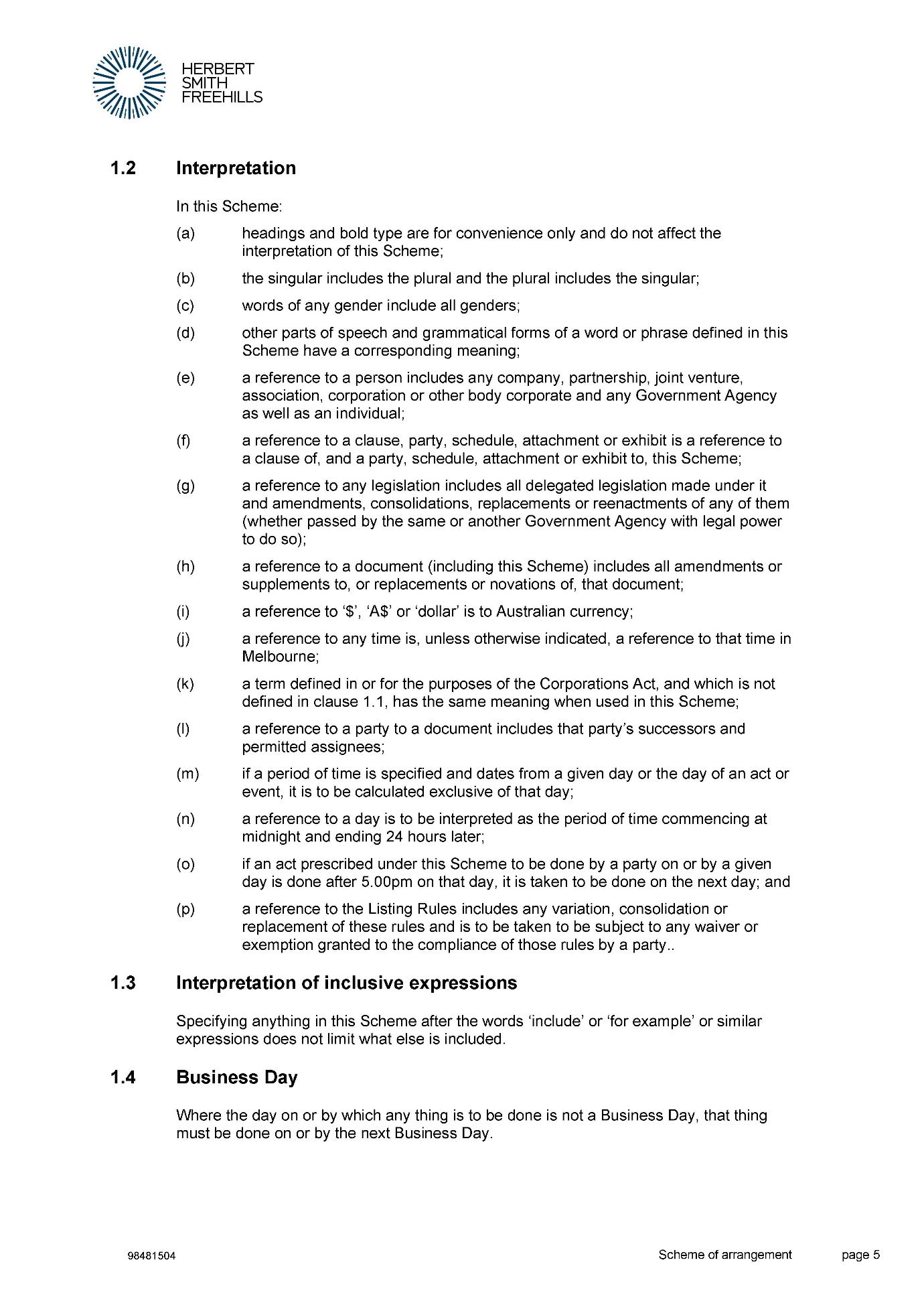
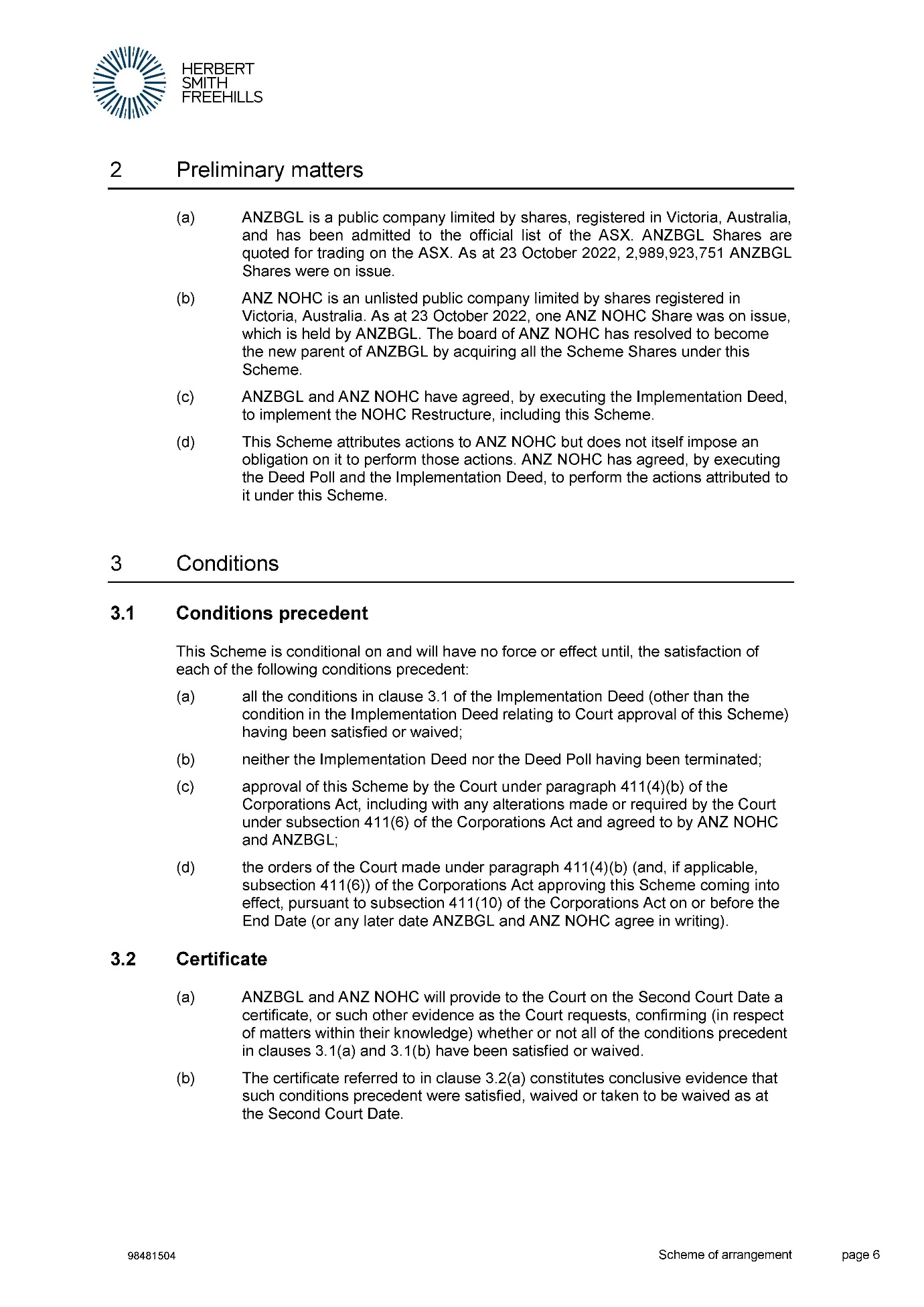
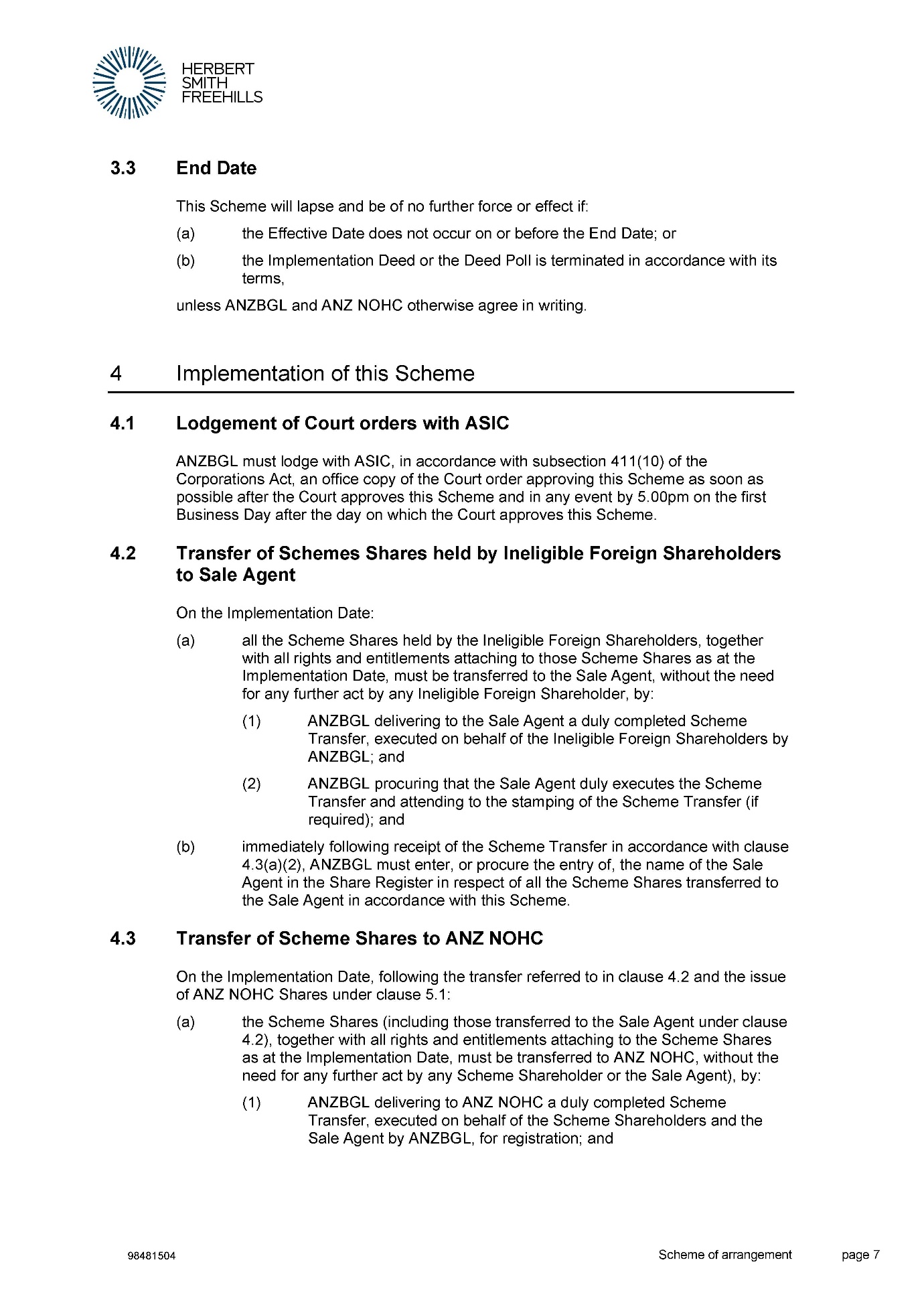
ANNEXURE A
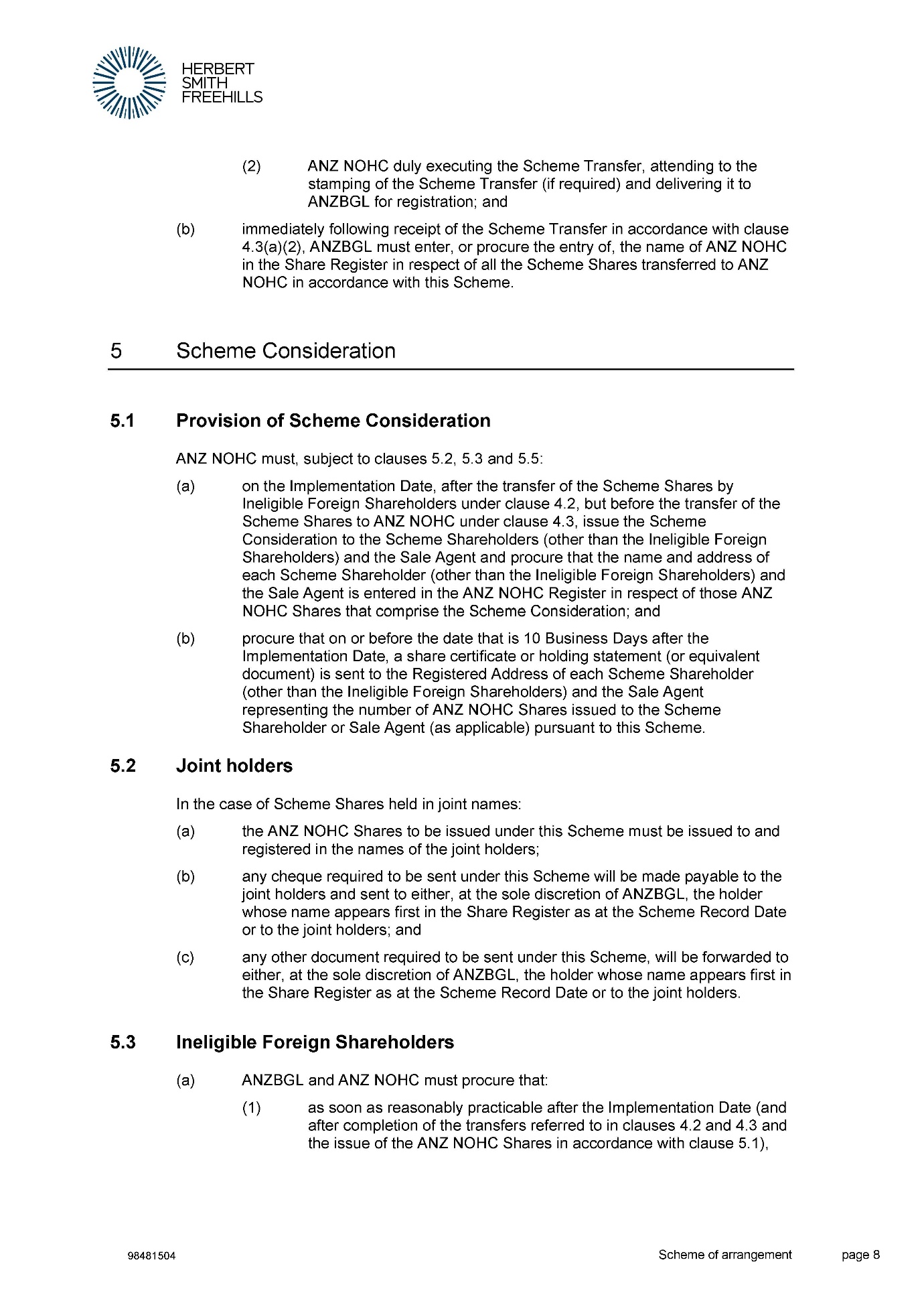
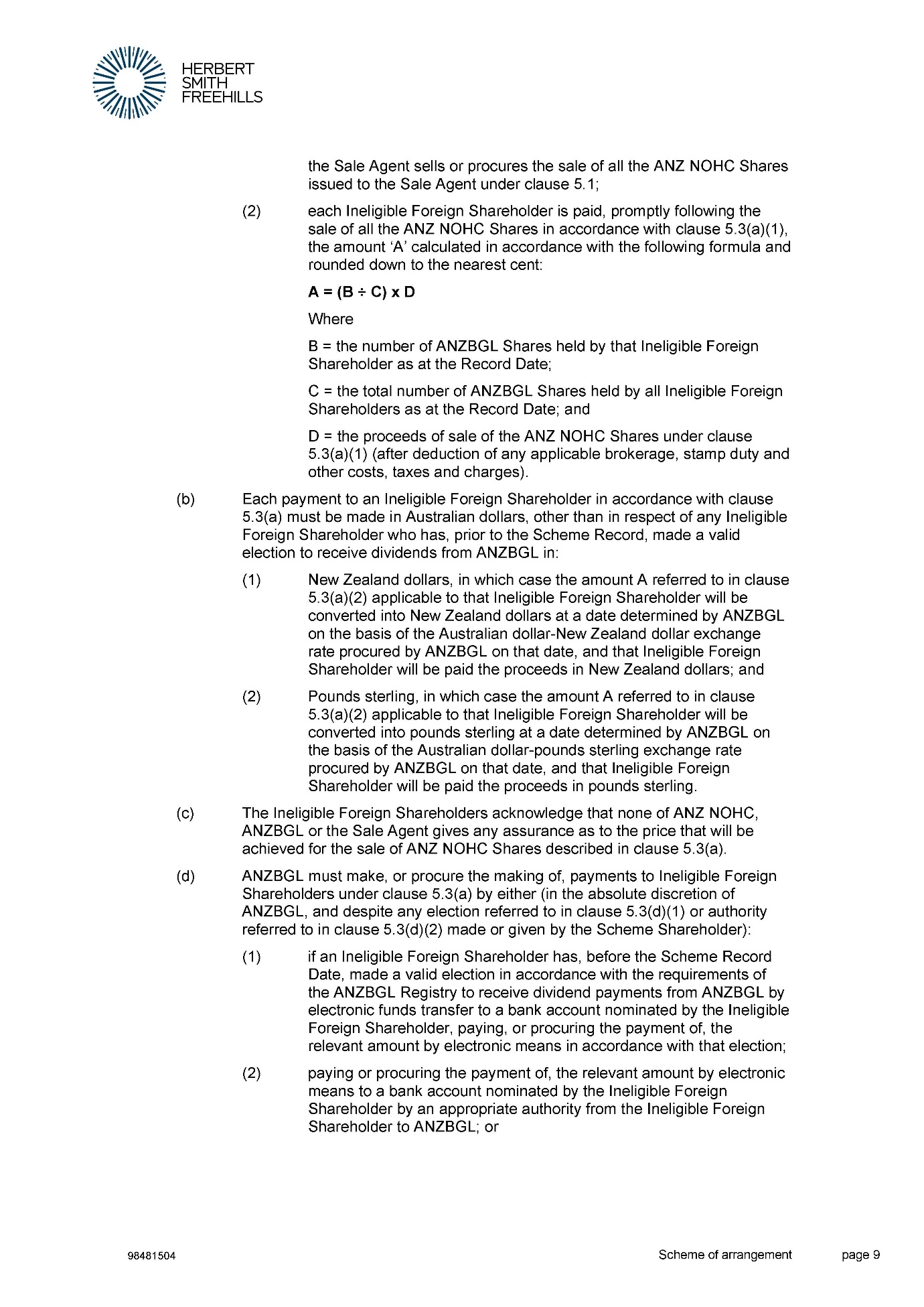
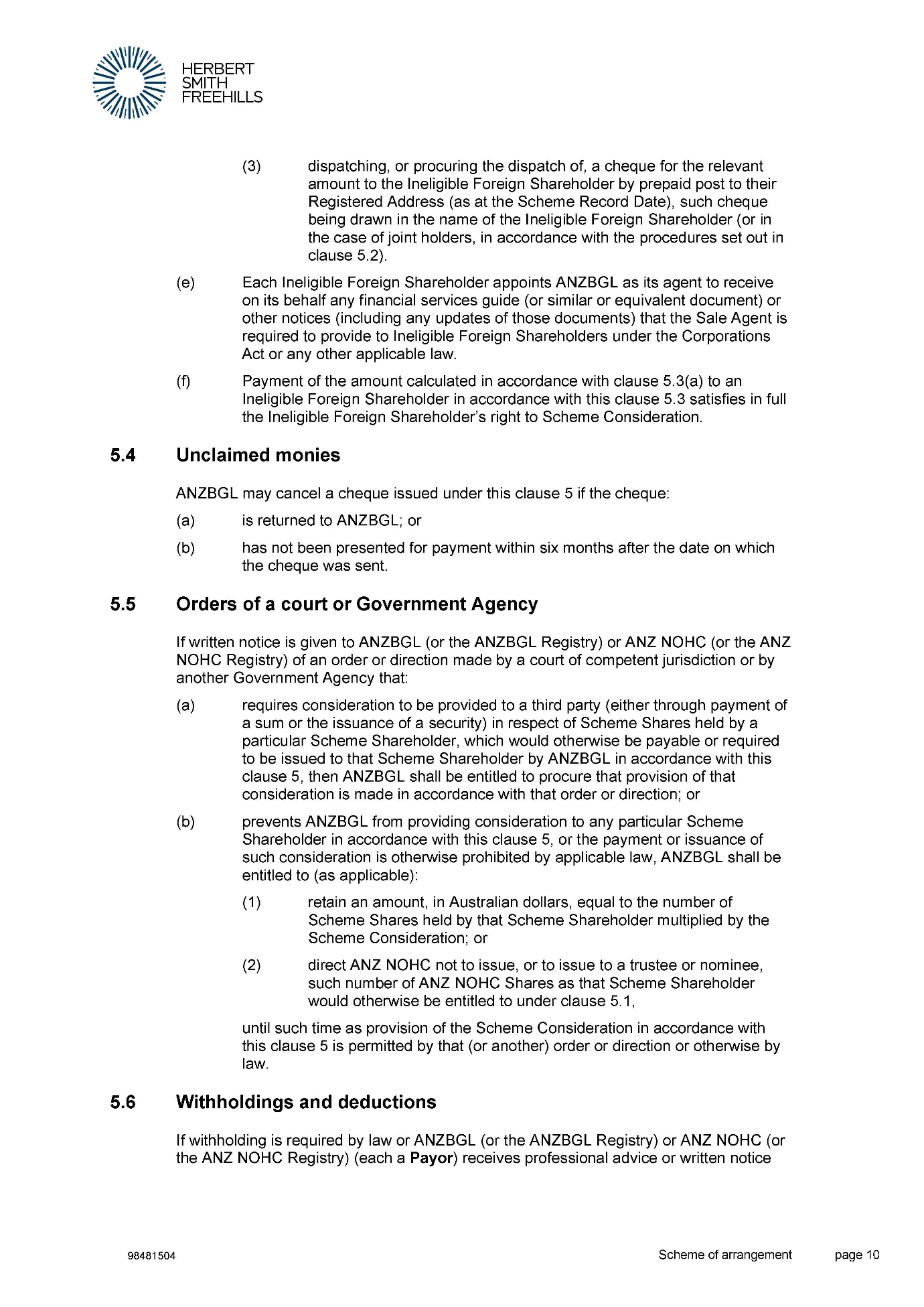
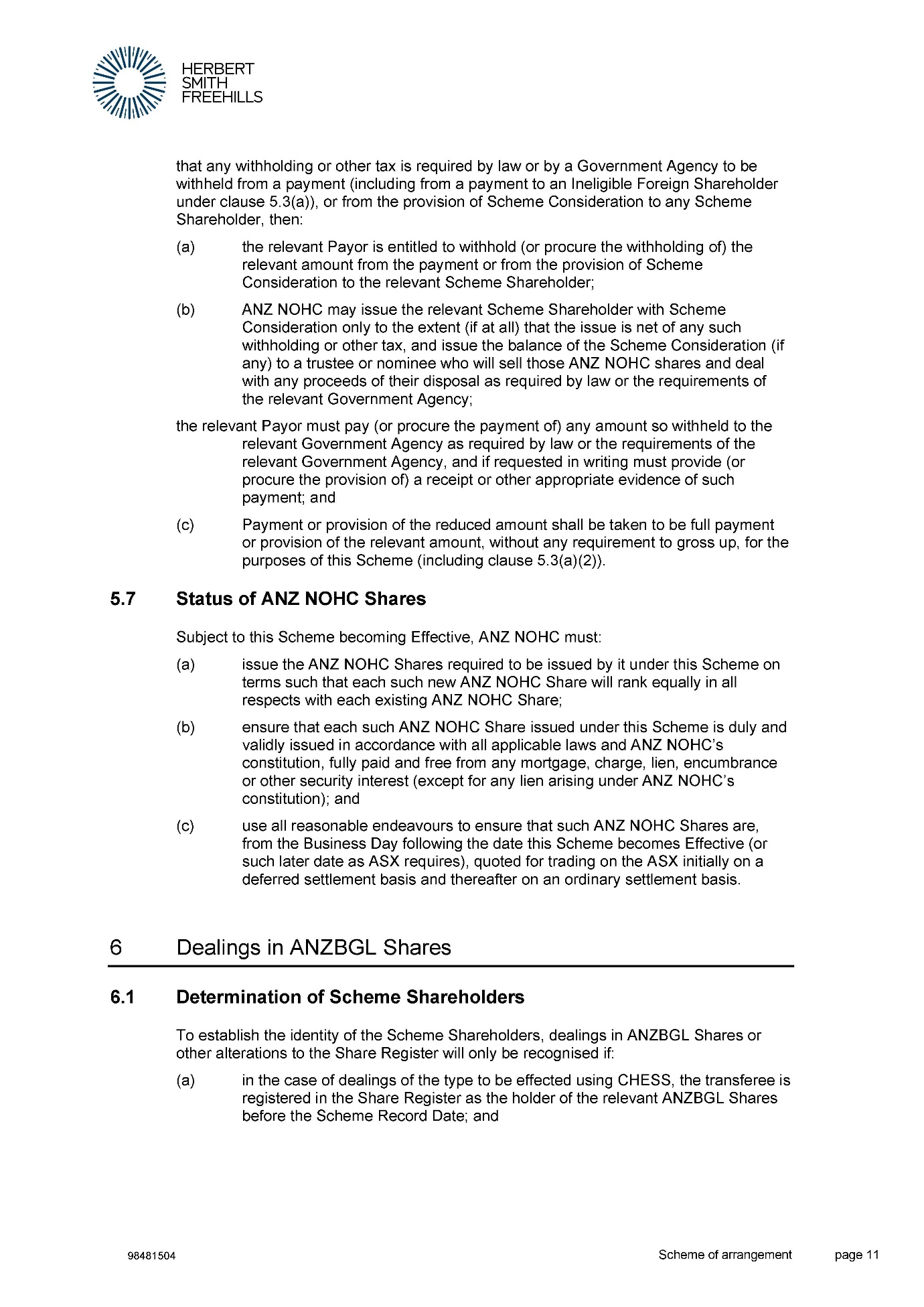
SCHEME OF ARRANGEMENT
O’BRYAN J:
Introduction
1 By an originating application dated 16 September 2022, the plaintiff, Australia and New Zealand Banking Group Limited (ANZBGL), sought orders pursuant to s 411(1) of the Corporations Act 2001 (Cth) (Act) to convene and hold a meeting of its shareholders (Scheme Meeting) to consider and, if thought fit, agree to a proposed scheme of arrangement (Scheme) between ANZBGL and its shareholders (ANZBGL Shareholders).
2 The Scheme is one of the steps required to implement a proposed internal restructure of ANZBGL and each of its subsidiaries (ANZ Group). The proposed restructure involves the following two steps:
(a) ANZ Group Holdings Limited (ANZ NOHC) will be established as a non-operating holding company and, pursuant to the Scheme (if approved and implemented), ANZ NOHC will become the new listed parent company of the ANZ Group in place of ANZBGL.
(b) After the Scheme is implemented, the ANZ Group will undertake an internal restructure whereby ANZ Group’s banking and certain non-banking businesses and assets will be separated into two principal subsidiary groups under ANZ NOHC, namely, the “ANZ Bank Group” and the “ANZ Non-Bank Group”, and certain property interests will be transferred to ANZ ServiceCo, which will become an internal service company.
3 The Scheme, if approved, will involve ANZ NOHC acquiring all of the ordinary shares in the capital of ANZBGL (ANZBGL Shares) held by those persons recorded in the ANZBGL register of members as the holders of ANZBGL Shares as at the Scheme Record Date (Scheme Shareholders). In consideration for the transfer of each ANZBGL Share to ANZ NOHC, ANZ NOHC will issue one ordinary share in ANZ NOHC (ANZ NOHC Share) (Scheme Consideration). The Scheme Consideration will be issued to:
(a) Scheme Shareholders who are not Ineligible Foreign Shareholders (as defined in the Scheme) (Eligible Shareholders); or
(b) a sale agent (Sale Agent) as nominee for Ineligible Foreign Shareholders, and the Sale Agent must sell those shares and remit the cash proceeds to the Ineligible Foreign Shareholders.
4 After the implementation of the Scheme and the restructure, ANZ NOHC will own all ANZ Group businesses and assets.
5 ANZBGL sought the Court’s order for the convening of the Scheme Meeting, to be held on 15 December 2022, commencing at 12.30 pm Melbourne time/12.00 pm Adelaide time, or if the ANZBGL Annual General Meeting (AGM) on that date continues after 12.30 pm Melbourne time/12.00 pm Adelaide time, as soon as the AGM concludes or is adjourned. The Scheme Meeting is to be conducted in-person at the Adelaide Convention Centre, North Terrace, Adelaide South Australia, and electronically via an online platform.
6 It is proposed that Mr Paul O’Sullivan, Chairman and Independent Non-Executive Director of ANZBGL, will act as Chair of the Scheme Meeting. Should Mr O’Sullivan be unable to perform the role, it is proposed that Mr John McFarlane, Independent Non-Executive Director of ANZBGL, will act as Chair of the Scheme Meeting.
7 On 26 October 2022, I made orders convening the Scheme Meeting. These are my reasons for making those orders.
Background
ANZBGL
8 The ANZ Group is primarily engaged in the provision of banking and other financial products and services.
9 Currently, ANZBGL is the listed parent company of the ANZ Group, and all assets in the ANZ Group are owned by ANZBGL and its subsidiaries. ANZBGL is an Australian public company limited by shares. Its registered office is in Victoria, Australia. It is admitted to the official list of the Australian Securities Exchange (ASX). Its ordinary shares are quoted for trading on the stock market conducted by ASX under security code “ANZ”. It also has hybrid securities listed on the ASX and is a foreign exempt listed company on the New Zealand Securities Exchange (NZX).
10 ANZBGL is an authorised deposit-taking institution (ADI) licensed under the Banking Act 1959 (Cth) (Banking Act), and it is regulated by various prudential regulators, including the Australian Prudential Regulation Authority (APRA) in Australia, the Reserve Bank of New Zealand in New Zealand and various international regulators.
11 ANZBGL has the following securities and options currently on issue:
(a) 2,989,923,751 ANZBGL Shares;
(b) 6,737,108 options and rights.
12 The directors of ANZBGL are:
(a) Graeme Richard Liebelt (Independent Non-Executive Director);
(b) Ilana Rachel Atlas AO (Independent Non-Executive Director);
(c) John Thomas MacFarlane (Independent Non-Executive Director);
(d) Shayne Cary Elliot (Chief Executive Officer);
(e) Rt Hon Sir John Philip Key GNZM AC (Independent Non-Executive Director);
(f) Paul Dominic O'Sullivan (Chairman, Independent Non-Executive Director);
(g) Sarah Jane Halton AO PSM (Independent Non-Executive Director); and
(h) Christine Elizabeth O'Reilly (Independent Non-Executive Director),
(together, the Directors).
13 Each of the Directors holds shares in ANZBGL. The Directors unanimously recommend that ANZBGL Shareholders vote in favour of the Scheme, and indicate that they intend to vote any ANZBGL Shares held or controlled by them in favour of the Scheme.
14 The ANZBGL constitution will remain in effect and will not be amended as part of the restructure.
ANZ NOHC
15 ANZ NOHC is a non-operating holding company which, if the Scheme is approved and implemented, will become the new listed parent company of the ANZ Group in place of ANZBGL, and will own all ANZ Group businesses and assets.
16 ANZ NOHC will be an authorised non-operating holding company under the Banking Act.
17 ANZ NOHC currently has one issued share, which is held by ANZBGL. If the Scheme is approved and implemented, ANZ NOHC will buy-back and cancel that share at the same time that the new ANZ NOHC Shares are issued as the Scheme Consideration in accordance with the Scheme.
18 It is proposed that, from the Effective Date of the Scheme, the ANZ NOHC Board will comprise the following individuals (subject to any elections or retirements in relation to the ANZBGL Board at the ANZBGL 2022 Annual General Meeting):
(a) Paul O'Sullivan (Chairman);
(b) Shayne Elliott (Chief Executive Officer);
(c) Ilana Atlas AO;
(d) Jane Halton AO PSM;
(e) Rt Hon Sir John Key GNZM AC;
(f) John MacFarlane;
(g) Christine O'Reilly;
(h) Jeff Smith; and
(i) Graeme Liebelt.
19 Following the restructure, the ANZ NOHC Board will be responsible for the oversight and strategic direction of the ANZ Group.
20 Also following the restructure, the ANZ NOHC constitution will be the main document governing the rights and obligations of ANZ NOHC Shareholders. The terms of the ANZ NOHC constitution will be substantially the same as the existing ANZBGL constitution.
The restructure
21 On 4 May 2022, ANZBGL announced that it intends to lodge a formal application with APRA, the Federal Treasurer and other applicable regulators to establish a non-operating holding company and create distinct banking and non-banking groups within the organisation. The announcement explained the transaction structure as follows:
ANZ also announced today it intends to lodge a formal application with APRA, the Federal Treasurer and other applicable regulators to establish a nonoperating holding company and create distinct banking and non-banking groups within the organisation. This is consistent with how many Financial Institutions are structured and will provide ANZ with greater flexibility and the potential to create additional value for shareholders over time. Following preliminary discussions, APRA has advised it has no in-principle objection to the proposed restructure. ANZ has also consulted other key Australian and New Zealand regulators and to date has not received any objections. Consultation and engagement remains ongoing. Should the proposed restructure proceed, a new listed parent holding company will be created with two wholly owned distinct groups of entities sitting directly beneath it. These would include the 'Banking Group' which would comprise the current Australia and New Zealand Banking Group Limited and the majority of its present-day subsidiaries and a ‘Non-Banking Group’, which would allow banking adjacent businesses to be developed or acquired to help bring the best new technology and non-bank services to our customers. The majority of ANZ's 1835i investments and similar holdings would move to the Non-Banking Group. Under this new structure there will be no impact on customers and no change to how ANZ's banking operations are regulated. As ANZ proceeds with a formal application, a comprehensive consultation program with shareholders, employees and other stakeholders will be undertaken. The proposal is subject to final ANZ Board approval and regulatory approvals and will require approval by the Federal Court and ANZ shareholders. Further information about the proposal can be found at http://shareholderanz.com.
22 The commercial rationale of the restructure is explained in section 5.1 of the Scheme Booklet, which notes that:
(a) the financial services industry is changing rapidly;
(b) traditional banking businesses like ANZBGL are facing significant disruption, principally from non-banking businesses that are launching competing financial service products. These businesses are not regulated in the same way as banks like ANZBGL;
(c) bank customers are demanding better and more tailored banking products and services, including through interconnected services and products, digital solutions and providers; and
(d) to take advantage of this changing environment, ANZBGL aims to grow with its customers and meet their changing expectations.
23 In this context, section 5.1 of the Scheme Booklet explains that the Directors consider that the restructure can help the ANZ Group to:
(a) develop a “digital banking ecosystem” including adjacent, non-banking services, platforms and partnerships that complement the ANZ Group’s core banking business;
(b) better meet customers’ needs in the digital age;
(c) compete in banking adjacent areas on a level playing field with other non-banking businesses, to allow the ANZ Group to provide better products and services to its customers; and
(d) be an employer of choice in both banking and non-banking areas.
The ANZ Group following the restructure
24 Following the implementation of the restructure, ANZ NOHC will be the new listed parent company of the ANZ Group in place of ANZBGL, and it will own all ANZ Group banking and certain non-banking businesses and assets, which will be separated into two principal subsidiary groups under ANZ NOHC. In particular:
(a) as a result of the Scheme, ANZBGL Shareholders who are Eligible Shareholders will hold all of the shares in ANZ NOHC, and ANZ NOHC will hold all of the shares in ANZBGL;
(b) as a result of the business restructure, the ANZ Group’s banking and certain non-banking businesses and assets will be separated into two principal subsidiary groups under ANZ NOHC:
(i) ANZ BH Pty Ltd (ANZ Bank HoldCo) will become the non-operating intermediate holding company of the ANZ Bank Group. ANZ Bank HoldCo will be 100% owned by ANZ NOHC. The ANZ Bank Group will comprise ANZ Bank HoldCo and the subsidiaries and businesses owned by it, which will include ANZBGL. These subsidiaries and businesses will comprise all of the ANZ Group’s banking businesses, as well as the ANZ Group’s international regulated bank operations and insurance businesses;
(ii) ANZ NBH Pty Ltd (ANZ Non-Bank HoldCo) will become the non-operating intermediate holding company of the ANZ Non-Bank Group. ANZ Non-Bank HoldCo will be 100% owned by ANZ NOHC. The ANZ Non-Bank Group will comprise ANZ Non-Bank HoldCo and the subsidiaries and businesses owned by it, including ANZ ServiceCo and the ANZ Group’s beneficial interests in the 1835i trusts (amongst others). These subsidiaries and businesses will comprise all of the ANZ Group’s nonbanking businesses;
(c) also as a result of the restructure, certain property interests will be transferred to ANZ ServiceCo, which will become an internal service company.
Impacts of the restructure
25 ANZBGL submitted and I accept that the restructure will have no impact on the business operations or customers of ANZBGL, and will not result in any change to the ANZ Group’s existing banking businesses or operations, including how those banking operations are regulated. In addition, the ANZ Group’s financial position will not be affected by the restructure.
26 As is set out in the Scheme Booklet, if the restructure goes ahead:
(a) there will be no change to the number of shares held by Eligible Shareholders in the parent company of the ANZ Group. In particular, Eligible Shareholders will receive the same number of ANZ NOHC Shares as their ANZBGL Shares held as at the Scheme Record Date;
(b) the total number of shares on issue in the parent company of the ANZ Group will not increase as part of the Scheme or restructure;
(c) ANZ NOHC Shares will trade on the ASX and NZX with the code “ANZ”;
(d) ANZ NOHC Shares will have the same dividend rights and the same voting rights as ANZBGL Shares, and the restructure itself is not expected to impact the ANZ Group’s ability to pay dividends;
(e) on the implementation of the Scheme, ANZ NOHC will establish its own Dividend Reinvestment Plan (DRP) and Bonus Option Plan (BOP). These will be on substantially same terms as the current DRP and BOP for ANZBGL; and
(f) if an ANZBGL Shareholder has an election in place to participate in the ANZBGL DRP and/or the BOP, that election will on the Implementation Date automatically apply to the ANZ NOHC DRP and/or BOP.
27 Further, the restructure itself is not expected to result in any material change to:
(a) the consolidated financial position of the ANZ Group;
(b) the overall funding requirements or debt issuance capacity of the ANZ Bank Group or the ANZ Group as a whole, nor is it expected to impact ANZ Bank Group’s liquidity and stable funding requirements; or
(c) the credit rating of ANZBGL and ANZ NOHC is likely to obtain an investment grade rating from credit rating agencies.
28 Further details on the financial impact of the restructure on the ANZ Group are set out in section 6 of the Scheme Booklet.
29 After the restructure, ANZ’s banking activities will continue to be subject to the same prudential regulation as they are subject to now. However, as part of the restructure, the ANZ Group’s prudential policy framework will be adjusted to reflect APRA’s regulation of the ANZ Group after the restructure. In particular, the activities of certain non-banking businesses will not be subject to the full suite of APRA prudential and reporting standards for banking activities. ANZBGL envisages that this will help enable a fit for purpose application of regulations, policies and procedures to these non-banking businesses.
30 A summary of APRA’s regulation of the ANZ Group after the restructure is set out in section 4.8(a) of the Scheme Booklet, which notes that:
(a) ANZ NOHC will be a non-operating holding company that is authorised by APRA. It will be required to comply with the conditions of its authorisation, which include the specific capital requirements. As an authorised NOHC, it will also be subject to regulation under the Banking Act and certain APRA prudential standards;
(b) the ANZ Bank Group will continue to be subject to the full suite of APRA prudential and reporting standards for ADIs, including standards in relation to capital adequacy and liquidity; and
(c) the ANZ Non-Bank Group entities will not be subject to ADI-specific regulation, such as bank capital adequacy and liquidity requirements currently applied to ANZBGL. However, ANZ NOHC will be required to apply certain APRA prudential standards appropriately throughout the ANZ Group, including to relevant members of the ANZ Non-Bank Group.
Transaction documents
31 There are four primary transaction documents relevant to the restructure:
(a) the NOHC restructure Implementation Deed (NOHC RID), pursuant to which ANZBGL and ANZ NOHC agree to take all necessary steps to implement the restructure, that is, to propose and implement the Scheme, and subsequently to implement the business restructure (if the Scheme is approved);
(b) the Scheme, pursuant to which all of the Scheme Shares will be transferred to ANZ NOHC, following which ANZ NOHC shares will be issued to Eligible Shareholders and to the Sale Agent as nominee for Ineligible Foreign Shareholders;
(c) the Deed Poll, pursuant to which ANZ NOHC undertakes in favour of each Scheme Shareholder to provide, or procure the provision of, the Scheme Consideration to each Scheme Shareholder in accordance with the terms of the Scheme, and to undertake all other actions attributed to ANZ NOHC under the Scheme; and
(d) the Restructure Deed between ANZBGL and ANZ NOHC, which sets out the steps necessary to achieve the business restructure, and requires those steps to be undertaken,
in each case subject to certain conditions precedent specified in each document. In an affidavit affirmed on 21 October 2022, Mr Simon Pordage, in his capacity as the company secretary of ANZBGL, deposed that he is not aware of any fact, matter or circumstance that has resulted in, or is likely to result in, the failure of the Scheme due to any condition precedent not being satisfied or waived.
The Scheme Booklet
32 As stated earlier, ANZBGL has prepared a draft Scheme Booklet to be sent to ANZBGL Shareholders if the Court makes the orders sought at the first court hearing. The Scheme Booklet sets out a detailed description of the proposed Scheme and the broader restructure, including the advantages and disadvantages. It sets out the Directors’ recommendation that ANZBGL Shareholders vote in favour of the Scheme, and includes an explanation of the reasons for that recommendation. It also sets out the Directors’ voting intentions. Finally, the Scheme Booklet contains several annexures, including the Notice of Scheme Meeting, the proposed Scheme and a copy of an independent expert report which has been prepared by Grant Samuel & Associates Pty Limited (Grant Samuel). Grant Samuel concludes that the restructure (including the Scheme) is in the best interests of ANZBGL Shareholders.
Relevant Principles
33 Part 5.1 of the Act provides a procedure whereby an arrangement between a company and its members can be made binding on all members. Section 411 is the principal provision. The procedure involves three main steps:
(a) an application to the Court for an order to convene a scheme meeting (s 411(1));
(b) if such an order is made, the convening of such a meeting at which a resolution to agree to the scheme is considered, and perhaps passed (s 411(4)(a)); and
(c) if the resolution is passed by the necessary majorities, an application to the Court for an order approving the scheme (ss 411(4)(b) and 411(6)).
34 The present application concerns the first stage, being an application to the Court for an order to convene the Scheme Meeting. Section 411 of the Act confers a discretion on the Court to make an order convening the Scheme Meeting, if certain statutory conditions are met, namely:
(a) an arrangement is proposed between a Pt 5.1 body and its members (or any class of them): s 411(1);
(b) an application for the order is made in a summary way by that body: s 411(1);
(c) 14 days’ notice of the hearing of the application has been given to the Australian Securities and Investments Commission (ASIC) (or such lesser period as the Court or ASIC permits): s 411(2)(a); and
(d) the Court is satisfied that ASIC has had a reasonable opportunity to:
(i) examine the terms of the proposed arrangement to which the application relates and a draft explanatory statement relating to the proposed arrangement; and
(ii) make submissions to the Court in relation to the proposed arrangement and the draft explanatory statement required by s 412: ss 411(2)(b) and 411(3).
35 In addition to these requirements of s 411, the procedure is regulated by s 412 of the Act and reg 5.1.01 and Sch 8 to the Corporations Regulations 2001 (Cth) (the Regulations), and by the Federal Court (Corporations) Rules 2000 (Cth) (Rules). The Regulations and the Rules prescribe certain information which is required to be sent to the members about the Scheme.
36 The principles which apply to the exercise of the Court’s discretion at this first stage are well-known. In Re Amcor Ltd [2019] FCA 346 (Amcor), Beach J described the Court’s role at the first court hearing as follows (at [47], emphasis in original):
My function on an application to order the convening of a meeting is supervisory. At this stage I should generally confine myself to ensuring that certain procedural and substantive requirements have been met including dealing with adequate disclosure, with limited consideration of issues of fairness. But having said that, it is appropriate to consider the merits or fairness of a proposed scheme at the convening hearing if the issue is such as would unquestionably lead to a refusal to approve a proposed scheme at the approval hearing, that is, the proposed scheme appears now to be on its face “so blatantly unfair or otherwise inappropriate that it should be stopped in its tracks before going any further” (Re Foundation Healthcare Ltd (2002) 42 ACSR 252 at [44] per French J).
37 It is not the Court’s role to usurp the shareholders’ decision whether to agree to a scheme. The question whether or not to accept particular consideration for shares is quintessentially a commercial matter for the members to assess, and they ought not be prevented from having the opportunity to do so, provided that the Court can be satisfied that they are acting on sufficient information and with time to consider what they are voting on: Crown Resorts Ltd, in the matter of Crown Resorts Ltd [2022] FCA 367 at [27] (Crown) citing Amcor at [50] and Re ACM Gold Ltd (1992) 34 FCR 530 at 534 per O’Loughlin J.
38 Therefore, if the arrangement is one that seems fit for consideration by the meeting of members, and is a commercial proposition likely to gain the Court’s approval if passed by the necessary majorities, then orders should be made to convene the meeting: Re Foundation Healthcare Ltd [2002] FCA 742; 42 ACSR 252 (Foundation Healthcare) at [36] per French J.
39 In summary, the Court’s task at the first court hearing is to assess first, whether the statutory prerequisites to the making of orders convening a meeting have been met and, second, whether it is appropriate for the Court to exercise its discretion in favour of making those orders. Each of those matters is considered in turn.
Power to make orders under s 411
40 ANZBGL submits, and I am satisfied that, all relevant statutory prerequisites have been satisfied.
41 First, ANZBGL, being a company registered under the Act, is a “Part 5.1” body and I am satisfied that the proposed Scheme is an “arrangement” between ANZBGL and its shareholders for the purpose of s 411 of the Act.
42 Second, ANZBGL has made this application to the Court.
43 Third, ASIC has been given notice of the first court hearing in accordance with s 411(2)(a) and, as required by s 411(2)(b), ASIC has had a reasonable opportunity to examine the terms of the proposed Scheme and the draft explanatory statement (in the form of the Scheme Booklet) and to make submissions to the Court. On 25 October 2022, ASIC provided ANZBGL’s lawyers with a preliminary “no objection” letter.
44 Fourth, as to compliance with the Rules:
(a) the evidence relied upon by ANZBGL includes an ASIC company extract recording the results of a search of the records of ASIC in relation to ANZBGL carried out no earlier than seven days before the originating process was filed, as required by r 2.4(2);
(b) the necessary evidence about the proposed chairperson and alternate chairperson of the Scheme Meeting has been provided, as required by r 3.2; and
(c) the proposed orders annex a copy of the Scheme, as required by r 3.3(1).
45 Fifth, as to compliance with the Regulations, s 412(1) of the Act and Sch 8 (Pt 3) of the Regulations set out the disclosure requirements of the explanatory statement (which is included within the Scheme Booklet). I am satisfied that each of the three aspects to the requirements of s 412(1) has been fulfilled.
46 In light of the procedural requirements having been satisfied, the Court’s discretion to make the convening orders is enlivened.
Exercise of the Court’s discretion
47 The relevant discretionary consideration involves two main questions:
(a) first, whether the Scheme is fit for consideration by the members (in this regard see, eg, FT Eastment & Sons Pty Ltd v Metal Roof Decking Supplies Pty Ltd (1977) 3 ACLR 69 at 72 per Street CJ; Australian Securities Commission v Marlborough Gold Mines Ltd (1993) 177 CLR 485 at 504); and
(b) second, whether the members are to be properly informed as to the nature of the Scheme: see Re NRMA Insurance Ltd (No 1) [2000] NSWSC 82; 156 FLR 349 per Santow J at [30]; Foundation Healthcare at [38].
The Scheme is fit for consideration
48 ANZBGL submits that the Scheme is fit for consideration by its members, in that:
(a) there is no issue arising from the Scheme which would unquestionably lead to a refusal by the Court to approve the Scheme at the second hearing. In particular, it cannot be said that the Scheme is on its face “so blatantly unfair or otherwise inappropriate that it should be stopped in its tracks before going any further” (Foundation Healthcare at [44]); and
(b) the Scheme is of such a nature and cast in such terms that, if agreed to at the Scheme Meeting, the Court would be likely to approve the Scheme at the second hearing.
49 As already noted, the Scheme Booklet contains a recommendation from the Directors that ANZBGL Shareholders vote in favour of the Scheme, and a statement that the Directors intend to vote any ANZBGL shares they hold in favour of the Scheme. In addition, the Scheme Booklet annexes an independent expert report which states that the Scheme is fair and reasonable and in the best interests of shareholders.
50 In the context of addressing this first question of whether a scheme is fit for consideration by the members, the Court will scrutinise the terms of a scheme to satisfy itself that there is no unfairness that would be likely to preclude approval of the scheme. In this case, ANZBGL raises the following particular features of the Scheme for the attention of the Court:
(a) performance risk;
(b) Ineligible Foreign Shareholders;
(c) impact of the restructure on ANZ Incentive Plans;
(d) director interests;
(e) shareholder warranties; and
(f) purpose of the Scheme.
51 ANZBGL submitted that none of these matters gives rise to any concern that the Scheme is not fit for consideration by its members in the requisite sense.
Performance risk
52 Although the Scheme requires ANZ NOHC to issue the Scheme Consideration, ANZ NOHC is not a party to the Scheme and is not directly bound by it, and so its obligations cannot be directly enforced against it by Scheme Shareholders.
53 ANZBGL submitted that the Scheme effectively eliminates any performance risk because ANZBGL has adopted the following accepted safeguards to address the issue of performance risk:
(a) First, the terms of the Scheme require that ANZ NOHC must first issue the Scheme Consideration to Eligible Shareholders and the Sale Agent before the Scheme Shares can be transferred to ANZ NOHC. This effectively removes any performance risk in so far as the transfer of the Scheme Shares in return for the Scheme Consideration is concerned.
(b) Second, ANZ NOHC will enter into a Deed Poll in favour of Scheme Shareholders binding ANZ NOHC to perform the actions attributed to it under the Scheme, including issuing the Scheme Consideration.
54 In light of these safeguards, I am satisfied that there is no material performance risk which would justify the Court not ordering the convening of the Scheme meeting.
Ineligible Foreign Shareholders
55 A specific matter that arises for consideration is the treatment of Ineligible Foreign Shareholders. The way in which an individual Scheme Shareholder participates in the Scheme will depend on whether that shareholder is an Eligible Shareholder or an Ineligible Foreign Shareholder:
(a) Eligible Shareholders will be issued with one ANZ NOHC Share for each Scheme Share they hold, following which the Scheme Shares held by Eligible Shareholders will be transferred to ANZ NOHC;
(b) Ineligible Foreign Shareholders will not be issued ANZ NOHC Shares. Instead, ANZ NOHC Shares will be issued to the Sale Agent as nominee for Ineligible Foreign Shareholders, and the Sale Agent must sell those shares and remit the cash proceeds to the Ineligible Foreign Shareholders.
56 In relation to Ineligible Foreign Shareholders, under cl 5.3 of the Scheme ANZBGL and ANZ NOHC must procure that:
(a) as soon as reasonably practicable after the Implementation Date, the Sale Agent sells all ANZ NOHC shares issued to it; and
(b) following that sale, each Ineligible Foreign Shareholder is promptly paid an amount equal to a proportionate share of the total sale proceeds which reflects the number of Scheme Shares held by the relevant Ineligible Foreign Shareholder as a proportion of the total number of Scheme Shares held by all Ineligible Foreign Shareholders (after the deduction of any applicable brokerage, stamp duty and other costs, taxes and charges).
57 These steps in relation to Ineligible Foreign Shareholders are summarised in sections 7.2(g) and 7.2(h) of the Scheme Booklet.
58 ANZBGL submitted, and I accept, that the proposed treatment of Ineligible Foreign Shareholders under the Scheme accords with common practice adopted in schemes of arrangement where scrip comprises (or is a component of) the proposed scheme consideration, including in relation to internal corporate reconstruction schemes (citing the recent example of Re Telstra Corporation Ltd [2022] NSWSC 1180 (Telstra)). In particular, there is a consistent line of authority to the effect that the proposed treatment of Ineligible Foreign Shareholders does not require those shareholders to meet together as a separate class for the purposes of considering the proposed scheme of arrangement: see, eg, Amcor at [41]-[44]; Re 5G Networks Ltd [2021] FCA 1189 at [49]; and Re Vault Intelligence Ltd [2020] FCA 1342 at [69].
Impact of restructure on ANZ Incentive Plans
59 Under the ANZ Incentive Plans, ANZ deferred shares, deferred share rights, restricted shares, restricted rights and performance rights (together, Equity Awards) may be granted to various categories of executives and employees, including the Chief Executive Officer, who receive variable remuneration outcomes above a certain threshold or who receive Equity Awards as part of an offer made to a specific employee, such as through a retention award or on commencement with ANZBGL.
60 The impact of the restructure on ANZ Incentive Plans is discussed in section 9.6 of the Scheme Booklet. As there disclosed, the Equity Awards held by employees on the Scheme Record Date will be replaced on the implementation of the Scheme with ANZ NOHC Equity Awards on a one for one basis, and will continue to be governed by the relevant plan rules and same offer terms. The Equity Awards and the ANZ Incentive Plans will continue to operate and apply after the implementation of the Scheme on substantially the same terms and conditions, except that the incentive plans will be operated by ANZ NOHC and provide interests in ANZ NOHC Shares.
61 ANZBGL submitted and I accept that the proposed treatment of the ANZ Incentive Plans and Equity Awards under the restructure does not give rise to any concern in relation to the creation of separate classes of shareholders for voting purposes.
Director interests
62 As stated in section 9.7 of the Scheme Booklet, it is not proposed that any payment or other benefit will be made or given to any director as compensation for loss of, or as consideration for or in connection with, their retirement from office as a director of ANZBGL or a body corporate connected with ANZBGL as a consequence of or in connection with the restructure. Further, it is not proposed that any payment or other benefit will be made or given to any director in connection with the restructure, other than in relation to their participation in the Scheme as Scheme Shareholders and the treatment of their Equity Awards under the restructure. No issue therefore arises as to whether a director who is to receive an additional benefit if a Scheme is approved should make a recommendation to members about voting in favour of the Scheme.
Shareholder warranties
63 Clause 8.2(b) of the Scheme sets out a warranty to be given by each Scheme Shareholder at the date of the transfer of their Scheme Shares. The warranty is in the usual form, and it is disclosed in section 7.2(j) of the Scheme Booklet. Deemed warranty clauses are commonly found in schemes of arrangement and are acceptable provided they are sufficiently disclosed: see, eg, Re RXP Services Ltd [2021] FCA 38 at [22]; Re Citadel Group Ltd [2020] FCA 1580; 148 ACSR 598 at [30]; Re Verdant Minerals Ltd [2019] FCA 556 (Re Verdant Minerals) at [70]. I am satisfied that the deemed warranty clause is acceptable.
Purpose of the Scheme
64 The Court’s jurisdiction to approve a scheme is restricted by s 411(17) of the Act, which provides as follows:
The Court must not approve a compromise or arrangement under this section unless:
(a) it is satisfied that the compromise or arrangement has not been proposed for the purpose of enabling any person to avoid the operation of any of the provisions of Chapter 6; or
(b) there is produced to the Court a statement in writing by ASIC stating that ASIC has no objection to the compromise or arrangement;
but the Court need not approve a compromise or arrangement merely because a statement by ASIC stating that ASIC has no objection to the compromise or arrangement has been produced to the Court as mentioned in paragraph (b).
65 This is a matter which affects the discretion ultimately to approve the Scheme, rather than the discretion to order a meeting: Re Macquarie Private Capital A Ltd [2008] NSWSC 323; 26 ACLC 366 at [27] per Barrett J.
66 ASIC’s Regulatory Guide 60 – Schemes of arrangement (RG 60) states (at [104] and [106]) that, at the second court hearing, ASIC will provide a statement under s 411(17)(b) if:
(a) all material information relating to the proposed scheme has been disclosed to ASIC;
(b) the standard of disclosure to all members fulfils the requirements under reg 5.1.01 and Sch 8 of the Regulations;
(c) the standard of disclosure to, and treatment of, all members is equivalent to the standard that would be required by the disclosure requirements and the principles in s 602 of the Act relating to the target securities in a takeover bid; and
(d) there are no other reasons to oppose the scheme (e.g. public policy grounds) and the other matters referred to in RG 60 have been complied with.
67 Section 411(17) does not present a bar to a meeting being convened if it seems likely that ASIC will produce the relevant statement at the second court hearing. ASIC has not indicated that it will oppose the application for convening the meeting. It is therefore appropriate to proceed on the basis that an application for approval would be unopposed by ASIC, and that ASIC will in due course provide a statement for the purpose of s 411(17)(b): Re Lonsdale Financial Group Ltd [2007] VSC 394 at [40] per Robson J.
Members are to be properly informed
68 The second principal aspect relevant to the exercise of the Court’s discretion is the adequacy of the information to be provided to shareholders, namely, the adequacy of the disclosure in the Scheme Booklet. As noted above, s 412(1) of the Act and Sch 8 (Pt 3) of the Regulations set out the disclosure requirements of the explanatory statement (which is included within the Scheme Booklet). If the Court is satisfied that the statutory disclosure requirements are met (as has been accepted in this case), it will ordinarily be satisfied that the information to be provided to shareholders is adequate for the purposes of the exercise of the Court’s discretion to convene a meeting: see, eg, Re Opes Prime Stockbroking Ltd (2009) 179 FCR 20 at [94]-[99], [102].
69 I am satisfied that the Scheme Booklet discloses all matters material to the decision of its members as to whether they will approve the proposed Scheme. The evidence shows that appropriate verification procedures have been implemented to ensure accuracy of the statements made in the Booklet and that full disclosure has been given. ASIC has also been given a reasonable opportunity to examine the proposed Scheme and Scheme Booklet. In addition, although ANZBGL is not required to provide shareholders with an independent expert report, in accordance with standard practice it has elected to do so.
Approval of the explanatory statement by the Court
70 Subsection 411(1) provides that, if the Court has made an order convening a meeting or meetings of members or creditors, the Court “may approve the explanatory statement”. The practice of courts varies in this respect. Consistent with recent practice in this Court, I have not made an order approving the Scheme Booklet: see Amcor at [114]-[115]; Re Verdant Minerals at [84].
Conclusion on exercise of discretion
71 I am satisfied that the Scheme is of such a nature and cast in such terms that, if it achieves the statutory majorities at the Scheme Meeting, the Court would be likely to approve it. It is therefore appropriate to make the orders sought convening the Scheme Meeting.
Dispatch of Scheme Booklet
72 ANZBGL sought orders to dispatch the Scheme Booklet (including the Notice of Scheme Meeting at Annexure 5 to the Scheme Booklet) as follows:
(a) each ANZBGL shareholder who has elected to be sent documents by ANZBGL in electronic form (Email Shareholder) will be sent an email which includes hyperlinks to an electronic copy of the Scheme Booklet, a personalised electronic proxy form and an online portal or website to view, listen to and participate in the Scheme Meeting online;
(b) each ANZBGL shareholder who has elected to receive documents from ANZBGL in physical form (Hardcopy Shareholder) will be sent (i) a physical hard copy of the Scheme Booklet, (ii) a hard copy proxy form and a reply-paid envelope; and (iii) a letter setting out URL addresses for access to an electronic copy of the Scheme Booklet, a personalised electronic proxy form and an online portal or website to view, listen to and participate in the Scheme Meeting online; and
(c) each ANZBGL shareholder who is not an Email Shareholder or Hardcopy Shareholder (Postal Shareholder) will be sent a hard-copy letter setting out URL addresses from which the Postal Shareholder can download an electronic copy of the Scheme Booklet, access an online portal or website to view, listen to and participate in the Scheme Meeting online and to lodge online any proxy or direct voting instructions, and a proxy form and reply-paid envelope.
73 I am satisfied that those methods of sending the meeting documents to ANZBGL Shareholders comply with the requirements of Div 2 of Pt 1.2AA of the Act.
74 There is one category of ANZBGL shareholder to whom ANZBGL does not propose to send a Scheme Booklet or Notice of Scheme Meeting, being shareholders whose registered address is in China, India and Papua New Guinea (Ineligible Scheme Booklet Shareholders). ANZBGL submitted that the local laws of each of China, India and Papua New Guinea mean that the Scheme Booklet cannot be sent to shareholders whose addresses are located in these countries. In support of this proposition, in his fourth affidavit to the Court affirmed 26 October 2022, Mr Charles Furphy, partner of Herbert Smith Freehills (lawyers for the plaintiff) gave evidence that ANZBGL has received legal advice from Rimon Law, a global law firm, in relation to (among other things) the operation of certain local laws in China, India and Papua New Guinea. A copy of that advice was tendered at the hearing and marked as Confidential Exhibit A in the proceeding.
75 Instead of dispatching a Scheme Booklet to Ineligible Scheme Booklet Shareholders, ANZBGL proposes to send a letter notifying the Ineligible Scheme Booklet Shareholders that, due to legal restrictions on the issue of Australian securities in China, India and Papua New Guinea, ANZBGL is unable to send any materials about the Scheme. I note that this course is consistent with the approach that has been adopted in other cases: see, eg, Amcor at [100]-[102]. I am satisfied that this is an appropriate course to be adopted in the circumstances.
Conduct of the Scheme Meeting
76 ANZBGL proposes to conduct the Scheme Meeting as a hybrid meeting; that is, by providing shareholders with the opportunity to attend either in-person or electronically via an online platform. It is submitted that the Court has power to make this order, on two bases.
77 First, ss 411 and 1319 of the Act confer a broad power on the Court to make orders for the conduct of scheme meetings. In particular, s 411 provides that the court may order that a meeting “be convened in such manner, and to be held in such place or places (in this jurisdiction or elsewhere), as the Court directs”, and s 1319 provides that “[w]here, under this Act, the Court orders a meeting to be convened, the Court may, subject to this Act, give such directions with respect to the convening, holding or conduct of the meeting, and such ancillary or consequential directions in relation to the meeting, as it thinks fit”. These provisions have been relied upon in a number of cases to order entirely virtual scheme meetings, in each case relying upon the powers granted by ss 411 and 1319 of the Act.
78 Second, the recently introduced s 249R(b) of the Act provides that a company may hold a meeting of its members at one or more physical venues and using virtual meeting technology. This provision was introduced by the Corporations Amendment (Meetings and Documents) Act 2022 (Cth), with effect from 1 April 2022, and has been relied upon in the context of meetings ordered under s 411 of the Act: see eg, Telstra at [39] and Crown at [82]-[84]. In contrast to a wholly virtual meeting permitted under subs 249R(c), it is not a condition of a “hybrid meeting” under subs 249R(b) that such a meeting is permitted by the company’s constitution.
79 Accordingly, I accept that the Court has power to order that the Scheme Meeting be conducted as a hybrid meeting.
80 ANZBGL has indicated that details on how shareholders can participate in the Scheme Meeting via the online platform will be provided in the Scheme Booklet and in the explanatory notes to the Notice of Meeting which is annexed to the Scheme Booklet. In summary, shareholders will be able to access the online platform by visiting a particular webpage address which is set out in the Notice of Scheme Meeting (that webpage will also be hyperlinked in the electronic copy of the Notice of Scheme Meeting). The online platform will enable participants to view the Scheme Meeting live, vote on the relevant resolution in real time and ask questions online, either by typing the question using the messaging tab or by using an audio questions feature.
US Securities Law Exemption
81 It is necessary to note one further matter. ANZBGL proposes that ANZBGL Shareholders with a registered address in the United States will be able to participate in the Scheme so that, if the Scheme becomes effective, ANZ NOHC will be required to issue ANZ NOHC Shares to those shareholders.
82 In this regard, ANZBGL has informed the Court that, in order to issue securities as consideration to residents of the United States, it intends to rely upon an exemption to the United States Securities Act of 1933 (US Securities Act). Unless an exemption applies, all securities offered in the United States must satisfy the registration requirements of the US Securities Act and be registered with the US Securities Exchange Commission. This includes securities issued as consideration in an internal corporate re-organisation.
83 The exemption to these registration requirements that ANZBGL intends to rely on is set out in s 3(a)(10) of the US Securities Act, which provides as follows:
Except as hereinafter expressly provided, the provisions of this title shall not apply to any of the following classes of securities: [….]….. any security which is issued in exchange for one or more bona fide outstanding securities, claims or property interests, or partly in such exchange and partly for cash, where the terms and conditions of such issuance and exchange are approved, after a hearing upon the fairness of such terms and conditions at which all persons to whom it is proposed to issue securities in such exchange shall have the right to appear, by any court or by any official or agency of the United States, or by any State or Territorial banking or insurance commission or other governmental authority expressly authorized by law to grant such approval.
84 ANZBGL’s intention to rely upon the exemption in s 3(a)(10) of the US Securities Act is disclosed in section 9.9 of the Scheme Booklet in the following terms:
The ANZ NOHC Shares to be issued pursuant to the Scheme, including any ANZ NOHC Shares represented by ANZ NOHC ADSs, have not been and will not be registered under the US Securities Act or the securities laws of any state or other jurisdiction of the United States. The ANZ NOHC Shares and ANZ NOHC Shares ADSs will be issued in reliance on the exemption from the registration requirements of the US Securities Act provided by Section 3(a)(10) thereof on the basis of the approval of an Australian court, which will consider, among other things, the fairness of the terms and conditions of the Scheme to ANZ Shareholders. For the purposes of qualifying for the exemption from the registration requirements of the US Securities Act afforded by Section 3(a)(10) of the US Securities Act, the Australian court will be advised that its approval of the Scheme will be relied upon by ANZBGL and ANZ NOHC as an approval of the Scheme following a hearing on the fairness of the terms and conditions of the Scheme to ANZ Shareholders at which hearing all ANZ Shareholders are entitled to attend in person or through their duly appointed proxies or through counsel to support or oppose the approval of the Scheme and with respect to which notification has been given to all ANZ Shareholders.
85 If I make orders approving the Scheme at the second Court hearing, ANZBGL (and ANZ NOHC) intend to rely upon my approval for the purpose of the s 3(a)(10) exemption. This has become common practice in schemes of arrangement: see, eg, Re Amcor Ltd (No 2) [2019] FCA 842 at [33] per Beach J, citing Damian T and Rich A, Schemes, Takeovers and Himalayan Peaks (3rd Ed, Ross Parsons Centre of Commercial, Corporate and Taxation Law, 2013) at pp 650, 654.
86 I am informed by ANZBGL that before an issuer can rely on the s 3(a)(1) exemption in the US Securities Act, a number of conditions must be satisfied. One of those conditions is that the relevant court must be advised, before any hearing at which the scheme is approved, that the issuer will rely on the s 3(a)(10) exemption based on that court’s approval in the event that the scheme is in fact approved. That has now been done. A further condition to the exemption is that a Court has considered and approved the fairness and reasonableness of the Scheme. This matter will be addressed at the second hearing and, if I make orders approving the Scheme, the fairness and reasonableness of the Scheme will be addressed in my reasons.
Conclusion
87 I am satisfied that this is a clear case for the exercise of the Court’s discretion to make orders convening a meeting of ANZBGL Shareholders to enable the Scheme to be considered.
I certify that the preceding eighty-seven (87) numbered paragraphs are a true copy of the Reasons for Judgment of the Honourable Justice O'Bryan. |
Associate:


