

Federal Court of Australia
Cowgill v Minister for Immigration, Citizenship, Migrant Services and Multicultural Affairs [2022] FCA 1337
ORDERS
Applicant | ||
AND: | MINISTER FOR IMMIGRATION, CITIZENSHIP, MIGRANT SERVICES AND MULTICULTURAL AFFAIRS First Respondent ADMINISTRATIVE APPEALS TRIBUNAL Second Respondent | |
DATE OF ORDER: |
THE COURT ORDERS THAT:
1. The second respondent’s decision be set aside.
2. The matter be remitted to the second respondent to decide according to law.
Note: Entry of orders is dealt with in Rule 39.32 of the Federal Court Rules 2011.
[4] | |
[14] | |
[16] | |
[20] | |
[20] | |
[48] | |
[59] | |
[62] | |
[68] | |
Ground 6: Whether the Tribunal erred in finding that the applicant had engaged in family violence | [73] |
[82] | |
Ground 9: Whether the Tribunal failed to make an independent assessment and determination | [85] |
[87] |
RANGIAH J:
1 On 7 July 2021, the second respondent, the Administrative Appeals Tribunal (the Tribunal) affirmed a decision made by the delegate of the first respondent, the Minister for Immigration, Citizenship, Migrant Services and Multicultural Affairs (the Minister) refusing to revoke the cancellation of the applicant’s visa.
2 The proceeding before the Court is an application for judicial review of the Tribunal’s decision.
3 I will describe the factual and procedural background and the legislative scheme before considering the parties’ submissions.
4 The applicant was born in New Zealand in 1976 and came to Australia with his parents at the age of 11 months. He was the holder of a Class BF-C Absorbed Persons (Permanent) visa until it was cancelled.
5 The applicant has a criminal history comprising of over 130 offences committed between 1996 and 2020. He had been given warnings on two occasions that future criminal convictions could result in the cancellation of his visa.
6 On 6 October 2020, the applicant was sentenced for 54 offences to terms of imprisonment totalling 5½ years.
7 On 18 November 2020, the Minister cancelled the applicant’s visa pursuant to s 501(3A) of the Migration Act 1958 (Cth) (the Act).
8 On 26 November 2020, the applicant made representations seeking revocation of the cancellation decision. On 13 April 2021, the delegate decided not to revoke the cancellation of the applicant’s visa.
9 On 21 April 2021, the applicant applied to the Tribunal for review of the delegate’s decision. The Tribunal made its decision to affirm the delegate’s decision on 7 July 2021.
10 In its reasons, the Tribunal acknowledged that it was bound to comply with Direction No. 90 - Visa Refusal and Cancellation under Section 501 and Revocation of a Mandatory Cancellation of a Visa under Section 501CA (Direction 90).
11 The Tribunal first determined that it was not satisfied that the applicant passed the character test under s 501(6) of the Act.
12 The Tribunal then considered whether, within s 501CA(4)(b)(ii) of the Act, there was “another reason” why the cancellation decision should be revoked. The Tribunal determined, in summary, that:
the primary consideration of the protection of the Australian community weighed strongly against revocation of the cancellation decision;
the primary consideration of the expectations of the Australian community weighed heavily against revocation of the cancellation decision;
the primary consideration of family violence weighed slightly against revocation of the cancellation decision;
the primary consideration of the best interests of minor children in Australia weighed moderately in favour of revocation of the cancellation decision;
the “other consideration” of the applicant’s links to Australia weighed strongly in favour of revocation, while the impediments if returned to New Zealand weighed slightly in favour of revocation; and
the considerations against revocation outweighed those in favour of revocation.
13 The Tribunal was not satisfied that there was “another reason” why the cancellation decision should be revoked. Accordingly, the Tribunal affirmed the delegate’s decision.
14 The applicant was self-represented in his application for judicial review. His grounds of review are expressed as follows:
1. First Issue – The Delegate of the Minister when making the decision to mandatory cancel my Visa in November 2020 erred in law by cancelling my visa as a result of the sentence I received in October 2020, as I should have been exempt from mandatory cancellation.
Second Issue – The AAT erred in law by failing to take into consideration the same relevant information and evidence in affirming the Ministers decision.
2. First issue – In line with the principles of Double Jeopardy, 2 processes have been undertaken for the same offences.
Second issue – The way that the Department has dealt with my matter can be seen to have been done in a cruel, Inhumane and punitive way.
3. The Tribunal erred in law, by using the fact that my father and brothers were deported, as to be seen as a ‘deterrent’ to me, and by way of additional warnings when this was impermissible reasoning, as a deterrent is no longer a valid consideration to be taken into account in a primary consideration.
4. The Tribunal ignored and failed to consider relevant material that was given in evidence in regards to the following;
(a) The AAT failed to consider relevant corroborating medical evidence and material in relation to mental health issues and diagnosis of depression
(b) The AAT failed to take into account relative factors and evidence regarding the importance of the Pathways Program.
(c) The AAT failed to take into account relevant evidence and material to the risk of re-offending and rehabilitation.
5. The Tribunal erred in law by failing to take into account relevant evidence and material, by having no regard to my daughters letter that offered an independent view from her perspective of her wishes, interest and view, that was relevant to Ministerial Direction 90, in the primary consideration of the best interests of the child.
6. The Tribunal erred in the primary consideration of Family Violence committed by the non-citizen, as there was no basis to conclude that there had been any threatening or other behaviour that coerces, or controlled a member of the person’s family or causes the family member to be fearful.
7. Under the International Covenant on Civil and Political Rights (ICCPR), there is an extremely strong inference ‘that Australia is my own country’, where someone as myself has lived in Australia the entirety of my life, and breaking up long standing family life (partner, children, mother, siblings, nieces, nephews, grandparents, aunties and uncles) is considered interference with family life.
8. The Minister has purported to cancel a Visa Transitional (permanent) Resident Visa, that has never been granted or held by myself.
9. The Tribunal has erred as it has failed to make such an independent assessment and independent determination and that in the result, failed properly to perform its function of reviewing the Ministers decision that a deportation order be made, as it did not take into account all relevant evidence and material.
15 At the hearing, the applicant abandoned his eighth ground.
16 The applicant’s visa was cancelled pursuant to s 501(3A) of the Act. That section requires the Minister to cancel a visa if the Minister is satisfied that the visa holder does not pass the character test because, relevantly, the visa holder has been sentenced to a term of imprisonment of 12 months or more, and is serving a sentence of imprisonment on a full-time basis in a custodial institution.
17 The delegate’s decision not to revoke the cancellation decision was made under s 501CA(4) of the Act, which provides:
(4) The Minister may revoke the original decision if:
(a) the person makes representations in accordance with the invitation; and
(b) the Minister is satisfied:
(i) that the person passes the character test (as defined by section 501); or
(ii) that there is another reason why the original decision should be revoked.
18 The applicant’s application to the Tribunal was made pursuant to s 500(1)(ba) of the Act. Section 43(1) of the Administrative Appeals Tribunal Act 1975 (Cth) (the AAT Act) empowers the Tribunal to affirm or vary the decision under review, or set it aside and substitute another decision or remit the matter for reconsideration. Section 43(2) requires the Tribunal to give reasons for its decision. Under s 43(2B), where the Tribunal gives its reasons in writing, the reasons shall include its findings on material questions of fact and a reference to the evidence or other material on which those findings were based.
19 The jurisdiction of the Federal Court of Australia arises under s 476A(1) of the Act.
The fifth ground: whether the Tribunal failed to have regard to relevant views of the applicant’s daughter
20 It is convenient to begin by considering the fifth ground of the applicant’s application. That ground, as argued, asserts that the Tribunal failed, contrary to Direction 90, to have regard to relevant views of the applicant’s daughter.
21 The applicant has four daughters from two relationships. The fifth ground of appeal is concerned with the applicant’s 13 year old daughter. She wrote a letter in support of the representations made by the applicant to the Minister seeking revocation of the cancellation decision. The letter was before the Tribunal.
22 The applicant’s daughter wrote:
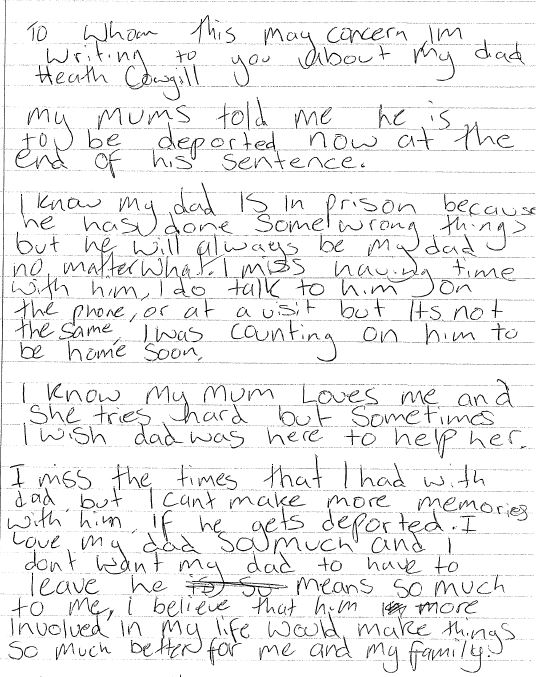
23 The applicant specifically referred to, quoted from, and relied upon, that letter in his Statement of Facts, Issues and Contentions (SFIC) filed with the Tribunal.
24 Section 499(1) of the Act allows the Minister to give written directions to a person or body having functions or powers under the Act if the directions are about the performance of those functions or the exercise of those powers. Direction 90 was given by the Minister under s 499(1) of the Act. Section 499(2A) requires a person or body to, “comply with a direction under subsection (1)”. In carrying out its function under s 43 of the AAT Act of reviewing the delegate’s decision, the Tribunal was required to comply with Direction 90.
25 Paragraph 6 of Direction 90 provides, relevantly, that a decision-maker (a person or body making a decision under s 501CA of the Act) must take into account the considerations identified in paras 8 and 9 where relevant to the decision.
26 Paragraph 8 states that the following are primary considerations:
(1) protection of the Australian community from criminal or other serious conduct;
(2) whether the conduct engaged in constituted family violence;
(3) the best interests of minor children in Australia;
(4) expectations of the Australian community.
27 Paragraph 8 goes on to explain the primary considerations and specify matters that decision-makers should or must consider.
28 Paragraph 8.3 provides:
8.3 Best interests of minor children in Australia affected by the decision
(1) Decision-makers must make a determination about whether cancellation or refusal under section 501, or non-revocation under section 501CA is, or is not, in the best interests of a child affected by the decision.
(2) This consideration applies only if the child is, or would be, under 18 years old at the time when the decision to refuse or cancel the visa, or to not revoke the mandatory cancellation of the visa, is expected to be made.
…
(4) In considering the best interests of the child, the following factors must be considered where relevant:
a) the nature and duration of the relationship between the child and the non-citizen. Less weight should generally be given where the relationship is non-parental, and/or there is no existing relationship and/or there have been long periods of absence, or limited meaningful contact (including whether an existing Court order restricts contact);
b) the extent to which the non-citizen is likely to play a positive parental role in the future, taking into account the length of time until the child turns 18, and including any Court orders relating to parental access and care arrangements;
c) the impact of the non-citizen’s prior conduct, and any likely future conduct, and whether that conduct has, or will have a negative impact on the child;
d) the likely effect that any separation from the non-citizen would have on the child, taking into account the child’s or non-citizen’s ability to maintain contact in other ways;
e) whether there are other persons who already fulfil a parental role in relation to the child;
f) any known views of the child (with those views being given due weight in accordance with the age and maturity of the child);
g) evidence that the child has been, or is at risk of being, subject to, or exposed to, family violence perpetrated by the non-citizen, or has otherwise been abused or neglected by the non-citizen in any way, whether physically, sexually or mentally;
h) evidence that the child has suffered or experienced any physical or emotional trauma arising from the non-citizen’s conduct.
(Emphasis added.)
29 The Tribunal’s reasons described the applicant’s 13 year old daughter as Daughter A. I will adopt the same description. In the context of the primary consideration of “the best interests of minor children in Australia”, the Tribunal’s discussion of the effect of the applicant’s removal on Daughter A and her three year old sister (Daughter H) was as follows:
Daughter A and Daughter H
95. Daughter A and Daughter H reside with the Applicant’s partner. The Applicant states that he has “developed a very close and protective relationship with my daughters…If I am deported, this will have a crushing affect [sic] on my daughters, partner and myself”.
96. In relation to Daughter A, the Applicant states that he has a trusting, honest and clear relationship, and that she “is a bright, intelligent girl [who] with 2 solid parents will have a fantastic future”. The Applicant also wrote that she “is clashing with her mother, with limited support this is progressively getting worse…a negative outcome could have a catastrophic effect on our teenage daughter”.
97. The Applicant describes his youngest daughter, Daughter H, as a bright, playful, affectionate and boisterous little girl who loves her father’s hugs. The Applicant expressed concern that should the Tribunal decide not to revoke the Cancellation Decision, Daughter H could suffer a life of confusion, sadness and depression.
98. [The applicant’s partner] relevantly writes:
[the Applicant] and I have two daughters, Daughter A 13 and Daughter H 3. We visit [the Applicant] as much as possible and [the Applicant] call us at least twice a day. Daughter A for a teenager has a very good relationship with her Dad, [the Applicant] works very hard to let a teenage girl know that her father loves her unconditionally. Very important for a teenage girl. Daughter H is 3 and loves the phone and has a strong bond with her father, [the Applicant].
(Names omitted.)
99. [The applicant’s partner] told the Tribunal that she would do her best to foster and continue the Applicant’s relationship with their children. [The applicant’s partner] said that subject to financial circumstances and her responsibilities towards the care of her mother, she would consider relocating to New Zealand should the Cancellation Decision not be revoked.
100. Paragraph 8.3(4)(g) of Direction No 90 requires the Tribunal to consider whether a child has been, or is at risk of being, subject to, or exposed to, family violence perpetrated by the non-citizen. It follows that the Tribunal’s deliberations above under the second primary consideration are relevant here. Although there is no evidence of physical violence being visited on Daughter A and Daughter H, [the applicant’s partner] in her oral evidence said that she had obtained restraining orders against the Applicant “To prevent the drug and alcohol abuse in our home. To protect my children”. In cross-examination, [the applicant’s partner] said that she did not want her children to be around drug-fuelled arguing, and also told the Tribunal that her children were too young to be aware or worried about the restraining orders. By his own admission, the Applicant had an entrenched and expensive daily drug habit prior to incarceration. The Applicant’s behaviour could not be considered to be in the best interests of his children. Any risk of future perpetration of family violence, even at the lower end of the scale, and use of illicit substances while resident in the family home with minor children would detract from a conclusion, or the weight given to such a conclusion, that revocation of the Cancellation Decision is in the best interests of those children.
(References omitted.)
30 The Tribunal concluded as to the best interests of minor children:
104. The Tribunal concludes that the best interests of minor children in Australia affected by the decision would be met by the revocation of the Cancellation Decision and the Applicant remaining in Australia. Taking into account all of the relevant considerations listed in paragraph 8.3 of Direction No 90 and having carefully and sympathetically balanced the evidence before it, the Tribunal finds that this consideration weighs moderately in favour of the revocation of the Cancellation Decision.
31 Paragraph 8.3(4) of Direction 90 prescribes that the factors it sets out, “must be considered where relevant”. The Tribunal must consider, amongst other things, “any known views of the child”, where those views are relevant to the best interests of a child affected by the Tribunal’s decision. The known views of the child concerning their own best interests are a consideration that the Tribunal is bound to take into account: cf Minister for Aboriginal Affairs v Peko-Wallsend Ltd (1986) 162 CLR 24 at 39. The weight given to the child’s views may vary according to the age and maturity of the child.
32 In the present case, Daughter A’s letter expressed her views concerning the adverse effects that the removal of the applicant from Australia would have upon her. As the letter was before the Tribunal, the views of Daughter A must be regarded as being “known” to the Tribunal. The Tribunal could not reasonably have regarded Daughter A’s views concerning her best interests as irrelevant to the assessment of her best interests. Accordingly, the Tribunal was required to consider those views.
33 There is no express reference in the Tribunal’s reasons to Daughter A’s letter or to her views. The Minister submits that the Tribunal considered the known views of Daughter A by taking into account the evidence of the applicant and his partner concerning the effect his removal would have upon their daughter. I do not accept that submission. To consider the views of the applicant and his partner is a quite different thing to considering the views of the applicant’s daughter. Even if there ultimately turns out to be a coincidence of views, para 8.3(4)(f) specifically requires consideration of the relevant known views of a relevant minor child.
34 The requirement to consider the known views of a child requires a Tribunal member to have regard to those views and bring their mind to bear upon those views: cf Plaintiff M1/2021 v Minister for Home Affairs [2022] HCA 17; (2022) 96 ALJR 497 at [24].
35 The Tribunal’s reasons for decision must include its findings on material questions of fact and a reference to the evidence or other material on which those findings were based: ss 43(2) and (2B) of the AAT Act.
36 In He v Minister for Immigration and Border Protection (2017) 255 FCR 41, the Full Court observed at [79]:
It must be emphasised that there is a distinction between the making of a decision by the Tribunal and the written statement it must give under s 368 of the Act. The making of a decision involves a mental process. The written statement functions as a record of the Tribunal’s reasons for making its decision. Those reasons provide evidence of the mental process engaged in by the Tribunal. If the written statement does not set out a finding concerning any of the prescribed matters…it may (but will not necessarily) lead to an inference that the Tribunal member made no such finding as part of his or her mental process when making the decision.
(Citations omitted.)
37 A failure by the Tribunal to deal with an issue in its reasons may lead to an inference that there was a failure to consider the issue. Such an inference should not be drawn too readily where the reasons are otherwise comprehensive and the issue has at least been identified at some point: Applicant WAEE v Minister for Immigration and Multicultural and Indigenous Affairs (2003) 236 FCR 593 at [47]. A conclusion that a decision maker has not engaged in an active intellectual process in respect of an argument will not be lightly made: KXXH v Minister for Immigration, Citizenship, Migrant Services and Multicultural Affairs [2022] FCAFC 111 at [47].
38 In the present case, the Tribunal considered the views of the applicant and his partner concerning the effect his removal would have upon his daughters. There was no reference to the views of Daughter A or to the letter she wrote, despite the applicant having specifically relied upon that letter in his SFIC. The centrality of Daughter A’s expressed views to the applicant’s case and the requirement of para 8.3(4)(f) of Direction 90 naturally leads to an expectation that the Tribunal would refer to the letter in its reasons. As the reasons contain no reference to the letter, the appropriate inference is that it was overlooked by the Tribunal. As a result, the Tribunal failed to take into account Daughter A’s known views concerning the applicant’s removal from Australia.
39 In these circumstances, the Tribunal failed to comply with para 8.3(4)(f) of Direction 90. The Tribunal thereby failed to comply with s 499(2A) of the Act.
40 The Minister submits that the Tribunal’s error was immaterial because Daughter A’s views as to her best interests did not reveal or include information that the Tribunal did not otherwise take into account. The Minister also submits that in the absence of Daughter A’s knowledge as to relevant family violence and substance abuse, her views would not overcome or add to the evidence in a meaningful way.
41 In Minister for Immigration and Border Protection v SZMTA (2019) 264 CLR 421, Bell, Gageler and Keane JJ held at [45]:
A breach is material to a decision only if compliance could realistically have resulted in a different decision.
42 Whether the decision made could have been different had the Tribunal considered Daughter A’s known views is, “a matter of reasonable conjecture within the parameters set by the historical facts that have been determined”: see MZAPC v Minister for Immigration and Border Protection [2021] HCA 17; (2021) 95 ALJR 441 at [38]. The standard of “reasonable conjecture” is “undemanding”: Nathanson v Minister for Home Affairs [2022] HCA 26; (2022) 96 ALJR 737 at [33].
43 It is true that in considering the best interests of Daughter A, the Tribunal took into account the views of the applicant and his partner that Daughter A would be emotionally harmed if he were removed from Australia. The Tribunal also took into account that the risk of future perpetration of family violence and use of illicit substances by the applicant posed a risk to Daughter A.
44 However, the specific requirement of Direction 90 that decision-makers consider, “any known views of the child (with those views being given due weight in accordance with the age and maturity of the child)”, recognises that a child’s views may carry greater persuasive weight than evidence about the child’s views or effects on the child given by the former or prospective visa holder or other witnesses. Daughter A was 13 years of age and, having written her letter, was clearly able to express her own views about the effects that removal of her father would have upon her. If the Tribunal had considered Daughter A’s letter, it would have been open to the Tribunal to accord greater weight to the daughter’s expression of her views about the effects of the removal upon her than it did to her parents’ evidence. That may realistically have led to a finding that the primary consideration of the best interests of minor children in Australia weighed more than moderately in favour of revocation of the cancellation decision.
45 In these circumstances, there is a realistic possibility that if the Tribunal had complied with s 499(2A) of the Act by having regard to the known views of Daughter A, a different decision could have been made.
46 I am satisfied that in failing to comply with s 499(2A) of the Act, the Tribunal made a jurisdictional error.
47 I will consider the remainder of the applicant’s grounds in case I am wrong about the fifth ground.
Ground 1: Whether the Minister lacked power to cancel the applicant’s visa under s 501(3A) of the Act because of an asserted exception
48 The applicant’s first ground, as argued, asserts that the Minister had no power to cancel the applicant’s visa under s 501(3A) of the Act. The applicant argues that if a person is serving a full-time custodial sentence and that fact has been considered by the Minister without resulting in the cancellation of a visa, the person’s visa cannot be cancelled under s 501(3A) unless a new offence is committed and a new full-time sentence of imprisonment has commenced.
49 The applicant was charged with 54 offences on 27 November 2019 and was taken into custody and held at Hakea Prison in Perth. He asserts that on 11 December 2019, a delegate of the Minister conducted an interview with him for the purpose of considering the cancellation of his visa under s 501(2) of the Act on the basis that he failed the character test under s 501(6). He asserts that the delegate was fully aware of his criminal history and the offences for which he was in custody. He also asserts that the delegate was aware that he had already pleaded guilty to some of those offences and that he would inevitably be sentenced to a term of imprisonment. The applicant asserts that the Minister considered the exercise of the discretion under s 501(2) to cancel his visa, but determined not to do so. He submits that the Minister instead determined on 22 January 2020 that the applicant was entitled to an Absorbed Persons visa.
50 The applicant accepted in oral argument that it was not until 6 October 2020 that he was sentenced to the terms of imprisonment which led to the cancellation of his visa under s 501(3A). He asserts, however, that “the conviction start date” was on 27 November 2019 when he was taken into custody “serving that sentence”.
51 The Minister submits that this Court has no jurisdiction to review a decision made under s 501(3A) of the Act to cancel a visa as such a decision does not fall within s 476A(1) of the Act, but accepts that a single judge is bound by the judgment of a majority of the Full Court in XJLR v Minister for Immigration, Citizenship, Migrant Services and Multicultural Affairs (2022) 289 FCR 256. In that case, it was held by the majority at [59]-[65], [80]-[87] (Rares J) and [95]-[96] (Yates J) that the existence of a legally effective cancellation decision is a jurisdictional fact for the Tribunal’s review of a non-revocation decision, and that the Federal Court has jurisdiction under s 476A of the Act to review and give declaratory relief in relation to the legal effectiveness of a cancellation decision.
52 The applicant’s argument, as I understand it, is that s 501(3A) of the Act should be construed such that if the Minister decides not to cancel a visa under s 501(2) of the Act on the basis that the holder does not pass the character test under s 501(6) by reason of having been sentenced to a term of imprisonment of 12 months or more, the Minister is precluded from subsequently cancelling the visa under s 501(3A) on the basis of the same term of imprisonment.
53 The applicant’s submission appears to evolve from Minister for Immigration and Border Protection v Makasa (2021) 270 CLR 430, where the High Court held at [23] and [27] that the discretionary power under s 501(2) can be exercised only once in respect of any particular failure to pass the character test, regardless of the subsequent occurrence of a new event or provision of new information that would otherwise be relevant to the exercise of the Minister’s discretion.
54 The accuracy of applicant’s submission seems at least doubtful given that the Minister must cancel a visa if the circumstances specified under s 501(3A) arise and lacks any discretion to decline to cancel. However, it is undesirable to decide the point in the absence of any substantial argument. It is enough to conclude that several of the premises essential to the applicant’s argument are not established.
55 The evidence does not establish that the Minister made any decision not to cancel the applicant’s visa under s 501(2) of the Act. Although there is evidence that the applicant was visited in prison by a Departmental officer on 11 December 2019, there is no evidence that the purpose of her visit concerned any possible cancellation under s 501(2) of the Act. The applicant relies upon a letter of 22 January 2020 from the Department of Home Affairs which refers to a request (presumably made by the applicant) for “an absorbed person visa determination”. The letter states that, “it is our view that Heath Cowgill meets the requirements in s 34 of the Act and is taken to have been granted an absorbed person visa on 1 September 1994”. It may be noted that s 34(2) of the Act provides that if a non-citizen in the migration zone meets certain requirements, they are taken to have been granted an absorbed person visa on 1 September 1994. The Department’s letter simply expressed a view that the applicant met the requirements of s 34 of the Act and that he therefore held an absorbed person visa. It did not reflect any decision to grant a visa to the applicant. It does not provide evidence of any decision taken not to cancel the applicant’s absorbed person visa under s 501(2).
56 Further, the applicant accepted in the course of submissions that after he was arrested on 27 November 2019, he was held in Hakea Prison on remand. The transcript of the sentencing hearing for the 54 offences leading to the sentences totalling 5½ years’ imprisonment demonstrates that the applicant was sentenced on 6 October 2020. Therefore, the applicant’s claim that he had been sentenced before a decision was supposedly made in January 2020 under s 501(2) of the Act cannot be correct.
57 Even if the applicant’s construction of s 501(3A) of the Act were assumed to be correct, he has not established the factual and legal premises which he relies upon to demonstrate the invalidity of the cancellation decision.
58 The applicant’s first ground must fail.
Ground 2: Whether it was contrary to the principles of “double jeopardy” for the Minister to have considered the same evidence twice
59 The applicant’s second ground asserts that it was contrary to the principles of “double jeopardy” for the Minister to have considered the same evidence twice: once to determine that he was the holder of an absorbed person visa; and then to cancel the same visa on the basis of information already known to the Minister. However, that argument relies upon some of the same unestablished premises as the first ground. It must fail.
60 The applicant also submits as part of the second ground that it was, “cruel, inhumane and punitive” to cancel the applicant’s visa and decline to revoke the cancellation decision. In Falzon v Minister for Immigration and Border Protection (2018) 262 CLR 333, the High Court confirmed at [47]-[50] and [94] that cancellation of a visa under s 501(3A) of the Act, and the removal of a non-citizen from Australia is not punitive, but is for the protection of the Australian community. It may be that the applicant is alleging that the Tribunal improperly decided not to revoke the cancellation decision for purposes which included punishment of the applicant. However, as I will discuss in relation to Ground 3, there is no indication that the Tribunal took into account any punitive purpose in making its decision.
61 The applicant’s second ground must be rejected.
Ground 3: Whether the Tribunal erred in taking into account the removal of the applicant’s father and brothers as a deterrent
62 In respect of the third ground, the applicant asserts that the Tribunal fell into error by, “using the cases of my father and brothers and additional warnings as a deterrent”.
63 The Tribunal at [72] recorded the Minister’s submissions that there were cogent reasons for the Tribunal to be concerned about the applicant’s risk of reoffending including that, “the applicant’s biological father was deported in 2002 and his brother SC was deported in 2003 which should have stood as additional warnings that criminal conduct may result in removal from Australia”. Further, when considering the primary consideration of the expectations of the Australian community, the Tribunal stated at [111]:
Despite the deportation of his father and two brothers, family obligations and responsibilities, formal written warnings of possible future liability under s 501 of the Migration Act, and the imposition of prison sentences, fines and community dispositions, the Applicant has continued to offend. In the Tribunal’s view, this entrenched criminal conduct negates any greater level of tolerance the community may have afforded the Applicant given his arrival in Australia as an infant.
64 The applicant submits that the Tribunal treated the removal of his father and brothers from Australia as a factor that should have operated as a deterrent against criminal conduct. He argues that while Ministerial Direction No. 21 had stated that deterring other people from committing the same or other similar offences was an important factor in determining whether to refuse or cancel a visa, subsequent Directions had removed any reference to general deterrence. He submits that it was impermissible for the Tribunal to regard the removal of his father and brothers as a general deterrent.
65 In my opinion, the applicant’s submission misunderstands the Tribunals reasons. It is true that the Tribunal may not make a decision to refuse to revoke a cancellation decision as a means of punishing a former visa holder, and that it may be that treating cancellation as a means of deterrence of criminal conduct might infringe that limitation. But, that is not what the Tribunal did. The Tribunal’s first reference to the removal of the applicant’s father and brothers merely recited a submission by the Minister concerning the likelihood of recidivism if the applicant remained in Australia. The Tribunal’s second reference was concerned with para 8.4(1) of Direction 90 concerning the expectations of the Australian community, which provides, relevantly:
The Australian community expects non-citizens to obey Australian laws while in Australia. Where a non-citizen has engaged in serious conduct in breach of this expectation, or where there is an unacceptable risk that they may do so, the Australian community, as a norm, expects the Government to not allow such a non-citizen to enter or remain in Australia.
66 It was in the context of considering whether there was an “unacceptable risk” that the applicant may engage in serious criminal conduct in the future that the Tribunal observed that, despite the deportation of his father and brothers, the applicant had continued to commit crimes. That was a matter that went to the protection of the Australian community, and was not directed towards deterrence of the applicant or the general community from committing crimes. It was permissible for the Tribunal to take that factor into account.
67 The applicant’s third ground must be rejected.
Ground 4: Whether the Tribunal ignored or failed to consider relevant material that had been provided to the Tribunal
68 In respect of his fourth ground, the applicant argues that the Tribunal ignored or failed to consider relevant material that had been provided to the Tribunal. The applicant notes that the Tribunal stated at [73], in the context of considering the likelihood of the applicant reoffending and his claim that since receiving treatment from a psychologist and medication, his mental health had improved dramatically:
Although the witness statements from the Applicant’s mother (Exhibit A4) and his partner (Exhibit A5) attest to positive changes subsequent to diagnosis and commencement of medication, there is no relevant corroborating medical evidence.
69 The applicant points out that in the transcript of his sentencing hearing there were references to a report from a psychologist. However, those references are merely to a psychologist’s discussion of the influences which led to the applicant’s drug addiction and offending and his expressed desire to change. The Tribunal was correct to say that there was no medical evidence corroborating the statements of the applicant’s mother and his partner concerning positive changes subsequent to the applicant’s diagnosis and commencement of medications.
70 The applicant also submits that there is inconsistency between the Tribunal’s acceptance of the evidence of the applicant’s partner concerning family violence committed by the applicant, but not accepting the partner’s evidence concerning the applicant’s positive changes subsequent to his diagnosis and commencement of medications. However, the Tribunal was not obliged to accept or reject the whole of the applicant’s partner’s evidence. There was no error of logic in the Tribunal accepting some parts of her evidence and rejecting others.
71 The applicant complains of a number of factual findings made by the Tribunal, including its assessment of his limited prospects of remaining abstinent from illicit drugs when released from prison and the seriousness of his criminal history. The applicant also complains of the Tribunal’s failure to recognise his ability to become a useful member of society as there were some lengthy periods where he did not commit any offences and to give appropriate weight to apparently independent and authoritative sources. In my opinion, these complaints merely amount to arguments that the Tribunal ought to have made different findings. The applicant’s complaints do not establish any jurisdictional error.
72 The applicant’s fourth ground must be rejected.
Ground 6: Whether the Tribunal erred in finding that the applicant had engaged in family violence
73 As to the applicant’s sixth ground, he contends that the Tribunal erred in finding that some of the applicant’s behaviour met the definition of family violence and finding that this consideration weighed slightly against revocation of the cancellation decision.
74 The applicant submits that there was no basis for the Tribunal to conclude that there had been any threatening or other behaviour that coerced or controlled a member of his family or caused them to be fearful.
75 Paragraph 8.2 of Direction 90 provides:
8.2 Family violence committed by the non-citizen
(1) The Government has serious concerns about conferring on non-citizens who engage in family violence the privilege of entering or remaining in Australia. The Government's concerns in this regard are proportionate to the seriousness of the family violence engaged in by the non-citizen (see paragraph (3) below).
(2) This consideration is relevant in circumstances where:
a) a non-citizen has been convicted of an offence, found guilty of an offence, or had charges proven howsoever described, that involve family violence; and/or
b) there is information or evidence from independent and authoritative sources indicating that the non-citizen is, or has been, involved in the perpetration of family violence, and the non-citizen being considered under section 501 or section 501CA has been afforded procedural fairness.
(3) In considering the seriousness of the family violence engaged in by the noncitizen, the following factors must be considered where relevant:
a) the frequency of the non-citizen's conduct and/or whether there is any trend of increasing seriousness;
b) the cumulative effect of repeated acts of family violence;
c) rehabilitation achieved at time of decision since the person's last known act of family violence, including:
i. the extent to which the person accepts responsibility for their family violence related conduct;
ii. the extent to which the non-citizen understands the impact of their behaviour on the abused and witness of that abuse (particularly children);
iii. efforts to address factors which contributed to their conduct; and
d) Whether the non-citizen has re-offended since being formally warned, or since otherwise being made aware by a Court, law enforcement or other authority, about the consequences of further acts of family violence, noting that the absence of a warning should not be considered to be in the non-citizen's favour. This includes warnings about the non-citizen's migration status, should the non-citizen engage in further acts of family violence.
76 Paragraph 4(1) of Direction 90 defines family violence as follows:
family violence means violent, threatening or other behaviour by a person that coerces or controls a member of the person's family (the family member), or causes the family member to be fearful. Examples of behaviour that may constitute family violence include:
a) an assault; or
b) a sexual assault or other sexually abusive behaviour; or
c) stalking; or
d) repeated derogatory taunts; or
e) intentionally damaging or destroying property; or
f) intentionally causing death or injury to an animal; or
g) unreasonably denying the family member the financial autonomy that he or she would otherwise have had; or
h) unreasonably withholding financial support needed to meet the reasonable living expenses of the family member, or his or her child, at a time when the family member is entirely or predominantly dependent on the person for financial support; or
i) preventing the family member from making or keeping connections with his or her family, friends or culture; or
j) unlawfully depriving the family member, or any member of the family member's family, or his or her liberty.
77 The Tribunal observed that the applicant’s partner had obtained four restraining orders against the applicant. The first order expired and the other three orders were subsequently revoked.
78 The Tribunal found at [83]:
Before the Tribunal [the applicant’s partner] said that she loved the Applicant dearly and had not sought restraining orders lightly. [The applicant’s partner] confirmed that the Applicant had been abusive, insulting, derogatory and verbally threatening towards her, but had never been physically violent. She said that the Applicant engaged in nasty drug-fuelled arguing and emotional violence (Transcript/41–43). The Tribunal notes that giving evidence was difficult and stressful for [the applicant’s partner] and considers that she was a credible and honest witness.
79 The Tribunal found at [86] that, “the restraining orders granted to the Applicant’s partner were not as a consequence of actual physical violence, and also accepts the Applicant’s contention that his breach of the Family Violence Restraining Order in 2018 did not involve physical violence”. However, the Tribunal went on to find that there was evidence that the applicant’s behaviour met the definition of family violence.
80 In my opinion, it was open to the Tribunal to accept the applicant’s partner’s descriptions of, “abusive, insulting, derogatory and verbally threatening” behaviour and “emotional violence”, which were of sufficient concern to cause her to seek family violence restraining orders, as constituting, “threatening or other behaviour by a person that coerces or controls a member of the person's family…or causes the family member to be fearful”, within the definition of “family violence” in para 4(1) of Direction 90.
81 The applicant’s sixth ground must be rejected.
Ground 7: Allegation that the decision to remove the applicant from Australia would be inconsistent with Arts 6 and 7 of the International Covenant on Civil and Political Rights
82 The applicant’s seventh ground appears to allege that the decision to remove the applicant from Australia would be inconsistent with Art 6 and Art 7 of the International Covenant on Civil and Political Rights (ICCPR). It is well established that a treaty which has not been incorporated into domestic law cannot operate as a direct source of individual rights and obligations: Minister of State for Immigration and Ethnic Affairs v Teoh (1995) 183 CLR 273 at 286-287 (Mason CJ and Deane J), 301-302 (Toohey J), 304 (Gaudron J), 316 (McHugh J). In Re Minister for Immigration and Multicultural Affairs; Ex parte Lam (2003) 214 CLR 1, McHugh and Gummow JJ observed at [101] that the judgments in Teoh had accepted that unenacted international obligations are not mandatory relevant considerations.
83 As was observed by the High Court in DQU16 v Minister for Home Affairs [2021] HCA 10; (2021) 95 ALJR 352 at [19], the relevant question is not what the ICCPR provides, but the statutory question posed by the provision under consideration. Section 501(3A) and s 501CA(4) do not preclude the making of a decision that may be inconsistent with the ICCPR: see also Ratu v Minister for Immigration, Citizenship, Migrant Services and Multicultural Affairs (2021) 286 FCR 89 at [71].
84 The applicant’s seventh ground must be rejected.
Ground 9: Whether the Tribunal failed to make an independent assessment and determination
85 The applicant’s ninth ground alleges that the Tribunal failed to make an independent assessment and an independent determination and, as a result, failed to properly perform its function of reviewing the Minister’s decision. The ground also appears to allege that the Tribunal did not take into account all relevant evidence and material.
86 The ground as argued merely asserts that the Tribunal ought to have reached a different conclusion. The applicant, in effect, seeks merits review of the Tribunal’s decision. That is not available in the present application for judicial review for jurisdictional error. The ground must be rejected.
87 I have concluded that the applicant’s fifth ground has been established, but that the remainder of his grounds should be rejected.
88 I will order that the Tribunal’s decision be set aside and that the matter be remitted to the Tribunal to decide according to law.
I certify that the preceding eighty-eight (88) numbered paragraphs are a true copy of the Reasons for Judgment of the Honourable Justice Rangiah. |


