

FEDERAL COURT OF AUSTRALIA
iSelect Limited, in the matter of iSelect Limited [2022] FCA 1329
ORDERS
IN THE MATTER OF ISELECT LIMITED (ACN 124 302 932)
| ||
ISELECT LIMITED (ACN 124 302 932) Plaintiff | ||
AND: | INNOVATION HOLDINGS AUSTRALIA PTY LTD Interested Party | |
DATE OF ORDER: |
OTHER MATTERS:
(a) The Court notes that the Australian Securities and Investments Commission (ASIC) was provided with at least 14 days' notice of the hearing of this application.
(b) The Court is satisfied that ASIC has had a reasonable opportunity to:
(i) examine the terms of the proposed scheme of arrangement to which the application relates and a draft explanatory statement relating to that arrangement; and
(ii) make submissions to the Court in relation to the proposed scheme of arrangement and the draft explanatory statement.
(c) The Court notes the letter from ASIC to the directors of the plaintiff dated 31 October 2022 produced at the hearing.
THE COURT ORDERS THAT:
1. Pursuant to subsection 411(1) and section 1319 of the Act, the plaintiff (iSelect) convene and hold a meeting (Scheme Meeting) of its shareholders other than the Excluded Shareholders (as defined in the Scheme referred to below) (Eligible Shareholders):
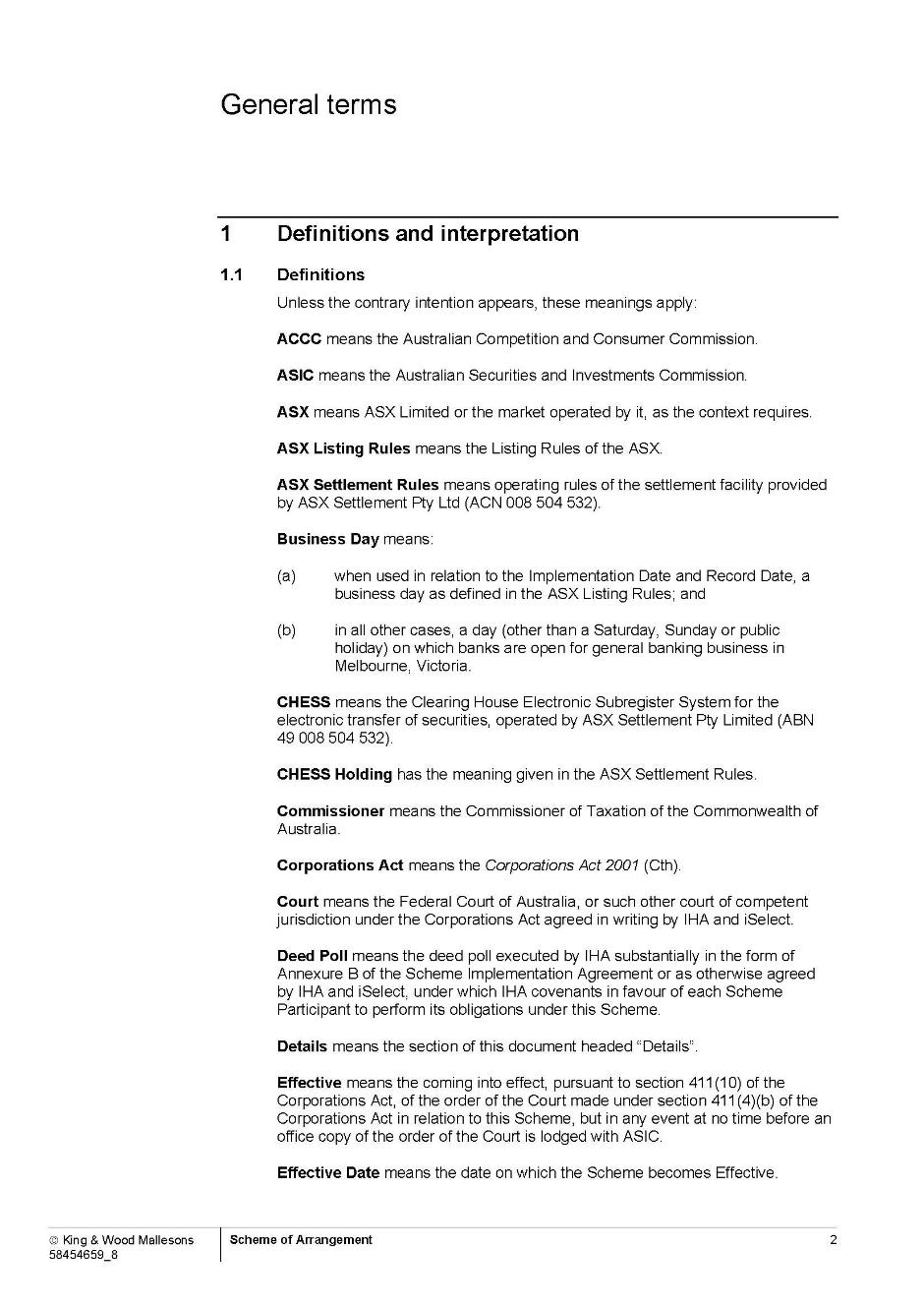
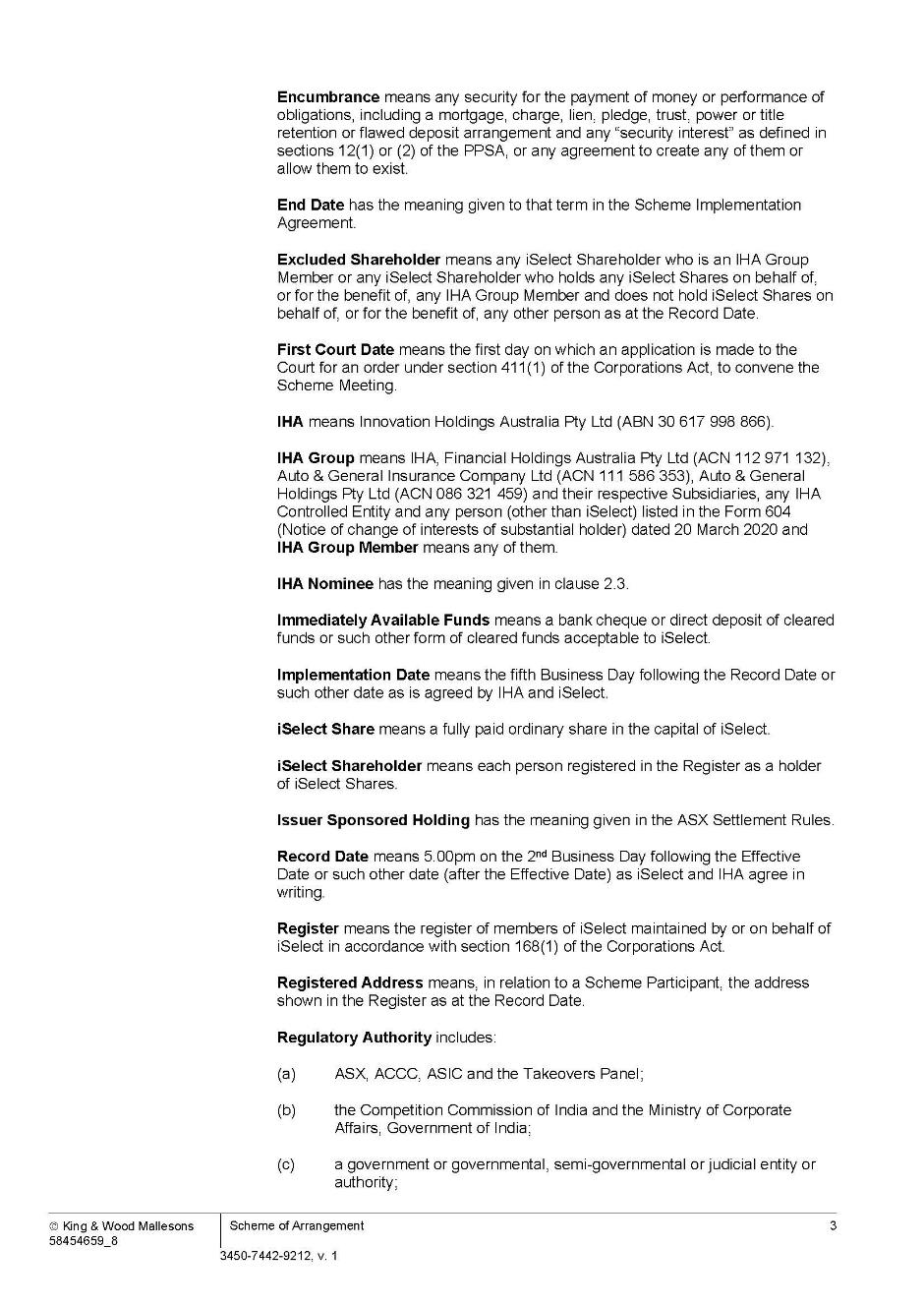
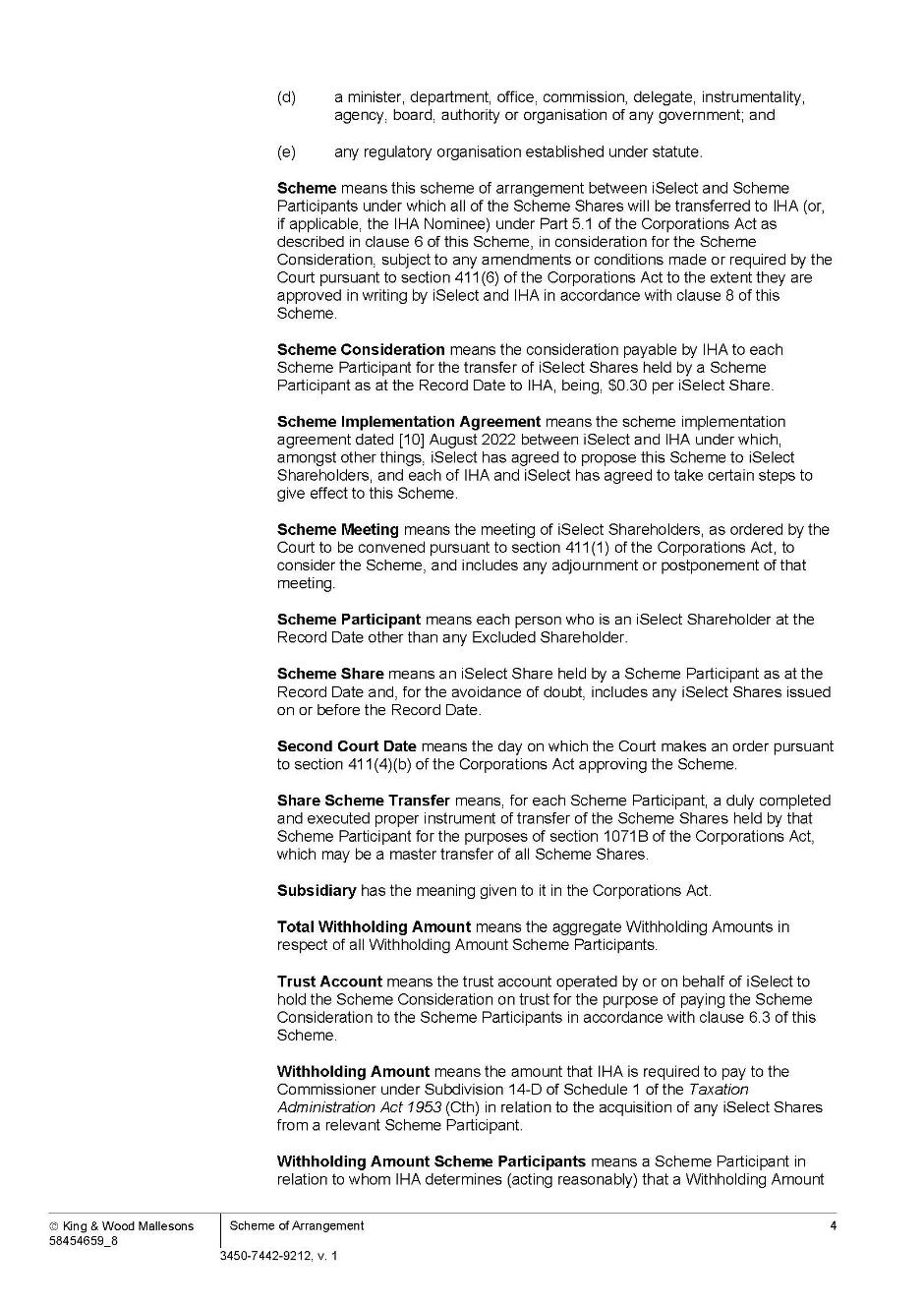
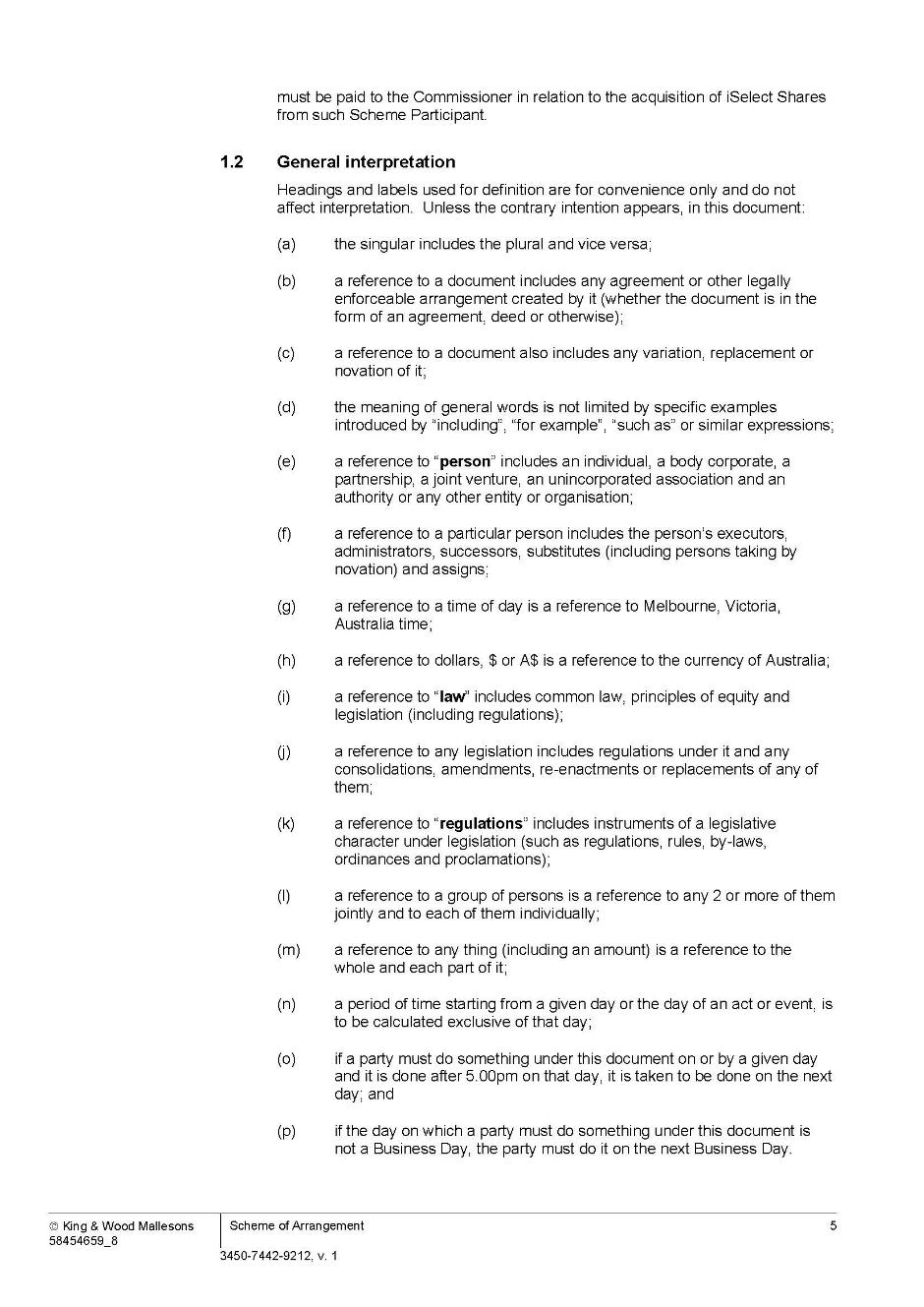
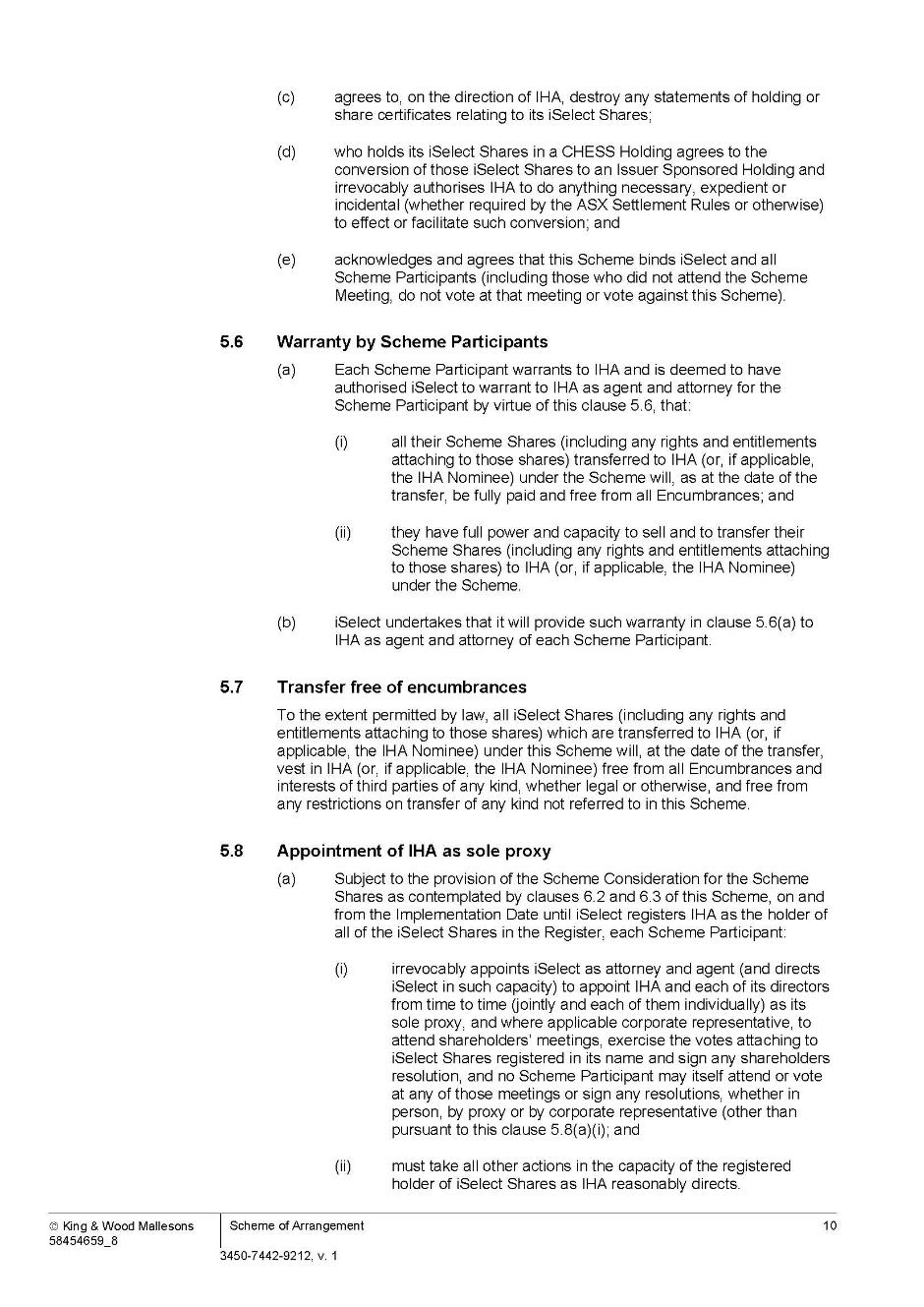
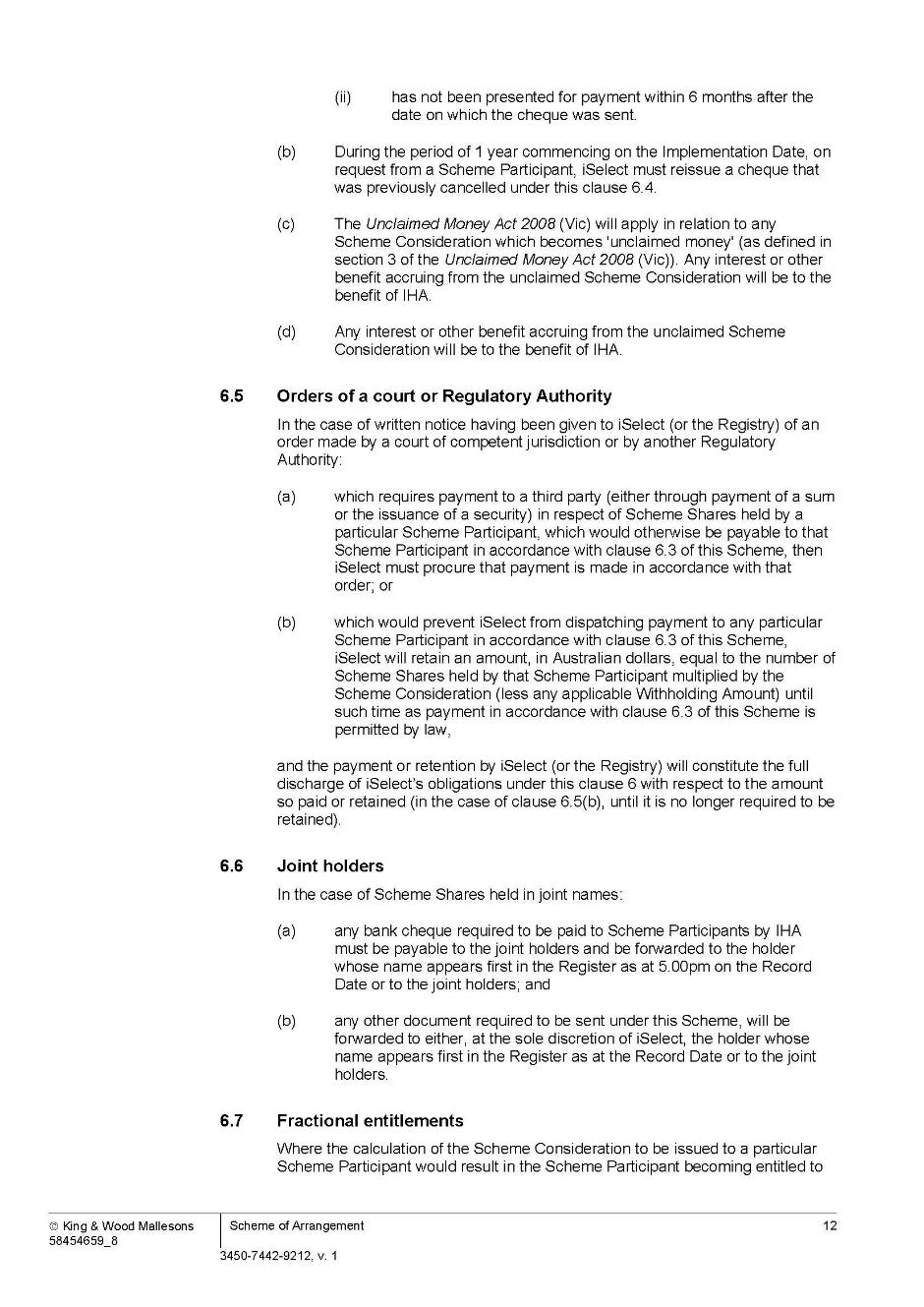
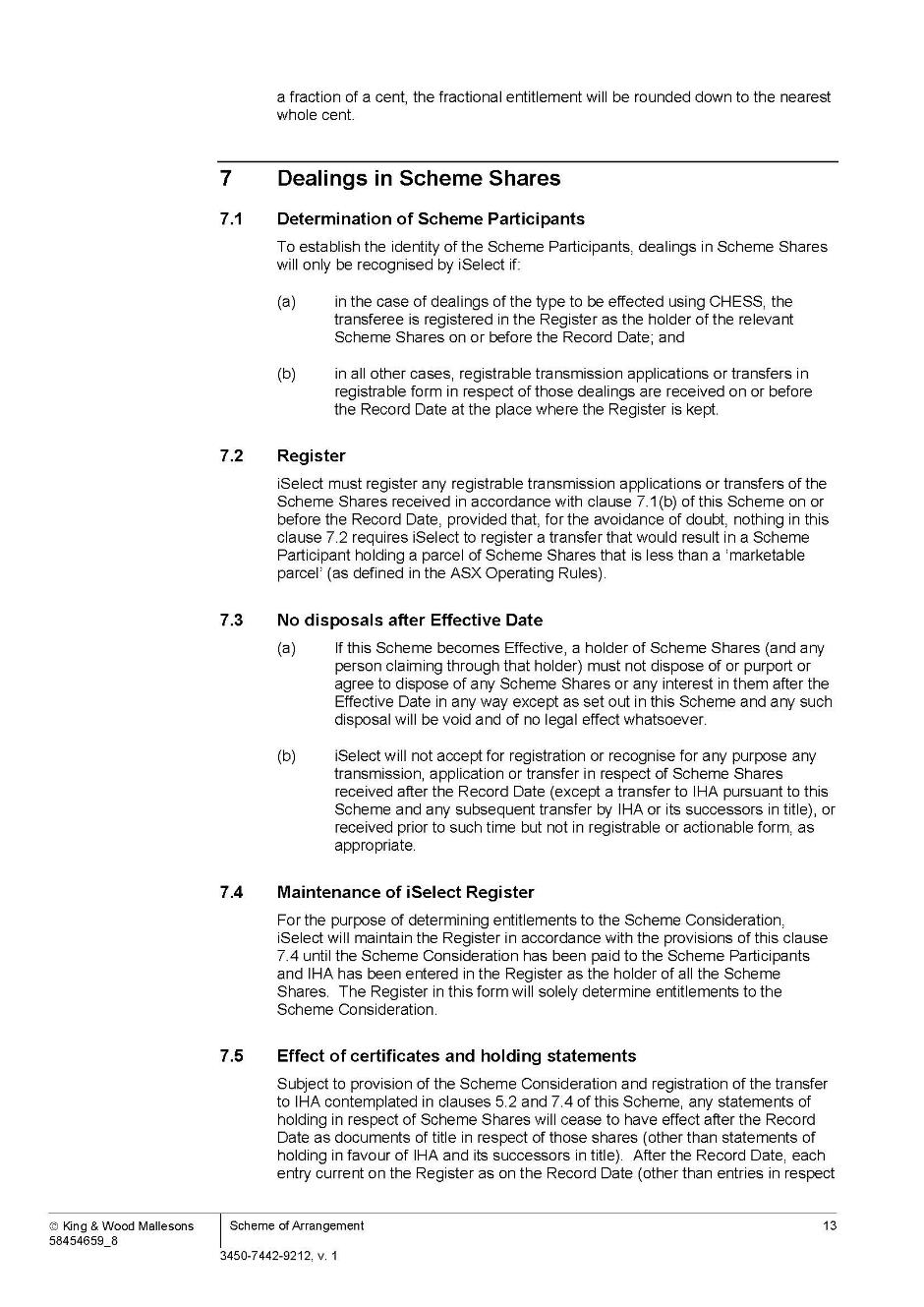
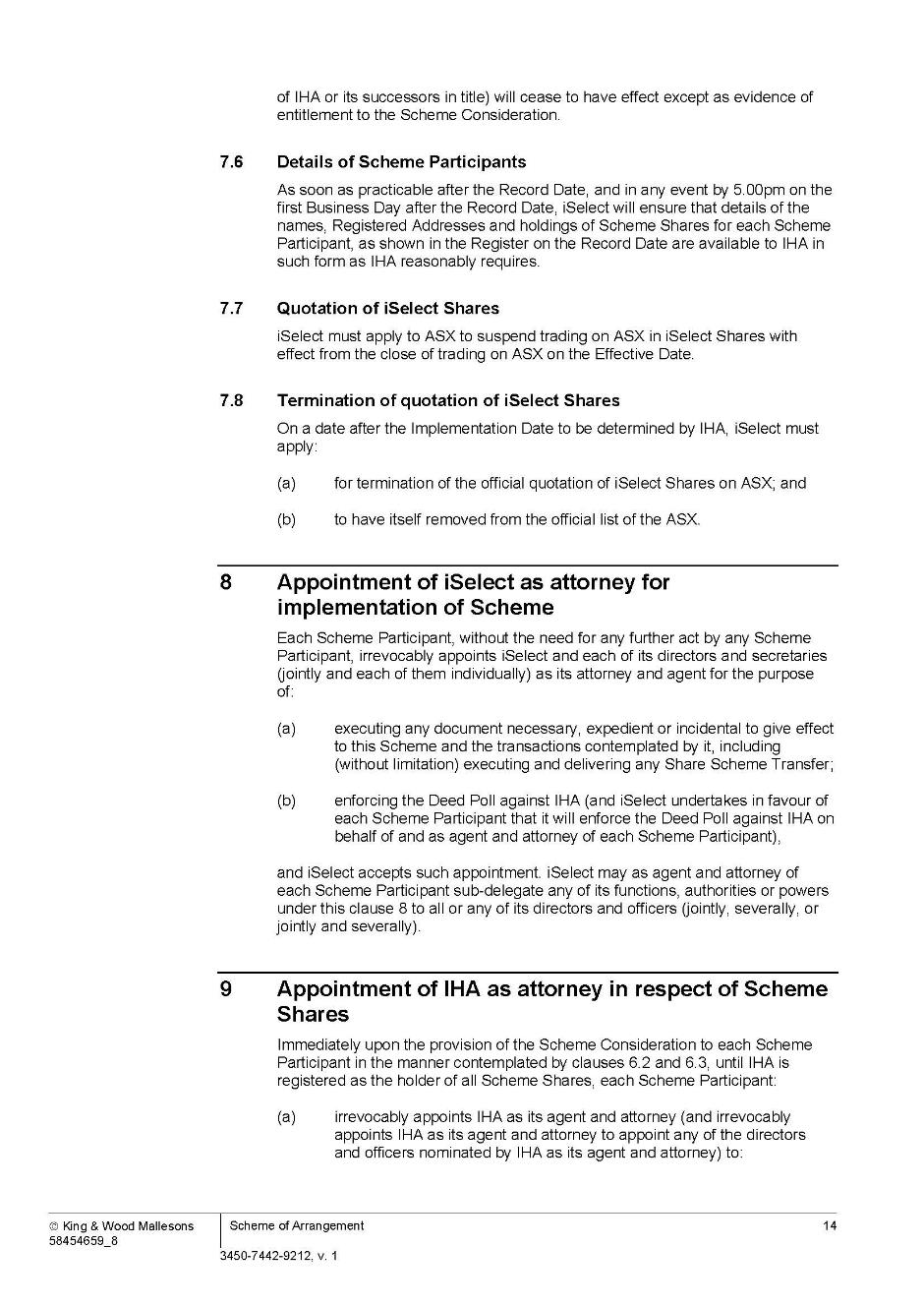
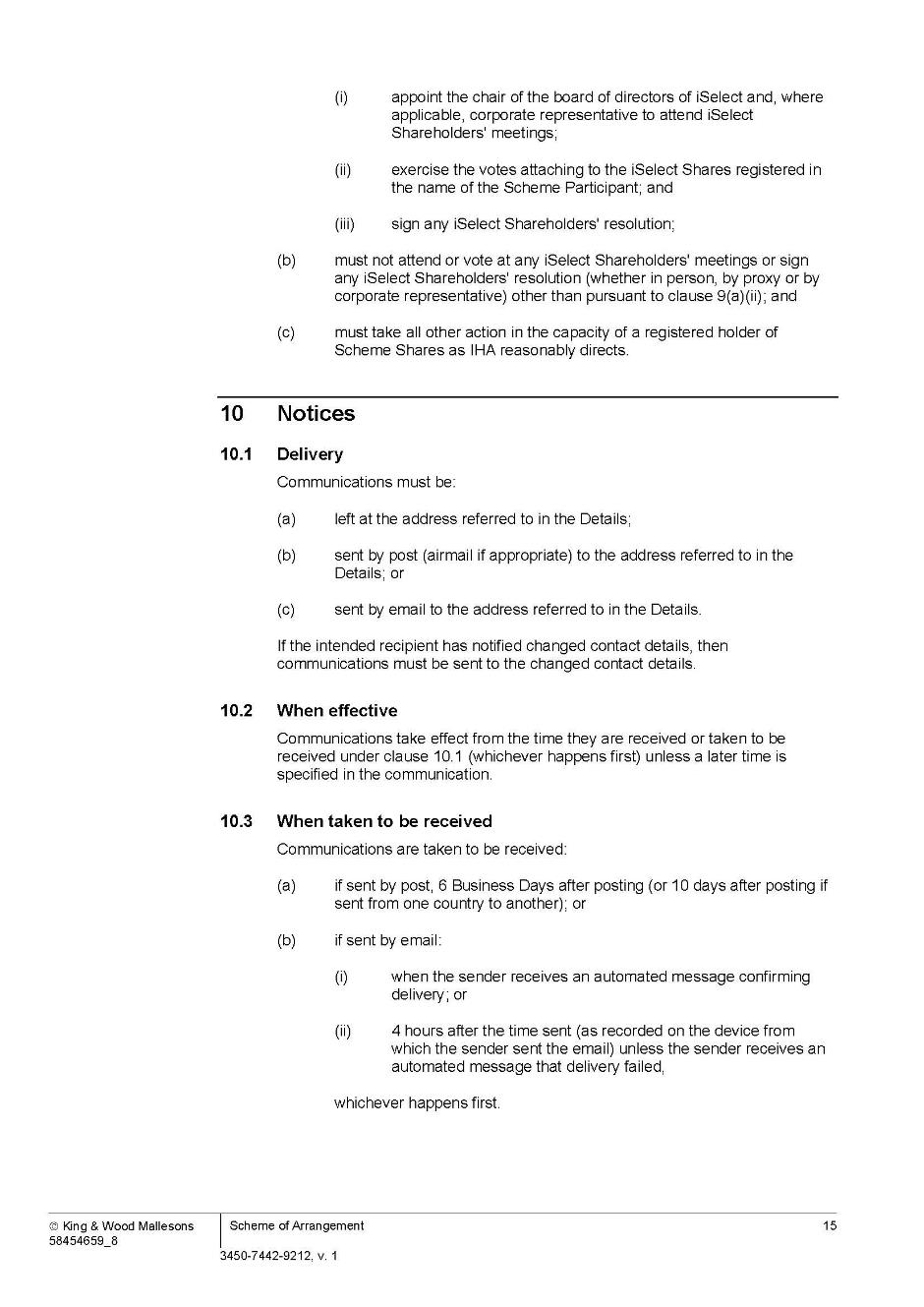
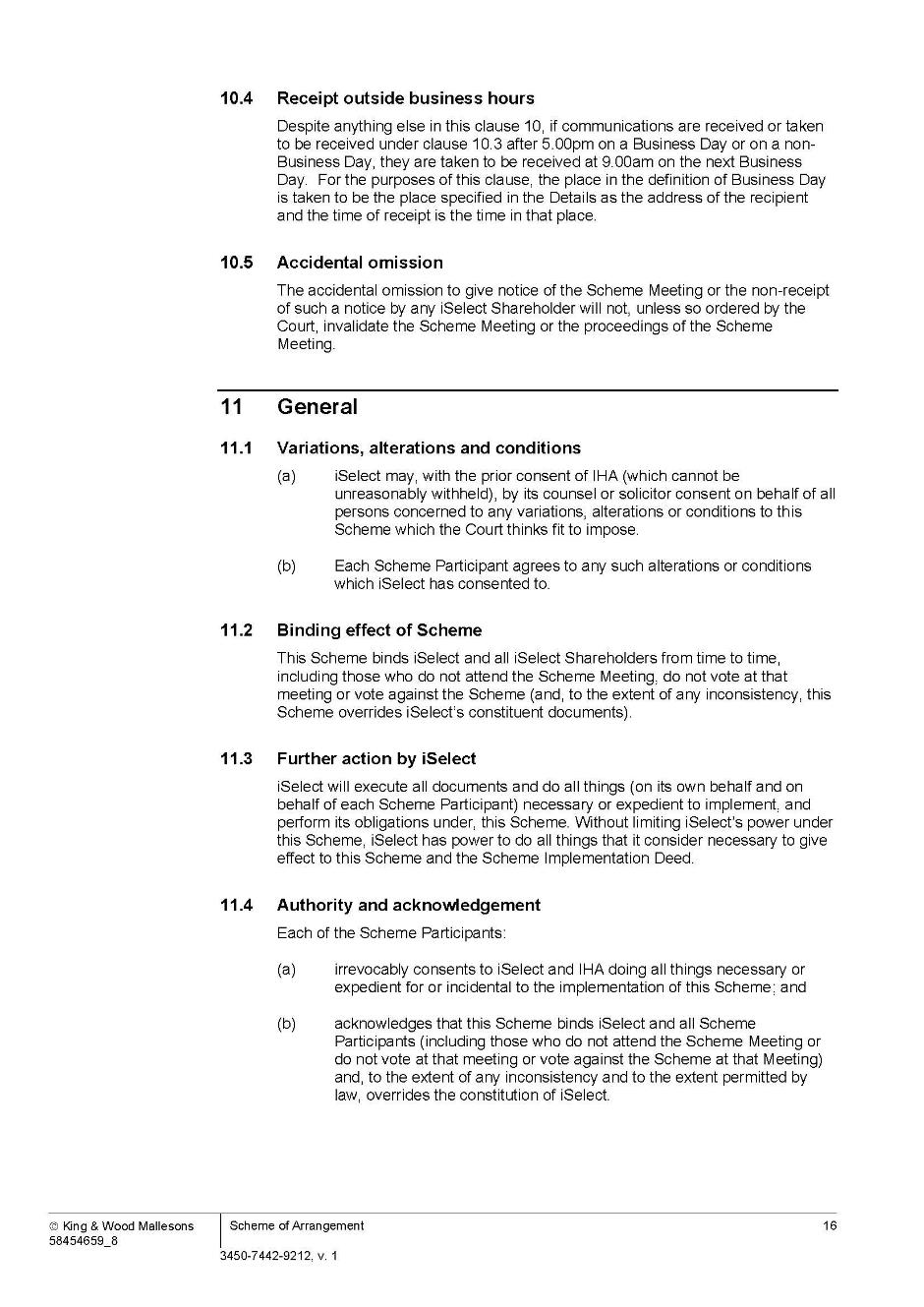
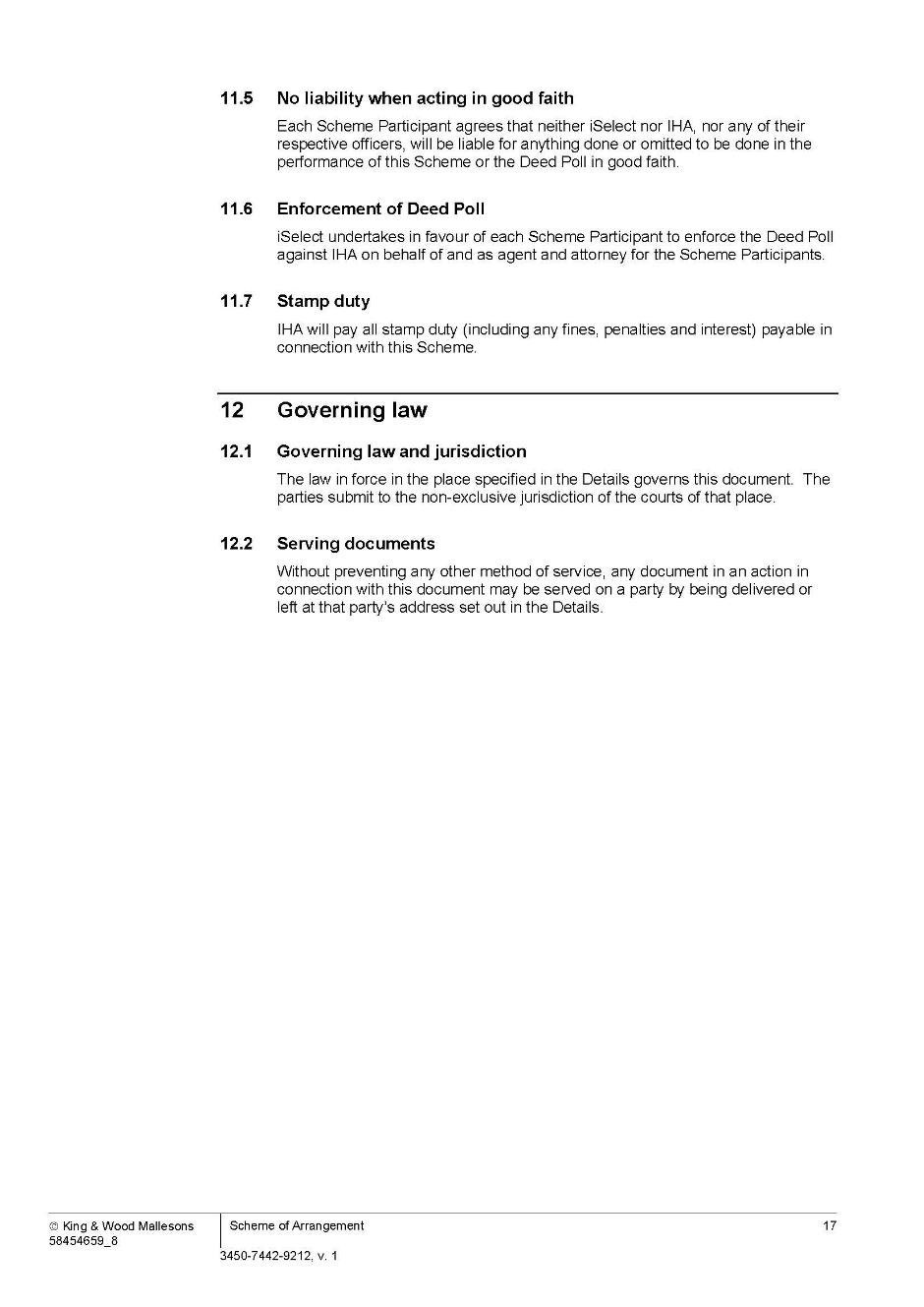
(a) for the purpose of considering and, if thought fit, agreeing (with or without modification) to the Scheme of Arrangement (Scheme) proposed to be made between iSelect and the Scheme Participants (as defined in the Scheme), the terms of which are set out in Annexure A to these orders; and
(b) to be held on 9 December 2022 at 10:00 am (Melbourne time) and to be conducted in-person at Collins Square, 727 Collins Street, Melbourne VIC 3000 and through an online platform at https://meetnow.global/MZMAQ75.
2. Pursuant to subsection 411(1) and section 1319 of the Act, the Scheme Meeting be convened by sending on or before 9 November 2022:
(a) to each Eligible Shareholder who has elected to be sent documents in electronic form or who has supplied an email address to iSelect (Email Shareholder) (or, in the case of joint holders, to the holder whose name appears first in iSelect's register), an email substantially in the form which appears in Annexure "WJH-6" to the affidavit of Warren James Hebard affirmed on 27 October 2022 (Hebard Affidavit), and which contains hyperlinks to:
(i) an electronic copy of a document substantially in the form of the document which is Annexure "LDB-3" to the affidavit of Leonard David Bryant sworn on 28 October 2022 (Scheme Booklet) (which contains, among other things, the Notice of Scheme Meeting at Annexure B and the proposed Scheme of Arrangement at Annexure C);
(ii) an online portal or website that is accessible by the Email Shareholder and which enables the Email Shareholder to lodge online prior to the Scheme Meeting any proxy or direct voting instructions for the Scheme Meeting; and
(iii) an online portal or website that is accessible by the Email Shareholder to view, listen to and participate in the Scheme Meeting online;
(b) to each Eligible Shareholder who has elected to receive documents from iSelect in physical form (or, in the case of joint holders, to the holder whose name appears first in iSelect's register) (Hardcopy Shareholder):
(i) a hardcopy of the Scheme Booklet; and
(ii) a proxy/voting form substantially in the form of the document which is Annexure "WJH-7" to the Hebard Affidavit (Proxy Form) and a reply-paid envelope for the return of completed Proxy Forms.
(c) to each Eligible Shareholder who is not an Email Shareholder or a Hardcopy Shareholder (or, in the case of joint holders, to the holder whose name appears first in iSelect's register) (Postcard Shareholder):
(i) a hardcopy postcard substantially in the form of the document which is Annexure "WJH-8" to the Hebard Affidavit (Postcard) setting out URL addresses from which the Postcard Shareholder:
(A) can download an electronic copy of the Scheme Booklet; and
(B) is directed to an online portal or website that is accessible by the Postcard Shareholder to view, listen to and participate in the Scheme Meeting online and which enables the Postcard Shareholder to lodge online prior to the Scheme Meeting any proxy or direct voting instructions for the Scheme Meeting; and
(ii) a Proxy Form and a reply-paid envelope for the Postcard Shareholder to lodge their Proxy Form for the Scheme Meeting.
3. The documents referred to in orders 2(b) and 2(c) be sent:
(a) in the case of shareholders whose registered address is within Australia, by prepaid ordinary post addressed to the relevant addresses recorded in iSelect's register; and
(b) in the case of shareholders whose registered address is outside Australia, by airmail or international courier service addressed to the relevant addresses recorded in iSelect's register.
4. Compliance with r 2.15 of the Federal Court (Corporations) Rules 2000 (Cth) (Rules) be dispensed with, except in so far as that rule applies rule 75-15(2) of the Insolvency Practice Rules (Corporations) 2016 (Cth).
5. Voting on the resolution to agree to the Scheme is to be conducted by way of a poll.
6. A proxy in respect of the Scheme Meeting will be valid and effective if, and only if, it is completed and delivered in accordance with its terms or a proxy or direct voting instruction is lodged online in accordance with the instructions on the online portal or website referred to in Order 2 and received by iSelect by 10:00 am (Sydney time) on 7 December 2022.
7. Broderick Ernst George Arnhold or, failing him, Geoffrey Bruce Stalley, be Chairperson of the Scheme Meeting.
8. The further hearing of the Originating Process is adjourned to the Honourable Justice Anderson at 10:15am (Melbourne time) on 14 December 2022 or as soon thereafter as the business of the Court allows.
Note: Entry of orders is dealt with in Rule 39.32 of the Federal Court Rules 2011
ANNEXURE A
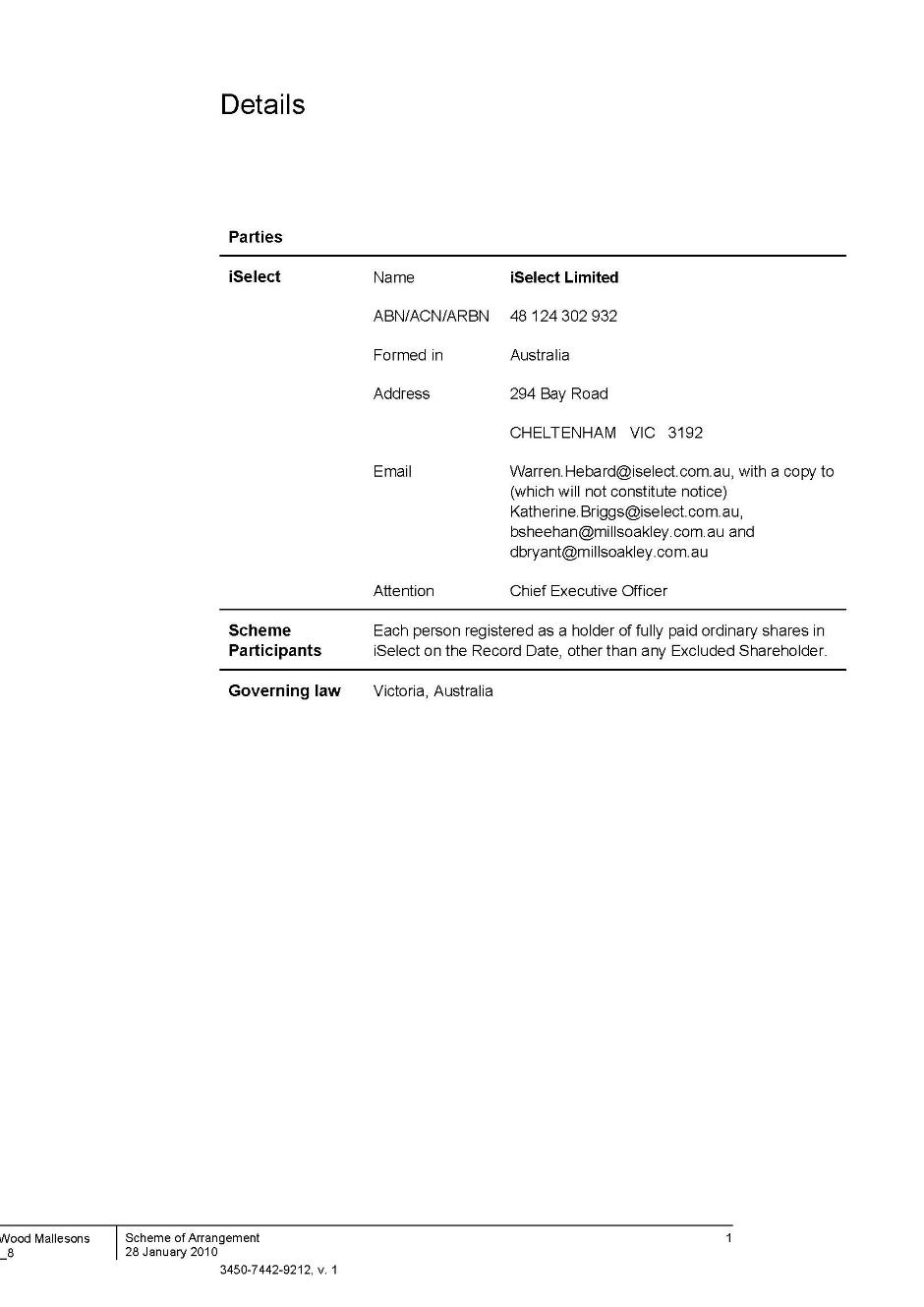
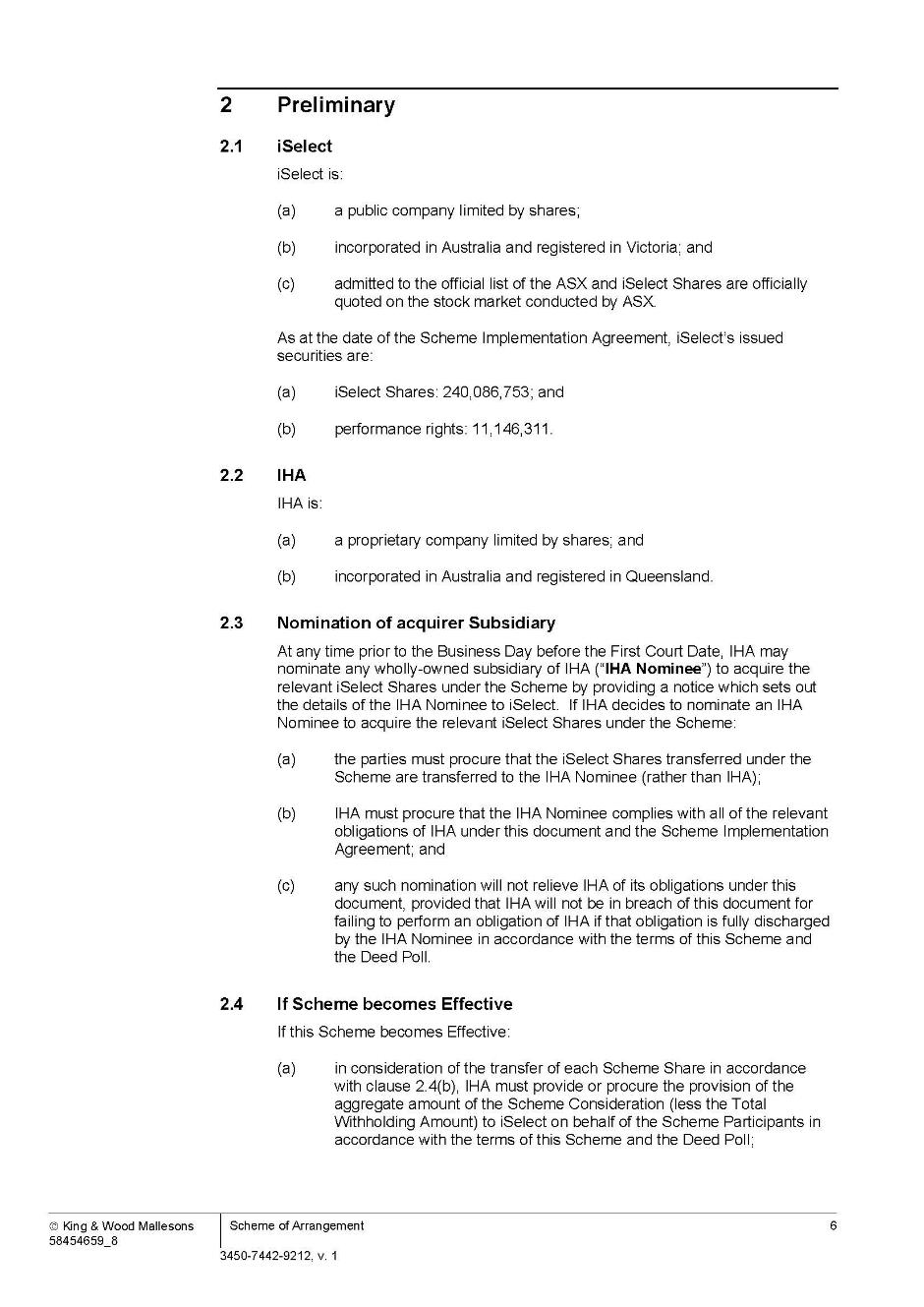
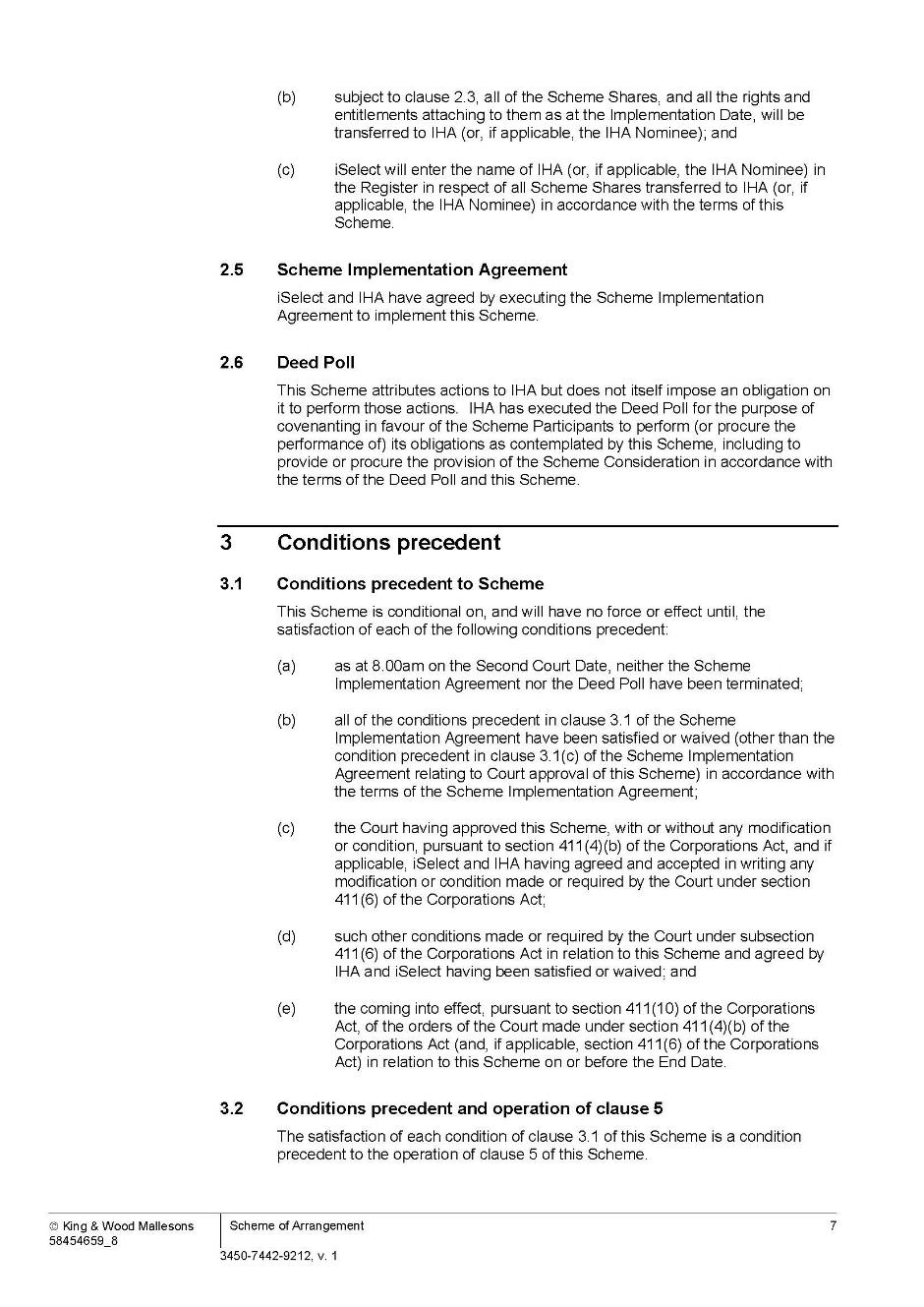
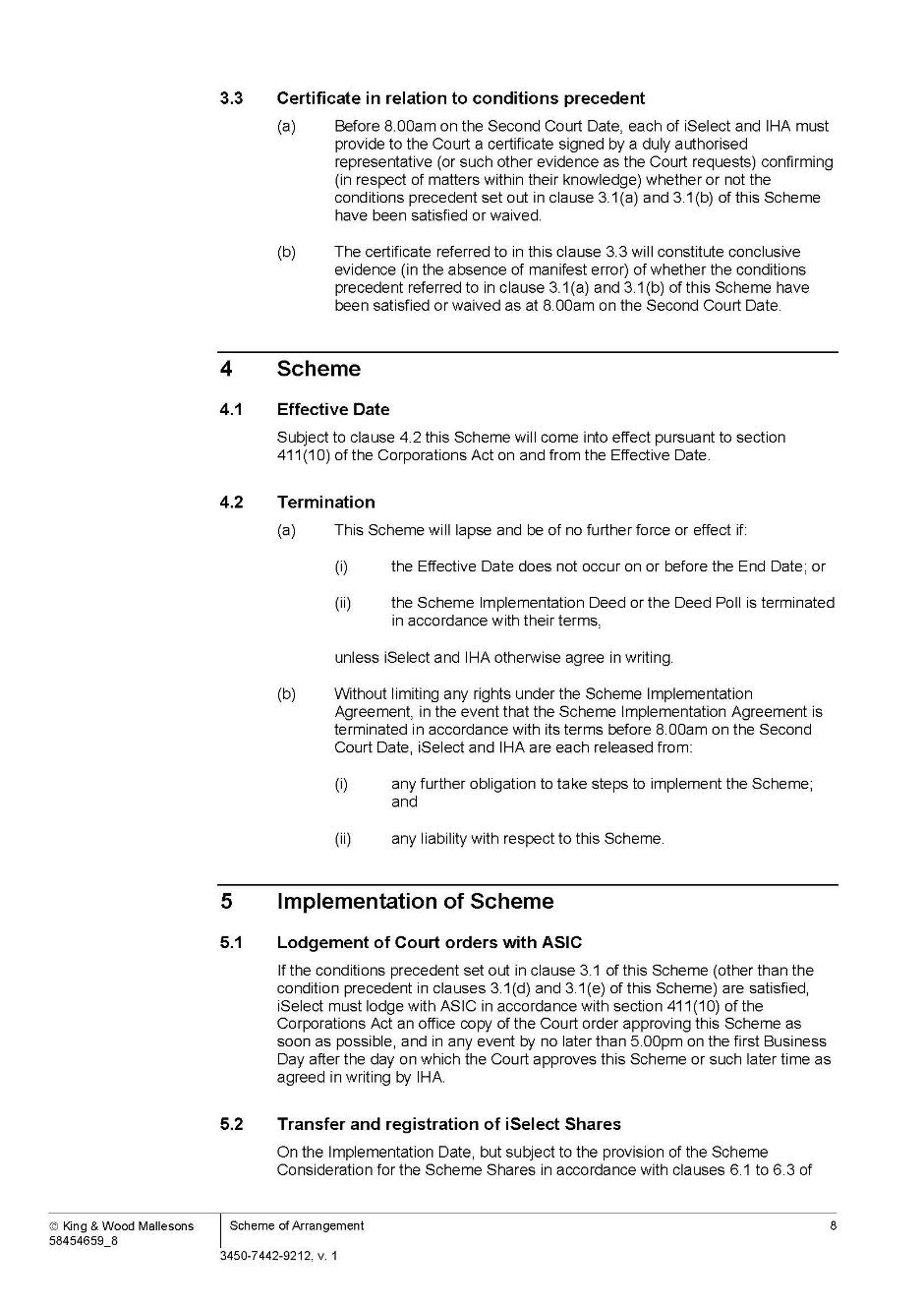
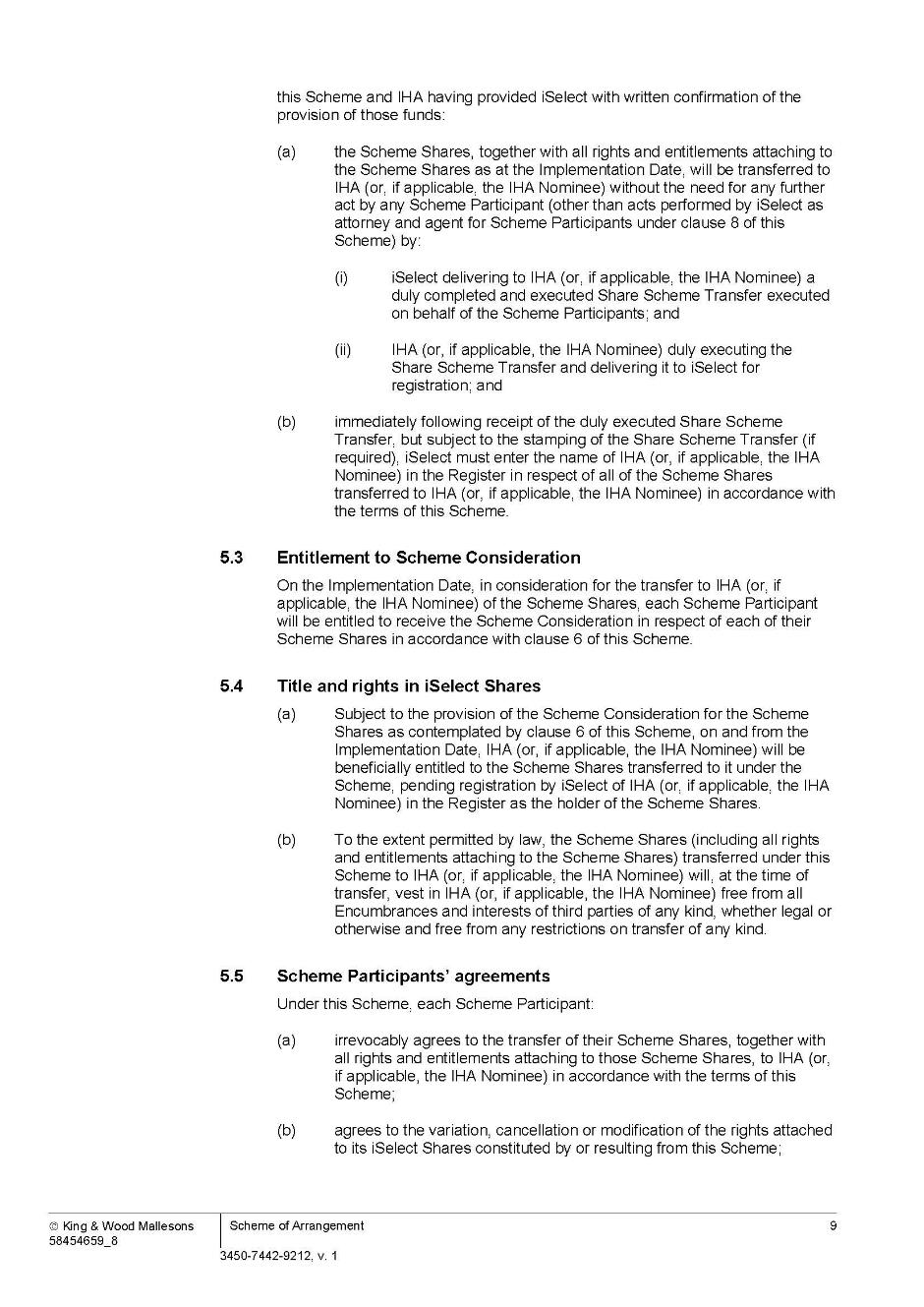
ANDERSON J:
INTRODUCTION
1 The plaintiff (iSelect) by originating process filed 30 September 2022 makes application for orders under section 411(1) of the Corporations Act 2001 (Cth) (Act) to convene and hold a meeting of its shareholders (Scheme Meeting) to consider a proposed scheme of arrangement (Scheme). On 2 November 2022, I made orders convening the Scheme Meeting. These are my reasons for doing so.
2 The commercial purpose of the Scheme is to effect the acquisition by Innovation Holdings Australia Pty Ltd (IHA) of all of the shares in iSelect that IHA does not already hold. IHA currently holds 26% of the total issued share capital of iSelect. IHA and any member of the IHA Group who holds iSelect shares (Excluded Shareholders) will not participate in the Scheme and will not be eligible to vote at the Scheme Meeting.
3 If the Scheme is implemented, all of the iSelect shares on issue as at the Record Date (expected to be 7.00 p.m. on 19 December 2022) other than those iSelect shares held by an Excluded Shareholder (Scheme Shares) will be transferred to IHA and, in consideration for that transfer, each holder of Scheme Shares (Scheme Participant) will receive a cash payment of $0.30 per Scheme Share (Scheme Consideration).
4 The directors of iSelect (Directors) unanimously recommend that iSelect shareholders, other than Exclude Shareholders (Eligible Shareholders), vote in favour of the Scheme, and the Directors intend to vote any iSelect shares held or controlled by them in favour of the Scheme. In each case, in the absence of a “Superior Proposal” as defined in the Scheme Implementation Deed entered into by iSelect and IHA on 10 August 2022 (SIA), and subject to the Independent Expert continuing to conclude that the Scheme is in the best interests of iSelect shareholders.
5 An independent expert report (IER) has been prepared by Grant Thornton Corporate Finance Pty Ltd (Grant Thornton). A copy of the IER is at Annexure ADC-2 to the De Cian Affidavit. In the IER, Grant Thornton concludes that the Scheme is fair and reasonable and therefore in the best interests of iSelect shareholders, in the absence of a superior alternative proposal emerging. The basis for this conclusion is that the value of the Scheme Consideration of $0.30 per Scheme Shares is at the high end of Grant Thornton’s assessed value range of the Scheme Shares (of between $0.21 to $0.30 per Scheme Share).
6 iSelect has prepared a draft scheme booklet which sets out a detailed description of the proposed Scheme and its advantages and disadvantages, and includes the explanatory statement required by sub-sections 411(2)(b)(i) and 412(1) of the Act. The draft scheme booklet refers to the recommendation of the Directors that Eligible Shareholders vote in favour of the Scheme and explains the reasons for that recommendation. It also summarises the conclusions of Grant Thornton, and annexes a copy of the IER, along with a number of other annexures (including the Notice of Scheme Meeting). In particular, the Scheme Booklet annexes the IER at Annexure A, the Notice of Scheme Meeting at Annexure B, the proposed Scheme of Arrangement at Annexure C, and the executed Deed Poll at Annexure D.
7 A draft of the scheme booklet (including the annexed IER) was lodged with the Australian Securities and Investments Commission (ASIC) on 12 October 2022. Amendments were subsequently made to that draft scheme booklet, including in response to comments received from ASIC. ASIC was later provided with a revised draft of the scheme booklet on 27 October 2022 (Scheme Booklet). ASIC has indicated that it has no further comments on the Scheme Booklet, and that it has no comments on the IER. Accordingly, iSelect intends to provide a copy of the Scheme Booklet in substantially this form (and including the IER and other annexures) to Eligible Shareholders if the Court makes the orders sought at the first court hearing. Subject to ASIC registering the Scheme Booklet pursuant to s 412(6) of the Act following the first court hearing.
8 iSelect requested that ASIC provide a preliminary no-objection letter in the usual form prior to the first court hearing. On 31 October 2022, ASIC provided this a letter.
9 iSelect submits that it is appropriate to make orders convening the Scheme Meeting, as the proposed Scheme is of such a nature that it would likely be approved by the Court at the second court hearing.
EVIDENCE
10 The evidence relied upon by iSelect is as follows:
(a) Affidavit of Brendan Michael Sheehan sworn on 13 September 2022 in his capacity as a Partner at Mills Oakley, the solicitors for iSelect (Sheehan Affidavit). The Sheehan Affidavit refers to the corporate details of iSelect and annexes a copy of an ASIC company extract for iSelect, a copy of iSelect’s constitution and a copy of the announcement of the Scheme.
(b) Affidavit of Leonard David Bryant affirmed on 28 October 2022 in his capacity as a Partner at Mills Oakley (Bryant Affidavit). Mr Bryant addresses the lodgement of the draft Scheme Booklet with ASIC on 12 October 2022, and to the subsequent amendment of that draft Scheme Booklet following the receipt of comments from ASIC, and he annexes a copy of the final amended draft Scheme Booklet which iSelect proposes to send to Eligible Shareholders. Mr Bryant also addresses the notice given to ASIC of the first court hearing, and refers to iSelect’s request that ASIC provide its usual preliminary no-objection letter prior to the first court hearing stating that ASIC does not intend to appear to make submissions or to intervene to oppose the Scheme at the first court hearing.
(c) Affidavit of Warren James Hebard affirmed on 28 October 2022 in his capacity as Chief Executive Officer of iSelect (Hebard Affidavit). In his affidavit, Mr Hebard addresses the proposed Scheme and refers to various details relating to iSelect, including the composition of iSelect’s board of Directors, its share capital and performance incentives. He also refers to the agreement between iSelect and IHA to implement the Scheme (that is, the SIA), and he provides an overview of the main features of the Scheme and describes certain features of the SIA (such as the exclusivity provisions). Mr Hebard also addresses the consideration of the Scheme by the Directors of iSelect and their voting recommendation and voting intentions in relation to the Scheme. Finally, Mr Hebard refers to the verification and proposed methods of dispatch of the Scheme Booklet, and the proposed arrangements for the conduct of the Scheme Meeting.
(d) Affidavit of Broderick Ernst George Arnhold affirmed on 27 October 2022 in his capacity as the non-executive Chairman of iSelect (Arnhold Affidavit). It is proposed that Mr Arnhold be chairperson of the Scheme Meeting, and his affidavit contains evidence of the necessary matters in relation to this role as required by rule 3.2 of the Federal Court (Corporations) Rules 2000 (Cth) (Rules).
(e) Affidavit of Geoffrey Bruce Stalley affirmed on 26 October 2022 in his capacity as a nonexecutive director of iSelect (Stalley Affidavit). It is proposed that Mr Stalley be alternate chairperson of the Scheme Meeting, and his affidavit contains evidence of the necessary matters in relation to this role as required by rule 3.2 of the Rules.
(f) Affidavit of Andrea De Cian sworn on 27 October 2022 in his capacity as an authorised representative of Grant Thornton (De Cian Affidavit). Grant Thornton was engaged by iSelect to provide an independent expert opinion as to whether the Scheme is in the best interests of iSelect shareholders. Grant Thornton has prepared an independent expert’s report containing that opinion, a copy of which is annexed to the De Cian Affidavit. Mr De Cian had overall responsibility for the preparation of that report.
(g) Affidavit of Trevor Francis Jeffords affirmed on 28 October 2022 in his capacity as a director of IHA (Jeffords Affidavit). Mr Jeffords addresses the verification of the IHA Information in the Scheme Booklet, and he annexes a copy of the Deed Poll executed by IHA.
(h) Affidavit of Leonard David Bryant affirmed 1 November 2022.
ISELECT AND IHA
11 iSelect is an Australian public company limited by shares, and its shares are listed on the Australian Securities Exchange (ASX).
12 iSelect operates a price comparison website business providing services that include product comparison, recommendation and purchase support across private health insurance, life and general insurance, broadband, energy and personal financial products. iSelect maintains two brands, iSelect (www.iselect.com.au), and Energy Watch (www.energywatch.com.au).
13 As at 26 October 2022, iSelect had:
(a) 240,086,753 fully paid ordinary shares on issue;
(b) 942 shareholders; and
(c) 11,146,311 iSelect performance rights on issue.
14 The iSelect Directors are as follows:
(a) Broderick (Brodie) Ernst George Arnhold (Chairman);
(b) Shaun Keith Alfred Bonett (Non-Executive Director, Chair of Remuneration and Nomination Committee);
(c) Bridget Cara Fair (Non-Executive Director);
(d) Melissa Reynolds (Non-Executive Director); and
(e) Geoffrey Bruce Stalley (Non-Executive Director, Chair of the Audit and Risk Committee).
15 As disclosed in section 8.10 of the Scheme Booklet, that each Director holds iSelect share which in aggregate amount to 3.41% of the total number of iSelect shares on issue.
16 IHA is a member of the IHA group of companies, which includes IHA, Financial Holdings Australia Pty Ltd, Auto & General Insurance Company Ltd and Auto & General Holdings Pty Ltd and their respective subsidiaries (IHA Group). The businesses operated by the IHA Group include an online comparison business through the website www.comparethemarket.com.au, and businesses which underwrite and distribute motor and home insurance and pet insurance in Australia. IHA is privately owned by a number of offshore companies and entities associated with the Global Chief Executive Officer of the IHA Group and the Group Managing Director & CEO for Asia Pacific of the IHA Group.
AGREEMENT TO IMPLEMENT THE SCHEME
17 On 10 August 2022, iSelect and IHA entered into the SIA pursuant to which they agreed to implement the proposed Scheme on the terms of the SIA. In particular, under the SIA, IHA has agreed to acquire all of the Scheme Shares and pay or procure the payment of the Scheme Consideration to the Scheme Participants in accordance with the Scheme (clause 4.3 of the SIA).
18 The parties’ agreement to implement the Scheme on the terms of the SIA is subject to the satisfaction of a number conditions precedent, including the Australian Competition and Consumer Commission (ACCC) advising that it does not oppose the Scheme, iSelect shareholders (other than Excluded Shareholders) agreeing to the Scheme, and Court approval of the Scheme (clause 3.1 of the SIA). The conditions precedent to the SIA are summarised in section 7.3 of the Scheme Booklet.
19 The SIA annexes a copy of the proposed scheme of arrangement. After the SIA was entered into, the proposed scheme was amended in minor respects. The amended version of the proposed scheme is annexed to the Scheme Booklet which appears at annexure LDB-3 to the Bryant Affidavit.
20 The SIA also attaches a copy of the draft deed poll to be given by IHA. After the SIA was entered into, the deed poll was amended in minor respects. The amended version of the deed poll is annexed to the Scheme Booklet which appears at annexure LDB-3 of the Bryant Affidavit. An executed copy of the deed poll will be annexed to the Scheme Booklet (Deed Poll).
KEY ASPECTS OF THE SCHEME
21 The terms of the Scheme are in conventional form for an acquisition scheme of this nature. The key steps may be summarised as follows:
(a) if the Scheme is to proceed, all conditions precedent to the Scheme (other than Court approval) must be either satisfied or waived by the applicable time;
(b) if the Scheme is agreed to by the requisite majorities of Eligible Shareholders at the Scheme Meeting and approved by the Court, it becomes effective on the lodging of an office copy of the Court’s order with ASIC, which is anticipated to occur on 15 December 2022 (clause 4.1 of the Scheme);
(c) if the Scheme becomes effective on 15 December 2022 as anticipated, the Scheme Consideration will be paid to Scheme Participants on the Implementation Date, which is anticipated to be on 28 December 2022, and the Scheme Shares will subsequently be transferred to IHA on that date (clauses 5 and 6 of the Scheme); and
(d) following the implementation of the Scheme, IHA will own 100% of the issued shares in iSelect, and iSelect will be delisted from the ASX.
22 The mechanism for the payment of the Scheme Consideration and the transfer of the Scheme Shares is in a customary form. The essential mechanism is referred to in sections 7.1-7.13 and 11 of the Scheme Booklet as follows:
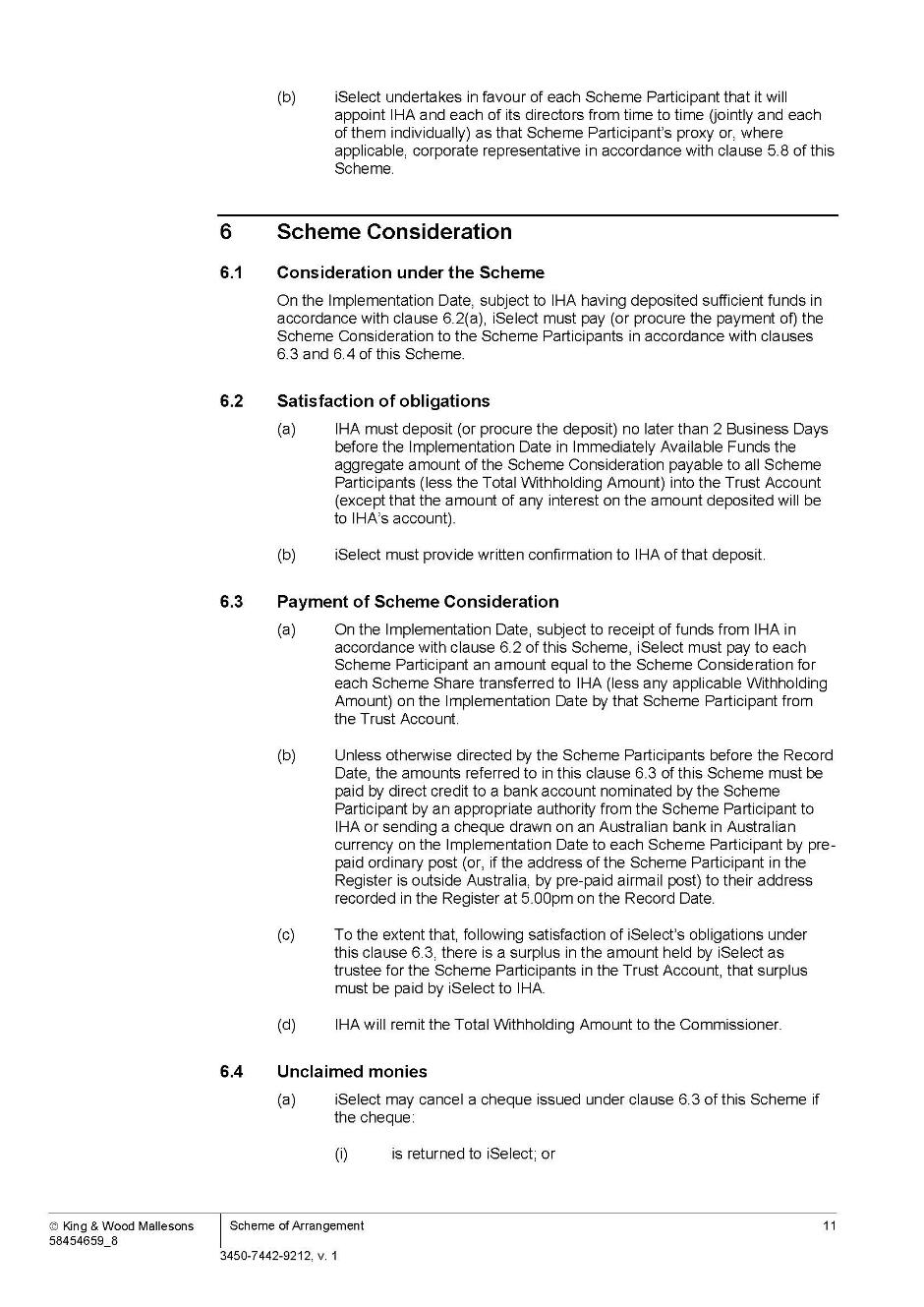
(a) by no later than 2 Business Days before the Implementation Date, IHA must deposit the aggregate amount of the Scheme Consideration payable to all Scheme Participants (less the Total Withholding Amount) into a trust account operated by or on behalf of iSelect to hold the Scheme Consideration on trust for the purpose of paying the Scheme Consideration to the Scheme Participants (Trust Account) (clause 6.2);
(b) on the Implementation Date, subject to receipt of the funds from IHA in accordance with sub-paragraph (a) above, iSelect must pay to each Scheme Participant from the Trust Account an amount equal to the Scheme Consideration for each Scheme Share transferred to IHA on the Implementation Date by that Scheme Participant (clause 6.3); and
(c) subject to the provision of the Scheme Consideration to Scheme Participants in the manner contemplated by clauses 6.2 and 6.3 of the Scheme, the Scheme Shares will be transferred to IHA (less any applicable Withholding Amount) without the need for any further act by any Scheme Participant (clause 5.2 of the Scheme).
DEED POLL
23 As noted above, the terms of the Scheme provide that IHA must deposit an amount equal to the aggregate amount of the Scheme Consideration into the Trust Account. However, IHA is not a party to the Scheme and will not be bound by its terms, and so its obligations cannot be directly enforced against it by Scheme Participants.
24 For this reason, clause 5.3(d) of the SIA requires that IHA must sign and deliver the Deed Poll to iSelect by no later than the Business Day prior to the First Court Date. Under the terms of the Deed Poll, IHA covenants in favour of each Scheme Participant to observe and perform all obligations contemplated of IHA under the Scheme, including to pay the Scheme Consideration into to the Trust Account on behalf of each Scheme Participant in accordance with the Scheme.
25 The Deed Poll may be relied upon and enforced by any Scheme Participant (see clause 1.3 of the Deed Poll).
RELEVANT PRINCIPLES
26 Part 5.1 of the Act provides a procedure whereby an arrangement between a company and its members can be made binding on all members. Section 411 is the principal provision. The procedure involves three main steps:
(a) an application to the Court for an order to convene a scheme meeting;
(b) if such an order is made, the convening of such a meeting at which a resolution to agree to the scheme is considered, and perhaps passed; and
(c) if the resolution is passed by the necessary majorities (see section 411(4)), an application to the Court for approval of the scheme.
27 This application concerns the first stage, being an application to the Court for an order to convene the Scheme Meeting.
28 Section 411 of the Act does not state the criteria that must be satisfied before a scheme meeting is ordered, but it is clear that, if certain statutory pre-requisites are met, section 411(1) confers a discretion on the court in relation to whether the meeting should be ordered: Re Spicers Ltd [2019] FCA 731 (Re Spicers) at [11]; Re Healthscope Limited (2019) 139 ACSR 608 (Re Healthscope) at [43], Re Amcor Ltd [2019] FCA 346 (Re Amcor) [45]; Re DuluxGroup Ltd [2019] FCA 961 (Re DuluxGroup) at [15]; Re Legend Corporation Limited [2019] FCA 1249 (Re Legend) at [17]; Re Wellcom Group Limited [2019] FCA 1655 (Re Wellcom Group) at [24]; Re 86 400 Holdings Ltd [2021] FCA 311 (Re 86 400) at [5]. Re Verdant Minerals Ltd [2019] FCA 556 (Re Verdant Minerals) at [28], citing Re CSR Ltd (2010) 183 FCR 358 at [8]; Re Sienna Cancer Diagnostics Limited [2020] FCA 899 (Re Sienna Cancer Diagnostics) at [43].
29 In exercising that discretion, Australian courts have commonly applied the approach described by Street J (with whom Hutley and Samuels JJA agreed) in FT Eastment & Sons Pty Ltd v Metal Roof Decking Supplies Pty Ltd (1977) 3 ACLR 69 in deciding whether to convene a scheme meeting, as follows:
The approach taken upon a summons is that the court will not ordinarily summon a meeting unless the scheme is of such a nature and cast in such terms that, if it achieves the statutory majority at the creditors’ meeting the court would be likely to approve it on the hearing of a petition which is unopposed.
30 The principles which apply at this first stage of the scheme of arrangement procedure are well-known: Re 86 400 at [6]; Re 5G Networks Limited [2021] FCA 1189 at [22] – [25] (Re 5GN); Re RXP Services Limited [2021] FCA 38 (Re RXP) at [16] – [19]; Re Citadel Group Limited [2020] FCA 158 (Re Citadel) at [24] – [27]; Re DWS Limited [2020] FCA 1590 (Re DWS) at [14] – [17]; Re Healthscope at [43], Re Amcor at [45]. The principles have been summarised by Beach J in a number of decisions, including in Re Amcor at [47], in the following way:
My function on an application to order the convening of a meeting is supervisory. At this stage I should generally confine myself to ensuring that certain procedural and substantive requirements have been met including dealing with adequate disclosure, but with limited consideration of issues of fairness. But having said that, it is appropriate to consider the merits or fairness of a proposed scheme at the convening hearing if the issue is such as would unquestionably lead to a refusal to approve a proposed scheme at the approval hearing, that is, the proposed scheme appears now to be on its face “so blatantly unfair or otherwise inappropriate that it should be stopped in its tracks before going any further” (Re Foundation Healthcare Ltd (2002) 42 ACSR 252 at [44] per French J). Re RXP at [18] – [19], referred to with approval in Re 86 400 at [6]. See also Re Australian Pharmaceutical Industries Limited [2022] FCA 103 (Re API) at [21], and Re PM Capital Asian Opportunities Fund Limited [2021] FCA 1380 at [39] (Re PM Capital).
31 The authorities make it clear that it is not the court’s role to express a view on whether the proposed scheme should be approved, or to usurp the shareholders’ decision whether to agree to a scheme by attempting to intrude its own commercial judgment: Re Ellerston Global Investments Limited [2020] NSWSC 879 at [27]; Re Cytopia Ltd [2009] VSC 560 at [3]. The question of whether or not to accept particular consideration for shares is quintessentially a commercial matter for the members to assess, and they ought not be prevented from having the opportunity to do so, provided that the court can be satisfied that they are acting on sufficient information and with time to consider what they are voting on: Re API at [22]; Re Healthscope at [128]; Re Amcor at [50]; Re PM Capital at [40]; Re English Scottish and Australian Chartered Bank [1893] 3 Ch 385 at 409 per Lindley LJ, cited with approval in Re ACM Gold Ltd (1992) 34 FCR 530 at 534 per O’Loughlin J; Re Cytopia Ltd [2009] VSC 560 at [3].
32 Therefore, if the arrangement is one that seems fit for consideration by the meeting of members, and is a commercial proposition likely to gain the court’s approval if passed by the necessary majorities, then orders should be made to convene the meeting: Re Foundation Healthcare Ltd (2002) 42 ACSR 252 (Re Foundation Healthcare) at [36]. These observations have been applied in a number of subsequent decisions: Re API at [23]; Re PM Capital at [40]; Re Ellerston at [25]-[27]; Re Asaleo Care Limited [2021] FCA 406 (Re Asaleo) at [19]. However, the court will consider the merits or fairness of a proposed scheme at the convening hearing if the scheme appears on its face so blatantly unfair or otherwise inappropriate that it should be stopped in its tracks before going any further, or to put in another way, if an issue arises that would unquestionably lead to a refusal to approve a proposed scheme at the approval hearing: Re Foundation Healthcare at [44] per French J, applied in Re Healthscope at [45]. See also Re Ellerston at [27].
33 Accordingly, the Court’s task at the first court hearing involves the assessment of two principal matters:
(a) first, whether the statutory prerequisites to the making of orders convening a meeting have been met; and
(b) second, whether it is appropriate for the Court to exercise its discretion in favour of making those orders.
See: Re API at [24] and Re PM Capital at [41].
34 Each of these matters will be considered in turn below.
STATUTORY PREREQUISITES
35 iSelect submits that all relevant statutory prerequisites have been satisfied, in particular:
(a) as required by section 411(1), iSelect has made an application in relation to an arrangement that is proposed between a Part 5.1 body and its members. It is well established that a scheme to effect an acquisition of shares may be an ‘arrangement’ within the section: Re Foundation Healthcare Ltd (2002) 42 ACSR 252 at 264 [39] per French J;
(b) as required by rule 2.4(2) of Rules, the evidence relied upon by iSelect includes an ASIC company extract recording the results of a search of the records of ASIC in relation to iSelect carried out no earlier than 7 days before the originating process was filed;
(c) the requirement in section 411(2)(a) of the Act, to give ASIC at least 14 days’ notice of the first court hearing has been satisfied;
(d) as required by section 411(2)(b) of the Act, ASIC has had a reasonable opportunity to examine the terms of the proposed Scheme and the draft explanatory statement, and to make submissions to the Court;
(e) as required by rule 3.2 of the Rules, the necessary evidence about the proposed chairperson and alternate chairperson of the Scheme Meeting has been provided; and
(f) as required by rule 3.3(1) of the Rules, the proposed orders annex a copy of the Scheme.
36 In addition, the information to be provided to shareholders for the purposes of their consideration of the Scheme is regulated by s 412 of the Act and reg. 5.1.01 and Schedule 8 of the Corporations Regulations 2001 (Cth) (Regulations). In particular, s 412(1) of the Act and Schedule 8 (Part 3) of the Regulations set out the disclosure requirements of the explanatory statement (which is included within the Scheme Booklet).
37 There are three aspects to the requirements of s 412(1) of the Act:
(a) first, the explanatory statement must explain the effect of the compromise or arrangement, and in particular state any material interest of the directors, and the effect on those interests of the compromise or arrangement so far as it is different from the effect on the like interests of other persons. The effect of the Scheme is addressed in sections 2, 6 and 7 of the Scheme Booklet, and the required information in relation to the material interests of the Directors is addressed in sections 8.10 to 8.15 of the Scheme Booklet;
(b) second, the explanatory statement must set out the prescribed information, being the information set out in reg 5.1.01 and Schedule 8 of the Regulations. The evidence as to verification of the Scheme Booklet demonstrates that this requirement has been satisfied; and
(c) third, the explanatory statement must set out any other information that is material to the making of a decision whether or not to agree to the compromise or arrangement. In this respect, it is submitted that the Scheme Booklet is clear and comprehensive, and (along with the IER annexed to the Scheme Booklet) contains a detailed evaluation of the Scheme, presented in a way that enables an iSelect shareholder to form his or her own view of the merits of the Scheme.
See Re 5GN at [50] – [56]; Re Amcor at [91]; Re Verdant Minerals at [77]; Re Sienna Cancer Diagnostic at [87]; Re QMS Media Limited [2019] FCA 2172 (Re QMS Media) at [96].
38 More generally, the processes for the verification of the information in the Scheme Booklet are such that the Court can be satisfied that the Scheme Booklet is accurate and includes all material information, that no material facts or considerations have been omitted, and that it is not misleading or deceptive.
39 Moreover, it is necessary for the Scheme Booklet to be registered by ASIC before being sent to iSelect shareholders: Section 412(6) of the Act. Before registering the Scheme Booklet, ASIC must conclude that it appears to comply with the requirements of the Act, and must form the opinion that the Scheme Booklet does not contain any matter that is false in a material particular or materially misleading in the form and context where it appears: ss 412(7) and 412(8) of the Act. The Scheme Booklet is registered. This provides further assurance as to the satisfaction of the relevant disclosure requirements: Re API at [27] and Re 5GN at [55].
40 I am satisfied on the evidence that the procedural requirements have been met and that the Court’s discretion to make the convening orders is enlivened: Re API at [26]; Re PM Capital at [42]; Re Healthscope at [43], Re Amcor at [45]; Re DuluxGroup at [15]; Re Legend at [17]; Re Wellcom Group at [24].
DISCRETION
41 The relevant discretionary considerations involve two main questions: first, whether the Scheme is fit for consideration by the members; and secondly, whether the members are to be properly informed as to the nature of the Scheme: Re API at [27]; Re Crown Resorts Limited [2022] FCA 367 (Re Crown) at [25] – [26]; Re PM Capital at [46]; Re Skilled Group Limited (No 1) [2015] VSC 781 (Robson J) at [27]; FT Eastment & Sons Pty Ltd v Metal Roof Decking Supplies Pty Ltd (1977) 3 ACLR 69 at 72 per Street CJ; Re NRMA Ltd (2000) 33 ACSR 595 at [30]; Re Foundation Healthcare Ltd (2002) 42 ACSR 252 at 263 [38].
Scheme is fit for consideration
42 iSelect submits that the Scheme is fit for consideration by the Eligible Shareholders, in that:
(a) there is no issue arising from the Scheme which would unquestionably lead to refusal by the Court to approve the Scheme at the second court hearing. In particular, it cannot be said that the Scheme is on its face “so blatantly unfair or otherwise inappropriate that it should be stopped in its tracks before going any further”; and
(b) the Scheme is of such a nature and cast in such terms that, if agreed to at the Scheme Meeting, the Court would be likely to approve the Scheme at the second court hearing.
See: Re API at [28]; Re Healthscope at [45]; Re Amcor [47]; Re PM Capital at [44]; Re Foundation Healthcare at [44]; Re Healthscope [45] and Re RXP at [18] – [19]. This statement was quoted with approval by O’Bryan J in Re Wellcom Group at [31]. See also FT Eastment & Sons Pty Ltd v Metal Roof Decking Supplies Pty Ltd (1977) 3 ACLR 69 at 72 per Street CJ; ASIC v Marlborough Gold Mines Ltd (1993) 177 CLR 485 per the Court at 504; Re Coles Group Ltd (2007) 25 ACLC 1380 at 1385-1386 [29] – [36] per Robson J.
43 It is relevant to note in this respect that the Scheme Booklet contains the voting recommendations of the Directors and annexes the IER stating that the Scheme is fair and reasonable and in the best interests of iSelect shareholders: Re API at [28].
44 In the context of addressing this first question of whether a scheme is fit for consideration by the members, the court will also scrutinise the terms of a scheme to satisfy itself that there is no unfairness that would be likely to preclude approval of the scheme. In this case, iSelect identifies the following particular features of the Scheme for the attention of the Court:
(a) Performance risk;
(b) Exclusivity arrangements;
(c) Break Fee;
(d) Treatment of iSelect incentive arrangements;
(e) Shareholder warranties; and
(f) Purpose of the Scheme.
45 iSelect submits that none of these matters gives rise to any concern that the Scheme is not fit for consideration by its members in the requisite sense.
Performance risk
46 As noted above, although the terms of the Scheme provide that IHA must pay the aggregate amount of the Scheme Consideration into the Trust Account for payment to Scheme Participants, IHA is not a party to the Scheme and is not directly bound by it. As such, the Court will wish to ensure that IHA is bound to perform the actions attributed to it under the Scheme and that its obligations are able to be enforced: Re Amcor at [53]; Re Healthscope at [131]; Re Verdant Minerals at [44]; Re Sienna Cancer Diagnostics at [59]; Re QMS Media at [39]; Re Marengo Mining Ltd [2012] FCA 1220 at [22] – [26]; Re Wellcom Group at [63].
47 iSelect submitted that the Scheme before the Court effectively eliminates any performance risk. This is because iSelect has adopted the following accepted safeguards to address the issue of performance risk:
(a) first, the terms of the Scheme require that Scheme Participants must first receive payment of the Scheme Consideration before any transfer of their Scheme Shares can occur. This effectively eliminates any performance risk in so far as the transfer of Scheme Shares in return for the Scheme Consideration is concerned: Re RXP at [21]; Re Citadel at [29]; Re DWS at [19]; Re QMS Media at [42]; Re Asaleo at [45] – [48]; and
(b) second, IHA has executed a Deed Poll in favour of Scheme Participants binding IHA to perform the actions attributed to it under the Scheme, including depositing an amount equivalent to the Scheme Consideration into the Trust Account on the business day before the Implementation Date.
48 I accept that the Scheme has effectively eliminated any performance risk.
Exclusivity arrangements
49 The SIA contains a number of exclusivity provisions, including ‘no shop’, ‘no talk’ and ‘No due diligence’ obligations on the part of iSelect (Exclusivity Provisions).
50 The Exclusivity Provisions apply during the ‘Exclusivity Period’, which began on 10 August 2022 and ends on the earlier of the termination of the SIA, the Implementation Date (which is anticipated to be on 28 December 2022) or the End Date (being 10 May 2022, with the possibility of a further 3-month extension to the End Date under clause 3.5 of the SIA, or such other date as is agreed by iSelect and IHA).
51 Accordingly, the longest period during which the exclusivity provisions could reasonably be anticipated to apply is nine months, with the possibility of an extension for a further 3 months.
52 The Exclusivity Provisions are referred to in section 11.1(f) of the Scheme Booklet and are, in summary, as follows:
(a) (‘No-shop’ obligation) iSelect must not solicit, encourage, or initiate any enquiries, negotiations, expressions of interest, offers, proposals, discussions or other communications, or offer, agree, announce or communicate an intention to do any of these things, with a view to obtaining or encouraging any offer, proposal or expression of interest in relation to an actual, proposed or potential Competing Proposal;
(b) (‘No-talk’ obligation) Subject to the fiduciary exception (section 11.1(i)(iv) of the SIA), iSelect must not negotiate, accept or enter into or participate in any discussions or negotiations about an actual, proposed or potential Competing Proposal or any expression of interest, proposal, offer, agreement, understanding or arrangement which may reasonably lead to an actual, proposed or potential Competing Proposal, even if the Competing Proposal was not solicited, invited or encouraged by iSelect, or the Competing Proposal has been announced, made, or become open for accepting;
(c) (‘No-due diligence’ obligation) Subject to the fiduciary exception and the ordinary course exception (sections 11.1(i)(iv) and 11.1(i)(v) of the SIA), iSelect must not, in relation to an actual, proposed or potential Competing Proposal, enable any person other than IHA to undertake due diligence investigations on any iSelect Group Member or any of their businesses or assets, disclose any confidential or non-public information, make available or provide access to (other than to IHA) any premises used, leased or licenced or owed by any iSelect Group Member, or make available or permit or cause any other person other than IHA to have access to any officers or employees of any iSelect Group Member or make available any officers or employees of any iSelect Group Member to any person other than IHA, for the purpose of formulating, developing or finalising a Competing Proposal.
(d) (Ordinary Course Exception) Nothing in the SIA prevents iSelect from continuing to make normal presentations to, and respond to enquiries from, brokers, portfolio investors and analysts in the ordinary course of business or in relation to the Scheme, or providing information as required by law, including to satisfy disclosure obligations under the ASX Listing Rules or to any Regulatory Authority;
(e) (Notification) iSelect is required to promptly notify IHA in writing if iSelect:
(i) receives or becomes aware of an approach with respect to an actual, proposed or potential Competing Proposal, which must set out all material details of such proposal, including the identity of the person making the actual, proposed or potential Competing Proposal, the consideration offered and proposed funding and all material terms and conditions; or
(ii) provides any information relating to any iSelect Group Member or any of their businesses or assets to any other person in connection with or for the purposes of an actual, proposed or potential Competing Proposal;
(f) (Matching Rights) If the iSelect Directors determine that a Competing Proposal is a Superior Proposal (in reliance on the fiduciary exception), as soon as reasonably practicable (and in any event within 2 Business Days), iSelect must give a matching right notice to IHA setting out all material details of the Competing Proposal, including the form of consideration being proposed. iSelect must give IHA at least 5 Business Days after provision of the matching rights notice to provide an IHA Counterproposal;
(g) (IHA Counterproposal) If during the 5 Business Day period after the matching right notice is given IHA makes an IHA Counterproposal, iSelect must procure that the iSelect Directors consider the IHA Counterproposal and determine whether, acting reasonably and in good faith, the IHA Counterproposal would provide an equivalent or superior outcome for iSelect Shareholders (other than Excluded Shareholders) compared with the Competing Proposal, taking into account all of the terms and conditions of the IHA Counterproposal as compared to all of the terms and conditions of the Competing Proposal, and then promptly notify IHA of the determination of the iSelect Directors; and
(h) Should the iSelect Directors determine the terms and conditions of the IHA Counterproposal would provide an equivalent or superior outcome to iSelect Shareholders (other than Excluded Shareholders) than those in the relevant Competing Proposal, iSelect and IHA must use reasonable endeavours to agree the amendments to the SIA and, if applicable, the Scheme and Deed Poll to give effect to the IHA Counterproposal.
53 (Fiduciary Exception) The “No talk” and “No due diligence” obligations are subject to what is commonly referred to as a “fiduciary carve-out”. In particular, clause 9.6 of the SIA provides that these obligations do not apply to a bona fide Competing Proposal that the iSelect Directors have determined in good faith, after consultation with their financial and legal advisors, is, or could reasonably be expected to become, a Superior Proposal, where after having received legal advice, failing to respond to such bona fide Competing Proposal may constitute a breach of the iSelect Directors’ fiduciary or statutory duties.
54 There is evidence that the Exclusivity Provisions were the outcome of normal commercial negotiations that took place between iSelect and IHA, who were each assisted in those negotiations by separate, independent legal and financial advisers in relation to the terms and operation of those provisions: Hebard Affidavit at [69].
55 In addition, there is evidence that the Directors of iSelect consider that the Exclusivity Provisions in the SIA are in the interests of Scheme Participants and are reasonable and appropriate to secure IHA’s entry into the SIA and its commitment to implement the Scheme on the terms and conditions of the SIA: Hebard Affidavit at [70].
56 Exclusivity provisions such as those in the SIA are commonly found in merger implementation agreements and have been accepted in many company schemes of arrangement: Re Spicers at [34]; Re RXP at [29] and Re Healthscope at [161]; Re Amcor at [75]; Wellcom Group at [68]; Re Toll Holdings [2015] VSC 123 at [36]; Re Skilled (No 1) (2015) 113 ACSR 525 at [50]; Re RXP at [29] – [41]; Re PM Capital at [54]; Re Healthscope at [161]; Re Verdant Minerals at [50]; Re Sienna Cancer Diagnostics at [67]; Re Toll Holdings [2015] VSC 123 at [36].
57 In Re Arthur Yates & Co Ltd (2001) 36 ACSR 758 at 759-760 at [9], Santow J said that an exclusivity clause should exist for no more than a reasonable period which is properly defined; be subject to a fiduciary carve-out; and be given adequate prominence when disclosed in the Scheme Booklet. It has also been observed that it is desirable that the scheme proponents tender evidence directed to showing that the exclusivity provisions are the result of a normal commercial negotiation: Re QMS Media at [46], Re APN News and Media Ltd (2007) 62 ACSR 400 (Re APN News) at [29]; Re Tox Free Solutions Ltd [2018] FCA 977 at [52] – [54]; Re Verdant Minerals at [50(d)].
58 I am satisfied on the evidence that these requirements have been met in the present case: the longest period during which the exclusivity provisions could reasonably be anticipated to apply is nine months, with the possibility of an extension for a further 3 months; the exclusivity provisions are subject to an appropriate fiduciary carve-out (other than the ‘no-shop’ provision that is not ordinarily subject to such carve-out); there is clear disclosure of the provisions in the Scheme Booklet: Scheme Booklet at section 11.1(j); and there is evidence that the exclusivity provisions were inserted in the SIA as the result of normal commercial negotiations between iSelect and IHA: Hebard Affidavit at [69].
Break Fee
59 If the Scheme does not become effective, a break fee of up to $720,000 (exclusive of GST) may be payable by iSelect to IHA (iSelect Break Fee).
60 The circumstances in which iSelect may be required to pay the iSelect Break Fee are customary for schemes of this nature. They are set out in clause 10.2 of the SIA and summarised in section 11.1(k) of the Scheme Booklet, and are as follows:
(a) (change of recommendation or statement) on or before the End Date any iSelect Director:
(i) fails to recommend the Scheme in accordance with the terms of the SIA;
(ii) withdraws or changes their recommendation or otherwise makes a public statement indicating that they no longer support the Scheme for any reason; or
(iii) recommends, supports or endorses a Competing Proposal, including where any iSelect Director recommends that iSelect Shareholders (other than Excluded Shareholders) accept or vote in favour of a Competing Proposal or any iSelect Director accepts or votes, or states an intention to accept or vote in favour of, a Competing Proposal,
except where the failure, change, modification or qualification of recommendation or statement is solely due to:
(iv) the Independent Expert concluding that the Scheme is not in the best interests of iSelect Shareholders (other than Excluded Shareholders), or adversely changing its previously given opinion to the effect that the Scheme is not in the best interests of iSelect Shareholders; or
(v) a requirement or request by a court or a Regulatory Authority that the relevant iSelect Director(s) withdraw, or abstain from making, the recommendation or statement; or;
(b) (termination) the SIA is validly terminated by IHA in accordance with its terms due to a material breach of a provision of the SIA by iSelect (other than any representation and warranty given by iSelect not being accurate or being misleading).
61 The iSelect Break Fee is not payable if the Scheme does not proceed solely because iSelect shareholders do not vote in favour of the Scheme in the requisite majorities at the Scheme Meeting. In addition, clause 10.5 of the SIA provides that the iSelect Break Fee is not payable if the Scheme becomes effective.
62 In addition, a break fee may be payable by IHA to iSelect in the circumstances set out in clause 10.3 of the SIA (IHA Break Fee).
63 The payment of a break fee is a common feature associated with schemes of arrangement such as the present Scheme: Re 5GN at [30]; Re Sienna Cancer Diagnostics at [72], citing Re DuluxGroup at [31]. However, in certain circumstances, the payment of such a fee may be considered excessive or otherwise coercive in nature: see the authorities and principles discussed in Re Amcor at [58] – [70] and in Re Healthscope at [146] – [153].
64 iSelect submits that the iSelect Break Fee in this case is neither excessive nor coercive in nature, and that the terms requiring payment and the circumstances in which those terms were agreed are consistent with the requirements of the relevant authorities. In this respect, iSelect relies on the authorities and principles discussed in Re Amcor at [58] – [70] and in Re Healthscope at [146] – [153], which, in summary, are as follows.
65 First, the fee amount is not such that it would likely influence voting at the meeting. This is the critical consideration.
66 In Re SFE Corporation Ltd (2006) 59 ACSR 82 at [7], Giles J stated that his Honour would only be inclined to refrain from ordering a meeting by reason of a break fee if the amount of the fee was such that it could influence voting at the scheme meeting. In Re APN News at 409, [52], Lindgren J said that the relevant questions were whether the fee was likely to coerce shareholders into agreeing to the scheme or deter companies from mounting a competing offer: see Re Spicers at [31(b)]. Similarly, in its current Guidance Note concerning lock-up devices (Guidance Note 7), the Takeovers Panel has indicated that, in considering whether lock-up devices (including break fees) give rise to unacceptable circumstances, it will have regard to the likely effect of the device on competition involving current or potential bidders, and whether shareholders may be substantially coerced into accepting the bid: In Re Toll Holdings [2015] VSC 123 at [27] – [30], Robson J applied each of the above principles.
67 I am satisfied on the evidence that neither the terms nor the amount of the iSelect Break Fee are such that they would likely influence voting at the Scheme Meeting. Moreover, the iSelect Break Fee is not payable if the Scheme does not proceed merely because iSelect shareholders do not vote in favour of the Scheme in sufficient numbers to pass the resolution at the Scheme Meeting. Accordingly, the fee is not such that it would likely influence voting at the meeting. iSelect submitted that this is the decisive consideration at the first court hearing stage. This is because the fee is not capable of influencing shareholders in deciding whether to accept or reject the Scheme unless, at some time before the Scheme Meeting, a circumstance arises which may trigger the obligation if the Scheme is not approved: Re Spicers at [31(a)] citing Lander J in Re Adelaide Bank [2007] FCA 1582 at [31].
68 Second, in Re APN News at [44], Lindgren J said that:
Break fees are justified by reference to:
• the costs incurred by the offeror company;
• the benefit that that company confers on the members of the target company by increasing its value; and
• the desirability, from the viewpoint of those members, that takeover offers be made to them.
69 In the present case, clause 10.1 of the SIA provides that the provisions in the SIA in relation to break fees were agreed in circumstances where:
(a) each of IHA and iSelect confirms its belief that the implementation of the Scheme will provide significant benefits to IHA, iSelect and their respective shareholders, and acknowledges that, if they enter into this document and the Scheme is subsequently not implemented, each will have incurred significant costs and expenses;
(b) each of IHA and iSelect has requested that provision be made for the relevant payments outlined in this clause 10, in the absence of which neither party would have entered into this document;
(c) each of IHA and iSelect confirms its belief that it is appropriate to agree to the payments referred to in this clause 10 to secure the other party’s entry into this document; and
(d) each of IHA and iSelect acknowledges that:
(i) it has received separate external legal advice in relation to the SIA and the operation of clause 10; and
(ii) the amount that it has agreed to pay under clause 10 of the SIA is an amount which is appropriate to reimburse and compensate the other party for the reasonable advisory costs and out-of-pocket expenses that the other party has incurred, and/or will incur, in relation to the Transaction, the preparation and negotiation of the SIA (including in connection with IHA’s due diligence investigations), the implementation of the steps contemplated by this document, or otherwise relating to the Scheme.
70 There is also evidence in the Hebard Affidavit at [57] and [58], that:
(a) in light of the matters set out above, the Directors considered that the iSelect Break Fee is in the interests of iSelect shareholders and is reasonable and appropriate in order to secure IHA’s entry into the SIA and its commitment to implement the Scheme on the terms and conditions of the SIA; and
(b) the iSelect Break Fee provisions were agreed to as the result of normal commercial negotiations in relation to which iSelect and IHA were each assisted by separate, independent legal and financial advisers in relation to the terms and operation of these provisions.
71 Third, the Takeover Panel’s Guidance Note 7 on lock-up devices (Guidance Note 7) at [9] provides that reasonable triggers for the payment of a break fee might include:
(a) a change of directors’ recommendation; or
(b) a competing transaction that successfully completes; or
(c) a material breach within the target’s control.
72 I find that the triggers for the payment of the iSelect Break Fee in clause 10.2 of the SIA are consistent with these guidelines.
73 Fourth, Guidance Note 7 at [9] states that:
Break fees
The 1% guideline
9. In the absence of other factors, a break fee not exceeding 1% of the equity value of the target is generally not unacceptable.
74 The Guidance Note 7 figure of 1% has been referred to by the courts in the schemes context in a number of cases: Re QMS Media at [60] and the authorities cited therein. For a recent application of the 1% guideline, see: Re 5GN at [30].
75 Here, the amount of the iSelect Break Fee represents approximately 1% of the equity value of iSelect having regard to the aggregate value of the Scheme Consideration. In the circumstances, I am satisfied that the iSelect Break Fee is reasonable and appropriate.
Treatment of iSelect incentive arrangements
76 The proposed treatment of iSelect incentive arrangements are set out in section 8.12 of the Scheme Booklet and in section G of the Hebard Affidavit. The relevant matters are as follows.
77 iSelect operates a long term incentive plan (iSelect Long Term Incentive and Performance Right Plan) under which performance rights or other entitlements for which the grant of iSelect shares or other securities in the capital of iSelect have been offered or issued (iSelect Performance Rights). iSelect Performance Rights are granted to senior executives as an incentive and to reward such persons for performance and align their interests with those of iSelect Shareholders. In particular, iSelect Performance Rights grants for a financial year are made under the iSelect Long Term Incentive and Performance Right Plan approved by iSelect Shareholders at the 2018 Annual General Meeting.
78 iSelect has on issue 11,146,311 iSelect Performance Rights, which comprise:
(a) 731,667 unvested performance rights (FY2019 LTIP);
(b) 3,413,286 unvested performance rights (FY2020 LTIP);
(c) 2,188,621 unvested performance rights (FY2021 LTIP);
(d) 4,059,869 unvested performance rights (FY2022 LTIP); and
(e) 752,868 unvested performance rights (FY2022 LTIP).
79 Each iSelect Performance Right entitles the holder to receive one iSelect share after vesting, subject to the satisfaction of certain conditions.
80 As disclosed in section 8.12 of the Scheme Booklet, the Chairman of iSelect, Mr Arnhold, currently holds 1,329,032 iSelect Performance Rights issued under the FY2020 LTIP, all of which are unvested and none of which are expected to vest prior to the Effective Date of the Scheme. No other iSelect Director holds any iSelect Performance Rights.
81 If the Scheme becomes Effective, Mr Arnhold will not receive any amount in respect of his unvested iSelect Performance Rights, which will be cancelled. However, he will be entitled to participate in the new iSelect Retention and Performance Incentive Scheme (RPI Scheme) which iSelect and IHA have agreed to put in place in connection with the Scheme.
82 In particular, IHA and iSelect have agreed that, if the Scheme becomes effective, the iSelect Long Term Incentive and Performance Right Plan and all outstanding iSelect Performance Rights will be cancelled, and the senior executives that hold iSelect Performance Rights will receive consideration for the cancellation by being eligible to participate in the RPI Scheme.
83 The RPI Scheme is a discretionary cash incentive scheme and will comprise three components (which are described in further detail in section 8.12 of the Scheme Booklet):
(a) Retention Scheme (RT Scheme) which rewards continuity of service as well as individual performance;
(b) Short Term Incentive Scheme (STI Scheme) which provides rewards according to
(c) iSelect performance results; and
(d) Long Term Incentive Scheme (LTI Scheme) which provides rewards according to sustained iSelect performance results.
84 The RPI Scheme will operate in relation to the financial periods ending 30 June 2023 (FY23) and ending 30 June 2024 (FY24) only.
85 If the Scheme becomes Effective, Mr Arnhold will be eligible to receive up to $300,000 under the RT Scheme. He will not be entitled to receive any amount or benefit under the STI Scheme or the LTI Scheme.
86 Payments under the RT Scheme are conditional on:
(a) the participant complying with the general RPI Scheme terms;
(b) the participant remaining employed or engaged by iSelect (or any of its Related Bodies Corporate) on the relevant payment dates; and
(c) satisfactory achievement of any performance measures included in the participant’s RPI Scheme invitation letter.
87 Participants under the RT Scheme will be entitled to receive a cash bonus amount that will be paid in three instalments as follows:
(a) 20% on 10 February 2023;
(b) 30% on 10 August 2023; and
(c) 50% on 10 February 2024.
88 The first instalment is payable regardless of whether the Scheme becomes effective (subject to the above conditions being satisfied in respect of the relevant participant). However, the second and third instalments will only become payable if the Scheme becomes effective and the above conditions are satisfied in respect of the relevant participant.
89 Further, if the Scheme does not become effective, the iSelect Long Term Incentive and Performance Right Plan will remain in place and no iSelect Performance Rights will be cancelled.
90 Mr Arnhold’s entitlement to certain benefits under the RT Scheme is subject to iSelect Shareholder approval at the 2022 Annual General Meeting (as described in further detail in section 8.12 of the Scheme Booklet).
91 The proposed treatment of the iSelect incentive arrangements gives rise to two potential issues. The first issue concerns classes, and the second concerns the appropriateness of Mr Arnold making a voting recommendation to Eligible Shareholders in the Scheme Booklet.
92 As to the first issue, courts have consistently held that members (including directors) with existing performance rights or options which are to be cancelled in return for a cash payment or converted into shares which will participate in the Scheme do not constitute a separate class for the purposes of voting on the Scheme: Re APN at [39]; Re RXP at [45]; Re Healthscope at [167] and Re Amcor at [85].
93 In Re Healthscope, Beach J engaged in a review of the relevant authorities on classes at [105] to [120]. At [106], his Honour said:
The well-established test for identifying a class for the purposes of a scheme of arrangement is that expressed by Bowen LJ in Sovereign Life Assurance Co v Dodd [1892] 2 QB 573 at 583. Sovereign Life Assurance concerned a creditors’ scheme of arrangement, but the test enunciated by Bowen LJ has been adopted ever since in members’ schemes (Re Foster’s Group Limited [2011] VSC 93 at [15] per Ferguson J). Bowen LJ expressed the class test in the following terms:
…The word “class” is vague, and to find out what is meant by it we must look at the scope of the section, which is a section enabling the Court to order a meeting of a class of creditors to be called. It seems plain that we must give such a meaning to the term “class” as will prevent the section being so worked as to result in confiscation and injustice, and that it must be confined to those persons whose rights are not so dissimilar as to make it impossible for them to consult together with a view to their common interest…
94 Beach J also expressed the relevant question as being whether the rights of the relevant shareholders there under consideration were “so dissimilar from the rights of the other Healthscope shareholders as to make it impossible for them to consult together with a view to their common interest” (at [107]).
95 In Re Amcor, Beach J considered the proposed treatment of employee incentive arrangements under the relevant transactions and held that no separate class meetings were necessary or desirable. His Honour noted at [86] that this was because:
[t]he holders of incentives who are also Amcor shareholders will participate in the Scheme on the same basis and receive the same consideration as Amcor shareholders who are not holders of incentives. That is, all shareholders are being treated equally under the Scheme. There is no additional benefit being offered by New Amcor to these shareholders under or in connection with the Scheme.
96 Beach J applied these principles in Re Citadel at [63] in relation to performance rights, in Re DW at [40] in relation to a potential benefit to a director in the form of a consultancy agreement, and in Re RXP in relation to performance rights and proposed cash payment incentives, including to a director of RXP at [37]-[45]. In each case his Honour held that the authorities did not support any requirement for a separate scheme meeting in respect of the matters raised. In Re Spicers at [35], I respectfully agreed with Beach J’s analysis. Black J came to the same view in Re Villa World Ltd (2019) 139 ACSR 550 (Re Villa World) at [27]-[29]; Re ERM Power Limited [2019] NSWSC 1502 at [19]-[20] and O’Callaghan J in Re QMS Media at [78].
97 iSelect submitted that these authorities and the considerations discussed apply with equal force to the present Scheme, such that separate class meetings are not necessary or desirable as a result of the proposed treatment of the iSelect incentive arrangements.
98 As to the second issue, in a number of recent decisions, courts have considered whether a director who is to receive an additional benefit if a Scheme is approved should make a recommendation to members about voting in favour of the Scheme. Differing views have been expressed:
(a) in some cases, the court has taken the view that, as a general rule, a director who will receive such a benefit should decline to make a recommendation to shareholders as to how they should vote, but that the making of such a recommendation may not preclude the Court making orders convening a meeting if the benefits are adequately disclosed in the scheme booklet: Re Gazal Corporation Ltd [2019] FCA 701 at [30], Re Ruralco Holdings Ltd [2019] FCA 878 at [28]; Re Navitas Ltd (No 2) [2019] WASC 218 at [32]; Re Wellcom Group at [60];
(b) in other cases, the court has taken a different approach, holding that, ordinarily, the interests of directors ought not prevent them from making a voting recommendation to shareholders where that interest is sufficiently disclosed in the scheme booklet and shareholders may take it into account in determining the weight to give to that recommendation: Re DWS at [42] – [49]; Re RXP at [41] – [48]; Re APN at [45]; Re Crown at [61]; Re SMS Management and Technology Limited [2017] VSC 257 at [26]; Re Kidman Resources Ltd [2019] FCA 1226 (Re Kidman Resources) at [105] to [113]; Re Villa World at [38] to [40]; Re ERM Power Limited [2019] NSWSC 1502 at [18]; Re QMS Media at [85] – [88]; Re BINGO at [15]; Re Isentia Group Limited [2021] NSWSC 910.
99 iSelect submits that the second approach referred to above is to be preferred, for the reasons set out by Beach J in Re DWS. In that case, his Honour reviewed the authorities and agreed with the approach taken by Robson J in Re SMS Management and Technology Limited [2007] VSC 257 at [26], O’Callaghan J in Re Kidman Resources Ltd at [105]-[113] and Black J in Re Villa World Ltd at [38]-[40], namely, that the interests of directors ought not ordinarily prevent them from making a voting recommendation to shareholders provided that the interest is sufficiently disclosed in the scheme booklet. This approach has been applied in a number of subsequent decisions: Re Crown; Re RXP; Re Citadel; Re Japara Healthcare Limited [2021] FCA 1150. I respectfully agree and adopt the approach of Beach J in Re DWS and O’Callaghan J in Re Kidman Resources Ltd.
100 In the present case, I am of the view that the interests of Mr Arnhold in relation to the proposed treatment of his iSelect Performance Rights and his eligibility to receive up to $300,000 under the RT Scheme are not of such a nature that they ought to preclude him from making the a voting recommendation: Re DWS at [49] and Re Citadel at [64]. In any event, these matters are fully disclosed in the Scheme Booklet, and are referred to each time the voting recommendation of the Directors is referred to.
101 In addition, there is evidence that the iSelect Directors (other than Mr Arnhold) consider that, despite Mr Arnhold’s interests described above, it is appropriate for him to make a recommendation to Eligible Shareholders in the Scheme Booklet given his role in the operation and management of iSelect, and the fact that Eligible Shareholders would wish to know Mr Arnhold’s views in relation to the Scheme: Hebard Affidavit at [51].
102 There is otherwise no payment or benefit that is proposed to be made or given to any Director in connection with the Scheme, and the no iSelect Director has any interest in relation to the Scheme other than in their capacity as an iSelect shareholder: Hebard Affidavit at section H; Scheme Booklet at sections 8.12 to 8.15.
Shareholder warranties
103 Clause 5.6 of the Scheme of Arrangement sets out a warranty to be given by each Scheme Participant at the date of the transfer of their Scheme Shares: Hebard Affidavit at [71]. The warranty is in the usual form, and it is disclosed in section 13.2 of the Scheme Booklet.
104 Deemed warranty clauses are commonly found in schemes of arrangement and are acceptable provided they are sufficiently disclosed: Re RXP at [22]; Re Citadel at [30]; Re DWS at [21]; Re Verdant Minerals at [70]; Re Sienna Cancer Diagnostics at [62]; Re QMS Media at [64]; Re Amcor at [56]; Re Wellcom Group at [75]; Re Hostworks Group Ltd (2008) 26 ACLC 137; Re APN News at [57]- [63]; Re Sino Gold Mining Ltd (2009) 74 ACSR 647 at [29]-[31]. iSelect submitted that this deemed warranty clause is acceptable. I agree.
Purpose of the Scheme
105 The Court’s jurisdiction to approve a scheme is restricted by section 411(17) of the Act. This is a matter which affects the discretion ultimately to approve the Scheme, rather than the discretion to order a meeting: Re Macquarie Private Capital A Ltd (2008) 26 ACLC 366 at 370 [27] per Barrett J. At the approval stage, the Court must be satisfied there is no proscribed purpose as described in section 411(17)(a) or there must be provided to the Court a statement in writing by ASIC that it has no objection to the arrangement (section 411(17)(b) of the Act): Re APN at [55]; Re Coles Group Ltd (No 2) (2007) 65 ACSR 494 at 497, [16] – 499, [24]. If such a statement is provided by ASIC, it will not be provided until the second court hearing: ASIC, Regulatory Guide 60 (September 2011) at [60.106].
106 Section 411(17) of the Act does not present a barrier to a meeting being convened if it seems likely that ASIC will produce the relevant statement at the second court hearing: Re APN at [56]: Re Lonsdale Financial Group Ltd [2007] VSC 394 (Re Lonsdale) at [31]–[40].
107 By letter dated 31 October 2022, ASIC indicated that it will not oppose the application for convening the meeting. That being so, it is appropriate to proceed on the basis that an application for approval would be unopposed by ASIC, and that ASIC will in due course provide a statement for the purpose of section 411(17)(b) of the Act.
108 Further, ASIC’s Regulatory Guide 60 (RG 60) states, at paragraph 104, that ASIC will provide a statement under section 411(17)(b) of the Act if:
(a) all material information relating to the proposed scheme has been disclosed to ASIC;
(b) the standard of disclosure to all members fulfils the requirements under regulation 5.1.01 and Schedule 8 of the Regulations;
(c) the standard of disclosure to, and treatment of, all members is equivalent to the standard that would be required by the disclosure requirements and the principles in s 602 of the Act relating to the target securities in a takeover bid; and
(d) there are no other reasons to oppose the scheme (e.g. public policy grounds) and the other matters referred to in RG 60 have been complied with.
109 Accordingly, in circumstances where it seems likely that ASIC will produce a statement under section 411(17)(b), and there are presently no indications suggesting an inference that there is any proscribed purpose, the requirements of section 411(17) do not present a bar to a meeting being convened: Re Lonsdale at [31] – [40]; Re APN at [56].
Members are to be properly informed
110 The second principal aspect relevant to the exercise of the court’s discretion is the adequacy of the information to be provided to shareholders.
111 As noted above, s 412(1) of the Act and Schedule 8 (Part 3) of the Regulations set out the disclosure requirements of the explanatory statement (which is included within the Scheme Booklet). The prescription of the contents of the explanatory statement in these provisions ordinarily provides guidance to the court in assessing this matter, bearing in mind that these applications are made in a summary way. Accordingly, if the Court is satisfied that the statutory disclosure requirements are met, it will ordinarily be satisfied that information to be provided to shareholders is adequate for the purposes of the exercise of the court’s discretion to convene a meeting: Re Foundation Healthcare Ltd (2002) 42 ACSR 252 at [38]; Re Opes Prime Stockbroking Ltd (recs and mgrs apptd) (2009) 73 ACSR 385 at 408-409, [94]-[99].
112 In addition, although iSelect is not required to provide shareholders with an independent expert report, in accordance with standard schemes practice it has elected to do so: reg 5.1.01 and Sch 8, cl 8303 of the Regulations, which require that an explanatory statement must be accompanied by an independent expert report if the other party to a reconstruction in a scheme of arrangement holds at least 30% of the company or where there are common directors in the entities involved in the scheme of arrangement, neither of which apply here.
Conclusion on the exercise of discretion
113 iSelect submitted that the Court can be satisfied that the Scheme is of such a nature and cast in such terms that, if it achieves the statutory majorities at the Scheme Meeting, the Court would be likely to approve it, and that it is therefore appropriate to make the orders sought convening the Scheme Meeting.
114 The reasons for this, in iSelect’s submission, are as follows:
(a) the terms of the proposed Scheme are in a conventional form for an acquisition scheme in the nature of a takeover, and the Scheme is straightforward in its application;
(b) there is no reason why the Scheme, if considered and agreed to by Eligible Shareholders, is not of such a nature as would be likely to be approved by the Court at the second hearing;
(c) shareholders are to be presented with an appropriately detailed and clear explanation of the Scheme in the Scheme Booklet, as well as a careful analysis of the Scheme by an independent expert. They also have the benefit of the recommendation of the Directors in relation to the Scheme;
(d) the Scheme Booklet meets all of the statutory requirements, has been carefully prepared and verified by iSelect and IHA, and has been examined by ASIC; and
(e) it cannot be said that the Scheme appears on its face to be so blatantly unfair or otherwise inappropriate that it should be stopped in its tracks before going any further.
115 Accordingly, iSelect submitted that this is a clear case for the exercise of the discretion to make orders convening a meeting of iSelect shareholders to enable the Scheme to be considered. I agree that for the reasons advanced by iSelect this is a case where my discretion should be exercised to make orders convening a meeting of iSelect shareholders to enable the Scheme to be considered.
DISPATCH OF SCHEME BOOKLET
116 iSelect proposes to dispatch the Scheme Booklet (including the Notice of Scheme Meeting annexed to the Scheme Booklet) as follows:
(a) iSelect shareholders who have elected to receive shareholder communications in electronic form or who have supplied an email address to iSelect (Email Recipients) will be sent an email which includes a hyperlink to an electronic copy of the Scheme Booklet. This method of dispatch has been commonplace for a number of years in schemes of arrangement for shareholders who have nominated an electronic address: Re Amcor; Re Healthscope; Re ERM Power Limited [2019] NSWSC 1502 at [26]; Re Ardent Leisure Limited [2018] NSWSC 1665 at [27]; Re Staging Connections Group Ltd [2015] FCA 1012 at [49]-[52]; Re Signature Gold Ltd [2017] FCA 1481 at [55]; Re Intecq Ltd [2016] NSWSC 1429 at [21]. It is submitted that the Court plainly has power to make such an order, as section 411 of the Act permits the Court to order that a scheme meeting “be convened in such manner… as the Court directs”. Furthermore, the recently introduced provisions in sections 110C to 110E of the Act permit this method of dispatch: see in particular sub-section 110D(1)(d), which permits a document to be sent by sending the recipient sufficient information in electronic form, by means of an electronic communication, to allow the recipient to access the document electronically, provides that, at the time the document is sent, it is reasonable to expect that the document would be readily accessible so as to be usable for subsequent reference;
(b) each iSelect shareholder who has elected to receive documents from iSelect in physical form (Hardcopy Recipient) will be sent a physical hard copy of the Scheme Booklet and a hard copy proxy form: consistent with sections 110E(2)(a) and 110F of the Act;
(c) each iSelect shareholder who has not made an election to receive shareholder communications electronically or in hard copy and who has not supplied an email address to iSelect (Postcard Recipients) will be sent a hard copy postcard which includes a URL address from which the Postal Recipient can download an electronic copy of the Scheme Booklet. Postal Recipients will also be sent a hard copy proxy form. It is submitted that the Court plainly has power to make such an order under section 411 of the Act, and such an order has been made in a number of recent schemes: Re APN; Re Japara Healthcare Limited [2021] FCA 1150; Re 5GN; Re Think Childcare Limited [2021] FCA 1042; Re Dragontail Systems Ltd [2021] FCA 834; Re Coca-Cola Amatil Limited [2021] NSWSC 270 at [26]; Re Vocus Limited [2021] NSWSC 630 at [21]; Re RXP; Re Citadel. Furthermore, sub-section 110D(1)(b) of the Act expressly permits a document to be sent by sending the recipient sufficient information in physical form to allow the recipient to access the document electronically, provided that, at the time the document is sent, it is reasonable to expect that the document would be readily accessible so as to be usable for subsequent reference.
117 The above proposals are also in accordance with rule 13.1 of iSelect’s constitution: Hebard Affidavit at [94].
SCHEME MEETING
118 iSelect proposes to conduct the Scheme Meeting as a hybrid meeting, that is, providing shareholders with the opportunity to attend either in-person or electronically via an online platform: Hebard Affidavit at [100]. iSelect submitted that the Court has power to make this order, on two bases.
119 First, sections 411 and 1319 of the Act confer a broad power on the Court to make orders for the conduct of scheme meetings. In particular, s 411 provides that the court may order that a meeting “be convened in such manner, and to be held in such place or places (in this jurisdiction or elsewhere), as the Court directs”, and s 1319 provides that “[w]here, under this Act, the Court orders a meeting to be convened, the Court may, subject to this Act, give such directions with respect to the convening, holding or conduct of the meeting, and such ancillary or consequential directions in relation to the meeting, as it thinks fit.” These provisions have been relied upon in a number of cases to order virtual scheme meetings, in each case relying upon the powers granted by sections 411 and 1319 of the Act: Re PM Capital; Re 5GN; Re APN at [35]; and Re Asaleo Care Limited [2021] FCA 406 at [76] – [77] and Re Think Childcare Limited [2021] FCA 1042 (O’Callaghan J).
120 Second, the recently introduced s 249R of the Act provides in sub-section 249R(b) that a company may hold a meeting of its members at one or more physical venues and using virtual meeting technology. This provision was introduced by the Corporations Amendment (Meetings and Documents) Act 2022 (Cth), with effect from 1 April 2022: Re Crown at [82] – [84]. In contrast to a wholly virtual meeting permitted under sub-section 249R(c), it is not a condition of a ‘hybrid meeting’ under sub-section 249R(b) that such a meeting is permitted by the company’s constitution.
121 I agree that the Court has power to order that the Scheme Meeting be conducted as a hybrid meeting, that is, providing shareholders with the opportunity to attend either in-person or electronically via an online platform.
122 Details on how Eligible Shareholders can participate in the Scheme Meeting via the online platform will be provided in the Scheme Booklet and in the explanatory notes to the Notice of Meeting which is annexed to the Scheme Booklet. In summary, Eligible Shareholders will be able to access the online platform by visiting a particular webpage address which is set out in the Notice of Scheme Meeting (that webpage will also be hyperlinked in the electronic copy of the Notice of Scheme Meeting). The online platform will enable Eligible Shareholders to view the Scheme Meeting live and vote on the relevant resolution in real time: Hebard Affidavit at [100].
APPROVAL OF SCHEME BOOKLET BY THE COURT
123 Sub-section 411(1) of the Act provides that if the court has made an order convening a meeting or meetings of members or creditors, the court “may approve the explanatory statement”, which is contained in the Scheme Booklet.
124 The practices of courts vary in this respect. Orders approving the explanatory statement have been made in a number of cases, whereas in other cases the court has declined to make orders approving the explanatory statement: Re Adelaide Bank Ltd [2007] FCA 1582; Re Marengo Mining Ltd [2012] FCA 1220; Re Opus Group Limited [2018] FCA 959; Re Ecosave Holdings Limited [2015] FCA 1121; Re Biosceptre International Limited [2013] FCA 1429. Re 5GN; Re RXP; Re Citadel; Re Verdant Minerals at [84]; Re Sienna Cancer Diagnostics at [98]; Re DWS at [61]; Re Citadel at [68]; Re RXP at [70]; Re Amcor at [114] – [115]; Re Healthscope at [189] Re DuluxGroup at [63]; Re Wellcom Group at [83]; Re Ixla Ltd [2007] VSC 573 [38].
125 In Re RXP this Court (Beach J) held at [70], that:
… s 411(1) provides that if I have made an order convening a meeting of members, I may approve the explanatory statement. But I do not propose to formally do so. In view of the requirement for registration by ASIC and the criteria that ASIC must apply, it is more appropriate that the explanatory statement for a members’ scheme be dealt with in that fashion. But I should stress that not to so formally approve should not be seen as casting any doubt on the accuracy or adequacy of the Scheme Booklet which comprises the explanatory statement or that it is not suitable for registration by ASIC.
126 I agree with the approach of Beach J in Re RXP that the better course to be adopted is not to formally approve the explanatory statement. iSelect has not sought the approval of the explanatory statement by the Court and I decline to do so.
PROPOSED ORDERS
127 The proposed orders are in a conventional form. iSelect notes the following matters in relation to the proposed orders.
128 Order 1 is in the usual form. A copy of the proposed Scheme of Arrangement is annexed for the purposes of identifying the Scheme as required by rule 3.3(1) of the Rules.
129 Order 2 provides that the relevant documents must be sent out to shareholders by 9 November 2022 for the Scheme Meeting on 9 December 2022. This will satisfy the requirement in 249HA that at least 28 days’ notice must be given of a meeting of a listed company's members.
130 Order 3 relates to the method of dispatch of documents to Hardcopy Recipients and Postcard Recipients.
131 Order 4 dispenses with compliance with rule 2.15 of the Rules (which provides that regulations 5.6.11 to 5.6.36A of the Regulations apply to the Scheme Meeting). However, on 1 September 2017, regulations 5.6.11 to 5.6.36A of the Regulations were substantially repealed and re-enacted in Division 75 of the Insolvency Practice Rules (Corporations) 2016 (Cth) (Insolvency Practice Rules). As rule 2.15 of the Rules was not itself repealed, the order sought is out of an abundance of caution to the extent that it could be said that rule 2.15 of the Rules applies to the re-enacted version of regulations 5.6.11 to 5.6.36A of the Regulations contained within the Insolvency Practice Rules.
132 Order 5 provides that voting on the resolution to agree to the Scheme is to be conducted by way of a poll. A resolution put to the vote at a meeting of members of a listed company must be decided on a poll if, as here, the notice of the meeting sets out an intention to propose the resolution and states the resolution: section 250JA (1)(a) of the Act. Section 250JA(1)(a) of the Act applies despite anything in the company’s constitution: section 250JA(2) of the Act. Furthermore, rule 3.3(2) of the Rules provides that, unless the Court otherwise orders, a meeting of members ordered under section 411 of the Act must be convened, held and conducted in accordance with:
(a) the provisions of Part 2G.2 of the Act that apply to the members of a company; and
(b) the provisions of the plaintiff’s constitution that apply in relation to meetings of members and are not inconsistent with Part 2G.2 of the Act.
133 Order 6 provides for a cut-off time for the receipt of proxies.
134 Order 7 identifies the chairperson and alternative chairperson of the Scheme Meeting.
135 Order 8 proposes that the second court hearing take place at 10:15am on 14 December 2022.
DISPOSITION
136 I am satisfied on the evidence that this is a case for the exercise of the discretion to make orders convening a meeting of Eligible Shareholders to enable the Scheme to be considered. I therefore made the proposed orders sought by iSelect on 2 November 2022.
I certify that the preceding one hundred and thirty-six (136) numbered paragraphs are a true copy of the Reasons for Judgment of the Honourable Justice Anderson. |
Associate:


