

Federal Court of Australia
National Tertiary Education Industry Union v University of Sydney [2022] FCA 1265
ORDERS
NATIONAL TERTIARY EDUCATION UNION First Applicant TIM ANDERSON Second Applicant | ||
AND: | First Respondent STEPHEN GARTON Second Respondent Third Respondent | |
DATE OF ORDER: |
THE COURT ORDERS THAT:
1. The parties confer with a view to agreeing appropriate orders to give effect to these reasons and as to the further conduct of the proceeding within 7 days.
Note: Entry of orders is dealt with in Rule 39.32 of the Federal Court Rules 2011.
THAWLEY J:
INTRODUCTION
1 The background to these proceedings may be found in National Tertiary Education Industry Union v University of Sydney [2020] FCA 1709 (Primary Judgment), National Tertiary Education Industry Union v University of Sydney [2021] FCAFC 159; (2021) 392 ALR 252 (Appeal Judgment) and National Tertiary Education Industry Union v University of Sydney (No 2) [2021] FCAFC 184 (Remittal Judgment). It is not necessary to repeat the background.
2 I have adopted abbreviations as used in the Primary Judgment and the Appeal Judgment. In both of those judgments reference was mostly made to the relevant clauses of the 2018 Agreement because the provisions of the 2013 Agreement and the 2018 Agreement are relevantly the same, albeit with different clause numbers – see: Appeal Judgment [38] and [39]. The same approach is continued, recognising that Dr Anderson’s employment was terminated under the provisions of the 2018 Agreement, but that some of the earlier warnings were given at the time that the 2013 Agreement was applicable.
INTELLECTUAL FREEDOM
3 One of the issues which requires determination on remittal is whether any one or more of the First, Second, Third, Fourth or Fifth Comments constitute the exercise of the right to intellectual freedom in accordance with cll 315 to 317 of the 2018 Agreement (cll 254 to 256 of the 2013 Agreement).
4 Those clauses provide:
INTELLECTUAL FREEDOM
315 The Parties are committed to the protection and promotion of intellectual freedom, including the rights of:
(a) Academic staff to engage in the free and responsible pursuit of all aspects of knowledge and culture through independent research, and to the dissemination of the outcomes of research in discussion, in teaching, as publications and creative works and in public debate; and
(b) Academic, Professional and English Language Teaching staff to:
(i) participate in the representative institutions of governance within the University in accordance with the statutes, rules and terms of reference of the institutions;
(ii) express opinions about the operation of the University and higher education policy in general;
(iii) participate in professional and representative bodies, including Unions, and to engage in community service without fear of harassment, intimidation or unfair treatment in their employment; and
(iv) express unpopular or controversial views, provided that in doing so staff must not engage in harassment, vilification or intimidation.
316 The Parties will encourage and support transparency in the pursuit of intellectual freedom within its governing and administrative bodies, including through the ability to make protected disclosures in accordance with relevant legislation.
317 The Parties will uphold the principle and practice of intellectual freedom in accordance with the highest ethical, professional and legal standards.
General context
5 Before turning to the various “Comments”, it is appropriate to refer to some matters of general context. Dr Anderson was a Senior Lecturer in the Department of Political Economy in the School of Social and Political Sciences. His areas of research were development, human rights and self-determination in the Asia-Pacific, Latin America and the Middle East. His specialist areas of research and teaching linked themes of economic development with themes of human rights.
6 In 2011, Dr Anderson started researching Syria, and the conflict and violence in and against that state. In late 2013, Dr Anderson helped organise a delegation to visit Syria to meet with government and non-government representatives, including President Dr Bashar al-Assad. That visit led to the publication in Australia of several media articles criticising Dr Anderson.
7 Dr Anderson used social media as a means of engaging in public debate in his areas of research. Dr Anderson had a Facebook Account and a Twitter Account. As part of his work, Dr Anderson criticised what he considered to be “misinformation” published by media channels and particular journalists. He put the matter this way in one of his affidavits:
From approximately 2008 onwards, I have used social media channels as a means of extending public debate in all my areas of research. At times, this involves criticising misinformation published by particular media channels and by particular journalists. In the case of war such criticism is important because this misinformation often becomes propaganda for war, which is in itself a serious crime. It is therefore part of my work to monitor the way in which wars are reported by the media. Often, my social media comments and info-graphics engage with misleading reports and active disinformation by journalists of various publications about the several wars in the Middle East. At times, I engage in debate with particular journalists whom I believe are spreading misinformation.
8 From time to time, Dr Anderson and his work were the subject of significant criticism by, among others, politicians and journalists.
First Comments
9 The context immediately before the First Comments was described by Dr Anderson in the following way:
On 4 April 2017, there was said to have been a gas attack in Khan Sheikhoun, Syria. After President Donald Trump responded on 7 April 2017 with a missile attack on Syria, on 8 April I tweeted a picture of Trump, Barack Obama and George Bush with the words “Masterminds of Middle East terrorism”. This triggered a series of media articles, mainly published by NewsCorp media, attacking me and my views on the situation in Syria …
In response, Jay Tharappel, at that time a tutor employed at the University, made some comments on social media in relation to the story. Jay tutored in subjects that I taught. This prompted several more NewsCorp-published articles attacking both me and Jay.
10 On 11 April 2017, the Daily Telegraph ran a story titled “Sydney University tutor investigated after racially-charged attack on Daily Telegraph Reporter of Armenian descent”, referring to Mr Jay Tharappel. As noted in the quote above, Mr Tharappel tutored in subjects which Dr Anderson taught. He was a PhD student under Dr Anderson’s supervision. The Daily Telegraph article identified Dr Anderson by name and included a photograph of him.
11 On 12 April 2017, the Daily Telegraph published an article in the print newspaper with the headline “Assad situation for uni loonies”, the word “loonies” being a reference to Dr Anderson and Jay Tharappel.
12 Between 18 April 2017 and 19 April 2017, Dr Anderson and several academic colleagues held a conference called “After the War on Syria: Imperialism, Independence, and Human Rights”.
13 On 20 April 2017, News Corporation published an article by Rick Morton under the headline “Assad defender condemns diggers for Syria airstrike murder”. In his affidavit, Dr Anderson stated:
On 20 April 2017, in an article titled ‘Assad defender condemns diggers for Syria airstrike murder’, News Corporation journalist Rick Morton wrote that I was an “Assad defender” and wrongly claimed that I was criticising “diggers” on ANZAC Day. In fact, I was referring to the involvement of the Australian Airforce, with the US Airforce, in an air attack which had killed more than 100 Syrian soldiers guarding the mountain behind the airport at Deir Ezzor. Australian Prime Minister Malcolm Turnbull admitted the killings but claimed the attack had been a ‘mistake’. Later in 2017 I published a research paper on the September 2016 Deir Ezzor massacre; that paper became a chapter in my 2019 book Axis of Resistance.
1 felt my work was misrepresented by Mr Morton’s article.
14 Dr Anderson continued to engage in a social media exchange on war-related matters.
15 Between 4 and 10 May 2017, Dr Anderson made the First Comments. The First Comments are referred to in the Primary Judgment at [18] and [19] and [154] to [160] and in the Appeal Judgment at [57]. Dr Anderson’s evidence (which was admitted on a limited basis as evidence of his state of mind from the words “largely responding” onwards) included:
In May 2017, I engaged in posting material to my Twitter and Facebook accounts largely responding to the barrage of negative media coverage I was receiving, and the misreporting about Syria I perceived. I engaged in this way:
(a) to correct, in the context of public debate, what I saw as misreporting about Syria; and
(b) to address, in the context of public debate, the comments made about me personally and my research.
16 This evidence was not directly challenged in cross-examination.
17 The applicants submitted that by making the First Comments, Dr Anderson exercised his right to intellectual freedom, being the right:
(1) to engage in public debate within the meaning of cl 254(a) of the 2013 Agreement (cl 315(a) of the 2018 Agreement); and/or
(2) right to express controversial or unpopular views within the meaning of cl 254(b)(iv) of the 2013 Agreement (cl 315(b)(iv) of the 2018 Agreement).
18 As to the former, the applicants submitted:
The First Comments constituted the exercise of intellectual freedom within the meaning of cl 254 of the 2013 Agreement [cl 315 of the 2018 Agreement] in that:
(a) one of the rights conferred on Dr Anderson by cl 254 of the 2013 Agreement was the right to engage in public debate;
(b) the public debate in this instance was initiated by third parties (the media outlets) and was about Dr Anderson’s work and professional standing as an academic;
(c) the debate was one that Dr Anderson did not invite and one in which his personal and professional integrity were impugned;
(d) the media commentary was personal and intemperate (including the headline “Sarin Gasbag”, the description of Dr Anderson as a “loonie” and the characterisation of Dr Anderson’s seminar as “a bizarre rant”); and
(e) Dr Anderson’s comments were made in the context of his work, and public comment on his work.
19 The respondents submitted that the Court “should find that the First Comments were intemperate personal attacks on journalists or other comments which cannot reasonably be characterised as Dr Anderson responsibly disseminating the outcomes of his research by engaging in public debate under cl 254(a), including because there was no relevant public debate”. The respondents contended that engaging in public debate was not an exercise of intellectual freedom within cl 254(a) unless it was engaged in for the dissemination of outcomes of research.
20 In this regard, the respondents relied upon what was said in the Primary Judgment at [160(1)]:
… As to the applicants’ submission that cl 315(a) conferred the right to participate in public debate, the better construction is that the “right” is “to engage in the free and responsible pursuit of all aspects of knowledge and culture through independent research, and to the dissemination of the outcomes of research in discussion … and in public debate”. “Public debate” is one way in which the dissemination of the outcomes of research might occur. The clause does not recognise as falling within the concept of “intellectual freedom” a freestanding right to engage in public debate outside of dissemination of research in the academic’s areas of independent research or expertise. An academic has the right to engage in public debate outside of the 2018 Agreement as any person does subject to the general law. Further, the engagement in public debate, contemplated by cl 315(a) for the purpose of dissemination of research, must also be “responsible”. If the engagement in public debate is not “responsible” it will not be an exercise of intellectual freedom falling within the “rights” identified in cl 315(a).
21 The Full Court did not directly address what was said in the Primary Judgment at [160(1)]. Notwithstanding, the reasons of the plurality (Jagot and Rangiah JJ) are expressed in terms which suggest that their Honours proceeded upon the basis of a broader construction of cl 315(a) than that expressed in in the Primary Judgment at [160(1)]. At [187], the plurality stated (emphasis added):
The primary judge’s construction of cll 315-317 also involved error. The provisions relating to intellectual freedom, cll 315-317 of the 2018 agreement (and cll 254-256 of the 2013 agreement), must be construed together. The statement of the commitment of the parties in cl 315 to protect and promote intellectual freedom is expressed as including specified “rights”. Those specified rights include the right to engage in public debate (cl 315(a)). The rights include the right to express opinions about the operation of the University (cl 315(b)(ii)) and to express unpopular or controversial views, provided that in doing so they must not engage in harassment, vilification or intimidation (cl 315(b)(iv)). Clause 315 thus does involve a conferral of rights, contrary to the conclusions of the primary judge and the arguments of the University.
22 At [266(2)] the plurality stated:
… The right of intellectual freedom is not confined to public comments about the content of courses being taught or taught at the time of public comment.
23 In my view, the First Comments constituted the exercise of intellectual freedom. Dr Anderson was engaged in public debate. The comments were made in the context of his work and public comment on his work and were related to his work. Even on the narrower construction of cl 254, the comments are sufficiently connected with Dr Anderson’s research as to amount to “dissemination of the outcomes of research … in public debate”. In making the comments, Dr Anderson did not engage in harassment, vilification or intimidation. Nor has the University established any breach by Dr Anderson of a standard which might engage cl 256 of the 2013 Agreement (cl 317 of the 2018 Agreement).
Second Comments
24 On 30 May 2017, Dr Anderson was issued with a letter of allegation in connection with the First Comments. On the same day, Dr Anderson made the Second Comments which were constituted by:
(1) posting to the Facebook Account:
“University of Sydney policy says: “Staff and affiliates are encouraged to engage in debate on matters of public importance”. Apparently not!”, along with a graphic
(2) tweeting to the Twitter Account:
“University of Sydney policy says “Staff and affiliates are encouraged to engage in debate on matters of public importance”. Apparently not!”, along with a graphic
25 Dr Anderson’s evidence (which was admitted only as to his state of mind) about these posts was that he made them “in alarm at the apparent” and, as he saw it, “illegitimate threat” to his academic position. Dr Anderson was not challenged about this evidence.
26 Dr Anderson submitted that the Second Comments constituted the exercise of intellectual freedom in cl 254 of the 2013 Agreement because:
(a) Dr Anderson was engaging in public debate, which he had an express right to do under cl 254 of the 2013 Agreement; and
(b) Dr Anderson was expressing an opinion about the operation of the University which was also something he was expressly entitled to do under cl 254 of the 2013 Agreement; and
(c) the subject matter of the letter was an unlawful threat to discipline him for exercising his right to intellectual freedom by making the First Comments.
27 I accept that Dr Anderson was engaged in public debate as he was entitled to under cl 254(a) of the 2013 Agreement. I also accept that Dr Anderson was expressing an opinion about the operation of the University, as he was entitled to under cl 254(b)(ii) of the 2013 Agreement. Further, even on the narrower construction of cl 254, the comments are sufficiently connected with Dr Anderson’s research as to amount to “dissemination of the outcomes of research … in public debate”.
28 In the context of the issue concerning the re-posting of the PowerPoint presentation, addressed later in these reasons, the plurality of the Full Court stated at [266]:
[I]f: (a) an exercise of intellectual freedom in accordance with cll 315 and 317 cannot be misconduct at all (which is the case), and (b) posting the PowerPoint presentation initially was an exercise of that right in accordance with cll 315 and 317 (an issue of fact the Court must determine for itself on the remittal), then:
(1) Dr Anderson would be acting lawfully in wanting to “express his view that he had a right to post material of that kind if he wished” and would be right to insist he had the right to do so “without censure”. His self-described “assertion of my intellectual freedom” would be lawful. Contrary to J [256], these factors would not indicate that the conduct was not an exercise of the right of intellectual freedom;
(2) also contrary to J [256], it was not necessary for Dr Anderson to prove or explain what course he was teaching at the time that made it relevant to re-post the PowerPoint presentation. The right of intellectual freedom is not confined to public comments about the content of courses being taught or taught at the time of the public comment; and
(3) if Dr Anderson intended the re-posting of the PowerPoint presentation to be “an assertion of an unfettered right to exercise what he considered to be intellectual freedom” and was being “deliberately provocative” in conveying that Dr Anderson “could post such material if he wanted and the University had no right or entitlement to prevent him from doing so”, he would have been correct and entitled to make that point to the University by the re-posting of the material.
29 The underlying point being made in observations is relevant also to the Second Comments.
30 The Second Comments were made pursuant to a right to exercise intellectual freedom. In making the Second Comments, Dr Anderson did not engage in harassment, vilification or intimidation. Nor has the University established any breach by Dr Anderson of a standard which might engage cl 256 of the 2013 Agreement (cl 317 of the 2018 Agreement).
31 I accept that Dr Anderson was exercising his right to intellectual freedom in making the Second Comments.
Fourth Comments
32 The Fourth Comments are described in the Primary Judgment at [45] and [46]:
On 2 August 2018, 7NEWS Sydney posted a video news story by Channel 7 reporter Mr Bryan Seymour about the lunch photo, focussing on the badge on Mr Tharappel’s shirt and commenting on Dr Anderson. The story was titled “University student sparks outrage: A University of Sydney academic has outraged many in the Muslim and Jewish communities by wearing an offensive slogan”. Among other things, Mr Seymour described Dr Anderson and Mr Tharappel as a “fervent supporters of … Kim Jong Un”.
On 3 August 2018, Dr Anderson:
(1) twice posted to his Facebook Account:
Colonial media promotes ignorance, apartheid and war. Channel 7’s Bryan Seymour accuses Indian Australian student of ‘racism’ for siding with #Yemen and other Arab states against #ApartheidIsrael. Also lies about those in solidarity with #Korea #DPRK.
https://m.facebook.com/story.php?story_fbid=2248128551877932&id=108878629136279
(2) tweeted:
Colonial media promotes ignorance, apartheid and war. Channel 7’s Bryan Seymour accuses Indian Australian student of ‘racism’ for siding with #Yemen and other Arab states against #ApartheidIsrael. Also lies about those in solidarity with #Korea #DPRK . [Link attached to 7NEWS video story]
33 The context included the following. A Channel 7 reporter, Bryan Seymour, published a piece on the nightly news about the lunch photo, focussing on the badge on Mr Tharappel’s shirt and commenting on Dr Anderson. The story was titled “University student sparks outrage: A University of Sydney academic has outraged many in the Muslim and Jewish communities by wearing an offensive slogan”.
34 In relation to the Facebook post of 3 August 2018, Dr Anderson’s evidence included:
On 3 August 2018, I posted on Facebook a link to a Facebook post made by news organisation Channel 7. I considered that Seymour had drawn false inferences, in part from reporting on the two supporters of Israel who were interviewed, and also from a false translation of the Arabic text of the badge.
35 His evidence (which was limited to evidence of his state of mind) included:
I posted this response to what I believed to be Seymour’s abusive and defamatory article, so that my silence on the matter would not be seen as consent to the misinformation.
I made these comments because:
(a) “Colonial media promotes ignorance, apartheid and war”. As a published academic on matters of international conflict and war on propaganda, I have the expertise to be able to identify media which falls into this category;
(b) Seymour claimed that I was a “fervent supporter of Kim Jong Un”. He had no basis to make this claim and did not speak to me before making the statement. I have never made any statement in which I support or oppose Kim Jong Un, nor the system of government in north Korea (DPRK). It was, therefore, in my view, a lie, which I was entitled to challenge.
I posted the same comment, along with the link to Channel 7’s post in the ‘comments’ section on the Lunch Photo. My purpose was to inform readers that this was a misleading report. I did so in defence of my reputation as a researcher and an academic.
At the same time, I also tweeted my comment, along with the link to the Channel 7 Facebook post. I did so to respond and criticise Seymour’s report in defence of my reputation as a researcher and an academic.
36 Dr Anderson was not directly challenged about this evidence.
37 Dr Anderson submitted:
The Fourth Comments were the exercise of intellectual freedom in cl 315 of the 2018 Agreement because:
(a) one of the rights conferred on Dr Anderson by cl 315 of the 2018 Agreement was the right to engage in public debate;
(b) Dr Anderson was engaging in public debate; and
(c) that public debate was initiated by the media and was, in part, about Dr Anderson and his work; and
(d) the subject matter of the public debate was within Dr Anderson’s areas of research and teaching; and
(e) Dr Anderson engaged in the public debate for the purposes described above, and no challenge was made to that evidence.
38 I accept these submissions. In making the comments, Dr Anderson did not engage in harassment, vilification or intimidation. Nor has the University established any breach by Dr Anderson of a standard which might engage cl 256 of the 2013 Agreement (cl 317 of the 2018 Agreement). Even on the narrower construction of cl 254, the comments are sufficiently connected with Dr Anderson’s research as to amount to “dissemination of the outcomes of research … in public debate”.
Third and Fifth Comments
39 The Third Comments were constituted by Dr Anderson posting PowerPoint slides on 23 April 2018 for the ‘Reading Controversies’ seminar. These included the “Gaza Graphic”. The Gaza Graphic as it appeared in the seminar PowerPoint slides was as follows:
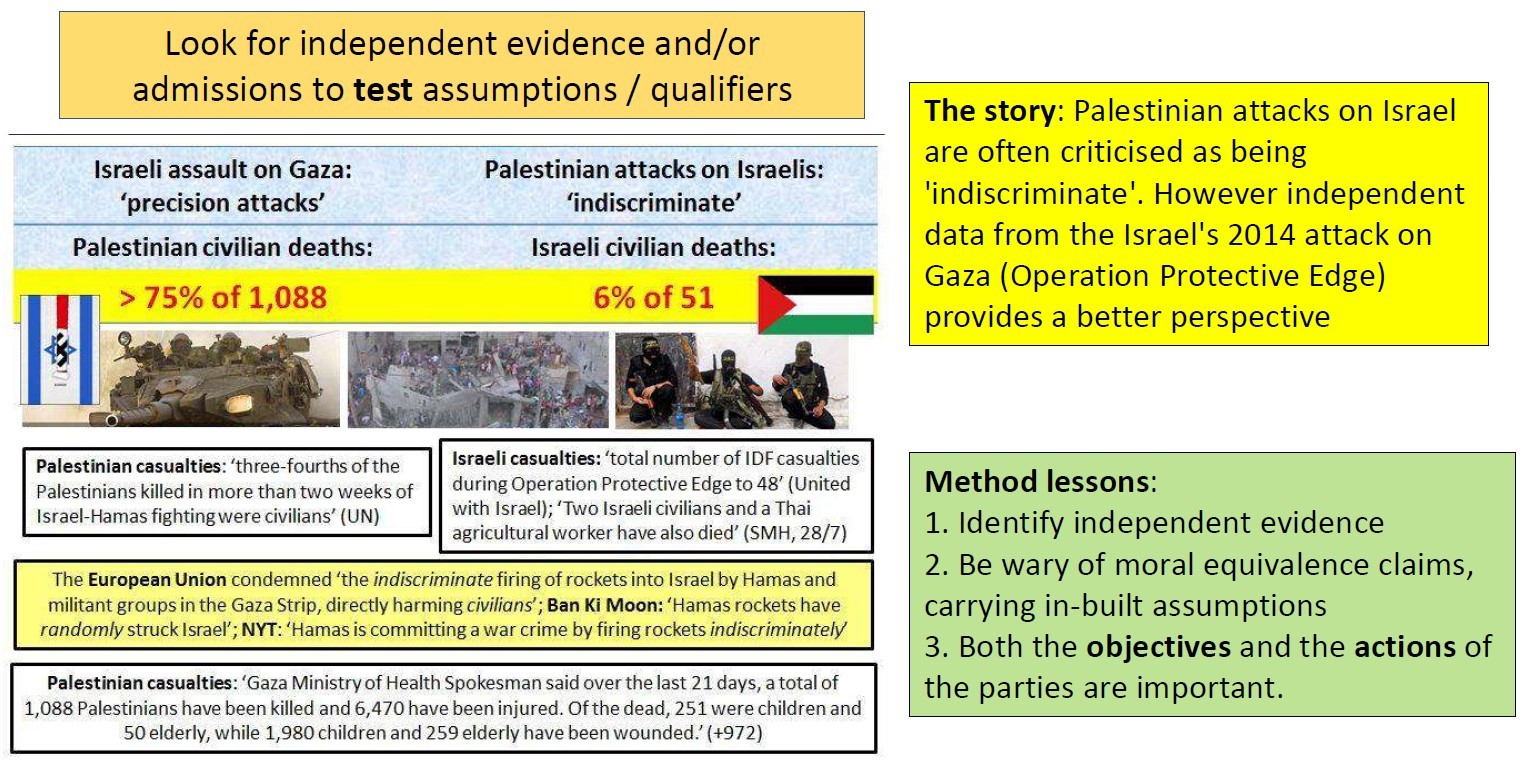
40 The Fifth Comments were constituted by Dr Anderson posting the Gaza Graphic and a comment on Facebook and Twitter.
41 In relation to the Third Comments, the plurality of the Full Court observed at [267] that it is the Israeli flag superimposed with the swastika which is the issue. The Full Court observed that “[e]verything else in the PowerPoint presentation involves the expression of a legitimate view, open to debate, about the relative morality of the actions of Israel and Palestinian people”. The plurality said:
[267] Consider the PowerPoint presentation in more detail. It is the Israeli flag superimposed with the swastika which is the issue. Everything else in the PowerPoint presentation involves the expression of a legitimate view, open to debate, about the relative morality of the actions of Israel and Palestinian people. Dr Anderson is making a public comment asserting that the concept of moral equivalence between Israel and Palestinian people who attack Israel is false, in part, because of an asserted higher number of deaths of civilian Palestinians in Gaza from purportedly “precision attacks” by Israel compared to an asserted far lower number of deaths of people in Israel from purportedly “indiscriminate” attacks by Palestinians. He is including Israel within a long history of colonial exploitation by one political entity over another weaker entity or people. It does not matter whether this comparison may be considered by some or many people to be offensive or insensitive or wrong. As discussed, offence and insensitivity cannot be relevant criteria for deciding if conduct does or does not constitute the exercise of the right of intellectual freedom in accordance with cll 315 and 317.
[268] What then of the swastika superimposed over the Israeli flag? That is deeply offensive and insensitive to Jewish people and to Israel. It may involve an assertion of the very kind of false moral equivalence (comparing Israel to Nazi Germany) against which Dr Anderson is advocating in the PowerPoint presentation. Again, however, the relevant issue cannot be the level of offence which the conduct generates or the insensitivity which it involves. The issue is only whether the conduct involves the exercise of the right of intellectual freedom in accordance with cll 315 and 317. Whether this part of the PowerPoint presentation operates to take the otherwise legitimate expressions of intellectual freedom elsewhere in the PowerPoint presentation outside of the scope of cll 315 and 317 is a question of fact which must be determined on the whole of the evidence. For example, did the evidence support an inference that the superimposition of the swastika over the flag of Israel was a form of racial vilification intended to incite hatred of Jewish people? That is a matter which may only be determined on the whole of the evidence as part of the remittal of the matter.
[269] Accordingly, the primary judge was required to decide, as a matter of objective fact by reference to the evidence of all the relevant circumstances, whether each or any of the instances of Dr Anderson’s impugned conduct (excluding the lunch photo) constituted an exercise of the right of intellectual freedom in accordance with cll 315-317 of the 2018 agreement (or, if applicable, the equivalent provisions of the 2013 agreement). This included consideration of whether the conduct did or did not involve harassment, vilification or intimidation or the upholding of the principle and practice of intellectual freedom in accordance with the highest ethical, professional and legal standards.
42 The Gaza Graphic is a later iteration of an infographic first prepared in 2015 and referred to by Dr Anderson as the “Gaza Casualties Graphic” or “Gaza Casualties infographic”. In his affidavit (which was limited to his state of mind), Dr Anderson stated:
In 2015, I prepared an info-graphic which I refer to as the Gaza Casualties Graphic to promote public education about the events in Gaza. When I prepared the first version of this Gaza Casualties Graphic in 2015, I used the heading “Double-speak in Gaza”. As I outline below, I subsequently used a second version of this Graphic with a different heading in 2018.
The Gaza Casualties Graphic is intended to be read as a comparison of casualties from the Israeli assault on the Gaza Strip in July-August 2014 (Operation Protective Edge), and those from Palestinian attacks on Israel. Its purpose is to demonstrate the relative civilian casualties from both sides, in context of a public debate about supposedly ‘precise’ and ‘indiscriminate’ violence.
The comparison is achieved through identifying (in the yellow box) statistics relating to the deaths. In compiling the statistics, to determine the number of Palestinian civilian deaths, I referred to relatively independent sources (the United Nations and the Gaza Ministry of Health). Those are cited on the Gaza Graphic. To determine the number of Israeli civilian deaths, I used ‘against interest’ sources (Israeli sources for IDF).
Accompanying the statistics is a figure for the proportion of Palestinian civilian casualties next to the Israeli flag, and a figure for the proportion of Israeli civilian casualties next to the Palestinian flag. The flags are adjusted vertical and horizontal simply to fit into the background graphics. The Israeli flag is altered, and, on very close examination, a partial swastika can be seen superimposed over a part of the Israeli flag.
I borrowed all five background graphics for my composite graphic. I do not recall the origin of any of them.
…
In the first version of my Gaza Casualties Graphic I used this altered Israeli flag to highlight the comparison between the Israeli Defence Forces (IDF) 2014 attack on Gaza and the racialised violence of Nazi Germany. The graphic associates with the data showing that more than one thousand Palestinians were killed by the IDF, and at least 75% of them were identified by the United Nations as civilians.
The altered flag was an evocative image consistent with my published view that Zionist racial ideology and racialised violence (as demonstrated by the information on this graphic) was reminiscent of the murderous, racialised pogroms of Nazi Germany.
One fragment of the Gaza Casualties Graphic cannot be read out of context. There are a number of parallels that can be made between the two states of Nazi Germany and Israel. In international popular debate (including that in Israel) there are regular comparisons between Israeli racial violence and that of Nazi Germany. The point of that is to stimulate the conscience of those who use the genocide committed by the Nazis in attempts to justify the racism, ethnic cleansing and apartheid in Palestine...
Continuing the description of the Gaza Graphic, underneath the yellow box are three images, of an Israeli tank, the destruction of buildings and of Palestinian resistance fighters. Underneath these images are two text boxes, each providing further detail of the comparison of civilian deaths in each Palestine and Israel.
Underneath that are two further text boxes, each containing further statements, from various identified sources regarding the assaults. These compared the evidence in statistical form against public characterisations of the violence. The point I was making was that, contrary to many public statements, the Palestinian armed resistance had been far more discriminate (and overall less damaging) than the Israeli assault.
I believe that comparisons of, and pointing to parallels between, fascist systems is a legitimate matter, both for public debate and for discussion at public universities. This comparison has been made frequently, over many decades, including by prominent Jewish figures including Albert Einstein and Hanna Arendt. (See Fred Jerome (2009) Einstein on Israel and Zionism. Einstein and Hannah Arendt in 1948 protested the visit to the USA of Menachem Begin. They regarded his Freedom Party (Herut, the predecessor to the current ruling Likud Party) as “closely akin in its organization, methods, political philosophy and social appeal to the Nazi and Fascist parties. It was formed out of the membership and following of the former lrgun Zvai Leumi, a terrorist, right-wing, chauvinist organization in Palestine” (Einstein, Arendt and 26 others, Letter to the New York Times, 4 Dec 1948, p.213).
I posted the first version of the Gaza Casualties Graphic online sometime in 2015, but I no longer have any record of where or when.
43 In cross-examination, Dr Anderson stated that he found the image of the Israeli flag when looking for images which he could use in relation to what he described as “the massacre in Gaza in 2014” in order to “give some illustration to the words that I was putting into the graphic”.
44 In 2018, Dr Anderson decided to introduce a “method component” called ‘Reading Controversies’ into his course. He stated in his affidavit (in a passage which was admitted only as evidence of his state of mind):
The idea was to introduce students to ways in which they could decipher propaganda storms and select more reliable information; that is, to ‘read’ controversies with more discerning eyes. The techniques had to do with reading both sides, identifying the more independent sources, including ‘admissions against interest’ and discounting both ‘self-serving’ statements and facile ‘moral equivalence’ assertions. In May 2018, I taught both of my units of study this concept using Venezuela as an example.
45 On 21 April 2018, he delivered a presentation at a ‘Reading Controversies’ seminar advertised to students of his class, but which the public could also attend. The Gaza Graphic was used in this seminar. He described this in his affidavit as “version two” of the Gaza Casualties infographic, stating (this evidence being limited to his state of mind):
In those slides is version two of my Gaza Casualties infographic. In this version the original graphic has been shrunk down to allow the addition of text boxes above and to the right. Those boxes outline the story and make several methodological points. The header is: “Look for independent evidence and/or admissions to test assumptions/qualifiers” while at the side I have added: “1. Identify independent evidence, 2. Be wary of moral equivalence claims, carrying built-in assumptions, 3. Both the objectives and the actions of the parties are important.”
These additional text boxes were inserted to make explicit some of the methodological concerns expressed in paragraph 21, above.
With the overall Gaza Graphic reduced in size as a result of the additional text boxes, all images including altered Israeli flag became even smaller. The partial image of a swastika had become barely visible and not central to the meaning of the graphic, so I forgot about it.
…
The import of the slide is in its presentation of evidence on the relative casualties in Gaza, and discussion of how to find independent evidence in such controversies. Had I noticed, at that time, the background partial swastika, I would still have left it there, as it is a fitting graphical comment on the behaviour of the Israeli military in that circumstance.
While some may feel offended by Nazi-Zionist analogies, I say the inclusion of the analogy in that graphic was appropriate. The purpose of the slide was to encourage critical analysis. Racial ideology linked to racial massacres suggest comparisons with fascist regimes. I developed the analogy further, as regards racial ideology in my 2018 research paper ‘The Future of Palestine’, now a chapter in my 2019 book ‘Axis of Resistance’.
At the time of the delivering the seminar, the slide was displayed as I spoke to the slide. No student raised any issue with the slide during the seminar.
46 As noted earlier, the slides were posted by Dr Anderson to his Facebook Account on 23 April 2018. Dr Anderson later discovered that a person had made a complaint to the University about the slide.
47 When cross-examined in relation to the Israeli flag, Dr Anderson pointed out that it was only part of an infographic and that it should not be taken out of context. Dr Anderson stated:
You are characterising my graphic in a very inappropriate and fragmented way. You’re not recognising what the graphic is about.
…
My graphic is about the casualties in Gaza, and as I’ve explained to you, the background images to that graphic and the meaning of the graphic were a collection of different fragments that I found while looking on the internet.
…
[Y]ou are mischaracterising my graphic. The graphic is about Gaza casualties, and I wonder why you refuse to acknowledge that.
…
If you refuse to acknowledge the context of my graphic, then you’re not understanding the graphic.
48 It was submitted for Dr Anderson, and I accept, that Dr Anderson created the graphic for an academic purpose. Further, and with specific reference to what the plurality of the Full Court has stated at [268], I do not draw an inference “that the superimposition of the swastika over the flag of Israel was a form of racial vilification intended to incite hatred of Jewish people”.
49 In terms of what the plurality of the Full Court has stated at [267] and [269], whilst I consider that the Third Comments would be offensive to many people, in the context in which the Israeli flag superimposed with the swastika was used, I do not consider that its use involved “harassment, vilification or intimidation”. In this assessment, it is necessary to consider the matter in the context which existed at the time of publication and not by reference to later events, including the escalation in the dispute between Dr Anderson and the University. The University did not establish any breach of any standard which might have engaged cl 317 of the 2018 Agreement.
50 I accept that the use and publication of the PowerPoint was an exercise of intellectual freedom and that the inclusion of the image on the Gaza Graphic slide did not take it out of the protection of cll 315 or 317 of the 2018 Agreement.
51 The Fifth Comments concern the re-posting of the slides on 20 October 2018. Dr Anderson’s evidence was that he made the Fifth Comments “[b]y way of asserting my right to freedom of political and intellectual freedom, and to once again make use of a teaching aid of which I was, and remain, quite proud”. He said further that he re-posted the graphic “to reassert [his] right to use [his] own educational material, in public” and that he “intended this as an assertion of [his] intellectual freedom”. Dr Anderson denied that he decided he would post a “deliberately controversial and offensive post”. He said that he “was preparing a letter in response to reject [Professor Garton’s] criticisms of [the] image, and [he] posted it again”.
52 I have set out earlier what the plurality stated at [266]. It is repeated for convenience:
[I]f: (a) an exercise of intellectual freedom in accordance with cll 315 and 317 cannot be misconduct at all (which is the case), and (b) posting the PowerPoint presentation initially was an exercise of that right in accordance with cll 315 and 317 (an issue of fact the Court must determine for itself on the remittal), then:
(1) Dr Anderson would be acting lawfully in wanting to “express his view that he had a right to post material of that kind if he wished” and would be right to insist he had the right to do so “without censure”. His self-described “assertion of my intellectual freedom” would be lawful. Contrary to J [256], these factors would not indicate that the conduct was not an exercise of the right of intellectual freedom;
(2) also contrary to J [256], it was not necessary for Dr Anderson to prove or explain what course he was teaching at the time that made it relevant to re-post the PowerPoint presentation. The right of intellectual freedom is not confined to public comments about the content of courses being taught or taught at the time of the public comment; and
(3) if Dr Anderson intended the re-posting of the PowerPoint presentation to be “an assertion of an unfettered right to exercise what he considered to be intellectual freedom” and was being “deliberately provocative” in conveying that Dr Anderson “could post such material if he wanted and the University had no right or entitlement to prevent him from doing so”, he would have been correct and entitled to make that point to the University by the re-posting of the material.
53 Given that (a) and (b) in the chapeau of [266] are both satisfied, it necessarily follows that the conclusions of the plurality in (1), (2) and (3) are applicable and that Dr Anderson was acting lawfully when he re-posted the Gaza Graphic as a means of asserting his right to intellectual freedom. The University did not establish any breach by Dr Anderson of a standard which might engage cl 317 of the 2018 Agreement.
THE FIRST WARNING
54 The next question is whether the University imposed the First Warning on Dr Anderson in whole or in part based on any conduct which constituted the exercise of the right to intellectual freedom in accordance with cll 254 to 256 of the 2013 Agreement (cll 315 to 317 of the 2018 Agreement).
55 As Dr Anderson submitted, the First Warning was imposed after the University substantiated the allegations in paragraphs (a) and (b) of the letter of 30 May 2017 (in relation to particulars 1-8), the allegations in paragraph (a)-(f) of the letter dated 26 June 2017 and concluded that Dr Anderson’s conduct constituted “misconduct” within the meaning of the 2013 Agreement. The conduct giving rise to the substantiated allegations on which the First Warning was based was:
(a) as to the letter of 30 May 2017, the conduct described in paragraphs [17]-[20] of the Primary Judgment (being the First Comments); and
(b) as to the letter of 26 June 2017, the conduct described in paragraph [32] of the Primary Judgment:
(i) the publication of posts on 30 May 2017 (being the Second Comments);
(ii) the sending of an email dated 31 May 2017 to staff members in the Department of Political Economy faculty; and
(iii) the sending of an email dated 6 June 2021 to Professor Jagose.
56 The First Comments and the Second Comments each constituted the exercise of intellectual freedom. It follows that the First Warning was imposed in part because Dr Anderson exercised his right to intellectual freedom within the meaning of cl 254 of the 2013 Agreement.
57 It also follows that the First Warning was imposed in breach of cl 254 of the 2013 Agreement and that the University thereby contravened s 50 of the Fair Work Act 2009 (Cth) (FW Act).
THE FINAL WARNING
58 The next question is whether the University imposed the Final Warning on Dr Anderson in whole or in part based on any conduct which constituted the exercise of the right to intellectual freedom in accordance with cll 254-256 of the 2013 Agreement or cll 315-317 of the 2018 Agreement.
59 As Dr Anderson submitted, the Final Warning was imposed after the University substantiated allegations 2, 3, 4, 6 and 7 (in whole) and allegation 5 (in part) of the letter dated 10 August 2018. The conduct giving rise to the substantiated allegations on which the Final Warning was based was:
(a) the publication of the Lunch Photo;
(b) posts by Dr Anderson on his Facebook and Twitter accounts on 2 and 3 August 2018 (being the Fourth Comments); and
(c) Dr Anderson’s refusal to take down the Lunch Photo and the Fourth Comments.
60 The Fourth Comments constituted the exercise of intellectual freedom. It follows that the Final Warning was imposed in part because Dr Anderson exercised his right to intellectual freedom within the meaning of cl 315 of the 2018 Agreement.
61 Further, as Dr Anderson submitted, the Final Warning was imposed in part by reason of the First Warning. This is made apparent from the terms of the letter of 2 August 2017, in which Dr Anderson was notified of the decision to impose the Final Warning. This letter made it clear that the author (Professor Garton) was concerned “that you have repeated conduct in respect of which you received a formal warning”. I accept that the Final Warning was imposed in part because of the First Warning, being a warning imposed in contravention of cl 254 of the 2013 Agreement.
62 It follows that the Final Warning was imposed in breach of cl 254 of the 2013 Agreement and cl 315 of the 2018 Agreement and that the University thereby contravened s 50 of the FW Act.
TERMINATION OF EMPLOYMENT
63 On 26 October 2018, the University sent to Dr Anderson a letter with the subject line “Further Allegations Relating to Your Conduct”. The letter contained allegations that publication of the 19 or 20 October 2018 Facebook and Twitter posts might constitute misconduct. The letter included (bolding in original):
Further Allegations
I have now been made aware of fresh allegations of misconduct by you which again relate to your social media activity and which involve the republication by you of the altered Israeli flag image (Further Allegations).
Given the serious nature of the Further Allegations, I have determined to deal with them under clause 384(c) of the Enterprise Agreement.
The Further Allegations are as follows:
(a) on 19 October 2018 at 4:57PM, you published or caused to be published on your Twitter account (Post #1 in Annexure B), a photo depicting the altered image of the Israeli flag, along with the text “Revision: how to read the colonial media, and untangle false claims of ‘moral equivalence’. The colonial violence of #Apartheid #Israel neither morally nor proportionately equates with the resistance of #Palestine.” (Twitter Post);
(b) the content of the Twitter Post was also posted on 20 October 2018 at 10:55AM on your Facebook account (Post #2 in Annexure B) (Facebook Post);
(c) you posted as a comment to the Facebook Post at 11:02AM stating “On the future of Palestine. https://counter-hegemonic-studies.net/future-palestine-1/”, which included a hyperlink to the Centre for Counter Hegemonic Studies website;
(d) the Facebook Post and the Twitter Post (due to the fact it included the altered image of the Israeli flag) are derogatory and/or offensive in nature;
(e) the altered image of the Israeli flag included in the Facebook Post and the Twitter [Post] can be reasonably seen as racist towards or seeking to target and/or offend Israelis and/or Jewish people and/or Jewish victims of the Nazi regime;
(f) there is no legitimate academic or intellectual purpose served by the inclusion of the altered image of the Israeli flag in the Facebook Post or the Twitter Post;
(g) you were aware or should reasonably have been aware that the inclusion of the altered image of the Israeli flag in the Facebook Post and the Twitter Post was offensive; and
(h) the making of the Facebook Post and Twitter Post with the inclusion of the altered image of the Israeli flag was a deliberate and direct contravention by you of the final warning issued to you on 19 October 2018.
64 The letter informed Dr Anderson that the further allegations, if substantiated, would amount to “serious misconduct” and may justify the termination of Dr Anderson’s employment. Dr Anderson was invited to respond.
65 On 27 October 2018, Dr Anderson sent to Professor Garton and others an email which concluded by stating that he did not intend to respond.
66 A letter from the University, signed by Professor Garton and dated 3 December 2018, explained that the University was satisfied that Dr Anderson’s conduct amounted to “serious misconduct” as defined. It is the conduct set out at (a) to (c) of the Further Allegations in the letter dated 26 October 2018 which was of principal concern. The matters in (a) and (b) comprise the Fifth Comments. In considering what disciplinary action to take, the University also took into account the First Warning and the Final Warning. The letter of 3 December 2018 included:
I am proposing that the appropriate Disciplinary Action is the termination of your employment with the University due to your Serious Misconduct, particularly in the context of previous warnings issued on 2 August 2017 and 19 October 2018 in respect of similar conduct.
67 Each of the First, Second, Third, Fourth and Fifth Comments constituted the exercise of intellectual freedom. It follows that the termination was imposed in part because Dr Anderson exercised his right to intellectual freedom within the meaning of cl 254 of the 2013 Agreement and cl 315 of the 2018 Agreement. It also follows that the University imposed the termination in breach of its duty under cl 315 of the 2018 Agreement and thereby contravened s 50 of the FW Act.
SERIOUS MISCONDUCT
68 The University concluded that Dr Anderson had engaged in serious misconduct because of the Fifth Comments. It imposed the disciplinary sanction of termination of employment because of that serious misconduct. The Fifth Comments were the exercise of intellectual freedom and therefore could not have constituted serious misconduct. It follows that the University terminated Dr Anderson’s employment in breach of cl 384 of the 2018 Agreement and thereby contravened s 50 of the FW Act.
PROFESSOR GARTON
69 The final issue is whether Professor Garton is liable for the contraventions as an accessory.
70 Professor Garton knew that the enterprise agreement existed. He knew that it applied to Dr Anderson. He made the decisions to issue the First Warning and the Final Warning and he recommended termination of Dr Anderson’s employment.
71 Professor Garton did not act otherwise than honestly and in accordance with his genuinely held view as to the meaning and operation of the 2013 and 2018 Agreements. Nevertheless, Professor Garton had knowledge of all of the essential facts and intentionally participated in the events which gave rise to the contraventions. It is not essential to being an accessory that the accessory know that the relevant events amount to a contravention. Accessorial liability in this context does not depend upon conscious wrongdoing.
72 Professor Garton was “involved in” in the University’s contraventions of s 50 of the FW Act within the meaning of s 550(2) of the FW Act because he was “knowingly concerned” in the contraventions.
73 Professor Garton is thereby taken to have contravened s 50 of the FW Act: s 550(1) of the FW Act.
CONCLUSION
74 The parties should confer with a view to agreeing within 7 days appropriate orders to give effect to these reasons and as to the further conduct of the matter.
I certify that the preceding seventy-four (74) numbered paragraphs are a true copy of the Reasons for Judgment of the Honourable Justice Thawley. |
Associate:


