

FEDERAL COURT OF AUSTRALIA
Australian Securities and Investments Commission v Commonwealth Bank of Australia [2022] FCA 1149
ORDERS
AUSTRALIAN SECURITIES AND INVESTMENTS COMMISSION Plaintiff | ||
AND: | COMMONWEALTH BANK OF AUSTRALIA (ACN 123 123 124) First Defendant COLONIAL FIRST STATE INVESTMENTS LTD (ACN 002 348 352) Second Defendant | |
DATE OF ORDER: |
THE COURT ORDERS THAT:
1. The proceeding be dismissed.
2. The Plaintiff will pay the First and Second Defendants’ costs.
Note: Entry of orders is dealt with in Rule 39.32 of the Federal Court Rules 2011.
REASONS FOR JUDGMENT
ANDERSON J:
1 This proceeding concerns the application of the “conflicted remuneration” provisions found in ss 963A, 963E, 963L and 963K of the Corporations Act 2001 (Cth) (Act) to certain alleged “benefits” provided by the Second Defendant, Colonial First State Investments Limited (CFSIL) to the First Defendant, Commonwealth Bank of Australia (CBA) relating to the distribution of CBA’s “MySuper” superannuation product, called Essential Super (Essential Super)..
2 In broad terms, the Plaintiff, Australian Securities and Investments Commission (ASIC) alleges that, during the period 1 July 2013 to 30 June 2019 (Relevant Period), CFSIL gave, and CBA accepted, monetary and/or non-monetary benefits which could reasonably be expected to influence financial product advice provided by CBA to its retail clients in relation to Essential Super. These benefits are said to comprise:
(a) choses in action pursuant to certain written agreements CBA and CFSIL entered into with respect to Essential Super distribution agreements (the Promises);
(b) cash transfers from CFSIL to CBA (the Cash Transfers);
(c) journal entries, totalling $55,723,946.65 in respect of Essential Super in the management accounts of the CBA Group (the Journal Entries);
(each an Impugned Benefit, and collectively, Impugned Benefits).
3 ASIC alleges that CBA contravened the prohibition against a financial services licensee accepting conflicted remuneration pursuant to s 963E of the Act. ASIC further alleges that CFSIL breached the prohibition on product issuers or sellers giving conflicted remuneration pursuant to s 963K of the Act.
4 CFSIL is a wholly owned subsidiary of CBA and is an entity within the Commonwealth Bank of Australia group (CBA Group).
5 ASIC relies on the same facts and circumstances to establish its case against CBA and CFSIL.
6 At trial, CFSIL relied upon the evidence tendered by CBA and adopted the submissions advanced by CBA, but made additional submissions on the proper construction of the conflicted remuneration provisions.
7 ASIC’s case may be summarised as follows.
8 CFSIL was the issuer of Essential Super, which was launched for distribution in the retail bank branches and online channels of CBA on 1 July 2013.
9 CBA and CFSIL entered into a written agreement on 27 June 2013 (2013 Distribution Agreement) with respect to Essential Super, for an initial five year term. Under the 2013 Distribution Agreement, CBA was obliged to provide services to CFSIL; and in return CBA was entitled to a payment of 30% of the total net revenue derived by CFSIL from Essential Super in each financial year. ASIC alleges that CBA and CFSIL subsequently entered into two further written agreements, one on 2 June 2015 (2015 Distribution Agreement) and another on 26 February 2018 (2018 Distribution Agreement) (collectively, Distribution Agreements). The Promises consisted of this arrangement to pay 30% of the total net revenue of the Essential Super Fund to CBA in consideration for the services CBA was providing under the Distribution Agreements.
10 ASIC alleges that from 1 July 2013 to 8 October 2017, Essential Super was sold in CBA retail branches to individuals and small business employers as a default fund for employees who did not choose a superannuation fund. CBA trained its retail branch staff to sell Essential Super in accordance with ASIC’s Regulatory Guide: “RG146 Licensing: Training of financial product advisers”. ASIC alleges that staff who had completed the training were authorised to provide general advice to customers about Essential Super. Staff who were not authorised to provide such advice were not permitted to sell Essential Super, but were trained to do a “warm handover” to authorised staff of customers that were potentially interested in Essential Super.
11 ASIC alleges that from 1 July 2013 to 3 July 2018, Essential Super was also available to individuals and small business employers via an online application process established by CBA. In addition, between September 2014 and August 2016, a number of individuals became members of Essential Super due to the transfer of “accrued default amounts” from the Colonial First State FirstChoice Superannuation Trust to Essential Super.
12 ASIC alleges that CFSIL derived revenue from Essential Super once an Essential Super account was opened and funds were placed in it (Funded Essential Super Accounts). The revenue comprised three elements:
(a) a fixed monthly member fee;
(b) a management/administration fee based on a percentage of funds under management; and
(c) an insurance administration fee calculated as 7.5% of premiums for insurance held by members through Essential Super.
13 ASIC alleges that the Cash Transfers, which comprised nine cash payments totalling $22,767,481.61, were made by CFSIL to CBA with respect to Essential Super, with the first payment being made on 31 July 2014 and the remainder in the 2019 financial year. In addition, the Journal Entries, which comprised 26 journal entries totalling $55,723,946.65, were posted in the CBA general ledger with respect to Essential Super in each of the 2014 to 2019 financial years.
14 ASIC alleges that, through these arrangements and resulting payments and journal entries, CFSIL gave, and CBA accepted, conflicted remuneration in contravention of the prohibitions within Division 4 of Part 7.7A of the Act.
15 CBA denies that it breached the conflicted remuneration prohibition in the Act. CBA’s defence to ASIC’s allegations may be summarised as follows.
16 CBA contends that the central issue in dispute in these proceedings is whether the nature of the alleged Impugned Benefits, and the circumstances in which they arose, could reasonably have been expected to influence either the choice of financial product recommended by CBA to its customers or the financial product advice that CBA gave to its customers.
17 CBA contends that the context and relevant circumstances in which the alleged Impugned Benefits arose are of critical importance, and include the following.
18 In 2000, CBA acquired Colonial Limited, the parent company of CFSIL, for substantial consideration in the order of $9.274 billion.
19 A significant purpose of that acquisition was to combine the capability, skill and strength of CFSIL in manufacturing and managing superannuation fund products and the ability of CBA to use its existing distribution network to distribute such products.
20 In 2012, the Commonwealth Parliament, through the introduction of “Stronger Super” legislative reforms (MySuper Reforms) created a market for a new, simple superannuation product in the form of MySuper that would apply with legislative force to around 60% of superannuation fund members.
21 CFSIL had the skill and capability to manufacture a MySuper product that would comply with the legislative requirements and be of benefit to the customers of CBA.
22 At all relevant times, Essential Super was the only CBA-branded MySuper Product that CFSIL manufactured and the only such product that CBA distributed.
23 Competitors of the CBA Group were also distributing MySuper products, including products those competitors had manufactured.
24 At all relevant times, the Impugned Benefits were not known to those who were distributing Essential Super.
25 When confronted with the legislative requirement and commercial opportunity to manufacture and distribute a MySuper product, CBA took the view that it was imperative that the CBA Group develop and produce such a product. The Retail Banking Services (RBS) and Wealth Management business units (Wealth Management) of CBA agreed to jointly develop the Essential Super product, which was to be manufactured by the entity within the CBA Group capable of doing so, being CFSIL. The Essential Super product was then distributed by the entity in the CBA Group best placed to do so, being CBA. Essential Super was endorsed by the Executive Committee of the CBA Group on 4 May 2012 on the basis that costs incurred and revenue earned would be shared between the two business units/legal entities on an appropriate basis.
26 CBA contends that against this background, the alleged “Impugned Benefits” were, in truth, no more than standard intragroup accounting allocations to support or reflect a sharing of costs and revenues between the two business units and the two associated legal entities that were responsible for the MySuper product.
27 CBA contends that from these circumstances alone, it follows that the nature of the Impugned Benefits and the circumstances in which they arose, when objectively assessed, do not amount to a benefit that could reasonably be expected to influence the choice of financial product or the content of financial advice for the purposes of the conflicted remuneration provisions.
28 CBA contends that from a financial and accounting perspective for the CBA Group, any purported transfer of value by virtue of the Impugned Benefits was irrelevant. This is because, upon consolidation of the accounts, those transfers “cancel out”. Further, due to the operation of the dividend distribution policy of the CBA Group, any value that would otherwise have been retained by CFSIL in respect of Essential Super, would have flowed through to CBA in any event through the distribution of dividends. Both of those factors, in CBA’s submission, demonstrate the illusory nature of the alleged “influence” of the Impugned Benefits as any value realised from the Essential Super product would have ultimately flowed to CBA in any event.
29 CBA contends that there are other aspects of the Impugned Benefits which are problematic for ASIC’s case:
(a) the quantum of those Impugned Benefits did not take into account all of the expenses incurred by CBA in developing and distributing the Essential Super product;
(b) the quantum of those Impugned Benefits was de minimis to CBA;
(c) the details of the Impugned Benefits were not known to staff authorised to sell the Essential Super product and therefore could not influence the financial product advice or choice of product; and
(d) the fact that the detail of the financial arrangements, including the way in which they changed over time, were overlooked for a significant period - demonstrates that these arrangements were incapable of influencing CBA to behave in any particular way.
30 In these circumstances, CBA submits that it is difficult to conceive how the Impugned Benefits and the circumstances in which they arose could have reasonably influenced any choice of financial product recommended by CBA’s authorised staff, or any financial product advice they gave for the purposes of s 963A of the Act.
31 CFSIL denies that it breached the conflicted remuneration prohibition in the Act.
32 CFSIL relies on the submissions of CBA, and in doing so, contends that the alleged Impugned Benefits relied upon by ASIC in this proceeding, are not “conflicted remuneration” for the purposes of s 963A of the Act and CFSIL has not contravened the prohibition in s 936K of the Act.
33 The critical issues in dispute in the proceeding are:
(1) the meaning of “conflicted remuneration” for the purposes of s 963A of the Act;
(2) whether the nature of the alleged Impugned Benefits, and the circumstances in which they were provided, could reasonably have been expected to influence either the choice of financial product recommended by CBA to its customers or the financial product advice that CBA gave its customers; and
(3) whether CBA and CFSIL can rely upon the “grandfathering exception” provided for by s 1528 of the Act.
34 The parties filed a joint statement of agreed facts and issues in dispute (SAFID) dated 29 October 2020.
35 The development of Essential Super is largely uncontested and is set out in the SAFID. It can be summarised as follows.
36 In or around April 2011, the CBA Group commenced developing a superannuation product (originally called Simple Super). This superannuation product would be compliant with the proposed MySuper Reforms, would capture superannuation guarantee contributions and would consolidate superannuation from other funds.
37 The CBA Group, comprising CBA and its wholly owned subsidiaries, is divided into legal entities and business units. Throughout the Relevant Period:
(a) RBS was a business unit that provided home loan, consumer finance and retail deposit products and services to all retail bank customers; and
(b) Wealth Management was a business unit that provided superannuation, investment, retirement and insurance products and services including financial planning.
38 At all material times, CBA was, and still is, the holder of Australian Financial Services Licence number 234945.
39 From in or around 2010, RBS and Wealth Management began work on a joint initiative to develop a superannuation product to be sold online and in branches, targeting personal and small business customers. The project was targeted to launch on 1 July 2013, in line with the MySuper regulations commencing on that date.
40 In 2012, the Australian Parliament passed the MySuper Reforms. MySuper products were designed to be a new, simple and cost-effective way of providing default superannuation products for the accumulation phase of superannuation which was designed for members who do not necessarily actively engage with their superannuation.
41 MySuper products are tightly regulated. They involve a requirement to obtain authorisation from APRA before a trustee of a superannuation fund can offer a MySuper product, restrictions on the types of fees that can be charged and investment options limited to either a single diversified option or a life cycle option. All MySuper products must contain life and total permanent disability insurance on an opt-out basis. No commission can be paid on MySuper products from funds in member accounts. Superannuation trustees are generally only permitted to offer one MySuper product in a fund.
42 From 1 January 2014, employers’ superannuation guarantee contributions for employees who had not made a choice of fund could only be directed to a fund that offered a MySuper product. Trustees of superannuation funds were required to transfer default amounts accrued prior to 1 January 2014 (“accrued default amounts” or “ADAs”) to a MySuper product before 30 June 2017.
43 On or around 3 June 2011, the CBA Group Executive Committee were presented with a paper entitled “Commonwealth Simple Superannuation – Business Case” (Business Case). The Business Case outlined the rationale for launching a MySuper compliant product on the basis that the CBA Group’s competitors had launched, or were expected to launch comparable simple superannuation products in late 2011 and 2012. The Business Case records that it is a joint initiative of Wealth Management and RBS and that the product will be sold online and in branch targeting personal and small business customers with simple needs.
44 By 2012, competitors in the market had developed, or were in the process of developing, MySuper compliant products to bring to market.
45 On or around 4 May 2012, the Business Case was presented to the CBA Group Executive Committee. As set out in the SAFID at [21], the Business Case recognised:
(a) the business need for the CBA Group to launch a MySuper product to remain competitive in the superannuation market and in time for the commencement of the MySuper regulations;
(b) that a joint initiative between Wealth Management and RBS was the most efficient and effective way for the CBA Group to develop a MySuper product. The plan leveraged the technical expertise in the field of superannuation that the CBA Group had acquired through its purchase of CFSIL in 2000, with RBS’s retail banking network;
(c) a division of responsibilities between RBS and CFSIL, with CFSIL to manufacture and administer the product, and RBS to distribute the product;
(d) a plan for “a 50% share of costs and benefits between RBS and CFS business units” so that revenue was allocated and attributed correctly in the CBA Group’s financial statements.
46 On 4 May 2012, the CBA Group Executive Committee endorsed the Business Case and requested that a methodology be developed for the sharing of costs and earnings between the relevant entities. Between 4 May 2012 and 1 July 2013, the joint development of the Simple Super product was undertaken. In October 2012, CBA and CFSIL chose “Essential Super” to be the name of the Simple Super product.
47 In late 2012, representatives of CBA and CFSIL commenced talks in relation to attribution of costs and revenue from Essential Super. On 27 June 2013, CBA and CFSIL entered into the 2013 Distribution Agreement for an initial 5 year term.
48 On 2 June 2015, representatives of CBA and CFSIL entered into the 2015 Distribution Agreement.
49 Between September and November 2017, representatives of CBA and CFSIL exchanged email correspondence concerning Essential Super. These emails dealt substantially with payments and deductions to be made between relevant business units within the CBA Group under the 2015 Distribution Agreement with respect to Essential Super.
50 On 23 February 2018, Linda Elkins, Executive General Manager, Colonial First State wrote a letter on behalf of CFSIL to Clive van Horen, Executive General Manager Retail Products, on behalf of CBA. That letter, titled “Letter of Variation” recorded the agreement between CBA and CFSIL to vary clauses of the 2015 Distribution Agreement.
51 On 28 February 2018, Clive van Horen executed the letter on behalf of CBA.
52 On 26 February 2018, Clive van Horen, on behalf of CBA and Linda Elkins, Director, and Bernadette Watts, Company Secretary, on behalf of CFSIL, executed the 2015 Distribution Agreement.
53 Clause 8(a) of the 2013 Distribution Agreement, 2015 Distribution Agreement and 2018 Distribution Agreement each provided that CFSIL was to pay CBA for services it performed with respect to Essential Super.
54 The invoicing procedure of the 2013 Distribution Agreement, 2015 Distribution Agreement and 2018 Distribution Agreement each provided that:
(a) at the end of each financial year, CFSIL was to determine the total net revenue for Essential Super for that financial year and advise CBA of the fee payable based on that total net revenue (Advice);
(b) on receipt of the Advice from CFSIL, CBA was to issue an invoice for the fees (Invoice).
55 Throughout the Relevant Period, CBA had over 1000 branches (Branches) throughout Australia that together formed its retail branch network (Branch Network).
56 Throughout the Relevant Period, CBA had digital assets including NetBank and CommBank, and after May 2016, CBA’s digital assets also included the CommBank App (Digital Channels). The Digital Channels were accessible online by the general public.
57 On and from 1 July 2013:
(a) until on or about 8 October 2017, CBA distributed Essential Super to individuals through its Branch Network (Branch Sales).
(b) until on or about 3 July 2018, CBA distributed Essential Super to individuals through its Digital Channels (Digital Sales).
(c) until on or about 3 July 2018, CBA distributed Essential Super to employers as a default fund for employees who did not make a choice of superannuation fund (Employer Sales).
58 As a result of Employer Sales, individuals became members of Essential Super (Employee Sales) when they:
(a) commenced employment with an Employer Sales member who had nominated Essential Super as the default fund for employees who did not make a choice of superannuation fund; and
(b) did not make a choice of superannuation fund for superannuation contributions by that employer.
59 During the Relevant Period, 390,400 individuals became members of Essential Super (excluding those members who never had funds in their Essential Super account), broken down by financial year as follows:
(a) 1 July 2013 to 30 June 2014: approximately 69,607;
(b) 1 July 2014 to 30 June 2015: approximately 70,141;
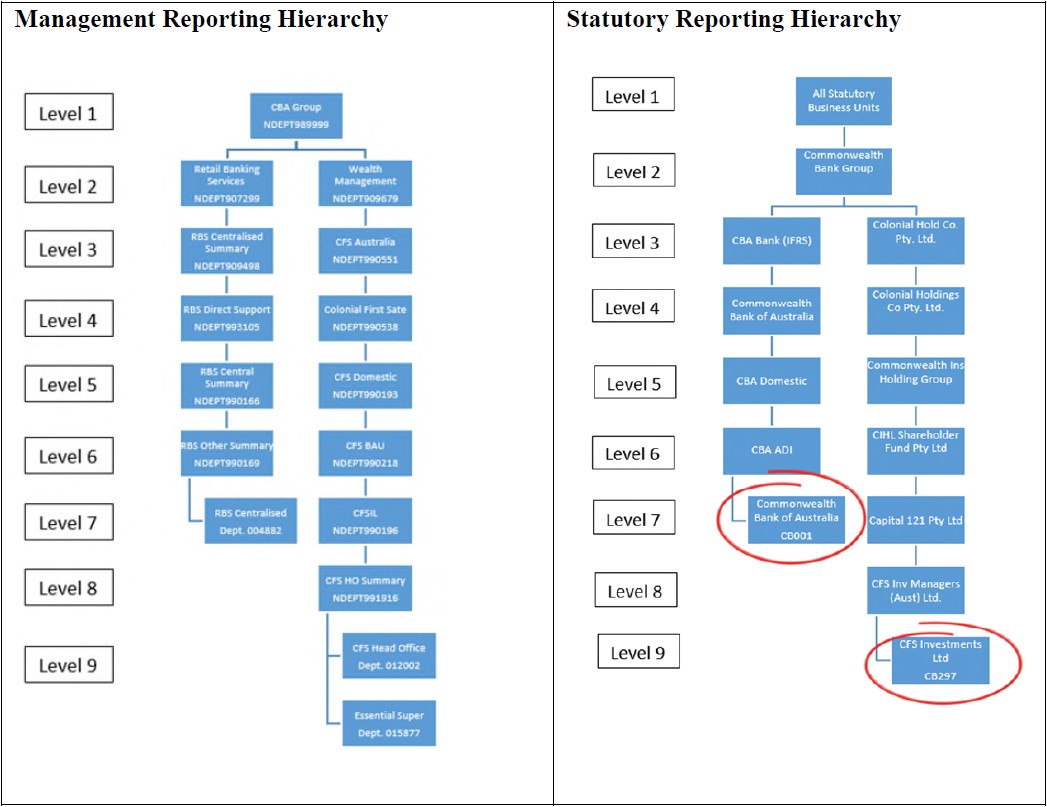
(c) 1 July 2015 to 30 June 2016: approximately 66,714;
(d) 1 July 2016 to 30 June 2017: approximately 112,617;
(e) 1 July 2017 to 30 June 2018: approximately 68,807; and
(f) 1 July 2018 to 30 June 2019: approximately 2,514.
60 Of the 390,400 individuals who became members of Essential Super during the Relevant Period:
(a) 191,364 individuals became members pursuant to Branch Sales;
(b) 135,499 individuals became members pursuant to Digital Sales;
(c) approximately 22,872 individuals became members pursuant to Employee Sales; and
(d) approximately 40,665 became members because they were members of the Colonial First State FirstChoice Superannuation Trust, had accrued default amounts in that fund and those accrued default amounts were transferred to the Commonwealth Essential Super fund between September 2014 and August 2016 (ADA Transfers).
61 Branch Sales involved a customer becoming a member of Essential Super as a result of:
(a) initiation of the Essential Super account opening process by a member (or members) of CBA’s staff in its “CommSee” system, within a Branch; and
(b) interactive completion of the application with the customer.
62 Where CommSee was unavailable a customer could lodge a paper application to become a member of Essential Super within a Branch.
63 During the Relevant Period, CBA staff who had completed the prescribed training and testing (Authorised Staff) were permitted to undertake the opening process of an Essential Super account for a customer.
64 During the Relevant Period, CBA staff who had not completed the prescribed training and testing (Non-Authorised Staff) could either perform a “warm handover” to Authorised Staff to assist a customer with opening an Essential Super account or could call the Essential Super call centre and assist a customer to become a member of Essential Super together with an Authorised Staff member in the call centre.
65 Between 1 July 2013 and 8 October 2017, CBA provided Non-Authorised Staff with approved scripts to use when discussing Essential Super with a customer or potential customer.
66 Between 1 July 2013 and 8 October 2017, the approved scripts could be accessed by branch staff. The scripts contained approved phrases including:
“Have you heard about Essential Super; it’s a superannuation fund, which can easily be viewed and managed in NetBank alongside a customer’s day to day banking”
“Essential Super is a simple superannuation fund, which can easily be viewed and managed in NetBank alongside a customer’s day to day banking.”
“Congratulations on your new job. If your employer pays super on your behalf, Essential Super issued by CFS is a simple and easy online account that accepts employer and personal contributions. I can't provide advice on this however let me introduce you to an accredited branch member who can help you?”
67 The text preceding the approved phrases provided that:
“Prepositioning Factual Information: I am not qualified to provide you advice about Essential Super, however let me introduce you to one of our Essential Super specialists (CSS) who can help you further.
…
Non-accredited staff should preposition Factual Information at the start of any interaction when discussing Essential Super.”
68 Between 1 July 2013 and 8 October 2017, branch staff were to follow standard operating procedures for Branch Sales.
69 From in or around June 2013 until 8 October 2017, Authorised Staff were trained by CBA to engage with a customer or potential customer, in respect of Essential Super, under a “general advice model”.
70 The training completed by Authorised Staff from in or around June 2013 until 8 October 2017 included various modules related to general advice pertaining to superannuation including:
(a) Superannuation fundamentals;
(b) Super investments;
(c) Employer contributions;
(d) Personal contributions; and
(e) Taxation and fees, among other things.
71 Between 1 July 2013 and 8 October 2017, CBA provided Authorised Staff with:
(a) a General Advice Warning approved script; and
(b) guides to use when introducing Essential Super to a customer or potential customer, including guides titled:
(i) “Start a Super Conversation”;
(ii) “Essential Super QRG”;
(iii) “How to discuss insurance or Essential Super with a customer”; and
(iv) “Essential Super Insurance: Common questions and suggested responses”.
72 On and from 1 July 2013 until on or around 3 July 2018, Employer Sales occurred:
(a) in Branches, where an employer was set up as a “standard employer sponsor” with respect to Essential Super in CBA’s “CommSee”; or
(b) digitally, where an employer set themselves up as a “standard employer sponsor” with respect to Essential Super by means of an online application via a Digital Channel.
73 Once an employer had been set up as a “standard employer sponsor” with respect to Essential Super, the employer was able to add employees as members of Essential Super:
(a) in a Branch; or
(b) by calling the Essential Super call centre; or
(c) via a Digital Channel.
74 With respect to Employer Sales in Branches, only Authorised Staff members were permitted to assist employer customers to be set up as a “sponsor” with respect to Essential Super in CBA’s “CommSee” system.
75 Throughout the Relevant Period, CBA provided an online application form for employers which stated:
Reasons for applying:
- To have a central depository for all your employees super details
- The ability to create a superannuation account for your employees.
Before you get started
- Please download and read the Essential Super Product Disclosure Statement (PDF 415KB) and Financial Services Guide (PDF 603.72KB).
Important information
- This application form provides general information only and is not financial advice
…
- This application form provides general information only and is not financial advice. It does not take into account your individual objectives, financial situation or needs.
... A Product Disclosure Statement (PDF 600KB) for Essential Super is available from commbank.com.au/super or by calling 13 40 74. You should read the PDS and assess whether the information is appropriate for you before making an investment decision.
76 On and from 1 July 2013 until on or about 3 July 2018, Digital Sales were completed by individuals completing an online application to open an Essential Super account via a Digital Channel.
77 The online application made available by CBA between 1 July 2013 and March 2015 contained details on how to apply for Essential Super, and required customers to update their personal details, select an investment option and select insurance options, among other things.
78 Further changes were made to the online application process until March 2018, but the key features were largely unchanged.
79 Individuals who became members of Essential Super as a result of ADA Transfers received a welcome pack from CBA which contained:
(a) a cover letter;
(b) an “Investment Confirmation” summarising the Essential Super account;
(c) a Product Disclosure Statement (PDS) for Essential Super;
(d) a “Super Choice” form to instruct the member’s employer to pay future contributions to Essential Super;
(e) a non-lapsing death benefit nomination form; and
(f) a booklet with information regarding NetBank and superannuation.
Essential Super transactions
80 RBS generated net profit after tax in the following amounts:
(a) $3,472 million in FY2013-14;
(b) $3,867 million in FY2014-15;
(c) $4,436 million in FY2015-16;
(d) $4,964 million in FY2016-17;
(e) $5,193 million in FY2017-18; and
(f) $4,234 million in FY2018-19.
81 The Cash Transfers, identified at [2] above, which CFSIL made to CBA are particularised as follows:
(a) $2,253,537.82 on or about 31 July 2014 for the 2014 financial year;
(b) $12,303,855.79 on or about 25 July 2018 for the 2018 financial year;
(c) $1,141,468.82 on or about 22 August 2018 for July 2018;
(d) $1,156,272.89 on or about 26 September 2018 for August 2018;
(e) $1,131,283.60 on or about 30 October 2018 for September 2018;
(f) $1,183,778.29 on or about 27 November 2018 for October 2018;
(g) $1,159,280.84 on or about 19 December 2018 for November 2018;
(h) $1,211,837.17 on or about 30 January 2019 for December 2018; and
(i) $1,226,166.87 on or about 29 March 2019 for January 2019;
82 The Cash Transfers made by CFSIL to CBA as outlined above, were in respect of Essential Super and were calculated in accordance with the methodology for calculating the fees in the 2018 Distribution Agreement.
83 The Journal Entries, identified at [2] above, which CFSIL and CBA made in respect of Essential Super were posted in the CBA general ledger (“CB001”) and can be particularised as follows:
(a) $2,253,537.82 on 30 June 2014 by journal entry #0002884878 for the 2014 financial year;
(b) $1,496,618.28 on 31 December 2014 by journal entry #0003107342 for the period from 1 July 2014 to 31 December 2014;
(c) $6,900,000 on 30 April 2016 by journal entry #0003717255 for the period from 1 July 2015 to 30 April 2016;
(d) $1,600,000 on 30 June 2016 by journal entry #0003806790 for the period 1 May to 30 June 2016;
(e) $841,981.57 on 31 July 2016 by journal entry #0003841311 for July 2016;
(f) $869,365.00 on 29 August 2016 by journal entry #0003874804 for August 2016;
(g) $1,026,926.59 on 30 September 2016 by journal entry #0003906361 for September 2016;
(h) $1,087,656.27 on 31 October 2016 by journal entry #0003958823 for October 2016;
(i) $1,096,550.90 on 30 November 2016 by journal entry #0003999590 for November 2016;
(j) $1,144,403.13 on 20 December 2016 by journal entry #0004027104 for December 2016;
(k) $879,960.58 on 31 January 2017 by journal entry #0004082645 for January 2017;
(l) $1,139,963.16 on 27 February 2017 by journal entry #0004112368 for February 2017;
(m) $1,295,850.01 on 30 March 2017 by journal entry #0004153297 for March 2017;
(n) $1,411,357.17 on 30 April 2017 by journal entry #0004185380 for April 2017;
(o) $1,468,285.55 on 19 May 2017 by journal entry #0004219522 for May 2017;
(p) $1,472,448.34 on 30 June 2017 by journal entry #0004274612 for June 2017;
(q) $1,472,448.34 on 31 July 2017 by journal entry #0004320320 for July 2017;
(r) $923,764.00 on 30 September 2017 by journal entry #0004400361 for August 2017;
(s) $1,028,352.00 on 22 September 2017 by journal entry #0004386160 for September 2017;
(t) $518,086.84 on 31 October 2017 by journal entry #0004437140 for October 2017;
(u) $1,047,901.63 on 30 November 2017 by journal entry #0004479319 for November 2017;
(v) $1,083,057.20 on 31 December 2017 by journal entry #0004517708 for December 2017;
(w) $1,116,922.93 on 31 January 2018 by journal entry #0004556462 for January 2018;
(x) $1,146,244.40 on 28 February 2018 by journal entry #0004592076 for February 2018;
(y) $1,184,953.45 on 31 March 2018 by journal entry #0004633395 for March 2018;
(z) $1,217,464.09 on 30 April 2018 by journal entry #0004669440 for April 2018;
(aa) $1,253,385.22 on 31 May 2018 by journal entry #0004709237 for May 2018;
(bb) $12,303,855.79 on 29 June 2018 by journal entry #0004745194 for the 2017/18 financial year;
(cc) $1,141,468.82 on 31 July 2018 by journal entry #0004799262 for July 2018;
(dd) $1,156,272.89 on 31 August 2018 by journal entry #0004834363 for August 2018;
(ee) $1,131,283.60 on 30 September 2018 by journal entry #0004873473 for September 2018;
(ff) $1,183,778.29 on 31 October 2018 by journal entry #0004913015 for October 2018;
(gg) $1,159,280.84 on 30 November 2018 by journal entry #0004955518 for November 2018;
(hh) $1,211,837.17 on 31 December 2018 by journal entry #0004995168 for December 2018; and
(ii) $1,226,166.87 on 11 February 2019 by journal entry #0005042639 for January 2019;
Revenue earned from funded accounts
84 CFSIL only earned revenue from Funded Essential Super Accounts, i.e. those accounts that had been opened and into which funds had been placed.
85 Between May 2013 and November 2013, in accordance with the PDS dated 17 May 2013, the net revenue earned by CFSIL from Funded Essential Super Accounts included:
(a) a “Member Fee” of $5 per month ($60 per annum) net of tax;
(b) a “Management Fee” of 0.80% per annum; and
(c) an “Insurance Administration Fee” of 7.5% of premiums for insurances held by members through Essential Super.
86 Between November 2013 and March 2015, in accordance with the PDS dated 2013, the net revenue earned by CFSIL from Funded Essential Super Accounts included:
(a) a “Member Fee” of $5 per month ($60 per annum) net of tax;
(b) an administration fee calculated at 0.40% per annum of funds under administration;
(c) an investment fee calculated at 0.40% per annum of funds under administration; and
(d) an “Insurance Administration Fee” of 7.5% of premiums for insurances held by members through Essential Super.
87 Between March 2015 and November 2018, in accordance with the PDS dated 28 March 2015, the net revenue earned by CFSIL from Funded Essential Super Accounts included:
(a) a “Member Fee” of $5.88 per month ($70.56 per annum) gross of tax;
(b) an administration fee calculated at 0.40% per annum of funds under administration;
(c) an investment fee calculated at 0.40% per annum of funds under administration; and
(d) an “Insurance Administration Fee” of 7.5% of premiums for insurances held by members through Essential Super.
88 Between November 2018 and the end of the Relevant Period, in accordance with the PDS dated November 2018, the net revenue earned by CFSIL from Funded Essential Super Accounts included:
(a) a “Member Fee” of $5.88 per month ($70.56 per annum) gross of tax;
(b) an administration fee calculated at 0.35% per annum of funds under administration
(c) an investment fee calculated at 0.40% per annum of funds under administration; and
(d) an “Insurance Administration Fee” of 7.5% of premiums for insurances held by members through Essential Super.
89 ASIC tendered at trial each of the documents identified in its Tender List dated 26 April 2022 and marked exhibit P-2. ASIC also tendered the redacted affidavit of Amanda Jean Jowett sworn 19 November 2020 (Jowett Affidavit), paragraphs [1]-[53], [74] and part of [76] and marked exhibit P-1. Ms Jowett, a senior lawyer with ASIC, deposed to the background of ASIC’s investigation and produced documents obtained by ASIC during the course of its investigation which had been tendered in evidence.
90 CBA tendered at trial each of the documents identified in its Tender List dated 4 May 2022 and marked exhibit MFI-2. In addition, CBA tendered three affidavits. The affidavit of Deirdre Langan, General Manager of Retail Products Finance, sworn 15 February 2021 (Langan Affidavit), marked exhibit D-1; the affidavit of David Huxtable, General Manager of CBA Group Treasury Finance, sworn on 15 February 2021 (Huxtable Affidavit), marked exhibit D-3; and the affidavit of Andrew Culleton, Executive General Manager Group People Services, sworn on 15 February 2021 (Culleton Affidavit), marked exhibit D-5.
91 CBA also tendered in evidence, as exhibit D-6, an expert report prepared by Mr Tony Samuel dated 12 March 2021 (Samuel Expert Report).
92 Ms Langan provided an affidavit sworn 15 February 2021. Ms Langan deposed to her experience working in various finance and accounting roles within the CBA Group.
93 Ms Langan is the General Manager, Retail Products Finance at CBA and has worked in various finance roles within the CBA Group for approximately 17 years.
94 Ms Langan has been involved in various capacities with Essential Super since July 2013.
95 Ms Langan was responsible for preparing financial statements and performance reporting (including journal posting), among other things.
96 Ms Langan gave evidence regarding the methodology applied to allocate the revenue and costs of Essential Super within the CBA Group by the relevant business units and finance departments at different times during the Relevant Period.
97 Ms Langan, in her affidavit, provided an overview of the finance processes within the CBA Group and set out:
(a) an overview of the general ledger of the CBA Group (General Ledger) and its various functions;
(b) an overview of the structure of the General Ledger;
(c) the procedure and process of journal postings to the General Ledger;
(d) how journal postings are “swept” across in the General Ledger each month; and
(e) General Ledger account and department IDs that are relevant to journal entries posted in relation to Essential Super.
Overview of the General Ledger
98 Ms Langan explained that the General Ledger is the master set of accounts that captures all transactions (including assets, liabilities, revenue and expenses), across the CBA Group business units and legal entities. The General Ledger contains a debit entry and a credit entry for every transaction recorded within it, therefore all debit balances should match the total of all credit balances.
99 Ms Langan deposed that, in her experience, the data contained within the General Ledger is the primary source material that is used by finance teams across the CBA Group to prepare:
(a) the management accounts of various CBA Group business units (for example RBS) and legal entities (for example CFSIL);
(b) the audited statutory accounts of each legal entity required to prepare such accounts (including CBA and CFSIL); and
(c) various financial statements for each entity including consolidated income statements, balance sheets, and statement of cash flows.
Structure of the General Ledger
100 Ms Langan explained how the General Ledger is arranged into two “hierarchies”. The management reporting hierarchy which is organised by business units and cost centres (Management Reporting Hierarchy) and the statutory reporting hierarchy which is organised by legal entities within the CBA Group (Statutory Reporting Hierarchy). The diagram below shows the structure during the Relevant Period.
101 The structure of the General Ledger therefore permits reporting at a level of business units, cost centres or products and separately, by a different class of entries, it also permits a recording of transactions that are going to impact legal entities.
102 Within this hierarchy:
(a) for RBS: all revenue and expenses are booked to the relevant RBS department code and also the legal entity code “CB001”; and
(b) for CFSIL: all revenue and expenses are booked to the relevant CFS department code and also the legal entity code “CB297”.
103 As shown above, the various CBA Group legal entities sit within and around this structure. Every CBA Group legal entity has its own subordinate ledger that sits within the General Ledger, to which journal entries can be posted. The mechanism through which transactional data is entered into the General Ledger is called a journal entry.
104 Journal entries are posted to the General Ledger by either:
(a) the relevant finance team populating the data necessary to create a journal entry; or
(b) automatically created by a CBA Group source platform (where no human input required).
As such, journal entries are primarily used by the CBA Group to attribute and track costs, revenue and expenses of different business units within the CBA Group.
105 In circumstances where CBA pays expenses on behalf of Colonial First State (CFS), being the wealth management and superannuation business of CFSIL, these entries are initially booked to the relevant CFS department and legal entity code “CB001” and are subsequently reallocated to legal entity code “CB297” via a journal entry process.
The monthly “sweep” process of expenses and resulting cash payments
106 Within the CBA Group it is common for one business unit (or legal entity) to incur expenses on behalf of another business unit (or legal entity) upfront.
107 Ms Langan deposed that it was only by means of a special “sweep” process that a journal entry would create a payable in the balance sheet, and the general practice was that all payables identified in that sweep process were thereafter settled by a cash payment between the relevant entities.
Journal entries posted in relation to Essential Super
108 In relation to Essential Super, CBA incurred expenses upfront on behalf of CFSIL. Ms Langan deposed that she was involved in posting one journal entry in financial year 2014, which was set up in such a way to “sweep” Essential Super costs borne by CBA (on behalf of CFSIL) to CFSIL. Ms Langan assumed that all subsequent journal entries posted in respect of Essential Super followed this model.
109 Ms Langan’s first interaction with Essential Super came during her time as Financial Controller of CFS and Wealth Management, which began in July 2013.
110 Ms Langan deposed that, in this role, she primarily received information about the finance processes that were in place for Essential Super from Mr Keith Wylie. Mr Wylie told Ms Langan that RBS and CFSIL had agreed to a 50:50 profit share, which the RBS and CFS finance teams were responsible for executing. Mr Wylie also told Ms Langan about the Business Case and the financial model underpinning it (Financial Model), both of which Mr Wylie had assisted in preparing.
111 The Business Case at section 6.2.4 provided:
6.2.4 Joint venture between CFS and RBS
The business case assumes a 50% share of costs and benefits between RBS and CFS business units. RBS and CFS Finance teams will be engaged following business case approval to agree to allocation methodology.
112 When Ms Langan first started as the Financial Controller, she received a briefing about the responsibilities she would be tasked with and the business teams that she would be supporting. Ms Langan worked across a number of different CBA products, but deposed that she did not recall having any specific conversations about Essential Super until approximately June or July 2014, when Andrew Strong (Executive Manager, Liability Products Finance, RBS) contacted her to discuss posting a journal entry to facilitate a 50:50 profit share with respect to Essential Super.
113 Ms Langan was never made aware of the fact that CBA and CFSIL had entered into the 2013 Distribution Agreement in respect of Essential Super.
114 As Financial Controller, Ms Langan was involved with posting one journal entry related to Essential Super, this took place at the end of the 2014 financial year and amounted to $2,253,537.82 (FY14 Cash Payment).
115 The FY14 Cash Payment was transferred from RBS to CFSIL.
116 On 7 July 2014, the FY14 Cash Payment was picked up in the CBA Group’s monthly sweep process, as was intended. The FY14 Cash Payment was transferred from CFSIL to the CBA legal entity on 31 July 2014.
117 The FY14 Cash Payment was calculated on the basis of operating expenses only and was based on a 50:50 profit share. Because Essential Super was loss-making in the 2014 financial year, this journal entry transferred expenses from RBS to CFSIL to reduce the loss position in RBS to create a 50% share of losses between RBS and CFS.
118 The figure transferred in this journal entry did not include any development costs incurred in the 2014 financial year in relation to Essential Super, which was approximately an additional $6,232,290 incurred by RBS. This figure also did not include or reflect any development costs incurred by CFSIL. If these total costs were included, Essential Super was a product which incurred a loss of $15,729,704 in the 2014 financial year.
119 In February 2016, Ms Langan commenced as the Executive Manager, Liability Products and was responsible for arranging the journal entries to be posted in relation to Essential Super.
120 Because it had been several years since she last worked with Essential Super due to an extended period of leave, Ms Langan had discussions with members of the RBS finance team to understand the correct processes that needed to be followed with respect to journal entries. Ms Langan was provided with a copy of a journal entry which was posted in December 2014 (December 2014 Journal).
121 Ms Langan deposed that the December 2014 Journal was comprised of:
(a) one credit entry in the amount of $-724,447.22 posted to account 58206 (Corporate Expense Accrual) and department 012002 (CFS “Head Office” cost centre);
(b) one debit entry in the amount of $724,447.22 posted to account 58149 (Other Operating Expenses) and department 004882 (RBS cost centre);
(c) one credit entry in the amount of $-2,221,065.50 posted to account 46205 (Other income) and department 016147 (RBS “Essential Super” - cost centre); and
(d) one debit entry in the amount of $2,221,065.50 posted to account 46388 (Sundry income - other) and department 012002 (CFS “Head Office” cost centre).
122 The December 2014 Journal therefore transferred a net total of $1,496,618.28 to CBA, to facilitate the profit share.
123 Ms Langan deposed that she reviewed the December 2014 Journal in order to learn what account and department codes should be used in future journal entries. In the course of that review, Ms Langan noticed that no journal entries were posted to effect a profit share for the January 2015 - June 2015 portion of the 2015 financial year and during the course of her work as part ASIC’s investigation into Essential Super, Ms Langan confirmed that in fact no journal entries were posted for the period January 2015 to June 2015.
124 On or around 29 April 2016, a journal entry was posted from CFSIL to RBS. The journal entry contained:
(a) one debit entry in the amount of $6,900,000.00, posted to account 46388 (Sundry Income - Other) and department 012002 (CFS cost centre); and
(b) one credit entry in the amount of $6,900,000.00, posted to account 46205 (Other income) and department 004882 (RBS cost centre).
125 The journal reflected a 50:50 split of profit earnt on Essential Super, in respect of the period July 2015 to April 2016.
Adoption of the Distribution Agreement allocation methodology
126 In early September 2017, Elizabeth Bennett (Senior Manager, Business Partnering of CFSIL) informed Ms Langan that she had discovered the 2015 Distribution Agreement executed between CBA and CFSIL. The 2015 Distribution Agreement provided for CBA and CFSIL to share the total net revenue of Essential Super on a 70:30 basis (with CFSIL receiving 70% and RBS receiving 30%), rather than the 50:50 profit share basis previously in place.
127 This was the first time Ms Langan became aware of the 2015 Distribution Agreement. Ms Langan deposed that she was not told about the 2015 Distribution Agreement during her role as Financial Controller for CFSIL and Wealth Management and was not told about the 2015 Distribution Agreement in her roles supporting RBS (until the conversation with Ms Bennett). To Ms Langan’s knowledge, no one in the RBS or CFS finance teams knew that the 2015 Distribution Agreement existed prior to 2017.
128 Because the net revenue share contemplated in the 2015 Distribution Agreement differed from the approach that was previously taken, Ms Langan spoke with her colleagues within the RBS finance team and the RBS business unit to understand more about the 2015 Distribution Agreement and obtained their views about what allocation methodology should be adopted from that point onward.
129 Ms Langan recalled that all of the colleagues that she spoke with were unaware of the 2015 Distribution Agreement.
130 After corresponding with Ms Bennett about this issue, it was agreed between CFSIL and RBS to adopt the allocation methodology set out in the 2015 Distribution Agreement, being a share of 30% of the net revenue earned on Essential Super from CFSIL to CBA.
131 Ms Langan deposed that after this agreement was reached, the RBS and CFS finance teams posted journal entries in accordance with the 30% net revenue share contemplated in the 2015 Distribution Agreement.
132 In order to correct the journal entries already posted within the 2018 financial year, the journal entry posted for October 2017 was in the amount of $518,086.84 in order to “true-up” the amounts on a year to date basis. This journal entry did not reverse the journal entries posted in respect of July, August and September 2017.
133 Throughout the balance of the 2018 financial year, journal entries were posted from CFSIL to RBS. This was only an allocation of revenue and did not include any cost allocations in relation to Essential Super for financial years 2018 and 2019.
134 In June 2018, further to the true-up process, the finance teams supporting CFSIL and RBS conferred about performing the 6-monthly true-up scheduled for June 2018.
Discovery that the journal entries were not resulting in cash payments
135 Ms Langan later learned that in June 2018, Ms Bennett discovered that no journal entry since the July 2014 journal had in fact resulted in a cash payment from CFSIL to CBA.
136 Ms Langan explained that the July 2014 journal entry resulted in a cash transfer.
137 However, in the ensuing 2015, 2016 and 2017 financial years, only management account journal entries were made; there were no sweep entries in those years which created a cash payable entry and nor were any cash payments made.
138 It was only in late 2017 when Ms Bennett discovered that no journal entry since July 2014 had in fact resulted in a cash payment from CFSIL to CBA.
139 Ms Langan deposed that, in order to ensure that an actual cash payment was transferred between legal entities, the CFS finance team proposed to modify the means by which journal entries were being posted, by posting from and to the “CB297” CFSIL legal entity ledger (as payer) and the “CB001” General Ledger (as receiver) (Cash Transfer Finance Process).
140 Because this issue was identified in June 2018 before the end of the 2018 financial year, the CFS finance team reversed the journal entries posted between July 2017 and May 2018 (Reversed Journal Entries) and posted a new journal entry which summed to the value of all of the Reversed Journal Entries (being $11,992,580.10) in accordance with the Cash Transfer Finance Process, to facilitate a cash settlement between CFSIL and CBA.
141 The CFS finance teams also posted a journal entry for the June 2018 true-up in the amount of $311,275.96. This figure was adjusted slightly down from the amount Ms Bennett had originally calculated.
Examination in chief of Ms Langan
142 Ms Langan was asked to explain the “sweep” process and the general process that she followed in July 2014, to make a journal entry that brought into effect the sweep process. Ms Langan explained that the sweep process is a standard monthly process to transfer costs from management accounts into financial accounts for the CFSIL legal entity, which occurs on work day five of each month. This is a manual process which is completed by a finance member.
143 Ms Langan explained the process with reference to an Essential Super RBS costs spreadsheet labelled as “D27” and marked for exhibit as MFI-1, an extract of which is below.

144 The codes that are listed under column “A”, being “CB297” and “CB001” pertain to CFSIL and CBA respectively. The sum of $14,881,010.84 were costs that were debited out of CBA and credited to the CFSIL legal entity’s account. Ms Langan gave evidence that this is the overall journal entry that would be posted for the month, and similar amounts would be posted each month, where costs were taken out of CB001 and placed into the CB297 and CFS entity.
145 Referring to the department column, Ms Langan explained that the code “011044” pertains to a department that sits within the CFSIL management. Ms Langan explained that this shows the sweep process that would happen each month wherein transfers for the sum of the expenses that had been paid on behalf of CFSIL by CBA, would be transferred into the CFSIL legal entity accounts.
146 Ms Langan gave evidence that under CBA’s processes, the use of the RBS and Wealth Management’s business codes in the management accounts triggers an intercompany payable from CFSIL to CBA. That intercompany payable then causes a monthly cash payment to settle the amounts that have been transferred between the legal entities. This mechanism for transitioning the business unit journal entry into a cash payment at the legal entity level is known as “sweeping”.
147 This process takes place at the end of every month.
Cross-examination of Ms Langan
148 Ms Langan gave the following evidence in cross-examination.
149 Ms Langan was cross-examined on the methodology applied to allocate the revenue and costs of Essential Super within the CBA Group during the Relevant Period.
150 Ms Langan was asked about the Distribution Agreements, which she discovered in the second half of 2017, and was questioned about her understanding of the annual fee equating to 30% net revenue. Ms Langan gave evidence that she reviewed the Distribution Agreements after becoming aware of them, but in terms of understanding the annual fee, she would have relied on her colleagues for this information.
151 Ms Langan gave evidence that prior to learning about the annual fee, she proceeded on the understanding that there was a 50:50 profit share arrangement. After coming to understand that net revenue did not include a deduction for operating costs, Ms Langan took the view that the calculation and journal entries needed to be organised in a different way. After adopting a new process for the calculation, Ms Langan gave evidence that this would have reduced the receipt of revenue by around $5 million.
152 Ms Langan was asked whether this realisation caused her to make any further checks. Ms Langan’s evidence was that she conferred with her colleagues and asked whether they were aware of the 2015 Distribution Agreement and the profit share arrangements; and also to advise her supervisors about the need to change the process to reflect the Distribution Agreements.
153 Ms Langan was asked about the arrangement with respect to statutory accounting that occurred each year. Ms Langan confirmed that both CFSIL and Capital 121 prepared separate statutory accounts in 2013 and 2014, and that, at least CFSIL lodged those separate statutory accounts with ASIC in the 2013 and 2014 financial years.
154 Ms Langan was then asked about CFSIL and the arrangement that it had in terms of functions and responsibilities within the CBA Group. Ms Langan gave evidence that CFSIL did not, and does not have any employees, rather, CBA would employ and pay staff to work on behalf of CFSIL. This employment arrangement would form part of the costs that were required to be transferred between the legal entities at the end of each month. CFSIL did not directly remunerate staff and there was no payroll function for CFSIL.
155 Ms Langan was questioned about her discovery of the revenue arrangement that existed within the Distribution Agreements and her subsequent understanding that costs were not being swept to CFSIL. Ms Langan was also asked whether this would have concerned CBA. Ms Langan gave evidence that, because CFSIL is a wholly owned subsidiary and the consolidated expenses sit within the CBA Group, this would not have affected CBA.
156 Ms Langan was asked to explain the difference between CFSIL and the CFS entities. Ms Langan explained that CFSIL is a distinct legal entity that has financial reporting requirements that need to be prepared and submitted with ASIC. CFS, on the other hand, is the overarching management arm. CFS managed the funds on behalf of CBA. CFSIL is wholly owned by CFS.
157 Ms Langan was asked about the management account journal entries. Ms Langan gave evidence that the 2014 management journals were subject to a sweep in July 2014. With respect to the 2015, 2016 and 2017 management journals, Ms Langan understood that there was no sweep which occurred, but Ms Langan gave evidence that she only came to learn this fact in 2019, during the evidence collection process as part of this proceeding.
158 Ms Langan, under cross examination conceded, with respect to the contention that the journal entries were management account entries that did not effect or constitute a payment between the two legal entities, that she was reliant on people within the CFS finance team for that conclusion as the sweep process sits within CFS and not RBS; and it would be necessary to adduce evidence from a person within CFS in order to satisfy the court that no cash payment was triggered in the 2015, 2016 and 2017 financial years.
159 Ms Langan was asked about the evidence deposed to in her affidavit with respect to the FY14 Cash Payment. Ms Langan gave evidence that this payment was in a different category to the payments in the 2015, 2016 and 2017 financial years, because, at the time of the 2014 financial year, Ms Langan was the financial controller of CFS and so had first-hand knowledge that a cash payment had been triggered and a sweep occurred.
160 In relation to the Distribution Agreements and the discovery of the profit share arrangement within these agreements, Ms Langan was asked what steps she was required to take going forward and what needed to occur. Ms Langan gave evidence that, from the perspective of RBS and within her financial expertise, she would not have needed to make any further investigations with respect to any restatements, because the amounts involved were not considered material to the management accounts.
161 Under cross examination, Ms Langan was directed to statements she made in her affidavit concerning the structure of the CBA Group and the different legal entities and business units that exist within it. Ms Langan gave evidence that CBA and CFSIL are legal entities and RBS and Wealth Management are business units.
162 Ms Langan was asked about the journal entries posted from CFSIL to RBS in the 2018 financial year. Ms Langan identified how the original journal postings from July through to May 2018 were posted as management entries. A modification to those entries was made in respect of those journal entries in June 2018 through the CFSIL legal entity. Insofar as there were amounts recorded in the management journal entries between CFSIL and RBS, Ms Langan gave evidence that these were recorded in the usual form without any corrections made; with the corrections to those entries in two separate entities in the June period. The first entry amounted to around $12 million and this entry was effectively the correction to the management entries to flow through the legal entities. The second entry, which was in the region of $300,000, was then a true-up to reflect the true revenue share for the year.
163 Ms Langan was asked to explain what the approximately $12 million sum represented. Ms Langan gave evidence that this sum represented the amounts from July 2017 through to May 2018 and were the amounts posted as management accounts in the business units only. This was then subject to the usual monthly sweep process.
164 With respect to the second entry in the region of $300,000, Ms Langan gave evidence that this figure reflected the management entries that would have been posted. This was an approximation of revenue that the team would have reviewed for the financial year and then would have adjusted the June amount, such that the full year transfer aligned to a 30% share of net revenue, there was then a sweep and a payment in respect of the true up by virtue of the legal entities.
165 Ms Langan impressed me as a person who was across the detail of the financial accounts of the CBA Group and its subsidiaries. Ms Langan was a forthright and compelling witness whose evidence I accept completely.
Evidence in chief
166 David Huxtable gave the following affidavit evidence.
167 Mr Huxtable has held various roles within the CBA Group and has advised on matters regarding accounting policy and reporting. Since September 2018, Mr Huxtable has held the role of General Manager, CBA Group Treasury Finance and since May 2021, the role of General Manager, Financial Reporting and Analysis.
168 Mr Huxtable gave evidence regarding the CBA Group structure (and the various business units within the CBA Group including RBS and Wealth Management) and the recording of financial performance, including with respect to Essential Super.
169 In his affidavit, Mr Huxtable outlined the CBA Group structure as at 2018. This reflects the structure of the CBA Group during the Relevant Period.
170 The CBA Group structure includes different business units such as RBS and Wealth Management. Mr Huxtable explained that CFSIL is a legal entity that sits within the CFS division of the Wealth Management business unit.
171 Mr Huxtable explained that, in its Annual Reports, the CBA Group provides information in respect of CBA as well as, on a consolidated basis, for its subsidiaries and that the financial results of all transactions that occur within the CBA Group structure are presented in the CBA Group’s financial statements for each reporting period. Mr Huxtable said that the CBA Group records its financial performance in the General Ledger and includes financial performance data for CBA Group entities such as CFSIL.
172 Mr Huxtable set out how Essential Super was presented in the CBA Group financial reporting in financial years 2014 and 2019.
173 Mr Huxtable said that in each financial year the revenue earned from the Essential Super product by CFSIL was recorded as “funds management income” which formed part of the CFS total recorded “funds management income” along with other subsidiaries. The CFS “funds management income” was recorded as part of the Wealth Management total “funds management income” and was recorded as part of CBA Group’s total “funds management income” in the CBA Group Annual Financial Statements.
174 Tables representing the flow of “funds management income” were set out in Mr Huxtable’s affidavit for the financial years 2014 to 2019. The figures presented in these tables were extracted from the CBA Group general ledger, profit announcements and annual reports (in particular financial statements included in the annual reports).
175 In relation to dividend payments, Mr Huxtable said that profits recognised in the CFSIL legal entity are distributed to the CBA legal entity (being CFSIL’s ultimate parent entity) through the CBA Group’s legal entity ownership structure as dividends. Dividends retained by CBA are retained as earnings or paid to its shareholders.
176 Mr Huxtable extracted the section of the CBA Group Capital Management of Subsidiaries and Branches Policy which sets out the mandatory requirements as to dividends, although he noted that exceptions in the policy allowed for dividends to be retained under specific circumstances:
Dividends
Subsidiaries must pay dividends to their parent companies, and branches must repatriate their earnings to CBA in Sydney, Australia, equal to their cash net profit after tax. Payments must be made at least semi-annually. The only exceptions to this are where the subsidiary or branch needs to retain profits:
a) to remain solvent;
b) to satisfy capital or regulatory requirements; or
c) Treasury Business Partnering confirms in advance that an adjustment to any required payment is in the best interest of the Group and does not have a negative capital impact on the Group. If there are constraints to the payment of dividends or profit repatriation (e.g. no foreign exchange liquidity), Treasury Business Partnering must be immediately informed.
177 For the years 2014 to 2019, Mr Huxtable set out:
(a) CFSIL’s dividend payments to its immediate parent company, Capital 121 Pty Limited (Capital 121);
(b) Capital 121’s dividend payments to its immediate parent company Commonwealth Insurance Holdings Limited (CIHL);
(c) CIHL’s dividend payments to its immediate parent entity Colonial Holding Company Limited (CHCL); and
(d) CHCL’s dividend payments to its immediate parent entity CBA.
178 These payments were recorded in the annual financial statements of each entity, which were audited and lodged with ASIC annually.
Cross-examination of Mr Huxtable
179 Mr Huxtable was cross-examined in relation to the dividend payment policy of the CBA Group and specifically, dividend payments made by CFSIL.
180 Mr Huxtable was first taken to the CBA Group’s capital management policies from 2012 through to 2020, which were exhibited to his affidavit. Mr Huxtable gave evidence that the group dividend policy, which had the CBA Group’s capital management policy appended to it, was updated annually from 2013 up until 2018 and this policy also covered the subsidiaries of the CBA Group.
181 Mr Huxtable explained that after 2018, there was a separate policy document that covered the subsidiaries; and the subsidiaries were no longer covered by the group policy. Mr Huxtable explained that the principles that applied to the subsidiary dividend did not change as part of this bifurcation process and that the only material difference was that there were two separate policy documents rather than one.
182 Mr Huxtable was taken through CFSIL’s annual financial statements and was asked to confirm CFSIL’s net profits (after tax) and dividends paid each financial year from June 2014 through to June 2019. Mr Huxtable accepted that, in the six financial years from 2013 to 2019, the actual percentage of net profit after tax distributed by CFSIL by way of dividend ranged from a low of 44% to a high of 98%.
183 Mr Huxtable also accepted that the dividend policy provided for capital requirements to take priority over the payment of dividends, and that, in the six years in question, the regulatory capital requirements for CFSIL were subject to change.
184 Mr Huxtable was taken to a paragraph of the CFSIL 2014 financial report which stated that:
In order to maintain or adjust the capital requirements, the company may adjust the amount of dividend paid to its shareholders.
185 Mr Huxtable agreed that it was apparent from this section of the 2014 financial report that CFSIL had to start transitioning to maintain its operation risk financial requirement (OPFR) as part of APRA’s requirement for Registrable Superannuation Entity (RSE) licensees. Mr Huxtable agreed that this had affected CFSIL’s capital requirements and, consequently, its dividends.
186 Mr Huxtable was taken to this same section within the 2015 financial report. Mr Huxtable confirmed that, for the year ended 30 June 2015, the company was also required to comply with ASIC Regulatory Guide 166, which imposed a net tangible asset requirement of 10% of average revenue on RSEs, on top of the APRA OPFR requirement.
187 Mr Huxtable confirmed that it was clear that CFSIL’s payment of dividends was subject to capital requirements.
188 Mr Huxtable explained, by reference to CFSIL’s principles of capital management, that regulatory capital requirements, which informed the level and quality of capital, were requirements imposed by different regulatory entities. Mr Huxtable said that for different entities there are different regulations, as there are different regulators who govern those entities. For example, ASIC will require a base level of capital to be retained within the entity so that it can maintain solvency. Mr Huxtable also said that a bank will have the regulatory capital requirement to maintain a certain level of capital to meet potential deposit outflows and to underwrite the going concern of the organisation.
189 Mr Huxtable then explained what is meant by economic capital requirements. Rather than being an external regulatory concept, he explained that economic capital is an internal measure of capital and is specifically designed to represent the amount of capital needed by reference to the risk that was being undertaken by a specific division. Further, it assists in determining the performance of a particular division based on the economic capital holds relative to the profit or revenue it was generating. Mr Huxtable clarified that while there are regulatory capital requirements for each subsidiary, when it comes to economic capital and assessing performance, it comes more from a management perspective as opposed to a “legal-entity level”.
190 Mr Huxtable confirmed that the primary capital requirement for CFSIL is the regulatory capital requirement, which can change over time.
191 I accept Mr Huxtable’s evidence. Mr Huxtable demonstrated a detailed knowledge of the CBA Group structure and the dividend policy adopted by the CBA Group. Mr Huxtable gave forthright evidence which I accept in its entirety.
Evidence in chief
192 Andrew Culleton gave the following evidence by affidavit.
193 Mr Culleton is the Executive General Manager, Group People Services at CBA and has held this position since April 2013. Mr Culleton gave evidence concerning the employment arrangements between employees and the CBA Group. Mr Culleton also gave evidence that CFSIL did not employ any personnel; and the personnel that did support CFSIL’s operations were employees of CBA or certain other related bodies corporate of CBA and CFSIL and did not make any payroll payments during the Relevant Period.
194 Mr Culleton outlined how CBA Group is comprised of a large number of corporate subsidiaries, all of which are ultimately owned by CBA. CBA Group subsidiaries are grouped and organised by business units. Between 1 July 2013 and 30 June 2019, CBA Group business units included amongst others, the RBS and Wealth Management business units.
195 Only a small number of CBA Group entities are employers of CBA Group personnel.
196 Based on his review of the CBA Group Enterprise Agreements, lodgments to the Australian Taxation Office (ATO) for payroll payments and the records of CBA Group’s HR systems, Mr Culleton formed the view that the CBA Group entities are the only entities that employed CBA Group staff. Mr Culleton deposed that, if there were other CBA Group entities who employed CBA Group staff then they would have been required to enter into an Enterprise Agreement, or otherwise have lodged payroll payments to the ATO or would have been identified in the CBA Group’s HR systems as an employer entity.
197 Mr Culleton identified the CBA Group employer entities as:
(a) the CBA legal entity (ACN 123 123 124);
(b) Colonial Services Pty Limited (ACN 075 733 023) (Colonial Services);
(c) Commonwealth Insurance Limited (ACN 067 524 216) (Commlnsure);
(d) Commonwealth Securities Limited (ACN 067 254 399) (CommSec);
(e) BWA Group Services Pty Ltd (ACN 111 209 440) (Bankwest Services); and
(f) Digital Wallet Pty Limited (ACN 624 272 475) (Digital Wallet) (noting that Digital Wallet made no payroll payments during the Relevant Period),
(collectively, the Employer Entities).
198 The CBA Group had various enterprise agreements and awards in place, which were approved by the Fair Work Commission. The enterprise agreements and the awards set out the minimum terms and conditions of employment of CBA Group personnel who are covered by the instrument.
199 Prior to 8 October 2014, the CBA Group had separate enterprise agreements and an award (Historical Industrial Instruments) in place which related to each of the Employer Entities, except for Bankwest and Bankwest Services. The Historical Industrial Instruments included various enterprise agreements relating to employee entitlements in the employment of CBA, CFSIL, Colonial Services and Commlnsure.
200 On, and from 9 October 2014, the Historical Industrial Instruments were replaced by a single enterprise agreement that covered all Employer Entities in the CBA Group, except for Bankwest and Bankwest Services.
201 The Commonwealth Bank Group Enterprise Agreement 2014, which was approved by the Fair Work Commission on 9 October 2014 and operated on and from 9 October 2014 (2014 Enterprise Agreement), applied to all relevant CBA Group personnel outside of the Bankwest division of the CBA Group.
202 The 2014 Enterprise Agreement was subsequently replaced by the Commonwealth Bank Group Enterprise Agreement 2016 (2016 Enterprise Agreement), which was approved by the Fair Work Commission on 25 November 2016 and which operated from 2 December 2016.
203 After the CBA Group acquired Bankwest, employees that had historically been employed by the Bankwest entity were transferred across so as to be employed by the BWA Services entity. This transfer was completed in or around March 2012.
Employees within Wealth Management and CFSIL
204 CFSIL is a wholly-owned subsidiary of CBA and sits within the Wealth Management business unit that provides investment, superannuation and retirement products to individuals as well as to corporate and superannuation fund investors.
205 The Employer Entities are the only CBA Group subsidiaries that employ CBA Group personnel. CBA Group personnel that support the Wealth Management business unit are typically employed by Colonial Services, however some are employed by CommInsure, and certain CBA Group personnel in Wealth Management are employed by CBA itself.
206 CFSIL does not employ any personnel.
207 CFSIL has made no payroll payments at any time. Mr Culleton deposed this to be within his knowledge and belief because:
(a) on 9 February 2021, he caused a search to be run on the ATO's Single Touch Payroll (STP) platform (which has records from 1 July 2016 onwards) for all payroll lodgments made by CFSIL. That search returned no results. The member of Mr Culleton’s team who ran that search, Steve Cottrell (Head of Governance and Assurance, CBA Group People Services), took a screenshot of the ATO Business Platform page that showed no results and the date and time of the search;
(b) also on 9 February 2021, Mr Culleton caused a search to be run on CBA's archived payroll software platform, known as “PeopleSoft”, for any payroll payments made by CFSIL. PeopleSoft was used between 2002 and 2018, the platform was then retired and its contents archived. Terry Spek (Senior Manager, Workforce analytics Supply and Enablement) queried the PeopleSoft archived data to determine whether CFSIL had ever made payroll payments, and that search returned no results.
208 In examination in chief, Mr Culleton identified that the companies listed as the Employer Entities in his affidavit were incomplete. Mr Culleton provided the names of four additional Employer Entities that he wished to add to the list. These were identified as:
(a) Avanteos;
(b) Arcadian;
(c) Aussie Home Loans; and
(d) CMLA.
Cross-examination of Mr Culleton
209 Mr Culleton was cross-examined and gave the following evidence.
210 Mr Culleton, in cross-examination, confirmed that the Employer Entities, including the four entities which he added to that list, employed CBA Group staff. Mr Culleton confirmed that CFSIL did not employ CBA Group staff.
211 Mr Culleton explained that CBA business units are supported by a combination of staff within the Employer Entities. Mr Culleton noted that CBA Group has an obligation to pay payroll tax for those employees to the relevant state agencies as well as withholding tax to the ATO and, for the purpose of payroll tax, each employee would be identified as working for the relevant Employer Entity. Mr Culleton confirmed that CFSIL is not, and has never been, an Employer Entity. Mr Culleton was made sure of this after undertaking extensive checks and reviews of the relevant financial records and payroll data.
212 Mr Culleton explained that his role is to apply the marginal or the withholding tax, and then the finance team account for the fringe benefits tax and the state-based payroll tax; and the withholding tax statement will identify the legal entity with whom the staff member is employed.
213 Mr Culleton was then asked in cross-examination, about the status of the employees that were supporting the operations of CFSIL.
214 Mr Culleton’s evidence was that, upon reviewing a number of different employees’ contracts, he could confirm that they were all employees of one of the Employer Entities, and many were employed by CBA. Those employees were subject to the direction of the team leader that runs the relevant department, which, Mr Culleton explained could be someone who is employed under the CBA entity.
215 Mr Culleton was asked about the minutes of a board meeting of CFSIL which took place on 29 May 2013. The board members and attendees of the meeting were listed on the first page of the minutes. Mr Culleton was asked whether he could recognise the names of any of the attendees that were listed. Mr Culleton could immediately recognise at least two of the names listed in the minutes, being Mr Michael Venter and Ms Annabel Spring. Mr Culleton stated that they were employees of the CBA Group. Mr Culleton recognised Ms Spring as a group executive. Mr Culleton was of the view that Ms Spring, as a group executive, would have been on a number of boards.
216 Mr Culleton was asked about the business units to which the CBA Group subsidiaries are organised. Mr Culleton referred to two business units in his affidavit, RBS and Wealth Management. CFSIL operations operate within the Wealth Management business unit. Mr Culleton described RBS as a large organisation which provided retail banking and lending services. RBS has more than 15,000 people and sits within the CBA legal entity. Mr Culleton gave evidence that the provision of retail banking and lending services to customers is not necessarily a service that would be wholly within the scope of the CBA legal entity, as employees from other Employer Entities, such as CommSec, would provide such services within the CBA retail network. The majority of employees that work in retail branches would be employees under CBA.
217 Mr Culleton impressed me as a witness who was across the detail of the employment arrangements between the CBA Group and its employees. Mr Culleton was forthright in his evidence and I accept his evidence in its entirety.
Evidence in chief
218 Mr Tony Samuel is Managing Director of Sapere Research Group Limited (Sapere).
219 Mr Samuel expressed the following expert opinion in his Report.
220 Mr Samuel gave evidence in relation to accounting principles, including principles concerning journal entities and intercompany transfers.
221 Mr Samuel explained the principles that are relevant to the presentation and preparation of consolidated financial statements. Under these principles, intragroup transactions are eliminated in full in consolidated financial statements. Mr Samuel found this approach to be consistent with CBA’s accounting policy. Therefore, all intercompany transfers between the CBA legal entity and the CFSIL legal entity, would be eliminated in the CBA Group’s consolidated financial statements, so that only transactions with external parties would be reported.
222 Mr Samuel described how it is common and recognised business practice for corporate groups to maintain an appropriate allocation of costs and revenues between members of the group, so as to permit appropriate reporting about the performance of separate entities and business units within the group. All disclosing entities, companies and registered managed investment schemes are required to maintain records which accurately record their financial transactions, which would enable the preparation of financial statements and the audit of those financial statements.
223 Mr Samuel proceeded to explain the primary difference between statutory reporting and management reporting.
224 Mr Samuel explained how statutory reporting is concerned with the presentation of financial statements in accordance with requirements of the Act, which incorporates the Australian Accounting Standards. The Act requires consolidated financial statements to be prepared where the preparation of such statements is required by an accounting standard, which is normally the case where an entity controls one or more other entities.
225 Management reporting, on the other hand, is optional, for internal use and there are no legal or accounting requirements. Mr Samuel explained how management reporting is the foundation for monitoring performance, tracking financial performance against plans or forecasts and making strategic business decisions. In this regard, management reporting includes details typically not contained in statutory reporting and provides greater insights into the financial position of the group and, specifically, individual business units.
226 Mr Samuel found that the CBA Group’s method of recording its financial transactions using journal entries in a general ledger and the details required to be recorded within the journal entries (as described in the Huxtable and Langan Affidavits) is consistent with the Act’s requirements and common accounting practices.
227 Mr Samuel reached the following conclusions with respect to the journal entries:
(a) the journal entry in the 2014 financial year is essentially a reallocation of 50% of the costs incurred by the RBS cost centre to the CFS cost centre and is a management accounting journal entry only which has no impact on the CBA legal entity or the CFSIL legal entity because all general ledger entries are to CB001 which net off to nil;
(b) the journal entry in the 2015 financial year is essentially a reallocation of income and costs that net to $1,496,618.28 from the CFS cost centre to the RBS cost centre and is a management accounting journal entry only. It has no impact on the CBA legal entity or CFSIL legal entity because all general ledger entries are to CB001 which net off to nil. This journal entry was not picked up in the monthly sweep;
(c) the journal entries in April and June 2016 are essentially a reallocation of income from the CFS cost centre to the RBS cost centre. They have no impact on the CBA legal entity or CFSIL legal entity because all general ledger entries are to CB001 which net off to nil. These journal entries were not picked up in the monthly sweep;
(d) the journal entries in the 2017 financial year are essentially a reallocation of income from the CFS cost centre to the RBS cost centre. They have no impact on the CBA legal entity or CFSIL legal entity because all general ledger entries are to CB001 which net off to nil. These journal entries were not picked up in the monthly sweep;
(e) the net effect of the journal entries in the 2018 financial year was to transfer Essential Super revenue of $12.304 million from the CFSIL legal entity to the CBA legal entity. The journal entries in the 2019 financial year also had the effect of transferring Essential Super revenue from the CFSIL legal entity to the CBA legal entity.
228 Mr Samuel, in his Report, identifies that:
(a) Essential Super’s gross revenue ranged between 0.04% and 0.08% of the CBA Group’s revenue each year and made up 0.05% of the CBA Group’s total revenue; and
(b) Essential Super’s profit/loss before tax ranged between 0.04% and 0.09% of the CBA Group’s profit before tax each year and made up 0.04% of the CBA Group’s total profit before tax.
229 Ultimately, all or almost all of CFSIL’s net profit after tax was distributed as dividends to CBA, including the profit derived from the sale of Essential Super.
230 After considering the CBA financial statements and the AASB 10 Consolidated Financial Statements accounting standards, Mr Samuel concludes at paragraph 183 of his Report that “intergroup transactions are eliminated in full in consolidated financial statements…. Therefore, the June 2014 CFSIL Sweep Journal Entry… and FY19 Journal Entries….and FY19 Journal Entries…. would all be eliminated in full in the CBA Group’s consolidated financial statements”.
Cross-examination of Mr Samuel
231 Mr Samuel was cross-examined and gave the following evidence.
232 Mr Samuel was asked whether he considered it relevant to understand why CBA and CFSIL entered into the Distribution Agreements. Mr Samuel gave evidence that the questions he was asked, and was required to answer in his Report, were specific to the accounting for those transactions and was otherwise not concerned with this issue.
233 Mr Samuel was asked about the conclusions he reached in his Report with respect to the 2015 financial year entry. Mr Samuel explained that he could not identify the journal ledger accounts which were concerned with the 2015 financial year entry, he therefore concluded that this entry was not included in the June 2015 sweep.
234 Mr Samuel explained that there are two different journals. The first journal is an allocation internally within the CB001 division, specifically between the retail division and the wealth division. Then there is a second entry which he could not find which transfers funds between legal entities.
235 Mr Samuel, under cross-examination was asked to explain why he could not find this entry. Mr Samuel gave evidence that there could be two components to this. Mr Samuel did not conduct an audit, and it was not within his remit or ability, in these circumstances, to be able to examine every record that CBA or CFSIL had available. Mr Samuel explained that the equivalent spreadsheet from other years, with no reference to the relevant general ledger accounts in it, indicated to him that it was in fact caught in the sweep. Therefore he concluded it was part of the transfer between legal entities, and in the 2015 financial year he could not identify those ledger accounts in the spreadsheet, and therefore he concluded that they were not part of the transfer between legal entities.
236 Under cross-examination, Mr Samuel accepted that each of CFSIL, Capital 121, CIHL and CHCL prepared separate statutory accounts for relevant financial years; he was briefed with those accounts; and there was a requirement for those separate accounts to be prepared
237 Mr Samuel acknowledged that in answering question 6 of his Report, which addressed the effect of the approach to the journal entry postings and intercompany transfers referred to in the CBA Witness Statements from a statutory reporting perspective, he interpreted it as being in respect of the consolidated group only and that if he had instead interpreted it as referring to each individual entity then his conclusion would have been different.
238 Mr Samuel gave evidence that, from an accounting perspective, upon consolidation in the CBA Group, all cash payments cancelled out through the application of the double-entry accounting to the CBA Group and by way of the application of the CBA dividend accounting policy where profits earned by a subsidiary are returned to the parent company.
239 Mr Samuel was a careful and precise witness who gave compelling evidence about the relevant accounting principles adopted by the CBA Group. Mr Samuel demonstrated a detailed understanding of the relevant accounting principles and the financial accounting standards. I accept, completely, Mr Samuel’s evidence and the opinions which he expressed in his Report.
240 CFSIL tendered in evidence five Essential Super Reference Guides (collectively, the Reference Guides) which formed part of the PDS of Essential Super. The Reference Guides were each dated:
(a) 17 May 2013;
(b) 16 November 2013;
(c) 28 March 2015;
(d) 25 July 2015; and
(e) 18 February 2017.
Chapter 7 of the Corporations Act
241 ASIC’s submissions conveniently and accurately set out the statutory scheme of Chapter 7 of the Act which I adopt as follows.
242 Chapter 7 of the Act is headed “Financial services and markets”. It was introduced in 2001 by the Financial Services Reform Act 2001 (Cth), Schedule 1, item 1. As originally enacted, it contained 12 Parts with relevant definitions generally contained in Part 1.
243 The main object of Chapter 7 of the Act is set out in s 760A. At all relevant times s 760A provided that the main object of Chapter 7 includes to promote:
(a) confident and informed decision making by consumers of financial products and services while facilitating efficiency, flexibility and innovation in the provision of those products and services; and
(b) fairness, honesty and professionalism by those who provide financial services.
244 Chapter 7 draws a distinction between retail and wholesale clients, with the protections afforded by the Chapter generally extending only to retail clients. However, where a person receives a superannuation product, that person is always considered to be a retail client: s 761G(6)(a) of the Act. This is said to be consistent with the long term nature and complexity of such financial products; and also, to ensure the integrity of the regime in a choice of superannuation fund environments: Revised Explanatory Memorandum to the Financial Services Reform Bill 2001 (Cth) (Revised Explanatory Memorandum) at [2.25] and [2.27].
245 Among other things, Chapter 7 of the Act regulates the provision of “financial product advice”. This is defined in s 766B of the Act (with some qualifications which are not relevant to this matter) as a recommendation or a statement of opinion, or a report of either of those things, that:
(a) is intended to influence a person or persons in making a decision in relation to a particular financial product or class of financial products, or an interest in a particular financial product or class of financial products; or
(b) could reasonably be regarded as being intended to have such an influence.
246 Section 766B(2) divides financial product advice into two categories: personal advice and general advice with more onerous obligations attaching to the provision of personal advice. General advice is defined in s 766B(4) to be financial product advice that is not personal advice. Personal advice is defined in s 766B(3) to be financial product advice that is given or directed to a person (including by electronic means) in circumstances where:
(a) the provider of the advice has considered one or more of the person’s objectives, financial situation and needs; or
(b) a reasonable person might expect the provider to have considered one or more of those matters.
Conflicted remuneration provisions
247 Part 7.7A of Chapter 7 of the Act is headed “Best interests obligations and remuneration”. Divisions 1 and 3 of Part 7.7A were inserted into the Act by the Corporations Amendment (Future of Financial Advice Measures) Act 2012 (Cth) (No 67, 2012). Divisions 2 and 4 of Part 7.7A were inserted into the Act by the Corporations Amendment (Further Future of Financial Advice Measures) Act 2012 (Cth) (No 68, 2012). Both of these amending Acts took effect from 1 July 2012 and are colloquially referred to as the “FOFA reforms” (FOFA reforms).
248 The ban on conflicted remuneration is contained in Division 4 of Part 7.7A of the Act, which extends from s 963 to s 963P (Conflicted Remuneration Provisions). The Conflicted Remuneration Provisions were introduced because Parliament recognised that conflicts of interest affect the quality of financial product advice and that mere disclosure of conflicts of interest is ineffective to combat poor advice and poor consumer outcomes: Revised Explanatory Memorandum to the Corporations Amendment (Further Future of Financial Advice Measures) Bill 2012 (Cth) (Revised Explanatory Memorandum to the further FOFA Bill) at [2.4]-[2.6].
249 At all material times s 963E(1) of the Act relevantly provided:
A financial services licensee must not accept conflicted remuneration.
Note: This subsection is a civil penalty provision (see section 1317E).
250 Section 963K of the Act relevantly provided:
An issuer or seller of a financial product must not give a financial services licensee … conflicted remuneration.
Note: This subsection is a civil penalty provision (see section 1317E).
251 Section 963A of the Act defined “conflicted remuneration” for the purposes of s 963E and 963K as follows:
Conflicted remuneration means any benefit, whether monetary or nonmonetary, given to a financial services licensee … who provides financial product advice to persons as retail clients that, because of the nature of the benefit or the circumstances in which it is given:
(a) could reasonably be expected to influence the choice of financial product recommended by the licensee or representative to retail clients; or
(b) could reasonably be expected to influence the financial product advice given to retail clients by the licensee or representative.
252 The parties, in their written submissions, submitted that the definition of “conflicted remuneration” had not yet had the benefit of being judicially considered; and that there has been almost no judicial consideration of ss 963A, 963E, 963L and 963K in Australia. I wish to note, briefly, that during the intervening period between the filing of opening written submissions and the commencement of this trial, Beach J in Australian Securities and Investments Commission v Westpac Banking Corporation [2022] FCA 515 (Westpac) observed the following with respect to conflicted remuneration at [91] and [94]:
[91] The definition of “conflicted remuneration” has not yet been authoritatively considered. The statutory language of s 963A(b) suggests that it is directed to the capacity of a benefit to influence the content of financial product advice, and not whether the benefit will influence a decision to give, or not to give, financial product advice.
…
[94] Broadly speaking, the elements of a contravention of s 963K are, first, an issuer or seller of a financial product gives a “benefit” to a financial services licensee or a representative of a financial services licensee, second, the financial services licensee, or representative, provides financial product advice to persons as retail clients and, third, because of the nature of the benefit or the circumstances in which it was given, the benefit could reasonably be expected to influence the choice of financial product recommended by the licensee or representative to retail clients or to influence the financial product advice given to retail clients by the licensee or representative.
253 Moreover, after this trial finished, Abraham J, in Australian Securities and Investments Commission v Select AFSL Pty Ltd (No 2) [2022] FCA 786, considered the conflicted remuneration provisions at [208]-[243]. Her Honour also noted at [213], that the key elements to be established, consistent with the approach adopted by Beach J in Westpac at [94], are:
(1) a benefit, whether monetary or non-monetary;
(2) that is given to a licensee or a representative of a licensee;
(3) where the licensee or representative provides financial product advice;
(4) the advice is provided to persons as retail clients; and
(5) the benefit is a volume based benefit and the presumption in s 963L applies; or
(6) because of the nature of the benefit or the circumstances in which it is given, the benefit meets the criteria in s 963A(a) or (b).
ASIC’S SUBMISSIONS ON STATUTORY CONSTRUCTION OF SS 963A, 963E, 963K AND 963L
254 ASIC submits that the statutory language of s 963A of the Act indicates that it was expressly directed to the objective capacity of a benefit (and/or its circumstances) to influence the choice of financial product recommended or the financial product advice.
255 ASIC submits that applying a plain reading to s 963A(a) of the Act, the relevant “choice of financial product” is that “recommended by the licensee”. A licensee may recommend a “choice” between a particular financial product and no financial product. A benefit which tends to increase (or decrease) the likelihood of the licensee recommending such a choice would, in ASIC’s submission, be caught by s 963A(a). The provision, in ASIC’s submission, includes no indication of a requirement that there be a choice between different financial products.
256 ASIC submits that the statutory language of s 963A(b) of the Act suggests that it is directed to the capacity of a benefit to influence the content of financial product advice; and not whether the benefit will influence a decision to give, or not to give, financial product advice. The Conflicted Remuneration Provisions, in ASIC’s submission, are directed towards benefits that may affect the financial product advice given by licensees. This object is given effect by the adoption of broad definitions, in particular, that of “conflicted remuneration”.
257 ASIC submits that this construction is supported by the Revised Explanatory Memorandum to the further FOFA Bill, which provided:
Conflicted remuneration
2.13 The Bill broadly defines the term ‘conflicted remuneration’ and proceeds to outline those persons who should not accept or pay conflicted remuneration. [Schedule 1, item 24, Division 4]
2.14 Conflicted remuneration means any monetary or non-monetary benefit given to a licensee or representative that could reasonably be expected to influence financial product advice, by either influencing the choice of financial product being recommended or by otherwise influencing the financial product advice more generally. [Schedule 1, item 24, section 963A] It is recognised that a broad range of benefits could be interpreted as possibly influencing advice. However, benefits which would only have a remote influence on advice will not be caught.
2.15 If an activity does not involve providing financial product advice within the meaning of section 766B of the Corporations Act, then benefits given in relation to that activity cannot be conflicted remuneration. For example, section 766B(9) provides that the provision of a Product Disclosure Statement (PDS) or a Financial Services Guide (FSG) does not constitute the provision of financial product advice (except in prescribed circumstances (regulation 7.1.08(1))). As such, benefits given in relation to the provision of a PDS or FSG to a retail client cannot be conflicted remuneration.
258 ASIC submits that its construction is supported by the statutory scheme in which s 963A is located. The meaning of “conflicted remuneration” is, for the purposes of s 963A, of broad compass.
259 ASIC submits that its construction of “conflicted remuneration” pursuant to s 963A of the Act is also consistent with the objects of Chapter 7 and the Conflicted Remuneration Provisions in order to:
(a) promote confident and informed decision-making by consumers of financial products;
(b) promote fairness, honesty and professionalism; and
(c) properly address conflicts of interest affecting quality of financial product advice.
260 In ASIC’s submission, s 963A of the Act must be read as responding to instances wherein the licensee is recommending or giving advice as to only a single financial product.
261 CBA and CFSIL contend that the “task of construing s 963A necessarily requires the Court to consider the context of the Act and the legislature’s treatment of corporate groups under the Act”. ASIC submits that the Conflicted Remuneration Provisions are expressly concerned with the acceptance of conflicted remuneration by financial services licensees, and the giving of conflicted remuneration by an “issuer or seller of a financial product”: ss 963A, 963E and 963K. In ASIC’s submission, these sections make neither direct nor indirect provision for financial services licensees and issuers or sellers of financial products operating within the same group of companies. In ASIC’s submission, where an issuer or seller of financial products gives a benefit to a financial services licensee, and the benefit meets the s 963A criterion such that it is “conflicted remuneration”, then irrespective of the mutual membership of the same corporate group, the Conflicted Remuneration Provisions will apply.
262 ASIC submits that, importantly, the distinction between general advice and personal advice is not picked up in the definition of “conflicted remuneration”. The Revised Explanatory Memorandum to the further FOFA Bill explains at [2.12] that “the provision of general advice may still be susceptible to influence by conflicted remuneration”.
263 ASIC submits that ss 963B and 963C of the Act provided for a range of circumstances in which a monetary or non-monetary benefit given to a financial services licensee, or its representative, is not conflicted remuneration. Neither defendant contends that ss 963B and/or 963C have application to this matter.
264 ASIC submits that s 963L of the Act provided that certain volume-based benefits are presumed to be conflicted remuneration, unless the contrary is proved (i.e. unless it is proven that the benefit could not reasonably be expected to influence the choice of financial product recommended or the financial product advice given to retail clients by the licensee). Volume-based benefits are relevantly identified as those access to which, or the value of which, is wholly or partly dependent on the total value or number of financial products of a particular class or classes recommended by the licensee or representative or acquired by the retail clients.
265 ASIC submits that the elements of a contravention of s 963E and/or s 963K are as follows:
(a) The financial services licensee provides financial product advice to persons as retail clients.
(b) The financial services licensee accepts a “benefit” (under s 963E), or an issuer or seller of a financial product gives a “benefit” to the financial services licensee (under s 963K).
(c) Because of the nature of the benefit or the circumstances in which it was given, the benefit could reasonably be expected to influence:
(i) the choice of financial product recommended by the licensee or representative to retail clients; or
(ii) the financial product advice given to retail clients by the licensee or representative.
266 ASIC submits that reading s 963E(1) together with the definition of “conflicted remuneration” and applying that reading to CBA’s position in this matter, CBA was subject to the following prohibition:
CBA (being a financial services licensee, and as a provider of financial product advice to persons as retail clients), must not accept any benefit that could reasonably be expected to influence that advice.
267 ASIC submits that reading s 963K together with the definition of “conflicted remuneration” and applying that reading to CFSIL’s position in this matter, CFSIL was subject to the further prohibition:
CFSIL (as the issuer of Essential Super), must not give CBA any benefit that could reasonably be expected to influence the financial product advice CBA gives to persons as retail clients.
CBA’S SUBMISSIONS ON THE STATUTORY CONSTRUCTION OF SS 963A, 963E, 963K AND 963L
268 CBA submits that in circumstances where there are no substantive judicial authorities on the provisions, the rules of statutory construction provide a reliable answer to the operation of the provisions.
269 CBA submits that the primary object of statutory construction is the ascertainment of the meaning of the statutory language by construing “the relevant provision so that it is consistent with the language and purpose of all the provisions of the statute”: Project Blue Sky Inc v Australian Broadcasting Authority (1998) 194 CLR 355, 381 (Project Blue Sky) per McHugh, Gummow, Kirby and Hayne JJ at [69]. The process of statutory construction also requires consideration of the context and purpose of the provision.
270 CBA submits that the task of construing s 963A of the Act must therefore begin with consideration of the text of the provision itself, as well as its context, including the general purpose and policy of the provision. As French CJ and Hayne J observed in Certain Lloyd’s Underwriters v Cross (2012) 248 CLR 378 (at [24]):
The context and purpose of a provision are important to its proper construction because, as the plurality said in Project Blue Sky Inc v Australian Broadcasting Authority, “[t]he primary object of statutory construction is to construe the relevant provision so that it is consistent with the language and purpose of all the provisions of the statute” (emphasis added). That is, statutory construction requires deciding what is the legal meaning of the relevant provision “by reference to the language of the instrument viewed as a whole”, and “the context, the general purpose and policy of a provision and its consistency and fairness are surer guides to its meaning than the logic with which it is constructed”. (Some citations omitted.)
271 CBA submits, in addition, that it is necessary to have regard to the imperative in s 15AA of the Acts Interpretation Act 1901 (Cth): “In interpreting a provision of an Act, the interpretation that would best achieve the purpose or object of the Act (whether or not that purpose or object is expressly stated in the Act) is to be preferred to each other interpretation”. The purpose or object of the provision is to be gleaned from its text and context, including relevant secondary materials such as the relevant explanatory memoranda.
272 CBA submits that the following observations may be made about the legislative choice to adopt the statutory language in the s 963A definition.
273 First, the text and language of the provision expresses a clear and deliberate choice by Parliament to roll-up a number of terms to convey a singular concept: a benefit whose nature or the circumstances in which it is given could reasonably be expected to influence one or other of two things – the choice of financial product recommended, or the financial product advice given. Parliament’s approach reflects a deliberate policy choice to avoid a ‘shopping list’ approach to the sequential elements of the provision. The key criteria for establishing a benefit for the purposes of s 963A turn on a consideration either of the “nature of the benefits” or the “circumstances in which it is given”, or both, and those matters must be capable of altering the choice of financial product that might otherwise be recommended or the financial product advice that might otherwise be given. This requires the Court to carefully examine the facts of each particular case to determine whether these requirements are satisfied.
274 Second, the provision assumes that some form of financial product advice is being provided by an individual adviser to a retail client, and for the first limb, that there is a choice to be had between different financial products to recommend. If no financial product advice is provided, the provision cannot be enlivened. Likewise, if there is no choice of different financial products to recommend, the first limb of the provision has no application.
275 Third, the focus of the text on the nature of the benefit, and the circumstances in which the benefit is given, evince that the legislature intended the operation of the provision to give effect to substance over form.
276 Fourth, the language imports an objective reasonable standard, that is, whether it “could reasonably be expected to influence”, which is to be assessed by reference to the nature of the benefit or the circumstances in which it is given.
277 Fifth, s 963A refers to “benefit” by a qualification expressed in mandatory terms – the character or circumstances of the benefit must be such that it “could reasonably be expected to influence” either the relevant financial product advice or the choice of financial product recommended. There is no “benefit” for the purposes of s 963A unless this objective criterion is satisfied. That intention of the legislature flows naturally from the FOFA reforms and is reflected in the express words of the provision. A clear causal nexus between the benefit and influence must be established.
278 Sixth, the language requires that the relevant time at which the benefit is to be assessed - as to whether it “could reasonably be expected to influence” - is when it was provided. When applying this section, Parliament intended for courts to assess the alleged influence at the time the alleged benefit was provided.
279 CBA submits that the fundamental principle underpinning s 963A is the requirement of influence.
280 CBA submits that the legislative scheme requires a causal relationship of a particular kind between the provision of the Impugned Benefits, having regard to their nature and the circumstances in which they were given, and the choices made in respect of the financial product offered or the financial product advice given by the adviser to the client, or both. CBA submits that causal relationship does not exist in the case of Essential Super.
281 As to the statutory context of the Conflicted Remuneration Provisions, CBA submits that the Act is replete with examples of provisions providing for and facilitating the operation of the corporate group structure set out in Annexure A to CBA’s closing submissions. CBA submits that to give effect to the context of the provision, the Court should give an interpretation which accords with the recognition through the Act of the structure, conduct and operation of corporates groups, including the relationships of parent and subsidiary entities.
282 CBA submits that it is common and recognised business practice for corporate groups to maintain an appropriate allocation of costs and revenues between members of the group, so as to permit appropriate reporting about the performance of separate entities and business centres within the corporate group: Samuel Expert Report at [47], [54], [64], [93]-[95], [103], [112]-[113], [122], [123], [129], [130], [145], [146] and [148].
283 CBA submits that the present proceeding involves conduct on the part of two defendants within a corporate group responsible for two different business units, in circumstances where they were conducting a joint enterprise. CBA submits that the conduct of that joint enterprise required appropriate allocations of revenues and costs, by way of intercompany agreements, accounting records and financial transfers.
284 CBA submits that the deliberate choice of the words “conflicted remuneration” as the statutory heading of the Division that Parliament introduced into the Act to give effect to the prohibitions, indicates an intention to target remuneration arrangements that can be expected to generate a genuine conflict of interest. That, in CBA’s submission, is the mischief the statutory provision is seeking to prohibit. CBA submits that the choice of the label, “conflicted remuneration” for the central defined term is not irrelevant to its interpretation. CBA submits that in this case, there is no real potential for a situation of conflict to arise, since Essential Super was the only MySuper product distributed by CBA.
285 CBA submits that when it was faced with a legislative requirement for a new, simple and no frills super product that would cover most superannuants in the country, CBA elected to use its in-house capability to produce a financial product, branded as a CBA product, to the market. CBA submits that the notion that subsequent management accounting and APRA requirements to formalise the arrangement had any capacity to influence CBA’s conduct, belies the facts and business common sense.
286 CBA points to ASIC’s regulatory guidance which emphasises that the Conflict Remuneration Provisions are concerned with substance over form.
287 CBA submits that the Revised Explanatory Memorandum to the further FOFA Bill makes it clear that the legislation is aimed at situations of real and genuine conflict of interest, such as where the financial adviser has a financial incentive to maximise the value of the payments they receive irrespective of the suitability of the products or investments for the retail client. The Conflicted Remuneration Provisions are not, in CBA’s submission, concerned with situations where the scope for influence is “remote”, or situations where there is no genuine conflict of interest having regard to matters such as the weighting of the benefit in the total remuneration of the recipient, the environment in which the benefit is given, and how direct or indirect is the link between the benefit and the value or number of financial products recommended or acquired: see Revised Explanatory Memorandum to the further FOFA Bill at paragraphs [2.14], [2.15], [2.19] and [2.20].
SECTION 963L – REVERSAL OF ONUS DOES NOT APPLY
288 Section 963L of the Act provides a reversal of onus for proving conflicted remuneration where there is:
A benefit access to which, or the value of which, is wholly or partly dependent on the total value of financial products” (s 963L(a)) or “on the number of financial products” (s 963L(b)) “of a particular class, or particular classes:
(i) recommended by a financial services licensee, or a representative of a financial services licensee, to retail clients, or a class of retail clients; or
(ii) acquired by retail clients, or a class of retail clients, to whom a financial services licensee or a representative of a financial services licensee, provides financial product advice.
289 A “benefit access” is not defined by the Act. ASIC, by its Statement of Claim at [82], alleges that each of the Impugned Benefits comprise a “volume-based” benefit which would attract the operation of s 963L.
290 CBA submits that s 963L has no application and does not operate in this case for the following reasons.
291 First, CBA submits that in order to enliven the provision, ASIC must establish that there is a relevant “benefit” and ASIC has not discharged this burden. CBA submits that s 963L is not enlivened as the Impugned Benefits do not constitute “benefits” or any real commercial advantage for the purposes of s 963A.
292 Second, CBA submits that even if the Court is satisfied that s 963L does operate, and the presumption applies, it is up to CBA to prove that the benefit is not conflicted remuneration – namely, that the benefit (which will have been established), because of the nature or the circumstances in which it is given, could not reasonably be expected to influence. CBA submits that the Impugned Benefits were not apt to influence the advice being provided.
293 Third, CBA submits that the entitlement to 30% of net revenue earned annually by CFSIL pursuant to the 2017 Distribution Agreement, does not easily fit into the s 963L requirement, as it is not strictly dependent on:
(a) the total value; or
(b) the total number of financial products.
294 The entitlement is 30% of the annual revenue from the three items, being:
(a) a fixed member fee per account;
(b) a management fee % of funds under administration; and
(c) an insurance administration fee.
295 CBA submits that, on the assumption that the product that is the subject of the financial advice was the initial interest in Essential Super as acquired by the customer when opening an Essential Super account, it is difficult to see how ASIC can articulate how an annual revenue split between a parent and wholly-owned subsidiary that created and funded the CBA-branded Essential Super product can fall within s 963L.
296 CBA submits that the Court should find that ASIC has failed to prove the application and operation of s 963L in this case.
CFSIL submissions on the proper construction of the Conflicted Remuneration Provisions
297 CFSIL submits that in construing the Conflicted Remuneration Provisions, the context, purpose and policy is critical since “the context, general purpose and policy of the provision and its consistency and fairness are surer guides to meaning than the logic of the construction of the provision”: Commissioner for Railways (NSW) v Agalianos (1955) 92 CLR 390 at 397.
298 CFSIL submits that the purpose and policy of the provision is to be deduced and understood from the text and structure of the Act and legitimate and relevant considerations of context, including secondary material: Project Blue Sky at [69].
299 CFSIL submits that the purpose of these provisions is to address conflicts of interest in the provision of financial product advice. The FOFA reforms represented the Commonwealth’s response to the Inquiry into Financial Products and Services in Australia by the Parliamentary Joint Committee on Corporations and Financial Services in 2009 (Inquiry). In its report, the Parliamentary Joint Committee stated at [5.29] and [5.30]:
A significant conflict of interest for financial advisers occurs where they are remunerated by product manufacturers for a client acting on a recommendation to invest in their financial product
…
These payments place financial advisers in the role of both broker and expert adviser, with the potentially competing objectives of maximising remuneration via product sales and providing professional, strategic financial advice that serves clients’ interests… (Emphasis added)
300 CFSIL submits that the main object of Chapter 7 of the Act is set out in s 760A(a) and (b), being:
(a) the confident and informed decision making by consumers of financial products and services while facilitating efficiency, flexibility and innovation in the provision of those products and services; and
(b) fairness, honesty and professionalism by those who provide financial services.
301 CFSIL submits that the definition of conflicted remuneration in s 963A raises (at least) three considerations, some of which overlap.
302 First, CFSIL submits there must be a benefit. “Benefit” is defined in s 9 of the Act as: “any benefit, whether by way of payment of cash or otherwise”. Section 963A provides that the benefit can be non-monetary as well as monetary. CFSIL submits that those definitions do not advance the meaning of “benefit” substantially. That task must be guided by the ordinary meaning of the word, context and purpose. CFSIL submits that the ordinary meaning of benefit is “a favourable or helpful factor or circumstance; advantage, profit”: Australian Concise Oxford Dictionary, 4th Edition.
303 Second, CFSIL submits that financial product advice must be provided to retail clients. This financial product advice includes both personal advice and general advice.
304 Third, CFSIL submits that the benefit must, because of its nature or the circumstances in which it was given, be reasonably expected to influence the choice of financial product recommended or the financial product advice given.
305 CFSIL submits that the phrase “because of the nature of the benefit or the circumstance in which it was given” is important. This is because, in CFSIL’s submission, neither the Act nor the Revised Explanatory Memorandum to the further FOFA Bill (which introduced the conflicted remuneration definition) defines the phrase. CFSIL submits that the Revised Explanatory Memorandum to the further FOFA Bill does however confirm that while a broad range of benefits could be interpreted as possibly influencing advice, “benefits which would only have a remote influence on advice will not be caught”: Revised Explanatory Memorandum to the further FOFA Bill at [2.14].
306 CFSIL submits that deciding whether a benefit is to be considered as conflicted remuneration is a matter of substance over form and one must consider the overall circumstances in which the benefit is given or accepted.
307 CFSIL submits that the phrase “could reasonably be expected” required more than a possibility, risk or chance of the event occurring.
308 CFSIL submits that something more than the mere possibility of influence is supported by the fact that the exposure draft of the FOFA Bill proposed a test of “might influence”. This was changed to “could reasonably be expected to influence” when the FOFA Bill was introduced to Parliament.
CFSIL submissions on the presumption in s 963L
309 ASIC pleads reliance on the presumption in s 963L. CFSIL submits that the application of the presumption requires two conditions to be satisfied. First, there must be a relevant benefit in the statutory sense. If there is no benefit, s 963L is not engaged. Second, CFSIL submits that the value of the benefit must be wholly or partly dependent on the total value and/or number of financial products acquired by retail clients.
310 CFSIL submits that ASIC has failed to establish on the evidence, either of these two conditions and, as a consequence, the presumption in s 963L does not apply in this case.
“Benefit” in the statutory context of s 963A
311 ASIC submits that it has established on the evidence that during the Relevant Period, CFSIL gave, and CBA accepted, monetary and/or non-monetary benefits comprising the Impugned Benefits.
312 ASIC submits that by each Distribution Agreement, CFSIL promised to pay CBA an annual fee of “30% of total net revenue” earned by CFSIL in relation to Essential Super in the relevant financial year. ASIC submits that in each instance, the right to payment as arising out of the Distribution Agreements was a chose in action and was enforceable by a chose in action. CBA’s right to payment was therefore proprietary.
313 ASIC submits that s 9 of the Act relevantly defines a “benefit” as “any benefit whether by way of payment of cash or otherwise”. ASIC submits that a “benefit” connotes an advantage, profit or good. The choses in action arising out of the Distribution Agreements were advantageous to CBA. ASIC submits, in short, by the Distribution Agreements, CFSIL conferred benefits upon CBA.
314 ASIC submits that at least eight of the nine Cash Transfers comprised a benefit, conferred under one of the Distribution Agreements. These Cash Transfers affected the statutory accounts for each defendant. They reflected and arose out of the CBA’s continuing distribution of Essential Super pursuant to the Distribution Agreements. ASIC submits that the Cash Transfers were advantageous to, or tending towards the profit of, CBA.
315 ASIC submits that the Journal Entries were made by CFSIL to CBA pursuant to agreements reached between their respective finance teams. As such, in ASIC’s submission, the Journal Entries were payments, there was no need to transfer cash to effect payment. In any event, in ASIC’s submission, the Defendants have failed to prove that cash was not transferred. In ASIC’s submission, these payments made by way of journal entry were advantageous to, or tending towards the profit, of CBA.
316 ASIC submits that each class of Impugned Benefits is given by CFSIL to CBA in circumstances where:
(a) CBA and CFSIL had developed the Essential Super financial product together;
(b) CBA and CFSIL entered into the Distribution Agreements (and made other arrangements) with a view to distribute Essential Super;
(c) CBA was required to, and did, develop channels for the sale of Essential Super;
(d) CBA trained certain staff to sell Essential Super through a general advice model; and
(e) Essential Super was the only superannuation product that CBA trained its staff to distribute, and that CBA distributed, which contained a MySuper offering.
317 ASIC submits that s 963L is engaged and that CBA and CFSIL must therefore prove that the benefit is not conflicted remuneration.
318 Even absent a s 963L presumption, ASIC submits that by reason of the nature of the Impugned Benefits and/or the circumstances in which they were given, it could reasonably be expected that CBA would give financial product advice to retail clients, and that the financial product advice would concern Essential Super and (as appropriate) feature in its recommendation.
319 ASIC submits that the fees payable by CFSIL pursuant to the Distribution Agreements were expressly payable to “… [CBA] for the performance of the Services and obligations under this Agreement”. The “Services” were defined to mean the “services to be performed by [CBA] in accordance with this Agreement as outlined in the Service Level Agreement”.
320 ASIC submits that CBA distributed Essential Super by way of a model involving the provision of general financial product advice to retail clients. ASIC submits that further to the Distribution Agreements, CBA gave financial product advice to retail clients by recommending Essential Super by using phrases such as: “Have you heard about Essential Super; it’s a superannuation fund, which can easily be viewed and managed in NetBank alongside a customer’s day to day banking”.
321 ASIC submits that CBA also recommended that retail clients take out insurance through their Essential Super accounts and that they fund their Essential Super accounts, once open, by doing one or more of:
(a) directing employer superannuation contributions to those accounts to ensure regular contributions;
(b) consolidating all superannuation interests into an Essential Super account; and
(c) making contributions from a bank account.
322 ASIC submits that these actions constituted financial product advice and tended to increase the amount which CBA was entitled to be paid by CFSIL, as each of these actions tended to increase CFSIL’s revenue from Essential Super.
323 ASIC therefore submits in relation to influence, that:
(a) CBA (being a financial services licensee, and as a provider of financial product advice to persons as retail clients), accepted benefits that could reasonably be expected to influence its financial product advice, in contravention of s 963E(1) of the Act; and
(b) CFSIL (as the issuer of Essential Super), gave CBA benefits that could reasonably be expected to influence the financial product advice CBA gave or would give to persons as retail clients, in contravention of s 963K of the Act.
324 CBA submits that ASIC must first establish that there was a relevant “benefit” that it received in order to enliven the application of s 963A; and that ASIC has failed to prove this.
325 CBA makes the following submissions regarding “benefit” in the statutory context of s 963A.
326 First, given the absence of substantive judicial consideration of the meaning of “benefit” pursuant to s 936A, guidance can be taken from the meaning given to “benefit” in similar statutory contexts within the Act. The best example, in CBA’s submission, is s 623 of the Act, which prohibits, in the context of a takeover bid, conduct which includes giving a benefit that is likely to induce acceptance or disposal of the securities the subject of the bid, where that same benefit is not offered to all holders.
327 With respect to s 623, the benefit must be of sufficient substance that it is likely to induce acceptance or disposal of the securities that are the subject of the takeover bid. By comparison, CBA submits that in s 963A, the benefit must be of sufficient substance that, because of its nature or the circumstances in which it is given, it could reasonably be expected to influence the choice of financial product recommended, or the financial product advice given, to retail clients. CBA submits that the analogy between the two provisions is clear. It is therefore significant, in CBA’s submission, that in the context of s 623, courts and tribunals have taken the view that in order for a benefit to have such an effect, it must confer a real commercial advantage or some real value on the recipient, and whether it does so requires an assessment through the lens of “net benefits”.
328 Secondly, construing the meaning of a “benefit” in the context of s 963A to require a “real commercial advantage”, after an assessment of any “net benefits” that might arise, gives effect to a “substance over form” approach. Such an approach is also congruent with ASIC Regulatory Guide 246 and also aligns, in CBA’s submission, with the statutory purpose of the Conflicted Remuneration Provisions, as explained in the explanatory memoranda to the FOFA reforms.
329 Thirdly, even if the Court were to be satisfied that any of the Impugned Benefits alleged in ASIC’s case are capable of being considered to be a real and tangible benefit, the Impugned Benefits must also satisfy the additional statutory command: that because of their nature, or the circumstances in which they were given, such benefits could reasonably be expected to influence the advice provided.
330 CBA submits that ASIC has failed to establish, on the evidence, that any of the Impugned Benefits as alleged in ASIC’s case constitute “benefits” for the purposes of s 963A of the Act.
331 While ASIC, by its Statement of Claim, alleges three different categories of Impugned Benefits, CBA submits that neither the Promises, the Cash Transfers nor the Journal Entries constitute “benefits” for the purposes of s 963A of the Act.
332 CBA submits that the evidence was clear and overwhelming that the Journal Entries were merely management account entries that conferred no benefit on CBA.
333 CBA relies upon the agreed fact that the Cash Transfers made by CFSIL to RBS in relation to Essential Super occurred in July 2014 and then not again until 2018.
334 CBA relies upon Ms Langan’s evidence that the July 2014 journal entry resulted in a cash transfer. However, in the ensuing 2015, 2016 and 2017 financial years, only management account journal entries were made and there were no “sweep entries” in those years which created a cash payable, nor were there any cash payments made.
335 Rather, it was only in late 2017 that Ms Bennett discovered that no journal entry since July 2014 had in fact resulted in a Cash Transfer from CFSIL to CBA, and nothing was done about that situation until June 2018.
336 CBA relies upon an agreed fact that the Cash Transfers in 2018 and 2019 were calculated in accordance with the methodology for calculating the fees in the 2018 Distribution Agreement, being an agreement to a 70:30 split to net revenue.
337 CBA submits that neither the Promises nor the Cash Transfers are benefits for the purpose of s 963A of the Act as they do not confer any real commercial value or advantage, given they are arrangements between two entities within the single CBA Group.
338 CBA submits that in the case of Essential Super, the Promises and any resulting Cash Transfers did not confer any real profit, advantage or gain; nor did they result in any change in overall value for CBA. They merely promised, and at times resulted in, the movement of funds from one subsidiary to its parent entity. CBA submits that at most, this increased the value in the parent entity, and reduced the value of the parent entity’s investment in its subsidiary by the same amount.
339 Even that analysis, in CBA’s submission, overstates the true “net” position. The Promises were given in exchange for CBA’s agreement to provide valuable services to CFSIL, which included marketing, distribution, resourcing, IT services and access to NetBank services and functionality. CBA submits that it incurred very substantial expenses in providing these services, and it did so before it received any payment from CFSIL.
340 CBA submits that the Promises and resulting Cash Transfers represented consideration or compensation for those services provided.
341 In addition, CBA submits that it incurred substantial expenses on product development for which it was not recompensed under the Distribution Agreements.
342 CBA submits that there is no evidence that, in net terms, the Promises and the Cash Transfers that were made in July 2014 and in 2018 and 2019 delivered any profits, advantage or gain to CBA as the head entity of the CBA Group. Nor, in CBA’s submission, is there any evidence from which it could be concluded that CBA derived any profit, advantage or gain that it would not otherwise have obtained as the head entity of the CBA Group as a result of the sale of its CBA-branded product, Essential Super.
343 CBA submits that once it is recognised that CBA only derives value from CFSIL by way of dividends paid up the chain to CBA (which are ultimately owned by CBA), the notion that the Promises and any resulting Cash Transfers were of commercial value or advantage is misplaced.
344 The lack of any real value for CBA is illustrated by the fact that from a financial accounting perspective, any purported transfer of value arising from the Promises and Cash Transfers disappears upon consolidation. This is because those transfers “cancel out”. That is to say that, from a CBA consolidated accounting perspective, they do not exist: Samuel Report at [183].
345 Further, when Cash Transfers were made, any value was (and remained) CBA value. Any increase in value in CBA would necessarily be matched by a commensurate decrease in the value of CBA’s investment in CFSIL. Therefore, if the Cash Transfers from CFSIL to CBA had not been made, the ultimate value to CBA would still have been the same.
346 For the same reasons, CBA submits that the FY14 Cash Payment, which was not calculated in accordance with the Distribution Agreement but on the earlier 50:50 profit split, could not be a benefit.
347 CBA submits that it is not necessary to distinguish between, or to apply any different analysis to, the FY14 Cash Payment compared to the 2018 and 2019 cash payments. This is because immediately before the FY14 Cash Payment was made, CFSIL had incurred an obligation under the 2013 Distribution Agreement to pay CBA for services it had already rendered throughout the 2014 financial year. Conversely, in CBA’s submission, it was owed an amount for the performance of those services under the 2013 Distribution Agreement. CFSIL tendered, and CBA accepted, the FY14 Cash Payment and neither has made any attempt subsequently to adjust the quantum of that payment to accord with the 2013 Distribution Agreement. CBA submits that the reason why nothing was done in that regard is obvious – the error had absolutely no commercial significance within the context of the wholly owned CBA Group.
348 CBA submits that ASIC’s contention that the Journal Entries constitute benefits is misconceived. This is because they are simply entries in the management accounts within the General Ledger and are primarily used by the CBA Group to attribute and track costs, revenue and expenses of different business units within the CBA Group.
349 In CBA’s submission, the evidence of Ms Langan establishes that the Journal Entries did not result in any Cash Transfers, or any amount being payable or receivable, between legal entities, as they were Journal Entries in the management accounts of business units only.
350 CBA submits that ASIC’s case fails at the first hurdle in respect of each of the alleged Impugned Benefits. CBA submits that ASIC has not established that there were any relevant benefits within the statutory context of s 963 of the Act as there has been no agreement or transfer that is capable of creating a commercial advantage or net benefit to the CBA Group.
No “benefits” Apt to Influence Advice
351 CBA submits that even if the Court was satisfied that any or all of the Impugned Benefits are capable of constituting “benefits”, then ASIC’s case falls at the second hurdle as their very nature and the circumstances in which they were provided means that they were not reasonably capable of influencing, and there was no reasonable basis to expect they would influence, the choice of financial product recommended or the financial advice provided.
352 ASIC sought to characterise the arrangements between CFSIL and CBA in respect of Essential Super as one involving a careful and serious arm’s length arrangement. CBA submits this contention must be rejected. First, the evidence was that CFSIL does not employ any employees, and instead relies on employees from other entities within the CBA group. Second, CBA relies upon the fact that frontline staff of CBA involved in the distribution of Essential Super had no knowledge of the internal accounting or allocation arrangements between CBA and CFSIL. This, in CBA’s submission, demonstrates that there was no reasonable basis for any expectation that those internal arrangements would influence either the choice of product recommended by those CBA staff members to retail clients, or the financial product advice they gave to retail clients.
353 CBA submits that it is difficult to understand how the Promises could have any capacity to influence CBA, given that:
(a) the undisputed evidence is that the finance teams that recorded journal entries in respect of Essential Super had no knowledge of the existence of the Distribution Agreements or their terms until September 2017, and therefore any transactions between CFSIL and RBS in respect of Essential Super until that time had no regard to the Promises;
(b) when that discrepancy was identified, no rectification attempts were made to account for the three years of unfulfilled Promises.
354 CBA makes the following submissions in relation to the Journal Entries and the Cash Transfers:
(a) there was nothing other than management account journal entries in the 2015, 2016 and 2017 financial years. No Cash Transfers were made and nor were there any entries recording that amounts were payable or receivable between the CFSIL and CBA legal entities;
(b) critically, in CBA’s submission, there is a period between January to June 2015 when no journal entries with respect to Essential Super were made. Despite this, CBA continued to distribute Essential Super, and there was no evidence of any change to the way in which CBA and its staff engaged with retail clients or employers;
(c) in 2019 when CFSIL suspended its cash transfers under the 2018 Distribution Agreement, CBA continued to distribute Essential Super despite the suspension of payments. CBA submits that there is no evidence of any change to the way in which CBA and its staff engaged with retail clients, employers or digital customers.
355 These matters provide an unequivocal answer to the question of influence. CBA submits that they show beyond any shadow of a doubt that the Impugned Benefits asserted by ASIC could not reasonably be expected to influence any advice provided by CBA to its retail clients, since the absence of the alleged benefits had no impact on CBA’s conduct.
356 CBA also relies upon the evidence that the quantum of the Impugned Benefits did not take into account all of the expenses incurred by CBA in developing and distributing Essential Super which exceeded $30 million and were borne solely by RBS. Those costs formed no part of either the 50:50 profit split calculation or the 70:30 revenue split referred to in the Distribution Agreements and were accounted for elsewhere in the CBA Group.
357 CBA submits that another indication that the Impugned Benefits were not apt to influence is that the quantum of the alleged Impugned Benefits was de minimis to CBA. CBA submits that the evidence discloses that over the Relevant Period, the Cash Transfers made in relation to Essential Super by CFSIL to CBA was almost $23 million. During the Relevant Period, the RBS business unit of the CBA Group generated a net profit after tax of in excess of $26,000 million ($26 billion). This means that the accounting entries are immaterial to CBA. It also provides an explanation as to why certain Journal Entries were not rectified upon noticing that they had not occurred for a six month period and why the finance teams did not go back to correct earlier years where no Cash Transfers had been effected by the Journal Entries.
358 The evidence also discloses that the details of the Impugned Benefits were not known to Authorised Staff.
359 CBA relies upon the fact that Essential Super was the only CBA-branded MySuper product that the CBA Group had to distribute, so there was never a question of choosing between that product and another product, in terms of what employees at a branch might identify as a suitable MySuper superannuation product.
360 CBA relies upon the evidence of Mr Samuel that from an accounting perspective, upon consolidation in the CBA Group, all Cash Transfers cancelled out, through the application of the double-entry accounting to the CBA Group and by way of the application of the CBA dividend accounting policy where profits earned by a subsidiary are returned to the parent company.
361 CBA submits that the nature of the Impugned Benefits and the circumstances in which they arose are such that, when objectively assessed, do not amount to a benefit that could reasonably be expected to influence either the choice or financial product recommended by CBA to its retail clients or the content of financial advice CBA provided to its retail clients. CBA submits that the Impugned Benefits alleged by ASIC are not “benefits” within the meaning of s 963A of the Act.
Influence
362 CBA submits that the definition of “conflicted remuneration” in s 963A of the Act requires ASIC to establish that the alleged benefit is one which could reasonably be expected to influence either:
(a) the choice of financial product recommended; or
(b) the financial product advice provided.
363 CBA submits that ASIC fails to establish this element for two reasons. First, CBA submits, as a statutory construction point, both limbs operate in the context of a choice between financial products, where a conflict may potentially arise because the advisor is recommending one product over another. CBA submits having regard to its statutory purpose and the market at which it was aimed, it is doubtful whether the provision was intended to operate where no other financial product was available, such that a choice could be made between two options. CBA submits that the first limb will not operate in that situation because there is no choice to be made, and the better view is that the second limb also presupposes there is a choice to be made between financial products that creates a situation of potential conflict.
364 Second, CBA submits that on the facts of this case, given that Essential Super was the only CBA-branded MySuper product distributed by CBA, there was no choice to be made by CBA when distributing the product between different financial products, and nor was the nature of the financial product advice (if provided) ever going to be different from that which was provided. CBA submits that as a consequence, there was no prospect of the alleged benefit influencing any advice given by CBA to its retail clients.
365 CBA submits that because this is a civil penalty proceeding, s 1032 of the Act is enlivened. Section 1032 provides that ASIC must establish all elements of the alleged contravention on the balance of probabilities and the Court must take into account the gravity of the matters alleged and their consequences in assessing whether those matters have been proved to a comfortable level of satisfaction: s 140(2) Evidence Act 1995 (Cth) and Briginshaw v Briginshaw (1938) 60 CLR 336 (Briginshaw).
366 CBA submits that ASIC has failed to discharge its burden in this case. ASIC’s case proceeds on the basis that every single instance in which a customer established an Essential Super account was the result of financial product advice. CBA submits that ASIC has not adduced any evidence of any recommendation or statement of opinion that was actually provided by a member of CBA’s branch staff to a single retail customer, let alone to every, or almost every, branch customer. ASIC, in CBA’s submission, has relied entirely on the training materials tendered. That, in CBA’s submission, is not sufficient to discharge the Briginshaw standard in a penalty case, where the asserted contraventions are alleged to attach to every Essential Super account that was opened. CBA submits that it is impossible to say of any particular account that a CBA staff member provided advice to the particular retail client of the kind that would fall within s 963A of the Act.
367 CBA submits that ASIC has not produced any evidence from the 22,872 Essential Super members who became members because they became an employee of an employer who nominated Essential Super to be its default fund.
368 CBA submits that ASIC has failed to adduce any evidence from the 40,655 Essential Super members who became members because they were members of the Colonial First State FirstChoice Superannuation Trust and had accrued default amounts in that fund which were transferred to Essential Super between September 2014 and August 2016.
369 CBA submits that ASIC has failed to adduce any evidence of financial product advice being provided to employers who were invited to nominate Essential Super as their default MySuper product.
370 CBA submits that ASIC has not established that financial advice was provided in respect of each Essential Super account that was opened.
371 CFSIL adopted the submissions of CBA and made the following further submissions.
372 CFSIL submits that a striking feature of ASIC’s case is that it does not point to any conflict of interest in respect of Essential Super. This, in CFSIL’s submission, is not a case about CFSIL incentivising CBA to sell Essential Super to customers over other products that CFSIL or CBA might offer to such customers. To the contrary, and by design, Essential Super was the only superannuation product being distributed by CBA for the benefit of the CBA Group.
373 CFSIL submits that ASIC has fallen well short of establishing that the alleged Impugned Benefits were benefits in the statutory sense or could reasonably be expected to influence CBA in recommending Essential Super in lieu of some other superannuation product to customers or giving financial product advice to customers in respect of Essential Super.
374 In addition, CFSIL submits that the alleged benefits are grandfathered pursuant to s 1528 of the Act such that neither CBA nor CFSIL can be liable in this proceeding.
No “benefit” within the meaning of s 963A
375 CFSIL submits that ASIC has failed to establish that the Impugned Benefits are benefits within the meaning of the Conflicted Remuneration Provisions.
376 CFSIL submits that the Cash Transfers were made by CFSIL to CBA in each of the 2014, 2018 and 2019 financial years. CFSIL submits that these Cash Transfers were not a benefit to CBA in the statutory sense. They were merely intercompany transfers within the CBA Group, which did not provide any real commercial value or profit to CBA and had no impact on CBA’s overall financial position. CFSIL submits that CBA accounts on a consolidated basis, as it is required to do by s 295 of the Act. As such, in CFSIL’s submission, the Cash Transfers between the CFSIL legal entity and the CBA legal entity relied on by ASIC were eliminated in the CBA Group’s consolidated financial statements.
377 CFSIL submits that the Journal Entries allegation suffers from the same vice. The CBA Group structure includes operating legal entities such as CFSIL and business units such as Wealth Management. The CBA Group records its financial performance data in the General Ledger. This includes CBA Group legal entities such as CBA and CFSIL (which have unique identifiers in the General Ledger) as well as business units such as Wealth Management and RBS (which also have unique identifiers within the ledger). CFSIL submits the journal entry is the mechanism through which data is entered into the General Ledger. It includes detail that allocates the transaction revenue to legal entities, business units, products and accounts.
378 The evidence establishes that the journal entry process consists of two stages. First, at the business unit or management account level, and then secondly, at the legal entity level. The evidence was that under CBA’s processes, the use of the RBS and Wealth Management business codes in the management accounts triggers an intercompany payable from CFSIL to CBA that then causes a monthly cash payment to settle the amounts that have been transferred between the legal entities. This mechanism for transitioning the business unit journal entry into a cash payment at the legal entity level was known, as has been described above, as “sweeping”.
379 CFSIL submits that the Journal Entries in this case fall into two categories. In respect of the 2015, 2016 and 2017 financial years, the monthly sweep did not extend to Essential Super. As a result, no payments were transferred between CFSIL and CBA at all, during those years. This was because these journal entries sat only at the business unit level, as between RBS and Wealth Management, and had no impact on the legal entities. CFSIL submits that such journal entries are not benefits in the statutory sense as they do not provide commercial value or profit when viewed in the context of the CBA Group as a whole.
380 CFSIL submits that for the balance of the Relevant Period, the management account journal entries were “swept” and triggered the Cash Transfers. CFSIL submits that these Cash Transfers did not comprise a benefit in the statutory sense.
381 With respect to ASIC’s third alleged benefit, the Promises, ASIC alleges that the promise by CFSIL to pay 30% of the net revenue it earned from Essential Super to CBA under the Distribution Agreements constituted a benefit. CFSIL submits that, like the Cash Transfers and Journal Entries, ASIC’s case ignores the context of the CBA Group. In CFSIL’s submission, any payments made pursuant to the Distribution Agreements would ultimately be accounted for on a consolidated basis and would be netted off within the CBA Group. CFSIL submits the Promises did not confer any real commercial value or profit in a manner that attracts the Conflicted Remuneration Provisions.
382 ASIC alleges that CBA provided financial product advice within the meaning of s 766B of the Act to every, or almost every, customer who became a member of Essential Super.
383 CFSIL submits that there is a lacuna in ASIC’s case in this respect, as ASIC has not made clear what financial product advice in the form of a recommendation or statement of opinion was in fact provided by CBA to every, or almost every, Essential Super member.
384 CFSIL submits that ASIC has done no more than refer to processes that CBA set in place so that, in respect of branch sales, Authorised Staff would provide a recommendation or a statement of opinion. CFSIL submits that ASIC has failed to adduce any evidence of any recommendation or statement of opinion being provided to a single customer who acquired Essential Super.
Any such benefit could not be reasonably expected to influence
385 CFSIL submits that even if the Court is satisfied that a benefit was provided, and financial product advice was given in respect of every or almost every member of Essential Super, a finding that there has been conflicted remuneration within the meaning of s 963A requires a nexus between these matters. CFSIL submits that the Court must be satisfied that the nature of the benefit and the circumstances in which it was given, could reasonably be expected to influence the choice of financial product recommended or financial product advice.
386 CFSIL submits that influence should be understood in the context of s 963A as a benefit having the capacity to have a real and tangible effect on either the choice of financial product recommended, or the financial advice given, to retail clients. CFSIL submits that if the benefit in question could not reasonably be expected to have any real or tangible effect on the relevant recommendation or advice then it is not a benefit which is capable of causing influence for the purposes of s 963A.
387 CFSIL submits that a fundamental flaw in ASIC’s case is that Essential Super was the only superannuation product that CBA had to distribute.
388 ASIC, in its pleaded case, alleges that the Impugned Benefits could reasonably be expected to influence CBA to recommend the Essential Super product “and not another superannuation product to its customers”: Statement of Claim at [78(b)]. CFSIL submits that ASIC has adduced no evidence to support this case. To the contrary, CFSIL submits that on the evidence there was never a question of CBA making a choice to recommend Essential Super over some other superannuation product.
389 CFSIL submits that the Court should reject ASIC’s suggestion that a relevant choice for the purposes of s 963A(a) could be between recommending a product or recommending no product at all. That was not ASIC’s pleaded case. ASIC did not, in CFSIL’s submission, seek to depart from or expand on its pleaded case. In any event, there is no support for ASIC’s submission in the text of the provision. Section 963A(a) refers to “the choice of financial product”. CFSIL submits that ASIC’s construction of the provision would read into this limb of the definition the words “or whether to recommend a financial product at all”. That construction, in CFSIL’s submission, must be rejected.
390 CFSIL submits that there are a number of factual matters which undermine ASIC’s case. In short, they are:
(a) CFSIL’s status as a wholly-owned subsidiary of the CBA Group;
(b) CBA accounting for the group on a consolidated basis;
(c) the alleged “benefits” comprising no more than intercompany cost and revenue adjustments; and
(d) Essential Super having been developed as the CBA-branded MySuper product offering, to be manufactured by CFSIL and distributed by CBA, to customers in branches and through digital and employer sales channels.
391 CFSIL submits that the following further matters also militate against ASIC’s case.
392 First, CFSIL submits there was no incentive provided to CBA sales staff to sell the Essential Super product. CFSIL submits there is no evidence that any CBA sales representative had any knowledge of the Impugned Benefits.
393 Second, CFSIL submits the alleged Impugned Benefits could only have a theoretical influence on any recommendation or financial product advice given by CBA concerning Essential Super. In CFSIL’s submission, the nature of the benefits and the circumstances in which they were given were insignificant.
ASIC’s submissions on Grandfathering Provisions
394 CBA and CFSIL rely upon s 1528 of the Act and contend that even if the Court finds that the Impugned Benefits fall within s 963A, those benefits are grandfathered and exempt from the Conflicted Remuneration Provisions, since they arose under an arrangement entered into prior to 1 July 2013. This contention is put by CBA and CFSIL on the basis that the relevant arrangement was the 2013 Distribution Agreement and that the 2015 and 2018 Distribution Agreements were “successive iterations of the same basic arrangement”, and to the extent that the arrangement within the 2013 Distribution Agreement was subsequently amended or supplemented in the 2015 and 2018 Distribution Agreements, those changes do not break the nexus with the initial arrangement set out in the 2013 Distribution Agreement, which pre-dated 1 July 2013.
395 ASIC submits that the Impugned Benefits are not grandfathered and CBA and CFSIL has not established that s 1528 of the Act applies.
396 ASIC submits that the Impugned Benefits were given under arrangements entered into after 1 July 2013. ASIC’s submission is that the 2015 and 2018 Distribution Agreements were not the same arrangement as the 2013 Distribution Agreement and, as a consequence, s 1528 of the Act does not apply to CBA or CFSIL.
397 At all material times, s 1528 of the Act provided a “grandfathering exception” to the giving or accepting of a benefit for the purposes of ss 963E and 963K:
(1) Subject to subsections (2) and (3), Division 4 of Part 7.7A, as inserted by item 24 of Schedule 1 to the amending Act, does not apply to a benefit given to a financial services licensee, or a representative of a financial services licensee, if:
(a) the benefit is given under an arrangement entered into before the application day [viz., 1 July 2013]; and
(b) the benefit is not given by a platform operator.
(2) The regulations may prescribe circumstances in which that Division applies, or does not apply, to a benefit given to a financial services licensee or a representative of a financial services licensee.
398 Regulations 7.7A.16, 7.7A.16A and 16B of the Corporations Regulations 2001 (Cth) (Regulations) were made under s 1528(2) of the Act to prescribe when benefits provided by platform operators and persons other than platform operators, respectively, were exempt from the Conflicted Remuneration Provisions.
399 Grandfathering was removed from 1 January 2021 by the Treasury Laws Amendment (Ending Grandfathered Conflicted Remuneration) Act 2019 (Cth).
400 ASIC submits that the “grandfathering exception” provided for by s 1528(1) is expressed to apply only where “the benefit is not given by a platform operator”: s 1528(1)(b). ASIC contends that as CBA and CFSIL do not submit that CFSIL was not a platform operator, and they have not produced any evidentiary foundation that could tend to the conclusion that CFSIL was not a platform operator then reliance upon s 1528(1) fails in limine.
401 ASIC submits that reg 7.7A.16 of the Regulations relevantly provides for grandfathering where the benefit is given by a platform operator and the benefit is given under an arrangement that was entered into before 1 July 2013.
402 However, reg 7.7A.16 is to be disregarded where regs 7.7A.16A or 7.7A.16B can apply: reg 7.7A.16(4). In the present case, ASIC submits that either of regs 7.7A.16A or 7.7A16B can apply.
If CFSIL is a Platform Operator
403 ASIC submits that reg 7.7A.16A prescribes a circumstance in which the Conflicted Remuneration Provisions apply to platform operators: reg 7.7A.16A(1)(a).
404 The circumstance is identified in reg 7.7A.16A(2) as:
(a) the benefit is given by a person acting in the capacity as a platform operator; and
(b) the benefit is given under an arrangement that was entered into before [viz. 1 July 2013]; and
(c) the benefit:
(i) relates to an acquisition … of a financial product on the instructions of a person who had not given an instruction to the person acting in a capacity as a platform operator to open an account on the platform before 1 July 2014; or
(ii) does not relate to a person who opened an account on the platform before 1 July 2014.
405 ASIC submits that insofar as CFSIL gives benefits in the capacity of platform operator (per reg 7.7A.16A(2)(a)), and gives benefits under an arrangement entered into before 1 July 2013 (per reg 7.7A.16A(2)(b)), it remains necessary to consider reg 7.7A.16A(c).
406 ASIC submits that of the 390,400 individuals who became members of Essential Super during the Relevant Period, 320,793 became members from 1 July 2014 onwards (Post 1 July 2014 Members). ASIC submits that benefits relating to the Post 1 July 2014 Members, as given by CFSIL to CBA “do not relate to a person who opened an account on the platform before 1 July 2014”. That is, in ASIC submission, these benefits would fall within reg 7.7A.16A(2)(c)(ii).
407 ASIC submits that as a consequence, even if CFSIL gave benefits as a platform operator under an arrangement entered into before 1 July 2013, benefits relating to the Post 1 July 2014 Members remain subject to the Conflicted Remuneration Provisions.
If CFSIL is not a Platform Operator
408 ASIC submits that reg 7.7A.16B prescribes a circumstance in which the Conflicted Remuneration Provisions apply to persons other than platform operators: reg 7.7A.16B(1)(a).
409 The circumstance is identified in reg 7.7A.16B(2) as:
(a) the benefit is given by a person who is not acting in the capacity as a platform operator; and
(b) the benefit is given under an arrangement that was entered into before [viz. 1 July 2013]; and
(c) the benefit:
(i) is given in relation to the acquisition, on or after 1 July 2014, of a financial product, for the benefit of a retail client; or
(ii) does not relate a financial service provided, before 1 July 2014, for the benefit of a retail client; and
(d) the client did not have an interest in the product before 1 July 2014.
410 ASIC submits that insofar as CFSIL gives benefits when not acting in the capacity of a platform operator (per reg 7.7A.16B(2)(a)), and gives benefits under an arrangement entered into before 1 July 2013 (per reg 7.7A.16B(2)(b)), it remains necessary to consider regs 7.7A.16B(2)(c) and (d).
411 ASIC submits that benefits relating to the Post 1 July 2014 Members, are “given in relation to the acquisition, on or after 1 July 2014, of a financial product, for the benefit of a retail client”, (per reg 7.7A.16B(2)(c)(i)). Alternatively, ASIC submits that the benefits “do not relate to a financial service provided, before 1 July 2014, for the benefit of a retail client”, (per reg 7.7A.16(2)(c)(ii)).
412 In addition, ASIC submits, that Post 1 July 2014 Members, “did not have an interest in the product before 1 July 2014”. That is, in ASIC’s submission, these members would fall within reg 7.7A.16B(2)(d).
413 ASIC submits that, as a consequence, even if CFSIL gave benefits not as a platform operator, and under an arrangement entered into before 1 July 2013, benefits relating to the Post 1 July 2014 Members remain subject to the Conflicted Remuneration Provisions.
Grandfathering could only fully exempt the first payment
414 ASIC submits that in view of regs 7.7A.16A and 7.7A.16B, grandfathering could fully apply to the first payment of $2,253,537.82 in July 2014. ASIC submits that this payment was in respect of the 2014 financial year. It was only this payment that did not include benefits relating to Post 1 July 2014 Members.
Benefits paid under an arrangement – no single arrangement
415 CBA and CFSIL rely upon s 1528(1)(a) of the Act to the effect that the Impugned Benefits were given under an arrangement entered into before the application date, being 1 July 2013. ASIC submits this contention must fail.
416 It is not the case, in ASIC’s submission, that all of the Impugned Benefits were given and received under the 2013 Distribution Agreement. ASIC submits that almost all of the Impugned Benefits were given and received under the 2015 Distribution Agreement and/or the 2018 Distribution Agreement.
417 ASIC submits that an “arrangement” for the purposes of s 1528(1)(a), includes a “contract” or “agreement”: s 761A of the Act. ASIC submits that as the Distribution Agreements were each contracts and agreements, it should therefore be considered an “arrangement” for the purposes of s 1528(1)(a).
418 The 2015 Distribution Agreement was executed on 2 June 2015 and the 2018 Distribution Agreement was executed on 26 February 2018. ASIC submits they were “entered into” after 1 July 2013 and as such, benefits “given under” each of those “arrangements” fall outside of s 1528(1)(a).
419 ASIC further submits that the 2015 and 2018 Distribution Agreements were not the same “arrangement” as the 2013 Distribution Agreement. ASIC acknowledges that whilst an “arrangement” is a broader term than a “contract”, nonetheless, once a contract is on foot, that is the relevant “arrangement”. If a contract has been replaced after 1 July 2013 then s 1528 no longer assists. ASIC submits that a new contract is not the same “arrangement” as the contract is replaced.
420 ASIC submits that the 2015 and 2018 Distribution Agreements were not merely amendments to, or supplements of, the 2013 Distribution Agreement. That, in ASIC’s submission, is clear from the text of the Distribution Agreements themselves, and by application of well-established principles of construction.
421 ASIC submits that when considering the effect of a subsequent agreement, the relevant issue is whether that agreement amends the earlier agreement or brings it to an end or replaces it. The earlier agreement may be brought to an end either expressly or by implication. The issue is to be resolved by ascertaining the manifest intention of the parties.
422 ASIC submits that a potentially critical factor militating in favour of a conclusion that the manifest intention of the parties, objectively ascertained, was to bring the earlier agreement to an end and replace it, is where the terms of the two relevant agreements deal with the same subject matter but in different and inconsistent ways. This, in ASIC’s submission, is to be addressed by considering the terms of the two agreements.
423 The 2015 Distribution Agreement reveals, in ASIC’s submission, that the manifest intention of the parties, objectively ascertained, was to bring the 2013 Distribution Agreement to an end and replace it. This is clear, in ASIC’s submission, when viewing the different and inconsistent ways that the two agreements provide for differing service standards and their fixed terms overlap. In addition, ASIC points to the fact that the 2015 Distribution Agreement expressly uses the language of appointment: “the Trustee hereby appoints the Bank to provide the Services …”: cl 3(a).
424 ASIC submits that the 2015 Distribution Agreement does not refer to the 2013 Distribution Agreement. In addition, it includes an “entire agreement” provision at cl 30.
425 ASIC submits that the 2015 Distribution Agreement is clear and susceptible to only one meaning.
426 ASIC submits that the 2018 Distribution Agreement replaced the 2015 Distribution Agreement. The terms of the two Distribution Agreements deal with the same subject matter in different and inconsistent ways as both agreements, again, provide for different service standards and their fixed terms overlap. In addition, ASIC points to the 2018 Distribution Agreement which expressly uses the language of appointment: “The Trustee hereby appoints the Bank to provide the Services…”: cl 3(a). By Recital C to the 2018 Distribution Agreement CFSIL and CBA expressly recorded their “wish to replace the Existing Agreement by entering into this new Agreement in relation to the Services and the Service Level Agreement…”.
427 The 2018 Distribution Agreement also included an “Entire Agreement” provision at cl 31. ASIC submits that the 2018 Distribution Agreement is relevantly susceptible to only one meaning, that it was a new agreement.
CBA’s Submissions on Grandfathering Provisions
428 CBA submits that the combined effect of s 1528 of the Act and the regulations made under s 1528(2) is that certain benefits will be grandfathered such that the Conflicted Remuneration Provisions will not apply to those benefits.
429 CBA submits that ASIC bore the onus to prove that s 1528 of the Act and any regulations made under it did not apply to CBA or CFSIL.
430 CBA submits that s 1528(1) has two elements:
(a) that an arrangement was entered into prior to 1 July 2013; and
(b) that the benefit is not given by a platform operator.
If both elements are satisfied, Division 4 of Part 7.7A will not apply to the benefit.
431 CBA submits that in relation to the first element, the evidence establishes that the relevant arrangement was entered into prior to 1 July 2013 and continued as the same essential arrangement. In CBA’s submission, the same result follows if the 50:50 profit split is regarded as a separate arrangement that mistakenly operated in 2014, 2015, 2016 and 2017. CBA advances two alternate contentions.
432 The first is that the 2013 Distribution Agreement was entered into prior to 1 July 2013 and continued as the same arrangement, with the amendments to the 2015 and 2018 Distribution Agreements only constituting variations to the one continuing arrangement.
433 The second and alternate contention advanced by CBA is that the 50:50 profit share arrangement was entered into prior to 1 July 2013, and that arrangement was used to calculate the July 2015 sweep journal and resulting cash payment. It was also the basis for the management account journal entries in the 2015, 2016 and 2017 financial years. The details of the 50:50 profit share changed only marginally in those years, and did not change the fundamental arrangement between the two finance teams. The relevant calculations reverted to the Distribution Agreement formula in 2015 and 2018.
434 CBA submits that in relation to the second element, s 1528(1) will grandfather the arrangement where it is entered into prior to 1 July 2013 and the benefit is not given by a platform operator. In CBA’s submission, there is a very limited exception to that rule in reg 7.7A.16B, but it has no application on the facts of this case. CBA submits that when the benefit is given by a platform operator, as defined in s 1526(2), this position is governed by s 1528(2) and reg 7.7A.16. The effect of that regulation is to extend the grandfathering to the arrangements that existed in this case, in the event that CFSIL was a platform operator at relevant times.
CBA’s characterisation of the one continuing arrangement entered into prior to 1 July 2013
435 CBA submits that the evidence demonstrates that the 2013 Distribution Agreement was not entered into for the purposes of cost and revenue sharing. The 2013 Distribution Agreement was executed on 27 June 2013, prior to the application date of the transitional provisions on 1 July 2013 (Application Date).
436 Prior to the execution of the 2013 Distribution Agreement, there had been various exchanges within the two business units (RBS and Wealth Management) concerning the kind of cost and revenue sharing arrangement that should be put in place between the two business units. When the Executive Committee of the CBA Group met and approved the Business Case on 4 May 2012, the board paper had noted that RBS and Wealth Management proposed to equally share the costs and net benefits. The Business Case records that there should be a 50% share of costs and benefits between RBS and CFS business units, and that the two respective finance teams of those business units would be engaged following approval of the Business Case in agreeing an allocation methodology. CBA submits that thereafter, the finance teams met to agree upon a methodology, and by emails exchanged in November and December 2012, they agreed on a 50:50 share of revenue. CBA submits that as part of that same agreement, they agreed that operating expenditures within RBS and CFS would be split 44:56 respectively, but that there would be no transfer of costs between the two business units.
437 CBA submits that the evidence establishes that representatives of both the RBS and CFS business units met on 6 June 2013 to discuss the proposed 2013 Distribution Agreement. Under that draft, it was proposed that the trustee would pay RBS 30% of the total net revenue for the provision of agreed services and that this split was “based on the finance model regarding the revenue split for Essential Super”. CBA submits that while this formula had moved away from the original concept of an equal sharing of benefits, it did represent the adoption of an agreed split of total net benefits from the distribution and sale of the CBA-branded product. CBA submits that in this way, the fee schedule to the 2013 Distribution Agreement absorbed the much earlier agreement for a sharing of the net benefits from the project, albeit the particular percentage varied from the original contemplated.
438 CBA submits that the finance teams responsible for the relevant accounting entries did not become aware of the 2013 Distribution Agreement until late in 2017. Until then, they were working on the basis of a 50:50 profit share, as agreed in the exchange of emails between the finance teams in November and December 2012.
The 2013 Distribution Agreement was amended in 2015, and in 2018, but was one continuing agreement
439 CBA’s alternative contention is that the 2013 Distribution Agreement was amended in 2015, and in 2018, but that this was still one continuing agreement. CBA submits that the language and defined terms used by ASIC in the Statement of Claim seek to elevate the variations to the 2015 and 2018 Distribution Agreements to entirely new arrangements, but the evidence shows that these amendments were in fact just variations to an existing and continuing agreement. CBA submits that an internal audit in 2015 identified issues with respect to service levels and it was proposed to update the agreement to accommodate the CBA Group’s amended outsourcing policy.
440 CBA submits that in 2015, there were minor amendments to an existing agreement and that these were in response to a review that was carried out to ensure compliance with CBA Group policy.
441 CBA submits that in 2018, the Distribution Agreement was again varied at the request of CFSIL. CBA submits that the text of the letter of variation evidences that the parties will vary one continuing agreement.
442 CBA submits that properly characterised, there was one Distribution Agreement whose core provisions continued to operate. This characterisation, in CBA’s submission, is supported by the terms in which the parties certified their compliance to the Distribution Agreements.
443 CBA submits that the Court should accept that the 2013 Distribution Agreement commenced prior the Application Date and continued, with some minor amendments, throughout the Relevant Period.
444 CBA submits that the above analysis proceeded on the basis that the relevant question is: whether the 2013 Distribution Agreement, which preceded the Application Date, continued with minor amendments thereafter. However, in CBA’s submission, the real question is not so stringent. The grandfathering provisions operate in respect of “arrangements”. Under s 761A of the Act, the expression “arrangement” includes any contract, agreement, arrangement or understanding, whether it is formal or informal, written or oral, or enforceable or not enforceable. This wide meaning of the expression “arrangement” is consistent with the three Distribution Agreements being seen as successive iterations of the same basic arrangement. CBA submits that that is so, a fortiori, when it is appreciated that the question posed by s 1528(1) focuses on the giving of a benefit under an arrangement entered into before the Application Date. The alleged benefit is the obligation to pay fees as set out in the Schedule to the Distribution Agreements. In CBA’s submission, that arrangement never changed. It consisted of an arrangement to pay 30% of the total net revenue of Essential Super to CBA in consideration of the services CBA was providing under the Schedule to the 2013 Distribution Agreement. CBA submits that it is plain that the arrangement under which the alleged benefit was given, or to be given, never changed from the date on which the 2013 Distribution Agreement was entered into on 27 June 2013.
445 CBA submits that s 1528 provides for the grandfathering of Conflicted Remuneration Provisions. Section 1528(2) provides that the Regulations may prescribe circumstances in which the conflicted remuneration division applies or does not apply to a benefit given to a financial services licensee. The term “Platform Operator” is defined in s 1526 as meaning the provider of a custodial arrangement, with an extended definition provided for in s 1526(2). CBA submits that it was common ground at the trial that CFSIL is a platform operator.
446 CBA submits that since CFSIL is a platform operator, the potentially relevant grandfathering regulations pursuant to s 1528(2) are regs 7.7A.16 and 7.7A.16A.
447 CBA submits that reg 7.7A.16 applies in this case to the exclusion of reg 7.7A.16A with the result that the “arrangement” is grandfathered.
448 CBA submits that the distinction between regs 7.7A.16 and 7.7A.16A turns on whether the platform operator was acting in its capacity as a platform operator when it provided the benefit. Pursuant to reg 7.7A.16, if the Impugned Benefit is given by a platform operator who is not then acting in the capacity of a platform operator, then reg 7.7A.16A does not apply, and the benefit is provided under an arrangement entered into before 1 July 2013, and so the grandfathering provisions apply. CBA submits that reg 7.7A.16A prescribes the circumstance where the benefit given by a platform operator is not grandfathered.
449 CBA submits that the facts of this case do not fall within the elements of reg 7.7A.16A and is therefore not applicable. CBA submits that the facts of this case do fall within the elements of reg 7.7A.16 and it therefore applies and, as a consequence the Conflicted Remuneration Provisions, are grandfathered (i.e. the Division has no application) since the benefits were given under an arrangement entered into before 1 July 2013.
CFSIL’s Submissions on Grandfathering Provisions
450 CFSIL submits that even if ASIC has established the alleged benefits fall within s 963A, the benefits are grandfathered and are not conflicted remuneration under s 1528 of the Act.
CFSIL gave the benefits as a platform operator
451 CFSIL submits that there are different grandfathering provisions for a benefit given by a “platform operator” and a benefit not given by a “platform operator”. CFSIL submits that it is common ground that CFSIL gave the alleged benefits as a platform operator. CFSIL submits in respect of a benefit given by a platform operator, that the relevant grandfathering provisions were contained in regs 7.7A.16 and 7.7A.16A.
452 CFSIL submits that the issues between the parties on grandfathering are twofold:
(a) whether the alleged benefits were given under an arrangement or arrangements entered into before the Application Date; and
(b) whether the alleged benefits were given by CFSIL “in the capacity as a platform operator” within the meaning of reg 7.7A.16A.
The benefits were given under an arrangement before the Application Date
453 CFSIL submits that the grandfathering provisions are engaged in respect of an “arrangement”. That concept, in CFSIL’s submission, is much broader than an agreement; and includes an “understanding” which is a broad and flexible concept.
454 CFSIL submits that, for the purposes of reg 7.7A.16, all of the alleged benefits were given pursuant to an arrangement or arrangements entered into before 1 July 2013. CFSIL submits that an arrangement was entered into on 27 June 2013, when the 2013 Distribution Agreement was entered into, which was before the Application Date. The relevant arrangement was a 30% sharing of net revenue between CFSIL and CBA. CFSIL submits that this arrangement was unchanged in the subsequent 2015 and 2018 Distribution Agreements as any changes that were brought about were immaterial and were merely as a result of the conduct of annual reviews.
455 Alternatively, in CFSIL’s submission, the relevant arrangement for the alleged benefits in the 2014 to 2017 financial years was a 50:50 profit share in respect of Essential Super between the CFS and RBS business unit that was entered into in November/December 2012.
456 CFSIL submits that the critical distinction between regs 7.7A.16 and 7.7A.16A is whether the platform operator gave the Impugned Benefits “in the capacity as a platform operator”. Under reg 7.7A.16 where the Impugned Benefits are given by a platform operator but not in that capacity, and the benefit is given under an arrangement that was entered into before 1 July 2013, the grandfathering provisions apply. CFSIL submits that is what occurred in this case with respect to the Impugned Benefits.
457 CFSIL submits that the applicable regulation is 7.7A.16 and the alleged benefits given by CFSIL are entirely grandfathered because CFSIL gave the alleged benefits as a platform operator under an arrangement which was put in place before the Application Date.
Meaning of “conflicted remuneration” and the context and application in which the Conflicted Remuneration Provisions should be understood
458 The task of construing s 963A of the Act begins with consideration of the statutory language of the provision itself and construing the relevant provision so that it is consistent with the language and purpose of the Act and the provision itself. Section 15AA of the Acts Interpretation Act 1901 (Cth), dictates that an interpretation which best achieves the purpose or object of the Act is the approach which should be taken. The section states:
In interpreting a provision of an Act, the interpretation that would best achieve the purpose or object of the Act (whether or not that purpose or object is expressly stated in the Act) is to be preferred to each other interpretation.
459 The purpose or object of the provision is to be ascertained from its text and context, including relevant secondary materials such as the explanatory memoranda to the FOFA reforms. The Conflicted Remuneration Provisions were introduced by Parliament because it was clear that conflicts of interest affect the quality of financial product advice and the mere disclosure of conflicts of interest is ineffective to combat poor advice and poor consumer outcomes: Revised Explanatory Memorandum to the further FOFA Bill at [2.4]-[2.6].
460 A consideration of the statutory language used in the s 963A definition exhibits a number of pertinent features.
461 First, there must be a benefit. “Benefit” is defined in s 9 of the Act as “any benefit, whether by way of payment of cash or otherwise”. Section 963A provides that the benefit can be non-monetary as well as monetary.
462 Second, the benefit must, because of its nature or the circumstances in which it is given, be reasonably expected to influence the choice of financial product recommended or the financial advice given. To establish a benefit for the purposes of s 963A requires a consideration of the “nature of the benefits” and/or the “circumstances in which it is given”; and those matters must be capable of altering the choice of financial product that might otherwise be recommended or the financial product advice that might otherwise be given.
463 Third, the definition in s 963A stipulates that the financial product advice or choice of financial product must be provided to a retail client. The first limb of the definition in s 963A(a) cannot be enlivened unless there is a choice of different financial products to recommend to retail clients. The second limb of the definition in s 963A(b) cannot be enlivened if no financial product advice is given to retail clients.
464 Fourth, the focus of the text on the nature of the benefit, and the circumstances in which the benefit is given, evidence an intention by the legislature that the operation of the provision is to give effect to substance over form.
465 Fifth, the “benefit” must, because of its nature or the circumstances in which it was given, be reasonably expected to influence the choice of financial product recommended or the financial product advice given. The language of the text imports an objective reasonable standard of “could reasonably be expected to influence”, which is to be assessed by reference to the nature of the benefit or the circumstances in which it is given.
466 Sixth, the express words of the provision require a causal nexus between the benefit and the influence.
467 Seventh, the language of the provision requires that the relevant time at which the benefit is to be assessed – as to whether it “could reasonably be expected to influence” – is when it was provided.
468 Eighth, the concept of “influence” is the fundamental principle underpinning the definition in s 963A. The influence test requires something more than the mere possibility of influence. Support for that proposition is to be found by a comparison between the exposure draft of the FOFA Bill which proposed a test of “might influence” and the FOFA Bill which changed the test to “could reasonably be expected to influence” when introduced to Parliament. Influence should be understood in the context of s 963A as a benefit which has the capacity to have a real and tangible effect on either the choice between different financial products which are recommended, or the financial advice given to retail clients.
469 Ninth, s 963A was inserted in the Act as part of the FOFA reforms. The underlying objective of the FOFA reforms was to improve the quality of financial advice whilst building trust and confidence in the financial advice industry: Revised Explanatory Memorandum to the further FOFA Bill at page 3. The FOFA reforms came about as a result of the Commonwealth’s response to the Inquiry. In its report, the Parliamentary Joint Committee stated at [5.29] and [5.30]:
A significant conflict of interest for financial advisers occurs where they are remunerated by product manufacturers for a client acting on a recommendation to invest in their financial product.
…
These payments place financial advisers in the role of both broker and expert adviser, with the potentially competing objectives of maximising remuneration via product sales and providing professional, strategic financial advice that serves clients' interests… (Emphasis added)
470 The deliberate choice of the words “conflicted remuneration” as the statutory heading to this division of the Act indicates an intention to target remuneration arrangements that can be expected to generate a genuine conflict of interest. This is the key mischief that the statutory provision is seeking to prohibit. Parliament’s decision to use the label, “conflicted remuneration” for the central defined term is important to its interpretation. There must exist a genuine conflict of interest or the provision has no application.
471 The statutory context of the Conflicted Remuneration Provisions evidences a clear intention that the provisions are aimed at situations of real and genuine conflicts of interest, such as where the financial advisor has a financial incentive to maximise the value of payments they receive irrespective of the suitability of the products or investments for the retail client: Revised Explanatory Memorandum to the further FOFA Bill at [2.14], [2.15], [2.19] and [2.20].
472 The Conflicted Remuneration Provisions are not concerned with situations where the scope for influence is “remote”, or situations where there is no genuine conflict of interest having regard to matters such as the benefit of a recipient; the environment in which the benefit is given, and how direct or indirect the link is between the benefit and the value of a financial product that is recommended.
473 Mindful of the above features of the statutory language used in the definition of “conflicted remuneration” for the purposes of s 963A, I now turn to consider their application to the present case.
The Impugned Benefits are not benefits within the meaning of the Conflicted Remuneration Provisions
474 The central issue in dispute in these proceedings is whether the nature of the alleged Impugned Benefits, and the circumstances in which they arose, were indeed benefits; and whether these benefits could reasonably have been expected to influence either the choice of financial product recommended by CBA to its customers or the financial product advice that CBA gave to its customers.
475 Section 963A refers to “benefit” by a qualification that is expressed in mandatory terms. The character or circumstances of the benefit must be such that it “could reasonably be expected to influence” either the relevant financial product advice or the choice of financial product recommended. There is no “benefit” for the purposes of s 963A unless this objective criterion is satisfied.
476 In construing whether a benefit exists in the context of s 963A, the Court should take a substance over form approach and ask whether a real commercial advantage exists after an assessment of any net benefits that may arise. This approach also aligns with the statutory purpose of the Conflicted Remuneration Provisions as outlined in the explanatory memoranda to the FOFA reforms.
477 To establish its case, ASIC identified a number of benefits which it alleged to have arisen from the Impugned Benefits. ASIC alleged that:
(a) by each Distribution Agreement, CFSIL promised to pay CBA an annual fee of “30% of total net revenue” earned by CFSIL in relation to Essential Super in the relevant financial year. In each instance, the right to payment as arising out of the Distribution Agreements were a chose in action. The Promises were a right to payment that was therefore proprietary;
(b) at least eight of the nine Cash Transfers comprised a benefit, conferred under the Distribution Agreements as these payments affected the statutory accounts for the Defendants and reflected and arose out of the CBA’s continuing distribution of Essential Super pursuant to the Distribution Agreements;
(c) the Journal Entries were made by CFSIL to CBA further to agreements reached between the CFSIL and CBA financial teams and were payments, there was no need to transfer cash to effect payment. The payments made by the Journal Entries were advantageous to, or tending towards the profit of, CBA; and
(d) each class of Impugned Benefits was given by CFSIL to CBA in circumstances where:
(i) CBA and CFSIL developed the Essential Super product together;
(ii) CBA and CFSIL entered into the Distribution Agreements (and made other arrangements) with a view to the distribution of Essential Super;
(iii) CBA was required to, and did, develop channels for the sale of Essential Super;
(iv) CBA trained certain staff to sell Essential Super through a general advice model;
(v) Essential Super was the only superannuation product that CBA trained its staff to distribute, and that CBA distributed, which contained a MySuper offering.
478 For the reasons that follow, I find that ASIC has failed to establish that there was a relevant monetary or non-monetary benefit in order to enliven the application of s 963A; and the Impugned Benefits are not benefits that fall within the definition of “conflicted remuneration”.
479 ASIC has misconceived the purpose and application of the Conflicted Remuneration Provisions, as it relates to the context of a corporate group such as the CBA Group. The Conflicted Remuneration Provisions were never intended to operate between business units in the same group of companies or entities within a consolidated group of companies. Rather, the Conflicted Remuneration Provisions are directed to benefits that exist between arms-length entities that are not part of a single consolidated group, as well as legal entities which have separate and distinct ownership. Further, the legal form of the Distribution Agreements do not alter these circumstances. Nor do they alter the substance and commercial reality that Essential Super was a CBA-branded product that was jointly initiated, and thereafter jointly supported, by two business units within the CBA Group. This pivotal circumstance is terminal to ASIC’s case.
480 Essential Super was the sole superannuation product that was being developed and distributed by the CBA Group. In these circumstances, there was no ability for CBA to recommend Essential Super over another superannuation product within the CBA Group. There was simply only one product. Employees of the CBA Group, at each of its Branches, were never in a position to recommend Essential Super over another superannuation product for its customers.
481 The development and distribution of Essential Super was, and still is, a joint initiative between two CBA Group business units, RBS and Wealth Management. The product is manufactured by one legal entity within the corporate group and is distributed by a separate legal entity within that same corporate group. In doing so, it was necessary to allocate or attribute costs and/or revenues between those two entities.
482 It follows that the nature of the Impugned Benefits and the circumstances in which they arose, when objectively assessed, do not amount to a benefit that could reasonably be expected to influence the choice of financial product or the content of financial advice for the purposes of the Conflicted Remuneration Provisions.
483 I will deal with each of the Impugned Benefits below; and in doing so I will outline how the arrangements in question within the CBA Group did not generate any real or tangible commercial benefit, as the activities occurred entirely within a single group, and related to the marketing of a single product within that group.
484 ASIC’s submission that the Journal Entries were payments and that these payments were advantageous to, or tending towards the profit of CBA such that it would constitute a benefit within the meaning of s 963A must be rejected.
485 The Journal Entries can be said to be no more than standard intragroup accounting allocations to support or reflect the sharing of costs and revenues between business units and the associated legal entities that were responsible for Essential Super. The evidence establishes that the Journal Entries did not result in any cash payment, or any amount being payable or receivable, between the legal entities, as they were merely journal entries in the management accounts of business units only. Nothing within this arrangement can be said to comprise a benefit to CBA.
486 Ms Langan, whose evidence I accept, deposed that the Journal Entries are simply entries in the management accounts within the General Ledger of the CBA Group which are used to attribute and track costs, revenue and expenses among other things. The evidence is clear that the Journal Entries were simply management account entries in CB001, with no possible benefit accruing to CBA. Moreover, Ms Langan gave uncontradicted evidence that none of the Journal Entries were the subject of any sweep in the 2015 to 2017 financial years and no payments were transferred between CFSIL and CBA at all during this time. This was because the Journal Entries sat only at the business unit level and had no impact on the legal entities.
487 Mr Samuel, whose evidence I also accept, outlined in his Report that Journal Entries that occur within the same business unit cannot be said to comprise a “benefit” for the purposes of Conflicted Remuneration Provisions, as they do not cause any transfer of value between legal entities.
488 Further, from a financial accounting perspective for the CBA Group, any transfer of value from CFSIL to CBA simply “cancels out” upon consolidation of the accounts. Such an arrangement cannot be said to confer a benefit upon either CBA or CFSIL. This accounting arrangement also demonstrates the illusory nature of the alleged “influence” of the Impugned Benefits as any value realised from the Essential Super product would have ultimately flowed to CBA in any event.
489 Journal entries that occur within the same business unit clearly cannot be said to comprise a “benefit” for the purposes of Conflicted Remuneration Provisions, as they do not cause any transfer of value between legal entities. One cannot ascertain any real commercial benefit or advantage in circumstances such as this, where the relevant entities are operating within the perimeter of a single group, and intercompany financial arrangements cancel out. That is the very nature of double-entry accounting. These inter-company arrangements confer no tangible profit, benefit or advantage. The Journal Entries provide no benefit, in the statutory sense, as they do not provide commercial value when viewed in the context of the CBA Group as a whole.
490 Neither the Promises nor the Cash Transfers are benefits for the purpose of s 963A of the Act as they do not confer any real commercial value or advantage, given they are arrangements between two entities within the single CBA Group.
491 In the case of Essential Super, the Promises and any resulting Cash Transfers, did not confer any real profit, advantage or gain; nor did they result in a change in overall value for CBA. They merely promised, and at times resulted in, the movement of funds from one subsidiary to its parent entity. At most, this increased the value in the parent entity, and reduced the value of the parent entity’s investment in the subsidiary by the same amount. This did not provide any real commercial value or profit to CBA and had no impact on its financial position.
492 The Promises were given in exchange for CBA’s agreement to provide valuable services to CFSIL, which included marketing, distribution and resourcing, IT, services and access to NetBank services and functionality. CBA incurred substantial expenses in providing these services, and it did so before it received any payment from CFSIL. Both the Promises and any resulting Cash Transfers represented consideration/compensation for those Services. In addition, CBA incurred substantial expenses on product development, for which it was not recompensed under the Distribution Agreements. There is no evidence that, in net terms, the Promises and the Cash Transfers that were made in July 2014 and in 2018 and 2019 delivered any profit, advantage or gain to CBA as the head entity of the CBA Group. Nor is there any evidence from which it could be concluded that CBA thereby derived any profit, advantage or gain that it would not otherwise have obtained as the head entity of the CBA Group as a result of the sale of its CBA-branded Essential Super product.
493 CBA’s investment value in CFSIL is derived from the dividends paid by CFSIL up the chain to CBA and the value of CFSIL as a legal entity, which is ultimately owned by CBA.
494 Once this is recognised, the notion that the Promises and any resulting Cash Transfers were of commercial value or advantage is misplaced; because it lacks any real value for CBA, and moreover, when the Cash Transfers were made, any value was, and remained, CBA value.
495 This is illustrated by the fact that any purported transfer of value arising from the Promises and Cash Transfers disappears upon consolidation, because those transfers “cancel out”; and further, any increase in value in CBA would necessarily be matched by a commensurate decrease in the value of CBA’s investment in CFSIL. The payments between the CFSIL legal entity and the CBA legal entity relied on by ASIC were therefore eliminated in the CBA Group’s consolidated financial statements.
496 For the same reasons, the FY14 Cash Payment, which was not calculated in accordance with the 2015 Distribution Agreement, but on the earlier 50:50 profit split, could not be a benefit. No benefit can be said to be derived from the Cash Transfers.
497 It is not necessary for me to apply any different reasoning to the Cash Transfers arising out of 2018 and 2019. CFSIL tendered, and CBA accepted, the FY14 Cash Payment and neither has made any attempt to adjust the quantum of that payment to accord with the 2013 Distribution Agreement. The reason why nothing was done in that regard is obvious, the error had absolutely no commercial significance within the context of the wholly owned CBA Group.
498 Indeed, Mr Samuel, whose evidence I accept, made clear that it is common and recognised business practice for corporate groups to maintain an appropriate allocation of costs and revenues between members of the group, so as to permit appropriate reporting about the performance of separate entities and business centres within the corporate group: Samuel Expert Report at [47], [54], [64], [93]-[95], [103], [112]-[113], [122], [123], [129], [130], [145], [146] and [148]. The conduct of this joint enterprise required appropriate allocations of revenues and costs, by way of intercompany agreements, accounting records and financial transfers.
499 ASIC’s case fails at the first hurdle in respect of each of the alleged Impugned Benefits. ASIC has not established that there were any relevant benefits within the statutory context of s 963A as there has been no agreement or transfer that is capable of creating a commercial advantage or net benefit to the CBA Group.
Section 963L – Reversal of onus does not apply
500 The application of the presumption in s 963L requires two conditions to be satisfied. First, there must be a relevant benefit in the statutory sense prescribed in s 963A. If there is no benefit, s 963L is not engaged. Second, the value of the benefit must be wholly or partially dependent on the total value and/or the number of financial products acquired by retail clients.
501 ASIC has failed to establish that there is a relevant benefit for the reasons given above. As a consequence, s 963L is not enlivened as the Impugned Benefits do not constitute “benefits”, or any real commercial advantage for the purposes of s 963A. As a consequence, s 963L has no application in the present case.
Impugned Benefits not capable of influencing advice
502 Even if (contrary to my view) the Impugned Benefits alleged by ASIC could be capable of constituting a relevant benefit within the context of s 963A, the Impugned Benefits must also be capable of having a real and tangible effect on influencing either the choice of financial product recommended, or the financial advice given, to retail clients.
503 ASIC’s case must fall at the second hurdle as the nature and the circumstances in which the Impugned Benefits were provided were not reasonably capable of influencing any choice of product or financial advice.
504 ASIC sought to characterise the arrangements between CFSIL and CBA in respect of Essential Super as one involving careful, serious, cautious governance as well as an arrangement between companies at arm’s length. This characterisation ignores the commercial reality and circumstances of the arrangement between CBA and CFSIL. CFSIL does not employ any employees. It instead relies on employees from other entities within the CBA group. This touchpoint shows the artificial nature of the way in which ASIC has constructed the relationship between CFSIL and CBA.
505 Further, the frontline staff of CBA that were involved in the distribution of Essential Super had no knowledge of the internal accounting or allocation arrangements between CBA and CFSIL. This demonstrates that there was no reasonable basis for any expectation that those internal arrangements would influence either the choice of product recommended by those CBA staff members to retail clients, or the financial product advice they gave to retail clients. Therefore, the circumstances that ASIC relies upon cannot be said to be reasonably expected to influence the advice that frontline staff would give with respect to Essential Super over other superannuation products.
506 In relation to the Promises, it is difficult to understand how there could be any capacity to influence CBA given the following matters:
(a) the finance teams that recorded Journal Entries in respect of Essential Super had no knowledge of the existence of the Distribution Agreements or their terms until September 2017, and therefore any transactions between CFSIL and RBS in respect of Essential Super until that time had no regard to the Promises; and
(b) when that discrepancy was identified, no rectification attempts were made to account for the three years of unfulfilled Promises.
507 Similarly, in relation to the Journal Entries and Cash Transfers:
(a) there was nothing other than management account journal entries in the 2015, 2016 and 2017 financial years. No Cash Transfers were made and nor were there any entries recording that amounts were payable or receivable between the CFSIL and CBA legal entities;
(b) there is a period between January to June 2015, when no journal entries with respect to Essential Super were made. Despite this, CBA continued to distribute Essential Super, and there is no evidence of any change in the way in which CBA and its staff engaged with retail clients or employers;
(c) in 2019 when CFSIL suspended its cash transfers under the 2018 Distribution Agreement, CBA continued to distribute Essential Super despite the suspension of payments. However, there is no evidence of any change in the way in which CBA and its staff engaged with retail clients, employers, digital customers or ADA transferees.
508 These facts provide an unequivocal answer to the question of influence. They show beyond any doubt that the Impugned Benefits asserted by ASIC could not be reasonably expected to influence any advice provided by CBA to its retail clients, since the absence of the Impugned Benefits had no impact on CBA’s conduct.
509 The lack of capacity for the Impugned Benefits to influence the choice of financial product, or the advice given, is also apparent when one considers that:
(a) the quantum of those Impugned Benefits did not take into account all of the expenses incurred by CBA in developing and distributing the Essential Super, which exceeded $30 million and was borne solely by RBS. Those costs also formed no part of either the 50:50 profit split calculation or the 70:30 revenue split referred to in the Distribution Agreements and were accounted for elsewhere in the CBA Group. Further, the fact that project development costs were tracked and included in the General Ledger of the CBA Group accounts, but not within the Journal Entries, Cash Transfers or the 70:30 revenue split that ASIC relies upon; and were not within the scope of the cost or revenue sharing arrangement is further indication that the nature of the Impugned Benefits were not one capable of influencing CBA to behave in a particular way. Rather, this is further evidence of the fact that Essential Super was a CBA Group product and a CBA Group initiative that did not give rise to any real possibility of a conflict;
(b) the quantum of those Impugned Benefits was de minimis to CBA as it only amounted to almost $23 million, which is immaterial when compared with the net profit after tax which was generated by RBS which was in excess of $26 billion over the Relevant Period. This also provides an explanation as to why certain Journal Entries were not rectified upon noticing that they had not occurred for a six month period and/or why the finance teams did not go back to correct earlier years where no Cash Transfers had been effected by the Journal Entries;
(c) the details of the Impugned Benefits were not known to staff authorised to sell the Essential Super product. The evidence does not establish that authorised staff had any knowledge of the Distribution Agreements or any expected Cash Transfers; and
(d) the detail of the financial arrangements that were in fact put in place between CFSIL and CBA in respect of Essential Super, including the way in which they changed over time, and were overlooked for a significant period, demonstrate that they were incapable of influencing CBA to behave in any particular way. This is also clear from the evidence of Mr Samuel that, all Cash Transfers cancelled out through the application of the double-entry accounting to the CBA Group, and by way of the application of the CBA dividend accounting policy where profits earned by a subsidiary were returned to the parent company.
510 ASIC submits that where an issuer or seller of financial products gives a benefit to a financial services licensee, and the benefit meets the s 963A criterion such that it is “conflicted remuneration”, then irrespective of the mutual membership of the same corporate group, the Conflicted Remuneration Provisions will apply. I reject this submission and find that the approach adopted by ASIC is artificial. The Conflicted Remuneration Provisions, properly understood and applied in the present case, cannot ignore how Essential Super was developed and distributed by wholly owned legal entities and business units within the CBA Group.
511 It follows that the nature of the Impugned Benefits and the circumstances in which they arose are such that, when objectively assessed, do not amount to a benefit that could reasonably be expected to influence either the choice of financial product recommended by CBA to its retail clients or the content of financial advice CBA provided to its retail clients.
512 ASIC has fallen well short of establishing that the Impugned Benefits were benefits in the statutory sense or could reasonably be expected to influence CBA in recommending Essential Super in lieu of some other superannuation product to customers or giving financial product advice to customers in respect of Essential Super.
The provision of financial advice
513 A further threshold issue with respect to influencing “the choice of financial product recommended”, or the “financial product advice given, to retail client” is the requirement that such recommendation or advice is provided.
514 Turning to the definition of conflicted remuneration in s 963A of the Act, ASIC was required to establish that the Impugned Benefits could reasonably be expected to influence either:
(a) the choice of financial product recommended; or
(b) the financial product advice provided.
515 Both limbs operate in the context of a choice between financial products, where a conflict may potentially arise because the advisor is recommending one product over another.
516 In the current case, Essential Super is the sole superannuation product offering within the CBA Group. The provision cannot be intended to operate where no other financial product is available, as this would eliminate the requirement that a choice could be made between two options. Clearly, the first limb cannot operate in this case because there is no choice to be made, and the better view is that the second limb also presupposes there is a choice to be made between financial products that creates a situation of potential conflict.
517 Given that Essential Super was the only CBA-branded MySuper product distributed by CBA, there was no choice to be made by CBA when distributing the product between different financial products, and nor was the nature of the financial product advice (if provided) ever going to be different from that which was provided. There cannot be any prospect that the alleged benefit influenced any advice given by CBA to its retail clients.
518 As this is a civil penalty proceeding, s 1332 of the Act is enlivened and ASIC must establish all elements of the alleged contravention on the balance of probabilities. The Court must then take into account the gravity of the matters alleged and their consequences in assessing whether those matters have been proved to a comfortable level of satisfaction: s 140(2) Evidence Act 1995 (Cth) and Briginshaw.
519 ASIC has failed to discharge its burden in this case. ASIC’s case proceeds on the basis that every single instance in which a customer established a MySuper account was the result of financial product advice. ASIC has not adduced any evidence of any recommendation or statement of opinion actually provided by a member of CBA’s branch staff to a single retail customer, let alone to every, or almost every, branch customer. This is not sufficient to discharge the onus and the Briginshaw level of satisfaction in a penalty case, where the asserted contraventions are alleged to attach to every Essential Super account that was opened.
520 It is not possible, on the state of the evidence, to conclude in respect of any particular account that a CBA staff member provided advice to the particular retail client of the kind that would fall within s 963A of the Act.
521 ASIC’s proofs are even less convincing in relation to the other distribution channels. CBA submits that the Court cannot, on the evidence before the Court, infer that in all circumstances, within all of the distribution channels, financial product advice was provided. I agree with CBA’s submission.
522 ASIC’s case includes the following two cohorts of Essential Super members:
(a) 22,872 members who became members because they became an employee of an employer who had nominated Essential Super to be the default fund for employees who did not choose a fund (Employee Members); and
(b) The ADA Transfers, i.e. those approximately 40,655 members who became members because they were members of the Colonial First State FirstChoice Superannuation Trust, and had accrued default amounts in that fund which were transferred to the Essential Fund between September 2014 and August 2016.
523 ASIC has not produced any evidence from these members.
524 ASIC has failed to adduce any evidence of financial product advice being provided to employers who were invited to nominate Essential Super as their default MySuper product or in respect of each Essential Super account that was established.
525 I agree with the submissions of CFSIL that there is a lacuna in ASIC’s case in this regard, in that ASIC has not made clear what financial product advice (in the form of a recommendation or statement of opinion) was in fact provided by CBA to every, or almost every, Essential Super member.
526 ASIC has done no more than refer to training manuals and processes that CBA set in place to infer that, in respect of branch sales, Authorised Staff would have provided a recommendation or a statement of opinion to a retail client. ASIC has failed to adduce any evidence of any recommendation or statement of opinion being provided to a single customer who acquired Essential Super.
527 If, contrary to my findings and reasons above, ASIC has established that the Impugned Benefits fall within s 963A, then for the reasons that follow, I am of the opinion that the Impugned Benefits are grandfathered such that the Conflicted Remuneration Provisions do not apply to the Impugned Benefits.
528 The combined effect of s 1528 of the Act and the regulations made under s 1528(2) is that certain benefits will be grandfathered such that the Conflicted Remuneration Provisions will not apply to those benefits.
529 Section 1528 of the Act provides a “grandfathering exception” to the giving or accepting of a benefit for the purposes of ss 963R and 963K:
(1) Subject to subsections (2) and (3), Division 4 of Part 7.7A, as inserted by item 24 of Schedule 1 to the amended Act, does not apply to a benefit given to a financial services licensee, or a representative of a financial services licensee, if:
(i) the benefit is given under an arrangement entered into before the application day; and
(ii) the benefit is not given by a platform operator.
…
(2) The regulations may prescribe circumstances in which that Division applies, or does not apply, to a benefit given to a financial services licensee or a representative of a financial services licensee.
530 Section 1528(1), as can be seen above, has two elements:
(a) that an arrangement was entered into prior to the Application Date; and
(b) that the benefit is not given by a platform operator.
531 If both elements are satisfied, Division 4 of Part 7.7A will not apply to the benefit.
532 The issues between the parties on grandfathering were two-fold:
(a) whether the alleged benefits were given under an arrangement or arrangements entered into before the Application Date; and
(b) whether the alleged benefits were given by CFSIL “in the capacity as a platform operator” were within the meaning of regulation 7.7A.16A.
Impugned Benefits were given under an arrangement before the Application Date
533 With respect to the first issue, the evidence establishes that the 2013 Distribution Agreement commenced prior to the Application Date and continued as the same essential arrangement. The same result follows if the 50:50 profit split is regarded as a separate arrangement that mistakenly operated in 2014, 2015, 2016 and 2017.
534 CBA proposed two analyses with respect to how the arrangement could be interpreted:
(a) The first analysis is that the 2013 Distribution Agreement was entered into prior to 1 July 2013 and continued as the same arrangement with the 2015 and 2018 amendments only constituting variations to the one continuing arrangement.
(b) The second, and alternative analysis, is that the 50:50 profit share arrangement was entered into prior to 1 July 2013, and that arrangement was used to calculate the July 2015 sweep journal and resulting cash payment. It was also the basis for the management account journal entries in 2015, 2016 and 2017 financial years. The details of the 50:50 profit share changed only marginally in those years, and in ways that did not change the fundamental arrangement between the two finance teams. Relevant calculations reverted to the Distribution Agreement formula in 2015 and 2018.
535 Section 1528(1) will grandfather the arrangement where it is entered into prior to 1 July 2013 and the benefit is not given by a platform operator.
536 Where the benefit is given by a platform operator (as defined in s 1526(2) of the Act), the relevant legislation by which this arrangement is governed is pursuant to s 1528(2) of the Act and reg 7.7A.16 of the Regulations. The effect of reg 7.7A.16 is to extend the grandfathering to the arrangements in the event that CFSIL was a platform operator at relevant times.
537 Prior to the execution of the 2013 Distribution Agreement, there had been various exchanges within the two business units (RBS and Wealth Management) concerning the kind of cost and revenue sharing arrangement that should be put in place between the two business units. When the Executive Committee of the CBA Group met and approved the Business Case on 4 May 2012, the board paper noted that RBS and Wealth Management proposed to equally share the costs and net benefits. The Business Case recorded a 50% share of costs and benefits between the RBS and CFS business units, and that the two respective finance teams of those business units would be engaged following approval of the Business Case in agreeing an allocation methodology. Thereafter, the finance teams met to agree upon a methodology, and by emails exchanged in November and December 2012, they agreed on a 50:50 share of revenue. As part of that same agreement, they agreed that operating expenditures within RBS and CFS would be split 44:56 respectively, but that there would be no transfer of costs between the two business units.
538 The evidence establishes that representatives of both RBS and CFS business units met on 6 June 2013 to discuss the proposed 2013 Distribution Agreement. Under that draft, it was proposed that the trustee would pay RBS 30% of the total net revenue for the provision of agreed services and that this split was “based on the finance model regarding the revenue split for Essential Super”. While this formula had moved away from the original concept of an equal sharing of benefits, it did represent the adoption of an agreed split of total net benefits from the distribution and sale of the CBA-branded product. The evidence shows that the fee schedule to the 2013 Distribution Agreement absorbed the much earlier agreement for a sharing of the net benefits from the project, albeit the particular percentage varied from the original contemplated.
539 The finance teams responsible for the relevant accounting entries did not become aware of the 2013 Distribution Agreement until late in 2017. Until then, they were working on the basis of a 50:50 profit share, as agreed in the exchange of emails between the finance teams in November and December 2012.
540 CBA’s alternative contention is that the 2013 Distribution Agreement was amended in 2015, and in 2018, but that this was still one continuing agreement. The language and defined terms used by ASIC in the Statement of Claim seek to elevate the 2015 and 2018 variations to the Distribution Agreement to entirely new agreements, but the evidence shows that these amendments were simply variations to an existing and continuing agreement.
541 In 2015, there were minor amendments to an existing agreement and that these were in response to a review that was carried out to ensure compliance with CBA Group policy.
542 In 2018, the Distribution Agreement was again varied at the request of CFSIL.
543 Properly characterised, there was one Distribution Agreement whose core provisions continued to operate. This is supported by the terms in which the parties certified their compliance to the agreements.
544 I accept that the 2013 Distribution Agreement commenced prior to the Application Date and continued, with some minor amendments, during the Relevant Period.
545 ASIC’s submission that there is a legal question to be answered in this case as to whether the 2015 Distribution Agreement is a variation of the 2013 Distribution Agreement or a new agreement for the purposes of grandfathering, is an incorrect characterisation of the issue that is at the heart of the grandfathering provisions. The grandfathering provisions operate in respect of “arrangements”. Under s 761A of the Act, the expression “arrangement” includes any contract, agreement, arrangement or understanding, whether it is formal or informal, written or oral or enforceable or not enforceable. The wide meaning of the expression “arrangement” under s 761 of the Act is consistent with the three Distribution Agreements being seen as successive iterations of the same basic arrangement. The alleged Impugned Benefit here are the Promises (the obligation to pay fees set out in the schedule to the Distribution Agreements). The Promises consisted of an arrangement to pay 30% of the total net revenue of the Essential Super Fund to CBA in consideration for the services CBA was providing under the Distribution Agreements. The arrangement never changed from the date on which the 2013 Distribution Agreement was entered into on 27 June 2013.
546 After considering the evidence, I find that the 2013 Distribution Agreement commenced on 27 June 2013 prior to the Application Date and continued as one arrangement, with minor and inconsequential amendments throughout the Relevant Period.
Impugned Benefits were given by CFSIL in its capacity as a platform operator
547 Section 1528(2) provides that the Regulations may prescribe circumstances in which the conflicted remuneration division applies or does not apply to a benefit given to a financial services licensee. The term “Platform Operator” is defined in s 1526 as meaning the provider of a custodial arrangement, with an extended definition provided for in s 1526(2). It is not in dispute that CFSIL is a platform operator. There are different grandfathering provisions for a benefit that is provided for by a “platform operator” and a benefit not given by a “platform operator”.
548 The relevant grandfathering regulations pursuant to s 1528(2) are regs 7.7A.16 and 7.7A.16A.
549 For the reasons that follow, reg 7.7A.16 applies in this case to the exclusion of reg 7.7A.16A with the result that the “arrangement” is grandfathered.
550 The distinction between regs 7.7A.16 and 7.7A.16A turns on whether the platform operator was acting in its capacity as a platform operator when it provided the benefit. Pursuant to regulation 7.7A.16, if the impugned benefit is given by a platform operator who is not acting in the capacity of a platform operator, reg 7.7A.16A does not apply and the benefit is provided under an arrangement entered into before 1 July 2013. As such, the grandfathering provisions apply. Regulation 7.7A.16A prescribes the circumstance where the benefit given by a platform operator is not grandfathered. Two critical positive elements within that circumstance are that the benefit must be given:
(a) by a person acting in the capacity as a platform operator; and
(b) the benefit must relate to the acquisition of a financial product on the instructions of a person who had not given an instruction to open an account on the platform before 1 July 2013.
551 Importantly, reg 7.7A.16A(3)(b) defines the concept of a person acting in the capacity of a platform operator. It states that a benefit is to be treated as having been provided in the capacity as a platform operator if it:
relates to activities undertaken in connection with the platform as a result of instructions to the platform operator from a client who has set up, or is setting up, an account on the platform.
552 In simple terms, the benefit must relate to the acquisition of a financial product by the platform operator on the instructions of a client. That scenario does not apply to the present case. The Impugned Benefits alleged by ASIC relate to Funded Essential Super Accounts. They do not relate to activities undertaken in relation to the platform, consisting of ‘the acquisition of a financial product’ by the platform operator as a result of instructions to CFSIL from members as to their investment option as required by the extended definition of platform operator in s 1526(2).
553 When considering the above, it is clear that the facts of this case do not fall within the elements of reg 7.7A.16A; and this regulation is not applicable. This is because CFSIL gave the alleged benefits as a platform operator under an arrangement which was put in place before the Application Date, but were not given for members making a certain choice of investment option with respect to Essential Super. As a consequence, the Conflicted Remuneration Provisions are grandfathered (i.e. the Division has no application) since the benefits were given under an arrangement entered into before 1 July 2013.
554 For the reasons stated above, ASIC has failed to establish that the Impugned Benefits were conflicted remuneration within the meaning of s 963A.
555 ASIC, in its case, sought to elevate form over substance which was inconsistent with the language and purpose of the Conflicted Remuneration Provisions. ASIC’s case ignored the circumstances in which the Essential Super product was developed and distributed, as well as the commercial realities of intercompany transfers within the same corporate group to effect an allocation of costs and revenues when a joint activity is undertaken by different business units and entities within the one corporate group.
556 ASIC has failed to establish on the evidence that the Impugned Benefits could reasonably be expected to have any influence over CBA’s distribution of Essential Super. The evidence established that CBA distributed Essential Super because it was CBA’s MySuper product, and the Impugned Benefits alleged were mere intercompany arrangements that had no impact on the overall financial position of CBA and were not apt to influence either the choice of financial product recommended or the financial advice given by CBA to its retail clients.
557 In any event, if contrary to my findings and reasons, the Impugned Benefits are conflicted remuneration within the meaning of s 963A, I find the Impugned Benefits are grandfathered such that the Conflicted Remuneration Provisions do not apply.
558 For the reasons above, the proceeding will be dismissed with costs.
I certify that the preceding five hundred and fifty-eight (558) numbered paragraphs are a true copy of the Reasons for Judgment of the Honourable Justice Anderson. |
Associate:


