

FEDERAL COURT OF AUSTRALIA
Nicolson v Naizmand [2022] FCA 1108
ORDERS
Applicant | ||
AND: | Respondent | |
DATE OF ORDER: |
THE COURT ORDERS THAT:
Interim control order
1. An interim control order be made pursuant to s 104.4 of the Criminal Code (Cth), being the Schedule to the Criminal Code Act 1995 (Cth), in the terms set out in the Schedule to these orders.
Case management of confirmation hearing
2. The confirmation hearing referred to at paragraph 8 of the Schedule to these orders be listed for hearing at 10.15 am on 24 February 2023, or such other date and time as the Court may fix in consultation with the parties.
Non-publication order
3. Until midnight on 30 April 2026 or further order of the Court, there is to be no publication of the form of any orders in these proceedings, or any information filed in these proceedings, that might identify the person listed in Control 9.1(f)(xii) of Annexure AN-01 to the affidavit of Alexander Nicolson affirmed on 29 June 2022, including:
(a) that person’s name and date of birth (being redacted from the form of the orders reproduced with these reasons);
(b) the information included in paragraphs 157-162 (including the heading above paragraph 157) of the Exhibit AN-03 to the affidavit of Alexander Nicolson affirmed on 29 June 2022;
(c) the information in Control 11.1(c)(xii) of Annexure D2 to Exhibit AN-03 to the affidavit of Alexander Nicolson affirmed on 29 June 2022; and
(d) the affidavit of Nicolette Strauss affirmed on 29 June 2022.
4. Order 3 is made on the ground set out in s 37AG(1)(a) of the Federal Court of Australia Act 1976 (Cth), namely that it is necessary to prevent prejudice to the proper administration of justice.
5. Order 3 does not prevent disclosure of information to and between the following people for the purposes of the proceedings:
(a) the presiding judge and necessary staff of the Court;
(b) officers and employees of agencies that are members of the Joint Counter Terrorism Team, and legal representatives of those agencies;
(c) the Respondent and his legal representatives; and
(d) Commonwealth officers (as defined by s 3 of the Crimes Act 1914 (Cth)).
Endorsement pursuant to Rule 41.06
To: Ahmad Saiyer Naizmand
You will be liable to imprisonment, sequestration of property or punishment for contempt if:
(a) for an order that requires you to do an act or thing – you neglect or refuse to do the act or thing within the time specified in the order; or
(b) for an order that requires you not to do an act or thing – you disobey the order.
Note: Entry of orders is dealt with in Rule 39.32 of the Federal Court Rules 2011.
SCHEDULE
1. This Interim Control Order relates to the Respondent, Ahmad Saiyer Naizmand.
2. The Court is satisfied on the balance of probabilities that the Respondent has been convicted in Australia of an offence relating to terrorism (s 104.4(1)(c)(iv) of the Criminal Code).
3. The Court is satisfied on the balance of probabilities that each of the obligations, prohibitions and restrictions to be imposed on the Respondent by this Interim Control Order is reasonably necessary, and reasonably appropriate and adapted, for the purpose of:
3.1. protecting the public from a terrorist act (s 104.4(1)(d)(i) of the Criminal Code);
3.2. preventing the provision of support for or the facilitation of a terrorist act (s 104.4(1)(d)(ii) of the Criminal Code); and
3.3. preventing the provision of support for or the facilitation of the engagement in a hostile activity in a foreign country (s 104.4(1)(d)(iii) of the Criminal Code).
4. The obligations, prohibitions and restrictions to be imposed on the Respondent by this Interim Control Order are those set out in Annexure A to this Schedule.
5. A summary of the grounds on which the Interim Control Order is made is set out in Annexure B to this Schedule.
6. This Interim Control Order does not begin to be in force until it is served personally on the Respondent.
7. If this Interim Control Order is confirmed, the confirmed control order is to be in force for 12 months after the day on which this Interim Control Order is made.
8. The Respondent may attend the Federal Court of Australia which is located at Level 17, Law Courts Building, 184 Phillip St, Queens Square, Sydney, New South Wales on 24 February 2023 at 10.15 am, or such other date as may be fixed in consultation with the parties, for the Court to:
8.2. declare this Interim Control Order to be void; or
8.3. revoke this Interim Control Order.
9. The Respondent’s lawyer may attend the Australian Federal Police Sydney office at 110 Goulburn Street, Sydney, New South Wales between 9:00 am and 4:00 pm, Monday to Friday in order to obtain a copy of this Interim Control Order.
ANNEXURE A - TERMS OF THE INTERIM CONTROL ORDER MADE AGAINST
AHMAD SAIYER NAIZMAND
1.1. You are required to remain at premises:
between the hours of midnight and 5:00 am (the curfew period) each day from the day on which this Interim Control Order comes into force until the day that it ceases to be in force.(a) nominated by you within 6 hours from the time this Interim Control Order comes into force; or
(b) any other premises nominated by you and approved in writing by an AFP Superintendent; or
(c) 7/46 Dartbrook Road, Auburn
(the specified premises),
1.2. You must present and identify yourself at the specified premises during the curfew period upon request by a police officer.
2. Control 2 (reporting)
2.1. You are required to report to a police officer every Friday between 7:00 am and 7:00 pm (the reporting period), at Auburn Police Station on the corner of Queen and Susan Streets, Auburn NSW.
3. Control 3 (prohibited places)
3.1. You are prohibited from being at any of the following areas:
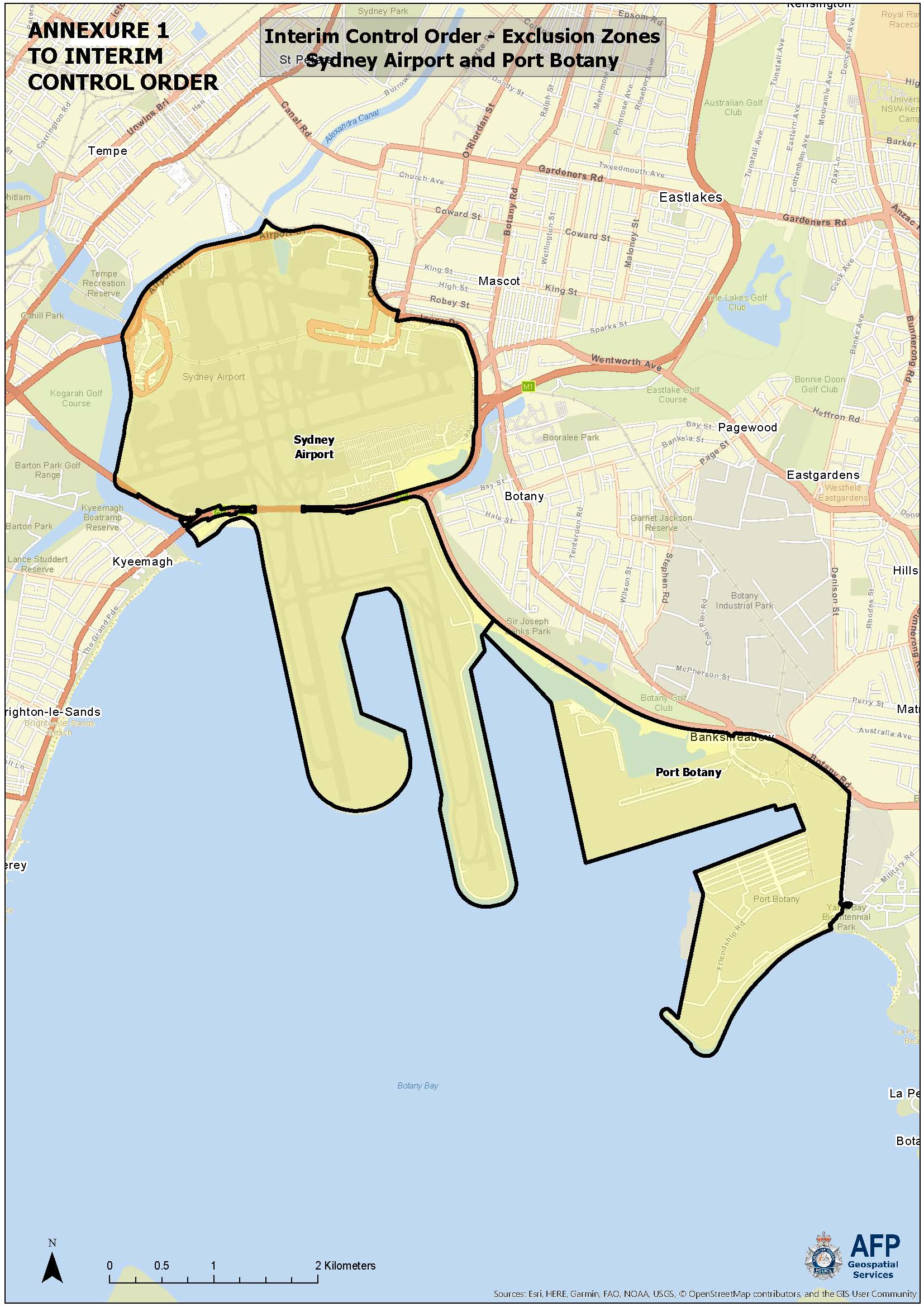
(a) within the exclusion zone at Sydney Airport, as identified by yellow shading in Annexure 1;
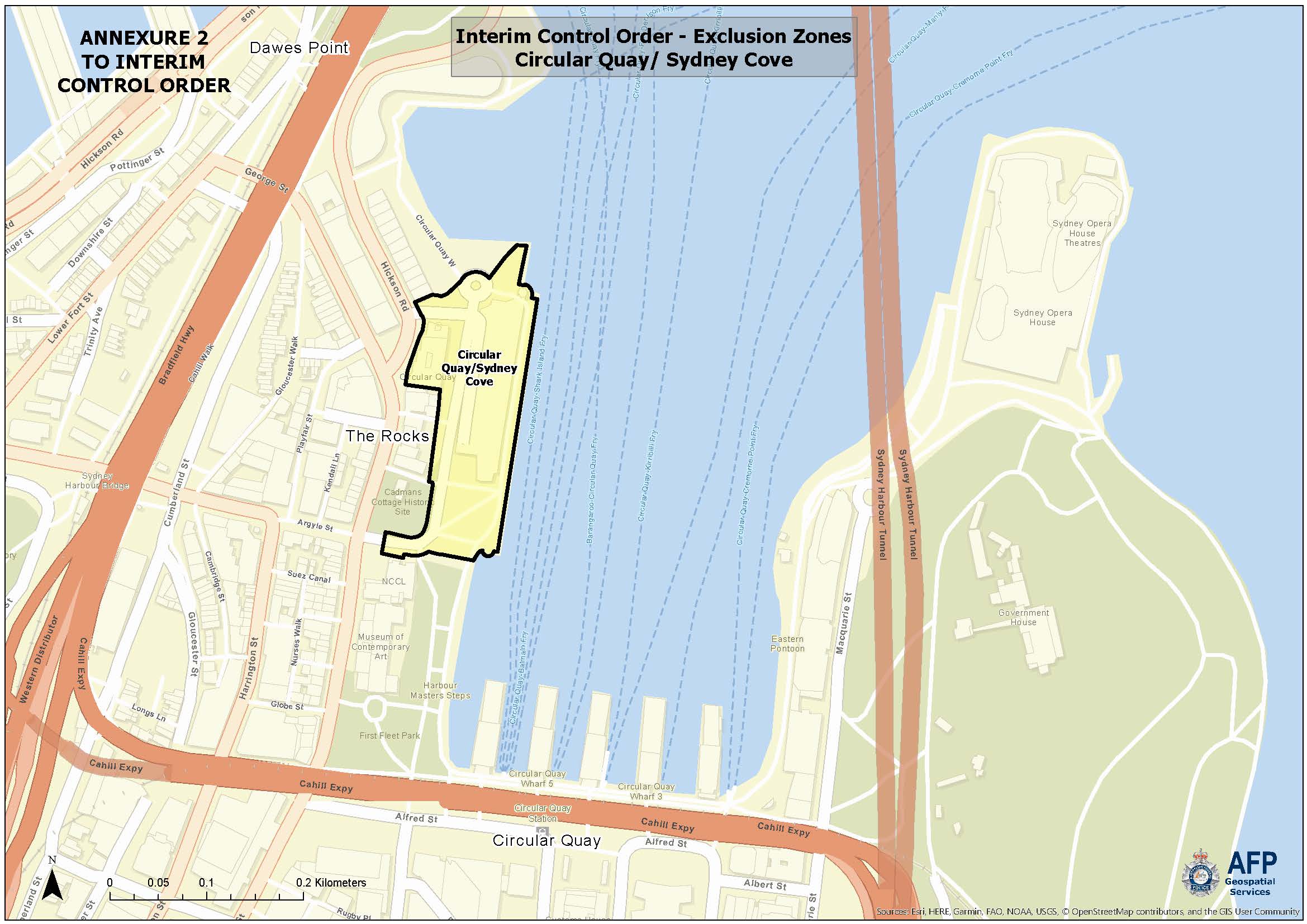
(b) within the exclusion zone at Circular Quay, as identified by yellow shading in Annexure 2;
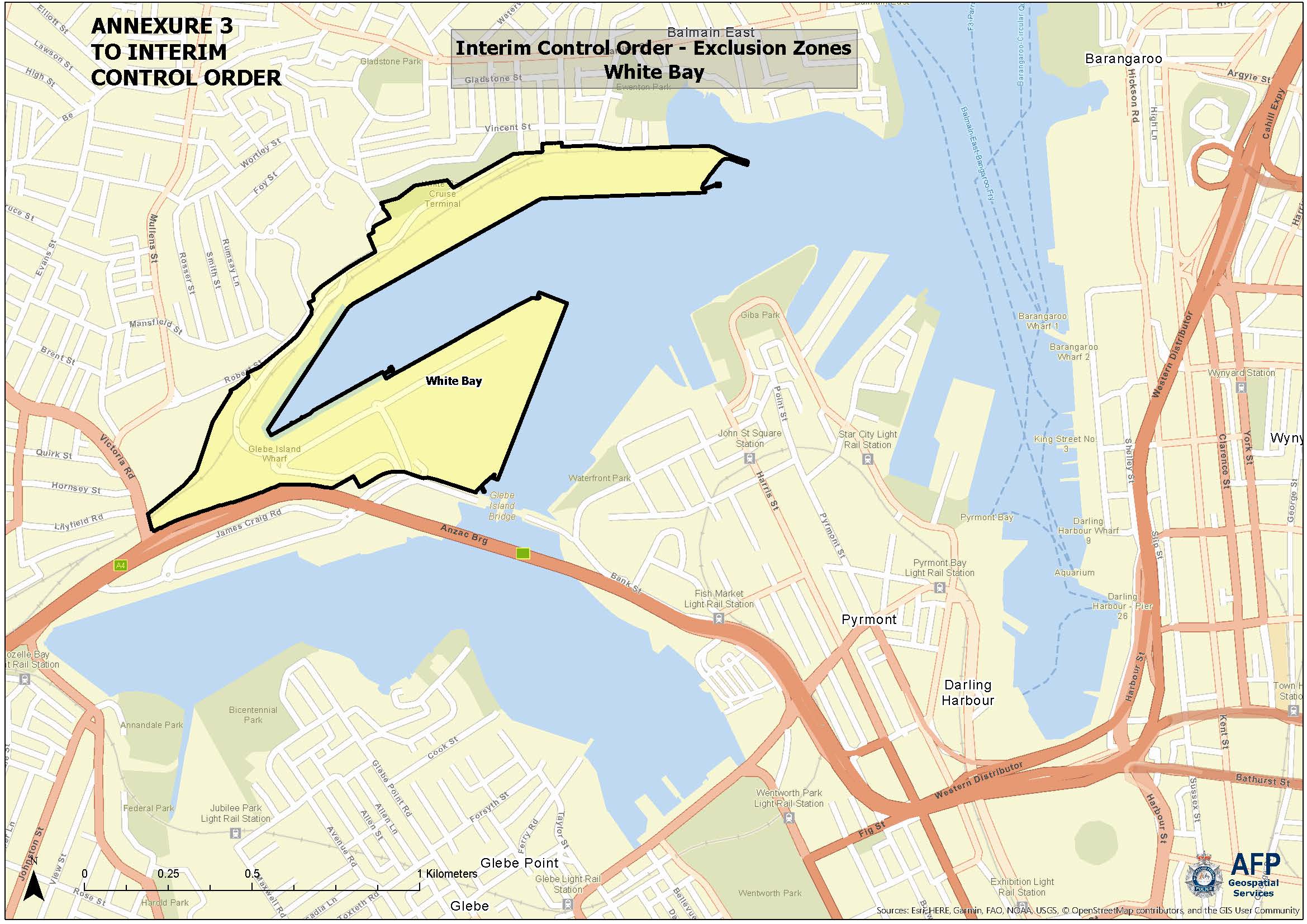
(c) within the exclusion zone at White Bay, as identified by yellow shading in Annexure 3;
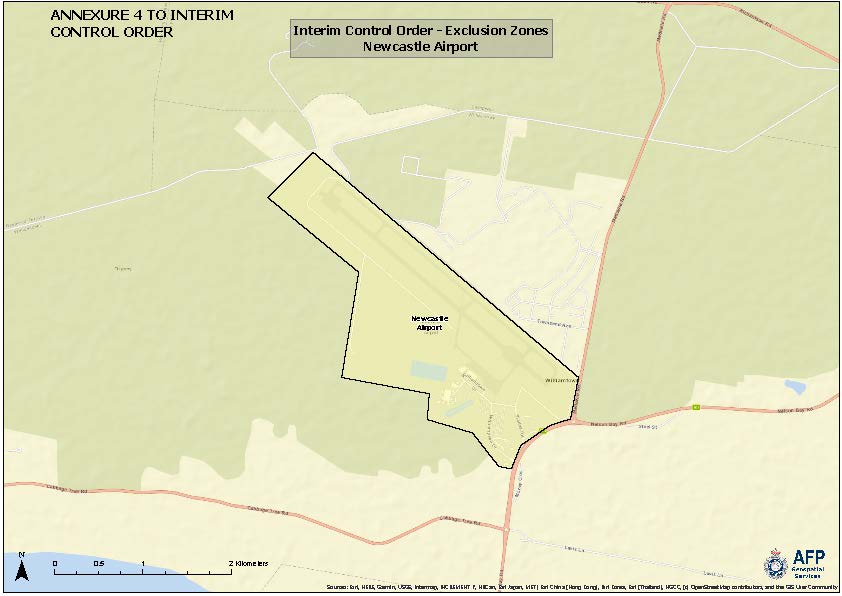
(d) within the exclusion zone at Newcastle airport, as identified by yellow shading in Annexure 4;
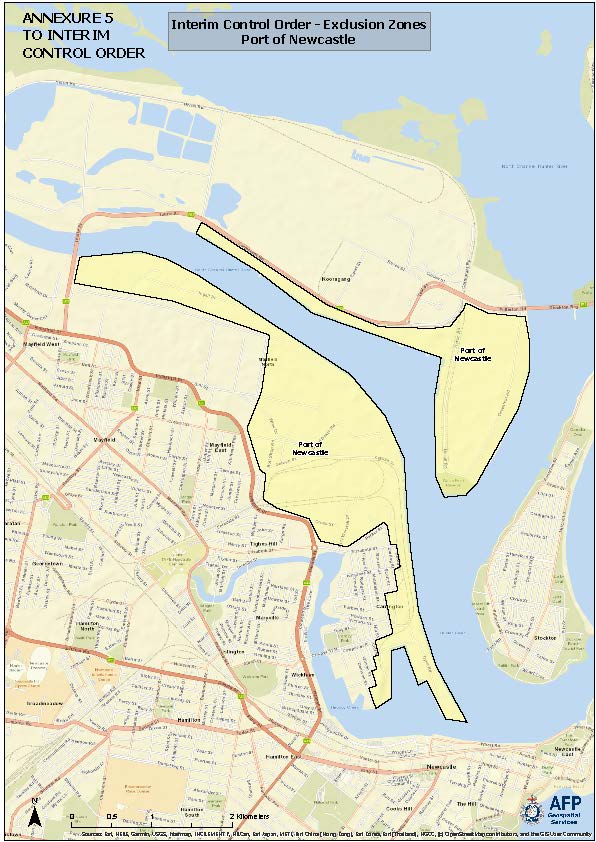
(e) within the exclusion zone at Newcastle port, as identified by yellow shading in Annexure 5;
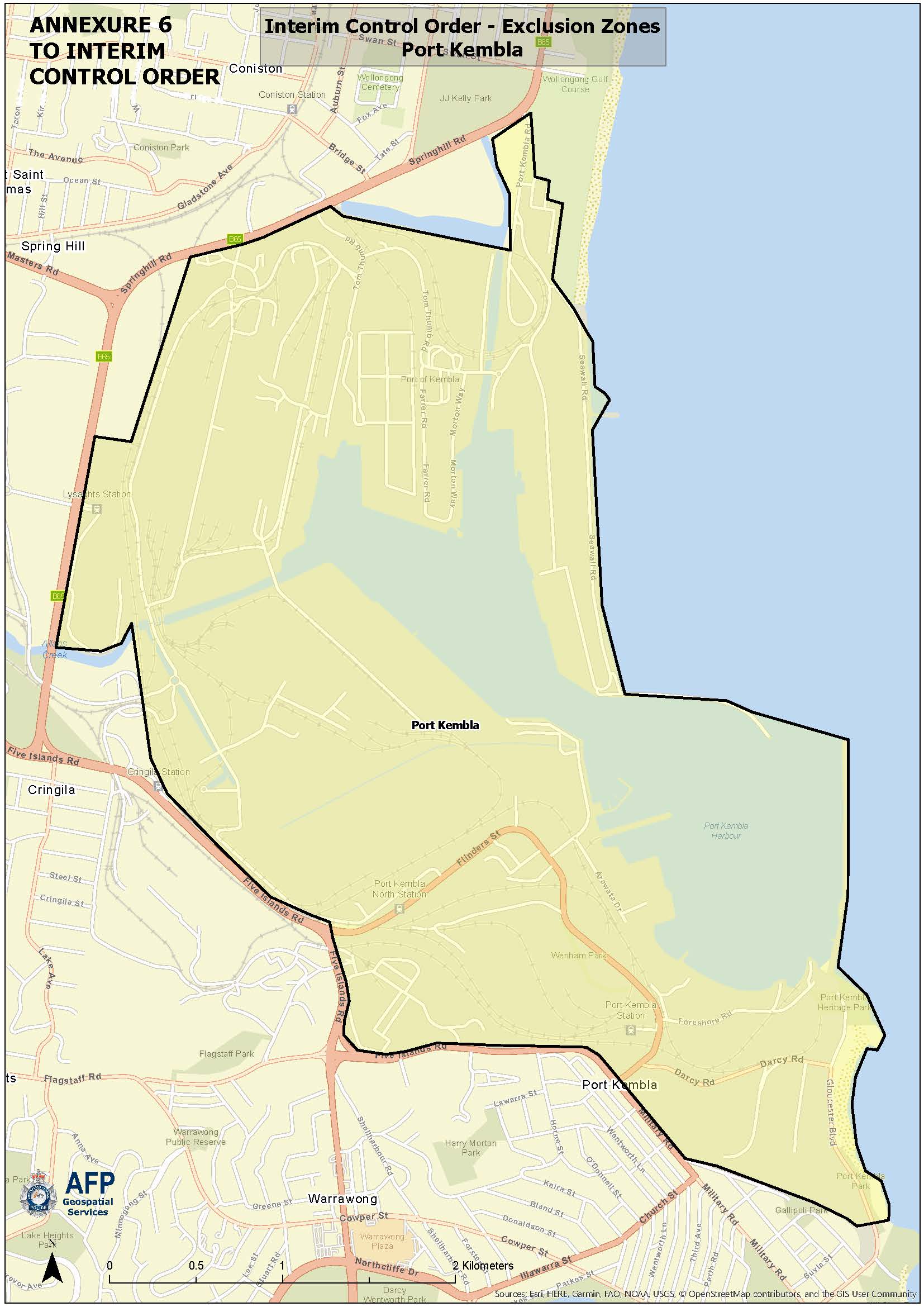
(f) within the exclusion zone at Port Kembla, as identified by yellow shading in Annexure 6;
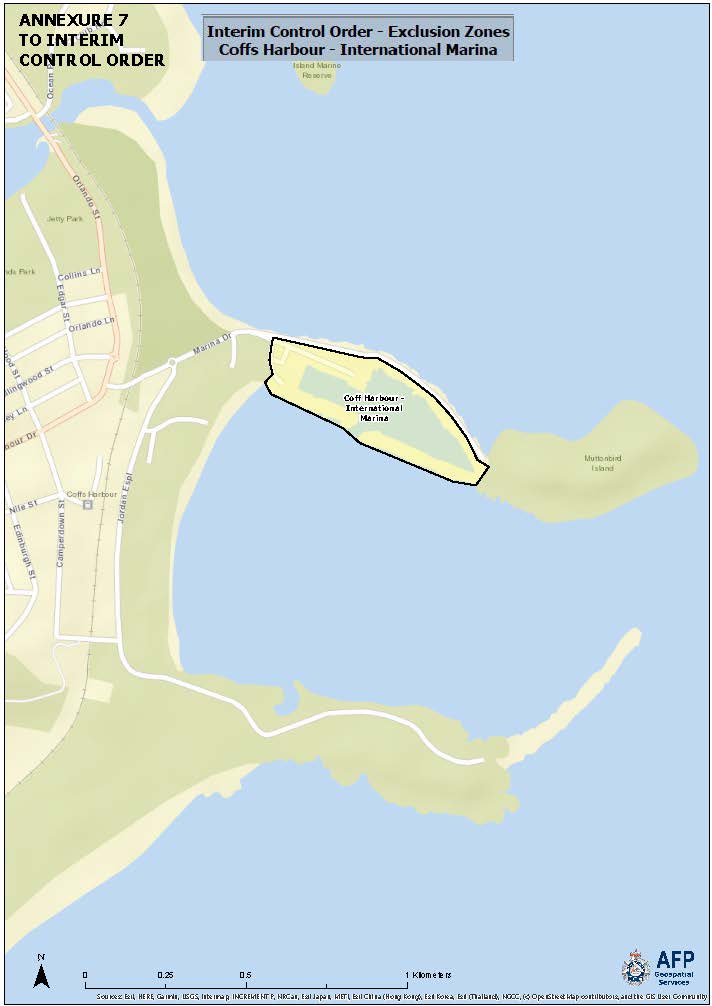
(g) within the exclusion zone at Coffs Harbour port, as identified by yellow shading in Annexure 7;
(h) inside, or in the grounds of, any prison or correctional facility unless you are incarcerated there;
(i) at the residence of any person with whom, by reason of Control 9, you are prohibited from communicating or associating; or
(j) any place in Australia outside the state of New South Wales.
3.2. Controls 3.1(a)-(g) do not prohibit you from being in the prohibited area for the purpose of travelling through the prohibited area if the route taken is the most direct route.
4. Control 4 (leaving Australia)
4.1. You are prohibited from leaving Australia.
5. Control 5 (accessing or possessing prohibited documents)
5.1. You are prohibited (including in respect of your work or occupation) from: accessing, acquiring, possessing or storing documents (including documents in electronic form) or electronic media, or attempting to access, acquire, possess or store documents (including documents in electronic form) or electronic media, depicting or describing any:
(a) that instruct, counsel the carrying out, use of or making of, or are supportive of the carrying out, use of, or making of, or in that context describe:
(i) explosives, explosive devices, initiation systems or firing devices;
(ii) firearms, firearm parts or ammunition within the meaning of s 4 of the Firearms Act 1996 (NSW);
(iii) anti-surveillance or counter surveillance;
(iv) execution;
(v) beheading;
(vi) suicide attack;
(vii) bombing;
(viii) terrorist attack;
(ix) assassination;
(x) torture;
(xi) genocide;
(xii) martyrdom;
(xiii) a ‘prohibited weapon’ within the meaning of the Weapons Prohibition Act 1998 (NSW);
(b) depicting or describing any:
i. propaganda and promotional material for a ‘terrorist organisation’ (including Islamic State) within the meaning of s 102.1(1) of the Criminal Code (Cth); or
ii. activities of, or associated with, any ‘terrorist organisation’ (including Islamic State) within the meaning of s 102.1(1) of the Criminal Code (Cth).
5.2. Control 5.1 does not apply where the documents (including documents in electronic form) or electronic media is:
(a) published by a ‘constituent body’ of the Australian Press Council;
(b) broadcast on Australian free to air television;
(c) broadcast on Australian pay television;
(d) shown in a commercial movie cinema;
(e) broadcast on any commercially available streaming service, including: Netflix; STAN; ABC iView; Disney + or SBS on demand;
(f) contained in material that is served on you or your legal representative in relation to any legal proceedings before an Australian court to which you are a party, provided that it is accessed, acquired, possessed or stored by you only for a purpose connected with the conduct of those proceedings and not otherwise (Court material);
(g) contained in a work of fiction which has been assigned an International Standard Book Number and does not solely or predominantly relate to any of the topics identified at Control 5.1(a)(i)-(xiii) or (b)(i)-(ii);
(h) contained in a magazine or newspaper purchased by you or a member of your household during the period of the order; or
(i) shown in computer games classified by the Classification Board or the Australian Classification Review Board.
6. Control 6 (producing or distributing prohibited documents)
6.1. You are prohibited (including in respect of your work or occupation) from producing or distributing documents (including documents in electronic form) or electronic media, or directing any person to produce or distribute documents (including documents in electronic form) depicting or describing any:
(a) explosives, explosive devices, initiation systems or firing devices;
(b) firearms, firearm parts or ammunition within the meaning of s 4 of the Firearms Act 1996 (NSW);
(c) anti-surveillance or counter surveillance;
(d) execution;
(e) beheading;
(f) suicide attack;
(g) bombing;
(h) terrorist attack;
(i) assassination;
(j) torture;
(k) genocide;
(l) martyrdom;
(m) ‘prohibited weapon’ within the meaning of the Weapons Prohibition Act 1998 (NSW);
(n) propaganda and promotional material for a ‘terrorist organisation’ within the meaning of s 102.1(1) of the Schedule to the Criminal Code (Cth); or
(o) activities of, or associated with, any ‘terrorist organisation’ within the meaning of s 102.1(1) of the Schedule to the Criminal Code (Cth).
6.2. Control 6.1 does not prohibit you from distributing, or directing a person to distribute, Court material for a purpose connected with the conduct of proceedings and not otherwise.
7. Control 7 (employment)
7.1. You are prohibited from undertaking paid employment without first notifying an AFP Superintendent (by telephone or in writing) of the business name of your employer and your intended position.
8. Control 8 (prohibited items)
8.1. You are prohibited from possessing or using, or causing any person to act on your behalf to possess or use, any of the following:
(a) firearms, firearm parts or ammunition within the meaning of s 4 of the Firearms Act 1996 (NSW);
(b) a ‘prohibited weapon’ within the meaning of the Weapons Prohibition Act 1998 (NSW);
(c) any quantity of any chemical which is not consistent with reasonable domestic use;
(d) any quantity of petrol exceeding 4 litres that is not contained in the petrol tank of a vehicle, unless you are filling the petrol tank of a vehicle;
(e) an article or device, not being a firearm, capable of propelling by any means:
i. any irritant matter, not consistent with reasonable domestic, personal or work-related use in liquid, powder, gas, chemical form or any dense smoke; or
ii. any substance not consistent with reasonable domestic, personal or work-related use, capable of causing bodily harm;
(f) a detonator;
(g) a fuse capable of use with an explosive or a detonator;
(h) a knife, in a public place, without reasonable excuse;
(i) anything intended, by the person having custody of the thing, to be used to injure or menace a person.
9. Control 9 (prohibited persons)
9.1. You are prohibited from communicating with or associating with, including through a third party or parties:
(a) any person incarcerated in any prison or correctional facility unless you yourself are incarcerated in that correctional facility;
(b) any person you know, or reasonably believe, to be located in Turkey, Iraq or Syria;
(c) any person known to you to be in the community subject to a Control Order made under Division 104 of the Criminal Code (Cth), or an interim or extended supervision order made under the Terrorism (High Risk Offenders) Act 2017 (NSW) or Division 105A of the Criminal Code (Cth);
(d) any person known to you to be convicted of an offence under the Crimes (Foreign Incursions and Recruitment) Act 1978 (Cth) (now repealed);
(e) any person known to you to be convicted of, or charged with, a ‘terrorism offence’ within the meaning of s 3(1) of the Crimes Act 1914 (Cth);
(f) any of the following persons:
10. Control 10 (mobile phone)i. Milad Al-Ahmadzai (DOB: 3 April 1990)
ii. Jibryl Almaouie (DOB: 9 October 1993)
iii. Mohamed Rashad Almaouie (DOB: 30 October 1995)
iv. Kawa Alou (DOB: 19 March 1993)
v. Raban Alou (DOB: 3 August 1997)
vi. Hamdi Alqudsi (DOB: 21 August 1974)
vii. Ali Al-Talebi (DOB: 9 September 1989)
viii. Masood Atai (DOB: 3 February 1991)
ix. Milad Atai (DOB: 3 January 1996)
x. Omarjan Azari (DOB: 7 May 1992)
xi. Samimjan Azari (DOB: 2 October 1998) except at family gatherings or in the company of one or more of your or his ‘close family members’ as defined by s 102.1(1) of the Criminal Code
xii. [REDACTED]
xiii. Mehmet Biber (DOB: 15 August 1992)
xiv. [REDACTED]
xv. Wassim Fayad (DOB: 15 November 1967)
xvi. Ibrahim Ghazzawy (DOB: 13 October 1995)
xvii. Tamim Khaja (DOB: 8 September 1997)
xviii. Sulayman Khalid (DOB: 11 November 1994)
xix. [REDACTED]
xx. Ahmad Rahmany (DOB: 13 March 1990)
xxi. Abdul-Rahman Tayba (DOB: 21 May 1996).
10.1. You are prohibited from accessing or using, any mobile telephone device and SIM card other than a single mobile telephone device and SIM card provided to you by an AFP member (permitted mobile phone and permitted SIM card, respectively) for your use at any one time, and your use of a permitted mobile phone and a permitted SIM card are subject to the following conditions:
(a) you must not tamper with, intentionally damage or destroy, sell or dispose of any component of a permitted mobile phone or any equipment necessary for the operation of a permitted mobile phone, or cause or permit another person to do any of those things;
(b) at any time an AFP member requests, you must present a permitted mobile phone and a permitted SIM card for inspection, repair, service or replacement as required;
(c) you must not change, remove, modify or disconnect or cause any other person to change, remove, modify or disconnect on your behalf (including any employee or person acting on behalf of a telecommunications service provider) a permitted SIM card, telecommunication service provider or phone number connected to a permitted mobile phone;
(d) if you set a password for a permitted mobile phone, or change the password for a permitted mobile phone, you must provide the new password to an AFP Superintendent, or a police officer acting under an AFP Superintendent’s direction, if you are requested to do so by an AFP Superintendent or that police officer; and
(e) if you become aware that a permitted mobile phone, or any equipment necessary for the operation of a permitted mobile phone, is not in good working order, notify an AFP member as soon as practicable, but no later than twelve hours after becoming so aware.
10.2. Control 10.1 does not apply if your use of another mobile telephone device is solely for the purposes of notifying an AFP member of a fault or damage to a permitted mobile phone.
10.3. You are prohibited from causing or permitting another person to use or access a permitted mobile phone, unless it is being used in an emergency, provided you contact an AFP Superintendent as soon as possible after accessing or using the permitted mobile phone during the emergency and provide:
(a) the name of the person who used the permitted mobile phone;
(b) the date, time and phone number called by that person; and
(c) an explanation of the nature of the emergency which required you to cause or permit another person to use or access the permitted mobile phone.
10.4. You are prohibited from causing or permitting another person to use or access any mobile telephone device on your behalf unless the mobile telephone device is used or accessed for the ordering or sale of food or consumer products or the provision of a service.
10.5. Control 10.4 does not apply in the case of an emergency where the use of, or access to, to a mobile telephone device is solely for the purposes of calling police, ambulance, NSW Fire and Rescue, or State Emergency Services (SES).
11. Control 11 (landline phone)
11.1. You are prohibited from accessing or using any fixed or landline telephone other than one service that has been approved in writing by an AFP Superintendent for you to access or use.
11.2. To seek approval, you must:
(a) submit a written request to an AFP Superintendent which nominates the fixed or landline telephone service; and
(b) provide any other information requested by or on behalf of an AFP Superintendent for the purpose of identifying the nominated fixed or landline telephone service.
11.3. You are prohibited from causing another person to use or access any fixed or landline telephone on your behalf unless the fixed or landline telephone is used or accessed for the ordering or sale of food or consumer products or the provision of a service.
11.4. Controls 11.1 and 11.3 do not apply in the case of an emergency where the use of, or access to, a fixed or landline telephone service is solely for the purposes of calling police, ambulance, NSW Fire and Rescue, or State Emergency Services (SES).
11.5. If you use a fixed or landline telephone service in the circumstances described in Control 11.4, you must contact an AFP Superintendent as soon as is reasonably practicable after accessing or using such a fixed or landline telephone and:
(a) provide sufficient detail to the AFP Superintendent to identify the fixed or landline telephone that you accessed or used, and the date, time and phone number called; and
(b) explain the nature of the emergency which required you to access or use, or cause another person to access or use on your behalf, that fixed or landline telephone.
12. Control 12 (public telephone)
12.1. You are prohibited from accessing or using, or causing any person to access or use on your behalf, any public telephone except in the case of an emergency, provided you contact an AFP Superintendent as soon as possible after accessing or using such a public telephone and:
(a) provide sufficient detail to the AFP Superintendent to identify the public telephone that you accessed or used, and the date, time and phone number called; and
(b) explain the nature of the emergency which required you to access or use, or cause another person to access or use on your behalf, that public telephone.
13. Control 13 (satellite phone)
13.1. You are prohibited from accessing or using, or causing any person to access or use on your behalf, any satellite telephone service.
14. Control 14 (platforms)
14.1. You must not use or access, or cause any person to access or use on your behalf, applications or computer programs (collectively, platforms), unless:
(a) the platform has been installed to a permitted mobile phone at the time it is first provided to you, and you use the platform on the permitted mobile phone only; or
(b) you first obtain permission from an AFP Superintendent to install and use the platform on a permitted mobile phone, computer or tablet device. Permission may be granted, subject to conditions and may be amended or revoked by an AFP Superintendent. Any conditions, amended conditions or revocation must be in writing; or
(c) the platform is:
i. Youtube
ii. Facebook
iii. Instagram
iv. Gmail
v. Google Chrome
vi. App Store
vii. SBS on demand
viii. 9Now
ix. 7plus
x. ABC iview
xi. BBC News
xii. Maps
xiii. Google Maps
xiv. Microsoft Office
xv. Daily Telegraph
xvi. Safari
xvii. Calendar
xviii. Calculator
xix. PDF readers
14.2. In addition to the platforms referred to in Control 14.1, you must not access or use, or cause any person to access or use on your behalf, any Voice Over Internet Protocol (VOIP) service.
14.3. In addition to the platforms referred to in Control 14.1, you must not access or use, or cause any person to access or use on your behalf, any internet based messaging service.
14.4. Controls 14.2 and 14.3 do not prohibit access to or the use of:
(a) a website which includes an ‘instant chat’ function that allows a visitor to the website to send messages to, and receive messages from, the website host solely for the purpose of obtaining or providing customer service.
(b) any platform, VOIP or website for the purpose of participating in any proceeding in an Australian Court to which you are a party or witness.
15. Control 15 (internet)
15.1. You are prohibited from accessing or using any internet service other than an internet service of which you have provided notice in writing to an AFP Superintendent (the permitted internet service).
(a) you must submit a written notice to an AFP Superintendent which:
i. nominates the internet service provider account; and
ii. nominates the device (or devices, as the case may be) you will connect to the internet service (including, but not limited to, computers and televisions);
(b) provide any other information requested by, or on behalf of, an AFP Superintendent, in relation to, or for the purpose of identifying, the nominated account and devices.
15.3. You are prohibited from causing any other person to access or use on your behalf any other internet service.
15.4. However, Controls 15.1 and 15.2 do not prohibit access to or the use of:
(a) an Automated Teller Machine,
(b) a computer or tablet device, connected to an internet service, owned by a business or government agency which is made available for your use to facilitate contact tracing, the ordering or sale of food or consumer products or the provision of a service;
(c) a television connected to an internet service, where the access or use is limited to watching the services set out in Control 5.2.
16. Control 16 (email account)
16.1. You are prohibited from accessing or using any electronic mail (email) account other than an account of which you have provided notice in writing to an AFP Superintendent (the permitted email account).
16.2. To provide notice, you must:
(a) submit a written notice to an AFP Superintendent which nominates the email account; and
(b) provide any other information requested by, or on behalf of, the AFP Superintendent in relation to, or for the purpose of identifying, the nominated account which you will be accessing or using.
16.3. You are prohibited from causing or permitting another person to use or access the permitted email account.
16.4. You are prohibited from causing any other person to access or use on your behalf any email account unless the email is used or accessed for the ordering or sale of food or consumer products or the provision of a service.
17. Control 17 (computer or tablet device)
17.1. You are prohibited from accessing or using any computer or tablet device other than a computer or tablet device of which you have provided notice in writing to an AFP Superintendent (the permitted computer or tablet device) and your use of the permitted computer or tablet device is subject to the following conditions:
(a) before using the permitted computer or tablet device, you must provide the password for the permitted computer or tablet device to an AFP Superintendent; and
(b) if you change the password for the permitted computer or tablet device, you must immediately and prior to continuing to use that device, provide the new password in writing to an AFP Superintendent, or a police officer, acting under an AFP Superintendent’s direction.
17.2. You are prohibited from causing or permitting another person to access or use any computer or tablet device on your behalf, including any computer or tablet device of which you have provided notice in writing under Control 17.1, unless the computer or tablet device is used or accessed for the ordering or sale of food or consumer products or the provision of a service.
(a) submit a written notice to an AFP Superintendent which nominates the computer or tablet device; and
(b) provide any information requested by or on behalf of an AFP Superintendent in relation to, or for the purpose of identifying and accessing, the nominated computer or tablet device.
17.4. However, Controls 17.1 and 17.3 do not prohibit access to or the use of:
(a) an Automated Teller Machine,
(b) a computer or tablet device, connected to an internet service, owned by a business or government agency which is made available for your use to facilitate contact tracing, the ordering or sale of food or consumer products or the provision of a service; or
(c) a television connected to an internet service, where the access or use is limited to watching the services set out in Control 5.2.
[not used]
19. Exemptions requested by you
19.1. You may request an AFP Superintendent approve an exemption to the requirements or prohibitions (as the case may be) specified in Controls 1 to 18 above.
19.2. To request an exemption, you must:
(a) submit a written request to an AFP Superintendent which:
i. identifies the Control in respect of which you seek an exemption;
ii. explains the extent to which you seek to be exempted from the Control; and
iii. explains your reason(s) for seeking the exemption; and
(b) provide any other information requested by, or on behalf of, the AFP Superintendent for the purposes of determining whether to approve the exemption.
19.3. An AFP Superintendent may grant an exemption subject to conditions specified in writing.
19.4. You must comply with all of the conditions specified in writing by an AFP Superintendent. If you do not comply with a condition to an exemption, the exemption is (and will be taken to have been for all purposes) of no effect.
19.5. A request for an exemption must be made before the material time and date.
19.6. If an AFP Superintendent has not approved an exemption by the material time and date, the request is deemed to have been refused.
20. Exemptions granted by the AFP without a request from you
20.1. An AFP Superintendent may grant an exemption, initiated by the AFP, to the requirements or prohibitions specified in the Controls with your consent.
20.2. An AFP Superintendent may grant an exemption subject to reasonable conditions specified in writing provided on reasonable notice to you and to which you consent in writing.
20.3. If an exemption is granted and consented to, you must comply with all of the conditions specified in writing by an AFP Superintendent. If you do not comply with a condition of an exemption, the exemption is (and will be taken to have been for all purposes) of no effect.
21. Suspension of Controls while in custody
21.1. Controls 1 to 18 do not apply during any period in which you are held by or on behalf of any officer in prison or remand centre of the Commonwealth, a State or Territory.
21.2. Controls 1 to 18 resume their application at the conclusion of any period referred to in Control 21.1.
22. Interpretation
22.1. In this Interim Control Order:
(a) Material time and date means:
i. in relation to a Control that requires you to do an act – the time and date that you are required to do that act and propose not to do it;
ii. in relation to a Control that prohibits you from doing an act – the time and date that you propose to do that act;
iii. in relation to a Control that requires you to be present in an area or place – the time and date that you are required to be present at that area or place and propose not to be;
iv. in relation to a Control that prohibits you from being present at an area or place – the time and date that you propose to be present at that area or place.
(b) AFP Superintendent means a member of the Australian Federal Police performing the duties of a Superintendent within the Counter Terrorism portfolio, and includes any AFP member or special member authorized to perform duties or functions or otherwise act on behalf of a Superintendent within the Counter Terrorism portfolio in connection with this control order.
(c) Password includes but is not limited to any passcode, swipe pattern or any information or function necessary to facilitate access to the applicable device.
(d) Police officer means a ‘member’ or ‘special member’ of the Australian Federal Police, as defined by the Australian Federal Police Act 1979 (Cth), or a ‘police officer’ within the meaning of the Police Act 1990 (NSW).
ANNEXURE B – SUMMARY OF GROUNDS ON WHICH THE INTERIM CONTROL ORDER IS MADE
1. Having regard to the matters set out in both the “Statement of facts relating to why the order should be made” (SOF-for) and the “Statement of facts relating to why the order should not be made” (SOFN), the grounds on which the order should be made can be summarised as follows.
Passport offence
2. Islamic State follows an extreme interpretation of Islam which is anti-Western, and promotes violence against those who do not agree with its interpretations (including Shia Muslims) as infidels and apostates. It has:
2.1 since its inception, directly and indirectly engaged in preparing, planning, assisting in or fostering the doing of various terrorist attacks, globally;
2.2 as one of its main goals, to engage in terrorist attacks throughout the world, including killing Westerners; and
2.3 by its leaders and propaganda materials, exhorted its followers to take action to achieve those goals.
3. On 15 July 2013, Mr Naizmand’s Australian passport was cancelled after the Director General of Security issued an adverse security assessment having been satisfied Mr Naizmand adhered to an extreme and violent lslamist ideology, was likely to try to engage in militant jihad and would, if permitted to travel overseas, likely engage in conduct that might prejudice the security of Australia or a foreign country.
4. Notwithstanding his passport cancellation, Mr Naizmand departed Australia on 6 August 2014. He used his brother's passport to travel from Australia to Kuala Lumpur, then to Dubai where he was apprehended by authorities for passport irregularities and returned to Australia. He was subsequently convicted and sentenced for using an Australian document that was not issued to him contrary to s 32(2) of the Australian Passports Act 2005 (Cth) and placed on a 12 month good behaviour bond.
5. The:
5.1 criminality of the behaviour itself;
5.2 content of material accessed by Mr Naizmand immediately prior to his departure;
5.3 fact that he took steps to conceal the travel from his family; and
5.4 nature of the intercepted phone calls that took place between known Islamic State extremists shortly after his departure
strongly suggests his purpose in leaving Australia on 6 August 2014 was to attempt to enter either Syria or Iraq to participate in the conflict with those countries in support of Islamic State.
First control order offences
6. On 8 August 2016, Mr Naizmand was found guilty and subsequently convicted of five offences of contravening a control order contrary to s 104.27 of the Criminal Code (Cth) (first control order offences). The first control order offences involved Mr Naizmand either:
6.1 accessing electronic media depicting or describing propaganda or promotional material for a terrorist organisation or any activities of or associated with Islamic State; or
6.2 accessing electronic media depicting or describing explosives, suicide attacks, bombings or terrorist attacks on five separate occasions in January and February 2016.
7. Mr Naizmand was sentenced to 4 years imprisonment for the first control order offences, with a non-parole period of 3 years. He was released from custody on completion of his sentence on 28 February 2020.
8. For the purposes of s 104.4(1)(c)(iv) of the Criminal Code, the first control order offences for which Mr Naizmand was convicted related to terrorism.
Second control order offence
9. On 27 February 2020, Mr Naizmand was made subject to a second interim control order, which was confirmed on 20 May 2022.
10. On 27 November 2020, Mr Naizmand contravened the second control order contrary to s 104.27 of the Criminal Code (second control order offence). The second control order offence involved Mr Naizmand causing his wife, Ms Mursal Azari, to use her mobile telephone to message two people on Mr Naizmand’s behalf as follows:
10.1 firstly to send a message to [REDACTED] to obtain the number of [REDACTED]; and
10.2 secondly to then forward that phone number to Mr Naizmand’s mother.
11. [REDACTED]. The second control order prohibited Mr Naizmand from communicating or associating with either of these two men.
12. Mr Naizmand was sentenced, and a formal conviction recorded, for the second control order offence on 6 June 2022. For the purposes of s 104.4(1)(c)(iv) of the Criminal Code, the second control order offence relates to terrorism.
Ideology and conduct
13. Prior to his incarceration for the first control order offences, Mr Naizmand:
13.1 frequently accessed Islamic State and other extremist material supportive of violent jihad on the internet, including when subject to a control order prohibiting him from doing so;
13.2 was a member of a close-knit group of individuals, known as the Appleby Group, who supported the ideology and activities of Islamic State, and were involved in the commission of terrorism offences; and
13.3 associated or communicated with others who, although not members of the Appleby Group, adhered to the same ideology.
14. During his incarceration for the first control order offences, Mr Naizmand:
14.1 maintained frequent contact with associates, including family members, who hold extremist views, have been convicted of terrorism offences or have links to other extremists;
14.2 asserted that Sharia law should be the law of Australia, and that he considered Islam superior to other ways of life; and
14.3 showed an inconsistent approach to engaging with the Proactive Integrated Support Model (PRISM) program offered by the NSW Department of Corrective Services which is designed to redirect offenders away from extremism and help them transition out of custody. After expressly indicating an unwillingness to engage, Mr Naizmand was discharged from the service on 21 August 2019, having not completed the program.
15. Mr Naizmand generally does not appear to have engaged in concerning behaviour whilst living in the community subject to the second control order between February 2020 and December 2020. Mr Naizmand's behaviour during this period must be understood in the following context:
15.1 he engaged with extremist material and with like-minded associates during a relatively lengthy period between at least 2013 and 2018;
15.2 he did not denounce his associates, including members of the Appleby Group, or their offending; and
15.3 he was aware that he was under surveillance during the relevant period, and had some understanding of the nature and extent of that surveillance, given his conviction for the first control order breaches, and that he was subject to four monitoring warrants and six curfew compliance checks whilst subject to the second control order.
16. The circumstances in which Mr Naizmand breached the second control order suggest he has a continuing desire to continue to communicate or associate in some way with others convicted of terrorism offences [REDACTED], and possibly to do so in a way that evades detection by law enforcement. On the same day that Mr Naizmand breached the second control order, he expressed his anticipation for the release of Samimjan Azari (a person with whom he was prohibited from communicating by the first and second control orders), and expressed an intention to contact someone after the expiry of the second control order.
17. During his incarceration for the second control order offences, Mr Naizmand:
17.1 was not eligible to participate in any counselling or de-radicalisation programs, by reason of his status as an unsentenced prisoner;
17.2 on at least one occasion, expressed an interest in sharing a religious text “refut[ing] the Shia” with another inmate; and
17.3 on at least one occasion, spoke with Samimjan Azari, through his (ie Mr Naizmand’s) wife, Ms Mursal Azari.
18. Mr Naizmand’s historical conduct, strongly expressed views and associates suggest he is vulnerable to the influence of people with concerning views, and material with concerning content.
19. The protective factors available to Mr Naizmand in the community appear to be limited, particularly in circumstances some of his family members hold extremist views.
20. There is a real risk that in the absence of appropriate controls Mr Naizmand will take steps to:
20.1 support extremist ideology;
20.2 access and view Islamic State or other extremist propaganda, promotional material and other material supportive of violent jihad more broadly;
20.3 engage with members of the Appleby Group, either directly or through their families and associates, or engage with their associates or others who hold the same extremist ideology.
21. The obligations, prohibitions and restrictions set out in the proposed interim control order will ensure Mr Naizmand:
21.1 is provided with an opportunity to engage positively with the community (through employment, religious observation and education, and any voluntary counselling he chooses to engage in);
21.2 is capable of being monitored by police during his reengagement with the community; and
21.3 is prohibited from engaging in those behaviours, and being exposed to associates and influences, which may lead him to commit, provide support for or facilitate a terrorist act or support or facilitate the engagement in a hostile activity in a foreign country
and thereby reduce the risks outlined above.
BROMWICH J:
1 This is an application by Detective Superintendent Alexander Nicolson of the Australian Federal Police (AFP), for an interim control order (ICO) over the respondent, Mr Ahmad Saiyer Naizmand, pursuant to s 104.4(1) of the Criminal Code (Cth). These are my reasons for granting that application, and my adjudication of the particular control orders that were in dispute.
2 Mr Naizmand has been the subject of two previous ICOs, both of which were subsequently confirmed, and both of which were breached contrary to s 104.27 of the Criminal Code, resulting in gaol sentences. The chronology of those events is as follows:
(a) On 5 March 2015, Judge Driver of the Federal Circuit Court of Australia, now Division 2 of the Federal Circuit and Family Court of Australia, made an ICO against Mr Naizmand. That ICO was confirmed by Judge Driver on 30 November 2015 and expired on 6 March 2016 (first control order).
(b) On 2 February 2017, Mr Naizmand was sentenced by Judge Scotting in the District Court of New South Wales, following a guilty plea to five offences of contravening the first control order. The sentence was a four-year term of imprisonment, backdated to when he was taken into custody on 29 February 2016, which expired on 28 February 2020. Two applications for parole were refused, such that he served the full head sentence. Appeals against his sentence were dismissed.
(c) On 27 February 2020, the day before Mr Naizmand’s release from prison, I granted an application for, and made, a further ICO against him. That ICO was confirmed by me on 20 May 2020 and expired on 26 February 2021 (second control order).
(d) On 16 December 2020, Mr Naizmand was arrested, interviewed about and charged with contravening the second control order. Initially there were two charges, but they were later replaced with a single rolled up charge on indictment in the District Court of New South Wales, to which he pleaded guilty on 9 May 2022. On 6 June 2022, he was sentenced by Judge Craigie SC to a term of imprisonment of 1 year and 4 months, but released immediately taking into account time already served in custody on remand.
3 Each of the above convictions are the grounds relied upon for allowing the application for the grant of the further ICO sought, with that application being filed within weeks of Mr Naizmand’s release from prison and listed for hearing at the earliest possible date.
4 The application proceeds with the necessary consent of the Commonwealth Attorney-General, in his capacity as the Minister administering the Australian Federal Police Act 1979 (Cth) (AFP Minister): s 104.2, Criminal Code. It is supported by an affidavit from Detective Superintendent Nicolson. There was limited cross-examination of Detective Superintendent Nicolson on his affidavit.
The legislative regime for control orders
5 Chapter 5 of the Criminal Code deals with the security of the Commonwealth. Part 5.3 within Chapter 5 deals with terrorism. Division 104 of Pt 5.3 deals with control orders. Section 104.1 succinctly states the objects of Div 104:
104.1 Objects of this Division
The objects of this Division are to allow obligations, prohibitions and restrictions to be imposed on a person by a control order for one or more of the following purposes:
(a) protecting the public from a terrorist act;
(b) preventing the provision of support for or the facilitation of a terrorist act;
(c) preventing the provision of support for or the facilitation of the engagement in a hostile activity in a foreign country.
6 Those objects are a central feature of the control order regime, being replicated in s 104.4(1)(d) of the Criminal Code as being the purposes for which an ICO may be made and confirmed. The Court must be satisfied on the balance of probabilities that each of the obligations, prohibitions, and restrictions to be imposed by the order, referred to as controls, is reasonably necessary, and reasonably appropriate and adapted, for one or more such purpose.
7 There is a two stage process of a senior officer of the AFP first seeking and obtaining an ICO with the necessary consent of the AFP Minister (which may also be done on an urgent basis without first obtaining consent, and which may also be varied); and secondly that officer electing to have that order confirmed for up to 12 months: see Subdivisions B, C, CA and D of Division 104 of the Criminal Code. The requirements for the first stage for the grant of an ICO are addressed below.
Mr Naizmand’s stance at the ICO stage
8 Mr Naizmand does not oppose a further ICO being made, accepting that the basis for making such an order is established by the evidence adduced, which is largely not challenged at this stage and only adversely commented upon to a limited extent. However, he does not consent to the further ICO being made as proposed by Detective Superintendent Nicolson because he does not concede that it is “reasonably necessary, and reasonably appropriate and adapted” for the purposes set out in, and required by, s 104.4(1)(d) of the Criminal Code. Further, as described below, he argues against some of the particular controls sought upon that basis and related bases.
9 The required hearing to determine whether the ICO should, or should not, be confirmed is not able to take place prior to late February next year due to the unavailability of Mr Naizmand’s senior counsel before then. The confirmation of the ICO may be opposed at that hearing, directed to challenging the evidence already adduced by Detective Superintendent Nicolson or arguments based on that evidence, or such further evidence as may be adduced, together with any evidence that may be given by Mr Naizmand or adduced by him.
10 Mr Naizmand initially disputed a larger number of the original controls proposed than the objections that were ultimately pressed. A number of those originally disputed control orders have been resolved by a change in drafting and other points of compromise, including adjustments suggested by the Court. Other points of objection have not been maintained. A smaller number of remaining objections have required adjudication, some of which have been in his favour and a number of others not so. I address those ultimately disputed control orders below.
Satisfaction of the preconditions for the making of an ICO
11 There are four preconditions for the making of an ICO pursuant to s 104.4(1) of the Criminal Code as set out in paragraphs (a) to (d).
12 The first precondition in s 104.4(1)(a) is that a “senior AFP member”, as defined in s 100.1, has requested an ICO in accordance with s 104.3. Detective Superintendent Nicolson is such an officer, being an AFP officer of or above the rank of Superintendent, and has requested an ICO in accordance with s 104.3(a) by way of an originating application and the supporting affidavit affirmed by him already referred to above.
13 Detective Superintendent Nicolson’s affidavit also establishes that each of the remaining preconditions in s 104.3 have been satisfied, for the following reasons. That state of satisfaction is subject to the question of each individual control sought being shown to be reasonably necessary, and reasonably appropriate and adapted for any of the purposes set out in s 104.4(1)(d) of the Criminal Code.
14 The second precondition in s 104.4(1)(b) is that this Court has received and considered such further information (if any) as it requires. No such information has been required, such that this precondition is not operative.
15 The third precondition in s 104.4(1)(c) is that the Court be satisfied, on the balance of probabilities, that any one or more of the conditions in subparagraphs (i) to (vii) have been established, each of which pertain to terrorism issues. Detective Superintendent Nicolson relies upon s 104.4(1)(c)(iv), namely that Mr Naizmand has been convicted in Australia of an offence relating to terrorism. There is no doubt as to his convictions. The offences under s 104.27 of contravening a control order are offences relating to terrorism: see McCartney v EB [2019] FCA 183; 263 FCR 170 at [24]-[39], especially at [33]. Specifically, in this case:
(a) s 3(1)(b) of the Crimes Act 1914 (Cth) defines “terrorism offence” to mean “an offence against Part 5.3 or 5.5 of the Criminal Code”;
(b) an offence against s 104.27 of the Criminal Code, which falls within Part 5.3, therefore is, and at all relevant times was, a “terrorism offence” within the meaning of s 3(1)(b) of the Crimes Act;
(c) the control order that was made by Judge Driver on 5 March 2015, confirmed on 30 November 2015, and breached by Mr Naizmand in January and February 2016, was made on the basis that it would substantially assist in preventing a terrorist act and that the controls were reasonably necessary and reasonably appropriate and adapted to protect the public from a terrorist act;
(d) the conduct by which Mr Naizmand breached that control order involved five instances of him accessing material relating to terrorist organisations and which advocated terrorist attacks;
(e) the control order that was made by me on 27 February 2020, confirmed on 20 May 2020, and breached by Mr Naizmand on 27 November 2020, was also made on the basis that it would substantially assist in preventing a terrorist act and that the controls were reasonably necessary and reasonably appropriate and adapted to each of the purposes described in s 104.4(1)(d) of protecting the public from a terrorist act; preventing the provision of support for or the facilitation of a terrorist act; and preventing the provision of support for or the facilitation of engagement in a hostile activity in a foreign country;
(f) the conduct by which Mr Naizmand breached that control order involved two instances of him bypassing controls on the use of a mobile telephone by getting relatives to convey messages on his behalf, thus evading the monitoring regime created by aspects of the balance of the control orders.
16 The fourth precondition in s 104.4(1)(d) is that:
the court is satisfied on the balance of probabilities that each of the obligations, prohibitions and restrictions to be imposed on the person by the order is reasonably necessary, and reasonably appropriate and adapted, for the purpose of:
(i) protecting the public from a terrorist act; or
(ii) preventing the provision of support for or the facilitation of a terrorist act; or
(iii) preventing the provision of support for or the facilitation of the engagement in a hostile activity in a foreign country.
17 Section 104.4(2) relevantly provides that for the purposes of s 104.4(1)(d), the Court must take into account as a paramount consideration the objects of Div 104 reproduced at [2] above. Section 104.4(2) also relevantly provides as an additional consideration, but not a paramount consideration, the impact of the control order obligations, prohibitions or restrictions on the person’s circumstances, including financial and personal. Those circumstances are to be gleaned, to the extent possible, from Detective Superintendent Nicolson’s affidavit, as Mr Naizmand did not give or adduce any evidence.
18 Section 104.4(1)(d)(i) was considered in Thomas v Mowbray [2007] HCA 33; 233 CLR 307. As is apparent from the reproduction of s 104.4(1)(d) above, subparagraph (i) is directed to the purpose of protecting the public from a terrorist act. However, the observations of the High Court apply equally to subparagraphs (ii) and (iii) directed to preventing the provision of support to, or facilitation of, a terrorist act, or engagement in hostile activities overseas. Gleeson CJ at [19] explained the exercise involved in s 104.4(1)(d) as one involving proportionality:
The requirement that a Court consider whether each of the obligations imposed by a control order is both reasonably necessary, and reasonably appropriate and adapted, for the purpose of protecting the public was the subject of debate. A requirement of that kind would sometimes be described as a requirement of proportionality. Judgments about proportionality often require courts to evaluate considerations that are at least as imprecise as those involved in formulating a control order.
19 Also in Thomas v Mowbray, Gummow and Crennan JJ at [99] considered that the pre-condition in s 104.4(1)(d) involved a balancing exercise:
Section 104.4(1) requires in para (d) that each of these be measured against what is “reasonably necessary” and also against what is “reasonably appropriate and adapted” for attainment of the purpose of public protection from a terrorist act. This is weighed with the impact upon the circumstances of the person in question as a “balancing exercise” (s 104.4(2)).
20 When it comes to assessing the risk for which a proposed set of controls are designed to address, Gleeson CJ in Thomas v Mowbray observed at [9] that the “level of risk of the occurrence of a terrorist act, and the level of danger to the public from an apprehended terrorist act, will vary according to international or local circumstances”. Similarly, Gummow and Crennan JJ observed at [92], by reference to consideration earlier in their Honours’ reasons of terrorist activities such as the attack on the World Trade Centre on 11 September 2001, that judges exercising the jurisdiction conferred by the provisions outlined above will bring to bear both matters of common knowledge and the facts and circumstances disclosed by the evidence adduced in support of an application for a control order, both at the interim stage and at the confirmation stage.
21 Detective Superintendent Nicolson submits that what has happened in the past is the most reliable guide to what will happen in the future, citing Minister for Immigration & Ethnic Affairs v Guo (1997) 191 CLR 559, where Brennan CJ, Dawson, Toohey, Gaudron, McHugh and Gummow JJ observed in relation to the 1951 Geneva Convention Relating to the Status of Refugees’ predictive concept of a well-founded fear of persecution:
(a) at 574:
The course of the future is not predictable, but the degree of probability that an event will occur is often, perhaps usually, assessable. Past events are not a certain guide to the future, but in many areas of life proof that events have occurred often provides a reliable basis for determining the probability – high or low – of their recurrence.
(b) at 575:
Determining whether there is a real chance that something will occur requires an estimation of the likelihood that one or more events will give rise to the occurrence of that thing. In many, if not most cases, determining what is likely to occur in the future will require findings as to what has occurred in the past because what has occurred in the past is likely to be the most reliable guide as to what will happen in the future. It is therefore ordinarily an integral part of the process of making a determination concerning the chance of something occurring in the future that conclusions are formed concerning past events.
22 The same reasoning necessarily also applies to the other two risks that may be sought to be mitigated by a control order, namely the level of risk of the provision of support for or the facilitation of a terrorist act or of the provision of support for or the facilitation of the engagement in a hostile activity in a foreign country.
23 In a case such as this, there is little in the way of fact finding required as to past events involving Mr Naizmand. The evidence, especially of agreed facts tendered in the criminal proceedings brought against him for both breaches of ICOs, and in each of the sentencing court’s fact finding, delivers quite a high degree of certainty as to what has previously taken place by and in relation to Mr Naizmand. It is the application of those past proven events, in the context of the rest of the evidence and applicable general knowledge and experience, that informs Court’s evaluative assessment of the risks that he poses and whether each proposed control, considered in the context of the other controls, is reasonably necessary, and reasonably appropriate and adapted to mitigate those risks.
24 Detective Superintendent Nicolson has provided a detailed account of Mr Naizmand’s past conduct in an exhibited statement of facts relating to why the interim control order should be made (49 pages, 195 paragraphs, plus over 500 pages of annexures), and an annexed statement of facts relating to why the interim control order should not be made (55 pages, 32 paragraphs, plus over 60 pages of annexures), being documents furnished to the AFP Minister as required by s 104.2(3)(aa) of the Criminal Code. The essence of the key reasons favouring the making of an ICO are distilled in a summary of those grounds, and again furnished to the AFP Minister, as required by s 104.2(3)(aa) of the Criminal Code, which I consider amply justify a control order of some kind being made, in terms of that being reasonably necessary, and reasonably appropriate and adapted for the purposes identified in s 104.4(1)(d).
25 That summary document conveniently explains, with footnote references to the statement of facts relating to why the interim control order should be made, the original conduct by Mr Naizmand in bypassing the cancellation of his passport in 2013 for national security reasons by using his brother’s passport, his apprehension and return to Australia for passport irregularities, his conviction and sentence by way of a good behaviour bond for the passport offence of using another’s passport, and the two prior control orders and the conduct amounting to a breach of each of them. This conduct gave rise to terrorism-related concerns, alongside his past adherence to extremist ideology supportive of violent jihad of the kind advocated for and performed by supporters of Islamic state. I therefore adopt that summary as the reasons for making the interim control order, with minor amendments, the most significant of which is to vary the reference to counselling at [21.1], which I have not accepted should be made a control for the reasons set out below.
26 It was suggested on behalf of Mr Naizmand that I should not accept that the absence of evidence that he had renounced his extremist views meant that he had not done so. The problem with that approach is that this is a risk assessment exercise. He and he alone is best placed to demonstrate that his outlook and stance has changed, whether by the best means of direct evidence from him, or the distinctly second-best means of indirect evidence from another person or other sources. But if, at present, he chooses not to do so by either means, the ordinary inference would be that there has not been any material change, or at least there remains a live risk that no such material change has taken place.
27 Given the seriousness of the breaches of the first control order, and the further, albeit less serious, breaches of the second control order, the ordinary inference to be drawn is that no evidence that he could give or adduce would assist him. The absence of evidence that he still holds to extremist views does not become positive evidence that he has not changed, but it is a circumstance permitting the risk assessment to be conducted upon the basis that there is no evidence that he has changed, such that the past is the only reliable guide to what is presently a risk in the future. It may be that he will seek to give or adduce such evidence at the confirmation hearing. If he does not, then he can hardly be heard to complain if greater weight is unavoidably given to what he has said and done in the past.
Adjudication on controls in dispute
28 With the above considerations in mind, I address the controls that were ultimately in dispute.
Curfew (Control 1 as originally sought)
Reporting (Control 2 as originally sought)
29 Mr Naizmand objects to any curfew being imposed at all, let alone the one originally proposed between 10.00 pm and 5.00 am each day, and any reporting requirement at all, let alone the one proposed of reporting to the local police station between 7.00 am and 7.00 pm on Fridays. Detective Superintendent Nicolson’s affidavit evidence is that those controls will assist police to monitor Mr Naizmand’s whereabouts and activities, including whether he is engaging in activities or associating with persons of security concern that may have a radicalising influence on him. I reject Mr Naizmand’s submission that the imposition of any curfew or any reporting obligations, particularly in the sense that they assist police monitoring activities, is beyond the scope of the assessment process. Plainly, anything that makes the control orders as a whole more likely to be efficacious is a relevant (in the general sense) and indeed important consideration.
30 Mr Naizmand also counters by submitting that there is no suggestion that he is any more likely to engage in those activities at night or during the day, a submission I am unable to accept because the issue is not just when such activities may take place, but also the ease or difficultly in monitoring them, which self-evidently is harder to do at night. Mr Naizmand also relies upon the approach taken by Charlesworth J in McCartney v Abdirahman-Khalif (No 2) [2020] FCA 1002 at [184], where her Honour balanced the competing considerations by having a more limited curfew from midnight to 6.00 am (not dispensing with it as sought), and dispensed with a reporting requirement. While approaches taken in other cases may be informative, it would be an abdication of my responsibility to treat the conclusions reached as some kind of precedent.
31 Mr Naizmand further submits that neither any curfew control nor any reporting control is reasonably necessary, and reasonably appropriate and adapted to the stated purpose by way of preventing or inhibiting activities or association with persons of concern. I reject this submission as it does not address Detective Superintendent Nicolson’s evidence regarding the utility of these controls, and the past events to which his evidence is directed.
32 Given Mr Naizmand’s original offence of bypassing the cancellation of his passport by using his brother’s passport to leave Australia, his serious and repeated breaches of the first control order, and, despite a lengthy gaol term for that conduct, his further breaches of the second control order to evade the monitoring of his communications, his past conduct provides an ample basis for concluding that there is a need to enhance the overall effectiveness and purpose of the ICO to be made by facilitating the monitoring and observation of him.
33 As a fall back, Mr Naizmand sought a later start for the curfew of midnight, but made no submission as to any particular or specific difficulty arising out of a 10.00 pm curfew start time. Given that his employment as a tree lopper is a daylight activity, there is no suggestion of there being any employment need, and no reference was made to any other need to be out and about past 10.00 pm, beyond the imposition that this poses. However, nor did Detective Superintendent Nicolson voice any overt opposition to the curfew commencing later at midnight, while maintaining a clear stance that a curfew was necessary, and an evident preference for it to start at 10.00 pm. Accordingly, I am amenable to that later and therefore significantly less restrictive curfew. I am also open to the reporting taking place on a different day of the week, but in default of that, the day will remain a Friday. I note that there is provision in the ICO to be made to vary those sorts of details in any event.
34 Given Mr Naizmand’s past history, I am satisfied that the curfew and reporting controls sought, as adjusted for a later curfew start time of midnight, are reasonably necessary, and reasonably appropriate and adapted to making the control regime overall more effective.
Producing or distributing prohibited documents (Control 6 as originally sought)
35 This control follows on from control 5 as originally sought, which is directed to curtailing access to documents over a range of topics in aid of or related to terrorism and like activities or their curtailment, such as explosives, firearms and other weapons, counter–surveillance, a range of violent acts or conduct, or propaganda and like activities. Proposed control 5, which is now not opposed, has an exception for mainstream media and the like, while proposed control 6, directed to prohibiting, producing or distributing such material, does not have such an exception (except in relation to court proceedings, in keeping with control 5). In his affidavit at [63], Detective Superintendent Nicolson explains that such an exception is not provided for because such publication or distribution, even from mainstream media, carries a risk of promotion or support or encouragement of acts of terrorism. I am satisfied that allowing limited access to such material from mainstream sources, while not allowing even that mainstream manifestation to be further produced or distributed is reasonably necessary, and reasonably appropriate and adapted to the overall purpose of the ICO. That is because the impingement is relatively slight, and not disproportionate to the overall objectives of the ICO.
Employment (Control 7 as originally sought)
36 This proposed control is in substantially the same terms as control 9 made as part of the second control order confirmed in May 2020:
You are prohibited from undertaking paid employment without first notifying an AFP Superintendent (by telephone or in writing) of the business name of your employer and your intended position.
37 In his affidavit at [67], Detective Superintendent Nicolson adopted the views of Commander Booth advanced in support of the second control order, which were as follows:
The purpose of this control is not to impede the Respondent’s ability to gain employment. Rather, it is to ensure that the AFP ls aware of any paid employment that may equip him with the means to commit, support or facilitate a terrorist act or expose him to criminal elements at certain specific workplaces who may influence him in this regard. If the AFP becomes aware that the Respondent is being exposed to such means or influences, it can take additional steps to mitigate any risks arising from that.
38 Mr Naizmand does not address that reasoning in his written submissions. Rather, he simply contends that this control is not reasonably necessary because of the surveillance he will be under. In response, Detective Superintendent Nicolson submits that a balance is to be struck between the burden on Mr Naizmand of providing the notice required, and the burden on the AFP of obtaining that same information through surveillance. He further submits that the ability of the AFP to surveil Mr Naizmand on its own does not render this control unnecessary, noting that by that logic, the Court would not impose any control directed to a risk that could also (at least in theory) be managed through surveillance.
39 I accept Detective Superintendent Nicolson’s reasoning and am satisfied that a notification regime for employment is reasonably necessary, and reasonably appropriate and adapted for the purposes identified in s 104.4(1)(d).
40 In Mr Naizmand’s oral submissions, his senior counsel sought to vary the terms of the proposed control so that he would be required to notify an AFP superintendent of his paid employment from time to time and to do so by telephone or in writing with the business name of his employer and his intended position, the reason being that although he works for an employer (as a tree lopper), there was said to be a strong prospect that he would also be receiving his own contracts, becoming a tree lopper in his own right. That could entail notifying the AFP day by day of each job of tree lopping, so that it would be better for him to be able to do so after the event, say within 48 hours.
41 The conclusion that I have reached is that the control ultimately sought only requires prior notice of a kind that can accommodate both employment by an employer and any self-employment work. That can be done by email or by telephone and can accommodate the circumstances described in the preceding paragraph. Accordingly, I see no need to change the terms of the ultimately proposed control.
Prohibited persons (Control 9 as originally sought)
42 Mr Naizmand seeks one carve out of the restrictions on association, to permit him to see his brother-in-law, Mr Samimjan Azari, in the limited context of family gatherings or in the company of at least one other close family member as defined in s 102.1(1) of the Criminal Code. Mr Samimjan Azari, who is married to a sister of Mr Naizmand, features repeatedly in the statement of facts relating to why the ICO should be made. Mr Samimjan Azari was in prison on firearms, drugs and proceeds of crime offences until he was released on parole on 29 December 2020. The evidence indicates that Mr Naizmand’s prior attempts to maintain contact with Mr Samimjan Azari, and the contents of their prior communications are a legitimate source of concern, such that I have approached the request to allow this limited access with some caution. In the result, I consider that to deny this variation, in its very limited terms, is not reasonably necessary, and reasonably appropriate and adapted, when regard is had to the benefits to be had from familial engagement of this kind. I will therefore, not without misgivings, allow this limited variation. Mr Naizmand is being given the benefit of the doubt in this regard.
Mobile phone (Control 10 as originally sought)
Platforms (Control 14 as originally sought)
Internet (Control 15 as originally sought)
Email account (Control 16 as originally sought)
Computer or tablet device (Control 17 as originally sought)
43 This suite of controls is directed to Mr Naizmand’s modes of communication and access to information. There is no ultimate issue as to proposed controls 11 to 13, dealing with landlines, public telephones or satellite phones. However, objections to aspects of the balance are directed to whether they go further than really required, such that they are not reasonably necessary, and reasonably appropriate and adapted to the objective sought to be advanced, rather than opposition to any form of control. It is essentially a question of degree.
44 The explanation provided by Detective Superintendent Nicolson is that restricting Mr Naizmand to one mobile phone provided by the AFP, one SIM card and one computer or tablet device is to ensure that the AFP has the capability to effectively monitor his communications, and that any lesser restriction would make that monitoring more difficult and potentially impossible. The asserted need for this level of control can be summarised as arising from Mr Naizmand’s prior offending involving access to an extensive amount of extremist material and Islamic State propaganda, especially via social media. The objective is to ensure this does not happen again, or at least to greatly reduce the risk of it occurring. The trade-off for being able to have the use of such devices for Mr Naizmand’s day-to-day life, and thereby the technical capacity to access such material, is that proportionate controls are put in place to help to ensure that the identified access of concern does not take place, including by facilitating effective monitoring. The basis for having and maintaining this control in the form proposed is made out.
45 Each of these controls are considered in the form finally advanced, which contains a series of amendments designed to address a number of concerns raised by Mr Naizmand. The objection is considered in relation to the final form pressed for by Detective Superintendent Nicolson. The central points of ultimate objection, and my conclusions, are as follows:
(a) As to the mobile being provided by the AFP, Mr Naizmand wishes to obtain his own mobile handset and to provide details of it to the AFP, not opposing being confined to one such handset. A further complication is that his preference, and current handset, is an iPhone, but the AFP only provide Android handsets. While the restriction to an Android handset is doubtless irritating, that is a minor inconvenience in the greater scheme of the freedoms this regime is designed both to maintain and curtail. I accept that the AFP providing the handset enables them to implement better and more effective monitoring. An essential part of this regime is that virtually all of Mr Naizmand’s mobile phone communications take place by him using a single AFP-provided handset, with limited exceptions. I am satisfied that degree of restriction is reasonably necessary, and reasonably appropriate and adapted to achieving the overall purpose of the ICO.
(b) As to the platforms control, that is control over computer applications able to be used, including those that facilitate access to the internet such as Facebook, this is directed to limiting the use of platforms installed on the mobile handset at the time it is provided to him by the AFP. He has supplied a list of applications that either came with his present handset or have been installed on it by him or on his behalf. Detective Superintendent Nicolson does not object to any of those listed applications being installed, although that will entail obtaining the Android equivalents, with the existing platforms in question now being listed in the control. With that position being arrived at, the objection amounts to a restriction being imposed on using new platforms. As a practical matter, it would be impossible for the AFP to keep track of the enormous range of new platforms that are constantly being released. I consider that if Mr Naizmand has a real need, or even a compelling and justified desire, for any new or additional platform, that can be adequately addressed as and when it arises by the mechanism for adjustments of that kind already provided for. Given that this restriction is at present no real restriction at all, and given that a future need or justified desire can be addressed, I am satisfied that this control is reasonably necessary, and reasonably appropriate and adapted.
(c) As to the internet control, this is not a problem for Mr Naizmand at his home, noting that more than one internet service can be used if notice is given in writing beforehand. Nor is it a problem in relation to viewing television at premises that he visits, with an amendment being made to facilitate this and to address a number of other concerns. The problem arises in relation to Wi-Fi access to the internet via other internet services away from his home, noting that it allows him to view a smart television at premises he visits that is connected to the internet, provided the use or access is limited to watching services listed in Control 5. He will also have mobile access to the internet on his own handset using mobile data, if that is needed. The danger from the AFP’s perspective is that use of other internet access facilities of this kind will enable him to do the very sorts of things that are otherwise not permitted, in a way that will be difficult to monitor. Viewed in that way, I am satisfied that his restriction, as modified, is reasonably necessary, and reasonably appropriate and adapted.
(d) The same reasoning as above applies to limiting Mr Naizmand to an approved email service, noting that another service can be used if written notice is provided beforehand, and also preventing anyone else from using the permitted email service. I am satisfied that this restriction is reasonably necessary, and reasonably appropriate and adapted, noting that the prior requirement of obtaining prior approval has been amended to one only requiring notice.
(e) As to restrictions on computers or tablet devices, the initial control was one that required prior approval, now changed to only to requiring notice. Detective Superintendent Nicolson’s affidavit suggests that his understanding of the control as drafted, and the objective sought, was to limit Mr Naizmand to one computer or one tablet. I do not consider that is so. The words of restriction refer to:
You are prohibited from accessing or using any computer or tablet device other than a computer or tablet device of which you have provided notice in writing to an AFP Superintendent (the permitted computer or tablet device) and your use of the permitted computer or tablet device is subject to the following conditions: …
I do not read that as wording as limiting Mr Naizmand to a single such device, but rather to any such device that has been notified in writing prior to use, with such notice to include providing the password, and no one else being allowed to use the device. A breach of those associated restrictions would be, on any reasonable view, a most serious breach of the ICO. With that interpretation in mind, noting the consequences of non-compliance, with the change to a notification regime, and with a slight adjustment to the requirement to provide any new password so that this must take place immediately, in writing, before continuing to use the device, and as a matter of course, not just upon request, I am satisfied that this control is reasonably necessary, and reasonably appropriate and adapted.
Counselling (Control 18 as originally sought)
46 This proposed control would require Mr Naizmand to consider in good faith participating in counselling or education, and if that is agreed to, to advise the AFP in writing the name and qualifications of the person providing this service. While I am satisfied that the objectives sought to be advanced of helping Mr Naizmand to move away from extremist influences are understandable and probably laudable, I am unable to see how such a control is enforceable. Rhetorically, how can a court measure or assess, let alone enforce, a requirement to consider something in good faith? I am therefore not able to be satisfied that such a control is reasonably necessary, and reasonably appropriate and adapted. That said, it is an indication of the sorts of steps that Mr Naizmand may wish to consider and adduce evidence of if he is to put the need for control orders behind him in the more immediate future.
Controls ultimately not in dispute
47 There is no need to address the remaining controls in detail in these reasons as it is not overtly disputed that they are reasonably necessary and reasonably appropriate and adapted. It is sufficient to state that I have carefully considered the terms of each of those proposed controls, Detective Superintendent Nicolson’s detailed written submissions, the detailed explanation in his affidavit for each control, and his opinion as to why they meet the statutory test, supplemented and qualified by his oral evidence in cross-examination. I accept that evidence and those arguments. I am satisfied that the precondition in s 104.4(1)(d) has been met for those remaining controls.
Conclusion
48 For the foregoing reasons, I am satisfied on the balance of probabilities that each of the three operative preconditions for the making of the interim control order have been met and that it is appropriate to make the interim control order, now made with controls as either adjudicated in Detective Superintendent Nicolson’s favour, or not ultimately opposed by Mr Naizmand, and proposed Control 18 being rejected.
I certify that the preceding forty-eight (48) numbered paragraphs are a true copy of the Reasons for Judgment of the Honourable Justice Bromwich. |
Associate:


