Federal Court of Australia
McDonald v Dakkak [2022] FCA 1065
ORDERS
Applicant | ||
AND: | Respondent | |
DATE OF ORDER: |
THE COURT ORDERS THAT:
1. The applicant bring in a draft interim control order in accordance with these reasons by 2.15 pm on 12 September 2022.
Note: Entry of orders is dealt with in Rule 39.32 of the Federal Court Rules 2011.
YATES J:
Introduction
1 The applicant requests the Court to make an interim control order against the respondent, Radwan Dakkak, under s 104.4 of the Criminal Code (see the Schedule to the Criminal Code Act 1995 (Cth)) (the Code).
2 The request is made in circumstances where the Court made an interim control order (the first interim control order) against the respondent on 31 December 2020: Booth v Dakkak [2020] FCA 1882 (the first proceeding).
3 The first interim control order was made following the respondent’s conviction in the Supreme Court of New South Wales, and imprisonment, on two charges under s 102.8(1) of the Code (associating with terrorist organisations) (the Association Offences) to which the respondent had entered pleas of guilty: R v Dakkak [2020] NSWSC 1806.
4 As a consequence of his pleas of guilty, the respondent admitted, in respect of each charge, that: (a) he intentionally associated with another person on two or more occasions; (b) he knew that the other person was a member of, or a person who promotes or directs the activities of, an organisation; (c) the organisation was a terrorist organisation, and the respondent knew this; and (d) the association between the respondent and the other person provided support to the terrorist organisation.
5 The fault element for the offences is “intention” and, by pleading guilty, the respondent admitted that he intended to support each organisation, named in the charges, to expand or continue to exist by his association with them.
6 The last of the respondent’s sentences for these offences expired on 1 January 2021. The first interim control order came into force on his release from prison on that day.
7 On 16 January 2021, the respondent was arrested and charged with contravening the first interim control order, contrary to s 104.27 of the Code.
8 On 17 December 2021, the respondent entered a plea of guilty to this charge in the District Court of New South Wales.
9 On 11 April 2022, the respondent was convicted and sentenced by the District Court to imprisonment for one year and eight months (concluding on 15 September 2022), with a non-parole period of one year and three months (expiring on 15 April 2022) (the Contravention Offence): R (Cth) v Dakkak [2022] NSWDC 181.
10 Sections 104.4 and 104.5 of the Code contemplate, but do not specify in terms, an ex parte procedure for obtaining an interim control order: Thomas v Mowbray [2007] HCA 33; 233 CLR 307 at [48]. Here, the respondent has been informed of the request and was present, in person, at the hearing. He was not legally represented.
11 Proceedings in relation to a request for an interim control order are taken to be interlocutory proceedings for all purposes, including for the purpose of s 75 of the Evidence Act 1995 (Cth): s 104.28A of the Code.
12 The present application is supported by the affidavit of the applicant, Amelia McDonald, made 17 August 2022. The applicant holds the rank of Detective Superintendent in the Australian Federal Police (AFP).
The law
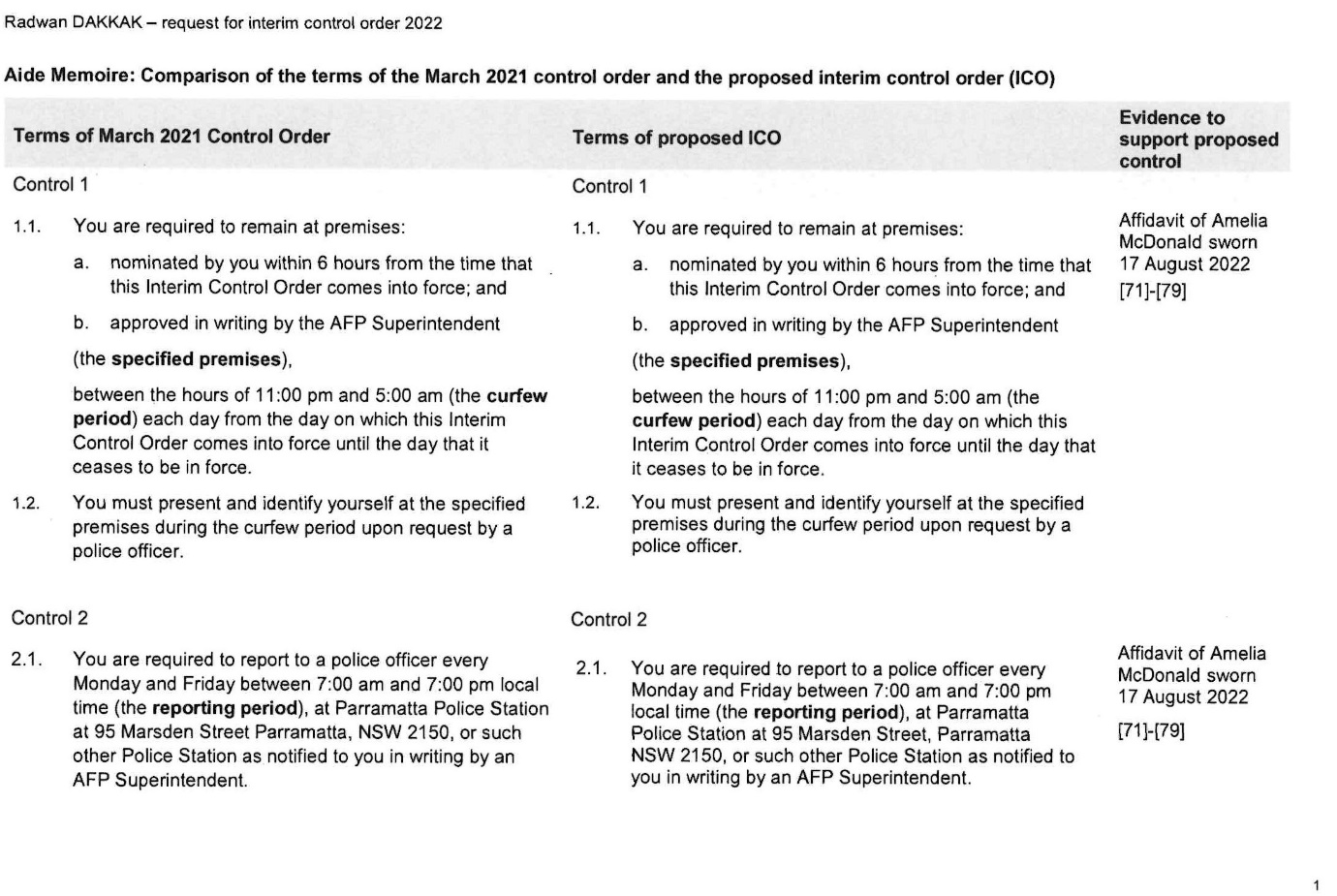
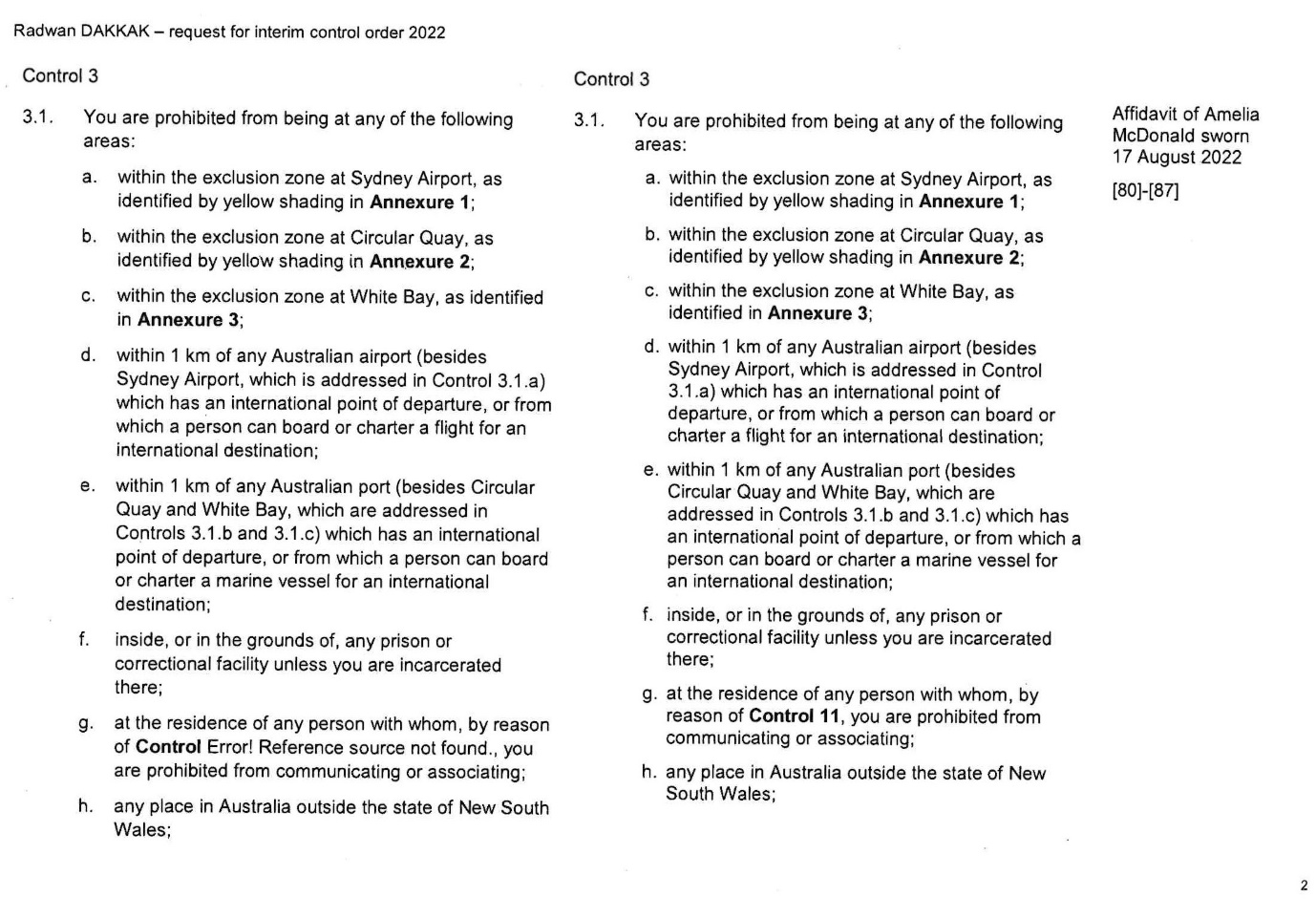
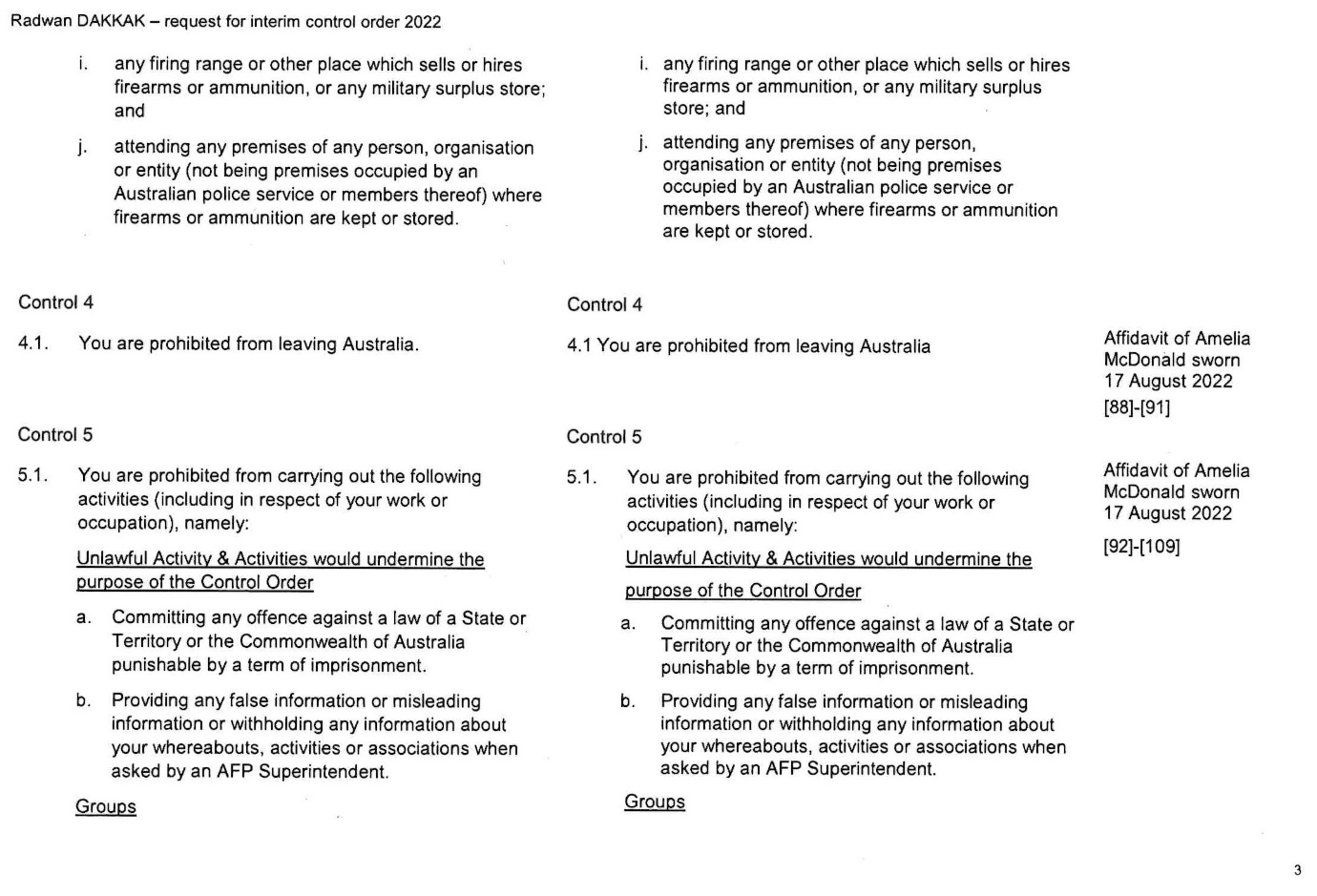
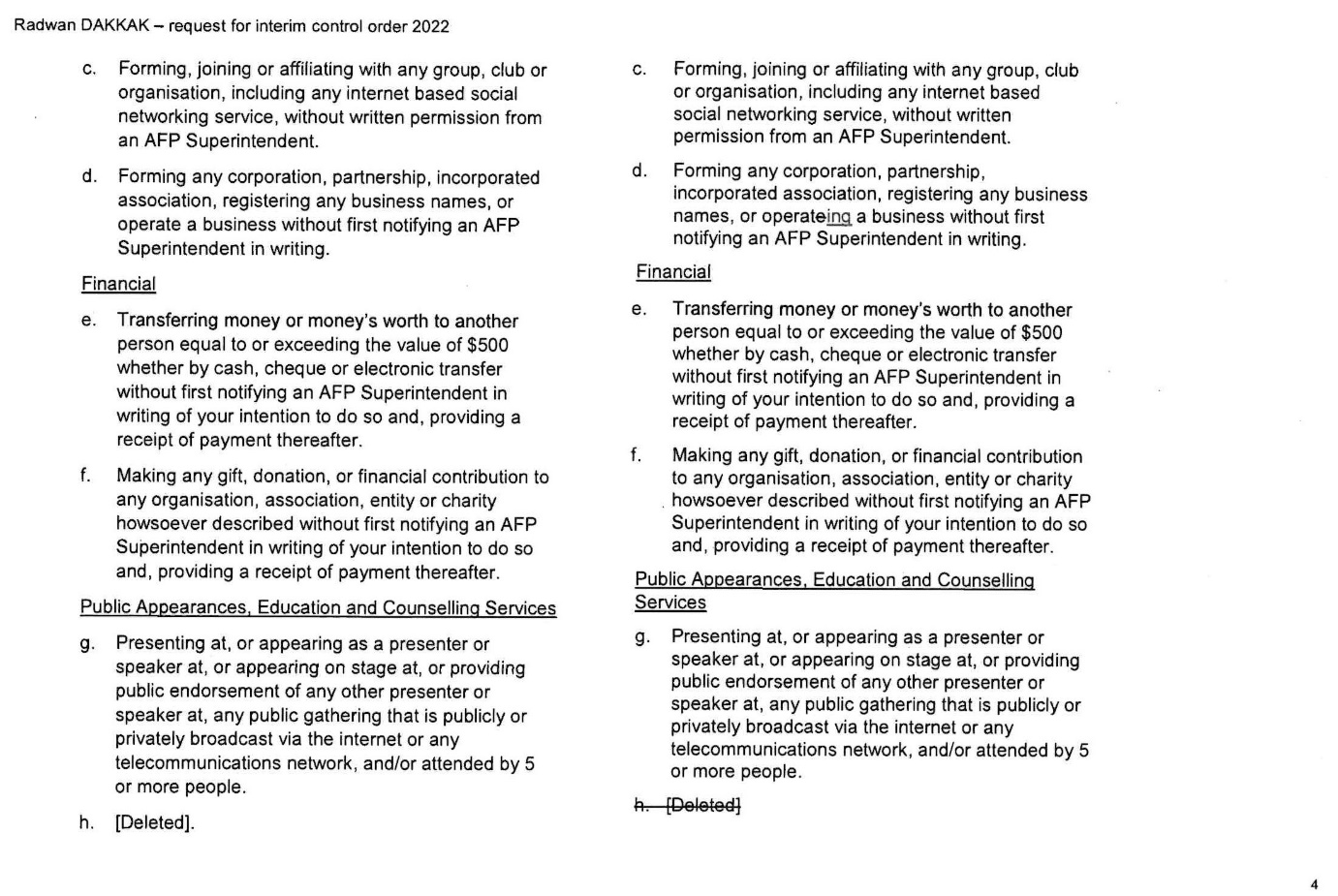
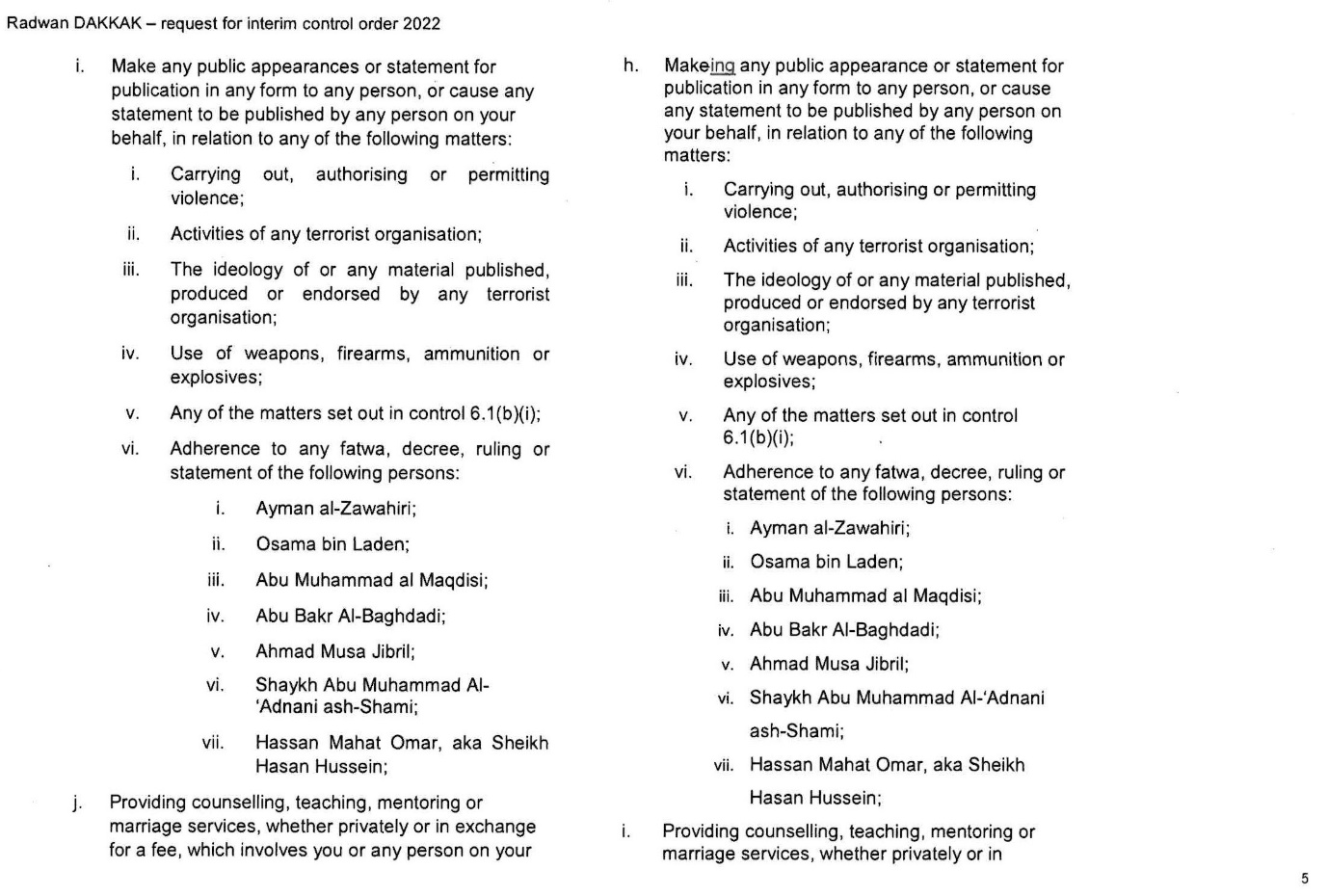
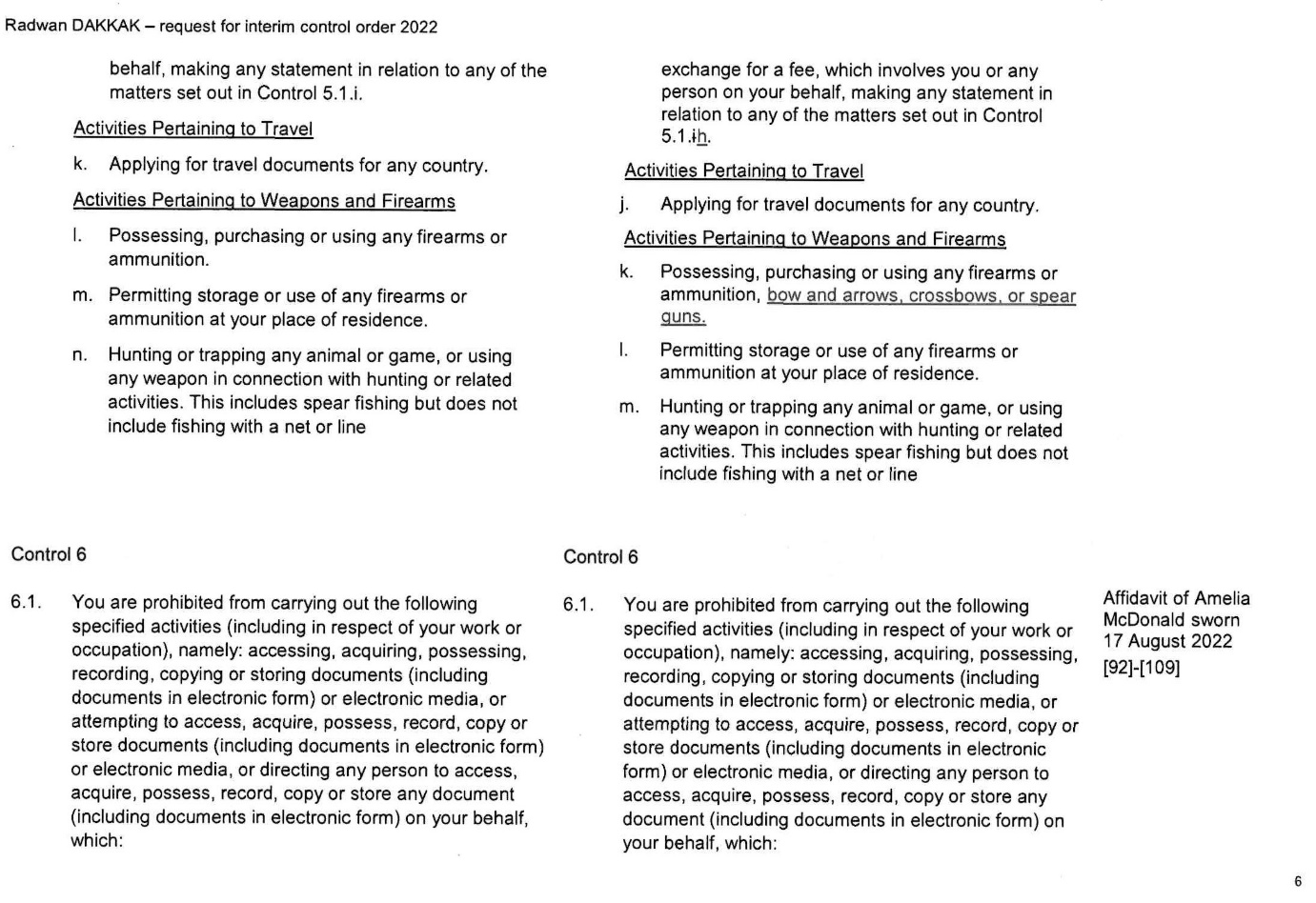
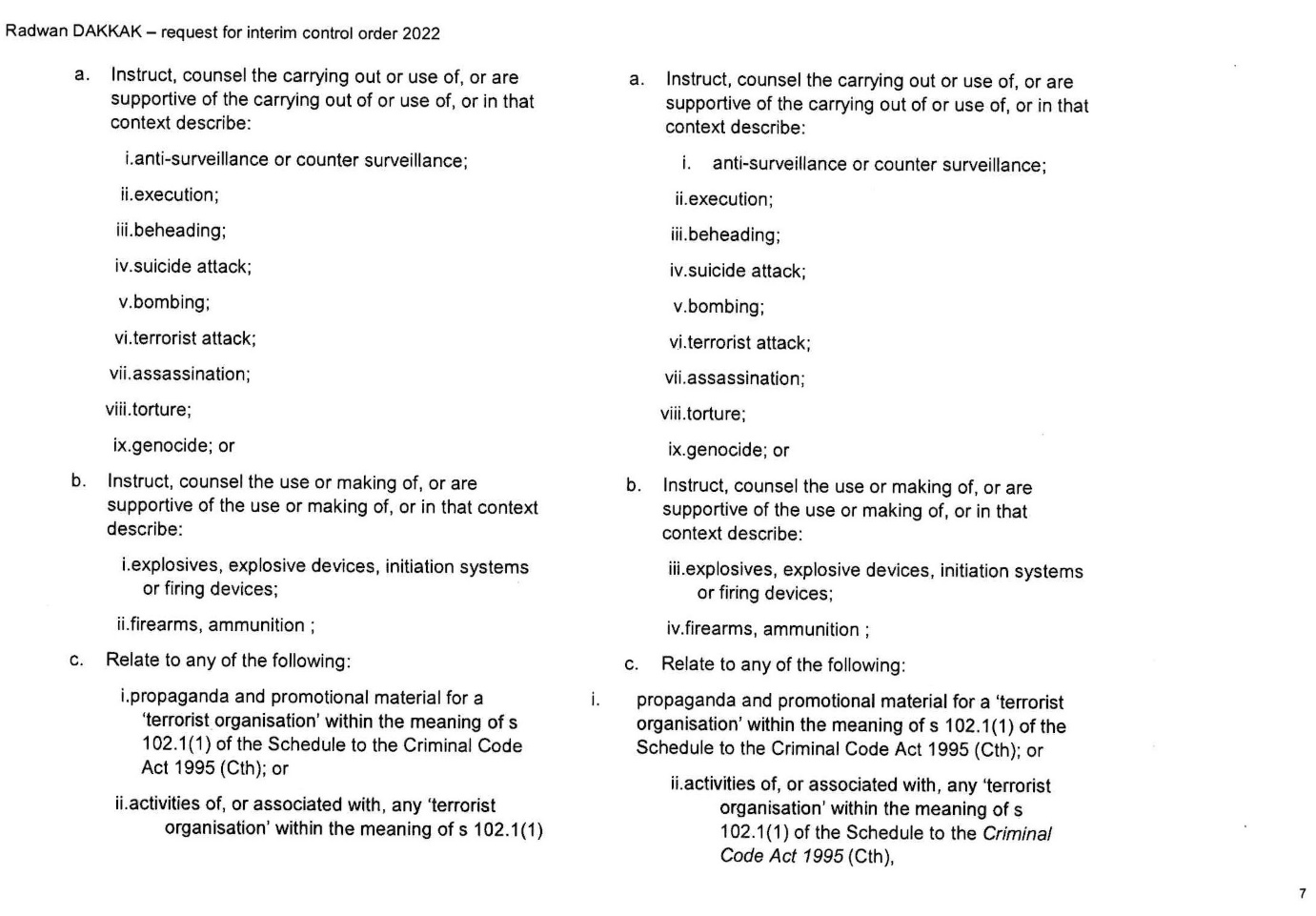
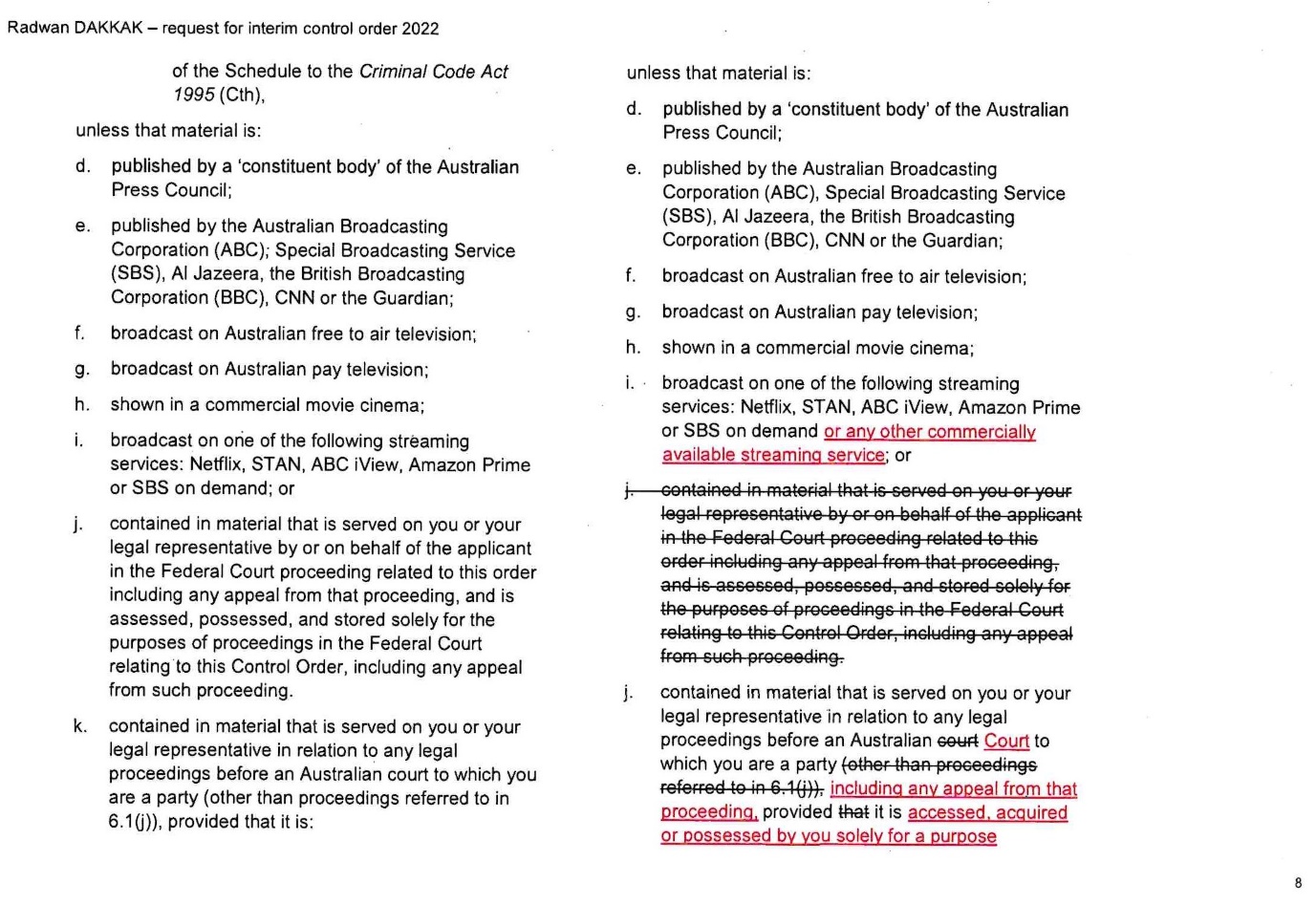
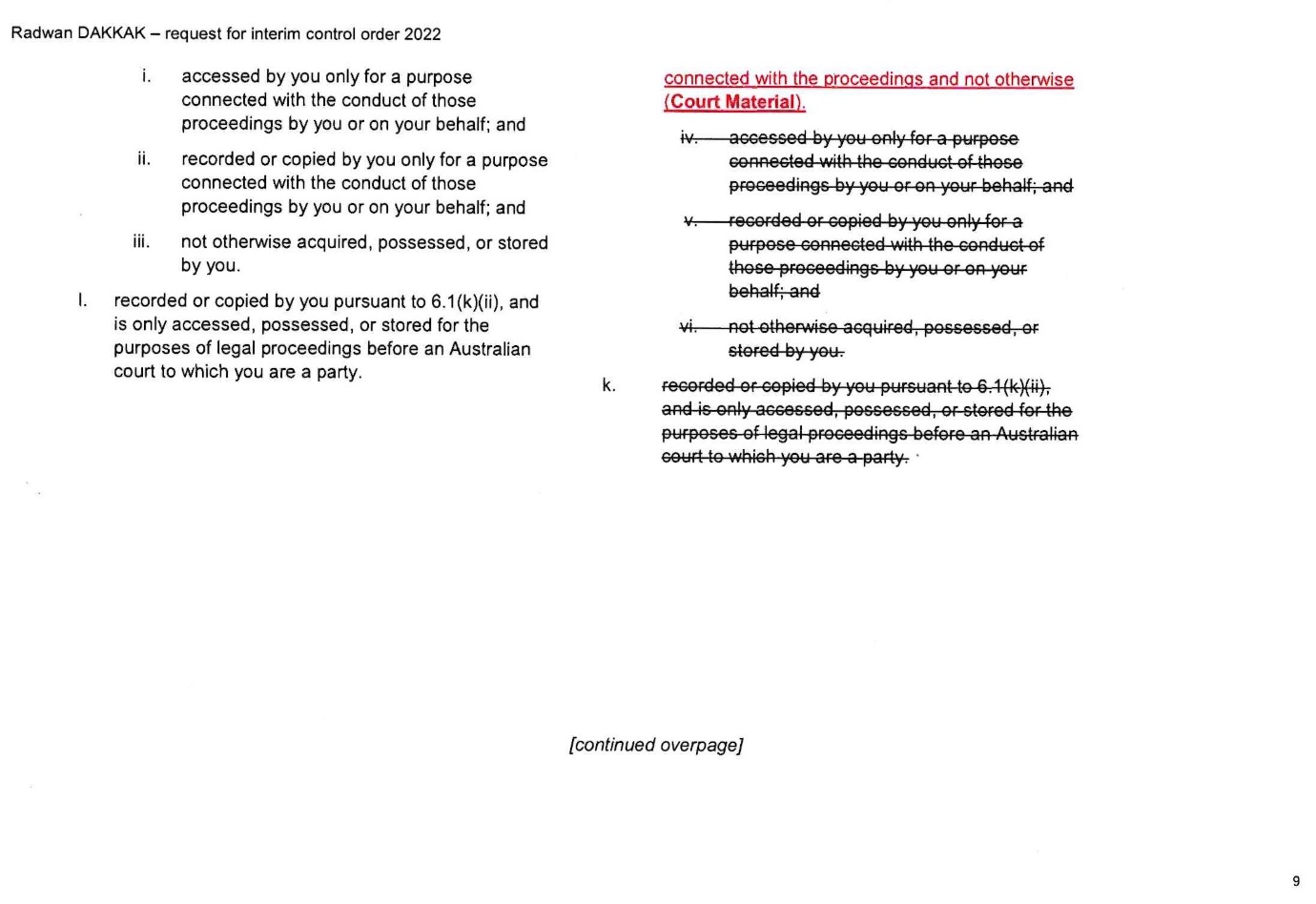
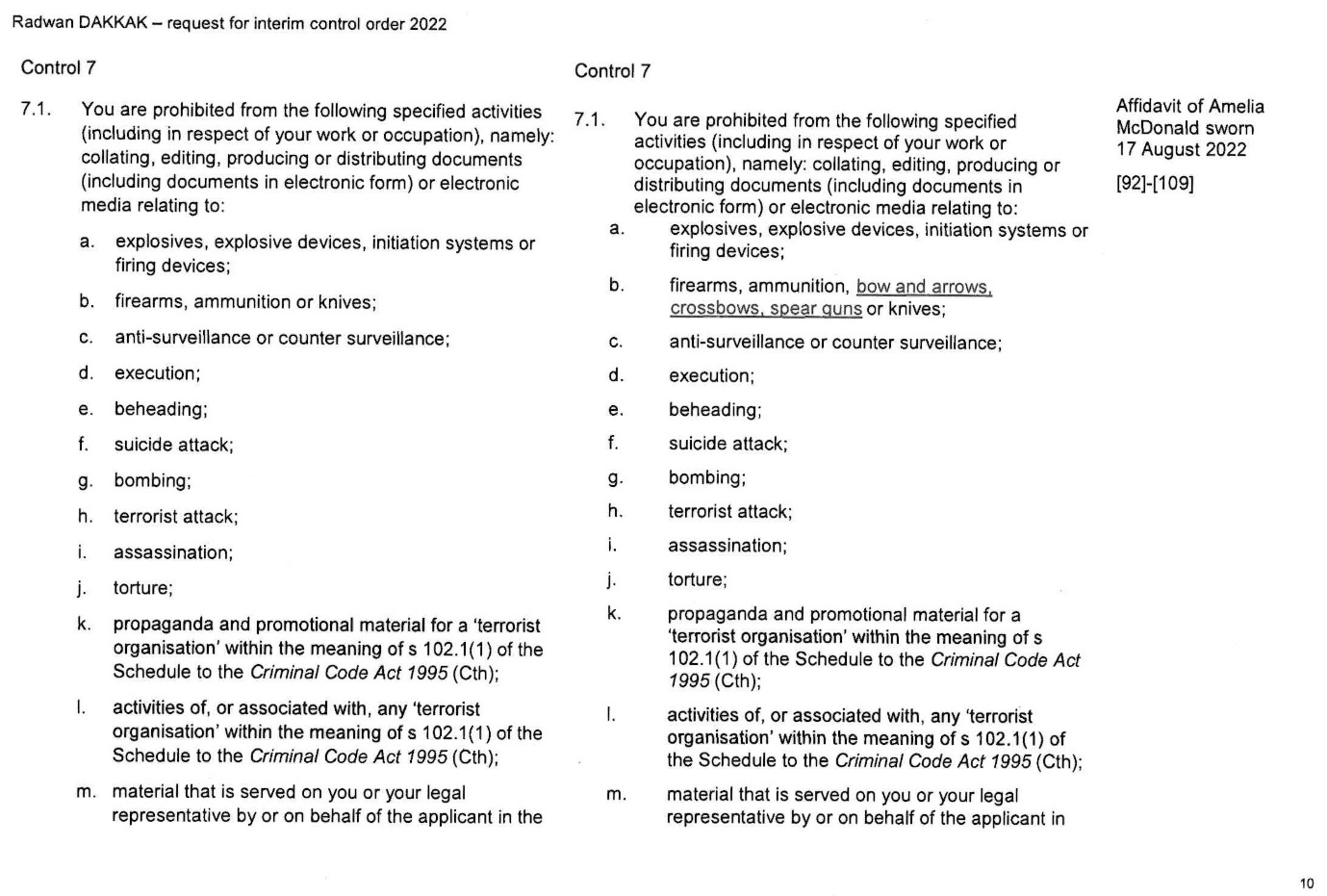
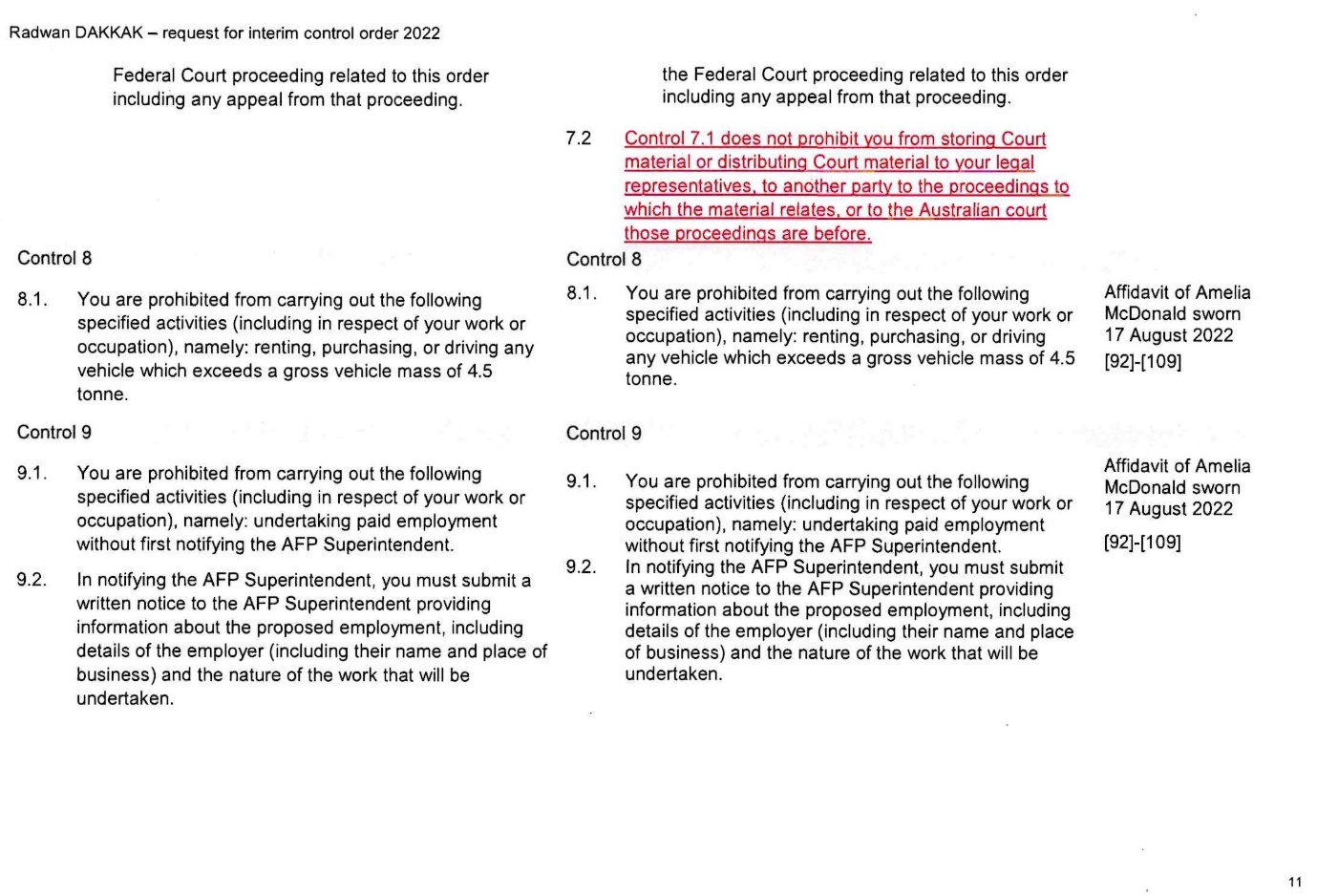
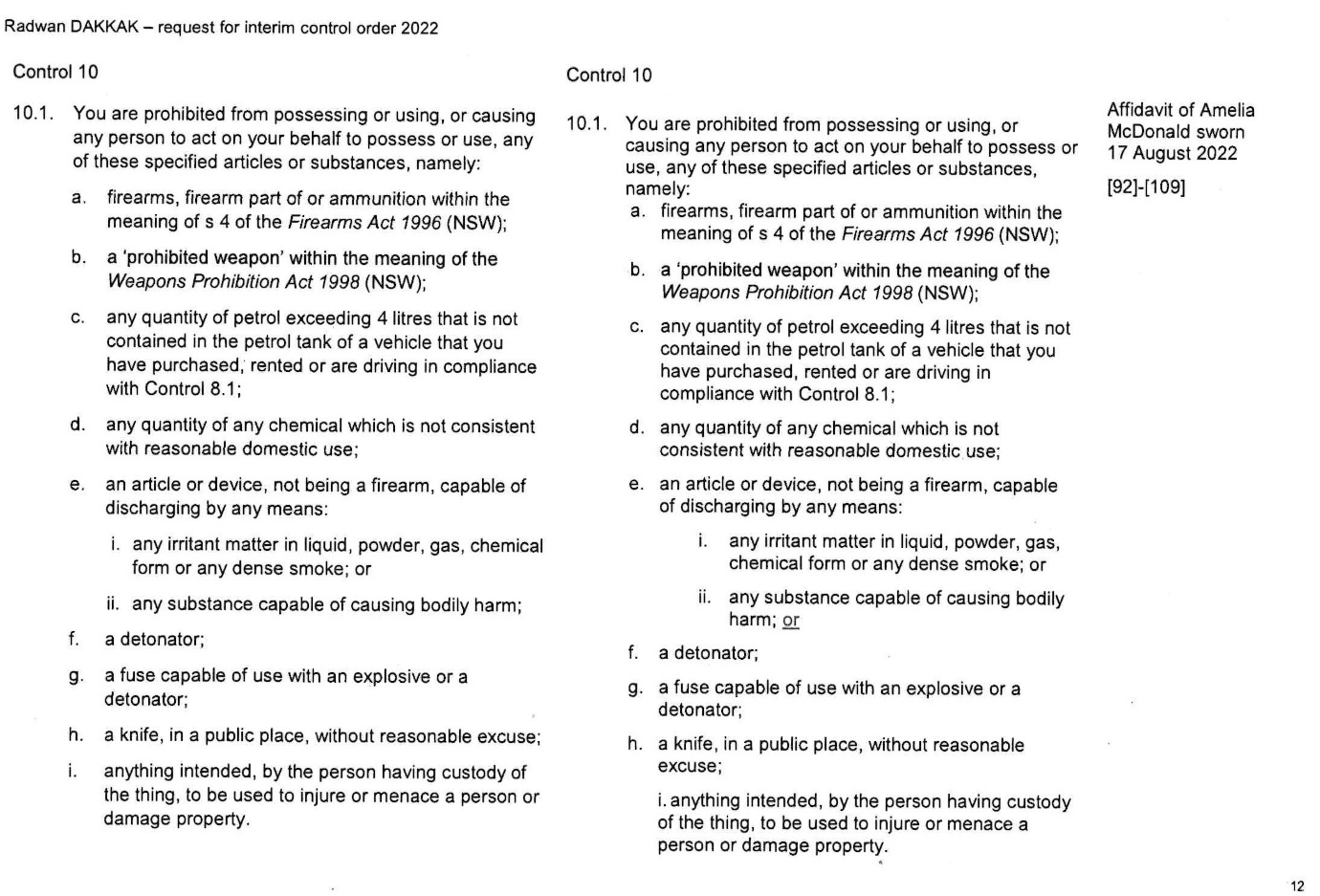
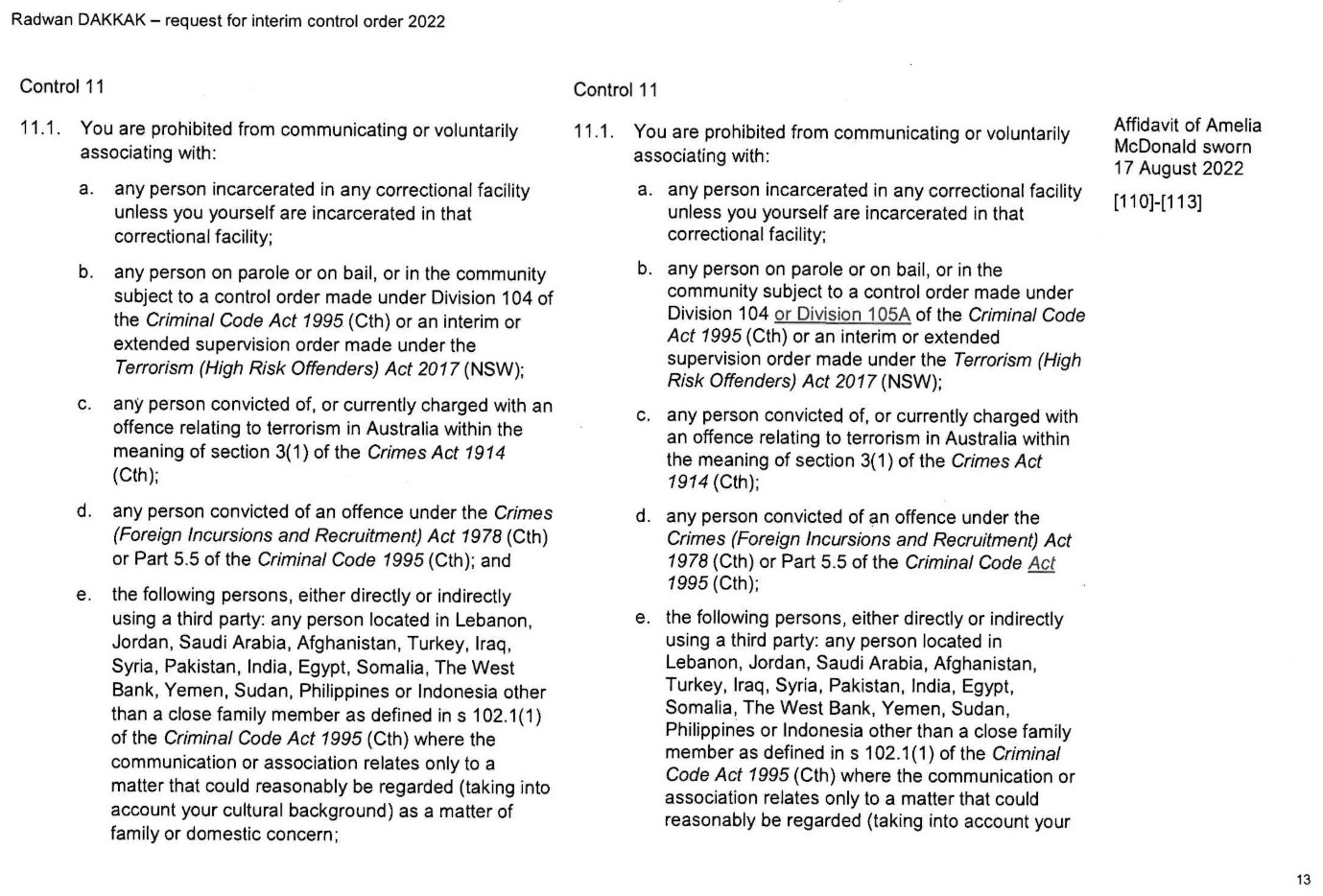
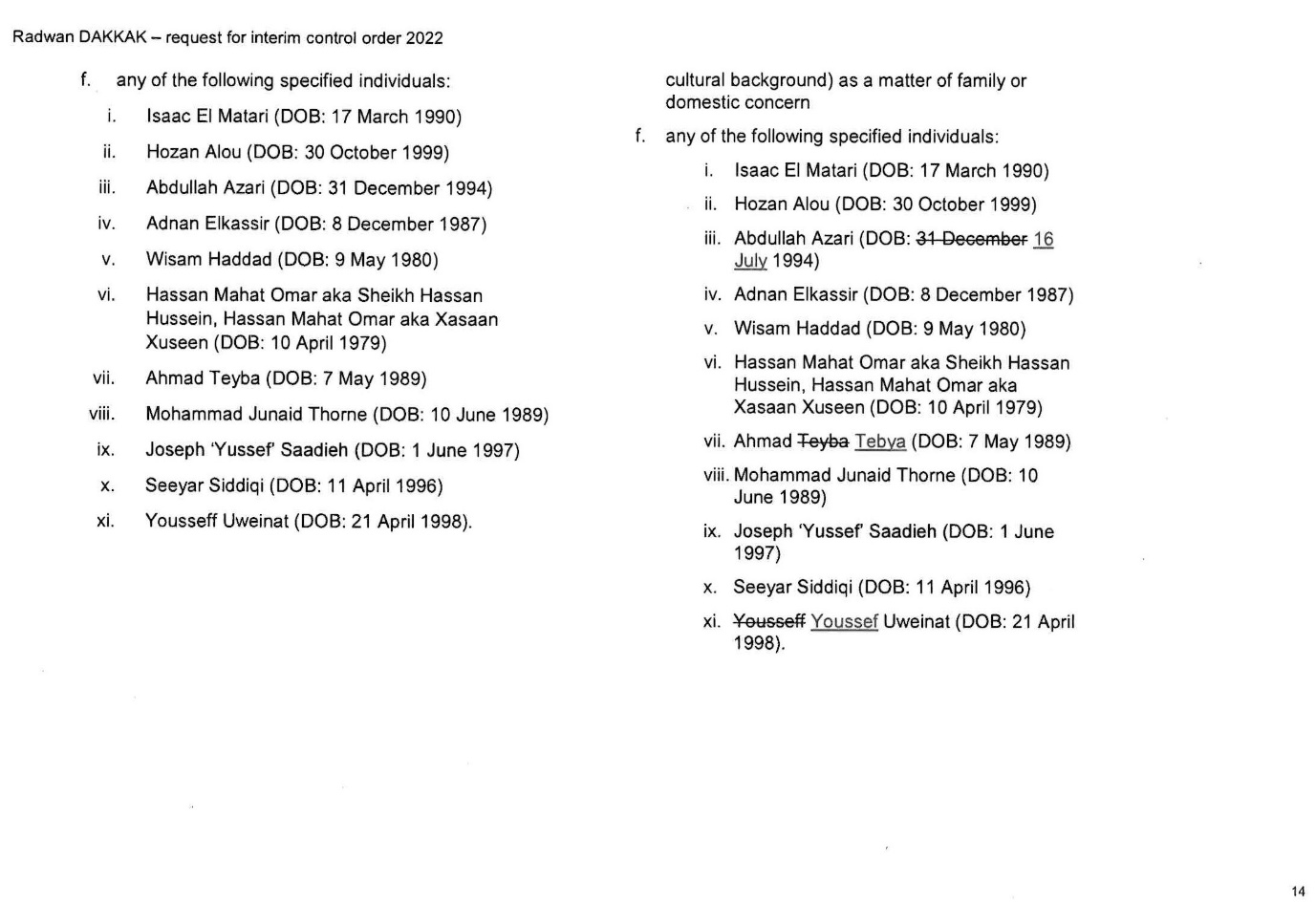
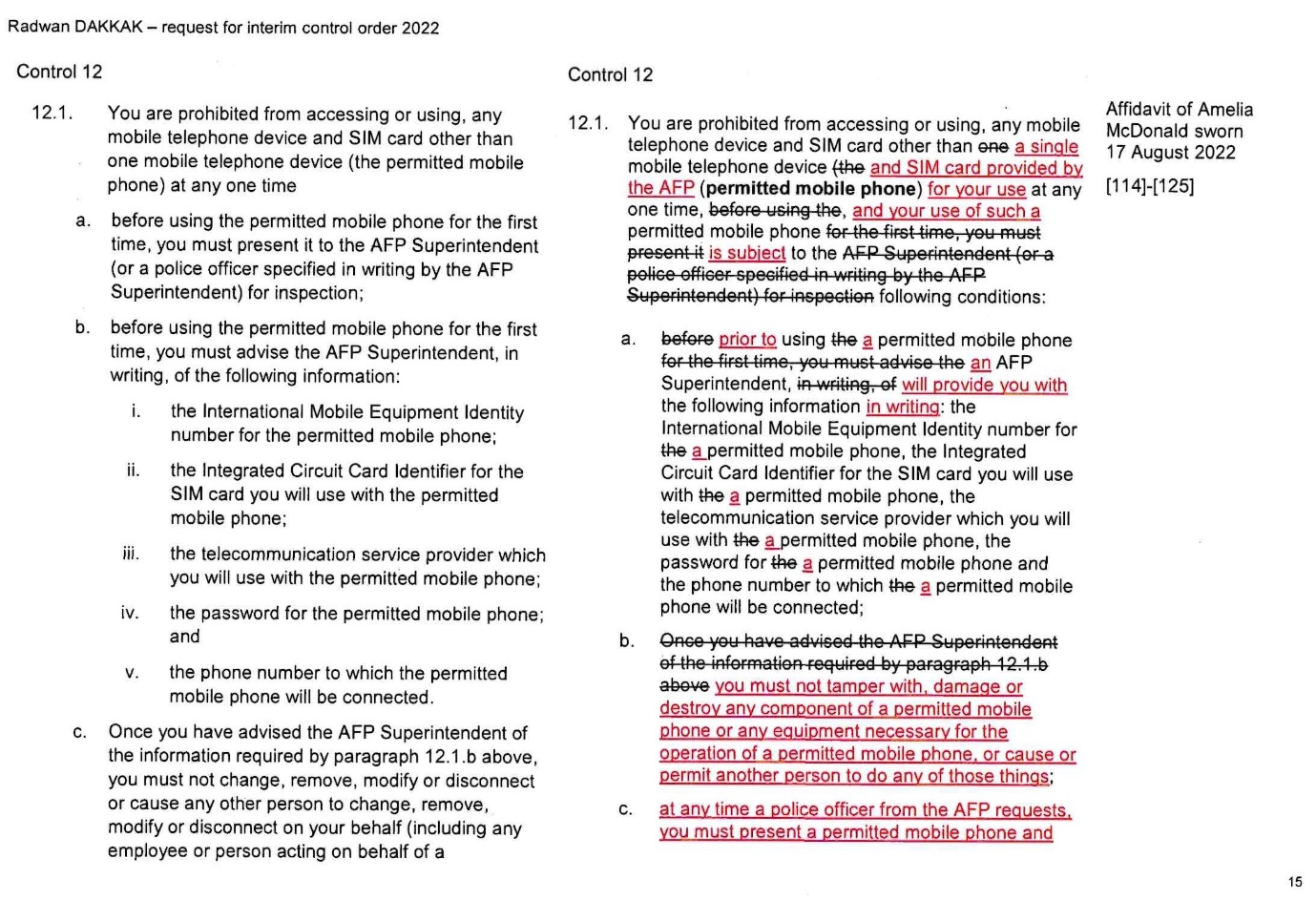
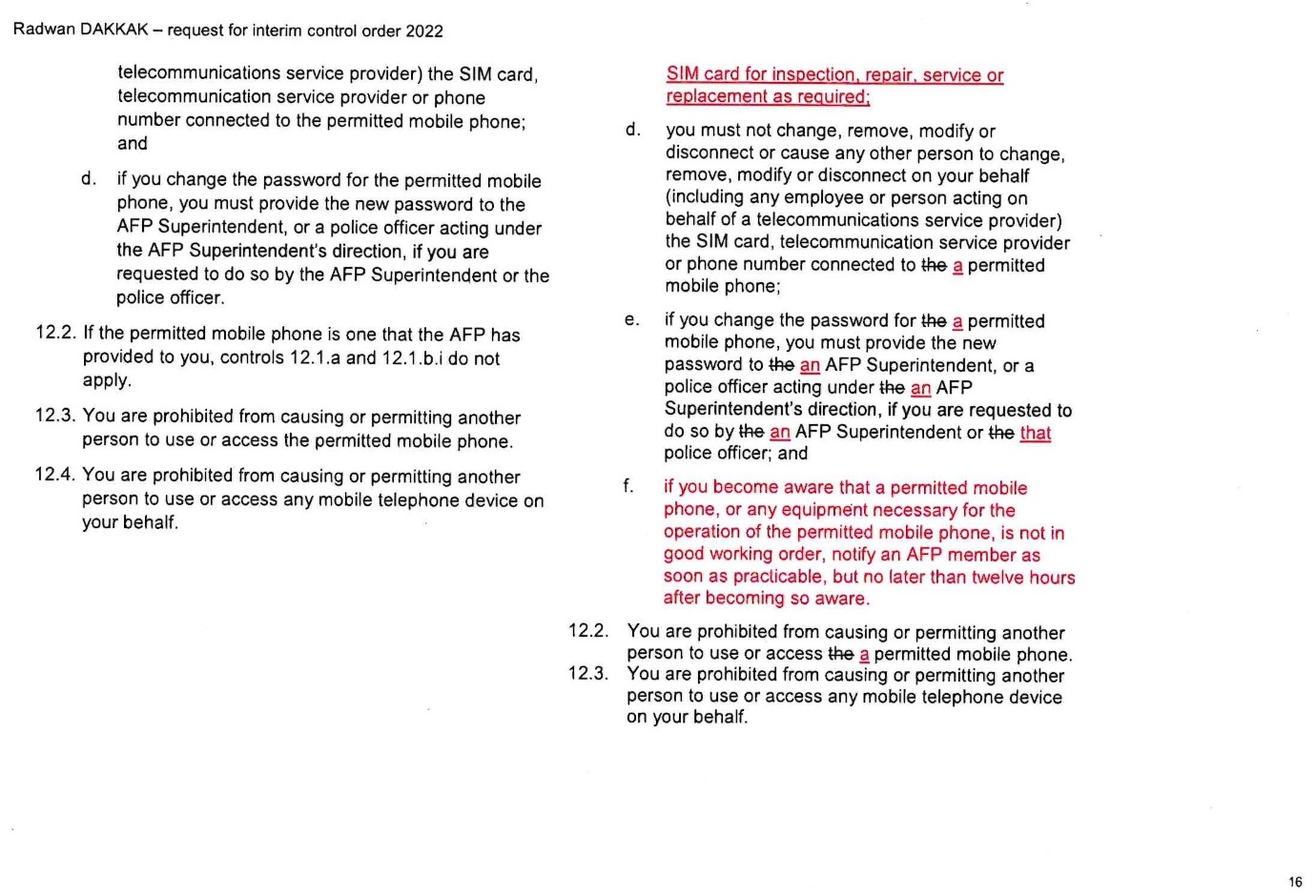
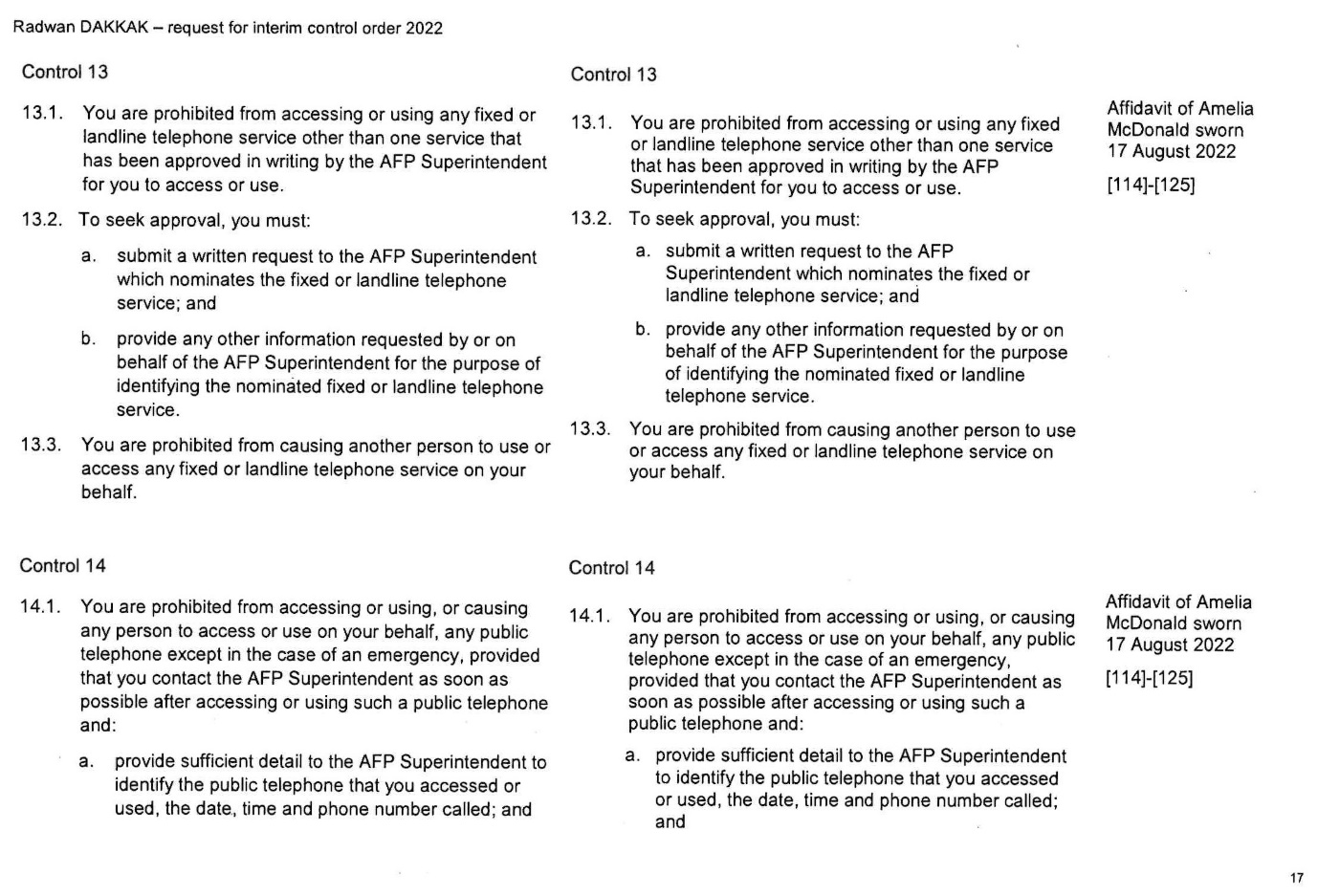
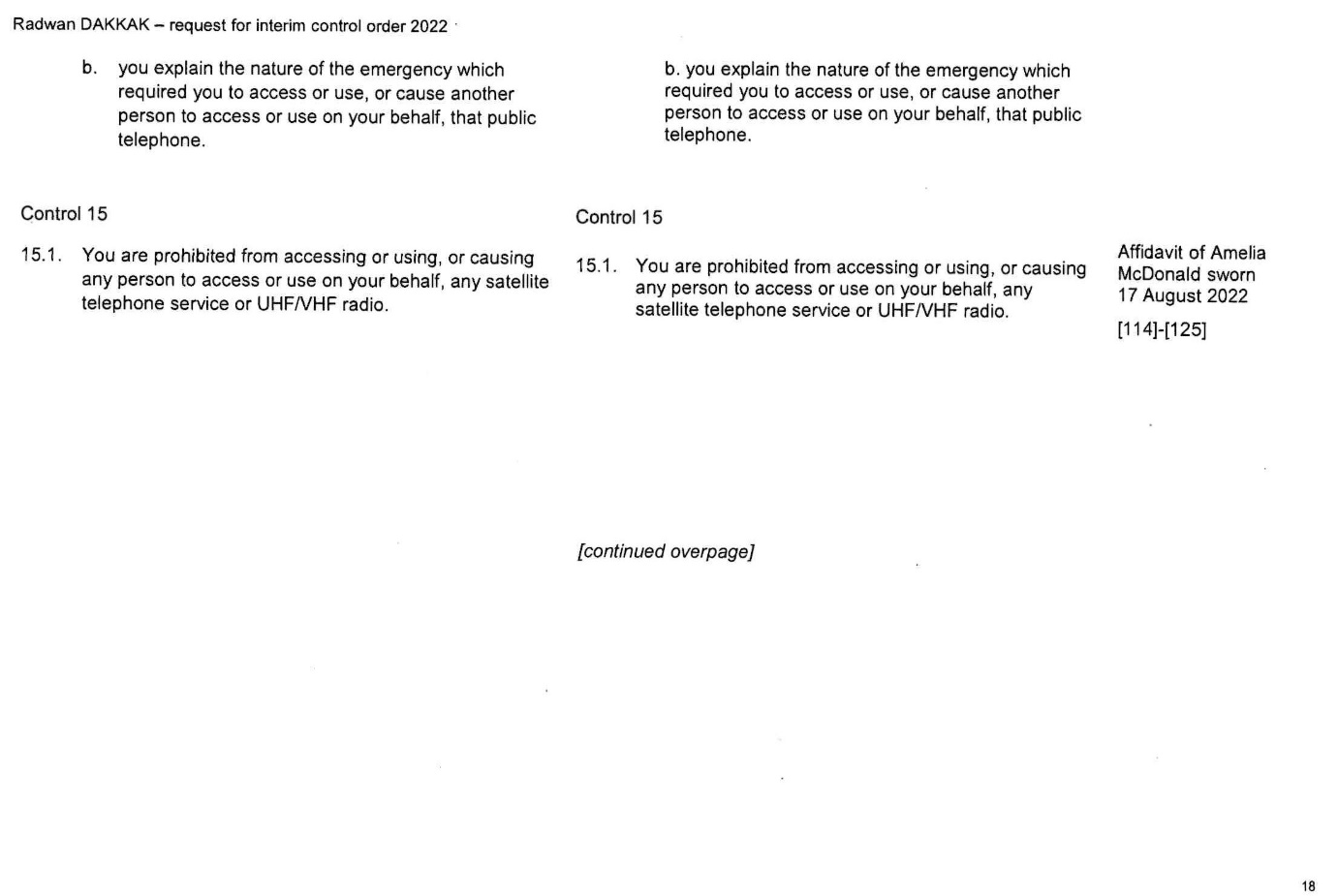
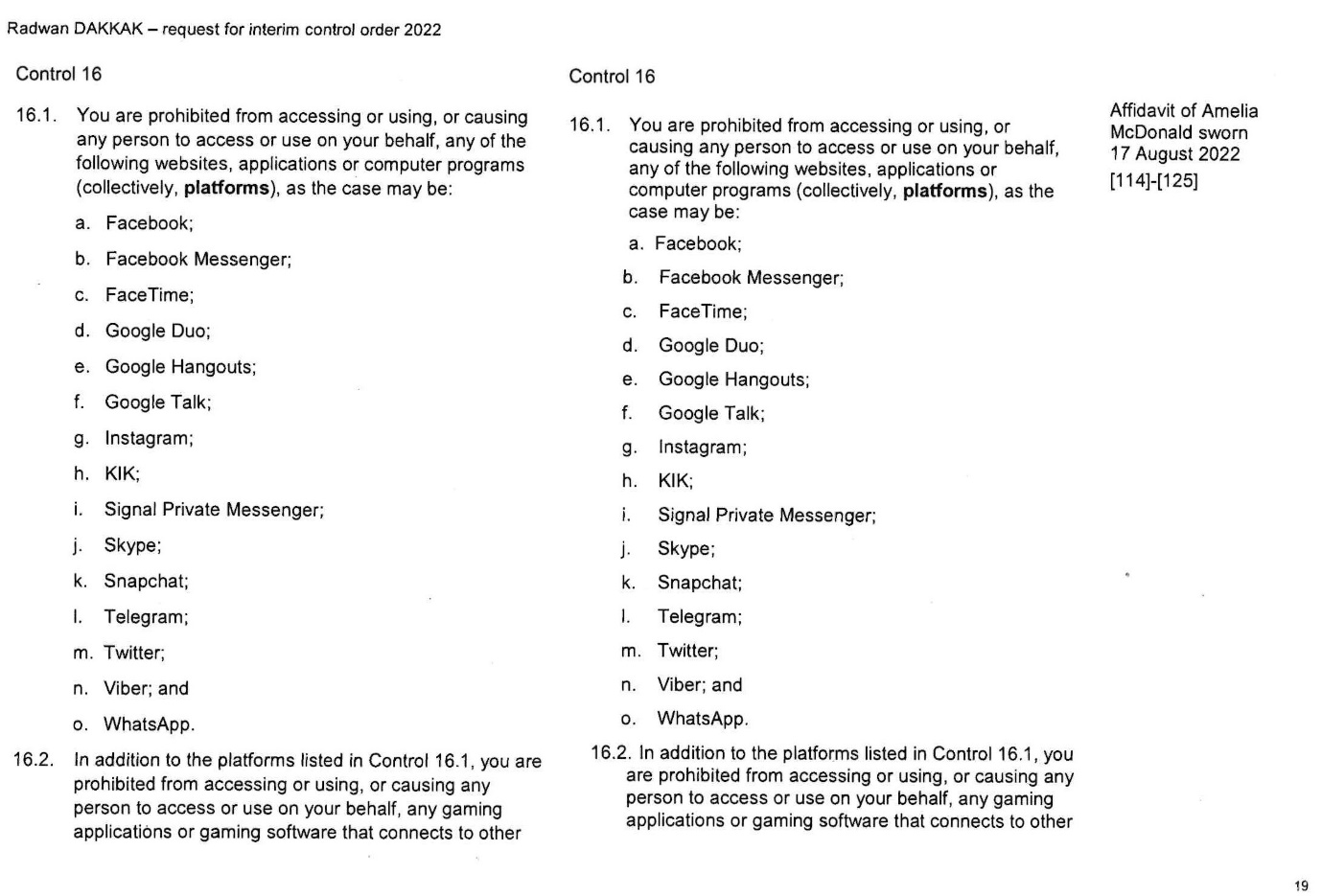
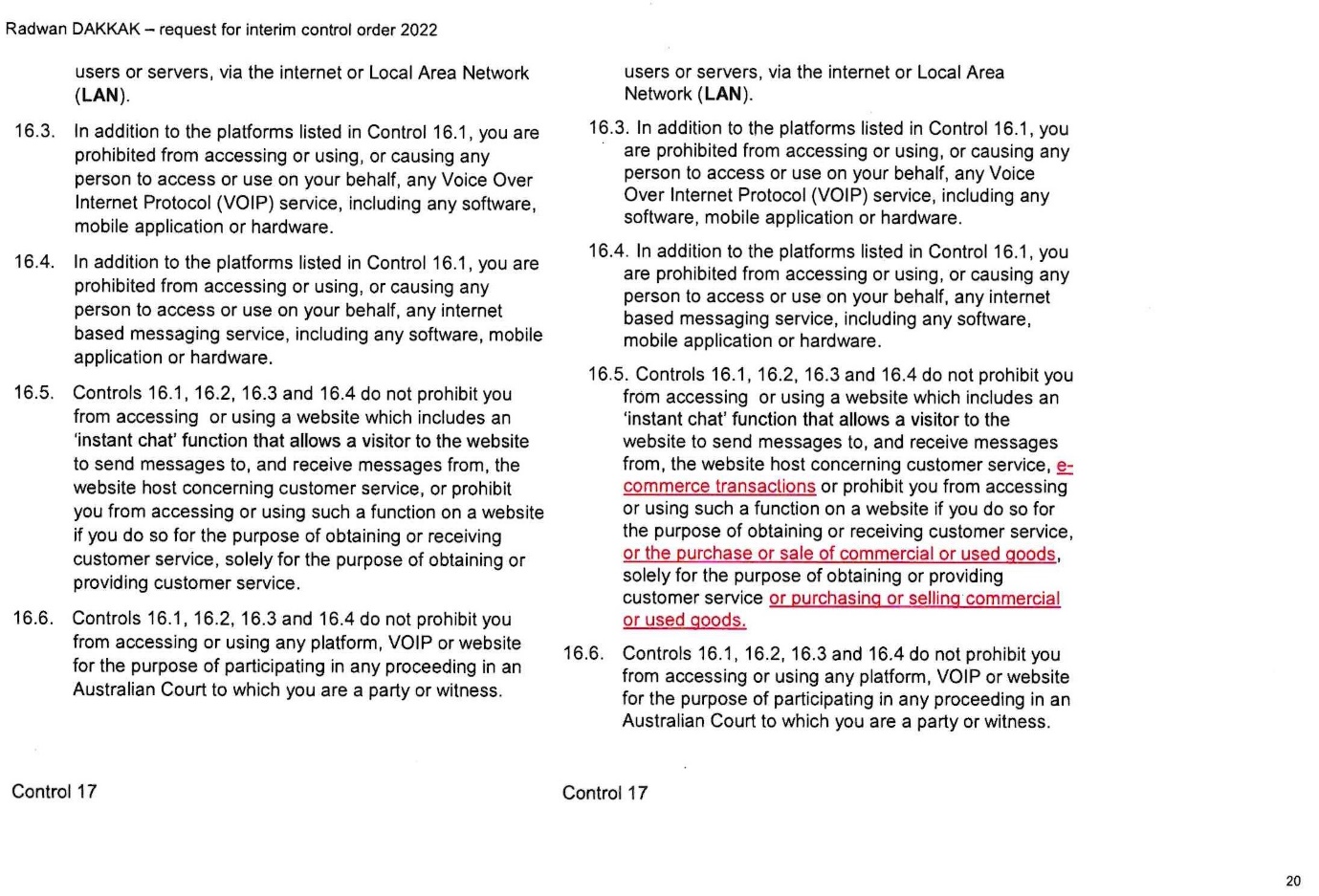
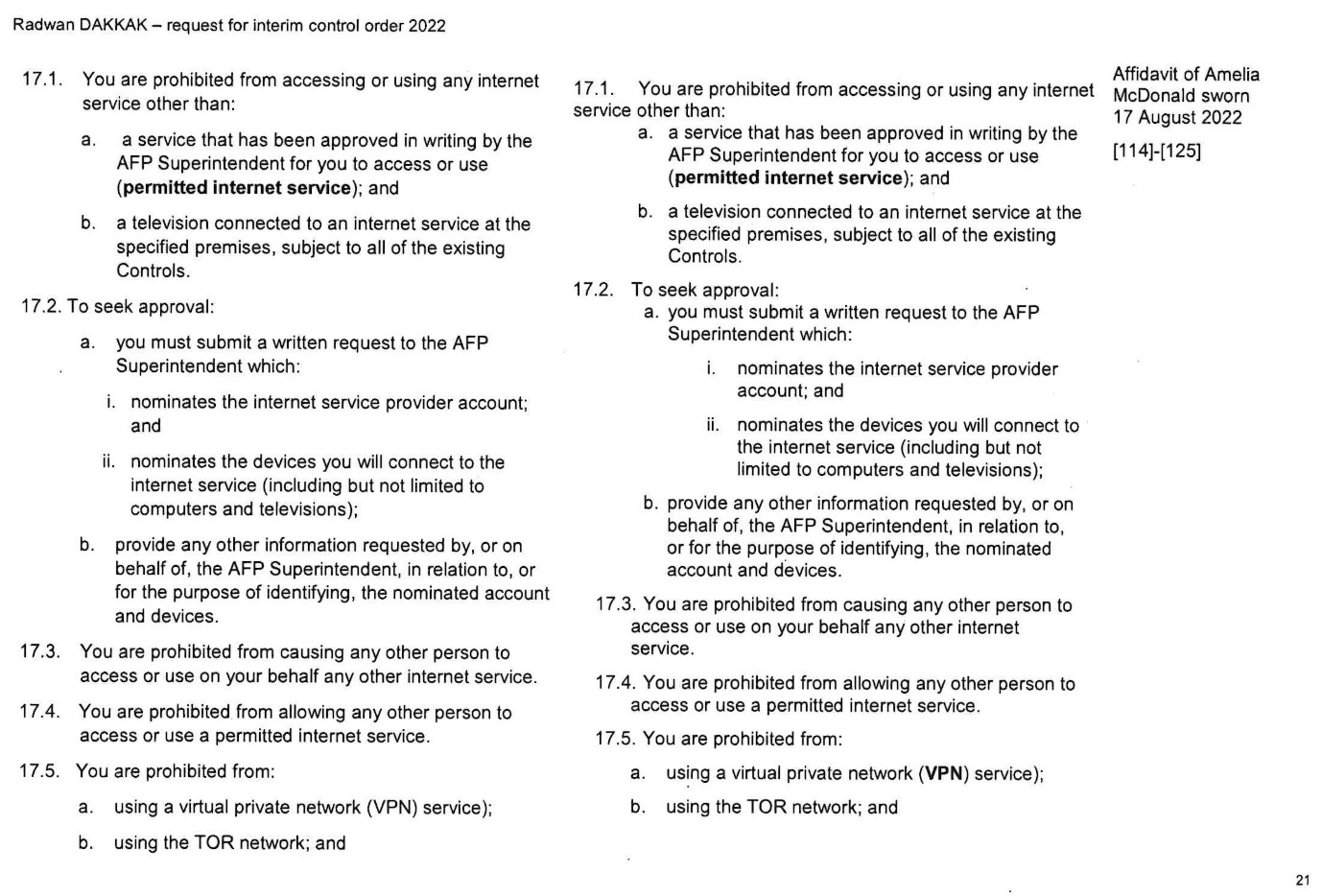
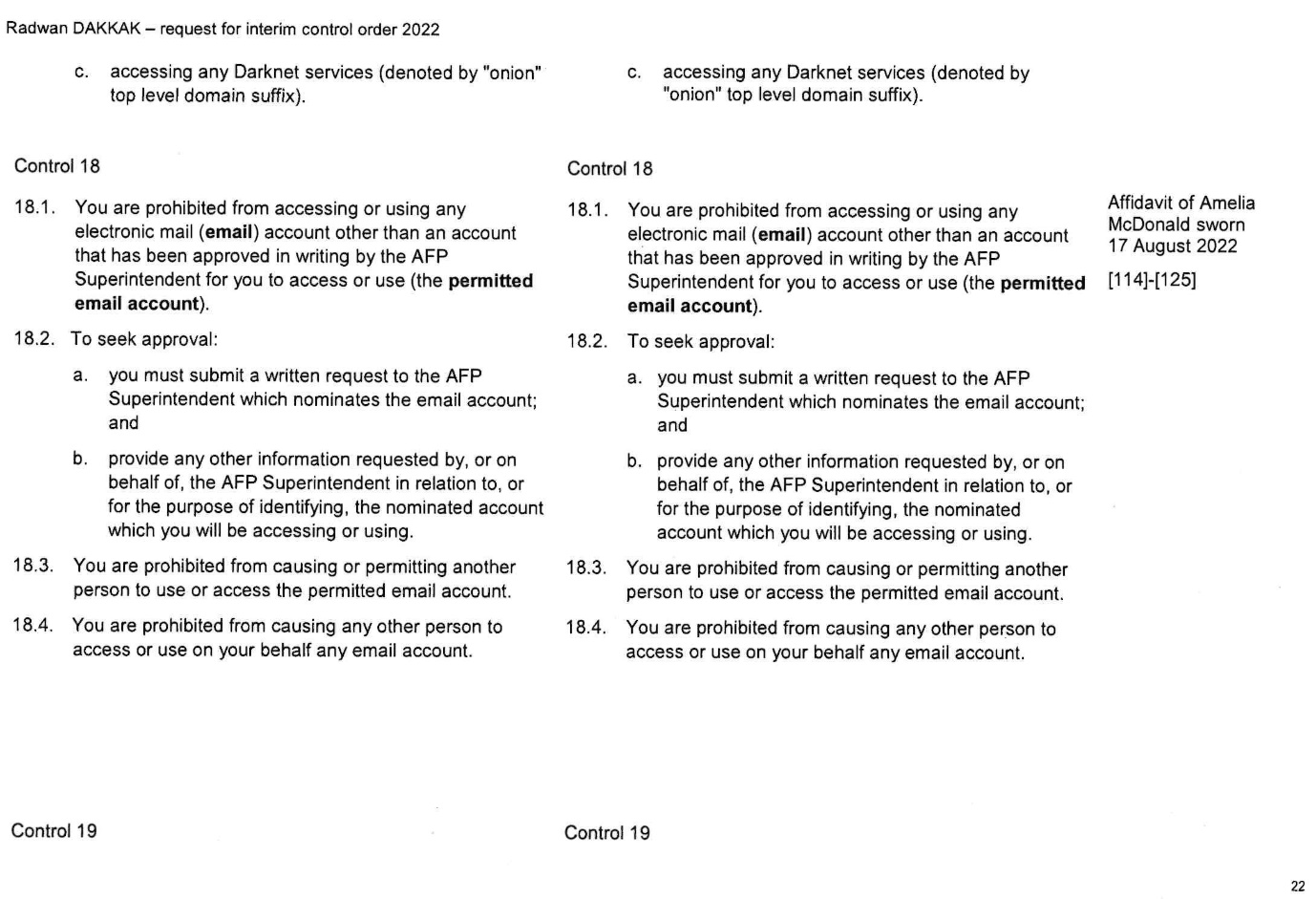
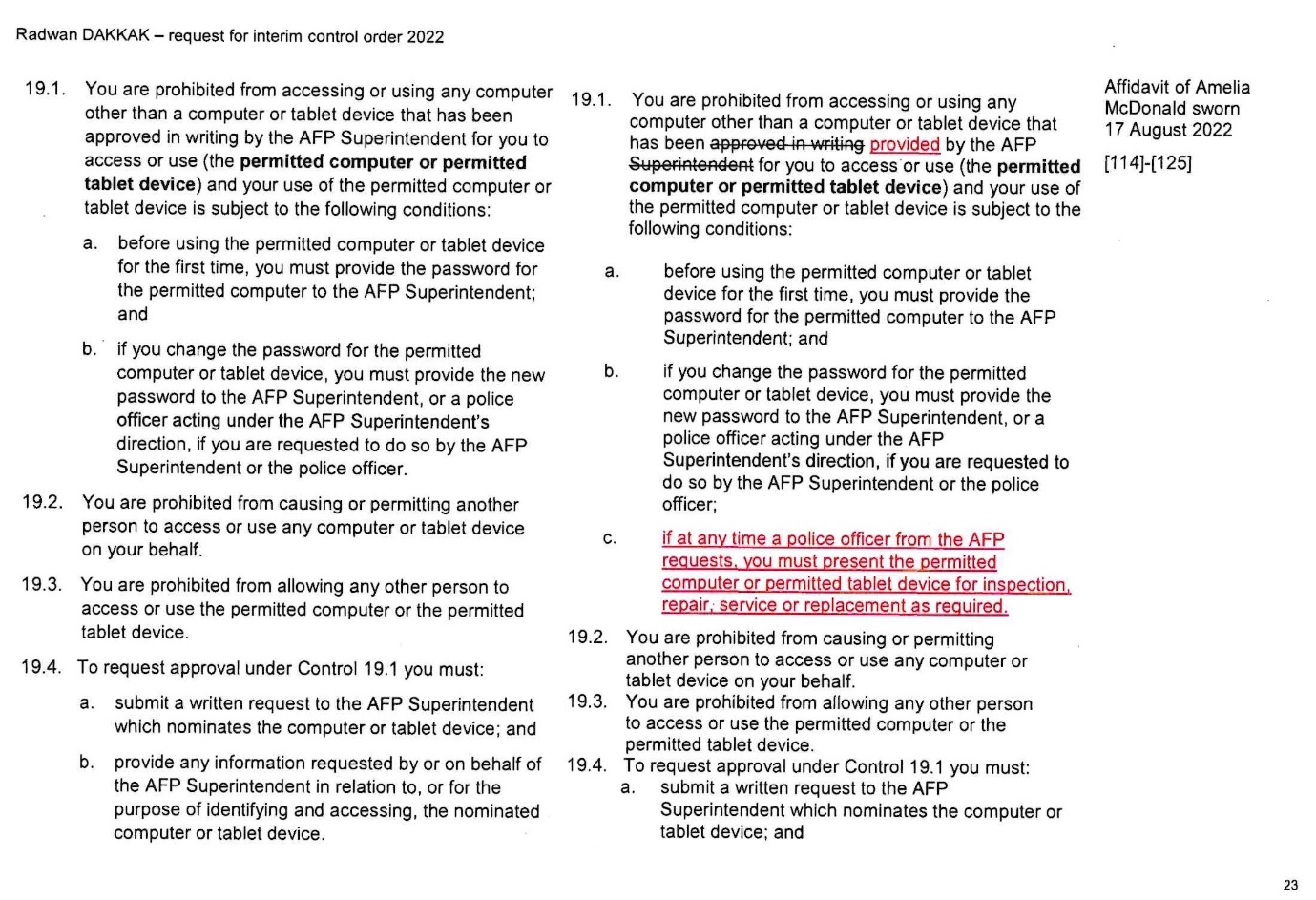
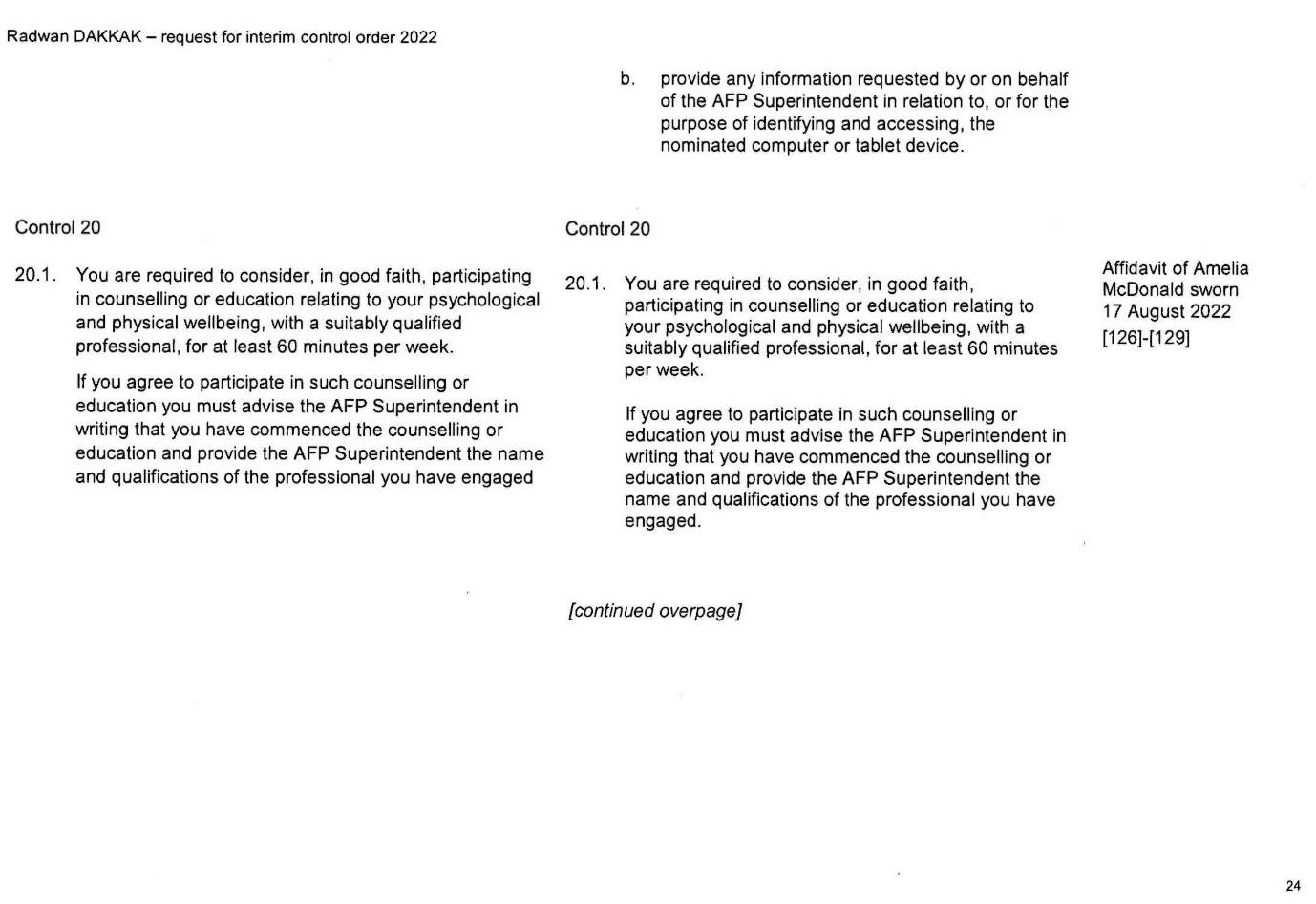
13 Chapter 5 of the Code deals with offences related to the security of the Commonwealth. Part 5.3 deals with offences concerning terrorism. Division 104 (within Pt 5.3) deals with the making of control orders. The objects of the Division are set out in s 104.1:
The objects of this Division are to allow obligations, prohibitions and restrictions to be imposed on a person by a control order for one or more of the following purposes:
(a) protecting the public from a terrorist act;
(b) preventing the provision of support for or the facilitation of a terrorist act;
(c) preventing the provision of support for or the facilitation of the engagement in a hostile activity in a foreign country.
14 An interim control order is made on the request of a “senior AFP member”. However, a senior AFP member must not request an interim control order in relation to a person without the written consent of the “AFP Minister”: s 104.2(1). Here, the AFP Minister is the Attorney-General for the Commonwealth.
15 Section 104.3 sets out the information and material that must be provided to an issuing court in respect of an application for an interim control order.
16 Section 104.4 sets out the requirements for making an interim control order.
(1) The issuing court may make an order under this section in relation to the person, but only if:
(a) the senior AFP member has requested it in accordance with section 104.3; and
(b) the court has received and considered such further information (if any) as the court requires; and
(c) the court is satisfied on the balance of probabilities:
(i) that making the order would substantially assist in preventing a terrorist act; or
(ii) that the person has provided training to, received training from or participated in training with a listed terrorist organisation; or
(iii) that the person has engaged in a hostile activity in a foreign country; or
(iv) that the person has been convicted in Australia of an offence relating to terrorism, a terrorist organisation (within the meaning of subsection 102.1(1)) or a terrorist act (within the meaning of section 100.1); or
(v) that the person has been convicted in a foreign country of an offence that is constituted by conduct that, if engaged in in Australia, would constitute a terrorism offence (within the meaning of subsection 3(1) of the Crimes Act 1914 ); or
(vi) that making the order would substantially assist in preventing the provision of support for or the facilitation of a terrorist act; or
(vii) that the person has provided support for or otherwise facilitated the engagement in a hostile activity in a foreign country; and
(d) the court is satisfied on the balance of probabilities that each of the obligations, prohibitions and restrictions to be imposed on the person by the order is reasonably necessary, and reasonably appropriate and adapted, for the purpose of:
(i) protecting the public from a terrorist act; or
(ii) preventing the provision of support for or the facilitation of a terrorist act; or
(iii) preventing the provision of support for or the facilitation of the engagement in a hostile activity in a foreign country.
(2) For the purposes of paragraph (1)(d), in determining whether each of the obligations, prohibitions and restrictions to be imposed on the person by the order is reasonably necessary, and reasonably appropriate and adapted, the court must take into account:
(a) as a paramount consideration in all cases--the objects of this Division (see section 104.1); and
(b) as a primary consideration in the case where the person is 14 to 17 years of age—the best interests of the person; and
(c) as an additional consideration in all cases—the impact of the obligation, prohibition or restriction on the person’s circumstances (including the person's financial and personal circumstances).
(2A) In determining what is in the best interests of a person for the purposes of paragraph (2)(b), the court must take into account the following:
(a) the age, maturity, sex and background (including lifestyle, culture and traditions) of the person;
(b) the physical and mental health of the person;
(c) the benefit to the person of having a meaningful relationship with his or her family and friends;
(d) the right of the person to receive an education;
(e) the right of the person to practise his or her religion;
(f) any other matter the court considers relevant.
(4) In paragraphs (1)(c) and (d), a reference to a terrorist act includes:
(a) a reference to a terrorist act that does not occur; and
(b) a reference to a specific terrorist act; and
(c) a reference to more than one terrorist act.
17 Section 104.5 sets out the terms in which an interim control order is to be made.
18 The applicant has provided the Court with detailed written submissions as to how the Court should approach its consideration of the present request. It is not necessary for me to set out the detail of those submissions, which are on the Court’s file. The applicant’s submissions emphasise the protective purpose for which an interim control order is made: McCartney v Abdirahman-Khalif (No 2) [2020] FCA 1002 at [209]; McCartney v EB [2019] FCA 183; 263 FCR 170 at [18]. The submissions also address the requirement of proportionality inherent in s 104.4(1)(d), and ss 104.4 (2) and (2A), with respect to the imposition of conditions. Further, the submissions direct attention to ss 104.1(c) and (d) which make clear that the Court’s fact-finding, for the purpose of making an interim control order, is based on the civil standard of proof.
Preliminary matters
Procedural findings
19 On the evidence before me, I am satisfied that:
(a) The applicant is a “senior AFP member”: see the definition in s 100.1 of the Code.
(b) This Court is an “issuing court”: see the definition in s 100.1 of the Code.
(c) The applicant sought, and obtained, the consent of the AFP Minister under s 104.2 of the Code to make the request for the proposed interim control order.
(d) The applicant has complied with the requirements of s 104.3 of the Code with respect to the provision of material to the Court.
(e) The respondent has been convicted in Australia of an “offence relating to terrorism” within the meaning of s 104.4(1)(c)(iv) of the Code (i.e., the Association Offences). This was the accepted position when the first interim control order was made. It is not necessary for me to address whether an offence under s 104.27 of the Code (i.e., the Contravention Offence) is “an offence relating to terrorism”.
Findings on sentencing
20 When sentencing the respondent in respect of the Association Offences, the sentencing judge made the following findings, amongst other findings:
(a) Although an offence contrary to s 102.8(1) is a terrorism offence, it is one of the least serious terrorism offences created by the Code.
(b) The evidence established that the respondent’s beliefs and interests included material downloaded from his computer and other devices. The material betrayed an interest in extreme and dangerous political views, demonstrating the respondent’s motivation in providing such assistance, as he did, to those members of Islamic State (IS) nominated in the charges against him.
(c) The Association Offences were serious offences. The respondent’s associations with members of the terrorist group were not fleeting. There was clear evidence of the respondent’s radicalisation and this was a substantial part of his motivation to associate with people he knew to be members of a terrorist organisation. IS was notorious for engaging in barbaric and egregious abuses of human rights. The respondent expressed opinions that some of these tactics (like killing children) were justified.
(d) The respondent’s conduct fell below the putative mid-range of objective seriousness but was substantially more serious than cases that would fall at the bottom of the range.
(e) Although the respondent had pleaded guilty to the Association Offences, it could not be accepted that he had established that he was truly remorseful or contrite.
(f) It was difficult to assess the respondent’s prospects of rehabilitation. Despite a number of positive matters favourable to rehabilitation, there is no evidence that the respondent has been “de-radicalised”. The respondent’s youth, prior good character, and family support showed that he has some prospects of rehabilitation. However, given the absence of evidence of contrition and “de-radicalisation” these matters could not be given much weight.
(g) Although, for the most part, the respondent’s conduct in gaol (up to the time of sentencing) had been exemplary, and he had no previous offences, the extreme nature of his views is a matter that must be taken into account in considering the protection of the community.
21 When sentencing the respondent in respect of the Contravention Offence, the sentencing judge made the following findings, amongst other findings:
(a) There were, in fact, three contraventions of the first interim control order.
(b) It was difficult to know what caused the respondent to access the material that constituted the Contravention Offence, but there is no suggestion that he committed any act which imperils any person, or that he did anything which might assist a terrorist organisation. The respondent’s failing was in accessing material which he was prevented from accessing by the first interim control order.
(c) The Association Offences and the Contravention Offence constitute the respondent’s only criminal offending. He is otherwise a young man of good character.
(d) The sentencing judge could not tell whether the respondent’s offending revealed a lack of insight into his conduct or whether his stated understanding of his conduct showed that he was defensive or evasive.
(e) A view could not be expressed as to whether the respondent’s prospects of rehabilitation were positive or negative.
(f) The conduct constituting the Contravention Offence was not egregious, but the timing of the conduct was “poor”.
(g) It could not be said that, by committing the Contravention Offence, the respondent was “thumbing his nose at the Commonwealth”.
(h) Because the respondent’s offending was so close to his release from custody and his being served with the first interim control order, his offending could not be regarded as trivial.
The proposed controls
Introduction
22 At the hearing for the first interim control order, the respondent was represented by Counsel. At that time, only the imposition of certain controls were in contest, namely Controls 1.1, 2.1, 5.1(g) and (h), 9, 11.1(e), and 16. I reached the view that:
(a) Control 1.1 should be imposed subject to amending the curfew time.
(b) Control 2.1 should be imposed.
(c) Control 5.1(g) should be imposed, but Control 5.1(h) should not be imposed.
(d) Control 9 should be imposed, noting that a particular undertaking was to be given by the applicant to assuage a particular concern that the respondent had about a future employer being informed of his offending.
(e) Control 11.1(e) should be imposed, subject to a qualification exempting communications with a close family member as defined in s 102.1(1) of the Code.
(f) Control 16 should be imposed.
23 Although the applicant in the first proceeding elected to confirm the first interim control order pursuant to s 104.12A(1) of the Code, the matter did not proceed to a confirmation hearing in light of the fact that the respondent was in custody following his arrest on 16 January 2021 in respect of the Contravention Offence. The first interim control order was varied from time to time to take account of the fact that some of the controls were no longer appropriate given the respondent was in custody. However, after the respondent entered his plea of guilty to the Contravention Offence on 17 December 2021, it was apparent that, by that time, a confirmation hearing lacked utility. On 23 December 2021, the respondent consented to the first proceeding being discontinued, with no order as to costs.
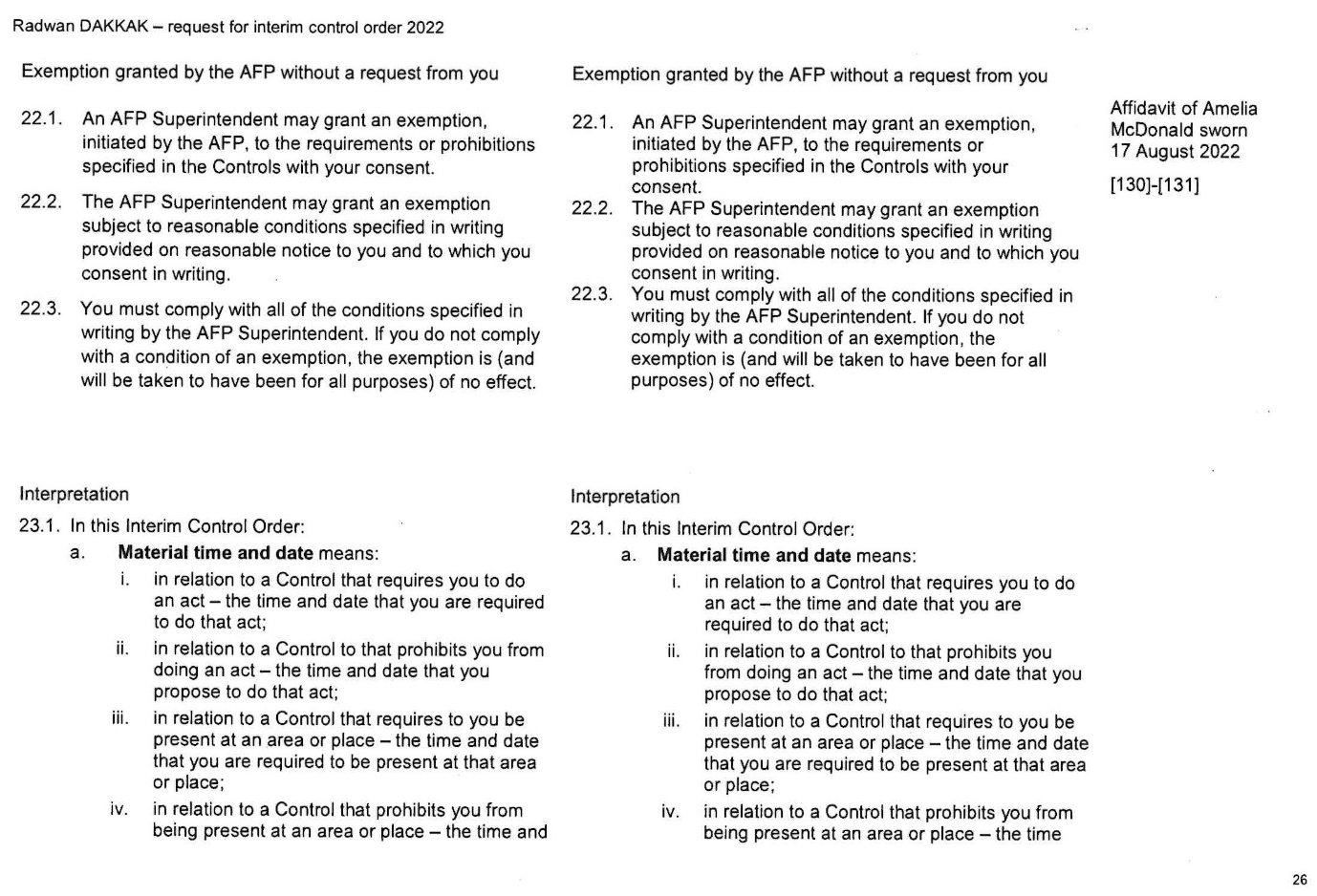
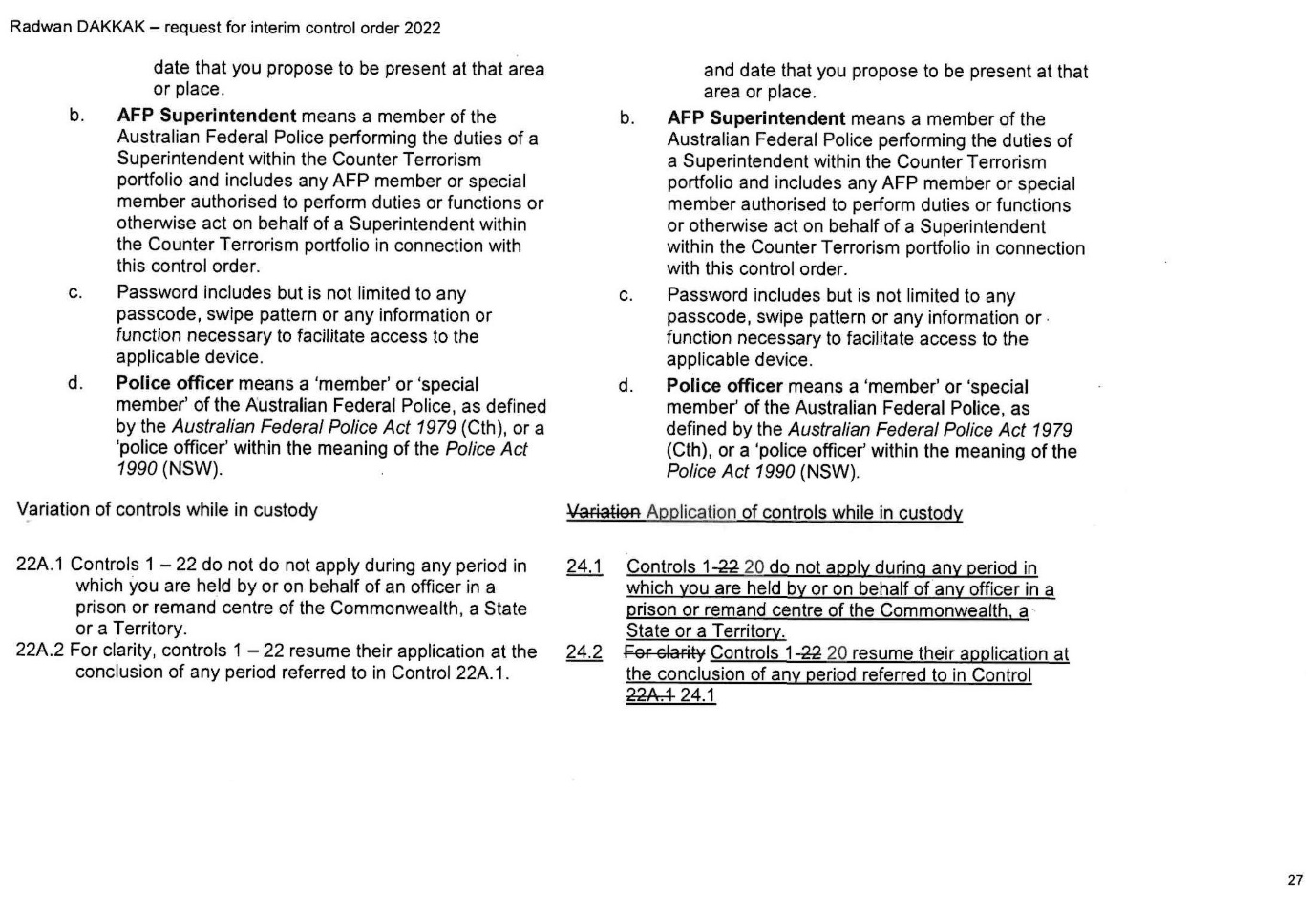
24 In her affidavit, the applicant explains why each of the controls that are presently proposed should be imposed on the respondent. The proposed controls are in very similar terms to the controls imposed by the first interim control order. Controls 1 to 5 (with the exception of Control 5.1(k)), 6, 7 (other than for exceptions that are drafted more broadly), 8 to 11, 13 to 18, and 20 are in the same or substantially the same terms as the controls imposed under the first interim control order. The applicant has prepared a table which compares the controls imposed by the first interim control order with the controls that are now proposed. The table is annexed to these reasons for ease of reference.
25 Proposed Control 5.1(k) prohibits the respondent from possessing, purchasing, or using not only firearms or ammunition, but also bows and arrows, crossbows or spear guns. The applicant has explained that, in recent years, radicalised individuals have sought to use such weapons in planning, preparing for, or carrying out terrorist acts in Australia and internationally.
26 Controls 12.1 and 19.1 are drafted in more restrictive terms than the controls imposed by the first interim control order. The proposed new controls enable the respondent to use only a permitted mobile phone and SIM card, and a permitted computer or tablet device provided to him by the AFP. As explained by the applicant in her affidavit:
120. The purpose of seeking to restrict the Respondent to using one phone, one SIM card and one computer or tablet device provided to him by the AFP is to ensure that the AFP has the ability to monitor the Respondent’s communications, and to reduce the risk that he will be exposed to or seek out extremist material, which has been a demonstrated feature of his offending and past behaviour and of concern to law enforcement.
121. I consider it is necessary to expressly limit the Respondent to using one SIM card, so as to make clear that the Respondent is not permitted to use his permitted mobile phone with a number of different SIM cards, each of which would be linked to a different mobile service. If the Respondent had unrestricted access to SIM cards, or to any other services, devices and platforms, his communications and online activities would be significantly more difficult, and potentially impossible, to monitor.
122. The Respondent’s previous offending involved him accessing, drafting, promoting and distributing an extensive amount of extremist material and Islamic State propaganda on his mobile phone and on his laptop. Accordingly, it is necessary for the AFP to be able to monitor the Respondent’s activities on his devices to ensure he does not access, draft, promote or distribute such material again, and, if he does, take appropriate steps.
123. I consider that the more restrictive controls I seek in this interim control order are reasonably necessary and reasonably appropriate, particularly taking into account the Respondent’s conduct in committing the Contravention Offence while the First ICO was in effect, which demonstrated that controls sought in the terms of Controls 12.1 and 19.1 of the First ICO are no longer sufficient to mitigate the risks posed by the Respondent.
124. It is necessary for police to be able to monitor the Respondent’s online activities to ensure he does not access, publish or distribute such material again (and if he does, to take appropriate steps). The ability of police to more closely monitor the Respondent’s communications will also assist in detecting and preventing him from communicating with persons the subject of Control 11, or engaging in communications in preparation for, or support of, a terrorist act or in support of facilitation of the engagement in hostile activities in a foreign country.
125. These controls seek to balance the objectives I have just described with the Respondent’s legitimate need to use certain devices, such as a mobile phone and computer, and services (such as a social media platform and email account). The AFP is willing to provide the Respondent a mobile phone and SIM card that can be used in accordance with Control 12 and a computer or tablet device that can be used in accordance with Control 19.
27 As I have noted, although ss 104.4 and 104.5 of the Code contemplate an ex parte procedure for obtaining an interim control order, the respondent was present at the hearing. He addressed the Court on the proposed controls, specifically proposed Controls 1, 5.1(a), 5.1(f), 5.1(g), 5.1(i), 6, 8, 9, 11.1(b), 12.3, 16, 17(b), and 19.2. It is fair to say that the respondent raised a number of matters which were of legitimate concern to him respecting the scope of the controls and their clarity. He expressed his willingness to comply with the controls, and his desire not to contravene them unwittingly.
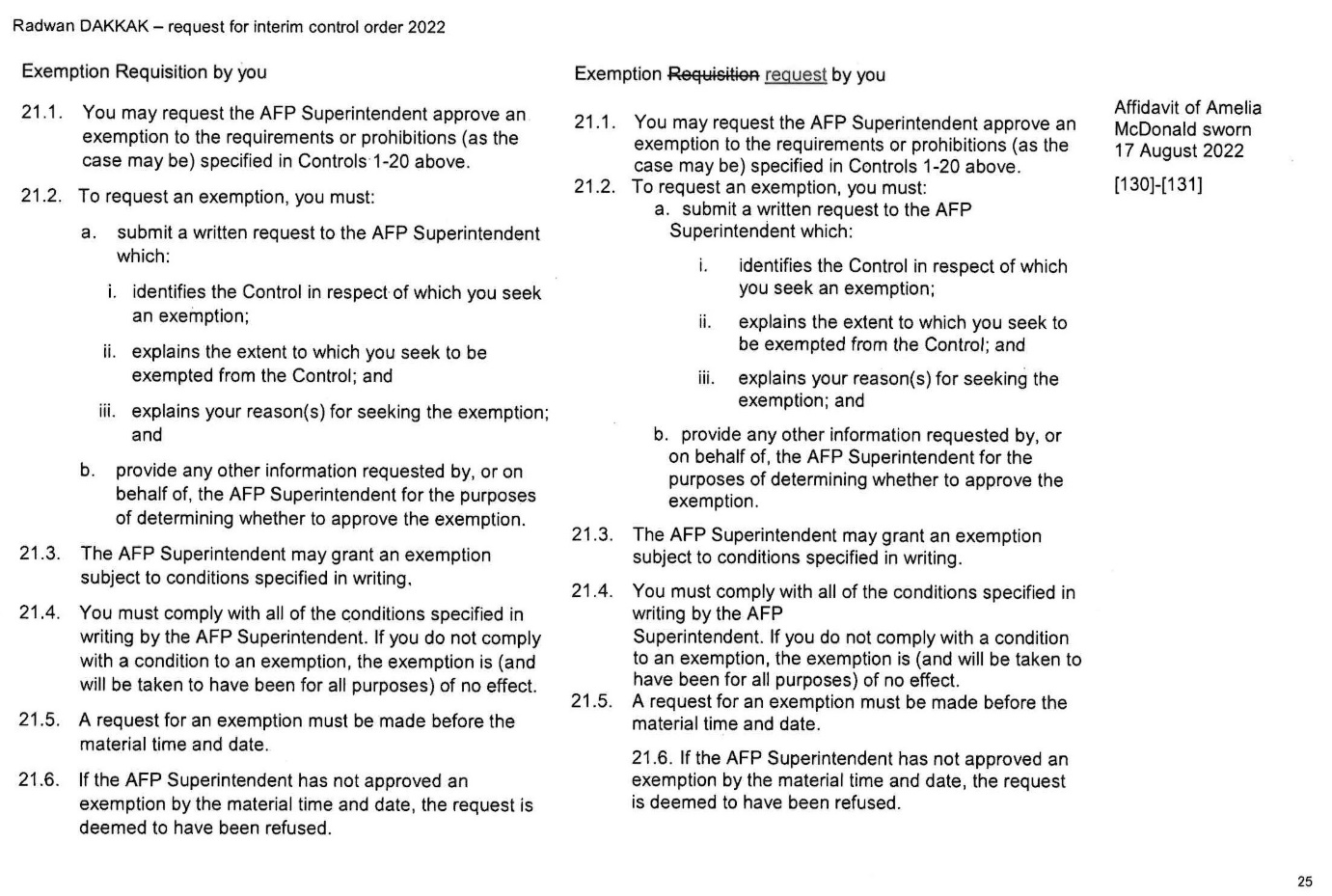
28 Before discussing the particular proposed controls addressed by the respondent, I record that the applicant advanced three overarching submissions as to the appropriateness of all the controls. First, the proposed controls are intended to operate as a suite of measures. Secondly, and relatedly, the proposed controls are designed to be complementary and to cover gaps to prevent circumvention. The applicant noted that the respondent had not taken issue with controls requiring him to have a permitted laptop and a permitted phone, but he did take issue with controls designed to prevent any gaps if, in contravention of the controls, he engaged in behaviour that involved the use of non-permitted devices. The applicant reasoned that without the suite of controls, including those prohibiting the respondent from using other persons / non-permitted devices, the respondent could thereby circumvent the objectives of the interim control order. Thirdly, Control 21 confers a facility to seek specific exemption from the requirements or prohibitions specified in Controls 1 to 20. This enables a degree of flexibility to be introduced, where appropriate, in the operation of the controls.
29 These submissions were advanced to urge caution before modifying the controls lest their operation, as a whole, be impaired.
30 I also note that the Court’s power to vary an interim control order at a confirmation hearing is limited to removing a control: s 104.14(7)(b). As I observed when making the first interim control order:
23 ... This is consonant with s 104.11A(2)(b) of the Code which provides that an interim control order can be varied only if the variation does not involve adding any obligations, prohibitions or restrictions to the order. I accept the applicant’s submission that I should proceed cautiously before limiting a proposed control that is prima facie justified, in terms of s 104.4(1)(d), on the material presently before the Court, in circumstances where the respondent has not yet filed evidence or has merely provided an untested explanation for an amendment he seeks, which can only be fully explored at a confirmation hearing.
Control 1
31 Control 1 is a curfew provision which, amongst other things, requires the respondent to remain at nominated premises between 11.00 pm and 5.00 am. The respondent contended that this provision is unnecessary in light of Control 2, which is a reporting obligation requiring the respondent to report at Parramatta Police Station every Monday and Friday within a stipulated time period.
32 I do not accept that Control 1 is unnecessary in light of Control 2. As the applicant explained, Controls 1 and 2 are complementary, not alternative, controls. I accept that, together, they enable the AFP to monitor the respondent’s whereabouts and activities, including whether he is engaging in activities or associating with persons of security concern, or who may have a radicalising influence on him, or on whom he may have a radicalising influence.
Control 5.1(a)
33 Control 5.1(a) prohibits the respondent from committing any offence against a law of a State, Territory or the Commonwealth that is punishable by a term of imprisonment. This prohibition is obviously directed to criminal offences of a serious, not a trivial, nature. However, the respondent queried whether it could be said that this control was directly connected with the purpose of preventing or prohibiting the facilitation of a terrorist act.
34 Section 104.4(1)(d) requires the issuing court to be satisfied, before making an interim control order, that each of the obligations, prohibitions, and restrictions to be imposed by the order is reasonably necessary, and reasonably appropriate and adapted, for one of several purposes, including preventing the provision of support for, or the facilitation of, a terrorist act, and preventing the provision of support for, or the facilitation of, the engagement in a hostile activity in a foreign country—the two purposes on which the applicant relies alternatively.
35 In her affidavit, the applicant deposes that the proposed controls, considered collectively, are designed to ensure that the respondent is:
(a) provided with the opportunity to engage positively with the community upon his release from custody (through employment, religious observation, counselling, and education);
(b) capable of being monitored by police during his re-integration into the community; and
(c) prohibited from engaging in those behaviours, and being exposed to those influences, which may lead him to provide support for, or facilitate, a terrorist act, or provide support for, or facilitate, hostile activities in a foreign country. In the context of considering the appropriateness of Control 5.1(a) (within the context of s 104.4(1)(d)), the applicant emphasised the first of these aims.
36 I am presently of the view that Control 5.1(a) is designed to encourage the respondent to engage positively within the community on his release from custody and, as the applicant advanced in oral submissions, to engage in a law-abiding life. This control can be seen as one measure that is designed to encourage the respondent to avoid influences that may lead him to provide support for, or facilitate, a terrorist act or hostile activities in a foreign country.
Control 5.1(f)
37 Control 5.1(f) prevents the respondent from making any gift, donation, or financial contribution to any “organisation, association, entity or charity howsoever described” without first notifying an AFP Superintendent in writing of the respondent’s intention to do so and, thereafter, providing a receipt of payment.
38 The respondent’s concern is with respect to the breadth of the word “association”. He said that this was a very broad expression which could include gifts to family members.
39 I do not agree. The word “association” must be seen in the collocation “organisation, association, entity or charity howsoever described”. I do not accept that it captures a financial payment, whether as a gift or otherwise, merely made to a family member who receives it in that capacity. In any event, as I have indicated, the prohibition is conditioned on written notification being given to an AFP Superintendent. If the respondent is unsure about whether this prohibition might be engaged in a given case or in given circumstances, he can exercise the caution of giving the written notification.
Control 5.1(g)
40 In general terms, Control 5.1(g) prohibits the respondent from presenting or speaking at, or endorsing a speaker at, a public gathering that is broadcasted or attended by five or more people. The respondent’s concern is that this prohibition might be directed to communications within his family. Having regard to the terms in which Control 5.1(g) is couched, I am satisfied that the respondent’s concern is misplaced. It is not directed to the respondent’s private communications within his family.
Control 5.1(i)
41 Control 5.1(i) prohibits the respondent from providing counselling, teaching, mentoring, or marriage services, which involve the respondent making a statement in relation to the matters in Control 5.1(h). Control 5.1(h) prohibits the respondent from making public statements about certain matters, including “carrying out, authorising or permitting violence”.
42 Once again, the respondent’s concern is that this prohibition might capture communications within his family. The respondent explained that, coming from the Muslim faith, his family read the Quran every day, and sometimes he likes to recite and explain verses of the Quran. The respondent shared his concern that there are verses in the Quran which speak of war and violence, and that he does not want to breach Control 5.1(i) “for authorising violence” when reciting the Quran with, or teaching, his family. Once again, I am satisfied that the respondent’s concern is misplaced.
43 This prohibition, along with others in Control 5, are directed to prohibiting the respondent from producing and disseminating material that could be used to plan a terrorist act or which could have a radicalising influence on others. As the applicant explained in her affidavit, these prohibitions are particularly important in circumstances where the respondent’s previous conduct was, in large part, a product of his radicalisation and his prolific promotion and distribution of IS propaganda. This control is not directed to prohibiting the respondent from reading or reciting the Quran, or observing or sharing his faith. It does, however, prohibit him from counselling and teaching violence, and from mentoring others to carry out, authorise, or commit violence.
Control 6
44 In general terms, Control 6 prohibits the respondent from accessing and possessing certain material. It was the respondent’s breach of Control 6 of the first interim control order that led to his conviction for the Contravention Offence.
45 The respondent’s concern is that this control could be breached inadvertently or unintentionally. He appeared to suggest that the Contravention Offence was of this character or was an example of a de minimis breach.
46 As I stated at the hearing, I do not propose to go behind the findings of the sentencing judge in respect of the Contravention Offence. However, I accept that, in operation, it is possible that Control 6 could be breached inadvertently.
47 I have reflected on whether the terms of Control 6 could be modified to cater, expressly, for inadvertence, including by conditioning the control, in the case of electronic access, to exempting access for a limited time period, as the respondent suggested. I have reached the view that any attempt to modify the terms of the control, as proposed, is likely to lead to a substantial weakening of the measure, and possible uncertainty in its application. I am persuaded that the question of whether the control is breached is best determined by objective circumstances. The onus should be placed on the respondent to act responsibly and carefully, mindful of the controls placed upon him. Further, as the applicant submitted, should the respondent innocently or unwittingly access prohibited material, it is within his competence to make disclosure of that access by bringing it to the attention of the AFP in a timely fashion.
48 The respondent also raised the question of whether an additional exception to Control 6 should be permitted to allow him to purchase, from an Australian bookstore, a publicly available book. I am not persuaded that, at the present time, such an exception should be provided. This is because the terms of Control 6 are specific as to the subject matter in respect of which access is prohibited. Given the particular nature of the prohibited material, I do not see Control 6 as acting as a substantial impediment to the respondent purchasing or otherwise acquiring books from an Australian bookstore within the permitted scope of the control. If there is doubt whether the respondent can access a particular book from an Australian bookstore, he can request an exemption under Control 21.
Control 8
49 Control 8 prohibits the respondent from, amongst other things, driving any vehicle which exceeds a gross vehicle mass of 4.5 tonnes. The respondent holds a forklift driving licence and suggested that his future employment might involve him driving a forklift that exceeds the stipulated maximum gross vehicle mass. I should point out that there was no evidence before the Court as to the likelihood of that prospect.
50 I am not persuaded that the terms of Control 8 should be modified to provide for that prospect. Should this prospect become actuality, the respondent can, once again, request an exemption under Control 21. This will enable the AFP to examine and consider the circumstances of the requested use.
Control 9
51 Control 9 concerns the respondent’s future employment. Under this control, he is not permitted to undertake paid employment without first notifying the AFP Superintendent. The respondent’s concern with respect to this control is that, once he notifies the AFP Superintendent of his prospective employer’s identity, the AFP will inform that person of his offending, and thus interfere with his prospects of obtaining gainful employment.
52 The respondent raised the same concern when the application was made for the first interim control order. His concern was addressed by the then applicant giving an undertaking to the Court to the effect that the AFP will not contact the respondent’s employer or prospective employer unless there is a security concern about his employment. The present applicant offers the same undertaking. The undertaking should be accepted.
Control 11.1(b)
53 Control 11.1(b) prohibits the respondent from communicating or voluntarily associating with a person who is on parole, or on bail or under other forms of control. The respondent contended that he is not capable of properly complying with this control because he might inadvertently come into contact with a person, particularly when undertaking his reporting obligation under Control 2, not knowing that the person is on parole, or on bail, or under another form of control.
54 This concern is readily addressed by qualifying Control 11.1(b) so that it refers to any person “reasonably known by you to be” on parole etc. The applicant agrees to this qualification.
Control 12.3
55 Control 12.3 prohibits the respondent from causing or permitting another person to use or access any mobile telephone device on his behalf. The respondent raised the prospect that this control could be contravened if, for example, he asked a member of his family to use their mobile telephone as a camera to take a picture for him.
56 This concern is readily addressed by qualifying Control 12.3 with the addition of the words “in circumvention of these controls”.
Control 16
57 Control 16 prohibits the respondent from accessing or using, or causing any person to access or use on the respondent’s behalf, nominated websites, applications or computer programs. The respondent contended that this control is not necessary because, under the proposed controls, he would be monitored in any event, particularly having regard to Controls 12 and 19. As I have noted, these controls enable the respondent to use only a permitted mobile phone and SIM card, and a permitted computer or tablet device, provided to him by the AFP.
58 I do not accept that Control 16 is not necessary. Even though the respondent’s online activities will be monitored, it does not follow that the need for Control 16 is obviated, so as to relieve the respondent from assuming his own responsibility not to access or use, or cause any other person to access or use, on his behalf, the platforms in question. The observations I made in imposing the first interim control order remain pertinent:
47 As I have discussed, the respondent’s previous conduct was in large part a product of his radicalisation, including through his exposure to extensive extremist material and Islamic State propaganda online. His conduct also involved the extensive and prolific publication of such material on social media platforms. The evidence is that many of the platforms listed in control 16 are frequently used by terrorist organisations and others who adhere to extreme ideological views to promulgate their message. Online gaming applications and gaming software include an instant chat functionality which could enable communication between the respondent and persons of national security concern.
48 The applicant submits that, while it is not possible to exhaustively list all the potential avenues for accessing extremist material, or to anticipate platforms that may become available in the future, the purpose of restricting the respondent’s use of the nominated platforms is to reduce the risk that he will be exposed to or seek out such material, which has been a feature of his radicalisation in the past.
49 The applicant submits, therefore, that it is necessary for police to be able to monitor the respondent’s online activities to ensure that he does not access, publish or distribute such material again and, if he does, to take appropriate steps. The applicant submits that the ability of police to monitor the respondent’s communications will assist in detecting and preventing the respondent from communicating with the persons identified in control 11, or engaging in communications in preparation for, or support of, a terrorist act or in support or facilitation of the engagement in hostile activities in a foreign country.
50 ...
51 For his part, the respondent submits that the social media platforms he seeks to have excluded from control 16 are probably the most popular social media platforms used by people of his age group, particularly Facebook and Facebook Messenger. The respondent submits that, even though his previous criminal activities involved use of a number of the platforms he now seeks to have excluded from the control, this control, without the amendments he seeks, would be onerous because it would inhibit him in his day-to-day communications, particularly with his family and those who are his friends (such as those from university). The respondent draws attention to the prohibitions and restrictions in control 7 and, in addition, argues that the better course would be to permit him to use the social media platforms (he seeks to have excluded from the control) on the basis that he reports his communications on these platforms to the police.
52 In light of his past conduct, his radicalisation and his lack of remorse or contrition for his past offending, not to mention the problematic nature of his prospects of rehabilitation, as alluded to by the sentencing judge, I am persuaded that, although far-reaching, control 16 is proportionate, particularly given that a number of the platforms which the respondent seeks to have excluded are the very platforms he used at the time of his offending. I note, in particular, the respondent’s use of Facebook, Instagram, Twitter, and Telegram which, at the time of his offending, he operated under his own name, his kunya “Abu Bakr At-Tarabulsi”, and various other aliases. I am not persuaded, at the present time, that self-reporting of the kind suggested by the respondent is appropriate or viable. The better course, at the present time, is to prohibit the use of these platforms, which will not interfere with the respondent’s day-to-day use of other modes of communication, including emails and the use of a mobile telephone.
Control 17.1
59 Control 17.1 prohibits the respondent from accessing or using any internet service other than one approved in writing by the AFP Superintendent, including through a television connected to an internet service at the respondent’s specified premises.
60 The respondent queried whether this control was necessary in light of the fact that his communications will be monitored. He also raised, as a potential problem, the prospect that his supplied mobile telephone might automatically connect to a public Wi-Fi network.
61 As with Control 16, the fact that the respondent’s online activities will be monitored does not mean that the need for Control 17.1 is obviated, so as to relieve the respondent from assuming responsibility to exercise restraint over his own activities. Controls 16 and 17 are complementary measures. Control 17 is to ensure that, in fact, the respondent’s activities can be monitored. The respondent has a history of associating and communicating with, and being influenced by, and influencing, persons who hold extremist views. The fact that, in breach of the first interim control order, he accessed extremist material online while he was in the community for 16 days following the conclusion of his imprisonment for the Association Offences, illustrates the applicant’s concern and highlights the need for appropriate controls in this regard.
62 As to the possibility of inadvertent connection between his supplied mobile telephone and a public network, I have been informed that this will not be possible with the supplied permitted devices.
Control 19.2
63 Control 19.2 prohibits the respondent from causing or permitting another person to access or use any computer or tablet device on his behalf. The respondent’s concern is that this control could be breached inadvertently if, for example, a service provider to him, such as a bank, used a computer in a transaction involving him. I do not accept that, in those circumstances, the provider would be using the computer on the respondent’s behalf. However, the respondent’s concern is readily addressed in the same way that his concern with respect to Control 12.3 is readily addressed. Control 19.2 can be qualified by adding the words “in circumvention of these controls”.
Conclusion
64 Subject to the qualifications to which I have referred, I am satisfied, on the material presently before me (including the factual material provided in the applicant’s affidavit and the reasons given by her) that the controls, which the respondent has addressed, are reasonably necessary, and reasonably appropriate and adapted, for the purpose of preventing the provision of support for, or the facilitation of, a terrorist act, or preventing the provision of support for, or the facilitation of, the engagement in a hostile activity in a foreign country: s 104.4(d) of the Code.
65 I am of the same view in respect of the other proposed controls which the respondent has not specifically addressed.
66 I will make the interim control order that is proposed with the qualifications I have discussed. I have made, separately, the programming orders discussed at the hearing on 6 September 2022.
I certify that the preceding sixty-six (66) numbered paragraphs are a true copy of the Reasons for Judgment of the Honourable Justice Yates. |
Associate: