

Federal Court of Australia
Nguyen v Minister for Immigration, Citizenship, Migrant Services and Multicultural Affairs [2022] FCA 1034
ORDERS
Applicant | ||
AND: | MINISTER FOR IMMIGRATION, CITIZENSHIP, MIGRANT SERVICES AND MULTICULTURAL AFFAIRS First Respondent ADMINISTRATIVE APPEALS TRIBUNAL Second Respondent | |
DATE OF ORDER: |
THE COURT ORDERS THAT:
1. The decision of the second respondent be quashed and the matter be remitted to the second respondent for the determination of the application for review lodged on 13 December 2021 according to law.
2. The first respondent pay the applicant's costs to be assessed by a registrar on a lump sum basis if not agreed.
Note: Entry of orders is dealt with in Rule 39.32 of the Federal Court Rules 2011.
COLVIN J:
1 On 9 February 2021, Ms Thi Tuyet Anh Nguyen's visa was cancelled under s 501(3A) of the Migration Act 1958 (Cth). A migration agent acting for Ms Nguyen made representations to the Minister seeking revocation of the decision to cancel. Thereafter, there were email communications between the migration agent and the Minister's department concerning the representations. On 23 November 2021, a delegate of the Minister refused to revoke the visa cancellation. The Migration Act provides that an application can be made to the Administrative Appeals Tribunal to review a decision of the kind made by the delegate: s 500(1)(ba). However, 'an application for review of the decision must be lodged with the Tribunal within 9 days after the day on which the person was notified of the decision in accordance with subsection 501G(1)': s 501(6B). The issue before the Court concerns whether this time limit was met.
The lodgement of the application to review
2 On the day that the delegate's decision was made, an email notifying the decision was sent to an email address of the migration agent. It was the same email address that had been used by the migration agent in earlier communications with the Minister's department concerning the visa cancellation. Some 18 days later the migration agent sent an email to the Minister's department saying: 'we have just noticed the decision'. Shortly thereafter, an application for review was lodged. If the date of the email notification was the date of notification for the purposes of the time limit in s 501(6B) then the application was lodged some 11 days late.
3 The Tribunal determined that it had no jurisdiction because the application was not lodged in time. It found that the migration agent was an authorised recipient and time commenced to run when the email notifying the decision was sent to the migration agent.
4 Ms Nguyen now seeks to review the Tribunal's decision.
The statutory provisions as to notification
5 Relevantly for present purposes, s 501G provides that if a decision is made under s 501CA to not revoke a visa cancellation decision then the Minister must give a written notice that sets out the decision and the notice 'must be given in the prescribed manner'.
6 Two such prescriptions are relied upon by the Minister. First, s 494D(1) provides:
If a person (the first person) gives the Minister written notice of the name and address of another person (the authorised recipient) authorised by the first person to receive documents in connection with specified matters arising under this Act or the regulations, the Minister must give the authorised recipient, instead of the first person, any documents in connection with those matters that the Minister would otherwise have given to the first person.
(original emphasis)
7 Second, reg 2.55(3) of the Migration Regulations 1994 (Cth) applies to 'the giving of a document to a holder or former holder of a visa relating to the … cancellation of a visa'. It provides that the Minister must give the document in one of a number of specified ways which include 'by transmitting the document by … email … to the last … email address … known to the Minister'.
Issue for determination
8 The issue for determination is whether the application for review was lodged within time. It is accepted that lodgement within nine days of notification of the delegate's decision was a pre-condition to the Tribunal's jurisdiction.
9 Commencement of the review application within the time specified in s 501(6B) is a 'jurisdictional fact' in the sense explained in Plaintiff M70/2011 v Minister for Immigration and Citizenship [2011] HCA 32; (2011) 244 CLR 144. The term jurisdictional fact is a label used to describe statutory pre-conditions which much exist before the repository of power has authority to exercise that power: Southern Han Breakfast Point Pty Ltd (in Liquidation) v Lewence Construction Pty Ltd [2016] HCA 52; (2016) 260 CLR 340 at [47] (Kiefel, Bell, Gageler, Keane and Gordon JJ). Accordingly, a decision-maker does not have authority to finally determine whether a jurisdictional fact exists (noting that in some instances the 'jurisdictional fact' may take the form of an opinion or assessment or a state of satisfaction): see authorities collected in Tsvetnenko v United States of America [2019] FCAFC 74; (2019) 269 FCR 225 at [29] (Besanko, Banks-Smith and Colvin JJ)). Therefore, in the present case, the findings by the Tribunal concerning whether the migration agent was an authorised recipient are not determinative. Any mistake as to the existence of a fact that is a jurisdictional fact may be corrected by this Court exercising its administrative law jurisdiction. A mistake which has led to error in the assertion or denial of jurisdiction is jurisdictional error.
10 If the communication to the migration agent's email address was proper notification in accordance with s 501G(1) then the application was lodged out of time. If not, then the application for review must be upheld on the basis that the Tribunal has denied in error the existence of the review jurisdiction conferred by s 500(1)(b).
The form completed by Ms Nguyen
11 Much of the argument concerned the terms and effect of a completed 'Form 956' given by the migration agent to the Minister. I was informed by counsel for the Minister that the form is no longer in use. However, at the time, the form was published by the Minister's department. It comprised some three pages and enumerated 23 items for completion. It was headed 'Advice by a registered migration agent/exempt person of providing migration assistance'.
12 The nature of Form 956 was considered by Jagot, Bromberg and Mortimer JJ in MZZDJ v Minister for Immigration and Border Protection [2013] FCAFC 156; (2013) 216 FCR 153. It was there described as 'a standard form used for administrative convenience and consistency of practice' which 'does not appear to have any statutory role so far as s 494D is concerned': at [25]. It was also observed at [26]:
The level of formality required (or not required) by s 494D is not without significance. The absence of strict prescriptions about form underlines the facultative nature of this provision: it is intended to give applicants a readily accessible means of ensuring communication in relation to their visa applications is undertaken in the most effective manner if they do not wish, for whatever reason, to be entirely responsible for receiving communications and taking necessary action.
13 These observations reflect the evident purpose of s 494D as a means by which a person can require the Minister to communicate with an authorised recipient (instead of the person) as to specified migration matters.
14 For present purposes, issues arise as to what was communicated by the form as completed. The following aspects of the form as completed are relevant:
(1) Item 1 asks 'Are you notifying the Department that you have been appointed to provide immigration assistance, or that your appointment has ended?'. Expressed in those terms, the question is directed to the migration agent, not Ms Nguyen. The box for 'new appointment' has been ticked. Part 1 then directs the completion of Part A and Part C.
(2) Part A is headed 'New appointment: Registered migration agent/exempt person's details'. Under that heading, Item 7 asks 'Do you agree to the Department communicating with you by fax, email or other electronic means'. Again the question is directed to the migration agent. The box for 'Yes' is ticked and details are provided of the email address that was used by the department to communicate with the migration agent. It is the email address to which the delegate's decision was sent on 23 November 2021.
(3) Still in Part A, there is a section headed 'Client's details'. It begins with Item 12:
The person receiving immigration assistance
(ie. the client) is a: (tick one only)
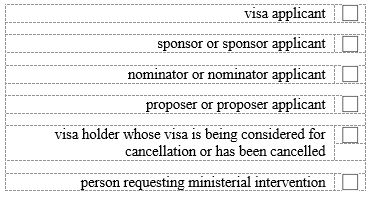
It may be noted that the form instructs that only one box is to be ticked. There are separate boxes for 'visa applicant' and 'visa holder whose visa is being considered for cancellation or has been cancelled'. It was submitted for the Minister that the terminology 'visa applicant' might include a person who was seeking the cancellation of a revocation decision. In the context of the other descriptions such a construction of the form would require a highly technical characterisation. It would also be inconsistent with the broad dichotomy between applications and cancellations evident from the form. I do not accept that the form should be read in the manner submitted.
(4) Item 13, is headed 'Client 1'. It is completed with the details of Ms Nguyen.
(5) Item 14 begins 'Names of other clients you are providing immigration assistance to in relation to the same matter (eg. dependant applicants)'. The item has been completed with the names of Ms Nguyen's three children.
(6) Item 15 then takes the following form:
Are you providing assistance with an application process, a cancellation process or specific matter? (tick one only)
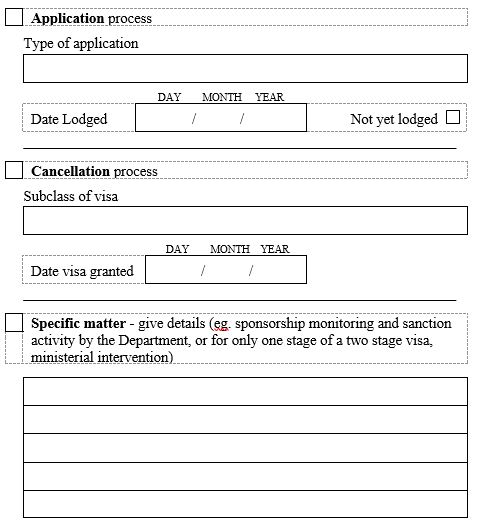
The form was completed by (a) ticking the box next to 'Application process'; (b) inserting the words 'All immigration matters' in the box for 'Type of application'; and (c) ticking the box for 'Not yet lodged'. Again, the form instructs that only one box is to be ticked. The effect of inserting the words 'All immigration matters' below the part of the form that refers to 'Application process' (and not in the part that refers to 'Cancellation matters') is at the heart of the issue between the parties.
(7) Still in Part A, there is then a heading 'Authorised recipient'. Item 17 appears under that heading and asks 'Have you been authorised to receive written communications on behalf of your client(s) in relation to the matter indicated in Question 15?'. Again the question is directed to the migration agent. It is specifically confined to the matter indicted in the answer to Question 15. The 'Yes' box has been ticked.
(8) Part C has provision for two declarations. The first has been completed by the registered migration agent and declares that he has been appointed as a registered migration agent to act for the client. The second is by the client. It has been ticked (and signed). It says:
Appointment - I declare that I have appointed the registered migration agent/exempt person named in Part A of this form to provide assistance with matters as indicated on this form.
15 It may be observed that the overall tenor of the form is that it serves as a notification of the appointment of a migration agent and the extent of the authority of the migration agent. At no point does the form state, in terms, that the migration agent is authorised by the person to receive documents. Nor is there an indication that the email address at which the migration agent is willing to receive documents is intended to be identified as the only address to which communications of a particular kind are to be sent to Ms Nguyen.
16 The distinction is an important one. It is one thing for a migration agent to say, 'I have been appointed and you can communicate with me at this email address'. It is another thing for a person to say 'don't communicate with me, instead only communicate with my migration agent'. Under the terms of s 494D the consequence of giving written notice of the name and address of the authorised recipient is that the Minister 'must give the authorised recipient, instead of the [person giving the notice] any documents … that the Minister would otherwise give to the first person'.
Section 494D
17 Section 494D is in two parts. It first specifies an event, namely if the written notice as described is given to the Minister. It then describes a consequence, namely the Minister must give any documents to the authorised recipient instead of the person giving the notice. Read literally, there is no requirement for the specified consequence to be acknowledged or understood by the person giving the notice or to be stated in the notice. Section 494D says that if written notice is given by a person of another person's name and address then the Minister must give the authorised recipient any documents instead of the person.
18 In my view there is much to commend a construction of s 494D which requires the form in which the notice is given to identify the person as being authorised to receive documents in the manner described (that is, instead of the person giving the notice).
19 When s 494D refers to a notice giving details of another person 'authorised by the first person to receive documents' it must be referring to an authority of the kind that is thereafter described, namely an authority to be the sole point at which 'documents in connection with specified matters arising under this Act' (that is matters specified in the notice) are to be received. Otherwise, a person who gave an authority to a migration agent (or other person) to receive documents from the Minister thinking that the documents would also be provided to that person would nevertheless be affected by the consequence specified in s 494D, namely that documents must be given to the migration agent and not to the person who gave the notice. In short, a person who did not know of the statutory consequence and gave no authority for it to occur would be treated as having given authority for documents of the specified kind to only be given to the migration agent (or other person).
20 It is unlikely that it was intended that a person should be treated as having conferred an authority which they did not actually confer. It may be expected that an authority of the kind described with the possibility of very substantial consequences would derive from the person giving the notice and not as an unspecified (possibly unexpected) statutory consequence of giving authority to a migration agent (or other person) to receive documents.
21 It must also be recognised that s 494D may operate to afford a significant protection for those people who have to deal with the Minister concerning migration matters. As was observed in MZZDJ at [23]:
There may be a variety of circumstances (language difficulties, minority, literacy, unfamiliarity with the Australian migration and legal system, other vulnerabilities, no access to a postal address or to email) in which an applicant feels it is more reliable to authorise someone other than himself or herself to be the recipient of communications from the Minister. This may, but need not, coincide with the retention of a migration agent.
22 However, it is unlikely that such a benefit was to be conferred if it was unintended or there was uncertainty as to what is being authorised. The possibility of vulnerability reinforces the need for certainty as to the authority that is being conferred. Uncertainty may result in a notification that was given by the Minister to the person in accordance with the facilitative provisions of the Migration Act which allows for different means of notification (see, for example, s 494C) operating as notice when the person was acting on the mistaken view that an authority had been given under s 494D. A provision such as s 494D will only operate with fairness to a person dealing with the Minister if there is certainty in the way in any notice is expressed as to the nature of the authority that it confers.
23 Accordingly, in my view, upon a proper construction of s 494D, a notice which does not state that the authority conferred is for the Minister to give documents to the authorised recipient, instead of the person concerned, is not a notice for the purposes of the provision. A notice which simply specified the name and address of another person would not do so. A notice which also said that the other person was authorised to receive documents would not do so. The notice must say that the person is authorised to receive documents from the Minister instead of the person who is giving the notice.
Was the form completed by Ms Nguyen a notice for the purposes of s 494D?
24 The following matters assume particular significance when it comes to the issue whether the form as completed is a 'written notice' for the purposes of s 494D:
(1) The declaration given is that the migration agent is authorised 'to provide assistance'. There is no statement in the form to the express effect that Ms Nguyen is giving notice of the name and address of a person authorised to receive documents. On the express terms of the form, the statement as to where documents may be sent is given by the migration agent. It may be inferred from the terms of the form as a whole that it is a notice of the name and address (namely the email address at Item 7) of a person authorised by Ms Nguyen to receive documents. However, I am unable to see how it may be considered to be a notice identifying the migration agent as a person who is authorised to receive documents from the Minister instead of Ms Nguyen.
(2) The form differentiates between an application process and a cancellation process and requires only one to be selected. The statement 'All immigration matters' is made in respect of an application process. The extent of the authority actually given is to be determined by reference to the form itself. Given the terms of the form, it does not confer authority in respect of any cancellation process.
25 It was claimed that the form was to be construed having regard to the fact that it was included as an attachment to an email sent to the department on 1 April 2021 by the migration agent. The email attached a revocation submission, supporting documents and '956 Agent advice'. However, the inclusion of the form as an attachment to a communication of that kind could not confer authority upon the migration agent if the form itself did not do so. It is not suggested that the email communication of 1 April 2021 was itself given by Ms Nguyen. Further, uncertainty is created by the fact that a different email address to that in the Form 956 was provided in the completed 'personal circumstances form' in which Ms Nguyen agrees to the Department communicating with Ms Nguyen by email (albeit to an address that belongs to the domain of the migration agent). The form goes on to inquire expressly whether Ms Nguyen authorises the Department to contact anyone regarding her case. That part of the form is completed with the name of the migration agent and a mobile telephone number but no email address (despite the form requesting 'Phone number and email address').
26 In the course of oral argument, a contention to the effect that the content of the personal circumstances form may itself confer the requisite authority was not pressed by the Minister.
27 In those circumstances, I am unable to find that Ms Nguyen, by the completed Form 956, gave written notice for the purposes of s 494D. It was not a notice that authorised the migration agent to receive documents in relation to the cancellation process (rather, it was a notification only in respect of all immigration matters where there was an application process) and it was not a notice which, by its terms, gave authority to the migration agent to receive documents instead of Ms Nguyen.
28 It was submitted for the Minister that the manner of completion of the form is explained by the fact that it was to encompass a cancellation revocation process being a process not contemplated by the form. I do not accept that submission. The form refers to a cancellation process and to a visa holder who visa has been cancelled. There is no real doubt that those descriptions encompass a person whose visa is being considered for cancellation or has been cancelled. A person who obtains immigration assistance with the revocation of a visa cancellation is being given immigration assistance with a cancellation process and not with an application process.
29 It was submitted for Ms Nguyen that on a proper construction of s 494D, there could not be an authorisation given for 'all immigration matters' and that each matter had to be specified in the sense that each application or visa cancellation or other matter had to be listed. I do not accept the submission. The evident purpose is to enable a person to require the Minister to communicate with an authorised recipient rather than the person. The terms of s 494D may be resorted to in a variety of circumstances: MZZDJ at [23]. What is required is specification of the matters. A statement that refers to all matters, specifies the matters to which the written notice pertains.
Regulation 2.55(3)(d)
30 Regulation 2.55(3)(d) provides for a document to be given to the last email address known to the Minister. The regulation is referring to the last known email address of the person to whom the notice must be given.
31 Reliance upon the regulation is advanced by the Minister as an alternative. It presupposes that there is no authority given by the form as completed. It was submitted that service to the email address specified in the Form 956 was service to Ms Nguyen's last known address. It is difficult to see how an address which was given as a place where particular documents could be served (those relating to migration applications) could be the last address known for the purposes of the regulation for serving different documents.
32 In any event, the email address is not an email address of Ms Nguyen. It is an email address of the migration agent. It is specified as such in the form. There is no evidence to suggest that it was used by Ms Nguyen as her email address. Therefore, it is not an email address for the purposes of reg 2.55(3)(d).
Conclusion and costs
33 For reasons that have been given, the Tribunal was in error in concluding that the application dated 13 December 2021 was out of time for the reasons given by the Tribunal. It was not suggested by the Minister that there was any other basis upon which the Tribunal did not have jurisdiction to determine the application for review dated 13 December 2021. In those circumstances, relief substantially in the terms sought should be granted. It was accepted that costs should follow the event. There should be an order accordingly.
I certify that the preceding thirty-three (33) numbered paragraphs are a true copy of the Reasons for Judgment of the Honourable Justice Colvin. |
Associate:


