

FEDERAL COURT OF AUSTRALIA
PayGroup Limited, in the matter of PayGroup Limited [2022] FCA 1026
ORDERS
Plaintiff | ||
DATE OF ORDER: |
OTHER MATTERS:
A. The Court is satisfied that the Australian Securities and Investments Commission (ASIC) has had a reasonable opportunity to:
(a) examine the terms of the proposed scheme of arrangement to which the application relates and a draft explanatory statement relating to that arrangement; and
(b) make submissions to the Court in relation to the proposed scheme of arrangement and the draft explanatory statement.
B. The Court notes that ASIC was notified on 15 August 2022 of the hearing of this application but has permitted a lesser period of notice than the 14 days required under s 411(2)(a) of the Corporations Act 2001 (Cth) (the Act).
C. The Court notes the letter from ASIC to K&L Gates (the plaintiff’s solicitors) dated 23 August 2022 produced at the hearing and notifying the plaintiff that ASIC does not currently propose to appear to make submissions or intervene to oppose the proposed scheme at the first hearing under s 411(1) of the Act.
THE COURT ORDERS THAT:
1. The plaintiff is to convene and hold a meeting of the holders of ordinary shares in the plaintiff (members) to consider and, if thought fit, to approve (with or without any alterations or conditions) the scheme of arrangement (Scheme) proposed to be made between the plaintiff and the members, the terms of which are found at pages 408 to 427 of Exhibit MSMS1 to the affidavit of Mark Stephen Malhotra Samlal made on 18 August 2022 (first Samlal affidavit) (the Scheme Meeting).
2. The Scheme Meeting is to be convened by sending on or before 26 August 2022:
(a) in the case of members who have elected to receive shareholder communications electronically by way of email (Email Members), an email substantially in the form of pages 661 to 663 of Exhibit MSMS1 to the first Samlal affidavit and which includes links to a document substantially in the form of pages 154 to 235 of Exhibit MSMS2 to the affidavit of Mark Stephen Malhotra Samlal made on 22 August 2022 (second Samlal affidavit), which comprises the explanatory statement as required by s 412(1)(a) of the Act (Scheme Booklet) and which is to contain (among other things) the notice of scheme meeting (Notice of Scheme Meeting) and a proxy form for the Scheme Meeting (Scheme Proxy Form) substantially in the form of pages 89 to 97 of Exhibit MSMS2 to the second Samlal affidavit;
(b) in the case of members who are not Email Members, the following documents by pre-paid post addressed to the relevant address(es) recorded in the plaintiff’s register:
(i) a document substantially in the form of the Scheme Booklet, which contains among other things the Notice of Scheme Meeting and the Scheme Proxy Form; and
(ii) a reply paid envelope for the return of the Scheme Proxy Form.
3. Subject to these orders, the Scheme Meeting is be convened, held and conducted in accordance with the provisions of:
(a) Part 2G.2 of the Act (save for any applicable replaceable rule) that apply to a meeting of the plaintiff’s members; and
(b) the plaintiff’s constitution that apply in relation to meetings of members and that are not inconsistent with Part 2G.2 of the Act.
4. The Scheme Meeting is to be held at 11:00 am (AEST) on Friday 30 September 2022 at the offices of K&L Gates, Melbourne, level 25, 525 Collins Street, Melbourne, in Victoria.
5. Members of the plaintiff may vote at the Scheme Meeting by attending in person or by proxy, attorney or corporate representative (if applicable).
6. Ian Richard Basser, or failing him David Grahame Fagan, is to be the chair of the Scheme Meeting.
7. The chair of the Scheme Meeting shall have the power to adjourn the meeting to such time, date and place as they consider appropriate.
8. The plaintiff may provide access to the Scheme Meeting for such other persons as it thinks fit.
9. Voting on the resolution to approve the Scheme is to be conducted by way of a poll.
10. A proxy form in respect of the Scheme Meeting will be valid and effective if, and only if, it is completed and received in accordance with its terms by 11:00 am (AEST) on 28 September 2022.
11. Compliance with r 2.15 of the Federal Court (Corporations) Rules 2000 (Rules) is dispensed with.
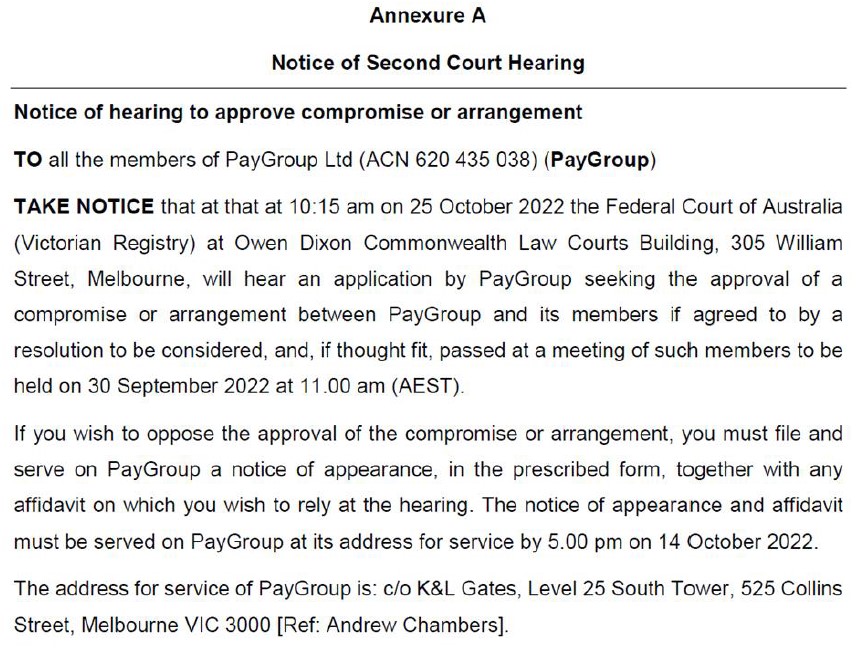
12. Notice of the hearing of an application under s 411(4) of the Act for an order approving the Scheme is to be published once in “The Australian” newspaper by an advertisement substantially in the form of Annexure A to these orders, such advertisement to be published on or before five days prior to the Scheme Meeting, and the plaintiff is otherwise exempted from compliance with r 3.4 of the Rules.
13. The further hearing of the originating process is adjourned to 10:15 am (AEDT) on 25 October 2022.
14. Liberty to apply is reserved.
15. These orders are to be entered forthwith.
Note: Entry of orders is dealt with in Rule 39.32 of the Federal Court Rules 2011.
O’CALLAGHAN J:
1 After a hearing on 23 August 2022, I made the orders set out above. These are my reasons.
2 By originating process filed on 16 August 2022, PayGroup Limited (PayGroup) sought orders pursuant to s 411(1) of the Corporations Act 2001 (Cth) (the Act) as follows:
1. An order under section 411(1) of the Act that the plaintiff convene a meeting of the Members for the purpose of considering, and if thought fit, agreeing (with or without alterations or conditions) to the Scheme (Scheme Meeting).
2. An order under section 411(2)(a) of the Act, abridging the period of which notice of the hearing of this application must be given to the Australian Securities and Investments Commission.
3. Orders or directions under section 1319 of the Act as to:
(a) the time and place at which the Scheme Meeting is to be held;
(b) the manner in which the Scheme meeting is to be convened, held and conducted;
(c) the persons who to act as chairperson and alternate chairperson at the Scheme Meeting,
as the Court sees fit.
4. An order under section 411(4)(b), and (if necessary) section 411(6) of the Act that the Scheme be approved.
5. An order under section 411(12) of the Act that the plaintiff be exempted from compliance with the requirements of section 411(11) of the Act in relation to the Scheme.
3 At the hearing on 23 August 2022, PayGroup sought the first three of those orders, that is the orders directed to the first meeting.
4 PayGroup is a public company, limited by shares and listed on the Australian Securities Exchange. It conducts a business of providing payroll and human capital management solutions.
5 The proposed scheme is a takeover scheme, under which all the shares in PayGroup will be acquired for $1 per share (Scheme).
6 The acquirer – Deel Australia Holdings Pty Ltd (Deel) – is the Australian subsidiary of Deel, Inc (Deel Inc), which is incorporated in Delaware in the United States.
7 If the Scheme is approved: (a) all the shares in PayGroup at the “Scheme Record Date” will be transferred to Deel; (b) PayGroup’s shareholders will receive payment for their shares; and (c) PayGroup will become a subsidiary of Deel (and delisted from the ASX).
8 PayGroup’s directors have unanimously recommended that, in the absence of a superior proposal, shareholders should vote to approve the Scheme. Further, all PayGroup’s directors who hold shares in the company intend to vote in favour of the Scheme (absent a superior proposal).
9 A scheme booklet (Exhibit MSMS2 to the second affidavit of Mr Mark Samlal affirmed on 22 August 2022), including the explanatory statement required by s 412 of the Act, has been prepared. It provides a detailed description of the Scheme, including its advantages and disadvantages. It also contains an independent expert report (prepared by a specialist valuation firm, Lonergan Edwards & Associates) assessing the Scheme and opining that it is in the best interests of PayGroup’s shareholders, in the absence of a superior proposal.
The proposed scheme
10 On 23 June 2022, PayGroup, Deel and Deel Inc executed a scheme implementation agreement, by which they agreed to take all reasonable steps to propose and implement the Scheme.
11 The terms of the Scheme are contained in Annexure 2 of the scheme implementation agreement (a copy of which is Annexure C of the scheme booklet).
12 Section 8 of the scheme booklet explains in detail the implementation of the Scheme, in summary as follows:
(a) “Scheme Participants”, that is, any holder of PayGroup shares at the “Scheme Record Date” (which is two business days after the Scheme becomes effective), will receive the “Scheme Consideration” of $1 for every PayGroup share held as at that date;
(b) the Scheme Consideration will be paid on the “Implementation Date” (five business days after the Scheme Record Date, or as otherwise agreed);
(c) no later than two business days before the Implementation Date, Deel must deposit the aggregate amount of the Scheme Consideration into a trust account, to be held on trust for the Scheme Participants; and
(d) also on the Implementation Date, subject to payment of the Scheme Consideration, the shares will be transferred to Deel.
13 Although Deel is to pay the Scheme Consideration, it is not a party to the Scheme.
14 Additional shares may also be issued to Mr Marcus Webb, one of the vendors of the “Astute” group of companies which PayGroup purchased on 14 November 2019. Part of the consideration for that acquisition included an issue of shares in PayGroup, subject to the achievement of performance hurdles. There is a dispute, currently the subject of an arbitration, about whether those hurdles were achieved. The maximum value of shares to which Mr Webb may be entitled is $1.5 million.
15 If the number of fully paid ordinary shares on issue at the Scheme Record Date exceeds 119,830,380 (which will depend on the number of additional shares issued to Mr Webb, if any), then the cash price per share will be adjusted down on a proportional basis, with the amount per share calculated by dividing the maximum equity value of PayGroup shares under the Scheme ($119,830,380) by the actual number of shares on issue.
16 Accordingly, on 2 August 2022, both Deel and Deel Inc executed a deed poll in favour of the Scheme Participants. An executed copy of the deed poll is at Annexure D of the scheme booklet.
Statutory framework
17 The statutory framework relating to schemes of arrangement involves a three stage process:
(a) the hearing of an application to the court for orders to convene a meeting or meetings (s 411(1));
(b) the holding of the meeting or meetings (s 411(4)(a)); and
(c) the hearing of an application to the court for an order to approve the scheme (ss 411(4)(b) and 411(6)).
18 The court’s discretion to make an order under s 411(1) is enlivened if:
(a) a compromise or arrangement is proposed between a Part 5.1 body and its members (or any class of them);
(b) application for the order is made in a summary way by the body;
(c) 14 days’ notice of the hearing of the application has been given to ASIC (or such lesser period as the court or ASIC permits); and
(d) the court is satisfied that ASIC has had a reasonable opportunity to:
(i) examine the terms of the proposed compromise or arrangement to which the application relates and a draft explanatory statement relating to the proposed compromise or arrangement; and
(ii) make submissions to the court in relation to the proposed compromise or arrangement and the draft explanatory booklet.
See, by way of example only, Re Kidman Resources Limited [2019] FCA 1226; (2019) 375 ALR 760 at 763 [22].
19 In relation to criteria (c) and (d), counsel for PayGroup relied on a letter from ASIC dated 23 August 2022. In that letter, ASIC noted that it had received seven days’ notice of the hearing, not 14, but that it had “determined to permit this shorter period”. Accordingly, the notice provision is satisfied. Further, ASIC said that it was satisfied that it had had a reasonable opportunity to examine the terms of the scheme and the draft explanatory statement and to make submissions to the court.
20 I am satisfied that the criteria set out above have been met and that, accordingly, the court’s discretion to make orders for the plaintiff to convene the scheme meetings is enlivened.
Should the discretion be exercised?
21 As to whether it is proper for the court to exercise that discretion, the court must be satisfied that:
(a) the scheme is fit for consideration by the proposed meeting in the sense that it is of such a nature and cast in such terms that, if it achieves the statutory majority at the meeting, the court would be likely to approve it on the hearing of a petition which is unopposed; and
(b) members are to be properly informed as to the nature of the scheme before the scheme meeting.
22 As Finkelstein J explained in an oft cited passage in Re CSR Ltd (2010) 183 FCR 358 at 379-380 [74]-[76], at the first court hearing, the court should generally confine itself to ensuring that certain procedural and substantive requirements are met (for example, that there will be adequate disclosure), with limited consideration of issues of fairness. And the court should only consider the merits or fairness of a proposed scheme at the convening hearing if the issue is such as would “unquestionably” lead to a refusal to approve the scheme at the approval hearing; that is, the scheme may “appear on its face so blatantly unfair or otherwise inappropriate that it should be stopped in its tracks before going any further” (quoting Re T & N Ltd [2007] 1 All ER 851 and Re Foundation Healthcare Ltd [2002] FCA 742; (2002) 42 ACSR 252).
23 I had the benefit of detailed written and oral submissions by Mr CT Möller and Mr MB Peckham on behalf of the plaintiff. I should also add that Mr B Holmes of counsel was given leave to appear on behalf of Deel and Deel Inc. He adopted the submissions made on behalf of the plaintiff.
24 Those submissions raised the following features of the Scheme:
(a) performance risk;
(b) the deemed warranty by PayGroup’s shareholders;
(c) the potential for a price adjustment to the Scheme Consideration (on a worst-case scenario, from $1 to $0.9909), which depends on the outcome of a pending arbitration and potential further share issues;
(d) exclusivity provisions;
(e) the “break fee”; and
(f) the purpose of the Scheme (i.e. not to avoid Chapter 6 of the Act).
25 As all counsel submitted, and I agree, there are no matters arising from those submissions that require explanation in these reasons. It is perhaps, though, worth noting that although schemes of arrangement are not required to be the subject of a report by an independent expert unless the parties have a common director, or the acquiring company controls 30% of the scheme company (neither of which is the case here), PayGroup in any event has obtained a report from an independent expert as to whether, in its opinion, the Scheme is in the best interests of PayGroup’s shareholders. See Corporations Regulations 2001 (Cth) reg 5.1.01 and Schedule 8 cll 8303 and 8306.
26 The independent expert, Lonergan Edwards, opines that the Scheme is “fair and reasonable and in the best interests of PayGroup shareholders in the absence of a superior proposal”. The opinion is summarised in a covering letter, which explains that Lonergan Edwards assessed whether the Scheme is:
(a) fair, by assessing the value of the scheme consideration ($1 per share) against the assessed value of a PayGroup share on a 100% controlling interest basis, which it valued as between 91 cents (low) and $1.01 (high);
(b) reasonable, by determining whether it is fair; and
(c) in the best interests of PayGroup shareholders, on the basis that it is fair and reasonable, in the absence of a superior proposal.
27 The summary states that:
As the Scheme Consideration is consistent with the high end of our assessed valuation range for PayGroup shares on a 100% controlling interest basis, in our opinion, the Scheme Consideration is fair to PayGroup shareholders when assessed based on the guidelines set out in [ASIC Regulatory Guide 111 – Content of expert reports].
28 In respect of the potential for issuing additional shares to Mr Webb, and the potential price adjustment, the summary states:
For valuation purposes we have adopted 119.3 million shares on issue. However, as noted in Section VI, the [scheme implementation agreement] also includes a recognition of the further potential issue of shares to a third party depending on the outcome of a current mediation (where a binding decision from the mediator is awaited). In the event of an outcome favourable to the Company no additional shares will be issued. In the event certain performance hurdles are determined by an independent mediator as having been satisfied, PayGroup will be required to issue new shares to the value of $1.5 million (which reduces our valuation range per share slightly) and the Scheme Consideration will be adjusted downwards (as discussed in Section VI). However, as noted in Section VI, the mediation outcome (favourable or adverse) does not change our opinion on the Scheme.
Disposition
29 For the reasons given above, I was satisfied that the Scheme is of such a nature and cast in such terms that, if it achieves the statutory majorities at the scheme meeting, the court would be likely to approve it, and that it is therefore appropriate to make the orders sought by PayGroup.
30 Those reasons were succinctly and accurately summarised by Mr Möller and Mr Peckham in their submissions as follows:
(a) the terms of the proposed Scheme are in a conventional form for an acquisition;
(b) there is no reason that the Scheme, if considered and adopted by the members, would not likely be approved by the court at the second hearing;
(c) the PayGroup shareholders will receive a careful analysis and assessment by an independent expert of the transaction and its advantages and disadvantages, and have the recommendation of PayGroup’s directors;
(d) the scheme booklet meets all of the statutory requirements, has been carefully prepared and verified by PayGroup, and has been examined by ASIC; and
(e) it cannot be said that the Scheme appears to be so blatantly unfair or otherwise inappropriate that it should be stopped in its tracks before going any further.
I certify that the preceding thirty (30) numbered paragraphs are a true copy of the Reasons for Judgment of the Honourable Justice O'Callaghan. |
Associate:
VID 463 of 2022 | |
DEEL AUSTRALIA HOLDINGS PTY LTD | |
Second Interested Party | DEEL INC |


