FEDERAL COURT OF AUSTRALIA
Solos Limited v Aussie Hoops Pty Ltd [2022] FCA 1022
ORDERS
Plaintiff | ||
AND: | AUSSIE HOOPS PTY LTD ACN 619 010 285 Defendant | |
DATE OF ORDER: | 1 September 2022 |
THE COURT ORDERS THAT:
1. The separate question be answered as follows:
Question: was the originating process filed by the plaintiff for an order setting aside the statutory demand dated 26 April 2022 and the affidavit in support of that originating process filed and served within the 21 day statutory period specified in s 459G of the Corporations Act 2001 (Cth)?
Answer: No.
2. The plaintiff is to pay the defendant’s costs of the determination of the separate question.
3. Unless the parties provide consent orders to Chambers disposing of the proceeding, the proceeding be listed for case management hearing on 8 September 2022 at 9.30 am AEST.
Note: Entry of orders is dealt with in Rule 39.32 of the Federal Court Rules 2011.
MARKOVIC J:
1 On 14 June 2022 an order was made pursuant to r 30.01 of the Federal Court Rules 2011 (Cth) for the determination of a separate question prior to the determination of any remaining issues in the proceeding. That question is: was the originating process filed by the plaintiff, Solos Limited, for an order setting aside the statutory demand dated 26 April 2022 issued by the defendant, RC Aussie Hoops Pty Limited, (Second Statutory Demand) and the affidavit in support of that originating process filed and served within the 21 day statutory period specified in s 459G of the Corporations Act 2001 (Cth)? (preliminary question).
2 The 21 day statutory period is calculated having regard to the date on which the Second Statutory Demand was served on Solos. The resolution of the preliminary question turns on the identification of that date about which there is a dispute which must be resolved. Relevantly, Aussie Hoops contends that service was effected on 3 May 2022, while Solos contends that service was effected on 4 May 2022. The parties agreed that if the date of service of the Second Statutory Demand is found to be 3 May 2022, as Aussie Hoops contends, then the answer to the preliminary question will be “no” and it will follow that the Court will have no jurisdiction to entertain Solos’ originating process.
BACKGROUND
3 The preliminary question arises in the following circumstances.
4 On 26 April 2022 Mills Oakley, the solicitors for Aussie Hoops, sent a letter by registered prepaid post to the proper officer, Solos at Evandale Place, Level 3, 142 Bundall Rd, Bundall QLD 4217 (26 April 2022 Letter) enclosing the Second Statutory and an affidavit of Thomas Darcy Greer sworn on 26 April 2022 (Greer Affidavit). The tracking number for the 26 April 2022 Letter was 02 01007 44651 20060 50995 (Tracking Number).
Solos’ registered office is the office of MJG Partnership
5 It was not in dispute that the registered office of Solos is, as recorded in a current and historical extract obtained from the database maintained by the Australian Securities and Investments Commission on 22 April 2022, “Evandale Place, Level 3, 142 Bundall Rd, Bundall QLD 4217”.
6 The premises at Evandale Place, Level 3, 142 Bundall Rd, Bundall QLD 4217 are occupied in part by an accounting firm, MJG Partnership, who are Solos’ accountants.
7 The building known as Evandale Place comprises six levels: ground level and levels 1 to 5. MJG Partnership occupies suites 1 and 2 on level 3. The ground floor of the building has a common lobby area which includes a desk as well as a number of tenancies and the other levels of the building are occupied by other tenants. The mailboxes for the building are located outside of, but adjacent to, the building on the street front.
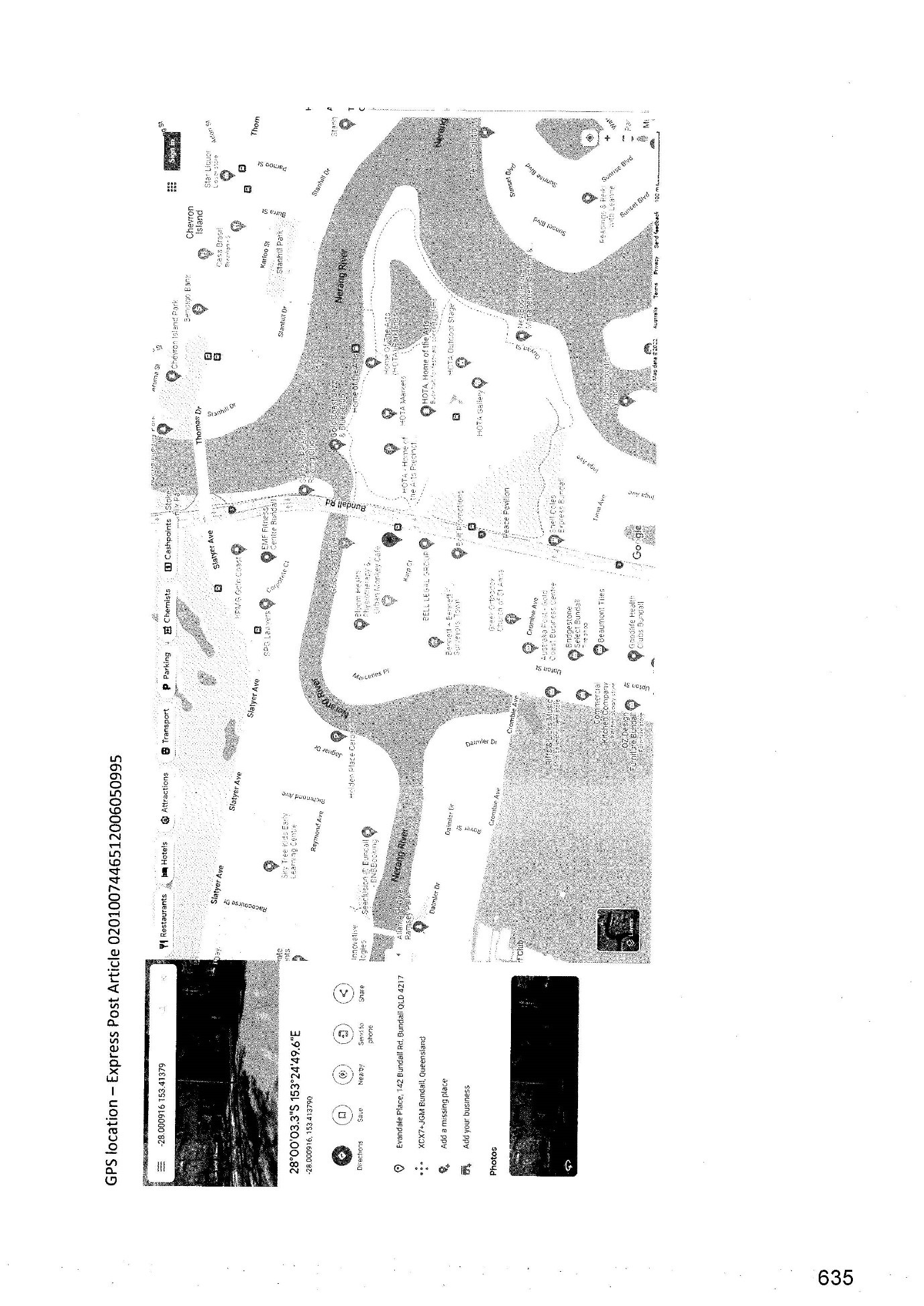
8 MJG Partnership’s office is accessible to members of the public between 8.30 am and 5.00 pm each weekday. Upon exiting the lifts on level 3 the glass front door of MJG Partnership’s office is immediately visible. The reception desk is located just inside the door.
MJG Partnership’s usual practice for the receipt of mail
9 Jane Elizabeth Bohl is MJG Partnership’s office manager, a position she has held since 2016. When at work, Ms Bohl sits at the reception desk referred to in the preceding paragraph. During office hours, the reception desk is not left unattended other than for the occasional, very short period.
10 As part of her duties as office manager Ms Bohl receives and records any mail delivered to MJG Partnership which is addressed to its clients. In doing so Ms Bohl has the following general practice:
(1) she notes on the document when it was received;
(2) where a legal document, including a creditor’s statutory demand, is served on MJG Partnership as the registered office, she completes a “court documents received” checklist;
(3) she scans and then emails to the relevant person a copy of the legal document received with a notation of when it was received. The scanned copy is then saved in the relevant client’s database file;
(4) she takes a photocopy of the legal document and saves it in the client’s file; and
(5) depending on the client, she may then post the original to it.
11 If any documents are delivered to MJG Partnership’s reception during the day at a time when Ms Bohl is not there, for example when she is on a short break, the documents are left on the reception desk or the person delivering the mail may ring the bell located on the reception desk and either Ms Bohl or another staff member will come to reception.
12 MJG Partnership does not have any arrangement with Australia Post for mail addressed to its office to be held or diverted to any other place and expects all mail addressed to its street address to be delivered to its mailbox.
13 Ms Bohl explained that on very rare occasions Australia Post representatives deliver letters directly to MJG Partnership’s office. However, on most occasions Australia Post representatives either leave the letters:
(1) in a mailbox labelled MJG Partnership that is part of the mailboxes described at [7] above and to which MJG Partnership has access. The mailbox is checked approximately twice a week by one of two junior staff members. If there is mail in the mailbox the junior staff members bring the mail to her directly unopened;
(2) on the building’s lobby desk which is freely accessible to the public. Either Ms Bohl or another staff member checks the desk when passing through the lobby;
(3) on a mailbox labelled “other tenants” which is also located with the mailboxes described at [7] above. The building managers have access to that mailbox. MJG Partnership does not; or
(4) in MJG Partnership’s registered post box, i.e. its P.O. box, which is checked daily every business day by one of two junior staff members.
14 Irrespective of how documents are received at MJG Partnership, once they are received Ms Bohl handles those documents for MJG Partnership’s external clients in the manner described at [10] above.
The First Statutory Demand
15 On 28 April 2022 at approximately 10.00 am Ms Bohl was sitting at the reception desk of MJG Partnership when a representative of Australia Post hand delivered an envelope to her. Ms Bohl described this as “an unusual event”.
16 After opening the envelope she noted that it concerned a legal issue and thus completed a “court documents received” checklist, scanned and emailed a copy of the documents to Solos and took a photocopy of the documents to save to Solos’ client file. The document which was delivered at the time was a letter from Mills Oakley dated 22 April 2022 addressed to the proper officer of Solos and enclosed a creditor’s statutory demand for payment of debt issued by Aussie Hoops as trustee for RC Aussie Hoops Unit Trust to Solos (First Statutory Demand) together with an accompanying affidavit of Thomas Darcy Greer sworn on 22 April 2022.
17 On 28 April 2022 before sending the email to Solos referred to in the preceding paragraph, and because of issues experienced about the delivery of mail, including that an Australia Post representative had, as set out at [15] above, hand delivered a document to MJG Partnership’s office Ms Bohl sent an email to the building managers to which they responded the following day. The email and the building manager’s responses, which are also recorded in the email (in bold, adjacent to each question posed) included (as written):
Just wanted to confirm how mail is delivered to our building street address.
• Does Aust Post come daily to the building? Yes
• Do they just drop mail on the foyer bench? No they put mail in the letter boxes as marked. If you do not have a letterbox they put it in the “other tenant” box.
• Or do they place what they can in the Building Mailboxes outside and then drop the rest on the foyer bench? See above
• Or do they deliver to Management’s office and then it is placed on the foyer bench? We clear the “other tenant’ box twice a week and place the main on the foyer bench
• Do they possibly hold mail at the Post Office until they have ‘enough’ to make a delivery? Not that I am aware of
We have had a couple of issues over a few months of mail ‘apparently’ being delivered (especially postal cards) but then somehow returned to Aust Post only to have a second card ‘apparently’ sent and then the parcel/correspondence has been sent back to original sender.
And then a pile of mail appears and both of the postal cards are there?
Today I actually had an Aust Post officer hand deliver an Express Envelope directly to me. Then after that I received a phone call from another solicitors office advising that a package of legal documents that were addressed to our street address had been returned to them!?!
She confirmed that the parcel was addressed properly. She advised that the envelope had been returned to them with the address crossed out and marked return to sender. She is going to hand deliver this to us and I can then see the envelope.
I do encourage our clients to use our PO Box but unfortunately some legal correspondences are required to be sent to a Street Address.
I’m sure we can’t be the only office in the building that is having this issue. I wanted to check the process with you before going to Aust Post.
The Second Statutory Demand
18 On 4 May 2022 Ms Bohl received the 26 April 2022 Letter enclosing the Second Statutory Demand and Greer Affidavit. Ms Bohl cannot now recall how she received the 26 April 2022 Letter save that she does not believe it was hand delivered to MJG Partnership’s office by a person from Australia Post. That is so because, had it been hand delivered, she thinks she would have remembered this as it was an unusual event.
19 When Ms Bohl initially looked at the Second Statutory Demand she thought it was the same document as the First Statutory Demand. For that reason:
(1) at the top of the 26 April 2022 Letter she wrote “4/5/22 another copy received”; and
(2) she did not complete a “court documents received” checklist as she considered that she had already forwarded the documents to Solos.
20 On 12 May 2022 Ms Bohl received an inquiry from Clive McKerr of Solos about whether any further documents had been received at MJG Partnership’s office. Ms Bohl then reviewed the Solos hardcopy file, located the 26 April 2022 Letter and realised that it differed from the letter dated 22 April 2022 which had enclosed the First Statutory Demand. As a result she emailed a copy of the 26 April 2022 Letter and its enclosures to Solos.
Service of Solos’ application to set aside the Second Statutory Demand
21 It was not in dispute that on 25 May 2022 Solos served a sealed originating process seeking orders setting aside the Second Statutory Demand and an affidavit in support affirmed by George Monemvasitis on 24 May 2022 on Aussie Hoops at the offices of its solicitors, Mills Oakley.
Documents produced by Australia Post
22 At the request of Aussie Hoops, a subpoena was issued to the Australian Postal Corporation (which I refer to in these reasons as Australia Post) seeking the production of “[a]ll documents relating to or recording the tracking and delivery of the Express Post envelope with [the Tracking Number]”.
23 In response to the subpoena Australia Post produced the following documents:
(1) a document titled “NG record for express post article 0201007446512006050995” in which the final set of entries recorded an “Event” as “delivered” at “actual date/time” of “03.05.2022 10.30.16 AUSQLD” and “Event location” as “Bundall QLD”;
(2) two copies of a document titled “Express Post Article 0201007446512006050995 Tracking (SAP screen shot)” which recorded, albeit in a different format, the same information as recorded in the document referred to at (1) above;
(3) a document titled “GPS location – Express Post Article 0201007446512006050995”, a copy of which appears as Annexure A to these reasons; and
(4) a document titled “Salesforce EM443596481” (Salesforce Document) which was created and last modified on 2 June 2022 at 9.45 am and 9.50 am respectively and which appears to include the same information as recorded in the final set of entries of the document referred to at (1) above as well as entries for “Event Geo Location” and “Geo Precision” which respectively record “-28.000916 153.41379” and “34”.
24 Also in evidence was a document titled “Track your items – Australia Post” which, in relation to the item bearing the Tracking Number, recorded as the final entry the following:
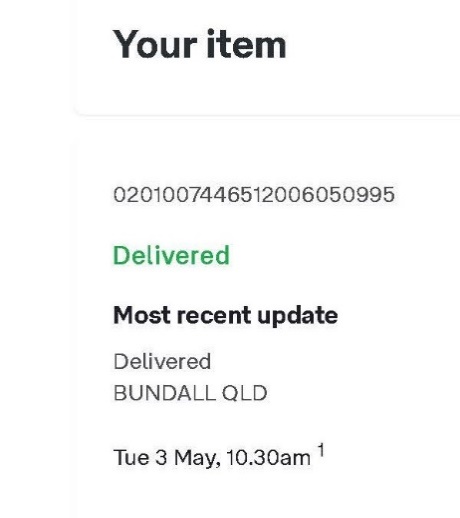
The footnote reference (1) read: “all times refer to the local time at the location shown”.
STATUTORY FRAMEWORK AND RELEVANT LEGAL PRINCIPLES
25 Section 459G of the Corporations Act provides:
(1) A company may apply to the Court for an order setting aside a statutory demand served on the company.
(2) An application may only be made within the statutory period after the demand is so served.
(3) An application is made in accordance with this section only if, within that period:
(a) an affidavit supporting the application is filed with the Court; and
(b) a copy of the application, and a copy of the supporting affidavit, are served on the person who served the demand on the company.
The statutory period referred to in s 459G is 21 days: see Corporations Act, s 9 and Corporations Regulations 2001 (Cth), reg 5.4.01AAA(2)(b).
26 Section 109X of the Corporations Act relevantly provides:
(1) For the purposes of any law, a document may be served on a company by:
(a) leaving it at, or posting it to, the company’s registered office; or …
27 Section 29 of the Acts Interpretation Act 1901 (Cth) sets out the “meaning of service by post” and provides:
(1) Where an Act authorises or requires any document to be served by post, whether the expression “serve” or the expression “give” or “send” or any other expression is used, then the service shall be deemed to be effected by properly addressing, prepaying and posting the document as a letter and, unless the contrary is proved, to have been effected at the time at which the letter would be delivered in the ordinary course of post.
(2) This section does not affect the operation of section 160 of the Evidence Act 1995.
28 Section 160 of the Evidence Act 1995 (Cth) relevantly provides:
(1) It is presumed (unless evidence sufficient to raise doubt about the presumption is adduced) that a postal article sent by prepaid post addressed to a person at a specified address in Australia or in an external Territory was received at that address on the seventh working day after having been posted.
…
(3) In this section—
working day means a day that is not—
(a) a Saturday or a Sunday, or
(b) a public holiday or a bank holiday in the place to which the postal article was addressed.
29 In the matter of AXF Group Pty Ltd [2019] VSC 671; 348 FLR 391 concerned the question of whether statutory demands had been served on the company. Relevantly the company’s registered office address was the address of its solicitor. However, unbeknownst to the director of the company, the solicitor moved premises. In doing so the solicitor arranged for Australia Post to redirect all mail sent to his previous address to his new premises. A preliminary question arose in relation to the service of the demands, namely whether they had been served on a date less than 21 days before a particular date. At first instance that question was answered in the affirmative in relation to both demands. The company appealed. After referring to s 109X of the Corporations Act and s 29(1) of the Acts Interpretation Act, at [41]-[42] Sifris J said:
41 The Demands were, in accordance with s 109X of the Act, and s 29(1) of the AIA Act, properly addressed, prepaid and posted to the registered address of the Company. Evidence of these matters is sufficient to raise the presumption. The Associate Judge was correct in holding that service had been presumed to be effective four days after the Demands had been posted on 17 January 2019. Service is presumed to have taken place on Wednesday, 23 January 2019.
42 The relevant authorities make clear that the Company bears the onus of establishing ‘proof to the contrary’. The Company does this by proving non-delivery of the Demands to the premises to which they were addressed (the registered office) or actual delivery to some other address (here, the redirection address). If non-delivery of the Demands is proven, the presumption does not apply and proof of non-delivery is effective as proof of non-service. If actual delivery to some other address is established, the sender must establish service without relying upon s 29(1), that is, by establishing, for instance, the Demands had been physically delivered at a later time by a company employee from the redirection address to its registered office. However, if there is only proof that the Demands have not been received by the Company, the presumption is not displaced and service has been effective according to s 29(1).
(Footnotes omitted; emphasis added.)
30 At [61] Sifris J said:
It is for a company or its agents to maintain adequate records with ASIC. Creditors are entitled to expect that documents posted to a company’s registered office (and subject to any instances of misdelivery) have been effectively served on the company. Strangers to the company are not privy to information beyond that disclosed by the ASIC register and are not obliged to make further inquiries as to current addresses or mail redirections which have been arranged either by the company or its agents. This is the policy basis which underpins the ability for a person to serve a company pursuant to s 109X of the Act and upon which a presumption of service arises under s 29(1) of the AIA Act. It is also the reason why presumed service under s 29(1) is concerned with (and displaced by) delivery and not receipt of a document.
(Emphasis added.)
31 To like effect, in Chen v Kornucopia Pty Ltd (No 1) (2019) VR 305 at [42]-[44] Sifris J set out the following principles concerning service by post of a statutory demand at the registered office of a company:
42 The statutory framework creates two presumptions which affect service (one relating to delivery of a statutory demand and therefore, the occurrence of service, and one concerning the time of service):
…
43 The serving party must establish the following facts, by either direct evidence, or inference from the evidence, in order to raise the presumption under s 29(1). This requires:
(a) proof that the envelope bore the correct name and address;
(b) proof that the envelope contained the relevant document to be served;
(c) proof that the envelope bore the correct cost of postage; and
(d) proof that the envelope was placed in the post.
44 The Company bears the onus of establishing ‘proof to the contrary’ pursuant to s 29(1) of the AIA Act. It does so by proving non-delivery of the statutory demand to the premises of the company’s registered office, or delivery to some address other than the registered office. If the company successfully proves alternative delivery or non-delivery, the presumption does not apply, and proof of non-delivery is effective as proof of non-service. However, ‘if there is no evidence of actual delivery or non-delivery, then the presumption will apply and the item will be deemed to be delivered in the ordinary course of post’.
(Footnotes omitted.)
32 Commencing at [45] Sifris J referred to the decision in Deputy Commissioner of Taxation v Melking Holdings Pty Ltd (2019) 137 ACSR 411; [2019] FCA 988. His Honour relevantly continued at [46]-[47]:
46 Furthermore, as Colvin J also said in Melking Holdings, ‘[t]he registered office of a company must be a location that accommodates the possibility of service by post’. In Partners of Piper Alderman v Sharjade Pty Ltd, Barrett J said there is, implicit in the statutory regime, ‘an expectation that there will be in place at the registered office a system for the safe and secure reception of documents delivered by post’. … Where there are numerous such possibilities, but no evidence tending to suggest which is most likely, the Court may inevitably hold that service (that is, delivery) has been effective, for that is the default position by virtue of the presumption, and no evidence has been adduced to suggest that it has not occurred.
47 I reiterate that it is incumbent on the company to adduce proof of non-delivery. If there is only proof that the statutory demands have not been received by the Company, the presumption is not displaced and service has been effective according to s 29(1). While proof of non-receipt does not prove non-delivery, proof of non-receipt at a place by its occupant, as distinct from non-receipt by a person who is not an occupant, may prove non-delivery at that place for the purpose of s 29(1) of the AIA Act. That is, however, subject to what was said by McKerracher J said in Josway:
while mere denial of non-receipt by the addressee would scarcely, if ever, suffice to prove ‘non-delivery’, evidence of non-receipt at a place by an appropriate occupant, depending on the cogency of the evidence, may be sufficient to create a doubt for the purposes of s 160 of the Evidence Act. While such evidence needs to be sufficient to create a ‘doubt’ it does not need to be proof to the civil standard of fact finding at trial as to actual non-delivery. A ‘doubt’ ought not to be assimilated with proof or demonstration.
(Footnotes omitted; emphasis in original.)
CONSIDERATION
33 As set out at [1] above, the only question before the Court is the date of service of the 26 April 2022 Letter which enclosed the Second Statutory Demand and the Greer Affidavit.
34 So far as that question is concerned it was not in dispute, insofar as the 26 April 2022 Letter is concerned, that the matters required to raise the presumption under s 29(1) of the Acts Interpretation Act had been established. That is, the envelope: bore the correct name and address; contained the relevant documents to be served, bore the correct cost of postage; and it was placed in the post: see Chen at [43]. That being so, a presumption arises that service of the 26 April 2022 Letter and its enclosures was effected at the time at which that letter would be delivered in the ordinary course of post, unless the contrary is proved. The ordinary course of post would, unless sufficient evidence to raise doubt about the presumption is adduced, be the day that is seven working days after the 26 April 2022 Letter was posted i.e. 5 May 2022.
35 However, in this case neither party contended for that date as the date for service. Each contends for an earlier date. It was not in dispute that the effect of the parties’ respective positions is that Aussie Hoops, which contended that service was effected on 3 May 2022, bears the onus for the purpose of s 29(1) of the Acts Interpretation Act of establishing “proof to the contrary”. If it is unable to meet that onus it will follow that, as Solos contended, the date for service must be 4 May 2022, which is the date the 26 April 2022 Letter came to Ms Bohl’s attention.
36 Aussie Hoops submitted that, based on the authorities and in particular Chen at [47], service under s 109X of the Corporations Act of a document by posting it to the company’s registered office is established, by way of statutory presumption or actual evidence, if the letter was delivered by the postal service to the letter box. It contended that service by post in accordance with s 109X of the Corporations Act does not require evidence that the letter was received in an office or by a person. So much is true. As the High Court observed in Fancourt v Mercantile Credits Limited (1983) 154 CLR 87 at 97 in considering s 39(1) of the Acts Interpretation Acts 1956 (QLD), which was relevantly in the same terms as s 29(1) of the Acts Interpretation Act, it is “non-delivery” which is significant. That may be different from receipt by the intended recipient.
37 In this case the critical question is: when was the 26 April 2022 Letter delivered to Solos’ registered office?
38 Aussie Hoops submitted that the threshold to displace the presumption under s 160 of the Evidence Act is low. It submitted that all it is required to do to displace the rebuttable presumption is to raise doubt and that the material produced by Australia Post did that. Aussie Hoops contended that, accordingly, s 160 of the Evidence Act could be put to one side, leaving s 29 of the Acts Interpretation Act. As to that, Aussie Hoops submitted that as there was no argument that it had satisfied the first limb, deemed service, it only had to address the second limb, namely that, unless the contrary was proved, the 26 April 2022 Letter was delivered in the ordinary course of post. Aussie Hoops submitted there was sufficient evidence before the Court to prove the contrary.
39 Solos submitted that Ms Bohl’s evidence demonstrates that the 26 April 2022 Letter was delivered on 4 May 2022. It submitted that Ms Bohl’s evidence is inherently plausible and consistent with contemporaneous documents that were generated well before any dispute arose between the parties as to the date of delivery. Solos contended that evidence from external accountants occupying a registered office should be regarded as reliable evidence as to when, or if, a statutory demand has been delivered to a registered office. Solos submitted that the email exchange between Ms Bohl and the building manager (see [17] above) establishes “mismanagement of mail by Australia Post” and demonstrates the Court should exercise caution before placing reliance on records produced by Australia Post.
40 I turn to consider whether Aussie Hoops has established “proof to the contrary” so as to displace the presumption in s 29(1) of the Acts Interpretation Act, having regard to the evidence which is before the Court.
41 Solos’ registered office is at Evandale Place, Level 3, 142 Bundall Rd, Bundall QLD 4217.
42 Turning first to the document titled “Track your items – Australia Post”. The 26 April 2022 Letter, being the item bearing the Tracking Number, was according to that document:
(1) first processed at “Melbourne Airport VIC” on 28 April 2022 at 9.28 pm;
(2) in transit to “Brisbane Airport QLD” on 28 April 2022 at 9.36 pm;
(3) processed at “Brisbane Airport QLD” on 1 May 2022 at 8.51 pm;
(4) “on board for delivery Bundall QLD” on 3 May 2022 at 9.18 am; and
(5) as set out at [24] above, recorded as “delivered Bundall QLD” on 3 May 2022 at 10.30 am.
43 Aussie Hoops submitted that the tracking history showed the item travelling from Melbourne Airport to Bundall, Queensland. That is so. However, it does not establish delivery at Solos’ registered office. It does no more than establish that the 26 April 2022 Letter was delivered to “Bundall, QLD”. In my opinion that of itself is not sufficient to displace the presumption in s 29(1) of the Acts Interpretation Act. However, it is sufficient to raise a doubt for the purposes of the statutory presumption in s 160 of the Evidence Act that the 26 April 2022 Letter was received by Solos on the seventh working day after it was posted, 5 May 2022.
44 A similar conclusion was reached in Re Crowe Consulting Pty Ltd (2019) 140 ACSR 450; [2019] NSWSC 1414. There the creditor, referred to as Management, relied on an online search of the Australia Post website, similar to that relied on by Aussie Hoops as proof of delivery. The search showed that the relevant item “was delivered to ‘ERINA’ on 22 July 2019”. In relation to that evidence at [23]-[25] Gleeson J said:
[23] Next, Management relied upon the record of delivery recorded in the tracking receipt issued by Australia Post as proof of the actual date of delivery of the express post envelope containing the demand. Management submitted that the tracking record issued by Australia Post for item “090” proved delivery of the express post envelope to the registered office of the Company on 22 July 2019 at 11.29 am.
[24] In Re Shaolin Temple Foundation (Australia) Ltd at [6], Black J observed with reference to the analysis of Robb J in Futre Developments of Australia Post’s contractual provisions in respect of the delivery of mail:
… in a particular case, where evidence of fact is led as to a delay in delivery of mail, and that evidence of fact is accepted, then at least one possible inference will be error or delay on the part of Australia Post, although no doubt other inferences may also be available. … I do not understand his Honour to be suggesting that a tracking receipt issued by Australia Post is determinative, in a manner that displaces other factual enquiry.
[25] Here there is no evidence from any employee of Australia Post that directly proved where and how the express post envelope was delivered. The notation on the Australia Post website does not specify that the express post envelope was placed into the receptacle established at the Company’s premises for receipt of articles: see [26] below. And there is no evidence of Australia Post’s practice in respect of recording the delivery of express post items or to explain the significance of the reference to “Erina” in the tracking record on which Management relies: In the matter of Edifice Australia Pty Ltd at [12] (Black J).
45 Notwithstanding those limitations about the document in question, Gleeson J was satisfied that the tracking receipt was sufficient to raise a doubt about the statutory presumption in s 160 of the Evidence Act: see Re Crowe at [27].
46 There are two further documents which were produced by Australia Post described at [23(1)] and [23(2)] above. Those documents contain the same information but do not, in my opinion, take the matter any further than the tracking information document. That is they do no more than describe the passage of the 26 April 2022 Letter from Melbourne Airport to the time it was “delivered” at “Bundall QLD” on 3 May 2022. My comments at [43] above apply equally to this evidence.
47 It is next necessary to consider the Australia Post GPS location document which is Annexure A to these reasons. It is tolerably clear, from its title, that Annexure A provides for a GPS location of the item which bears the Tracking Number, namely the 26 April 2022 Letter. To that end, Annexure A also includes a set of coordinates and the address “Evandale Place, 142 Bundall Rd, Bundall QLD 4217”. I would infer that they are the coordinates for that address. Those coordinates are also included in the Salesforce Document which is described at [23(4)] above.
48 It might be open to infer from these two documents taken together that the 26 April 2022 Letter was delivered on 3 May 2022 at 10.30 am to the address which is located at the GPS coordinates included in Annexure A and repeated in the Salesforce Document. No evidence has been provided about the meaning of any of the documents produced by Australia Post. For example, insofar as Annexure A and the Salesforce Document are concerned, no evidence has been provided to explain the purpose of Annexure A: is it given to an Australia Post employee to locate the address for delivery of an item; is it generated by the employee responsible for the delivery or another person and so on. Insofar as the Salesforce Document is concerned, similarly no evidence has been given about its purpose and why it was created approximately one month after the event with which it appears to be concerned or about the meaning of some of its content. For example there was no evidence about the meaning of the event type “DD-ER13”, which is also a term used in some of the other Australia Post documents which are in evidence. Accordingly, I am not satisfied that delivery occurred on 3 May 2022 based on these documents alone, or in combination with the other documents produced by Australia Post.
49 Aussie Hoops relied on the decision in In the matter of Myao Travel Pty Ltd (2020) 148 ACSR 563; [2020] NSWSC 1219 which also concerned the determination of the date of service of a creditor’s statutory demand. As is the case here, the creditor relied on material produced by Australia Post in response to a subpoena to establish that the envelope containing the demand had been delivered to the relevant address on a specified date, rather than relying on the statutory presumption as to time of service. Among the documents produced by Australia Post was a document in the form of Annexure A. The concern raised with that document was that the “pin” appearing on it was located at a neighbouring property and not at the address of the registered office. At [19] Rees J said the following about the document:
The fact that the Google Maps pin appearing on the GPS map sits outside the neighbouring property does not mean that the postal item was delivered to the neighbouring property. The documents produced by Australia Post indicate that the driver was at the location of the Google Maps pin when they activated the device which recorded that the item had been delivered. As mentioned, the Google Maps pin is in the middle of a road. There is no suggestion in the documents produced by Australia Post that it has formed the view at any time that the item of post has been misdelivered to the neighbour. Whilst these things do happen, it is more likely that a mail item correctly addressed to the registered office would be delivered to that address.
50 There was evidence before her Honour from Australia Post explaining how the document in the form of Annexure A was created and, in particular, how the “pin” might have come to be located at the adjacent property. There is no evidence of that nature before me. In Myao Travel the factual issue to be determined, which affected the question of the time of delivery, was whether the demand had been delivered to the address of the registered office or the property adjacent to that address. Here, both parties accept that there was delivery to the registered office but the factual issue to be determined is the date on which that delivery was effected. In Myao Travel the defendant company denied receipt of the demand and contended that the envelope in which it was posted was misaddressed. Here Solos’ evidence is that it received the 26 April 2022 Letter on 4 May 2022 (not 3 May 2022). It contended that, given the inconclusive nature of the documents produced by Australia Post, the date of its receipt should be taken to be the date of delivery and thus of service.
51 I accept that considered on their own the documents produced by Australia Post are inconclusive and do not “prove the contrary” for the purposes of s 29(1) of the Acts Interpretation Act. However, those documents must be considered together with the further available evidence about delivery of post to MJG Partnership. When that is done, I am satisfied that Aussie Hoops has “proved the contrary” as required by s 29(1) of the Acts Interpretation Act and has discharged its onus of proving delivery on 3 May 2022. That is because, when considered as a whole, the evidence establishes that:
(1) according to its records Australia Post ceased handling the 26 April 2022 Letter, and delivery was completed on, 3 May 2022;
(2) as I have already observed, it is open to infer and I would infer given the other surrounding facts, that the 26 April 2022 Letter was delivered on 3 May 2022 at 10.30 am to the address which is located at the GPS coordinates included in Annexure A and repeated in the Salesforce Document. I would also infer, having regard to Annexure A, that those GPS coordinates were for Evandale Place, 142 Bundall Road, Bundall, QLD 4217;
(3) it is not in dispute that the 26 April 2022 letter was received by Ms Bohl on 4 May 2022. She cannot recall how she received it, although she does not believe it was hand delivered by Australia Post on that day;
(4) Ms Bohl’s evidence is that Australia Post on most occasions delivers mail for MJG Partnership to one of four specified places set out at [13] above. Delivery to level 3 is rare;
(5) the places for delivery are:
(a) the MJG Partnership mailbox, which is checked twice per week. As the 26 April 2022 Letter was not addressed to MJG Partnership but to the street address simpliciter, I would not comfortably infer that the letter was delivered to the MJG mailbox on 3 May 2022;
(b) the P.O. box, but, as the 26 April 2022 Letter was not addressed to the P.O. box, the parties were agreed that it has no relevance;
(c) on the building lobby’s desk; or
(d) in a mailbox labelled “other tenants” which is also cleared twice per week; and
(6) given the methods set out above and Ms Bohl’s evidence that the 26 April 2022 Letter was not hand delivered, I would infer that it was delivered either to the building’s lobby desk or the “other tenants” mailbox on 3 May 2022.
52 MJG Partnership had a system in place for the “safe and secure reception of documents delivered by post” which involved more than one possibility for the delivery of postal items. In short, I am satisfied that it is more probable than not that the 26 April 2022 Letter was delivered on 3 May 2022 to one of two places identified by Ms Bohl (set out at [51(5)(c)-(d)] above) for the delivery of mail and that service was effected on that date. That it may not in fact have been delivered to level 3 does not alter my conclusion given Ms Bohl’s evidence that there are a number of ways by which Australia Post achieves delivery at the office of MJG Partnership (see [13] above).
CONCLUSION
53 For those reasons, the answer to the preliminary question is no. That is the application for an order setting aside the Second Statutory Demand and the Greer Affidavit supporting that application were not filed and served within the 21 day statutory period specified in s 459G of the Corporations Act.
54 As Aussie Hoops has been successful in relation to the separate question, it should have its costs of the determination of that question.
55 As the parties noted at the hearing, a negative answer to the preliminary question affects the Court’s jurisdiction to determine the proceeding. I will list the proceeding for case management hearing at which time the parties can inform the Court as to the fate of the proceeding, in light of the conclusion I have reached. Alternatively, if the parties reach a consensual position in the meantime, they can provide draft orders to my Associate to be made in Chambers.
56 I will make orders accordingly.
I certify that the preceding fifty-six (56) numbered paragraphs are a true copy of the Reasons for Judgment of the Honourable Justice Markovic. |
Associate:
Annexure A