

Federal Court of Australia
Lu v University of New South Wales (No 2) [2022] FCA 1010
ORDERS
Applicant | ||
AND: | Respondent | |
DATE OF ORDER: |
THE COURT ORDERS THAT:
1. Leave to make an application pursuant to s 46PO(1) of the Australian Human Rights Commission Act 1984 (Cth) be refused.
2. The originating application be dismissed.
3. The applicant pay the respondent’s costs.
Note: Entry of orders is dealt with in Rule 39.32 of the Federal Court Rules 2011.
KATZMANN J:
Introduction
1 On 5 March 2021 Min Lu, also known as Yolanda Lu, lodged a complaint with the Australian Human Rights Commission (AHRC or the Commission) against the University of New South Wales (UNSW or the University). Relevantly, the complaint contained allegations that UNSW discriminated against her on various grounds including her race, her association with a disabled person, her sex and her marital status. She also claimed to have experienced racial hatred and to have been victimised for making, or trying to make, the complaint. She indicated that the complaint could be resolved by, amongst other things, the University paying her $550,000 in compensation for “general and economic loss” together with $25,000 in legal fees.
2 The complaint was terminated by a delegate of the President of the Commission on 8 November 2021 (Notice of Termination) under s 46PH(1)(c) of the Australian Human Rights Commission Act 1986 (Cth) (AHRC Act). Section 46PH(1)(c) entitles the President to terminate a complaint if she is satisfied, having regard to all the circumstances, that an inquiry, or the continuation of an inquiry, into the complaint is “not warranted”.
3 On 4 January 2022 Ms Lu filed an originating application in this Court seeking “compensation, protections and supports” from the Court and the following relief (without alteration):
Income loss and future income capability affections, including leaves (waiting for the further diagnosis): over 150,000.
Communication fees and relevant fees (forced to pay): $38,000
The suffer, pain, distress, harm and damages and relative fees: 400,000 +
Extra time loss recovery: $100000, 450 hours+ loss for ongoing issues and my family members and relatives had distress from these issues. + to be determined.
All the medical fees, personal injury, sickness and the damages of image and provoking: to be determined.
Network [later amended to “To repair the network”], friendship loss and other interests and rights loss: to be determined
The other party pay all the solicitor fee, filing fee, and all fees relative to this case.
4 She also claimed “other relief”, which was expanded in an amended originating application filed on 10 February 2022. The other relief is described (without alteration) as:
1. To request the respondent and associates, they must cease doing all adverse actions and must be responsible of all consequence and long-term affections.
2. Correct all reports and records in my profile of the respondent and repair all relationship damaged. (Defamation Act 2005)
3. Correct all unfair and abusive procedures, and administrative manipulated documents. (Administrative law)
4. Remove all restrictions for the human and equal rights and the right of alumni.
5. The respondent needs to cease to access my privacy and my personal information and all cyber security adverse actions and relevant adverse actions even stalking, monitoring and bullying conducts. (Privacy Act)
6. To provide remedy to the applicant and applicant’s family members’ pain, fear and suffering.
7. To provide all medical fees and future treatment fees to the applicant for health damages and personal injury.
8. To provide remedy to the applicant due to damaging the applicant’s employment.
9. Repair the relationships, reputation, network and friendship broken by the respondents.
10. Common Law
11. Land ACT 1901
12. GIPA ACT
13. Other relevant reliefs (Torts and others)
(Emphasis in original.)
I take the “GIPA ACT” to be a reference to the Government Information (Public Access) Act 2009 (NSW). The “Land ACT 1901” appears to be a reference to the Inclosed Lands Protection Act 1901 (NSW), which makes trespassing on “inclosed lands” an offence. The relevance of these references in the context in which they appear is obscure.
5 Ms Lu applied for an extension of time but none is required. That is because her application was made within the prescribed time, being 60 days after the issue of the Notice of Termination: see AHRC Act, s 46PO(2).
6 Where, as here, a complaint is terminated under s 46PH(1)(c), however, an application may not be made to the Court unless it grants leave to do so: AHRC Act, s 46PO(3A)(a). UNSW opposed the grant of leave. Leave was neither sought nor granted before Ms Lu filed her originating application. For this reason, strictly speaking, the application is incompetent. But leave may be granted after the event.
Background
7 Ms Lu graduated from UNSW in 2015with a Master’s in Accounting and Business Information Technology. Early in 2016 she contacted one of her former lecturers, Dr Felix Tan, and asked him if she could attend some of his classes during the first semester, although she was no longer an enrolled student. He agreed to the request and Ms Lu attended some of his classes during that semester. He also permitted her to attend some workshops, which were offered as part of the course, to share her experiences as a former student. In July 2016, however, it seems that he was no longer comfortable with this arrangement.
8 On 23 September 2016 the University’s Security Operations Manager, Christopher Evans, met with Dr Tan to discuss his concerns about Ms Lu’s “persistent unwelcome contact with him”. According to a report of that meeting, in about July 2016 Ms Lu started contacting Dr Tan on his mobile phone, sending personal text messages about the breakdown of her marriage and other personal matters. She also asked him about his routine on the weekends and where he goes shopping. After the meeting, Dr Tan blocked Ms Lu’s telephone number from his mobile phone to ensure that he would not receive any further phone calls or messages.
9 Ms Lu’s complaint arises out of actions taken by the University in October and November 2018. A contemporaneous report of these events, annexed to Mr Yahl’s affidavit, discloses the following matters. At about 6.28 pm on 17 October 2018 a staff member called security, advising that Dr Tan was being “stalked” by Ms Lu and requesting their attendance at the “breakout area” near Dr Tan’s office. A security officer spoke to Dr Tan who advised that Ms Lu had been “randomly showing up at his lectures”, refuses to leave, and was “now sitting just down [the] hallway from his office”. Dr Tan reported that Ms Lu had repeatedly tried to organise a meeting with him and, although he was prepared to have a skype meeting, he informed Ms Lu that he was unwilling to meet with her in person. In the end, Dr Tan agreed to meet Ms Lu in the presence of security staff. After the meeting, the security officer asked Ms Lu to leave the premises. She demanded 80 minutes to calm down, security gave her 30 minutes, and she subsequently left of her own volition. On 1 November 2018 the University sent Ms Lu a notice in the following terms:
Notice of revocation of licence
You are hereby notified that any express or implied licence allowing you to enter or remain on the grounds and buildings of the University of New South Wales’ (University) Kensington campus has been revoked indefinitely.
This means that you do not have permission to enter the land or buildings of the University’s Kensington campus from and including the date that you receive this notice. The Kensington campus includes all of the buildings and grounds located on the land bounded by Anzac Parade, High Street, Botany Street, Oval Lane, Willis Street and Barker Street.
If you enter any part of the University’s Kensington campus after the date of this notice, or refuse to immediately leave the premises after being asked to leave, you will be committing an offence and the University will contact the Police. You may [then] be charged or issued with a penalty notice under the Inclosed Lands Protection Act 1901 (NSW). If you are [found] guilty of an offence, you may be liable to pay a fine.
In addition, if you either enter, or remain on, the University’s Kensington campus after being given this notice and refuse to give your name and address when requested, you may be lawfully detained by the University’s security staff and delivered to the Police, to be dealt with according to law.
(Emphasis in original.)
10 Dr Tan claimed that between 5 and 12 January 2019 Ms Lu sent several messages to him through the “WhatsApp” messaging service and she also tried to call him on his personal mobile number on 11 and 12 January using a new mobile phone number. Dr Tan did not answer her calls. The following month Ms Lu contacted the University requesting a review of the ban imposed by the November notice but the University refused the request. Ms Lu made a further request in July 2019 and this time she had more success.
11 On or about 26 July 2019 the University lifted the revocation of the licence, albeit on conditions. That day Tara Murphy, Head of Security & Traffic at UNSW, wrote to Ms Lu:
Revocation of licence lifted
I refer to the notice dated 1 November 2018 in which you were notified that your licence to enter or remain on the grounds and buildings or the University of New South Wales (Kensington campus) had been revoked, and to subsequent correspondence regarding that notice.
The purpose of this letter is to advise you that the revocation of licence notice has now been lifted, provided that you comply with the following conditions:
1. You do not attempt to contact and/or approach Dr Tan whether in person, via email, phone or any form of social media.
2. You do not attempt to visit Level 2 Quadrangle Building School of Business Office, unless invited by a member of that office.
From the date of this letter, you are permitted to enter the land and buildings of the University’s Kensington campus in accordance with the conditions stipulated above. If you breach the above conditions, the revocation of licence is liable to be reinstated.
12 On 7 August 2019 Ms Lu sued Dr Tan for damages in the Small Claims Division of the Local Court, claiming that he had “negligently judged [her] behaviour” and that what was said to have occurred in 2016 was false. On 1 November 2019 Dr Tan filed a defence denying liability. On 25 November 2019 Dr Tan, who was represented by Paul Sheehy, in-house counsel for the University, applied for summary dismissal and the proceeding was dismissed as vexatious and an abuse of process.
13 Earlier, on 13 November 2019 Rick Minter, Emergency & Major Incident Manager at UNSW, contacted the “Fixated Persons Unit” of the NSW Police Service about Ms Lu and on 18 December 2019 Mr Minter met with the local police liaison officer. After the meeting, Mr Minter sent an email entitled “UNSW harassment issue”, which reads:
As discussed with you today, UNSW would like police to contact the person mentioned below [Ms Lu], following ongoing emails & phone calls being received, which we believe to be harassing. The person mentioned has been told by the university that the matter (scil.) is finalised and no further correspondence will be entered into. UNSW are still receiving emails from her and “her nephew” claiming to be a UNSW student. The “nephew” did not provide[ ] sufficient information for the office to ascertain their identity.
14 This particular email was annexed to Ms Lu’s affidavit. It contained handwriting, which I presume was Ms Lu’s, asserting that the statement that “no further correspondence will be entered into” does not mean “cease communication”.
15 On 19 December 2019, Tony Grech, the Crime Prevention Officer at Eastern Suburbs Police Area Command, sent several emails to Ms Lu, the first of which reads:
Hi Lu Yolanda.
I am the Crime prevention Officer for Eastern Beaches and I am the liaison officer for UNSW.
It has come to my attention that you have continued to harass staff at UNSW via emails and phone calls regarding your admission to the university. You have been advised by UNSW several times that there will not be any other communication on your matter. You have excessively sent and called UNSW staff on the matter even when you have been ask[ed] to stop all communication. All of this has been recorded as evidence.
I am contacting you as a final warning to cease any and all communication by yourself or by a third party to UNSW or UNSW staff. If you continue to communicate with UNSW they will have no other option to report this to the Police and criminal charges will be placed on you.
The legislation is clear on harassment and you will be charged if you continue. There will be no other warnings.
(Emphasis in original.)
16 In another email Officer Grech noted that Ms Lu had sent him four emails in the previous hour and 40 minutes. He insisted Ms Lu cease contact with him, otherwise he said he would take action himself. In a third email he informed her that “constant communication with UNSW staff has been deemed as harassment”. He acknowledged that she could “take whatever action [she wished]” but told her that, if she were to contact UNSW, she would be prosecuted.
17 After the Local Court proceeding was dismissed, Ms Lu continued to write to UNSW seeking information and, through solicitors, requested a meeting with representatives of the University.
18 On 1, 9, and 12 June 2020 (the latter at 5.07 am) the University received emails questioning and criticising its conduct and supporting Ms Lu. The emails were purportedly sent by a person named Edmund Lu who claimed to be a current student at the University and Ms Lu’s nephew. But when the University requested proof of identity in order to respond to his queries and criticisms, none was supplied.
19 A meeting was arranged between Ms Lu, her then solicitor, Mark Shumsky, Ms Murphy and Mr Sheehy. The meeting took place over two hours on 30 July 2020.
20 On 6 August 2020, Ms Lu emailed Prof Lemuria Carter, the Head of the School of Information Systems and Technology Management at UNSW Sydney, to invite her, Dr Yenni Tim, Dr Christine Van Toorn and two other members of the academic staff, to attend a “mediation”. Ms Lu indicated that the purpose of the mediation was to answer numerous questions, set out in her email, relating to the events of 17 October 2018 and arising from the contents of Mr Evans’ security report. The vast majority of the questions were directed to Dr Tim, but one was specifically aimed at Prof Carter. Ms Lu wanted Prof Carter to explain what she did to investigate the “issue”, which I take to be a reference to Dr Tim’s alleged conduct on 17 October 2018. Prof Carter replied, acknowledging the request for mediation and advising that she would respond after she received advice from “HR”.
21 Prof Carter responded on 10 August 2020 in the following terms, after acknowledging the exchange of emails:
I understand that you have sought, and been provided with, many pieces of information from the University. The University believes that it has provided you with all applicable information regarding the matter you refer to, and is under no obligation to correspond with you further. Accordingly, I decline to answer your questions.
I am not under any obligation to have a mediation or meeting with you, and I decline to do so. This also applies to Dr Tan, Ms Van Toorn and Dr Tim, as well as all other members of the School.
I request that you please do not contact me, or any staff of the School of Information Systems & Technology Management, in future. Any further correspondence from you on this matter will be filed and will not be responded to.
22 It was around this time in August 2020 that Ms Lu said she complained to the University, through her then lawyers, of unlawful discrimination.
23 On 11 August 2020 NSW Community Justice Centres wrote to Ms Murphy on Ms Lu’s behalf seeking to arrange a mediation. The University agreed to the request and a mediation took place on 22 September 2020 but no agreement was reached.
24 On 24 September 2020 the following email was sent to Mr Sheehy purportedly by Edmund Lu (errors in original):
Upon solicitor’s option (initial legal fee and compensation), I would like to add something on.
1. 350*$300= $105000
Yolanda and I spent around 350 hours to deal with this issue and relative issue as some leaders frustrated her and simply used ‘personal violence’ way to stop pointing out the untrue facts and frustrate me to give up studying. They tried to control her and limit her freedom to protect self and me.
2. $2000. Transport fee
3. $3600. 6 days off work.
4. Compensation includes ‘long term psychology harm
5. Long term affections on me.
We expect you involve me and Yolanda to discuss the compensation to increase effectiveness and satisfaction. Also, some leader may look at the wrong profile of Yolanda. She graduated in 2015 not 2016, not 2002.
Please reply to the solicitor and include us by tomorrow 10:00am.
25 Mr Sheehy forwarded the email to Mr Shumsky, together with another email “Edmund” sent to various staff members including Ms Murphy, saying:
Given that your client specifically agreed that all correspondence would be between the lawyers, this is extremely disappointing and frustrating. It appears that she is either unable or unwilling to comply with her agreement.
Please inform your client that:
• She is not to communicate with anyone at UNSW, either by herself or through Edmund
• UNSW will not reply to any emails she/Edmund sends to UNSW staff
26 Mr Shumsky replied, noting that Edmund Lu was not his client. He said he had never communicated with him. He also said that he had advised Ms Lu not to communicate with anyone from UNSW, either directly or through “Edmund”, and had told her that UNSW would not reply to any such emails.
27 On 26 September 2020 Ms Lu instituted proceedings in the District Court of NSW against six staff members of the University and one former staff member, alleging she had been defamed by them. Mr Minter was the first-named defendant. The others were Ms Greene, Ms Murphy, Dr Tan, Prof Carter, Paul Ajnas and Dr Tim. On 20 October 2021 those proceedings were summarily dismissed on the application of the University: Lu v Minter (No 3) (District Court (NSW), 20 October 2021, unreported (Gibson DCJ). On 28 April 2022 Gibson DCJ made a lump sum costs order in the University’s favour of $49,000. Evidently, when her Honour asked Ms Lu to “answer the costs issues” set out in the University’s written submissions, she declined to do so and left the courtroom despite being warned that, if she left, the hearing would continue in her absence: Lu v Minter (No 4) [2022] NSWDC 127.
The complaint to the AHRC
28 Ms Lu lodged her complaint to the AHRC on 5 March 2021. Ms Lu’s complaint was forwarded to UNSW the same day and a response was sought. The University responded on 26 March 2021 through Mr Sheehy. Ms Lu provided submissions on the University’s response on 14 April 2021. Those submissions were not annexed to Ms Lu’s affidavit and they were not otherwise before the Court. But they were summarised by the delegate and I have no reason to doubt the accuracy of that summary. Certainly Ms Lu did not challenge its accuracy. According to the summary Ms Lu submitted that:
the University was aware of her nephew and that she needed to help him due to his broken foot from late 2018;
she saw and spoke to Dr Tim;
the University lacked “common sense”; Edmund Lu was an anonymous name; YH are the initials of his Chinese first name, and the University has documents to prove that he was a student from 2016 to 2020;
the University staff did not trust her and this was discrimination;
she has numerous communications from 2016 to 2018 to prove that she had been invited to help Dr Tan with his class;
she had contacted University staff in 2019 and “pointed out all untrue, vilifying and deceptive statements on the incident reports”; and
she had the “right to make complaint and know the basis of the decision against [her]”, the number of emails she sent University staff was appropriate, and the University had a duty to deal with “untrue facts and unfair violent and defamatory” treatment.
29 In her application, Ms Lu alleged unlawful discrimination under the Disability Discrimination Act 1992 (Cth) (DDA), the Racial Discrimination Act 1975 (Cth) (RDA), the Sex Discrimination Act 1984 (Cth) (SDA), and the AHRC Act.
30 If a complaint is made to the Commission under s 46P of the AHRC Act, the Commission must refer the complaint to the President: AHRC Act, s 46PD.
31 Section 46PF of the AHRC Act relevantly provides:
(1) Subject to subsections (1A) and (5), if a complaint is referred to the President under section 46PD, the President must:
(a) consider whether to inquire into the complaint, having regard to the matters referred to in section 46PH; and
(b) if the President is of the opinion that the complaint should be terminated—terminate the complaint without inquiry; and
(c) unless the President terminates the complaint under paragraph (b) or section 46PH—inquire into the complaint and attempt to conciliate the complaint.
(1A) For the purposes of paragraph (1)(a), the President may inform himself or herself of such facts and circumstances as are necessary to form the opinion referred to in paragraph (1)(b).
…
(5) The President may decide not to inquire into the complaint, or, if the President has started inquiring into the complaint, may decide not to continue to inquire into the complaint, if:
(a) the President is satisfied that the person aggrieved by the alleged acts, omissions or practices does not want the President to inquire, or to continue to inquire, into the complaint; or
(b) the President is satisfied that the complaint has been settled or resolved.
(Emphasis added.)
32 Section 46PH(1)(c) relevantly provides:
Discretionary termination of complaint
(1) The President may terminate a complaint on any of the following grounds:
…
(c) the President is satisfied, having regard to all the circumstances, that an inquiry, or the continuation of an inquiry, into the complaint is not warranted[.]
By s 19, read with s 8 of the AHRC Act, the President may delegate any or all of these powers to another person, provided the other person is not a member of the Commission. At some point in time Ms Lu’s complaint was delegated to Jodie Ball. It was she who determined to terminate the complaint.
33 On 15 April 2021 Ms Lu was provided with an assessment of all the information received by the Commission about her complaint and she was invited to provide any further information or comments. Over the ensuing six months she provided additional information. In her statement of reasons, the delegate assured Ms Lu that all the additional information had been considered. Some of this material appears to be before the Court in this proceeding either in Ms Lu’s affidavit or Mr Yahl’s.
34 In the Notice of Termination the delegate summarised Ms Lu’s claims and allegations as follows:
• University staff said that [she was] a ‘dangerous Chinese lady’ and ‘targeted’ [her] because of [her] race. [She says] that [she was] treated differently than other people on campus and that University staff said they had ‘safety concerns’ because of [her] race and [her] association with [her] nephew who is also from mainland China.
• [Her] status of being recently divorced was used to imply that [her] communication with a staff member was inappropriate.
• Due to [her] association with an injured person with a disability and [her] racial and marital status, the University has acted in blatant disregard of [her] person.
• The University did not exercise due process or procedural fairness.
• The University has declined to answer [her] questions; treated [her] with no respect; initiated the revocation and limitation of [her] licence to attend the whole campus and then certain parts of the campus; called you a fixated person; called [her] nephew a ‘purported nephew’ and did a threatening assessment.
• The accusations of stalking and harassing are strongly denied. The accusations are ‘exaggerated and unfounded’.
• Decisions were based on inaccurate, exaggerated reports and presumptions of previous incidences and did not rely on direct information provided by persons who had direct knowledge of the behaviour.
• The fact that [she was] referred to the fixated persons unit after making legitimate and properly founded complaints is ‘unacceptable’.
35 The summary did not include the allegations of racial hatred and victimisation raised by Ms Lu in her complaint form. That was because, as the delegate explained in her reasons, the information before the Commission regarding these matters “[did] not support a reasonably arguable claim of racial hatred under the RDA or victimisation under the RDA, SDA or DDA”. Consequently, Ms Lu was advised (as early as 15 April 2021) that her complaint was “accepted and progressed as a complaint of unlawful discrimination under the RDA, SDA and DDA only”.
The delegate’s decision
36 After considering the material she had received from both parties, the delegate decided that the continuation of an inquiry was unwarranted for a number of reasons including concerns she had about the merits of the complaint. For what it may be worth, the inference to be drawn from her reasons is that she was of the opinion that the complaint was lacking in merit.
The application to this Court
37 In her application Ms Lu asserted (without alteration):
1. The applicant is a Master-Degree holder of UNSW and certified public accountant of Australia, Certified Senior Accountant of China who has integrity and impressing records of school life and career. I was working for famous groups, ASX list group as a professional level staff. As honour, I have many awards of sport, academic, working and was always a leader during school life. I have very good family education.
2. However, from October of 2018 to now, the employees of the respondent provided me a series of quite unfair procedures, misusing the staff power, bulling me and intimidated me at least three times, using the ways like domestic violence for a few years when I did nothing wrong.
3. After I lodged the complaint, it was ongoing that I had retaliation from the staff or associates of the respondent including financial, emotional abuse and isolation, no legal assistance and collusive rigging of damaging my case and making me and my family members’ hard life.
4. To pass the faults to me, the employees of the respondent restricted my human right, working right, education right, freely associate right. My working right and equal working right was removed by the respondent with defamation.
5. I was expelled and isolated without any reason by the employees.
6. I was not allowed to attend the clubs, societies, alumni and community activities of the respondent due to discrimination.
7. As an associate and only one carer of my male relative, the respondent refused me to provide urgent help and carer to this relative when he was unable to walk (disabled and overseas).
8. I was not allowed to provide care and accompany to my only one overseas relative on campus and to access services and facilities, who was unable to walk and study at the respondent’s Kensington campus.
9. As I am a Chinese lady and has a male relative from China studying at UNSW, I had less favourable and no any trust from the respondent.
10. I had hate crime from the staff and the associates of the staff members of the respondent.
11. Due to my sex and the relationship (personal information, not sure why the respondent spread it), I was shunned and obtained strongly suspicious though the leaders failed to take duty of care and didn’t do their duties as it will make them troubles. They easily damaged my rights and interests due to discrimination and vilification.
12. I was suspended and classified as a Chinese dangerous lady and a threat.
13. My privacy and my relationships were exposed and spread to the strangers who are the staff members without any consents.
14. I had and am having abusive treatments, restrictions, ridicules and intimidations.
15. The respondent classified me as ‘fixed person’, ‘criminal person’, ‘a threat’ due to discrimination and intimidated me and restricted me which are breaching human right and hid their staff’s unlawful discrimination.
16. I was not allowed to enter the premises and use the facilities like other alumni due to unlawful discrimination.
17. I was excluded and expelled from the whole land so that I lost the right for further education, working and human right due to discrimination.
18. The respondent prevented, monitored, and restricted me not to contact people and friends.
19. The respondent created a manipulated documents and story to calculate me and make troubles to me including financial abuse, emotional abuse.
20. After I consult how to claim public liability claim via insurance, the respondent attempted to fraud me to pay over $3500 without any basis. Afterwards, they remove the function to claim the wrongly exclusion on the public liabilities website and put the not existing telephone numbers on it to control people and restrict me to claim.
21. This insurance manager with the respondent’s legal department arranged his relative via district court registrar to provide me purported pro bono service one time. Actually, they were adverse actions and even a trap to damage my credit and the important evidence.
22. The important emails with the staff members of the respondent disappeared.
23. I was restricted to freely contact people and my friends.
24. My associates and I was not allowed to contact all staff and all staff of former school of the respondent as the respondent ‘phishing engagement’ and defamation to hide the unlawful discrimination, which caused me injury, damages and loss over $38000 which I was threated to pay otherwise I would be charged and have a big trouble.
25. I had race vilification and insults in the public place, online and various situations by a sudden intimidation which caused me injury.
26. I suffered various adverse actions and even revenge after I made complaints and spoken up.
27. I was forced to leave the freely accessible place by a random staff lady member of the respondent, when I was doing the legitimate things like others. The respondent hid her name.
28. The respondent vilified me, treated me less favourite and did conclusive rigging against me. I had ridicule (call my name, tricked and cheated for long time after I made complaints.
29. The reports were manipulated and conflicting with the facts and evidence.
30. Please refer to the other details in my complaints to the Human right complaints. As the result, I was suffering, had distress, harm, lost employment and other damages and losses.
31. Other relevant issues.
38 Ms Lu claimed that the discrimination complained of is unlawful under the Age Discrimination Act 2004 (Cth) (ADA), DDA, RDA and SDA. Ms Lu only raised the issue of age discrimination in this proceeding.
39 Orders were made on 11 April 2022, amongst other things requiring the parties to file and serve affidavits and submissions on the question of leave and listing that question for hearing at 9.30 am on 29 August 2022.
40 In accordance with those orders UNSW filed and served an affidavit affirmed by Andrew Finlay Yahl on 24 June 2022 and two sets of submissions. Mr Yahl is a solicitor employed by Bartier Perry with the day to day carriage of the matter for the University.
41 At 10 minutes to midnight on 22 June 2022, nearly a month after her evidence was supposed to be filed, Ms Lu lodged an affidavit with the Court which was accepted for filing the following day. She claimed to have lodged other documents with the Court which were rejected for filing. She filed no submissions (so-called), although her affidavit included much that was in the nature of a submission and was treated as such.
42 Two working days before the hearing, Ms Lu emailed the Court requesting an adjournment. The request was denied. On the morning of the hearing Ms Lu made a further application and another in the early afternoon, both of which were also denied. The reasons her requests were denied are set out below.
The applicant’s evidence and submissions
43 Ms Lu’s affidavit contained a good deal of material which was not apparently relevant to the question of whether leave should be granted. As I have already mentioned, it also included assertions in the nature of submissions. And it was replete with unsubstantiated allegations and invective.
44 In her affidavit Ms Lu contended that the following matters demonstrated that she had been treated less favourably than others:
Alumni of UNSW – have right of receiving ongoing service including lectures, start-up support, career, sport, society, network and etc.
Lifelong associate membership of student life societies of UNSW and member of the various societies.
The applicant should have equal education and equal working right.
Genuineness of my nephew of his studies from 2016 to 2020 and support him.
Gym, swimming pool, facilities, and events are open to the community to attend the campus, and no need to be registered students and staff. (Eventbrite https:www.eventbrite.com.au). On the outside of Gym, it is clearly labelled ‘Open to the community
45 Ms Lu denied stalking Dr Tan. She claimed that she was welcomed and encouraged to attend Dr Tan’s classes and other events “of society” between March 2016 and October 2018. She alleged that statements made in UNSW documents that she was seeking out Dr Tan in July 2016 and entered his classroom were untrue. She argued that these statements “fulfilled the prejudicial and looking down on a Chinese woman … due to her sex and the status of the relationship”. She said that “other people were not treated like this”. Ms Lu admitted to mentioning “the status of the relationship”, which I take to be a reference to her marital status as a divorcee, on one occasion. She alleged that the University had used this intentionally to lower her reputation, disparage women in general, and show contempt for “the status of the relationship”. She asserted that, if Dr Tan believed she was a stalker, he would not have agreed to an on-line meeting with her. She claimed that it was she, rather than Dr Tan, who asked for an online meeting, as she was “too busy to attend the campus”.
46 After posing 32 questions for the University to answer, the affidavit finished with a “conclusion” in the following terms (without alteration):
51. As above, the documents, attitudes and decisions from the UNSW are opposite and conflicting with the above facts and policy. The treatments from UNSW are prejudicial, not knowing the facts before the decision and are fulfilled with Chinese Panic.
52. As a reasonable person, I can't predict that Dr. Tan reported to the security on 23 September 2016 when he welcomed me on 5 September 2016 by email and by words. After 23 September 2016 to October 2018, he still initially greeted me by himself when he saw me on campus or on the events, appreciating me to help his class, welcome me to discuss his teaching materials with him, other conducts and invitations which made me not to predict that he intended to cease all communications with me and my associates.
53. However, on the statements from the solicitor of UNSW, stated that Dr Tan didn’t block me between 2016 to 2018 and he is uncomfortable with me and blocked me in September and October. He asked me to leave his class that I refused to leave. These statements are conflicting with the above evidence and facts. UNSW failed to check with me before the decision made which is not serious and discrimination as UNSW treated me not equally and less favourable.
54. As a reasonable person, if Dr Tan is not comfortable with me that he needs to let me know and not to offer the meeting and other help. From this point, the point and the statements of UNSW are untenable. UNSWs anxiety and panic is without any basis, except discrimination and bias.
55. The leaders never feet sorry and apologized to me, a member of Australia residence, an alumni and my nephew due to such big troubles and harms. Only hate, impatience is expressed.
47 To the extent that they were legible, the annexures to the affidavit comprised:
documents purporting to show that Ms Lu “had the right of ongoing service, benefits and genius reasons to attend the university”, including as an alumna of the University, being pages apparently downloaded from the internet much of the contents of which was illegible, and in relation to particular events which were alleged to be open to the public;
a copy of her masters’ degree;
selective emails passing between Dr Tan and Ms Lu in 2016 (the last on 5 September 2016);
one email from Ms Lu to Vincent Peng dated 25 May 2018 referring to her attendance at a class and thanking “Felix” “for the offer of a gift”, requesting a meeting in his office on 6 June;
a message from Dr Tan from 2018 (the day and month are not apparent) declining an appointment for “Lego Model Discussion: ‘World Peace and Development” and suggesting she make an appointment with “Vincent” instead;
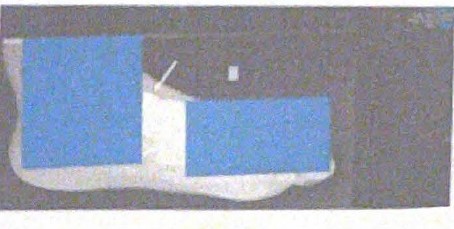
the following redacted image of a foot above which the date “27 Oct 2018” and the name “Mr. Lu” appear in what I take to be Ms Lu’s handwriting:
random redacted photographs of telephone chats with unidentified people; and
email exchanges between Ms Murphy and Ms Lu on 5 November 2018 to which I will refer in due course.
The first adjournment applications
48 It is convenient at this point to discuss the adjournment applications. Before I do so, however, it is necessary to provide some further background and context.
49 On 11 April 2022, when the matter was listed for first case management, Ms Lu did not appear. Orders were made in her absence and a copy of the orders sent to her. One of the orders made that day was for Ms Lu’s evidence in chief to be filed by 27 May 2022. Her submissions and her evidence in reply were required to be filed by 8 July 2022. The hearing of the leave application was fixed for 9.30 am on 29 August 2022. Liberty was granted to either party to apply on three days’ notice.
50 On 19 April 2022, at Ms Lu’s request, another case management hearing was held. I dispensed with the need for her to file a formal application for leave but I made it absolutely clear to her that leave was still required and the orders made on the previous occasion would stand. I also urged Ms Lu to obtain legal advice.
51 On 19 May 2022, a further case management hearing took place, this time at the University’s request. On this occasion Mr Yahl successfully applied for a self-executing order due to Ms Lu’s continuing failure to comply with one of the orders made on 11 April 2022 by not filing the complete AHRC Notice of Termination, namely the Notice of Termination with its two attachments, being the reasons for the decision (Attachment A) and a copy of the complaint (Attachment B): see Lu v University of New South Wales [2022] FCA 588.
52 At 11.02 am on Thursday 25 August 2022, two working days before the scheduled hearing, Ms Lu sent an email to the Court, copied to Mr Yahl. She wrote:
Due to injury for a while, the 29 Aug 2022 is requested to vacate and postpone it after 25 Sep 2022.
Then the court and the other party has time to read evidence thoroughly.
Justice Connect only provides one time consultation which is not helpful for my case.
Thus, I am still in the disadvantage situation to prepare by self for the all legal documents during injury period and other physical treatments.
For discrimination case, government should provide free legal help. From prior experience, a truly independent solicitor without any self interest and conflicts of interest of UNSW is extremely hard to be found in NSW.
I am also on carer responsibility.
As above multiple considerations, please change the date for next one to save all people’s time and resources.
53 Mr Yahl replied 22 minutes later, saying that the time for filing evidence had passed and the University did not consent to the vacation of the hearing date.
54 At 1.40 pm Ms Lu was informed by the Registry that, in the absence of evidence sufficient to justify an adjournment, the hearing of the interlocutory application would proceed (as scheduled) at 9.30 am the following Monday. Eight minutes later, Ms Lu emailed the Court, copying in Mr Yahl, complaining that she had been discriminated against because she was being forced to do legal work. This is the text (without alteration):
Dear Court,
The other party is on sickness discrimination.
I will provide the medical certificate to prove the injury was from May to Aug 2022.
The cause is being investigated which is highly concerned. The other party forced injured people to do legal work which is discrimination and not acceptable.
The injury is diagnosed on 19 June 2022 for 19 May.
On 23 May, the medical certificate has been provided.
I have right to refuse to do work when doctors said I was unfit. Extra work will worse the situation.
And I have child and senior people before Sep 2022.
The objection is no tolerance to be accepted.
(Original emphasis.)
55 The injury was not mentioned and I was not provided with a medical certificate on or dated 23 May 2022.
56 At 2.01 pm Ms Lu emailed Mr Yahl expressing her concern that he and another solicitor “gang up to make [her] sick from May 2022”, insisting that she needed an “extension [to] provide evidence” and, if the extension were not granted “the concern is also raised”.
57 At 12.32 pm the following day, Ms Lu sent an email in the following terms to the Registry and the University’s lawyers:
I attach my medical certificates and treatments covered 29 Aug 2022. Personal and sensitive info was covered.
Andrew's side failed to provide any authority letter from UNSW till now.
The reason that I got really sick and injured as only one working day 23 May provided to me to do all legal work when I was severely coughing with pain. After that, in June 2022, it was diagnosed with fractures and health got worse by them. I was unable to work from around 25 June to Aug 2022.
The date 8 July 2022 to respond to the other party within two weeks which was not consented by me in April due to school holiday involving. Now, from the attachment, you can see I am in injury and unable to do massive work to collect all evidence including all treatments and all bills related to this case as the result of harm.
I request:
1. change the 29 Aug 2022 to 12 Oct 2022
2. Extend the 8 Jul 2022 to 26 Sep 2022 due to injury
3. Authority letter to be provided from the other party by 9 Sep 2022
4. Live Jury for the next hearing.
5. Allow support person to be with me for next time who is not in Sydney on 29 Aug 2022.
I expect the court take duty of care of me and accept the doctor’s advice, though I am willing to go to the court to present for the case. Due to injury, I need a bit more time to recover and it is being recovered though I need to have further advice from the specialists in Sep and wait for more documents.
(Original emphasis.)
58 At the end of that email was plea to James Mattson, one of the University’s solicitors, urging him to agree to her request.
59 Three documents were attached to the email.
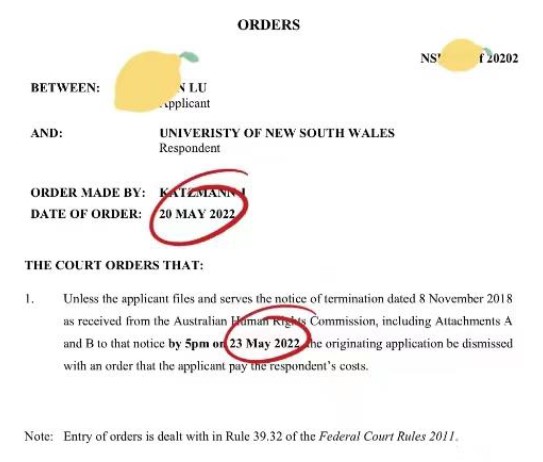
60 The first was an annotated copy of the order I made on 20 May 2022:
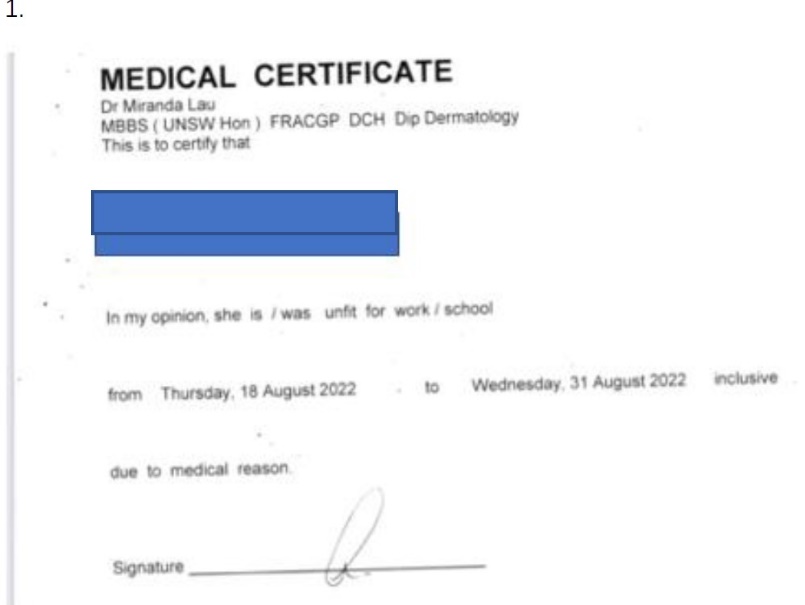
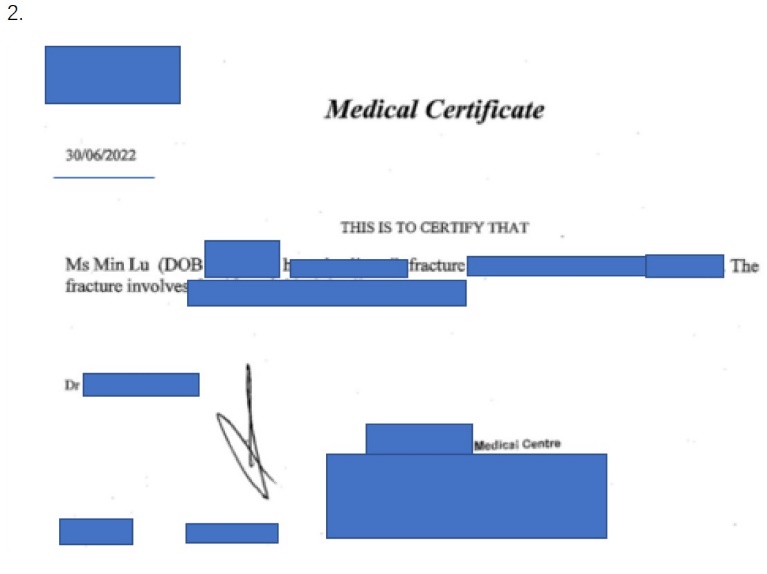
61 The second and third were redacted copies of medical certificates evidently issued by a general practitioner, Dr Miranda Lau:
62 At 1.41 pm Ms Lu sent another email attaching a medical certificate which, she wrote, “more clearly to show the name and the date” of the first one, which had been “covered”. The attachment looked like this:
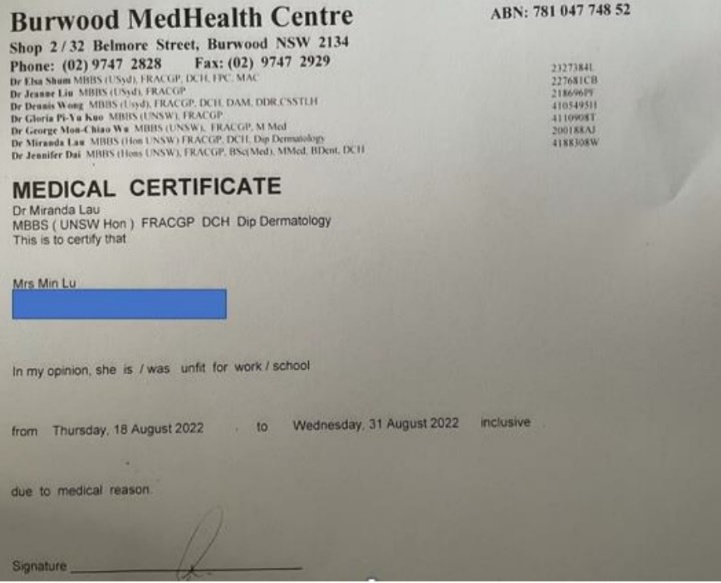
63 By no stretch of the imagination could this material justify adjourning the hearing.
64 The first medical certificate was not the medical certificate actually issued by the doctor since it was partially redacted. The opinion was that Ms Lu was “unfit for work/school”, not that she was unfit to appear in court. The “medical reason” was not identified. The history provided to the doctor was not disclosed. And there was nothing to indicate that the doctor had even examined Ms Lu before providing the certificate. In these circumstances, Dr Lau’s opinion was not entitled to any weight.
65 The other medical certificate was so heavily redacted as to be worthless.
66 Several unsuccessful attempts were made to contact Ms Lu to let her know that the material was unacceptable and to confirm that the hearing would proceed. Two minutes before the hearing was due to start, Ms Lu sent an email to the Registry and Mr Yahl, which read (without alteration):
Thanks for the too short notice. Three different doctors opinions and exam result were provided. How many more doctors does the court need?
I will bring another one to be enough sufficient evidence to the court and bring Chinese students’ request.
Then 10am. I need to settle down the child first.
67 When Ms Lu appeared in court, shortly before 10 am, she pressed her adjournment application. This time she was armed with another medical certificate from Dr Lau but she refused to allow the University’s lawyers to see it so I refused to accept it. Ms Lu sought to argue that she had been in compliance with the orders and in support of her application, wanted to rely on an affidavit with a “lodging ID” of 18 May 2022 that she had lodged “24 times” but was only accepted for filing on 22 June 2022. I inferred that the material in the affidavit of 22 June 2022 was the same as the material Ms Lu lodged on 27 May 2022. Ms Lu then indicated she was going to lodge another affidavit “to response to the other party’s affidavit and submission”. But the orders made on 11 April 2022 (and confirmed on 19 April 2022 in her presence) required that any affidavits in reply be filed by 8 July 2022. Ms Lu claimed that she had applied for an extension of time. I took that to be a reference to the request she had made in her email of 25 August 2022 in which she had first asked for the hearing to be adjourned to a date more than six weeks after the time allowed in the court orders. As I explained to her, the time for filing evidence had long passed.
68 At this point Ms Lu came up with another reason for an adjournment. She told the Court that she had “take[n] action” to apply for a solicitor from the Government to help her with the case and that she had “a like work compensation limitation, from June to now”, and that was why she needed legal assistance. I was sceptical about what she said and questioned her about it:
HER HONOUR: To whom have you applied for legal assistance?
MS LU: Government – federal government.
HER HONOUR: What part of the federal government?
MS LU: I can’t remember, but I definitely apply for. I can’t remember exact name.
HER HONOUR: How did you apply?
MS LU: By email.
HER HONOUR: Can you turn up a copy of the email?
MS LU: Currently, I don’t have that email. Yes. But I can lodge later
69 Ms Lu’s story was not credible. Apart from anything else, she had her mobile phone with her in court. If she had made an application by email, almost certainly it would have been accessible on her phone.
70 Ms Lu then proceeded to tell the Court that she had asked for leave by ticking the leave option in her originating application and that the Registry had informed her that leave had been granted. But the originating application included no application for leave. And I doubted very much whether the Registry did as she alleged. In any case, by 19 April 2022, when Ms Lu first appeared before the Court, she could have been in no doubt that leave had not been granted. I made it abundantly clear to her that she could not proceed without leave.
71 Ms Lu went on to complain that she had never consented to the timetabling orders made on 11 April 2022, but that is beside the point. She did not appear when the timetable was fixed and, once the orders were made and confirmed, she was bound to comply with them.
72 In considering whether to accede to an adjournment application, the Court is required to take into account a variety of considerations. In particular, the Court is obliged to exercise the power to adjourn a hearing in the way that best promotes the overarching purpose of the civil practice and procedure provisions applying to civil proceedings in the Court: Federal Court of Australia Act 1976 (Cth) (FCA Act), s 37M(3). That purpose is to facilitate the just resolution of disputes according to law and as quickly, inexpensively and efficiently as possible: FCA Act, s 37M(1). It includes the following objectives, many of which are unrelated to the interests of the parties to the dispute before the Court: s 37M(2). The objectives are:
(a) the just determination of all proceedings before the Court;
(b) the efficient use of the judicial and administrative resources available for the purposes of the Court;
(c) the efficient disposal of the Court’s overall caseload;
(d) the disposal of all proceedings in a timely manner;
(e) the resolution of disputes at a cost that is proportionate to the importance and complexity of the matters in dispute.
73 The overarching purpose would not be served, let alone promoted, by adjourning a proceeding long fixed for hearing on the basis of evidence of the kind upon which Ms Lu relied.
The course of the hearing after an adjournment was refused.
74 After the adjournment application was refused, Ms Lu was invited to address the Court on the question of whether leave should be granted. But Ms Lu resisted the invitation. Instead, she repeatedly sought to rely on evidence that had not been filed with the Court or served on the University. In one case, I permitted her to tender a document answering this description. In another, I indicated that, provided no prejudice was occasioned to the University and the documents were admissible, I might allow her to tender several others. Ms Lu said that they were on a USB flash drive that she had in her hand but refused to give it to the University’s lawyers so that they could view the documents on their laptop because it contained her “personal information”. I granted a 30 minute adjournment to allow Ms Lu to show the documents on the USB to Mr Mattson. When the hearing resumed, Mr Mattson indicated that she did not want to show the documents on the USB because it was her “personal choice” but indicated she would be happy to show the documents on her laptop. I adjourned a second time to allow Ms Lu to retrieve her laptop from security and Mr Mattson to review the documents. After that adjournment Mr Mattson informed the Court that the USB was not working and Ms Lu was showing the documents on her mobile phone, a less than satisfactory course. As another 30 minutes had passed and only a fraction of the documents were able to be read, it became apparent that the course I was contemplating was entirely impractical. Accordingly, the hearing resumed and I suggested that the reviewing of the documents could continue during the luncheon adjournment.
75 Once again, I invited Ms Lu to address the Court on the leave question. Once again, she resisted. Finally, when pressed to tell me why permission to make the application should be granted, she replied:
Because the reason is because I got intimidation and I listed over 20 times the other party breached the discrimination law including associates of disability, associate of Chinese people, overseas Chinese people, and also my sex, the marriage status and my sex and my age and also racial vilification. They spread racial vilification in the public and because of that the ..... is set up. Because of that the damages for my person and body and the losses were occurred due to the staff of USW, and I try to reconcile many times, but they ignore. So because of those damages and the losses I requested this application.
Also based on the Human Rights ..... note there are many facts and evidences are untrue and I already provide evidences, but I don’t know why somehow they have not seen. So that’s why I need to lodge the application to the Federal Court, and I try my best to reduce disputes and I know the facts. The facts are still not clear for the other party. So that’s why I need to lodge this application to show to the court, except myself and also other students benefit in rights and in future students. The other party need to adjust and correct their unfair procedures to Chinese people.
76 Later she added:
It’s affecting my income capability and affecting my life and my son’s life, as well, for the whole life. And the damage – my actual damage and losses is over millions and millions. It’s can’t – it’s can’t measured. So that is why I have to and I was enforced to lodge this application, and also, the other party has some conduct to hide discrimination in the past, all the thoughts to me, to manipulate some documents, and their complaint procedures is totally – do not meeting the standard of Australia A/NZ …
77 I interpolate that “Australia A/NZ” proved to be a reference to “Complaint Handling at Universities: Australasian Best Practices Guidelines” by the Commonwealth and ACT Ombudsman, published in March 2016. I allowed Ms Lu to tender this document and admitted it into evidence, subject to relevance.
78 Ms Lu remained combative throughout the hearing. She insisted on “lodging” further documents. She claimed these were documents she had provided to the Commission. If so, there was no reason why she could not have annexed them to her June affidavit or filed them as annexures to another affidavit in accordance with the Court orders. I told Ms Lu that, if she did not wish to make any further submissions or take the Court to any particular evidence in her affidavit or Mr Yahl’s, I would ask her to sit down and call upon Mr Mattson to address the Court. Ms Lu continued to argue:
No, I need another choice, like, I need – I said, I need to action – I need to expand to lodge all these documents relevant the case, already sent to the human rights, and also I’m waiting for the human rights. They have only sent to the other party stuff. I haven’t got these documents yet. I believe those documents need to present to the court and I’m already applied for access the information, I’m still waiting, and they say that the decision will be made 24 September when they provide those documents sent to the university staff to ..... them for the discrimination.
79 At this point I asked Ms Lu to be seated, explaining that it was obvious she would not address the Court on the material upon which I had asked to hear her, and called upon Mr Mattson.
80 Mr Mattson addressed the Court until about 1.05 pm. The Court then broke for lunch.
The next adjournment application
81 When the Court resumed after lunch, Ms Lu made yet another application for an adjournment. This time the reason she gave was that she needed to go home “to settle” her 12-year old son. Ms Lu also said that she was not “in [the] mood at all to [be] present” and her body did not allow her to stay for such a long time. She continued:
So that’s why I need to adjourn this section and also, I showed some evidences to the other party, lot of disputes that what they claim or what they ..... are totally different with what I show them for the evidences, so – and then and I’m also going to send email to him and they are quite lots of pages, I believe, over 200 pages. I don’t think he can read today. So the other party also needs time to discuss with the client after he read all those documents.
82 When I told Ms Lu that I was not prepared to adjourn the matter, she claimed to be “really uncomfortable” and too ill to continue. She said she needed to call her doctor and then an ambulance. When Mr Mattson said that the University did not consent to an adjournment, Ms Lu claimed that was “further proof they’re discriminating injured person” and “abusing child as well, if I leave him and without feeding – food”. When I told her that I had refused her application for an adjournment, she insisted that an ambulance be called because “the court ow[e] public liability for me”. When she tried to make the call from the courtroom, I told her she could not do so and that if she wanted to make a call she had to make it outside. Ms Lu then packed up her things, left the courtroom and proceeded to make a loud phone call. It being evident that Ms Lu had no interest in participating further in the hearing, Mr Mattson continued his submissions in her absence. At the conclusion of Mr Mattson’s submissions, I asked the court officer to check whether Ms Lu was still outside the courtroom and wanted to make any further submissions. Ms Lu was no longer outside the courtroom and could not be found.
83 I refused Ms Lu’s last request for the following reasons.
84 First, I found what Ms Lu said difficult to believe. Just before the Court adjourned for lunch, Mr Mattson indicated that he would take no more than 15 minutes to complete his submissions. Earlier I had explained to Ms Lu that she would be given an opportunity to reply. The first time Ms Lu suggested that she needed to be home for her son was when she informed the Court officer shortly before 2.15 pm. It was not apparent how her son came to be at home when he should have been at school. Ms Lu never explained why he needed settling. She did not say that he was unwell. Nor was it apparent, having regard to her son’s age, why he could not fend for himself until she returned.
85 While Ms Lu said she felt “really uncomfortable”, the need for an ambulance was unexplained. There was nothing in the scant medical evidence to account for it. There was also an arguable inconsistency in her reasons. If an ambulance were to be called, it would presumably take her to hospital so that she could not be home for her son.
86 Second, if her child was indeed at home and needed care, as I explained to Ms Lu, it was up to her to make suitable arrangements. After all, the matter had been set down for hearing for over four months. While Ms Lu wanted the hearing adjourned, having regard to the correspondence she had received from the University and the Court and the limited material she supplied to support her adjournment on medical grounds, she should have realised that her prospects of securing an adjournment were at least uncertain and planned accordingly. In the face of the University’s opposition and the dearth of information in the medical certificates she provided to the Court, there was certainly no reason for her to think that she would have been successful. When the matter was listed for hearing on 11 April 2022, the University estimated it would take half a day and I noted as much in my orders, but that did not mean the hearing would necessarily finish in the estimated time and there was no reason for Ms Lu to assume that it would.
87 Third, having regard to the history of the proceeding, there was no reason to believe that the situation would be any different in six weeks’ time when Ms Lu had suggested the matter be relisted.
88 In these circumstances, I considered that the best way to promote the overarching purpose of the civil practice and procedure provisions was to refuse the adjournment.
Should leave be granted?
The legislative framework
89 Section 46PO of the AHRC Act relevantly provides:
(1) If:
(a) a complaint has been terminated by the President under section 46PE, paragraph 46PF(1)(b) or section 46PH; and
(b) the President has given a notice to any person under subsection 46PH(2) in relation to the termination;
any person who was an affected person in relation to the complaint may make an application to the Federal Court or the Federal Circuit Court, alleging unlawful discrimination by one or more of the respondents to the terminated complaint.
…
(3) The unlawful discrimination alleged in the application:
(a) must be the same as (or the same in substance as) the unlawful discrimination that was the subject of the terminated complaint; or
(b) must arise out of the same (or substantially the same) acts, omissions or practices that were the subject of the terminated complaint.
(3A) The application must not be made unless:
(a) the court concerned grants leave to make the application; or
(b) the complaint was terminated under paragraph 46PH(1)(h); or
(c) the complaint was terminated under paragraph 46PH(1B)(b).
90 With the exception of the SDA, each of the Discrimination Acts provides that it is unlawful for a person to discriminate against another person on the ground of the other person’s protected attribute (age, disability or race) by denying the other person, or limiting the other person’s access to premises or places open to the public or a section of the public, or requiring the other person to leave the premises or place. The DDA in s 23, for example, provides that:
It is unlawful for a person to discriminate against another person on the ground of the other person’s disability:
(a) by refusing to allow the other person access to, or the use of, any premises that the public or a section of the public is entitled or allowed to enter or use (whether for payment or not); or
(b) in the terms or conditions on which the first-mentioned person is prepared to allow the other person access to, or the use of, any such premises; or
(c) in relation to the provision of means of access to such premises; or
(d) by refusing to allow the other person the use of any facilities in such premises that the public or a section of the public is entitled or allowed to use (whether for payment or not); or
(e) in the terms or conditions on which the first-mentioned person is prepared to allow the other person the use of any such facilities; or
(f) by requiring the other person to leave such premises or cease to use such facilities.
91 Section 27 of the ADA is in identical terms, save for fact that the chapeau to the section refers to “age” rather than “disability”. Section 11 of the RDA is not as broad. It provides that:
It is unlawful for a person:
(a) to refuse to allow another person access to or use of any place or vehicle that members of the public are, or a section of the public is, entitled or allowed to enter or use, or to refuse to allow another person access to or use of any such place or vehicle except on less favourable terms or conditions than those upon or subject to which he or she would otherwise allow access to or use of that place or vehicle;
(b) to refuse to allow another person use of any facilities in any such place or vehicle that are available to members of the public or to a section of the public, or to refuse to allow another person use of any such facilities except on less favourable terms or conditions than those upon or subject to which he or she would otherwise allow use of those facilities; or
(c) to require another person to leave or cease to use any such place or vehicle or any such facilities;
by reason of the race, colour or national or ethnic origin of that other person or of any relative or associate of that other person.
92 But section 9(1) of the RDA provides that:
It is unlawful for a person to do any act involving a distinction, exclusion, restriction or preference based on race, colour, descent or national or ethnic origin which has the purpose or effect of nullifying or impairing the recognition, enjoyment or exercise, on an equal footing, of any human right or fundamental freedom in the political, economic, social, cultural or any other field of public life.
93 Section 22 of the SDA relevantly provides that it is unlawful for a person who provides goods or services, or makes facilities available, to discriminate against another person on the ground of the other person’s sex or marital or relationship status:
(a) by refusing to provide the other person with those goods or services or to make those facilities available to the other person;
(b) in the terms or conditions on which the first-mentioned person provides the other person with those goods or services or makes those facilities available to the other person; or
(c) in the manner in which the first-mentioned person provides the other person with those goods or services or makes those facilities available to the other person.
94 As the delegate pointed out in her reasons for terminating the complaint, “[t]o support a claim of unlawful discrimination a person is required to provide or point to information which supports that they have been treated unfavourably because of their race and/or less favourably because of their sex/marital status or disability, than someone of a different sex or without a disability” (emphasis added). While any of these attributes does not need to be “the dominant or a substantial reason” for doing the act complained of, it must at least be one of the reasons: ADA, s 16; DDA, s 10, RDA, s 18; SDA, s 8. Absent a causal connection, a claim of unlawful discrimination is doomed to fail.
95 Victimisation for making a complaint is an offence under s 94 SDA and s 42 DDA and racial hatred, or more accurately, offensive, insulting, humiliating or intimidating behaviour on the ground of race, colour, national or ethnic origin, is unlawful under s 18C of the RDA. However nothing further needs to be said about these matters for reasons to which I shall come shortly.
The relevant legal principles
96 The requirement for leave is relatively new. It was inserted into the AHRC Act in 2017. The relevant principles for determining whether leave should be granted to an applicant under s 46PO(3A)(a) of the AHRC Act were developed by Mortimer J in James v WorkPower Inc [2018] FCA 2083 at [37]–[38]. At [37] her Honour observed that:
[T]he text, context and purpose of the leave requirement in s 46PO(3A) suggests that it is appropriate for the Court to consider in determining whether to grant leave whether the claims made by an applicant are reasonably arguable, and are – at the least – not fanciful. This is consistent with the language used in s 46P(1A) …
97 A claim will be reasonably arguable if there is a “rational factual substratum for the allegations”, that is, there is some “factual basis” for the claims, even at the threshold level required for leave: James at [43]; Wilson v Britten-Jones (No 2) [2020] FCA 1290 at [86] (Abraham J).
98 The purpose of the leave requirement was to provide a screening mechanism to avoid the burdens imposed on the parties and the courts in responding to, or dealing with, unmeritorious complaints (Explanatory Memorandum on Human Rights Legislation Amendment Bill 2017 [166]) or, as Mortimer J put it in James at [37], “to act as a filter to preclude complaints [the merits of which] are disproportionate to the time and resources likely to be consumed by dealing with them in a whole proceeding”.
99 Apart from the question of whether the claims are reasonably arguable, her Honour went on to observe (also at [38]) that there may be other permissible considerations, such as:
(1) the importance of the subject matter of the complaint to the parties and their respective circumstances;
(2) the nature and seriousness of the allegations, including, for example, whether discrimination is alleged to be continuing;
(3) the extent to which the Commission has dealt with the merits of the complaint, “[f]or example, it may be the Commission’s termination reasons thoroughly answer the alleged merits of a complaint and make it clear the complaint is not reasonably arguable”;
(4) whether an applicant has delayed in complaining about the alleged discrimination and, if so, whether there are any explanations for that delay;
(5) whether the respondent has attempted to address the allegations in any way outside the Commission process and whether the allegations have been addressed or resolved in any way;
(6) the factual and legal complexity of the matters raised by the allegation of unlawful discrimination;
(7) whether the allegations raise issues of public importance or of general application; and
(8) other factors that are often considered in leave applications, such as prejudice to another party.
100 Obviously the weight to be given to any or all of the relevant considerations will vary from case to case. It would be “perverse”, however, and “contrary to the legislative scheme to grant leave if the matter were considered by a Court to be without any merit (in the manner described in James)”: Matthews v Markos [2019] FCA 1827 at [37] (Abraham J). Thus, whether a claim is reasonably arguable is a consideration, unlike others, which must be satisfied before leave will be granted: Matthews at [37].
Does Ms Lu have a reasonably arguable case?
101 There are numerous difficulties with Ms Lu’s application.
102 First, none of her claims has ever been properly particularised. References to the applicable legislation were provided in job lots. It was evident that Ms Lu did not appreciate precisely what she needed to prove in order to succeed on any of the claims.
103 Second, it is not open to Ms Lu to bring a case of unlawful discrimination on the basis of age. The same is true of Ms Lu’s complaints of racial hatred and victimisation. That is because s 46PO(3)(a) of the AHRC Act stipulates that the unlawful discrimination alleged in the application must be the same (or the same in substance) as the unlawful discrimination that was the subject of the terminated complaint. No allegation of age discrimination was made in the terminated complaint and the allegations of racial hatred and victimisation were not accepted as part of the terminated complaint.
104 Third, the allegations made in the amended originating application that Ms Lu’s rights to work and education were curtailed by the University are baseless. There is no evidence to suggest that Ms Lu was ever employed by, or engaged to provide services for reward to, the University or had ever applied to work or study there after her graduation.
105 Fourth, as the University submitted, Ms Lu can only succeed in an action for direct discrimination under the DDA or the SDA if she can demonstrate a causal connection between the protected attribute and the asserted less favourable treatment (DDA, s 5; SDA, ss 5-7). And she can only succeed in an action for racial discrimination if she can prove that the University’s actions involved “a distinction, exclusion, restriction or preference based on race”. A mere belief in, or assertion of, such a relationship is not enough.
106 Yet there is not a skerrick of evidence before the Court to suggest that UNSW’s actions were taken because of Ms Lu’s race, sex or marital status, disability or, for that matter, age. Ms Lu’s case that the University discriminated against her for any or all of the alleged reasons appears to be founded on no more than conjecture, supposition or assumption. There is certainly nothing in the contemporaneous records of the University which supports any such claim. Rather, as the delegate observed in her reasons for termination:
[It] appears that [Ms Lu was] banned from the University's Kensington campus (completely and then partially) and asked not to contact certain University staff because of your conduct, which was perceived to be persistent, unwelcome, and inappropriate. It appears that anyone who engaged in the conduct set out in the Summary of Events and Incident Report, as well as engaging in what was perceived to be ongoing, persistent email contact, would have been treated in the same or similar manner as you were treated …
107 Fifth, in her complaint to the AHRC, speaking of her allegedly disabled nephew, Ms Lu stated:
UNSW did not allow me to support him. UNSW did not provide any service or assistance for him, even did not allow me to accompany and provide any care to him on campus when he could not walk. UNSW did not allow me to take him to go to the medical clinic on campus.
108 In the University’s response to the complaint, Mr Sheehy observed that the implication was that Ms Lu had asked the University to allow her to support and accompany her nephew on campus, and that the University refused. He denied that any such request had been made and said that there were no records of one. He stated that the University was unaware of the existence of Edmund Lu or the fact that he claimed to be Ms Lu's nephew until 1 June 2019. He attached evidence to support his statement.
109 Annexed to Ms Lu’s affidavit was an email sent to Ms Murphy and Mr Ajnas, the context of which was not clear, which appears to have been sent on 5 November 2018. In that email, addressed to Ms Murphy, Ms Lu wrote:
Especially for my nephew, who is current student, he broke his foot and he can’t walk now. I am the only one relative person in Sydney. Can I go to campus to help him or not. I need an answer urgently.
110 The affidavit also annexed an email to Mr Ajnas dated 5 November 2018 in which Ms Lu wrote:
I would like to know the following things:
1. After I have the certification, do I have the right to enrol any course of UNSW?
2. Do I have the right to work for UNSW?
3. My nephew current student of UNSW who broke his leg one week ago and he is not able to go to the UNSW. Can I do something for him on campus or help him to access to the place he wants to on campus or not?
4. If I have appointment with some staff or students, can I go to the campus?
5. Does that mean, I am not able to have any network with people on campus?
6. If I receive invitation form UNSW, can I go to campus or not?
7. Please provide appeal details.
8. Please provide the contact details for the legal people so that my solicitor can contact the person directly.
Looking forward to your reply.
(Emphasis added.)
111 Assuming the correctness of these statements, they do not indicate that the University was aware that she had a nephew, let alone one with a disability, at or before it made the decision to deny her access to its premises, services or facilities. The evidence indicates that the first time Ms Lu made the University aware of her nephew’s alleged injury and mobility problem was in the above emails. That was four days after the Banning Notice was issued. Her concern was with the effect of the University’s decision, not the reason for it.
112 I cannot find anything in the material before the Court to suggest that any of the decisions or actions about which Ms Lu complained was taken for a reason which included her association with a disabled person.
113 Sixth, the claim of discrimination on the ground of marital status is also hopeless. The claim was put in the following way in Ms Lu’s complaint (without alteration):
[M]y status being seperated divorced was additionally used and claimed by staff and security as being an inappropriate person to contact the staff member because of the purported danger of inappropriate contact or of having improper conversations.
114 When asked by the Commission to explain what she meant by this, Ms Lu replied (without alteration):
Documents received 27 September 2019, suggest that lecturer Dr Tan had apparently told security that my status, was I was separated, and security considered and implied my attendance and communications were presumed inappropriate or unwelcomed.
115 Both the University and the Commission understood that the documents to which Ms Lu was referring were documents she received as a result of a GIPA application. The evidence indicates that Ms Lu made three requests for information under the GIPA Act, the first on 17 November 2018, the second on 17 August 2019 and a third in September 2020.
116 The University and the Commission inferred that the allegation of discrimination on the ground of marital status was based on a statement in a report of a meeting between Dr Tan and Christopher Evans, the University’s security operations manager, on 23 September 2016. That report included the following statements:
Felix advised it was in semester 1 2016 when Yolanda started to make contact with him. She asked Felix if she could attend some of the classes and Felix advised that this was okay and she could actually be a mentor to some of the students.
During this time Yolanda started to discuss her personal matters with Felix and divulged that she had separated from her husband. Felix stated around July 2016 Yolanda started contacting him on his mobile number, sending personal text messages about her relationship breakup and other personal matters.
117 It is apparent from this report that Dr Tan and Mr Evans knew that in July 2016 Ms Lu was separated. But mere knowledge of a person’s marital status cannot establish that any action was taken because of that status. In her complaint, Ms Lu said that “[b]y speaking with a staff member, she was accused of trying to talk about ‘personal matters”’. She alleged that “[t]his was clearly discrimination on the part of UNSW”. To the contrary, the statement in Mr Evans’ report that Ms Lu started to discuss her personal matters with Dr Tan cannot amount to discrimination either on its face or when read in context.
118 As the delegate observed in her reasons for terminating the complaint:
[I]t appears that Dr Tan viewed [Ms Lu’s] contact with him in 2016 as ‘persistent, unwelcome contact’ and Mr Evans met with Dr Tan in 2016 to discuss Dr Tan’s concerns about that contact. The contact of concern appears to include the following:
• four text messages sent to [Dr] Tan on his private mobile number asking questions that were of a personal nature
• asking questions about his routine and where he shopped in the weekend
• Dr Tan becoming aware that [she was] attending University and in particular attending lecture theatres where Dr Tan frequently taught, despite not being an enrolled student.
It appears that any person, regardless of their relationship status, who engaged in a pattern of conduct that a University staff member considered to be sufficiently concerning that he involved University security staff, would have experienced the same or similar treatment as [she experienced].
119 Further, as the delegate went on to observe, assuming that Ms Lu had contact with Dr Tan between 2016 and 2018 and that she was not blocked from contacting him (at least before the Banning Notice was issued), as she told the Commission, that does not support the notion that she was treated less favourably because of her marital status than a person of a different marital status.
120 Seventh, none of the contemporaneous records refer to Ms Lu’s race, nationality or ethnicity. In her complaint to the Commission Ms Lu claimed that University staff said that they had “safety concerns” because of her race and her “association with [her] nephew who is also from mainland China”. Ms Lu said that she had been discriminated against because staff said she “could be a dangerous Chinese lady” (see p 7 of Attachment B to the Notice of Termination). When asked by the Commission to identify the person who said this, Ms Lu replied that “the security people and Ms Tim suggested this” and that she later saw emails from staff who wrote that she was dangerous and assessed as threatening. When asked by the Commission to identify the person who said they had “safety concerns” because of her race and when the statement was made, Ms Lu gave the following non-responsive answer:
Security persons on 17 October 2018 Michael Hobson and other persons came to me and asked me what I am doing. I replied I have a scheduled meeting with my former lecturer, they told me to report to the School. I asked why security came to me. They said there are safety concerns about me. When I asked for reasons, Mr Hobson went to Yenni Tim’s office. Yenni Tim came out and suggested I should leave but she did not ask other people who were sitting next to me to leave. I was humiliated and offended to be treated this way in front of at least 4 or 5 other people. I presumed Ms Tim had called and spoke with security and that she asked security to remove me.
121 In her reasons for decision, the delegate observed that Ms Lu made no allegation of racially discriminatory comments in any of her pleadings in the Local or District Court proceedings, “which recount in significant detail [her] version of the events of 17 October 2018”.
122 There is no material before the Court to support Ms Lu’s allegation that UNSW staff said she could be “a dangerous Chinese lady” or that she was perceived to be a security risk because of her race. None of the contemporaneous documents in evidence mention her race, nationality or ethnicity.
123 The fact that Ms Lu is Chinese and was (or is) perceived to be dangerous and assessed as threatening does not mean that her Chinese race, nationality or ethnicity or, for that matter, the race, nationality or ethnicity of her nephew, was a reason the University barred her from the Kensington campus or limited her access to its services or facilities. Nor does the fact that she is a woman or divorcee against whom the action was taken mean that the action was taken for a reason that included her sex or marital status. As the University submitted, citing Paramasivam v University of New South Wales [2007] FCAFC 176 at [36] (Mansfield, Jacobson and Middleton JJ), a mere reference to her nationality, sex or marital status does not support the conclusion that its actions in relation to Ms Lu were taken for a reason which included her nationality, sex or marital status. In Paramasivam, the appellant had claimed that she had been the victim of unlawful racial discrimination because the NSW Police Service had identified and removed her from the University’s premises by reference to her dark complexion and her Sri Lankan background. As Tamberlin J put it at first instance when he summarily dismissed her application on the basis that she had no reasonable prospect of successfully prosecuting her case, “[m]erely to identify a person by reference to characteristics of clothing, ethnicity or skin for the purpose of the application and enforcement of a generally applicable law is not a contravention of the [RDA]”: Paramasivam v University of New South Wales [2007] FCA 875 at [14].
124 Once again, there is no reason to think that the University’s actions were taken for any other reason than the concerns of staff about her conduct, which, as the delegate put it, “was perceived to be persistent and unwelcome”.
125 In none of the documents placed before the Court, whether by Ms Lu or the University, is there anything to suggest that anyone at the University referred to Ms Lu as a “fixated person”. This aspect of Ms Lu’s complaint appears to derive from references to the “fixated persons investigation unit” or “fixated persons unit” in emails Ms Lu obtained through the GIPA process. The evidence clearly demonstrates that the University contacted the unit because of the frequency of her communications with numerous members of staff.
126 Finally, Ms Lu also complained that Prof Carter had “refused to answer [her] questions in a discriminatory, disrespectful and an arrogant way under UNSW HR’s instructions”. This complaint seems to arise from Prof Carter’s email of 10 August 2020. But Ms Carter’s email was neither disrespectful nor arrogant. And it does not support any of her claims of unlawful discrimination.
Conclusion
127 Having carefully considered all of the evidence on the application, I am not satisfied that Ms Lu can mount an arguable case of unlawful discrimination under the ADA, DDA, RDA or SDA. Thus, while it may be accepted that the subject-matter of the complaint is of importance to Ms Lu, leave to make the application must be refused and the originating application dismissed with costs. There will be orders accordingly.
I certify that the preceding one hundred and twenty-seven (127) numbered paragraphs are a true copy of the Reasons for Judgment of the Honourable Justice Katzmann. |


