

Federal Court of Australia
Mulligan on behalf of the Warlangurru Claim Group v State of Western Australia [2022] FCA 845
ORDERS
GRACE MULLIGAN, RAYLEEN CHARLES, JIMMY FREDDY, CYRIL THIRKALL AND BENJAMIN LAUREL Applicant | ||
AND: | Respondent CALLUM HUGH MACLACHLAN Respondent FORREST & FORREST PTY LTD Respondent | |
DATE OF ORDER: |
THE COURT NOTES THAT:
A. Pursuant to s 87(1) of the Native Title Act 1993 (Cth) the parties have filed with this Court a Minute of Consent Determination which reflects the terms of an agreement reached by the parties in relation to these proceedings.
B. The terms of the agreement involve the making of a determination of native title in relation to the area of land and waters the subject of these proceedings pursuant to s 87(2) and s 94A of the Native Title Act 1993 (Cth).
C. Each of:
(a) Callum Hugh MacLachlan of Blina Station; and
(b) Forrest and Forrest Pty Ltd of Quanbun Downs Station;
has agreed to the terms of the Determination on the basis of having reached agreement with the Applicant in relation to those portions of their respective pastoral leases that are situated within the Determination Area. Following the making of the Determination, that agreement will be executed and an application will be made for the agreement to be registered as an Indigenous Land Use Agreement on the Register of Indigenous Land Use Agreements as a prescribed body corporate agreement pursuant to s 24BG of the Native Title Act 1993 (Cth).
D. The persons who are the Applicant have indicated that they intend to have the native title rights and interests held in trust and have nominated the Warlangurru Aboriginal Corporation ICN: 8513 as the prescribed body corporate to be the trustee of the native title rights and interests.
E. The Warlangurru Aboriginal Corporation ICN: 8513 will give consent in writing to hold the rights and interests comprising the native title in trust for the common law holders and to perform the functions given to it as a registered native title body corporate under the Native Title Act 1993 (Cth).
BEING SATISFIED that a determination in the terms sought by the parties is within the power of the Court, and it appearing to the Court appropriate to do so, pursuant to s 87 of the Native Title Act 1993 (Cth) and by the consent of the parties:
THE COURT ORDERS THAT:
1. There be a determination of native title in WAD 509 of 2015 in terms of the Determination as provided for in Attachment 'A' hereof.
2. The Warlangurru Aboriginal Corporation ICN: 8513 shall hold the determined native title in trust for the native title holders pursuant to s 56(2)(b) of the Native Title Act 1993 (Cth).
3. There be no order as to costs.
Note: Entry of orders is dealt with in Rule 39.32 of the Federal Court Rules 2011.
ATTACHMENT 'A'
DETERMINATION
THE COURT ORDERS, DECLARES AND DETERMINES THAT:
Existence of native title (s 225)
1. The Determination Area is the land and waters described in Schedule 1 and depicted on the map comprising Schedule 2.
2. Native title exists in those parts of the Determination Area identified in Schedule 3 (Native Title Area).
3. Native title does not exist in those parts of the Determination Area identified in Schedule 4.
Native title holders (s 225(a))
4.The native title in the Determination Area is held by the Warlangurru People. The Warlangurru People are the people referred to in Schedule 5.
The nature and extent of native title rights and interests (s 225(b)) and exclusiveness of native title (s 225(e))
Non-exclusive rights and interests
5 Subject to paragraphs 6, 7 and 8, the nature and extent of the native title rights and interests in relation to each part of the Determination Area referred to in Schedule 3 (being areas where there has been a partial extinguishment of native title and where any extinguishment is not required to be disregarded) are that they confer the following non-exclusive rights on the Native Title Holders, including the right to conduct activities necessary to give effect to them:
(a) the right to access and move freely through and within each part of the Determination Area referred to in Schedule 3; and
(b) the right to live, being to enter and remain on, camp and erect shelters and other structures for those purposes on the Determination Area referred to in Schedule 3.
(c) the right to:
(i) hunt, gather and fish;
(ii) take and use flora and fauna;
(iii) take, use, share and exchange the natural resources of each part of the Determination Area referred to in Schedule 3 including soil, sand, clay, gravel, ochre, timber, charcoal, resin and stone;
(iv) light fires for domestic and cultural purposes but not for the clearance of vegetation;
(v) engage in cultural activities in the area, including the transmission of cultural heritage knowledge;
(vi) conduct and participate in ceremonies;
(vii) conduct burials and burial rites and other ceremonies in relation to death;
(viii) hold meetings;
(ix) visit, maintain and protect from physical harm, areas, places and sites of importance in each part of the Determination Area referred to in Schedule 3; and
(x) access, take, use, share and exchange water.
6. The native title rights and interests referred to in paragraph 5 do not confer:
(a) possession, occupation, use and enjoyment of those parts of the Determination Area on the Native Title Holders to the exclusion of all others, nor
(b) a right to control the access of others to the land or waters of those parts of the Determination Area.
7. Notwithstanding anything in this Determination there are no native title rights and interests in the Determination Area in or in relation to:
(a) minerals as defined in the Mining Act 1904 (WA) (repealed) and the Mining Act 1978 (WA); or
(b) petroleum as defined in the Petroleum Act 1936 (WA) (repealed) and the Petroleum and Geothermal Energy Resources Act 1967 (WA); or
(c) geothermal energy resources and geothermal energy as defined in the Petroleum and Geothermal Energy Resources Act 1967 (WA); or
(d) water lawfully captured by the holders of other rights and interests,
except the right to take and use ochre to the extent that ochre is not a mineral pursuant to the Mining Act 1904 (WA).
8.Native title rights and interests are subject to and exercisable in accordance with:
(a) the laws of the State and the Commonwealth, including the common law; and
(b) the traditional laws and customs of the Native Title Holders.
The nature and extent of any other interests
9.The nature and extent of other rights and interests in relation to the Determination Area are those set out in Schedule 6.
Relationship between native title rights and other interests
10. The relationship between the native title rights and interests described in paragraph 5 and the other interests referred to in paragraph 9 ('the other rights and interests') is that:
(a) to the extent that any of the other rights and interests are inconsistent with the continued existence, enjoyment or exercise of the native title rights and interests, the native title rights and interests continue to exist in their entirety, but the native title rights and interests have no effect in relation to the other rights and interests to the extent of the inconsistency during the currency of the other rights and interests; and otherwise,
(b) the existence and exercise of the native title rights and interests do not prevent the doing of any activity required or permitted to be done by or under the other rights and interests, and the other rights and interests, and the doing of any activity required or permitted to be done by or under the other rights and interests, prevail over the native title rights and interests and any exercise of the native title rights and interests, but, subject to the operation of s 24JB(2) of the Native Title Act 1993 (Cth), do not extinguish them.
Liberty to Apply
11. The parties have liberty to apply to establish the precise location and boundaries of the public works and adjacent land and waters identified in relation to any part or parts of the Determination Area referred to in paragraph 2 of Schedule 4 of this Determination.
Definitions and interpretation
12. In this Determination, unless the contrary intention appears:
'Determination Area' means the land and waters described in Schedule 1 and depicted on the map at Schedule 2;
'flowing water' means the following water within the Determination Area:
(a) water which flows, whether permanently, intermittently or occasionally, within any river, creek, stream or brook; and
(b) any natural collection of water into, through, or out of which a river, creek, stream or brook flows;
'land' includes the airspace over, or subsoil under, land, but does not include 'waters' and, for the avoidance of doubt, includes any natural collection of water found on the land which does not fall within the definition of 'waters';
'Native Title Act' means the Native Title Act 1993 (Cth);
'underground water' means water from and including an underground water source, including water that percolates from the ground;
'waters' has the same meaning as in the Native Title Act 1993 (Cth); and includes flowing and underground water.
In the event of any inconsistency between the written description of an area in Schedule 1 or Schedules 3 to 4 and the area as depicted on the map at Schedule 2, the written description prevails.
SCHEDULE 1
DETERMINATION AREA
The Determination Area, generally shown as bordered in blue on the map at Schedule 2, comprises all that land and waters bounded by the following description:
All those land and waters commencing at the easternmost northeastern corner of the northeastern segment of Pastoral Lease N049848 (Noonkanbah), being a point on a northern boundary of Native Title Determination WAD6229/1998 Noonkanbah (WCD2007/002) and extending generally northwesterly along the boundaries of that native title determination to the intersection of an eastern boundary of Native Title Determination WAD6099/1998 Nyikina Mangala (WCD2014/003); Then northerly along the boundary of that native title determination to the intersection of a southern boundary of Native Title Determination WAD535/2018 Bunuba #2 Part B (WCD2019/008); Then generally easterly along boundaries of that native title determination to the intersection of a northwestern boundary of Native Title Determination WAD25/2012 Yi-Martuwarra Ngurrara (WCD2018/001); Then southwesterly along the boundary of that native title determination back to the commencement point.
Note: Geographic Coordinates provided in Decimal Degrees.
All referenced Deposited Plans and Diagrams are held by the Western Australian Land Information Authority, trading as Landgate.
Cadastral boundaries sourced from Landgate's Spatial Cadastral Database dated 2nd October 2019.
For the avoidance of doubt the determination excludes any land and waters subject to:
Native Title Determination Application WAD6229/1998 Noonkanbah (WCD2007/002) as Determined in the Federal Court on the 27/04/2007.
Native Title Determination Application WAD6099/1998 Nyikina Mangala (WCD2014/003) as Determined in the Federal Court on the 29/05/2014.
Native Title Determination Application WAD535/2018 Bunuba #2 Part B (WCD2019/008) as Determined in the Federal Court on the 25/07/2019.
Native Title Determination Application WAD25/2012 Yi-Martuwarra Ngurrara Part A (WCD2018/001) as Determined in the Federal Court on the 12/03/2018.
Datum: Geocentric Datum of Australia 1994 (GDA94)
Prepared By: Graphic Services (Landgate) 22nd October 2019
Use of Coordinates:
Where coordinates are used within the description to represent cadastral or topographical boundaries or the intersection with such, they are intended as a guide only. As an outcome to the custodians of cadastral and topographic data continuously recalculating the geographic position of their data based on improved survey and data maintenance procedures, it is not possible to accurately define such a position other than by detailed ground survey.
SCHEDULE 2
MAP OF THE DETERMINATION AREA
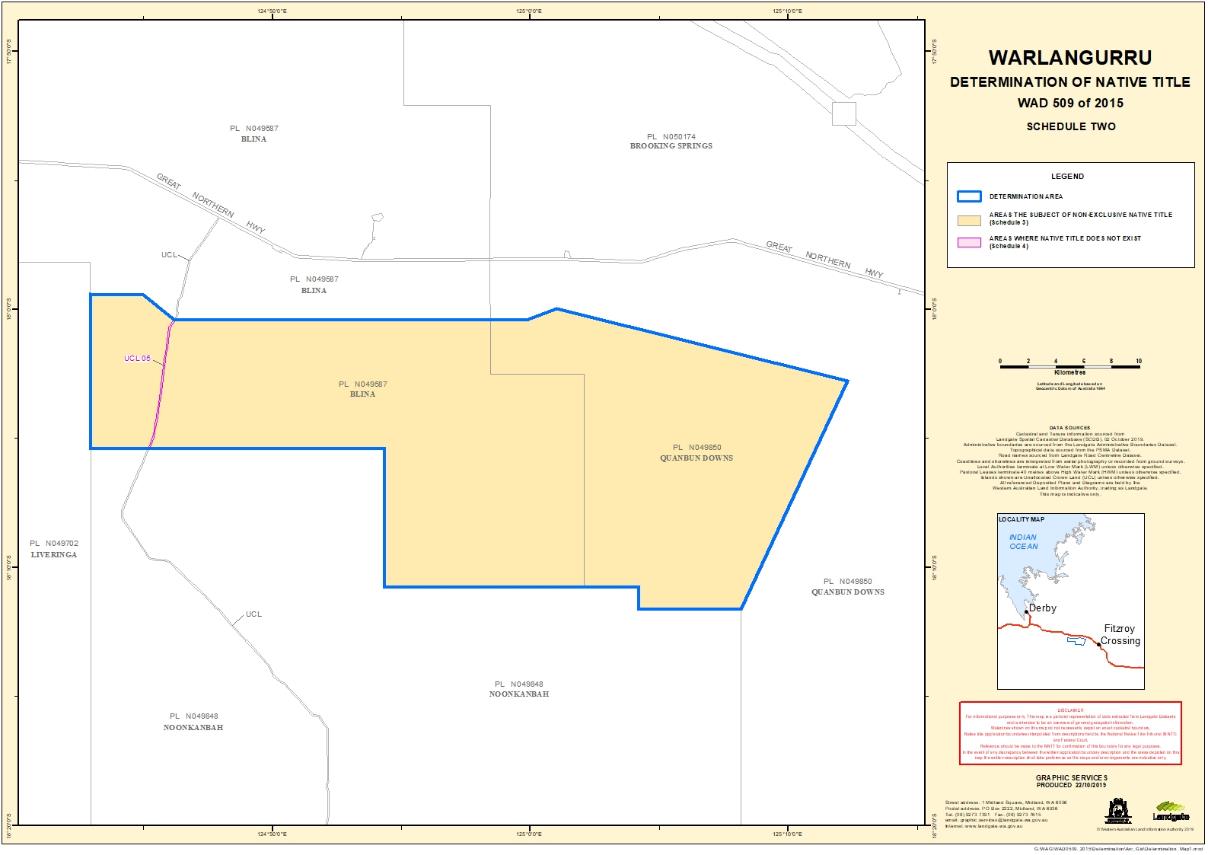
SCHEDULE 3
NON - EXCLUSIVE NATIVE TITLE AREAS
Areas where native title comprises the rights set out in paragraph 6
The following land and waters generally shown as orange on the map at Schedule 2:
1. Pastoral Leases:
Portion of Pastoral Lease N049850 (previously 3114/1269, Crown Lease 381/1992) Quanbun Downs falling within the Determination Area.
Portion of Pastoral Lease N049587 (previously 3114/1271,Crown Lease 402/1992) Blina falling within the Determination Area.
6.
SCHEDULE 4
AREAS WHERE NATIVE TITLE DOES NOT EXIST
Native title does not exist in the following land and waters by reason of extinguishment, being those areas (except those public works which are captured by the definition at paragraph 2 of this Schedule) shown as pink on the map at Schedule 2.
1. UCL Areas
UCL 05 | Road through Blina Station to Great Northern Highway Government Gazette 24 July 1980 |
2. Any other public works
Any other public works as that expression is defined in the Native Title Act and the Titles (Validation) and Native Title (Effect of Past Acts) Act 1995 (WA) and to which s 12J of the Titles (Validation) and Native Title (Effect of Past Acts) Act 1995 (WA) or s 23C(2) of the Native Title Act applies, within the external boundary of the Determination Area including the land and waters defined in s 251D of the Native Title Act.
SCHEDULE 5
DESCRIPTION OF THE NATIVE TITLE HOLDERS
The Warlangurru People (the common law holders of native title rights and interest pursuant to this determination) are:
1. the descendants of the following persons (including through adoption):
(a) Maisie Lormada;
(b) Ginger Nganawila and Weeda Costaine;
(c) Topsy Nyarrbiriny;
(d) George Sam;
(e) Wadgie and Emily;
(f) The parents of Tiliwali;
(g) Jurkapitija; and
(h) Yirlanykayi.
2. those people who have rights in the claim area by virtue of:
(a) spiritual imbuement on the claim area (conception totemism);
(b) ritual authority for the claim area;
(c) birth on the claim area; or
(d) burial of a forebear on the claim area.
SCHEDULE 6
OTHER RIGHTS AND INTERESTS
1. Pastoral Leases
Portion of Pastoral Lease N049850 Quanbun Downs falling within the Determination Area.
Portion of Pastoral Lease N049587 Blina falling within the Determination Area.
2. Existing Interests under the Mining Act 1978 (WA)
Tenement ID | Tenement type | Date of grant |
E04/2364 | Exploration Licence | 10 March 2015 |
3. Existing Interests under the Petroleum and Geothermal Energy Resources Act 1967 (WA)
Tenement ID | Tenement type | Date of grant |
EP 371 R2 | Exploration Permit | 18 March 1993 |
4. Other Rights and Interests
(a) Rights and interests, including licences and permits, granted by the Crown in right of the Commonwealth or the State pursuant to statute or otherwise in the exercise of its executive power and under any regulations made pursuant to such legislation;
(b) Rights or interests held by reason of the force and operation of the laws of the State or of the Commonwealth including the force and operation of the Rights in Water and Irrigation Act 1914 (WA) and of the Country Areas Water Supply Act 1947 (WA);
(c) Rights and interests of members of the public arising under the common law including but not limited to:
(i) the public right to fish;
(ii) the public right to navigate; and
(iii) the right of any person to use any road in the Determination Area (subject to the laws of the State) over which, as at the date of this Determination, members of the public have a right of access under common law.
(d) The right to access land by:
(iv) an employee or agent or instrumentality of the State;
(v) an employee or agent or instrumentality of the Commonwealth; and
(vi) an employee or agent or instrumentality of any local Government authority;
as required in the performance of his or her statutory or common law duties where such access would be permitted to private land.
(e) Rights of any person to access and enjoy (subject to the laws of the State) Stock Routes.
(f) (i) Without limiting the operation of any other paragraph in the Sixth Schedule, but subject to paragraph 4(f)(ii), the rights of holders from time to time of existing petroleum interests under the Petroleum and Geothermal Energy Resources Act 1967 (WA), petroleum pipelines under the Petroleum Pipelines Act 1969 (WA) and existing mining tenements under the Mining Act 1978 (WA) including those mentioned at paragraphs 7 and 8 above to use (including by servants, agents and contractors) roads and tracks as are existing at the time of this Determination in the Determination Area to the extent reasonably necessary to have access to the area subject of the petroleum, pipeline and mineral interests for the purposes of exercising the rights granted by those interests; and
(ii) Nothing in paragraph 4(f)(i) above allows any upgrade, extension, widening or other improvement to the road or track other than work done to maintain such road or track in reasonable repair.
(g) Any other:
(i) legal or equitable estate or interest in the land or waters; or
(ii) any other right (including a right under an option and a right of redemption), charge, power or privilege over, or in connection with:
(A) the land or waters; or
(B) an estate or interest in the land or waters; or
(iii) restriction on the use of the land or waters, whether or not annexed to other land or waters.
BANKS-SMITH J:
Introduction
1 The Native Title Act 1993 (Cth) provides for Aboriginal people to apply to this Court for a determination of native title, a determination that recognises long-held connections to the land.
2 The preamble to the Native Title Act identifies that:
A special procedure needs to be available for the just and proper ascertainment of native title rights and interests which will ensure that, if possible, this is done by conciliation and, if not, in a manner that has due regard to their unique character.
Governments should, where appropriate, facilitate negotiation on a regional basis between the parties concerned in relation to:
(a) claims to land, or aspirations in relation to land, by Aboriginal peoples and Torres Strait Islanders; and
(b) proposals for the use of such land for economic purposes.
3 The provisions that endorse conciliation and which constitute the 'special procedure' recognised by the preamble include the consent determination provisions in the Native Title Act, which are invoked by the parties in this proceeding. The parties have agreed to and seek a consent determination under s 87 of the Native Title Act. Their application is before the Court for determination pursuant to s 225 of the Native Title Act.
4 For the following reasons I consider it appropriate to make the determination of native title as set out in Attachment A to the orders that are published with these reasons.
This application
5 The application was notified by the Native Title Registrar pursuant to s 66 of the Native Title Act. The three months notification period referred to in s 66 of the Native Title Act ended on 27 March 2017. The claim made was considered by the Native Title Registrar who was satisfied under s 190A that the application addressed the criteria of the registration test. The application was entered on the Register of Native Title Claims on 14 November 2016.
The claim group
6 The application is made by Grace Mulligan, Rayleen Charles, Jimmy Freddy, Cyril Thirkall and Benjamin Laurel (Applicant) on behalf of the Warlangurru native title claimants.
7 Those claimants are those people who are:
(1) the descendants of the following persons (including through adoption):
(a) Maisie Lormada;
(b) Ginger Nganawila and Weeda Costaine;
(c) Topsy Nyarrbiriny;
(d) George Sam;
(e) Wadgie and Emily;
(f) the parents of Tiliwali;
(g) Jurkapitija; and
(h) Yirlanykayi.
(2) those people who have rights in the claim area by virtue of:
(a) spiritual imbuement on the claim area (conception totemism);
(b) ritual authority for the claim area;
(c) birth on the claim area; or
(d) burial of a forebear on the claim area.
8 This group is reflected in the description that appears in Schedule 5 of the determination (Attachment A to the orders).
9 I note that there is a slight change in this claim group description from that in the original claim application. This change was addressed by Ms Chau Kim Huynh, the solicitor from Corser & Corser Lawyers representing the applicant in this matter, who swore an affidavit in support of this application. Ms Huynh explained that the change arose from anthropological research undertaken in consultation with members of the claim group on whose behalf the application was brought, and was endorsed by the claim group. The applicant and the State submitted that the Court could proceed to make the determination in accordance with the terms proposed in the minute (discussed below) having regard to Ms Huynh's evidence, and also because the change does not alter the composition of the claim group or exclude any person said to hold native title rights and interests in the claim area, but rather, ensures that all those who have been identified and accepted as holding native title in the claim area are accurately captured in Schedule 5 of the determination. It is not in issue that the determination made by the Court may reflect such a change, where it is accepted and agreed to by the State: Billy Patch on behalf of the Birriliburu People v State of Western Australia [2008] FCA 944 at [18]; and Watson on behalf of the Nyikina Mangala People v State of Western Australia (No 6) [2014] FCA 545 at [33].
The determination area
10 The determination area the subject of the application covers approximately 727 square kilometres of land subject to pastoral lease in the Kimberley region of Western Australia, south-west of the town of Fitzroy Crossing.
11 The determination area is surrounded by determined native title claims: the Bunuba #2 Part B determination to the north (Brooking on behalf of the Bunuba People (Bunuba #2 Part B)) v State of Western Australia [2019] FCA 1136); the Noonkanbah determination to the south-west (Cox on behalf of the Yungngora People v State of Western Australia [2007] FCA 588); the Nyikina Mangala determination to the west (Watson on behalf of the Nyikina Mangala People v State of Western Australia (No 6) [2014] FCA 545); and the Yi-Martuwarra Ngurrara Part A determination to the south-east (Forrest on behalf of the Ngurrara People v State of Western Australia [2018] FCA 289).
Signed minute of proposed consent orders
12 There are four parties to this application: the Applicant, the State and two pastoralists, being respectively Callum Hugh MacLachlan of Blina Station and Forrest and Forrest Pty Ltd of Quanbun Downs Station.
13 The parties have signed and filed a minute of proposed consent determination. The terms of the minute are reflected and incorporated in Attachment A to the orders.
Pastoralists
14 I was informed that each of Mr MacLachlan and Forrest and Forrest Pty Ltd has agreed to the terms of the determination on the basis of having reached agreement with the Applicant as to those portions of their respective pastoral leases that are situated within the determination area. Following the making of the determination, that agreement will be executed and an application will be made for the agreement to be registered as an Indigenous Land Use Agreement on the Register of Indigenous Land Use Agreements as a prescribed body corporate agreement pursuant to s 24BG of the Native Title Act.
Joint submissions
15 The Court has the benefit of a set of joint submissions prepared by the State Solicitor on behalf of the State and by Corser & Corser Lawyers. It is well-accepted practice for the Court to rely on the joint submissions of the parties in considering whether it is satisfied that the conditions set out in s 87 of the Native Title Act are met.
Authorisation of applicant
16 Ms Huynh explained in her affidavit that the Kimberly Land Council (KLC) represented the applicant at the commencement of the proceedings, and filed the requisite Form 1 Native Title Determination Application. A copy of the application was annexed to Ms Huynh's affidavit. It included the KLC's certificate pursuant to s 203BE(2) of the Native Title Act, and affidavits of each of the named applicants deposing to, among other things, their respective authorisation by the claim group, at a meeting of its members on 7 October 2014, to bring the application on its behalf. The certificate discloses, more particularly that at the meeting:
[T]he native title group affirmed by way of resolution that there is no particular process of decision-making under the traditional laws and customs of the native title group that must be complied with, in relation to decisions authorising persons to make, or to deal with matters arising in relation to, applications for determinations of native title on behalf of the native title claim group. The meeting further resolved that such decisions at the meeting were to be made by majority vote on a show of hands. The applicant was authorised to make the application pursuant to that process, with the decision being unanimous.
17 I am satisfied that the applicant members were duly authorised to make and deal with matters relating to the application.
Authorisation of consent determination
18 Ms Huynh also addressed the question of the applicant's endorsement of the terms of the determination, explaining that in November 2021 she sent a copy of the minute of proposed consent orders to each of the members of the applicant, under cover of a letter seeking instructions as to the endorsement of its terms, the amendment of the claim group description (see [9] above) and the nomination of a prescribed body corporate. Ms Huynh said that during November 2021 and December 2021 she received memoranda of instructions from each of the members of the applicant to seek orders in terms of the minute, subject to the amendment of the description of the claim group to correspond with the anthropologist's recommendation.
19 I am satisfied that the applicant has been duly authorised to pursue the orders in terms of the signed minute of consent orders provided in this matter.
Assessment of connection
20 The Applicant provided the State with the following material (connection material) in support of the native title claimants' connection to the Warlangurru claim area:
(a) Warlangurru #1 and #2 Native Title Determination Applications Anthropologist's Report by Dr Kim de Rijke dated August 2016;
(b) Warlangurru #2 Native Title Determination Application Anthropologist's Report by Dr Kim de Rijke dated November 2018;
(c) Warlangurru #1 Anthropological Assessment of the Woodley Claim by Dr Kim de Rijke dated 27 October 2020;
(d) Warlangurru #1 Scope of Rights: Anthropologist's Report by Dr Kim de Rijke dated 14 December 2020;
(e) affidavit of Grace Mulligan affirmed 11 April 2015; and
(f) affidavit of Benjamin Laurel affirmed 11 April 2015.
Connection to country
21 It is often sufficient to summarise the connection material relied upon by the State and referred to in the joint submissions in providing reasons for a consent determination. In this case, having had the advantage of reading the submissions, I consider that the joint summary is instructive and worth recording in full in these reasons. Accordingly, I respectfully extract the joint summary in full as follows:
The Native Title Holders and system of law and custom
16. The members of the Warlangurru Native Title Holding Group (the Native Title Holders) hold and observe a system of traditional laws and customs by which they are affiliated with the Warlangurru Determination Area that is shared with a network of Nyikina and Walmajarri speakers, including the Noonkanbah native title holders to their south.
17. The laws and customs now observed have their origin in the laws and customs in operation at the date of both legal sovereignty (1829) and at the date of effective sovereignty in the Fitzroy valley region of the Kimberley. Effective sovereignty is the approximate year or years by which the acknowledgement and observance of traditional laws and customs by any Aboriginal peoples then occupying the Determination Area are likely to have been materially affected by the presence or activities of non-Aboriginal people; in this case the 1880s.
18. Evidence from the records demonstrates that Aboriginal people in this region were, and remain, multilingual; that there were, and are, intermarriages between Nyikina and Walmajarri people; that there were, and are, shared responsibilities for religious narratives and joint ritual activity that bind the speakers of both languages.
19. Dr de Rijke records that [d]uring fieldwork I was repeatedly reminded by the claimants of the close Nyikina-Walmajari relationship. He was told, for example, that Warlangurru is heavy Nyikina and heavy Walmajari mix, and we share Law; the Walmajari come to Nyikina, the Nyikina to Walmajari. [We have] ceremony together; put young boys through. Been together all the time.
Acquiring rights and interests in country
20. Dr de Rijke states that a number of principles regarding the acquisition of rights to land emerge from the early ethnography of the region being:
a. Descent;
b. Place of birth;
c. Conception totemism (jarin) and impregnation by spirit children (rai); and
d. Ritual induction and the possession of privileged sacred knowledge. Dr Eric Kolig, who worked in the Fitzroy Valley in the 1970s, found that [t]he idea that a few individual custodians, experts or religious owners can confer their personal rights to land, to other group members, is completely traditional.
21. The multiple pathways identified as applying pre-sovereignty are still recognised by contemporary claimants.
22. Dr de Rijke provides examples of contemporary jarin and rai affiliations both within and around the Warlangurru #1 claim area and notes that when at the Yungngora community where most of the claimants now live he observed eleven-year old children talking amongst themselves about their jarin.
23. Other claimants claim rights through the principle of descent from a forebear.
24. There is one further pathway for acquisition of rights in land identified by contemporary claimants, being the burial of a forebear on country. In the Warlangurru #1 claim area senior claimant Rosie Mulligan assert[s] rights to Calwynyardah [now Blina] at least partly on the basis of her father's brother [sic] burial there (this is Sandy Milmarri, who is Rosie's classificatory father who raised her). Sandy was a member of the regional normative society and was important in customary matters.
25. As Dr de Rijke notes, Rosie Mulligan also obtained privileged customary knowledge about the claim area from her forebears, and younger family members obtained jarin conception totems or were born in the claim area, hence also acquiring rights to the claim area in accordance with the principles identified in early ethnography.
26. Dr de Rijke opines that if burial of a forebear on country constitutes a post-contact pathway to the acquisition of rights in land, this is an adaptation in accordance with the pre-contact system which already allowed for flexibility in the acquisition of such rights. He also notes that the Mulligan family's claim to rights in the Blina area are acknowledged by others in the claim group and non-claimants spoken to at Noonkanbah.
Other laws and customs and continuity
27. Dr de Rijke notes that senior claimants have lived and worked on the claim area for many years some 'foot walking' the country with sheep in the past and thus knowing it intimately. Senior claimants are the children or grandchildren of the apical ancestors, hence it can be inferred that they would have been living, working and travelling on the pastoral leases with their ancestors and gained knowledge of traditional laws and customs from them. The traditional laws and customs acknowledged and observed include:
(a) Rainbow snake and Dreamings
Dr de Rijke states that the claimants were acutely aware of religious sites and areas of significance, the location of water, and recognised abundantly the various medicinal and other useful resources present. Water locations in particular are considered spiritually potent. Soak waters (juma) as well as swamps are considered to be inhabited by Galperu, the Rainbow snake, and are approached with due reverence, acknowledgement and introductions in language.
Dr de Rijke opines that the religious narratives of the Dreaming remain vitally important to claimants' understanding of the claim area.
(b) Kinship and social organisation
Dr de Rijke notes that [k]in terms and subsection terms are in common use among the claimants. 'Skin' names … continue to inform social interactions. … Ideal marriages between members of particular subsections are known, but not consistently practiced. So-called 'wrong' marriages are said to largely provoke 'growls' instead of major serious repercussions.
In-law avoidance is recognised, if not strictly observed.
Dr de Rijke opines that kinship terms continue to inform expected behaviour and thus normative content, a practice that is likely a substantial continuity with the past.
(c) Death and burial rituals
[S]pecified protocols and restrictions in personal movement referred to as 'sorry business' apply upon the death of a relative. Whilst such practices have changed post-contact, Dr de Rijke opines that 'sorry business' remains a distinctly tradition-based cultural protocol observed by claimants today.
(d) Permission and duty of care
Dr de Rijke notes that at locations on the claim area claimants loudly introduced themselves to spiritually imbued landscape. Such introductions are seen to ensure safety from potentially malicious spirits as well as manifesting a continuing recognition of cultural duties to care for the country. Part of this cultural duty is a requirement that strangers ask for permission to access and use resources in the claim area.
(e) Use of resources in the claim area
The claimants continue to visit the claim area regularly hunting, fishing, camping, collecting natural resources, and visiting sites of significance. Rules about sharing resources still apply, as Dr de Rijke notes [s]uch sharing was in evidence during fieldwork. when plain turkeys and goanna were hunted, cleaned, cooked, cut up, and distributed in particular ways.
(f) Exchange and trade
The Fitzroy Basin was traditionally involved in the wurnan exchange network, described by Dr de Rijke as a customary economic exchange system with pragmatic as well as religious components. Dr de Rijke records discussions with claimants about the contemporary exchange of items, sharing and gifts, both in the everyday context and in ceremonial 'Law time', and also about manufacturing and selling items such as boomerangs.
(footnotes omitted)
22 The State was satisfied, on the basis of the connection material that this application has a credible basis and that the claimants and their ancestors have maintained a presence in the determination area since the acquisition of British sovereignty.
23 The State was also satisfied that evidence of the claimants' and their ancestors' continuing physical or spiritual involvement in the determination area was sufficient to enable the State to conclude that this connection had not been severed.
24 Accordingly, the State was satisfied that the material considered was sufficient to evidence the maintenance of connection according to traditional laws and customs in the determination area.
Whether conditions in s 87 have been met
25 Section 87 of the Native Title Act sets out conditions which must be met before the Court may make an agreed determination of native title.
26 The notice period under s 66 of the Native Title Act must have ended (s 87(1)). The application was notified by the Native Title Registrar pursuant to s 66 of the Native Title Act. As noted above, the period of three months after the notification day referred to in s 66(8) and s 66(10)(c) of the Native Title Act ended on 27 March 2017.
27 The parties must have reached agreement on the terms of an order in relation to the proceedings. The parties have indicated their agreement by way of the signed minute that has been filed with the Court. I am satisfied this condition has been met.
28 The terms of that agreement, in writing signed by or on behalf of the parties, must be filed with the Court. Again, this has been met by way of the filing of the minute.
29 The orders as filed or proposed must be within the power of the court to make: s 87(1)(c). The orders sought set out the details of the matters required by s 225 of the Native Title Act, as required by s 94A. They concern rights and interests which the Australian common law is able to recognise: s 223(l)(c) of the Native Title Act; and Freddie v Northern Territory [2017] FCA 867 at [15] (Mortimer J).
30 This application is for a determination of native title in relation to an area for which there is no approved determination of native title (s 13(1)(a) of the Native Title Act) and there remains no approved determination in relation to the area the subject of the proposed determination (s 68 of the Native Title Act).
31 There are no other proceedings before the Court relating to native title determination applications that cover any part of the area the subject of the proposed determination area which would otherwise require orders to be made under s 67(1) of the Native Title Act.
32 The form of the proposed determination complies with s 94A and s 225 of the Native Title Act.
33 I am therefore satisfied that the proposed orders are within the power of the Court.
34 As to whether it is appropriate to make the orders sought under s 87(1A), it is to be recalled that the consent determination mechanism is not intended to operate by way of substitution of a trial. The State is not required to obtain proof from an applicant which would demonstrate to the civil standard of proof, on the balance of probabilities, that the native title rights claimed by the applicant exist. What is necessary is that the State have sufficient information so that it is in a position to inform the Court that, from the State's perspective, it is appropriate for the Court to make the determination of native title in orders giving effect to the terms of an agreement as provided for in s 87 or s 87A of the Native Title Act. See generally the observations of the Full Court in Widjabul Wia-Bal v Attorney General of New South Wales [2020] FCAFC 34; (2020) 274 FCR 577 at [51] (Reeves, Jagot and Mortimer JJ).
35 Having regard to the joint submissions and the State's assessment of the connection material on advice from the State Solicitor's Office as referred to above, I am satisfied that the State has acted in accordance with its obligations by seeking and considering the connection material provided to it and that it has engaged in good faith with the claim group.
36 Both the Applicant and the State have been legally represented throughout this consent determination process. The parties have freely and on an informed basis come to an agreement.
37 The State has also conducted searches of land tenure, mining and petroleum registries to determine the extent of other interests within the proposed determination area, and those interests are included in schedule 6 of the determination.
38 The State has played an active role in the negotiation of the determination and by its own rigorous and detailed assessment process has satisfied itself that the determination is justified in the circumstances: see generally Munn for and on behalf of the Gunggari People v State of Queensland [2001] FCA 1229; (2001) 115 FCR 109 at [29]-[30] (Emmett J).
39 Having regard to all of those matters, I consider it is appropriate to make the orders sought under s 87 of the Native Title Act.
Prescribed body corporate
40 The nomination of a prescribed body corporate under s 56(2) of the Native Title Act is a matter with which the Applicant has the power to deal: s 62A of the Native Title Act.
41 The affidavit of Ms Huynh evidences the fact that the Applicant has nominated Warlangurru Aboriginal Corporation ICN: 8513 (WAC) as the prescribed body corporate to hold the native title rights and interests of the proposed common law holders on trust for them.
42 On 19 December 2016 WAC was accepted for registration under the Corporations (Aboriginal and Torres Strait Islander) Act 2006 (Cth), by the Office of the Registrar of Indigenous Corporations.
43 On 16 December 2021, WAC consented in writing to its nomination by the Applicant as the prescribed body corporate.
44 I am satisfied that it is appropriate to order that WAC is to hold the determined native title in trust for the native title holders pursuant to s 56(2)(b) of the Native Title Act.
Conclusion
45 There will be orders as requested.
46 The Warlangurru claimants now have formal recognition by Australian law and the community of their native title rights and interests in the determination area.
47 The continued work by the Applicant to pursue and finalise this claim is to be admired. Corser & Corser Lawyers, and before them the KLC, are to be congratulated for the support and assistance provided to the claimants and, in particular, the Applicant.
48 The contribution of the State to this process, and that of the pastoralists, should also be acknowledged.
I certify that the preceding forty-eight (48) numbered paragraphs are a true copy of the Reasons for Judgment of the Honourable Justice Banks-Smith. |
Associate:


