

Federal Court of Australia
DBB16 v Commonwealth of Australia [2022] FCA 783
File number(s): | NSD 189 of 2021 |
Judgment of: | RAPER J |
Date of judgment: | |
Catchwords: | MIGRATION – application for a declaration that the applicant’s detention was not authorised for a period by the Migration Act 1958 (Cth) – whether the applicant was falsely imprisoned – whether the applicant was entitled general, special, aggravated and exemplary damages – whether the detaining officers held a reasonable suspicion that the applicant was an “unlawful non-citizen” – application dismissed |
Legislation: | Judiciary Act 1903 (Cth) s 39B Migration Act 1958 (Cth) ss 13, 14, 476A, 189, 195A, 196 |
Cases cited: | Alsalih v Manager, Baxter Immigration Detention Facility and Another [2004] FCA 352; 136 FCR 291 AOU21 v Minister for Home Affairs [2021] FCAFC 60 BHL19 v Commonwealth of Australia (No 2) [2022] FCA 313 Boensch v Pascoe [2019] HCA 49; 268 CLR 593 Capital Securities XV Pty Ltd (formerly known as Prime Capital Securities Pty Ltd) v Calleja [2018] NSWCA 26 Commonwealth v AJL20 [2021] HCA 21; 95 ALJR 567 Fernando v Minister for Immigration and Citizenship [2007] FCA 1203; 165 FCR 471 Goldie v Commonwealth of Australia [2002] FCA 433; 117 FCR 566 Guo v Commonwealth [2017] FCA 1355; 258 FCR 31 Lee v Minister for Immigration & Multicultural Affairs [2002] FCA 303 Lin v Tasmania [2012] TASCCA 9 Lithgow City Council v Jackson [2011] HCA 36; 244 CLR 352 Minister for Immigration and Multicultural and Indigenous Affairs v Al Masri [2003] FCAFC 70; 126 FCR 54 Ruddock v Taylor [2005] HCA 48; 222 CLR 612 Thoms v Commonwealth of Australia [2022] HCA 20 |
Division: | General Division |
Registry: | New South Wales |
National Practice Area: | Administrative and Constitutional Law and Human Rights |
Number of paragraphs: | |
Ms M Yu with Mr W Chan and Mr A Flick | |
Solicitor for the Applicant: | Human Rights for All Pty Ltd |
Counsel for the Respondent: | Mr C Lenehan SC with Ms L Coleman |
Solicitor for the Respondent: | Australian Government Solicitor |
ORDERS
Applicant | ||
AND: | Respondent | |
DATE OF ORDER: |
THE COURT ORDERS THAT:
1. The application be dismissed.
2. The applicant pay the respondent’s costs as agreed or taxed.
Note: Entry of orders is dealt with in Rule 39.32 of the Federal Court Rules 2011.
RAPER J
1 By application dated and filed on 5 March 2021, the applicant seeks a declaration that “for a period of six months and seven days, the applicant’s detention was not authorised by the Migration Act 1958 (Cth) (the Act)” and claims associated general, special, aggravated and exemplary damages for false imprisonment against the Commonwealth of Australia.
2 The applicant alleges his detention for that period was unlawful because the Minister for Immigration, Citizenship, Migrant Services and Multicultural Affairs had exercised a discretionary personal power available to him under s 195A of the Act to grant the applicant two visas valid for a period of six months and seven days, commencing on 24 July 2019 or, alternatively, on 24 September 2019 (the relevant period). The applicant alleges that the decision was effected by the Minister signing a decision instrument (extracted at paragraph 9 below). However, the applicant was not released from immigration detention nor notified at the time of the fact of the decision.
3 The Commonwealth contends that the appellant’s detention during the relevant period was both authorised and required by ss 189(1) and 196(1) of the Act for three reasons. First, the applicant’s detention was at all times lawful by reason of the operation of s 189(1) of the Act: The relevant detaining officers reasonably suspected that the applicant held the status of being an “unlawful non-citizen” (whether or not in fact the applicant was an unlawful non-citizen). The Commonwealth submitted that if the Court is so satisfied on this issue, the Court need go no further in its deliberations. If the Court is not so satisfied, then secondly, the Minister’s “act of mistakenly signing the decision instrument” cannot be regarded as a “substantive exercise of the power” conferred by s 195A(2), and thirdly, to the extent that by the Minister’s inadvertent actions on 24 July 2019 it were found that the Minister did in fact intend to exercise the power conferred by s 195A, that exercise was not complete and thus was not “beyond recall”. This being so because prior to any external notification of a decision having been made under s 195A, there was no final “decision” to which the Act might attach legal consequences.
Jurisdiction
4 This matter comes before this Court in its original jurisdiction, conferred by s 39B(1A)(c) of the Judiciary Act 1903 (Cth), to hear and determine a claim for damages for the tort of false imprisonment arising from detention. Whether a person was acting or purporting to act under the authority of the Act is a matter arising under a Commonwealth statute and any claim for associated damages would fall within the Court’s original jurisdiction: Fernando v Minister for Immigration and Citizenship [2007] FCA 1203; 165 FCR 471 at [18]. The jurisdictional limitations imposed by s 476A(1) of the Act, which state that the Federal Court has original jurisdiction in relation to a migration decision if, and only if, one or more of the circumstances in paragraphs (a) to (d) are applicable, were intended to apply only to the “challenge by the judicial review processes to migration decisions”: Fernando at [22]. Therefore, s 476A does not fetter the Court’s powers to hear and determine a claim for common law damages for false imprisonment under s 39B(1A)(c): recently reaffirmed in BHL19 v Commonwealth of Australia (No 2) [2022] FCA 313, per Wigney J at [81].
Background
5 The applicant was born in Bangladesh on or about 1 September 1988. On 13 November 2013 the applicant arrived in Australia by boat without a visa. He was immediately detained in closed immigration detention pursuant to s 189 of the Act. From 13 November 2013 onwards, the applicant has continuously remained in closed immigration detention.
6 On 24 July 2019, the Hon David Coleman MP in his capacity as the Minister (Minister Coleman) signed a document titled “Submission for decision PDMS Ref. Number MS19-001205”, bearing the subject line “Possible Ministerial Intervention under section 195A of the Migration Act 1958 in relation to three long term detainees.”
7 The first page is extracted:
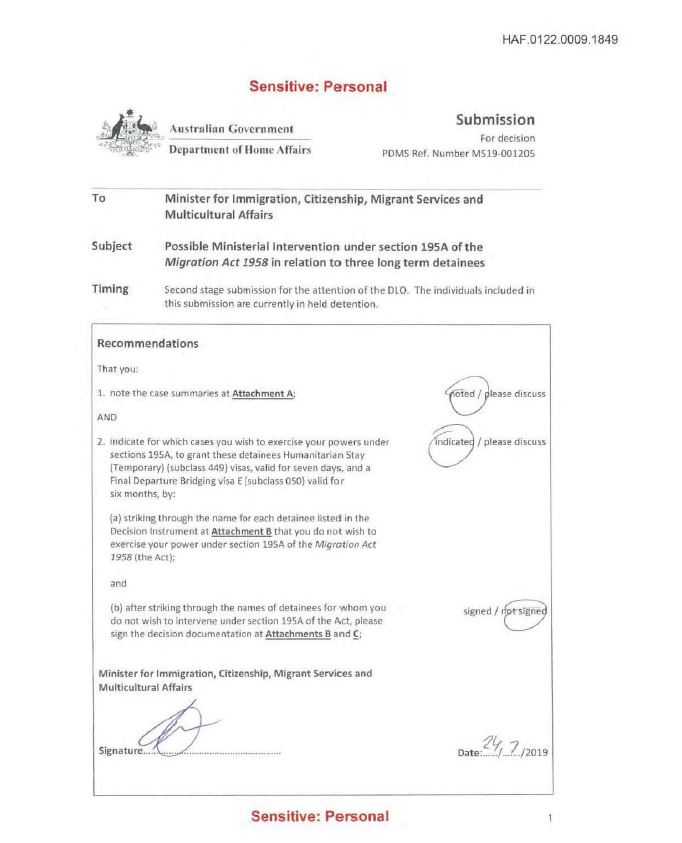
8 Relevantly reference is repeatedly made throughout the decision instrument to Annexures B and C. There is no record of there ever being an Annexure C.
9 There was, however, an Annexure B, titled “Exercise of Ministerial Discretion under section 195A of the Migration Act 1958 Decision Instrument”. This is known as the decision instrument. The decision instrument was signed by Minister Coleman and dated either “24/7/2019” or “24/9/2019”. The body of the decision instrument relevantly contained the following wording:
1. The illegal maritime arrivals (IMAs) named in the below table are in detention under section 189 of the Migration Act 1958 (the Act) and I have considered their cases under section 195A of the Act.
2. I have determined that it is in the public interest to grant these IMAs a Humanitarian Stay (Temporary) (subclass 449) visa and a final departure Bridging E (subclass 050) visa.
3. I therefore exercise my power under section 195A of the Act to grant a Humanitarian Stay (Temporary) (subclass 449) visa valid for seven days and a final departure Bridging E (subclass 050) visa valid for six months to the IMAs named below:
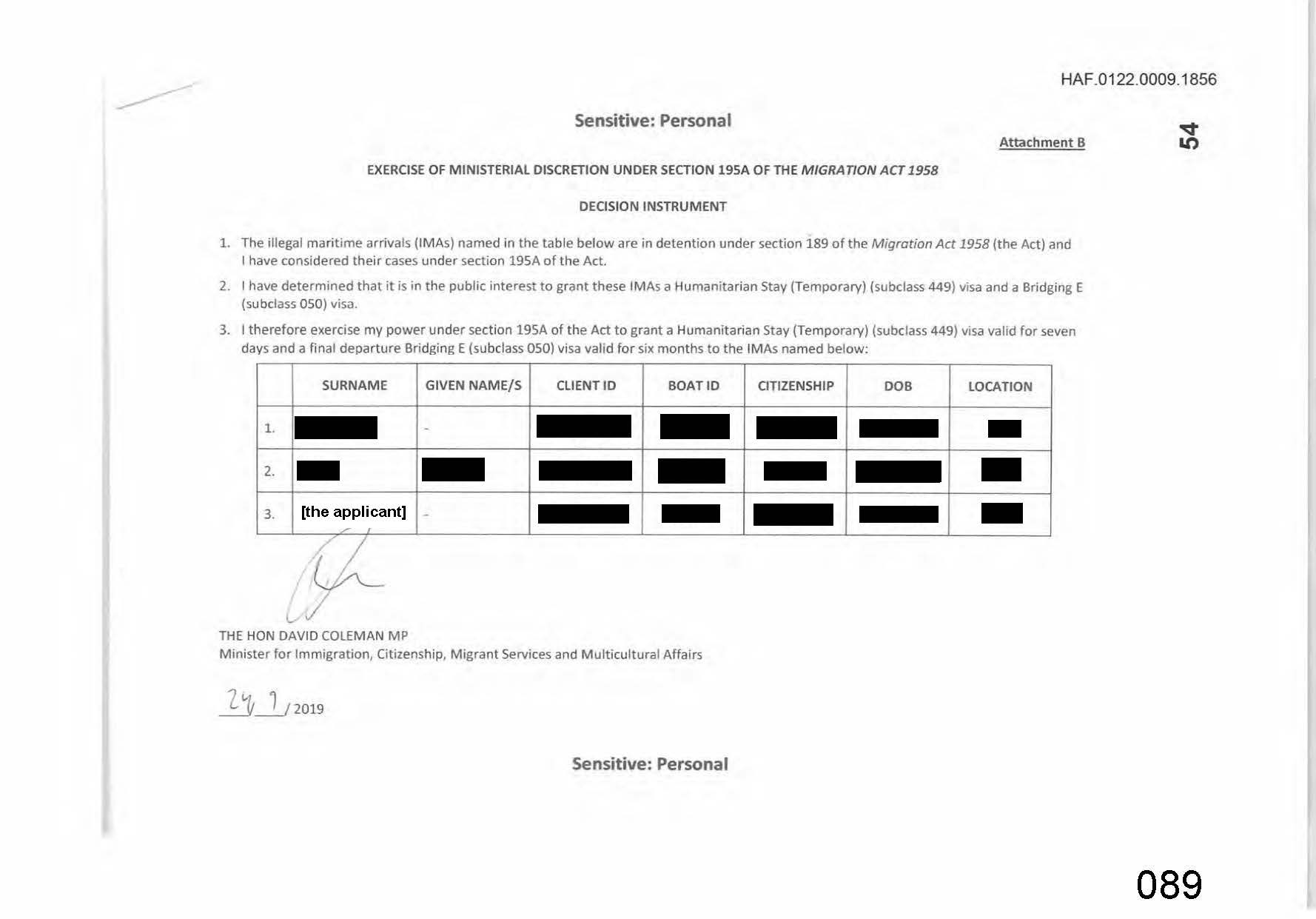
10 As can be seen above, the applicant was named immediately below that statement and was identified with respect to his name, date of birth, country of citizenship and boat identification number, the details of which have been redacted for the purpose of maintaining confidentiality.
Relevant legislative provisions
11 Sections 13 and 14 of the Act provide:
13 Lawful non-citizens
(1) A non-citizen in the migration zone who holds a visa that is in effect is a lawful non-citizen.
(2) An allowed inhabitant of the Protected Zone who is in a protected area in connection with the performance of traditional activities is a lawful non-citizen.
14 Unlawful non‑citizens
(1) A non‑citizen in the migration zone who is not a lawful non‑citizen is an unlawful non‑citizen.
(2) To avoid doubt, a non‑citizen in the migration zone who, immediately before 1 September 1994, was an illegal entrant within the meaning of the Migration Act as in force then became, on that date, an unlawful non‑citizen.
12 Section 189 provides:
189 Detention of unlawful non-citizens
(1) If an officer knows or reasonably suspects that a person in the migration zone (other than an excised offshore place) is an unlawful non-citizen, the officer must detain the person.
(2) If an officer reasonably suspects that a person in Australia but outside the migration zone:
(a) is seeking to enter the migration zone (other than an excised offshore place); and
(b) would, if in the migration zone, be an unlawful non-citizen;
the officer may detain the person.
(3) If an officer knows or reasonably suspects that a person (other than a person referred to in subsection (3A)) in an excised offshore place is an unlawful non-citizen, the officer must detain the person.
(3A) If an officer knows or reasonably suspects that a person in a protected area:
(a) is a citizen of Papua New Guinea; and
(b) is an unlawful non-citizen;
the officer may detain the person.
(4) If an officer reasonably suspects that a person in Australia but outside the migration zone:
(a) is seeking to enter an excised offshore place; and
(b) would, if in the migration zone, be an unlawful non-citizen;
the officer may detain the person.
(5) In subsections (3), (3A) and (4) and any other provisions of this Act that relate to those subsections, officer means an officer within the meaning of section 5, and includes a member of the Australian Defence Force.
Note: See Subdivision B for the Minister’s power to determine that people who are required or permitted by this
section to be detained may reside at places not covered by the definition of immigration detention in subsection 5(1).
13 Section 195A provides:
195A Minister may grant detainee visa (whether or not on application)
Persons to whom section applies
(1) This section applies to a person who is in detention under section 189.
Minister may grant visa
(2) If the Minister thinks that it is in the public interest to do so, the Minister may grant a person to whom this section applies a visa of a particular class (whether or not the person has applied for the visa).
(3) In exercising the power under subsection (2), the Minister is not bound by Subdivision AA, AC or AF of Division 3 of this Part or by the regulations, but is bound by all other provisions of this Act.
Minister not under duty to consider whether to exercise power
(4) The Minister does not have a duty to consider whether to exercise the power under subsection (2), whether he or she is requested to do so by any person, or in any other circumstances.
Minister to exercise power personally
(5) The power under subsection (2) may only be exercised by the Minister personally.
Tabling of information relating to the granting of visas
(6) If the Minister grants a visa under subsection (2), he or she must cause to be laid before each House of the Parliament a statement that (subject to subsection (7)):
(a) states that the Minister has granted a visa under this section; and
(b) sets out the Minister’s reasons for granting the visa, referring in particular to the Minister’s reasons for thinking that the grant is in the public interest.
(7) A statement under subsection (6) in relation to a decision to grant a visa is not to include:
(a) the name of the person to whom the visa is granted; or
(b) any information that may identify the person to whom the visa is granted; or
(c) if the Minister thinks that it would not be in the public interest to publish the name of another person connected in any way with the grant of the visa—the name of that other person or any information that may identify that other person.
(8) A statement under subsection (6) is to be laid before each House of the Parliament within 15 sitting days of that House after:
(a) if the decision to grant the visa is made between 1 January and 30 June (inclusive) in a year—1 July in that year; or
(b) if the decision to grant the visa is made between 1 July and 31 December (inclusive) in a year—1 January in the following year.
14 Section 196 provides that an unlawful non-citizen detained under s 189 must be kept in immigration detention and relevantly provides:
(1) An unlawful non-citizen detained under section 189 must be kept in immigration detention until:
(a) he or she is removed from Australia under section 198 or 199; or
(aa) an officer begins to deal with the non-citizen under subsection 198AD(3); or
(b) he or she is deported under section 200; or
(c) he or she is granted a visa.
…
Consideration
15 The primary issue to be determined by this Court is whether the applicant’s detention during the relevant period was both authorised and required by ss 189(1) and 196 of the Act.
16 For the reasons which follow, I am of the view that the relevant detaining officers had a reasonable suspicion over the relevant period that the applicant had the status of being an unlawful non-citizen within the meaning of s 189(1). By reason of this finding, the applicant’s detention during the relevant period was both authorised and required by ss 189 and 196 of the Act.
17 I also am of the view that by reason of this finding there is no need for me to determine the other potential arguments raised by the applicant in this matter. This Court should confine itself to determining only those matters dispositive of the justiciable controversy – an exercise in “judicial economy” which promotes judicial efficiency: see Boensch v Pascoe [2019] HCA 49; 268 CLR 593 at [7] per Kiefel CJ, Gageler and Keane JJ (although arising in the context of appellate review).
18 The Commonwealth bears the onus of proving that the detention was at all times lawful: AOU21 v Minister for Home Affairs [2021] FCAFC 60 at [185]. By this, the Commonwealth must prove that the detention was authorised by law. In this case, the Commonwealth submits it was so authorised by its powers under s 189 of the Act. Accordingly, this case turns on an interpretation of s 189.
19 By its operation, s 189 provides that a person must be detained if an officer knows or reasonably suspects that the person is “an unlawful non-citizen”. The evident purpose of s 189 and the detention it authorises, is “to separate a person from the community until their status and the lawfulness of their presence is investigated and determined”, as recently elucidated by Kiefel CJ, Keane and Gleeson JJ in Thoms v Commonwealth of Australia [2022] HCA 20 at [25].
20 In this case, the applicant argues that his detention was unlawful by reason of the purported decision made by Minister Coleman on 24 July or 24 September 2019 to grant him two visas for a period of six months and seven days.
21 In Thoms, the plurality, comprising Kiefel CJ, Keane and Gleeson JJ, considered the decision of Ruddock v Taylor [2005] HCA 48; 222 CLR 612, and in particular a like argument raised by Mr Taylor, to this case. Mr Taylor had argued that because the decision to cancel his visa pursuant to s 501 was unlawful it followed that his detention was unlawful. That argument was rejected, and Kiefel CJ, Keane and Gleeson JJ (Gageler, Gordon and Edelman and Steward JJ agreeing) in Thoms, at [29], extracted the joint judgment in Ruddock v Taylor which explained that the lawfulness of Mr Taylor’s detention was determined by reference to s 189(1) in this way:
That argument was rejected. In the joint judgment it was explained that the lawfulness of Mr Taylor's detention was to be determined by reference to s 189(1). The operation of s 189(1) was explained as follows:
Section 189 is directed not only to cases where an officer knows that a person is an unlawful non-citizen, it extends to cases where the officer reasonably suspects that a person has that status. It follows that demonstrating that a person is not an unlawful non-citizen does not necessarily take the person beyond the reach of the obligation which s 189 imposes on officers. ... The reference to an officer's state of mind is explicable only if the section is understood as not confined in operation to those who are, in fact, unlawful non-citizens.
(Footnotes omitted, emphasis added)
22 Their Honours thereafter explain, at [30], that s 189(1) applies in cases where, despite it being subsequently established that a person was not an “unlawful non-citizen” (the state of affairs the applicant in this case wants to assert), so long as the officer holds the “requisite state of mind”, the person is required to be detained.
23 At [31], their Honours state:
So understood, it does not matter that the applicant here is not an alien. So long as the officers in question had objectively reasonable grounds to suspect that he was a non-citizen who did not hold an effective visa, that was sufficient for his detention to be justified. As a matter of construction, s 189(1) authorises and requires the detention of persons who are not aliens if there are objectively reasonable grounds to suspect that they are non-citizens who do not hold a visa which is in effect.
24 Accordingly, the question for determination by this Court is whether the Commonwealth has established that the officers in question had objectively reasonable grounds to suspect that the applicant was a non-citizen who did not hold an effective visa. Whether there were reasonable grounds is judged against what was known or reasonably capable of being known at the relevant time: Ruddock v Taylor at [40].
25 Justice Jagot, in Guo v Commonwealth [2017] FCA 1355; 258 FCR 31, distilled the relevant principles to be taken into account when determining whether an officer’s suspicion that a person is an unlawful non-citizen was reasonable, at [35].
26 Furthermore, the determination of the lawfulness of the detention is not confined by a consideration of whether the relevant officer had the requisite reasonable suspicion at the point that the person was taken into detention but also whether the relevant officer(s) held that suspicion subsequently when the person was kept in detention: Guo at [79]. Accordingly, Jagot J found at [83] – [84]:
83. It follows that the reasoning of Charlesworth J in Okwume at [196] is consistent with that in Ruddock v Taylor and Fernando. In summary, based on Ruddock v Taylor and Fernando:
(1) for the taking of a person into immigration detention to be lawful, the Commonwealth must prove that the detaining officer or officers held a reasonable suspicion at that time that the person was an unlawful non-citizen;
(2) for the keeping of a person in immigration detention to be lawful, the Commonwealth must prove that the detaining officer or officers during the person’s detention held a reasonable suspicion that the person was an unlawful non-citizen;
(3) the lawfulness of detention, at all times, depends on the detaining officer or officers holding a reasonable suspicion that the person is an unlawful non-citizen;
(4) as such, lawful detention may become unlawful if a detaining officer does not or no longer holds a reasonable suspicion that the person is an unlawful non-citizen;
(5) similarly, unlawful detention may become lawful if the detaining officer forms a reasonable suspicion that the person is an unlawful non-citizen;
(6) whenever detention is or becomes unlawful, the person is falsely imprisoned and the Commonwealth may be liable for that tortious conduct;
(7) the Commonwealth bears the onus of proving the lawfulness of detention and thus must prove the existence of the relevant reasonable suspicion in the mind of the detaining officer or officers; and
(8) the Commonwealth’s complaints about the impracticality and inconvenience of having to prove the existence and subsistence of the required state of mind on the part of the detaining officer or officers do not carry weight. For one thing, when it comes to the deprivation of individual liberty, the common law is a vigilant guardian, and complaints by the person depriving another of their liberty that they might be inconvenienced by having to prove the lawfulness of the detention garner little support. For another, proof sufficient to establish the lawfulness of immigration detention involves matters of fact and of inference from fact. The Commonwealth is free to assist itself in discharging the onus of proof by the implementation of whatever systems, processes and safeguards it sees fit and by the calling of such evidence in any particular case as it sees fit.
84. Otherwise, the discussion above also supports the following:
(1) the required state of mind on the part of the detaining officer is a reasonable suspicion that the person is an unlawful non-citizen, not that the person might be or might become an unlawful non-citizen;
(2) there are no pre-determined rules about how the detaining officer might form such a reasonable suspicion, but such a suspicion must actually be held by the detaining officer. Mere belief or assumption that someone else might hold that state of mind does not answer the statutory requirement. Nor does a mere assumption that if a person is being detained the detention is lawful;
(3) if the source of the belief is a Departmental policy, advice, guideline or instruction that fact alone does not necessarily make a suspicion reasonable. It may or may not be reasonable for an officer to rely on a Departmental policy, advice, guideline or instruction depending on the circumstances. And even if it is reasonable for an officer to rely on a Departmental policy, advice, guideline or instruction, the suspicion may or may not be reasonable depending on other surrounding circumstances either known to or which ought reasonably to have been known or made known to the detaining officer;
(4) accordingly, if a Departmental policy, advice, guideline or instruction is itself unreasonable then a suspicion formed in reliance on such a policy, guideline or instruction may also not satisfy the statutory requirement; and
(5) further, because the “whole of the surrounding circumstances” is relevant to the reasonableness of a suspicion (Hyder at [15](8)), it may also be relevant to consider whether information ought reasonably to have been made available to a detaining officer by others involved in the detention of a person, even if not personally the detaining officer.
27 It follows that these principles are to be applied when assessing the evidence of the relevant detaining officers.
Did the officers have reasonable grounds to suspect that the applicant was an unlawful non-citizen?
28 For the reasons which follow, I am satisfied that the Commonwealth has established that the officers in question had objectively reasonable grounds to suspect that the applicant was a non-citizen who did not hold an effective visa.
29 The Commonwealth relied on evidence of two Detention Status Resolution Officers (SRO) who were the relevant officers over the relevant period:
(a) Ms Wanjiru Waweru-Powell, who was the applicant’s SRO between 24 July 2019 and 8 January 2020;
(b) Mr Mark Dorman, who was the applicant’s SRO between 9 January 2020 and 3 December 2020.
30 Consistent with the principles in Guo at [84], the evidence established that the officers did not hold a mere belief or assumption. Both officers gave uncontested evidence that they conducted regular case reviews of the applicant to determine whether his detention was lawful. Ms Waweru-Powell attested to completing five case reviews of the applicant. As part of conducting those reviews, she was required to document the applicant’s full immigration history, the case progression since the last review, including the activities undertaken during the relevant month, what is “Planned next month” for example “Monitor AAT outcome”, “Await MI outcome” (which was updated each month) and where under the heading “Lawful Detention”, she is asked “Is detention still appropriate?” and on the occasion of each review, she answered the question as “Yes”.
31 In addition, Ms Waweru-Powell gave unchallenged evidence that she held the requisite state of mind that the applicant was an unlawful non-citizen by reference to the statutory indicia, as required: Guo at [84]. Her evidence was as follows:
12. During the period that I was the applicant’s SRO, I reasonably suspected that the applicant:
12.1. was not an Australian citizen;
12.2. did not hold a valid visa;
12.3. was therefore an unlawful non-citizen; and
12.4. as a result, I had to detain or cause the applicant to be detained by reason of s 189 of the Migration Act 1958 (Cth) (the Act).
13. I satisfied myself of the above matters on a monthly basis when I completed case reviews for the applicant.
32 Similarly, Mr Dorman described, at the time of completing the case review, the “way [he] compl[ies] with s 189(1)” was by undertaking active steps to satisfy himself rather than base any belief on assumption. These steps involved checking the Departmental systems including TRIM and ICSE at the time the person is assigned to him to gather information, which included considering information as to:
7.1 where the person was born;
7.2. whether the person is or has ever been recorded as an Australian citizen;
7.3. whether either of the person’s parents is or has ever been recorded as an Australian citizen;
7.4. whether the person holds a valid visa;
7.5. if the person has been previously detained; and
7.6. when the person’s last visa (if any) expired or was cancelled, whether the person sought the revocation of any visa cancellation, and whether any decisions have been made to set aside or revoke any visa cancellation.
33 Mr Dorman completed the same case review documentation as Ms Waweru-Powell, referred to at paragraph 30 above and the Commonwealth tendered his completed case reviews for January, February and March 2020 (being the period he was the applicant’s SRO during the relevant period).
34 Mr Dorman attested (without challenge) to holding the requisite state of mind that he knew or reasonably suspected that the applicant was in fact an unlawful non-citizen, by reference to the statutory indicia. Relevantly he deposed to being satisfied that the applicant:
20.1. was not an Australian citizen;
20.2. did not hold a valid visa;
20.3. was therefore an unlawful non-citizen; and
20.4. as a result, for the purposes of s 189 of the Act, as the applicant’s SRO, I was an officer who knew or reasonably suspected that the applicant was an unlawful noncitizen, and therefore, I must ensure the applicant remained in immigration detention until he was either removed from Australia or granted a visa.
21. If I did not have the state of mind which I refer to in paragraph [20] above at any time when I was the applicant's SRO, I would have consulted with more senior officers in the Department as soon as possible to confirm his status as a lawful non-citizen. Had myself or other senior officers received that approval, myself or another officer would have been required to direct Serco officers to release the applicant from detention. I would not have provided that direction while I had the state of mind described at paragraph [20].
35 Accordingly, the evidence revealed that both relevant officers formed their states of mind on the basis of their examination of the Department’s systems during each case review and by reference to any new information or correspondence from stakeholders concerning the applicant’s immigration status.
36 The applicant contended that “the knowledge or suspicion held by the Applicant’s detaining officers” was not reasonable as their evidence merely demonstrated that they “subjectively thought that the applicant was an unlawful non-citizen throughout the relevant period” (emphasis added). The applicant relied upon Alsalih v Manager, Baxter Immigration Detention Facility and Another [2004] FCA 352; 136 FCR 291 at [58] – [59]. Care must be taken when seeking to rely on Alsalih. It arose in a different context, namely a consideration of the temporal limitation upon the power to detain and where it must be established that there is a “real likelihood or prospect of the removal of the person from Australia in the reasonably foreseeable future”: Alsalih at [52] quoting Minister for Immigration and Multicultural and Indigenous Affairs v Al Masri [2003] FCAFC 70; 126 FCR 54. As identified by Jagot J in Guo, at [83], the test clearly involves a subjective dimension and her Honour’s view coheres with what was stated in the joint judgment of Kiefel CJ, Gageler, Keane and Steward JJ in Commonwealth v AJL20 [2021] HCA 21; 95 ALJR 567 at [72]. The subjective suspicion of the officer is key but its reasonableness must be assessed by all the circumstances (which itself involves an objective element as well).
37 Thus, I accept the submission of the applicant thereafter made to the effect that it is “for the court to judge based on the entirety of the evidence before it and not just the evidence that may have been available to the detaining officers who have given evidence in this case”. However, I also accept that their subjective views, namely what was in the minds of the detaining officers is also relevant: Guo at [83].
38 There is nothing from the remaining evidence which undermines the reasonableness of their suspicion. For example, there was no evidence of the detaining officers having before them conflicting information which affected the reasonableness of their suspicion as for example was the case in Goldie v Commonwealth of Australia [2002] FCA 433; 117 FCR 566 at [5] – [6]. Further, there was no evidence to suggest that the officers needed in this case to make (further) due inquiry as Gray and Lee JJ held: Goldie at [6]. I accept the submission of the Commonwealth that the only information before the detaining officers was to the effect that, first, the applicant was a non-citizen, and secondly, the applicant had never held a visa.
39 The applicant submitted that the detaining officers’ suspicion was not reasonable because of the potential accessibility the two detaining officers had to the signed decision instrument granting the applicant the relevant two visas which had been uploaded onto the Parliamentary Document Management System (PDMS) on 16 August 2019, which the applicant submitted was “accessible to all Commonwealth agencies” relying on the evidence of Ms Stubb and where this instrument was also emailed to at least five email addresses by Nick Aitken on 19 August 2019.
40 I reject this submission on the following bases. First, both Ms Waweru-Powell and Mr Dorman gave evidence in the witness box that they had never seen the signed decision instrument before. Secondly, both Ms Waweru-Powell and Mr Dorman gave evidence (which was not challenged) that they did not have access to the PDMS. Thirdly, the height of Ms Stubb’s evidence was that the PDMS was “used by all Commonwealth agencies” and said nothing about its level of accessibility. Fourthly, the fact that the instrument was emailed to five employees within the Department without more does not give rise to any lack of reasonableness on the part of the detaining officers. There were no facts and circumstances that should have led those officers to inquire further and the evidence does not establish that the signed decision instrument was an “objective” fact capable of being known to the detaining officers over the relevant period.
41 Their evidence, as contained in the notations to their case reviews, was that the Minister had decided not to or declined considering to intervene in the applicant’s case. This evidence was the subject of objection which is dealt with at the end of these reasons. For the reasons set out below, the evidence is admissible, but its weight diminished. Further, even if it were admissible only for a non-hearsay purpose, my opinion as the reasonableness of their suspicion would remain made out.
42 Further, the applicant contended “unreasonableness” on the basis that the Department’s failure to notify the detaining officers of the grant was founded on “a misunderstanding of what was, and was not, legally permissible in dealing with a grant of a visa under s 195A(2) of the Act”. However, this submission appeared to be predicated on an erroneous understanding that ss 67 and 68 of the Act applied, which the applicant conceded was incorrect during the hearing.
43 Lastly, the applicant sought to challenge the admissibility of certain evidence. Given the confined nature by which this matter has been determined, the resolution of those objections is now largely academic but for completeness I will deal with certain of them in the following way.
Questions of admissibility of certain parts of the evidence
44 Practical necessity dictated the deferral of the determination of certain objections made by the applicant to the Commonwealth’s evidence – a course with which the parties consented.
45 Given the confined scope of the issues which now need to be determined, I propose to rule only on those relating to evidence relevant to a fact in issue and prima facie entitled to weight. In this regard, consideration needs to be given to those as they relate to evidence of the two detaining officers, namely Mr Dorman and Ms Waweru-Powell.
46 There is overlap between the objections relating to the evidence of both officers, given the objections relate to underlying source materials which they had access to and they comprise:
a. Objections to representations comprising “Consider – not intervene” contained in the Dorman affidavit [17], Annexure MD-1 to Dorman affidavit p 12 and Annexure WWP-1 to Waweru-Powell affidavit pp 8, 16, 25, 33 and 41 – Objection based on s 59 (hearsay) and failure to meet s 69(2) (business records exception); and
b. Objections to the representations comprising “…Minister Coleman decided not to intervene in the applicant’s case” contained in the Dorman affidavit [18], “24.07.2019 Minister Coleman declined to intervene under s195A of the Act” contained in the Annexure WWP-1 to Waweru-Powell affidavit pp 28 and 44 and “Minister declined to consider intervening on 24.07.2019” contained in the Annexure WWP-1 to Waweru-Powell affidavit pp 12, 29 and 45 – Objection based on s 59 (hearsay) and failure to meet s 69(2) (business records exception).
47 The dispute regarding both grouped objections turns on the meaning and application of s 69(2), in the context of ss 69(1) and 69(5) of the Evidence Act 1995 (Cth), although the Commonwealth relies on an alternative argument that this evidence be admitted for a non-hearsay purpose. The relevant three subsections are as follows:
69 Exception: business records
(1) This section applies to a document that:
(a) either:
(i) is or forms part of the records belonging to or kept by a person, body or organisation in the course of, or for the purposes of, a business; or
(ii) at any time was or formed part of such a record; and
(b) contains a previous representation made or recorded in the document in the course of, or for the purposes of, the business.
(2) The hearsay rule does not apply to the document (so far as it contains the representation) if the representation was made:
(a) by a person who had or might reasonably be supposed to have had personal knowledge of the asserted fact; or
(b) on the basis of information directly or indirectly supplied by a person who had or might reasonably be supposed to have had personal knowledge of the asserted fact.
…
(5) For the purposes of this section, a person is taken to have had personal knowledge of a fact if the person’s knowledge of the fact was or might reasonably be supposed to have been based on what the person saw, heard or otherwise perceived (other than a previous representation made by a person about the fact).
48 With respect to both of the grouped objections, there was no apparent dispute that the documents in question fall within the description under s 69(1) of the Evidence Act 1995 (Cth).
49 The issue is whether each relevant representation was made “by a person who had or might reasonably be supposed to have had personal knowledge of the asserted fact or on the basis of information directly or indirectly supplied by such a person”: see Capital Securities XV Pty Ltd (formerly known as Prime Capital Securities Pty Ltd) v Calleja [2018] NSWCA 26 at [87] per Leeming JA (with whom Basten and Gleeson JJA agreed).
50 The Commonwealth bears the onus of establishing that the exception under s 69 applies: Lithgow City Council v Jackson [2011] HCA 36; 244 CLR 352 at [17].
51 As Leeming JA emphasised in Calleja at [89], ss 69(2)(a) – (b) and 69(5) concern the asserted fact within the representation by which the person “might reasonably be supposed to have had personal knowledge”. His Honour concluded that those words indicate that the Court is allowed to draw inferences not just from the form of the document, but also from the nature of the information contained in it. Additionally, his Honour stated at [91] that s 183 could be relied upon to draw such inferences.
52 The representations are contained in Case Reviews created by Mr Dorman and Ms Waweru-Powell. The apparent source of the representations arises from the evidence of both Mr Dorman and Ms Waweru-Powell that they had access to the various records of the Department upon which the Case Reviews were made. With the aid of s 183 it may be inferred that the reference is likely to have been derived from other documents which comprised business records of the Commonwealth, and that the authorities make clear that it is not necessarily required to establish who made the representation (see, e.g. Lin v Tasmania [2012] TASCCA 9 at [87]; and Lee v Minister for Immigration & Multicultural Affairs [2002] FCA 303 at [22]). Lin and Lee were cited with approval in Calleja at [89] and [108] respectively.
53 Accordingly, for this reason, it is reasonably open to infer that the information upon which the representations were derived was directly or indirectly supplied by a person who had or might reasonably be supposed to have had personal knowledge of the asserted fact and therefore the evidence of the representations is admissible.
54 However, it is accepted that neither Ms Waweru-Powell and Mr Dorman identified the sources of the representations. It is also accepted that there was no evidence from the relevant Minister or his advisors. As a consequence, the weight given to the representations is clearly diminished but nonetheless they are admissible.
55 Alternatively, they may be relied upon and remain relevant for a non-hearsay purpose (namely, to establish that the representations in question were recorded in the Department’s ICSE system and acted upon by the detaining officers) and are therefore admissible.
56 A ruling either way, in my view, would lead to the same result in this matter. This argument regarding their admissibility was largely academic given that whether the substance of the representation contained in their notation is true or not is not a complete answer and even if it was not true, it is still open, to determine the detention’s lawfulness on the reasonableness of the detaining officers’ suspicion. However, as I have found, in any event, the representations were given limited weight in the disposition of this matter.
Conclusion
57 For the above reasons, I find that application should be dismissed.
I certify that the preceding fifty-seven (57) numbered paragraphs are a true copy of the Reasons for Judgment of the Honourable Justice Raper. |
Associate:


