Federal Court of Australia
Pauga v Chief Executive of Queensland Corrective Services (No 5) [2022] FCA 684
ORDERS
DATE OF ORDER: |
THE COURT ORDERS THAT:
1. The Summary of Grounds dated 6 June 2021 and lodged on that date be removed from the court file.
2. Order 7 of the orders made on 29 March 2022 be vacated.
Note: Entry of orders is dealt with in Rule 39.32 of the Federal Court Rules 2011.
COLVIN J:
1 Mr Pauga has been committed to prison in the purported exercise of the power conferred by s 19 of the Extradition Act 1988 (Cth). He disputes the validity of the warrant of commitment and clams that he is being unlawfully detained. There are related proceedings in which Mr Pauga seeks to advance his statutory right to seek a review of the decision to commit. Unfortunately, due in no small part to the conduct of those acting for Mr Pauga, the hearing of the applications has been delayed considerably. One of the problems has been the manner in which the grounds of the application have been articulated.
2 Initially, the matter proceeded on the basis that affidavits would be filed in support of the application followed by written submissions. It was expected that the submissions would expose the grounds that were sought to be advanced in support of Mr Pauga's application. On that basis, by orders made on 10 September 2021, the requirement for the respondents to file affidavits was deferred until after both the affidavits and submissions to be relied upon by Mr Pauga had been filed. This was done because it was the submissions that were to disclose the grounds upon which the applicant was to rely.
3 Eventually, after a number of interlocutory hearings, the submissions on behalf of Mr Pauga were delivered on 24 January 2022 being a date on which a case management hearing had been scheduled. The submissions commenced: 'These submissions are to be read in conjunction with the affidavit of Gregory James Finlayson filed 11 January 2022'. Mr Finlayson is the lawyer acting for Mr Pauga. His affidavit ran to some 250 paragraphs and comprised 315 pages including annexures. It was a discursive document which purported to describe the claims being made by Mr Pauga as well as providing some of the evidence relied upon in support of certain matters said to be known to Mr Finlayson. It was not the only affidavit to be relied upon.
4 At the case management hearing on 24 January 2022, Mr Mancini appeared as counsel for Mr Pauga. He accepted that materials had been filed late. He also made an application to add what he described as 'potentially new grounds through the affidavit of Mr Finlayson of 11 January'. Mr Mancini also outlined what he understood to be the issues for consideration at the case management hearing. They included an issue as to whether certain matters in the affidavit of Mr Finlayson could be relied upon to support what was described at that time as the 'AFP arrest ground'. At that point, I indicated that there was a further issue and that was whether there should be an order that without leave being granted the applicant should be confined to the matters stated in the outline of submissions. I said to Mr Mancini: 'That is the basis upon which we have been going forward and why you have not been burdened with having to file grounds'. Mr Mancini responded as follows:
And in the future, we're proceeding on the same basis your Honour.
5 Although initially maintaining the position that the AFP arrest ground was potentially new, Mr Mancini subsequently conceded that for the purpose of his application to rely upon the ground that it was new. There was argument heard on the application and reasons were delivered: Pauga v Chief Executive of Queensland Corrective Services [2022] FCA 244.
6 The orders made at the conclusion of the hearing included the following two orders:
Without leave being first granted the applicant shall be confined to the grounds stated in the applicant's Outline of Submissions dated 24 January 2022.
Any application for leave to advance any further ground shall be supported by a concise statement of the ground and particulars of the evidence relied upon to support the ground.
7 It may be noted that the opening words to the submissions that had been delivered on the morning of the case management hearing to the effect that the submissions were to be read in conjunction with the affidavit of Mr Finlayson filed 11 January 2022 were not the subject of any comment by Mr Mancini at the hearing on 24 January 2022. In particular, it was not suggested that notwithstanding the approach that had been adopted whereby the submissions were to articulate the grounds that the opening words in the submissions could somehow expand the grounds to include other matters not addressed in the submissions to be found buried away in the discursive affidavit of Mr Finlayson of 11 January 2022.
8 At that time, the proceedings had been listed for final hearing in the week commencing 14 March 2022. However, the hearing did not proceed due to logistical difficulties faced by counsel for Mr Pauga as a result of their being required on the morning that the hearing was scheduled to commence to isolate at home as close contacts of a person who had contracted COVID-19.
9 On 16 March 2022, the parties were informed that the final hearing of the proceedings had been relisted for 20, 21, 22, 23, 27 and 28 June 2022.
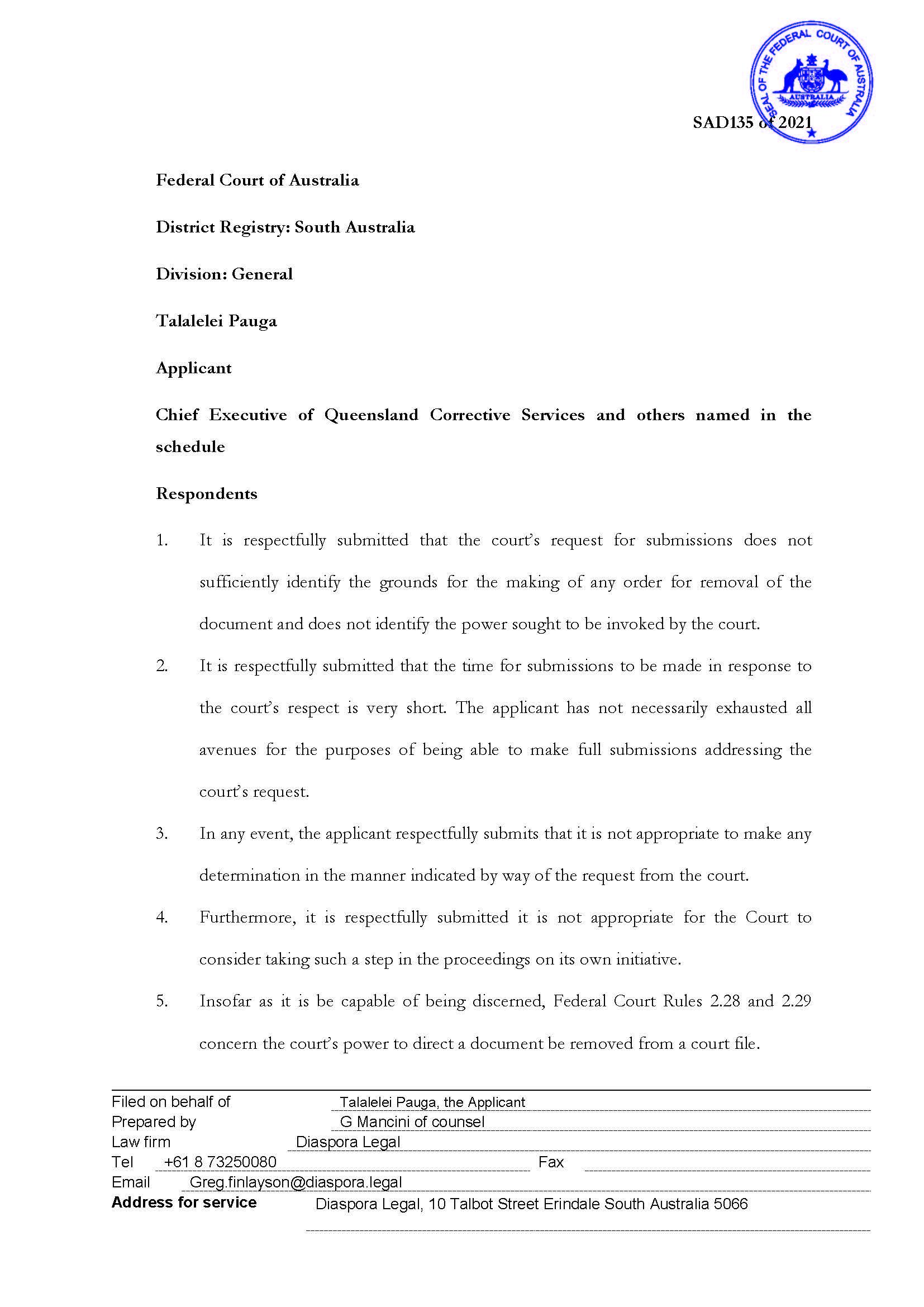
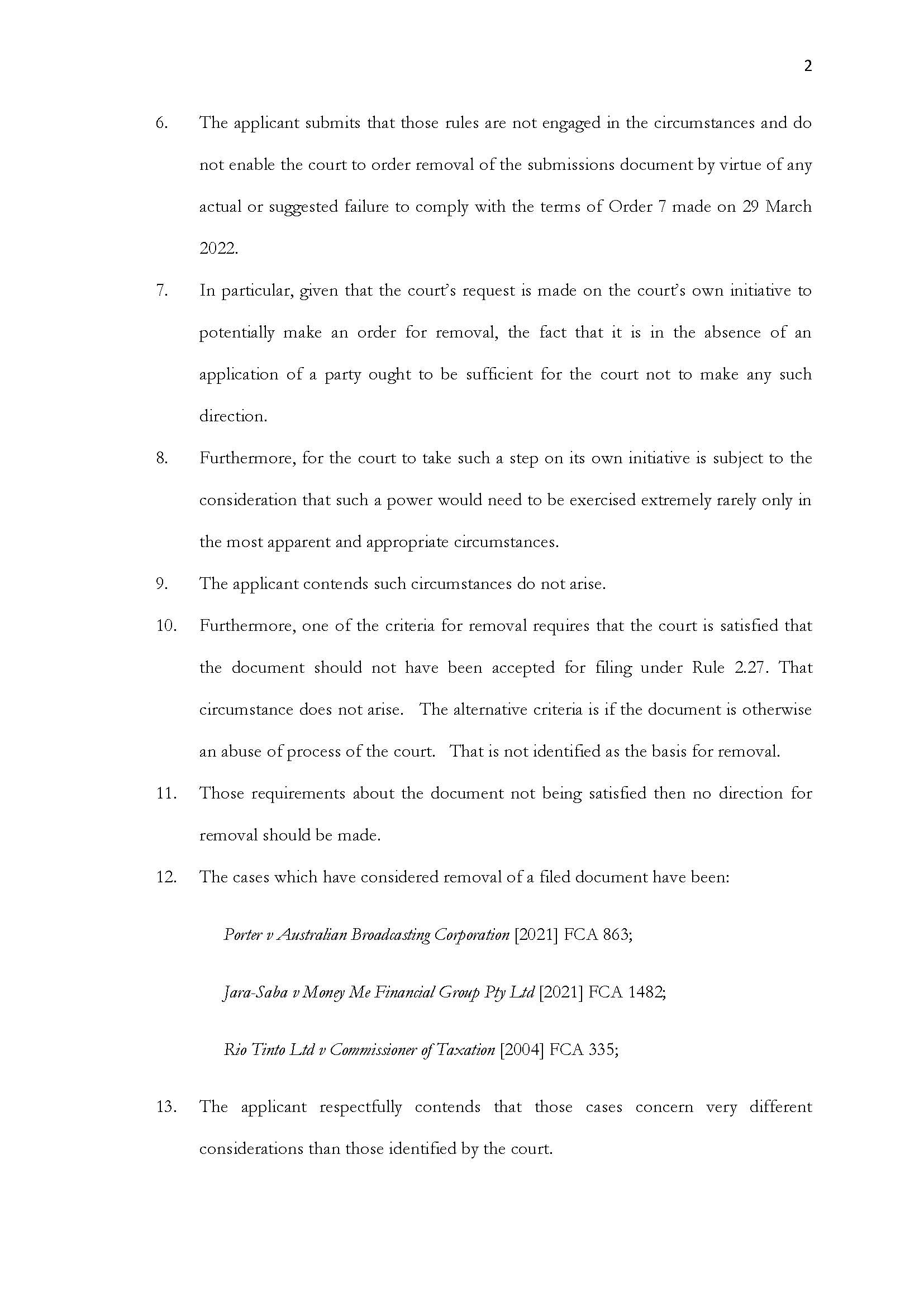
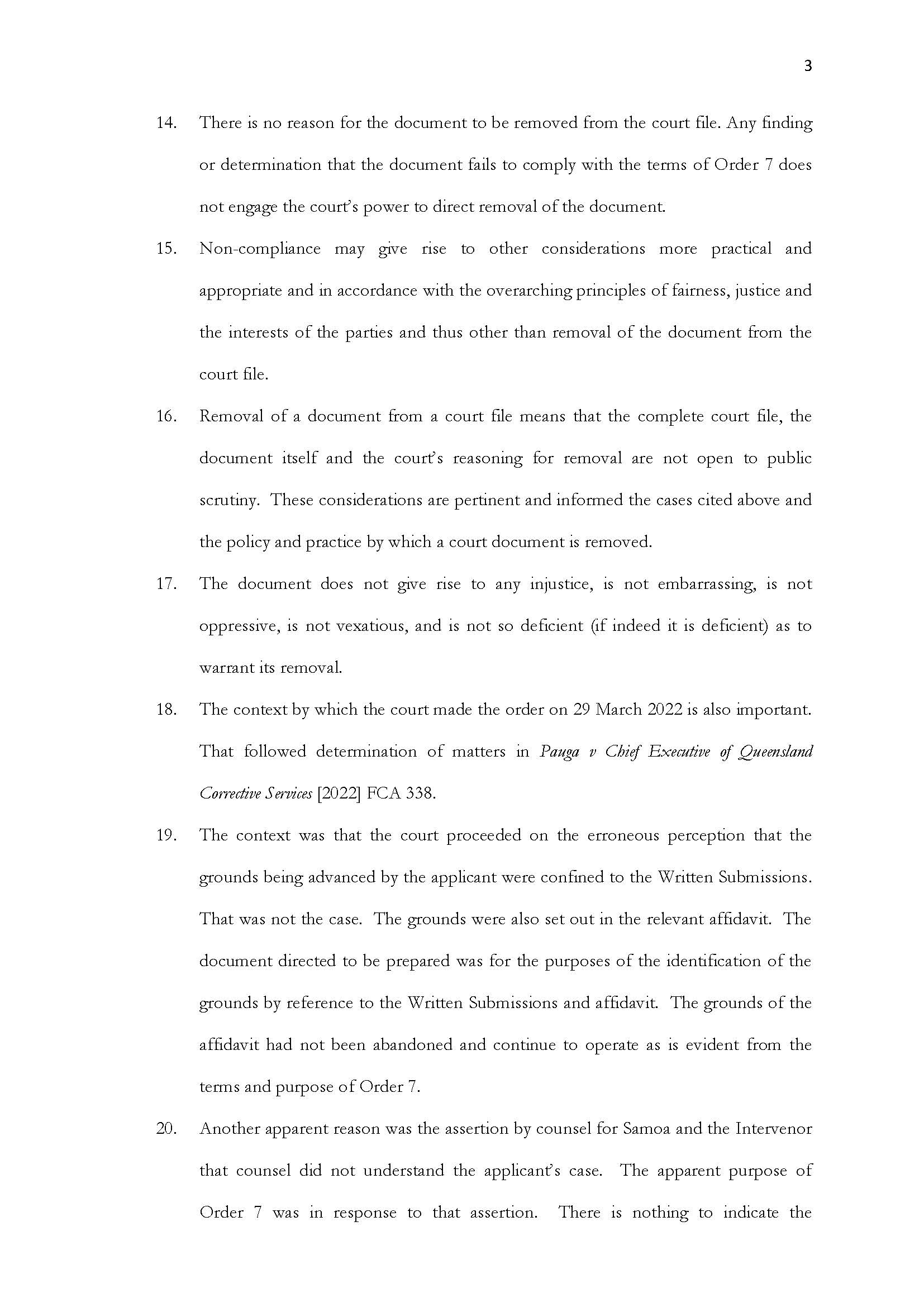
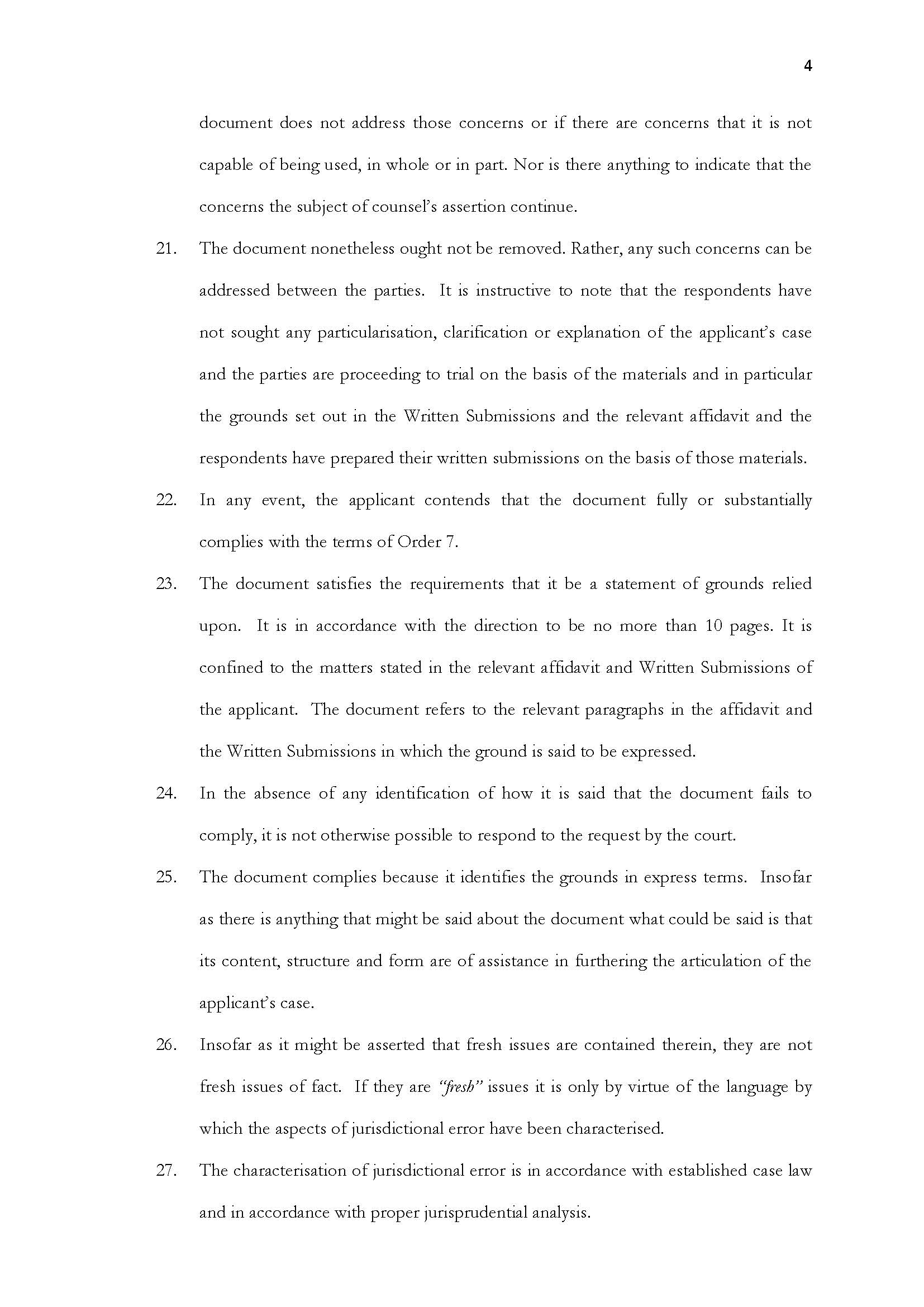
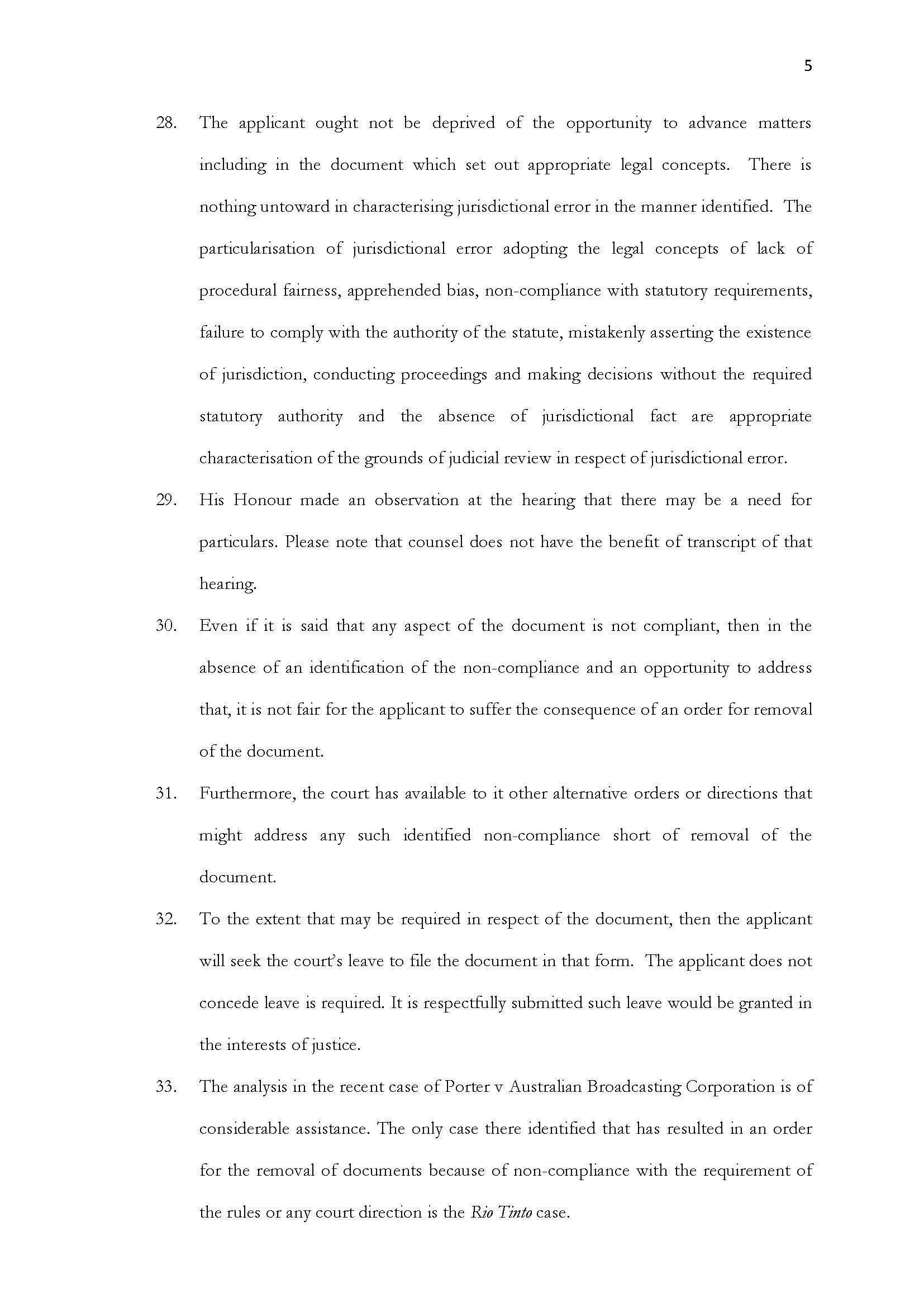
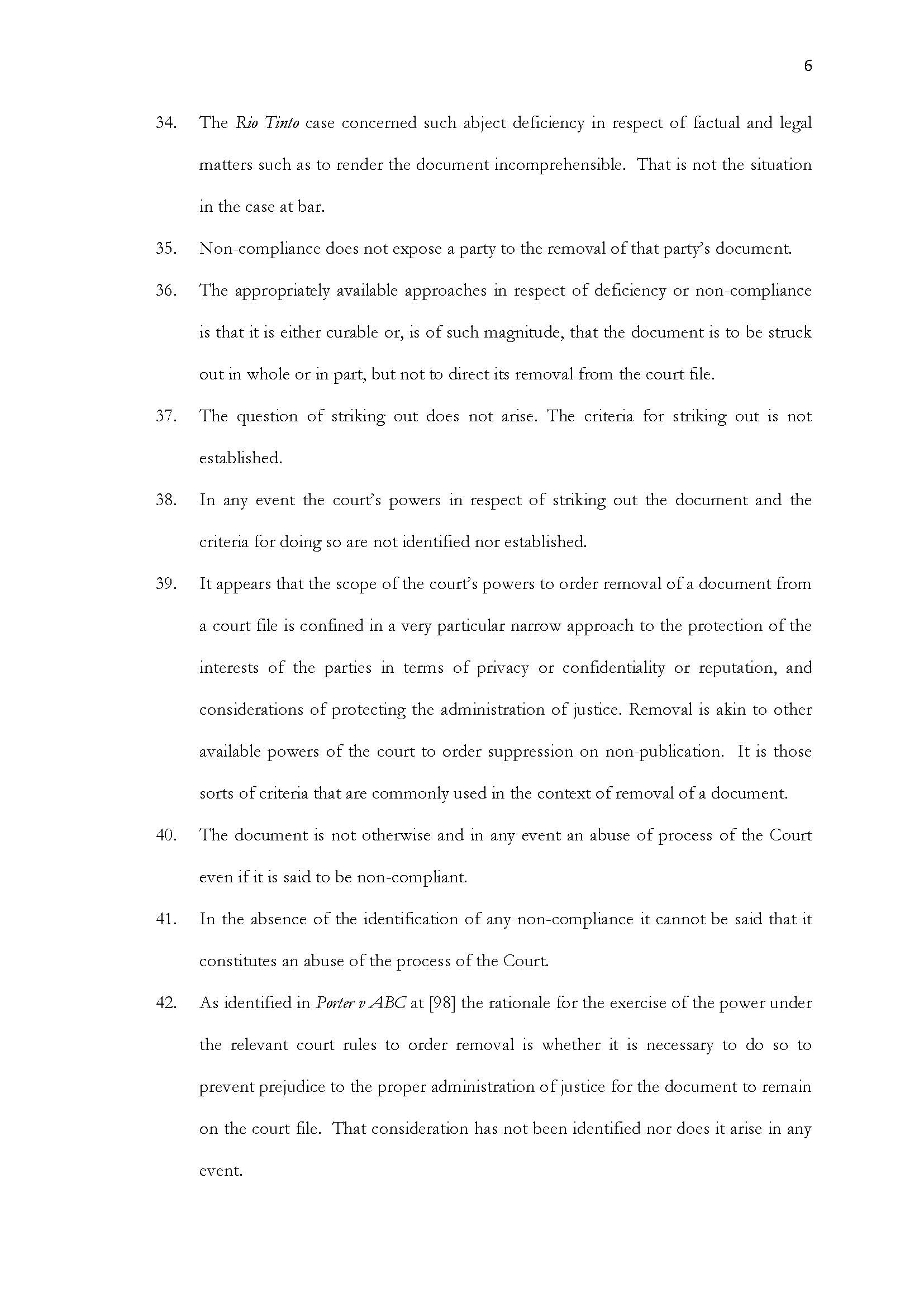
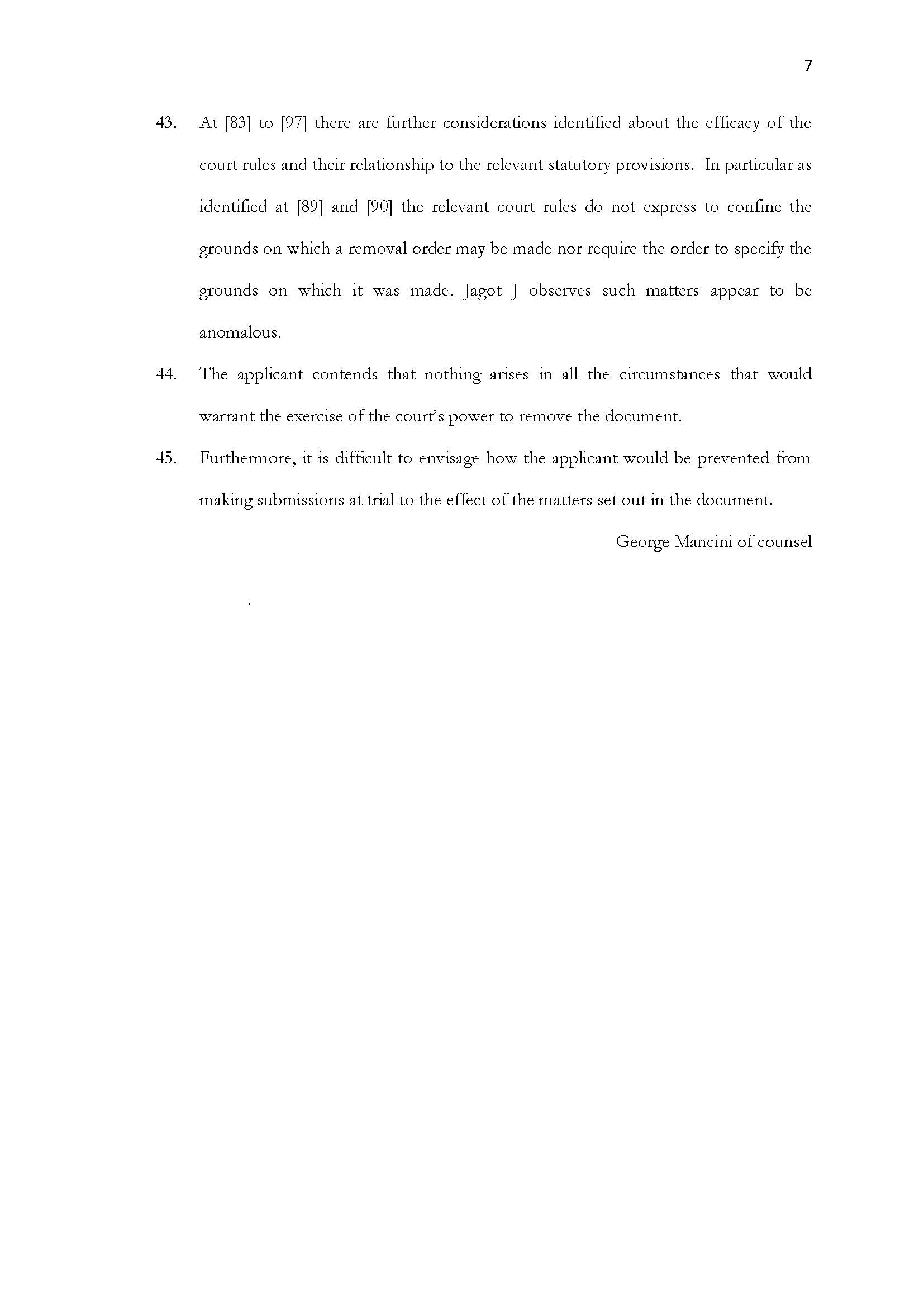
10 In the meantime, a number of matters were listed for consideration on 29 March 2022. In the course of that hearing, Mr Mancini maintained that by reason of the opening sentence to the applicant's submissions referring to the affidavit of Mr Finlayson of 11 January 2022 all of the matters in the affidavit could be raised. Having regard to the fact that the hearing had been delayed, I reluctantly allowed Mr Mancini the opportunity to deliver a statement of the grounds that he relied upon which was not confined to his submissions: see Pauga v Chief Executive of Queensland Corrective Services (No 3) [2022] FCA 338. The precise form of order made was as follows:
On or before 26 April 2022, the applicant do file and serve a statement of the grounds relied upon of no more than 10 pages that is confined to the matters stated in the affidavit of Mr Finlayson dated 11 January 2022 and the written submissions by the applicant filed 31 January 2022 such statement to refer to the relevant paragraphs of the affidavit or written submissions in which the ground is said to be expressed.
11 It may be noted that notwithstanding the considerable delay by the applicant in articulating his grounds, the direction contemplated a further period of about a month for the statement of grounds to be filed.
12 On 25 May 2022 my associate raised with Mr Finlayson by email the failure to comply with the order in relation to the filing of the statement of grounds. It met with the following response late that same day:
I confirm that the document is yet to be filed.
I advise that the solicitors for the respondents have been informed of the progress and the matters associated with delays to date.
A draft was provided to the respondents yesterday. The pinpoint references are being completed by counsel and it is anticipated that the document will be filed along with a request for an extension of time.
13 There was no further response of any kind until 7 June 2022 when my associate received an email in the following terms from Mr Finlayson:
Further to correspondence regarding the Statement of Grounds, we have provided the attached lodged with the Registry.
Representatives for Samoa have advised that they do not consent to the Applicant relying on the summary document as it has been served well out of time and does not, in their view, comply with order 7 of the Orders … dated 29 March 2022. They assert that the summary document also appears to raise new issues.
The applicant has corresponded today to seek to elucidate the basis of that opposition.
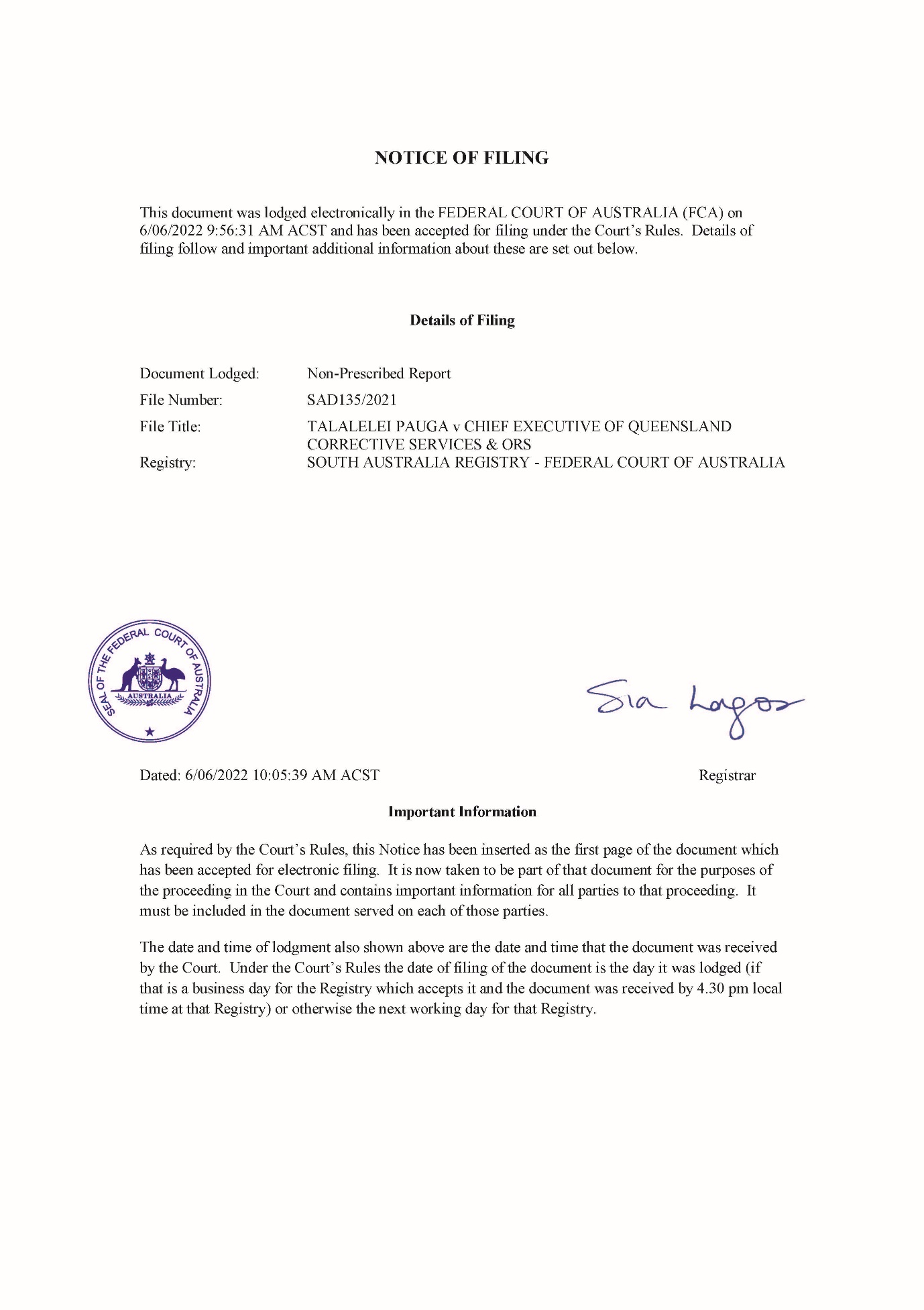
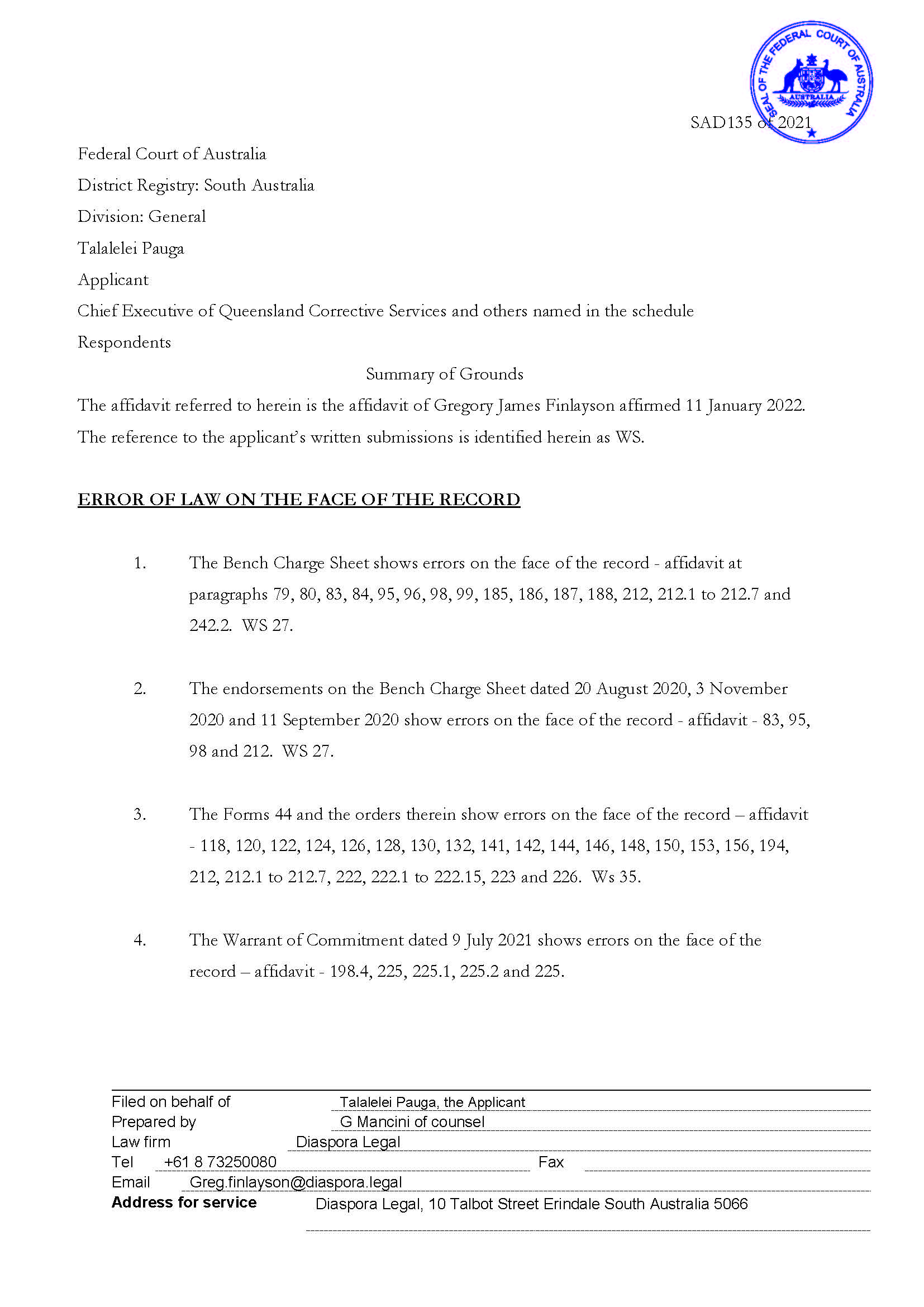
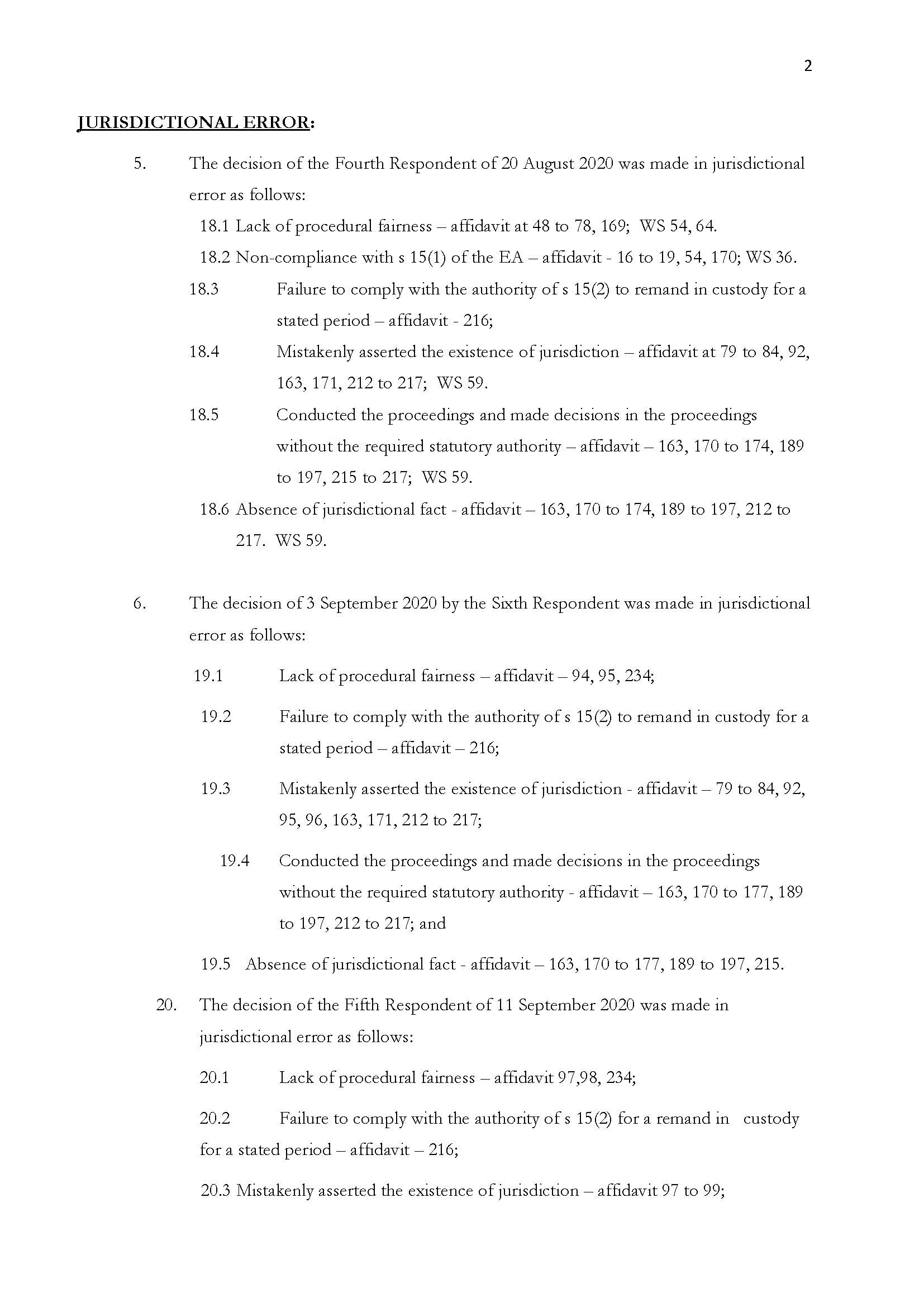
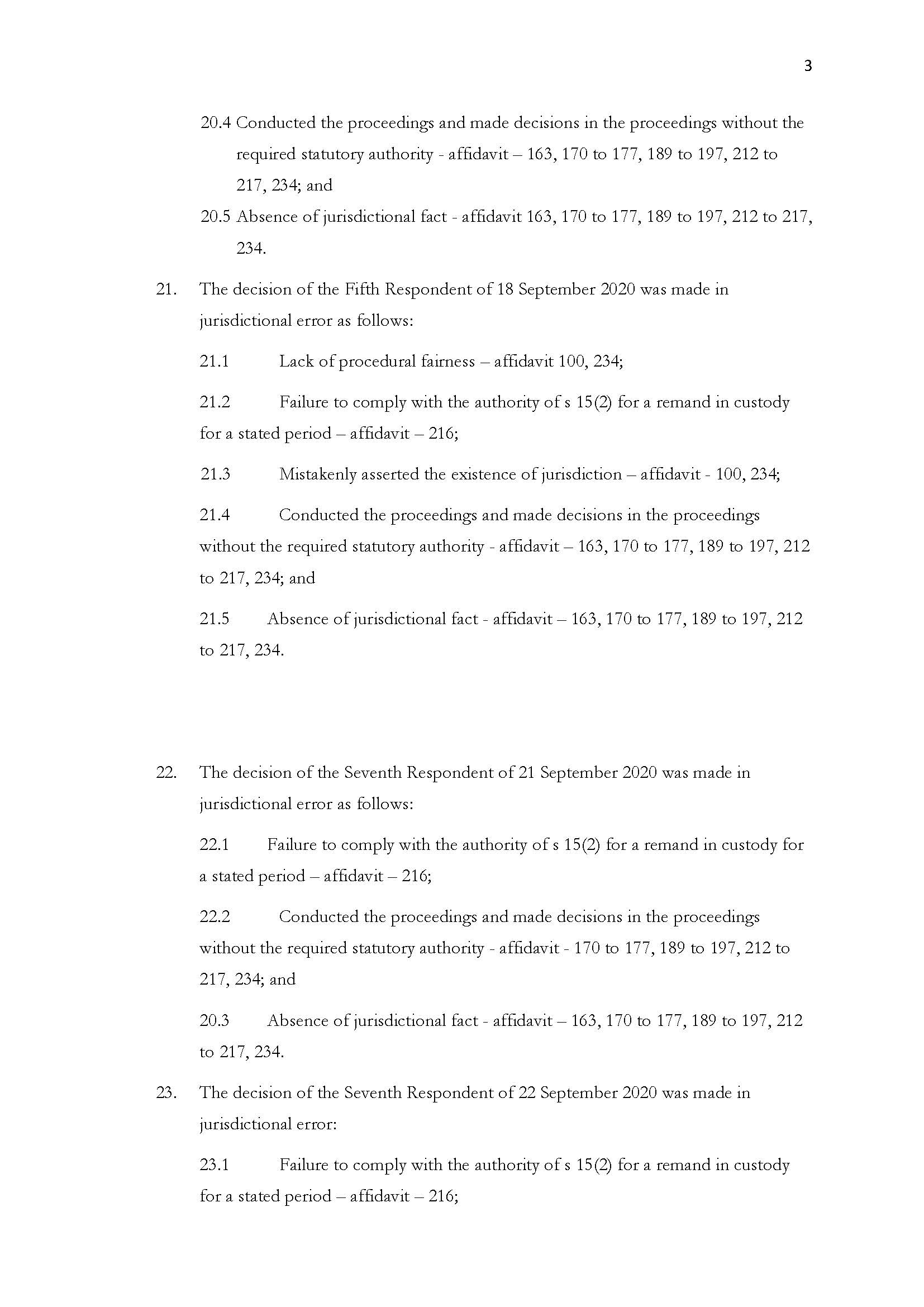
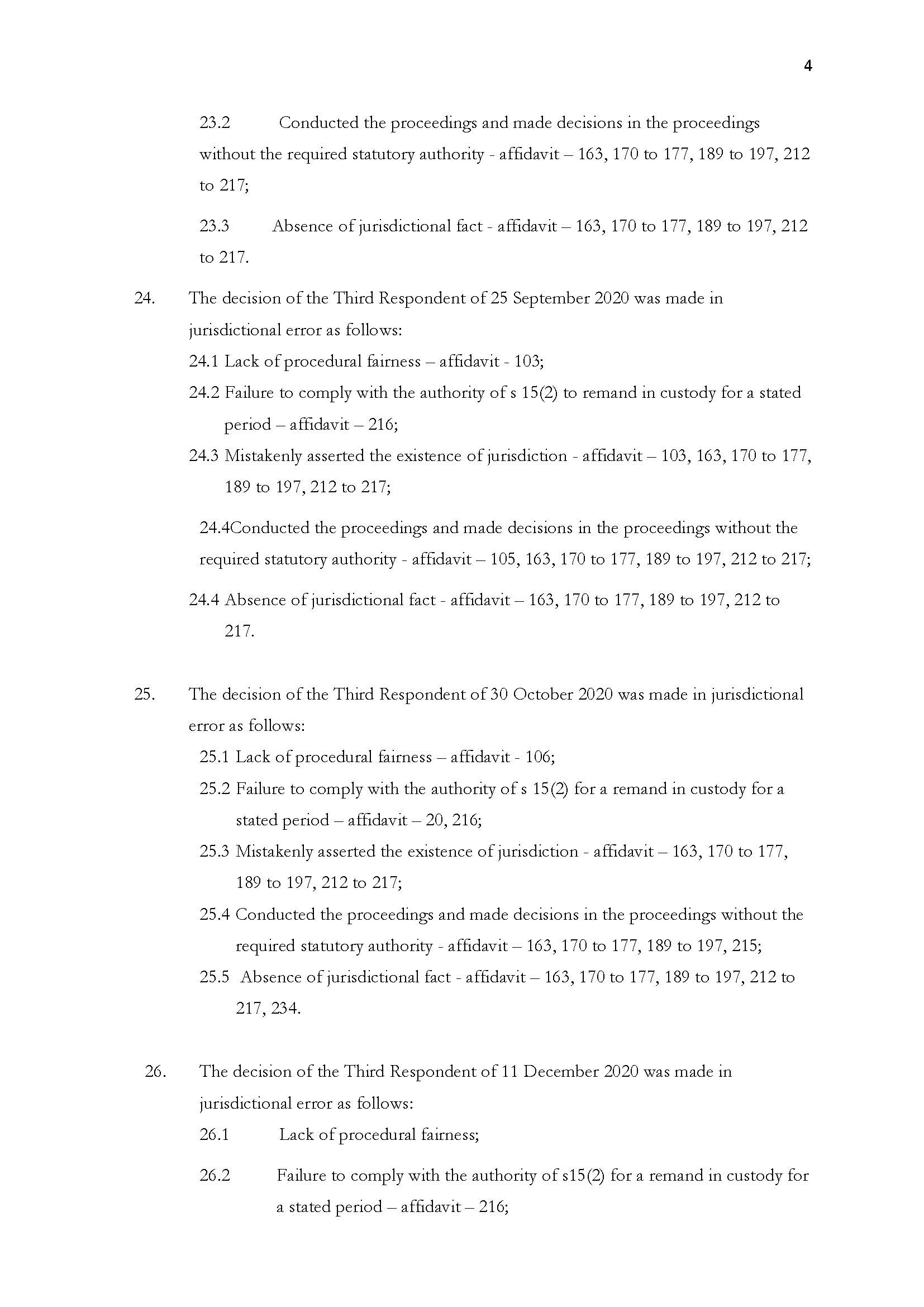
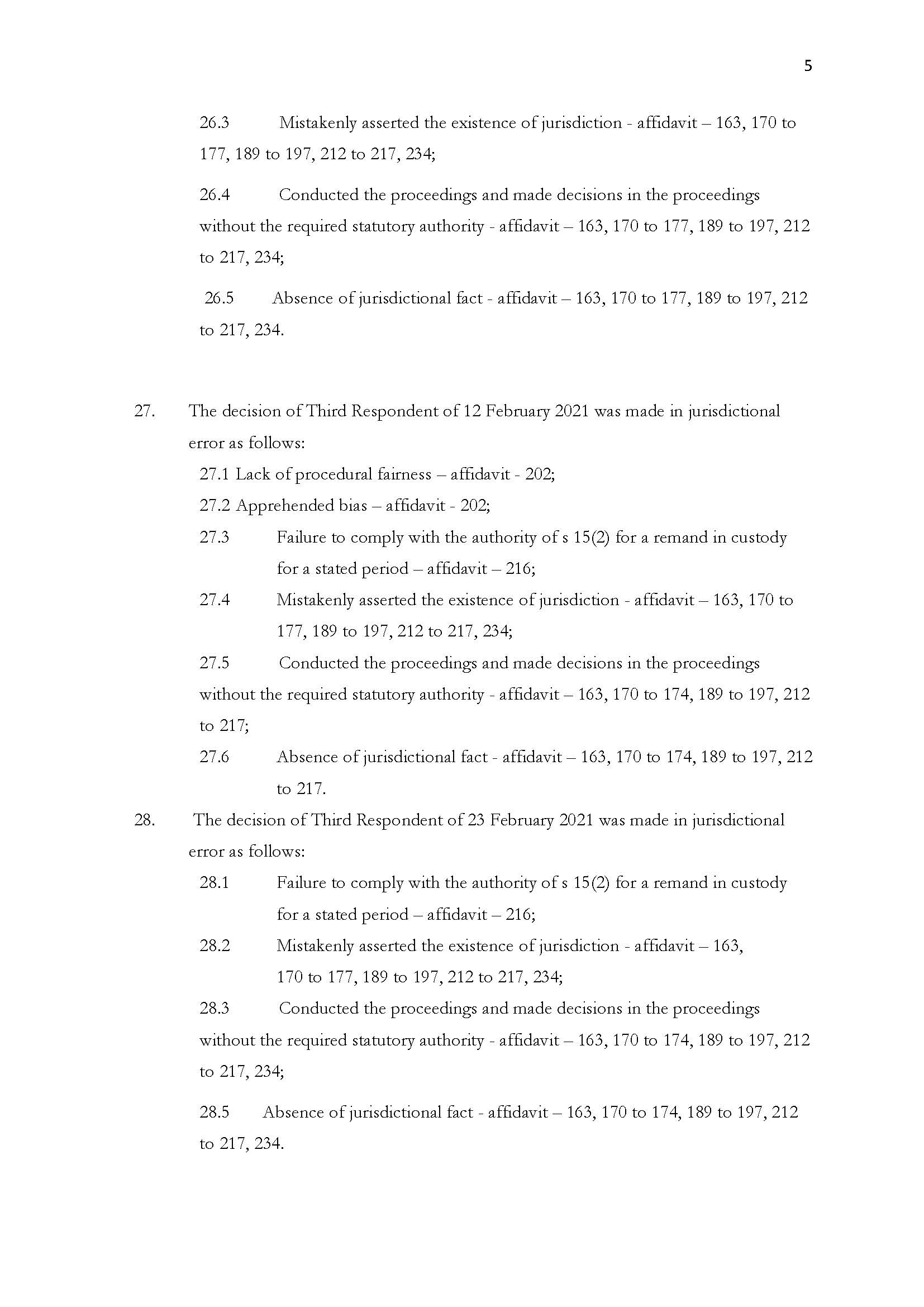
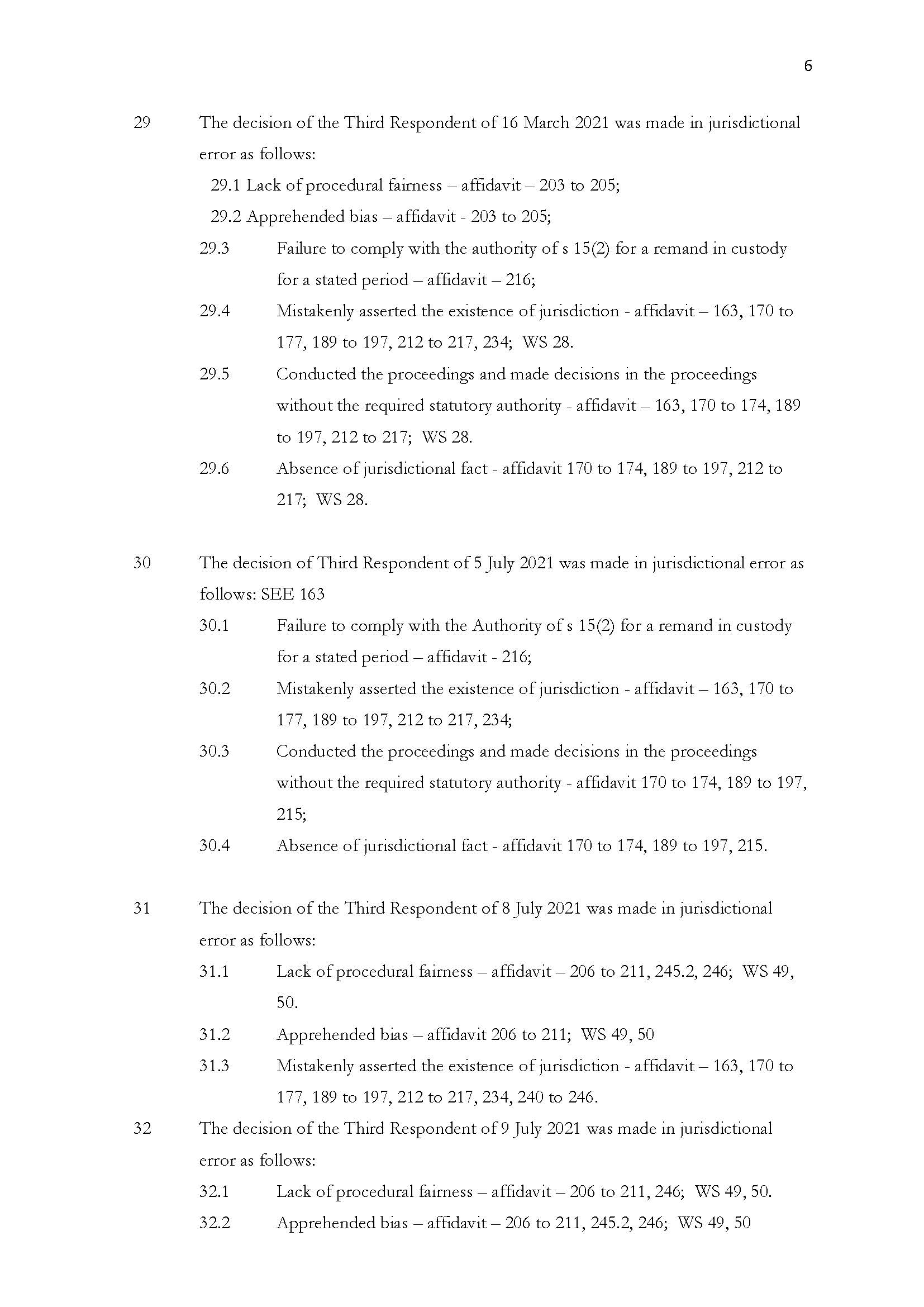
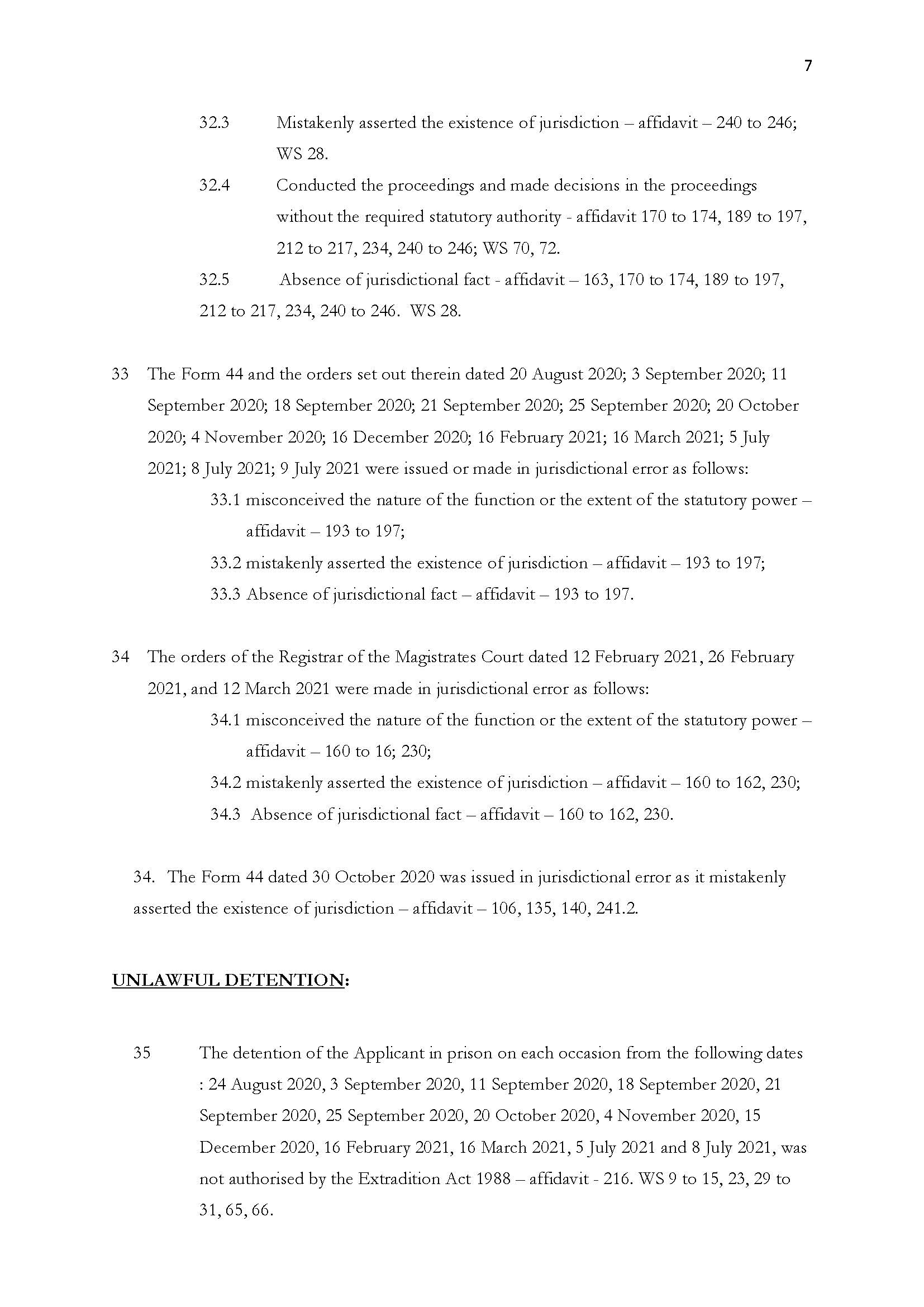
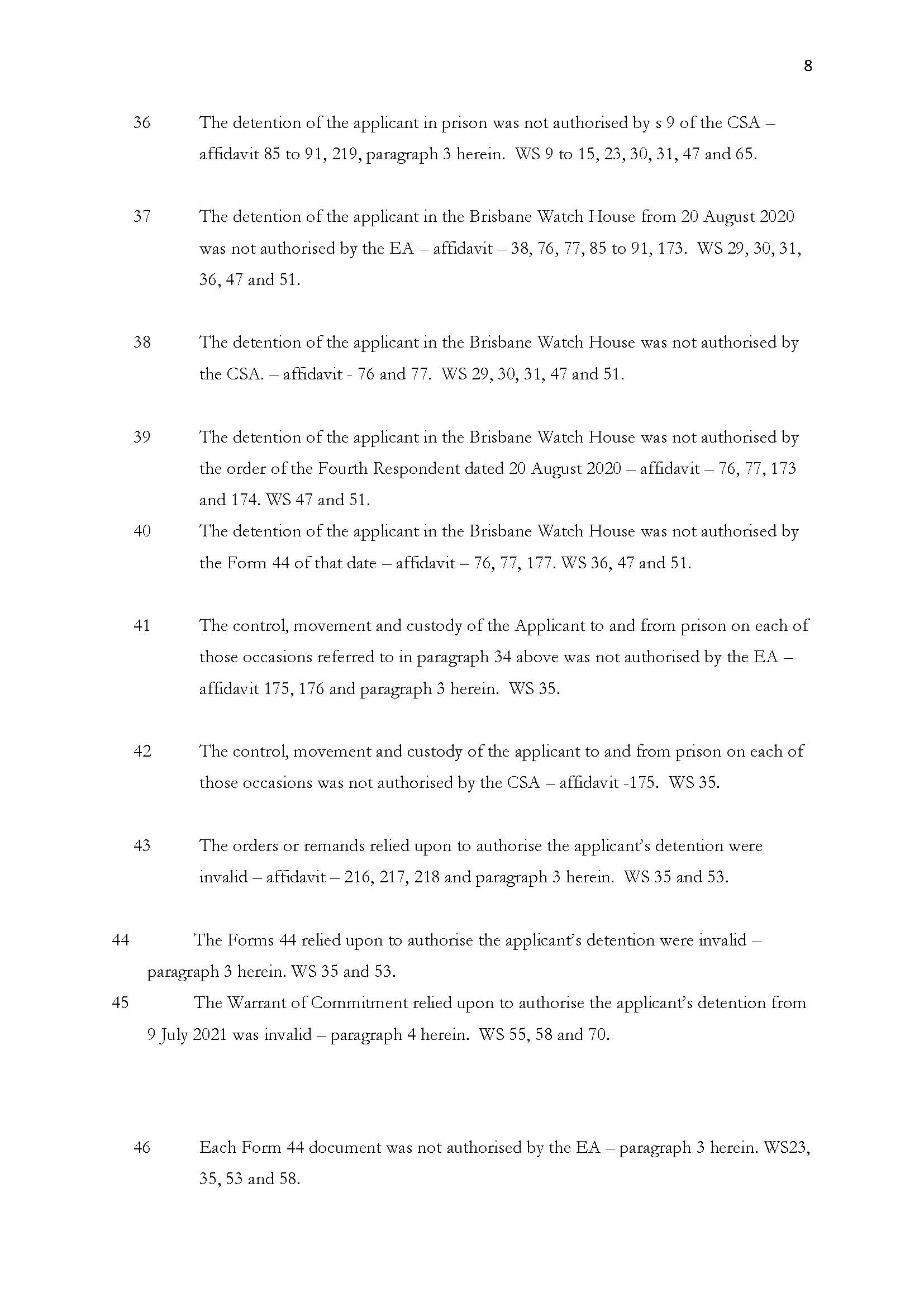
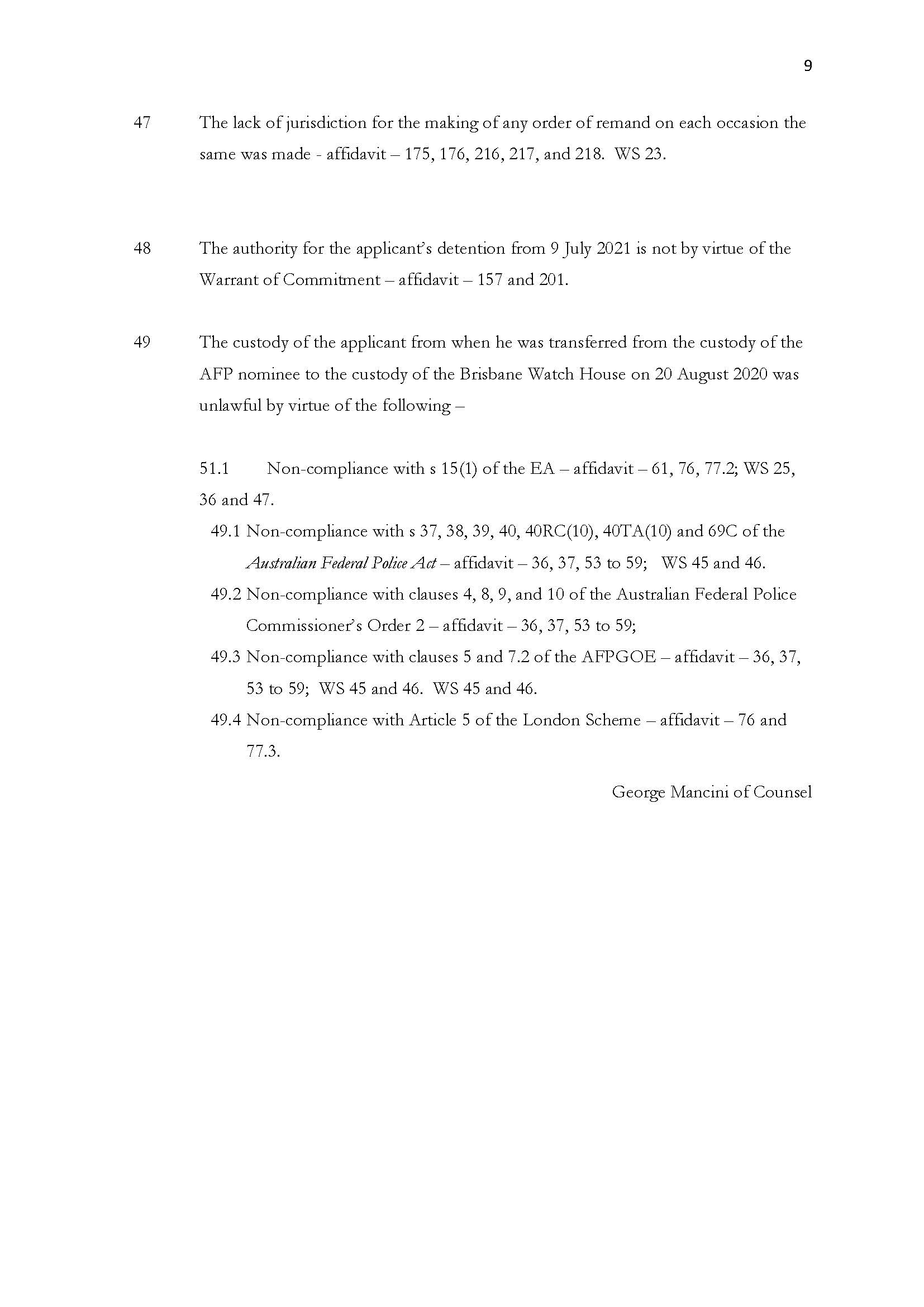
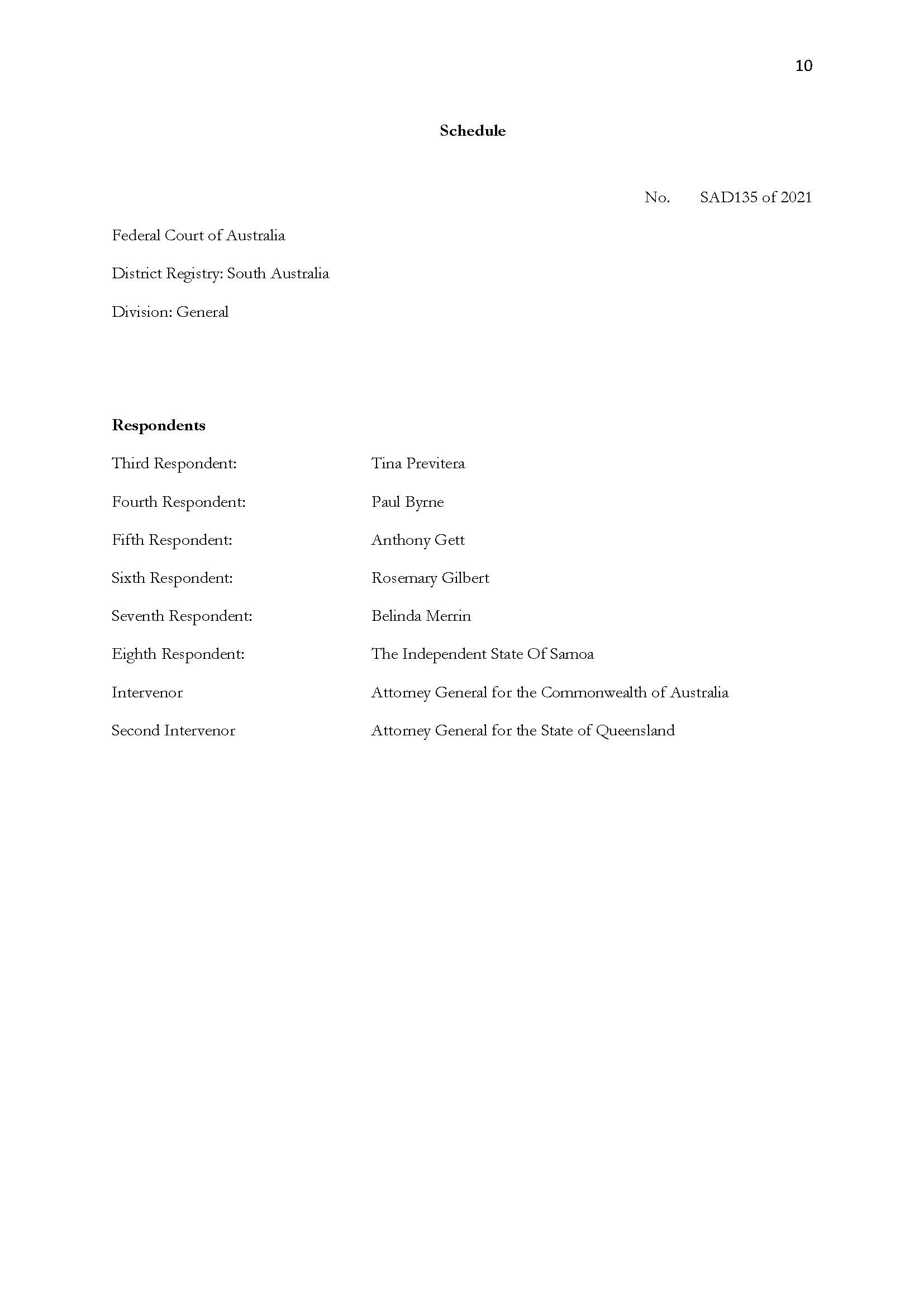
14 Beyond the terms of the response of 25 May 2022, there has been no explanation to the Court for the delay nor has there been any request for an extension of time. The document attached to the email is headed 'Summary of Grounds' and comprises some nine pages. A copy of the document is attached to these reasons as attachment A.
15 Grounds of review for error on the face of the record should state concisely the nature of the alleged error expressed in recognisable legal terms. The same may be said of grounds to support a claim that there has been unlawful detention of a kind that should cause the Court to issue a writ of habeas corpus. They should be couched by reference to the facts of the particular case and expose a contextualised expression of the ground that can be understood by the respondents to the application and the Court. In short, they should state concisely the nature of the case to be raised.
16 Further, the elucidation of the nature of the case in a concise way is a fundamental obligation of counsel and lawyers for parties. Indeed, adopting the language used by others, they each have a duty to confine the case to the real issues and to assist the court by a process of simplification and concentration and not to advance a multitude of ingenious arguments: Dyczynski v Gibson [2020] FCAFC 120; (2020) 280 FCR 583 at [216] (Murphy and Colvin JJ).
17 The document that has been filed very belatedly on behalf of Mr Pauga takes the form of extremely generalised assertions of error. It is impossible to tell from the way in which the grounds have been expressed, what the nature of the case is that is sought to be advanced. It is no more than a list of labels. It is plainly not a document of the kind that was directed to be filed.
18 Further, in the context of the history of the matter it is a disingenuous document. It seeks to reinstate reliance upon the full extent of the discursive materials in the affidavit without reducing them to readily identifiable grounds when that was a course that Mr Mancini had said was not the basis upon which he was proceeding. It is also not what was contemplated when the direction was made on 29 March 2022 which required the grounds to be stated in a document of no more than 10 pages. With subparagraphs, it asserts 101 'grounds'.
19 The document that has now been filed is a blatant attempt to escape the requirement to concisely state the nature of the case that is sought to be advanced and seek to use the whole of the discursive contents of the affidavit of Mr Finlayson as the basis for the application. This is a course that has never been countenanced nor could be countenanced as a matter of fairness.
20 At 10.14 am on 8 June 2022, an email was sent to Mr Finlayson by my associate referring to the Summary of Grounds and requesting the filing of any submissions as to the basis upon which the document was said to comply with the terms of the orders made on 29 March 2022 for the purpose of considering whether the document should be removed from the court file for failing to comply with the orders. Having regard to the extent of the delay and the fact that the hearing is scheduled to commence on 20 June 2022 those submissions were sought by noon the following day.
21 The following morning, Mr Finlayson provided a seven page document by way of submission. It indicated that it had been prepared by Mr Mancini. A copy of the document is attached to these reasons as Attachment B.
22 For the following reasons, having taken into account those submissions, and in the context of the history of the conduct of these proceedings by those acting for Mr Pauga (the key aspects of which that are relevant for present purposes having been outlined above), I am satisfied that there should be a direction that the Summary of Grounds should be removed from the court file and that it is appropriate to do on the Court's own motion.
23 First, the Summary of Grounds is so fundamentally defective that it plainly fails to conform to the orders made on 29 March 2022.
24 Secondly, having regard to the proximity of the hearing date it would severely prejudice the respondents if there was further delay in making clear that the position in relation to the Summary of Grounds is that it does not conform to the orders made and could not be relied upon. Further, it is oppressive of the respondents for a document of that kind to be filed at this stage of the proceedings on the basis that it is to be relied upon by Mr Pauga as the articulation of the grounds upon which he will rely for the purposes of a substantial hearing to commence within 2 weeks of when the document was delivered.
25 Thirdly, having regard to the history of the matter, no reasonable lawyer acting competently and consistently with the obligations of that lawyer to the Court could consider the Summary of Grounds to be a form of document that conformed to what was required by the orders made on 29 March 2022.
26 Fourthly, the Summary of Grounds was filed well out of time and without any application for an extension of time to do so.
27 Fifthly, to afford Mr Pauga an opportunity to formulate grounds that might go beyond the matters stated in his written submissions was an indulgence. It involved a departure from the basis upon which the proceedings had been conducted, namely that the grounds of the application would be expressed in the written submissions. It was granted on the basis that he would reduce those grounds to a concise expression of no more than 10 pages and would demonstrate the basis upon which the document did not raise any new matter not expressed in the affidavit of Mr Finlayson or the written submissions by providing references to the paragraphs where the ground was said to have been raised. It was not an opportunity to return to reliance upon the discursive contents of the affidavit of Mr Finlayson without stating grounds in proper form.
28 Sixthly, the publication of these reasons with the Summary of Grounds and the submissions of Mr Finlayson appended to them ensures that the relevant record is available and the actions taken are subjected to public scrutiny. Therefore, removal will not have the consequences contented for in the submissions provided by Mr Mancini.
29 Seventhly, the Court may, on its own initiative, order the removal of a document from the court file: r 2.28(1)(a)(i) Federal Court Rules 2011 (Cth). The power is to be exercised having regard to the overarching objective expressed in s 37M of the Federal Court of Australia Act 1976 (Cth). It would be inconsistent with those objects to allow those acting for Mr Pauga, in effect, to ignore the Court's case management directions designed to require the applicant to state concisely the nature of his grounds and not rely upon the affidavit of Mr Finlayson for that purpose, and now at the last moment, sanction that course. Further, for reasons that have been given, the Summary of Grounds is an abuse of process and therefore may be removed from the Court file under r 2.28(1)(c) of the Federal Court Rules. Contrary to the submission advanced by Mr Mancini, I consider the present case to fall within the same category as a case like Rio Tinto Ltd v Commissioner of Taxation [2004] FCA 335.
30 Eighthly (and additionally), the Court has inherent jurisdiction to maintain the integrity of its procedures and it is not necessary to look to the Federal Court Rules to support an order requiring the removal of the Summary of Grounds from the court file.
31 In the present case, removal is appropriate to make clear that the document should never have been filed and to make clear that it is now for the applicant to make whatever application he wishes to make concerning the grounds of review. It is also appropriate for the reasons that have been given to vacate the order made on 29 March 2022.
32 In the absence of further order, I take the view that Mr Pauga is confined to the matters stated in the written submissions. To be clear, without further order, I do not consider that it would be consistent with the manner in which the case has been conducted for there now to be reference to the affidavit of Mr Finlayson for the purpose of expanding the grounds relied upon in support of his application beyond those matters expressly addressed in his written submissions.
33 Finally, I note that leave was sought to file further submissions as to why there should not be an order requiring the removal of the Summary of Grounds. It was not indicated why there should be further submissions and further delay to accommodate their provision. Further delay would be unfair to the respondents for the reasons I have given. I decline to receive further submissions.
I certify that the preceding thirty-three (33) numbered paragraphs are a true copy of the Reasons for Judgment of the Honourable Justice Colvin. |
Associate:
ATTACHMENT A
ATTACHMENT B