

Federal Court of Australia
Huon Valley Council v Swiss Re International SE [2022] FCA 611
ORDERS
Applicant | ||
AND: | SWISS RE INTERNATIONAL SE (ARBN 138 873 211) Respondent | |
DATE OF ORDER: |
THE COURT ORDERS THAT:
1. The separate question, the subject of order 1 made on 25 October 2021 pursuant to r 30.01 of the Federal Court Rules 2011 (Cth), that is:
“Upon a proper construction of the Policy, does the Policy respond to the claim made on the Applicant by the Minister for $336,230, being the Minister’s costs of the Inquiry into the affairs of the Applicant pursuant to s.229 of the Act, as alleged in paragraph 7.1 of the statement of claim.”
be answered “no”.
2. By 8 June 2022, the parties file and serve agreed short minutes of order for the future conduct of the proceeding, including as to costs, failing agreement brief written submissions and competing short minutes of order.
3. Any necessary further orders arising from the determination of the separate question in Order 1 be determined on the papers, unless the Court otherwise orders.
Note: Entry of orders is dealt with in Rule 39.32 of the Federal Court Rules 2011.
ALLSOP CJ:
Introduction
1 The proceeding concerns a claim for indemnity under a Corporate Practices Protection Policy issued by Specialist Underwriting Agencies Pty Ltd (SUA) on behalf of AXIS Speciality Europe SE to the applicant, Huon Valley Council. By a scheme prepared pursuant to Div 3A of Pt III of the Insurance Act 1973 (Cth) and approved pursuant to orders dated 10 February 2017, the general insurance business of AXIS Speciality Europe SE was transferred to the respondent insurer. There is no dispute between the parties that pursuant to the scheme of transfer, the respondent has assumed responsibility for the obligations (actual or contingent) under the Policy.
2 The claim for indemnity concerns costs and expenses incurred by the Council arising from the conduct of a Board of Inquiry (BoI) established by the Tasmanian Minister for Planning and Local Government on 8 September 2015 under s 215 of the Local Government Act 1993 (Tas) (the Act) to investigate what was described as a “large volume of serious complaints and concerns” raised by the “Mayors, councillors and stakeholders in relation to the Council”. One particular issue is whether the Policy responds to the costs and expenses incurred by the BoI during the inquiry which were made payable by the Council pursuant to s 229 of the Act.
3 On 25 October 2021, orders were made by consent that the following separate question be determined on the papers in advance of any other issue:
Upon a proper construction of the Policy, does the Policy respond to the claim made on the Applicant by the Minister for $336,230, being the Minister’s costs of the Inquiry into the affairs of the Applicant pursuant to s.229 of the Act, as alleged in paragraph 7.1 of the statement of claim.
4 For the following reasons, that separate question should be answered: “no”.
The Local Government Act
5 Before turning to the circumstances giving rise to the claim for indemnity, it is important to understand the statutory framework which empowered the Minister to establish the BoI, and to impose the costs and expenses of the BoI on the Council.
6 The relevant provisions of the Act are contained in Pt 13, which is entitled “Inquiry”. In Pt 13, the Minister is vested with a broad power to establish a Board of Inquiry to investigate a council under s 215, as follows:
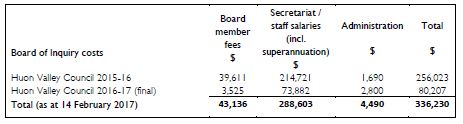
215. Board of Inquiry
(1) The Minister may establish a Board of Inquiry to investigate a council, single authority or joint authority or any matter relating to the administration of this Act if–
(a) …
(b) the Minister is satisfied that a matter justifies its establishment.
(2) The Minister is to notify a council, single authority or joint authority of–
(a) the establishment of a Board of Inquiry to investigate the council, single authority or joint authority; and
(b) the reason for the inquiry; and
(c) the subject matter of the inquiry.
(3) A Board of Inquiry consists of one or more persons appointed by the Minister.
(4) A member of a Board of Inquiry is entitled to such allowances as the Minister determines.
(5) If the Minister establishes a Board of Inquiry to investigate a council, the Minister may suspend all the councillors of the council from office for a period not exceeding 6 months if, in the opinion of the Minister, the circumstances are such that a suspension is necessary in the interests of the community.
There are no factors or mandatory considerations which constrain the Minister’s broad discretion to establish a Board of Inquiry.
7 The functions and powers of the BoI once established, and its obligation to provide a report to the Minister are set out in ss 216, 217 and 224 of the Act:
216. Functions of Board of Inquiry
(1) The functions of a Board of Inquiry are –
(a) to conduct an inquiry into any matter referred to it by the Minister; and
(b) to make recommendations to the Minister as a result of its inquiry.
(2) A Board of Inquiry may do anything necessary or convenient to carry out its functions.
217. Powers of Board of Inquiry
(1) A Board of Inquiry may –
(a) summon any person to appear before it to give evidence and produce any such documents as are specified in the summons; and
(b) require any person appearing before it to produce any document; and
(c) require any person appearing before it to give evidence on oath or affirmation; and
(d) require any person appearing before it to answer questions; and
(e) adjourn the inquiry from time to time.
(2) A person must not, without reasonable excuse –
(a) fail to attend an inquiry as required by summons or from day to day during the inquiry; or
(b) fail to produce a document when required to do so; or
(c) fail to answer questions required to be answered; or
(d) fail to comply with the requirement to affirm or be sworn.
Penalty: Fine not exceeding 10 penalty units.
…
224. Report of inquiry
(1) A Board of Inquiry is to submit a report of its findings and recommendations to the Minister.
(2) The Minister may direct a Board of Inquiry to reconsider its report if, in the opinion of the Minister, its findings or recommendations –
(a) were made as a result of an inquiry conducted contrary to law; or
(b) are unjust, oppressive, discriminatory or unreasonable; or
(c) are based, wholly or partly, on a mistake of fact.
8 Section 218 of the Act provides that in conducting its investigation, the BoI is to proceed with as little formality and technicality as possible, is not bound by the rules of evidence, but must conduct its investigation in accordance with the principles of natural justice.
9 It is also appropriate to set out the relevant terms of ss 27, 28 and 62 of the Act which formed part of the BoI’s Terms of Reference for its investigation into the governance arrangements and practices of the Council:
27. Functions of mayors and deputy mayors
(1) The functions of a mayor are–
(a) to act as a leader of the community of the municipal area; and
(b) to carry out the civic and ceremonial functions of the mayoral office; and
(c) to promote good governance by, and within, the council; and
(d) to act as chairperson of the council and to chair meetings of the council in a manner that supports decision-making processes; and
(e) to act as the spokesperson of the council; and
(f) to represent the council on regional organisations and at intergovernmental forums at regional, state and federal levels; and
(g) to lead and participate in the appointment, and the monitoring of the performance, of the general manager; and
(h) to liaise with the general manager on –
(i) the activities of the council and the performance and exercise of its functions and powers; and
(ii) the activities of the general manager and the performance and exercise of his or her functions and powers in supporting the council; and
(i) any function imposed by an order under section 27A ; and
(j) any other function imposed by this or any other Act.
(1A) The mayor or deputy mayor is to represent accurately the policies and decisions of the council in performing the functions of mayor or deputy mayor.
…
28. Functions of councillors
(1) A councillor, in the capacity of an individual councillor, has the following functions:
(a) to represent the community;
(b) to act in the best interests of the community;
(c) to facilitate communication by the council with the community;
(d) to participate in the activities of the council;
(e) to undertake duties and responsibilities as authorised by the council.
(2) The councillors of a council collectively have the following functions:
(a) to develop and monitor the implementation of strategic plans and budgets;
(b) to determine and monitor the application of policies, plans and programs for –
(i) the efficient and effective provision of services and facilities; and
(ii) the efficient and effective management of assets; and
(iii) the fair and equitable treatment of employees of the council;
(c) to facilitate and encourage the planning and development of the municipal area in the best interests of the community;
(d) to appoint and monitor the performance of the general manager;
(e) to determine and review the council's resource allocation and expenditure activities;
(f) to monitor the manner in which services are provided by the council.
(3) In performing any function under this Act or any other Act, a councillor must not –
(a) direct or attempt to direct an employee of the council in relation to the discharge of the employee's duties; or
(b) perform any function of the mayor without the approval of the mayor.
(4) A councillor is to represent accurately the policies and decisions of the council in performing the functions of councillor.
…
62. Functions and powers of general manager
(1) The general manager has the following functions:
(a) to implement the policies, plans and programs of the council;
(b) to implement the decisions of the council;
(c) to be responsible for the day-to-day operations and affairs of the council;
(d) to provide advice and reports to the council on the exercise and performance of its powers and functions and any other matter requested by the council;
(e) to assist the council in the preparation of the strategic plan, annual plan, annual report and assessment of the council's performance against the plans;
(f) to coordinate proposals for the development of objectives, policies and programs for the consideration of the council;
(g) to liaise with the mayor on the affairs of the council and the performance of its functions;
(h) to manage the resources and assets of the council;
(i) to perform any other function the council decides.
(2) The general manager may do anything necessary or convenient to perform his or her functions under this or any other Act.
10 After receiving and considering a report from a Board of Inquiry, the Minister must notify the council and councillors concerned and is obliged to invite the council and councillors to make any further submission within 14 days of the notice or such other period as allowed by the Minister: s 225(1). After considering any submissions, sub-section 225(2) and s 226 then provide for the Minister’s powers to act upon a report by a Board of Inquiry:
225. Result of inquiry
(1) After considering a report from a Board of Inquiry, the Minister, by notice in writing, must –
(a) advise the council, councillor (whether suspended or not), single authority or joint authority affected by the report of the findings and recommendations of the Board of Inquiry; and
(b) invite the council, councillor (whether suspended or not), single authority or joint authority to make any further submissions within 14 days of the notice or such other period the Minister may allow.
(2) After considering any submissions, the Minister may direct a council, councillor, single authority or joint authority to take any one or more of the following actions within the period specified in that direction:
(a) that the council, councillor, single authority or joint authority rectify or mitigate the effects of its, his or her action;
(b) that the council, councillor, single authority or joint authority discontinue its, his or her action;
(c) that the council, councillor, single authority or joint authority give reasons for its, his or her action;
(d) that the council, councillor, single authority or joint authority take such other steps as the Minister thinks necessary.
(3) In giving a direction to a council, councillor, single authority or joint authority, the Minister may require the council, councillor, single authority or joint authority to notify, within a specified period–
(a) the steps the council, councillor, single authority or joint authority has taken or proposes to take; or
(b) the reasons why the council, councillor, single authority or joint authority has not taken, or is not proposing to take, any steps.
226. Dismissal of councillors
(1) Instead of making a direction to a council or councillor under section 225 (2), the Minister may recommend that the Governor by order dismiss any councillor or all councillors if, in the opinion of the Minister–
(a) the failure of the councillor or council to perform any function has seriously affected the operation of the council; or
(b) the irregularity of the conduct of the councillor or council has seriously affected the operation of the council.
(1A) In subsection (1) –
operation of the council includes the performance and exercise of the council’s functions and powers, the administrative operation of the council, the governance of the council and the decision making of the council.
(2) If a councillor or council fails to comply with a direction under section 225 (2) within the specified period the Minister may recommend that the Governor by order dismiss the councillor or all councillors.
(2A) On receipt of a recommendation by the Minister, the Governor, by order, may dismiss the councillor or all councillors.
(3) An order for dismissal of a councillor or all councillors made by the Governor as a result of a recommendation by the Minister under this section may specify that the dismissal takes effect–
(a) on the date specified in the order; or
(b) on the happening of an event specified in the order.
11 If the Governor dismisses all of the councillors of a council on recommendation by the Minister, s 231 provides that the Governor may appoint a commissioner to exercise the functions of the council:
231. Appointment of commissioner on dismissal
(1) On the dismissal of all of the councillors of a council, the Governor may appoint a person as commissioner for the council for a period not exceeding 12 months.
(2) One person may be appointed as commissioner in respect of more than one council.
(3) The Governor, on the recommendation of the Minister, may extend the appointment of a commissioner for any further period or periods of 12 months.
12 Finally, it is important to set out s 229 of the Act, which confers an unconfined discretion on the Minister to “require a council to pay any costs associated with an inquiry into its affairs under [Pt 13]”. It is under this provision that the claim for indemnity the subject of this separate question arises.
The Board of Inquiry
13 The events giving rise to the establishment of the BoI, which emerge from the statement of agreed facts and the BoI’s final report dated 3 June 2016 (the BoI Report), can briefly be summarised as follows. In mid-2015, the Minister and Director of Local Government received a number of serious complaints from the Mayor and the majority of councillors on the Council, some of which appeared to allege breaches of the Act. These allegations included that there were destructive behaviours occurring within the Council, including the breakdown and dysfunctionality of key relationships following the October 2014 council elections, including between: the Mayor (Mr Peter Coad) and the Council’s General Manager (Ms Simone Watson); the Mayor and certain councillors; and between certain councillors. The complaints also raised concerns regarding the transparency, accountability and conduct of the Council, as well as policy and process issues both internal to the Council and in dealings with third parties. A number of the complaints stated that the current situation was untenable and was seriously affecting the Council’s operations and long-term performance.
14 Having received and reviewed these complaints, on 8 September 2015 the Minister gave notice by letter to the Council that he had established a BoI to investigate the affairs of the Council pursuant to s 215(1)(b) of the Act (the Minister’s Letter).
15 The Minister’s Letter to the Council stated that the BoI had been established because of “major divisions within the Council affecting its governance and operations” and to investigate the large volume of serious and concerns that had been raised with the Minister and Director of Local Government by the Mayor, councillors and stakeholders in relation to the Council. The terms of the letter were relevantly as follows:
Dear Mayor
I am writing to advise the Huon Valley Council (the Council) that I have established a Board of Inquiry under the powers conferred to me by section 215(l)(b) of the Local Government Act 1993 (the Act) to investigate the Council.
The function of a Board of Inquiry is to conduct an inquiry into any matter referred to it by the Minister responsible for local government and make recommendations to the Minister as a result of its inquiry. A Board of Inquiry is to conduct an inquiry with as little formality and technicality as a proper consideration of the matter before it permits and must observe the rules of natural justice.
The Board of Inquiry will consist of Mr Michael Stevens and Ms Jill Taylor, who I have appointed under section 215(3) of the Act Both Mr Stevens and Ms Taylor have extensive experience in operational, policy and regulatory settings, and I consider them well suited to the Board of Inquiry.
Mr Stevens has previously held a number of senior executive positions within the Tasmanian State Service including Deputy Secretary of the Departments of Premier and Cabinet (responsible for local government) and Justice, and Commissioner for Public Employment.
Ms Taylor is a current member of the Local Government Association of Tasmania's (LGAT)'s Standards Panel, which hears councillor code of conduct complaints. Ms Taylor also has extensive tribunal experience, including previously being a member of the Legal Profession Tribunal and Social Security Appeals Tribunal.
I have established the Board of Inquiry because I consider that there are major divisions within the Council that are affecting its governance and operations.
In my view, the Board of Inquiry is the appropriate body with broad investigative powers to deal with the large volume of serious complaints and concerns that have been raised with me and the Director of Local Government (the Director) by the Mayor, councilors and stakeholders in relation to the Council.
In addition, the Council has requested an investigation by the Director into the log of complaints/concerns raised by the General Manager. Please note that those matters raised with the Director will be included as part of the deliberations of the Board of Inquiry.
Attached is a copy of the Terms of Reference for the Board of Inquiry, which outlines the subject matter of the Inquiry.
Please note that I will not be suspending the elected members of the Council under section 215(5) of the Act, as I do not consider the circumstances are such that a suspension is necessary in the interests of the community. I have also made this decision in light of the interim arrangements that the Council has implemented to enable the Mayor and General Manager to continue to perform their roles.
I also seek to reassure Council employees that council operations will not be impacted during the Board of Inquiry.
…
16 The notice annexed the Terms of Reference for the BoI dated 7 September 2015, which was in the following terms:
TERMS OF REFERENCE
The Board is to inquire into and make findings and recommendations with regard to:
1. The following matters:
• representation and promotion of the decisions and policies of the Council by the Mayor;
• the timeliness and quality of advice provided to the Mayor by senior staff;
• the management of Council assets:
• demands being placed on the General Manager by the Mayor and the requirement for the Council to provide a safe workplace;
• implementation of financial policies and practices within the Council; and
• compliance by elected representatives with the Council's Code of Conduct.
2. The governance arrangements and practices of the Huon Valley Council, with particular regard to:
• Section 28 of the Act - compliance by elected members of Council with regard to their functions under the Act;
• Section 27 of the Act - compliance by the Mayor with regard to his functions under the Act;
• Section 62 of the Act - compliance by the General Manager in regard to functions and powers under the Act; and
• Any other sections of the Act relevant to governance arrangements and practices within the Council.
3. The subject matter of the formal complaints, or any other relevant governance issues concerning the Huon Valley Council lodged with the Director of Local Government or the Minister for Planning and local Government in accordance with the Board of Inquiry's Instrument of Appointment.
4. In particular, whether any and, if so which, complaints should be investigated further by the Director, or referred by the Director to another relevant authority for investigation where the matter lies within that authority’s legislative responsibilities.
17 It is unnecessary for the purpose of the determination of this separate question to provide a detailed description of the inquiries and investigations conducted by the BoI pursuant to the Terms of Reference. It is apt, however, to outline in broad terms the conduct of the BoI as summarised in the statement of agreed facts and documents filed by the parties on 11 November 2021 (references omitted):
6. The BoI:
(a) had Terms of Reference dated 7 September 2015;
(b) received a letter of 2 October 2015 from Ms Watson, responding to the BoI’s letter of 17 September 2015. Ms Watson’s letter contained further information to support her complaint together with other information from Ms Watson that she considered was relevant to the Terms of Reference;
(c) by correspondence of 6 November 2015 addressed to the General Manager of the [Council], invited the General Manager to provide her response to allegations from the Mayor and Councillor Smith;
(d) on 2 December 2015 and pursuant to s.217(1) of the Act summoned the General Manager of the Council to attend before it to give evidence on 17 December 2015 at 2pm;
(e) on 9 December 2015 in correspondence addressed to the General Manager of the [Council], required the provision of certain categories of documents, as detailed in the appendix to that correspondence, pursuant to s.222(1) of the Local Government Act 1993;
(f) received from the General Manager of the [Council] correspondence of 11 December 2015, her response to the allegations made concerning her conduct;
(g) conducted other inquiries and investigations and ultimately produced a report dated 3 June 2016 as required by s.224 of the Local Government Act 1993. …
(References omitted.)
18 The BoI Report delivered to the Minister on 3 June 2016 recommended that the Minister should recommend to the Governor of Tasmania to dismiss all of the councillors of the Council pursuant to s 226(1)(b) of the Act and to appoint a commissioner pursuant to s 231 of the Act. The BoI’s alternative recommendation was for the Minister to direct the Council to take certain actions under s 225(2), and if the Council failed to comply within those directions within a period of six months, the Minister should then recommend to the Governor to dismiss the councillors.
19 The BoI’s main findings supporting these recommendation are summarised in Pt 6 of the BoI Report. It found that:
F1. The current unworkable relationship between the Mayor and the General Manager, between the Mayor and certain councillors and between certain councillors is highly irregular and renders the Council dysfunctional.
F2. This irregular conduct has seriously affected Council’s operations. The dysfunction of its governance arrangements is impacting on the health and wellbeing of these parties and is beginning to affect the long-term performance of the Council.
20 Part 6 of the BoI Report also made a number of specific findings of fact which the Council claimed to be relevant to their claim for indemnity under the Policy:
F9. The complete lack of effective liaison between the Mayor and the GM is inconsistent with the intent of ss.27(1)(ba) and 62(1)(g) of the Act.
…
F11. While the Mayor qualified his public statements as his own when they differed from a Council decision, these statements had the practical effect of undermining the position of the Council. This is inconsistent with the Mayoral function to act as the spokesperson of the Council under s 27 of the Act.
…
F17. The Mayor and several councillors have demonstrated inappropriate behaviour and in the Board’s view have failed on occasions to comply with the Council’s Code of Conduct.
…
F19. There is greater need for transparency in Council decisions to ensure that the Council meets its obligations to facilitate communication with the community under s.28(1)(c) of the Act.
…
F21. Workshops are voluntary by nature and there is a risk that councillors who do not attend are not properly informed on matters coming before Council for decision. This has the potential to impede the ability of councillors to perform their individual and collective function under s.28(1) and (2) of the Act.
21 In his response to the BoI Report under s 225(1) dated 15 June 2016, the Minister initially decided to accept the BoI’s alternative recommendation to issue Ministerial Directions and assess compliance before making any recommendation for the dismissal of councillors. However, in October 2016, due to a failure of the Council to comply with at least one of those Ministerial Directions, the Minister, pursuant to s 226(2) of the Act, recommended to the Governor that the councillors be dismissed and that a commissioner be appointed. This recommendation was agreed to and acted upon by the Governor under s 226(2A), who dismissed each of councillors pursuant to the Local Government (Huon Valley Council Dismissal) Order 2016 (Tas) with effect from 10 October 2016. A commissioner was appointed for a period of 12 months.
22 On 5 April 2017, the Minister advised the commissioner that pursuant to s 229 of the Act, he had determined that it was appropriate that the costs of the BoI were borne by the Council. It is apposite to extract relevant paragraphs of that letter:
As you are aware, the Board of Inquiry was established in 2015 to investigate the Council following the receipt of a series of complaints about the behaviours of members of the Council and senior staff. The Board of Inquiry completed its work when it provided me with its final report of findings and recommendations in June 2016. However, further investigative work was undertaken by the Director of Local Government on issues raised under the Inquiry that were outside the Board's Terms of Reference. This work concluded in February 2017 and, as such, the costs directly associated with the Board of Inquiry have now been finalised.
Section 229 of the Local Government Act 1993 provides that councils may be required to pay any costs associated with an inquiry into its affairs. As the Board of Inquiry was established as a result of issues that were internal to the Huon Valley Council, it is appropriate that any costs incurred as a result of the Inquiry are borne by the Council and not the greater Tasmanian community.
(emphasis added)
23 The costs of work directly associated with the Inquiry, including further investigative work undertaken by the Director of Local Government, was determined to be $336,230 (the BoI Costs). The statement of agreed facts at [9] provided that the BoI Costs were calculated by the Minister as follows:
24 That sum was to be recovered by the Department of Treasury and Finance, on behalf of the Tasmanian Government, via three annual invoices of $112,007 with a due date for payment of 30 June 2017, 30 June 2018 and 28 June 2019 respectively. It is this amount as to which the determination of the separate question is directed.
25 On 12 April 2017, the Council’s insurance broker notified SUA of the Minister’s determination under s 229 for consideration of cover under the Policy. The respondent has denied indemnity for the BoI Costs.
The claim for indemnity and the Policy
26 The Policy contains wording comprising three main sections titled “Section 1 – Broadform Statutory Liability”, “Section 2 – Inquiry Costs Indemnity” and “Section 3 – Employment Practices Liability” and includes a schedule. Only the first two of those three sections are relevant for present purposes. The period of insurance under the Policy was 30 June 2015 to 30 June 2016.
27 Under the heading “Section 1 – Broadform Statutory Liability”, the insuring clause provides as follows:
The Insurer agrees to pay to and on behalf of the Insured:
(a) Penalties;
(b) Enforceable Undertaking Expenses;
(c) Legal Costs
(d) Prosecution Costs
for a Statutory Liability Claim.
28 The definitions of the relevant defined terms in the insuring clause are located under the sub-heading “Definitions Applicable to Section 1” in Section 1:
Enforceable Undertaking Expenses
means any monetary sum outlaid by the Insured to satisfy the conditions of any enforceable undertaking given by the Insured and accepted by any Regulatory Authority or sanctioned or imposed by any court as a result of a Statutory Breach by the Insured but excluding:
(a) any compliance and/or implementation costs accrued to rectify or improve systems and/or processes;
(b) any amounts that relate to improvement of risk management measures or procedures of the Insured;
(c) any legal fees, costs and associated expenses.
…
Penalties
means any monetary sum payable by the Insured to any Regulatory Authority for a Statutory Breach by the Insured but excluding any legal fees, costs and associated expenses.
Prosecution Costs
means any reasonable legal fees, costs and associated expenses payable by the Insured to any Regulatory Authority for proceedings that result in the imposition of Penalties or Enforceable Undertaking Expenses or a finding that an Offence has been committed by an Insured.
Provided that the Statutory Breach is covered by this Policy.
…
Statutory Liability Claim
means any written notice of originating legal proceedings issued against or served upon the Insured by a Regulatory Authority during the Policy Period that alleges a Statutory Breach.
Statutory Breach
means any act, error or omission which occurs in connection with the Business which causes the Insured to:
(a) contravene any Acts of Parliament or to be involved in the contravention of any Acts of Parliament; or
(b) commit an Offence pursuant to any Acts of Parliament; or
(c) engage in conduct prohibited under any Acts of Parliament; or
(d) engage in conduct which will result in the imposition of Penalties under any Acts of Parliament.
29 The definition of Regulatory Authority is found under the “General Definitions” section:
Regulatory Authority
means a person, body or entity appointed, constituted or acting under a delegation or power pursuant to any Acts of Parliament for the purposes of enforcement of Acts of Parliament and prosecution of Offences, including a person or entity authorised to collect monies payable to the Consolidated Revenue Fund, Consolidated Fund or any other such fund and includes but is not limited to:
(a) Statutory authorities;
(b) Statutory corporations;
(c) Government agencies;
(d) Local councils and municipal authorities.
The respondent admits in these proceedings that the Minister in making the determination under s 229 of the Act was acting as a Regulatory Authority, and that the BoI also acted as a Regulatory Authority.
30 Under the heading “Section 2 – Inquiry Costs Indemnity”, the insuring clause provides as follows:
The Insurer agrees to pay reasonable Legal Costs for an Inquiry into acts, errors, omissions of the Insured that occur after the Retroactive Date.
Provided that an Inquiry Costs Claim is first made against the Insured and notified to the Insurer during the Policy Period.
31 The definitions of “Inquiry”, “Inquiry Costs Claim” and “Notifiable Incident” are found under the heading “Definitions Applicable to Section 2” in Section 2:
Inquiry
means any
(a) investigation, examination, inquiry, coronial inquest, royal commission or other proceedings before any court, tribunal, professional body or Regulatory Authority where attendance is required at the direction of that court, tribunal, professional body or Regulatory Authority
(b) request for information, audit or review by any Regulatory Authority as a result of a Notifiable Incident.
Inquiry Costs Claim
means any written or verbal notice communicated to the Insured requiring the legally compellable attendance of the Insured at and/or to an Inquiry in connection with the Business.
Notifiable Incident
means any incident, event or circumstance that requires compulsory notification to any Regulatory Authority.
32 It is also relevant to note the definitions of “Insured” and “Legal Costs” contained in the General Definitions which are applicable to both Section 1 and 2 of the Policy:
Insured
means:
(a) the Named Council;
(b) any former, current and future mayor, president, chairman, councillor, board member, Partners, directors, Officers and Employees of the Named Council but only with respect to their duties as mayor, president, chairman, councillor, board member, Partners, directors, Officers and Employees of the Named Council; and
(c) any heirs, executors, administrators, assignees or legal representatives of any Insured referred to in paragraphs (a) or (b) above, in the event of the death, bankruptcy or incapacity of such Insured, but only to the extent that cover under this Policy would have been available to such Insured.
…
Legal Costs
means any reasonable fees, costs and associated expenses reasonably incurred by the Insured following the written consent of the Insurer or paid by the Insurer after a Claim is notified to the Insurer and are incurred solely and exclusively:
(a) in the investigation, defence (including appeal or resisting appeal) and settlement of any Statutory Liability Claim; or
(b) in representing the Insured in relation to an Inquiry Costs Claim
(c) in the investigation, defence (including appeal or resisting appeal) and settlement of any Employment Practices Claim.
however shall not include wages, salaries or other remuneration or benefits paid by the Named Council to its principals, Partners, directors, Officers and any Employee.
Provided that in any event the liability of the Insurer for legal fees and costs for an Appointed Representative where legal fees are charged on a time costed basis the hourly rate will be the lesser of:
(a) the usual hourly charge out rate of the Appointed Representative;
(b) the hourly charge out rate of the Insurer's Nominated Representative for work performed for the Insurer at the time the legal services are provided.
33 Finally, the Policy Schedule provides that the aggregate limit of liability during the Policy Period is $2 million. The limit of liability for any one claim under either Section 1 or Section 2 of the Policy is also $2 million minus minor deductibles of $2,500 for organisations or $1,000 for named persons.
The parties submissions
The Council’s submissions
34 The Council advanced two alternative submissions as to the response of Section 1 and Section 2 of the Policy, respectively. The Council’s claim for indemnity under Section 1 was itself advanced under three alternative constructions of the Policy.
Section 1 of the Policy – Penalties
35 In short, the Council contended that the Minister (acting as a Regulatory Authority) engaged s 229 of the Act to impose an obligation on the Council to pay a monetary sum which arose from the notice of the establishment of the BoI on 8 September 2015 (which the Council contended is an originating legal proceeding) and the findings of the BoI as to acts, errors or omission of the Council which were contrary to the Act. The Council submits that the insuring clause in Section 1 was engaged when the Council provided the respondent (through SUA) on 14 September 2015 with notice of the Minister’s Letter to the Council concerning the establishment of the BoI. This contention was developed as follows.
36 First, the insuring clause indemnifies the Council for Penalties for a Statutory Liability Claim. As noted above, Penalties is defined to mean “any monetary sum payable by the Insured to any Regulatory Authority for a Statutory Breach”. The Minister, acting as a Regulatory Authority in making the determination under s 229 of the Act, did so for the purpose of enforcing the Act and was authorised to collect monies payable to the equivalent of the Consolidated Revenue Fund. The effect of s 351 of the Act was said to assign the Minister responsibility for the administration of the Act, and therefore enforcement of the Act, within the meaning of “Regulatory Authority” in the Policy.
37 Secondly, the Council submitted that the BoI Costs were payable by reason of a Statutory Breach. The Statutory Breach was said to comprise the acts, errors or omissions of the Council that were found by the BoI to be contrary to the Act. The Policy defines the “Insured” in the general definitions as including its Mayor, each councillor and its employees (which would include the General Manager). While the Council acknowledged that the BoI did not determine it had committed any Offence, it contended that the BoI’s findings (see [20] above, particularly F9) fell within the ordinary meaning of “contravene any Act”, as the findings established that each of the Mayor and the General Manager engaged in acts, errors or omissions contrary to their statutory functions and in contravention of the Act. The inclusion in the definition of Statutory Breach of “an Offence” in sub-paragraph (a) was said to indicate that a “contravention” as referred to in sub-paragraph (b) is something less than the commission of an offence.
38 Thirdly, the Council submitted that the BoI Costs were a consequence of the receipt by it of an originating legal proceeding, that being the Minister’s Letter dated 8 September 2015 attaching the BoI’s Terms of Reference. The phrase originating legal proceeding is not defined in the Policy. The Council contends that the definition of Regulatory Authority makes clear that it extends to the exercise of any administrative power or statutory function for the purpose of enforcing Acts of Parliament. This construction was said to be supported by the distinction drawn between “enforcement of Acts of Parliament” and the “prosecution of Offences”: The enforcement of Acts of Parliament is achievable by implementing steps falling short of the prosecution of Offences. The terms of the Minister’s Letter, including the Terms of Reference, were said to establish that the Minister was concerned that the Council had engaged in conduct contrary to the Act and amounted to an allegation of a Statutory Breach. In particular, the Terms of Reference specifically required the BoI to inquire into and make recommendations relating to compliance with ss 27, 28 and 62 and “any other sections of the Act relevant to the governance arrangements and practices within the council”. In its reply submissions, the Council crystallised this submission by stating that all was required for an allegation of a Statutory Breach was an “assertion or accusation” that conduct by the insured may have been contrary to the Act: the Minister’s action to establish the BoI to investigate the Council in relation to “any matter relating to administration” was therefore said to be an originating legal proceeding which alleged a Statutory Breach.
39 Furthermore, the Council contended in its reply submissions that it is not necessary for a Statutory Liability Claim that each allegation of a Statutory Breach be made at the outset. Rather, all that was required is that during the Policy Period, there is an allegation of a Statutory Breach. For example, the Council points to the BoI’s letter dated 6 November 2015 addressed to the General Manager which made a number of “allegations” concerning the performance of the General Manager’s functions pursuant to s 62 of the Act.
40 Finally, the Council contended that the BoI Costs did not comprise “any legal fees, costs and associated expenses” which are excluded sums within the meaning of the Penalties definition. Applying the esjusdem generis principle, the Council submitted that the meaning of “costs and associated expenses” should be constrained by the ordinary meaning of “legal fees, costs and associated disbursements”: Visy Paper Pty Ltd v Glass Granulates Pty Ltd [2014] NSWSC 1387 at [32]–[49]. The particularisation of the amount payable pursuant to the s 229 determination in the statement of agreed facts at [9] was said to not include any legal fees. Rather, they were costs associated with the inquiry which as particularised did not include legal fees, costs and associated expenses incurred by the Minister as the Regulatory Authority. Contextually, the Council submitted that Legal Costs and Prosecution Costs are separately defined in the insuring clause in Section 1 and therefore the Policy can be seen to carve out and deal separately with “legal fees, costs and associated expenses”.
Section 1 of the Policy – Legal Costs
41 Alternatively, and it may be noted directly contradictory to its submissions concerning the BoI Costs being Penalties, the Council contended that BoI Costs were paid by the Council as “Legal Costs” for a “Statutory Liability Claim”. Otherwise relying upon its submissions in relation to “Penalties”, the Council submitted that the key issue was the meaning of “Legal Costs”.
42 The Council contended there is an obvious drafting error in this clause: that the parties reasonably meant to refer to the payment of reasonable fees “paid by the Insured” after a Claim is notified to the Insurer, not “paid by the Insurer”.
43 The definition of “Claim” includes any Statutory Liability Clam as defined in Section 1 of the Policy. Relying upon the same submissions advanced above concerning the Minister’s Letter constituting a Statutory Liability Claim, the Council submitted that plainly the definition of Legal Costs is not limited to legal costs and disbursements incurred by the Insurer, but extended to legal costs and disbursements that are payable by the Insured in the settlement of a Statutory Liability Claim.
44 Noting that “settlement” is undefined, the Council submitted that the ordinary meaning of settlement must extend to the resolution of the allegations made by the Minister’s Letter. The exercise by the Minister of the power to recommend to the Governor to dismiss the councillors pursuant to s 226, followed by the making of the determination under s 229, was said by the Council to be the final step required to settle the Statutory Liability Claim. The Council contends the respondent’s preferred construction fails to give meaning and effect to the words “and associated expenses” within the meaning of the general definition of Legal Costs (noting this is directly contradictory to its submission with respect to Penalties that “costs and associated expenses” should be read down by the esjusdem generis principle to be confined to those related to the character of legal fees).
Section 1 of the Policy – Prosecution Costs
45 In the further alternative, the Council submitted that the BoI Costs were “Prosecution Costs” for a “Statutory Liability Claim” within the meaning of the insuring clause in Section 1 of the Policy. The question for determination under this limb of the Council’s submissions is whether the amount payable under the s 229 determination was “costs and associated expenses” payable to a Regulatory Authority for “proceedings that result in the imposition of Penalties” or a “finding that an Offence has been committed by an insured” with the meaning of Prosecution Costs.
46 The Council advanced that if it was accepted that the BoI Costs was a Penalty, it must follow that that amount comprised “costs and associated expenses” that were required to be paid by the Council to the Minister as a Regulatory Authority.
47 Alternatively, the Council submitted that Offence is defined in the general definitions as meaning “a breach or contravention of any Acts of Parliament”. It was said not to be a requirement to meet this definition that a breach must be or amount to a criminal offence. Nor was it a requirement for this limb of the insuring clause for the BoI’s conduct to be a legal proceeding or have the character of a prosecution. Having regard to ordinary usage of prosecution, the Council contended that the Prosecution Costs cannot sensibly be construed as confined to costs incurred by a prosecutor in consequence of proceedings for a criminal offence. It is sufficient that there is an originating proceeding brought by a Regulatory Authority which alleges a Statutory Breach, the result of which is one or more findings that the Insured has breached or contravened the Act.
Section 2 of the Policy – Inquiry Costs Indemnity
48 In the alternative to its submissions concerning Section 1 of the Policy, the Council submits that it is entitled to indemnity under Section 2 of the Policy, as the BoI Costs fall within the meaning of the insuring clause: “reasonable Legal Costs for an Inquiry into acts, errors, omissions of the Insured that occur after the Retroactive Date”. The Policy Schedule states that the Retroactive Date is unlimited. The Council therefore contends that if its arguments raised above are accepted concerning “Legal Costs” extending to the amount payable under the s 229 determination, then two issues arise.
49 The first issue is whether the BoI conducted an investigation or inquiry where attendance is required at its direction within the meaning of “Inquiry”. The Council submits the BoI exercised its power under s 217(1) of the Act to compel the General Manager to attend before it on 17 December 2015. In doing so the BoI made an “Inquiry Costs Claim” against the Council requiring the attendance of the Insured at an Inquiry in connection with the Business of the Council which was notified to the respondent. It is therefore unnecessary to determine whether the fact that the BoI had the power to direct attendance was sufficient to fall within the meaning of an “Inquiry”.
50 The second issue is whether the general definition of Legal Costs at sub-paragraph (b) limits the scope of the indemnity. It is well to set out sub-paragraph (b) of definition with its chapeau:
Legal Costs
means any reasonable fees, costs and associated expenses reasonably incurred by the Insured following the written consent of the Insurer or paid by the Insurer after a Claim is notified to the Insurer and are incurred solely and exclusively:
…
(b) in representing the Insured in relation to an Inquiry Costs Claim
…
51 The Council contends this general definition does not limit the scope of the indemnity in Section 2 of the Policy. This is principally because the indemnity in Section 2 covers Legal Costs “for an Inquiry” incurred after an Inquiry Costs Claim is first made on the Insured and notified to the Insurer. The Council submits that “for” must be intended to mean in respect of or with reference to an Inquiry. The requirement to pay the costs associated with the BoI under the s 229 determination is causally related to the Inquiry and was imposed upon the Council in respect of or with reference to the outcome of the Inquiry. The Council submitted that the general definition of Legal Costs is not limited to solicitor/client costs but extends to fees, costs and associated expenses paid by the Insured after notification of the Inquiry Costs Claim and in final settlement of it.
The respondent’s submissions
52 At a high level, the respondent contends that the Council’s submissions fail to give proper attention to the language of the Policy, the commercial circumstances which the Policy addresses and the objects it intended to secure: McCann v Switzerland Insurance Australia Ltd [2000] HCA 65; 203 CLR 579 at 589 [22] (Gleeson CJ). The respondent highlighted that the Policy contains three separate sections of cover, and that while the Policy needs to be construed as a whole, the objective intention of the Policy is to provide insurance cover for three separate risks. The Policy is ‘modular’ cover, with each limb able to be purchased together or separately. The respondent therefore submits that the Council’s contention that each of the insuring clauses in Section 1 and Section 2 are triggered by the BoI Costs fails to appreciate the fundamental difference between those sections of the Policy. At a fundamental level, the BoI was undertaking an inquiry, not instigating a proceeding against the Council and alleging that it had contravened a particular Act of Parliament. Once the BoI is properly characterised as such, the respondent submitted it is easier to identify that only Section 2 of the Policy can respond, but only in relation to the Council’s own legal costs, not the costs of the Regulatory Authority engaged in an Inquiry.
Section 1 of the Policy
53 The respondent’s primary contention concerning Section 1 of the Policy was the Minister’s Letter notifying the Council of the establishment of the BoI did not amount to Statutory Liability Claim, which it described as a “critical gateway” for a claim under Section 1. While the respondent acknowledged the Minister is a Regulatory Authority and that the Council gave notice of the BoI to it during the Policy Period, it submitted that the Ministers’ letter did not meet the definition of an “originating legal proceeding” nor did it allege a Statutory Breach.
54 The respondent contended that the provision of the Minister’s Letter and attached Terms of Reference to the Council did not amount to an original legal proceeding as that term is commonly understood, that being proceedings with a judicial or quasi-judicial nature. The terms of the letter and Terms of Reference made clear that the BoI was to undertake an administrative inquiry into complaints made between councillors and Council employees and the effect of any breakdown in key relationships on the governance and operations of the Council in providing its services. This construction was said to be supported by the use of the phrase “issued against or served upon” in the definition of “Statutory Liability Claim” which sits more harmoniously with proceedings in a court or tribunal, not a purely administrative inquiry.
55 The respondent also contends that the Minister’s Letter and Terms of Reference cannot be fairly understood as alleging a Statutory Breach. At its highest, the letter and Terms of Reference were said to evince an intention to investigate whether the dysfunction alleged in the complaints and concerns raised by the Mayor, councillors and other stakeholders had impacted upon its responsibilities under the Act, as well as the complaints made by the Council’s General Manager.
56 The respondent submitted that it is not to the point that the BoI Report found numerous acts, errors and omissions by the Council. The trigger for the insuring clause in Section 1 is the content of the notice of which originated the legal proceedings. This was said to be logical in the context of the Policy as a whole when at the time an insured seeks indemnification, quite often all that is available is allegations made by the Regulatory Authority, and the clear commercial purpose of this section is to provide an insured with legal costs in order to defend itself against allegations made against it in legal proceedings. The Council’s submissions as to the BoI Report are therefore wholly irrelevant.
57 Even if the Council did establish that the Minister’s Letter was a Statutory Liability Claim, the respondent further submitted that the BoI Costs did not meet the definition of Penalties, Legal Costs or Prosecution Costs.
58 Penalties: The respondents contend that the BoI Report does not establish a Statutory Breach, nor does it establish that the BoI Costs are payable by the Council for a Statutory Breach. The respondent acknowledged that the BoI did conclude that there “was a complete lack of effective liaison between the Mayor and the General Manager” which was described as “inconsistent with the intent of s 27(1)(ba) and s 62(1)(g)”. However, the respondent contended this did not amount to a finding that the Mayor or General Manager had contravened the Act or engaged in conduct prohibited by the Act, as the BoI did not say, for example, there was no communication between the Mayor and the General Manager (contravening the Act), or that the communication was so poor that it contravened the Act. The other examples relied upon by the Council were said to be even weaker and none could be fairly described as conclusions as to a contravention of the Act or the Council engaging in conduct prohibited by the Act.
59 Even assuming the BoI had concluded that the Council had contravened the Act, the respondent submitted there was no inference available that the BoI Costs were a Penalty for any particular contravention. The BoI made approximately 60 findings and 55 recommendations over a vast array of issues. The BoI Costs are all the costs associated with preparing the BoI Report and those costs cannot be linked to the BoI’s statement concerning the effectiveness of the Mayor’s and General Manager’s relationship.
60 Legal Costs: The respondent disagreed with the Council’s contention that the definition of Legal Costs contained an obvious drafting error that the words “or paid by the Insurer” should read “or paid by the Insured”. The natural reading of the definition is that Legal Costs paid under the Policy can either be legal costs incurred by the insured following the written consent of the Insurer or legal costs paid directly by the Insurer after notification of a claim. This construction is said to be supported by the Claim Conditions, which provides that: the Insurer has the right to conduct the defence of the insured; and, if the insured is conducting its own defence, the Insurer’s solicitor acts for the insured as their appointed representative until a insured submits the name of a solicitor and is approved by the Insurer.
61 The respondent further submitted that the Council’s submission that if the Insurer pays for the legal costs “there is nothing on which the indemnity may operate” ignores that an indemnity may operate to keep “an insured harmless against loss” as opposed to making good a loss: Globe Church Incorporated v Allianz Australia Insurance Ltd [2019] NSWCA 27 at [118] per Bathurst CJ, Beazley P and Ward JA.
62 With reference to definition of Legal Costs at [32] above, the respondent said it was clear that the way in which the BoI costs were incurred makes plain that the Council could never seek consent for incurring those costs and could never establish those costs were reasonable, which are further textual indicators that stand against the Council’s construction.
63 Finally, the respondent contended that the BoI costs could not be characterised as a settlement of a Statutory Liability Claim.
64 Prosecution Costs: With reference to the definition at [28] above, the respondents argued there is no evidence that any of the BoI Costs are Legal Costs as defined, and that the only evidence is to the contrary, as the BoI Costs are board member fees, secretariat salaries and general administration costs. Otherwise, the respondent relied upon its submissions as to the proceeding not resulting in the imposition of Penalties, Enforceable Undertaking Expenses or a finding that an Offence had been committed.
Section 2 of the Policy
65 As noted above, the respondent contended that Section 2 of the Policy is the appropriate limb of the Policy to consider any claim for costs associated with BoI. However, in light of the definition of Legal Costs which are those costs “incurred solely and exclusively in representing the Insured” in relation to an Inquiry Costs Claim, the respondent submitted that Section 2 of the Policy did not respond. The words of Section 2 are plain and do not include the payment of a regulator’s or an inquirer’s costs, assuming that it can be established such costs are legal costs (which with respect to the BoI Costs the respondent denies: see [64] above).
Consideration
Relevant principles
66 The principles that apply to the interpretation and construction of insurances polices were not in dispute. For present purposes, it is sufficient to repeat what I said in MOS Beverages Pty Ltd v Insurance Australia Ltd t/as CGU Insurance [2020] FCA 1716 at [18]:
The principles to apply in relation to the interpretation and construction of insurance policies as commercial contracts were not in dispute. Such principles can be found in authorities dealing with the construction of commercial contracts, such as Electricity Generation Corporation v Woodside Energy Ltd [2014] HCA 7; 251 CLR 640 at 656–657 [35]; Mount Bruce Mining Pty Limited v Wright Prospecting Pty Limited [2015] HCA 37; 256 CLR 104 at 116–117 [48]–[52]; Simic v New South Wales Land and Housing Corporation [2016] HCA 47; 260 CLR 85 at 111 [78]; Ecosse Property Holdings Pty Ltd v Gee Dee Nominees Pty Ltd [2017] HCA 12; 261 CLR 544 at 551 [16] and also in authorities dealing specifically with contracts of insurance: McCann v Switzerland Insurance Australia Limited [2000] HCA 65; 203 CLR 579 at 589 [22], 600–603 [73]–[74]; Wilkie v Gordian Runoff Limited [2005] HCA 17; 221 CLR 522 at 528–529 [15]–[16]; Johnson v American Home Assurance Company [1998] HCA 14; 192 CLR 266 at 272–276 [19] (Kirby J, albeit in dissent); and Australian Casualty Co Limited v Federico [1986] HCA 32; 160 CLR 513 at 520–521. See also Legal & General Insurance Australia Ltd v Eather (1986) 6 NSWLR 390 at 405 and the cases referred to thereat, which emphasise the importance of commercial purpose in the interpretation and construction of a policy. The principles need not be restated fully here, but it is important to note that the Policy is to be given a businesslike interpretation, paying attention to the language used by the parties in its ordinary meaning, and to the commercial purpose and object of the contract, in the context of the surrounding circumstances, including the market or commercial context in which the parties are operating, by assessing how a reasonable person in the position of the parties would have understood the language: Todd v Alterra at Lloyds Ltd (on behalf of the underwriting members of Syndicate 1400) [2016] FCAFC 15; 239 FCR 12 at 22–23 [42]. As Lord Halsbury LC said in Glynn v Margetson & Co [1893] AC 351 at 359: “a business sense will be given to business documents”. Lord Bingham of Cornhill’s explication of that phrase of Lord Halsbury in Homburg Houtimport BV v Agrosin Private Ltd (The ‘Starsin’) [2004] 1 AC 715 at 737 [10] bears repetition: “The business sense is that which businessmen, in the course of their ordinary dealings, would give the document.” His Lordship reinforced the powerful sense of that expression of the matter by reference to the famous observation of Lord Mansfield in Hamilton v Mendes (1761) 2 Burr 1198 at 1214; 97 ER 787 at 795: “The daily negociations and property of merchants ought not to depend upon subtleties and niceties; but upon rules, easily learned and easily retained, because they are the dictates of common sense, drawn from the truth of the case.” Cardozo J expressed the matter similarly in the context of considering causal connections in the words of a contract of insurance in Bird v St Paul Fire and Marine Insurance Company 224 NY 47 at 51 (1918): “General definitions of a proximate cause give little aid. Our guide is the reasonable expectation and purpose of the ordinary business man when making an ordinary business contract.” Preference is to be given to a construction supplying a congruent operation to the various components of the whole: Wilkie 221 CLR at 529 [16].
67 As will become apparent, the alternative constructions of the Policy urged by the Council both fail to give effect to the ordinary meaning of the words used, and fail to accord with a sensible understanding of the commercial operation, objectives and purposes of Sections 1 and 2 of the Policy as understood by an ordinary business person within its commercial context.
Section 2 of the Policy
68 It is appropriate first to start with Section 2 of the Policy. Section 2 provides indemnity for Legal Costs for an Inquiry into acts, errors and omissions of the Council, provided that an Inquiry Costs Claim is made against the Insured and notified to the Insurer. For the reasons that follow, I agree with the respondent that given the nature of the BoI, that from both a legal and commercial perspective, Section 2 is the section of the Policy which most readily responds to the Council’s claim for indemnity. However, the BoI Costs do not satisfy the definition of Legal Costs in the Policy. This means that the Council’s claims with respect to Section 2 must fail, as must its claim for indemnity for Legal Costs under Section 1.
69 Plainly, the BoI falls within the meaning of an Inquiry. The BoI (which the respondent accepts was a Regulatory Authority) was established to investigate the affairs of the Council. This is confirmed by the BoI’s Terms of Reference, which were to “inquire into and make findings and recommendations with regard to” certain matters. The powers invested in the BoI by the Act, including s 217, meant that it was able to require, by direction, the attendance of the Mayor, General Manager and councillors during the course of its inquiry, including by way of summons.
70 It is also uncontentious that, as the statement of agreed facts provides at [6(c)] (see [17] above), the BoI, by letter dated 2 December 2015, exercised its power under s 217 of the Act to summon the General Manager of the Council to attend before it to give evidence. On 9 December 2015, the BoI also required the General Manager to produce copies of documents to the BoI pursuant to s 222 of the Act. The former of these letters, and arguably the latter, fall within the meaning of a “written or verbal notice communicated to the Insured requiring the legally compellable attendance of the Insured” to an Inquiry. As submitted by the Council, it is therefore unnecessary to determine whether the BoI’s power to direct the attendance of the Mayor, General Manager or councillors as Insureds (separate to the question of the exercise of that power) was sufficient of itself to satisfy the definition of an Inquiry Costs Claim.
71 The real dispute as to Section 2 of the Policy concerned whether the BoI Costs fell within the meaning of Legal Costs as defined. This question is also relevant to two of the alternative constructions of Section 1 of the Policy advanced by the Council concerning Legal Costs and Prosecution Costs.
72 It is convenient to set out the definition of Legal Costs again, noting it is contained in the General Definitions section of the Policy:
Legal Costs
means any reasonable fees, costs and associated expenses reasonably incurred by the Insured following the written consent of the Insurer or paid by the Insurer after a Claim is notified to the Insurer and are incurred solely and exclusively:
(a) in the investigation, defence (including appeal or resisting appeal) and settlement of any Statutory Liability Claim; or
(b) in representing the Insured in relation to an Inquiry Costs Claim
(c) in the investigation, defence (including appeal or resisting appeal) and settlement of any Employment Practices Claim.
however shall not include wages, salaries or other remuneration or benefits paid by the Named Council to its principals, Partners, directors, Officers and any Employee.
Provided that in any event the liability of the Insurer for legal fees and costs for an Appointed Representative where legal fees are charged on a time costed basis the hourly rate will be the lesser of:
(a) the usual hourly charge out rate of the Appointed Representative;
(b) the hourly charge out rate of the Insurer's Nominated Representative for work performed for the Insurer at the time the legal services are provided.
73 Disregarding for the moment the question of whether the BoI Costs can be appropriately characterised as legal fees and costs, a critical element of the definition of Legal Costs is that it is expressed to be limited to fees, costs and associated expenses “incurred by the Insured following the written consent of the Insurer”, or, “paid by the Insurer after a Claim is notified”. Neither of these limbs can be satisfied by the Council. The Council clearly did not obtain written consent from the Insurer (nor could it have) to incur the BoI Costs before the Minister made a direction under s 229 of the Act. The written consent of the Insurer was irrelevant: the Minister had a wide discretion under s 229 of the Act to enforce the BoI Costs on the Council. Conversely, the BoI Costs were not fees, costs and associated expenses incurred by the Insurer; the costs were imposed upon the Insured after the Ministerial direction. The Council, at least implicitly, appeared to accept this position.
74 This forced the Council to contend that there is an obvious drafting error in the definition: that it should read: “means any reasonable fees, costs and associated expenses reasonably incurred by the Insured following the written consent of the Insurer or paid by the Insured after a Claim is notified to the Insurer” (change in bold). As the respondent submits, there are a number of compelling textual indicators which demonstrate that this contention should not be accepted.
75 First, the text of the definition already deals with the situation where the Insured incurs the relevant legal fees, costs and associated expenses. The definition provides that indemnity will only apply to fees, costs and associated expenses incurred by the Insured “following the written consent of the Insurer”. There is a further qualification that such costs, fees and associated expenses must be incurred “reasonably”. It could hardly be contended that it was the intention of the Insurer to immediately qualify those limiting characteristics of the indemnity provided for Legal Costs incurred by an Insured by providing that separately, and additionally, the definition of Legal Costs could be satisfied by the Insured merely providing written notice to the Insurer with no requirement that the legal costs thereafter paid were to be “reasonable”. The first limb would be given no work to do, given written consent would never be provided to an Insured until after a Claim is notified. This would be a perverse commercial outcome.
76 Secondly, the phrase “incurred by the Insurer” comes after the disjunctive “or”. This suggests that the first sentence of the definition of Legal Costs was intended to provide for two separate circumstances in which legal fees, costs and associated expenses could fall within the definition, supporting the conclusion that the use of the word “Insurer” after the disjunctive “or” is not a drafting error.
77 Thirdly, as submitted by the respondent, the Claims Conditions strongly suggest that there is no drafting error in Section 2. Under the heading “Defence”, the Insurer has “the right, but not the obligation, to conduct in the name of the Insured the Investigation, defence including appeals and resisting appeals, and settlement of any claim”. If the Insurer exercises this right, any amount incurred by the Insurer is deemed to be part of the “Legal Costs”. Such costs will then be covered by the indemnity and form part of the limit of liability under Section 2 of the Policy (and aggregate limit of liability), which are both $2 million (see [33] above). This underscores the commercial purpose of the definition of Legal Costs including costs incurred by the Insurer: to limit its maximum liability in respect of any one claim, and aggregate liability during the Policy Period, including its own legal costs, to $2 million.
78 In contrast, where the Insurer agrees to the Insured assuming control of the defence, the Claims Conditions provided that the Insurer will reimburse the Insured “for reasonable Legal Costs in accordance with and subject to the provisions of this Policy”. If Section 2 were redrafted as contended for by the Council, this would result in disharmony in the Policy, as the definition of Legal Costs would make no reference to the Insurer incurring legal costs, whilst the Claims Conditions would deem such incurred costs to be Legal Costs as defined. The Claims Conditions would also impose a reasonableness requirement that would not otherwise be required by Section 2 if it read “or paid by the Insured after a claimed in notified to the Insurer”. This also undermines the Council’s contention that if the Insurer pays for the legal costs “there is nothing on which the indemnity may operate”. To the contrary, as the respondent’s submitted, it ignores that an indemnity may operate to keep “an insured harmless against loss” as opposed to making good a loss: namely a situation in where the Insurer defends legal proceedings on its behalf: see Globe Church Incorporated v Allianz Australia Insurance Ltd [2019] NSWCA 27 at [118] per Bathurst CJ, Beazley P and Ward JA.
79 This is sufficient to dispose of the Council’s contention concerning Section 2 of the Policy and with respect to Legal Costs under Section 1 of the Policy. If I am wrong on the above, there are two further difficulties for the Council which mean that its contention with respect to Section 2 must be rejected.
80 The first difficulty is that paragraph (b) of the general definition of Legal Costs as it applies to Inquiry Costs Claims provides that it only applies to fees, costs and associated expenses incurred solely and exclusively “in representing the Insured in relation to an Inquiry Costs Claim”. The BoI Costs were clearly not incurred in representing the Insured: they were the costs of the BoI. The Council submitted that this general definition is modified by the terms of Section 2, which provides that the Insurer agrees to pay reasonable Legal Costs “for an Inquiry” (emphasis added). The use of the word “for” was suggested to only require a causal connection between the legal fees and costs said to be incurred by the Insured and the Inquiry, and to expand the general definition of Legal Costs.
81 This contention cannot be supported. The general definition of Legal Costs expressly provides for the sole and exclusive circumstances in which costs, fees and associated expenses incurred by the Insured or Insurer will be covered by the indemnity provided by Sections 1, 2 and 3 respectively. It is not a sensible construction of the Policy to suggest the use of the word “for” in the indemnifying clause of Section 2 was intended to alter the meaning of Legal Costs as otherwise defined with specific reference to an Inquiry Costs Claim in the General Definitions. The words of the Policy plainly identify that the indemnity does not extend to the costs of a Regulatory Authority or inquirer’s costs in relation to an Inquiry.
82 The second difficulty is that even assuming that the definition of Legal Costs could extend to legal fees, costs and associated expenses of the BoI which were paid by the Insured after the BoI was notified to the respondent, there is no evidence that the BoI Costs are “legal fees, costs and associated expenses”. It is evident from the definition of Legal Costs that it was the intention of the respondent only to provide indemnity for legal fees and costs in the ordinary sense: fees for work performed by legal professionals and their support staff and associated expenses. This is confirmed by the restrictions on the hourly rate of legal fees and costs charged by an Authorised Representative of the Insurer, and that no indemnity is provided for the “wages, salaries or other remuneration or benefits” paid by the Council to its principals, Partners, directors, Officers and any Employees in relation to legal work. The evident intention was that legal fees, costs and associated expenses would be incurred by solicitors, barristers or other professionals not in the employ of the Council but rather engaged to represent the Council.
83 There is no evidence that the BoI Costs are legal fees, costs and associated expenses of the BoI, and any available inference is to the contrary. As submitted by the respondent, [9] of the statement of agreed facts demonstrates that the amounts constituting the BoI Costs are referable to “Board member fees”, “Secretariat/staff salaries (incl. superannuation)” and “Administration”: see [23] above. None of those categories can be said to be appropriately characterised as legal fees and costs in the ordinary sense. The Board member fees and secretariat/staff salaries constituted all but $4,490 of the $336,230 in BoI Costs. While one of the BoI members may have been a lawyer, the Council has not adduced any evidence suggesting that she was performing legal services for the BoI. Unsurprisingly, the documentary evidence of the BoI inquiry process does not reveal that an external law firm was engaged. The terms of the letter dated 5 April 2017 also reveal that part of the costs were incurred after the BoI’s Report was provided to the Minister by the Director of Local Government undertaking further investigative work outside of the BoI’s Terms of Reference.
84 This difficulty also means that the Council’s claim for indemnity for Prosecution Costs under Section 1 of the Policy must fail, as Prosecution Costs is defined as “legal fees, costs and associated expenses” payable by the Insured to any Regulatory Authority for proceedings that results in the imposition of Penalties or a finding that an “Offence” has been committed by an Insured. There is no available inference that the BoI Costs were “legal fees, costs and associated expenses” as that phrase is commonly understood.
85 For these reasons, the Council’s claim for indemnity under Section 2 with respect to the BoI Costs is rejected.
Section 1 of the Policy
86 As noted above, the Council’s advanced a number of alternative submissions as to how indemnity arose in respect of the BoI Costs. In short, the Council contends that the BoI Costs were “Penalties”, “Legal Costs” or “Prosecution Costs” for a “Statutory Liability Claim”.
87 My views in summary are this. First, a critical hurdle for each of the alternative submissions, is the existence of a Statutory Liability Claim against the Insurer. On a proper construction of the Policy, neither the establishment of the BoI by the Minister to investigate the affairs of the Council (or subsequent correspondence), nor the findings of the BoI in its final report, satisfy the definition of a Statutory Liability Claim. As such, the Council’s claim for indemnity must fail.
88 Secondly, if I was wrong as to the existence of a Statutory Liability Claim, the BoI Costs do not fall within the meaning of Penalties, Legal Costs or Prosecution Costs to be brought within the scope of the indemnity in Section 1. The power of the Minister to require the Council to pay the BoI Costs under s 229, properly construed, is not a power to impose a Penalty, nor, for reasons already explained, are they or has it been proved that they are legal fees, costs or associated expenses within the meaning of Legal Costs or Prosecution Costs.
Was there a Statutory Liability Claim?
89 A Statutory Liability Claim is defined as “any written notice of originating legal proceedings issued against or served upon the Insured by a Regulatory Authority during the Policy Period that alleges a Statutory Breach”. The respondent accepts for the purpose of this proceeding that Minister was acting as a Regulatory Authority. The respondent also accepts that the establishment of the BoI was notified to it within the Policy Period. The critical question therefore is whether the Minister issued or served upon the Insured “any written notice of originating legal proceedings” that “alleged a Statutory Breach”.
90 The Council relies upon the receipt by it of the Minister’s Letter notifying it of the establishment of the BoI (and attaching the BoI’s Terms of Reference) as the issuing of an originating legal proceeding which alleged a Statutory Breach. In particular, the Council relies upon the letter, and attached Terms of Reference, as establishing that the Minister (a Regulatory Authority) was concerned that the Council had engaged in conduct in contravention of the Act, particularly ss 27, 28 and 62. The terms of the letter and Terms of Reference were said to amount to an allegation (being an assertion or accusation) that conduct of the Council may have been contrary to the Act.
91 To the extent the Council relied upon correspondence from the BoI addressed to the General Manger which was said to have made a number of “allegations” concerning the performance of the General Manager’s functions pursuant to s 62 of the Act, and the ultimate findings of the BoI Report, this was misconceived. As the respondent submitted, Section 1 demands attention be paid to the “written notice” by the Minister, as the notice is the trigger on which the indemnity operates, not the content of the findings by the BoI. The clear commercial purpose of Section 1 is to provide an Insured with legal costs in order to defend itself against allegations made against it in legal proceedings, and if the defence fails, to cover the insured for Penalties or Prosecution Costs which might flow therefrom.
92 Further, reference to the findings of the BoI Report fails to appreciate that the relevant Regulatory Authority, for the purpose of determining whether the BoI Costs falls within the scope of Section 1 of the Policy, is the Minister. It was the Minister who exclusively had the power to impose the BoI Costs on the Council pursuant to s 229. The BoI is not a pre-existing statutory body: it was only established following the exercise of statutory power by the Minister for the purpose of an investigation into such matters as directed by the Minister: s 215. The investigation, inquiry and ultimate report of the BoI was a facilitative, investigative step to the Minister potentially exercising a power under ss 225 or 226. As such, any notices or findings made by it could not be “written notice of originating legal proceedings”, nor inform the content of the alleged written notice provided by the Minister.
93 It is uncontentious that the Minister’s Letter can be understood as a “written notice”. However, the respondent contends that an originating legal proceeding, as it is commonly understood, is a proceeding of a judicial or quasi-judicial nature; a Board of Inquiry under the Act not being of such a character. This is said to be supported by the fact that the definition of a Statutory Liability Claim refers to an originating legal proceeding “issued against or served upon the Insured”, terms commonly used with respect to proceedings initiated in a court or tribunal.
94 However, “originating legal proceeding” must be understood within the definition of a Statutory Liability Claim and the Policy as whole. What is required is written notice of originating legal proceeding alleging a Statutory Breach. On its proper construction, there is nothing to suggest that written notice of an originating legal proceeding could not be a notice of the beginning of a legal inquiry by a Regulatory Authority of an administrative nature, the outcome of which could result in statutory powers being exercised that affect the status of employment or office or reputation of a person. That is exactly the case here: the Minister has given written notice of an administrative inquiry, the findings and recommendations of which, after providing those affected with an opportunity to be heard, could result in the Minister issuing Directions to the Council or particular office holders, and could result in the dismissal of the Council as a whole or particular office holders.
95 The Minister’s letter constituting written notice of an originating legal proceeding is supported by the fact the BoI possesses powers to require persons to attend to give evidence by summons (including on oath or affirmation) or to answer any questions or to produce any documents: ss 217 and 222 of the Act. The Council was put on notice that BoI could require the legally compellable attendance of the Mayor, General Manager and Councillors at the Inquiry and that it would conduct investigations leading to administrative findings and recommendations. While the BoI was to conduct proceedings with as little formality and technicality as possible and was not bound by the rules of evidence, it was bound to observe the rules of natural justice (although it was not obliged to conduct a public hearing or permit cross-examination of a witness): s 218.
96 That being said, the relevant question as to the existence of a Statutory Liability Claim is whether the “written notice” was of “originating legal proceedings” which “alleged a Statutory Breach”: again, the definition must be understood as a whole. The better view is that there is no allegation of a Statutory Breach in the Minister’s Letter and BoI’s Terms of Reference. An allegation of a Statutory Breach requires an assertion of wrong: an assertion that an “act, error or omission” of the Insured has contravened the Act, resulted in the commission of an Offence, was prohibited under the Act, or could result in the imposition of Penalties. The Minister’s letter and Terms of Reference did not assert a wrong in this sense. Rather, it established the BoI to investigate the Council with reference to the volume of serious complaints made to the Minister and Director, with a particular focus on the impact of divisions within the Council on its governance and operations.
97 The high point of the Minister’s Letter and Terms of Reference was that the BoI was tasked to inquire into and make findings and recommendations as to the “governance arrangements and practices” of the Council, including “compliance by” the elected members of Council, the Mayor and General Power with respect to ss 28, 27 and 62 of the Act, as well as any other sections of the Act “relevant to governance arrangements and practices”. The BoI was also tasked to investigate “compliance by elected representatives with the Council’s Code of Conduct”. These terms of reference must be read in a context that the Minister had expressed concern in the letter as to the “major divisions within the Council that are affecting its governance and operations” and the “large volume of serious complaints and concerns” raised with him and the Director.
98 Turning to the definition of a Statutory Breach, which is set out at [28] above, it is clear that these so-called allegations, tasking the BoI to conduct investigations into the compliance of the Mayor, General Manager and councillor with s ss 27, 28 and 62 of the Act, could not give rise to limbs (b)-(d) of the definition. As to (b), none of ss 27, 28 or 62 create criminal offences or civil penalty provisions prosecutable by a Regulatory Authority which could fall within the meaning of an “Offence”. As to (c), ss 27, 28 and 62 do not prohibit conduct, but rather establish the functions of the Mayor, General Manager and Councillors in general and aspirational terms. As to (d), ss 27, 28 or 62, nor the Minister’s power under s 225 (or s 229 for reasons expressed below), empower any Regulatory Authority to impose “Penalties” upon the Council.
99 This leaves the Council’s contention that the Minister’s Letter alleged an “act, error or omission” which contravened the Act within limb (a) of the definition of a Statutory Breach. It may be accepted that, dependent on context, contravene may take on a broader meaning than conduct amounting to a criminal offence or resulting in the imposition of a civil penalty, and a person may contravene an Act where they fail to comply with a provision, although no penalty or relief attends to breach. Ordinarily, however, the notion of contravening an Act requires that the relevant provision in question to impose an obligation, breach of which gives rise to consequences.
100 Taking the letter and Terms of Reference at their highest, it could be said that they alleged that the Mayor, General Manager and Councillors had acted inconsistently with their functions under the Act in ss 27, 28 and 62 or any other provisions affecting governance and operations, or the Council’s Code of Conduct. In one sense, this could be seen as an allegation that failed to comply with the Act and therefore contravened it. However, the better view is that the Minister’s Letter and Terms of Reference were not sufficiently serious and specific to amount to an allegation of a Statutory Breach: the Minister did not, with reference to the Act, allege that the Council or its elected representatives had committed a legal wrong: that is engaged in acts, errors or omissions which were said to contravene the Act. It was only the BoI, through its investigative process and its final report, that made allegations of and findings with respect to conduct said to be “inconsistent” with the Act (it is unnecessary to determine whether such findings could be said to amount to a Statutory Breach). As noted above, however, it is “written notice” of “originating legal proceedings” alleging a “Statutory Breach” upon which the indemnity in Section 1 operates. Thus, my view is that the broad and unspecified so-called “allegations” in the Minister’s Letter and BoI’s Terms of Reference were not sufficient to establish a Statutory Liability Claim.
101 This again demonstrates that Section 2 of the Policy, providing specific indemnity in respect of Inquiries which are not conditioned on an allegation of a Statutory Breach, is the section of cover directed to the commercial risks associated with the BoI.
Were the BoI Costs Penalties, Legal Costs or Prosecution Costs?
102 Even if I am wrong on the conclusion that the Minister’s Letter was not a Statutory Liability Claim, the BoI Costs were not Penalties, Legal Costs or Prosecution Costs and therefore indemnity under Section 1 does not arise.
103 I have already explained above as to why the BoI Costs cannot be Legal Costs and Prosecution Costs at [69]-[83], including for the factual reason that the Council has not established that those costs were “legal fees, costs and associated expenses”.
104 The final alternative submission of the Council is that the BoI Costs are Penalties: that being “any monetary sum payable by the Insured to any Regulatory Authority for a Statutory Breach by the Insured but excluding any legal fees, costs and associated expenses”: see [28] above. It may be accepted that the BoI Costs are payable to a Regulatory Authority, and that, given my findings above, those costs were not “legal fees, costs and associated expenses”.
105 This leaves two questions for consideration: whether the BoI made a finding or findings of a Statutory Breach? And if so, were the BoI Costs Penalties payable “for” a Statutory Breach/s?
106 The fundamental difficulty for the Council with respect to the latter of those two questions is that the power in s 229 of the Act is not conditioned on any outcome of an Inquiry under Pt 13, nor more particularly a Statutory Breach. No criteria are provided for its exercise. Section 229 provides that the Minister “may require a council to pay any costs associated with an inquiry” under Pt 13. The Council therefore bears the evidentiary and legal burden to show that the imposition of the BoI Costs was a penalty causally connected to a finding of a Statutory Breach.
107 A penalty, in general terms, is the imposition of payment or recompense for, because of, and in respect to the punishment and/or deterrence of, a contravention of an act.
108 The Council has not satisfied that evidentiary burden in establishing the BoI Costs are Penalties. The terms of the letter from the Minister concerning the BoI Costs does not identify that the BoI Costs are referable to any Statutory Breach. Rather, the letter identifies that the Minister exercised his power under s 229 because the “Board of Inquiry was established as a result of issues that were internal to the [Council]” (emphasis added). This supports the conclusion that the BoI Costs were imposed not “for” a Statutory Breach, but rather because of the nature of the matters and allegations the BoI was established to investigate: it was not imposed with respect to any particular findings and recommendations in the BoI Report.
109 This is confirmed when one looks to the BoI Report itself. As the respondent contends, the BoI Report made approximately 60 findings and 55 recommendations over a vast array of issues concerning the applicant’s affairs and proposals about ways to ensure better management in the Council. The BoI Costs are all of the costs associated with the inquiry and preparation of the BoI Report, as well as further investigative work undertaken by the Director after the BoI Report was furnished to the Minister. There is no basis upon which the Court could draw a definitive link between any amount of costs associated with any finding of a Statutory Breach, let alone the whole of the BoI Costs.
110 It must also be remembered that the BoI Costs are the costs incurred in paying board member fees, secretarial staff salaries and other administrative costs. As a matter of common sense, “costs” of a Regulatory Authority in enforcing an Act of Parliament, if borne by the person against whom proceedings or investigations were conducted, are not a penalty. Such costs may be borne by the person independently of any penalty imposed. A proper understanding of Section 1 of the Policy recognises that it discretely addresses these two types of risks, by separately providing indemnity for Penalties; and Prosecution Costs (limited to “legal fees, costs and associated expenses”) payable by an Insured to a Regulatory Authority from proceedings that result in the imposition of Penalties or the finding of an Offence.
111 Given the above, it is unnecessary to address the question of whether the BoI Report made a finding of a Statutory Breach, or more particularly an Offence within the meaning of Prosecution Costs.
112 For all these reasons, the Council’s claims for indemnity under Section 1 of the Policy with respect to the BoI Costs must fail.
Conclusion
113 The separation question should be answered “no”. The parties will be provided an opportunity to provide brief written submissions annexing proposed minutes of order as to costs and the future conduct of the proceeding, if not otherwise agreed.
I certify that the preceding one hundred and thirteen (113) numbered paragraphs are a true copy of the Reasons for Judgment of the Honourable Chief Justice Allsop. |
Associate:


