FEDERAL COURT OF AUSTRALIA
Aviation 3030 Pty Ltd (in liq) v Lao, in the matter of Aviation 3030 Pty Ltd (in liq) [2022] FCA 458
ORDERS
DATE OF ORDER: |
THE COURT ORDERS THAT:
1. The Court declares that the March 2016 Share Issue is an unreasonable director-related transaction within the meaning of s 588FDA of the Corporations Act 2001 (Cth).
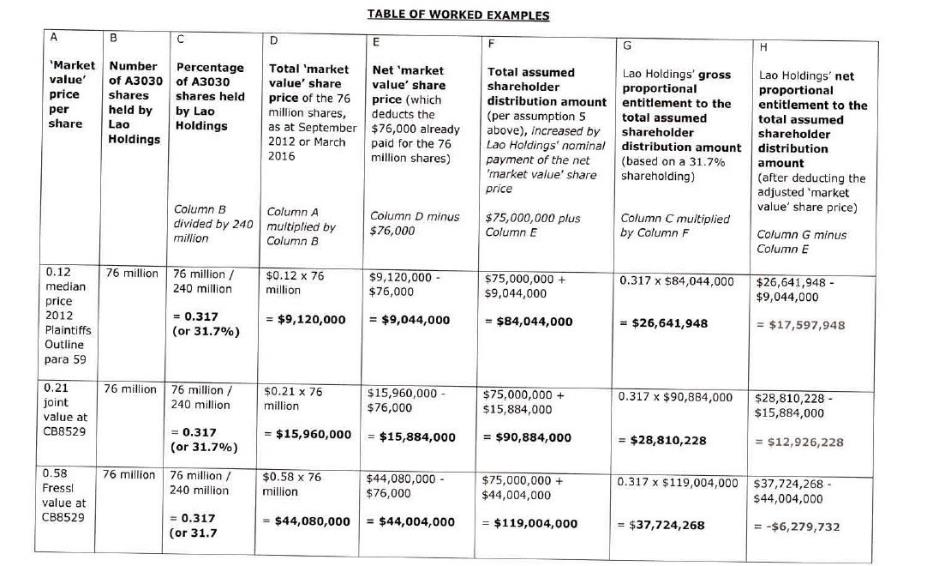
2. Under and pursuant to s 588FF(4) of the Corporations Act, Lao Holdings Pty Ltd pay the sum of $9,044,000 in respect of the 76 million shares issued to it pursuant to the March 2016 Share Issue.
3. The payment of the sum of $9,044,000 referred to in paragraph (2) of these orders is stayed pending the final distribution of the net assets of Aviation 3030 Pty Ltd (in liquidation). I direct the Plaintiff liquidators of Aviation 3030 to set off that sum against the distribution of the net assets of Aviation 3030 to which Lao Holdings is entitled, in accordance with paragraph [450] of these reasons.
4. The Plaintiffs’ costs of and incidental to this proceeding be assessed on an indemnity basis and paid as to 50% thereof by Lao Holdings. The payment of those costs in the sum assessed be stayed pending the final distribution of the net assets of Aviation 3030. I direct the Plaintiff liquidators of Aviation 3030 to set off those costs from the final distribution of the net assets of Aviation 3030 to which Lao Holdings is entitled, in accordance with paragraph [462] of these reasons.
5. The proceeding against the Seventh Defendant be dismissed with no orders as to costs.
Note: Entry of orders is dealt with in Rule 39.32 of the Federal Court Rules 2011.
ANASTASSIOU J:
INTRODUCTION
1 This proceeding was commenced in March 2020 by Aviation 3030 Pty Ltd (in liquidation) (the First Plaintiff) and its liquidators, Mr George Georges and Mr John Lindholm (the Second and Third Plaintiffs), collectively, the Plaintiffs. The case arose against the background of Aviation 3030 having entered into a contract to purchase a parcel of land near Point Cook, on the outer western fringe of Melbourne, in May 2011 for $7.8 million. Approximately 7 years later, in October 2018, Aviation 3030 contracted to sell the land for $135 million, settlement of which is to occur in April 2023 (being 54 months after the date of entry into the Contract of Sale). The difference represents a profit of approximately $127 million.
2 More specifically, the case concerns whether the issue of 152 million shares in Aviation 3030, at a price of $0.001 per share, to interests associated with its Founding Shareholders, being Mr Hakly Lao and Mr Khay Suong Taing, and members of the Lao and Taing families respectively, or corporate entitles associated with either of those families, constitutes an unreasonable director-related transaction contrary to s 588FDA of the Corporations Act 2001 (Cth), and, if so, the consequences that flow from that. The Plaintiffs’ claim also includes alleged breaches of the statutory and fiduciary duties that Mr Lao owed to Aviation 3030 as a registered director of that company, and related claims for accessorial liability founded on knowing involvement, knowing assistance and knowing receipt of benefits in connection with those alleged breaches of duty.
3 The liquidators of Aviation 3030 were appointed pursuant to winding up orders made by the Court on 20 March 2019 by O’Callaghan J on the application of the Australian Securities and Investments Commission (ASIC). ASIC applied for the winding up orders on the grounds that the orders were necessary for the public interest, to ensure investor protection and to enforce compliance with the law: see ASIC v Aviation 3030 Pty Ltd [2019] FCA 377 (the ASIC Proceeding). There is a question concerning the admissibility of O’Callaghan J’s Reasons in this proceeding. I shall return to that question below.
4 It is important to note that Aviation 3030 was not wound up on the grounds of insolvency. To the contrary, at the time of its winding up, Aviation 3030 had the benefit of a contract for the sale of the land, which as I have said above, will produce a substantial commercial profit. The present proceeding is thus unusual in that it concerns claims brought by the liquidators of a solvent company by which they challenge the issue of the 152 million shares referred to above.
5 If successful, the effect of the Plaintiffs’ challenge will alter the economic outcome of Aviation 3030’s investment in the land for the Founding Shareholders, or interests associated with them, relative to the economic interests of the Early Investors, being shareholders who invested in Aviation 3030 at an early stage to assist it in acquiring the land.
6 The principal legal question in this case is whether the remedies available, where there is found to be an unreasonable director-related transaction, apply to a solvent company. I have referred above to the relative interests of the Founding Shareholders. I have used the expression ‘Founding Shareholders’ for convenience, not because of any formal distinction between shareholders, as there is only one class. I have similarly referred to the other shareholders as the ‘Early Investors’, where it is convenient and sufficient to refer to them by that description. The Early Investors are all of the shareholders who are not the Founding Shareholders, most of whom made an investment in Aviation 3030 in or around 2011.
7 The parties to this proceeding as originally commenced were:
(1) Mr Hakly Lao (the First Defendant);
(2) Mr Chong Huy Taing (the Second Defendant);
(3) Lao Holdings Pty Ltd (the Third Defendant);
(4) Khay Suong Taing Aviation3030 Pty Ltd (KST Aviation3030) (the Fourth Defendant);
(5) Mr Khay Suong Taing (the Fifth Defendant);
(6) Ms Say Kim Taing (the Sixth Defendant);
(7) Ms Heng Kim Ou (the Seventh Defendant); and
(8) ASIC (the Eight Defendant). ASIC was removed as a defendant pursuant to orders made by consent on 18 March 2020.
8 Mr Hakly Lao did not file a notice of address for service in this proceeding, appear at the hearing or file any documents in connection with the proceeding. He was not represented during the hearing and did not participate in it. Accordingly, on the first day of trial, the Plaintiffs made an application pursuant to r 30.21 of the Federal Court Rules 2011 (Cth) that the trial proceed in respect of all Defendants, notwithstanding Mr Lao’s failure to appear. The Plaintiffs relied on the Affidavit of Michael Gordon Sloan sworn 31 March 2021, the Affidavit of Michael Gordon Sloan sworn 11 April 2021 and the Affidavit of Michael Gordon Sloan sworn 15 April 2021 in support of this application. On the first day of the trial I made an order to the effect sought and reserved the Plaintiffs’ costs in respect of that application.
9 The hearing of the proceeding commenced on 19 April 2021, and ran initially for 11 days. During the course of 2021, while the hearing was adjourned, the proceeding was settled as between the Plaintiffs and the Second, Fourth, Fifth and Sixth Defendants, being the Taing Defendants. The settlement was subject to approval by the Court pursuant to s 477(2B) of the Corporations Act. To that end, Anderson J made orders on 11 October 2021 approving the settlement deed between the relevant parties: see Lindholm (liquidator), in the matter of Aviation 3030 Pty Ltd (in liq) [2021] FCA 1244. Shortly thereafter, on 22 October 2021, I made orders by consent discontinuing the proceeding against those same Defendants.
10 The remaining defendants are therefore the First Defendant, Mr Hakly Lao and the parties associated with him; namely, the Third Defendant, Lao Holdings and the Seventh Defendant, Ms Heng Kim Ou, who is Mr Lao’s mother (the Lao Defendants). Lao Holdings was registered on 2 October 2012 with Mr Lao as the sole shareholder and director. At all relevant times, Lao Holdings was owned and controlled by Mr Lao and his mother, Ms Ou.
11 Returning to the background facts, the acquisition of the land that is the subject of this proceeding was pursued as a joint venture, or enterprise, between the Founding Shareholders. In the course of that enterprise, and in order to raise capital for the acquisition of the land, potential shareholders were canvassed, principally among persons known to the Founding Shareholders, many of whom are members of the Cambodian community in Melbourne. The Lao and Taing families are also members of the Cambodian community in Melbourne.
12 The circumstances relating to this capital raising are relevant to whether there was adequate disclosure to Early Investors concerning the proposed issue of 152 million shares to the Founding Shareholders or their associates. Whether there was adequate disclosure is, in turn, relevant to whether the impugned transaction was an unreasonable director-related transaction. The impugned transaction is referred to as the “March 2016 Share Issue”. As I shall explain in detail below, it was a transaction which involved members of the Lao and Taing families. Those families, or their associates, controlled Aviation 3030 during the relevant time.
13 If, as the Plaintiffs allege, the March 2016 Share Issue is an unreasonable director-related transaction, and assuming that a remedy is available in the context of a solvent company, whether the transaction was adequately disclosed, or forecast, is also relevant to what remedy should flow under s 588FDA of the Corporations Act. In this respect, the Third and Seventh Defendants say that there was no unreasonable director-related transaction, and even if there was, no remedy is available for a contravention of s 588FDA of the Corporations Act where the company is solvent.
14 I shall turn to address some preliminary matters before setting out the factual matrix and competing claims in greater detail.
PRELIMINARY MATTERS
Lay witnesses
15 The Plaintiffs called seven lay witnesses to give evidence at trial:
(1) Mr Terence Grundy, the independent director of Aviation 3030;
(2) Mr Michael Bishop, a solicitor at Pointon Partners (being the former solicitors for Aviation 3030);
(3) Mr Philip Webb, the former external accountant to Aviation 3030;
(4) Ms Eve Gothe, an early investor in Aviation 3030;
(5) Mr David Olsen, an early investor in Aviation 3030;
(6) Mr John Ribbands, of Counsel; and
(7) Ms Say Kim Taing, who was, prior to 22 October 2021, the Sixth Defendant to this proceeding (and is the wife of Mr Khay Suong Taing, and mother of Mr Chong Huy Taing).
16 This is a case in which the Plaintiffs submit that certain inferences ought to be drawn in respect of the Lao Defendants’ failures to either: (a) give evidence themselves, or (b) call particular witnesses to give evidence, for the following reasons.
17 First, and as stated above, Mr Lao did not give evidence at trial (either on his own behalf as the First Defendant, or in his capacity as sole director and shareholder of Lao Holdings at the time of the relevant events in March 2016). The Plaintiffs submit that the Court ought to infer that Mr Lao’s evidence would not have assisted his case, such that it is appropriate for a Jones v Dunkel [1959] HCA 8; 101 CLR 298 inference to be drawn against him. This is particularly so given the apparent centrality of Mr Lao in all of the events that are the subject of this proceeding. The Plaintiffs refer in this context to the statement in Blatch v Archer (1774) 1 Cowp 63; 98 ER 969; namely, that “all evidence is to be weighed according to the proof which [it] was in the power of one side to have produced, and in the power of the other to have contradicted”.
18 Second, the Plaintiffs submit that an inference ought to also be drawn against the Third and Seventh Defendants in respect of their failure to call Mr Lao to give evidence at trial. Indeed, the only witness called on behalf of the Third and Seventh Defendants to give evidence at trial was Jenny You (who was Mr Lao’s personal assistant and sometime-partner during the relevant period). I note for completeness that an outline of evidence for Vuong Do was filed and served by the Third and Seventh Defendants. However, Mr Do was ultimately not called to give evidence at trial, a failure about which the Plaintiffs make no submission.
19 It is unnecessary to express a view as to whether a Jones v Dunkel inference should be drawn at large, to the effect that Mr Lao’s evidence would not have assisted any of the Lao Defendants, as was urged by the Plaintiffs. Where, and to the extent, that such an inference arises and assists in resolving a controversy in the evidence, I have dealt with it at that point of my reasons.
Expert witnesses
20 The Plaintiffs relied upon the evidence of two expert witnesses in this proceeding: Mr Bruce Kerr of Savills (in respect of the valuation of the Property), and Mr Andrew Fressl of McGrathNicol (in respect of the valuation of Aviation 3030 shares and Aviation Unit Trust units).
21 Mr Kerr prepared one report, which was filed on 16 November 2020. That report was admitted into evidence without objection, and no party sought to cross-examine Mr Kerr. Further, the Third and Seventh Defendants’ expert witness on share valuation, Mr Richard Norris, expressly relies upon Mr Kerr’s valuation of the Property as an integer in his analysis.
22 Mr Fressl prepared two reports, dated 20 November 2020 and 26 March 2021, respectively. Both reports were admitted into evidence without objection. Mr Fressl also prepared a joint report dated 11 April 2021 in conjunction with the expert engaged by the Third and Seventh Defendants, Mr Norris.
23 There was cross-examination of both Mr Fressl and Mr Norris during an expert conclave held on 31 May 2021, at which time the two experts gave evidence concurrently.
Admissibility of affidavit of Mr David Leggatt
24 Late in the course of the trial, the Third and Seventh Defendants sought to adduce evidence by affidavit from David Leggatt, a solicitor who has previously acted for both Mr Lao and Aviation 3030, as a means for explaining why they did not call Mr Lao. The Plaintiffs object to the admission of this affidavit into evidence. They submit as follows.
25 First, the Plaintiffs say the entirety of the affidavit is irrelevant and therefore inadmissible. The Lao Defendants seek to adduce the evidence from Mr Leggatt in order to explain the absence of Mr Lao from the witness box. No evidence has been adduced, however, that could support a finding that the Lao Defendants ever intended, or attempted, to call Mr Lao to give evidence in the proceeding. On 28 August 2020, the Court made orders requiring the Defendants to file and serve “outlines of evidence for each lay witness whom they propose to call at trial”. No outline of evidence for Mr Lao was filed or served. No evidence has been given of requests made to Mr Lao to give evidence, provide instructions or to otherwise assist in the defence of the proceeding by the Lao Defendants.
26 In the circumstances, the Plaintiffs submit that the Court ought infer that the Lao Defendants never intended to call evidence from Mr Lao, and that such a decision was strategic. Belatedly, the Lao Defendants have sought to call evidence from Mr Leggatt – who has never acted for either Mr Lao or the Lao Defendants in this proceeding – in an attempt to avoid the inevitable consequence of that strategic decision. Further, none of the evidence sought to be adduced via Mr Leggatt’s affidavit addresses the period between 28 August 2020 (when the Court made its procedural orders for the filing and service of outlines of evidence) and 15 February 2021 (when the outlines of evidence were to be filed and served).
27 In the alternative, if the Court were to rule against the Plaintiffs’ general objection on the ground of relevance, the Plaintiffs submit that, in any event, the Court ought reject the evidence in:
(1) the fourth sentence of paragraph 19 of the affidavit, together with exhibit DTL-03; and
(2) the second sentence in paragraph 25.
28 As to the fourth sentence in paragraph 19 and exhibit DTL-03, the Lao Defendants accept that this part of the evidence cannot be admissible as proof of its contents, but submit that it is admissible to prove that the exhibited document was sent to Mr Leggatt. The Plaintiffs submit that the mere fact that the document was provided to Mr Leggatt is itself irrelevant; after all, the fact that it was sent to him does not form the basis for the expression of some admissible expert opinion by him. To this end, and as to the second sentence in paragraph 25, Mr Leggatt’s evidence of his opinion of Mr Lao’s mental health is expert medical evidence that Mr Leggatt is plainly not qualified to give.
29 Finally, to the extent (if any) that parts of Mr Leggatt’s affidavit are admitted into evidence, the Lao Defendants have consented to a direction being made pursuant to s 136 of the Evidence Act 1995 (Cth) to the effect that the use of those parts of Mr Leggatt’s affidavit that are deemed admissible be limited to rebutting any Jones v Dunkel inference that might otherwise be drawn against them for their failure to call Mr Lao to give evidence in the proceeding.
30 In all of the circumstances, the Plaintiffs submit that an adverse inference ought to be drawn against the Third and Seventh Defendants for their failure to call Mr Lao to give evidence in the proceeding. They have not explained their failure do so, and it ought be inferred that Mr Lao’s evidence would not have assisted their case.
31 Finally, the Plaintiffs submit that an adverse inference ought to also be drawn against the Seventh Defendant, Ms Ou, for her failure to give evidence at trial about the matters that are the subject of this proceeding. In this regard, it is notable that Ms Ou filed no witness outline, and gave no evidence at trial, in circumstances where no suggestion was ever made that she was unavailable or otherwise unable to do so. As with Mr Lao, the Plaintiffs submit that the Court ought to infer that any evidence given by Ms Ou would not have assisted her case.
32 The Third and Seventh Defendants submit that they only sought to tender the affidavit following evidence given by Mr Webb. More specifically, that issue arose during examination-in-chief, when Mr Webb was taken through multiple transactions involving payments made to various companies in which Mr Lao was a director or held shares. The Third and Seventh Defendants contend that the evidence seemed to have been elicited to demonstrate that Mr Lao had received significant benefits from payments to other companies and was not included in Mr Webb’s outline of evidence.
33 During Mr Webb’s examination-in-chief, Counsel for the Third and Seventh Defendants raised this issue and I allowed Counsel for the Third and Seventh Defendants to seek instructions as to this matter. The Third and Seventh Defendants submit that Mr Leggatt’s affidavit is admissible for the purpose for which it is tendered; that is, to show the impracticability of obtaining instructions from Mr Lao to call him as a witness, in particular that Mr Leggatt himself, who was acting for Mr Lao in a Magistrates’ Court criminal matter, found it difficult to get instructions.
34 In response to the Plaintiffs’ specific objections, the Third and Seventh Defendants submit that:
(1) Exhibit DTL-03 is a document that was made available to Mr Leggatt acting as Mr Lao’s lawyer. It is relevant to whether or not Mr Lao was in a position to give proper instructions or to appear at court. It is precisely the kind of information legal representatives would consider to assess the utility of seeking instructions from or calling Mr Lao. It is not led to prove Mr Lao’s actual medical condition but to show what was known by his legal representative.
(2) The second sentence of paragraph 25 does not contain an opinion of Mr Lao’s mental health. It expresses a concern, Mr Leggatt, as a lawyer, had about compelling Mr Lao to leave his apartment. The basis of that concern is set out in preceding paragraphs.
35 I accept the Plaintiffs’ submission that the entirety of Mr Leggatt’s affidavit is irrelevant. In short, although Mr Leggatt has acted for Mr Lao in other matters, I am not satisfied that his affidavit demonstrates any attempt by the Third or Seventh Defendants to contact Mr Lao or call Mr Lao to give evidence, or any reason why they could not have at least attempted to call Mr Lao, particularly considering the fact that Ms Ou is Mr Lao’s mother. Accordingly, I have not had regard to the affidavit in considering the evidence in this proceeding.
Admissibility of O’Callaghan J Reasons
36 The Plaintiffs seek to tender in evidence in this proceeding: (a) O’Callaghan J’s orders dated 20 March 2019, and (b) his Honour’s reasons for judgment dated 19 March 2019. The Plaintiffs submit that this tender is sought for the limited purpose of establishing particular findings and orders that were made in that proceeding in respect of Aviation 3030 (and by which, it is submitted, that company is now bound as a matter of res judicata and issue estoppel: see, eg, Jackson v Goldsmith [1950] HCA 22; 81 CLR 446 at 466 (Fullagar J); Port of Melbourne Authority v Anshun Pty Ltd [1981] HCA 45; 147 CLR 589 at 597 (Gibbs CJ, Mason and Aickin JJ)).
37 In this regard, the Plaintiffs seek to rely upon the following specific matters arising from or recorded in those documents:
(1) on 25 September 2018, ASIC commenced proceeding VID1223/2018 (being the proceeding before O’Callaghan J) in this Court, seeking the winding up of Aviation 3030 on grounds including the impropriety of the March 2016 Share Issue;
(2) in that proceeding, ASIC submitted to O’Callaghan J that the winding up of the Aviation Group was justified on the basis that “the conduct of the directors of the defendants [was] such that winding up orders [were] necessary for the public interest, to ensure investor protection and to enforce compliance with the law”;
(3) Aviation 3030 was ultimately found by O’Callaghan J to have been operating an unregistered managed investment scheme, contrary to the requirements of the Corporations Act; and
(4) on 20 March 2019, O’Callaghan J made winding up orders in respect of Aviation 3030 (and the Aviation Group more broadly), on grounds including the impropriety of the March 2016 Share Issue.
38 In seeking to rely upon O’Callaghan J’s reasons in this limited way, the Plaintiffs submit that they do not seek to rely on any findings of fact made by O’Callaghan J about any of the Defendants to the present proceeding (including but not limited to the Lao Defendants). Further, they say that s 91 of the Evidence Act 1995 (Cth) does not preclude the course proposed by the Plaintiffs. That section relevantly provides as follows:
(1) Evidence of the decision, or of a finding of fact, in an Australian or overseas proceeding is not admissible to prove the existence of a fact that was in issue in that proceeding.
(2) Evidence that, under this Part, is not admissible to prove the existence of a fact may not be used to prove that fact even if it is relevant for another purpose.
39 Further, s 93 of the Evidence Act relevantly states that:
This Part does not affect the operation of:
(a) a law that relates to the admissibility or effect of evidence of a conviction tendered in a proceeding (including a criminal proceeding) for defamation; or
(b) a judgment in rem; or
(c) the law relating to res judicata or issue estoppel.
40 The Plaintiffs submit that s 91 of the Evidence Act “does not prevent the tender of judgments which contain findings as to the existence of facts relevant to the issues in the trial in which they are tendered. It merely prevents the judgments from being tendered for the purpose of proving the existence of those facts”: Ainsworth v Burden [2005] NSWCA 174 at [109] (Hunt AJA, Handley and McColl JJA agreeing), cited with approval in Randall v Chief of the Defence Force [2020] FCA 1327 at [36] (Collier J).
41 The Plaintiffs also contend that whether s 91 operates to exclude the use of a decision or judgment “will depend upon an analysis of three things — (i) what facts were in issue in those proceedings; (ii) what facts were found in the decisions; and (iii) the use to which the [party in question] seeks to put those judgments — that is, what facts [they seek] to prove by their use”: A-G (NSW) v Martin [2015] NSWSC 1372 at [13] (Simpson J), also cited with approval in Randall v Chief of the Defence Force at [36] (Collier J).
42 The Plaintiffs submit that a “finding of fact”, in the sense that phrase is used in s 91, is not defined in the Evidence Act. In this regard, Schmidt J in A-G (NSW) v Mohareb [2016] NSWSC 1823 observed at [26] that:
While issues which arise for resolution in particular proceedings will very frequently depend on findings of fact made on the evidence, not every finding made, or conclusion reached on matters in issue involves a finding of fact. In some cases they involve the resolution of questions of law and often, the resolution of questions of mixed fact and law.
43 In that case, Schmidt J held (at [32]) that s 91 of the Evidence Act does not prevent the tendering of judgments:
unless the judgment is sought to be tendered to prove the existence of a fact that was in issue in the earlier proceeding. If tendered to establish the existence of the proceedings, who the parties were and how a question of law, or a question of mixed fact and law, was resolved in those proceedings, s 91 does not render the judgment inadmissible.
44 In the circumstances, the Plaintiffs submit that the tender of O’Callaghan J’s orders and reasons in this proceeding in the specific manner proposed is not precluded by s 91 of the Evidence Act, and ought to be permitted. Alternatively, if the Court were to conclude that s 91 of the Evidence Act prohibits the tendering of his Honour’s reasons and orders in this proceeding (even in the limited manner proposed), then the Plaintiffs submit that the Court should dispense with compliance with this provision pursuant to s 190(3) of the Evidence Act.
45 Relevantly, s 190(3) provides that the Court may order that s 91 (which, relevantly, is located in Part 3.5 of the Evidence Act) does not apply in relation to evidence if the matter to which the evidence relates is not genuinely in dispute, or if the application of s 91 would cause or involve unnecessary expense or delay.
46 In this regard, the Plaintiffs submit that the matters for which they seek to tender O’Callaghan J’s Reasons identified above cannot be said to be genuinely in dispute. They comprise:
(1) the fact of commencement of the proceeding before O’Callaghan J and statements of what was submitted by ASIC in that proceeding (insofar as the matters referred to at [37](1) and (2) above are concerned); and
(2) statements of the ultimate outcome (and resolution of questions of law) in that proceeding (insofar as the matters referred to at [37](3) and (4) above are concerned).
47 In these circumstances, the Plaintiffs submit that the limited use of O’Callaghan J’s Reasons and orders in this proceeding as proposed by the Plaintiffs will cause no injustice to the Lao Defendants. The Plaintiffs add that insistence on strict compliance with s 91 of the Evidence Act would only be productive of unnecessary delay and expense.
48 In response, the Third and Seventh Defendants submit that the Plaintiffs must demonstrate that, given the express restrictions on the use of O’Callaghan J’s Reasons, they contain evidence that could rationally affect the assessment of the probability of the existence of a fact in issue in this proceeding: s 55 of the Evidence Act.
49 As to the four matters the Plaintiffs seek to rely on, the Third and Seventh Defendants submit as follows.
(1) The commencement of the proceeding is admitted by [44] of the Defence and the originating motion is in evidence.
(2) The making of the ASIC submissions to O’Callaghan J is irrelevant to the existence or otherwise of a fact in issue in this proceeding.
(3) The unregistered managed investment scheme was a fact in issue in the ASIC Proceeding, and s 91 of the Evidence Act expressly states that an earlier decision is not admissible to prove the existence of a fact that was in issue in the earlier proceeding (even if it were otherwise a relevant fact in the later proceeding).
(4) The Third and Seventh Defendants do not dispute the making of the winding up orders and the orders have already been tendered.
50 The Third and Seventh Defendants submit that the reasons should therefore not be admitted, particularly as they are critical of the conduct of Mr Lao and Mr Huy Taing. The Third and Seventh Defendants contend that if the reasons are admitted, I should disregard any comments made by a different judge in a different proceeding that was based on different evidence and issues. The Third and Seventh Defendants further submit that the Court should not be influenced by anything said in O’Callaghan J’s Reasons, particularly in circumstances where each of the Second to Seventh Defendants made an application for his Honour to recuse himself from hearing this proceeding.
51 The Third and Seventh Defendants also made a number of other observations regarding O’Callaghan Reasons including, among others, that the March 2016 Share Issue was just one of a number of matters ASIC relied on in support of its application. The Third and Seventh Defendants submit that even if I were persuaded that O’Callaghan J’s Reasons were relevant, they should be excluded from evidence in the exercise of the Court’s discretion under s 135 of the Evidence Act as any probative value to demonstrate the matters the Plaintiffs seek to rely on is outweighed by the potential prejudice it would cause if it were admitted into evidence.
52 Considering the limited matters for which the Plaintiffs seek to rely on O’Callaghan J’s Reasons, and that those matters are facts about the commencement of a proceeding, statements of what was submitted in that proceeding and statements relating to the resolution of questions of law in that proceeding, I am satisfied that s 91 of the Evidence Act does not preclude those reasons from being admitted as evidence: A-G (NSW) v Mohareb at [32]. For the avoidance of doubt, I have not had regard to any other finding or matter in those reasons, save for those specific matters for which the Plaintiffs propose to rely on.
BACKGROUND FACTS
53 Most of the relevant facts in this case are not in dispute. Rather, the dispute concerns the characterisation of the relevant facts in context and the legal principles to be applied to those facts. However, to understand how the issues in this case arise, it is necessary to describe in some detail the relevant background facts. In so doing, I acknowledge the substantial assistance I have received from the Plaintiffs’ and the Third and Seventh Defendants’ written and oral submissions. Having regard to the narrow scope of any factual differences, as opposed to differences concerning the legal analysis of those matters, much of the following account of the relevant background facts is taken from the summary provided in the Plaintiffs’ closing written submissions dated 4 March 2022.
54 Where factual matters are not controversial, it has been convenient to essentially paraphrase, and at times plagiarise, those submissions. That has only been possible through the industry of Counsel and those assisting them, who have carefully and thoroughly summarised such matters on behalf of the Plaintiffs. In this regard it is of significance that the proceeding is brought by liquidators, who are also officers of the Court. The fact that the proceeding is one brought by the liquidators, and insofar as s 588FF(1) is concerned, can only be brought by a liquidator, has further substantive significance to which I shall refer below. However, for the time being, I shall focus on the relevant background narrative.
55 Aviation 3030 was incorporated by Mr Lao and Mr Khay Suong Taing on 4 May 201l. Mr Lao and Mr Khay Suong Taing had previously been business associates in connection with a company called “VKK”. Mr Lao first identified the property as a business opportunity. Initially, Mr Lao asked Mr Khay Suong Taing’s opinion about the investment, and later, for his participation.
56 Mr Lao has been a director of Aviation 3030 since its incorporation, and remains so as at the time of the trial of this proceeding. Mr Khay Suong Taing was replaced as a registered director of Aviation 3030 by his son, Mr Huy Taing, on 20 October 2011 (although Mr Khay Suong Taing became a registered alternate director for Mr Huy Taing in March 2012). In April 2013, Ms Ou became a registered alternate director for her son, Mr Lao.
57 At all relevant times, Aviation 3030 was advised by both external accountants and external legal advisors. Its external accountant was Mr Philip Webb (initially of Prime Charter and subsequently of Lindon Advisory). Its external solicitor was Mr Michael Bishop of Pointon Partners. Further, in 2016, John Ribbands of Counsel was engaged to provide legal advice to the company.
58 Information memoranda prepared by Aviation 3030 (addressed to potential ‘shareholders’ and ‘unitholders’) (collectively, Information Memoranda) relevantly stated that the company was incorporated for the “sole purpose” of acquiring and developing 240 acres of land located in Point Cook, Victoria. Those memoranda further stated that Aviation 3030 would conduct a capital raising in order to raise the funds required for this project, whereby shares in Aviation 3030, or units in one or more of the Aviation Unit Trusts, would be issued to investors. There was no dispute at the hearing that these statements were an accurate summary of the company’s business model in respect of the Property at the relevant times (and this business model is addressed further below).
59 As I have mentioned, in May 2011, Aviation 3030 entered into a contract to purchase the Property for a total price of $7.8 million (Purchase Contract). At that time, the Property was zoned as “green wedge zone”, being a zoning type with particularly restrictive permitted uses (insofar as general use and development are concerned).
60 However, in October 2012, the Property was rezoned as “farming zone”. This rezoning caused the value of the Property to significantly increase in value. In this regard, the unchallenged evidence of the Plaintiffs’ property valuation expert, Mr Kerr, was that by 17 March 2016, the value of the Property was $75.2 million, ex GST.
61 The Purchase Contract settled in December 2015, at which time Aviation 3030 became the registered proprietor of the Property.
62 In October 2018, Aviation 3030 entered into a contract to sell the Property to a third-party purchaser for $135 million (Sale Contract). A deposit has been paid to Aviation 3030 by that purchaser (and the sale is due to complete in April 2023).
63 Between 2011 and late 2015, Aviation 3030 sought to raise capital from investors for the purpose of funding the acquisition and development of the Property (Capital Raising). As indicated by the Information Memoranda referred to above, the Capital Raising took one of two forms: some investors were offered the opportunity to purchase shares directly in Aviation 3030, whereas others were offered the opportunity to purchase units in one or more of the Aviation Unit Trusts.
64 During the course of the Capital Raising, Aviation 3030 provided at least some investors with one or more of these Information Memoranda. It appears that various versions of the Information Memoranda were produced over time, and for different types of investor (shareholders or unitholders). There are some differences in content as between the versions of these documents. In particular:
(1) One key difference in content between versions of the Information Memoranda concerned the amount/s intended to be raised by Aviation 3030 via the Capital Raising. The different versions of the Information Memoranda variously record this amount as ranging from $19,795,748.52 to $21,194,676.09. Regardless of the precise figure used in this regard, it was not suggested by any party or witness that any of these Capital Raising targets were ever met – in fact, all of the evidence was to the contrary.
(2) A further key difference in content as between versions of the Information Memoranda addressed to shareholders (Shareholder IM) and those addressed to unitholders (Unitholder IM) concerned paragraphs 21 and 22 of the Shareholder IM. Those particular paragraphs did not appear in the Unitholder IM.
Those paragraphs read as follows:
21. If, within three years from settlement or prior to the date of rezoning of the Land (whichever is earlier), further funding is required for any costs associated with the Property (including, without limitation, rezoning costs), the Company intends to issue further Shares in the Company provided that the number of Shares on issue at any given time does not exceed 240 million Shares. The Company may also elect to retain, and not issue, Shares if further funding is not required.
22. Upon the full funds being raised as set out in the 'Disbursement of Funds' section of this IM, any remaining Shares not allocated shall be retained by the founders or their nominated entities.
65 It is against this background that the particular events giving rise to the March 2016 Share Issue took place.
66 First, on 18 September 2012, Mr Grundy, the independent director of Aviation 3030, resolved (as the sole director who voted on that resolution) that Aviation 3030 would enter into a so-called “Option Agreement”. This document is referred to in the Further Amended Statement of Claim as the “Purported Option Agreement”, because the Plaintiffs submit that, on the evidence before the Court, there are real doubts about whether it is bona fide and/or enforceable. I shall refer to this agreement as the “Option Agreement”, noting that one of the principal questions before the Court is whether the options issued under and pursuant to that agreement are valid and enforceable.
67 The Option Agreement purported to grant options to purchase up to 160 million shares in Aviation 3030 to “the Founders (or their respective nominees)”. ‘The Founders’ were stated in the Option Agreement to be, in the first instance, Mr Lao and Mr Khay Suong Taing. I have used the expression above of ‘Founding Shareholders’ in a more general sense to include associates of Mr Lao and Mr Khay Suong Taing. That phrase is not to be confused with “the Founders” as defined in the Option Agreement. The price at which these options were capable of being exercised pursuant to the Option Agreement was $1,000 per one million shares. In this regard, the Option Agreement relevantly states that:
(1) “[t]he Options consist of a right for the Founders (or their respective nominees) to collectively purchase up to one hundred and sixty million (160,000,000) shares (‘Total Options’) in equal proportions” at the stipulated subscription price;
(2) the options referred to could be exercised “at any time within five (5) years of the Effective Date (‘Option Exercise Period’) or as otherwise agreed in writing between the Company and the Founders”; and
(3) the options were to be exercised by the ‘Founders’ “delivering to the Company a notice in writing signed by both of the Founders within the Option Exercise Period, and specifying the number of Shares to be subscribed for pursuant to the exercise of the Options”.
68 At Recital A of the Option Agreement Mr Lao and Mr Khay Suong Taing are referred to as the “founders of the Company”. Recital C, however, defines Ms Ou and Mr Khay Suong Taing as “the Founders” (as a defined term). In this context, Recital B states that Mr Lao “has assigned all of his rights and interest under the Former Option Agreement to his mother, Ou, so that she becomes a founder in place of Lao in accordance with Lao’s letter to the company dated #”. The term “Former Option Agreement” is not defined in the Option Agreement. It may be inferred that this is intended to be a reference to the so-called “Grant of Options Letter” annexed to the Option Agreement.
69 Sometime after 25 August 2015, Ms Ou (Mr Lao’s mother) and Mr Khay Suong Taing (Mr Huy Taing’s father) each purported to execute an “Option Exercise Notice”. These documents are referred to in the Further Amended Statement of Claim as the “Purported Option Exercise Notices” because they were executed in apparent reliance on the Option Agreement, which the Plaintiffs allege suffers from the deficiencies referred to below.
70 There were two versions of the document entitled “Option Exercise Notice” in evidence. Both versions appear to be signed by Ms Ou and Mr Khay Suong Taing, and both are dated 25 August 2015 (although it appears that neither of the versions of this document was in fact executed on this date). Both versions signed by Ms Ou nominate herself to receive the shares in question, and both versions signed by Mr Khay Suong Taing nominate his wife, Ms Say Kim Taing) to receive the relevant shares. However, one version of the notices provides for the issue of 76.5 million shares (at an exercise price of $76,500), whereas the other version provides for the issue of 76 million shares (at an exercise price of $76,000). As is set out further below, it was the latter version that was ultimately acted upon by Aviation 3030 in making the March 2016 Share Issue.
71 At a meeting held on 10 March 2016, the Board of Aviation 3030 (comprising Mr Lao, attending by telephone, and Mr Huy Taing, as Mr Grundy was not in attendance) resolved as follows:
The Board resolved to accept the exercise notice from both founders and made note that each founder is required to make a payment to the company in accordance to [sic] the share price as stipulated. The Board is to issue the shares within 7 days of the notice provided. Huy Taing motioned this arrangement and Hakly Lao seconded it. The board resolved for Hakly Lao to instruct Michael Bishop from Pointon Partners to start the process to issue the shares.
72 These resolutions are referred to in the Further Amended Statement of Claim as the “10 March 2016 Resolutions”. It is unclear from the evidence which of the two versions of the Option Exercise Notice was before the Board at this time. For instance, Mr Huy Taing’s evidence was that he could not recall which version of the Option Exercise Notice was tabled at the 10 March 2016 Board meeting.
73 On about 16 March 2016, each of Ms Ou and Mrs Taing executed a “Share Nomination Form”. There is a question about the accuracy of the date on these forms, as a copy of the unexecuted form was sent by Pointon Partners to Mr Lao on 16 March 2016 at 2:31 pm, with the request that Mr Lao “please review this form carefully and if satisfactory, arrange for it to be signed by the appropriate persons”. An equivalent email was sent by Pointon Partners to Mr Huy Taing on 16 March 2016 at 2:32 pm. The above documents are referred to in the Further Amended Statement of Claim as the “Purported Share Nomination Forms”, because they were executed in apparent reliance on what the Plaintiff describe as the “Purported Option Agreement”.
74 The Share Nomination Form executed by Ms Ou refers to “the option agreement executed between myself […] and the Company on 18 September 2012”. It also states that she nominated Lao Holdings Pty Ltd (as trustee for the Lao Holdings Trust) as the party in whom would vest “all the rights in respect of the securities in the Company to be issued pursuant to the option exercise notice served on the Company on or about 10 March 2016”. That form was signed by Ms Ou, and also by Mr Lao (which was stated to be in his capacity as “the authorised representatives [sic] of LAO HOLDINGS PTY LTD […] as trustee for The Lao Holdings Trust”).
75 The Share Nomination Form executed by Mrs Taing was in broadly similar terms, albeit that it nominated “KHAY SUONG TAING AVIATION3030 PTY LTD […] as trustee for The Khay Suong Taing Aviation3030 No1 Trust” as the recipient of “all the rights in respect of the securities in the Company to be issued pursuant to the option exercise notice served on the Company on or about 10 March 2016”.
76 On 17 March 2016, the Board of Aviation 3030 (comprising only Mr Lao and Mr Huy Taing, as Mr Grundy abstained from voting) resolved to:
(1) approve the issue of 76 million fully-paid ordinary shares to each of Lao Holdings and KST Aviation3030; and
(2) complete share certificates in respect of those share allocations.
77 These resolutions are referred to in the Further Amended Statement of Claim as the “17 March 2016 Resolutions”.
78 On about 17 March 2016, Aviation 3030 received two payments of $76,000: one that bore the payment description “AVIATION 3030 LAO FOUNDERS SHARES”, and one that bore the payment description “AVIATION 3030 TAING FOUNDERS SHARES”. The Third and Seventh Defendants admit in this regard that Lao Holdings, as trustee for the Lao Holdings Trust, paid $76,000 for 76 million shares in Aviation 3030.
79 On or shortly after 17 March 2016, 76 million shares in Aviation 3030 were issued to each of Lao Holdings and KST Aviation3030 (this share issue comprising the “March 2016 Share Issue”, as defined in the Further Amended Statement of Claim).
80 Also in March 2016, the Lao Holdings Trust was settled. The trustee of this trust was Lao Holdings, and the beneficiaries were Mr Lao and Ms Ou.
Plaintiffs’ submissions concerning factual findings and conclusions.
81 I turn to the Plaintiffs’ submissions concerning the factual findings they contend support their case against the Lao Defendants, being Mr Lao, Lao Holdings and Mr Lao’s mother, Ms Ou.
82 The Plaintiffs submit that it cannot be doubted that the March 2016 Share Issue, issued at $1000 per one million shares, which equates to $0.001 per share, was below market value for those shares at the time of issue. That conclusion is not disputed by the Third and Seventh Defendants. They admit that the price paid for the shares acquired by Lao Holdings was less than the value of those shares in 2016 measured by reference to the assets and liabilities of Aviation 3030.
83 The price at which the shares were issued pursuant to the March 2016 Share Issue was significantly less than the prices paid by third party investors, which I have referred to as the Early Investors. An expert accountant, Mr Fressl, whose report was tendered by the Plaintiffs without challenge, noted that there were 22 different share prices for shares issued in Aviation 3030 during the Capital Raising. The prices ranged between $10 per one million shares to $350,000 per one million shares. However, Mr Fressl’s evidence was that during the Capital Raising, shares in Aviation 3030 were most commonly issued at a price per million shares of either $98,000, being $0.098 (observed 6 times), $120,000, being $0.12 (observed 8 times) and $140,000, being $0.14 (observed 3 times).
84 Some shares were issued at a price of $10 per million shares. Insofar as the price of $10 per one million shares is concerned, Mr Fressl gave evidence that this price was only paid by persons expressed to be Mr Lao’s “nominees”, in two transactions: one in July 2011, and one in December 2012. Mr Fressl concluded that these transactions, which involved issue prices that were “considerably lower than other transactions”, were not conducted on a commercially arms-length basis, and could thus be put to one side for the purpose of his analysis of the market price for Aviation 3030 shares.
85 This evidence concerning the prices at which the Early Investors acquired shares in Aviation 3030 is of significance to the question of whether, and if so how, a remedy may be fashioned in this case which balances the economic interests of the Founding Shareholders, now relevantly, Lao Holdings and indirectly via the Lao Holdings Trust, Mr Lao and Ms Ou, with the economic interests and reasonable expectations of the Early Investors. Also relevant to this question, in particular as to the reasonable expectation of the Early Investors, is the extent to which the issue of shares to the Founding Shareholders was foreshadowed to them at the time of their investments. I shall refer below to the evidence and submissions of the parties concerning disclosure to the Early Investors.
86 As stated above, the shares that were the subject of the March 2016 Share Issue were issued to (a) Lao Holdings as trustee for the Lao Holdings Trust, and (b) KST Aviation3030 as trustee for the Khay Suong Taing Aviation3030 No 1 Trust. In both cases, the beneficiaries of these share issues were Aviation 3030 directors Mr Lao and Mr Huy Taing, and their family members.
87 Insofar as the Lao Defendants are concerned, as at the dates of each of the 10 March 2016 Resolutions, the 17 March 2016 Resolutions and the March 2016 Share Issue (collectively, the impugned transactions), the sole shareholder and director of Lao Holdings was Mr Lao. At all relevant times, the beneficiaries of the Lao Holdings Trust were Mr Lao and his mother, Ms Ou.
88 Insofar as the Lao Defendants are concerned, Aviation 3030 received only $76,000 for the 76 million shares issued to Lao Holdings pursuant to the March 2016 Share Issue (being a price of $0.001 per share). The same sum was paid on behalf of KST Aviation3030. The Plaintiffs submit that as a result of the March 2016 Share Issue, Aviation 3030 was deprived of the ability to sell those 76 million shares for commercial consideration. It is relevant to observe in this context that according to the Shareholder IM, Aviation 3030 was not able to issue unlimited numbers of shares. That document states that the company could issue “a maximum” of 240 million shares which were issued in million share ‘lots’ (240 of which notionally corresponded to the 240 acres of the Property). Relevantly, prior to the March 2016 Share Issue, there were 87,000,010 Aviation 3030 shares on issue. The March 2016 Share Issue had the effect of increasing the number of shares on issue to 239,000,010 (being almost the “maximum” limit that the company had set for itself). If the March 2016 Share Issue was set aside (leaving to one side the shares issued by KST Aviation3030) Mr Lao would not hold any shares.
Valuation of Shares as a result of the March 2016 Share Issue
89 For the purpose of assessing the value received by the Lao Defendants as a result of the March 2016 Share Issue, and the quantum of the loss and damage suffered by Aviation 3030 in this matter, both the Plaintiffs’ expert (Mr Fressl) and the Third and Seventh Defendants’ expert (Mr Norris) were asked to value the 152 million shares that were the subject of the March 2016 Share Issue as at the time of issue in 2016. Whilst the experts were instructed to use slightly different dates for their valuation (29 February 2016 for Mr Norris, and 17 March 2016 (being the date of the March 2016 Share Issue) for Mr Fressl), the experts agreed that this difference would not have a material impact on their valuations.
90 As is recorded in the Joint Expert Report dated 11 April 2021, the experts agreed upon both:
(1) the appropriate standard of value to use (market value); and
(2) the appropriate method of valuation to use (the orderly realisation of net assets approach).
91 In this regard, both Mr Fressl and Mr Norris agreed that if it were assumed that the Option Agreement was binding and enforceable, then the value of the 152 million shares in 2016 was $0.21 per share (giving those 152 million shares a total value of $32,196,775).
92 This was also Mr Norris’ valuation of those shares if it were assumed that the Option Agreement was not binding and enforceable. However, Mr Fressl’s opinion was that if it were assumed that the Option Agreement was not binding and enforceable, then the value of the 152 million shares in 2016 was in fact $0.58 per share (giving those 152 million shares a total value of $88,183,041).
93 The scope of the experts’ disagreement in this regard was confined, and principally turned on the following matters:
(1) how they interpreted the assumption that the Option Agreement was not binding and enforceable; and
(2) to the extent that this question was to be answered by reference to the value of the 87 million shares already on issue prior to the March 2016 Share Issue, what, if any, discounts ought to be applied when valuing those shares.
94 The Plaintiffs submit that in both respects, the evidence of Mr Fressl ought to be preferred, for the following reasons.
95 In respect of the first matter, the Plaintiffs submit that it was both necessary and appropriate for the experts in this case to conduct their valuation task on the basis of two counterfactuals: one where the Option Agreement was not binding and enforceable, and one where the Option Agreement was binding and enforceable.
96 Whilst the Plaintiffs do not seek orders in this proceeding that formally impugn the entry into the Option Agreement (to which I shall refer to further below), the issues concerning the bona fides and enforceability of the Option Agreement make it appropriate for the experts to have conducted their valuations pursuant to both counterfactuals.
97 Insofar as the ‘no Option Agreement’ counterfactual is concerned, the Plaintiffs submit that Mr Norris failed to properly apply its underpinning assumptions. Mr Norris conceded that when valuing the 152 million shares that were the subject of the March 2016 Share Issue, he assumed that they existed, “because the company was bound to issue them”. The Plaintiffs submit that his reasoning in this regard was somewhat circular, referring to when he specifically said: “I was just assuming they existed because I’m instructed to value them. So I assumed they exist”. Critically, in doing so, he expressly assumed that those 152 million shares were issued for the price stated in the Option Agreement (being $152,000).
98 The Plaintiffs submitted that it was erroneous for Mr Norris to have done so. To assume that the 152 million shares were issued in accordance with the Option Agreement (and at the price provided for by that agreement) is directly inconsistent with the fundamental premise of this counterfactual. I agree with the Plaintiffs’ submissions in this respect. However, once the premise of the counterfactual is accepted, as the Plaintiffs suggest, the question remains as to the value of the 152 million shares issued pursuant to the Option Agreement.
99 By contrast, when performing his valuation in the context of this counterfactual, Mr Fressl did not assume any binding obligation by Aviation 3030 to issue the 152 million shares that were the subject of the March 2016 Share Issue. Rather, he identified the value of those shares by reference to the value of the 87 million shares already on issue in early 2016. In this regard, Mr Fressl assumed that, in the absence of a valid and enforceable option agreement, Aviation 3030 directors would not issue 152 million shares at a value that was lower than the value of the existing shares on issue at the time, and which would dilute those shareholdings. This is a key difference between the two experts’ approaches to the question of valuation of the March 2016 shares at the time of issue.
100 The Plaintiffs submit that Mr Fressl’s approach ought to be preferred by the Court, as it appropriately reflects the assumptions of the ‘no Option Agreement’ counterfactual. It also assumes – the Plaintiffs submit, appropriately – that directors acting in the best interests of the company would not ordinarily effect a share issue to the detriment of existing shareholders.
101 As to the question of discounts, Mr Fressl’s opinion was that no discounts are applicable when valuing the 87 million Aviation 3030 shares on issue, regardless of whether the Option Agreement is assumed to have been binding and enforceable. By contrast, Mr Norris applied minority interest discounts for lack of control (20%) and lack of marketability (25%) in both scenarios.
102 The Plaintiffs unsurprisingly contend that Mr Fressl’s evidence ought to be preferred on this point. They say Mr Fressl’s evidence was that an orderly realisation of assets methodology involves a realisation of assets, a deduction of realisation costs and a settlement of liabilities, followed by distribution of proceeds to shareholders on a pro rata basis (namely, reflecting their proportional shareholdings in the company). As Mr Fressl said, pursuant to this methodology, “you end up with a cashbox”, the contents of which is distributed accordingly (to shareholders and others). No discount for control is required, because there is no ongoing business in respect of which one might pay a premium for control (or, by contrast, in respect of which one might suffer a discount for not having control).
103 By contrast, Mr Norris’ approach involved making assumptions which are fundamentally inconsistent with the application of the orderly realisation of assets methodology (which, as observed above, Mr Norris agreed was the appropriate methodology to adopt in this case). As Mr Fressl stated in the joint expert report:
As the experts agree on the method of value, which is an orderly realisation and that there is a distribution of net proceeds to shareholders, the ability of a minority shareholder to “force a realisation” is not relevant.
The shareholders would choose to make a distribution of those proceeds in the absence of another project. There is no information as to another project and Aviation 3030 was a single purpose entity to take ownership and affect a rezoning of the Point Cook Land.
104 Given that the assumptions underpinning Mr Norris’ evidence appear to conflict with the tenets of the valuation methodology agreed upon by both experts and with the undisputed nature of the project being pursued by the company, the Plaintiffs submit that Mr Fressl’s evidence ought to be preferred in all of the circumstances.
105 As a matter of principle, in the sense of resolving the competing views of the experts, it is convenient at this point to state my reasons for preferring the evidence of Mr Fressl to Mr Norris. As I have said above, I agree with the Plaintiffs’ submission that Mr Norris appears to have misunderstood the premise of the counterfactual assumption that there was ‘no Option Agreement’. For the reasons advanced by the Plaintiffs, I also agree that in the present circumstances there is no warrant to discount the value of the 87 million shares on issue. In particular, I accept the force of the logic in Mr Fressl’s opinion that when applying an orderly realisation of assets methodology (which both experts agree is the appropriate methodology in the present circumstances), ‘you end up with a cashbox’. Accordingly, as there is no evidence that Aviation 3030 is to conduct any ongoing business, a premium for control, or discount for the lack thereof, is inapposite.
106 It is also convenient at this point to note the significance of the valuation of the 152million shares as at the time of the March 2016 Share Issue. It is worth repeating the alternative assumptions the experts were asked to make and to restate the essential differences between them. On the assumption that the Option Agreement was binding and enforceable, Mr Fressl and Mr Norris agreed that the value of the 152million shares in March 2016 was $0.21 per share, giving an aggregate value of $32,196,775. If, however, the Option Agreement was not binding, then Mr Norris values the shares at $0.21 per share (the same value he accords to the shares also on the assumption that the Option Agreement was binding), but Mr Fressl values the shares on the hypothesis that the Option Agreement was not binding at $0.58 per share, giving those 152 million shares a total value of $88,183,041.
107 For the reasons I have given above, I prefer the evidence of Mr Fressl, more specifically his analysis, to Mr Norris’ on the contending hypothesis, namely where the Option Agreement is assumed not to be binding. As stated above there is no difference between the experts in relation to the alternative assumption that the Option Agreement is binding.
108 Applying Mr Fressl’s and Mr Norris’ conclusions as to value on the assumption that the Option Agreement was binding and enforceable, the value of the shares issued pursuant to the March 2016 Share Issue was $32,196,775. Applying Mr Fressl’s conclusion as to value on the hypothesis that the Option Agreement was not binding and enforceable, the aggregate value of the shares purportedly issued pursuant to the March 2016 Share Issue (at $0.58 per share) was $88,183,041.
109 However, in my view, the valuation of the shares on the assumption that the Option Agreement was valid and enforceable is somewhat academic. If it was, and is, valid and enforceable according to its terms, and the 152 million shares were validly issued at the exercise price of $0.001 per share, the value of the shares, assuming an orderly realisation of assets methodology, is of little assistance in relation to the question of what, if any remedy, should be available in this case. That is because on the hypothesis that the Option Agreement is enforceable, it begs the question that is in issue in this case; namely, whether the shares issued under and pursuant to that Option Agreement should be upheld or set aside.
110 If the March 2016 Share Issue should be set aside, the valuation of the shares on the counterfactual assumption that the share issue was, and is, valid and enforceable, reveals the gain that will be enjoyed by the Early Investors; that is to say, the owners of the 87 million shares on issue at the time of the March 2016 Share Issue. They will be better off collectively by at least $32,196,775. However, that is on the assumption that the value of their shareholding at that time was effectively diluted by the issue of the 152 million shares issued at a price of $0.001 per share. If the alternative assumption is made; namely, that the Option Agreement is not valid and enforceable, or as the Plaintiffs put their case, that the March 2016 Share Issue is impugned, the gross collective benefit to the Early Investors would, on Mr Fressl’s analysis, be $88,183,041.
111 It seems to me that in relation to the question of loss or benefit, depending on whether the position is considered from the perspective of the Founding Shareholders or the Early Investors, the assumption that the Option Agreement is and was valid and enforceable, or that the March 2016 Share Issue was valid and enforceable, is relevant to an assessment of the substantive gain to the Early Investors and concomitant loss to the Founding Shareholders. From the perspective of the Early Investors, if this valuation assumption were adopted, they would have the benefit of a distribution of assets on an orderly realisation without having their notionally fractional interest in the underlying assets of Aviation 3030 diluted by the issue of shares at the strike price of $0.001 per share. Thus, the Early Investors would notionally have the benefit of the difference between the value of the shares assuming the Option Agreement was valid and enforceable as well as the difference in value between the strike price and the value of the shares, assuming that there was no Option Agreement.
112 The result on Mr Fressl’s analysis is that the Early Investors would be $88,183,041 better off, and the Founding Shareholders would, ipso facto, be worse off in the same sum. In other words, it does not matter for the purposes of assessing benefit, from the perspective of the Early Investors, or loss, from the perspective of the Founding Shareholders, whether the assumption is made that the Option Agreement is or is not enforceable.
113 The point of this distinction is that it exposes the corresponding loss and benefit if the Option Agreement, or the March 2016 Share Issue thereunder, is impugned. To put it another way, the loss of the Founding Shareholders directly equates to the benefit of the Early Investors. As I have said in the introduction to these reasons, in practical terms this proceeding involves a contest between the interests of the Founding Shareholders and those of the Early Investors. If the assumption that the Option Agreement is not ‘purported’ but is the actuality rather than the ‘counterfactual’, the valuation of the shares issued under the March 2016 Share Issue is then academic, as the Founding Shareholders, now relevantly only Lao Holdings, and indirectly Mr Lao and Ms Ou, would simply be entitled to the shares at the strike price for its 76 million shares of $76,000, irrespective of the value of those shares.
114 A valuation of the shares issued under the March 2016 Share Issue, on the assumption that the share issue was valid and enforceable, is however a proxy for the position the Early Investors would have been in, so far as the aggregate value of their shares in Aviation 3030 is concerned. If the March 2016 Share Issue was valid and enforceable, the effect would be to dilute the value of their shares by approximately $32 million, assuming an issue price of $0.001 per share. But in reality, there would be a dilution of their proportionate notional share of the underlying assets of Aviation 3030 by approximately $88 million, given the shares issued under the March 2016 Share Issue were issued without regard to the issue price under the Option Agreement, and were issued at the value reflective of the net assets of Aviation 3030 at that time.
115 The question of what, if any, dilution of the Early Investors is justified in the present circumstances is at the core of the contest of economic interests as between the Early Investors and the Founding Shareholders. It is a subject that I shall discuss further below in the context of what remedies may be appropriate.
Distribution of existing shareholders
116 The March 2016 Share Issue increased the number of Aviation 3030’s shares on issue from approximately 87 million to approximately 239 million. As a result of the March 2016 Share Issue, Lao Holdings and KST Aviation3030 went from holding zero shares in Aviation 3030 to collectively holding 63.6% of the total issued share capital of Aviation 3030.
117 The Plaintiffs submit that the March 2016 Share Issue had a significant dilution effect on the existing shareholdings of Aviation 3030. Specifically, existing shareholdings were reduced in value by 63.49% by the March 2016 Share Issue, which, in total dollar terms, represents a reduction in value of approximately $32 million.
118 The dilution in value of existing interests caused by the March 2016 Share Issue was the subject of express admissions by Aviation 3030 in a letter sent to its investors on about 5 September 2016, at the direction of ASIC. That letter was sent on the company’s behalf by its solicitors (Pointon Partners), and its content was expressly approved by each of the three registered directors of Aviation 3030 at the time (Mr Grundy, Mr Lao and Mr Huy Taing).
119 That letter reads as follows:
We confirm that we act for Aviation 3030 Pty Ltd (ACN 150 720 317) ('the Company').
You are receiving this letter as an investor in the Company ('Investor', and collectively 'the Investors'), that has made an investment in the Company either as a shareholder of the Company or as a unitholder of the Aviation3030 Investment Unit Trust, the Aviation3030 Holdings Unit Trust, the Aviation 3030 Heng Ly Unit Trust, the Point Cook Aviatation3030 Unit Trust and/or the Aviation3030 HL Unit Trust.
The purpose of this letter is to provide you with:
(a) details of a proposed sale of the Company's primary asset; and
(b) corrective disclosure in relation to matters concerning your investment,= of which you may be unaware.
This letter is being sent to you as part of an agreement between the Company and the Australian Securities and Investments Commission.
Sale of the Company's primary asset
(a) As you would be aware, the Company's primary asset is the property at Lot 1, Aviation Road, Point Cook in the State of Victoria ('the Aviation Road Property'). The Company has entered into negotiations with a prospective purchaser of the Aviation Road Property. A contract of sale has not been signed but negotiations are at an advanced stage. The key terms of the proposed sale ('the Sale') are as follows:
a. the Aviation Road Property is proposed to be sold for $145,000,000 ('the Purchase Price');
b. ten percent (10%) of the Purchase Price is payable on the day of the Sale;
c . twenty percent (20%) of the Purchase Price is payable six (6) months after the day of the Sale;
d. seventy percent (70%) of the Purchase Price is payable twelve (12) months after the day of the Sale;
e. the Sale will be subject to leases existing on the Aviation Road Property as at the day of the Sale; and
f . the Sale will be subject to the approval of the Company's shareholders. For that reason, and assuming that the Sale proceeds, you will be sent a Notice of Meeting and, at that meeting, the contract of sale will be presented to Aviation Investors for their approval.
Corrective disclosure
(b) On 17 March 2016, the Company issued 76 million shares to Lao Holdings Pty Ltd and Khay Suong Taing Aviation3030 Pty Ltd ('the 17 March 2016 Share Issue').
(c) Lao Holdings Pty Ltd is a company controlled by Hakly Lao, a director of the Company.
(d) Khay Suong Taing Aviation3030 Pty Ltd is a company controlled by Khay Suong Taing, a former director of the Company and father of current director of the Company, Chong Huy Taing.
(e) Prior to the 17 March 2016 Share Issue, the Company had a total of approximately 88 million shares on issue.
(f) Following the 17 March 2016 Share Issue, the Company has a total of approximately 240 million shares on issue.
(g) The 17 March 2016 Share Issue resulted in 63.33% of the Company's shares now being held by Lao Holdings Pty Ltd and Khay Suong Taing Aviation3030 Pty Ltd, both of which previously held no shares.
(h) Each of Hakly Lao and Khay Suong Taing paid $76,000 for their 76 million shares, representing a price of 0.1 cents per share of the Company.
(i) Other shareholders of the Company who ,purchased their shares prior to the 17 March 2016 Share Issue paid prices which ranged between 0.001 and 20 cents per share of the Company.
(j) The 17 March 2016 Share Issue was made pursuant to a document termed 'Option Agreement' between the Company, Khay Suong Taing and Heng Kim Ou (mother of Hakly Lao) dated 18 September 2012, which in turn annexed a letter dated 4 May 2011 from Aviation to both of Hakly Lao and Khay Suong Taing. Copies of these documents are attached for your reference.
(k) The 4 May 2011 letter purports to record a grant by the Company to Hakly Lao and Khay Suong Taing (in their capacity as 'Founders' of the Company) of options to collectively purchase up to 160 million shares in the Company at a price of $1,000 per million shares.
(I) The 18 September 2012 'Option Agreement' purports to record a grant by the Company to Heng Kim Ou (Hakly Lao's mother) and Khay Suong Taing of options to collectively purchase up to 160 million shares in the Company at a price of $1,000 per million shares.
(m) The Information Memorandum that may have been provided to Investors did not refer to the 4 May 2011 letter or, after 18 September 2012, to the 18 September 2012 'Option Agreement'. Paragraph 22 of the Information Memorandum states:
Upon the full funds being raised as set out in the 'Disbursement of Funds' section of this IM, any remaining Shares not allocated shall be retained by the founders or their nominated entities
(n) The 'Disbursement of Funds' section of the Information Memorandum anticipated approximately $19.8 million being raised by the Company from Investors.
(o) At the time of the 17 March 2016 Share Issue, the Company had not raised $19.8 million from investors.
(p) As a result of the 17 March 2016 Share Issue:
a. The proportion of the Company's shares held by each Investor has substantially decreased; and
b. the amount of any profits distributed by the Company to an Investor will be substantially lower than was the case prior to the 17 March 2016 Share Issue.
For your information, please refer to the 'table below for a comparison of effect of the 17 March 2016 Share Issue on the entitlement of typical Investors to any profits distributed by the Company. Please note that the table below is based on the Company earning a net profit of approximately $100,000,000 following the Sale, after accounting for the transactions costs associated with the Sale and taxation ('Net Profit') (that is, assuming the Sale in fact takes place and settlement of the purchase is completed).
Please note that nothing contained in this letter shall be deemed or construed as a guarantee, or assurance that the Sale will proceed on the terms specified in paragraph (a), if at all. Accordingly, and as noted above, the table below only provides a hypothetical comparison of the entitlement of typical Investors to any profits distributed by the Company.
Shares held by typical investor | Entitlement to net profit prior to the 17 March 2016 Share Issue | Entitlement to net profit prior to the 17 March 2016 Share Issue | Net Change to Net entitlement profit |
1,000,000 | $1,136,363.64 | $416,666.67 | ($719,696.97) |
2,000,000 | $2,272,727.27 | $833,333.33 | ($1,439,393.94) |
3,000,000 | $3,409,090.91 | $1,250,000.00 | ($2,159,090.91) |
4,000,000 | $4,545,454.55 | $1,666,666.67 | ($2,878,787.88) |
5,000,000 | $5,681,818.18 | $2,083,333.33 | ($3,598,484.85) |
Upon consideration of the above, you may wish to seek independent legal advice as to your rights as an Investor in relation to the amount you may expect to receive based on your investment.
120 It is relevant to note that the dilution complained of in this case is not merely the dilution of existing shareholdings in percentage terms. What is specifically complained of in this case is the dilution in the value of those shareholdings. Mr Fressl observed during the concurrent expert evidence session that, whilst the issue of shares by a company will ordinarily cause a dilution of existing shareholdings in percentage terms, the dilution does not also need to occur in “valuation terms – in dollar terms”. Accordingly, the price at which Lao Holdings acquired its 31.8% of the total issued share capital in Aviation 3030 is highly significant. The fact that Lao Holdings did not pay a commercial price for its 76 million shares means that existing shareholdings were diluted both in percentage, and also in value (as there was no commensurate increase in the company’s share capital as a result of the March 2016 Share Issue, as one would ordinarily expect in a commercially arms-length transaction where a market price is paid for shares).
121 I agree with the Plaintiffs’ submission that the March 2016 Share Issue diluted the existing shareholding in both percentage terms and as to the value of existing shares. As a matter of simple mathematics, the share issue at the strike price, or option exercise price, could not but have a diluting effect as described.
The bona fides and/or enforceability of the Option Agreement
122 The Plaintiffs submit that it is not necessary for this Court to formally determine the validity of the Option Agreement (or the resolution pursuant to which it was entered into) in order for the Plaintiffs to establish their entitlement to relief in this proceeding.
123 As I have said, the Option Agreement is not the subject of any specific claim for relief by the Plaintiffs in this proceeding. The Plaintiffs submit that the Option Agreement has effectively been ‘superseded’ by the actions taken in purported exercise of the options. Accordingly, formally seeking relief to set aside the Option Agreement (or the resolution pursuant to which it was executed) would be of no legal relevance.
124 That said, the Plaintiffs submit the circumstances of the preparation and execution of the Option Agreement remain relevant to the issues in dispute in this proceeding. This is because these matters have implications for the validity of steps taken by the Lao Defendants to exercise the options, and also for other aspects of the Plaintiffs’ case, in particular regarding disclosure.
125 Against this background, the Plaintiffs submit that the evidence before the Court raises real questions about the bona fides and/or enforceability of the Option Agreement. These matters arise principally from the circumstances in which the Option Agreement was prepared and executed in September 2012.
126 The Third and Seventh Defendants case proceeded on the basis that there was no ‘precursor’ agreement to the Option Agreement (namely, no pre-existing agreement which the Option Agreement is alleged to have sought to formalise, or to which it is alleged to give effect). In this regard, Counsel for the Third and Seventh Defendants stated during opening submissions that:
Now, just to make it clear, your Honour, we don’t contend or we – it’s not part of our case that this constitutes an agreement itself – the letter constitutes an agreement. It constitutes an expression of intention and we concede that there … appears to be no documentary evidence of an agreement having been struck in the technical sense of the word until September of 2012 which is when the documentation was prepared and signed by the company.
127 The correspondence to which the Plaintiffs’ Counsel referred during opening submissions records Mr Lao providing instructions to Pointon Partners between 10 and 18 September 2012 for the preparation of a number of documents for the first time (including the Option Agreement), some of which were deliberately backdated to 2011.
128 Critically, the contents of Mr Lao’s instructions (and Pointon Partners’ drafts) in this regard changed over this period, including in respect of key matters such as option price and effective date.
129 On 10 September 2012, Mr Lao sent an email to Mr Bishop, which relevantly stated:
Following up on our phone conversation, can you please help to prepare the options agreement as discussed.
Notes:
- Options for a total of 160,000,000 shares
Each 1,000,000.00 can be converted for $10.00
- The total number of shares issued to Hakly Lao and/or Nominee via this option agreement, may be issued to Khay S Taing and/or Nominee up to the same amount provided Khay S Taing has followed all directors duties satisfactorily by Hakly Lao
- This options agreement can be exercised by any given time Hakly Lao
Michael, as discussed, the date of the options agreement needs to be at the earlier stage, please confirm if the date during when Tayo was a director is suffice and if Tayo & I signing on behalf of aviation3030 with me signing again on behalf of Hakly Lao would be an acceptable agreement?
130 The email dated 10 September 2012 nominates an option price of $10 per one million shares – which is different from what was ultimately provided for in the Option Agreement (being $1,000 per one million shares).
131 The draft agreement provided by Pointon Partners to Mr Lao on 11 September 2012:
(1) provided, on its first page, space for insertion of a “2012” date for the making of the agreement;
(2) had no effective date or option subscription price inserted (Schedule);
(3) purported to grant the options to Mr Lao alone (cl 1.1);
(4) provided that only Mr Lao had the right to exercise the options (cl 3.3);
(5) provided that any ability on the part of Mr Khay Suong Taing to exercise the options was contingent on the consent of the Board of Aviation 3030 (which includes Mr Lao’s consent) (cl 3.4); and
(6) provided that Mr Lao could not assign the benefit of the agreement (or the options) without the prior written consent of the company (cl 8).
132 On 13 September 2012, Jenny You sent an email to Pointon Partners (copied to Mr Lao), which relevantly stated that “the effective date of the agreement is 30 June 2011”. As I have said, Ms You was the personal assistant to Mr Lao and apparently also an administrator of the company. For instance, Mr Grundy gave evidence that Mr You prepared for the relevant materials for Board meetings, liaised with all the consultants that were engaged by Mr Lao, and if there were any inquiries from investors or consultants, they went through Ms You.
133 The further draft provided by Pointon Partners on 13 September 2012:
(1) still provided, on its first and second pages, space for insertion of a “2012” date for the making of the agreement;
(2) had an effective date of 30 June 2011 and a subscription price of $1,000 per one million shares (Schedule); and
(3) purported to grant the options to both Mr Lao and Mr Khay Suong Taing as “the Founders” (Recital B; cl 1.1).
134 Mr Bishop gave evidence at trial that the price of $1,000 per one million shares came to be inserted as the option price in that draft as a result of a discussion he had with Mr Lao, in which he expressed the view to Mr Lao that it was not appropriate to use a purely “nominal” price of $10 (as one might for a company with no assets), as at the effective date under contemplation at that time (being 30 June 2011), Aviation 3030 in fact had the (valuable) rights to acquire the Property. Following this conversation, Mr Lao provided Mr Bishop with instructions to use a figure of $1,000 per one million shares.
135 On 17 September 2012, Ms You sent an email to Pointon Partners (copied to Mr Lao), which relevantly stated:
Thank you for speaking with Hakly and I.
Just to summarize you will prepare the following documents tomorrow morning:
1) Agreement between Hakly Lao and Khay Taing to be dated 2011
2) Letter from Hakly Lao nominating all rights to Heng Kim Ou
3) Agreement between Khay Taing and Heng Kim Ou to be dated tomorrow
[…]
As Hakly mentioned over the phone we will go through the documents with all parties in your office and if any changes need to be made you can email them across and we can arrange for them to be signed with Terry present […]
136 The email dated 17 September 2012 represents the first time that a suite of three documents, rather than a single agreement, was proposed in the correspondence between Mr Lao (and Ms You on his behalf) and Pointon Partners. Ms You gave evidence that Mr Lao asked her to communicate the instructions set out in this email to Mr Bishop.
137 These three documents were provided in draft form by Pointon Partners to Mr Lao on 18 September 2012 at 11:16 am, under cover of an email that relevantly stated as follows:
Please find attached for your review the following documents for this afternoon’s meeting:
Option Agreement between Hakly and Khay with the effective date 30 June 2011;
Letter to Aviation 3030 Pty Ltd from Hakly assigning his rights under Option Agreement dated 1 July 2011;
Option Agreement between Khay and Heng Kim Ou with effect from today.
138 The first document attached to this email:
(1) still provided space for insertion of a “2012” date for the making of the agreement;
(2) provided for the first time that the founders could assign the benefit of the agreement without the company’s prior consent (cl 8); and
(3) still provided for an effective date of 30 June 2011, and an option price of $1,000 per one million shares (Schedule).
139 The third document attached to this email:
(1) provided space for insertion of a “2012” date for the making of the agreement;
(2) identified Mr Lao and Mr Khay Suong Taing as the “founders” of Aviation 3030 (Recital A), but stated that Mr Lao had assigned his rights and interests under “the Former Option Agreement” to his mother, Ms Ou, “so that she becomes a founder in place of Lao in accordance with Lao’s letter to the Company dated #” (Recital B). (It is presumed that the references to the “Former Option Agreement” and “Lao’s letter to the Company dated #” are intended to refer to the first and second documents attached to Ms Morelli’s email (respectively). Executed copies of those documents are not in evidence (and for completeness, it is not suggested by any party that executed copies of those documents exist));
(3) provided that the founders could assign the benefit of the agreement without the company’s prior consent (cl 8); and
(4) made no provision for an effective date, but provided for an option price of $1,000 per one million shares (Schedule).
140 After receipt of Ms Morelli’s email of 18 September 2012, sent at 11:16 am, Mr Lao sent an email to Pointon Partners at 12:50 pm. Mr Lao referred to the three draft documents and stated:
I would like the first agreement to be simple, preferably just 1 page with a detailed one to supersede it.
1. Initial agreement
It can just make reference to:
160 million shares
Price at $0.0001 per share
Effective date
And make mention a more detailed one will be prepared
2. My letter nominating mum as beneficiary All ok here. Except if u can leave gap above my name to be wider so I can sign.
3. Final detailed agreement
I would like to introduce a fourth party to the agreement, Hakly Lao as “Partner”.
We will come down earlier than 2 pm to have it all sorted prior to Khay coming down. Will you be ok to see us in 30mins?
141 For the first time in the correspondence exchanged with Pointon Partners during September 2012, this email from Mr Lao suggests an option exercise price of $0.0001 per share (equivalent to $100 per one million shares).
142 On 19 September 2012, Ms You sent an email to Pointon Partners (copied to Mr Lao) which relevantly stated:
For your records I have attached copies of the following:
1) Grant of Options letter from Aviation 3030 Pty Ltd to Hakly Lao and Khay Suong Taing dated 4 May 2011
2) Letter from Hakly Lao to Aviation 3030 Pty Ltd nominating Heng Kim Ou as beneficiary dated 1 July 2011; and
3) Option Agreement signed by Khay Suong Taing, Heng Kim Ou and Aviation 3030 Pty Ltd
3 copies of the Option Agreement were signed yesterday afternoon, I will arrange for an original copy to be sent to your office for safe keeping.
143 Of the documents referred to in Ms You’s email:
(1) The first document is a signed copy of the so-called “Grant of Options letter” that is annexed to the Option agreement.
(2) The second document is an unsigned copy of the letter attached to Ms Morelli’s email of 18 September 2012, dated 1 July 2011.
(3) The third document is a signed copy of the Option Agreement.
144 An examination of this correspondence reveals that what occurred between 10 and 18 September 2012 was not the documenting of an agreement that had already been made, but rather, the creation of an agreement for the first time. This is consistent with the case as opened by the Third and Seventh Defendants at trial. As I have said, this agreement is not directly impugned on the Plaintiffs’ case. Rather, they seek to impugn the giving effect of this agreement by the March 2016 Share Issue.
145 The Third and Seventh Defendants seek to attribute weight to correspondence or events preceding the incorporation of Aviation 3030 in May 2011. Those Defendants specifically allege in their Defence that the Option Agreement had the effect of “granting options to Hakly Lao and Khay Suong Taing as founders […] as had been proposed in February 2011” (emphasis added). The particulars to this allegation state that: “[t]he issue of options was proposed in the letter dated 11 February 2011 referred to in paragraph 14J above” (which paragraph of the Defence relevantly refers to a letter sent by Pointon Partners to Hakly Lao on 11 February 2011.
146 It is unclear precisely what significance could be said to attach to the letter dated 11 February 2011, in circumstances where the Third and Seventh Defendants have expressly disavowed, as part of their case, the existence of any agreement preceding the Option Agreement. But for completeness, and in any event, an examination of the February 2011 letter in question reveals it to have little relevance to the matters that are the subject of this proceeding, for the following reasons.
147 The letter contains advice provided by Pointon Partners to Mr Lao in February 2011 (some months before the incorporation of Aviation 3030 on 4 May 2011). It bears no relation (and no relevance) to the Option Agreement created in 2012, as:
(1) the letter contemplates the incorporation of a public company (Aviation 3030 Ltd) as the relevant property investment vehicle to be used by Mr Lao (rather than the proprietary company, Aviation 3030, which was ultimately used for this purpose);
(2) the letter does not mention Mr Khay Suong Taing; and
(3) at most, the letter only raises the possibility of performance options being provided for “the founders” (who are not defined) of the property development project, insofar as it states:
We also note that you may wish to consider issuing options / performance shares to the founders, providing the founders with the right to receive an additional allotment of shares in the event that certain milestones are met.
As we discussed in conference, this would be an appropriate mechanism for enabling the founders to increase their holdings if the total 240m shares proposed to be issued do not get issued prior to sale of the Property.
These options / performance shares could thus be exercised in the event that a sale of the Property occurs prior to Aviation 3030 Ltd issuing the full allotment of 240m shares to public investors under Stage 2.
148 The Plaintiffs submit that in any event, mere advice about the possibility of using performance options in respect of a project does not equate to an agreed cause of action. To this end, Mr Bishop gave evidence at trial that, after giving this advice in 2011, he did not receive instructions for its implementation.
149 As Mr Bishop observed, in this case, “the reverse of what would normally [occur] […] occurred”, as “rather than shares being issued up front to them, the founders […] issued as a later step”. This was after the Capital Raising had commenced – by the time that the Option Agreement was executed in September 2012, approximately 67 million shares had already been issued to the Early Investors in Aviation 3030 (including the two third-party investors who gave evidence in this proceeding). Significantly, Mr Huy Taing gave the following evidence during cross-examination regarding this issue:
Was it your understanding that in respect of Aviation 3030 Proprietary Limited, that even though shares were being sold to members of the public - - -?---Yes.
- - - to those investors who came in and paid large sums of money, that notwithstanding that, the directors of the company could issue shares to themselves or their family at minimal cost?---At minimal cost. Yes, that’s right. Yes, they can issue because as I said, you know, had they issued the shares in the beginning, then it will be very minimal cost anyway. But, obviously, it wasn’t done. For what reason, I’m not sure because that’s Hakly and the lawyer. They ..... all that. I wasn’t there in the early days so I don’t know what was done. But usually, yes, when you start up a company, you know, the shares, you know – you pay very minimal for it. So – and that’s why I thought, okay. I mean, this has got to be a similar scenario where, you know, they – you know, as being a founder and, you know, should be entitled to, you know, the rights to the share. But – well, actually, he thought he was going to get share earlier, but it didn’t happen […]
[Emphasis added]
150 The Plaintiffs submit that, self-evidently, if the Option Agreement did not exist prior to 18 September 2012, it cannot have been disclosed to investors who purchased their shares in Aviation 3030 (and units in the Aviation Group) prior to that date. The Plaintiffs submit, therefore, that it is the timing of the preparation, execution and implementation of the Option Agreement (after Aviation 3030 had already been carrying out its Capital Raising for some time) that gave rise to the issues of disclosure (and the associated risks to Aviation 3030 of regulatory action and litigation).
Disclosure of the Option Agreement or options to which it refers
151 The adequacy of disclosure of the Option Agreement (and the options to which it refers) to investors is a central issue in this case. For the timing reasons given by the Plaintiffs, the Option Agreement, as a matter of practicality, could not be disclosed before it came into existence. However, the question remains as to whether Aviation 3030, and/or Mr Lao or Mr Khay Suong Taing disclosed to the Early Investors a proposal to issue shares to the Founding Shareholders pursuant to an option agreement to be entered. A substantial part of the hearing was occupied by evidence in relation to this issue.
152 The Plaintiffs submit that the issue as to the adequacy of disclosure informs the allegations made against the Lao Defendants – in particular, the allegations of breach of statutory and fiduciary directors’ duties. This is not disclosure in the sense of technical compliance with the corporate fundraising provisions of the Corporations Act (which provisions, Aviation 3030 admitted, in a letter sent to ASIC in February 2016, it had breached in the course of its Capital Raising). Indeed, the letter of February 2016 admits that Aviation 3030 contravened ss 706 and 727(1) of the Corporations Act in respect of part of its Capital Raising. Rather, the Plaintiffs submit that the question of disclosure in this proceeding concerns whether the Early Investors were properly informed, prior to investing in Aviation 3030 or the Aviation Group, of the following:
(1) the existence of the Option Agreement or its terms;
(2) the existence of any share option agreement of any kind in favour of the Aviation 3030 directors, their nominees or any other person; and/or
(3) the ability of Aviation 3030’s directors (or their nominees) to obtain shares in Aviation 3030 for a price that was significantly lower than that paid by other shareholders, with the effect that the value of existing shareholdings would be diluted.
153 Aviation 3030 and its directors were expressly warned by the company’s external legal advisers that the absence of proper disclosure of these matters to investors could result in regulatory action or civil litigation being commenced against Aviation 3030 (and even its eventual liquidation).
154 The Plaintiffs submit that these warnings offer a useful ‘model’ of what appropriate disclosure of the matters referred to in [152] above might have looked like had such disclosure been made in this case. One example in this regard is the ‘sample’ disclosure paragraph included by Mr Ribbands of Counsel in his first memorandum of advice (the text of which is set out below at [176]). Another example is the mandated disclosure letter sent by Aviation 3030 to its investors in September 2016, at the behest of ASIC. This letter to investors expressly identified:
(1) the existence, terms and effect of the Option Agreement (and in fact, it enclosed a copy of that document);
(2) the occurrence of the March 2016 Share Issue;
(3) the beneficiaries of the March 2016 Share Issue (being Lao Holdings, a company controlled by Mr Lao (an Aviation 3030 director), and KST Aviation3030, a company controlled by Mr Khay Suong Taing (a former Aviation 3030 director and father of current Aviation 3030 director, Mr Huy Taing));
(4) the number of shares issued to each of Lao Holdings and KST Aviation3030 (76 million), and the price paid for those shares ($76,000 each, being a price of $0.001 per share);
(5) that the full amount of funds identified in the Information Memoranda (and referred to in paragraph 22 of the Shareholder IM) had not been raised by Aviation 3030 prior to the March 2016 Share issue; and
(6) that as a result of the March 2016 Share Issue, each existing Aviation 3030 shareholding had been diluted, such that any profits distributed to those shareholders in future would be lower than was the case prior to the March 2016 Share Issue.
155 According to the Plaintiffs, a key consequence of this failure was (as was repeatedly warned by the company’s independent director and legal advisers in the months leading up to the March 2016 Share Issue) the exposure of Aviation 3030 to civil claims and regulatory action once the March 2016 Share Issue was effected.
156 The Plaintiffs submitted that the Third and Seventh Defendants seek to walk a fine line in this case insofar as disclosure is concerned. The Plaintiffs submit that the Third and Seventh Defendants have denied the existence of any ‘precursor’ agreement to the Option Agreement. The Third and Seventh Defendants have also admitted that the Information Memoranda did not refer to the Option Agreement (as they say that “the information memoranda were prepared and distributed prior to entry into the 2012 option agreement”). The Plaintiffs submit that during cross-examination of the third-party investors (whose evidence is addressed further below), the Third and Seventh Defendants made attempts to suggest that paragraph 22 of the Shareholder IM adequately disclosed a founders’ option. The Plaintiffs submit that this argument does not appear to be seriously pressed by the Third and Seventh Defendants in closing submissions and should in any event be rejected. The Third and Seventh Defendants’ defence (insofar as disclosure to investors is concerned) principally relies on assertions that:
(1) the Information Memoranda “stated that 240 million shares could be issued”, and “stated that shares could be issued at such price as the directors of Aviation 3030 Pty Ltd saw fit”;
(2) “forms” and “receipts” completed and received by investors stated that “there were to be 240 million shares issued”, and “each 1 million shares or units acquired by the investor represented a 1/240th interest in the project”; and
(3) “potential investors were also provided with information at investor presentation seminars conducted by representatives of Aviation 3030 Pty Ltd”.
157 The Plaintiffs submit that each of these arguments must fail, as none of the materials relied upon by the Third and Seventh Defendants in this regard provided adequate disclosure to investors of the matters referred to in paragraph [152] above. Before addressing each of these arguments in turn, it is appropriate to make some observations about the two third-party investors who were called to give evidence at the trial of this proceeding: Ms Gothe and Mr Olsen. Ms Gothe and Mr Olsen were honest and credible witnesses, and I accept their evidence.
Evidence of Aviation 3030 investors
Eve Gothe
158 The circumstances of Ms Gothe’s investment in Aviation3030 are as follows. Ms Gothe and her brother were Early Investors in Aviation 3030. In early 2011, Ms Gothe was working at TRUenergy with a colleague named Jimmy You. Mr You was the brother of Ms You. After Ms Gothe told Mr You that she had inherited some money and was considering the purchase of a house with her brother (as they were renting the house that they shared with their father at the time), Mr You introduced Ms Gothe to Ms You. Ms You offered Ms Gothe shares in Aviation 3030 at a price of $98,000 per one million shares (being a price of $0.098 per share). This was described to Ms Gothe by Ms You as being “the price usually offered to family”. Consistent with this, at trial Mr Khay Suong Taing gave evidence that the sale of Aviation 3030 shares was structured in four stages, based on what he observed other property development companies to do. In particular, he said that “[t]he first stage is the cheapest and then second stage, there is an increase. Third stage, another increase. Then fourth stage is another increase”. Ms Gothe, who was considering the making of an investment in early 2011, was a “first stage” investor.
159 Following some email correspondence and a meeting with Ms You that took place at Ms Gothe’s house, on 11 February 2011, Ms Gothe confirmed in an email to Ms You that she had decided to invest in one million shares for $98,000, being, as I have said, a price of $0.098 per share. Ms Gothe did not receive either of the Information Memoranda prior to making her decision to invest, or paying her deposit. The Information Memoranda were provided to her months later, by Ms You’s brother whilst he and Ms Gothe were at work. Even after receiving those documents, Ms Gothe never had any conversation with Ms You (or anyone from Aviation 3030) about the contents or effect of these documents, nor did she attend any of the “presentation seminars” at the offices of Aviation 3030, to which I shall refer below. Ms Gothe paid the balance of her investment amount in July 2011, and shortly thereafter received a share certificate confirming her purchase.
160 After receiving occasional newsletters from Aviation 3030 for a number of years, on about 16 August 2016, Ms Gothe received a call from a representative of Aviation 3030. That person said to her words to the effect that the Property was going to be sold, and that Aviation 3030 needed to have a meeting of all investors that evening. The meeting was held at the Aviation 3030 office in Keysborough, and lasted approximately 20 minutes. Ms Gothe gave evidence that the meeting was about the sale of the Property – she was told by a representative of Aviation 3030 that a buyer had offered to purchase the Property for $140 million, and she was asked to sign documents that she was told recorded her agreement as an investor to the sale of the Property at this price or greater. Ms Gothe gave evidence that she felt “a bit pressured” to sign these documents at the meeting and she was not given copies of what she signed (as to which, see further at [162] below).
161 Ms Gothe gave evidence that there was no discussion at this meeting in August 2016 of either the Option Agreement or the March 2016 Share Issue. She said further that prior to receiving the 5 September 2016 letter from Aviation 3030, she was not aware of these matters. Specifically, she was not aware of the possibility that: (a) the proportion of shares held by her as an investor could substantially decrease, or (b) the amount of profits distributed to her as an investor could be substantially reduced, as a result of shares issued to directors (or former directors) of Aviation 3030 (or companies associated with them) for a price of $1,000 per one million shares, being $0.001 per share.
162 Ms Gothe said she was “confused” and “angry” when she received the 5 September 2016 letter and learned – for the first time – of these matters. Ms Gothe also subsequently learned that whilst one of the documents she was asked to sign at the hastily-convened 16 August 2016 meeting was, in fact, a confirmation that she approved a sale of the Property “for any value above $120,000,000.00”, the other document that she was asked to sign on 16 August 2016 stated:
I understand that an investment in Aviation3030 is a multiple of 1,000,000.00/240,000,000.00 shares, is approximately equivalent to 1/240 Acres of land.
I understand that the company will not issue more than 240,000,000.00 shares.
As per the IM issued to me at the time of my investment, I acknowledge that I was made aware of the Founders entitlement (options) to retain the unissued shares, with the right to issue these at a later time from when the company was formed on 4 May 2011.
The founders are “Hakly Lao” and “Khay Suong Taing” or their nominated entity.
I acknowledge that the founders are not entitled to issue shares to themselves or their nominated entity if it exceeds 240,000,000.00 shares, but can do so if it is up to 240,000,000.00.
My investment is therefore a multiple of approximately 1/240 share/s in the company and will not be diluted from the founders exercising their entitlement to themselves or their nominated entity.
163 Ms Gothe’s evidence was that the third paragraph of this document (containing a purported acknowledgement regarding “the Founders entitlement (options) to retain the unissued shares”) was not brought to her attention at the time that she was asked to sign the document at the Aviation 3030 meeting on 16 August 2016. Crucially, she also said in her evidence that the paragraph was not accurate at the time that she signed the document, and the contents and effect of the paragraph came as a surprise to her in 2017 when she was shown a copy of the document.
164 At trial, Counsel for the Third and Seventh Defendants indicated that no reliance was sought to be placed on the above document by those Defendants in this matter. The Plaintiffs submit that this concession was wholly appropriate, given the circumstances in which Ms Gothe’s signature on this document was procured. As I have said, Mr Lao declined to participate in this proceeding and accordingly, there is no concession on his part. However, for the reasons given by Counsel for the Plaintiffs, I agree that no reliance could properly be placed on the document in the circumstances.
165 Following this, in 2017, Ms Gothe wrote to Aviation 3030 about the matters raised in the September 2016 letter. It was suggested by Counsel for the Third and Seventh Defendants, during cross-examination, that Ms Gothe had delayed in communicating with Aviation 3030 about these matters, or otherwise taking further action in respect of her concerns. The Plaintiffs submit that when her evidence is viewed in its totality, it cannot fairly be said that Ms Gothe is guilty of any relevant delay in voicing her complaints. To this end, Ms Gothe stated under cross-examination:
I’ve never invested in anything before in my life, so I had no idea that I had any rights or what I could do, and I just thought they were allowed to do that and they just had to tell us.
166 When cross-examined about why she did not seek legal advice immediately after receiving the 5 September 2016 letter (or immediately after receiving a subsequent 7 October 2016 letter from ASIC), Ms Gothe gave evidence that she could not readily afford it (having spent her available funds on the Aviation 3030 investment). I accept the Plaintiffs’ submission that having regard to Ms Gothe’s financial position, and other exigencies arising from that position, there is no warrant for any criticism of relevance concerning her failure to obtain legal advice earlier or raise a complaint in relation to the March 2016 Share Issue.
David Olsen
167 Mr Olsen is the managing director of D & J Olsen Pty Ltd, which carries on business as an importer of outdoor furniture and promotional products. Mr Olsen made his investment in Aviation 3030 in 2011, via D & J Olsen Pty Ltd as trustee for the Olsen Family Trust. The company paid $140,000 for one million shares in Aviation 3030 (being a price of $0.14 per share). The funds for this investment came from the company’s overdraft account.
168 Mr Olsen’s evidence was that in 2011 he completed an “Application for Shares” form at Aviation 3030’s Keysborough offices and paid for his investment by cheque, after which he believes that he received a “Receipt of Payment” document, the Information Memoranda, and a share certificate. Mr Olsen says that no particular parts of the Information Memoranda were ever explained to him.
169 Mr Olsen gave evidence that, prior to receiving the 5 September 2016 letter, he had “no idea at all” that the March 2016 Share Issue had occurred. He had never heard of the Option Agreement (or any founders option more generally). Nor did he know, prior to this time, that directors of Aviation 3030 (or companies associated with them) could purchase shares in Aviation 3030 at a price of $1,000 per one million shares (or $0.001 per share).
170 After receiving the 5 September 2016 letter, Mr Olsen contacted Aiation3030 to complain. When Mr Olsen did not receive a response, he instructed his solicitor to correspond with Aviation 3030. The response received from Pointon Partners (which asserted that there had been full disclosure of proposed share issues to investors) did not resolve Mr Olsen’s concerns. Mr Olsen’s evidence in this regard was: “I couldn’t say that there had been any disclosure until ASIC had forced them to make the disclosure”. In my view, Mr Olsen was a reliable and truthful witness and I accept his evidence.
Material relied upon by the Third and Seventh Defendants
Information Memoranda
171 The Plaintiffs submit that the Third and Seventh Defendants’ attempt to rely on the Information Memoranda in their disclosure case is complicated by the fact that the Court cannot be satisfied, on the evidence before it, that all investors in fact received one or both of the Information Memoranda prior to investing. In this regard, Ms You (who was charged with running the Aviation 3030 investment presentations (an issue which I address further below), and who was the only witness called by the Third and Seventh Defendants at trial) admitted in cross-examination that she could not say with certainty that every single investor received a copy of one or both of the Information Memoranda before they invested. This is consistent with the evidence of Ms Gothe, who gave unchallenged evidence that she did not receive either of the Information Memoranda until after she decided to invest and paid her deposit to Aviation 3030. Similarly, Mr Olsen gave evidence that he believed that he received the Information Memoranda shortly after writing the cheque for the full amount of his investment.
172 In addition, there is an issue as to the adequacy of the statements contained in the Information Memoranda on which the Third and Seventh Defendants rely. As noted at [156] above, the Third and Seventh Defendants rely upon three aspects of the Information Memoranda, as follows:
(1) paragraph 22 of the Shareholder IM, which referred to any excess shares being retained by the “founders or their nominated entities”;
(2) statements contained in the Information Memoranda to the effect that “240 million shares could be issued”; and
(3) statements contained in the Information Memoranda to the effect that “shares could be issued at such price as the directors of Aviation 3030 Pty Ltd saw fit”.
173 Turning to the first of these matters, paragraph 22 of the Shareholder IM provides as follows:
Upon the full funds being raised as set out in the 'Disbursement of Funds' section of this IM, any remaining Shares not allocated shall be retained by the founders or their nominated entities.
174 For reasons that are unclear, the Unitholder IM did not contain such a paragraph. The Plaintiffs submit that as a preliminary matter, therefore, paragraph 22 of the Shareholder IM could not possibly operate as effective disclosure unless it were established that all investors were provided with a copy of that document. This has not been established as a matter of fact. Relevantly, Ms You gave evidence that she could not say, about investors who did receive Information Memoranda, whether they received the Shareholder IM or the Unitholder IM (or indeed, which version of those documents they received).
175 Separately, and in any event, the Plaintiffs submit that paragraph 22 of the Shareholder IM does not assist the Lao Defendants on the question of disclosure, as:
(1) First, it is accepted by all parties that the event on which paragraph 22 is expressed to be conditional (namely, the raising of “the full funds” set out in the “Disbursement of Funds” section of the Shareholder IM) did not occur. The Third and Seventh Defendants admit in their Defence that at no stage did Aviation 3030’s Capital Raising raise any of the amounts stated in the Information Memoranda. This is confirmed by Mr Fressl’s unchallenged expert evidence that the total amount raised via the Capital Raising was only about $10,299,380. Further, the evidence before the Court was that in 2015, Aviation 3030 lacked the funds required to complete the Purchase Contract, such that it was required to borrow $8 million for this purpose. Thus, the Plaintiffs submit that in circumstances where the express precondition of paragraph 22 was never satisfied, that paragraph cannot have the effect of adequate disclosure of the Option Agreement (or the options to which it refers) to investors, regardless of its precise terms.
(2) Second, the Plaintiffs submit that if regard is had to the terms of paragraph 22, it is apparent that whatever this paragraph is referring to, it is not the Option Agreement. Contrary to what is provided by paragraph 22, the Option Agreement does not make the grant of options (or their exercise) conditional upon satisfaction of a fundraising condition. Whatever paragraph 22 may be referring to (and the person most likely to be able to answer that question, Mr Lao, chose not to participate in the trial), it is not the Option Agreement.
(3) Third, the Plaintiffs submit that the terms of paragraph 22 are opaque. The idea of “remaining shares” in Aviation 3030 that are “not allocated” being “retained by the founders” is a nonsense: as a matter of basic corporations law, shares are either issued or they are not. The Plaintiffs say such ambiguous language cannot be relied upon as effective disclosure of the Option Agreement.
(4) Fourth, the Plaintiffs submit that even if the matters identified in subparagraphs (a) to (c) above were somehow addressed (or otherwise overlooked), paragraph 22 does not disclose any of the key details of the options relied upon by the Lao Defendants. In this regard, paragraph 22 contains no reference to (i) the identity of the recipients of the options, (ii) the price at which the options might be exercised, (iii) the number of shares available pursuant to the options, or (iv) the timeframe in which the options may be exercised. These, it is submitted, are all matters that are critical to an investor having an informed understanding of the Option Agreement and the options to which it refers.
176 Indeed, as I have explained above, the inadequacy of paragraph 22 from a disclosure perspective is something of which Aviation 3030 and its directors were expressly warned by Mr Ribbands of Counsel. Mr Ribbands advised in his Memorandum of Advice dated 23 February 2016 that:
In my opinion, if item 22 in the information memorandum was genuinely intended to provide investors with advice as to the fact of the founder’s agreement and the options that have been reserved to those founders then it should have specifically said so. To that end, what should have been included, if the intention was to provide proper disclosure of the founder’s agreement, was akin to the following:
‘Upon the full funds being raised as set out in the ‘disbursement of funds’ section of this IM, any remaining shares not issued may be taken up by the founders or their nominated entities pursuant to an option agreement at the option exercise price of $1,000 per 1,000,000 shares.’
The overwhelming inference that is open to be drawn from the failure to provide such an express reference to the fact of the option agreement is that the founders were reluctant to disclose it.
177 The Plaintiffs submit that in this context, it is little surprise that Ms Gothe’s evidence was that she did not understand what paragraph 22 was trying to convey. Similarly, Mr Olsen gave evidence that he did not recall reading paragraph 22 at the time that he received the Information Memoranda, but that upon re-reading the paragraph at the time of giving evidence in this proceeding, he understood the reference to the founders “retaining” shares to mean that they would purchase them at market value. In the circumstances, the Court ought to find that paragraph 22 of the Shareholder IM affords no assistance to the Lao Defendants on the question of disclosure to investors.
178 Turning to the second matter raised by the Third and Seventh Defendants, being the statement contained in the Information Memoranda that “[t]he Company can issue a maximum of 240 million Shares”, the Plaintiffs make the following submissions.
179 Properly construed, this sentence does no more than state how many shares might potentially be issued in Aviation 3030. To this end, during cross-examination, Ms Gothe repeatedly denied the suggestion that she always “appreciated that [her] investment was equivalent to one-240th of the project”. By way of example only, a relevant exchange with Counsel for the Third and Seventh Defendants in this regard was as follows:
But I suggest to you that at all times, you appreciated that your investment was equivalent to one-240th of the project. Do you accept that proposition?---No, I just – again, it was all that I had a million shares. That’s all that we were, sort of –yes.
All right. Did you have any idea what the total number of shares were?---Yes.
And what was the total number of shares?---240 million.
Okay. So you had a million shares out of 240 million shares?---Yes.
And that’s what you were expecting to get, isn’t it?---Yes, I would guess. I – it depends how many shares were sold. That’s what I mean. I guess I could say if they were all sold then, yes, it would be one of, yes, 240.
[Emphasis added]
180 In this regard, Ms Gothe made a critical distinction between:
(1) knowing at all times that her one million shares in Aviation 3030 were, absolutely, a 1/240th interest in the total shareholding of Aviation 3030 (being the contention advanced by Counsel for the Third and Seventh Defendants); and
(2) the possibility that she would only have a 1/240th interest in Aviation 3030 depending on how many shares were ultimately sold by the company.
181 As Ms Gothe stated, when she committed to purchase one million shares in early 2011, she had “no idea how many shares had been sold” – she just knew that there were 240 million shares potentially available for sale. The Plaintiffs submit that this is not the same as Ms Gothe knowing at all times that her shareholding represented a fixed 1/240th interest of the total shareholdings in Aviation 3030. Indeed, the Third and Seventh Defendants’ submission in this regard does not address the fact that as a result of the March 2016 Share Issue, Aviation 3030 has 239,000,010 million shares – not 240 million shares – currently on issue. Ms Gothe’s shareholding today does not, therefore, reflect a 1/240th interest in Aviation3030, which is what the questions put to her during cross-examination by Counsel for the Third and Seventh Defendants seemed to assume.
182 Finally, the Plaintiffs respond to Third and Seventh Defendants’ reliance on the statement in the Information Memoranda that “[t]he Company reserves the right to issue Shares to investors under the Capital Raising at such price per Share as it sees fit” in the following manner. They submit that this statement does not contain the necessary information to constitute effective disclosure to investors. In particular, it does not disclose that company directors (or their family members) may be issued shares at a price that is significantly lower than the market value paid by third-party investors. When cross-examined about this statement, Ms Gothe gave evidence that she understood that the price at which she invested – being $98,000 per one million shares, or the “family” price – was “the lowest price you could get”. Accordingly, she did not understand this statement in the Information Memoranda to mean that shares could be issued for prices that were lower than what she (and other Aviation 3030 “family”, or early investors) paid. Similarly, Mr Olsen gave evidence under cross-examination that he understood this statement to mean that, if this power were exercised, the company would still sell its shares at market value.
Receipts and forms
183 In their Defence, the Third and Seventh Defendants allege that:
investors […] completed forms and received receipts which stated that:
(a) there were to be 240 million shares issued; [and]
(b) each 1 million shares or units acquired by the investor represented a 1/240th interest in the project.
184 It is on this basis that the Third and Seventh Defendants allege that the March 2016 Share Issue therefore “made good the investors’ expectation of having a 1/240th interest for each one million shares or units held”.
185 The Plaintiffs submit that this submission must be rejected, for the following reasons.
186 First, the Plaintiffs submit that the documents relied upon as receipt of payment are of limited assistance on the subject of disclosure. That is so because both Ms Gothe and Mr Olsen gave evidence that they received their receipts after they had decided to invest, and after making a payment (in Ms Gothe’s case, of a deposit, and in Mr Olsen’s case, of the entire investment amount). It is trite to observe that a document received after an investment has been made is of little, if any, utility from a disclosure perspective.
187 Second, and in any event, the Plaintiffs say that statements such as the sentence in the receipt of payment document to the effect that “Price: $___ to purchase___ of a total 240,000,000 shares at $____ per share” are insufficiently detailed to constitute effective disclosure. Properly construed, this sentence (and similar sentences in other documents) does no more than record how many shares, out of the maximum of 240 million shares in Aviation 3030 that were potentially available to be purchased, a particular investor had in fact agreed to purchase at a particular time. Statements to this effect do not communicate any of the matters referred to in paragraph [152] above. In this regard, although both Ms Gothe and Mr Olsen properly conceded under cross-examination that they were aware that 240 million shares could theoretically be issued in Aviation 3030, they both maintained that prior to receipt of the 5 September 2016 disclosure letter, they were unaware of both the Option Agreement, and the potential for, or fact of, the March 2016 Share Issue more generally. Their awareness of the former did not, therefore, have the effect of disclosing the latter.
Presentation seminars
188 The Third and Seventh Defendants’ Defence alleges that “seminars were conducted by Jenny You, Khay Suong Taing and others”, at which presentations were made “orally and by PowerPoint slides”. It is further alleged that at these seminars, “potential investors were […] provided with information” regarding the investment.
189 The Plaintiffs submit that as with the Information Memoranda, the Third and Seventh Defendants’ reliance on presentation seminars as a method of investor disclosure suffers, in the first instance, from the lack of evidence that all of the investors attended such a seminar prior to making their investments. In fact, the evidence before the Court is to the contrary. For instance, Ms You gave evidence that people could invest in Aviation 3030 without attending a presentation. Accordingly, Ms You could not say whether every investor attended a presentation or, indeed, how many of those who ultimately invested did attend such a presentation. This is consistent also with Ms Gothe’s evidence. Ms Gothe said that she did not attend any such seminar prior to investing (and it was not put to her in cross-examination that she did). The fact that not all investors attended a presentation seminar prior to investing necessarily reduces the weight that can be attributed to such seminars in a disclosure context.
190 Quite apart from this issue, the Plaintiffs submit that the Third and Seventh Defendants have not established that any of the matters referred to in paragraph [152] above were, in fact, disclosed to investors during these seminars. Mr Olsen gave evidence that prior to making his investment in 2011, he attended a seminar in Keysborough at which a presentation was made by a representative of Aviation 3030. During cross-examination, Mr Olsen gave evidence of his understanding at the time that his “one million shares represented equivalent to one acre of land”. He agreed that he understood in this regard that he was “getting 1/240 of the whole of the land”; namely, that his one million shares represented a notional interest of “1/240 of the whole of the land”. However, he maintained that at all relevant times, he understood that “up to 240 million shares may be issued” in Aviation 3030. In other words, that 240 million was maximum number of shares that might be issued. Critically, his evidence was that he did not recall anyone saying during the seminar that he attended that “once the project was through, any shares left would be retained by the founders”.
191 During cross-examination, Counsel for the Third and Seventh Defendants sought to question Mr Olsen about PowerPoint presentations that – it was put to him – were delivered during the seminar he attended in 2011. However, the PowerPoint presentations put to Mr Olsen in this regard reveals the unsafe premise on which this line of questioning was predicated. The presentations in question were almost certainly not delivered to Mr Olsen in 2011 before he made his investment, because they contain numerous express references to events occurring in future years (as late as June 2014). As Mr Olsen observed in re-examination after being taken to these references within the PowerPoint presentation, “it quite clearly shows that the presentation was made much later […] obviously, this presentation is well past that time” (there referring to 2011, when he attended the Aviation 3030 seminar).
192 Ms You also gave evidence about these investor presentations. Ms You accepted in cross-examination that, given the time that has passed since she delivered these presentations, the PowerPoint slides, rather than her independent recollection, comprise the best record of what she might have said to investors at the relevant time. In this regard, it is notable that the PowerPoint slides in question do not refer to how many shares were to be issued in Aviation 3030, nor do they refer to the Option Agreement (or, indeed, any kind of options for “founders”, Aviation 3030 directors or their family members and associates).
193 The Plaintiffs submit that to the extent that Ms You ultimately stated that during investor presentations she did refer to shares to be retained by the founders, this evidence ought to be treated with caution. First, Ms You was asked to explain the contents of her presentation in detail during examination in chief. Her explanation, which was elicited by non-leading questions, initially omitted any reference to the founders, options or the distribution of shares. It was only once Ms You was specifically asked the question, “And during the presentations, did you make any reference at any time to the founders?”, over objection by Counsel for the Plaintiffs, that she gave the following evidence:
So the company would issue/sell shares in accordance to the – how much money they needed to see the project through. And investors did ask what would happen with the remaining shares that weren’t going to be issued. And I would say that it would be retained by the founders.
And did you ever identify who the founders were? --- If the investors asked, yes.
194 Given the way in which this evidence was elicited, including the omission to mention such matters unprompted, the Plaintiffs submit that it is of reduced probative value. That is particularly so when it is appreciated that Ms You’d evidence is contrary to the evidence of Mr Olsen, who attended a presentation. Further, and in any event, the Plaintiffs submit that it is significant that Ms You’s evidence was that she told investors that unissued shares would be ‘retained’ by the founders (and identified the founders) when investors asked. The Court has no evidence about the frequency with which investors would ask these questions. All that is revealed by Mr Olsen’s evidence is that at the Aviation 3030 presentation he attended in 2011, there was no reference made to the founders, or any right of the founders to receive unissued shares.
195 In all of the circumstances, the Plaintiffs submit that the evidence before the Court is insufficient to enable it to conclude that there was proper disclosure of any of the matters referred to in [152] above during the investor presentations delivered by Aviation 3030. I agree with that proposition, for the reasons I have set out above and which I expand upon below.
Warnings to Aviation 3030 and its directors of the risks of proceeding with the proposed exercise of options
196 The Plaintiffs submit that prior to the occurrence of any of the impugned transactions, Aviation 3030 and Mr Lao (and Mr Huy Taing) were expressly warned: by (a) Aviation 3030’s independent director (Mr Grundy), and (b) its external legal advisers (Mr Bishop of Pointon Partners and Mr Ribbands of Counsel), of the risks that:
(1) neither the fact of the options, nor their proposed exercise, had been adequately disclosed to investors;
(2) the exercise of the options would significantly dilute existing shareholdings in Aviation 3030; and
(3) in the circumstances referred to in subparagraphs (a) and (b), the exercise of the options could result in regulatory action or other litigation being commenced against Aviation 3030, or even liquidation of the company.
197 Of particular significance to this issue is the fact that by late 2015, ASIC had commenced an investigation into Aviation 3030’s apprehended breaches of the Corporations Act fundraising requirements. In this regard, Mr Grundy’s evidence at trial was that the company faced a risk that, if the options were permitted to be exercised while ASIC was investigating the company, “the register would have been changed and then ASIC would have started an inquiry into the share options which would have expanded the initial inquiry”. In fact, this is precisely what occurred, as I explain further below.
The warnings given
198 The Plaintiffs conveniently summarised the key warnings delivered to Aviation 3030 and Mr Lao (and Mr Huy Taing) during the relevant period, regarding the risks associated with the exercise of the options in early 2016 as follows.
199 On 20 November 2015, Mr Huy Taing sent an email to Mr Grundy, copied to Ms Ou and Mr Lao. The email relevantly stated:
Hi Terry
Auntie Kim and my dad would like to exercise the founders option agreement before settlement.
Being a director can you please review the attach [sic] option Agreement dated 18 Sept 2012 and advise if you have any issues?
200 On 23 November 2015, Mr Grundy responded to Mr Huy Taing by email. That email relevantly stated:
I have perused the documents you attached to the email, all of which come as somewhat a surprise to me […] What I do find disturbing is that if the options are in fact exercised, this will have the effect of substantially diluting the value of the shareholding of the existing shareholders. A rough calculation shows the Taing and Lao family interests will hold collectively some 150 million shares out of a total of 240 million shares issued. I cannot see any reference to this issue in the Information Memorandum (other than a very brief comment).
As a director, I am proposing that I seek independent legal advice as to the validity of the Founders’ Agreement and the purported exercise of the Options before agreeing to consent to the exercise of the Options […] This reinforces the necessity for Jenny You and Hakly to hand over to Prime Charter all the files and records of the company.
201 Later that day, Mr Huy Taing forwarded this email to Mr Lao and Ms Ou, stating:
Hi Hakly & Auntie
Can you please review Terry’s email and provide the necessary documentation to satisfy Terry’s queries. We may face issues with transferring the founders unit.
202 On 11 February 2016 at 1:54 pm, Mr Grundy sent an email to Mr Bishop, copied to Mr Lao and Mr Huy Taing, which relevantly stated:
There was a meeting of the board of directors held yesterday.
Following the conclusion of the agenda items, Hakly Lao raised the issue of the founders’ options to subscribe for ordinary shares in the company as the founders of the Company on the terms set out in the “Grant of Options” letter dated 4 May, 2011. Hakly indicated that he and Khay wished to exercise the options.
Unfortunately, Hakly has all the documents and records of the company and he has failed to hand these over despite repeated requests to do so. My position as a director is not to agree to the allocation of shares in accordance with the Grant of Options pending an enquiry as to whether :-
1. The Grant of Options are valid and enforceable as against the Company.
2. The Options have been properly exercised.
3. Assuming that 1 and 2 are in order, whether or not the Grant of those Options will expose the Company to civil claims and / or regulatory action as a consequence of an apparent failure to disclose this arrangement to the incoming investors.
203 When cross-examined, Mr Huy Taing’s evidence was that he understood Mr Grundy’s email to mean that “even if the grant of the option was valid and enforceable, the company […] might be exposed to claims by investors or regulatory action by ASIC because of […] an apparent failure to disclose this arrangement to the incoming investors”. He said that he discussed the contents of this email with Mr Lao at the time.
204 Mr Bishop responded to Mr Grundy’s email later that day, at 3:36 pm (copied to Mr Lao and Mr Huy Taing). That email relevantly stated:
My view is that the founders options are prima facie exercisable as against the company by the founders in accordance with those documents. However it is a separate question as to whether:
(a) the company had made sufficient disclosure to investors. That is something which requires further instructions and discussions. if the instructions are that all non associated shareholders were well aware of the founders options and the terms of issue then one means of formalising that could be to convene a general meeting to have non associated shareholders ratify any proposed issue of shares pursuant to the exercise of the options; and
(b) whether even if non associated shareholders were to ratify the share issue, whether the options should be exercised at the current time when ASIC is investigating shares issues by the company.
My view, which I cannot expressly [sic] strongly enough, is that it would be extremely ill advised for the founders options to be exercised whilst the ASIC inquiry into the company is ongoing. Given that a breach of the fundraising provisions was identified and admitted to ASIC in our correspondence of Monday, the whole tenor of our approach was to seek to act in a contrite and cooperative fashion with ASIC so as to minimise the downside associated with that breach. That is, try to demonstrate to ASIC that the company is prepared to deal with that matter in a responsible manner and so that discussions can occur with ASIC as regards limited remedial measures such as offering investors the right to cancel their investment.
If ASIC perceives that the company is not acting in a responsible manner generally then ASIC will be far more inclined to take more extreme measures in relation to the contravention of the fundraising provisions, such as seeking the appointment of a liquidator to the company (which has occurred in some previous cases involving breaches of the fundraising provisions). A significant dilutory share issue in favour of the directors or their relatives for a minimal exercise price pursuant to the exercise of the options (and even if ratified by non associated shareholders) is likely to cause ASIC to take the view that the company and those who control it are not behaving responsibly and that control of the company’s affairs should pass from the current board. For instance, by the appointment of a liquidator. Therefore, to sum up, exercising the options now whilst the ASIC inquiry is ongoing is very likely to prejudice our defence of the ASIC inquiry and lead to a far worse outcome in relation to that inquiry than would otherwise be the case. If the appointment of a liquidator occurs then any benefits perceived to be gained from exercise of the options will be short term and illusory, as a liquidator may potentially look to unwind that exercise of options.
[Emphasis added]
205 When cross-examined about this email, Mr Huy Taing gave evidence that he understood that the risks for Aviation 3030 associated with the exercise of the options (which Mr Bishop specifically identified in his email) were serious matters for consideration by the company’s directors. He also said that he discussed this correspondence with Mr Lao at the time as being “a potential obstacle to an exercise of the options by the option holders”.
206 At 4:28 pm that day, Mr Grundy responded to Mr Bishop’s email, stating that he concurred with Mr Bishop’s views. At 4:29 pm, Mr Bishop sent an email to Mr Grundy which stated, “I have told both Hakly and Huy at least twice during phone conferences that they shouldn’t even think about exercising the options at the current time”. In this regard, Mr Bishop gave evidence at trial that his advice to Mr Lao and Mr Huy Taing at that time about the exercise of the options was that:
…they shouldn’t whilst there was an ASIC investigation underway. The expiry date for exercise of the options was still some months away, sort of, yes, 4 May still, sort of – yes, so three months later. So, in my view, there wasn’t any pressing urgency for the – the options to be exercised or the – or the matter to be resolved at that particular sort of point in time.
207 Following this email exchange, Mr Ribbands was retained to provide legal advice to Aviation 3030. In February 2016, he provided two memoranda of advice. The initial advice dated 23 February 2016 contained Mr Ribbands’ opinion on the adequacy of disclosure of the options to shareholders, whereas the further advice issued on 7 March 2016 contained his opinion on the process by which the options were required to be exercised pursuant to the Option Agreement.
208 The first advice provided by Mr Ribbands is of particular significance in this proceeding. A question arose at trial about to whom, precisely, this first advice was communicated. I note the following in relation to the first advice.
209 Mr Ribbands stated that he had been retained to advise Aviation 3030 “with specific reference to an option agreement granted to the ‘founders’ of the enterprise”, as the company was the subject of an ongoing ASIC investigation, and “[t]here is some concern as to the level of disclosure of the option agreement which has been provided to investors and what impact this might have upon the company in the context of the current ASIC enquiry”.
210 Mr Ribbands stated that:
In the context of the current ASIC inquiry into Aviation 3030 there is a concern on the part of the Solicitors for the company that the exercise of the options in accordance with the agreement may be inadvisable in that it might have the potential to encourage ASIC to pursue its investigation into the company. That issue would arise by reason of the manner in which the exercise of the options will dilute the interests of the existing shareholders. Where there is a suggestion that a company might be operating in such a way as to prefer the interests of some of the directors, or as in this case their families, over those of shareholders etc then ASIC may well pursue the matter […] Lawful conduct may nonetheless result in the appointment of a liquidator to an otherwise solvent company where the interests of others may be harmed or not adequately protected.
211 Mr Ribbands added: “[i]t is not enough to show that investors may still make a profit where, were it not for the conduct complained of, the investors might in fact have made an enormous profit”. He further said that “[i]rrespective of the value of the assets in the company, the real question from ASIC’s perspective, will not necessarily be limited to whether or not investors have made a loss or gain on their investments. Rather, whether what is proposed to be done by way of exercising the options that were provided pursuant to the founder’s agreement, was adequately disclosed to investors in the first instance”.
212 Mr Ribbands identified the key question for consideration as being “whether or not there has been a sufficient level of disclosure as to the terms of the founder’s agreement to incoming investors”. Mr Ribbands outlined his understanding that that paragraph 22 of the Shareholder IM comprised “the extent of the disclosure of the founder’s agreement for the purposes of informing incoming investors as to the fact of its existence”. However, he concluded that this paragraph did not constitute sufficient disclosure.
213 In particular, Mr Ribbands observed that Aviation 3030 had not met the fundraising condition specified in that paragraph, and also, “[m]ore fundamentally […] the terms of the option agreement itself were not in accordance with that which was described in paragraph 22 of the information memorandum”, as the Option Agreement contained no fundraising limitation of the kind referred to in paragraph 22 of the Shareholder IM. In this regard, Mr Ribbands observed that under the Option Agreement:
In fact, the less money that is raised would mean the less number of shares that are in fact issued. That in turn provides a windfall opportunity for the option holders on the basis that there are more shares available to be issued up to the maximum available of 240,000,000.
214 Mr Ribbands stated that in his opinion, “honesty” (or a lack thereof) would be “the basis for any attack upon the company and the directors from a disenchanted investor.” Mr Ribbands added that: “[t]he amount of money payable to founders or related entities in the first instance from the original ‘disbursement of funds’ coupled with the enormous benefit conferred upon the option holders clearly opens the door to a challenge on the basis of a deliberate failure to withhold information that was material to any decision to invest in the company.”
215 Mr Ribbands stated that, in his view, “the effect of the [Option Agreement] is such that it has a significant impact upon the equity of the existing investors so that the consequence of the failure to disclose it enlivens possible actions on the part of those investors to seek compensation. There will be a significant dilution of existing equity […]”.
216 Mr Ribbands also observed that concerns about whether the options had been adequately disclosed to investors gave rise to two issues for Aviation 3030 to consider:
(a) Whether or not the company ought not approach the option holders to seek an extension of time within which the option holders might be permitted to exercise the option. The benefit of an extension of time of say, one year, for the exercise of those options means the additional share issue does not need to take place now, being a point in time when ASIC is investigating the company; and
(b) Whether the issue of shares pursuant to the option will enliven civil action being brought by disenchanted investors against the company for its failure to make adequate disclosure […]
217 In respect of this first point, Mr Ribbands further observed that:
What is of concern, is that if those options are not exercised by the current expiry date of 4 May 2016 they will lapse. The options plainly confer a substantial benefit upon the option holders and it is in their best interests that they exercise those options prior to that expiry date. The exercise of those options before May 2016 however, may have catastrophic consequences for the company itself. For those reasons I suggest that the company should write to the options holders so that a variation of the time within which the options may be exercised is arrived at by mutual agreement between the parties.
[Emphasis added]
218 Mr Ribbands concluded:
On the assumption that at some point it [sic] time the option agreement will in fact be exercised then I have no doubt that the consequential diminution in value of existing shareholder’s interests will see those shareholders consider possible right of action against the company.
219 Mr Grundy gave evidence at trial that he accepted Mr Ribbands’ advice in this regard, and that he discussed it with Mr Huy Taing. However, he was not able to recall whether he discussed the advice with Mr Lao, but equally, he did not deny doing so.
220 In respect of his conversation with Mr Huy Taing, Mr Grundy said that he “discussed with Huy the benefit of extending the date for exercise of the option for 12 months whilst we sorted out the ASIC investigation and got this disclosure issue sorted out somehow to buy time”, but that Mr Huy Taing “declined that offer because he said that he and Hakly and the families wanted to exercise the options”.
221 As noted above, a question arose at trial about whether Mr Ribbands’ first advice was provided to Mr Huy Taing and Mr Lao prior to the 10 March 2016 Aviation 3030 Board meeting. At trial, Mr Huy Taing amended his Defence to deny that it had been. The Plaintiffs submit that although a full copy of Mr Ribbands’ first advice may not have been provided to Mr Lao and Mr Huy Taing prior to 10 March 2016, I should be satisfied on the evidence before it that the details of that advice were communicated to Mr Lao prior to this date. The reasons for this are as follows.
222 Mr Grundy gave evidence that he originally intended to table Mr Ribbands’ first advice at the regularly scheduled Aviation 3030 Board meeting in mid-March 2016, rather than provide the advice to Mr Lao and Mr Huy Taing in advance of that meeting. The reason for this seems to have been a concern that Mr Grundy had about ASIC, which was investigating Aviation 3030 at the time, obtaining a copy of Mr Ribbands’ first advice. To this end, on 3 March 2016, Mr Grundy sent an email to Mr Webb, copied to Mr Lao and Mr Huy Taing, which relevantly stated:
I have sent to you John's Memorandum of Advice on the Options transaction. This will need to be tabled at the next board meeting. I am reluctant to circulate the advice to board members as I am concerned about maintaining confidentiality and legal professional privilege. During the board meeting, Huy can read the memorandum and we will have to read out the memorandum to Hakly if he attends via conference telephone. Michael Bishop has received a copy of the memorandum. As you know, John has strongly advised that the board consider resolving that the period of time for the exercise of the Grant of the Options be extended by 12 months to enable sufficient time for the ASIC enquiry to be completed.
[Emphasis added]
223 Mr Lao responded by email, requesting a copy of Mr Ribbands’ first advice. When Mr Grundy sought Mr Ribbands’ opinion in relation to this request, Mr Ribbands said:
Don't send it
Write to him and say that we are concerned to ensure that it is kept confidential. You can say to him that what john has recommended is that the period within which the option may be exercised is extended for at least one year.
224 Several minutes later, Mr Ribbands sent a further email to Mr Grundy, stating “Ill [sic] call him”. Mr Ribbands gave evidence at trial that the purpose of the call referred to in his email was to speak with Mr Lao about his request to be provided with a copy of the first advice, and to discuss the contents of the first advice with him. Mr Ribbands said that he spoke with Mr Lao at that time about the exercise of the options, and described the content of their discussion as follows:
I outlined to him the basis of my opinion and the rationale for it. In essence, my advice to Hakly was that it was crazy for the option holders to seek to enforce the – to exercise the options now from the company’s perspective. I was acting for the company. I said it would be in the best interests if that didn’t happen because it would inevitably prompt action or further inquiry by ASIC, and that was not in the company’s interests as we saw it at the time.
And did Mr Lao, to the best of your recollection, ask for the detailed basis for that expression of opinion?---He did in the sense – perhaps not so much in those specific terms, but it was a discussion – I certainly elaborated on why I thought it was the case. And it was the case simply because the resulting benefit that would flow to those option holders for the relatively nominal price that was involved exercise [sic] the options would increase the ire of minority shareholders and attract the interest of ASIC.
And again to the best of your recollection, what was Mr Hakly Lao’s response to what you explained to him?---Hakly was a good client in many respects. He would listen to advice. But he didn’t always – he wouldn’t always take it. And that was always his prerogative, of course. And this would not have been a short conversation, as I recall. At the end of the exercise, I think he had made a decision that notwithstanding my view, he still wanted to press ahead with the exercise of the options. I think he was also concerned about the strict letter of the agreement with the pending expiry in May of that year and whether or not any extension of it would be – would be permissible or acceptable. So he was keen to ensure that the opportunity that was left to the option holders wasn’t lost, and so he then asked me, well, if we had to go ahead and exercise the options, how do we go about it?
225 As a result of this discussion, Mr Lao instructed Mr Ribbands to prepare a second memorandum of advice outlining “what steps would have to be implemented by the option holders so that the exercise of the options was valid and enforceable as against the company”. On 6 March 2016, Mr Lao sent an email to Mr Ribbands (copied to Mr Grundy and others), stating “Following out [sic] discussion during the week, looking forward to receiving your Memorandum of advice for both options when ready”.
226 Mr Ribbands sent his second advice by email to Mr Lao, copied to Mr Grundy and Mr Huy Taing one day later, on 7 March 2016. The second advice referred to Mr Ribbands’ first advice, insofar as it stated:
I have been asked to provide a further advice to Aviation 3030 with regard to an option agreement granted to the ‘founders’ of the enterprise. I previously expressed a view in an opinion dated 23 February 2016 that there were a number of advantages for the company if the option holders could be persuaded to consider delaying the exercise of their options. I have now been asked to advise as to whether the exercise of any options by the option holders can be considered as valid or invalid. In order to address that question, in the absence of an actual purported exercise of the options, it is simpler to look at the question from the perspective of the option holders. That is, what must be done by the option holders to ensure that the options have in fact been exercised properly?
227 At trial, Mr Ribbands acknowledged there was a potential conflict associated with advising Aviation 3030 on these issues, arising from the fact that “Hakly Lao’s family had a significant interest in the exercise of the options”. Mr Ribbands said, however, that he was very mindful of “crossing lines” in terms of to whom the advice was directed, hence the express statement that the advice was prepared from the perspective of the company.
228 Later on 7 March 2016, Mr Lao sent an email to Mr Ribbands, copied to Mr Grundy and Mr Huy Taing, stating, “I noticed your Memorandum of Advice refers to previous advice dated 25 February 2016, can you please send this across also”. In response, Mr Ribbands sent an email to Mr Lao on that same day, copied to Mr Grundy and My Huy Taing, that stated:
Hi Hak
That’s the advice that needs to be kept confidential and I understand is to be discussed at the next board meeting
I have already discussed with you the conclusions reached by me and the reasons for them. I understand however that the company has other plans with regard to the land and is not concerned with the current issues facing it. Those commercial decisions are outside the scope of my role but I don’t think they change my views as to the risks that the company faces […]
229 Before the regularly scheduled Board meeting in March 2016 could be held, on 8 March 2016 Mr Huy Taing advised Mr Grundy by email that an “impromptu” Board meeting would be called on 10 March 2016, “to discuss some urgent matters”. Mr Lao and Mr Huy Taing decided together that this meeting should be called. Mr Grundy was unavailable on 10 March 2016, and therefore did not attend that meeting. I pause to note this is the meeting at which the 10 March 2016 Resolutions were passed by Mr Lao and Mr Huy Taing, voting unanimously in their favour, as to which see [71] above.
230 These warnings about the risks associated with the proposed exercise of the options that were given to Aviation 3030 and its directors by the company’s external legal advisers may be contrasted with the advice that was unilaterally obtained by Mr Lao and Mr Huy Taing from m+k lawyers on 29 February 2016. The Plaintiffs submit that advice, which concluded that “it is unlikely that there is the ‘potential’ that a Liquidator could unwind the share issue”, was expressly based on instructions and assumptions which are demonstrably inaccurate. Accordingly, the Plaintiffs contend that is of limited probative assistance to the Lao Defendants in this proceeding. Specifically in this regard, the m+k advice contains the following statements:
(1) “We have been instructed that: […] every Investor/Shareholder was made aware of the Options which are the subject of this advice”;
(2) “Bearing in mind that all Investors knew about the fact of the Options […]”; and
(3) “On the basis of my instructions and presuming therefore that there will be no objections from other Shareholders, I cannot see how the exercise of the Options can prejudice the current ASIC investigation”.
231 The Plaintiffs submit that each of these ‘assumptions’ is (and at the time, was) inaccurate. In fact, they are directly contradicted by:
(1) the concerns regarding disclosure expressed by the company’s external legal advisers prior to the date of the m+k advice;
(2) the evidence of Ms Gothe and Mr Olsen to the effect that they were not aware of the Option Agreement until they received the 5 September 2016 disclosure letter (which was sent by Aviation 3030 at ASIC’s behest); and
(3) the number of complaints received by Aviation 3030 from its investors after the 5 September 2016 disclosure letter was sent.
Presaged events ensue
232 The Plaintiffs submit that the warnings given by Aviation 3030’s external advisers ultimately occurred as predicted. Mr Grundy said in an email sent to Mr Huy Taing, and copied to Mr Lao, on 5 May 2016:
The lawyer at ASIC who is conducting the enquiry has raised the issue of the options recently exercised by calling on the company to supply all documents relating to the transaction. ASIC has called for the documents following the lodgement of the Form showing the change in shares. In fact, a copy of the ASIC form lodged advising of the change in shareholding has been attached to the Notice served on the company today […]
You and Hakly were warned that this could occur, and John, Michael and Phil endeavoured to persuade you to defer the exercise of the options until the ASIC enquiry had concluded.
There is now a possibility that if ASIC finds that the options are unlawful, or not in the interests of the shareholder investors, that orders from the Court would be sought to set aside the share allocation and appoint a provisional liquidator to dispose of the company’s assets. There could also be prosecutions and civil claims against the directors and participants in the share scheme.
[Emphasis added]
233 The Plaintiffs in effect contend that there is a causal connection between the impugned transactions and the following events.
(1) ASIC’s investigation, which originally concerned compliance with the Corporations Act fundraising requirements, expanded to encompass the March 2016 Share Issue.
(2) In August 2016, ASIC issued proceedings against Aviation 3030, seeking: (i) appointment of a receiver to the Property, and (ii) orders prohibiting the company’s directors and agents from dealing with any proceeds of sale of same. Although this proceeding was ultimately resolved prior to final determination, Aviation 3030 was required to pay ASIC’s costs.
(3) In September 2016, Aviation 3030 sent a letter to its investors regarding the March 2016 Share Issue, following negotiations with ASIC, after which a number of complaints were made to Aviation 3030 by investors in respect of the March 2016 Share Issue.
(4) In December 2016, an investor by the name of the Guildford International Group Pty Ltd (as trustee for the Guildford Unit Trust) commenced proceedings in this Court against Aviation 3030, Lao Holdings and KST Aviation3030 (see VID 1460 of 2016), alleging (inter alia) shareholder oppression and breach of directors’ duties in respect of conduct including the March 2016 Share Issue (the Guildford Proceeding). The Guildford Proceeding is stayed pending the resolution of this matter.
(5) On 25 September 2018, ASIC commenced winding up proceedings against Aviation 3030 (see VID 1223 of 2018 in the Federal Court), on grounds including the impropriety of the March 2016 Share Issue.
(6) On 20 March 2019, winding up orders were made in respect of, and liquidators (the Second and Third Plaintiffs in this proceeding) were appointed to, Aviation 3030 and the Aviation Group.
Other benefits enjoyed by the Lao Defendants
234 The Plaintiffs submit that over time, both Mr Lao and Ms Ou have each received a number of benefits from Aviation 3030. More specifically, the Plaintiffs advance the following contentions.
235 First, the Plaintiffs submit that, quite separate from the March 2016 Share Issue, Mr Lao was at one point a shareholder in Aviation 3030. In this respect, Mr Khay Suong Taing gave evidence that he paid $285,000 to purchase one million shares on or around 4 December 2012. Mr Khay Suong Taing further explained that Mr Lao had sold those shares to Mr Khay Suong Taing in order to repay a debt to Aviation 3030.
236 Second, the Plaintiffs submit that Aviation 3030 made a number of payments to the Lao Defendants (or to companies or persons associated with them). These included payments for “Finders Fees”, “Acquisition Costs”, “Management Fees”, being project management fees and reimbursements of administrative expenses and “Consulting Fees” which comprised directors’ fees paid by Aviation 3030.
237 The Plaintiffs do not make any specific complaint in relation to these payments, other than as a responsive submission to the contention of the Lao Defendants that the minimal price paid for the shares in the March 2016 Share Issue was justifiable lest “the founders get nothing”. I will return to the question of the “benefits enjoyed” by the Lao Defendants below.
The Third and Seventh Defendants’ submissions regarding disclosure to investors and warnings given to the Board of Aviation 3030
238 Having set out a detailed account of the events concerning the relevant actors and impugned transactions, I turn to the Third and Seventh Defendants’ submissions concerning disclosure of the Option Agreement to Early Investors and warnings given to the Board of Aviation 3030 not to issue shares pursuant to that Option Agreement.
239 Before doing so, it is useful to recap the core propositions that underlie the Plaintiffs’ claims in this proceeding. Those are, first, that Aviation 3030 failed to adequately disclose to Early Investors the Option Agreement and the terms upon which shares were to be issued to the Founding Shareholders pursuant to that agreement; and second, for reasons that were explained to the Board of Aviation 3030 at the relevant time, the company was warned in the clearest possible terms not to issue shares pursuant to the Option Agreement. In this respect, the advice given to the Board of Aviation 3030 was prescient, in that what was anticipated would very likely ensue if the shares were issued, did in fact occur.
240 The above ‘double-barrelled’ attack on the issue of the shares pursuant to the Option Agreement is the foundation for the primary claim made in this proceeding for setting aside the share issue as an unreasonable director-related transaction. It is also the factual foundation for related statutory and equitable claims against Mr Lao for breaches of directors’ and fiduciary duties, and against the Third and Seventh Defendants for accessorial liability pursuant to s 79 of the Corporations Act in relation to Mr Lao’s breaches of his statutory directors’ duties, knowing receipt of benefits derived from those breaches of duty, and/or knowing participation in relation to them. I shall refer to these claims further below.
241 The defence of the Third and Seventh Defendants to the Plaintiffs’ allegations of inadequate disclosure of the Option Agreement and the shares issued thereunder to the Founding Shareholders, as well as the allegations that Aviation 3030 and its directors failed to have regard to, or disregarded, the warnings given to it by its external legal advisers, should be understood in the context of their principal defences to the Plaintiffs’ principal claims under the Corporations Act.
242 At [3] of their closing submissions the Third and Seventh Defendants say:
The third and seventh defendants, Lao Holdings Pty Ltd and Kim Ou, deny the transactions constitute unreasonable director-related transactions and contend that, even if they do, s.588FF(4) precludes recovery. The transactions in 2016 represented the implementation of contractual obligations assumed in 2012 and any recovery will not be for the benefit of creditors as required by s.588FF(4)
243 That contention is the principal defence advanced by the Third and Seventh Defendants. I shall return to the contending submissions concerning the application of s 588FF of the Corporations Act below.
244 The Third and Seventh Defendants do not advance any affirmative contentions concerning the adequacy of disclosure of the Option Agreement to Early Investors. They do not say that the Early Investors were informed of all matters which may be reasonably expected to have been disclosed concerning the Option Agreement. Rather, they submit that the Plaintiffs do not allege that the Shareholder IM failed to comply with statutory requirements of the Corporations Act, or that Mr Lao breached duties he owed to the company in the preparation of the Information Memoranda. They further submit at [40] of their closing submissions that: ‘There is no evidence that any investor did not receive a memorandum or did not attend a presentation.’
245 The main focus of the Third and Seventh Defendants’ submissions concerns the warnings given to Aviation 3030 not to issue the shares under the Option Agreement at the time. As to those warnings, the Third and Seventh Defendants advance several propositions. First, they say at [10] of their closing submissions, as to the memoranda of advice given by Mr Ribbands: “Only the later shorter memorandum was provided to Hakly Lao and Huy Taing.”
246 The Third and Seventh Defendants refer to and rely upon the advice given by Mr Ribbands in the further memorandum of advice. In particular, they rely upon the advice contained at [8], which states as follows:
The option agreement is binding on the company insofar as there are rights and benefits that remain able to be enforced by the option holders i.e. it hasn’t lapsed. The company has no legal means where by it can revoke the options. Even if it purported to do so, the option holders may still exercise the options, and as long as that exercise is compliant i.e. in accordance with the terms of the grant, the company is bound by it
247 They say further that the predictions of “catastrophe”, as Mr Ribbands described the consequences of issuing shares pursuant to the Option Agreement at that time, “were not as great as might have been feared”. They note that the particulars to the Plaintiffs’ Further Amended Statement of Claim in this regard refer to only four complaints. Those complaints were made by Daryl Williams (on behalf of himself and Serge Valentino), David Olsen (on behalf of D&J Olsen Pty Ltd), Eve Gothe and an investor named “Joseph”.
Consideration of disclosure to Early Investors and warnings not to issue shares in March 2016
248 As the Third and Seventh Defendants correctly observe, there is no allegation that Aviation 3030 contravened any statutory provisions relating to disclosure in the context of the Capital Raising. The Plaintiffs’ case is rather that the failure to disclose the Option Agreement to the Early Investors and the diluting effect of the March 2016 Share Issue, was highly likely to expose Aviation 3030 to claims by investors and also by ASIC. The Plaintiffs’ case is that exposing Aviation 3030 to such claims, particularly in circumstances where the company was already at the time subject to scrutiny and investigation by ASIC, was not in the best interests of the company.
249 The Plaintiffs point to the incontrovertible fact that the Option Agreement post-dated the relevant Capital Raising and the issue of shares to the Early Investors. Self-evidently, as the Option Agreement did not come into existence until after the issue of shares to Early Investors, it was not possible to disclose, in terms, the Option Agreement. That is not to say that it was by any means impossible for Aviation 3030 to have notified potential investors of the proposal to enter into an Option Agreement, including the substantive provisions of such agreement and especially the price at which it was proposed to issue shares to the Founding Shareholders. The prospect of granting options to the Founding Shareholders had been the subject of discussion with external advisers as described above. However, the proposal was not implemented until the Option Agreement was entered into on 18 September 2012.
250 The disclosure to the Early Investors must be viewed in the context of the way Aviation 3030 went about its Capital Raising activities. The evidence about these activities reveals that Aviation 3030 took an informal and unstructured approach to fundraising in the period that the Early Investors acquired shares in the company. Mr Khay Suong Taing gave evidence of his fundraising activities, in particular introducing the investment, including conducting inspections of the land, with potential investors. Mr Khay Suong Taing used his connections with the Cambodian community in Melbourne to promote the investment. The fundraising activities were relatively informal and centred upon family, friends and community connections.
251 There is no reason to criticise the approach taken to promoting the investment in Aviation 3030 via family, friends and community connections, through what may be described as a ‘word of mouth’ approach. However, what seems to me to have been missing in relation to the Capital Raising was a plan to ensure that third parties were given sufficient information about what was to occur in relation to the issue of shares pursuant to a yet to be created Option Agreement before they made their investments.
252 Ms Gothe’s investment arose in the circumstances I have described above. In her case, the opportunity to invest in Aviation 3030 was coincidental and arose from her connection with Ms You’s brother. She did not receive either of the Information Memoranda before she purchased her parcel of one million shares. In fact, Ms Gothe only received the Information Memoranda months later, when Ms You gave them to her while they were at work. The Third and Seventh Defendants say at [40] of their closing submissions:
There is no evidence that any investor did not receive a memorandum or did not attend a presentation. If there are any such investors, the plaintiffs could have called them as witnesses.
253 That is a hollow point, and beside the point. The question is rather what, if any, information were investors given prior to making their investments?
254 The Third and Seventh Defendants say further at [33] of their closing submissions:
Just two of the people identified were called to give evidence: Ms Gothe and Mr Olsen. The third and seventh defendants accept each of them was a honest witness attempting to recall events that occurred nearly ten years earlier. However, they were not disinterested witnesses and both of them described assumptions they said they made which were not based on information they received. Neither of them said they would not have made their investment had they known shares were to be issued to directors at a lower price than what they paid.
[Emphasis added]
255 This too is beside the point. This is not a case brought by an Early Investor for rescission on the analytical footing of a so-called ‘no-transaction’ case. Even if it was, evidence of the complainant concerning what he or she would have done had the true facts been disclosed is unavoidably self-serving; and though admissible, is not necessary, and may not be sufficient, to make good the causal thesis in a no-transaction case: see, eg, Gould v Vaggelas [1984] HCA 68; 157 CLR 215 at [238] (Wilson J); Dominelli Ford (Hurstville) Pty Ltd v Karmot Auto Spares Pty Ltd [1992] FCA 833; 38 FCR 471 at 483 (Beaumont, Foster and Hill JJ).
256 The Third and Seventh Defendants did not make any submissions to the effect that the Information Memoranda provided clear information, more specifically notice, of the intended issue of shares pursuant to a yet to be created Option Agreement. The Shareholder IM speaks for itself. In my view, it was wholly inadequate so far as disclosing the prospect of shares being issued to the Founding Shareholders under an Option Agreement to be entered into with them. Further yet, the Unitholder IM does not even include the paragraphs that the Third and Seventh Defendants claim constitutes adequate disclosure.
257 Moreover, the Third and Seventh Defendants did not lead evidence of any material improvement in disclosure of salient matters concerning the proposed Option Agreement at presentations or via other communications with potential investors. Ms You’s evidence in relation to the presentations was insufficient, for the reasons explained by the Plaintiffs, and summarised above, such that I am not satisfied there was proper disclosure during the presentations nor that all the Early Investors attended such a presentation. Mr Lao would have been in a position to give evidence about such matters but was not called by the Third and Seventh Defendants. If necessary, I would infer that his evidence would not have assisted those Defendants pursuant to the rule in Jones v Dunkel. However, it is unnecessary to rely on any such inference, as the shortcomings in the disclosure concerning the proposed Option Agreement are manifest. As I have said, the content of the Information Memoranda was wholly inadequate, indeed opaque, in relation to the proposed issue of shares to the Founding Shareholders.
258 The relevant disclosure to the Early Investors as conveyed by the Information Memorandum, once it came into existence, essentially concerned the investor’s notional share of the land. They were informed that one million shares corresponded to one acre of the land, which was 240 acres in aggregate. Hence, one million shares would correspond to 1/240th of the maximum shares to be issued in Aviation 3030.
259 This correlation between the land size and its notional division into parcels of one acre, in turn representing one million shares, was a pragmatic and tangible way of describing to Early Investors what they would acquire. However, the missing integer in the equation was what was to happen in relation to unsold parcels of one million shares. The Early Investors were not told that the balance of potentially unissued shares would be issued to the Founding Shareholders pursuant to an Option Agreement, nor critically the price at which such options may be exercised.
260 Thus, Early Investors were not told of the intention on the part of the Founding Shareholders, who controlled the Board of Aviation 3030, to issue the balance of shares not issued to investors to the Founding Shareholders at a price of $0.001 per share and accordingly, were not made aware of the diluting effect, from the perspective of the Early Investors, of the shares pursuant to the proposed Option Agreement. This omission was fundamental and was not cured until Aviation 3030 wrote to investors on 5 September 2016 following ASIC’s intervention.
261 In relation to warnings and advice given to the Board of Aviation 3030 by external advisers, in particular Mr Ribbands, the Third and Seventh Defendants say that the predictions of Mr Ribbands and Mr Grundy were dire. Yet, they submit that following the disclosure in September 2016, there were only a handful of complaints received from investors and only one proceeding, the Guildford Proceeding, was issued. Guildford is a company controlled by Ms Hahn Ngo. She was at one time employed by Mr Lao and later, by Mr Webb. While working with Mr Webb, Ms Ngo had access to Aviation 3030’s commercial information and she became a shareholder at the same time as Mr Webb became aware of the Option Agreement. Less than a month after final orders were made dismissing the ASIC Proceeding, Ms Ngo, through Guildford, commenced proceedings in this Court. The Third and Seventh Defendants submit that the “fact she did so suggests she may have become a shareholder in preparation for a possible claim.”
262 In my view, this submission is merely conjecture, as Ms Ngo was not called to give evidence. The Third and Seventh Defendants submit that had she been called as a witness, she would have been asked questions about acquiring shares “in preparation for a possible claim”. Thus, they say “it cannot be assumed that Guildford’s claims have merit and they may well constitute a misuse of confidential information.” I do not give any weight to this submission because it is both speculative and, even if Ms Ngo had been called, any inquiry into Ms Ngo’s motivation for acquiring shares would be collateral to the issues raised in this proceeding. In the absence of a pleaded allegation in this proceeding of abuse of process in relation to the Guildford Proceeding, any inquiry into Ms Ngo’s suggested motivations would be ill-defined and would entail embarking upon unwarranted satellite litigation.
263 Further, the Third and Seventh Defendants say at [10] of their closing submissions, in relation to Mr Ribbands’ advice:
… the [Plaintiffs’] outline refers in various places to the two memoranda of advice prepared by John Ribbands in February and March 2016. Both of them are dated 23 February 2026 [sic] but they differ in content. Only the later shorter memorandum was provided to Hakly Lao and Huy Taing. The distinction is important to keep in mind, but is sometimes blurred in the plaintiffs’ outline.
[Emphasis added]
264 The statement that only the shorter advice was ‘provided’ to Mr Lao is too precise, in the sense that it is too literal to be accurate. It is true that Mr Lao was not ‘provided’ with a copy of Mr Ribbands’ initial advice in which he strongly recommended that the options not be exercised and that attempts should be made by the option holders and Aviation 3030 to extend the time for the exercise of the options for the reasons set out in detail above. However, as I have described above, Mr Ribbands gave evidence that the substance of his initial advice was conveyed orally to Mr Lao. In this regard, Mr Ribbands gave very clear, direct and effectively unchallenged evidence about his communications with Mr Lao. I have no hesitation in accepting Mr Ribbands’ evidence. His evidence was entirely consistent with the clear advice he gave to the Board of Aviation 3030 in his first advice.
265 If it were necessary, the finding I make that Mr Ribbands communicated the substance of his first advice to Mr Lao would be fortified by Mr Lao’s failure to give evidence, either on his own behalf or as a witness called on behalf of the Third and Seventh Defendants: see Jones v Dunkel. However, it is again unnecessary to resort to inferences of that kind given the clear and effectively unchallenged evidence of Mr Ribbands.
Enforceability of the Option Agreement
266 The principal and substantive response of the Third and Seventh Defendants to the Plaintiffs’ contentions concerning Aviation 3030’s failure to heed the advice not to exercise the options but rather negotiate a variation to the Option Agreement to extend the time in which they may exercise the options, is to point to the contractual rights and obligations of the parties to the Option Agreement. They rely upon Mr Ribbands’ second advice, which was sought following a telephone discussion between Mr Ribbands and Mr Lao on or around 3 March 2016. In particular, the Third and Seventh Defendants rely on the following passage of Mr Ribbands’ second advice:
The option agreement is binding on the company insofar as there are rights and benefits that remain able to be enforced by the option holders i.e. it hasn’t lapsed. The company has no legal means where by it can revoke the options. Even if it purported to do so, the option holders may still exercise the options, and as long as that exercise is compliant i.e. in accordance with the terms of the grant, the company is bound by it.
267 On 11 February 2016, Mr Bishop told Mr Lao and Mr Huy Taing that:
Therefore, to sum up, exercising the options now whilst the ASIC inquiry is ongoing is very likely to prejudice our defence of the ASIC inquiry and lead to a far worse outcome in relation to that inquiry than would otherwise be the case. If the appointment of a liquidator occurs then any benefits perceived to be gained from exercise of the options will be short term and illusory, as a liquidator may potentially look to unwind that exercise of options.
268 Also on 11 February 2016, Mr Grundy expressed his agreement with that position, in response to which Mr Bishop said he told Mr Lao and Mr Huy Taing “at least twice” during a phone conference that they should not even consider exercising the options at that time.
269 As a matter of contractual principle the views expressed by Mr Ribbands, Mr Bishop and Mr Grundy are plainly correct. However, as Mr Ribbands first advice makes pellucid that the question is not whether options have been conferred which may be exercised as a matter of contractual rights, but rather whether in the prevailing circumstances, the Board of Aviation 3030, being Mr Lao, Mr Huy Taing and Mr Grundy, should have accepted the advice that it was not in the best interests of Aviation 3030 to issue shares to the option holders (being the Founding Shareholders) pursuant to the Option Agreement.
270 As explained at the outset of these reasons, the option holders were not the directors of Aviation 3030 personally. However, the connection between the directors and the option holders was very proximate. The option holders were Ms Heng Kim Ou, Mr Lao’s mother and Mr Khay Suong Taing, who nominated his wife Ms Say Kim Taing to subscribe for the shares. Ms Ou subsequently nominated by Lao Holdings as trustee for the Lao Holdings Trust as the entity to whom the shares were to be issued. The beneficiaries for the Lao Holdings Trust being Mr Lao, Ms Ou and their family members. Ms Say Kim Taing nominated an associated company, KST Aviation3030 as trustee for the Khay Suong Taing Avaiation3030 No 1 Trust as the entity to whom the shares were to be issued. The beneficiaries of that trust being Mr Khay Suong Taing, Ms Say Kim Taing, any of their children (including Mr Huy Taing) and other family members. At the time the options were exercised in March 2016, Mr Khay Suong Taing’s son, Mr Huy Taing was a director of Aviation 3030 following Mr Khay Suong Taing’s retirement from the Board of Aviation 3030 in 20 October 2011.
271 Having regard to these very close family relationships, I infer that if Mr Khay Suong Taing and Mr Lao had wished to accept the advice given by Mr Ribbands and others, a variation to the Option Agreement to extend the time for exercising the options could have been achieved. The Board of Aviation 3030 continued to be controlled by Mr Lao and by Mr Huy Taing. I also infer that had Mr Lao been disposed to accept Mr Ribbands’ advice, there was at the least a strong likelihood that had he requested his mother Ms Ou to agree to a variation of the Option Agreement, she would have agreed. I draw that inference from the following matters. First, Ms Ou is Mr Lao’s mother. The evidence did not reveal any day to day involvement of Ms Ou in the running of Aviation 3030’s business. Conversely, it was Mr Lao who identified the opportunity to acquire the land and it was he who instigated an effective joint venture through Aviation 3030, together with the Taing interests. In these circumstances, the recommended variation to extend the time for exercising options was an available and practical solution, at least in the short term, should Mr Lao have had an appetite for accepting Mr Ribbands’ advice. The communications in the lead up to the March 2016 Share Issue reveals that the difficulty was not one of power to vary the Option Agreement but rather an unwillingness, indeed steadfast refusal, to do so on the part of Mr Lao and Mr Huy Taing.
272 As I have said above, I agree with the views expressed by Mr Ribbands in his second advice concerning the enforceability of the Option Agreement as a matter of principle. But that is not the point. If there was not at that time an enforceable contract, subject to being impugned, as for example by the present claim, there would be no transaction in respect of which such claim could be brought. There may be other bases for a claim such as the present, for example where a transaction is impugned for illegality, such as the sale of goods stolen from a company and purportedly sold, hypothetically, to a person related to a director of the company. The basis for impugning such transaction is plainly different as a matter of legal analysis to the present. In other words, the predicate of the Plaintiffs’ case is that there was a contract entered into at a point in time, May 2012, and that contract was fully performed. The relevant difference between the time at which Mr Ribbands gave his advice and the time at which the Plaintiffs brought this proceeding is simply that in the meantime, the Option Agreement was fully performed. Mr Ribbands’ advice was, in effect, that the company should not, if it could be avoided, perform the contract at that point in time for cogent reasons that were thoroughly and carefully expressed in writing and, as I have said, conveyed orally to Mr Lao.
273 The Plaintiffs do not plead that the Option Agreement was either void or voidable, nor did they make any allegation that the Option Agreement per se should be impugned. The Third and Seventh Defendants seek to make much of this. But in my view, it is a point of no substance and raises a distinction without material difference. The Option Agreement has been performed and the shares in Aviation 3030 issued accordingly. The Option Agreement is therefore spent in relation to the only matter which is material; namely, the issue of the shares. Accordingly, I respectfully adopt the analytical premise of the Plaintiffs’ case which is confined to the real question, namely, whether the March 2016 Share Issue is an unreasonable director-related transaction pursuant to s 588FDA of the Corporations Act. It is to this question that I shall turn shortly.
274 Before doing so, it is convenient to address the following matter raised by the Third and Seventh Defendants at [45] of their closing submissions:
The course of action proposed by Mr Ribbands in his longer advice would have done no more than defer potential claims. As subsequent events show, only one investor (who had inside knowledge) took action.
275 There is some force in this contention. However, it depends on speculative assumptions about what may or may not have occurred had Mr Ribbands’ advice been followed. Given sufficient time, it is conceivable that after thorough disclosure an agreement could have been reached between the Founding Shareholders and the Early Investors for the ratification of the Option Agreement or a variation to it as to the critical element of the price to be paid by the option holders. The contention in [45] of the Third and Seventh Defendants’ submissions that subsequent events show only “one investor (who [it is alleged] had inside knowledge) took action” is not indicative of what may have occurred had the present proceeding not been brought. It is not appropriate to speculate about the range of possible outcomes on the alternative or counterfactual hypothesis that Mr Ribbands advice was accepted, nor to speculate as to what actions may have been taken by Early Investors had the present proceeding not been brought by the liquidators. Accordingly, I do not accept the gravamen of the Third and Seventh Defendants’ submissions to the effect that the concerns expressed by Mr Ribbands were overstated.
The Case against the Lao Defendants
276 As against the background above, the Plaintiffs submit that the questions for the Court in this matter are as follows:
(1) how those events viewed in their totality ought to be characterised; and
(2) whether, when properly characterised, those events give rise to liability on the part of the Lao Defendants (or any of them).
277 In this regard, the Plaintiffs submit that each of the impugned transactions:
(1) comprises a voidable unreasonable director-related transaction pursuant to s 588FDA of the Corporations Act;
(2) comprises a breach by Mr Lao of the statutory and fiduciary directors’ duties that he owed to Aviation 3030 as a registered director of that company; and
(3) gives rise to secondary (or accessorial) liability on the part of the other Lao Defendants, who benefited from and/or otherwise participated in some way in the impugned conduct of Mr Lao. In this regard, the case against Lao Holdings and Ms Ou is put on the following bases:
(a) involvement, pursuant to s 79 of the Corporations Act, in Mr Lao’s breaches of his statutory directors’ duties; and
(b) knowing assistance (in the case of both Lao Holdings and Ms Ou), and knowing receipt (in the case of Lao Holdings, which is in possession of 76 million shares that were issued pursuant to the March 2016 Share Issue), in respect of Mr Lao’s breaches of his fiduciary directors’ duties.
RELEVANT LEGAL CLAIMS
Unreasonable director-related transactions
278 I have set out in full below (save for references) the Plaintiffs’ outline of closing submissions on this topic, and likewise, the Third and Seventh Defendants’ submissions. This may seem to lack diligence on my part, but should better be viewed as economical in the interests of delivering prompt reasons and a well justified recognition of the industry of Counsel for both of the contesting parties and all those who assisted them.
Legislative scheme
279 Section 588FDA of the Corporations Act (“Unreasonable director-related transactions”) relevantly provides that:
(1) A transaction of a company is an unreasonable director-related transaction of the company if, and only if:
(a) the transaction is:
(i) a payment made by the company; or
(ii) a conveyance, transfer or other disposition by the company of property of the company; or
(iii) the issue of securities by the company; or
(iv) the incurring by the company of an obligation to make such a payment, disposition or issue; and
(b) the payment, disposition or issue is, or is to be, made to:
(i) a director of the company; or
(ii) a close associate of a director of the company; or
(iii) a person on behalf of, or for the benefit of, a person mentioned in subparagraph (i) or (ii); and
(c) it may be expected that a reasonable person in the company's circumstances would not have entered into the transaction, having regard to:
(i) the benefits (if any) to the company of entering into the transaction; and
(ii) the detriment to the company of entering into the transaction; and
(iii) the respective benefits to other parties to the transaction of entering into it; and
(iv) any other relevant matter.
The obligation referred to in subparagraph (a)(iv) may be a contingent obligation.
Note: Subparagraph (a)(iv)—This would include, for example, granting options over shares in the company.
(2) To avoid doubt, if:
(a) the transaction is a payment, disposition or issue; and
(b) the transaction is entered into for the purpose of meeting an obligation the company has incurred;
the test in paragraph (1)(c) applies to the transaction taking into account the circumstances as they exist at the time when the transaction is entered into (rather than as they existed at the time when the obligation was incurred).
280 Section 588FE(6A) relevantly provides that a transaction is voidable if:
(a) it is an unreasonable director-related transaction of the company; and
(b) it was entered into, or an act was done for the purposes of giving effect to it:
(i) during the 4 years ending on the relation-back day; or
(ii) after that day but on or before the day when the winding up began.
281 Section 588FF(1) provides that where the Court is satisfied that a transaction of the company is voidable pursuant to s 588FE, then it may make one or more of the following orders:
(a) an order directing a person to pay to the company an amount equal to some or all of the money that the company has paid under the transaction;
(b) an order directing a person to transfer to the company property that the company has transferred under the transaction;
(c) an order requiring a person to pay to the company an amount that, in the court’s opinion, fairly represents some or all of the benefits that the person has received because of the transaction;
(d) an order requiring a person to transfer to the company property that, in the court’s opinion, fairly represents the application of either or both of the following:
(i) money that the company has paid under the transaction;
(ii) proceeds of property that the company has transferred under the transaction;
(e) an order releasing or discharging, wholly or partly, a debt incurred, or a security or guarantee given, by the company under or in connection with the transaction;
(f) if the transaction is an unfair loan and such a debt, security or guarantee has been assigned—an order directing a person to indemnify the company in respect of some or all of its liability to the assignee;
(g) an order providing for the extent to which, and the terms on which, a debt that arose under, or was released or discharged to any extent by or under, the transaction may be proved in a winding up of the company;
(h) an order declaring an agreement constituting, forming part of, or relating to, the transaction, or specified provisions of such an agreement, to have been void at and after the time when the agreement was made, or at and after a specified later time;
(i) an order varying such an agreement as specified in the order and, if the Court thinks fit, declaring the agreement to have had effect, as so varied, at and after the time when the agreement was made, or at and after a specified later time;
(j) an order declaring such an agreement, or specified provisions of such an agreement, to be unenforceable.
282 Section 588FF(2) provides that nothing in s 588FF(1) limits the generality of anything else in that subsection.
283 Section 588FF(4) provides that:
If the transaction is a voidable transaction solely because it is an unreasonable director-related transaction, the court may make orders under subsection (1) only for the purpose of recovering for the benefit of the creditors of the company the difference between:
(a) the total value of the benefits provided by the company under the transaction; and
(b) the value (if any) that it may be expected that a reasonable person in the company’s circumstances would have provided having regard to the matters referred to in paragraph 588FDA(1)(c).
284 Section 588FF(3) ordinarily requires any application for orders pursuant to s 588FF(1) to be made within the period beginning on the ‘relation-back day’ and ending on the later of: (a) three years after the relation-back day, or (b) 12 months after the first appointment of the company’s liquidators. In this regard, s 9 of the Corporations Act defines ‘relation-back day’ as having the meaning given by section 91. Item 14 of s 91 relevantly provides that ‘relation-back day’, in relation to a winding up of a company or Part 5.7 body, means:
(14) if, because of Division 1A of Part 5.6, the winding up is taken to have begun on the day when an order that the company or body be wound up was made—the day on which the application for the order was filed […]
Plaintiffs’ submissions – Unreasonable director-related transaction
285 The primary claim made by the Plaintiffs in this proceeding is for relief pursuant to s 588FF of the Corporations Act in respect of three unreasonable director-related transactions. Those transactions are the so-called impugned transactions, being:
(1) the 10 March 2016 Resolutions;
(2) the 17 March 2016 Resolutions; and
(3) the March 2016 Share Issue.
Liability
Legal principles
286 Section 588FDA was inserted into Part 5.7B of the Corporations Act by the Corporations Amendment (Repayment of Directors’ Bonuses) Act 2003 (Cth). During the amending bill’s second reading speech, the Honourable Peter Costello (who was the Treasurer at the time) made the following statements about the purpose and scope of the amending legislation:
The object of the bill is to assist in the restoration of funds, assets and other property to companies in liquidation for the benefit of employees and other creditors, where unreasonable payments have been made to directors in the lead-up to liquidation.
[…]
The Corporations Act already contains a range of measures, known as the voidable transaction provisions, that allow a liquidator access to moneys paid out by a company. The provisions permit the reversal of certain transactions entered into by an insolvent company in the lead-up to a liquidation. The Bankruptcy Act provides trustees with similar powers in relation to personal insolvency.
In certain limited circumstances, liquidators can attack payments made while a company is still solvent. This bill adds to those circumstances, by explicitly extending them to include unreasonable payments made to directors of companies.
The amendments cover transactions made to, on behalf of, or for the benefit of a director or close associate of a director. To be caught, the transaction must have been unreasonable, and entered into during the four years leading up to a company's liquidation, regardless of its solvency at the time the transaction occurred.
[…]
The focus of the bill is transactions entered into by the company with its directors, and accordingly the recipients covered by it include directors of the company.
The bill covers two further categories of person. It includes company transactions with close associates of a director. A ‘close associate’ is defined under the bill to mean a relative or de facto spouse of a director, as well as the relative of a director's spouse or de facto spouse.
It will also apply to transactions entered into with third parties, where they are made on behalf of, or for the benefit of, either a director or close associate. This will prevent people avoiding the new provisions through restructuring or redirecting transactions.
[Emphasis added]
287 The Explanatory Memorandum to the amending bill relevantly stated:
[1.2] The object of the Bill is to assist in the recovery of funds, assets and other property to companies in liquidation where payments or transfers of property to directors are unreasonable.
[1.3] The amendments relate to transactions made to, on behalf of, or for the benefit of a director or close associate of a director. To fall within the scope of the amendments, the transaction must have been unreasonable, and entered into during the 4 years leading up to a company’s liquidation, regardless of its solvency at the time the transaction occurred.
[Emphasis added]
288 These extracts expose an important preliminary point regarding the construction and application of s 588FDA. Unlike some of the other types of voidable transaction referred to in Part 5.7B of the Corporations Act, the Plaintiffs contend it is not an element of an unreasonable director-related transaction that the company was insolvent at the time of entry into the relevant transaction. In other words, Plaintiffs say s 588FDA does not require a liquidator to prove that a company was insolvent at the time that a transaction was entered into.
289 The Plaintiffs say their interpretation is apparent from the face of s 588FDA itself (which contains no such requirement), and the statements from the second reading speech and Explanatory Memorandum extracted above. The Plaintiffs add that such a construction is also consistent with one of the other amendments effected by the Corporations Amendment (Repayment of Directors’ Bonuses) Act 2003 (Cth) at the time that s 588FDA was introduced, which was to remove unreasonable director-related transactions from the scope of the defence provided by s 588FG(2) of the Corporations Act. As a result of this amendment, s 588FG(2) now relevantly reads:
A court is not to make under section 588FF an order materially prejudicing a right or interest of a person if the transaction is not an unfair loan to the company, or an unreasonable director-related transaction of the company, and it is proved that:
(a) the person became a party to the transaction in good faith; and
(b) at the time when the person became such a party:
(i) the person had no reasonable grounds for suspecting that the company was insolvent at that time or would become insolvent as mentioned in paragraph 588FC(b); and
(ii) a reasonable person in the person’s circumstances would have had no such grounds for so suspecting; and
(c) the person has provided valuable consideration under the transaction or has changed his, her or its position in reliance on the transaction.
[Emphasis added]
290 As insolvency is not a necessary requirement of s 588FDA, the defence in s 588FG(2) of having no reasonable grounds to suspect insolvency has no relevance to unreasonable director-related transactions. Indeed, in relation to this amendment, the Explanatory Memorandum relevantly stated:
The insolvency of the company at the time of an unreasonable director-related transaction is not a relevant consideration under the proposed amendments. Accordingly, section 588FG(2) is amended to remove unreasonable director-related transactions (along with unfair loans under section 588FD currently listed) from the scope of the exemption provided under that subsection in relation to knowledge of the company’s solvency at the time the transaction was entered into.
291 Consistent with this, McLure P stated in Weaver v Harburn [2014] WASCA 227; 103 ACSR 416 at [65] that: “[i]t is clear that, as with an unfair loan, the financial condition of the company at the time of the transaction is not an element (that is necessary condition) of an unreasonable director-related transaction”. Her Honour further stated in that case that:
The only insolvency related elements (that is necessary conditions) of a voidable unreasonable director-related transaction are that the company is being wound up and the transaction was entered into within 4 years of the relation-back day. Otherwise, the relevance and/or weight to be given to the fact, or risk, of insolvency depends on the facts. Indeed, a director-related transaction entered into when the company was insolvent would, without more, be caught by s 588FE(4). Further, a transaction may, like an unfair loan, be so objectively unreasonable that the financial position of the company at the time of entry into the transaction is not relevant. In other circumstances, the transaction may be unreasonable solely or primarily because of the financial condition of the company at the time of the transaction.
292 In this context, the Third and Seventh Defendants’ suggestion that particular weight ought to be given, in the construction of s 588FDA, to the title of Part 5.7B of the Corporations Act, must be rejected. The title of this Part is “Recovering property or compensation for the benefit of creditors of insolvent company” (emphasis added). However, the title predates the introduction of s 588FDA to the Corporations Act: it was not the subject of amendment at the time that this provision was introduced. The Plaintiffs therefore said that the retention of the words “insolvent company” in the Part’s title could not have the effect of undermining the express purpose of s 588FDA. The Plaintiffs say if I was to accept such a submission, it would be to ignore the express terms of s 588FDA itself, the clear language of legislative intent contained in the amending bill’s Explanatory Memorandum, and the judicial commentary in cases such as Weaver, all of which expressly states that insolvency is not an element of the cause of action arising under s 588FDA.
293 Such a construction would also be inconsistent with the fundamental purpose of the provision. Relevantly in this regard, Nettle JA in Vasudevan v Becon Constructions (Aust) Pty Ltd [2014] VSCA 14; 41 VR 445 observed (at [19]) that s 588FDA is “self-evidently an anti-avoidance provision aimed at preventing errant directors from stripping benefits out of companies to their own advantage”. His Honour further stated at [28] that:
In my view, it is apparent from the terms of s 588FDA, and also from the Explanatory Memorandum, that the very point of the section was and is to catch director-related transactions of kinds not otherwise liable to avoidance as unfair preferences, uncommercial transactions or unfair loans.
294 His Honour added that it ought to be presumed, therefore, that “Parliament deployed the language of the section with the intention of achieving that objective”: Vasudevan at [19]. While the headings in the Corporations Act may be taken into account “in determining the meaning of a provision where that provision is ambiguous, and may sometimes be of service in determining the scope of a provision”, the High Court has cautioned that “where the enacting words are clear and unambiguous, the title, or headings, must give way, and full effect must be given to the enactment”: Hornsby Building Information Centre Pty Ltd v Sydney Building Information Centre Ltd [1978] HCA 11; 140 CLR 216 at 225, quoting Silk Bros Pty Ltd v State Electricity Commission (Vic) [1943] HCA 2; 67 CLR 1 at 16. It would be inappropriate (and, the Plaintiff submits, erroneous) for the clear words of s 588FDA to be given some “unnaturally confined meaning” because of the heading to Part 5.7B. This is particularly so because the construction contended for by the Third and Seventh Defendants would, if accepted, have the effect that even if a liquidator were to establish an unreasonable director-related transaction, the Court could grant no relief at all if the company in liquidation happened to be solvent. The Plaintiffs submit that such an outcome would be absurd having regard to what s 588FDA was introduced into the Corporations Act to achieve.
295 Returning, then, to the general principles that govern the application of s 588FDA, it is not necessary for a liquidator to first prove any impropriety or breach of directors’ duties in order for a court to find that the provision has been enlivened: Smith v Starke (No 2) [2015] FCA 1119; 109 ACSR 145 at [104]; Weaver at [78]-[79]. As Gleeson J said in Smith v Starke (No 2) at [104]:
[t]he focus in s 588FDA is not the director’s conduct but the reasonableness of the company’s conduct, objectively assessed, in entering into the transaction […]
296 Given the similarities in the statutory terms of s 588FB (which concerns ‘uncommercial transactions’) and s 588FDA(1)(c), courts have applied case law concerning the former when identifying circumstances that may comprise unreasonable director-related transactions: see, eg, Hundy v Kashan [2020] FCA 1101 at [52] (Griffiths J), citing, inter alia, Vasudevan and Smith v Starke (No 2) as well as Crowe-Maxwell v Frost [2016] NSWCA 46; 91 NSWLR 414 (Beazley P, Macfarlan and Gleeson JJA agreeing) and D Pty Ltd (in liq) v Calas (Trustee), in the matter of D Pty Ltd (in liq) [2016] FCA 1409 (Moshinsky J).
297 The Plaintiff say, and I accept, that s 588FDA sets out three conditions which are necessary and sufficient in order for there to be an unreasonable director-related transaction of the company, in paragraphs (a), (b) and (c): Re Gondon Five Pty Ltd (in liq) [2020] NSWSC 1769 at [12] (Leeming JA). It is convenient to consider each of these subparagraphs (and their requirements) in turn.
Section 588FDA(1)(a)
298 As set out above, s 588FDA(1)(a) states that:
(1) A transaction of a company is an unreasonable director-related transaction of the company if, and only if:
(a) the transaction is:
(i) a payment made by the company; or
(ii) a conveyance, transfer or other disposition by the company of property of the company; or
(iii) the issue of securities by the company; or
(iv) the incurring by the company of an obligation to make such a payment, disposition or issue; […]
299 About this subsection, the Explanatory Memorandum to the Corporations Amendment (Repayment of Directors’ Bonuses) Bill 2002 (Cth) relevantly stated at [3.7] that:
Transactions covered would include payments; conveyances, transfers and other dispositions of property; the issue of securities (including options); and incurring an obligation to enter into these arrangements.
300 Consistent with this, s 9 of the Corporations Act relevantly defines ‘transaction’ as being:
a transaction to which [the body in question] is a party, for example (but without limitation):
(a) a conveyance, transfer or other disposition by the body of property of the body; and
(b) a security interest granted by the body in its property (including a security interest in the body’s PPSA retention of title property); and
(c) a guarantee given by the body; and
(d) a payment made by the body; and
(e) an obligation incurred by the body; and
(f) a release or waiver by the body; and
(g) a loan to the body;
and includes such a transaction that has been completed or given effect to, or that has terminated.
301 In Capital Finance Australia Ltd v Tolcher [2007] FCAFC 185; 164 FCR 83, Lindgren J observed at [73] that:
[a]s can be seen, paras (a) to (g) all refer to changes in the body’s property, rights or liabilities […] Unless adequate consideration is received by the body in return, the transaction will be to its disadvantage. Similarly, the Explanatory Memorandum for the Corporate Law Reform Bill 1992 (Cth), which introduced s 588FB, stated (para 1,044) that the aim of the new uncommercial transactions provision was to prevent companies:
disposing of assets or other resources through transactions which resulted in the recipient receiving a gift or obtaining a bargain of such magnitude that it could not be explained by normal commercial practice.
Section 588FDA(1)(b)
302 As set out above, s 588FDA(1)(b) states that:
(1) A transaction of a company is an unreasonable director-related transaction of the company if, and only if:
…
(b) the payment, disposition or issue is, or is to be, made to:
(i) a director of the company; or
(ii) a close associate of a director of the company; or
(iii) a person on behalf of, or for the benefit of, a person mentioned in subparagraph (i) or (ii); […]
303 Section 9 of the Corporations Act contains the following definitions that are relevant to the application of s 588FDA(1)(b). Most relevantly, ‘director’ is defined as follows:
director of a company or other body means:
(a) a person who:
(i) is appointed to the position of a director; or
(ii) is appointed to the position of an alternate director and is acting in that capacity;
regardless of the name that is given to their position; and
(b) unless the contrary intention appears, a person who is not validly appointed as a director if:
(i) they act in the position of a director; or
(ii) the directors of the company or body are accustomed to act in accordance with the person’s instructions or wishes.
Subparagraph (b)(ii) does not apply merely because the directors act on advice given by the person in the proper performance of functions attaching to the person’s professional capacity, or the person’s business relationship with the directors or the company or body.
304 In addition, ‘close associate of a director’ is defined as “a relative of the director”, or “a relative of a spouse of the director” and ‘relative’, in relation to a person, is defined as “the spouse, parent or remoter lineal ancestor, child or remoter issue, or brother or sister of the person”.
305 Regarding the meaning of the phrase “for the benefit of” as used in s 588FDA(1)(b)(iii), Nettle JA in Vasudevan concluded at [15] that the ordinary meaning of the word “benefit” includes “both direct and indirect benefits”. His Honour held (at [23]) that “the natural and ordinary meaning of a requirement that something be for ‘for the benefit of’ a person is that it be ‘for the advantage, profit or good’ of the person”. His Honour further stated (at [24]) that:
the natural and ordinary meaning of “for the benefit of” accords to the objective of the section of preventing directors stripping benefits out of companies to their own advantage. Conversely, given the ease with which an errant director might channel benefits from a company under his charge to another company in which he is financially although not legally or equitably interested, there is every reason to suppose that Parliament intended not to confine the meaning of the expression to something in the nature of an equitable interest.
306 In this regard, his Honour considered that the expression “for the benefit of” as used in s 588FDA(1)(b)(iii) was intended to capture any “benefit which legally or financially advantages the director in question”: Vasudevan at [26]. Consistent with this, in that case Nettle JA found that ‘benefit’ was capable of encompassing assets held on behalf of the objects of a discretionary trust: Vasudevan at [22]. The broad construction of subparagraph (1)(b) adopted by Nettle JA was recently expressly approved by Rangiah J in Pearce v Gulmohar Pty Ltd [2017] FCA 660 at [380]–[381] as being “clearly right”.
Section 588FDA(1)(c)
307 As set out above, s 588FDA(1)(c) states that:
(1) A transaction of a company is an unreasonable director-related transaction of the company if, and only if:
…
(c) it may be expected that a reasonable person in the company’s circumstances would not have entered into the transaction, having regard to:
(i) the benefits (if any) to the company of entering into the transaction; and
(ii) the detriment to the company of entering into the transaction; and
(iii) the respective benefits to other parties to the transaction of entering into it; and
(iv) any other relevant matter.
308 The test in s 588FDA(1)(c) is an objective one, which requires “an answer to the question what a reasonable person in the company’s circumstances may be expected not to do”: Re IW4U Pty Ltd (in liq) [2021] NSWSC 40; 150 ACSR 146 at 162 [82], citing Frost at [71] (Beazley P) and Weaver at [91]. This test “substantially adopts” the language used to identify an ‘uncommercial transaction’ in s 588FB of the Corporations Act, and for that reason, case law regarding s 588FB may provide useful guidance and analogy in cases involving s 588FDA: D Pty Ltd (in liq) at [58].
309 Section 9 of the Corporations Act relevantly defines ‘benefit’ in this context as being “any benefit, whether by way of payment of cash or otherwise”. Consistent with this, the Plaintiffs say case law suggests that ‘benefit’ is to be interpreted broadly.
310 The term ‘detriment’ is not defined in the Corporations Act, but it is generally accepted that, in this context, the word “refers to ‘commercial detriment’ but is not limited to a detriment that can necessarily be measured in money terms”: Shot One Pty Ltd (in liq) v Day [2017] VSC 741 at [211] (Sloss J).
311 As McLure P observed in Weaver at [92]:
[t]he matters in para (c)(i)–(iii) of s 588FDA(1) are mandatory relevant matters in the evaluative assessment of what is objectively unreasonable. The “any other relevant matter” requirement in para (c)(iv) recognises that relevance depends on the facts and circumstances of the particular case.
312 As s 588FDA(2) makes clear, the test in s 588FDA(1)(c) is to be applied to the transaction “taking into account the circumstances as they exist at the time when the transaction is entered into”: Re IW4U at [79]. This enquiry requires the Court to consider “all relevant matters”: Frost at [70] (Beazley P), citing with approval Smith v Starke (No 2) at [107]. Each case “must of course be considered in accordance with its peculiar facts, circumstances and context”: Golden Heritage Golf Pty Ltd (in liq) (recs and mgrs apptd) v Sun [2016] VSC 167; 113 ACSR 550 at [73] (Sifris J). Consideration of the circumstances of the company also requires consideration of “the state of knowledge of those who were the directing mind of the company, such as its controlling director or directors”: Frost at [87].
313 “Normal commercial practice” is also a relevant (but not determinative) consideration when considering what a reasonable person in the company’s circumstances would do: Frost at [70]. Other considerations include the company’s status “and what flows from that; its controllers, shareholders, business and other activities; and the facts and circumstances of, and surrounding, the transaction”: Weaver at [91]. This may (but need not) include the company’s financial condition at the time of the transaction in question: Weaver at [65]. It is also relevant to consider whether a benefit received by a party from the company is “of such commercial magnitude that it is not explainable by normal commercial considerations”: Slaven v Menegazzo [2009] ACTSC 94 at [46] (Mansfield J).
314 Where there is limited evidence of the nature or purpose of a transaction, but “the surrounding circumstances show it to be a departure from normal commercial practice and to raise inferences as to a lack of benefit to the company, detriment caused to the company, or benefit accruing to other parties”, then “absent some commercial explanation”, courts may infer that the transaction is an unreasonable director-related transaction: Frost at [89]. In such circumstances, a defendant may be said to bear an evidentiary onus of raising some commercial explanation for the transaction: Frost at [90]. In this regard, it was observed in Frost at [90] that:
[a] common thread in the uncommercial transaction cases is that, where there is limited evidence of the nature or purpose of a transaction, but the surrounding circumstances show it to be a departure from normal commercial practice and to raise inferences as to a lack of benefit to the company, detriment caused to the company, or benefit accruing to other parties, absent some commercial explanation, courts may infer the transaction was uncommercial, without requiring the liquidator to prove its precise uncommercial nature. The same may be said with respect to the identification of unreasonable director-related transactions.
315 President Beazley in that case further described the ‘onus’ in question at [90] as follows (and in so doing, approved statements by Campbell J in Hawksford v Hawksford [2005] NSWSC 463; 191 FLR 173:
The distinction between an onus of proof and an onus of adducing evidence is of particular relevance in the present situation. Where party A has the legal onus of proving a negative proposition, and relevant facts are peculiarly in the knowledge of party B or where party B has the greater means to produce evidence relating to those facts, then provided party A establishes sufficient evidence from which the negative proposition may be inferred, party B then comes under an evidential burden, or an onus of adducing evidence…
316 In particular, it has been said that a court ought to examine a transaction particularly closely where “that transaction involves a relative of a company’s director”. In this regard, the Victorian Court of Appeal in Queensland Phosphate Pty Ltd v Korda [2019] VSCA 215 observed (in respect of s 588FB) at [164](h):
The court will have regard to the totality of the business relationship of the parties. The court will also consider whether there is a relationship between the parties to the transaction that may require greater scrutiny. This may include consideration of any personal relationship between the individuals involved in the transaction.
317 When it comes to assessing whether a reasonable person in the company’s circumstances would not have entered into the transaction in question, it is not sufficient for a director to simply assert that they have “performed significant services for the company”, or that they have otherwise been paid no salary or wages as directors, such that they are entitled to some form of recompense: Frost at [80]. Such a submission was expressly rejected by Barrett J in Fisher v Divine Homes Pty Ltd [2011] NSWSC 8; 85 ACSR 512, where his Honour relevantly said at [50] that:
If a company is to enter into a service contract with its director, it must do so in some clearly observable manner. The fact that a particular person is the sole director and shareholder and therefore the only human instrumentality by which the company may act does not change this. Corporate decisions and acts can only be achieved in explicit ways […] Coincidence of the identity of the sole director, the sole shareholder and the person by whom services are provided does not mean that the corporate decision to enter into a service contract and the actual formation of the contract can take place wholly within the individual’s head and be revealed, if at all, only when it suits him or her to reveal it.
318 In approving these comments in Frost, Beazley P observed at [86] that the existence of a contractual relationship, or the fulfilment of some antecedent payment obligation, may be relevant to the evaluative enquiry under s 588FDA(1)(c), as “evidence of quid pro quo may serve to illustrate the respective benefits and detriments envisaged” by that section. However, Beazley P also expressly cautioned at [86] that in such cases:
to focus on whether there was a contract or antecedent obligation asks the wrong question and potentially casts the onus in the wrong direction. The question at all times is whether there was an unreasonable director-related transaction.
[Emphasis added]
319 In a similar vein (albeit in respect of s 588FB), Barrett J said at [12] in Hall v Ledge Finance Ltd [2005] NSWSC 645 that:
Despite use of the word “voidable” as a label in Part 5.7B and references, in general parlance about Part 5.7B, to the “avoidance” of transactions and the “recovery” of moneys related to transactions, the statutory provisions are not concerned with undoing transactions or re-arranging the financial relationships of parties to transactions, vis-à-vis those transactions themselves. They do not involve reliance on contractual rights or the contractual consequences of events. The liquidator, in pursuing the statutory cause of action, does not sue upon a contract or for restitution consequent upon the invalidity of a transaction.
Nor is the liquidator affected by any vitiating elements to which a transaction may be subject, except to the extent that those elements may be shown by a defendant to make unavailable the “transaction” foundation for the liquidator’s claim, in the sense that there never was in truth a transaction (even one liable to be rescinded or declared void). The liquidator’s task is merely to prove facts justifying a conclusion that the company became party to a “transaction” described in s.588FA, s.588FB, s.588FC or was the borrower under a loan described in s.588FD. If any of those things is proved and if, in addition, elements are shown as referred to in a sub-section of s.588FE such as to cause the transaction to be given by s.588FE the statutory designation “voidable”, the liquidator has access to the statutory jurisdiction conferred on the court by s.588FF(1).
320 One must also bear in mind that, where it is alleged that a transaction was entered into for the purpose of meeting an obligation of the company, s 588FDA(2) requires that the test under s 588FDA(1)(c) be applied “to the transaction taking into account the circumstances as they exist at the time when the transaction is entered into (rather than as they existed at the time when the obligation was incurred)”: see, eg, Re Lawrence Waterhouse Pty Ltd (in liq) [2011] NSWSC 964 at [277].
Plaintiffs’ analysis of relevant principles
321 The Plaintiffs make the following preliminary submissions. First, that each of the three impugned transactions that are the subject of this proceeding occurred in March 2016. Accordingly, each transaction occurred within the period of four years ending on the relation-back day (which in this case was 25 September 2018). Each of the impugned transactions, therefore, satisfies the requirements of s 588FE(6A)(b). Second, this proceeding was commenced on 13 March 2020, within the three-year period following the relation-back day of 25 September 2018. Accordingly, the Plaintiffs have brought their application for relief pursuant to s 588FF(1) within the time prescribed by s 588FF(3) of the Corporations Act.
322 The Plaintiffs submit that each of the three impugned transactions also satisfies the requirements of s 588FDA(1), for the following reasons.
Section 588FDA(1)(a): ‘transaction’
323 Insofar as s 588FDA(1)(a) is concerned, the Plaintiffs submit that both the 10 March 2016 Resolutions and the 17 March 2016 Resolutions comprise ‘transactions’ that:
(1) satisfy the definition of ‘transaction’ in s 9, as they each comprise an obligation incurred by Aviation 3030 (insofar as the resolutions passed required Aviation 3030 to do certain things); and
(2) fall within the scope of s 588FDA(1)(a)(iv), as they comprise the incurring by Aviation 3030 of an obligation to make an issue of securities.
324 The Plaintiffs say that so much is evident from the text of these resolutions. The 10 March 2016 Resolutions (as recorded in the relevant minutes of meeting) were as follows:
The Board resolved to accept the exercise notice from both founders and made note that each founder is required to make a payment to the company in accordance to the share price as stipulated. The Board is to issue the shares within 7 days of the notice provided. Huy Taing motioned this arrangement and Hakly Lao seconded it.
The board resolved for Hakly Lao to instruct Michael Bishop from Pointon Partners to start the process to issue the shares.
325 Moreover, the 17 March 2016 Resolutions, as recorded in the relevant minutes of meeting, were as follows:
It was resolved to approve the following allotments of shares:
LAO HOLDINGS PTY LTD
ACN: 160 597 142
No of shares: 76,000,000
ORDINARY SHARES FULLY PAID
KHAY SUONG TAING AVIATION 3030 PTY LTD
ACN: 151 010 678
No of Shares: 76,000,000
ORDINARY SHARES FULLY PAID
…
It was resolved to complete the new share certificates pursuant to the rules that govern the execution of documents by the company and to cancel any certificates that are no longer required.
326 Further, the Plaintiffs say that the March 2016 Share Issue comprises a ‘transaction’ that satisfies the definition of ‘transaction’ in s 9. This is because though s 9 does not expressly deem the issue of shares to be a ‘transaction’, that term is defined inclusively (and is to be construed broadly). The Plaintiffs say as the issue of shares is a quintessential commercial ‘transaction’, I should be satisfied it falls within the scope of this definition. The Plaintiffs also contend that it falls within the scope of s 588FDA(1)(a)(iii), as it comprises an issue of securities by Aviation 3030.
Section 588FDA(1)(b): recipient of the issue of shares
327 Turning, then, to s 588FDA(1)(b), the Plaintiffs submit that the proposed or actual recipients of the benefits pursuant to each of the impugned transactions all fall within one or more of the classes of recipient identified in that sub-section.
328 Insofar as the 10 March 2016 Resolutions are concerned, the Plaintiffs submit those resolutions purported to: (a) accept each of the Option Exercise Notices and (b) issue shares in Aviation 3030 accordingly. The Plaintiffs contend that insofar as the Lao Defendants are concerned, the Option Exercise Notice was executed by Ms Ou (who was also stated in that notice to be the proposed recipient of the shares in question). At all relevant times, the Plaintiffs submit that Ms Ou was a ‘close associate’ of a director of Aviation 3030 as that term is defined in s 9 of the Corporations Act, by virtue of being the mother of Mr Lao. Accordingly, they say the 10 March 2016 Resolutions satisfy s 588FDA(1)(b).
329 Insofar as the 17 March 2016 Resolutions are concerned, the Plaintiffs submit that those resolutions purported to (a) approve the issue of 76 million ordinary shares in Aviation 3030 to Lao Holdings, and (b) require the company to complete a share certificate accordingly. As observed in paragraph 13 above, as at March 2016, Mr Lao was both a director of Aviation 3030, and the sole director and shareholder of Lao Holdings.
330 The 17 March 2016 Resolutions do not state whether the shares resolved to be issued to Lao Holdings on that date were to be issued to that company as legal and beneficial owner, or in its capacity as trustee for the Lao Holdings Trust. In fact, the shares were ultimately issued to Lao Holdings in its capacity as trustee, as recorded in both the Share Nomination Form completed by Ms Ou, and the share certificate issued by Aviation 3030. In any event, the Plaintiffs submit that it is not necessary to finally determine this question, because s 588FDA(1)(b) is satisfied in respect of the 17 March 2016 Resolutions regardless of the precise capacity in which it was contemplated that Lao Holdings would hold the shares.
331 In this regard, if Lao Holdings is treated as being the proposed beneficiary of the 17 March 2016 Resolutions in its own right, the Plaintiffs submit that two of the categories of recipient identified in s 588FDA(1)(b) are satisfied.
(1) First, insofar as Lao Holdings (being wholly owned and controlled by Mr Lao) may fairly be construed as “the creature” of Mr Lao, the 17 March 2016 Resolutions comprise an issue of shares to be made “to” a director of the company (as any enlargement of Lao Holdings’ assets would be directly to Mr Lao’s benefit as its owner and controller).
(2) Second, the 17 March 2016 Resolutions comprise an issue of shares to be made to Lao Holdings as a person on behalf of, or for the benefit of, Mr Lao (as the sole owner and controller of Lao Holdings).
332 Similarly, if Lao Holdings is treated as being a recipient of the benefit of the 17 March 2016 Resolutions in its capacity as trustee for the Lao Holdings Trust, then those resolutions comprise: (a) an issue of shares to be made to Lao Holdings as a person on behalf of, or for the benefit of, Mr Lao (as a director of Aviation 3030), and (b) Ms Ou (as a close associate of a director of Aviation 3030). The Plaintiffs submit this is because the beneficiaries of the Lao Holdings Trust were, and at all relevant times have been, Mr Lao and Ms Ou.
333 Insofar as the March 2016 Share Issue is concerned, this issue of shares included the issue of 76 million shares to Lao Holdings as trustee for the Lao Holdings Trust. Accordingly, the March 2016 Share Issue comprised the issue of securities in Aviation 3030 to a person (Lao Holdings as trustee of the Lao Holdings Trust) for the benefit of that trust’s beneficiaries (Mr Lao and Ms Ou). Accordingly, the Plaintiffs submit that the March 2016 Share Issue satisfies s 588FDA(1)(b).
Section 588FDA(1)(c): the reasonable person test
334 As set out above, s 588FDA(1)(c) requires the Court to consider whether it may be expected that a reasonable person in Aviation 3030’s circumstances would not have entered into the impugned transactions, having regard to:
(1) the benefits (if any) to Aviation 3030 of entering into the transactions;
(2) the detriment to Aviation 3030 of entering into the transactions;
(3) the respective benefits to other parties of entering into the transactions; and
(4) any other relevant matter.
335 The Plaintiffs submit that it may be expected that a reasonable person in Aviation 3030’s circumstances would not have entered into any of the impugned transactions. Broadly, this is because each of the impugned transactions involved the proposed or actual issue of a significant number of shares in Aviation 3030 to a director of that company and his close associate (or to a company on behalf of those persons), for a total purchase price that was significantly lower than what arms-length investors paid for their investments in Aviation 3030. The Plaintiffs make the following submissions in this regard.
336 First, the benefits to Aviation 3030 of these transactions were negligible. Insofar as the Lao Defendants are concerned, Aviation 3030 received only $76,000 for the 76 million shares that were issued. By the time that the March 2016 Share Issue occurred, the company had already (in December 2015) had to take out a loan of approximately $8 million with Principled Mortgage Investments Ltd in order to be able to settle the Purchase Contract (or risk losing the Property). There is no evidence that the company had any pressing financial needs in March 2016 that were met by any of the impugned transactions.
337 Second, and by contrast, the detriment caused to Aviation 3030 by the impugned transactions was substantial, as:
(1) These transactions exposed Aviation 3030 to civil litigation, regulatory action, and liquidation. As was foretold by Aviation 3030’s external legal advisers and its independent director prior to the occurrence of the impugned transactions, those transactions caused Aviation 3030 to suffer detriment in the form of (among other things) an expanded ASIC investigation, two proceedings brought by ASIC against the company (one for the appointment of a receiver, and one for the winding up of Aviation 3030 and the Aviation Group), and the commencement of the Guildford Proceeding. All of these things have come at a cost to Aviation 3030, including:
(a) the legal costs incurred to date by Aviation 3030 in respect of the Guildford Proceeding total $992,470.02; and
(b) the legal costs and party-party costs incurred by Aviation 3030 in respect of the ASIC investigation, proceeding VID 998 of 2016 (the receivership proceeding) and proceeding VID 1223 of 2018 (the winding up proceeding) total $1,090,160.46.
(2) The proposed or actual issue of the 76 million shares at a price of $1,000 per one million shares deprived Aviation 3030 of the opportunity to sell those shares (either in part or in whole) for commercial consideration.
(a) Section 588FDA(2) provides that the test in s 588FDA(1)(c) is to be applied “to the transaction taking into account the circumstances as they exist at the time when the transaction is entered into” – in this case, in March 2016. Relevantly, at that time, the company owned a single valuable asset (the Property). Purchased for $7.8 million in 2011, as at March 2016, its market value was $75.2 million (ex GST).
(b) The prices paid by third party, arms-length investors for their investments in Aviation 3030 were significantly higher than the option price of $1,000 per one million shares enjoyed by the Lao Defendants in March 2016. To put it in perspective, the so-called “family” price offered to Ms Gothe in early 2011 when she agreed to invest was $98,000 per one million shares – some 98 times more than what the Lao Defendants paid for their shares in March 2016.
(c) In this context, it is apposite to repeat what Lindgren J said in Tolcher – namely, that “unless adequate consideration is received by the body in return, the transaction will be to its disadvantage”. By reference to the prices previously paid by third-party investors for their own Aviation 3030 shares, the price paid by the Lao Defendants for the shares they received pursuant to the March 2016 Share issue was manifestly inadequate. The same is true when one compares the price paid by the Lao Defendants to what the Third and Seventh Defendants’ own expert evidence provides was the market value of those shares in March 2016. Mr Norris opined that the market price for the 152 million shares issued in March 2016 was $0.21 per share. This puts the total market value of the 76 million shares issued to the Lao Defendants in March 2016 at approximately $16.10 million. Given that it is based on the evidence of the Third and Seventh Defendants’ own expert, it is submitted that this figure ought to be treated as a ‘floor’ for the Court’s analysis of the detriment suffered by Aviation 3030 by reason of the impugned transactions.
(d) If, however, the evidence of the Plaintiffs’ expert is preferred in this regard, the total market value of the 76 million shares as at March 2016 ranges from approximately $16.10 million (at a price of $0.21 per share, if it were assumed that the Option Agreement was binding and enforceable) to approximately $44.09 million (at a price of $0.58 per share, if it were assumed that the Option Agreement was not binding and enforceable). The direct financial detriment suffered by Aviation 3030 as a result of the impugned transactions may be quantified as these two amounts, from which the $76,000 received from the Lao Defendants for their shares ought to be subtracted, as follows:
Price per share | (A) Total market value of shares1 | (B) Amount paid for the shares by the Lao Defendants | (C) = A – B |
$0.21 | $16,098,387.50 | $76,000 | $16,022,387.50 |
$0.58 | $44,091,520.50 | $76,000 | $44,015,520.50 |
338 The Plaintiffs submit that at all relevant times there was a limit on the total number of shares which Aviation 3030 was able to issue (being a maximum of 240 million shares, to be issued in lots of no fewer than one million shares at a time). The share issue proposed by the 10 March 2016 Resolutions and the 17 March 2016 Resolutions (and effected by the March 2016 Share Issue) took the total number of Aviation 3030 shares on issue to 239,000,010. Accordingly, the impugned transactions effectively deprived Aviation 3030 of any further ability to raise capital through share issues (as the minimum size for a share parcel was one million shares – and the March 2016 Share Issue meant that there was only 999,990 shares remaining before Aviation 3030 reached its ‘cap’ of 240 million shares).
339 The Plaintiffs submit that is also relevant that the impugned transactions were detrimental to Aviation 3030’s existing shareholders, whose interests were significantly diluted by the March 2016 Share Issue. The effect of a transaction on a company’s shareholders is something that may properly be considered in a s 588FDA(1)(c) analysis: to this end, in Smith v Starke (No 2), Gleeson J said at [139] that “a reasonable person in the company’s position was required to consider the interests of its members as a whole before making [the impugned decision]”. None of the impugned transactions could fairly be described as being in the interests of members of Aviation 3030 as a whole (for example, this was not a case in which Aviation 3030 received some form of non-financial benefit from the transaction, such as the ability to continue to trade as a solvent company.) In this regard, the Plaintiffs submit that the Lao Defendants’ suggestion that the dilutionary impact of the impugned transactions ought to be accorded little weight because “every time shares are issued in a company, the existing shares will be, to some extent, diluted” should not be accepted. The Plaintiffs submit that what is in issue here is not simply that existing shareholders’ interests were diluted as a proportion of total shares on issue – the price at which this occurred is also highly significant. This precise point was identified by Ms Gothe in her evidence, when she said that:
we paid when the property was still green wedge; we ran the risk of potentially losing everything. And then when the – the land was obviously rezoned. They’ve obviously seen the asset is quite valuable and then decided to sell themselves shares at, you know, a fraction of what we paid […]
340 Had the Lao Defendants at least paid a commercial consideration for the shares that they received in March 2016, those funds would have then become part of the company’s assets (such that the March 2016 Share Issue would have diluted existing shareholdings insofar as proportion of total shareholdings was concerned, but not necessarily in value).
341 By contrast to the effect of the impugned transactions on Aviation 3030 and its shareholders, absent the grant of relief by the Court, the Lao Defendants will enjoy extraordinary benefits as a result of those transactions. Specifically, Mr Lao and Ms Ou as beneficiaries of the Lao Holdings Trust stand to profit handsomely from the final distributions that are made to shareholders in the liquidation of Aviation 3030 after the $135 million sale of the Property settles in 2023, given that they are currently the beneficial owners of approximately 31.8% of the issued share capital of Aviation 3030.
342 The Plaintiffs submit that no adequate commercial explanation for the impugned transactions has been provided by the Lao Defendants in this matter. In this regard, the Plaintiffs say any suggestion that the impugned transactions were an inexorable consequence of Aviation 3030’s contractual obligations under the Option Agreement must be rejected, for the following reasons.
343 First, the authorities summarised above make clear that the mere existence of a contract or antecedent obligation is not determinative of an enquiry under s 588FDA. Rather, “[t]he question at all times is whether there was an unreasonable director-related transaction”. Any “narrow focus on the establishment of contractual relations or a legal obligation distracts attention from the question whether the relevant transactions were unreasonable director-related transactions” Frost at [85]-[86].
344 Second, and in any event, s 588FDA(2) requires the Court to conduct its assessment at the time of the impugned transactions in March 2016 (not at the time that the Option Agreement was entered into in 2012). The Plaintiffs submit that as at March 2016, there were real questions about both the validity and enforceability of the Option Agreement. While the existence of those matters was known to Mr Lao (and to Mr Huy Taing), it is plain that they were not taken into account by Mr Lao (or Mr Huy Taing) in March 2016. By March 2016, the company and its directors had been advised by its independent director (Mr Grundy) and its external legal advisers (Mr Bishop and Mr Ribbands) of the risks associated with exercise of the options at that time. They were also advised that one option available to the company was to agree upon an extension of time for the exercise of the options with the option-holders. Such an extension would have permitted an investigation into the adequacy of disclosure made to investors (and would also have permitted any necessary rectification of the company’s disclosure of the Option Agreement to occur, whether by ratification in general meeting or otherwise).
345 The Plaintiffs submit that there is no credible evidence that this course was ever seriously considered or explored. To this end, Mr Khay Suong Taing gave evidence that he did not hear “anything from anyone” about the possibility of the time for exercising the options being extended. Mrs Taing did not recall, at around the time of executing the Option Exercise Notices and the Share Nomination Form, ever having a conversation with anybody about whether the options should be exercised at that time, whether there was any time limit associated with their exercise, or whether the time for the exercise of options ought to be extended. The evidence of Mr Khay Suong Taing and Mrs Taing, therefore, directly contradicts the evidence of Mr Huy Taing that he did discuss these matters with his parents prior to the March 2016 Share Issue.
346 The Plaintiffs submit that any suggestion that Aviation 3030 ‘had’ to proceed with the impugned transactions by reason of a supposed ‘obligation’ to issue the shares is simply unsustainable. The evidence suggests that had the composition of the Board of Aviation 3030 at the relevant time been different, the impugned transactions would not have proceeded (at least at that time). As noted above, Mr Grundy expressed his concerns about the exercise of the options. After he did so, the meeting at which the 10 March 2016 Resolutions were approved by Mr Lao (and Mr Huy Taing) was held at a time at which Mr Grundy was unavailable (separate from the scheduled Board meeting that was due to occur later that month, and at which Mr Grundy was going to provide Mr Lao and Mr Huy Taing with copies of Mr Ribbands’ first advice). The Plaintiffs submit that the evidence points strongly to the impugned transactions (insofar as the Lao Defendants are concerned) being motivated by the self-interest of Mr Lao.
347 Further, the Plaintiffs submit that any suggestion that the March 2016 Share Issue was a form of ‘quid pro quo’ for work carried out by Mr Lao for the benefit of Aviation 3030 should be rejected. A suggestion was also made by Counsel for the Third and Seventh Defendants during opening submissions that, if such work was not taken into account by the Court in this matter, “the founders get nothing” in respect of the efforts allegedly made by Mr Lao on behalf of Aviation 3030 (which are said to include the raising of capital, having the Property rezoned, and personally guaranteeing the performance of the Purchase Contract). The Plaintiffs submit that argument should be rejected as a matter of fact and law. In this regard, Gzell J in Ziade Investments Pty Ltd v Welcome Homes Real Estate Pty Ltd [2006] NSWSC 457; 57 ACSR 693 said at [31] that ‘benefits’ allegedly received by the company from the defendants were not to the point in an enquiry under s 588FDA, stating that:
It was argued that Ziade Investments had received considerable benefit from the advances made to it over the years. In my view, that is beside the point. The question is whether Ziade Investments benefited from the [the impugned transactions].
348 In the circumstances, the Plaintiffs submit that the evidence does not support the construction of the impugned transactions advanced by the Third and Seventh Defendants (namely, as fair remuneration for work done in service of the company that would otherwise go uncompensated). The Plaintiffs submit that it is clear that Mr Lao and Ms Ou both enjoyed various financial benefits from Aviation 3030 over time. Further, even if, for the sake of argument, this submission were accepted in respect of Mr Lao, there has been no suggestion that there was any work done by either the Third or Seventh Defendants (Lao Holdings and Ms Ou) for the benefit of Aviation 3030 that requires consideration in an analysis under s 588FDA.
349 The Plaintiffs submit that it is pertinent to observe in this regard that the relevant facts regarding the impugned transactions are peculiarly in the knowledge of the Lao Defendants, especially Mr Lao, who has not participated in this proceeding. However, it is also notable that Ms Ou, despite formally participating in the proceeding as the Seventh Defendant, has not offered any explanation of her involvement in the impugned transactions that might otherwise have informed the Court’s application of s 588FDA. As I have said, the Plaintiffs contend the Court ought to therefore infer that the evidence of Mr Lao and Ms Ou would not have assisted their respective cases, or the case of Lao Holdings.
350 In conclusion, the Plaintiffs submit that the impugned transactions are precisely the type of mischief to which s 588FDA is directed. A director of Aviation 3030 and his mother have received a benefit from the company of such a magnitude that it is not explicable by normal commercial considerations. In this regard, the Plaintiffs submit that the impugned transactions were motivated by self-interest on the part of one or more of the Lao Defendants, at the expense of Aviation 3030 and its shareholders
Relief sought by the Plaintiffs
351 The Plaintiffs submit that by reason of the matters set out above, each of the impugned transactions comprises an unreasonable director-related transaction pursuant to s 588FDA of the Corporations Act, and thus, are voidable pursuant to s 588FE.
352 As a result, the Plaintiffs contend the following relief should be granted:
(1) declarations that each of the impugned transactions is an unreasonable director-related transaction pursuant to s 588FDA of the Corporations Act, and is voidable pursuant to s 588FE(6A) of the Corporations Act; and
(2) orders pursuant to s 588FF of the Corporations Act that:
(a) each of the 10 March 2016 Resolutions and the 17 March 2016 Resolutions be set aside as being void ab initio, and therefore of no effect and unenforceable; and
(b) the shares issued to Lao Holdings pursuant to the March 2016 Share Issue be transferred back to Aviation 3030 for cancellation, or alternatively, Lao Holdings pay to Aviation 3030 an amount that, in the Court’s opinion, fairly represents some or all of the benefits received by the Lao Defendants as a result of the March 2016 Share Issue.
353 For completeness, the Plaintiffs observe that there is an unresolved question in the case law concerning s 588FF in relation to whether this provision confers a ‘discretion’ or a ‘jurisdiction’ upon the Court, insofar as orders for relief are concerned. Put another way, some courts have considered themselves to have had no discretion as to whether to make orders for relief once satisfied that s 588FDA was enlivened, whereas others have considered that they retain a discretion as to whether to make an order pursuant to s 588FF, even when satisfied that an unreasonable director-related transaction has occurred. The Plaintiffs submit that it is unnecessary for this Court to ultimately determine this question in this case, as in all of the circumstances, there can be no doubt that it is appropriate to grant relief pursuant to s 588FF.
354 Another preliminary issue that the Plaintiffs submit requires consideration is the construction and operation of s 588FF(4). This subsection arises for consideration in this case because the impugned transactions are “solely” (insofar as the voidable transaction regime provided by Part 5.7B of the Corporations Act is concerned) unreasonable director-related transactions. In other words, they are not also alleged to be uncommercial transactions, unfair loans, or similar. In this regard, s 588FF(4) provides as follows:
(4) If the transaction is a voidable transaction solely because it is an unreasonable director-related transaction, the court may make orders under subsection (1) only for the purpose of recovering for the benefit of the creditors of the company the difference between:
(a) the total value of the benefits provided by the company under the transaction; and
(b) the value (if any) that it may be expected that a reasonable person in the company’s circumstances would have provided having regard to the matters referred to in paragraph 588FDA(1)(c).
355 The Third and Seventh Defendants’ opening submissions raise two questions in respect of the application of s 588FF(4) in this case.
356 The first question is whether this subsection acts as any form of “limitation” on the Court’s powers to order relief pursuant to s 588FF(1) in respect of unreasonable director-related transactions. For the reasons set out in the following paragraphs, the Plaintiffs submit that s 588FF(4) does impose a limitation on the Court’s power to order relief in respect of unreasonable director-related transactions, but it is not a limitation of any significance in this case.
357 The second (and related) question is what, if any, significance ought to be attached to the phrase “for the benefit of the creditors of the company” as it appears in the subsection chapeau? For the reasons set out in the following paragraphs, the Plaintiffs submit that the breadth of the term “creditors” imposes no constraint on the relief that may be ordered pursuant to s 588FF(4) in this case.
358 In relation to the effect of s 588FF(4) on the scope of relief available pursuant to s 588FF(1), the Plaintiffs rely on the following section from the Explanatory Memorandum to the Corporations Amendment (Repayment of Directors’ Bonuses) Bill 2002 (Cth) (being the Amendment that introduced this provision into the Corporations Act), which relevantly stated at [3.13] that:
Subsection 588FF(4) amends the existing range of orders available to a court in relation to voidable transactions, by providing that, in the case of an unreasonable director-related transaction, the court may make orders only in relation to the unreasonable portion of the total transaction, taking into account the reasonable value (if any) that is attributable to it.
359 President McMurdo observed in Fielding v Dushas [2013] 2 Qd R 416 at [15]:
In many cases, the determination of this amount will be capable of precise arithmetical calculation. In other cases, the present amongst them, the evidence will be imprecise and judges will be required to assess the value as best they can on the evidence.
360 In Vasudevan, Nettle JA stated at [30] that s 588FF(4):
… confers a broad degree of discretion on the court to do what is just and equitable in the particular circumstances of each case and so thereby to avoid the possibility of capricious and unfair consequences for innocent third parties.
361 The Plaintiffs submit that orders made pursuant to s 588FF(4) may be, but need not be, an order for monetary compensation. To this end, Mansfield J in Slaven (a case involving disposition of a company’s asset to a director’s son) made an order declaring an agreement void pursuant to s 588FF(4). At [49]-[50], Mansfield J said in this regard that:
In the case of unreasonable director-related transactions, as noted above, s 588FF(4) permits the making of orders under that subsection only for the purpose of recovering for the benefit of the creditors of the company, the difference between the total value of the benefits provided by the company under the transaction, and the value (if any) that it may be expected that a reasonable person in the company’s circumstances would have provided having regard to the matters referred to in s 588FDA(1)(c). In my view, that is clear. The value of the benefits provided by the company under the transaction is the value of the property, in effect its purchase price. A reasonable person in the company’s circumstances would have expected that amount and the total value of the benefits provided by the company under the transaction would have been to that amount. In other words, the company should have, and would have, recovered the Contract price. The Contract in fact arranged for the company to recover no price at all for the property.
In my view, an order under s 588FF(1)(h) is appropriate. I declare the Contract void at the time when it was made. Its making is a consequence of the wrong assumption that the company did not have a legal existence independently of that of its directors, its shareholders, or as a trustee company of its unit holders. It is simply inappropriate to merge those interests or to anticipate that they are the same. They are not.
362 The Plaintiffs submit that s 588FF(4) does not preclude the granting of the relief referred to in [352] above. In this regard, the Plaintiffs submit that:
(1) The “total value of the benefits provided by the company” pursuant to the impugned transactions must be the market value of the 76 million shares issued to Lao Holdings. They say this is consistent with the approach adopted by Mansfield J in Slaven, where the “value” of property transferred for no consideration was held to be “the value of the property, in effect, its purchase price” (which was in fact stated in the contract to be some $55,000 higher than the market value of the property, as assessed by a valuer at the relevant time). For reasons I shall explain in due course, I do not accept the Plaintiffs’ construction of subparagraph (a) in this instance.
(2) The “value (if any) that it may be expected that a reasonable person in the company’s circumstances would have provided” in respect of the impugned transactions must, in this case, be nil. The use of the words “if any” in s 588FF(4)(b) envisages the possibility that for some transactions the reasonable person in the company’s position would provide no value at all (namely, it would not enter into those transactions). The subscription price paid by the Lao Defendants was $76,000. The Plaintiffs contend, and it can hardly be disputed, that this was significantly lower than: (i) what third-party investors paid for their shares historically, and (ii) the market price for 76 million shares at the relevant time. The Plaintiffs add that it cannot credibly be suggested that Aviation 3030, acting as a reasonable person, would have entered into the impugned transactions in those circumstances.
363 Applied to the present circumstances, the Plaintiffs thus contend the difference between these two amounts is the difference between: (a) the market value of the 76 million shares issued to Lao Holdings, and (b) the $76,000 paid by the Lao Defendants for those shares.
364 However, the Plaintiffs submit the Court not is limited by s 588FF(4) to making orders for the payment of this sum. For instance, in Slaven, Mansfield J made orders setting aside the contract pursuant to which the unreasonable benefit was provided by the company, and observed (at [52]) that this meant the liquidator “will now be free to sell the property and [the director] free to endeavour to acquire it at its market value”). The Plaintiffs submit that such an approach is consistent with the text of s 588FF(4), which requires only that orders made pursuant to s 588FF(1) be “for the purpose” stated in s 588FF(4). To this end, the Plaintiffs seek, as their primary form of relief in this matter, the setting aside and cancellation of the shares issued to the Lao Defendants. Alternatively, the Plaintiffs seek financial compensation orders reflecting the difference referred to in the preceding paragraph. Either way, the Plaintiffs submit, as part of any relief granted, the Court will need to give credit to the Lao Defendants for the, comparatively negligible, $76,000 paid to purchase the shares under the Option Agreement. The Plaintiffs say that such an accommodation will ensure that any orders for relief made pursuant to s 588FF(1) concern only the ‘unreasonable portion’ of the impugned transactions (and is consistent with the approach adopted in the cases of Slaven and Fielding referred to above).
365 In relation to the second preliminary question, being the significance of the phrase “for the benefit of the creditors of the company” in s 588FF(4), the Third and Seventh Defendants’ argument is that, because Aviation 3030 is a solvent company (such that shareholders will be paid a distribution at the conclusion of the liquidation), the orders sought by the Plaintiffs are not “for the benefit of the creditors” of Aviation 3030 as that expression is used in s 588FF(4).
366 In response, the Plaintiffs submit that the ultimate consequence of such an argument would seem to be that the Plaintiffs could never be entitled to any relief under s588FF, despite establishing the occurrence of an unreasonable director-related transaction. The Plaintiffs submit that the submission should be rejected for the following reasons.
367 First, insofar as matters of fact are concerned, it is not accurate to suggest that, simply because it is solvent, Aviation 3030 does not have any creditors. The Plaintiffs’ “Update to Creditors and Members” dated March 2021 records that, as at the date of that document, there remained a number of creditor claims outstanding (including State Revenue Office liability and income tax liability). Thus, as a simple question of fact, the Plaintiffs note that Aviation 3030 has ‘creditors’ until at least those outstanding claims are resolved.
368 Second, insofar as matters of law are concerned, the Plaintiffs say case law regarding s 588FF(4) reveals that this provision ought not be narrowly construed. To this end, considering first the concept of ‘benefit’, courts have suggested that this term ought to be construed broadly, and is not limited to notions of direct financial benefit. For instance, in Weaver, the first respondent was both the sole director and ultimate sole shareholder of the company in question (via a family trust of which he was the only beneficiary). The impugned transaction was the purchase of a boat for the director’s wife (the second respondent). The respondents initially contended that, because the amount of the impugned transaction was $385,219.35, yet the company’s outstanding debts amounted to only $221,450, “the total value of the debts owed to the company’s creditors establishes an upper limit of the amount that can be awarded for an unreasonable director-related transaction […] the award cannot exceed $221,450”. However, McLure P observed at [129]-[131] that:
The payments in this case were unreasonable because of their nature not extent. It may be expected that a reasonable person in the company’s circumstances would not have made any payment to effect the boat purchase.
At the hearing of the appeal the respondents retreated from their second contention to accept, correctly in my view, that the benefit of creditors includes the benefit of having the affairs of an insolvent company properly investigated and administered by the liquidators: Pegulan Floor Coverings Pty Ltd v Carter (1997) 24 ACSR 651 [at] 659.
Accordingly, the order for repayment should extend to the full amount of the payments made by the company, with a direction that any surplus at the completion of the winding up is to be paid to the second respondent.
369 The Plaintiffs submit that Pegulan Floor Coverings Pty Ltd v Carter (1997) 24 ACSR 651 was a case in which Doyle CJ made an order under s 588FF(1) for the repayment of the sums that had been paid pursuant to various voidable transactions, even though that repayment would be entirely absorbed by the liquidator’s costs and expenses (and thus, would confer no direct financial benefit on the company’s creditors). While this case preceded the introduction of ss 588FDA and 588FF(4) (and concerned insolvent transactions), the Plaintiffs submit that this case remains instructive, as it demonstrates the breadth of the concept of “benefit to creditors”. Relevantly in this regard, Doyle CJ stated at 658-659:
Apparently, the position in the insolvency was that any funds recovered would be absorbed in meeting the liquidator’s costs and, possibly, other expenses of the liquidation. It was argued that because there would be no benefit to creditors, an order for repayment should not be made.
I reject that submission. To begin with, I can see no link between the purpose of the provision, which I accept, namely to avoid a preferential benefit to a creditor, and the conclusion that no order should be made because the creditors generally would not benefit from the order. Second, in my opinion the argument misconceives the operation of the relevant provisions. Their purpose is to avoid the conferring of preferential benefits. That is achieved by ordering repayment. The benefit to creditors, from these and other provisions, is a more general one than that identified by counsel for the appellant. It is the benefit of having the affairs of an insolvent company properly investigated and administered in an orderly fashion in terms of the provisions of the law. While most creditors no doubt hope for a benefit in the form of a dividend, the purpose of these provisions is wider than that.
[Emphasis added]
370 Relevantly, Edmonds J in Kijurina (as liquidator of ET Family Pty Limited) v Taouk [2015] FCA 424; 105 ACSR 686 (a case involving a members’ voluntary liquidation) also considered s 588FF(4), and cited Pegulan at [44] as authority for the proposition that “[t]he court may make an order under s 588FF of the CA even if creditors generally would not benefit from the order”.
371 The Plaintiffs rely on these cases in support of the submission that the relief they seek pursuant to s 588FF is, properly construed, “for the benefit of the creditors” of Aviation 3030, notwithstanding the fact that all outstanding creditor claims as identified by the Plaintiffs will be paid in full at the conclusion of the liquidation (with surplus funds available for distribution to shareholders). The Plaintiffs say further that these cases support the proposition that “benefit to creditors” is a broader concept than simply monetary benefits, and there is an inherent benefit of having the affairs of a company in liquidation properly investigated and interrogated. The Plaintiffs submit that these conclusions ought to apply equally to all companies in liquidation, regardless of their solvency at the time of liquidation.
372 Further, and in any event, the Plaintiffs submit that the meaning of ‘creditors’ as used in s 588FF(4) ought not be given a narrow meaning, but rather, should be understood to include the company’s shareholders (a proposition with which the Third and Seventh Defendants appear to expressly disagree).
373 ‘Creditors’ as used in s 588FF(4) is not defined (either in s 588FF(4) itself, or elsewhere in the Corporations Act). With that in mind, the Plaintiffs submit that this term ought to be given a broad construction. As Gordon J observed at [122] in Capital Finance, the meaning of the term ‘creditors’ is flexible, and varies according to its context. In that case, in the analogous context of s 588FB, ‘creditor’ was held to mean persons with existing rights in relation to monetary claims against the company in question, and who would be entitled to prove in a winding up under s 553 of the Corporations Act.
374 Contrary to the Third and Seventh Defendants’ submissions, the Plaintiffs submit that there is no reason why the term ‘creditors’ in the context of s 588FF(4) ought not include shareholders. In an analogous context in Re BM2008 Pty Ltd (in liq) [2010] VSC 337; 244 FLR 17, Davies J was required to determine the scope of the phrase “in the best interests of the company’s creditors as a whole” as used in s 493A of the Corporations Act (which section is entitled “Effect of voluntary winding up on company’s members”). Relevantly, her Honour was required to determine whether that phrase included the interests of shareholders in a solvent liquidation. The company was expected to have a surplus of assets over liabilities of about $8 million, and shareholders were expected to receive a distribution of that surplus. It was submitted at [10] that shareholders were not ‘creditors’ of the company for the purpose of s 493A, as:
[…] the shareholders merely have an expectation in a winding up that they will receive a distribution upon the completion of the winding up, which does not qualify them as creditors;
[…] the statutory scheme in the context of liquidations makes the distinction between “creditors” and “contributories” and that the inquiry under s 493A with respect to the “interests of the company’s creditors as a whole” did not extend to the interests of shareholders of the company.
375 Justice Davies rejected these arguments. First, her Honour stated at [11] that it was “not correct” to characterise the interests of shareholders in the company’s surplus assets as “a mere expectancy on their part”. Rather:
Their interest in the surplus on the winding up of the company is a legal right to a proportionate share of any surplus of assets of the company, remaining after all liabilities have been paid. That legal right attaches to the shareholding itself. As Dixon J pointed out in Archibald Howie Pty Ltd v Commissioner of Stamp Duties (NSW):
(1) … While a shareholder has not a proprietary right or interest in the assets of an incorporated company, his "share" is after all an aliquot proportion of the company's share capital with reference to which he has certain rights. He is entitled among other things to have share capital applied in pursuance of the memorandum and articles of association and, so far as assets are available for the purpose, to have his paid up capital returned in a liquidation or upon a reduction of capital if that method of returning it is decided upon pursuant to the articles of association. These rights all arise out of the contract inter socios.
It is not unimportant that s 158 (1) of the Companies Act 1936 (N.S.W) (which is based on s 55 (1) of the English Companies Act 1929) empowers a company to reduce its capital only "if so authorized by its articles." The reduction involving the payment off of part of the paid up share capital must therefore be considered an effectuation of a provision of the contract of membership. The allotment of the share and the payment up of the liability thereon conferred upon the holder for the time being of the share a right to have the assets of the company used and applied in the various ways in which the articles expressly or impliedly require or authorize and this is one of them. It is an effectuation or realization of the rights obtained by the acquisition of the share in the same way as is the distribution of a dividend. The consideration given is the payment up of the share capital in satisfaction of the liability for the amount of the share incurred on allotment.
(2) … The shareholder contributes the amount of the share of the capital of the Company. This contribution measures his right to any return of the capital which the Company may make, either as a going concern or in a winding up. Subject to any regulation the articles may make as to the basis upon which assets in excess of proportion in which he shares with other shareholders in a distribution of excess assets.
The right reflects a shareholder’s proportionate “interest” in the company’s assets derived from the share. Any surplus which remains after discharging the debts of the company is divisible amongst the shareholders in the proportion of the number of shares held, subject to the provisions of the company’s constitution otherwise providing.
376 Her Honour also pointed to s 501 of the Corporations Act, which statutorily recognises the right of a shareholder to a proportionate share of any surplus of assets. That section states as follows:
Subject to the provisions of this Act as to preferential payments, the property of a company must, on its winding up, be applied in satisfaction of its liabilities equally and, subject to that application, must, unless the company's constitution otherwise provides, be distributed among the members according to their rights and interests in the company.
377 In this regard, her Honour observed at [12]-[13] that:
The right of shareholders to a company’s surplus is “not dictated by or derived from [s 501 of the Act]”. Rather, the function of s 501 of the Act is to empower liquidators to make a distribution of surplus assets to shareholders in accordance with their respective entitlements.
In a solvent voluntary winding up, shareholders have more than a mere expectation of receipt of any surplus. They have a legal right to that surplus and the liquidators must allocate the surplus amongst the shareholders according to their respective rights and interests.
378 Ultimately, her Honour found that the shareholders’ entitlement to distribution of the surplus remaining at the conclusion of the solvent winding up was sufficient to constitute them as “creditors” for the purpose of s 493A. Her Honour noted at [15]-[16] that this was consistent with the ordinary and natural meaning of “creditors”, being “[s]omeone to whom money is due”. Her Honour also noted that such a construction was also consistent with ss 553A and 563A of the Corporations Act, both of which explicitly recognise that a shareholder may have rights as a ‘creditor’ of a company in liquidation.
379 The Plaintiffs say that the same reasoning ought to be adopted by the Court in this case in respect of s 588FF(4). Indeed, it could scarcely be otherwise: if the Court were to accept the argument advanced by the Third and Seventh Defendants, the Plaintiffs submit that the practical effect would be that the Court could take no action and could grant no relief in respect of the unreasonable director-related transactions that are the subject of this proceeding. In substance, the Plaintiffs say this would be contrary to the express purpose and intention of s 588FDA (as summarised above).
Third and Seventh Defendants’ Submissions – Unreasonable director-related transaction
380 The Third and Seventh Defendants’ submit that neither of the two resolutions in March 2016 involved the incurring of an obligation to make an issue of shares within the meaning of s 588FDA(1)(a)(iv), as the Plaintiffs submit. Rather, the Third and Seventh Defendants’ submit the obligation to issue the shares was incurred by reason of the exercise of the Option Agreement and the resolutions simply recognise that obligation.
381 In relation to s 588FDA(1)(c), the Third and Seventh Defendants submit that the Plaintiffs failed to consider subsection (2) of the provision for the purposes of assessing whether s 588FDA(1)(c) is established, which relevantly states:
(2) To avoid doubt, if:
(a) the transaction is a payment, disposition or issue; and
(b) the transaction is entered into for the purpose of meeting an obligation the company has incurred;
the test in paragraph (1)(c) applies to the transaction taking into account the circumstances as they exist at the time when the transaction is entered into (rather than as they existed at the time when the obligation was incurred).
382 While s 588FDA(2) specifies that the circumstances existing at the time of the transaction may be taken into account, it does not say that only those circumstances may be taken into account. The Third and Seventh Defendants submit that the Plaintiffs therefore erred in only considering the circumstances that existed in March 2016, as the Court is not precluded from considering the origins and the history of the transaction.
383 The Third and Seventh Defendants submit that in the present case the circumstances existing at the time of the transaction included events that had occurred over a period of years prior to March 2016. They include the following relevant matters:
(1) Hakly Lao located the property in 2010 and procured his nominee to enter into a contract of purchase;
(2) Mr Lao and Khay Suong Taing agreed to work together to advance a project for the acquisition of the property;
(3) from the outset, the arrangements between Mr Lao and Mr Taing were to raise capital by the sale of shares with one million shares for each of the 240 acres;
(4) even before the company ‘Aviation 3030 Pty Ltd’ was registered, the proposed allocation of shares to Mr Lao and Mr Taing was documented in letters written by and notes prepared by the company’s solicitors;
(5) the allocation of founder shares to the founders of a project was not unusual and could have taken place at the commencement of the project;
(6) the company granted the Option Agreement prepared by external solicitors as the result of the independent director voting in its favour;
(7) investors were informed there would be a total of 240 million shares on issue;
(8) Mr Lao and Mr Taing secured a re-zoning of the property and finance to complete the purchase, both of which were critical to the commercial outcome; and
(9) the investors will receive a 1/240th interest in the profits of the project in any event.
384 The Third and Seventh Defendants’ submit that having regard to all of the circumstances, it could not be said that a reasonable person in the company’s circumstances would not have entered into the transaction in March 2016 giving effect to the agreement made in September 2012.
385 In rejecting the Plaintiffs submission that the transactions exposed Aviation 3030 to the risk of litigation, the Third and Seventh Defendants’ note that Mr Ribbands’ longer advice states that the risk of litigation could have arisen whenever the Option Agreement were exercised and, in any event, there is no evidence that Aviation 3030 would, but for the resolutions in March 2016, have sold shares for commercial consideration, nor for the value which it ultimately did.
386 In relation to relief under s 588FF, the Third and Seventh Defendants submit that this provision is not available to the Plaintiffs as s 588FF(4) restricts the power of the Court to make an order other than those that meet the stated purpose of recovery for the benefit of creditors. The Third and Seventh Defendants submit that in this proceeding no order is required for the purpose of benefitting the creditors, having regard to the update to creditors referred to in Senior Counsel for the Plaintiffs’ opening address to the Court, in which he stated that upon settlement of the property “creditors will be paid” and it was anticipated there would be a “very large fund for distribution to the shareholders”.
387 The Third and Seventh Defendants contend that there is no authority to support the Plaintiffs’ construction of s 588FF(4), being that it allowed recovery where the only persons to benefit are the shareholders of the company. In particular, they say that the passage relied on by the Plaintiffs from Vasudevan at [30], to the effect that that s 588FF(4)“confers a broad degree of discretion on the court to do what is just and equitable in the particular circumstances, does not relate to the requirement that the benefit be to the creditors. The Third and Seventh Defendants submit that the Nettle JA in that paragraph was not relevant to the need for a benefit to creditors; namely, because the company in that case was wound up in insolvency. Properly understood, the Third and Seventh Defendants say his Honour’s comments were rather conferring a broad discretion in relation to the kinds of orders that could be made.
388 The Third and Seventh Defendants submit that, likewise, Fielding and Slaven, being authorities relied on by the Plaintiffs, concerned the determination of the relief in circumstances where orders were plainly for the benefit of the company’s creditors.
389 In respect of Weaver, also relied on by the Plaintiffs, the Third and Seventh Defendants said that authority confirmed that orders under s 588FF(4) must be limited to orders for the benefit of creditors, as stated by McLure P at [126]-[131]:
The respondents raise two matters as to the scope and effect of s 588FF(4) of the Act, which relevantly provides:
If the transaction is a voidable transaction solely because it is an unreasonable director-related transaction, the court may make orders under subsection (1) only for the purpose of recovering for the benefit of the creditors of the company the difference between:
(a) the total value of the benefits provided by the company under the transaction; and
(b) the value (if any) that it may be expected that a reasonable person in the company's circumstances would have provided having regard to the matters referred to in paragraph 588FDA(1)(c). (emphasis added)
In this case the only known creditors of the company are the lessor ($162,422) and the Australian Tax Office ($59,028), totalling $221,450.
It is contended in the respondents case that first, the court should consider what value, if any, it may be expected a reasonable person in the company's circumstances would have provided; and second, the total value of the debts owed to the company's creditors establishes an upper limit of the amount that can be awarded for an unreasonable director-related transaction. In essence, the claim is the award cannot exceed $221,450.
The payments in this case were unreasonable because of their nature not extent. It may be expected that a reasonable person in the company's circumstances would not have made any payment to effect the boat purchase.
At the hearing of the appeal the respondents retreated from their second contention to accept, correctly in my view, that the benefit of creditors includes the benefit of having the affairs of an insolvent company properly investigated and administered by the liquidators: Pegulan Floor Coverings Pty Ltd v Carter (1997) 24 ACSR 651, 659.
Accordingly, the order for repayment should extend to the full amount of the payments made by the company, with a direction that any surplus at the completion of the winding up is to be paid to the second respondent.
[Emphasis added]
390 The Third and Seventh Defendants submit that by directing that any surplus be repaid to the second respondent upon completion of the winding up, the Court ensured the amount repaid under the order was used only for the benefit of the company’s creditors, including the costs of the liquidation. If s 588FF(4) operated as contended by the Plaintiffs, the Third and Seventh Defendants submit that the surplus would have gone to the shareholders. In this respect, they say there is no amount required for the benefit of the creditors in the present case.
391 The Third and Seventh Defendants also submit that the Plaintiffs’ reliance on Pegulan and Re BM2008 Pty Ltd was misplaced.
392 In relation to the Plaintiffs reliance on Pegulan, the Third and Seventh Defendants submit that as the case pre-dates ss 588FDA and 588FF(4) by many years, it is limited utility in understanding how to construe s 588F(4). In particular, the Third and Seventh Defendants submit that it is not the purpose of s 588F(4) but rather the recovery of amounts for the benefits of creditors.
393 As to Re BM2008 Pty Ltd, the Third and Seventh Defendants say that case concerned a different provision of the Act, s 439A, regarding the voluntary winding up of a company, with the relevant consideration being that the court determine whether a transfer of shares was in the “best interests of the company’s creditors”. The Third and Seventh Defendants submit that s 588FF(4) is very different to s 439A. For example, it is included in Part 5.7B the Corporations Act, which concerns the recovery of property or compensation for the benefit of creditors of insolvent companies. The provisions of Part 5.7B allow liquidators to claw back amounts in specified circumstances, almost all of which involve insolvent trading.
394 Further, to the extent relevant, the Third and Seventh Defendants note that when the Bill which inserted s.588FDA and s.588FF(4) was read a second time in Parliament, the Treasurer began with the following statement:
This is a bill to amend the Corporations Act 2001 to permit liquidators to reclaim unreasonable payments made to directors of insolvent companies.
395 In the following paragraph the Treasurer spoke of the restoration of funds to companies in liquidation:
... for the benefit of employees and other creditors ...
396 The Third and Seventh Defendants submit that the Plaintiffs’ outline of submissions should be rejected insofar as they submit the failure to amend the heading to Part 7.5B “may have been a legislative oversight”. There is no basis for such a contention and it is contradicted by the content of the second reading speech.
397 Ultimately, the issue is a matter of construction of the statute in accordance with established and well-known principles. The Third and Seventh Defendants submit that the construction of s.588FF(4) proposed by the Plaintiffs deprives the words “for the benefit of the creditors” of any meaning. They contend it is as if the words are entirely superfluous and can be ignored or omitted. The proposed construction would give the provision the same meaning if it had said:
... [a court may make orders] under subsection (1) only for the purpose of recovering the difference between ...
398 The Third and Seventh Defendants submit that it is an incontrovertible principle of statutory construction that a provision has to be construed by reference to and giving meaning to all of its words. In Project Blue Sky Inc v Australian Broadcasting Authority [1998] HCA 28; 194 CLR 355, the High Court said at [71]:
Furthermore, a court construing a statutory provision must strive to give meaning to every word of the provision. In The Commonwealth v Baume Griffith CJ cited R v Berchet to support the proposition that it was... "a known rule in the interpretation of Statutes that such a sense is to be made upon the whole as that no clause, sentence, or word shall prove superfluous, void, or insignificant, if by any other construction they may all be made useful and pertinent".
[Citations omitted]
399 It follows that, on the Third and Seventh Defendants’ contention, an interpretation which renders the phrase “for the benefit of the creditors” otiose is contrary to principles of construction.
400 The Third and Seventh Defendants submit that the word “creditors” in s.588FF(4) should be given the same meaning as the word “creditors” used in the heading and body of Part 5.7B. In this way, the inclusion of a requirement that orders be for the benefit of creditors ensures that orders are only made as required for the benefit of creditors who might otherwise receive reduced amounts (or no amount at all) in the winding up of a company. The Third and Seventh Defendants contend that there needs to be an element of insolvency in the circumstances of the case, even if the relevant transactions were made at a time the company was not then insolvent. They say this is both consistent with the text of the sub-section and the scheme established by Part 7.4B and with the orders made in Weaver.
401 For completeness, the Third and Seventh Defendants do not accept that any amount to be paid under s.588FF(4) should be based on the value of the shares as at March 2016. Rather, they submit that the value a reasonable person would have paid should be assessed based on the value of shares at the time of the granting of the option in September 2012. They buttress this conclusion by saying that when the option was granted, the company provided a benefit with a commercial value and the value of the shares in 2012 would have been much lower given that the value of the Point Cook property at that time was in the order of $10.8 million.
Consideration of whether there was an unreasonable director-related transaction and, if so, the appropriate remedy to follow
402 I suppose there is nothing wrong with the analytical method invariably chosen, as it was here, by which the contending parties, through dissecting the legislative provisions into elements or integers, considered those integers by reference to the contending characterisations of the facts. But, this kind of taxonomy tends to obscure an understanding of the quality of the conduct complained of, especially where the conduct is dissected as if it is to be looked at on a slide under a microscope. The question inherent in s 588FDA of the Act is: what was wrong about the conduct as manifest by the transaction or transactions concerned? That question is to be answered at the time the transaction occurs, because s 588FDA uses the transaction as the trigger for potential remedial action. However, that does not mean that the antecedence to the transaction is irrelevant, indeed s 588FDA(1)(c)(iv) expressly states that the Court may take “any other relevant matter” into account when assessing the reasonableness of the impugned transaction. The question, therefore, as to whether the transaction was unreasonable in the sense defined in s 588FDA cannot, in my view, be answered as if at the time the transaction occurred nothing had come before. Nor does the section require foreseeable future consequences at the time of the transaction to be ignored. Indeed, quite the opposite considering that s 588FDA is an anti-avoidance provision.
403 If my analysis is correct that the transaction while the transaction should be considered at the time in occurred, but that antecedent events and/or relationships are also relevant to consider, then it seems to me that in this case, an antecedent fact which has a significant bearing on whether the transaction was an unreasonable director-related transaction, and the remedy to be fashioned if it is, is the contribution made to the company by Mr Lao and Mr Khay Suong Taing. In saying that, I should not be understood to suggest that the March 2016 Share Issue was a form of ‘quid pro quo’, or that the Lao Defendants did not receive any “benefits” whatsoever from Aviation 3030 over time. The Plaintiffs contend that those defendants enjoyed various benefits from the company
404 However, if the Plaintiffs’ submissions were accepted; namely, that each of the 10 March 2016 and 17 March 2016 Share Resolutions be void ab initio, the Lao Defendants would, as submitted by the Third and Seventh Defendants, receive comparatively “nothing” in terms of the benefit or reward from the realisation of the opportunity they created. The “benefits” the Lao Defendants were said to have enjoyed, which were payments of the kind referable to either remuneration for the Lao Defendants performing their roles as directors or other anticipated disbursements which were disclosed in the Information Memoranda, have no material bearing in the present case, in relation to a remedy which would equitably balance the competing interests.
405 It follows from what I have just said that I do not agree with the Plaintiffs’ submission that as the Third and Seventh Defendants themselves did not do any work or create any opportunity, there should be no “just allowance” made for those parties. I reject this contention having regard to the interrelated nature of the parties and the fact that Mr Lao, who it must be accepted did “do the work” and did “create the opportunity”, is a discretionary object of the Lao Holdings Trust. In my view that structure is immaterial to the analysis. Mr Lao’s mother, Ms Ou, was nominated by Mr Lao as the optional holder under the Option Agreement. I infer that the interposition of Lao Holdings as the direct beneficiary in relation to the options merely reflects Mr Lao’s decision to so structure the receipt of any benefits. I draw that inference having regard to the facts that Mr Lao is a director of Lao Holdings, that the other director is his mother, Ms Ou, and that Lao Holdings is appointed trustee of a trust of which Mr Lao is a discretionary object. This structure is commonplace in relation to the holding of intra-family related interests.
406 It was Mr Lao’s (and Mr Khay Suong Taing’s) contribution that led to the successful acquisition of the land and its later resale, including town planning approvals and the like. Indeed, one is entitled to ask, if it was not the Founding Shareholders, then who made all of that happen? It seems to me that the success of the entire venture first emanated from the opportunity identified by Mr Lao to acquire the land. In other words, the opportunity to acquire the land and later sell it at an extremely high return was the product of the work, ingenuity and entrepreneurship of the Founding Shareholders, Mr Lao and Mr Khay Suong Taing. The Early Investors, on the other hand, were passive investors.
407 The only two groups who stand to either win or lose from this proceeding are the Early Investors, on the one hand, and the Founding Shareholders, on the other. Therefore, in my view, once the conclusion is reached that the transaction meets the definition of an unreasonable director-related transaction within the meaning of s 588FDA of the Corporations Act, s 588FF(4) mandates a remedy. This remedy can be fashioned to satisfy the objective of that subsection by an analysis of what may be called the competing equities. In my view, such approach is consistent with the assessment mandated by s 588FF(4) of the Corporations Act. I shall return to this issue below in the context of the remedies I propose to grant in this case.
408 Allied to the contribution made by the Founding Shareholders, is the fact that far from any Early Investors suffering a loss, they have, as I have alluded to several times, won the lottery. If the fact that the Founding Shareholders were the progenitors of this gain is to be ignored, or given little weight, because they are also wrongdoers, then their loss would be significant. From the perspective of the Founding Shareholders, the consequences for them of the primary order sought by the Plaintiffs (namely, that each of the impugned transactions be set aside as void ab initio) would be punitive, though that is not the aim of a remedial order such as the present. Indeed, such an order would be very far from achieving the minimum equity. Rather, it would confer a windfall gain on the Early Investors at the cost of no one, save the Founding Shareholders.
409 Other than in a situation where I was compelled to rescind the impugned transactions, the considerations I have just mentioned would be germane to fashioning a remedy which is not as blunt as ‘all-or-nothing’. In relation to any discretion to fashion a remedy that would be equitable as between the Early Investors and the Founding Shareholders, it would be necessary to ask: how does shifting the entire gain that would have been made by the Founding Shareholders to the Early Investors achieve that objective? I shall refer to the question of whether there is such a discretion and how it might be exercised in this case below.
410 I propose to approach my consideration by explaining how I analyse the questions which arise in respect of the Plaintiffs’ principal claim. Insofar as arguments have been advanced by either of the contending parties that are inconsistent with my analysis, needless to say I reject them. Insofar as they are not, I neither reject nor embrace them. I do not propose to address the parties’ respective contentions seriatim in that maddening fashion for author and reader alike. However, where a contention has been advanced which must be met if my analysis is to be accepted, I shall address it. If in due course it should be found that my analysis is not correct, the various contentions I have either not addressed, or disagreed with, respectfully will remain available to be chosen.
411 As a preliminary matter, and in respect of the three impugned transactions, I note that the 10 March 2016 Resolutions and the 17 March 2016 Resolutions are, in my view, ‘spent’, for the same reasons as the Plaintiffs submit, and I accept, the Option Agreement is ‘spent’ for present purposes. Accordingly, it is unnecessary to decide whether those resolutions were transactions within the meaning of s 588FDA of the Corporations Act.
412 I will first address the question of whether the solvency of Aviation 3030 precludes the Plaintiffs from making a claim pursuant to s 558FDA of the Corporations Act. I accept the Plaintiffs’ analysis that s 588FDA does not require a liquidator to prove that a company was insolvent at the time the transaction was entered into. I agree with the Plaintiffs that the words in the Part’s title “insolvent company” should not have the effect of overriding the purpose of s 588FDA, particularly having regard to: (1) the Explanatory Memorandum which expressly states insolvency is not a precondition necessary for s 588FDA to apply; and, (2) the fundamental purpose of the provision being “self-evidently an anti-avoidance provision aimed at preventing errant directors from stripping benefits out of companies to their own advantage”: see Vasudevan at [19]. I also accept that the Plaintiffs as liquidators have brought their application for relief pursuant to s 588FF(1) within the time prescribed by s 588F(3) of the Corporations Act.
413 It follows that the analysis of whether the transaction is an unreasonable director-related transaction pursuant to s 588FDA of the Corporations Act must commence with identifying the relevant transaction or transactions. There is no question that the March 2016 Share issue was a transaction within the meaning of s 588FDA(1)(a) of the Corporations Act. I accept the Plaintiffs’ analysis on this element; namely, that the March 2016 Share Issue is the transaction for which there may be work to do for some form of remedial order. I also accept that the recipient of the shares in the March 2016 Share Issue, Lao Holdings as trustee of the Lao Holdings Trust for the benefit of Ms Ou and Mr Lao, being discretionary objects of that trust, satisfies s 588FDA(1)(b) of the Corporations Act.
414 In my view, the reason as to why the March 2016 Share Issue is an unreasonable director-related transaction may be stated briefly. That reason is essentially that, the effect of the March 2016 Share Issue was to substantially dilute the value of the existing shareholders’ proportionate interest in Aviation 3030 because of the price at which the options were to be exercised pursuant to the Option Agreement, in circumstances where the existing shareholders had not been properly informed that this was to occur before they acquired their shareholdings. The transaction is unreasonable essentially because of the inadequacy of the disclosure at the relevant time; namely, prior to the Early Investors acquiring their shares.
415 If the shares had been issued to the Founding Shareholders at the option price at or about the time Aviation 3030 was formed, the Early Investors would have known of the existence of 152 million ‘founder’ shares and there would have been nothing unreasonable about the transaction. At that point in time there were no third party investors and the land had not yet been acquired. Accordingly, there would have been no cause for complaint in relation to the price at which the Founding Shareholders’ may have been issued shares at that time, as any third party investors would have been on notice, or could have ascertained, the existence of the shares. In those circumstances, third party investors would have been able to make their own assessment of the effect of those shares on their proportionate interest in the share capital of Aviation 3030. As I have mentioned above, a similar course of action was raised with Mr Lao, whereby all 240 million shares would be issued to the Founding Shareholders upfront and then sold on to third party investors, but that course was ultimately not pursued. It is unnecessary to determine why the Founding Shareholders did not issue their shares at the outset of Aviation 3030 embarking on its enterprise, but it is probable that the alternative course was taken to avoid adverse tax consequences, specifically the crystallisation of capital gains that would occur if the Founding Shareholders were to have on sold some proportion of their shares to third party investors.
416 The effect of the March 2016 Share Issue was to retrospectively dilute the interests of the Early Investors. It is for this reason, as I have said, that the transaction was an unreasonable director-related transaction. The question becomes what, if any, remedy will cure the harm done to the Early Investors by the diluting effect of the issuing of shares under the Option Agreement. In my view, the minimum equity is to notionally impose as the option exercise price that price which was paid most frequently by Early Investors (in mathematical terms, the median price).
417 The remedy I propose to order in this case will have the effect of serving as a proxy, in an approximate way, of putting the Founding Shareholders in the position they would have been in had they taken the course of issuing their ‘founder’ shares at the outset and later on-selling a proportion of those shares to third party investors, had they chosen to do so, adjusted to allow for the fact that the Founding Shareholders took the course they did. It also approximates the position that the Early Investors would have been in had the Founding Shareholders issued themselves shares at the outset, save that they are better off because the relevant founder, Mr Lao, via his related company, Lao Holdings, shall have to notionally pay $0.12 per share. It seems to me that this remedy will represent a cure for the element of the impugned transactions that was wrong; namely, the inadequacy of the disclosure, while recognising that Aviation 3030’s highly successful enterprise could not have occurred without the Founding Shareholders who initiated it. I mention the remedy I propose at this stage so that my analysis that follows may be understood with advance notice of my conclusion and hopefully thereby assist in an understanding of my reasoning.
418 The Plaintiffs contend that in addition to the dilution of the value of the existing shareholdings of the Early Investors, there are other characteristics of the impugned transaction that coloured it unreasonable; namely, that the transaction exposed Aviation 3030 to civil litigation, regulatory action and liquidation, and deprived Aviation 3030 of the opportunity to sell those shares for commercial consideration. Indeed, these characteristics are given priority in the Plaintiffs’ submissions. I do not agree with the Plaintiffs’ characterisations of these matters for the following reasons.
419 In my view, the “reasonable person” referred to in s 588FDA(1)(c) of the Corporations Act would open the aperture of the lens sufficiently to see the landscape in which the transaction took place. Relevantly, in this case, that landscape is contoured by:
(1) the competing economic interests of the persons affected by the impugned transaction, the Founding Shareholders and the Early Investors; and
(2) the anterior relationships between those competing parties, insofar as those relationships have a bearing on whether the transaction, assessed at the time it occurred, was coloured by unreasonableness; and if so, in what respects and to what extent.
420 In other words, the assessment of whether the transaction is unreasonable must, in my view, be undertaken by standing back from the impugned transaction itself and considering it in the context I have described. That cannot be achieved without considering who wins and who loses, so to speak, and whether that is equitable in all the circumstances. It is trite to observe that the law of fiduciaries is the law of equity. But perhaps it is worth expressly noting that the “reasonable person” referred to in s 588FDA(1)(c) of the Corporations Act is the reasonable person in equity; that is to say, as equity conceives what is reasonable. In my opinion, wherever the Corporations Act addresses fiduciary obligations and standards, the cognate or related equitable doctrines inform the meaning to be given to the language of the Corporations Act, unless to do so would contradict the language, or a scheme established under the Corporations Act, or is in any other way inimical to a robustly plain reading of the Corporations Act. This is simply because fiduciary obligations and the standards to which the fiduciaries are to be held were created by, and evolved from, the Court of Chancery.
421 In my view, equity does not conceive as reasonable an unearned windfall to one group of shareholders at the expense of a disproportionate loss to the other group, even if the latter be a wrongdoer. Equity will notice the unclean hands of the wrongdoer, but it will not allow them to be cut off. This is what might be called “just allowance” in legal taxonomy, if there be a need to put a label on it: see, eg, Western Areas Exploration v Streeter [2009] WASC 213; 234 FLR 265 at [459] (Heenan J). I would prefer to think of it in terms of the defining character of equity, good conscience. Thus, where good conscience demands a recognition of the contribution of a fiduciary who is also a wrongdoer, equity will recognise the contribution to the extent necessary to act in good conscience towards even the wrongdoer. That is the other side, as it were, of doing the minimum equity.
422 This, in my opinion, is the paramount reason that here, applying the standard of the reasonable person in equity, the remedy and its consequences are inseparable, as a matter of good conscience, from the wrong. There is nothing of which I am aware in any other relevant part of the Corporations Act which contradicts that proposition and I do not believe what I have said here is disrespectful to what was said by the High Court in Project Blue Sky.
423 The Plaintiffs contention that the March 2016 Share Issue was unreasonable because it deprived Aviation 3030 of the opportunity to issue the shares and sell them for a commercial value in March 2016, puts what I have just said into focus. It cannot be disputed that the March 2016 Share Issue had that effect. Though shares are but choses in action and more may be created, once issued and allotted, or sold, it is unlikely that a further equivalent number of shares could be issued for the same price as would have been achievable had the previously allotted shares for the nominal option price not been issued. This proposition of course assumes an informed buyer, which is where disclosure and unreasonableness intersect.
424 If what was wrong with the March 2016 Share Issue was that it deprived Aviation 3030 of the opportunity to allot the shares at a commercial price, then taking into account the value of the land at that time, the only cure for that detriment to the company is to set aside the March 2016 Share Issue and declare it to be void ab initio. This is the primary relief the Plaintiffs urge upon the Court. The difficulty with this analysis, as I see it, is that it ignores the relevant antecedent events, and in particular that Aviation 3030 was conceived and commenced, in effect, as a joint venture between the Lao interests and the Taing interests. It was the combination of their efforts or ingenuity, or risk taking, or howsoever it may be described, that seized and exploited the business opportunity for the benefit of Aviation 3030. At the time the Early Investors were introduced to that opportunity, it had advanced but had not matured into the profitable venture it had become by the time of the March 2016 Share Issue. To put it in slightly different terms, what was wrong with the March 2016 Share Issue, in the sense I have used that to mean, ‘what was unreasonable about the transaction’, was the retrospectivity of the option price. It was too little, too late, so to speak. It was an attempt to re-write the history of the shareholders in Aviation 3030. It was perhaps even a realisation on the part of the Founding Shareholders that that not having issued to themselves some shares there would be no benefit to them from Aviation 3030’s highly profitable venture. In my view, it is by no means clear that the only remedy, much less the appropriate remedy, is rescission of the March 2016 Share Issue, nor that this must occur if there is to be any effective remedy for Aviation 3030.
425 I find that the March 2016 Share Issue was an unreasonable director-related transaction for the reasons I have given above. However, it does not follow from that finding that everything about the March 2016 Share Issue is tainted with unreasonableness and must therefore be expunged. While the shares have been issued to the option holder’s nominee, Lao Holdings, there is no impediment to making orders as to rescission if that were appropriate. In other words, the transaction is not one which has put assets beyond the reach of the Plaintiffs as liquidators or beyond the reach of this Court. Indeed, it is possible to imagine a number of factual scenarios where the belated issue of options to directors, after success of the company’s business venture is assured, could only be cured by making an order in the nature of rescission. But this is not such a case.
426 When thinking about whether the transaction is reasonable, analytically, the question of remedy keeps emerging. It does so because it is the character of the unreasonableness that, once identified, reveals what is required to remedy it; and conversely, what remedial action would not be remedial at all, but punitive so far as the wrongdoer is concerned. The unstated predicate of Aviation 3030 having been deprived of the opportunity to allot the shares at a commercial value is, in effect, that the Founding Shareholders could not have ever properly exercised their rights under and pursuant to the Option Agreement. That is the ex-ante equivalent to the primary relief urged upon me by the Plaintiffs. In the present factual context, I do not accept the Plaintiffs’ analysis.
427 I pause at this point to say something about the factual context of this case that may put it into the category of the “unusual”. This factual context has relevance to the question of whether the March 2016 Share Issue was unreasonable and it is especially relevant to the fashioning of any remedy. The unusual feature is that the facts of this case expose a useful worked example of the consequences for non-parties that arise from a proceeding brought pursuant to s 588FDA of the Corporations Act. The Early Investors are not parties to this proceeding, but the orders the Court may make will have a direct effect in relation to the economic value of their shares in Aviation 3030 and, accordingly, their interests in the property. The same proposition is true for the Founding Shareholders but they are (or were in the case of the Taing Defendants) parties to this proceeding. Mr Lao chose not to submit to the jurisdiction of the Court but that has no bearing on the present analysis.
428 The reason the facts of this case are a useful worked example is because the binary contest in terms of competing economic interests is, as I have said repeatedly, between the Founding Shareholders and the Early Investors respectively. Only one group is represented in this proceeding because only one group is a party to it. But the Plaintiffs as liquidators notionally represent the Early Investors, at least to a point. For example, the Plaintiffs’ contention that the primary relief should be to rescind the March 2016 Share Issue, can only benefit the Early Investors. And that may be, as it should, given that the Founding Shareholders are represented and able to put a contrary construction on the events in question. However, a proceeding brought pursuant to s 588FDA of the Corporations Act may not always be a suitable vehicle within which to consider the question of whether the transaction was an unreasonable director-related transaction, and in particular what remedy should flow from that, without at some stage in the proceedings inviting third parties likely to be affected by any remedial order whether they wish to be heard.
429 If the facts of this case were slightly different, it may not have been possible to determine a remedy consistent with the analysis mandated by s 588FF(4) without the Early Investors becoming parties, or possibly by making a representative order in relation to them as a class; or, if the actual facts of this case were the same, save that there was a real contest on the part of the Founding Shareholders concerning the extent to which there had been disclosure of the shares to be issued under the Option Agreement. In the present case, if the character of the unreasonableness as I have described it is correct, but there is a significant factual question that turns upon individual reliance, the Early Investors (or their equivalent) should be parties to the proceeding in order to be bound by findings which will affect, beneficially or detrimentally, their interests. It is conceivable that in some circumstances, where there are several variations among the hypothetical ‘early investor class’ concerning what they were told or knew in advance about a proposed issue of shares under an option agreement for the benefit of the founders, it may not be practical to determine the question posed by s 588FDA, or fashion a just remedy, without the interests affected by the Court’s determination being before the Court, especially if there is a high degree of individual idiosyncrasies, such that a proceeding pursuant to s 588FDA should be stayed pending the hearing of individual claims, or representative proceedings. That is, in substance, the opposite to the course followed here, where the Guildford Proceeding has been stayed pending the resolution of this proceeding. In such circumstances, the preferable course may be to give leave to proceed against the company in liquidation in respect of such claims, so that they may be resolve inter parties as between the parties with the relevant economic interests. Once that has occurred, there may or may not be any work left to do for a proceeding pursuant to s 588FDA, so far as remedial orders are concerned.
430 In this instance, I am satisfied that equity can be done as between the competing economic interests, notwithstanding that the Early Investors are not parties to the proceeding, because the remedy I have determined is, as I have said, equal to or better than the position those investors would have been in had shares been issued upfront to the founders as I have described.
431 I return then to a further characteristic of the Plaintiffs’ submission that the Plaintiffs submit supports the conclusion that the March 2016 Share Issue was an unreasonable director-related transaction. That characteristic is that by the March 2016 Share Issue, Aviation 3030 became exposed to the risk, that was predicted by Aviation 3030’s external advisers, that ASIC would expand its investigations, take regulatory action and that as well aggrieved existing shareholders would bring claims, particularly having regard to the inadequate disclosure made to the Early Investors. All of that may be accepted, but what were the Founding Shareholders to do? Having taken the course they did, that is not issuing themselves founder shares up front, as time went by and events occurred that had a dramatic effect on the value of the land, the shares on issue at the time became bloated with unrealised gains in real economic value, in line with the corresponding increase in the value of the land.
432 Mr Ribbands’ first advice was correct and it was also pragmatic. The essence of his advice was that from the perspective of Aviation 3030 there were compelling external reasons why the options should not be exercised at that time. Those external reasons were twofold: first, ASIC’s interest and potential for investigations; and, second, the grave risk that Early Investors would bring claims after being alerted of the diluting effect of the March 2016 Share Issue. These potential claims created a synergy with the ASIC investigations, leading to what Mr Ribbands described as potentially “catastrophic consequences”. Broadly speaking, that is precisely what happened. However, Mr Ribbands did not suggest that the option holders should not at any time seek to exercise their rights, rather they should defer doing so and agree to extend the time in which the options may be exercised. I agree that is sound advice in the context in which it was given. That context also included the second advice given by Mr Ribbands on the assumption that the option holders intended to exercise their options, as in fact they did. Had the facts been slightly different, the option holders at that time, Ms Ou and Ms Taing, might have given the requisite notice and thereby exercised their options, but instead of those shares being issued, the Board of Aviation 3030 might have refused to accept the exercise of the options and issue the shares. At that point it would have been open to the option holders to bring a proceeding for the enforcement of their rights under the Option Agreement. That hypothetical proceeding would have likely involved ASIC and it is likely that, in one way or another, the Early Investors would become parties to this hypothetical proceeding, either individually or on some representative basis. There were a range of possible causes of action that would have been available to the Early Investors, including claims founded upon non-disclosure and quite likely also oppression. The Early Investors might also allege breach of directors’ duties on the part of the Lao and Taing interests to the Board of Aviation 3030. This is a high level sketch (which I accept is somewhat speculative) of what the so-called counterfactual might have looked like so far as litigation against, or involving, Aviation 3030 is concerned.
433 While the forecast consequences of the March 2016 Share Issue were likely to, and did, ensue, the option holders were entitled prima facie to exercise their rights under the Option Agreement as a matter of contract, subject to extraneous reasons to rescind the agreement. It should also go without saying that as we are here concerned with an anti-avoidance provision (see Vasudevan at [19]), there was nothing in the March 2016 Share Issue that had the effect of dissipating any of the assets of the company externally.
434 In any event, I am not persuaded so far as litigation involving the Aviation 3030 is concerned, that the outcome would not have been materially the same had the Board refused to issue the shares under the March 2016 Share Issue. In my view, the main flaw in the Plaintiffs’ analysis on this issue is that it elides the fact that on the state of affairs as they existed in March 2016, the option holders had contractual rights under the Option Agreement, or at a minimum the proper basis to come before a court and seek a determination of their legal rights under that agreement. That hypothetical proceeding would be likely to expand to include a consideration of the rights of the Early Investors, and ASIC would be interested as the regulator, at least in relation to the need to remedy any defective disclosure to the Early Investors and possibly also in relation to other matters.
435 As I have said above, the unstated predicate of the Plaintiffs’ case on this point seems to be that the options could never be properly exercised, either because it deprived Aviation 3030 of the opportunity to issue them at a commercial value, or because avoidable litigation and regulatory action would ensue. That contention impliedly asserts that the Founding Shareholders were required to abandon, or vote against, the issue of shares pursuant to options granted to their nominees. That is materially the same, in terms of outcome, as an order in this case to rescind the March 2016 Share Issue. For these reasons, I am not persuaded that the collateral risk of an expanded ASIC investigation, or the Guildford Proceeding, or even hypothetically, a threatened representative group proceeding, would warrant the fiduciary having to abandon, ex ante, the impugned transaction.
436 In this respect, it is highly significant that the transaction in this case is not one that cannot be undone by a court of competent jurisdiction at this stage, and it is not a transaction which has the effect of dissipating the company’s assets by moving them outside the jurisdiction. In short, in one way or another, the controversy about the relative rights and obligations of the two groups of shareholders was bound to require quelling by a proceeding before a court, unless it could be resolved otherwise (as the settlement between the Plaintiffs and the Taing Defendants demonstrates). Any claim that may have been brought by a dissatisfied Early Investor, like the Guildford Proceeding, would in substance be a contest as between the two groups of shareholders. Further, it should not be ignored that the ASIC investigation, and its expansion to include an investigation into the March 2016 Share Issue, was of assistance in making corrective disclosure to the Early Investors.
437 Finally, in the context of this case, and having regard to the nature of the proceedings which the Plaintiffs contend should not have arisen but for the March 2016 Share Issue, apart from that causal thesis being dubious for reasons I will explain, before this proceeding was commenced, it is difficult to see why proceedings of the kind anticipated would not have been necessary in one form or another, but for the present proceeding. Ironically, the present proceeding could not have been brought without there being a relevant transaction to impugn, and that transaction is the same one the Plaintiffs submit should not have occurred because of the likelihood that it would provoke litigation against Aviation 3030. In the circumstances of this case therefore, I do not accept the Plaintiffs’ thesis that by inciting litigation, in the way they put it, the March 2016 Share Issue was coloured as an unreasonable director-related transaction within the meaning of s 588FDA. As to whether there would have been more or less of one kind of claim or investigation if the share issue had not occurred is, beyond what I have said, an arid question, because to take it further is too speculative.
Breach of statutory and equitable duties
438 For reasons I shall explain, it is unnecessary to decide the Plaintiffs’ claims that there was also a breach of statutory or equitable duties. However, I wish to express the following reservations about those claims, beginning with the claims against Mr Lao for breach of his statutory and equitable directors’ duties.
439 It is of pervasive significance in this case that at the time the impugned transaction occurred, it was known to the Board of Aviation 3030, including the Lao and Taing nominees to the Board (I infer), that the profit from the land would be of such a magnitude that even if the Early Investors’ interests were diluted, as would occur by reason of the March 2016 Share Issue, the return to those investors would still be highly successful by commercial standards. Needless to say, the success of the venture does not provide a licence nor an immunity for a fiduciary to seek to somehow benefit from the more modest expectations of the beneficiary, or to absorb some premium for himself or herself. But they are not the facts of this case. Here, as I have said now several times, from the perspective of the Founding Shareholders and the option holders who they nominated, if they had not acted to exercise the options, those rights could have been lost with the effluxion of time.
440 There were plainly signs of resistance by the independent director, Mr Grundy, and by Aviation 3030’s external professional advisers to the course proposed. In circumstances where deferring the exercise of the options would not have resolved the issue, I infer that Mr Lao and Mr Huy Taing would have been concerned about the time passing relative to the expiry of the rights under the Option Agreement, and about the resistance they were beginning to receive from the company’s independent director, Mr Grundy, fortified by the views of their professional advisers. It is thus reasonable to infer that the Lao and Taing interests were astute not to the risk to their interests and appreciated that had they not taken the course they did, they might somehow have been prevented from doing so before the time expired under the Option Agreement. I regard that as the likely explanation for the course taken by Mr Lao and Mr Huy Taing. Of course, the impugned transaction was directly the work of the directors of Aviation 3030 at the time and the option holders.
441 It is instructive, when considering whether Mr Lao’s involvement in the March 2016 Share Issue was a breach of his directors’ duties, to ask: what would have happened if that transaction had not occurred so far as litigation against Aviation 3030 and regulatory investigations are concerned, given that, as the Plaintiffs put it, such consequences could have been avoided if Mr Lao had not been involved in causing an unreasonable director-related transaction to occur and by reason of the same foreseeable consequences so far as such litigation is concerned, breached his directors’ duties?
442 At a superficial level, it may appear incongruous that a transaction may satisfy the definition of an unreasonable director-related transaction on the one hand, but the director who effectively procured it, on the other hand, is not necessarily taken to have therefore breached one or more of his or her duties as a director of the company. However, as I have said now repeatedly, s 588FDA of the Corporations Act is an “anti-avoidance provision”: Vasudevan at [19]. It is intended to operate where other specific statutory proscriptions do not capture a transaction that nevertheless meets the definition in s 588FDA of the Corporations Act. While it may be expected that the broad duties of directors in s 180 of the Corporations Act (among the others) might usually also have been contravened when there has been an unreasonable director-related transaction, that is not necessarily always the case.
443 However, ultimately I find it is unnecessary to decide if Mr Lao’s conduct in voting in favour of the March 2016 Share Issue constitutes a breach of his duties as a director as it is immaterial in relation to the remedy I consider appropriate in the circumstances. This is because I would not, in any case, have awarded additional compensation for any such breach. The reasons for this are that: (1) I am not persuaded that the proceedings of which the Plaintiffs complain are sufficiently connected to this proceeding, such that compensation should be awarded; and, (2) in any event, Aviation 3030, and through it, the Early Investors, are adequately compensated by the remedy I have referred to above (and expand upon below). Although, as I have said, I would not make any further order for compensation even if I had determined the question and found that there had been a breach of directors’ duty, it may be said that I should nevertheless determine the question of breach. This is because if I had done so and found there to be a breach of duty, I would be required by s 1317E to make a declaration to that effect. That, in turn, might have led to other claims against Mr Lao for breach of duty. However, without deciding the question of breach in terms, for the reasons I have given above I am not persuaded that the conduct constitutes a breach and because I am also not persuaded of the alleged causal connection between the alleged breaches and the consequences said to ensue from them, in my view I am not required in this case to determine this question.
444 In this respect, I note that the damages claim by the Plaintiffs is for the recovery of costs from Mr Lao and the Third and Seventh Defendants. These expenses relate to the Guildford Proceeding in respect of which apparently $992,470 in costs have been incurred to date and to the two earlier proceedings brought by ASIC, being proceeding VID 998 of 2016, described as the “receivership proceeding”, and proceeding VID 1223 of 2018, described as the “winding up proceeding”. The costs of those proceedings include cost orders in those proceedings in favour of ASIC, including some costs associated with ASIC’s investigation. The total sum incurred by Aviation 3030 in respect of those proceedings was $1,090,160.46. These are substantial sums. However, in my view, the payment of $9,044,000 by Lao Holdings (being a price of 0.12 per share for 76 million shares) will nevertheless be sufficient in the circumstances to compensate Aviation 3030, and through it the Early Investors, bearing in mind that indirectly approximately 31.7% of those costs will in any event be borne by the Lao interests.
445 It follows, for the above reasons, that it is also unnecessary to consider the claims of accessorial liability arising under the statute and the equitable principles concerning a third party’s knowing assistance or knowing receipt in a breach of fiduciary duty.
THE APPROPRIATE REMEDY
446 I have set out at length the parties’ contending submissions. The case put by the Plaintiffs was entirely binary. The case put by the Third and Seventh Defendants was also entirely binary. Neither of the parties suggested any other principled basis upon which to resolve this proceeding, nor in particular how I might fashion a remedy which might accommodate the economic interests of the Founding Shareholders, on the one hand, and the Early Investors, on the other; and do so equitably, having regard to their respective contributions to the spoils of success. On the basis of the parties’ submissions as to remedy, the outcome would be either black or red. The remedies afforded by the law and in equity do not operate in this fashion, and whatever the wrongdoing, perhaps save in the most egregious case, the legal outcome, viewed from the perspective of the competing economic interests should not be black or red, as in roulette. I have chosen the metaphor of the roulette wheel because it evokes both the binary position of the contending parties, the all or nothing outcome for one or the other, and because if the Plaintiffs’ analysis as to the appropriate remedy were accepted, the Founding Shareholders, now relevantly the Lao Defendants, shall have (in substance) lost their investment entirely on the black, whereas the Early Investors shall have won a massive windfall on the red, so to speak.
447 It should be acknowledged that the adjustment I propose to mediate the economic interests of the Founding Shareholders on the one hand, and the Early Investors on the other, also involves notionally treating Mr Lao’s contribution to the success of the enterprise conducted by Aviation 3030 as capable of being attributed to Lao Holdings, though it is a separate legal entity and though it did not, as the Plaintiffs stress, contribute to the success of the venture. In my view, for present purposes, it is permissible to attribute the benefit of Mr Lao’s contribution to Lao Holdings, as that entity became the shareholder as a result of Ms Ou’s nomination when she exercised her rights under the Option Agreement and because Lao Holdings holds the shares as trustee, I would infer bare trustee, on behalf of discretionary objects among whom include Mr Lao. Accordingly, I infer that the beneficial owner of the shares in Aviation 3030, subject to Lao Holdings nominating Mr Lao as the beneficial owner of the shares, or more accurately, as the beneficial owner of the proceeds from the sale of the land upon distribution of those proceeds by the Plaintiffs in their capacity as liquidators of Aviation 3030. As I have said above, I infer that the nomination of Lao Holdings as the beneficiary of the options was likely due to a decision by Mr Lao to structure his interests. Thus, I would attribute the equity, for the purposes of adjusting the equities as I have described, to Lao Holdings, in effect, as Mr Lao’s nominee.
448 On balance, it appears to me that the market value of the shares at the time the options were exercised is not the economic value, nor the point in time to choose, for the purposes of fashioning a remedy that is capable of having the effect of compensating the Early Investors for the effects of inadequate disclosure without unduly punishing the Lao Defendants. If the market value of the shares at the time the options were exercised was selected as the key integer for the purposes of the analysis, it would inevitably result in the Early Investors receiving the benefit of the substantial increase in the value of the land (and therefore the shares) in the period between the issue of the shares to them and the exercise of the options. Plainly, the increase in the value of the shares over this time period effectively tracks the increase in the value of the land as events occurred, in particular the rezoning of the land and necessary town planning approvals.
449 In my view, the better proxy for the purposes of fashioning a remedy which cures the essential reason that ‘colours’ the March 2016 Share Issue as an unreasonable director-related transaction; namely, the dilution of the value of the shares held by the Early Investors, is to notionally impute an option exercise price equivalent to the median price at which the shares were acquired by the Early Investors. The median price at which the shares were sold to the Early Investors was $0.12 per share. By imputing a notional price of $0.12 per share to the shares issued to Lao Holdings, there will be no material dilution to the value of the shares issued to the Early Investors. For those who paid a lower price, for example Ms Gothe, who paid $0.098 per share, they will undoubtedly be better off. For those investors who paid more than $0.12 per share, such as Mr Olsen, in terms of the gross price paid, there is a small dilution, but that is substantively compensated by the $9,044,000 that will be notionally paid by Lao Holdings. On this basis, it seems to me that the Early Investors will not be worse off than they would have been had the events that bear upon disclosure to the Early Investors been different, in particular, as if the Founding Shareholders had issued to themselves 152 million shares upfront. The difference from the perspective of the Founding Shareholders is that not having taken that course, as they could have, they are now worse off by $9,044,000, that detriment being the price they must pay to cure the twin vices of not adequately disclosing the proposed Option Agreement and therefore unjustifiably diluting the value of the shares held by the Early Investors when the options were exercised. I consider a remedy fashioned in this way to be as elegant a solution as may now be devised to cure the wrongdoing, without conferring a windfall on the Early Investors at the expense of the Founding Shareholders.
450 The ‘mechanics’ to achieve the remedy I have suggested are, I believe, quite simple. I shall direct that the Lao Holdings nominally pay the additional sum of $9,044,000 to Aviation 3030. That sum reflects the net ‘market value’ of 76,000,000 shares at a cost of $0.12 per share, deducting the $76,000 already paid for those shares. The Plaintiffs, as liquidators, are to in turn distribute the aggregate sum, once Aviation 3030 has been wound up, pari passu between all shareholders (including Lao Holdings) who have separately reached a resolution with the Plaintiffs concerning the matters that arise in this proceeding. A high level worked example provided by the Third and Seventh Defendants of the ‘mechanics’ necessary to give effect to this remedy is reproduced at Annexure I. In addition, as I shall explain below, prior to making the pari passu distribution the Plaintiffs will need to account for the orders I have made as to costs (see [461] and ff.).
Scope to fashion relief under s 588FF(4) of the Corporations Act
451 I shall commence my consideration of the Court’s power to fashion a remedy as I have proposed with a consideration of the relevant section of the Corporations Act, which both informs and constrains the remedies available in the present circumstances; namely, where the impugned transaction has been found to be an unreasonable director-related transaction, but is not also found to fall within any other category of voidable transaction in Part 5.7 B of the Corporations Act. In these circumstances, the remedy a court may grant must meet the criteria in s 588FF(4), set out above.
452 The Third and Seventh Defendants submit that s 588FF(4) is not satisfied in this case, because the power to grant a remedy in the circumstances where s 588FF(4) is engaged, is limited to recovering any sum calculated as directed in ss 588FF(4)(a) and (b), only ‘for the benefit of creditors of the company.’ The Third and Seventh Defendants submit that as Aviation 3030 is solvent, indeed abundantly solvent, there is no creditor who might conceivably benefit from the recovery of any sum. This contention turns upon the meaning of ‘creditors’ in s 588FF(4) of the Corporations Act. The Third and Seventh Defendants submit that the distinction made variously throughout the Corporations Act between ‘creditors’ and ‘shareholders’ is applicable to the expression ‘creditors’ in this subsection and, accordingly, the Court is bereft of power to grant any remedy in the context of a unreasonable director-related transaction to which a solvent company is a party. I disagree with that submission for the following reasons.
453 The natural meaning of ‘creditors’ includes all persons to whom any specie of obligation may be owed. The creditor may be a person entitled to payment of a debt, or to the recovery of damages awarded by a judgment of a court of competent jurisdiction. It may be a person entitled to payment for goods sold and delivered to the company and so the list goes on. A shareholder is one class of creditor of the company, entitled to payment of a sum in accordance with the terms which govern the obligation. The relevant terms in the case of a shareholder are the articles of association of the company. For certain purposes, shareholders are to be treated differently to other creditors of the company, including, importantly, so far as priorities are concerned upon a winding up, external creditors are to be paid before any shareholder. If, however, the company is solvent, shareholders are entitled to the return of their paid up share capital and to a distribution of any surplus. Even if the company is wound up in insolvency, the shareholders remain entitled to a pari passu distribution of any surplus after payment of external creditors, though the surplus may not be sufficient to fully discharge the obligations to the shareholders in full.
454 There are various contexts in which it is relevant to distinguish between a shareholder and an external creditor, and the example of priorities as between external creditor and shareholder is perhaps the most well-known and significant. The distinction between creditor and shareholder only matters when there is a reason to make the distinction. In my view, there is no reason to distinguish between creditors generally and one class of creditor, a shareholder, for the purpose of the recovery of the difference in value described in s 588FF(4). The reason there is no difference is that shareholders are just as likely to be harmed by an unreasonable director-related transaction as external creditors. Indeed, if the company is insolvent, it is more likely that the shareholders will suffer a loss precisely because of priorities as to payment, noted above. The fact that a claim pursuant to s 588FDA is not conditioned by any requirement that the company be insolvent is an implicit recognition that such transactions may arise irrespective of the solvency of the company. It would be therefore incongruous, to say the least, that there be a remedy under and pursuant to s 588FDA for external creditors, but not for shareholders. Equally, an unreasonable director-related transaction may arise in the context of an insolvent company, or be the cause of its insolvency. In those circumstances it would be no less incongruous that a remedy would be available to external creditors, but not for the benefit of shareholders, whose interests are just as likely to be harmed by the transaction. For these reasons, in my view, the power under s 588FF(4) is enlivened.
455 I now turn to the question of whether the remedy I propose meets the mandate specified in s 588FF(4) of the Corporations Act. In my view, the remedy is entirely congruent with that provision. I note Nettle JA’s comments in Vasudevan in relation to the Court’s discretion in granting relief pursuant to s 588FF(4) at [30]:
…[that subsection] confers a broad degree of discretion on the court to do what is just and equitable in the particular circumstances of each case and so thereby to avoid the possibility of capricious and unfair consequences for innocent third parties.
456 Having set out the reasons why s 588FF(4) applies in the present circumstances, I consider the question of how each subsection is to be interpreted. In this regard, I do not accept the Plaintiffs’ contention that the value in subsection (a) “must be” the market value of the 76,000,000 shares at the time of the share issue. To the contrary, in my view, the value of the benefit provided by the company under the transaction is the price paid for the shares by the options holders at the time the options were exercised, being $76,000. That is, in the circumstances of this case, the total amount of the payments made under the impugned transaction: see, eg, Fielding at [7] (McMurdo P). I also do not accept the Plaintiffs’ contention that the value to be attributed to subsection (b) should be nil, as no reasonable person in the company’s position would have entered into the transaction. The value (if any) referred to in sub paragraph (b) is the price at which the options should have been exercised in March 2016. In my view, for the various reasons I have expressed, that was the price at which the options could be exercised without diluting the value of the shares issued to Early Investors; namely, $0.12 per share, the aggregate sum being $9,120,000. The difference between those two values is therefore $9,044,000. Using those two values in the equation gives effect to the purpose of the provision; namely, to do what is required to undo the unreasonableness of the transaction. In the circumstances of this case, that is to pay the difference between what was paid and what should have been paid.
457 That price would have been sufficient to satisfy the “reasonable person”, acting in good conscience, as equity requires, to avert diluting the value of the shares issued to the Early Investors. As I have explained, that price, notionally imputed as the price at which the options might have been exercised at the time they were eventually exercised, has the effect of holding harmless the Early Investors against the dilution that was caused by issuing the shares at the price of $0.001 specified in the Option Agreement at the time the options were exercised. Arguably, the option exercise price under the Option Agreement may not have been unreasonable if the options had been exercised before third party investors became involved. However, in the absence of full and proper disclosure of the Option Agreement to the Early Investors before they purchased shares, the contract price became unreasonable as time passed between the making of the Option Agreement and the time it was exercised.
Discretion as to appropriate remedy
458 During the hearing I raised with the parties whether the Court has a discretion to fashion a remedy rather than being compelled to rescind the impugned transactions if they were found to be unreasonable director-related transactions. The Plaintiffs submit that the authorities are divided on this question: see, eg, D Pty Ltd at [68], citing a number of authorities in support of each position; see also Great Investments Ltd v Warner [2016] FCAFC 85; 243 FCR 516 at [141] (Jagot, Edelman and Moshinsky JJ).
459 As I have found that s 588FF(4) provides the power, indeed it requires the Court in this case to, in effect, adjust the equities between the contending parties to achieve the objectives stated in that section, it is unnecessary for me to determine the question of discretion. In cases where the impugned transaction also satisfies the definition of other transactions proscribed by Part 5.7B of the Corporations Act, the need to fashion a remedy, and thus exercise a discretion as to the remedy or suite of remedies, will often arise. Where that is necessary, in my view the Court plainly has a discretion to fashion a remedy that remediates the wrong. The Court is not, in my view, constrained to apply an ‘all or nothing’ remedy as I have discussed above where such remedy, for example the setting aside of the impugned transaction without more, would have the effect of punishing the wrongdoer disproportionately to the harm caused by the wrong.
460 Where the legitimate expectations of persons adversely affected by the wrong to be made whole may be achieved by a remedy, or suite of remedies, that are less blunt in their effect upon the wrongdoer, or where, as here, the blunt tool of an order in the nature of rescission would confer an unearned windfall on persons affected by such an order, the Court may use the range of powers in s 588FF(1)(c) to ameliorate such consequences and thus adjust the equities between the persons affected by the impugned transaction. That discretion is inherent in, and implied by, the range of powers conferred on the Court by s 588FF(1). For example, the power conferred by s 588FF(1)(c) would have provided the discretionary latitude necessary to fashion an appropriate remedy in this case, but for the specific application of s 588FF(4) of the Corporations Act.
COSTS
461 In my view, this proceeding has been of utility in resolving the competing interests of the Founding Shareholders and the Early Investors. It has averted the likelihood, as a practical matter, that further proceedings such as the Guildford Proceeding would have been brought by Early Investors, though it is theoretically possible such further claims may still be made. In other words, in the circumstances of this case, this proceeding brought by the Plaintiffs has proved to be an efficient vehicle for the quelling of controversy between the two groups of shareholders. In this sense, the proceeding has been beneficial to the Early Investors, though they are not parties to it. Further, an order for costs against Aviation 3030 would, in a practical sense, be reflected in a diminished return to the Lao Defendants in a proportion equivalent to their shareholding, being approximately 31.7%.
462 Taking into account: (a) the sum of $9,044,000 to be paid by Lao Holdings, which as I have indicated should be set off against its entitlement to a pari passu distribution, and (b) the broader utility of the proceeding and indirect benefit of it to the Early Investors, in my view the appropriate order as to the costs of this proceeding is as follows. The costs of and incidental to this proceeding be assessed on an indemnity basis and paid in the first instance by Aviation 3030. Following settlement of the Contract of Sale, which is expected to occur in April 2023, and upon the distribution of the net assets of Aviation 3030 in the finalisation of the winding up, a sum equal to half of the costs of the proceeding, be deducted by the Plaintiffs, in their capacity as liquidators of Aviation 3030, from the distribution to which Lao Holdings would otherwise have been entitled. For the avoidance of doubt, in determining the Early Investors’ entitlement to a distribution, the costs which are to be borne by the Lao Defendants ought not be deducted from the broader pool for distribution. In other words, in addition to the sum of $9,044,000 to be deducted from the distribution to Lao Holdings, a further sum equal to half of the costs of this proceeding, assessed on an indemnity basis, also be deducted from the distribution.
463 There is a rough analogy relevant to my discretion as to costs so far as the Early Investors are concerned. That is, the ‘free ride’ factor considered in the context of representative group proceedings: see, eg, BMW Australia Ltd v Brewster; Westpac Banking Corporation v Lenthall [2019] HCA 45; 269 CLR 574 at [168]-[169] (Gordon J). Indeed, in my view, there are policy considerations embedded in the legislation concerning representative group proceedings, such as Part IVA of the Federal Court of Australia Act 1976 (Cth), and the Practice Notes that have been developed through experience, to ensure that the interests of non-parties are protected when orders are to be made that affect their interests, which might be adapted to the present context involving claims made pursuant to s 588FDA. It may be that over time a practice is established for proceedings, like the present, to be brought by liquidators, as an arguably more efficient vehicle for quelling the controversy between a variety of competing interests who may otherwise, individually, or in some representative capacity, proliferate several, or even many, separate claims. Those claims might be capable of more global and efficient resolution by a claim of the present kind, provided, as I have said, that particular attention is given to the possible impact of the remedies sought on the rights of non-parties. An obvious advantage of a proceeding brought by a liquidator is that he or she is an Officer of the Court. Thus, the liquidator may be directed by the Court, and, equally importantly, may seek directions from the Court.
464 Needless to say, a claim pursuant to s 588FDA can only be a competitor to a representative group proceeding if the company concerned is wound up. Again, the facts of this case provide a practical example of how and why this vehicle might be appropriate, as Aviation 3030 was wound up by orders made by O’Callaghan J on the application of ASIC in the public interest pursuant to s 461(1)(k) of the Corporations Act. In my view, the winding up of Aviation 3030 was prescient.
465 These matters are relevant to the reasons I have determined costs be assessed on an indemnity basis. That is to say, in the present context, there is a special feature which justifies awarding costs on an indemnity basis having regard to the global resolution of the proceeding. Indeed, the orders I propose to make in relation to costs will have the effect of indirectly attributing a proportion of the costs to the Early Investors, who have also benefited from this proceeding. The cost order I propose cuts the καρπούζι (meaning watermelon) in half.
DISPOSITION
466 For the reasons above, I have determined that the orders should be as follows.
(a) The Court declares that the March 2016 Share Issue is an unreasonable director-related transaction within the meaning of s 588FDA of the Corporations Act.
(b) Lao Holdings pay the sum of $9,044,000 under and pursuant to s 588FF(4) of the Corporations Act.
(c) The payment of the sum of $9,044,000 is stayed pending the final distribution of the net assets of Aviation 3030. I direct the Plaintiffs, in their capacity as liquidators of Aviation 3030, set off that sum against the distribution of the net assets of Aviation 3030 to which Lao Holdings is entitled, in accordance with [450] of these reasons.
(d) The Plaintiffs’ costs of and incidental to this proceeding be assessed on an indemnity basis and paid as to 50% thereof by Lao Holdings. The payment of those costs in the sum assessed be stayed pending the final distribution of the net assets of Aviation 3030. I direct the Plaintiffs, in their capacity as liquidators of Aviation 3030, set off those costs from the final distribution of the net assets of Aviation 3030 to which Lao Holdings is entitled, in accordance with [462] of these reasons.
(e) The balance of the Plaintiffs’ costs of and incidental to this proceeding be assessed on an indemnity basis and paid by Aviation 3030.
(f) The proceeding against the Seventh Defendant be dismissed with no orders as to costs.
467 I shall hear from the parties as to any other order that may be necessary or appropriate to give effect to the orders I have proposed above, or otherwise to give effect to these reasons. I invite the parties to correspond with my chambers by 5:00pm today in this regard.
I certify that the preceding four-hundred and sixty-seven (467) numbered paragraphs are a true copy of the Reasons for Judgment of the Honourable Justice Anastassiou. |
Associate:
ANNEXURE I – TABLE OF WORKED EXAMPLES