

FEDERAL COURT OF AUSTRALIA
Jess v McNiven, in the matter of McNiven (No 2) [2022] FCA 446
ORDERS
DATE OF ORDER: |
THE COURT ORDERS THAT:
1. The Court declares that the Applicants are the legal owners of the properties located at 120 Surrey Road, Blackburn North 3130, described as Certificate of Title Volume 08671 Folio 397 (the Blackburn North Property) and 19 Lowan Avenue, Templestowe 3107, described as Certificate of Title Volume 08345 Folio 278 (the Templestowe Property), collectively, the Properties, in their capacity as Joint and Several Trustees for the Bankrupt Estate of Cameron Robert McNiven and Heather Anne McNiven, respectively.
2. Within 14 days of this order:
(a) the First Respondent withdraw the following caveats lodged over the Properties:
(i) caveat with dealing number AR021871E; and
(ii) caveat with dealing number AR021872C;
(b) the Second Respondent withdraw the following caveats lodged over the Properties:
(i) caveat with dealing number AR021873A; and
(ii) caveat with dealing number AR021874X;
(c) the First and Second Respondents withdraw the following caveats lodged over the Properties:
(i) caveat with dealing number AR021875V; and
(ii) caveat with dealing number AR021876T.
3. The First and Second Respondents are restrained from lodging any further caveat over the Properties.
4. In respect of the Templestowe Property:
(a) the First and Second Respondents deliver up vacant possession to the Applicants within 90 days of the date of this order;
(b) the First and Second Respondents deliver up all keys for all buildings and improvements on the property to the Applicants within 90 days of the date of this order;
(c) the First and Second Respondents must remove from the property all vehicles, rubbish and chattels which have not vested in the Applicants (Personal Property) within 90 days of this order;
(d) in the event that the Respondents fail to comply with paragraph 4(c) of these orders, the Applicants are empowered to remove and dispose of the Personal Property on the Templestowe Property as they see fit after 90 days have passed from the date of these orders;
(e) the property be sold subject to the Law Institute of Victoria’s standard form contract and any special conditions reasonably required by the Applicants;
(f) the Applicants have the sole conduct of the sale of the property and be authorised to instruct an agent and/or auctioneer for that purpose;
(g) the Applicants are to decide whether the property is to be sold by public auction or by private sale; and
(h) the Respondents while residing in the property pay all mortgage repayments, rates and taxes, keep the property insured and provide evidence of these payments to the Applicants.
5. In respect of the Blackburn North Property:
(a) the Applicants are entitled, subject to any secured creditors’ rights, to all rental income from the property;
(b) within 14 days, the First Respondent and Second Respondent provide to the Applicants information and documents and a full account of all rental collected in respect of the property, and full details of where and how such funds were disbursed including the details of all bank account/s where rental is, or has been, remitted, including the:
(i) name/s of the financial institution;
(ii) account name/s; and
(iii) branch and account number/s;
(iv) details of the current tenants such as:
A. the names and all contact details for the current tenants;
B. the current rent being charged; and
C. the current lease document;
(c) the Applicants are entitled to sell the property;
(d) the property, if sold, be subject to the Law Institute of Victoria’s standard form contract and any special conditions reasonably required by the Applicants;
(e) the Applicants have the sole conduct of the sale of the property and be authorised to instruct an agent and/or auctioneer for that purpose; and
(f) the Applicants are to decide whether the property is to be sold by public auction or by private sale.
6. The Respondents pay the Applicants’ costs of and incidental to the proceeding, to be agreed and in default of agreement assessed on a standard basis.
Note: Entry of orders is dealt with in Rule 39.32 of the Federal Court Rules 2011.
ANASTASSIOU J:
INTRODUCTION
1 This is a proceeding that arises from the bankruptcies of the Respondents, Mr Cameron Robert McNiven and Mrs Heather Anne McNiven (collectively, the McNivens). Mrs McNiven became bankrupt on 25 November 2010 and was discharged from bankruptcy on 6 March 2014. Mr McNiven became bankrupt on 24 December 2010 and was discharged from bankruptcy on 25 December 2013.
2 The issue in this proceeding is whether Mr Matthew Jess and Mr Paul Burness (as Joint and Several Trustees of the Bankrupt Estate of Mr McNiven) and Mr James Downey (as Trustee of the Bankrupt Estate of Mrs McNiven) (collectively, the Trustees) are entitled to realise their interests in properties located at:
(1) 120 Surrey Road, Blackburn North 3130, described as Certificate of Title Volume 08671 Folio 397 (the Blackburn North Property); and
(2) 19 Lowan Avenue, Templestowe 3107, described as Certificate of Title Volume 08345 Folio 278 (the Templestowe Property),
(collectively, the Properties).
3 By their statement of claim dated 7 February 2019, the Trustees contend that they are entitled to realise their interests in the Properties by reason of the vesting provisions in ss 58 and 116 of the Bankruptcy Act 1966 (Cth). Accordingly, the Trustees seek a declaration to the effect that they are the legal and beneficial owners of the Properties; an order that the McNivens withdraw caveats lodged over the Properties and are restrained from lodging any further caveats over the Properties; and orders for vacant possession and powers of sale in relation to the Properties.
4 Conversely, by their amended defence and cross-claim dated 15 August 2019, the McNivens contend that the Trustees are estopped from realising the Properties. The McNivens seek a declaration that they are the beneficial owners of the Properties and a consequential order that the Trustees transfer the legal titles in the Properties back to them. In the alternative, the McNivens seek an “equitable accounting” from the Trustees in relation to financial and personal contributions they made in relation to the Properties since their bankruptcies commenced.
5 As I explain in some detail below, the Trustees initially determined that there was limited (if any) equity in the Properties. However, in March 2016, a secured creditor with a second ranking mortgage over the Properties, Anylock Pty Ltd, agreed to withdraw its claim against the Properties, unlocking substantial equity in the Properties.
6 Shortly thereafter, the Trustees engaged in without prejudice negotiations with the McNivens’ representatives in an attempt to reach a resolution that would enable the Trustees to annul the bankrupt estates. However, those discussions did not lead to a resolution. Accordingly, the Trustees took steps to seek transmission of the Properties in December 2017 and to issue a notice to vacate to the McNivens in March 2018.
7 Ultimately, the Trustees commenced this proceeding on 7 December 2018. At the beginning of the trial in November 2020, the estimated equity in the Properties is expected to be $1.45m, less any sale costs and associated expenses.
8 At a very high level of generality, the parties’ competing contentions may be summarised as follows.
9 The McNivens’ case is that in all the circumstances, they were entitled to, and ultimately did, form an assumption, based on express and implied representations by the Trustees, that the Trustees had abandoned their interests in the Properties, and it would therefore be unconscionable for the Trustees to resile from the representations, because the McNivens had relied upon them to their detriment. The juridical basis for the McNivens’ cross-claim is an equitable estoppel based on alleged written representations, conduct, silence and inaction by the Trustees since the date of their bankruptcies. The McNivens also say they are beneficiaries of a constructive trust over the Properties, though Senior Counsel for the McNivens accepted that any such claim is effectively coextensive with the equitable estoppel claim.
10 In response, the Trustees contend that there can be no estoppel against the relevant provisions of the Bankruptcy Act. In this regard, the Trustees rely on longstanding authority that there can be no estoppel in the face of a statute: see, eg, Smith v Bone [2015] FCA 319; 104 ACSR 528; cf. O’Brien v Sheahan [2002] FCA 1292. Further, the Trustees say that they did not make any actionable representations or engage in conduct sufficient to give rise to an equitable estoppel.
11 In addition, or alternatively, the Trustees submit that to the extent any representations were made by the Trustees to the effect that the administration of the bankrupt estates was being finalised and the Properties would not be realised, such representations were made with an implicit premise or subject to an implied qualification; namely, a factual assumption that there was no equity in the Properties.
12 The Trustees further contend that the McNivens did not rely on any representations either during or after their discharge from bankruptcy. Rather, they say the McNivens knew, or ought to have known, that the Trustees would sell the Properties if there was equity for them to realise for the benefit of unsecured creditors, consistent with their statutory duties. Moreover, the Trustees contend that the McNivens’ claim of detrimental reliance is unreasonable in the circumstances that followed the McNivens being discharged from bankruptcy. Those circumstances relevantly included public examinations in relation to the Anylock transactions and extensive without prejudice negotiations during which the Trustees put the McNivens on notice of their intention to realise the Properties.
13 Finally, in relation to the equitable estoppel claim, the Trustees contend that even assuming the pleaded representations are established, and assuming the McNivens relied on those representations, any detriment thereby suffered was minimal. For example, the Trustees highlight that the McNivens have enjoyed the exclusive use and occupation of the Templestowe Property and the receipt of rent from the Blackburn North Property, both during and after their bankruptcies. Accordingly, the Trustees contend it would be disproportionate to require the Trustees to transfer the legal titles in the Properties back to the McNivens.
14 The McNivens plead in the alternative a claim for “equitable accounting”, which seeks to take into account the capital growth of the Properties and contributions made by the McNivens towards the Properties during and after their bankruptcies. The McNivens’ pursue their alternative claim having regard to the fact that since the commencement of their bankruptcies they have:
(1) made all the loan repayments in relation to the mortgages registered over the Properties, and paid all the rates, taxes and other outgoings in relation to the Properties (the equity payments claim); and
(2) expended significant personal effort and financial resources in undertaking capital improvements, repairs and maintenance in relation to the Properties (the personal efforts claim).
15 The Trustees contend that in any “equitable accounting”, or like process, they are entitled to the capital growth in the Properties as the legal and beneficial owners. The Trustees submit that the focus of such an enquiry should be whether there has been unjust enrichment to the bankrupt estates, and not alleged detriment to the McNivens. Moreover, the Trustees contend that to the extent credit is given for the equity payments and personal efforts, the McNivens ought to give credit for rent received from the Blackburn North Property and notional rent on the Templestowe Property.
16 It follows from the above summary that there are three main issues to decide, each of which consists of various sub-issues. First, whether the Trustees are estopped from realising the Properties, including the threshold question of whether there can be an estoppel in the face of the provisions of the Bankruptcy Act (the estoppel claim). Second, whether the McNivens are beneficiaries of a constructive trust over the Properties (the constructive trust claim). Third, if the estoppel and constructive trust claims fail, whether the McNivens are entitled to any interest in, or the proceeds of sale from, the Properties as a result of the equity payments and their personal efforts having regard to the principles of unjust enrichment, including, if answered in the affirmative, whether they ought to give credit to the Trustees for notional rent on the Templestowe Property and the Blackburn North Property. Related also to this issue is whether the Trustees or the McNivens are entitled to the capital growth of the Properties (the unjust enrichment claims).
17 For the reasons that follow, I have concluded that the equitable estoppel claim is legally, analytically and factually flawed, and must fail. In my view, as a matter of principle, there can be no estoppel against the vesting provisions in the statute. Fundamentally, I dismiss the estoppel claim for three reasons. First, the alleged representations are not rationally capable of founding the assumptions the McNivens claim to have been made. Second, I find that the assumptions the McNivens claim they made consequent on the Trustees’ conduct were a convenient confection. Third, though it may be inferred from the first and second point above, I also expressly find that the McNivens did not alter their position to their detriment in any relevant way.
18 In sum, as concerns the estoppel claim, I therefore find that the Trustees did not make any representations actionable in estoppel, particularly when the alleged statements, conduct and inaction are understood in context. Further, there was no reasonable reliance by the McNivens to their detriment on any of the pleaded representations. It follows that the Trustees did not act unconscionably, such that equity would not require the transfer of the Properties to the McNivens.
19 As to the constructive trust claim, I do not accept that the McNivens acquired an equitable interest in the Properties by reason of the equity payments or personal efforts claims. Indeed, no such interest arises by reason of the repayment of the mortgage over the Properties or by reason of the conduct of the parties Trustees.
20 The unjust enrichment claims raise more complicated questions of fact and law. However, in brief, and for the reasons that I develop below, I have concluded that the McNivens are entitled to a limited credit for interest repayments on their mortgage, as well as a discounted proportion of the rates, taxes and outgoings incurred in relation to the Properties, but are not entitled to any credit for other expenses or personal efforts that did not contribute to an increase in value of the Properties.
21 However, that entitlement is offset by the requirement that the McNivens give credit to the Trustees for notional rent of the Templestowe Property and rent received from the Blackburn North Property. Accordingly, I have not made an order for restitution because any unjust enrichment to the Trustees is exceeded by the benefit to the McNivens of the exclusive use and occupation of the Properties. Finally, I have concluded that the Trustees, not the McNivens, are entitled to the benefit of any capital growth of the Properties for the reason that appreciation in their value cannot be disaggregated from their ownership of the Properties.
22 For completeness, I note that during the hearing the McNivens abandoned an allegation that the Trustees disclaimed the Properties. Further, they did not press an allegation of acquiescence, delay or laches, other than to the extent that issue informs the analysis in relation to the above mentioned claims in [16]. Accordingly, I have not considered those issues as discrete claims.
BACKGROUND
Early relationship, investments and purchase of the Properties
23 The McNivens commenced a serious romantic relationship in 1993 and married on 17 February 2007.
24 In March 2000, the McNivens purchased the Blackburn North Property as joint proprietors, financed by a loan from Perpetual Trustees. From March 2000 to August 2004, the McNivens resided at the Blackburn North Property.
25 In March 2004, the McNivens established a family trust called the McNiven Discretionary Trust (the McNiven Family Trust). In August 2004, the McNivens purchased the Templestowe Property on behalf of the McNiven Family Trust. The McNivens did so on the advice of their former accountant, who they did not refer to by name but identified as being employed by “The Accountant Group” in Geelong.
26 At or around the same time, the McNivens obtained a loan from St George Bank Limited to facilitate the purchase of the Templestowe Property. The McNivens also re-financed the Blackburn North Property with St George.
27 In August 2004, the McNivens left the Blackburn North Property and moved into the Templestowe Property. From that date onwards, the McNivens lived in the Templestowe Property and rented out the Blackburn North Property as an investment property. The McNivens have also applied contributions of rent from the Blackburn North Property towards the St George mortgage and otherwise maintained both of the Properties.
28 On 1 May 2005, Mr McNiven completed an application form to invest in a Timbercorp Projects Package with Timbercorp Finance Pty Ltd (now in liquidation). Mr McNiven gave evidence that he made that investment on advice from the McNivens’ former accountant. However, shortly thereafter, the McNivens came to the conclusion that their former accountant was “charging us a lot of money for our accounting services” and they decided to change accountants.
29 As a result, in or around 2006, the McNivens engaged Mr Peter Holt of Holt Norman & Co Pty Ltd to be their personal and business accountant. The McNivens also retained Mr Holt as a financial planner and reposed full trust in Mr Holt to manage their financial affairs. Indeed, on advice from Mr Holt, the McNivens made further investments in managed investment schemes and margin loans, accruing substantial debts to Timbercorp, BT Financial Group, Macquarie Bank, Agripay Pty Ltd and Rewards Projects Ltd, among others.
30 The McNivens also transferred the Templestowe Property out of the McNiven Family Trust and into their personal names on 14 March 2007. The McNivens made that decision, on the advice of Mr Holt, to avoid potentially incurring a substantial capital gains tax liability in the future.
31 In December 2007, the McNivens refinanced the Properties with St George by signing a Portfolio Loan Agreement (the St George Mortgage). That portfolio loan comprised three sub-accounts, which the McNivens have maintained and serviced since that time.
Anylock transactions
32 In November 2007, Mr Holt recommended a joint venture with Anylock to the McNivens. Anylock was registered as a company with ASIC on 21 June 2007 and Mr John Voitin was the sole director, secretary and shareholder of the company.
33 The proposed investment with Anylock involved a project to subdivide and develop a property located in Kilmore. More specifically, Mr McNiven gave evidence that the proposal involved subdividing an 11 acre property into 40 lots, with the potential to subdivide a further 40 lots in the future.
34 On 1 February 2008, Anylock and the McNivens executed a document entitled Property Development Joint Venture Agreement. Under the Joint Venture Agreement, the Joint Venturers (Anylock and the McNivens) would acquire a property from Seatham Developments Pty Ltd, a company associated with Mr Voitin, and would develop the land in accordance with the terms of the Joint Venture Agreement.
35 Pursuant to the terms of the Joint Venture Agreement, it was anticipated that the McNivens would contribute approximately $600,000 in equity to the development. It was also contemplated that Mr McNiven would be involved in the construction of properties on the development due to his experience as a carpenter builder and to maximise profits from the development. The McNivens understood that Mr Holt would organise the finance for them to invest in the joint venture; however, it appears that Mr Holt had some difficulty obtaining the requisite finance on behalf of the McNivens.
Financial difficulties
36 The McNivens’ financial difficulties culminated in 2008 and 2009, during which period the McNivens fell into arrears on their loans and investments and received multiple letters of default from creditors.
37 Mr McNiven gave evidence that around this time Mr Voitin was calling him repeatedly, asserting that the McNivens were in default of the Joint Venture Agreement and demanding money from them. Mrs and Mr McNiven also said that they were receiving margin calls and letters of default from entities such as BT Financial Group and Timbercorp. Mrs McNiven succinctly summarised the McNivens’ financial position at the start of 2009 when she said during her evidence that they were “completely overcommitted”, “into debt up to our eyeballs” and “in serious financial strife”.
38 In early 2009, Mr Holt introduced the McNivens to Mr Graeme Watters, an accountant with experience dealing with creditors in the insolvency context. Mrs and Mr McNiven each gave evidence that they were told at the time that Mr Watters was a lawyer and it was only “later on down the track” that they became aware that he was not. In my view, nothing turns on this factual issue, other than it is part of the context of relevant events.
Further dealings with Anylock
39 From around early 2009, Mr Watters was responsible for dealing with the McNivens’ creditors, including, most relevantly for present purposes, liaising with Mr Voitin do something about the McNivens’ rapidly escalating liability to Anylock. During the course of Mr Watters’ negotiations with Mr Voitin in relation to the McNivens’ liability to Anylock, the McNivens were told that they owed Anylock $880,000, mainly as a result of default and interest charges as well as costs allegedly incurred in relation to the joint venture development.
40 Mr Watters told the McNivens that they could reduce their liability to Anylock to $750,000 if they signed an agreement with Anylock. Mrs and Mr McNiven each gave evidence that they thought this would give them time to pay back the money they owed and, at least temporarily, appease Mr Voitin so that he would leave them alone.
41 On 1 May 2009, Anylock and the McNivens entered into a Settlement Deed and Loan Agreement. The effect of those agreements was that the McNivens borrowed $750,000 from Anylock with a repayment date of three years at a compounding interest rate of 10 per cent per annum. To secure the amounts owing under the loan agreement, the McNivens gave a mortgage over the Properties to Anylock (the Anylock Mortgage). In accordance with the terms of these agreements, on 2 July 2009, Anylock lodged a caveat with the Registrar of Titles over the Properties pursuant to s 89 of the Transfer of Land Act 1958 (Vic) (the Anylock Caveat).
42 The McNivens’ financial situation further deteriorated throughout 2009. Mrs McNiven gave evidence that the McNivens were receiving letters of default with increasing frequency as well as calls from creditors demanding the repayment of money, which they generally referred to Mr Watters for advice. Mr Watters assured the McNivens that he was still trying to negotiate with creditors to alleviate their financial pressures. However, those discussions did not lead to a resolution.
43 In August 2010, Mrs McNiven received a bankruptcy notice from Agripay. Shortly thereafter, Mr McNiven also received a bankruptcy notice from Agripay. Mrs and Mr McNiven each gave evidence that Mr Watters advised them to enter bankruptcy and offered to assist by preparing their statement of affairs. Mrs McNiven said that after discussing the matter with Mr McNiven, she came to the conclusion that: “[w]e didn’t think we had any other options. We had so many creditors. We had no way of paying them. We owed more than what we had. And we were just – we didn’t know what to do.”
44 On 8 November 2010, prior to petitioning for bankruptcy as debtors, the McNivens paid $103,000 to Anylock. Mrs McNiven said she was not aware of that payment at the time it was made. Mr McNiven explained the circumstances surrounding that payment as follows. He said that the McNivens’ financial situation was dire and Mrs McNiven was experiencing post-natal depression after the birth of their first child. Further, Mr Voitin was threatening legal action to recover the money under the Anylock Loan Agreement. Mr Watters suggested that the McNivens transfer some money to Mr Voitin to cover the ‘interest’ on the loan agreement. Relying on that advice, Mr McNiven arranged a bank cheque of $103,000 in favour of Anylock, being the remaining funds that were available to him at that time.
45 There is no allegation by the Trustees that the Anylock Mortgage was a sham or not legitimate for some other reason. Indeed, the Trustees expressly said on multiple occasions that they did not seek to characterise the Anylock transactions (being an encapsulated phrase referring to the Anylock Joint Venture Agreement, Settlement Deed, Loan Agreement and Anylock Mortgage) as a “fraud” or “sham”. Of course, the Trustees did not need to go that far. There is an understandable unwisdom to assuming a burden to prove allegations of fraud when it is sufficient to rely on well-established legal rights to succeed in the claim.
46 Nevertheless, the Trustees said that it should have been apparent to the McNivens that the Anylock transactions were suspicious and were likely to be investigated and challenged by the Trustees, both as a result of enquiries made by the Trustees about the Anylock transactions during the McNivens’ bankruptcies and also by reason of the public examinations conducted by the liquidators of Timbercorp in October to November 2015 (to which I refer below).
47 Irrespective of whether the Anylock transactions were legitimate or not, it is not contested that the transactions created the appearance that there was no equity in the Properties during the McNivens’ bankruptcies and for several years after their discharge from bankruptcy. In other words, it became a common assumption of fact that due to the Anylock Mortgage, there was no equity in the Properties. That is a critical factual assumption in this matter and one which I shall return to in due course.
48 As I have already said, it was in the context of public examinations that arose in connection with the Timbercorp liquidation (bearing in mind that the McNivens owed money to Timbercorp) that Mrs McNiven, Mr McNiven and Mr Voitin were publicly examined in October to November 2015. Following those examinations, a settlement agreement was entered into between Timbercorp, Anylock, Mr Voitin and Mrs McNiven’s Trustee in March 2016 concerning the abandonment of Anylock’s interest in the Properties. It is unnecessary to draw any inference, one way or the other, in relation to the sequence of those events, having regard to the matters relied upon by the Trustees in support of their case.
49 The terms of the settlement were essentially that Anylock would withdraw its claims in relation to the Properties. Less than two weeks after the settlement, and days before the withdrawal of the Anylock Caveat on 1 April 2016, Mr Watters contacted Mr Burness and made an offer to purchase the caveats on the Properties. That led to extensive (albeit ultimately unsuccessful) without prejudice negotiations between the Trustees and the McNivens’ representatives, which I explore below.
50 Before explaining those events in detail, it is appropriate to first return to the sequence of events which led to the McNivens’ bankruptcies. In considering the factual detail which follows, it is important to bear in mind that the McNivens allege that the Trustees did not take any steps to realise the Properties – and thereby made representations to that effect by conduct, silence and inaction – throughout the whole of the period from the commencement of their bankruptcies in November and December 2010, respectively, until 8 March 2018, when the Trustees wrote to the McNivens requesting that they vacate the Properties.
The McNivens’ bankruptcies
Mrs McNiven
51 Mrs McNiven signed her statement of affairs on 23 November 2010. In that statement, Mr Holt was recorded as her accountant. Mrs McNiven disclosed her interests in the Properties as well as the existence of the St George Mortgage and Anylock Mortgage. Mrs McNiven proffered the following estimates as to the value of the Properties:
(1) for the Blackburn North Property, resale value of $650,000 and a debt to secured creditors of $1.4m; and
(2) for the Templestowe Property, resale value of $750,000 and a debt to secured creditors of $750,000.
52 The mathematics of the situation is obvious, even if one is not good at mathematics. As I shall explain, I find that the mathematics was obvious to each of Mrs and Mr McNiven.
53 On 25 November 2010, Mrs McNiven entered bankruptcy on a debtor’s petition and Mr Andrew Wily was appointed her trustee in bankruptcy. On that same date, Mr Wily sent a letter to Mrs McNiven informing her about the effect of bankruptcy, including the vesting provisions under the Bankruptcy Act.
54 On 13 December 2010, Mr Wily sent a letter to Anylock, care of its solicitors, Voitin Lawyers, in which Mr Wily stated that he had been appointed as Trustee of Mrs McNiven’s Bankrupt Estate. Mr Wily stated that he had become aware that Anylock had lodged caveats in respect of the Properties supported by a mortgage dated 1 May 2009 and asked for certain documents to assist in his investigations. The documents sought by Mr Wily included:
(1) a copy of the mortgage dated 1 May 2009;
(2) documents which evidence any loan or advance secured by the mortgage;
(3) documents relevant to whether Anylock had received payment of any sums in connection with any loan or advance secured by the mortgage; and
(4) documents which evidence the current amount owing under the mortgage.
55 On 24 January 2011, Mr Wily received a letter from Voitin Lawyers, on behalf of Anylock, enclosing the Anylock Mortgage and Loan Agreement, both dated 1 May 2009. The letter also said that no payments had been received by Anylock and that the amounting owing under the Anylock Mortgage as at 30 November 2010 was $762,500.
56 On 30 March 2011, Mr Wily lodged caveats over the Properties with the Registrar of Titles. Shortly thereafter, Mrs McNiven was notified of the caveats by the Land Titles Office.
57 Throughout 2011 and 2012, Mr Wily made various enquiries aimed at investigating the Anylock Mortgage. On 17 October 2011, he sent a letter to Anylock in which he asked for evidence of the funds advanced to support the Anylock Mortgage. On 16 December 2011, he sent a follow-up letter to Anylock in which he repeated his request for evidence of the funds advanced to support the Anylock Mortgage. On 23 February 2012, he sent yet another letter to Anylock, referring to the “previous correspondence, to which I do not appear to have received a response” and requesting, within 14 days, evidence of the funds advanced to support the Anylock Mortgage.
58 On 23 February 2012, Mr Wily also sent a letter to Mrs McNiven requesting all documentation in her possession in support of funds advanced to Anylock, including pursuant to the Anylock Loan Agreement. Mr Wily advised Mrs McNiven that if she failed to provide the requested information, he would regard that as grounds for him to object to her discharge from bankruptcy.
59 Mr Wily sent a further letter to Anylock on 7 August 2012, again referring to his previous correspondence and requesting evidence of “funds advanced to [Anylock to] support the mortgage dated 1 May 2009 in the amount of $750,000.”
60 On 16 August 2013, Ms Fleur Evans, a Manager working for Mr Wily, recorded in a file note that she had discussions with the Trustee for Mr McNiven, who told her that “no creditors [were] interested in funding [a] claim” to investigate the Anylock transactions and they proposed to finalise Mr McNiven’s bankruptcy. Mr Wily gave evidence that at this time he was still investigating the Anylock transactions in connection with Mrs McNiven’s bankruptcy.
61 On 3 September 2013, Mr Wily issued a supplementary report to creditors. The supplementary report to creditors relevantly said:
As creditors are aware, Heather McNiven was made bankrupt on 25 November 2010 following acceptance of her Debtors petition with the Official Receiver.
I have conducted further investigations into the affairs of Mrs McNiven and in this regard I have determined that it is necessary to provide a further report on my findings:
[Calculations of estimated equity in Templestowe Property and Blackburn North Property, respectively]
…
If the mortgage of Anylock Pty Ltd is valid, then there will be no equity realisable for the benefit of creditors.
If the mortgage of Anylock Pty Ltd is invalid, and in the event that the caveat is removed then it would appear that the equity available to the Trustee in the bankrupt estate may be in the vicinity of $138,722, less any legal costs and costs and expenses of the Trustee associated with the recovery of the same.
I have requested further details from the caveator in respect of their claim and I am yet to determine the validity and position with respect to their claim over the property.
…
Possible recoveries and funding from creditors
The major areas of possible recovery for the benefit of creditors are those transactions that are void. I am currently without sufficient funds in this estate I would like to obtain legal advice regarding the possible liabilities that the Trustee may incur in issuing a lapsing notice and the effect on the Estate.
I may also elect to have the bankrupt publicly examined on oath as to his conduct, trade dealings, property and affairs. That examination may well be used to seek evidence in relation to a potential recovery or litigation. The trustee (or a creditor) may examine the bankrupt and the transcript of the examination may be used in evidence in proceedings against the bankrupt under this Act.
I am without sufficient funds to enable me to undertake such an examination.
Creditors are requested to advise within ten days of the date of this report if they would be willing to fund the further investigations of the Trustee, in particular providing sufficient funding to commence proceedings to challenge the validity or otherwise of the caveat as lodged over the properties by Anylock Pty Ltd.
62 Importantly, the supplementary report to creditors dated 3 September 2013 is relied on by the McNivens as one of the bases for their estoppel claim. Suffice to say, for present purposes, that I do not accept that the Trustees represented that they would not be realising their interests in the Properties in this report.
63 On 2 October 2013, Mr Wily sent a further letter to Mrs McNiven requesting information concerning the Anylock loan for the purpose of investigating whether an amount of $750,000 was advanced and secured by the Anylock Mortgage. Mr Wily again notified Mrs McNiven that failure to provide the requested information was grounds for an objection to her discharge from bankruptcy and could result in an extension of her bankruptcy to a period of eight years.
64 On 4 November 2013, Mr Wily issued a notice of objection to Mrs McNiven’s discharge from bankruptcy on the basis that she had failed to comply with a written request to provide information about her property, income or expected income: see s 149D(1)(d) of the Bankruptcy Act.
65 It is alleged that on or 12 February 2014, Mr Wily called Mrs McNiven and told her that he had completed his investigations and decided that the information provided to him was satisfactory. As such, he proposed to withdraw his objection to her discharge from bankruptcy. The alleged oral representations in February 2014 are relied on by the McNivens, together with the written representations in the supplementary report to creditors dated 3 September 2013. These statements are characterised by the McNivens as express representations upon which they were entitled to rely, and did rely, when forming the assumption that the Trustees had abandoned their interests in the Properties.
66 The McNivens did not produce any direct evidence that might corroborate the alleged oral representations. There was apparently no contemporaneous note made by Mrs McNiven of the telephone conversation on 12 February 2014, nor any file note or other contemporaneous record made by Mr Wily. I found the evidence given by Mrs McNiven on this subject to be highly unsatisfactory. During her evidence in chief, Mrs McNiven claimed that Mr Wily said he was satisfied with the information provided to him and that he would be withdrawing his objection to her discharge from bankruptcy. However, she could not recall what she said in response to Mr Wily. Importantly, Mrs McNiven did not say during her evidence in chief that Mr Wily told her that he would not be realising the Properties during the conversation on 12 February 2014.
67 Mr Wily gave evidence that he could not recall whether any such conversation took place nor could he recall making any such representations. Mr Wily added, however, that he would not have made representations that the administration of Mrs McNiven’s Bankrupt Estate could be finalised because investigations into the Anylock transactions were ongoing at that time.
68 On 19 February 2014, Mr Wily received a letter from Mr Watters. The letter referred to a meeting between Mr Wily and Mr Watters on 12 February 2014 and said: “[we] confirm your advice that you have now completed all your investigations and the information that has been provided to you is satisfactory.” The 19 February 2014 letter requested that Mr Wily turn his immediate attention to discharging Mrs McNiven from bankruptcy.
69 On 6 March 2014, Mr Wily withdrew his objection to Mrs McNiven’s discharge from bankruptcy and Mrs McNiven was discharged from bankruptcy. Despite withdrawing his objection to discharge, Mr Wily gave evidence that at no time did he advise Mrs McNiven that the Properties were no longer vested in him as her trustee in bankruptcy.
70 On 19 September 2014, Mr Wily instructed his then lawyers, SRM Lawyers, to write to Voitin Lawyers in respect of the Anylock Caveat. In that correspondence, SRM Lawyers said that unless Anylock provided contemporaneous records recording the debt due and owing to Anylock and a valid agreement granting Anylock a proprietary interest in the Properties, SRM Lawyers was of the view that Anylock did not have a sufficient interest in the Properties to maintain the caveat.
71 The letter enclosed an application under s 89A of the Transfer of Land Act 1958 (Vic) for the removal of the Anylock Caveat. SRM Lawyers had been instructed to issue that application on 30 September 2014 if the caveat was not withdrawn. Mr Wily gave evidence that he recalls providing instructions to SRM Lawyers to write similar letters to Voitin Lawyers with respect to other unrelated bankrupt estates to which he happened to have been appointed as a trustee. He said that by reason of his experience with other bankrupt estates to which he had been appointed, in relation to which caveats had also been lodged by Anylock, there was a lack of evidence to substantiate the debt the subject of the alleged mortgage. I pause to note that this evidence is consistent with Mr Wily’s evidence that investigations into the Anylock transactions were ongoing throughout 2014.
72 On 30 September 2014, as foreshadowed, Mr Wily instructed his lawyers to issue an application to remove the Anylock Caveat. However, it appears from historical title searches of the Properties that, notwithstanding Mr Wily’s instructions, an application for removal of the caveat under s 89A of the Transfer of Land Act was never in fact issued. This may have been due to Mr Wily being removed and replaced as trustee shortly after those instructions. However, for present purposes, it is not necessary to determine why the application pursuant to s 89A was not issued.
Application to remove Mr Wily as Trustee of the Bankrupt Estate of Mrs McNiven
73 On 11 November 2014, the liquidators for Timbercorp brought an application in this Court in which they sought to remove Mr Wily as Trustee of the Bankrupt Estate of Mrs McNiven (in addition to other bankrupt estates). The material filed with the Court (and separately provided to Mrs McNiven) explained that Timbercorp proposed to fund an independent trustee to investigate the Anylock Mortgage and, if necessary, commence proceedings to remove the Anylock Caveat. Mr Burness gave evidence that he understood that application was made because the liquidators for Timbercorp were dissatisfied with Mr Wily. While I accept that was Mr Burness’ subjective belief, nothing turns on whether his inference was, or was not, an accurate explanation for the application. In any case, if it matters, that inference clearly emerges from the grounds for, and relief sought in, the application brought by the liquidators of Timbercorp.
74 On 27 November 2014, Mr Wily sent a letter to the Australian Financial Security Authority (AFSA) stating, among other things, that:
(1) he did not consider there to be any merit in the application to remove him as trustee of various bankrupt estates;
(2) it was nevertheless appropriate for him to cease to be the trustee of the estates because Timbercorp:
(a) was a major creditor in each of those bankrupt estates;
(b) had raised concerns about his administration of the bankrupt estates; and
(c) had made it clear that it was prepared to fund another trustee, but not him, to conduct further investigations in relation to those bankrupt estates; and
(3) accordingly, he would apply to the Court to accept his resignation as trustee of each of the bankrupt estates.
75 On 28 November 2014, Gordon J made orders:
(1) accepting Mr Wily’s resignation as Mrs McNiven’s trustee in bankruptcy pursuant to s 180 of the Bankruptcy Act; and
(2) appointing Mr Downey as Mrs McNiven’s trustee in bankruptcy pursuant to s 179(1)(b) of the Bankruptcy Act.
76 On 6 December 2014, Mrs McNiven was served with the court documents filed in relation to the application for the removal and replacement of Mr Wily, including a copy of the Court’s orders.
77 From the time Mr Downey was appointed to take over the bankrupt estate of Mrs McNiven, no steps were taken to realise the Properties until 2016.
78 I shall say more about events which transpired in the context of Mrs McNiven’s bankruptcy below in the context of considering the pleaded claims.
Mr McNiven
79 On 13 December 2010, Mr McNiven signed his statement of affairs. In his statement of affairs, Mr McNiven disclosed his interests in the Properties as well as the existence of the St George Mortgage and Anylock Mortgage, and provided the following estimates:
(1) for the Blackburn North Property, resale value of $650,000 and a debt to secured creditors of $1.4m; and
(2) for the Templestowe Property, resale value of $750,000 and a debt to secured creditors of $1.4m.
80 I note there is an unexplained discrepancy between what is stated as the amounts owing to secured creditors for Mrs and Mr McNiven in relation to the Templestowe Property. The discrepancy is that Mrs McNiven recorded a debt owing to secured creditors of $750,000 in relation to the Templestowe Property, whereas Mr McNiven recorded a debt owing to secured creditors of $1.4m. However, that discrepancy is not material to the matters I have to determine in this proceeding.
81 On 24 December 2010, Mr McNiven entered bankruptcy on a debtor’s petition and Mr Jess and Mr Burness were appointed as his trustees in bankruptcy.
82 On 6 January 2011, Mr Jess and Mr Burness sent a letter to Mr McNiven informing him about his bankruptcy and the vesting provisions under the Bankruptcy Act.
83 On 10 January 2011, Mr Jess and Mr Burness lodged caveats on the title to the Properties claiming an equitable estate or interest in fee simple as trustees of the estate of the registered proprietor, Mr McNiven.
84 On 20 January 2011, Mr Jess and Mr Burness sent a report to creditors of Mr McNiven’s Bankrupt Estate. The report contained a summary of Mr McNiven’s financial position, estimating that the equity in the Properties was between nil (on a worst case scenario) and $44,000 (on a best case scenario). Mr Jess and Burness further advised that investigations into the bankrupt’s assets, liabilities, income and pre-bankruptcy activities were ongoing, and said that they would update creditors as to their intentions in respect of the Properties in due course.
85 Also on 20 January 2011, Mr Matthew Kucianski, an employee of Mr McNiven’s Trustee, sent an email to Mr Watters seeking information and records with respect to the Bankrupt Estate of Mr McNiven.
86 On 22 March 2011, Mr Voitin sent a letter to Mr Burness enclosing a copy of the Anylock Mortgage and Loan Agreement. Mr Voitin said in the letter that, as at 1 March 2011, there had been no repayments of interest pursuant to the Anylock Mortgage and the payout figure was $787,500.
87 On 6 April 2011, Mr Burness sent a letter to Anylock seeking information regarding the Anylock Mortgage and Loan Agreement, including:
(1) when the funds which form the security were provided;
(2) how those funds were provided; and
(3) to whom those funds were provided.
88 On 12 April 2011, Mr Voitin sent a letter to Mr Burness advising that the accountant for Anylock was on leave but that he was currently obtaining instructions in relation to the matters raised in Mr Burness’ letter dated 6 April 2011.
89 In March or April 2011, Mr Watters told the McNivens that the Trustees had requested formal valuations of the properties to ascertain whether there was any equity in them. Valuations were provided to the McNivens and their Trustees. On 21 April 2011, the Templestowe Property was valued at $750,000. On 3 May 2011, the Blackburn North Property was valued at $700,000.
90 On 1 August 2011, Mr Burness served a notice on Anylock pursuant to s 77A of the Bankruptcy Act seeking books and records in connection with his investigation of the affairs of Mr McNiven under s 19AA of the Bankruptcy Act.
91 Over the subsequent years, Mr Jess and Mr Burness investigated the Anylock transactions. However, they did not discover any evidence upon which to challenge the validity of, or set aside, those transactions. It also appears that there was little appetite among creditors to investigate a claim against Anylock, because even if the Anylock Caveat was removed, there was limited equity available in the Properties.
92 Accordingly, on 25 December 2013, Mr McNiven was discharged from bankruptcy.
93 On 7 March 2014, being the day after Mrs McNiven was discharged from bankruptcy, Mr Burness and Mr Jess issued an advice to creditors. Mr Burness gave evidence that the document was prepared to advise creditors of the current status of Mr McNiven’s bankruptcy at that time and was not provided to Mr McNiven in his capacity as a bankrupt.
94 The advice to creditors included the following relevant statements at the start of the document:
Finalisation of Administration
Creditors are advised that Mr McNiven was automatically discharged from his bankruptcy on 25 December 2013. We have now finalised all outstanding matters in the bankrupt estate.
This estate has come to an end and our file is being closed.
…
There will be no further updates on this file.
95 During the course of the hearing, it was revealed that the advice to creditors appears to have been sent to the McNivens via one of the creditors, Horizon Sunrise Pty Ltd, which was the Trustee for the McNiven Family Trust. Indeed, both Mrs and Mr McNiven gave evidence that they received the advice to creditors dated 7 March 2014 in the mail at their Templestowe Property. They both said in substance that they understood from reading that document that Mr McNiven’s estate was being finalised and the Trustees were not going to sell the Properties.
96 This advice to creditors is a further document said by the McNivens to contain express representations by the Trustees that they would not seek to realise the Properties given there was little or no equity in them. According to the McNivens, it followed that they were entitled to keep the Properties, and as such, they maintained the Properties, made the St George Mortgage repayments and exerted significant personal efforts in relation to the Properties.
97 I shall say more about the events which transpired in the context of Mr McNiven’s bankruptcy below in the context of considering the pleaded claims.
Timbercorp public examinations
98 On 2 September 2015, a summons was issued by this Court pursuant to s 596B of the Corporations Act 2011 (Cth) to Mrs and Mr McNiven in connection with the Timbercorp liquidation. The summons required the attendance of each of Mrs and Mr McNiven for cross-examination and production of various documents relating to the Anylock transactions.
99 On 7 September 2015, the summons was served on Mrs and Mr McNiven by Mills Oakley, the solicitors acting on behalf of the liquidators of Timbercorp.
100 The McNivens were publicly examined in October and November 2015. Relevant matters in relation to which the McNivens were cross-examined included:
(1) their introduction to Mr Voitin;
(2) their indebtedness at the time of the introduction to Mr Voitin;
(3) various meetings they had with Mr Voitin;
(4) the joint venture agreement with Anylock;
(5) the Settlement Deed and Loan Agreement with Anylock; and
(6) the amount claimed by Anylock as a debt.
101 In the course of their public examinations, it was specifically suggested to each of Mrs and Mr McNiven that the objective of the Anylock transactions was to reduce or eliminate any equity in the Properties, in order to obscure value in the Properties that would otherwise be available to unsecured creditors. The Trustees contended that these matters put the McNivens on notice that the Anylock transactions were likely to be challenged by the Trustees.
102 These matters are central to the Trustees’ contentions that the McNivens were on notice that the Timbercorp liquidators were investigating the Anylock mortgage, and that it was vulnerable to challenge or to being set aside. These suggestions, put to Mrs and Mr McNiven during their public examinations, are in turn relevant to whether the McNivens were entitled to rely on any representations allegedly made by the Trustees to the effect that they would not sell the Properties because there was insufficient equity to warrant them doing so. In short, during public examinations, it was in substance put to the McNivens that they understood that the effect of the Anylock Mortgage was as if it was blotting paper for equity.
103 I note for completeness that Mr Voitin was also publicly examined by the liquidators of Timbercorp.
2016 Anylock Settlement
104 Following the public examinations, there was a settlement of Anylock’s claims in relation to the Properties in 2016.
105 More specifically, on 18 March 2016, a Deed of Settlement and Release was entered into between Timbercorp, Anylock, Stanton Grant Legal (the law firm acting on behalf of Anylock) and Mr Downey (Mrs McNiven’s Trustee) (the 2016 Anylock Settlement). Pursuant to that settlement, Anylock agreed to withdraw its caveats over the Properties, which it did so on 1 April 2016, and agreed not to lodge any further registerable dealing against the Properties. Anylock also agreed not to lodge any proof of debt in the McNivens’ bankruptcies; however, the terms of the settlement did not expressly provide that Anylock forgave the debt owed by the McNivens, waive the interest accruing under the Anylock Loan Agreement nor release the Anylock Mortgage. In return, Timbercorp agreed to conclude public examinations of Mr Voitin and to various releases in relation to Mr Voitin and his related entities.
106 The McNivens each gave evidence that, at the time, they had no knowledge of, or involvement in, the 2016 Anylock Settlement. Indeed, until these proceedings, the McNivens said they were not aware of the existence of the Deed of Settlement and Release, nor the substance of it. Further, the McNivens say there had been no disclosure to them of how that agreement was arrived at, or why such an agreement was negotiated between the parties to the Deed of Settlement and Release at that time, or at all, nor were they informed as to the basis on which, or for what consideration, the Anylock Caveat was withdrawn.
107 The evidence indicates that Mr McNiven’s Trustees were first notified of the 2016 Anylock Settlement on 9 May 2016, when Mr Voitin, under the letterhead of Stanton Grant Legal, wrote to Mr Burness and said: “We confirm that the [Anylock] caveat was withdrawn on 1 April 2016. We’re instructed that there is no indebtedness owing to Anylock and that there is no claim against or interest in the properties.”
108 Shortly thereafter, on 11 May 2016, Mr Burness said the following in an advice to creditors:
This report is prepared on the assumption that the reader is familiar with our earlier circulars. …
Despite [Mr McNiven’s] discharge from bankruptcy, assets which vested in the bankrupt estate continue to be vested. These assets can be realised to satisfy the claims of creditors whose debt arose prior to the date of bankruptcy.
There are the following material developments since our latest circular to creditors…
Real property
…
At the time of our earlier circular, there were two parties claiming a secured interest in the property; St George bank and Anylock Pty Ltd (“Anylock”). Based on the value of secured claims we determined that there was likely to be little, if any, equity in the Properties. As a result, no action was taken by our office to realise the Properties at the time.
It has recently come to our attention that the Anylock creditor has withdrawn any claim they have to the Properties. Anylock has earlier contended to have a secured claim to the value of some $790,000. The circumstances behind the withdrawal are unknown and we are presently making enquiries with Anylock and the bankrupt to determine if the claim was paid out, and if so, by whom. Notwithstanding, following the withdrawal of the Anylock claim we now consider there is substantial equity in the Properties.
[Emphasis added]
109 Mr Burness then set out a preliminary assessment of the equity in the Properties, estimating there was a surplus of $1,129,879 (or $564,940 when divided equally between each of the bankrupt estates).
110 I turn now to the contents and relevance of the without prejudice communications which followed the 2016 Anylock Settlement. I note for completeness that Anylock was deregistered with ASIC on 10 November 2019.
Without prejudice negotiations
111 The 2016 Anylock Settlement led to a series of communications between the Trustees and the McNivens’ representatives between 31 March 2016 and 6 December 2017, including negotiations concerning the realisation of the Trustees’ interests in the Properties and the finalisation of their administration of the bankrupt estates. In their evidence, both Mrs and Mr McNiven categorically and steadfastly denied they had any knowledge of the communications between their representatives, Mr Watters and Mr Mark Madafferi, and the Trustees during this period. I reject their evidence on this question for reasons I shall explain below.
112 I pause briefly to note that Mr Madafferi was a solicitor engaged by the McNivens in or around 2015, at the suggestion of Mr Watters, to provide specialist legal advice in relation to their bankruptcies. Mrs and Mr McNiven said that this was the first time they realised Mr Watters was not a lawyer so they “stopped dealing with” him. Mrs and Mr McNiven both gave evidence to the effect that Mr Madafferi’s engagement was for the limited purpose of assisting them with the Timbercorp public examinations and they were not aware until these proceedings that he was negotiating with the Trustees between March 2016 and December 2017.
113 At the commencement of the trial, the McNivens claimed without prejudice privilege in respect of those communications. They submitted that any application to inspect the relevant documents or admit any of them into evidence should be referred to another Judge of this Court. I referred the privilege dispute to the Court’s National Operations Registry for allocation to another Judge on 2 December 2020.
114 On 3 February 2021, McKerracher J published reasons in Jess v McNiven, in the matter of McNiven [2021] FCA 53 and ordered that the Trustees were permitted to adduce evidence of the without prejudice communications in this proceeding pursuant to s 131(2)(g) of the Evidence Act 1995 (Cth). Relevantly, his Honour said at [27]-[29]:
… On any view of s 131(2)(g) the paramount consideration is whether the Court is likely to be misled by the maintenance of the privilege. In my view, it is fatal to the McNivens’ maintenance of privilege over the communications that they, not the Trustees, plead, and propose to lead positive evidence of, silence and inaction by the Trustees. That is now a directly relevant issue in the proceeding.
A plea of silence to support an estoppel or reliance claim necessarily implies an absence of communications to substantiate the alleged representations on which the McNivens relied to their detriment. In those circumstances, it is not just the content of privileged communications which are relevant, but the very fact of the existence of the communications as well. There is no real dispute that the content of the communications contradicts the respondents’ assertions.
This is not simply a case where the content of the privileged communication is sought to be adduced to contradict a party’s position. For instance, this is not a case where a party seeks to adduce evidence of a settlement offer or an admission of liability from the privileged communication to counter or discredit a position advanced by that party before the Court. Here, the relevance and centrality of the issue on which the Court is likely to be misled is critical. An essential element of the pleaded defence requires a finding that the Trustees made certain representations by their silence. To disallow the admission into evidence of the privileged communications, the very fact and existence of which go to the basis of the pleaded case, would be to allow the Court to be misled.
115 I turn now to the relevant contents of the without prejudice communications.
116 On or around 30 March 2016, Mr Watters phoned Mr Burness and made an offer to purchase the Trustees’ caveats on the Properties for $250,000. In response, Mr Burness told Mr Watters that he should put the proposal in writing. Mr Burness also said the Trustees would be reactivating Mr McNiven’s Bankrupt Estate and would have to get valuations of the Properties before considering any settlement offer.
117 On 31 March 2016, Mr Watters sent a letter to Mr Burness in which he indicated that Mr McNiven’s father was prepared to offer $250,000 as full and final settlement of all outstanding matters in Mr McNiven’s bankruptcy in exchange for “a release of [the] caveat”. The letter also enclosed a ‘kerbside’ assessment of the Properties, which valued the Blackburn North Property at $960,000 to $1m and the Templestowe Property at $870,000 to $930,000.
118 On 2 May 2016, Mr James Currie, an employee working for Mr McNiven’s Trustees, phoned Mrs McNiven to make arrangements for a valuer to attend the Properties and to ascertain whether there were tenants in the Blackburn North Property (which Mrs McNiven confirmed was presently occupied by tenants). On 9 May 2016, the Blackburn North property was inspected for the purposes of a valuation. On 11 May 2016, the Templestowe property, where the McNivens lived, was inspected for the purposes of a valuation.
119 On 24 May 2016, Mr Burness sent a letter to Mr Watters. Mr Burness referred to the letter dated 31 March 2016, in which Mr Watters outlined an offer from Mr McNiven’s father to settle the claims for $250,000, and advised “that the offer is rejected”.
120 On 25 May 2016, Mr Adelmo Di Battista, an employee working for Mr McNiven’s Trustees, spoke to Mrs McNiven on the phone and explained to her that it was necessary for the rent received in relation to the Blackburn North property to be redirected to the Trustees. Mr Di Battista also “explained the reactivation of the [Trustees’] appointment”. Mrs McNiven queried why the Trustee “would have to reactivate [their] appointment”, to which she was told it “could be due to further matters that required investigation”.
121 On 5 July 2016, Mr Jack Juresko, an employee working for Mrs McNiven’s Trustee, wrote to Mr Jess and asked whether he was available to “catch up soon” to discuss Mrs and Mr McNiven’s Bankrupt Estates. Mr Juresko said Mr Madafferi had recently called asking for an update and, during that conversation, Mr Madafferi explained the McNivens wanted to try to keep the Templestowe Property and sell the Blackburn North Property to pay out both bankrupt estates.
122 On 6 July 2016, there was a telephone conversation between Mr Madafferi and Mr Juresko. The file note is quite difficult to read and is erroneously dated “6/7/15” but it appears to say “keep – 19 Lowan St Templestowe” (referring to the Templestowe Property) and “sell – 120 Surrey Road Blackburn Nth” (referring to the Blackburn North Property).
123 On 7 July 2016, Mr Di Battista sent an email to Mrs McNiven’s Trustee advising as to the balances of the St George sub-accounts (being approximately $933,619) and valuing the Properties at $1.05m (Blackburn North Property) and $1.1m (Templestowe Property), respectively.
124 On 10 July 2016, Mr Watters sent an email to Mr Burness saying he had not yet heard from the Trustees in relation to a settlement of the McNiven matter and asked if they could organise a meeting to discuss the bankrupt estates. Mr Watters also sought confirmation as to whether the Trustees would accept the Blackburn North Property as a full and final settlement, albeit with a qualification that he did not have any instructions as yet from the McNivens.
125 It is significant that Mr Watters thought it necessary to state that he did not yet have instructions from the McNivens in relation to the offer made on 10 July 2016. I infer from that statement that Mr Watters was otherwise negotiating with the Trustees on instructions from the McNivens, contrary to their evidence that they were unaware of the without prejudice negotiations. This is one of the pieces of evidence that has led me to reject the McNivens’ evidence that they were unaware of the without prejudice communications.
126 On 11 July 2016, Mr Jess sent an email to Mr Watters in which he indicated that he would shortly be meeting with Mrs McNiven’s Trustee to assess the provable debts in each bankrupt estate. Mr Watters added,:
Ultimately we will need to sell for market value or obtain sufficient funds to annul the estate. We can consider whether that can be achieved in the manner you have suggested [in the email dated 10 July 2016] following our meeting.
127 On 13 July 2016, Mr Madafferi sent an email to the Trustees headed “without prejudice” and prefaced by a statement that he acted for both Mrs and Mr McNiven. In the email, Mr Madafferi acknowledged that Timbercorp had reached some sort of arrangement to withdraw the Anylock Caveat over the Properties. Mr Madafferi also said that he understood the Trustees now wanted to claim the equity in the Properties to settle their interests in the matter. Mr Madafferi sought information about how each of the Trustees intended to proceed and what steps, if any, would be taken against the McNivens.
128 On 13 July 2016, Mr Jess responded to Mr Madafferi, copying in Mr Downey, stating:
…
Our position is that we will need to sell the interest of the Bankrupt Estate of Cameron McNiven in the properties for market value, or alternatively obtain sufficient funds to annul the estate.
We are preparing an estimate of the amount required to annual the Bankrupt Estate of Cameron McNiven which we will provide once finalised, and would suggest a meeting may be worthwhile shortly thereafter…
129 On 19 July 2016, Mr Juresko sent an email to Mr Madafferi which estimated that the equity in the Properties was between $1,000,000 and $1,100,000 and contained a calculation of the amount required to pay out Mrs McNiven’s Bankrupt Estate. Mr Juresko said that he needed to make some further enquiries with creditors such as Timbercorp and Agripay but would soon be in a position to “provide you with a fairly accurate payout figure” for Mrs McNiven’s Bankrupt Estate. Mr Juresko concluded the email by adding that Mr McNiven’s Trustee would be doing the same.
130 On 22 July 2016, Mr Di Battista sent a letter addressed to Mr McNiven, care of Mr Madafferi, regarding his bankrupt estate. The letter relevantly said:
…
I understand that you may be interested in annulling your Bankrupt Estate in an effort to protect the Bankrupt Estate's interest in properties situated at and known as 120 Surrey Road, Blackburn North Victoria and 19 Lowan Avenue, Templestowe Victoria (Properties).
In order for an annulment of your Bankrupt Estate to occur you must payout all debts of your estate, including interest on interest bearing debts.
131 The letter from Mr Di Battista dated 22 July 2016 then set out details and calculations for an annulment, estimating the amount required to annul Mr McNiven’s bankruptcy to be approximately $733,323. Mr McNiven denied ever receiving this letter but the fact it is addressed to him personally is yet another consideration which informs my view that the McNivens knew Mr Madafferi was negotiating with the Trustees on their behalf. I am fortified in making that finding by the fact that by this time, the Trustees had become active in taking steps towards the sale of the Properties, including by obtaining valuations. I therefore infer the McNivens were aware of the demonstrable change in attitude and approach by the Trustees to recover the equity in the Properties.
132 On 28 July 2016, Mr Juresko sent an email to Mr Madafferi, which included a revised calculation of the amounts owing to creditors and the potential equity available in the Properties. The letter concluded:
To make this matter go away would require the payment of … $564,940 less costs as agreed, or alternatively the sale of the two properties.
133 On 9 August 2016, Mr Madafferi sent a letter to Mr Jess, copying in Mr Juresko and Mr Watters, explaining he was trying to arrange a meeting to progress the matter. The letter also raised a multiplicity of tangential issues, including assertions that there were “glaring irregularities in the reports and claims to date” and referring to debts which were incurred without the “knowledge and consent” of the McNivens.
134 On that same date, Ms Sarah Peters, an employee working for Mr McNiven’s Trustees, received a telephone call from Mr Madafferi, the file note of which recorded that:
(1) Mr Madafferi thought a meeting with both Trustees would be beneficial to ensure everyone was “on the same page”;
(2) the McNivens were concerned with the claims made in the bankrupt estate, especially in relation to loans they did not sign or where they did not receive the benefit of the funds contributed; and
(3) although the McNivens would like to come to a resolution that is “palatable to all parties involved”, they have basically lost everything and therefore have nothing more to lose. As such, the McNivens “would not have any issue in frustrating the situation” so that they can keep the Properties for as long as possible.
135 On 16 August 2016, Mr Jess and Mr Juresko had a meeting with Mr Watters and Mr Madafferi. The detailed file note of that meeting indicates the parties discussed the “Anylock debt issue”, though particulars of that conversation are not recorded. Mr Madafferi noted that the McNivens had received “bad advice” from Mr Holt in relation to their investments and alleged that applications were fraudulently completed on their behalf. Mr Madafferi also said that the McNivens simply wanted to settle claims against the Properties given they were discharged from bankruptcy almost three years earlier.
136 On 12 September 2016, Mr Madafferi sent a letter to Mr Juresko and Mr Burness concerning the potential purchase of the Trustees’ interests in the Properties. In that letter, Mr Madafferi made a joint offer on behalf of the McNivens to the Trustees of $600,000 to pay out debts of the estates within 30 days. The letter suggested that the McNivens were able to get “family assistance” to facilitate the settlement but indicated the McNivens were not prepared to accept the figures calculated by the Trustees.
137 On 14 September 2016, Mr Juresko had a meeting with Mr Madafferi. The file note of that meeting records the following:
They are talking [sic] caveat – we are taking transmission – ie we will be registered on title and be in a position to sell, and have all the equity available across both properties.
Equity position only changed after the Anylock caveat/mortgage was withdrawn and it was withdrawn because it was fraudulent – and again the bankrupts must accept responsibility for not only the delay – but engaging in deceptive conduct to put their assets out if the reach of creditors.
The Statements of Affairs belong to each bankrupt – that is – notwithstanding any advice or assistance offered – they signed off on its contents including the creditors listed.
…
They claim the loans weren’t signed by their clients. (They were listed in their Statement of Affairs but now claim that was a mistake).
The improvements made and payments under mortgage – aren’t relevant
They state they are prepared to take legal action rather than accept each Trustee’s position – unless disputed matters are settled in their favour.
…
If we sell properties they intend seeking an order to quarantine the proceeds until matters referred to above are resolved.
[Emphasis added]
138 On 11 October 2016, Mr Jess wrote in a letter to Mr Madafferi:
I refer to your correspondence dated 12 September 2016 which contained an offer of $600,000 to pay out all debts of the Bankrupt Estate [of Mr McNiven] and the Bankrupt Estate of Heather McNiven.
139 The letter dated 11 October 2016 then set out the proofs of debt that have been lodged in relation to the Bankrupt Estate of Mr McNiven and said that:
So that I may consider the offer further, I propose to adjudicate on all claims lodged in the Bankrupt Estate [of Mr McNiven] and in this regard, I would appreciate if your client would provide full details of the nature of any disputed creditor claims together with all documentations in support of the same within fourteen (14) days of the date of this letter.
140 There was no evidence of any response to the letter dated 11 October 2016. However, in brief, Mr Jess gave evidence that he adjudicated on the proofs of debt and, on the basis of those adjudications, it became clear that the settlement offer was inadequate to meet the claims of creditors, such that the offer was formally rejected and settlement discussions ended.
141 In this respect, Mr Jess sent a letter to Mr Watters on 4 December 2017 stating:
I wish to advise that I have formally rejected a joint offer to pay out all the debts…of the Bankrupt Estate of Cameron McNiven together with the Bankrupt Estate of Heather McNiven. Accordingly, I will now take steps to obtain transmission of title and sell the two Properties in which the Bankrupt Estate holds an interest, in conjunction with Trustee of the Bankrupt Estate of Heather McNiven.
142 As I have said previously, the McNivens each gave evidence that they were not aware that either Mr Watters or Mr Madafferi were negotiating on their behalf with the Trustees in the period between March 2016 and December 2017. However, that is at odds with the correspondence sent by Mr Watters and Mr Madafferi during this period. For instance, Mr Madafferi said on multiple occasions that he had instructions to act on behalf of the McNivens on the basis that his clients “would like to come to a resolution that is palatable to all parties involved”. Similarly, Mr Watters made various offers to the Trustees, purportedly on the basis that the McNivens were able to obtain “family assistance”. I do not accept the McNivens categorical denials in light of the objective evidence, all of which supports the conclusion that Mr Watters and Mr Madafferi were professional advisers acting with proper instructions.
143 Further, neither Mr Watters nor Mr Madafferi were called as witnesses in this proceeding (for which the McNivens offered no adequate explanation). By reason of the failure to call either of them as witnesses, in circumstances where they were undoubtedly able to give highly probative evidence concerning whether the McNivens were informed of the without prejudice negotiations, I am entitled to infer that their evidence would not have corroborated the McNivens’ denials of any knowledge of the negotiations: see Jones v Dunkel [1959] HCA 8; 101 CLR 298 at 308 (Kitto J), 312 (Menzies J) and 320-321 (Windeyer J). Indeed, that view is supported by the evidence consistently given by the McNivens; namely, that they outsourced almost all of their dealings and communications to a set of professional advisers who had the requisite expertise in bankruptcy.
Attempts by Trustees to realise equity in the Properties
144 Following the unsuccessful conclusion of without prejudice negotiations, the Trustees applied to the Registrar of Titles for transmission of the Properties pursuant to s 51(1) of the Transfer of Land Act 1958 (Vic). The Trustees subsequently became the registered proprietors of the Properties on 21 December 2017.
145 In January 2018, AFSA sent a letter to each of the McNivens advising them of the effect of discharge from bankruptcy, including that the Properties remained vested in the Trustees and that they could not deal with the Properties without the Trustees’ permission.
146 On 8 March 2018, the Trustees wrote to the McNivens’ representatives and said, among other things, that the Properties:
(1) vested in the Trustees pursuant to s 58 of the Bankruptcy Act at the commencement of Mrs and Mr McNiven’s bankruptcies;
(2) were transmitted to the Trustees on or about 21 December 2017, such that the Trustees are now the registered proprietors of the Properties; and
(3) the Trustees would be selling the Properties pursuant to their duty to recover and realise property for the benefit of unsecured creditors pursuant to s 19 of the Bankruptcy Act.
147 The Trustees gave notice in the letter dated 8 March 2018 to the McNivens that they were required to vacate the Properties by 4 May 2018. The letter further said that if the McNivens failed or refused to give vacant possession to the Trustees, the Trustees would commence proceedings seeking an order for vacant possession and costs, without further notice.
148 On 15 May 2018, the McNivens lodged caveats on the titles to the Properties allegedly supported by either an asserted “estoppel” or “implied, resulting or constructive trust”. On 4 June 2018, the Trustees demanded the withdrawal of the caveats. During the subsequent months, the McNivens refused to provide vacant possession or comply with the Trustees’ demand to remove the caveats. Accordingly, on 7 December 2018, the Trustees commenced this proceeding.
149 I shall discuss the significance of these events further below. By way of recap at this point, by the time the McNivens were publicly examined in October and November 2015, there was no rational basis upon which the McNivens could assume that the Trustees had abandoned any interest in the Properties. Thereafter, the without prejudice negotiations were entered into on a predicate that is entirely inconsistent with the alleged assumption; namely, that a compromise was to be reached in relation to the Trustees’ claims to avoid needing to realise the Properties. From, at the latest, the date of the Trustees’ unequivocal letter of 4 December 2017, it is simply fanciful to believe the assumption could survive, as was further confirmed by the transmission application on 21 December 2017 and the demand for possession of the properties made on 8 March 2018.
ESTOPPEL CLAIM
Estoppel against the operation of the Bankruptcy Act
150 Before turning to the estoppel claim as put, a threshold question is raised by this claim and put in issue by the Trustees’ answer to the McNivens’ defence and cross-claim. This question is capable of being phrased in different ways, but it is sufficiently clear to pose the question as follows: whether there can be an estoppel which operates to prevent the Trustees from realising their interests in the Properties having regard to the Trustees’ duties under the Bankruptcy Act.
151 There is longstanding authority on the question of whether there can be an estoppel in the face of a statute. In Maritime Electric Company Ltd v General Dairies Ltd [1937] AC 610, Lord Maugham said at 618-620:
To the plea of estoppel two objections were raised by the appellants. First, it was contended that, apart from any other reason, estoppel was barred or precluded by the provisions of the Public Utilities Act.
…
It will be convenient to deal in the first place with the contention based on the statute…The specific question for determination here is, ‘can the duty so cast by statute upon both parties to this action, be defeated or avoided by a mere mistake in the computation of accounts?’
In the view of their Lordships the answer to this question in the case of such a statute as is now under consideration must be in the negative. The sections of the Public Utilities Act which are here in question are sections enacted for the benefit of a section of the public, that is, on grounds of public policy in a general sense. In such a case - and their Lordships do not propose to express any opinion as to statutes which are not within this category - where, as here, the statute imposes a duty of a positive kind, not avoidable by the performance of any formality, for the doing of the very act which the plaintiff seeks to do, it is not open to the defendant to set up an estoppel to prevent it. This conclusion must follow from the circumstances that an estoppel is only a rule of evidence which under certain special circumstances can be invoked by a party to an action; it cannot therefore avail in such a case to release the plaintiff from an obligation to obey such a statute, nor can it enable the defendant to escape from a statutory obligation of such a kind on his part. It is immaterial whether the obligation is onerous or otherwise to the party suing. The duty of each party is to obey the law. To hold, as the Supreme Court has done, that in such a case estoppel is not precluded, since, if it is admitted, the statute is not evaded, appears to their Lordships, with respect, to approach the problem from the wrong direction; the Court should first of all determine the nature of the obligation imposed by the statute, and then consider whether the admission of an estoppel would nullify the statutory provisions.
[Emphasis added]
152 The decision of the Privy Council in Maritime Electric was cited by the High Court in Federal Commissioner of Taxation v Wade [1951] HCA 66; 84 CLR 105, in which Kitto J said at 117:
No conduct on the part of the commissioner could operate as an estoppel against the operation of the Act: cf. Commissioners of Inland Revenue v. Brooks; Maritime Electric Co., Ltd. v. General Dairies, Ltd.
[Footnotes omitted]
153 Justice Gleeson in turn cited this passage in Smith v Bone [2015] FCA 319; 104 ACSR 528 and added at [44]:
More generally, no estoppel is effective against the operation of a statute: Oamington Pty Ltd (Receiver & Manager Appointed) v Commissioner of Land Tax (1997) 98 ATC 5051. See also Minister for Immigration, Local Government and Ethnic Affairs v Kurtovic (1990) 21 FCR 193 at 208ff.
154 These decisions have been cited with approval by the Full Court of this Court: see, eg, Clifton (Liquidator) v Kerry J Investment Pty Ltd trading as Clenergy [2020] FCAFC 5; 379 ALR 593 at [527] (Besanko, Markovic and Banks-Smith JJ) and Minister for Health v Nicholl Holdings Pty Ltd [2015] FCAFC 73; 231 FCR 539 at [50] (Greenwood and Logan JJ).
155 I respectfully agree with the approach to determining whether there can be an estoppel against the operation of a statute stated succinctly by Hargrave J in Equuscorp Pty Ltd v Belperio [2006] VSC 14, where his Honour said at [272]:
It can thus be seen that not all statutes which declare a transaction to be unenforceable or void will operate so as to preclude the establishment of an estoppel against a party seeking to rely upon the statutory invalidity. The question is one of statutory construction.
156 Whether a person can establish an estoppel in the face of a statute depends upon the nature of the statute, the underlying social policy it seeks to achieve and the purpose of the relevant provisions against which the estoppel purports to operate: see also Yaxley v Gotts [2000] Ch 162 at 191 (Beldam LJ). However, there is in most cases limited, if any, scope to set up an estoppel against the operation of a statute.
157 Having regard to the importance of determining whether there is any scope for the principles of estoppel to operate in the context of the statutory scheme for the administration of bankrupt estates, I asked the parties to file and serve supplementary written submissions concerning this issue following the hearing. I indicated that I would be assisted by submissions regarding the factors that either allow scope for, or militate against, the operation of an estoppel in the face of the Bankruptcy Act. I raised, in particular, that the parties should address the purpose of the relevant provisions of the Bankruptcy Act and the underlying policy issues that arise in this context, both of which are matters relevant to whether, as a matter of principle, there can be an estoppel in the face of the Bankruptcy Act.
158 Before turning to those submissions, I shall refer to some additional authorities that are relevant to the question of whether there can be an estoppel against the relevant provisions of the Bankruptcy Act.
159 The first and most significant authority to which I shall refer to is O’Brien v Sheahan [2002] FCA 1292. In O’Brien v Sheahan, Carr J held that representations, which included express representations and representations by conduct (including inaction and silence), gave rise to an estoppel against the trustee, such that the trustee was estopped from realising a property registered in the name of the bankrupt. His Honour was relevantly exercising the appellate jurisdiction of this Court as a single judge on appeal from the then Federal Magistrates Court.
160 On 14 August 2003, the High Court dismissed an application for special leave: see Sheahan v O'Brien & Anor [2003] HCATrans 308. In so doing, Gummow J said (sitting with Hayne J):
In the courts below the determination of the matter has been understood as depending upon the application of well-established principles of equitable estoppel to the particular facts of the case rather than upon any aspect of the law of bankruptcy, including any question as to the scope left by the statutory scheme of insolvent administration for the operation of the general law principles of estoppel.
The decision of the Federal Court from which special leave to appeal is sought in the two applications was dependent upon the conduct of the particular litigation. That conduct included the form of the orders entered in March 2003 which were in the same form as those proposed in the judgment which had been delivered on 21 October 2002. The decision of the Federal Court therefore should not be understood as establishing any generally applicable principle of law relating to estoppel in the administration of bankrupt estates.
[Emphasis added]
161 Subsequent authorities have noted that the question of whether there can be an estoppel against the operation of the vesting provisions of the Bankruptcy Act remains unresolved: see, eg, Rankin v Official Trustee in Bankruptcy [2005] FCA 1084; 220 ALR 723 at [41] (Heerey J); Dixon v Riquero [2004] FMCA 173; 1 ABC(NS) 474 at [19] (Raphael FM); Official Trustee in Bankruptcy v Frederiksen [2007] FMCA 1915; 5 ABC(NS) 671 at [23]-[24] (Wilson FM).
162 In Rankin v Official Trustee in Bankruptcy [2005] FCA 1084; 220 ALR 723, Heerey J summarised the special leave application in the following terms at [41]:
In rejecting the application for special leave in Sheahan v O’Brien [2003] HCATrans 308 Gummow and Hayne JJ made it clear that the decision of the Federal Court the subject of the application should not be understood as establishing that the law relating to estoppel was generally applicable in the administration of bankrupt estates. This point was not argued in the present case…I shall therefore deal with the estoppel argument on the assumption that principles of estoppel are applicable in a bankruptcy context and without any consideration whether this is so as a matter of law.
163 Justice Heerey referred to the well understood principle that to give rise to an estoppel, any representation must be clear and unequivocal, citing Legione v Hateley [1983] HCA 1; 152 CLR 406 at 436-437 (Mason and Deane JJ). His Honour rejected that there was any such representation on the evidence before him in Rankin, stating at [44].
If the doctrine of estoppel is applicable at all, its essential elements have not been established in the present case. In any case, I must say with respect that it is difficult to see how mere inactivity on a trustee’s part could overcome the clear rule that property of a bankrupt does not revest in the bankrupt upon discharge.
164 In Draper v Official Trustee in Bankruptcy [2006] FCAFC 157; 156 FCR 53, Besanko J referred to O’Brien v Sheahan with apparent approval but also concluded that there was no evidence sufficient to found an estoppel against the trustee claiming an interest in the subject property. In particular, his Honour held at [139]-[142]:
Sixthly, and in the further alternative, the appellants claim that the trustee was estopped from asserting an interest in the property. The Magistrate rejected this submission. He said that he was unable to find ‘in the facts and circumstances of this particular case any representation, whether express or by omission which will give rise to the same kind of equitable estoppel as arose in O’Brien’s case’.
The reasons for the trustee’s inactivity over such a long period are not entirely clear. It appears that the lack of equity in the property, at least in the early stages, and the lack of funds to bring proceedings were probably the reasons for the inactivity, but it is unnecessary for me to make firm findings in relation to this issue. I say that because the claim that the trustee is estopped from asserting his interest fails for the reason (as the Magistrate found) that the evidence cannot lead to a finding that there was a representation, whether by words or conduct, by the trustee that it had foregone, or would forego, its interest in the property.
In O’Brien v Sheahan [2002] FCA 1292, Carr J found that the facts gave rise to an equitable estoppel which prevented the trustee from relying on his legal rights to the property which vested in him upon the sequestration order being made. The reasons for that conclusion are summarised in the following passages from the reasons for judgment (at [49], [50] and [51]):
‘In my opinion, as the years passed without any action on the part of the Official Receiver, a combination of the original conduct (demanding valuations) and statements made by Mr Peel on the Official Receiver’s behalf, his failure to take any action to realise the property, and his silence (despite knowing that substantial payments of capital and interest were being made by the appellants) gave rise to the representation that the Official Receiver was no longer interested in realising the property and had, in effect, abandoned it to the appellants. It is not necessary for me to find the exact point at which such a representation came into existence. If it were necessary for me to do so, I would have thought that it would arise, at the latest, at the expiration of about two years from the time when the appellants provided the Official Receiver with the valuations in March 1997. As from the time when the representation came into existence the appellants assumed, quite reasonably in my view, that the legal relationship existing between them and the Official Receiver in relation to the property was that the Trustee had abandoned any interest in the property in favour of them. The property was thereafter at their risk. It may be worth noting that if the value of the property had fallen to the extent that despite the appellants having paid interest and repaid capital, there was no equity in the property, then that would have been their loss.
It is quite clear, in my opinion, that the Official Receiver (and later, to a lesser extent, the respondent) by the conduct to which I have referred above induced the appellants to adopt the assumption or expectation that neither of them was interested in selling the property and they had abandoned it to the appellants.
It is also quite clear that the appellants acted in reliance on that assumption or expectation by making the payments of principal, interest, rates and taxes, and that the Official Receiver and the respondent knew that they were doing so.’
Although there are some similar features in this case, the trustee, in its correspondence to Mrs Draper, made it clear that it was not abandoning an interest in the property and this is sufficient to distinguish this case from O’Brien v Sheahan (supra). The communications are referred to in the reasons for judgment of Mansfield J (at [47]). I would uphold the Magistrate’s finding that there was no representation by the trustee sufficient to give rise to an equitable estoppel.
[Emphasis added]
165 Having regard to these authorities, the McNivens submitted that “estoppel is not only theoretically an available argument to [them], but it is a path which has been considered and relied upon by the Court, including at an appellate level, and considered but not overruled by the High Court of Australia.” Conversely, the Trustees submitted that the question of whether, as a matter of principle, there can be an estoppel against the Bankruptcy Act remains unresolved, as it was neither argued nor expressly considered in O’Brien v Sheahan. Further, the Trustees submitted that if O’Brien v Sheahan does stand for the proposition that there can be an estoppel in the face of the statute, I should conclude it is plainly wrong or, alternatively, distinguishable from the present circumstances.
166 In my view, the decision in O’Brien v Sheahan does not establish any generally applicable principle of law relating to the availability of a claim in estoppel in the face of the statutory provisions concerning the administration of bankrupt estates. Accordingly, that question remains open for determination. For the following reasons, I conclude that there cannot be an estoppel against the provisions of the Bankruptcy Act engaged by this proceeding. Further, as I have said in the introduction to these reasons, I have decided that the estoppel claim is effectively hopeless on all necessary elements.
Relevant provisions of the Bankruptcy Act
167 The following provisions are relevant to resolving the question of whether there can be an estoppel against the Bankruptcy Act.
168 Section 58 of the Bankruptcy Act provides that where a debtor becomes bankrupt, their property vests in their trustee. In this context, property means real or personal property of every description: s 5 of the Bankruptcy Act.
169 Section 116 of the Bankruptcy Act in turn provides that all property that belonged to, or was vested in, a bankrupt at the commencement of the bankruptcy, or has been acquired after the commencement of the bankruptcy and before his or her discharge, is divisible among the bankrupt’s creditors.
170 Upon discharge from bankruptcy, property vested in the trustee remains so vested and does not revest in the former bankrupt: see, eg, Daemar v Industrial Commission of New South Wales (No 2) (1990) 22 NSWLR 178 at 182-183 (Kirby P, with whom Clarke and Meagher JJA agreed).
171 Depending on the circumstances in which property is vested in the trustee, the time limit for a trustee to realise the property is six years after the bankrupt is discharged from the bankruptcy or six years from the date on which the property was disclosed to the trustee: s 129AA(3) of the Bankruptcy Act.
172 The trustee can extend that time period by giving written notice, known as an extension notice, stating that a later revesting time applies to particular property: s 129AA(4) of the Bankruptcy Act. It was undisputed that the Trustees had given notice of an extension to the revesting period in the present case.
173 Generally speaking, an extension notice applies for no more than three years. However, there is no limit on the number of extension notices that a trustee may give (either generally or in relation to particular property): s 129AA(5)-(6).
174 The aforementioned sections must be read together with the limitation period prescribed by s 127(1) of the Bankruptcy Act. That section specifies that a claim shall not be made by the trustee in the bankruptcy to any property of the bankrupt after the expiration of 20 years from the date on which a person became a bankrupt. Further, s 127(1) provides that after 20 years, the property shall be deemed to be vested in the bankrupt, subject to the rights of a person other than the trustee in respect of the property.
175 The duties of a trustee, as well as their powers of investigation, are also important aspects of the statutory scheme. Relevant duties of a trustee include (among others):
(1) determining whether the estate includes property that can be realised to make a distribution to creditors: s 19(1)(b) of the Bankruptcy Act;
(2) taking appropriate steps to recover property for the benefit of the estate: s 19(1)(f) of the Bankruptcy Act;
(3) administering the estate as efficiently as possible by avoiding unnecessary expense: s 19(1)(j) of the Bankruptcy Act; and
(4) exercising powers and performing functions in a commercially sound way: s 19(1)(k) of the Bankruptcy Act.
176 In exercising those duties, a trustee may investigate the bankrupt’s conduct and examinable affairs, and request books, accounts and records kept by the bankrupt, so far as they relate to the bankruptcy: s 19AA of the Bankruptcy Act.
Application of estoppel in a bankruptcy context
177 In broad terms, the Trustees’ contention was that the Bankruptcy Act creates a comprehensive scheme for the administration of bankrupt estates; that is to say, it covers the field such that there is no room for the principles of estoppel to apply. That scheme includes relevant provisions concerning: the duties and powers of the trustees; the vesting of property upon bankruptcy; the realisation of property for the benefit of creditors; the revesting of property after a fixed period of time; and the effect of discharge from bankruptcy. The Trustees submitted that each of those elements is informed by a balancing of competing public policy considerations. Thus, to overlay upon the existing statutory scheme would lead to an inconsistency with the statutory purpose of the Bankruptcy Act.
178 The availability of an estoppel would require intruding upon the performance of a trustee’s statutory duties under the Bankruptcy Act. Assuming for present purposes that the estoppel advanced by the McNivens was arguable, the estoppel would bite, in the sense of fight against, one of the ineluctable duties of a trustee; that is, to get in the assets of the bankrupt at the relevant time as prescribed by the Bankruptcy Act, for the benefit of unsecured creditors and then distribute assets as directed by the statute. In my opinion, no purported qualification or exception could be more inimical to the manifest objects of the Bankruptcy Act (and the rights and obligations of the bankrupt, the creditors and the trustee, established under the statute) than if an estoppel were to have the effect for which the McNivens contended.
179 The Trustees also referred to obligations in the Insolvency Practice Rules (Bankruptcy) 2016 (Cth) (the Bankruptcy Rules). Those obligations include the following requirements.
180 First, r 42-15 states that communications by a trustee must be:
(a) clear and concise and, where appropriate, expressed in lay terms; and
(b) objective; and
(c) responsive; and
(d) timely; and
(e) expressed in a professionally courteous tone and manner.
181 Second, r 42-30 provides that a trustee must undertake various preliminary inquiries at the commencement of each bankruptcy. Most relevantly for present purposes, a trustee must:
(1) identify and make an assessment of the realisable assets that could be expected to:
(a) provide, on a cost‑benefit basis, a return to creditors; or
(b) contribute to the payment of the costs and fees of the administration; and
(2) determine the likelihood of the bankrupt estate including property that can be realised to pay a distribution to creditors.
182 Third, r 42-35 specifies that a trustee must consider the views of creditors regarding the extent to which investigations are undertaken in the administration, and must inform creditors, as soon as practicable, of the outcomes of any inquiries undertaken in the administration.
183 Fourth, r 42-40 requires that a trustee must realise only those assets that, relevantly, will give a cost-effective return to creditors or contribute to the payment of the costs of the administration.
184 Fifth, r 42-60 states that in conducting an administration, a trustee must only incur costs that are necessary and reasonable, and before deciding whether it is appropriate to incur a cost, must compare the amount of the cost likely to be incurred with the value and complexity of the administration.
185 The Trustees submitted that allowing an estoppel in the face of the Bankruptcy Act could lead to incongruence with these established principles of bankruptcy law. For instance, if a claim for estoppel were allowed in the present circumstances, it would undermine the requirement that trustees must seek to administer the estate as efficiently as possible by avoiding unnecessary expense and performing their functions in a commercially sound way: see ss 19(1)(j) and 19(1)(k) of the Bankruptcy Act.
186 In response, the McNivens contended that a fundamental policy underlying the Bankruptcy Act is the rehabilitation of debtors, including the prospect of providing them with a “fresh start”. The McNivens referred, in this respect, to Re McMaster, Ex parte McMaster [1991] FCA 773; 33 FCR 70, in which Hill J, said:
The modern bankruptcy law serves three purposes. The first is to ensure that the assets of the bankrupt are distributed rateably among creditors. The second, which is interrelated to the first, is to ensure that one creditor does not obtain an undue advantage over other creditors. The third is to bring about the discharge of the debtor from future liability for his existing debts, so that the debtor may start afresh: [Storey v Lane [1981] HCA 47; 147 CLR 549].
[Emphasis added]
187 The McNivens said this approach is consistent with s 153(2) of the Bankruptcy Act, which provides that upon discharge from bankruptcy, a bankrupt is released from all debts provable in their bankruptcy. Thus, according to the McNivens, the principles of estoppel are compatible with the statutory scheme, including the concept that a discharged bankrupt has an absolute entitlement to acquire and retain their property without fear of their assets being realised for the purpose of making a distribution to creditors. The McNivens contended that when these statutory objectives are given proper weight, the nature, purpose and policy underlying the Bankruptcy Act are consistent with the application of principles of estoppel in circumstances such as the present.
188 I have concluded that there can be no estoppel of the type asserted by the McNivens because, as a matter of principle, that would have the effect of contradicting what the Bankruptcy Act specifically requires a trustee to do; namely, as I have said, to realise assets for the benefit of unsecured creditors. That reason alone is sufficient to preclude the doctrine of estoppel having a place in the working out of rights and obligations as between the different classes of interests governed by the Bankruptcy Act, being the bankrupt, the creditors and the trustee. That is my reason for answering the question I have posed above at [150], however it may be best expressed, in the negative.
189 In this regard, I cannot discern any relevant distinction between a promissory estoppel and other supposed classifications of estoppel, whether the estoppel be founded on a representation of an existing fact, or the shared assumption of parties manifest in the conventional dealings between them upon a promise as to a state of affairs upon which the representee relied. In my view, it matters not for present purposes whether the assumption floated downstream upon a raft bound together by a common assumption of the parties, or comes from water drawn from the well of representations. The fundamental tension which precludes an estoppel against the Bankruptcy Act is that whensoever an estoppel is established, it is for a remedy that precludes the person who induced, or shared, the assumption from resiling from it, if to do so would be unconscionable. That is the essence of estoppel, and that is inimical to the scheme established by the Bankruptcy Act for the administration of bankrupt estates.
190 For completeness, I refer below to the other submissions made by the McNivens in relation to his issue. I have considered those submissions and I reject them for the reasons I explain.
191 The McNivens contended O’Brien v Sheahan is clear authority for the proposition that representations, including conduct, inaction and silence, may give rise to an equitable estoppel in the context of the Bankruptcy Act. The McNivens further said that while the High Court, in refusing special leave, indicated that the doctrine of estoppel may not be “generally applicable…in the administration of bankrupt estates”, embedded in that statement is the premise that it may be applicable in relevant contexts, depending on the facts and circumstances of any given case.
192 Conversely, the Trustees submitted that the relevant facts and circumstances in O’Brien v Sheahan are distinguishable from those in the present case or, alternatively, O’Brien v Sheahan was wrongly decided and should not be followed. It is therefore appropriate to turn to consider the extent to which O’Brien v Sheahan is analogous, or apposite by way of analogy, to the present facts and circumstances.
193 In O’Brien v Sheahan, Carr J held that the trustee had induced the bankrupts to assume that he had abandoned any interest in the property, by way of express representations as well as conduct (including silence and inaction), and was estopped from resiling from that expectation. In particular, his Honour reasoned as follows.
(1) The Official Receiver, as trustee of the bankrupt estates of Mr and Mrs O’Brien, told the bankrupts that he needed to obtain a valuation of the property to enable him to determine whether there was any equity in the relevant property. The Official Receiver said he needed that information in order to decide whether to sell the interest which, as trustee, he had acquired in the property (at [44]).
(2) It was incumbent upon the Official Receiver, within a reasonable time thereafter, to make a decision (and inform the bankrupts) whether he was (at that time) going to take any steps to realise the property for the benefit of the creditors and, if not, to inform the bankrupts what other course he proposed to take (at [45]).
(3) By not doing so during a period of over four years, the Official Receiver and, subsequently, the trustee appointed to administer the bankrupt estates, represented and maintained such representations to the bankrupts that they did not propose to assert any entitlement to any net proceeds from the realisation of the property (at [46]).
(4) The delay by the trustee was not justified by the need to investigate the validity of a second mortgage over the relevant property (at [47]).
(5) The original conduct (obtaining a valuation) and statements by the Official Receiver, in conjunction with the failure to take any action to realise the property, and silence (despite knowing that substantial payments of capital and interest were being made by the bankrupts) gave rise to the representation that the Official Receiver was no longer interested in realising the property and had, in effect, abandoned it (at [49]).
(6) By that conduct, the bankrupts were induced to adopt the assumption or expectation that the property would not be sold and that it had been abandoned to the bankrupts (at [50]).
(7) The bankrupts acted in reliance on that assumption or expectation by making the payments of principal, interest, rates and taxes (with the knowledge of the Official Receiver and the subsequent trustee) (at [51]).
(8) It would be unconscionable to permit the Official Receiver and trustee to frustrate the assumption or expectation which they raised in the bankrupts and which caused substantial detriment to the bankrupts (at [55]).
194 The McNivens contended that the reasoning in the present case is analogous to O’Brien v Sheahan, such that the estoppel claim should be both available as a matter of principle and should not be accepted as a matter of fact. The McNivens identified the following similarities between O’Brien v Sheahan and the present case.
(1) There were representations (including by inaction and silence) that the McNivens could continue to remain in the Properties because there was limited, if any, equity to realise.
(2) The Trustees raised questions or concerns about (but did not ultimately challenge prior to or during litigation) a second mortgage, after investigating and obtaining further information and documents about the liability.
(3) The Trustees thoroughly investigated the relevant assets, interests and liabilities of the bankrupts, including but not limited to the Properties.
(4) The Trustees made findings in each of Mrs and Mr McNivens’ Bankrupt Estates that there was no equity in the Properties.
(5) From the commencement of their bankruptcies, the McNivens have continued to make the mortgage repayments and paid the rates, taxes and outgoing on the Properties, as well as carrying out improvements to the Properties.
(6) The Trustees had ample time to investigate and challenge the validity of the Anylock transactions and a substantial period expired before the Trustees “eventually decided to sell the property”.
195 The McNivens thus submitted O’Brien v Sheahan demonstrates that the application of principles of estoppel within the context of the Bankruptcy Act is orthodox and appropriate, not novel and opaque. Notwithstanding the asserted similarities, in my view, the facts and circumstances in O’Brien v Sheahan are distinguishable from the present case.
196 First, in O’Brien v Sheahan, Carr J found that the trustee had a conversation with the former bankrupts about them paying the mortgage and led them to believe they could remain in the property whilst they continued to pay the mortgage. Here, no such representations were made, nor were the Trustees aware of improvements being made or personal efforts exerted on the Properties. In this respect, I accept the Trustees’ contention and characterisation of the evidence; namely, that:
(1) Mr Wily could not recall whether or not the mortgage was being paid or who was paying it;
(2) Mr Jess was aware someone was paying the mortgage but did not know who was doing so, other than that it wasn’t him or Mr Burness;
(3) Mr Burness knew mortgage payments were being made and that rent was being applied from the Blackburn North Property, but not by whom; and
(4) Mr Downey was not aware of payments being made in relation to the mortgage.
197 Second, in O’Brien v Sheahan, Carr J regarded it as significant that there had been a period of silence of four years. In particular, Carr J found that after initial discussions about the validity of a second mortgage in late 1996 and valuations of the property in early 1997, the bankrupts did not hear from their trustee again until 2001. It was at that point that the trustee wrote a letter to the bankrupts stating that he intended to have the property valued, following which he would determine whether to realise any equity in the property. In my view, that is a materially different approach to the one taken by the Trustees in the present case because:
(1) the McNivens were aware that there were enquiries about the validity of the Anylock transactions throughout the duration of their bankruptcies;
(2) even if the McNivens did not realise the Anylock transactions were being investigated, they knew, or ought to have known, that their validity was in question as a result of the summons issued to attend public examinations in September 2015 and the matters raised during those examinations in October to November 2015;
(3) even if the McNivens were unaware of the prospect of the Anylock Mortgage being challenged or set aside as a result of these matters, they were at least aware that the Trustees were maintaining their claims in respect of the Properties when the McNivens’ representatives engaged in without prejudice negotiations from March 2016 to December 2017; and
(4) by December 2017, the Trustees had evinced their unequivocal intent to sell the Properties applying for transmission of the Properties.
198 It can thus be readily observed that on the facts of the present case, there is not the combination of positive and negative factors relied upon by Carr J in O’Brien v Sheahan as founding a representation, in that case, that the trustee had, in effect, abandoned the property. The decision in O’Brien v Sheahan should therefore be confined to its own facts and distinguished, without needing to embark on analysis as to whether that decision was plainly wrong: see, eg, Australian Securities Commission v Marlborough Gold Mines Ltd [1993] HCA 15; 177 CLR 485 at 492 (Mason CJ, Brennan, Dawson, Toohey and Gaudron JJ); Farah Constructions Pty Ltd v Say-Dee Pty Ltd [2007] HCA 22; 230 CLR 89 at [135] (Gleeson CJ, Gummow, Callinan, Heydon and Crennan JJ).
199 Nonetheless, in case my conclusion about the unavailability of an estoppel against the Bankruptcy Act is found to be wrong, I proceed to consider the requirements to establish an estoppel and whether those elements are made out in the present circumstances.
Relevant principles of estoppel
200 There was no relevant controversy between the parties as to the principles to be applied in an equitable estoppel claim. Both parties relied upon the seminal judgment of Waltons Stores (Interstate) Ltd v Maher [1988] HCA 7; 164 CLR 387 at 428–429, in which Brennan J set out the requirements for an equitable estoppel as follows:
In my opinion, to establish an equitable estoppel, it is necessary for a plaintiff to prove that (1) the plaintiff assumed that a particular legal relationship then existed between the plaintiff and the defendant or expected that a particular legal relationship would exist between them and, in the latter case, that the defendant would not be free to withdraw from the expected legal relationship; (2) the defendant has induced the plaintiff to adopt that assumption or expectation; (3) the plaintiff acts or abstains from acting in reliance on the assumption or expectation; (4) the defendant knew or intended him to do so; (5) the plaintiffs action or inaction will occasion detriment if the assumption or expectation is not fulfilled; and (6) the defendant has failed to act to avoid that detriment whether by fulfilling the assumption or expectation or otherwise. For the purposes of the second element, a defendant who has not actively induced the plaintiff to adopt an assumption or expectation will nevertheless be held to have done so if the assumption or expectation can be fulfilled only by a transfer of the defendant's property, a diminution of his rights or an increase in his obligations and he, knowing that the plaintiffs reliance on the assumption or expectation may cause detriment to the plaintiff if it is not fulfilled, fails to deny to the plaintiff the correctness of the assumption or expectation on which the plaintiff is conducting his affairs.
201 These principles have been frequently and repeatedly cited with approval in this Court: see, eg, Federal Treasury Enterprise (FKP) Sojuzplodoimport v Spirits International B.V. [2021] FCAFC 77; 389 ALR 612 at [368] (Katzmann, Beach and Markovic JJ); United Petroleum Pty Ltd v Pentaco Oil (Aust) Pty Ltd [2016] FCA 118 at [147] (Moshinsky J).
202 As I have already stated, in my view, the McNivens’ estoppel claim is both analytically flawed and unsupported by the evidence. Below I shall give reasons for this conclusion and discuss my reasons in some detail.
203 Consistent with the reasoning of the French CJ, Kiefel, Bell And Keane JJ in Sidhu v Van Dyke [2014] HCA 19; 251 CLR 505 at 511, I shall not dwell on legal taxonomy, acknowledging that:
In The Commonwealth v Verwayen, Mason CJ described estoppel as “a label which covers a complex array of rules spanning various categories”. His Honour went on to say of “titles such as promissory estoppel, proprietary estoppel and estoppel by acquiescence” that they are all “intended to serve the same fundamental purpose, namely ‘protection against the detriment which would flow from a party’s change of position if the assumption (or expectation) that led to it were deserted’”.
[Emphasis added; footnotes omitted]
204 As to the fundamental purpose of estoppel, that was illuminated much earlier in the concise evocation of it by Dixon J (as his Honour then was) in Grundt v Great Boulder Pty Gold Mines Ltd [1937] HCA 58; 59 CLR 641 at 674-675:
The principle upon which estoppel … is founded is that the law should not permit an unjust departure by a party from an assumption of fact which he has caused another party to adopt or accept for the purpose of their legal relations. This is of course a very general statement. But it is the basis of the rules governing estoppel. Those rules work out the more precise grounds upon which the law holds a party disentitled to depart from an assumption in the assertion of rights against another. One condition appears always to be indispensable. That other must have so acted or abstained from acting upon the footing of the state of affairs assumed that he would suffer a detriment if the opposite party were afterwards allowed to set up rights against him inconsistent with the assumption. In stating this essential condition, particularly where the estoppel flows from representation, it is often said simply that the party asserting the estoppel must have been induced to act to his detriment.
…
The justice of an estoppel is not established by the fact in itself that a state of affairs has been assumed as the basis of action or inaction and that a departure from the assumption would turn the action or inaction into a detrimental change of position. It depends also on the manner in which the assumption has been occasioned or induced. Before anyone can be estopped, he must have played such a part in the adoption of the assumption that it would be unfair or unjust if he were left free to ignore it.
The alleged representations
205 The representations allegedly made by Mrs McNiven’s Trustee and Mr McNiven’s Trustees include express written and oral representations, as well as representations by silence and inaction. In particular, the alleged representations are found at [4](b), (d) and (f) of the McNivens’ amended defence and cross-claim dated 15 August 2019. The relevant sections of the amended defence and cross-claim are set out below:
As to paragraph 4, the Respondents:
…
b. say that on or about 7 March 2014, The First Applicant made representations that:
i. “We have now finalised all outstanding matters in the bankrupt estate”;
ii. “This estate has come to an end and our file is being closed”.
iii. “Attached in Schedule 1 to this report is the Remuneration Claim Notice outlining all fees incurred in relation to the conduct of this file until the date of this advice.”
iv. “We advise there is presently a small amount of cash at bank … which will be used to meet our fees and outlays in finalisation of this Administration.”
v. “There will be no further updates on this file”
vi. Schedule 1 Remuneration Claim Notice, … Regulation 8.12C, Section 162. We refer to the Remuneration Approval Notice dated 20 January 2011 which was approved by Creditors on 10 February 2011 in the amount of $25,100 exclusive of GST… We are required to complete this Remuneration Claim Notice as the administration of the estate will shortly be finalised and a final dividend has now been declared and paid;
vii. “There was ultimately not a need to realise the bankrupt’s property”.
(Cameron McNiven Trustees Representations)
Particulars
The Cameron McNiven Trustees’ Representations were in writing and contained in an ‘Advice to Creditors’ document dated 7 March 2014, a copy of which was received by the Respondents on or about 11 March 2014, and may be inspected at the respondents’ solicitors offices by appointment.
c. say that after 7 March 2014, the Cameron McNiven Trustees Representations were read, understood and relied upon by the Respondents and they reasonably believed from the Cameron McNiven Trustees Representations inter alia that as at 7 March 2014 that:
i. The First Applicant had finalised all outstanding matters in the bankrupt estate;
ii. The First Respondent was discharged from bankruptcy on 25 December 2013;
iii. First Respondent’s bankruptcy was at an end;
iv. The First Applicant was closing their file;
v. Administration number VIC 5406 of 2010/0 was at an end and a final dividend had been paid in relation to it;
vi. The first Applicant would not realise the Properties because there was little or no equity in them;
vii. the Properties had been abandoned by the First Applicant; and
viii. The Respondents were entitled to keep the Properties.
d. say that Andrew Wily made representations:
i. in writing on 3 September 2013, that if the caveat lodged by Anylock Pty. Ltd. (ACN 126 080 582) (Anylock) Number AG608101H with the Registrar of Titles over the Templestowe Property and the Blackburn North Property Anylock Caveat was:
1. valid, there would be no equity realisable in the Properties for the benefit of creditors; and
2. invalid, and the Anylock Caveat removed, the equity available in the Properties was approximately $138,722 less any legal costs and expenses;
ii. orally on 12 February 2014, that he had completed his investigations into the bankrupt estate of the Second Respondent and that the information provided to him was satisfactory;
(the Heather McNiven Trustee Representations)
e. say that no later than 6 March 2014, the Heather McNiven Trustee Representations were read, understood and relied upon by the Respondents and they reasonably believed from the Heather McNiven Trustee Representations inter alia that as at 6 March 2014 that:
i. Andrew Wily had finalised all outstanding matters in the bankrupt estate;
ii. the Second Respondent’s bankruptcy was at an end;
iii. the Second Respondent was discharged from bankruptcy on 6 March 2014;
iv. Administration number VIC 5001 of 2010/5 was at an end;
v. Andrew Wily had carried out all investigations in relation to the bankruptcy and would not be realising the Properties because there was little or no equity in them;
vi. the Properties had been abandoned by Andrew Wily and the Second Applicant; and
vii. the Respondents were entitled to keep the Properties.
f. Say that at no time between the commencement of the bankruptcies of the Respondents and 8 March 2018 when the Applicants issued to the Respondents, a Notice to Vacate the Templestowe Property did the Applicants and/or Andrew Wily take any steps to realise the Properties (Representation by Silence and Inaction).
206 The representations purportedly made by the Trustees are said to consist of:
(1) written representations made by Mr Wily in a supplementary report to creditors dated 3 September 2013 and by Mr Jess and Mr Burness in an advice to creditors dated 7 March 2014;
(2) oral representations made by My Wily to Mrs McNiven via telephone on 12 February 2014; and
(3) representations by silence and inaction, being that from the commencement of the McNivens’ bankruptcies in November and December 2010, and apart from the lodgment of caveats over the Properties, the Trustees did not take any substantive steps to take possession of, realise or otherwise deal with either of the Properties until they applied to the Registrar of Titles for transmission of the Properties on 21 December 2017.
207 The McNivens say that those representations induced them to believe that the Trustees had finalised their administration of the bankrupt estates, such that no further steps would be taken in relation to their bankruptcies and the Trustees would not seek to realise the Properties. As I explain below, I do not accept that the pleading at [4] of the amended defence and cross-claim is established.
208 In my view, the alleged representations consist of a cacophony of indirect and qualified statements. There was no clear and unequivocal representation by the Trustees sufficient to give rise to an equitable estoppel: see, eg, Draper at [139]-[140], [142]. Further, the representations were not made to the McNivens and, read fairly and plainly, do not convey that the Trustees had abandoned their interests in the Properties. The statements relied upon by the McNivens were made for a self-evidently different purpose and to a class of persons with a different interest. The purpose was for the Trustees to report to creditors as they were required to do.
209 Further, and most significantly, the explicit premise of the statements made to the creditors was the assumption based on the fact of the Anylock Mortgage that there was no equity in the Properties. That assumption subsequently proved no longer to be correct. The case put by the McNivens proceeded on the basis that this premise did not exist. However, when pressed, the case shifted to a pretence that this premise was not understood by the McNivens. I reject their evidence in this regard, as I shall explain. But, in any case, what may have been the subjective understanding of the McNivens, the representations made by the Trustees upon which the McNivens case is founded, are not rationally capable of inducing any such belief, or assumption.
210 Indeed, what the Trustees said in the supplementary report and advice to creditors assumed, but did not concede, that the Anylock Mortgage was enforceable. However, once the 2016 Anylock Settlement was reached, the Trustees promptly took steps to obtain valuations for the purpose of re-assessing the equity available in the Properties. Accordingly, I do not accept that the Trustees made any actionable representations to either Mrs or Mr McNiven.
211 Moreover, any assertions of inaction or silence are without merit in circumstances where there were extensive without prejudice negotiations between the parties, as described above. During those communications, the Trustees repeatedly said that they would ultimately need to sell the Properties for market value or obtain sufficient funds to annul the bankrupt estates. Thus, in my view, the Trustees acted consistently with a view to realising the Properties once the 2016 Anylock Settlement was reached.
212 I do not accept the McNivens’ characterisation of the alleged representations as “uncontroversial” nor do I accept that the alleged representations were “cemented” by “years of silence and inaction”. To the contrary, I find that there were no clear, unqualified and unequivocal representation. It was therefore not reasonable for the McNivens to rely on any representation, expressed or implied from silence or inaction, given the subsequent events which took place.
213 In addition, I make the following specific observations concerning the character of the representations made by the Trustees.
Supplementary report to creditors dated 3 September 2013
214 The supplementary report was addressed and sent to creditors. Plainly, that document was not created for the purpose of providing Mrs McNiven with an update as to the status of her bankruptcy. Though the evidence was not conclusive, it appears that Mrs McNiven received the report through the mail on behalf of Horizon Sunrise, as Trustee for the McNiven Family Trust, which was listed as a creditor in Mrs McNiven’s Statement of Affairs.
215 The Trustees initially disputed that contention on the basis that they said the registered address for Horizon Sunrise was Suite 3, 67 Palmerston Crescent, South Melbourne, being the address of the McNivens’ accountants, Bentley, Watters & Associates. However, after several days of evidence, the McNivens tendered an ASIC company search of Horizon Sunrise, which recorded the company’s contact address as 19 Lowan Avenue, Templestowe (being the address of the Templestowe Property) from 31 July 2012.
216 For that reason, I find it likely the McNivens received the report through the mail, possibly not appreciating that it was directed to Horizon Sunrise rather than them personally. Even if that were so, the report is a statement made to creditors about the affairs of Mrs McNiven’s Bankrupt Estate at that point in time, rather than a statement directed to the McNivens.
217 In addition, and relatedly, the supplementary report does not convey any representation expressly or impliedly that the Trustees had unconditionally abandoned their interests in the Properties. To the contrary, it specifically indicates that Mr Wily would continue to seek further information about the Anylock transactions. The supplementary report also directly raises the prospect of potentially challenging the validity of the caveat lodged over the Properties by Anylock, subject to whether creditors are willing to fund such further investigations.
218 Moreover, the supplementary report should be understood in the context of other contemporaneous correspondence and events. Most proximate among those communications are the following:
(1) a letter sent by Mr Wily to Mrs McNiven on 2 October 2013, less than a month after the supplementary report was provided to creditors, requesting further information concerning the Anylock transactions and threatening to extend Mrs McNiven’s bankruptcy if she failed to provide the requested information; and
(2) an objection by Mr Wily to Mrs McNiven being discharged from bankruptcy on 4 November 2013, filed on the basis that Mrs McNiven had failed to comply with a written request to provide information concerning the Anylock transactions.
219 Understood within this context, the McNivens’ contention that the supplementary report to creditors conveyed the alleged representations is untenable.
Oral representations on 12 February 2014 and letter dated 19 February 2014
220 I refer to what I have said earlier in relation to the alleged representations conveyed orally by Mr Wily on 12 February 2014; namely, that there is no direct evidence of the alleged representation. However, even accepting (in favour of the McNivens) that there was a meeting between Mr Wily and Mr Watters on 12 February 2014, and also that Mr Wily told Mrs McNiven on the same day he was satisfied with the information provided in relation to the Anylock transactions such that he would withdraw his objection to her discharge from bankruptcy, those representations do not assist the McNivens.
221 Apart from anything else, there is a fundamental difference between, on the one hand, Mr Wily indicating his satisfaction with the information provided and withdrawing an objection to discharge and, on the other hand, the formal disclaimer by a trustee of a vested interest in property. In this respect, it is important to recall that the objection to discharge was only concerned with Mrs McNiven’s provision of information in relation to the Anylock transactions, not with the broader investigation into the validity of the Anylock transactions. Moreover, and critically within this context, discharge from bankruptcy does not result in the re-vesting of property in the former bankrupt. That is an important distinction, and one which the McNivens seem to have consistently refused to acknowledge they understood at the relevant time.
222 If any oral representation was made to the effect alleged, it was made with the qualification that the Trustees did not at that time propose to realise the Properties because of an assumption they adequately explained and disclosed; namely, that there appeared to be no in equity in the Properties. However, once the Anylock Caveat was withdrawn, the state of affairs fundamentally changed and it was incumbent on the Trustees to take steps to realise the Properties for the benefit of creditors.
Advice to creditors dated 7 March 2014
223 As I have said, the McNivens also rely on an advice to creditors dated 7 March 2014 which stated, among other things, that Mr McNiven was being discharged from bankruptcy, the estate had come to an end and the file was being closed. I refer to and repeat what I have said above in relation to this being a document that was addressed and sent to creditors, not one directed to Mr McNiven or intended to be relied on by him. Again, however, it is likely that Mr McNiven received the advice via Horizon Sunrise, as Trustee of the McNiven Family Trust, which was included as a creditor in Mr McNiven’s statement of affairs.
224 It is important to note, as a matter of context, that the advice to creditors formed part of the Trustees’ obligation to report matters to creditors on the basis of matters known at that time. That context reveals that the McNivens’ reliance on a statement in the advice to creditors is misplaced and taken out of context. The critical statement upon which the McNivens seize – being that there was no “need to realise the bankrupt’s property” – was in the relevant section of the advice to creditors in which the Trustees explained why there was a variance between their expected remuneration and what was in fact billed.
225 For those reasons, I am not satisfied that there is a representation capable of founding an estoppel in the advice to creditors dated 7 March 2015.
Representations by silence and inaction
226 Finally, the McNivens plead that the Trustees (including Mr Wily) failed to “take any steps to realise the Properties” from the commencement of the bankruptcies to 21 December 2017 or 8 March 2018. That allegation is borderline risible. I do not accept that there were any representations by silence and inaction having regard to the following matters.
227 First, the alleged representations of inaction are at odds with steps taken by the Trustees during the McNivens’ bankruptcies to obtain valuations of the Properties and investigate the validity of the Anylock Mortgage. In respect of the latter, it is evident from the correspondence that I have set out above that the Trustees were making ongoing enquiries into the validity of the Anylock Mortgage from the commencement of the McNivens’ bankruptcies through to the 2016 Anylock Settlement.
228 Second, the alleged representations of silence are unsustainable in light of the extensive without prejudice communications from March 2016 to December 2017, which I have set out in detail above. Those communications reveal an awareness on the part of the McNivens, through their representatives, that the Trustees were seeking to realise the Properties, unless sufficient funds could be obtained to annul the McNivens’ bankruptcies.
229 Third, and even assuming I am wrong about each of the aforementioned matters, the McNivens cannot, on any view, credibly rely on representations arising from silence and inaction after 21 December 2017, being the date on which the Trustees took steps to seek transmission of the Properties. The McNivens seemed to concede as much in their closing submissions, though I note this for completeness given the pleaded allegations of inaction and silence extend to March 2018.
230 In many ways, the pleaded representations by silence and inaction illustrate the difficulty of establishing an estoppel in the face of the Bankruptcy Act. Trustees have statutory duties to: take appropriate steps to recover property for the benefit of the estate; administer the estate as efficiently as possible by avoiding unnecessary expense; and exercise powers and perform functions in a commercially sound way: see s 19 of the Bankruptcy Act. Accordingly, in circumstances where there appeared to be no equity in the Properties, the Trustees had a duty to undertake further enquiries and, in the interim, it was prudent in the interests of avoiding unnecessary costs that they not seek to realise the Properties. That state of affairs was only altered after the 2016 Anylock Settlement was entered into, justifying a course which included the Trustees taking the steps they did in relation to the Properties.
231 Prima facie, it would be anomalous if the alleged representations by silence and inaction were found in this statutory context; namely, in which the Trustees were subject to duties to administer the bankrupt estate properly and efficiently. Moreover, the statutory scheme for bankruptcy includes a process for disclaimer of property, which involves a degree of formality and process that is plainly not compatible with the assumption the McNivens claim they were induced to make: see s 133 of the Bankruptcy Act. The Bankruptcy Act also contains limitation periods for the realisation of vested property, which provisions contemplate recovery occurring well after discharge from bankruptcy: see ss 127, 129AA of the Bankruptcy Act.
232 Thus, for all of the above reasons, I do not accept that any of the alleged representations were made by the Trustees.
Reliance by the McNivens on representations
233 It is well understood that a party relying on an estoppel must satisfy the Court that they acted reasonably in relying on a representation. In Sidhu v Van Dyke at [55], [61], the High Court (French CJ, Kiefel, Bell and Keane JJ, Gageler J agreeing) held that a party seeking to rely on an estoppel bears the legal burden of proving that he or she has been induced to rely on the other party’s promises. Their Honours rejected a “presumption of reliance” in holding that reliance “is a fact to be found” (at [58]).
234 Having expressed the view that there are no actionable representations on the facts of the present case, it is strictly unnecessary to decide the question of reliance. However, in the event that I am wrong and it were necessary to do so, I turn to factual question of reliance by the McNivens and make the following observations.
235 First, during their bankruptcies, the McNivens either knew, or ought to have known, that their Properties vested in the Trustees by reason of formal notifications to that effect by the Trustees. The McNivens were specifically advised about the effect of the vesting provisions at the commencement of their bankruptcies as well as the consequences of their discharge from bankruptcy. In addition, the McNivens were aware that caveats had been lodged on the Properties by the Trustees in January and March 2011. Yet, they did not seek the removal of those caveats upon discharge nor did they seek confirmation that they were entitled to deal with the Properties thereafter. In those circumstances, the McNivens acted unreasonably to the extent they relied on any representation that the Trustees had abandoned their interests in the Properties.
236 Second, the McNivens were aware, or ought to have been aware, that the Trustees were required to administer the estate with a level of formality, particularly when dealing with the McNivens’ most valuable assets, being the Properties. In this regard, the McNivens evidence was consistently that they relied on their professional advisers, Mr Watters and Mr Madafferi, none of whom were called to give evidence. Relevantly, those advisers were described as having expertise in insolvency contexts and I infer they must have known that a formal agreement would be required before the Trustees disclaimed or revested the Properties.
237 Third, the McNivens understood that the statements in the supplementary report to creditors and advice to creditors – to the effect that there was no or limited equity in the Properties – were predicated on the existence of the Anylock Mortgage. Mrs and Mr McNiven also knew that the Trustees were taking steps to investigate the veracity of the Anylock Mortgage, including during their bankruptcies and during the subsequent public examinations conducted in October and November 2015. By reason of those matters, the McNivens knew, or ought to have known, that the withdrawal of the Anylock Caveat meant that the Trustees would seek to realise their interests in the Properties once the available equity was unlocked.
238 In those circumstances, it was not reasonable for the McNivens to rely on the representations they contended were made to them. Plainly, any representations were conveyed upon an implicit premise; namely, that the Trustees did not presently propose to realise the Properties, as on the face of it, the Anylock Mortgage had soaked up any equity. Acknowledging, as I must, my recidivism when it comes to the rule against repetition, during the period the representations were purportedly relied on by the McNivens – being March 2014 to December 2018 – the McNivens acted unreasonably by assuming the Trustees would not realise the Properties given:
(1) in September 2015, the McNivens were issued with a summons to appear in the public examinations conducted by the liquidator of Timbercorp, putting them on notice that the Anylock transactions might potentially be set aside;
(2) in October and November 2015, the McNivens were cross-examined extensively about the Anylock transactions during those public examinations;
(3) from early 2016 through to late 2017, the McNivens’ representatives were engaged in without prejudice negotiations with the Trustees to bring an end to their bankruptcies;
(4) in May 2016, the Trustees arranged inspections and valuations of the Properties to determine their market value (including by requesting and obtaining Mrs McNiven’s cooperation to do so);
(5) in December 2017, the Trustees took transmission of the Properties, signalling an unequivocal intent to realise their interests; and
(6) in March 2018, the Trustees notified the McNivens that they had to vacate the Properties.
239 I do not accept the McNivens’ evidence to the contrary. I found Mrs McNiven to be an evasive and unreliable witness. She was astute to give answers consistent with her interests and resisted making any concessions, even when pressed to do so in light of material contemporaneous communications that were not disputed. She also provided inconsistent answers in relation to critical issues. One such example is her evidence concerning the supplementary report to creditors dated 3 September 2013. Mrs McNiven initially said that she was not aware her trustee was seeking funding to challenge the validity of the Anylock transactions. When taken to the supplementary report to creditors and to those parts of it that were contrary to her claimed assumption, her answer became that she did not recall reading that part of the document.
240 Mrs McNiven demonstrated a tendency to give a rehearsed response or, if that failed, to say she could not recall. Mrs McNiven also had a tendency to answer only the part of the question consistent with her interests and to embellish what I infer she perceived to be helpful to her claim. For instance, when pressed about her belief that the Trustees would not be seeking to realise the Properties, Mrs McNiven simply offered a stock answer by saying “there was no equity in the Properties” and pretended not to appreciate the relevant difference between debt secured against the Properties and unsecured debt.
241 Specifically, when I asked Mrs McNiven about her understanding of the concept of “equity”, she said the following:
HIS HONOUR: Mrs McNiven, I thought I understood your evidence earlier to be that the absence of any equity in the property was because of the combined value of the indebtedness to the bank and to Anylock relative to the valuations that you had at the time?---No. It was also – it was also because of all the compounding debts that we had. All of the failed investments. We had all these loans, and they were worth – the assets were worth nothing.
Yes. But in - - -?---So we had all of these debts.
But in relation to the properties, when you speak of equity, do you not – what do you mean by equity in the properties themselves? What was your understanding of the idea of what equity is in respect of the property?---Well, what we owed was more than what we had.
Owed in respect of debts that were secured against the property?---Just all of our debts. So all of the debts that we had. We didn’t have enough money in the properties to pay them all.
Do you include in that debts that are not secured against the property? Is it your understanding that the idea of equity in the property was affected not only by debts which were secured against the properties, but also by other debts not secured by the property?---Yes, well, we thought they were all secured.
What did you think was secured?---All of the other loans that we had were secured against the properties.
Thus far, there’s the bank loans and the Anylock loan; is that right?---Yes.
What other loans did you believe were secured against the property?---I thought all of the other investment loans were all secured against the properties, at that time.
Though, there were no mortgages to that, in relation to the other loans?---Well, that’s right, but we – we still owed the money.
Yes. But that’s what I’m trying to understand is your understanding of what is meant by equity in the property?---Yes. So at that point in time, I didn’t think we had any equity because we had so many debts. I didn’t even think that the properties were worth as much – that much. I didn’t know what they were worth. But with all of our debts, I didn’t think we had any equity.
Did you think all of your debts were debts that impacted upon your equity in the property, irrespective of whether they were secured against the property or not? Was that your belief?---At that point in time, I did, yes.
242 In my view, assessed holistically, Mrs McNiven’s evidence about this critical factual question was self-serving and inconsistent with the objective surrounding circumstances.
243 Mr McNiven, on the other hand, appeared to be genuinely confused about critical aspects of his bankruptcy. For example, Mr McNiven’s belief that following discharge the Properties revested in him was the consequence of his misunderstanding of bankruptcy law, not the result of a misrepresentation by the Trustees. Mr McNiven was almost entirely reliant on others in respect of his dealings in relation to his bankruptcy. That was demonstrated by Mr McNiven’s evidence that:
(1) he engaged Mr Watters to “deal with all of the creditors” and work through their financial problems; and
(2) he deferred to Mr Watters and Mr Madafferi to negotiate with the Trustees following the withdrawal of the Anylock Caveat.
244 Turning to Mr McNiven’s evidence as to the critical question of whether he made the alleged assumption, his evidence was as follows:
[HIS HONOUR] Yes. And so at a point in time [being on or around May 2009], it was your understanding that you had no equity in the two properties; is that correct?---That’s right.
And by “equity”, when you say you believe you had no equity, what is your understanding of the notion of having equity or not?---Well, not having equity is when the amounts that you owe outstrip the amounts that the assets are worth.
Yes. And in your mind, do you distinguish between money that you owe to a creditor like a bank that has a mortgage over the properties that you’ve offered as security and creditors who don’t have a mortgage but nonetheless you owe money to?---I do now, but not at the time, no.
Yes. All right?---I thought that all – I thought they were all – yes, I didn’t know the difference between secured and non-secured at that stage.
I see. All right.
245 Mr McNiven said further:
HIS HONOUR: Mr McNiven, you keep using the expression “no equity in the property”?---Yes.
What did you understand equity in the property to mean at that point in time?---That they couldn’t get any money out of the – even – even if they sold the houses, it wouldn’t go – it wouldn’t pay off all the debts.
Yes. And why was that?---Why was that?
..... Yes?---Because of all the investments that had been made earlier on.
Did you have an understanding of to whom the value of the property would be – no, yes, let me start that again. If the property was sold, do you have an understanding of who would get the money from the property?---It would be split up between all our debts; is that correct?
Was that your understanding, was it?---Well, that’s what I thought would happen, yes.
Yes?---That’s what the trustee does.
Yes, but where did you think St. George Bank stood as between itself and other creditors?---I’ve learned – I’ve learned now that they are a – they’re a, what do you call it, guaranteed creditor, so they would be paid out first.
What about Anylock?---And then he would be paid out next.
And when you say there was no equity in the properties, was it your understanding at the time there was no equity because the indebtedness of the St. George Bank was secured against the properties to give first priority, and the indebtedness to Anylock was secured against the properties to give second priority, leaving nothing to any other creditors if there were any other creditors, that is - - -?---No.
- - - nothing - - -?---No.
.....?---Sorry?
246 I do not accept Mrs or Mr McNiven’s evidence in relation to their understanding of the meaning of equity at the relevant time. Their evidence was self-serving and implausible in light of the other evidence they gave. In my view, Mrs and Mr McNiven understood that the equity in the Properties was the difference between the value of the Properties and the debts owing to their secured creditors, and that such an analysis did not include unsecured creditors.
247 Mrs and Mr McNiven’s evidence revealed that contrary to their assertions, they understood the difference between secured and unsecured debt, including the criticality of the difference between those classes of debt for the purposes of ascertaining what is widely referred to, including outside the legal profession, as ‘equity’. That phrase is commonly used in domestic banking and it was used in the same sense in the Trustees’ various reports to creditors.
248 Accordingly, I do not accept that the McNivens made the critical assumption they claim to have made nor that they relied on representations to the effect that they were entitled to reside in the Properties and the Trustees would not seek to realise them. That is fatal to the estoppel claim and thus it would be superfluous to say more about this claim.
249 However, I note only for completeness, that I would not have found that there was any detrimental reliance by the McNivens and even if there was, equity would not require the Trustees to transfer legal title in the Properties to the McNivens when a lesser remedy would suffice to remedy any unconscionability: see Crown Melbourne Ltd v Cosmopolitan Hotel (VIC) Pty Ltd [2016] HCA 26; 260 CLR 1 at [218] (Nettle J).
250 Although the situation the McNivens find themselves in is unfortunate, it is not by reason of any unconscionability on the part of the Trustees. In all the circumstances, I do not accept the McNivens’ contention that it would be unconscionable for the Trustees to resile from the assumed state of affairs. The conduct of the Trustees, viewed in the context of the statutory scheme and the specific circumstances of the McNivens’ bankruptcies, was not unconscionable; rather, it was objectively reasonable.
251 I do not accept that the Trustees induced the McNivens to believe that the Properties would revest in them following their discharge from bankruptcy, or that they had abandoned their interests in the Properties. Plainly, any representations conveyed in the reports to creditors included an implied qualification that if there was available equity in the Properties, the Trustees would act consistently with their statutory duties by seeking to realise their interests.
252 It is a red herring to focus on the personal efforts or expenses incurred by the McNivens to maintain the Properties since the commencement of those bankruptcies. That is so for the very simple reason that they have enjoyed a commensurate benefit from the exclusive use, and rent derived from, the Properties during that very same period. In my view, the Trustees also acted with sufficient haste once the Anylock Mortgage was withdrawn to realise the Properties, that they cannot be said to have acted unconscionably in standing by as the McNivens maintained the Properties, both financially and through their personal efforts. This absence of unconscionability is yet a further reason why I do not accept the McNivens estoppel claim.
Conclusion in relation to estoppel claim
253 It follows from the above analysis that there are two concurrent and equally compelling reasons why the McNivens’ estoppel claim fails. First, I do not accept that there can be an estoppel, as a matter of principle, against the operation of the relevant provisions of the Bankruptcy Act. Second, there is no estoppel as a matter of fact in the present circumstances for all the reasons I have explained. Having regard to each of the deficiencies I have identified above, the estoppel claim is untenable.
CONSTRUCTIVE TRUST CLAIM
254 By their constructive trust claim, the McNivens contend that it would be inequitable for the Trustees to assert beneficial ownership of the Properties in the circumstances that have occurred. In particular, the McNivens say that by reason of them having made all the loan repayments in relation to the mortgages registered over the Properties and otherwise repairing, maintaining and improving the Properties, they have acquired a beneficial interest in the Properties.
255 During opening submissions, I raised with Senior Counsel for the McNivens that, it seemed to me, the common thread in the constructive trust claim and the estoppel claim is the asserted unconscionability in the Trustees “standing by” while the McNivens made the equity payments in respect of the Properties and otherwise exerted personal efforts. Senior Counsel for the McNivens respectfully agreed with that observation and added that if the estoppel claim fails, he would concede that the constructive trust claim must also fail.
256 Having already reached a view that the conduct of the Trustees was not unconscionable – nor in any way unfair or unjust – I need not say anything further in relation to the constructive trust claim, save that no specific contention was articulated in support of this claim and generalised assertions that the McNivens acquired a beneficial interest in the Properties do not provide an adequate legal basis for the remedy sought.
UNJUST ENRICHMENT CLAIMS
257 The third set of claims I am required to consider were referred to by the parties as the “equitable accounting” claims. These claims concern the extent to which, if any, the Trustees ought to account to the McNivens for their equity payments (including both the mortgage interest payments and the rates, taxes and other outgoings paid in relation to the Properties) and personal efforts claims. The claims also raise the question of whether the Trustees or the McNivens are entitled to the increase in the capital value of the Properties.
258 These claims are, properly understood, claims for restitution by the McNivens based on the principle of unjust enrichment. Accordingly, I approach the questions on that juridical basis.
259 The leading authority relied upon by the parties in respect of these claims was Draper. Briefly stated, the facts of that case are as follows. Mr Draper became bankrupt on 12 July 1989. The day before, he and his wife, Mrs Draper, had become jointly registered as the owners of a property in MacDonald Park. Mr Draper’s bankruptcy severed the joint tenancy, such that he and his wife became tenants in common.
260 On 16 November 1989, the trustee of Mr Draper’s bankrupt estate became registered as the holder of Mr Draper’s half interest in the MacDonald Park property. Some 16 years later, in 2005, the MacDonald Park property was sold. At that time, the trustee remained registered as the holder of Mr Draper’s half interest in the MacDonald Park property, even though Mr Draper was discharged from bankruptcy by operation of law on 25 July 1992.
261 The issue before the Full Court of this Court was, in essence, whether the trustee was, and remained, entitled to a one-half interest in the MacDonald Park property. Relevant to that issue, Mrs Draper had repaid all the money in relation to the loan over the property, including principal and interest. Meanwhile, the trustee took no steps from 1989 to 2015 to dispose of or realise his interest in the MacDonald Park property.
262 Each of their Honours (Mansfield, Rares and Besanko JJ) wrote separately in allowing the appeal. In short, the majority held that Mr Draper held his interest on trust for Mrs Draper, that having been their intention from the outset. The matter was in turn remitted to the Federal Magistrates Court (as it then was) in relation to the claim for an express trust and equitable accounting.
263 As to the question of whether there should be an equitable accounting in that case, Mansfield J said at [54]-[57]:
The trustee, by submissions filed after the hearing, accepts that in any event the appeal should be allowed for the purpose of determining the extent of any accounting which the trustee should give to Mrs Draper or the Drapers for moneys paid in respect of the MacDonald Park property.
The starting point for such an accounting in equity is the contributions made to the payment of capital and interest on the two mortgages. As noted, there is evidence Mrs Draper paid off the vendor mortgage; and it is unlikely that Mr Draper could have done so during bankruptcy. The direct evidence also is that Mrs Draper paid all the capital and interest payments on the first mortgage, including a lump sum of $5,500 in 1996 to finally discharge it; whether that resulted from the pooling of income is a matter which, in my view, should, if relevant, be determined upon the rehearing. However, again any significant payments by or with the support of Mr Draper during his bankruptcy should be known to the trustee. After his discharge from bankruptcy, any payments made by Mr Draper should be taken into account in equity for the purposes of the accounting in any event. For example, if after his discharge Mr Draper paid to discharge the mortgage or for improvements, there would appear to be no reason why the trustee should not have to account to him for those payments. The rehearing can also address the amount of payment for recurrent outgoings and for improvements by Mrs Draper, and by Mr Draper or the Drapers jointly after Mr Draper’s bankruptcy came to an end. The payments by Mrs Draper, and the payments by Mr Draper or by the Drapers jointly after 25 July 1992, should be brought to account.
Any benefit to Mrs Draper through the use and occupation of the MacDonald Park property should also be taken into account: Baumgartner v Baumgartner 164 CLR at 151 per Mason CJ, Wilson and Deane JJ. The trustee should be entitled to a proper rental, but on the evidence that could not exceed half of $30 per week.
Re Pavlou (a bankrupt) [1993] 1 WLR 1046 suggests that the accounting should reflect the extent to which the value of the MacDonald Park property increased by reason of the improvements. That would be significant only in respect of improvements Mrs Draper paid for, or those made after 25 July 1992. In the light of the amount in issue, it may not be necessary to take that step. My rough estimates, assuming most of the capital repayment of the first mortgage was “back ended”, ie effected towards the end of the loan period, is that the amount to be brought to account (assuming that the payments in respect of the first mortgage were from joint resources) will include the capital and interest on the vendor mortgage, part of the interest and most of the capital on the first mortgage, and depending when the improvements were made (assuming they were jointly funded), some of the improvements. If Mrs Draper is accepted to have made all the repayments, the amount to be brought to account increases. I have assumed in those estimates the recurrent outgoings for rates and taxes approximates the allowance the other way for occupation rental, but so far as I can see there is no evidence of the amount of the outgoings; that would have to be addressed at any further hearing.
[Emphasis added]
264 Justice Rares said at [106]-[114] of Draper:
Mrs Draper appears to have paid the capital instalments on the mortgage and thereby increased the overall equity of redemption. Those payments benefited the trustee in its own right, and, in respect of her pre-bankruptcy payments, increased the value of the property. These payments have to be taken into account on the basis that the wife’s contributions had increased the estate.
Here, the payments by the Drapers were completely responsible for the increase in the value of the equity of redemption, since the trustee never made any payment. In that circumstance, it seems to me, that, subject to hearing from the parties, this may well be a case where it would be practicable to apply the solution suggested by Millett J (Re Pavlou (a bankrupt) [1993] 1 WLR at 1051C-D) where he said that if the trustee in bankruptcy insisted on strict accounts being taken, then he is entitled to do so unless it could be seen in advance that the amounts were likely to be so similar that the taking of accounts would be a waste of time and the costs would outweigh any possible advantage to be gained thereby. He continued:
In such a case the Court might well impose its own solution of directing the interest element in the mortgage instalments to be set off against the use and occupation without any further enquiry. In some cases the Court may be able to infer an agreement between the parties that that procedure should be adopted …
The trustee’s attitude was that Mrs Draper could remain in occupation of the property provided she paid the mortgage and the outgoings. If she paid the value of the whole of the equity of redemption through that means, maintained the upkeep of the property, and the payment of rates, taxes and other outgoings, it would be, prima facie, unconscientious of the trustee now to insist upon some strict accounting or to assert some beneficial entitlement in the equity of redemption to the extent to which was gained wholly or in part by the exertions and efforts of Mrs Draper. And the trustee cannot get any benefit from payments or pooling by Mr Draper after his discharge from bankruptcy. The trustee engaged in years of uncooperative and unhelpful inaction. The trustee had the full armoury of the Bankruptcy Act with which to conduct public examinations of Mr and Mrs Draper (which he did) and any other persons who might be involved in relation to the acquisition of the property.
As between itself and Mr and Mrs Draper, the trustee had made no contribution to the equity of redemption. Mrs Draper paid the $1,000 for the initial equity in the MacDonald Park property. It has not been shown that there was any equity acquired by Mr Draper at the time of the sequestration order other than a half share (if there be no resulting trust) for which he had not paid and which, apart from the $1,000 equity, was fully encumbered by the two mortgages. Thereafter either Mrs Draper paid in full or Mr Draper’s income was used to assist in paying for the amounts due under the mortgages and for the other outgoings referable of ownership of the MacDonald Park property. The trustee must give credit, in respect of his half share, to Mr and Mrs Draper for those payments, their exertions (except any during his bankruptcy which exceeded what he could have retained under s 116(2)(c) or any other statutory exception), the interest that they paid at the time the mortgages were current and the value of their investment during the remaining period.
In Ex parte James; Re Condon (1874) LR 9 Ch App 609 at 614 James LJ famously said:
I am of opinion that a trustee in bankruptcy is an officer of the Court. He has inquisitorial powers given him by the Court, and the Court regards him as its officer, and he is to hold money in his hands upon trust for its equitable distribution among the creditors. The Court, then, finding that he has in his hands money which in equity belongs to someone else, ought to set an example to the world by paying it to the person really entitled to it. In my opinion the Court of Bankruptcy ought to be as honest as other people.
In my opinion, no different result should flow when the trustee has held an asset in his name for years and, effectively, deprived the person entitled to it from using or enjoying the asset to the full extent of the person’s right, title and interest.
It seems to me that unless the trustee were made to account for the value of the principal payments which Mrs Draper made and, to the extent that the source was not property divisible among his creditors which Mr Draper made, so as to acquire 100% of the equity of redemption, thereby improving the estate, the trustee would gain a windfall at the expense of Mr and Mrs Draper. As James LJ said: “The Court of bankruptcy ought to be as honest as other people.”
If an accounting is to be ordered, then regard will need to be had to the value of the principal contributions and interest payments made by Mrs Draper and, Mr Draper, (with his own property not divisible among his creditors) any benefit enjoyed by Mrs Draper, and after his discharge, Mr Draper through the use and occupation of the property during the period prior to its sale, the value of any improvements made by Mr and Mrs Draper to the property of a capital nature and any outgoings paid by them for the purposes of retaining the use and occupation of the property. Except for any property Mr Draper used which was divisible among his creditors, the trustee must give credit for the interest on the capital payments which Mrs Draper and her husband had made, thereby discharging the trustee from its obligation to contribute one half of the principal and interest payments for the whole of the period during which the property was in their ownership. Unless the trustee gives credit for those principal repayments which exonerated its half share of the estate, it will have the windfall of the benefit of those payments, namely the increase in the value of the equity of redemption and the relief of the property from the imposition of the mortgage together with the obligation to repay principal and interest, while giving no credit to the co-owners who had spent the money and were entitled to enjoy some of the fruits of that expenditure.
It would be inequitable to require Mr and Mrs Draper to pay an occupation rent for the trustee’s half share of the property without the trustee accounting for the value of the payments which had been made to exonerate that half share from interest and principal charges under the mortgages and other outgoings like rates and taxes. And, to the extent that Mr and Mrs Draper effected improvements on the property, again the trustee must account for the value of those improvements: Baumgartner v Baumgartner 164 CLR at 150-151 per Mason CJ, Wilson and Deane JJ.
[Emphasis added]
265 Justice Besanko also relevantly said at [160]-[163] of Draper:
If Mrs Draper’s claim of an express trust succeeds on a rehearing then there will be no need to consider the rights of the respective parties on an equitable accounting. If, on the other hand, it fails, then it will be necessary for the magistrate to consider claims on an equitable accounting. The trustee concedes that this is so now that the property has been sold, although the present trustee submits that Mrs Draper is entitled to nothing more than what she has already received because she cannot establish that she paid more than one half of the expenses that are recoverable on an equitable accounting.
Before considering the magistrate’s findings it is appropriate to set out some general principles about the rights of parties on an equitable accounting.
A right of contribution may arise both at law and in equity where one of two or more joint debtors pays more than his or her proportionate share. As between the appellants or Mrs Draper alone on the one hand, and the trustee on the other, that right is not relevant in this case except perhaps as to the payment of rates, taxes and other outgoings in relation to the property. A right to recover moneys paid in excess of a person’s proportionate share of a liability may also arise between the co-owners of a property. It would seem that that right does not arise or is not enforceable from time to time but arises in certain circumstances such as on an order being made for partition or sale of the property or in analogous circumstances. One analogous circumstance mentioned in the authorities is an action to determine the distribution of the proceeds of a co-owned property after a mortgagee’s sale: Re Cook’s Mortgage (No 2); Lawledge v Tyndall [1896] 1 Ch 923. It seems that the circumstances in which the right arises or is enforceable are limited: Forgeard v Shanahan 35 NSWLR 206 at 224 per Meagher JA. I mention these matters for two reasons. First, in this case the property was sold pursuant to an agreement between the parties. It was not argued by the trustee that the Court’s power to order an equitable accounting between co-owners does not arise in these circumstances and I will proceed on the basis that it does, noting that the contrary was not suggested. Secondly, these observations may be relevant to whether Mr Draper has a claim on an equitable accounting should facts be established that otherwise give rise to such a claim.
In the circumstances of this case, the principles relevant on an equitable accounting are as follows:
1. A co-owner who has not occupied the property will not have a claim for occupation rent from a co-owner who has been in occupation unless he or she was excluded from the property (and there appears to be no evidence of this) or the co-owner who has been in occupation makes a claim for the cost of improvements: Scapinello v Scapinello [1968] SASR 316; Chatterton v Chatterton (1989) 52 SASR 337; Forgeard v Shanahan 35 NSWLR 206; Ryan v Dries (2002) 10 BPR 19,497. I would follow what Sheller JA and Hodgson JA said in Ryan v Dries and hold that the same principle applies if the co-owner in occupation makes a claim in relation to mortgage repayments instead of the cost or value of improvements. I note that in Re Pavlou [1993] 1 WLR at 1051, Millett J said the repayments of interest may be offset against a claim for occupation rent.
In this case, Mrs Draper makes a claim for the cost of carrying out improvements in excess of her one-half share and a claim based on the repayment of the mortgage debts in excess of one half. In those circumstances on the face of it she will be liable to the trustee for an occupation rent.
2. If one of two co-owners makes improvements to the property then, on partition or sale, or in analogous circumstances, he or she may have a claim against the other co-owner. The claim is restricted to the lesser of one half of the cost of the improvements or one half of the increase in the value of the property resulting from the improvements. I have already referred to the relevant authorities (at [135]).
The cost of repairs and maintenance to a property are recoverable on the same basis as improvements if, and only if, they have increased the value of the property: Leigh v Dickeson (1884) 15 QBD 60; Ryan v Dries 10 BPR 19,497 at [66]-[67] per Hodgson JA.
3. If a co-owner in the position of Mrs Draper repaid more than one half of the mortgage debts, either by way of capital or interest, then that co-owner is able to recover that excess from a co-owner in the position of the trustee. That right arises because by repaying the mortgage debts that co-owner has increased the value of the property for those entitled to it (or the proceeds of sale) after the mortgages have been discharged. Without more, the right does not give rise to a trust, constructive or otherwise, but a right to recover moneys paid by a co-owner in excess of his or her proportionate share.
4. If one of two co-owners of property pays more than one half of the rates, taxes and other outgoings in relation to the property then on a partition or sale, or in analogous circumstances, he or she may have a claim for the amount paid in excess of one half. Whether the co-owner has such a claim will depend on whether there is a joint liability for the rates, taxes or other outgoings or some other basis for liability: Scapinello v Scapinello [1968] SASR at 319 per Bright J. I will say nothing more about rates, taxes and other outgoings which, as I have said, were not considered by the magistrate. They can be considered on the rehearing if it is necessary to conduct an equitable accounting.
[Emphasis added]
266 For completeness, I note that Besanko J earlier said at [133]-[135]:
Reference was made to Re Pavlou (a bankrupt) [1993] 1 WLR 1046 a decision of Millett J (as he then was). In that case, a husband and wife bought a house in 1973 and became joint tenants of the property. They lived together in the house until 1983 when the husband finally left. Thereafter, the wife remained in sole occupation and paid the mortgage instalments as they fell due. She also paid for repairs and improvements in 1985 and 1989. In March 1987 a bankruptcy order was made against the husband and a trustee in bankruptcy was appointed. The joint tenancy was thereby severed and, thereafter, they owned the property as tenants in common in equal shares. Millett J was asked to rule on when the equitable accounting (which the parties agreed needed to take place) should begin. That is not the issue here but in the course of his reasons for judgment, Millett J said (Re Pavlou [1993] 1 WLR at 1049):
I must make it clear of course that, in deciding as I do that the wife is entitled as against the trustee in bankruptcy to credit for one half of any repairs or improvements, there has to be an inquiry as to the amount expended and the increase, if any, in the value of the property thereby realised. Much expenditure on property is not reflected in any increase in value, and most expenditure on property results in a much smaller increase in value than the amount expended. The wife will be entitled, as against the trustee in bankruptcy, to credit only for one half of the lesser of the actual expenditure and any increase in the value realised thereby.
The same applies in my judgment to any capital element in the repayment of mortgage instalments. The repayment of the capital element in each instalment increases the value of the equity of redemption which inures to the benefit of both joint tenants. Accordingly, the wife is entitled to credit for one-half of the increase in value of the equity of redemption which results from the capital element of the mortgage payments since the date on which the husband left the property in 1983, and not merely since the date of the bankruptcy order.
The observations in the second paragraph cited above were made in the context of the issue in that case and I do not think that they are authority for the proposition that a constructive trust arises by reason of the repayment of the capital element of a mortgage debt.
There are other reasons why the repayment of a mortgage debt does not give rise to a constructive trust. First, the High Court has said that before the court imposes a constructive trust as a remedy it should first decide whether, having regard to the issues in the action, there are other means available to quell the controversy: Bathurst City Council v PWC Properties Pty Ltd (1998) 195 CLR 566 at [42]; Giumelli v Giumelli (1999) 196 CLR 101 per Gleeson CJ, McHugh, Gummow and Callinan JJ at [10]. See also, Meagher, Heydon and Leeming, Meagher, Gummow and Lehane’s Equity: Doctrines and Remedies (4th ed, 2002) at [25-065]. There is another means in this case, namely, the recognition of rights on an equitable accounting. Secondly, although a co-owner making improvements to jointly-owned property is different from a co-owner paying more than his or her proportionate share of a mortgage debt, in my opinion it would be odd if the latter situation gave rise to a superior remedy for a claimant compared with the former situation. A co-owner making improvements is restricted to the lesser of the cost of the improvements or the increase in the value of the property as a result of the improvements: Re Pavlou [1993] 1 WLR at 1049; Forgeard v Shanahan (1994) 35 NSWLR 206 at 223 per Meagher JA (with whom Mahoney JA agreed). I reject the submission that on the assumption that Mrs Draper repaid the whole of the mortgage debts a constructive trust arose in her favour.
[Emphasis added]
267 The principles articulated in Draper are not directly applicable on the facts of this case. Among the various factual differences between Draper and this case, the following are significant. First, in Draper, the trustee remained idle for a period of 16 years after Mr Draper became bankrupt and made no attempts to dispose of its half interest in the MacDonald Park property. In this respect, Rares J observed that the trustee “engaged in years of uncooperative and unhelpful inaction” despite having the full armoury of the Bankruptcy Act at its disposal. That inaction is in stark contrast to the diligence of the Trustees in this case, particularly after the settlement of the Anylock Mortgage. Second, Draper involved a balancing of rights as between a trustee and the wife of a bankrupt, where the wife was a co-owner of the property. Here, both the husband and wife were concurrently bankrupt for the relevant period. Upon Mrs and Mr McNiven being declared bankrupt, the Properties vested in the Trustees and the McNivens ceased to have any interest in the Properties. Nonetheless, the observations of their Honours in Draper provide a useful analogy for determining whether and to what extent the McNivens are entitled to an amount for the equity payments and personal efforts claims as restitution for unjust enrichment.
268 Prior to analysing the various claims, it is relevant to set out the McNivens’ pleading in respect of these claims at [4](a)-(ab) of the amended defence and cross-claim:
As to paragraph 4, the Respondents:
…
a. say further that since the commencement of the bankruptcies of the Respondents, the Respondents have made all:
i. loan payments to St George Bank Limited secured by Mortgage AF777718Y in relation to the Templestowe Property;
ii. loan payments to St George Bank Limited secured by Mortgage AD230638R in relation to the Blackburn North Property;
iii. payments in relation to rates, taxes, outgoings, maintenance, repairs, insurance, improvements and renovations to the Blackburn North Property and Templestowe Property.
(the Equity Payments)
ab. say further that the Respondents have expended personal time and effort in undertaking significant repairs, improvements and renovations in relation to the Templestowe Property and Blackburn North Property (the Personal Effort).
Particulars
Templestowe Property:
- Painting inside including all bedrooms, lounge & dining room and replacing carpet in all bedrooms, stairs and upstairs retreat. Installing air conditioning in lounge & dining area.
- Completely renovated back yard & pool area, including re concreting & painting pool, installing new pool equipment & solar heating, ripping up pavers and re-paving around pool, building deck, new shed for pool equipment and new fence area around pool and spa and along back of property. Ripping out old retaining wall and replacing.
Blackburn North Property
Fully renovated including, re-stumping, painting whole house both inside & out, replacing kitchen, bathroom & toilet; new carpet in bedrooms; ripping up carpet & polishing boards in hallway & lounge room.
Further particulars of will be provided prior to trial.
[Errors and formatting in original]
269 The McNivens filed further and better particulars on 25 August 2020 and 23 September 2020 concerning the equity payments claim and personal efforts claim. Annexures A to C of the further and better particulars dated 23 September 2020 concern the repayments made in relation to each of the St George Mortgage sub-accounts, whereas Annexure D relates to the expenses incurred by the McNivens in relation the Properties by way of rates, taxes, outgoings, maintenance, repairs and capital improvements. The McNivens also filed further and better particulars on 2 November 2020, which set out details of their personal efforts claim in Schedule A (for the Templestowe Property) and Schedule B (for the Blackburn North Property).
270 In the agreed list of issues, filed on 25 November 2020, the parties raised the following (presently relevant) issues to decide:
E. EQUITABLE ACCOUNTING OR SIMILAR PROCESS
11. Whether there should be an equitable accounting or similar process.
12. What principles would apply in an equitable accounting or similar process.
13. Whether the former bankrupts are entitled to credit in respect of principal repayments, and if so what amount(s) and over what period(s).
14. Whether the former bankrupts are entitled to credit in respect of interest repayments, and if so what amount(s) and over what period(s).
15. Whether the former bankrupts are entitled to credit in respect of personal effort claims, and if so what amount(s) and over what period(s).
16. Whether the former bankrupts are entitled to credit in respect of expense payments, and if so what amount(s) and over what period(s).
17. Whether the trustees are entitled to credit in respect of the Blackburn rent, and if so what amount(s) and over what period(s).
18. Whether the trustees are entitled to credit in respect of notional rent on the Templestowe property, and if so what amount(s) and over what period(s).
271 At my request, the parties subsequently provided an agreed list of issues in relation to the equitable accounting claim, which I use as the structure of the analysis which follows.
LIST OF ACCOUNTING ISSUES
This list of accounting issues is intended to be read as expanding upon issues set out in the agreed list of issues filed 25 November 2020 and particularly issues 8 and 12 to 18 therein.
1. Are the respondents entitled to an interest in the properties or any part of the proceeds of sale of the properties, by reason of:
(a) “the Equity Payments” (as defined in paragraph 4 of the amended defence);
(b) “the Personal Effort” (as defined in paragraph 4 of the amended defence),
during the following periods:
(c) prior to bankruptcy;
(d) during bankruptcy;
(e) after discharge from bankruptcy;
(f) after the time when the respondents became aware that the trustees were seeking to realise the properties; and
(g) after the commencement of this proceeding?
2. Under what principle(s) do the respondents have any entitlement as set out in question 1?
3. In calculating the entitlements under question 1, do the respondents need to give credit to the applicants for:
(a) their use of the Templestowe property in the period since late 2010 (ie notional rent);
(b) the net rent that they received in respect of the Blackburn property since late 2010 after deduction of all expenses?
4. In respect of:
(a) Equity Payments in relation to maintenance, repairs, improvements and renovations of the properties; and
(b) Personal Effort,
is the rule that the respondents are entitled to the:
(c) Cost or alternatively the value of the improvements;
(d) amount by which those improvements have enhanced the value of the properties as at the relevant date(s); or
(e) the lesser of (c) or (d) (ie minimum equity)?
5. At what point in time are the values of the Equity Payments or Personal Effort referred to in question 4 to be determined:
(a) the date of the relevant “Equity Payments” and “Personal Efforts”; or
(b) the date at which the trustees get possession of the properties.
6. Put another way, in answering questions 4 and 5, to the extent that the respondents are entitled to any value for the Equity Payments or Personal Effort referred to in 4, is it the case that:
(a) the respondents are entitled to credit for the actual cost or value of such contributions when they were made; or
(b) an adjustment should be made to the amounts in (a) in respect of depreciation on the maintenance, repairs, improvements and renovations as at the date at which the applicants gain possession of the properties; or
(c) the respondents are only entitled to a credit for the value by which such contributions are reflected in the actual value of the properties as at the date at which the applicants gain possession of the properties, if such an order be made?
7. Alternatively, are the respondents entitled to the benefit of any of the capital growth of the properties in any of the periods set out in question 1 (d) to (g) above, considering:
(a) the answers to question 1 above;
(b) the fact that on the trustees’ case, the properties have been vested in the trustees since the date of the respondents’ bankruptcies pursuant to section 58 of the Bankruptcy Act 1966; and
(c) the abandonment by Anylock of its claim to an interest in the properties, after the respondents’ bankruptcies were discharged.
272 It is of assistance in understanding the unjust enrichment claims to commence with a summary of the relevant evidence contained in the Fourth Joint Expert Report of the expert accountants, Mr Gary Fettes and Mr Mark Lipson, dated 29 September 2021. There were various earlier iterations of joint expert reports, though the substance of the expert evidence is summarised in the Fourth Joint Expert Report.
|
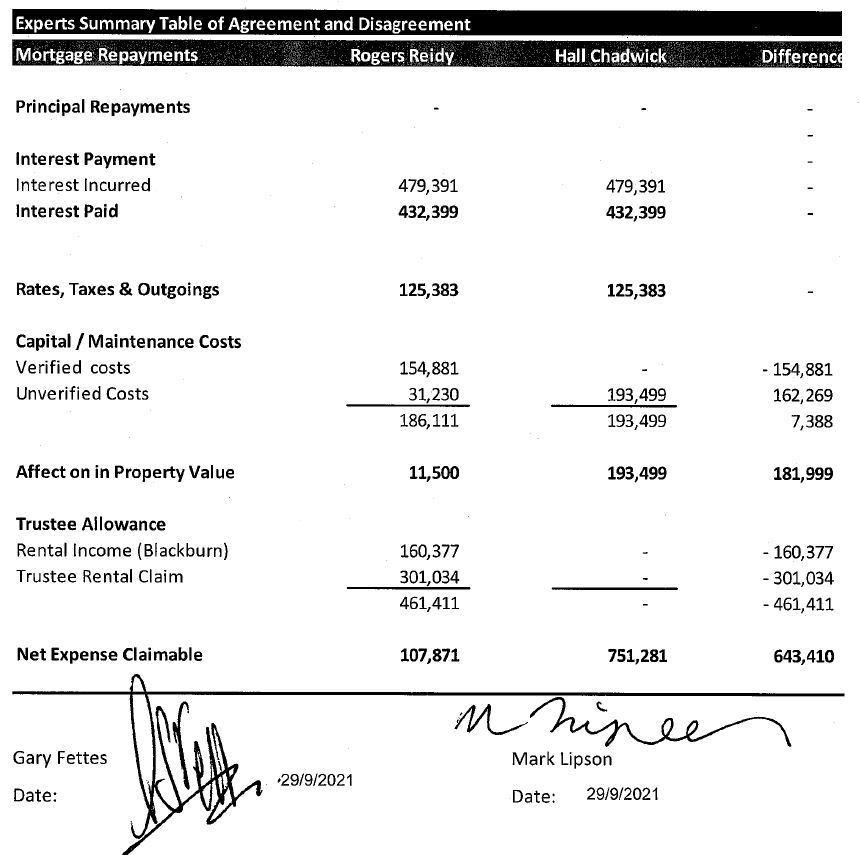
Question 1 – Are the McNivens entitled to an interest in the Properties or any part of the proceeds of sale by reason of the equity payments or personal efforts claims and, if so, during which period?
273 I analyse the McNivens’ entitlement as a result of the equity payments and personal efforts claims below. The guiding principle is that neither party should take the benefit of an increase in the value of the Properties without making an allowance for expenses incurred by the other in order to achieve that outcome. However, I have approached the question also having regard to whether the Trustees have been unjustly enriched by the equity payments and personal efforts in the context of the scheme for the administration of bankrupt estates in the Bankruptcy Act.
Interest payments
274 There is agreement between Mr Fettes and Mr Lipson, as expressed in the Fourth Joint Expert Report, that the McNivens made no repayments of principal to reduce the St George Mortgage but paid a total of $432,399 in interest repayments. That amount includes $160,377 in income received from the Blackburn North Property, which was applied to maintain the St George Loan, and is $46,992 less than the interest incurred in respect of the St George Mortgage over the Properties since the commencement of the McNivens’ bankruptcies.
275 The Trustees contend that the McNivens are not co-owners of the Properties and do not have a right to an equitable accounting in accordance with the principles in Draper. However, as a matter of principle, the Trustees say that they do not seek to be enriched by an unjust benefit and, in accordance with the rule in Ex Parte James (1803) 32 ER 385, acknowledge that a trustee in bankruptcy should avoid invoking strict legal rights where that would result in outcomes contrary to ethical standards of commercial fairness: see also Draper at [110]-[116] (Rares J).
276 In order to determine the McNivens’ entitlement to any credit for the interest payments made in relation to the St George Mortgage, it is necessary to distinguish between the following periods:
(1) the period before their bankruptcy;
(2) the period during their bankruptcy; and
(3) the period after their discharge from bankruptcy.
277 In my view, the McNivens are not entitled to any credit for either of the first two periods described above. As to the first period, the Trustees are not unjustly enriched by any interest payments made prior to the McNivens’ bankruptcy and, even if the interest payments did give rise to a relevant interest, that would have vested in the Trustees as before acquired property: see s 58(1)(a) of the Bankruptcy Act. As to the second period, the Properties having vested in the Trustees, any interest payments made during bankruptcy would simply give rise to an interest that vested in the trustees as after acquired property: see s 58(1)(a) of the Bankruptcy Act.
278 In relation to the third period described above, I would allow a credit for the interest payments made by the McNivens from 7 March 2014, being the day after Mrs McNiven was discharged from bankruptcy, to 4 December 2017, being the date on which Mr Watters was advised the Trustees would take steps to obtain transmission of title and sell the Properties. It is during that period which the Trustees have enjoyed an unjust benefit because, by maintaining the St George Loan, the McNivens avoided the prospect that the St George would exercise any power of sale over the Properties. The maintenance of the St George Loan in turn enabled the Trustees to realise the increase in the capital value of the Properties.
279 I have demarcated the outer boundaries of the McNivens’ entitlement as 4 December 2017 because from that time, it became indisputable that the Trustees intended to sell the Properties and they promptly took steps to become the registered proprietors on 21 December 2017. From December 2017 onwards, it was the McNivens who resisted the Trustees’ lawful claim for possession of the Properties. As I have found that the legal basis for the McNivens’ asserted right to remain in the Properties should be rejected, I can see no basis to make any allowance for the interest paid to maintain the St George Loan thereafter. In my view, there is no unjust benefit to the Trustees from that date onwards, as they have been prevented in the meantime from recovering the Properties. Therefore, to give the McNivens any allowance for interest paid in that period would be to reward them for their own wrong. That is inconsistent with the principle of restitution for unjust enrichment. I would thus regard such payments as involving the gratuitous conferral of a benefit to the Trustees.
280 According to calculations prepared by Mr Fettes in the Joint Expert Report dated 11 May 2021, the total amount of interest repaid in relation to the St George Mortgage during that period is approximately $181,008.94. On account of some revisions made to the calculations following the final conclave between Mr Fettes and Mr Lipson, the Trustees noted in closing submissions that this figure likely overstates the interest paid. However, it is not necessary for further evidence in relation to this issue because, for reasons I shall explain, the McNivens are not entitled to any restitution by reason of the equity payments and personal efforts claims.
Payment of rates, taxes and outgoings
281 There is also consensus between Mr Fettes and Mr Lipson in the Fourth Joint Expert Report that the McNivens jointly paid $125,383 on rates, taxes and outgoings. The experts both accepted that those amounts included amounts paid during the bankruptcies and after the transmission of the Properties to the Trustees. The experts also accepted that those amounts may have included some component of charges for consumption.
282 The Trustees contended that the McNivens do not have an entitlement to expenses incurred as rates, taxes and outgoings. This is because Mrs and Mr McNiven gave evidence that the expenses claimed in this category included expenses such as water bills, gas bills and electricity bills, all of which include a component for consumption. Similarly, the McNivens’ insurance bills included a component for contents insurance.
283 Moreover, the Trustees said that the rates, taxes and other outgoings identified by the McNivens are expenses for which the Trustees will not receive any benefit. Rather, it is the McNivens that have had the benefit of water rates, energy costs and expenses associated with the pool. Further, the Trustees contended that rates are a tax imposed, at least in part, to pay for local amenities and infrastructure during a period in which the McNivens have occupied, and had exclusive use of, the Properties.
284 In all of the circumstances, the Trustees said they have not been unjustly enriched by such expenses and it would be a curious outcome indeed if creditors were disadvantaged by reason of such payments through an equitable accounting or claim for restitution.
285 In my view, the question of what, if any, entitlement to a reimbursement the McNivens have as a result of rates, taxes and outgoings depends on the nature and characterisation of those expenses.
286 Prima facie, if the expenditure relates to a service provided to the McNivens which was available to be consumed by them; for example, electricity, water and gas bills, then there is no basis upon which any reimbursement could be made. This is because the McNivens merely paid for the services they enjoyed and have consumed at least a proportion of the benefit. The same may be said in relation to various expenses incurred at retail stores such as Amart Furniture, Ikea or Just Pools, in relation to which Mrs McNiven’s evidence was that she did not know whether they were personal expenses or property expenses. That is not sufficient proof of the claims to be satisfied that restitution to the McNivens is warranted.
287 However, in relation to any expenditure that would have been incurred by the Trustees irrespective of whether the McNivens retained possession of the Properties, the McNivens are prima facie entitled to a reimbursement. This is because such outgoings are, in effect, an incident of the ownership of the Properties. One example of these types of expenses are municipal rates and land tax, both of which are payable irrespective of whether any person occupies the Properties or receives a benefit from local amenities.
288 I do not accept the Trustees’ contention that the outgoings in this latter category are not recoverable at all because the McNivens have enjoyed the benefits of local infrastructure and amenities provided by the relevant municipal council throughout the entire period of their exclusive use and occupation of the Properties. However, having regard to the many years during which the McNivens have occupied the Properties, I assume that some proportion of the outgoings conferred a benefit to the McNivens. Accordingly, I discount the McNivens’ claim in respect of rates, taxes and outgoing by 50%. I would thus recognise $62,691 as the contribution towards rates, taxes and outgoings in relation to which the Trustees have been unjustly enriched. In my view, this is (if anything) a generous allowance in respect of the McNivens for the reasons given above.
Personal efforts
289 As I explain below, the McNivens personal efforts ought only be taken into account to the extent those works involved capital improvements or maintenance that increased the value of the Properties. That is consistent with the approach taken by Besanko J in Draper; namely, that a party undertaking improvements, repairs and capital maintenance is restricted to the lesser of the cost of the improvements or the increase in the value of the property as a result of the improvements: see Re Pavlou (a bankrupt) [1993] 1 WLR 1046 at 1049; Forgeard v Shanahan (1994) 35 NSWLR 206 at 223 per Meagher JA (with whom Mahoney JA agreed). In the context of resolving question 4, I shall explain why the McNivens are therefore only entitled to only $11,500 for their personal efforts claim.
Question 2 – Under what principle do the McNivens have any entitlement as set out in question 1?
290 In my view, the principles of equitable accounting do not strictly arise in this context. Unlike Mrs Draper, the McNivens do not have a legal or beneficial entitlement to the Properties. Any rights that the McNivens had vested in the Trustees upon their bankruptcies and any rights that they otherwise acquired in the Properties during their bankruptcies vested in the Trustees. Further, for the reasons I have explained, the Properties did not revest in the McNivens after discharge from their bankruptcies.
291 That being so, the focus of the enquiry, and the juridical basis for the McNivens’ entitlement to the amounts in question 1, is a claim for restitution to avoid unjust enrichment to the Trustees.
292 The principles applicable to restitutionary claims of this kind were set out in Mann v Paterson Constructions Pty Ltd [2019] HCA 32; 267 CLR 560 at [212]-[213]:
Until recently, one view of English restitutionary jurisprudence was to treat the concept of unjust enrichment as if it were a definitive legal principle that supplies a sufficient premise for direct application by rigid, uniform application of questions concerning whether there is (1) an enrichment, (2) at the plaintiff's expense, (3) in circumstances of an unjust factor, and (4) subject to defences. Within that rigid approach, there was something of a tendency to treat tests for and measures of "enrichment" as governed by a single principle; thus encouraging a view of the benefit abstracted from the contract price. More recently, some members of the Supreme Court of the United Kingdom have cautioned against mechanical application of the "four questions" of enrichment, expense, injustice and defences. In Swynson Ltd v Lowick Rose Llp, Lord Sumption JSC denied that English law had a universal theory which explains all of the cases in which restitution is available. In view of those developments, it may be that the law of restitution in the United Kingdom and the law of restitution in Australia are no longer quite as far apart as was previously imagined.
Whether or not that is so, however, in this country restitution arises in recognised categories of case and is not necessarily available whenever, and to the extent that, a defendant is enriched at the plaintiff's expense in circumstances that render the enrichment unjust. Although, over time, novel categories of case may come to be recognised, or existing categories refined, that must occur in accordance with the common law's ordinary process of incremental development: by analogy with decided cases, albeit that, within that process of development and refinement, the four questions may serve to focus attention on the nature, availability and measure of restitutionary relief, and so assist in structuring understanding as to avoid the development of the law of unjust enrichment degenerating into an exercise in idiosyncratic discretion.
[Emphasis added; footnotes omitted]
293 In Commissioner of State Revenue (Vict) v Royal Insurance Australia Ltd [1994] HCA 61; 182 CLR 51, Mason CJ said at [41]:
Restitutionary relief, as it has developed to this point in our law, does not seek to provide compensation for loss. Instead, it operates to restore to the plaintiff what has been transferred from the plaintiff to the defendant whereby the defendant has been unjustly enriched…
294 That passage was cited with approval in Roxborough v Rothmans of Pall Mall Australia Limited [2001] HCA 68; 208 CLR 516 at [25]-[26] (Gleeson CJ, Gaudron and Hayne JJ). See also Australian Financial Services and Leasing Pty Ltd v Hills Industries Ltd [2014] HCA 14; 253 CLR 560 at [19] (French CJ, Hayne, Crennan, Kiefel, Bell, Gageler and Keane JJ).
Question 3 – In calculating the entitlements under question 1, do the McNivens need to give credit to the Trustees for notional rent of the Templestowe Property and/or rent received from the Blackburn North Property?
295 To the extent that the McNivens claim credit for the repayment of interest of loans secured against the Properties, they ought to give credit for notional rent on the Templestowe Property as well as rent received from the Blackburn North Property. This is consistent with the approach taken in relation to equitable accounting claims between co-owners; namely, that where the occupier seeks from the other co-owner their share of amounts the occupier spent on maintaining and improving the property, an occupation fee is payable as a set-off to any claim by the occupier to account: Campbell v van der Velde [2019] FCA 1871 at [175] (Farrel J). Further, this approach akin to the solution suggested by Millet J in Re Pavlou (a bankrupt) [1993] 1 WLR 1046, which was referred to by Rares J in Draper at [107]:
this may well be a case where it would be practicable to apply the solution suggested by Millett J [in Re Pavlou]…where he said that if the trustee in bankruptcy insisted on strict accounts being taken, then he is entitled to do so unless it could be seen in advance that the amounts were likely to be so similar that the taking of accounts would be a waste of time and the costs would outweigh any possible advantage to be gained thereby. He continued:
‘In such a case the Court might well impose its own solution of directing the interest element in the mortgage instalments to be set off against the use and occupation without any further enquiry. In some cases the Court may be able to infer an agreement between the parties that that procedure should be adopted …’
296 In the Fourth Joint Expert Report, it was agreed that the McNivens made no repayments of principal but paid interest of $432,725 in relation to the St George Mortgage. As I have already explained, I do not accept that the McNivens are entitled to the full amount of those interest repayments. In any event, those contributions should be offset by a credit to the Trustees for rental income received from the Blackburn North Property and notional rent on the Templestowe Property. That should be assessed in the amount of $461,411 for the following reasons.
297 Mr Fettes was instructed that he should account for the values of rental income from the Blackburn North property and notional rent in Templestowe in his calculations. Based on his instructions, and relying on the unchallenged evidence of Bertacco Ferrier Property Consultants Pty Ltd, Mr Fettes calculated the rent received from the Blackburn North Property as $160,377 between 25 November 2010 and 31 July 2020. In my view, it is uncontroversial that the Trustees are entitled to this amount as income from the Properties which vests with them as after-acquired property.
298 Mr Fettes, again pursuant to instructions, calculated the notional or imputed rent for the Templestowe Property as $301,034, calculated based on a weekly rent figure that was provided by Bertacco Ferrier between 25 November 2010 and 31 July 2020. Consistent with the observations of Mansfield J at [56] and Rares J at [113] in Draper, the use and occupation of the Templestowe Property should also be taken into account in an assessment of whether there has been unjust enrichment to the Trustees.
Question 4 – What is the rule for determining the McNivens entitlement to the equity payments in relation to maintenance, repairs, improvements and renovations of the properties and exertion of personal effort?
299 Consistent with that observations of Besanko J at [163] in Draper, in my view the McNivens are entitled to the lesser of the cost of the improvements or the increase in the value of the Properties as a result of the improvements. The rule serves to focus the enquiry on restitution for unjust enrichment rather than any alleged detriment to the McNivens, the latter being the focus of the estoppel claim.
300 Mr Fettes approached the calculation in the Fourth Joint Expert Report by comparing the cost of expenditure of the Properties to the increase in value of the property. The increase in value was only taken into account to the extent that increase was greater than the capital, maintenance and repair works undertaken by the McNivens. Approaching the analysis in this way, Mr Fettes allowed $11,500 for the property expenses and personal efforts claimed by the McNivens, which is the amount which Bertacco Ferrier determined that the Templestowe property had been improved by McNivens’ expenditure and personal efforts. Indeed, the $11,500 amount is directly referable to a pool refurbishment undertaken by Mr McNiven which straddled the period before and after the McNivens were discharged from bankruptcy.
301 Mr Lipson, on the other hand, gave the McNivens credit for $193,499 in respect of capital expenditure, maintenance and repairs on the Properties. Mr Lipson justified his opinion on the basis that if such expenses had not been incurred, the Properties would have fallen into disrepair and that would have had a negative effect on the market value of the Properties (as well as the value of the rent received from the Blackburn North Property).
302 I do not accept Mr Lipson’s evidence in this regard for a number of reasons. First, Mr Lipson expressly disavowed having any expertise to determine whether capital expenses in fact lead to an increase in the value of property. It follows that I reject Mr Lipson’s evidence that the Properties would have fallen into disrepair, and thereby diminished in value, if not for the expenses and efforts incurred by the McNivens.
303 Second, the assumption that the McNivens should be entitled to restitution of one dollar for each dollar claimed proceeds on a series of false premises. For instance, Mr Lipson’s opinion erroneously assumes that each dollar spent on capital works or maintenance equates to a commensurate increase in value. His opinion also assumes that each dollar spent can be aggregated to produce a commensurate increase in value. Each of those assumptions is flawed due to depreciation of capital works and maintenance over time, and the changes in the value of money over time.
304 During cross-examination, Mr Lipson accepted that there may not be a direct correlation between what was spent or exerted by the McNivens and the improvement in value of the Properties. In this regard, I refer to what Millet J said in Re Pavlou at 1049 with approval:
Much expenditure on property is not reflected in any increase in value, and most expenditure on property results in a much smaller increase in value than the amount expended.
305 Third, and relatedly, it appears that Mr Lipson’s expert opinion is merely a consequence of his instructions and does not involve any independent analysis or active intellectual engagement. Any difference in the analysis is entirely driven by Mr Lipson’s instructions and the conclusions reached are, in effect, bootstrapped to the false premises underpinning that assumption.
306 Thus, in my view, as concerns maintenance, repairs, improvements and renovations of the properties and exertion of personal effort, the McNivens are only entitled to $11,500.
Question 5 – At what point in time are the amounts in question (4) to be determined?
307 The trustees contend that consistently with the concept of “enrichment”, the value must be the value at the time when the trustees gain possession of the properties, rather than the date of the relevant equity payments and personal efforts. I endorse that proposition, though it is unnecessary to decide whether that is so given the conclusion I have reached above.
Question 6 – Should an adjustment be made in respect of the depreciation on the maintenance, repairs, improvements and renovations for the period prior to which the Trustees obtain possession of the Properties?
308 Having expressed a view that the maintenance, repairs and improvements did not materially enhance the value of the properties, as per the unchallenged valuation evidence, no adjustment should be made in respect of these items.
Question 7 – Are the McNivens entitled to the benefit of any of the growth in the capital value of the Properties?
309 In my view, the Trustees are entitled to any capital growth of the Properties from the time those Properties vested in them upon the McNivens’ bankruptcies. I have reached that view for the following reasons.
310 First, there is nothing unjust or unconscionable about the Trustees receiving the benefit of capital growth of the Properties. The substantial equity in the Properties is the consequence of the abandonment of the Anylock Mortgage. If the Anylock Mortgage had not been abandoned, the interest on that loan would have far exceeded any equity available in the Properties. As the legal owner of the Properties, there is no unjust enrichment to the Trustees by reason of these events. Further, as against unsecured creditors, the McNivens cannot an equity of any description, and certainly no equity with priority to the unsecured creditors.
311 Second, it is relevant that the McNivens’ contributions to the St George Mortgage did not reduce the principal debts secured against the Properties. That is a critical distinguishing factor from the present circumstances and those in Draper, where the wife of the bankrupt paid the principal and interest in relation to the mortgage, increasing the overall equity of redemption, such that in Draper the trustee would have been unjustly enriched if they retained that increase in the value of the property.
312 In short, the increase in the capital value of the Properties is a benefit vested in the Trustees. It must therefore be to their benefit, unless it can be shown that it would be unjust for the Trustees to retain that benefit as an incident of ownership, having regard to any contributions made by the McNivens to the increase in value. For the reasons discussed above, the contributions made by the McNivens’ did not lead to an increase in the value of the Properties.
Conclusion in relation to unjust enrichment claims
313 It follows from what I have said above that although, in theory, the McNivens are entitled to restitution on the basis of unjust enrichment for the interest repayments on the St George Loan for some of the relevant period, and a proportion of the amounts paid for rates, taxes and outgoings, those amounts are offset by the rent received from the Blackburn North Property and notional rent on the Templestowe Property. Thus, in aggregate, I have concluded that the Trustees are not required to make any contribution to the McNivens out of the proceeds of sale of the Properties.
314 For the sake of completeness, I note that on 22 April 2022, the McNivens filed (without leave) further affidavit material which contains updated calculations of various expenses in the categories I have considered above. For the reasons I have explained in relation to the unjust enrichment claims, if those updated figures were applied to the analysis, the outcome would be the same in that any expense recoverable by the McNivens would be less than the ongoing benefit they have enjoyed from their ongoing occupation of the Templestowe Property and receipt of rent for the Blackburn North Property. For this reason, it is unnecessary for me to consider whether the affidavits proffered to my chambers should be admitted as evidence in the proceeding.
DISPOSITION
315 For the above reasons, I have concluded that the Trustees’ claim should succeed and the McNivens’ cross claim should be dismissed. Costs should follow the event and be paid on a standard basis. I shall make orders accordingly.
I certify that the preceding three-hundred and fifteen (315) numbered paragraphs are a true copy of the Reasons for Judgment of the Honourable Justice Anastassiou. |
VID 1571 of 2018 | |
HEATHER ANNE MCNIVEN | |
JAMES PATRICK DOWNEY AS TRUSTEE FOR THE BANKRUPT ESTATE OF HEATHER ANNE MCNIVEN |


