

Federal Court of Australia
Dahdah v Platinum Distributors Australia Pty Ltd (No 2) [2022] FCA 416
Table of Corrections | |
In paragraph 177 line seven, the word “respondent” has been replaced with “applicant” |
ORDERS
Applicant | ||
AND: | PLATINUM DISTRIBUTORS AUSTRALIA PTY LTD First Respondent JAMES DAHDAH Second Respondent | |
DATE OF ORDER: |
THE COURT ORDERS THAT:
1. The application be dismissed.
Note: Entry of orders is dealt with in Rule 39.32 of the Federal Court Rules 2011.
[1] | |
[1] | |
[3] | |
[8] | |
[15] | |
[16] | |
[16] | |
[20] | |
[31] | |
[31] | |
[39] | |
[41] | |
[86] | |
[86] | |
[89] | |
[101] | |
[110] | |
[121] | |
[122] | |
[142] | |
7.3 Did the applicant work for other people after October 2016? | [159] |
[172] | |
7.5 Consideration and findings arising from the evidence concerning the key factual disputes | [201] |
[214] | |
[214] | |
8.2 An alternative case for unpaid wages from February 2015 until 26 June 2015 | [232] |
[246] | |
[255] | |
[258] |
BURLEY J:
1 These proceedings primarily involve a claim by the applicant, Jean Dahdah, for unpaid wages and entitlements under the Fair Work Act 2009 (Cth) (FW Act). The applicant’s employer was Platinum Distributors Australia Pty Ltd, a company that was deregistered shortly after the commencement of the proceedings. The respondent is James Dahdah, the sole director and shareholder of Platinum, who is also the applicant’s first cousin.
2 The applicant is a citizen of Lebanon. Platinum was an Australian company engaged in the import and export of goods. The applicant and Platinum entered into a contract of employment on 2 February 2014, pursuant to which the applicant was to be employed in Australia as an “export coordinator” for an annual wage of $97,500.00. The applicant arrived in Australia in January 2015 on a subclass 457 Visa and in February 2015 began to work under the direction of the respondent.
3 In his Further Amended Statement of Claim the applicant contends that he worked for Platinum from about 17 February 2015 until October 2017 but that, save for limited payments totalling $19,711, he was not paid any wages or other entitlements. He claims that in May 2015 the respondent directed the applicant to work for his father, John Dahdah, at his father’s company Veejay Trans Pty Ltd and that in the period from 26 June 2015 until 17 October 2016 the applicant was seconded to Veejay. The applicant claims that from 17 October 2016 he returned to work at Platinum under the supervision of the respondent but from mid-2017 to October 2017 he struggled to get directions from the respondent in respect of his employment and accepted that by then his employment had come to an end.
4 The applicant claims that pursuant to ss 87, 323, and 535 of the FW Act he is owed accrued wages, unpaid annual leave pay, and superannuation contributions pursuant to the contract of employment. Alternatively he contends that he was covered by the Clerks Private Sector Award 2010 (Clerks Award) and that he performed duties commensurate with level 2 classification as set out in Schedule A of the Clerks Award. He claims that he is entitled to payment for unpaid wages, leave and superannuation entitlements under the Clerks Award.
5 The applicant pleads that the respondent was at all material times responsible for the control and conduct of Platinum and that he was “involved in” the contraventions by Platinum and accordingly liable for each of the claims within the meaning of s 550 of the FW Act. He seeks declarations of liability, orders for the payment of compensation in the amount of $286,957.50 plus interest, and orders that the respondent pay to him pecuniary penalties.
6 The applicant also pleads a cause of action arising under s 18 of the Australian Consumer Law as it appears in Schedule 2 of the Competition and Consumer Act 2010 (Cth) (ACL). A claim pleaded against Platinum, who was named in the Originating Application and Statement of Claim as the first respondent, for breach of contract has been abandoned in light of Platinum’s deregistration.
7 The respondent denies liability. He accepts that he executed the contract of employment on behalf of Platinum and that he lodged papers for the 457 Visa pursuant to which the applicant, his wife and two children came to Australia. He also accepts that he was at all material times responsible for the management and control of Platinum. However, he contends that on or about 26 June 2015 the applicant ceased providing services to Platinum and that from that date Platinum owed the applicant no obligations as an employer. He pleads in the alternative that from about 26 June 2015 the applicant engaged in industrial action within the meaning of s 19 of the FW Act by failing or refusing to perform any work for Platinum and that accordingly the applicant is not entitled to receive any damages. The respondent raises further matters in defence of the FW Act claims and the claims under the ACL, to which reference is made below.
1.3 Introduction to the factual dispute
8 These proceedings take on the appearance of something of a family feud. The main protagonists are cousins. The witnesses are for the most part close relatives. Furthermore, the versions of events provided by the applicant and the respondent in their evidence are often diametrically opposed. It is apparent that the conduct of neither is beyond reproach. I have, in considering the evidence, borne in mind that the applicant bears the onus of proof according to the civil standard, as required by s 140(1) of the Evidence Act 1995 (Cth). A number of the allegations made by the parties are of an extremely serious nature. In this context I am conscious that, pursuant to s 140(2), in deciding whether the Court is satisfied that a case has been proved on the balance of probabilities, it is to take into account the nature of the cause of action or defence, the nature of the subject matter of the proceeding and the gravity of the matters alleged, as contemplated in Briginshaw v Briginshaw [1938] HCA 34; 60 CLR 336 at 361-362 (Dixon J).
9 Many of the witnesses are from the same family and share the same surname. I refer to the main protagonists, Jean and James Dahdah, as the applicant and respondent respectively. Otherwise, I refer to members of the family primarily by their forenames. In so doing I mean no disrespect to any of the individuals concerned.
10 Several hotly contested factual disputes require resolution before the legal issues between the parties can be addressed.
11 The first concerns the duration of the applicant’s employment with Platinum. The applicant contends that he remained an employee from 17 February 2015 until October 2017 but that for a period from about June 2015 to October 2016 the respondent instructed him to work on secondment with Veejay, the company owned by the respondent’s father, John. After the applicant had a falling out with John, he was prepared to continue to work at Platinum and claims that he attended at the premises or contacted the respondent every day to work, but the respondent gave him no instructions and in October 2017 he accepted that he had been dismissed and sought work elsewhere.
12 This version of events gives rise to four disputed areas of fact. First, the respondent contends that the applicant resigned from Platinum or abandoned his employment there on 26 June 2015 because he wished to leave to buy a truck and start his own business. Secondly, the respondent denies that the applicant worked for Platinum on secondment at Veejay. Rather, he submits that the applicant left his employment at Platinum in order to work at Veejay as a labourer. Thirdly, the respondent denies that after the applicant ceased to work at Veejay he returned to Platinum, made himself available to work on a daily basis or contacted him regularly asking him for work. Fourthly, the respondent contends that the evidence supports a finding that from August 2016 the applicant was engaged in work for himself or third parties, which is inconsistent with his story that he had remained working at Platinum.
13 One additional factual dispute warrants introduction. It concerns two documents upon which the applicant relies to support his case. They are the 2016 and 2017 group certificates issued by the Australian Taxation Office (ATO) in respect of the employment of the applicant by Platinum. The applicant contends that they provide strong corroboration for his claim to have worked for Platinum until October 2017. The respondent claims that he falsely procured them to be prepared for Platinum because the applicant had threatened to kill him if he did not assist him to obtain a permanent residency visa.
14 I consider the conflicting evidence in relation to these disputes in section 7 below before turning to consideration of the ultimate issues between the parties.
15 For the reasons set out in more detail below I find that the applicant has not established the breaches alleged. The application must be dismissed.
16 Jean Dahdah is the applicant. He was born in 1970 and grew up and lived in Lebanon until 2015. Prior to his departure from Lebanon his primary occupation was as a bus driver for a school. Before the applicant came to Australia he had a limited ability to speak English and little ability to read or write in English. He gave four affidavits, each of which were translated into Arabic before they were affirmed. He gave oral evidence and was cross examined with the assistance of an interpreter.
17 In his affidavit in chief dated 30 June 2019, the applicant describes how he came to Australia and provides his version of events concerning the duration of his employment with Platinum and the instructions that he received from the respondent. The affidavit is relatively brief and exhibits a limited number of documents. In his second affidavit, dated 24 April 2020, the applicant provides a very detailed response to the affidavit in answer supplied by the respondent. In his third affidavit, dated 3 June 2020, the applicant provides details of payments that he received from Platinum. In his fourth affidavit, dated 7 August 2020, he responds by paragraph to an affidavit made by the respondent in answer to the applicant’s reply affidavit.
18 Jousephine Dahdah is the sister of the applicant and the cousin of the respondent. She gave one affidavit about two meetings that she recalled attending, one in about July 2017 and another in September 2017. She speaks fluent English and Arabic and was cross examined.
19 Jouliana Dahdah is the daughter of Jousephine, niece of the applicant and a cousin of the respondent. She lives with her parents. She gives evidence of her recollection of a meeting that she attended in mid-September 2017. She is fluent in English and Arabic and was cross examined.
2.2 The respondent’s witnesses
20 James Dahdah is the respondent. He was admitted to practice as a solicitor in August 2017 and studied law part time from 2011. Prior to commencing his work as a solicitor he was the sole director and shareholder of Platinum, which traded in the import and export of goods to and from Australia. He is of Lebanese heritage and speaks English and Arabic.
21 The respondent provided a first affidavit on 19 September 2019, in which he sets out his version of events concerning his recruitment of the applicant to work for Platinum and the work that the applicant performed. The respondent affirmed a second affidavit on 19 July 2020. In it he provides a paragraph by paragraph response to the applicant’s second affidavit.
22 On 17 September 2020 the respondent provided a third affidavit in which he gives evidence about the loss of relevant records from Platinum, the payment of salary to the applicant and exhibits letters to the ATO, the Department of Home Affairs and also the Legal Services Commissioner about his fabrication of certain group certificates.
23 On 25 September 2020 the respondent swore a fourth affidavit explaining in more detail what he considered the applicant’s role at Platinum to be. On 16 November 2020 the respondent swore a fifth affidavit which contains evidence concerning mobile telephone numbers for certain relevant individuals.
24 John Dahdah is the father of the respondent and the applicant’s uncle. He is a director of Veejay, a company that has been involved in the provision of demolition and excavation services within the construction industry since 2007. He gives evidence in his first affidavit that on about 15 January 2015 the applicant came to live at his home in Bossley Park, Sydney where he stayed until October 2016, and about work that the applicant performed for Veejay from July 2015 until October 2016. In his second affidavit John replies to the applicant’s affidavit of 24 April 2020 and the affidavit of Jousephine affirmed on 2 June 2020. He was cross examined.
25 John gives evidence that on about 5 July 2015 the applicant asked him for a job and that he started to work for Veejay the next day. He gives evidence that the applicant was a poor worker, that he had received a complaint that the applicant had fallen asleep on the job, that he had rolled an excavator on its side, that he had used a scissor lift against instructions and caused damage to the sprinkler system at a site and that he had damaged a truck and sought to have it repaired without John’s knowledge. John gives evidence that after the last incident he informed the applicant that he would no longer be able to work for him, whereupon in October 2016 the applicant ceased to attend work at Veejay and stopped living at John’s home. John also gives evidence that from early December 2015 until February 2016 the applicant left Australia to return to Lebanon.
26 Elie Atie is a motor mechanic who has known the respondent for 21 years and who leased part of his premises in Yennora, Sydney, to Platinum. He gives evidence about his conversations with the applicant and the respondent in 2015. He gave one affidavit and was cross examined.
27 Habib Boustany has been a friend of the respondent for many years. He gives evidence in his affidavit about the disputed departure of the applicant from his employment at Platinum. He gave one affidavit and was cross examined.
28 Danielle Gittany is the sister of the respondent. In her affidavit she gives evidence about her recollection of a conversation that she heard between the applicant and the respondent. She gave one affidavit and was cross examined.
29 Saliba Gittany is Danielle’s husband and John’s son-in-law and has known the applicant since 2012. He gives evidence of conversations he had with the applicant and the respondent in 2015 and 2016. He gave one affidavit and was cross examined.
30 Maciej Nowak is an operations manager with Trades Unlimited who has known John for about 7 years. In his affidavit he gives evidence that he was introduced to the applicant on a site at which Veejay was working and understood that the applicant worked for John from July 2015 until October 2016. He was not cross examined.
31 The FW Act Claims. The applicant contends that by reason of the terms of his contract of employment with Platinum he was a “national system employee” under s 13 of the FW Act and that Platinum was a “national system employer” under s 14. He contends that the payment of annual wages is an “entitlement under a contract” between him and Platinum that relates to a subject matter described in s 139(1) of the FW Act and that accordingly it falls within the definition of a “safety net contractual entitlement” in s 12. This is an entitlement that may be enforced by him in this Court pursuant to ss 542 and 543 of the FW Act. He contends that by failing to pay amounts payable to him in full, and at least in monthly amounts, Platinum acted in breach of s 323(1) of the FW Act and that the Court may make orders for him to recover compensation for any loss as a result of contravention of that civil remedy provision pursuant to s 545 of the FW Act, citing Association of Professional Engineers, Scientists and Managers, Australia v Wollongong Coal Ltd [2014] FCA 878 at [31]-[32] (Buchanan J), Murrihy v Betezy.com.au Pty Ltd [2013] FCA 908; 238 IR 307 at [119] (Jessup J) and Qantas Airways Ltd v Flight Attendants’ Association of Australia [2020] FCAFC 227; 282 FCR 243 at [68] (Jagot and Wheelahan JJ).
32 The applicant submits that for contravention of s 323 to be established he must demonstrate: (a) that Platinum is an employer and that he was an employee for the purpose of the FW Act; (b) that Platinum failed to pay “amounts payable to the employee”; (c) that the amount payable was in relation to his performance of work as an employee; and (d) that the amount payable was not paid in accordance with s 323(1)(a) to (c). This, he submits, is established because Platinum failed to pay him at least monthly for the term of his employment from 17 February 2015 until October 2017 (employment period). He additionally advances claims for unpaid annual leave and unpaid superannuation during that period. The applicant submits that the respondent is personally liable as a person who is involved in the contraventions of Platinum pursuant to ss 550(1) and 550(2)(a) and (c) of the FW Act.
33 The applicant contends that in May 2015 the respondent directed him to go to work for his father, John, and assured the applicant that Platinum would still pay his salary whilst he did so. He submits that during the secondment, the applicant worked on a full-time basis and continued to report to and take directions from the respondent as his direct supervisor and manager. He submits that in contravention of his contract of employment the respondent instructed the applicant to perform work that was not in conformity with the role nominated for him in the contract of employment as Export Coordinator. He contends that after the secondment period ceased on 17 October 2016 the applicant returned to work for Platinum under the direction of the respondent until October 2017. By that point he accepts that he struggled to receive directions or wages and was forced to accept that Platinum had terminated the contract and that he had by then been constructively dismissed.
34 The applicant places emphasis upon a number of factual matters. He relies on the contract of employment with Platinum that the respondent had drawn up in order to apply for the 457 Visa. He disputes the veracity of the respondent’s evidence that the employment relationship was undermined by the applicant’s inability to communicate in English. He submits that the respondent misled the Department of Immigration in documents supporting the visa application as to the need for the applicant to speak English for the role, pitching his visa application as being for a person with skills in communicating with persons in the Middle East. He submits that at the time of the application the relevant visa requirements were such that a person being paid a base salary of at least $96,400 per annum was exempt from English language requirements, citing IMMI 14/009 – Tests, Scores, Level of Salary and Exemptions to the English Language Requirement for Subclass 457 (Temporary Work (Skilled) Visas. The applicant submits that the wage of $97,500 in the contract of employment was designed by the respondent to circumvent the English test requirements. He further submits that this was a significantly higher wage than the USD12,000 per annum that the applicant was earning as a bus driver in Lebanon.
35 The applicant further submits that penalties should be imposed on the respondent for his breaches of the FW Act. In this regard he cites Kelly v Fitzpatrick [2007] FCA 1080 (Tracey J) concerning the assessment of penalty.
36 In his closing submissions the applicant confines his misleading and deceptive conduct claim to one based on the fact that when the respondent arrived in Lebanon on his honeymoon in October 2014 he had said to the applicant:
Congratulations! You got your visa to go to Australia. After two years you can stay in Australia permanently…Please resign from your current job and join us in Australia.
37 The applicant contends that this amounted to a representation that the respondent would apply for permanent residency for the applicant when he was two years into the term of his contract of employment. He failed to do so. The applicant contends that this amounted to a representation made in trade and commerce that was misleading or deceptive or likely to mislead or deceive in breach of ss 18 and 31 of the ACL. The applicant contends that the representation was misleading because the respondent did not at the time it was made disclose that it was a requirement for the 457 Visa and also for a permanent residency visa that he pass an English language proficiency test. He submits that in reliance upon the representation he travelled to Australia, abandoning a comfortable life in Lebanon and brought his family to Australia and by reason thereof suffered loss and damage.
38 The applicant makes detailed submissions going to the credibility of the witnesses. He submits that the respondent is not a witness of truth pointing to matters that he contends demonstrate that he made inconsistent statements, provided misleading information and engaged in blatant contravention in a wide spectrum of Australian legislation. He submits that the respondent made false representations to the Australian Taxation Office and the Department.
39 The respondent denies that Platinum engaged in any misconduct as alleged arising under the FW Act but accepts that if the allegations are proven, his role in Platinum was such that he was involved in the contraventions within s 550(1) of the FW Act. He submits that the primary contest between the parties is on a factual level and contends that the following factual issues arise:
(a) Did the applicant receive wages, annual leave and superannuation from Platinum between February 2015 and 26 June 2015 in accordance with the contract of employment?
(b) Did the applicant resign from or abandon his employment with Platinum on 26 June 2015?
(c) If he did not, when did the applicant cease his employment with Platinum?
(d) If he continued to be employed after 26 June 2015 was he entitled to receive wages and other entitlements, and if so, how much is he owed?
(e) Is the applicant covered by the Clerks Award as alleged and if so, did he perform duties and responsibilities consistent with Level 2 classification?
(f) Was the representation set out in [36] above made?
(g) If it was, was it misleading or deceptive in trade or commerce and did the applicant suffer any loss?
40 The respondent contends that a key issue in the case is the credit of the main protagonists. He submits that the applicant was not a witness of truth for a number of reasons. The respondent accepts that certain employee and financial records have not been retained by his accountant and as a consequence of Platinum’s deregistration and that this is unsatisfactory. However, he submits that there is no evidence or even suggestion that the respondent deliberately engineered this situation to avoid legal scrutiny, and the absence of records can be explained by the fact that Platinum was a small business which relied on its accountant to assist in the keeping of records. He also admits that he made a number of regrettable errors of judgment in failing to report the cessation of the applicant’s employment to the Department of Home Affairs and in creating false 2016 and 2017 group certificates. In his evidence he contends that he asked his accountant to create those summaries as a result of a threat made to him by the applicant to kill him and to “get him off his back”. He submits that he has disclosed these mistakes to the authorities and exhibits copies of letters to the Department of Home Affairs, the ATO and the Legal Services Commissioner, none of whom have taken any action. The respondent submits that whilst these lapses of judgment are regrettable, the context reveals that he acted in accordance with his values and that they do not demonstrate that his evidence is not to be accepted.
4. CHRONOLOGY OF BACKGROUND FACTS
41 Much of the factual basis for the case is in dispute. In this section I set out my findings of fact in relation to background matters that are established by the evidence.
42 In 2011 Platinum was incorporated, with the respondent as its sole director and shareholder.
43 In 2012 Platinum reported in its Financial Statements a loss of $236,000. In 2013 it reported a gross profit of $122,544 and the payment of “salaries and wages” of $12,000.
44 On or about 14 November 2013 the Department recorded receipt of a Business Sponsorship Application made by the respondent on behalf of Platinum for the sponsorship of the applicant. The application required information including a “detailed explanation which outlines your reasons” for proposing that the applicant receive a sponsorship and invited the applicant to lodge further documents in support of the application. The application records a statement made by the respondent to the effect that Platinum had two professional employees, that the gross payroll expenditure of the business was $12,000. It included a statement that the sponsor (Platinum) agreed that it was willing to meet its obligations as a Business Sponsor and a declaration that the details on the form were correct.
45 On 3 December 2013 a representative of the Department sought further information from Platinum about the business sponsorship application. The respondent replied on 7 January 2014 providing documents including;
(a) a Business Plan dated December 2013;
(b) a letter of reference from Australian Tax Services, signed by Mark-Anthony Basha, a Tax agent acting on behalf of Platinum; and
(c) a letter from Rhyder Industries Pty Ltd dated 19 December 2013 (Rhyder letter) stating: “This letter is to verify that invoices [numbered] were in relation to training provided to [Platinum] for the employee Mrs Vivienne Dahdah”. Rhyder Industries is a company of which the respondent is the sole director and shareholder.
46 The Business Plan commences with an Executive Summary which says:
James Dahdah is the sole director for the business Platinum Distributors Australia Pty Ltd. It commenced operating in 2011 and has displayed a turnover of over $500,000 in the first year of operation, increasing to $700,000 in the following year….The business imports branded food and beverage items and genuine automotive parts. It also exports Australian made products to the foreign markets such as the Middle East.
…
This business plan has been written to support an application for sponsorship of Mr Jean Dahdah as the Import and Export Coordinator to assist in the successful running and expansion of the business.
47 The Business Plan is clearly directed to extoll the virtues of the company and to support a visa application for the applicant. It includes some clear falsehoods and exaggerations. For instance, the statement that Platinum had a turnover of $500,000 in its first year was plainly incorrect, a proposition that the respondent accepted during cross examination.
48 Under the heading “Business Profile” it says:
…The business has all the equipment and facilities required to grow the business and focus more on exporting to the Middle East, however, a coordinator with the relevant knowledge, language skills and experience of the Middle Eastern market is necessary to achieve this. For this reason [the respondent] would like to sponsor [the applicant] as the required candidate.
49 Later, the document provides that the Import and Export Coordinator role is a key one that requires business experience in the importing and exporting industry and also “knowledge of the Middle Eastern market, existing strong networks and strong language skills of this particular market”. Under the heading “Sponsorship Requirements” the Business Plan identifies the duties and responsibilities of the Import and Export Coordinator, and the skills, qualifications and experience required. Those include “identifying local and overseas business opportunities”, “excellent communication skills and fluent in the relevant Middle Eastern languages” and strong networks. It says that the respondent has failed to find a locally based candidate for the position. It says:
…[the applicant] has worked in product development in both the USA and the Middle East and has held the role of Import and Export Coordinator in the Middle East….In addition, [the applicant] has extensive knowledge and language skills required to work and communicate in the Middle Eastern market. He has strong networks and relevant key industry relationships that will give the business the competitive advantage it requires to succeed in the industry.
50 The respondent contends that in about January 2014 the applicant supplied him with a resume, which he exhibits to his affidavit. The document is half a page in length and undated. It refers to an “Objective” which is said to be “using my skills and experience in assisting organizations to build a larger more successful clientele”; “Experience” which was said to be “Import Export Manager/Co-ordinator at Hope Construction SARL in North Lebanon from March 2002 until December 2009”; “Education” at De La Salle, North Lebanon, 1985; “Interests” and “References” (available on request). No reference is made to the applicant’s work as a bus driver for De La Salle College. The applicant disputes that he provided this document to the respondent.
51 On 2 February 2014 the applicant and Platinum entered into the contract of employment that had been prepared by the respondent. It relevantly provided as follows:
Position
Export Co-ordinator
Salary
For the position of Export Co-ordinator you will be paid the base salary totalling $97,500.00
Change to Terms of Employment
This contract will hold for the full term mentioned within, if the reasons of unusual circumstances or undue hardship you will find it necessary to negotiate part or this entire contract you are encouraged to first speak with the Managing Director.
Term of Contract
The duration of employment is for a 4 years period with an option to renew.
Entitlements
Annual Leave: as accrued under current Fair Work Australia Commission
Personal Leave: as accrued under current Fair Work Australia Commission
Superannuation: in accordance with current legislation.
52 The contract of employment also allowed for one months’ provision of notice of termination and contained terms relating to confidentiality, disciplinary proceedings and dispute resolution. It was signed by the applicant and the respondent.
53 On 5 March 2014 the Department acknowledged receipt of $330 and an application made by the respondent for a 457 temporary work visa for the applicant. The respondent gives evidence that he lodged the application for the applicant and his family on that day.
54 The respondent gives evidence that on 10 March 2014 the applicant provided him with a reference from a previous employer, Hope Construction. This, he said, “supported my understanding that [the applicant] possessed the required skills and experience required to perform the role of Import/Export coordinator with the company”.
55 The Hope reference is controversial. The document is dated 10 March 2014 and is on letterhead entitled “HOPE Construction SARL” and signed by Salem ElCheikh who, the oral evidence revealed, is the applicant’s brother in law. It provides:
Mr Jean Dahdah was employed by our company between the period of March 2002 and December 2009 in the capacity of import and export manager/Co-ordinator.
He had been entrusted with various tasks during his employment ranging from meetings and liaising with customers in Lebanon & the Middle East to co-ordinating shipments from our suppliers in various global locations.
His list of duties included
• Pinpointing commercial prospects both domestically and abroad
• Identifying a range of products and services to be provided
• Coordinating with suppliers and merchants regarding orders and products
• Maintaining a constant assessment of regulatory and legislative developments
• Carry out and retaining after-sales service procedures
• Recognizing products that would suit our business plan for growth and expansion in the Middle East marketplace from USA and Europe.
We feel that Jean has the skills required to execute his duties in the role with out any fault. His ability to accurately identify potential markets inside Lebanon & the Middle East was an integral part of the ongoing success of our organisation. Likewise his ability to identify products from suppliers in western countries that would be suited in Lebanon & the Middle East was astonishing.
We wish Jean all the success in the world in his future endeavours and are certain that his skills with [sic] undoubtedly have a positive impact on any organisation he would join.
56 On 30 June 2014 the Department recorded receipt of an application for a Long Stay Temporary Business Visa related to the previously submitted Business Sponsorship Application. This was lodged by the respondent and included his contact details. The applicant was the primary applicant and his wife Berthe and children Elie and James were secondary applicants. The application records that the applicant did not have English as his first language and that he had not undertaken an English test within 36 months of the application. It also records that his guaranteed annual earnings and base rate of pay were $97,500.
57 On 14 October 2014 the Department sent the applicant a letter stating that the 457 Visa applications for the applicant and his family had been approved. The notification provides that the 457 Visa was granted on the basis that his occupation was “Importer or Exporter”, that the base salary was $97,500 and that it was valid until 14 October 2018. It provided that if he stopped working for his sponsor he must find another employer willing to nominate him, apply for another type of substantive visa or leave Australia. The notification provides that the sponsor was Platinum. It was emailed to the respondent at the email address pda@hotmail.com.au.
58 The respondent was visiting Lebanon on his honeymoon at the time that the notification was received from the Department and informed the applicant in person of the approval.
59 On 14 January 2015 the applicant arrived in Australia. Platinum paid for his aeroplane ticket at the request of the applicant. The applicant went to live with the respondent’s parents at Bossley Park where he stayed until October 2016.
60 On about 17 February 2015 the applicant commenced working for Platinum at its premises in Yennora.
61 The applicant returned to Lebanon for the period from 23 May 2015 until 9 June 2015. There is a minor dispute as to the reason for the trip. The applicant contends that he was sent to Lebanon to sell remote car keys on behalf of Platinum. The respondent contends that the applicant returned to Lebanon because their relationship had become tense after it became apparent that the applicant was unable to perform tasks expected of him, particularly because he could not speak or write in English. He claims to have approved the trip so that the applicant could see his family and also to see what business he could drum up for Platinum. The applicant gives evidence that the respondent paid for the ticket but insisted that he would deduct this from his wages.
62 The respondent contends that on 26 June 2015 he and the applicant had conversations that led him to the view that the applicant had resigned his position with Platinum. I return to this important subject later in these reasons.
63 The respondent exhibited to his first affidavit minutes of a meeting of Platinum dated 30 June 2015 (June 2015 minutes) at which the respondent and Mr Basha were present. They include under the heading “Resolved”:
James confirmed that Jean Dahdah resigned to buy a truck and contract on his own.
64 The applicant contends that in May 2015 the respondent told him that there was not enough work for him at Platinum and instructed him to work for Veejay from July 2015. The respondent denies that this was so, and contends that in early July 2015 the applicant, having abandoned his position at Platinum, obtained work for Veejay. I return to this subject also.
65 On an unspecified date in 2016, prior to the issue of the applicant’s 2014/2015 tax assessment, a tax return was prepared on behalf of the applicant by Ms Anna Leksinska. It describes the applicant’s occupation as “construction worker – earthmoving labourer”. The applicant contends that it was prepared by the respondent and given to him to sign. The respondent denies that this was so. I address this dispute in more detail below.
66 On 15 June 2016 the ATO issued a notice of assessment to the applicant of his income tax for the year ended 30 June 2015 (2015 tax assessment). This was not provided by applicant in his affidavit evidence, but was produced by him on discovery. It contains the following relevant details:
It is addressed to the applicant at a location in Ermington NSW;
The taxable income was $44,600;
The tax is assessed at $6,042;
The PAYG credits and other entitlements are assessed at $13,000;
A refund to the applicant is assessed at $6,398.
67 On 15 June 2016 the applicant’s son Elie, then aged 18 years old, arrived in Australia and started to work with John at Veejay on the next day.
68 On 21 June 2016 the respondent received the applicant’s tax refund of $6,398. He has not paid this money to the applicant despite being aware that an attempt to pay it into his bank account failed.
69 An undated PAYG summary for year ending 30 June 2016 (2016 group certificate) is exhibited to the first affidavit of the applicant. It provides:
(1) The payee is Jean Dahdah with his tax file number noted;
(2) The period of payment is 1 July 2015 until 30 June 2016;
(3) The gross payments were $97,500;
(4) The total tax withheld was $26,004;
(5) The payer’s name is Platinum;
(6) The signature of the authorised person was of the respondent dated 20 September 2017.
70 On 16 December 2016 the applicant flew to Lebanon.
71 On 28 February 2017 the applicant returned from Lebanon.
72 On 17 March 2017 Matthew Semaan of CK Migration Law sent an email addressed to the applicant but copied to the respondent which indicates that the respondent had asked him to assist the applicant in his application to the Department of Immigration and Border Protection to apply for a temporary residence visa. The email attaches a letter containing an Agreement for the Provision of Migration Services, a visa request document and a client information questionnaire. The respondent’s evidence is that he did not send the applicant to see Mr Semaan. I address this disputed detail later in the reasons.
73 On 22 May 2017 the applicant flew to Lebanon.
74 On 16 June 2017 the respondent was admitted as a solicitor.
75 On 22 June 2017 the applicant returned to Sydney from Lebanon.
76 A second undated PAYG summary, this time for the year ending 30 June 2017 (2017 group certificate), is in evidence which provides the following relevant information:
(1) The payee is Jean Dahdah with his tax file number noted;
(2) The period of payment is 1 July 2016 until 30 June 2017;
(3) The gross payments were $40,625;
(4) The total tax withheld was $10,783;
(5) The payer’s name is Platinum.
77 On 9 July 2017 the respondent sent a text message to the applicant saying “…we need to talk importantly. Immigration spoke with me”.
78 The respondent claims that he received the 2016 group certificate from his accountant Anna Nawrocka on 30 September 2017.
79 On 3 October 2017 the respondent had an exchange of text messages with Jousephine in which she asked him to send Jouliana the 2017 group certificate, and he replies, saying that he would send it as soon as his accountant was “finished with the company stuff for last year”. The respondent supplied the 2017 group certificate to Jouliana after he received it from his accountant on 19 October 2017.
80 On 10 October 2018 the applicant wrote a letter to the Department of Home Affairs in which he said that:
(a) he is currently in Australia on a 457 work visa which is due to expire on 14 October 2018;
(b) his sponsor is the respondent who had promised to pay him all outstanding money owed to him within six weeks before the end of his visa;
(c) he had planned to depart Australia on 13 October 2018 but could not because he is owed three and a half years’ wages in the amount of $427,050;
(d) he received $19,440 of the total amount owing, and the outstanding balance is $407,650;
(e) in 2017 he went to Lebanon and borrowed USD$100,00 from a money lender on terms that he pay it back with 20% interest upon his return from Australia on 18 October 2018;
(f) he appointed a lawyer in Lebanon to negotiate a settlement of this loan and to give him more time to get the money and that in response:
The lender told my lawyer that if I go back without his money he will kill me and my family (letter from the lawyer is attached).
(g) he is taking legal action against Platinum and the respondent and that he will provide the Department with the application and evidence; and
(h) he seeks a temporary protection visa in the meantime until the proceedings are solved.
81 On 13 October 2018 the applicant lodged an application for a protection visa.
82 On 23 January 2019 Platinum was deregistered.
83 On 6 December 2019 the applicant was examined by an officer of the Department of Home Affairs about his claims for protection (protection interview). The respondent relies on the transcript of this interview to supply evidence of inconsistent statements made by the applicant during the course of this interview for a protection visa.
84 On 12 September 2020 the solicitors representing the respondent wrote to the Legal Services Commissioner, informing them that the respondent was admitted to practice as a solicitor on 16 June 2017 and that he was a director of Platinum until it was deregistered in 2019. The letter states that Platinum had sponsored the applicant for his 457 Visa and that the applicant had resigned his position in June 2015 but that the respondent is “now aware” that he was obliged to notify the Department of Home Affairs of the resignation. He did not do so. The letter states that the applicant “threatened him physically by saying that, unless he was able to continue to demonstrate…that he was still employed by [Platinum], [the applicant] would harm him”. The letter states that “under such duress” the respondent directed that group certificates be issued to the applicant for the years ended June 2016 and June 2017 and that tax be paid accordingly to the ATO. The letter states that the respondent accepts that he was wrong to have done so and attaches letters addressed to the ATO and the Department of Home Affairs. It concludes by stating that the applicant’s employment is currently before the Court and that these matters have been drawn to its attention.
85 In letters to the ATO and the Department of the same date the solicitors for the respondent admit to the falsity of the 2016 and 2017 group certificates and admit to the failure on the part of the respondent to notify the departure of the applicant from Platinum respectively.
5. THE CREDIT OF THE APPLICANT AND THE RESPONDENT
86 Each party criticised the evidence and challenged the credit of the other. The respondent submits that the applicant’s account of events cannot be believed. He submits that the version of events offered is improbable, often internally inconsistent and contrary to that of disinterested witnesses insofar as it concerns key events such as conversations concerning his resignation. He submits that the applicant gave evasive, argumentative evidence that was motivated by his desire to obtain a permanent residency visa in Australia.
87 The applicant submits that the respondent was not a witness of truth. He submits that the respondent made inconsistent statements, provided misleading information to the Court and resorted to silence and omission of critical information in support of his case.
88 For the reasons set out below, I have serious reservations as to the reliability of both the applicant and the respondent.
5.2 The credit of the applicant
89 I generally found the applicant to be a poor witness. He is 50 years of age and grew up in Lebanon with no formal qualifications after high school. His evidence is that he worked as a bus driver for 13 years before coming to Australia. He gave his oral evidence with the assistance of an interpreter. He has resided in Australia since 2015 and the Australian habits and the legal system are no doubt unfamiliar to him. These matters must be taken into account when considering matters of credit. Nevertheless, I found aspects of his evidence to be unsatisfactory such that I find it difficult to accept his evidence as truthful unless it is supported by corroborating material. I refer to relevant aspects of his evidence elsewhere in these reasons, but add to those as follows.
90 First, the applicant’s evidence as to his experience and qualifications prior to leaving Lebanon was opaque and contradictory. In this regard, it may be noted that in his evidence in chief the respondent exhibited the Hope reference and a resume that he submitted in documents in support of the applicant’s 457 Visa. In his detailed affidavit in response the applicant did not deny the existence of the Hope reference, dispute the evidence given that he had supplied the Hope reference to the respondent or deny the truth of its contents. The author of the Hope reference, Mr ElCheikh, is the applicant’s brother in law.
91 In his oral evidence the applicant initially accepted that at the request of the respondent he had gone to Mr ElCheikh to obtain a reference but he said that he could not remember what was in the letter. A little later, he said that it was the respondent, not he, who had first spoken to Mr ElCheikh. Significantly, he also said that he had never worked for Hope Construction during his time in Lebanon. When confronted with the proposition that he must have known that he had been asked to obtain the letter to demonstrate that he had credentials working as an import/export manager, he said that he was aware that he had sought a letter from an import/export company in Lebanon but did not know what the letter was about. A short while later he gave evidence that he now understands that the Hope reference contains lies about his work experience because he had never worked for that company but that he only discovered the falsehood during the course of his cross examination. That evidence is not credible. Each of the respondent’s affidavits and exhibits were translated for him and the applicant filed a detailed affidavit responding to the respondent’s first affidavit. When confronted with that fact, the applicant gave evidence that he remembered the letter, but did not know what it was used for. He adhered to his evidence that he had not worked for Hope Construction and said that he had worked as a bus driver for a school from 2003. He repeated his evidence that the reference to him working for Hope Construction was false. I do not accept that the applicant did not know the contents of the Hope reference or why it was used.
92 Secondly, in his oral and written evidence the applicant denied that he had provided a resume to the respondent in support of his visa application. He also gave evidence that he did not know what was contained in it. Having regard to the evidence given by the respondent on this subject (to which I refer in section 5.3 below) I am left in a considerable state of uncertainty as to who prepared the resume.
93 Thirdly, in his first affidavit, the applicant’s evidence was that the respondent had offered him a job as an export coordinator. The applicant subsequently changed his evidence in his second affidavit (of 24 April 2020), where he denied the substance of conversations deposed to by the respondent to the effect that they had ever discussed the work that he would be doing upon his arrival in Australia. In the course of his cross examination the applicant confirmed that he had signed the contract of employment, but said that he only did so because the respondent had asked him to. He said that he did not know or understand the position or understand that he was offered the position of “Export coordinator” or that he was being sponsored to fill that role. His final position, stated in his oral evidence, is that whilst he knew of the name of the job he was doing, he did not have an understanding of what it entailed. I do not accept that evidence as credible.
94 In the applicant’s personal particulars for assessment provided to the Department in support of his application for a protection visa, dated 10 October 2018, the applicant states he was “self-employed” in the import/export business from July 2006 until March 2010 in Lebanon. He makes no reference to any other employment at all, whether at the school as a bus driver or with Hope Construction. None of the applicant’s affidavits affirmed after he had received the respondent’s written evidence addressed or denied the evidence given by the respondent that the applicant had provided the Hope reference to him or challenged the correctness of the respondent’s understanding that the applicant had worked in import/export.
95 I do not accept that the applicant was so naïve as to travel to Australia with no idea as to the work that the respondent would ask him to perform, especially given that he had executed the contract of employment. I consider it most likely, amongst the conflicting versions of events offered by the applicant in this regard, that the applicant and the respondent did discuss the type of work that he would be doing. I consider it likely that the applicant was well aware from discussions with Mr ElCheikh of the contents of the Hope reference. Whilst, for the reasons set out below, I am not confident to make a finding as to who prepared the resume, I consider that the applicant was aware that his visa application was being put forward on the basis that his work experience was such that he was suited to perform the role of export coordinator and that he was content to sign the contract of employment because he had a broad understanding of what that entailed.
96 Fourthly, the applicant also gave inconsistent evidence about the work that he actually did while at Platinum. In his first affidavit of 30 June 2019 he asserted that he worked as an export coordinator for three weeks after he arrived in Australia. In documents filed in support of his application for a protection visa he claimed to have worked in import/export until October 2018, whereas in his interview with the Department of Home Affairs in December 2019 he stated that he never worked in the role of export coordinator. In his pleaded case the applicant contends that he worked as a clerical employee covered by the Clerks Award, however, in cross examination he denied ever examining any paperwork, completing any forms, performing any clerical duties or working as a clerk. The varying versions of events do not add to the applicant’s credibility. Nor do they support the contention that the work that he performed was covered by the Clerks Award.
97 Fifthly, the applicant also gave inconsistent evidence about the duration of his employment with Platinum. In his first affidavit he claimed that his employment ceased in August 2018. In his second, he claimed that it ceased in October 2017. In his application for a protection visa dated 13 October 2018, prior to the commencement of these proceedings, the applicant claimed that he remained an employee with Platinum as at that date. In his protection visa interview, he changed the termination date to 2016. In cross examination the applicant gave unsatisfactory explanations for these changes.
98 Sixthly, in the letter that the applicant wrote in support of his protection visa on 10 October 2018 he referred to having borrowed USD100,000 from a money lender and that when he engaged a lawyer to negotiate a settlement of the debt he claimed that the lender had told his lawyer that if the applicant did not return to Lebanon with the money on 18 October 2018 he would kill the applicant and his family. In his affidavit evidence the applicant claimed that he had borrowed not USD but AUD100,000 to support his family. This later claim was shown in cross examination to be rife with inconsistencies. For instance, in his protection visa interview the applicant initially claimed that he had borrowed two amounts from the money lender being USD17,000 and USD40,000, but later he said that he had borrowed the USD40,000 in two instalments of USD15,000 and then USD25,000. He also claimed in that interview that his wife had borrowed up to USD15,000. In cross examination in the present proceedings he said that he had borrowed multiple amounts, rather than a single amount, which totalled USD72,000, which is somewhat less than his initial claim to the Department of USD100,000 and slightly less than the claim of AUD100,000. The applicant also gave inconsistent evidence regarding the amounts of money that he brought with him from Lebanon to Australia, as to which see [169] below.
99 Furthermore, in support of the protection visa the applicant supplied the Department with a letter from a lawyer representing him in Lebanon. In his oral evidence the applicant disavowed that the letter was written by the lawyer on his behalf, instead (confusingly) contending that the letter was written on behalf of the creditor who had threatened to kill the applicant if he did not repay the money owed. It is not apparent why the applicant took this position in his oral evidence. It is wholly inconsistent with his letter to the Department in support of his application. Whatever the cause, it is apparent that the applicant’s oral evidence in this regard varied significantly from that which is apparent from the written materials upon which he relied, apparently to meet what he considered at the time to be the convenience of his own case.
100 Having regard to these and other discrepancies in the evidence of the applicant, in my view the applicant has a demonstrated preparedness to tell different stories of the same events, often with significantly varied details. They suggest that he either does not have a clear recollection of the events to which he refers or that the version of events given is fabricated, which causes me to doubt that many of those events occurred at all, or in the manner described in his evidence.
5.3 The credit of the respondent
101 I formed an unfavourable view of the respondent’s credit. The oral evidence he gave was at times evasive or inaccurate where he, I infer, considered it expedient for the interests of his case. I also find that as a matter of general approach the respondent is a person who has been prepared to take a cavalier attitude to the truth in his general conduct, including in the lodgement of formal documents to government entities. I have made some findings in this regard in the course of the balance of these reasons. I provide some further observations going to my view of the respondent’s credit below.
102 First, I find that the respondent is a person who is prepared to write and authorise the presentation of formal documents to various governmental authorities knowing them to be false. A first example may be seen in relation to the 2016 and 2017 group certificates, to which I refer in more detail in section 7.4 below. The respondent now admits that they were false documents that he directed his accountant to create. In section 7.4, I have rejected his evidence that he caused those documents to be concocted because the applicant made death threats to him. I consider that the respondent determined that it was more convenient to his interests that he deceive the ATO in order to get the applicant “off his back” than that he adhere to his responsibility to the ATO to tell the truth. A second example arises in the context of the respondent’s admission that he failed to notify the Department of the fact that the applicant had ceased to work for Platinum at the time that the applicant ceased in his employment. This was in breach of his obligations as the director of the company that sponsored the applicant under his 457 Visa. Despite the content of his letter of 12 September 2020 to the Legal Services Commissioner, I find it improbable that the respondent was unaware of his obligations as a sponsor to notify the Department of the cessation of the applicant’s employment and reject his evidence to this effect. Indeed, the respondent’s own rendition of conversations on 26 June 2015 demonstrate that he was acutely aware of the visa conditions applicable to the applicant (see section 7.1 below).
103 A third example arises in the context of the Business Plan that was submitted in support of the 457 Visa. In it the respondent significantly exaggerated the turnover of Platinum in its first two years of trading. The respondent’s acceptance in the witness box that he had made false representations to the Department arose only after he was confronted with figures revealing that fact.
104 Secondly, I found that the respondent was at times evasive or provided self serving or incredible evidence when he considered it expedient to do so in the conduct of the case.
105 The respondent was questioned about his knowledge of the level of English that the applicant spoke. In his first affidavit the respondent’s evidence was that when the applicant arrived in Australia he perceived that the applicant had inadequate language skills to perform the role of export coordinator. In his oral evidence the respondent professed not to know even in 2014 that the applicant knew insufficient written and spoken English to perform the job of import/export coordinator at Platinum. I find this incredible. The applicant was the respondent’s cousin whom he had known and been friendly with since he was a boy in the late 1990s and had kept in touch with him since then quite regularly. The respondent offered his cousin a job at his own company for a salary of $97,500, which was well in excess of the money that the applicant was earning in Lebanon and at a time when Platinum was reporting a low turnover and had previously only paid employees wages of $12,000 per annum. It is hard to believe that in making such an offer the respondent would not have an appreciation of his cousin’s language skills.
106 Indeed, the Business Plan that was lodged shortly prior to the entry into the contract of employment (and supplied in support of the 457 Visa application) appeared to be written to emphasise the importance of the applicant’s skill with Middle Eastern languages rather than English. Furthermore, it was suggested to the respondent in cross examination that he had pitched the applicant’s salary at an amount to ensure that the applicant did not have to pass an English proficiency test as a condition of the grant of his 457 Visa. The evidence of the relevant legislative instrument, referred to at paragraph [34] above, indicates that the wage offered to the applicant of $97,500 only marginally eclipsed the $96,400 threshold to entitle the applicant to an exemption from the English language test. Despite the denials offered by the respondent, I am satisfied that Platinum nominated the salary of $97,500 in order to exceed that threshold.
107 Thirdly, the respondent gave written evidence in chief that on 17 March 2017 he had received a call from his migration agent, Mr Semaan from CK Migration, informing him that the applicant and Jason Nader were meeting with him on that day. He exhibits to his first affidavit a letter from Mr Semaan of that date which is addressed to the applicant and is a general retainer letter for CK Migration to prepare a visa on his behalf. He gives further evidence he never directed or sent the applicant to go to speak to Mr Semaan. However, the respondent’s evidence in his first affidavit is that in November 2016 he told the applicant and Jason Nadar that he would not have Platinum associated with any permanent residency application unless Mr Semaan did it and the applicant replied that he would go see him. Furthermore, in cross examination the respondent was confronted with a covering email to the letter (obtained on subpoena from Ared Pty Ltd) in which Mr Semaan says to the applicant “James Dahdah has asked me to send you the following documents to start preparing an application for permanent residence”. That email is copied to the respondent at the Platinum email address (pda@hotmail.com.au). The covering email tends to contradict the respondent’s evidence that he had never directed or sent the applicant to see Mr Semaan. It was suggested to the respondent that he purposely did not attach the covering email to the letter when he exhibited it to his affidavit. The respondent denied this and contended that he received the letter in the mail at his parent’s house. I found the respondent’s evidence in this regard evasive and self-serving and I reject it. Having regard to the fact that the covering email is addressed to Platinum, I find that the covering email was deliberately omitted by the respondent because it did not support an aspect of his case.
108 Fourthly, the evidence concerning the preparation of the applicant’s resume and the Hope reference letter was the subject of some dispute. One aspect of it indicated that the respondent was at best inattentive to detail during the course of his preparation of his written evidence. In his written evidence the respondent said that his migration agent asked him to obtain a copy of the applicant’s resume in support of the 457 Visa application. He says that the applicant then sent the resume to him, a copy of which he exhibits, and that he lodged the visa application with the resume. In his oral evidence he first said that he sent the resume unchanged to the Department. However, documents produced on subpoena from the Department indicate that two paragraphs had been added to the resume that appear in exhibit J that do not appear in the version that the respondent contends was sent to him by the applicant. In cross examination the applicant accepted that he had amended the resume to add two further paragraphs. He gave evidence that he had spoken to the applicant before making the amendments. The applicant submits that having regard to this evidence it should be inferred that the respondent, not the applicant, prepared the resume and that given that much of the content of the Hope reference was reproduced in the resume, it may be inferred that the party who prepared the resume prepared the reference letter also. Having regard to the applicant’s confusing evidence about his work history, and the respondent’s changing version of events as to the preparation of the resume, I find it difficult to accept either version of events.
109 Having regard to the totality of the evidence given by the respondent I have formed the view that his evidence should be treated with considerable caution and only accepted when it is corroborated by other witnesses, supported by documents or otherwise supported as inherently likely.
6. SUMMARY OF THE KEY FACTUAL DISPUTES
110 The parties agree that the key factual dispute in the proceedings is whether or not the applicant resigned from or abandoned his employment with Platinum on 25 June 2015. Consideration of this issue involves traversing the two often very different alternative versions of events proffered by the parties.
111 In his evidence and submissions, the applicant contends that he left secure employment as a bus driver for the De La Salle College in Lebanon and came to Australia on the basis of the contract of employment. He was aware at the outset that he had an opportunity to apply for permanent residency at the end of two years of employment and submits that it was in his interests to do what the respondent asked of him in order to qualify for the visa. He submits that it is implausible that on 26 June 2015 he would have resigned in order to buy a truck and start his own business. He submits that it is yet more implausible that within 10 days of allegedly leaving his employment with Platinum he would have changed course and gone to work as a construction labourer for John Dahdah at Veejay. He submits that the respondent accepted in cross examination that the applicant never actually said that he was resigning his job and no evidence was adduced that the applicant failed to report for work. He submits that the period from 26 June 2015 until 30 June 2015, when the respondent recorded the applicant’s alleged resignation in the June 2015 minutes, was implausibly short (involving only one working day) for the respondent genuinely to form the view that the conversation reported amounted to a resignation and that the June 2015 minutes should be regarded with “caution”.
112 Furthermore, the applicant relies on objective documents to support his case, in particular the 2016 and 2017 group certificates, which on their face support the contention that he was an employee for Platinum for the period until 30 June 2017.
113 Central to the applicant’s case is his claim that from July 2015 until October 2017 he continued to be employed by Platinum and, at the direction of the respondent, he worked on secondment at Veejay. He contends that during that period Platinum invoiced Veejay for his labour services and the respondent continued to promise that he would pay him his wages. He contends that in May 2015 he was instructed by the respondent to go to work for John at Veejay because Platinum did not have enough work for him to do, and that in July 2015 he commenced his secondment, which lasted until he had a falling out with John in October 2017. The applicant gives evidence that while he was seconded to Veejay he recorded his completed tasks in books that the respondent gave to him labelled “Harakat Pty Ltd – Tax Invoice Book” (Harakat work book). The respondent accepts that he was a director of Harakat Pty Ltd until mid-2017. The applicant gives evidence that when a Harakat work book was full, he would give it to the respondent and that he completed 6 or 7 such books while he worked for John but has retained only one, which he exhibits. He submits that after October 2016 he continued to report to work at the Yennora premises of Platinum every day and that the respondent continued to assign him tasks until October 2017.
114 The applicant contends that he repeatedly requested proper payment from the respondent but did not receive it. He submits that it is notable that it was not until the respondent’s third affidavit that he purported to provide evidence of payments made to the applicant and he failed to adduce any evidence of any conversation or documentary evidence in the form of a payslip or record of money transfer to prove that he paid the applicant on a monthly basis at all. Similarly, John did not adduce any evidence in his affidavits to say that Veejay had paid the applicant in cash. The applicant contends that he did not do so, and that oral evidence to this effect given by John in cross examination should be disregarded.
115 Finally, the applicant contends that whilst the respondent’s evidence gives the impression that from 26 June 2015 onwards he gave money to the applicant from time to time as a gift, the better view is that he did so on the basis that the money was in lieu of wages on a mutual understanding that the respondent owed money to the applicant. This is said to include a payment made by the respondent in May 2016.
116 The respondent presents a different version of events in his evidence and submissions. He contends that the applicant abandoned his employment with Platinum because he wished to pursue a business opportunity by purchasing his own truck. He relies on his recollection of conversations that he had during the week of 22 June 2015 and conversations recounted in the evidence of Mr Boustany, Mr Atie and Mr Gittany that corroborate his version of events. He contends that the applicant’s claim that it was the respondent, not he, who wished to acquire a truck is inherently lacking credibility, and relies on the fact that it was the applicant, not the respondent, who knew the vendor of the truck, Tony Bourizk. The respondent submits that based on the conversations of 26 June 2015 he formed the view that the applicant had resigned and no longer wished to work with Platinum. He submits that his recollection of events is consistent with the June 2015 minutes that were signed by the respondent and Mr Basha as the Chairperson of Platinum.
117 The respondent disputes that the applicant continued to work for Platinum after July 2015 on secondment. He submits that there is no credible evidence that the applicant continued to work for Platinum during the time that he performed work with Veejay, and relies on evidence of John and also the respondent to that effect. He rejects the proposition that he gave instructions to the applicant whilst he worked at Veejay and submits that no reliable inferences can be drawn from the Harakat work book or other invoices said to record the work that the applicant did for Veejay on behalf of Platinum.
118 The respondent relies on other matters in support of his contention that the applicant abandoned his employment. He submits that the applicant did not account for the periods of time when he was absent from Australia in Lebanon, when there were occasions where he did not obtain the respondent’s approval for his absence. He submits that the applicant has given inconsistent evidence about when he worked for Platinum and what his duties were. Further, the respondent disputes that there were many occasions after July 2015 when the applicant attended the premises of Platinum but did not perform work because the respondent was not present, gave him no instructions and did not answer his calls. The respondent submits that the evidence shows that the applicant worked at a number of different places after October 2017 including working for Jason Nader in a business known as Inferno Fencing, later working in a new business that the applicant had established with Mr Nader known as Argileh Express. In this context the respondent submits that the applicant’s bank statements indicate that the source of money that he deposited from time to time in 2017 is more likely than not to have come from his working for third parties and that the applicant’s explanations for the sources of that money were conflicting, varied and inherently incredible.
119 The respondent submits that the applicant had a number of motives for fabricating his claim that he continued to be employed by Platinum after 26 June 2015. One is that he realised that he needed to be have been employed for more than 2 years with the same employer to meet the criteria for becoming a permanent resident. Another is that once he realised that he may not meet the English-language requirements for a permanent resident visa he used the litigation as a means of obtaining a protection visa for his family by claiming that he needed the money to repay outstanding debts in Lebanon to avoid death threats being carried out. The respondent submits that after moving his family to Australia in order to get a better life the applicant sought advice from a migration agent, Mr Semaan of CK Migration, and then returned to Lebanon in June 2017 for the purpose of obtaining primary documents to support his residency application. It is submitted that this led to the applicant and respondent having a heated confrontation on or about 13 September 2017 when the applicant demanded that Platinum produce group certificates demonstrating that he had been employed for 2 years. It was then, according to the respondent, that the applicant threatened the respondent that “its on your neck” if he did not get his residency.
120 The respondent acknowledges that Platinum did not have certain employee financial records relevant to the case as a result of Mr Basha no longer retaining them and because Platinum has been deregistered. He accepts that this state of affairs is unsatisfactory, but submits that no suggestion was made that he deliberately engineered this situation to avoid legal scrutiny. He submits that Platinum was a small business which relied on its accountants to keep its records. He also acknowledges that he has made a number of errors of judgment in not reporting the applicant’s cessation of employment with the Department of Home Affairs and by creating false 2016 and 2017 group certificates. He submits that he candidly acknowledged those mistakes and has disclosed them to the relevant authorities. He submits that he made those mistakes consistently with the values instilled in Lebanese culture which emphasises family ties and helping out family members. He submits that once the applicant got angry and aggressive he felt intimidated and so under duress he gave the applicant what he wanted in order to avoid further trouble.
121 In the sections below I review the evidence presented in relation to the primary areas of disputed fact and then set out my conclusions in relation to those facts in issue.
7.1 The conversation of 26 June 2015
122 There is a dispute on the evidence as to whether on 26 June 2015 the applicant informed the respondent that he intended to buy a truck so that he could start his own business.
123 The respondent gives evidence that during the week of 22 June 2015 the applicant approached him and said that he had a friend who had a truck that he wanted to sell and that the friend had work for him to do. The respondent deposes to having a conversation in Arabic to the following effect:
Jean: James, a friend of mine has a truck he wants to sell, and I want to buy it.
James: What do you mean?
Jean: I have a friend who is selling his truck and he has work for me.
James: Jean you can’t buy a truck. You are working for me.
Jean: OK, we will talk.
124 The respondent gives evidence of a further conversation on 26 June 2015 to similar effect in which Mr Boustany participated. He gives evidence that during the conversation, Mr Boustany and the respondent informed the applicant that he could not buy a truck. The respondent gives evidence that the conversation included the following:
James: What is this? What’s going on?
Habib: Did you hear Jean wants to buy a truck?
James: What do you mean Jean?
Jean: Yes the truck I want to buy from my friend.
James: Jean, I told you that you can’t buy the truck. You are not allowed.
Habib: Yes, Jean you are not allowed to buy a truck. You are bound by that condition on your visa.
James: Jean, you are not allowed to start a business. How are you going to do that?
Jean: I will put the truck in your name.
James: No, I won’t allow that. I don’t want that liability and can’t afford to hold that liability.
125 Mr Boustany left the conversation but the respondent and the applicant continued their conversation, the respondent giving evidence that it traversed the type of truck for sale, its cost, the earning rate per load and its potential. The respondent gives evidence that he pointed out to the applicant the weekly costs and earnings and said that he would be better off continuing to work at Platinum.
126 The respondent deposes that the conversation concluded as follows:
James: How are you going to pay for it? I can’t pay for it.
Jean: I will get the money don’t worry.
James: Jean, do you have enough money to rebuild the engine, diffs or the gearbox if they go? It has done a million kms so they may need to rebuilt [sic] very soon if not now. Maybe that’s why he is trying to sell it?
Jean: You just don’t want me to get ahead. You are greedy.
James: Are you serious Jean?
Jean: Yes. I want to buy the truck and you can’t stop me.
James: That’s fine Jean, if you don’t want to work here anymore then fuck off.
127 The respondent gives evidence that he considered that by this conversation the applicant had resigned from his position in the company, although he kept an open mind to the possibility that he would return.
128 In cross examination the respondent accepted that he did not notify the Department of the end of the employment relationship. Nor did he write any letter of confirmation to the applicant. It was put to him that he did not consider that the applicant had abandoned his employment but he maintained his position.
129 The respondent gives evidence that a few days later, he had a conversation with his father John who told him that the applicant had asked John for work. At that point the respondent told his father that the applicant was no longer working with Platinum. That version of events is supported by John, who gave evidence that on 5 July 2015 the applicant said to him “I am finding it difficult working. Is there room for me?”, to which John responded “Yes, there is if you can drive the truck and do some labouring”. This version of events was not shaken during the course of cross examination.
130 The respondent gives evidence that on 30 June 2015 he had an end of financial year meeting with his accountant, Mr Basha during which he confirmed his view that the applicant was no longer employed by Platinum. The minutes of the meeting bearing that date are signed by the respondent and Mr Basha and provide:
James confirmed that Jean Dahdah resigned to buy a truck and contract on his own
131 In his evidence the applicant denies that the conversations summarised above took place. He contends that at no stage did he signal that he wanted to buy a truck so that he could work for himself. He contends that the conversation about the truck concerned buying a truck to be used in the respondent’s business, not for a business that he wished to start.
132 The evidence of the respondent is supported to some extent by two independent witnesses.
133 Elie Atie gives evidence that he was introduced to the applicant when he arrived in Australia and conversed with him in Arabic. He regularly saw him at the Yennora premises because Mr Atie’s mechanic shop was in the same location. He gives evidence that in late June 2015 he heard a loud argument – which he described as “screaming” and “people were yelling” – coming from the premises of Platinum, and he walked over to hear what the commotion was about. He saw the applicant and the respondent arguing in Arabic. He heard the respondent say to the applicant words to the effect that the applicant cannot work for someone else because his visa is attached to Platinum. The applicant responded by questioning why he could not. The conversation continued:
James: Jean, I need you here to do my work. I don’t have time to do everything on my own and do your job. That’s why I hired you.
Jean: Well then, fix it! Change the paperwork.
James: Fix what? The visa is what it is and can’t be changed. This isn’t Lebanon where you can just get someone to fix something when you feel like it.
Jean: I don’t want to miss out on the truck. I already told him I will buy it.
134 Mr Atie gives evidence that he then left the conversation. Some days later he reports asking the respondent what happened with the applicant, to which the respondent responded:
Well he insisted on going ahead with the truck, so I told him to fuck off.
135 Thereafter, Mr Atie ceased to see the applicant regularly at the premises.
136 The evidence given by Mr Atie was not shaken in cross examination.
137 Habib Boustany gives evidence that the respondent introduced him to the applicant when he arrived in Australia in January 2015 and that he subsequently saw him regularly at the Yennora premises of Platinum and conversed with him in Arabic. He visited the premises to see the respondent on about 26 June 2015 and had a brief conversation with the applicant who informed him that he wished to buy a truck in order to work for himself. Mr Boustany replied that his visa says that he has to work for the respondent’s company and that he could not raise the money to pay for it. The conversation continued:
Jean: I could make a lot more money working the truck than I can working for James.
Boustany: How would you buy the truck anyway? You don’t have the money and you can’t get a loan?
Jean: I’ll put it in James’ name, the loan and the truck.
Boustany: Why would James do this? What is he going to tell the government?
Jean: No we will keep telling the government that I am still working for him, and that won’t change.
Boustany: So you want James to lie to the government too?
Jean: Yeah he is my cousin he will do it.
Boustany: Yeah I haven’t spoken to James about this but I wouldn’t do that for my own brother let alone my cousin.
138 Soon after, the respondent joined the conversation. Mr Boustany reports that the respondent told the applicant that he was not allowed to buy a truck or to start a business because he is on a 457 visa.
139 Mr Boustany was cross examined on his recollection of the conversation, but his version of events was unshaken. I consider that the answers to the questions in cross examination indicated that he had a first-hand recollection of the conversation. His recollection broadly supports the version told by the respondent.
140 Mr Boustany further gives evidence that some months later he participated in a conversation at the Yennora premises with the applicant and the respondent during which the respondent informed the applicant that if he wished to work for the respondent again or obtain any sort of residency visa he would need to learn English. He gives evidence that sometime later he had a conversation with the applicant during which he said that he had a business doing home delivery of argileh shisha.
141 The applicant denies that the conversations occurred as described by Mr Atie and Mr Boustany.
142 There is no dispute that the applicant worked as a labourer for Veejay from July 2015 until October 2016. However, the parties are at odds as to whether (a) the respondent instructed the applicant to work at Veejay; (b) during the time that he did so, the respondent gave instructions to the applicant as to what to do; and (c) Veejay invoiced and was paid by Platinum for the work performed by the applicant.
143 In relation to (a), the applicant presented inconsistent versions of events in relation to the duration of his alleged secondment. As to the commencement of the secondment, in his first affidavit he claimed that within about 8 months of arriving in Australia – about August 2015 – the respondent said that there was not enough work for him to do in Platinum, that he wanted him to work for his father’s company, and that Platinum would continue to pay for the work that he did. In his second affidavit he said that he was directed to work for John Dahdah in about May 2015 and commenced working at Veejay in July 2015.
144 As to the conclusion of the secondment, the applicant’s evidence in his first affidavit was that he “mostly worked with [the respondent’s] father” from February 2015 until August 2018. In his second affidavit he appears to say that he ceased to work for John Dahdah in around October 2016. In his third affidavit he states that he returned to work at Platinum’s workshop on 17 October 2016, suggesting that this was when he ceased to work for Veejay. These differing versions give me some doubt that the applicant has any clear recollection of there being a secondment at all.
145 The applicant gives affidavit evidence that he would record his completed tasks in the Harakat work book. When a book was full, he would give it to the respondent and that he completed 6 or 7 such books while he worked for Veejay but has retained only one, which he exhibits. The Harakat work book exhibited shows 29 pages of handwritten entries with the first date being 6 September 2016 and the last being an illegible date in October 2016. Each of the handwritten entries refers to “John” and a time such as “9,30 am 3,00 pm”.
146 The applicant describes that on a typical work day he and John would leave the house together and go to Veejay’s premises in Bossley Park before going to the demolition site, where John would fill up his truck with rubbish from the demolition and the applicant would drive it to the tip. Significantly, the applicant’s evidence is that if anything happened on the site, John would “always interact with [the respondent] in regards to my work and performance”. He says that it was the respondent who gave him instructions and directions as to what he had to do when working with John and that John would only give him “basic instructions about what I had to do, what address and what time I was to be there and what work I had to do on the jobsite”.
147 John gives evidence that the applicant asked him for a job on about 5 July 2015 and started to work for Veejay the next day driving a truck and doing some labouring. The applicant denies that this conversation took place, but does not dispute that he commenced to work for Veejay following day. John’s rendition of this conversation was not shaken in cross examination, and I accept it. It provides another strand of evidence that broadly supports the evidence given to the effect that at the end of June 2015 the applicant had communicated an intention no longer to continue working for Platinum.
148 In relation to (b), John denies that his son James (the respondent) gave instructions to the applicant whilst he was working for Veejay. John gave convincing evidence that the respondent was not involved in or part of any operational routine of Veejay and did not provide instructions to the applicant. In cross examination John explained that, whilst from time to time his son assisted him with paperwork and computer work and the preparation of safe work method statements required by Veejay, he “does not know one end of a screwdriver from the other” and would be of no assistance. From time to time the respondent, via Platinum, sourced products that John used in the operations of Veejay. Whilst John understood that the respondent was the applicant’s sponsor under his 457 Visa, at no point did John consider that the applicant was under the respondent’s supervision whilst he was working for Veejay.
149 John explained that Veejay is in the business of transporting and disposing of asbestos and demolition waste from demolition sites, which requires a government-issued licence held by John as a qualified supervisor. John did not consider that it would be possible for the respondent, who is not qualified, to supervise the work of the applicant. I accept this evidence as inherently credible.
150 In relation to (c), it is part of the applicant’s case about the secondment that it was Platinum rather than Veejay that paid the applicant’s wages for the work that he did for Veejay. John denies that it did so, and contends in his evidence that Veejay paid the applicant directly.
151 John gave evidence that Veejay paid cash to the applicant for the work that he performed.
152 The applicant challenged this position, relying on the evidence of some invoices that he submits indicate on their face that they were rendered by Platinum to Veejay for work performed by the applicant. The applicant also referred to the Harakat work books to support this contention. He contends that he provided time sheets to the respondent and that Platinum duly invoiced Veejay for the work performed by the applicant. He exhibited to his second affidavit copies of four invoices from Platinum that he says the respondent showed him, documenting the days that he worked with Veejay.
153 The first invoice is dated 30 September 2015 and describes the product as “Misc Truck Oil (Hydraulic/Eng/Diff/Gearbox)”. It includes a reference to “P.O. # Jean”. John gave written evidence that this invoice was for an order that Veejay placed to purchase motor oil from Platinum that he hoped to on-sell at a profit to businesses that he knew in the industry, but that Veejay never proceeded with purchase and never paid for the goods. Inconsistently, in cross examination John denied having seen that invoice before, but he was not questioned on this point and his oral evidence may have been an oversight. The respondent gives evidence that the invoice of 30 September 2015 was for motor oil that Platinum procured for Veejay. In cross examination the respondent said that the reference to “Jean” in the invoice was because Jean was the person to whom he emailed the invoice at Veejay. On its face the invoice would appear to be for products supplied by Platinum to Veejay for its trucks. Although it is odd that the respondent should have considered it appropriate to email invoices to the applicant given that his role at Veejay was as a labourer, the respondent was not cross examined on this point.
154 The second invoice, dated 11 May 2016, makes a similar reference to Jean, but includes under a product description the following:
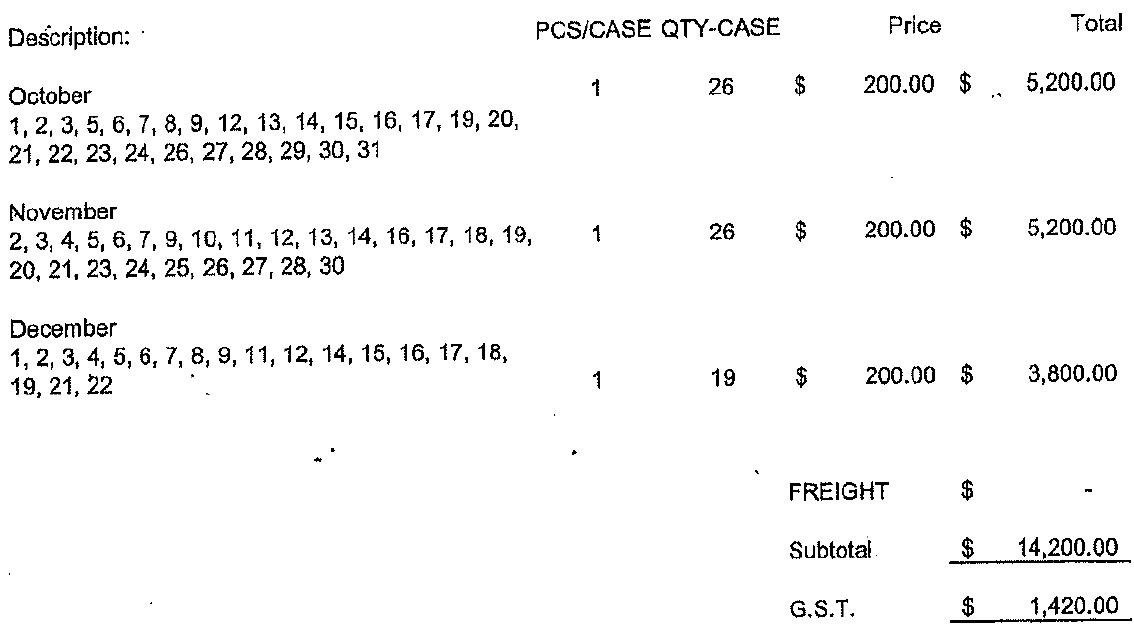
155 The remaining two invoices provide similar references to days during the months of February, March, April and May (for the 21 June 2016 invoice) and June (for the 30 June 2016 invoice).
156 John denied ever seeing those invoices and denied receiving them. He said that he does not know what they are for, and that he has never paid either Platinum or the respondent for any work done by the applicant. John adhered to this evidence in cross examination.
157 The respondent gives evidence that he did not recognise the three later invoices and denies that he gave them to the applicant and says that Platinum was never paid for any of the relevant invoices. The respondent exhibits a lengthy bank statement from Platinum for the period from March 2015 until 17 June 2017 which supports the proposition that the company had not been paid for those invoices during that period.
158 The evidence does not resolve conclusively the purpose or origins of the invoices of 11 May 2016, 21 June 2016 or 30 June 2016. I note that the applicant left Australia to go to Lebanon from 16 December 2016 until 28 February 2017 and also from 22 May 2017 until 22 June 2017. The invoices relied upon by the applicant refer to many days within these periods, which tends to suggest that there is no correlation between the days when he potentially performed work for Veejay and the dates in the invoices. Furthermore, it is not possible from the Harakat work books to draw any correlation between the dates identified in the invoices and the days that the applicant claimed that he worked for Veejay.
7.3 Did the applicant work for other people after October 2016?
159 There is a contest on the evidence as to whether, after the applicant ceased to work at Veejay, he returned to work for Platinum under the supervision of the respondent, or whether he worked for third parties. In this section I first consider the competing evidence from the witnesses and then the evidence of payments received by the applicant during this period.
160 The applicant gave inconsistent versions of events concerning how he conducted himself during this period. In his first affidavit he says that he was employed by Platinum from February 2015 until August 2018 and that on a daily basis, or as and when required, the respondent would give him instructions, but that he “mostly” worked with the respondent’s father. In his second affidavit he says that he returned to work for Platinum in October 2016 and that from May 2016 to October 2017 he “remained in contact with James”. It may be observed that the latter comment conflicts with the applicant’s earlier evidence that he worked at Veejay under the supervision of the respondent. In his third affidavit the appellant says that from October 2016, when he returned to the Platinum premises after working for John, until the end of his employment in 2017 he would on “many occasions” arrive at the workshop and the respondent would not give him instructions.
161 The applicant also gives evidence that he tried to contact the respondent by telephone but he did not answer and when he did answer the respondent said he was too busy studying for his law degree. He adhered to this evidence in cross examination, saying that he attended work every day and “was trying to contact James all the time to get work and he wasn’t getting back to me”. However, mobile telephone records for the period 13 July 2017 until 14 December 2017 for the telephones used by the applicant were produced on subpoena. They reveal that in that period only one two second call was placed to the respondent. When confronted with these records the applicant changed his evidence and said that, at the time, those phone numbers were not his, but those of his family. He said that he used friends’ telephones to call the respondent. The change of position was not to the applicant’s credit and I do not accept it as truthful. That change, and his variable evidence as to the duration of his employment with Platinum cause me to doubt that his version of events is accurate.
162 The respondent gives evidence that some months passed after the applicant left Platinum during which time he only dealt with the applicant at family functions. The respondent’s evidence is that the applicant then contacted him for money that he said that he was owed, but that the respondent considered that he did not owe the applicant anything. The applicant denies that this was the case and gives evidence that he was always working for John at the direction of the respondent and that after he ceased with Veejay he returned to work for Platinum and the respondent at the workshop in Yennora. The applicant’s evidence is that he remained in regular contact with the respondent during the period he worked with John and afterwards. He gives evidence that he always called the respondent “asking for money week in week out” and that he saw the respondent in the months following October 2016 “because I was still working for James”.
163 The respondent gives evidence that at the end of 2016 or early 2017 he saw the applicant at the workshop and the applicant informed him that he was working for a friend of his, Jason Nader. He says that he asked Saliba Gittany where the applicant was working, because he understood that he was working for Jason Nader part time, and Mr Gittany told him that the applicant was also working as a handyman for Jason’s father, Harris Nader. He gives evidence that later, on 12 November 2016, the applicant came to the workshop and introduced him to Jason Nader. They had a conversation in Arabic in which the applicant asked the respondent to sign the transfer of the Honda sedan (that the respondent had earlier given him) over to him or Jason. The respondent did so, and exhibited a document from New South Wale Roads & Maritime Services indicating that the vehicle was disposed of by the respondent on 12 November 2016.
164 The respondent gives evidence that his conversation with Mr Nader and the applicant continued to the effect that Mr Nader was helping the applicant to get his permanent residency. The conversation as reported is as follows:
James: Well, Jean isn’t working for me anymore and I can’t do anything for him. Have you transferred his 457 onto your company?
Jason I am working on it. I have a lawyer who can do it.
Jean Can’t you do it through your company?
James No, you are not working for me and you need to pass your English test.
Jean I have seen an immigration agent who says I don’t need to pass English.
Jason Yes, well, I have someone that says he can do it without the English test.
James Jean, I will not have my company name associated with any application unless Matthew does it. It is that simple.
Jason Ok, we will go see Matthew.
165 The applicant accepts that he did fencing work for Jason Nader, but contends that the respondent gave him permission to do so for a limited time because Jason’s son was ill. The applicant denies ever working for Harris Nader. He does not deny that Jason was with him during the conversation concerning the vehicle or that the transfer of the Honda sedan took place. The applicant denies that the conversation with Mr Nader concerning the migration agent took place, and says that it was the respondent who sent him to see the migration agent named Mr Semaan.
166 The respondent gives evidence that some months after November 2016 he saw the applicant driving a panel van with stickers on it advertising the name “Argileh Express”. He exhibits a photograph of it. He deposes to a conversation with the applicant during which the applicant said that the van was his and that he had started a new business in partnership with Jason Nader. The applicant denies the conversation as described, denies that he was an owner of that business and says that the van belonged to Mr Nader. He gives evidence that he began working with Argileh Express in December 2017 “when I had lost contact with James in the same month”. He says that he was desperate and that Jason had offered him work. He gives evidence that he was paid about $700 per week.
167 In relation to the evidence of payments received, various bank statements of the applicant were tendered by the respondent to indicate that during the claimed employment period he received a number of deposits of funds into his bank account. These included on 2 May 2017 the sum of $900, on 13 August 2017 two deposits of $400 and $100, on 5 October two deposits of $300 and $100 and on 31 October the amount of $1,000. The respondent contends that receipt of such funds is inconsistent with the proposition that the applicant was working for Platinum during this period. He also contends that the explanations provided by the applicant for these amounts was unsatisfactory.
168 In cross examination the applicant sought to explain these payments initially by saying that his son had given him some money to deposit and that he had brought over AUD10,000 from Lebanon. However, the applicant’s son, Elie, was not called to give evidence of his contributions. Further, it does not seem likely that the applicant would have taken the trouble to deposit such relatively small amounts if they were from his son and he could have provided evidence of his son’s bank details to support the claim.
169 Furthermore, as I have noted in section 5.2 above, the applicant gave wholly inconsistent evidence about the funds that he borrowed in Lebanon and brought from Lebanon to Australia. In his oral evidence in these proceedings he initially said that he had brought more than $10,000 from Lebanon that he did not deposit into a bank account. In his protection visa interview with the Department in 2019, he claimed that the amount was USD33,000, an amount that he reduced to about $17,000 to $18,000 during cross examination, saying that after giving that answer in his interview he had discussed it with his wife and agreed that it was a smaller amount. The applicant made no reference to bringing money to Australia in his affidavit evidence.
170 The inconsistency of evidence in this respect does not conceal the illogicality of the proposition that, having brought in such a sum (whatever the amount), it is intrinsically unlikely that the applicant would take funds from that amount and then deposit small parts of it, piecemeal, into his bank account.
171 I reject the applicant’s evidence concerning the funds deposited into his bank account. The more probable explanation is that the applicant received the funds in payment for work that he had performed for third parties. Although the applicant denied that this was so, Jousephine gave evidence that she had been informed by the applicant that after he ceased working for John at Veejay he had started to perform labouring work for third parties. Mr Gittany deposed to a conversation after October 2016 with the applicant to the effect that the applicant was doing manual labour 2 or 3 days a week. Mr Boustany deposed to having a conversation with the applicant where he said that he had begun a business delivering argileh shisha to homes. The respondent gave similar evidence. None of that evidence was shaken in cross examination.
7.4 The 2016 and 2017 group certificates
172 It will be recalled that the applicant relies on the 2016 and 2017 group certificates, referred to at [69] and [76] above, as evidence demonstrating that he was employed by Platinum at least until 31 June 2017. The respondent contends that the documents were falsely obtained by him from the ATO in order to get the applicant “off his back” after receiving a death threat from the applicant who was concerned about his application for permanent residency. I address the evidence relevant to this subject below.
173 The respondent gives evidence that on 17 March 2017 he received a call from Mr Semaan from CK Migration informing him that the applicant was in his office with Jason Nader. He reports that Mr Semaan told him that he was trying to explain to the applicant that unless he had been working with his sponsor for at least 2 years and can pass the English test, then there was nothing that he could do for him. The respondent says that he confirmed to Mr Semaan that the applicant had not returned to take up employment with Platinum after he had left in June 2015. The respondent says that it was at this point that he became concerned that the applicant’s Visa was still attached to his sponsorship and because he was going to be a solicitor he thought he should notify the Department. The respondent exhibits a letter from CK Migration dated 17 March 2017 which is addressed to the applicant at a hotmail.uk email address and an address in Bossley Park. The letter thanks the applicant for asking CK Migration to assist in his application and says that “as discussed” the author has determined that the “Temporary Residence Transition stream of the subclass 186 – Employer Nomination Scheme visa” is the most suitable option. As dealt with above, the respondent failed to produce the covering email that indicated he had sent the applicant to see Mr Semaan.
174 The applicant does not deny visiting Mr Semaan on the date indicated, but has no recollection of Mr Semaan having any telephone conversation whilst he was there and denies ever receiving the letter annexed, which was addressed to a hotmail address that he says the respondent created for him. The applicant’s evidence is that that the respondent sent him to Mr Semaan and during the meeting Mr Semaan requested documents for the purpose of lodging the permanent visa application. The applicant says it was the respondent, not Mr Semaan, who told him that he needed to demonstrate he had been working for Platinum for at least two years.
175 The respondent in his written evidence says that in August 2017 he was visiting his sister Danielle Gittany when he received a telephone call from the applicant demanding in aggressive tones that he meet him at Bakery King. He refused and invited him to Ms Gittany’s place, but the applicant angrily refused. About 30 minutes later the respondent had a conversation with Ms Gittany during which she told him that she had just seen the applicant in the driveway of her house, and that he had driven past it “numerous times”. The conversation continued:
James: Are you sure it is him?
Danielle: Yes I am sure. I know his head and his face. It was his silver Camry. I have two girls and I don’t need him stalking and intimidating us.
176 The respondent gives evidence that as a result of his conversation with Ms Gittany he became concerned that the applicant wanted to harm his family and “try to do so when I wasn’t around”.
177 Ms Gittany gives evidence about the same conversation. She says that in early August 2017 she was with the respondent when she heard him have a telephone conversation in Arabic with the applicant. At the time the respondent’s phone was on speaker. She describes the applicant as screaming at the respondent and insisting that he go to Bakery King to talk with him. The respondent refused, after which, about an hour later, Ms Gittany observed the applicant drive past her house numerous times and then drive into the driveway and stare at her for about 30 seconds. She gives evidence that she felt threatened and intimidated that the applicant was stalking her. She then told the respondent that she has two young girls and that she did not want “this idiot doing anything”.
178 The applicant denies approaching Ms Gittany’s house as alleged. He accepted that he had a conversation with the respondent while the respondent was at Ms Gittany’s house but says that beforehand Saliba Gittany had telephoned him to say that the respondent was going to call him to invite him over “so that [the respondent] can cause a problem between me, you and Danielle. Don’t come”. He says that at around that time he called the respondent and said words to the following effect:
Jean: You owe me my money.
James: I don’t owe you anything.
Jean: You and your father are crooks.
179 The evidence of Ms Gittany supports that which has been given by the respondent. I found Ms Gittany to be a credible witness and accept the version of events as told by her. In this context I note that whilst Mr Saliba Gittany gave evidence in the proceedings on behalf of the respondent, it was not suggested to him in cross examination that he had had any conversation with the applicant to the effect that the applicant claims.
180 On 13 September 2017 Jousephine Dahdah convened a family meeting at her home. In attendance were Jousephine, her husband, the applicant, his wife Berthe Makdessy, the respondent and Jouliana.
181 The respondent gives evidence of a conversation that took place to the following effect:
Jean: James, I need my residency.
James: Jean, Matthew [being Matthew Semaan of CK Migration] told you what you need to do. There is nothing I can do for you because you don’t have English skills. You need to pass your English test.
Jean: I’ve seen another solicitor who told me that’s a lie. You’re lying to me.
James: Jean, you went to see him with Jason [Nader]. Matthew called me while you were there with him. Matthew made it clear that you haven’t done your English.
Jean: Matthew’s lying too. I’ve spoken to other people. I don’t need an English test.
James: Jean, in your circumstances, that’s what’s needed. Matthew’s a lawyer. He knows what’s required.
Jean: You’re lying to me. You just don’t want me to get permanent residence.
James: Jean, you left me to start your own business. It was your call. You wanted to buy your own truck. You wouldn’t listen to me.
182 The respondent says that at this point the applicant became more aggressive and began to shout at him saying:
Jean: Fuck your father’s god. I’m going to fuck his god. He’s greedy and I want my money.
James: He’s paid you everything he owes you. All you do is stand there and scream. No one wants to talk to you when you’re screaming at them.
Jean: Look, I’m not going back to Lebanon. You better get me my permanent residence.
James: How do I do that Jean? This is not Lebanon where I can just pay someone off. There’s rules and regulations in Australia.
Jean: I don’t give a fuck. If I don’t get my permanent [residency], it’s on your neck…I need two years of group certificates. Go and get them.
183 The respondent gives evidence that at this point the applicant pointed at his neck and made a cut throat sign with his thumb, which he took to mean that he meant to kill him. He says that the applicant’s wife then asked the applicant why he was speaking to the respondent in that way.
184 The respondent says that after this he concluded “that I needed to get Jean off my back”. He called his accountant, Anna Nawrocka and said that his cousin was threatening him and he needed to get group certificates prepared for him “so that he can show he’s been working when he applies for permanent residence”. He received the first group certificate on about 20 September 2017 and provided it to Jouliana. He says that subsequently, on about 3 October 2017 Jousephine sent him an SMS asking for the second group certificate. In answer, the respondent says that as soon as his accountant has finished “with the company stuff” he will send it to Jouliana by email. The respondent’s evidence is that he received the second group certificate from his accountant on or about 19 October 2017 and promptly emailed it to Jouliana.
185 The applicant agrees that the meeting took place at Jousephine’s house, but denies that the conversation was as the respondent recalls it, including any aggressive gestures or threats. He says that the only relevant part of the conversation was as follows:
Jean: James, this first tax return that was lodged in 2014/15 is a return I have never seen. Are you paying tax for me?
James: Yes
Jean: Where are they?
James: I’ve given you the group certificate but never lodge[d] the group certificate for the company. From now I will send all the group certificates to Julianna to give to you.
186 The applicant’s evidence is that he never spoke about the residency papers during this conversation and that the conversation did not concern his permanent residency at all. He accepts that before the conversation he had been to see Mr Semaan but denies that Mr Semaan was mentioned during the conversation. He accepted that during the conversation he and the respondent spoke angry words, but contends that the respondent started getting worked up and he responded. He denies that he began to shout. When asked in cross examination why he was particularly concerned about getting tax documents, he said that he understood that the most important thing in Australia is the superannuation and the tax and that he did not want to stay in Australia illegally.
187 Jouliana Dahdah was present during the conversation. She gives affidavit evidence that in total the conversation was between two and three hours and that she was present for it all. She refers to three parts of the conversation.
188 First, she says that the applicant asked the respondent about a tax assessment, saying that he had received one, but wants to know where the rest of the tax is. The respondent answered by saying that the one received is for 2014 and 2015 tax and that “the 2016 and 2017 tax was only paid until October 2017 and that has not been lodged”. The applicant asked whether the respondent had paid his tax, because he had not received any group certificates, to which the respondent answered: “I am behind on all my tax payments through my company. Hold on, I will message my accountant now and see if the group certificates are ready” and “Yes, she replied that they are ready, I will email them to Jouliana when I receive them from my accountant”. Later the respondent said “I just got a $45,000 bill from the ATO. How am I meant to pay it? I can’t pull money out of thin air”.
189 The respondent denies that the conversation as described took place although he accepts that he subsequently agreed to send the group certificates to Jouliana.
190 Secondly, Jouliana’s evidence is that the applicant and respondent got into an argument and she recalled them saying:
James: I am the son of a slut?
Jean: Well if that’s what you want to say, then yeah your mum is a slut.
James: You left my company, you went and worked for yourself.
Jean: No, I didn’t leave. You convinced me to come here. You told me you will give me a stable job and stable income….
191 In cross examination Jouliana accepted that at one point towards the end of the conversation it got heated from both sides with raised voices, but that it subsequently settled down. She did not accept that the applicant had used the aggressive language ascribed to the applicant by the respondent or make any cutthroat sign across his neck during the course of the conversation to which I have referred in [182] above.
192 I take the reference in this conversation to the applicant having left Platinum to be of relevance. It indicates that as at the time of the conversation it was clear at least to the respondent that the applicant had left the employment of Platinum and that Jouliana recalled him saying as much.
193 Thirdly, Jouliana recalls a conversation as follows:
Jousephine: How do we go about getting his [Jean’s] permanent residency?
James: He has pass his English test which is very hard which you won’t even pass.
Jean: I am taking English lessons.
194 In cross examination Jouliana largely adhered to her written evidence. She agreed that since about 2016 she had been aware that the applicant was interested in obtaining permanent residency in Australia. She also accepted that it was her understanding that the central focus of the conversation was not about any claim by the applicant for wages unpaid by Platinum and the respondent, but rather about the receipt of taxation certificates.
195 Jousephine Dahdah gives written evidence that in September 2017 she invited the applicant and the respondent to her house. The applicant and his wife Berthe arrived first followed by the respondent. Her daughter, Jouliana, and husband, Emil, were also present. Her affidavit evidence is less detailed than Jouliana’s. She says that she asked the respondent why he was not paying the applicant’s taxes and that the applicant then said that he had no record of any tax statement and that he needed group certificates for his records. She records the respondent’s answer to be:
I have one tax statement and I will send you the second tax statement later because I have not lodged it yet. Those papers should be with me not you. I will send them to Jouliana by email and she will give them to you.
196 Jousephine recalled that the applicant and respondent got upset with each other and said:
James: My mum is a slut huh?
Jean: If you want it that way, yes your mum is a slut.
197 She says that the conversation turned to the applicant’s application for permanent residency and recalls it being in similar terms to that set out in the in the third part of the conversation recalled by Jouliana set out at [193] above.
198 In cross examination counsel for the respondent essentially put the case in answer to Jousephine in the following terms:
Is it curious to you that what Jean was worried about was a group certificate saying that taxes were deducted, when he had, according to him, hadn’t been paid his wages properly? That is very strange, do you agree?---Yes, I agree because he was suspicious, because he’s here on working visa, he was suspicious that they’re not paying his taxes and he’s going to be, maybe, in trouble later on, to apply for a residency in here. He was suspicious, he wasn’t sure about it. That’s why he asked to make sure, if they’re paying his taxes, even if they’re not paying his wages, but if they’re paying, you know, like – obviously its illegal not to pay your tax. So he was worried.
It is absolutely bizarre that, wouldn’t you agree, Ms Dahdah that he’s concerned about taxes and he’s not saying, where’s my money for my wages. The whole discussion’s about taxes. That makes no sense. Did you ever say that to him?---No, I didn’t. What made sense is because I already asked him about the money in the previous – previous meeting we had, and the – and the second time where – where that happened, because my brother wanted to have his group certificate. As far as he’s concerned, if his taxes were paid, he can actually fill up the tax, and – and he might get some money back on his tax.
199 Jousephine accepted that the applicant had never spoken to her about the recovery of money paid on his tax and that she was speculating as to why the applicant might want his group certificates. Importantly, she accepted that one reason why the applicant was asking for a tax return was to provide supporting documents for his application for permanent residency. That was a subject that was discussed at the meeting.
200 I accept that Jouliana and Jousephine attempted to provide honest evidence of their recollection of the conversation. It is apparent that the conversation was long and that their memory of it is fragmented. Clearly none of the witnesses purports to recite it in full. For the reasons given, I am cautious in accepting either the applicant or the respondent’s version of events without supporting material from third party sources.
7.5 Consideration and findings arising from the evidence concerning the key factual disputes
201 In section 7.1 above I have referred to the evidence given in relation to the conversation on 26 June 2015, upon which the respondent relies as evincing an intention on the part of the applicant to cease working at Platinum.
202 I am satisfied that on or about 26 June 2015 the applicant indicated to the respondent that he intended to purchase a truck and start his own business operating it, in accordance with the respondent’s recollection of the conversation. In this regard the version of events told by the respondent is supported by the independent evidence of Mr Boustany and Mr Atie and indirectly supported by the chronology of events in relation to the secondment, to which I have referred to in section 7.2. As I have explained in section 7.1, Mr Boustany and Mr Atie recalled being present when the applicant informed the respondent of his interest, indeed determination, to buy a truck and to leave Platinum to start his own business. Their evidence was not shaken in cross examination and I accept it. It is supported by the contemporaneous record in the form of Platinum’s June 2015 minutes. It is also indirectly supported by John’s evidence of his conversation with the applicant on 5 July 2015.
203 I have referred to the evidence relating to the period when the applicant went to work at Veejay in section 7.2. Having regard to the matters set out there I:
(1) Find that the applicant worked as a labourer at Veejay from 5 July 2015 until October 2016;
(2) Find that the applicant worked under the supervision of John during that period and was engaged to work by Veejay;
(3) Reject the submission that the Harakat work books or the invoices adduced in evidence by the applicant from Platinum to Veejay demonstrate that Platinum continued to employ him while he worked for Veejay or that he was otherwise working under a secondment from Platinum during that period;
(4) Reject the contention that during the period that he worked at Veejay, the applicant worked under the supervision of the respondent; and
(5) Find that Veejay paid the applicant in cash for the duration of his employment with Veejay.
204 It follows that I reject the applicant’s contention that he continued to work as an employee for Platinum during the period from 5 July 2015 until October 2016. To the contrary, I find that during that period he was engaged (whether as an employee or otherwise is unclear on the evidence) for Veejay.
205 In section 7.3 above I have considered whether or not the applicant worked for people other than Platinum after October 2016 until the alleged termination of his employment in October 2017. I am satisfied from the evidence referred to there that he did. Conversely, I reject the applicant’s claim that during that period he attended the premises of Platinum to report for work or that he frequently made telephone calls to the respondent to ask him for work.
206 In section 7.4 I have considered the troubling evidence concerning the 2016 and 2017 group certificates. I accept that at the meeting in September 2017 the question of the group certificates was discussed in the context of the provision by Platinum of such documents to the applicant. However, I do not consider that it was raised simply because the applicant wished to be compliant with Australian taxation law, as he contends. I consider it more likely, and find, that the subject was raised because the applicant, Jousephine and Jouliana thought that it would be necessary for the applicant to have such documents in order to further his claim to permanent residency in Australia on the basis that he had worked for Platinum for two years.
207 The applicant’s evidence was that he never would have resigned from his job in Lebanon if he had not thought that he could obtain a permanent residency visa for Australia. He was conscious by then of his need to prove that he had worked with the same employer for more two years. I consider it likely that it was the applicant who provided Jousephine and Jouliana with the (incorrect) narrative that he had remained in employment with the respondent at Platinum, and that their acceptance of that position arose from him. Furthermore, despite the applicant’s denial that the topic of his application for a permanent residency visa was raised during the meeting, each of Jousephine and Jouliana recall that it arose. I accept their evidence in this regard and that the preparation of the group certificates arose in that context.
208 This view is broadly supported by the chronology of events. Some months before in March 2017 the applicant, in the company of Mr Jason Nader, had visited Mr Semaan at CK Migration Law. The applicant’s son, Elie, arrived in Australia in June 2016 and the balance of his family arrived in June 2017. The applicant gives evidence that the primary reason for his trip to Lebanon from May 2017 until 22 June 2017 was to obtain documents for his application for permanent residency. These matters tend to support the proposition that documents relevant to his application for permanent residency, such as group certificates, were of concern to the applicant at that time.
209 Furthermore, neither Jousephine or Jouliana recall any part of the September 2017 conversation to be about unpaid money owed by the respondent (or Platinum) to the applicant, which tends to contradict the applicant’s version of the conversation. I do not accept that the purpose of the discussion was to address the underpayment by Platinum of the applicant’s entitlements. Had that been a genuine grievance one might have expected that subject to be raised, but neither Jousephine nor Jouliana recall it. Rather the focus of the September 2017 meeting appears to have been upon obtaining documents to support the applicant’s visa application. These matters cause me to reject the applicant’s recollection of the conversation.
210 Having regard to the whole of the evidence, I consider that it is likely that the effect of the meeting was, as the respondent’s evidence indicates, to ask the respondent to produce group certificates for Platinum in respect of the applicant, regardless of whether or not Platinum had been the employer of the applicant for the whole period, because the applicant, Jouliana and Jousephine considered them to be important for his application for permanent residency in Australia.
211 However, one aspect of the evidence given by the respondent is that the applicant threatened to kill him if he did not produce such statements. Having regard to the fact that Jouliana and Jousephine have no recollection of that part of the conversation, I am not prepared to find that this aspect of the conversation, or the making by the applicant of a cutthroat sign, took place. Had such strong language and such a threatening gesture been made, one would expect the other participants in the conversation to recall it. In this regard I do not consider that the failure of the applicant to call the evidence of his wife, Berthe, to be decisive. I accept the denials of the applicant that such threats were made. It follows that I reject the evidence given by the respondent in this regard.
212 I consider that the respondent thought it expedient to “get Jean off his back” (as he said in his evidence) by instructing his accountant to create the group certificates, but I do not consider that he did so under a threat of death or anything nearly so dramatic. Rather, he wished to meet the desires of Jouliana and Jousephine and, perhaps to a lesser extent, those of the applicant.
213 I find that the respondent was prepared to satisfy that expediency by instructing his accountant to prepare false group certificates.
8. CONSIDERATION OF THE APPLICANT’S CLAIMS
8.1 Claim under s 323 of the FW Act
214 The applicant’s pleaded case is that he performed work for Platinum for a period of 32 months for which he was paid only $19,711. The pleaded basis for that claim is that the applicant was an employee of Platinum from 17 February 2015 until October 2017.
215 I have summarised the disputed factual issues in some detail above. The first relevant legal issue is whether on or about 26 June 2015 the applicant resigned from or abandoned his employment. This does not depend on the parties’ subjective intentions or understanding, but is determined by what a reasonable person in the parties’ position would have understood was the objective position immediately after the conversation ended on 26 June 2015, based on what each party said and did and in light of the surrounding circumstances: Koutalis v Pollett [2015] FCA 1165; 235 FCR 370 at [43] (Rares J).
216 In Koutalis the Court made the following observation of present relevance (emphasis added by Rares J):
43. …In Toll (FGCT) Pty Ltd v Alphapharm Pty Ltd (2004) 219 CLR 165 at 179 [40], Gleeson CJ, Gummow, Hayne, Callinan and Heydon JJ said:
This Court, in Pacific Carriers Ltd v BNP Paribas [(2004) 218 CLR 451], has recently reaffirmed the principle of objectivity by which the rights and liabilities of the parties to a contract are determined. It is not the subjective beliefs or understandings of the parties about their rights and liabilities that govern their contractual relations. What matters is what each party by words and conduct would have led a reasonable person in the position of the other party to believe. References to the common intention of the parties to a contract are to be understood as referring to what a reasonable person would understand by the language in which the parties have expressed their agreement. The meaning of the terms of a contractual document is to be determined by what a reasonable person would have understood them to mean. That, normally, requires consideration not only of the text, but also of the surrounding circumstances known to the parties, and the purpose and object of the transaction [Pacific Carriers Ltd v BNP Paribas (2004) 218 CLR 451 at 461-462 [22]]. (emphasis added)
44. In my opinion, the same considerations apply to the evaluation of the circumstances where parties engage in conversations and conduct that affects their legal rights under a contract, including the assessment of whether or not words and or conduct can be seen to amount to a resignation. Nonetheless, in employment contexts, a court must be conscious that situations can arise in which one or other of the parties acts in the heat of the moment in such a way that a reasonable person in the position of the parties in all the circumstances would not understand the employee to be resigning or the employer to be terminating the employee’s employment, as the case may be. So much is reflected in what May LJ, with whom Croom-Johnson and Woolf LJJ agreed, said in Sovereign House Security Services Limited v Savage [1989] IRLR 115 at 116, namely:
In my opinion, generally speaking, where unambiguous words of resignation are used by an employee to the employer direct or by an intermediary, and are so understood by the employer, the proper conclusion of fact is that the employee has in truth resigned. In my view tribunals should not be astute to find otherwise. However, in some cases there may be something in the context of the exchange between the employer and the employee or, in the circumstances of the employee him or herself, to entitle the Tribunal of fact to conclude that notwithstanding the appearances there was no real resignation despite what it might appear to be at first sight. (emphasis added)
217 In the present case, the case advanced by the applicant is that the conversations of 26 June 2015 to which I have referred in section 7.1 did not take place. He advances no alternative case that on that day he was dismissed, or constructively dismissed. Rather, he advances an alternative version of events concerning the secondment, which I have rejected. Accordingly, the relevant question concerns the conversation that I have found took place on that day, and the events surrounding it.
218 The evidence of the respondent, Mr Boustany and Mr Atie indicates that the applicant conveyed his intention to acquire at truck and commence his own business. The respondent was not prepared to assist in this venture. After a lengthy conversation on the subject, during which the respondent attempted to dissuade the applicant from his plans, the applicant indicated that he was serious in his plan to buy the truck and start his own business. The respondent replied “That’s fine Jean, if you don’t want to work here anymore then fuck off”.
219 Although the respondent had the final word in that conversation, it is apparent that the applicant evinced an intention on his part to cease working for Platinum and engage in another activity that was antithetical to his continued employment at Platinum, and in breach of his obligations under his 457 Visa.
220 The events that followed indicate that the applicant did not purchase a truck. However, a short period of time later, on 5 July 2015, he approached John for work and immediately began to work for Veejay. That step was also inconsistent with his continuing to work for Platinum as an employee. In this regard, I have earlier in these reasons explained why I reject the contention advanced by the applicant that, despite performing as a labourer at Veejay, he was nonetheless still working as an employee at Platinum under the supervision of the respondent.
221 Whilst taken alone it might be regarded that the conversation between the applicant and the respondent on 26 June 2015 did not amount to a conclusive expression of resignation or abandonment, the events that followed demonstrate that indeed that was the applicant’s intention. The diverging evidence as to what happened after the period of time that the applicant worked at Veejay is of less relevance, having regard to the findings that I have made. However, in my view the applicant’s case to the effect that he continued to report to the respondent after October 2016 is also not supported by the evidence and must be set to one side.
222 In weighing up the competing versions of events I pause to reflect on three aspects of the case that are particularly troubling.
223 One is that there is an inherent improbability that a man in the position of the applicant would leave his life in Lebanon and come to Australia to work at Platinum, only to abandon his employment a few months later. On one level it does not seem like rational behaviour. The applicant as a recent arrival to Australia was naïve as to local laws and to a large extent in the hands of the respondent. It would be a rash thing for one in his position to take such a course.
224 However, after observing the applicant in the witness box and considering his evidence closely, in my view he was capable of making impulsive and irrational decisions if he considered that they would be to his benefit. The fact that he behaved in a way that may appear objectively to be irrational does not persuade me that he was being truthful in denying, in the face of the other evidence to which I have referred, the 26 June 2015 conversation or in presenting the alternative version of events that he has advanced in relation to his work at Veejay, or the events that happened thereafter.
225 Another is that the conversation with the respondent of 26 June 2015 concerned the applicant’s intention to buy a truck, and yet within 10 days he was asking John for work at Veejay. On one view that might indicate that he never had an intention to acquire a truck and that the version offered by the respondent is false. However, I prefer to rely on the objective factors to which I have referred. It is entirely possible that the applicant changed his mind after the respondent refused to provide his support (including financial support) for buying the truck and instead decided to chance his arm working for John.
226 A third factor is that the existence of the 2016 and 2017 group certificates tend to support the applicant’s version of events. These are indeed troubling in the context of the narrative provided by the respondent. However, for the reasons set out in more detail in section 7.4 above, I am satisfied that those documents are, as the respondent contends, false. I am satisfied that in September 2017 there was a lengthy family meeting at which the applicant, Jousephine and Jouliana urged the respondent to produce the 2016 and 2017 group certificates to assist the applicant in his application for permanent residency and that the respondent agreed to comply. As I have noted, I reject as false the respondent’s evidence that at that meeting the applicant threatened to kill him. In my assessment the respondent is a person who is prepared to bend the truth to meet the expediency of his own interests, and at that point he considered it was more convenient to lie to the ATO than to disappoint his family.
227 In the result, the conclusion that I reach is that the applicant has not made out his case that he worked for Platinum for the period from 27 June 2015 until 1 October 2017. I accept that he left the employment of Platinum on about 26 June 2015.
228 It follows that the applicant fails in his case that Platinum was in breach of s 323 of the FW Act for the period from 26 June 2015 to 1 October 2017. From 26 June 2015 the applicant ceased to be entitled to wages because he abandoned his employment and indicated that he was no longer ready, willing and able to perform the contract of employment. Thereafter, Platinum no longer had an obligation to pay the applicant any wages and superannuation and he no longer continued to accrue any annual leave: Automatic Fire Sprinklers Pty Ltd v Watson [1946] HCA 25; 72 CLR 435 at 465.
229 For these reasons the applicant’s primary case for the payment of entitlements and pecuniary penalties for the period February 2015 to October 2017 must fail.
230 In the alternative, the applicant contends that he was covered by the Clerks Award and that he performed duties commensurate with level 2 classification as set out in Schedule A of the Clerks Award. He claims that he is entitled to payment for unpaid wages, leave and superannuation entitlements under the Clerks Award. However, the applicant conceded during cross-examination that he had not performed any clerical work as set out in the Clerks Award and there is otherwise no evidence to suggest that he did so. As a result, I am not satisfied that the applicant was covered by the Clerks Award and his claim for entitlements on this basis must also fail.
231 In light of my findings above it is not necessary to consider the respondent’s alternative claim that from about 26 June 2015 the applicant engaged in industrial action within the meaning of s 19 of the FW Act.
8.2 An alternative case for unpaid wages from February 2015 until 26 June 2015
232 Although not pleaded, in closing submissions the applicant advanced a case to the effect that he is entitled to unpaid wages and entitlements for the period that he worked from 17 February 2015 until 26 June 2015. The respondent addressed the argument in answer. In my view it is appropriate to address my conclusions in relation to this aspect as advanced.
233 The respondent submits that the applicant lodged a taxation return for the 2014/2015 financial year (2015 tax return), which indicates that he received a gross payment of $48,750 and had $13,000 in taxation withheld, which amounts satisfy his entitlement to wages.
234 The applicant contends that he had nothing to do with the 2015 tax return, that he did not arrange for it to be filed, that he never lodged a taxation return and that he never received any refund arising from it. This raises another area of the evidence in which diametrically different versions of events are offered.
235 At the trial the respondent tendered a tax return for 2014/2015 and a Notice of Assessment for the year ended 30 June 2015 (2015 tax assessment) issued by the ATO produced on subpoena by the applicant (see [66] above).
236 The 2015 tax return identifies the details of the applicant and his tax file number. It gives as his postal address the same Ermington, NSW address as noted in the 2015 tax assessment. It provides a BSB number for the Carlingford branch of the National Australia Bank and notes the “occupation description” for the applicant as “construction worker-earthmoving labourer”. Work related deduction claims are made for car expenses and protective clothing. The tax agent’s details record the contact name as “Anna Leksinska” and a telephone number is provided. The details of income and tax withheld correlate with the details set out in the 2015 tax assessment.
237 The applicant gave evidence in cross examination that it was the respondent who prepared the tax return when they were together in the office of Mr Basha and that “[the respondent] made me sign it…and he took care of the rest”. The applicant denied ever seeing Ms Leksinska. He said that the respondent gave the 2015 tax assessment to him but not the 2015 tax return. He denied giving Ms Leksinska or anyone else any documents for a tax return and said that he had not met Ms Leksinska. He also denied that he had supplied information as to his income for the 2015 tax assessment or that he had received a gross income of $48,750. He said that the respondent made him sign documents the contents of which he was unaware. He denied ever receiving a tax refund in the amount of $6,398 or any refund at all.
238 The applicant’s denial of involvement in the creation of the tax return sits uncomfortably with the fact that it was he who produced the 2015 tax return and the 2015 tax assessment. Plainly they had come into his possession at some point in time.
239 The respondent gives evidence that it was the applicant who approached him at some time in about May or June 2016 and said that he wanted to do his tax return. The respondent then asked Anna Nawrocka to do it, Mr Basha having said that he did not want to do it, and Ms Nawrocka said “they will sort it out”. The respondent’s evidence is that Ms Nawrocka was his accountant and worked for Mr Basha but he did not know Ms Leksinska. His evidence is that he did not ask Ms Nawrocka to prepare the applicant’s tax return for 2015, and only told her that the applicant wanted it done and Mr Basha did not want to do it. When asked who provided Ms Leksinska with the information going to the deductions to be made for the applicant, the respondent answered that he thought that would have been Ms Nawrocka.
240 On 21 June 2016 the respondent received by direct transfer to his bank account from AAA Mobile Accountants (an accounting firm located at the Ermington address identified in the tax return lodged on behalf of the applicant) the $6,398 refund on the tax due to the applicant from the ATO.
241 The respondent gave evidence that Platinum paid the wages due to the applicant in cash prior to his departure on 26 June 2015, because prior to then the applicant did not have an Australian bank account. The applicant denies that this happened.
242 I am not persuaded, on the basis of the evidence available, that the 2015 tax return does not represent the true position, namely that the applicant was paid wages by Platinum prior to 26 June 2015. There is no suggestion that the tax return is not a genuine document, or that the ATO did not provide a refund in the amount specified in the return. It is inherently improbable that Platinum or the respondent would have manufactured a state of affairs where tax would be paid in respect of wages for the applicant in circumstances where he was not paid at all. Indeed, such a proposition was not put to the respondent even though the submissions advanced by the applicant suggest (without making the allegation directly) that this is what must have taken place.
243 In the circumstances, in my view the applicant has not established that he was not paid wages for the period 17 February 2015 to 26 June 2015.
244 However, as set out at [51] above, pursuant to the contract of employment, the applicant was entitled to superannuation contributions “in accordance with current legislation”. The applicant claims that during his employment Platinum failed to make superannuation contributions in respect of the applicant. In his third affidavit the respondent’s evidence was that he had no recollection of Platinum making any superannuation payments on the applicant’s behalf. In cross examination, the respondent accepted that he knew that Platinum was supposed to make superannuation contributions for the applicant and there was a possibility that he did not do so. Although couched in terms of “possibility” in my view this qualification more likely reflects the respondent’s inability to make a frank concession than any doubt on his part. I consider that, had Platinum made superannuation contributions in respect of the applicant, the respondent would have known it. I am satisfied that Platinum did not make superannuation contributions for the applicant for the period 17 February 2015 to 26 June 2015.
245 The applicant submits that the failure to make superannuation contributions is a breach of s 323 of the FW Act even if the Clerks Award does not apply. He submits that s 323 is a broad provision requiring the payment of entitlements, including those arising under contracts of employment, citing Murrihy at [142]. However, Murrihy does not stand for the proposition that superannuation contributions fall within s 323. The Explanatory Memorandum to the Fair Work Bill 2008 notes that “the amounts referred to in this subclause would not include superannuation contributions or non-monetary benefits”. Under the Superannuation Guarantee (Administration) Act 1992 (Cth) and the Superannuation Guarantee Charge Act 1992 (Cth), an employer is under no statutory obligation to make superannuation contributions for the benefit of any employee, however the extent to which it does so will affect whether it pays a charge or tax and, if so, in what amount: Bluescope Steel (AIS) Pty Ltd v Australian Workers Union [2019] FCAFC 84; 270 FCR 359 at [25] (Allsop CJ, Rangiah J agreeing). Therefore, the result of the failure to make superannuation contributions for the applicant is that Platinum, which has been deregistered, may have a charge imposed on it by the relevant statutory body. In light of the structure of the legislative scheme, and having regard to the Explanatory Memorandum, I am not satisfied that the general language of s 323(1) of the FW Act encompasses superannuation payments. Such payments do not appear to be “amounts payable to the employee in relation to the performance of work” as that subsection requires. Moreover, whatever contractual obligation Platinum may owe in respect of unpaid superannuation has not been pursued in this litigation. Any liability of the respondent would only arise under s 550 of the FW Act. In the result the applicant has not established that Platinum’s failure to make superannuation contributions on his behalf for the period 17 February to 26 June 2015 constitutes a breach of s 323 of the FW Act.
246 The applicant pleads that “during the employment period” the applicant at various times asked the respondent to make payment for the work that he performed pursuant to his contract of employment and that, in response, the respondent made seven listed representations to him. In closing submissions, he confined his case to the following single representation, namely that:
the respondent would apply for permanent residency in respect of the applicant, two years into the term of is contract of employment.
247 The applicant pleads that the representation was made in trade or commerce within the meaning of s 18 of the ACL, and that in reliance on that representation the applicant continued to perform tasks as assigned by the respondent pursuant to the contract of employment during the “Employment Period” (which is defined in the statement of claim as being from February 2015 until October 2017), and continued to fund and support his and his family expenses by taking out a loan for $100,000. He pleads that the respondent did not have a genuine intention of applying for permanent residency in respect of the applicant and that as a result the conduct of the respondent was misleading or deceptive in breach of ss 4, 18 and 31 of the ACL.
248 The applicant further pleads that but for the misleading or deceptive conduct of the respondent, the applicant would not have entered into the contract of employment and would not have continued to perform work under it. He pleads that he was induced to perform work without pay during the Employment Period and is entitled to damages under s 236 of the ACL.
249 The relevant case advanced on the pleading is that prior to commencement of his employment the respondent represented to the applicant that he would apply for permanent residency in respect of the applicant, two years into the term of his contract of employment.
250 The difficulty with the applicant’s case in this regard is that the pleaded representation that the respondent would apply for permanent residency for him is conditional, and dependent on the applicant remaining in employment with Platinum for two years. As I have found, that condition was not fulfilled as a result of the applicant resigning from or abandoning his employment after 26 June 2015. Accordingly, that case cannot be made out.
251 In his closing submissions the applicant put forward a different case. He relied on the following paragraph in his first affidavit of 27 June 2019:
James Dahdah arrived in Lebanon in October 2014 for his honeymoon. On that day when he arrived home James Dahdah said words to the effect:
“Congratulations! You got your visa to go to Australia. After two years you can stay in Australia permanently”.
He further said words to the effect:
“Please resign from your current job and join us in Australia”.
252 The applicant submits that the representation was liable to mislead the applicant as to the terms or conditions attached to obtaining permanent residency in Australia because the respondent did not disclose at the time of the offer the requirements of the visa including the English language requirements for both the visa and the permanent residency. The applicant submits that at the time that the respondent prepared the Business Plan and other documents for the applicant’s 457 visa the respondent was aware that the role that he required the applicant to fulfil required proficiency in English and that the applicant was not proficient in English, yet when putting forward the role to the Department he created the impression that the role required a person who could speak Arabic. He further submits that the respondent identified a salary for him at $97,500 in his contract of employment in order to circumvent the English language requirement.
253 This is quite a different misrepresentation case based, as it appears to be, on the assumption that the failure on the part of the respondent to inform the applicant of certain English language requirements amounted to a misrepresentation. However, the modified case based on the conversation quoted above must fail for the same reason as the pleaded case. That is because, taking the representation at its highest, it too is based on the express premise, when understood in context, that the applicant would remain in the employ of the applicant for two years, which he failed to do. Furthermore, no evidence was adduced by the applicant indicating that he was aware, at the time, that his 457 visa application was predicated on the basis that he could speak Arabic but not English, or that he had any awareness or had adverted at all to the conditions that may be applicable to an application for a permanent residency visa. In such a circumstance, there is no evidence to support the proposition that the applicant relied on any such representation.
254 Accordingly, the claim advanced under the ACL must fail.
255 For the reasons set out in more detail above, I have found that between 17 February 2015 and 26 June 2015 Platinum engaged the applicant as an employee. During that period he received wages in cash. Platinum deducted and remitted taxation from the applicant’s wages to the ATO. The work that the applicant performed was not of a clerical nature and did not fall within the Clerks Award. He left the employment of Platinum on 26 June 2015.
256 I have found that the applicant received his wages and other entitlements for his period of employment, save that Platinum failed to make superannuation contributions in respect of the applicant. The applicant had no entitlement to wages or other entitlements from Platinum after 26 June 2015.
257 I have otherwise rejected the claims by the applicant, including his claim for misleading or deceptive conduct pursuant to the ACL.
258 The applicant has failed in his various claims. The application must be dismissed.
I certify that the preceding two hundred and fifty-eight (258) numbered paragraphs are a true copy of the Reasons for Judgment of the Honourable Justice Burley. |
Associate:


