

FEDERAL COURT OF AUSTRALIA
Chevron (TAPL) Pty Ltd v Chevron Australia Pty Ltd, in the matter of Chevron (TAPL) Pty Ltd (No 2) [2022] FCA 381
ORDERS
CHEVRON (TAPL) PTY LTD (ACN 081 647 047) Plaintiff | ||
AND: | CHEVRON AUSTRALIA PTY LTD (ACN 086 197 757) Defendant | |
DATE OF ORDER: |
THE COURT ORDERS THAT:
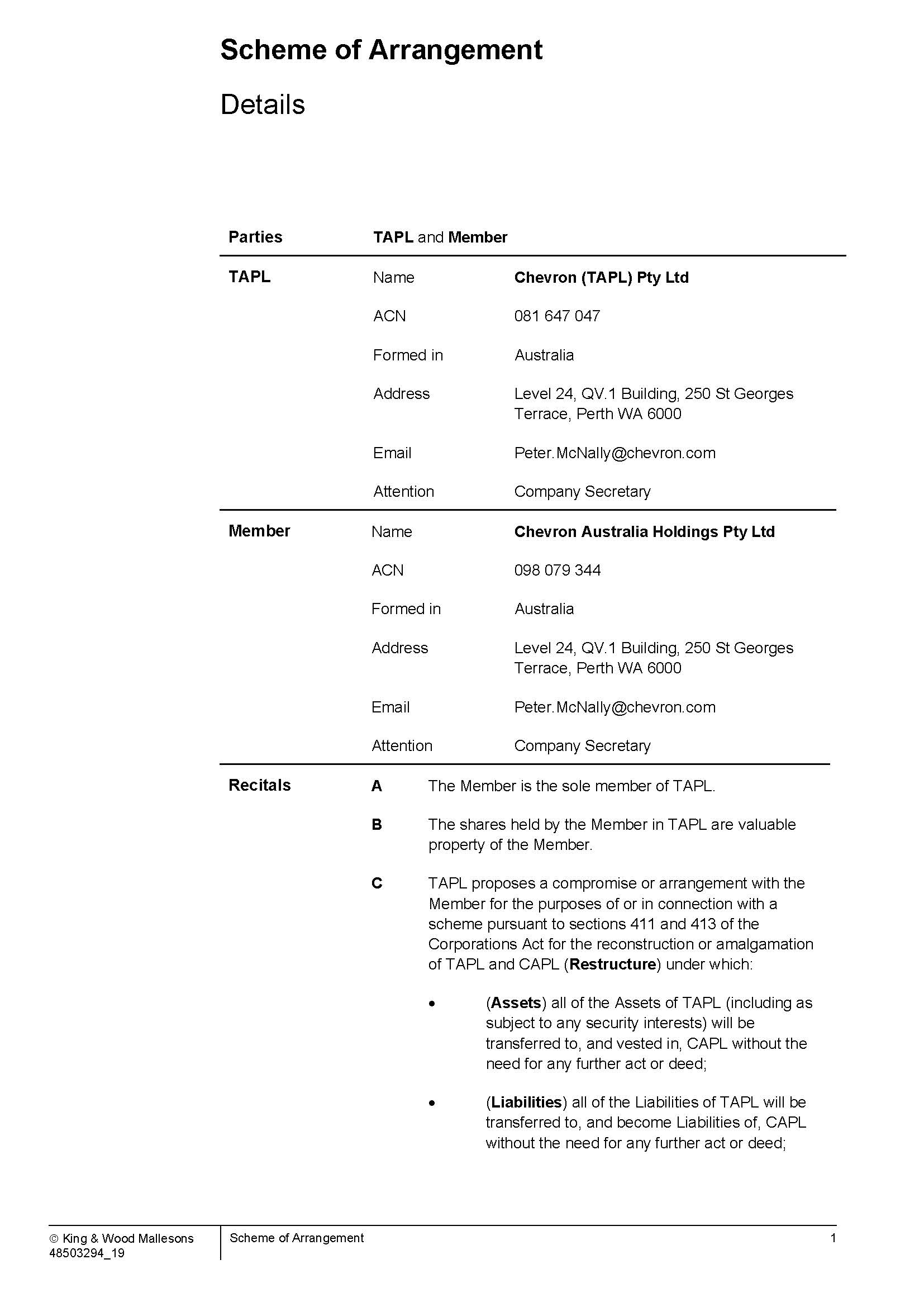
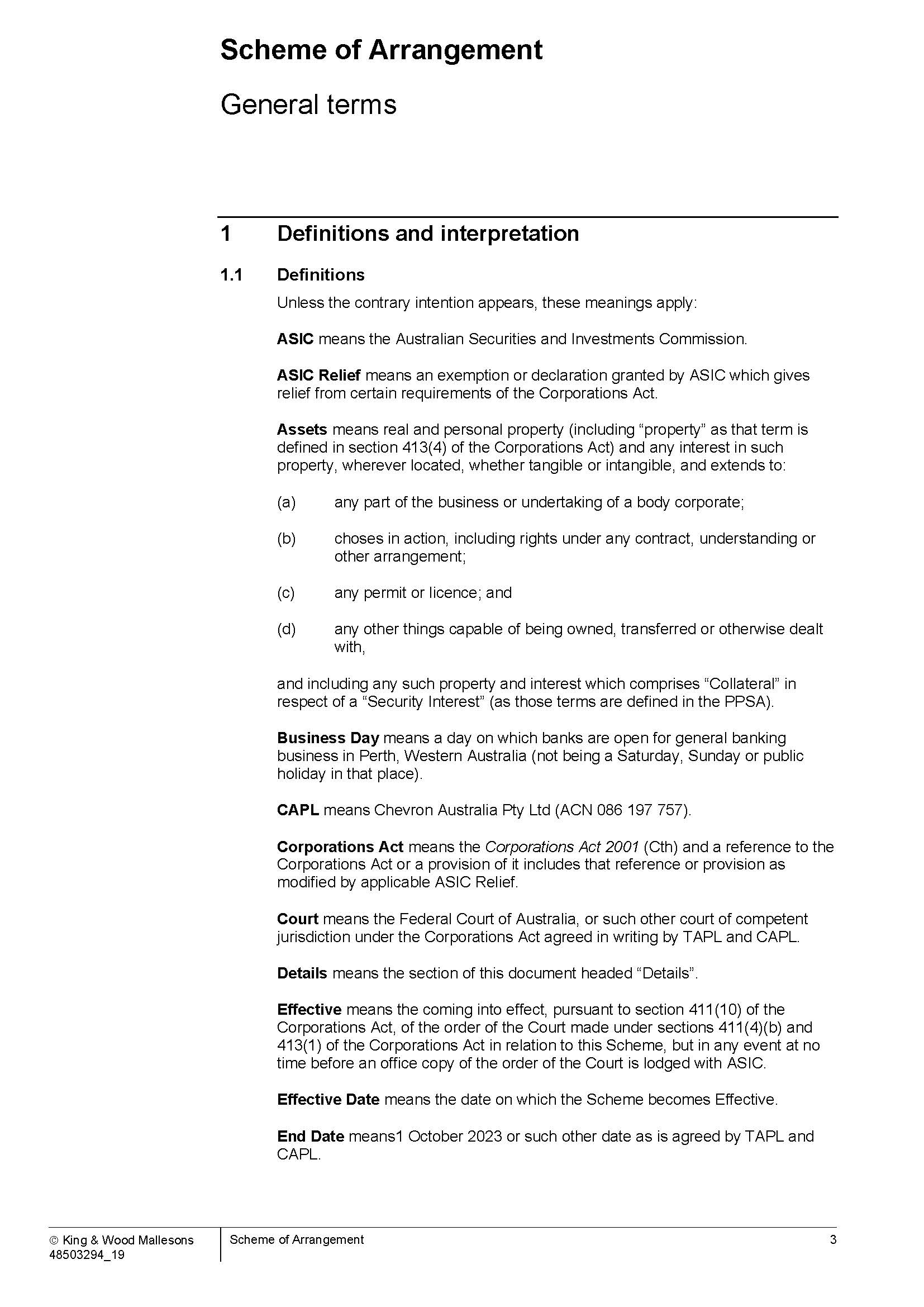
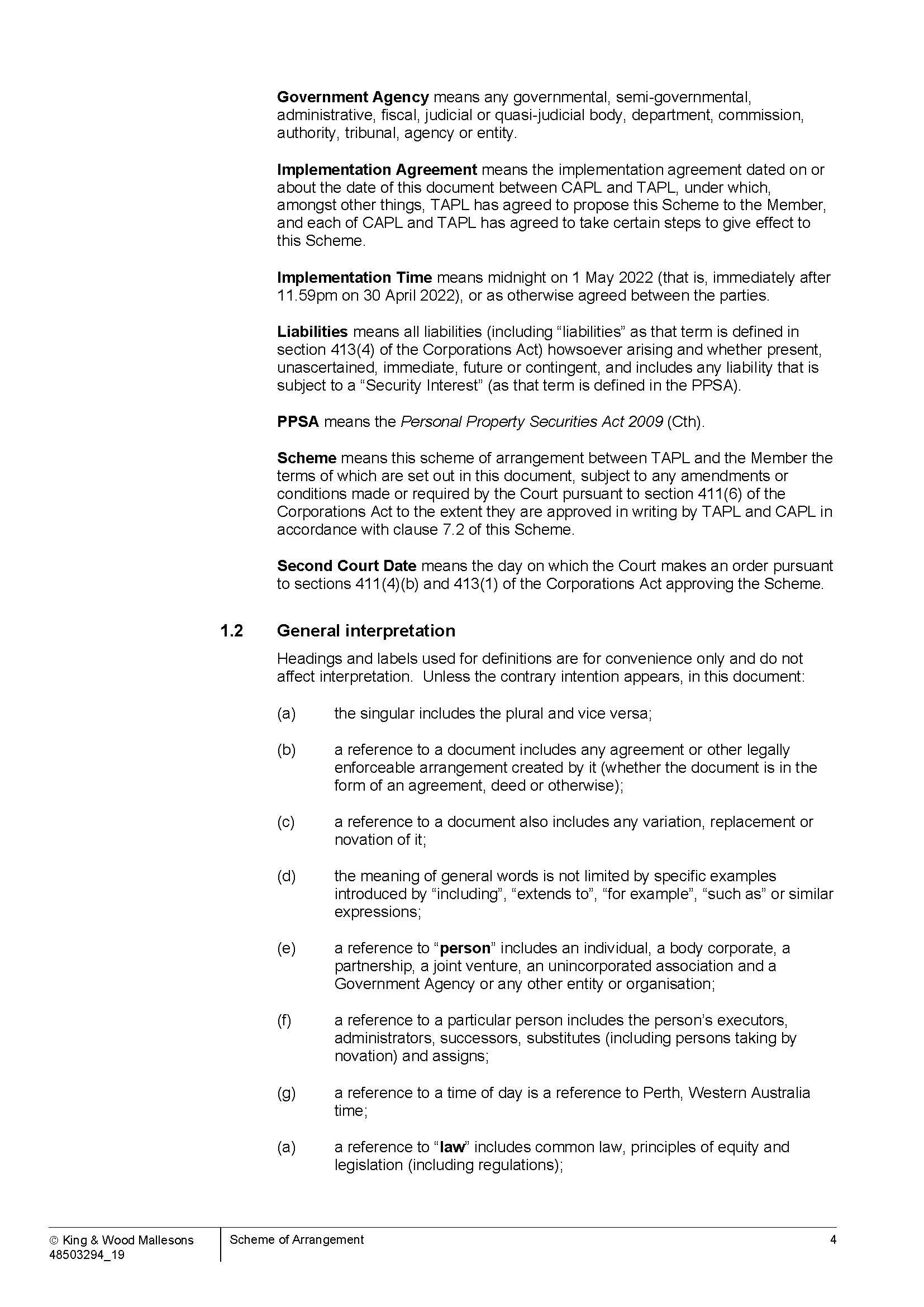
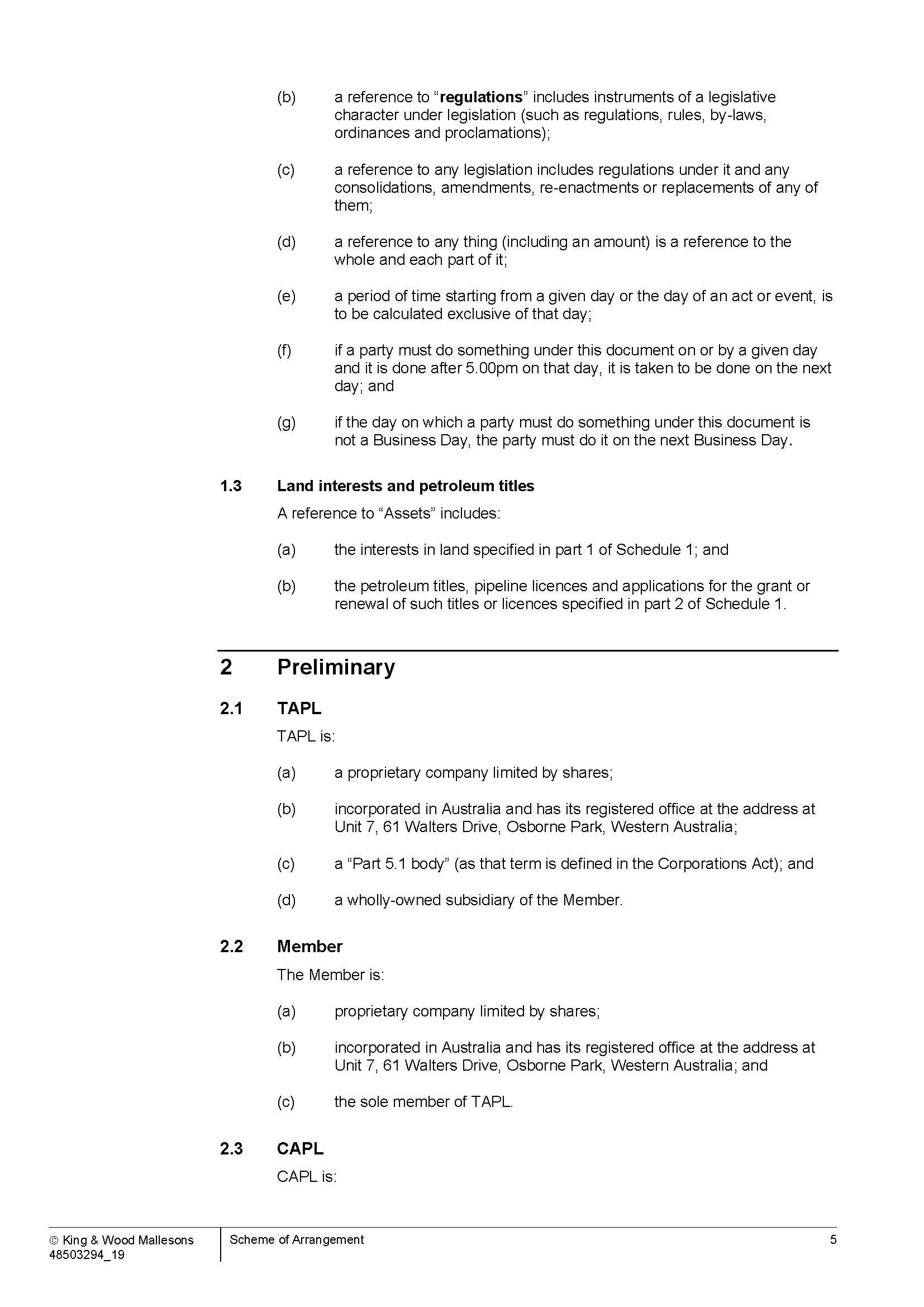
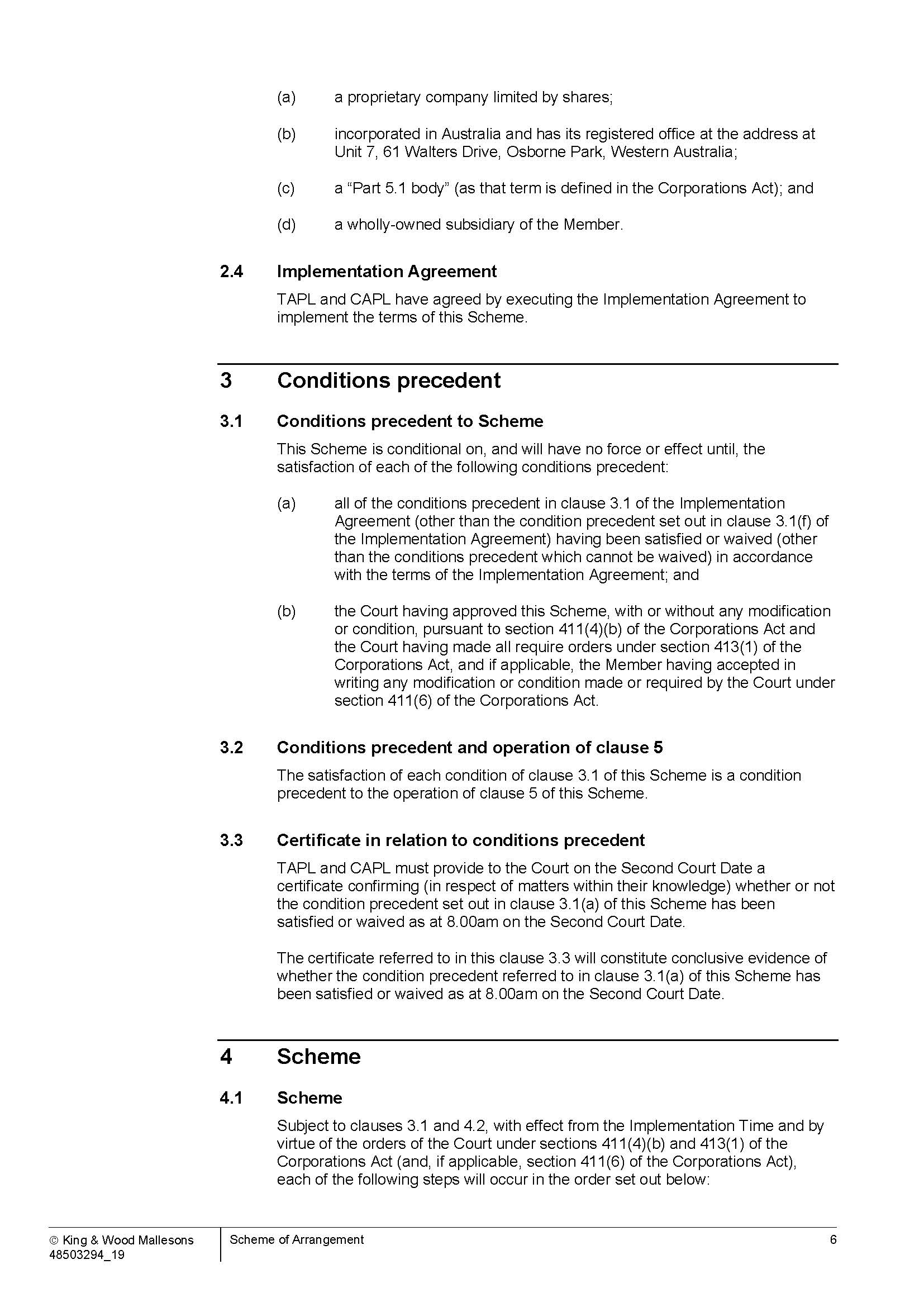
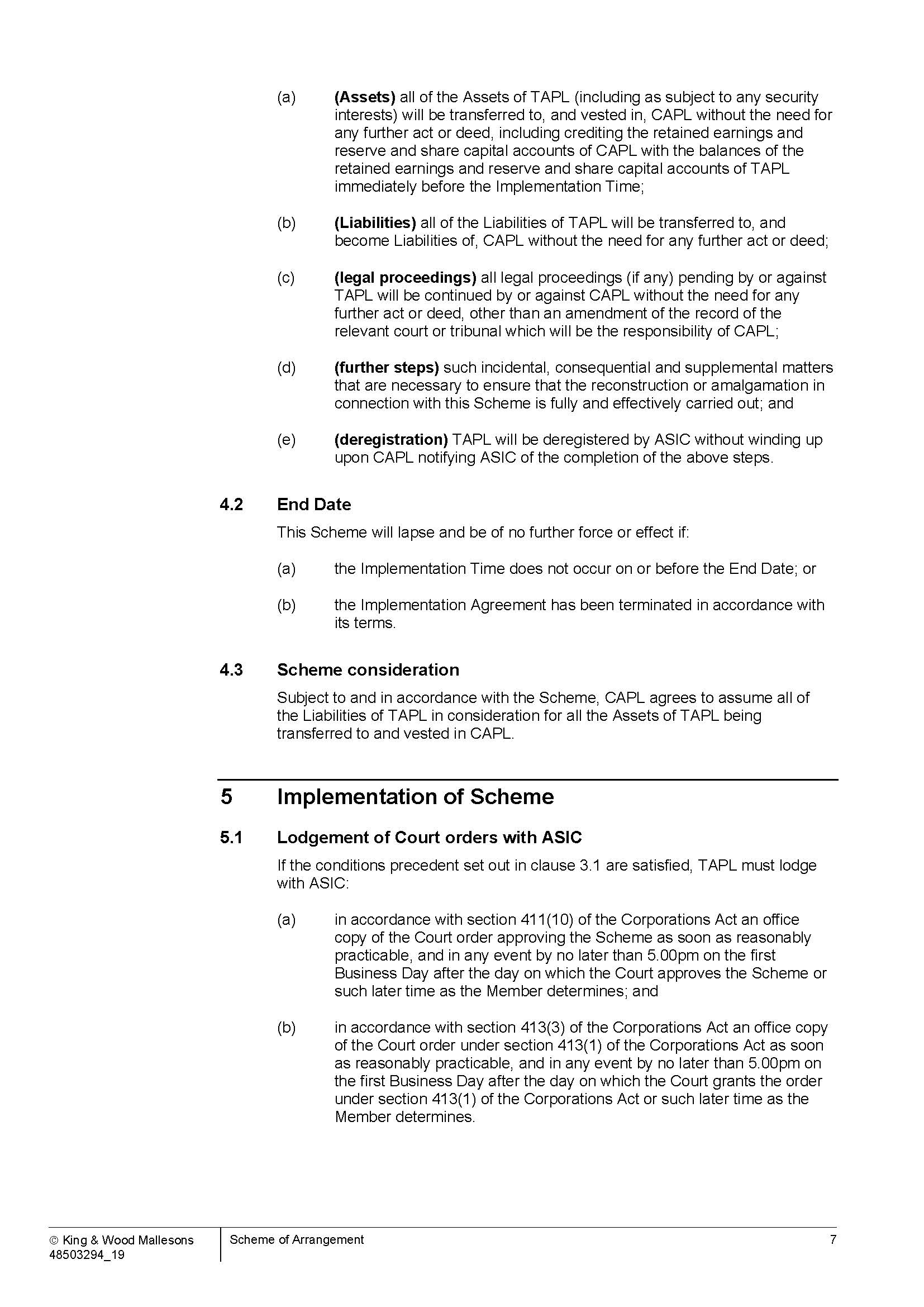
1. Pursuant to s 411(4)(b) of the Corporations Act 2001 (Cth) (Act) and s 411(6) of the Act, the scheme of arrangement (Scheme) proposed between the plaintiff, Chevron (TAPL) Pty Ltd (TAPL), and its sole member, Chevron Australia Holdings Pty Ltd (CAHPL), a copy of which is Annexure A to these orders (which contains the following alterations), be approved:
(a) In cl 1.1 of the Scheme, the definition of Implementation Time be altered to delete the words 'on 1 April 2022 (that is, immediately after 11.59 pm on 31 March 2022)' and substitute them with the words 'on 1 May 2022 (that is, immediately after 11.59 pm on 30 April 2022)'.
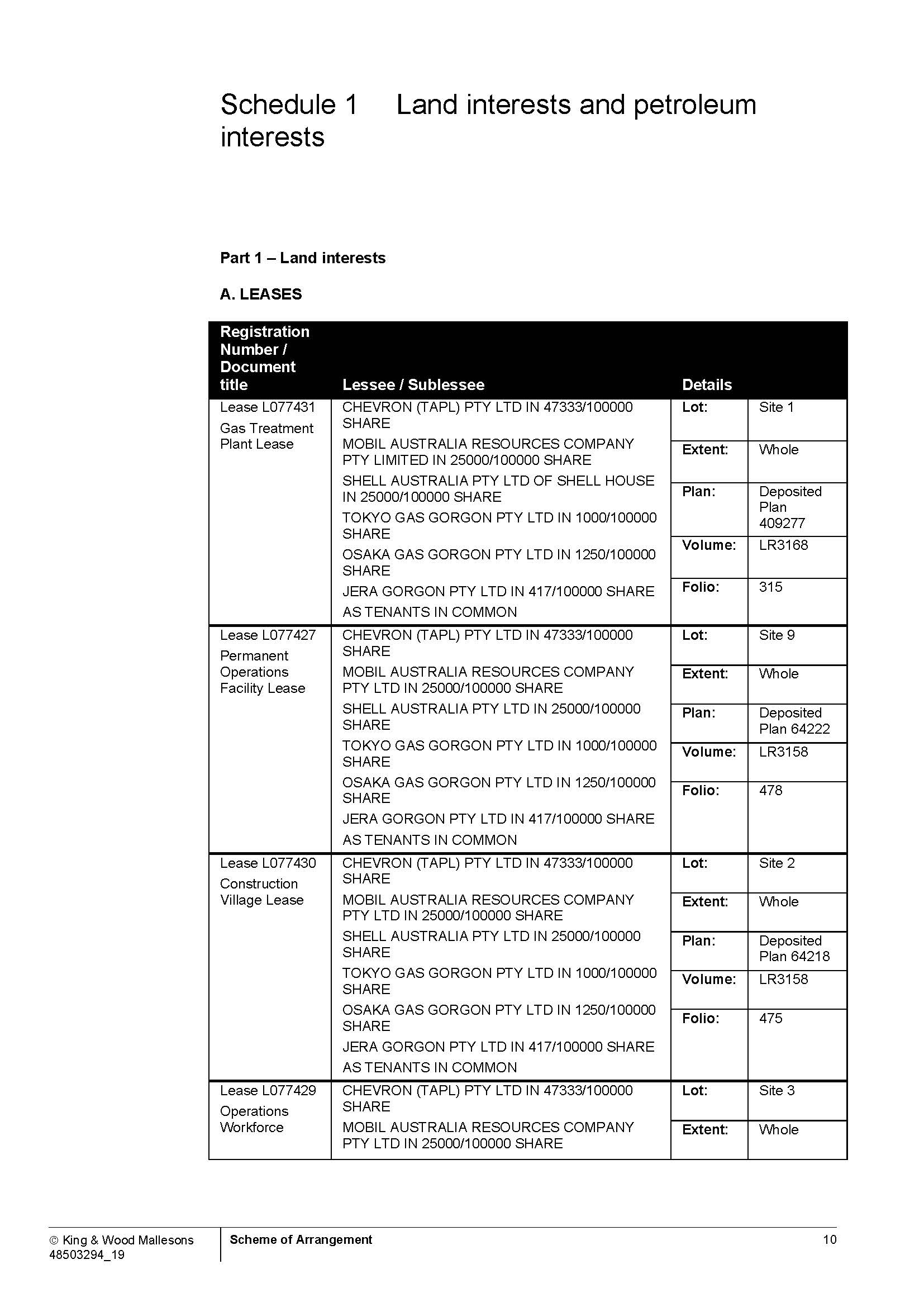
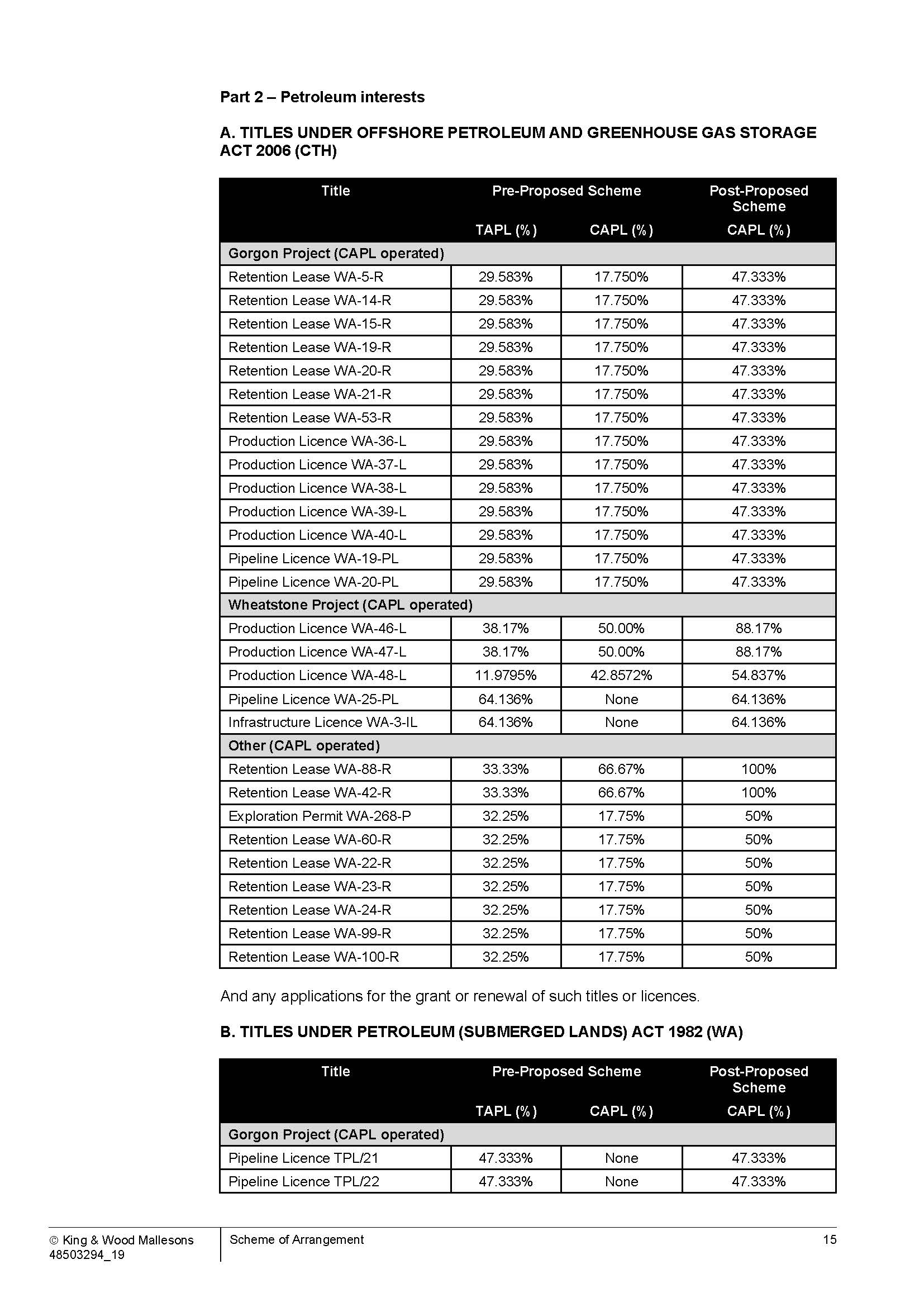
(b) Part 2, Section A of Schedule 1 to the Scheme be altered to add a reference to Retention Lease WA-99-R and Retention Lease WA-100-R.
2. Pursuant to s 411(12) of the Act, TAPL be exempted from compliance with the requirements of s 411(11) of the Act.
3. Orders 4 and 5 below are made pursuant to s 413 of the Act for the purpose of facilitating the Scheme and are subject to, and in accordance with, the terms of the Scheme. In the orders below, capitalised nouns and acronyms not defined in these orders have the meanings and interpretations given to them by the Scheme.
4. Pursuant to s 413(1) of the Act, with effect from the Implementation Time, the Scheme be implemented by the following steps taken in the following order, and speaking as at that time:
(a) first, all of the Assets of TAPL (including as subject to any security interests) be transferred to, and vested in, the defendant, Chevron Australia Pty Ltd (CAPL), without the need for any further act or deed, including crediting the retained earnings and reserve and share capital accounts of CAPL with the balances of the retained earnings and reserve and share capital accounts of TAPL immediately before the Implementation Time;
(b) second, all of the Liabilities of TAPL will be transferred to, and become Liabilities of, CAPL without the need for any further act or deed;
(c) third, all legal proceedings (if any) pending by or against TAPL will be continued by or against CAPL without the need for any further act or deed, other than an amendment of the record of the relevant court or tribunal which will be the responsibility of CAPL; and
(d) fourth, upon CAPL notifying the Australian Securities and Investments Commission (ASIC) of the completion of the above steps, TAPL is to be deregistered by ASIC without winding up.
5. Pursuant to s 413(1)(g) of the Act, on and from the Implementation Time:
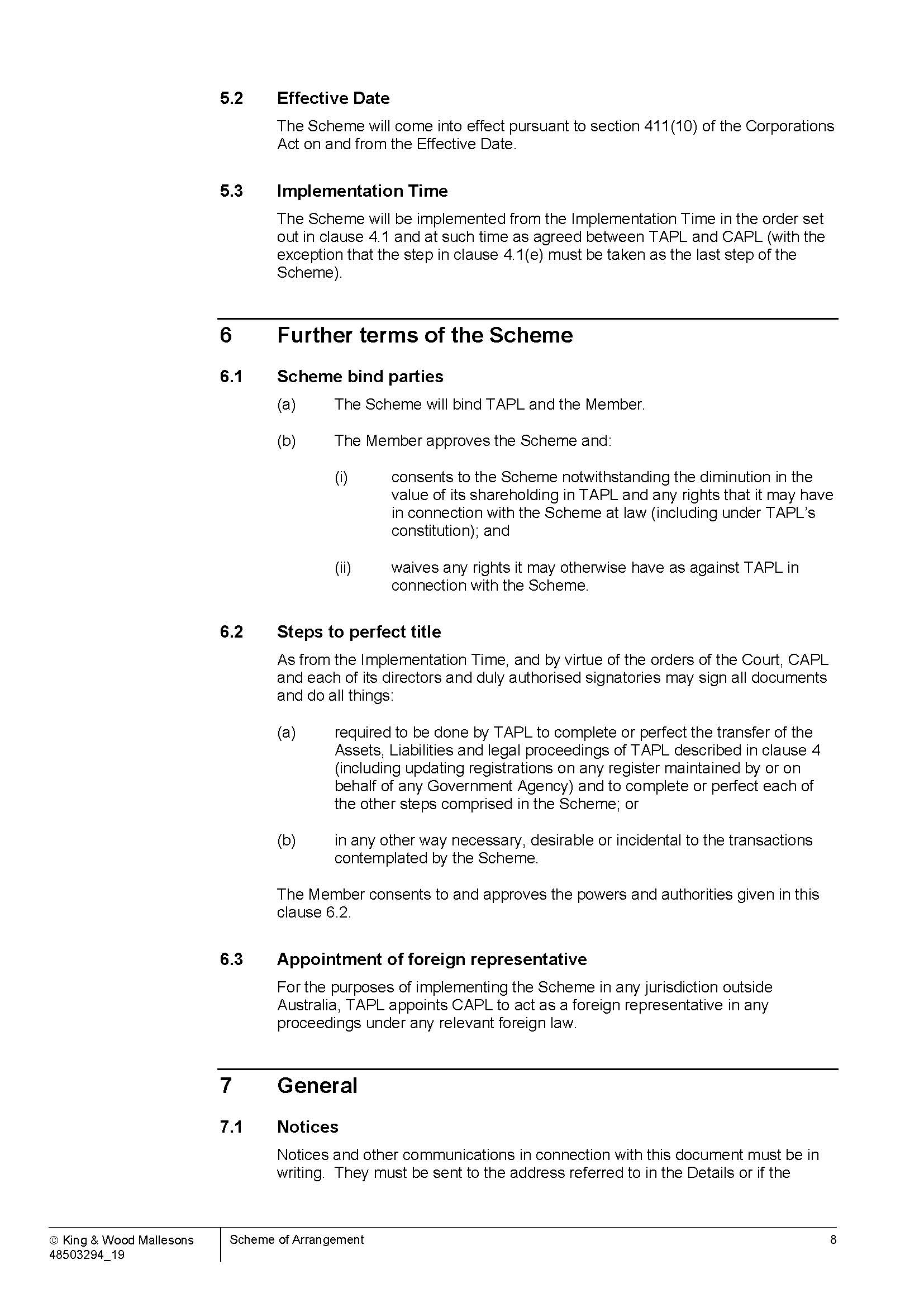
(a) CAPL or any director, officer, company secretary or other duly authorised signatory of CAPL from time to time may, in the name of TAPL, sign all documents and do all things required to be done by TAPL to complete or perfect the transfer of the Assets and Liabilities of TAPL as contemplated by the Scheme, whether by lodgement, registration, notification or otherwise;
(b) any reference to TAPL be read as a reference to CAPL in all contracts, agreements, deeds, titles, licences and applications for the grant or renewal of such titles or licences which form part of the Assets and Liabilities transferred to, and vested in, CAPL pursuant to orders 4(a) and 4(b) above, and to which TAPL is named as a party, titleholder, licenceholder or applicant; and
(c) CAPL may use, disclose and otherwise handle all information transferred from TAPL and vested in CAPL by the Scheme provided always that CAPL shall receive the information upon the same terms as TAPL held the information and subject to the Liabilities of TAPL in respect of that information.
6. Pursuant to s 37AF of the Federal Court of Australia Act 1976 (Cth), on the ground that the order is necessary to prevent prejudice to the proper administration of justice, until further order the documents marked:
(a) SDC-14 to SDC-16, SDC-32 to SDC-47 and SDC-49 in the second affidavit of Samuel David Cutt affirmed 24 March 2022; and
(b) AAZ-18 in the fifth affidavit of Anqi Angela Zhao affirmed 24 March 2022,
be marked 'confidential' on the electronic court file, not to be published or accessed by any party other than the parties and their solicitors except pursuant to an order of the Court.
7. Liberty be granted to any party, and any director or officer of any party, to apply for any further orders pursuant to s 413 of the Act as may be considered necessary or desirable.
Note: Entry of orders is dealt with in Rule 39.32 of the Federal Court Rules 2011.
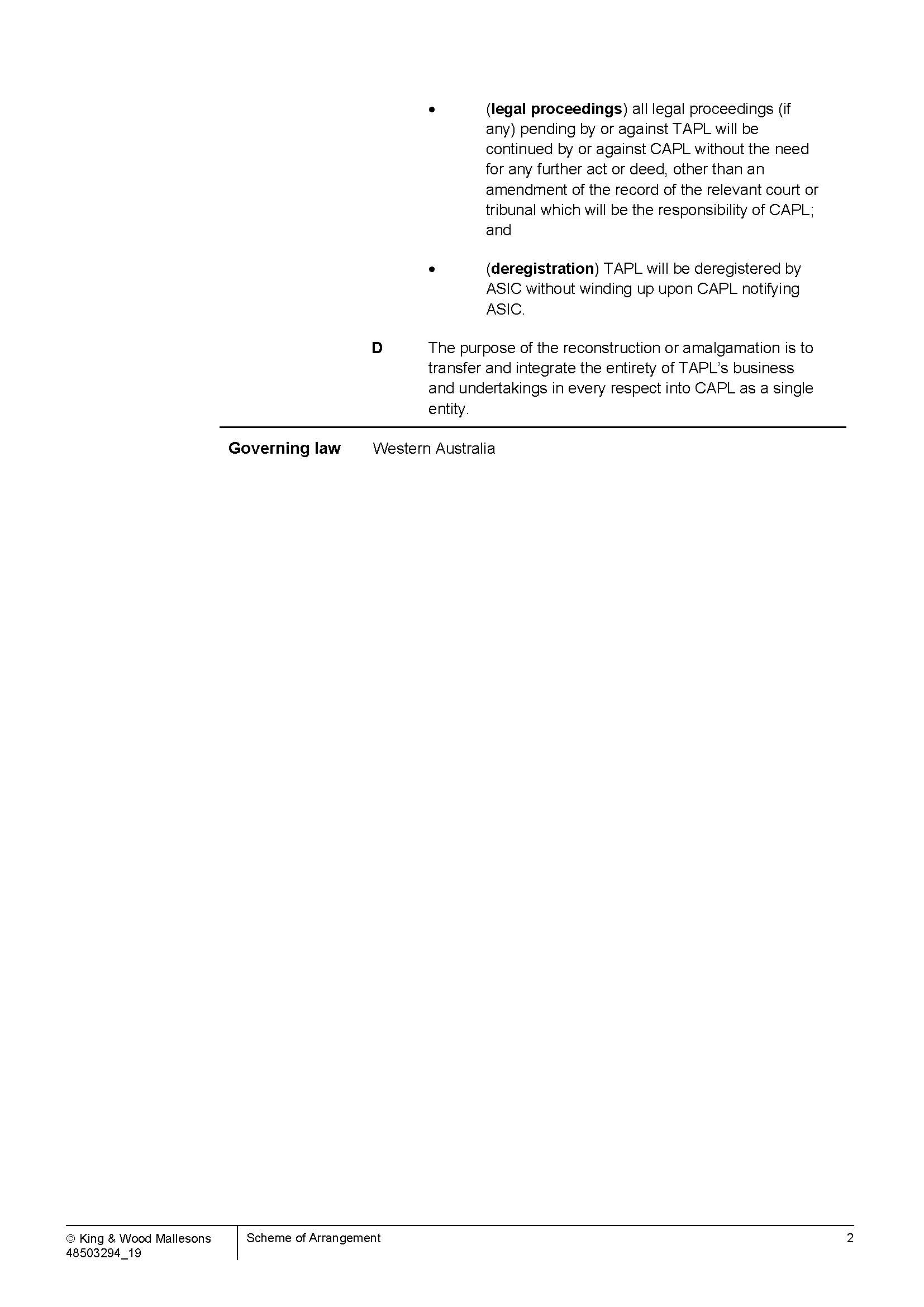
Annexure A
BANKS-SMITH J:
Introduction
1 On 28 March 2022 I made orders approving the convening of a meeting of shareholders for the purpose of considering a scheme of arrangement (Scheme) and approving the distribution of a scheme booklet: Chevron (TAPL) Pty Ltd v Chevron Australia Pty Ltd, in the matter of Chevron (TAPL) Pty Ltd [2022] FCA 220 (Chevron (No 1)).
2 The Scheme involved the transfer by Chevron (TAPL) Pty Ltd (TAPL) of the entirety of its business and undertakings to Chevron Australia Pty Ltd (CAPL), so that the business and undertakings of TAPL and CAPL are held and conducted by a single entity, namely CAPL. The scheme was propounded with the approval of TAPL's and CAPL's common sole member and parent company, Chevron Australia Holdings Pty Ltd (CAHPL).
3 The scheme meeting was held on 11 March 2022, and CAHPL agreed to the Scheme.
4 TAPL sought the Court's approval of the Scheme on 28 March 2022 and I made orders on that date. These are my reasons. I adopt the defined terms utilised in Chevron (No 1).
Jurisdiction to approve Scheme
5 Section 411(4) of the Corporations Act 2001 (Cth) relevantly provides that an arrangement is binding on the members of a company and the company if, at a meeting convened in accordance with an order of the Court, a resolution in favour of the arrangement is passed by a majority in number of the members present and voting (either in person or by proxy); passed by 75% of the votes cast on the resolution; and the arrangement is approved by order of the Court.
Relevant considerations for second court hearing
6 The considerations relevant to the Court's decision to approve a scheme pursuant to s 411(4)(b) of the Act are well established.
7 Where a majority of members have approved a scheme, the Court is not bound to approve it. However, the Court should be slow to conclude that a scheme is unreasonable or unfair, provided that the members have been properly informed of matters relevant to the making of their decision, as that would otherwise involve the Court substituting its commercial judgment for that of the body of members: Seven Network Limited, in the matter of Seven Network Limited (No 3) [2010] FCA 400 at [31]-[40] (Jacobson J).
8 Similar observations were made by Beach J in Amcor Limited, in the matter of Amcor Limited (No 2) [2019] FCA 842, including that:
[11] … the Scheme shareholders' vote in favour of the Scheme is evidence of its inherent fairness. Put another way, if a majority of the Scheme shareholders have approved the Scheme, it is unlikely that the Scheme would be unreasonable …
9 The matters the Court must take into account in deciding whether to approve a scheme were summarised in Seven Network Limited (No 3) and David Jones Limited, in the matter of David Jones Limited (No 3) [2014] FCA 753 (Farrell J) and include whether:
(a) the orders of the Court convening the scheme meeting were complied with;
(b) the resolution to approve the scheme was passed by the requisite majority, and whether other statutory requirements have been satisfied;
(c) all conditions to which the scheme is subject (other than court approval and lodgement of the Court's orders with ASIC) have been met or waived;
(d) the scheme is fair and reasonable so that an intelligent and honest shareholder, properly informed and acting alone, might approve it;
(e) there was full and fair disclosure to shareholders of all information material to the decision whether to vote for or against the scheme;
(f) the company has brought to the attention of the Court all matters that could be considered relevant to the exercise of the Court's discretion; and
(g) the Court is satisfied under s 411(17) that the scheme has not been proposed to avoid Chapter 6 of the Act, or that the company has a statement from ASIC that it has no objection to the scheme.
10 For the reasons that follow, I was satisfied as to all of these matters.
11 However, in this case orders were also sought under s 413 of the Act, as anticipated in Chevron (No 1) at [16] and [46]-[52]. Accordingly, at the approval hearing it was also necessary to examine the specific requirements for those proposed orders to ensure they are appropriate: Re AGL Gas Networks Ltd [2001] NSWSC 165 at [43] (Santow J); Re RBS Group (Australia) Pty Ltd (Unreported, NSWSC, 2 February 2012) at [54] (Ward J); and Fiducian Portfolio Services Ltd v Fiducian Investment Management Services Ltd (No 2) [2015] FCA 95; (2015) 228 FCR 587 at [28]-[43] (Yates J).
Evidence
12 In addition to the evidence referred to at the first hearing (Chevron (No 1) at [10]) TAPL relied on the following for the second court hearing:
(a) second affidavit of Peter McNally, deposing to the proper dispatch of the scheme booklet and notice of meeting to CAHPL, the conduct of the meeting, the signing of the record of resolution, the execution of a circular resolution as to abridged notice, and confirmation of consent by CAHPL to minor edits to the Scheme (amendments that are reflected in the orders made on 28 March 2022);
(b) second affidavit of Samuel Cutt, deposing to communications undertaken with the representatives of the State of Western Australia in order to secure consents, waivers or similar permissions required by the various agreements between the State and TAPL;
(c) fifth affidavit of Anqi Zhao, deposing to lodgement and registration of the scheme booklet with ASIC, the advertising of the approval hearing and the receipt of certain counterparty consents or 'no objection' letters;
(d) sixth affidavit of Anqi Zhao, confirming that the Minister for Mines and Petroleum had consented to the transfer of a particular petroleum lease (L 1H) from TAPL to CAPL, confirming the execution of a relevant deed of covenant (which incorporated all amendments sought by the State) by CAPL, and attaching a 'no objection' letter from ASIC;
(e) affidavit of Caroline Andretich, a senior associate at King & Wood Mallesons, who was tasked with liaising with representatives of the Department of Mines, Industry Regulation and Safety of Western Australia (DMIRS) and confirmed that as to the applications for approval and registration of the Implementation Agreement as a dealing against each of the State Petroleum Interests (defined below), each had been successful (subject to one technical issue which the evidence indicated would be resolved); and
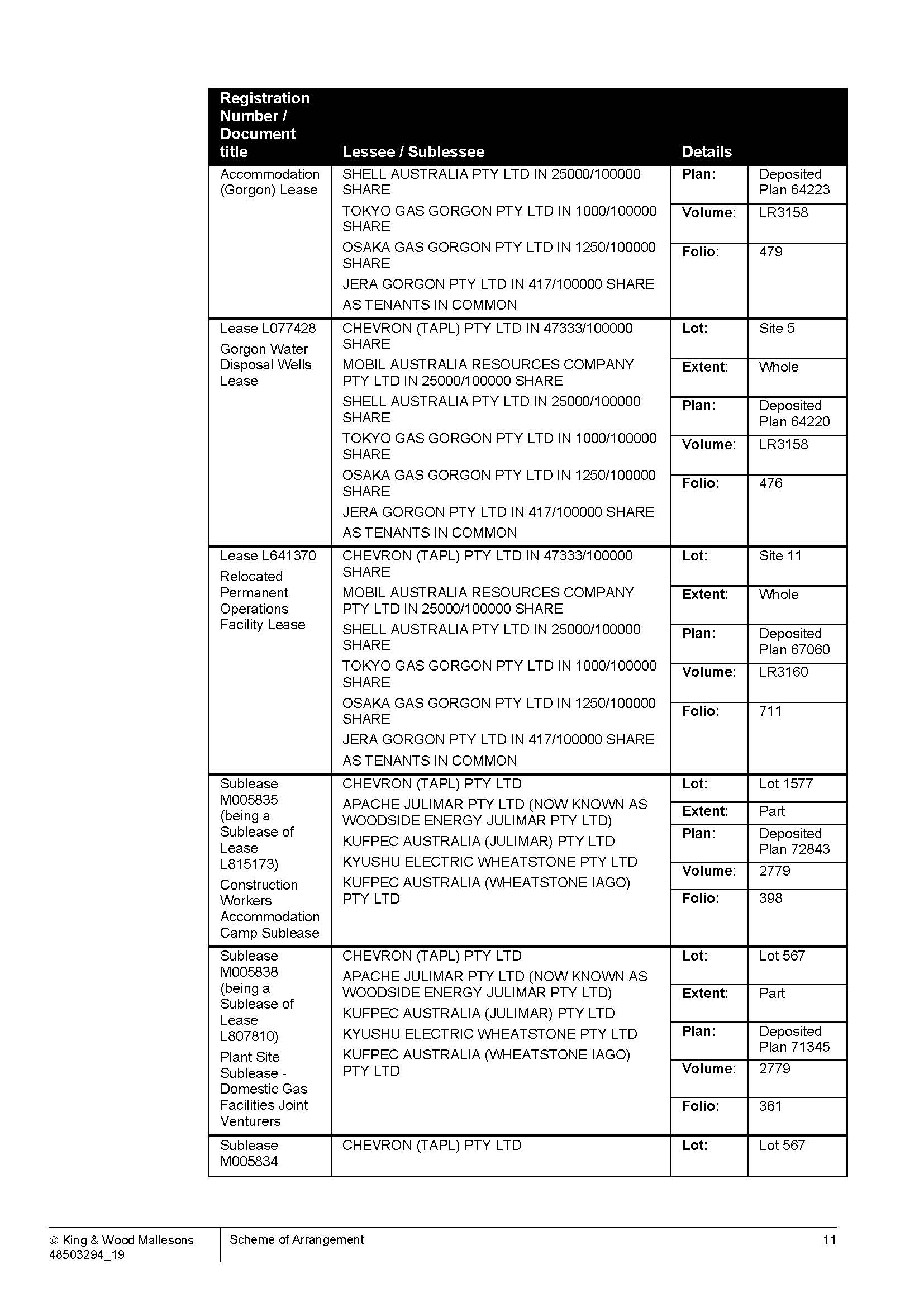
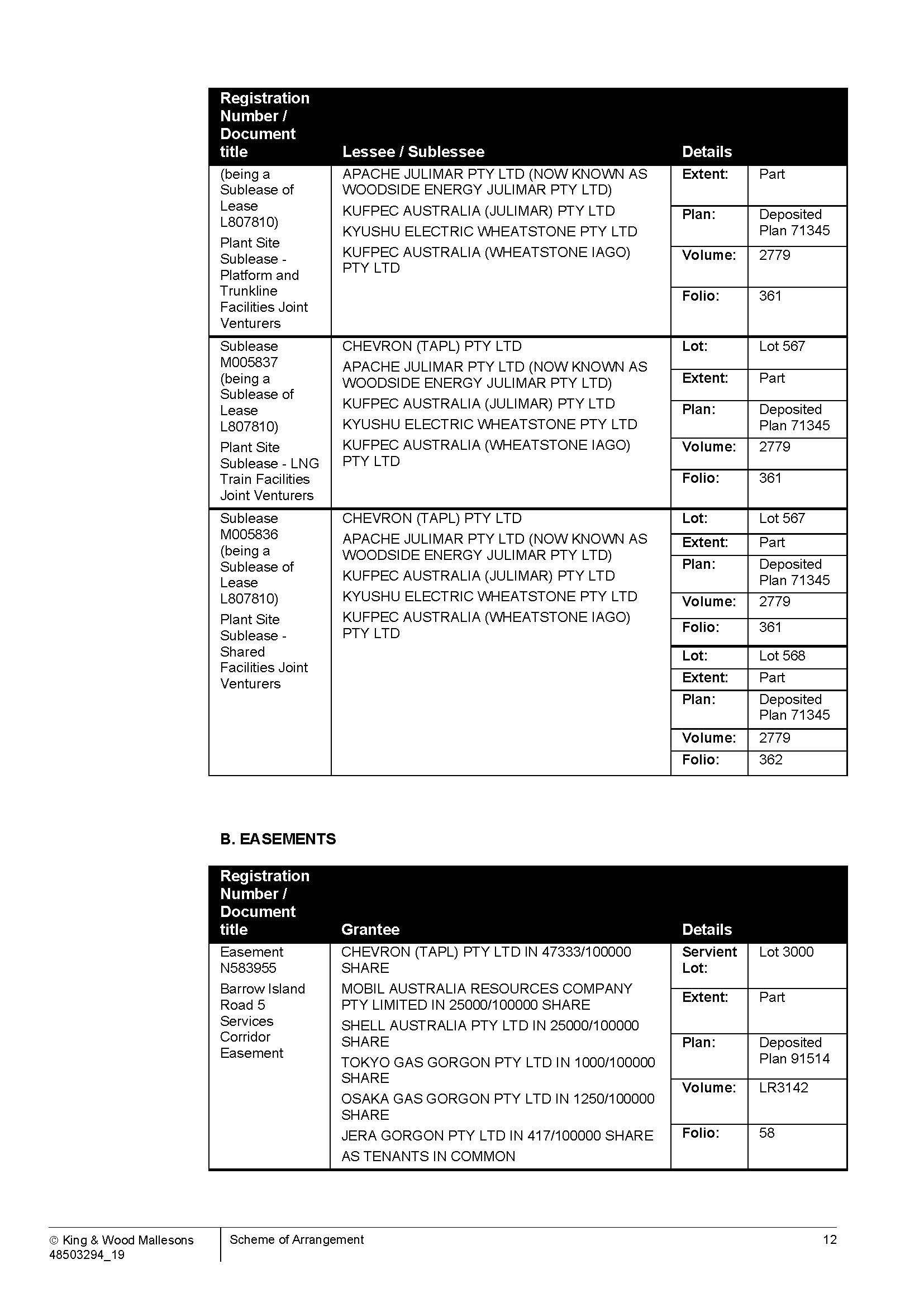
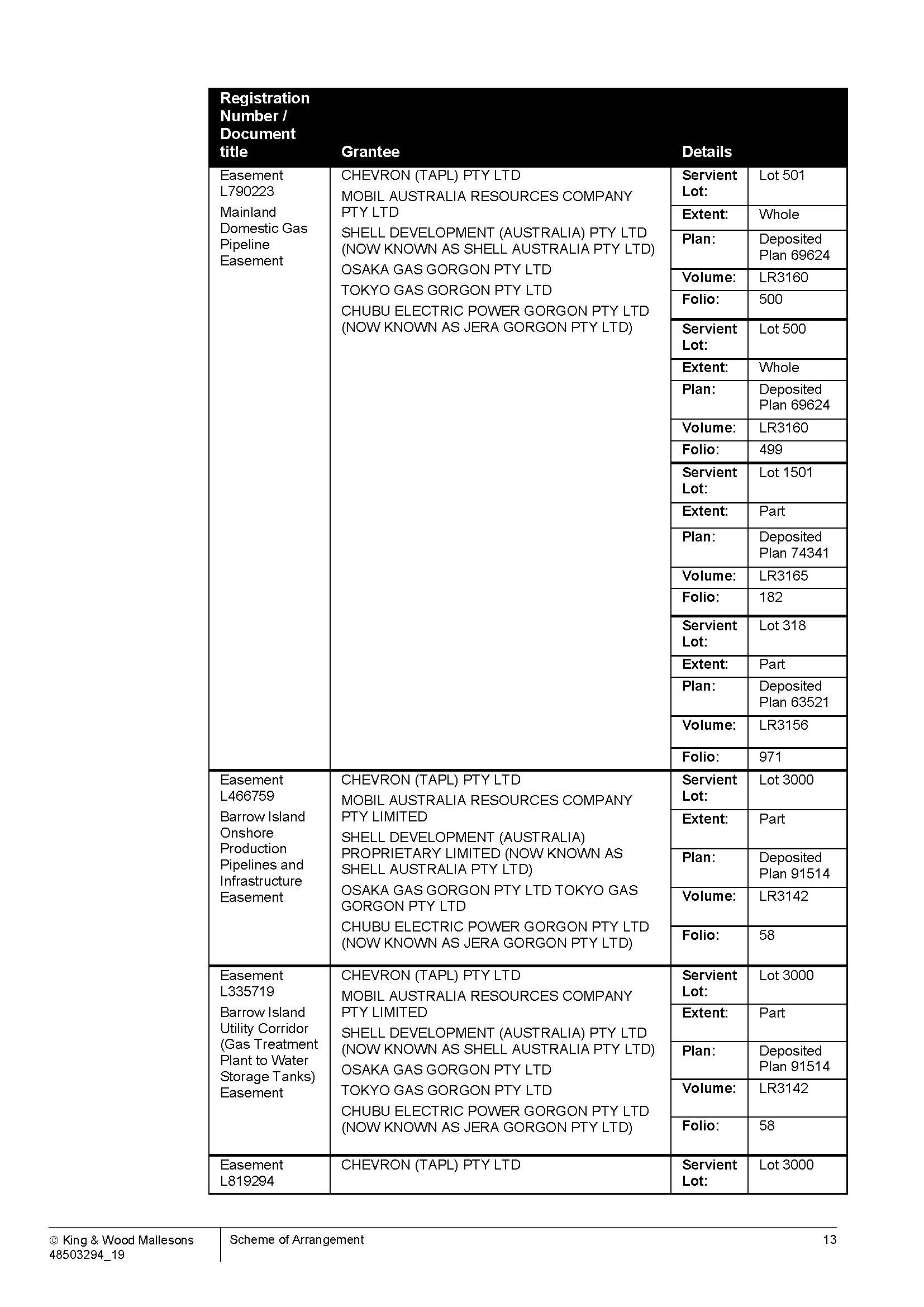
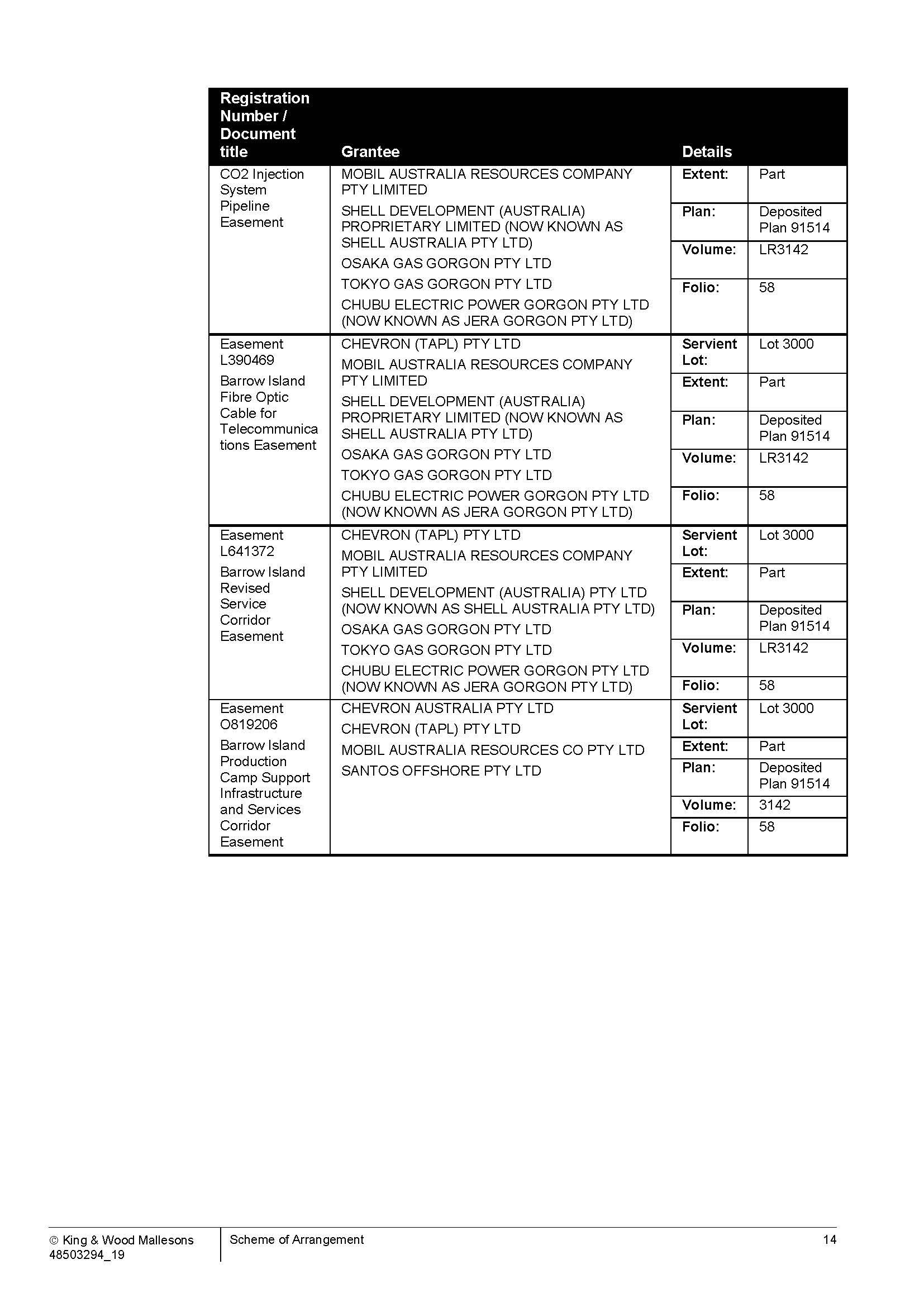
(f) seventh affidavit of Anqi Zhao deposing as to confirmation from DMIRS that DMIRS did not require anything further in order to register the Implementation Agreement as a dealing against each State Petroleum Interest; the absence of any notice from any party seeking to appear or object at the second court hearing; and providing a certificate of satisfaction of relevant conditions precedent under the Implementation Agreement, executed by TAPL and CAPL.
Procedural requirements
13 The evidence relied upon by TAPL has satisfied me of the following procedural matters, including compliance with the orders made 8 March 2022 at the first hearing (Orders).
14 I am satisfied that verification processes were implemented to ensure that the scheme booklet did not contain any misleading statements and that it satisfied the applicable disclosure requirements (Chevron (No 1) at [39]).
15 As required by s 412(6) of the Act, the scheme booklet was registered by ASIC prior to being sent to CAHPL. Before registering the explanatory statement, ASIC must conclude that it appears to comply with the requirements of the Act, and ASIC must form the opinion that the statement does not contain any matter that is false in a material particular or materially misleading in the form and context where it appears. Therefore, it is a matter of some weight that ASIC proceeded to register the scheme booklet.
16 I am satisfied that the meeting was properly convened and the resolution to approve the Scheme passed. As permitted by order 3(h) of the Orders, a resolution put to the vote at the scheme meeting to approve the Scheme could be decided by CAHPL or its representative by signing a record of the resolution. Mr Callaghan, the corporate representative for CAHPL, was present at the scheme meeting and signed a record of resolution.
17 An arrangement is only binding if, at the scheme meeting, the required majorities are obtained, namely:
(a) a majority in number of the members present and voting (either in person or by proxy): s 411(4)(a)(ii)(A) (the headcount test); and
(b) 75% of the votes cast on the resolution: s 411(4)(a)(ii)(B) (the votes test).
18 In this case, CAHPL is the sole member of TAPL and voted all of its shares in favour of the Scheme. This met the requirement for both majorities.
19 As required by order 4 of the Orders, an advertisement was placed in the Australian newspaper advertising the date and time of the second court hearing.
Conditions precedent
20 Before approving a scheme, the Court will ordinarily require that all conditions precedent to the scheme (other than the Court's approval and the lodgement of the Court's approval order with ASIC) have been satisfied or waived, so as to remove doubt about the binding nature of the scheme: In the Application of United Medical Protection Limited [2007] FCA 631 at [19] (Finkelstein J).
21 In this case, a certificate was provided by way of Ms Zhao's seventh affidavit confirming the satisfaction and waiver of the conditions precedent in cl 3.1 of the Implementation Agreement (other than the condition precedent as to court approval).
Exercise of discretion
Good faith and proper purpose
22 TAPL submitted that the Court may be satisfied that CAHPL has voted in good faith and not for an improper purpose, and referred to the following matters in support of that submission:
(a) the Scheme is for a restructure transaction of a kind ordinarily approved by courts (see Chevron (No 1) at [23]-[26]);
(b) the independent expert opined that neither TAPL's creditors who will become creditors of CAPL following the Scheme, nor the creditors of CAPL, who will remain creditors of CAPL following the Scheme, will be materially prejudiced by the Scheme;
(c) as identified at the first court hearing (Chevron (No 1) at [53]-[54]), the position of creditors is that TAPL's creditors will not be materially prejudiced by the Scheme given that net assets substantially exceed net liabilities, and given there is a deed of cross-guarantee between TAPL, CAPL and CAHPL by which a creditor of the transferor company can continue to have recourse as a creditor of the transferee after implementation of the Scheme;
(d) the Scheme is a solvent restructure of the Chevron Group in Australia with the purpose of achieving corporate efficiency;
(e) the mechanisms of the transaction are such that the liabilities of TAPL will not be separated from assets of the substantial oil and gas operations of CAPL and the Chevron Group; and
(f) neither ASIC nor any creditor nor anyone else sought to appear at the second court hearing to object to approval.
23 I accept TAPL's submissions in this regard.
No proscribed purpose
24 The Court's power to approve a scheme is restricted by s 411(17) of the Act. At the approval stage, the Court must be satisfied there is no proscribed purpose as described in s 411(17)(a), or there must be provided to the Court a statement in writing by ASIC that it has no objection to the arrangement (see s 411(17)(b)).
25 A 'no objection' statement was provided by ASIC, and this satisfies the requirements of s 411(17)(b). But that does not bring to an end the Court's discretion: Re Wesfarmers Ltd; Ex parte Wesfarmers Ltd (No 2) [2018] WASC 357 at [18] (Vaughan J).
26 Further, it cannot be said that the Scheme enables TAPL to avoid Chapter 6 in any way, nor that it was for that purpose. As TAPL is a company, but not a listed company or an unlisted company with more than 50 members, Chapter 6 does not apply to TAPL. In addition, the effect of the Scheme cannot be achieved by a takeover bid under Chapter 6.
All necessary matters have been brought to the attention of the Court
27 At the first hearing, TAPL notified the Court of several matters warranting the Court's attention. They were addressed in Chevron (No 1) at [46]-[69]. I do not consider any of those matters present an impediment to approval. I deal with particular matters in more detail below.
Full and fair disclosure to the member
28 The content of the scheme booklet provided to CAHPL was considered at the first hearing, and the Court indicated that it was satisfied to the necessary level that, by the scheme booklet, there would be proper disclosure as to the effect of the proposed Scheme and the material considerations to which the member ought to have regard.
29 TAPL adduced evidence that the scheme booklet was professionally drafted, was the subject of a due verification process by both TAPL and CAPL, was approved by TAPL's board for release on the basis that it was true and correct, and was reviewed by ASIC.
30 The scheme booklet and notice of meeting were also made publicly available through the ASIC register from the date of lodgement prior to the scheme meeting and this hearing, providing an opportunity for any interested party to be heard. As I have noted, none sought to do so.
The Scheme is fair and reasonable
31 I touched on the authorities and principles at [7], [8] and [9(d)] above. Having regard to those, TAPL submitted that the Scheme is fair and reasonable in the sense that an intelligent and honest shareholder, properly informed and acting alone, might approve the Scheme, and referred to the following matters in support of its submission:
(a) proof of the relevant statutory majorities is prima facie evidence of the fairness and reasonableness of the Scheme;
(b) in the scheme booklet, TAPL's board unanimously recommended that TAPL's shareholder vote in favour of the Scheme;
(c) no impediment has emerged since the Implementation Agreement was made; and
(d) the Scheme is fair and reasonable because it is intended to yield commercial benefits for TAPL's only member.
32 I accept those submissions, and add that the affidavits and submissions filed in this matter indicated considerable care and objectivity. I am satisfied that the Scheme is fair and reasonable.
Exemption from s 411(11)
33 Section 411(11) of the Act requires, subject to s 411(12), that a copy of the Court's order approving a scheme of arrangement be annexed to every copy of the company's constitution issued after the order is made. Section 411(12) allows the Court to exempt a body from compliance with this provision or to determine the period during which it shall comply.
34 I consider that exemption from compliance with s 411(11) is appropriate given that the Scheme will not alter the constitution of TAPL. Further, no ongoing purpose will be served by requiring the orders approving the Scheme to be annexed to TAPL's constitution.
Conclusion - approval of Scheme
35 For the above reasons, I made orders approving the Scheme.
Orders sought under s 413
Power under s 413 enlivened
36 As anticipated in Chevron (No 1) at [46], TAPL seeks a range of orders under s 413 of the Act.
37 Orders under s 413(1) may be made if the pre-conditions set out in that section are met, namely: that there is a compromise or arrangement; the compromise or arrangement must be proposed 'for the purposes of, or in connection with a scheme for the reconstruction of a Part 5.1 body or Part 5.1 bodies or the amalgamation of 2 or more Part 5.1 bodies'; and under the Scheme 'the whole or any part of the undertaking or of the property of a body concerned in the scheme … is to be transferred to a company'.
38 I am satisfied, for the reasons given in Chevron (No 1) at [48]-[50], and having regard to the authorities cited (and in particular In the matter of Stork ICM Australia Pty Ltd; Stork ICM Australia Pty Ltd v Stork Food Systems Australasia Pty Ltd [2006] FCA 1849 at [76]-[77] (Lindgren J)), that in this case the Scheme may fall within either or both concepts of a 'compromise' or 'arrangement', and that therefore s 413 may operate.
39 Further, as required, CAPL is a defendant to these proceedings because it will be the subject of (and bound by) the order for transfer of the assets and liabilities of TAPL.
40 By its application under s 413, TAPL sought orders that provide for the transfer of assets and liabilities; the transfer of legal proceedings; deregistration of TAPL without a winding up; certain consequential orders; and liberty to apply should further related issues arise.
Transfer of assets and liabilities
41 The transfer of assets and liabilities was contemplated by cl 4.1(a) and cl 4.1(b) of the Scheme.
42 TAPL sought orders in effect as follows:
(a) all of the assets of TAPL (including as subject to any security interests) be transferred to, and vested in, CAPL without the need for any further act or deed, including crediting the retained earnings and reserve and share capital accounts of CAPL with the balances of the retained earnings and reserve and share capital accounts of TAPL immediately before the Implementation Time (being 1 May 2022); and
(b) all of the liabilities of TAPL will be transferred to, and become liabilities of, CAPL without the need for any further act or deed.
43 The transfer of all assets and liabilities is a fundamental step that gives effect to the reconstruction or amalgamation, for which the Court has power under s 413(1)(a). The terms 'property' and 'liabilities' as defined in s 413 are to be read expansively, rather than narrowly: Stork at [90]-[91] (Lindgren J); and Barrick (Australia Pacific Exploration) Pty Limited v Barrick (PD) Australia Pty Limited, in the matter of Barrick (Australia Pacific Exploration) Pty Limited (No 2) [2017] FCA 1076 at [86], [90] (Barker J).
44 For the purpose of the first court hearing TAPL disclosed matters relating to the transfers such as the steps undertaken to obtain the consent of counterparties to material contracts. Those consents were all forthcoming, as addressed further below. Two other features identified were that TAPL's property in Commonwealth and State petroleum titles and renewal applications are to be transferred to CAPL; and that property subject to security interests, for which secured parties have registrations under the Personal Property Securities Act 2009 (Cth) (PPSA), is to be transferred to CAPL. Again, these are addressed further below.
Transfer of legal proceedings
45 The transfer of all legal proceedings against TAPL to CAPL pursuant to proposed order 4(c) is contemplated by cl 4.1(c) of the Scheme.
46 TAPL sought an order to the effect that all legal proceedings (if any) pending by or against TAPL will be continued by or against CAPL without the need for any further act or deed, other than an amendment of the record of the relevant court or tribunal, which will be the responsibility of CAPL.
47 Express power is conferred upon the Court to transfer legal proceedings: s 413(1)(c).
Deregistration of TAPL
48 The deregistration of TAPL without a winding up is contemplated by cl 4.1(e) of the Scheme.
49 TAPL seeks an order that upon CAPL notifying ASIC of the completion of the various transfers, TAPL is to be deregistered by ASIC without winding up.
50 Express power is conferred upon the Court to deregister a company without a winding up: s 413(1)(d).
Consequential orders
51 TAPL seeks orders facilitating practical and procedural formalities to the following effect:
(a) an order permitting CAPL or any other duly authorised signatory of CAPL, in the name of TAPL, to sign all documents and do all things required to be done by TAPL to complete or perfect the transfer of the assets and liabilities of TAPL as contemplated by the Scheme, whether by lodgement, registration, notification or otherwise;
(b) an order that any reference to TAPL be read as a reference to CAPL in all contracts, agreements, deeds, titles, licences and applications for the grant or renewal of such titles or licences which form part of the assets and liabilities that are to be transferred to, and vested in, CAPL, and to which TAPL is named as a party, titleholder, licence holder or applicant; and
(c) an order that CAPL may use, disclose and otherwise handle all information transferred from TAPL and vested in CAPL by the Scheme, provided always that CAPL shall receive the information upon the same terms as those upon which TAPL held the information, and subject to the liabilities of TAPL in respect of that information.
52 The Court is empowered to make such orders under s 413(1)(g) as are necessary to ensure that the reconstruction or amalgamation is fully and effectively carried out. In my view, all of the above orders fall within the bounds of that provision in that they are necessary for the proper implementation of the Scheme, and to bring about a seamless and effective transfer: see the authorities referred to at [11] above; and Mercedes-Benz Financial Services Australia Pty Limited v Daimler Truck Financial Services Australia Pty Limited, in the matter of Mercedes-Benz Financial Services Australia Pty Limited (No 2) [2021] FCA 1410 at [25]-[27] (McKerracher J).
Liberty to apply
53 The Court may order that there be liberty to apply to facilitate the making of any orders as to subsequent or additional matters required to be addressed to give effect to a reconstruction or amalgamation: examples include Barrick Mining Company (Australia) Pty Ltd v Barrick Administration Company Pty Ltd, in the matter of Barrick Mining Company (Australia) Pty Ltd [2018] FCA 1958, order 6 (Colvin J); and Perth Markets Ltd [2019] WASC 417 at [137]-[142], order 3 (Hill J).
Conclusion as to orders sought under s 413
54 For the above reasons, and having regard also to the particular matters that are addressed below in some further detail, I am satisfied that it was appropriate to make the orders sought under s 413.
Particular matters relevant to Scheme
55 As identified in Chevron (No 1) at [45], in circumstances where, as is common, the first hearing proceeded ex parte, senior counsel for TAPL properly drew attention to a number of matters of significance. I anticipated that certain issues would need to be addressed further at the second court hearing, those matters relevantly being: material contracts (at [55]-[58]); Commonwealth and State approvals (at [59]); Commonwealth and State petroleum interests (at [60]-[63]); and secured creditors (at [64]-[68]).
Material contracts
56 Ms Zhao's evidence was to the effect that each of the counterparties to the material contracts has provided their consent to the Scheme. To the extent such consents constituted conditions precedent to the Implementation Agreement and the Scheme, the requisite certificates confirming satisfaction or waiver of the conditions precedent were in evidence.
Government approvals
57 The Scheme is also conditional on the satisfaction or waiver of a condition precedent that prior to the second court hearing date all relevant consents of government agencies are obtained.
58 The evidence disclosed, and it is perhaps not surprising having regard to the assets of TAPL, that there are a number of agreements and instruments that involve government counterparties (this is also apparent from the Schedule to the Scheme, attached to the orders of 28 March 2022).
59 Different consent regimes applied to different agreements, and TAPL conveniently grouped the agreements with similar regimes for the purpose of addressing consent issues at the second court hearing, evidenced by way of the Mr Cutt's second affidavit. It is not necessary to set out each agreement or its terms, because to the extent further information is required it is disclosed by that affidavit, when read with the submissions of TAPL filed 24 March 2022. There were seven groups identified.
60 The first group includes the Gorgon Gas Processing and Infrastructure Project Agreement of 9 September 2003 (State Agreement) (Schedule 1 to the Barrow Island Act 2003 (WA)). Each agreement in this group cross-refers to cl 21(1) of the State Agreement which permits TAPL to assign or dispose of all the rights and interests under a relevant agreement to an 'associated entity' (which includes CAPL), without the Minister's consent, but subject to execution of a deed of covenant by the assignee. Accordingly, the transfer from TAPL to CAPL is permitted under these documents.
61 The second group are private lease and licence agreements that permit assignment with the lessor's or licensor's consent but also provide that consent must not be unreasonably withheld if there is an assignment in accordance with cl 21 of the State Agreement and where the relevant Minister has consented. I do not consider there is any impediment to these assignments, particularly where, as noted in Chevron (No 1) at [56], s 413(1) enables the Court to make an order which has the effect of transferring a contract even if it contains a provision to the effect that it cannot be assigned without a party's consent: Stork at [96]-[99]; and J.P. Morgan Operations Australia Limited v J.P. Morgan Australia Group Pty Limited, in the matter of J.P. Morgan Operations Australia Limited [2018] FCA 1131 at [28] (Farrell J). The rationale, as explained in Stork, is that if the Court makes such orders, then any transfer that occurs, regardless of any contractual restrictions, occurs by operation of law under s 413(2).
62 The third group of documents is constituted by a large number of pipeline and other easements, gas treatment plant leases, licenses relating to village and other infrastructure, airport and roads licences, and carbon dioxide and other environmental monitoring licences.
63 Each of the documents in this group permits an assignment or disposal of rights if the assignment or disposal is effected in accordance with the State Agreement. As mentioned, the State Agreement permits a transfer from TAPL to CAPL.
64 The fourth group is the Access Rights Instrument for Gorgon Domgas Pipeline of 17 July 2012. Access rights were granted to the Gorgon Joint Venturers (including TAPL) under this agreement pursuant to s 34 of the Dampier to Bunbury Pipeline Act 1997 (WA). Pursuant to s 36 of the Dampier to Bunbury Pipeline Act, these access rights may be assigned with the approval of the DBNGP Land Access Minister (as that expression is used in that Act), and such approval may not be withheld except in the public interest.
65 In evidence is a letter of 23 March 2022 from the Hon Roger Cook, Deputy Premier and Minister for State Development, Jobs and Trade, addressed to Mark Hatfield, Managing Director, Chevron Australia Pty Ltd, referring to discussions between Chevron and the Department of Jobs, Tourism, Science and Innovation on behalf of the State, regarding the proposed merger and restructure of Chevron's corporate assets by way of the Scheme, and indicating that the State 'does not object to the Scheme', subject to execution of a deed of covenant to the effect that CAPL shall comply with and observe the provisions of each agreement and arrangement that were to be have been complied with by TAPL. I note the reference to the executed deed of covenant at [12(d)] above, a copy of which is in evidence by way of Ms Zhao's sixth affidavit.
66 I am satisfied on the basis of the Minister's letter indicating 'no opposition' on behalf of the State, together with the provision of the deed of covenant, that the terms of the various agreements in this group do not comprise an impediment to the transfer of assets and liabilities anticipated by the Scheme.
67 The one agreement in the fifth group is a deed of lease in relation to a pipeline licence. As to this deed, TAPL may not assign or dispose of its interest without the consent of the lessor. The evidence indicates that the State as lessor consents to the assignment, and in any event, the reasoning in Stork would apply.
68 The one agreement in the sixth group is the Barrow Island Production Camp Support Infrastructure and Services Corridor Easement of 21 July 2021. Senior counsel for TAPL explained that the easement was granted by the Minister for Lands under s 144 of the Land Administration Act 1997 (WA). Section 18(1) of the Land Administration Act provides that a person may not assign or transfer or otherwise deal with Crown land unless with the prior approval of the Minister. But s 8(1) of the Barrow Island Act permitted the grant of the easement and s 8(6) of the Barrow Island Act provides that s 18(1) of the Land Administration Act does not apply to the easement. It follows that no approval from the Minister under the Land Administration Act is required.
69 The agreement in the seventh group is the Domgas Producer Agreement of 5 December 2011. Pursuant to cl 19 of this agreement, TAPL may assign with the State's approval. Again the reasoning in Stork would apply, but in any event I am satisfied, on the basis of the Minister's 23 March 2022 letter together with the provision of the deed of covenant, that the terms of this agreement do not comprise an impediment to any transfer of right and obligations under this agreement.
70 In conclusion, I am satisfied having regard to the evidence, including the Minister's letter of 23 March 2022, the deed of covenant and the certificates relating to the satisfaction or waiver of conditions precedent, and having regard to the analysis in Stork, that the terms of the numerous agreements and instruments to which government agencies or departments are parties do not comprise an impediment to any transfer of right and obligations as between TAPL and CAPL by way of the Scheme.
Commonwealth and State petroleum interests
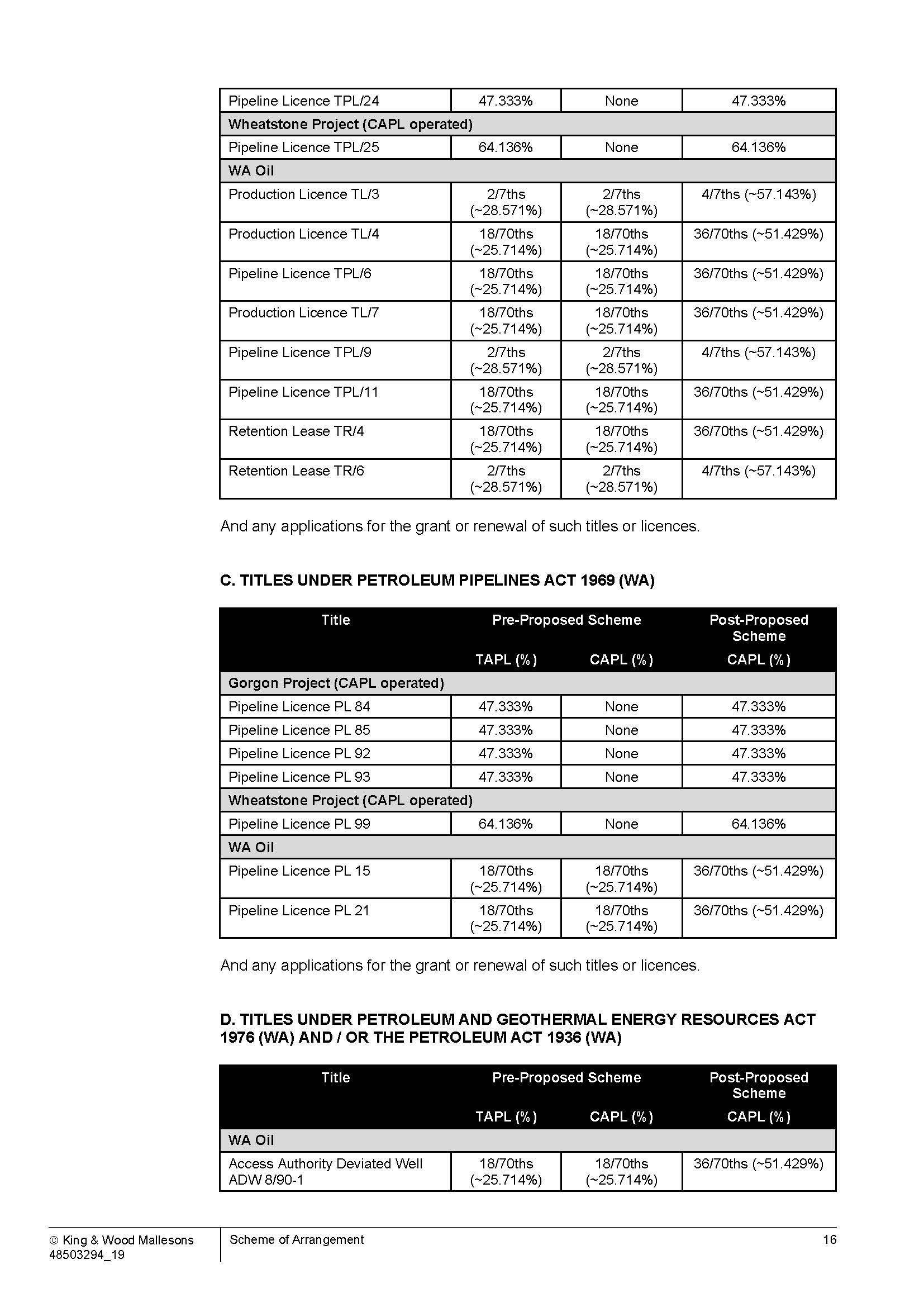
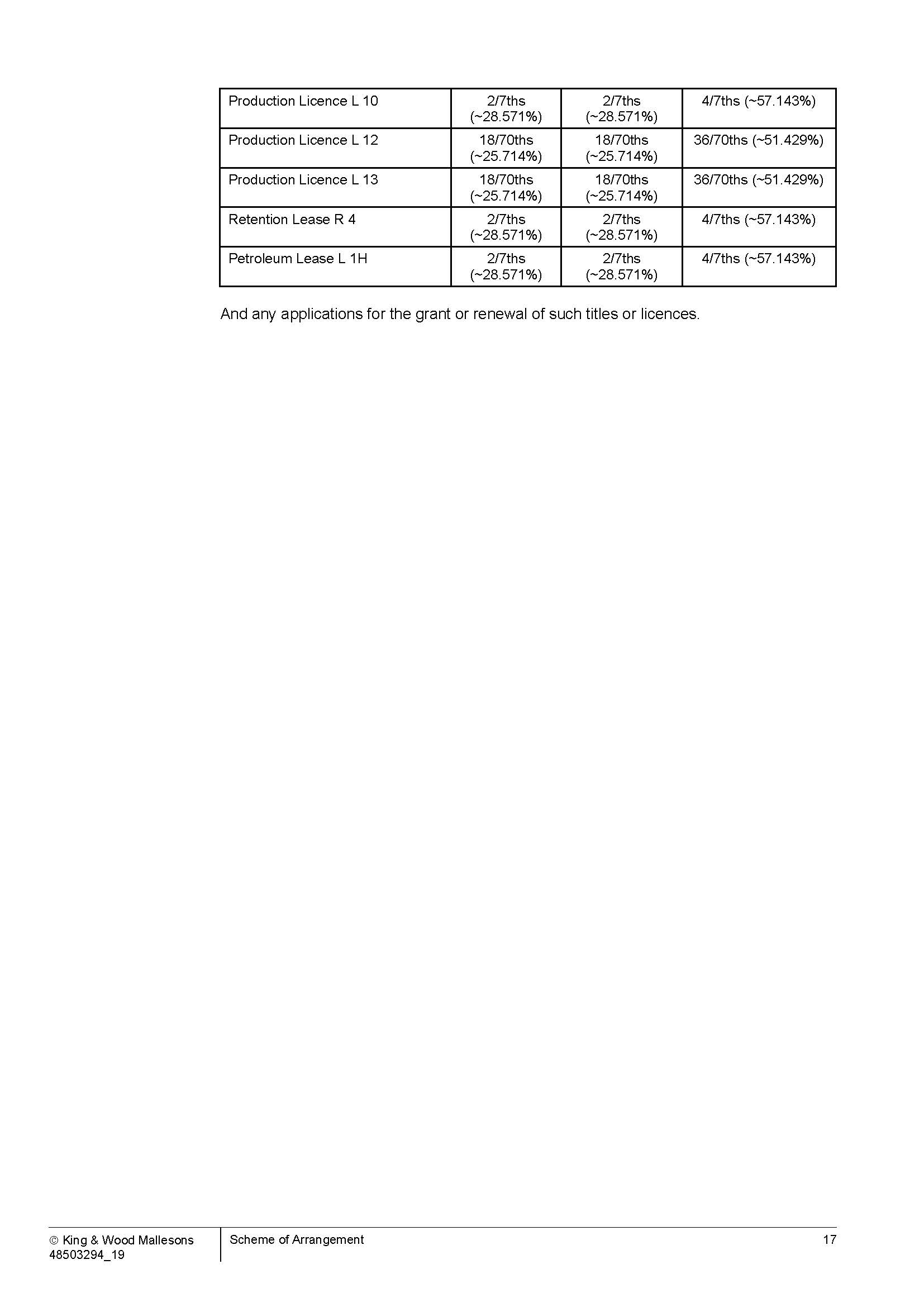
71 As noted in Chevron (No 1) at [60], the evidence discloses that TAPL has a number of interests in petroleum titles and petroleum retention lease renewal applications under the Offshore Petroleum and Greenhouse Gas Storage Act 2006 (Cth) (referred to collectively as the Commonwealth Petroleum Interests). TAPL also has a number of interests in petroleum titles under the Petroleum and Geothermal Energy Resources Act 1967 (WA), Petroleum (Submerged Lands) Act 1982 (WA) and Petroleum Pipelines Act 1969 (WA) (referred to collectively as the State Petroleum Interests).
72 Whether s 413(1) can be used to transfer a statutory licence may depend upon the terms of the particular statutory provision and any prescribed restrictions, but may also be affected by the principles discussed in Stork.
73 TAPL by its solicitors engaged with the National Offshore Petroleum Titles Administrator with respect to the Commonwealth legislation and interests, and with the DMIRS with respect to the State petroleum legislation, to ensure that the transfer of the Commonwealth Petroleum Interests and the State Petroleum Interests under the proposed Scheme satisfies the relevant statutory requirements. There has been extensive discussion between those respective parties.
74 TAPL made submissions at the second court hearing about the petroleum titles to the following effect:
(a) as was made clear by the first affidavit of Peter McNally (Chevron (No 1) at [10(a)]), the Scheme is to effect an internal restructure only, and is not intended to affect how Chevron Australia conducts business in Australia and is not intended to affect any third party dealing with Chevron Australia;
(b) as part of the Scheme and pursuant to the orders sought under s 413 of the Act, each of the Commonwealth Petroleum Interests and State Petroleum Interests will be transferred from TAPL to CAPL;
(c) if approved, such transfers will be effected by an order of the Court and will occur by operation of law, having regard to s 413(2), as explained in Stork at [96]-[99];
(d) each of the Offshore Petroleum and Greenhouse Gas Storage Act, the Petroleum and Geothermal Energy Resources Act, the Petroleum (Submerged Lands) Act and the Petroleum Pipelines Act contain express provisions which, in effect, entitle a person in whom the rights of a registered holder of a title have devolved by operation of law to apply to have its name entered in the relevant register as the holder of the title;
(e) these provisions would apply in the context of the Scheme because the rights of TAPL as a registered holder of the Commonwealth Petroleum Interests and State Petroleum Interests will have devolved on CAPL;
(f) 'devolution' contemplates 'a legal consequence flowing from an involuntary act': O'Brien v Komesaroff (1982) 150 CLR 310 at 320-321 (Mason J);
(g) as explained in Stork, the transfer of property and liabilities under the Scheme will occur pursuant to the operation of s 413, not by the voluntary act of TAPL;
(h) accordingly, it can be said that the transfer to CAPL will involve a 'devolution' by operation of law; and
(i) once the devolution occurs, then if TAPL makes an application to have its name entered on the relevant register as the holder of the title and pays the relevant fee, its name will be so registered, and it will then follow because of the Scheme that CAPL will become the registered holder of the title.
75 I accept TAPL's submissions as to the potential for CAPL to become the registered holder of such titles and the steps that may be implemented in order to achieve that result.
76 TAPL also made submissions as to its petroleum retention lease renewal applications under the Offshore Petroleum and Greenhouse Gas Storage Act. Under that Act, it submitted, it acquires certain statutory rights on making a renewal application. For example, it has a statutory right that its petroleum retention lease continue until grant, refusal or its lapsing. It has a statutory right of renewal on terms. It has a statutory right to be informed of a right to apply for a petroleum production licence if commercial viability already exists. Each of such rights is a chose in action: National Trustees Executors & Agency Company of Australasia Ltd v Federal Commissioner of Taxation (1954) 91 CLR 540 at 584. Having regard to the broad concept of 'property' in s 413(4) of the Act, the above statutory rights can be transferred from TAPL to CAPL pursuant to an order under s 413(1).
77 I accept TAPL's submissions, having regard to the analysis in Stork at [96]-[99] and Barrick (Australia Pacific Exploration) Pty Limited v Barrick (PD) Australia Pty Limited, in the matter of Barrick (Australia Pacific Exploration) Pty Limited [2017] FCA 998 at [86]-[90]. In summary, the purpose of s 413 of effecting a complete transfer of assets and liabilities of the transferor body would not be served if choses in action held by the transferor body are not able to be transferred.
78 It follows that I am satisfied that orders may be made under s 413(1) which will result in a transfer by operation of law of each of the Commonwealth Petroleum Interests and State Petroleum Interests from TAPL to CAPL.
Secured creditors
79 A number of entities have registered financing statements under the PPSA for security interests set out in those statements against collateral (the assets) of TAPL. Section 413(2) enables orders to be made that permit a transfer of assets subject to any security interest.
80 In Chevron (No 1) at [65] I summarised the manner by which provisions of the PPSA accord protection to a secured party where a transfer proceeds, provided it takes certain steps to protect its own interests. For ease of reference I repeat that summary:
(a) the PPSA permits a transfer of the collateral the subject of a security interest regulated by the PPSA;
(b) a security interest in collateral is perfected if a financing statement is registered: s 21(1)(a);
(c) registration is regulated by Part 5.3 of the PPSA;
(d) s 162 provides that a financing statement may be registered to reflect a transfer of collateral before or after the transfer;
(e) if there is a transfer, s 34(1) accords temporary protection to the secured party who at the time of the transfer held a perfected security interest in the collateral, in that they have perfection for a prescribed period of time;
(f) s 66 and s 67 then deal relevantly with priorities of securities in transferred collateral; and
(g) if registration is effected by the secured party against the new grantor within the specified time, priority with respect to the collateral is maintained.
81 Further, I noted that the evidence disclosed that TAPL has given notice to each person who has registered a financing statement against collateral of TAPL under the PPSA, informing them that the transfer of collateral from TAPL to CAPL may occur without loss of their priority if they take advice and take appropriate steps to effect registration.
82 TAPL provided further detailed submissions as to the operation of the relevant provisions, noting, for example, that s 162 provides that a financing statement may be registered to reflect a transfer of collateral before or after the transfer. And therefore, on the contemplated transfer of TAPL's assets or collateral to CAPL under the Scheme, s 162 of the PPSA permits the secured party to register a financing statement as to its security interest in collateral which would then be held by CAPL, even before the transfer occurs.
83 TAPL also clarified that the PPSA expressly contemplates a scenario such as the transfer of TAPL's collateral that is the subject of security interests granted by TAPL, and gives the secured parties priority if they register a financing statement within time. Relevantly:
(a) s 66 and s 67 deal of the PPSA deal with the priority position as between existing secured parties of TAPL and CAPL's secured parties' security interests over the transferred collateral from TAPL to CAPL, to the exclusion of s 55; and
(b) s 55 deals with the priority position as between existing secured parties of TAPL as to TAPL's collateral that will be transferred to CAPL under the Scheme.
84 It remains necessary for secured creditors to take appropriate steps to register financing statements either before implementation of the Scheme or within the times provided for by s 34 - but I am satisfied that TAPL has taken all reasonable steps to inform secured creditors of their need to address such issues and to take legal advice. If secured parties register a financing statement within time, as TAPL submitted, the Scheme will not affect these secured parties but will afford them protection.
85 It follows that I am satisfied that orders for transfer of the collateral under s 413(1)(a) of the Act may be made. TAPL's secured parties will not be affected if they register a financing statement within time and this may be after the Scheme is implemented. I also note in this context the liberty to apply provision as discussed above.
Conclusion
86 For the above reasons, I was satisfied that each of the matters relevant to an order approving the Scheme under s 411 of the Act, and relevant to the orders sought under s 413, were satisfied. Therefore, it was appropriate to make the orders sought.
I certify that the preceding eighty-six (86) numbered paragraphs are a true copy of the Reasons for Judgment of the Honourable Justice Banks-Smith. |
Associate:


