

FEDERAL COURT OF AUSTRALIA
Crown Resorts Limited, in the matter of Crown Resorts Limited [2022] FCA 367
ORDERS
CROWN RESORTS LIMITED ACN 125 709 953 Plaintiff | ||
DATE OF ORDER: |
THE COURT NOTES THAT:
A. The Australian Securities and Investments Commission (ASIC) was provided with at least 14 days' notice of the hearing of this application.
B. The Court is satisfied that ASIC has had a reasonable opportunity to:
(i) examine the terms of the proposed scheme of arrangement to which the application relates and a draft explanatory statement relating to that arrangement; and
(ii) make submissions to the Court in relation to the proposed scheme of arrangement and the draft explanatory statement.
THE COURT ORDERS THAT:
1. Pursuant to section 411(1) of the Corporations Act 2001 (Cth) (Act), the Plaintiff convene and hold a meeting (Scheme Meeting) of its shareholders, excluding Midnight Acacia Holdings Pty Limited (and any other Related Body Corporate of SS Silver II Pty Ltd (ACN 644 174 890)), (Crown Shareholders):
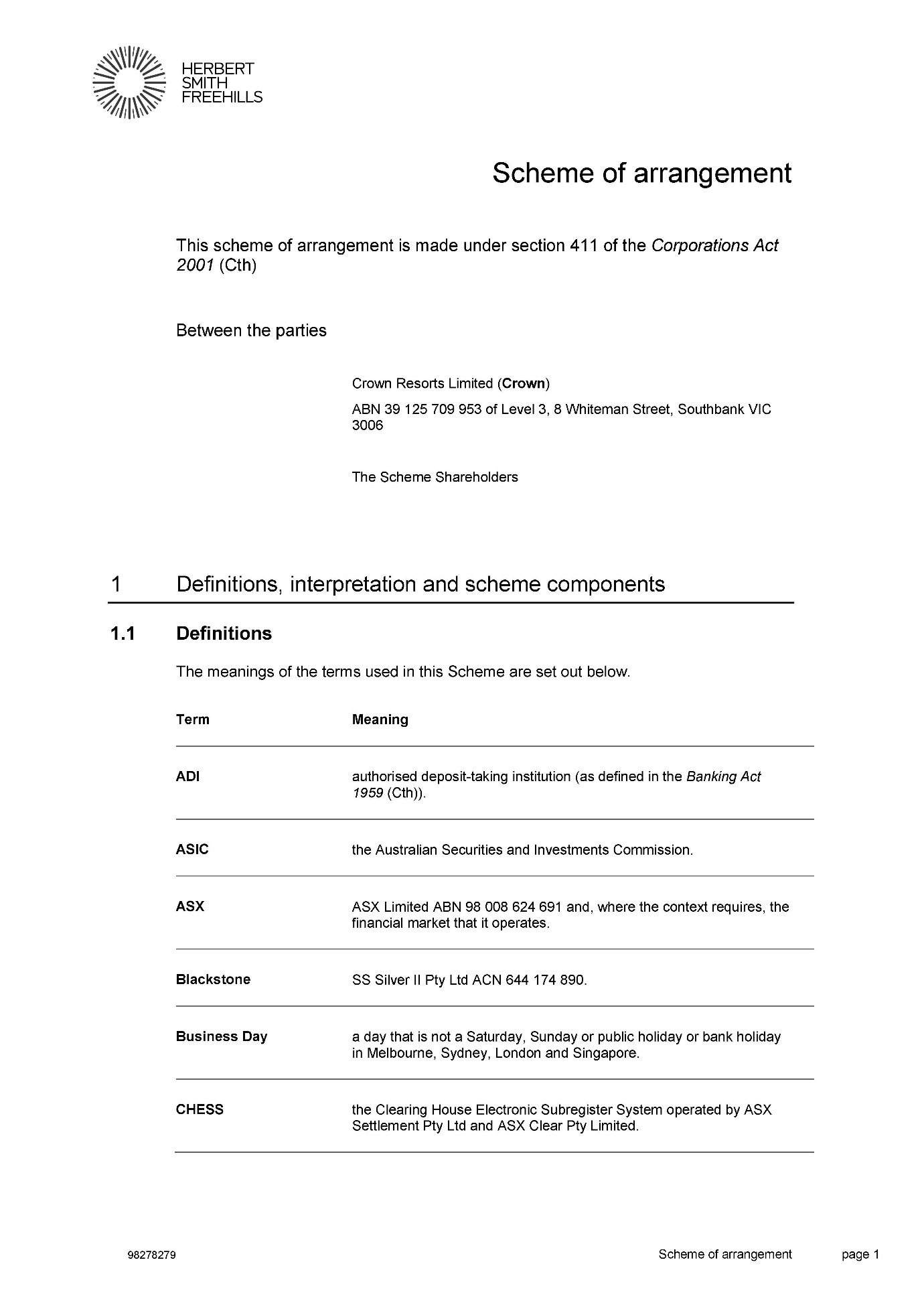
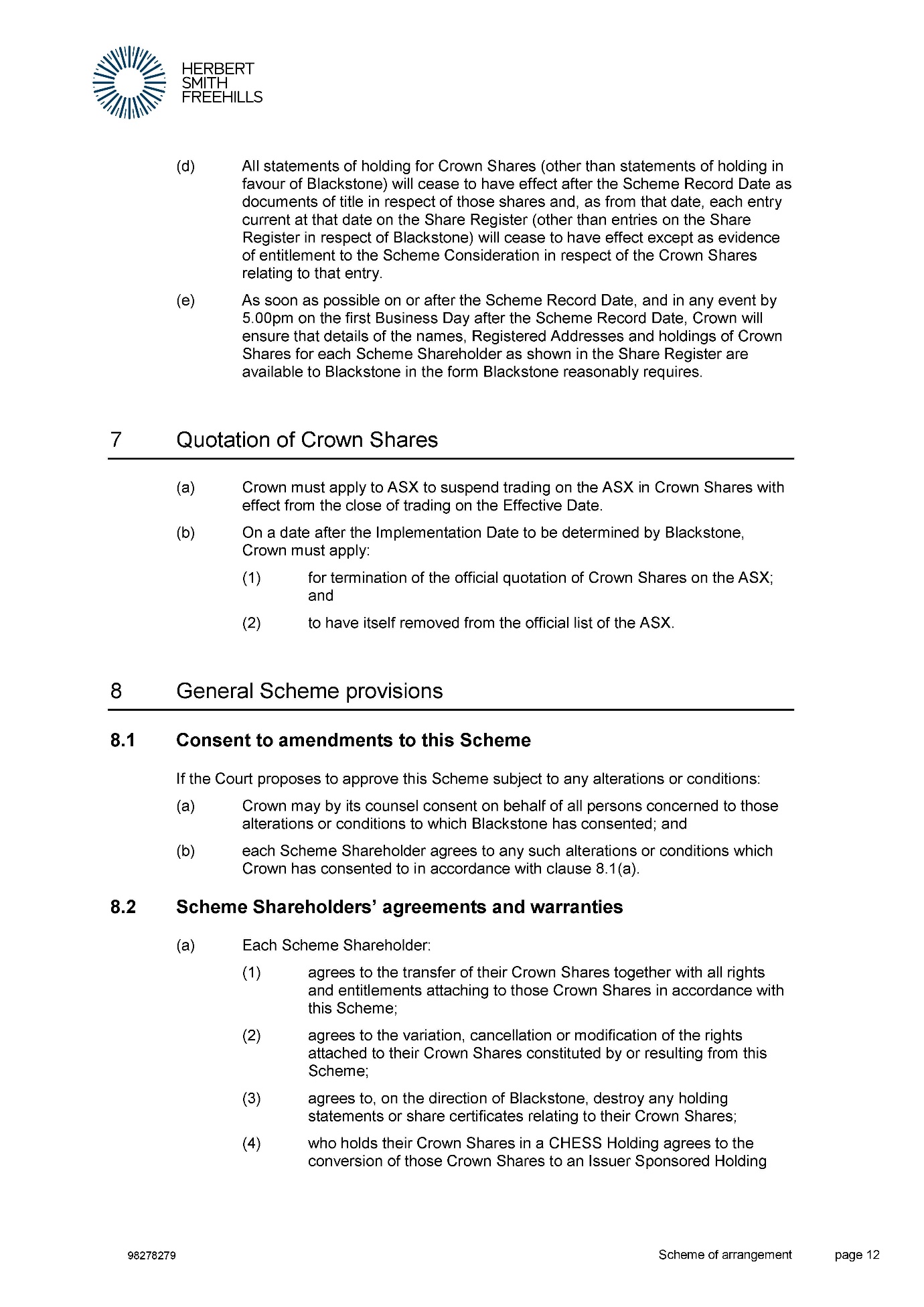
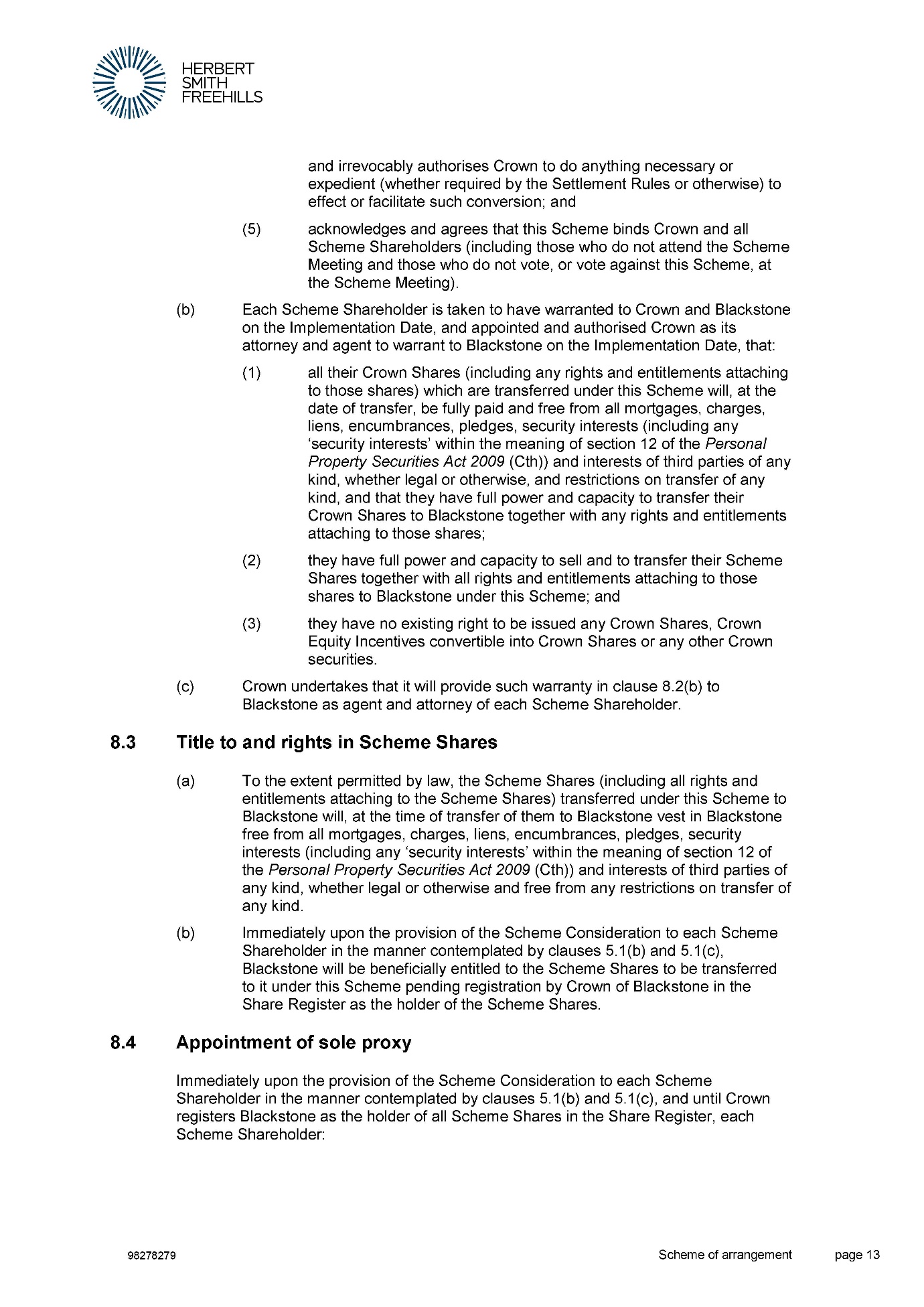
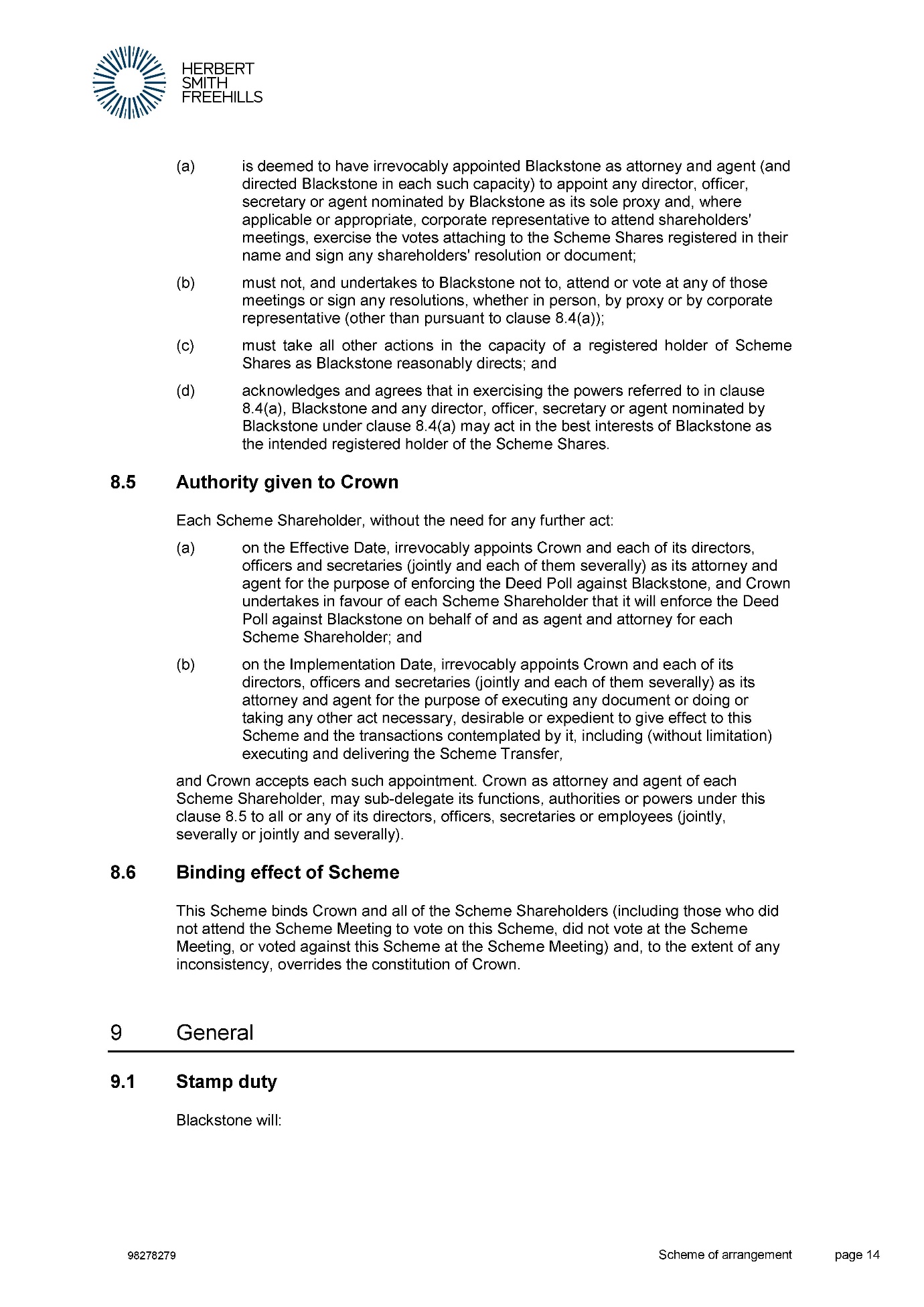
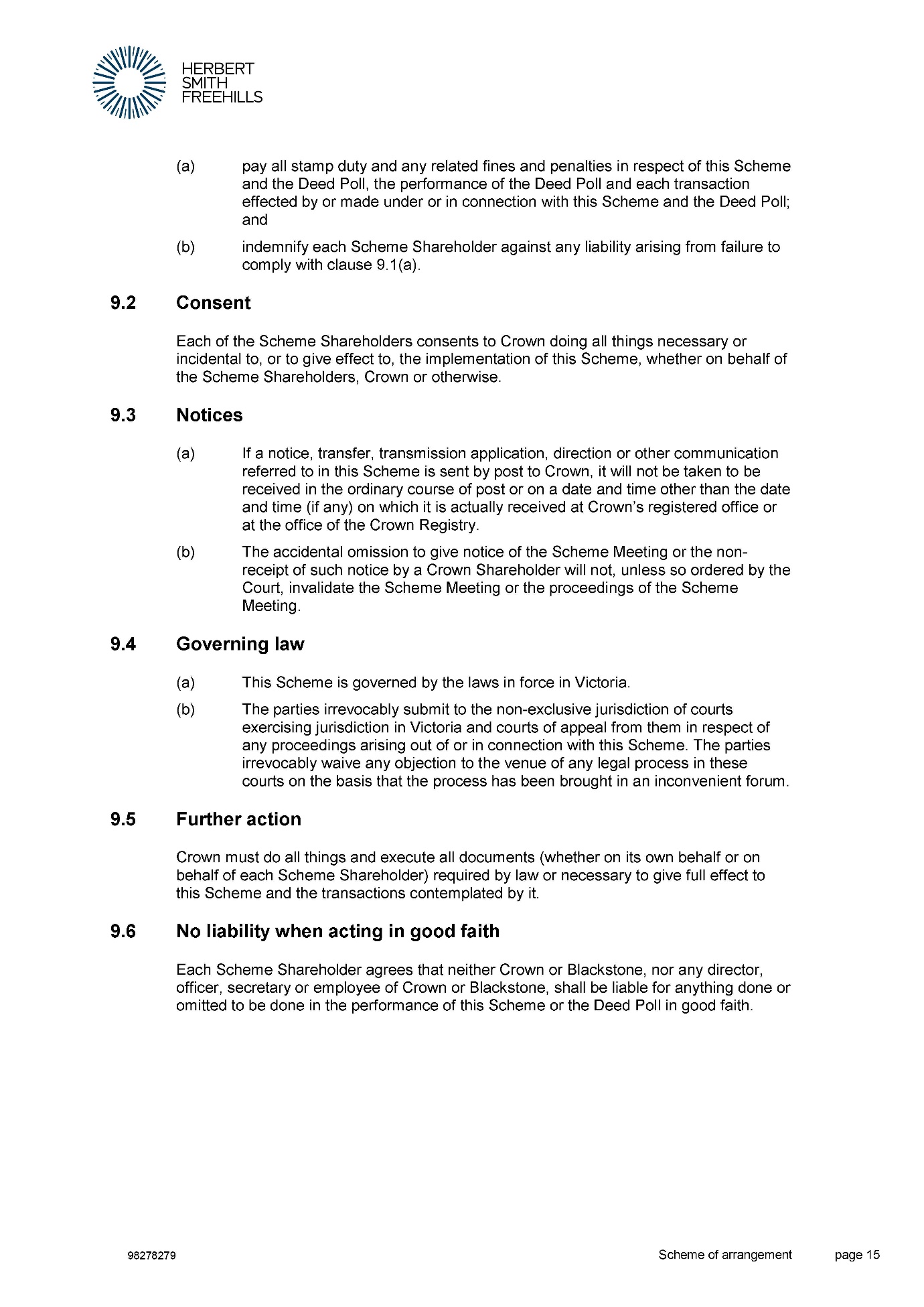
(a) for the purpose of considering, and, if thought fit, agreeing (with or without modification), to the scheme of arrangement (Scheme) proposed to be made between the Plaintiff and Crown Shareholders, the terms of which are set out in Annexure A to these orders; and
(b) to be held on 29 April 2022 at 10:00am (AEST, being Melbourne time) and to be conducted electronically through an online platform without Crown Shareholders being physically present (which is to be accessed in accordance with the instructions included in the notice of meeting to be sent to shareholders).
2. The Scheme Meeting be convened by sending on or before 31 March 2022:
(a) an email to each Crown Shareholder who has nominated an electronic address for the purposes of receiving notices of meeting and proxy forms from the Plaintiff (Email Shareholder) (or, in the case of joint holders, to the holder whose name appears first in the Plaintiff’s register), such email to be substantially in the form of Annexure RAL-9 to the Affidavit of Rodd Ashton Levy dated 28 March 2022 (Second Levy Affidavit) which contains links to:
(i) a website from which the Email Shareholder can download an electronic copy of a document substantially in the form of the Scheme Booklet, a draft of which is at Annexure RAL-5 to the Second Levy Affidavit incorporating the amendments set out in RAL-8 to the Second Levy Affidavit (which contains among other things the proposed Scheme of Arrangement at Annexure 2 and Notice of Scheme Meeting at Annexure 4) (Scheme Booklet);
(ii) a website from which the Email Shareholder can download an electronic copy of a document substantially in the form of the document entitled ‘Online Meeting Guide’, a copy of which is at Annexure SAH-2 to the affidavit of Scott Alexander Hudson (Scheme Meeting Online Guide);
(iii) an online portal or website that is accessible by the Email Shareholder and which enables the Email Shareholder to lodge their proxy for the Scheme Meeting and voting instructions online; and
(iv) an online portal or website that is accessible by the Email Shareholder to listen to and participate in the Scheme Meeting online;
(b) the following hard-copy documents to each Crown Shareholder who is not an Email Shareholder (or, in the case of joint holders, to the holder whose name appears first in the Plaintiff’s register) (Postal Shareholder):
(i) an access postcard setting out the URL which provides access to a website from which the Postal Shareholder:
A. can download an electronic copy of the Scheme Booklet (including the notice of meeting which is annexed to the Scheme Booklet) (which contains among other things the proposed Scheme of Arrangement at Annexure 2 and Notice of Scheme Meeting at Annexure 4);
B. can download an electronic copy of a document substantially in the form of the Scheme Meeting Online Guide; and
C. is directed to an online portal or website that is accessible by the Postal Shareholder to listen to and participate in the Scheme Meeting online;
(ii) a personalised hard copy proxy/voting form for the Scheme Meeting (Proxy Form), substantially in the form of the final four pages of Annexure RAL-5 to the Second Levy Affidavit; and
(iii) a prepaid envelope for return of the completed Proxy Form.
3. The documents referred to in Order 2(b) be sent:
(a) in the case of Crown Shareholders whose registered address is within Australia, by prepaid ordinary post addressed to the relevant addresses recorded in the Plaintiff’s register; and
(b) in the case of Crown Shareholders whose registered address is outside Australia, by airmail or international courier service addressed to the relevant addresses recorded in the Plaintiff’s register.
4. Compliance with r 2.15 of the Federal Court (Corporations) Rules 2000 (Cth) (Rules) be dispensed with, except in so far as that Rule applies rule 75-15(2) of the Insolvency Practice Rules (Corporations) 2016 (Cth).
5. Subject to these orders, the meeting shall be conducted in accordance with the Plaintiff’s constitution and, unless inconsistent with the Plaintiff’s constitution, Part 2G.2 of the Act.
6. Voting on the resolution to approve the Scheme is to be conducted by way of a poll.
7. Crown Shareholders whose names are recorded in the register of members of the Plaintiff at 7:00pm (AEST, being Melbourne Time) 27 April 2022 will be eligible to vote at the Scheme Meeting.
8. A proxy in respect of the Scheme Meeting will be valid and effective if, and only if, a Proxy Form is completed and delivered in accordance with its terms or a proxy is lodged online in accordance with the instructions by 10.00am (AEST, being Melbourne time) on 27 April 2022.
9. Dr Zygmunt Edward Switkowski or failing him Ms Sarah Jane Halton, be Chair of the Scheme Meeting.
10. The Chair of the Scheme Meeting shall have the power to adjourn the meeting to such time, date and place as he considers appropriate.
11. The Plaintiff shall have power to postpone the meeting to such time, date and place as it considers appropriate and, in that event, notwithstanding any other part of these orders:
(a) only Crown Shareholders whose names are recorded in the register of members of the Plaintiff at 7:00pm (AEST, being Melbourne Time) on the date which is two calendar days before the date of the postponed meeting will be eligible to vote at the Scheme Meeting;
(b) a proxy in respect of the Scheme Meeting will be valid and effective if a Proxy Form is completed and delivered in accordance with its terms or a proxy is lodged online in accordance with the instructions at least 48 hours before the time scheduled for the postponed meeting; and
(c) a reference in these orders to the Scheme Meeting is taken to include a reference to the postponed meeting.
12. Compliance with r 3.4 and Form 6 of the Rules is dispensed with.
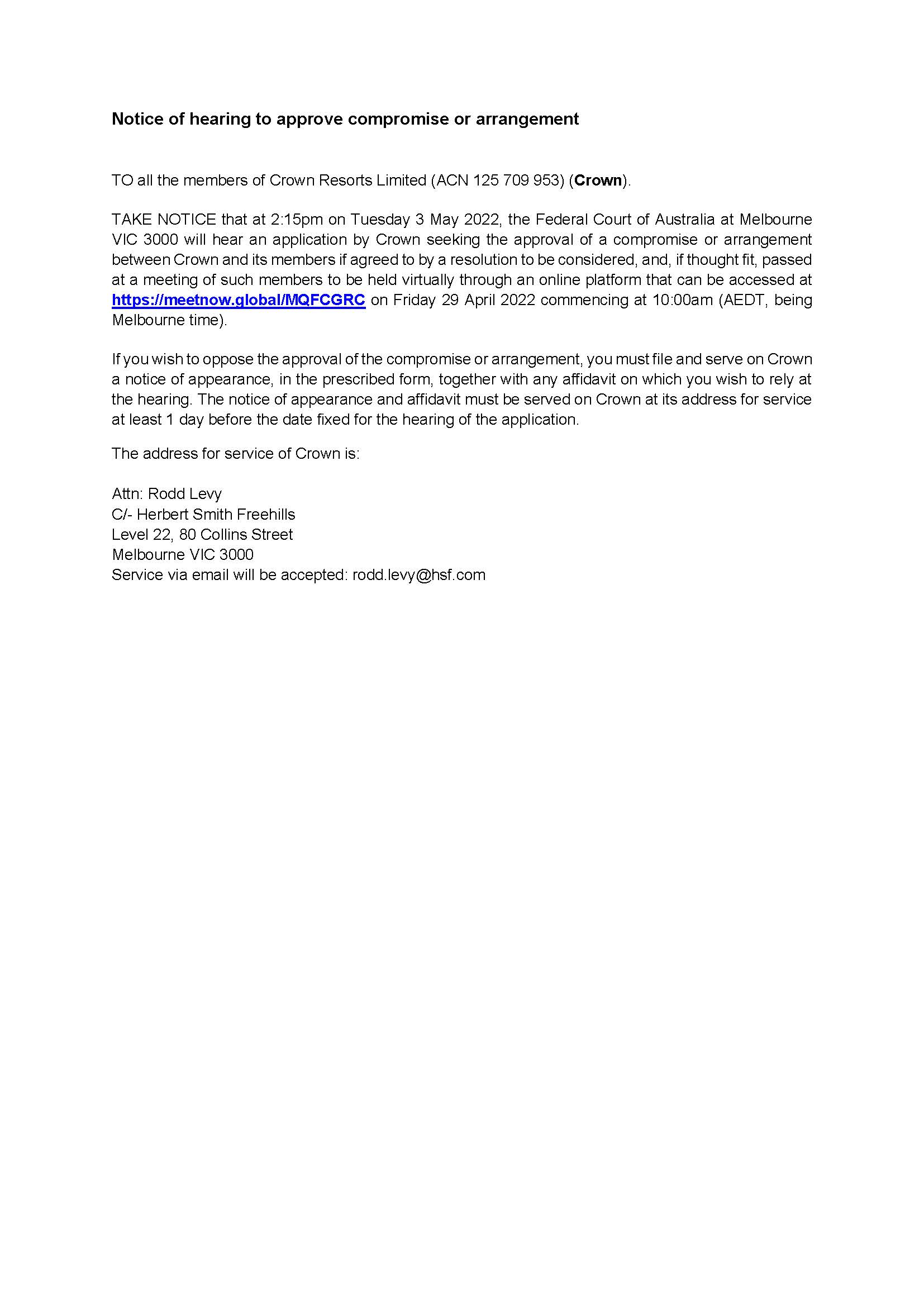
13. The Plaintiff publish a Notice of Hearing in The Australian newspaper, in substantially the form that appears at Annexure B hereto, not later than 5 days prior to the date fixed for the hearing of any application to approve the Scheme.
14. The further hearing of the Originating Process is adjourned to the Honourable Justice O’Bryan at 2:15pm on Tuesday 3 May 2022 or as soon thereafter as the business of the Court allows.
Note: Entry of orders is dealt with in Rule 39.32 of the Federal Court Rules 2011.
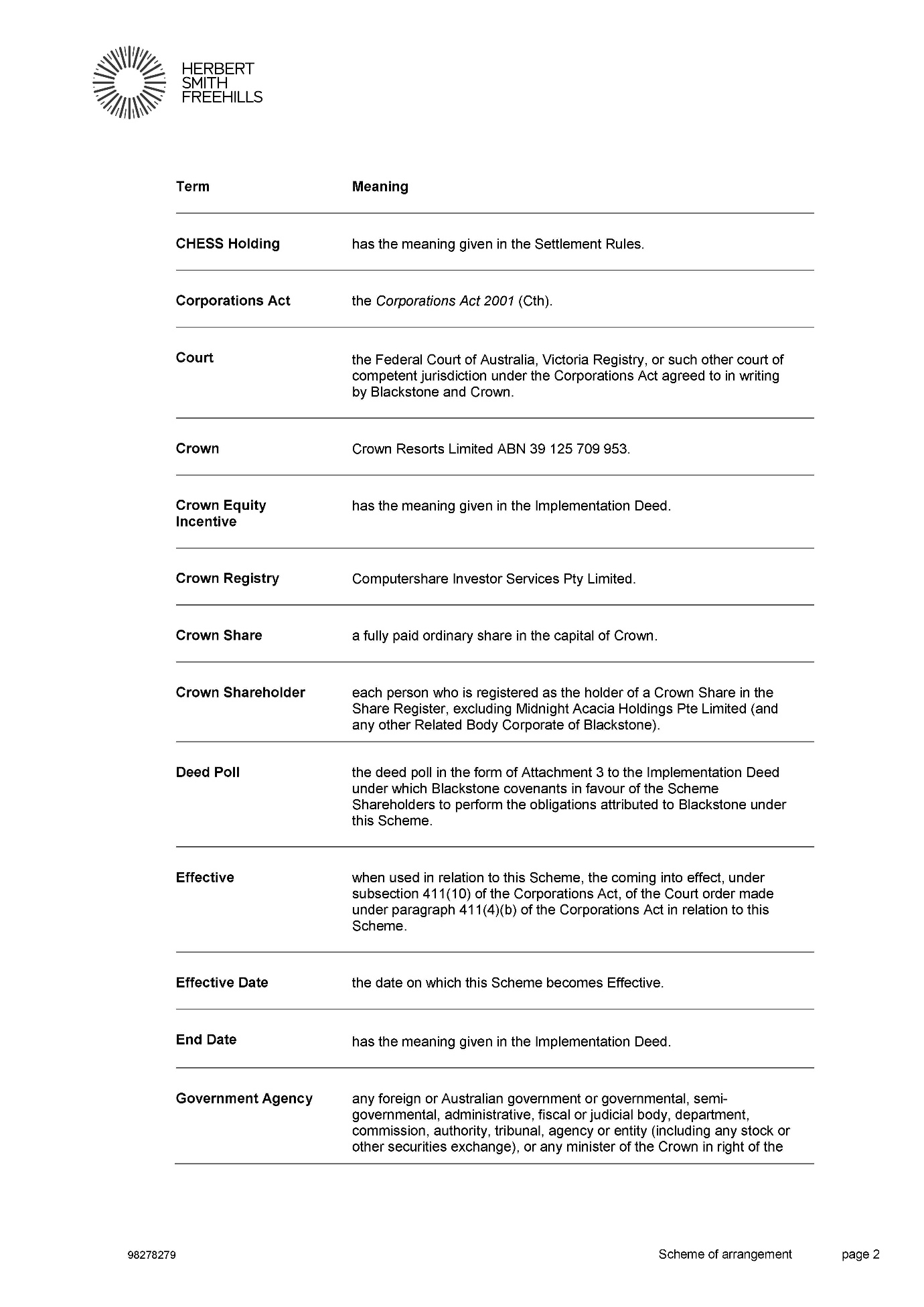
ANNEXURE A 
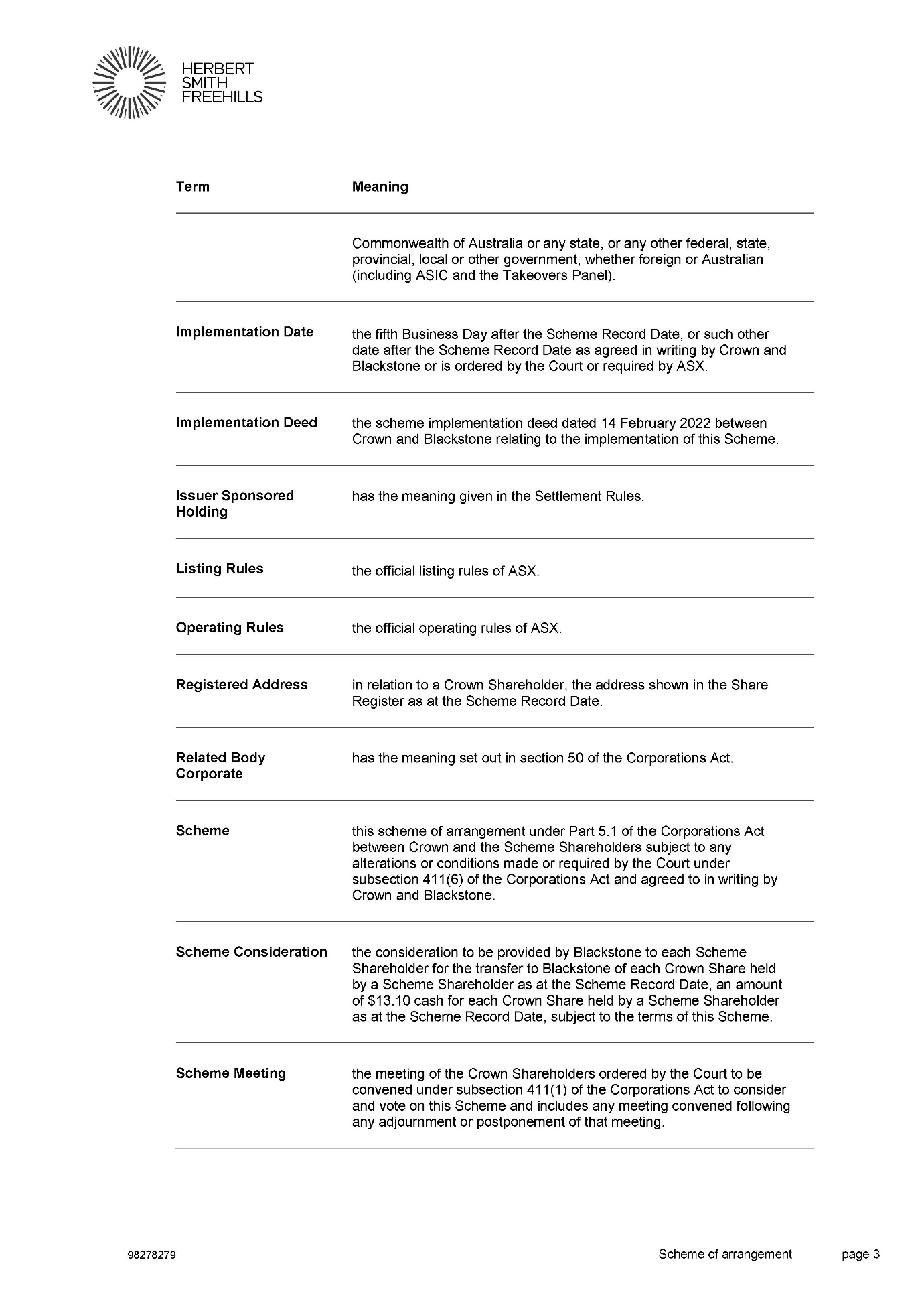
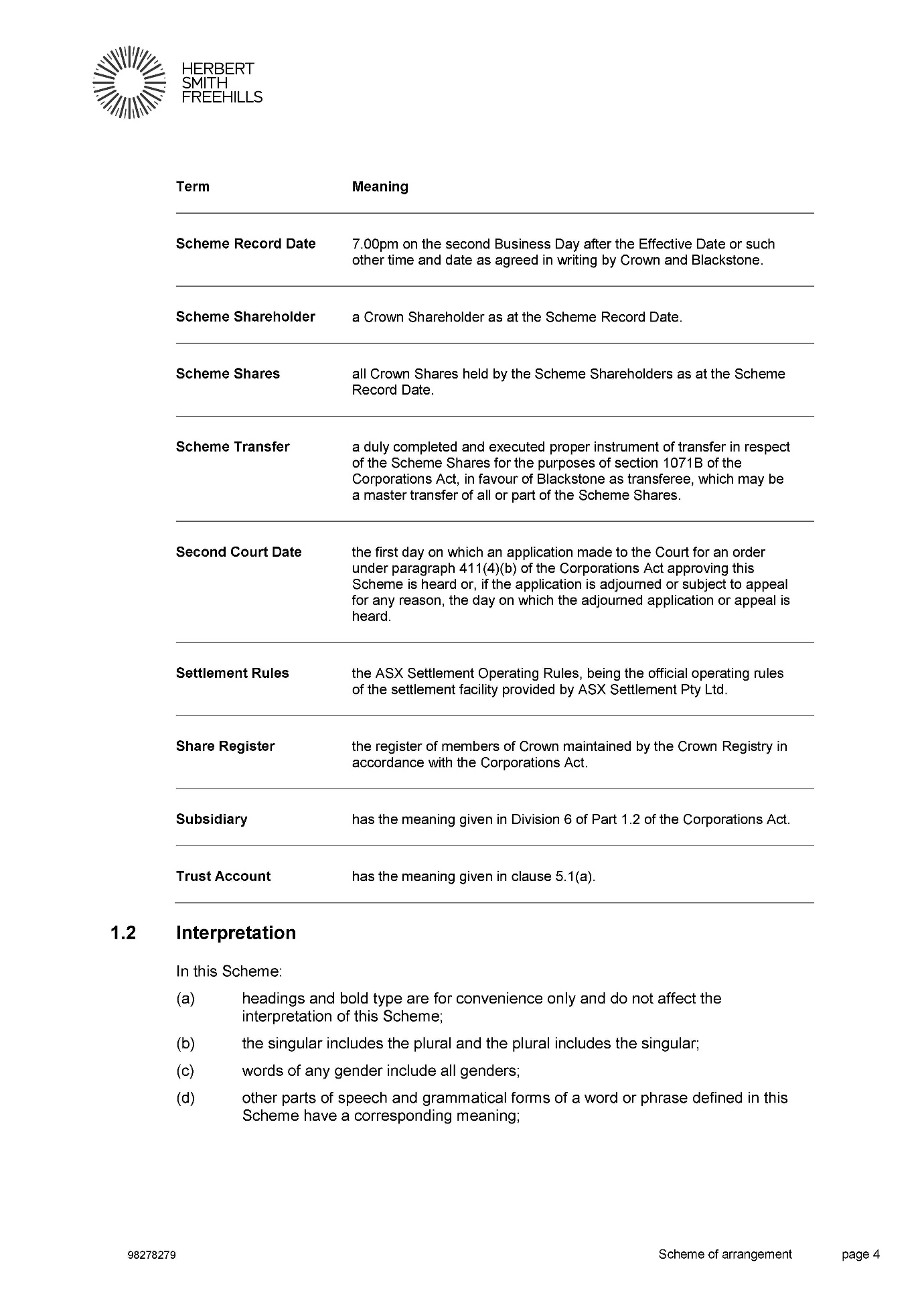
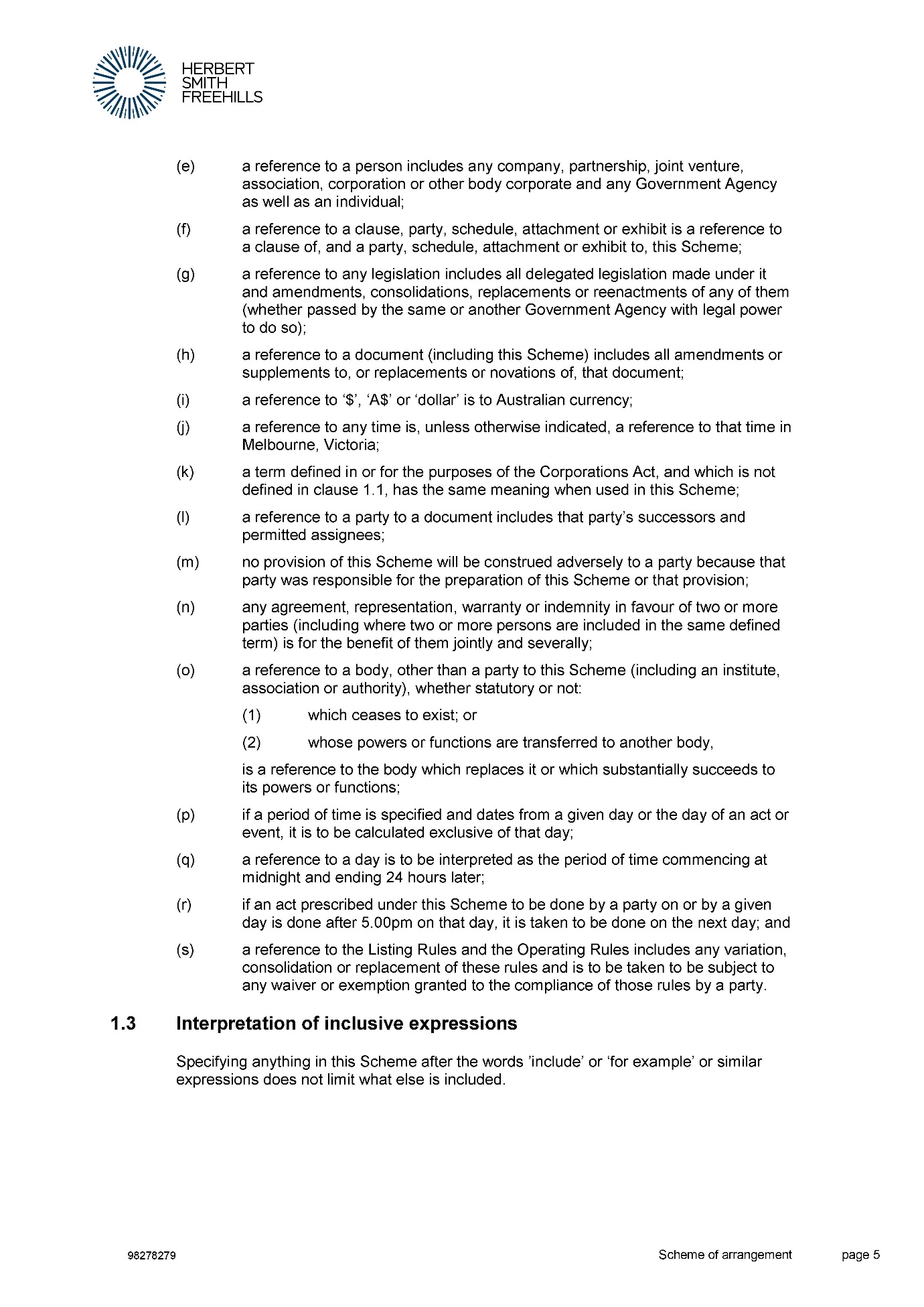
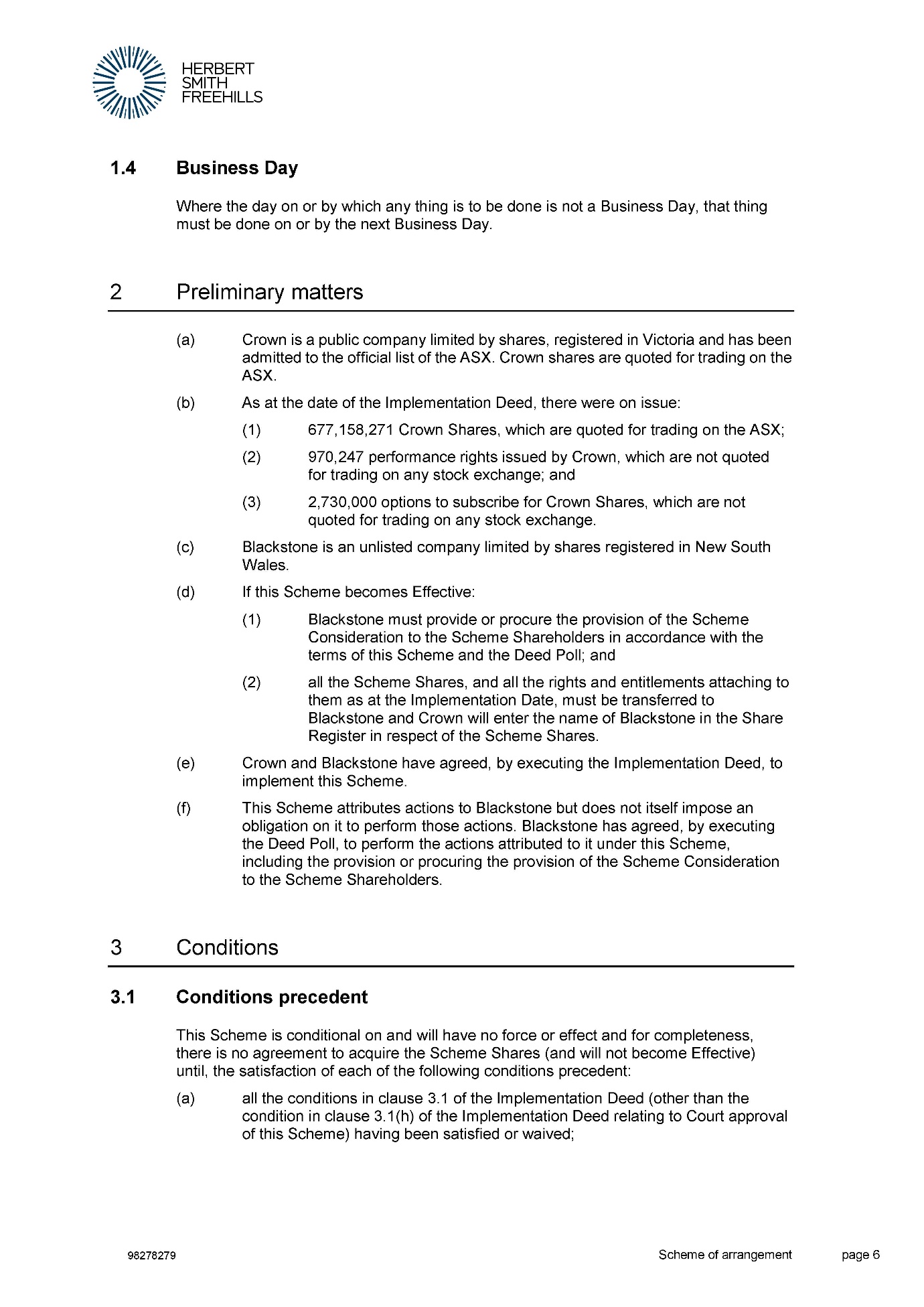
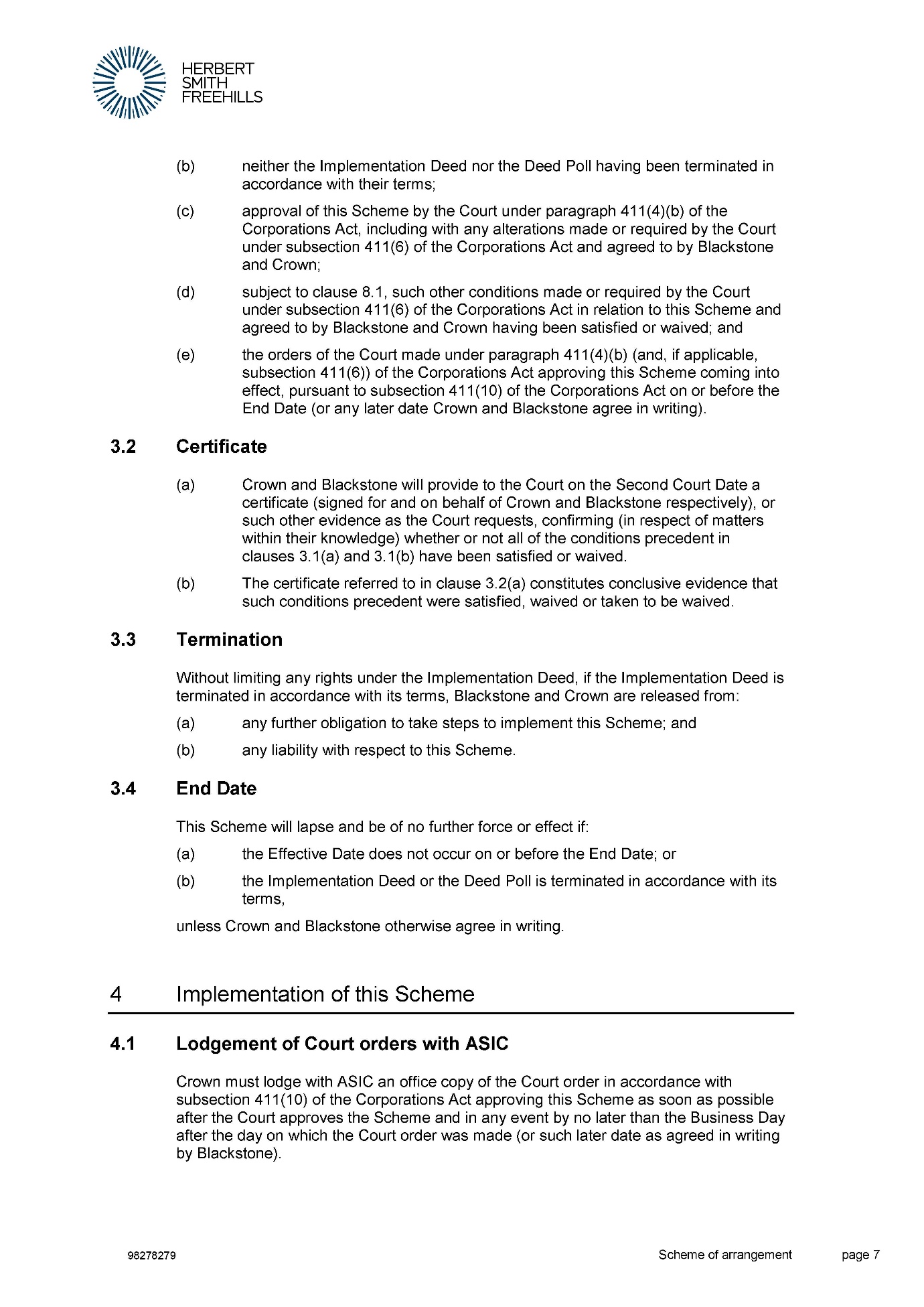
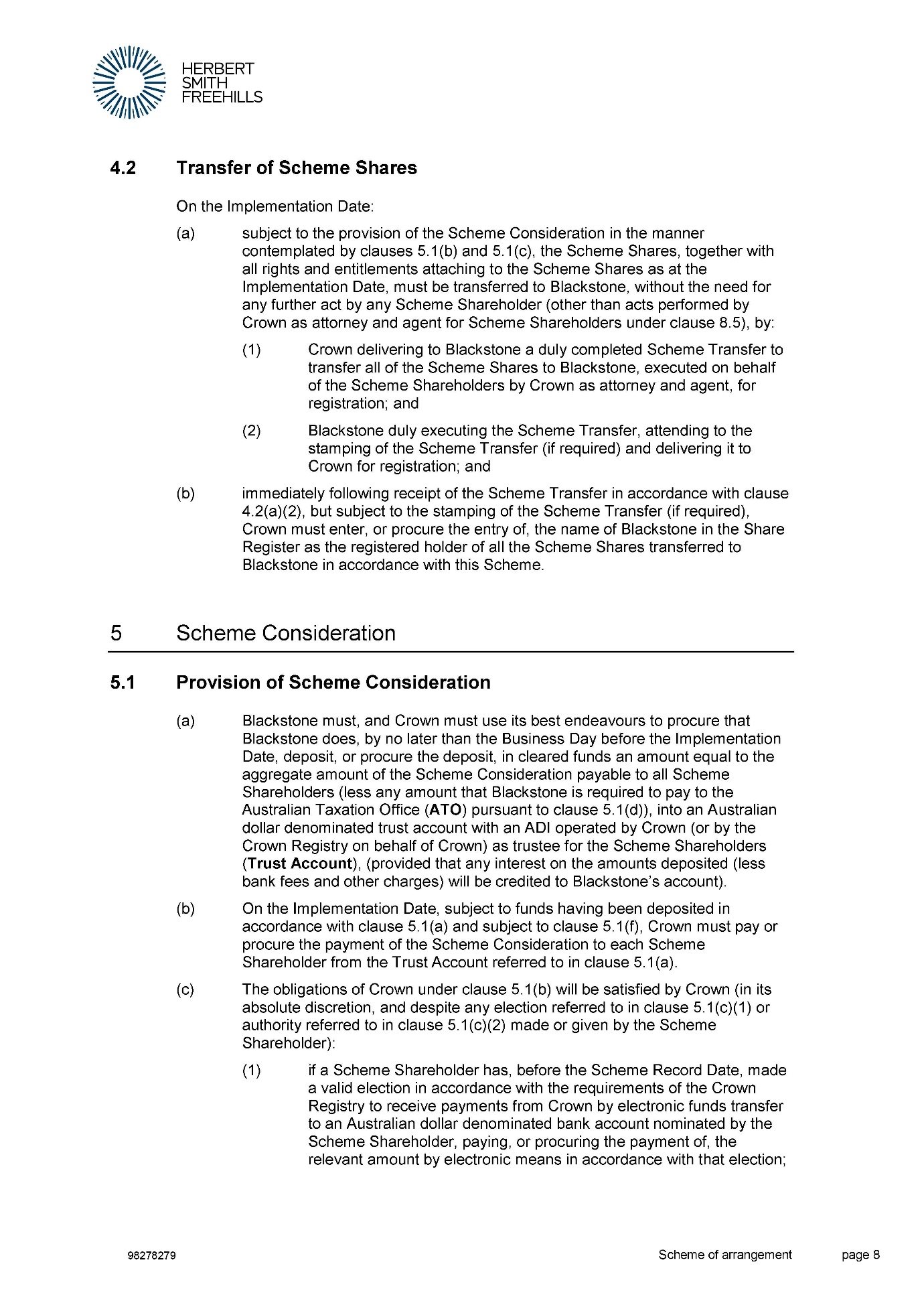
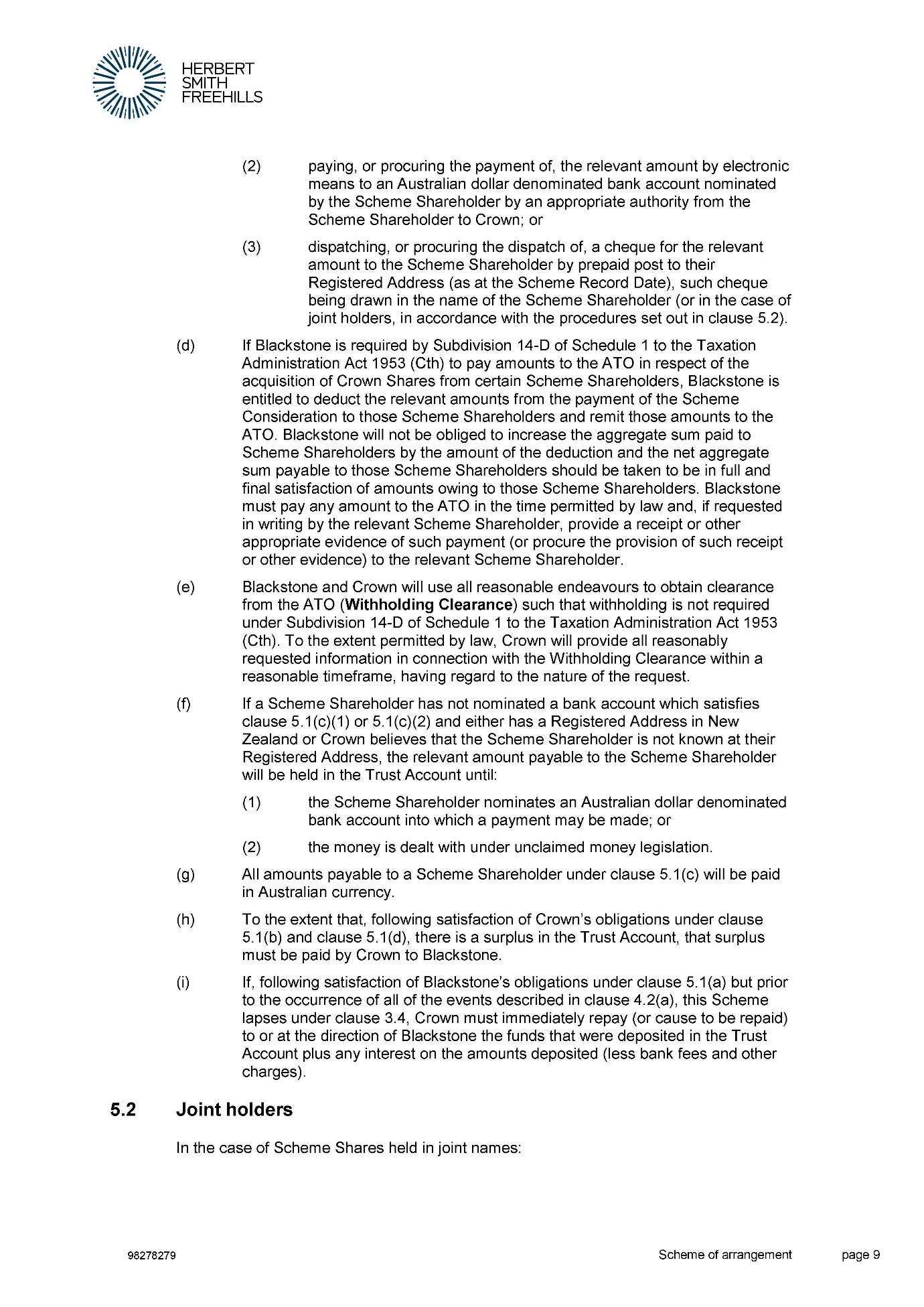
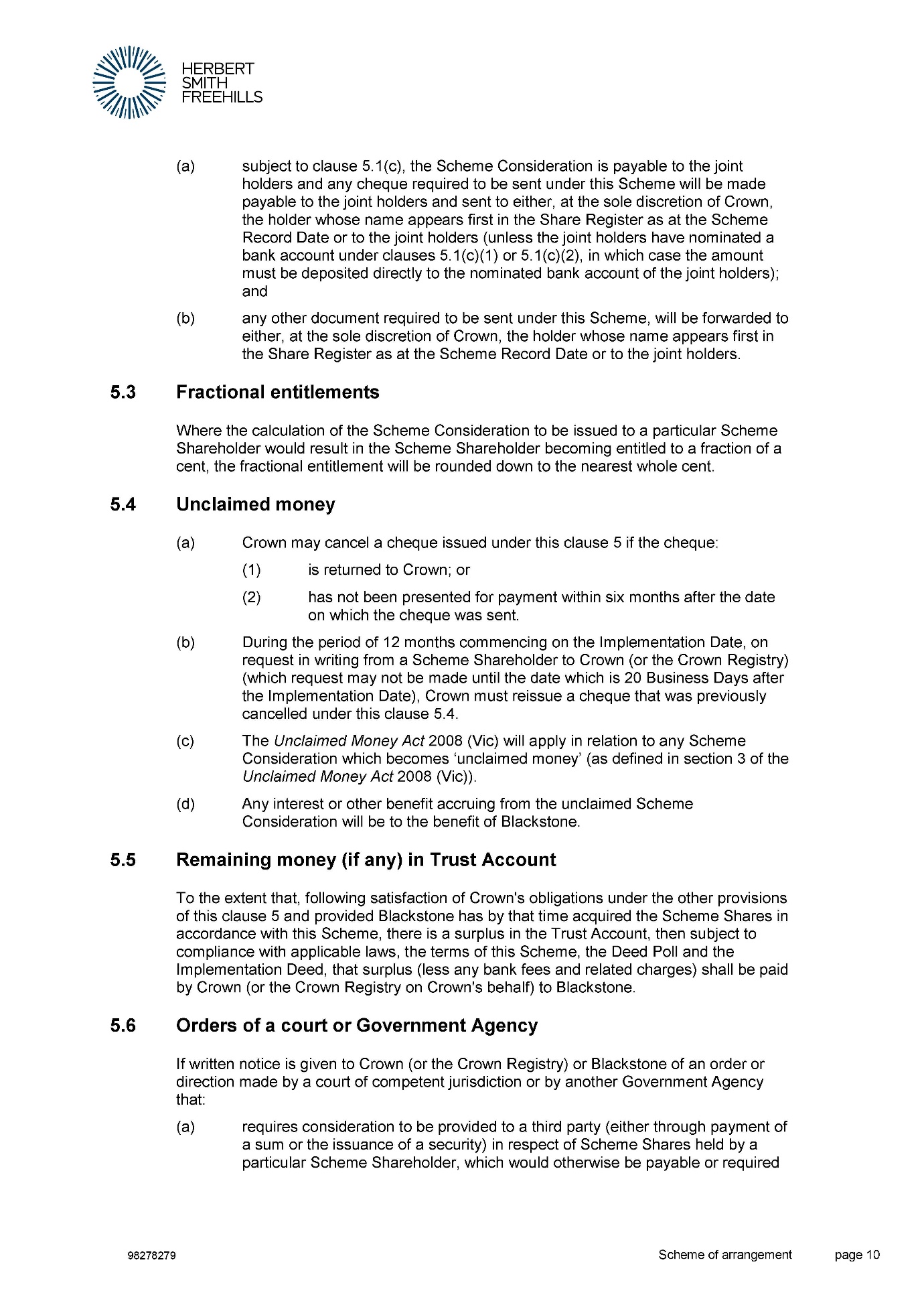
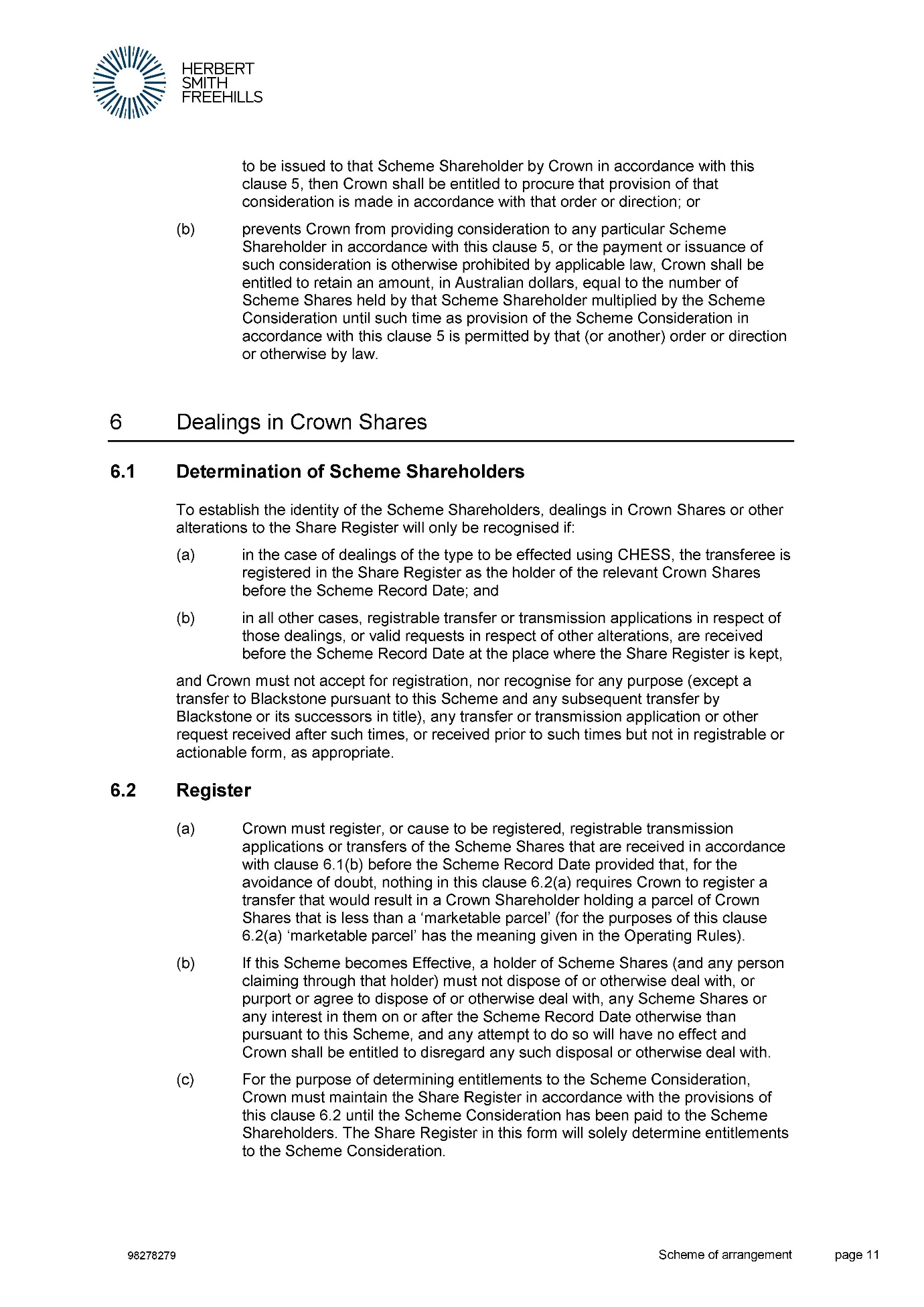
ANNEXURE B
O’BRYAN J:
Introduction
1 By originating application dated 25 February 2022, the plaintiff (Crown) seeks orders pursuant to s 411(1) of the Corporations Act 2001 (Cth) (Act) convening a meeting of Crown shareholders for the purposes of them considering and, if thought fit, agreeing to a proposed scheme of arrangement (Scheme) between them and Crown.
2 The commercial purpose of the Scheme is to provide for the acquisition of all the shares in Crown by SS Silver II Pty Ltd (ACN 644 174 890) (Blackstone), except for those shares already held by Midnight Acacia Holdings Pty Limited or any other related body corporate of Blackstone (Blackstone RBCs).
3 The Scheme, if implemented, will result in the transfer of all Crown shares (excluding shares held by Blackstone RBCs) (Scheme Shares) to Blackstone. The holders of the Scheme Shares (Scheme Shareholders) will receive $13.10 in cash for each Scheme Share (Scheme Consideration).
4 The Scheme meeting is proposed to be held virtually at 10:00 am (AEST) on 29 April 2022. As a result of the health risks associated with the COVID-19 pandemic, it is proposed that there will be no physical meeting and instead that the meeting be held electronically through an online platform, which shareholders will be able to access by visiting a particular webpage address that is set out in the notice of meeting. That webpage will also be hyperlinked in the electronic copy of the notice of meeting. The online platform will enable participants to view the Scheme meeting live, ask questions by way of a “Q&A” function and vote on the relevant resolution in real time.
5 It is proposed that Dr Zygmunt Edward Switkowski will chair the Scheme meeting unless he is unable to do so, in which case Ms Sarah Jane Halton will chair.
6 On 29 March 2022, I made orders convening the Scheme meeting. These are my reasons for making those orders.
Overview of the Scheme
7 Crown is an Australian public company limited by shares. It is admitted to the official list of the Australian Securities Exchange (ASX) and its shares are quoted for trading on the stock market conducted by the ASX. Crown is registered in Victoria, Australia. It operates in three states of Australia and in the United Kingdom, with its core businesses and investments in the integrated resorts sector.
8 Blackstone Inc is a leading global alternative asset manager with over US$880 billion in assets under management across real estate, private equity, hedge fund solutions, insurance and credit investments. Blackstone is listed on the New York Stock Exchange and has a market capitalisation of around US$148 billion (circa A$210 billion). A Blackstone RBC, Midnight Acacia Holdings Pty Limited, currently owns a 9.99% interest in Crown.
9 On 14 February 2022, Crown released a market announcement stating that it had entered into a Scheme Implementation Deed with Blackstone, whereby Blackstone agreed to acquire all of the issued ordinary shares of Crown (except for those shares held by Blackstone RBCs) by means of a scheme of arrangement under the Act. The market announcement was made available on the ASX website and it enclosed a copy of the Scheme Implementation Deed.
10 Under the Scheme Implementation Deed, Crown agrees to propose the Scheme and both Crown and Blackstone agree to implement the Scheme on and subject to the terms and conditions of the Scheme Implementation Deed. The terms of the Scheme are set out in the proposed Scheme of Arrangement that is Attachment 2 to the Scheme Implementation Deed.
11 The Scheme provides for the acquisition by Blackstone of all of the shares in Crown (except for those shares held by Blackstone RBCs). In particular, it provides that, following provision of the Scheme Consideration to the Scheme Shareholders, all Scheme Shares will be transferred to Blackstone. It is anticipated that these steps will occur on 12 May 2022 (the Implementation Date). If the Scheme is implemented, Crown will be delisted from the ASX.
12 Blackstone is not a party to the Scheme and cannot be directly bound by it (relevantly, under s 411 of the Act, a scheme is between a company and its members). The established practice in these circumstances is to require the entity providing the scheme consideration to execute a Deed Poll in favour of scheme shareholders. That practice has been followed in this case. The Scheme Implementation Deed requires Blackstone to execute a Deed Poll in a prescribed form prior to the first hearing before this Court. This Deed Poll was executed by Blackstone on 24 March 2022. Under the Deed Poll, Blackstone undertakes in favour of each Scheme Shareholder to perform the actions attributed to it under the Scheme, and to provide the Scheme Consideration to each of them in accordance with the terms of the Scheme.
13 On 15 March 2022, the lawyers for the plaintiff, Herbert Smith Freehills, lodged a draft of the Scheme Booklet with the Australian Securities and Investments Commission (ASIC) for ASIC’s review and comment. On 24 March 2022, ASIC emailed Herbert Smith Freehills with proposed amendments to the Scheme Booklet. Also on 24 March 2022, the final report of the Perth Casino Royal Commission was delivered. Section 5.6(c) of the draft Scheme Booklet referred to the final report of the Perth Casino Royal Commission not having been released and the findings of the Commission not being known. Crown subsequently prepared a further and final draft of the Scheme Booklet to address the proposed amendments received from ASIC as well as to update the section addressing regulatory investigations to reflect the publication of the Perth Casino Royal Commission findings. On 28 March 2022, Herbert Smith Freehills sent this final draft of the Scheme Booklet to ASIC. On the same date, ASIC provided Herbert Smith Freehills with confirmation that it had no further comments on the final draft of the Scheme Booklet.
14 On 28 March 2022, ASIC also provided Crown with a “preliminary no objection” letter. This letter stated that, based on ASIC’s examination of the terms of the Scheme and the Scheme Booklet, ASIC does not currently propose to appear to make submissions or intervene to oppose the Scheme at the first court hearing. Consistently with the terms of the letter, ASIC did not appear at the first court hearing.
15 The Scheme Booklet sets out a detailed description of the Scheme and its advantages and disadvantages. It also annexes an Independent Expert Report of Grant Samuel & Associates Pty Ltd (Independent Expert). In the opinion of the Independent Expert, the Scheme is fair and reasonable and in the best interests of the Scheme Shareholders in the absence of a superior proposal. That overall conclusion is based on a number of considerations, including:
(a) the scheme is being proposed against a backdrop of uncertainty well beyond that for most corporate transactions;
(b) the scheme consideration is the highest price secured in an open, competitive environment;
(c) the Independent Expert’s estimate of the enterprise value of Crown is in the range of $9.4 billion to $10.6 billion (with the implied enterprise value of the Scheme Consideration falling within this range (though at the lower end));
(d) the scheme consideration of $13.10 per share represents a premium over pre-announcement share prices that is consistent with the level of premiums typically associated with takeovers in Australia (20-35%);
(e) in the absence of the scheme or a similar transaction, it is likely that, under current market conditions, Crown shares would trade at prices well below $13.10; and
(f) if the Scheme is not approved, Crown will need to undertake a major refinancing of its debt facilities, a significant portion of which becomes due and payable in late 2023. Refinancing will, in the Independent Expert’s opinion, be challenging even though Crown has a relatively modest level of gearing.
16 The Board’s recommendation and the reasons for it are set out in the Chairman’s Letter in the Scheme Booklet and in section 1.2 of the Scheme Booklet. The voting intentions of the directors are also set out in the Chairman’s Letter and in section 1.2(a) of the Scheme Booklet. The directors of Crown unanimously recommend that Crown shareholders vote in favour of the Scheme, in the absence of a superior proposal and subject to the Independent Expert continuing to conclude that the Scheme is in the best interests of Crown shareholders. Subject to the same qualifications, the Scheme Booklet states that each director intends to vote in favour of the Scheme in respect of all of the Crown shares held or controlled by them.
Power to make orders under section 411
17 Part 5.1 of the Act provides a procedure whereby an arrangement between a company and its members (a scheme) can be made binding on all members. Section 411 is the principal provision. The procedure involves three main steps:
(a) an application to the Court for orders to convene a meeting or meetings of members to consider a resolution approving the scheme (s 411(1));
(b) if such an order is made, the holding of the meeting or meetings of members (s 411(4)(a)); and
(c) if the resolution is passed by the requisite majority, an application to the Court for an order approving the scheme (ss 411(4)(b) and 411(6)).
18 In terms of the first step of obtaining orders to convene a scheme meeting, s 411 of the Act confers a discretion on the Court to make such an order if the following requirements are satisfied:
(a) an arrangement is proposed between a Pt 5.1 body and its members (or any class of them): s 411(1);
(b) an application for the order is made in a summary way by that body: s 411(1);
(c) 14 days’ notice of the hearing of the application has been given to ASIC (or such lesser period as the Court or ASIC permits): s 411(2)(a); and
(d) the Court is satisfied that ASIC has had a reasonable opportunity to:
(i) examine the terms of the proposed arrangement to which the application relates and a draft explanatory statement relating to the proposed arrangement; and
(ii) make submissions to the Court in relation to the proposed arrangement and the draft explanatory statement required by s 412: ss 411(2)(b) and 411(3).
19 In addition to these requirements of s 411, the procedure is regulated by s 412 and reg 5.1.01 and Sch 8 to the Corporations Regulations 2001 (Cth) (the Regulations), and by the Federal Court (Corporations) Rules 2000 (Cth) (Rules). The Regulations and the Rules prescribe certain information which is required to be sent to the members about the Scheme.
20 I am satisfied that these requirements are met and that the Court’s power to make the convening orders is enlivened.
21 First, Crown, being a company registered under the Act, is a “Part 5.1” body. It is well established that a scheme designed to effect an acquisition by one company of the shares in another may be an “arrangement” within the section: Re Foundation Healthcare Ltd [2002] FCA 742; 42 ACSR 252 (Foundation Healthcare) at [39] per French J.
22 Second, Crown has made this application to the Court.
23 Third, Crown gave ASIC notice of the first court hearing date on 10 March 2022, satisfying the requirement of 14 days’ notice of the hearing of the application. As noted above, on 15 March 2022, ASIC was first provided with a draft of the Scheme Booklet and Independent Expert Report. It was subsequently provided with a further and final draft of the Scheme Booklet on 28 March 2022. ASIC has confirmed that it has no further comments on the final draft of the Scheme Booklet and has provided Crown with a “preliminary no objection” letter indicating that it does not propose to appear to make submissions or intervene to oppose the Scheme at the first court hearing.
24 Fourth, as to compliance with the Rules:
(a) in evidence is the results of a search of the records maintained by ASIC in relation to Crown, conducted on 21 February 2022, being no earlier than 7 days before the originating process was filed as required by r 2.4(2) of the Rules;
(b) the chairperson and the alternate chairperson nominated for the proposed Scheme meeting have each made an affidavit containing the matters required by r 3.2 of the Rules; and
(c) the proposed draft order for the convening of the Scheme meeting identifies the Scheme as required by r 3.3(1) of the Rules.
Exercise of the Court’s discretion
25 The function of the Court in an application to convene a meeting is supervisory. In Re Amcor Ltd [2019] FCA 346 (Amcor), Beach J described the Court’s role at the first court hearing as follows (at [47]):
My function on an application to order the convening of a meeting is supervisory. At this stage I should generally confine myself to ensuring that certain procedural and substantive requirements have been met including dealing with adequate disclosure, with limited consideration of issues of fairness. But having said that, it is appropriate to consider the merits or fairness of a proposed scheme at the convening hearing if the issue is such as would unquestionably lead to a refusal to approve a proposed scheme at the approval hearing, that is the proposed scheme appears now to be on its face ‘so blatantly unfair or otherwise inappropriate that it should be stopped in its tracks before going any further’ (Re Foundation Healthcare Ltd (2002) 42 ACSR 252 at [44] per French J).
26 Before ordering a meeting, the Court needs to be satisfied of two matters:
(a) first, that the scheme is fit for consideration by the proposed meeting in the sense that it is “of such a nature and cast in such terms that, if it achieves the statutory majority at the … meeting the court would be likely to approve it on the hearing of a petition which is unopposed”: FT Eastment & Sons Pty Ltd v Metal Roof Decking Supplies Pty Ltd (1977) 3 ACLR 69 at 72 per Street CJ; Australian Securities Commission v Marlborough Gold Mines Ltd (1993) 177 CLR 485 at 504; Re Coles Group Ltd [2007] VSC 389; 25 ACLC 1380 (Coles) at [29]-[36] per Robson J; and
(b) second, that “the members [are to be] properly informed as to the nature of the scheme before the scheme meeting”: Re NRMA Insurance Ltd (No 1) [2000] NSWSC 82; 156 FLR 349 per Santow J at [30]; see also Foundation Healthcare at [38] per French J.
The Scheme is fit for consideration
27 The question whether or not to accept particular consideration for shares is quintessentially a commercial matter for the members to assess: Amcor at [50]. Members ought not be prevented from having the opportunity to do so provided that the Court can be satisfied that they are “acting on sufficient information and with time to consider what they are voting about”: Re English, Scottish and Australian Chartered Bank [1893] 3 Ch 385 at 409 per Lindley LJ, cited with approval in Re ACM Gold Ltd (1992) 34 FCR 530 at 534 per O’Loughlin J.
28 As stated above, the Independent Expert Report to be included in the Scheme Booklet contains an assessment of the fair market value of Crown. The Independent Expert opines that the Scheme is fair and reasonable and in the best interests of the Scheme Shareholders in the absence of a superior proposal.
29 The Scheme Booklet also sets out reasons why members might vote for or against the Scheme and contains a recommendation from all directors that shareholders vote in favour of the Scheme and a statement that all directors intend to vote in favour of the Scheme.
30 Notwithstanding those recommendations, the Court will also scrutinise the terms of the Scheme to satisfy itself that there is no element of unfairness in those terms that would be likely to preclude the approval of the Scheme if it came before the Court at a second hearing for approval. In this case, Crown raised the following particular features of the Scheme for the attention of the Court:
(a) exclusivity arrangements;
(b) break fee;
(c) performance risk;
(d) performance rights and options;
(e) shareholder warranties; and
(f) s 411(17).
31 For the reasons set out below, I am satisfied that none of these matters provide a reason for the Court to refrain from making an order convening the Scheme meeting.
Exclusivity arrangements
32 Clause 12 of the Scheme Implementation Deed contains a number of exclusivity provisions, namely:
(a) a “no current discussions” warranty (cl 12.1);
(b) a “no shop” restriction (cl 12.2);
(c) a “no talk” restriction (cl 12.3) which is subject to a fiduciary carve-out (cl 12.4);
(d) a “notification of approaches” obligation (cl 12.5); and
(e) a “matching” right (cl 12.6).
33 The exclusivity provisions apply during the “Exclusivity Period” which is defined in the Scheme Implementation Deed as being the period from 14 February 2022 (when the Deed was entered into) until the earlier of the termination of the Scheme Implementation Deed, the “End Date” of 14 August 2022, or the “Implementation Date” (which is currently anticipated to be on 12 May 2022). Accordingly, the longest period during which the exclusivity provisions could be anticipated to apply is six months.
34 As noted by Robson J in Re Toll Holdings Ltd [2015] VSC 123 at [36] and in Re Skilled Group Ltd (No 1) [2015] VSC 789; 113 ACSR 525 (Skilled Group) at [50], such provisions are now ordinarily found in merger implementation agreements. In Re Arthur Yates & Co Ltd [2001] NSWSC 40; 36 ACSR 758 at [9], Santow J said that an exclusivity clause should meet the following criteria:
(a) it should be for no more than a reasonable period which is capable of precise ascertainment;
(b) it must be framed so that it is subject to an overriding obligation not to breach the directors’ fiduciary duties or be otherwise unlawful; and
(c) the exclusivity clause should be given adequate prominence in the explanatory statement sent to shareholders.
35 For the following reasons, I am satisfied that the exclusivity arrangements are reasonable and do not prevent the Court from making an order to convene a meeting of members to vote on the Scheme.
36 First, the existence and nature of the exclusivity provisions are addressed at cl 9.4(e) of the Scheme Booklet and the effect of these arrangements is also considered in the Independent Expert Report.
37 Second, Ms Betty Ivanoff (General Group Counsel of Crown) and Mr Rodd Levy (Partner at Herbert Smith Freehills) gave evidence that the exclusivity provisions in the Scheme Implementation Deed were the subject of normal commercial negotiations between Crown and Blackstone, in which each party was represented by separate independent legal and financial advisors in relation to the terms and conditions of the Scheme Implementation Deed. The evidence was that Ms Ivanoff and the Board of Crown consider that the exclusivity provisions in the Scheme Implementation Deed are in the interests of Crown shareholders and are reasonable and appropriate in order to secure Blackstone’s entry into the Scheme Implementation Deed and its commitment to implement the proposed Scheme on the terms and conditions of the Scheme Implementation Deed.
38 Third, I consider that the period of exclusivity is not unreasonable. The longest period during which the exclusivity provisions could be anticipated to apply is six months. In Re APN News & Media Limited [2007] FCA 770; 62 ACSR 400, Lindgren J concluded (at [31]) that he did not regard a period of some three and a half months in that case as being unreasonably long. In Re Veda Advantage Limited [2007] FCA 822 at [26]-[27], Lindgren J considered that the exclusivity period in that case of almost six months “must lie at the outer limits of what is a reasonable period for present purposes”, but nonetheless concluded that the provision was not unreasonable. I am satisfied that the exclusivity period of up to six months is within the period that the Courts have accepted as reasonable: see also Re Healthscope Ltd [2010] VSC 367 (Healthscope) at [20] per Davies J (five months) and the cases cited therein (ranging six to nine months).
39 Fourth, the “no talk” restriction is subject to a “fiduciary carve out”.
40 Fifth, the “matching” right provides that Blackstone will have five business days to match or better any competing proposal. The Takeovers Panel considered the potential anti-competitive effects of matching rights in Ross Human Directions Ltd [2010] ATP 8 at [27]-[28] and [53]-[54] and concluded that a matching right with a duration of five business days was acceptable.
41 For these reasons, I consider that the exclusivity arrangements do not prevent the Court from making an order to convene a meeting of members to vote on the Scheme.
Break fee
42 A break fee of $88.7 million is payable by Crown to Blackstone in certain circumstances, which are set out in cl 13.3 of the Scheme Implementation Deed and explained in section 9.4(f) of the Scheme Booklet. They are in summary as follows:
(a) during the exclusivity period, one or more members of the Crown board withdraws, adversely changes, adversely modifies or adversely qualifies their support of the Scheme or their recommendation that Crown shareholders vote in favour of the Scheme or fails to recommend that Crown shareholders vote in favour of the Scheme, (including by supporting, recommending or endorsing a competing proposal), unless:
(i) the Independent Expert concludes that the Scheme is not in the best interest of Crown shareholders (except where that conclusion is due to the existence, announcement or publication of a competing proposal);
(ii) a court or Government Agency of competent jurisdiction requires that the Crown board member abstains from making a recommendation;
(iii) Crown is entitled to terminate the Scheme Implementation Deed for material breach;
(b) a competing proposal of any kind is received by Crown, announced or made before the second court date and, within 18 months of the date of such announcement, the third party making that proposal (or a related body corporate of that third party) completes a competing proposal, or otherwise acquires a relevant interest in more than 50% of the Crown shares or otherwise comes to control Crown or acquires substantially all of the assets of Crown;
(c) Blackstone becomes entitled to terminate the Scheme Implementation Deed for material breach by Crown or pursuant to cl 15.1(b) and the Scheme does not complete.
43 However, notwithstanding the occurrence of any event which would trigger a requirement to pay the break fee under the Scheme Implementation Deed, the break fee is not payable to Blackstone if the Scheme becomes effective.
44 Further, the break fee is not payable merely because the Scheme does not proceed as a result of Crown shareholders not approving the Scheme.
45 The Break Fee represents approximately 1% of the total equity value of Crown.
46 As I observed in Re DuluxGroup Ltd [2019] FCA 961; 136 ACSR 546 (DuluxGroup) at [31]:
Break fees have become a common feature of commercial transactions of this nature. The effect of such fees on the interests of shareholders has been considered by the courts in connection with schemes of arrangement and by the Takeovers Panel in connection with share acquisitions, the control of companies and the purposes of Chapter 6 of the Act. In general terms, the courts and the Takeovers Panel accept that break fees can be justified by reference to the costs incurred by the offeror and the benefit that an offer may confer on the members of the target company by increasing its value. However, such fees may adversely affect the interests of shareholders if the amount of the fee is such that it is likely to coerce shareholders into agreeing to a scheme or to deter the making of a competing offer for the company’s shares: see Re SFE Corporation Ltd (2006) 59 ACSR 82 at [7] per Gyles J; Re APN News & Media Ltd (2007) 62 ACSR 400 at [37]-[55] per Lindgren J; Re Toll Holdings Ltd [2015] VSC 123 at [27]-[30] per Robson J; Takeovers Panel, Guidance Note 7 – Lock Up Devices (Issue 4, 11 February 2010) at [7]. In its current Guidance Note, the Takeovers Panel has stated that, in the absence of other factors, a break fee not exceeding 1% of the equity value of the target is generally not unacceptable. The 1% guideline is not, of course, decisive and courts have ordered a meeting to consider a scheme notwithstanding a break fee that exceeds that level: Re Cytopia Ltd [2009] VSC 560 at [12]-[18] per Davies J (in that case, the fee of $500,000 was approximately 4.57% of the equity value of the target).
47 I am satisfied that the terms of the break fee payable by Crown to Blackstone do not render the Scheme unfair to Scheme Shareholders.
48 First, I accept that the break fee is justified by reference to the costs that would be incurred by Blackstone if the Scheme were not implemented, and the benefit that the implementation of the Scheme would provide to Crown and its members such that it is reasonable that Crown agrees to this fee so as to secure Blackstone’s participation. In this regard I refer to cl 13.1 of the Scheme Implementation Deed, which states that the break fee (payable by Crown to Blackstone) has been agreed to in circumstances where:
(a) Crown and Blackstone acknowledge that, if they enter into the Scheme Implementation Deed and the Scheme is subsequently not implemented, Blackstone will incur significant costs, including those set out in cl 13.4;
(b) in these circumstances, Crown and Blackstone have agreed that provision be made for the payment of the break fee on the occurrence of a triggering event under cl 13.2, without which Blackstone would not have entered into the Scheme Implementation Deed or otherwise agreed to implement the Scheme;
(c) Crown and the Crown Board believes, having taken advice from its external legal adviser, that the implementation of the Scheme will provide benefits to Crown and its shareholders and it is reasonable that Crown agree to the payments referred to in cl 13.2 in order to secure Blackstone’s participation in the Transaction.
49 Further, cl 13.4 of the Scheme Implementation Deed states that the break fee has been calculated to reimburse Blackstone for specified transaction costs and that Crown and Blackstone agree that:
(a) the costs actually incurred by Blackstone will be of such a nature that they cannot all be reasonably ascertained;
(b) the break fee is a genuine and reasonable pre-estimate of those costs; and
(c) they received advice from their respective legal advisers on the operation of cl 13.
50 Second, in the present context, the fee is approximately 1% of the total equity value of Crown, having regard to the value of the Scheme Consideration when the proposed transaction was announced. This falls within the Takeovers Panel Guidance Note which indicates that in the absence of other factors, a break fee not exceeding 1% of the equity value of the target is generally not unacceptable. I consider that the amount of the break fee would not be expected to deter a competing offer being made for the shares. Further, the break fee is not payable simply because Crown shareholders reject the Scheme. The fee is therefore not capable of influencing shareholders in deciding whether to accept or reject the Scheme.
51 I note for completeness that there is also a reverse break fee payable by Blackstone to Crown. The reverse break fee is also in the amount of $88.7 million, again representing approximately 1% of Crown’s total equity value. The conditions under which the reverse break fee is payable by Blackstone are set out in cl 14 of the Scheme Implementation Deed (and summarised in section 9.4(g) of the Scheme Booklet). The reverse break fee is triggered where Crown terminates the Scheme Implementation Deed for material breach by Blackstone or the Scheme becomes effective but Blackstone does not pay the Scheme Consideration in accordance with its obligations under the Scheme Implementation Deed and the Deed Poll.
Performance Risk
52 As noted above, although Blackstone is to provide the Scheme Consideration, it is not party to the Scheme of Arrangement and is not directly bound by it. As such, its obligations do not depend upon s 411 of the Act, which is confined to the obligations of the plaintiff company and its members: Re Westfield Holdings Ltd [2004] NSWSC 458; 49 ACSR 734 at [13]-[14]. In considering whether to approve a scheme involving the participation of a person other than the plaintiff company and its members, it is important to ensure that that other party is bound to perform the role assigned to it and that its obligations are able to be enforced. In this context, the courts have considered the “performance risk” as regards the obligations to be performed by the non-scheme party: see for example Amcor at [53]; Coles at [38]; Re Lonsdale Financial Group Ltd [2007] VSC 394 (Lonsdale) at [42]; Healthscope at [31]-[32].
53 Crown has adopted accepted safeguards to address the performance risk arising from the obligations of Blackstone to issue the Scheme Consideration (see Re Wellcom Group Limited [2019] FCA 1655 at [63]). In particular:
(a) the terms of the Scheme (supported by the Scheme Implementation Deed) prevent any transfer of the Scheme Shares to Blackstone unless and until the Scheme Consideration has been paid;
(b) Blackstone has executed a Deed Poll by which it is legally bound to perform the roles assigned to it under the Scheme with respect to the payment of the Scheme Consideration; and
(c) Blackstone has agreed to pay the reverse break fee to Crown if the Scheme becomes effective but Blackstone does not pay the Scheme Consideration in accordance with its obligations under the Scheme Implementation Deed and the Deed Poll.
54 In these circumstances, I am satisfied that there is no material performance risk which would justify the Court not ordering the convening of the Scheme meeting.
Performance rights and obligations
55 Crown has on issue the following equity incentives:
(a) 970,247 performance rights (Performance Rights); and
(b) 2,730,000 options issued by Crown (Crown Options).
56 Section 9.2(a) of the Scheme Booklet explains that:
(a) Each vested Performance Right entitles its holder to acquire one Crown share, subject to the satisfaction of certain conditions.
(b) Crown’s CEO and Managing Director, Steven McCann, is the holder of 400,000 Performance Rights.
(c) The Crown Board has determined that if the Scheme becomes effective and is implemented, all Performance Rights will vest, and the holders of the Performance Rights will receive a cash payment equal to the Scheme Consideration for each Performance Right held.
(d) Crown shareholders should have regard to the Performance Rights held by Mr McCann and the above matters when considering Mr McCann’s recommendation on the Scheme, which appears throughout the Scheme Booklet. The Crown Board considers that, notwithstanding these arrangements, it is appropriate for Mr McCann to make a recommendation on the Scheme, given his role in the operation and management of Crown and that Crown shareholders would wish to know Mr McCann’s views in relation to the Scheme.
(e) If the Scheme does not proceed, the Performance Rights held by Mr McCann will remain on issue and will vest three years after their issue (which will be 1 June 2024), subject to Mr McCann being employed on the vesting date or if terminated by Crown without cause.
57 Section 9.2(b) of the Scheme Booklet explains, in relation to the Crown Options, that:
(a) Each Crown Option entitles the holder to be allocated one fully paid ordinary share in Crown, subject to the satisfaction of certain conditions.
(b) The Crown Board has determined that, if the Scheme becomes effective, the Crown Options will be cancelled prior to the Scheme Record Date. As set out in the 2021 Annual Report, each holder of a Crown Option has paid a fee equal to the market value of the Crown Option at the date they were agreed to be issued, which was paid by the option holder through a loan advanced by Crown. In accordance with the terms of those loans, upon cancellation of the options prior to the Scheme Record Date, no amount will be repayable by the option holders and the loans will be extinguished.
58 Section 9.2(c) of the Scheme Booklet explains that Crown operates a short-term incentive plan whereby participating employees are entitled to receive cash bonuses conditional on performance. The Crown Board has determined that if the Scheme becomes effective, each participant will receive a cash payment calculated as if they had achieved ‘at-target’ performance (but subject to an individual participant having performed satisfactorily against their commitments to Crown’s values for the year).
59 Aside from the foregoing, Crown has no other options, performance rights or other equity incentives on issue.
60 A question arises whether persons with the benefit of existing performance rights or options who are also current shareholders should form a separate class from those shareholders who do not hold such rights because they will receive an additional benefit from the Scheme arising from their rights. That question has been considered in many cases, commencing with Skilled Group by Robson J (at [82]) and continuing with a number of decisions in this Court (see, for example, Re Healthscope [2019] FCA 542; 139 ACSR 608 at [167]) and Amcor (at [85])). In circumstances where the performance rights or options are interests held by officers or employees in the ordinary course of the company’s affairs as an incentive and reward for services, and the shares issued upon the vesting of the rights or options are of the same type or class to those held by other shareholders, the rights and options do not give rise to a divergence of interests with other shareholders and the holders should not be regarded as a separate class of members. I am satisfied that that is the position in the present case.
61 In the case of a director who has the benefit of performance rights or options, a further question arises whether they should make a voting recommendation to other shareholders. The cases considering that question were recently summarised by Moshinsky J in Japara Healtchare Limited, in the matter of Japara Healthcare Limited [2021] FCA 1150; 156 ACSR 695 at [71]. Generally, if the rights or options are interests held by the director in the ordinary course of the company’s affairs, it is appropriate for the director to make a recommendation to shareholders provided that the director’s interests are fully and prominently disclosed in the scheme booklet. In the present case, I consider that the nature and extent of the additional benefits to which Mr McCann will become entitled if the Scheme is implemented are not such as to make it inappropriate for him to make a voting recommendation to members. The arrangements are adequately disclosed in the Scheme Booklet, and shareholders are expressly told to have regard to these arrangements when considering Mr McCann’s recommendation of the Scheme.
Shareholder warranties
62 Clause 8.2(b) of the Scheme provides that each Scheme Shareholder is taken to have warranted to Crown and Blackstone that, as at the implementation date of the Scheme, all of their Scheme Shares that are transferred under the Scheme will, at the date of transfer, be fully paid and free from all security interests and interests of third parties of any kind, and that they have full power and capacity to transfer those shares to Blackstone together with any rights and entitlements attaching to those shares.
63 The warranties are in the usual form for a transaction of this nature and are acceptable as long as the warranties are sufficiently disclosed in the explanatory statement to shareholders: see e.g. Re Biosceptre International Limited [2013] FCA 1429 at [22] per Yates J and the cases cited therein. I am satisfied that the warranties have been sufficiently disclosed in section 4.6 of the Scheme Booklet.
Section 411(17) of the Corporations Act
64 The Court’s power to approve a scheme is restricted by s 411(17) of the Act. This is a matter which affects the Court’s discretion to ultimately approve the Scheme, rather than the discretion to order a meeting: Re Macquarie Private Capital A Ltd [2008] NSWSC 323; 26 ACLC 366 at [27] per Barrett J. At the Scheme approval stage, the Court must be satisfied that there is no proscribed purpose as described in s 411(17)(a) or there must be produced to the Court a statement in writing by ASIC that it has no objection to the arrangement as per s 411(17)(b): Re Coles Group Ltd (No 2) [2007] VSC 523; 65 ACSR 494 at [16]-[24] per Robson J.
65 ASIC's Regulatory Guide 60 – Schemes of arrangement (RG 60) states (at [104]) that ASIC will provide a statement under s 411(17)(b) if:
(a) all material information relating to the proposed scheme has been disclosed to ASIC;
(b) the standard of disclosure to all members fulfils the requirements under reg 5.1.01 and Sch 8 of the Regulations;
(c) the standard of disclosure to, and treatment of, all members is equivalent to the standard that would be required by the disclosure requirements and the principles in s 602 of the Act relating to the target securities in a takeover bid; and
(d) there are no other reasons to oppose the scheme (e.g. public policy grounds) and the other matters referred to in RG 60 have been complied with.
66 If such a statement is provided by ASIC, it will not be provided until the second court hearing: RG 60 at [106].
67 Subsection 411(17) does not present a bar to a meeting being convened if it seems likely that ASIC will produce the relevant statement at the second court hearing. Where (as here) ASIC has indicated that it does not oppose the application for convening the meeting, it is appropriate to proceed on the basis that an application for approval would be unopposed by ASIC and that, in due course, ASIC will provide a statement for the purpose of s 411(17)(b): Lonsdale at [31]-[40] per Robson J.
Summary
68 In summary, I am satisfied that the scheme is fit for consideration by the proposed meeting in the sense that it is of such a nature and cast in such terms that, if it achieves the statutory majority at the meeting, the Court would be likely to approve it on the hearing of a petition which is unopposed.
Will Crown shareholders be properly informed?
69 The second matter relevant to the exercise of the Court’s discretion to convene the Scheme meeting is the adequacy of the information to be provided to shareholders; namely, the adequacy of the disclosure in the Scheme Booklet.
Section 412 and Sch 8
70 There are three aspects to the requirements of s 412(1) of the Act:
(a) First, the explanatory statement must explain the effect of the compromise or arrangement and, in particular, state any material interest of the directors and the effect on those interests of the compromise or arrangement in so far as it is different from the effect on the like interests of other persons: see s 412(1)(a)(i). These matters are addressed in sections 4 and 9 of the Scheme Booklet.
(b) Second, the explanatory statement must set out the prescribed information, being the information set out in reg 5.1.01 and Sch 8 (Pt 3) of the Regulations. In his first affidavit, Mr Levy adduced in evidence a schedule showing the specific requirements of the Act, the Regulations and Part D of RG 60 and the location in the Scheme Booklet of the statements which comply with those requirements.
(c) Third, the explanatory statement must set out any other information that is material to the making of a decision whether or not to agree with the compromise or arrangement, being information which is within the knowledge of the directors and has not previously been disclosed: see s 412(1)(a)(ii). In this respect, I consider that the Scheme Booklet is clear and comprehensive. In addition, the Independent Expert Report contains a detailed evaluation of the Scheme, presented in a way that enables a shareholder to form his or her own view of the merits of the Scheme.
Verification
71 Ms Ivanoff gave evidence of the verification procedures implemented to ensure that the Scheme Booklet does not contain any misleading or deceptive statements and satisfies the applicable disclosure requirements.
72 The evidence reveals that the process was thorough and, as a result, Ms Ivanoff is in a position to be and is satisfied that the Scheme Booklet includes all information material to the making of a decision by a shareholder whether or not to agree to the Scheme, that each relevant statement is accurate, that no material facts or considerations have been omitted, and that the document is not misleading or deceptive in any material respect (including by reason of any material omission).
73 In relation to the information in the Scheme Booklet supplied by Blackstone, Mr Frederick Prickett, solicitor for Blackstone, supplied an affidavit which exhibited a letter from Blackstone to Crown containing the confirmations required under cl 5.3(h) and cl 5.3(i) of the Scheme Implementation Deed as to the accuracy of the information regarding Blackstone which was provided by Blackstone to Crown and providing Blackstone’s consent to that information being included in the Scheme Booklet.
ASIC’s role
74 As the Scheme is purely a members’ scheme, it is necessary that the explanatory statement be registered by ASIC before the notice of meeting is sent to Crown shareholders: see s 412(6). Before registering the statement, ASIC must conclude that it appears to comply with the requirements of the Act and must form the opinion that the statement does not contain any matter that is false in a material particular or materially misleading in the form and context where it appears: see ss 412(7) and 412(8).
75 As noted above, Crown has provided the draft Scheme Booklet to ASIC. After providing some initial comments on the first draft, which were addressed by Crown, ASIC has indicated that it has no further comments on the final draft of the Scheme Booklet.
Independent Expert Report
76 Schemes of arrangement are not required to be the subject of a report by an independent expert unless the parties have a common director or the acquiring company controls 30% of the scheme company: see reg 5.1.01 and Sch 8, cl 8303 of the Regulations. Neither is applicable to the Scheme in this case. Nevertheless, Crown has obtained a report from the Independent Expert as to whether, in its opinion, the Scheme is in the best interests of the Crown shareholders. The Independent Expert opines that the Scheme is fair and reasonable and in the best interests of Crown shareholders.
Approval of the explanatory statement by the Court
77 Subsection 411(1) provides that, if the Court has made an order convening a meeting or meetings of members or creditors, the Court “may approve the explanatory statement”. The practice of courts varies in this respect. Consistent with recent practice in this Court, I have not made an order approving the Scheme Booklet: see Amcor at [114]-[115]; Re Verdant Minerals Ltd [2019] FCA 556 at [84]; DuluxGroup at [63].
Orders for convening and conducting the scheme meeting
Use of methods of electronic communication
78 Crown sought orders to convene and conduct the Scheme meeting using methods of electronic communication.
79 In relation to convening the meeting, Crown sought orders that the Scheme meeting be convened by giving members 28 days’ notice of the meeting in one of two ways:
(a) for members who have nominated an electronic address for the purpose of receiving notices of meeting and proxy forms, by sending an email to the member at that address which contains links to:
(i) a website from which the member can download an electronic copy of a document substantially in the form of the Scheme Booklet (and which contains the notice of meeting);
(ii) a website from which the member can download the “Online Meeting Guide”;
(iii) an online portal or website that enables the member to lodge their proxy for the Scheme meeting; and
(iv) an online portal or website to listen to and participate in the Scheme meeting online;
(b) for all other members, by sending the following hard-copy documents by pre-paid post:
(i) an access postcard setting out the URL which provides access to a website from which the member can download an electronic copy of the Scheme Booklet (and which contains the notice of meeting) and the “Online Meeting Guide” and is directed to an online portal or website to listen to and participate in the Scheme meeting online;
(ii) a personalised hard copy proxy/voting form for the Scheme meeting; and
(iii) a prepaid envelope for return of the completed proxy form.
80 In relation to the conduct of the meeting, Crown seeks orders for the meeting to be conducted electronically through an online platform without members being physically present, which platform is to be accessed in accordance with the instructions included in the notice of meeting to be sent to shareholders.
81 Crown’s Constitution does not expressly authorise the conduct of virtual general meetings using an online platform or other electronic means; nor does it expressly authorise the use of electronic communications for sending documents to members. Nevertheless, recent amendments have been made to the Act to address both matters, prompted by the COVID-19 pandemic.
82 The Act was amended by the Treasury Laws Amendment (2021 Measures No 1) Act 2021 (Cth) to insert a new Part 2G.5 that made provision for, amongst other things, the conduct of virtual general meetings (Div 2) and the use of electronic communications for sending documents to members (Div 3). Relevantly, s 253Q permitted companies to use virtual meeting technology in holding a Ch 2G meeting, provided the technology gives the persons entitled to attend the meeting, as a whole, a reasonable opportunity to participate without being physically present in the same place. Section 253RA permitted companies to give notices of general meeting, proxy forms and statements relating to such general meetings by means of electronic communication or by giving the recipient (by means of electronic communication or otherwise) sufficient information to allow the recipient to access the document electronically, provided that:
(a) it is reasonable to expect that the document would be readily accessible so as to be useable for subsequent reference; and
(b) the recipient had not made an election under s 253RB to receive documents in hard copy only.
83 Consequential amendments were also made to Div 3 of Pt 2G.2, including particularly s 249J(3), to reflect the fact that a notice of meeting may be given by electronic means in accordance with s 253RA.
84 More recently, Divs 2 and 3 of Pt 2G.5 have been repealed by the Corporations Amendment (Meetings and Documents) Act 2022 (Cth) (2022 Amendment Act) and replaced with different provisions concerning the conduct of virtual general meetings and the use of electronic communications for sending documents to members, with effect from 1 April 2022. The relevant transitional provisions stipulate that:
(a) the amendments made in respect of the use of electronic communications for sending documents to members apply in relation to a document sent on or after 1 April 2022 (s 1687C); and
(b) the amendments made in respect of meetings of members apply in relation to a meeting held on or after 1 April 2022 (s 1687B).
85 In the present case, Crown proposes to send notices of meeting (which are included with the scheme booklet) to members on or before 31 March 2022. Accordingly, Div 3 of Pt 2G.5 will apply to those notices. I am satisfied that the orders sought by Crown in respect of convening the meeting, including particularly the orders permitting Crown to give notice of the meeting by email communication with links to enable the download of the Scheme Booklet, the lodgement of a proxy form and to participate in the Scheme meeting, are in accordance with the requirements of s 253RA. In that respect, I rely on the evidence given by Mr Scott Hudson, General Manager – Market Liaison at Computershare Investor Services Pty Ltd (which maintains the register of Crown shareholders), concerning the methods to be employed in providing the Scheme materials to Crown shareholders. I note in particular Mr Hudson’s evidence that no Crown shareholder has given Crown notice in writing, as recorded in the Register, of an election to receive documents in relation to a meeting of Crown's members in hard copy only (pursuant to s 253RB of the Act).
86 Conversely, the Scheme meeting is scheduled for 29 April 2022, which means that Div 2 of Pt 2G.5 will be inapplicable and the provisions enacted by the 2022 Amendment Act will apply. Following amendment (and with effect from 1 April 2022), s 249R provides as follows:
A company may hold a meeting of its members:
(a) at one or more physical venues; or
(b) at one or more physical venues and using virtual meeting technology; or
(c) using virtual meeting technology only, if this is required or permitted by the company’s constitution expressly.
87 As noted above, Crown proposes to conduct the scheme meeting by virtual technology only. Under s 249R, it is only permitted to do so if that is required or permitted by its Constitution. As noted above, Crown’s Constitution is silent on conducting a virtual general meeting.
88 ASIC has, however, taken steps to afford temporary relief to companies to enable them to conduct virtual general meetings notwithstanding there is no express permission in the company’s constitution. Section 253TA of the Act provides as follows:
(1) An entity may hold a meeting of its members, using virtual meeting technology only (even if this is not required or permitted by the entity’s constitution expressly), if:
(a) the entity is specified in a determination under subsection (2); or
(b) the entity is in a class of entities specified in a determination under subsection (2).
(2) ASIC may make a determination specifying an entity, or a class of entities, if ASIC considers that it may be unreasonable to expect the specified entity, or entities in the specified class, to hold meetings wholly or partially at one or more physical venues because of a situation that is beyond the control of the entity, or the entities in the class.
…
89 Pursuant to the power given to it by s 253TA, ASIC has made a determination titled ASIC Corporations (Virtual-only Meetings) Instrument 2022/129. The determination commences on 1 April 2022. Relevantly, ASIC has specified all listed entities for the purposes of s 253TA, with the determination continuing until 31 May 2022. The specification is subject to the condition that, before a company relies on the determination, the board of directors of the company must pass a resolution to the effect that, in the opinion of the directors voting for the resolution, it would be unreasonable for the company to hold a meeting of its members, wholly or partially, at one or more physical venues due to the impact of the COVID-19 pandemic.
90 On 29 March 2022, the directors of Crown each assented to a written resolution to the above effect. I am therefore satisfied that it is lawful for Crown to conduct the scheme meeting as a virtual meeting only.
91 I note for completeness that, in a number of cases, the Court has formed the view that the powers given to the Court to convene scheme meetings under s 411(1), and in respect of general meetings under s 1319, are sufficiently broad to enable the Court to make orders for the convening and conduct of scheme meetings using electronic communications: see for example Re Redflex Holdings Limited [2021] FCA 417 at [41]-[46]; Re Asaleo Care Limited [2021] FCA 406 at [74]-[78]. As I am satisfied that Crown is permitted to convene and conduct the scheme meeting using electronic communications under the specific provisions referred to above, it is unnecessary to consider the interrelationship between those specific provisions and the powers conferred by ss 411(1) and 1319.
Orders for postponement
92 Crown also sought an order that it be permitted to postpone the Scheme meeting.
93 The directors of Crown are empowered by r 4.1 of Crown’s Constitution to postpone any general meeting. The postponement of a Scheme meeting, however, raises particular issues. A Scheme of this kind is concerned with the sale of the company’s shares and necessarily involves consideration of the value of those shares at a point in time. A key consideration for the Court in the exercise of its discretion to convene the Scheme meeting is the adequacy of the information to be provided to the shareholders. As is usual in schemes of this kind, the information to be provided to Crown shareholders will include the Independent Expert Report, which expresses an opinion on the value of Crown shares as at the date of the Report. This opinion is necessarily based on the expert’s consideration of known facts and circumstances as at the time the report was written.
94 During the hearing I raised a concern with Crown’s senior counsel about the Court permitting postponement of the Scheme meeting in an open-ended manner. If the meeting were to be postponed for a lengthy period, circumstances might change and the information upon which the Independent Expert’s opinion was based might become out of date. In response, senior counsel for Crown explained that the reason for seeking the order permitting postponement is that various regulatory approvals are required before the Scheme can become effective. Crown considers that flexibility in permitting the postponement of the Scheme meeting is desirable in these circumstances.
95 I accept that the present Scheme is subject to a number of conditions involving regulatory approvals and, in these particular circumstances, there may be a practical need for postponement. In light of the exigencies of Crown’s regulatory environment, I have made the order sought by Crown. However, and as I expressed during the hearing, if the Scheme meeting were to be postponed for any lengthy period, a question may arise whether the information provided to the Crown shareholders in respect of the Scheme remained current at the time of the meeting. If it becomes relevant, this is a matter that would be addressed at the second court hearing.
Conclusion
96 In conclusion, I am satisfied that it is appropriate to make the orders sought by Crown.
I certify that the preceding ninety-six (96) numbered paragraphs are a true copy of the Reasons for Judgment of the Honourable Justice O'Bryan. |
Associate:


