Federal Court of Australia
Tucker v McKee [2022] FCA 315
ORDERS
Appellant | ||
AND: | First Respondent STATE OF VICTORIA (STATE REVENUE OFFICE) Second Respondent | |
DATE OF ORDER: |
THE COURT ORDERS THAT:
1. The Appellant provide security for the Respondents’ costs of and incidental to the appeal in the amount of $36,122 (the security amount).
2. On or before 4.00 pm on 5 April 2022 the Appellant pay the security amount by way of payment into Court or in a manner acceptable to a Registrar.
3. Failing provision of the security amount in accordance with orders 1 and 2 above the appeal be stayed.
4. Unless within seven days the Appellant files short written submissions (no more than two pages) opposing such an order, the Appellant be ordered to pay the Respondents’ costs of and incidental to the Appellant’s review application dated 1 March 2022 and the Respondents’ application for additional security for costs dated 15 March 2022, which in the absence of agreement shall be determined by lump sum assessment by a Registrar.
Note: Entry of orders is dealt with in Rule 39.32 of the Federal Court Rules 2011.
MURPHY J:
1 Two interlocutory applications are before the Court:
(a) an application dated 1 March 2022 by the appellant, Tobias Tucker, to review the decision of Senior National Judicial Registrar Legge made on 15 February 2022, pursuant to which Mr Tucker was ordered to provide security for the respondents’ costs of the appeal herein, in the amount of $28,490 (the security amount); and
(b) an application dated 15 March 2022 by the respondents, Paul McKee and the State of Victoria (the State parties), seeking that Mr Tucker provide additional security for the State parties’ costs of and incidental to the appeal.
2 For the reasons that follow I am satisfied that it is appropriate to order that Mr Tucker provide security for the State parties’ costs of and incidental to the appeal herein, including the additional security sought by the State parties, in a total of $36,122, to be paid within seven days.
THE EVIDENCE
3 The State parties rely upon the following affidavits:
(a) in the review application, affidavits of Alexander Price, Assistant General Counsel at DTF Legal and the solicitor with the conduct of the proceeding on behalf of the State Parties, affirmed 3 November 2021 (First Price Affidavit) and 3 February 2022; (Second Price Affidavit); and
(b) in the application for additional security, an affidavit of Alexander Price affirmed 15 March 2022 (Third Price Affidavit).
4 Mr Tucker relies upon the following affidavits:
(a) an affidavit of Mr Tucker affirmed 31 January 2022;
(b) affidavits of Nicholas Raso, lawyer, an Australian Legal Practitioner with SGM Legal and the solicitor with the conduct of the proceeding for Mr Tucker, affirmed 1 March 2022 (First Raso Affidavit) and 17 March 2022 (Second Raso Affidavit).
THE FACTUAL AND PROCEDURAL BACKGROUND
5 The application for review arises against the background that, on 27 April 2020, Mr Tucker commenced a defamation proceeding against the State parties. On 23 July 2021, the primary judge dismissed Mr Tucker’s originating application and amended statement of claim and ordered him to pay the costs of the proceeding. The primary judge made those orders consequent upon finding that the Court did not have jurisdiction to hear and determine the proceeding.
6 On 12 August 2021 Mr Tucker filed a notice of appeal in relation to the orders of the primary judge.
7 On 7 October 2021 DTF Legal, the solicitors for the State parties, wrote to SGM Legal, Mr Tucker’s solicitors, requesting that Mr Tucker pay the sum of $60,000 into Court as security for the State parties’ costs of and incidental to the appeal. That request was not met, and on 4 November 2021 the State parties filed an interlocutory application seeking an order that Mr Tucker provide security for the State parties’ costs in the amount of $60,000. Mr Tucker opposed the application on the basis that it was not appropriate to order security for costs in the circumstances of the case, including that the originating application and the appeal arise under the Fair Work Act 2009 (Cth) (FW Act) and the special costs regime under s 570 of that Act applies. But if security for costs was to be ordered he contended that the amount should not be more than $5,985.
8 In relation to the parties’ estimates of the State parties’ party-party costs it is necessary to understand that DTF Legal are “in-house” legal service providers to the Victorian Department of Treasury and Finance, and do not issue invoices for the legal work they undertake. Therefore the State parties do not seek security for costs in relation to the legal work undertaken by DTF Legal. The significant difference in the parties’ estimates regarding the State parties’ recoverable costs arises from the difference between them as to party-party counsels’ fees.
9 It is common ground between the parties that the hearing of the appeal will take one day. Mr Price deposed in the First Price Affidavit that the hourly and daily rates (inclusive of GST) charged and to be charged by counsel in the appeal are as follows.
Counsel | Hourly rate | Daily rate |
Renee Enbom QC | $715 | $7,150 |
Justin Hooper | $330 | $3,300 |
He stated that those rates are discounted rates for government, as Ms Enbom QC’s standard rates are $825 per hour inclusive of GST and $8,250 per day; and Mr Hooper’s standard rates are $365 per hour inclusive of GST and $3,650 per day.
10 On the basis of those hourly and daily rates, Mr Price estimated that the State parties have and will incur disbursements in the appeal (almost entirely made up of counsels’ fees) of $119,105. He set out the following table:
Work | Counsel’s costs | Disbursements |
Senior Counsel reading in, advice on the appeal and filing a notice of contention. | SC: $25,025 (3.5 days) JC: $9,900 (3 days) | |
Preparing written submissions, chronology and list of authorities in the appeal. | SC: $10,725 (1.5 days) JS: $9,900 (3 days) | |
Preparing for the hearing of the appeal, including considering the appellant’s submissions and authorities. | SC: $10,725 (1.5 days) JC: $3,300 (1 day) | |
Attendance at the appeal hearing. | SC: $7,150 (1 day) JC: $3,300 (1 day) | |
Attending to receive judgment on the appeal, including preparation. | SC: $1,430 (2 hours) JC: $660 (2 hours) | |
Preparing and filing application for security, including providing advice and preparing the evidence. | SC: $5,005 (7 hours) JC: $6,600 (2 days) | Filing fee - $525 |
Preparation for the hearing of the security application, including reviewing any material filed by the appellant and preparing written submissions. | SC: $7,150 (1 day) JC: $6,600 (2 days) | |
Attendance at hearing of security application. | SC: $7,150 (1 day) JC: $3,300 (1 day) | |
Attendance to receive judgment in the security application. | JC: $660 (2 hours) | |
TOTAL | $118,580 | $525 |
11 Mr Price deposed that he considered that a large proportion of counsels’ fees would be recoverable on a party-party basis. Mr Price said he considered $60,000 to be “well below” the amount the State parties could expect to recover on a party-party basis.
12 For his part, Mr Tucker submitted that party-party counsels’ fees were only in the order of $12,750. In that context he submitted that a security amount of $5,985 would be “commercial”.
13 The Registrar did not accept either parties’ estimate of party-party counsels’ fees. By reference to the table from the First Price Affidavit (set out at [10] above) the Registrar:
(a) disallowed $34,925 of counsels’ fees claimed by the State parties in the first row of the table;
(c) combined counsels’ fees claimed for preparing the appeal in the second and third rows of the table, but allowed senior counsel three days preparation in an amount of $21,450; and junior counsel four days preparation in an amount of $13,200;
(c) allowed all of the counsels’ fees claimed for appearances at the appeal hearing in the fourth row of the table which was a senior counsel appearance fee of $7,150; and a junior counsel appearance fee of $3,300;
(d) combined counsels’ fees claimed for attending to receive judgments (including preparation for that) in the fifth and ninth rows of the table, and allowed senior counsel $1,430 (two hours); and disallowed junior counsel’s fees; and
(e) combined counsels’ fees relating to the application for security for costs in the sixth, seventh and eighth rows of the table, and allowed senior counsel $7,150, and junior counsel $3,300.
14 On that basis the Registrar estimated total recoverable counsels’ fees at $56,980; less than 50% of the State parties’ estimate. The Registrar set out her approach in the following table:
Preparatory work | Appeal hearing – 1 day | Security for costs application | Attendance for judgments | |
Senior Counsel | $21,450 (3 days) | $7,150 | $7,150 | $1,430 |
Junior Counsel | $13,200 (4 days) | $3,300 | $3,300 | |
Total | $56,980 |
15 Then, consistently with the Registrar’s finding that she was unable to make any substantive evaluation of the parties’ relative prospects of success in the proceeding, she applied a discount of 50% to address the risk that the State parties might be unsuccessful, such that no costs order adverse to Mr Tucker would be made. Applying that discount led the Registrar to conclude that it was appropriate to fix security for costs in the amount of $28,490. The Registrar made orders accordingly.
16 By interlocutory application dated 1 March 2022 but accepted for filing on 4 March 2022, Mr Tucker applied to review the Registrar’s decision.
17 The Third Price Affidavit shows that by letter dated 10 March 2022, the State parties offered to accept security in the reduced amount of $25,000 provided Mr Tucker discontinued the review application. The Second Raso Affidavit shows that by letter dated 15 March 2022, Mr Tucker did not accept that offer and continued to maintain that security in the amount of $5,985 is appropriate.
18 On 15 March 2022 the State parties filed an application seeking additional security for the State parties’ costs, essentially based on the contention that the review application required that they expend further counsels’ fees.
THE REVIEW APPLICATION
19 Before turning to Mr Tucker’s submissions, it is necessary to understand that when the review application was filed it concerned whether: (a) in the circumstances of the case it was appropriate to order the provision of security for costs for the appeal; and (b) if an order for security was to be made, the appropriate quantum of such security. The application then changed. Mr Tucker now accepts that an order requiring him to provide security for the State parties’ costs of the appeal is warranted, and the review application is concerned only with the appropriate security amount.
Mr Tucker’s submissions
20 First, Mr Tucker submits that in the event the State parties are successful in the appeal they will not have any entitlement to costs because of the operation of the special costs regime under s 570 of the FW Act. He says that the justiciable controversy between the parties arose under the FW Act because that Act: (a) governed the employment relationship between the parties; (b) was the source of the rights exercised by the State parties to investigate, suspend and dismiss Mr Tucker; and (c) Mr McKee’s email (which lies at the centre of the defamation proceeding) expressly imputes breaches of that Act. He argues, therefore, that the quantum of security should be drastically reduced given the application of the FW Act costs regime to the proceeding.
21 Second, Mr Tucker submits that, if the State parties have an entitlement to costs in the appeal (which he denies) the State parties have seriously “overcooked” their estimate of counsels’ fees and any security must be assessed according to the Court’s scale. In particular, he relies upon Schedule 3 of the Federal Court Rules 2011 (Cth) (the Rules), headed “Costs allowable for work done and services performed”. Item 16 of the Schedule provides as follows:
16 Counsel’s fees
16.1 An amount may be allowed for counsel’s fees according to the circumstances of the case. That amount may be assessed by reference to the National Guide to Counsel Fees. The fees are to be claimed as a disbursement.
16.2 If a lawyer briefs another lawyer as counsel, the fees of the lawyer acting as counsel are to be assessed in accordance with item 16.1.
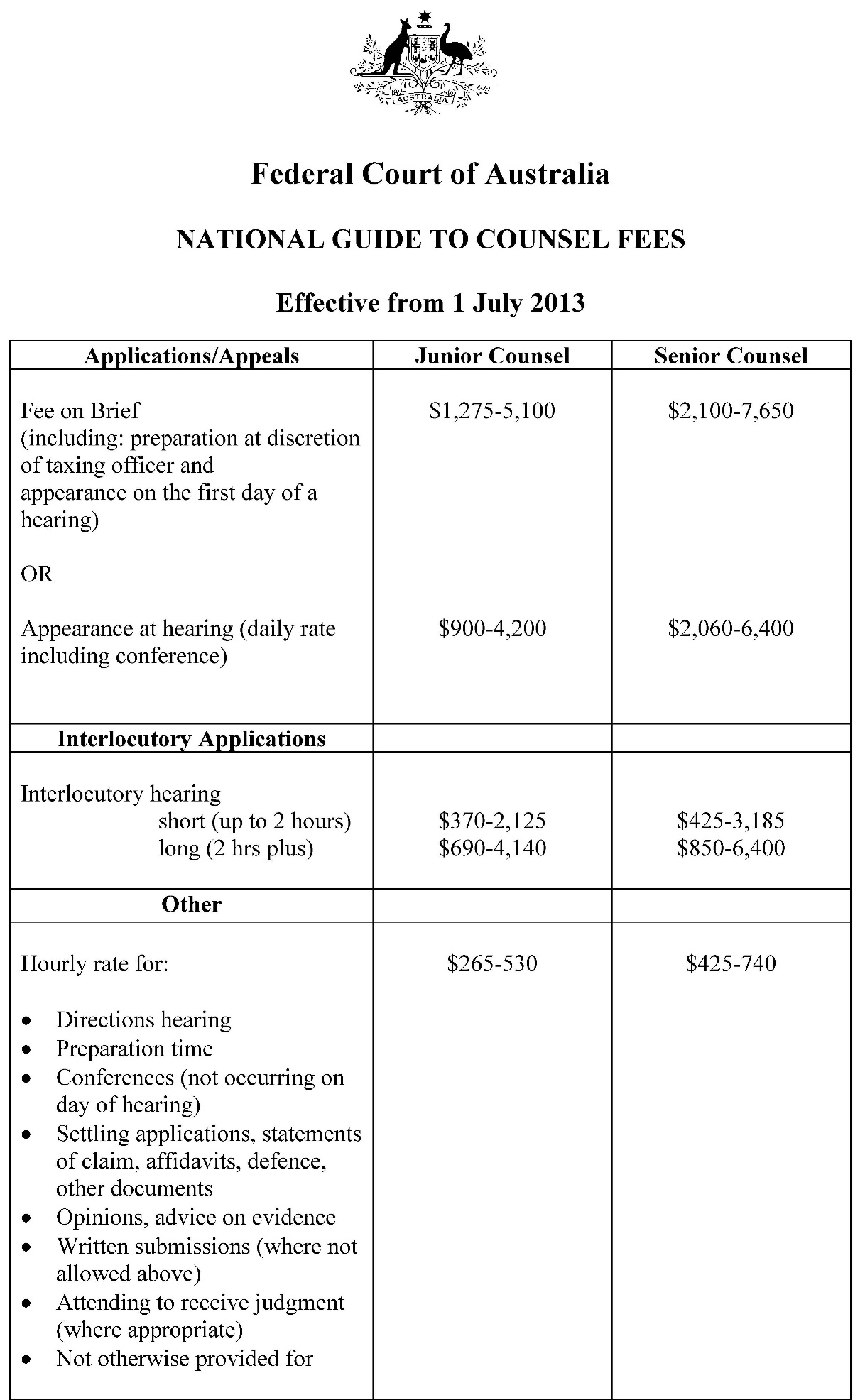
22 Mr Tucker then relies on the National Guide to Counsel Fees (Guide), Annexure A to these reasons, as published on the Federal Court website. It provides as follows:
Applications/Appeals | Junior Counsel | Senior Counsel |
Fee on Brief (including: preparation at discretion of taxing officer and appearance on the first day of a hearing) OR | $1,275-5,100 | $2,100-7,650 |
Appearance at hearing (daily rate including conference) | $900-4,200 | $2,060-6,400 |
Interlocutory Applications | ||
Interlocutory hearing
| $370-2,125 $690-4,140 | $425-3,185 $850-6,400 |
Other | ||
Hourly rate for: • Directions hearing • Preparation time • Conferences (not occurring on day of hearing) • Settling applications, statements of claim, affidavits, defence, other documents • Opinions, advice on evidence • Written submissions (where not allowed above) • Attending to receive judgment (where appropriate) • Not otherwise provided for | $265-530 | $425-740 |
23 Mr Tucker contends that the first row of the Guide (referring to a “Fee on Brief”) is the relevant part. Based on those parts of the Guide he submits that the maximum recoverable amount with respect to the State parties’ counsels’ fees is $12,750, comprised of:
(a) $7,650 for Ms Enbom QC; and
(b) $5,100 for Mr Hooper of junior counsel.
24 He argues that the State parties seek security based on their own self-appraisal of party-party counsels’ fees, based on counsel’s estimates rather than by reference to the Federal Court scale, as set out in the Guide.
25 He submits that the Registrar erred in her approach to the Guide. Because the review application requires the Court to consider the application afresh, his assertions of error by the Registrar are not directly applicable, but they are useful in elucidating his argument. He submits that the Registrar fell into error in allowing counsels’ fees of $34,650 for preparation of the appeal and $10,450 for counsels’ attendance at the appeal hearing, when the Guide expressly caps the fees for counsels’ appearances and preparation at $12,750. He says that the Registrar was wrong in stating that the Guide “broadly” contemplates counsel’s fees in circumstances where, on his argument, the Guide “precisely identifies the specific range of rates applicable to specific matters including one-day hearings.” He submits that the Guide does not support a construction that the rates in the Guide are liable to be interpreted liberally or are “beholden to a ‘broad’ and nebulous discretion”.
26 Mr Tucker also submits that the Registrar erred in allowing costs for senior counsel to receive judgment, querying why it could not have been done by junior counsel or the instructing solicitor given judgments are delivered by email or by video-link in a matter of minutes.
27 Third, Mr Tucker submits that his appeal is bound to succeed. He submits that:
(a) an important issue before the primary judge was whether Mr McKee’s allegedly defamatory email had been disseminated interstate or overseas such as to attract the Court’s jurisdiction. He says that when the State parties refused to produce documents evidencing the extent of publication of the email, he filed an interlocutory application dated 29 April 2020 seeking production of those documents. He contends that the primary judge “entirely ignored” and did not determine the interlocutory application by which Mr Tucker attempted to obtain evidence which was in the State parties’ hands; and notwithstanding that the primary judge later held that he was not satisfied on the evidence that the email was in fact published outside Victoria: see Tucker v McKee [2021] FCA 828 at [44];
(b) he directly raised the application of the cross-vesting legislation to the proceeding, and the issue of whether the Court was obliged to transfer the proceeding to a state court if it had any legitimate concerns regarding jurisdiction. He says that the primary judge called for submissions on that issue, which the parties subsequently filed, but his Honour then disregarded the question of cross-vesting and, without explanation, dismissed the proceeding outright; and
(c) the primary judge decided that two discrete allegations in the defamation claim were “colourable”, being (a) Mr McKee’s express allegation that Mr Tucker had breached an enterprise agreement and, (b) the imputation that in breaching an enterprise agreement he breached s 50 of the FW Act. Mr Tucker says that the State parties never raised the notion that his claims were “colourable” as an issue and that an allegation of improper purpose was never put to him. He relies on the observations of Lee J in Mulley v Hayes [2021] FCA 1111 at [71]-[74] to the effect that if the Court is to rely upon an allegation of improper purpose and thus “colouring” to oust jurisdiction, then the allegation must be raised so that the claimant has notice of it and can respond.
Accordingly, Mr Tucker submits that the quantum of security should be further reduced to reflect what he describes as his “very good prospects of success” in the appeal.
28 Fourth, Mr Tucker submits that the State parties have failed to mitigate their costs in the matter. He argues that the State parties refused to budge on their initial demand for security of $60,000, and described Mr Tucker’s first attempt to offer security as being “derisory”. On his argument, had the State parties accepted his initial offer they would have saved over $60,000 (comprising $36,745 spent on their initial application for security and $23,980 spent on their application for additional security). Instead, the Registrar awarded security of less than half the amount they sought, and the State parties have entirely wasted over $30,000 to date on counsels’ fees.
29 In written submissions he says that, at present, the State parties have no security for costs and that they “will not get security of more than $5,985” (emphasis in original). That last assertion is based on his solicitor’s letter to the State parties dated 15 March 2022 which said that the firm had “clear instructions that if security of more than $5,985 is ordered, the proceeding will be permanently stayed.” In oral submissions Mr Tucker submits that he cannot pay any more than $5,985, but he accepts that he has put on no evidence as to that.
30 Mr Tucker argues that the State parties, which have unlimited funds, are using the security application to bully, intimidate and suppress his legitimate claim which he has attempted to settle. For that reason too he contends that the Court should further reduce the amount of security ordered.
31 Fifth, he submits that the “general injustice” in the matter is a factor as to why he should not be denied access to justice through an order for security in an amount greater than $5,985. He contends that the Court should acknowledge the “appalling conduct” of Mr McKee and the State of Victoria in raising and publishing “utterly false allegations” against him, a relatively young man with young children. Mr Tucker describes the alleged behaviour as “heinous and moral[ly] depraved conduct” including sexual harassment, and notes that the alleged victim has provided evidence that she never made a complaint against him and has expressly advised Mr McKee of the falsity of the allegations. He argues that this justifies a further reduction in the amount of security ordered.
Consideration
32 It is common ground that the review application requires a hearing de novo and that the Court must decide the quantum of security afresh: 3Bears Childcare Centre Pty Ltd v Deputy Commissioner of Taxation [2018] FCA 1690 at [13] (Gleeson J); West International v Ultradrilling Pty Ltd [2008] FCA 1443 at [6] (Gordon J). As the party seeking security for costs, the State parties have the onus.
33 The legal principles in relation to fixing an appropriate sum for security for costs are well-established. It involves a “broad brush” assessment for the purpose of fixing an amount of security that is “sufficient”. It does not involve a full assessment of the respondent’s costs: Pathway Investments Pty Ltd and Ors v National Australia Bank Limited [2012] VSC 97 at [37] (Davies J); Davaria Pty Ltd v 7-Eleven Stores Pty Ltd (No 5) [2020] FCA 953 at [10] (Middleton J). In undertaking a broad brush assessment of future costs, the Court should have regard to the probable costs to which the respondent will be put to insofar as they can be ascertained: Farmitalia Carlo Erba SrL v Delta West Pty Ltd [1994] FCA 88; 28 IPR 336 at 343-4 (Heerey J). It is not the Court’s task to undertake anything in the nature of the taxation of the respondent’s costs (see, e.g. Premier Building & Consulting Pty Ltd v Spotless Group Ltd (No 5) [2005] VSC 19 at [5]-[6] (Byrne J); Oswal v Australia and New Zealand Banking Group Ltd [2016] VSC 119 at [8]-[13] (Sifris J)); instead the Court’s task is to identify an amount that is not an “exact assessment” but is “broadly reasonable”: Southern Equity Pty Ltd v Timevale Pty Ltd [2015] FCA 1364 at [49]-[50]; see also Kayler-Thomson v Colonial First State Investments Ltd [2020] FCA 1867 at [114] (Beach J). In Bryan E Fencott & Assocs Pty Ltd v Eretta Pty Ltd (1987) 16 FCR 497 at 515 French J (as his Honour then was) said that the process of estimation embodies to a considerable extent, necessary reliance on the “feel” of the case after considering relevant factors.
34 The State parties contend that, in the main, the Court should take the same approach as that taken by the Registrar below. They submit that Mr Tucker should be ordered to provide security for costs in an amount no less than the $28,490 ordered.
35 I do not accept Mr Tucker’s approach to the construction of the Guide, and I can see no merit in his submission that the appropriate amount of security for costs to be ordered is no more than $5,985. As I have said, he submits, but put on no evidence to the effect that he is unable to pay more than $5,985 in security, nor that an order for security in a greater amount is likely to stultify the proceeding. For the reasons I explain, I am satisfied that it is appropriate to order that he provide security in the sum of $28,490, within seven days.
36 First, the Guide is only a guide to the assessment of costs. Considered at a high level, if successful in the proceeding, the State parties will be entitled to their party-party costs, being the costs fairly and reasonably incurred in the conduct of the appeal: see rr 40.01 and 40.02 of the Rules and the definition of “costs” in the dictionary at Schedule 1 to the Rules.
37 Clause 16.1 of Sch. 3 of the Rules provides that “an amount may be allowed for counsel’s fees according to the circumstances of the case” (emphasis added). Thus, as assessment of what counsel’s fees are fair and reasonable, and therefore recoverable on a party-party basis, must be determined having regard to the circumstances of the proceeding, which will include its complexity.
38 By reference to the notice of appeal and Mr Tucker’s submissions, I am satisfied that the appeal raises factual and legal issues of some complexity. The issues in the appeal include whether the primary judge erred:
(a) in not concluding that the defamation proceeding was in relation to a matter arising under the FW Act, within the meaning of s 39B(1A)(c) of the Judiciary Act 1903 (Cth);
(b) in not finding that in the context of a defamation claim the incorporation of one party under the Corporations Act 2001 (Cth) was, in and of itself, enough to attract federal jurisdiction;
(c) in engaging in speculation to conclude that the allegedly defamatory email was not published outside Victoria in circumstances where the primary judge did not hear evidence about who is in possession of the email and did not decide Mr Tucker’s interlocutory application seeking discovery of documents evidencing publication outside of Victoria;
(d) in engaging in speculation as to whether the alleged imputation that Mr Tucker had breached s 50 of the FW Act was capable of being conveyed given the circumstances set out in (c) above;
(e) by taking into account irrelevant considerations, including Mr Tucker’s profession and experience;
(f) in finding that two of the defamatory imputations pleaded in the amended statement of claim were colourable; that is, made with an improper purpose in an attempt to invoke jurisdiction, when that assertion was not raised by the State parties and not put to Mr Tucker; and
(g) in ordering Mr Tucker to pay the State parties’ costs of the proceeding, as the proceeding was a matter arising under the FW Act and therefore the special costs regime in s 570 of that Act applied.
39 Having regard to these issues and taking a conservative approach to the State parties’ costs, in my view it is appropriate to allow senior counsel three days preparation for the appeal hearing, and junior counsel four days preparation, as the Registrar did. It is also appropriate to allow senior and junior counsel’s fees at the daily and hourly rates that they have charged and propose to charge. Taking a conservative view of the recoverable counsels’ fees, I estimate party-party costs at $56,980, as the Registrar did.
40 Second, Mr Tucker’s argument that the Guide sets a cap or upper limit on party-party counsel’s fees is based on a misreading of the Guide. The Guide does not provide that, for a one-day appeal, the successful party is only entitled to recover a one-day fee for each counsel including preparation capped at a maximum of $5,100 for junior counsel and $7,650 for senior counsel.
41 Instead, the Guide provides for two alternative approaches to assessing counsel’s fees on a party-party basis. That the Guide allows two alternative approaches is made plain by the word “OR” which appears between the two alternatives in the first row of the Guide: see Wide Bay Conservation Council Inc v Burnett Water Pty Ltd (No 9) [2011] FCA 661 at [49] (Logan J).
42 The first approach provided by the Guide is to allow a “Fee on Brief” which is a single fee which includes the cost of appearance on the first day of the hearing, and an amount for preparation at the discretion of the taxing officer. Contrary to Mr Tucker’s argument, the question as to whether some or all of counsel’s preparation is to be included as part of the “Fee on Brief” is a matter for the taxing officer’s discretion. Thus it cannot reasonably be said that the overall amounts allowed for junior and senior counsel are capped at a maximum of $5,100 and $7,650 respectively. As Logan J explained in Wide Bay at [57]:
The fee on brief (or brief fee) basis, as the associated, parenthetical note in the National Guide indicates, includes, “preparation at discretion of taxing officer and appearance on the first day of a hearing”. A fee on brief for the first day includes not only the appearance on the first day but also an allowance for pre-appearance preparation whether on that same day or beforehand. Again, [a] taxing officer has a discretion to allow more in respect of preparatory work than that implicit in the fee on brief for the first day of a trial.
(Emphasis added.)
43 The second approach provided by the Guide, which the Registrar took below, is to allow a fee for “Appearance at hearing (daily rate including conference)” and to allow fees on hourly rates for “preparation time” on top the appearance fee. The Guide expressly allows this approach by providing lower daily rates for counsel for an appearance at a hearing (including a conference) and also allowing recovery of hourly rates charged by counsel for “preparation time” on top of the daily rate for the appearance. Mr Price gave unchallenged evidence that Ms Enbom QC and Mr Hooper are retained on the basis of their charging daily rates for appearance at a hearing by counsel plus hourly rates for preparation time. He was not cross-examined on that evidence.
44 Third, Ms Enbom’s daily rate fee is higher by $750 than the range specified in the “appearance at hearing” section of the Guide, but taking a “broad brush” view that is not a matter of significance when the great bulk of the fees are based on hourly rates rather than daily rates. The Guide does not cap or set a maximum on the amount that will be allowed for party-party counsel’s fees on a taxation. At the time Wide Bay was decided (as Logan J noted at [50]) a note by the Registrar of the Federal Court which was appended to the Guide said that “[t]he amounts listed are not to be regarded as limiting the taxing officer’s discretion to allow higher or lower fees if it is considered appropriate”: see National Guide to Counsel Fees as at 13 December 2002: see www.fedcourt.gov.au/forms-and-fees/legal-costs/national-guide-counsel-fees/2003. Although that note is not appended to the current Guide, there is nothing to indicate that those comments no longer apply. Indeed, the current “Guide to Discretionary Items in Bills of Costs” relevantly states that with party and party bills of costs, taxing officers apply a “fair and reasonable” test to all claims, including any disbursement claim. The Registar of the Federal Court states that while the guide there set out may be used by a taxing officer, “[it] is not, however, to be regarded as limiting the taxing officer’s discretion to allow higher or lower fees or disbursements if it is considered appropriate”: see https://www.fedcourt.gov.au/forms-and-fees/legal-costs/bills-of-costs.
45 Fourth, Mr Tucker’s contention that the Registrar erred in allowing counsel’s fees for senior counsel to receive judgments on the appeal and the security for costs application is based on a misunderstanding. The Registrar did not allow any counsels’ fees for receiving judgment on the security application; she allowed two hours for senior counsel for receiving judgment on the appeal and nothing for junior counsel. Conservatively, I would allow senior counsel two hours to read the appeal judgment, and to provide advice about any orders to be sought including in relation to costs.
46 Fifth, I do not accept Mr Tucker’s contention that the security amount to be ordered should be reduced by more than 50% from my estimate of the State parties’ party-party costs having regard to (a) his asserted good prospects of establishing that the costs in the appeal are covered by the special costs regime prescribed by s 570 of the FW Act; (b) his asserted good prospects of success in the appeal; (c) the asserted failure of the State parties to mitigate their costs; and (d) the “general injustice” in the matter. It is noteworthy that if Mr Tucker’s contention that the security should be no more than $5,985 is to be accepted, that would require a reduction of almost 90% from my estimate of party-party costs.
47 The authorities indicate that the prospect of success of a proceeding is a factor to which the Court may have regard when assessing whether security for costs ought be awarded (Soh v Commonwealth of Australia [2008] FCA 1524 at [10] (Moore J); Clack v Collins (No 1) [2010] FCA 513 at [13] (Jagot J)); but it may not be appropriate for the Court to undertake that assessment, depending on the stage of the proceeding: see, e.g. Nyoni Pharmacy Board of Australia [2018] FCA 1313 at [19] (White J). It is a different question when prospects of success are put forward as the basis for ordering a reduced amount of security. Having said that, I can accept that the prospects of success may be relevant to the security amount to be ordered, particularly when, if Mr Tucker can establish that the proceeding is covered by the special costs regime under the FW Act it is unlikely that he will be required to pay any of the State parties’ costs.
48 However, while on Mr Tucker’s submissions some of the appeal grounds appear to have merit, it is impossible to make a proper assessment. Amongst other things, Mr Tucker put on very little to allow an adequate assessment and the State parties put on nothing. I do not, for example, have the transcript of the hearing below, the written submissions filed below, a copy of the interlocutory application seeking further discovery, the transcript of any case management or interlocutory hearing(s) in relation to the application for further discovery, a copy of the documents the State parties produced relevant to the place of publication of the allegedly defamatory email, or a copy of the witness statements that were filed relevant to the place of publication of the allegedly defamatory email.
49 The authorities also show that in setting security for costs a reduction to the party-party costs estimate may be applied to reflect the vicissitudes of litigation such as the possibility of settlement, the merits of the case, the possibility of off-setting future costs orders, the risk that the litigation may be stifled and so on: Voxson Pty Ltd v Telstra Corporation Ltd (No 8) [2017] FCA 1427 and [17] (Perram J); Norcast S.r.L v Bradken Ltd & Others [2012] FCA 765 at [25]-[28] (Gordon J). The amount of any reduction is not fixed, but is discretionary and may vary as circumstances dictate: Norcast at [28] citing Pathway Investments at [55]. There is some force in the State parties’ argument that in allowing a reduction of 50% the Registrar applied a greater discount than was appropriate, because, in the circumstances many matters which might ordinarily justify the discount did not exist; namely; (a) a likelihood of the appeal settling; (b) the possibility that substantial amounts may be taxed off the bill of costs; and (c) the prospect or actuality of off-setting costs orders. But in circumstances where the State parties did not ask the Court to set security for costs at more than the $28,490 ordered by the Registrar there is no need to go further into that question.
50 I can see little merit in Mr Tucker’s submission that the State parties have failed to mitigate their costs. It is perhaps open to criticise the State parties for seeking security in the amount of $60,000, which is at the upper end of the range I estimate to be reasonable. But a similar criticism can be made of Mr Tucker. His contention that security of $5,985 is appropriate is unrealistic, and he has maintained that position throughout. Further, his contention that the State “refused to budge on their initial demand” is incorrect. The Third Price Affidavit and the Second Raso Affidavit show that the State parties offered to accept security in the reduced amount of $25,000 which Mr Tucker did not accept. Before me, notwithstanding that it would have been available to them to do so, the State parties did not seek security of more than the $28,490 ordered by the Registrar.
51 Nor am I persuaded that there is any force in the contention that the amount of security should be reduced having regard to the “general injustice” of the matter. I am not in a position to judge where the justice or injustice lies.
52 Sixth, although Mr Tucker submits he is unable to pay more than $5,985, there is nothing in the evidence to show that, and he concedes that he made a forensic decision not to put on any evidence as to his financial and asset position. If Mr Tucker had established an inability to pay a greater security amount that would have been a relevant consideration in fixing the appropriate security amount; but his unwillingness to pay is not.
53 Standing back from the dispute, taking a broad brush approach, and one that is favourable to Mr Tucker, I consider that reducing the security amount by 50% from my estimate of party-party costs is reasonable in all the circumstances. Putting to one side the request for additional security, I have determined, as the Registrar did, that Mr Tucker must provide security in the amount of $28,490 and I have ordered that he do so within seven days. That may seem a short period, but in the case management hearing on 8 March 2022 the parties were informed that, because of the impending appeal hearing, any security that was ordered would be required to be speedily provided.
THE APPLICATION FOR FURTHER SECURITY
54 The State parties seek additional security for costs because of additional costs that have been and will be incurred prior to the hearing of the appeal by reason of Mr Tucker’s application to review the Registrar’s decision.
55 The Third Price Affidavit shows that following the decision of the Registrar, SGM Legal foreshadowed an application to review those orders in an email to the State parties on 18 February 2022. On 22 February 2022 DTF Legal wrote to SGM Legal putting Mr Tucker on notice that if he sought review of the Registrar’s orders then the State parties would incur additional costs and would require security for those costs. On 7 March 2022 the State parties were served with Mr Tucker’s review application. As I have said, the evidence shows that by letter dated 10 March 2022 the State parties offered to consent to security being reduced to $25,000, to be paid within 14 days, on condition that the review application was discontinued. The Second Raso Affidavit shows that Mr Tucker rejected that offer and maintained that security of $5,985 was appropriate.
56 The Court has power to vary an order for security for costs where there has been a material change of circumstances since the original application was heard, or where new material exists which could not reasonably have been put before the Court on the hearing of the original application. A further order will be appropriate whenever, amongst other things, new facts come into existence or are discovered which renders the enforcement of the earlier order unjust: Waters v Commonwealth of Australia (Australian Taxation Office) [2017] FCA 312 at [49]-[52] (Griffiths J) citing Truth About Motorways Pty Ltd v Macquarie Infrastructure Investment Management Ltd [2001] FCA 1603 at [11] (Hely J). It is plain on the evidence that at the time of the security for costs application, the State parties did not know that they would incur additional costs through the review application, and there has been a material change of circumstances.
57 In the Third Price Affidavit Mr Price estimates the party-party costs of and incidental to the review application and the additional application for security at $17,245, made up as follows:
Work | Counsel’s costs | Disbursements |
Appearance at case management hearing, including considering the Review Application, taking instructions and all other preparation. | SC: $715 (1 hour) | |
Appearance at the Review Application and additional security application. | SC: $3,575 (1/2 day) JC: $1,650 (1/2 day) | |
Preparation for both applications, including settling all the papers, preparing written and oral submissions and considering the Appellant’s material. | SC: $7,150 (1 day) JC: $3,300 (1 day) | Filing fee - $525 |
Receiving judgment on the applications and all related attendances. | JC: $330 (1 hour) | |
TOTAL | $16,720 | $525 |
58 In oral submissions, senior counsel for the State parties reduced that estimate by withdrawing:
(a) the claim for $1,650 in junior counsel’s fees at the review application and additional security application (senior counsel appeared at the hearing without a junior); and
(b) the claim for $330 in junior counsel’s fees for receiving judgment on the applications and all related attendances.
That leads to a reduction of $1,980 in the estimate of party-party costs, to $15,265. The State parties seek additional security in the amount of $15,000.
59 Mr Tucker does not submit that the State Parties are not entitled to additional security; rather, his submissions focused on two matters; neither of which has any force.
60 First, he reiterates his earlier arguments about the operation of the Guide in relation to counsels’ fees, and says that counsels’ fees above the scale cannot be allowed. That argument must be rejected for the reasons previously given. Other than that Mr Tucker said nothing to impugn the State parties’ estimate, and I accept it.
61 Second, he argues that the State parties are, or ought to be aware, that they stand to receive no more security than $5,985. Based on that he contends that the application for additional security of $15,000 is “meaningless, a complete waste of money and potentially an abuse of process”. That argument must be rejected too. Mr Tucker’s submission that he “will not” pay more than $5,985 in security for costs does not establish an inability to pay. In circumstances where he concedes that he made a forensic decision not to put on evidence as to his financial and asset position it is appropriate to infer that he is unwilling to pay. That is not a relevant consideration in setting the amount of security to be provided.
62 As with the initial order for security, it is appropriate to allow a 50% reduction on the estimate of the State parties’ party-party costs of $15,265, and to order that Mr Tucker provide an additional $7,632 in security for costs.
63 I have therefore ordered that Mr Tucker must provide security for costs of $28,490 and $7,632, totalling $36,122, within seven days, at risk of the appeal being stayed.
COSTS
64 I am not aware of any reason why costs should not follow the event. It is appropriate to order that, unless within seven days Mr Tucker files short written submissions (no more than two pages) opposing the proposed order, Mr Tucker be ordered to pay the State parties’ costs of the review application and their application for additional security for costs, which, in the absence of agreement, shall be determined by lump sum assessment by a Register.
65 In the event that Mr Tucker files submissions in opposition to the proposed order as to costs, the State parties shall file short written submissions in opposition, within seven days. The Court will determine the issue on the papers.
I certify that the preceding sixty-five (65) numbered paragraphs are a true copy of the Reasons for Judgment of the Honourable Justice Murphy. |
Associate:
ANNEXURE A