

Federal Court of Australia
Lavender v Commonwealth of Australia [2022] FCA 314
ORDERS
NSD 1590 of 2019 | ||
| ||
BETWEEN: | RALPH LAVENDER First Applicant JACK LAVENDER Second Applicant | |
AND: | COMMONWEALTH OF AUSTRALIA First Respondent MINISTER FOR AGRICULTURE AND WESTERN NEW SOUTH WALES Second Respondent DIRECTOR OF FISHERIES COMPLIANCE NEW SOUTH WALES (and others named in the schedule) Third Respondent | |
order made by: | PERRY J |
DATE OF ORDER: | 31 MarcH 2022 |
THE COURT ORDERS THAT:
1. Insofar as the applicants seek to join as an applicant, Ralph Lavender on behalf of the Illawarra Fishing Aboriginal and Torres Strait Islander Corporation, the application is dismissed.
2. By 4pm on 8 April 2022, the applicants are to file and serve the amended originating application in accordance with the leave granted on 22 March 2021 but correcting the title of the proceedings by omitting the description of the applicant as Ralph Lavender on behalf of the Illawarra Fishing Aboriginal and Torres Strait Islander Corporation and referring instead to the applicants, Ralph Lavender and Jack Lavender.
3. The name of the second respondent is amended to the Minister for Agriculture and Western New South Wales.
4. The name of the fourth respondent is amended to Revenue NSW.
5. The fifth to thirty-seventh respondents are disjoined from the proceeding.
6. Insofar as the applicants seek to join an entity described by them as the New South Wales Department of Primary Industries as a new fifth respondent, the application is dismissed.
7. The application is summarily dismissed pursuant to s 31A(2) of the Federal Court of Australia Act 1976 (Cth) and rr 26.01(1)(a) or (c) of the Federal Court Rules 2011 (Cth) (FCR).
8. The applicants are to pay the second, third and fourth respondents’ costs as agreed or taxed under r 40.12 of the FCR.
Note: Entry of orders is dealt with in Rule 39.32 of the Federal Court Rules 2011.
PERRY J:
[1] | |
[6] | |
[10] | |
[13] | |
5. PRINCIPLES GOVERNING AN APPLICATION FOR SUMMARY DISMISSAL | [15] |
[22] | |
6.1 The applicants’ claim and evidence relied upon in support | [22] |
[30] | |
[46] |
1 The applicants, Ralph Lavender and his son, Jack Lavender, seek declarations that they hold native title rights to fish over certain waters in New South Wales. In particular, they contend that their native title right to fish includes fishing for commercial purposes without the constraints which would otherwise be imposed by New South Wales law and schemes of management. In addition, injunctive relief is sought against the respondents and the New South Wales Department of Primary Industries to prevent them from interfering with the applicants’ alleged native title rights to fish and “indigenous fishermen in the exercise of their native title rights”. Ralph Lavender describes himself as a fisherman and the founding director of the Illawarra Fishing Aboriginal and Torres Strait Islander Corporation (the Corporation).
2 By an interlocutory application dated 6 December 2019, the second to fourth respondents (the NSW respondents) seek an order for summary dismissal of the originating application dated 26 August 2019 (Originating Application) pursuant to s 31A(2) of the Federal Court of Australia Act 1976 (Cth) (FCA Act) and r 26.01 of the Federal Court Rules 2011 (Cth) (FCR) (application for summary dismissal). The reasons for the delay in hearing the application are explained at paragraph [14] below.
3 At the hearing of the application for summary dismissal, leave was granted to the applicants, Ralph and Jack Lavender, to file and serve their proposed amended originating application dated 22 April 2020 (the Amended Application) in the terms in which it was originally refused for filing on 22 April 2020, in light of Mr Ralph Lavender’s assurance that the Amended Application embodied the applicants’ claim as they wished to press it (T22/3/2021 at 5.16–33). However, despite the Amended Application purporting to substitute the Corporation for the applicants, no order was made to join Ralph Lavender as the applicant in a different capacity, namely on behalf of the Corporation, or to disjoin Ralph and Jack Lavender in their personal capacities. Nor is there any evidence explaining why the purported substitution is sought, as to Ralph Lavender’s authority to act on behalf of the Corporation save for the reference to Ralph Lavender as a director of the Corporation, or as to the membership of the Corporation. In those circumstances, I have proceeded on the basis that the Amended Application sets out in substance the applicants’ case and their proposed joinder of the Corporation in substitution for them. I have also considered it appropriate in those circumstances to make orders requiring the applicants to file and serve the Amended Application but corrected so as to identify the applicants as Ralph and Jack Lavender.
4 For the reasons set out below, the Amended Application has no reasonable prospects of success and must be dismissed under s 31A(2) of the FCA Act and r 26.01 of the FCR. This is not a case in which there would be any purpose served by granting the applicants a further opportunity to seek to amend the application.
5 Finally, I note that the Amended Application, read with Ralph Lavender’s affidavit sworn 8 September 2020, purports to raise a constitutional issue. While s 78B of the Judiciary Act 1903 (Cth) (Judiciary Act) requires notice to be given to the Attorneys-General of the Commonwealth and the States of a constitutional issue arising in any matter, that does not require the provision of notice where the constitutional issues are untenable or not “real and substantial”: see e.g. Re Culleton [2017] HCA 3; (2017) 340 ALR 550 at [29] (Gageler J) (recently followed in ACCC v Fuji Xerox Australia Pty Ltd [2021] FCA 153; (2021) 150 ACSR 165 at [69] (Stewart J)). For the reasons set out below, the Amended Application raises grounds which are untenable, including those which purportedly raise a constitutional issue. The hearing and determination of the application for summary dismissal is therefore not prevented by s 78B of the Judiciary Act.
6 I have already noted the applicants’ proposed substitution of Ralph and Jack Lavender as applicants in their personal capacities, with Ralph Lavender as applicant on behalf of the Corporation.
7 The NSW respondents are identified as the Minister administering the Fisheries Management Act 1994 (NSW) (Fisheries Management Act), the Director of Fisheries Compliance New South Wales, and the NSW Office of State Revenue. While evidence was filed by the applicants of service on the first respondent, the Commonwealth, the Commonwealth did not file an appearance or take any part in the proceeding.
8 While the Amended Application names the second respondent as the “Minister for Primary Industries”, the Minister who now administers the Fisheries Management Act holds the office “Minister for Agriculture and Western New South Wales” (Minister). The office or title of “Minister for Primary Industries”, which was held by the Minister’s predecessor, no longer exists. While the NSW respondents accepted that the Minister, through his representatives, was on notice of the Originating Application and the Amended Application, the Court record should reflect the correct title of the Minister and orders should therefore be made updating the Minister’s title. Similarly, the Amended Application names the fourth respondent as “New South Wales Office of State Revenue”, whereas that office is now “Revenue NSW”. The Court record should reflect the correct name of the office and orders should also be made updating the name of the fourth respondent.
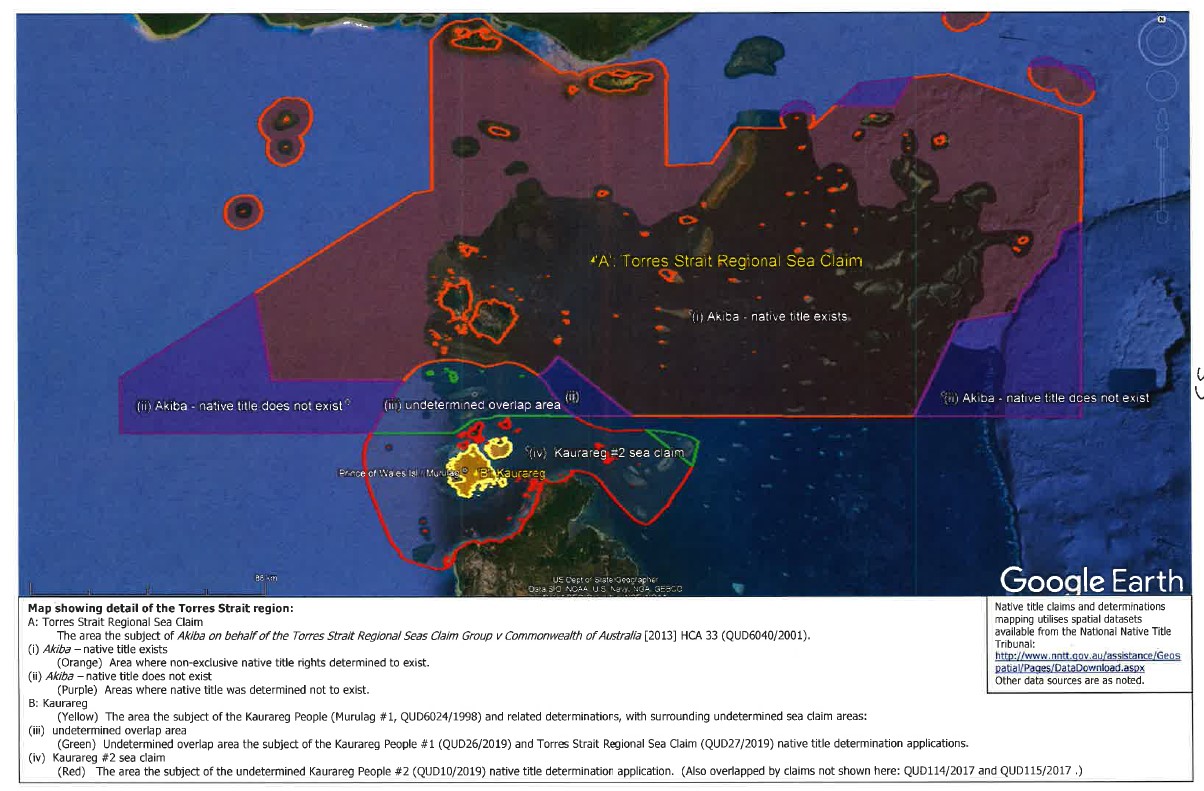
9 In addition, the Amended Application purported to remove the persons previously named as the fifth to thirty-seventh respondents, while purporting to add (without leave) a new fifth respondent identified as the “New South Wales Department of Primary Industries”. However, as the NSW respondents submitted, government departments of the New South Wales Government do not have separate legal personality and therefore cannot be joined. Further and in any event, the relevant department responsible to the Minister is the Department of Regional NSW: Administrative Arrangements (Administrative Changes—Regional NSW and Independent Planning Commission) Order 2020 (121) LW 4.2.2020 orders 7 and 8.
10 The NSW respondents rely upon the affidavit of Ms Caitlin Fegan (solicitor at the NSW Crown Solicitors Office) affirmed on 6 December 2019 (the Fegan affidavit) in support of the application for summary relief. While at the time of affirming her affidavit, Ms Fegan stated that she did so only on behalf of the second and third respondents, at the hearing, counsel for the respondents confirmed that the fourth respondent also sought to rely upon that affidavit (T 22/3/21 at 4.5).
11 The applicants relied upon the affidavits of Ralph Lavender sworn on 26 August 2019 and on 8 September 2020 (although dated 7 September 2020) (the first and second Ralph Lavender affidavits respectively), together with the affidavit of Jack Lavender sworn on 26 August 2019 (the Jack Lavender affidavit). The applicants also filed an affidavit of service on the Commonwealth Attorney General sworn on 23 October 2020. I note that the applicants’ affidavits were sworn before the Amended Application.
12 I also note that the second Ralph Lavender affidavit does not appear to have been filed, contrary to the suggestion in the NSW respondents’ submissions in reply at [2]. However, the respondents accepted that they had been served with a copy of the second affidavit (ibid) and made submissions having regard to that affidavit. In those circumstances, I have taken the affidavit as read on the application for summary dismissal and, rather than requiring it to be filed, for convenience, have identified it as Exhibit A-1.
13 I gratefully adopt the procedural background set out in the NSW respondents’ further submissions filed after the hearing on 6 April 2021 as follows:
3. The applicants commenced these proceedings by originating application filed on 2 October 2019. Following correspondence sent to the applicants, to which there was no reply, on 6 December 2019 the State respondents filed an interlocutory application seeking that the originating application be struck out and that the proceedings be summarily dismissed (the application for summary dismissal). The first case management hearing was listed for 10 December 2019.
4. On 9 December 2019, a notice of acting – appointment of lawyer was filed on behalf of the applicants by Katherine Hawes of Aquarius Lawyers. On 10 December 2019, the applicants were given leave to file and serve any amended originating application and material in support of that application by 31 January 2020. On 4 February 2020 and again on 8 April 2020, orders were made by consent extending time for the applicants to file their amended originating application, first to 27 March 2020 and then to 17 April 2020. On 5 February 2020, the matter was listed for case management on 3 June 2020.
5. The applicants attempted to file an amended originating application dated 22 April 2020 with the Court’s registry around that time, but the document was not accepted for filing.
6. Pursuant to a timetable set down at a directions hearing on 1 June 2020, the State respondents filed submissions in support of their application for summary dismissal on 29 July 2020. On 20 August 2020, Ms Hawes of Aquarius Lawyers filed a notice of intention to cease to act on behalf of the applicants. In an email to the Court’s registry on 21 August 2020, a representative of that firm cited difficulty in obtaining instructions from the applicants. On 28 August 2020, Ms Hawes filed a notice of ceasing to act on behalf of the applicants. On 28 August 2020 an interlocutory hearing (of the application for summary dismissal) listed for 31 August 2020 was vacated. On 1 September 2020, the first applicant filed a notice of address for service on his own behalf.
7. At a directions hearing on 9 September 2020, orders were made listing the proceedings for case management of the application for summary dismissal on 2 December 2020, with a note that the adjournment was at the request of the applicants, whose solicitors had ceased to act and who were then said to be having difficulties obtaining new solicitors due to the COVID-19 pandemic. The adjournment application was not opposed by the State respondents.
8. On 2 December 2020, orders were made for the applicants to file submissions and for the State respondents to file submission in reply. Submissions were filed in accordance with that timetable and the application for summary dismissal was listed for and heard on 22 March 2021.
9. The parties’ written submissions and the hearing on 22 March 2021 proceeded on the footing that the applicants’ claim was that which was set out in the proposed amended application which the applicants attempted to file around 22 April 2020. Mr Lavender was given leave to file that proposed amended application by 23 March 2021, and the document (Amended Application) was filed on that day.
(Footnotes omitted.)
14 As is apparent in the summary of the proceeding, the delay in progressing the proceedings to a hearing of the application for summary dismissal was caused by the apparent difficulties faced by the applicants, including after the withdrawal of their legal representatives on 27 August 2020. In this regard, I note that a question was raised at the hearing as to whether these proceedings were being case managed with the native title proceeding filed in Federal Court proceeding NSD 1331 of 2017 (South Coast Claim Proceedings), and whether this may have contributed to a delay in the hearing of the application for summary dismissal. However, the South Coast Claim Proceedings are relevant to the application for summary dismissal only because there is an overlap between the areas that are the subject of the applicant’s prayer for relief (Amended Application at [2]) and the claim area in the South Coast Claim Proceedings. Mr Ralph Lavender’s submission at the hearing that the waters the subject of the native title claim here do not overlap with those the subject of the South Coast Claim Proceedings wrongly assumed that the State lacks legislative power beyond the low water mark, as the NSW respondents submit (T22/3/21 at 12.25).
5. PRINCIPLES GOVERNING AN APPLICATION FOR SUMMARY DISMISSAL
15 Sections 31A(2) and (3) of the FCA Act relevantly provide that:
(2) The Court may give judgment for one party against another in relation to the whole or any part of a proceeding if:
(a) the first party is defending the proceeding or that part of the proceeding; and
(b) the Court is satisfied that the other party has no reasonable prospect of successfully prosecuting the proceeding or that part of the proceeding.
(3) For the purposes of this section, a defence or a proceeding or part of a proceeding need not be:
(a) hopeless; or
(b) bound to fail;
for it to have no reasonable prospect of success.
16 The test for summary dismissal laid down by r 26.01(1)(a) of the FCR (“no reasonable prospect of success”) is the same test for summary dismissal as that in s 31A(2)(b) of the FCA Act: Shammas v Canberra Institute of Technology [2014] FCA 71 at [13], [51] (Foster J). Rule 26.01(1)(c) of the FCR also provides for a matter to be summarily dismissed where no reasonable cause of action is disclosed.
17 The principles governing the application of s 31A of the FCA Act are well established and were summarised recently in Przybylowski v Australian Human Rights Commission (No 2) [2018] FCA 473 at [7] (Perry J) as follows:
(1) The respondent as the moving party bears the onus of persuading the Court that the application has no reasonable prospects of succeeding: Australian Securities and Investments Commission v Cassimatis [2013] FCA 641; (2013) 220 FCR 256 (Cassimatis) at 271 [45] (Reeves J).
(2) With respect to the scope of s 31A, French CJ and Gummow J explained in Spencer v Commonwealth [2010] HCA 28; (2010) 241 CLR 118 (Spencer) at [22], that the section:
… will apply to the case in which the pleadings disclose no reasonable cause of action and their deficiency is incurable. It will include the case in which there is unanswerable or unanswered evidence of a fact fatal to the pleaded case and any case which might be propounded by permissible amendment. It will include the class of case in the long-standing category of cases which are “frivolous or vexatious or an abuse of process”. The application of s 31A is not, in terms, limited to those categories.
(3) Section 31A sets a lower threshold than the previous test for summary dismissal which required that the claim be “manifestly groundless” or “hopeless”: Spencer at [52]–[53] (Hayne, Crennan, Kiefel and Bell JJ). Nonetheless, the discretion must still be exercised with caution (Spencer at [24] (French CJ and Gummow J) and [60] (Hayne, Crennan, Kiefel and Bell JJ)).
(4) An assessment of whether a proceeding has no reasonable prospects of success for the purposes of s 31A involves the making of value judgments in the absence of a full and complete factual matrix and argument, with the result that the provision vests a discretion in the Court: Kowalski v MMAL Staff Superannuation Fund Pty Ltd [2009] FCAFC 117; (2009) 178 FCR 401 (Kowalski) at [28] (the Court).
(5) Consistently with this, Reeves J in Cassimatis explained at [46] that:
… the determination of a summary dismissal application therefore does not require a mini-trial based upon incomplete evidence to decide whether the proceedings are likely to succeed or fail at trial. Instead, it requires a critical examination of the available materials to determine whether there is a real question of law or fact that should be decided at trial. Each application for summary judgment or summary dismissal has to be determined according to its particular circumstances. What is required is a practical judgment of the case at hand. The relevant circumstances will partly depend upon the stage which the proceedings have reached. Among other things, this will affect the materials available to the Court considering the application, for example, whether pleadings have been exchanged, or discovery of documents has occurred.
(6) To illustrate the application of these principles, Reeves J explained at [47] that the moving party is more likely to succeed if she or he demonstrates that the applicant’s success relies on a question of fact that is fanciful, trifling, implausible, improbable, tenuous, or contradicted by all the available documents or evidence. Conversely, his Honour explained that, as a general principle, such an application is unlikely to succeed where, on a critical examination of all the available materials, the Court is satisfied that there appears to be a real question of fact to be determined. The latter, in his Honour’s view, is more likely to be the case where the available materials include pleadings that raise factual disputes that can truly be described as significant, substantial, plausible or weighty.
18 The caution which should be exercised by the Court before taking such a serious step should be emphasised: see also Unpaid Systems Ltd v Telstra Corporation Ltd [2016] FCAFC 158; (2016) 122 IPR 190 at [48] (the Court). It is not necessarily sufficient that the claim is poorly drafted as a deficiency of that nature may be met by the grant of leave to amend.
19 It also follows that at this stage, it is not for the Court to resolve disputed issues of fact. Rather, the available materials must be considered in order to determine whether there is any real question of law or fact to be determined by the Court.
20 Finally, as the respondents submitted, in relation to applications to strike out a pleading pursuant to r 16.21 of the FCR and its predecessors, leave to re-plead will generally be refused where the amendment would be futile, such as where it fails to disclose a reasonable cause of action or seeks to raise a case that is misconceived on a point of law: Allstate Life Insurance Company v Australia and New Zealand Banking Group Ltd [1995] FCA 481; (1995) 58 FCR 26 at 36 (Lindgren J (with whose reasons Lockhart and Tamberlin JJ agreed)); Ferella v Official Trustee in Bankruptcy (No 2) [2018] FCA 18 at [34] (Perry J).
21 Consistently with these principles, the NSW respondents accepted that the onus of persuading the Court that there was no reasonable prospect of success lay with them.
6.1 The applicants’ claim and evidence relied upon in support
22 The applicants seek relief purportedly under the Native Title Act 1993 (Cth) (NTA) in the Amended Application as follows.
23 First, the applicants seek declaratory relief in the following terms:
1. … a declaration by the Court under sections 10, 11, 211, 223, 225, 227, and 238 of the Native Title Act 1993 (Cth), that being an indigenous Corporation registered under Corporations (Aboriginal and Torres Strait Islander) Act 2006 of Aboriginal and Torres Strait Islander descent and heritage and following the decision of the High Court in the matter of Leo Akiba on behalf of the Torres Strait Regional Seas Claim Group v Commonwealth of Australia [2013] HCA 33 (7 August 2013) and other relevant decisions they are entitled to fish in Australian waters including the waters of New South Wales, and the section of the territorial sea adjoining the State of New South Wales without limitation by state authorities under the Fisheries Management Act 1994 (NSW), their, regulations or share schemes made therein and without limitation by any other scheme of management operated by the NSW Fisheries Department.
2. Further, a declaration that the Applicant is entitled to access and take resources for the adjacent waters to the Illawarra indigenous community and the Muralug Island in the Torres Strait. Also, that the Applicant may access and take resources for any purpose, including commercial fishing. This is following precedent found on paragraph 66 of the Akiba High Court decision. By waters, it is referred from the tidal low water mark of New South Wales to the 12 nautical mile territorial sea boundary as prescribed under the Seas and Submerged Lands Act 1973 (Cth) and the 1982 UN Convention on the Law of the Sea.
24 Secondly, the applicants seek permanent injunctions preventing the respondents from interfering with or intercepting “the Applicant’s fishing activities” and the NSW Department of Primary Industries “from breaching Commonwealth law by intercepting and interfering with indigenous fishermen in the exercise of their native [title] rights.”
25 Thirdly, exemplary damages in the sum of $5.2 million are sought against the respondents, “to compensate the Applicant’s members of any depravation of their rights” (errors in the original).
26 In support of the relief sought, Ralph Lavender gave evidence, among other things, in the first and second Ralph Lavender affidavits that:
(1) he and his son hold New South Wales commercial fishing licences and are not permitted to fish by reason of holding native title;
(2) he is the son of Ralph Wakenshaw, an Iningai Aboriginal man from the major tribal group of the Central West Region of Queensland;
(3) he was born in the Illawarra region of New South Wales and has lived most of his life in the surrounding region;
(4) aside from a short visit overseas, he has fished the New South Wales South Coast waters continually since 1982, including the fishing of lagoons and lakes in the coastal areas;
(5) he and his son have been fishermen since their teenage years and have followed Ralph Lavender’s father and grandfather fishing in the waters adjacent to New South Wales;
(6) his grandfather taught him about fishing and where to fish “which form part of the traditional guide”, and he has passed traditional knowledge on to his son, Jack Lavender;
(7) his home is built on land which contains a midden “containing the remnants of hundreds if not thousands of years of cell gathering from the local lake and nearby waters”.
(8) anthropological evidence of the four major tribes of the Yuen people was identified by Alfred Howitt, an early ethnologist in 1904;
(9) in 2018, the National Native Title Tribunal ruled that the South Coast People represent a “single cohesive kinship population” going back to colonisation;
(10) a well-known Yuen aboriginal activist and relative of the applicant’s mother “nominated” that the Yuen shared one walkabout from Nowra to south of Eden and that the applicant’s grandfather stated that the Yuen country extended north of Nowra as far as the current location of Bundeena; and
(11) continued connection with maritime hunting fishing and gathering is a hallmark of the traditional Yuen culture.
27 Furthermore, in his second affidavit under the heading “Constitutional information”, Ralph Lavender refers to a speech delivered on 14 May 1900 to the House of Commons, Imperial Parliament, by the Secretary of State for the Colonies, Mr Joseph Chamberlain MP, “which amongst other things specifically states that fishing powers would be conferred by the Imperial Parliament on the Commonwealth and not on the penal colonies about to become states” (see also the first Ralph Lavender affidavit at [15]). On the basis of this speech, Ralph Lavender contends, in the second Ralph Lavender affidavit, that the second to fourth respondents’ interlocutory applications “are seeking jurisdiction beyond their legal capacity”. He further contends that the referendum in 1967, which amended s 51(xxvi) of the Constitution, did not confer any powers on the states to make laws for aboriginal people and that:
… the findings of the High Court and multiple cases recognising the rights of aborigines beyond the fabric of legislation enacted since 1788 removes any possibility that the state of New South Wales can claim jurisdiction over aborigine and aboriginal rights and cannot make laws contradicting Commonwealth law.
The continued operation of a quota system of subsistence fishing for aborigines has conducted by New South Wales he is again in excess of their powers and should be terminated forthwith
(Errors in the original.)
28 Ralph Lavender also asserts, in the second Ralph Lavender affidavit, that New South Wales has misused its power in maintaining a system of fisheries regulation through a system of fishing licences for commercial and recreational fishermen and, from 1994, by regulating fishing by traditional aboriginal fishermen and limiting them to subsistence quotas irrespective of the rights which may be conferred by Commonwealth law.
29 Finally, in his affidavit, Jack Lavender deposes that he has given his full permission to his father to make the affidavit relating to their family history and further states that:
…
3. I am a diver and fisherman well known to the indigenous communities of the Pacific..
4. I am both the current Australian Spear-fishing Champion and recently defended my title as Inter-Pacific Spear-fishing Champion in the contest held at Eden in Southern NSW for indigenous participants from throughout the Pacific Islands and Australia.
5. I have had a lifelong connection with the coastal waters of New South wales..
(Errors in the original.)
6.2 The application for summary dismissal must be upheld
30 Despite the generalised reference to an entitlement to fish in Australian waters (including those of New South Wales) and the reference to “adjacent waters to … Muralug Island in the Torres Strait” in the Amended Application, it is apparent among other things from the fact that relief is sought only with respect to New South Wales laws and fisheries authorities and the evidence of alleged connection given by Ralph and Jack Lavender, that the claim is made over adjacent waters to the Illawarra indigenous community “from the tidal low water mark of New South Wales to the 12 nautical mile territorial sea boundary as prescribed under the Seas and Submerged Lands Act 1973 (Cth) and the 1982 UN Convention on the Law of the Sea”. While it is convenient to describe this as the Claim Area, the boundaries of the Claim Area have not been identified and no map of the Claim Area has been provided. The precise area the subject of the application is therefore uncertain. As such, even if the claim had been made under s 61 of the NTA and in the prescribed form for a claimant application (which it was not), the details of the area claimed that are required to be given by ss 62(1)(b) and (2)(a)–(b) of the NTA would not have been met, among other requirements with which the application would not comply.
31 The applicants’ claim is based, at least in part, on the High Court’s decision in Akiba on behalf of the Torres Strait Regional Seas Claim Group v Commonwealth [2013] HCA 33; (2013) 250 CLR 209 (Akiba (HCA)) (the Torres Strait Regional Sea Claim) and upon Ralph Lavender’s claim to be a member of the Akiba native title group through Kaurareg ancestry. At first instance in Akiba on behalf of the Torres Strait Islanders of the Regional Seas Claim Group v Queensland (No 3) [2010] FCA 643; (2010) 204 FCR 1 (Akiba (FCA)), Finn J upheld a claim on behalf of thirteen island communities for native title over a large part of the Torres Strait. The final orders made at first instance took the form of an approved native title determination (as required by the NTA) and included the right to access and take resources for any purpose in the waters the subject of the determination. In Akiba (HCA), the High Court held that the right to take resources for any purpose had not been extinguished. As a result, it allowed an appeal against the decision of the Full Court of the Federal Court (Commonwealth v Akiba on behalf of the Torres Strait Islanders of the Regional Seas Claim Group [2012] FCAFC 25; (2012) 204 FCR 260) which had held (contrary to the primary judge) that any native title right to take fish and other aquatic life for commercial purposes had been extinguished by successive legislatures in Queensland and by the Commonwealth Parliament.
32 Bearing in mind the applicants’ joinder application substituting Ralph Lavender on behalf of the Corporation for the current applicants, the applicants apparently contend that, as a result of the decision in Akiba (HCA), as well as their ancestral connection to Muralug Island in the Torres Strait through Ralph Lavender’s mother, the Corporation holds (presumably on behalf of its members or at least on behalf of Ralph and Jack Lavender) native title rights to fish for any purpose in the Claim Area. In this regard, Ralph Lavender gave evidence that:
(1) his mother, Eileen Lavender, is of white and Torres Strait Islander descent from the Kaurareg Torres Strait Islanders of Muralug Island (commonly known as Prince of Wales Island) just south of Thursday Island and inherited five acres of waterfront land on Muralug Island under customary Kaurareg law; and
(2) when he was about 14, his uncle took him to the Torres Strait where he hunted dugong and turtle from the island with family members and neighbours.
33 This submission is misconceived at every level.
34 First, under s 61(1) of the NTA, a native title claimant application may be made only by a person or persons (the native title claim group) who, according to their traditional laws and customs, hold the common or group native title rights. Consistently with this, ss 225(a) and (b) of the NTA provide that a determination of native title is a determination, relevantly, of who the persons, or each group of persons, holding the common or group rights are (the native title group) and of the nature and the extent of the native title rights and interests “in relation to the determination area”. Furthermore, a native title applicant for a native title determination application under the NTA must not only be authorised by the native title claim group, but must also be included in the native title claim group (s 61(1) of the NTA).
35 However, despite being in substance a claim for native title, the present applicants have not defined the native title group said to hold the native title rights and interests or put forward any evidence as to the definition of the native title group; nor have they led any evidence as to their authority to bring the claim on behalf of any native title group.
36 Those difficulties would not be cured by the proposed joinder of the Corporation which, as a creature of statute, is manifestly not a person or persons who hold the native title rights under the traditional laws and customs of the (undefined) native title group. Nor would the claim be made by an “applicant” for the purposes of s 61(1) of the NTA because a corporation self-evidently cannot be a member of a native title claim group. Furthermore, no approved native title determination over the Claim Area has been made and therefore there is no prescribed body corporate which may hold native title on trust for the native title holders (see ss 55, 56 and 57 of the NTA).
37 Secondly, an application for an approved determination under s 13(1)(a) of the NTA can be made only in relation to “an area”. In line with this, s 225 of the NTA provides that an approved native title determination is a determination, relevantly, of the nature and extent of the native title rights and interests “in relation to the determination area”. The determination area the subject of the decision in Akiba is defined in Schedule 1 of the registered native title determination (the Akiba Native Title Determination). That area was located entirely within the Torres Strait and did not include any part of New South Wales or the sea adjoining New South Wales (Fegan affidavit at [8]–[12] and Annexure CF-2 to the Fegan affidavit (extract from the Native Title Register for Akiba)). Further, while the determination area in the Akiba Native Title Determination included a large part of the waters in the Torres Strait, it did not include Muralug Island (Prince of Wales Island) or the waters immediately adjacent to it: see Annexure A to this judgment; see also Fegan affidavit at [11], [12], [18] and Annexure CF-5 to the Fegan affidavit.
38 Thirdly, while Ralph and Jack Lavender claim to hold native title under the Akiba decision by reason of their membership of the Kaurareg people of Muralug Island, the Kaurareg people and Muralug Island (Prince of Wales Island) were expressly excluded from that part of the Torres Strait Regional Sea Claim which was the subject of the decision in Akiba. As Finn J explained at first instance in Akiba (FCA) at [51]–[53], the Kaurareg people had filed a separate native title claim asserting native title rights with respect to Muralug Island and its surrounding waters (the Kaurareg Claim). To the extent to which the Torres Strait Regional Sea Claim as originally filed overlapped with the Kaurareg Claim, the area of overlap (the Part B area) was the subject of orders by Finn J which split off the Part B area to be heard and determined separately with the Kaurareg Claim: Akiba (FCA) at [52]. As at the date of Ms Fegan’s affidavit, two determinations had been made recognising that native title rights exist in respect of Muralug Island which are held by the Kaurareg people. However, the claim to the waters surrounding Muralug Island, which overlapped with Part B of the Torres Strait Regional Sea Claim, had not been determined (Fegan affidavit at [15]–[18]). Accordingly, the determination made in Akiba (FCA), which was the subject of the appeal to the High Court in Akiba (HCA), did not relate to the Kaurareg Claim and Part B of the Torres Strait Regional Sea Claim and the Kaurareg Claim relates to a different area from the Claim Area in the present case. As such, the decision in Akiba (HCA) lends no support to the applicants’ claim to hold native title.
39 Fourthly and in any event, Ralph and Jack Lavender do not allege that they are the descendants of any of the persons listed in the Akiba Native Title Determination or that they are members of any of the groups listed in that determination; nor does the Akiba Native Title Determination include any of the groups with which Ralph and Jack Lavender claim to have a connection, namely, the Kaurareg people, the Iningai people or the Illawarra Aboriginal community (Annexure CF2 to the Fegan affidavit).
40 Finally, even taken at its highest, the evidence of Ralph and Jack Lavender could not reasonably establish that they are members of a group which, according to its traditional laws and customs, hold native title rights in the Claim Area. I have summarised the evidence relied on at [26], [29] and [32] above. The key points of contention appear to be the evidence of Ralph Lavender that he was born in the Illawarra regions and has lived for most of his life in the surrounding region, that his grandfather taught him about fishing, and that he had fished in the New South Wales South Coast waters since 1982. However, as I have earlier mentioned, no evidence is given about the content of the traditional laws and customs pursuant to which native title is said to exist in the Claim Area or as to the membership of any native title group under traditional laws and customs. Ultimately, the claim turns upon the misguided notion that the decision in Akiba (HCA) meant that native title rights to access and take resources offshore for any purpose were recognised automatically throughout Australia, or at least for those such as Ralph and Jack Lavender who claim to have common ancestry with the native title holders in Akiba.
41 That being so, the claims for injunctive relief and damages must also fail because they are dependent upon the applicants’ claim to hold native title being upheld. However, four further points should be made.
42 First, insofar as the applicants seek to challenge the State’s power to make laws with respect to fisheries management, no comprehensible basis is put forward in support of the assertion and the contention is unarguable. In this regard, I note that the applicants’ allegation that this proceeding relates “only to the maritime waters under the sole control of the Commonwealth of Australia”. However, the allegation is plainly incorrect. As the NSW respondents submit, the waters to which the State’s fisheries legislation applies includes waters in respect of which the applicants apparently claim native title rights: see s 7 of the Fisheries Management Act.
43 Secondly, the applicants make a number of allegations with respect to an alleged “campaign conducted by the fisheries inspectors to wipe out native fishing of NSW Waters”. The allegations lack any particularity, despite their seriousness, and are without any basis in evidence. They are scandalous and ought to be struck out in any event for that reason.
44 Thirdly, it appears from the reference to s 211 of the NTA in paragraph 1 of the “details of claim” in the Amended Application that the applicants rely upon that provision in support of all or some of the relief which they seek. Section 211 operates “to exclude laws made in exercise of [State legislative power] (inter alia) from affecting the freedom of native title holders to enjoy the usufructuary rights referred to in s 211”: Western Australia v Commonwealth [1995] HCA 47; (1995) 183 CLR 373 at 474 (Mason CJ, Brennan, Deane, Toohey, Gaudron and McHugh JJ). In other words, State laws which would otherwise prohibit native title holders from enjoying native title rights with respect to the classes of activity referred to in s 211 (including fishing) for the purpose of satisfying their personal, domestic and non-commercial communal needs without a licence or other authority, are inconsistent with s 211 of the NTA and rendered inoperative by force of s 109 of the Constitution. However, that section operates according to its terms and, in the event that Ralph or Jack Lavender or any other person establishes that they hold native title rights and s 211(1) is otherwise satisfied, the provision will apply. There is no need to make non-interference orders against the NSW respondents to achieve that end.
45 Fourthly, as the NSW respondents submit, dismissal of these proceedings does not affect any native title rights and interests which may exist in the waters the subject of the application and would not prejudice the ability of any properly constituted native title claimant group to seek a determination of those rights in an application under s 61 of the NTA.
46 For the reasons set out above, the application to join Ralph Lavender on behalf of the Corporation in substitution for Ralph and Jack Lavender as applicants in their own right is misconceived and should be dismissed. The Amended Application also lacks any reasonable prospects of success and should be summarily dismissed. As the NSW respondents submit, the applicants have failed to put forward any comprehensible, cohesive or reasonable argument that might support their claim to native title rights to fish or for the non-application of NSW fisheries laws. Given the fundamental misconceptions on which the Amended Application proceeds, it would be futile to afford the applicants a further opportunity to amend it. As the NSW respondents have been wholly successful, the applicants are to pay their costs as agreed or taxed.
I certify that the preceding forty-six (46) numbered paragraphs are a true copy of the Reasons for Judgment of the Honourable Justice Perry. |
Associate:
Annexure A
Schedule
No: NSD1590/2019
Federal Court of Australia
District Registry: New South Wales
Division: General
Fourth Respondent | REVENUE NSW |
Fifth Respondent | MATHEW PROCTOR |
Sixth Respondent | IAN MERRINGTON |
Seventh Respondent | PATTY ELLIOT |
Eighth Respondent | MATHEW RICHARDSON |
Ninth Respondent | BEN DONALDSON |
Tenth Respondent | OWEN MCTAVISH |
Eleventh Respondent | MICHAEL KIRWIN |
Twelfth Respondent | IAN STOCKTON |
Thirteenth Respondent | ANTHONY ERNST CHEN |
Fourteenth Respondent | EMMA CORFIELD |
Fifteenth Respondent | DANIEL MINTER |
Sixteenth Respondent | DREW EAGAN |
Seventeenth Respondent | ANNE MCCREADY |
Eighteenth Respondent | GAVIN MCDONALL |
Nineteenth Respondent | MARK FACKERELL |
Twentieth Respondent | JASON GIBSON |
Twenty First Respondent | WARREN WINTER |
Twenty Second Respondent | PETER TILLBROOK |
Twenty Third Respondent | SAMSON HALLYWOOD |
Twenty Fourth Respondent | LUCAS CLARK |
Twenty Fifth Respondent | PATRICK ANTHONY TULLY |
Twenty Sixth Respondent | NICHOLAS SCHROEDER |
Twenty Seventh Respondent | MICHAEL KOUKOULAS |
Twenty Eighth Respondent | LEE BURDETT |
Twenty Ninth Respondent | MARK SHERRY |
Thirtieth Respondent | ROBERT PEEVER |
Thirty First Respondent | PAUL FRONK |
Thirty Second Respondent | ELIZABETH ALLBRIT |
Thirty Third Respondent | ANTHONY HUGH ANDREWS |
Thirty Fourth Respondent | GLENN STAPLES |
Thirty Fifth Respondent | GLENN CLARKE |
Thirty Sixth Respondent | MARTIN KICK |
Thirty Seventh Respondent | PETER TURNELL |


