

FEDERAL COURT OF AUSTRALIA
Taylor v Nationwide News Pty Limited (No 2) [2022] FCA 149
ORDERS
Applicant | ||
AND: | First Respondent BRENDEN HILLS Second Respondent | |
DATE OF ORDER: |
THE COURT ORDERS THAT:
1. The application be dismissed.
2. The applicant pay the respondents’ costs.
Note: Entry of orders is dealt with in Rule 39.32 of the Federal Court Rules 2011.
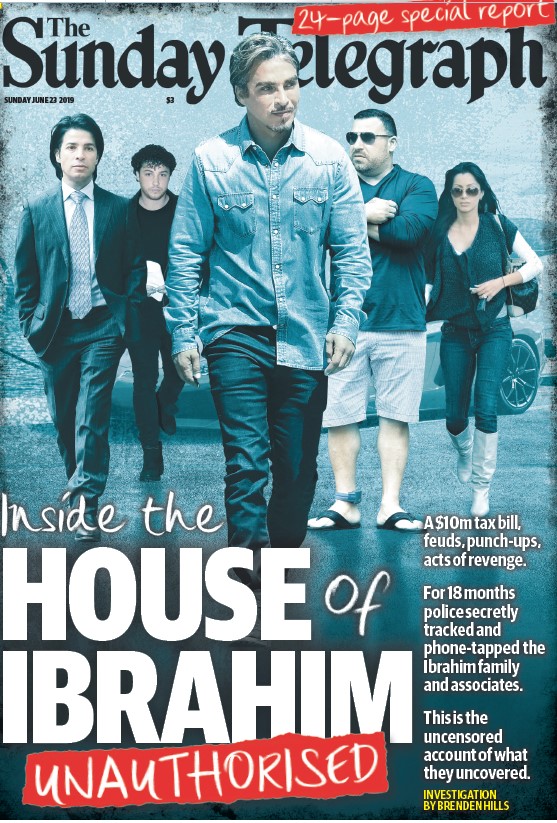
KATZMANN J
Introduction
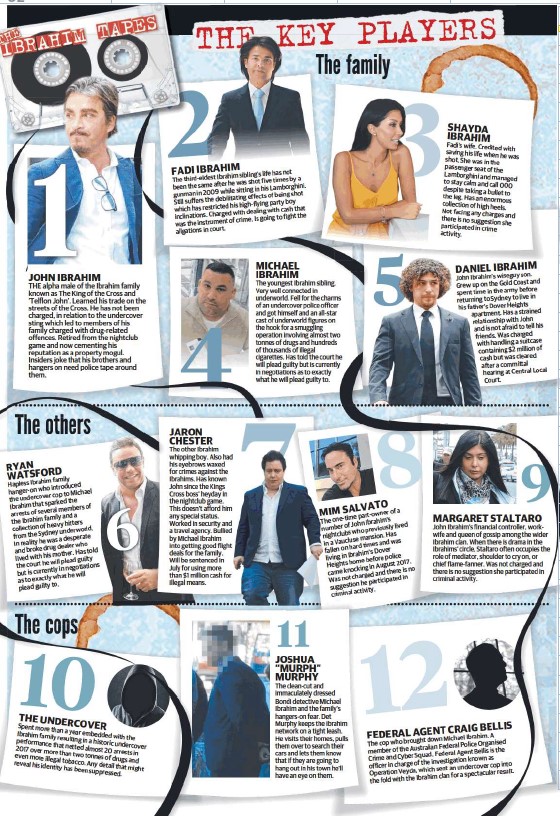
1 The first respondent, Nationwide News Pty Limited, is a publishing services company and, relevantly, the publisher of The Sunday Telegraph and The Daily Telegraph, newspapers with a wide circulation in New South Wales and the Australian Capital Territory. The second respondent, Mr Brenden Hills, is, and was at all material times, employed by News as a journalist.
2 On 23 June 2019 News published in The Sunday Telegraph a lengthy feature article or, more accurately, a series of articles under the banner “Inside the HOUSE OF IBRAHIM: UNAUTHORISED”. The feature was described as an “uncensored account” of the Ibrahim family based on surveillance material obtained by the Australian Federal Police (AFP) and tendered in a NSW court. The article was also published on The Daily Telegraph’s website and tablet app and promoted on its Facebook page and Twitter account. Mr Hills promoted the publication on his Twitter feed on three occasions.
3 The applicant, Daniel Taylor, is a member of the Ibrahim family. He is the 31 year old son of John Ibrahim and a nephew of Michael, Fadi and Sam Ibrahim. He takes his surname from his mother. John Ibrahim is a former Kings Cross nightclub owner and a well-known Sydney identity. Michael Ibrahim is currently serving a 30 year prison sentence for various offences relating to his involvement in a drug and tobacco syndicate. Ryan Watsford, an associate of Michael Ibrahim, is serving an eight year prison sentence for drug importation and related offences. Michael Ibrahim, Ryan Watsford, and their associates were the targets of an undercover criminal investigation undertaken by the AFP, known as Operation Veyda which culminated in their arrests. While police suspected Mr Taylor was involved in the criminal enterprise, and he was arrested and charged (according to the newspaper) with “handling a suitcase containing $2 million of cash” (said to be the proceeds of crime), he was not committed for trial and the paper reported that he had been “cleared” of the charge and, indeed, of “any involvement in” the tobacco importation ring that snared his uncle Michael.
4 Mr Taylor alleges that the article contains several defamatory imputations, as particularised in his statement of claim (pleaded imputations). The pleaded imputations are that Mr Taylor is:
(a) a mobster; and/or
(b) a member of the mafia; and/or
(c) a criminal involved in organised crime.
5 Mr Taylor contended that these imputations were conveyed through the sensationalist and voyeuristic presentation of the surveillance material in the publication as a whole; the description of Mr Taylor as a “key player” in the Ibrahim family, and the “wiseguy” son of John Ibrahim, and the nephew of Michael Ibrahim; the various references to the mafia, mobsters and crime fighters in the context of stories about the Ibrahim family; and, notwithstanding that they were accompanied by statements that he had been cleared, the references to Mr Taylor having been arrested and charged.
6 The respondents deny that the article, in its natural and ordinary meaning or otherwise, was reasonably capable of conveying or in fact conveyed any of the pleaded imputations and, if it was, denied that those imputations were defamatory. Alternatively, insofar as the publication is found to convey the imputation at (c) and that meaning is found to be defamatory of Mr Taylor, the respondents contend that that meaning is substantially true.
7 For the reasons that follow I am not persuaded that any of the pleaded imputations were conveyed and it is therefore unnecessary to decide whether the respondent’s justification defence is made out.
The matter complained of
8 The matter complained of was a feature article, more accurately a series of articles. For this reason I will generally refer to it as “the publication” and each of the stories it tells as an “article”. The publication was a wraparound. In other words, the front page of the publication was also the front page of the newspaper and the last page of the publication the last page of the newspaper. This design would enable the uninterested reader to remove it easily and discard it and the interested reader to put it to one side and read it at his or her leisure.
9 References to, and photographs of, Mr Taylor appear in several places. It is notable that the article refers to him consistently, not by the name by which he chooses to be known, but as Daniel Ibrahim.
10 The front page features a photograph of five members of the Ibrahim family in an obvious allusion to the television series, Entourage. The group is led by John Ibrahim. He is flanked by his brother, Fadi, on his right and his brother, Michael, wearing an ankle bracelet, on his left. Mr Taylor appears behind and to the left of Fadi and Fadi’s wife, Shayda, behind and to the left of Michael. The publication was described as an unauthorised and uncensored exposé of what went on “Inside the House of Ibrahim” as revealed by covert surveillance of the Ibrahim family and certain associates. This is what it looked like:
11 The same photograph, emblazoned with the “unauthorised” banner, also appeared on the last page.
12 Page 2 described “THE KEY PLAYERS”, beginning with “[t]he family”, followed by “[t]he others”, and then “[t]he cops”. This is what it looked like:
13 John Ibrahim is referred to as “Telflon [sic] John” and the “alpha male of the Ibrahim family”. As Mr Taylor’s counsel, Mr Smark SC, submitted, he is presumably “Teflon” because “dirt doesn’t stick” to him. The biographies of John’s brothers, Fadi and Michael, both mention their respective charges, as does Mr Taylor’s. Shayda Ibrahim’s biography contains a disclaimer that she is “[n]ot facing any charges and there is no suggestion she participated in crime activity”. A similar disclaimer is given in relation to Mim Salvato and Margaret Staltaro.
14 The description of Mr Taylor reads as follows:
5 DANIEL IBRAHIM
John Ibrahim’s wiseguy son. Grew up on the Gold Coast and spent time in the army before returning to Sydney to live in his father’s Dover Heights apartment. Has a strained relationship with John and is not afraid to tell his friends. Was charged with handling a suitcase containing $2 million of cash but was cleared after a committal hearing at Central Local Court.
15 While Mr Taylor is identified on this page as a “key player” and family member, most of the publication has nothing to do with him. That said, his name is mentioned no fewer than 70 times and his photograph appears eight times.
16 The additional direct references are these:
(1) on p 3, in a promotion from the editor, Michael Carroll, under the heading “MICK’S PICKS, FROM THE EDITOR”:
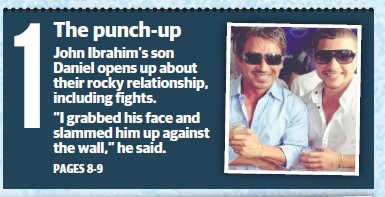
(2) on pp 8–9, captioned “FATHER VERSUS SON”, in an article focusing on the relationship between Mr Taylor and John Ibrahim. The article begins with the quote in the above clip said to be taken from one of “the Ibrahim tapes”, accompanied by a large photograph of Mr Taylor alongside his father. A second photograph of Mr Taylor appears below it in which Mr Taylor is said to “[flip] the bird” (presumably at the photographer) as he reported to a police station earlier that year (presumably in compliance with his bail conditions). The quote is followed by this precis of the article:
In his autobiography, John Ibrahim wrote he is a proud dad who taught his son Daniel how to be a man, but more recently their relationship is strained and the pair have come to blows, according to Daniel.
(3) on pp 14–15, in the context of a story about Ryan Watsford and another “Ibrahim associate”, Jaron Chester, having their eyebrows waxed as an act of retribution or “payback” for stealing more than $60,000 from Michael Ibrahim. Mr Chester also had his head shaved for good measure. The punishment is said to have been carried out on the orders of John Ibrahim by Bridgette Lee, a beautician, who is described as “the one-time girlfriend” of Mr Taylor. The article reported, amongst other things, that:
Hours after the waxing on August 2, 2017, police intercepted a call where Ms Lee told Daniel how Watsford was wrong in thinking his eyebrows would grow back given she had ripped them out at the roots.
“He’s looking at me like a f…king dear in the headlights,” Ms Lee said. “… I’m trying to take the conversation so seriously, like, to help him but I just couldn’t.”
…
This is what happens when you cross the Ibrahim family. It’s a step away from the traditional Kings Cross-style punishments like a kneecapping, but perhaps just as bad for a vain underworld figure of the modern age like Watsford.
Ms Lee is said to have informed Mr Taylor in one of the recorded conversations that Mr Chester was hyperventilating and asked Mr Taylor whether he had any Valium. In another, Michael Ibrahim and Mr Taylor are said to be laughing and joking as they watched the footage of the waxing.
(4) on p 15, which features a large photograph of Ms Lee with the following caption:
Beautician Bridgette Lee was paid to remove the eyebrows of two men accused of stealing from the Ibrahim family, according to police recordings. She is also a one-time girlfriend of John Ibrahim’s son Daniel.
This particular article also includes a report of a telephone call on 21 May 2017 in which Mr Chester told a friend that he was “scared, Mick turned this afternoon”. Mr Taylor is mentioned immediately afterwards:
That day, Chester received a text from Daniel Ibrahim that said: “I’m coming to pick up yours and your mum’s car tomorrow. Have them ready.” Michael called John on May 22, 2017, and said he couldn’t get to sleep until 5am because he was “burning with anger”.
(5) on pp 18–19, in a story about “the cop the brothers fear”, Bondi detective Joshua Murphy, where Mr Hills wrote:
Det Murphy was also living rent free inside Daniel Ibrahim’s head. When AFP officers burst into Daniel’s apartment and arrested him in August 2017 over proceeds of crime charges he would later beat, Daniel’s first thought was Det Murphy.
“When they first came through I thought it was that dog Murphy,” Daniel told friend Nabih Hadid in a call on August 14, 2017. “And I was waiting to see that f...ing grub.
“I said ‘What do you c…s want?’” Daniel said. They go, ‘It’s the AFP, shut your mouth’.”
“My first thought was, ‘F … I’ve been bagging Jews in America too much on Facebook,” Daniel said.
17 Readers were repeatedly encouraged to visit The Daily Telegraph’s website and listen to the recordings.
18 The back page urged readers to subscribe to a “SPECIAL DIGITAL PACKAGE” with the tantalising exhortation:
BUT WAIT, THERE’S MORE:
• Listen to the police phone taps
• Take a tour of their houses with police
• Watch the police surveillance video
• Walk through John’s secret tunnel
• See more incredible photos
• Read the transcripts
Only by subscribing at dailytelegraph.com.au.
Mr Smark described this in his opening as “the language of the circus”.
19 Since it is the only article in which Mr Taylor features prominently, it is appropriate to say something more about the “father versus son” story. It depicts Mr Taylor (on p 8) as foul-mouthed and “furious” with his father for not posting bail which meant that he had to remain in custody until his mother could raise the money. Under the caption “FATHER VERSUS SON” appears a misquote in large print later attributed to Mr Taylor and purportedly taken from a telephone intercept: “I grabbed his face and smashed it into a wall” (the article in fact reports Mr Taylor as saying “I grabbed his face and slammed him up against the wall”).
20 The article began by referring to Mr Taylor’s arrest in 2017:
DANIEL Ibrahim was burning. The target of his anger was his father, John. It was August 11, 2017, and the 28-year-old had just been released from Surry Hills Police Centre on bail where he spent nights in a cell after being arrested for holding a suitcase containing more than $2 million in cash.
21 Immediately after this account of his arrest, however, the article reported:
He has since been cleared of any involvement in the tobacco importation ring that snared his uncle Michael.
22 The article noted that Mr Taylor had been arrested on “the same day John’s younger siblings, Michael and Fadi, were arrested over various alleged roles in a billion-dollar tobacco and drug smuggling operation”. It stated that Mr Taylor’s “stint behind bars” was prolonged because of the difficulties his mother had in raising $600,000 in bail money to secure his release.
23 The article reported him telling “an unknown male” in a telephone call a couple of weeks after he had been arrested that his mother approached his father “for help with the bail money” but “John’s told her to get f…ed because ‘he’s not my problem’”. John Ibrahim was said to be “enraged that his family members had cast yet another legal shadow over the family name”. Mr Taylor is reported as saying in the same phone call: “It ruined his bullshit image that he’s been trying to f…ing make”. Mr Hills wrote that Mr Taylor told the unknown male that he confronted his father after he was released “and the pair had a punch-up”, quoting Mr Taylor as saying:
So I had it out with him when I got back, f..ing (he) slapped me across the face called me an embarrassment, that me and his brothers have ruined everything that he’s tried to achieve.
24 The article went on to refer to a conversation Mr Taylor had with Nabih Hadid, described as a “then prison inmate”, in which Mr Taylor recounted the fight he claimed to have had with his father after he was released:
In an earlier call with then prison inmate, Nabih Hadid, Daniel gave a more detailed account of his version of the fight with John.
“He swung twice,” Daniel said in the call on August 16, 2017. “So I grabbed his face and slammed him up against the wall. Cracked his head against the wall (and) he fell on the floor.
“He slapped me once … I called him a dog and he went to slap me again and I dodged it.
“(I) grabbed him by the face, pushed him and slammed him up against the wall … fell over, cracked his head on the wall and fell over. Big one. Big one, bro. Big one.
“Then he jumped back up and we headbutted each other. (We) went head-to-head and I go ‘Go on, c..t, swing again, I’ll f...ing throw punches at you’.”
The fight ended in a stalemate, Daniel said.
Enthralled by what he was hearing, Hadid wanted more: “What did he say?”
“Nothing,” Daniel said. “He told me to get out of the house, get out of the street; how I’m an embarrassment to him, everything that he’s tried to do, a disrespectful c..t, my life is over, blah blah blah.”
25 The article described Mr Taylor’s relationship with his father as “tempestuous”. It attributed the problems in the relationship to “bitterness” Mr Taylor harbours towards his father over the latter’s role in his upbringing. “Beyond that”, Mr Hills wrote:
[T]he pair clash over unpaid rent, jealousy over women, and other issues that are often spurred on by Daniel’s sense of entitlement and youthful petulance in trying to challenge his father’s alpha dog status. The fight over the bail appeared to put their relationship under extreme strain, with Daniel still simmering over the confrontation more than a week after being released.
26 Mr Hills went on to report that Mr Taylor told Mr Hadid in another call that “John’s not my dad from now on for all intents and purposes”, that his father was “a f…king dog”, and that his mother did everything. In another call, Mr Hills reported, Mr Taylor told “a family insider” that he sees Michael Ibrahim as a father figure “after the pair went into the construction business together”. He quoted him as saying: “I’ve got Mick and my mum, they’re the only people I can count on”. He also reported that Mr Taylor in a different call informed Mr Watsford that he did not want to do what John had done to him (having “10 kids to a bunch of different (women)”) and noted that there was apparently “ill feeling from Daniel’s mother towards John”. Mr Hills surmised that Mr Taylor “appeared to feel threatened by his father when it came to women”. And he reported that Mr Taylor told the unknown male that his father had called him “a disrespectful little maggot” and that he should be ashamed of himself.
27 At the foot of page 9, there is a photograph of John and Michael Ibrahim, Mr Taylor and Margaret Staltaro apparently taken at a restaurant at which they were dining together. The photograph accompanies a short article entitled “Burger binge sign of brotherly bond” and includes snippets of telephone conversations between John and Michael Ibrahim and comments made by Michael to his wife. Seemingly, the purpose is to show that John and Michael have a close relationship.
28 As Mr Taylor pleaded that the defamatory imputations arise from the whole of the publication, it is necessary to refer to the other articles in which Mr Taylor is neither featured nor mentioned at all.
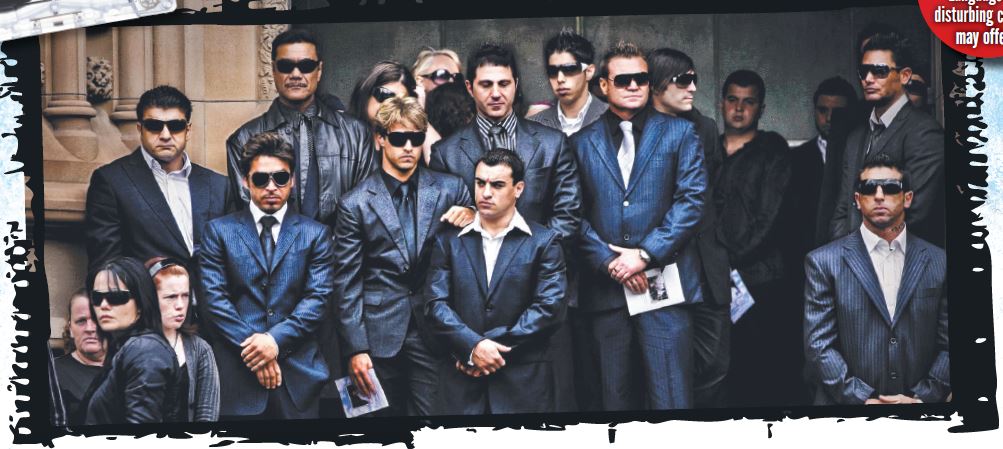
29 Page 3 consists of an article entitled “A FAMILY AFFAIR”. It contains an overview of the telephone intercept material and the charges laid against Michael and Fadi Ibrahim. The article refers to the family as the “House of Ibrahim” and states that they have been regarded with “fear and fascination” for three decades. It promises that the telephone intercepts will take the reader inside the “private world of this complicated family” and reveal “the truth about feuds, grudges and family lore”. A prominent photograph of some Ibrahim family members, which notably excludes Mr Taylor, appears above the article. It is captioned “THE ENTOURAGE” and states that the picture, taken at a funeral in 2009, “became a signature image of the family and added to the mystique and notoriety of patriarch John”. Mr Taylor’s counsel submitted that the photograph “look[ed] like a picture of gangsters”. This is the photograph:
30 As I mentioned earlier, p 4 includes a column entitled “MICK’S PICKS” which contains a selection of the editor’s top five articles. The column promotes the publication as giving an “unprecedented insight” into the Ibrahim family that reveals “incredible” information and a “comprehensive and raw picture of a complicated family”. It tells the reader that they “won’t be disappointed”. Mr Smark submitted that the article was a “textbook example of propelling a reader to expect scandal”.
31 Pages 4–5 contain an article concerning a $10 million “tax bill debt” incurred by John Ibrahim which apparently caused tensions with Fadi Ibrahim. A number of photographs accompany the article. Two show John Ibrahim on “luxury trip[s]”. Another depicts his “clifftop mansion”. Mr Smark submitted that the impression given by this article is that the family is “awash with money”.
32 The article on pp 6–7 is entitled “THE ENTOURAGE”. A banner above the headline reads “THE DARKER SIDE OF CELEBRITY”. The article likens the lives of the Ibrahim family to the characters in the television series Entourage, complete with an image of leading members of the cast. The article emphasises that John Ibrahim is “top dog” of a hierarchical structure which starts with the family and morphs into an ill-defined network of social and business contacts which includes “family members like [his] younger brothers Fadi and Michael”. It relates anecdotes about the dynamics of his “underlings” apparently drawn from the police tapes. Unlike the front page, however, the article does not identify Mr Taylor as part of the “entourage”. Mr Smark submitted that the article suggests that the Ibrahim family is a criminal family led by John. He also drew attention to the following passage from the article which he submitted contained “underworld overtones”:
After the assassination of mafia figure Pasquale Barbaro in November 2016, John warned Michael to watch his back.
“Stop being so blase like nothing can happen,” John said.
But John is also tough on his brothers and will assert his dominance when it comes to money.
33 Page 7 also carries a sidebar entitled “Colourful tinge to group in Ibrahim outer circle”. That piece asserts that the network outside the “Ibrahim clan” also contains a selection of “colourful” figures, including “Moses Obeid, the son of jailed former NSW politician Eddie Obeid [and] one-time jailed businessman Rodney Adler”. Mr Smark submitted that the ordinary reasonable reader would understand that the word “colourful” was a euphemism for “criminal”.
34 Pages 10–11 carry an article entitled “Shooting left Fadi broken”. It refers to Fadi Ibrahim’s rehabilitation efforts after he was shot in 2009. An image of Fadi Ibrahim’s Lamborghini sports car, pictured on the night of the shooting, accompanies the article. Mr Smark submitted that the article reemphasises the Ibrahims’ wealth, presumably because of the image of the Lamborghini, and its connection to crime, as it implies Fadi’s shooting was a “hit job”.
35 A separate article on p 11 refers to the “bitter history” and “bad blood” between the Ibrahim and Macris families. It states that John Macris, who was allegedly suspected of being responsible for the shooting of Fadi Ibrahim in 2009, was “murdered in Greece last year”. Mr Smark submitted that the article further alluded to the Ibrahims’ connection to the “organised crime underworld, a world of money”.
36 Pages 12–13 carry an article about Shayda Ibrahim and a trip to Dubai taken by Michael and Fadi Ibrahim. A sidebar on p 13 refers to Michael Ibrahim having a “drug-fuelled night of debauchery and mayhem” on a “luxury party boat”. Mr Smark submitted that the articles again alluded to the Ibrahims’ wealthy lifestyle.
37 The article on p 15, which complements the article referred to above at [15](3), is about a “rich tradition” in the Ibrahim family of administering a punishment known as “The Slap” to “those who commit lower level, but still serious, crimes against the family”.
38 Pages 16–17 consist of an article about the arrest of Mr Watsford and his interview with police in which the identity of the undercover officer was revealed. “He’s a cop? I thought he was a mate”, reads the headline. The banner above the article reads “THE STING REVEALED”.
39 Page 16 also includes an article about a prank “[an] Ibrahim hanger-on” is said to have pulled on Claudia Lowy, the “grand-daughter of a Sydney shopping centre magnate”. Page 17 includes an article about John Ibrahim’s “weekly poker game” with “a select group of businessmen, developers, restaurant owners, family and close friends”. It states that new entrants are required to come up with $8,000 as an “initial buy-in”.
40 Page 19, to which I have already referred at [15](4), includes an article about the “mysterious” initial targets of the investigation “that brought down Michael Ibrahim and a number of others in his network”.
41 Pages 20–21 are concerned with “the outer circle”. The article discusses the “dangerous secret” of “[o]ne of western Sydney’s crime figures” who had a “fetish for sex with men who dress as women”. The article included the following statements:
History has not been kind to people in similar situations.
In 1992, New Jersey mobster John D’Amato was murdered after it emerged he was secretly gay. His body has never been found. He was rumoured to be the inspiration for gay mobster Vito Spatafore in the television show, The Sopranos, who was killed by fellow Mafia members after being outed.
For this reason, The Sunday Telegraph has chosen not to identify the crime figure.
The calls also give rare insight into the emotionally exhausting responsibilities Michael is forced to carry thanks to his apex position in the criminal world.
42 Mr Smark submitted that this passage was “another example of the assimilation of the Ibrahim family into the criminal milieu”.
43 Pages 22–23 discusses the police raids on the homes of John, Fadi, and Michael Ibrahim, their mother Wahiba, and Mr Watsford. The banner at the top is entitled “Inside the houses of Ibrahim”. The heading is “Boys’ Toys, $20K & That Secret Tunnel”. The article is accompanied by various photographs taken by police during the raids, including “a stash of $20,000”, a “cabinet loaded with expensive colognes”, a 9mm pistol in the home of Wahiba Ibrahim, “[g]iant elephant tusks”, and “a secret tunnel”. It includes references in the article to “a manuscript for the classic Al Pacino movie, Scarface”, a violin case “[a]bove a book about the Mafia”, and “small bag of white powder”. It encourages readers to view an “amazing video” on The Daily Telegraph’s website which allows them to “take a walk through the houses”. Mr Smark submitted that:
[T]he whole suggestion taken together like a rope with strands is that this is a criminal leading a criminal family, he has got money, there’s the suggestion of drugs, there’s interest in organised crime. He has even got a violin case there. And there’s a picture of a gun cross. It turns out if you read the details it’s apparently some other relative who has got the gun, nine millimetre pistol an elderly woman has…It’s all part of this being a criminal family.
Publication
44 The matter complained of was published on 23 June 2019. That day 285,719 copies of the newspaper were sold and the readership of the edition was approximately 700,000. The online PDF version attracted 26 page views and 22 unique visitors.
45 An article forming part of the publication, which included references to Mr Taylor, was published on The Daily Telegraph’s tablet app. The article was entitled “Daniel Ibrahim tells of the day he and dad John got into a punch up”. At the time of the trial it had had 949 page views and 633 unique visitors. The same article was published on the newspaper’s website and had 2,215 page views and 1,886 unique visitors from the period 23 June 2019 to 3 May 2020.
46 The publication was promoted on The Daily Telegraph’s Facebook page in two posts, both on 23 June 2019. The first post had 51 likes, 26 comments and 11 shares. The post read:
On his way to cementing his status as the King of the Cross, nightclub boss John Ibrahim faced down bikies, killers, thugs and crooked cops. But in recent years, the person that threatened to bring Ibrahim to his knees was a nerd who is good with numbers.
47 The second Facebook post received 10 likes, six comments and two shares. It read:
#EXCLUSIVE: A $10m tax bill, punch-ups, acts of revenge. For 18 months police secretly tracked and phone-tapped the Ibrahim family and associates. This is the uncensored account of what they uncovered. INVESTIGATION: http://bit.ly/2IxOjOx”.
48 The Facebook page of The Daily Telegraph has over 1.3 million followers.
49 The publication was also promoted on The Daily Telegraph’s Twitter account on five occasions on 23 June 2019:
(a) the first tweet had one comment, one retweet and three likes. It read: “John and Fadi Ibrahim in fight over repayment of $200,000 loan. Via @BrendenHills”;
(b) the second tweet had no comments or retweets and one like. It read: “Kyle Sandilands’ front row seat at eyebrow waxing punishment. Via @BrendenHills”;
(c) the third tweet had no comments or retweets and two likes. It read: “Inside the secret tunnel John Ibrahim’s mansion. Via @BrendenHills”;
(d) the fourth tweet had no comments or retweets and three likes. It read: “What Ryan Watsford did to get slapped by an Ibrahim brother. Via @BrendenHills”.
(e) the fifth tweet had three comments, two retweets and four likes. It read: “Secret recordings tendered to court have revealed John Ibrahim ordered the waxing of two men’s eyebrows as punishment for two of his hangers-on stealing money and that his mate Kyle Sandilands showed up to the beauty salon for a laugh”.
50 The newspaper’s Twitter account has over 200,000 followers.
51 The publication was also promoted on Mr Hills’ Twitter account on three occasions:
(1) the first tweet was retweeted on 22 June 2019 from @sundayteleed and attracted no comments, 13 retweets, and 48 likes. The original tweet from @sundayteleed read:
I know this looks like a lot…but it’s totally worth it. Read some, put it down, go back again. You won’t regret it. A unique and incredibly detailed look inside the House of Ibrahim.
(2) the second tweet was retweeted on 22 June 2019 from @LillSaleh and attracted no comments, 11 retweets and 31 likes. The original tweet from @LillSaleh read:
An incredible uncensored investigation into a family that has intrigued and fascinated people for three decades. The 24 page liftout in #SundayTele is a must read. The #digital assets on @dailytelegraph are unbelievable. #subscribe #buythepaper #HouseofIbrahim.
(3) the third tweet was posted on 23 June 2019 and attracted one comment, five retweets and eight likes. The tweet read:
Police secretly recorded 880 calls of the Ibrahim family. Today @dailytelegraph have made it a 24p liftout. You can also listen to the tapped calls and view police footage online. Unprecedented insight into a fascinating family. Tax bills, in-fighting, eyebrow waxing. All of it.
52 Mr Hills’ Twitter account has around 280 followers.
53 The publication is still available to be read on the website of The Daily Telegraph.
Issues
54 The parties agreed that the pleadings raised the following questions for determination:
(1) Does the publication convey the pleaded imputations?
(2) If any of the pleaded imputations are conveyed, are they defamatory of Mr Taylor?
(3) If the imputation that Mr Taylor is a “criminal involved in organised crime” is conveyed by the publication, is it substantially true for the purposes of s 25 of the Defamation Act 2005 (NSW)?
(4) If liability is proved:
(a) In what amount should general damages be awarded?
(b) Should an award of aggravated damages be made and, if so, in what amount?
(c) Should there be any mitigation of damages and, if so, to what extent?
55 The second question fell away, however, when counsel for the respondents conceded that all of the pleaded imputations were defamatory — and rightly so. The tort of defamation is concerned with damage to, or disparagement of, reputation. It goes without saying that an imputation that a man is a mobster, a member of the mafia, or a criminal involved in organised crime would lower his reputation in the opinion of right-thinking members of the community. It is puzzling, to say the least, that the issue was raised in the first place.
Does the matter complained of convey the pleaded imputations?
The relevant principles
56 It is common ground that the relevant principles relating to the determination of defamatory meaning were accurately summarised by Wigney J in Rush v Nationwide News Pty Ltd (No 7) [2019] FCA 496 at [70]–[85] where some of the leading authorities from which they were sourced are cited. Omitting most of the references to the authorities, those principles are set out below.
57 First, the question is whether the defamatory meanings were conveyed to an ordinary reasonable reader of the publication (at [73]–[74]).
58 Second, that is a question of fact on which the applicant carries the burden of proof on the balance of probabilities (at [72]–[73]).
59 Third, it is for the tribunal of fact (here the Court) to determine whether the natural and ordinary meaning of the words in question conveys any or all of the alleged meanings (at [74]). Although some publications may be reasonably capable of bearing more than one meaning, the Court must ultimately determine whether the alleged meaning was the natural and ordinary meaning of the words complained of (at [83]).
60 Fourth, the natural and ordinary meaning of the words may be their literal meaning or an implied, inferred or indirect meaning (at [81]). In considering whether the alleged meaning is implied or inferred the ordinary reasonable reader will draw on their general knowledge. General knowledge in this context includes “matters of universal notoriety”, namely, “matters which any intelligent viewer or reader may be expected to know”: Fox v Boulter [2013] EWHC 1435 (QB) at [16] (citing Lord Mansfield CJ in R v Horne [1775–1802] All ER Rep 390 at 393E). The meaning the publisher may have intended is irrelevant (at [84]). Equally, the manner in which the publication was actually understood is also irrelevant (at [85]).
61 Fifth, the Court does not approach the matter in the way it would interpret a statute or a contract or other legal instrument. Rather, the Court must consider the meaning of the words in question as the ordinary reasonable reader or, as Wigney J put it in Rush at [74], “[t]he Court is required to put itself in the shoes of, or assume the role of, the ordinary reasonable reader”.
62 Sixth, the hypothetical ordinary reasonable reader is obviously enough not a lawyer who examines the publication overzealously and does not live in an ivory tower (at [77]–[78]). Rather, the ordinary reasonable reader is a reader of fair to average intelligence, experience and education (at [75]). Such readers are taken to be fair-minded and not perverse, morbid, suspicious of mind or “avid for scandal” (at [75]). They do not search for hidden meanings or adopt strained or forced interpretations but they do draw implications, particularly derogatory ones, more freely than do lawyers (at [77]). They can and do read between the lines (at [77]). They read the publication in its entirety and the words in question in context but take into account emphasis given by conspicuous headlines or captions (at [77]). A headline, for example, might give the reader a predisposition about what follows and so may assume special importance (at [79]).
63 Seventh, a defamatory statement in one part of an article will not necessarily be negated by a contrary statement in another part of the article (at [79]). But an allegation of disreputable conduct may be removed by another statement or other statements in the publication (commonly referred to as the “bane and antidote”) (at [90]–[91]).
64 Eighth, the manner in which the material is published can be relevant to the approach taken by the ordinary reasonable reader. As his Honour put it (at [78]):
[T]he mode or manner of publication can be a relevant matter in determining what was conveyed to the ordinary reasonable reader. The ordinary reasonable reader of a book, for example, is likely to read it with more care than he or she would read an article in a newspaper, particularly if that article is sensational. The ordinary reasonable reader of such an article is more prone to engage in loose thinking. That is all the more so where the words which are published are imprecise, ambiguous, loose, fanciful or unusual.
65 Ninth, the meaning the ordinary reasonable reader would attribute to an article may also be influenced by its overall tone or tenor (at [80]). Thus:
The article may, for example, be tinged with, or even pregnant with, insinuation or suggestion. It may also implicitly invite the reader to adopt a suspicious approach. As Gleeson CJ observed in Drummoyne Municipal Council v Australian Broadcasting Corporation (1990) 21 NSWLR 135 at 137:
It is a feature of certain forms of defamation that one can read or hear matter published concerning a person and be left with the powerful impression that the person is a scoundrel, but find it very difficult to discern exactly what it is that the person is said or suggested to have done wrong.
The applicant’s case
66 Mr Taylor submitted that, taken as a whole and reading the references to him in context, the article conveys each of the three pleaded imputations.
67 He pointed to the entire presentation of the article, which he described as “sensational and breathless, propelling the reader into a world of insinuation, suspicion and voyeurism”. He highlighted the following features:
(1) the scale and form of the publication as a special section of the newspaper conveying to the reader that the information it contained was important and worthy of close consideration with the editor himself urging the reader to persevere to avoid disappointment;
(2) the design of the front and back cover, including the “UNAUTHORISED” banner; the reference to the police secretly tracking the Ibrahim family over 18 months and tapping their phones; the statement that the report is “the uncensored account of what [the police] uncovered”; and the description of the journalists’ work as an “Investigation”;
(3) the repeated motif at the beginning of each section or story of the cassette tape (“the Ibrahim Tapes”, said to echo the “Nixon tapes”), emphasising the source of the information and alluding to the potential secrets revealed by the recordings;
(4) the repeated use of typeface typical of manual typewriters in the heading for each section and the initial letter of its text, suggesting “the world of true-crime hard-boiled reporting”;
(5) the warning at the start of the introduction about the language and “disturbing content”; and
(6) the gratuitous images of scantily clad women, one of whom (Ms Lee) is described as a “one-time girlfriend of [Mr Taylor]”.
68 Mr Taylor also emphasised the following matters. Starting with the front cover, he is depicted as a significant figure in the family led by John Ibrahim. He appears as one of a select few on the front and rear cover. He is described as a “key player” on page 2. He submitted that his appearance in that context is sufficient to identify him as a criminal member of the family. He claimed that the term “key players” is a loaded expression. He argued that the photo montage is a “rogues’ gallery” with the five family members who are seen on the front and back cover listed at 1 to 5, other important associates (two of whom were criminals) at 6 to 9, and the police who oppose them at 10 to 12. This section, he contended, emphasised the central role he played in “the family”. He is there described as John Ibrahim’s “wiseguy” son.
69 Mr Taylor referred to the fact that John Ibrahim has three brothers (Fadi, Michael and Sam). Sam is mentioned on p 3 but is not brought to the readers’ attention and, unlike his brothers and Mr Taylor, he is not named as a “key player” on p 2. Other members of the family, like Wahiba Ibrahim, the brothers’ mother, are mentioned but not described as key players.
70 Mr Taylor highlighted that with respect to three of the “key players” — Shayda Ibrahim, Mim Salvato, Margaret Staltaro — there is said to be no suggestion that they participated in criminal activity. In his case, however, the reader is told that he “was charged with handling a suitcase containing $2 million of cash but was cleared after a committal hearing at Central Local Court”. Mr Taylor submitted, that this was no disclaimer of participation in criminal activity. To the contrary, he argued, it only “cement[ed]” the meaning conveyed by “wiseguy”, which is the term used to describe him in the “key players” photo montage on p 2. He claimed that the comment was no more than a statement that he “beat the rap”, to continue the vernacular, and was merely part of the implication that he was involved in organised crime.
71 Mr Taylor submitted that the Ibrahim family was depicted throughout the publication as an organisation, more particularly, an organisation involved in nefarious activities including serious crime. He argued that the publication, in particular the article at pp 8–9, emphasised how Michael and Fadi Ibrahim and Mr Taylor were arrested “as a group” which conveyed the impression that they were “together in some enterprise”.
Some general observations
72 Before considering the imputations, some general observations should be made
73 First, nowhere in the publication is there an express statement that the applicant is a mobster, a member of the mafia, or a criminal involved in organised crime. For Mr Taylor to succeed, he needs to satisfy the Court that the words used to describe him, read in the context of the entire publication, would convey that meaning to an ordinary, reasonable reader. Put another way, he must show that the ordinary, reasonable reader would draw that meaning by implication or inference from the matter complained of.
74 Second, while three imputations were pleaded, the submissions failed to clearly delineate any substantive difference between them. As the respondents submitted, the first two pleaded imputations are very similar. They pointed out that “mobster” is a colloquial term for “gangster” (strictly, a member of a gang of criminals) and the sting of the first pleaded imputation — that Mr Taylor is a “mobster” — is the same as the second — that Mr Taylor is “a member of the mafia”, is that Mr Taylor is a gangster. Mr Smark acknowledged in argument that the meanings of the three expressions overlap.
75 The respondents submitted that the “Mafia” is the name of a specific body of organised criminals originally operating in Sicily (and Italy in general) with a particular code of behaviour (said to have derived from the Sicilian adjective “mafiusu”, which, roughly translated, means “swagger” or “boldness”). But the word “mafia”, that is with a lower case “m”, refers to a group of criminals whose modus operandi is similar to the Sicilian Mafia. It is not uncommon, for example, to read and hear references in the media to the Russian mafia.
76 The submissions made on behalf of Mr Taylor made no attempt to distinguish between the three imputations and I am unable to discern any substantive difference. Members of the mafia and mobsters may equally be regarded as criminals involved in organised crime. While not all criminals involved in organised crime may be members of “the” mafia, all members of the mafia and all mobsters are properly described as criminals involved in organised crime. It is difficult to imagine that the damages that may be awarded to a person whom a publication claims, expressly or implicitly, to be a criminal involved in organised crime would differ from the amount that would be awarded to a person alleged to be a member of the mafia or a mobster. In any event, for the reasons that follow, I am not persuaded that any of the three imputations is conveyed by the publication.
Consideration
77 The publication is not a sober analysis of the material upon which it reports. Rather, it is a classic example of tabloid journalism. It sensationalises the information. It is also voyeuristic. It encourages readers with a prurient interest in other people’s affairs, particularly “underworld figures” and so-called celebrities, to nourish that interest. As Mr Smark put it in his opening remarks:
It’s a matter which is imbued with both visually and in content the creating of a certain mystique, an underworld, an area of great interest and yet which is secret.
78 Furthermore, the publication is littered with references to popular culture, which arguably signalled to the reader’s imagination.
79 A publication of this nature is likely to foster a degree of loose thinking. And “loose talk about suspicion can very easily convey the impression that it is a suspicion that is well founded”: Lewis v Daily Telegraph Ltd [1964] AC 234 at 285 (Lord Devlin).
80 While the ordinary reasonable reader reads between the lines, however, he or she does not go searching for sinister meanings. Yet that is what Mr Taylor’s case effectively invites. It must be remembered, as Wigney J put it in Rush at [75], that the ordinary, reasonable reader is taken to be fair-minded and not suspicious of mind or avid for scandal.
81 The portrait of Mr Taylor is certainly unflattering. It does not paint him in a favourable light. And it is understandable that he would be unhappy about it. But the impression of him it creates is not that of a mafia figure, mobster or criminal engaged in organised crime. Rather, Mr Taylor comes across as Mr Hills described him, namely as a petulant young man with a sense of entitlement, who has a complicated and at times turbulent relationship with his father, a foul mouth, a fondness for wisecracks and a predilection for making jokes in poor taste. It is true that the publication discloses that he is close to his uncle, Michael, who is a notorious criminal, and that he was in contact with a prisoner with whom he was apparently on friendly terms. But Mr Taylor does not complain that the publication conveys the imputation that he is an associate of criminals. The pleaded imputations are materially different.
82 Mr Taylor submitted that the publication depicts the Ibrahim family as an organisation involved in nefarious activities, including serious crime. He contended that there are frequent references to “Mafia lore and the language of organised crime”. He pointed to the following matters:
Michael Ibrahim is said to be “[v]ery well connected in [the] underworld” (p 2) and on the same page Mr Taylor, himself, is described as a “wiseguy”, “which the ordinary reasonable reader would recognise as a term for a member of the Mafia, used in well-known films such as Goodfellas”.
The article on pages 22–23 about the police raid on John Ibrahim’s Dover Heights house which describes some of his possessions, singling out for special mention “a manuscript for the classic Al Pacino movie, Scarface” and the observation that “[a]bove a book about the Mafia on the shelf is what appears to be a violin case”. The specific mention of the violin case was said to “plainly…evoke the classic image of the Prohibition-era American mobster carrying a Tommy gun concealed in a violin case”.
“Operation payback”, the article on pp 14–15 discussing the “punishment” meted out to Mr Watsford and Mr Chester, which Mr Taylor submitted was likened to a “kneecapping” (but which was in fact said to be “a step away from [such] traditional Kings Cross-style punishments like a kneecapping”).
The article on pp 18–19 in which Det Murphy is compared to the well-known American detective, Eliot Ness (“Think a Bondi version of Eliot Ness, the smartly dressed 1920s American Prohibition agent [who] took down Al Capone as a member of the squad known as The Untouchables before Kevin Costner immortalised him in the 1987 movie of the same name”). To emphasise the comparison, Mr Taylor noted that the article features an image of the actor, apparently a still from the film.
The article on pp 20–21, entitled “The Outer Circle”, which referred to the sexual proclivities of a so-called Ibrahim associate, likening him to New Jersey mobster John D’Amato, who “was murdered after it emerged he was secretly gay”. Mr Taylor pointed to the reference in the article to Michael Ibrahim counselling this individual as one of the responsibilities he was “forced to carry thanks to his apex position in the criminal world”.
83 Mr Taylor submitted that this is “the milieu” in which he was identified. He contended that the references to Eliot Ness, Al Capone, The Untouchables, John D’Amato, The Sopranos, Scarface and the violin case are quite gratuitous and could only have been made in order to liken the Ibrahim family to the American mob.
84 There is force in many of these submissions.
85 I accept the submission that the Ibrahim family is depicted as an organisation involved in nefarious activities, including serious crime. The inclusion of the gratuitous references mentioned above does suggest that “the Ibrahim clan” (the expression used on pp 2, 3, 4, 7, 17, 18, 19, and 20) or the “Ibrahim family” (the term used on pp 1, 2, 3, 5, 6, 8, 10, 13, 14, 15, 16, 17, 22, and 23) operates like the American mob. Moreover, I am acutely aware that one can be damned by association.
86 But the question here is not whether the publication has the effect of diminishing Mr Taylor’s reputation because he is a member of the Ibrahim family but whether, because of that and the other matters upon which he relied, the publication implies that he, too, is a mobster, a member of the mafia, and/or a criminal involved in organised crime. Mr Smark argued that this was the effect of Mr Taylor’s inclusion as a “key player” in the montage on p 2. But the ordinary reasonably reader, having read the whole of the article, would recognise that the members of the Ibrahim family who are listed there are not all key figures in a criminal network. Read in context, “the key players” are those individuals who feature in the recorded conversations and the police officers who were involved in the investigation which led to the arrest of some of them.
87 The fact that another (or other) members of his family are or may be involved in organised crime does not mean that Mr Taylor is too. And I am not persuaded that the matter complained of suggests that he is. The ordinary reasonable reader would know that you cannot choose your relatives.
88 Neither the reports of the conversations with the prisoner (Hadid) nor those with his uncle Michael imply that he (Taylor) is involved in organised crime, even though it is a fair inference that his uncle was.
89 Unlike other members of the Ibrahim family, Mr Taylor is not said to be “awash with cash”. He is not said to have any of the trappings of wealth. Nor is he said to enjoy a life of luxury. If anything, the opposite is true. The publication implies that he lacked the resources to raise bail, that his Ibrahim family did not come to his aid, and that he relied on his struggling mother to help him out. It records that he was living in a flat owned by his father who was chasing him for rent. The report of the police raid on the homes of Ibrahim family members relates to searches of the homes of John, Fadi, Michael and their mother. It does not insinuate that any of the items mentioned in the article belonged to Mr Taylor. While the publication mentions that the police entered the apartment in which he was living to arrest him, it does not refer to a search of the apartment. Mr Taylor did not submit that the publication inferred that he procured Ms Lee to administer the punishment to Mr Watsford and Mr Chester and the article does not indicate that he was present when the punishment was administered. In all the references in the publication to the involvement of other members of the Ibrahim family in criminal conduct and the actions of police and law enforcement agencies, there is no suggestion that Mr Taylor was also involved apart from the three references to his arrest over his handling of the suitcase, all of which were accompanied by statements that he had been “cleared” of involvement or, in one instance, that he had “beat” the charges.
90 Mr Smark pointed to the disclaimer given in relation to each of Shayda Ibrahim, Mim Salvato, Margaret Staltaro, and John Ibrahim that they had not been charged and there was “no suggestion” that they had participated in criminal activity. He argued that the omission of a disclaimer in the same terms in relation to Mr Taylor would suggest to the ordinary reasonable reader that, despite having been cleared by the legal system, Mr Taylor was nonetheless involved in criminal activity. He contended that undue prominence was given to the statement that Mr Taylor had been arrested for “holding a suitcase containing more than $2 million in cash”, and that the subsequent disclaimer that he had been cleared did not neutralise this imputation. He referred to the remarks made in Favell v Queensland Newspapers Pty Ltd [2005] HCA 52; 79 ALJR 1716; 221 ALR 186 at [8].
91 These remarks do not assist Mr Taylor.
92 In Favell, the question before the High Court was not whether the article in question did convey the pleaded imputations but whether it was capable of doing so. The context was an application by the respondents for orders that the pleaded imputations be struck out and that summary judgment be entered in their favour. At first instance an order was made striking out the imputations and an appeal from that order was dismissed. The High Court, however, held that the article was capable of conveying the pleaded imputations (at [18] per Gleeson CJ, McHugh, Gummow and Heydon JJ).
93 The impugned article reported on a fire that destroyed a riverside mansion which was subject to a controversial development application. The passage upon which Mr Taylor relied appears in the joint judgment. It reads as follows (the emphasis in the quotation below is mine):
[T]he article does not simply report the fire without comment. On the contrary, the main thrust of the article is to link the fire with the contentious development proposal. What could have been the relevance of the development proposal to the story about the fire? The development proposal was not just an interesting background fact. The headline makes clear the point of the story: “Development site destroyed”. The first paragraph repeats that emphasis. The article does not simply give an account of the fire “without comment”. And if, by “the circumstances surrounding” the fire, Helman J had in mind the development proposal and the surrounding controversy in the neighbourhood, an ordinary reasonable reader might well ask why that was given such prominence. If the fact of the fire and the fact of the controversial development proposal were merely coincidental, and not causally related, then no inference of wrongdoing would follow. Newspapers can, and do, report coincidences. On the other hand, if the two were not just coincidental, but there was a connection, there was at least a possible inference that the connection was sinister.
94 It is rare at “the capacity stage” to conclude that the antidote of the matter complained of removes its bane: Corby v Allen & Unwin Pty Ltd [2014] NSWCA 227 at [144] (McColl JA, Bathurst CJ and Gleeson JA agreeing at [1] and [191] respectively). At that stage, a court is required to have regard to “‘all such insinuations and innuendoes’ as could reasonably be read into the words published by the ordinary reader”: Molan v Fairfax Media Publications Pty Ltd [2017] NSWSC 800 at [14] (McCallum J). But we are not at the capacity stage here. The inquiry at this point is a very different one. As I have already observed, the question here is not whether the publication is capable of conveying any of the imputations but whether I, as the putative ordinary reasonable reader, am persuaded on the balance of probabilities that it does. The fact that an ordinary reasonable reader might come to a particular conclusion does not necessarily mean that he or she would or, for that matter, should.
95 In any event, the publication in Favell did not apparently include a statement which could have rebutted the available defamatory inference.
96 In the present case, I am not satisfied that the ordinary reasonable reader of the publication would come to the conclusion that Mr Taylor was a criminal involved in organised crime or if, contrary to my opinion there is a substantial difference between the three pleaded imputations, a gangster or a member of the mafia. While Mr Smark argued otherwise, I consider that, if such an impression might have been given by the report of the arrest and the charge, it is dispelled by the statements that accompany the report on the three occasions it appears. In other words, the antidote overcame the bane. The disclaimer recorded for Shayda Ibrahim and others was inapt in Mr Taylor’s case because, unlike them, he had been suspected of involvement in a criminal enterprise and he had been charged. The ordinary reasonable reader would recognise that. The ordinary reasonable reader would not conclude that, despite having been cleared of handling (or holding) the suitcase full of cash and “any involvement in the tobacco importation ring that snared his uncle Michael”, Mr Taylor was nonetheless guilty or involved. The publication does not insinuate that, despite the outcome of the committal proceeding, the reality was otherwise. Nor does the publication insinuate that Mr Taylor was involved in any other organised crime. I appreciate, of course that the reader is entitled to give some parts of the article more weight than other parts. But I am not persuaded that the publication gave such prominence to the reason Mr Taylor was arrested that the accompanying statement concerning the outcome of the committal would not have removed any impression to the contrary that might have arisen from the report of his arrest and the mention of the charge.
97 In advocating for a different conclusion, Mr Smark argued:
But it doesn’t cancel out. I mean, to use an extreme example, and I’m not suggesting this is that, but a person is not placed in the same position – this is the standard illustration of how bane and antidote is limited, by having an allegation of an invidious crime, like paedophilia, made against him or her and then having it published that the claim has been dropped. The person is still, in terms of what else might be believed about that person, significantly differently situated then as if the material had never been advanced.
And in the context of this matter, this is exactly it. Two million dollars in a suitcase. I mean, most people perhaps would be thinking, well, can you fit $2 million in a suitcase? It’s a very striking proposition. And the article doesn’t go on to say he didn’t, in fact, have $2 million in a suitcase. It simply says he was cleared of charges associated with that. Who has $2 million in a suitcase? It’s a remarkable proposition. It’s not suggested it was a case of mistaken identity or something of that kind.
98 I am not persuaded by this argument either. The ordinary reasonable reader considers the publication as a whole, the words alleged to be defamatory and their context, and “tries to strike a balance between the most extreme meaning that the words could have and the most innocent meaning”: John Fairfax Publications Pty Limited v Rivkin [2003] HCA 50; 77 ALJR 1657; 201 ALR 77 at [26] (Gleeson CJ). While the reference to the suitcase is striking (at least at first) when the publication as a whole is considered and the reference is read in that context, it does not overwhelm or otherwise defeat the effect of the statements that Mr Taylor was cleared. It is a long established principle that, if something disreputable is said of a person in one part of a publication but it is removed by the conclusion, “the bane and the antidote must be taken together”: Chalmers v Payne (1835) 2 Cr M & R 56 at 159.
99 The statements in the publication regarding the circumstances of Mr Taylor’s arrest and the reason he was charged are isolated and nothing is made of them. Importantly, none of the articles in which Mr Taylor is mentioned depicts him as a gangster, a mafia figure or a criminal involved in organised crime. Nor does the publication as a whole — whatever might be said or implied about other members of the Ibrahim family. It is true, as Mr Smark submitted, that the publication does not go so far as to state that Mr Taylor was unaware of the contents of the suitcase or that this was a case of mistaken identity. But in the face of the statements that he was cleared of involvement in the criminal enterprise, the ordinary reasonable reader would not jump to so scandalous a conclusion that he was nonetheless a criminal involved in organised crime, a gangster or a member of the mafia. After all, the article offers no reason to think that Mr Taylor had any knowledge of the contents of the suitcase and is silent about the circumstances in which he came into possession of it.
100 I reject the submission that the reference to Mr Taylor as John Ibrahim’s “wiseguy” son implies that he is a member of the Mafia or a mobster, as Mr Smark contended. Wiseguy (whether written as one word or two) is a colloquial term originating in the United States. The meaning Mr Taylor sought to give it is not universally accepted, certainly not in Australia. I, myself, was unaware of it before reading the submissions in this case. The Macquarie Dictionary does not indicate that it is an accepted meaning in Australian English. It defines the term, whether written as one word or two, to mean “a cocksure or impertinent person of either sex” (accessed 3 February 2022). That definition accords with the definition in the Oxford English Dictionary which is “an experienced or knowledgeable man; usually ironic or [derogatory]; a know-all, a wiseacre; someone who makes sarcastic or annoying remarks …” (accessed 3 February 2022). These definitions perfectly fit the portrayal of Mr Taylor in the matter complained of. Despite the references in the publication to gangsters and the mafia, I do not think that the ordinary reasonable reader of the publication would take the term “wiseguy” when used in connection with Mr Taylor to mean that Mr Taylor is a mobster or a member of the mafia. And Mr Taylor did not plead that the term has a special meaning conveyed to readers with knowledge of some extrinsic facts, such as the use of the term in Goodfellas.
101 Even if wiseguy could have such a meaning, in the context in which it is used to describe Mr Taylor, the ordinary reasonable reader would not interpret it this way. None of the othermembers of the Ibrahim family or their hangers-on were so described. It is obvious that the term was suggested by the text message sent to Mr Taylor by his father (“[a]ll you’re good for is a smart-arse comment”) reported on p 9. To paraphrase the respondents’ submission, the ordinary reasonable reader would understand it to be a reference to a person who makes “smart-arse comments” — a smart aleck, not a criminal. The “father versus son” article on pp 8–9 is replete with examples, such as Mr Taylor telling his father “the cheque’s in the mail” when he was chasing him for rent money; joking to his aunt (Michael’s wife), in reference to his uncles’ arrest in Dubai, that “at least Mick will lose some weight”; commenting that a photograph of his father on the balcony of his home reading his autobiography was “like getting caught having a wank to your own photo”; and telling his father that his autobiography would be a top seller in “Caltex”, this latter remark generating the text message referred to above.
102 I emphatically reject the submission that the report suggests that Mr Taylor was a prominent underworld figure. The submission was put this way:
On page 8, Taylor is described as being particularly close to Michael Ibrahim, whom the report describes as “Very well connected in the underworld” and holding an “apex position in the criminal world”, and as “trying to challenge his father’s alpha dog status”. All of this suggests that Taylor was prominent within that milieu, and that he was ambitious to rise higher.
103 This is a bridge too far. In no way does the publication suggest that Mr Taylor was a prominent figure in the “underworld” or the “criminal world”. Nor does it suggest that he had any aspirations to become part of it, let alone rise up in it. The submission takes the reference to the challenge to his father’s “alpha dog status” completely out of context.
Conclusion
104 I am not satisfied that any of the imputations are conveyed. Consequently, the originating application should be dismissed with costs.
105 In these circumstances, it is not only unnecessary to deal with the defence of substantial truth, it is undesirable to do so. The question it raises does not arise and, if I were to find the defence made out, it could seriously damage Mr Taylor’s reputation for no good reason. Finally, although it is conventional for trial judges to assess damages even if liability is not proved and generally expected that they do so, in the present case that is an impossible task. That is because Mr Taylor’s claim for aggravated damages depends on one or more of the imputations being established and the respondents’ failure to apologise for something I have found they did not do and the respondents rely in mitigation of damages on the substantial truth of the third imputation which I have declined to determine. If there is an appeal and the appeal is successful, then and only then will these matters need to be considered.
I certify that the preceding one hundred and five (105) numbered paragraphs are a true copy of the Reasons for Judgment of the Honourable Justice Katzmann. |
Associate:


