

Federal Court of Australia
United Firefighters’ Union of Australia v United Firefighters’ Union of Australia, Union of Employees, Queensland [2022] FCA 145
ORDERS
UNITED FIREFIGHTERS’ UNION OF AUSTRALIA Applicant | ||
AND: | ||
UNITED FIREFIGHTERS’ UNION OF AUSTRALIA, UNION OF EMPLOYEES, QUEENSLAND Respondent | ||
DATE OF ORDER: |
THE COURT ORDERS THAT:
1. On or before 4:00 pm, 2 March 2022, the parties are to provide chambers with draft declarations pursuant to s 167 of the Fair Work (Registered Organisations) Act 2009 (Cth), consistent with the reasons for judgment of Abraham J in the matter of NSD 1027/2020 - United Firefighters’ Union of Australia v United Firefighters’ Union of Australia, Union of Employees, Queensland [2022] FCA 145.
Note: Entry of orders is dealt with in Rule 39.32 of the Federal Court Rules 2011.
ORDERS
NSD 987 of 2020 | ||
| ||
BETWEEN: | UNITED FIREFIGHTERS’ UNION OF AUSTRALIA Applicant | |
AND: | ||
UNITED FIREFIGHTERS’ UNION OF AUSTRALIA, UNION OF EMPLOYEES, QUEENSLAND Intervener | ||
order made by: | ABRAHAM J |
DATE OF ORDER: | 24 February 2022 |
THE COURT DECLARES THAT:
1. Pursuant to s 323(1) of the Fair Work (Registered Organisations) Act 2009 (Cth), the Queensland Branch of the United Firefighters’ Union of Australia (UFUA) has ceased to function effectively, and there are no effective means under the rules of the UFUA or the Queensland Branch by which the Branch can function effectively.
THE COURT ORDERS THAT:
1. Pursuant to s 323(2) of the Fair Work (Registered Organisations) Act 2009 (Cth), the scheme at Appendix A (the Scheme) of these orders be approved in relation to the Queensland Branch of the UFUA.
2. Mr Gavin Marshall be appointed as Administrator of the Queensland Branch of the UFUA under the Scheme.
3. In the event of any difficulty arising in the course of implementation of the Scheme, the Administrator, the applicant or any person represented in the proceeding shall have liberty to apply on 48 hours’ notice.
Note: Entry of orders is dealt with in Rule 39.32 of the Federal Court Rules 2011.
APPENDIX A – SCHEME TO ENABLE THE QUEENSLAND BRANCH OF THE UNITED FIREFIGHTERS’ UNION OF AUSTRALIA TO FUNCTION EFFECTIVELY
Appointment of Administrator
1. Gavin Marshall shall be appointed as Administrator of the Queensland Branch of the United Firefighters’ Union of Australia (“the Branch”) from the date of the Order of the Court until the declaration of the results of the elections referred to in paragraph 13 below, or until further order of the Court.
2. The Administrator shall have all of the powers of the Branch Officers and the Branch Committee of Management under the Rules of the United Firefighters’ Union of Australia (“UFUA”).
3. Without limiting the foregoing, the Administrator shall have power to bring proceedings in the name of the UFUA, for the recovery of any funds of the UFUA or the Branch, and for the imposition of penalties and the awarding of compensation as may be available under the Fair Work (Registered Organisations) Act 2009 (Cth) (“the RO Act”).
4. For the avoidance of doubt, the Administrator shall have full power to engage such employees and consultants as the Administrator deems necessary to enable the Administrator to carry out the duties and functions conferred on the Administrator under this Scheme.
5. For the further avoidance of doubt and notwithstanding any provisions of the Rules of the UFUA, the Administrator may appoint any person deemed suitable to him as a proxy to represent him at any meeting of the National Committee of Management or National Executive of the UFUA provided that a separate written appointment is made for each such meeting, and each such instrument may provide instructions to the proxy as to how the proxy should vote and must do so in the event of a vote being required on any matter that, in the opinion of the Administrator, may affect the interests of the members of the Branch. To avoid doubt any such instructions may include a direction to abstain from voting.
6. For the further avoidance of doubt, for the purposes of discharging the obligations under this Scheme, the Administrator shall have the powers of the Branch Secretary and the Branch Committee of Management under Chapter 7 and Chapter 8 of the RO Act.
7. The Administrator may alter the rules of the UFUA and/or the Branch as necessary to enable the Branch to function effectively and shall submit any alterations to the General Manager of the Fair Work Commission for approval.
8. The Administrator may develop and implement policies, including by way of any Rule changes, to ensure the Branch will be representative of and accountable to its members, will be able to operate effectively, will encourage members to participate in the affairs of the Branch to which they belong, and will encourage the democratic functioning and control of the Branch.
Roll of members and preparation of accounts
9. The Administrator shall as soon as is reasonably practicable after the date of the Order, prepare a list of members of the Branch as at the date of the Order, and shall state whether the member was financial or unfinancial as at the date of the Order.
10. Where any question of membership of the Branch is before the Court pursuant to inter alia ss 167 or 168 of the RO Act, the Administrator may participate in such proceedings to the extent he sees fit in order to represent the interests of the Branch, including to furnish such materials in the possession of the Branch that may assist the Court in determining the matters before it.
11. Any person joining the Branch after the date of the Order shall be placed on the list that would be applicable had they been a member at the date of the Order, and shall for the purposes of the Scheme form part of the respective list.
12. The Administrator shall, as soon is reasonably practicable after the date of the Order and unless otherwise completed, cause to be prepared financial accounts, including a general purpose financial report as specified by s 253(2) of the RO Act and an operating report as specified by s 254 of the RO Act, setting out the assets and liabilities of the Branch.
Elections
13. The Administrator shall, as soon as is practicable:
(a) on the completion of the steps set out in paragraphs 9 to 12; and
(b) when he is satisfied that any rule changes or policies referred to in paragraphs 7 and 8 respectively have been implemented,
request the General Manager of the Fair Work Commission to arrange for the conduct of an election for all offices in the Branch by the Australian Electoral Commission.
14. The Administrator must do all things necessary to facilitate the conduct of the election including all those things required to be done by a Committee of Management of an organisation under s 189 of the RO Act.
15. For the purposes of the conduct of the election for the offices in the Branch, the operation of the UFUA Rules shall be modified to the extent necessary to enable the Branch to function effectively.
16. Notwithstanding any Rule, each member of the Branch shall on and from the day on which the electoral official calls for nominations for election to each of the offices be deemed to be a financial member of the UFUA for the purposes of:
(a) being nominated for any such office;
(b) holding any such office;
(c) nominating any person for election to any such office; or
(d) voting in the election for any such office.
17. For the avoidance of doubt, this Scheme does not operate retrospectively to confer any other right on any member to be treated as a financial member in respect of any event occurring prior to the date of calling for nominations for that office.
18. The elections are to be held to fill the vacant offices. The persons elected to any office shall, notwithstanding any UFUA Rule, commence to hold office from the date on which they are declared to be elected and shall hold office until the declaration of elections for Branch officers conducted in 2024, and the persons then elected shall be elected for three years thereafter.
19. During the period of administration, the Administrator shall not permit the use of the funds or resources of the Branch for campaigning or electioneering.
Term and payment of the Administrator
20. The Administrator shall use his best endeavours to ensure the completion of the administration within 120 days of the date of the Order, or such further time as the Court may allow.
21. The Administrator shall cease to act under this Scheme on the declaration of the results of the elections provided for from paragraph 13.
22. The UFUA shall pay the fees and expenses of the Administrator of carrying out his functions under this scheme from the accounts of the Branch and, in the event those funds prove insufficient to cover such fees and expenses, from the accounts of the UFUA.
REASONS FOR JUDGMENT
Abraham J:
1 The applicant in each of these proceedings, the United Firefighters’ Union of Australia (UFUA or Federal Union), is an organisation registered under the Fair Work (Registered Organisations) Act 2009 (Cth) (FW(RO) Act). The respondent and intervener, the United Firefighters’ Union of Australia, Union of Employees, Queensland (UFUQ or State Union), is an organisation registered under the Industrial Relations Act 2016 (Qld) (IR Act (Qld)).
2 In the NSD 1027/2020 proceeding, the Federal Union seeks orders under s 167 of the FW(RO) Act to recognise the continuous membership of four firefighters who, it was contended, were disenfranchised as a result of a decision of the Queensland Branch of the Federal Union (Queensland Branch) in September 2018 (the s 167 application). In the NSD 987/2020 proceeding, the Federal Union seeks orders under s 323 of the FW(RO) Act to appoint an administrator to reconstitute the Queensland Branch which it contended has ceased to function effectively as a result of the disenfranchisement of some 2500 members and the mass resignations of its elected officials (the s 323 application).
3 There is a relationship between these applications. In summary, the Federal Union contends that the events which precipitated the s 323 application involved the disenfranchisement of the Queensland Branch membership, with some 2500 members being improperly removed from the membership roll, including the four firefighters seeking declarations under s 167. The declarations of membership of the Federal Union sought by the four firefighters in the s 167 application are relevant to the role of the administrator sought to be appointed in the s 323 application, insofar as that involves an obligation on the administrator to cause an election by qualified electors in accordance with the requirements of the FW(RO) Act.
4 Given the commonality of some of the underlying evidence, the s 167 application and s 323 application were heard together, with the evidence being admissible in both proceedings. Although the State Union is not a party to the s 323 application, on their application, leave to intervene was granted on 8 April 2021, but only on two discrete issues. Those issues are as follows:
(1) the construction of s 323(1)(a) of the FW(RO) Act and whether that provision is satisfied; and
(2) the nature and appropriateness of the scheme proposed by the Federal Union for approval by the Court under s 323(2).
5 For the reasons below, I am satisfied that declarations under s 167 should be made, reflecting that each of the four firefighters has been a member of the Federal Union from the date on which they joined. I am also satisfied that I should make the orders sought under s 323, reflecting the Federal Union’s proposed scheme for the administration of the Queensland Branch.
Material relied on
6 The applicant read the following affidavits:
(1) Gavin Marshall affirmed 7 September 2020. Mr Marshall is the proposed administrator of the scheme the subject of the s 323 application;
(2) Gregory McConville sworn 10 August 2020 (First McConville Affidavit), unsworn and filed on 17 March 2021 (Second McConville Affidavit) and sworn 16 April 2021 (Third McConville Affidavit). Mr McConville is the National President of the Federal Union;
(3) Daniel Feeney sworn 28 August 2020. Mr Feeney is a firefighter employed by the Queensland Fire & Emergency Services (QFES), having commenced in May 2010;
(4) Lam Pham sworn 28 August 2020. Mr Pham is a Station Officer employed by the QFES, having commenced in August 2010;
(5) Scott Neumann sworn 28 August 2020. Mr Neumann is a firefighter employed by the QFES, having commenced in January 2013;
(6) Paul Hagger sworn 29 August 2020. Mr Hagger is a firefighter employed by the QFES, having commenced in October 2001; and
(7) Antonia Sakkas affirmed 2 February 2021. Ms Sakkas is a solicitor of Davies Lawyers, the law firm representing the Federal Union in these proceedings.
7 The affidavits of Mr Feeney, Mr Pham, Mr Neumann and Mr Hagger (the four firefighters the subject of the s 167 application) as well as the First McConville Affidavit were admitted subject to some objections and limitations. Mr Feeney, Mr Pham, Mr Neumann, Mr Hagger and Mr McConville were cross-examined.
8 The respondent read the following affidavits:
(1) Angela Oliver affirmed 8 February 2021 (First Oliver Affidavit) and 3 March 2021 (Second Oliver Affidavit). Ms Oliver is the Operations Manager of the State Union and has been employed by the State Union since 1995; and
(2) Peter Chalmers affirmed 8 February 2021 (First Chalmers Affidavit) and 3 March 2021 (Second Chalmers Affidavit). Mr Chalmers is an employee of the QFES and has held numerous roles in both the State Union and Federal Union. He has worked as a firefighter for over 35 years.
9 Each of the affidavits relied on by the respondent were admitted in full. Both witnesses were cross-examined.
10 Following the hearing, the parties filed marked-up copies of the affidavits, reflecting the various rulings made during the course of the hearing as to the admissibility of the affidavit evidence.
11 The following documents were also tendered by the parties at the hearing:
(1) the resignation letter of Mr Hagger, dated 10 April 2021 (R1);
(2) a bundle of emails between Ms Sakkas and employees of the Commonwealth Bank of Australia (CBA) and National Australia Bank (NAB), of various dates in October 2019 (A2);
(3) State Union applications for exemption from holding elections and accompanying affidavits and exemption decisions, of various dates (A3);
(4) an unsworn affidavit of Gregory McConville, filed on 17 March 2021 (A3A) (referred to above at [6(2)]);
(5) minutes of meetings of the Branch Committee of Management (BCOM) and the Branch Executive of the Federal Union (A4), dated 8 May 2018, 11 July 2018 and 14 September 2018 (A4);
(6) annual reports of the QFES (2013-2018) (A5);
(7) financial reports of the Queensland Branch (2013-2017) (A6);
(8) a letter of advice from Hall Payne Lawyers (Hall Payne) to John Oliver (State Union Branch Secretary) Re: Issues arising out of dual registration, dated 29 August 2018 (R7); and
(9) documents titled ‘Code Red, Vol 4, No 2: End Date for Payroll Deductions’, dated 8 August 2013, and ‘Code 2, Vol 35, No 31: KPMG Review of QFES Structure and Funding - Update’, dated 6 September 2021 (A8).
Factual background
12 Before addressing the two applications, it is necessary to describe the factual background and context in which they arise.
13 In 1987, the State Union was registered under the IR Act (Qld).
14 In 1990, the Federal Union came into being in its existing form. As noted above, the Federal Union is an organisation registered under the FW(RO) Act. The membership of the Federal Union is divided into branches and includes a Queensland Branch to which members employed in Queensland belong (other than those who belong to the Aviation Branch whose members are employed in aviation fire services throughout Australia). When the Federal Union was formed, the Rules of the United Firefighters’ Union of Australia (UFUA Rules) relevantly provided: (1) branch autonomy in respect of all matters that affected one branch only (for example, questions of branch membership): r 54; and (2) that existing members of the State Union would be automatically recognised as (financial) members of the Federal Union by reason of having been members of the State Union and having paid membership subscription fees to the State Union: r 89. These rules are continued in the current form of the UFUA Rules.
15 The State Union is an “associated body” of the Federal Union under r 2(2) of the UFUA Rules. The Federal Union is the “federal counterpart” of the State Union pursuant to s 9A of the FW(RO) Act.
16 The officers of the State Union and the Queensland Branch were always substantially similar, and since at least 2006 were identical. This is because in 2006, the State Union applied for and was granted an exemption from holding an election for officers of the State Union under the IR Act (Qld) and as a result the officers of the Queensland Branch were taken to be the officers of the State Union. Thereafter, only Queensland Branch elections were held. Consequently, the persons holding the offices in both the Queensland Branch and the State Union were one and the same.
17 At all material times, the Queensland Branch office was physically located within, and formed part of, the same office as the State Union. In 2011, the offices of the State Union and Queensland Branch were flooded, which destroyed a significant number of paper records.
18 Section 230 of the FW(RO) Act requires the Queensland Branch to keep a register of members (the Register). Rule 10 of the UFUA Rules reflects that obligation.
19 Rule 7 of the UFUA Rules addresses admissions to membership of the Federal Union. It provides that an applicant for membership shall make a “written application” to the Secretary of the Branch: r 7(2). An applicant becomes a member of the Federal Union upon the entry of the applicant’s name, with the authority of the BCOM, in the Register: r 7(3). Rule 7(4)(c) also provides that “no error, omission or want of form in connection with an applicant’s application for or admission to membership” shall invalidate their membership. The Branch Secretary has authority to enter in the Register the name of any applicant for membership if in the Branch Secretary’s opinion there is “no doubt as to the admission of the applicant” and the applicant is not covered by a relevant direction: r 64(1)(ee). I return to consider the Register in more detail below at [82]-[84].
20 Until July 2013, a double-sided membership application form existed, which permitted an applicant to apply for membership of both the Federal Union and the State Union by signing each side of the form. The double-sided form was typically provided to new recruits when they were undertaking induction training. One set of subscription fees was paid to the State Union. Until the events precipitating these proceedings, it was understood, and was at the very least the practice, that this resulted in membership to both unions.
21 The double-sided form, which is accepted was in use prior to July 2013, is set out below. One side of the form appeared as follows:
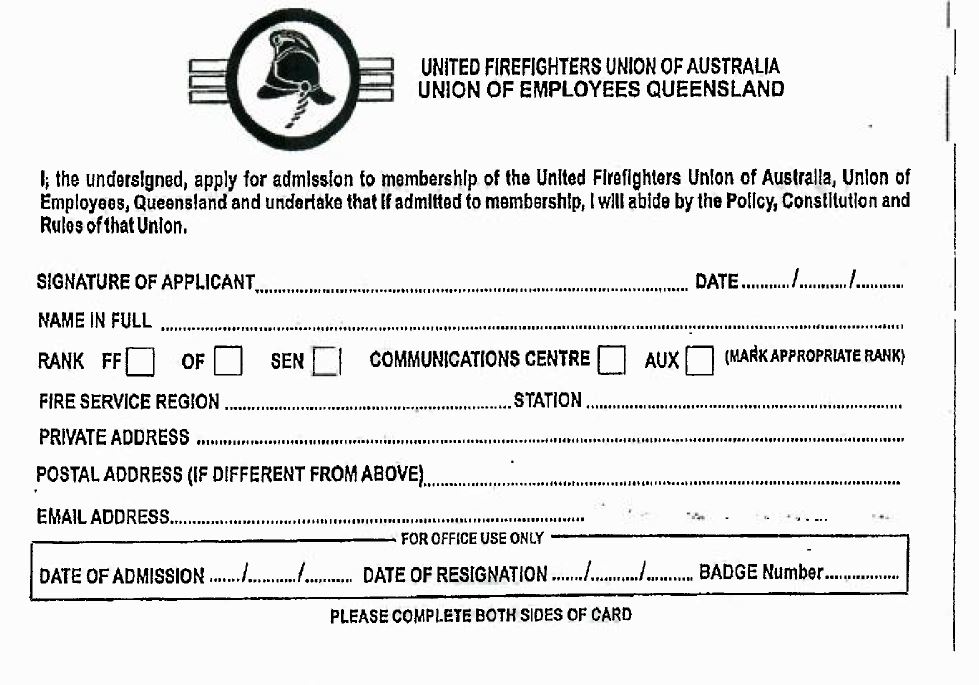
22 The alternate side of the form appeared as follows:
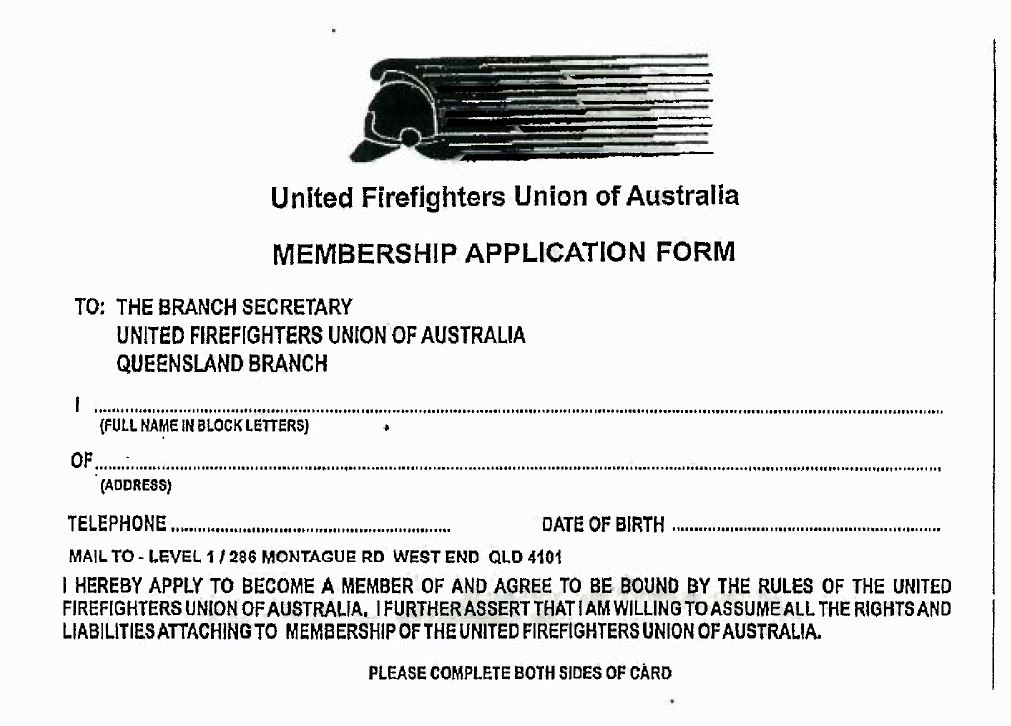
23 Each of the four participants in the s 167 application completed double-sided forms. Records show that Mr Hagger joined the State Union on 2 November 2001. Mr Pham joined the State Union on 17 August 2010. On either 10 or 11 January 2013, Mr Feeney joined the State Union. On 14 January 2013, Mr Neumann joined the State Union. They paid the single subscription fee as required. Their evidence is that they also intended to join the Federal Union at the time they joined the State Union. From that time, (until they were removed from the Register of the Federal Union), they had been treated as members of both unions. This is discussed further below. Suffice to say at this stage that this is now accepted by the State Union. The hard copies of membership forms from applicants prior to July 2013 were stored in the basement of the offices of the State Union and Queensland Branch which, as noted above, were flooded in 2011, likely destroying them.
24 In July 2013, the membership application form changed to a single-sided form, which was used until 2018. Although there were slight amendments to the form over time, they were of no moment.
25 In July 2013, the State Union adopted a new membership system that allowed staff members to upload a completed membership application to a member’s profile, which resulted in a corresponding change in the membership application form. The evidence of the State Union is that these changes to the membership application form were stylistic only and not intended to have any substantive effect.
26 An example of the kind of single-sided form which was used after July 2013 is as follows:
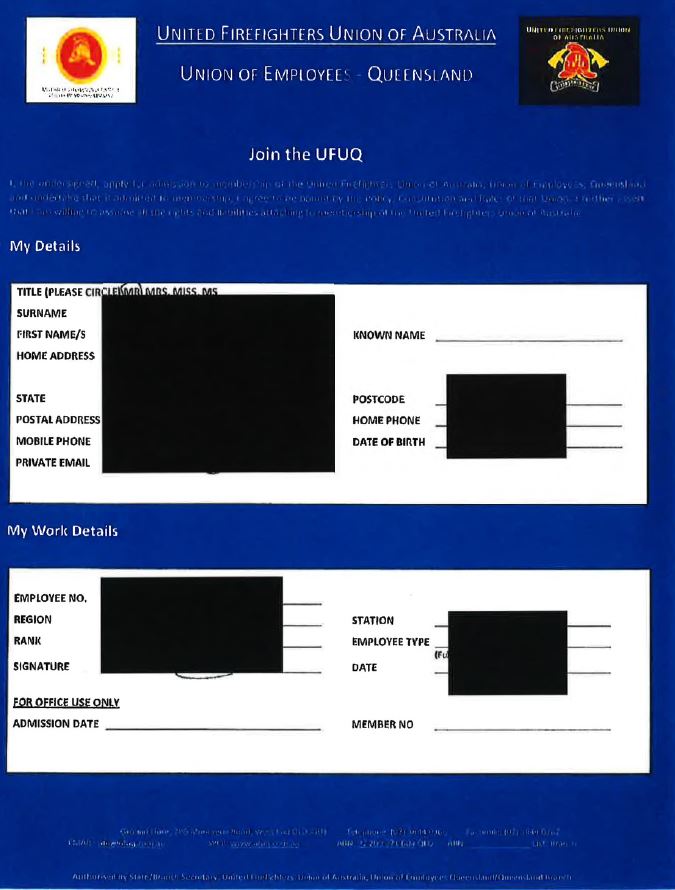
27 Although not apparent from this replication of the form, at the foot of the form is the statement, “[a]uthorised by State Secretary, United Firefighters’ Union of Australia, Union of Employees Queensland”.
28 In respect to paying the subscription, different forms have been used at various times. Prior to 2013, payment was made via payroll deduction and during 2013 and following, payment was made by direct debit or credit card. Copies of the forms used before 2013 were unable to be located, likely due to the flood. However, according to Ms Oliver, the payroll deduction form in use from July 2013 was the same or substantially similar to the one that was used historically. Payroll deductions and direct debit or credit card payments for membership subscriptions were only ever paid directly into the UFUQ bank account.
29 For example, the direct debit form in use from around 2013/14 provided for the following authorisations:
REQUEST AND AUTHORITY TO DEBIT/CHARGE THE ACCOUNT NAMED BELOW TO PAY UFU/UFUQ SUBSCRIPTIONS AND/OR LEVELS
I authorise and request that the amount payable for subscriptions and/or levies (as varied from time to time) which the responsible officer of the UFU/UFUQ certifies as the amount due pursuant to the relevant rules be paid from account by either direct or credit card as indicated by me through the Bulk Electronic Clearing System (BECS).
…
I authorise and request the UFU/UFUQ (ID 404605) to debit my account through the ‘Bulk Electronic Clearing System (BECS)’. The terms and conditions of the Direct Debit Request Service Agreement shall apply.
…
I hereby authorise and request the UFU/UFUQ to charge my credit card account. The authority shall stand until I notify the UFU/UFUQ otherwise in writing.
…
Authorised by State/Branch Secretary, United Firefighters Union of Australia, Union of Employees Queensland & United Firefighters Union of Australia Queensland Branch
30 On 3 September 2018, the membership application form and direct debit form were amended by the State Union to remove all references to the Federal Union. These amended forms were available on the State Union website. I will discuss this further below.
31 The Queensland Branch was required to file financial reports with the Registered Organisations Commission (ROC) in accordance with the FW(RO) Act. The financial reports of the Queensland Branch lodged with the ROC reflect the following information in terms of the size of membership of the Queensland Branch and its total assets:
Financial Year (FY) | Number of members | Total assets |
FY 1999-00 | 1987 | $32,940.45 |
FY 2002-03 | 2050 | $48,202.32 |
FY 2004-05 | 2182 | $40,660.09 |
FY 2009-10 | 2424 | $8,878 |
FY 2012-13 | 2563 | $259,994 |
FY 2013-14 | 2337 | $244,588 |
FY 2014-15 | 2344 | $202,158 |
FY 2015-16 | 2383 | $272,907 |
FY 2016-17 | 2472 | $252,730 |
FY 2017-18 | 56 | $169,462 |
32 The evidence is that the majority of firefighters joined prior to 2013, firefighter turnover is generally low and firefighters usually stay in the profession for a long time. Despite this, the record reflects that there was a significant and sudden reduction in the membership of the Queensland Branch in the period between FY 2016-17 and FY 2017-18 (which coincided with the alleged disenfranchisement). I will explain why this occurred in further detail below.
33 In 2000, Mr Chalmers (who gave evidence called by the State Union) became a member of the BCOM of the Queensland Branch and of the State Committee of Management (SCOM). Mr Chalmers understood that payment of one set of fees made him a financial member of both the Federal Union and State Union. In 2006, Mr Chalmers became a member of the Branch Executive of the Federal Union. In 2012, Mr Chalmers was elected to the position of Junior Vice President of the Queensland Branch. In 2013, Mr Chalmers became Senior Vice President of the Queensland Branch. In 2015, Mr Chalmers again held the position of Junior Vice President, which he held until 2018, when he was made Senior Vice President, a position which he currently holds.
34 On 7 July 2010, Mr John Oliver became Secretary of the Queensland Branch, a position which he held concurrently with the position of Secretary of the State Union. Mr Oliver did not give evidence in these proceedings. I will return to that matter below.
35 It is appropriate at this stage to address some matters chronologically.
36 On 8 May 2018, a meeting of the BCOM was conducted. The minutes of that meeting, prepared by Mr Oliver, record that the “UFUQ and National/Victoria branch are at breakdown point. Fees and work achieved are not in line with the expectation of Queensland. National Office almost defunct”.
37 On 11 July 2018, a further meeting of the BCOM was held. The minutes of that meeting, also prepared by Mr Oliver, reflect that Mr Oliver “discussed the issue of the membership application and the advice received”. It was noted that correspondence was sent to the National Office and that they were awaiting a reply. I note that although there is reference to an advice received, it is entirely unclear what advice that entry relates to.
38 On 29 August 2018, the State Union received a letter of advice from Hall Payne. The letter was addressed to Mr Oliver. It appears that Mr Oliver gave instructions to Hall Payne in respect to the advice. The purpose of the advice was to review the UFUA and UFUQ Rules in the context of the UFUQ’s relationship with the Queensland Branch to ensure that the UFUA and UFUQ Rules adequately provide for the financiality of dual members and that governance and compliance arrangements are adequate. The content of the advice is discussed below.
39 On that same day, Mr Oliver stood aside as Secretary of the Queensland Branch, on the basis of an asserted conflict of interest between holding the position of Secretary for both the State Union and the Queensland Branch arising from issues between the Federal Union and State Union. Mr Chalmers was then appointed by the BCOM as Acting Secretary of the Queensland Branch. I note that although this was a full time position, Mr Chalmers continued to work as a full time firefighter. He also still held his position on the SCOM. I note that despite stepping down, Mr Oliver appeared to still attend at least some BCOM meetings (such as the meeting on 11 September 2018, to which the minutes record his attendance as a “guest”). I note also that he continued to write letters to Mr Peter Marshall, National Secretary of the Federal Union, in relation to Queensland Branch matters, purporting to do so in his capacity as Secretary of the State Union.
40 Mr Chalmers said that in or about September 2018 the State Union and Queensland Branch had identified that the membership application form that had been in use after July 2013 was purportedly defective (on the basis, it appears, of the Hall Payne advice). In particular, Mr Chalmers’ evidence is that it was considered at the time that:
(a) as a result of the defect, members of the State Union who had completed the defective form were not likely members of the Federal Union;
(b) the Queensland Branch’s records did not make clear who was properly a member of the Federal Union;
(c) no subscription had been raised in accordance with the UFUA Rules for Queensland Branch members; and
(d) there was no recognition of the financial status of financial members of the State Union as financial members of the Federal Union.
41 On 3 September 2018, Mr Oliver wrote to Mr Marshall, including as follows:
I have, at the request of the State Executive of the UFUQ, investigated the rules of the UFUQ, the rules of the Queensland Branch of the UFUA, and the interrelationship between the two entities.
The conclusion I have reached following my investigation is as follows:
• the Queensland membership application form is defective;
• a direct result of that defect is that the members of the UFUQ are not also members of the UFUA Queensland Branch and, to the extent that they were treated as members of the UFUA, as a result of the defect can no longer be treated as members; and
• no subscription has been raised in accordance with the UFUA rules putting in doubt (when taken together with the issue of membership) as to what payments to the national fund should have been made in the past (in respect of the Branch) and what should be made in future.
…
To assist the persons who have been treated as members of the Branch, I have in consultation with the State President, determined to place a notice to members of the UFUQ who have been treated as members of the Branch, that they may make application under s 168 of the Act.
42 On 10 September 2018, Mr Marshall responded by letter to Mr Oliver seeking clarification about the nature of the defect and querying, inter alia, how long the “defective” application form had been in use and what forms were previously used. Mr Marshall noted that if the previous forms did not suffer from the same deficiency, then “the problem may be smaller than you [Mr Oliver] perceive”. He also suggested that any applications under s 168 were premature in the circumstances, and that they should meet to discuss.
43 On 18 September 2018, Mr Chalmers posted a letter to members on the State Union website. The letter enclosed an application form which affected members could complete in order to seek admission to the Federal Union under s 168 of the FW(RO) Act.
44 As Mr Chalmers accepted during cross-examination, a number of steps needed to be taken to access the letter and accompanying s 168 form on the UFUQ website. Once a user accessed the UFUQ website, they could navigate from a number of links. These included “shift calendar”, “member’s area”, “update your details” and “UFU Queensland branch”. To access the letter, the user was required to select the “UFU Queensland branch” option. Thereafter, further links were presented, including the relevant link, titled “UFUA-Q members form – s168”, to access the letter and accompanying form.
45 If access was made to this link, the following letter appeared (emphasis in original):
Dear UFUQ member
As you may be aware there is a union in Qld under the state industrial system (UFUQ) and a union in the Commonwealth industrial system (UFUA).
Recently, the State Secretary of the UFUQ has, at the request of the State Executive, reviewed the membership application process used by the unions to ensure that it was compliant with their rules.
Through that review issues have been identified which, in a legal sense, puts into doubt whether membership of the Queensland Branch of the United Firefighters of Australia (UFUA) was effected when you applied to become a member of the UFUQ.
The view of the Union’s lawyers is that, whilst you are a member of the state registered union (UFUQ) and you retain the full rights and benefits of your membership, you did not become a member of the UFUA. This error appears to have been inherited by the current Executive and at no point in the time since the formation of the federal union, over 20 years ago, was it picked up.
This situation can be remedied with your consent. There is no doubt at all that you have been treated by the UFUA as a member and section 168 of the Registered Organisations Act (Commonwealth) provides a method of resolving this issue, by allowing a person who has previously been treated as a member of an organisation, to make application for membership:
To make the process user friendly, please fill out and sign the attached form, then scan and email it to peterchalmers@ufuq.com.au and they will be forwarded to the national union.
There will be no pause in your access to full industrial representation by the UFUQ or the UFUA.
On behalf of the UFUQ and the UFUA I apologise for the inconvenience.
Regards
Peter Chalmers
Acting Secretary UFUA - Q
18 September 2018
46 Attached to this was a notice pursuant to s 168, in the following terms:
Notice to the Queensland Branch of the United Firefighters of Australia (UFUA)
I , confirm that, I:
• am employed by QFES;
• am eligible for membership of the UFUA;
• have in good faith acted as a member of the UFUA; and
• believe that I have been treated as a member of the UFUA,
and seek under s168 of the Registered Organisations Act, to be admitted as a member of the UFUA as if I was a member through the whole period of time that I was treated as a member.
Date: ..../09/18
Signed: ..................................
47 I will return to this topic below, suffice to say at this stage, the manner in which this posting occurred and the content of the posting (including its accuracy) is in issue.
48 On 21 September 2018, Mr Oliver wrote to Mr Marshall and, inter alia, provided a copy of the membership application form that had been in use since 2013, and stated that he had not been able to locate an earlier version of the form. Pausing there, the evidence establishes that the pre-2013 form could be located on the UFUQ website. Mr Oliver clarified what he said the nature of the purported defect was, as follows:
The defect is clear, candidates have applied for admission to the UFUQ but not the UFUA. Rather they have (at best) expressed a willingness to assume rights (sic) and liabilities but not applied for membership. Membership of a voluntary organisation, such as the UFUA, is a contractual relationship. There is, unfortunately, nothing evidencing the intention of persons to enter into a contract with the UFUA.
49 Mr Oliver also advised that the Queensland Branch consider that the s 168 application process should occur and that State Union members who have been treated as Federal Union members have been notified via the State Union website.
50 On 21 September 2018, Mr Chalmers wrote to Kidmans Partners, the national auditors, stating that as at 30 June 2018 there were only 56 members of the Queensland Branch.
51 As at 18 October 2018, after one month had elapsed since Mr Chalmers posted the letter on the UFUQ website, no s 168 forms had been returned. As a result, the Queensland Branch considered that it was unable to determine who was properly a member of the Queensland Branch, apart from 56 members, who were officers of the Queensland Branch and firefighters employed by a national system employer.
52 On 23 October 2018, Mr Chalmers lodged the Queensland Branch’s financial reports with the ROC, which relevantly stated that there were only 56 members in the Queensland Branch as at 30 June 2018.
53 On 26 October 2018, Mr Oliver wrote to the Secretaries of each of the branches of the UFUA informing them of the issues that had arisen and enclosing correspondence between him and Mr Marshall.
54 On 8 November 2018, Mr Marshall wrote to Mr Oliver and enclosed proposed changes to the UFUA Rules concerning the issues relating to membership.
55 On 8 November 2018, the ROC wrote to Mr Oliver in relation to the Queensland Branch’s financial reports lodged for the FY ended 30 June 2018. In the letter, the ROC requested further information including, inter alia, about significant changes to the financial affairs of the Queensland Branch, noting a large reduction in revenue and decrease in membership of 97.7% (from 2472 to 56) between 2017 and 2018.
56 On 30 November 2018, Mr Chalmers responded to the ROC and relevantly explained, inter alia, as follows:
The UFUQ in reviewing the membership application that had been utilised for both the UFUQ and the Branch in relation to persons eligible for membership of both the UFUQ and the Branch, determined that the membership application was significantly defective in so far as application for membership of the Branch was concerned. The Branch is aware of that determination and the consequence of that defect being that the persons who applied for membership of the UFUQ did not apply for membership of the Branch, and the contract of membership had not been formed (in so far as the Branch and the respective member was concerned). The view of the Branch is that the exceptions to this are the officers of the Branch and the members who were engaged by national system employers (as they were advised in relation to their industrial representation being through the Branch when they joined), however to put that beyond doubt it was considered appropriate for those persons to apply under section 168 of the Fair Work Registered Organisations Act (FW ROA).
…
I confirm that a notice was placed, by the UFUQ as it undertook to do so, on its website. The Branch has (in response to that notice) received no application under section 168 of the Act.
The correspondence between the UFUQ and the UFUA and between the UFUA and the Branch adequately sets out the situation and how it is proposed to be rectified, albeit the terms/rule changes need to be finalised.
In summary:
(a) a person cannot be 'deemed' to be a member of an organisation as the contract of membership is consensual and application must evidence an intention to become a member;
(b) the persons treated as members of the Branch had not applied for membership;
(c) the exception to (b) were the:
(i) officers of the Branch; and
(ii) eligible members employed by national system employers;
(d) the members falling into the exceptions set out in (c) number 56 in total at the time the rules provide for the assessment of capitation;
(e) the arrangements with the UFUQ:
(i) for its payment to the Branch of an amount equalling the capitation component of each dual member provide for payment only for actual dual members;
(ii) are now required, by the UFUQ, to be made the subject of a binding agreement;
(iii) require rule modifications to be made to the UFUA rules; and
(f) it is the intention of the Branch, the UFUA and the UFUQ that these matters be regularised, the membership of all members eligible to be members of the Branch be perfected (using UFUA rule 7(4)) and the arrangements for payment of an amount equalling capitation (pursuant to a service agreement) be formalised.
For these reasons the circumstances were seen by the Branch as transitional and not representing a significant change in the financial affairs of the Branch.
UFUQ is currently seeking advice and suggested drafting in relation to proposed rule changes which they have undertaken to provide to the Branch for its consideration. Once this advice is available, we will be able to put any suggestions back to the UFUA for their consideration.
57 In April 2019, each of the participants in the s 167 application (with the exception of Mr Feeney) filed application forms pursuant to s 168 to be recognised as members of the Federal Union.
58 On 16 May 2019, Mr Oliver responded to Mr Marshall’s correspondence of 8 November 2018 in which he had enclosed proposed amendments to the UFUA Rules to address the issues raised. In his letter, Mr Oliver stated as follows:
It appears that I have not formally responded to the rule changes you have proposed in the correspondence of 8 November 2018. Whilst I accept that it is a matter entirely to be determined by the UFUA, the rule changes you have proposed are not, with the possible exception of the proposed change to r 80, either lawful or in a form that I believe could be accepted as a resolution of the various issues by the UFUQ.
59 On 22 May 2019, Mr Oliver wrote to each of the four participants, informing them, inter alia, their applications were out of time. Mr Oliver explained as follows:
To assist the UFUA to make certain its membership the Branch proposed that a section of the Commonwealth organisations legislation be utilised – section 168. The UFUQ placed the notice on its website (as the Branch does not have a website) with a view to assisting persons who wish to have membership of the UFUA. Unfortunately the period of time that the legislation provides to make that application is a month and that time passed in October 2018. The section no longer has utility.
60 On 28 May 2019, Mr Marshall responded to Mr Oliver’s letter of 16 May 2019, advising, inter alia, that Mr Oliver had failed to explain why in his view the proposed rule changes were not lawful or in an acceptable form, and requested that they meet to discuss the issues.
61 As referred to in more detail below, the financial statements of the UFUQ for the year ended 30 June 2019 showed in ‘Note 7 on Related Parties’ that:
The members of the United Firefighters Union of Australia Union of Employees Queensland (State Union) are also members of the United Firefighters Union of Australia Qld Branch (Federal Union). As part of this arrangement the State Union transfers funds to the Federal Union during the financial year to assist in the ongoing management of that Union.
62 Between 12 and 22 August 2019, all members of the BCOM (including Mr Oliver) resigned from office. The reasons where given, were in one case, personal reasons, and in the others, that they see no value in maintaining membership with the Federal Union. The Federal Union was advised of the resignations on 2 September 2019. I note that the members of the BCOM had stood for and been elected to those positions in May 2018, and to do so they had to have been financial members of the Federal Union.
63 On 2 September 2019, Mr Chalmers resigned, by letter addressed to Mr Marshall, from membership of the Federal Union and from his position as Senior Vice President of the Queensland Branch.
64 In or around September 2019, Ms Oliver compiled lists of members of the Queensland Branch as at pre-September 2018 (2298 members), and as at post-3 September 2018 (48 members). The list, prior to 3 September 2018, included the names of the four firefighters. I note that, as referred to above at [50], on 21 September 2018, Mr Chalmers wrote to the national auditors stating that as at 30 June 2018 there were only 56 members in the Queensland Branch. Similarly, the financial reports for the FY ending 30 June 2018, lodged in October 2018, refer to there being 56 members as at 30 June 2018 (see above at [52]). There were no submissions as to the basis on which that occurred, given the Hall Payne advice was not received until 29 August 2018.
65 On or about 13 September 2019, materials and records said to be in respect to the Queensland Branch, were collected from the State Union office by a representative of Mr Marshall.
66 In a letter from Mr Oliver to Mr Marshall dated 11 October 2019, Mr Oliver informed Mr Marshall that the State Union intended to close the bank accounts of the Queensland Branch and return the money in them to the State Union (the accounts having $122,976.20). The Federal Union, through its lawyers, communicated with the banks, and asked that no such dealings with the accounts be permitted. On 18 and 24 October 2019, CBA and NAB respectively confirmed they will not permit any dealings with the Queensland Branch’s bank accounts.
67 On 26 November 2019, Mr Marshall wrote to the ROC informing it that all positions on the BCOM were currently vacant and that there was no ability under the UFUA Rules to fill the casual vacancies by appointment. Mr Marshall sought guidance from the ROC about how to deal with these concerns, noting that he held doubts that a valid roll of members of the Queensland Branch could be constituted. In the letter, Mr Marshall outlined the context to the dispute between the Federal Union and the State Union, and suggested that in his view, based on his knowledge of turnover of firefighters in their employment, it “is inconceivable that more than two thousand firefighters who were members as at 2013 (and who had applied using dual forms) had ceased to be members”. Mr Marshall also foreshadowed that an application may be made under s 323 to reconstitute the Queensland Branch.
68 On 4 June 2020, the State Union filed proceedings in the District Court of Queensland seeking, inter alia, that the Federal Union pay money held in the Queensland Branch bank accounts to the State Union. Those proceedings have not been heard.
69 Against that background I turn to the two applications.
Section 167 application
70 Section 167(1) of the FW(RO) Act gives this Court jurisdiction to make a declaration as to a person’s entitlement to membership: Construction, Forestry, Mining and Energy Union v CSBP Limited (No 2) [2012] FCAFC 64; (2012) 202 FCR 149 at [27].
71 Section 167 is in the following terms:
167 Federal Court may declare on person’s entitlement to membership
Who may apply to Federal Court
(1) Where a question arises as to the entitlement under section 166 of a person:
(a) to be admitted as a member of an organisation (whether for the first time or after having resigned, or been removed, as a member of the organisation); or
(b) to remain a member of an organisation;
application may be made to the Federal Court for a declaration as to the entitlement of the person under this section by either of the following:
(c) the person;
(d) the organisation concerned.
Court may make orders relating to its declaration
(2) On the hearing of an application under subsection (1), the Court may, in spite of anything in the rules of the organisation concerned, make such order to give effect to its declaration as it considers appropriate.
(3) The orders which the Court may make under subsection (2) include:
(a) an order requiring the organisation concerned to treat a person to whom subsection 166(1) or (4) applies as being a member of the organisation; and
(b) in the case of a question as to the entitlement under this section of a person to be admitted as a member of an organisation, where the person has previously been removed from membership of the organisation—an order that the person be taken to have been a member of the organisation in the period between the removal of the person from membership and the making of the order.
Effect of orders
(4) On the making of an order as mentioned in paragraph (3)(a), or as otherwise specified in the order, the person specified in the order becomes, by force of this section, a member of the organisation concerned.
(5) Where:
(a) an order is made as mentioned in paragraph (3)(b); and
(b) the person specified in the order pays to the organisation concerned any amount that the person would have been liable to pay to the organisation if the person had been a member of the organisation during the period specified in the order;
the person is taken to have been a member of the organisation during the period specified in the order.
Court to give certain people opportunity to be heard
(6) Where an application is made to the Court under this section:
(a) if the application is made by an organisation—the person whose entitlement is in question must be given an opportunity of being heard by the Court; and
(b) if the application is made by the person whose entitlement is in question—the organisation concerned must be given an opportunity of being heard by the Court.
72 I note that s 167(1) operates in circumstances where a question arises as to a person’s entitlement to be admitted under s 166. Section 166 relevantly provides:
166 Entitlement to become and to remain a member
Employee organisations
(1) Subject to any modern award or order of the FWC, a person who is eligible to become a member of an organisation of employees under the eligibility rules of the organisation that relate to the occupations in which, or the industry or enterprise in relation to which, members are to be employed is, unless of general bad character, entitled, subject to payment of any amount properly payable in relation to membership:
(a) to be admitted as a member of the organisation; and
(b) to remain a member so long as the person complies with the rules of the organisation.
Note 1: Rules of an organisation must provide for the circumstances in which a person ceases to be a member of an organisation (see subparagraph 141(1)(b)(vii)).
Note 2: If a member fails to pay his or her membership dues for 24 months, this may result in the person ceasing to be a member, regardless of the rules of the organisation (see section 172).
Note 3: See also section 168, which deals with a special case of entitlement to membership (person treated as having been a member).
(2) Subsection (1) does not entitle a person to remain a member of an organisation if the person ceases to be eligible to become a member and the rules of the organisation do not permit the person to remain a member.
(3) A person who is qualified to be employed in a particular occupation, and seeks to be employed in the occupation:
(a) is taken to be an employee for the purposes of this section; and
(b) in spite of anything in the rules of the organisation, is not to be treated as not being eligible for membership of an organisation merely because the person has never been employed in the occupation.
Employer organisations
(4) Subject to subsection (5) and to any modern award or order of the FWC, an employer who is eligible to become a member of an organisation of employers is entitled, subject to payment of any amount properly payable in relation to membership:
(a) to be admitted as a member of the organisation; and
(b) to remain a member so long as the employer complies with the rules of the organisation.
(5) Subsection (4) does not entitle an employer:
(a) to become a member of an organisation if the employer is:
(i) a natural person who is of general bad character; or
(ii) a body corporate whose constituent documents make provisions inconsistent with the purposes for which the organisation was formed; or
(b) to remain a member of an organisation if the employer ceases to be eligible to become a member and the rules of the organisation do not permit the employer to remain a member.
This section overrides inconsistent rules
(6) Subsections (1) and (4) have effect in spite of anything in the rules of the organisation concerned, except to the extent that they expressly require compliance with those rules.
73 Section 168 also features in these proceedings:
168 Application for membership of organisation by person treated as having been a member
(1) Where:
(a) a person who is eligible for membership of an organisation (other than a member of the organisation or a person who has been expelled from the organisation) applies to be admitted as a member of the organisation; and
(b) the person has, up to a time within one month before the application, acted in good faith as, and been treated by the organisation as, a member;
the person is entitled to be admitted to membership and treated by the organisation and its members as though the person had been a member during the whole of the time when the person acted as, and was treated by the organisation as, a member and during the whole of the time from the time of the person’s application to the time of the person’s admission.
(2) Where a question arises as to the entitlement under this section of a person to be admitted as a member and to be treated as though the person had been a member during the times referred to in subsection (1):
(a) the person; or
(b) the organisation;
may apply to the Federal Court for a declaration as to the entitlement of the person under this section.
(3) Subject to subsection (5), the Court may, in spite of anything in the rules of the organisation concerned, make such orders (including mandatory injunctions) to give effect to its determination as it considers appropriate.
(4) The orders that the Court may make under subsection (3) include an order requiring the organisation concerned to treat a person to whom subsection (1) applies as being a member of the organisation and as having been a member during the times referred to in subsection (1).
(5) Where an application is made to the Court under this section:
(a) if the application is made by an organisation—the person whose entitlement is in question must be given an opportunity to be heard by the Court; and
(b) if the application is made by the person whose entitlement is in question—the organisation concerned must be given an opportunity to be heard by the Court.
Submissions
74 In summary, the applicant contended that the four firefighters were members of the Federal Union, and unbeknown to them, and through no conduct on their part, they are no longer members. That is, it contended their names were improperly removed from the Register. The Federal Union submitted that there was a deliberate course of conduct engaged in to disenfranchise the membership of the Federal Union, driven by Mr Oliver. Although the originating application seeks declarations be made as to the four firefighters’ membership, reflecting they are and have been members of the Federal Union since 30 April 2013, in closing submissions the applicant contended that it sought declarations, as to “continuous and unbroken membership”. It submitted that retrospective declarations ought to be made, particularly in the context of the UFUA Rules which relevantly require a period of continuous financial membership in order for a member to stand for election.
75 Affidavits of the four firefighters, recited above at [6], were read, and each firefighter was required for cross-examination. The applicant submitted that each of the four firefighters gave evidence that they intended to join both the State Union and the Federal Union, and that they understood that payment of their subscriptions to the State Union would render them financial members of both the State Union and the Federal Union. The roll of members as at 2018, prior to the mass disenfranchisement of members, contained the names of the four firefighters.
76 Although the State Union initially opposed any declaration as to their membership being made and, indeed, cross-examined each of the firefighters, inter alia, on the basis that there was no benefit in being a Federal Union member, that opposition is no longer maintained. Rather, in its closing submission the State Union changed its position and now does not contest that each of the individuals intended to join the Queensland Branch at the time they executed membership forms. However, it contended that there remains a question about the membership of the four firefighters as a result of the failure of the Queensland Branch, in accordance with r 80 of the UFUA Rules, to set a subscription fee and for members to pay any subscription fee to the Queensland Branch. Moreover, any declaration under s 167(1) must be confined to the four firefighters, and if such a declaration was to be made, it should not be retrospective. This was said to be because there is a lack of utility in making a retrospective declaration.
77 Additionally, the State Union submitted that there was no improper conduct by it and that it acted in good faith in pursuance of legal advice. It contended that whether that advice is correct or not is beside the point. The State Union did not engage in a covert strategy to disenfranchise members of the Federal Union. The actions that were taken were intended to rectify the issues that had arisen, notwithstanding that they could have done better.
Consideration
78 The four firefighters applied to be members of the Federal Union, with the State Union now accepting that that was the firefighters’ intention in completing the double-sided forms. Each witness understood that payment of their subscriptions to the State Union would render them financial members of both the State and Federal Unions. The evidence of the State Union’s two witnesses was to the effect that it was always the intent to treat members as financial members of both the State Union and the Queensland Branch.
79 As noted above, Mr Oliver, who was Queensland Branch Secretary since 2010, had authority to enter in the Register the name of any applicant for membership if in his opinion there was “no doubt as to the admission of the applicant”: r 64(1)(ee). There was no evidence to suggest that this rule was not given effect to or complied with. That is, there was no doubt about the admission of these four firefighters into membership of the Federal Union. I accept the applicant’s submission that an inference should be drawn that this power was “exercised in the manner contemplated”.
80 There was only one membership database. Membership details were entered onto the membership database, and Ms Oliver accepted that, having been entered on the database as a member, the database was the only evidence she used on a day-to-day basis to check whether a person was a member of the Queensland Branch. That membership database was used to calculate the affiliation/capitation fees payable to the Federal Union, which were based on the number of members of the Queensland Branch.
81 Ms Oliver accepted that this one database was used to satisfy compliance with the obligations in the FW(RO) Act. She also confirmed that the information placed into the membership database was used for the purposes of complying with both state and federal statutory requirements, including in respect of producing a roll of members for the Australian Electoral Commission’s (AEC) conduct of Queensland Branch elections.
82 The membership database, which is from where the roll of members of the Queensland Branch prior to 3 September 2018 was generated (referred to above at [64]), contained the names of these four firefighters. As at that date, the four firefighters were members of the Federal Union. Likely in or around September 2018, (although noting [64] above) these firefighters, without their knowledge, had their names removed from the Register, with the effect they were no longer members. The precise date of their removal from the Register is unclear, and of no practical moment. The lists of members from the Register compiled by Ms Oliver for membership post-3 September 2018 have their names removed (which was before the s 168 letter was posted on the UFUQ website). It is their position as members held prior to that occurring, which the four firefighters want restored by the declarations sought.
83 Once entered on the Register as a member of the Federal Union, members remain on the Register until they resign, or when one of the circumstances set out in the FW(RO) Act (for example, s 172 of the FW(RO) Act, where a member ceases to pay required fees for 2 years) or the UFUA Rules arises, to warrant removal. Absent that, there is no power or basis to revoke membership: see for example, Australian Education Union v Lawler [2008] FCAFC 135; (2008) 169 FCR 327 at [14], [19] and [239]-[240]. Neither of these situations has been suggested by anyone to have been the cause of the action taken at the time, removing these four firefighters from the Register. The respondent does not point to any provision of the FW(RO) Act or UFUA Rules to justify what occurred, and nor does Mr Chalmers, the then Acting Secretary of the Queensland Branch.
84 Rather, as noted above, the respondent’s evidence and submission is that the removal of the names of these four firefighters (and approximately 2500 others) was done in accordance with legal advice. The legal advice was admitted over the objection of the applicant. Its relevance was said to establish the bona fides of what occurred, in a context where the applicant had made allegations as to the respondent’s conduct. The legal advice was tendered and admitted not for the truth or correctness of its content, but the fact of it. However, the respondent does not seek to defend the correctness of that advice which was obtained by them (and nor does it rely in this Court on any reasoning about membership akin to that contained in the advice). Its concession in respect to the membership of these four firefighters appears to cut across the concerns said to be had about membership. Nonetheless, the respondent’s submission starts from the position that as the four firefighters have been removed, there is a real question as to their status because of the absence of them making any subscription payment to the Queensland Branch (and the alleged failure of the Queensland Branch to set such a subscription payment).
85 The State Union submitted that this application only relates to the four firefighters whose application for membership was made prior to the form changing in July 2013. It was submitted that the s 167 application was not about the removal of members from the membership roll, and in any event, that was done in good faith acting on legal advice. In that context, it was submitted much of the Federal Union’s submissions as to those events which occurred after the form changed in July 2013 were irrelevant. It is correct that this application only relates to four firefighters, and that each did apply prior to the form changing in July 2013. However, contrary to the State Union’s contention, the circumstances which resulted in them being removed from the Register of the Federal Union are plainly relevant to a consideration of this application. This is all the more so given the State Union is opposing the declarations sought, contending that any declarations, if made, should not be retrospective.
86 Before addressing the respondent’s evidence as to acting on legal advice, it is appropriate to consider some factual matters, in addition to those referred to above.
87 The evidence establishes that all new members who joined after 1990 were treated in the same manner as existing members. They were recognised as financial members of the Federal Union by reason of having paid membership subscription fees to the State Union and having applied to join “the Union”. As Ms Oliver, who was called by the respondent accepted, it was always the intent to treat members as financial members of both the State Union and the Queensland Branch. And each member was treated as a financial member of both the State Union and the Queensland Branch. For example, Mr Chalmers accepted that the payment of one set of fees entitled him to be nominated for election in both the Federal Union and State Union (noting that financiality was a precondition to nomination).
88 That position is reflected in the contemporaneous documentary evidence. To take just some examples.
89 The information document produced by the respondent as to the benefits of membership, which is typical of that provided to recruits at induction training, relevantly includes the following:
Upon joining the UFU, you become a member of two organisations, the Queensland registered United Firefighters Union of Australia, Union of Employees, Queensland and the Federally registered United Firefighters Union of Australia, Queensland Branch.
90 Financial statements filed by the Queensland Branch also refer to the members as “dual members” of the two unions. For example, the Queensland Branch’s financial reports for the FY ending 30 June 2013, under the heading ‘Related Party Disclosures’, provided that (emphasis added):
During the financial year, in accordance with a resolution of the Branch Committee of Management, a grant of $250,000 was received from the United Firefighters Union of Australia, Union of Employees Queensland to ensure that the Branch is presently able to effectively function and provide ongoing support to the dual members of the UFUA/UFUQ.
91 From January 2014 to August 2018, the State Union website provided that:
On acceptance of your membership, you receive member status of both the Queensland registered United Firefighters’ Union of Australia, Union of Employees, Queensland and the Federally registered United Firefighters’ Union of Australia, Queensland Branch.
92 The audited financial statements for the State Union, including up until the FY ending 30 June 2019, recorded payments to and from the Queensland Branch. In that financial statement, ‘Note 7 on Related Parties’ relevantly recorded that:
The members of the United Firefighters Union of Australia Union of Employees Queensland (State Union) are also members of the United Firefighters Union of Australia Qld Branch (Federal Union).
93 The financial statements are required by s 268 of the FW(RO) Act to be filed with the ROC and it can be accepted that these statements are admissions made pursuant to statutory duties, signed off by Mr Oliver, which appeared in public documents, and as such are made in circumstances of “the utmost solemnity”: NT Power Generation Pty Ltd v Power & Water Authority [2004] HCA 48; (2004) 219 CLR 90 at [55].
94 As referred to above, the officers in the State Union applied every three years, from 2006 onwards, to the Queensland Industrial Relations Commission (QIRC) to be exempt from the need to run elections for the State Union. The applications were made and granted based on the fact that membership of the Federal Union was the same as membership of the State Union. As described above at [80], the State Union maintains an electronic membership database which was used for the purposes of producing a roll of members to satisfy requirements in respect of the AEC’s conduct of elections in relation to the Queensland Branch. As noted above, Ms Oliver confirmed that the information included on an applicant’s membership form was ordinarily entered onto the membership database and that information was treated as being definitive of any question of membership.
95 The exemption applications made each election cycle were supported by an affidavit of Mr Oliver, the Secretary of the State Union. In these affidavits, Mr Oliver deposed on a number of occasions that: “All members of the UFUQ are eligible to be, and are, members of the UFUA pursuant to rule 6 of the UFUA rules”. These statements were on oath, with all that that entails. That statement was made most recently by Mr Oliver in an affidavit sworn on 24 May 2018, in respect to an exemption for the 2018 election. Such statements were also made in other affidavits dated 10 September 2012, 30 January 2013, 15 May 2013, and 19 May 2016.
96 In addition, the terms of the membership application forms in both the pre-2013 and the 2013 versions, referred to above at [20]-[27], reflect this.
97 Turning then to Mr Chalmers’ evidence, that whatever was done was on the advice received from Hall Payne. That advice was dated 29 August 2018. The respondent tendered a copy of that advice in support of Mr Chalmers’ evidence. However, on a proper reading, that advice does not support that contention. As noted above, the respondent’s closing submission did not appear to seek to defend the advice or advance the positions advocated therein.
98 First, the advice reflects that certain instructions were provided which formed the basis of the advice, including that the membership form provided to Hall Payne on which the advice was sought was in “long-standing use”. The form provided was the 2013 version, which had only been in operation for five years, and, as the membership figures set out above at [31] show, only applied to a small number of its members. As is apparent from the forms reproduced above, there is a difference in language between the 2013 form and the pre-2013 form. The vast majority of members submitted the pre-2013 form which applied for over 20 years. It follows that at best, the advice on that aspect could only have applied to a limited number of members. Mr Chalmers in cross-examination conceded as much. This raises the issue of why such inaccurate instructions were provided. Nonetheless, the BCOM (and the State Union) must have been aware that the advice had limited application, but chose irrespectively, on Mr Chalmers’ evidence, to act on it in respect to all members. I observe also in this context that on 10 September 2018, Mr Marshall had responded to Mr Oliver’s letter of 3 September 2018 and expressly raised the issue with him of how long the defective application form had been in use: see [41]-[42] above.
99 Second, on the issue of membership, the advice suggested that it was arguable that persons may be members on the basis that there was evidence (other than the membership application form) they were treated as members. Hall Payne, although it expressed some doubt that any such conduct existed (other than officers nominating for elections), indicated that it “would appreciate discussing this aspect further”. Even given their concerns, the advice was that nonetheless the BCOM would be members by virtue of the fact they had been treated as members. There is no evidence of any further advice being sought, or indeed, of any further discussion with Hall Payne on this topic. There is also no evidence, and therefore no explanation, as to why seeking further advice did not occur. It would have been the obvious step to undertake if the BCOM was acting in the interests of its members.
100 Third, the BCOM instead simply concluded, in effect, that members of the Federal Union, which included these four firefighters, were no longer members of the Federal Union (apart from the BCOM and employees of the Federal Union) and on 18 September 2018 placed a link on the UFUQ website purporting to provide notice of the issue and a solution via s 168. The Hall Payne advice did not recommend that a notice directed to members be put on the website in the manner which occurred. The issue of s 168 arose in the advice in respect to the BCOM, although I note that the advice did state “the notice should invite any UFUQ members who wish to make an application to be members of the Branch, to make an application”. That said, the advice cautioned against the use of s 168 as a means to rectify individual memberships because of the time limits, noting that it is “unlikely to have value”. I note also that if such notice was to be given, the advice referred to the need for it to direct attention to the issues with the membership and to the provisions of s 168.
101 Even if, for the purpose of argument, Mr Chalmers had concerns about some membership forms, the Queensland Branch members were not properly notified by him of any issues.
102 There was no information readily accessible on the website that would alert either the four firefighters, or any other person, to there being any issue with their membership. Rather, as discussed above, Mr Chalmers simply placed a link on the State Union website in an obscure manner, described above at [43]-[44]. The link did not alert any member to there being an issue with their membership. The name of the link was “UFUA-Q members form – s168”. The link was not brought to their attention. As posted, no member accessing the website, even if they had clicked through to the page with the link, would know to click on that link unless they already knew there was an issue with their membership. Nothing on the face of the link alerted them to the fact of an issue as to the status of their membership. Nothing on the link alerted them to any time sensitivity of actions one might take. The link was placed on the website about two weeks after receipt of the Hall Payne advice. Once the link was accessed, the information provided there did not include any reference to the statutory time limit which applies to s 168. If it was genuinely intended that persons who understood themselves to be members of the Federal Union be given proper notice that they were no longer members and that they be provided with an opportunity to rectify that, it would not have been done in the manner in which it was.
103 The information provided in the letter, recited above at [45], was also inaccurate. I note at the outset, that although the letter was signed off by Mr Chalmers as Acting Secretary of the Queensland Branch, it is addressed to State Union members (by this time they had been removed from the roll as Federal Union members). The statement that the view of the State Union’s lawyers was that members did not become a member of the Federal Union is incorrect. If that statement is based on the Hall Payne advice, it was not the advice given. As noted above, Hall Payne needed more information to consider if the members had been treated as members of the Federal Union. I note also that the letter acknowledges the obvious: State Union members had been treated by the Federal Union as Federal Union members. The statement that they are not members of the Federal Union, and that the error in membership “appears to have been inherited by the current executive and at no point in time since the formation of the federal union over 20 years ago, was it picked up” is also incorrect. It will be recalled that the only membership form provided to Hall Payne was the form in use from July 2013. Mr Oliver was the Queensland Branch Secretary at that time, and Mr Chalmers was a member of the BCOM. Both Mr Oliver and Mr Chalmers held equivalent positions with the State Union. The change of form in 2013 occurred under their watch. The changes were instigated or undertaken by the State Union (see [24]-[25] above). The letter also refers to the issue of membership applying to all members; it was not confined to those who applied using the 2013 form, which was the only form about which advice was given. Ms Oliver believed the State Union’s lawyer or industrial officer drafted the letter. That was not Mr Chalmers’ evidence, which was silent on the topic. It is also unlikely to have been, given the plain inaccuracies. Irrespective of who drafted it, Mr Chalmers published the letter on the website, which even a cursory reading of it by a person in his position, would have made it readily apparent that it contained statements which were incorrect.
104 Given the manner in which the notice was posted on the website, unsurprisingly, only 20 applications for membership were made, and they were all made outside the 28 day time limit imposed by s 168. The four firefighters did not become aware of the membership issue via the website; rather, their attention was drawn to it, outside the time limit, by another firefighter.
105 There was evidence that members could have been notified of important matters via a Code Red or Code 2, the State Union’s news bulletin. Mr Chalmers agreed that these labels are used to describe important announcements that impact union members, but gave evidence that Code Red had not been used for a long time and he did not think about or view the notice as being a Code Red. In that context, in each of Mr Oliver’s affidavits accompanying the exemption applications, he notes that information amongst firefighters is shared using methods such as a Code 2, which, at least in the case of elections, is forwarded to every fire station and location where State Union members are employed, placed on the worksite noticeboard and State Union website, and faxed directly to members of the SCOM, who ensured it was circulated to members of the State Union. It is noted that these are “very effective” means by which members “traditionally receive notice”. I note that a Code 2 was published in respect to each of the triennial elections (up to and including 2018).
106 Regardless of the label used, given the significance of the message, and given that loss of membership with the Queensland Branch would result from a failure to complete the s 168 form, one would expect at the very least that Mr Chalmers, as Acting Secretary of the Queensland Branch, would take whatever steps were necessary to ensure this notice was brought to the attention of members. That could easily have been done, but it was not. The removal of a person as a member of a union, in the circumstances, can hardly be classified as anything other than an important issue. Mr Chalmers’ explanation for the manner in which this notice was posted, and the failure to take steps to bring such an important matter to his members’ attention, is at the very least disingenuous. In all the circumstances, the actions taken by Mr Chalmers were not consistent with a person who had responsibilities to his members. It cuts across Mr Chalmers’ evidence that he was genuinely taking action to remedy the situation and find a workable solution (particularly given the form was changed in 2013 by the State Union itself).
107 Fourth, as noted above, Mr Chalmers’ actions affected all members of the Queensland Branch (but for the 56 persons referred to previously), regardless of which application form was completed. They were taken knowing that the 2013 form only applied to a limited number of members (which Mr Chalmers accepted in his evidence was the case). In evidence, particularly re-examination, Mr Chalmers said that the Hall Payne advice also related to the subscription issues. Although that can be accepted at face value, that evidence does not assist in explaining Mr Chalmers’ actions. The explanation provided by Mr Chalmers’ in the letter posted on the UFUQ website refers only to the membership form. There is no reference at all to subscription issues. The s 168 form attached to the letter, the completion of which was all that was necessary to reinstate a person’s Federal Union membership, does not make any reference to subscription. It was not then seen as a hurdle to reinstatement of membership. There is no suggestion that any issue of subscription would prevent reinstatement occurring. This reflects that the issue of concern was one of membership and not financiality. It will also be recalled, as referred to above at [56], that Mr Chalmers’ report to the ROC dated 30 November 2018, which responded to the ROC’s inquiry into the sudden drop in membership, explained the loss solely by reference to an issue with membership forms. There was no reference to financiality. Mr Chalmers’ letter of 30 November 2018 also states that the s 168 notice was placed on the UFUQ website to “put beyond doubt” that the “officers of the Branch” and “national system employers” were members. Even leaving aside that these statements misrepresent the effect of the letter and s 168 notice put on the UFUQ website, there is again no reference to financiality. I note also that Mr Oliver’s letter to Mr Marshall dated 3 September 2018, referred to above at [41], which purports to outline his conclusion in respect to his investigation, although referring to financial issues, does not identify financiality as affecting the question of membership. Indeed, the letter sets out proposals to rectify the position of dual members which relevantly included that “the UFUA rules be amended to provide that dual members who are financial in the UFUQ are recognised, whilst attached to the UFUA Queensland Branch, as financial members of the UFUA without the payment of further subscription”. This implies an acceptance by the State Union that such members were also financial members of the Federal Union.
108 Most importantly, the Hall Payne advice, while providing advice to remedy the issue of subscriptions, did not advise that the consequence was that this resulted in members no longer being Federal Union members. It did not advise that the Queensland Branch members be removed as members on that account. Any issues relating to financiality were not destructive of membership. In so far as Mr Chalmers suggests in his evidence that the subscription aspect of the advice explained his actions, or that his actions accorded with that aspect of the advice, that suggestion cannot be accepted.
109 In any event, Hall Payne advised inter alia, that a rule change could be made so that a financial (dual) member of the State Union would be recognised as a financial member of the Queensland Branch. Such a rule would recognise what was intended: that payment of one subscription fee entitled a firefighter to membership with both unions. The BCOM had the power to effect rule changes which affected the Queensland Branch: r 87. It did not affect such a rule change. Moreover, an amendment to the rules with the same effect was also suggested in the letter from Mr Marshall on 8 November 2018, and was rejected by Mr Oliver on 22 May 2019.
110 I note also that in respect to the s 323 application, the applicant submitted that there should be nothing stopping the administrator (if one is appointed) corresponding with persons who were members of the Queensland Branch at the time of the purported wrongful disenfranchisement. The State Union did not challenge that submission. In particular, it was not suggested by the State Union that a scheme encompassing such an approach was inappropriate because these persons were not properly members of the Federal Union, or that they were not financial members, or that they were properly no longer members.
111 Finally, as will be recalled, each of these four firefighters applied for membership prior to the change to the membership forms in 2013. The pre-2013 form has not been the subject of any issue. The Hall Payne advice in relation to any concerns about membership arising from the post-2013 form, did not apply to them. The wording on the pre-2013 form is clear. Moreover, the evidence establishes that when the change was made to the form in 2013, it was not to be a change of substance, but rather a cosmetic change. The basis of application for membership was not to change. I note in that context r 7(4), which provides that the validity of any membership is not affected by matters of form.
112 I note also that union membership rules such as r 7 should be construed liberally: see for example, Re Carter; Re Federated Clerks Union of Australia, Victorian Branch (No. 1) (1989) 32 IR 1 at 27; Brown v Health Services Union [2012] FCA 644; (2012) 205 FCR 548 (Brown v HSU) at [81].
113 The respondent called only two witnesses: Mr Chalmers, Secretary of the State Union, and Ms Oliver, Operations Manager of the State Union. I note that the affidavit evidence of Mr Chalmers refers only to the State Union and not to anything he did with the Queensland Branch, although that was the subject of cross-examination. In Mr Chalmers’ evidence it became apparent that he had an agenda to push, being that of the State Union. I note that the State Union’s initial approach to the issues in this case, including the approach when questioning the four firefighters, was on the basis that there was no benefit to being a member of the Federal Union, and that it was the State Union that looked after the firefighters’ interests. That strategy was eventually abandoned in closing submissions. I note also that Mr Chalmers is currently a member of the SCOM.
114 That said, it is to be recalled that the action which resulted in these four firefighters being disenfranchised was one taken by the BCOM, in the context where, in May 2018, the minutes of a meeting record the breakdown of the relationship between the Federal and State Unions. When the issues were raised by Mr Oliver (and the BCOM) with the Federal Union following the Hall Payne advice (leaving aside that there are questions of its accuracy), responses were provided promptly, including possible amendments to the UFUA Rules. Mr Oliver did not respond to the Federal Union for over 6 months, and when he did respond, it took the form of a flat denial: see [54] and [58] above. When the members of the BCOM resigned it was effectively at the same time. Where an explanation for doing so was given, it was to the same effect: see [62] above. At that time, the composition of the BCOM and the SCOM was identical.
115 Given the allegation made by the applicant as to the circumstances in which these four firefighters were removed from membership, it is notable that Mr Oliver, who had been the Queensland Branch Secretary from 2010 until 29 August 2018 (the day the Hall Payne advice was received), was not called. In his position he would have been instrumental in what occurred at the Queensland Branch and State Union during that time. As noted above, the change of membership form in 2013 occurred while he was Queensland Branch Secretary, and given his position, under the UFUA Rules, he was responsible for being satisfied that a person could be admitted as a member. Given his position, he would have been involved in obtaining the advice from Hall Payne, and the inference is that he would have provided the instructions. This is reinforced by the fact the Hall Payne advice is addressed to Mr Oliver, and refers to there being recent discussions (which given the context it can be assumed likely involved him). Since receiving that advice, the evidence reflects it was Mr Oliver who was communicating with Mr Marshall about the purported issues of concern. Although he had removed himself from the position of Secretary of the Queensland Branch, the evidence reflects he still had involvement in their affairs.
116 The unexplained failure by a party to call a witness may in appropriate circumstances support an inference that the uncalled evidence would not have assisted the party’s case: Jones v Dunkel [1959] HCA 8; (1959) 101 CLR 298 (Jones v Dunkel). Although it is unnecessary to consider and resolve some of the factual assertions advanced by the applicant as to the conduct of the BCOM, and in particular Mr Oliver, in the circumstances, the failure to call Mr Oliver does give rise to a Jones v Dunkel inference.
117 As noted above, the respondent does not appear to defend the propriety of the conduct of removing these four firefighters from the Register on the basis of the Hall Payne advice, or indeed for any other reason.
118 In my view, Mr Chalmers’ evidence, that the actions taken, which had the consequence that these four firefighters were disenfranchised, along with many others, were in accordance with legal advice, was disingenuous. Regardless of who was said to have driven the actions which resulted in the disenfranchisement, or whether the actions taken were by one person or multiple people, the action, the manner in which it was taken, the timing, and the inevitable consequences thereof, could not reasonably have been seen to accord with legal advice, particularly given the obligations of the BCOM towards its members.
119 The respondent’s submission that any declaration made as to membership of these four firefighters should not be retrospective because there is an absence of fees paid to the Queensland Branch by any of the four individuals, and there is a real question as to whether the individuals were properly members, must be considered in the above context. The submission proceeds on the basis that the four firefighters did pay subscriptions that were received by the State Union. This submission raises the issue of whether membership subscriptions received by the State Union were in satisfaction of the requirements for financial membership of the Queensland Branch.
120 The only evidence is from Mr Chalmers and Ms Oliver, and the highest that evidence goes is that they were not aware of a subscription fee set for the Queensland Branch, or any financial agreement. No witness gave evidence directly on this point about whether membership fees had been set. Although Hall Payne were instructed for the purposes of their advice that no subscription fee was ever determined pursuant to r 80, given the inaccuracies in the other instructions provided to them, that does not assist the respondent. As explained above, it can be inferred that the instructions were given by Mr Oliver, who did not give evidence. In addition, there was no evidence led of any person having undertaken an investigation into such matters.
121 In the notes to and forming part of the financial statements for the year ending 30 June 2017 for the Queensland Branch, the first item states:
The Branch is reliant on the agreed financial support of the United Firefighters Union of Australia, Union of Employees Queensland to continue on a going concern basis.
122 Ms Oliver, when cross-examined about this, gave no explanation, except that she had not seen any such agreement. This illustrates the limitations of the witnesses called by the respondent.
123 The Federal Union accepted there was no direct evidence that a subscription fee was set by the Queensland Branch, but argued that it can be inferred that it was determined by the branch that payment of a contribution by the State Union to the Federal Union satisfied the relevant rules. Mr McConville, in cross-examination, accepted that the direct debit form was evidence of a subscription fee being set by the Federal Union because it was authorised by the Federal Union (see [29] above). Mr McConville always took the view that the subscription fee for the State Union and Federal Union was “one and the same”. That form does reflect that the subscription is one for membership to both unions. In so far as the respondent places reliance on the absence of some documentary record evidencing any membership fee arrangement, the submission must be considered in a context where the practice of paying one subscription fee was sufficient to gain both memberships and where some records of the unions were destroyed by flood in 2011.
124 This submission must be viewed in the context where the evidence was that it was always the intent of the Federal Union and the State Union to treat members as financial members of both the State Union and Queensland Branch. As is plain from the evidence recited above, the evidence was that it was accepted that the payment of a single subscription fee was what was required for a person to be a member of both unions. As noted above, payment of the single subscription fee resulted in those paying becoming financial members of both unions. Although the respondent contends that there is a real question as to whether these four firefighters were properly members before they were removed, financiality was not the basis for their removal. Nor, on the evidence, was it the basis on which the removal from the Register of membership occurred. The four firefighters were not removed on the basis that they had failed to pay a subscription.
125 In that context, I do not accept the respondent’s submission that as s 166 of the FW(RO) Act provides that a condition of eligibility to membership of an organisation is that a member pays a fee in relation to membership and s 172 provides that a member can be removed if they fail to pay their membership dues, this calls into question the historical membership of these four firefighters. Moreover, as noted in the paragraph above, this was not the basis of their removal. Nor was it considered at the time as a basis to prevent a successful s 168 application. I note also, in any event, that the UFUA Rules provide for non-financial members. Section 167 contemplates that an applicant may be unfinancial: s 167(5)(b) and see r 35.
126 It was accepted by the respondent during argument that a subscription fee could be set as a single fee for the two unions, although it was submitted that there was no evidence to suggest that occurred. The payment of a single subscription fee can, in certain circumstances, be effective to discharge the obligation for financial membership to each organisation: Communications, Electrical, Electronic, Energy, Information, Postal, Plumbing and Allied Services Union of Australia v Gray [2012] FCAFC 158; (2012) 207 FCR 548 at [16], [37] and [52]. In Bailey v Krantz (1985) 13 IR 339, Gray J observed at 384 that:
A member paying one sum of money, which he or she believed was all that he or she was obliged to pay, would expect that all obligations arising under both sets of rules would be met from that sum of money, and that any further decisions made to spend that sum of money would be made in accordance with both sets of rules
127 And further:
If no intention may legitimately be inferred on the part of the payers, then it may be proper to look at the intention of the payees. These are, in effect, the elected officials, whose obligation it is to comply with both sets of rules.
128 The issue here is not whether the members could be admitted to membership pursuant to a fresh application, but rather that the four individuals be taken to have been members of the organisation, and in this instance, continuous membership.
129 The circumstantial evidence gives rise to the inference that there was an arrangement or understanding as to the subscription fees, which reflects the practice adopted since 1990. At the time of the membership of these four firefighters, it was understood by them, the Federal Union, and the State Union that the single subscription fee paid to the State Union entitled them to membership of both unions. As is apparent from the direct debit form recited above at [29], the one fee was for both unions, and both unions authorised this. They were admitted as members and entered onto the membership database, and that was used as being definitive of membership. They were financial members of both unions. Capitation fees were paid by the State Union to the Federal Union on the basis that they were financial members. The amount of the capitation fee paid to the Federal Union depended on the number of members. This implies the existence of some arrangement or understanding. The members had been exercising the rights of membership including voting in elections, and had paid dues which they were told would be sufficient to entitle them to financial membership of the Queensland Branch. On that basis, they were treated as members of the Federal Union.
130 It is that context in which the respondent’s submission that the declarations ought not to be retrospective must be considered. The respondent submitted it was not necessary that the retrospective dates sought by each member were different, and one witness in cross-examination said that it would be sufficient for his purposes if he was declared a member at present.
131 The respondent’s submission does not grapple with the circumstances which gave rise to the disenfranchisement of these four firefighters. It now appears that the basis on which the firefighters’ membership was removed is not defended. In that circumstance, the Federal Union should not be in a position of having to seek declarations. Whether it is in this position because of the deliberate conduct of the BCOM, or whether it was the unintended consequence of the actions of the BCOM, as Mr Chalmers’ claims, it is a result of flawed conduct. Nothing was pointed to in the FW(RO) Act or the UFUA Rules supports what occurred. I note that some persons on the BCOM at the time, or involved in this process, for example, Mr Oliver and Mr Chalmers, still hold positions with the State Union, as the State Secretary and Senior Vice President, respectively. It is unclear what genuine interest the State Union has in opposing a declaration of membership to the Federal Union being made retrospectively for these four firefighters.
132 Moreover, it is the Federal Union bringing this application, not the four firefighters. The UFUA Rules place significance on continuity of membership, for example, for electoral purposes: see sch 3, r 1(a).
133 I note that it is not necessary to resolve or comment upon the submissions of the Federal Union that retrospectivity would quell the outstanding dispute between the parties in the District Court of Queensland. This application concerns only four firefighters, in the context of s 167 of the FW(RO) Act.
134 Given the circumstances of the four firefighters’ removal from the membership of the Federal Union, the respondent has not established any proper basis for why the declaration of membership should not reflect that the firefighters have been members since joining, and that their membership is continuous.
Section 323 application
135 Section 323 of the FW(RO) Act is as follows:
323 Federal Court may order reconstitution of branch etc.
(1) An organisation, a member of an organisation or any other person having a sufficient interest in relation to an organisation may apply to the Federal Court for a declaration that:
(a) a part of the organisation, including:
(i) a branch or part of a branch of the organisation; or
(ii) a collective body of the organisation or a branch of the organisation;
has ceased to exist or function effectively and there are no effective means under the rules of the organisation or branch by which it can be reconstituted or enabled to function effectively; or
(b) an office or position in the organisation or a branch of the organisation is vacant and there are no effective means under the rules of the organisation or branch to fill the office or position;
and the Court may make a declaration accordingly.
(2) Where the Court makes a declaration under subsection (1), the Court may, by order, approve a scheme for the taking of action by a collective body of the organisation or a branch of the organisation, or by an officer or officers of the organisation or a branch of the organisation:
(a) for the reconstitution of the branch, the part of the branch or the collective body; or
(b) to enable the branch, the part of the branch or the collective body to function effectively; or
(c) for the filling of the office or position.
(3) Where an order is made under this section, the Court may give any ancillary or consequential directions it considers appropriate.
(4) The Court must not make an order under this section unless it is satisfied that the order would not do substantial injustice to the organisation or any member of the organisation.
(5) The Court may determine:
(a) what notice, summons or rule to show cause is to be given to other persons of the intention to make an application or an order under this section; and
(b) whether and how the notice, summons or rule should be given or served and whether it should be advertised in any newspaper.
(6) An order or direction of the Court under this section, and any action taken in accordance with the order or direction, has effect in spite of anything in the rules of the organisation or a branch of the organisation.
(7) The Court must not under this section approve a scheme involving provision for an election for an office unless the scheme provides for the election to be held by a direct voting system or a collegiate electoral system.
136 Therefore, s 323(1) provides that an organisation may apply to this Court for a declaration that a part of the organisation, including a branch, has ceased to exist or function effectively and there are no effective means under the rules of the organisation or branch by which it can be enabled to function effectively. Section 323(2) provides for a process whereby the Court, if satisfied of the precondition in s 323(1), may, at its discretion, approve a scheme for, amongst other things, the taking of action to reconstitute a branch. This power is not to be narrowly construed, and includes the power to appoint an administrator where it is appropriate to do so: s 323(2); Brown v HSU at [103], [114]. The orders to be made, and the scheme sought by the applicant, are based on that in Brown v HSU, modified having regard to some factual complexities in that case that are irrelevant here.
137 There is no dispute that the Queensland Branch has ceased to “function effectively”, given it is not functioning at all.
138 It will be recalled that leave to intervene was granted to the State Union, and that leave was limited to the questions of: the construction of s 323, whether that provision was satisfied on the facts of this case, and the nature and appropriateness of the scheme proposed.
139 The State Union submitted that: first, the Federal Union is able to effectively reconstitute the Queensland Branch under the UFUA Rules; second, if the Court is satisfied of the preconditions under s 323(1)(a), it should make a declaration to the effect sought by the Federal Union; and third, if the Court does so, it should approve a scheme which permits firefighters to nominate whether or not they wish to be members of the Queensland Branch for the purposes of participating in an election or otherwise.
Submissions – s 323(1)(a)
140 The first issue is whether s 323(1)(a) is satisfied. That is, whether there are no effective means under the rules of the organisation or branch for reconstitution of the Queensland Branch.
141 The applicant submitted that for the reasons given by Tracey J, rule amendments are not considered “effective means”: see Re Health Services Union [2009] FCA 829; (2009) 187 IR 51 (Re HSU) at [18]. It was submitted that is a fortiori the case in circumstances where the organisation: is a loose federation with very strong branch autonomy; has no ability to change rules in respect of matters affecting one branch only; and, in the absence of a functioning Queensland Branch, has no capacity to change the UFUA Rules in any event.
142 The intervener contends that s 323(1)(a), properly interpreted, encompasses the rules of an organisation both as they are, or may be, by valid amendment. It was submitted that the FW(RO) Act places primacy on members of organisations determining matters affecting the organisation, rather than matters impacting the organisation being determined by third parties. This is reflected in provisions such as s 164(3) where relief may be refused under that section if there have not been attempts to resolve the matter “within the organisation”. Further, it was submitted that the condition precedent to an exceptional order under s 323(1)(a), that there be no effective means under the rules to rectify the requisite state of affairs, is one which reinforces that if matters can be resolved in accordance with the rules, this should occur. The intervener addressed Re HSU, and submitted that Tracey J did not conclude that amendments to rules are not an “effective means”. It was submitted that the UFUA Rules do not preclude amendment. It was submitted there are no impediments to the Queensland Branch being ‘reconstituted’ by variations, amendments or alterations to the UFUA Rules. Such reconstitution can occur by the appointment of new executive members of the Queensland Branch. Casual vacancies for Queensland Branch officers are, by r 73 of the UFUA Rules, able to be filled in accordance with r 71. The BCOM may appoint a person to fill a vacant position under this provision. Although there are currently no members of the BCOM, the National Committee of Management (NCOM) can exercise its power under r 49 to amend, alter or substitute r 71 and, if necessary, rr 72-74, to appoint persons to be officers of the Queensland Branch. It submitted that any reconstitution under the UFUA Rules would mean that the question of membership would be able to be determined by members joining the Queensland Branch of their own volition rather than being automatically made members of the Queensland Branch by the administrator’s fiat.
143 In reply, the applicant submitted that the position the State Union is now advancing is diametrically opposed to the previous position Mr Oliver adopted, where he rejected rule changes as a remedial tool to resolve the issue. The applicant referred to the exchange of correspondence which is recited above at [54] and [58]. The proposed rule changes, which were rejected by Mr Oliver on behalf of the State Union, would have had the effect of treating members of the State Union as financial members of the Federal Union. It was submitted that the BCOM always had the power to effect rule changes which affected only the Queensland Branch: r 87. It could have passed rule changes that recognised the financial membership of every member of the State Union. Remedial action was always at the fingertips of the Queensland Branch, but the State Union (where the BCOM were also members of the SCOM) rejected this course and, instead, left the Queensland Branch moribund as a result of the actions of its officers. The applicant contended that s 323(1)(a) refers to existing rules, citing principles of statutory construction, Brown v HSU at [77]-[78] and Re HSU at [18].
Consideration – s 323(1)(a)
144 There is no dispute that the existing rules do not provide a remedy in themselves. Any remedy using that approach would require a change of rules, because, as a result of the mass resignation of the BCOM, there are no branch officials. While the UFUA Rules would permit, for example, the filling of casual vacancies, to do that requires the existence of a BCOM or a Branch Executive, of which there is none.
145 In Brown v HSU at [32]-[34], Flick J observed the following:
[32] In later decisions regarding s 171D it was accepted that the provision was to be given no “narrow interpretation”: Federated Cold Storage & Meat Preserving Employees Union of Australasia; Ex parte Gallagher (1983) 79 FLR 26 at 31-32; 51 ALR 657 at 662-663 per Smithers J. His Honour there said:
Considerable novelty may be appropriate in a scheme submitted under s 171D. It would seem that the court should be guided not by any narrow interpretation of s 171D, but should respond to the purpose of that section in the context of the Act and of Pt IXA of the Act. Part IXA is headed “Validating provisions for Organisations”. The objects of the Act are not in doubt. They are to encourage the organisation of representative bodies of employers and employees and their registration under the Act and to equip them with effective representative governing bodies so that they may play a part in the national procedures of conciliation and arbitration of industrial disputes. Recognising that in the management of such organisations according to their rules, complex situations arise and on occasion lead to complete frustration, Parliament enacted Pt IXA. The provisions of that part are directed to the relief of organisations in situations in which the effect of rules has led to invalidity in various respects. The notion discernible is that, in such situations, subject to the overriding rule, that injustice shall be avoided, relief may be provided.
…
Section 171D is in the midst of the sections last mentioned and stems from the intention of Parliament to revive the effective management and administration of organisations when governing bodies have become defunct or impotent or are unable to function effectively because the rules fail to speak effectively in the relevant current circumstances. Its provisions should therefore be liberally construed. In the absence of more detailed limitation of the nature of the scheme which may be approved the contents of a scheme, within the ambit of the power to approve, must in my opinion extend to a scheme for the taking of steps which will reconstruct the defunct body by making that body again, giving it a new constitution appropriate for a body with the functions envisaged. And the scheme may contain those other provisions which will enable the body in its environment to function effectively for the purposes for which it is constituted. The provisions in a scheme must however represent a faithful pursuit of the purposes for which the power to approve such a scheme was conferred on the court by Parliament. As Dixon J, as he then was, said in R v Burgess; Ex parte Henry (1936) 55 CLR 608 at 674:
It is apparent that the nature of the power necessitates a faithful pursuit of the purposes. … No doubt the power includes the doing of anything reasonably incidental to the execution of the purpose. But wide departure from the purpose is not permissible.
In assessing the purpose of the provision the remedial aspects must inevitably prevail, so that as a matter of interpretation, the emphasis is on the approval of a practical scheme rather than on the authorisation of a particular person to take action. In relation to the scheme submitted in this case considerable effort has been expended to acquaint all members with its contents and the changes in the organisation which it is thought will be implemented by the reconstituted collective body which will come into existence pursuant to the scheme.
In the same decision Northrop J similarly recognised that the powers conferred were “extremely wide and should not be restricted”: at 43; 675.
[33] Section 323 of the Commonwealth Registered Organisations Act is in substantially the same terms and should be given a similarly broad interpretation. The width of the powers should not be doubted. Section 323 should thus be given an interpretation consistent with the natural meaning of the words employed and the objects and purposes of the Act.
[34] The power conferred by s 323(2) to “approve a scheme” most probably includes a power to either amend a proposed scheme or even to devise a scheme: Gordon v Carroll (1975) 27 FLR 129; 6 ALR 579. Smithers, Woodward and St John JJ there observed in an obiter comment (at 166; 612-613):
… we are inclined to the view that a power to approve a scheme must include a power to amend a proposed scheme or, where necessary, to devise one. It follows from this that such a scheme may be proposed by any party to the proceedings. However, it is clearly preferable that, whenever possible, the scheme should be proposed by those who will have to administer it.
And when exercising the discretion “[i]t is for the Court … to satisfy itself as to the appropriateness of a proposed scheme from the point of view of the current structure of the organisation, fairness and justice thereof as between members and branches, and the necessity for the organisation to be equipped with effective governing bodies elected on a suitably democratic basis”: Ex parte Gallagher at 30; 662 per Smithers J.
146 And later at [69]-[71]:
[69] Section 323 of the Commonwealth Registered Organisations Act requires that there be “no effective means under the rules of the organisation by which it can be reconstituted or enabled to function effectively” (s 323(1)(a)) and there being “no effective means under the rules of the organisation or branch to fill the office or position” (s 323(1)(b)). Section 290B(1)(a) and (c) are the counterpart provisions in the State Industrial Relations Act.
[70] The former s 171D(1)(b) of the Conciliation and Arbitration Act was the predecessor provision to s 323(1)(b) of the Commonwealth Registered Organisations Act. The reference in both provisions to there being “no effective means under the rules of the organisation” serves to emphasise the importance of leaving it to the members to devise rules to themselves resolve an issue or dispute that has arisen. An instance of the Court not being satisfied that rules did not provide an “effective means” of filling an “office or position” within the meaning of s 171D(1)(b) was provided by Adams v Hill (1984) 3 FCR 138. In that case, and after setting out the terms of s 171D, Wilcox J went on to conclude as follows (at 142):
There are two difficulties, arising out of the wording of the section, in granting the relief sought by the Union and Mr Kidd. The form of declaration which the court is empowered to make under subs. (1) — and which is the foundation of a scheme under subs. (2) — is that particular offices or positions are vacant “and there are no effective means under the rules of the organisation to fill the office(s) or position(s)”. It is not possible to make that declaration in this case. Vacancies do exist, for the nine offices or positions of delegates to the ALP State Council, but there are effective means under the rules of the organisation to fill those vacancies.
Recognising this, the applicants seek a declaration that there are no means of filling the vacancies before 11 August 1984. This is unfortunately now true, but the section does not contemplate a declaration in those terms. The section is clearly designed to resolve a problem caused by a hiatus in the rules, not a problem caused by the fact that relevant office-bearers have neglected to take action to fill vacancies at the time most appropriate to the efficient operation of the organisation. The extension of the section to cover such cases would represent a significant inroad upon the entitlement of members to have the organisation governed in compliance with the rules.
[71] Section 323(1)(a) — and the state counterpart s 290B(1)(a) — share the common requirement that there be “no effective means under the rules” and are to be construed in a like manner to the former s 171D(1)(b). It remains important to leave it to the members to resolve a dispute where possible.
147 On the topic of the rules, Flick J observed at [72]-[74]:
[72] The agreed statement of facts did not contain any agreement as to there being no “effective means under the rules” — presumably because such a conclusion was seen by the parties as one to be drawn from the relevant rules. It is nevertheless concluded that there are no “effective means under the rules” whereby the difficulties which have emerged can be adequately addressed.
[73] A number of considerations lead to this conclusion.
[74] First, under the rules of the Federal Union (which govern the Federal Branch) no provision is made for the holding of “early elections”. Rule 29 provides that “[e]lections shall take place in 2010 and each four years thereafter”. The rules do not contemplate or enable an election to be held prior to 2014
148 At [77]-[78], his Honour refers to the “capacity under the existing rules to function effectively”. That said, the issue of amendment did not appear to be a live issue.
149 I note also that in reaching a conclusion in that case, Flick J at [96] emphasised that separate and independent consideration was given to the factual basis underlying the reasons why the organisation could not function effectively.
150 In that context, it is apparent that Tracey J in Re HSU, in concluding that there was “no effective means” under the rules, was addressing the facts in that particular case. At [15]-[18], his Honour concluded:
[15] The making of a declaration under s 323(1)(a) is also conditioned on it being established that there are no effective means under the Rules by which the Branch may be enabled to function effectively. The Rules provide for a large number of Branches. Whilst those Branches, may, as a matter of history, have federated to form the Union, the Rules reflect their desire to maintain a large measure of independence. Thus Rule 44(a) provides, in part:
“The control of the Branch resides exclusively in the members of the Branch, who shall be bound by these Rules. This Rule can never be altered except by a ballot of all financial members of the Union. Such alteration to be carried must receive a majority of two-thirds of the financial members of the Union.”
[16] Rule 44(b) provides that, subject to the Rules and Federal policy “nothing shall alienate the right of members assembled in the General Meeting to determine the policy of the Branch.” By Rule 45 provision is made for a national plebiscite. The circumstances in which such a plebiscite may be conducted are heavily circumscribed by procedural requirements and would take a good deal of time to implement. By Rule 49 Branch management is under the control of Branch Committees of Management. This power is only qualified by reference to any contradictory Rules or “any proper direction of the National Council or the National Executive.” The scope for curial dispute as to the propriety of a direction purportedly given under this Rule is readily apparent. Rule 71 provides for an involved process whereby Rules may be altered.
[17] I was not referred to any other Rules which might have facilitated the effective resolution of the difficulties presently confronting the Branch.
[18] Part of the problem derives from the Rules themselves because of the powers which they confer on the Branch President and Branch Secretary which enable them to each take action which is prejudicial to the interests of the other and create separate power centres in respect of different aspects of the Branch’s operation. Although it may, theoretically, be possible over a prolonged period for steps to be taken which might ultimately have the desired outcome, I am persuaded that there are no effective means under the Rules of the Union which might be employed for the purpose of ensuring a timely restoration of the effective functioning of the Branch.
151 That is not dissimilar to the setup of the Federal Union in this case, such that it federated a former union, and the rules provide for a large number of branches, reflect the branches’ desire to maintain a large measure of independence, and are designed to entrench the position of the branch. The rules also reflect that branch matters are for the branches and not the national body, and that the national body is deprived of making decisions in matters affecting the branch alone. The branches are given power to deal with matters affecting members of the branch.
152 Rule 49 provides for amendment to the UFUA Rules. Relevantly, the NCOM can change the rules, but those amendments do not come into effect as a change to the rules until they have gone through the process that is mandated by r 49(4)-(7). Any amendments must be publicised and made available to each branch. There is opportunity for branches to consider whether there is any objection to the amendments. If there is an objection, a procedure follows in which a plebiscite can be called. If there is no objection, the amended rule comes into effect after a period of 28 days.
153 It is also appropriate to refer to r 86(1), which provides:
86 - NATIONAL RULES IN RELATION TO BRANCHES
(1) Each Branch Committee of Management shall subject to the Act and Rule 87 of these Rules have full power and authority to make Rules affecting that Branch only in any respect whatsoever and to amend and rescind any such Rules. Rules so made or amended shall be part of the Rules of the Union only insofar as they relate to and bind that Branch and its membership.
154 Those rules reflect a structure in the Federal Union which places power in the BCOM to change the rules affecting members of the branch, and, at a national level, if amendments are sought to be made, the process involving the branches is an essential part.
155 Although it was initially contended by the Federal Union that s 323(1)(a) involved a consideration of only the existing rules, during the hearing, the Federal Union accepted, in light of Re HSU, that I should approach resolving this issue on the basis that s 323(1)(a) encompasses the concept of possible amendment to the rules. I proceed on that basis (without deciding the issue).
156 That said, I accept the applicant’s submission that in the circumstances of this case there are no effective means under the UFUA Rules which might be employed for the purpose of ensuring a timely restoration of the effective functioning of the Queensland Branch.
157 The intervener submitted, based on Mr McConville’s acceptance in cross-examination, that the circumstances of the Queensland Branch are a matter of national importance affecting the Federal Union as a whole. Therefore, the rules which preclude variation, amendment or alteration of rules affecting one branch only do not apply. However, it is difficult to see how that description necessarily removes this from being a matter relating to the Queensland Branch only. In any event, as explained above, the structure of the UFUA Rules is designed to protect the independence of the branches. The process set out in the UFUA Rules which is required to be undertaken before the rules can be changed involves, critically, the branches. There is no BCOM for the Queensland Branch. Therefore, the Queensland Branch could have no involvement. That would appear to undercut the relationship between the branches and the national body recognised in the UFUA Rules. At the least, it could not be said that the position advanced by the intervener is clearly able to be undertaken. It would be potentially liable to challenge. It could not be said with any confidence that any such process would be able to be effected, or in a timely manner.
Submissions – Scheme
158 The scheme sought by the applicant (Scheme) is, relevantly, in identical terms to the one approved by Flick J in Brown v HSU. It was submitted that it has not been suggested that Flick J made any error in approving such a scheme in Brown v HSU. Here, under the Scheme, the administrator’s task is to resuscitate the Queensland Branch, including by arranging an election. The administrator’s powers will include compiling a roll in order to invite people to participate in an election for a new BCOM. Such a power is necessary and was part of the scheme approved by Flick J in Brown v HSU. The applicant submitted that, in any event, there can be no prejudice resulting from the exercise of the power in cl 9 of the Scheme: (1) if any person does not want to participate in a ballot, then they need not complete it; and (2) if any person does not wish to be a member of the Queensland Branch, then it is always open for them to resign in accordance with the UFUA Rules. It was submitted that an intention of Parliament in passing the FW(RO) Act was to “encourage members to participate in the affairs of organisations to which they belong”. The starting point should be that approximately 2500 members were improperly disenfranchised, and did not resign from the Federal Union. Clause 9 of the Scheme serves to encourage participation in the affairs of the union by its members.
159 The intervener accepted that if the Court determines that s 323(1)(a) is satisfied, then it does not contest that the Court would approve a scheme for the taking of action to reconstitute the Queensland Branch under s 323(2) of the FW(RO) Act. It submitted it had concerns about aspects of the Scheme and the operation of provisions to make firefighters, who may not wish to be members of the Queensland Branch (and therefore the UFUA), members of an industrial organisation which they either never joined or never wished to join. It submitted that the Scheme may also sweep up persons who are no longer firefighters because they have retired or may otherwise have left the industry. The State Union submitted that it “proffers, in good faith, a constructive proposal in these submissions to amend the scheme to ensure that such a situation, which is incongruent with precepts of freedom of association, is avoided”. The suggestion by the intervener is that cl 9 of the Scheme be amended.
160 Clause 9 as sought by the applicant is as follows:
The Administrator shall as soon as is reasonably practicable after the date of the Order, prepare a list of members of the Branch as at the date of the Order, and shall state whether the member was financial or unfinancial as at the date of the Order.
161 The amendment is in the following terms:
The Administrator shall as soon as is reasonably practicable, prepare a list of persons the Administrator consider to be members of the Branch and communicate with those persons detailing that:
(a) the Administrator has determined that they are a member of the Branch;
(b) as a member of the Branch they are subject to obligations under the Rules of the UFUA;
(c) if they wish to be a member of the Branch they should notify the Administrator in writing within 7-days.
162 In reply, the applicant submitted that the State Union has not cavilled with its submission that no prejudice will be visited on persons if they are treated as members under cl 9 of the Scheme. Nor has the State Union attempted to submit that the scheme approved in Brown v HSU was an inappropriate means of reconstituting a failed branch. Neither has it addressed the submission that its misconduct in relation to the Queensland Branch is relevant to whether the Court should treat its submissions as made “in good faith”. It submitted in the circumstances that the correct starting point in assessing the State Union’s submissions is that the mass disenfranchisement was, of itself, a denial of the members’ freedom of association and did not have the legal effect relied upon. It was submitted that the amendment sought is a further attempt to deny the members’ freedom of association. The members have, over many years, signed forms (which were replete with UFUA logos and references), paid moneys by way of deduction intended for the benefit of the Federal Union, and participated in the affairs of the Federal Union (including Queensland Branch elections). The Court should not countenance the submission which seeks to undo the relevance of that uncontested evidence by giving primacy to the misconduct of the Queensland Branch officials in wrongfully disenfranchising approximately 2500 members.
Consideration - Scheme
163 The statutory preconditions having been satisfied, I turn to consider the consequences. In that circumstance, the intervener does not contest that the Court would approve a scheme for the taking of action for the reconstitution of the Queensland Branch under s 323(2) of the FW(RO) Act.
164 The Court must not make an order under this section unless it is satisfied that the order would not do substantial injustice to the organisation or any member of the organisation: s 323(4). As the applicant submitted, it follows that the section contemplates an order being made that may occasion some prejudice to the members of an organisation.
165 That said, I note that the circumstances are that the Scheme was advertised in accordance with the orders dated 23 October 2020, and no person sought to be heard. I note also that the State Union sought leave to intervene.
166 The Scheme is based on that ordered in Brown v HSU, shorn of matters not applicable given the different factual basis. It may be accepted, as contended for by the intervener, that Brown v HSU is not and cannot be authority for the proposition that the scheme approved therein will be appropriate in all cases. Attention must necessarily be directed to the circumstances of the particular case.
167 Nonetheless, it is appropriate to consider Brown v HSU in some detail as it considered the operation of s 323. At [98]-[106], Flick J observed the following:
[98] A condition precedent to the exercise of any power to “approve a scheme” is the making of a declaration. For the purposes of the Commonwealth Registered Organisations Act, that condition precedent is imposed by s 323(2); for the purposes of the State Industrial Relations Act, that condition precedent is to be found in s 290B(8).
[99] The conclusion having been reached that the Federal Branch and the State Union are both dysfunctional and that there are no effective means under the rules to enable either to function effectively, the occasion for the exercise of the power to “approve a scheme” thereafter arises.
[100] There are three aspects of the power to “approve a scheme” that should be noted at the outset, namely:
• it is a discretionary power — both ss 323(2) and 290B(8) refer to the fact that the Court “may, by order, approve a scheme”;
• the only express constraint on the exercise of the power is that what is approved must constitute a “scheme”; and
• other than the requirement that what is approved be a “scheme”, neither s 323(2) of the Commonwealth Registered Organisations Act nor s 290B(8) of the State Industrial Relations Act impose any other express constraint upon either the manner in which that power is to be exercised or the content of the “scheme” to be approved.
[101] If the conclusion is reached, as it has been in the present proceedings, that declarations should be made, it may be queried why the discretion to approve a scheme would not normally be exercised. Where those declarations are to be made, it is difficult to envisage circumstances where a scheme would not be warranted. But whatever those circumstances may be (if any), they do not arise in the present proceedings.
[102] In the absence of any express legislative constraint other than that there be a “scheme”, it may well be a mistake for a Court to even attempt to identify the factors to be taken into account when exercising the power — lest it be perceived that those factors may be exhaustive. Each case must necessarily depend upon the facts and circumstances giving rise to the need to “approve a scheme”. An implied limitation on the exercise of the power to “approve a scheme” would be that the power must be exercised in a manner that promotes the objects and purposes of the Act. But any constraint short of that limitation may well be open to question. Consistent with the objective of promoting the objects and purposes of the Act, the Court would also need to satisfy itself that the proposed scheme is fair and just as between the members and that it is appropriate to put the organisation back on a democratic footing as soon as is practicable: cf Ex parte Gallagher.
[103] The powers conferred by ss 323(2) and 290B(8) are, accordingly, not to be narrowly construed.
[104] Section 323(2) of the Commonwealth Registered Organisations Act — the immediate source of power to be exercised by this Court for approving a scheme pursuant to that Act, is a provision which warrants repetition. It provides as follows:
Where the Court makes a declaration under subsection (1), the Court may, by order, approve a scheme for the taking of action by a collective body of the organisation or a branch of the organisation, or by an officer or officers of the organisation or a branch of the organisation:
(a) for the reconstitution of the branch, the part of the branch or the collective body; or
(b) to enable the branch, the part of the branch or the collective body to function effectively; or
(c) for the filling of the office or position.
Section 290B(8) is in the substantially the same terms. Section 323(3) further provides that where an order is made, “the Court may give any ancillary or consequential directions it considers appropriate”. The oral submissions of the parties drew no relevant distinction between the ambit of the two powers conferred by the Commonwealth Registered Organisations Act and the State Industrial Relations Act. It is thus sufficient to resolve the question as to whether any scheme should be approved, and the contents of that scheme, by reference to s 323 alone.
[105] It may be that the scheme which is approved must be confined to achieving one or other of the objectives set forth in s 323(2)(a), s 323(2)(b) or s 323(2)(c). So construed, s 323(2) would not permit any scheme to be approved which would be foreign to or achieve a different objective to those identified in s 323(2)(a), (b) and (c). And it may be that s 323(3) is to be construed as confined to the making of ancillary or consequential directions to the achievement of one or more of those objectives. But whether that is so or not, the terms of s 323(2)(a), (b) and (c) — especially s 323(2)(b) — are such as themselves to most probably embrace all of the circumstances which have occasioned a part of an organisation to cease to “function effectively”. Certainly the ambit of the power conferred by s 323(2) is not to be narrowly construed.
[106] The power conferred, however, is confined to the Court “approv[ing] a scheme for the taking of action”. So confined, the power would not (for example) permit the appointment of an administrator for the purpose of the administrator himself devising and implementing a “scheme”. That course would not be a case of the Court “approv[ing] a scheme” — rather it would be (in effect) the delegation to the administrator of a function that has been entrusted to the Court. Nor could the power be exercised in a manner which was inconsistent with the objects of the respective statutes as set forth in s 5 of the Commonwealth Registered Organisations Act or s 3 of the State Industrial Relations Act.
168 Under the Scheme, the administrator’s task is to resuscitate the Queensland Branch, including by arranging an election. For that purpose, the administrator’s powers will include compiling a roll in order to invite people to participate in an election for a new BCOM.
169 A person who is notified by the administrator that they are on the membership roll is treated under the Scheme as being a member, unless they opt out from membership (for example, by resigning).
170 The intervener’s position, as reflected in the amended cl 9, is that the membership list be prepared by the administrator, that each of the members be written to, and that each be provided with an opportunity, if they wish to be a member of the Queensland Branch, to notify the administrator in writing in seven days. It follows on that approach that if a person does not inform the administrator within that time period, that person will not be a member. It is said that such an approach will ensure that firefighters are able to determine whether or not they wish to be members of the Queensland Branch. That is said to be based on a notion of freedom of association.
171 The intervener does not now contest the fact that the four firefighters intended to join the Federal Union. It is difficult to see on what basis that acceptance could not be considered to have more general application, particularly given that most of the members joined pre-2013.
172 I note that the provision of notice to the members in the intervener’s suggested approach, is in stark contrast to the approach taken by the BCOM in 2018, which had the consequence of disenfranchising approximately 2500 members from the Federal Union. The State Union’s approach begins with the proposition that unless people, in effect, opt in, they are not members. This is proposed in a context where the State Union has not sought to defend what occurred in relation to the four firefighters, or more generally that the membership forms (at least in respect to pre-2013 which was relevant to those firefighters) were ineffective to create membership, as reflected in its approach to the four firefighters discussed above. As noted above, the State Union does not submit in this application that its position is that the persons who were removed as members are not properly members because they are unfinancial, or for any other reason.
173 The intervener did not demur from the submission by the applicant that there is nothing stopping the administrator corresponding with persons who were members of the Queensland Branch at the time of the disenfranchisement. Of course, as the intervener submitted, persons may have resigned as firefighters since that time. Persons may have resigned from the Federal Union since then (as members of the BCOM did).
174 The only basis proffered by the intervener for contending that the opt-in clause was appropriate, was Ms Oliver’s evidence that she estimated one in five persons may have not filled in the back of the double-sided form relating to the Federal Union in the pre-2013 version. There was no evidence put to support that estimate. Even on that evidence, the vast majority completed both sides. Even if the back of the form was not completed, there is no basis to suggest that was deliberate as opposed to an oversight. The evidence is at such a level of generality as to provide little assistance. I note also that, despite the intervener’s submission, on Ms Oliver’s evidence, even if the form was incomplete, it was treated as sufficient for entry on the Register and membership of the Federal Union. Therefore, those who filled the form, in whichever fashion, were treated as members, and had the right to vote in the Queensland Branch elections. There is no basis to suggest persons have not been treated as and acted like members. There was ample time for a person, if that person was treated as a member of the Queensland Branch and did not want to be a member, to resign. Moreover, the double-sided forms ceased to be in use in 2013.
175 Under the Scheme, if some persons on the roll want to resign, they will be able to. Any issue as to membership, including any applications made to the Court under ss 167 and s 168 (in which the proposed administrator may participate), are also addressed in the Scheme.
176 The circumstances in which the BCOM acted which had the consequence of disenfranchising members, are described above and do not need to be repeated here. Suffice to say there is no suggestion that anything in the FW(RO) Act or the UFUA Rules support, or was the basis for, what occurred. Those circumstances cannot now be ignored when considering any argument advanced on freedom of association and the proposed cl 9.
177 I note that the intervener submitted that in Brown v HSU there was no issue as to membership. That may be so, but that does not address the circumstances in this case. I observe also that this is not a case of competing schemes, as in Sherriff v Townsend [1980] FCA 74; (1980) 71 FLR 51. Here, a single scheme is proposed, with submissions advanced by the intervener as to the appropriateness of the Scheme being directed at only one aspect. The intervener is making submissions only as a result of leave given by the Court to do so on two topics, recited above at [4].
178 In all the circumstances, I am satisfied that the applicant’s approach in respect to cl 9 is to be preferred. I am also satisfied of the appropriateness of the remainder of the Scheme.
Conclusion
179 For the reasons above, I make the declarations under s 167 in the terms sought, reflecting that each of the four firefighters has been a member of the Federal Union from the date on which they joined. I am also satisfied that I should make the orders sought under s 323, reflecting the applicant’s proposed scheme for the administration of the Queensland Branch.
I certify that the preceding one hundred and seventy-nine (179) numbered paragraphs are a true copy of the Reasons for Judgment of the Honourable Justice Abraham. |


