Federal Court of Australia
Thunder Studios Inc (California) v Kazal (No 12) [2022] FCA 110
ORDERS
THUNDER STUDIOS INC (CALIFORNIA) First Applicant RODRIC MARC DAVID Second Applicant | ||
AND: | First Respondent ADAM KAZAL Second Respondent | |
DATE OF ORDER: | 18 February 2022 |
THE COURT ORDERS THAT:
1. On or before 25 February 2022 the parties agree and file the form of orders including injunctions necessary to give effect to the reasons for judgment delivered on 18 February 2022 and in the event of disagreement file such form of orders noting any disagreements in mark up together with written submissions limited to two pages each.
2. The proceeding be stood over to 28 February 2022 for the making of final orders.
Note: Entry of orders is dealt with in Rule 39.32 of the Federal Court Rules 2011.
REASONS FOR JUDGMENT
RARES J:
1 Rodric David, the second applicant, is an Australian businessman. At some time before he and his family left Australia to live in Los Angeles and establish Thunder Studios Inc (California), the first applicant, he entered into a business relationship with members of the Kazal family that turned toxic.
2 The respondents, Charif and Adam Kazal, are two of eight brothers in the Kazal family (I will refer to the various brothers by their first names in these reasons for simplicity of reference rather than writing their first and surnames).
3 Mr David and Thunder claim that Charif and Adam made two ongoing internet publications on a website called the Kazal Family Story located at www.kazalfamilystory.com (the Kazal website) from about June 2013 that defamed them, and also amounted to injurious falsehoods about them. They also claim that each of Charif and Adam engaged in conduct that was misleading or deceptive, or likely to mislead or deceive, in contravention of s 18 of the Australian Consumer Law (ACL) in Sch 2 the Competition and Consumer Act 2010 (Cth) by publishing from about May 2013, thousands of tweets on his respective Twitter account that purport to be a newsfeed offering what appears to be a link to a headline and news story, but which takes anyone who clicks on the bitlink to the Kazal website instead.
4 Mr David and Thunder contend that the publications and tweets are false and that Charif and Adam have used them, and various other behaviours to make Mr David’s, his wife’s and family’s lives a misery, driving them from their home in Sydney to seek, unsuccessfully, an escape and another life in Los Angeles.
5 Neither Charif nor Adam currently has any filed defence to the applicants’ claims because of the circumstances that I will describe below. After summarising the procedural history, I will consider, first, whether the matters complained of conveyed the imputations and or representations that each of Mr David and Thunder alleged, secondly, the factual background and, thirdly, what relief, if any, should be awarded to Mr David and Thunder.
6 On 15 August 2014, the applicants commenced this proceeding by filing an originating application and statement of claim. On 13 May 2015, the applicants filed an amended statement of claim and, following an unsuccessful mediation, Charif filed his defence on 21 May 2015. The applicants filed their reply to Charif’s defence on 7 August 2015. On 17 December 2015, I granted leave to Charif to file an amended defence, which he did on 18 December 2015. Adam never filed a defence. The applicants and Charif each filed proposed statements of agreed facts on 21 December 2015 and 18 February 2016 respectively.
7 On 4 November 2016, the applicants sought and obtained ex parte relief from the duty judge that enjoined the further publication of a variety of allegedly defamatory matters of and concerning Mr David. The application for continuation of the injunctive relief granted on that day was listed for hearing before me, as the docket judge, on 11 November 2016. However, on 11 November 2016 the parties agreed consent orders which specified that, should Adam refuse or neglect to do any act within the time specified in the orders I made that for doing the act, or disobeyed those orders by doing an act that the orders required him not to do, he would be liable to imprisonment and sequestration of property or other punishment (the 11 November 2016 orders).
8 Adam immediately set about breaching the 11 November 2016 orders which are set out in Thunder Studios Inc (California) v Kazal [2016] FCA 1598 at [12] and in annexure A to those reasons. Those reasons contained my findings following the hearing on 9 and 21 December 2016 in respect of the statement of charge of contempt of court brought by the applicants that alleged that Adam had contravened the 11 November 2016 orders in multiple respects and had made two other publications in late October 2016 that were intended to influence Mr David and expose him to the risk of public prejudgment of the issues or merits of this proceeding.
9 I found Adam guilty of contempt of court in respect of 6 charges: Thunder [2016] FCA 1598; and, on 27 February 2017, I sentenced him to serve terms of imprisonment for those contempts totalling 18 months, and ordered that he pay the applicants’ costs of the contempt application on an indemnity basis (the 27 February 2017 orders): Thunder Studios Inc (California) v Kazal (No 2) [2017] FCA 202. On 10 March 2017, Katzmann J rejected Adam’s application to stay the 27 February 2017 orders and to release him from gaol pending the determination of his appeal from the convictions and sentence that I had imposed. Her Honour expedited the hearing of the appeal: Kazal v Thunder Studios Inc (California) [2017] FCA 238.
10 On 6 April 2017, Besanko, Wigney and Bromwich JJ heard Adam’s appeal and reserved their decision.
11 On 25 May 2017, Charif filed a cross-claim against Mr David which sought, amongst other things, aggravated damages for the allegedly defamatory publication by Mr David of words and images on a website, called “Kazal Family Truth”, that Mr David allegedly operated and administered.
12 On 31 July 2017, Besanko, Wigney and Bromwich JJ decided Adam’s appeal, set aside two of Adam’s convictions and reduced the total term of imprisonment to 15 months. The Full Court also ordered Adam to pay Mr David’s and Thunder’s costs on an indemnity basis: Kazal v Thunder Studios Inc (California) (2017) 256 FCR 90. Relevantly, the Full Court upheld the following convictions (on charges 3, 5, 8 and 9), namely that Adam was guilty of:
(a) breaching orders 1 and 3 of the orders made on 11 November 2016 (the 11 November orders) by republishing, after 11 November 2016, each of the 22 posts in exhibit WM2 that first appeared at or about the date and time that each post respectively records as that of its posting, between 11 and 21 November 2016 on the website at www.kazalfamilystory.com in that the second respondent caused to be displayed on one or more vans in O’Connell Street, Sydney on 18 and 22 November 2016 words and images that directed readers thereof to the website on which so many of the 22 posts appeared as had been posted at the respective time of republication;
(b) breaching orders 1 and 3 of the 11 November orders by republishing, after 11 November 2016, each of the 22 posts by including in the seven tweets that he published and displayed on 15, 16, 17, 18, 19, 20 and 21 November 2016 on his Twitter account containing copies of emails that he had addressed to Kate McClymont, words and images that directed readers of the seven tweets to the website on which so many of the 22 posts appeared as had been posted at the respective time of republication;
(c) making public statements between 28 October 2016 and 11 November 2016 in that he published on his Twitter account:
(i) on 28 October 2016 a tweet that reproduced his email a copy of which was annexed and marked “D” to the 11 November 2016 orders (the 28 October publication);
(ii) on 31 October 2016 a tweet that reproduced his email a copy of which was annexed and marked “B” to the 11 November 2016 orders (the 31 October publication);
each being a statement that was intended and calculated to influence a party, being the second applicant, and to expose him to the risk of public prejudgment of the issues or merits of these proceeding;
(d) making public statements after 11 November 2016 being:
(i) each of the 28 October and 31 October publications;
(ii) the 22 posts;
(iii) the seven tweets;
(iv) the republication of one or more of the 22 posts by display and publication of the words and images that he caused to be made on one or more vans in O’Connell Street, Sydney on 18 and 22 November 2016 that directed readers thereof to the website on which so many of the 22 posts appeared as had been posted at the respective time of republication;
each being a statement that was intended and calculated to influence a party, being the second applicant, and to expose him to the risk of public prejudgment of the issues or merits of these proceedings.
13 On 18 August 2017, I heard Adam’s interlocutory applications filed on 16 June 2017 and 28 June 2017 respectively seeking, first, leave to file a defence out of time under r 1.39 of the Federal Court Rules 2011 (that time having elapsed well over two years previously) and, secondly, to set aside four subpoenas that the applicants had served on third persons. Adam was then in prison and did not seek to purge his contempt, express any contrition, or explain his conduct. I dismissed both applications: Thunder Studios Inc (California) v Kazal (No 3) [2017] FCA 1170. I also found (at [27]) that it was not:
appropriate to permit him, as a contemnor, to engage further in this litigation and subject his adversaries, the applicants, to further expense in circumstances where it is apparent that he has carefully structured his affairs so that, although very well resourced to afford legal representation and a comfortable lifestyle for himself and his family, he has no apparent assets that he has been willing to disclose to his trustee in bankruptcy in his statement of affairs or to reveal where or how he will find the money to pay the already outstanding significant costs orders. He has demonstrated no respect for the orders of the Court or its authority.
14 On 7 September 2017, following Charif’s failure to comply with a second order that he provide verified, substantive answers to certain interrogatories, I ordered that he file and serve verified answers to those interrogatories on or before 4:00pm on 15 September 2017 and that, in default of compliance with that order, his defence be struck out (the 7 September 2017 orders). As Charif did not file and serve his answers by the time and date specified, his defence was struck out by virtue of the self-executing 7 September 2017 order: see Thunder Studios Inc (California) v Kazal (No 5) [2017] FCA 1572 at [5].
15 On 9 October 2017, Mr David filed his defence to Charif’s cross-claim. He denied publishing the matter complained of in the cross-claim, and alternatively denied that it was capable of conveying or did convey any of the pleaded imputations, or of being defamatory of Charif. Mr David also raised defences of substantial truth, qualified privilege, contextual truth and fair report pursuant to the then form of ss 25, 26, 29 and 30 of the Defamation Act 2005 (NSW) and pleaded particulars in mitigation of damage.
16 On 4 and 8 December 2017, I heard an application dated 3 October 2017 filed by a journalist, Linton Besser, and his then employer, Fairfax Media Publications Pty Ltd, to set aside subpoenas for production that Charif had caused to be issued to each of them. I found that to require Mr Besser and Fairfax to comply with the subpoenas would be oppressive, and for that reason set them aside: Thunder Studios Inc (California) v Kazal (No 4) [2017] FCA 1571.
17 On 8 December 2017, I heard and rejected an application that Charif had filed in Court on 4 December 2017 for an extension of time so as to rectify the effect of his default in complying with the 7 September 2017 orders which had caused the striking out of his defence (see [14] above): Thunder Studios Inc (California) v Kazal (No 5) [2017] FCA 1572. Bromwich J rejected Charif’s application for leave to appeal from Kazal (No 5) [2017] FCA 1572: Kazal v Thunder Studios Inc (California) [2018] FCA 593.
18 Thus, by December 2017 neither Charif nor Adam had, or could rely on, a defence to the statement of claim.
19 On 15 December 2017, I heard and rejected Adam’s application pursuant to r 42.22 that he be discharged from his term of imprisonment before its end: Thunder Studios Inc (California) v Kazal (No 6) (2017) 356 ALR 238.
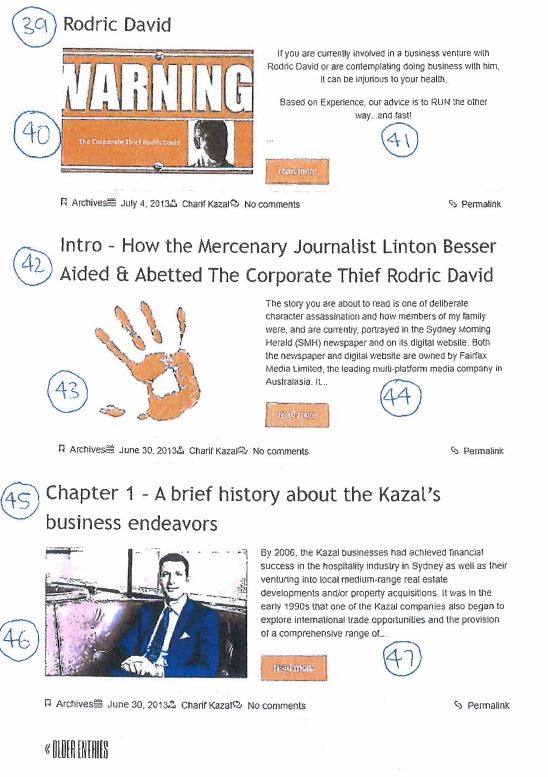
20 On 8 June 2018, I heard Charif and Adam’s application dated 5 June 2018 that I recuse myself from further hearing the proceeding on the basis of the procedural history detailed above, and in particular my findings in Thunder [2016] FCA 1598, Thunder (No 2) [2017] FCA 202, Thunder (No 3) [2017] FCA 1170, Thunder (No 5) [2017] FCA 1572 and Thunder (No 6) [2017] FCA 1573. I rejected that application: Thunder Studios Inc (California) v Kazal (No 7) [2018] FCA 996.
21 On 7 August 2018, I granted Charif leave to further amend his cross-claim by joining Thunder as the second cross-respondent, and heard yet another interlocutory application, brought this time by the applicants, who sought that, first, the issue of whether one or both of Charif and Adam was a publisher of the matter complained of in the cross-claim be heard separately and before all other issues in the cross-claim under r 30.01 and, secondly, Charif provide security for costs in respect of the cross-claim. I rejected the applicants’ application for a separate trial, but ordered that Charif give security for the payment of costs that may be awarded against him in the cross-claim: Thunder Studios Inc (California) v Kazal (No 8) [2018] FCA 1995.
22 After nearly two years in which the parties appear to have let sleeping dogs lie, on 22 May 2020 I heard Charif and Adam’s application that the proceeding be stayed under r 30.11, pending the determination of two other proceedings docketed to Perram J or, alternatively, this proceeding be transferred to his Honour’s docket. The other proceedings involved persons, including Mr David, who featured in the defunct business relationship between him and members of the Kazal family which are part of the background, but separate to the matters complained of here. Those proceedings were, first, one brought by KTC, a Cayman Islands company controlled by Charif and other members of his family against Mr David and others, to which I will return, and, secondly, one brought by Re.Group Pty Limited and David Singh against Adam, Charif and Tawfik Elgazzarr. I rejected that application: Thunder Studios Inc (California) v Kazal (No 9) [2020] FCA 846. I noted (at [2]–[3]) that the KTC proceeding raised:
issues against solicitors who acted for Mr David and his company, RAAL Limited, in 2010 in relation to a commercial transaction that spawned a farrago of litigation across the world between Mr David, Mr Singh and companies that they control, on the one hand, and members of the Kazal family and companies that they control, on the other. The issues concerning the solicitors are unrelated to the present question before me.
Subsequently to the events of 2010, Mr David incorporated [Thunder]. He and Thunder have been embroiled in litigation with various members of the Kazal family and KTC in Australia, the Cayman Islands, the United Arab Emirates, the United States of America and possibly elsewhere since at least 2010.
23 The final hearing of this proceeding commenced on 19 October 2020 and concluded on 28 October 2020. In the course of the hearing, I delivered two ex tempore judgments. The first related to the respondents’ proposed particulars relied on in mitigation dated 22 October 2020, that resulted in much of the first paragraph of those particulars being struck out: Thunder Studios Inc (California) v Kazal (No 10) [2020] FCA 1636. The second arose when Charif made an oral application on the sixth day of the trial that he be allowed to discontinue his cross-claim. I rejected that application and, when Charif elected to call no evidence, I entered a verdict and judgment for Mr David and Thunder on the cross-claim and dismissed it with costs on an indemnity basis: Thunder Studios Inc (California) v Kazal (No 11) [2020] FCA 1656.
Principles – Defamatory publications
24 I discussed the principles that apply in the determination of whether a publication conveys an imputation and, if it does, whether that imputation is defamatory in Chau v Australian Broadcasting Corporation (No 3) (2021) 386 ALR 36 at 45–48 [31]–[38], albeit in the context of a television program.
25 Here, the ordinary reasonable reader of the two internet publications and tweets will be a person who uses the internet or social media as an ordinary member of the community now does. This reader would have read and understood each of the matters complained of in the way that Gleeson CJ, McHugh, Gummow and Heydon JJ described in Favell v Queensland Newspapers Pty Ltd (2005) 221 ALR 186 at 190 [10]–[12], namely:
In determining what reasonable persons could understand the words complained of to mean, the court must keep in mind the statement of Lord Reid in Lewis v Daily Telegraph Ltd:[[1964] AC 234 at 258]
The ordinary man does not live in an ivory tower and he is not inhibited by a knowledge of the rules of construction. So he can and does read between the lines in the light of his general knowledge and experience of worldly affairs.
Lord Devlin pointed out, in Lewis v Daily Telegraph Ltd, [[1964]] AC at 277] that whereas, for a lawyer, an implication in a text must be necessary as well as reasonable, ordinary readers draw implications much more freely, especially when they are derogatory. That is an important reminder for judges. In words apposite to the present case, his Lordship said: [[1964] AC at 285]
It is not … correct to say as a matter of law that a statement of suspicion imputes guilt. It can be said as a matter of practice that it very often does so, because although suspicion of guilt is something different from proof of guilt, it is the broad impression conveyed by the libel that has to be considered and not the meaning of each word under analysis. A man who wants to talk at large about smoke may have to pick his words very carefully if he wants to exclude the suggestion that there is also a fire; but it can be done. One always gets back to the fundamental question: what is the meaning that the words convey to the ordinary man: you cannot make a rule about that. They can convey a meaning of suspicion short of guilt; but loose talk about suspicion can very easily convey the impression that it is a suspicion that is well founded.
A mere statement that a person is under investigation, or that a person has been charged, may not be enough to impute guilt. [Mirror Newspapers Ltd v Harrison (1982) 149 CLR 293] If, however, it is accompanied by an account of the suspicious circumstances that have aroused the interest of the authorities, and that points towards a likelihood of guilt, then the position may be otherwise. There is an overlap between providing information and entertainment, and the publishing of information coupled with a derogatory implication may fall into both categories. It may be that a bare, factual, report that a house has burned down is less entertaining than a report spiced with an account of a suspicious circumstance.
(emphasis added)
26 The ordinary reasonable reader would understand the matters complained of in the same way as Brennan J (with whom Gibbs CJ, Stephen, Murphy and Wilson JJ agreed) explained in Reader’s Digest Services Pty Ltd v Lamb (1982) 150 CLR 500 at 505–506. The reader would read each publication with the understanding that ordinary and reasonable members of society, using their social and moral perspective, would read a publication of that nature. The reader has a wide latitude to understand imprecise, ambiguous or loose language or expression in a publication (including through the visual presentation of matters) as imputing a meaning adverse to its subject: Trkulja v Google LLC (2018) 263 CLR 149 at 160–161 [32] per Kiefel CJ, Bell, Keane, Nettle and Gordon JJ. Each matter complained of is in a permanent form so that the reader can reread or go back over it to check or revisit some part that he or she may not have absorbed or wishes to check, as with a physical document such as a print newspaper, pamphlet or book: see too Amalgamated Television Services Pty Ltd v Marsden (1998) 43 NSWLR 158 at 165–167 per Hunt CJ at CL with whom Mason P and Handley JA agreed; Stocker v Stocker [2020] AC 593 at 605 [37]–[38] per Lord Kerr of Tonaghmore JSC (with whom Lord Reed DPSC, Lady Black, Lord Briggs and Lord Kitchin JJSC agreed).
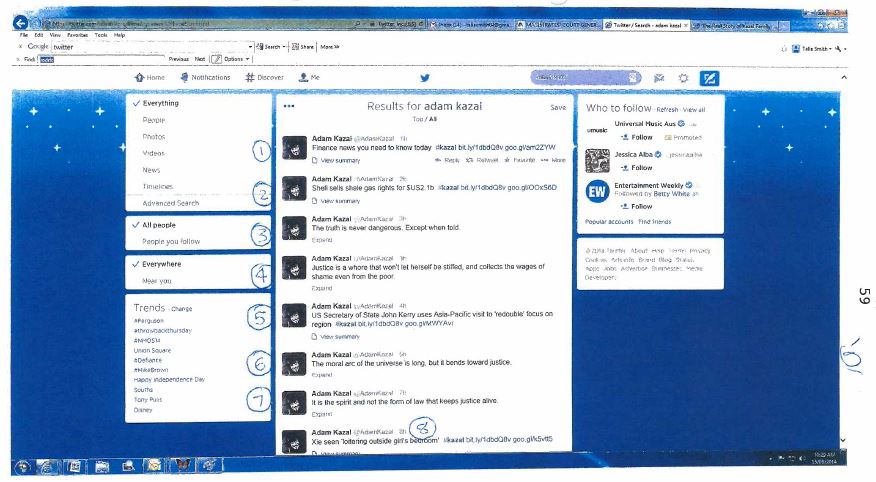
27 The first matter complained of consists of screenshots of a webpage (which I infer is the landing page) from the Kazal website as set out below.
28 I will consider whether the landing page conveyed any of the pleaded imputations about Mr David and Thunder before following the same process in respect of the second matter complained of (the Intro article).
29 The first screenshot (shot A1) has a banner “Kazal Family story”, which also appears in the next three screenshots and “Know the truth” (which is in the banner at the top, not clearly visible). Unfortunately, the quality of the screenshots is far from perfect. The parties agreed that the orange parts are in fact red in the internet version and online, I infer, the text is legible. The handwritten numbers in circles are not part of the website but are reference numbers to which I will refer as “par x”. Shot A1 is below:
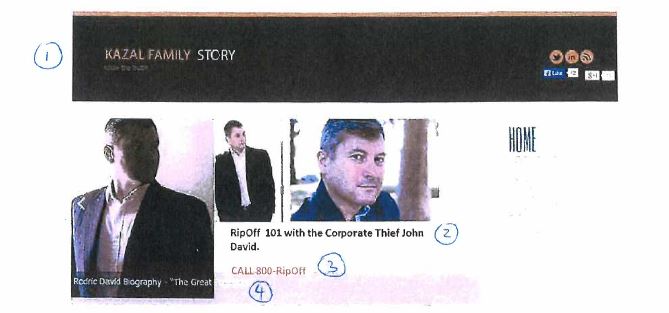
30 The individual pictured in the three photographs in shot A1 is Mr David. For some reason, possibly a mistake, the caption in par 2 “RipOff 101 with the Corporate Thief John David” (emphasis added) is a reference to Mr David’s father, John David. The other caption in par 4 is “Rodric David Biography – ‘The Great Pretender’”, which is a hyperlink to par 11 in the landing page (see [36] below).
31 The second screenshot is set out below (shot A2).
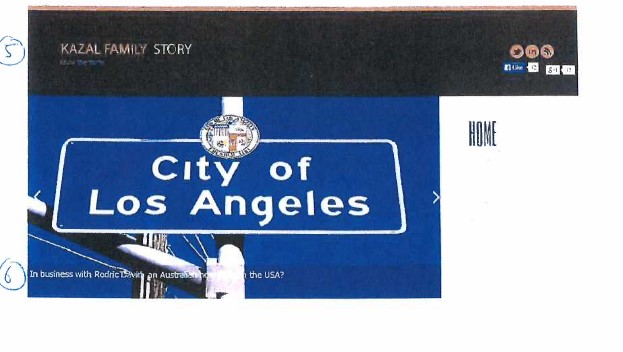
32 The caption (par 6) below the street sign reads “In business with Rodric David, an Australian living in the USA?” and is a hyperlink to par 16 in the landing page.
33 The third screenshot below (shot A3) has a sinister looking image of a masked man whose hand is reaching out of the screen.
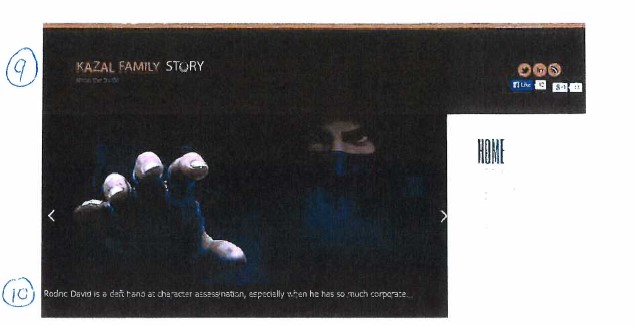
34 The caption (par 10) “Rodric David is a deft hand at character assassination, especially when he has so much corporate…”, which is a hyperlink to par 19. The fourth screenshot below (shot A4) has a graphic device entitled “Failure Types”:
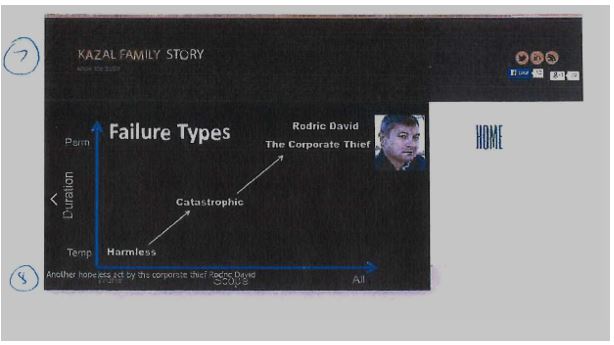
35 The caption (par 8) “Another hopeless act by the corporate thief Rodric David” is a hyperlink to par 22. Mr David’s photograph appears at the high point of the Perm[anent] axis of the graph of arrows from ‘harmless’ to ‘catastrophic’ under the caption “Rodric David The Corporate Thief” next to his photograph.
36 The fifth screenshot (shot A5) contains pars 11, 16, 19 and 22 which are the landing pages for the hyperlinks to those paragraphs from shots A1 and A2:
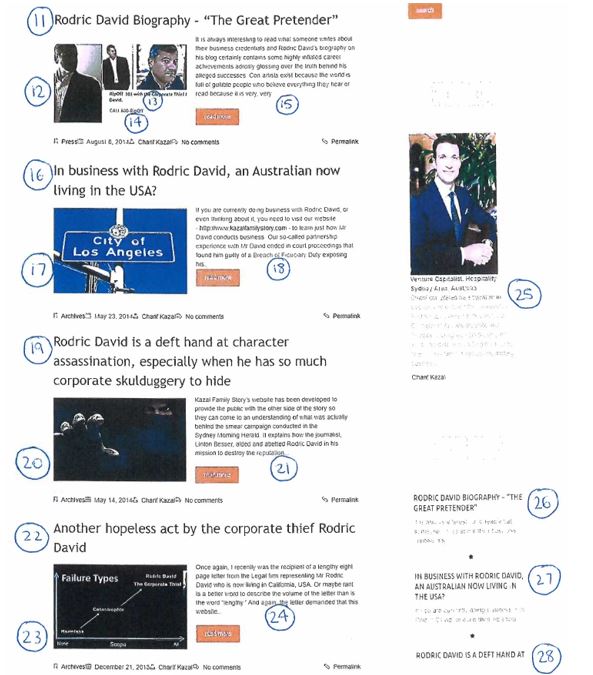
37 On the right hand side of shot A5 are further hyperlinks (par 26 links to par 11, par 27 to par 16, par 28 to par 19). Each of the passages of text below the hyperlinked headings in pars 11, 16, 19 and 22 is introductory to another, presumably longer, passage of text on a subsequent webpage not in evidence. However, the passages have a common theme that disparages Mr David. For example, par 15 begins by referring to Mr David’s biography on his blog and tells the reader that this glossed “adroitly… over the truth behind his alleged successes Con artists exist because the world is full of gullible people who believe everything they hear or read because it is very, very…” and is followed by a hyperlink box entitled “read more”.
38 The heading of par 16 “In business with Rodric David, an Australian now living in the USA?” introduces par 18, which reads:
If you are currently doing business with Rodric David, or even thinking about it, you need to visit our website – http://www.kazalfamilystory.com – to learn just how Mr David conducts business. Our so-called partnership experience with Mr David ended in court proceedings that found him guilty of a Breach of Fiduciary Duty exposing his
read more
39 Charif’s photo appears opposite at par 25.
40 The text of par 21 seeks to explain the reason why the publisher developed the Kazal website, namely “to provide the public with the other side of the story so that they can come to an understanding of what was actually behind the smear campaign conducted in The Sydney Morning Herald (SMH). It explains how the journalist, Linton Besser, aided and abetted Rodric David in his mission to destroy the reputation…”.
41 The next screen shot is below (shot A6):
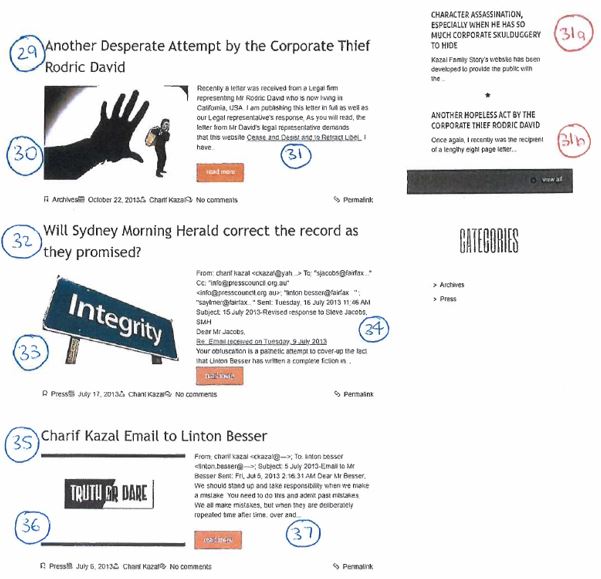
42 The person depicted between the thumb and index fingers of the hand in par 30 that is carrying a bag over his shoulder is Mr David. The text refers to and provides a link to a letter that Mr David’s lawyer wrote seeking that the Kazal website’s publisher “Cease and Desist and to Retract Libel”.
43 Next, par 32 asserted that the SMH had promised to “correct the record” and par 34 sets out the opening part of an email that Charif had sent on 16 July 2013 complaining about Mr Besser allegedly having “written a complete fiction…”. Underneath this are pars 35–37, which set out the opening part of an earlier email that Charif had sent to Mr Besser on 5 July 2013 against a caption “TRUTH OR DARE”.
44 The seventh and last screenshot (shot A7) comprising the first matter complained of is below (and, as I noted at [29] above, the orange in the reproduction below is in fact red in the on-screen original):
45 The first part of shot A7 is par 40, which is a red box that declares “WARNING” that contains a picture of Mr David with the caption “The Corporate Thief Rodric David”. The text of par 41 reads:
If you are currently involved in a business venture with Rodric David or are contemplating doing business with him, it can be injurious to your health.
Based on Experience, our advice is to RUN the other way… and fast!
46 Next, par 42 links both to the narrative of pars 21, 32–34, 35–37 and to the Intro article, which consists of the full text of the hyperlink from the heading in par 42 of the landing page, “Intro – How the Mercenary Journalist Linton Besser Aided & Abetted the Corporate Thief Rodric David”. The text in par 44 reads:
The story you are about to read is one of deliberate character assassination and how members of my family were, and are currently, portrayed in the Sydney Morning Herald (SMH) newspaper and on its digital website. Both the newspaper and digital website are owned by Fairfax Media Limited, the leading multi-platform media company in Australasia. It…
READ MORE
47 Finally, pars 45–47 comprise the beginning chapter of the Kazal Family Story, with a picture of Charif in par 46.
The imputations that the landing page is alleged to convey
48 Mr David alleged in par 6 of the statement of claim that the landing page conveyed the following six representations or imputations, namely (those in pars 6(a), (c), d(ii), (f), (e) and (h) which I have renumbered below for ease of reference):
6(a) Mr David is a corporate criminal who ran away to California after being convicted of breach of fiduciary duty,
6(b) Mr David is a corporate thief,
6(c) Mr David was convicted of breach of fiduciary duty as a result of not fulfilling his partnership obligations to the Kazal family,
6(d) Mr David is so lacking in integrity that he paid the journalist Linton Besser to publish deliberately invented lies in the Sydney Morning Herald about the Kazal family and their business dealings,
6(e) Anyone doing business with Mr David runs the risk of physical injury if they do not go along with him, and
6(f) Mr David paid the journalist Linton Besser to smear the Kazal family in an attempt to cover up his own criminal theft.
49 Thunder alleged that the landing page conveyed six similar imputations, namely (in pars 7(a), (c), (d)(ii), (e), (f) and (h) which I have also renumbered for ease of reference):
7(a) Thunder is run by a corporate criminal, who ran away to California after being convicted of breach of fiduciary duty,
7(b) Thunder is run by a corporate thief,
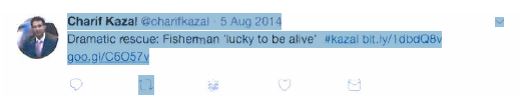
7(c) Thunder is run by Mr David, who was convicted of breach of fiduciary duty as a result of not fulfilling his partnership obligations to the Kazal family,
7(d) Thunder is run by Mr David, who is so lacking in integrity that he paid the journalist Linton Besser to publish deliberately invented lies in the Sydney Morning Herald about the Kazal family and their business dealings,
7(e) Anyone doing business with Thunder runs the risk of physical injury, and
7(f) Thunder is run by a person who paid the journalist Linton Besser to smear the Kazal family in an attempt to cover up his own criminal theft.
50 Thunder alleged that, although it was not named in the landing page or the Intro article, readers, who knew of Mr David’s association with it would identify it as, in effect, his company and thus as one of the subjects of the respective publication. The persons whom the respondents had targeted as its audience were:
(1) members of the business communities in New South Wales, Australia more generally, and the United States of America, including those with whom the applicants had done business or were presently engaged in negotiations,
(2) readers of Charif’s posting on 30 May 2014 in backstage under an article published on 28 May 2014 entitled “Get $1 Million for Your LA Indie Film!” (the backstage post).
(3) readers of Charif’s posting on 8 June 2014 in the Los Angeles Business Journal in its “LA Biz” section, under an article published on 6 June 2014 entitled “CEO Rodric David offering $1 million to indie film projects through Thunder Funder” (the LA Biz post),
The parties’ submissions on imputations conveyed by the landing page
51 The applicants contended that the landing page conveyed imputations 6(a) and 7(a). They argued that the image in par 30 of the outstretched hand with Mr David depicted as a thief dressed in black carrying a sack over his shoulder, in combination with the references to him being an Australian now living in California, conveyed that Mr David had “run away”. They argued that the image depicted Mr David as an escaping thief carrying his loot.
52 The respondents argued that none of imputations 6 or 7 was conveyed, except for imputations 6(b) and 7(b). They contended that the other sets of five imputations were strained, forced and “utterly unreasonable”, having no support or reference in the landing page. They submitted that it contained no reference to any payment to Mr Besser or any other journalist and that the description of him as “mercenary” would be understood by the ordinary reasonable reader as the author’s perception of Mr Besser’s character, not that he was linked to Mr David. They argued that there was no reference to physical injury, to anyone having “to go along” with Mr David, or to how or why Mr David came to live in California. They contended that the red hand in par 43 and the warning of injury to health in pars 40 and 41 could not reasonably be understood to convey imputations 6(e) and 7(e). Rather, the respondents submitted, the ordinary reasonable reader would understand from par 44 that the landing page was explaining how the Kazal family had been the victim of character assassination.
53 Where a person is not named in a publication that he, she or it alleges has defamed him, her or it, the plaintiff or applicant must prove that it was published to someone with knowledge of specific circumstances that would identify that person as its subject: Consolidated Trust Company Ltd v Browne (1948) 49 SR (NSW) 86 at 89–91 per Jordan CJ, with whom Street J agreed (at 94), 92–93 per Davidson J. Jordan CJ applied what Isaacs J had held in David Syme & Co v Canavan (1918) 25 CLR 234 at 238 (Barton J at 237 used a similar test, while Rich J merely agreed). Isaacs J said that where the plaintiff is not specifically named in a publication, the test is whether it would lead persons acquainted with the plaintiff, reasonably in the circumstances, to believe that he, she or it was the person referred to in the publication.
54 In Mirror Newspapers Ltd v World Hosts Pty Ltd (1979) 141 CLR 632 at 639–640, 642, Mason and Jacobs JJ (with whom Gibbs CJ and Stephen J agreed, as did Aickin J in obiter dicta at 645–646) held that a newspaper report that stated that a named individual had been made bankrupt and that he was the owner of a restaurant was capable of defaming, as insolvent, the unnamed company that owned the restaurant to persons who knew of the company’s ownership. Mason and Jacobs JJ held that the publication could convey such an imputation in its natural and ordinary meaning to persons who knew that the company owned the restaurant, without the need to plead any innuendo. They said that if the reader’s belief that a publication referred to a person, that it did not name, arose from, or was the product of, the natural and ordinary meaning of the matter complained of itself, then it was capable of being defamatory of that person. They held that whether or not a publication does so is a question of fact: World Hosts 141 CLR at 642.
The respondents’ submissions on identification
55 The respondents argued that the particulars of identification were incapable of enabling a reader of either the first or second matters complained of to identify Thunder as their subject. They contended that this was not a case in which it could be inferred, or should be found, that the matters complained of were published to persons with knowledge of the extrinsic facts. They submitted that the content of the matters complained of was personal to Mr David and concerned events that occurred before Thunder was incorporated or Mr David became involved with it.
Identification – consideration
56 I reject the respondents’ argument that the landing page and the Intro article did not identify Thunder in its natural and ordinary meaning. The landing page directed the reader’s attention expressly to the question posed in par 16, “In business with Rodric David, an Australian now living in the USA?”. It made repeated references to Mr David’s alleged activities in business, including that he was “The Corporate Thief”. The natural and ordinary meaning of the landing page included that what it conveyed about Mr David as an individual would also apply to any company in which he had a controlling or managing interest. Thus, the formulation of imputations 7(b) to (f) that “Thunder is run by Mr David”, that substitute “Thunder” for him in the same sense as imputations 6(b) to (f) apply to Mr David personally, are meanings that the landing page would convey, in its natural and ordinary meaning, to a person who knew that Thunder was Mr David’s company or that he controlled it, even though Thunder was not named in that publication: World Hosts 141 CLR at 639–640, 642; see too Simon v Lyder [2020] AC 650 at 661–662 [25]–[27] per Lord Briggs JSC giving the opinion of the Judicial Committee (Lord Wilson, Lord Carnwath, Lady Black, Lady Arden JJSC and himself).
57 As I will elaborate below, I accept the evidence of Mike Hammond, a friend of Mr David, who read the first and second matters complained of. I find that he understood each of them to refer to Thunder because he knew it was Mr David’s company. He said that Thunder’s “reputation really was Rodric’s reputation” (see [271] below). Indeed, Mr Hammond first drew Mr David’s attention to the Kazal website by sending him a text message or email with a link to it.
58 Moreover, Charif’s posts, being the LA Biz post and the backstage post each appeared on the same webpage as the articles that named Mr David as owner of Thunder. I describe Charif’s posts below at [181] and [183]. The headline of the LA Biz article was “CEO Rodric David offering $1 million to indie film projects through Thunder Funder”. Mr David described LA Biz as “the number one business paper in Los Angeles”, with a status as a business newspaper similar to The Australian Financial Review in this country.
59 However, the respondents’ argument does not only fail on this level. It is preposterous, given that Charif posted comments on 30 May 2014 and 8 June 2014 respectively on the Facebook walls of each of the LA Biz and backstage articles that were about Mr David’s project using his company, Thunder, that each began: “If you are currently doing business with Rodric David, or even thinking about it, you need to visit our website: [giving the hyperlink to the Kazal family story website] to learn just how Mr David conducts business”.
60 Charif’s comments in his posts advised the reader of the two business journal articles about Mr David and his company, Thunder, and implored the reader to visit the Kazal website where they could read the first and second matters complained of in the knowledge of the reader of the LA Biz and backstage articles that Thunder was Mr David’s company and that he ran it: see Simon [2020] AC at 661–662 [25]–[27].
61 Accordingly, the landing page, in its natural and ordinary meaning, and imputations 7(b), (c), (d), (e) and (f), were published of and concerning Thunder to readers who knew that Mr David owned or ran it, including Mr Hammond and readers of Charif’s posts on the Facebook pages of the LA Biz and backstage articles or who then either went to the Kazal website or, if he or she had visited it before, aggregated the two: cf Simon [2020] AC at 662 [26]–[27] per Lord Briggs JSC for Lord Wilson, Lord Carnwath, Lady Black, Lady Arden JJSC and himself. For the same reasons, such a reader of the Intro article would also have understood it to convey any imputations that it conveyed about Mr David, correspondingly about Thunder, namely imputations 10(f), (g), (h), (i) and (j).
62 Once an ordinary, reasonable reader knew that Mr David ran or owned Thunder, then the reader would have understood each of the landing page and the Intro article to have conveyed each of the corresponding imputations pleaded about Thunder that, below, I have found it to have conveyed about Mr David.
Consideration – were the disputed imputations conveyed?
63 The landing page repeatedly describes Mr David as “the corporate thief” and takes the reader through a succession of vignettes that are incomplete but invite the reader to click on the link to the full version of that particular story. The issue here, however, is whether the presentation of words and images in the first matter complained of conveys to the ordinary reasonable reader any of the meanings in the five sets of disputed imputations.
Imputation 6(a): Mr David is a corporate criminal, who ran away to California after being convicted of breach of fiduciary duty.
Imputation 7(a): Thunder is run by a corporate criminal, who ran away to California after being convicted of breach of fiduciary duty.
64 The first matter complained of relates that Mr David is “now living in California, USA” (pars 16, 24, 27 and 31) and suggests a connection between him and Sydney because of the references to him being an Australian now living in California (pars 16 and 27), articles in the SMH (pars 21, 32 and 44) and the Kazal family being successful in Sydney (par 47). The reader is told in par 16 that Mr David is both “an Australian now living in the USA” and in par 18 that he was once in a partnership with the Sydney-based Kazal family that resulted in “court proceedings that found him guilty of breach of Fiduciary Duty exposing his…”.
65 In my opinion, the ordinary reasonable reader would not have understood the landing page to convey imputations 6(a) or 7(a). That is because there is nothing in it to suggest that Mr David sought to escape or run away from either Sydney or the asserted conviction. Rather, the thrust of the first matter complained of is that the reader should beware of Mr David, that he had “been found guilty of Breach of Fiduciary Duty” and that his present whereabouts are in California, where he is living openly and is ready to do business. The reader would not be able, reasonably, to understand from the terms of the landing page why Mr David had moved to California.
Imputation 6(c): Mr David was convicted of breach of fiduciary duty as a result of not fulfilling his partnership obligations to the Kazal family.
Imputation 7(c): Thunder is run by Mr David, who was convicted of breach of fiduciary duty as a result of not fulfilling his partnership obligations to the Kazal family.
66 The ordinary reasonable reader would understand that imputation 6(c) was conveyed by par 18 of the landing page that stated that the Kazal family’s “so-called partnership with Mr David ended in court proceedings that found him guilty of a Breach of Fiduciary Duty”. The reader would understand that the concept of “conviction” is a finding of criminal guilt in par 18. The use of the word “guilty” in par 18 reinforced that meaning in the context of Mr David being named, repeatedly, as the “corporate thief” throughout the landing page. The reader would understand theft is a criminal offence and, accordingly, that the statement in par 18 that Mr David had been “found guilty” meant that a court had convicted him of breach of fiduciary duty.
Imputation 6(d): Mr David is so lacking in integrity that he paid the journalist Linton Besser to publish deliberately invented lies in the Sydney Morning Herald about the Kazal family and their business dealings.
Imputation 7(d): Thunder is run by Mr David, who is so lacking in integrity that he paid the journalist Linton Besser to publish deliberately invented lies in the Sydney Morning Herald about the Kazal family and their business dealings.
67 The reader would understand, from pars 16 and 18, that Mr David had had business dealings with the Kazal family in their “so called partnership”, and that he lacked integrity because he had been “found guilty of a Breach of Fiduciary Duty”. The ordinary reasonable reader would understand pars 19, 20, 21, 31(a), 42, 43 and 44 to convey that Mr Besser had “aided and abetted” Mr David in seeking to destroy the reputation of the Kazal family by “deliberate character assassination”. The reader would understand pars 32, 33, 34, 35, 36 and 37 to convey that Mr Besser and the SMH published “a complete fiction” about the Kazal family in the context of the whole of the landing page. The reader would be drawn to think that Mr David, the corporate thief, went about his character assassination of the Kazal family through enlisting Mr Besser and the SMH to publish what he (Mr David) must have known were fictions or falsehoods about them. The reader would be led to think that Mr Besser and the SMH must also have known that those matters were untrue because, even after Charif had tried to inform them of his version of things, they lacked the integrity “to correct the record”.
68 Moreover, par 32 would suggest to the reader that the SMH had “promised to correct the record” by correcting Mr Besser’s “complete fiction”, that par 37 suggests he deliberately repeats. The graphic image in par 43 is a red hand (in the online version) and accompanies the statement that Mr Besser is a “mercenary journalist”. The natural and ordinary meaning of “mercenary” is of a person who works merely for money or other material reward (Oxford English Dictionary online; senses 1, 2(a) or “working or acting merely for gain” (Macquarie Dictionary online; sense 1). These would suggest to the reader that Mr David orchestrated and paid for Mr Besser to engage in the deliberate character assassination of the Kazal family.
69 The reader would apply the moral standards of the community in evaluating what the landing page was conveying about the type of person Mr David was in light of that conduct and conclude that, in so acting, he was lacking in integrity. For these reasons, I am satisfied that imputation 6(d) was conveyed.
Imputation 6(e): Anyone doing business with Mr David runs the risk of physical injury if they do not go along with him.
Imputation 7(e): Anyone doing business with Thunder runs the risk of physical injury.
70 The ordinary reasonable reader would understand that the landing page was critical of Mr David as a person with whom to do business, not just because he was “the corporate thief”, but because of the matters that pars 11–18, 27, 39, 40 and 41 elaborate. In particular, pars 40 and 41 are emphatic. The reader is told that par 41 is a “WARNING” about Mr David, again characterised as “the corporate” thief. The reader is told in terms that if he or she is, or is contemplating, doing business with Mr David, “[i]t can be injurious to your health. Based on experience, our advice is to RUN the other way… and fast!”. The reader would be drawn to understand that Mr David is not just a “corporate thief” but that he also can be a physical threat to persons with whom he is in business because of the potential injury to one’s health, based on the experience of the Kazal family. That threat of physical injury, the reader would think, is additional to the financial risk to which he or she would be exposed in going into business with Mr David. The reader would understand that he or she should “RUN the other way” because doing business with Mr David carried with it a danger to his or her physical safety, being an injury to the reader’s health or wellbeing.
71 Accordingly, I am satisfied that imputation 6(e) was conveyed.
Imputation 6(f): Mr David paid the journalist Linton Besser to smear the Kazal family in an attempt to cover up his own criminal theft.
Imputation 7(f): Thunder is run by a person who paid the journalist Linton Besser to smear the Kazal family in an attempt to cover up his own criminal theft.
72 The ordinary reasonable reader would be conscious of the matters that I discussed in considering whether imputation 6(d) was conveyed (see [67]–[68] above). The reader would ask why was Mr David paying a mercenary journalist, namely, Mr Besser to engage in the character assassination of the Kazal Family in the SMH by publishing fictions. The reader would reflect on the message in par 18 that, in fact, it was Mr David, not the Kazal family, whom a court “found” guilty of “Breach of Fiduciary Duty” and be drawn to the conclusion that the reason why Mr David paid Mr Besser for the character assassination was to cover up what Mr David had done as “the corporate thief”, namely, his “skulduggery” (as pars 19 and 31(a) describe). Accordingly, the ordinary reasonable reader would understand the landing page to convey imputation 6(f).
The second matter complained of – the Intro article
73 The Intro article begins with the picture of the City of Los Angeles street sign on which the question “In business with Rodric David, an Australian now living in the USA?” is superimposed. The headline presages “How the Mercenary Journalist Linton Besser Aided & Abetted the Corporate Thief Rodric David” against the caption “Charif Kazal” under par 1, and below his photo, brief biographical notes appear at par 24.
74 The opening paragraph (par 2) alerts the reader to what follows as being an account of “deliberate character assassination” in the portrayal of members of the Kazal family in The Sydney Morning Herald. The reader is told that since 1 September 2010, the SMH and Fairfax’s website have published over 24 “well-constructed articles” that Mr Besser and Fairfax “carried out [as] this prolonged smear campaign… purely to assist Rodric David, the David family and their business interests” (par 3). The reader “will finally discover the truth” on the Kazal website (par 4). Charif tells the reader that Mr Besser initially set out to denigrate three members of his family, namely himself and his brothers, Tony and Karl, but the targets expanded to include his parents and, later, his pregnant wife (par 5). The reader is given a definition of “defame” and then told that Mr Besser “clearly worked directly for and with Rodric David to frame the distorted content of his articles defaming my family to apply inordinate pressure on us during legal proceedings we had commenced” against Mr David in May 2010 in the United Arab Emirates (UAE) and later in the Cayman Islands. The reader is told that the articles were planned to coincide with and influence steps in those two proceedings (par 7). Mr Besser’s photograph is captioned with “The Mercenary Journalist” (par 8).
75 The Intro article provides some biographical details about Mr David and his father, John (par 9). It tells the reader that John David “openly advising us to drop our court cases against Rodric”, he (John David) would ensure that all the adverse media and attention towards the Kazal family would cease (par 10) and:
We did not take up Mr David’s offer and the overall consequences of us seeking justice through the courts have been severe. My brothers and I have been threatened, our business have been threatened, bullying of our children in school and sporting activities has occurred and continual stress is caused to all other family members awaiting the next unwarranted attack to be published in the Sydney Morning Herald against the family.
76 The Intro article described the UAE proceeding as being based on Mr David’s corporate fraud as well as his breach of fiduciary duty as a director of a company in which the Kazal family had a financial interest (par 12). It tells the reader that Mr David “designed the media smear campaign” to destroy the Kazals’ credibility during critical stages of the two foreign legal proceedings. It stated that he had annexed to his affidavit of 27 September 2010 in the Cayman Island proceeding nine articles published between 1 and 17 September 2010 and referred in the affidavit to negative publicity about the Kazals. The article asserts that if that proceeding were dismissed swiftly, Mr David would benefit from “a much more rewarding business deal” of which the Kazal family was then ignorant. It tells the reader that Mr David worked “closely” with Mr Besser to time the publications to “disguise secret financial deals of significant benefit to him”. It also asserts that Mr David used his training as an actor, the media and other proceedings, including in the New South Wales Independent Commission Against Corruption (ICAC), to shift the focus away from his corporate fraud (par 15).
77 The Intro article informs the reader that the “deceptive attacking front page” publicity was “excruciating” and distracted the Kazal family’s focus from other important business matters (par 16). Under the subheading “Power of the news media”, the reader is told about how news media can influence and manipulate public perception and how the adverse publicity affected the Kazals (pars 17 and 18). The next subheading, “Truth will prevail”, introduces the reader to the purpose of the Kazal website, being to present “the other side of the story” so that the public will understand “what was actually behind the smear campaign conducted in the Sydney Morning Herald”. The reader is told that the Kazal website would explain how Mr Besser aided and abetted Mr David “in his mission to destroy our family for financial gain” in the multi-million dollar range. It asserts that Mr Besser only contacted the Kazal family for their responses as “impartiality pretences”, but, even then, nothing that they said was included in any of Mr Besser’s articles. It tells the reader that every attempt that the Kazal family made to get The Sydney Morning Herald to report the story fairly “was summarily rebuffed” and:
[t]hat is why my preference for a title for our heretofore unknown side of the story is “The Corporate Thief and The Mercenary Journalist” but then, that is just my opinion of a very appropriate headline.
78 The Intro article concludes with the promise that the Kazal family will continue to challenge openly “the abominable treatment” they had received from Mr David, Mr Besser, the newspaper and Fairfax “until we obtain justice” (pars 20–23). The Intro article web page also contains links to other pages on the Kazal website (pars 23–25) like in the landing page.
The imputations that the Intro article is alleged to convey
79 Mr David alleged that the Intro article, a copy of which is annexure B to these reasons, conveyed the following 10 representations or imputations, namely (those in pars 9(b)(i), (ii), (c), (d)(i), (ii), (f)–(j) of the statement of claim which I have renumbered below for ease of reference):
9(a) anyone doing business with Mr David runs the risk of serious personal injury if they do not go along with him;
9(b) anyone doing business with Mr David runs the risk of serious injury to their business if they do not go along with him;
9(c) Mr David uses threats of violence to stand over business associates;
9(d) Mr David threatened Charif and each of his brothers and their businesses with violence for seeking justice through the courts;
9(e) alternatively to 9(d), Mr David threatened Charif and each of his brothers and their businesses with violence, if they continued to seek justice through the courts;
9(f) Mr David was responsible for the children of Charif and each of his brothers being bullied at school and at sporting activities, because he paid Linton Besser to publish unwarranted attacks upon members of Kazal family for having sought justice against him through the courts;
9(g) Mr David attempted to pervert the course of justice, by threatening Charif and each of his brothers and their business, because the Kazal family sought justice through the courts;
9(h) Mr David committed corporate fraud in the United Arab Emirates;
9(i) Mr David paid the reporter Linton Besser to lie about the Kazal family and their business dealings; and
9(j) Mr David paid the journalist Linton Besser to smear the Kazal family, in an attempt to cover up his own corporate fraud and theft.
80 Thunder alleged that the Intro article conveyed 10 similar representations or imputations, namely (those in pars 10(b)(i), (ii), (c), (d)(i), (ii), (f)–(j) which I have renumbered below for ease of reference):
10(a) anyone doing business with Thunder runs the risk of serious physical injury;
10(b) anyone doing business with Thunder runs the risk of serious injury to their business;
10(c) Thunder is run by a corporate criminal who uses threats of violence to stand over business associates;
10(d) Thunder is run by a corporate criminal who threatened Charif and each of his brothers and their businesses with violence for seeking justice through the courts;
10(e) alternatively to 10(d), Thunder is run by a corporate criminal who threatened Charif and each of his brothers and their businesses with violence if they continued to seek justice through the courts;
10(f) Thunder is run by a corporate criminal who was responsible for the children of Charif and each of his brothers being bullied targeted at school and at sporting activities, because he paid Linton Besser to publish unwarranted attacks upon members of the Kazal family for having sought justice against him through the courts;
10(g) Thunder is run by a corporate criminal who attempted to pervert the course of justice, by threatening Charif and each of his brothers and their business, because the Kazal family sought justice through the courts.
10(h) Thunder is run by a person who committed corporate fraud in the United Arab Emirates;
10(i) Thunder is run by a corporate criminal who paid the reporter Linton Besser to lie about the Kazal family and their business dealings; and
10(j) Thunder is run by a corporate criminal, Rodric David, who paid the reporter Linton Besser to smear the Kazal family in an attempt to cover up his own corporate fraud and theft.
The parties’ submissions on whether the Intro article conveyed imputations 9(a)–(j) and 10(a)–(j)
81 The applicants argued that the Intro article conveyed imputations 9(d) and (e) and 10(d) and (e) as alternatives. They contended that imputations 9(a) to (e) and 10(a) to (e) were conveyed because pars 10 and 11 of the Intro article contained the suggestion of violence. In particular, the applicants relied on par 11 which asserted that “My brothers and I have been threatened, our businesses have been threatened”. They submitted that the ordinary reasonable reader would understand that those threats were of physical harm, particularly because of the asserted threat to Charif (as the apparent author) and his brothers. They asked, rhetorically, what else could such a threat mean? They argued that the balance of par 11 referred to separate threats to the Kazal family’s businesses and the bullying of their children at school so that the first “threatening” of Charif and his brothers must have been of a different character to the commercial effect of further newspaper articles on the Kazal family’s business and their stimulative effect as a source of bullying of the children. The applicants contended that the Intro article created a tone and impression that Mr David was a dangerous enemy who had both power and influence, and whose threats had severe consequences beyond a mere smear campaign.
82 The respondents argued that none of imputations 9(f), (g), (i) or (j) and 10(f), (g), (i) or (j) was conveyed by the Intro article. They contended that the Intro article made no reference to any payment being made to Mr Besser or any other journalist and could not be reasonably understood to convey an attempt to pervert the course of justice. They accepted, however that imputation 9(h) was conveyed.
Imputations 9(a) to (e) and 10(a) to (e)
83 I am of opinion that the ordinary reasonable reader of the Intro article would not have understood it to convey any of imputations 9(a) to (e) and 10(a) to (e) (the violence imputations). That is because, read as a whole, the only threats that the Intro article suggests are ones that Mr David or his father, John David, made to continue the alleged “smear campaign” against the Kazal family and their business interests. The reader would have understood that the adverse media articles had been the cause of the alleged bullying of the Kazal family’s children at school and that, likewise, the threats to Charif, his brothers and their business were that the media campaign would continue unless, as par 10 told the reader, the Kazal family dropped their court cases against Mr David. This understanding would have been reinforced in the reader’s mind by what the last sentence of par 14 summed up as “typical of Rodric David’s modus operandi throughout our unfortunate business association”, namely, his alleged use of the media to smear the Kazal family and their businesses for his advantage.
Imputation 9(f): Mr David was responsible for the children of Charif Kazal and each of his brothers being bullied at school and at sporting activities, because he paid Linton Besser to publish unwarranted attacks upon members of the Kazal family for having sought justice against him through the courts.
Imputation 10(f): Thunder is run by a corporate criminal who was responsible for the children of Charif Kazal and each of his brothers being bullied targeted at school and at sporting activities, because he paid Linton Besser to publish unwarranted attacks upon members of the Kazal family for having sought justice against him through the courts.
84 I reject the respondents’ argument that nothing in the Intro article suggested that Mr David paid Mr Besser. First, the headline (in par 1) describes Mr Besser as a “mercenary journalist”. That was calculated to convey that Mr Besser was, in effect, a journalist who was not objective or impartial but one who would write a story to advance the side of the person, namely, Mr David, by whom he was paid to write it. Secondly, the Intro article’s use of “aided and abetted” in linking Mr Besser to achieving Mr David’s ends conveyed that there was a nefarious association between what Mr Besser published and Mr David (pars 1 and 20). Thirdly, the Intro article stated in terms that Mr Besser “clearly worked directly for and with” Mr David to benefit the latter’s cause in the UAE and Cayman Island proceedings (par 7). It said that Mr David “designed the media smear campaign” (par 14) and that he and Mr Besser were “working closely” to time the attacks (par 15). And it told the reader that the purpose of the campaign was “to bring inordinate pressure on the Kazal family” (par 7). Fourthly, it stated that John David had advised the Kazal family to drop those proceedings so as to end the smear campaign. That would suggest to the ordinary reasonable reader that Mr David and his father could control how Mr Besser “worked directly for and with” Mr David (pars 7 and 10). Fifthly, pars 27 and 31 reinforced that Mr David was “a deft hand at character assassination, especially when he has so much corporate skulduggery to hide” and that the means of his character assassination was his employment of Mr Besser’s journalistic services.
85 The Intro article tells the reader that the consequence of Mr David’s mercenary, Mr Besser, writing the media smears of the Kazal family was that their children had been bullied at school. That occurred after the Kazals did not capitulate to John David’s “advice” to drop their UAE and Cayman Island court proceedings (pars 10 and 11). The reader would have concluded that the Intro article conveyed imputations 9(f) and 10(f).
Imputation 9(g): Mr David attempted to pervert the course of justice, by threatening Charif Kazal and each of his brothers and their business, because the Kazal family sought justice through the courts.
Imputation 10(g): Thunder is run by a corporate criminal who attempted to pervert the course of justice, by threatening Charif Kazal and each of his brothers and their business, because the Kazal family sought justice through the courts.
86 The Intro article told the reader that the purpose of the smear campaign was “to bring inordinate pressure on” the Kazal family during the UAE and Cayman Island proceedings (par 7) and that the campaign would stop if they dropped those proceedings (par 10). It stated that each article “was carefully planned and published to coincide with and influence critical legal proceedings and court appearances” (par 7). It told the readers that the Kazal family brought their proceedings because of Mr David’s corporate fraud and breach of fiduciary duty as a director of a company in which they both had a financial interest (par 12). It stated that “another benefiting party also colluded with Mr David” (which the reader would have understood was someone working with Mr David) by annexing some of the articles in the smear campaign to an affidavit in the Cayman Island proceedings and that this “was obviously an attempt to influence the Judge’s decision on the case set before him” (par 14).
87 The ordinary reasonable reader would have understood that such behaviour, embodied in John David’s “advice” to drop the two cases (par 10), was an attempt to pervert the course of justice by threatening the Kazal family that, unless they did so, Mr David would continue with the smear campaign and the damaging use of the published articles in the court proceedings.
88 I am satisfied that the Intro article conveyed imputations 9(g) and 10(g).
Imputation 9(i): Mr David paid the reporter Linton Besser to lie about the Kazal family and their business dealings.
Imputation 10(i): Thunder is run by a corporate criminal who paid the reporter Linton Besser to lie about the Kazal family and their business dealings.
89 The ordinary reasonable reader would have understood that the Intro article stated that its and the Kazal website’s purpose was to ensure that “truth will prevail” (pars 4 and 19) and to expose Mr David’s “deliberate character assassination” of the Kazal family through the use of his “mercenary” Mr Besser in the conduct of the smear campaign. The reader would understand that Mr David had paid Mr Besser to write lies about the Kazal family and their business dealings in his articles. That understanding was conveyed by the Intro article’s exposition of that “deliberate character assassination” (par 2), Mr David’s “design” of “the media smear campaign as a way to destroy our credibility” (par 14), together with Mr David’s and Mr Besser’s “manipulation” of information published and the Intro article’s suggestion that the Kazal website was going to bring out the “truth” about the Kazal family, in contrast to what the smear campaign had said about the Kazals. This understanding would have been driven home to the reader by pars 19 to 23 which conveyed that Mr Besser was not prepared to write about the asserted “truth” that the Kazal website would ensure “will prevail” (pars 19 and 20).
90 Accordingly, the reader would have understood the Intro article to convey imputations 9(i) and 10(i).
Imputation 9(j): Mr David paid the journalist Linton Besser to smear the Kazal family, in an attempt to cover up his own corporate fraud and theft.
Imputation 10(j): Thunder is run by a corporate criminal, Rodric David, who paid the the reporter Linton Besser to smear the Kazal family in an attempt to cover up his own corporate fraud and theft.
91 The ordinary reasonable reader would also have understood that the Intro article was saying that Mr David had paid Mr Besser to smear the Kazal family in articles that had the effect of “diverting attention away from his corporate fraud” (par 15). The reader would be led to ask why Mr David was smearing the Kazal family if not to protect himself from the consequences if the truth prevailed, of what the UAE and Cayman island proceedings had concluded, namely that he was “the corporate thief” (pars 1, 21 and 32) and had engaged in “corporate fraud” (pars 12 and 15) “especially when he has so much corporate skulduggery to hide” (par 27). I am satisfied the Intro article conveyed imputations 9(j) and 10(j).
92 Each imputation that I have found that the landing page and the Intro article conveyed was defamatory (which is not in issue) and also a representation that it conveyed for the purposes of the applicants’ claims under s 18 of the ACL.
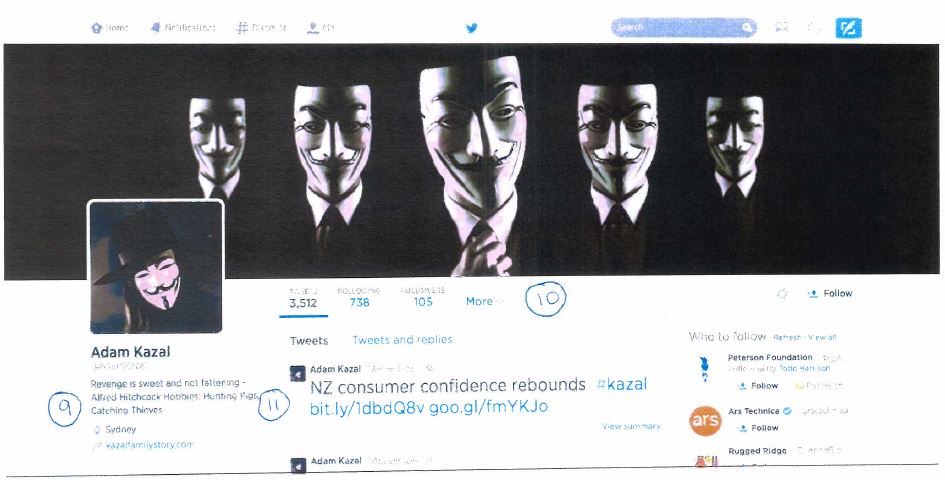
93 The Twitter accounts of Charif and Adam respectively have thousands of individual tweets. Annexures C and D to these reasons comprise screen shot examples of the content of each Twitter account. Each of Charif and Adam began publishing his Twitter account in about May 2013, however, the relevant activity on them occurred only after the Kazal website was first published in June 2013. Some tweets in those accounts appear on their face to relate to Mr David, such as par 4 in annexure C, others are more cryptic such as pars 3 and 4 in annexure D. The balance of the tweets in annexures C and D and the preponderance of tweets on each account appear to relate to current news, such as pars 2 and 5 of Charif’s account which reads, before the hyperlink, “Man drowns at Vivid opening night” and “Aust share market opens higher”. However, if the visitor to each Twitter account clicks on the bitlink next to the text of those and many, but not all, similar tweets, he or she is taken to the Kazal website and not to the apparent news item.
94 The statement of claim pleaded that:
each of the Twitter accounts conveyed, in trade or commerce, a representation that it was a news feed that reproduced headlines and or summaries of business related stories from mainstream media and that a viewer, who clicked on the text of an individual tweet, would be taken to the original item to which the text referred (the Twitter representation); and
each Twitter representation was misleading or deceptive in contravention of s 18 of the ACL, as well as its analogue in s 18 of the Australian Consumer Law (NSW) as applied by s 28 of the Fair Trading Act 1987 (NSW). It is unnecessary to deal with the latter claim as it duplicates the claim under the ACL and, in any event, the absence of any defence entails that the allegations in the statement of claim are taken to be admitted.
95 As I explain below, the use of the bitlink in each Twitter feed concealed the fact that it was a device to redirect the reader to the Kazal website.
How Charif and Adam used their Twitter accounts
96 Dr Bradley Schatz, a digital forensics consultant, prepared an expert report on 23 July 2018 for the applicants, that was tendered without objection or any requirement for him to be cross examined. He explained that “bitlinks”, the proprietary name used by Bitly for short links, are shortened hyperlinks. When a bitlink is created it operates, in effect, as a shortened, but no less effective, uniform resource locator or URL. The publisher of a website on the internet usually creates a URL or a hyperlink to organise the content of the website. When a person conducts an internet search in his or her web browser, by clicking on a hyperlink displayed as a search result, the browser uses the URL to navigate directly to the page on the creator’s website and download its contents that are then displayed on the screen of the user’s device.
97 There are link shortening services available which are used to create shortened links. One such service is Bitly which each of Charif and Adam used to create a bitlink that he employed on his Twitter account. As Dr Schatz explained, the attraction of shortened links for a person posting a message on a Twitter account is that the link uses less characters than a hyperlink, thus leaving more characters for the account operator to use in the accompanying message. That is because Twitter limits the number of characters that can be used in any individual tweet. Dr Schatz said that Twitter tracks a significant amount of information about views and consumption of tweets.
98 Dr Schatz said that while the Bitly short link to the landing page had been created on 13 September 2013, the available Bitly statistics page for it only covered a time period beginning in 2016. He opined that reasons why short links, such as those on Charif’s Twitter account, are used on Twitter accounts can include an intention to drive users to the website the subject of the short link, increase the ranking of that website in search engines or provide a reference to source material related to an assertion referred to in the tweet. He said that the short links on Charif’s Twitter account did not disclose to a viewer of the tweets the identity of the linked URL, namely, the Kazal website, to which, by clicking on it, the viewer will be taken. Dr Schatz explained:
Short Link l was used in the following tweet, which I found in the Charif Kazal Twitter Account:
The goo.gl link points to a Daily Telegraph story titled "Westpac Life Saver chopper rescues rock fisherman in seas off Botany Bay thanks to mate's quick thinking'".
The bit.ly link refers to the home page document of the Kazal Website: http://kazalfamilystory.com/.
I reviewed the l November 2014 archived copy of the home page of the Kazal Website using archive.org. The page contained posts from 30 June 2013 through to 8 August 2014. The archived page did not contain any content of relevance to the rescue of a fisherman.
I inspected the Tweets in the Charif Kazal twitter feed over the period of 14 May 2014 to 8 August 2014. The tweets contained around 440 instances of Short Link 1, a sampling of subjects of which include:
a) Linkedin splashes $186 million;
b) Space age home wants new owner;
c) Door closed to asylum seekers;
d) Bigger container ships bound for NZ;
e) Hyundai ordered to pay $US240m in damages.
The archived copy of the home page of the Kazal Website that I examined did not contain content of relevance to the subject of the above Tweets.
If I assume that the archived version of the Kazal Website pointed to is an accurate representation of the complete content over the period 14 May 2014 to 8 August 2014, then it is my opinion that the Tweets referred.
99 Dr Schatz found that the bitlinks on Charif’s Twitter account that related to tweets naming Mr David did take the viewer to the landing page. One example is below:

100 Dr Schatz found that Bitly’s statistics showed that the bitlink to the website that he labelled “Short Link 1” had received 1016 “clicks” as at 12 July 2018 which, of course, only covered a period commencing in 2016. Dr Schatz said that he did not have access to Google or Twitter Analytics or statistics to confirm his opinion, based on his expertise and experience, it would be reasonable to assume that the inclusion of that bitlink in Charif’s tweets would have the effect of prioritising the position or ranking of the Kazal website in search engine results at the time of their publication. In my opinion, based on the evidence, Dr Schatz’s view about this is correct.
101 Dr Schatz did not examine Adam’s Twitter account. It is common ground that it used the same bitlink as Dr Schatz’s “Short Link 1” to drive viewers to the Kazal website as can be seen in the tweet below, which is the first tweet in annexure D to these reasons:

102 However, Adam argued that there was no evidence that he published the Intro article, including by his using any bitlinks on his Twitter account. I reject that argument because, once a reader was taken to the Kazal website, he or she could, and I am satisfied some did, move to the Intro article.
103 Dr Schatz said that a viewer would realise that, by clicking on a short link or bitlink in the tweet, he or she would be redirected to another website. He said that because of the nature of short links, they do not disclose or disguise the destination website to which a viewer who clicks on them will be taken. However, it is obvious that a tweet that presents an apparent news story, such as that in Charif’s tweet of 5 August 2014 “Dramatic rescue: Fisherman ‘lucky to be alive’”, as appears at [98] above, is calculated to induce a viewer to click on the associated short link or bitlink, so that he or she can read about that rescue. The ordinary reasonable viewer would expect to be taken to a website dealing with the story about the rescued fisherman and would not have intended to be taken instead to the landing page. Yet, that was the purpose of each of Charif and Adam in posting large numbers of tweets with that characteristic, namely to mislead and deceive anyone who took such a tweet at face value into being presented with the landing page, as the home page of the Kazal Family Story, and its attacks on Mr David.
Issues raised in respect of mitigation
104 Although neither Charif nor Adam has filed a defence, Charif had a right to lead evidence and cross examine in relation to the cross-claim while he persisted in it. Moreover, the applicants still had to prove certain matters, including damages. I allowed the respondents to cross examine witnesses, tender evidence and make submissions in opposition to the applicants’ claims for relief, subject to limiting the respondents’ to putting the applicants to proof, including as to particular matters in mitigation of damages: Kazal (No 10) [2020] FCA 1636. As I noted above, I required the respondents to give further particulars of any matters on which they relied in mitigation of damages. I allowed the respondents to rely on the findings made in the reasons for judgment of Jones J in the Grand Court of the Cayman Islands on 23 November 2011: In the matter of Emergent Capital Limited 2011 (2) CILR 329, which I discuss below.
105 Mr David was born in Sydney in 1970, was educated and lived there until he went to study at the University of Southern California in 1988. He graduated with a Bachelor of Arts in 1993. While at university he met his wife, Elizabeth, or Liz, with whom he had a son, and daughter, who were 17 and 14 at the time of the trial.
106 After graduating, he worked in his family business in the grocery industry until 1998 in the United States, South East Asia and, briefly, in Sydney. He returned to Sydney and from 1998 to 2008 he worked in property development and construction.
107 Mr David has been the chief executive officer (CEO) of Thunder since he caused it to be incorporated in California in March 2013. It is based in Long Beach and has operated from premises there that it leased in early April 2013. It began with about six employees, but by late June 2018 its workforce exceeded 10. As a result, at the time of first publication of each of the matters complained of in about June 2013, Thunder then was an excluded corporation, because it had less than 10 employees and was not related to another corporation within the meaning of s 9(2)(b) of the Defamation Act 2005 (NSW). As a result, s 9(1) of the Act provides that Thunder was able to maintain a cause of action for defamation.
108 Mr David said that Thunder provided services such as making content, programming, employing or engaging “talent”, both in person and remotely, doing livestream work for broadcasting and distributing it to networks, within the United States of America, in Australia, and elsewhere through operating a global paywall for its programming.
The previous relationship between Mr David and the Kazals
109 In about 2006, his father introduced Mr David to Charif. John David had met Charif at a meeting of the Australian Lebanese Chamber of Commerce.
110 In early 2008, Mr David and Charif discussed participating in a joint venture in the UAE and agreed to proceed. They incorporated a joint venture vehicle, Emergent Capital Limited in the Cayman Islands which had two corporate shareholders, RAAL Ltd, which Mr David controlled, and KTC which Charif and at least one of his brothers, Tarek, known also as Tony, controlled. Emergent’s share capital was 50,000 shares of 1USD each and its issued capital was 100 shares of which each of RAAL and KTC each held 50 shares.
111 Jones J referred in his reasons to the role of another brother, Karl, who appears to have contributed AUD600,000 in funding to Emergent, and gave a personal guarantee for its liabilities. There was a bizarre dispute that Jones J described about Karl’s role, in which he, Karl, denied ever participating in KTC (which contained in its corporate name the first initials of the names of Karl, Tony and Charif) and Charif asserted that he had forged Karl’s signature on his share transfer form in KTC. Jones J declined to make any findings about Karl’s role as a shareholder in KTC and confined his findings to the roles of Tony and Charif. He found that Charif was not a truthful or reliable witness and that Mr David was not a reliable one in that proceeding.
112 Importantly, s 91 of the Evidence Act 1995 (Cth) precludes evidence of the decision, or a finding of fact, of Jones J or any other court, from being admissible here to prove the existence of a fact that was in issue in such a proceeding. However, Jones J’s findings are relevant, not to establish the truth of those findings in this proceeding, but as evidence simply of what his Honour said about the dispute that he resolved and his reasoning process to arrive at those findings. The matters complained of purport to give a significantly distorted account of his Honour’s finding that Mr David breached his fiduciary duty. The findings are thus admissible to prove what Jones J found, but not to prove the correctness or otherwise of those findings, save as to the extent that they may create issue estoppels as between Mr David and his privies on the one hand and, on the other hand, Charif and his privies.
113 Jones J also found that Mr David and Charif agreed that each side would contribute funds in equal shares to support the joint venture and both men would move to Abu Dhabi in the UAE. Although Mr David and his family relocated to live in the Middle East, Charif did not. However, Tony was resident in Dubai. Moreover, his Honour found that KTC did not contribute its share of funding to the joint venture, in particular, later in 2008 and 2009. Jones J found that during 2008 and 2009, Mr Singh introduced a proposal, that he and Emergent took up, to buy a waste recycling business at Eastern Creek, a suburb of Sydney, owned by Global Resources Australia Pty Ltd. Emergent made that acquisition using a Cayman Islands vehicle, Global Resources Ltd. It is not necessary for me to make any findings beyond observing that disputes over the funding of this acquisition appear to have precipitated the denouement of the relationship between the Kazal family and both Mr David and Mr Singh.
114 Jones J found that by 28 January 2010, Mr David had provided about AUD5.8 million in funds to support Emergent whereas the Kazal side had provided only about AUD600,000. On that day his Honour found that Mr David convened a board meeting and that another director, Nick Marvomanolakis (Mr Marvo) had given the Kazal side notice of the meeting on 22 January 2010. However, only Mr David and Mr Marvo attended. This meeting resolved to issue 49,900 shares in Emergent to RAAL at USD1 each, in consideration of a corresponding reduction in RAAL’s loan to the company.
115 In about March 2010, KTC commenced a proceeding in the Grand Court of the Cayman Islands seeking that Emergent be wound up on the just and equitable ground. This was the beginning of over a decade of litigation and other acrimony between Mr David and members of the Kazal family.
116 In about April 2010, Tony lodged a complaint with the Department of Immigration in Dubai. He alleged that Mr David had not communicated with him for over a year and absconded in breach of his visa. I accept Mr David’s evidence that Tony’s complaint was false.
117 On 6 May 2010, Charif lodged a criminal and civil complaint in the UAE in the Court of First Instance of Abu Dhabi (the UAE proceeding) against Mr David asserting that he had embezzled funds and that, among other financial misdeeds, Mr David had embezzled Tarek’s (i.e. Tony’s) salary in one of the joint venture companies. I also accept Mr David’s evidence that those allegations were false.
Mr David’s detention in the UAE
118 During his examination in chief before me, Mr David gave the following account of what happened next. Tony’s complaint caused the Abu Dhabi police to ask Mr David to attend at a police station on a Wednesday evening in May 2010. He was detained so that he could be delivered to the authorities in Dubai. The Islamic weekend was on the Friday and Saturday, which caused delays in the police transferring Mr David to Dubai. He was detained, first, in the police station overnight and on the Thursday evening moved to another facility in Abu Dhabi, where he spent a second night before being delivered to the Al Awir prison in Dubai. While he was in a Department of Immigration interview room at Al Awir prison, Mr David was served there with the petition to wind up Emergent that KTC had filed in the Grand Court. The Dubai authorities then released Mr David but required him to remain in the UAE while they investigated Tony’s complaint. After about six weeks, the Dubai immigration authorities apologised to Mr David, returned his passport and fined Tony for making a false complaint. Mr David and his family then left the UAE and returned to live in Sydney. They moved into accommodation rented in another name and kept their whereabouts secret.
119 I infer that the purpose of Tony’s complaint was to humiliate Mr David and make it difficult for him to conduct any defence of the winding up petition in the Cayman Islands while he was detained in custody in the UAE falsely accused of conduct that contravened his visa conditions. It could not have been accidental that KTC was aware of Mr David’s whereabouts in order to serve him while he was being detained on the basis of Tony’s complaint.
120 Mr David elaborated on his experience in detention in cross-examination before me and in his 1 June 2010 affidavit in the Grand Court. There, he deposed that he had been detained on (Wednesday) 12 May 2010 and kept overnight at the Abu Dhabi police station. He was taken from there on 13 May 2010 to Shahama station near the border of Dubai and, stayed in the waiting room overnight. He said in the affidavit:
I was never detained in Shahama, had full freedom to roam about the property and at all times had my mobile phone and personal effects in my possession. In fact, the hospitality shown to me by the police was exemplary.
On the morning of 14 May, the police commander personally arranged for my transfer to Dubai. This was unusual, in that Friday is a holy day in the UAE. Once I arrived in Dubai, I was released within 15 minutes.
121 As he was travelling back to Abu Dhabi following his release from detention, Mr David received a phone call from Mr Besser, which was their first encounter. They communicated with each other from time to time thereafter. Nearly three years later, Mr Besser used information that Mr David gave him about his detention in an article headlined “Bad company” which he published in the SMH on 16 March 2013 (see [142] below). Mr David was cross-examined on the basis of that article and his affidavit of 1 June 2010 in the Cayman Island proceeding that dealt with his detention in the UAE.
122 Mr Besser’s account of Mr David’s overall detention in the Bad company article, was not as anodyne as that in the latter’s 1 June 2010 affidavit. It commenced, under a photograph of Mr David for which he had posed in 2013 for the purpose of the article:
The stench - a gagging foulness of human sweat and faeces from filthy squat toilets - overwhelms Rodric David as he's led, handcuffed, into a dank cell block crammed with 300 unwashed men. The Australian business tycoon - son of former grocery magnate John David, of IGA fame - tries his best to remain calm, but under his label shirt beads of sweat are trickling down his back. The shortish, stocky 40-year-old is the only Westerner in the cell at Abu Dhabi's Port Zayed police station. And certainly the only one wearing a Zegna suit.
Knowing that any sign of weakness could be perilous, David keeps his eyes fixed firmly on the concrete floor. He spots a spare little table, sits down, and pulls out a notebook and pen from his jacket. He starts writing · and writing. When he runs out of pages, he starts scribbling over the writing between the lines.
"The chairman will see you now," a fellow prisoner in a kendora, a traditional cream-coloured Arab gown, announces to him in English. David, at a loss as to what else to do, follows the man into a separate cell. Sitting on the bed is a fresh-shaven Arab, who looks David up and down and, in a plummy British accent, pronounces: "You are under my protection." He issues David with a series of instructions. Don't go to the showers. Don't go to the toilet. Don't leave your cell.
123 Mr David said in cross-examination that Mr Besser had interviewed him from time to time over the period between his detention and the publication of the Bad company article, but he had not given Mr Besser all the material that the article contained. Mr David said, and I accept, that he was treated differently on the first night of his detention in Port Zayed, where he was in a dank cell in handcuffs, and the second night at Shahama. He said in his 1 June 2010 affidavit (and he repeated in evidence to me, correctly) that there is a difference between being detained and imprisoned. In his affidavit he was making this point to answer the suggestion, apparently put by KTC to the Grand Court, as follows:
In truth, I have never been imprisoned in any offence in the UAE, Dubai or anywhere else. Further, and directly contrary to the evidence put before this court and the submissions made to the court on 21 May [2010], I have not been charged or held in connection with false accounting or any other offence, or released on bail.
The next stage in the Cayman Island proceeding
124 Later in 2010, Jones J ordered Ernst & Young, accountants, to prepare audited financial statements for Emergent and its subsidiaries (the audit report). Once the audit report was completed in early October 2010, the Grand Court ordered the sale of Emergent’s shareholding in Global.
125 On 14 January 2011, the shareholders of Emergent resolved, pursuant to undertakings given to the Grand Court, to place it into voluntary liquidation. The sale of Global realised AUD13.5 million which was paid into court in the Grand Court.
126 In the liquidation of Emergent, based on the audit report, RAAL, Mr David’s and Mr Singh’s other interests received about AUD10 million to satisfy their proofs of debt, while KTC and the Kazal brothers received about AUD1 million based on the audit report.
127 In early 2011, the ICAC subpoenaed Mr David to give evidence at a private hearing. He and his lawyers provided documents and evidence to the ICAC in its inquiry about an alleged undisclosed conflict of interest between a senior executive of the Sydney Harbour Foreshore Authority, Andrew Kelly, and Charif in relation to them allegedly discussing, from 2007, establishing a joint venture business in the UAE.
128 On 9 May 2011 Mr Besser wrote an article that appeared in The Sydney Morning Herald headlined: “Revealed: Kazal family links to Gaddafi”. It reported on a trip in late 2009 to New Zealand that Saif Gaddafi, a son of the former Libyan dictator, Colonel Muammar Gaddafi, had allegedly made to holiday with Tony (Kazal). The article described the Kazal brothers as having established “a glittering property empire in Sydney”, the “jewel” of which was a “handful of leases to some of the state government’s most precious heritage buildings in the Rocks”. It reported on allegations that Saif Gaddafi, and his brothers, had benefited from considerable (Libyan) government financing of the Kazal family’s businesses’ endeavours, including the purchase of Global. When Mr David read this article, on about the day of its publication, he was concerned, given the reputation of Colonel Gaddafi and the reporting of his son’s connection to the Kazal family.
129 On 12 May 2011, Mr David was having a drink with business associates at the Vault Bar in the central business district of Sydney when two of the Kazal brothers made their presence felt. They threatened Mr David with profanities, saying “we’re going to get you”. Mr David and his associates left the bar and the two brothers followed them calling out, loudly and verbosely and swinging a bag that appeared to contain heavy cans or jars of protein powder.
130 On 20 May 2011, Mrs David was driving in the vicinity of Bondi Junction in Sydney when she noticed that someone was following her in another car and took note of the registration number. She went to the Rose Bay police station and phoned her husband. They then went to pick up their children from Woollahra Public School, nearby, and she noticed the same car drive past. Mr David got out of their car and walked down the street carrying his mobile phone with the aim of photographing the driver of the other car through the passenger window which was wound down. As he approached, the passenger lunged forward, grabbed Mr David’s phone and the car began to drive off. Mr David jumped onto the bonnet and held onto the windscreen wipers for a distance as the car accelerated down the street. He finally jumped off injuring his head. He walked back to the school and by then the police had arrived. Mr David had kept records on his phone of the communications with his lawyers about the evidence he was going to give to the ICAC as well as all his personal and other text messages.
131 When Mr David told the police at the school about his dealing with ICAC they took the family to Paddington police station where they remained until evening. The police told him that the other car was owned by a private investigator engaged by Tony (Kazal). Mr David said that, during the events of that afternoon, his wife and children appeared to exhibit “terrorised horror”. Thereafter, the police and the ICAC provided surveillance security for Mr David and his family, and he employed a specialist security firm to provide them with physical protection. They rented a car and changed it every week. They received what Mr David said were “very strange” phone calls and observed lots of vehicles that appeared to be driving by their home.
132 During July 2011, the ICAC conducted public hearings in Sydney at which Mr David, Mr Hammond and, I infer Charif and Mr Kelly, gave evidence. At one stage during the ICAC hearings, Mr David became aware that Charif had accosted Mr Hammond in the hearing room. Those incidents reinforced in Mr David’s mind the need to move away from Australia for his and his family’s safety.
133 Because of these incidents, after the ICAC hearing, Mr David and Mrs David and their children left Australia in late 2011. Mrs David and their children were citizens of the United States. He said, and I accept, “we were terrified”. He said that they left “to get away from the Kazals” hoping, in effect, that things would calm down when he was out of sight and out of mind. His hope was dashed as events unfolded.
134 Jones J heard the claim to set aside the share allotment between 7 and 11 November 2011 (chronology). On 23 November 2011, his Honour delivered judgment in the Grand Court: Emergent 2011 (2) CILR 329.
135 Jones J found that on 22 December 2009 Charif, on behalf of KTC, wrote to Mr David denying that it had any obligation to participate in funding Emergent. Jones J found that Charif’s denial in his evidence that KTC had an obligation to fund Emergent equally with RAAL was not credible. I accept Mr David’s evidence before me that the parties had agreed to fund Emergent equally and that the Kazal side, through KTC or otherwise, did not contribute their share of that funding to Emergent.
136 Jones J found that at 31 December 2009 Emergent was solvent on the basis that, as he valued its position, its assets exceeded its liabilities but that its solvency, from a cash flow perspective, depended on whether its shareholders were willing to fund it or wished to demand repayment of their loans. Thus, the issue of the 49,900 shares for only USD49,900 funded by a reduction of RAAL’s AUD5.8 million loan was not, in his Honour’s view, capable of being seen as actuated for the purpose of Emergent avoiding insolvency or raising the funds as working capital. Jones J found that in promoting the share issue, Mr David was determined to protect his own position by eliminating the Kazal brothers’ equity interest and assuming 99.99% ownership of Emergent. His Honour found that this would leave Mr David and Mr Singh owning and in control of the waste business that Global owned.
137 His Honour found that the action of the directors (Mr David and Mr Marvo) at the board meeting of 28 January 2010 “constituted a breach of their fiduciary duty because the only purpose was to eliminate KTC’s interest and pass ownership of Emergent to RAAL” (Emergent 2011 (2) CILR 329 at [51]). Accordingly, he ordered that the liquidators rectify Emergent’s register of members by cancelling the issue of the 49,900 shares on 28 January 2010.
138 On 16 December 2011 the ICAC reported on the investigation into Mr Kelly’s conduct. I admitted its report into evidence but limited its use under s 136 of the Evidence Act to evidence of the source of Mr David’s understanding and not of the truth of the facts asserted in the report. Mr David read the report when it was published. The ICAC found that in relation to holding out to Mr Kelly the prospect of employment in the UAE and paying him $11,170 for his accommodation and flight to the UAE in May 2007, Charif’s conduct was corrupt within the meaning of ss 8 and 9 of the Independent Commission Against Corruption Act 1988 (NSW).
139 On about 3 May 2012 the UAE Court acquitted Mr David of all charges and rejected Charif’s civil proceeding against Mr David. On 9 January 2013, the Court of Appeal of the UAE dismissed Charif’s appeal against the UAE Court’s determination of both the criminal and civil cases.
140 As noted above, on 8 March 2013, Thunder was incorporated in California.
141 Also on 8 March 2013, Adam, in company with another man, accosted John David in Woolloomooloo. Both were carrying hand held dumb bells. John David was then 82 years old. The New South Wales police facts in support of the ex parte provisional apprehended violence order that was issued on 22 March 2013 recorded that Adam had demanded $150 million, accused the David family of “swindling us out of $150 million” and yelled in John David’s face “you have stolen from us you cunt! I’m back in Australia now. I’m going to get you”. Passers-by intervened and Adam and his companion left. The police facts also recorded that on 15 March 2013 Adam attended at John David’s business address and demanded to see him, but he was not there.
142 On Saturday 16 March 2013 Mr Besser published two articles in the SMH, one headlined “Bad company”, the other “Two bags of money and a lot of trouble in Beirut”.
143 The Bad company article was lengthy and detailed. It recounted what it described as “the inside story” of how Mr David “ended up in a Middle Eastern jail after going into business with the Kazal brothers.” As I have noted above at [122] it contained Mr Besser’s dramatic account of Mr David’s first night of detention in Port Zayed on 12–13 May 2010, which was, I find, substantially accurate. The article said that Mr David had been:
thrown into prison because of a bitter falling out with an Australian man who once called him "brother" – Charif Kazal, a handsome, charismatic businessman whose Lebanese family owns a string of glamorous restaurants and bars in Sydney's The Rocks and Circular Quay, including a $13 million, three-storey nightclub called Bar 100, a popular look-at-me spot for many B-list celebrities.
144 The article stated that at an interview with authorities in the UAE after his release, Mr David was handed documents containing what the article said were Charif’s allegations in the Grand Court that Mr David “has been jailed for financial crimes and that their joint venture company has to be wound up immediately. A hearing is scheduled in four days time in the Cayman Islands”. The article referred to John David’s introduction of his son to the Kazal brothers as “good Lebanese boys”. The article discussed the joint venture structure and the way in which Emergent’s business in the UAE developed. It described Tony as having worked for the founding ruler of the UAE, having won the trust of the sovereign of Dubai and Tony being friends with Saif Gaddafi. It then described how the joint venturers fell out and, in December 2009, that Charif had written to Mr David denying that the Kazals had ever agreed to invest funds in the business and asserting that their role was confined to making introductions.
145 The article recounted that the board meeting of 28 January 2010 had brought about the dilution of the Kazals’ shareholding from 50% to 0.1%, and that “[i]t was a declaration of war and, ultimately a mistake.” It then described the course of events commencing with Tony lodging the false complaint with the UAE authorities and Charif’s assertion to the Grand Court that Mr David had been arrested and was then in prison in the UAE. Mr Besser wrote:
What David repeatedly failed to see - or chose not to in his haste to reap huge profits from a questionable housing project - was that this venture was probably doomed from the start. If David had bothered to do even a modicum of research into the history of the Kazals, he would never have even contemplated closing a deal on a handshake with Charif, Tony or Karl.
146 The article then traversed in some detail what it said was the history of the Kazal family. It asserted numerous less than flattering accounts of their personal and business ethics and dealings. This included an assertion that Tony had agreed to assist Hezbollah in a covert currency conversion of USD1.2 million for a significant profit. The article reminded readers that the United States considered Hezbollah to be a terrorist organisation.
147 The article also reported on Jones J’s judgment including:
The court ruled he [Mr David] had breached his fiduciary duties as a director in the debt-for-equity conversion that had practically eliminated the Kazals' share of the company.
The judge raised questions about David's truthfulness and drew an "adverse inference" about his failure to properly notify the Kazals of what he intended to do at the critical shareholders' meeting. The judge ordered their shareholding be restored. For his part, Tony Kazal says his family's claims were "entirely validated by the court and our shareholding was restored ... we went to court and we were vindicated".
But the actions against David also resulted in significant collateral damage for the Kazals. The same Cayman Islands judge found that the Kazals had indeed reneged on their promise to jointly fund the business. "Mr David thought that Charif Kazal was attempting to rewrite the history of their relationship," the judge found. "In my view the evidence overwhelmingly supports this conclusion."
148 The article then recounted that the Cayman Island’s fraud squad had investigated admissions that Charif made in the witness box which, it said, later embroiled him in a fee dispute with his lawyers. It reported that the Abu Dhabi Court (scil: UAE Court) had ruled that none of Charif’s criminal charges against Mr David were true and that Charif could not be accepted as a reliable or truthful witness. It said that the UAE Court had appointed experts who had found: “there is mismanagement by the company’s manager, Andrew Kelly, who throughout the dispute had been the Kazals’ star witness”.
149 The article then recounted what had occurred in the ICAC hearings, including the incident involving Mr Hammond, and that the “ICAC recommended prosecutors charge Charif with perjury for lying about the deal”. It also reported about the incidents in Sydney in May 2011 that Mr and Mrs David experienced, that I described at [129]–[131] above.
150 The second of Mr Besser’s articles in the SMH of 16 March 2013 described the detail of Tony’s alleged dealings with Hezbollah. Mr David read the article at the time of its publication, including its descriptions of the alleged links between the Kazals and the terrorist organisation, Hezbollah. He said that this was the first that he had heard about such a suggested link to the Kazals and when he learned of it, his anxiety about them increased.
The aftermath of the Bad company article
151 That anxiety was fuelled by the reaction that Adam, Charif and other Kazal family members then unleashed on Mr David and his family. Late in the morning of 16 March 2013, Adam began a barrage of aggressive text messages. Examples of the texts to Mr David and members of his family, including John David, appear below.
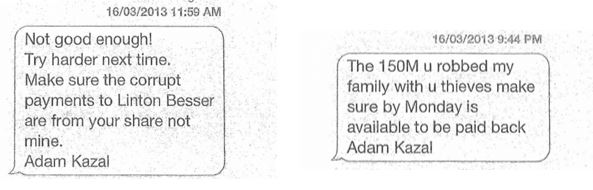
152 John David reported those messages to the police. According to the police facts, a sergeant phoned Adam who told the police that he (Adam) would continue to make all attempts to recoup the monies that he believed were owed to his family by the David family. The sergeant advised Adam to let his lawyers deal with his claims. He told Adam that his behaviour constituted harassment and intimidation and had to stop.
153 However, the police warning did not deter Adam from continuing his thuggish behaviour. On 18 March 2013, he attended John David’s business premises again and repeated his demands and threats.
154 On 19 March 2013, Adam made the following threats at 9:42am and 10:56am that he and Charif followed up by publishing the matters complained of not long after.
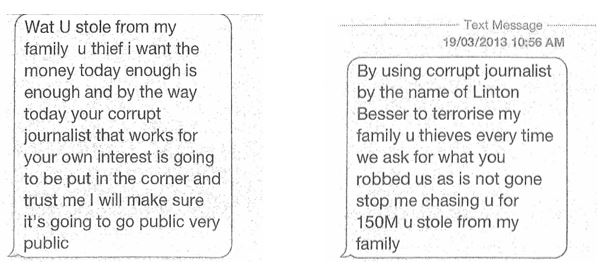
155 On 22 March 2013, the police made the provisional apprehended violence order preventing Adam from assaulting, harassing or intimidating John David, which was returnable before the Local Court on 27 March 2013. Subsequently, on 8 May 2014, the Local Court made a final order in substantially the same terms to remain in force for a period of two years.
The impact of the publication of the matters complained of on Mr and Mrs David
156 In about June 2013, Mr Hammond, in Sydney, performed a Google search for Thunder or Mr David in relation to his preparation for the forthcoming 2013 Australians in Film Awards and dinner that is an annual event in Los Angeles. He was going to attend the event and sit at the same table with Mr David. The search results threw up the Kazal website. Mr Hammond sent Mr David a text with a link to the Kazal website, which the latter received as he was leaving a movie theatre with his wife and children. Mr David glanced at the website when he received the text, saw what he described as “some salacious headlines and photos of me that were unflattering” and put the phone away until he had a chance to absorb it. At that point he felt a mixture of anger and despondency.
157 When Mr David looked at the landing page in his study after returning home from the cinema he felt an adrenaline spike of anger mixed with emotions of despair, anxiety and despondency. He saw the Kazal website as a continuation of the Kazals’ vendetta against himself and his reputation. He interpreted the blood red hand in par 43 as suggesting a risk to the life, principally, of himself, as well as those whom he loved. His first thoughts were how he could protect his wife and family from the repercussions of the scandalous, aggressive vendetta against him in the matters complained of. He said that he knew that legal proceedings would take a long time to address things and was burdened “by the sheer volume of the mud they threw”. He was also worried about the reputational impact on Thunder. He felt very despondent. That feeling was reinforced by his awareness that the publications followed close on the heels of Adam’s assault of his father (John David) and, because of “the threats embedded within it [viz: the first and second matters complained of] implied and otherwise, gave me real, real concern for my life”.
158 When he saw and went through the Intro article, on the night of Mr Hammond’s text he, again, felt angry, tormented and despondent.
159 Mr David he told his wife about the Kazal website the morning after he received Mr Hammond’s text and saw her shake involuntarily, exhibit grief and despair. He said: “All I could do was to hold her close and wait for it to subside”. After observing his wife’s reaction, Mr David said that he felt impotent and that he needed to protect her but “I couldn’t shield her from this”.
160 Mrs David observed her husband’s reaction on that morning as “a mixture of fury and incredulity”. She thought that the Kazal website was so unhinged that no one could take it seriously.
161 Mr David had never been found guilty or convicted of any crime. He denied that he was a corporate criminal or corporate thief or had ever paid money to Mr Besser or his employer, the owner of the SMH. He denied moving to the United States because he was guilty of corporate fraud or any criminality. Rather, he said, he moved his family there “to get away from the Kazals”. He said that each of the pleaded imputations in respect of the landing page and the Intro article was false. I accept that evidence.
162 Mr and Mrs David discussed what they should do about the content on the Kazal website. They considered doing nothing and ignoring it because it was so extreme and unusual while creating their own website to promote Mr David and Thunder, so that when persons searched the internet for him or it, their website would come up in the search results. However, as time went by, Mr and Mrs David perceived that people were treating them and their children differently in both personal and business matters and there appeared to be adverse impacts on Thunder’s business.
163 In the trial, Mrs David gave evidence before her husband from Los Angeles and he was present, without objection, on the audio/visual link while she did so. She recounted that because they had lived as a family in the United States since late 2011, they had only recently made friends or acquaintances of people in their new social and business circle, including among parents of children attending the same school and those children. The parents of a boy, who had become good friends of the Davids’ son, had also become reasonably good friends with Mr and Mrs David, but Mrs David said that, after June 2013, those parents stopped interacting with the David family and allowing their children to do so. Mrs David said that those parents “expressed to other people that they had read these terrible things online”. She recounted how their daughter had become close to the daughter of another couple and that both girls’ mothers had taken them to a Taylor Swift concert. Mrs David suggested to the other mother that they could have dinner together with their husbands but:
… my friend, who I was close to, who knew the mother in question, said that she had said to her, I feel bad that I keep telling Liz [Mrs David] no or ignoring it, but …her husband was quite a big deal with a big entertainment company and high-profile, and she basically said …. I can’t do it, because, you know, I read online about her husband, and I couldn’t risk doing that to my husband. He couldn’t risk the association. That was, you know, a paraphrase of what I heard…. I mean, of course, in these circumstances, it’s very difficult, because most people, out of social kindness, are probably not going to say to your face, “Hey, I read your husband’s a corporate thief”, so sorry, we’re not going to go out to dinner with you.
(emphasis added)
164 The worry about such reactions gave Mrs David sleepless nights. Mr David said that the girl’s father was a senior executive of a company that owned venues, Anschutz Entertainment Group, that was “influential in my industry”. Mrs David said that in the weeks and months following the first publication of the Kazal website in June 2013, it had “overarching effects” on their lives. She got to the point of trying not to say her husband’s name to people because in the circles in which they mixed people did Google searches (or “googled”) the names of businesses or other acquaintances. She feared that if they googled Mr David, they would read material on the Kazal website which, of course, included the landing page and its link to the Intro article. When she told Mr David, her partner for about 30 years, that this was what she was doing, he was furious and mortified. She described the impact that the publications complained of have had on their lives as costing hundreds of thousands of dollars in both lost business and legal fees and that she “wondered if … we would be able to stay together.”
165 Mrs David gave other examples of children making remarks to their son or daughter who told her things like “one of the boys in the playground saw dad on the internet and said he is a crook”. She said that those remarks caused her children distress and concern for their safety. When Mrs David related these remarks to her husband, she observed him to become angry and despairing, in a way that, to her, was “bordering on depression”. She said that he evinced a “sense of futility”. They discussed changing their names, moving away again, expressed their concerns about the effect of the publications on their two children and were so distressed that they asked themselves: “How can we live this day in and day out?” She said that the effect on her husband “was heartbreaking to see”.
166 Mr and Mrs David gave other instances of events in which the effect of the matters complained of manifested themselves in their social and business interactions. One evening in about October 2013, Mr Hammond and Mr and Mrs David went to dinner at a fashionable restaurant in Los Angeles with a prominent lawyer in the entertainment industry and his partner. Mrs David said that the lawyer had “his own prime spot table” and appeared to be well known to both the staff and other diners. She said that during the evening there was a lot of discussion about what the lawyer and Mr David might be able to do together in the future. Mr David said that he and the lawyer had a very productive discussion and got on well. However, as they were leaving, the lawyer took Mr David aside and said that he could not be associated with Mr David because there was “a lot of notoriety about you”. He told Mr David that when he went to the bathroom he had done a Google search on Mr David and saw material on a website that gave him cause for concern. Mr David felt angry on learning this. He said that was the end of any communications between him and the lawyer.
167 Mr Hammond also recalled this evening. He remembered the lawyer showing Mr David his phone, on which he (Mr Hammond) saw the Kazal website on screen and the lawyer saying “what have you done to these guys?” and that they “hate your guts”. Mr Hammond said that Mr David’s face blushed, and he appeared upset and embarrassed. He said that Mr David tried to explain his perspective but that “the story is [so] long and … almost unbelievable”. Mr Hammond said that, when returning to the Davids’ home that night Mr David said to him “that’s the end of that”.
168 The respondents put to Mr David in cross-examination that the likelihood to explain the lawyer’s reaction was that the lawyer had found details of a court case online. The case involved Focus on Cars Inc, the vendor of assets that Thunder appeared to purchase as part of its acquisition of its business premises. Focus had alleged that Thunder and Mr David breached the purchase contract, made intentional and negligent misrepresentations about Thunder’s ability to meet its contractual obligations and had fraudulently induced Focus to enter into the asset purchase agreement. As Mr David explained, that proceeding was, in fact, a cross-claim that Focus filed on 8 October 2013 in a proceeding that Thunder had brought against Focus in which Thunder alleged that Focus had made misrepresentations to induce the purchase (collectively, the Focus proceedings). The Focus proceedings settled at a mediation. Each action was dismissed and resulted in a reduction in the purchase price that Thunder had to pay Focus. There was no evidence before me of any publication concerning the Focus proceedings or any public knowledge of it that the entertainment industry lawyer knew or could have read before he told Mr David that there was “a lot of notoriety about you”. I accept Mr Hammond’s evidence that the lawyer had found and read the Kazal website, including the landing page and, I infer, the Intro article.
169 In about July 2013, Mr David became aware of Charif’s and Adam’s Twiter accounts. Over the years he noticed thousands of tweets posted on each that appeared to drive traffic to the Kazal website. He understood that the tweets used a bitlink to take the reader of a tweet about what seemed to be a news item, but diverted him or her instead to the Kazal website. This made him furious. To rub salt into the wound, Mr David felt the need to visit the Twitter accounts to keep abreast of the latest tweets.
170 In 2013, Thunder retained Nima Nami, a lawyer, to act for it. On 1 October 2013, Mr Nami, on his firm’s letterhead (Nami Law Firm), wrote to Charif, Karl and Tony at their Sydney office and GoDaddy at its Arizona offices. GoDaddy was then the host of the Kazal website. Mr Nami’s letters required Charif, Karl, Tony and GoDaddy to cease and desist publication of the matters complained of including on its website by 11 and 21 October 2013 respectively. The letter to the three brothers also required them to post an apology to Mr David.
171 A Google search screenshot for “rodric david” of 7 October 2013 showed the first result was a paid advertisement which appeared as “Kazal Family Story – Read about Charif and Tony”, gave a hyperlink to the Kazal website, and stated “Honest businessman from Australia”. The fourth item in the search results was “Your search – rodric david – did not match any news results”.
172 On 17 October 2013, Charif’s then Australian solicitor, Richard Mitry, replied to Mr Nami’s letter. Mr Mitry stated that Charif “is the sole of author of the website” and denied that Karl or Tony had any involvement in its publication or content. Mr Mitry wrote that Charif denied that the matters complained of on the Kazal website were defamatory of Mr David and asserted that the statements in them could be justified, included honest opinion and were made without any malice. Mr Mitry foreshadowed that Charif wished to bring proceedings for significant damages against Mr David.
173 On 18 October 2013, Mr David’s Sydney solicitor, Walter MacCallum, then of Aitken Lawyers, wrote to GoDaddy demanding that it remove the matters complained of.
174 On 3 December 2013, Mr Nami replied to Mr Mitry’s letter and rebutted its assertions in detail. Mr Nami again demanded that the defamatory publications on the website be deleted.
175 In early December 2013, Orlando Cabanday, a lawyer representing the Westside Group that had a business similar to that of Focus, approached Mr Nami to negotiate the lease of about 45,000 square feet in the premises that Thunder had acquired from Focus at a rent of USD45,000 plus outgoings and taxes per month for a term of 10 years. Mr David regarded this a good commercial opportunity for Thunder.
176 Mr Nami gave evidence that soon into the negotiations Mr Cabanday emailed him on 10 December 2013 enquiring in advance of sending a non-disclosure agreement “what can you tell me about this mess between Rodric and the Kazal brothers?”. Mr Nami attempted to explain the history of the dispute that Mr David had had with the Kazals and that he (Mr Nami) had been through those matters. He told Mr Cabanday that the allegations on the website were “completely not true” and vindictive. Subsequently, within minutes of their phone call on 10 December 2013, Mr Cabanday sent Mr Nami a draft non-disclosure agreement. However, Mr Cabanday did not engage later with Mr Nami’s attempts to follow up or pursue the negotiations. Within a few days, Mr Nami informed Mr David that Westside was no longer interested because its preliminary due diligence on him on the internet revealed that he (Mr David) was “some type of fraud”. Because it could not secure a tenant for it, Thunder used that space until about 2018 for storage, when it changed its use. Mr Nami said that Mr David was disappointed with this outcome and its connection to the Kazal website.
177 The respondents also asserted that Westside’s concern about the Focus proceedings was the reason for its cessation of interest in pursuing the lease negotiations. I reject that assertion. Mr Nami gave evidence that the parties mediated the Focus proceedings almost immediately after Focus commenced its cross action, which was filed on 8 October 2013. I infer that the mediation occurred before Mr Cabanday’s email of 10 December 2013 in which he inquired about “the mess between Rodric and the Kazal brothers”. Had Mr Cabanday or his client, Westside, been troubled by the Focus proceedings, it is likely that he would have raised those at the same time as his emails of 10 December 2013. But he did not because, I infer, the Focus proceedings were not of concern. Since Thunder secured a substantial reduction in the amount of the outstanding promissory note it owed to Focus for the purchase price, the answer to any such enquiry would be likely to have satisfied a commercial person that Thunder had not been at fault in the disputes the subject of the Focus proceedings.
178 Moreover, had Mr Cabanday read, or received a fair report of, Jones J’s decision in Emergent 2011 (2) CILR 329, he would have seen that Jones J found that Mr David had breached his director’s fiduciary duty by creating an allotment to dilute the Kazal brother’s shareholding. As Jones J made clear, this occurred in circumstances where the Kazal brothers were falsely claiming that they did not have to contribute to funding the joint venture vehicle and had made a relatively insignificant contribution to it of AUD600,000, in contrast to Mr David’s company’s contributions of over AUD5.8 million. It is doubtful that businesspeople would consider the facts or Jones J’s findings (or a fair report about them) about Mr David as suggesting that they should not do business as a tenant with Mr David or Thunder. The conduct as Jones J found was suggestive of Mr David’s frustration with having to continue to fund the joint venture with substantial funds, while the Kazal brothers were dishonestly repudiating their obligations to provide any significant funds.
The LA Biz and backstage posts
179 In about May 2014, Thunder launched an initiative called “Thunder Funder” to generate interest in its business among persons in the film industry and promote sales of its services. Mr David said that Thunder engaged a publicist to assist in it obtaining favourable positive publicity for the initiative.
180 On 28 May 2014, backstage published an article headlined “Best $1 million for your LA Indie Film” (the backstage article). The article had a picture of Mr David and informed its readers that he owned Thunder which had acquired Focus’s premises as a result General Motors’ recent bankruptcy filing. It stated that Mr David wanted to partner with others to use the 20 soundstages to produce indie films. He had launched an initiative called “Thunder Funder” offering a total of $12 million in funding for 12 independent film makers to undertake projects each year for the foreseeable future.
181 On 30 May 2014, Charif added the backstage post to the comment section of the Facebook version of the backstage article that commenced:
If you are currently doing business with Rodric David, or even thinking about it, you need to visit our website - http://www.kazalfamilystory.com - to learn Just how Mr David conducts business. Our so-called partnership experience with Mr David ended in court proceedings that found him guilty of a Breach of Fiduciary Duty exposing his many illegal and fraudulent actions. Below is a sampling of what the Judge had to say about Mr David's business practices:
182 On 6 June 2014, the LA Business Journal or LA Biz, published an article (the LA Biz) article headlined: “CEO Rodric David offering $1 million to independent projects through Thunder Funder. The article was lengthy. As I noted above (at [58]) Mr David said that the LA Business Journal is the equivalent of the Australian Financial Review as “the number one business paper in Los Angeles”.
183 On 8 June 2014, Charif made the LA Biz post to the comment section of the Facebook version of the LA Biz article, which was identical to the backstage post.
184 Mr David felt angry and very dejected when he saw each of Charif’s posts. He said that “the guy is following me around the world” and that “there was no way I could prevent the attacks against the positive messaging specific to the business”. He considered whether he should seek to separate himself from Thunder’s business so that the focus of the attacks would remain only on him.
185 He said that this experience resulted in him concluding that Thunder could not market itself “openly in a way that wouldn’t allow Charif Kazal a platform to amplify his attacks on me. It was extraordinarily damaging”. And Charif’s online activities involved him manipulating the search engine optimisation (SEO) results for each of Mr David and Thunder to place his (Charif’s) negative posts on the Kazal website at or near the top of search result pages.
186 On 23 May 2014, Charif opened his campaign on a new front by placing a paid advertisement on LinkedIn in The Australian Property Institute members group which appeared as:
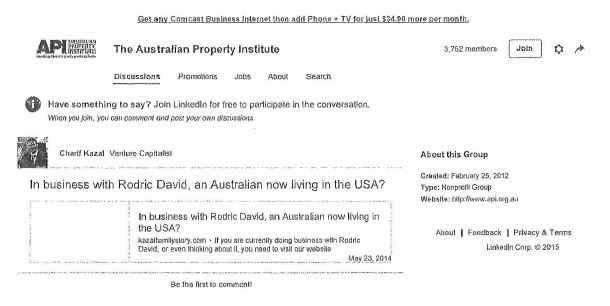
187 Once again, Mr David felt angry and dejected by this paid attack on him.
188 In about August 2014 Charif opened a further front in his attacks on Mr David by posting press releases on various websites in online publications. On 8 August 2014, one press release headed “Charif Kazal and Linton Besser’s Untruthful Articles Published by Sydney Morning Herald” on ReleaseWire, which appears to operate in Australia and the United States, and related sites. This press release rehearsed the by now familiar theme that Mr Besser had victimised the Kazal family in the Bad company and other articles and that the ‘true story’ was available on the Kazal website to which it provided a hyperlink. It praised the connections and qualifications of Charif, Tony and Karl and their achievements. Notably, the press release said nothing about their failures to meet their funding obligations that Jones J had found. Another press release, published on ReleaseWire, on 7 August 2014, was headed “Why Linton Besser, Sydney Morning Herald Journalist, Aided and Abetted Rodric David”. Its content was equally predictable and it too included a hyperlink to the Kazal website.
Commencement of this proceeding
189 On 15 August 2014, the applicants commenced this proceeding against Charif and Adam. Mr David hoped that this would cause them to pause or stop their activities on the internet defaming him and Thunder. He was sadly disappointed. Later on 15 August 2014, a process server, Richard Wellmeela, attempted to serve Charif and Adam at one of their business premises, a bar in the Rocks in Sydney. Neither was there but Mr Wellmeela gave his phone number to an employee of the bar and soon after Adam rang him while he was still there. Adam told him “Tell the lawyer to stick the document up his arse”. Adam uttered other profanities including “I will then come to fuck the lawyers”. I note in passing that this response appeared to reflect Adam’s conduct and attitude to this proceeding, as I explain below, until he gave evidence when applying to be released early while serving his sentence of imprisonment: cf: Thunder Studios Inc (California) v Kazal (No 6) [2017] FCA 1573 at [52], [58]. Relevantly, however, when Mr David saw Mr Wellmeela’s affidavit of service of 5 September 2014, he was horrified and scared by Adam’s statements. As events in late 2016 were to demonstrate starkly, Mr David had good reason to have that reaction.
190 A Google Analytics report for the Kazal website for the period between 20 June 2013 and 5 September 2014 showed that:
Country | New Users | Page Views | Services |
Australia | 1611 | 8877 | 2847 |
United States | 338 | 1934 | 490 |
Total (including Australia and United States) | 2763 | 14404 | 4770 |
191 In his answers to interrogatories, Charif said that between June to July 2013 and 21 September 2017, there had been, in Australia, 2404 page views of the Kazal website by 324 users and, in the United States, 556 page views of it by 36 users. He said that there had been an estimated 100,758 page “impressions” of the Kazal website, and 7,429 of the Intro article. Dr Schatz described a page “impression” as a potential, rather than an actual, view. Charif also asserted that there had been only one page view of the Intro article by one user in Australia and two page views by two users in the United States. I do not accept that the Intro article had so few page views or readers, since Mr David, Mr Hammond and the parties’ lawyers had read it. I place no weight on that estimate by Charif of the viewing of the Intro article.
192 On 9 September 2014 Aitken Lawyers wrote to Twitter demanding that it remove the link to the Kazal website published in each of Charif’s and Adam’s tweets on their accounts.
193 On 19 September 2014, GoDaddy wrote to Aitken Lawyers saying that without a Court order it could not take action in respect of the Kazal website.
194 On 14 November 2014, Charif and Adam published their first article “Ms Kate McClymont, Sydney Morning Herald: Kazal Family Story” on another online platform called prsync that allows persons to post press releases. In it he berated Ms McClymont, a well-known journalist with The Sydney Morning Herald, for writing about Mr David. Charif referred to Mr David in the article as a “convicted criminal” whom Ms McClymont has portrayed “as an innocent businessman being intimidated by the Kazals”. Charif asserted that she had portrayed “… my family, like we are the wrongdoers when in fact you are portraying an ex-convict who served time in gaol as some poor innocent victim is beyond pathetic”. The article stated that Charif had submitted it and it was signed by Adam, so that both were publishers of it. This was another rant and included, as usual, a link to the Kazal website so that readers could identify Mr David as the falsely described “ex-convict”. Charif followed up with further publications on prsync on 12 December 2014, 13 May 2015 and later, each of which was focussed on denouncing Mr David personally and Mr Besser’s publications. Each of those publications by Charif had a hyperlink to the Kazal website. Mr David explained that posting a press release or publication on prsync allows other websites to make automatic uploads of their content, which then provides an input to Google’s algorithms used to assess ranking of items in search engine optimisation results.
195 Subsequently, Charif and or Adam’s barrage of online postings continued. Next, in about May 2015, posts and articles about the Kazal Family Story and related topics began appearing on Pinterest. That online platform that is a photo hosting site. A post on Pinterest’s United States platform is published on its network worldwide and, again, is an input for search engine optimisation algorithms.
196 Needless to say, Charif and other Kazal brothers made multiple postings on their Pinterest accounts, many included snippets from, and of course links to the Kazal website such as:
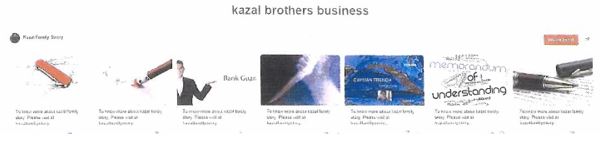
197 Another Pinterest post, depicted below, showed that the information and link to the Kazal website also appeared on another website, buzzfeed.
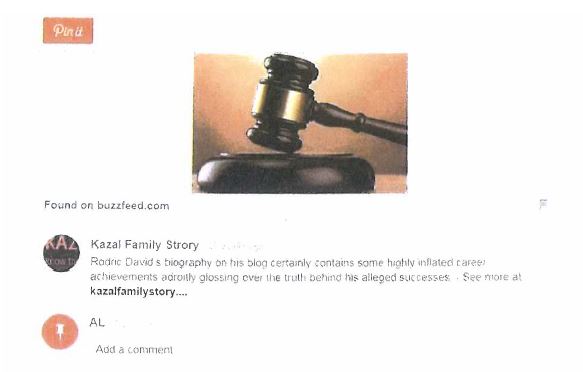
The Steven Rockefeller encounter
198 During 2015, a friend introduced Mr David to Steven Rockefeller, one of the heirs to the Rockefeller fortune, who owned a media company. Mr David began negotiating a business deal under which Mr Rockefeller and one of his associates discussed merging their entertainment business with Thunder’s and contributing USD10 million working capital. Mr and Mrs Rockefeller had invited Mr and Mrs David to stay with them at the Rockefeller estate in New York and Mr David anticipated that the “deal” would be closed at a meeting there. On the day before they were due to fly to New York, the friend who had introduced Mr David phoned him to say that Mr Rockefeller was withdrawing from the deal and that Mrs Rockefeller had said to her husband that “she was not going to have crazy Arabs knocking on her door”. During their negotiations, Mr David had told Mr Rockefeller about this proceeding and the Kazal website. He said that Mr Rockefeller was comfortable and understood that the Kazal website and other publications that the Kazals had generated were malicious attacks. By this stage, Mr David considered that he had to take persons with whom he was beginning to deal or commence a relationship through the story about the Kazal website and related publications. He said that this made him feel embarrassed but “I thought it was always better for me” to do so.
199 On 9 June 2015, Aitken Lawyers wrote to Adam (who had not filed an appearance) advising him that the Court had ordered a mediation to occur on 16 June 2015 and invited him to attend. Adam replied in an email on 15 June 2015 brazenly asserting that he had removed his Twitter post and:
“I have no intention of putting it back up. I am an undischarged bankrupt.
Accordingly, I see no reason why you will pursue a case against me”.
200 He said that he had no interest in mediation. His email reflected a detachment from the reality of what he was doing that pervades the behaviour of both respondents. There is no evidence that Adam removed his Twitter posts.
201 As at mid-August 2014 over 4,800 individual tweets were available for viewing on Charif’s Twitter account and over 3800 on Adam’s, which as at 8 September 2015 had increased, respectively, to 6,166 tweets and to 5,856.
202 On 7 August 2015, Mr MacCallum wrote to Charif’s solicitor, Mr Mitry, making an open offer to settle this proceeding on the basis that Charif and Adam agree to be enjoined from further publication of the matters complained of, continuing to make the misleading representations using the bitlinks on their Twitter accounts and pay $100,000 in costs. There was no response.
203 On 22 March 2016, soon after Mr David’s father’s death, Mr MacCallum wrote to Mr Mitry repeating the earlier open offer but adding a further term, that the proposed injunctions would not prevent Charif from publishing a fair report of Jones J’s judgment. Once again, there was no response to the offer. However, Charif adopted a new tactic that turned the posting of material onto the website into a virtual storm.
204 In 2016, GoDaddy suspended the Kazal website’s account after Mr David complained to it under the Digital Millenium Copyright Act (US). However, predictably, the respondents did not let this interfere with their persistence in harassing and disparaging Mr David and Thunder. They simply found a new host, a site called Indurance and kept the Kazal website operating as before. After Mr David’s lawyers made a new complaint to Indurance, it ceased hosting the Kazal website and the respondents found a new host, Orange. Orange was located in Iceland which required a complainant to follow a different process, under Icelandic law, for removal of a website. Mr David did not pursue such a process, since he thought that Charif and Adam would find another compliant host site if he went through the new process.
The 2016 activity on the Kazal website
205 From 1 April 2016, Tony and Charif began posting emails or news articles on the Kazal website on an almost daily basis. Their theme was in the headlines, for example, “Tony Kazal demanding answers from Richard Bribe Taker Story Maker Baker – Day 1” on 1 April 2016, “The lies to cover the Corporate Fraud Syndicate” by Charif on 3 April 2016 and “Charif Kazal Demands Answers from the Corporate Thief Rodric David – Day 2” on 11 April 2016. The articles rehashed in splenetic, distorted descriptions, the by now familiar themes. Richard Baker was a Fairfax journalist who wrote in The Age. This series of postings on the Kazal website culminated on 2 March 2017 with an article headed “Rodric David Reminded the Kazal family refused his family’s witnesses tampering Attempts – Day 163” that was signed by Tony. This last article was a rant that included statements such as:
Well guess what ! l don't care if it takes 20 years for justice to be served, I will not stop until every last grub your family has paid off is brought before the Courts and made accountable for the endemic corruption that surrounds you!
…
The evidence of your crimes is outlined on Charifs website www.kazalfamilystory.com which is tracking the truth of what occurred in our dealings with you and highlights the many crimes committed by you and your co-conspirators against Charif & I.
Your criminal acts that include being found guilty by the Court of stealing from Charif & I and having Fairfax Media write more than 30 malicious articles about Charif & I to help you steal from us and destroy our entire family's business reputation.
(emphasis added)
206 The other numerous examples of these postings rehearse the same familiar themes. Once again, the multiple postings had the purpose of exploiting the search engine optimisation algorithms so as to increase the use of Mr David’s name and thus his ranking in search results. In addition, many of these postings also were emailed to Mr David, Thunder and, initially, to a generic email address for sales at Thunder but later to individual employees. Mrs David saw many of these both on the Kazal website and on Twitter. Some of the postings to the Kazal website in this campaign were directed and emailed to Mr Singh and his employees.
207 On 1 September 2016, Charif emailed Mr David and employees of Thunder and posted on the Kazal website an article entitled “Charif Kazal Demands Answers from the Corporate Thief Rodric David – Day 74”. This article began by reciting that Charif and Tony had “commenced litigation against you for Fraud and Embezzlement and to wind up all of our businesses jointly owned with you starting in early 2010”. He accused Mr David of having made a vexatious complaint to the ICAC about Charif bribing Mr Kelly in 2007 when he (Mr Kelly) was a public official. He asserted that because of Mr David’s alleged breaches of a joint venture, the UAE based partner had terminated the contract. Charif then alleged that Mr David was in a conspiracy with Fairfax Media and Mr Besser to report lies over six years “for your benefit”. Charif alleged that this was “part of a deliberate strategy to steal the GRL [Global] business from Tony and I” and continued:
We have all the evidence of your crimes recorded on [the Kazal website] which contains all of your lies, corruption and contradictions for the world to see and judge for themselves.
The actions you took and those of Fairfax Media to support your lies by attacking innocent members of my family have cost us in excess of $3 Billion this past 6 years.
The truth is on our side which is why you can never evade us from pursuing you until you are made accountable before the Courts.
We will not stop until all is revealed about your disgusting malicious crimes against my family.
(emphasis added)
208 The tone of that posting and email was threatening and confronting. The Kazals instigated the winding up of Emergent on the just and equitable ground on the basis of the invalid allotment that Mr David had promoted. The winding up resulted in the sale of the interest in Global, the distribution to the joint venturers of the amounts Emergent owed them and a division of the balance on an equal basis. The alleged cost to the Kazals of “$3 billion” and “crimes” does not have any apparent grounding in reality.
209 Charif followed the 1 September 2016 posting with another email on 3 September 2016 entitled “Charif Kazal Demands Answers from the Corporate Thief Rodric David – Day 75”. This was largely repetitious of the previous posting, but also complained about Mr David’s conduct in allegedly setting up a website that was the subject of the cross-claim that Charif abandoned immediately before he would have had to give evidence to support his claim that Mr David had defamed him.
Litigation in the United States
210 Mrs David agreed in cross-examination that after a time, these emails and postings became “a constant barrage”. The purpose of the cross-examination of Mrs David on these postings was to link the distress which Mr and Mrs David felt as a result of that “barrage” of emails being sent to Mr David and Thunder’s employees and the picketing and pamphleteering that occurred in late October and November 2016 around the Davids’ home in Los Angeles contemporaneously with Adam’s conduct that resulted in his convictions for contempt of Court and the damages that Mr David and Thunder claimed in a proceeding against Charif, Adam and Tony that they brought in the United States District Court for the Central District of California in February 2017 (the District Court proceedings).
211 Mr David felt angry about the content of this stream of emails and the fact that it was also directed to the work emails of the staff at Thunder. He thought that those emails were also causing his staff stress and anxiety. He had to reassure them that there was no truth in the allegations against him. He offered them therapy if any needed it and told them that if they did not want to come to work because of the emails, they could have a sick day. He said that his staff expressed concern for their physical safety because of information in the material online, such as the newspaper articles suggesting connections between the Kazals, the Gaddafi family and Hezbollah. Mr David said that the public perception and fear in the United States about those persons and bodies at the time was different to that in Australia. He was distressed and concerned as to how his staff had been affected by this conduct. That distress only increased with what happened in late October 2016.
212 On 21 October 2016, Charif filed an amended complaint against Mr David and others in the Superior Court of the State of California for the County of Los Angeles – West District (Charif’s Superior Court claim). He claimed that Mr David, among others, had published the Kazal Family Truth, the publication of which was also the subject of Charif’s abandoned cross-claim in this proceeding. One complaint in the articles and emails that Charif posted after April 2016 related to the fact that, as Charif asserted, Mr David did not identify himself to be responsible for the Kazal Family Truth website. Mr David denied in evidence to me that he was responsible for the publication of the Kazal Family Truth website and said that the chief technology officer of Thunder from mid-2015, Matt Price, was its publisher in his private capacity.
213 Charif’s Superior Court claim asserted that Mr Price, Mr David and others had violated provisions of the United States Code relating to cyber-piracy, cybersquatting and the Business and Proprietorship Code relating to unlawful domain name registration and unfair business practices. Mr David denied in cross-examination that Mr Price had informed him that he (Mr Price) had created the Kazal Family Truth website before Mr David had been served with Charif’s Superior Court claim. Senior counsel for the respondents accused Mr David of lying in making that denial. In re-examination, Mr David said that he felt humiliated when accused of lying. Although the respondents criticised Mr David’s veracity on this issue, I accept his evidence that he was not aware of Mr Price’s responsibility in creating the Kazal Family Truth website before being served with Charif’s Superior Court claim.
214 First, Charif abandoned his cross-claim based on Mr David being the publisher of the Kazal Family Truth website. I find that, because Charif declined on the sixth day of the trial to pursue his cross-claim, any evidence that he could have given would not have assisted his case, both on the cross-claim and the defence of Mr David’s claim: Kuhl v Zurich Financial Services Australia Ltd (2011) 243 CLR 361 at 384–385 [63] per Heydon, Crennan and Bell JJ; Jones v Dunkel (1959) 101 CLR 298 at 308 per Kitto J, 312 per Menzies J and 320–321 per Windeyer J.
215 Secondly, the respondents led no evidence to support the accusation during the trial, when it was a live issue in the cross-claim before Charif abandoned it. I infer that Charif had no documentary or other evidence, admissible against Mr David, to challenge the veracity of Mr David’s evidence that neither he nor Thunder was responsible for the publication of the Kazal Family Truth website or knew of Mr Price’s role earlier than he said, despite the availability of forensic processes of discovery and interrogatories in this proceeding and in Charif’s Superior Court claim (including, there, the availability of oral depositions).
The events of late October and November 2016
216 The online campaign directed at Mr David intensified in late October 2016 and morphed into a physical and disturbing form. Mr and Mrs David also gave evidence of the traumatising effect of the conduct and threatening behaviour that Adam and his brothers orchestrated in Sydney and Los Angeles in late October and November 2016.
217 On 26 October 2016, at about 6:15am, Mrs David walked downstairs in their Los Angeles home, which was in a cul de sac. It was dark outside but she saw a car full of men driving slowly past their house and slowly back again. Mr David had gone to the gym earlier that morning. She received a call from her neighbour who normally picked up their son to take him to school. The neighbour informed Mrs David that there were men on the street holding signs with Mr David’s picture on them. Her son went outside and got into the neighbour’s car. About two minutes later, the boy phoned her, hysterical, about the men, the signs and their allegations against his father. She told him that she would deal with things, he could go to school and she would talk to him later. At that stage she had not seen what was outside. She told their daughter not to leave the house because she did not feel safe. She locked up, leaving her daughter in the home, put on the alarm and got into the car. When she got to the corner she saw about five men holding large posters with Mr David’s face on them that proclaimed him to be a “Corporate Thief”. They had also placed two metre long banners on trees and stop signs. She rang her husband and said that she did not know what was happening. Mrs David also called the police because she was so distressed.
218 Mr David arrived home from the gym while his wife was speaking to the police. The police told the protestors that they could not hang their signs on public or private property, but the police told Mrs David that there was not much else that they could do as the men were on public property. Mrs David said that, given their experiences of the Kazals, she felt a heightened sense of threat and fear from this incident. She said their daughter, who usually walked to her school, which was a short distance away, was in tears, confused and terrified. She had to go with her daughter into the classroom and discuss the situation with the school principal. The men returned again over the next days. Their daughter did not walk to school until after Christmas 2016.
219 When he arrived at Thunder’s premises later on 26 October 2016, Mr David saw about 12 protestors doing the same thing as at his home, disrupting the driveway into the studios. Mr David rang his wife from work and told her that the same thing was happening outside Thunder’s premises. He called the sheriff who told the protestors that they could not approach private property. He was horrified, exasperated and very afraid because of those actions and posters. To him, “this was a step that we could never imagine”. He felt powerless to protect his family and children from this abnormal conduct. He said that the protestors were posting what they were doing on social media. He also saw a van (as depicted in [221] below) driving slowly in Los Angeles near his home, the children’s school’s front gates and Thunder’s premises. Mr David said that the protestors chanted “Rodric the robber” and took videos of their activities and posted these on Youtube and the Kazal website as appears below:
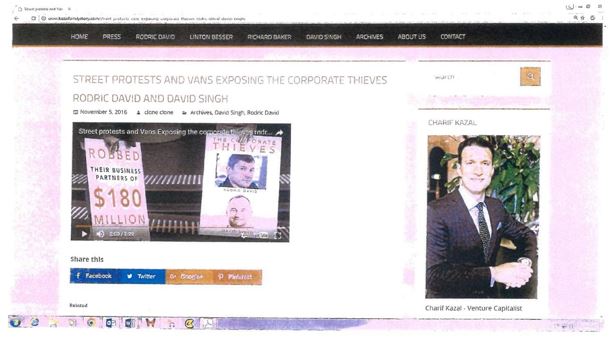
220 On 26 October 2016, Mr David rang his wife and said that the same thing was happening in Sydney (where it was 27 October 2016). At some point that day he also told her that vans were driving around Sydney. Mr David’s brother sent him photos of the similar activities of protestors and vans in Sydney, in the Central Business District and Eastern Suburbs, one of which is below:
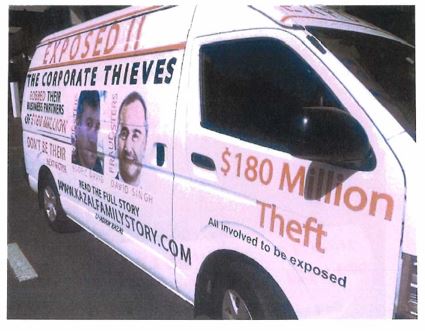
221 Within a few days, Mrs David saw a van with the detailing below driving past their home, her daughter’s school and the neighbourhood:
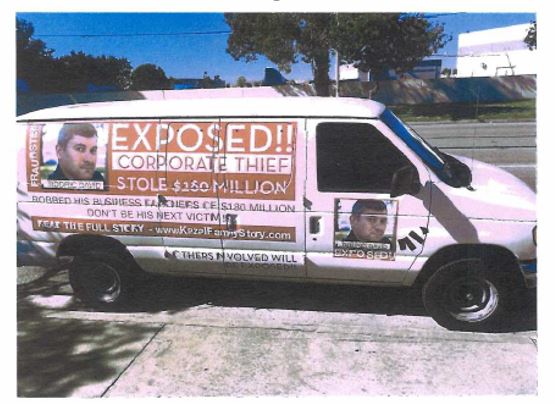
222 Mrs David said that on one occasion the van and some accompanying cars were taunting her as she spoke to police about her fears. She said, and I find, that “it was terrifying. It was intimidating”. She engaged a security company to change all the locks at their home and install security lights and security cameras. She said that the Kazals were having her followed and photographed. Her doctor had to prescribe her with anti-anxiety medication as the extraordinary behaviour escalated. She began losing her hair and losing weight. The behaviour was, as I would infer could be expected, having a significant, adverse impact on their children and, of course, to her observation, on Mr David. She said his reaction was “fury… tempered by anxiety and fear”. Mrs David said that:
there just seemed to be this ever escalating series of events, and this was this was sort of our nightmare come true, that them being here on our doorstop, with men and aggressive tactics you know, we had tried very hard to keep our address in the United States secret, private used a PO Box for everything, you know, purchased the house in the name of a trust that had nothing, no reference to our Christian names. You know, the idea of them being here in Los Angeles, on our doorstep, around our children’s school, around his business, was it was terrifying, so whilst there was a lot of anger and rage and fury, there was equally fear and anxiety. It was gobsmacking.
223 On 28 October 2016 (Sydney time), Adam sent an email to Mr David and numerous Thunder employees, in the same manner of communication that Charif and Tony had used since about April 2016. Adam’s email was headed “Adam Kazal Demands Answers from Online Identity Thief Rodric David – Day 1” and read:
Rodric David,
You defrauded companies you owned with my brothers Charif & Tony.
You admitted under Oath to being the one the Sydney Morning Herald wrote their lies for to fabricate an ICAC Inquiry.
You used the Herald articles to avoid prosecution and steal the $180 million company you owned with Charif & Tony Global Renewables with help on the theft from CEO David Singh.
You had the Herald write an article attacking all of our family members and Oscar is suing them for that.
Now I find for at least the last 6 months you have stolen my identity to publish disgusting lies to embarrass me and my family just because I am Charif & Tony's brother. You also stole the identity of Charif, Tony & Karl.
You made it personal and I will show you that I am not going to put up with the crap you tried to dish out to my brothers.
My team in LA are going to expose you wherever you go until you are charged with your crimes and my team in Sydney will expose all of the spineless thieves who thought they could help themselves to steal from my family.
Getting your hyena to scream at the LA Police like she did yesterday exposing how the disgustingly racist elements of your family are not restricted just to your Syrian David blood is not going to stop me and my crew!!
I will show the good people of LA what scum they have allowed into their city that Australia is glad to be rid of. Let's see how you like having the truth of what you get up to reported for the world to see your true colours.
You and your crime lord father John David might be used to stealing white collar style with help from your family's ex-politician lapdog but I really don't care about any of that.
You start a fight with me, I will show you how Adam Kazal is different to the rest of the family.
See you around grub.
(emphasis added)
224 Adam’s statement “Getting your hyena to scream at the LA police” was a reference to Mrs David’s reaction to the shocking events that occurred on 27 October 2016 outside their home.
225 On 28 October 2016, Adam also republished that email on his Twitter feed under the heading: “hey @Rodric_David my team in LA are going to expose you wherever you go! – Day 1”. That republication was the subject of Adam’s conviction for contempt summarised in pars (c) and (d) by the Full Court (see [12] above).
226 When Mrs David read Adam’s email of 28 October 2016 (which was dated 27 October 2016 when it was received in Los Angeles) and its reference to “my team in LA and my team in Sydney” she “thought it was terrifying”. She knew of the earlier apprehended violence order against Adam as a consequence of his conduct toward her father-in-law. She said “I read this as a genuine threat. I read this as a threat to our safety, the safety of my children, the safety of my family”. When she expressed her fears to Mr David, they agreed to approach the Federal Bureau of Investigation (FBI) and the local police because of the unpredictability of the situation and to apply to this Court for an injunction. She also said that Adam’s misogynistic characterisation of her as a screaming animal was false and that she had not screamed at the police. Both she and Mr David read the contents of the email as a direct threat. She also learned that Adam had made the tweet of 28 October 2016.
227 Mr David burst into tears when he was taken in examination in chief to Adam’s email of 28 October 2016. He gave this evidence, that I accept, of its effect on him:
I was traumatised. I was in fear of my life and the life of my family. My extended family in Australia. My father.
228 Immediately afterwards, in response to questions in chief, Mr David said that his cultural heritage included Swedish, Lebanese, Egyptian and Syrian strands. He was then asked whether, although he was not a Muslim, he was proud of that racial heritage and said “Absolutely, I’m a proud son”. However, in late 2018 in the jury trial in the District Court proceeding, Mr David gave the following evidence concerning Adam’s racist taunt about “your Syrian David blood” in the 28 October 2016 email:
Do you have Syrian blood? --- That’s the funny thing, no.
(emphasis added)
229 In cross-examination before me, Mr David denied lying to the jury by saying that he did not have Syrian blood. He said that there was a family debate about the location of an ancestral village on his father’s side as to whether it was in Lebanon or Syria and asserted that “I misspoke at the time. It wasn’t a deliberate lie… It’s innocuous to me”. His cross examination continued:
You gave that answer to the jury, and you denied your Syrian blood to the jury, because you wanted them to find against the Kazals, who you painted as Muslims, and Arabs, isn’t that right? --- No, it’s not.
And you painted them as having links to Hezbollah, isn’t that right? --- No, it’s in the articles that were written about them.
And you thought that by telling lies about your Syrian blood, you would obtain an advantage over the Kazals in this trial before the jury, didn’t you? --- No.
Lets have a look at how your counsel opened this jury trial, at transcript page 13, please. Can we go down to line 14. You see there, Mr Wiener told the jury, in his opening, these articles, which will be introduced by both sides, also link the Kazals to Hezbollah, which is a terror organisation, and the Libyan regime of Muammar al Qaddafi; do you see that? --- I do.
And your counsel put that to the jury on your instructions; didn’t he? --- No, counsel ran the case as he saw fit. I’m not the lawyer.
(emphasis added)
230 I do not accept that Mr David was mistaken in giving his answer to the jury that he did not have Syrian blood. I find that he lied on that occasion. This has made me examine closely his evidence in general and be cautious in treating it at face value before accepting the large part of it in these reasons as I have, including his account of what happened to him while detained in the UAE during May 2010. Most of his evidence, apart from his state of mind, was consistent with objective facts or satisfied me as to its inherent plausibility. I have said that some of his account is coloured by the hurt and pain of the abusive conduct of the Kazals beginning with his arrest in the UAE, and continuing with the online and then physical threats and harassment to which he was exposed. Nonetheless, in considering the evidence as a whole, which spanned events over 13 years and concerned the considerable antipathy between the parties, I formed the view that the findings that I have made are warranted after having had regard to the matters and standard of satisfaction that I must reach prescribed in s 140 of the Evidence Act.
231 I have allowed in making my findings for the emotional scarring of the years of traumatising behaviour to which the Kazals have subjected Mr David and his family, which is likely to have detracted somewhat from his ability to give a wholly detached account. Having considered Mr David’s evidence as a whole, including as to his state of mind, I am satisfied that, in general, he was endeavouring to tell the truth and recounting a reasonably accurate history of his experiences of the verifiably extraordinary behaviour of the Kazals towards him and his family.
232 I accept Mr David’s evidence that Adam’s email of 28 October 2016 “changed the game”. He was in fear of his life and said that “[t]he escalation was extreme, and here is a clear and concise statement saying he is going to be very much different to his brothers in the way he seeks to deal with this”. He described Adam’s use of the anonymous face mask on his Twitter feed as reinforcing his perception that the behaviour to which he and his family were subjected in late 2016 was a vendetta. He was also concerned that Adam had included in his emails and tweets the individual email addresses of many of Thunder’s staff. This conduct caused Thunder to install a new firewall.
233 On 28 October 2016 Mr MacCallum wrote to Mitry Lawyers. Mr MacCallum put them on notice that Mr David believed that their client, Charif, and his brother, Adam, were responsible for the vans, protestors and posters that had been displayed in Los Angeles and Sydney. The letter noted that overnight posters had been affixed to telegraph and light poles along New South Head Road and Victoria Road in Sydney’s Eastern suburbs that appeared in the form below:
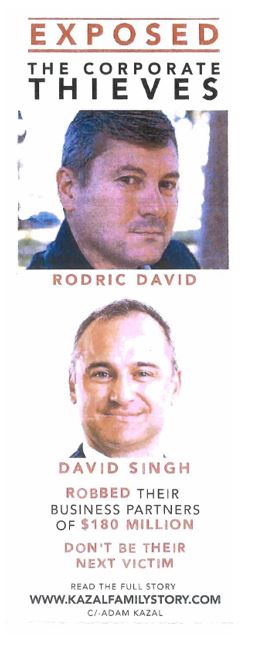
234 Mr MacCallum sought, by 5pm on Monday 31 October 2016, an undertaking from Charif that he would not post or display any signs, including on vans, to the above effect, or convey any of the imputations pleaded in the statement of claim, or any imputations that Mr David was a corporate thief, stole $180 million, was guilty of fraud, was a conman or conspired with Mr Singh to steal $180 million.
235 On 31 October 2016 Adam sent an email to Mr MacCallum headed “Response to your Letter”. Relevantly (as I found in Kazal [2016] FCA 1598 [6]–[9]), the email said that Adam had received Mr MacCallum’s letter and that the letter appeared:
to be trying to link me back to a case I was removed from at the outset when I removed the content your Client claimed offence to from my Twitter feed.
236 Adam wrote in the email that he did not regard Mr MacCallum’s threat in his letter of 28 October 2016 as related to the case involving his brother, Charif, being, I infer, this proceeding. Adam said this was a separate issue and a case that, for him, had ended a long time before. The email then proceeded to say among other things:
Regarding the van, do you seriously claim to be a lawyer? You are the same person as I recall that orchestrated and fabricated the ICAC case with Rodric David just to create a smokescreen for his highway robbery. That makes you nothing more than a common thug and liar fabricating claims to enable this man to steal from innocent victims. Is that what a lawyer does? I don’t think so.
You want me to cease using the Van? Are you serious?
(emphasis added)
237 In the email, Adam made a series of allegations accusing Mr David of creating or being involved in the creation of false webpages that purported to be associated with members of the Kazal family, including Adam, but were, in fact, operated and controlled by Mr David and Thunder Studios (seemingly a reference to the Kazal Family Truth website). He asserted that those webpages defamed Adam, his entire family, and others. I infer that this allegation related to the subject matter of Charif’s abandoned cross-claim. Adam wrote in the email:
So if you think I am going to stop then clearly you also aren’t a very good lawyer!
238 It continued by referring to Mr David allegedly supplying The Sydney Morning Herald with misleading information that was used to defame, allegedly, the Kazal family in more than 30 articles, including some concerning Adam personally. It then said:
Unless your Client removes the offensive website and transfers the domain name www.adamkazal.com to me as the lawful owner, pays my costs of $666,666.66 for Legal & Marketing Costs, Pain and Disruption to the Bank Account mentioned below and issues a written public apology by 4pm tomorrow, I reserve the right to not only continue using the Van, but to also increase the size of my fleet.
Bank:…
Account Name:…
BSB…
Account #:…
If you fail to meet my demands and include a copy of any EFT Confirmation issued by the Bank the I reserve the right to do whatever is necessary to expose the Corporate Fraudsters Rodric David & David Singh who stole $180 million from my family as well as all other persons that have intentionally aided and abetted the Fraudsters in the process. Feel free to warn all involved to ensure they have a good digital image online if they want to look their best on the side of my growing fleet of vans……
For the avoidance of any doubt, that includes you too Sir.
(emphasis added)
239 Adam also posted the Tweet below that also reproduced his 31 October 2016 email:
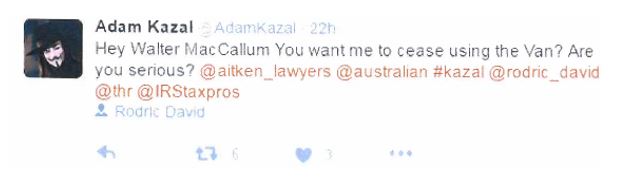
240 When Mr David saw Adam’s email of 31 October 2016 it reinforced in his mind that Adam “was well prepared and capable of taking the law into his own hands as he saw it”.
241 On 4 November 2016, Perram J granted an ex parte injunction against Adam that enjoined further publication of defamatory imputations of and concerning Mr David including on the vans. On 5 November 2016 Mr David became aware of a video that showed the placards, posters and vans had been posted on YouTube and multiple other outlets, including the Kazal website and channels called John Doe, David Singh and Rodric David. The video showed activities outside the Sydney office of the Prime Minister at 1 Bligh Street, as well as Mr Singh’s home with him, and later his wife, leaving it in cars. There was narration accompanying on the video directed at Mr David. After Perram J granted the injunction, the video on the Rodric David channel was taken down only in Australia but was still available elsewhere.
242 I set down the hearing of the application to extend the injunctions until the trial for 11 November 2016. I recorded a summary of relevant findings in my reasons that Adam had committed contempts (Thunder [2016] FCA 1598 at [11]–[22]). Both the Full Court and I found that Adam had contravened orders 1 and 3 (in annexure A to these reasons) because he published the Kazal website, by his express reference to it on the vans and posters, in circumstances where the Kazal website displayed 23 posts that conveyed the proscribed imputations about Mr David: Kazal 256 FCR at 119–120 [57]. The Full Court affirmed Adam’s convictions on counts 8 and 9, namely that, by sending and publishing the 28 and 31 October 2016 emails and tweets, he had intended to put improper pressure on Mr David, Thunder and Mr MacCallum that had the tendency to interfere in the administration of justice. Those publications contained deliberate threats to escalate his conduct involving the posters, pamphlets, protestors, vans and defamatory publications that were calculated to bring improper indeed, as Besanko, Wigney and Bromwich JJ said, “extreme” pressure on Mr David, Thunder and Mr MacCallum to desist in this litigation: Kazal 256 FCR at 129 [87]. Their Honours held that “it was a plain, deliberate and serious administration of justice contempt”.
243 I am satisfied by Mr and Mrs David’s evidence that Mr David genuinely felt that extreme pressure and was traumatised by Adam’s conduct of publishing and causing the republication of the defamatory imputations conveyed by the landing page and the Intro article as part of his campaign of intimidation and harassment that he pursued relentlessly in late October and until late November 2016. In my opinion, as I explain later, that conduct must sound in a significant award of compensatory and aggravated damages: Praed v Graham (1889) 24 QBD 53 at 55 per Lord Esher MR, with whom Lindley and Lopes LJJ agreed.
244 Even after I found Adam guilty of contempt on 21 December 2016 (Thunder [2016] FCA 1598) and sentenced him on 27 February 2017 (Thunder (No 2) [2017] FCA 202), the Kazal website remained active and contained posts that Charif updated or caused to be updated, by reason of his control of it, until at least 2 March 2017 when Tony posted, and emailed to Mr David, Thunder, six of its employees and Charif his article, “Rodric David Reminded the Kazal Family Refused his Family’s Witness Tampering Attempts – Day 163” (see [205] above). Mr David said that in separate proceedings that Mr Singh and his company, Re.Group, brought in respect of similar conduct including that posting in October and November 2016, Perram J had made an order that had the consequence that “the website was, in effect, shut off”. Whatever order, if any, was in effect, it was not before me, but I accept that from about March 2017 the Kazal website ceased being updated, but has remained online.
245 However, during the trial, Mr MacCallum was able to play, in Court on 21 October 2020 (which was conducted electronically on Microsoft Teams), as real evidence, YouTube videos on youtube.com that were still available for viewing through using a Google article on the Kazal website. One video, that lasted for about two minutes 20 seconds, showed a van driving in Sydney and protestors holding posters and placards with Mr David and Mr Singh’s photos (see [241] above) and “Robbed $180 million” and standing outside a house (which I infer was Mr Singh’s) from which a man emerges and gets into a car. A voice-over states: “Mr Singh, Adam Kazal wants to know why four and a half years ago you had no money and now you live in a $30 million house at [a named eastern suburb in Sydney]. Can you explain that?” The video also showed about ten people holding the posters and placards outside 1 Bligh Street, chanting “Rodric the Robber” before concluding with a display of the Kazal website’s internet address. This became Exhibit B.
246 Another short video of about 20 seconds, which became Exhibit D showed, progressively, still images of the names of the Kazal Family Story, Mr David with a cloak over his shoulder and a large hand reaching toward him (par 30, as seen in the landing page), a smiling labelled photo of Charif, a road sign “Integrity” the “Truth or Dare” sign (par 36), a “Caring for Sustainability Sign”, the “Failure Types” graph (par 23), a sign “Contact us”, followed by “NSW, Sydney, Australia” and the Kazal website’s internet address. Music played in the background of this video.
247 When Mr MacCallum tried to copy Exhibit D after Court on 21 October 2020 he could not do so directly on his computer but made a copy using his mobile phone. That became the physical Exhibit D. However, overnight, the videos were removed from YouTube by the uploader and could not be viewed anymore.
248 On 24 February 2017, three days before Adam’s sentencing hearing was to occur, Charif emailed Mr David, other Thunder employees and Tony, and posted an article on the Kazal website entitled “Charif Kazal Demands Answers from the Corporate Thief Rodric David – Day 162”. The article referred to the ICAC proceeding and accused Mr David of making a false accusation that Charif had committed a crime which the Director of Public Prosecutions had determined raised no case for Charif to answer. He stated:
You were found guilty by the Court of stealing the shares owned by my brother Tony & I.
More recently you stole the online identities of Tony & I as well as our brothers Karl & Adam.
Our lawyer in America where you had your Thunder Studios employees carry out the online identity theft on your behalf is confident we will again prevail.
Finally we have our long running defamation proceedings. You have so far failed to meet the majority of Court imposed deadlines over several years, whilst I simply rely on the Truth Defence to expose you for what you did to Tony & I.
The truth is a powerful weapon. Too bad you will never get an opportunity to feel the power it brings to a Court case like ours!
My website www.kazalfamilystory.com is recording all of your lies, corruption and contradictions for the world to see and judge for themselves including the work of the Sydney Morning Herald who has written more than 30 malicious articles in the last 6 years attacking me and my family on your behalf.
The truth will never go away and I will continue to use it as a shield against your desperate lies and malicious threats including your online Identity theft and defamatory lies!
I will not rest until you repay what you stole plus damages, apologise publicly for the lies you told and serve time in prison for the despicable crimes you committed against me and my entire family!
(emphasis added)
249 Mr David felt exasperated when he read that email, especially in the context that Adam had been found guilty and was about to be sentenced for his contempt, including for his threats in his 28 and 31 October 2016 emails to interfere in the administration of justice. Mr David said “this is such extraordinary crazy behaviour” and that he believed that Charif “was stepping into his brother’s Adam’s shoes”. When he read the paragraph “The truth is a powerful weapon. Too bad you will never get an opportunity to feel the power it brings to a Court case like ours” he understood that it “reemphasised that there was a threat to my life”.
250 Mr David said that as a result of the campaign waged by Charif, Adam and other Kazals “I don’t sleep comfortably in my own house because I know they know where I live” and:
Fatherhood is my greatest joy. It’s not right, it’s not normal, for a business dispute to attack family members, put protestors and vans and denigrate a parent in front of the childrens school. This has been an extraordinary campaign to defame, destroy, slander, smear, attack, assault my entire family. My dad has been assaulted.
251 Mr David now has weapons at home for protection on advice from the FBI and ordinarily when his wife and he attend a function they have armed body guards, electronic security at home, and security personnel now take his children to school. He gave consideration to abandoning this proceeding at times. He was deeply devastated by his inability to protect his wife and children from the behaviour of Adam, Charif and the Kazals. At one stage in this chain of events he was fearful that his marriage would not survive. He said that “I have no online reputation. It’s been taken from me” and that in the modern business world people do online due diligence of potential business associates or persons.
252 As at 1 September 2020, the second page (of ten results) of a Google search of “Rodric David” displayed the Kazal Family Story Pinterest account with the caption “Another hopeless act by the corporate thief Rodric David”.
253 Edward Panos was a company director, entrepreneur and venture capitalist who had experience in negotiating with institutional investors including on Wall Street. He was living in Utah at the time of the trial. He had worked on numerous reverse mergers and listed public offerings before January 2014 when he became chief executive officer of Indie Film Funding, which he helped his niece to incorporate. In about February or March 2014 Martin Guigui, a Hollywood producer, whose company was called Sunset Pictures, introduced Mr Panos to Mr David for the purpose of exploring a joint venture between their three companies. Mr Panos described the contemplated transaction as a “triangular merger”. Sunset had access to large numbers of film scripts, Thunder had the production facilities and space and Indie Film Funding had a crowd funding platform.
254 Mr Panos said that, in his experience, it was and is a common practice for people in his field to google a person with whom they are considering entering into a transaction because “Google can tell you a lot of things”. When he did such a search on Mr David, Mr Panos of course came across the Kazal website. He described his reaction when he did so:
Not good. I read through the stories and was concerned about the introduction and the meeting.
255 Mr Panos called people in the film industry and others whom he knew to enquire if they had had dealings with Thunder and received responses that he described as “neutral” in the sense that none were negative about Mr David. He also took into account that Mr Guigui had recommended Mr David, and decided to have a meeting with them. Mr Panos raised the issue of the Kazal website with Mr David who gave his side of the story. Mr Panos said that Mr David appeared to be an honest person.
256 On about 1 April 2014, the three men’s companies (Sunset, Indie Film and Thunder) entered into a letter of intent. On 31 July 2014, Sunset, Indie Film and Thunder entered into a memorandum of understanding with the intention of undertaking a significant capital raising through an initial public offering (IPO). Mr Panos introduced Mr David to a lawyer and business plan writer to prepare documentation for external investors. They raised some money from external sources before taking the next step of approaching, as investors, private equity and other institutions on Wall Street, such as JP Morgan and Goldman Sachs. Mr Panos assessed the proposed investment vehicle as having good prospects. He had had experience of successfully raising capital in this way before and thought that this proposal was better than some of Mr Panos’s earlier ones.
257 However, despite having a professionally prepared business plan, a list of proposed movies and production facilities, Mr Panos found that, after six to eight months of effort, there was no interest. He said that this caused him to ask: “why weren’t we getting traction with such an amazing deal?” He received feedback from those whom he asked that they had gone onto Google, read the negative reviews about Mr David on the Kazal website and considered that these would negate any interest from Wall Street investors and the public. Mr Panos said that once the persons he approached had done “due diligence [on Mr David], they went cold”. In his experience, people and institutions in his industry would “absolutely not” be likely to do business with a person, who had been described as a “corporate thief” or “a corporate fraudster”.
258 Mr Panos admitted in cross-examination that in December 2016, two years later, he and his wife entered into a settlement with the Securities and Exchange Commission in respect of its complaint in the United States District Court for the District of Columbia that they had engaged in fraudulent and manipulative trading in stock. The complaint alleged that he had made a career out of creating fraudulent shelf companies, taking them public or selling them to private entities for hundreds of thousands of dollars. He agreed to the Court ordering that he be prohibited from acting as a director or officer of a public company under the Securities Exchange Act of 1934 (US), to pay a civil penalty of USD1.3 million and to pay USD1.3 million in compensation to victims of his contravening conduct.
259 Mr Panos denied that the lack of interest in the proposal with Mr Guigui and Mr David that he tried to take to market was because of due diligence persons whom he approached in 2014 had done on him. As he said: “we did not settle out until 2016”. There was no evidence that Mr Panos had had any allegations aired in public about his conduct at the time in 2014 that he was seeking to market the proposed venture including Mr David and Thunder. Indeed, the evidence suggested that, because people in the United States who moved in the business circles that Mr David and Mr Panos did, commonly used Google searches to do “due diligence” on those with whom they might do business or meet, had Mr Panos been the subject of adverse attention, Mr David would not have dealt with him. Mr David was not asked anything about Mr Panos’ reputation in cross examination.
260 Mr Nami said that after he and Mr David learnt of the Kazal website, Mr David “was not himself” (see [170]–[172] above). Mr Nami said that Mr David was “very rushed … very scattered and frustrated which is the opposite of how Rodric typically is”. Mr Nami had the opportunity of interacting closely with Mr David because, by this time in 2013, he had moved his law office into Thunder’s premises. Mr Nami said that when he informed Mr David of the concerns that Mr Cabanday expressed, there “was not a good reaction” which was the same when similar situations occurred, which Mr Nami described as “a handful of disappointments.”
261 Mr Hammond had worked in the radio, film and television industry for over 30 years and travelled regularly to the United States, among other countries, in the course of his work. He had anchored the Los Angeles award ceremonies for the Australian Academy of Cinema and Television Arts. Over the years, he had regularly attended industry conventions, including in the United States. He attended the Australians in Film Awards that occurred in Los Angeles annually in around October.
262 Mr Hammond had known and been a good friend of Mr David for nearly 30 years. Their families were also close. He said that Mr David was known in Australia through his family, which was a well-known business family, and from his own business ventures. He said that Mr David had studied at the University of Southern California, but was not as well known in the United States in 2013.
263 Mr Hammond recalled that, after the ICAC hearing in July 2011, at which Mr David and he both gave evidence, Mr and Mrs David left Sydney to live in Los Angeles “just to get away” and have a fresh start. He said that, before leaving Sydney, if he went to the Davids’ for dinner or socially, Mr David would ring him as he was driving to tell him that he (Mr David) had received a call asking if Mr Hammond was still there, so that he, Mr David, would feel that his home was being watched. Mr Hammond said that this situation “was pretty horrible” and that in the end “Rod decided he just had to take his family away”.
264 He said that he knew of Thunder from about 2013 when Mr David began operating it, because of their regular contact with one another. He said that the studios at Thunder’s premises were very well known and the largest privately owned production facility on the west coast of the United States. Mr Hammond said that when Mr David “came in, the whole town was abuzz about this Aussie who has taken over this very large facility and was rebranding it [as Thunder studios] and taking it in a new direction”. He said that Mr David had chosen the studios’ name based on the AC/DC song “Thunderstruck”. Mr Hammond had accompanied Mr David to functions in Los Angeles, such as the Australians in Film Awards dinner, and introduced him to Australians working in the industry. Mr Hammond said that “Los Angeles is a small town when it comes to the film and production community” and that everyone in that community knew what everyone else was doing. In 2013, Mr Hammond was working in Australia for Foxtel and said that it was considering using Thunder’s premises. He also said that there were many Australian actors resident in Los Angeles who also knew of Thunder’s arrival on the scene.
265 Mr Hammond said that he was in Sydney when he came across the Kazal website and informed Mr David about it (see [156] above). He was preparing to leave for that year’s Australians in Film Awards dinner and planned to introduce Mr David to actors and production people whom he (Mr Hammond) knew. Mr Hammond performed numerous Google searches over the following months.
266 He said that, based on his experience in the industry, in Los Angeles, unlike in Australia, “people background you before they even meet you. They google you” and that, there, “reputation and image is… at a totally different level… particularly in the production… and media field”. Thus, the impact of the imputations conveyed by the matters complained of “would not be good… for potential business associates” with whom Mr David might wish to explore commercial opportunities, especially as he was at the outset of seeking to establish a new business.
267 Mr Hammond described the impact that the Kazal website had on Mr David, who “had left all his family and friends behind here”, taken his family to Los Angeles and kept his home addresses very confidential, as provoking Mr David to ask “what am I going to do?... When do these people ever stop?” Mr Hammond said, and I accept, that Mr David “was broken”. When he visited in October 2013 and stayed at the David’s home, both men went for morning walks through a nearby canyon. On one walk as they got to the top of the mountain, Mr David burst into tears, which Mr Hammond had never seen him do before. They discussed how to neutralise the effect of the Kazal website, including approaching Google or calling “some sort of truce” with the Kazals. Mr David told Mr Hammond “I’ve moved to the other side of the world and… they won’t let this go… They just keep going.”
268 Mr Hammond said that he perceived that Mr David’s behaviour at this time was different in that he had become short with his family, raising his voice with his children “which he normally would never do”. Mr Hammond said that he saw his friend “struggling a lot”. He described their house as “like Fort Knox”.
269 Subsequently, Mr David told Mr Hammond about the Twitter and Pinterest accounts. Mr Hammond said that Mr David was angry, exasperated, scared and “hopeless almost” as they discussed the ongoing situation. Mr Hammond said that he was worried about Mr David’s wellbeing.
270 Mr Hammond said that prior to June 2013, in the circles in which he moved, Mr David had a very high reputation. He had a good reputation for honesty and commercial integrity and was well respected in the business community. After the publication of the Kazal website, Mr Hammond said that Mr David’s reputation was affected by people regarding him with hesitancy and speculating about “what’s really going on there?” and that, in effect, there was no smoke without fire.
271 Mr Hammond also said that before June 2013 and the publication of the Kazal website Thunder’s “reputation really was Rodric’s reputation, and… the fact that Rodric was well known and respected here in Australia” created the expectation that Thunder was going to be a good business and “a fair and decent business to deal with because of Rodric”. After the publication of the Kazal website, Mr Hammond said that there was “a caution, a reluctance” about Thunder. He observed that the potential association with Foxtel never eventuated. Mr Hammond said that one person who was an actor, producer and director and had had some scripts ready to send to Thunder, but did not go ahead. The person told Mr Hammond that he had achieved a better deal in circumstances where Mr Hammond sensed that the person did not want “the trouble that was perceived to be existing there… attached to his product”.
272 In October 2016, Mr Hammond phoned Mr David who told him that there were people with placards and vans outside their house in Los Angeles. He said that after that event, the security at the Davids’ Los Angeles home went to “another level altogether”, beyond the level that he had described as “Fort Knox”. He said that Mr David had gone from being a very gregarious, outgoing person to one who was a little more secretive about his movements, a little more wary in making new friends or acquaintances and very conscious of defamatory information about him on the internet. He said that with the events in October and November 2016 “I just saw my friend close down”. I accept Mr Hammond’s evidence.
The United States District Court jury trial and Court of Appeals decision
273 As noted above (at [210]), in February 2017, Mr David and Thunder had commenced the District Court proceedings. That went to trial in late 2018 before a jury, who returned a verdict on 11 December 2018 (the jury trial). There were two causes of action. On the first claim, the jury awarded Thunder USD2,000 against Charif for infringement of copyright under 17 United States Code §504(c)(2), but awarded nothing against Adam or Tony. On the second claim, they awarded Mr David USD100,000 in compensatory damages and USD1 million in punitive damages against each of Adam and Tony for stalking under the California Civil Code §1708.7, but awarded nothing against Charif.
274 On 15 September 2021 a majority of the United States Court of Appeals for the Ninth Circuit directed the District Court to set aside the jury verdict on the second claim on the ground that the conduct of Tony and Adam was speech related and protected by the First Amendment to the Constitution of the United States: see Thunder Studios Inc v Kazal 13 F. 4th 736 (2021) (the CA9 decision). On 28 December 2021, the District Court entered an order to give effect to the CA9 decision and set aside the judgment on count two.
275 The majority in the CA9 Decision, Circuit Judge W Fletcher and District Judge Amon, explained that the statutory tort of stalking is committed if the defendant “engaged in a pattern of conduct in the interest of which was to follow, alarm, place under surveillance, or harass the plaintiff”. However, they also said that the statute proscribed only conduct occurring in California. Circuit Judge Lee agreed with the majority except in respect of its determinative reasoning that the First Amendment protected speech and speech related conduct of both American citizens and persons, like Adam and Tony, who were foreigners with no connection to the United States. On 10 December 2021, the Ninth Circuit denied the application by Mr David and Thunder for a rehearing in banc.
276 As I noted at [112] above, s 91 of the Evidence Act provides that evidence of the decision and any finding of fact, in the jury trial and the CA9 decision, is not admissible to prove the existence of any fact that was in issue in those proceedings. I have not had regard to any findings in either of those proceedings, except to the extent that, by reason of the CA9 decision, Mr David and Thunder have not recovered any damages (that the jury may have awarded) in respect of the matters complained of.
277 The respondents noted their difficulty in having no defences to the applicants’ claims. They sought to portray themselves as victims of, first, Mr David’s conduct beginning with his breach of fiduciary duty, as found by Jones J in Emergent 2011 (2) CILR 329, secondly, Mr David’s role in the ICAC inquiry, the ICAC’s subsequent report, its adverse findings and the publicity concerning Charif and Tony arising from that inquiry and report, thirdly, Mr David’s role in the Bad company and other critical articles that Fairfax had published about them and their family and, last, their belief about Mr David’s involvement in the Kazal Family Truth website. Charif and Adam argued that those matters should cast Mr David’s reputation, character and entitlement to damages into perspective. They observed that “there is no entity that is ‘the Kazals’” and that of the eight brothers and two sisters, siblings of which Charif and Adam were two, each respondent can only be held liable for the actual conduct for which he is found to be responsible. The respondents contended that, while theirs was a close knit family, much of the evidence concerned “the Kazals” as opposed to the conduct of either Charif or Adam. They submitted that the matters complained of were in the nature of a reply to an attack.
278 The respondents accepted that Charif had published both matters complained of, but asserted that there was no evidence that Adam had published the Intro article, either by his publication of the Kazal website internet address or on any specific occasion. They noted that the applicants had not identified any tweet by Adam with a bitlink to the Intro article. The respondents argued that the consequence of there being no evidence that Adam published the Intro article entailed that all claims against him based on the Intro article cannot be established. Adam said the mere publication of a hyperlink to the Intro article though his publication of the first matter complained of did not make him a publisher through the hyperlink, relying on Google Inc v Duffy (2017) 129 SASR 304.
279 The respondents accepted that their tweets were misleading by representing to readers that if they clicked on a bitlink they would go to a news article, rather than being diverted to the Kazal website. However, they contended that in their tweets, they had not engaged in conduct in trade or commerce.
280 The respondents argued that there was no evidence that either applicant had suffered any actual loss or, if he or it did, that any loss was suffered as the natural and probable result of the publication of the matters complained of. They contended that this was fatal to the claims for malicious falsehood.
281 Next, the respondents submitted that Thunder’s inability to enter into a lease with Westside Group could not be attributed to the effect of their defamatory publications. They asserted that Mr Nami had allayed Mr Cabanday’s concerns about “this mess between Rodric and the Kazal brothers” between his first and second emails on 10 December 2013 (see [176]) because Mr Cabanday had attached the draft non-disclosure agreements to the latter. They contended that even if Mr Nami had explained the findings against Mr David in Emergent 2011 (2) CILR 329 to Mr Cabanday, a prudent attorney, such as he appeared to be, undertaking due diligence on behalf of his client would have sought to confirm the explanation independently by reading the judgment. Likewise, Charif and Adam submitted that whatever Mrs Rockefeller may have said about the prospect of “crazy Arabs knocking on her door”, the likely reason that her husband called the deal off was his knowledge of the Cayman Island judgment of which Mr David had informed him.
282 The respondents argued that Jones J’s finding that Mr David had breached his fiduciary duty reflected on his trustworthiness and honesty and was an “extremely serious adverse” finding. They contended that Mr David’s evidence that he thought the finding “irrelevant” showed a disregard for the Court’s view about “a serious breach of his duties and obligations as a director”. They submitted that the findings would be highly relevant to anyone proposing to do business with him “and are more likely to have troubled potential business partners than the website”.
283 Next, they characterised Mr Panos as a business man with “a colourful past” who associated with others of the same ilk, such as Mr David. This, they suggested, was the reason, together with Jones J’s judgment, why the proposed “triangular merger” failed to attract interest on Wall Street or elsewhere.
284 Charif and Adam asserted that Mr David had demonstrated a willingness to tell false stories about his dispute with their family, which he knew would be republished by Fairfax and to lie on oath about Charif, Adam and Tony. The respondents contended that the Bad company article demonstrated that, despite having taken his family to the United States to get away from the Kazals, Mr David fed Mr Besser damaging and allegedly false stories about them. They submitted that Mr Davd had lied to Mr Besser about being imprisoned in the UAE, as reported in the Bad company article, because during his evidence to me he said that he had never been imprisoned but only had been detained.
285 The respondents’ submissions pointed out that Mr David raised generalised claims and fears about the Kazal family. They accepted that on the evidence “the Court might conclude that Mr David believed that the Kazals were trying to intimidate or scare him. However, the Court should not make such a finding”. Charif and Adam then suggested that Mr David’s evidence was “coloured by the events of October and November 2016”, and referred to “the troubling question of aspects of Adam Kazal’s conduct”.
286 The respondents, correctly, argued that in any assessment of damages it will be necessary to relate an award to the conduct for which each of them is responsible. Charif contended that there is no evidence that he participated in the protest activity in Sydney or Los Angeles in 2016. Adam contended (despite his convictions for contempt) that his participation in the publication of the landing page was limited to his tweets that included the bitlink to it.
287 The respondents submitted that damages in defamation should not be assessed in a “blinkered manner” without regard to the background context which included Mr David’s conduct in relation to his participation in the publication of the Bad company article on 16 March 2013, which they described as “his ‘inside story’ of his relationship with the Kazals”. They argued that “on its face the [Kazal] website is clearly a response to the highly defamatory article of which Mr David is a publisher”. They argued that the article was “full of casual insults directed towards the Kazal family” and that the Kazal website was “clearly a response to the highly defamatory article of which Mr David is a publisher”. They also submitted that the finding that Mr David had breached his fiduciary duty was relevant to assessing any reputation that he had and any damage to that reputation.
288 Adam contended that there was very limited evidence that any of his 3,882 tweets contained the bitlink to the landing page. Charif and Adam argued that Mr David had googled and looked at the Kazal website hundreds of times and that Mr Hammond, Sarah Furlonger, a solicitor under Mr MacCallum’s supervision, and her predecessor, had intermittently clicked on the bitlink while monitoring the content of Adam’s Twitter account, thus increasing the apparent number of actionable publications. In addition, the respondents contended that Mr David, his close associates, such as Mr Hammond and legal teams, googled and looked at the website hundreds of times so that this reduced the extent of publication.
289 The respondents argued that somehow the jury’s resolution of the very different causes of action in the jury trial created an issue estoppel, at least in respect of any material relied on in aggravation of damages. They accepted in their submissions that they had not identified “whether the issues raised by the material were fundamental or necessary to the decisions” in the jury trial. However, they relied on the jury verdict in favour of Charif on the stalking claim as based on the same conduct on which the applicants rely in this proceeding.
290 The respondents also sought to rely on the verdicts in the jury trial as compensation that Mr David had received that could not be duplicated in any award in this proceeding. However, because of the CA9 decision that subsequently ordered that the jury verdict be set aside, there is no basis to have regard to Mr David having recovered any damages in other proceedings: cf s 38(c)–(e) of the Defamation Act. The respondents contended that the effect of the CA9 decision was that any conduct complained of in the United States was constitutionally protected there and so could not be taken into consideration as being a basis for an award of aggravated damages since it could not be characterised there as improper, unjustifiable or lacking in bona fides. They also submitted that Mr David’s evidence that he was terrorised by the 2016 conduct was not accepted in the CA9 decision.
291 In addition, Adam argued that his conviction and imprisonments for contempt “must be taken into account in assessing aggravated damages, notwithstanding the purpose of aggravated damages is compensatory not punitive”. Presumably, Adam’s argument seeks to assert that his conviction and imprisonment somehow is relevant to mitigate the damages that he ought to pay.
292 Adam and Charif also argued that damages against both of them should be assessed on the basis of the highest common factor and that this also applied to limit any award of aggravated damages based on the speech of Lord Hailsham of St Marylebone LC in Broome v Cassell & Co Ltd [1972] AC 1027 at 1063E.
The claim under s 18 of the ACL – consideration
293 I reject the respondents’ argument that their use of the bitlink to the website did not contravene s 18 of the ACL because that conduct did not occur in trade or commerce. First, they used the bitlink in association with news stories so as to induce readers of their tweets to click on the bitlink in order to be taken to the associated stories. Instead, the reader would be taken to the Kazal website which had nothing to do with the news story. The consequence was that the readers of the tweets were misled and deceived, or likely to be misled or deceived, about the browsing activity that they were seeking to pursue.
294 Secondly, the effect of the readers being taken to the Kazal website was to drive up traffic to it and consequently the search engine optimisation ranking of that website when other persons with an interest in reading about Mr David searched the internet for information about him.
295 Thirdly, this conduct, of using the misleading nature of the tweets to drive traffic to the Kazal website, was calculated to publicise its content, or at least that of the landing page, being the first matter complained of, to the readers of the tweets who used the bitlink. Thus, by misleading readers of the tweets into viewing, involuntarily, the Kazal website, the respondents increased the traffic to it and its publication of the defamatory imputations that I have found that it conveyed, or at least that of the landing page, and possibly also of the Intro article.
296 The design of this conduct was to cause persons who might be interested in doing business, or investing in projects, with Mr David and his company, Thunder, to be presented with the Kazal website and encouraged to explore its content, thus disseminating the landing page and, possibly, the Intro article more broadly. In effect, the two matters complained of were in the nature of advertising by Charif and Adam, warning readers against engaging with Mr David and Thunder. In this way, the respondents’ conduct had the character of an aspect or element of trading or commercial activities or transactions, designed to encourage others not to do business, or invest in projects, with Mr David or Thunder. That was conduct in “trade or commerce”: Houghton v Arms (2006) 225 CLR 553 at 565 [33]–[34] per Gleeson CJ, Gummow, Hayne, Heydon and Crennan JJ; ALDI Foods Pty Ltd v Transport Workers’ Union of Australia (2020) 282 FCR 174 at 187 [34]–[36] per Besanko, Bromberg and O’Bryan JJ; Madden v Seafolly Pty Ltd (2014) 313 ALR 1 at 4 [9] per Marshall J, 28 [97]–[98] per Rares and Robertson JJ.
297 And, for the reasons I have given, the respondents’ conduct was misleading or deceptive, or likely to mislead or deceive, in trade or commerce, readers of the tweets into believing that Charif and Adam’s Twitter accounts were publishing genuine news feeds with bit or short links to news articles. Thus, their conduct contravened s 18 of the ACL.
The claim in injurious falsehood – consideration
298 The tort of injurious falsehood is an intentional tort, the modern foundation of which Lord Esher MR, Bowen and Fry LJJ crystallised in Ratcliffe v Evans [1892] 2 QB 524 at 527–528: Palmer Bruyn & Parker Pty Ltd v Parsons (2001) 208 CLR 388 at 405 [57] per Gummow J, 423–424 [109]–[110] per Kirby J; see too per Gleeson CJ at 396–397 [13]–[14] and Ballina Shire Council v Ringland (1994) 33 NSWLR 680 at 692F–693E per Gleeson CJ. Bowen LJ giving the judgment of the Court of Appeal in Ratcliffe [1892] 2 QB at 527–528 said:
That an action will lie for written or oral falsehoods, not actionable per se nor even defamatory, where they are maliciously published, where they are calculated in the ordinary course of things to produce, and where they do produce, actual damage, is established law. Such an action is not one of libel or of slander, but an action on the case for damage wilfully and intentionally done without just occasion or excuse, analogous to an action for slander of title.
(emphasis added)
299 Here, the imputations which I have found the matters complained of conveyed concerned each of Mr David and Thunder respectively. Each of those imputations was false for the following reasons. I have accepted Mr David’s evidence that each of the pleaded imputations was false. In addition, that finding has other bases in the evidence as follow:
300 Imputations 6(a) and 7(a): Mr David was not “convicted” of any crime. Moreover, he did not run away to California because of any conviction. There is no evidence or basis to say that Mr David’s conduct that Jones J found to be a breach of his fiduciary duty as a director in causing the diluting share allotment was a crime. Imputations 6(a) and 7(a) are false.
301 Imputations 6(b) and 7(b): Mr David is not a corporate thief and, accordingly, imputations 6(b) and 7(b) are false.
302 Imputations 6(c) and 7(c): For the reasons I have given in respect of imputations 6(a) and 7(a), Mr David was not convicted of anything. Moreover, there is no evidence that he did not fulfil any of his partnership obligations to the Kazal family. Jones J’s finding (which is not in evidence in this proceeding of the true position) was that Mr David had breached his fiduciary duty as a director owed to Emergent in exercising the power to make the allotment of shares that his Honour set aside. Imputations 6(c) and 7(c) are also false.
303 Imputation 6(d) and 7(d): Mr David did not pay Mr Besser to write his articles. Moreover, there is no evidence that anything in those articles for which Mr David was responsible was “deliberately invented” or other kind of lie. Accordingly, imputations 6(d) and 7(d) are false.
304 Imputation 6(e) and 7(e): There was no evidence to support any suggestion that Mr David posed any risk to anyone or that he caused or threatened, or even would cause or would threaten, physical injury to anyone at all, including anyone doing business with him. Imputations 6(e) and 7(e) are false.
305 Imputations 6(f) and 7(f): There is no evidence that Mr David paid Mr Besser anything or that Mr David had committed any criminal theft. Accordingly, imputations 6(f) and 7(f) are false.
306 Imputations 9(f) and 10(f): As I have found above, there is no evidence that Mr David paid Mr Besser anything. Nor is there any basis to suggest that Mr David was a corporate criminal or responsible for any conduct affecting Charif’s or his brothers’ children, or that any involvement of Mr David with Mr Besser’s articles had a purpose that had anything to do with members of the Kazal family seeking justice through the courts. Thus, imputations 9(f) and 10(f) are false.
307 Imputations 9(g) and 10(g): There was no evidence to suggest that Mr David had threatened Charif or any of his brothers or their businesses at all, let alone as an attempt to pervert the course of justice. Imputations 9(g) and 10(g) are false.
308 Imputations 9(i) and 10(i): These imputations are false for the same reasons as imputations 6(d) and 7(d) are.
309 Imputations 9(j) and 10(j): These imputations are false for the same reasons as imputations 6(f) and 7(f) are.
Did Mr David and Thunder suffer “special damage”?
310 In Ratcliffe [1892] 2 QB at 532–533, Bowen LJ explained that in an action for injurious (or malicious) falsehood in order to prove damage to a person’s trade or business, the plaintiff or applicant can prove that he, she or it suffered “special damage” by evidence showing a general loss or decline in business. The Court of Appeal stated the following principle (at 533):
in an action for falsehood producing damage to a man's trade, which in its very nature is intended or reasonably likely to produce, and which in the ordinary course of things does produce, a general loss of business, as distinct from the loss of this or that known customer, evidence of such general decline of business is admissible.
311 The falsity of each of the imputations that I have found conveyed was calculated to deter or induce others not to deal with Mr David or Thunder. Charif and Adam made their publications with the intention of injurying Mr David and Thunder. Their malice is inherent in the deliberately false assertions in each of the matters complained of that Mr David was a criminal, a thief and had been “convicted”. Moreover, the inference that each of Charif and Adam intended to injure Mr David and Thunder can be seen in their conduct in promoting the publication of the matters complained of. Charif’s postings in LA Biz and backstage deliberately invited readers to visit the Kazal website and warned them about the asserted peril of engaging with Mr David and Thunder in business because of his alleged guilt. Charif’s use of his LinkedIn and Pinterest accounts had the same deliberate intention to injure Mr David and Thunder. Charif and Adam engaged over several years in activities on their respective Twitter accounts to enhance the prominence of the Kazal website in search engine optimisation of results returned for persons seeking information about Mr David and to drive readers to the Kazal website, including through their occasional tweets that named Mr David in their “usual” manner, such as falsely calling him “the corporate thief”.
312 The conduct of Adam in October and November 2016 was organised and intended to publicise widely and in an intimidating way the falsehoods on the website, comprised in the imputations that I have found were conveyed. The conduct occurred knowingly in breach of orders that I made by consent of Adam on 11 November 2016, as found by the Full Court. As Besanko, Wigney and Bromwich JJ said, that conduct was deliberate and calculated to bring improper, extreme pressure on Mr David: Kazal 256 FCR at 129 [87].
313 Charif asserted that there was no evidence of his being involved in Adam’s conduct in October and November 2016. However, two of the orders that I made by consent on 11 November 2016 had required Adam to cease publishing on the Kazal website and YouTube and remove from the website a video entitled “STREET PROTESTS AND VANS EXPOSING THE CORPORATE THIEVES RODRIC DAVID AND DAVID SINGH”. The Full Court set aside the convictions that I entered against Adam for breaching those orders. They also found that, although there was no doubt the video continued to be available on the website and YouTube after 11 November 2016, Adam’s convictions had to be set aside because as they said (Kazal 256 FCR at 121 [66]):
[i]n this case, aspects of the available evidence positively suggested that the appellant [Adam] did not in fact have control of the Family Website, in particular because it was operated by his brother, Charif. It was a reasonable possibility therefore that the appellant may not have had the control and thus capacity to determine whether or not the video continued to be on the Family Website. The suggestion at least followed that, rather than him, his brother or perhaps somebody else also had control of the means by which the video was on YouTube, although that is less clear.
(emphasis added)
314 Thus there was an inference consistent with Adam not being in a position to bring about compliance with the orders to take the video down and so there was a reasonable doubt as to his guilt.
315 However, because Charif, as he admitted in this proceeding, controlled the Kazal website, he was a publisher of the video showing the street protests and vans. I infer that this video was, or was similar to, the video in evidence which Mr MacCallum played from the website during the trial, that I described at [245] above. It is also safe to infer that Charif posted that video on the website because he intended to disseminate more widely how Adam and he were “exposing” the alleged conduct of Mr David and Mr Singh. In addition, he made or authorised the posting of content on the Kazal’s website during the period of Adam’s conduct in contempt, that repeated, yet again, the imputations, that I infer he knew at all times after 11 November 2016, Adam had given undertakings not to publish. For example, on 27 November 2016, Charif posted on the Kazal website an email he had sent to Mr Singh entitled “Charif Kazal Queries why David Singh a corporate fraud who stole $180 million, has nothing to say? – Day 62”. The post commenced by asserting that for nearly nine weeks Charif had “highlighted to you the many crimes you and Rodric David committed”. He wrote to Mr Singh:
… the best you could come up with to respond to the most damaging allegations a businessman could face was for you to have your wife seek an AVO against my brother Adam because he is driving a van around time [sic] exposing you for being a Corporate Fraud who stole $180 million from our family…
My website www.kazalfamilystory.com is tracking all of the despicable acts Corporate Thief #1 (C1) Rodric David and Corporate Thief #2 (C2) David Singh committed against Tony & I.
(emphasis added)
316 Moreover, Charif continued the publication on the Kazal website of the stream of emails that he and his brothers, including Tony, wrote to Mr David, Mr Singh and their employees that repeated one or more of the imputations that the landing page and or the Intro article conveyed up to March 2017 and have remained accessible to anyone visiting the Kazal website since then (see [244] above).
317 I am also satisfied that the publication of the matters complained of caused actual damage to Thunder and Mr David. Bowen LJ explained in Ratcliffe [1892] 2 QB at 529–533 that in an action for injurious falsehood the nature and circumstances of the publication of the falsehood may make evidence of a general loss of business admissible where it tends to prove that such a loss was “the natural and direct result produced, and perhaps intended to be produced” (at 533).
318 Here, the evidence established that people in the circles in which Mr David and Thunder operated “googled” persons with whom they were intending to negotiate for business or even to socialise. There were four specific occasions on which Mr David received a commercial rebuff that were directly connected to the Kazal website, namely, the dinner with the prominent entertainment attorney, the Westside transaction involving Mr Nami’s exchange with Mr Cabanday, the IPO with Mr Panos and Mr Guigui, and the incident with Steven Rockefeller (see [166]–[168], [175]–[178], [198], [253]–[259]).
319 Accordingly, I am satisfied that each of Mr David and Thunder suffered “special damage” as the intended, and also reasonably probable, result of the publication of each of the matters complained of sufficient to support their claims in injurious falsehood: Ratcliffe [1892] 2 QB at 533; Palmer Bruyn 208 CLR at 396–397 [13]–[14] per Gleeson CJ, 412–413 [75]–[78] per Gummow J, 425 [114], 433–434 [140]–[142] per Kirby J, 459 [213] per Callinan J.
Assessment of damages – principles and consideration
320 In Nationwide News Pty Ltd v Rush (2020) 380 ALR 432 at 526 [458]–[463], White, Gleeson and Wheelahan JJ held that, under s 35(2) of the Defamation Act (as it applies to this proceeding before the 2021 amendments), once a court has made a finding that the circumstances of the publication of the matter complained of warrants an award of aggravated damages, the statutory cap fixed under s 35(1) does not apply. In Chau v Australian Broadcasting Corporation (2021) 386 ALR 36 at 76–77 [160]–[162], I summarised the principles as to the awarding of ordinary compensatory damages.
321 In considering Mrs David’s evidence about the impact of the matters complained of and her husband’s, her and her family’s earlier and later interactions with Charif, Adam and others of their siblings and other evidence to similar effect, I have considered evidence that some of that conduct that has affected Mr David (including his observation of, and reaction to, his wife’s feelings and experiences and vice versa). Importantly, in cases of defamation it has long been the law that such circumstances are relevant to the assessment of damages for the reasons that Lord Esher MR gave in Praed 24 QBD at 55, namely:
in actions of libel there is another rule, which is this:—the jury in assessing damages are entitled to look at the whole conduct of the defendant from the time the libel was published down to the time they give their verdict. They may consider what his conduct has been before action, after action, and in court during the trial.
(emphasis added)
322 Nonetheless, s 34 of the Defamation Act constrains the application of this principle as follows:
34 Damages to bear rational relationship to harm
In determining the amount of damages to be awarded in any defamation proceedings, the court is to ensure that there is an appropriate and rational relationship between the harm sustained by the plaintiff and the amount of damages awarded.
323 When assessing damages I have kept this constraint in mind along with the facts that, as Lord Esher MR explained, may be inextricable, in working out the role and responsibility of each of Charif and Adam to the extent that the conduct of each was separable from other causes of the damage that Mr David suffered (including the conduct of other Kazal brothers).
324 The respondents sought to make a case in mitigation of damages that their conduct was provoked by or responsive to Mr David having procured the impugned allotment of shares in Emergent, provided material to the ICAC and the Fairfax journalists, particularly Mr Besser, as well as being responsible for the Kazal Family Truth website. That argument had no proper basis.
325 While Jones J found that Mr David had acted in breach of his fiduciary duty as a director of Emergent, his Honour set the allotment aside and, in winding Emergent up, the Kazals got all the relief to which they appear to have been lawfully entitled, namely repayment of the small shareholders’ loans that they had made to Emergent and half of the net assets consequent on the sale of Global by the liquidators whom Jones J had appointed at the instance of the Kazals’. It is incomprehensible how Adam (who had no apparent role, or investment, in Emergent) or Charif can have any cause for complaint about the fate of Emergent that Karl, Tony and Charif instigated by filing the petition for its winding up. The more unintelligible is their supposed sense of grievance, given Jones J’s finding that the Kazal side of the joint venture had falsely denied its responsibility to finance Emergent jointly and had failed to do so, throwing the substantive burden of funding onto Mr David. I have accepted Mr David’s evidence in this proceeding that KTC, RAAL and their controlling minds agreed to fund Emergent equally but the Kazal side, through KTC or otherwise, did not keep their side of that bargain (see [135]–[136] above). The orders that Jones J made undid any apparent consequence of the impugned share allotment. It follows that the respondents’ assertions that Mr David stole any money at all, let alone $180 million (or in one version $3 billion), were malicious, deliberate untruths. Indeed, nothing in the plethora of material in evidence indicated any substance in the allegation that the Kazals were financially worse off after Emergent was wound up then they were before.
326 I reject the respondents’ argument that the finding that Mr David breached his fiduciary duty as a director of Emergent was “extremely serious” and reflected on his honesty and integrity as a businessman. A breach of a director’s fiduciary duty in making a share allotment requires no finding of dishonesty. The law is that directors can misuse their power of allotment even though they have the bona fide belief that the allotment is in the best interests of the company, as Lord Wilberforce held giving the opinion of himself, Lords Diplock, Simon of Glaisdale, Cross of Chelsea and Kilbrandon in Howard Smith Ltd v Ampol Petroleum Ltd [1974] AC 821 at 834F-H. The highest that Jones J went in his reasons (to the extent that they may be relevant to Mr David’s reputation) was to find that Mr David was determined to protect his own position by eliminating the Kazal brothers’ equity and assuming 99.99% ownership and control of Emergent in circumstances where “the Kazal brothers would not honour their commitment to contribute capital”: Emergent 2011 (2) CILR 329 at [49], [51].
327 The respondents’ assertion, that the finding of Mr David’s breach of fiduciary duty would be highly relevant to persons considering entering into business with Mr David and reflected poorly on his character and reputation, cannot be accepted. First, other than their misreporting of Jones J’s findings, there is no evidence that these were available on an internet search of Mr David or Thunder. Secondly, any proper understanding of the commercial realities, that Jones J described in his reasons, would reveal that Mr David was unwilling to continue funding Emergent in the face of his joint venture partners’ dishonest denial that they were in very substantial default of contributing substantial funds to it. The company, as appears from his Honour’s reasons, was deadlocked. While Mr David acted in his self interest in procuring the allotment, most business people would have had some sympathy with his predicament in dealing with joint venture partners, such as Karl, Tony and Charif, who were not fulfilling their obligations and, on Jones J’s description, dishonestly seeking to have Mr David take all the funding burden and risk. The respondents’ publications were distortions of the finding of Jones J in relation to Mr David’s breach of fiduciary duty owed, not to them, but to Emergent; their characterisation of that finding as one of “guilt” was knowingly false.
328 There is an air of unreality in seeking to separate out some of the conduct of Charif from that of Adam and vice versa and also of either of them from the conduct of other brothers. The Kazals appear, on the evidence and as the respondents submitted, to be a close knit family who operated in their relations with Mr David as a unit. Thus, Tony posted numerous emails on the Kazal website that he had also sent to Mr David and employees of Thunder. Adam asserted in his 28 October 2016 email that he was acting to “expose all of the spineless thieves who thought they could help themselves to steal from my family” (see [223]) and repeated his threats to Mr MacCallum in his 31 October 2016 email (see [235]–[237]). Charif accepted liability for the Kazal website and thus was a publisher of Tony’s posts to it. Each of Charif and Adam sought to advance an argument that his individual liability was discrete from the other’s and that it somehow was hermitically sealed from both the responsibility of the other respondent and also from that of any other brother, such as Tony.
329 Legal responsibility as a publisher of defamatory matter falls on every “person who has been instrumental in, or contributes to any extent to, the publication”: Fairfax Media Publications Pty Ltd v Voller (2021) 392 ALR 540 at 548 [32] per Kiefel CJ, Keane and Gleeson JJ, at 553–555 [62]–[69] per Gageler and Gordon JJ applying what Isaacs J held in Webb v Bloch (1928) 41 CLR 331 at 363–364. The decision in Duffy 129 SASR 304, on which the respondents relied, is inconsistent with the majority’s reasoning in Voller 392 ALR 540. Nonetheless, conduct of a person who is not joined as a party to the proceeding, that is extraneous to the publication itself, and is not joint conduct with that of a party, cannot be attributed to a party who was the publisher of the relevant defamatory matter. Accordingly, for example, the conduct of Tony and Karl before the publication of the matters complained of, or extraneous to the material either may have posted on the Kazal website, is irrelevant to the assessment of damages for which either Charif or Adam may be liable. However, a posting by anyone, including Tony, on the Kazal website is a publication by Charif because he operated, and was a publisher of, the website. And Adam’s conduct, to the extent that he drove traffic to the Kazal website by his use of the bitlink on his Twitter account and his conduct in October and November 2016 constituting his contempt on counts three and five (i.e. the breaches of orders one and three made on 11 November 2016 as found by the Full Court in pars (a) and (b) in the extract I have quoted at [12] above), including his antecedent cognate conduct that occurred before 11 November 2016, was a publication of the matters complained of and or the substance of the imputations that I have found.
330 I reject as baseless the respondents’ submission, based on Broome [1972] AC at 1063E, that damages as against both Charif and Adam are limited to a sum representing the lowest amount for which either of them is liable. Since 1985, in Australia, a plaintiff or applicant has a separate cause of action against each joint tortfeasor and that each is severably liable for damages based on his, her or its conduct: XL Petroleum (NSW) Pty Ltd v Caltex Oil (Australia) Pty Ltd (1985) 155 CLR 448 at 459–460 per Gibbs CJ, 466 per Brennan J and Thompson v Australian Capital Television Pty Ltd (1996) 186 CLR 574 at 584 per Brennan CJ, Dawson and Toohey JJ, 591 per Gaudron J agreeing with Gummow J, 612–613 per Gummow J. Thus one joint tortfeasor can be liable for an award of aggravated or exemplary damages when another joint tortfeasor is not so liable.
331 The conduct of Charif began with his initial publication online of the matters complained of in June 2013 and those publications have continued to the present time. The misleading and deceptive use of the bitlink in the Twitter accounts of Charif and Adam has caused traffic to be driven to the Kazal website and persons then downloading one or both of the matters complained of. Adam’s conduct, as found in the contempt proceeding, caused significant republications of the Kazal website and both matters complained of until he desisted during the pendency of the contempt proceeding.
332 The conduct of both Adam and Charif since 2013 up to the trial has resembled a concerted, continuous campaign by both of them to vilify and denigrate Mr David and Thunder. The campaign was conducted as a vendetta. I reject the respondents’ submission that Mr David provoked their conduct, in particular, the publication of the matters complained of, by feeding Mr Besser false information about them, such as that Mr David had lied to Mr Besser about being imprisoned in the UAE. The ordinary reasonable person, including Mr Besser, would understand that being detained in a jail cell, as Mr David actually was, is in a practical sense the same as being imprisoned. There was no evidence that Mr David used the word “imprisoned” when he spoke to Mr Besser. Mr David made his affidavit in the Cayman Island proceeding, on which he was cross-examined, to answer an allegation that Charif had made, falsely, there that he (Mr David) “had been imprisoned in the UAE because of offences connected with dubious or false accounting”. As Mr David said “I was never imprisoned. As I said in this affidavit, I was detained… There’s a big difference between being detained and being imprisoned”.
333 While Mr Besser may have used the word “imprisoned” in the Bad company article to convey that Mr David had been detained involuntarily at Port Zayed and transferred, handcuffed and in leg chains to Shahama, I accept Mr David’s evidence that he did not convey to Mr Besser that he had been “imprisoned as punishment” for a crime, as opposed to involuntarily held, or detained, in a cell by police.
334 The Bad company article painted a substantially accurate picture so far as it suggested that Charif and Tony caused Mr David to be thrown into prison in Abu Dhabi and unjustifiably subjected to indignities there because of the Kazals’ unfounded allegations (as established in the decisions of the UAE courts) (see [139] above). Indeed, Charif now seeks to say that Mr David had described his detention in the UAE to Mr Besser as “imprisonment” to cast the Kazals in a bad light in a way that justified the publication of the matters complained of. As I have found, Mr David said that he had been detained. Yet “imprisonment” was Charif’s own deliberately false assertion to the Grand Court about Mr David’s detention in the UAE. Charif’s argument is meretricious.
335 In my opinion, rather than undermining Mr David’s credit, the episode reveals how Charif knowingly distorted the truth of what had occurred in the Cayman Island proceeding to advance his own position both in the Grand Court and in this proceeding as it suited his objectives. That capacity to distort the true position ran riot in the matters complained of and the respondents’ relentless campaign to denigrate Mr David and Thunder that I have found above.
336 I accept Mr David’s evidence that he felt terrorised by the October and November 2016 conduct. I also accept his evidence generally as to his hurt to feelings, fear and sense of helplessness at the incessant and intensifying impact of the online and physical behaviours of Charif, Adam and other members of their family on the Kazal website in evidence. Of course, the only respondents are Charif and Adam and damages can only be awarded against each of them for conduct for which he is responsible, including jointly with one or more others.
337 The respondents have no defence in this proceeding. In particular they cannot rely on a defence of qualified privilege to reply to an attack: Loveday v Sun Newspapers Ltd (1938) 59 CLR 503; Harbour Radio Pty Ltd v Trad (2012) 247 CLR 31. Yet, it appeared to be Charif’s and Adam’s submission that, in effect, Mr David brought their conduct complained of on himself so as to reduce any damages to which he might otherwise be entitled. On the evidence before me, that proposition is baseless. I reject the respondents’ argument that somehow Mr David’s entitlement to damages is affected by his having participated as a source in the publication of the Bad company article on 16 March 2013. He is responsible for republication of what he told Mr Besser in preparation of that article because such republication was intended by him and or was the natural and probable result of his provision of that material to Mr Besser: John Fairfax & Sons Ltd v Cojuangco (1988) 165 CLR 346 at 350 per Mason CJ, Wilson, Deane, Toohey and Gaudron JJ. There is no evidence that Mr David gave any incorrect information to Mr Besser and the respondents’ allegation in the matter complained of that he paid Mr Besser was without foundation. And as I have explained, Jones J’s finding that Mr David had breached his fiduciary duty as a director of Emergent by causing the allotment to dilute the shareholding of KTC did not entitle the respondents to publish their false distortion of it.
338 Rather, Charif and Adam chose, in publishing the matters complained of and their subsequent vindictive conduct including in this trial, to characterise his Honour’s finding as having a significance out of all proportion to the joint venture dispute. On the evidence before me, rather, the lack of commercial morality and integrity of KTC and its principals, Karl, Tony and Charif, was patent. What made their behaviour worse was Tony’s false allegation against Mr David that resulted in his detention, Charif’s conduct in bringing the baseless criminal charges and civil complaint in the UAE and Karl, Tony and Charif’s false assertion in the Grand Court that Mr David had been imprisoned in the UAE. However, the first of two instances of that behaviour are not relevant to the assessment of damages in this proceeding. The Bad company article did not provide any intelligible basis to support or justify the publication of the matters complained of, the Kazal website or the splenetic vendetta that Charif and Adam have pursued against Mr David and Thunder that has involved the unjustified intimidation of his family, including his young children.
339 In assessing damages, in respect of damage to Mr David as a businessman (and Thunder as his corporate vehicle), I have considered taking into account that his reputation could possibly have been affected, to a minor extent, in the eyes of any person who had knowledge (or a fair report of) Jones J’s finding that Mr David breached his fiduciary duty to Emergent in effecting the impugned allotment. There is no evidence of that anyone to whom the matters complained of were published knew of the actual findings of Jones J or had read a fair report of them. Nor was there evidence of any effect of the findings on Mr David’s reputation. Because of the absence of evidence that any person to whom the matters complained of were published was aware of Jones J’s findings or a fair report of them, I am not satisfied that they had any effect on Mr David’s reputation. Moreover, the matters complained of and the subsequent conduct by Charif and Adam knowingly distorted and perverted Jones J’s finding into a deliberately false accusation that Mr David had committed and been convicted of a crime when they both knew that nothing of the sort had occurred. Indeed, they knew that Charif’s criminal allegations against Mr David had been rejected by the UAE trial and appeal courts. Those distortions can only be relevant to increasing the damages.
340 I have also excluded from the award of damages the damage to the reputations of Mr David and Thunder from publications of the matters complained of in the United States of America. That is because the evidence, being the CA9 decision, is that the law of that country as to damage to reputation by a defamatory publication is substantively different to the law of Australia: see s 175(1) of the Evidence Act. Accordingly, Mr David and Thunder cannot rely on the presumption that the law of the United States is the same as that of Australia as the lex fori: Neilson v Overseas Projects Corporation of Victoria Ltd (2005) 223 CLR 331 at 343 [16] per Gleeson CJ, 370 [115], 372 [125] per Gummow and Hayne JJ, 411 [249] per Callinan J and 420 [275] per Heydon J.
341 I reject the respondents’ submission that Mr David had had a number of most serious allegations and findings against him in the conduct of his business, and had chosen to associate with others, such as Mr Panos, of the same ilk. In my opinion that submission was unjustifiable and aggravated the damages. First, the proposition that Mr David had made such a conscious choice was not put to him. I doubt that the respondents intended the submission to include his unfortunate business association with Charif, Tony and other members of the Kazal family. And, had Mr David had any inkling of how they behaved in business and elsewhere, it is unlikely that he would never be where he is now. Secondly, the respondents referred in cross examining Mr David to a jury finding in a proceeding that Carey Martell brought. Thunder had employed him as a vice president from January 2015 to late 2016. Mr David and Mr Martell had a falling out and Mr Martell took proceedings that Mr David “didn’t attend”. The jury made a finding of fraud, but the judgment was vacated by agreement. The circumstances of that proceeding and the settlement are not in evidence. The jury’s findings were vacated by consent. There is no sufficient basis on which to make any findings about Mr David’s conduct in relation to his dealings with Mr Martell, who agreed to the jury’s findings being vacated. Nor is there any evidence of the effect, if any, of the jury’s finding on Mr David’s reputation.
342 The matters complained of were calculated to attract readers who googled Mr David, being persons who were likely to be interested in doing business with him or Thunder, as his corporate vehicle, or having social interactions with him and his family. Moreover, Charif targeted business publications, such as LA Biz, backstage and LinkedIn’s The Australian Property Institute page or section (see [179]–[183] and [186]).
343 The Google Analytics evidence showed that the publication in Australia comprised the bulk of the downloads of the matters complained of. I appreciate that a not insignificant number of downloads occurred in the United States and a substantial number of incidents of conduct, such as those involving the entertainment lawyer, Mr Nami, Westside Group, the LA Biz and backstage posts, Steven Rockefeller and the 2016 conduct in Los Angeles occurred in the United States. Disaggregating the effects of tortious conduct that occurred wholly in the United States is a somewhat artificial, but necessary, task in assessing damages in this proceeding. However, I have had regard to the fact that, as a matter of common sense, the conduct of Charif and Adam that caused all of the damage to the reputations of Mr David and Thunder flowed from the publications of the landing page and the Intro article that originated in Australia. The subsequent actions and damage that appear to have occurred wholly or principally in the United States, including the downloads there of the matters complained of and Charif’s postings on the La Biz and backstage, comprise conduct of each respondent that is relevant to the damages that can be awarded for Mr David’s hurt to feelings in addition to the damages caused by the publications here of the matters complained of: Praed 24 QBD at 55.
344 The ongoing publication of the matters complained of coupled with the determined attempts of Charif and, until he obeyed the injunctions in late November 2016, Adam, to drive online traffic to the Kazal website and hence to the landing page and the Intro article, has had a profound impact on Mr David’s feelings. Not only has he been driven to personal despair, but he has been profoundly hurt by his consciousness of the hurt and threats to his wife, two young children and, during his lifetime, to his late father. In addition, from 1 April 2016, Charif in an obviously concerted campaign with Tony, bombarded Mr David and his staff with over 160 emails that they also posted to the Kazal website. Tony and Adam could not post on the Kazal website without Charif’s knowledge and approval. That conduct caused Mr David more hurt and anxiety, as it was clearly intended to do. Likewise, the use by both Adam and Charif of the bitlinks on their Twitter accounts, and Charif’s LinkedIn and the Pinterest accounts, to drive traffic to the Kazal website was coordinated, not individual, conduct. The respondents acted in an obviously concerted way with other male siblings throughout the period of publication and before.
345 Charif refused to respond to or ignored the two open offers to settle in August 2015 and March 2016. Indeed, the offer in March 2016 antedated the barrage of daily postings on the website and emails written by Charif and Tony (see [205]–[206]).
346 Aggravated damages are compensatory, not punitive, in nature. They are awarded to augment the amount of ordinary compensatory damages where the conduct of the tortfeasor has aggravated the harm to the applicant or plaintiff because it was improper, unjustifiable or lacking in bona fides: Triggell v Pheeney (1951) 82 CLR 497 at 513–514 per Dixon, Williams, Webb and Kitto JJ and can include the tortfeasor’s conduct up to the time of the verdict: Praed 24 QBD at 55 per Lord Esher MR; KSMC Holdings Pty Ltd t/as Hubba Bubba Childcare on Haig v Bowden (2020) 101 NSWLR 729 at 760 [150] per Payne JA with whom White JA agreed.
347 Here, the conduct of each of Charif and Adam was improper, unjustifiable and lacking in good faith. They persisted in the unjustifiable publication of the false imputations that I have found knowing that there was no real or rational basis for their assertions. Indeed, they have taken extraordinary measures to antagonise Mr David, intensify the volume of publications of the matters complained of and associated matter to create as much damage to Mr David’s reputation as possible. The use of the bitlink on their Twitter accounts is one example. Others include Charif’s postings on LA Biz, Backstage, LinkedIn, Pinterest and the conduct in 2016 in which, first, Charif, in combination with Tony, began the barrage of daily postings and emails from 1 April 2016 and then Adam engaged in the activities in Sydney and Los Angeles the subject of his convictions for contempt, including his flagrant breaches of consent orders to desist in the defamatory republication of the landing page and many of the imputations that it and the Intro article conveyed.
348 To add insult to Mr David’s injury, three days before I was to sentence Adam, Charif emailed Mr David on 24 February 2017 repeating his false claims in the matters complained of and asserting that Mr David had committed crimes “against me and my entire family” for which Charif asserted that Mr David should “serve time in prison”. The unsupported assertions in the matters complained of never identified any conduct of Mr David that any reasonable person could consider in any way criminal. Moreover, in the conduct of the trial, as I have found the respondents made unjustified aspersions on Mr David’s character (at [341]) that aggravated the damage. In my opinion, the conduct of each of Charif and Adam, taken as a whole, can only be seen as persevering in the making of the false and defamatory imputations that I have found in each of the matters complained of in order to exacerbate that damage to Mr David’s and Thunder’s reputations and increase the hurt to his feelings: Triggell 82 CLR at 514.
349 As at the end of the trial, the maximum amount of compensatory damages that can be awarded for non-economic loss for defamation prescribed under s 35(3) of the Defamation Act was $421,000. Damages for injurious falsehood are not limited.
350 Moreover, s 36 of the Defamation Act requires the Court to disregard the tortfeasor’s malice or other state of mind at any time in awarding damages for publication of defamatory matter except to the extent that this affects the relevant harm. Here, the states of mind of each of Charif and Adam were relevant because they proclaimed continuously, expressly or by their conduct, to Mr David their intention to harm him as much as they could and to continue doing so until he capitulated to their vendetta. As the Intro article foreshadowed, Charif (and I find by his republications and tweets, Adam) promised (in pars 22 and 23) that:
Our family will continue to openly challenge the abominable treatment we have received from firstly Rodric David… We will not rest until we obtain justice.
351 They repeated their perverse conception of achieving “justice” by their statements and conduct on multiple occasions, such as those I have quoted from the Kazal website at [205], [207], [223], [238] and [248], as well as Adam’s conduct in October and November 2016.
352 In my opinion the appropriate award of general and aggravated damages in defamation for Mr David against each respondent, having regard to ss 34 and 36 of the Defamation Act, the applicants’ causes of action for injurious falsehood, all of the evidence and the considerations to which I have referred is:
(a) as against Charif, $400,000; and
(b) as against Adam, $600,000.
353 In my opinion, pre-judgment interest should be awarded in accordance with the principles that I explained in Chau (No 3) 386 ALR at 78 [167]–[169]. Because the elements of publication and aggravation continued over the whole period between the initial publications of the matters complained of in June 2013 to the present time, the amount of damages needed to vindicate Mr David has not diminished over time but rather has increased and the hurt to his feelings has intensified. In my assessment he is entitled to an award of pre-judgment interest:
(a) as against Charif, $125,000; and
(b) as against Adam, $225,000.
354 I would not order any additional sum for any compensation, loss or damage caused by the respondents by their contraventions of s 18 of the ACL or for injurious falsehood.
355 I have awarded a higher figure in damages against Adam because his conduct that underlaid his convictions for contempt were significantly more threatening and malicious (as communicated to and perceived by Mr David) than even Charif’s extraordinary behaviour. While Charif’s activities were mainly online, Adam’s were also physical and directly threatening of Mr David and his family, through numerous persons attending outside his home and Thunder’s premises, with organised protests in Sydney and Los Angeles that were serious breaches of the orders of this Court. What particularly aggravated the damages was Adam’s attempt to oppress and intimidate Mr David and Mr MacCallum in this proceeding with his threats in his emails of 28 and 31 October 2016 and his conduct in organising the protestors and vans to republish the matters complained of and numerous of the imputations that I have found they conveyed.
356 In addition, while a considerable amount of Adam’s conduct in October and November 2016 occurred in Los Angeles and cannot be included in the damages for which he is liable in this proceeding, its effect on Mr David’s feelings was inseparably interconnected with Adam’s parallel conduct in Sydney. The impact of that conduct on Mr David was cognate, even though what occurred in Los Angeles was, literally, closer to home for him. I have attempted in my assessment of the appropriate sums to award as damages to unscramble the eggs that each of Charif and Adam, in effect, broke in Australia and the United States by his individual conduct that each originated and directed from Sydney where he lived.
357 Thunder is in a different position to Mr David. There was no evidence that Thunder suffered any actual economic loss, except as a result of publications in the United States. As I have noted, I am not satisfied, having regard to the different law that may apply in the United States that the publications in respect of the possible lost business opportunities with the entertainment lawyer, Mr Nami, the Westside Group, Mr Panos or Steven Rockefeller were actionable in that country.
358 I am satisfied, however, that the matters complained of have caused some substantive damage to Thunder’s reputation, because as Mr Hammond’s evidence showed, like Mr David, it is known not only in the United States, but in Australia as well. Mr David’s and Thunder’s involvement with Australians in the film industry both in Los Angeles and here meant that the wide publication of the matters complained of would have had, as their content was calculated to make them have, a damaging impact on Thunder’s reputation in Australia. In addition, Thunder was not able to consummate any dealing with Foxtel, an Australian company, to which Mr Hammond referred in his evidence.
359 In Madden 313 ALR 1 at 30 [112]–[114], Rares and Robertson JJ said:
A defamatory statement to the effect that a trading company carries on business in a dishonest manner is likely to injure its reputation in the way of its business and the Court can award damages to compensate the company for that damage: Barnes & Co Ltd v Sharpe (1910) 11 CLR 462 per Griffith CJ at 474, per O’Connor J at 478-479, per Higgins J at 485. Indeed, such a defamatory statement can attract substantial damages even where the company does not lead any evidence to establish any actual damage in terms of financial loss: Australian Broadcasting Corporation v Comalco Ltd (1986) 12 FCR 510 per Smithers J at 560, per Neaves J at 586-588, per Pincus J at 599-605.
In Comalco 12 FCR 510 the Full Court awarded $100,000 damages for a nationally broadcast television program that conveyed serious, false defamatory meanings about a company’s reputation where, as Pincus J observed (at 604) there was “not a sentence of evidence to prove that any real damage, slight or large had been done”. And in RAIA Insurance Brokers Ltd v FAI General Insurance Co Ltd (1993) 41 FCR 164 per Beaumont and Spender JJ at 178-181, with whom Davies J agreed, upheld an award of $15,000 for commercial loss made under s 82 of the Trade Practices Act. There the primary judge had inferred on “extremely exiguous” material that an insurer had suffered from the misleading and deceptive conduct of a broker in giving an inaccurate appraisal of its policy wording in circumstances where it was difficult to lead precise evidence of loss of premium income.
The assessment of damages under s 82 and its analogues, in a situation where no actual financial loss is established, requires the Court to have regard to the nature of the representations or conduct complained of and to the manner and extent of their publication: RAIA 41 FCR at 179.
360 Even though a company that has been defamed or is the subject of an injurious falsehood or misleading or deceptive conduct does not prove that it has suffered any direct financial loss, a serious attack on its commercial reputation that has received wide publicity will cause real damage, albeit that that damage is insusceptible of precise calculation. In such a case a court can only estimate what amount is necessary to compensate it for the defamatory or injuriously false publication: cf: Placer (Granny Smith) Pty Ltd v Thiess Contractors Pty Ltd (2003) 196 ALR 257 at 266 [38] per Hayne J with whom Gleeson CJ, McHugh and Kirby JJ agreed at 259 [6]–[7]; Madden 313 ALR at 31 [116].
361 Accordingly, I consider it appropriate to award compensatory and aggravated damages to Thunder. However, the aggravated damages component does not include any element of compensation to hurt to feelings (because a company has none); rather, it is based on the persistence in and ever increasing attempts to widen the reach of publication of the matters complained of, including Adam’s conduct here, in October and November 2016.
362 In my opinion, Thunder is entitled to awards of damages of:
(a) as against Charif, $50,000;
(b) as against Adam, $75,000.
363 In addition, there should be prejudgment interest of $15,000 as against Charif and $22,500 as against Adam.
364 Accordingly, the applicants are entitled to judgments against Charif and Adam as follows:
(1) Mr David against Charif: $525,000
(2) Mr David against Adam: $825,000
(3) Thunder against Charif: $65,000
(4) Thunder against Adam: $97,500
365 In my opinion, unless enjoined, both Charif and Adam are likely to continue making publications of the matters complained of, the Kazal website and the defamatory imputations that I have found, as well as the misleading and deceptive use of the bitlink on their Twitter accounts. Their persistent conduct over the seven years to the trial (except in Adam’s case after the consent interlocutory injunctions and contempt proceeding) makes it plain beyond doubt that each will continue his irrational and vendetta-like behaviour the subject of these reasons, unless enjoined permanently from doing so.
366 I will direct the parties to draft the form of injunctions and other orders to give effect to these reasons. I will also make directions for the parties to make submissions as to costs.
I certify that the preceding three hundred and sixty-six (366) numbered paragraphs are a true copy of the Reasons for Judgment of the Honourable Justice Rares. |
Associate:
ANNEXURE A
Orders of 11 November 2016
Upon the Applicants providing the usual undertaking as to damages:
1. Until the final disposition of these proceedings, the Second Respondent be restrained from posting, affixing or displaying, or directly or indirectly causing to be posted, affixed or displayed on any structure, building, signpost, pole, wall, mobile or immobile structure, or to any motor vehicle, any kind any sign, placard, poster, banner, pamphlet, flyer or any like item, or otherwise publishing or distributing any such material, whether or not displaying images or likenesses of Rodric David or any members of his family, where such object may be or is in fact visible or distributed to the public or any member of the public and which:
a. is in the form of or to the same or similar effect as the sign or poster, a copy of which is annexure "A" to this Order 1; or
b. makes, conveys, or is capable of making or conveying, any imputation that Rodric David:
A. is a corporate thief;
B. stole $180 million;
C. is guilty of fraud;
D. is a con man;
E. conspired with David Singh to steal $180 million,
or any imputation to the same or similar effect.
…
2. Until the final disposition of these proceedings , the Second Respondent be restrained from publishing or distributing (otherwise than to his lawyers for the purpose of obtaining legal advice or for use in litigation), in hard copy or electronic form, whether on the internet or any form of social media, including Twitter:
a. the material contained in the e-mail dated Monday 31 October 2016, a copy of which is annexed and marked "B";
b. the material contained on the Second Respondent's Twitter feed entitled "Hey Walter MacCallum You want me to cease using the Van? Are you serious? @aitken_lawyers @australian #kazal @rodric_david @thr @IRStaxpros”, a copy of which is annexed and marked "C";
c. the material located on the internet at https://twitter.com/ AdamKazal/status/793388384311996416, a copy of which is annexed and marked "D";
d. the video entitled "Street protests and vans exposing corporate thieves Rodric David and David Singh" displayed on YouTube and the website at www.kazalfamilystory.com;
e. any imputation arising from any material (whether in hard copy or electronic form) published on or after 26 October 2016 that Rodric David, alone or together with his legal representatives:
i. fabricated a case before the ICAC;
ii. perverted the course of justice;
iii. is guilty of contempt of the ICAC;
A. lied to the ICAC;
B. engaged in thuggery, to enable him to steal from innocent people;
C. lied, to enable him to steal from innocent people;
D. fabricated claims, to enable him to steal from innocent people;
E. Is a thief,
or any imputations to the same or similar effect
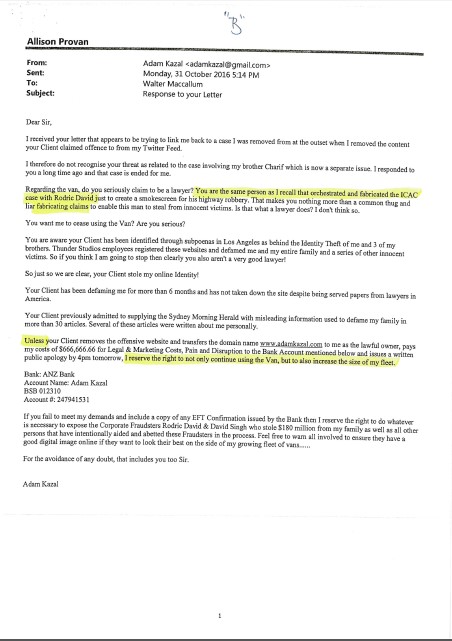
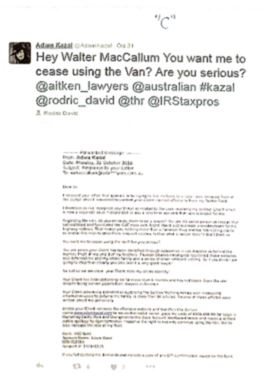
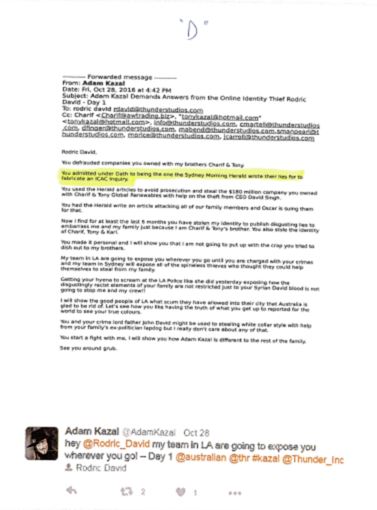
ANNEXURE B
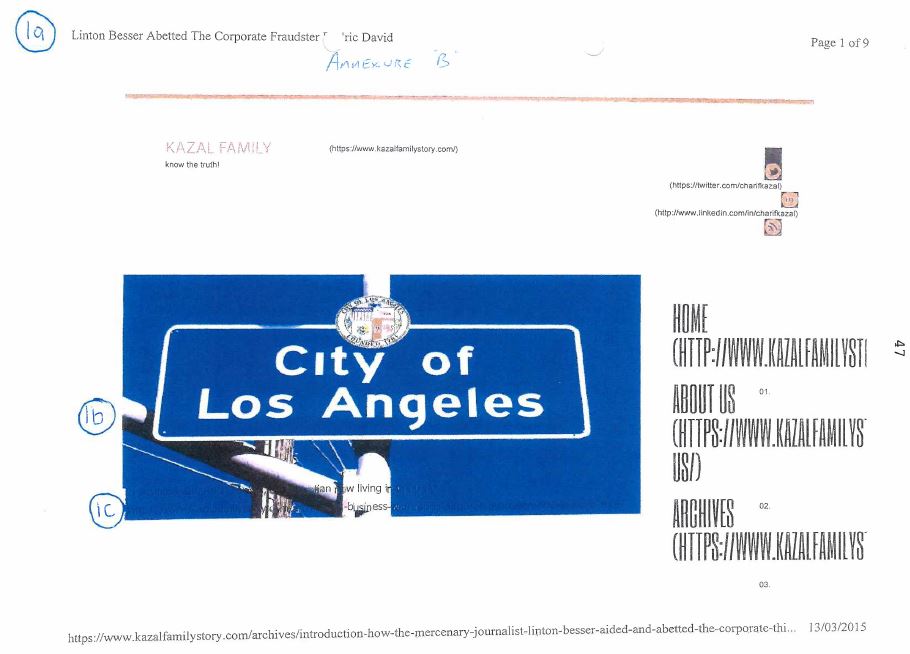
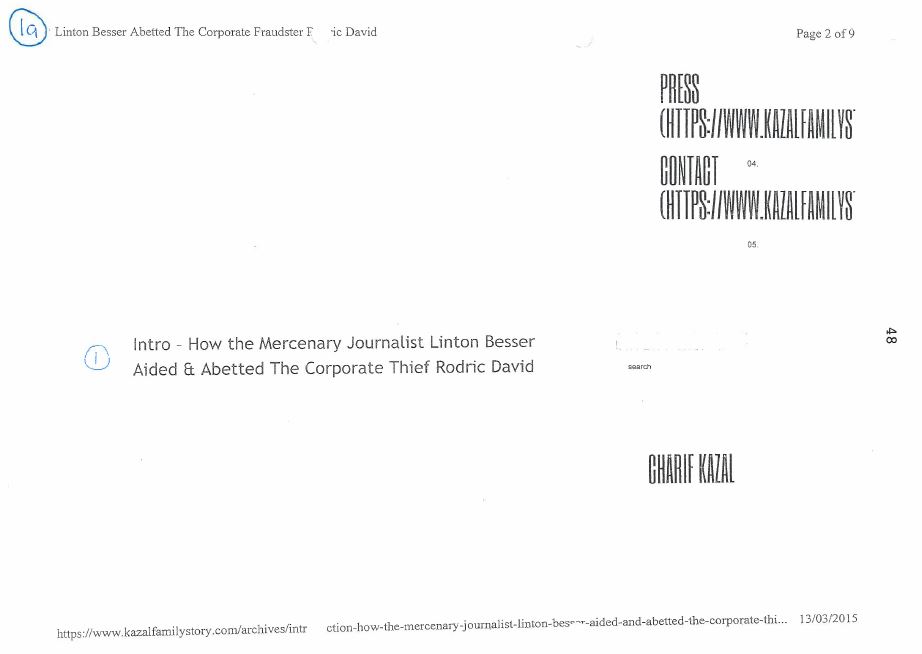
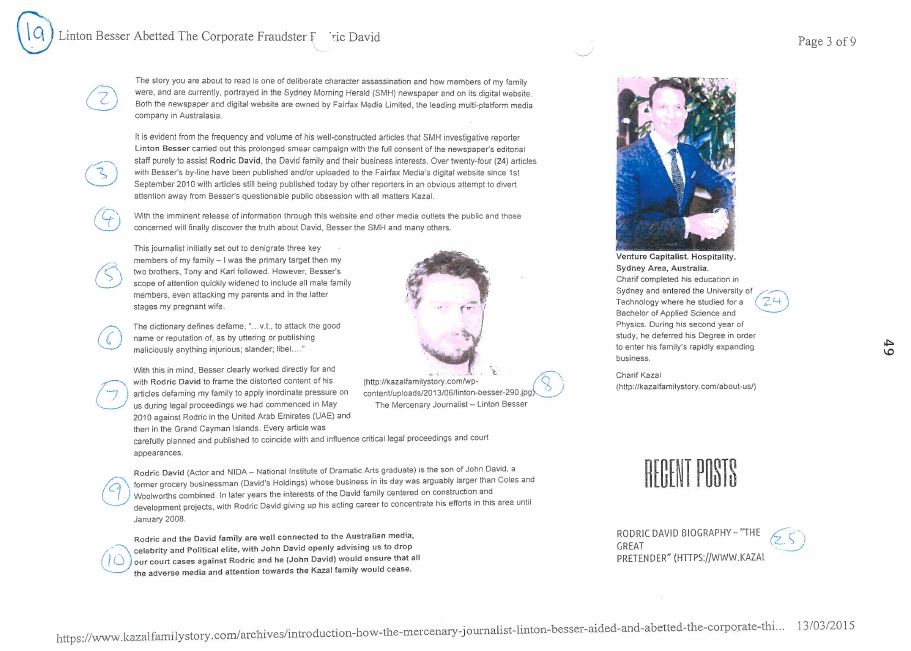
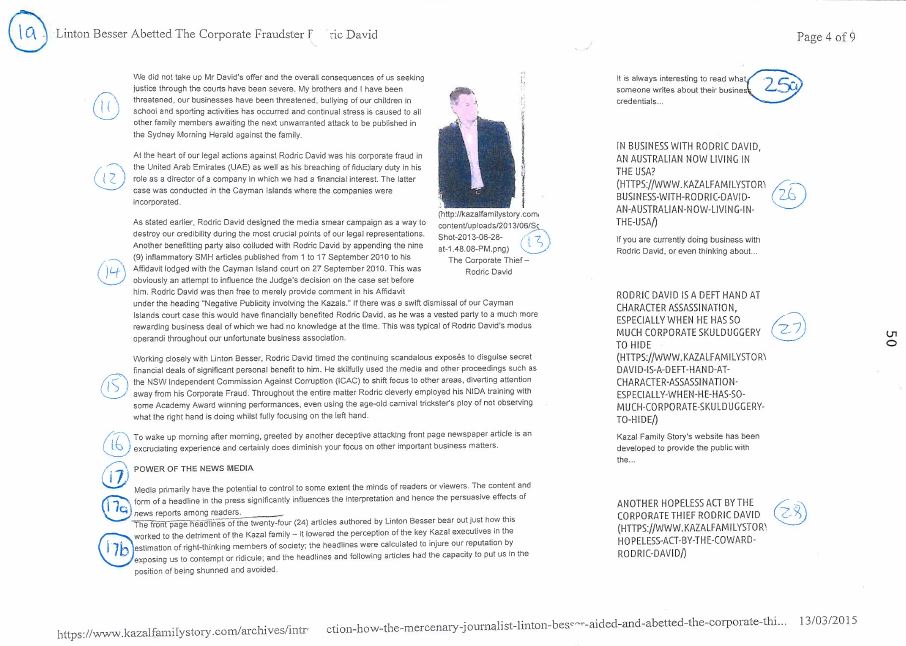
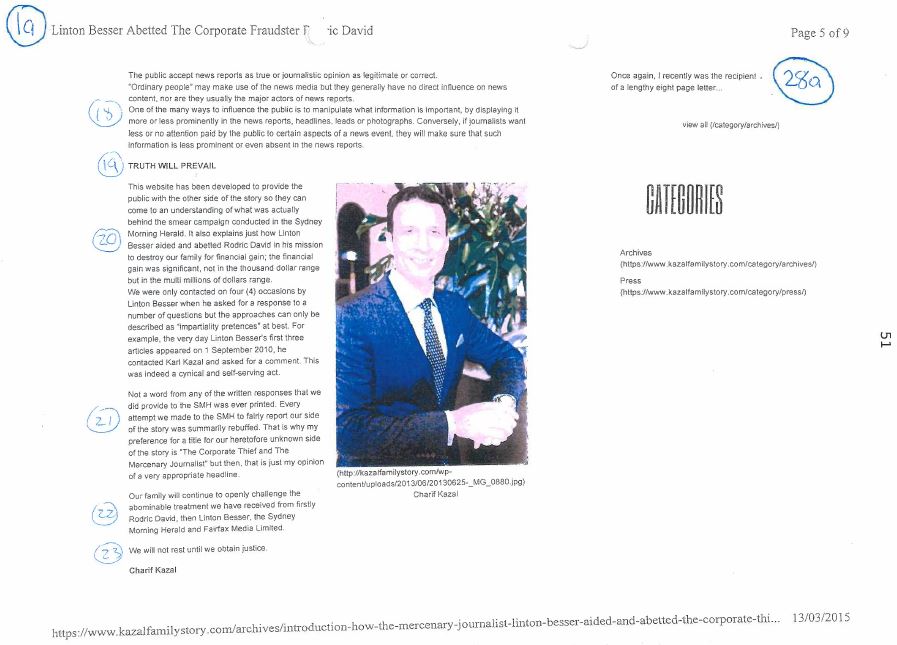
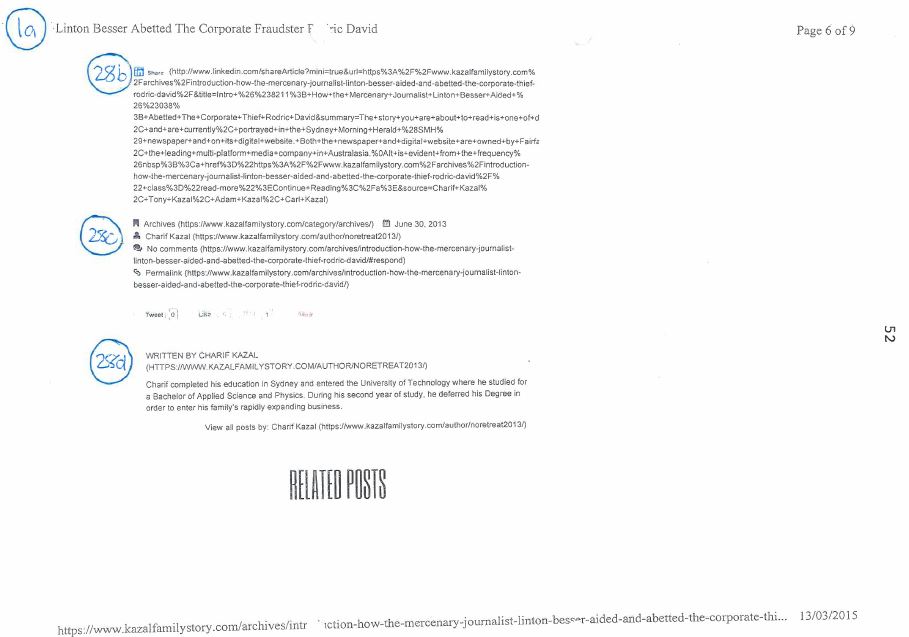
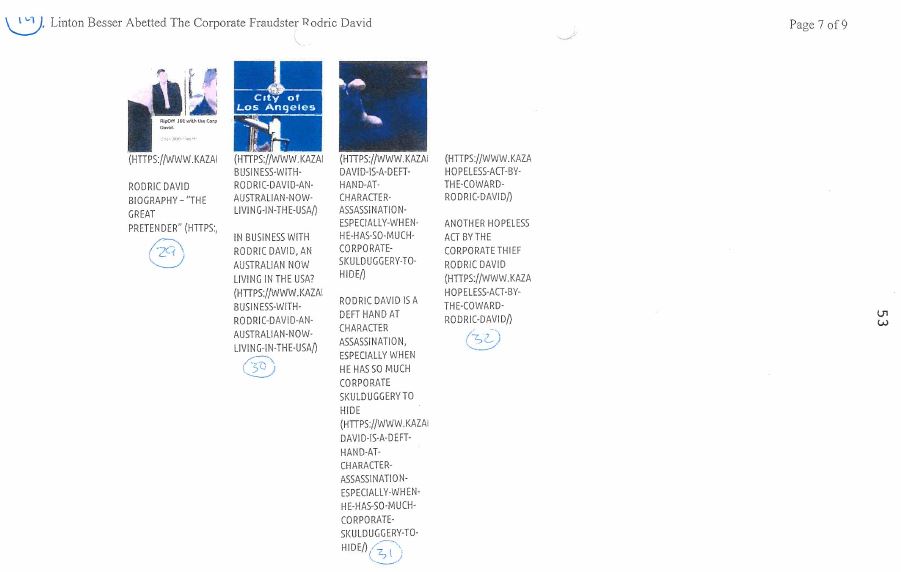
ANNEXURE C
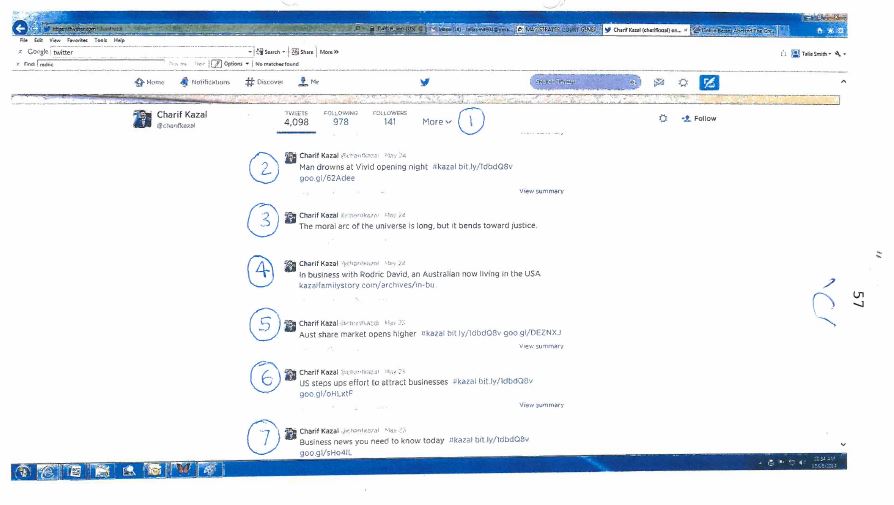
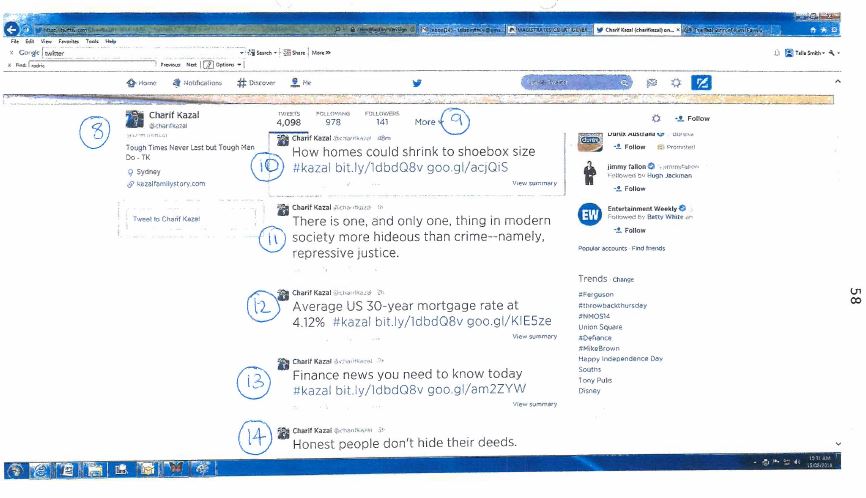
ANNEXURE D