

Federal Court of Australia
Jang v Trustees of the Property of Lee (bankrupt) [2022] FCA 99
ORDERS
Applicant | ||
AND: | THE TRUSTEES OF THE PROPERTY OF SARAH EUNJU LEE ALSO KNOWN AS EUN JU LEE, A BANKRUPT Respondent | |
DATE OF ORDER: |
THE COURT ORDERS THAT:
1. The amended originating application filed on 11 September 2020 and the amended statement of claim filed on 11 September 2020 be dismissed.
2. Subject to Orders 3, 4 and 5 below, the applicant is to pay the respondents’ costs of the proceeding.
3. Any party wishing to vary Order 2 is to file and serve any application setting out the orders which she or they seek, together with submissions, not exceeding three pages in length, on or before 2 March 2022.
4. In the event that an application and submissions are filed by either party pursuant to Order 3 above then the other party is to file and serve her or their submissions in response, not exceeding three pages in length, on or before 16 March 2022.
5. Unless either party requests an oral hearing, the question of any variation of Order 2 will be dealt with on the papers.
Note: Entry of orders is dealt with in Rule 39.32 of the Federal Court Rules 2011.
MARKOVIC J
1 Soon Ja Jang, the applicant, was, at the time of the events the subject of this proceeding, the mother in law of Sarah Eunju Lee (also known as Eun Ju Lee). Sarah Eunju Lee was married to Mrs Jang’s son, Ji Soo Jang (also known as Kyle Jang). For ease and without intending any disrespect I will refer to Sarah Eunju Lee and Ji Soo Jang as Sarah and Kyle respectively.
2 By order made on 19 April 2018 in the Federal Circuit Court of Australia (as it then was) Sarah was made a bankrupt and the respondents were appointed as her trustees in bankruptcy (Trustees).
3 This proceeding concerns a property (Gungahlin Property) situated at 51A Strayleaf Crescent, Gungahlin in the Australian Capital Territory (ACT) which was purchased on 8 March 2017 by Sarah as to 50% and Kan Kwai and Seung Jun Lee (who again, without intending disrespect and for ease, I will refer to as Seung) as to 25% each. Kan Kwai and Seung are married. Upon Sarah being made a bankrupt her share in the Gungahlin Property vested in the Trustees pursuant to s 58 of the Bankruptcy Act 1966 (Cth). However, Mrs Jang claims an equitable interest by way of resulting trust over Sarah’s 50% interest in that property and seeks declarations, in effect, to establish her entitlement and to have her registered on the title of the Gungahlin Property as a tenant in common in relation to her claimed 50% share in lieu of the Trustees.
Mrs Jang’s claim
4 This proceeding was originally commenced in the Supreme Court of the Australian Capital Territory (ACT Supreme Court) on 5 April 2019 and was transferred to this Court by order made on 22 July 2020. When the proceeding was commenced Mrs Jang sought the extension of a caveat that she had lodged on the title of the Gungahlin Property.
5 Before proceeding further it is convenient to outline Mrs Jang’s claim as now pleaded in her amended statement of claim filed on 11 September 2020.
6 As described at [3] above, Mrs Jang seeks a declaration that she is entitled to a half interest in the Gungahlin Property and an order directing the Registrar General Land Titles of the ACT to rectify the title to the Gungahlin Property by removing the Trustees’ names and entering her name as a tenant in common in the proportion of one half interest in the land with the two other registered proprietors, Kan Kwai and Seung.
(1) in or about late November 2016 she entered into an oral agreement (Agreement) with Kan Kwai and Seung to purchase the Gungahlin Property, that it was a term of the Agreement that the purchasers of that property were to be her, Kan Kwai and Seung and that it was a further term of the Agreement that her share in the Gungahlin Property would be one half and that Kan Kwai and Seung would purchase the other one half interest;
(2) upon entering into the Agreement Mrs Jang then entered into an agreement with her daughter in law, Sarah, (Second Agreement) for Sarah to act as her agent to purchase her one half interest in the Gungahlin Property using funds to be supplied to her by Mrs Jang;
(3) it was a term of the Second Agreement that Sarah was to be registered with Kan Kwai and Seung as the registered proprietors of the Gungahlin Property and that Sarah was to hold her interest on trust for Mrs Jang;
(4) contracts for the purchase of the Gungahlin Property were exchanged on 16 December 2016;
(5) it was a further term of the Agreement that the full deposit for the purchase would be paid by Kan Kwai;
(6) between January 2017 and March 2017 Mrs Jang obtained loan monies of $225,000 as follows:
January 2017 - $65,000 from Aeja Kim;
January 2017 - $50,000 from Yong Ja Lee;
January 2017 - $30,000 from Maroot Shin;
February 2017 - $30,000 from Hak Boon Choi;
February 2017 - $30,000 from Sun Lee;
March 2017 - $20,000 from Chun Soon Oh;
(7) during the period from January 2017 to March 2017 Mrs Jang provided funds to Sarah in accordance with the Second Agreement to be used for the purchase of her one half interest in the Gungahlin Property as follows:
January 2017 - $65,000;
January 2017 - $20,000;
January 2017 - $25,000;
20th February 2018 - $30,000;
23rd February 2018 - $40,000;
Late February 2017 - $40,000;
Late February 2017 - $35,000;
6th March 2018 - $20,000; and
7th March 2018 - $25,000;
(8) in addition to the monies referred to at (6) above Mrs Jang provided an additional sum of $75,000 to Sarah from her own resources;
(9) Sarah applied the monies provided to her to purchase a one half interest in the Gungahlin Property in accordance with the Second Agreement and the purchase of the one half interest in the Gungahlin Property by Sarah was for and on behalf of Mrs Jang;
(10) the balance of the purchase price for the Gungahlin Property was paid by Kan Kwai and Seung with some additional funds provided by Mrs Jang;
(11) on 4 October 2017 Mrs Jang obtained loan monies from Secure Funding Pty Limited which she used to refinance her loan of $225,000;
(12) on 21 August 2017 Mrs Jang registered caveat no 2107211 on the title of the Gungahlin Property (Caveat);
(13) Sarah’s name has been removed from the title of the Gungahlin Property as a result of her bankruptcy and the names of the Trustees have been entered in her place; and
(14) by reason of the matters set out above Sarah held her interest in the Gungahlin Property on a resulting trust in favour of Mrs Jang and the removal of her name from the register of titles was wrongful. Mrs Jang enjoys a one half interest in the Gungahlin Property and her name should be entered on the title as a tenant in common with Kan Kwai and Seung, holding a one half interest in the Gungahlin Property and the Trustees’ names should be removed from the title to that property.
8 On 14 May 2019 the Trustees filed a detailed defence, albeit to the statement of claim dated 25 April 2019 which was filed in the ACT Supreme Court, in which they deny all but the allegation that Mrs Jang registered the Caveat on the title of the Gungahlin Property (see [7(12)] above), which they admit. But in doing so they rely on the terms of the Caveat insofar as Mrs Jang’s alleged interest in the Gungahlin Property is concerned.
the evidence
9 The events which led to this proceeding and the dispute which now arises for resolution are described below.
The applicant’s witnesses
10 In addition to Mrs Jang, the following witnesses gave evidence for her:
(1) Sarah;
(2) Young Ja Lee;
(3) Hak Boon Choi Doo;
(4) Chun Soon Oh;
(5) Yun-Jong Jang, Mrs Jang’s daughter;
(6) Marissa Lee, a principal solicitor of M Legal, who acted for Mrs Jang in relation to her claim against Sarah’s bankrupt estate from mid-June 2018 to December 2018; and
(7) Dr Steven Strach, a consultant forensic document and handwriting examiner and director of Strach Forensic Pty Ltd, who was instructed to consider whether four particular signatures in the name of Eun Ju Lee are the result of a signature image transfer process. While Dr Strach’s affidavit was read and his report tendered, I was not taken to any aspect of it during submissions and Mrs Jang did not rely on any particular aspect of it in support of her claim that there was a resulting trust in her favour, nor to meet any of the Trustee’s submissions. Accordingly I do not intend to set out or address Dr Strach’s reasoning or his conclusions.
11 The applicant’s witnesses, other than Yun-Jong Jang, Marissa Lee and Dr Strach, were cross-examined. They each gave evidence through a Korean interpreter. That observation is not made by way of criticism of those witnesses but simply to explain the circumstances in which their evidence was given. However, it is necessary to make some particular observations about both the applicant and Sarah as witnesses.
12 I turn first to Mrs Jang who swore three affidavits on 2 April 2019 (April 2019 Affidavit), 3 May 2019 (May 2019 Affidavit) and 28 June 2019 respectively and who, as noted above, was cross-examined.
13 Mrs Jang did not strike me as naïve. On the contrary, the impression she left was that of a capable person able to manage her own affairs. She has owned various properties over the years, has traded in and out of property and obtained finance. However, Mrs Jang was not an impressive witness.
14 At times when Mrs Jang gave evidence about important matters she resiled from the evidence included in her affidavits, stating that it was incorrect. On more than one occasion she blamed her solicitor at the time for misunderstanding her instructions, both as to evidence included in her affidavits and as to matters of some import included in documents or correspondence completed or sent on her behalf. Mrs Jang maintained her position that aspects of her affidavits were incorrect despite the fact that, at the time of swearing each of them, they were translated for her, they were again translated for her on the first day of the hearing prior to her giving evidence and she confirmed at the time she gave evidence at the hearing that each of her affidavits was correct.
15 It became apparent that Mrs Jang’s attempts to distance herself from evidence given in her affidavits and to change her evidence were deployed in order to improve her position where she perceived potential inconsistencies either in her evidence or as between her evidence and that of other witnesses. That did not reflect well on her as a witness.
16 Mrs Jang was also evasive at times, failing to respond directly to questions put to her in cross-examination. Mrs Jang submitted that the fact that she gave evidence through an interpreter caused some confusion in her evidence, and that she is of advanced age which may also have added an element of confusion. But Mrs Jang’s approach to her cross-examination was not the product of confusion. Based on my observation, it was apparent that she understood the questions, indeed it was apparent at times that Mrs Jang had a relatively good comprehension of English; and neither she nor those acting for her made any complaint about the translation provided nor was any evidence tendered that her age affected her cognitive abilities or her ability to cope with the cross-examination. Based on my observation of Mrs Jang as a witness, her evasiveness or refusal to address a question put to her was borne of a perception by her that a direct answer would not assist her case.
17 Sarah equally struck me as a capable person. She had run her business which eventually failed in the circumstances described below. She clearly understood sophisticated concepts. However, Sarah too was evasive in cross-examination. On a number of questions she avoided answering the question posed. Sometimes she suggested she had not understood. But, accounting for some apprehension on her part, it was clear that she understood the issues and the questions put and that she had a good comprehension of English. As to the latter on a number of occasions Sarah answered questions before the interpretation was complete. It was apparent that Sarah’s evasiveness was borne of a perception that a direct response may not have assisted Mrs Jang’s case.
Respondents’ witnesses
18 The following witnesses gave evidence for the respondents:
(1) Louisa Meng Li Sijabat who is one of the Trustees;
(2) Kan Kwai who is a chartered accountant, a certified practising accountant, a fellow of CPA Australia and one of the registered proprietors of the Gungahlin Property. As at the time of affirming her affidavits in 2020 Kan Kwai had been practising as an accountant for about 11 years; and
(3) Seung who is also a registered proprietor of the Gungahlin Property.
Only Ms Sijabat and Kan Kwai were cross examined.
Mrs Jang’s background
19 Mrs Jang was born in Korea. She came to Australia in 1987. Mrs Jang has three children, all of whom were born in Korea: two sons, Kyle born in 1967 and Kerry born in 1972; and a daughter, Yun-Jong, born in 1969.
20 Mrs Jang has purchased and sold properties over the years:
(1) she has owned eight properties located in Sydney;
(2) in November 2012 she purchased a property at 69 Sunninghill Avenue, Burradoo, New South Wales (Burradoo Property) with Yun-Jong which they then sold in about May 2018 for $1,635,000; and
(3) she then purchased a property at 3 Skewes Street, Casey in the ACT which she sold in about December 2020 for $950,000.
Sarah’s background
21 Sarah was born in Korea in 1972 and came to Australia in 1996 where she has lived since that time.
22 When she first came to Australia Sarah undertook language courses and a course in hotel management, which she did not complete. As set out above, Sarah is married to Kyle.
23 Sarah and Kyle were directors of Ciani Innovation Pty Ltd and Sarah was Ciani’s secretary and its sole shareholder. Ciani was a supplier of building materials, in particular windows, window covering and security screens.
Events leading up to the purchase of the Gungahlin Property
24 Each of Mrs Jang, Sarah and Kan Kwai gave evidence about how they came to learn about the sale of the Gungahlin Property and the events leading up to the entry into the contract for sale. I set out their evidence in turn.
Mrs Jang’s evidence
25 Mrs Jang visited the Gungahlin Property in late October 2016. As recounted by Mrs Jang in the April 2019 Affidavit she liked it. She was not sure that she would be able to get a loan to purchase it but she said that she would be able to provide the deposit. She intended to buy the property for herself.
26 In light of successful objection taken to parts of the April 2019 Affidavit, leave was granted to examine Mrs Jang in relation to the subject matter of those paragraphs. Mrs Jang’s evidence was as follows:
Mr Buckland: … Mrs Jang, did you have a conversation with your daughter-in-law about the property in December 2016? And by daughter-in-law, I mean, Sarah Eunju Lee.
The Interpreter: Yes.
Mr Buckland: What did you say to Sarah? Please try to use as much as you can remember the exact words that you said to Sarah.
The Interpreter: She knew that I was interested in the property. Our – sorry, can I ask her to repeat that.
Mr Buckland: Yes.
The Interpreter: Because Sarah and her husband was – has been in Canberra by then a short period of time. They were not aware of many people in Canberra, but they said they know a person who is an accountant. And that she – they got information from her – from the accountant about the property. And they were short of money, so they were asking me whether I was interested into the property. So I said I do not have money in my hand at the moment. So they asked the accountant about the situation and I was told that she – that accountant would be responsible for the full deposit on the property. If that is the case, then I will see what I can come up with – the money. So I said it would take some time for getting some loan so in – I can borrow some money from my friends. But because I cannot get the loan because – under my name, I asked her to do it on her name and she agreed. So she made a contract on 13 December 2016 with a deposit so I later give some money to her by the end of December 2016.
Mr Buckland: Just to clarify, when you say, I later gave some money to her by the end of 2016, who is the her you are talking about.
The Interpreter: Kan Kwai. Because it was a half and half deal with Kan Kwai.
Mr Buckland: Did you give money to anyone else to fund the purchase of property?
The Interpreter: I borrowed the money. Yes.
Mr Buckland: Sorry, I think we might be – I will just state the question again, did you give money to anyone else to fund the purchase of the property?
[At this stage an objection was raised and addressed]
Mr Buckland: Thank you. Ms Ko, do you understand the question that has been asked?
The Interpreter: I do.
Mr Buckland: Do you need me to repeat it.
The Interpreter: I think I can put it to her because I remember the question.
Mr Buckland: You - - -
The Interpreter: I do. I borrowed the money from other friends.
Mr Buckland: Mrs Jang, you said you gave the money to Kan Kwai, how did you give the money to Kan Kwai?
The Interpreter: Because I – because my daughter-in-law has been acting on my behalf. I gave the money to my daughter-in-law. We made a joint named account and we both put the money in – deposited our money into that account.
Mr Buckland: When you gave money to your daughter-in-law did you say anything to her about the money?
The Interpreter: I asked her how she’s going to handle the money and she suggested to have a joint account to deal with the matter.
Mr Buckland: Do you recall how much money you gave to your daughter-in-law?
The Interpreter: I put in $265,000 in total. The total amount of the property that I was to put in was 215,000 but I put in $50,000 on top for renovating the property.
27 In the May 2019 Affidavit Mrs Jang said that in November 2016 she had a conversation with Sarah in which she said words to the following effect:
I want to buy the property 50-50 with the Kan Kwai couple, but I don’t have the money now. Can you ask them to pay the deposit?
Sarah agreed to do so and a short time later they had a further conversation in which Sarah said words to the following effect:
I talked to the Kan Kwai couple. They agree to buy it with you and they will pay the deposit, but you must be sure that you have the money later.
28 Later Mrs Jang had another conversation with Sarah to the following effect:
Mrs Jang: I was going to get a loan, but I am too old so I need to use your name to buy the property. You will buy it for me and I will give you the money.
Sarah: I will buy the property on your behalf.
29 I pause to observe that, despite Mrs Jang's evidence that she could not get a loan, there was objective evidence before me (see [99] below) that she had, both prior to and after the purchase of the Gungahlin Property, been able to obtain loans secured against the Burradoo Property.
Sarah’s evidence
30 According to Sarah she learnt that the Gungahlin Property was for sale in November 2016 from Kan Kwai and Seung. Kan Kwai was Sarah’s accountant. She and Kyle did not have the money to purchase the property. Sarah recalls that she had a conversation to the following effect with Kan Kwai and Seung, although she cannot recall who of the two said what:
Kan Kwai/Seung: We don’t have the money to buy the property. Do you know of anyone who would want to buy it with us?
Sarah: I will ask my mother in law. She might be interested.
31 Sarah then had a telephone conversation with Mrs Jang who, at the time, was in Sydney. She told Mrs Jang that “she [had] heard of a good investment property” and asked her to come to view it. Mrs Jang agreed to do so.
32 Sarah recalls that after inspecting the Gungahlin Property Mrs Jang said words to the following effect to her:
I saw the property. It is a good investment and I am happy to buy a half interest in it. Can you go and talk to the Kan Kwai couple to see if they will buy it with me 50-50? They will need to pay the full deposit first as I am too old to get a loan and I will have to get the money together.
33 Sarah then had a conversation with Kan Kwai and Seung to the following effect:
Sarah: My mother in law wants to buy the property with you 50-50. Is that agreed?
Kan Kwai/Seung: Yes.
34 Later Sarah had a conversation with Mrs Jang to the following effect:
Sarah: The seller wants to sell it urgently. Do you have the money now?
Mrs Jang: I don’t have the money at the moment, but I can get it for sure, so go and talk to the Kan Kwai couple and see if they can pay the deposit.
35 Sarah said that she then had the following conversations:
First she spoke with Kan Kwai and Seung and, although she cannot now recall who said what, she recalls that one or the other of them said words to the following effect:
Yes. We will pay the deposit, but she must make sure she has the money.
She then had another conversation with Mrs Jang to the following effect:
Mrs Jang: Can you go and buy the property for me?
Sarah: Yes I can, but you have to make sure you have the money.
Mrs Jang: I am giving you the money and your name will be on the title but you are doing it for me. It is my property.
Sarah: Okay.
Sarah recalls that she had several conversations with Mrs Jang to the following affect:
Mrs Jang: I am giving you the money to buy the property for me.
Sarah: Yes I’ll do that.
Mrs Jang: That’s my property remember. You know that. Your name is just there to protect me. It’s my property.
Sarah: Of course, I know that.
Kan Kwai’s evidence
36 On about 15 December 2016 Kan Kwai saw an advertisement on allhomes.com.au for the sale of the Gungahlin Property at a purchase price of $1.2 million. Having seen the Gungahlin Property offered for sale a few years earlier for $1.7 million, Kan Kwai thought it was being offered at a very good price. Kan Kwai had a conversation with Seung to the following effect:
Kan Kwai: The [Gungahlin Property] is for sale for $1,200,000. It is a very good price. We could operate a restaurant from the commercial space at the front and maybe rent out the townhouse at the back.
Seung: It sounds like a good opportunity, but I don’t think we can afford it seeing as we just bought another property a month ago.
Kan Kwai: Do you know anyone who might be interested in purchasing it with us and running the restaurant?
Seung: I’ll ask my friend Kyle. I think he and his wife, Sarah, might be looking for a new business endeavour.
Kan Kwai: Okay. You talk to Kyle. In the meantime, I’ll call the agent and make sure the property is still available.
37 That afternoon, Kan Kwai contacted the real estate agent who informed her that the Gungahlin Property was under offer and that contracts were due to be exchanged the next day. This caused Kan Kwai to contact the owner of the Gungahlin Property and arrange an inspection. According to Kan Kwai, that evening she, Seung and Kyle inspected the commercial space at the front of the Gungahlin Property. They were unable to inspect the townhouse as it was tenanted.
38 After their inspection Kan Kwai, Seung and Kyle decided to make an offer of $1.28 million to purchase the Gungahlin Property. They had a conversation with one of the owners, Shuk Han Lau, who indicated that, as their offer was higher, they could have the property if they could pay the deposit the following day. Mrs Lau referred them to her husband who was overseas at the time. That night Kan Kwai and Mr Lau exchanged text messages, the effect of which was that Kan Kwai, Seung, Kyle and Sarah would sign the contract for purchase of the Gungahlin Property on 16 December 2016 at 11.30 am. As set out at [39] below, and as confirmed in the text messages, that was what occurred.
The purchase of the Gungahlin Property
Contracts are exchanged
39 On 16 December 2016 contracts for sale of the Gungahlin Property were exchanged. The purchase price was $1.28 million. Originally the purchasers were to be Sarah, Kyle, Kan Kwai and Seung each holding a 25% interest but, at some point prior to signing the contract for sale, Sarah and Kyle informed Kan Kwai that Kyle would not be on the title of the Gungahlin Property and instead Sarah would hold a 50% interest. According to Kan Kwai, at no time prior to or upon the signing of the contract, or at all, was she informed that Sarah was purchasing the Gungahlin Property on behalf of Mrs Jang. Rather, all of Kan Kwai’s interactions with Sarah led her to believe that they were each purchasing the property in their own right, with the intention that they would operate a restaurant from it.
40 After signing the contract for sale Kan Kwai provided a cheque for $128,000 drawn from funds in her bank account to the vendors’ solicitor in payment of the deposit for the Gungahlin Property. On 9 January 2017 Sarah and Kyle transferred $30,000 and $34,000 respectively to Kan Kwai as payment towards the deposit.
41 Sarah said that in about late December 2016 or early January 2017 Mrs Jang gave her $64,000 in cash for payment of her share of the deposit and that, in turn, she deposited $34,000 into her account and $30,000 into Kyle’s account. Thereafter on 9 January she transferred the total amount of $64,000 to Kan Kwai’s account to pay Mrs Jang’s share of the deposit.
42 Payment of the deposit for the Gungahlin Property was a matter that attracted some attention because of Mrs Jang’s differing evidence on that topic. It is convenient to address that now. As set out at [25] above, in her April 2019 Affidavit Mrs Jang gave evidence that she would be able to pay the deposit. However, in her May 2019 Affidavit she gave contradictory evidence (see [27] above).
43 In cross-examination Mrs Jang again gave differing evidence from the evidence she gave in her April 2019 Affidavit. She said that Kan Kwai and Seung agreed to pay the deposit because she did not have the money; that Kan Kwai told her if the deposit was not paid they “would lose the chance”, I infer, of buying the Gungahlin Property; and that Kan Kwai said that they would pay the deposit and that Mrs Jang could pay later when the money was available.
44 In cross-examination Mrs Jang also said that she did not have money for the deposit because she does not save money and she needed to borrow the money because Kan Kwai had told her that they needed to proceed with urgency. It seems that despite not having any money she was prepared to enter into an agreement to purchase the Gungahlin Property because she had the Burradoo Property which she subsequently sold for $1.65 million.
45 Mrs Jang explained that the evidence in her April 2019 Affidavit about payment of the deposit was incorrect, that she did not understand English properly and that her lawyer at the time, about whom she said she had complained, had prepared the affidavit and had not understood what she had told him. Laying blame at the feet of her solicitors became a recurring theme for Mrs Jang.
46 It is difficult to accept Mrs Jang’s explanation for changing her evidence on this issue in face of the fact that the April 2019 Affidavit includes a certification by her lawyer at the time that prior to Mrs Jang swearing it he “explained the legal effect of the document to her in her native language Korean and translated the document for her from English into her native language of Korean”, the April 2019 Affidavit was again translated to Mrs Jang on the first morning of the hearing and, when she gave evidence at the hearing, Mrs Jang stated without any reservation that her April 2019 Affidavit was correct.
Subsequent inspection of the Gungahlin Property
47 At the time Sarah entered into the contract for purchase of the Gungahlin Property she had only inspected the restaurant premises. Shortly after the deposit was paid, Kan Kwai recalls that she and Sarah had a conversation to the following effect:
Sarah: We want to inspect the property with Kyle’s mother. She is a very good business woman and has a sharp eye. She will be able to give us advice about the restaurant.
Kan Kwai: Okay. Sounds good.
Sarah denies that this conversation took place.
48 On 6 January 2017 Kan Kwai, Seung, Kyle, Sarah and Mrs Jang inspected the Gungahlin Property. This was the first time that Kan Kwai and Seung met Mrs Jang and the first time that any of them had inspected the townhouse. Upon doing so they found that it did not have a kitchen or laundry. Kan Kwai recalls Mrs Jang suggesting that they should ask for a reduction in the purchase price because of the state of the townhouse.
49 According to Kan Kwai, during the inspection Sarah did not suggest that she was purchasing the Gungahlin Property on behalf of Mrs Jang and Mrs Jang did not suggest that she had any interest in the Gungahlin Property. Nor did Kan Kwai and Seung enter into any agreement with Mrs Jang in relation to the Gungahlin Property. They barely spoke to her during the inspection.
50 Kan Kwai recalls that later Sarah and Kyle said words to the following effect to her and Seung:
Sarah: Kyle’s mother doesn’t know that we already paid the deposit. Please don’t tell her.
Kyle: Please don’t let her know that we already paid the deposit. She won’t be happy if she finds out.
Sarah denies that this conversation took place.
Financing of the purchase
51 In early January 2017 Kyle informed Kan Kwai that the bank was only willing to lend 70% of the purchase price for the Gungahlin Property.
52 By letter dated 27 January 2017 Suncorp Bank approved a loan to Kan Kwai, Seung and Sarah for $896,000, being 70% of the purchase price of the Gungahlin Property, on a preliminary basis and subject to valuation.
53 Settlement of the sale of the Gungahlin Property was scheduled to take place on 17 February 2017. However, as at 15 February 2017, Kan Kwai, Seung and Sarah were still awaiting completion of the valuation for the purpose of final approval of the loan from Suncorp. At about this time Kan Kwai recalls Kyle informing her that Suncorp was “only willing to loan [them] an initial amount of 60% because of the condition of the townhouse” and that Suncorp would not “provide [them] with the final 10% until [they did] some renovations and [made] the house compliant”.
Further negotiations with the vendors
54 On or about 16 January 2017 Kan Kwai, Seung and Sarah first met with Rod Badgery, a solicitor with Badgery & Rafferty who they retained to act on their behalf on the purchase of the Gungahlin Property.
55 On 16 February 2017 Kan Kwai and Sarah approached Ms Lau, one of the vendors, to negotiate payment of 10% of the purchase price two months after settlement with renovation of the townhouse to take place in the meantime. Despite Kan Kwai’s understanding that the vendors had agreed to this request, on 20 February 2017 they issued a notice to complete the contract for sale of the Gungahlin Property.
56 By letter dated 20 February 2017 Kan Kwai, Seung and Sarah were informed by their mortgage broker that Suncorp had approved a loan in the sum of $768,000 to be secured by way of mortgage over the Gungahlin Property and that once the sale had settled and the kitchen had been added to the townhouse they could reapply for a loan of up to 70% of the value of the Gungahlin Property.
57 On 21 February 2017 Sarah sent an email to Ashlea Archer of Badgery & Rafferty which included:
According to our loan process, the loan has been pre-approved, but it is only 60% of the purchasing price due to condition of the residential property. The financier has been reported from the valuer that the residential property is the condition of unable to live. The financier is happy to increase LVR to 70% once we renovate the house as condition to live.
Last Friday, Kan and me met the owner and explained about the situation now. The owner has agreed and accepted with settlement by 90% purchase price now and they get the 10% payment once completion of renovation and bank approval within next two months after the settlement.
I am expecting to get the formal letter from the seller’s solicitor about this agreement from the seller. Once you receive the letter from her, I will issue the bank cheque for stamp duty immediately.
58 Ultimately the vendors did not agree to vary the contract for sale by deferring payment of 10% of the purchase price but did agree, by way of deed of variation dated 7 March 2017, among other things to extend the date for settlement of the contract for sale to 8 March 2017 and to withdraw the notice to complete.
Sarah, Kan Kwai and Seung open bank accounts
59 In the meantime, on 23 February 2017, Kan Kwai, Seung and Sarah attended a branch of Westpac Banking Corporation and opened account no 83-6873 in their joint names (Joint Account). Kan Kwai understood that the purpose of the account was to manage the income and expenses of the partnership which she, Seung and Sarah had formed (see [63]-[73] below). On 23 February 2017 Kan Kwai paid $30,905 and $200 into the Joint Account and recalls that Sarah also paid $30,905 into the Joint Account. Later that day, Kan Kwai arranged for $68,810 to be withdrawn from that account in payment of the stamp duty on the Gungahlin Property.
60 Sarah said that she understood the purpose of the Joint Account was to pay stamp duty. She said that Mrs Jang had already given her the money for that purpose so she paid $30,905 in cash into the Joint Account.
61 On 28 February 2017 Kan Kwai, Seung and Sarah returned to Westpac and opened a business account, account no 59-1055, in their joint names (Business Account). Kan Kwai understood that they were required to open this second account because the Joint Account was not linked to the partnership.
62 A statement for the Joint Account for the period from 23 August 2017 to 23 February 2018 showed that Sarah deposited the sum of $1,821 into it at approximately monthly intervals on 9 October 2017, 8 November 2017, 11 December 2017 and 8 January 2018 and the sum of $1,810 on 9 February 2018.
Kan Kwai, Seung and Sarah form a partnership
63 Kan Kwai recalls that at the time of exchange of contracts for the Gungahlin Property she, Seung, Sarah and Kyle were informed by the vendors’ solicitor, Pierre Johannensen, that the price included GST because of the commercial component of the property i.e. the restaurant premises. Based on her experience as an accountant Kan Kwai knew that they could claim back the GST but they would need to be registered for GST to do so which, in turn, required an Australian Business Number (ABN).
64 After meeting with Mr Johannensen, Sarah, Kyle, Seung and Kan Kwai returned to Kan Kwai and Seung’s home and discussed claiming back the GST. Kan Kwai thought that as they were planning to operate a restaurant together it made sense to form a partnership. She recalls saying words to the following effect:
In order to claim the GST, we need to form a partnership. We have already signed the contract in the three of our names, so a partnership is the best option, rather than company. The partnership is also entitled to CGT concession when we sell the property in the future.
65 Kan Kwai recalls that Sarah and Seung agreed to form a partnership and that she agreed to act as the partnership’s accountant. Sarah said that she never agreed to form and register a partnership and she never authorised Kan Kwai or Seung to do so.
66 As was her practice, before undertaking any work, Kan Kwai prepared an authority form authorising her to form the partnership and to lodge tax returns on its behalf for signature by Sarah, Seung and herself (Authority Form), which they each signed at Kan Kwai’s house on 18 December 2016. Kan Kwai recalls that was the date on which they signed because it was the same day that Kyle emailed Sarah’s contact details to her.
67 Kan Kwai applied for an ABN for the partnership. On 6 March she informed Mr Badgery that she, Sarah and Seung had obtained an ABN which was effective as of 10 December 2016.
68 Kan Kwai prepared quarterly activity statements for the partnership which she recalls she, Seung and Sarah signed at the restaurant. This was easily done because they saw each other there most days. Although Kan Kwai was authorised to lodge the activity statements on behalf of the partnership she had all three partners sign them because it was good practice to do so and provided additional protection for her.
69 Kan Kwai also prepared tax returns for the partnership for the financial years ended 30 June 2017 and 30 June 2018. As best as Kan Kwai can recall she and Sarah also signed these documents at the restaurant. Again, although she was authorised to sign the tax returns on behalf of the partnership, she arranged for all three partners to sign them because it is good practice and added protection for her. After they were signed, Kan Kwai lodged the tax returns for the partnership on the Australian Taxation Office’s portal.
70 After commencement of this proceeding, Kan Kwai prepared the tax return for the partnership for the financial year ended 30 June 2019. Sarah refused to sign that tax return and disavowed any knowledge of the partnership’s existence. Sarah said that Kan Kwai never told her about the partnership.
71 Sarah also said that she did not sign the Authority Form, the partnership tax returns for the financial years ended 30 June 2017 and 30 June 2018 or the activity statement for the period ended 31 March 2017.
72 Kan Kwai retained the original Authority Form, quarterly statements and tax returns for the years ended 30 June 2017 and 30 June 2018 until a date in 2019 when Sarah asked her to provide those documents to her. Sarah told Kan Kwai that her solicitor needed all of the original signed documents containing her signature relating to the partnership. Although Kan Kwai subsequently asked Sarah to return the original documents she had provided to her, that did not occur. Instead, at some point in 2019, Sarah provided copies of the documents to Seung.
73 Although I found Sarah’s evidence to be somewhat disingenuous, and despite the volume of evidence led, the questions of the process by which the partnership was formed, whether Sarah was aware of it and the execution of documents by Sarah in relation to it are not issues which I need to resolve. Ultimately they were not relevant to the issues which arose for resolution.
A shortfall in funds
74 Shortly prior to 8 March 2017, Sarah and Kan Kwai had a conversation to the following effect:
Sarah: I don’t have enough money to settle because the bank is not loaning us enough money. I have borrowed money from Kyle’s mother but I am still short. Can I borrow money from you to fund that balance of my share?
Kan Kwai: How much do you need?
Sarah: I only have $105,000, so I’ll need to borrow the rest from you.
After speaking with Seung, Kan Kwai informed Sarah that they were willing to fund the balance provided she paid them back with 10% interest.
75 Sarah denies that the conversation set out in the preceding paragraph occurred. She says that she never agreed with Kan Kwai that she and her husband would fund the balance. Rather Sarah said that about one week before settlement was scheduled to take place Kan Kwai and she had a conversation to the following effect:
Kan Kwai: I don’t have enough money and I have to borrow money from someone.
Sarah: We don’t have enough money either. What do you want me to do?
Kan Kwai: We have to make a settlement so do you want me to borrow some money from someone?
Sarah: Can you do for us?
Kan Kwai: I can ask them and I'll let you know.
Sarah said that about one day later Kan Kwai confirmed that “they can do for you but you need to pay 10% interest”. They then discussed how the money would be repaid and Sarah said “once we do the renovations the bank will advance us the money so that’s when we pay it back”.
76 A loan agreement dated 7 March 2017 (Loan Agreement) between Sarah as borrower and Kan Kwai as lender was in evidence. It records that Sarah agrees to repay the amount of $106,580.35 comprising a loan amount of $88,816.96 and interest of $17,763.39 calculated at an annual rate of 10%. The term of the loan was two years and the security was described as (as written):
Borrower agreed to assigns to the lender 6.94% rights title and interest in and to the property of 51 & 51a Strayleaf Crescent Gungahlin ACT 2912
77 Contrary to the evidence set out at [75] above, Sarah accepted that she had loaned money from Kan Kwai and that she paid interest on the funds she had loaned but said that the Loan Agreement was not contemporaneous and had been presented to her by Kan Kwai at a time after the funds had been advanced and after she became a bankrupt. Sarah could not remember the exact date on which she signed the document but recalled that the weather was cold and that at the time of signing she did not meet the person whose signature appears as witness. She recalled that his name and signature appeared at the bottom of the document and that Kan Kwai had already signed the document.
78 In cross-examination Kan Kwai accepted that she did not respond in her evidence in chief to the assertion by Sarah that the Loan Agreement was entered into at a later date than it bears but said that she had been busy and stressed at the time of preparing her evidence and did not respond to everything. Kan Kwai said that the fact that she did not respond did not mean that what Sarah asserted was correct. She disagreed with Sarah’s version of events.
79 Despite the initial evidence given by Sarah, there was no dispute that Kan Kwai had loaned Sarah the sum of $88,816.96 at the time of settlement of the purchase of the Gungahlin Property at an interest rate of 10% per annum because Sarah did not have sufficient funds to meet her half share of the purchase price. The only dispute that arose was in relation to the date of execution of the Loan Agreement. Ultimately the acceptance of either Sarah’s evidence or Kan Kwai’s denial given in cross-examination may go to credit. But, given that the issue of timing of execution of the Loan Agreement does not arise for determination, it is not necessary for me to make a finding and I do not intend to do so.
Settlement of the purchase of the Gungahlin Property
80 On or about 7 March 2017 two bank cheques were provided to Mr Badgery for settlement of the sale of the Gungahlin Property: one from Westpac for $313,233.92; and one from the Australia and New Zealand Banking Group Limited (ANZ) for $105,000. The evidence before me establishes that the former cheque came from funds in an account held by Kan Kwai with Westpac and that the latter was provided by Sarah.
81 On 8 March 2017 the purchase of the Gungahlin Property settled. The settlement sheet for the Gungahlin Property shows that the amount due on settlement after deduction of the deposit and adjustments was $1,185,036.92. A spreadsheet prepared by Kan Kwai at about the time of settlement showing her, Seung’s and Sarah’s respective contributions to the purchase price of the Gungahlin Property provides as follows (as written):
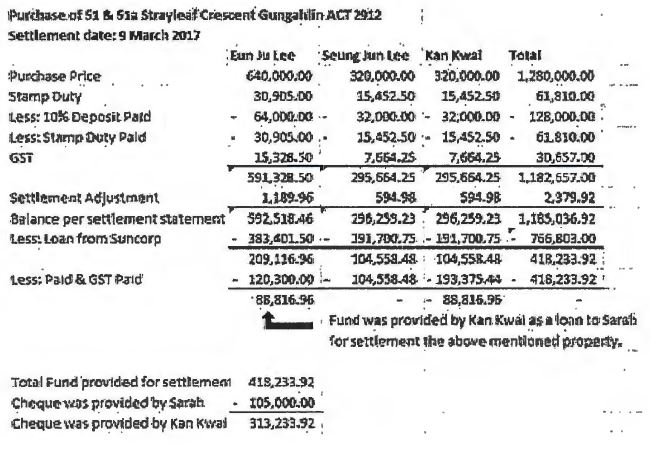
82 On 29 March 2017 the transfer for the Gungahlin Property, nominating as transferees Kan Kwai and Seung as to 25% each and Sarah as to 50% as tenants in common, was registered. The Gungahlin Property is the subject of a mortgage granted by Kan Kwai, Seung and Sarah in favour of Suncorp dated 24 February 2017 which was also registered on 29 March 2017.
83 According to Kan Kwai, she was never informed that Sarah was purchasing the Gungahlin Property on behalf of Mrs Jang. All of Kan Kwai’s interactions with Sarah led her to believe that they were each purchasing the Gungahlin Property in their own right, with the intention that they would operate a restaurant from it.
84 Sarah denies that she ever told Kan Kwai that she would hold a 50% share in the Gungahlin Property and maintains that she told Kan Kwai and Seung that Mrs Jang was purchasing the property and that she was using Sarah’s name.
Mrs Jang provides funds to Sarah
85 In her April 2019 Affidavit Mrs Jang gave the following evidence about funds that she claimed she gave to Sarah, on her understanding, for the purchase of the Gungahlin Property:
(1) in January 2017 she gave $65,000, $20,000 and $25,000 to Sarah. She understood that the sum of $65,000 was to be paid by Sarah to Kan Kwai for the deposit. That latter evidence is contrary to the objective evidence which shows that two payments of $30,000 and $34,000 were made to Kan Kwai in January 2017;
(2) on 20 February 2017 she gave $30,000 to Sarah;
(3) on 23 February 2017 she deposited $40,000 into Sarah’s bank account;
(4) in late February 2017 she gave Sarah $75,000 in cash in two amounts of $40,000 and $35,000;
(5) on or about 6 March 2017 she deposited $10,000 into Sarah’s bank account and she gave her daughter $10,000 for her to transfer to Sarah’s account; and
(6) on 7 March 2017 she gave $15,000 in cash to Sarah and later deposited $10,000 into Sarah’s bank account.
86 Yun-Jong recalls that in early 2017 Mrs Jang gave her some money and said to her words to the effect of “this is for the property. Make sure you give to [Sarah]”. Yun-Jong says that on or about 20 February 2017 she transferred $30,000 to Sarah in four separate transfers of $5,000, $5,000, $10,000 and $10,000; and on or about 6 March 2017 she transferred $10,000 to Sarah.
87 Sarah recalls that on a number of occasions Mrs Jang gave her money to pay for the Gungahlin Property but cannot recall the exact amounts or dates on which the money was provided. However, having refreshed her memory from the April 2019 Affidavit, she said that the amounts referred to there (see [85] above) appear to her to be the amounts of money given to her by Mrs Jang to purchase Mrs Jang’s half interest in the Gungahlin Property which she used for that purpose.
Mrs Jang’s borrowings
88 According to Mrs Jang she borrowed $225,000 between January and March 2017 for the purchase of the Gungahlin Property and gave those moneys to Sarah. This included moneys borrowed from her friends Young Ja Lee, Hak Boon Choi Doo and Chun Soon Oh. Mrs Jang and these women were members of a “Kye”, a private Korean rotating savings and credit association used by members of the Korean community in Australia.
89 Each of Young Ja Lee, Mrs Doo and Mrs Oh gave evidence about the circumstances in which they loaned money to Mrs Jang in January 2017, the effect of which was as follows:
(1) Mrs Jang, Young Ja Lee, Mrs Doo and Mrs Oh were members of a Kye which commenced in August 2016;
(2) there was a Kye meeting on the first Thursday of each month;
(3) at the January 2017 Kye meeting or in early January Mrs Jang had a conversation with each of Young Ja Lee, Mrs Doo and Mrs Oh in which she informed each of them that she needed to borrow money;
(4) Young Ja Lee and Mrs Jang had a conversation to the following effect:
Mrs Jang: I am buying a property in ACT. I urgently need money to settle. Do you have about $50,000 to lend me?
Young Ja Lee: That is a big money. Make sure you will repay me
Mrs Jang: I am getting a loan later. I will repay you.
(5) Mrs Doo and Mrs Jang had a conversation to the following effect:
Mrs Jang: I urgently need money to buy a property in ACT. Can I borrow $30,000 from you?
Mrs Doo: I have $30,000, but that is my son’s money I am keeping. That money must be repaid to me for sure if I lend you.
Mrs Jang: No worries. I will repay if my loan gets approved later. I will try to repay you in about 6 months.
(6) Mrs Oh and Mrs Jang had a conversation to the following effect:
Mrs Jang: I need to borrow some money. I am short about $20,000.
Mrs Oh: O.K No problem. I will give when you come to visit me next time.
Mrs Jang: Thank you. I will see you in next month.
(7) in or about January 2017 Young Ja Lee loaned $50,000 in cash to Mrs Jang and in or about February 2017 Mrs Doo loaned $30,000 in cash to Mrs Jang and Mrs Oh loaned $20,000 in cash to Mrs Jang;
(8) in or about October 2017 Mrs Jang repaid the loans referred to in the preceding sub paragraph in cash with interest; and
(9) Mrs Oh said that Mrs Jang made a handwritten note as a loan document which she kept until the moneys she loaned Mrs Jang were repaid at which time she tore it up in front of Mrs Jang.
90 The Trustees served subpoenas on each of Young Ja Lee, Mrs Doo and Mrs Oh. Those subpoenas were not in evidence. But the circumstances which led to the service of the subpoenas were agreed between Mrs Jang and the Trustees. They were photographs of certain documents taken on 8 and/or 9 March 2021 and provided to Mrs Jang’s husband; those documents were then translated on behalf of Mrs Jang by a Korean interpreter; and they were then served on the Trustees on 12 March 2021 by way of ongoing discovery. At the time no formal affidavit of discovery was provided. Thereafter subpoenas were served on each of Young Ja Lee, Mrs Doo and Mrs Oh seeking production of the originals of the documents provided to the Trustees on 12 March 2021. In answer to those subpoenas:
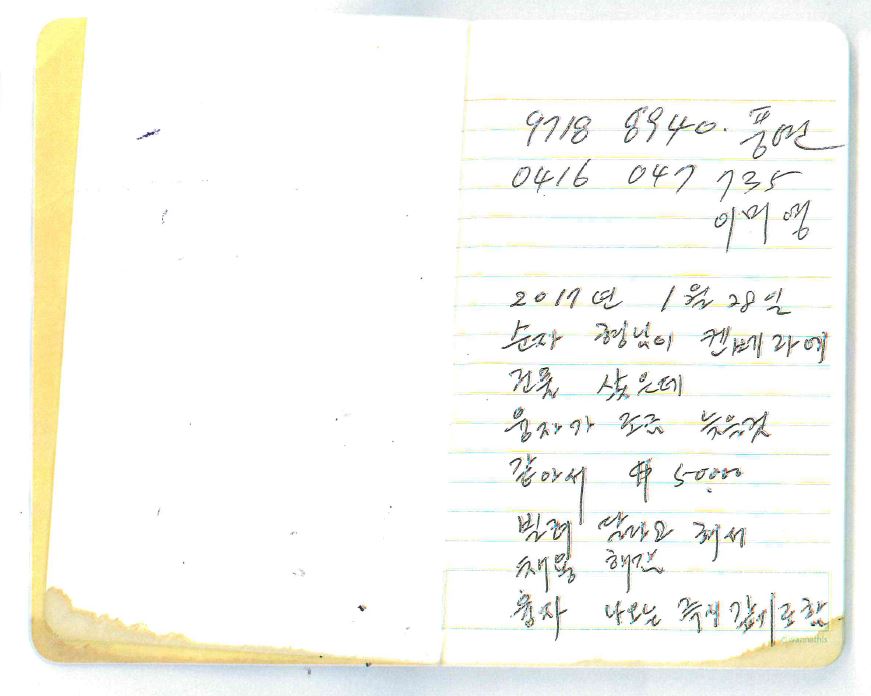
(1) Young Ja Lee produced a handwritten note in the Korean language dated 28 January 2017 (Lee Note). She said that on 28 January 2017, at the time she loaned the moneys to Mrs Jang, she made the Lee Note in Korean in a notebook she maintained at the time. Young Ja Lee did not refer to or include the Lee Note in her evidence in chief. The Lee Note and an English translation of it appear respectively as follows:
Lee Note
English translations of Lee Note
28 January 2017
Soonja hyungim borrowed $50,000, which she requested because she has bought a building in Canberra but there was going to be a delay in the loan.
She promised to repay it the moment she received the loan.
*T/N: hyungnim is a term used to refer to an older male or husband’s older brother’s wife.
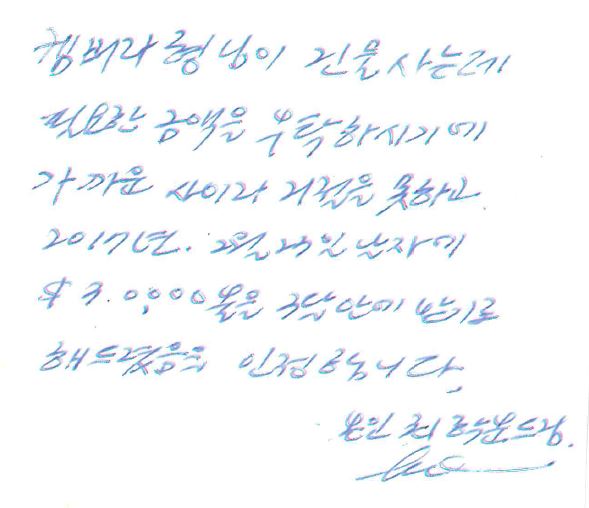
(2) Mrs Doo produced a handwritten note which she said she wrote out on 23 February 2017 as a formal receipt when Mrs Jang “asked to borrow some money” and that she made “the record as evidence” (Doo Note). The Doo Note was not referred to or included in Mrs Doo’s evidence in chief. The Doo Note and an English translation of it appear respectively as follows:
Doo Note
English translation of Doo Note
I declare that Hyungnim from Canberra requested to borrow money to buy a building, and because we were close and I could not refuse, I loaned her $30,000 on 23 February 2017, to be repaid within three months.
Name: Hakbum Choi [T/N: handwriting illegible]
/signature affixed/
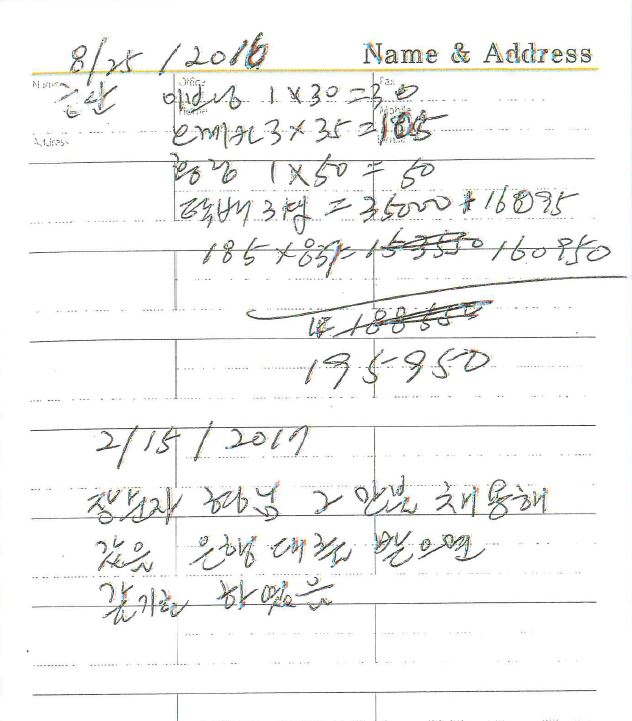
(3) Mrs Oh produced a notebook in which she writes prayers each day and important notes that she needs to remember and identified a particular page from it written in the Korean language (Oh Note). The Oh Note and an English translation of it appear respectively as follows:
Oh Note
English translation of Oh Note
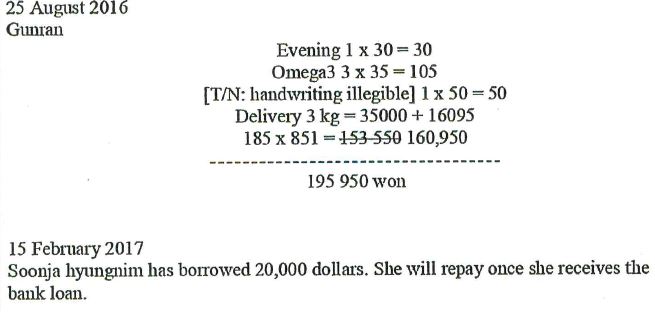
Mrs Oh said that she wrote the bottom part of the Oh Note on 15 February 2017 when she gave the money to Mrs Jang. However, the Oh Note was not referred to or included in Mrs Oh’s evidence in chief.
91 Young Ja Lee’s notebook referred to at [90(1)] above only included one page with writing on it, namely the page containing the Lee Note which recorded the loan to Mrs Jang. Despite that Young Ja Lee maintained that she made the Lee Note when she loaned the money and that she found the diary and brought it with her to Court having learnt that it was required a few days prior. Young Ja Lee said that she had moved two or three months ago to her daughter’s house, having lived at her previous address for over 30 years. She looked for the notebook at her new residence. It was not easy to find. First she said she found the notebook containing the Lee Note in a drawer, then she said she found it in a bag and finally she said that she found it in a black handbag which was in a drawer.
92 Mrs Doo said that she wrote out the Doo Note before 6 June 2019, which is the date on which she swore her affidavit for the purpose of this proceeding. The Doo Note was written on the back of a page taken from a calendar which Mrs Doo used as memo paper. The reverse of the Doo Note is as follows:
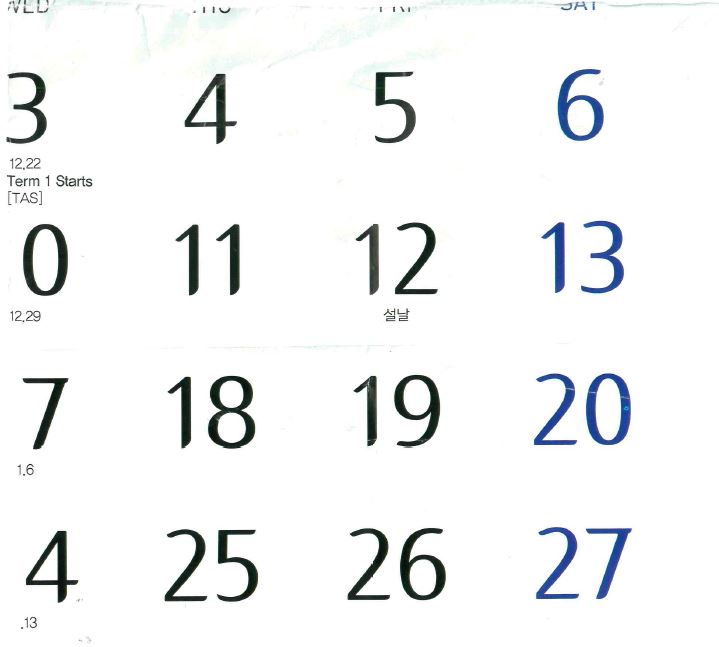
93 In cross-examination Mrs Doo accepted that the reverse of the Doo Note included under the numeral “12” the Korean words for “Lunar New Year day” and that in 2021 the Lunar New Year day was celebrated on Friday, 12 February 2021. Despite that evidence, Mrs Doo did not accept that she wrote the Doo Note after 12 February 2021. She said she uses calendars “which have already passed” as a notebook and maintained that she made the Doo Note in 2017. I reject Mrs Doo’s evidence in that regard. Accepting that her practice was to use old calendars as note paper, it would not be possible for her to have created the Doo Note in 2017. It appeared on the reverse of a page which she acknowledged came from a 2021 calendar which, self-evidently, could not have been an old calendar in 2017.
94 Mrs Doo did not accept that she had been asked to fabricate the Doo Note in about March 2021. She tried to explain why the Doo Note appeared on the reverse of a page from a 2021 calendar. She said she transferred it from a thick book to the particular piece of paper and that her children came and went through the book. Mrs Doo also said that she was told to give the note and so she transferred it to the reverse of the calendar page. Because the notebook was very thick she got rid of it at the end of the year. She said that “at the end of the year I get rid of all the notes as the era ends and I use the calendars and make a note”.
95 I do not accept Mrs Doo’s explanation. If the Doo Note was originally included in a notebook, that notebook should have been produced to the Court in answer to the subpoena. If, as Mrs Doo said, the notebook was destroyed, given her evidence that she was “told to give the note” (presumably in answer to the subpoena) that must have occurred after the commencement of this proceeding. Indeed, given Mrs Doo’s practice of using old calendars as note paper, the Doo Note, which was written on the back of a February 2021 calendar, could not have been written before February 2021. These matters, taken together with the proximity of February 2021 to the hearing which commenced on 12 April 2021, do not reflect well on Mrs Doo as a witness and cast doubt on her evidence. I cannot accept the Doo Note as contemporaneous evidence of a loan to Mrs Jang for the purpose of buying “a building”, nor her explanation that it was not fabricated. Rather the irresistible inference in light of Mrs Doo’s evidence as a whole is that the Doo Note was not transcribed from a notebook but was created for the first time by Mrs Doo on a date after February 2021.
96 In cross-examination Mrs Oh first said that she wrote the Oh Note to remind herself of the transaction with Mrs Jang after she tore up the handwritten note referred to at [90(3)] above but accepted that the Oh Note existed at the time she swore her affidavit in June 2019 for the purpose of this proceeding, which she understood to be an important document. But Mrs Oh said that it was a personal note and she was not asked at the time she prepared her affidavit whether she had a personal note. Hence she only referred to Mrs Jang’s note in her affidavit. Given Mrs Oh’s evidence in her affidavit about Mrs Jang’s note, which she said she retained until the loan was repaid, I find it difficult to accept that, had the Oh Note existed at the time Mrs Oh prepared her affidavit, she would not have referred to it. Accordingly, and given the difficulties with reconciling some of Mrs Oh’s evidence given in cross-examination (see [211] below), I give little weight to Mrs Oh’s evidence that she did not refer to the Oh Note because it was a personal note and no one asked her about it. Rather I would infer that the Oh Note was not a contemporaneous record and was created at a time after Mrs Oh prepared her affidavit.
97 Mrs Jang kept a diary entry of the money she borrowed from her friends (Jang Note). An English translation of the Jang Note appears as follows:
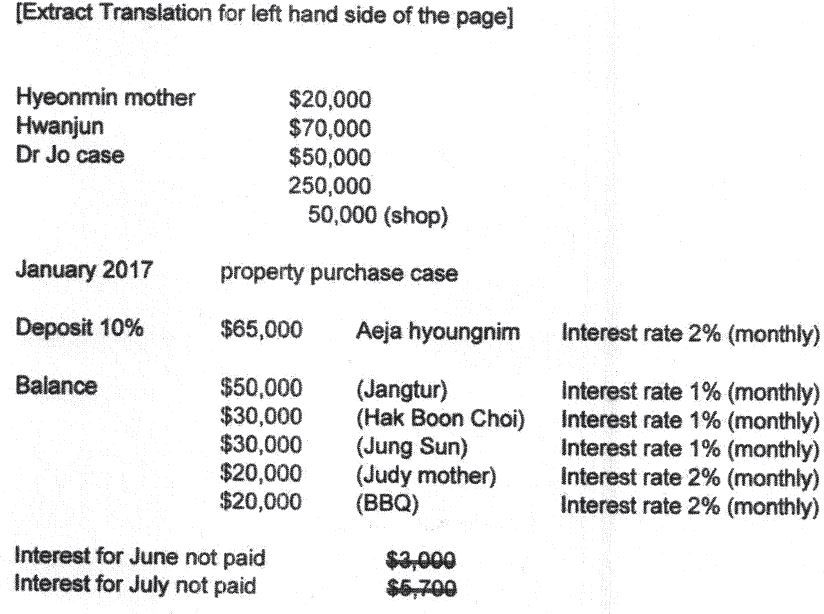
98 In cross-examination Mrs Jang explained that the “the top 3” lines of the Jang Note recorded the “money she gave” which I understand to be loans she made to the persons named, and “below is the money that [she] borrowed”. She also said that the last two lines in the Jang Note referring to the interest for June and July as “not paid” was interest that “she wrote down” that “she could not pay to the bank”. Notwithstanding the reference to the months of June and July and her description of the Jang Note as a record of her borrowings, Mrs Jang said that she created the Jang Note when she gave the money to Sarah.
99 According to Mrs Jang, as she had to pay a high interest rate on the money she borrowed from her friends she approached Secure Funding to obtain a loan. A loan agreement schedule dated 4 October 2017 was in evidence. It provided for a loan by Secure Funding as lender to Mrs Jang and Yun-Jong as borrowers in an amount of $400,000 to be secured by way of a mortgage over the Burradoo Property. Of the $400,000 loaned by Secure Funding to Mrs Jang and Yun-Jong, $200,000 was applied towards the discharge of a loan from the National Australia Bank which was secured over the Burradoo Property.
Rental of the townhouse at the Gungahlin Property
100 In about May 2017 Sarah informed Kan Kwai that she and Kyle wished to rent the townhouse at the Gungahlin Property and proposed a rental of $600 per week. Kan Kwai accepted the offer and asked Sarah to pay the rental into the Business Account from which she informed Sarah the mortgage repayments would be direct debited.
101 Sarah and Kyle moved into the townhouse in May 2017 but only commenced paying rent on 10 July 2017, paying $2,400 per month rather than $600 per week.
Mrs Jang lodges the Caveat
102 In August 2017 Mrs Jang sought advice from a lawyer, Jacob Jang, about asset protection. Jacob Jang lodged the Caveat on the title of the Gungahlin Property on Mrs Jang’s behalf. Mrs Jang met with Jacob Jang twice. It was on the second occasion that she signed the form for lodgement of the Caveat. According to Mrs Jang, apart from telling her where to sign the form, Jacob Jang did not explain it to her and she relied on him to complete it correctly. She said that at the time she signed the Caveat, the words describing the nature of the interest she claimed were not translated to her. At the time Mrs Jang did not live in the ACT and Jacob Jang informed her that he would post the Caveat to Sarah to be lodged.
103 The Caveat records as the “nature of the estate or interest in the land” an “equitable interest of $300,000 pursuant to an unregistered loan agreement between caveator and registered proprietor [Sarah]”. Despite what is recorded on the Caveat Mrs Jang maintained in cross-examination that she did not loan money to Sarah for purchase of the Gungahlin Property. Rather she said that she gave money to Sarah to purchase the Gungahlin Property “as her agent” and on her behalf. But the Caveat was lodged not long after acquisition of the Gungahlin Property by a lawyer instructed by Mrs Jang who at the time was seeking to protect her assets, and after Sarah, at least according to the statement of affairs subsequently completed by her (see [110] below) had started to experience financial difficulty.
104 A “notice to registered proprietor of lodgement of caveat” dated 21 August 2017 was sent by the ACT Land Titles Office to the registered proprietors of the Gungahlin Property, Sarah, Kan Kwai and Seung Jun Lee. Upon receiving her notice Kan Kwai contacted Sarah to inform her of its receipt and inquired about who was “Soon Ja Jang”. According to Kan Kwai, after Sarah informed her that it was her mother in law she said words to the following effect:
We have something going on. We need to protect the money she loaned to buy the property, that’s all.
105 On 27 March 2019 Mrs Jang received a lapsing notice for the Caveat. At that time the registered proprietors of the Gungahlin Property were the Trustees as to 50% and Kan Kwai and Seung as to 25% each.
Sarah becomes a bankrupt
106 On 1 August 2016 Sarah, Kyle and Kerry entered into a deed of guarantee and indemnity with Lincoln Sentry Group Pty Ltd. On 6 October 2017 Lincoln Sentry commenced a proceeding in the Magistrates Court of Queensland against Ciani, Sarah, Kyle and Kerry as defendants claiming payment of $60,896.06 for goods supplied to Ciani plus interest including as against Sarah, Kyle and Kerry in their capacity as guarantors. Sarah did not defend the proceeding. She accepted that at the time of the proceeding there was money owing to Lincoln Sentry which she could not pay. Relevantly, Lincoln Sentry obtained judgment against Sarah, Kyle and Kerry.
107 From about mid-2017 and certainly by August 2017 Ciani was experiencing serious financial difficulties. An email exchange between Sarah and Grace Lam, a senior accountant with Vincents, the Trustees’ firm, sheds light on this timing. In her email, among other things, Ms Lam wrote:
Further, could you please provide some background information regarding Ciani Innovation and its dealings with Lincoln Sentry?
• What does Ciani Innovation do? It is still trading?
• What services/products did Lincoln Sentry supply to Ciani Innovation?
• When did Ciani Innovation start experiencing financial difficulties?
• Who was the customer that went bankrupt? What much does that customer owe Ciani Innovation?
In response to these queries Sarah wrote:
Please see below according to your questions;
• Ciani Innovation is trading for commercial building supply and interior fit out company.
• We have suffered since June, 2017
• We have supplied Windows, security screens and window covers to Peter O’Brien Constructions who has built the DHA (Defence house Australia). They have contracted with DHA for building 63 houses in Canberra and Googong area. I did not have any trouble to get paid till Feb, 2017 but the company was getting struggle after that. We have not paid almost $200,000 for the last 8 houses. Other subcontractors including us have suffered due to that happening.
• POBC is now liquidation progress and I am expecting to get some paid after finishing the process.
108 As set out at [2] above, on 19 April 2018 Sarah became a bankrupt. The relevant orders were made on a creditor’s petition presented by Lincoln Sentry. At the same time Mrs Jang’s sons, Kyle and Kerry, were also made bankrupt.
109 Kan Kwai first became aware that Sarah and Kyle were bankrupt on or about 24 May 2018 upon receipt of a letter from the Trustees. On about 20 July 2018 Kan Kwai lodged a proof of debt in Sarah’s bankrupt estate for $88,816.96 for the moneys loaned to Sarah for the purchase of the Gungahlin Property.
110 Sarah completed a statement of affairs dated 5 May 2018 (SOA). Sarah said that after receiving the SOA from the Trustees she tried to complete it but could not understand it all. She then discussed the SOA with Kyle, who had also been made a bankrupt, and they completed their forms together. Sarah said that at the time she did not understand what was sought on page 13 of the SOA. I pause to observe that page 13 sought information about real estate owned by the bankrupt. In relation to the questions posed there Sarah recorded that:
(1) she did own land or buildings in Australia or overseas and provided the address of the Gungahlin Property. As to this response included in the SOA Sarah said that because her name was on the title of the Gungahlin Property she thought that was what the questions were asking and so she filled in the SOA as best she could;
(2) she co-owned the Gungahlin Property with Kan Kwai and Seung;
(3) the Gungahlin Property was acquired in March 2017 for $1.28 million;
(4) she owed $796,000 to creditors who hold security over the Gungahlin Property; and
(5) she resided at the Gungahlin Property with her partner.
111 Under the heading “Money Owed to You” in the SOA Sarah recorded:
Name and address of person or organisation who owes you money | Date debt was created | Amount owed ($) | Amount likely to be received ($) |
Soon Ja Jang | 05/2016 | 100,000 | 100,000 |
Soon Ja Jang | 10/2016 | 150,000 | 150,000 |
Soon Ja Jang | 01/2017 | 150,000 | 150,000 |
Soon Ja Jang | 02/2018 | 30,000 | 30,000 |
In contrast to the evidence given by Sarah about page 13 of the SOA and the real estate she holds, Sarah did not identify that there was any error in this part of her SOA at the time of preparing her affidavit, which she did with the assistance of a solicitor. It was only when asked about this entry in cross-examination that Sarah said that she informed a solicitor that she had entered this information incorrectly and had made a mistake.
112 Mrs Jang learned about Sarah’s, Kyle’s and Kerry’s bankruptcies in August 2018. She then engaged Marissa Lee of M Legal to assist her in dealing with the Trustees.
113 Sarah said that when Mrs Jang became aware that she had incorrectly put information into the SOA she was very upset. She said that she never showed Mrs Jang her SOA but told her about its contents when she learned from her lawyer at the time, who was also Marissa Lee, that the information she had included in it was incorrect.
114 Mrs Jang said that she had never seen the SOA but that she became aware of the information in it, in particular that part stating that she owed money to Sarah. When asked about these amounts Mrs Jang said they were incorrect and that she had told “David”, who I understand to be David Chang, her former solicitor, to correct it. She said that it was she who gave the money to Sarah.
115 Despite Mrs Jang’s evidence that she had never seen Sarah’s SOA, an email dated 26 June 2018 from Ms Lam to Louisa Sijabat, one of the Trustees, records a telephone conversation between Marissa Lee and Ms Lam and includes:
Marissa further advised her client disputed the amounts owed to Sarah Lee and Kyle Jang as disclosed in bankrupt’s SOAs.
Marissa advised it was the other way round (Mrs Jang is the bankrupt’s creditor) and Sarah and Kyle might have had gotten confused when they filled out their SOAs. I advised we would be issuing demand letters to Mrs Jang very soon and I suggested Mrs Jang should submit her POD along with supporting documentation as soon as possible. Marissa advised the monies were lent to Sarah and Kyle in smaller amounts over a long period of time and they are having difficulties coming up with evidence of monies being lent by Mrs Jang to the bankrupts. I advised Mrs Jang may want to start with her own bank statements showing payments and we may be able to match these payments in the bankrupts’ banks statements.
116 A letter dated 28 June 2018 from M Legal to Ms Sijabat, one of the Trustees, includes:
I act for Soon Ja Jang.
I confirm my instructions as follows:-
1. My client is the mother in law to Sarah Eun Ju Lee (aka Eun Ju Lee (the “bankrupt”) and also the mother to Kyle Jang and Kerry Jang.
2. My client has lent the sum of about $400,000.00 to the bankrupt or her related entities of which about $300,000.00 was used to purchase the property at 51 Strayleaf Cres, Gungahlin ACT (the “property”);
3. Caveat was lodged on 21 August 2017 to protect my client’s interest;
4. My client is a creditor of the bankrupt and not a debtor. I am instructed that my client was noted as a debtor (rather than a creditor) in SOC in error;
5. I am instructed that there is a resulting trust in favour of my client for the bankrupt’s interest in the property.
My client is still considering her options trying to ascertain what is the best course of action in the circumstances in order to protect her significant interest and in this regard, would you please provide me with a copy of the Report to Creditors in relation to the other two bankrupts, Kyle and Kerry Jang so that I have all relevant information at hand in order to properly advise my client.
…
117 On 29 June 2018 Ms Lam sent an email to Marissa Lee which included:
Thank you for your letter dated 28 June 2018.
As per your request, please see attached our reports to creditors in relation to the bankrupt estates of Sarah Lee, Kyle Jang and Kerry Jang. Your letter states that Mrs Jang lent monies to Sarah and or her related parties. Please be advised that Mrs Jang will need to substantiate her claims as a creditor, and if relevant, as a secured creditor. Would you please ask Mrs Jang to complete a formal proof of debt (POD) for any monies she is owed (separately) by each of Sarah, Kyle and Kerry? (Blank copies of PODs are attached.) Please also ask Mrs Jang to provide full supporting documentation along with the PODs. This may include but is not limited to signed loan agreements, bank statements evidencing funds being paid from Mrs Jang’s bank account, funds being received in the relevant person’s bank account, documents stating the nature of her security, if any, and so on. We will need to see the documents that support Mrs Jang’s claimed caveatable interest in the property. The caveat form itself is insufficient to substantiate this.
…
118 On 23 July 2018, Ms Sijabat and Ms Lam had a teleconference with Marissa Lee during which Ms Sijabat and Marissa Lee had an exchange to the following effect:
Marrisa Lee: My client is owed money by the Bankrupt. She is a creditor of the Bankrupt estate.
Ms Sijabat: If that’s the case, she is welcome to submit a proof of debt form, together with supporting documents for her claim.
119 A subsequent letter dated 30 July 2018 from M Legal to Ms Sijabat provides:
I refer to our telephone conversation of 23 July 2018 and confirm that I “now also act for Yun-Jong Jang, the daughter of Mrs Soon Ja Jang and sister in law to the bankrupt.
It appears that Mrs Jang (senior) who is now 75 years of age, has provided money to the bankrupt via Yun-Jong Jang who assisted her in carrying out internet banking transactions, In the circumstances, Yun-Jong Jang should also be included in the list of creditors secured and unsecured.
Further to my earlier letter of 28 June 2018, my clients’ instructions in relation to her entitlement to lodge a caveat are that there is a resulting trust in her favour.
Mrs Jang, together with or via her daughter, Yun-Jong Jang has provided all of the monies paid by the bankrupt in the purchase of the subject property known as 51 Strayleaf Crescent Gungahlin or 51a Strayleaf Crescent, Gungahlin, 51 Winarla Lane, Gungahlin ACT 2912.
1. The deposit for the purchase was initially paid for by the other tenant in common, Kan Kwai. Ultimately however, deposit for the property at the time of contract was provided by my client:-
(a) 6/1/17 $34,000.00 deposited into the bankrupt’s account
2. The bankrupt transferred the following amounts to Kan Kwai’s account, the other tenant in common on account of the deposit.
(a) 9/1/17 $10,000.00 transferred to Kan Kwai
(b) $24 000.00 Ditto
Total $34,000.00
3. My client then provided the sum of $30,000.00 in cash to the bankrupt on or about 6 January 2017 which was then given by the bankrupt to Kan Kwai for the remainder of the deposit.
4. As for the bankrupt’s portion of the stamp duty amount of $30,905.00:
(a) My client provided the sum of $30,905.00 to the bankrupt on or about 23 February 2017. Please see the bankrupt’s bank statement
(b) The bankrupt then transferred it to the joint account she held with Kan Kwai and Seung Jun Lee at Westpac Banking Corporation.
5. As to the remainder of the settlement monies that the bankrupt paid in the sum of $105,000.00, my client provided the following via Yun-Jong Jang:-
(a) 20/02/17 $5,000.00 (from Yun-Jong Jang)
$5,000.00 (from Yun-Jong Jang)
$10,000.00 (from Yun-Jong Jang)
$10,000.00 (from Yun-Jong Hang)
23/02/17 $40,000.00 (cash)
06/03/18 $10,000.00 (from Yun-Jong Jang)
$10,000.00 (from Yun-Jong Jang)
07/03/17 $10,000.00 (ANZ internet funds transfer)
$15,000.00 (cash)
Total $115,000.00
(b) The bankrupt then withdrew the sum of $105,010.00 (This amount includes $10 bank cheque fee) on 7 March 2017 as a bank cheque and handed it to Kan Kwai.
(c) I am instructed that the bankrupt’s shortfall for her portion of the settlement money amounting to $88,816.96 was provided by Kan Kwai.
It is my client’s contention that she does have an equitable interest in the property as a result of a resulting trust and that she is therefore entitled to lodge a caveat to protect that interest.
I am further instructed that my clients have lent an additional sum of about $38,800.00 to the bankrupt for which she is claiming as an unsecured creditor.
Please find attached a copy of the duly executed Proof of Debt. Please note that it has been signed by Soon Ja Jang and Yun-Jong Jang on separate pages.
In the enclosed proof of debt Mrs Jang claimed that Sarah was indebted to her in the sum of
$248,705 for “Money provided for the purchase of property” and “Cash Loans” which were provided on 7 March 2017 and from 15 June 2017 to 16 October 2017 respectively.
120 Given the exchanges set out above, I do not accept Mrs Jang’s evidence that she instructed Marissa Lee without having seen the SOA nor her evidence that she did not tell Marissa Lee that she had advanced $400,000 to Sarah, $300,000 of which was applied to the purchase of the Gungahlin Property. Again, based on the initial conversation between Marissa Lee and Ms Lam and Marissa Lee’s subsequent correspondence, I would infer that Marissa Lee had instructions from Mrs Jang that she was Sarah’s and Kyle’s creditor and that Mrs Jang had loaned them monies over a long period of time. There is no reason to conclude that Marissa Lee acted without instructions. Given the detail of the correspondence it is fanciful to suggest that to be so. Further, given the general view I have formed about Mrs Jang as a witness I do not accept that Marissa Lee misunderstood her instructions.
121 On 22 August 2018 Ms Sijabat attended a meeting with Ms Lam, Sarah, Mrs Jang and Marissa Lee. Ms Sijabat recalls that during the meeting Marissa Lee made representations to the following effect:
[Mrs Jang] loaned the Bankrupt about $200,000 around March 2017 so the Bankrupt could purchase the Property.
[Mrs Jang] borrowed these funds from her friends and family.
[Mrs Jang] refinanced her own home at 69 Sunnyhill Avenue Burradoo NSW 2576 around October 2017 with Secure Lending to repay her friends and family.
Ms Sijabat was provided with a copy of the loan agreement between Secure Funding and Mrs Jang and Yun-Jong.
122 Ms Sijabat also recalls that during the meeting on 22 August 2018 she and Marissa Lee had a conversation including to the following effect:
Ms Sijabat: I require further documents from your client in support of her claim to have a caveatable interest over the Bankrupt’s share of the property. What has been provided to date is insufficient to support your client’s claim. As it has been several months since this was originally requested, we now need these urgently. Are you able to provide me with all of the remaining supporting documents to adequately substantiate your client’s claim in the next two weeks?
Marissa Lee: My client will do her best to gather the documents she can. As we have said, my client is claiming a caveatable interest for the money loaned by her to the Bankrupt. However, there may be some difficulties gathering documents to support all of the amounts loaned by my client as a number of the loans were cash loans with no documentation.
Ms Sijabat: It may be problematic for your client and her claim if there is no documentary evidence of all of the amounts said to be loaned, as I am required to assess her claim based on documentary evidence.
123 During the meeting, Marissa Lee also raised the possibility of Mrs Jang making a proposal under s 73 of the Bankruptcy Act. Ms Sijabat provided what she described as some “standard information” about s 73 composition proposals and said words to the following effect:
In order for me to be able to recommend any proposal to creditors, I need to be able to form a professional opinion that the proposal would be likely to result in a better estimated outcome for creditors than if Sarah’s bankruptcy continued.
124 Marissa Lee said that the meeting held on 22 August 2018 was informal and “without admissions” as referred to in her email and letter dated 13 August 2018. However that correspondence does not, as Marissa Lee asserts, indicate that the proposed meeting took place on a “without admission” basis. The letter of 13 August 2018 relevantly includes:
As I have indicated earlier, my client, Mrs Soon Ja Jang is the only person in her family of any financial means and without admissions may be able to provide the funds necessary to make a composition proposal to the creditors.
I will ascertain if Mrs Jang could travel up to Sydney for an informal meeting with the Trustee in the next few days. If you could provide a couple of suitable dates, that would be helpful.
125 Marissa Lee also said that, as best she can recall, the purpose of the 22 August 2018 meeting was to explore the possibility of finding a speedy resolution of the matter before significant costs were incurred. Marissa Lee said her instructions were to ascertain if there was a means to resolve the matter and at that time the scope of any claim by Mrs Jang had not been decided. Other than the error in recording Mrs Jang as a debtor in the SOA any claim would have been subject to obtaining appropriate advice from counsel and ascertaining all of the material available to Mrs Jang.
126 Mrs Jang said that she showed her diary entry referred to at [97] above to Ms Lam at the meeting on 22 August 2018 but that Ms Lam said words to the effect of “that’s your community. I don’t want to see it”.
127 A letter dated 14 September 2018 from M Legal to Ms Sijabat included:
I refer to my previous correspondence and to our meeting on 22 August 2018.
Unfortunately, my client, Mrs Jang was taken ill after the meeting and is not able to provide further documentary evidence in relation to cash loans made to Eun Ju Lee.
I am instructed to propose a section 73 composition for the sum of $130,000.00. I have set down below the basis for my client’s proposal.
There followed the detail of Mrs Jang’s proposal. It is not necessary to set it out.
128 There was subsequent correspondence between Marissa Lee and the Trustee’s about Mrs Jang’s proposal. However it was not accepted by the Trustees.
129 Despite their requests, as the Trustees had insufficient documents to support the claim made by Mrs Jang in the Caveat and, given the passing of time, the Trustees instructed their solicitors to transmit Sarah’s interest in the Gungahlin Property to them and to lodge an application to lapse the Caveat on the basis that Sarah’s interest in the Gungahlin Property vested in the Trustees pursuant to s 58 of the Bankruptcy Act.
Sarah’s bank accounts
130 As a result of the Trustees’ investigations, Ms Sijabat is aware that there are nine bank accounts in Sarah’s name of which two are held jointly with Kan Kwai and Seung. Ms Sijabat has received statements for Sarah’s account number 5565-90771 held with the ANZ (ANZ Account) for the period from 23 March 2016 to 1 May 2018 (ANZ Statements). Based on a review of the ANZ Statements she has identified the following payments made into the ANZ Account in the period between exchange and settlement of the contract for sale of the Gungahlin Property:
Date | Description | Amount |
6 January 2017 | CARDENTRYATGUNGAHLINBRANCH | $34,000 |
20 February 2017 | TRANSFER FROM YUNJANGSHOP | $10,000 |
20 February 2017 | TRANSFER FROM YUNJANGSHOP | $10,000 |
20 February 2017 | TRANSFER FROM YUNJANGSHOP | $5,000 |
20 February 2017 | TRANSFER FROM YUNJANGSHOP | $5,000 |
23 February 2017 | DEPOSIT | $40,000 |
6 March 2017 | DEPOSIT | $10,000 |
6 March 2017 | TRANSFER FROM YUNJANGSHOP | $10,000 |
7 March 2017 | ANZINTERNETBANKINGFUNDSTFER TRANSFER689803FROM 223192054 | $10,000 |
7 March 2017 | CARDENTRYATGUNGAHLINBRANCH PAYMENT | $15,000 |
TOTAL | $149,000 |
And:
Date | Description | Amount |
3 January 2017 | TRANSFER FROMKYLEJANGFROMKYLEJANG | $1,700.00 |
11 January 2017 | TRANSFER FROMKYLEJANGFROMKYLEJANG | $ 800.00 |
16 January 2017 | EFTPOS MEDICAREBENEFIT | $37.05 |
16 January 2017 | ANZINTERNETBANKINGFUNDSTFER TRANSFER422393FROM 401390855 | $1,300.00 |
20 January 2017 | ANZM-BANKINGFUNDSTFER TRANSFER512016FROM 401390855 | $400.00 |
24 January 2017 | TRANSFER FROM BALWINDERBHULLABLIND | $350.000 |
27 January 2017 | ANZINTERNETBANKINGFUNDSTFER WAGE PAYMENTJANCIANIINNOVATION | $5,000.00 |
1 February 2017 | ANZINTERNETBANKINGFUNDSTFER TRANSFER194616FROM 401390855 | $14,000.00 |
6 February 2017 | ANZINTERNETBANKINGFUNDSTFER WAGE PAYMENTCIANIINNOVATION | $5,000 |
14 February 2017 | TRANSFER FROM NABTRANSFERFROMKYLEJANG | $1,500.00 |
TOTAL | $30,087.05 |
Ms Sijabat’s investigations have also revealed that account no 401390855 referred to in the above table is a savings account held by Ciani with the ANZ.
131 The ANZ Statements also show three payments made to “KANKW” as follows:
Date | Description on Bank Statements | Amount |
9 January 2017 | ANZINTERNETBANKINGFUNDSTFER | $10,000 |
9 January 2017 | ANZINTERNETBANKINGFUNDSTFER | $24,000 |
7 March 2017 | CARDENTRYATGUNGAHLINBRANCH | $105,010 |
TOTAL | $139,010 |
With the exception of the transactions set out in the first table at [130] above and those set out in the preceding paragraph Ms Sijabat has not identified any other transaction in any of Sarah’s bank statements that may be referrable to Mrs Jang’s claim.
Subsequent dealings between Sarah and Kan Kwai
132 In about April or May 2019, Sarah and Mrs Jang went to see Kan Kwai and Seung at the restaurant where, according to Kan Kwai, they had a conversation to the following effect:
Sarah: You need to tell our solicitor that I bought the [Gungahlin Property] for Kyle’s mother and that she is the real owner of the property.
Kan Kwai: Why?
Sarah: You need to. Please. If you don’t help me, you won’t get your money back.
Kan Kwai: I am sorry, but I am not going to lie.
Kan Kwai understood the reference to her not getting her money back to be a reference to the amount of $88,816.96 that she had loaned to Sarah to complete the purchase of the Gungahlin Property.
133 In about November 2019, after commencement of this proceeding, Sarah stopped paying rent into the Business Account. On that day Kan Kwai and Sarah exchanged emails:
(1) at 7.19 pm Kan Kwai sent an email to Sarah in the following terms (as written):
I am writing to remind you that your rental at 51 Strayleaf Crescent Gungahlin ACT 2912 is outstanding. You need to make a payment by this Friday, 22nd November 2019 to the following bank account as you previously did.
Account Name: K Kwai and EJ Lee and SJ Lee
BSB: 732-719
Account number: 836873
Also I am writing to inform you that I am going to move in to 51 Strayleaf Crescent Gungahlin ACT. Now I give you four weeks notice to vacate the property, you need to hand me the keys by 18th December 2019.
If you have any questions, please email me.
(2) at 10.02 pm Sarah responded in the following terms (as written):
I told you I have paid the rental to the 50% owner.
Do not email or talk to me anything, it is ilegal. From now on, if you say anything to me, it will report it to police.
And bring all income and outcome statements for house and restaurant from the start.
My solicitor asked for investigation.
Do not confuse that this building ia belong to you at all, you only got 25%.
You can not say to vacate, if you want to do that, you seek your lawer idiot.
From next week, my mother in law will control the restaurant business.
You have two option,
1. you give us the bank account and she is managing next 15 months as you did last 15 months.
If you do not accept this option.
2 She will make the company and change the POS machine and she manage all accounts.
Kan Kwai understood that Sarah’s reference to “the 50% owner” was a reference to Mrs Jang.
134 On 26 November 2019 Kan Kwai and Seung’s solicitors, Bradley Allen Love, sent a letter to Sarah in response to her email set out at [133(2)] above in which, among other things, demand was made for payment of the outstanding rental payments for the townhouse at the Gungahlin Property. Sarah subsequently made rental payments of $2,400, $4,800 and $2,400 on 2 December 2019, 20 December 2019 and 4 February 2020 respectively.
135 On 17 December 2019 Sarah lodged a complaint about Kan Kwai with the Tax Practitioners Board. Sarah’s complaint was described in the following terms (as written):
Kan Kwai (Tax agent) set up the Partnership without my consents or agreement and I have just received the tax returns of last 3 years partnership from her on 04/12/2019 (Please refer the emails from Kan Kwai). I never know there is partership with my name’s in or never got informed from Kan Kwai last 3 years. This was revealed by other case otherwise she hides it till I know. I have checked the lawyers and other accountants and found out the Partnership is serious and this is normally working between couple so the tax agent has to give full informations before setup and get the signed consents. This case is the misconduct as a tax agent and breaches of code of professional conduct. I am going to call ATO to remove my name from the Partnership and I wish her license as a tax agent out from the board, and hopely there wont be any other person suffered from her breaches. Anyway, I am also going to this case to the court as criminal and/or civil matter.
136 By letter dated 14 January 2020 the Tax Practitioners Board responded to Sarah’s complaint about Kan Kwai. That letter included (as written) :
We refer to the complaint made by you to the Tax Practitioners Board (the Board) on 17 December 2019 concerning Kan Kwai.
Your concern were:
• Kan Kwai included you in a business partnership without your knowledge or permission
• You have a taxable position due to the partnership income.
The Board has decided to take no further action in relation to this complaint.
In deciding to take no further action, the Board found that Kan Kwai provided a document which included your signature for the establishment of a partnership. No breaches of the Tax Agent Services Act 2009 have been found.
You may refer any forgery of signature to the police.
137 Sarah said that she tried to make a complaint to the police but she was told that she had to do so through a solicitor. She suggested that she gave the documents to a solicitor, who she did not identify by name, to investigate and that solicitor had the outcome of the inquiry but did not inform her of the outcome. Sarah’s evidence on this issue was vague and somewhat evasive and I give it no weight. There is no reliable evidence given by Sarah that she ever referred her allegation of forgery of her signature by Kan Kwai to the police or indeed to anyone to investigate and I do not accept that she did so.
Legal principles
138 The Gungahlin Property is situated in the ACT.
139 Relevantly, s 201 of the Civil Law (Property) Act 2006 (ACT) provides:
(1) An interest in land cannot be created or disposed of by a person except—
(a) by writing signed by the person or by the person’s agent properly authorised in writing; or
(b) by the person’s will; or
(c) by operation of law.
(2) A declaration of trust by a person in relation to an interest in land must be—
(a) in writing signed by the person; or
(b) made by the person’s will.
(3) A disposition by a person of an equitable interest or trust existing at the time of the disposition must be—
(a) in writing signed by the person or by the person’s agent properly authorised in writing; or
(b) made by the person’s will.
(4) This section—
(a) does not affect the creation or operation of a resulting, implied or constructive trust; and
(b) is subject to section 202 (Creation of interests in land by word of mouth).
(Notes omitted.)
140 In Calverley v Green (1984) 155 CLR 242 the High Court (Gibbs CJ, Mason, Brennan, Murphy and Deane JJ) considered whether the respondent, Ms Green, held her half share of a property on a resulting trust for the appellant, Mr Calverley. Mr Calverley and Ms Green were in a de facto relationship. They first lived in a house owned by Mr Calverley. Mr Calverley paid Ms Green $10 per week as a contribution to the cost of the household provisions that she purchased with Ms Green providing the balance. Some years later, Mr Calverley and Ms Green decided to move and located a new home. Initially Ms Calverley had difficulty obtaining finance for the purchase of the new home. When approval for a loan was secured it was on the basis that the purchase be in their joint names. Accordingly Ms Green signed the application for finance with Mr Calverley, finance was approved and the new house was purchased for the sum of $27,250. Mr Calverley paid the deposit of $9,000 from part of the proceeds of sale of the first house and an amount of $18,000 was borrowed on the security of a mortgage given by Mr Calverley and Ms Green. They were jointly and severally liable to pay the sum borrowed with interest. The property was transferred to Mr Calverley and Ms Green as joint tenants and they lived together under the same arrangements as before for approximately five years thereafter.
141 Justice Deane noted that the resolution of the appeal turned upon presumptions of equity applicable in determining the beneficial ownership of property which is purchased and transferred into the legal ownership of persons other than in accordance with their respective contributions to the purchase price. At 266-267 his Honour identified three relevant presumptions:
…The first is that which was applied by Rath J. at first instance in this case but was held by the Court of Appeal to be irrelevant upon a proper appreciation of the facts. Worded in terms that are appropriate for present purposes, it is: where a person pays the purchase price of property and causes it to be transferred to another or to another and himself jointly, the property is presumed to be held by the transferee or transferees upon trust for the person who provided the purchase money. The second can properly be seen as complementary of the first. It is: where two or more persons advance the purchase price of property in different shares, it is presumed that the person or persons to whom the legal title is transferred holds or hold the property upon resulting trust in favour of those who provided the purchase price in the shares in which they provided it.
The third “presumption”, usually called the “presumption of advancement”, is not, if viewed in isolation, strictly a presumption at all. It is simply that there are certain relationships in which equity infers that any benefit which was provided for one party at the cost of the other has been so provided by way of “advancement” with the result that the prima facie position remains that the equitable interest is presumed to follow the legal estate and to be at home with the legal title or, in the words of Dixon C.J., McTiernan, Fullagar and Windeyer JJ in Martin v Martin, that there is an “absence of any reason for assuming that a trust arose”. “The child or wife has the legal title. The fact of his being a child or wife of the purchaser prevents any equitable presumption from arising” (quoting Ashburner’s Principles of Equity 2nd ed, 1933, p 110n).
(Footnotes omitted.)
142 At 246-247 Gibbs CJ referred to the same three presumptions. After considering the history of the development of the presumption of advancement his Honour noted (at 251) that both the presumption of advancement and the presumption of a resulting trust may be rebutted by evidence of the actual intention of the purchaser at the time of the purchase and, where the intention is not rebutted and a resulting trust is found to arise, his Honour observed (at 252) that the extent of the beneficial interest of the respective parties must be determined at the time when the property was purchased and the trust created. His Honour said that thus the fact that in that case the mortgage debt was repaid by Mr Calverley was not relevant to a determination of the extent of the interests of the parties in the property although it may be relevant on an equitable accounting between the parties.
143 In considering the issue that arose for determination, at 262 Mason and Brennan JJ said:
The Court of Appeal correctly took the time of the acquisition of the Baulkham Hills property as the material time for determining the beneficial interests of the parties. The evidentiary material from which the court might have drawn an inference as to the intention of the parties included their acts and declarations before or at the time of the purchase, or so immediately after it as to constitute a part of the transaction. Evidence of those acts and declarations were admissible either for or against the party who did the act or made the declaration, but any subsequent declarations would have been admissible only as admissions against interest: Shephard v. Cartwright; Charles Marshall Pty. Ltd. V. Grimsley. …
(Footnotes omitted.)
144 In El-Debel v Micheletto (Trustee) [2021] FCAFC 117, the Full Court (Markovic, Derrington and Colvin JJ) considered an appeal from declarations that four properties formed part of the property that was divisible amongst the creditors of the bankrupt. The primary judge had found that the purchase price for those properties which were registered in the names of parties associated with the bankrupt, had been provided by the bankrupt and thus that each of the properties were held on resulting trust in favour of the bankrupt.
145 At [7], the Full Court set out a summary of the relevant principles:
(1) A presumption of a resulting trust arises where one person provides the purchase price of property which is conveyed into the name of another person.
(2) In deciding whether a presumption of a resulting trust has been rebutted the Court must reach a conclusion on the whole of the evidence.
(3) The presumption of a resulting trust may be rebutted by evidence which manifests an intention to the contrary, but should not give way to slight circumstances.
(4) The extent of the beneficial interest of the parties arising by reason of a resulting trust must be determined when the property was purchased.
(5) It is the intention of the person who provides part of the purchase price that is relevant when considering whether the presumption may be displaced by contrary evidence.
(6) If part of the purchase price is provided by being borrowed on a mortgage, the presumption of a resulting trust is applied by treating the monies raised by the mortgage as a contribution by the person who is liable to repay that money.
146 The question of whether a resulting trust arose was also considered by Ward CJ in Equity in Amit Laundry Pty Ltd v Jain [2017] NSWSC 1495. At [161]-[166] and [168] her Honour summarised the relevant principles as follows:
161. The relevant presumption was formulated (at 266-267) in Calverley by Deane J in the following terms (see also Gibbs CJ at 246-247 and Mason and Brennan JJ at 258):
… where two or more persons advance the purchase price of property in different shares, it is presumed that the person or persons to whom the legal title is transferred holds or hold the property upon resulting trust in favour of those who provided the purchase price in the shares in which they provided it.
162. The theoretical basis of resulting trusts and the possibility or desirability of identifying clear-cut categories of resulting trust (and even the reason for the appellation “resulting”) have been the subject of judicial and academic debate (Kerr v Baranow [2011] 1 SCR 269; [2011] SCC 10 at [16]; noted by Edelman J, sitting as his Honour then was in the Supreme Court of Western Australia, in Anderson v McPherson [No 2] [2012] WASC 19 at [89]; [90]-[93]; see generally, PW Young, C Croft and ML Smith, On Equity (Lawbook Co, 2009) at [6.930]). Fortunately, or otherwise, it is not necessary to enter into such debates. Suffice it to note that the presumption of resulting trust involves a “legal presumption” (see Jacobs’ Law of Trusts at [12-10]; W Swadling, “Explaining Resulting Trusts” (2008) 124 Law Quarterly Review 72), namely the presumption of a declaration of trust (in Anderson v McPherson, Edelman J referred to the rebuttable presumption as being “of the fact of a manifest declaration” (at [106]; see also, Jacobs’ Law of Trusts (at [12-10])).
163. The presumption of a resulting trust is thus a presumption as to a declaration of trust, premised on a presumed intention to create an equitable (beneficial) interest in the acquired property in someone other than, or in addition to, the person in whom legal title is vested. Once the primary fact giving rise to the presumption is established (for example, that one or more persons has or have provided part or all of the purchase price but the legal title has been vested in another), the burden falls on the party disputing the existence of a resulting trust (here, Rajil) to rebut the presumed fact on the balance of probabilities (see Ryan v Ryan [2012] NSWSC 636 at [57]; Weige v Cupton Pty Ltd (2012) 8 ASTLR 229; [2012] NSWCA 414 at [46]; Jacobs’ Law of Trusts at [12-10]). Where that party fails to rebut the presumption, the court “upon consideration of all circumstances presumes there was a declaration [of trust] though the plain and direct proof thereof be not extant” (Cook v Fountain (1672) 3 Swan 585 at 591; 36 ER 984 at 987 (Lord Nottingham LC)).
164. So understood, the presumption of resulting trust is thus the “starting point of a factual enquiry” about the intention of the party (or parties) who provided the funds for the purchase in question (Black Uhlans Inc v New South Wales Crime Commission Cautionary (2002) 12 BPR 22,421; [2002] NSWSC 1060 at [136]; Dyer v Dyer (1788) 2 Cox Eq Cas 92; (1788) 30 ER 42 at 43; Fowkes v Pascoe (1875) LR 10 Ch App 343 at 352; Re Kerrigan; Ex parte Jones (1946) 47 SR (NSW) 76 at 83), the presumption operating “to place the burden of proof [on the party disputing the trust], if there be a paucity of evidence bearing upon such a relevant matter as the intention of the party who provided the funds for the purchase” (Nelson v Nelson (1995) 184 CLR 538 at 547; [1995] HCA 25(Deane and Gummow JJ)).
165. The search for the intention of the relevant party (or parties) intention is as to proof of a “definite” not “nebulous” intention (Weige v Cupton Pty Ltd [2012] NSWCA 414 at [46]; referring to Drever v Drever [1936] ALR 446 at 450 (Dixon J)); the “objective, or manifest, intention ... it is not a subjective, uncommunicated intention but it is to be inferred from what the parties do or say” (Anderson v McPherson (No 2) [2012] WASC 19 at [156] (Edelman J, citing Calverley at 261 (Mason and Brennan JJ))). The relevant intention is to be found as at the date of purchase (or immediately thereafter) (Calverley at 251(Gibbs CJ); and at 262 (Mason and Brennan JJ)), although evidence of later acts and declarations are admissible (as admissions against interest) against the party who made them (Black Uhlans at [138] (Campbell J, as his Honour then was)).
166. Establishing on the balance of probabilities that a contribution of the requisite character has been made is a “factual precondition” to a successful assertion that there is a presumption of resulting trust (Hamed v Elddin [2016] NSWCA 9 at [23] (Meagher JA and Gleeson JJA, Sackville AJA) Elddin v Hamed (No 2) [2015] NSWSC 654 at [83] (Button J); see also, Ong v Lottwo Pty Ltd (in Liq) [2013] SASCFC 57 at [40] (Nicholson J, with whom Kourakis CJ and Stanley J agreed)). It is essential that the alleged contribution bears the character of purchase moneys (Calverley at 246 (Gibbs CJ); see also, Ong v Lottwo at [28]-[30]).
…
168. Incurring liability under a mortgage will amount to a contribution to the purchase price: “parties borrowing jointly in order to make up the acquisition cost are treated as having contributed the borrowed capital in equal shares” (Buffrey v Buffrey (2006) 12 BPR 23,619; [2006] NSWSC 1349 at [14] (Palmer J); Calverley). What is more problematic is the relevance, for the purposes of the resulting trust presumption, of mortgage repayments in the absence of a liability under the mortgage. It has been said that such payments are made towards securing a release of a charge over the property rather than as contributions to the purchase price (Calverley at 252 (Gibbs CJ); at 257 (Mason and Brennan JJ)).
Consideration
147 As set out above, Mrs Jang claims an equitable interest in the Gungahlin Property. She contends that her interest arises from an oral express trust between her and Sarah. The central question for resolution is whether Mrs Jang has established the existence of the express oral trust pursuant to which she contends Sarah holds her interest in the Gungahlin Property on trust for Mrs Jang.
A summary of Mrs Jang’s submissions
148 Mrs Jang submitted that the Court has the following evidence on oath from her and Sarah:
(1) Sarah was given funds by Mrs Jang to purchase an interest in the Gungahlin Property;
(2) the interest so purchased was to be held by Sarah for Mrs Jang;
(3) both Mrs Jang and Sarah understood that the interest purchased was Mrs Jang’s investment; and
(4) this was done because Mrs Jang wanted to invest in the Gungahlin Property but could not get finance while Sarah could.
149 Mrs Jang submitted that these facts (referred to as the core matters or core issues) are sufficient to establish an oral express trust whereby Sarah would hold her interest in the Gungahlin Property for her benefit.
150 Mrs Jang acknowledged that the trust was not recorded in writing and so was unenforceable for failure to comply with s 201 of the Civil Law (Property) Act but that case authority establishes that such an express trust gives rise to a resulting trust upon failure to comply with the Statute of Frauds requirement, which is consistent with s 201(4)(a) of the Civil Law (Property) Act. Mrs Jang contended that it is upon this basis that she claims a resulting trust over the whole of Sarah’s interest in the Gungahlin Property and that her primary claim is for a trust which results from the intention of both the beneficiary and the trustee and the course of conduct which flowed from the creation of that mutual intention, as opposed to a purchase price resulting trust in the Calverley v Green sense.
151 Mrs Jang submitted that the Trustees cannot challenge her and Sarah’s evidence about the creation of the trust directly as they were not involved in Sarah’s affairs until April 2018, more than a year after the purchase of the Gungahlin Property settled. Mrs Jang observed that no evidence was called which directly contradicted the conversations between her and Sarah. Rather, the Trustees tested and questioned the evidence tendered in support of Mrs Jang’s case, challenging her credibility and that of witnesses called in her case. Mrs Jang also observed that as part of this challenge the Trustees advanced several alternative theories to explain her and Sarah’s conduct: first, that Sarah’s business was so successful that it provided sufficient surplus funds to her to enable her to loan $400,000 to Mrs Jang which was correctly recorded in the SOA but, once this recording was discovered Sarah and Mrs Jang concocted the resulting trust to try to reverse the loan; and alternatively, that Ciani and Sarah by extension were in financial trouble from at least July 2017, a fact which was known to Mrs Jang and which led to the creation of the resulting trust idea and the lodgement of the Caveat in August 2017.
152 Mrs Jang submitted that neither of these theories is supported by the evidence and, that being so, the probability that her version of events is proved increases and the Court can more readily accept both her and Sarah’s evidence about investment in the Gungahlin Property.
153 Mrs Jang then made submissions about the evidence given both by her and other witnesses called on her behalf. Those submissions are set out and addressed as necessary below.
Mrs Jang bears the onus of proof
154 Mrs Jang bears the burden of proof. It is for her to establish, on the balance of probabilities the factual matters which are “necessary ingredients in [her] case”. The Trustees’ defence is, save in one respect, by way of the denial of factual matters asserted by Mrs Jang. Thus there is no requirement for them to disprove those matters: see s 140 Evidence Act 1995 (Cth); Australian Securities and Investments Commission v Big Star Energy Limited (No 3) [2020] FCA 1442; 148 ACSR 334 at [24]-[26]. The existence of the alleged oral trust relies on a series of oral agreements to which the Trustees were not and could not have been party.
Has Mrs Jang established the existence of the express oral trust?
155 Having considered the evidence as a whole, in my opinion Mrs Jang has failed to establish, on the balance of probabilities, the existence of an express oral trust (and thus the resulting trust) pursuant to which Sarah holds her interest in the Gungahlin Property on trust for her.
156 The express oral trust is said to arise on the pleaded case upon entry into the Agreement by Mrs Jang with Kan Kwai and Seung to the effect that they would jointly purchase the Gungahlin Property and the Second Agreement the effect of which was that Sarah would act as Mrs Jang’s agent for the purchase. In her amended statement of claim Mrs Jang then alleges that she paid $300,000 towards the purchase of the Gungahlin Property and that Kan Kwai and Seung paid the balance of the purchase price.
157 In her closing submissions Mrs Jang submitted that the express oral trust was established by the four core matters set out at [148] above.
158 The Trustees appeared to complain that Mrs Jang’s evidence and the case she pursued at trial were at odds with her pleaded case. That is so and a matter which was acknowledged by Mrs Jang, although whether she abandoned her pleaded case was not clear. Mrs Jang submitted that the pleading should not be taken as a script such that any difference between it and the evidence, however minor, is sufficient to deprive her of any relief.
159 In Ethicon Sarl v Gill [2021] FCAFC 29; (2021) 387 ALR 494 a Full Court of this Court (Jagot, Murphy and Lee JJ) considered the role of pleadings in the context of an allegation that in finding that particular devices had a defect the primary judge erred. In making that allegation the appellants contended that neither the pleading nor submissions raised the matter which formed a basis for the finding in issue and that the respondents should have been held to their pleading.
160 At [687]-[689] the Full Court said:
687 In Banque Commerciale SA en Liquidation v Akhil Holdings Ltd [1990] HCA 11; (1990) 169 CLR 279 at 296, Dawson J said, as cited with approval in Vale v Sutherland [2009] HCA 26; (2009) 237 CLR 638 at [41]:
But modern pleadings have never imposed so rigid a framework that if evidence which raises fresh issues is admitted without objection at trial, the case is to be decided upon a basis which does not embrace the real controversy between the parties … cases are determined on the evidence, not the pleadings.
688 To similar effect, in Betfair Pty Ltd v Racing New South Wales and Anor [2010] FCAFC 133; (2010) 189 FCR 356 at [51]-[53], [55]-[58] the Full Court explained that at trial a party is entitled to have the opposing party confined to that party’s pleadings, but if the first party does not seek to so confine the opposing party but allows the other party to raise other material facts and issues for the determination of the Court, then the Court is permitted and possibly obliged to decide the proceeding on the further material facts and issues raised and addressed at trial. The Full Court said (at [52]-[53]):
Pleadings are a means to an end and not an end in themselves (Banque Commerciale per Dawson J at 292-3). As early as 1916 Isaacs and Rich JJ said, in Gould and Birbeck and Bacon v Mount Oxide Mines Ltd (in Liquidation) (1916) 22 CLR 490 (at 517):
Undoubtedly, as a general rule of fair play, and one resting on the fundamental principle that no man ought to be put to loss without having a proper opportunity of meeting the case against him, pleadings should state with sufficient clearness the case of the party whose averments they are. That is their function. Their function is discharged when the case is presented with reasonable clearness. Any want of clearness can be cured by amendment or particulars. But pleadings are only a means to an end, and if the parties in fighting their legal battles choose to restrict them, or to enlarge them, or to disregard them and meet each other on issues fairly fought out, it is impossible for either of them to hark back to the pleadings and treat them as governing the area of contest.
(Emphasis added).
Approached in these terms, the question is whether the respondents knew the nature of the case they had to meet.
689 Their Honours further explained (at [55]):
The course of proceedings is in the control of the Court. That control is to be exercised for the attainment of a just outcome. There will obviously be cases where a pleaded case does not raise an important fact for attention. If that remains the position at the end of the case, the case may be lost on that basis, so far as it depends on that fact. Sometimes it would be unfair to allow a party to amend a case, or a pleading, to raise a new matter which could have been, but was not, raised earlier. On the other hand, mere infelicity of drafting will rarely be allowed to defeat a case on its merits if the merits of the case have been made apparent on the evidence without unfairness to the other party.
(Emphasis added).
161 This is not a case where a claim has been made and pursued at trial which has not been expressly pleaded. The issue is more nuanced. Mrs Jang pleads that the alleged trust arose by reason of the Agreement and Second Agreement. The Trustees contended that she has not made out her pleaded case and, in doing so, suggest, at least implicitly, that Mrs Jang should be held to that case. However, at trial Mrs Jang advanced a case that was different from her pleaded case. While she still asserted that her interest arose by reason of a resulting trust, a matter which is pleaded, she relies on material facts that differ from those pleaded to make good that claim.
162 The Trustees were on notice of the way in which Mrs Jang put her case and that it departed in a number of respects from her pleaded case. They made no complaint about that during the course of the trial and, given the evidence relied on by Mrs Jang and her opening submissions, were on notice of that case. Mrs Jang’s case has been presented with reasonable clarity.
163 In any event, whether on the basis of the case as pleaded or as presented at trial I reach the same conclusion. That is that Mrs Jang has failed to establish the existence of the resulting trust pursuant to which she contends that Sarah held a 50% share in the Gungahlin Property on her behalf.
164 As I have already observed Mrs Jang relies on four core matters to establish the resulting trust in her favour. However, she has not provided by way of closing submissions or otherwise any references to the evidence which she contends establishes these core matters. It is instructive to examine each one.
165 The first core matter is that Mrs Jang gave Sarah money to purchase an interest in the Gungahlin Property. As is clear from the authorities set out above, Mrs Jang bears the onus of establishing the payments that give rise to a presumption of a resulting trust. However, in my opinion, the evidence relied on by Mrs Jang does not support the assertion made by the first core matter.
166 Sarah holds a half interest in the Gungahlin Property. The purchase price of $1.28 million was paid in two parts: a 10% deposit followed by the balance subject to adjustments on completion.
167 Insofar as the deposit is concerned, initially Mrs Jang gave evidence that she could pay the deposit but in the same affidavit said that she intended that the sum of $65,000 which she gave to Sarah in January was to be paid by Sarah to Kan Kwai for the deposit. In a later affidavit Mrs Jang said that she did not have funds to immediately pay the deposit, that Kan Kwai and Seung would pay the deposit and that Mrs Jang would pay them later when she had the money. In cross-examination Mrs Jang said that the Jang Note recorded that she had borrowed the deposit for the Gungahlin Property.
168 Sarah gave evidence that Kan Kwai agreed to pay the whole of the deposit. In cross-examination she said that at the time of exchange Kan Kwai paid the deposit and that later Mrs Jang gave her cash which she transferred, I infer, to Kan Kwai’s account.
169 As to the payment of the balance of the purchase price, in her April 2019 Affidavit Mrs Jang said that she gave Sarah an additional amount of $235,000 either directly or via Yun-Jong which amount she intended be used for the purchase of the Gungahlin Property. However, when she gave evidence at the hearing Mrs Jang said that she contributed $265,000 in total to the Gungahlin Property, that the “total amount” that she “was to put in was $215,000” but that she also contributed $50,000 for renovations. Then in cross-examination Mrs Jang suggested that the $300,000 contribution pleaded in her amended statement of claim (and which I observe was the total amount referred to in the April 2019 Affidavit) was “without the loan money” suggesting that she in fact contributed more to the purchase price.
170 Yun-Jong’s evidence is that she was given some money by her mother and told it was for the “property” and that she should give it to Sarah and that in February and March 2017 she transferred a total of $40,000 into Sarah’s bank account.
171 Sarah has no independent recollection of the amounts or the dates on which she says she was given money by Mrs Jang.
172 None of the evidence given by Mrs Jang, Sarah or Yun-Jong is supported by any objective documentary evidence showing, for example, the source of funds, the date of payment of funds to Sarah and by what means e.g. cash or electronic transfer or otherwise, the receipt of funds and the application of those funds to the purchase price for the Gungahlin Property. The evidence rises no higher than an assertion that some moneys were paid to Sarah by Mrs Jang. That Mrs Jang intended, and in the case of money provided to Yun-Jong for transfer to Sarah told Yun-Jong, that those moneys were to be applied to the purchase of the Gungahlin Property is not sufficient to demonstrate that they were so applied.
173 The only objective documentary evidence of the source of funds for the purchase of the Gungahlin Property came from the Trustees. It comprised:
(1) Kan Kwai’s statement of account for her “Rocket Repay Home Loan” held with Westpac for the period dated 28 January 2016 to 27 January 2017 which shows a withdrawal of $128,000 on 16 December 2016, the date of exchange of the contract for sale of the Gungahlin Property, and deposits on 9 January 2017 by Kyle of $30,000 (in three separate transactions of $10,000 each) and by Sarah of $34,000 (in two separate transactions of $10,000 and $24,000 respectively). As to the latter corresponding payments were identified in the ANZ Statements (see [131] above);
(2) the evidence given by Ms Sijabat of funds received by Sarah into the ANZ Account in the period between exchange and settlement of the contract for sale of the Gungahlin Property based on an analysis of the statements for that account (see [130] above) for which the Trustees have been unable to establish the source or origin; and
(3) Kan Kwai’s reconciliation of the amounts contributed by each of Sarah, Seung and herself to the purchase price for the Gungahlin Property (see [81] above).
174 This evidence does not show Mrs Jang as the contributor of any of the funds received by Sarah in the relevant period or the application of funds apparently received from Mrs Jang to the purchase price for the Gungahlin Property.
175 The second, third and fourth core matters can be considered together. They are that the interest in the Gungahlin Property purchased by Sarah was held by her for Mrs Jang, that Mrs Jang and Sarah understood that the interest purchased by Sarah was Mrs Jang’s investment and that this was done because Mrs Jang wanted to invest in property but could not get a loan.
176 Mrs Jang relies on the evidence in chief given by her and Sarah to establish the creation of the trust and thus these core matters. The conversations between Mrs Jang and Sarah are set out at [26]-[28] above. Mrs Jang submitted that the Trustees cannot challenge that evidence directly, they are effectively strangers to the alleged arrangements. That is so. But that does not mean that the only available option is to accept the evidence or to accept it without any reservation or criticism.
177 The Trustees referred to Watson v Foxman (1995) 49 NSWLR 315. That case concerned a dispute between, on the one hand, Phillip Foxman and two companies controlled by him and, on the other, the Commonwealth Bank of Australia and a receiver appointed by the bank over some of the assets of Mr Foxman’s companies. The bank sought to recover a debt from Mr Foxman and his companies, one of which, Foxman Holdings, then cross-claimed against the bank seeking damages for, among other things, misleading or deceptive conduct under the then Trade Practices Act 1974 (Cth) or the Fair Trading Act 1987 (NSW). In support of that claim Foxman Holdings relied on evidence given by Mr Foxman of conversations he said he had with an officer of the bank. After referring to that evidence at 318-319 McLelland CJ in Eq said:
Where, in civil proceedings, a party alleges that the conduct of another was misleading or deceptive, or likely to mislead or deceive (which I will compendiously described as “misleading”) within the meaning of s 52 of the Trade Practices Act 1974 (Cth) (or s 42 of the Fair Trading Act), it is ordinarily necessary for that party to prove to the reasonable satisfaction of the court: (1) what the alleged conduct was; and (2) circumstances which rendered the conduct misleading. Where the conduct is the speaking of words in the course of a conversation, it is necessary that the words spoken be proved with a degree of precision sufficient to enable the court to be reasonably satisfied that they were in fact misleading in the proved circumstances. In many cases (but not all) the question whether spoken words were misleading may depend upon what, if examined at the time, may have been seen to be relatively subtle nuances flowing from the use of one word, phrase or grammatical construction rather than another, or the presence or absence of some qualifying word or phrase, or condition. Furthermore, human memory of what was said in a conversation is fallible for a variety of reasons, and ordinarily the degree of fallibility increases with the passage of time, particularly where disputes or litigation intervene, and the processes of memory are overlaid, often subconsciously, by perceptions or self-interest as well as conscious consideration of what should have been said or could have been said. All too often what is actually remembered is little more than an impression from which plausible details are then, again often subconsciously, constructed. All this is a matter of ordinary human experience.
Each element of the cause of action must be proved to the reasonable satisfaction of the court, which means that the court “must feel an actual persuasion of its occurrence or existence”. Such satisfaction is “not ¼ attained or established independently of the nature and consequence of the fact or facts to be proved” including the “seriousness of an allegation made, the inherent unlikelihood of an occurrence of a given description, or the gravity of the consequences flowing from a particular finding”: Helton v Allen (1940) 63 CLR 691 at 712.
(Emphasis added.)
178 As was the case in Watson v Foxman, Mrs Jang’s cause of action is founded on the speaking of words. The observations of McLelland CJ in Eq apply equally here such that the words spoken “must be proved with a degree of precision sufficient to enable the court”, in this case, to be reasonably satisfied that any consensus reached was capable of forming a binding agreement and was intended by the parties to be legally binding. However, the evidence relied on does not meet that threshold.
179 Insofar as the alleged agreement between Mrs Jang and Sarah is concerned Mrs Jang gave the evidence set out at [27]-[28] above in her May 2019 Affidavit. In her oral evidence, which was more detailed than the evidence included on the topic in her May 2019 Affidavit, Mrs Jang gave scant detail about the alleged agreement. She said that: Sarah and Kyle found out about the Gungahlin Property from an accountant who she does not identify but who I assume to be Kan Kwai; that they were short of money and so asked her if she was interested in the property but she said she had no funds at the time; Sarah and Kyle then spoke to the accountant and Mrs Jang was told that the accountant would pay the deposit; that being so Mrs Jang considered whether she could come up with the money; Mrs Jang said, although it is not clear to whom, that it would take some time to get a loan but that she could borrow money from her friends; because Mrs Jang could not obtain a loan in her name she asked “her” to buy the Gungahlin Property in her name and “she” agreed to do so; and accordingly “she” entered into the contract on 16 December 2016 and Mrs Jang gave her some money by the end of December 2016.
180 Mrs Jang’s evidence does no more than describe the bare elements of her case; it lacks any precision. For example, Mrs Jang does not name the “accountant” nor the person who she asked to act as purchaser, although I assume it was Sarah, nor does she provide any detail of conversations she had with Sarah about the Gungahlin Property and the way in which the transaction was to proceed, including the basis upon which Sarah was to hold the property on her behalf. The alleged agreement involved the acquisition of a significant asset for a not insubstantial sum. One might expect that there would be a level of detailed discussion about such a transaction prior to entry into it and that, given the significance of the transaction, a somewhat more detailed recollection of those discussions and how the transaction unfolded.
181 In the same vein, Mrs Jang provides no detail about the proposed funding of the Gungahlin Property either in the longer term, through borrowings or, in the shorter term, from her friends. Nor does she explain why or what circumstances or events, beyond her age, caused her to form the view that she could not obtain a loan thus necessitating the need for the property to be purchased in someone else’s name.
182 Mrs Jang’s evidence included in her May 2019 Affidavit does not advance the matter any further.
183 Sarah’s evidence in relation to the alleged agreement is set out at [30]-[35] above. While it aligns in part with the evidence given by Mrs Jang it does not either of itself or in combination with Mrs Jang’s evidence satisfy me that there was an agreement in the terms alleged.
184 Sarah gave her evidence by way of affidavit. The limitations of affidavits as a means of providing an accurate account of past oral communications is, as was observed by Pembroke J in Linfield Developments Pty Ltd v Shuangxing Development Pty Ltd [2016] NSWSC 68 at [11], well known. His Honour continued:
In Thomas v SMP (International) Pty Ltd [2010] NSWSC 822, I set out some of the considerations:
[23] … Affidavits have an important function and serve a useful purpose. But they are not necessarily always the best means of leading evidence-in-chief. Where there are disputed issues of fact involving oral representations and conversations, affidavit evidence can sometimes be an unsatisfactory medium for leading the evidence-in-chief.
[24] It is well known that eminent jurists with unparalleled trial experience have expressed misgivings about the elicitation of evidence-in-chief by affidavits in cases whose success or failure depends on disputed representations and conversations. A colourful but apposite aphorism frequently invoked by Hon T E F Hughes QC, and attributed to Lord Buckmaster, is that “the truth sometimes leaks out of an affidavit - like water from the bottom of a well”…
[25] Justice Emmett elaborated more fully on the difficulties to which affidavits and witness statements can give rise in Practical Litigation in the Federal Court of Australia – Affidavtis (2001) 20 Australian Bar Review 28:
Where evidence is controversial, particularly where credibility of the witness is involved, the adducing of the evidence in written form is often undesirable and can be quite unfair… With the very best of intentions a lawyer who settles an affidavit or a witness statement will invariably reduce the language of the witness to the lawyer’s own language. That may entail changes in meaning and emphasis that, although not intended, may expose a witness to unnecessary difficulties in the course of cross-examination. On the other hand, a dishonest witness will always be assisted by having evidence put into credible form by a lawyer...
[26] In 1996 in the Access to Justice Report, Final Report (HMSO), 1996 at [55], Lord Woolf pithily observed:
Witness statements have ceased to be the authentic account of the lay witness; instead they have become an elaborate, costly branch of legal drafting.
[27] And as long ago as 1975, the New South Wales Law Reform Commission, in Working Paper 14, (1975) – Procedure: Common Law Pleadings, also observed (paragraph 7.3): “affidavit evidence is said (and with justification) to be more the evidence of the legal advisor than the witness”.
[28] A common thread in the commentary is that the studied reconstruction, and formulation in writing, of contentious conversations and oral communications in language that is usually settled and refined by lawyers, can sometimes be unreliable and unintentionally misleading. …
185 Added to this are the comments of McLelland CJ in Eq set out at [177] above where his Honour referred to the fallibility of memory which increases with time and can be affected, where a dispute intervenes, albeit subconsciously, “by perceptions or self-interest as well as conscious consideration of what should have been said or could have been said”.
186 As I have already observed, in some respects Sarah’s evidence (see [30]-[35] above) aligns with that given by Mrs Jang. In her first affidavit sworn on 3 May 2019 Sarah said that: she came to learn about the Gungahlin Property in November 2016; she and Kyle did not have the funds to buy the Gungahlin Property; Mrs Jang asked Sarah to approach Kan Kwai and Seung to inquire if they would purchase the property with her and at that time told her that Kan Kwai and Seung would need to pay the full deposit and that she would have to get the money together; and that upon being informed about the urgency of the sale, Mrs Jang told Sarah that she did not have the money at the moment, that she would get it and asked Sarah to see if Kan Kwai and Seung could pay the deposit.
187 Later in the same affidavit Sarah gave evidence which differed in one respect to that given by Mrs Jang (see [35] above). That is, Sarah gave evidence of further conversations with Mrs Jang in which Mrs Jang said that she was giving Sarah the money, her name would be on the title but it would be Mrs Jang’s property and that Sarah’s name was just there to protect Mrs Jang. Based on Sarah’s evidence, the reason why the Gungahlin Property was to be purchased in Sarah’s name was not because of an inability on the part of Mrs Jang to borrow funds but to protect Mrs Jang.
188 Sarah’s evidence, like that of Mrs Jang, lacks any detail. As I have already observed the proposal was to acquire a property for a not insignificant sum with two people about whom, at least based on the evidence relied on by Mrs Jang, she knew little if anything. Yet there is no evidence given about the nature of the property, the sale price, or the detail of the alleged agreement pursuant to which it is said the resulting trust arises. Putting to one side why the transaction would proceed in the way proposed, with Sarah registered on the title but holding her half share for the benefit of Mrs Jang, there is no explanation of how that arrangement would operate in terms of the timing of the provision of money to fund the half share and the quantum required or how, for example, the income generated from the half share in the Gungahlin Property, which was described by Sarah as an investment property, would be disbursed or otherwise dealt with.
189 Nor is there any evidence explaining why it is that Sarah needed to be registered on the title of the Gungahlin Property in order to “protect” Mrs Jang. The nature of the protection sought, why it was required and how having Sarah recorded as registered proprietor afforded that protection is not the subject of any evidence. Once again, given the nature and relative import of the transaction, the lack of detail creates an uncertainty about the evidence and tells against its ability to persuade me that, on the balance of probabilities, the alleged agreement was put in place at the time of the purchase of the Gungahlin Property or at all.
190 Putting to one side the Jang Note, which I address below, an added problem is the complete lack of contemporaneous documents relied on by Mrs Jang to support the alleged agreement. Those documents that were in evidence tell against the existence of the alleged agreement:
(1) as observed above, the ANZ Statements disclose that for the period between the exchange of contracts for the sale of the Gungahlin Property and their settlement a total of $179,087.05 was deposited into the ANZ Account. There is no evidence that establishes where those funds were derived from or how they were expended and Mrs Jang accepted in cross-examination that she made no contemporaneous note or record of providing funds to Sarah in December 2016 or March 2017;
(2) Kan Kwai informed the vendors’ solicitor by text message sent on 27 January 2017 that the intended purchasers of the Gungahlin Property were to be herself, Seung, Sarah and Kyle, each holding a 25% interest;
(3) the contract for sale of the Gungahlin Property dated 16 December 2016 names Kan Kwai, Seung and Sarah as purchasers;
(4) a letter dated 27 January 2017 from Suncorp to Kan Kwai notifying preliminary approval of a loan in the sum of $896,000 to be secured by way of mortgage over the Gungahlin Property names Kan Kwai, Seung and Sarah as borrowers;
(5) on 1 February 2017 Badgery & Rafferty issued a costs agreement to Kan Kwai, Seung and Sarah in relation to their retainer to act for them on the purchase of the Gungahlin Property;
(6) a letter dated 20 February 2017 from Suncorp to Sarah notifying approval of a loan in the sum of $768,000 to be secured by way of mortgage over the Gungahlin Property names Kan Kwai, Seung and Sarah as borrowers;
(7) on 29 March 2017 the Gungahlin Property was registered in the names of Kan Kwai and Seung as to a 25% interest each and Sarah as to a 50% interest and a mortgage to Suncorp was registered on its title;
(8) on 21 August the Caveat was registered on the title of the Gungahlin Property by which Mrs Jang claimed an “equitable interest of $300,000 pursuant to an unregistered loan agreement” with Sarah;
(9) in the SOA dated 5 August 2018, which in cross-examination Sarah accepted she completed truthfully to the best of her knowledge, Sarah noted that she first had difficulty paying her debts in May 2017, declared that the Gungahlin Property was owned by her, Kan Kwai and Seung and did not disclose that Mrs Jang had any interest in it, named Mrs Jang as a debtor owing her $400,000, named Suncorp as her only secured creditor and did not include Mrs Jang in the list of her unsecured creditors; and
(10) a letter dated 28 June 2018 from Marissa Lee to the Trustees states that her instructions, among other things, were that Mrs Jang had “lent the sum of about $400,000 to [Sarah] or her related entities of which about $300,000 was used to purchase the [Gungahlin Property]” albeit it also raised a claim by Mrs Jang of a resulting trust in favour of Mrs Jang for Sarah’s interest in the Gungahlin Property without articulating the basis for that claim.
191 It is convenient at this point to make some observations about the Caveat. Mrs Jang submitted that the Caveat supported her case. In doing so she referred to her evidence, given in cross-examination, that the interest claimed in the Gungahlin Property included in the Caveat was not translated to her prior to her execution of it. She submitted that, as a result, the Caveat does not carry much weight but that the fact of the Caveat itself and the purpose for which she lodged it lends support to her evidence about her interest in the Gungahlin Property.
192 Mrs Jang observed that it was suggested to her in cross-examination that the Caveat was put on the Gungahlin Property in response to Sarah informing her of financial troubles with Ciani in 2017. Mrs Jang referred to her evidence denying that contention but submitted there were a number of surrounding facts which undermined that motivation for lodging the Caveat. They were: first, the absence of evidence that she knew anything about Ciani’s financial troubles; and secondly, the fact that the debt owed to Lincoln Sentry by Ciani which led to Sarah’s bankruptcy was only approximately $60,000, yet she was willing to offer $130,000 in a composition to creditors to annul Sarah’s bankruptcy. Mrs Jang relied on her evidence, again given in cross-examination, that she first heard about the debt owing to Lincoln Sentry after her sons and Sarah had become bankrupt.
193 Mrs Jang submitted that when taken together it is open to the Court to infer that if she had been informed about the financial difficulties her family was experiencing she would have provided the money to pay off those lesser debts, given her willingness to pay a greater sum to resolve Sarah’s bankruptcy. She contended that the fact that no such steps were taken in 2017 or 2018 prior to Sarah’s bankruptcy lends support to the conclusion that she did not know about Sarah’s financial troubles at the time the Caveat was lodged and that such troubles were not the reason for its lodgement in August 2017. Mrs Jang submitted that once that hypothesis is excluded the logical conclusion is that she lodged the Caveat in August 2017 for the reasons she gave, namely to protect her investment in the Gungahlin Property and that the existence and lodgement of the Caveat is a powerful fact in support of her case.
194 In cross-examination Mrs Jang accepted that the Caveat was the first document in which she sought to preserve what she claimed to be her interest in the Gungahlin Property. She also accepted that the Caveat was the first ever record of her providing funds to Sarah for the purchase of the Gungahlin Property. Mrs Jang refused to acknowledge that the Caveat recorded the interest claimed by her in the Gungahlin Property as a loan to Sarah and denied that she loaned any monies to Sarah. Then, in a non-responsive comment to a line of questioning about the timing of the lodgement of the Caveat, Mrs Jang said that the reason for lodging the Caveat was in case Sarah divorced and a concern that “she would get it all”.
195 Mrs Jang was not prepared to answer questions in cross-examination concerning the Caveat where it was put to her that the interest claimed therein at the time it was prepared and lodged was recorded as a loan to Sarah. Further, Mrs Jang sought to explain the alleged inaccuracy of the description of her interest in the Gungahlin Property by blaming her solicitor. She suggested by her evidence that either her solicitor had completed the Caveat without instructions or he had done so contrary to her instructions. As to the former, even if I accept that the Caveat was not translated to her before she signed it, it does not follow that it was not explained to her. As to the latter there is no basis upon which I would infer that the Caveat was prepared other than on instructions from Mrs Jang who, on her evidence, sought advice from Jacob Jang about asset protection. If Mrs Jang had loaned moneys to Sarah for the purpose of her acquisition of the Gungahlin Property then it would make perfect sense for her to wish to protect her interest as a lender by way of lodgement of the Caveat.
196 In those circumstances I do not accept Mrs Jang’s submission that the use of the word “loan” in the Caveat does not carry much weight. In my view, the inference to be drawn from the Caveat as prepared, signed and lodged is that, at the time, Mrs Jang claimed an interest in the Gungahlin Property as a result of a loan in the sum of $300,000 which she alleged she had made to Sarah for the purposes of its acquisition.
197 Whether or not Mrs Jang knew that Ciani was in financial difficulty at the time she lodged the Caveat does not change the view I have reached. But, in any event, assuming that she did not, there is no basis upon which I would draw the inference urged on me by Mrs Jang. There is no basis to infer that, had she been informed about Ciani’s financial difficulties, she would have provided funds to pay off the debt owed to Lincoln Sentry. It does not follow that Mrs Jang’s willingness to attempt to resolve Sarah’s bankruptcy by way of a compromise with her creditors some years later means that she would have been willing to pay off “lesser debts” in 2017 or 2018.
198 I turn then to consider the Jang Note, the only contemporaneous document relied on by Mrs Jang and, relatedly, the evidence of Young Ja Lee, Mrs Doo and Mrs Oh and the documents they each produced in answer to the subpoenas served on them.
199 Mrs Jang submitted that the Jang Note supports the alleged agreement with Sarah and undermines any submission of self-suggestion or recent invention. She submitted that the Jang Note records moneys which she borrowed to give to Sarah towards the purchase of the Gungahlin Property, the deletion of the interest for June and July was explained by her as recording the repayment of interest at the time it was paid and that a careful review of the relevant transcript leads to the conclusion that the notes for June and July 2017 were made at the time the interest was repaid while the notes about the loans were made in January 2017 when Mrs Jang gave the money to Sarah. Mrs Jang submitted that this evidence is consistent with the terms of the Jang Note and the use to which it had been put, namely to record moneys borrowed towards the purchase of Mrs Jang’s interest in the Gungahlin Property.
200 Mrs Jang submitted that, on balance, the Jang Note is a simple document which supports her case: it records money borrowed, from whom and related interest rates; and the repayment of interest prior to repayment of the whole loan. It was the type of document one would expect a woman like her to make.
201 Mrs Jang’s evidence about the Jang Note, a copy of which is reproduced at [97] above, was somewhat ambiguous. I cannot conclude, as Mrs Jang says I should, that it was prepared at two different times: as to the loans, at the time she provided the funds to Sarah; and, as to the entries about interest, at the time that interest was due and paid. On my review of the transcript of Mrs Jang’s cross-examination her evidence was that the entries about interest concerned interest owing to a bank that she could not pay (see [98] above). She gave no evidence about when those entries were made.
202 Taken at its highest, the Jang Note records moneys borrowed from the persons named in it at the interest rates specified. Those persons include Mrs Doo but it is not apparent, on the face of the Jang Note or from Mrs Jang’s evidence, that they include Young Ja Lee or Mrs Oh. The Jang Note does not specify when the amounts were borrowed or for what purpose. Even assuming that the heading “property purchase” refers to the Gungahlin Property, the Jang Note does not assist in understanding the purpose for which those moneys were borrowed. More critically, the Jang Note does not include any reference to Sarah or to the alleged agreement. In the circumstances, even if I accept that the Jang Note or a part of it was created in January 2017 at about the time Mrs Jang contends she gave money to Sarah, it does not assist Mrs Jang. It is not sufficient to corroborate the alleged agreement pursuant to which she contends Sarah holds the Gungahlin Property on a resulting trust for her benefit.
203 As set out above, Mrs Jang also relies on the evidence of three members of her Kye, Yong Ja Lee, Mrs Doo and Mrs Oh, as corroborative of her claim that Sarah holds her interest in the Gungahlin Property on resulting trust for her. Their evidence is set out at [90(1)] and [91] (Young Ja Lee), [90(2)] and [92]-[94] (Mrs Doo) and [90(3)] and [96] (Mrs Oh) above. In summary I found their evidence to be of limited use. It was at best peripheral and capable of providing only circumstantial support for Mrs Jang’s case. But, in any event it was significantly undermined by the evidence given by each of Young Ja Lee, Mrs Doo and Mrs Oh about the allegedly corroborative notes each of them conveniently produced initially in March 2021 and subsequently in answer to the subpoenas served by the Trustees.
204 As set out at [90]-[96] above, in answer to subpoenas served on them Young Ja Lee, Mrs Doo and Mrs Oh each produced the originals of documents, copies of which were provided by way of ongoing discovery in the days leading up to the commencement of the hearing to the Trustees. Those documents were the Lee Note, the Doo Note and the Oh Note.
205 The Lee Note, Doo Note and Oh Note were said to be corroborative of the evidence given by each of Young Ja Lee, Mrs Doo and Mrs Oh. However, neither Young Ja Lee, Mrs Doo or Mrs Oh referred to the existence of, in the case of Young Ja Lee, the Lee Note, in the case of Mrs Doo, the Doo Note and, in the case of Mrs Oh, the Oh Note in their respective affidavits. It is instructive to set out a summary of the evidence given by each of Young Ja Lee, Mrs Doo and Mrs Oh in relation to the production of their respective notes which they said recorded the loans made by them to Mrs Jang.
206 Young Ja Lee said that she recorded her loan to Mrs Jang in a notebook on 28 January 2017, the relevant page of which is the Lee Note. She said that she had moved home within the two or three months prior to the trial and that she had lived in her prior home for approximately 30 years. She said that she found the notebook containing the Lee Note “a few days ago”. That is, a few days before giving evidence on 14 April 2021. However, a photograph of the Lee Note had been taken on 8 or 9 March 2021, some five weeks prior. The objective timeline of first provision of a copy of the Lee Note to the Trustees casts considerable doubt on Young Ja Lee’s evidence as to the timing of the location of the Lee Note.
207 Added to that was Young Ja Lee’s evolving evidence in relation to where she located the notebook which contained the Lee Note. First she said she found it in a drawer in her new home, then she said she found it in a handbag and, finally, she said she found it in a handbag which was in a drawer. She managed to do so days before giving evidence having moved only a few months earlier from the home she had lived in for 30 years where, as must have been the case, the notebook containing the Lee Note had been stored.
208 Given the nature of Young Ja Lee’s evidence about the Lee Note, I would not give any weight to it or rely on it as corroborative either of Young Ja Lee’s evidence or of the assertion that Young Ja Lee loaned moneys to Mrs Jang.
209 Mrs Doo’s evidence was that she wrote the Doo Note on 23 February 2017 and that it was in existence on 6 June 2019 when she swore her affidavit. But that evidence was proved to be wrong. Mrs Doo admitted that the Doo Note was written on the back of a portion of a calendar which marked the Lunar New Year day as Friday, 12 February 2021. When it was pointed out to her that the Doo Note could not have possibly been created in February 2017 Mrs Doo said she transferred the Doo Note from a thick diary to the back of the calendar page. She then apparently disposed of the diary.
210 I do not accept Mrs Doo’s evidence about the way in which the Doo Note was created. It cannot be relied on as an accurate record of what Mrs Doo says was originally recorded in her notebook or as corroborative of her evidence that she loaned money to Mrs Jang. The irresistible inference is that the Doo Note was fabricated for the purposes of this proceeding. This of course serves to undermine not only the Doo Note itself but the whole of Mrs Doo’s evidence.
211 In her affidavit Mrs Oh said that Mrs Jang made a handwritten note recording her loan which she tore up upon being repaid. She also said that she wrote the Oh Note in her diary on 15 February 2017. However, in cross-examination Mrs Oh said that “because I got repaid, I tore up the paper, and afterwards for my memory I wrote it down in my diary”. But it seems somewhat counterintuitive to re-create a note of a loan once it has been repaid and certainly there would be no need to create the Oh Note prior to repayment because, on her evidence, she had the note provided to her by Mrs Jang. In any event, when counsel for the Trustees pointed out the inconsistency in her evidence Mrs Oh gave the following evidence: “this note was made at the time I lent the money, but in October, later, when I got paid, that’s when I got it – I – I tore it up”. That evidence is difficult to understand or indeed to reconcile with Mrs Oh’s earlier evidence. If Mrs Oh tore up the Oh Note, a copy of it could not have been provided to the Trustees on 11 March 2021 and the original could not have been produced in answer to the subpoena.
212 Mrs Oh’s changing evidence about the genesis of the Oh Note undermines the reliability of the Oh Note and her evidence as a whole. It is impossible to know when the Oh Note was created. The effect of her changing story is to lead me to conclude that the Oh Note was created well after February 2017, a conclusion that is reinforced by the fact that Mrs Oh did not refer to it in her affidavit which was sworn in June 2019. I do not accept Mrs Oh’s explanation that the reason why she did not produce the Oh Note at that time was because it was a personal record.
213 In any event, as the Trustees submitted, Young Ja Lee’s, Mrs Doo’s and Mrs Oh’s evidence was only peripheral and at best capable of providing only circumstantial support for Mrs Jang’s case. That was, until they produced their respective notes or receipts in relation to moneys provided to Mrs Jang. However, in light of the matters set out above I place no weight on the Lee Note, the Doo Note or the Oh Note. The views I have come to about those notes considerably undermines the evidence otherwise given by Yong Ja Lee, Mrs Doo and Mrs Oh but, in any event, their evidence does not serve to establish the alleged agreement between Mrs Jang and Sarah. At its highest, if accepted, it establishes only that these three woman loaned moneys to Mrs Jang on the basis that it would later be repaid.
214 In light of the sparse evidence given by Mrs Jang and Sarah about the circumstances in which the alleged agreement was struck and its terms or, put in the way in which Mrs Jang contended, the intention to create an express trust, and the lack of any contemporaneous documents in support of the alleged agreement or intention or other reliable corroborative evidence, Mrs Jang has failed to establish her claim. I am not satisfied that there was any such agreement as alleged or intention to create a trust such that Sarah holds her half share in the Gungahlin Property on a resulting trust in Mrs Jang’s favour.
215 I turn then to the pleaded case. To the extent it has not been abandoned, for the same reasons Mrs Jang has not established it. The only additional observation I would make is that there is no evidence relied on by Mrs Jang to support the Agreement as pleaded. Mrs Jang gives no evidence of any discussion with Kan Kwai or of any such alleged agreement. Kan Kwai was not cross-examined about the Agreement and the effect of her evidence in chief was that she was never told prior to entering into the contract for sale of the Gungahlin Property that Sarah was purchasing the property on behalf of Mrs Jang. Indeed, in cross-examination it was put to Kan Kwai that she knew nothing of the financial arrangements between Sarah and Mrs Jang, a proposition which she accepted.
Conclusion
216 Mrs Jang has failed to make out her case and to establish that Sarah holds her 50% interest in the Gungahlin Property on a resulting trust for her benefit. It follows that Mrs Jang’s amended originating application and amended statement of claim should be dismissed.
217 As Mrs Jang has been unsuccessful she should pay the Trustees’ costs of the proceeding. That is the order that I intend to make. If any party wishes to seek a variation of that order they may do so by filing an application together with submissions, not exceeding three pages in length, within 14 days of the date of publication of these reasons. If such an application and accompanying submissions are filed by one of the parties then the other party may file any submissions in response, not exceeding three pages in length, within 14 days thereafter. Unless a party requests an oral hearing, any question of the variation of the proposed costs order will be dealt with on the papers.
218 I will make orders accordingly.
I certify that the preceding two hundred and eighteen (218) numbered paragraphs are a true copy of the Reasons for Judgment of the Honourable Justice Markovic. |


