

Federal Court of Australia
St Mary’s Hog’s Pty Ltd v HBCA Pty Ltd [2022] FCA 52
ORDERS
DATE OF ORDER: |
THE COURT ORDERS THAT:
1. The applicants are to provide security for the costs of the first and third respondents in the form of a bank guarantee or payment into Court as follows:
(a) $102,668 within 30 days of the date of these Orders;
(b) $542,638 within 30 days from the date of filing and service of the first and third respondents’ defences;
(c) $134,671 at least 30 days before the date the proceeding is fixed for mediation; and
(d) $455,589 at least 30 days before the first day fixed for the final hearing of the proceeding.
2. The proceeding against the first and third respondents be stayed until such time as the security in Order 1(a) above is paid.
3. The first and third respondents have liberty to apply on five days’ notice for any stay should the applicants fail to pay security in accordance with Order 1(b), (c) and/or (d) above.
4. The applicants are to provide security for the costs of the second, fourth and fifth respondents in the form of a bank guarantee or payment into Court as follows:
(a) $17,850 within 30 days of the date of these Orders;
(b) $41,930 within 30 days from the date of filing and service of any reply by the applicants; and
(c) $118,650 within 30 days of the service of the parties’ evidence.
5. The proceeding against the second, fourth and fifth respondents be stayed until such time as the security in Order 4(a) above is paid.
6. The second, fourth and fifth respondents have liberty to apply on five days’ notice for any stay should the applicants fail to pay security in accordance with Orders 4(b) and/or (c) above.
7. The applicants are to provide security for the costs of the sixth respondent in the form of a bank guarantee, payment into Court or other form of security as agreed between the applicants and the sixth respondent as follows:
(a) $107,848 within 30 days of the date of these Orders;
(b) $228,047 within 30 days of the date on which the sixth respondent files its defence; and
(c) $184,366 within 30 days of the close of evidence or the conclusion of any mediation, whichever is the later.
8. The proceeding against the sixth respondent be stayed until such time as the security in Order 7(a) above is paid.
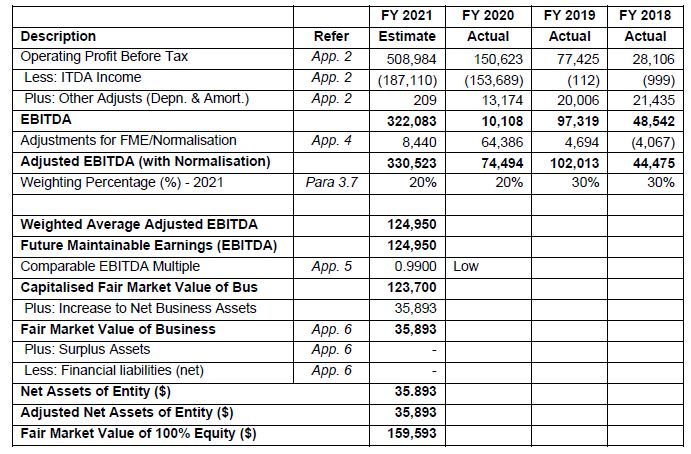
9. The sixth respondent have liberty to apply on five days’ notice for any stay should the applicants fail to pay security in accordance with Order 7(b) and/or (c) above.
10. The applicants pay:
(a) the first and third respondents’ costs of the interlocutory application filed by them on 24 August 2021 seeking security for their costs;
(b) the second, fourth and fifth respondents’ costs of the interlocutory application filed by them on 24 August 2021 seeking security for their costs; and
(c) the sixth respondent’s costs of the interlocutory application filed by it on 23 August 2021 seeking security for its costs.
Note: Entry of orders is dealt with in Rule 39.32 of the Federal Court Rules 2011.
MARKOVIC J:
1 This proceeding was commenced by the applicants, who are described below, under Pt IVA of the Federal Court of Australia Act 1976 (Cth) (Federal Court Act) on behalf of group members who are the entities or persons who at any time between 1 June 2014 to 31 October 2020 (Relevant Period) were either:
(1) a franchisee party to an agreement with HBCA Pty Ltd in relation to the operation of a franchised Hog’s Breath Café outlet (Franchise Agreement); or
(2) a guarantor party to a Franchise Agreement or were otherwise required to provide an indemnity, guarantee, mortgage or other security in respect of a franchisee’s obligations to HBCA thereunder, or under any related bank loan contract between that franchisee and HBCA,
who have not entered into a binding release of all of their claims against HBCA arising out of the conduct described in the amended statement of claim (ASOC).
2 The first applicant, St Mary’s Hog’s Pty Ltd, entered into a Franchise Agreement with HBCA on or about 6 December 2011 in relation to a Hog’s Breath Café outlet at 455 Great Western Highway, St Mary’s, New South Wales (St Mary’s Hog’s Franchise Agreement) and has been the operator of that outlet since about 12 December 2011. The second and third applicants, Luke Bernard Goodwin and Todd Adam Blackstock, are the shareholders of St Mary’s Hog’s and were guarantors under the St Mary’s Hog’s Franchise Agreement.
3 There are presently three applications before the Court by which various of the respondents seek orders that the applicants provide security for their costs of the proceeding as follows:
(1) the first and third respondents, HBCA and Ross Murray Worth, seek an order pursuant to s 56 of the Federal Court Act, r 19.01 of the Federal Court Rules 2011 (Cth) and/or, in the case of St Mary’s Hog’s, s 1335 of the Corporations Act 2001 (Cth) that the applicants give security for their costs in a total amount of $1,245,567.50, payable in four tranches or, to the extent that the applicants are unwilling or unable to provide the security, that the applicants and the group members provide the security sought, again in four tranches;
(2) the second, fourth and fifth respondents, Alfred Brett Dryland, Steven George Spurgin and Matthew Douglas Jesse, seek an order pursuant to s 56 of the Federal Court Act and r 19.01 of the Rules and/or s 1335 of the Corporations Act and/or the inherent jurisdiction of the Court that the applicants pay the sum of $177,890 by way of security for their costs of the proceeding in three tranches; and
(3) the sixth respondent, HBCM Pty Ltd, seeks an order pursuant to r 19.01 of the Rules or alternatively pursuant to s 1335 of the Corporations Act, that the applicants provide security for its costs of the proceeding by way of payment of $520,262.70 into Court (or such other form of security as may be ordered by the Court) in three tranches.
4 In each case the respondents seek an order that the proceeding be stayed until security is given.
5 As pleaded in the ASOC:
(1) HBCA was, during the Relevant Period, the franchisor in Australia of a system for the preparation, cooking and merchandising of certain foods and products to be sold exclusively through Hog’s Breath Café outlets (referred to in the ASOC as the Franchise System) under licence from the Franchise System owner, Hog’s Breath Company Pty Ltd (HBC);
(2) since 31 October 2020 HBCM has been the franchisor in Australia of the Franchise System under licence from HBC;
(4) Mr Dryland was, among other things, a director of HBCA during the Relevant Period and until 12 September 2019 the secretary of HBCA;
(5) Mr Worth was a director of HBCA during the Relevant Period and until February 2020 its chief executive officer (CEO);
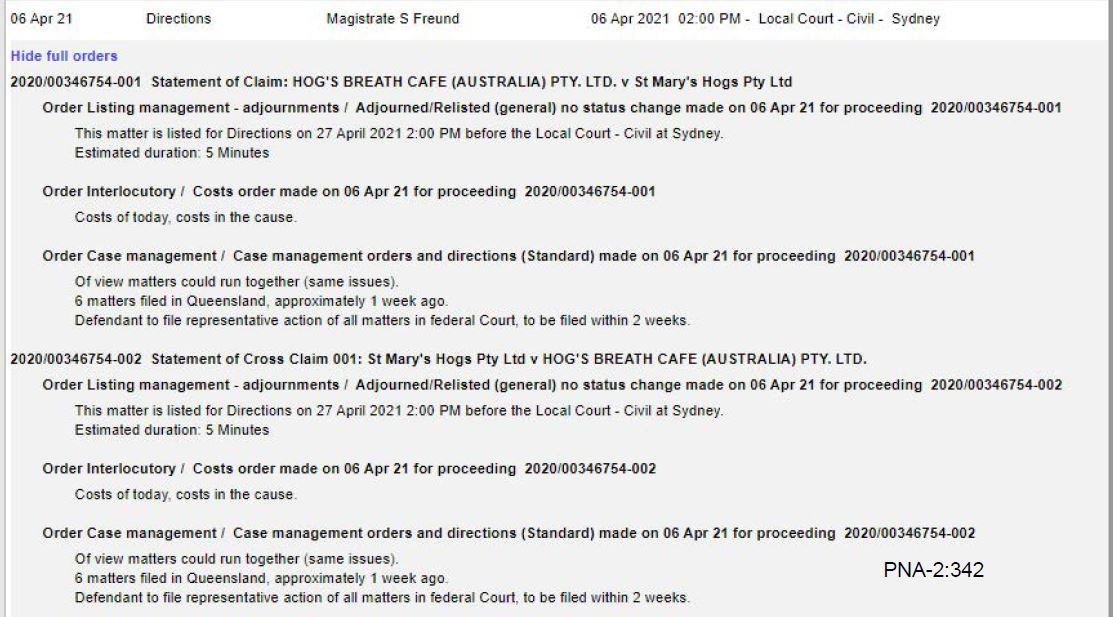
(6) Mr Spurgin was from about February 2020 until about 19 December 2020 the CEO of HBCA and since 19 December 2020 has been the CEO of HBCM; and
(7) Mr Jesse was a director of HBCA for a part of the Relevant Period.
6 In their amended originating process the applicants seek relief for alleged contraventions of the Competition and Consumer Act 2010 (Cth) (including Sch 2 of that Act (Australian Consumer Law)) and alleged breaches of the Franchise Agreements. In summary in the ASOC the applicants allege that:
(1) during the Relevant Period there were up to 90 outlets which traded under the name Hog’s Breath Café in Australia and which operated under the Franchise System and that the majority of the outlets were individually franchised businesses operated pursuant to a Franchise Agreement while the remaining were owned and operated by HBCA or an associate of HBCA;
(2) as at 30 October 2020 there were about 48 Hog’s Breath Café outlets in Australia including St Mary’s Hog’s and franchisee Group Members;
(3) HBCA owed the following duties to the applicants and franchisee Group Members and guarantors in relation to their Franchise Agreements:
(a) statutory duties to act in good faith in respect of any matter arising under or in relation to the Franchise Agreement (duty of good faith) pursuant to cl 6 of the Franchising Code of Conduct as set out in the Competition and Consumer (Industry Codes—Franchising) Regulation 2014 (Cth) (Code) and not to engage in conduct in connection with the supply of its services as franchisor that was, in all the circumstances, unconscionable, in contravention of s 21 of the Australian Consumer Law (unconscionable conduct);
(b) implied duties to cooperate and achieve the objects of the Franchise Agreement and to act reasonably and in good faith, having regard to the terms, purpose and object of the Franchise Agreement (implied duties); and
(c) duties under the Franchise Agreements to promote and maintain the development, prominence and success of the Hog’s Breath Café brand and develop the Franchise System, and to avoid a position of conflict of interest with the fulfilment of those duties;
(4) HBCA breached its duties referred to at [6(3)(c)] above and engaged in unconscionable conduct, and Messrs Dryland, Worth, Spurgin and Jesse were persons knowingly concerned in or party to HBCA’s breaches of its duty of good faith and unconscionable conduct, by:
(a) establishing competing food businesses that involved or included the preparation and sale of food items that were either related to the menu or menu items sold by St Mary’s Hog’s and franchisee Group Members or reflected enhancements to those menu items that should have been incorporated into the Franchise System for the benefit of St Mary’s Hog’s and franchisee Group Members; and
(b) requiring St Mary’s Hog’s and franchisee Group Members to rebrand their Hog’s Breath Café outlets as “Hog’s Australia’s Steakhouse” outlets, reduce the range and number of menu items and implement price changes for products sold;
(5) the Franchise Agreements required (among other things):
(a) HBCA to develop institutional public relations, advertising and promotional campaigns to promote and enhance the value of the Franchise System;
(b) St Mary’s Hog’s and the franchisee Group Members to pay to HBCA a monthly advertising fee of 2% of gross monthly sales;
(c) HBCA to establish a separate bank account (advertising fund) into which advertising funds were to be paid, and to operate the advertising fund as a pooled account for all franchisees to pay the costs of developing and publishing advertising and promotional material in a manner that HBCA deemed appropriate for the benefit of all franchisees; and
(d) HBCA to prepare, and have audited by a registered company auditor, an annual financial statement of all receipts and expenses of the advertising fund for the preceding financial year, including the amount expended on production, advertising, administration and goods or services supplied by HBCA and other stated expenses, within three months after the end of each financial year,
(collectively, advertising terms);
(6) the Code required HBCA to:
(a) prepare an annual financial statement detailing the advertising fund’s receipts and expenses for the previous financial year containing sufficient detail to give meaningful information about items of expenditure and have that statement audited by a registered company auditor within four months after the end of the relevant financial year and to provide a copy of that statement to each franchisee within 30 days of its preparation;
(b) pay advertising fees into the advertising fund on behalf of the outlets owned and/or operated by it on the same basis as St Mary’s Hog’s and franchisee Group Members were required to pay under their Franchise Agreements; and
(c) pay from the advertising fund only legitimate marketing and advertising expenses and the reasonable costs of administering and auditing the advertising fund,
(collectively, advertising code obligations);
(7) HBCA breached the advertising terms and/or the advertising code obligations and/or the implied terms and/or the duty of good faith and engaged in unconscionable conduct, and Messrs Dryland, Worth, Spurgin and Jesse were persons knowingly concerned in or party to HBCA’s breach of the duty of good faith and unconscionable conduct, by failing to implement any advertising, public relations and promotional campaign for the benefit of the franchisees of the Franchise System, failing to pay or require its associates to pay advertising fees into the advertising fund for company-owned outlets, using advertising fund moneys for things that were not legitimate marketing or advertising expenses in respect of the Hog’s Breath Café brand or the Franchise System or reasonable costs of administering the advertising fund, and failing to prepare or provide annual financial statements and/or audit reports containing the advertising fund’s receipts and expenses for the prior financial year or meaningful information about items of expenditure;
(8) further or alternatively, where rebates were provided by suppliers of products to HBCA in relation to products purchased by St Mary’s Hog’s and franchisee Group Members, HBCA owed a duty to account to St Mary’s Hog’s and franchisee Group Members for any such rebates received by it and pay into the advertising fund the amount of the rebates for use in the promotion of the Hog’s Breath Café brand and the Franchise System and, by failing to do so, breached that duty as well as its implied duties and the duty of good faith;
(9) HBCA wrongfully invoiced St Mary’s Hog’s and franchisee Group Members for royalties which included fees charged to them by third-party food delivery companies or, alternatively, engaged in unconscionable conduct by charging a royalty on the delivery fees and Messrs Dryland, Worth, Spurgin and Jesse were persons knowingly concerned in or party to the unconscionable conduct;
(10) HBCA breached its implied duties and duty of good faith by requiring St Mary’s Hog’s and franchisee Group Members to purchase or lease a specific brand of point-of-sale (POS) system which was not fit for purpose in the conduct of their businesses from around February 2016 to at least around January 2018, and Messrs Dryland and Worth authorised, implemented or acquiesced in that conduct and were persons knowingly concerned in or party to HBCA’s breach of their duty of good faith;
(11) HBCA breached the terms of the Franchise Agreements, its implied duties and the duty of good faith, contravened s 47(1) of the Competition and Consumer Act and engaged in unconscionable conduct, and Messrs Dryland, Worth, Spurgin and Jesse were persons knowingly concerned in or party to HBCA’s breach of the duty of good faith, contravention of s 47(1) of the Competition and Consumer Act and unconscionable conduct, by, among other things:
(a) requiring St Mary’s Hog’s and franchisee Group Members to purchase items from suppliers as directed by HBCA, beyond the scope of items prescribed by the Franchise Agreements, which were often of a lower quality than, and exceeded the price of, equivalent products that St Mary’s Hog’s and franchisee Group Members could have acquired independently; and
(b) unreasonably refusing to approve requests from franchisee Group Members to approve suppliers for an item or items;
(12) HBCA breached its implied duties and duty to act in good faith, and Messrs Dryland, Worth, Spurgin and Jesse were persons knowingly concerned in or party to HBCA’s breach of duty to act in good faith, by purporting to assign the Franchise Agreements to HBCM without procuring from HBCM a disclosure document that complied with the Code, providing St Mary’s Hog’s and franchisee Group Members a reasonable opportunity to understand that document or obtaining the written agreement of St Mary’s Hog’s and franchisee Group Members to the assignments of their respective Franchisee Agreements, and the purported assignment was void or, alternatively, voidable;
(13) from 31 October 2020, the Franchise Agreements were terminated by reason of HBCA’s inability to fulfil its obligations under them as a result of the termination of its Franchise System Development and Management Agreement with the Franchise System owner or, alternatively, had repudiated each of the Franchise Agreements by reason of its purported assignment of the Franchise Agreements to HBCM and/or its breaches of the Franchise Agreements as set out in the ASOC and such repudiation was accepted by St Mary’s Hog’s and the franchisee Group Members;
(14) given the termination of the Franchise Agreements as a result of HBCA’s purported assignment of the Franchise Agreements to HBCM, HBCA has no entitlement to the alleged unpaid royalties sought in the proceedings commenced against St Mary’s Hog’s and the franchisee Group Members listed in Schedule C to the ASOC or, alternatively, St Mary’s Hog’s and the franchisee Group Members are entitled to set-off amounts claimed in this proceeding against any unpaid royalties;
(15) HBCA engaged in unconscionable conduct, and Messrs Dryland, Worth, Spurgin and Jesse were persons knowingly concerned in or party to HBCA’s unconscionable conduct, by its purported assignment of the Franchise Agreements to HBCA (see [6(12)] above) and by commencing the Local Court Proceeding and State Court Proceedings (described at [43]-[47] below); and
(16) the set-off provisions and/or assignment provisions under the Franchise Agreements operate in a one-sided way to the benefit of HBCA and to the detriment of franchisees and are void pursuant to s 23 of the Australian Consumer Law.
7 No orders have yet been made for the filing of defences.
the evidence
8 Each of the respondents and the applicants relied on a number of affidavits. I set out below a summary of their evidence.
The Franchise System
9 Ginger White and Donald Algie are the directors of HBCM and the founders of the Franchise System. They opened the first Hog’s Breath Café in Airlie Beach, Queensland in 1989 and franchised the business at various locations throughout Australia and New Zealand.
10 HBCA was the franchisor of the Franchise System from about 2000 to October 2020. HBCA has different directors and shareholders to HBCM. The current director of HBCA is Mr Worth.
11 In September 2005 a franchise system and development management agreement (FSDMA) was entered into by HBC, a company of which Ms White and Mr Algie are directors, and HBCA pursuant to which HBC granted HBCA a licence to use the intellectual property of the Franchise System and to grant franchises in Australia and New Zealand for the duration of that agreement.
12 In 2020 a dispute arose between HBC and HBCA. HBC alleged that HBCA had committed various breaches of the FSDMA and that it was entitled to terminate the FSDMA. HBCA disputed those allegations. In October 2020 that dispute was resolved and HBCA sold certain assets of the Hog’s Breath Café franchisor business to HBCM. On 30 October 2020 HBCA and HBCM entered into a deed of assignment of franchise agreement pursuant to which HBCA assigned its right, title and interest in the Franchise Agreements of the Franchise System to HBCM.
13 The applicants dispute the validity of the assignment (see [6(12)] above). However, HBCA says that as a result the assignment from 30 October 2020:
(1) it has no ongoing interest or right to operate the Franchise System;
(2) HBCM is the franchisor of the Franchising System and, from November 2020, is entitled to receive royalties and advertising fund contributions from franchisees;
(3) it retains the right to recover any royalties owing for the month of October 2020 from franchisees; and
(4) advertising fund contributions owing by franchisees prior to 30 October 2020 were assigned to HBCM.
14 As at 31 July 2021 there were 45 stores in the Franchise System. The total gross sales of all stores in the Franchise System for the six months prior to 31 July 2021 was approximately:
(1) February 2021 - $6,222,575;
(2) March 2021 - $6,559,204;
(3) April 2021 - $7,230,494;
(4) May 2021 - $7,214,589;
(5) June 2021 - $6,031,132; and
(6) July 2021 - $5,883,405.
15 The plant and equipment for a Hog’s Breath Café would typically include equipment such as a kitchen, bar and refrigerator, office supplies, POS system, audio visual media, lighting and security, fit-out, furniture and flooring, memorabilia, painting and signage.
16 According to Ms White:
(1) under each Franchise Agreement, the franchisee is required to make monthly contributions to the national advertising fund for each month by the 15th of the following month; and
(2) as at 30 June 2021, a total of approximately $725,170 is owing by 28 franchisees for advertising fund contributions that became due prior to 30 October 2020. This includes approximately $39,413.38 owing by St Mary’s Hog.
The applicants
St Mary’s Hog’s
17 St Mary’s Hog’s operates the St Mary’s Hog’s Breath café franchise.
18 On 10 August 2021 James Conaghan, the solicitor for Messrs Dryland, Spurgin and Jesse, carried out a search of the records maintained by the Australian Securities and Investments Commission (ASIC) of St Mary’s Hog’s which showed that:
(1) it was incorporated on 9 April 2010;
(2) it has a paid up share capital of $405 with 405 shares issued to Mr Goodwin;
(3) its current directors are Shakeel Ahmed and Mr Goodwin; and
(4) Mr Blackstock was a director of St Mary’s Hog’s between 16 June 2010 and 29 February 2012.
19 St Mary’s Hog’s Franchise Agreement was entered into with HBCA on or about 6 December 2011 for a term of seven years and nine months and has expired. Since the expiry of that agreement St Mary’s Hog’s has continued to trade as a Hog’s Breath Café using the trademarks and intellectual property of the Franchise System and paying royalties and advertising fund contributions to HBCM. Since November 2020, St Mary’s Hog’s has not provided its monthly trading reports, profit and loss statement and balance sheet to HBCM as required by cl 12.1 of its Franchise Agreement.
20 However, after commencement of this proceeding and in the context of the threatened applications for security for costs, St Mary’s Hog’s provided its profit and loss statements and balance sheets for the periods 1 July 2017 to 30 June 2019 (referred to collectively as the 2018/2019 management accounts) and for the period 1 July 2020 to 30 June 2021 (referred to as the 2021 management accounts) to the respondents. Mr Conaghan gives the following evidence based on his review of those accounts:
(1) the 2018/2019 management accounts were prepared by an accountant while the 2021 management accounts were not;
(2) the profit and loss statement in the 2018/2019 management accounts account for depreciation while the profit and loss statement in the 2021 management accounts does not;
(3) St Mary’s Hog’s has had working capital (net current assets less net less current liabilities) over the years as follows:
(a) -$194,711 in FY2018;
(b) -$135,996 in FY2019; and
(c) -$75,986 in FY2021;
(4) the 2021 management accounts record:
(a) a net profit before tax of $508,924. However that amount:
(i) includes $187,106 of other income with no indication of whether that income is recurring;
(ii) excludes depreciation, which in the 2018/19 management accounts amounted to $18,769 and $18,831 respectively; and
(iii) excludes glassware, plateware and kitchen supplies which in the 2018/19 management accounts amounted to $10,361 and $21,668 respectively; and
(b) a net loss after tax of $126,992 including deductions of $87,976 for income tax expense and $500,050 for dividends paid;
(5) the 2018/19 management accounts disclose:
(a) a net profit before tax of $28,106 and $77,425 respectively;
(b) $27,000 in dividends paid in 2018 and no dividends paid in FY2019; and
(c) non-current assets which include “Loans” in the amount of $32,740 in FY2018 and $45,770 in FY2019, with no description of the nature of those loans;
(6) the disclosed equity in the management accounts is represented by non-current assets, plant and equipment, fixtures and fittings, and goodwill;
(7) in the 2021 management accounts plant and equipment is valued at $1,025,319;
(8) the 2021 management accounts also disclose the following items which are not included in the 2018/19 management accounts:
(a) fixtures and fittings in the amount of $14,894;
(b) leasehold improvements in the amount of $55,782; and
(c) other non-current assets in the amount of $95,000; and
(9) an amount of $297,000 has been carried forward in FY2018, FY2019 and FY2021.
Valuation of the St Mary’s Hog’s business
21 Paul Garufi, an accountant and director of Adaptive North Pty Ltd, was instructed by the lawyers for HCBA and Mr Worth to prepare a report addressing:
(1) the reasonable market value of the St Mary’s Hog’s business;
(2) the reasonableness of the value of the plant and equipment recorded in the FY2021 management accounts and the FY2019 and FY2018 financial statements;
(3) the reasonableness of the value of the goodwill recorded in the FY2021 management accounts and FY2019 and FY2018 financial statements; and
(4) any other matter he considered relevant to the reasonable market value of the St Mary’s Hog’s business having regard to the documents provided to him.
22 In his report dated 23 August 2021 Mr Garufi first explains that the fair market value of a stream of future cash flows from a business can be calculated using a number of alternative methodologies including the net present value or discounted cash flow methodology, capitalisation of future maintainable earnings and a net assets approach. Mr Garufi formed the opinion that the second of those options, a capitalisation of future maintainable earnings, was the most appropriate valuation technique for the task he had been instructed to undertake in relation to St Mary’s Hog’s business because it reflects the market conditions as at the valuation date, the business has ongoing earnings potential and there are comparable average capitalisation rates on which to assess the business’ fair market value.
23 Adopting that methodology Mr Garufi assessed the fair market value of St Mary’s Hog’s by:
(1) determining the adjusted earnings before interest, tax, depreciation and amortisation;
(2) assessing the appropriate capitalisation multiple, if appropriate, and determining the capitalised value of the business, if applicable;
(3) increasing the capitalised value of the business to the value of the net tangible and identifiable intangible business assets of the business, if applicable; and
(4) adding any surplus assets and subtracting any financial liabilities.
24 Mr Garufi’s calculation is shown in the following table:
25 In Mr Garufi’s opinion the value of the St Mary’s Hog’s business using the capitalisation of future maintainable earnings methodology is $159,593. He explains his calculation as follows:
(1) the valuation amount comprises $123,700 (see above table) having applied a capitalisation multiple to EBITDA of 0.99; and
(2) that amount has then been increased by $35,893 to reflect the net tangible and identifiable intangible assets of the business in excess of its liabilities, obtaining the value of the business according to a capitalisation methodology. Mr Garufi notes that an assets list has not been provided and that a plant and equipment market valuation is recommended.
Ms Nicks’ evidence
26 The applicants rely on an affidavit sworn by Marguerite May Nicks who is a bookkeeper and director of Go West Accounts Pty Ltd with 17 years’ experience working as a bookkeeper. Ms Nicks is Mr Goodwin’s sister, has known Mr Blackstock since about 2004 and is a 10% shareholder in each of St Mary’s Hog’s and Penrith Hog’s Pty Ltd.
27 For the past 17 years, through her business Go West, Ms Nicks has been the bookkeeper for St Mary’s Hog’s, Penrith Hog’s, Wilcoola Pastoral Co Pty Ltd, Hobart Hog’s Pty Ltd, Morayfield Hog’s Pty Ltd, Aspley Hogs Pty Ltd and Hogs Breath Northlakes Pty Ltd, which she refers to as current franchisees. She has also provided bookkeeping services through Go West to Epping Hog’s Pty Ltd, Chadstone Hog’s Pty Ltd, Hogs Breath Watergardens Pty Ltd, Woodgrove Hog’s Pty Ltd and Canberra Hog’s Pty Ltd, which she refers to as former franchisees. In her role as bookkeeper she was and is responsible for updating the MYOB accounts for each of the current franchisees and the former franchisees (collectively the Businesses). The Businesses also have an external accountant who prepares their annual financial accounts.
28 Ms Nicks explained that every May an annual budget for the following financial year is prepared for each of the Businesses in a format prescribed by HBCA. Usually the manager of each of the Businesses prepared the budget based on past financial results and forward projections of the trading conditions for the coming financial year. Ms Nicks prepares monthly management accounts for each of the Businesses from the information contained in the MYOB accounts and from the budgets which contain a comparison between actual results for the month against the budget. Those accounts were provided to HBCA until October 2020.
29 At Ms Nicks’ request the managers of each of the current franchisees provided her with updated budgets for FY2022 which she combined into a single excel workbook comprising the individual budgets for each of the current franchisees for FY2022 and a consolidated budget for the current franchisees for FY2022.
30 Based on her experience and knowledge of the Businesses Ms Nicks understands that the critical element in the profitability of the Businesses is sales revenue; sales revenue across the franchisees is typically seasonal, with the best months being December and January, followed by a drop off in February before sales pick up again for the rest of the year; and in normal trading conditions a reasonable forecast for consolidated monthly total gross sales across all of the Businesses operated by the current franchisees is $950,000 to $1,15 million.
31 The FY2022 budget for St Mary’s Hog’s shows a forecast net loss of $60,355.37 (excluding depreciation) on total gross sales of $1,567,360.
32 Ms Nicks gave evidence about the consolidated budget including that:
(1) it (and the individual Business budgets) include expense items for depreciation and equipment and an income item for “other income”. The latter comprises actual and forecast one off COVID-19 government relief payments and support;
(2) the monthly break-even sales revenue figure across all Businesses is approximately $954,000;
(3) other than for Hobart, it includes significantly reduced sales revenue for July to September 2021 reflecting the impact on in-store revenue of lockdowns and associated COVID-19 restrictions in some states;
(4) the reductions in sales revenue referred to in the preceding sub-paragraph and its impact on net profits is partially offset by costs savings, in particular reduced labour costs; and
(5) for the full year there is a forecast consolidated net loss for the current franchisees of $52,881.46 (excluding depreciation) on forecast total gross sales of $11,175,483.17, which is effectively a break-even result.
33 The consolidated budget and each of the budgets for FY2022 for the current franchisees include expense items for royalties and advertising fund levies payable to the franchisor with the consolidated budget showing total budgeted royalty payments for FY2022 of $504,519.66, calculated at 3% of gross sales for the first six months and from January 2022 at 5% of gross sales, and total budgeted advertising levy payments for FY2022 of $254,663.40 calculated at 2% of gross sales. Ms Nicks says that she understands that the current franchisees are currently making the royalty and advertising levy payments to HBCM on a without prejudice basis to the allegations and claims made in this proceeding. Ms Nicks has also calculated the total royalties and advertising levies paid by each of the current and former franchises in the period from 1 July 2014 to 30 June 2021.
The current franchisees
34 Mr Nase undertook company searches at ASIC for each of the current franchisees and provided the following summary of their directors and shareholders:
Entity Name | Directors | Shareholders (No. and class of shares) |
Aspley Hog’s Pty Ltd | Luke Goodwin | Luke Goodwin ( 1D class share, 100 ordinary shares), Suzanne Dorsman (2 D class shares), Todd Blackstock and Alicia Blackstock (1 D class share, 50 E class shares, 100 ordinary shares), GFDT Pty Ltd (GFDT) (50 E class shares), Jane Blackstock |
Hobart Hog’s Pty Ltd | Alison Goodwin, Alicia Blackstock | GFDT (2 D class shares, 150 G class shares), Todd Blackstock and Alicia Blackstock (2 D class shares, 150 G class shares) |
Hog’s Breath Northlakes Pty Ltd | Alison Goodwin | Stacey Pinci (2 D class shares, 10 G class shares), Todd Blackstock and Alicia Blackstock (1 D class shares, 45 G class shares), GFDT (1 D class shares, 45 G class shares) |
Morayfield Hog’s Pty Ltd | Luke Goodwin, Sarah Dixon | Sarah Dixon (1 D class shares, 40 G class shares), GFDT (1 D class shares, 30 G class shares), Alicia Blackstock and Todd Blackstock (30 G class shares) |
Penrith Hog’s Pty Ltd | Alison Goodwin, Linden Hull | Linden Hull (2 D class shares), GFDT (2 D class shares, 35 G class shares), Shakeel Ahmed (20 G class shares), Marguerite Nicks (10 G class shares), Todd Blackstock and Alicia Blackstock (35 G class shares) |
Wilcoola Pastoral Co Pty Ltd | Simon Garrington, Todd Blackstock | Simon Garrington (2 D class shares, 40 G class shares), Todd Blackstock and Alicia Blackstock (2 D class shares, 30 G class shares), GFDT (30 G class shares) |
Messrs Goodwin and Blackstock
35 Messrs Goodwin and Blackstock have guaranteed certain obligations owed by St Mary’s Hog’s under the St Mary’s Hog’s Franchise Agreement and also have and/or have had interests in approximately 11 other Hog’s Breath Café franchises.
(1) he is a guarantor of the franchisees of six other stores, in addition to being a guarantor of St Mary’s Hog’s. According to evidence relied on by HBCM those stores are located at Penrith, Morayfield, Aspley, North Lakes, Canberra and Hobart. According to evidence relied on by the applicants, Mr Goodwin is a guarantor of Penrith Hog’s, Morayfield Hog’s, Aspley Hogs and Hogs Breath Northlakes, all of which are operational, Canberra Hog’s, which has ceased trading and as at September 2021 was soon to be placed into external administration, and Epping Hog’s and Hog’s Breath Watergardens, both of which are in external administration and have ceased trading;
(2) as at 30 June 2021 the advertising fund contributions owing by those stores for the months prior to October were:
(a) Penrith - $36,889.05;
(b) Morayfield - $52,908.38;
(c) Aspley - $22,134.42;
(d) North Lakes - $37,080
(e) Canberra - $26,846.24; and
(f) Hobart - $25,922.74;
(3) of those stores the Canberra store closed in December 2020 and has not reopened and the Franchise Agreement for the Aspley store expired on 10 March 2019, although it is still trading within the Franchise System;
(4) on 12 April 2021 Mr Goodwin sent an email to Ms White informing her that the franchisee of the Canberra store was about to be placed into liquidation due to a debt owing to the Australian Taxation Office (ATO) and legal notices issued by HBCA;
(5) according to a search undertaken of records held by ASIC, three companies of which Mr Goodwin has been a director are currently in external administration being Chadstone Hog’s , Epping Hog’s and Woodgrove Hog’s; and
(6) a search undertaken of the New South Wales Land Registry found no record of any real property owned by Mr Goodwin in New South Wales.
37 In relation to Mr Blackstock:
(1) according to evidence relied on by HBCM, in addition to being a guarantor of St Mary’s Hog’s, he is a guarantor of the franchisees of seven other stores located at Penrith, Hobart, Morayfield, Aspley and North Lakes Canberra, Dandenong. According to evidence relied on by the applicants he is a guarantor of nine other franchisees being Penrith Hog’s, Wilcoola Pastoral, Hobart Hog’s, Morayfield Hog’s, Aspley Hog’s and Hogs Breath Northlakes, each of which is operational, Canberra Hog’s which as at September 2021 had ceased trading and was soon to be placed into external administration and Epping Hog’s, Chadstone Hog’s and Hog’s Breath Watergardens, each of which is in external administration and has ceased trading;
(2) as at 30 June 2021 the amount of advertising fund contributions owing for the months prior to October 2020 by each of the Aspley, Canberra, North Lakes, Hobart, Morayfield and Penrith stores was as set out at [36(2)] above and for Dandenong was $22,554.91;
(3) he is a current shareholder in Hog’s Breath North Lakes, Penrith Hog’s, Morayfield Hog’s, Aspley Hog’s and Hobart Hog’s;
(4) he is also a director of Canberra Hog’s and Wilcoola Pastoral; and
(5) according to a company search of St Mary’s Hog’s, he resides in Queensland and previously resided in Victoria. Based on searches undertaken at the Victorian Land Registry and the Queensland Land Registry it does not appear that Mr Blackstock presently owns any real property in either Queensland or Victoria.
38 Mr Conaghan has been informed that:
(1) on 18 February 2020 Mr Jesse had a conversation with Mr Goodwin at a regional franchise leaders meeting at HBCA’s premises in Cleveland, Queensland, during which Mr Goodwin said words to the following effect:
I have no personal assets. My house was transferred to my mother and my car is worn out.
(2) on about 13 May 2020 Mr Spurgin had a telephone conversation with Mr Goodwin during which Mr Goodwin said words to the following effect:
I have no assets. I have had to sell everything to stay afloat. I don’t have any property. My car is a beaten up ute of no value.
39 According to Ms Nicks neither Mr Goodwin nor Mr Blackstock is paid a salary by any of the current franchisees but they receive dividends from time to time and a casual wage if and to the extent either of them works in any of the Businesses at any given time.
40 Philip Nathan Argy, the solicitor for the applicants, gave evidence about the applicants’ ability to provide security. Mr Argy has been informed by Messrs Goodwin and Blackstock that:
(1) the applicants would be unable to provide a first tranche of security in the amount sought by the respondents, calculated by Mr Argy as $644,80.20, within 28 days or at all;
(2) the applicants would be unable to provide the total amount of security sought by the respondents up to trial;
(3) if security is ordered up to and including the filing of defences and cross-claims, the applicants could provide security in the amount of $20,000 over three to six months but would be unable to provide any further amount of security in the proceeding;
(4) if required by the Court they would be willing to provide an undertaking to pay any costs order made against St Mary’s Hog’s in the proceeding; and
(5) they approached their lender, Westpac Banking Corporation, about providing loans to the Businesses but it advised that it will no longer make loans to the franchisees.
41 As to their willingness to provide undertakings, each of Messrs Goodwin and Blackstock provided an undertaking to the Court dated 13 September 2021 by which they each undertake to the Court that, if a costs order is made in favour of any of the respondents, they will not make any submission that they should not be jointly and severally liable with St Mary’s Hog’s for that costs order and if, and to the extent that, St Mary’s Hog’s is unable or otherwise fails to pay any costs in accordance with any such costs order Messrs Goodwin and Blackstock will be personally liable for the costs order.
42 On 3 June 2021 Mr Argy met with Michelle Silvers of Court House Capital, a commercial third-party litigation funder, with a view to obtaining her approval for litigation funding for the applicants. During that meeting Ms Silvers said:
Our business model requires a respondent with sufficient assets to pay a large damages award of which we take at least 25%. There is no way any litigation funder would consider funding this action because [HBCA] has ceased trading and either has no assets or won’t have them by the end of the case. In addition, if any of its beneficial shareholders have assets, its share structure and the use of trusts make it virtually impossible for us to pursue. I’m sorry I can’t help you with this one.
Based on his meeting with Ms Silvers, Mr Argy does not consider that the applicants can obtain third party litigation funding to provide security for costs in the proceeding.
State court proceedings
43 On or about 7 December 2020 HBCA commenced proceeding no 2020/346754 against the applicants in the Local Court of New South Wales (Local Court Proceeding). HBCA also commenced a further 10 proceedings against other Hog’s Breath café franchisees and their guarantors variously in the Local Court, the Magistrates Court of Queensland and the Magistrates Court of the Australian Capital Territory (together with the Local Court Proceeding, the State Court Proceedings). In addition to the Local Court Proceeding, Messrs Goodwin and Blackstock are defendants to three other of the State Court Proceedings.
44 According to Mr Argy, in the Local Court Proceeding HBCA makes claims for unpaid royalties allegedly owed by St Mary’s Hog’s under the Franchise Agreement for the period prior to 31 October 2020 and against Messrs Goodwin and Blackstock as guarantors. St Mary’s Hog’s and Messrs Goodwin and Blackstock deny the claims and have filed a defence and cross-claim against HBCA which, Mr Argy says, raise largely the same allegations as those made by them in this proceeding. He also observes that, similarly, HBCA makes claims for unpaid royalties in the other State Court Proceedings.
45 On 6 April 2021 “guillotine orders” (as described by Mr Argy) were made in the four State Court Proceedings commenced in the Local Court (including the Local Court Proceeding) requiring the defendants to those proceedings to commence a representative proceeding in this Court within two weeks. A print out of orders made on 6 April 2021 in the Local Court Proceeding shows that the following orders and directions were recorded:
46 On 23 April 2021 the applicants commenced this proceeding.
47 On 27 April the Local Court adjourned each of the State Court Proceedings commenced in that court to 26 October 2021. So far as Mr Argy is aware, HBCA has taken no further steps in any of the State Court Proceedings other than to discontinue two of those proceedings which have settled.
Respondents’ estimates of recoverable costs and disbursements
48 The respondents each relied on detailed evidence of the likely estimate of the costs and disbursements they anticipate they will incur in defending this proceeding, a summary of which I set out below. The applicants did not lead any evidence in response to, or disputing, the estimates provided.
HBCA and Mr Worth
49 Daniel Patrick Georges, the solicitor for HBCA and Mr Worth, provided an estimate of the likely costs and disbursements that HBCA and Mr Worth will incur in defending the proceeding. In doing so, Mr Georges has divided the work to be undertaken, and his corresponding estimate, into four tranches namely: work to be undertaken up to the preparation of evidence; preparation of evidence up to mediation; completion via settlement; and completion via a hearing. After taking into account the effect of a taxation Mr Georges estimates the amounts for which the applicants would be liable to HBCA and Mr Worth for costs and disbursements on a party and party basis to be $674,943.50 for solicitors’ costs, $294,624 for counsels’ fees and $280,980 for disbursements.
50 Having regard to those estimates HBCA and Mr Worth seek security for their costs as follows:
(1) $102,688.50 for tranche 1 (up to and including the filing of defences);
(2) $552,638 for tranche 2 (up to and including the completion of discovery and lay and expert evidence);
(3) $134,671.20 for tranche 3 (up to and including the completion of mediation); and
(4) $455,589.80 for tranche 4 (up to and including the trial).
51 HBCA and Mr Worth also relied on an affidavit sworn by Lydia Fernandes Fogl, a solicitor/legal costs lawyer in the employ of Quantum Cost Assessors Pty Ltd and QCA Legal Pty Ltd on 23 August 2021. Ms Fogl has considered Mr Georges’ estimate of costs and disbursements having regard to Pt 40 of, and Sch 3 to, the Rules and her experience. Having done so, Ms Fogl is of the opinion that the amounts of security sought by HBCA and Mr Worth for each of tranches 1, 3 and 4 (see [50] above) and, for tranche 2, the amount of $542,638, rather than the amount set out at [50(2)] above (less in each case any GST that either of them may recover as an input tax credit) is likely to be allowed in a taxation of HBCA’s and Mr Worth’s costs on a party and party basis.
Messrs Dryland, Spurgin and Jesse
52 Mr Conaghan gave the following evidence based on discussions with Messrs Dryland, Spurgin and Jesse:
(1) he has been informed by Mr Dryland and verily believes that, although he was a director of HBCA throughout the relevant period, he had vacated his office at HBCA’s premises for much of that time and was having a boat built in Thailand such that he was not involved in the day to day running of the business; and
(2) he has been informed by Messrs Spurgin and Jesse that they had no involvement in HBCA’s business until late 2019 when Mr Jesse became involved and 17 February 2020 when Mr Spurgin became involved; which is well after the decisions which are said to have amounted to the contravening conduct by HBCA is said to have occurred.
Mr Conaghan anticipates that those instructions will be reflected in Messrs Dryland, Spurgin and Jesse’s defences when filed.
53 Mr Conaghan has undertaken an exercise to estimate the likely costs and disbursements that Messrs Dryland, Spurgin and Jesse will incur in defending the proceeding broken up into three tranches: tranche 1 being work undertaken until the service of any reply; tranche 2 being discovery, evidence and mediation; and tranche 3 being costs and disbursements associated with the trial, which he estimates will be at least eight days. Relevantly:
(1) as at the date of swearing his affidavit Messrs Dryland, Spurgin and Jesse had expended $27,268.35 in legal costs and disbursements;
(2) Mr Conaghan anticipates that they will incur further costs of at least $254,900 (exclusive of GST); and
(3) that estimate does not include an allowance for briefing senior counsel to appear at the trial as his clients have not yet made a decision as to whether that will be required.
54 Based on Mr Conaghan’s experience, costs assessed on the standard basis usually equate to around 70% of the actual costs and outlays incurred by a party in litigation. Applying that rule of thumb he estimates that any costs order against St Mary’s Hog’s may be in the following amounts for each of the tranches of work he has identified:
(1) tranche 1 - $17,850;
(2) tranche 2 - $41,930; and
(3) tranche 3 - $118,650.
HBCM
55 Alexander Philip Nase, HBCM’s solicitor, gave evidence of the steps which he believes will need to be undertaken in order to prepare the proceeding on HBCM’s behalf for hearing. That analysis formed the basis of a report prepared by Jeffrey Petersen, a legal costs consultant employed by Legal Costs Qld.
56 In his report Mr Petersen prepared an estimate of the costs to be incurred, on a party and party basis, by HBCM for the period up to and including the first day of trial and provided an opinion as to the appropriate amount of security to be provided to HBCM in the event that an order is made for security for costs in this proceeding.
57 Mr Petersen estimated HBCM’s total professional fees and costs (including GST) to be $520,262.70 calculated as follows:
professional fees (including GST) - $216,229.84; and
disbursements/outlays (excluding GST) - $304,032.86.
58 Mr Petersen opined that those amounts are fair and reasonable and would be recoverable on a party and party basis and that it would be fair and reasonable to brief both junior and senior counsel to appear for HBCM in the proceeding, having regard to the nature and importance of the proceeding. He noted that counsels’ respective hourly and daily rates are within the ranges provided for in the Court’s national guide to counsel fees.
59 The detailed schedule supporting Mr Petersen’s calculation shows that the amount estimated for professional fees is based on the Court’s schedule of costs other than professional fees incurred prior to 30 July 2021 in relation to which Mr Petersen has applied a 30% discount to take account of the differences between solicitor and own client costs.
60 The following further evidence was given on behalf of HBCM:
(1) HBCM is funding its own costs of defending the claims made against it in this proceeding and is not funding the costs of any other respondent;
(2) HBCM has not given any indemnity to any other respondent that specifically relates to or that is likely to respond to its costs of defending this proceeding and does not have the benefit of any such indemnity from any other respondent; and
(3) so far as Ms White is aware, HBCA is not currently trading and its current financial position is not known to HBCM.
statutory framework and legal principles
61 The power to order an applicant to give security for costs is found in s 56 of the Federal Court Act and r 19.01 of the Rules. In addition, where an applicant is a corporation, security may be ordered pursuant to s 1335 of the Corporations Act.
62 Section 56 of the Federal Court Act relevantly provides that the Court or a Judge may order an applicant in a proceeding in the Court to give security for the payment of costs that may be awarded against him or her and that the security shall be of such amount, and given at such time and in such manner and form, as the Court or Judge directs. Rule 19.01 of the Rules provides, among other things, that the applicant’s proceeding be stayed until security is given and that, if the applicant fails to comply with the order to provide security within the time specified in the order, the proceeding may be stayed or dismissed.
63 Section 1335(1) of the Corporations Act provides:
Where a corporation is plaintiff in any action or other legal proceeding, the court having jurisdiction in the matter may, if it appears by credible testimony that there is reason to believe that the corporation will be unable to pay the costs of the defendant if successful in his, her or its defence, require sufficient security to be given for those costs and stay all proceedings until the security is given.
64 Insofar as a representative proceeding commenced under Pt IVA of the Federal Court Act is concerned, s 33ZG(c)(v) provides that, except as otherwise provided in Pt IVA, nothing in that Part affects the operation of any law relating to security for costs.
65 Finally, s 43(1A) of the Federal Court Act provides:
In a representative proceeding commenced under Part IVA or a proceeding of a representative character commenced under any other Act that authorises the commencement of a proceeding of that character, the Court or Judge may not award costs against a person on whose behalf the proceeding has been commenced (other than a party to the proceeding who is representing such a person) except as authorised by:
(a) in the case of a representative proceeding commenced under Part IVA—section 33Q or 33R; or
(b) in the case of a proceeding of a representative character commenced under another Act—any provision in that Act.
Sections 33Q and 33R of the Federal Court Act are not presently relevant to the applications before me.
66 In Monarch Advisory Group Pty Ltd v Puxty [2021] FCA 341 at [23]-[26] I set out the principles which apply to an application for security for costs as follows:
23 The principles which apply when considering whether the Court should make an order for security for payment of an applicant’s costs of a proceeding are well settled. Those principles were recently summarised by Allsop CJ in All Class Insurance Brokers Pty Ltd (in liq) v Chubb Insurance Australia Limited [2020] FCA 840 at [40]-[44] where his Honour said:
40 Where the applicant is a corporation, the Court is empowered to order security for costs pursuant to s 1335 of the Corporations Act if “it appears by credible testimony that there is reason to believe that the corporation will be unable to pay the costs of the defendant”. Once this threshold is met, the Court will turn to the matters relevant to the exercise of its discretion to order security for costs: Cornelius v Global Medical Solutions Australia Pty Ltd [2014] NSWCA 65; 98 ACSR 301.
41 Section 56 of the Federal Court of Australia Act does not expressly impose any threshold to be met before the Court considers the various discretionary matters. However, the applicant’s inability to pay the costs of the respondent remains an important consideration in the exercise of the Court’s discretion.
42 The Court’s discretion to require the provision of security for costs is broad and the factors informing the exercise of that discretion cannot be stated exhaustively. The only limitation is that the discretion be exercised judicially: Bell Wholesale Co Ltd v Gates Export Corporation [1984] FCAFC 29; 2 FCR 1 at 3. The matter which lies at the heart of the discretion is one of fairness, both in terms of whether security should be granted, and if so, in what amount: Madgwick v Kelly [2013] FCAFC 61; 212 FCR 1 at 21 [92]. The Court aims to achieve a “balance between ensuring that adequate and fair protection is provided to the defendants, and avoiding injustice to an impecunious plaintiff by unnecessarily shutting it out or prejudicing it in the conduct of the proceedings”: Rosenfield Nominees Pty Ltd v Bain & Co (1988) 14 ACLR 467 at 470 (Giles J).
43 The Court’s discretion should be exercised having regard to all of the circumstances of the case (see Merribee Pastoral Industries Pty Ltd v Australia and New Zealand Banking Group Ltd [1998] HCA 41; 193 CLR 502 at 513 [26] (Kirby J)). There are a number of well-established factors relevant to the Court’s exercise. These include (see KP Cable Investments Pty Ltd v Meltglow Pty Ltd [1995] FCA 76; 56 FCR 189 at 197–198 per Beazley J): whether the application for security for costs has been brought promptly; the strength and bona fides of the applicant’s case; whether the applicant’s impecuniosity was caused by the respondent’s conduct subject of the claim; whether the respondent’s application for security is oppressive, in the sense that it is being used merely to deny an impecunious applicant a right to litigate; and whether there are any persons standing behind the company who are likely to benefit from the litigation and who are willing to provide the necessary security.
44 An additional factor to add to this list is whether there are aspects of public interest which weigh in the balance against the making of an order (see Equity Access Ltd v Westpac Banking Corporation [1989] FCA 520; ATPR 40-972 at 50,635 per Hill J).
24 In Beach Petroleum NL v Johnson, M.K. [1992] FCA 136; (1992) 7 ACSR 203 at 204 Von Doussa J said the following about the power of the Court to order security for costs under s 1335 of the Corporations Act:
The power of the court to order security for costs under s 1335 is conditioned on the court being satisfied by credible testimony that there is reason to believe that the applicant corporations (ie Claremont and Beach) will be unable to pay the costs of the respondents if they are successful in their defence. Subject to that condition being fulfilled the section gives the court an unfettered discretion which is to be exercised having regard to all the circumstances of this case: see Sir Lindsay Parkinson & Co Ltd v Triplan Ltd [1973] 2 All ER 273 at 285; Bell Wholesale Co Ltd v Gates Export Corp (1984) 2 FCR 1 at 4; 8 ACLR 588; Bryan E Fencott and Associates Pty Ltd v Eretta Pty Ltd (1987) 16 FCR 497 at 511.
25 At 204-205 his Honour said:
Although s 1335 requires that there be reason to believe that the plaintiff corporation "will be unable to pay the costs of the defendant if successful" — and I emphasise "will be unable to pay" — the section does not, in my opinion, require that the court be satisfied, as a matter of probability, that every eventuality which could lead to eventual payment of the costs be excluded. The section would be satisfied if it appeared by credible testimony that there is reason to believe that if the defendant is successful circumstances may then exist in which the plaintiff will be unable to pay the costs.
…
A corporation "will be unable to pay" the costs within the meaning of the section if it can only do so if given extended time to realise assets which might be difficult to realise, at least at a price sufficient to provide a surplus over other liabilities, sufficient to pay the costs: see Southern Cross Exploration NL v Fire & All Risks Insurance Co Ltd (1985) 1 NSWLR 114 at 121. The company will also be unable to pay the costs within the meaning of the section if the payment would be one that will amount to a preference of the defendant over other creditors such that the payment would be liable to be set aside either as a preference or as a fraudulent disposition (that is a payment made by the plaintiff corporation with the intention to defeat or delay one or more other creditors) in the event of the plaintiff corporation later going into liquidation. When the court is required to make a judgment which anticipates future events the court of necessity is required to judge the degree of probability that a particular event might occur. The court can do no more than evaluate the chances: cf Malec v JC Hutton Pty Ltd (1990) 92 ALR 545.
In my opinion the power of the court under s 1335 arises if credible evidence establishes that there is reason to believe there is a real chance that in events which can fairly be described as reasonably possible the plaintiff corporation will be unable to pay the costs of the defendant on service of the allocatur, if judgment goes against it. This will be so even if in other events which can also be fairly described as reasonably possible the plaintiff corporation would be able to pay the costs. The degree of likelihood of the plaintiff corporation being unable to pay the costs along with all the circumstances, actual and possible, about its financial position, would be then taken into account in the exercise of discretion, and in framing the orders of the court if the decision is to order security.
26 As to which party bears the onus of establishing for the purposes of s 1335 that there is reason to believe that the plaintiff or applicant will be unable to pay the costs of the litigation if unsuccessful, in Austcorp Project Number 20 Pty Ltd v LM Investment Management Ltd (in liq) [2014] FCA 1371 at [25]-[27] Gleeson J said:
[25] Once it appears by credible testimony that there is reason to believe that a corporation will be unable to pay the costs of the defendant if successful in its defence, there is an evidentiary burden on the party resisting the order for security for costs to establish a reason why security should not be granted: Wollongong City Council v Legal Business Centre Pty Ltd [2012] NSWCA 245 at [30] (“Wollongong City Council”), Topcide Pty Ltd v Charter Financial Planning Ltd [2010] FCA 1151 at [12] and Power Infrastructure Pty Ltd v Downer EDI Engineering Power Pty Ltd [2010] FCA 1222 at [9].
[26] Even so, the burden rests on the defendants, from first to last, to persuade the court that the order for security should be made: Livingspring Pty Ltd v Kliger Partners (2008) 20 VR 377 at [21].
[27] In Cornelius v Global Medical Solutions Australia Pty Ltd (2014) 98 ACSR 301; [2014] NSWCA 65 at [18] to [20], Macfarlan JA said:
The defendants contended on appeal that the primary judge erred in stating that the burden of proof rests upon applicants for security “from first to last”: see [5] above. They submitted that this was contrary to the following statement of Beazley JA in [Wollongong City Council] at [30]:
[30] Once the defendant has discharged the onus of establishing that there is reason to believe that the other party to the litigation will be unable to pay the costs of the litigation if unsuccessful, the onus shifts to the party against whom the order is sought (who I will refer as the plaintiff) to establish a reason why security should not be granted: KP Cable Investments v Meltglow [1995] FCA 76; 56 FCR 189; Equity Access Ltd v Westpac Banking Corporation (1989) ATPR 40-972; Pioneer Park v Australia and New Zealand Banking Corporation (2007) 65 ACSR 383; [2007] NSWCA 344; Prynew Pty Ltd v Nemeth [2010] NSWCA 94.
I do not consider that there is an inconsistency, as alleged, as Beazley JA was in my view referring to the evidentiary (or evidential) burden shifting in the circumstances described to the party against whom security is sought. In fact, her Honour made that explicit in her earlier decision in Prynew Pty Ltd v Nemeth 28 ACLC 10–026; [2010] NSWCA 94 at [16] where in the same context she referred expressly to the evidentiary burden shifting.
The expression “evidential burden” can be used in at least three senses: Strong v Woolworths Ltd [2012] HCA 5 at [46]–[64]. For present purposes, it is sufficient to say that it includes reference to the principle that in certain circumstances a party who does not bear the ultimate burden of proof may have to raise for consideration matters that favour it if it wishes them to be taken into account in the determination of the case. The evidential burden of raising a matter is thus distinct from the legal onus of proving entitlement to an order for security for costs which it is correct to describe as resting throughout on an applicant for such an order.
67 In Madgwick v Kelly (2013) 212 FCR 1 a Full Court of this Court (Allsop CJ, Jessup and Middleton JJ) considered the question of the provision of security for costs in the context of a class action. There the proceeding was brought on behalf of investors in failed forestry plantation schemes against the promoters, their directors and the financiers of the schemes.
68 In summarising the primary judge’s reasons Allsop CJ and Middleton J considered his Honour’s treatment of two related issues: whether the applicants had brought the proceeding for the benefit of others and the characteristics of group members. In doing so at [21]-[23] their Honours set out the following unchallenged parts of the primary judge’s reasons:
21 After the primary judge referred to the general principle (in non-representative proceedings) that impecuniosity of a plaintiff (natural person) will not prevent the order for security if the action is brought for the benefit of others: Cowell v Taylor (1885) 31 Ch D 34, he referred to Bray v F Hoffman-La Roche Ltd (2003) 130 FCR 317. After mentioning the trend of authority before 2003 to the effect that the bringing of the group action on behalf of others was not a significant factor, because to order security was seen to be incongruous and anomalous given the immunity of group members as to costs by reason of the FCA Act, s 43(1A), the primary judge identified at [61] of the reasons the following as important from the Full Court’s decision in Bray:
Bray establishes that where an impecunious applicant is bringing Part IVA proceedings, the fact that he or she is doing so for the benefit of represented persons may be a significant consideration in favour of granting security. It provides that the financial circumstances of the group members are relevant to the determination of an application for security. It also indicates that it is not necessary for the respondent to demonstrate the additional circumstance that the applicant has been deliberately selected in order to shield group members of substantial means for whose benefit the proceeding is also being brought. This may be seen from the separate reasons of Carr and Finkelstein JJ, with whom Branson J agreed.
(Emphasis in original.)
22 At [62]-[63] of the reasons, the primary judge set out the following relevant passages from Bray as to the importance of other characteristics of the group:
62 At [141] Carr J construed the FCA as contemplating that a group member might be given the choice of contributing to a financial pool from which the applicant might provide security for costs. At [142] his Honour noted:
Much would depend upon the number of group members involved, their financial circumstances and in particular whether an order for security for costs might stifle the proceedings. In that regard, in my opinion, it was for the applicant to adduce evidence about the likely effect of any order for security for costs.
63 At [252] Finkelstein J similarly found:
Dependent upon the type of proceeding, the represented group may be quite diverse. The group may include corporations as well as natural persons. The members of the group, whether corporate or not, may be rich or poor. In my view, the characteristics of the group should be taken into account on an application for security. Accordingly, if there is still a rule that an order for security should not be made against an impecunious natural person (for a criticism of the absoluteness of this rule see Melville v Craig Nowlan & Associates Pty Ltd (2002) 54 NSWLR 82), the rule may have little application to many class actions.
23 To this point, no criticism was made as to the primary judge’s treatment of Bray.
69 Commencing at [80] Allsop CJ and Middleton J addressed a submission by the respondents that the characteristics of the group are relevant to the question of stultification. At [81] their Honours observed the uncontroversial proposition that the onus of establishing that the making of an order for payment of security for costs would stultify a proceeding rests on the party resisting security. Their Honours continued at [81]-[83] at follows:
[81] ... A failure to prove stultification does not mean, however, that security must be provided. Indeed, as Hodgson JA (sitting alone as referrals judge) said in Dae Boong International Co Pty Ltd v Gray [2009] NSWCA 11 at [26] (Dae Boong), if the evidence does not permit a conclusion of stultification that does not make the impecuniosity of the party and the difficulties in providing security (such as they are proved) irrelevant. As Hodgson JA said, if those who stand to benefit from the proceedings are reasonably unwilling, even though possibly able, to provide security, that may be a factor to be taken into account.
[82] These considerations are especially apt to consider in a class action for the kinds of reasons referred to by the primary judge. The group members may or may not be willing to disclose their assets. They have no obligation to do so. The group members may be largely unidentified. The kinds of considerations to which the primary judge referred may not be sufficient to ground a defensible finding on likely stultification (to which question, we will come), but they are not irrelevant to the overall exercise of discretion. The generality of the discretion in s 56 should not be lost sight of. In Dae Boong, (although in the context of an application for security for costs pursuant to s 1335(1) of the Corporations Act) Hodgson JA went to the heart of the discussion in terms particularly apt for adoption in group proceedings when he said (at [27]):
[27] Ultimately it seems to me the question to be determined by the court is whether it is fair that the person being sued by the company should be in the position of having to incur substantial costs, in this case perhaps tens of thousands of dollars of costs, and being at risk of liability for the company’s costs, and yet have no real chance of recovering costs even if the action is unsuccessful, when there are persons who would benefit from the proceedings, who face no risk of liability for costs themselves and are either unwilling or unable to provide security.
[83] Thus, it was not wrong for the primary judge to take into account the subject of unwillingness of people to contribute as a relevant factor. This has support in a number of cases: BPM Pty Ltd v HPM Pty Ltd (1996) 131 FLR 339 at 344–5; Ariss v Express Interiors Pty Ltd (in liq) [1996] 2 VR 507 at 515; and Jeffcott Holdings Ltd v Paior (1996) 15 ACLC 28 at 32. Of course, unwillingness in itself is not determinative, and the question of the reasonableness of any unwillingness to contribute must be considered in determining what is fair in all the circumstances. In the context of the applications for security for costs brought in these related class actions, the reasonableness of requiring people to contribute (and to what extent) was an important factor to consider in the context of Pt IVA.
70 After determining that the orders made by the primary judge dismissing the application for security for costs should be set aside and, in considering whether some security should be ordered, at [99] their Honours said:
Here, as we have already said, the applicants and group members entered commercial transactions for their own reasons. They had sufficient assets or income to warrant the decision to enter the arrangements and receive the hoped for commercial and fiscal advantages. The commercial or other advantages of the investments have not materialised. The applicants on behalf of themselves and the group members wish to engage in commercial litigation to repair the position they find themselves in. Some of those group members are persons of significant means. Some invested a lot; some invested little. All made a choice of a commercial character to enter arrangements to advance their asset or income position. It seems entirely fair that those standing to benefit from such litigation make a real, but not oppressive, contribution to a fund to secure the costs of the respondents. The most obviously fair and appropriate approach would be rateable by reference to the investments. There would be a need, in setting the amount, not to risk stifling the action. Given, however, the nature of the underlying claims and proved ability of at least a not insignificant number of group members to contribute, an order for some security is appropriate.
submissions
71 Unsurprisingly there was a degree of overlap in the respondents’ submissions. I set out below a summary of them by common themes.
72 The first issue that the respondents addressed was impecuniosity. In that regard, HBCA and Mr Worth submitted, by reference to Ms Nicks’ evidence, that:
(1) the St Mary’s Hog’s financial statements for FY2020 and FY2021 each show a deficiency in current assets to meet current liabilities, $82,000 in FY2020 and $164,022 in FY2021, which is evidence of insufficient working capital;
(2) the working capital deficiency for those financial years is amplified by the fact that St Mary’s Hog’s received a total of $189,000 in JobKeeper payments in that period, which is no longer available to it, and because there is also evidence of dividend stripping by the directors in FY2021 with $550,000 having been paid out on a net profit of $508,984;
(3) the non-current assets comprised of property, plant and equipment valued at $1.79 million and goodwill valued at $297,000 as disclosed in the FY2021 balance sheet are inherently unreliable for the reasons set out in Mr Garufi’s report and are more realistically valued at $78,991 and $123,700 respectively, with the result that an adjusted balance sheet shows net assets of just $35,893; and
(4) this evidence makes it plain that St Mary’s Hog’s would not be able to meet an adverse costs order.
73 HBCA and Mr Worth submitted that the relevance of the financial positions of the current franchisees associated with Messrs Goodwin and Blackstock to the question of security is unclear but that there are at least two reasons why their financial statements should be disregarded. First, they each suffer from the same deficiencies as those of St Mary’s Hog’s in that each had negative working capital for FY2021. HBCA and Mr Worth observe that, on a consolidated basis for the group, 86% of its non-current assets comprise the original business purchase price, goodwill, plant and equipment and property improvements. For the reasons set out in Mr Garufi’s report, in principle, the value of those assets, as they appear in the accounts of the current franchisees, ought to be treated with significant caution. Secondly, there is no suggestion in the evidence that the assets of the current franchisees are or will be made available to meet an adverse costs order, nor is it apparent that either Messrs Goodwin or Blackstock have direct access to those assets to meet any adverse costs order.
74 HBCA and Mr Worth referred to Mr Argy’s evidence which they said makes it plain that the applicants can afford no more than $20,000 over the next three to six months by way of security and submitted that it follows that they would be unable to meet an adverse costs order.
75 Messrs Dryland, Spurgin and Jesse also made submissions in relation to the applicants’ ability to pay costs. They submitted that the evidence confirms that neither St Mary’s Hog’s or Messrs Goodwin and Blackstock have sufficient assets to meet the likely quantum of any adverse costs order in the proceeding.
76 Insofar as St Mary’s Hog’s is concerned, they submitted that there are reasons to doubt that Ms Nicks’ evidence in relation to its net asset position is accurate but, even if it is accepted at face value, it is less than the total amount of costs that the respondents together anticipate they will incur in this proceeding. They submitted that therefore the prima facie position or “credible testimony”, to use the language of s 1335 of the Corporations Act, is that St Mary’s Hog’s does not have sufficient current assets to meet any adverse costs liability in full. They contended that this concern is compounded when it is appreciated that the Franchise Agreement pursuant to which St Mary’s Hog’s is currently operating has expired; much of its recent profit is recorded as “other income”, likely government support; and St Mary’s Hog’s has been distributing all of its profits to its shareholders by way of dividends.
77 In relation to Messrs Goodwin and Blackstock, Messrs Dryland Spurgin and Jesse submitted that property searches suggested they have no real property in their names and Mr Goodwin has previously suggested to them that he has no assets. They contended that the only asset that the Court has been apprised of as potentially belonging to Messrs Goodwin and Blackstock are their respective interests in St Mary’s Hog’s and the current franchisees and even then it is not apparent that those interests are held in their own names. By way of example they noted that Mr Blackstock owns 60 of the 200 issued “class G” shares in St Mary’s Hog’s and that all of the other shares are held by Shakeel Ahmed, Alicia Jane Blackstock, Ms Nicks and GFDT Pty Ltd.
78 Messrs Dryland, Spurgin and Jesse submitted that the position of the current franchisees is of some importance to this application. Ms Nicks says that their consolidated net asset position is $6,318,124 (mostly in the form of non-current assets) and therefore, even if those companies were of substance, their assets are shielded from any adverse costs judgment because the applicants’ interests are either held indirectly or through family members.
79 HBCM made similar submissions in relation to the financial position of the applicants, the effect of which was to contend that they are impecunious.
80 The second issue raised by the respondents concerned group members.
81 HBCA and Mr Worth submitted that the applicants’ evidence is that the group members, of whom some inquiries have been made, are unwilling and unlikely to contribute to the costs of the proceeding. Yet, they observed, at the same time those group members would be beneficiaries of the litigation, if it was successful. HBCA and Mr Worth submitted that it is appropriate in the circumstances of this case, if the applicants are unwilling or unable to provide security, that group members be required to do so. They contended that this is plainly a commercial case where group members wish to engage in commercial litigation to seek a remedy for alleged breaches by the respondents and that they have invested substantial sums in their businesses and operate not insignificant businesses, relying on Madgwick at [99].
82 Relatedly, HBCM submitted that the only interest St Mary’s Hog’s has by itself in suing it, is in respect of a liability for advertising fund levy of $39,418.38 and that, in effect, its suit against it is largely on behalf of group members. Despite that it seeks relief against HBCM as to the entitlement of all class members to have terminated their Franchisee Agreements on or before 30 October 2020 being the date all extant Franchisee Agreements were assigned to HBCM; the validity of the assignment of the Franchise Agreements; a right of set-off of damages claimed (against HBCA) against the advertising fund debt (due to HBCM), which necessarily concerns HBCM in all claims against HBCA, despite a “no set-off” term in the Franchisee Agreement; and HBCA has, through its breaches of the Franchise Agreements and the purported assignment, repudiated each Franchisee Agreement, which has been accepted by St Mary’s Hog’s and the other franchisees within the Franchise System or some of them. HBCM submitted that St Mary’s Hog’s has no interest in the first or second question.
83 The third issue that the respondents addressed concerned relevant discretionary factors.
84 HBCM and Mr Worth submitted that there is no evidence that the proceeding would be stifled if an order for security was made and that the unwillingness of Messrs Goodwin and Blackstock to disclose their personal financial positions is telling and should weigh heavily against them. They submitted that it is also telling that the group members, to the extent they are known, have not disclosed their financial information. HBCA and Mr Worth submitted that, given the nature of the Local Court Proceeding, which concerns a debt claim for unpaid royalties, and the absence of any direct engagement with that debt claim in the ASOC, there can be no suggestion that the proceeding is defensive to the State Court Proceedings.
85 Messrs Dryland, Spurgin and Jesse raised additional factors including that their application has been brought promptly; the amount of security they seek is modest and not oppressive; the merits of the claim against them is questionable based solely on an allegation that they were “knowingly concerned” in contraventions of the Competition and Consumer Act allegedly committed by HBCA in circumstances where two of them were only appointed as director and CEO respectively of HBCA at the very end of the Relevant Period and Mr Dryland was not involved in the day to day management of HBCA; no comfort can be taken from the undertakings proffered by Messrs Goodwin and Blackstock as neither appear to be persons of any financial substance, with their main valuable assets (the franchises) effectively shielded from any costs judgment; the applicants have not discharged their onus to establish that an order for security would stultify the proceeding, given the absence of evidence about the asset position of shareholders of the current franchisees (other than the applicants) or their willingness to put forward money for security; and there is no merit in the assertion made by the applicants in correspondence that only one set of costs will be allowed for all of the respondents. They submitted that the applicants have chosen to join individual respondents to a claim against their franchisor and former franchisor which raises the separate and distinct allegation that the individuals were knowingly involved in contravening conduct. They are entitled to separate representation to meet that claim and to receive protection for the costs they are incurring in that respect.
86 The applicants’ primary submission is that the Court ought to dismiss the respondents’ applications for security for costs on the basis of the following principles: first, the exercise of the Court’s discretion is one based on fairness between the parties including “avoiding injustice to an impecunious plaintiff by unnecessarily shutting it out or prejudicing it in the conduct of proceedings”, citing All Class Insurance Brokers [2020] FCA 840; secondly the Court will not order security against natural persons because impecuniosity is no bar to individuals accessing justice; thirdly, where the applicants include a corporation and individuals, security for costs will ordinarily not be ordered, provided the individuals give undertakings that they will be liable for the costs of the corporation, whether or not those individuals have any assets to support that undertaking; and fourthly, a factor weighing against the award of security for costs is where the proceeding is, in substance, defensive.
87 The applicants submitted, in the alternative, that a consideration of the relevant factors leads to the same conclusion.
88 As to their financial position they submitted that the following matters are clear from the consolidated budget:
(1) the current franchisees will be at cash flow break-even in FY2022 (adding back depreciation);
(2) trading by the current franchisees has been and will continue to be affected by COVID-19 shutdowns and border closures;
(3) the current franchises will pay $504,519 in royalties and $254,663 in advertising contributions to HBCM from their operations in FY2022; and
(4) there is no available cash from the operations of the current franchisees to pay any security for costs.
89 The applicants submitted that based on the balance sheets of the current franchisees as at 30 June 2021 their combined net assets were $6,318,124, although there is currently a negative balance of current assets minus current liabilities of $869,135 reflecting COVID-19 related trading conditions. They also submitted that Mr Garufi’s evidence valuing St Mary’s Hog’s business at $159,593 is implausible having regard to Ms Nicks’ evidence about the financial position of the businesses and the amounts of royalties they have paid.
90 The applicants contended that the following conclusions can be stated: first, there are substantial assets available to St Mary’s Hog’s to meet a costs order at a final hearing, although this would require the sale of its business to realise that asset value and/or augmentation by the assets of the other current franchisees; and secondly, until the issues and roles of each of the respondents are more clearly defined by the filing of defences and cross-claims, the respondents cannot demonstrate that the threshold condition of s 1335 of the Corporations Act has been satisfied.
91 The applicants submitted that they have been refused third party litigation funding for the proceeding and, as the current franchisees’ lender has refused a request for loan funding, their current cash flow will likely be a barrier to obtaining loan funding from any other source to meet any order for security for costs. They also contended that, in any event, to the extent loan funding is available, HBCM has foreshadowed that the current franchisees may need capital upgrades in FY2022 of at least $1 million, which is not part of their operating budgets. For those reasons the applicants submitted that any order for security for costs will be oppressive as it will frustrate their right to litigate and/or stultify the proceeding. They said that they should not be placed in the invidious position of having to sell one or more of their operating businesses to provide security for costs in order to continue this proceeding to seek redress for the damage caused by the respondents.
92 The applicants contended that their submissions as to their financial position assumed added significance in the context where the party that chose to initiate the litigation is HBCA. They submitted that they were forced to bring this proceeding in circumstances of urgency to comply with a guillotine order made against them in the State Court Proceedings on HBCA’s application. They observed that those proceedings, which involve 11 separate claims in three different State Courts, give rise to the same issues as in this proceeding, subject to the limitations as to remedies available in those courts. They contended that they invited HBCA to bring its claim in this Court by way of cross-claim to avoid a multiplicity of proceedings but to date have had no response to that invitation. They submitted that if security is ordered and this proceeding is stayed, the State Court Proceeding will continue with the attendant inefficiencies and risks of inconsistent judgments and oppressive costs burden placed on the applicants and group members, contrary to s 37M and s 37N of the Federal Court of Australia Act.
93 The applicants submitted that the current cash flow difficulties for the current franchisees are a consequence of COVID-19 related restrictions rather than the respondents directly. However, they contended that on their claims, which are to be treated as having reasonable prospects of success, they have suffered very significant detriment as a consequence of the self-interested dealing of HBCA and each of the individual respondents. They submitted that such detriment is independent of, but has likely increased the franchisees’ susceptibility to, the current COVID-19 related difficulties. Evidence about these matters will be provided as part of their claim for relief at trial.
94 The applicants also submitted that Messrs Goodwin and Blackstock are individual guarantors of St Mary’s Hog’s Franchise Agreement and are named as defendants in the Local Court Proceeding and in three other State Court Proceedings. They submitted that as guarantors of St Mary’s Hog’s and six other franchisees they also have an interest in the relief against HBCM in relation to the alleged transfer of the Franchise Agreements and assignment of alleged liabilities. They submitted that it would be open to the Court to impose a joint and several costs order on all applicants if the respondents or any of them were to succeed in this proceeding. However, for the avoidance of doubt, if required, Messrs Goodwin and Blackstock will give personal undertakings to be liable for any costs order made against St Mary’s Hog’s in this proceeding.
95 The applicants submitted that while it is premature to consider the position of group members this is not a class action of the Madgwick type but a self-funded class action brought by a company seeking to enforce protective legislation, which is precisely the sort of case for which Pt IVA of the Federal Court Act was enacted.
consideration
96 For the following reasons I have come to the view that orders should be made requiring the applicants to pay security for the respondents’ costs in the amounts sought.
Orders for security for the respondents’ costs should be made
97 The first question to address is the financial status of the applicants.
98 It is convenient to commence the analysis with St Mary’s Hog’s. Insofar as it is concerned s 1335 of the Corporations Act provides that the Court may make an order for security for a respondent’s costs if it appears by “credible testimony” that that there is reason to believe that the corporation will be unable to pay those costs if the respondent is successful in its defence. Similarly, for the purposes of s 56 of the Federal Court Act an applicant’s inability to pay a respondent’s costs is an important factor in the exercise of the Court’s discretion.
99 First, on the applicants’ own evidence it appears that at present, based on available cash, they would not be able to pay the respondents’ costs. So much is evident from Mr Argy’s evidence that, if security was ordered up to the filing of defences and cross-claims, at best they could pay an amount of $20,000 over a period of three to six months but no further amount. That is reinforced by the applicants’ contention that the only way they could meet an adverse costs order would be by selling St Mary’s Hog’s business.
100 Secondly, St Mary’s Hog’s financial statements for FY2021 do not assist. They show:
(1) in the profit and loss statement net profit before tax of $508,984. However, that amount includes “other revenue” of $185,904 which the notes to the accounts explain is made up of government assistance being principally JobKeeper and, to a much lesser extent, ATO cash boost and Service NSW grants. Mr Garufi calculates earnings before income tax, depreciation and amortisation as $322,082. That is he subtracts the other income which includes the “other revenue”;
(2) in the balance sheet:
(a) current assets of $185,937.49 and current liabilities of $349,959.20 amounting to an overall deficiency of $164,021.71. St Mary’s Hog’s thus has negative working capital (as was the case in FY2020); and
(b) non-current assets of $1,476,333.76 made up of property, plant and equipment of $1,179,333.76 and goodwill of $297,000. However, Mr Garufi has adjusted the value of property, plant and equipment as at 30 June 2021 to $78,991 because the value recorded in the balance sheet includes an unidentified asset recorded at $1,011,710, which he has assumed is the value of the original fit-out of the leased premises from which St Mary’s Hog’s operates undertaken in 2010 and which in his opinion would have little or no recoverable value.
101 Thirdly, if I accept St Mary’s Hog’s submission that it has sufficient assets to meet an adverse costs order but would need to sell its business to do so, it is clear that the value of that business is not sufficient to meet the combined estimated total of the respondents’ costs. Mr Garufi values 100% of the equity in St Mary’s Hog’s at $159,593 using the capitalisation of future maintainable earnings valuation methodology (see [25] above). He has assumed that the only asset of St Mary’s Hog’s is the Hog’s Breath Café franchise which it operates. The applicants did not cross-examine Mr Garufi nor did they rely on any other evidence of valuation of St Mary’s Hog’s (other than the financial statements referred to above).
102 Mr Garufi was also asked to identify any other matter he considered relevant to the reasonable market value of the St Mary’s Hog’s business based on the material with which he was briefed. He identified the following matters:
(1) as at 30 June the working capital position of the business was negative;
(2) the accounts payable ledger as at 30 June 20201 indicated that rent for the premises was behind by three to four months as were franchise royalties indicating that St Mary’s Hog’s was in default on “significant business contracts/agreements”;
(3) the Franchise Agreement is currently operating on a month to month basis indicating that any prospective purchaser would need to negotiate a new agreement with the franchisor; and
(4) in FY2021 a dividend of $550,0000 was paid on a net profit of $508,984 leaving a deficiency after tax of $126,992 and indicating that cash has been removed from the business leaving it in a negative working capital position.
103 Those matters are sufficient to provide reason to believe that St Mary’s Hog’s will be unable to pay the respondents’ costs as currently estimated by them if they are successful in their defence of the proceeding.
104 I turn then to consider the position of the current franchisees. The applicants, through Ms Nicks, led evidence about those franchisees although the relevance of that evidence was not clear. For example, there was no evidence that the assets of the current franchisees would be available to meet any adverse costs orders and no undertakings were proffered by their directors to that effect, nor was any such submission made. Even if that was the case two issues arise.
105 First, searches of the current franchisees show that Mr Blackstock is only a director of Wilcoola Pastoral and Mr Goodwin is a director of Morayfield Hog’s and Aspley Hog’s and while each of Messrs Blackstock and Goodwin hold shares in the current franchisees either, in the case of Mr Blackstock, in his own name and, in the case of Mr Goodwin, through another entity, GFDT Pty Ltd of which he is a director and shareholder, there are also other shareholders for each current franchisee. Thus, it is not clear what share, if any, of the assets of the current franchisees would be available to the applicants to meet the respondents’ costs.
106 Secondly, the financial status of the current franchisees is not clear. Ms Nicks has prepared management accounts for FY2021 for each of Penrith Hog’s, Wilcoola Pastoral, Hobart Hog’s, Morayfield Hog’s and Hogs Breath Northlakes and financial accounts for FY2021 have been prepared for St Mary’s Hog’s and Aspley Hog’s. Ms Nicks’ analysis of the combined accounts for FY2021 for the current franchisees is that on a consolidated basis they have net assets of $6,318,124. However, an analysis prepared on behalf of HBCA and Mr Worth casts doubt on that value. That analysis, which removes other income to the extent that it is a government subsidy provided as a result of the COVID-19 pandemic, renders a different result with total net assets on a consolidated basis of $649,710, which would be insufficient to meet the respondents’ estimated costs. Notwithstanding that, the reliability of the value of the current franchisees’ assets as set out in the accounts put into evidence by Ms Nicks does not need to be resolved given the lack of evidence about the availability of the current franchisees’ assets to meet any costs orders.
107 Lastly, I turn to the financial position of Messrs Goodwin and Blackstock. They have not provided evidence of their income and assets. Searches undertaken by the respondents reveal that they hold no real property in their own names and, to the extent that they are shareholders in the current franchisees, the value of their shareholding is uncertain as their ability to realise that value is unknown. That being so the undertakings they have proffered to be personally liable for any costs order made in favour of the respondents is of little, if any, value.
108 Based on those matters I am satisfied that the inability of St Mary’s Hog’s to pay the respondents’ costs, a factor which is relevant to the exercise of the discretion under s 56 of the Federal Court Act, has been established and that the discretion under s 1335 of the Corporations Act in relation to St Mary’s Hog’s has been enlivened.
109 At the outset I accept that the applicants have a bona fide case with reasonable prospects of success, a factor which weighs in their favour. However, I am unable to and would decline to make any findings about the strength of their case given the nascent stage of the litigation and the limited evidence before me which might inform such findings. In any event the applicants did not urge me to make such a finding.
110 It is convenient next to address the applicants’ submission that security would ordinarily not be ordered where as in a case such as this both a corporation and individuals are applicants and the individuals provide an undertaking to be liable for the costs of the corporation. In making that submission the applicants relied on Vintage Marine Art Pty Ltd v Henderson & Cremer (No 2) (2019) 101 NSWLR 77.
111 In that case two applications for security had been made. Following the first application the plaintiff was ordered to pay $10,000 as security for the defendants’ costs. In doing so an undertaking proffered by Ms Edwards, who although not clear, was either a director or shareholder of Vintage Marine, to be personally liable for any costs order was taken into account as a favourable factor weighing against an order for security. Three years later the respondents made a further application for security for their costs and an order requiring payment of $40,000 by way of further security was made. In doing so the primary judge did not refer to the intent and scope of the first order for security nor the undertaking given by Ms Edwards to be personally liable for any costs order. Brereton JA (with whom Bell P and Macfarlan JA agreed) held (at [13]) that the fundamental flaw in the primary judge’s judgment was that the application was treated as a standalone application rather than as an application for further security in circumstances where the question of security had already been agitated. His Honour concluded (at [16]) that there had been error in the judgment at first instance, that leave to appeal should be granted and that the court should re-exercise the discretion in respect of security for costs.
112 Commencing at [20] Brereton JA considered Ms Edwards’ undertaking to be personally liable for any costs. At [21]-[23] his Honour said:
[21] The significance of that undertaking is this. First, courts will not usually order security where a case for security is made out only against one or some of multiple plaintiffs. It was once said, as long ago as Sykes v Sykes, that “unless there is ground for making an order for security against all plaintiffs, it cannot be made against any”. That is no longer an absolute rule, as was held by Megarry VC in Pearson v Naydler, but the rationale of the principle was explained by the Vice-Chancellor as follows:
“One consideration seems to be that if the defendant is in any case exposed to proceedings by the plaintiff resident within the jurisdiction, then even if there is no prospect of him being able to pay the costs, the mere existence of another plaintiff who resides abroad ought not to provide means of hampering the bringing of the action by the plaintiff residing within the jurisdiction.”
[22] As I have said, that is no longer an absolute rule, but it remains a significant consideration. One of the chief exceptions to it is where it is foreseeable that an ultimate costs order may be made only against a plaintiff who is amenable to an order for security and not against others who are not.
[23] This, of course, is not a case of there being one plaintiff, strictly speaking, in the jurisdiction and another out of the jurisdiction, but it is closely analogous to it once the undertaking proffered by Ms Edwards is taken into account. That is because at least part of the rationale of Corporations Act, s 1335 is to require an individual who conducts his or her business affairs through a corporation without assets to “come out from behind the skirts of the company, at least to bring his own assets into play”.
113 At [24]-[25] Brereton JA referred to a number of Queensland decisions which established a rule that if those behind a corporation make their own assets available to answer a costs order then security will not be ordered, but observed (at [26]) that if that is meant to state an absolute rule then it is not the law in New South Wales. His Honour then referred to the decision of Beazley JA in Prynew Pty Ltd v Nemeth [2010] NSWCA 94; (2010) 28 ACLC 10-026 where her Honour, after reviewing the authorities, concluded that the correct approach was, as has been previously expressed in KP Cable Investments Pty Ltd v Meltglow Pty Ltd (1995) 56 FCR 189 (at 204), that “the offer of security by way of a guarantee from the directors or shareholders or other persons interested in the outcome of the litigation was a factor, which could be decisive in a given case, to be considered in determining whether any other form of order for security for costs should be made”.
114 At [28] Brereton JA concluded that:
But while those cases make clear enough that in this court the proffer of an undertaking of the kind proffered by Ms Edwards does not conclusively determine the question, they also indicate that the existence of such an undertaking is a very powerful consideration which may, in a particular case, be determinative, and that is so whether or not the undertaking or guarantee is supported by any assets. In my view, the proffer of that undertaking, coupled with the other two discretionary considerations to which I have referred, combine to make an overwhelming discretionary case for declining to make an order for further security.
115 It is also instructive to have regard to the decision of Beazley JA in Prynew which concerned an application for security for costs of an appeal by one of the respondents pursuant to s 1335 of the Corporation Act. Prynew contended that the presence of an individual co-appellant and his offer to be responsible for its costs militated strongly against making an order for security against it and that an individual’s financial situation, whether a co-plaintiff or a person prepared to step out from behind a corporation and offer an undertaking in respect of any costs, is irrelevant. At [36]-[37] her Honour said:
[36] As I understand the reasoning of Basten JA in Jazabas v Haddad, it is that regard must be had to the rationale for the principle explained in Buckley v Bennell Design and Constructions. Given that rationale, it is then necessary to determine how the discretion is properly to be exercised where a person is prepared to come out from behind the shield of the company and be responsible for the costs of the impecunious corporate plaintiff. In this regard, Cooper J in Gentry Bros v Wilson Brown & Associates said, at 415:
In the instant case once the shareholders of the applicant have agreed to accept personal liability for any judgment for costs against the applicant, the statutory purpose of s 1335 as explained in the authorities to which reference has been made is satisfied. The making of an order which secures the personal liability of the shareholders is in itself the provision of security: see for example Memutu Pty Ltd v Lissenden (1983) 8 ACLR 364 at 366; Yandil Holdings Pty Ltd v Insurance Co of North America (1985) 3 ACLC 542 at 546; Appleglen Pty Ltd v Mainzeal Corp Pty Ltd (1988) 79 ALR 634 at 635-6.
Once the shareholders have been exposed to personal liability for the applicant’s costs, the weight to be given to the statutory purpose is gone. Those who stand behind the applicant once they accept personal liability for the applicant’s costs are in no worse position than they would be as litigants in person in the court: Harpur at 533; Yandil Holdings Pty Ltd at 546.
The offer by the shareholders of the applicant to accept personal liability for the applicant’s costs is a factor weighing heavily against the making of an order against the applicant for provision of a cash or other security for costs notwithstanding that the worth of the shareholders may ultimately prove insufficient to satisfy any judgment in whole or in part. (emphasis added)
[37] However, this reasoning did not find favour with Winneke P and Phillips JA in Epping Plaza v Bevendale, if its effect was to constrain the manner in which the discretion to order security was to be exercised. As their Honours explained:
[23] If the comments made by Cooper J in Gentry Bros at ACSR 415; ACLC 1399 were intended to suggest that the broad discretion, to which the authorities refer, is now to be fettered by a principle to the effect that, in cases where those who stand behind the impecunious company are prepared to expose themselves to a personal liability for the defendant’s costs, the court’s discretion should rarely be exercised in favour of making an order for security, then, like Powell J in Erolen at ACSR 456; ACLC 524 and Malcolm CJ in Intercraft, we simply cannot agree — though whether Cooper J should be read as having said as much is of course another matter; it did not appear so to Beazley J in KP Cable Investments at 203-4. Not only does the suggested principle cut across the authorities which make it abundantly clear that the discretion is to be unfettered and exercised in accordance with what the circumstances of the particular case require, but it ascribes a purpose for its existence which we do not accept; namely that the statutory purpose of s 1335 is to align the position of impecunious corporate plaintiffs with impecunious individual plaintiffs. The fact that those who stand behind the company are prepared to give an undertaking to the court to pay a successful defendant’s costs might be a factor which, on balance, will influence the court’s discretion in a particular case — or, more strictly perhaps, influence the manner of its exercise. But to elevate it to a position of critical importance or decisive significance in general seems to us to be requiring the judge to enter upon his or her discretion with a particular predisposition, something which the authorities make clear that the judge should not do.
[24] Furthermore, in our view the court should not readily accept an undertaking to pay costs from impecunious individuals who, at least at the time when such an undertaking is given, have no chance of making it good. Such an undertaking could not be an effective alternative security because it could only be enforced (at least for the time being) by proceedings for contempt: cf P S Chellaram & Co v China Ocean Shipping Co [1991] HCA 36; (1991) 102 ALR 321 at 324; [1991] HCA 36; 65 ALJR. 642 at 643. ... (emphases added)
(Emphasis in original.)
116 Her Honour preferred the approach in Epping Plaza v Bevendale subsequently endorsed in Jazabas v Haddad. At [45]-[46] she said:
[45] … A defendant is a captive audience to a plaintiff’s claim. In my opinion, the purpose of the security for costs jurisdiction would be rendered ineffective if a defendant sued by an impecunious company was denied security because, persons themselves impecunious, were prepared to offer to be responsible for the costs of the litigation. Correspondingly, if the principles that relate to exercise of the discretion where there is an impecunious co-plaintiff, also apply where an impecunious person agrees to be responsible for the costs of the litigation, the corporate plaintiff would be unfairly advantaged. Indeed, it would expose the captive defendant to a form of double jeopardy.
[46] In short, I do not consider the position of an individual co-plaintiff to be analogous to the position of an impecunious shareholder, or other person interested in the litigation, who agrees to be responsible for the costs of the litigation.
117 Thus the undertakings are not conclusive and their mere existence does not mean that I would not make an order for security for costs as the applicants suggested. They are matters to be taken into account in the exercise of the discretion. In a particular case they may be determinative. But their import must depend on the circumstances of the case.
118 Having regard to the facts of this case, the undertakings proffered by Messrs Goodwin and Blackstock are not sufficient for me to refuse to make the orders sought for payment of security for costs, nor do they weigh in any significant way in the applicants’ favour in the exercise of the discretion. Messrs Goodwin and Blackstock have not provided any evidence of their financial status and the only inference to be drawn based on the available evidence is that they have no assets in their respective names and no ready access to assets or funds.
119 The next question to consider is whether the orders sought by the respondents for security will stultify the proceeding. The applicants bear the onus of establishing that to be the case. However, they have failed to do so. They have not provided any evidence about the financial position of Messrs Goodwin and Blackstock or of the financial position of group members who are not related to the applicants.
120 As the former, the applicants say that they would only be able to pay $20,000 in security over a period of three to six months but have not led any evidence to support this assertion, nor have they led any evidence about the financial position of Messrs Goodwin and Blackstock. Further, St Mary’s Hog’s has continued to trade. It made modest profits before tax in FY2018, FY2019 and FY2020 and an after tax loss in FY2021. However, in FY2021, a significant dividend (amounting to all of its profits) was paid out in dividends to its shareholders.
121 As to the latter, the applicants have not disclosed the financial position of group members (other than the current franchisees) beyond Mr Argy’s evidence that a number of group members have said that they could not afford to contribute to the costs of the proceeding, nor any evidence of the willingness or otherwise of group members to contribute, should an order for payment of security for the respondents’ costs be made against the applicants. Against that, Mr Nase’s evidence on behalf of HBCM is that, in the six-month period between February and July 2021, the stores in the Franchise System made total gross sales on a monthly basis of between a low of approximately $5.8 million (in July 2021) and a high of approximately $7.23 million (in April 2021).
122 There is also only limited evidence of the applicants’ attempts to obtain funding. One potential funder has been approached on their behalf. It declined to fund the action. Based on Mr Argy’s conversation with Ms Silvers, a representative of that funder, he concluded without further exploration or, in my opinion, sufficient explanation that the applicants could not obtain third party funding. For example there is no evidence of HBCA’s financial status or to support the proposition that it won’t have any assets “by the end of the case” nor any explanation as to why Ms Silvers’ approach should carry conclusive weight on the subject of funding.
123 In Abbott v Zoetis Australia Pty Limited (No 2) [2019] FCA 462; (2019) 369 ALR 512 at [33]-[40] Lee J considered whether he should exercise his discretion to make an order for security in a class action which was, to adopt his Honour’s words, an “unfunded mass tort or product liability open class action”. In considering the question of stultification in that context at [38]-[39] his Honour said:
[38] Sixthly, although I do not consider that the applicant has discharged its burden of proving, in accordance with s 140(1) of the Evidence Act 1995 (Cth) stultification will necessarily occur (as that concept has been understood in the authorities), it would be a mistake, in the context of a class action such as the present, to consider that this is determinative. I accept the Full Court explained in Bell Wholesale Co Pty Ltd v Gates Export Corporation (1984) 2 FCR 1 at 4; 52 ALR 176 at 179; 8 ACLR 588 at 591 that:
… a court is not justified in declining to order security on the ground that to do so will frustrate the litigation unless a company in the position of the appellant here establishes that those who stand behind it and who will benefit from the litigation if it is successful (whether they be shareholder or creditors or, as in this case, beneficiaries under a trust) are also without means. It is not for the party seeking security to raise the matter; it is an essential part of the case of a company seeking to resist an order for security on the ground that the granting of security will frustrate the litigation to raise the issue of the impecuniosity of those whom the litigation will benefit and to prove the necessary facts.
[39] But if one was to apply this principle indiscriminately to Pt IVA proceedings, then strictly speaking, the only true way of proving stultification with certitude in an open class proceeding would be to prove that no group member had assets sufficient to proffer security or that no group member, with such assets, would pledge them. Whatever be the case in the different context of unfunded closed classes or unfunded commercial class actions, to place that burden on an applicant in an unfunded mass tort or product liability open class action such as the present, would necessarily require a costly and time consuming interrogation of the financial position of a very large number of group members — most of whom, no doubt, have no other connexion with the applicant other than the happenstance of being named as group members (and hence being someone who may benefit from a positive determination in relation to the common questions). To contend that current authority developed in the context of ordinary, inter partes litigation requires such an approach, ignores, or at least diminishes: the breadth of the discretion exercised in security applications; the unusual nature of open class Part IVA proceedings; and the concern of the Court expressed in Madgwick (at [77]) that the Court’s approach in that case should not be taken as advocating that litigation funding should be put in place to avoid an order for security.
(Emphasis in original.)
124 In contrast this is an unfunded commercial class action brought on behalf of counterparties to the Franchise Agreements and their guarantors who ran or continue to run Hog’s Breath cafés. Those parties are not in the same position as an individual applicant in an unfunded mass tort class action where most if not all members of the class are likely to be individuals. In those circumstances, I accept the submission made by Messrs Dryland, Spurgin and Jesse that, while the orders for security are sought against the applicants only, in order to satisfy the Court that making such orders would stultify the proceeding the applicants should have taken steps to demonstrate that they could not meet any order for security with support from other group members.
125 In a similar vein the applicants contended that their impecuniosity was caused by the respondents’ conduct. It is difficult to accept that to be the case when the applicants also candidly acknowledged that their current cash flow difficulties have been caused by the COVID-19 pandemic restrictions. The applicants said that the respondents’ conduct has likely increased franchisee susceptibility to the COVID-19 related difficulties. However, there is no evidence upon which I can draw such a conclusion and I am not satisfied based on the evidence before me that is the case.
126 The next issue raised is whether this proceeding is defensive in nature. The applicants contended that they were forced to bring this proceeding urgently in order to comply with an order made in the Local Court Proceeding and, as I understand it, other State Court Proceedings.
127 In Visco v Minter [1969] 2 All ER 714 at 716 Ormrod J said:
There is no dispute as to the basic principles, which are clearly set out in the judgment of SCRUTTON, L.J., in Mootschappij Voor Fondsenbezit v. Shell Transport and Trading Co. The court will not order a defendant resident abroad to give security for the plaintiff's costs because the plaintiff has chosen to institute the suit against him in this country where he has no assets. The defendant is entitled to defend himself here without the added embarrassment of having to find security for the plaintiff's costs. So, if the defendant wishes to raise a counterclaim by way of defence, he is allowed to do so without incurring the liability of having to provide security for the costs of the counterclaim. But this rule is subject to certain limits, because otherwise it would enable a defendant, sued in this court, to bring a cross-action about something quite different. Where the counterclaim or cross-action raises matters quite outside the plaintiff's claim, the defendant will be treated as a plaintiff so far as the cross-action is concerned and may be ordered to find security for costs. (See New Fenix Compagnie Anonyme D'Assurances de Madrid v. General Accident, Fire and Life Assurance Corpn., Ltd)
The principle seems to be that where a defendant counter-attacks on the same front on which he is being attacked by the plaintiff, it will be regarded as a defensive manoeuvre. But if he opens a counter-attack on a different front, even to relieve pressure on the front attacked by the plaintiff, he is in danger of an order for security for costs depending on the court's assessment of the position in each case.
(Footnotes omitted.)
To similar effect see: Australian Battery Distributors Pty Ltd v Robert Bosch (Australia) Pty Ltd [2015] FCA 1164 at [46]-[51].
128 Thus whether the applicants are correct in their characterisation of this proceeding depends on the nature of the Local Court Proceeding and this proceeding and, in particular, whether by this proceeding the applicants have opened a “counter-attack on a different front”.
129 In the Local Court Proceeding, by its amended statement of claim HBCA as plaintiff:
(1) refers to the Franchise Agreement and the holding over of that agreement on a month to month basis following its termination;
(2) pleads that it was a term of the Franchise Agreement (and continues to be the case under the holding over) that St Mary's Hog's would pay royalties to it on the 15th day of each month based on a percentage of the gross monthly sales of the restaurant;
(3) contends that Messrs Goodwin and Blackstock personally guaranteed St Mary's Hog's performance under the Franchise Agreement (and as it continues under the holding over arrangement); and
(4) claims the amount of unpaid royalties plus interest and legal costs, calculated in accordance with the Franchise Agreement, from St Mary's Hog's and from Messrs Goodwin and Blackstock in their capacity as guarantors.
130 By way of defence the applicants, who are defendants in the Local Court Proceeding, among other things:
(1) admit that it was a term of the Franchise Agreement that St Mary's Hog's would pay royalties to HBCA on the 15th day of each month equal to 5% of its monthly gross sales;
(2) deny that the gross sales are as claimed by HBCA in its statement of claim;
(3) deny the existence of a holding over agreement;
(4) allege that HBCA repudiated the Franchise Agreement; and
(5) further or in the alternative, raise in answer to HBCA's amended statement of claim a number of matters including that HBCA is estopped or otherwise disentitled from commencing or taking any further steps in the Local Court Proceeding until it participates in a mediation, alleges that the form of the Franchise Agreement was not approved by HBC, that HBCA repudiated the Franchise Agreement in a number of ways as particularised and that HBCA contravened the Franchising Code, engaged in unconscionable conduct, both at common law and in contravention of the Australian Consumer Law, and in misleading and deceptive conduct contrary to s 18 of the Australian Consumer Law.
131 The applicants have also filed a cross-claim in the Local Court Proceeding in which they seek relief for alleged breaches of the St Mary’s Hog’s Franchising Agreement and pursuant to various sections of the Competition and Consumer Act and the ACL.
132 The applicants’ claims made in this proceeding are summarised at [6] above. As is evident, the ASOC filed by the applicants in this proceeding is not defensive to the claim made by HBCA in the Local Court Proceeding. The latter is a claim for a debt alleged to be owing while in this proceeding the applicants make a number of claims against the respondents unrelated to the claim in debt but rather similar to or by way of expansion of the claim made in the cross-claim filed in the Local Court Proceeding.
133 In those circumstances it cannot be said that the proceeding commenced by the applicants in this Court is defensive. The applicants could have continued their defence of the claim in debt and prosecuted their cross-claim in the Local Court Proceeding. To the extent that the same defences and cross-claims may have been raised in other State Court Proceedings the parties, acting properly, could have come to an arrangement to ensure that the same issues were not litigated in multiple fora and that a process was agreed by which one of those proceedings might proceed to hearing in advance and so as to inform the balance.
134 The final matter to consider is the position of Messrs Goodwin and Blackstock as co-applicants. They are applicants in their capacity as guarantors of HBCA under the Franchise Agreement.
135 There is a disinclination to order an individual applicant to provide security, at least, in the absence of a factor in addition to impecuniosity: see Knight v Beyond Properties Pty Ltd [2005] FCA 764 at [32]. At [33] of Knight Lindgren J identified the types of additional factors, in addition to impecuniosity, which had persuaded courts to make an order for security against natural persons. They were: where the individual is resident outside Australia; bringing a claim to a significant extent for the benefit of others; failure to show that an order would stultify a proceeding and that the sum ordered was not oppressive; and lack of prospects of success and large costs involved to defendants.
136 In this proceeding Messrs Goodwin and Blackstock do not seek any relief different to, or beyond that, sought by St Mary’s Hog’s but make the same claims and seek the same relief as St Mary’s Hog’s. If the claim is successful, they will be relieved from liability under their guarantees including, I assume, in relation to the extant claim made by HBCA in the Local Court Proceeding. But, it does not follow and it is not apparent that Messrs Goodwin and Blackstock are necessary parties. In other words if St Mary’s Hog’s was the sole applicant and successful in its claim they would, in any event, take the benefit of that success in their capacity as guarantors.
137 Putting that matter to one side, and assuming for present purposes that Messrs Goodwin and Blackstock have a claim in their own right, the proceeding in this Court is clearly brought for the benefit of others: see Madgwick at [12].
138 Those factors, coupled with the apparent impecuniosity of Messrs Goodwin and Blackstock, make this an instance in which it would be appropriate to order security against them.
139 In summary, these applications were brought promptly; the evidence establishes that the applicants are unlikely to be able to pay the respondents’ costs of the proceeding should an order for costs be made; the evidence does not establish that the applicants’ impecuniosity was caused by the respondents’ conduct, the more likely and, indeed, admitted cause being the COVID-19 pandemic; the undertakings proffered by Messrs Goodwin and Blackstock are not, in the circumstances of this case, a complete answer to the applications for security and in the absence of evidence of their financial worth are of very limited assistance; relatedly the proceeding is brought for the benefit of others; the applicants, who bear the onus, have not established that the making of orders for security will stultify the proceeding; there is insufficient evidence of the ability and willingness of group members to contribute to any order for security; and the claims made by the applicants on behalf of all group members are commercial in nature. Based on those factors, subject to one matter which I address below, I am satisfied that I should exercise my discretion in favour of making orders for payment of security for the respondents’ costs.
140 HBCA and Mr Worth also sought an order that, to extent that the applicants are unwilling or unable to pay any security for their costs, group members be required to do so. I do not intend to make such an order. While I accept that this proceeding is brought for the benefit of parties to commercial transactions who wish to recoup alleged losses arising out of those transactions, it is not appropriate to make the additional order sought.
141 HBCA and Mr Worth rely on Madgwick at [99] (see [70] above) to support the making of the order they seek. But Madgwick does not support the proposition that where an impecunious applicant brings proceedings for the benefit of others, who may be able to meet an order for security for costs, security can then be ordered against the group members.
142 As was recognised at [37] of Madgwick, in referring without disapproval to a part of the reasons of the primary judge, “group members are not parties to a class action, are not required to take active steps in the class action, and do not control the conduct of the proceeding”. It would be strange indeed if, that being so, a court could then make an order of the type sought by HBCA and Mr Worth that group members pay security for costs where the applicant is unwilling or unable to do so. The inappropriateness of such an order in this case is highlighted by the fact that putting to one side the current franchisees, who I assume to be group members, the group members are not identified and no information is provided about their asset position. The only available evidence is that, to the extent inquiries have been made, the group members are unwilling or unable to provide security.
143 Further, despite the observations of Allsop CJ and Middleton J in Madgwick at [99], the Full Court did not make an order requiring group members to contribute to orders for payment of security, let alone an order in the nature of that sought by HBCA and Mr Worth. The Full Court made an order for the applicants to provide security for the costs of the respondents “in a sum and manner to be assessed by the primary judge” and the application for security for costs was remitted for the primary judge to fix any sum and the manner and terms of its provision.
144 On remittal the primary judge undertook that task. In doing so his Honour gave effect to the decision of the Full Court by requiring the applicants to write to the group members informing them that the Court intended to fix an amount of security for costs in the proceeding and that it was likely that the Court would stay the proceeding if the security was not paid, and requesting the group members to inform the applicants’ solicitors whether they were prepared to make a rateable contribution to a fund for security (and, if not, to provide the reason for their refusal). If such refusal was based on an asserted financial incapacity to make the contribution, the group member was requested to provide information as to that inability: see Kelly v Willmott Forests Ltd (in liq) (No 3) [2014] FCA 78 at [9]-[10]. Ultimately, the primary judge made orders for security for costs against the applicants (not the group members), fixed in a sum which corresponded to the figure that the applicants had submitted that they, together with contributions from group members, could proffer.
Quantum of security
145 As I have already observed, the applicants do not take issue with the quantum of security sought by the respondents in each case. However they submitted that at first sight the estimates provided appear to be high.
146 The respondents have led detailed evidence as to the calculation of the estimates of their likely costs and disbursements related to defending the proceeding. In the absence of any evidence taking issue with those estimates I am not satisfied that they are, as the applicants contended, too high or inappropriate. In the case of HBCA and Mr Worth, on the one hand, and HBCM, on the other, the estimates have been undertaken or verified by third party costs consultants acting as independent experts. In the case of Messrs Dryland, Spurgin and Jesse the estimate provided is relatively modest.
147 The applicants also submitted that in the absence of defences and cross-claims I could not be satisfied that separate representation was necessary and if, contrary to their submissions, I was minded to make an order for security then it should be in respect of one set of costs only.
148 Separate representation is justified at this stage: HBCA and HBCM are unrelated corporate entities and the claims made against each of them are distinct and separate. The claim against Messrs Dryland, Spurgin and Jesse is for being knowingly concerned in the alleged breaches by HBCA. Their separate representation from HBCA is understandable and justified, particularly given their contention that they have had limited involvement in the management of HBCA.
149 In support of their submission that an order for security should only be made in respect of one set of costs, the applicants relied on the decision in Clarence City Council v Commonwealth of Australia (No 2) [2020] FCAFC 147. In that case a Full Court of this Court (Jagot, Kerr and Anderson JJ) allowed two appeals. Among other orders, the Full Court directed the parties to file orders by agreement in respect of costs or, if no agreement was reached, written submissions as to the appropriate orders in respect of costs. Submissions were subsequently filed by the parties and the Full Court subsequently made costs orders in respect of the appeals including an order that the second respondent pay the appellants’ costs of the appeals.
150 An issue arose as to whether the Commonwealth of Australia, the first respondent, was entitled to its costs of the appeals. At [9]-[10] the Full Court set out the following principles:
9 Whilst the general rule is that costs follow the event there are “certain limited exceptions”: Les Laboratoires Servier v Apotex Pty Ltd [2016] FCAFC 27; 247 FCR 61 at [297] and [303] (Bennett, Besanko and Beach JJ). The general rule that costs follow the event must also take into account that the “costs should be paid in a way that is fair, having regard to what the court considers to be the responsibility of each party for the incurring of the costs”: Commonwealth of Australia v Gretton [2008] NSWCA 117 at [121] (Hodgson JA; Mason P agreeing).
10 The question arising from the present appeals is “whether it is reasonable for the unsuccessful litigant to bear more than one set of costs”: HP Mercantile Pty Ltd v Hartnett [2017] NSWCA 79 (HP Mercantile) at [14] (Bathurst CJ, Leeming and Payne JJA); Muswellbrook Shire Council v Hunter Valley Energy Coal Pty Ltd [2019] NSWCA 216; 372 ALR 695 at [173] (Macfarlan JA; Leeming JA agreeing). That is, whether the second respondent in each appeal should pay the appellants’ costs, as well as the costs of the first respondent (ie the Commonwealth) in each of the appeals.
151 The Full Court concluded that it was not reasonable or fair in the circumstances of that case for the appellants to pay the Commonwealth’s costs and thus to bear more than one set of costs. That was because of the way in which the proceeding had been determined at first instance and, as a result, the issues that arose in the appeals. The Full Court observed that the Commonwealth could have filed a submitting notice of appearance in the appeals but elected not to do so and, instead, advanced both written and oral submissions in support of the appellants’ position.
152 I have some difficulty applying the principles enunciated in Clarence City Council to the application before me. There the Full Court was considering the question of costs at the conclusion of the appeals when all issues had been identified and fully ventilated. It did so based on the history of the proceeding and the issues that arose for determination on the appeals. Here, for the reasons I have already given, I am satisfied that the respondents are entitled to their separate representation as presently constituted, having regard to the nature of the claims made and the relationships between them.
conclusion
153 For those reasons I will make the orders sought by the respondents for payment of security for their costs of the proceeding in the amounts and in the tranches sought by the respondents in each case, albeit with some variation to align the timing of payment and the event which triggers payment of each tranche, orders staying the proceeding until such time as the first tranche of security is paid and for liberty to apply for appropriate orders in the event that subsequent tranches of security are not paid.
154 As the respondents have been successful in their respective applications, the applicants should pay their costs of the applications for security for costs.
155 I will make orders accordingly.
I certify that the preceding one hundred and fifty-five (155) numbered paragraphs are a true copy of the Reasons for Judgment of the Honourable Justice Markovic. |
NSD 351 of 2021 | |
MR STEVEN GEORGE SPURGIN | |
Fifth Respondent: | MR MATTHEW DOUGLAS JESSE |
Sixth Respondent: | HBC MANAGEMENT PTY LTD ABN 70 644 819 296 |


