

FEDERAL COURT OF AUSTRALIA
Booth v Brookman (No 3) [2022] FCA 42
ORDERS
Applicant | ||
AND: | Respondent | |
DATE OF ORDER: |
THE COURT ORDERS THAT:
1. Pursuant to s 104.14(4) of the Criminal Code (Cth), the interim control order made in relation to the respondent on 6 July 2021 and as varied of 24 January 2022 is confirmed as set out in the Annexure to these Orders.
2. The confirmed order is in force until and including 5 July 2022.
3. The respondent’s lawyer may attend the Australian Federal Police at 383 Latrobe Street, Melbourne, Victoria between 9 am to 4 pm, Monday to Friday in order to obtain a copy of these Orders.
4. There is to be no disclosure, by publication or otherwise, of:
4.1. the address of the Respondent referred to in Control 2.2 of the confirmed order;
4.2. any future address of the Respondent approved by the AFP pursuant to Control 2.2 of the confirmed order; and
4.3. any other part of the proceeding, including preliminary discussion or legal argument, or information derived from the proceedings, which refer to or may disclose these addresses.
5. Order 4 is made under s 37AF of the Federal Court of Australia Act 1976 (Cth) (on the grounds set out in s 37AG(1)(a) and (c) of that Act).
6. Order 4 operates until further order.
7. Order 4 does not prevent the disclosure of information to and between the following people for the purposes of these proceedings:
7.1. the presiding judge and necessary staff of this Court;
7.2. persons referred to in s 6(1) of the Australian Federal Police Act 1979 (Cth) and legal representatives of the Australian Federal Police instructed in these proceedings;
7.3. the Respondent and his legal representatives;
7.4. Commonwealth officers (as defined by s 3 of the Crimes Act 1914 (Cth)); and
7.5. officers of the foreign agencies identified in the Confidential Second Affidavit of Sandra Booth sworn on 28 June 2021.
THE COURT NOTES THAT:
8. It is satisfied on the balance of probabilities that the respondent has been convicted in Australia of an offence relating to terrorism (s 104.4(1)(c)(iv) of the Criminal Code).
9. It is satisfied on the balance of probabilities that the respondent has provided support for or otherwise facilitated the engagement in a hostile activity in a foreign country (s 104.4(1)(c)(vii) of the Criminal Code).
10. It is satisfied on the balance of probabilities that each of the obligations, prohibitions and restrictions to be imposed on the respondent by the order is reasonably necessary, and reasonably appropriate and adapted, for the purposes of:
10.1. protecting the public from a terrorist act (s 104.4(1)(d)(i) of the Criminal Code);
10.2. preventing the provision of support for or the facilitation of a terrorist act (s 104.4(1)(d)(ii) of the Criminal Code); and
10.3. preventing the provision of support for or the facilitation of the engagement in a hostile activity in a foreign country (s 104.4(1)(d)(iii) of the Criminal Code).
Note: Entry of orders is dealt with in Rule 39.32 of the Federal Court Rules 2011.
ANNEXURE
1. Control 1
1.1. You are required to wear a tracking device at all times for the duration of this control order once provided or fitted in accordance with Control 1.2.
1.2. The tracking device you are required to wear pursuant to Control 1.1 is:
a. the tracking device which an AFP member seeks to provide and/or fit to you during the period this control order is in force; or
b. if an AFP member seeks to provide and/or fits to you a different tracking device for the purposes of this control during the period in which this control order is in force – that tracking device, as the case may be.
1.3. For the purposes of Control 1.2.a you are required to permit AFP members entry to the specified premises and access to you within 24 hours of nominating the specified premises under Control 2 at a time agreed with the AFP Superintendent, for the purposes of permitting officers to provide and/or fit you with a tracking device.
1.4. For the avoidance of doubt, if an AFP member provides and/or fits to you a tracking device pursuant to Control 1.2.b, you are no longer required to wear any other tracking device previously provided and/or fitted to you pursuant to this control order.
1.5. You are required to do all of the following:
a. permit an AFP member to provide and/or fit to you a tracking device for the purposes of this control order;
b. permit an AFP member to provide you with instructions on using and maintaining the tracking device;
c. take reasonable steps to ensure that the tracking device you are required to wear, and any equipment necessary for the operation of that tracking device, are or remain in good working order;
d. report to the AFP Superintendent, or another AFP member specified in writing by the AFP Superintendent, at the specified premises or a location nominated by the AFP as may be required, at such times as are from time to time nominated by the AFP Superintendent for the purpose of permitting the AFP Superintendent or an AFP member to inspect, service, modify, replace or repair the tracking device you are required to wear or its charging unit;
e. if you become aware that the tracking device you are required to wear, or any equipment necessary for the operation of that tracking device, is not in good working order—notify an AFP member as soon as practicable, but no later than 4 hours, after becoming so aware;
f. charge the device on a daily basis to ensure that the battery is charged at all times.
1.6. You must not:
a. remove, tamper with, damage or destroy any component of the tracking device you are required to wear or any equipment necessary for the operation of that tracking device;
b. attempt to do any of the things referred to in Control 1.6.a;
c. allow any other person to do, or attempt to do, any of the things referred to in Control 1.6.a;
d. wear the device whilst swimming without prior approval of the AFP Superintendent.
1.7. Control 1.6 does not apply:
a. to the extent the AFP Superintendent has authorised any of the things referred to in Control 1.6.a to be done;
b. if you are required to undergo an emergency medical procedure that necessitates removal of the tracking device;
c. in an emergency, if it is necessary to remove the tracking device to avoid serious injury or death to yourself;
d. if you are incarcerated in a correctional facility or otherwise in the custody of law enforcement authorities and they require the tracking device to be removed;
1.8. One or more AFP members who are authorised by the AFP Superintendent for the purposes of this Control may:
a. enter the specified premises for the purpose of installing any equipment necessary for the operation of the tracking device you are required to wear;
b. contact you on the permitted mobile phone to ensure the tracking device and any equipment necessary for the operation of the tracking device are or remain in good working order.
1.9. You are required to have your permitted mobile phone with you at all times to facilitate Control 1.8(b) above.
2. Control 2
2.1. You are required to remain at the specified premises between the hours of 10:00 pm and 6:00 am (the curfew period) each day from the day on which this control order comes into force until the day that it ceases to be in force.
2.2. The specified premises is:
a. <SUPPRESSED>, or
b. an alternative premises that has been pre-approved in writing by an AFP Superintendent.
2.3. You must present and identify yourself at the specified premises during the curfew period upon request by a police officer.
3. Control 3
3.1. You are prohibited from being at any of the following areas:
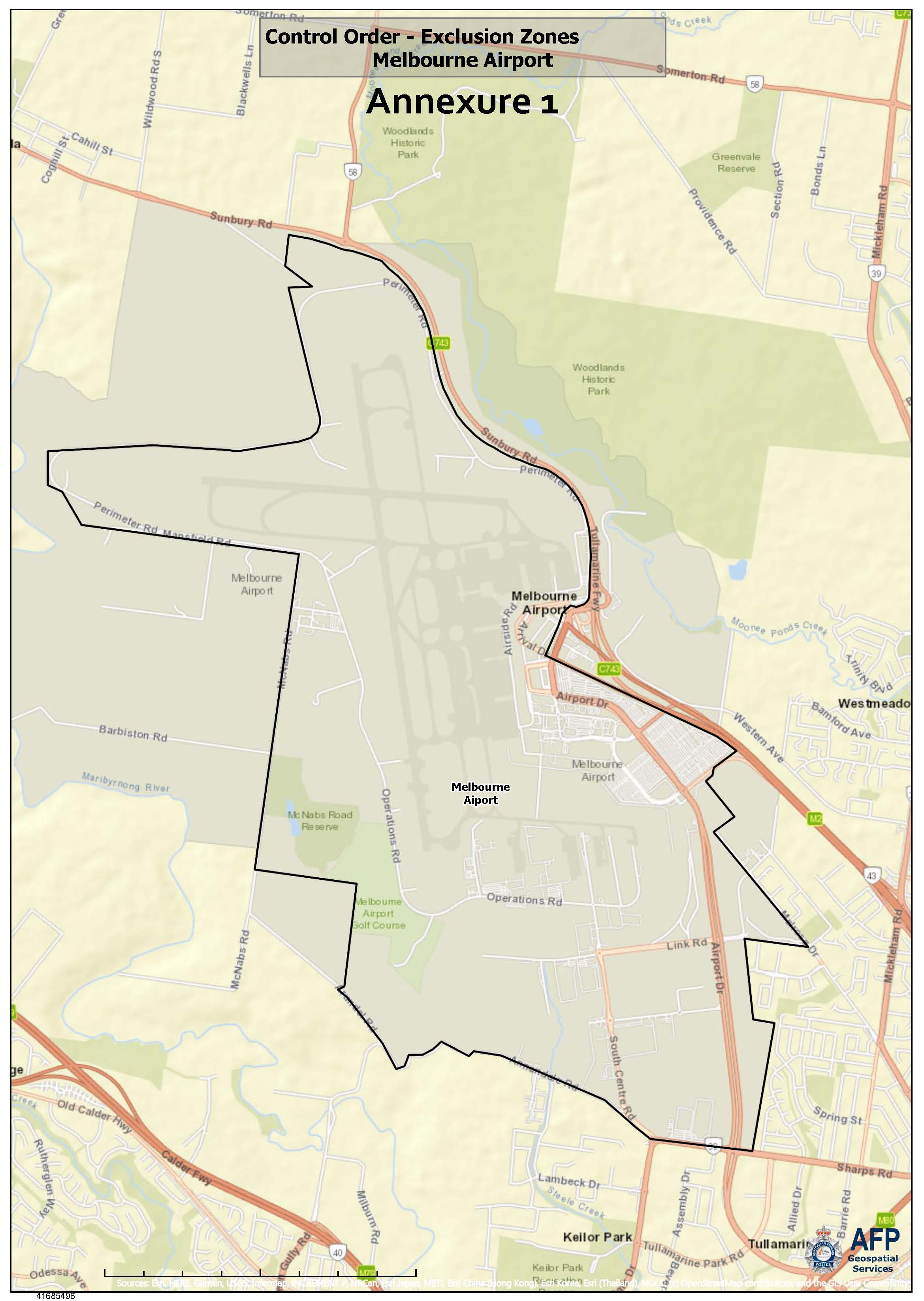
a. within the exclusion zone set out in Annexure 1 at Melbourne International Airport (Tullamarine);
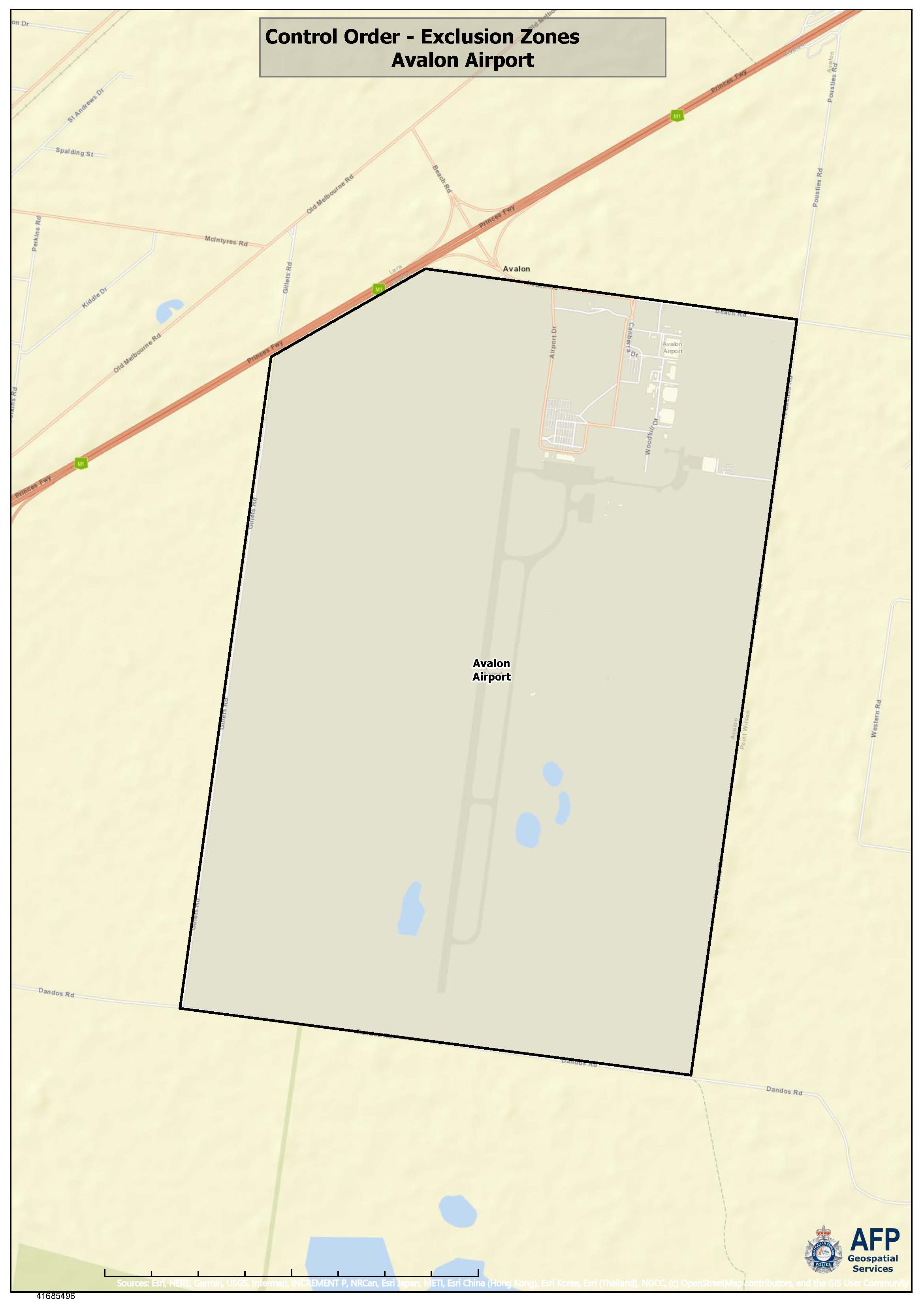
b. within the exclusion zone set out in Annexure 2 at Avalon Airport;
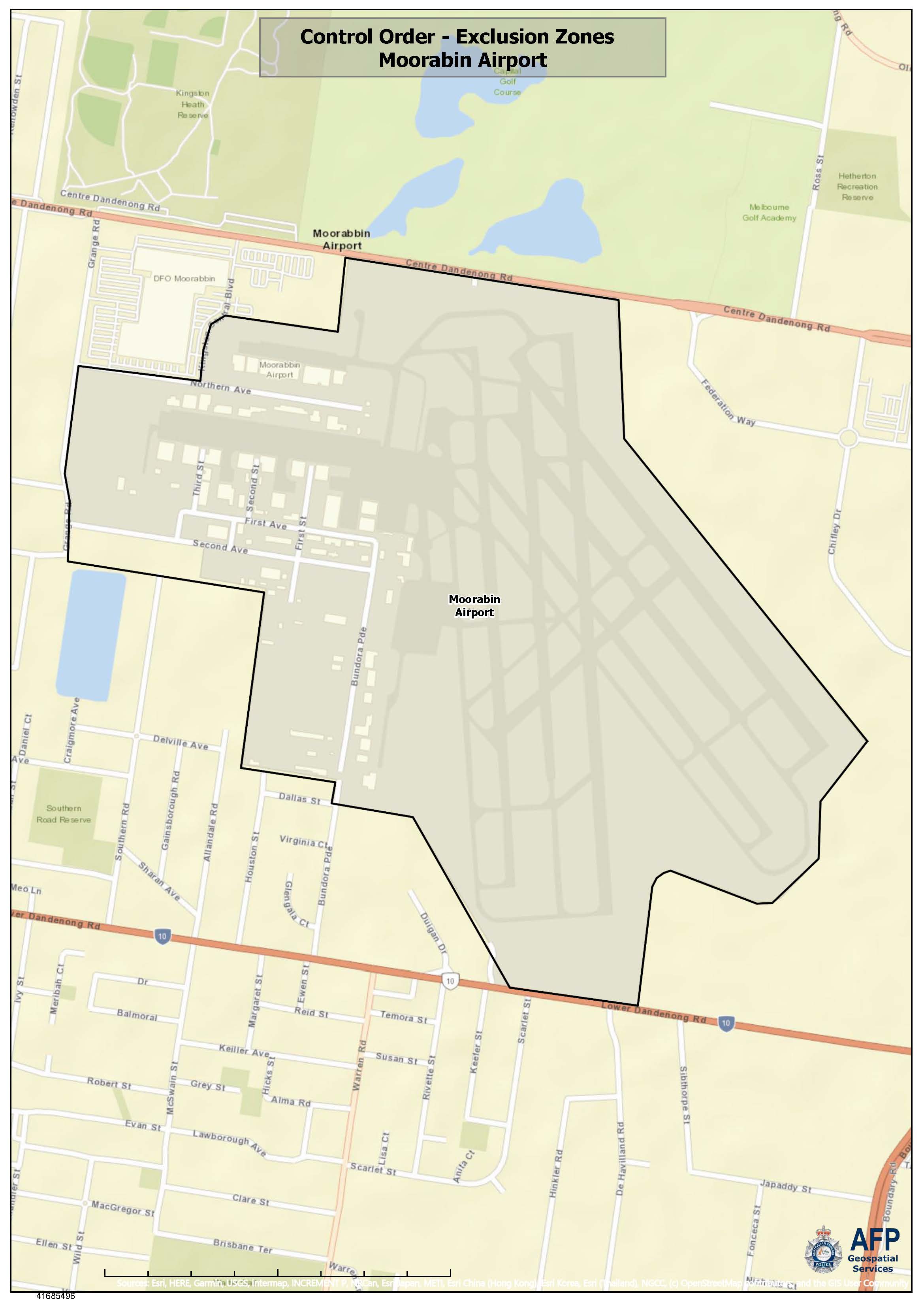
c. within the exclusion zone set out in Annexure 3 at Moorabbin Airport;
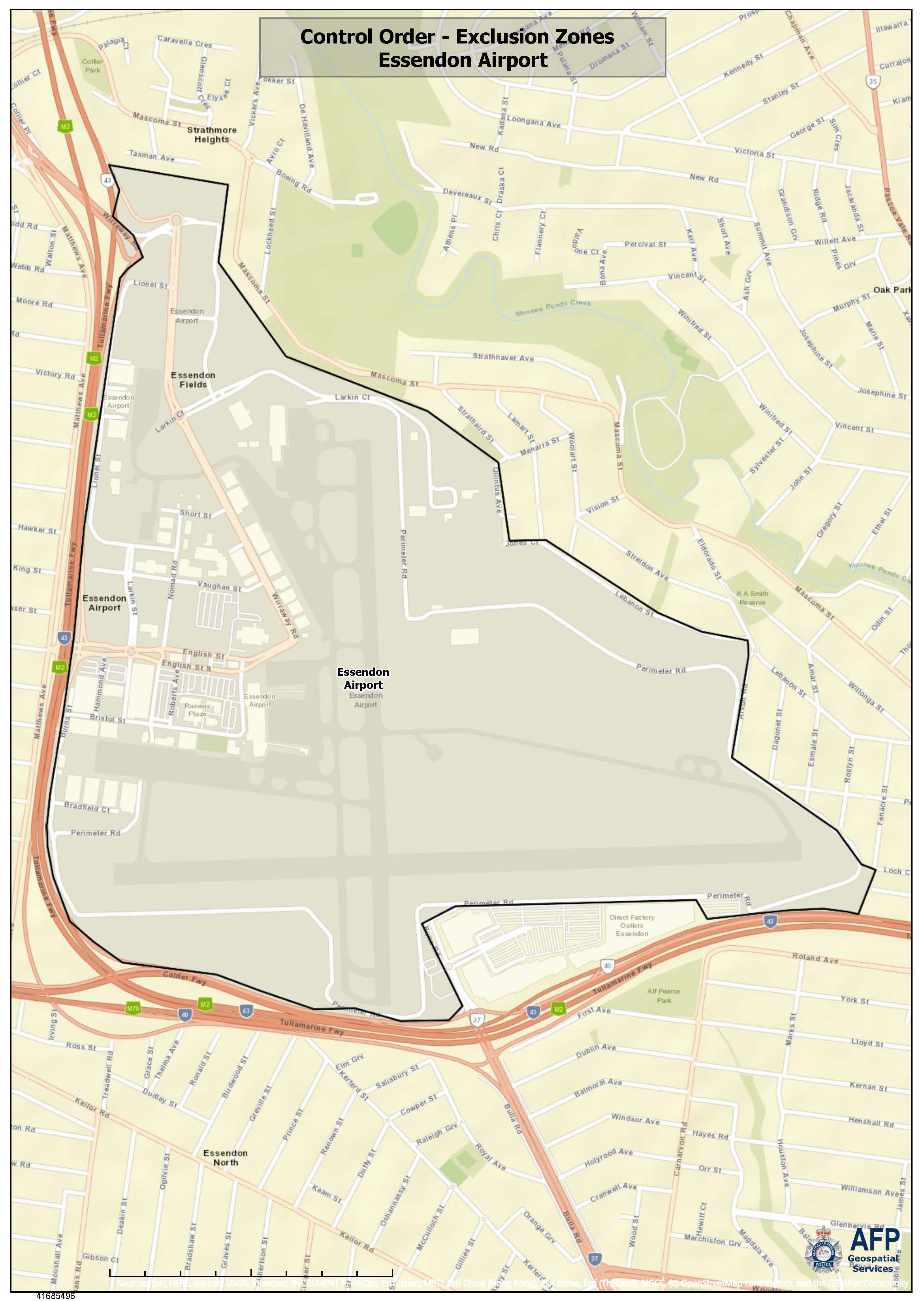
d. within the exclusion zone set out in Annexure 4 at Essendon Fields Airport;
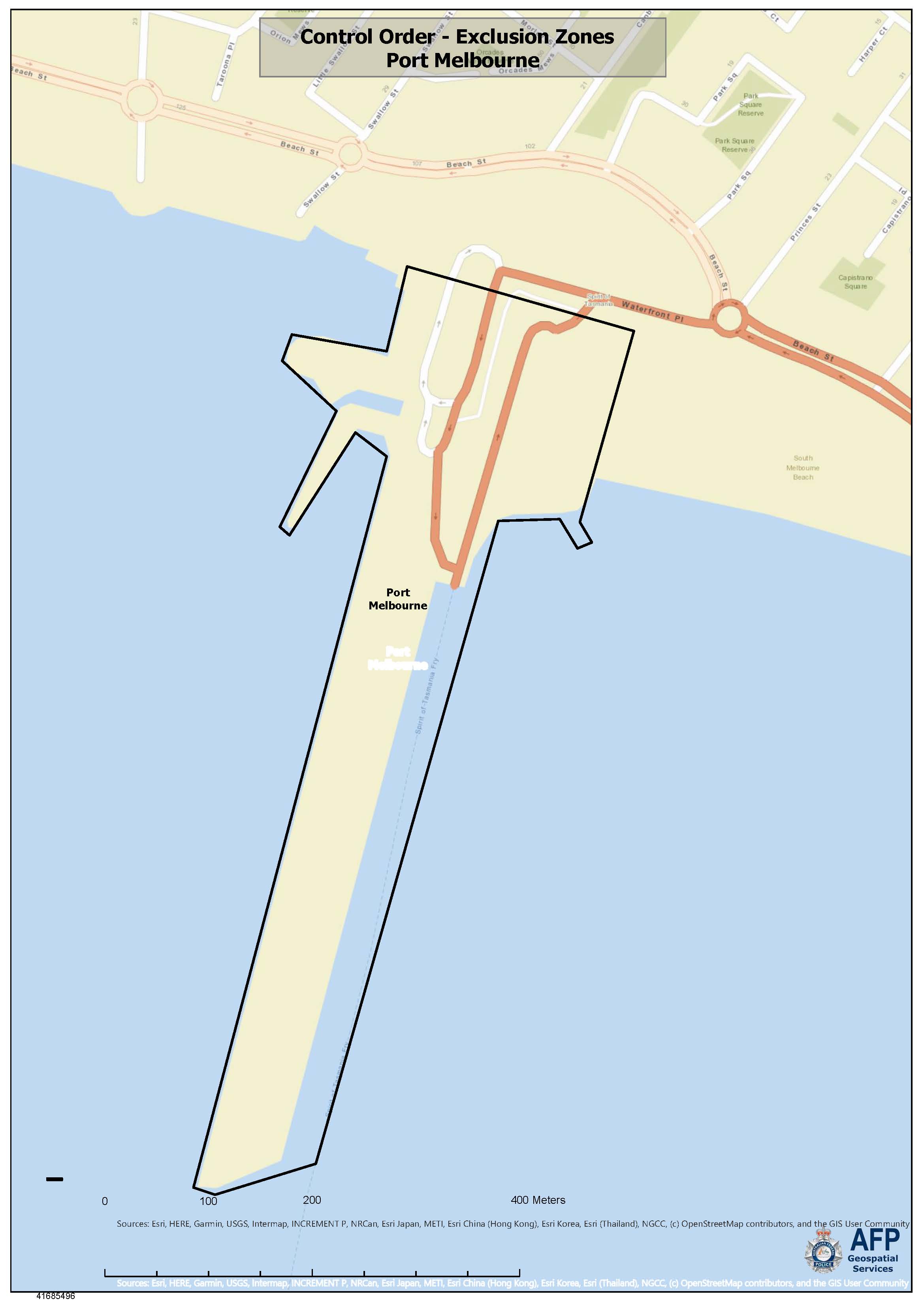
e. within the exclusion zone set out in Annexure 5 at Port Melbourne;
f. within 1 km of any Australian airport (besides Melbourne Tullamarine Airport, Avalon Airport, Moorabbin Airport, and Essendon Fields Airport which are addressed in Controls 3.1.a, 3.1.b, 3.1.c and 3.1.d), which has an international point of departure, or from which a person can board or charter a flight for an international destination;
g. within 1 km of any Australian port (besides Port Melbourne, which is addressed in Control 3.1.e) that has an international point of departure, or from which a person can board or charter a marine vessel for an international destination;
h. inside, or in the grounds of, any prison or correctional facility unless you are incarcerated there;
i. at the residence of any person with whom, by reason of Control 11, you are prohibited from communicating or voluntarily associating;
j. any place in Australia outside the state of Victoria, unless:
i. you contact an AFP Superintendent in writing requesting approval to travel in Australia 14 days prior to the intended departure date, outside the state of Victoria, for a specific period of time; and
ii. an AFP Superintendent consents to the proposed travel in writing.
4. Control 4
4.1 You are prohibited from leaving Australia.
5. Control 5
5.1 You are prohibited from carrying out the following activities (including in respect of your work or occupation), namely:
Groups
a. Forming, joining or affiliating with any group, club or organisation, including any internet based social networking service, without written permission from an AFP Superintendent.
b. Forming any corporation, partnership, incorporated association, registering any business names, or operating a business without first notifying an AFP Superintendent in writing.
c. Forming prayer groups in or out of a Mosque, leading prayers or instructing others on leading prayers.
d. Attempting to influence any other person in relation to religious or ideological matters including through online or social media.
Financial
e. Transferring money, other currency or assets to another person equal to or exceeding the value of $500 whether by cash, cheque or electronic transfer without first notifying an AFP Superintendent in writing of your intention to do so and, providing a receipt of payment thereafter.
f. Making any gift, donation, or financial contribution to any organisation, association, entity or charity howsoever described without first notifying an AFP Superintendent in writing of your intention to do so and, providing a receipt of payment thereafter.
Public Appearances
g. Presenting at, or appearing as a presenter or speaker at, or appearing on stage at, or providing public endorsement of any other presenter or speaker at, any public gathering that is publicly or privately broadcast via the internet or any telecommunications network, and/or attended by 5 or more people.
h. Make any public appearances or statement for publication in any form to any person, or cause any statement to be published by any person on your behalf, in relation to any of the following matters:
i. Carrying out, authorising or permitting violence;
ii. Activities of any terrorist organisation;
iii. The ideology of or any material published, produced or endorsed by any terrorist organisation;
iv. Use of weapons, firearms, ammunition or explosives;
v. Any of the matters set out in Control 6.1.a;
vi. Adherence to any fatwa, decree, ruling or statement of the following persons:
i. Ayman al-Zawahiri;
ii. Osama bin Laden;
iii. Abu Muhammad al Maqdisi;
iv. Abu Bakr Al-Baghdadi;
v. Abu Qatada al-Filistini;
vi. Said Mansour
vii. Abu Ibrahim al-Hahimi al-Qurashi, aka Amir Mohammed Abdul Rahman al-Mawli al-Salbi
Activities Pertaining to Travel
i. Applying for travel documents for any country.
Activities Pertaining to Weapons and Firearms:
j. Possessing, purchasing or using any firearms or ammunition.
k. Permitting storage or use of any firearms or ammunition at your place of residence.
l. Hunting or trapping any animal or game, or using any weapon in connection with hunting or related activities. This includes spear fishing but does not include fishing with a net or line.
6. Control 6
6.1. You are prohibited from carrying out the following activities (including in respect of your work or occupation), namely:
a. Possessing, storing, recording or copying documents (including documents in electronic form) or electronic media, or attempting to possess or store documents (including documents in electronic form) or electronic media, or directing any person to possess, store, record or copy documents on your behalf, which relate to any of the following:
i. explosives, explosive devices, initiation systems or firing devices;
ii. firearms, ammunition or knives;
iii. anti-surveillance or counter surveillance;
iv. execution;
v. beheading;
vi. suicide attack;
vii. bombing;
viii. terrorist attack;
ix. assassination;
x. torture;
xi. genocide;
xii. violent jihad;
xiii. propaganda and promotional material for a ‘terrorist organisation’ within the meaning of s 102.1(1) of the Schedule to the Criminal Code Act 1995 (Cth); or
xiv. activities of, or associated with, any ‘terrorist organisation’ within the meaning of s 102.1(1) of the Schedule to the Criminal Code Act 1995 (Cth).
b. Collating, editing, producing or distributing documents (including documents in electronic form) or electronic media relating to:
i. explosives, explosive devices, initiation systems or firing devices;
ii. firearms, ammunition or knives;
iii. anti-surveillance or counter surveillance;
iv. execution;
v. beheading;
vi. suicide attack;
vii. bombing;
viii. terrorist attack;
ix. assassination;
x. torture;
xi. genocide;
xii. violent jihad;
xiii. propaganda and promotional material for a ‘terrorist organisation’ within the meaning of s 102.1(1) of the Schedule to the Criminal Code Act 1995 (Cth); or
xiv. activities of, or associated with, any ‘terrorist organisation’ within the meaning of s 102.1(1) of the Schedule to the Criminal Code Act 1995 (Cth).
7. Control 7
7.1. You are prohibited from carrying out the following specified activities (including in respect of your work or occupation), namely, intentionally accessing or viewing documents (including documents in electronic form) or electronic media, or attempting to access or view documents (including documents in electronic form) or electronic media, which relate to any of the following:
a. explosives, explosive devices, initiation systems or firing devices;
b. firearms, ammunition or knives;
c. anti-surveillance or counter surveillance;
d. execution;
e. beheading;
f. suicide attack;
g. bombing;
h. terrorist attack;
i. assassination;
j. torture;
k. genocide;
l. violent jihad;
m. propaganda and promotional material for a ‘terrorist organisation’ within the meaning of s 102.1(1) of the Schedule to the Criminal Code Act 1995 (Cth); or
n. activities of, or associated with, any ‘terrorist organisation’ within the meaning of s 102.1(1) of the Schedule to the Criminal Code Act 1995 (Cth),
unless that material is:
o. published by a ‘constituent body’ of the Australian Press Council;
p. published by Al Jazeera, the British Broadcasting Corporation (BBC), CNN, or the Guardian;
q. broadcast on Australian free to air television;
r. broadcast on Australian pay television;
s. shown in a commercial movie cinema; or
t. broadcast on one of the following streaming services: Netflix; STAN; Amazon Prime; ABC iView; or SBS On Demand.
8. Control 8
8.1. You are prohibited from carrying out the following specified activities (including in respect of your work or occupation), namely: renting, purchasing, or driving any vehicle which exceeds a gross vehicle mass of 4.5 tonne.
9. Control 9
9.1. You are prohibited from carrying out the following specified activities (including in respect of your work or occupation), namely: undertaking paid work without first notifying the AFP Superintendent in writing.
9.2. In notifying the AFP Superintendent, you must submit a written notice to the AFP Superintendent which includes information about the proposed work, including details of the person for whom you will be undertaking the work (eg the employer), including their name and place of business, and the nature of the work that will be undertaken.
10. Control 10
10.1. You are prohibited from possessing or using, or permitting any person to act on your behalf to possess or use, any of these specified articles or substances, namely:
a. ‘firearm’ or ‘cartridge ammunition’ within the meaning of s 3(1) of the Firearms Act 1996 (Vic);
b. a 'prohibited weapon' within the meaning of s 3(1) of the Control of Weapons Act 1990 (Vic);
c. any quantity of petrol exceeding 4 litres that is not contained in the petrol tank of a vehicle that you have purchased, rented or driven in compliance with Control 8.1;
d. any quantity of any chemical which is not consistent with reasonable domestic use;
e. an article or device, not being a firearm, capable of discharging by any means:
i. any irritant matter in liquid, powder, gas, chemical form or any dense smoke; or
ii. any substance capable of causing bodily harm; except for reasonable domestic use;
f. a detonator;
g. a fuse capable of use with an explosive or a detonator;
h. a knife, in a public place, without reasonable excuse.
10.2. You are prohibited from possessing or using any thing intended to be used to injure or menace a person or damage property, and from instructing another person to use any thing to injure or menace a person or damage property on your behalf.
11. Control 11
11.1. You are prohibited from communicating or associating with, or attempting to communicate or associate with, directly or indirectly through a third party:
a. any person who, to your knowledge, is incarcerated in any correctional facility, unless you are yourself incarcerated in that correctional facility;
b. any person who, to your knowledge, is subject to a continuing detention order pursuant to Division 105A of the Criminal Code Act 1995 (Cth);
c. any person who, to your knowledge, is subject to a control order made under Division 104 of the Criminal Code Act 1995 (Cth);
d. any person who, to your knowledge, has been convicted of, or is currently charged with, an offence against:
i. Part 5.3 of the Criminal Code (Cth);
ii. the Crimes (Foreign Incursions and Recruitment) Act 1978 (Cth);
e. any person who, to your knowledge, is located in Morocco, Jordan, The West Bank, Saudi Arabia, Turkey, Iraq, Syria, Afghanistan, Pakistan, Yemen, Sudan, Somalia, Egypt, Philippines or Indonesia.
f. any of the following persons:
i. Momena SHOMA
ii. Abdullah CHAARANI
iii. Ahmed MOHAMED
iv. Khaled TEMSSAH
v. Hadashah Sa’adat KHAN
vi. Isa KOCOGLU
vii. Shayden THORNE
viii. Murat KAYA
ix. Robert CERANTONIO
x. Hatim MOUKHAIBER
xi. Aisha ALQATTAN
xii. Taha SEPEHRNIA
xiii. Eldea TEUIRA
xiv. Cody BROOKS
xv. Troy BARNES
xvi. Nazir SHIRYAR
xvii. Matthew MATOVIC
xviii. Michael DARDHA
xix. Bowe MADDIGAN
xx. Peter HOWARTH
xxi. Joseph McDONALD
xxii. Ziad AMOUCHE
xxiii. Christopher HEMMING
xxiv. Mark CONTIN
xxv. Eshan MAJEDI
xxvi. Paul DACRE
xxvii. Antonino GRANATA
xxviii. Kadir KAYA
xxix. Wissam FATTAL
xxx. Ramazan ACAR.
12. Control 12
12.1. You are prohibited from accessing or using, any mobile telephone device other than the one mobile telephone device and SIM card provided to you by the AFP (the permitted mobile phone), and your use of the permitted mobile phone is subject to the following conditions:
a. prior to using a permitted mobile phone an AFP Superintendent will provide you with the following information in writing: the International Mobile Equipment Identity number for the permitted mobile phone, the Integrated Circuit Card Identifier for the SIM card you will use with the permitted mobile phone, the telecommunication service provider which you will use with the permitted mobile phone, the password for the permitted mobile phone and the phone number to which the permitted mobile phone will be connected;
b. you must not tamper with, damage or destroy any component of the permitted mobile phone or any equipment necessary for the operation of the permitted mobile phone, or cause or permit another person to do any of those things;
c. at any time a police officer requests, you must present the permitted mobile phone for inspection, repair, service or replacement as required;
d. you must not change, remove, modify or disconnect or cause any other person to change, remove, modify or disconnect on your behalf (including any employee or person acting on behalf of a telecommunications service provider) the SIM card, telecommunication service provider or phone number connected to the permitted mobile phone;
e. you are also prohibited from utilising encryption, obfuscation or encryption services to prevent examination of data and where applicable are required to provide any password/s or access data to facilitate the examination of the permitted mobile phone.
f. if you set a password for the permitted mobile phone, or change the password for the permitted mobile phone, you must provide the new password to an AFP Superintendent, or a police officer acting under an AFP Superintendent’s direction; and
g. if you become aware that a permitted mobile phone, or any equipment necessary for the operation of the permitted mobile phone, is not in good working order, notify an AFP member as soon as practicable, but no later than twelve hours after becoming so aware.
12.2. You are prohibited from permitting another person to use or access the permitted mobile phone.
12.3. You are prohibited from permitting another person to use or access any mobile telephone device on your behalf.
12.4. Control 12.1 does not apply if the use of another mobile telephone device is solely for the purposes of notifying the AFP Superintendent of a fault or damage to the permitted mobile phone.
12.5. You are prohibited from altering or deleting any platforms, data, programs, software or hardware (including but not limited to software programs, messages, call logs, emails and internet history) stored on, accessible on or utilised on the permitted mobile phone.
13. Control 13
13.1. You are prohibited from accessing or using any fixed or landline telephone or facsimile service other than one service that has been approved in writing by the AFP Superintendent for you to access or use.
13.2. To seek approval, you must:
a. submit a written request to the AFP Superintendent nominating the fixed or landline telephone or facsimile service you wish to use; and
b. provide any other information requested by or on behalf of the AFP Superintendent for the purpose of identifying the nominated fixed or landline telephone or facsimile service.
13.3. You are prohibited from permitting another person to use or access any fixed or landline telephone or facsimile service on your behalf.
14. Control 14
14.1. You are prohibited from accessing or using, or permitting any person to access or use on your behalf, any public telephone except in the case of an emergency, provided that you contact the AFP Superintendent as soon as possible after accessing or using such a public telephone and:
a. provide sufficient detail to the AFP Superintendent to identify the public telephone that you accessed or used, the date, time and phone number called; and
b. you explain the nature of the emergency which required you to access or use, or cause another person to access or use on your behalf, that public telephone.
15. Control 15
15.1. You are prohibited from accessing or using any computer or tablet device other than:
a. a single computer or tablet device that has been provided to you by the AFP for you to access and use at any one time (permitted computer or tablet device); and
b. computers or tablet devices comprising machines publicly available for self- service use (self-service machines), including but not limited to a self-service checkout in a supermarket/store, an automated teller machine (ATM), a global positioning system (GPS) device and self-service ordering kiosks in fast food restaurants, provided that your access and use of any such self- service machine is limited to the machine’s intended use and does not involve using it to browse the internet or send electronic messages unrelated to the business to which it relates.
15.2. Prior to using the permitted computer or tablet device, the AFP Superintendent will provide you with the following information in writing:
a. the make and model of the permitted computer or tablet device;
b. the serial number of the permitted computer or tablet device; and
c. any password associated with the permitted computer or tablet device;
15.3. You must not tamper with, damage or destroy any component of the permitted computer or tablet device or any equipment necessary for the operation of the permitted computer or tablet device, or direct, cause or permit another person to do any of those things.
15.4. You are prohibited from deleting any platforms, programs, software or data (including, but not limited to, software programs, emails, and internet history) stored on or accessible from the permitted computer or tablet device, or partitioning any drive. You are also prohibited from utilising encryption, obfuscation or encryption services to prevent examination of data and where applicable are required to provide any password/s or access data to facilitate the examination of the permitted computer or tablet device.
15.5. At any time the AFP Superintendent (or another police officer) requests, you must present the permitted computer or tablet device for inspection and open any applications the AFP Superintendent or police officer directs you to open.
15.6. If you change the password for the permitted computer or tablet device, you must provide the new password to the AFP Superintendent, or a police officer acting under the AFP Superintendent’s direction, if you are requested to do so by the AFP Superintendent or the police officer.
15.7. You are prohibited from permitting any other person to use or access on your behalf the permitted computer or tablet device.
15.8. You are prohibited from permitting another person to use or access any computer or tablet device on your behalf.
16. Control 16
16.1. You are prohibited from accessing, installing or using, or permitting any person to access or use on your behalf, any applications, programs or social media services, Voice Over Internet Protocol (VOIP) services, audiovisual, voice and/or multimedia session over internet protocol networks, or any service internet based messaging service, cloud or remote storage service, file sharing service, virtualisation software or encrypted storage services designed to, or which purports to, disguise or conceal any function of any application, including incognito or hidden modes also called IP telephony, internet telephony or broadband telephony broadband phone service (collectively, platforms), other than those functions and protocols ordinarily and reasonably in use, without first obtaining the written approval of the AFP Superintendent to use that platform.
16.2. To seek approval you must submit a written request to the AFP Superintendent which nominates the platform.
16.3. Permission to use the nominated platform may be granted, subject to conditions and may be amended or revoked by the AFP Superintendent. Any conditions, amended conditions or revocation must be in writing.
17. Control 17
17.1. You are prohibited from accessing or using any internet service other than the one internet service provided to you by the AFP through your permitted mobile phone for you to access and use (the permitted internet service).
17.2. You are prohibited from permitting any other person to access or use on your behalf any other internet service.
18. Control 18
18.1. You are prohibited from accessing or using any electronic mail (email) account other than:
a. an account that has been approved in writing by an AFP Superintendent, specifically a Gmail account, for you to access and use (the permitted email account)
b. a necessary work email account that has been approved in writing by an AFP Superintendent for you to access and use.
18.2. To seek a permitted email account:
a. you must submit a written request to the AFP Superintendent; and
b. provide any other information requested by, or on behalf of, the AFP Superintendent.
18.3. You are prohibited from permitting another person to use or access the permitted email account.
18.4. You are prohibited from permitting any other person to access or use on your behalf any email account.
19. Control 19
19.1. You are prohibited from accessing or using, or causing any person to access or use on your behalf, any satellite telephone service or UHF/VHF radio.
20. Control 20
20.1. You are required to consider, in good faith, participating in counselling or education relating to your psychological and physical wellbeing, with a suitably qualified professional, for at least 60 minutes per week.
20.2. If you agree to participate in such counselling or education you must advise the AFP Superintendent in writing that you have commenced the counselling or education and provide the AFP Superintendent the name and qualifications of the professional you have engaged.
21. Exemption
21.1. You may request the AFP Superintendent approve an exemption to the requirements or prohibitions (as the case may be) specified in Control 2.1, 2.2, Control 8 and Control 11.1.e.
21.2. To request an exemption, you must:
a. submit a written request to the AFP Superintendent which:
i. identifies the Control in respect of which you seek an exemption;
ii. explains the extent to which you seek to be exempted from the Control; and
iii. explains your reason(s) for seeking the exemption; and
b. provide any other information requested by, or on behalf of, the AFP Superintendent for the purposes of determining whether to approve the exemption.
21.3. The AFP Superintendent may grant an exemption subject to conditions specified in writing.
21.4. You must comply with all of the conditions specified in writing by the AFP Superintendent. If you do not comply with a condition to an exemption, the exemption is (and will be taken to have been for all purposes) of no effect.
21.5. A request for an exemption must be made before the material time and date.
21.6. If the AFP Superintendent has not approved an exemption by the material time and date, the request is deemed to have been refused on behalf of a Superintendent within the Counter Terrorism portfolio in connection with this control order.
22. Exemption granted by the AFP without a request from you
22.1. An AFP Superintendent may grant an exemption, initiated by the AFP, to the requirements or prohibitions specified in the Controls with your consent.
22.2. The AFP Superintendent may grant an exemption subject to reasonable conditions specified in writing provided on reasonable notice to you and to which you consent in writing.
22.3. You must comply with all of the conditions specified in writing by the AFP Superintendent. If you do not comply with a condition to an exemption, the exemption is (and will be taken to have been for all purposes) of no effect.
23. Interpretation
23.1 In this Control Order:
a. AFP Superintendent means a member of the Australian Federal Police performing the duties of a Superintendent within the Counter-Terrorism portfolio.
b. Emergency means an actual or imminent occurrence of an event which in any way endangers or threatens to endanger the safety or health or yourself or a member of your immediate family, or threatens to destroy or damage the specified premises.
c. Password includes but is not limited to any passcode, swipe pattern or any information or function necessary to facilitate access to the applicable device.
d. Police officer means a ‘member’ or ‘special member’ of the Australian Federal Police, as defined by the Australian Federal Police Act 1979 (Cth), or a ‘police officer’ within the meaning of the Victoria Police Act 2013 (Vic).
24. Variation of controls while in custody
24.1 Controls 1 – 23 do not apply during any period in which you are held by or on behalf of an officer in a prison or remand centre of the Commonwealth, a State or a Territory.
24.2 Controls 1 – 23 resume their application at the conclusion of any period referred to in Control 24.1.
REASONS FOR JUDGMENT
SNADEN J:
1 On 6 July 2021, the court made an interim control order in respect of the respondent, Mr Brookman: Booth v Brookman [2021] FCA 767 (Snaden J). On 24 January 2022, that order was varied: Booth v Brookman (No 2) [2022] FCA 30 (Snaden J).
2 The interim control order as varied (hereafter, “the ICO”) was scheduled for a confirmation hearing to take place on Monday, 31 January 2022 pursuant to s 104.14 of the Criminal Code (being the schedule known as such to the Criminal Code Act 1995 (Cth)—hereafter, “the Code”). On Friday, 25 January 2022, the applicant, Commander Booth (a sworn officer of the Australian Federal Police), signed a notice of election to confirm the ICO, which was then (along with other material) duly served upon Mr Brookman in accordance with the requirements of s 104.12A of the Code.
3 The confirmation hearing proceeded as scheduled on Monday, 31 January 2022. The applicant led evidence in the form of a statement of agreed facts, and read and relied upon the following affidavits:
(1) paragraphs [1]-[2], [8], [40]-[77.2], and [78]-[194] of the affidavit of Commander Booth sworn on 28 June 2021;
(2) the affidavit of Detective Superintendent Alexander Gordon Reginald Nicolson affirmed on 28 June 2021;
(3) the affidavit of Detective Sergeant Amanda Glover affirmed on 14 July 2021; and
(4) the affidavit of Detective Senior Constable Alice Port affirmed on 28 January 2022.
4 All of the evidence was received without objection. It is unnecessary that I should attempt anything more than a high-level summary of it. It suffices to note that the evidence disclosed details of the respondent’s criminal history, his support of causes aligned with Islamic fundamentalism (both generally and, specifically, with respect to opposition forces in Syria), his glorification of violence carried out by those forces (in particular, against “kuffs” and “kuffar”—or non-adherents of the Islamic faith), and his apparent endorsement of violent jihad, “mujaahid”, “mujahideen” and martyrdom. The evidence also suffices to establish the service and explanation requirements imposed by ss 104.12 and 104.12A of the Code.
5 In addition to the body of evidential material, both parties filed helpful written submissions. By way of summary, the applicant submitted that, on the strength of the evidence before it, the court should be satisfied of all of the criteria that condition the confirmation of interim control orders under s 104.14 of the Code (reference to which is made in more detail below). The respondent accepted as much and did not oppose the confirmation of the ICO.
6 For present purposes, the court’s power to confirm the ICO is conditioned by the same two matters that governed its making in the first place: the Code, s 104.14(7)(c). Specifically, the court must determine whether:
(1) one or more of the circumstances listed in s 104.4(1)(c) exists—which, in this case, is to say whether the respondent has been convicted in Australia of an offence relating to terrorism (see the Code, s 104.4.(1)(c)(iv)), or has provided support for or otherwise facilitated the engagement in a hostile activity in a foreign country (see the Code, s 104.4(1)(c)(vii)); and whether
(2) the controls imposed by the ICO are reasonably necessary, and reasonably appropriate and adapted, for the purpose of protecting the public from a terrorist act, or preventing the provision of support for or the facilitation of a terrorist act, or the engagement in a hostile activity in a foreign country (see the Code, s 104.4(1)(d)).
7 If satisfied that both requirements are met, the court may confirm the ICO without variation: the Code, s 104.14(7)(c). In determining whether each control satisfies the second of those two requirements, the court must take into account, as a paramount consideration, the objects of div 104 of the Code and, as an additional consideration, the impact of the control upon the respondent’s personal circumstances: the Code, s 104.4(2).
8 For the purposes of confirmation under s 104.14 of the Code, the court must consider the original request for an interim control order and any evidence and submissions made at the confirmation hearing: the Code, s 104.14(3). An order to confirm an interim control order must, nonetheless, be made only on the strength of the evidence adduced and the submissions advanced for that purpose: the Code, s 104.14(3A).
9 Proceedings under div 104 of the Code are civil, rather than criminal, in nature. A control order serves not to punish a respondent but, rather, as a measure of community protection: the Code, s 104.1; see also Thomas v Mowbray (2007) 233 CLR 307, 330 [18] (Gleeson CJ), 347-348 [79] (Gummow and Crennan JJ). The court’s satisfaction of the matters that condition the granting of orders under div 104 is to be assessed on the balance of probabilities. It is not necessary that the court positively form the view—nor that there be evidence to suggest—that the respondent poses any kind of positive threat to the community: see, eg, Booth v Namoa [2019] FCA 2213, [28]-[31] (Rares J).
10 The confirmation of an existing interim control order must take place by means of further order: the Code, s 104.16(1).
11 Having considered the evidence placed before me and the submissions that the parties advanced, I am satisfied that it is appropriate to confirm the ICO without variation. In particular, I am satisfied (and it is not, in any event, in contest) that the respondent has been convicted in Australia of an offence relating to terrorism, and/or has provided support for, or otherwise facilitated, the engagement in a hostile activity in a foreign country (as defined for the purposes of the Code): see Booth v Brookman [2021] FCA 767 [2]-[3] (Snaden J).
12 Further—and taking account of the matters to which I must have regard under s 104.4(2) of the Code—I remain satisfied on the balance of probabilities that each of the obligations, prohibitions and restrictions whose imposition upon the respondent is contemplated by the confirmation of the ICO is (and all of them, in combination, are) reasonably necessary, and reasonably appropriate and adapted, for each of the purposes identified in s 104.4(1)(d) of the Code. That was the conclusion to which I was drawn when the ICO was made and, subject to the observations below, it remains so now.
13 Appropriately, the applicant highlighted two respects in which the present circumstances differ from those that obtained at the time that the ICO was made. First, she noted that a substantial volume of evidence—in particular, evidence of the respondent’s social media activities—which was relied upon for the purposes of the ICO was not now relied upon. That, she explained, reflected the fact that the admissibility of that material might now need to be the subject of argument, and that, in light of the fact that the respondent does not resist confirmation of the ICO and that the evidence in question is largely and in any event reflected in the statement of agreed facts, it was considered unnecessary to engage the court in that debate. Second, the applicant noted that the respondent is presently remanded in custody pending the hearing of criminal charges that have recently been brought against him.
14 Neither of those realities affects the state of satisfaction recorded above (at [12]). The absence of the social media evidence is neither here nor there. Although it might well have been that the court could more easily have been satisfied of certain matters—in particular, of the respondent’s ideological commitments—had that material been adduced, the material that is before the court suffices to that end in any event. Likewise, the fact that the respondent is presently in custody is of little moment. The controls that are to be confirmed will not apply for so long as that custody remains in effect. In the event that it ceases, they will become as necessary and appropriate as they were when they were first imposed. Further, as senior counsel for the respondent put it, the confirmation of the ICO might well assist the respondent in any application that he makes for bail pending the determination of the charges with which he is faced.
15 In light of the above observations, I am satisfied that it is appropriate to confirm the ICO without variation.
16 Additionally and for reasons that hardly require elaboration, it is appropriate to replicate the orders that were made at the same time as the ICO pursuant to pt. 5AA of the Federal Court of Australia Act 1976 (Cth). Those orders (to which the applicant consents, as she did when the ICO was made) will serve to prohibit the disclosure of information that is contained within the ICO (and that is to be replicated in the confirmed control order) that is personal to the respondent. They will be replicated in the court’s orders.
I certify that the preceding sixteen (16) numbered paragraphs are a true copy of the Reasons for Judgment of the Honourable Justice Snaden. |
Associate:


