

Federal Court of Australia
Sarina v O’Shannassy [2021] FCA 1649
ORDERS
First Appellant MARTIN GREEN Second Appellant | ||
AND: | Respondent | |
DATE OF ORDER: |
THE COURT ORDERS THAT:
1. The appeal be allowed.
2. Order 1 made by the Federal Circuit Court of Australia on 30 October 2020 be set aside and in lieu thereof ordered that:
1. There be judgment for the applicants.
3. Order 6 made by the Federal Circuit Court of Australia on 17 December 2020 be set aside and in lieu thereof it be ordered that:
6. The respondent pay the applicants’ costs of the proceedings that are not the subject of the costs referred in orders 1-5, such costs to be agreed, or if there be no agreement, to be taxed under Pt 40 of the Federal Circuit Court Rules 2001.
4. The cross-appeal be dismissed.
5. The respondent pay the appellants’ costs including their costs as cross-respondents to the cross-appeal.
6. The matter be remitted for the assessment of the appellants’ damages to the Federal Circuit and Family Court of Australia (Division 2) pursuant to s 28(1)(f) of the Federal Court of Australia Act 1976 (Cth) and be heard by a judge other than the primary judge.
Note: Entry of orders is dealt with in Rule 39.32 of the Federal Court Rules 2011.
(REVISED FROM TRANSCRIPT)
RARES J
1 This is an appeal from the decision of the Federal Circuit Court in a defamation action. The appellants, Clinton Sarina and Martin Green, were the applicants below. They entered into a business relationship with the respondent, John O’Shannassy, through a company, Fleur de Vie Beverages Pty Limited, in which they participated with others, including Andrew George and Bryan Coleman.
2 The critical issues are whether the trial judge erred, first, in the way in which he found the facts by not accepting a substantial body of unchallenged evidence of these witnesses and using that non-acceptance to find that he would not accept their uncorroborated evidence and, secondly, in upholding Mr O’Shannassy’s defence under s 33 of the Defamation Act 2005 (NSW) that the circumstances of the publication of the matter complained of, which conveyed very serious imputations about the appellants, were such that they were unlikely to sustain any harm.
3 In his notice of contention dated 14 December 2020, Mr O’Shannassy sought to challenge the rejection of the statutory qualified privilege defence and to uphold the judgment below if I were otherwise minded to allow the appeal. However, at the commencement of the hearing of the appeal, Senior Counsel for Mr O’Shannassy abandoned the notice of contention. During argument of the appeal, Mr O’Shannassy sought to challenge the finding that one of the imputations (imputation 3) was conveyed in respect of Mr Green.
4 The trial judge constructed his reasons for judgment in a somewhat unconventional way that, perhaps, created the situation in which any sight of the wood was lost for the trees. The proceeding before his Honour was conducted on the basis of affidavit evidence and cross-examination of deponents before the trial judge over five days.
Principles of appellate review of findings of fact
5 Before setting out the trial judge’s reasoning, it is important to understand the principles applicable to the finding of facts at a trial and appellate review of those findings.
6 Ordinarily, an appellate court is not able to interfere with findings of fact made by a trial judge who has had the benefit of seeing and hearing the witnesses and absorbing the whole of the evidence in context. Here, there is very little in the appeal papers, apart from the text of his Honour’s judgment, which bears on what happened at the trial. In Lee v Lee (2019) 266 CLR 129, at 148–149 [55], Bell, Gageler, Nettle and Edelman JJ said:
A court of appeal is bound to conduct a “real review” of the evidence given at first instance and of the judge’s reasons for judgment to determine whether the trial judge has erred in fact or law: [Fox v Percy (2003) 214 CLR 118 at 126–127 [25] per Gleeson CJ, Gummow and Kirby JJ; Robinson Helicopter Co Inc v McDermott (2016) 90 ALJR 679 at 686 [43]; 331 ALR 550 at 558]. Appellate restraint with respect to interference with a trial judge’s findings unless they are “glaringly improbable” or “contrary to compelling inferences” [(Fox v Percy (2003) 214 CLR 118 at 128 [29] per Gleeson CJ, Gummow and Kirby JJ; Robinson Helicopter Co Inc v McDermott (2016) 90 ALJR 679 at 687 [43]; 331 ALR 550 at 558–559)] is as to factual findings which are likely to have been affected by impressions about the credibility and reliability of witnesses formed by the trial judge as a result of seeing and hearing them give their evidence. It includes findings of secondary facts which are based on a combination of these impressions and other inferences from primary facts: [Kakavas v Crown Melbourne Ltd (2013) 250 CLR 392 at 434–435 [144]; Thorne v Kennedy (2017) 263 CLR 85 at 104 [42]]. Thereafter, “in general an appellate court is in as good a position as the trial judge to decide on the proper inference to be drawn from facts which are undisputed or which, having been disputed, are established by the findings of the trial judge” [Dearman v Dearman (1908) 7 CLR 549 at 564, quoting The Glannibanta (1876) 1 PD 283 at 287; Fox v Percy (2003) 214 CLR 118 at 127 [25]].
(emphasis added)
7 As the trial judge noted, unchallenged evidence can be rejected, but, as with the need for appellate restraint, that evidence should be inherently incredible or inconsistent with other evidence that the judge has accepted.
8 In Masterton Homes Pty Ltd v Palm Assets Pty Ltd (2009) 261 ALR 382 at 404–405 [105], Campbell JA, with whom Allsop P and Basten JA agreed, (and see also TAL Life Ltd v Sheutrim (2016) 91 NSWLR 439 at 480 [198] per Leeming JA) said that:
While the evidence was not cross-examined on, that does not necessarily mean that the judge was obliged to accept it. A judge can reject evidence that has not been cross-examined on if, for example, it was inconsistent with other evidence that he accepted, or if it was inherently incredible: Sullman v Sullman [2002] DFC 95-248; [2002] NSWSC 169 at [304]–[306]; Caldwell v J A Neilson Investments Pty Ltd (2007) 69 NSWLR 120; [2007] NSWCA 3 at [96]; Ellis v Wallsend District Hospital (1989) 17 NSWLR 553 at 586–8. Nor did the rule in Browne v Dunn (1893) 6 R 67 (Browne) prevent the judge from rejecting the evidence. That is because Ms Maude had given her evidence on affidavit in advance of the trial (including an account of the conversation with Mr Miles that she told Mr Newport about), and Mr Miles had replied to that affidavit in advance of the trial. Mr Miles’ reply included denying that his client was prepared for the appellant to receive the benefit of all the BBX dollars as BBX dollars were of no use to it, and saying that he did not agree to any proposition that removed his client’s ability to choose whether to take BBX dollars or set aside cash. Exchange prior to trial of affidavits that disclose the position of the respective parties concerning a particular evidentiary matter can prevent a Browne point being successfully raised: West v Mead (2003) 13 BPR 24,431; [2003] NSWSC 161 at [95]–[99]. Thus, I do not accept that the absence of cross-examination required the judge to accept Mr Newport’s evidence.
(emphasis added)
9 In Kuhl v Zurich Financial Services Australia Ltd (2011) 243 CLR 361 at 384 – 385 [62]–[64], Heydon, Crennan and Bell JJ discussed the appropriate inferences that a trial judge may draw about the failure of a witness (such as Mr George, who was not a party) to give evidence of a particular kind. Their Honours said (at 384 [62]):
Witnesses are supposed to answer questions put by counsel responsively; they are supposed to give a full answer but no more. It is one thing to say that a witness was not asked the right questions. It is another thing to say that the witness did not answer the questions that were asked. And it is an even more serious thing to say that a witness was “reluctant” to answer. The duty of a witness is to tell the truth, the whole truth and nothing but the truth so far as the questions asked seek it.
(emphasis added)
10 In contrast, in Kuhl 243 CLR at 384–385 [63], their Honours said that when a party, (such as Mr O’Shannassy) is not asked, or does not give evidence in chief, on a topic “the court will be less likely to draw inferences favourable to that party from other evidence in relation to the issue” (footnotes omitted).
11 As I describe the trial judge’s reasons below, I will make findings about the errors in his assessment process.
Background
12 Fleur de Vie had a paid-up capital of $100. Each of Mr George and Mr Coleman held 24 shares, Mr Green, 12, and another person, whose name did not appear in the trial judge’s findings, another 24 shares. Mr O’Shannassy was the company secretary. His Honour found that Mr Sarina was the only person who had provided substantial funds to Fleur de Vie. He had lent it $10,000. The purpose of establishing the company was to market bottled water, but the business was looking for a resource from which, as it were, to tap water to bring the project to market.
13 The basis for the appellants’ claims in defamation was an email that Mr O’Shannassy sent, at 9:22pm on 20 December 2017, to Mr George and Mr Coleman, in the following terms:
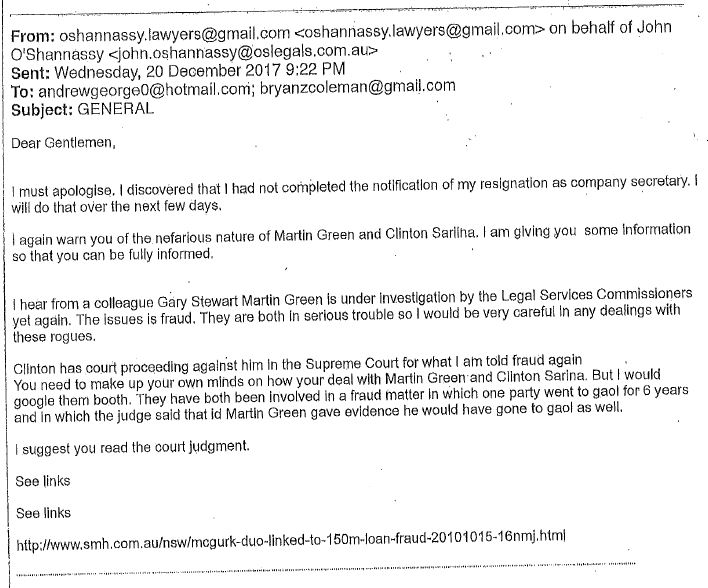
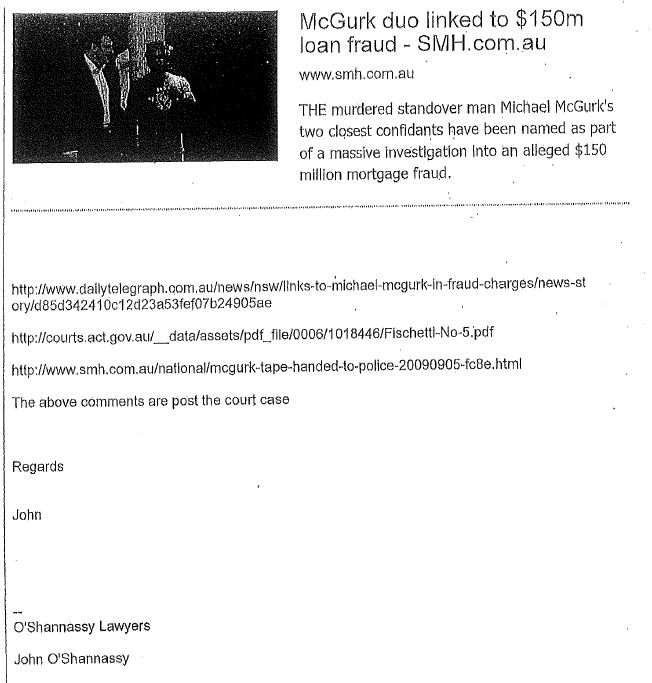
14 Mr O’Shannassy appears to have been in practice as a solicitor. It is not clear whether Mr Green also was in practice, although the above email suggested that he was.
15 The trial judge found that the matter complained of conveyed the following three common imputations about each of Mr Green and Mr Sarina, namely:
(1) he was a fraud (imputations 2 and 8);
(2) he is one of standover man, Mr McGurk’s two closest confidants (imputations 3 and 9); and
(3) he is a fraudulent businessman (imputations 7 and 12).
16 In addition, his Honour found that the matter complained of conveyed the following separate imputations about, respectively, Mr Green and Mr Sarina:
(4) Mr Green had so conducted himself, as at 20 December 2017, that the Legal Services Commissioner had a reasonable suspicion that the second Applicant [Mr Green] had engaged in fraud and was investigating him for that conduct (Imputation 1).
(5) Mr Sarina has further supreme court proceedings against him for fraud (Imputation 13)
17 Mr O’Shannassy pleaded the following substantial defences:
(1) justification of the imputations that each appellant was a fraud and a fraudulent businessman;
(2) qualified privilege under s 30 of the Defamation Act 2005 (NSW).
(3) publication of a public document under s 28 of the Act, being a reference to the judgment of the Supreme Court of the Australian Capital Territory in the link attached to the email.
(4) fair report, apparently being the republication of the links to the electronic newspaper articles in The Sydney Morning Herald headlined “McGurk duo linked to $150 million loan fraud - SMH.com.au” and The Daily Telegraph website captioned “michael mcgurk in fraud charges”.
(5) honest opinion under s 31, and,
(6) triviality under s 33, which provides as follows:
33 Defence of triviality
It is a defence to the publication of defamatory matter if the defendant proves that the circumstances of publication were such that the plaintiff was unlikely to sustain any harm.
18 The trial judge disposed of the justification defences and those under ss 28, 29 and 31 in four single and short paragraphs, essentially finding that there was no basis for any of them. In particular, he dismissed the defence of justification, as follows:
190. Mr O’Shannassy pleads that if each of Imputations 2, 7, 8 and 12 was conveyed by the publication of the Email [being the matter complained of], they are each substantially true. The only basis on which Mr O’Shannassy relies for establishing the truth of these Imputations is the conduct Mr Sarina and Mr Green manifested in relation to the dispute that arose about the terms on which Mr O’Shannassy had lent $35,000 to Mr Sarina. Mr O’Shannassy has not pleaded or particularised or otherwise articulated how such conduct, to the extent it is revealed by the evidence before me, could conceivably support a finding of fraud. The material on which Mr O’Shannassy relies, therefore, is incapable of supporting a finding in terms of Imputations 2, 7, 8 and 12.
19 His Honour rejected the defence of qualified privilege under s 30 on the basis that he was not satisfied that Mr O’Shannassy’s sending of the matter complained of was reasonable in the circumstances because it did not provide sufficient context or specificity to his allegations.
20 His Honour also dealt with the unpleaded, but argued, common law qualified privilege defence, rejecting it on the basis that Mr O’Shannassy had not identified the nature of the fraud which he asserted and had included in the matter complained extreme statements that were devoid of evidentiary or rational support (see at [186]). Whether that was a correct application of how the defence operates at common law need not be explored. That is because his Honour also found that Mr O’Shannassy’s dominant purpose in publishing the matter complained of was to embarrass Mr Sarina and Mr Green in the eyes of the directors of Fleur de Vie by making the broadest allegations of dishonesty without any proper support either in terms of evidence or argument. He found that, when he sent the email on 20 December 2017, Mr O’Shannassy knew that it was untrue to write that there were further Supreme Court proceedings against Mr Green.
21 His Honour found that the communication of the matter complained of was not for the purpose of providing information that could assist Mr George and Mr Coleman to assess the probity of Mr Sarina and Mr Green. That was principally because, if that had been his purpose, it would have been reasonable to expect Mr O’Shannassy to have provided details of the very dispute which he sought at trial to prove justified the imputations that they were frauds and fraudulent businessmen. That dispute concerned Mr O’Shannassy’s allegation that Mr Sarina engaged in some form of dishonesty in relation to obtaining $35,000 loan from him.
22 The structure of the judgment, however, would not inform a reader of the issues in dispute at the outset. The issues centred around the defamatory nature of the email, being the matter complained of, and the substantive defence of justification of the serious imputations that it conveyed.
The trial judge’s reasons
23 The trial judge commenced his lengthy reasons with the following statement:
4. Before I consider the evidence and record my findings, there are two matters I should note in relation to my assessment of the evidence. First, I have set out elsewhere the approach I take to assessing evidence; and I have attempted to follow that approach in the assessment of the evidence in this case. Second, much of the evidence Mr Sarina, Mr Green, and Mr George have given has not been challenged in cross-examination, and counsel for Mr O’Shannassy has not made submissions against my accepting a number of aspects of their evidence. Subject to the requirements of procedural fairness, however, I am not bound to accept evidence that is not challenged in cross-examination. As Newton J said in Bulstrode v Trimble [1970] VR 840:
[I]f a witness’s evidence upon a particular matter appeared in his evidence-in-chief to be incredible or unconvincing, or if it was contradicted by other evidence which appeared worthy of credence, the fact that the witness had not been cross-examined would, or might be of little importance in deciding whether to accept his evidence.
(references omitted and emphasis added)
24 Importantly, his Honour referred in [4] to the need for procedural fairness, a topic to which I will return. He then set out some of the circumstances leading to the relationship between the five men who appeared to have been involved in the business of Fleur de Vie. Mr O’Shannassy first met Mr Green. Mr Green then introduced Mr Sarina to Mr O’Shannassy. They had a meeting with Mr George and Mr Coleman in December 2016. It appears that by about this time Mr George and Mr Coleman had made the acquaintance of at least Mr Sarina and Mr Green.
25 The trial judge described the circumstances in which Mr Green requested Mr O’Shannassy, to lend him $500, which his Honour did not seem to take further for the purpose of resolving the issues. His Honour found that in June 2017, Mr O’Shannassy met Mr Green several times, and on one occasion they had a discussion in which Mr Green said that he and Mr Sarina needed money for a project involving land in West Caboolture. The men had some discussion about the $35,000, and it appears that Mr O’Shannassy lent Mr Sarina that sum of money. By August 2017, Mr Green told Mr O’Shannassy that the $35,000 would not be repaid at about that time but would have to be paid late. There was some dispute about the terms of the loan.
26 On 29 September 2017, Mr O’Shannassy sent an email to Mr Sarina and Mr Green in which he expressed his irritation and displeasure that the money had not been repaid, said that he had lost his trust in both of them, and required them to repay the money.
27 On 5 October 2017 Mr Sarina responded, copying Mr Green in, expressing offence at the allegation Mr O’Shannassy had made in the 29 September 2017 email that he was a “spiv or con artist” and suggested that they have a meeting. This dispute festered on and on 1 November 2017, Mr O’Shannassy sent Mr Sarina an email that appears to have been an extract from s 192E(1)(b) of an unidentified statute headed “Obtain financial advantage or cause financial advantage by deception Penalty 10 years max”. Mr O’Shannassy set out a passage from the sentencing reasons of a Supreme Court judge and suggested that Mr Sarina fell within her Honour’s remarks. Mr Sarina responded the next day, taking offence at what he described as Mr O’Shannassy’s “threats and false comments” and asserted that the money advanced to him was held in trust with his solicitor, who would be writing to Mr O’Shannassy shortly.
28 The trial judge then set out an exchange of emails with a detailed commentary about events that occurred on 17 November 2017. His Honour’s consideration of what occurred in relation to those events provided the fulcrum of his subsequent findings of fact on several other issues that the judgment dealt with over many pages. His Honour said (at [25]–[28]):
25. At 11:48 am on 17 November 2017 Mr O’Shannassy sent to Mr George an email stating he “will be resigning as company secretary”. Mr O’Shannassy also said the “reasons for this you will be interested in knowing. Please ring me to discuss”. According to Mr George, “[o]n receiving this email” he telephoned Mr O’Shannassy and asked what had happened. Mr O’Shannassy said:
You should do your research into Clinton Sarina and Martin Green. Sarina is not someone to be trusted and he deals with underworld figures such as McGurk and is a dangerous individual. He is involved in fraud.
Green is not credible and not of good character, he is also involved in fraud. Green has engaged in criminal activity and has been struck off as a solicitor in New South Wales.
26. Mr George further deposes that, after pressing Mr O’Shannassy to “divulge more”, Mr O’Shannassy said: “You can look them up on Google”.
27. Mr O’Shannassy does not in his affidavit respond to this part of Mr George’s affidavit; and it was not put to Mr George that a conversation to the effect he deposed did not occur. Under cross-examination, however, it was put to Mr O’Shannassy, and Mr O’Shannassy disagreed, that he had a conversation with Mr George on 17 November 2017; and that he told Mr George that Mr Green and Mr Sarina were of a nefarious nature. Mr O’Shannassy also said he did not in a telephone conversation with Mr George in November 2017 tell Mr George that Mr Green and Mr Sarina were of a nefarious nature; and he did not have a conversation with Mr George before 20 December 2017 about Mr Green or Mr Sarina.
28. Mr George’s evidence and the evidence Mr O’Shannassy gave under cross-examination is to be assessed by the email Mr George sent to Mr O’Shannassy at 12:38 pm on 17 November 2017, 50 minutes after Mr O’Shannassy sent his email. Mr George’s email was as follows:
Hi John,
Not a problem.
Please complete the attached and provide us a scanned electronic copy for our records. We will remove you from the company’s registrar [sic] on receipt of this notice.
Perhaps you can send your reasons in writing for our reference.
(references omitted and emphasis added)
29 It is common ground that Mr O’Shannassy did not put in issue, through his counsel’s cross-examination of Mr George, that the conversation took place as Mr George had deposed to the effect set out in [25] of his Honour’s reasons, and which Mr George reasserted took place during his cross-examination. However, as later appeared, Mr O’Shannassy in the witness box put a different position and denied the previously undisputed conversation to which Mr George had deposed. This occurred in the context that both sides’ witnesses relied on affidavits about matters that were important in support of their respective cases.
30 His Honour found that that conversation had not occurred by reference to, among others, juxtapositions of what came to be said on 20 December 2017 in the matter complained of, which the trial judge described in his reasons as “the Email”. He found that it was unlikely that Mr George, 50 minutes after receiving Mr O’Shannassy’s email, would have sent his email in reply on 17 November 2017 if there had been a conversation as Mr George had deposed “on receiving Mr O’Shannassy’s email” (at [30]). His Honour said at [31]–[32]:
31. Mr George’s evidence must also be assessed by reference to the first sentence of the second paragraph of the Email. Mr O’Shannassy there said: “I again warn you of the nefarious nature of Martin Green and Clinton Sarina”. It was put to Mr O’Shannassy in cross-examination that his use of “again” was a reference to Mr O’Shannassy having said to Mr George on 17 November 2017 that Mr Green and Mr Sarina were of a nefarious nature. Mr O’Shannassy denied this.
32. Read on its own the sentence “I again warn you of the nefarious nature of Martin Green and Clinton Sarina” does suggest Mr O’Shannassy had previously warned Mr George of the matters stated in the Email. But there are a number of matters to note:
a) The sentence must be read with the sentence that follows it: “I am giving you some information so that you can be fully informed”. That implies Mr O’Shannassy had not previously given any information to Mr George about the nefarious nature of Mr Green or Mr Sarina; and it also implies an assumption that Mr George himself has undertaken no enquiry about Mr Green and Mr Sarina. According to Mr George’s account of the conversation on 17 November 2017, however, Mr O’Shannassy did provide information about Mr Sarina (he dealt with underworld figures such as Mr McGurk, he is a dangerous individual, and he is involved in fraud), and about Mr Green (he has been involved in criminal activity and has been struck off as a solicitor); and Mr O’Shannassy also suggested Mr George “look them up on Google”.
b) Mr O’Shannassy was not asked in cross-examination or in re-examination what he recalls he intended to convey by the word “again” that appears in the sentence.
c) In his email of 21 December 2017 to Mr O’Shannassy, Mr George responded to the Email by stating that “[w]e consider your approach as libel and slander”. Mr George also stated “[w]e have recorded your email and reserve our right to share it with any relevant parties, including those named below”. Mr George, however, does not refer to any conversation he had with Mr O’Shannassy. In particular, Mr George does not refer to the conversation he says he had with Mr O’Shannassy on 17 November 2017. Had such a conversation occurred, it is reasonable to expect that Mr George would have understood the words “again warn” to refer to the conversation he says he had with Mr O’Shannassy on 17 November 2017; and he would have addressed the imputations Mr O’Shannassy made against the characters of Mr Green and Mr Sarina in that telephone conversation, as well as the imputations Mr O’Shannassy conveyed by the Email.
(references omitted and emphasis added)
The significance the trial judge placed on his findings that rejected Mr George’s unchallenged evidence
31 However that was not the only finding available, having regard to Mr George’s statement in his affidavit that, on receiving the email on 17 November 2017, he telephoned Mr O’Shannassy and asked about its warning. It is not illogical or improbable that that conversation could have occurred after Mr George had responded as he did, first, by sending his email 50 minutes later and then, after thinking more about the matter and, not having heard back from Mr O’Shannassy, later that day raising his queries with Mr O’Shannassy in a discussion.
32 The real problem with his Honour finding that he did not accept the unchallenged evidence of Mr George about having a conversation with Mr O’Shannassy on 17 November 2017 at this early point in his reasons, is that it permeated the whole of his reasoning. This occurred despite the trial judge’s self-instruction at [4] that one could only reject unchallenged evidence after according procedural fairness. There was no suggestion by counsel in the appeal or in the reasons for judgment that his Honour ever raised with the parties his doubts about Mr George or his reliability as reflected in his Honour’s findings about the events on 17 November 2017, which became central to his fact-finding. In particular, his Honour never suggested that the conversation to which Mr George had deposed (and on which he had not been cross-examined) had been fabricated.
33 True it is that Mr O’Shannassy gave evidence in cross-examination denying that he had that conversation. However, ordinarily, this would be a reason to find Mr O’Shannassy’s credit to be impugned or at least provide a basis to be cautious about accepting that evidence: Kuhl 243 CLR at 384–385 [62]–[64]. Yet, his Honour did not advert in his reasons to any issue about the reliability of Mr O’Shannassy’s evidence in cross-examination that he omitted to address in chief.
34 Here, the trial judge’s non-acceptance of Mr George’s evidence of the conversation on 17 November 2018 was critical. It formed the basis for his Honour not accepting, but apparently not disbelieving, virtually the entirety of the evidence that not only Mr George gave, but also somehow as appears below, the evidence also that each of Mr Green and Mr Sarina gave, again almost in their entirety.
How the trial judge found subsequent facts
35 His Honour found that, despite Mr O’Shannassy writing in the matter complained of on 20 December 2017, that he was warning Mr George “again” of the “nefarious nature” of the appellants, that fact, somehow did not suggest that Mr O’Shannassy had previously done so (see [31] and [32] of his reasons).
36 In my opinion, his Honour placed a construction in [31] and [32] of his reasons on Mr O’Shannassy’s subsequent use of the word “again” in the matter complained of that had no foundation in light of the way the trial was conducted. Mr George had set out his version of the conversation of 17 November 2017 in his affidavit and was cross-examined without suggesting he had not had it.
37 A comparison between the conversation as recounted in [25] of his Honour’s reasons with the matter complained of shows that Mr O’Shannassy was giving new information, in addition to that contained in Mr Green’s unchallenged account of the 17 November 2017 conversation. First, in the third paragraph of the matter complained of, Mr O’Shannassy informed Mr George and Mr Coleman that Mr Green was allegedly under investigation by the Legal Services Commissioner, a matter that Mr George did not refer to in the 17 November 2017 conversation. Secondly, in the next paragraph of the matter complained of, Mr O’Shannassy said that Mr Sarina had a court proceeding against him in the Supreme Court for “what I am told, fraud again”. Once more, that court proceeding was not referred to in Mr George’s 17 November 2017 conversation. Thirdly, Mr O’Shannassy referred to a criminal matter in which one party went to jail for six years, and the judge had said that, if Mr Green had given evidence, he would have gone to jail as well, before inviting Mr George and Mr Coleman to read the judgment which he linked to the email. That again was new. There was a suggestion in Mr George’s account of the conversation on 17 November 2017 that Mr O’Shannassy had alleged that Mr Green had engaged in criminal activity, but that was left vague and unexplored. The form of the matter complained of also identified particular conduct, which Mr O’Shannassy wished its recipients to take into account. That conduct had occurred after the court case about which he provided links, including to the articles involving Mr McGurk, who came to an untimely end in about 2009.
38 The trial judge asserted that Mr O’Shannassy’s use of the words in the matter complained of “I'm giving you some information so that you can be fully informed” (emphasis added), implied that he had not previously given any information to Mr George about the nefarious nature of Mr Green or Mr Sarina. In my opinion, such a finding was not open on the evidence. It is contrary to the express words that Mr O’Shannassy chose to disclose what he was doing. It was not appropriate for his Honour to act without notice to the parties on an unstated expectation that somehow, in responding to the email being the matter complained of, Mr George should have harked back to the conversation on 17 November 2017. That uncommunicated expectation did not justify his Honour not accepting Mr George’s uncontested evidence: Lee 266 CLR 148–149 [55]; Masterton 261 ALR at 404–405 [105]; Kuhl 243 CLR at 384–385 [63].
39 His Honour then found at [34]:
I therefore do not accept Mr George’s evidence that on 17 November 2017 he had a conversation to the effect of the conversation he says he had with Mr O’Shannassy. My nonacceptance is fortified by the difficulties I identify below with the evidence of Mr George.
40 That finding created the unsatisfactory position that can be seen to have come about from a full reading of his Honour’s reasons. First, the trial judge referred to Mr George’s evidence that he felt deeply concerned by Mr O’Shannassy’s comments on 17 November 2021 but then did not accept Mr George’s evidence about his reaction, because his Honour did not accept that he and Mr O’Shannassy had had the conversation (at [35]). That would be unexceptional if the finding about the conversation not occurring were sound. However, the trial judge made findings intermingling the various events that happened before and after 17 November 2017 and up to the time when the parties’ relationship dissolved in about late December 2017.
41 His Honour found that Mr George’s account of what he did after speaking to Mr O’Shannassy could not be accepted either. Mr George said that he called Mr Coleman, talked about what Mr O’Shannassy had informed him and discussed the risks that this posed for Fleur de Vie’s business, especially in obtaining finance, if he and Mr Coleman were to go into business with the appellants and they were as disreputable as Mr O’Shannassy described. Mr George said he and Mr Coleman then called Mr Green. The trial judge set out the following conversation that Mr George deposed to (at [44]):
George: Mr. O’Shannassy has made some serious allegations against you and Sarina that would need an explanation.
O’Shannassy said that I should do my research into him [sic] and Clinton Sarina. He told me that Sarina is not someone to be trusted and that he deals with underworld figures and is a dangerous individual.
[H]e also told me that you are not credible and are not of good character, that you have engaged in criminal activity and have been struck off as a solicitor in New South Wales.
Green: We are having difficulties with Mr. O’Shannassy at the moment and that his call was likely borne out of those difficulties.
George: I need to meet with you and Mr. Sarina to discuss this with both of you in detail. Shall I call Mr. Sarina?
Green: I will inform Mr. Sarina and make sure we are both available to meet and discuss your concerns.
42 His Honour found at [45]:
Given I have found I am not satisfied Mr George had the conversation with Mr O’Shannassy on 17 November 2017 which Mr George says he did, I do not accept this evidence.
(emphasis added)
43 His Honour gave further reasons why he found Mr George’s evidence of discussing the matters raised by Mr O’Shannassy in the 17 November 2017 conversation “implausible”. But the findings did not stop there. In his evidence, Mr Green substantially corroborated that he had had a similar conversation with Mr George as that given in Mr George’s evidence. The trial judge at [48] said that:
Given I am not satisfied Mr George had a conversation with Mr O’Shannassy on 17 November 2017 and I do not accept Mr George’s evidence that he had a conversation with Mr Green, I do not accept Mr Green’s evidence.
(emphasis added)
44 That finding is illogical. His Honour did not assess Mr Green’s unchallenged evidence at all beyond finding that because he had already found that Mr George had not had a conversation on an earlier occasion, Mr Green’s evidence that Mr George told him about should not be accepted. The trial judge then pointed out, what he said were, difficulties with Mr Green’s evidence, including about Mr George’s expression or view that he had been deeply concerned by what Mr O’Shannassy had said on 17 November 2017. The trial judge said Mr Green’s evidence was implausible because at that point, he Mr George did ask Mr Green about difficulties he was having with Mr O’Shannassy. On Mr Green’s account, as recorded by his Honour, Mr Green said he had called Mr Sarina to arrange a meeting. His Honour then found ([48](c)):
That is not consistent with my finding that Mr George was a close friend and colleague of Mr Sarina. If Mr George, in truth, desired to obtain an explanation from Mr Sarina, he would have contacted Mr Sarina, just as Mr Green says Mr George contacted him.
(emphasis added)
45 The problem with that finding is that Mr George, Mr Green and Mr Sarina all gave unchallenged evidence that they had a meeting at the Langham Hotel on 24 November 2017, called as a result, they all said, of Mr O’Shannassy’s conversation with Mr George on 17 November 2017. Yet again, his Honour used the phrasing that “[g]iven I am not satisfied Mr George had a conversation with Mr O’Shannassy on 17 November 2017, I do not accept Mr George’s evidence” that he (Mr George) placed significant weight on Mr O’Shannassy’s statements and was concerned by them (a [52]–[53]).
46 His Honour next dealt in his reasons with the unchallenged evidence of the Langham Hotel meeting under the heading “About one week after 17 November 2017 – the asserted Langham Sydney meeting”.
47 It is common ground in the appeal that no challenge was made at the trial to the occurrence of this meeting or the substantive content of what each of Mr George, Mr Green and Mr Sarina deposed about what was said there. Each of the three men testified in their affidavits that they had had this meeting to discuss the allegations that Mr O’Shannassy had made to Mr George on 17 November 2017. Mr George said that after this meeting he continued to be in a “suspicious state of mind” about the appellants. His Honour dealt with Mr George’s evidence, saying again that because he was not satisfied that Mr George had the conversation with Mr O’Shannassy on 17 November 2017 and the other findings he had made, he did not accept the unchallenged evidence of all three men. He found at [60]:
Given I am not satisfied Mr George had a conversation with Mr O’Shannassy on 17 November 2017, and the other findings I have made, I do not accept Mr George, Mr Green, and Mr Sarina met at “The Langham Sydney” in Kent Street and had conversations to the effect of what they depose they did. But even apart from those findings, I would not have accepted their evidence. It is implausible Mr Green would have set up a meeting with Mr Sarina without telling him the purpose of the meeting; there is an absence of any detail of the “allegations” that were said to have been discussed; Mr Sarina referred to articles when there is no suggestion Mr O’Shannassy had referred to those articles in his conversation with Mr George on 17 November 2017; and it is implausible Mr Sarina would have been first informed of the statements Mr O’Shannassy made to Mr George on 17 November 2017 at a meeting that occurred about one week later.
(emphasis added)
48 He then went on to examine Mr Sarina’s account of the Langham Hotel meeting, saying [61]:
Given the findings I have already made, I do not accept this evidence.
(emphasis added)
49 At this point, Mr Sarina had not been involved in any discussion in evidence before his Honour about anything Mr O’Shannassy had said on 17 November 2017. Mr Sarina gave evidence corroborating what Mr George had said about the Langham Hotel meeting. As counsel for the appellants noted, there was no challenge in the written or oral submissions of Mr O’Shannassy to the trial judge about any of the events occurring prior to mid to late December 2017 including the 17 November 2017 conversation and the Langham Hotel meeting. Yet his Honour did not accept any of that uncontroversial evidence.
50 His Honour made these adverse findings despite Mr George having no apparent interest in the outcome of the proceeding and the obvious difficulty in a judge finding it somehow to be “implausible” that three witnesses gave consistent, unchallenged evidence about the same event, up to the time of the publication of the email being the matter complained of. The finding of implausibility was glaringly improbable: Lee 266 CLR at 148–149 [55].
The publication of the matter complained of
51 Next, his Honour referred to Mr George’s evidence about what he did on receipt of the matter complained of late on 20 December 2017, in discussing with Mr Coleman their concerns about its contents and the appellants. The trial judge referred to Mr George’s evidence that he spoke to Mr Green by telephone on 21 December 2017, after he read the matter complained of. He set out some of the evidence and then found in [73]:
[73] Because I have not accepted most of the evidence Mr George has given, I have reached the point where I am not satisfied Mr George is a witness on whose evidence I can rely, unless the evidence is corroborated by evidence I have accepted. For that reason I do not accept Mr George’s evidence about what he did in response to, and what he thought about, the Email. Quite apart from my not accepting Mr George to be a witness on whose uncorroborated evidence I can rely, however, I would not have accepted his evidence about what he did in response to the Email, and what he thought about Mr Sarina and Mr Green.
a) Mr George says that the matters Mr O’Shannassy stated in the Email repeated the statements Mr O’Shannassy made in the telephone conversation he says he had with Mr O’Shannassy on 17 November 2017. I would not have accepted this evidence because I have not accepted Mr George’s evidence that he had a conversation with Mr O’Shannassy on 17 November 2017.
(emphasis added)
52 His Honour recited further evidence that Mr George and Mr Green gave. He then made the following finding, based solely on the cascading consequences of his finding that Mr George and Mr O’Shannassy did not have a conversation on 17 November 2017, a fact that had not been in contest on the affidavits until Mr O’Shannassy disputed it in the witness box, but which his counsel did not challenge (or seek to support in submissions) and found (at [79]):
Because I have not accepted most of the evidence Mr Green has given, I have reached the point where I am not satisfied Mr Green is a witness on whose evidence I can rely, unless the evidence is corroborated by evidence I have accepted. For that reason, although I accept that at 11:04 am on 21 December 2017 Mr Coleman had forwarded to Mr Green without any comment the Email, I do not accept any of Mr Green’s evidence. Quite apart from my not accepting Mr Green to be a witness on whose uncorroborated evidence I can rely, I would not have accepted his evidence about his conversation with Mr George.
a) I have not accepted Mr Green’s evidence that he had a conversation with Mr George about the matters Mr George says Mr O’Shannassy said in the conversation on 17 November 2017. For that reason I would not have accepted Mr Green experienced any disbelief in Mr O’Shannassy “persisting” with the matters set out in the Email.
b) I would not have accepted Mr Green’s evidence that he was worried about where the Email “had gone”. Mr Green does not give evidence that he asked Mr Coleman or Mr George whether they had sent the Email to anyone else. There is no suggestion in the evidence before me that Mr George or Mr Coleman had forwarded the Email to anyone else; or that Mr O’Shannassy had sent the Email to anyone else.
c) Mr Green says Mr George asked him “again” about “investigations underway by the Legal Services Commissioner and whether I had been involved in fraud”. Even on his own evidence, Mr Green does not refer to Mr George previously having asked Mr Green specifically about these matters.
d) Mr Green does not identify the matters on the basis of which Mr Green perceived Mr George was acting suspiciously towards him.
e) It is implausible Mr Green can recall saying to Mr George words to the effect “it is all untrue” but he cannot recall that to which these statements referred. It is also implausible Mr Green recalls saying he was “very embarrassed”, and that he felt embarrassed about having to explain himself “again” and yet not remember any details to the matters about which he says he was embarrassed, and the explanations he gave “again”.
(emphasis added)
53 His Honour made a similar finding about Mr Sarina’s evidence at [81] as follows:
Because I have not accepted most of the evidence Mr Sarina has given, I have reached the point where I am not satisfied Mr Sarina is a witness on whose evidence I can rely, unless the evidence is corroborated by evidence I have accepted. I am prepared to find that when Mr Sarina did become aware of the Email, he would have become angry on reading its contents. I do not accept, however, Mr Sarina was concerned Mr George and Mr Coleman would believe what Mr O’Shannassy said in the Email. As I have already found, Mr George and Mr Coleman were sufficiently known to Mr Sarina for him to have invited them “for an informal wedding ceremony that was for close friends and colleagues of Mr. Sarina following his formal wedding that had occurred prior to this date”. Further, in the email sent at 8:46 am on 24 December 2017 Mr George said that “[o]ur confidence in them [that is, Mr Sarina and Mr Green] and unwavering support of their abilities is founded on the strong relationship we have forged”. I have already found that a strong relationship had been forged between Mr Sarina and Mr Green, on the one hand, and Mr George and Mr Coleman on the other. Further, although I am prepared to find that Mr Sarina may have been concerned about FDV, that concern would not have been caused by the Email having been sent to Mr George or Mr Coleman.
(emphasis added)
54 Importantly, at 4:06pm on 21 December 2017, Mr George responded to Mr O’Shannassy in an email to the matter complained of from the previous day in the following terms (see [82]):
We have noted your email.
Please cease and desist all contact with us and any and all related entities and persons.
We consider your approach as libel and slander.
Please heed caution forth going.
We have recorded your email and reserve our right to share it with any relevant parties, including those named below.
(emphasis added)
55 His Honour did not accept Mr Green’s or Mr George’s evidence about their conversation with one another following their receipt of the matter complained of or that Mr George had any concern about whether its contents were true. His Honour found:
[85] At 11:15 pm on 23 December 2017 Mr O’Shannassy sent the following email to Mr George in response to the email Mr George sent to Mr O’Shannassy on 21 December 2017 (errors in original):
Andrew
Matter for yourself as to how you treat the information sent to you.
Suggest you do some research [sic] on defamation [sic] law if you are to allege law that no longer applies.
Further information which is [sic] public domain. Well again you seek advice.
I wont be contacting you again. But if you think you know exactly what your business partners are up to then that’s [sic] your good corporate governance. I suggest you may not. But again a matter for yourself.
Merry Christmas
Good governance
John
(references omitted)
56 The next morning Mr George sent an email in response at 8:46am on 24 December 2017 to Mr O’Shannassy copied to Messrs Coleman, Green and Sarina as follows:
Hi John,
Duly noted.
I am fully aware of defamation law, and in practice. Libel and slander was simply a term I have used to encapsulate your character.
We have consulted with Martin and Clinton on this matter and we are satisfied on all matters that may or may not subsist. Our confidence in them and unwavering support of their abilities is founded on the strong relationship we have forged.
We wish you a Merry Christmas and look forward to not receiving any further correspondence from you.
Kind regards
ANDREW GEORGE
57 Next, by accident, Mr George sent to the email addresses of Mr O’Shannassy and Mr Coleman, an email he addressed to Mr Sarina, as his Honour found:
[87] There is in evidence an email Mr George sent at 10:54 am on 24 December 2017 to the email addresses of Mr O’Shannassy and Mr Coleman, but addressed to Mr Sarina. The email is as follows:
Hi Clinton,
Thanks for this.
As mentioned you have our full support and I look forward to hearing of your win against Fairfax.
Wishing you, . . . and the kids a very merry Christmas and a very happy new year. Really look forward to kicking some serious goals next year.
Sent from my iPhone
Kind regards
ANDREW GEORGE
(references omitted)
58 The trial judge then found:
[91] Although Mr George does not in his affidavit address the email he sent to Mr O’Shannassy at 8:46 am on 24 December 2017, he was cross-examined about it. Mr George agreed that, as he stated in his email, he had consulted with Mr Sarina and Mr Green; he was satisfied “to the point that we could proceed at risk”; that was “more of a business decision . . . a reluctant business decision”; he was “obviously not thrilled about the explanations”, but he “would rather there not be any mess”, and he was “satisfied that we would be able to find solutions”. Mr George also said he believed “there were still a lot of unanswered questions”, and that “at the time of sending that email, I was certainly conscious that these allegations had been made by Mr O’Shannassy”, and that “they were very much in . . . the back of my mind . . . the entire time”. I do not accept this evidence to the extent it repeats the evidence Mr George gave in his affidavit which I have also not accepted. It is also manifestly inconsistent with the text of the emails Mr George sent to Mr O’Shannassy on 21 and 24 December 2017, and the email he sent to the email addresses of Mr O’Shannassy and Mr Coleman, but addressed to Mr Sarina at 10:54 am on 24 December 2017.
(references omitted and emphasis added)
59 During the hearing of the appeal, the parties referred to the following part of the cross-examination of Mr George at the trial:
Yes. And then, if I am right, you then responded by wishing Mr O’Shannassy a merry Christmas but said that you were looking forward to not hearing from them again? ---- That’s correct. Yes.
Right. So it’s a fair encapsulation of that email, isn’t it, Mr George, to say that you’ve considered what he had to say. You don’t accept it. You’ve spoken to the other two. And you accept what they had to say about it? ---- I wouldn’t put it in those words at all. I believe that there were still a lot of unanswered questions. And those questions very much did stem from things that were lingering, if you will, based on the statements made. But it was very clear to me that there had been a breakdown in the relationship. And I wasn’t interested in engaging in a back-and-forth that wasn’t going to be, I guess, progress the organisation any further.
(emphasis added)
60 Importantly, Mr Green gave evidence that he met with Mr Coleman at a banquet in Chinatown on 26 December 2017 in which they had a conversation, that his Honour set out (at [92]):
[92] Mr Green says that on 26 December 2017 he met with Mr Coleman at a banquet in Chinatown. According to Mr Green, a conversation to the following effect occurred:
Mr Coleman: Andrew and I have done some further research and due diligence regarding the email sent to us by O’Shannassy and we are satisfied that you guys are OK. The contents of the email did cause us some considerable concern however and we had to spend a little time satisfying ourselves that things were OK.
Mr Green: Thank you for your confidence.
(references omitted and emphasis added)
61 The trial judge did not accept that evidence, based on his evaluation of the exchanges of emails in late December 2017.
62 Next, his Honour found that Mr George did not have any concerns about whether what was stated in the matter complained of was or might be true, because, by then, he had found him to be a witness on whose uncorroborated evidence he could not rely. He summarised his findings as follows ([102]–[103]):
[102] I do not accept this evidence. First, I have already found I am not satisfied Mr George is a witness on whose uncorroborated evidence I could rely. Second, his evidence is inconsistent with the content of the emails Mr George sent to Mr O’Shannassy on 21 and 24 December 2017, and the email Mr George sent to the email addresses of Mr O’Shannassy and Mr Coleman, but addressed to Mr Sarina on 24 December 2017. Third, I have already found Mr George did not have a concern that the matters stated in the Email were or might be true. Fourth, Mr George does not identify the interactions he has had with Mr Sarina and Mr Green since 20 December 2017 in which he has been “subconsciously cautious”; nor does he explain the matters on the basis of which he says he is aware that he is subconsciously cautious of Mr Sarina and Mr Green.
Summary of findings
[103] The principal findings I have made are as follows:
a) I have not accepted Mr George’s evidence of his conversation with Mr O’Shannassy on 17 November 2017; or his evidence of his state of mind following the conversation I found he did not have with Mr O’Shannassy on 17 November 2017; or his evidence of his conversations with Mr Green and Mr Sarina about the conversation I do not accept Mr George says he had with Mr O’Shannassy on 17 November 2017; or his evidence about searching the internet.
b) I have not accepted Mr Sarina’s evidence of conversations he says he had in relation to the matters Mr George said Mr O’Shannassy told Mr George in a conversation I have found Mr George did not have with Mr O’Shannassy on 17 November 2017; and I have not accepted Mr Sarina’s evidence of his state of mind following such conversations I am not satisfied occurred.
c) I have not accepted Mr Green’s evidence of conversations he says he had in relation to the matters Mr George said Mr O’Shannassy told Mr George in a conversation I have found Mr George did not have with Mr O’Shannassy on 17 November 2017; and I have not accepted Mr Green’s evidence of his state of mind following such conversations I am not satisfied occurred.
d) I have not accepted Mr George’s evidence of the conversations he says he had after he received the Email or his evidence of his state of mind after receiving the Email.
e) I have found Mr George did not have a concern that the matters stated in the Email were or might be true.
f) I have not accepted the evidence of Mr Sarina or Mr Green of the conversations they each say they had after they became aware of the Email, or their evidence about their states of mind after they became aware of the Email.
(emphasis added)
The trial judge’s findings on the triviality defence
63 His Honour upheld only the s 33 defence and, as a result, dismissed the proceeding. There is no dispute that his Honour set out the principles and took a more favourable view as to their application to the appellants than necessarily appeared open on the authorities. This was because there was some doubt in the authorities about whether the s 33 defence required there to be an absence of likelihood of harm not only to reputation, but also to feelings. There is no complaint about his Honour’s statement of the test. He said (at [202]):
202. I turn, then, to the circumstances of the publication of the Email. Those circumstances are to be assessed by reference to the findings I have made, which includes my not having accepted most of the evidence of Mr George, Mr Sarina, and Mr Green.
(emphasis added)
64 His Honour then proceeded to analyse the issue of likelihood of harm by reference to his findings about what happened following the publication of the matter complained of to Mr Coleman and Mr George. The trial judge accepted that the imputations that he had found to be conveyed by the matter complained of were serious. His Honour rejected, correctly, Mr O’Shannassy’s imprecation to draw an adverse inference based on the appellants’ “failure” to call Mr Coleman, and then assessed Mr Coleman’s reactions based on the emails.
65 His Honour found at [208]::
I find, therefore, that Mr George used the words “we” and “our” to refer to the recipients of the Email, namely, Mr George and Mr Coleman; and that he did so after he had a conversation or conversations with Mr Coleman about the Email, although not a conversation to the effect Mr George says he had with Mr Coleman. On the basis of those findings, I also find that the matters stated in the emails Mr George sent on 21 and 24 December 2017 reflected both Mr George’s and Mr Coleman’s beliefs about the matters asserted in the Email and about the characters of Mr Sarina and Mr Green. This finding is supported by Mr George having included Mr Coleman as a recipient in the emails Mr George sent on 24 December 2017. On the basis of these findings, I further find that, at the time he read the Email, Mr Coleman, like Mr George, did not acquire any concern that the matters stated in the Email were or might be true, and he did not acquire any such concern after he read the Email.
(emphasis added)
66 His Honour considered the relationship between the recipients of the December 2017 emails, noting that Mr Green had introduced both Mr George and Mr Sarina to Mr O’Shannassy in about late 2016 and that Mr Green had referred to Mr George as a colleague with whom he had a good business relationship. The trial judge placed a great deal of emphasis on the fact that Mr Sarina had invited Mr George, Mr Green and Mr Coleman to attend Mr Sarina’s house for an informal wedding ceremony on 25 November 2017 “that was for close friends and colleagues of Mr Sarina following his formal wedding that had occurred prior to this date”. His Honour used this finding of a “close friendship” as a basis for concluding that Mr George and Mr Coleman “never became concerned” that, sometime after the wedding, the contents of the matter complained of were or might be true. He then said (at [211]–[213]):
[211] In light of these findings I am satisfied that the circumstances in which the Email was published were such that both Mr Sarina and Mr Green were unlikely to sustain any harm. The Email was published only to Mr George and Mr Coleman; at the time of publication each of Mr George and Mr Coleman had forged a strong relationship with each of Mr Sarina and Mr Green; at the time each of Mr George and Mr Coleman read the Email they did not become concerned that the matters stated in the Email were or might be true; and there is no evidence I have accepted to indicate that either Mr George or Mr Coleman made any enquiries of Mr Sarina or Mr Green, at the time they were made aware of the Email, about whether any of the matters alleged in the Email were or might be true, which is a basis for finding, and I do find, that neither Mr George nor Mr Coleman made any enquiry of Mr Sarina or Mr Green about whether any of the matters asserted in the Email were or might be true. On these findings, it is unlikely that Mr George’s and Mr Coleman’s regard for Mr Sarina and Mr Green would have been diminished by their reading the Email; and it is unlikely that Mr Sarina and Mr Green would have believed or suspected that Mr George’s or Mr Coleman’s regard for them would have been diminished because Mr George or Mr Coleman read the contents of the Email.
[212] Further, having also found that neither Mr Sarina nor Mr Green believed in the truth of any of the matters alleged in the Email as they related to the other, it is unlikely that Mr Sarina’s and Mr Green’s regard for each other would have been diminished because they read the Email; and it is unlikely that either Mr Sarina or Mr Green would have believed or suspected that the regard in which they were held by the other would have diminished because they read the Email.
Conclusion
[213] For these reasons, Mr O’Shannassy succeeds in his defence based on s.33 of the Defamation Act.
(emphasis added)
67 These findings ignored the earlier finding (at [208]) that Mr George and Mr Coleman had one or more conversations about the matter complained of before responding to Mr O’Shannassy on 21 December 2017. The need for them to have one or more discussions about the matter complained of signified that it had had an effect.
68 His Honour said that if, contrary to his findings, he had to assess damages, he would have only awarded nominal damages. That was because, as he said (at [216]), he had not accepted, amongst other findings, the evidence that Mr Sarina, Mr Green and Mr George had given about their reactions to reading the matter complained or what they did in response to it.
69 He also found that neither Mr Sarina’s or Mr Green’s reputation was harmed in any way by the publication based on what Mr George had emailed to Mr O’Shannassy, both intentionally and accidentally on 21 December 2017, concerning the matter complained of and the subsequent email exchanges. His Honour held that, based on his non-acceptance of their evidence, there was no hurt or harm to either appellant’s reputation, and no hurt or distress to his feelings so as to warrant any damages for consolation.
Mr O’Shannassy’s submissions
70 Mr O’Shannassy argued that the trial judge correctly found that the s 33 defence was established. He contended that, regardless of any errors in his Honour’s fact-finding about events prior to the publication of the matter complained of on 20 December 2017, the trial judge’s evaluation of the evidence as to the circumstances of the publication being such that the appellants were unlikely to suffer any harm was correct. He submitted that his Honour applied the correct test for s 33, indeed more favourably for the appellants then he needed to, and came to an evaluation of the circumstances that was open and not affected by any error. He argued that the evidence of what occurred after the publication on 20 December 2017 supported his Honour’s conclusion that neither Mr Green nor Mr Coleman believed, or were affected in their opinion of the appellants by, Mr O’Shannassy’s defamatory assertions.
71 Mr O’Shannassy contended that the trial judge correctly surmised that, had he had to assess damages, the appellants were only entitled to nominal damages. He submitted that there would be no point in remitting the matter to assess damages were the appeal on liability to be allowed.
Consideration
72 I am of opinion that his Honour erred in rejecting the unchallenged evidence of the three men that they had had a meeting at the Langham Hotel as they deposed. At no point did his Honour ask himself why three men, including Mr George, who was not a party and did not appear to have, nor was it suggested in the appeal that he had, some motive not to tell the truth, would each separately testify to and concoct a story, or be mistaken about having had a conversation on a precise occasion at the Langham Hotel that covered the subject matter of Mr O’Shannassy’s conversation on 17 November 2017 with Mr George. His Honour seems to have postulated a variety of answers to unasked questions that Mr Green, Mr Sarina or Mr George could have given in respect of their unchallenged evidence had they been asked them, and then made adverse findings based on those postulations.
73 As I have pointed out, his Honour’s construction of the matter complained of, juxtaposing it with Mr George’s account of the conversation on 17 November 2017, cannot bear scrutiny. In my opinion, the findings that Mr George did not have a conversation to the effect that he had deposed on 17 November 2017 and that there was no meeting at the Langham Hotel are glaringly improbable and contrary to compelling inferences: Lee 266 CLR at 148–149 [55].
74 The duty of a judge or jury as a tribunal of fact is to have regard to all of the evidence and weigh the whole of it together. His Honour’s approach seems to have been, sequentially, to not accept Mr George’s evidence about the conversation on 17 November 2017 that he gave without any challenge to his veracity; and then find that the two others’ evidence was “implausible” because they attested to the same conversation that his Honour had already rejected in separately addressing Mr George’s evidence. The trial judge did so on no other substantive basis than his Honour thought it was implausible that Mr George had had the 17 November 2017 conversation in which Mr O’Shannassy told him some, but not all of the, information later revealed in the matter complained of. From this unsound premise, his Honour reasoned that the three men could not have had the meeting to discuss Mr O’Shannassy’s allegations that Mr George said he made in the conversation.
75 In my opinion, his Honour’s findings and reasons for not accepting the appellants’ and Mr George’s evidence are glaringly improbable and contrary to compelling inferences, unsound, and cannot stand.
Mr O’Shannassy’s oral challenge to the finding on imputation
76 Mr O’Shannassy challenged in oral argument on the appeal the trial judge’s finding that the matter complained of conveyed imputation 3 that Mr Green was one of standover man Mr McGurk’s two closest confidants.
77 In my opinion, the trial judge correctly assessed what the ordinary reasonable reader of the matter complained of, being Mr George and Mr Coleman, would have understood from its terms. The matter complained of did not convey that the purpose of sending the links to the three newspaper articles, including the one headlined “McGurk Duo Linked to $150 million Loan Fraud”, related only to Mr Sarina. It was common ground that the photograph on the left-hand side of that headline is of Mr Sarina and another person called Mr Reddy, who is physically dissimilar to Mr Green, and that both Mr Coleman and Mr George would perceive that Mr Green was not depicted in that photograph. While the photograph could lead the ordinary reasonable reader, objectively, to think that the two persons depicted in it were the duo linked to the $150 million loan fraud, Mr O’Shannassy, in publishing the matter complained of, did not tell the reader that the articles are only about Mr Sarina’s alleged links to Mr McGurk. Rather, in terms, Mr O'Shannassy conveyed that “they have both been involved in a fraud matter in which one party went to gaol for six years,” and about which, he told the reader that the trial judge said that if Mr Green had given evidence he would have gone to gaol as well.” Mr O’Shannassy included in the matter complained of a copy of the court judgment, and other articles that he said post-dated it. He warned the two recipients “again” of the nefarious nature of Mr Green and Mr Sarina and that they would have to make up their own minds about how to deal with those two men. He implored his readers to google both of them.
78 In Trkulja v Google LLC (2018) 263 CLR 149 at 160–161 [32], Kiefel CJ, Bell, Keane, Nettle and Gordon JJ discussed how the ordinary reasonable reader understands what meaning a publication conveys, saying:
that exercise is one in generosity not parsimony. The question is not what the allegedly defamatory words or images in fact say or depict but what a jury could reasonably think they convey to the ordinary reasonable person (Favell [v Queensland Newspaers Pty Ltd] (2005) 79 ALJR 1716 at 1721 [17]; 221 ALR 186 at 192 per Gleeson CJ, McHugh, Gummow and Heydon JJ); and it is often a matter of first impression. The ordinary reasonable person is not a lawyer who examines the impugned publication over-zealously but someone who views the publication casually and is prone to a degree of loose thinking (Morgan v Odhams Press Ltd [1971] 1 WLR 1239 at 1245; [1971] 2 All ER 1156 at 1162-1163 per Lord Reid). He or she may be taken to “read between the lines in the light of his general knowledge and experience of worldly affairs” (Lewis [1964] AC 234 at 258 per Lord Reid; Favell (2005) 79 ALJR 1716 at 1719–1720 [10]; 221 ALR 186 at 190 per Gleeson CJ, McHugh, Gummow and Heydon JJ), but such a person also draws implications much more freely than a lawyer, especially derogatory implications (Lewis [v Daily Telegraph Ltd] [1964] AC 234 at 277 per Lord Devlin; Chakravarti v Advertiser Newspapers Ltd (1998) 193 CLR 519 at 573–574 [134] per Kirby J; Favell (2005) 79 ALJR 1716 at 1720 [11]; 221 ALR 186 at 190 per Gleeson CJ, McHugh, Gummow and Heydon JJ), and takes into account emphasis given by conspicuous headlines or captions (Mirror Newspapers Ltd v World Hosts Pty Ltd (1979) 141 CLR 632 at 646 per Aickin J; [John Fairfax Publications Pty Ltd v] Rivkin (2003) 77 ALJR 1657 at 1661–1662 [26]; 201 ALR 77 at 83 per McHugh J; at 1699 [187] per Callinan J; Favell (2005) 79 ALJR 1716 at 1719 [8]; 221 ALR 186 at 189 per Gleeson CJ, McHugh, Gummow and Heydon JJ). Hence, as Kirby J observed in Chakravarti v Advertiser Newspapers Ltd ((1998) 193 CLR 519 at 574 [134]), “[w]here words have been used which are imprecise, ambiguous or loose, a very wide latitude will be ascribed to the ordinary person to draw imputations adverse to the subject”.
(emphasis added)
79 The ordinary reasonable reader of the matter complained of would have understood that its author’s intention was to persuade the reader to be warned about “the nefarious nature” of the appellants and to give them some new information, in addition to what he had previously given, about why they should take that warning seriously. The matter complained of did not attempt to dissociate or distinguish Mr Green’s position from Mr Sarina’s in terms of who had an association with Mr McGurk, so that the ordinary reasonable reader would be led to think Mr Green was included in that description.
80 For these reasons, the trial judge was correct to find that imputation 3 was conveyed.
Consideration – the s 33 issue
81 In my opinion, the trial judge erred in his approach to s 33. His Honour reasoned that because the later responses to Mr O’Shannassy in emails, following the publication of the matter complained of on 20 December 2017 expressed confidence in both Mr Sarina and Mr Green, the circumstances of the defamatory publication were such as it was unlikely that the appellants would suffer any harm. This showed that his Honour was reasoning back from the evidence of subsequent events. The defence under s 33 is prospective not retrospective. It does not look to the harm that, in fact was done, but to the circumstances of the publication itself at the time it occurred.
82 In Smith v Lucht [2017] 2 Qd R 489 at 514–515 [96]–[97] , Flanagan J, with whom Philippides JA agreed, discussed the meaning of the words “any harm” and held that:
[96] … the word “any” in s 33 does no more than clarify that a defendant is required to establish not merely that the plaintiff was unlikely to suffer serious (being great or substantial) harm to his or her reputation, but rather, harm to reputation at all.
[97] There are further reasons why “any harm” in s 33 should be construed as limited to reputational harm. The inquiry posed by s 33, namely whether the defendant proves that the circumstances of publication were such that the plaintiff was unlikely to sustain any harm, is an objective inquiry directed to the time of publication. The inquiry requires an assessment of the circumstances of publication to objectively determine whether the plaintiff was unlikely to sustain any harm. If “harm” in s 33 extended to harm to feelings, a court would be required to objectively assess whether a plaintiff was unlikely to sustain hurt feelings. This position is not tenable. As observed by Kaye J in Szanto v Melville [2011] VSC 574:
“Further, if ‘harm’ included injury to feelings, it would make s 33 virtually unworkable. For, it would be very difficult to realistically assess, at the time of publication, whether the circumstances of the publication were such that a plaintiff was unlikely to sustain any harm.”
(emphasis added)
83 As his Honour found and as is common ground, the matter complained of conveyed, several serious imputations about each of Mr Sarina and Mr Green. The issue under s 33 was whether the circumstances at the time that Mr O’Shannassy published the matter complained of were such that it was unlikely that the appellants would suffer any harm.
84 I am of opinion that it cannot be suggested that in those circumstances that email was unlikely to cause any harm to each appellant’s reputation. The matter complained of was sent as a warning to two directors of the company, Fleur de Vie, about people with whom they were, or were proposing to be, in business. It asserted that each appellant was a fraud, a fraudulent businessman and one of standover man, Mr McGurk’s, closest confidants. In addition, the matter complained of conveyed that Mr Green was under investigation by the Legal Services Commissioner on suspicion of fraud and that there were further Supreme Court proceedings against Mr Sarina for fraud.
85 The matter complained of was written by a solicitor. It put forward to its readers an apparently serious set of allegations, supported by a court judgment and media reports, for the express purpose of warning its recipients not to deal with each appellant. In the circumstances, such a communication was calculated to cause harm.
86 In Barrow v Bolt [2015] VSCA 107, [62], Kaye JA, with whom Ashley and McLeish JJA agreed, said of the use of ex post facto evidence as to what happened after a defamatory publication:
subsequent events and circumstances, including the plaintiff’s experience of feelings of distress and hurt, can only have, at most, a limited relevance to the determination of that question [Morosi v Mirror Newspapers Ltd [1977] 2 NSWLR 749, 799; Jones v Sutton (2004) 61 NSWLR 614, 622 [33]–[34] (Beazley JA); Enders v Erbas & Associates Pty Ltd [2014] NSWCA 70, [6], [107]]. At best, such evidence might fortify a conclusion, based on the circumstances at the time of the publication, that those circumstances were in fact such that it was likely that the plaintiff would suffer distress to his feelings as a result of the publication [Cf Willis v The Commonwealth (1946) 73 CLR 105, 116 (Dixon J)].
(emphasis added)
87 Earlier, Kaye J had said in Szanto v Melville [2011] VSC 574 at [165]–[166]:
[165] On the one hand, there are a number of matters, pointed to by Ms Schoff, which would support the application of the defence under s 33. The letter was published to a confined audience. The letter expressly stated the factual premises, upon which the defamatory conclusion was based. The three solicitors, to whom the letter was published, were each seized with the background circumstances of the publication. Indeed, in evidence, Mr Brown and Ms Armstrong each stated that they did not consider that the letter lowered the reputation of the plaintiff in their eyes, because they saw the defamatory allegations, made in it, as part of the ongoing debate between the plaintiff and the defendant relating to the ASIC releases, and relating to other matters in issue between the parties.
[166] On the other hand, however, the letter made allegations about the conduct of an experienced solicitor, who was an officer of the Supreme Court of Victoria. The allegations of conscious breaches of duty, and illegality, are, by their very nature, particularly serious. They are even more serious when made by one legal practitioner to three other legal practitioners about a colleague. The recipients of the letter – as practising solicitors – would understand, more significantly than a lay person, the grave implications of the allegations made by the defendant, and, in particular, the serious nature of the conduct ascribed to the plaintiff by the defendant. In those circumstances, I would not be persuaded that, at the time of the publication, the “circumstances of the publication were such that the plaintiff was unlikely to suffer any harm” as a result of the publication of the letter by the defendant to Mr Sinisgalli, Mr Brown and Ms Armstrong. For those reasons, I would reject the defence under s 33 of the Defamation Act, even if I were to hold that the word “harm” were confined to “injury to reputation”.
(emphasis added)
88 The fact that a person may know of some of the facts, or their antidotes, that are being asserted in a defamatory publication, does not mean that their repetition with new supporting material is unlikely to cause any harm to the subject of the publication at the time it is made. In the present case, the matter complained of conveyed new facts not previously conveyed in the 17 November 2017 conversation (or on his Honour’s finding not previously conveyed at all). This entailed that the matter complained of was calculated to do harm. Indeed, if his Honour’s findings stood, the publication was the first time Mr O’Shannassy had put flesh on the bones of his assertions. Far from being unlikely to do any harm, its wording and subject matter were intended to warn the recipients not to deal with Mr Sarina or Mr Green.
89 One relevant circumstance in which the matter complained of was sent is that each of Mr Coleman and Mr George was in, or was contemplating, a commercial relationship with each of the appellants. Each recipient needed to be able to place trust in the appellants. An email from a solicitor, such as Mr O’Shannassy, warning Mr Coleman and Mr George about the nefarious character of each of the appellants with links to substantiating material was likely to cause them harm, for the same reasons as Kaye J gave in Szanto [2011] VSC 574 at [165]–[166].
90 The trial judge’s findings that he rejected, effectively, all the evidence that any of Mr George, Mr Sarina or Mr Green gave were erroneous. It was glaringly improbable to find that the evidence of the meeting at the Langham Hotel did not occur. His Honour was wrong to reject that evidence. Their evidence showed that Mr O’Shannassy’s earlier comments had caused Mr Coleman and Mr George sufficient concern to call the meeting with the appellants.
91 In Hough v London Express Newspapers Limited [1940] 2 KB 507 at 515, Goddard LJ said:
If words are used which impute discreditable conduct to my friend, he has been defamed to me, although I do not believe the imputation, and may even know that it is untrue. So if it be said of A. that he is a forger, no witnesses are necessary or can indeed be called to say that they believed the charge: if, then, he being a married man, it is said of him “yesterday he married Miss X” it defames him to those people who know that he already has a wife even if they did not believe he had actually committed bigamy.
92 Here, the matter complained of went further than Mr O’Shannassy’s allegations on 17 November 2017 by attaching links to other publications which the ordinary reasonable reader would understand were included to make good the imputations that it conveyed. The facts that subsequently, the persons to whom the matter complained of was addressed, effectively, communicated to Mr O’Shannassy that they no longer wished to deal with him and had confidence in Mr Sarina and Mr Green, coupled with the email that Mr George mistakenly sent to Mr O’Shannassy addressed to Mr Sarina, in isolation might be capable of supporting the view that not much harm was done. But for the reasons I have given, I am not satisfied that his Honour correctly evaluated the facts including Mr George’s evidence of the need for the meeting the appellants had with Mr Coleman on 26 December 2017. I am unable to see why Mr George had any reason to say other than truthfully that the allegations that Mr O’Shannassy raised were of concern to him, or that he had meetings with Mr Coleman about these, or needed to have a meeting with Mr Sarina and Mr Green on 26 December 2017 to discuss them.
Damages
93 In my opinion, for the reasons I have given, the trial miscarried. The appellants sought in their notice of appeal either that this Court assess damages or order a remitter to do so. There was no opposition to the matter being remitted for an assessment of damages until the close of argument before me. Obviously, I am not in the position of a trial judge. It is impossible for me to assess damages, because none of the relevant material is before me. In particular, in arriving at any assessment, matters such as evidence of hurt to feelings, damage to reputation and the impressions of the witnesses and their evidence will be relevant. The matter, therefore, must be remitted to the Federal Circuit and Family Court of Australia Division 2 for a retrial.
94 That leaves the question of the scope of the retrial. Mr O’Shannassy urged that it be on all issues. I reject that argument. Mr O’Shannassy had the opportunity to seek to uphold dismissal of the proceeding on grounds other than the victory he had secured under s 33 by cross-appealing or filing, as he did, a notice of contention. As I noted at the outset, Mr O’Shannassy abandoned any attempt to support a defence of qualified privilege. Given his Honour’s finding of malice, any such attempt was hopeless, as his Senior Counsel recognised.
95 There is some justification in Mr O’Shannassy’s complaint that his substantive defences were given short shrift in the trial judge’s reasons and that he was justified in seeking to limit the field of battle in the appeal. However, the only relief that the appellants had sought up to now is that there should be a remittal, to a different judge, to assess damages.
96 This proceeding has been a catastrophe for all parties. It originally also involved a challenge to the jurisdiction of the Federal Circuit Court which was abandoned on the appeal. Nonetheless, this question involved a day of hearing before the trial judge and a separate costs order. The trial itself took five days.
97 The evil of having a new trial, even limited to the assessment of damages, is an unfortunate consequence for the parties. That is particularly so since the damages are unlikely to be very large. This is because the publication of the defamation of each appellant was only to two other persons, or possibly three, if one includes the other appellant, because each was copied in to the matter complained of. Nonetheless, the matter complained of was defamatory, as Goddard LJ said in Hough [1940] 2 KB at 515. Both appellants were tarred before Mr Coleman and Mr George with the brush that Mr O’Shannassy used.
98 There is likely to be some evidence about hurt to each appellant’s feelings, but there is no suggestion of any economic loss or of anything other than a legitimate grievance that the matter complained of impugned their reputations. Additionally, the business venture in Fleur de Vie has now failed and there was no suggestion before me of any ongoing commercial relationship between any of Mr Coleman or Mr George and the appellants.
99 However, I do not consider, on the material before me, that this would be a case for only nominal damages. Mr O’Shannassy set out, but failed at the trial, to justify very serious imputations including that each of the appellants was a fraud, a fraudulent businessman and a close confidant of a standover man. As Lord Esher MR (with whom Lindley and Lopes LJJ agreed) said in Praed v Graham (1889) 24 QBD 53 at 55:
the jury in assessing damages are entitled to look at the whole conduct of the defendant from the time the libel was published down to the time they give their verdict. They may consider what his conduct has been before action, after action, and in court during the trial.
100 Mr O’Shannasy’s persistence in his failed defences can be taken into account in assessing general damages even though there was no suggestion that they were pursued in a way that attracted aggravated damages. The appellants are entitled to have some recompense in damages together with their hurt to feelings, for anxiety as to the uncertainty of the trial, the fact that the people with whom they were in business appear to have needed to convene a meeting with them at the Langham Hotel to address Mr O’Shannassy’s first round of allegations, and, when he put flesh on the bones in the matter complained of, there was further material calculated to cause them damage, leading to further discussions and meetings between the appellants, Mr Coleman and Mr George.
Conclusion
101 For these reasons, I am of opinion that the appeal should be allowed. Mr O’Shannassy cross-appealed about the trial judge’s award of costs. The cross-appeal obviously cannot succeed on the basis on which it was put. I will direct the parties to formulate draft orders to give effect to these reasons.
I certify that the preceding one hundred and one (101) numbered paragraphs are a true copy of the Reasons for Judgment of the Honourable Justice Rares. |
Associate:


