

Federal Court of Australia
Martens on behalf of the Kunggandji Gurrabuna People of Kamoi (Kimoi or Kimuy) v State of Queensland [2021] FCA 1577
ORDERS
DATE OF ORDER: |
THE COURT ORDERS THAT:
1. Pursuant to r 28.67(1)(e) of the Federal Court Rules 2011 (Cth), the claim made in this proceeding is dismissed insofar as it relates to the area of land and waters delineated as “Part B” in the bundle of maps and descriptions marked at MFI-KG Map”.
2. To the extent that the order in paragraph 1 does not apply, the originating application is dismissed pursuant to s 190F(6) of the Native Title Act 1993 (Cth).
Note: Entry of orders is dealt with in Rule 39.32 of the Federal Court Rules 2011.
CHARLESWORTH J
1 This native title claimant application was filed on behalf of the Kunggandji Gurrabuna People of Kamoi on 10 January 2019. It relates to approximately 31,072 square kilometres of coastal land and waters in northern Queensland, encompassing the vicinity of Cairns and extending seaward to the 200 nautical mile limit. I will refer to the application as the KGP Claim and to the area covered by it as the KGP claim area.
2 A copy of the originating application was provided to the National Native Title Registrar on 11 January 2019. On 5 March 2019, a delegate of the Registrar decided not to accept the claim for registration.
3 These reasons explain why orders will be made today dismissing the KGP Claim in its entirety.
4 The KGP Claim is among a number of overlapping native title determination applications affecting the same region in and around Cairns (the Cairns Proceedings). The other claims are those brought on behalf the Gimuy Walubara Yidinji People (QUD23/2019) (GWY Claim), the Cairns Regional Claim Group (QUD692/2016) (CRC Claim) and two claims on behalf of the Yirrganydji People (QUD337/2015 and QUD14/2019) (Yirrganydji Claims). The State of Queensland is named as the first respondent in each of them.
5 The claimants in each of the Cairns Proceedings allege that they possess native title rights and interests in their respective claim areas in accordance with traditional laws acknowledged and customs observed by their ancestors at the time of the assertion of sovereignty.
6 Attempts to resolve the overlaps by mediation resulted in the authorised applicants and some respondent parties executing a contract (titled “Protocol Deed”) setting out a process for the resolution of a critical aspect of their dispute. In accordance with the terms of the Protocol Deed, on 5 April 2019 Robertson J made orders by consent in each of the Cairns Proceedings referring three questions to two referees pursuant to s 54A(1) of the Federal Court of Australia Act 1976 (Cth) (FCA Act) and r 28.61 of the Federal Court Rules 2011 (Cth). The first question referred to the referees was:
Immediately before the acquisition of sovereignty, what group or groups held native title rights and interests in the specified area outlined in the map attached to this Annexure as Attachment 1?
7 The map referred to in that question delineated an area in which the Cairns Proceedings overlapped in whole or in part around the city of Cairns and is referred to as the Study Area. The southern portion of the KGP Claim covers the whole of the Study Area.
8 By clause 3 of the Protocol Deed, the authorised applicant in each of the Cairns Proceedings (including the persons named as the applicant in the KGP Claim) agreed to the following:
3. Use of the Final Report
3.1 The Parties agree to be bound by the findings of the referees’ report such that:
(a) each of them will discontinue their claims to native title (or withdraw any assertions of native title) that are inconsistent with those findings;
(b) each of the Applicants will amend the claim boundary of their native title determination applications to remove any territorial claim that is inconsistent with those findings;
(c) no party will oppose any application by any other party to amend their respective determination application/s consistently with those findings; and
(d) no party will object to a determination of native title in terms that are substantially consistent with those findings.
9 After conducting an inquiry, the referees gave their opinion in a Report provided to the Court on 6 March 2020. In answer to the first referred question, the referees expressed the opinion that immediately before the acquisition of sovereignty, the groups holding native title rights and interests in the Study Area were “Yidinji totemic patriclans” and “Djabugay (including Bulway) and/or Yirrganydji totemic patriclans”. The referees concluded that the apical ancestors named in the claim group description in the KGP Claim did not possess native title rights or interests in any part of the Study Area immediately before the assertion of sovereignty.
10 Notwithstanding clause 3 of the Protocol Deed, the authorised applicant in the KGP Claim did not amend the boundary of the KGP claim area to remove any territorial claim that was inconsistent with the findings expressed in the Report.
11 On 1 April 2021, the Court made an order in each of the Cairns Proceedings adopting the whole of the Report for the purposes of resolving the questions that had been referred to the referees: Singleton on behalf of the Yirrganydji Peoples v State of Queensland [2021] FCA 316. Against that background, the Court now has before it a number of applications for orders dismissing the KGP Claim.
12 In these reasons it will be necessary to refer to maps of the areas to which the contentious issues relate.
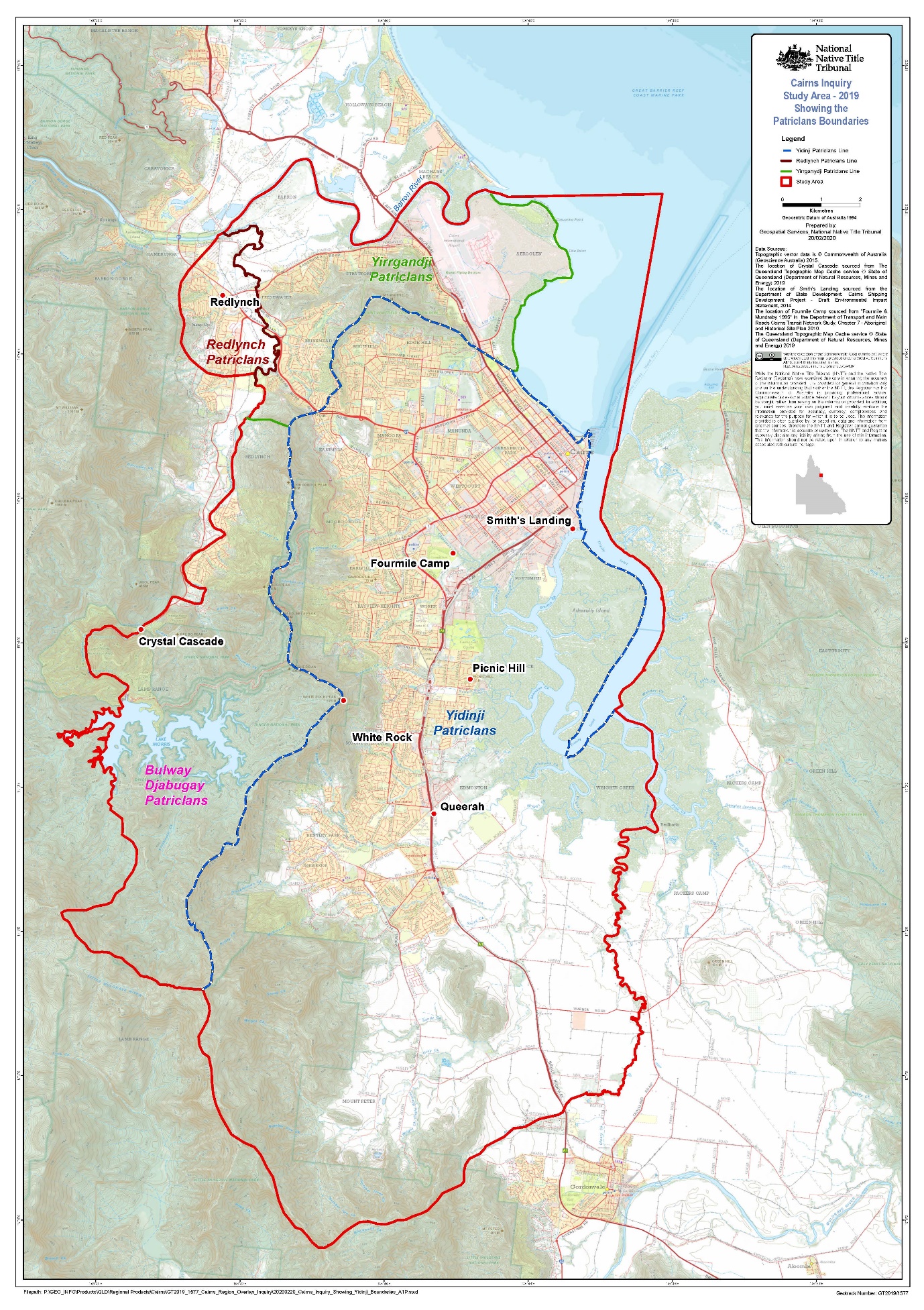
13 Attachment 1 is a map extracted from the Report visually depicting the referees’ findings (adopted by the Court) identifying which groups held rights and interests at sovereignty in respect of particular parts of the Study Area. It will be referred to as the Findings Map. As discussed in Singleton (at [40]), it depicts:
(1) an area north of Cairns and extending to the northern boundary of the Study Area described as “Yirrganydji Patriclans”;
(2) a large area encompassing the city of Cairns and extending to the southern and eastern boundaries of the Study Area, described as “Yidinji Patriclans”;
(3) an area extending to the western boundary of the Study Area described as “Bulway Djabugay Patriclans” extending northward to border the Yirrganydji Patriclans area and eastward to border the Yidinji Patriclans area; and
(4) an area in the north-west corner of the Study Area referred known as the “Redlynch Bump”, described as “Redlynch Patriclans”.
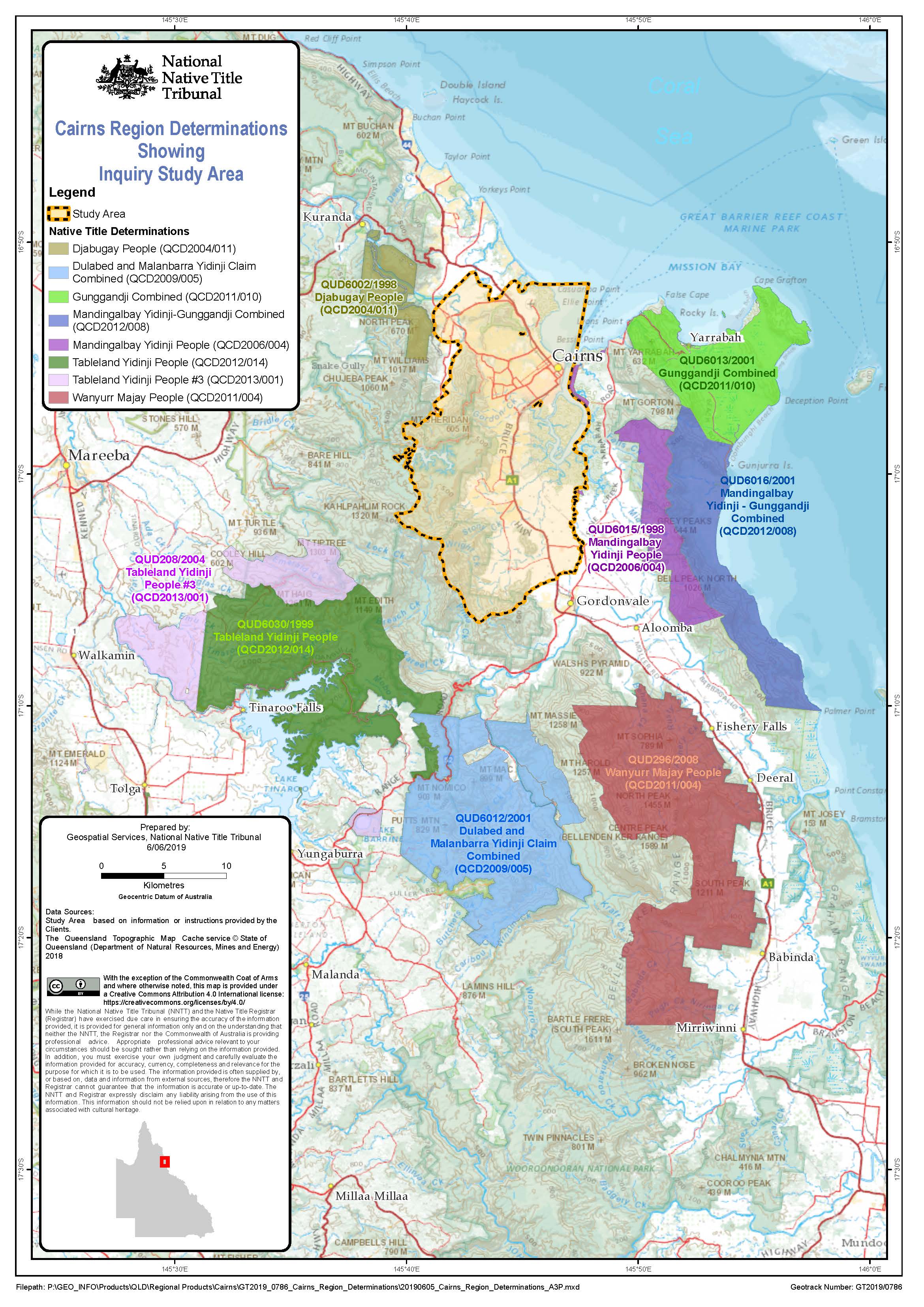
14 Attachment 2 is a map showing the Study Area (shaded in yellow) together with prior native title determinations that have been made in respect of areas proximate to it. Among other things, it depicts a combined consent determination in favour of the Kunggandji People in relation to an area east of the Study Area encompassing Yarrabrah and Cape Grafton (shaded in green) referred to with alternate spelling as the “Combined Gunggandji People Determination” (QUD6013/2001; Murgha on behalf of the Combined Gunggandji Claim v State of Queensland [2011] FCA 1511). It also depicts a consent determination in relation to an area made on the joint application of the Kunggandji People and the Yidinji People (shaded in blue) (QUD6016/2001; Mundraby on behalf of the Combined Mandingalbay Yidinji-Gunggandji People v State of Queensland [2012] FCA 1039). To the immediate west of the latter determination lies an area (shaded in magenta) subject to a consent determination made on the application of the Mandingalbay Yidinj People (QUD6015/1998; Mundraby v State of Queensland [2006] FCA 436).
15 I will refer to that map as the Determinations Map.
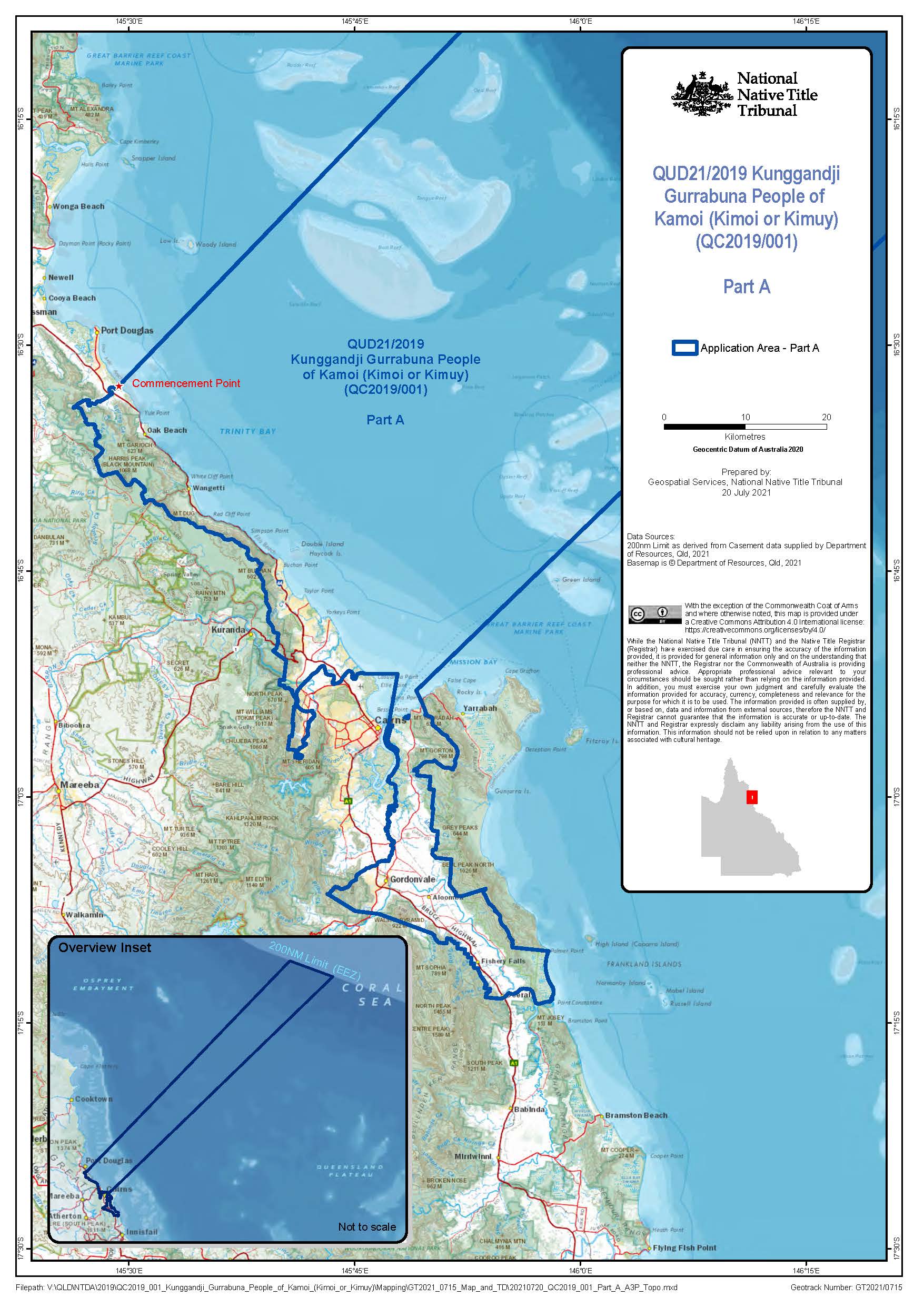
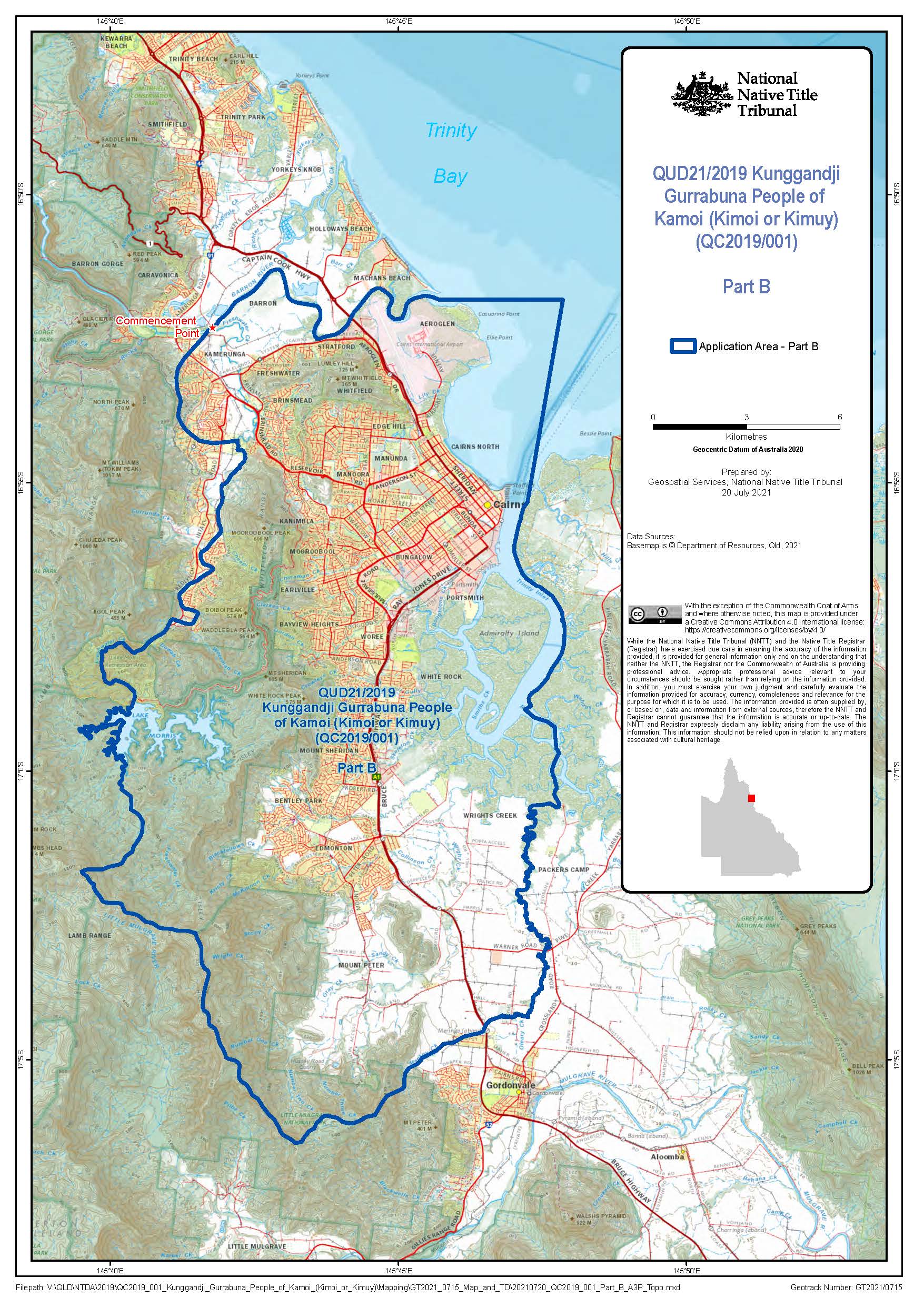
16 On 2 August 2021 the Court marked for identification a bundle of maps and descriptions prepared at the Court’s request by the National Native Title Tribunal (NNTT) depicting the external boundaries of the KGP claim area. The maps depict that part of the claim area that falls outside the Study Area (Part A Area) and the part that overlaps the Study Area (Part B Area).
17 Attachment 3 is a map of the Part A Area. As can be seen from that map, the KGP claim area covers a large region of land and waters not falling within the Study Area and not forming the subject of any findings adopted by the Court in any one of the Cairns Proceedings.
18 Attachment 4 is a map of the Part B Area.
Interlocutory applications
19 The Court now has before it an interlocutory application filed by the State on 7 September 2021 and the following interlocutory applications seeking the same or similar relief:
(1) an interlocutory application filed in this action on 7 September 2021 by the authorised applicant in the CRC Claim;
(2) an interlocutory application filed in this action on 7 September 2021 by Jeanette Singleton (one of the authorised applicants in the Yirrganydji Claims), in her capacity as the 13th respondent; and
(3) an interlocutory application filed in this action and in QUD23/2019 on 7 September 2021 by the authorised applicant in the GWY Claim.
20 To the extent necessary, I have granted the interlocutory applicants audience whether or not they are joined as parties in this proceeding.
21 The State’s primary position is that the whole of the KGP Claim should be struck out pursuant to s 190F(6) of the Native Title Act 1993 (Cth) (NT Act). In the alternative, it seeks orders that the proceeding be summarily dismissed pursuant to s 31A of the FCA Act insofar as it relates to the Study Area, together with consequential orders. In oral submissions the State also relied on r 28.67(1)(e) of the Rules as an alternative source of power for the dismissal of that part of the KGP Claim falling within the Study Area.
22 As explained in Singleton on behalf of the Yirrganydji Peoples v State of Queensland (No 2) [2021] FCA 1350 (Singleton No 2), I consider that if an order for dismissal is to be made consequent upon the adoption of the Report in connection with the Study Area, then the appropriate source of power is that conferred by r 28.67(1)(e) of the Rules. For the reasons given at [24] – [44] below, I have concluded that orders should be made on the application of the State dismissing KGP Claim pursuant to r 28.67(1)(e) of the Rules insofar as it covers the land and waters falling within the boundaries of the Study Area. As explained, at [45] – [76] below, so much of the KGP Claim that is not affected by that order should be dismissed pursuant to s 190F(6) of the NT Act.
23 The orders have the effect of eliminating the overlaps so making it unnecessary to make orders pursuant to s 67 of the NT Act providing for them to be heard in the one proceeding.
The application under rule 28.67
24 The effect of the Court’s order adopting the Report is to resolve a critical substantive question of fact arising on the originating application filed in this proceeding in connection with a part of the KGP claim area. The question is whether any one or more of the apical ancestors named in the description of the claim group held native title rights and interests in the Study Area in accordance with the traditional laws and customs referred to in the originating application at sovereignty. The adopted finding is that they did not: Report at [559]; Singleton at [104] and [173]. That substantive finding is fatal to the KGP Claim insofar as it covers the Study Area.
25 Rule 28.67(1) relevantly provides:
(1) After a report has been given to the Court, a party may, on application, ask the Court to do any of the following:
(a) adopt, vary or reject the report, in the whole or in part;
…
(e) give judgment or make an order in relation to the proceeding or question.
26 In Singleton No 2 (at [26]), I concluded that it was appropriate to exercise the power conferred under r 28.67(1)(e) of the Rules so as to give effect to the adopted finding in respect of the Yirrganydji Claims. I am satisfied that the same outcome should follow in respect of the KGP Claim.
27 In so concluding I have had regard to written and oral submissions made by the representative of the authorised applicant in the KGP Claim, Ms Sarah Addo. Ms Addo is a non-lawyer. She has previously made oral and written submissions at a contested hearing as to whether the Report should be adopted by the Court. Ms Addo repeated much of those submissions in opposing the orders now sought by the State and the other interlocutory applicants. I have previously rejected those submissions for the reasons given in Singleton. Whilst I do not propose to repeat all of those reasons here, I do consider it appropriate to address and acknowledge some matters raised by Ms Addo and relating to her representation of the KGP Claim group generally in this proceeding.
28 Ms Addo presented her oral submissions in a manner that was forceful yet respectful. Her submissions were presented in circumstances where she was remote from the place where the Court was sitting (as were all other parties). The conduct of the proceeding by video link made her task all the more difficult. Ms Addo informed the Court that her work in representing the claim group was undertaken in addition to her occupation caring for vulnerable Aboriginal youth. As far as the Court is aware, Ms Addo was the only Aboriginal person making submissions as an advocate in a complex multi-party dispute.
29 At times, Ms Addo’s submissions were emotionally charged. She is not at all criticised for that. The issues to which her submissions related are of the utmost importance, not only to the Aboriginal people she represents, but to all Australians.
30 Nor is Ms Addo criticised to the extent that the quality or correctness of her oral and written submissions was affected by her status as a non-lawyer. The task of the Court is to engage with the submissions insofar as they are relevant to the issues arising for determination on the interlocutory applications.
31 As observed in the Report, the impact of European settlement in northern Queensland was rapid and catastrophic for the Aboriginal occupants of the land and waters there, particularly in the vicinity of Cairns. Ms Addo submitted that there must be truth-telling in respect of the history of the region before and after colonisation. She expressed frustration that the legal processes leading up to the adoption of the Report have not served that objective so far as the Kunggandji Gurrabuna People were concerned. She submitted that the Court should revisit the order adopting the Report and that the overlapping claims should be remitted to a Registrar to be resolved by a conciliatory process with an emphasis on oral tradition.
32 Ms Addo’s submissions focussed particularly on the genealogy of members of the claim group descended from the apical ancestor “Kari”, the father of George Christian, and his location at or around the time of sovereignty. Ms Addo’s submissions included an assertion that the claim group also shared Yidinji genealogy and so held native title rights and interests in the Study Area by virtue of that lineage. She submitted that the referees were wrong to conclude that Kari did not possess native title rights and interests in the Study Area at sovereignty. She relied upon evidence relevant to that factual question, all of which either was, or could have been, adduced at the referees’ inquiry.
33 The inquiry undertaken by the referees had features similar to an adversarial trial. The parties were legally represented (including the authorised applicant in the KGP Claim). Experts were examined and cross-examined. There was a focus on written and oral submissions. The procedure was more in the nature of an arbitration than a mediation and has resulted in findings that are adverse not only to the KGP Claim but also, in part, to the Yirrganydji Claims and the GWY Claim (all of which have since been amended). Unlike a mediation directed at reaching a compromise in relation to facts, the issues determined by the referees were contested and the outcome was not directly agreed by consensus or compromise among those who participated in the procedure. For three of the four Aboriginal claimant groups the referees’ opinion was wholly or partially adverse.
34 The Report makes it plain that the task of answering the referred questions was not at all straight forward. The difficulty arose in part because of the rapid forced dislocation of Aboriginal people from their lands (including by violent means), resulting in the movement of surviving Aboriginal people into places traditionally occupied by other groups, including in some instances their removal to missions, as the evidence concerning Kari demonstrates. The experts who appeared before the referees expressed opinions on the basis of ethnographic and other records concerning the places at which the apical ancestors named in the various claim group descriptions were seen to be living at various times after sovereignty. All of that material was weighed by the referees. It was not perfect evidence and no single factor was determinative.
35 In considering Ms Addo’s submissions I have had regard to the unique nature of the rights and interests asserted by her on behalf of the claim group, some of whom are recognised as holding native title in the vicinity of Cape Grafton, east of the Study Area. They have previously been recognised as forming part of a traditional Aboriginal society whose laws and customs have survived the horrendous impacts of settlement in the area subject to that determination. Their ancient history forms a part of Australia’s history. They have participated in a difficult legal process that is itself the manifestation of the reception of English law in Australia.
36 As explained in Singleton, it is possible that another referee might have expressed a different opinion based on the same material. At the heart of Ms Addo’s submission was a contention that the true native title holders had not been identified, so as to justify a reversal of all that had occurred in the Cairns Proceedings since the mediation to which I have earlier referred. That contention must be rejected, even if it could be demonstrated that a factual finding more favourable to the Kunggandji Gurrabuna People was available to be made on the evidence before the referees. As explained below, Ms Addo’s submissions must be rejected because to do otherwise would be to undermine the objectives of the NT Act.
37 In Mabo v Queensland (No 2) (1992) 175 CLR 1 the High Court rejected the doctrine that Australia was terra nullius at the time of European settlement. It held that the common law of Australia recognises a form of native title held by Aboriginal and Torres Strait Islanders that was not affected by the assertion of sovereignty by the British Crown, but was nonetheless vulnerable to extinguishment by later acts inconsistent with their continued existence. The preamble to the NT Act sets out the considerations taken into account by the Parliament of Australia in its enactment. It acknowledges that the people whose descendants are known as Aboriginal peoples and Torres Strait Islanders were the inhabitants of Australia before European settlement and that they have been progressively dispossessed of their lands largely without legal compensation. It confirms that a special procedure needs to be available for the just and proper ascertainment of native title rights and interests which will ensure that, if possible, that is done by conciliation and, if not, in a manner that has due regard for their unique character.
38 The main objects of the NT Act include the establishment of a mechanism for determining claims to native title: NT Act, s 3(c). Section 87 and s 87A of the NT Act provide mechanisms for the determination of native title by consent. This Court devotes substantial judicial and administrative resources to disputed native title claims with a view to avoiding adversarial litigation that must necessarily follow under the NT Act if disputes cannot be resolved consensually. The preamble to the NT Act and the procedures of this Court recognise that adversarial litigation is a mode of dispute resolution that in many instances will be ill-suited to the resolution of native title disputes, given the unique character of the rights and interests in issue. Importantly, the preamble also recognises the need for Aboriginal people to fully participate in decisions concerning the most appropriate procedure among those that are available under the NT Act for the resolution of disputes in relation to their claims, including disputes between Aboriginal groups.
39 Plainly the claim groups in the Cairns Proceedings could not reach a consensual position as to who possessed native title in the Study Area at the time of the assertion of sovereignty. I have no doubt that the difficulty in reaching a consensus on that question arose in part because of the shattering effect of settlement in the region and the sparseness of written records relating to the period immediately after first contact. Written records can only be as good as the observations of those few Europeans who were paying attention to the plight of Aboriginal people at sovereignty and in the short period following. I also have no doubt that the boundaries of the land and waters occupied by the Aboriginal groups in the region were not as absolute as those depicted on the two dimensional maps attached to these reasons.
40 There has nonetheless been a successful mediated outcome in the Cairns Proceedings in the sense that the relevant parties reached an agreement about the procedural mechanism by which their impasse should be overcome. It is highly significant that the agreement recorded in the Protocol Deed is one reached by the Aboriginal parties in the Cairns Proceedings. The State was not a party to it. The orders of Robertson J were made not on the Court’s own initiative, but on the joint application of the Aboriginal parties. Their agreement was to the effect that the question would be put to referees jointly chosen by them and (importantly) that they would each accept the answer that was given. The referees’ inquiry was publicly funded and the authorised applicant was legally represented. To the extent that there ever existed a basis to set the Protocol Deed aside, the time to agitate that issue has long passed. It would be anathema to the objects of the NT Act for this Court to interfere with, or undermine, decisions reached by Aboriginal parties as to the most appropriate procedural mechanism for the resolution of disputes arising between them.
41 The Court should not be understood to express any view as to the desirability of resolving critical factual questions in native title proceedings by resorting to the referral procedures under s 54 of the FCA Act or equivalent Rules. It is enough to observe that the Aboriginal parties in the Cairns Proceedings considered that to be the most desirable procedure to resolve matters of tremendous importance to them. The Aboriginal parties are best placed to decide how the disputes giving rise to their overlapping claims should be resolved. It was open to any one of them to insist upon an adversarial trial, with all of the advantages and disadvantages attending such a costly procedure. At the end of such a trial, it is likely that one or more of them would have been disappointed with the outcome, just as one or more of them is disappointed by the findings in the Report and the Court’s more recent decision to adopt it for the purpose of substantively resolving the referred questions.
42 I have carefully considered Ms Addo’s submission that the parties should return to a conciliatory process, as well as her emphasis on the oral traditions of Aboriginal people. However, to intervene in the way contended for would be to disempower all of the parties to the Protocol Deed in respect of their past decisions and so bring the administration of justice in native title proceedings in this Court into disrepute. It is neither necessary nor appropriate to revisit the factual inquiry undertaken by the referees or to reconsider the order adopting the Report, notwithstanding Ms Addo’s submissions as to alternate findings the referees could or should have made on the material before them.
43 The authorised applicant in the KGP Claim has been afforded the opportunity to amend the originating application in a manner that reflects the adopted findings in relation to the Study Area. That has not been done. The progression of the claims overlapped by the KGP Claim in the Study Area is prejudiced by the failure to amend. For the above reasons, I will make an order pursuant to r 28.67(1)(e) dismissing the KGP Claim to the extent that the claim area covers the Study Area. The order is made because the adoption of the Report renders the remaining allegations in respect of the Study Area unnecessary to decide.
44 Whilst it may be open to the Court to dismiss the whole of the KGP Claim under s 190F(6) and to make no order dealing discretely with the Study Area, I consider an order discretely pertaining to the Study Area is necessary to reflect the legal consequence of the Court’s adoption of the Report. The consequence is that the KGP Claim is dismissed on its substantive merits insofar as it covers that area, even if it could be shown that there might previously have existed an arguable case in respect of it.
The application under section 190F(6)
45 Section 62 of the NT Act sets out the requirements for a native title claimant application. Relevantly, the application must be accompanied by an affidavit sworn by the applicant that contains details specified in s 62(2), which includes:
(e) a general description of the factual basis on which it is asserted that the native title rights and interests claimed exist and in particular that:
(i) the native title claim group have, and the predecessors of those persons had, an association with the area; and
(ii) there exist traditional laws and customs that give rise to the claimed native title; and
(iii) the native title claim group have continued to hold the native title in accordance with those traditional laws and customs.
46 The accompanying affidavit must contain a statement that the applicant believes that all of the statements made in the application are true: NT Act, s 62(1)(a)(iii).
47 Part 7 of the NT Act makes provision for the keeping of a Register of Native Title Claims. The Register is established by s 185. If the Registrar is given a copy of a claimant application, the Registrar must consider the claim made in the application in accordance with s 190A. The Registrar must accept the claim for registration if the claim satisfies all of the conditions in s 190B and s 190C: NT Act, s 190A(6)(b). If the Registrar is not satisfied that those conditions are fulfilled, the Registrar must not accept the claim for registration: NT Act, s 190A(6B). In considering a claim under s 190A, the Registrar is not restricted to the statements set out in the application, and may refer to additional material: s 190A(3).
48 If a claim is not accepted for registration, the Registrar must give the Court written notice of the decision including (relevantly) a statement of reasons which includes the Registrar’s opinion as to whether the claim satisfies all of the conditions in s 190B. The applicant may apply to the NNTT to reconsider the claim made in the application (s 190E), or to the Court to review the decision (s 190F(1)).
49 The delegate was not satisfied that the KGP Claim fulfilled the conditions mentioned in s 190B(2) to (8) and s 190C and so refused to accept the KGP Claim for registration. It is sufficient for present purposes to focus on the conditions for registration in s 190B(5) and (6). They provide:
Factual basis for claimed native title
(5) The Registrar must be satisfied that the factual basis on which it is asserted that the native title rights and interests claimed exist is sufficient to support the assertion. In particular, the factual basis must support the following assertions:
(a) that the native title claim group have, and the predecessors of those persons had, an association with the area; and
(b) that there exist traditional laws acknowledged by, and traditional customs observed by, the native title claim group that give rise to the claim to native title rights and interests; and
(c) that the native title claim group have continued to hold the native title in accordance with those traditional laws and customs.
Prima facie case
(6) The Registrar must consider that, prima facie, at least some of the native title rights and interests claimed in the application can be established.
50 For the claim to fulfil the condition in s 190B(5), the Registrar must be satisfied that the factual basis on which it is asserted that the claimed native title rights and interests exist is sufficient to support the assertion. Among other things, the factual basis must support the assertion that the native title claim group have, and the predecessors of those persons had, an association with the area. The test is not an onerous one. As discussed by Mansfield J in Northern Territory v Doepel (2003) 133 FCR 112 (at [17]), s 190B(5):
… requires the Registrar to address the quality of the asserted factual basis for those claimed rights and interests; but only in the sense of ensuring that, if they are true, they can support the existence of those claimed rights and interests. In other words, the Registrar is required to determine whether the asserted facts can support the claimed conclusions. The role is not to test whether the asserted facts will or may be proved at the hearing, or to assess the strength of the evidence which may ultimately be adduced to establish the asserted facts.
(emphasis added)
See also Gudjala People No 2 v Native Title Registrar (2008) 171 FCR 317; Martin v Native Title Registrar [2001] FCA 16, French J (at [22]).
51 Justice Mansfield said that whilst the condition in s 190F(5) required the presentation of evidentiary material, the evidentiary focus was a confined one (at [18]):
… It is not the same focus as that of the court when it comes to hear and determine the application for determination of native title rights and interests. The focus is upon the relationship of at least one member of the native title claim group with some part of the claim area. It can be seen, as with s 190B(6), as requiring some measure of substantive (as distinct from procedural) quality control upon the application if it is to be accepted for registration.
52 His Honour went on to discuss the difference between the conditions in s 190B(5) and (6):
126 Clearly the requirements upon registration imposed by s 190B should be read together. Section 190B(6) requires the Registrar to consider that, prima facie, at least some of the native title rights and interests claimed can be established. It is necessary that only the claimed rights and interests about which the Registrar forms such a view are those to be described in the Native Title Register: see s 186(1)(g). It is therefore clear that a native title determination application may be accepted for registration, even though not all the claimed rights and interests, prima facie, can be established. Section 190B(6) requires some measure of the material available in support of the claim.
127 On the other hand, s 190B(5) directs attention to the factual basis on which it is asserted that the native title rights and interests are claimed. It does not itself require some weighing of that factual assertion. That is the task required by s 190B(6). As counsel for the Territory also pointed out, addressing s 190B(6) may also require consideration of controverting evidence. Indeed, in Martin at [22] and [27] French J pointed out that the Registrar had erred in formulating the questions posed by s 190B(5) as being whether he was satisfied as to the existence of the three matters referred to in subcl (a), (b) and (c).
53 In Gudjala, the Full Court approved Mansfield J’s analysis and confirmed that the applicant is not required to provide evidence that proves directly or by inference the facts necessary to establish the claim (at [92]). However, when assessing information provided by the applicant under s 62(2)(e) of the NT Act, the Registrar is not obliged to accept broad or generalised assertions made in an application which have no geographical particularity: Martin (at [26]).
The delegate’s decision
54 The delegate observed that the sea portion of the KGP Claim made up a majority of the claim area. So much is obvious from the map of the Part A Area. In respect of that portion, the delegate said (at [48]):
… beyond references in the material to the use of watercraft and dug-out canoes by the Kunggandji to travel up creeks from the coast, or out to islands a short distance from the coast, there is no material before me addressing a physical or spiritual association of the group and its predecessors with the large area of waters east of the coastal islands. It follows, in light of the case law outlined above, that I cannot be satisfied the material supports an association with the whole of the area claimed.
55 The delegate went on to conclude that the materials provided in support of the claim did not support the assertion that the predecessors of the claim group had an association with the landbased portion of the claim area at the time of European settlement (which she took to occur in the late 1870s). In respect of that portion, the delegate said:
51 A number of anthropological maps, which appear in extracts from the George Christian Family Report, show the territory of the groups occupying the region surrounding Cairns across the period since early European settlement. The maps include one prepared by Parry-Okeden (Queensland Police Commissioner), and others by Roth (1897), McConnel (1939), Tindale (1974), Dixon (1976), Bottoms (1990), and Davis (1993). There are also descriptions from anthropologists, including Roth, Tindale and Birdsell, of the areas with which the Kunggandji were or are associated. In all of these maps and descriptions, Kunggandji country is recorded as extending only to Cape Grafton Peninsula, including False Cape, then south to the mouth of the Mulgrave River (however, many maps do not extend Kunggandji territory this far south).
52 The application overlaps entirely the area subject of the Gimuy Walubara Yidinji People (QC2012/017; QUD631/2012). The factual basis material before me which provides support for a pre-settlement association of the Kunggandji with the area southwest of Cairns subject of the Gimuy Walubara Yidinji People application, is a statement that appears in an extract from a source by Dixon, ‘A Grammar of Yidin’, which provides: ‘Yidinji myths clearly state their present (coastal) territory was at one time occupied exclusively by the Gunggandji ...’.
53 I note that the registered Gimuy Walubara Yidinji People application includes a small portion of coastal territory, however, with no reference to place names or locations, and in light of the contradictory information before me regarding the traditional territory of the Kunggandji, I do not consider this statement sufficient support for the assertion that the Kunggandji predecessors previously had an association with the area southwest of Cairns subject of the Gimuy Walubara Yidinji People application.
54 Similarly, the application area overlaps parts of native title determination applications brought on behalf of the Yirrganydji People native title claim group (see QUD602/2012; QUD337/2015; QUD692/2016), including a long strip of coastline stretching north of the Trinity Inlet, including Wangetti and Oak Beaches, up to Craiglie. In all of the anthropological maps provided in the material, it is the Yirrganydji who are identified as being associated with this area. This is a further reason why I do not consider the factual basis material sufficient in supporting an association of the Kunggandji Gurrabuna People of Kamoi (Kimoi or Kimuy) with the whole of the application area.
55 I also have before me a map which shows the specific estate areas within Kunggandji country that the two moieties of Kunggandji are associated with, taken from the George Christian Family Report prepared in 1996. This map again indicates that Kunggandji country is limited to the area comprising Cape Grafton and False Cape, extending in the north to just short of the entry to Trinity Inlet, and in the south to the northern part of the Malbon Thompson Forest Reserve. I note that the native title claim group who have brought this application appear to distinguish themselves from the broader Gunggandji native title claim group (who brought the adjacent application, now determined, covering the area surrounding and including Yarrabah) on the basis that they are of the ‘Gurrabuna Clan and moiety.’ The map appears to suggest that this moiety group is, in fact, associated only with certain estates within the wider Gunggandji/Kunggandji country. This is another reason why I do not consider the factual basis sufficient to support an association of the group with the whole of the area claimed.
56 In light of these reasons set out above, I am not satisfied the factual basis is sufficient to support an association of the Kunggandji Gurrabuna People of Kamoi (Kimoi or Kimuy) and their predecessors with the application area.
(footnote omitted)
56 The delegate was also not satisfied that there was sufficient material to support the assertion that there existed traditional laws acknowledged by, and customs observed by, the claim group that gave rise to the claim to native title rights and interests within the claim area. The delegate observed that the material relating to traditional laws and customs was confined to the region of Yarrabah.
57 The delegate’s conclusions under s 190B(5) informed her consideration of the condition in s 190B(6). The identified insufficiency of the factual assertions to support the claim had the consequence that the delegate was not satisfied that prima facie the claimed native title rights and interests could be established in any respect.
58 The delegate also concluded that procedural conditions in s 190C of the NT Act were not met and so concluded that the claim must not be accepted for registration.
The power in section 190F of the NT Act
59 Section 190E makes provision for an applicant to make an application for the claim to be reconsidered by the NNTT if it is not accepted for registration by the Registrar. A reconsideration application must be made within 42 days of notification of the delegate’s decision. None has been made.
60 Relevantly, s 190F(1) makes provision for the applicant to apply to this Court for review of a decision not to accept a claim for registration. No application for review has been made.
61 Section 190F(5) and (6) of the NT Act provide:
(5) Subsection (6) applies in a case where:
(a) the Registrar does not accept the claim for registration either because, in the opinion of the Registrar or, if the claim is reconsidered under section 190E, of the member of the NNTT reconsidering the claim:
(i) it does not satisfy all of the conditions in section 190B; or
(ii) it is not possible to determine whether all of the conditions in section 190B have been satisfied because of a failure to satisfy section 190C; and
(b) the Court is satisfied that the avenues for:
(i) the reconsideration under section 190E of the Registrar’s decision; and
(ii) the review under this section of the Registrar’s decision; and
(iii) the review of orders made in the determination of an application under this section; and
(iv) the review of the Registrar’s decision under any other law;
have all been exhausted without the registration of the claim.
(6) The Court may, either on the application of a party or on its own motion, dismiss the application in which the claim was made (the application in issue) if:
(a) the Court is satisfied that the application in issue has not been amended since consideration by the Registrar, and is not likely to be amended in a way that would lead to a different outcome once considered by the Registrar; and
(b) in the opinion of the Court, there is no other reason why the application in issue should not be dismissed.
62 For the purposes of s 190F(5) I am satisfied that all avenues for reconsideration and review of the delegate’s decision have been exhausted without the registration of the KGP Claim. In that regard, it is sufficient to observe that Ms Addo did not express any intention to apply for an extension of time in which to make an application under s 190E, nor did she express any intention to apply to this Court for a review of the decision. The various avenues are exhausted in the sense that there is no intention on the part of the applicant to avail itself of any one of them. It follows that s 190F(6) applies.
63 For the purposes of the first limb of s 190F(6)(a), the application has not been amended since it was considered by the delegate in March 2019. The remainder of the test casts a practical burden on the applicant in the sense discussed by Barker J in Sambo v State of Western Australia [2015] FCA 954:
31 The simple fact is that the relevant provisions of the NTA enable an apparently unmeritorious application – that is to say, one which has failed the registration test and in relation to which there is no pending reconsideration or judicial review – to be dismissed. The statutory provision recognises that such applications should not clog up the court system.
32 When any such application or motion is made for dismissal, the question is whether the claimant application should be dismissed. At that point the terms of s 190F(6)(a) and (b) come into play. It is then for an applicant, if it wishes to resist the dismissal, to put evidence before the Court that will lead to the Court not being satisfied that the application has not been amended since consideration by the Registrar and is not likely to be amended in a way that would lead to a different outcome once reconsidered by the Registrar; and in relation to the question whether there is no other reason why the claimant application should not be dismissed.
33 In that regard, there is a practical onus on an applicant to cause evidence to be supplied to the Court that may lead to the Court not being satisfied about those matters and not forming that relevant opinion: see Fazeldean on behalf of the Thalanyji People (No 2) v State of Western Australia [2012] FCA 1163 at [66].
34 In effect the proceeding now before the Court is in the nature of a show cause proceeding. The applicant has the opportunity to produce materials to show the Court that, notwithstanding the satisfaction of the preconditions to the exercise of the dismissal power, the application is likely to be amended in some way that would lead to a different outcome and/or there is another reason why the application should not be dismissed.
35 A practical burden falls on the applicant in this case therefore to deal with the different bases upon which the amended application failed the registration test and to show how a further amendment may be possible which would lead to a different outcome on a reconsideration; or that there is some other reason why the application should not be dismissed.
64 As Logan J said in Christine George & Ors on behalf of the Gurambilbarra People v State of Queensland [2008] FCA 1518 (at [56]), whether a claim is likely to be amended in a way that would lead to a different outcome involves an evaluative and predictive assessment. To make that assessment, the Court must have regard to the reasons why the registration of the application has been refused, and to consider whether any proposed amendment would lead to a different outcome, ie: that it would lead to a decision to accept the claim for registration. His Honour continued:
… There must be something … which provides a reasonable foundation for the predictive value judgment called for in s 190F(6)(a) to be made. The evidence before me did not arise above the raising of a possibility that, at some uncertain time in the future, further evidence might possibly be obtained which might, in turn, possibly generate an amendment of an unidentified kind of the application in its present form. That is a long way short of what is needed, even taking a benign view of the meaning to be given to the word ‘likely’. Further, it is quite impossible on the evidence to reach any predictive conclusion at all as to whether any amendment would lead to a different result upon reconsideration of an application so amended by the Registrar.
65 Logan J’s approach was followed by Barker J in Fazeldean on behalf of the Thalanyji People (No 2) v State of Western Australia [2012] FCA 1163 (at [66]):
… while the Court might consider the anthropological or ethnographic research material now put forward by or on behalf of the claim group, the Court should not speculate about other information that might be put forward. Thus it would not be open, in my view, for the Court to adopt a very broad proposition put on behalf of counsel for the applicants, that the Court should anticipate that additional information will be provided to the Registrar or delegate upon issues being raised by the Registrar or delegate after further consideration of an amended application. It is one thing for the Court to accept that further questions might be directed to the applicants by the Registrar or delegate upon further consideration of an amended application, but it is another to speculate about what that might be and to further speculate that the Registrar or delegate would be satisfied that registration is appropriate in light of such further material. The point is an obvious one: the claim group at this point is aware of the reasons why the application initially failed the registration test. Thus the claim group knows what sort of material it needs to put up to overcome the deficiencies earlier identified. If the applicants have information relating to those matters, then it no doubt should put that information forward at this point. In the absence of any evidence about those matters, or evidence pointing to those matters which suggest that there are indeed other items of information that might reasonably be put forward, then the Court simply would be speculating. There is a practical onus on the claim group therefore to put forward all relevant material at this point that it says would be reflected in an amended application, which amended application, in their view, would lead to a different outcome than occurred before.
66 A notable feature of Ms Addo’s submissions was the absence of any express intention on behalf of the applicant to amend the KGP Claim, whether for the purpose of reducing the external boundaries of the claim area or for the purpose of addressing the various deficiencies identified by the delegate. When prompted to address the topic of amendment, Ms Addo foreshadowed only that the applicant might seek to amend the name of the claim group so as to incorporate the word Yidinji as a signal of an alternate source of ancestral connection with the Study Area. As I have mentioned above, it is plain from Ms Addo’s written and oral submissions that the applicant intends to persist with the whole of the KGP Claim as presently formulated in respect of the whole of the sea and land based portions of the KGP claim area.
67 I take into account the circumstance that upon making an order adopting the whole of the Report, the Court fixed a date by which the applicant in any one of the Cairns Proceedings were to apply for leave to amend their claims and that no application for leave to amend was made on behalf of the Kunggandji Gurrabuna People within the timeframe fixed by the Court. Although Ms Addo is a non-lawyer, I consider that the applicant has the capacity to understand the delegate’s reasons and to prepare materials that address the matters that caused the delegate to refuse to accept any part of the KGP Claim for registration. In the ordinary course, litigants in the applicant’s position (particularly those without the benefit of legal representation) ought to be provided with a reasonable opportunity to make amendments to address all shortcomings that are capable of being addressed if that is what they are willing to do.
68 I am also prepared to assume that the persons comprising the applicant have been engaged for some time with the referral process and its consequences and not with the circumstance that the KGP Claim had been refused registration. However, even if the applicant had the present capacity to make the required amendments and to prepare supporting materials, I am not satisfied that there exists a will on their part to do so. It may confidently be predicted that the KGP Claim is unlikely to be amended in any substantive respect at all.
69 In circumstances where there is no amendment within the applicant’s contemplation, it is not possible for the Court to identify whether any contemplated amendment (if made) would be likely to lead to a different outcome upon the amendment being considered by the Registrar against the requirements of s 190B or s 190C of the NT Act. As discussed in Fazeldean, the Court should not speculate about the amendments that might hypothetically be made or the material that might hypothetically be forthcoming that might cause the Registrar to be satisfied that the conditions for registration are fulfilled. That is especially so given the multiple deficiencies affecting the claim in its present form arising under s 190B(2) to (8) inclusive, as well as numerous procedural deficiencies identified under s 190C. The defects are not minor. In the absence of a clearly articulated foreshadowed amendment it is not at all obvious whether and how they might be cured, and it is not for the Court to speculate about the combinations and permutations of changes that could conceivably made to achieve registration.
70 That conclusion is sufficient in and of itself to satisfy the second limb in s 190F(6)(a) of the NT Act.
71 For the State it was submitted that the Court should go further and conclude that the adoption of the Report renders it difficult, if not impossible, for the KGP Claim to be amended in a way that could satisfy s 190F(6) of the NT Act, not only in respect of the Study Area but in respect of the larger expanse of the KGP claim area. The submissions proceeded from the premise that the Court’s order adopting the Report would be something to which the Registrar must have regard in determining whether the condition in s 190B(6) was met in the event that an amended application were now to be filed. The State’s submissions addressed the KGP claim area in four parts and identified why an amended native title claim directed to any one of them would be untenable or otherwise unlikely to succeed. The gist of the submissions was that the KGP applicant will now have difficulty establishing even a prima facie case that the claim group possesses native title in areas that are geographically removed from the area subject to the consent determinations in Murgha and Mundraby, and particularly in areas to the north and west of the Study Area, as illustrated by the Determinations Map and the Findings Map viewed together. The State submitted that it would be very unlikely for members of the same Aboriginal society to possess native title rights and interests in two places geographically interrupted by land and waters in respect of which members of another society have been held to possess native title at sovereignty. The determination in favour of the Mandingalbay Yidinji-Gunggandji People (shaded in magenta on the Determinations Map) was pointed to as an intervening determination of that kind.
72 I accept that the Registrar may permissibly have regard to the adopted findings expressed in the Report (as depicted in the Findings Map) in the event that an amended application were to be filed. As Mansfield J identified in Doepel, the task under s 190F(6) may require consideration of controverting evidence. The task may also require consideration of past determinations as well as substantive findings made in native title proceedings (whether adopted or otherwise) that are not yet finalised. I also accept that the adopted findings render it impossible for the applicant in the KGP Claim to file an amended claim that covers any part of the Study Area that could be tenable, even on a prima facie basis insofar as native tile is claimed to be possessed by a process of descent from the named apical ancestors. Speaking in the abstract, the adopted findings in the Study Area may conceivably lead the Registrar to consider that an amended claim relating to land or waters outside of the Study Area cannot be established on the prima facie basis required by s 190F(6) of the NT Act. It may be that that negative state of mind may be more readily reached in some portions of the Part A Area than in others. Speaking in the abstract, and in the absence of evidentiary materials, I do not consider it untenable that the Kunggandji Gurrabuna People possess native title rights and interests in the area to the immediate west of the green shaded area on the Determinations Map, but I will not express a concluded view on that question.
73 I have concluded that it is neither necessary nor appropriate to express any view as to whether an amended claim in respect of the areas forming the subject of the State’s submissions (other than the Study Area) could be cast in terms that are both legally tenable and factually meritorious when assessed against the low thresholds in s 190B(5) and (6) of the NT Act. It is not necessary to do so because, as I have said, there is no present intention on the part of the applicant to make any amendment at all, nor is there anything before the Court to indicate what supporting material might be put forward in the event that any amendment were to be made. To my mind, the Court’s opinion on the topic could rise no higher than supposition as to what material might be put forward to support an amended claim in relation to any portion of the Part A Area in the future. It is not inconceivable that an amended claim could be registrable on a factual basis that at least partially satisfied s 190B(6). That of itself is a reason to say nothing more on the topic. In the event that a new claim is lodged and accepted for filing by the Court, the task of assessing the claim against the requirements for registration will be for the Registrar to undertake having proper regard to the material then filed. That task should be undertaken without the Court expressing a view as to what should be the correct outcome.
74 Moreover, if the State’s position is that no claim in respect of any portion of the Part A Area could tenably be made in the future by reason of the Court’s adoption of the Report as it relates to the Part B Area, then the appropriate procedure is to apply for an order summarily dismissing or striking out the KGP Claim in its present form as having no reasonable prospect of success. But the State has not made an application for relief of that kind in respect of the Part A Area. Its application for summary judgment was confined to that part of the claim that covered the Study Area.
75 Insofar as the KGP Claim covers the Part A Area, it will be dismissed on the basis that there are no anticipated amendments directed to addressing the deficiencies identified in the delegate’s decision and not by reference to the tenability of any amended claim that might hypothetically have been foreshadowed by a willing applicant.
76 For the purposes of s 190F(6)(b), the Court’s attention has not been drawn to any circumstance that would constitute a reason not to dismiss the claim. To the contrary, I am confident that unless the KGP Claim is dismissed, the applicant will remain unwilling to prepare a claim that meets the test for registration, particularly a claim that can be established on a prima facie basis, having regard to the Court’s adoption of the Report. I am not otherwise satisfied that it is in the interests of justice to permit the KGP Claim to proceed to trial in respect of the Part A Area.
77 If I am wrong in dismissing the KGP Claim in relation to the Study Area in the exercise of the power conferred under r 28.67(1)(e) of the Rules, I would in that event dismiss the entirety of the claim in the exercise of the power conferred by s 190F(6) of the NT Act.
78 In the circumstances, it is unnecessary to give separate consideration to the application for orders dismissing the KGP Claim made by the other interlocutory applicants.
I certify that the preceding seventy-eight (78) numbered paragraphs are a true copy of the Reasons for Judgment of the Honourable Justice Charlesworth. |
Associate:
Attachment 1 – Findings Map
Attachment 2 – Determinations Map
Attachment 3 – Part A Area Map
Attachment 4 – Part B Area Map
QUD 21 of 2019 | |
DOUGLAS SHIRE COUNCIL | |
Fifth Respondent: | MAREEBA SHIRE COUNCIL |
Sixth Respondent: | HENRIETTA MARRIE |
Seventh Respondent: | SEITH HARDY FOURMILE |
Eighth Respondent: | DEWAYNE CLINTON MUNDRABY |
Ninth Respondent: | MANDINGALBAY YINDINJI ABORIGINAL CORPORATION |
Tenth Respondent: | WILLIAM BRIM |
Eleventh Respondent: | NORTH QUEENSLAND LAND COUNCIL ABORIGINAL CORPORATION |
Twelfth Respondent: | CAPE YORK LAND COUNCIL ABORIGINAL CORPORATION |
Thirteenth Respondent: | JEANETTE SINGLETON |
Fourteenth Respondent: | KERRY SHEPPARD |
Fifteenth Respondent: | GEORGE SKEENE |
Sixteenth Respondent: | ERGON ENERGY CORPORATION LIMITED ACN 087 646 062 |
Seventeenth Respondent: | FAR NORTH QUEENSLAND PORT CORPORATION LIMITED ACN 131 836 014 |
Eighteenth Respondent: | TELSTRA CORPORATION LIMITED ABN 33 051 775 556 |
Nineteenth Respondent: | AFL CAIRNS LIMITED ACN 010 616 798 |
Twentieth Respondent: | CAIRNS AIRPORT PTY LTD ACN 132 228 221 |
Twenty-First Respondent: | SKYRAIL PTY LTD |
Twenty-Second Respondent: | DEAN MAHONEY |
Twenty-Third Respondent: | CAIRNS DISTRICT JUNIOR RUGBY LEAGUE LIMITED |
Twenty-Fourth Respondent: | HARTLEY’S CREEK CROCODILE FARMING COMPANY PTY LTD T/AS HARTLEY’S CREEK CROCODILE ADVENTURES |
Twenty-Fifth Respondent: | THE CAIRNS CULTURAL CO-ORDINATING ASSOCIATION INC |
Twenty-Sixth Respondent: | DUANE CASH |
Twenty-Seventh Respondent: | BRUCE MOGENSEN |
Twenty-Eighth Respondent: | STEVE ROSE |


