

Federal Court of Australia
Zheng v Minister for Immigration, Citizenship, Migrant Services and Multicultural Affairs [2021] FCA 1509
ORDERS
Applicant | ||
AND: | MINISTER FOR IMMIGRATION, CITIZENSHIP, MIGRANT SERVICES AND MULTICULTURAL AFFAIRS Respondent | |
DATE OF ORDER: |
THE COURT ORDERS THAT:
1. The application is dismissed.
2. The applicant pay the costs of the respondent.
Note: Entry of orders is dealt with in Rule 39.32 of the Federal Court Rules 2011.
CHEESEMAN J:
INTRODUCTION
1 The applicant, Jiaxing Zheng, seeks judicial review pursuant to s 476A(1)(c) of the Migration Act 1958 (Cth) of a decision under s 501CA(4) of the respondent, the Minister for Immigration, Citizenship, Migrant Services and Multicultural Affairs, not to revoke the mandatory cancellation of Mr Zheng’s Class CA Subclass 143 Contributory Parent visa.
2 The relief sought by Mr Zheng in his originating application is an order quashing the decision of the Minister and a writ of mandamus remitting the matter to the Minister for determination according to law. The Court’s jurisdiction to review the decision of the Minister is the same as the jurisdiction of the High Court pursuant to s 75(v) of the Constitution: s 476A(2).
3 Mr Zheng is a citizen of the People’s Republic of China (PRC). He moves on an originating application of 19 May 2021. The Minister’s decision is challenged solely on the basis that the Minister made a finding for which it is contended there was no evidence, or more accurately, no material. The impugned finding is that Mr Zheng, as a citizen of the PRC, “would have the same access to welfare … and public support as other nationals.”
4 For the reasons that follow, the application is dismissed.
Background
5 Mr Zheng came to Australia on 18 January 2014, and on 4 December 2015 was granted a visa.
6 On 29 July 2020, Mr Zheng was convicted in the District Court of New South Wales of a number of offences including having sexual intercourse with a person between the age of 14 and 16 years and producing and disseminating child abuse material. The disseminated material was a video of sex acts between Mr Zheng, then aged 19 years, and the victim, then aged 15 years. At the time the video was made, they were in a sexual relationship notwithstanding that the victim was below the age of consent. The victim agreed to being videoed and, initially, to Mr Zheng retaining the video for private viewing. The circumstances relating to the dissemination of the video were described by the Minister as follows:
39. In March 2018 the relationship between Mr ZHENG and the victim ended. At that time the victim asked for the video recording to be deleted and Mr ZHENG gave her his mobile phone so she could do so. Unbeknown to the victim, Mr ZHENG either retained or later recovered a copy of the video.
40. At the time of the breakup, the victim also removed Mr ZHENG from her social media messaging apps. Later, in October 2018, Mr ZHENG sent fresh friend requests to the victim via QQ and Wechat apps, asking to speak to her. The messages stated that there would be ‘consequences’ if the victim did not accept this friend request. In subsequent messages Mr ZHENG asked about a vehicle he had seen in the victim’s driveway and enquired whether it belonged to her new boyfriend. When the victim replied ‘I am not your girlfriend, we are nothing to each other’, Mr ZHENG replied ‘If we are nothing to each other then I can post those things’.
41. The victim was afraid that Mr ZHENG was referring to the video of her engaging in sexual acts with him, so she deleted him from her QQ contacts. After consulting with her mother, the victim also sent Mr ZHENG a message which states ‘If you post anything of me we will be going to the police’, and she later rejected further friend requests from him.
42. On or about 12 May 2019, Mr ZHENG uploaded to a Chinese language pornography website the video which had been created from the footage that he had taken of himself with the victim … The video was publicly accessible, did not require registration or payment to view, her face was clearly depicted in the video, and her QQ social media address details were embedded. The victim received multiple unsolicited friend requests on her QQ account from strangers which referred to the pornographic video posting. She later found the video described in those messages, which contained her QQ username and reported the matter to police.
7 Mr Zheng was sentenced to an aggregate term of imprisonment of two years and nine months.
8 Consequently, on 14 August 2020 a delegate of the Minister cancelled Mr Zheng’s visa as required under s 501(3A) of the Act. On 15 September 2020, in response to an invitation to do so, Mr Zheng made representations to the Minister pursuant to s 501CA(3) of the Act seeking revocation of the visa cancellation. On 8 April 2021, the Minister decided not to revoke the visa cancellation. On 19 May 2021, Mr Zheng filed the present application.
Minister’s decision
9 The Minister began by acknowledging that s 501CA(4) provides that the original visa cancellation decision may be revoked if the person makes representations in accordance with the invitation given under s 501CA(3)(b) and the Minister is satisfied either that the person passes the character test (as defined by s 501(6)) or that there is another reason why the original decision should be revoked.
10 The Minister noted that s 501CA(4)(a) was met because Mr Zheng had made representations in response to the invitation to do so.
11 The Minister next determined that he was satisfied that Mr Zheng did not pass the character test by reason of the operation of s 501(6)(a) of the Act because he had a ‘substantial criminal record’ as he was serving a sentence of imprisonment of greater than 12 months on a full time basis: s 501(7)(c).
12 Having determined that Mr Zheng did not pass the character test, the Minister then moved to pose the question required by s 501CA(4)(b)(ii) as to whether he was satisfied that there was another reason to set aside the original decision. In doing so, notwithstanding that he was not required to refer to Ministerial Direction 79 – Visa refusal and cancellation under s501 and revocation of a mandatory cancellation of a visa under s 501CA, the Minister took into account the various primary and other considerations contained in Direction 79 in evaluating whether or not he was satisfied there was another reason for revocation.
13 Given the narrow basis on which Mr Zheng seeks to challenge the Minister’s decision it is not necessary to summarise all of the Minister’s reasons for deciding not to revoke the visa cancellation. It is relevant to briefly set out the Minister’s findings in respect of the extent of the impediments likely to be faced by Mr Zheng if removed to the PRC. The extent of impediments faced by a visa holder if removed is one of the “other considerations” addressed in Direction 79.
14 The Minister noted that while Mr Zheng had spent his adult years in Australia, he spent the majority of his childhood in the PRC. As such, the Minister considered Mr Zheng’s familiarity with the language and customs of the PRC would facilitate his reintegration into the community. Mr Zheng’s family members, although resident in Australia, were PRC citizens and were able to return to the PRC to assist Mr Zheng’s reintegration should they wish to do so. Further, thereafter they could, if they chose to, visit Mr Zheng in China, even for long periods. The Minister noted that Mr Zheng’s parents and brother had been in China as recently as 2020, having returned to Australia to support him in his criminal proceedings.
15 In the context of material relied on in respect of Mr Zheng’s health, the Minister made the following finding regarding Mr Zheng’s access to health services in the PRC (R[26]):
I have considered Mr ZHENG’s general health and note that he is a 22 year old male who has stated in his submissions that he generally has good medical health. However, I note that a psychological report dated 15 July 2020 states that Mr ZHENG had a history of asthma and previous poor sleep behaviours. Additionally, the same psychological report states that Mr ZHENG submits that while he has never experienced any mental health difficulties or received any mental health treatment, he did at one point experience passive suicidal ideation whilst on remand. Whatever Mr ZHENG’s health status, should he require any medical treatment in the future, I find that he would be eligible for the same health services as are available to other PRC nationals.
16 In relation to the impediments faced by Mr Zheng, the Minister concluded at [29] of his reasons:
In conclusion, I accept that Mr ZHENG would initially experience some emotional, practical and financial hardship should he be removed from Australia. However, he would have retained familiarity with the language and culture of his childhood. I also consider that he would have the same access to welfare, health, education and public support as other nationals. I find that he would be capable of settling in China again.
17 As noted above, the finding that Mr Zheng would, if returned to the PRC, have the “same access to welfare … and public support as other nationals” is the express focus of the present review.
18 In considering Mr Zheng’s request for revocation, the Minister treated the following factors as weighing in favour of revocation. First, the Minister gave primary consideration to the best interests of minor children, finding that revocation of the visa cancellation would be in the best interests of Mr Zheng’s nephews. Secondly, the Minister found that Mr Zheng had made positive contributions to his community and that non-revocation of the cancellation decision would cause his family, the majority of whom were resident in Australia, to experience emotional hardship. Thirdly, the Minister considered the impediments that Mr Zheng would face if removed and the factors likely to mitigate those impediments as favouring revocation.
19 Ultimately, however, in balancing the factors for and against revocation, the Minister was not satisfied that there was another reason to revoke the cancellation decision for the purpose of s 501CA(4)(b)(ii) of the Act . The Minister regarded Mr Zheng as representing an unacceptable risk to the Australian community due to the particularly serious nature of the offences he had committed. The Minister regarded the dissemination of the child abuse material to be the most serious of Mr Zheng’s offences because it involved a grave breach of trust and demonstrated vindictiveness. The Minister concluded that there was an ongoing risk that Mr Zheng would reoffend. In the circumstances, the Minister also found that the expectations of the Australian community weighed against revocation.
Ground of Review
20 The sole ground of review is as follows:
1. The respondent made findings for which there was no evidence.
a. The respondent found that the applicant would have the same access to welfare, health, education and public support as other Chinese nationals.
b. First, there was no evidence before the respondent that the applicant would have access to welfare and public support in the People's Republic of China (China).
c. Second, the respondent's finding assumes (without evidence) that Chinese nationals are treated the same for the purposes of welfare and public support from the Chinese state.
d. Third, had the no evidence findings not have been made, the respondent could have given greater weight to the other consideration of the extent of impediments if removed; which could have realistically led to a different outcome in favour of the applicant when the respondent came to undertake the final balancing exercise of relevant factors.
21 Although the relevant finding is identified in ground 1(a) by reference to the compound phrase used by the Minister (“same access to welfare, health, education and public support”), the “no evidence” review is specifically directed to the finding in respect of access to “welfare and public support”: ground 1(b). The second aspect of the complaint is that the Minister’s finding assumes (without evidence) an equality of access amongst PRC citizens in respect of welfare and public support from the Chinese state: ground 1(c). The third and final part of the ground is directed to the materiality of the alleged error for the purpose of establishing jurisdictional error: ground 1(d).
22 Mr Zheng does not expressly challenge the finding at [26] of the Minister’s reasons that “he would be eligible for the same health services as are available to other PRC nationals”. In oral submissions Mr Zheng’s counsel faintly contended that health services were an aspect of welfare and in doing so vaguely referred to Burley J in Schmidt v Minister for Immigration and Border Protection [2018] FCA 1162; (2018) 162 ALD 495 but ultimately accepted that the finding at [26] was not challenged.
Relevant principles
23 The applicant bears the onus of establishing jurisdictional error: Plaintiff M64/2015 v Minister for Immigration and Border Protection [2015] HCA 50; (2015) 258 CLR 173 at [24] (French CJ, Bell, Keane and Gordon JJ).
24 The Tribunal’s statement of reasons must be read fairly in the context in which they were delivered and not with an eye keenly attuned to the detection of error: Minister for Immigration and Ethnic Affairs v Wu Shan Liang [1996] HCA 6; (1996) 185 CLR 259, 272 and 291 (Brennan, McHugh, Toohey, Gummow JJ) citing Collector of Customs v Pozzolanic [1993] FCA 456; (1993) 43 FCR 280 at 286 – 287.
25 To succeed on the “no evidence” ground, Mr Zheng must demonstrate an absence of any supporting material or rational or probative basis for the Minister’s decision: Minister for Immigration and Ethnic Affairs v Wu Shan Liang [1996] HCA 6; 185 CLR 259 at 282 (Brennan CJ, Toohey, McHugh and Gummow JJ); Hands v Minister for Immigration and Border Protection [2018] FCAFC 225; 267 FCR 628 at [44] - [46] (Allsop CJ, Markovic and Steward JJ). As Wheelahan J recently observed, the high threshold that an applicant must establish before a decision will be held to be beyond power on the ground of an absence of evidence or probative material protects against the court sliding into merits review: Renton v Minister for Home Affairs [2021] FCA 931 at [28].
26 In Guclukol v Minister for Home Affairs [2020] FCAFC 148, the Full Court addressed a “no evidence” challenge to the formation the state of satisfaction required by s 501CA(4)(b)(ii) of the Act in the following terms (at [22]):
… The real question was whether a finding of fact made by the Minister for the purposes of the formation of the state of mind on which the power was conditioned was supportable. That question is answered by the principles found in the several decisions of the High Court to which reference has been made, which indicates the relevant inquiry is whether the finding of fact was not supported by some probative material or could not be supported on logical grounds. The requirement that the material averred in support of a finding be “probative” emphasises its quality in proving, supporting or establishing a finding of fact. A skerrick of material may support the existence of a fact in the sense that it is consistent with it, but it might not be positively supportive of its existence.
27 To establish jurisdictional error, the fact to which the alleged error relates must be more than a peripheral finding, it must be of central importance to the decision-maker’s reasoning: Hands at [46]. The error must be material to the ultimate outcome such that absent its occurrence, the decision-maker could have realistically arrived at a different conclusion: Hossain v Minister for Immigration and Border Protection [2018] HCA 34; (2018) 264 CLR 123 at [29]–[30] (Kiefel CJ, Gageler and Keane JJ); Minister for Immigration and Border Protection v SZMTA [2019] HCA 3; (2019) 264 CLR 421 at [45] (Bell, Gageler and Keane JJ).
28 In the context of a no evidence challenge, the relevant fact must be at least a critical step in the Minister’s reasoning as to whether or not there is “another reason” to revoke the original decision: Hands at [45] – [48] (Allsop CJ, Markovic and Steward JJ agreeing); Viane v Minister for Immigration, Citizenship, Migrant Services and Multicultural Affairs [2020] FCAFC 144 (Kerr and Charlesworth JJ at [48] and Besanko J (in dissent) at [5(2) – (3)] noting Navoto v Minister for Home Affairs [2019] FCAFC 135 at [63] – [64]). Justice Besanko further observed that the requirement that the relevant fact at least be a critical step in the decision-maker’s path of reasoning occupies some of the area otherwise occupied by materiality: Viane at [5(3)]. Further, noting that:
…the precise formulation of the materiality test in the case of an alleged jurisdictional error by reason of an absence of evidence is not immediately apparent. It is difficult, at least in some cases, to postulate no more than the removal of the fact; the correct fact must be put in its place.
29 The principles relating to when an administrative decision-maker can rely on personal or specialised knowledge or common knowledge in making findings of fact are also relevant. It is well established that in an appropriate case and depending on the nature of the fact in question, a decision-maker may be entitled to rely on personal or specialised knowledge. In Navoto, the Full Court (Middleton, Moshinsky and Anderson JJ) noted that there is not always a “bright line” between those cases where the decision-maker is entitled to rely on personal knowledge or specialist knowledge, and those cases where the decision-maker is not permitted to do so (at [77] – [78]):
77 There have been recent decisions of this Court in which administrative decision-makers in contexts similar to this case were entitled to rely on their knowledge of features of other countries: Uelese v Minister for Immigration and Border Protection [2016] FCA 348; 248 FCR 296 at [69] per Robertson J and McLachlan v Assistant Minister for Immigration and Border Protection [2018] FCA 109 at [39] per McKerracher J. Conversely, there was a recent decision of this Court where an administrative decision-maker was not permitted to rely on such knowledge: Schmidt v Minister for Immigration and Border Protection [2018] FCA 1162; 162 ALD 495 at [25]-[34] per Burley J. See also Anaki v Minister for Immigration and Border Protection [2018] FCA 77 at [24]-[25] per Burley J.
78 Although we express no view on these decisions, our view, which may be subject to more detailed consideration in an appropriate case, is that it is unlikely that a precise test may be formulated to prescribe the circumstances in which an administrative decision-maker may rely on general knowledge or accumulated specialist knowledge: see Dekker v Medical Board of Australia [2014] WASCA 216 at [63] per Martin CJ, Newnes and Murphy JJA. That issue, where it arises, is likely to be determined by reference to all the circumstances of the case, including, amongst other factors, the nature of the decision-maker, the extent and character of the decision-maker’s specialisation, and the form of the particular knowledge relied upon by the decision-maker.
30 The issue was most recently considered by the Full Court in Viane, a decision in which the majority of the Court upheld a no evidence ground on the basis that they were not satisfied that the Minister in fact proceeded on the basis of his own knowledge and understanding: Viane at [42]. The majority reviewed the authorities in respect of administrative decision-makers’ reliance on personal or specialised knowledge in respect of living conditions in other countries at [36] – [40]. Justice Besanko dissented. In rejecting the no evidence ground, Besanko J found that the Minister had relied on personal or specialised knowledge and was entitled to do so. Justice Besanko canvassed the applicable principles at [5]. The High Court heard the appeal from the decision of the Full Court in Viane on 9 September 2021. The Court’s judgment is presently reserved.
Submissions
31 Mr Zheng submitted that the Minister made a finding that all PRC citizens are treated the same for the purposes of access to welfare and public support from the Chinese state and erred in doing so in the absence of evidence. Mr Zheng further submitted that the finding assumes, without evidence, that there in fact exists “welfare” and “public support” in the PRC.
32 Mr Zheng’s counsel did not identify any representations made by Mr Zheng to the Minister, or the Department, in respect of the availability (or otherwise) of access to welfare and public support in the PRC to PRC citizens generally, or to Mr Zheng specifically as a PRC citizen returning to the PRC following cancellation of his visa. Indeed, counsel for Mr Zheng acknowledged that “the applicant’s position vis-à-vis other Chinese nationals in respect of access to welfare, health and education services was not a matter advanced by the applicant in support of revocation”.
33 Mr Zheng principally relied on the majority’s decision in Viane, submitting that a positive finding by the Minister that he would have access to welfare and public support amounted to an error of the kind found by the majority of the Full Court in Viane. Mr Zheng also relied on the majority’s reasoning in Viane in relation to materiality.
34 Mr Zheng relied on Hands at [44] – [46] to submit that the error was material because the weight to be ascribed to the hardship that would be suffered by him if removed was a critical step in the Minister’s ultimate decision making process as to whether the Minister should be satisfied that there was another reason to revoke the cancellation decision. Mr Zheng submitted that the decision was “a finely balanced one”. That characterisation of the decision was based on a quantitative analysis of the Minister’s conclusion as to the number of considerations that were held against Mr Zheng (two) versus the number that were held in Mr Zheng’s favour (three). I understood the submission characterising the decision as “finely balanced” to be directed to establishing the materiality of the alleged error.
35 Counsel for the Minister submitted that Mr Zheng’s characterisation of the findings made by the Minister in respect of access to welfare and public support in the PRC was misconceived. Counsel for the Minister contended that the Minister did not in fact make a finding that welfare and public support services existed in the PRC, or if he did so, the nature and extent of such services. Counsel for the Minister submitted that the Minister made the limited finding that Mr Zheng “would have the same access to welfare, health, education and public support as other [Chinese] nationals” and did not make a finding as to the existence or extent of such support.
36 The Minister relied on the Full Court’s decision in Guclukol where the appellant contended, unsuccessfully, that the Minister had made findings of fact as to the existence of a social security system in Turkey when there was no evidence to support that finding. The critical finding in Guclukol was (reproduced at [8] of the Court’s reasons):
… I find that Mr GUCLUKOL will have similar levels of access to any available health or other support services as that [sic] generally available to other Turkish citizens in the same position as Mr GUCLUKOL, although I recognise that any available services may be of a lower standard than those available to him in Australia.
37 At [24] of Guclukol the Court stated that “the validity of the Minister’s reasons did not depend upon there being any evidence of the existence of a social security system. He made no finding that one existed. He merely concluded that, if it did, it would be available to the appellant as a Turkish citizen”.
38 The Minister submitted in written submissions that the impugned finding was “patently correct” and that Mr Zheng had not identified any factual error in the Minister’s finding by reference to the representations he advanced to the Minister, the materials that were before the Minister or the Department and had not sought to lead any material on the present application to establish error. The Minister contended that the present case is distinguishable from Viane on two bases; (1) that the impugned findings in Viane were of a different nature to the finding in the present case; and (2) unlike Viane, the impugned finding did not form a central component of the Minister’s reasoning and therefore any error or false assumption (which the Minister denied) was immaterial.
39 Mr Zheng contended that Guclukol was distinguishable arguing that the impugned finding in that case was different because it was qualified by the use of the word “any” to make clear that the Minister did not make a finding as to the existence of the relevant services, whereas the impugned finding in the present case was not similarly qualified. Mr Zheng submitted that the finding in Guclukol was confined to a finding that the appellant would have access to whatever services might exist to the same extent as any other Turkish citizen, whereas the impugned finding here was broader. Further, that unlike in the present case, the finding in Guclukol as to the conditions in Turkey comprehended access to medical and support services which may be privately available.
Consideration
40 To succeed in his application Mr Zheng must demonstrate that the impugned finding was made in the absence of material in the sense that there was no supporting material or rational or probative basis for the impugned finding. Further, that the impugned finding was at least a critical step in the Minister’s reasoning as to whether or not there is “another reason” to revoke the original decision and that any error was material to the ultimate outcome such that absent its occurrence, the Minister could have realistically arrived at a different conclusion. In the present context, the requirement that the relevant fact at least be a critical step in the Minister’s path of reasoning overlaps with the area otherwise occupied by materiality: Viane at [5(3)] (Besanko J).
Was the Minister’s finding made in the absence of supporting material or rational basis?
41 As noted above, Mr Zheng relied principally on the majority’s judgment in Viane.
42 The appellant in Viane was a Samoan citizen and also a New Zealand citizen. His wife and child were Australian citizens. If removed, the appellant, accompanied by his family, would choose to return to American Samoa. Two of the Minister’s findings in Viane were the subject of a no evidence challenge. First, that English was widely spoken in American Samoa and Samoa (the language finding). Secondly, and of particular relevance in the present context, that health and welfare services existed in American Samoa and Samoa which the appellant and his family could access (the welfare finding). It was common ground on the appeal that no material had been submitted to the Department to support these findings: Viane at [31] (Kerr and Charlesworth JJ).
43 Submissions in the Viane appeal were focussed on whether it was permissible for the Minister to base the language and welfare findings on common or personal or specialised knowledge (at [41]). In allowing the appeal, the majority found that the evidence before the primary judge did not support an inference that the Minister had relied on such knowledge to support either the language finding or the welfare finding (at [42]-[46]). Justice Besanko, in dissent, found in respect of the language finding, that the Minister had, in fact, and was entitled to have, relied on his own knowledge about such a general matter and, in any event, the appellant had not shown it to be wrong. In respect of the welfare finding, Besanko J found that properly construed the Minister had not found that the healthcare and welfare system was broadly the same as in Australia but simply that there is healthcare in American Samoa and Samoa. Further, Besanko J concluded that the welfare finding was a general fact which was a matter within the Minister’s own knowledge: at [14].
44 In my view, in the present application, the impugned finding, and the circumstances in which it was made, are different to the situation considered by the Full Court in Viane.
45 The first point of distinction is the finding itself. On a fair reading of the whole of the Minister’s reasons, in the context of the representations made by Mr Zheng and with an eye not keenly attuned to the detection of error, the Minister’s finding is limited to a general finding that Mr Zheng would have the same level of access to welfare and public support as other PRC citizens. The Minister’s finding does not encompass a finding as to the existence or extent of such services in the PRC.
46 As a matter of textual analysis, the finding of equality of access amongst PRC citizens does not depend, as a necessary premise, on a finding that such support in fact exists, or if it does so, the nature and extent of such support. If such support does not exist, PRC citizens, including Mr Zheng, would not have access to it. If such support exists, the Minister was satisfied that Mr Zheng, as a PRC citizen, have the same access as would other PRC citizens. The impugned finding is, as a matter of substance, akin to the finding made in Guclukol, notwithstanding the difference in the wording.
47 The relevant representations made by Mr Zheng in response to the Minister’s invitation are important in framing the statutory task under s 501CA(4): Minister for Home Affairs v Omar [2019] FCAFC 188; (2019) 272 FCR 589 at [34(g)] (Allsop CJ, Bromberg, Robertson, Griffiths and Perry JJ) and Minister for Immigration and Border Protection v Maioha [2018] FCAFC 216; (2018) 267 FCR 643 at [48] - [50] (Rares and Robertson JJ).
48 At the time Mr Zheng was invited to make representations he was provided with a copy of Direction 79 and informed that if the decision was made by the Minister personally, he or she would not be bound by Direction 79, but that the Direction provided a broad indication of the types of issues that the Minister would likely take into account in deciding whether or not to revoke the original decision. Mr Zheng’s attention was directed specifically to Part C of Direction 79. He was informed in writing that he may wish to address each paragraph in Part C that was relevant to his circumstances. Paragraph 14.5 of Part C, which correlates with sections 12 and 13 of the personal circumstances form submitted by Mr Zheng, was in the following terms:
14.5 Extent of impediments if removed
(1) The extent of any impediments that the non-citizen may face if removed from Australia to their home country, in establishing themselves and maintaining basic living standards (in the context of what is generally available to other citizens of that country), taking into account:
a) The non-citizen’s age and health;
b) Whether there are substantial language or cultural barriers; and
c) Any social, medical and/or economic support available to them in that country.
49 Mr Zheng did not advance representations to the effect that the impediments he would face were such as to constitute “another reason for revocation” in accordance with s 501CA(4)(b)(ii) of the Act. Mr Zheng’s representations for revocation were directed to seeking to qualify the nature of his criminal offending, not to any prospective hardship that he would face if returned to the PRC, in the context of the support generally available to other PRC citizens.
50 In his personal circumstances form dated 15 September 2020, Mr Zheng responded to the section relating to “Impediments to Return” and “Return to your Country of Citizenship” as follows:
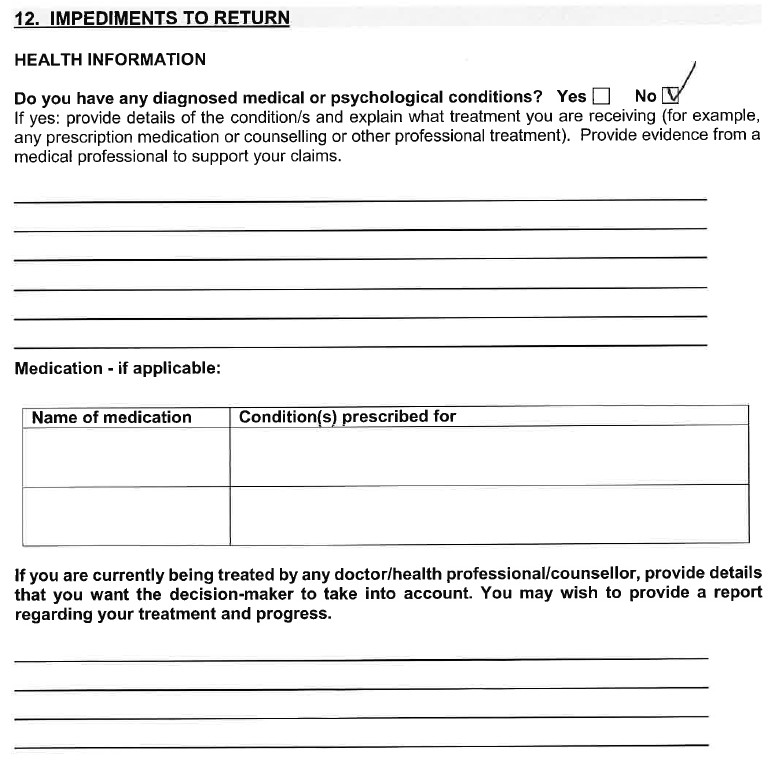
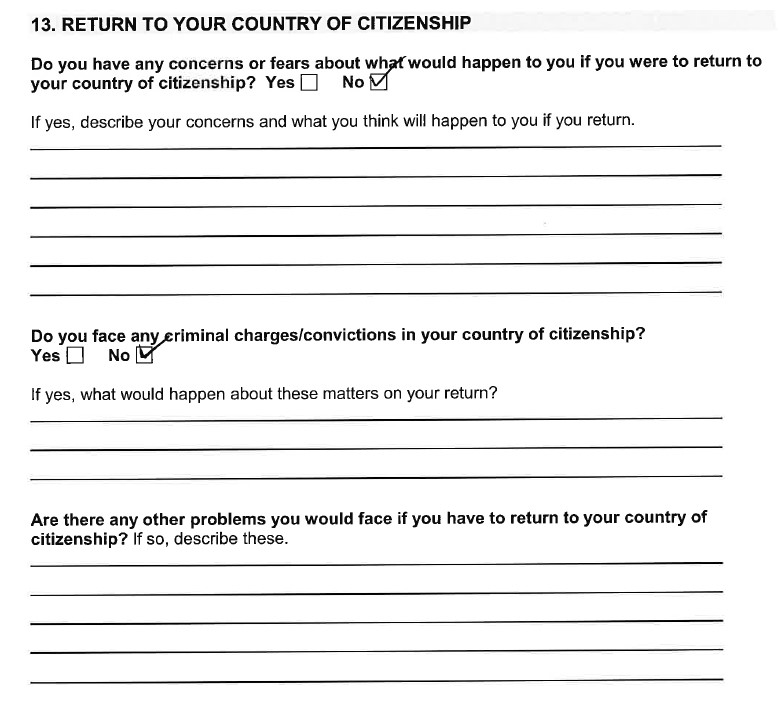
51 In his representations, Mr Zheng also relied on a letter from Bradley Jones, Forensic Psychologist, in which Mr Jones concluded that Mr Zheng was not suffering any psychological or psychiatric disorder. Mr Jones noted that Mr Zheng gave a history of “good general medical health, however acknowledged a history of asthma” and reported some sleep difficulties. On examination, Mr Jones estimated his level of cognitive functioning was in the average range with a limited range of insight and judgement. Mr Jones recommended Mr Zheng undergo forensic psychological treatment in order to reduce his risk of recidivism.
52 Mr Zheng did not seek before the Minister, and has not sought on this review, to lead any material to demonstrate that the Minister’s finding was wrong. Mr Zheng did not include any information in the sections of his personal circumstances form directed to eliciting information about any impediments he would face if returned to the PRC. He did not identify any concerns or any other problems that he would face if returned to the PRC.
53 Mr Zheng argued that he was not required to put on evidence to disprove the impugned findings that he says were made in the absence of material or rational basis. He relied on Viane and the decision of Burley J in Schmidt (which was cited by the majority in Viane) in this respect. These cases do not assist Mr Zheng. In each of those cases, the applicants made representations to the Minister as to the detrimental effect the loss of access to certain Australian welfare and social services would have on the applicant or their respective family members. The impugned findings in Schmidt concerned the comparative level of access, or quality of, certain services in two different countries, Australia and the United States of America. In Viane the appellant had made relevant representations on the subject matter of both the language and welfare findings: [60] (Charlesworth and Kerr JJ). The welfare finding in Viane was not only that the appellant as a Samoan citizen would have equal access to services in Samoa as were available to Samoan nationals but that the Australian citizens in the appellant’s family would also enjoy such access. Mr Viane expressly represented to the Minister that in American Samoa, he would likely be homeless, with no job, social ties, welfare or healthcare services and that there was problematic healthcare and no government social welfare in American Samoa.
54 The absence of representations on the relevant topic distinguishes the present application. Mr Zheng fairly conceded that he made no relevant representations that would have supported a contention that there was no welfare or public support in the PRC or that his access would be different to that of other PRC citizens. In the circumstances, I am not satisfied that Mr Zheng has established that the Minister’s finding that Mr Zheng, as a PRC citizen, would have the same access as other PRC citizens to welfare and public support constitutes an error, and certainly not a jurisdictional error: see Uelese v Minister for Immigration and Border Protection and Another [2016] FCA 348 at [69] (Robertson J).
55 If, contrary to my conclusion, the impugned finding, properly construed, does amount to a finding as to the existence of welfare and public support for PRC citizens in the PRC, then my conclusion would be the same for largely the same reasons. Mr Zheng made no relevant representations and did not establish on the present review that the finding was wrong. Unlike in Viane where the finding was that the appellant’s wife and child as Australian citizens in Samoa or American Samoa would “have equal access to welfare, healthcare and educational services as…American Samoans and Samoans in a similar position”, the present finding is limited to equality of access among PRC citizens, including Mr Zheng, to welfare and public support in the PRC. It is not in dispute that Mr Zheng is a citizen of the PRC. Even if the impugned finding is construed to include a finding that welfare and public support exists in the PRC for PRC citizens, the Minister made no finding as to the nature or the quality of welfare and public support in the PRC. Rather, the Minister found that Mr Zheng’s access to such support would be equal to that of other PRC citizens in circumstances where Mr Zheng had not made any representations that he would not enjoy equality of access to such support as other citizens and did not submit or advance material to suggest that he would face an impediment if returned because no such support existed in the PRC. Mr Zheng has not established that even on the broader construction of the finding, that the Minister made an error, let alone a jurisdictional error.
56 For completeness, I note that the Minister submitted that the impugned finding was “patently correct”. It was not clear whether this submission was intended to be directed to an argument that the Minister had relied on personal or specialised knowledge in making the impugned finding, counsel for the Minister at one point submitting it was not necessary to determine that issue. Based on the conclusions I have reached above, I agree that it is not necessary to determine this issue.
57 If I am wrong, then in the present application, where the impugned finding is a conclusion of a limited and general nature about basic country conditions in the PRC made in circumstances where no representations were advanced to the Minister to the contrary and no material or submissions were made on the present application to suggest that the impugned finding was contestable, I would infer that the finding was derived from the Minister’s personal or specialised knowledge accumulated in performance of his function under the Act. I would infer that the Minister had accumulated knowledge on which to base this finding by reason of the repetitive performance of his duties under the Act, including in respect of the cancellation of visas held by PRC citizens.
Critical step/materiality
58 If I am wrong and the impugned finding was made in error, it is necessary to consider whether the finding was at least a critical step in the Minister’s reasoning as to whether or not there is “another reason” to revoke the original decision and whether the error was jurisdictional. As noted above, in the present context these issues overlap.
59 The impugned finding must be considered in context. The Minister proceeded on the basis that if returned, Mr Zheng would have equal access to welfare and public support in the PRC as other PRC citizens have. The Minister made no findings as to the existence of such support or as to the nature or extent of such support. Nothing was put to the Minister on the issue by Mr Zheng. The Minister considered that the impediments that Mr Zheng would face if removed favoured revocation when reaching his conclusion that he was not satisfied that there was another reason to revoke the cancellation of Mr Zheng’s visa. The impugned finding at its highest only goes to the degree of the impediment that Mr Zheng would face on return to the PRC and to the weight given to this consideration by the Minister in reaching his negative conclusion as to satisfaction of another reason for revocation. Mr Zheng has not established that the impugned finding was a critical step in the Minister’s conclusion, particularly given the broad evaluative nature of the inquiry posed by s 501CA(4)(b)(ii) of the Act and the absence of any material or basis to suggest that the Minister’s conclusion was contestable.
60 Mr Zheng’s submission that the impugned finding gives rise to jurisdictional error focuses on the contention that his application was “finely balanced” and that the Minister may have come to a different conclusion in the absence of the impugned finding. I reject that submission. It proceeds on an artificial analysis of the Minister’s reasons, that is purely quantitative, namely, that two considerations were found against Mr Zheng whereas three were in his favour (one of which was treated as a primary consideration). It does not engage with the Minister’s qualitative analysis. The submission proceeds on the assumption that the considerations were equally relevant and determinative. It ignores the “significant weight” that the Minister expressly attached to the “very serious nature of the crimes committed by Mr Zheng, which [were] of a sexual nature, and involved a vulnerable member of the community, that being a minor”. Mr Zheng’s submission does not grapple with the Minister’s express statement that he fully agreed with the sentencing judge as to the particularly serious nature of the offences relating to the distribution of the video and the Minister’s endorsement of the sentencing judge’s observation that “‘[t]he behaviour of the offender is of a most disgraceful, nasty and shameful type. When he did not get his own way in terms of the victim recommencing some type of relationship with him he set about in a threatening and deliberate way to hurt and demean her. The fact that she was easily recognisable, and that her QQ messaging address was visible to people accessing the pornography site, demonstrates in the offender a real determination to embarrass and humiliate the victim and in doing so, damage her reputation”. Mr Zheng does not engage with the significance of the Minister’s finding that there was a risk of “significant harm” posed to the Australian community in the event of Mr Zheng reoffending.
61 A similar submission in respect of materiality based on an attempt to characterise a decision as “finely balanced” in circumstances where the decision-maker had not expressed a view to that effect was recently rejected in XSLJ v Minister for Immigration, Citizenship, Migrant Services and Multicultural Affairs [2021] FCA 1138 at [70] – [71] (Halley J).
62 The correct approach to materiality is to evaluate whether or not the error in the decision making is of such marginal significance to the issues that it could not realistically have affected the result: XJLR v Minister for Immigration, Citizenship, Migrant Services and Multicultural Affairs [2021] FCA 619 at [105] (Burley J). An assessment of materiality therefore necessitates a counter-factual analysis and an error will not be jurisdictional unless, as a part of that analysis, it may be demonstrated that the applicant was denied the possibility of a successful outcome: MZAPC v Minister for Immigration and Border Protection [2021] HCA 17 at [37] – [39] (Kiefel CJ, Gageler, Keane and Gleeson JJ). Mr Zheng has not established that the impugned finding was even contestable, let alone wrong. Mr Zheng has not demonstrated that the alleged error was material in the sense that there was a “realistic possibility” that the decision in fact made could have been different had the error not occurred.
63 For these reasons, the application is dismissed with costs.
I certify that the preceding sixty-three (63) numbered paragraphs are a true copy of the Reasons for Judgment of the Honourable Justice Cheeseman. |
Associate:


