

FEDERAL COURT OF AUSTRALIA
Patrick Stevedores Holdings Pty Limited v Construction, Forestry, Maritime, Mining and Energy Union (No 4) [2021] FCA 1481
ORDERS
DATE OF ORDER: |
THE COURT ORDERS THAT:
1. The parties file by 5pm on 7 December 2021 an agreed minute or competing minutes of order to reflect these reasons.
Note: Entry of orders is dealt with in Rule 39.32 of the Federal Court Rules 2011.
NSD 1594 of 2017 | ||
| ||
BETWEEN: | QUBE LOGISTICS (NSW) PTY LTD ACN 123 022 588 First Applicant QUBE LOGISTICS (SB) PTY LTD ACN 003 307 310 Second Applicant QUBE LOGISTICS (RAIL) PTY LTD ACN 082 313 415 Third Applicant | |
AND: | CONSTRUCTION, FORESTRY, MARITIME, MINING AND ENERGY UNION First Respondent MR PAUL MCALEER Second Respondent MR PAUL KEATING Third Respondent | |
order made by: | LEE J |
DATE OF ORDER: | 29 November 2021 |
THE COURT ORDERS THAT:
1. The parties file by 5pm on 7 December 2021 an agreed minute or competing minutes of order to reflect these reasons.
Note: Entry of orders is dealt with in Rule 39.32 of the Federal Court Rules 2011.
REASONS FOR JUDGMENT
LEE J:
A INTRODUCTION AND BACKGROUND
1 This is the fourth judgment arising out of this controversy.
2 The relevant facts are set out comprehensively in Patrick Stevedores Holdings Pty Ltd v Construction, Forestry, Maritime, Mining and Energy Union [2019] FCA 451; (2019) 286 IR 52 (Principal Judgment or PJ). These reasons assume a familiarity with the Principal Judgment, and will adopt its abbreviations.
3 In the Principal Judgment, I found that industrial action was organised by the Union, Mr McAleer and Mr Keating on various shifts between 20 April 2017 and 4 May 2017, and that the Union, Mr McAleer and Mr Keating were involved in industrial action of employees of Patrick Holdings, who were required to perform certain stevedoring work at the container stevedoring terminal in Port Botany, New South Wales (Terminal) operated by Patrick Operations: see PJ at 82–83 [116]–[117], 85 [127], 102 [186]. Although lengthy, the declarations made on 18 April 2019 best reference the found contravening conduct. In the Patricks Proceeding (NSD 596 of 2017), the following declaration was made:
1. The Construction, Forestry, Maritime, Mining and Energy Union (CFMMEU) and Paul McAleer (McAleer) contravened s 417 of the Fair Work Act 2009 (Cth) (FW Act) by organising and being involved in, within the meaning of s 550 of the FW Act, the industrial action taken by employees of Patrick Stevedores Holdings Pty Ltd (Patrick) covered by the Patrick Terminals Enterprise Agreement 2016 during the period between Day Shift on 20 April 2017 and the commencement of the Evening Shift on 1 May 2017 namely:
(a) a ban on loading empty containers onto trains commencing on the Day Shift on 20 April 2017 and concluding at the commencement of the Evening Shift of 1 May 2017 (with the exception of the period between 22 and 25 April 2017); and
(b) a general stoppage of work on the Evening Shift and Night Shift on 20 April 2017 and the Day Shift on 21 April 2017.
2. Paul Keating (Keating) contravened s 417 of the FW Act by organising and being involved in, within the meaning of s 550 of the FW Act, the industrial action taken by employees of Patrick covered by the Patrick Terminals Enterprise Agreement 2016 during the Day Shift on 1 May 2017, namely, the ban on loading empty containers onto trains in order 1 above.
3. The CFMMEU and McAleer contravened s 421 of the FW Act by contravening the interim order of the Fair Work Commission made on 20 April 2017 by organising and being involved in, within the meaning of s 550 of the FW Act, the industrial action taken by employees of Patrick covered by the Patrick Terminals Enterprise Agreement 2016 during the period between Night Shift on 20 April 2017 and the commencement of Evening Shift on 1 May 2017 namely:
(a) a ban on loading empty containers onto trains commencing on the Night Shift on 20 April 2017 and concluding at the commencement of the Evening Shift of 1 May 2017 (with the exception of the period between 22 and 25 April 2017); and
(b) a general stoppage of work on the Evening Shift and Night Shift on 20 April 2017 and the Day Shift on 21 April 2017.
4. Keating contravened s 421 of the FW Act by contravening the interim order of the Fair Work Commission made on 20 April 2017 by organising and being involved in, within the meaning of s 550 of the FW Act, the industrial action taken by employees of Patrick covered by the Patrick Terminals Enterprise Agreement 2016 during the Day Shift on 1 May 2017, namely, the ban on loading empty containers onto trains in order 3 above.
5. The CFMMEU and McAleer contravened s 340 of the FW Act by organising and being involved in, within the meaning of s 550 of the FW Act, the industrial action taken by employees of Patrick covered by the Patrick Terminals Enterprise Agreement 2016 during the period between Day Shift on 20 April 2017 and the commencement of Evening Shift on 1 May 2017 namely:
(a) a ban on loading empty containers onto trains commencing on the Day Shift on 20 April 2017 and concluding at the commencement of the Evening Shift of 1 May 2017 (with the exception of the period between 22 and 25 April 2017); and
(b) a general stoppage of work on the Evening Shift and Night Shift on 20 April 2017 and the Day Shift on 21 April 2017,
because Patrick exercised and proposed to exercise its workplace right to require employees to unload empty containers on trucks from the sub-lease area at the Port Botany Terminal and to prevent Patrick from exercising that workplace right.
6. Keating contravened s 340 of the FW Act by organising and being involved in, within the meaning of s 550 of the FW Act, the industrial action taken by employees of Patrick covered by the Patrick Terminals Enterprise Agreement 2016 on Day Shift on 1 May 2017, namely, the ban on loading empty containers onto trains, because:
(a) Patrick exercised and proposed to exercise its workplace right to require employees to unload empty containers on trucks from the sub-lease area at the Port Botany Terminal; and
(b) to prevent Patrick from exercising that workplace right.
4 In the Qube Proceeding (NSD 1594 of 2017), I made further declarations as follows:
1. The Construction, Forestry, Maritime, Mining, and Energy Union (CFMMEU) and Mr Paul McAleer contravened s 417 of the Fair Work Act 2009 (Cth) (FW Act) by organising and being involved in, within the meaning of s 550 of the FW Act, industrial action taken by employees of Patrick Stevedores Holdings Pty Limited covered by the Patrick Terminals Enterprise Agreement 2016 during the period between Day Shift on 20 April 2017 and the commencement of the Evening Shift on 4 May 2017, namely:
(a) a ban on loading empty containers onto trains on the Day Shift on 27 April 2017; and
(b) a ban on loading empty containers onto trains commencing on 2 May 2017 and concluding at the commencement of the Evening Shift on 4 May 2017.
2. The CFMMEU and Mr Paul McAleer contravened s 421 of the FW Act by contravening the interim order of the Fair Work Commission made on 20 April 2017 by organising and being involved in, within the meaning of s 550 of the FW Act, industrial action taken by employees of the Patrick Stevedores Holdings Pty Limited covered by the Patrick Terminals Enterprise Agreement 2016 during the period between Night Shift on 20 April 2017 and the commencement of Evening Shift on 4 May 2017 namely:
(a) a ban on loading empty containers onto trains on the Day Shift on 27 April 2017; and
(b) a ban on loading empty containers onto trains commencing on 2 May 2017 and concluding at the commencement of the Evening Shift on 4 May 2017.
5 After the findings and declarations as to the contravening conduct, two issues remained: first, the identification and quantification of any entitlement to an order under s 545 of the FW Act (which was identified as a claim for statutory compensation); and secondly, whether the Court should impose any pecuniary penalty pursuant to s 546 of the FW Act. I formed the view that it was appropriate that limited aspects of the issues related to statutory compensation be referred to a referee. On 12 August 2020, I made orders, by consent, referring both questions to a referee chosen by the parties for the purposes of the referee conducting an inquiry and making a report in writing to the Court stating, with reasons, the referee’s opinion as to the two questions.
6 On 1 April 2021, orders were made rejecting the referee report, and the issues as to compensation were accordingly set down for final hearing. I explained my reasons for rejecting the referee report and provided some guidance as to the principles to be applied to a compensation order under s 545 of the FW Act and, in particular, the applicable principles of factual and legal causation: see Patrick Stevedores Holdings Pty Limited v Construction, Forestry, Maritime, Mining and Energy Union (No 3) [2021] FCA 348; (2021) 304 IR 280 (Report Judgment or RJ). I return in more detail to those principles and their application below.
7 At the final hearing of the claims for compensation, the parties agreed that all issues, including any claim for a pecuniary penalty, should be addressed; no additional evidence was sought to be adduced by any party on penalty. At the conclusion of the hearing on 1 September 2021, with the consent of the parties, I directed that they return on 6 October 2021 to make final submissions on all outstanding issues.
8 The outstanding issues as to compensation and pecuniary penalties are complex. The reason for this complexity is that the direct costs or losses that are said to have been incurred because of the contravening conduct, were costs incurred by different entities.
9 There are two Patricks’ applicants: Patrick Holdings, and its wholly-owned subsidiary, Patrick Operations (I will refer to these entities collectively as Patricks). Patricks seek compensation against the Union for loss suffered because of the contraventions pursuant to s 545 of the FW Act, specifically, statutory compensation as identified in s 545(2)(b). Relief is sought in respect of three claims, which I will refer to as “Claim A”, “Claim B” and “Claim C”. Patrick Operations does not press for relief in respect of any claim other than Claim A, and that claim is only made against the Union. Patrick Holdings only presses for relief in respect of Claims B and C, which are also made only against the Union. Although claims for statutory compensation against Mr McAleer and Mr Keating were abandoned by Patricks at the final hearing, Patricks seek the imposition of penalties against the Union, Mr McAleer and Mr Keating pursuant to s 546(1), and payable to Patricks under s 546(3)(c).
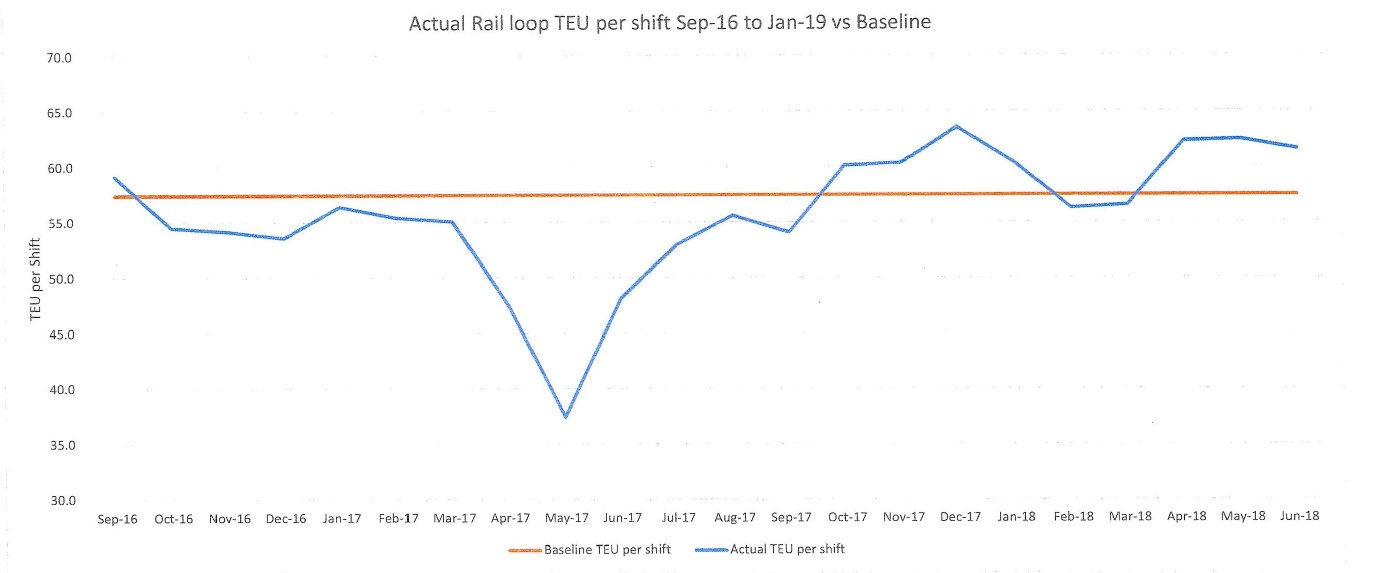
10 There are three Qube applicants: Qube Logistics (NSW) Pty Limited (Qube NSW); Qube Logistics (SB) Pty Limited (Qube SB); and Qube Logistics (Rail) Pty Limited (Qube Rail) (I will refer to these entities collectively as Qube). Each of the Qube applicants is a wholly-owned subsidiary of Qube Logistics (Aust) Pty Limited (Qube Logistics), which is a subsidiary of the publicly listed entity Qube Holdings Limited (Qube Holdings). Qube Holdings has a 50% interest in Patrick Stevedores, which was acquired in or around August 2016. Qube seeks orders for compensation, for direct costs, loss and damages arising from the contraventions. Relevantly, Qube makes seven claims for compensation, which are pressed only as against the Union (which span from “Claim A” to “Claim G”). Qube also seeks pecuniary penalties against each of the respondents and that those pecuniary penalties be payable to Qube.
11 I have separated my reasons into three parts. First, I provide some observations about how s 545 of the FW Act is to be interpreted and applied. Secondly, I will address each individual claim for statutory compensation in both proceedings, together with the evidence and submissions. In doing so, I will also address the expert report of the respondents and the weight I have given it. Thirdly, after reaching conclusions as to any compensation, I will consider whether it is appropriate to make any order for any of the respondents to pay a pecuniary penalty pursuant to s 546 of the FW Act.
B THE PRINCIPLED APPROACH TO THE REMEDIAL CLAIM
12 The power of the Court to make non-penal remedial orders arises under s 545(1) of the FW Act, which includes an order for statutory compensation as specified in s 545(2)(b). Section 545 appears, relevantly, as follows:
545 Orders that can be made by particular courts
…
(1) The Federal Court … may make any order the court considers appropriate if the court is satisfied that a person has contravened, or proposes to contravene, a civil remedy provision.
…
(2) Without limiting subsection (1), orders the Federal Court … may make include the following:
(a) an order granting an injunction, or interim injunction, to prevent, stop or remedy the effects of a contravention;
(b) an order awarding compensation for loss that a person has suffered because of the contravention;
(c) an order for reinstatement of a person.
13 As can be seen from its terms and its statutory context, s 545(1) confers a wide remedial power on the Court to make any order that it considers appropriate, if it is satisfied that a person has contravened, or proposed to contravene, a civil remedy provision, and s 545(2) provides a non-exhaustive list of examples as to the types of remedial orders that may be made, including statutory compensation as specified in s 545(2)(b). As indicated by the use of the word “may”, the power to make any remedial order under the section involves a discretion: see s 33(2A) of the Acts Interpretation Act 1901 (Cth).
14 Authorities in the industrial area have developed an approach to compensatory orders which, given the purposes of the statute, provides some guidance as to the way in which that discretion is to be exercised. Although the discretion to make remedial orders is broad, it is not without limits. In this respect, it is useful to reproduce the observations of Keane, Nettle and Gordon JJ in Australian Building and Construction Commissioner v Construction, Forestry, Mining and Energy Union [2018] HCA 3; (2018) 262 CLR 157 (at 190–191 [103]–[106], with whom Gageler J agreed at 174–175 [51]), in which their Honours dealt with the breadth of the section in the context of explaining that the power does not include a power to make penal orders:
The correct construction of s 545(1)
(i) Preventative, remedial and compensatory orders
103. As Jessup J observed in the Full Court, it assists in the construction of s 545(1) to have regard to its legislative history. But the starting point of the process must be the text of s 545(1) read in the context of the Fair Work Act as a whole and, in particular, in light of s 546. So approached, the first and most immediate point of significance is the breadth of the terms in which s 545(1) empowers the court to make any order the court considers appropriate. What is “appropriate” for the purpose of s 545(1) falls to be determined in light of the purpose of the section and is not to be artificially limited. As the ABCC submitted, such broad terms of empowerment are constrained only by limitations that are strictly required by the language and purpose of the section. To adopt and adapt the language of Flick J in Transport Workers’ Union of Australia (NSW Branch) v No Fuss Liquid Waste Pty Ltd [[2011] FCA 982 at [41]], the object and purpose of the power under s 545(1) is quite separate and distinct from that of the power under s 546 to order that a contravener pay a pecuniary penalty.
104. The second point of significance is contextual, and it points the other way. It will be observed that all of the example orders listed in s 545(2) are directed to preventing the occurrence of an apprehended contravention, remedying the effects of a committed contravention or compensating victims of a contravention for the consequences of the contravention. None of the example orders is penal. That suggests that the types of orders that may be regarded as “appropriate” within the meaning of s 545(1) are limited to preventative, remedial or compensatory orders, or at least do not include penal orders.
105. The third point dovetails with the second. As was earlier set out, the chapeau to s 545(2) expressly provides that the sub-section does not limit s 545(1). Standing alone, that could be taken to mean that s 545(2) does not in any way limit the scope of s 545(1). If so, it would permit of the possibility that s 545(1) extends to “appropriate” penal orders, notwithstanding that the example orders in s 545(2) are not penal. But, read in the context of s 545 as a whole, and particularly in light of the absence from s 545 of any explicit or apparently implicit suggestion of a penal purpose, the stipulation that s 545(2) does not limit s 545(1) presents as more likely to mean that the preventative, remedial and compensatory orders instanced in s 545(2) do not limit the range of preventative, remedial and compensatory orders open to be made under s 545(1).
106. The fourth point is also contextual and it augments the third. Critically, the only form of penal order to which the Fair Work Act specifically refers is a pecuniary penalty order; and s 546 is the only provision of the Fair Work Act that expressly provides for the imposition of pecuniary penalty orders. That strongly implies that s 546 is the sole repository of the power to make penal orders and, in turn, that provides powerful support for the conclusion that orders appropriately made under s 545(1) are limited to preventative, remedial and compensatory orders.
(Emphasis added, citations omitted).
15 Hence, s 545(1) should not be limited artificially; the preventative, remedial and compensatory orders instanced in s 545(2) do not limit the range of preventative, remedial and compensatory orders open to be made. Consistently with this, Mortimer J in Dafallah v Fair Work Commission [2014] FCA 328; (2014) 225 FCR 559 (at 595 [148]–[149]) referred to the width of the power as follows:
148. The language of s 545 is broad, allowing the Court to provide remedies which meet the circumstances of any given contravention, taking into account the range of parties who may have brought proceedings in relation to the contravention, and the actions which might in any given circumstance be required to remedy the contravention, or to ensure it does not occur again. Awarding compensation for loss is but one example and may not be appropriate, depending on what other action has been taken in respect of any losses. Each case will turn on its facts in that sense.
149. Fixing compensation under s 545 is a statutory task, and the Court must not substitute that task with approaches derived from the general law: Murphy v Overton Investments Pty Ltd (2004) 216 CLR 388 at [44]; Qantas Airways Ltd v Gama (2008) 167 FCR 537 at [94] per French and Jacobson JJ.
16 Her Honour went on to say (at 596 [157], [159]):
157. Further, the width of the power conferred by s 545(1) also allows for compensation which may not fully compensate a person for the loss suffered: see Gama at [94] per French and Jacobson JJ, where their Honours were considering similar statutory compensation provisions under s 46PO(4) of the Human Rights and Equal Opportunity Commission Act 1986 (Cth). In my opinion, that approach is available under s 545(1) because, as their Honours pointed out in Gama at [94], an award of compensation is discretionary. In s 545(1), the governing consideration is what the Court considers “appropriate”, and this in my opinion leaves room for a Court to find in a given case that less than full compensation might be appropriate.
…
159. One of the principal tasks, if compensation is to be awarded, is to ensure that there is the appropriate causal connection between the contravention and the loss claimed: Australian Licenced Aircraft Engineers Association v International Aviation Service Assistance Pty Ltd (2011) 193 FCR 526 at [423] per Barker J.
17 Her Honour’s observation (at 596 [157]) that s 545 “allows for compensation which may not fully compensate a person for the loss suffered” was considered by Logan J in Retail and Fast Food Workers Union Inc v Tantex Holdings Pty Ltd [2020] FCA 1258; (2020) 299 IR 56, where his Honour observed (at 97–98 [162]–[163]):
162. … It would be unwise, especially in an industrial relations context, to be further prescriptive, only to observe that, if a loss were proved to have been caused by a particular contravention, it is difficult to see how it would be “appropriate” not to award compensation for that loss.
163. But a causally connected loss must be proved. …
(Emphasis added).
18 There might be danger in abstract discussion as to if and when it might be “appropriate” to decline to make a s 545 remedial order, including an order for statutory compensation. There are many areas of the law where the grant of relief is discretionary: prerogative relief and equitable remedies are two obvious examples. Like in these other areas, the relevant considerations informing the discretion in an individual case are not confined, and are best identified and considered by reference to the facts of individual cases where relief is sought. Having said this, I accept that the statutory requirement that an order is “appropriate” highlights the necessity that any order is one the Court considers to be judicially appropriate, or “just”. This does not mean, in my view, that once a loss is proved as having been caused by a contravention, compensation for that loss must follow, as if axiomatically. Justice Logan’s observation that it would be “difficult to see how it would be ‘appropriate’ not to award compensation for” causally connected loss was linked with his Honour’s view that the Court should not be “further prescriptive” in directing how the discretion in s 545(1) should be exercised. It is potentially distracting for me to postulate situations where it may be appropriate to award no or less than full compensation for causally attributed loss – it all depends on the circumstances. It suffices to observe that the principled position, in my view, is as was explained by Mortimer J in Dafallah, as well as by Ross J in Fair Work Ombudsman v Construction, Forestry, Maritime, Mining and Energy Union (the Hutchison Ports Appeal) [2019] FCAFC 69 (at [132], with whom Rangiah J agreed at [158]):
132. Further, as is clear from s 545(2)(b) a necessary condition for the making of an Order for compensation is that loss is suffered because of the contravention. As Barker J put it in Australian Licenced Aircraft Engineers Association v International Aviation Service Assistance Pty Ltd [2011] FCA 333; (2011) 193 FCR 526 at [423] (the Australian Aircraft Case), “this requires an appropriate causal connection between the contravention and the loss claimed”. (Also see Maritime Union of Australia v Fair Work Ombudsman and Skilled Offshore (Australia) Pty Ltd [2015] FCAFC 120 at [20]). It necessarily follows that any order for compensation is an order directed to compensating a person for such a loss. As Katzmann J observed in Shizas v Commissioner of Police ([2017] FCA 61 at [209]) the focus of such an order is “in a loose sense, the restoration of those affected by a contravention to the positions they would have occupied but for its occurrence”.
19 Their Honours rejected an argument advanced by the Fair Work Ombudsman in that case that the position of the entity suffering loss need not be considered and the subject of evidence, and observed (at [135]–[141]):
135. … [T]he discretion conferred by s 545(1) is relatively unconfined, in the sense that the latitude as to the choice of the decision to be made is considerable: Coal and Allied Operations Pty Ltd v Australian Industrial Relations Commission (2000) 203 CLR 194 at [19] per Gleeson CJ, Gaudron and Hayne J.
136. Section 545 contains no positive indication of the considerations upon which the Court is to determine whether a compensation order is to be made. Consistent with principle, the power is to be exercised judicially, that is to say not arbitrarily, capriciously or so as to frustrate the legislative intent. But, subject to such considerations the discretion conferred is unconfined except insofar as “the subject matter and the scope and purpose” of the legislation may enable an appellate Court to pronounce the reasons given by the primary Judge to be “definitely extraneous to any objects the legislature could have in view”: Oshlack v Richmond River Council [1998] HCA 11; (1998) 193 CLR 72 at [22] per Gaudron and Gummow JJ.
…
139. Plainly, the matters to be considered in relation to s 545 must bear some relationship to the power being exercised. But I see no warrant in the subject matter and scope of the provision and purpose of the Act which would preclude the Court from considering a range of contextual matters, including the conduct of the person who suffered the loss and whether that person’s position with respect to compensation is known, and if so, what that position is. Such considerations may well be relevant and accorded weight depending on the circumstances of the case.
20 As can be seen, a necessary condition for the making of a s 545 order for compensation is that loss is suffered because of the contravention. But what do these words – which are the only words pointing to the nature of connexion required – actually require in order for the relevant loss to be recoverable?
21 Here one obtains some guidance about how causation is usually approached in the context of statutory compensation; although, it is important to recognise the limitations of any such analogies. The text and context of these provisions allowing recovery of statutory compensation may differ, sometimes markedly. The scope and purpose of particular provisions can inform the approach taken to causation in different contexts. Some differences between statutory compensation provisions are fundamental and reflect the difference between a right to obtain compensation on application and a discretion being conferred on a court to award a compensatory remedy on application. This is reflected in the difference, for example, between the old ss 82 and 87 of the Trade Practices Act 1974 (Cth).
22 Moreover there are textual differences. Some provisions have different words of causation. For example, s 1325 of the Corporations Act 2001 (Cth) allows for recovery of losses alleged to have been suffered ”because of” a contravention; however, s 1317HA of the same Act (and which could apply in the context of the same contravention) allows for recovery of loss which is alleged to have “resulted from” a contravention – this must be read as “resulted directly or indirectly” due to the combination of the definition of “result” in s 9 of the Corporations Act and s 18A of the Acts Interpretation Act 1901 (Cth): see BHP Group Limited v Impiombato [2021] FCAFC 93; (2021) 151 ASCR 634 (at 657 [102] per Middleton, McKerracher and Lee JJ). Another example of an important difference as to the scope of attribution of legal responsibility for losses which could be said to be causally related, as a matter of fact, is that as a result of legislative reform, most jurisdictions have introduced proportionate liability in respect of non-personal injury claims for economic loss or property damage, or claims for misleading or deceptive conduct brought pursuant to state or territory fair trading legislation. In such cases, each wrongdoer will only be liable to the extent of their responsibility.
23 What is required is to have regard to the text, context and statutory purpose of the relevant provision. The questions that seem to be relevant in the present case are first, whether a loss has been proved; and secondly, whether as a matter of history or fact, the proved contraventions did have a role in the happening of the loss. It is necessary then to examine the role that is identified by reference to the purpose of the inquiry; that is, the attribution of legal responsibility. It is at this third level of inquiry, in determining whether the order for statutory compensation is “appropriate”, that it may be necessary to ask whether, for some reason, the contravener should nevertheless be held not liable. In this context, it seems to me to be necessary to identify the nature of the role which the contravention played in bringing about the loss suffered.
24 Like in other statutory compensation contexts, whether the proved contraventions did have a role in the happening of the loss is not to be diverted by some misguided search of some form of “sole” cause. I made a number of observations as to why this is so, and as to causation generally in the Report Judgment (at 290–293 [29]–[37]). It is unnecessary to repeat that analysis here other than to highlight a point of some significance by adapting what was said, albeit in a different context, by Gaudron, Gummow and Hayne JJ in I & L Securities Pty Limited v HTW Valuers [2002] HCA 41; (2002) 210 CLR 109 (at 127–128 [55]–[56]).
25 If there is a contravention of the FW Act and, following that contravention, a person suffers loss or damage, it may be possible to identify several features of the history of events as having contributed to the person suffering loss. To search for the single cause of an event is, therefore, to pursue an illusion. Furthermore, much more often than not, to speak of the “effective cause” (or to use some similar expression) is to hide important assumptions that are made, or conclusions that are reached, about the attribution of responsibility for particular kinds of act or omission. That is why it is necessary to understand the purpose for making some inquiry about causation. Only when the purpose of the inquiry is known, is it possible to identify and articulate how and why some circumstances are extracted “out of the whole complex of antecedent conditions of an event” and identified by the law as a cause of it.
26 The purpose here is clear: as part of the statutory objective of providing a “balanced framework for cooperative and productive workplace relations” s 545 orders, including the examples listed in s 545(2), are directed to preventing the occurrence of an apprehended contravention, remedying the effects of a committed contravention or compensating victims of a contravention for the consequences of the contravention. If loss is suffered because of a contravention, if appropriate, an order can be made to remedy that result.
27 As I have explained above, the connexion may be satisfied if the contravening conduct is “a cause”: see, e.g., Henville v Walker [2001] HCA 52; (2001) 206 CLR 459 (at 469 [14]–[15] per Gleeson CJ; at 490 [97] per McHugh J; and at 509 [163]–[164] per Hayne J). However, when one comes to the attribution of legal responsibility, this is not the end of the matter. In the context of some types of statutory compensation, beyond the “not negligible” threshold, the strength of the requisite connexion is immaterial: see, e.g., Carey-Hazell v Getz Bros & Co (Aust) Pty Ltd [2004] FCA 853; (2004) ATPR 42-014 (at [195] per Kiefel J). Yet, this does not mean in the present context, that an order for recovery of a non-negligible but indirect loss would be appropriate.
28 Other factors that have contributed to a loss are beside the point unless they point to the loss not being causally related or the proposed compensatory order being other than “appropriate”. This can mean, as I concluded in the Report Judgment, that the contraventions were “a cause” of the loss claimed: RJ at 293 [37]. Although a number of cases have invoked the notion of “mitigation” or whether the claimant acted “reasonably” in incurring an alleged loss, this is perhaps better seen as being part of the broader causation inquiry and then, the evaluation as to whether, in the exercise of the Court’s discretion, an order for compensation claimed is “appropriate”.
29 It should be stressed that in this case some parts of the discussion above is academic, as the present forensic battleground was whether loss had been proved, and there was no pleading or developed arguments made on behalf of the Union identifying specific discretionary consideration as to why loss, if otherwise proved, should not be awarded on specified discretionary grounds or on the basis of some articulated argument that an award of proven loss should not be made, because it would not be appropriate in the sense explained above.
C THE CLAIMS FOR COMPENSATION
C.1 The Union’s broad submissions
30 The Union made a number of broad submissions in response to Patricks’ and Qube’s claims. Because there is overlap in the Union’s case across the two proceedings, and because those submissions were grouped together by the respondents in closing submissions, it is appropriate to set out at the outset those broader themes that the Union urged the Court to consider. Three sets of submissions were filed on behalf of the respondents: (1) those filed in the Patricks proceeding on 18 August 2021 (UPOS); (2) those filed 16 August 2021 in the Qube proceeding (UQOS); and (3) the amended closing submissions dated 5 October 2021, which addressed both proceedings (UCS).
31 Temporality. The principal submission of the Union is that there is insufficient evidence for me to conclude that any of the claimed losses were suffered because of the contraventions. The timing of the claimed losses forms a large part of this submission, specifically, that the contraventions took place in late April and early May, and the claimed losses, at least in the case of Patricks, span until June 2017. Furthermore, the Union’s broad submission as to temporality was a common thread in its challenge to the losses claimed in both proceedings, specifically, that the evidence is too imprecise as to the specified time periods when claimed losses are said to have been incurred.
32 Imprecise witness evidence. The Union asserts that in the evidence of the applicants’ witnesses as to losses, the contraventions must be precisely identified, and the impact of each individual contravention must be understood: see, e.g., UCS at [23]–[27]. It is said that there is a need to identify relevant details about the actual refusal to do work because “without knowing when work was scheduled to be done and was not done because of the contraventions” the Court simply does not know what the factual was or is: UCS at [16]. Put simply, the Union stresses the importance of focussing on the nature of the contraventions and the nexus between them and any claimed loss: UCS at [13].
33 The Union takes issue with how the witnesses in both proceedings define the contravening conduct. In summary, the evidence is said not to be confined by time or date to the particular instances of when the ban led to an actual refusal to perform work or would have led to such an outcome: UCS at [23]. In the Qube Proceeding, the evidence is said to follow a particular formula in every case, with the phrase “Patrick Employee Action” being inconsistently defined in each witness’ evidence, yet consistently relied on as evidence of that witness’ view as to the cause of loss or as to its quantification: UCS at [23]. The Union asserts that the witnesses have too broadly defined the contravening conduct and considered the impact of the conduct at large, rather than considering loss in respect of each atomised contravention. Such an approach, it is submitted, is “problematic in that it suggests that it was any one of the activities, a combination of them or all of them [that are said to have caused loss]”: UCS at [24(b)]. Similarly, the description of the contravening conduct relied on by the witnesses is too broad: for example, temporally locating the conduct in “late April and early May” rather than the precise dates that were found as fact by the Court in the Principal Judgment: UCS at [24(g)].
34 Causation. The Union seeks to emphasise other causes of the losses claimed. Broadly, in both proceedings, the Union points to different potential causes of the claimed losses including “changes to work practices that were implemented at the same time which meant there was increased work for Patrick employees to do”, namely, the scheduled track closure that took place between 22 and 24 April 2017, rail cancellations or changes that took place in the period that were not connected to the contraventions: see, e.g., UCS at [13]–[22], [28]–[33], [67]. This submission, as will be seen, was evident in the manner in which the Union conducted cross-examination of the witnesses called by Qube and Patricks.
35 Insufficient evidence. The Union submits that there is insufficient evidence of the usual financial position of Patricks such as to enable me to compare appropriately Patricks’ usual operations with its financial position after the contraventions: see, e.g., UCS at [23]–[27]. The Union submits that I would need to ascertain what would have happened in “the ordinary run of things” in order to identify the effect or consequence of the contravention because, without those details, it is “quite impossible to determine the factual and counterfactual”: UCS at [16]. As part of this submission, the Union points to the lack of evidence on “even the most basic things”: the number and kind of containers affected by the industrial action; where those containers were placed or kept after they were not loaded onto trains and if they were placed in the buffer stack when that happened; and what was the state of the buffer stack at the time they were placed there: UCS at [20].
36 The Union also submits that the counterfactual presented by Qube is defective as it does not provide satisfactory evidence of the “usual position, so far as costs and revenue, in the ordinary course of business” to enable me to determine whether the contraventions caused any divergence from the normal position and in that sense caused the claimed losses. Qube, so the submission runs, failed “to identify specifically by time, date and location the numbers of containers actually affected by the actual industrial action means it is not possible to determine the counterfactual”: UCS at [20]. The counterfactual was the subject of a large part of the evidence of the Union’s expert witness, Ms Wright, who addressed the methodology of the applicants’ claimed losses. I will return to Ms Wright’s report, which can be dealt with in an omnibus fashion, after considering each claim.
C.2 Patricks’ claims for compensation
37 A summary of the compensation claimed by Patricks appeared as follows in its outline of closing submissions filed 13 September 2021 (PCS) (noting that a claim initially identified as “Claim D” was not pressed):
‘Claim A’ – because of the Ban and General Stoppage of Work the Rail Yard became congested with containers causing Patrick Operations to engage additional Rail Loop Truck shifts to clear the congestion. Patrick Operations claims costs incurred in the period of April 2017 to 12 June 2017 that it would not otherwise have incurred in the amount of $364,725 (gross) …
‘Claim B’ – because of the Ban and General Stoppage of Work the operation in the Rail Yard did not work efficiently and productively and required Patrick Holdings to allocate an additional 31 shifts that it would not otherwise have engaged in the Rail Yard incurring costs in May 2017 of $24,524.46 (gross) that it would not have otherwise have incurred …
‘Claim C’ – because of the General Stoppage of Work on the Evening Shift and the Night Shift on 20 April 2017 and the Day Shift on 21 April 2017 which resulted in an increase in “await vessel” time and “balance of shift” time Patrick Holdings allocated additional stevedoring labour to clear a backlog of containers and to catch up on delays incurring additional costs from 20 April to 15 May 2017 in paying employees for periods of idle time that would not otherwise have been paid of $21,993 (gross) …
38 In support of its claims, Patricks relies on the evidence of three witnesses:
(1) Mr Jarrod Graham, the Manager of Strategic Operations at the Terminal, and at the time of the contravening conduct, the Automation and Landside Manager for the Terminal. Mr Graham’s relevant evidence was produced in the following statements: First Statement of Jarrod Graham dated 21 May 2018 (First Graham Statement); and Second Statement of Jarrod Desmond Graham dated 13 August 2018 (Second Graham Statement).
(2) Mr Bruce Guy, the Terminal Manager for the Terminal, employed by Patrick Holdings. Mr Guy’s relevant evidence was produced in the following statements: First Statement of Bruce Guy dated 21 May 2018 (First Guy Statement); and Third Statement of Bruce Guy dated 18 October 2019 (Third Guy Statement).
(3) Mr James Denham, the Business Improvement Manager for Patricks (accountant), employed by a subsidiary company, PSL Services Pty Ltd, and previously the Finance Manager for “Automated Terminals”. Mr Denham’s relevant evidence was produced in the following statements: First Statement of James Denham dated 21 May 2018 (First Denham Statement); Second Statement of James Patrick Denham dated 6 July 2018 (Second Denham Statement); and Third James Denham Statement dated 17 February 2020 (Third Denham Statement).
Claim A: Additional Rail Loop trucks
39 Under this category of loss, Patrick Operations claims compensation in the amount of $364,725 for the additional Rail Loop Trucks it was required to engage due to the Ban and the General Stoppage of Work.
40 By way of context, Patricks submits that the Terminal is organised by Patrick Operations to maximise efficiency, optimise productivity, and avoid employee idle time: PCS at [18]. Patrick Operations submits that it was required to engage additional Rail Loop Trucks on what is referred to as “Rail Loop Truck Shifts” in order to clear import containers in the Yard, which had become congested. So the submission runs, but for the Ban and the General Stoppage of Work, it would not have required the additional Rail Loop Truck Shifts.
41 On the evidence of Mr Graham as to the impact of the Ban, Patricks was required to cancel all rail windows on the relevant days. He gave evidence that this was because trains are not as dynamic as trucks and a delay to one service will impact the scheduled arrival of another service. Trains that were scheduled to arrive at the Terminal were diverted to an intermodal facility where the export containers were removed from the trains. These containers were then stored by the exporter and brought by truck into the Terminal at a later date: First Graham Statement at [147(a)].
42 As to the impact of the General Stoppage of Work, on the evidence of Mr Guy, it resulted in Patricks being unable to service vessels that were alongside the Quay Line and those vessels did not meet their assigned arrival or departure time: First Guy Statement at [291].
43 The impact of both the Ban and the Stoppage of Work was the subject of the evidence of Messrs Guy and Graham:
(1) Between 20 April 2017 and 1 May 2017, export containers located in the Buffer Stack and export containers that were unloaded from trains were not processed and delivered into the Yard to be loaded onto vessels as part of the Terminal’s usual process. There were significant delays in processing the export containers from the Buffer Stack to the Yard: Third Guy Statement at [13]–[19].
(2) The number of export containers in the Rail Stacks increased to such an extent that containers were not stored in ‘vessel order’ and Patrick Operations was impeded in placing and accessing export containers in the Rail Stack and transporting export containers to the Yard for export: Third Guy Statement at [55].
(3) The increased number of export containers meant that the Buffer Stack was overcrowded and the Rail Employees were unable to arrange export containers in vessel order: Third Guy Statement at [15].
(4) Train services that were due to call at the Rail Yard were diverted or cancelled: First Graham Statement at [53]–[54], [131]; Third Guy Statement at [38].
(5) As a result of the congestion described above, the Buffer Stack reached maximum capacity around early May 2017: Third Guy Statement at [16].
(6) In order to avoid the continued impact on the Terminal operations additional Qube Trucks were engaged to clear the Buffer Stack: Third Guy Statement at [27].
(7) The closure of the Rail Yard on 12 and 13 May 2017 to clear the congestion was not sufficient to process the export containers in the Buffer Stack and the congestion continued to impact the business into late May and June 2017, requiring additional Rail Loop Truck shifts: Third Guy Statement at [30].
44 Messrs Guy, Graham and Denham were cross-examined, but the cross-examination did not directly challenge the following aspects of their evidence:
(1) the Buffer Stack became congested;
(2) the Terminal operations were impacted by the congestion;
(3) the congestion required additional Rail Loop Truck shifts to be engaged; and
(4) at least one cause of the congestion was the Ban and/or the General Stoppage of Work.
45 The Union raised its causation submission, contending that it is not possible to find that contraventions were a cause of the congestion or that it resulted in any loss: UCS at [32]. Immediately preceding this broad submission was a reference to the failure to identify the number of containers affected by the industrial action and the influence of other factors that the loss could be causally attributed to: UCS at [30]–[31]. Broadly, the cross-examination of Mr Guy focussed on identifying other causes of the claimed losses in productivity for Patrick Operations outside of the contraventions. Those other causes which were also raised in closing submissions (UCS at [38]) included:
(1) The ability to use the full train window time: T63.28–35.
(2) Personal/sick leave absences, and shift cancellations by reason of absenteeism: T63.37–38.
(3) Track possession: T63.40.
(4) The change from Sydney Haulage to the “Knuckle”, which Mr Guy did not accept: T63.44–46.
(5) A reduced size of the Buffer Stack, which Mr Guy did not accept: T64.38–40, T72.19–20.
(6) Refusal by employees to perform work (other than due to the General Stoppage of Work): T69.8–10.
(7) More containers moving through the Yard, which Mr Guy did not accept: T73.25–33.
46 There are two difficulties with the Union’s submission. First, Mr Guy did not accept that a number of the potential causes did affect Patrick Operations’ productivity in the relevant period. Further, the questions put to him were initially posed in the abstract, which I suggested was not of much assistance in determining what in fact caused the claimed losses: T64.3–9. Secondly, and in any event, the existence of other causes of loss is no answer to a claim for statutory compensation supported by prima facie proof, unless the causes point to the claimed losses not being caused by the contraventions: see RJ at 295 [43]. To proceed otherwise is to fall into the heresy of conditioning a claim on proof that the contravention was the sole or only cause of loss.
47 The Union also relied on its temporality submission, that is, that the claimed losses are too temporally removed from the contraventions to be attributable to them. The submission as to the temporality of the claimed losses spanning up to a month after the contravening conduct is without merit for two reasons. First, the Terminal is operated in a manner that will maximise efficiency and productivity; therefore, given the tight turnarounds for shipping containers to maximise productivity, it is easy to conceive of even small disruptions having large impacts on the business. By way of example, I have had regard to the evidence of Mr Robert Harvey of Qube (which I will return to below, noting that I made an order that evidence in the Qube Proceeding be evidence in the Patrick Proceeding) with respect to the demands of shipping customers. Mr Harvey referred in cross-examination to one customer with very tight key performance indicators (KPIs), saying that “they had very tight KPIs with delivery times to the customers” and that “[t]hey would have KPIs based around delivery of containers 48 hours after they arrived at the wharf” which meant that “they would book the delivery before the vessel even arrived”: T143.27–38. Given that I accept that the margin for error was thin, it is not difficult to conceive of one disruption in such an industry affecting productivity for some time.
48 Secondly, the explanation for the prolonged impact of the contraventions is clear from the unchallenged evidence summarised above: see [43]. The contraventions set in motion a chain of events that led to losses incurred by Patricks. By reason of the Ban and Stoppage, export containers were not processed and delivered, the number of export containers and Patrick Operations was impeded from moving its containers for export, the Buffer Stack became overcrowded, reaching its maximum capacity in early May 2017, and train services were diverted or cancelled. Patrick Operations engaged additional Rail Loop Trucks to clear the congestion, however, presumably in part because of the disorganisation of the export containers or because of the sheer number of containers, the congestion impacted the business into late May and June 2017. The submission that the losses incurred are too temporally removed, without anything more to negate the causal relationship demonstrated by the evidence, does not assist the Union.
49 As to the Union’s submission that Patricks did not identify the number of containers affected, that submission goes to the quantification of the claimed losses, which I will now address. Patrick Operations claims compensation in the gross amount of $364,725. Mr Denham identified in his evidence that the quantum of the loss is ascertained by the evaluation of the productivity over the relevant period. A drop in productivity – calculated by TEU (average number of twenty-foot equivalent units of container length moved per shift) – necessitated the engagement of Qube trucks (operated by Qube employees) in addition to the four trucks owned by Patrick (and operated by Qube labour). Mr Denham’s evidence demonstrates a drop in the TEU per shift from April to June 2017, which is not present at any other time from September 2016 to June 2018. That drop is illustrated in the following graph:
50 Calculating the number of additional Rail Loop Truck shifts that were utilised by Patrick over this period (April to June 2017), having regard to the actual Productivity Factor compared to the “Baseline” average – which takes into account the usual ebbs and flows of the business and the usual productivity factors – Mr Denham’s evidence compellingly demonstrates that, but for the contravening conduct, Patrick would have required (Third Denham Statement at [40]):
(1) 52 fewer “Qube Truck Shifts” than the 65 engaged in April 2017;
(2) none of the 95 “Qube Truck Shifts” engaged in May 2017 (and 24 fewer “Patrick Truck Shifts” than the 248 “Patrick Truck Shifts” it did engage); and
(3) 55 fewer “Qube Truck Shifts” than the 106 that it in fact engaged in June 2017.
51 Patrick Operations claims the cost of those additional shifts that would not have been incurred, had the Terminal operated at its forecast productivity for those periods. The costs of those additional Rail Loop Truck shifts are evidenced by invoices and remittance advice: see Exhibit JPD-2. The Union makes no challenge to those invoices, but rather makes the following challenges in respect to Mr Denham’s quantification:
(1) Mr Denham does not provide adequate baseline figures to enable me to assess the “ordinary run of things” for the purpose of the counterfactual;
(2) it is not possible to say how many trucks were engaged additional to baseline requirements and why those trucks were engaged; and
(3) the losses are not based on any actual or out of pocket loss, but rather on a “theoretical productivity loss”.
52 First, it is true that in order to make an assessment as to causation, I must be satisfied that Patricks has demonstrated the status quo ante, that is, the normal operating position of Patricks prior to (and but for) the contravening conduct. Mr Denham used “baseline data” to demonstrate the “but for” position, and he described what the baseline data and period was in chief and cross-examination as follows (T98.8–15; T103.33–104.10):
[MR FERNON:] [W]hat is the baseline? --- The baseline per shift is the average of the rail loop TEU per shift across all periods from September ‘16 to March ‘17 and July ‘17 to June ‘18. So across the entire time period exhibited in that graph, excluding the period April ‘17 to June ‘17, which is the affected period. …
[W]hen you say it’s the “average TEU per shift”, could you explain to his Honour what that means? --- It’s the sum of the TEU for each individual month in the period divided by the sum of total rail loop truck shifts in the period.
…
[MR REITANO:] Right. So is it fair to say that you don’t think that that date range that I mentioned is important to any of the calculations you did? --- The calculation of the baseline TEU per shift is supposed to – and I will refer to my statement, my third statement. As part of the methodology that we used, and I refer to paragraph 23 (a) and (b), the baseline is supposed to represent the but for scenario, which is a period for representative productivity in normal operating conditions where we are not affected by this specific disruption. So the baseline period covers a large period of time which is representative of the normal operating conditions and the normal productivity we would expect to see on the rail loop. That’s what the baseline represents.
You didn’t choose another period to see if the baseline productivity was affected in some other period of three months, did you? --- We took a broader range of time rather than specifically choosing a three-month period of time. However - - -
Okay?--- … I do note that the productivity in the three-month period in question appears lower than what is represented in – in the full course of time referred to in my document JPD15.
(Emphasis added).
53 The methodology of Mr Denham was to choose monthly periods to demonstrate the effect of the contravening conduct on Patricks’ usual operations. That baseline data was taken from Patricks’ financial records and its own forecasting for those periods. The Union submits that there is no sound explanation why Patrick preferred to undertake its analysis over months, rather than on days, particularly in the light of the limited duration of the actual industrial action: UCS at [40]. Using data organised into monthly periods would give a broader view of Patricks’ normal operational productivity. As I indicated above, the effects of the contraventions were lasting, and so I consider that a broader view is warranted. The submission that Patricks did not provide an adequate picture of what would have been should be, on the balance of probabilities, rejected. The use of a wide time period, taking into account normal factors affecting productivity levels, and the use of Patricks’ own forecasting are acceptable on the evidence.
54 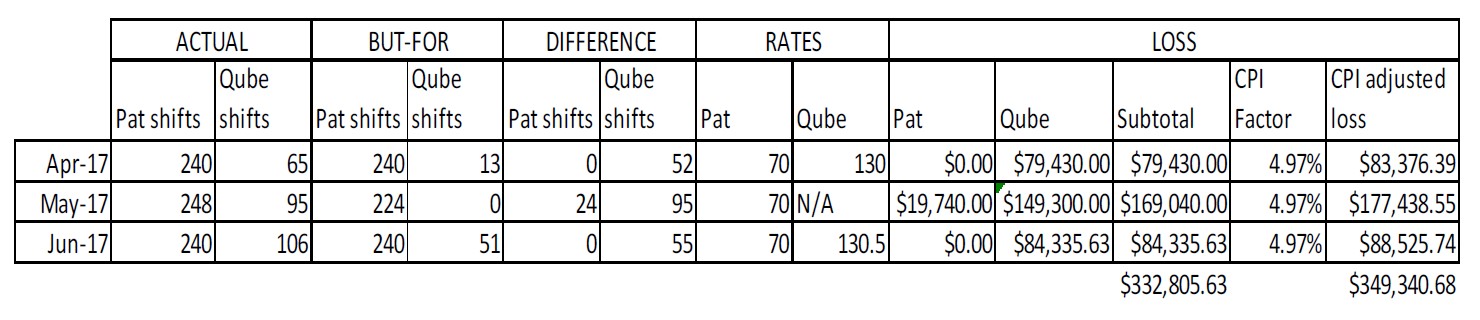 Secondly, the submission that Mr Denham did not provide the number of additional trucks that were required above baseline levels should also be rejected. The number of additional trucks that were required above the baseline levels is set out in the Third Denham Statement (at [40]) and reproduced above. In addition, Mr Denham demonstrated his findings and calculations as to the additional number of trucks in the following table (Third Denham Statement at [39]):
55 As to the question of why those additional trucks were engaged, on the basis of the unchallenged evidence of Messrs Guy and Graham summarised above, and the clear impact that the industrial action had on productivity as demonstrated by Mr Denham’s evidence, I am comfortably satisfied that additional trucks engaged above the baseline levels were engaged because of the contraventions.
56 Finally, the Union’s submission relating to “theoretical productivity loss” raises a similar issue to one which arose before the referee. The genesis of the submission is presumably in the observations of Moore J in Qantas Airways Ltd v Transport Workers’ Union of Australia (No 2) [2011] FCA 816; (2011) 211 IR 119 (at 131–132 [25]–[29]) as to inefficiencies or productivity losses not being recoverable under s 494(5)(b) of the Workplace Relations Act 1996 (Cth). The referee was of the view that any costs that are “notional” – that is, costs that are not actually incurred as an outgoing directly related to the industrial action – are not recoverable on the basis of Moore J’s analyses in Qantas relating to labour costs for ground staff (at 129–132 [18]–[29]), labour costs for technical crew (at 163–165 [123]–[133]) and maintenance costs (at 170–176 [155]–[156]). Although I did not address this point in the Report Judgment because it was unnecessary to do so, I did consider the issue at the time.
57 In considering compensation for so-called “notional costs”, Moore J was primarily concerned with whether the payment of money could remedy the effect of the industrial action: see Qantas (at 131–132 [26]). In relation to the additional costs incurred by Qantas for ground staff, his Honour only ordered compensation for the amount actually incurred in overtime payments made to non-salaried employees due to the industrial action, and did not order compensation for amounts that would have to be paid to salaried employees in any event. Any amounts paid to salaried employees, his Honour reasoned, would have been paid anyway. Justice Moore stated that it “may be possible to characterise one effect of the industrial action as being that salaried employees were required to perform tasks they would not ordinarily perform and were distracted from their ordinary duties” but that inefficiency could not be remedied by the payment of money: Qantas (at 132 [27]).
58 The referee would have rejected Claim A of the Patricks reference on the basis that the cost of extra truck shifts incurred due to the contraventions is a “notional cost” because it really related to inefficiency. That analysis, with respect, misinterpreted the judgment of Moore J in Qantas. It is plain that if, for example, a salaried employee is required to work more shifts because of a contravening party’s breach of the law, the employer suffers no relevant “loss” caused by the breach of the law because the employer would in any event have to pay the employee’s salary. The employee’s remuneration is not referable to the number of shifts or hours worked, but it would obviously be different with overtime payments. I will return to this example shortly. However, as was put by Patricks, that is not the case here. Patricks Operations engaged a contractor (or external provider) to perform the additional truck shifts that were needed because of the contraventions. That being so on the evidence, there is no room for the “notional cost” or “theoretical productivity” analysis as the costs were actually incurred and are evidenced by invoices and remittance advices: see Exhibit JPD-2. The productivity factor is perhaps an unfortunate label because it is suggestive of some sort of level of “efficiency”, but it is a means of determining the baseline levels of how Patricks would normally operate and from there determining what the impact of the contraventions was. I reject the Union’s submission.
59 For the reasons above, I am satisfied that Claim A must succeed, and Patrick Operations is entitled to compensation in the amount that has been proved on the evidence, that amount being $364,725.
Claim B: Additional Rail Yard shifts
60 Under this category of loss, Patricks Holdings claims $24,524.46 for an additional 31 shifts it submits it was required to allocate at the Rail Yard to ensure that trains and Rail Loop Trucks could be loaded and unloaded within the timeframes required. On Patricks’ case, but for the Ban and the General Stoppage of Work, it would not have required the additional labour at the Rail Yard: First Denham Statement at [59]–[61]; Third Denham Statement at [64].
61 The Union contends that there is no evidence that any additional costs such as overtime or wages were ever expended and that the efficiency of the work during the relevant period was consistent with the efficiency of work at other times when there were no contraventions: UCS at [45].
62 There is some force in the Union’s argument. While I am satisfied that there were additional shifts required to be worked by Patricks’ employees to clear the congestion at the Terminal for the same reasons as the additional Rail Loop Trucks were required (Claim A), this claim is distinguishable. Patricks’ employees are salaried employees, and the evidence of Mr Denham demonstrates that their salary is a fixed cost (Third Denham Statement (at [57]–[60])):
57. … Under the Enterprise Agreement, Patrick’s permanent employees at Port Botany are rostered to work 1820 hours per year. Patrick’s permanent employees are rostered to work 40 hours per week, seven weeks in a row, with the following week off. This is known as a “7 and 1 roster”.
…
59. While the salary paid to employees is a fixed cost in cash terms, that is, Patrick’s employees are paid a fixed salary each pay period, Patrick records the expenses for labour when employees are allocated to work. For example, if an employee receives a fortnightly pay of 70 hours work, and they do not work any hours. In cash terms, Patrick has a cash “outflow” of 70 hours, however, there is no expense from an accounting perspective as this payment is treated as “pre-paid” labour. For this reason, my accounting for these expenses using an accrual accounting methodology more accurately represents the timing in which these expenses are incurred.
60. In accounting terms, the pre-paid labour is not carried into the profit and loss statement as an expense, as that labour has not yet been allocated. On the balance sheet this labour is considered an asset, as it can be called upon at any time (e.g. on an unrostered shift). Once the labour is used, it moves from the balance sheet and appears on the profit and loss statement as an expense. Despite that the number of hours worked per week may fluctuate, Patrick’s accounting method accounts for, and reconciles this, as does the Enterprise Agreement (through the notion of the “bank of hours”).
63 In this context, the observations of Moore J in Qantas (at 132 [27]) are apt:
It may be possible to characterise one effect of the industrial action as being that salaried employees were required to perform tasks they would not ordinarily perform and were distracted from their ordinary duties. (As an aside I should observe that if, as it was, working in a contingency team was part of what a salaried employee might be required to do then this dichotomy between ordinary and other duties probably is of no moment. The only relevant question is whether working on a contingency team was part of those duties. The answer appears clearly to be yes). However one then asks how this effect is remedied by ordering the payment of money. I cannot see how it is. It would be different if overtime (or some other additional payment) had been paid to members of the contingency team or other people engaged to perform the ordinary duties of the members of the contingency team either then or later. The need to pay the overtime (or some other additional payment) or pay the additional staff would be an effect remedied by an order to pay money. But how does the payment of money remedy the effect of salaried employees working on a contingency term? In my opinion it does not.
64 Claims for compensation live and die by the counterfactual analysis. Determining the appropriate counterfactual is a fact-specific inquiry and depends on the claimed losses. Patricks quantifies its claimed losses by reference to the number of shifts worked by employees in the Rail Yard, shifts that would not have been necessary had the congestion occasioned by the contraventions not been present. However, turning to how payment was made for those additional shifts, the employees performing those shifts were salaried employees, and Patricks only claims “labour costs” for the 31 additional shifts: PCS at [48]. In the counterfactual, the fixed salaries would have been payable. In the factual, the salaries were payable. However, the salaries, payable pursuant to employment contracts, were payable with or without the contraventions.
65 However, rather than simply applying Moore J’s analysis as to fixed salary costs, Patricks urged the Court to consider the “banking of hours” by Patricks, referable to the fixed number of hours permanent employees could work under the relevant enterprise agreement. The “loss” claimed is, in effect, the loss of being able to allocate Patricks’ employees to other productive work, and the hours that the relevant employees can work in a year are fixed under the enterprise agreement at 1820 hours per year. In response to my questioning during the course of the hearing, Senior Counsel for Patricks made the following submissions (T230.40–231.8):
[MR FERNON:] … [W]hat Mr Denham explains is that which Patrick employees are paid a fixed salary, Patrick records the expenses for labour when the employees are allocated to work, and that’s because of the arrangements that exist under the enterprise agreement whereby employees who are rostered cannot work hours, in which case they owe Patrick hours, or work ahead, in which case they have an allocation of additional hours, in which case they’re able to bank hours. What occurs is that when Patrick, in fact, receives the benefit of the employees’ work, that’s when the expense is incurred, because of the way in which the banking of hours operates under the enterprise agreement, so that whilst, at one level, a salary is paid as a fixed cost, the actual expense is incurred in …
HIS HONOUR: But that’s just from an accounting point of view.
MR FERNON: Well, no, your Honour, because it means that when other work is required, the hours that might have been allocated to the performance of that other work have already been expended …
66 Overriding the “banking of hours”, though, is the fact that the employee’s remuneration is a fixed cost and is not variable by reference to the number of shifts or hours worked. Even if it is accepted that a loss in productivity was incurred because of the finite number of hours that the employees could work, there is no evidence about what, in particular, those employees would otherwise have been doing. The evidence goes to general productivity levels as the means by which Patricks identifies its loss, and Patricks does not particularise (let alone prove) any loss of specific revenue-generating contracts. The employees may well have been carrying out work that was not generating revenue. Without evidence, I would have to guess that they would have been allocated to revenue-generating activities, and those revenue-generating activities must be capable of quantification in money terms.
67 The case may have been different if Patricks could point to evidence of work pursuant to specific contracts that the employees could have undertaken. Were it the case that Patricks was unable to service a particular contract because employees were tied up clearing the congestion occasioned by the contraventions, the loss of that contract would prima facie be compensable. Claim B differs from Claim A because there are no invoices that in fact show additional outgoings incurred by Patricks. Qube provided additional Rail Loop Trucks to clear the congestion, in addition to the trucks owned by Patricks. Of themselves, inefficiencies in the allocation of labour of salaried employees occasioned by the congestion are not losses that are compensable.
68 Nevertheless, if I am wrong in concluding that no relevant “loss” has been incurred, because Patricks has not met its evidentiary burden of proving that it suffered a loss that can be remedied by the payment of money, I do not consider that it would be appropriate to award compensation to Patrick Holdings for salary costs that I am not satisfied on the evidence would not have been incurred without the contraventions. I would therefore not have awarded compensation for Claim B in any event.
Claim C: Additional quay cranes shifts
69 Under this category of loss, Patrick Holdings claims compensation in the amount of $21,993 for the additional labour by way of crane shifts in the auto yard that it had to engage by reason of the Ban and the General Stoppage of Work.
70 Patrick allocated employees to work quay cranes for the loading and unloading of container vessels berthed at the Quay Line: First Denham Statement at [62]. Broadly, work was said to be arranged to reduce inefficiencies, which included avoiding inefficiencies in work performed by the crane labour “gangs” by structuring work in a “manger” to reduce idle time, being “await vessel” time and “balance of shift” time: First Denham Statement at [62]–[72]. Patricks claims that, due to the Ban and the General Stoppage of Work, there was a higher “await vessel time” and “balance of shift time” for the period of 20 April 2017 to 14 May 2017 when compared with the monthly average for the period from April 2016 to April 2018, with the result being that Patrick Holdings was required to roster additional crane gang teams to process the container volume: PCS at [52].
71 The Union makes a similar submission in respect of Claim B; namely, there is no evidence that there was any additional time spent working on cranes or any additional cost involved as a result of the contraventions, given the wages for crane crews during the relevant period were required to be paid regardless of the industrial action and there is no evidence to the contrary: UCS at [49]–[50].
72 Because crane gang employees are also salaried employees paid on a fixed basis, Claim C must fail for the same reasons as I set out above as to Claim B. As with Claim B, if I am wrong in concluding that no “loss” has been incurred, I nevertheless do not consider it appropriate to award compensation for outgoings that I am not satisfied on the evidence would not have been incurred without the contraventions and, therefore, I would not have awarded compensation to Patrick Holdings for Claim C in any event.
C.3 Qube’s claims for compensation
73 Qube’s outline of closing submissions filed 13 September 2021 (QCS) identifies the following claims:
(1) Claim A: Subcontractor costs incurred by Qube NSW and Qube SB.
(2) Claim B: Interstate truck costs incurred by Qube SB.
(3) Claim C: Detention fees for import containers incurred by Qube SB.
(4) Claim D: Detention fees for export containers incurred by Qube SB.
(5) Claim E: Permanent loss of customer incurred by Qube SB.
(6) Claim F: Wages paid to rail crew that were unable to be usefully engaged incurred by Qube Rail.
(7) Claim G: Rail loss of revenue less direct costs for shuttle services and rural services, incurred by Qube Rail.
74 Qube relies on the evidence of five witnesses in support of its claims:
(1) Mr Daniel Coulton, the General Manager of Industrial Relations for the Qube Logistics business. Mr Coulton’s relevant evidence was produced in the following witness statements: First Statement of Daniel Coulton dated 12 June 2018 (First Coulton Statement); Second Statement of Daniel Coulton dated 6 August 2018 (Second Coulton Statement); and Third Statement of Daniel Coulton dated 18 October 2019 (Third Coulton Statement).
(2) Mr Robert Harvey, the General Manager of NSW for Qube Logistics. Mr Harvey’s relevant evidence was produced in the following witness statements: First Statement of Robert Harvey dated 12 June 2018 (First Harvey Statement); and Second Statement of Robert Harvey dated 28 October 2019 (Second Harvey Statement).
(3) Mr Jonsen Liwanto, the Finance Manager for Qube Rail. Mr Liwanto’s relevant evidence was produced in the following witness statement: Statement of Jonsen Liwanto dated 13 June 2018 (Liwanto Statement).
(4) Mr Ellem, the Rail Operations Manager for Qube Logistics. Mr Ellem’s relevant evidence was produced in the following witness statement: Statement of Steven Gary Ellem dated 12 June 2018 (Ellem Statement).
(5) Mr Wilson, employed by Qube Logistics as the Port Botany Container Park and Transport Manager. Mr Wilson’s relevant evidence was produced in the following witness statement: Statement of Damian Wilson dated 12 June 2018 (Wilson Statement).
75 As outlined above, there are three Qube applicants: Qube NSW; Qube SB; and Qube Rail. At the outset, Qube submits that in order to understand the extent and nature of the consequences of the contraventions, it is important to understand the background facts regarding: the operations of the Qube applicants, how the separate Qube applicants interacted together in the overall Qube business, and the relationships and arrangements between the Qube applicants and their customers: QCS at [1.4]. That background is outlined in the following summary, which I accept:
(1) The separate Qube applicants, Qube NSW, Qube SB and Qube Rail, are involved in the overall business of providing transport logistics services to importers and exporters in relation to containerised and other freight. The transport logistics services include the transportation by road and rail of freight and empty containers to locations within Australia as requested by the respective customers of Qube (Container Transport Services): First Coulton Statement at [10]–[11], [13], [15]– [17], [22]–[23]; First Harvey Statement at [22]–[25]; PJ at 57 [4].
(2) There are two main sides to Qube’s Container Transport Services: an “import side” and an “export side”: First Coulton Statement at [15].
(3) On the import side, Qube is engaged by customers to deliver containers full of goods that have arrived in Australia by vessel. Once the customer has removed the goods, Qube arranges for the return of the empty container either to a Port or another location as nominated by the shipping line, being the owner of the container: First Coulton Statement at [19]–[20].
(4) The export side of Qube’s business involves providing services to customers who are exporting goods out of Australia, such as grain and timber. Most of Qube’s customers are located in regional areas, but it has some metropolitan customers: First Coulton Statement at [22].
(5) Qube’s business model in NSW at all material times was built around it using rail services for the transport of containers as much as possible in its logistics supply chain. This is done for reasons of efficiencies because of the greater capacity of trains to carry containers, particularly when a “hub and spoke” distribution model is used, as Qube does: First Coulton Statement at [25].
(6) At times material to the issues in the Qube Proceedings:
(a) Qube NSW operated the empty container parks, including the container park at the “Sublease Area”. It was responsible for providing the services regarding empty containers: First Coulton Statement at [55].
(b) Qube SB was the entity that carried on the road transport and distribution part of the business. In order to do that it operated a fleet of trucks and employed persons to drive and operate those vehicles. It was the entity that entered into contracts with Qube’s customers to provide the Container Transport Services: First Coulton Statement at [56].
(c) Qube Rail was the entity that was responsible for the operation of trains used by Qube to provide rail-related aspects of the Container Transport Services. It owns and leases locomotives and rolling stock. It carries the import and export containers to and from the Port, intermodal terminals and to customers: First Coulton Statement at [60].
(7) The nature of Qube’s Container Transport Services are and were complex and interdependent. The efficient operation of its logistics chain at all material times relied upon a smooth interaction between the different “parts” of the chain. Therefore, a blockage or stoppage in one part of the chain had significant impacts on its ability to deliver containers to, and take containers from, its customers: First Coulton Statement at [27]; First Harvey Statement at [7].
76 Qube submits that the consequences and impact of the contraventions on its operations were immediate and escalating, and continued even after the Ban was removed on 5 May 2017 and Patricks’ rail employees started working in accordance with direction: First Coulton Statement at [100]–[166], [170]–[171]; First Harvey Statement at [12]–[15], [26]–[28]; Ellem Statement at [30]–[200].
Claim A: Subcontractor costs
77 Qube NSW and Qube Rail claim the costs of engaging subcontractors to transport containers that would otherwise have been transported by rail. For the period between 20 April 2017 and 20 May 2017, Qube used subcontractor trucking services to transport containers between the Terminal and its Intermodal Terminals at Minto and Yennora (the Minto IT or Yennora IT). Qube SB engaged third-party transport companies, and Qube NSW paid the subcontractor invoices: First Harvey Statement at [37], [38]; Liwanto Statement at [27]. Qube did not normally use subcontractors to transport containers to and from the Terminal (First Harvey Statement at [39]) and this work was normally undertaken by rail operations: Liwanto Statement at [29]. Qube submits that it would not have needed to engage these subcontractors if the contraventions did not occur: Qube outline of opening submissions filed 9 August 2021 (QOS).
78 Qube’s claims for compensation under Claim A are twofold. First, Qube SB claims the total direct cost of engaging the subcontractors of $581,357. Secondly, Qube SB claims $25,710 in respect of the costs it incurred in transporting extra containers itself. I will address these separately.
79 The first aspect of Claim A is supported by invoices and evidence of payment of those invoices, which indicate that the cost of the subcontractors engaged as a result of the Patrick Employees Action was $574,804.96 and the cost of the subcontractors engaged to move full containers from Sydney Haulage to the wharf was $6,552: see QCS at [3.3].
80 Further, the Union submits that, on the evidence, it is not possible to determine whether the extra containers that had to be moved were a result of the industrial action; that is, despite having the evidence at their disposal, Qube does not identify what work was additional because of the contraventions and what was always a “normal” number of containers to be removed: UCS at [55]–[56].
81 This submission should be rejected. The status quo ante was movement of the containers by rail and the movement by trucks was necessitated by the contraventions: see Liwanto Statement at [29]. Further, to the extent that this submission relates to temporality, it can be addressed in much the same manner as it was in the case of Patricks. Given the nature of Qube’s business, it can be expected that contraventions occasioning disruptions to Qube’s operations would have lasting impacts. I am comfortably satisfied that Qube SB incurred the subcontractor costs claimed under the first limb of Claim A because of, and in remedy to, the consequences of the industrial action.
82 The second aspect of Claim A is different from the first. That is because there is no evidence that Qube SB issued any invoices for the work that it carried out itself. Rather, the amount claimed by Qube SB is based on the estimated cost that would have been incurred if a subcontractor was engaged to carry out the work.
83 Although I appreciate that s 545 of the FW Act confers a broad discretion to award compensation for “loss”, and I would likely have been satisfied that the additional truck transport was required because of the contraventions, the transport of containers that Qube SB carried out itself (by its employees) might best be characterised as an inefficiency that cannot be remedied by the payment of money: see Qantas at 132 [27]. There was no actual outgoing incurred by Qube, and the Union’s submission that some claimed amounts were not actually paid by Qube has some merit in respect of this aspect of Claim A. The evidence adduced as to the estimated cost that would have been incurred if a subcontractor was engaged to carry out the work is speculative and presumably would have included some margin for profit. Accordingly, what the true economic cost was to Qube is difficult to assess. On the present evidence, I only consider it is appropriate to allow Qube to recover the direct sub-contractor costs incurred by Qube SB in the amount of $581,357.
Claim B: Interstate truck costs
84 Under this category of loss, the Qube applicants seek the direct costs which Qube SB incurred in engaging the services of truck drivers and trucks from related interstate entities in the amount of $104,992. Qube submits that the truck drivers and trucks were engaged over a two-week period to assist with clearing the backlog of shipping containers, being the manifestation of the congestion created in Qube’s business by the contravening conduct: First Coulton Statement at [170]–[171]; First Harvey Statement at [46]. Qube submits that this was a reasonable business decision in order to clear the congestion and deliver the containers which would otherwise have been conveyed by rail: QCS at [3.12].
85 Qube relies on the following documents as evidencing the outgoings for interstate trucks (QCS at [3.13]):
(1) A spreadsheet prepared by Mr Liwanto reflecting the actual costs incurred by the Qube SB business of transferring drivers and trucks from Qube Logistics entities interstate. Although it is a summary document, it is a document that forms part of the records belonging to and kept by Qube in maintaining a record of the costs incurred by it. The underlying documents and invoices are also in evidence and are set out below.
(2) Accommodation invoices for interstate drivers that were paid by Qube SB.
(3) An email identifying the names of interstate drivers.
(4) Payslips for various interstate drivers confirming that they were paid for the relevant pay period over May 2017 while they undertook work for Qube SB moving containers.
(5) Invoices from Qube SA to Qube Logistics for wages costs in relation to interstate drivers in connexion with the period of time which they undertook work for Qube SB rather than performing their usual work in their respective States.
(6) Invoices issued by Travel Solutions for the accommodation and travel-related costs for the various employees of the other entities.
(7) An email enclosing an FCM Travel Solutions consolidated invoice.
(8) An invoice from Qube SA for road tolls incurred by its employees in NSW during the relevant period.
86 The Union makes no submission that the incurring of those costs was unreasonable, but contends that there is no evidence for attributing the level of congestion to the contraventions, which ceased ten days earlier. Further, the Union challenges there was congestion, stating that there is no explanation in the evidence as to the meaning or level of congestion: UCS at [59]. As outlined above, the Union’s submission as to temporality is both general and superficial. It is perfectly conceivable on the evidence that the contraventions set in motion a chain of lasting effects due to Qube’s inability to use rail to transport containers caused by the backlog of containers. I accept, on the balance of probabilities, that this was the case. There being no challenge to the reasonableness of the expenses incurred, Qube is entitled to the full amount of $104,992.
Claim C: Detention fees for import containers
87 Under this category of loss, the Qube applicants seek the cost of the import detention fees, which Qube NSW paid to its customers as of 7 May 2021 in the amount of $791,416: QCS at [3.25]; T164.35.
88 By way of background, import detention costs are late return fees charged by shipping lines to their customers when a container is not returned to the shipping line’s nominated empty container park (when it is not “de-hired”) within the timeframe required by the shipping line. Qube SB makes those detention payments it is responsible for as determined with its business rules and terms with customers. Qube’s customers forward import detention invoices to Qube that are incurred in connexion with containers handled by Qube. Qube’s policy is to assess whether Qube de-hired the container within the timeframes set by its business rules (as agreed with its customers) and, if not, whether the relevant delay in returning the container was associated with Qube or its suppliers: First Harvey Statement at [49]–[63]. The Qube business rules, which were applied to determine whether Qube NSW was responsible for paying the detention fees incurred by customers, were created and established by Mr Harvey and applied under his supervision. Mr Harvey also makes decisions relating to the application of the business rules in situations that arise outside of the ordinary routine: First Harvey Statement at [51]–[56]; T141.20.
89 The import detention fees were incurred during the period from April to June 2017 when there was significant congestion at the Terminal arising from the industrial action the subject of the contraventions. To evince the incurring of the import detention fees, Qube relies on the NSW Detention Register – a contemporaneous business record of Qube NSW and extracts from Qube’s Maximus software (which it uses to track container movements). The business records contain relevant information that pertains to a claim such as the amount claimed by a customer, the container number in respect of the claim, the customer’s invoice number, and the date of that invoice. This information is the basis for the summary spreadsheet mentioned above which only extracts the detention fees relating to the containers which were affected by the industrial action the subject of the contraventions.
90 The Union’s submissions, again at a high level of generality, largely repeat those which have been addressed above, namely, that there is no evidence as to the specific containers that were not de-hired as of 20 April 2016 (before the contraventions occurred) or those claimed to have been detained by reference to any industrial action, and that Qube has not established that the detention fees were incurred because of the contraventions, especially when regard is had to the period over which the claim extends and the fact that container movement delays are a usual feature of Qube’s business: UCS at [65]–[67]. Lastly, the Union frames Qube SB’s loss as occurring because “Qube chose to reimburse its customers” (emphasis added): UCS at [64].
91 As to the Union’s submission regarding causation, I am satisfied that the import detention fees were incurred because of the contraventions. On the evidence, the import detention fees were incurred during the period from April to June 2017 in which there was significant congestion at the Terminal arising from the contravening conduct. Although detention fees may be a standard part of the business, the amount of the detention fees for the period in question was significantly higher than the average amount of detention fees paid by Qube NSW. Merely by way of an example, Mr Harvey’s evidence was that, on his calculations, the average detention fees that Qube Logistics paid per month from April to June 2016 was $1,227: First Harvey Statement at [70]. This is significantly higher than the claimed amount of $791,416. Furthermore, there was no reason other than the contravening conduct that the import detention costs were incurred during that period: First Harvey Statement at [68]–[70].
92 Lastly, I do not accept the Union’s submission that Qube SB’s loss can be framed as something that occurred by reason of Qube’s choice. Qube SB’s entitlement to seek compensation does not depend on it establishing that it had a contractual obligation to pay the detention costs: Qantas v TWU (No 2) at 140 [64]. Given that the payments were made in line with Qube SB standard practice as determined by its business rules and terms, as outlined above, the loss was an effect of the industrial action.
93 For these reasons, I am satisfied that the import detention fees were incurred because of the contraventions, and Qube is entitled to the recovery in the amount of $791,416.
Claim D: Detention fees for export containers
94 Under this category of loss, the Qube applicants seek the cost of export detention fees in the amount of $16,710. Qube submits that rural customers of Qube SB were also charged export detention costs by shipping lines and that Qube SB reimbursed those customers for these additional import detention fees. As outlined above, Qube SB made those export detention payments because, in line with its business rules and terms with customers, it was responsible to the customers for those additional costs which it claims were caused by the delays caused by, or related to, the contraventions: First Coulton Statement at [28]–[33].
95 The relevant rural customers who were reimbursed were Viterra Packaging and Processing Pty Limited and Agrigrain Pty Limited. The invoices which Viterra and Agrigrain issued to the Qube applicants indicate the additional days of the delay in dehiring containers. For example, the first invoice dated 30 June 2017 from Agrigrain attaches invoices that it received from the relevant shipping line. The amount of the detention fee was $220 for a five-day period. Agrigrain was required to return the container within 19 days (being 6 May 2017). It was unable to do so until 11 May 2017. The invoice notes that the container was not delivered “due to Pats strike”.
96 The Union contends that this evidence is imprecise and cannot be relied on to disassemble causation: UCS at [69]. Similar to the submissions advanced in relation to Claim C, the Union submits there is no evidence that the export detention fees were incurred because of the contraventions: UCS at [69]. The Union states that Mr Liwanto’s statement indicates that the reason for the incurring of the detention fees is said to be referable to employees refusing to work trains and Patrick cancelling rail windows, rather than because of the contraventions: UCS at [68].
97 As to the submission relating to causation, the evidence of Mr Harvey demonstrates the irregularity of Qube incurring export detention and fees and why they were necessary because of disruptions to rail transport occasioned by the contravening conduct (First Harvey Statement at [70]):
Qube Logistics rarely incurs export detention fees. This is because export customers usually only request an empty container when they are ready to fill it, and Qube Logistics runs regular rail services to these customers.
98 The delay in delivering the containers was directly related to the contraventions and, in particular, the refusal to load and unload empty containers, which, in turn, resulted in the failure to place the export containers on trains to leave the Terminal. I am satisfied that, as with Claim C, the detention fees were incurred because of the contraventions such that Qube should be entitled to their recovery in the amount of $16,710.
Claim E: Permanent loss of custom
99 Qube submits that the impact of the contraventions on Qube Logistics’ service delivery throughout the relevant period led to a customer of Qube Logistics, namely Yusen Logistics (Australia) Pty Ltd (Yusen), ceasing to use Qube Logistics’ services. Since late May 2017, Qube Logistics had not received any business from Yusen, despite the consistent levels of business from Yusen over the period from 2010 until 2017: First Harvey Statement at [90].
100 According to Qube’s business records, Qube SB’s average yearly revenue from Yusen over the period from 2010 to 2017 was approximately $1,246,000 per annum: First Harvey Statement at [78]. Qube transported imported and empty containers by rail between Port Botany and its metropolitan Sydney locations. Yusen is chiefly a freight forwarding company, and assists its customers with the importation of goods: First Harvey Statement at [75]. By reason of the contraventions, a number of containers under Yusen’s responsibility were “caught up in the congestion”: QCS at [3.43]. Qube submits that it had difficulty removing those containers because of:
(1) the cancellation of the rail services as a result of the contraventions;
(2) the additional time taken to move import containers using the alternative methods (moving containers by truck); and
(3) the need to prioritise the delivery of containers to more significant customers of Qube (that is, those with higher volumes), such as Woolworths and Kmart.
101 As to the third point, Qube submits that it was important to prioritise larger customers to minimise the potential financial impact to the business by ensuring that service levels were maintained for those customers of Qube Logistics which, if lost, would have had a more significant impact on Qube’s business: First Harvey Statement at [81]; QCS at [3.43(c)].
102 Qube provides evidence of Yusen’s dissatisfaction that Qube could not provide a timeframe as to when the containers tied up in the congestion would be moved. On 3 May 2017, Mr Harvey received an email from the Sydney Branch Manager for Yusen, asking: “Is there a plan to pull containers out by Patricks by road should the rail be closed again tonight or should Yusen arrange this? Please revert with our options”: First Harvey Statement at [85]. Qube replied to Yusen, confirming that it was unable to remove the containers by rail for at least two weeks and that Yusen would need to arrange alternative road transport of the containers: First Harvey Statement at [85]–[88].
103 Qube submits that the complete cessation of Yusen using Qube’s services is proximate to the industrial action the subject of the contraventions, particularly in the light of the length of the relationship and the content of the email communications: QCS at [3.47].
104 The Union submits that it has not been proved that the loss of Yusen was because of the contraventions, and it was rather because of Yusen’s dissatisfaction with the service provided by Qube: UCS at [72]. The Union submits that Qube’s attitude to Yusen was defined by its need to prioritise “more significant customers”: UCS at [72].
105 There are three considerations that influence my reasoning as to whether Qube should be compensated for the loss of Yusen:
(1) Yusen’s service delivery issues with Qube around the time of the contraventions appear to be unique to Qube, because of Qube’s model of only transporting containers by rail. Other service providers did not encounter the disruption due to the congestion occasioned by the contraventions, as those providers were not solely reliant on rail.
(2) There is evidence of Yusen’s dissatisfaction with the service it was receiving from Qube in relation to the movement of containers affected by the congestion, and Mr Harvey embraced the fact that more significant customers were prioritised at that time.
(3) There is insufficient evidence to allow me to form a reasonable satisfaction, on the balance of probabilities, that Yusen stopped using Qube’s services because of the contravening conduct.
106 First, during Mr Harvey’s cross-examination, I sought to clarify why, in his view, the contraventions and ensuing congestion caused a complete breakdown in Qube and Yusen’s commercial relationship, given the contraventions and the ability to move Yusen’s containers were essentially out of Qube’s hands. It seemed to me that were the state of affairs explained to Yusen, namely that responsibility for the state of affairs could not be attributed to Qube, Yusen may not have taken its business elsewhere (T147.38–148.10):
[HIS HONOUR:] Well, what strikes me as a tad odd … is why that would cause a sufficiently serious breakdown in relations … it seems to me, looking at that intuitively, that’s a perfectly rational and reasonable explanation, because it’s something that’s beyond your control. [If it was] explained to a customer that this was a deus ex machina event completely outside of your control – why would that have caused such irreparable fracture of relations such as to mean that these people – you lost them as a customer? That’s the thing I’m struggling to understand?
No. I understand, your Honour. So Yusen [is] a freight forwarder and they have multiple accounts. They used us for rail on a number of those accounts, but they used other transport companies for other parts of their business. The transport companies were getting in and out of Patrick’s with no problem at all getting their trucks loaded and unloaded, delivering containers as per normal with no disruption in any way, shape or form. We were unable to move our containers out of Patrick’s terminal on trains, which is our mode of operation, so our whole mode is to run trains in, pick up containers at once, take them out to either Yennora or Minto to have them delivered to the customer. So Yusen was seeing that there was absolutely no reason for a viewpoint of the way that Patrick’s was operating with the balance of the market that containers couldn’t get out. It was only that they were using us and our business model was falling over because of what was happening with it.
(Emphasis added).
107 Mr Harvey had earlier given the following evidence (T143.44–47; T144.01–03):
[Qube] couldn’t get the containers off the wharf because the trains weren’t able to pick them up and so we were missing the KPI with the 48 hours from the time the vessel arrived at the wharf.
…
We [Qube] were unable to give them a straight answer in terms of when they were going to get their containers delivered because we couldn’t get them off the wharf.
108 Qube submits that Mr Harvey’s evidence explains why he was unable to give any meaningful response or timeframe to Yusen as to when the containers would be delivered. Given Mr Harvey’s inability to give a clear answer over various discussions, Qube submits Yusen lost confidence in the rail logistics model utilised by Qube to undertake its operations: QCS at [3.52].
109 It is conceivable that Yusen lost confidence in Qube’s rail delivery model because it was only transport by rail that was affected by the contraventions and the congestion in the rail yard (and not transport by road). However, the only specific reference to rail being the issue in the eyes of Yusen comes from the evidence of Mr Harvey. Mr Harvey states that, in a meeting in late June 2017, Yusen conveyed to Qube its intention to cease using its services. Further, Mr Harvey’s unchallenged evidence was that, during that meeting, the Sydney Branch Manager of Yusen, Mr Tim Cannon, said words to the effect of: “We’ve had enough, we’re done. We won’t be coming back to rail”: First Harvey Statement at [89]. This is the only such reference in the evidence as to Yusen perceiving there to be problems with rail transport. The contemporaneous business records that were in evidence, namely the emails between Qube and Yusen around the time of the contraventions, do not make reference to the fact that Qube’s operations, in comparison to other similar providers, were reliant on rail and not road transport. There is not enough evidence for me to be satisfied that Yusen ceased using Qube’s services because of the impact that the contraventions had on Qube’s rail-reliant operating model.
110 Secondly, there are unexplained indications in the evidence suggesting that Yusen may have had concerns about the service it was receiving from Qube for some time prior to the contraventions. An email of 24 April 2017 from the Operations Manager of Yusen to Qube indicated that Yusen considered there were ongoing “communication issues” with those at Qube. In the email, a number of complaints were raised, including that there were “serious concerns in QUBE’s ability to service the Yusen Wetherill Park site”; that “[c]ommunication issues [had] arisen once again”; and surprise that Qube was “not working tomorrow’s public holiday”: UCS at [73].
111 On 28 April 2017, Yusen again wrote to Qube by email, disclosing concerns from “the past three weeks”. Those concerns included a number of deliveries to Wetherill Park which had not arrived and that there was a feeling that “the situation had not been taken [seriously] at all” because, when issues were raised, the response Yusen received was that “there have not been any issues and [Qube] are tracking well”: see Exhibit B, Q 1095. The email also included the following:
Outline of Service Failures over past 3 weeks
• Monday 10/4 6 containers booked, 0 of 6 arrived O/N
• Thursday 20/4 10 containers booked , [sic] 3 of 10 containers arrived O/N
• Monday 24/4 5 containers booked , [sic] 1 of 5 arrived O/N (containers went to Minto Terminal not Yennora)
• Wednesday 26/4 8 containers booked, 5 of 8 arrived O/N
• Friday 28/4 9 containers booked, 1 of 8 arrived O/N – Todays Update is below
112 The reference to issues that predated the contraventions, albeit only by a matter of weeks, may have been no more than a means by which Yusen could apply commercial pressure on Qube to take action, by particularising a large number of perceived service delivery failures. Whether that is the case or not does not matter much. The Union submitted, again very generally, that Qube and Yusen had some historical “problems” with Yusen having “expressed concerns … regarding the services that were provided by Qube” in the past: UCS at [72]. In any event, it does seem to me that Yusen had concerns with the level of service it was receiving from Qube immediately prior to the contravening conduct.
113 Thirdly, other than that statement of Yusen’s intention (albeit on the recollection of Mr Harvey), there is precious little evidence from which to glean why Yusen determined to stop using the services of Qube in late May or June 2017. The only evidence before the Court was the emails referred to in Mr Harvey’s statement from Mr Gavin Webster (Business Unit Director for International Forwarding at Yusen) and Mr Cannon. Those emails were sent from 28 April 2017 and demonstrate Yusen’s concerns about Qube’s service delivery issues: First Harvey Statement at [83].
114 There was also a focus on clearing the containers of some of the larger customers, as explained by Mr Harvey of Woolworths and Kmart (T144.11–15):
[T]hey were the two biggest customers at the time. And obviously the penalties would be far more significant today for us all if, out of the process that happened in 2017, if we had lost one of those customers. We would be talking about numbers that were tenfold the numbers that we’re talking about.
115 Qube submits that, with regards to deciding which containers to clear, prioritising larger customers was entirely explicable in order to minimise its losses and mitigate against the risks of losing much larger customers. The need for such a focus was itself the result of the congestion which had been caused by the industrial action the subject of the contraventions: T144.20.
116 Had I received some direct and persuasive evidence that decision-makers within Yusen decided to stop using the services of Qube because, for instance, it perceived that other customers of Qube (such as Woolworths and Kmart) were being prioritised during the clearing of the congestion occasioned by the contraventions, I may well have been satisfied that Yusen’s patronage ceased because of the contraventions. However, what is not apparent from the evidence is whether Yusen even knew that other customers were being prioritised. So much was confirmed by Mr Harvey in cross-examination as follows (T144.37–47):
MR REITANO: But do you recall that – something along these lines, that:
There were more significant customers, those with higher volumes such as Woolworths or Kmart. Prioritising larger customers was important to ensure that service levels were maintained for those customers of Qube where the loss of custom would have had a larger impact on Qube Logistics’ business.
I don’t recall putting anything like that in writing to Yusen or saying that to Yusen. But, look, we were getting bombarded by every client because we had thousands of containers at the wharf, which wasn’t ideal.
(Emphasis added).
117 On balance, I am not satisfied that Qube has discharged its onus to prove that Yusen ceased to use Qube as a service provider because of the contraventions.
118 Although it does not matter given this conclusion, it is worth remarking that there are also problems with the quantification of this claim. Qube claims compensation of $1,246,000 per annum, for a period of at least two to three years. That amount represents the average revenue it had been earning from Yusen each year from 2010 to 2017: QCS at [3.55]. Alternatively, Qube claims an amount equivalent to the average annual gross profit which they had been earning from Yusen during the period from 2010 and 2017, for a period of at least two to three years: approximately $103,418 per year: Second Harvey Statement at [23]. Over a two to three year period, the lost gross profit is $206,836 to $310,254: QCS at [3.60].
119 If I had awarded compensation for the loss of Yusen, it is manifest that it would not be appropriate to award an amount representative of lost revenue. It is trite that the object of compensation is to return the applicant to its position (in monetary terms) had the contraventions not taken place, and generally, businesses incur expenses to generate revenue. Qube submits that the loss of revenue is an appropriate measure of the loss suffered by Qube, because most of Qube’s operating costs are fixed and inflexible to volume in the short to medium term: QCS at [3.55]; Second Harvey Statement at [24]. However, had the contraventions not taken place, Qube would have incurred expenses to generate revenue from Yusen’s business. It simply cannot be that Qube’s business is run without any variable costs. However, there is a want of evidence as to what costs would have been incurred to generate the revenue from Yusen’s business.
120 It seems to me that a period of two to three years might arguably be an acceptable marker as a starting point for the assessment of compensation if it was otherwise proved, because Yusen had been a longstanding client for up to seven years. However, I would have also given weight to the fact that Yusen is, by Qube and Mr Harvey’s admission, not Qube’s largest client and so the impact of the loss of Yusen may be thought to be more fleeting than the two to three years. In short, both as to causation and quantum, the claim made was speculative in a number of respects.
Claim F: Wages paid to rail crew
121 Qube claims $110,286 for the wages that Qube Rail paid to its employees during times that they were not able to be usefully employed because of train cancellations and delays to trains caused by the contraventions: Liwanto Statement at [64].
122 A period of time that rail employees cannot be usefully employed or engaged in productive work is referred to as “undertime hours”: Liwanto Statement at [61], [65]. Qube Rail always has an element of undertime in each pay period for operational reasons: Liwanto Statement at [70]. However, for the pay periods ending 23 April 2017 and 7 May 2017 there was a “spike” in those hours, which Mr Liwanto, based on his experience in tracking undertime, attributes to the consequences of the industrial action the subject of the contraventions: Liwanto Statement at [64]. The amount claimed represents the wages that Qube Rail paid to its employees during times that they were not able to be usefully employed because of train cancellations and delays caused by the contraventions: Liwanto Statement at [64].
123 Qube Rail submits the evidence demonstrates that numerous train services of Qube Rail were cancelled or delayed in the period from 20 April 2017 to 9 May 2017, and that a natural and direct consequence of this was that Qube Rail’s employees in respect of those services had no useful work to do at those times. Qube Rail was however required to pay those employees if they presented ready to work: QCS at [3.63].
124 Given the obvious similarities between this claim and Claims B and C of the Patricks proceeding – claims with respect to which I expressed doubts as to their recovery during the hearing – Qube wisely seeks to distinguish its claim. Qube submits that its claim differed because the measure of “undertime” hours was a measure of hours where no work was being undertaken. Whereas Patricks’ claims had been for the extra labour costs of allocating employees to clear the congestion occasioned by the contraventions, when those employees could have been doing other work, Qube claims the hours for which it was obliged to pay its rail employees, despite those employees not performing any work.
125 Despite this attempt to differentiate these claims, the same issue remains: the salaries are a fixed cost and Qube was obliged to pay the wages of those employees, whether they performed work or not. Qube relied on the decision of Tracey J in Director of Fair Work Building Industry Inspectorate v Construction, Forestry, Mining and Energy Union [2015] FCA 1213 as an example of an instance where compensation under s 545 of the FW Act was awarded for wages paid to employees, who, because of contraventions of ss 348 and 355 of the FW Act, were prevented from doing the work they were employed to do. Qube submits that this decision demonstrates that its claim is one that can be the subject of an order under s 545 and that the fact that a person is obligated to pay an amount to an employee does not mean that it cannot also amount to some detriment or loss or damage. Further, this decision is said to also support Qube’s contention that the amount that was paid to each of the employees is an appropriate measure of the compensation QCS at [3.67].
126 Justice Tracey’s decision, as I raised at the hearing, concerned employees who were paid hourly rates: see Director v CFMEU (at [184]). It would be wrong to assume that the payment to those employees was a fixed cost in the same manner as here, because Tracey J makes no mention of the employees being salaried or otherwise having guaranteed income. In fact, the employees were allocated to that particular project and paid in relation to it; they were “assigned to perform [that] work” at their hourly rates: at [184]. Conversely, Qube rail crew employees are “entitled to a guaranteed payment of 76 hours per fortnight” under cl 42 of the relevant enterprise agreement: Liwanto Statement at [60]. Plainly, Tracey J dealt with a different situation.
127 This claim fails for much the same reasons as Claims B and C of the Patricks proceeding. As above, even if I am wrong as to whether the wages paid to the rail crew amount to loss, I do not consider that it would be appropriate to award compensation for salary costs that I am not satisfied, on the evidence, would not have been incurred without the contraventions and I would therefore not have awarded compensation for Claim F in any event.
Claim G: Rail loss of revenue
128 Qube claims losses in the amount of $355,545 suffered by Qube Rail when its “shuttle services” and “rural train services” were cancelled or not operated in the period from 25 April 2017 to 9 May 2017. Qube Rail provides the shuttle services to Qube SB and the rural train services to its customers Viterra, AMG and Auscott and Agrigrain: Liwanto Statement at [79(c)], [83]. The claimed losses stem from the revenue that Qube would have earned from the provision of those services, as calculated by Mr Liwanto. Qube relies on Qube Rail’s contemporaneous business record prepared by Mr Liwanto setting out the following information:
(1) the date of the cancelled service;
(2) the revenue that was not earned from the cancellation of the service; and
(3) the costs saved as a consequence of the cancelled service.
129 The Union submits that Qube’s evidence is deficient in two respects. First, on Qube’s evidence, the Court cannot distinguish what loss was attributable to the cancellation of the shuttle and rural train services: UCS at [85]. This is because the evidence does not establish that the cancellations of the six shuttle services was the result of the contraventions and, in any event, some of the cancelled services were subject to alternative arrangements which means they were not, in fact, cancelled: UCS at [86]. Secondly, the Union submits that the quantum claimed does not accurately reflect the loss incurred as it does not make any deduction for costs that were not incurred and there are no invoices, or other financial or contractual documents produced that would evidence the rates of revenue: UCS at [87].
130 With regards to the cancellations of the shuttle services, the evidence indicates that a number of shuttles were cancelled due to the industrial action the subject of the contraventions. Mr Liwanto’s evidence is that he was informed by Mr Ellem about the number of shuttle services that were missed: Liwanto Statement at [80]. That evidence was that one shuttle per day was cancelled, with the exception of the weekend of 29 and 30 April 2017, when two shuttles were cancelled each day. Mr Liwanto’s explained that he cross-referenced this information with business records to confirm the cancellations: Liwanto Statement at [81].
131 Turning to the rural services provided to external customers, the evidence established that the rural train services were affected by the impact of the contraventions in the period from 2 to 8 May 2017. The relevant services included those provided by Qube Rail to its customers Viterra, AMG and Auscott and Agrigrain. The services for Agrigrain on 2, 4 and 5 May 2017 were cancelled because of the uncertainty that surrounded those services. This is evident from the contemporaneous business records from 3, 4 and 5 May 2017:
(1) On 2 May 2017, Mr Brown of Agrigrain sent an email to Mr Ellem issuing the direction not to run the train because he was “[n]ot sure how to make any of this work”: see QCS at [3.81(a)(i)].
(2) Mr Brown of Agrigrain sent a further email to Mr Ellem on 3 May 2017 instructing that the service not be run “without empties”, although Qube could not load these onto the train.
(3) On 5 May 2017, Mr Ellem sent an email stating that Mr Brown from Agrigrain had expressed significant frustration and that he was “looking at another cancellation – that will make it 4 in a row”: see QCS at [3.81(a)(ii)].
132 As to the services to Viterra, AMG and Auscott on 8 and 9 May 2017, there was general evidence from Mr Guy and Mr Coulton indicating these services were “impacted by the Employees’ refusals to work that had taken place in April and in early May” and that they could not put together rail gangs “because of the refusals” and after 4 May 2017 there was continuing uncertainty and attendant disruption to the services: QCS at [3.81(b)].
133 I do not accept the Union’s submission regarding the “alternative arrangements” made as to the cancelled services. Mr Liwanto gave evidence that rail services could not be rescheduled because there is a maximum capacity to run particular rail services: T176.11–13; T177.28–46. Mr Ellem gave similar evidence, namely that if a rail service does not run, it is cancelled and, because the capacity for rail services is fixed, it is not generally able to be rescheduled: T191.23–26.
134 As to the Union’s submission that Mr Liwanto did not account for expenses incurred to generate revenue, it is plain that Mr Liwanto did have regard to expenses that Qube saved by the cancellation of the train services. Those costs were (QCS at [3.73]):
(1) the costs saved in terms of rail access fees that were not incurred from records that record that information;
(2) fuel from a fuel costs spreadsheet;
(3) invoices from fuel suppliers; and
(4) rail window fees that were saved if the service was cancelled within a relevant time period.
135 For the above reasons, I am satisfied that Qube has met its onus of proving that both the shuttle train services and rural train services were cancelled because of the contraventions. The quantification of the loss incurred by the cancellations, found in the evidence of Mr Liwanto, was carried out by reference to contemporaneous business records from May 2017 and adequately takes into account expenses that were saved by Qube. Accordingly, Qube should be entitled to the full amount claimed of $355,545.
C.4 The Expert Report
136 The only evidence going to the issue of compensation sought to be relied upon by the Union was an affidavit of Ms Dawna Wright, a forensic accountant, which annexed her expert report prepared for the purpose of these proceedings and dated 29 November 2019. My observations as to the expert report and the weight to be afforded to Ms Wright’s observations can now be conveniently dealt with in an omnibus fashion. Having said this, I stress that in making the findings above, I have had regard to the whole of the evidence adduced including that of Ms Wright to the extent that evidence could rationally affect the fact in issue to be determined.
137 The applicants in both proceedings objected to the whole of Ms Wright’s report being admitted into evidence. The principal submission was that the report is inadmissible based on the fact that Ms Wright had opined on matters outside the realm of her expertise. More particularly, that Ms Wright had made conclusions as to legal matters such as whether losses were properly compensable. There was real weight to these objections as such a matter is obviously a matter for the Court to decide. However, I considered that there was no real prejudice to the applicants in admitting the report subject to a limitation pursuant to s 136 of the Evidence Act 1995 (Cth), that its use was limited to evidence relevant to identifying loss in an accounting sense in relation to the claims referred to in the report.
138 Ms Wright’s observations were somewhat helpful in highlighting some issues in the quantification and formulation of Patricks’ and Qube’s claims and, to that extent, I have taken them into account in forming views as to the sufficiency of the material supporting the claims for loss above. However, it was of limited utility because Ms Wright’s analysis and conclusions were undertaken by reference to the material provided to her in November 2019 and her conclusions did not reflect the material, including contemporaneous documents, ultimately admitted into evidence. Before the hearing on compensation and penalties, Patricks and Qube took the opportunity, in its case in reply, to lead additional evidence from that in existence in November 2019. Patricks, for example, led further evidence from its accountant Mr Denham: Third Denham Statement. In that statement, Mr Denham refers to additional analysis undertaken by him “[t]o address some of the comments made by Ms Wright”, including additional documents exhibited to his statement directed at Ms Wright’s concerns: Third Denham Statement at [27]. Similarly, Qube tendered additional documents that were labelled as “not substantive new evidence” but rather, evidence “confirming that amounts that Ms Wright said there’s no evidence that had been paid … have been paid”: T202.37–39.
139 The conclusions I have drawn as to what amounts to causally related loss and as to the appropriateness of making an order for compensation have been drawn from the whole of the evidence, and with respect to Ms Wright (who professionally discharged the task she was asked to perform), has not been greatly assisted by expressions of opinion by an expert on the basis of a different universe of material as to the insufficiency of proof of the parties seeking to prove loss.
D PENALTIES
D.1 The applicable principles
140 Patricks and Qube both seek the imposition of pecuniary penalties on the Union, Mr McAleer and Mr Keating. The power to impose pecuniary penalties is found in s 546 of the FW Act:
546 Pecuniary penalty orders
(1) The Federal Court … may, on application, order a person to pay a pecuniary penalty that the court considers is appropriate if the court is satisfied that the person has contravened a civil remedy provision.
…
Determining amount of pecuniary penalty
(2) The pecuniary penalty must not be more than:
(a) if the person is an individual—the maximum number of penalty units referred to in the relevant item in column 4 of the table in subsection 539(2); or
(b) if the person is a body corporate—5 times the maximum number of penalty units referred to in the relevant item in column 4 of the table in subsection 539(2).
Payment of penalty
(3) The court may order that the pecuniary penalty, or a part of the penalty, be paid to:
(a) the Commonwealth; or
(b) a particular organisation; or
(c) a particular person.
…
No limitation on orders
(5) To avoid doubt, a court may make a pecuniary penalty order in addition to one or more orders under section 545.
141 Patricks and Qube both submit that the penalties should be payable to them pursuant to s 546(3). Indeed, the usual course when imposing a penalty is for the Court to order that payment be made to the person applying for the penalty: Schanka v Employment National (Administration) Pty Limited (No 2) [2001] FCA 1623; (2001) 114 FCR 379 (at 404 [78] per Moore J). The maximum penalty, at the time of the contraventions, was $10,800 per contravention for an individual under s 546(2)(a), and $54,000 per contravention for a body corporate under s 546(2)(b).
142 The general principles applicable to the award and assessment of pecuniary penalties are not in dispute. As stated above, the High Court in ABCC v CFMEU considered (at 190–191 [103]) that “the object and purpose of the power under s 545(1) is quite separate and distinct from that of the power under s 546 to order that a contravener pay a pecuniary penalty”. Section 546(5) expressly provides that the Court may make a pecuniary penalty order in addition to one or more orders made under s 545: ABCC v CFMEU (at 192–193 [108]). Section 546 employs the language of “may” which confers a discretion that is again tempered by what the Court considers “appropriate”. As to the exercise of that discretion, and what is “appropriate”, the FW Act itself does not provide guidance as to what amount should be awarded on the spectrum between maximum penalty and some lesser amount; rather, the Court is to fix a penalty that it considers appropriate “by reference to the frame of reference or yardstick provided by the maximum penalty as set by Parliament”: Pattinson v Australian Building and Construction Commissioner [2020] FCAFC 177; (2020) 282 FCR 580 (at 612 [98] per Allsop CJ, White and Wigney JJ).
143 Assessment of penalty is not an exact science: NW Frozen Foods v ACCC (1996) 71 FCR 285 (at 290 per Burchett, Carr and Kiefel JJ). Nor are penalties a matter of precedent; the appropriate penalty will be dictated by the circumstances of the case: Australian Ophthalmic Supplies v McAlary Smith [2008] FCAFC 8; (2008) 165 FCR 560 (at 563–564 [12]–[13] per Gray J). There are a number of factors that courts have considered relevant to the assessment of a penalty. It suffices for present purposes to set out the observations of Tracey J in Stuart-Mahoney v Construction, Forestry, Mining and Energy Union [2008] FCA 1426; (2008) 177 IR 61 (at 69 [39]–[40]):
39 In Kelly v Fitzpatrick (2007) 166 IR 14 I set out a non-exhaustive range of considerations to which regard may be had in determining whether conduct calls for a penalty, and if so, the amount of such penalty. These considerations were derived from a number of decisions of this Court including Trade Practices Commission v CSR Ltd [1991] ATPR 52,135 (41-076) (which concerned contraventions of the Trade Practices Act 1974 (Cth)) and Construction, Forestry, Mining and Energy Union v Coal and Allied Operations Pty Ltd (No 2) (1999) 94 IR 231 (which concerned contraventions of Part XA of the WR Act).
40 In my view, potentially relevant and applicable considerations for determining the appropriate penalty for a contravention of the BCII Act include:
• The nature and extent of the conduct which led to the breaches.
• The circumstances in which that relevant conduct took place.
• The nature and extent of any loss or damage sustained as a result of the breaches.
• Whether there had been similar previous conduct by the respondent.
• Whether the breaches were properly distinct or arose out of the one course of conduct.
• The size of the business enterprise involved.
• Whether or not the breaches were deliberate.
• Whether senior management was involved in the breaches.
• Whether the party committing the breach had exhibited contrition.
• Whether the party committing the breach had taken corrective action.
• Whether the party committing the breach had cooperated with the enforcement authorities.
• The need to ensure compliance with minimum standards by provision of an effective means for investigation and enforcement of employee entitlements.
• The need for specific and general deterrence.
144 It was common ground that these principles are equally applicable in the assessment of penalties under the FW Act: c.f. DP World Sydney Ltd v Maritime Union of Australia (No 2) [2014] FCA 596; (2014) 318 ALR 22 (at 27–29 [20]–[22] per Flick J); see also Australian Building and Construction Commissioner v Construction, Forestry, Maritime, Mining and Energy Union [2020] FCA 549 (at [26] per Flick J).
145 Although the factors identified above should not be seen as some sort of rigid “checklist”, the headings are useful in the present case, as they encompass each of the factors that are material to the assessment as to the appropriate penalty (being an assessment requiring a return to some of the findings and conclusions I made in the Principal Judgment).
D.2 Relevant summary of findings
Number of contraventions and course of conduct
146 On the issue of the penalty to be imposed, the respondents submit that a penalty at or near the maximum is not warranted in principle or otherwise. Instead, the respondents urge the Court to impose a single penalty on each of the Union, Mr McAleer and Mr Keating that reflects the objective seriousness of the “contravention(s) by each of them”, having regard to the course of conduct principle and the need to apply proportionate penalties having regard to the conduct engaged in: UCS at [108]. Rather unhelpfully, however, the Union’s submissions on this point are sparse and provide no indication as to the number of relevant contraventions or the appropriate penalty to be applied to each contravention.
147 On this point, the applicants’ submissions diverge. Qube submits that a penalty assessed at the maximum level should be imposed on each of the respondents in respect of each contravention of ss 417 and 421 of the FW Act. Furthermore, Qube argues that the contraventions as to the Ban and the Stoppage of Work arise out of distinctly different conduct and, therefore, should attract separate penalties. Patricks, on the other hand, contend that a single penalty against each of the respondents would be appropriate and that the maximum penalty should not be imposed.
148 The positions of the parties in respect of the number of contraventions, the quantum of penalties, and the applicable maximum penalties, are illustrated in the below table.
Contraventions (Patricks Proceeding) | Maximum | Patricks |
Union: S 417 Contravention | $54,000 | – |
Union: S 421 Contravention | $54,000 | – |
Union: S 340 Contravention | $54,000 | – |
Total (Union) | $162,000 | $48,600 |
McAleer: S 417 Contravention | $10,800 | – |
McAleer: S 421 Contravention | $10,800 | – |
McAleer: S 340 Contravention | $10,800 | – |
Total (McAleer) | $32,400 | $9,720 |
Keating: S 417 Contravention | $10,800 | – |
Keating: S 421 Contravention | $10,800 | – |
Keating: S 340 Contravention | $10,800 | – |
Total (Keating) | $32,400 | $7,560 |
Contraventions (Qube Proceeding) | Maximum | Qube |
Union: S 417 Contravention | $54,000 | $54,000 |
Union: S 421 Contravention | $54,000 | $54,000 |
Total (Union) | $108,000 | $108,000 |
McAleer: S 417 Contravention | $10,800 | $10,800 |
McAleer: S 421 Contravention | $10,800 | $10,800 |
Total (McAleer) | $21,600 | $21,600 |
149 Section 557(1) of the FW Act relevantly provides that two or more contraventions of a civil remedy provision referred to in s 557(2) are to be treated as a single contravention where the contravention was committed by the same person and arose from the same course of conduct.
150 However, s 557(1) is qualified by s 557(3), and “does not apply to a contravention of a civil remedy provision that is committed by a person after a court has imposed a pecuniary penalty on the person for an earlier contravention of the provision.” In Fair Work Ombudsman v Construction, Forestry, Maritime, Mining and Energy Union (the Hutchison Ports Appeal) [2019] FCAFC 69, Flick, Ross and Rangiah JJ held (at [188]):
Where a court has imposed a pecuniary penalty for an earlier contravention of a civil remedy provision set out in s 557(2), s 557(3) of the FW Act is engaged where the same person again contravenes the same civil remedy provision, even if the contraventions are unrelated.
151 At the hearing, the parties did not address me as to the application of s 557 to the contraventions in each of the proceedings, in the light of s 557(3) and the existence of previous unrelated contraventions of the same civil remedy provisions. The only evidence before me as to past contraventions of the respondents was raised in relation to the previous conduct of the respondents (see below at [160]), which indicates that each of the respondents has previously breached s 417 of the FW Act. Therefore, on this evidence, while s 557(1) of the FW Act can be applied to each of the respondent’s contraventions of s 421, it cannot be applied to those contraventions of s 417, by reason of s 557(3).
152 However, beyond the application of s 557 of the FW Act, the common law operates to ensure that multiple contraventions of different obligations may be treated as arising out of a single course of conduct if they have a common element in the action that led to the contraventions, as was explained in the Fair Work Ombudsman v CFMMEU (the Hutchison Ports Appeal) (at [183]–[184] per Flick, Ross and Rangiah JJ):
183 As I have said, s 557(1) of the FW Act was regarded in Rocky Holdings at [18] as a protection against double punishment. Seen in that context, s 557(3) withholds from a contravener a protection that would otherwise be conferred by s 557(1). However, s 557(3) does not remove the protection against double punishment conferred under the course of conduct principle. The primary judge held that where s 557(1) does not apply because of s 557(3), the course of conduct principle would apply, and I respectfully agree. If s 557(1) does not apply, a court is left with the instruction of s 546(1) to impose a pecuniary penalty that “the court considers is appropriate”. Where there are multiple contraventions, assessment of an appropriate penalty must take into account whether the factual or legal circumstances overlap to an extent that there is a risk of multiple punishments for what is essentially the same contravention. In other words, the course of conduct principle must be considered.
184 Section 557(3) of the FW Act, having withheld the absolute protection against more than one penalty conferred by s 557(1), leaves the contravener with the same protection as a person who commits, within a single course of conduct, multiple contraventions of a civil penalty provision not set out in s 557(2). That protection is the course of conduct principle. That does not automatically or necessarily mean that a single penalty must be imposed, but, rather, that the sentencing court is left to decide what penalty is, or penalties are, appropriate.
153 This is a case that engages the broad discretion to ensure penalties are appropriate to the conduct in a given case and to ensure that the respondents are not penalised twice for the same or substantially similar conduct. It is useful to set out the following summary of Rangiah J in Australian Building and Construction Commissioner v Construction, Forestry, Maritime, Mining and Energy Union (The Nine Brisbane Sites Appeal) [2019] FCAFC 59 (at 287–288 [123]–[124], with whom Allsop CJ agreed at 266 [10] and Griffiths J agreed at 266 [13]):
123 The course of conduct (or one transaction) principle under the general law has been stated in a variety of ways. A useful exposition of the principle was given by Owen JA in Royer v Western Australia [2009] WASCA 139; 197 A Crim R 319 at 328 [22]:
… At its heart, the one transaction principle recognises that, where there is an interrelationship between the legal and factual elements of two or more offences with which an offender has been charged, care needs to be taken so that the offender is not punished twice (or more often) for what is essentially the same criminality. The interrelationship may be legal, in the sense that it arises from the elements of the crimes. It may also be factual, because of a temporal or geographical link or the presence of other circumstances compelling the conclusion that the crimes arise out of substantially the same act, omission or occurrences.
124 In Transport Workers’ Union of Australia v Registered Organisations Commissioner (No 2) (2018) 267 FCR 40 at [84]-[91], the Full Court, referring to other judgments of the Full Court, considered the application of the course of conduct principle in the assessment of pecuniary penalties. The principles include the following:
(1) The purpose of the common law course of conduct principle is to ensure that, having regard to the circumstances (factual and legal), a party is not penalised more than once for the same conduct.
(2) That phrase should not simplistically be adopted to transfer multiple contraventions into one contravention, or, necessarily, to impose one penalty by reference to one maximum amount.
(3) The principle cannot, of itself, operate as a de facto limit on the penalty to be imposed.
(4) The application of the principle must be informed by the particular legislative provisions relevant to the proceedings. In particular, weight must be given to the fact that the legislature has deliberately and explicitly created separate contraventions for each relevant action.
(5) The application and utility of the principle must be tailored to the circumstances.
(6) A judge is not obliged to apply the principle if the resulting penalty fails to reflect the seriousness of contraventions.
(7) The task is to evaluate the conduct and its course and assess what penalty is, or penalties are, appropriate for the contraventions.
(8) It is necessary to examine all the conduct and enquire how its course and its explanation factually and legally informs the imposition of penalties, in order to avoid double punishment.
154 I am satisfied that each of the contraventions the subject of the declarations made on 18 April 2019 in both proceedings arose out of a single course of conduct, being one concerted industrial campaign “to see off this challenge” against Qube and Patricks: see PJ at 67 [41]–[42]. I do not accept Patricks’ submission that, by reason of there being only a “subset” of employees involved in the Ban which did not involve a complete cessation of work, the conduct in relation to the Ban is necessarily distinguishable as a separate course of conduct: see T246.3–13. As I indicated in the Primary Judgment, the Union’s contemporaneous documents, at a branch and national level, support the conclusion that the Union considered that it was in a pitched battle with Patricks in relation to the proposed use by Qube of the Sublease Area: PJ at 82 [113]. Nonetheless, this conflict took place on a single front; the industrial action occurred at the Terminal over consecutive days and can be characterised as the continuation of the same industrial strategy against Qube and Patricks. While I accept that the position taken by the Union became more widespread with the Stoppage of Work, which extended beyond the Ban, given the factual interrelationship of the contraventions, I am not satisfied that distinguishing the Ban and the Stoppage of Work and imposing separate penalties can be achieved without punishing the respondents twice for what is essentially the same offending conduct: Construction, Forestry, Mining and Energy Union v Cahill [2010] FCAFC 39; (2010) 269 ALR 1 (at 12 [39] per Middleton and Gordon JJ).
155 However, as stated by Rangiah J in Australian Building and Construction Commissioner v Construction, Forestry, Maritime, Mining and Energy Union (The Nine Brisbane Sites Appeal) [2019] FCAFC 59 (with whom Allsop CJ agreed to similar effect at [10]–[12], and Griffiths J agreed):
The course of conduct principle exists to ensure that where that conduct results in more than one contravention, an offender is not punished more than once for what is effectively the same offending conduct. A finding that multiple contraventions are connected by a single course of conduct raises a question as to what is the appropriate penalty for those contraventions that avoids double punishment, but does not answer that question. The question is answered by evaluating the conduct and its course and assessing what penalty is, or what penalties are, appropriate for the contraventions.
156 This is the question that I will now turn to.
The nature, extent and circumstances of the conduct
157 In the Principal Judgment, I made a number of findings as to the circumstances and context of the contravening conduct and the role of Messrs McAleer and Keating. Mr McAleer intended for the Sydney Brach to “[campaign] in the biggest way possible” and that he saw it as a “significant dispute with Patricks”: PJ at 68 [44]. This “campaign” involved a three-hour blockade of the Terminal: PJ at 69 [49]. The “campaign” then escalated to a refusal to unload the empty containers (the Ban), which occurred with Mr McAleer’s knowledge, approval and encouragement: PJ at 71 [59]. The employees had turned to Mr McAleer to “tell [them] what to do”, in response to which Mr McAleer “marshalled” and “rallied” the employees into the General Stoppage of Work: PJ at 72 [63]–[64], 74–75 [71]. That was what Mr McAleer considered as an appropriate industrial strategy to escalate the dispute: PJ at 73 [67]. There was no difference in the attitude of Mr McAleer and Mr Keating: PJ at 84 [124]. Indeed, Mr Keating warned Patricks that “[t]he company will be broken or broke”: PJ at 76 [77].
158 As to Qube, the Union and Mr Keating had viewed the subleasing by Patricks to Qube as “incredibly serious”, and Mr McAleer expressed “serious concerns” that unless the matter was “satisfactorily” resolved, it would be escalated to “the National Office”: PJ at 66–67 [37]–[41]. The issue of the use of the Sublease Area was seized on by senior officers of the Union and the subject of a MUA National Office Report. The Report concluded that “[t]he branch is determined to see off this challenge for Qube and Patrick, as we did in 1998, again in 2012 with the automation of Port Botany, and again in 2016 when Qube sought to break up their national agreement with the MUA”: PJ at 66–67 [41]. I found that these statements were serious and not mere hyperbole: PJ at 67 [42].
159 In summary, the conduct involved was objectively serious. It involved deliberate acts on the part of the two individuals, on behalf of the Union, which had the full support at the national level of the Union, to organise a stoppage of work at the Terminal, to “challenge” Patricks and Qube, and to disrupt business: see PJ at 66–67 [41]–[42].
Similar previous conduct of the respondents
160 Although no evidence was lead as to previous conduct, the respondents (with respect, sensibly) were content to proceed on the basis that (see T252.36–42):
(1) As to the Union: the Court has previously made findings of contravention and imposed pecuniary penalties with respect to the activity of persons within its Maritime Union of Australia Division, and with respect to the former Maritime Union of Australia for breaches of s 417 of the FW Act; in recent times:
(a) On 21 June 2018, the Court ordered that a pecuniary penalty of $38,000 be imposed on the Union in respect of declarations made on 8 December 2017 that from 7–14 August 2015 the MUA organised industrial action by employees of Sydney International Container Terminals Pty Ltd and Brisbane Container Terminals Pty Ltd, and was involved in contraventions of the FW Act by employees of those companies in the same period; the penalties imposed by the Court were subsequently overturned on appeal with the issue of penalty to be re-determined; the declarations of contravention were not challenged in the appeal: Fair Work Ombudsman v Construction, Forestry, Maritime, Mining and Energy Union [2018] FCA 934; (2018) 280 IR 173; Fair Work Ombudsman v Construction, Forestry, Maritime, Mining and Energy Union (Hutchison Ports Appeal) [2019] FCAFC 69.
(b) On 9 October 2019, the Court ordered that a pecuniary penalty of $30,000 be imposed on the Union in respect of a declaration that it had contravened s 417 of the FW Act by organising industrial action at Port Botany, NSW, on the day, evening and night shifts of 14 April 2018, and on the night shift ending on 16 April 2016, prior to the nominal expiry date of the Patrick Terminals Enterprise Agreement 2016: Patrick Stevedores Holdings Pty Ltd v Construction, Forestry, Maritime, Mining and Energy Union [2019] FCA 1647.
(2) As to Mr McAleer: the Court has also previously made findings of contravention and imposed a pecuniary penalty for breaches of s 417 of the FW Act:
(a) On 6 June 2014 the Court ordered that a pecuniary penalty of $8,000 be imposed on Mr McAleer in respect of declarations that he contravened s 417 of the FW Act by organising industrial action at Port Botany, NSW, between 10:30pm and 2:00pm and 2:00pm and 10:00pm on 18 December 2012 and 10:00pm on 18 December 2012 and 6:00am on 19 December 2012, before the nominal expiry date of the DP World Sydney Enterprise Agreement 2011: DP World Sydney Ltd v Maritime Union of Australia (No 2) [2014] FCA 596; (2014) 318 ALR 22.
(b) On 9 October 2019, the Court ordered that a pecuniary penalty of $6,000 be imposed on Mr McAleer in respect of a declaration that he had contravened s 417 of the FW Act by organising industrial action at Port Botany, NSW, on the day, evening and night shifts of 14 April 2018, and on the night shift ending on 16 April 2018, prior to the nominal expiry date of the Patrick Terminals Enterprise Agreement 2016: Patrick Stevedores Holdings Pty Ltd v Construction, Forestry, Maritime, Mining and Energy Union [2019] FCA 1647.
(c) In addition, on 18 November 2019, the Fair Work Commission (Commission) refused to grant Mr McAleer a right of entry permit, finding that Mr McAleer was not a ‘fit and proper person’ as required under s 513 of the FW Act. In determining that Mr McAleer was not a ‘fit and proper person’, the Commission placed weight on Mr McAleer’s conduct in the cases above. The Commission determined that it was apparent from Mr McAleer’s past conduct that he has been repeatedly involved in organising unlawful industrial action over a considerable period of time, and there was no evidence to suggest that he would conduct himself differently in the future: Construction, Forestry, Maritime, Mining and Energy Union - The Maritime Union of Australia Division [2019] FWC 7850 (appeal dismissed in Construction, Forestry, Maritime, Mining and Energy Union v Australian Building and Construction Commission [2020] FWCFB 1099).
(3) As to Mr Keating: on 6 June 2014, the Court ordered that a pecuniary penalty of $3,000 be imposed on Mr Keating in respect of declarations that he contravened s 417 of the FW Act by organising industrial action at Port Botany, NSW, between 10:30am and 2:00pm on 18 December 2012, and 2:00pm and 10:00pm on 18 December 2012, before the nominal expiry date of the DP World Sydney Enterprise Agreement 2011: DP World Sydney Ltd v Maritime Union of Australia (No 2) [2014] FCA 596; (2014) 318 ALR 22.
Size of the Union
161 I accept that the Union is a large industrial organisation of employees. It is expected to know its industrial obligations and there is no evidence to the contrary. It is further expected to act lawfully.
The contravening conduct was deliberate
162 The conduct of the respondents in relation to the unlawful industrial action involved deliberate acts: see PJ at 66 [37]. To the extent it was faintly suggested that the individuals did not know that the conduct that they had engaged in was unlawful, because of their misunderstanding of the effect of clause 1.3 of the enterprise agreement, I have previously noted that there was no evidence to establish that as a fact: see PJ at 104 [202]. Accordingly, I am satisfied that the conduct was deliberate.
Involvement of senior management
163 The conduct involved senior members of the Union as Mr McAleer was the Sydney Branch Secretary at the time of the contraventions, and Mr Keating was Sydney Branch Deputy Secretary: see PJ at 66 [37]. The evidence suggests the conduct had the support of the Union at the national level: PJ at 67 [42].
Absence of contrition and cooperation
164 None of the respondents has expressed any contrition nor has there been any admission of any wrongful conduct; indeed it is fair to say that every conceivable point was taken by the respondents.
165 It was an agreed fact, for the purposes of s 191 of the Evidence Act 1995 (Cth), that Mr McAleer is no longer employed by the Union, and is now employed as the Asia-Pacific Dockers Campaigner at the International Transport Workers Federation, working specifically in respect of the Asia-Pacific region: see T258.1–14. I accept that this is a relevant factor that reduces the need for specific deterrence as to Mr McAleer.
D.3 Conclusion on penalty
166 For the reasons I have outlined above, I am satisfied that, even allowing for the fact that there are separate contraventions recorded by the declarations, it is appropriate that there be one penalty imposed on each of the respondents in each of the proceedings, having regard to the course of conduct principle. However, contrary to Patricks’ written submissions, this does not mean the statutory maximum is converted to the statutory maximum for the course of conduct as a whole. Rather, each respondent’s conduct is to be assessed in the light of the maximum penalties for each of the contraventions (excluding those contraventions that are treated as a single contravention under s 557(1) of the FW Act).
167 As is well known, the purpose of civil penalties is to promote public interest in compliance and to attempt to put a price on a contravention that is sufficiently high to deter repetition by the contravener and by others who might be tempted to contravene the same legislation, with the focus required to be on the need for both general and specific deterrence. Although, I note that suggestions that penalties should be imposed at the maximum level should be treated cautiously and the basis for such a suggestion should be examined closely.
168 In this case, I have found that the conduct of the Union was serious, and that there is a need for penalties to be imposed on it in each of the proceedings that are sufficiently high to operate as an effective deterrent. The accumulated maximum penalty that can be imposed is $216,000.
169 However, in approaching this task, I note that I have ordered significant compensation be paid by the Union to the applicants in the respective proceedings. Given the focus on both general and specific deterrence, it necessarily follows that, in the specific circumstances of this case, the fact that I have awarded significant compensation rationally affects the size of the penalty required to be imposed in order to serve the end of specific deterrence. Having noted this, the submission made by the respondents that a compensatory order means that a penal order is thereby rendered unnecessary should be rejected. I am satisfied that there needs to be a penal response, albeit one that is not as significant as would otherwise be the case because of the significant compensation ordered to be paid. In all the circumstances, reflecting the serious nature of the contraventions, while bearing in mind that the conduct across both proceedings arose out of a single course of conduct, I consider that a single penalty of $30,000 should be imposed on the Union.
170 As to Mr McAleer, while the need for specific deterrence is significantly reduced, there remains a need for general deterrence. I recognise that the accumulated maximum penalty I can impose is $43,200. In arriving at a final figure, I have taken into account the numerous previous contraventions by Mr McAleer and the serious nature of his conduct, but also the course of conduct principle and the need to avoid double punishment. Bearing this in mind, I would impose a single penalty of $7,500.
171 As to Mr Keating, there is a need for both specific and general deterrence, although I have had regard to Mr Keating’s limited history of contraventions. The accumulated maximum penalty that can be imposed is $43,200. While I indicated in the Primary Judgment (at 84 [124]), there was not a cigarette paper of difference between the attitude of Mr McAleer and that of Mr Keating, I consider that Mr Keating’s conduct, as compared to McAleer’s conduct, was less severe. Accordingly, I consider that a single penalty of $5,000 should be imposed on Mr Keating.
172 Finally, I consider that each of the above penalties should be separated between the proceedings as follows and then paid equally to each of the applicants in that proceeding under s 546(3) of the FW Act:
(1) In the Patricks Proceedings:
(a) As to the Union, $15,000;
(b) As to Mr McAleer, $3,750; and
(c) As to Mr Keating, $2,500.
(2) In the Qube Proceedings:
(a) As to the Union, $15,000;
(b) As to Mr McAleer, $3,750; and
(c) As to Mr Keating, $2,500.
E CONCLUSIONS
173 The parties should provide agreed or competing short minutes of order reflecting these reasons within seven days.
I certify that the preceding one hundred and seventy-three (173) numbered paragraphs are a true copy of the Reasons for Judgment of the Honourable Justice Lee. |
Associate:


