FEDERAL COURT OF AUSTRALIA
Joy v UGL Operations and Maintenance Pty Limited [2021] FCA 1282
ORDERS
Applicant | ||
AND: | UGL OPERATIONS AND MAINTENANCE PTY LIMITED Respondent | |
DATE OF ORDER: |
THE COURT ORDERS THAT:
1. The amended statement of claim be struck out in part and the causes of action dismissed in part.
2. There be liberty to plead within 30 days a fresh further amended statement of claim provided that it conforms with the reasons for this judgment.
3. Costs of this application be in the cause.
Note: Entry of orders is dealt with in Rule 39.32 of the Federal Court Rules 2011.
MCKERRACHER J:
1 The respondent, UGL Operations and Maintenance Pty Limited, seeks to have parts of the amended statement of claim filed by the applicant (Mr Joy) summarily dismissed or struck out. Mr Joy appears for himself. Mr Joy contends that he has suffered loss as a result of racial discrimination in connection with his employment by UGL, on the basis that he is Asian and has a skin colour which is not Caucasian. UGL contends that a number of Mr Joy’s claims are unsustainable as a matter of law, and that others should be struck out as being embarrassing (without leave to re-plead). There is evidence in support of the UGL application making it clear that UGL has afforded Mr Joy previous opportunities to attempt to re-plead his claim. UGL says that it is obvious from the responses and the attempts that Mr Joy is, and will be, unable to do so.
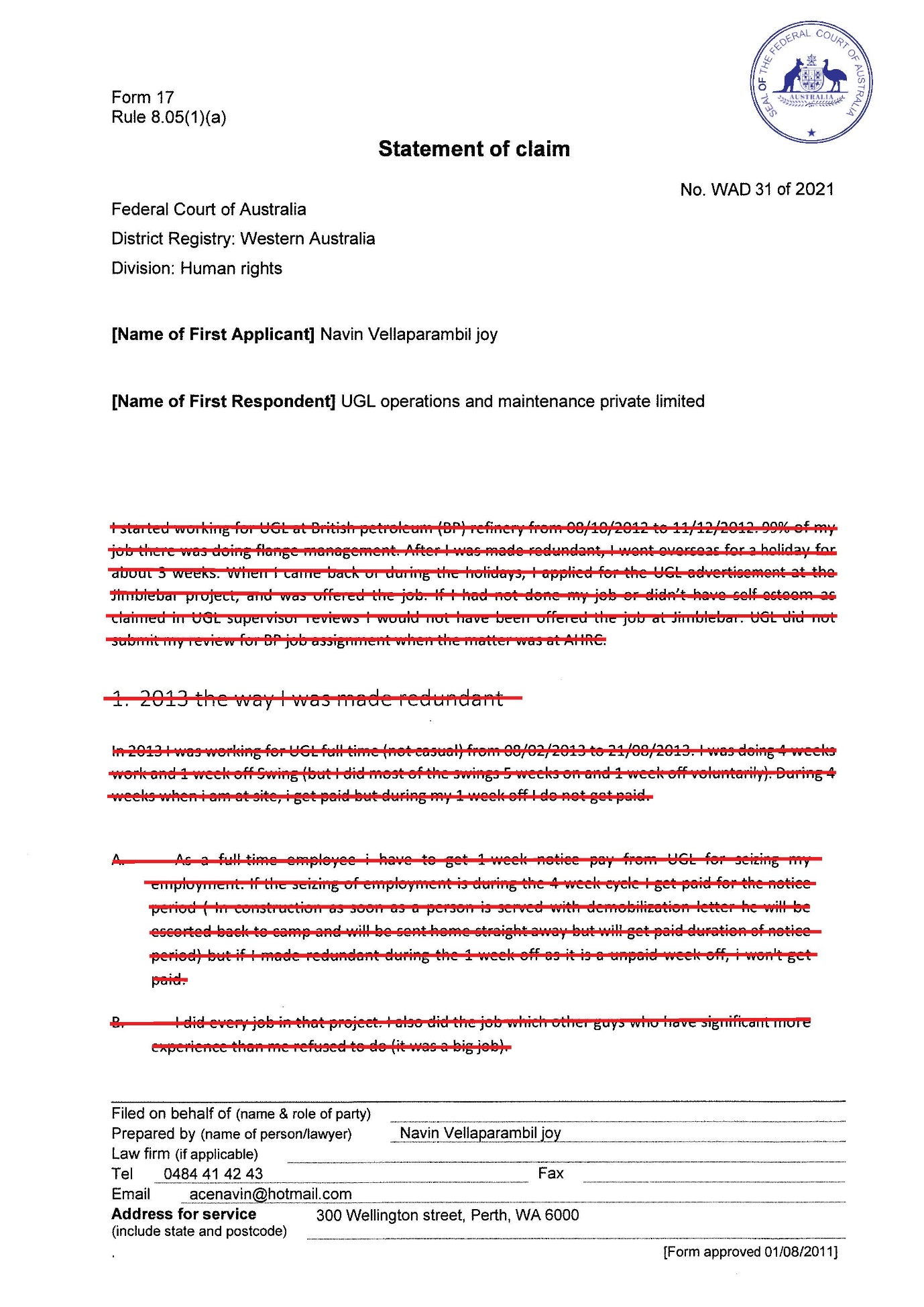
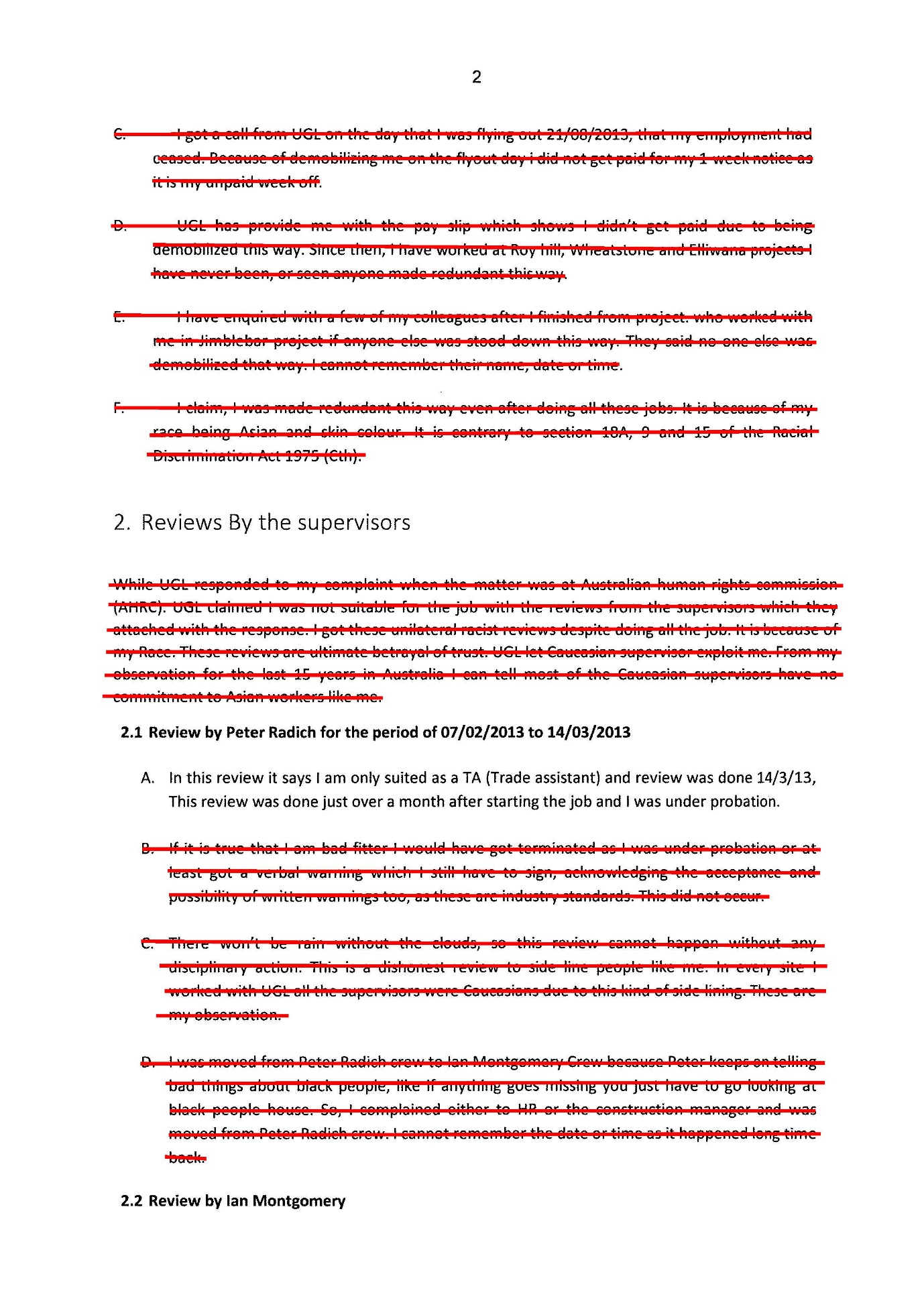
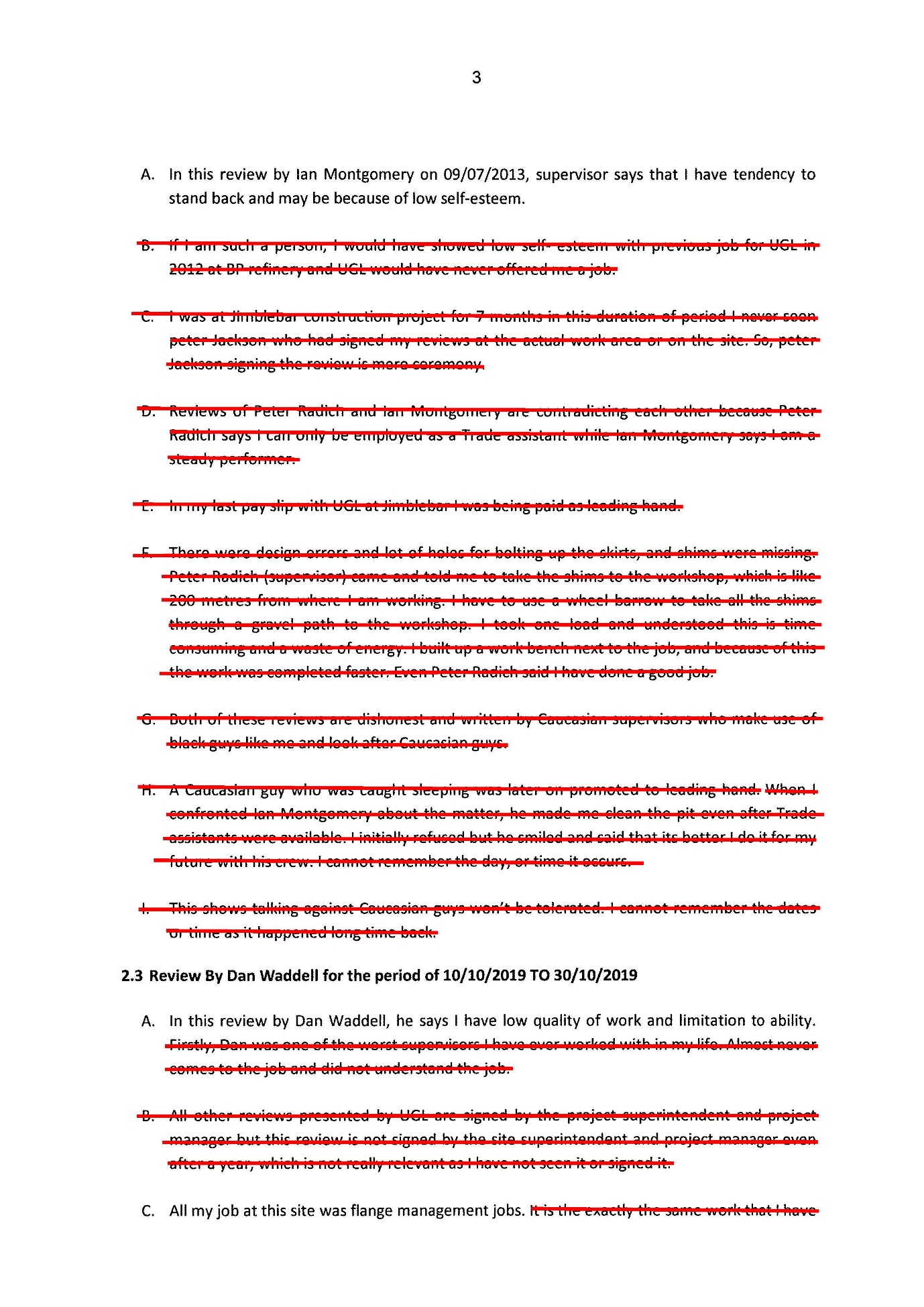
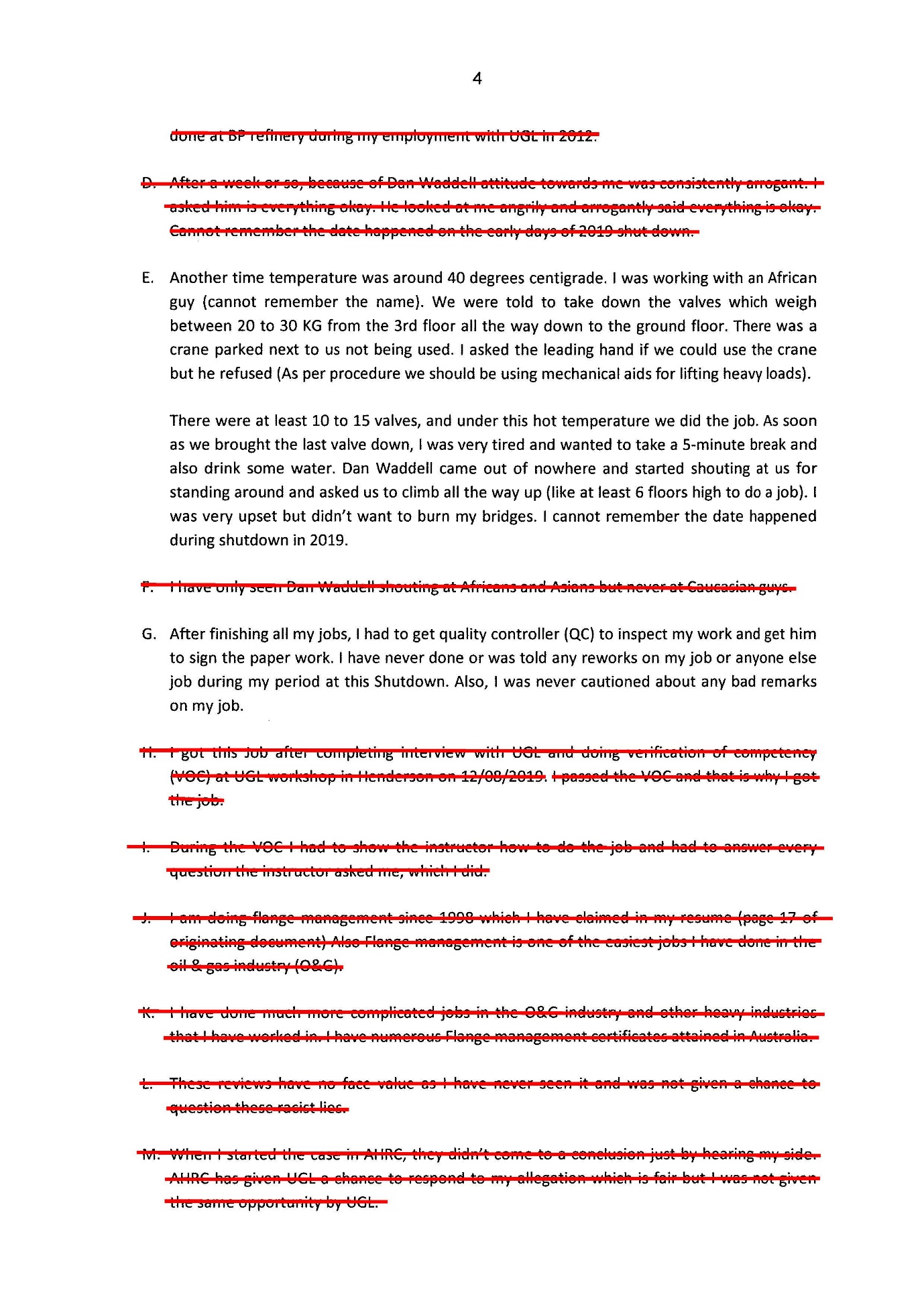
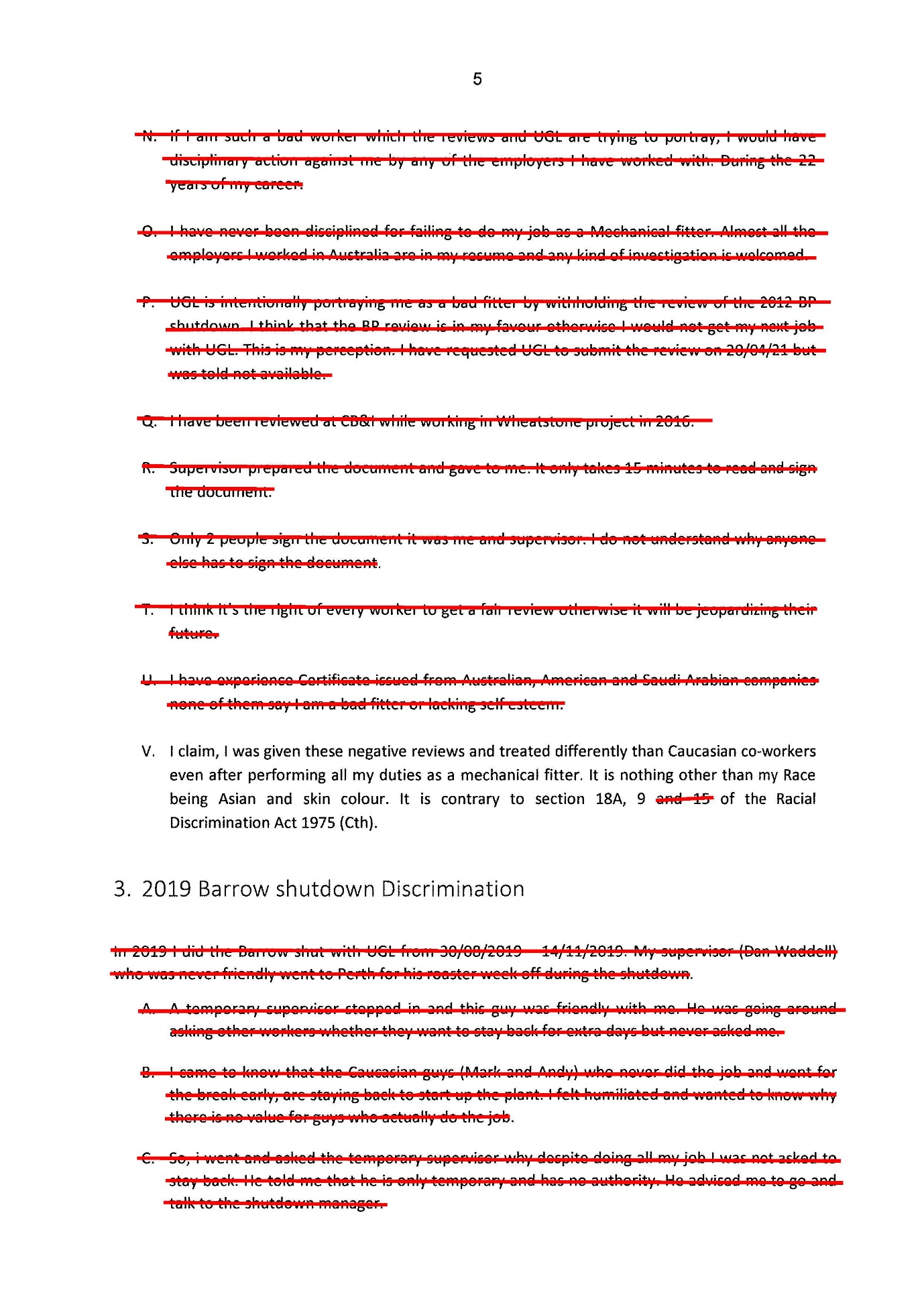
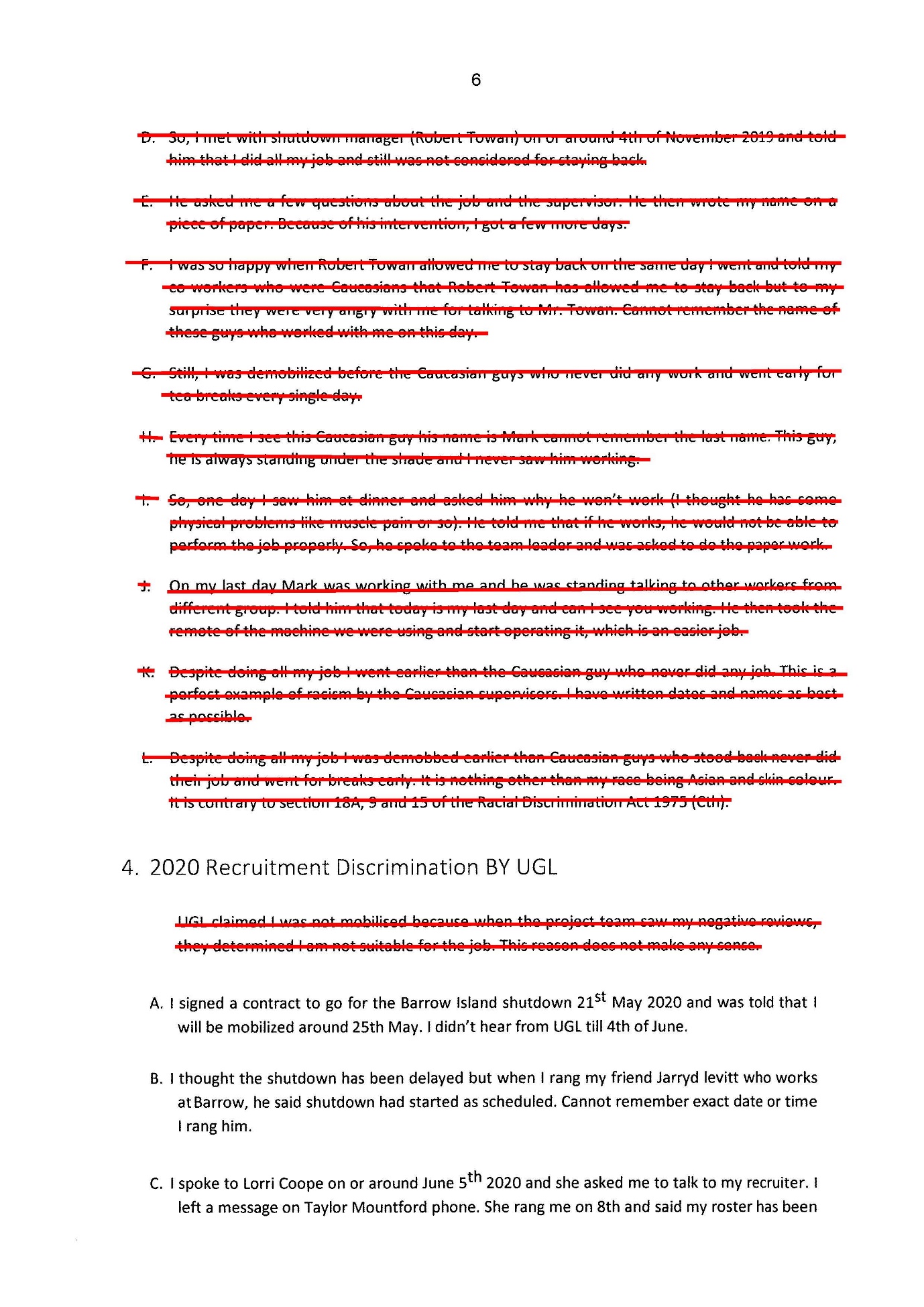
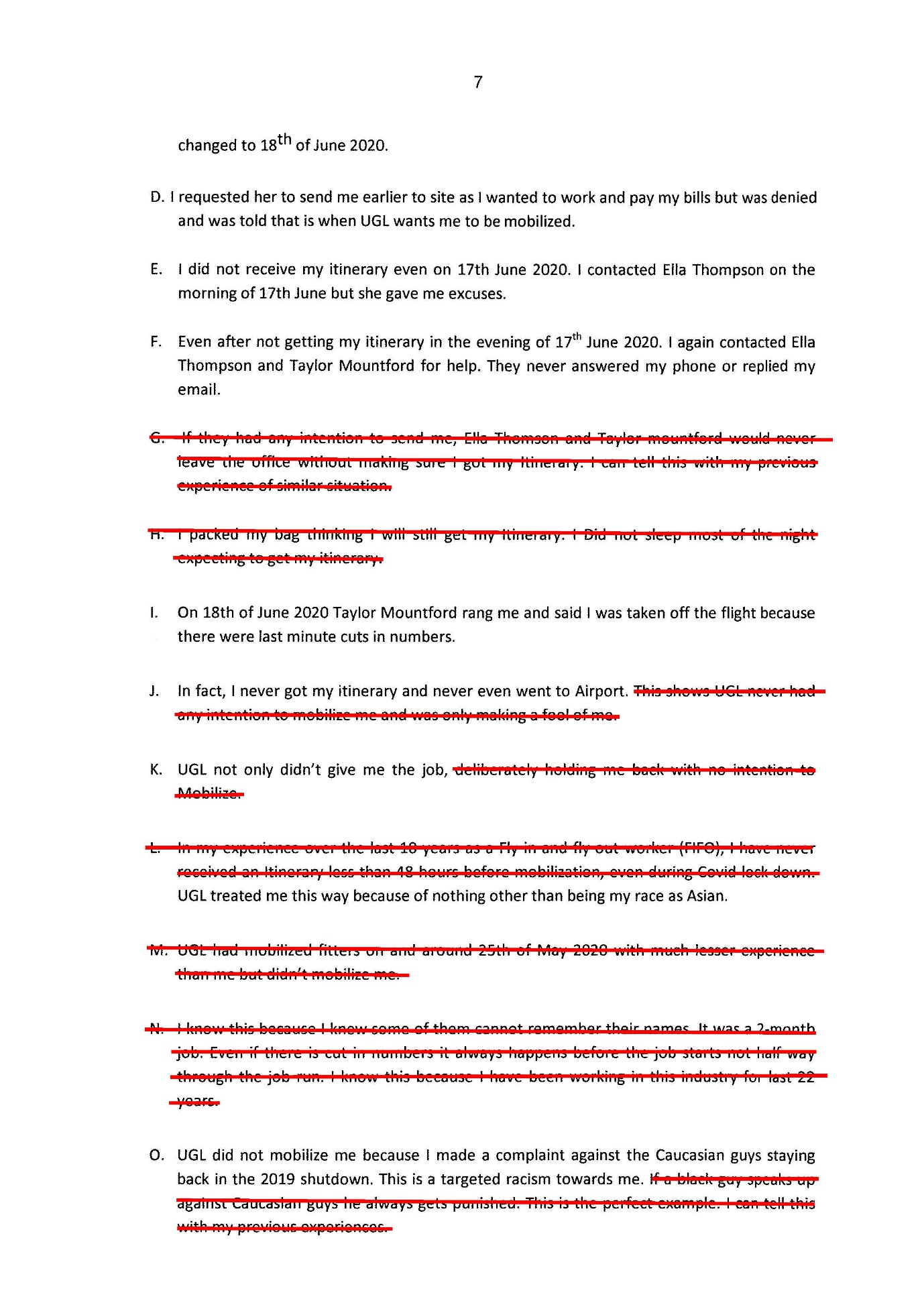
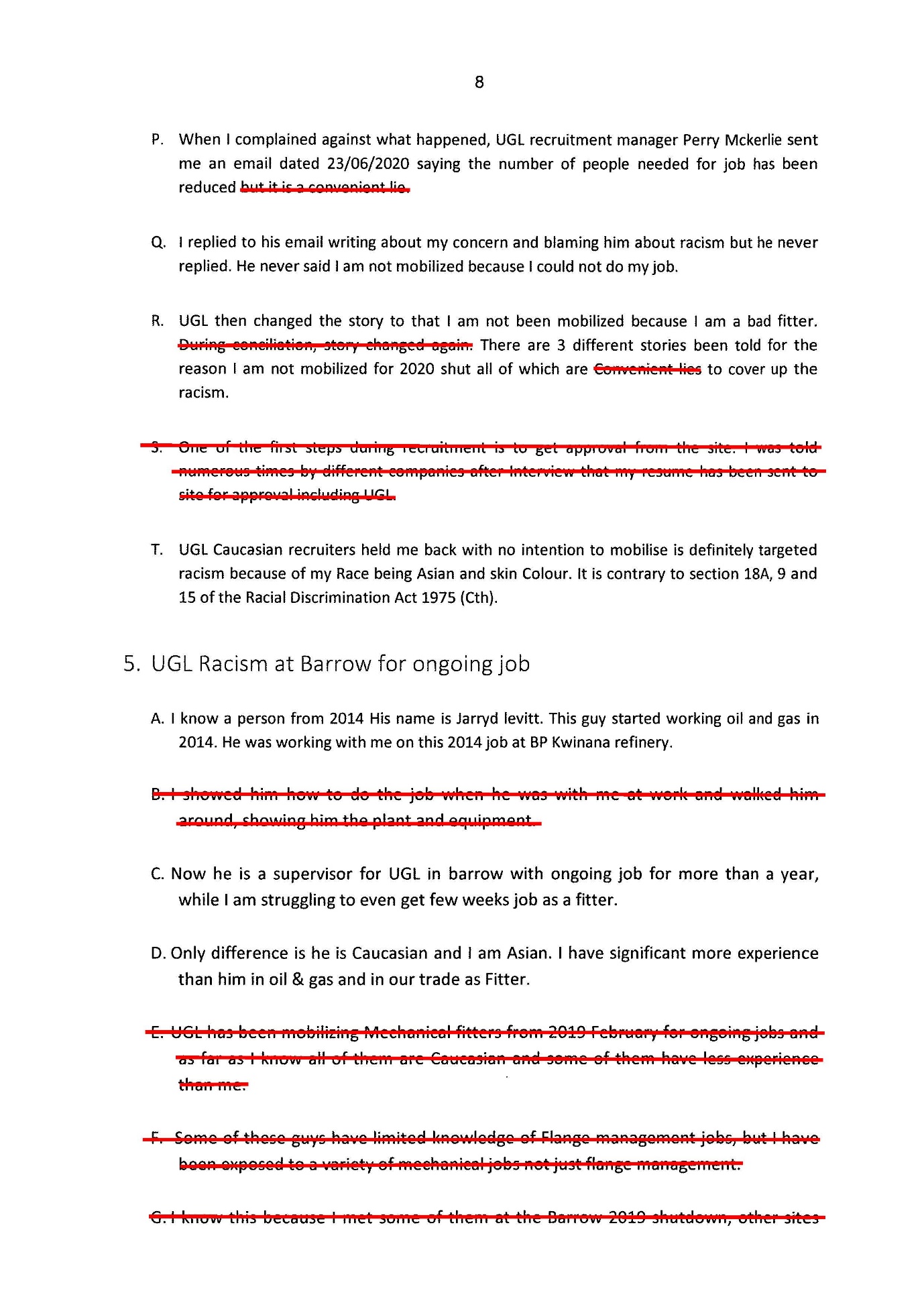
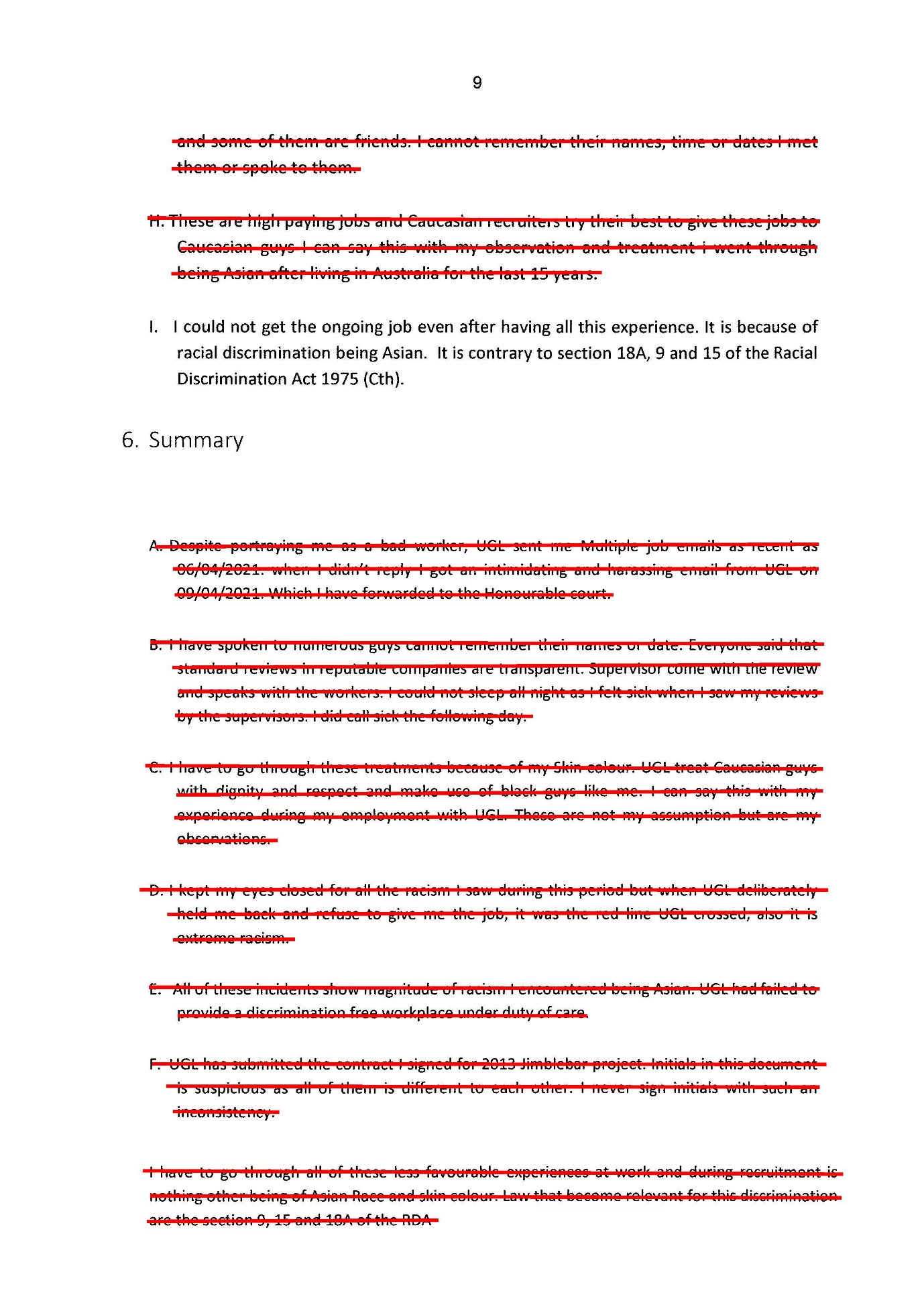
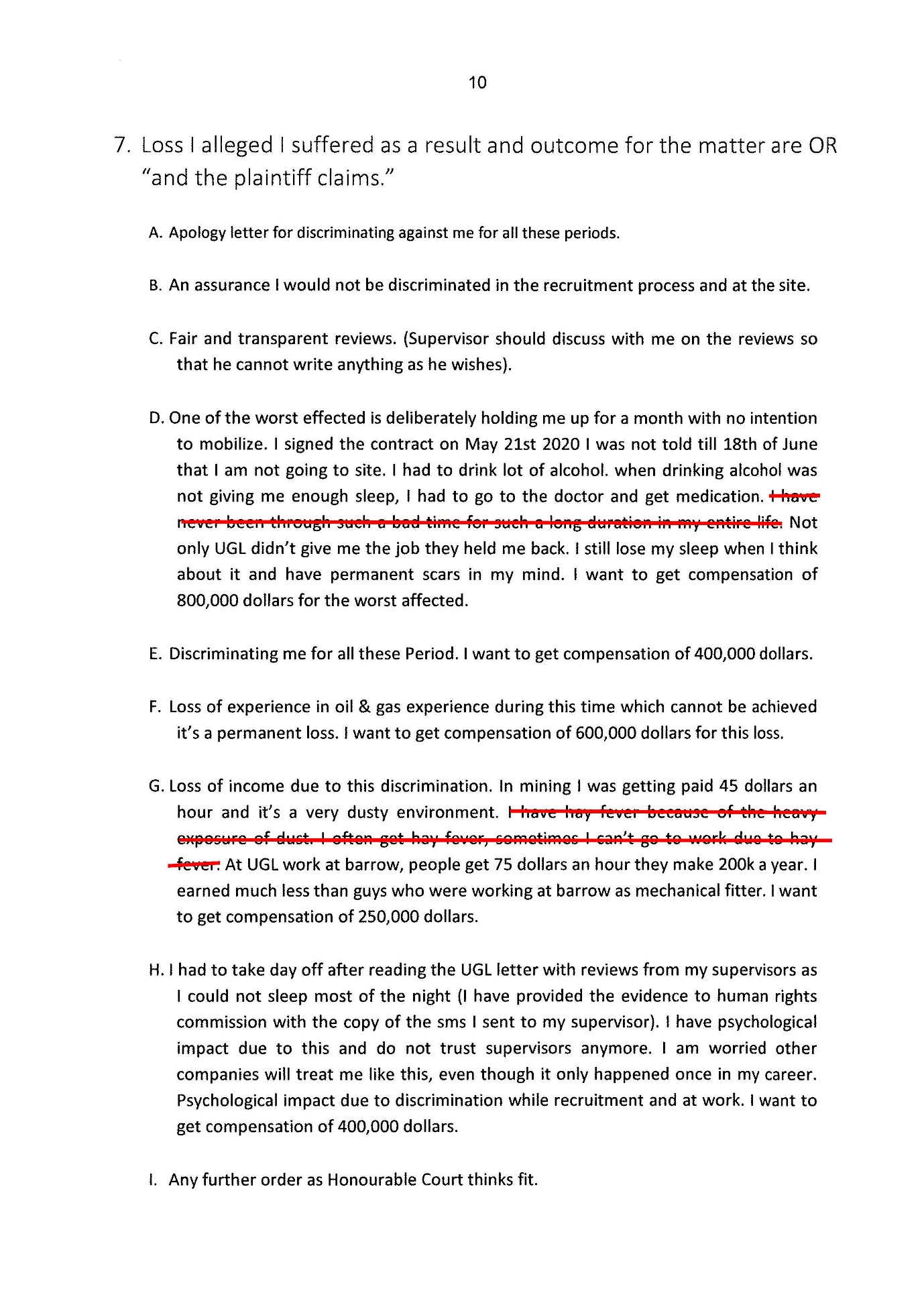
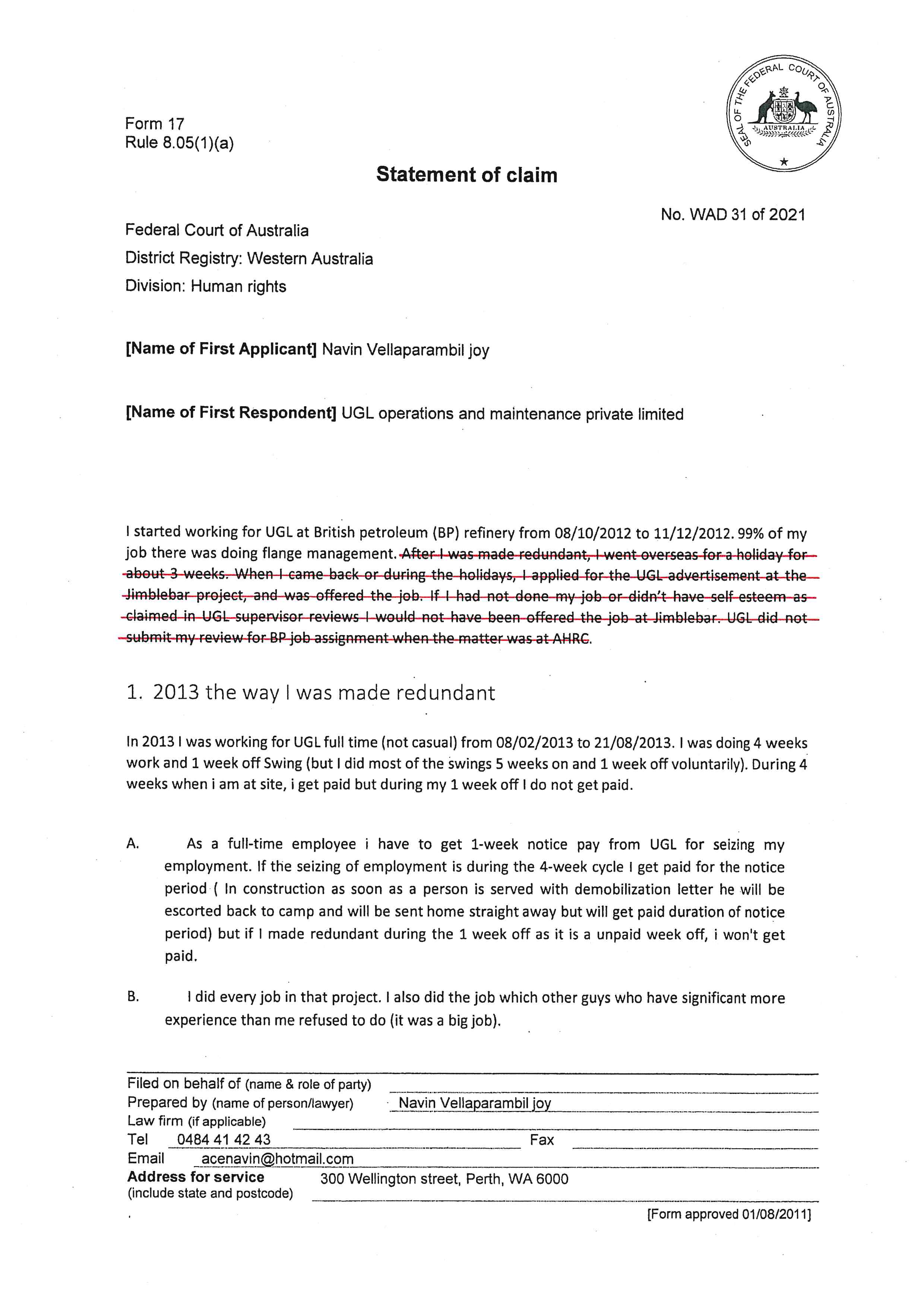
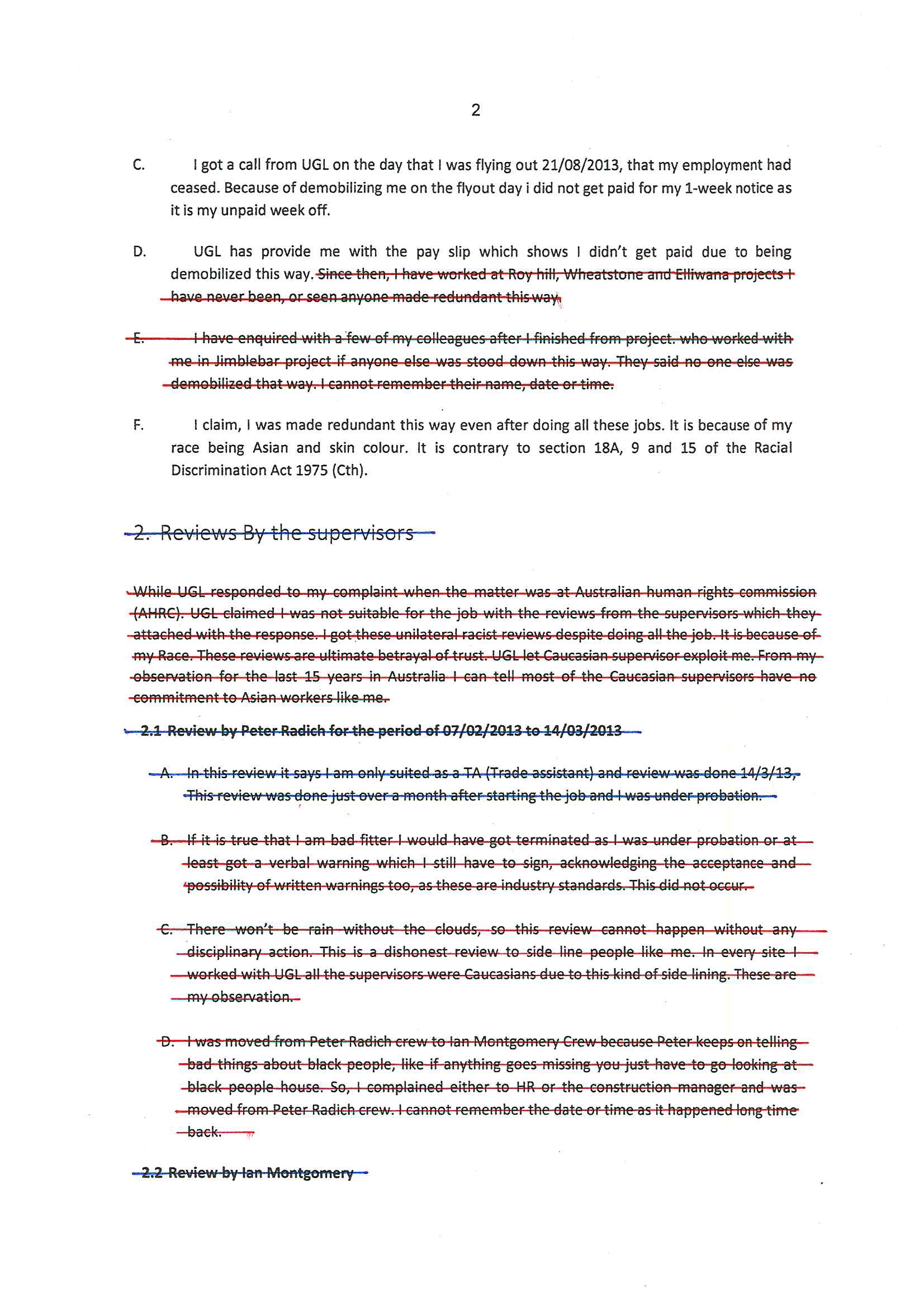
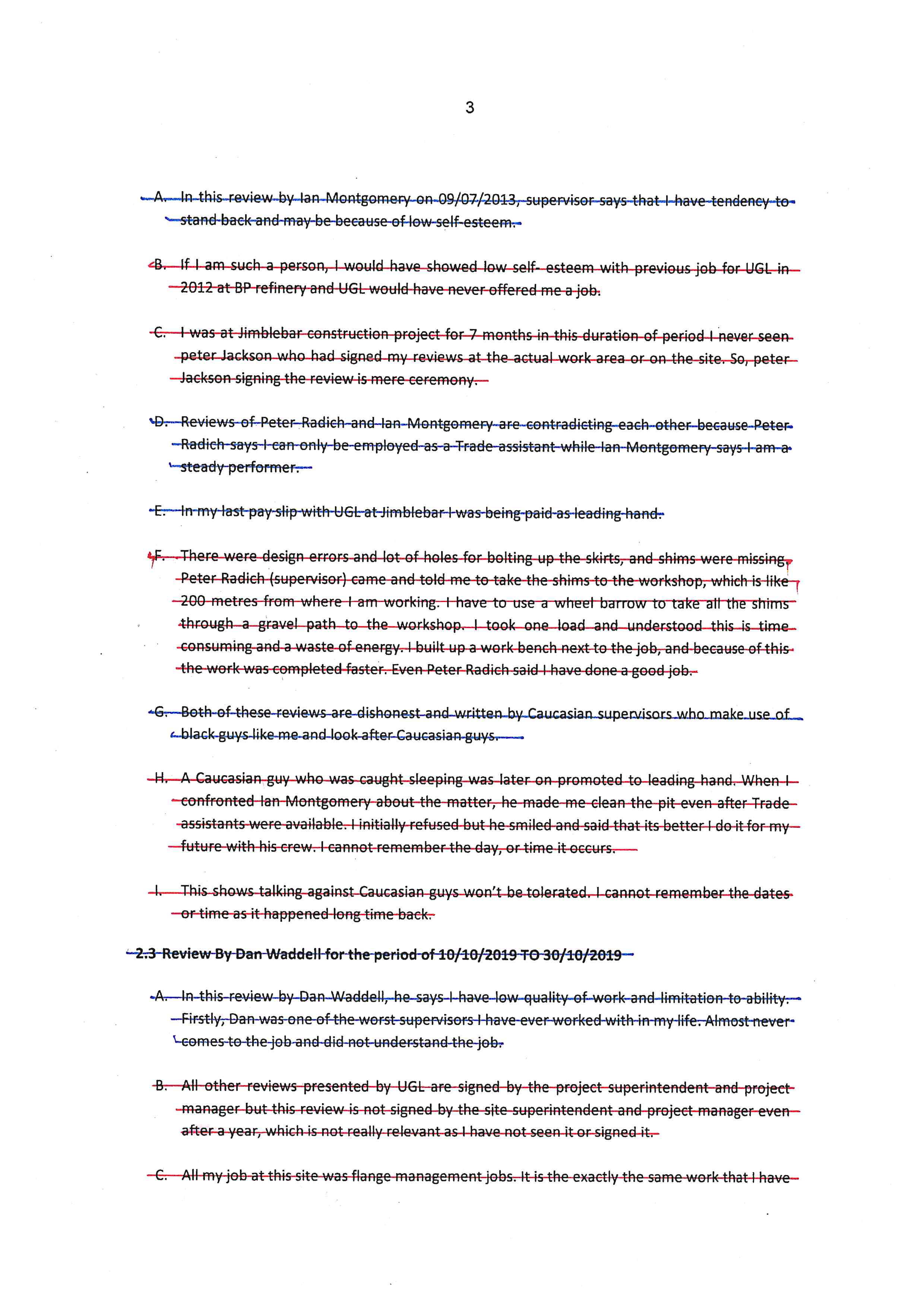
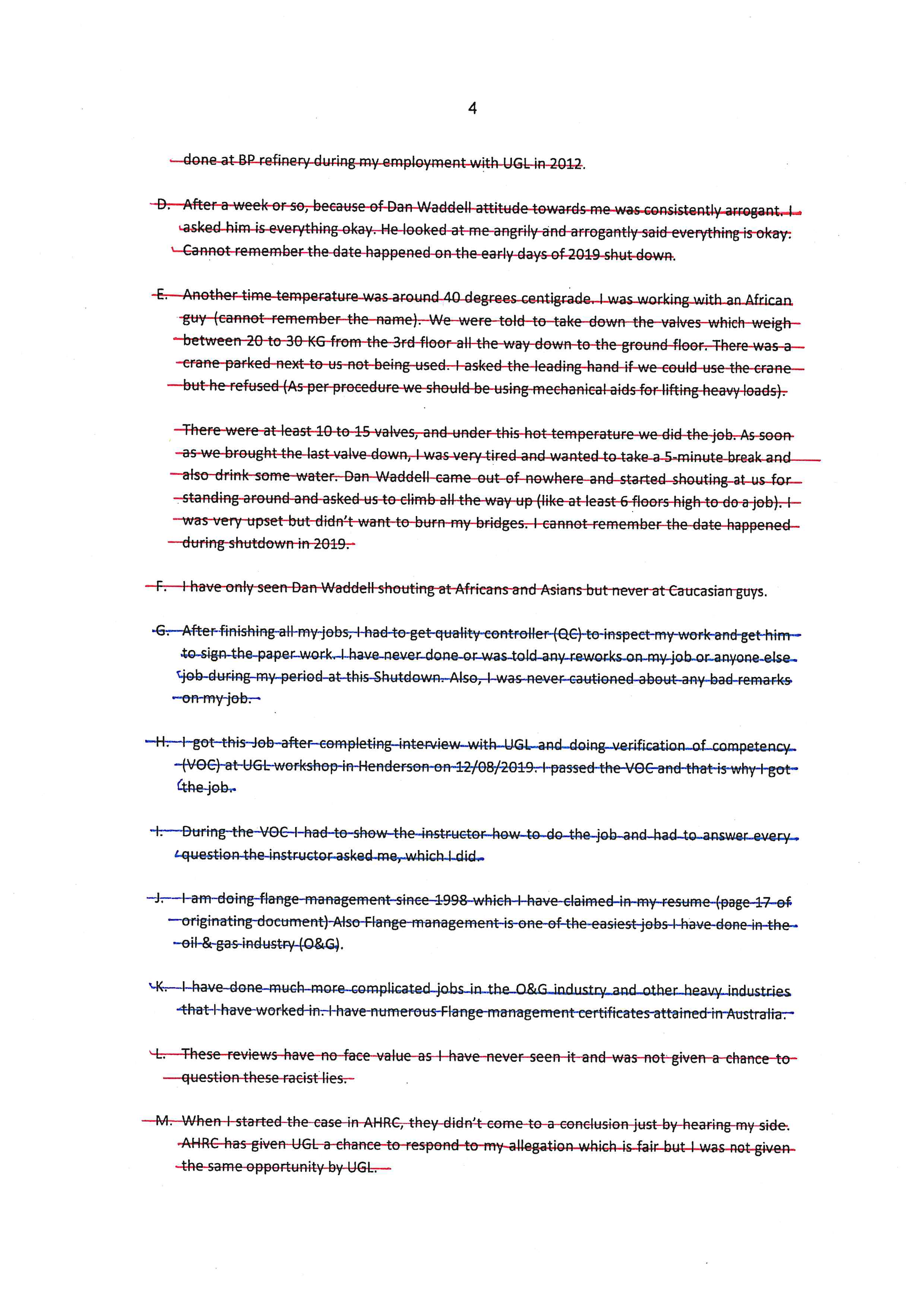
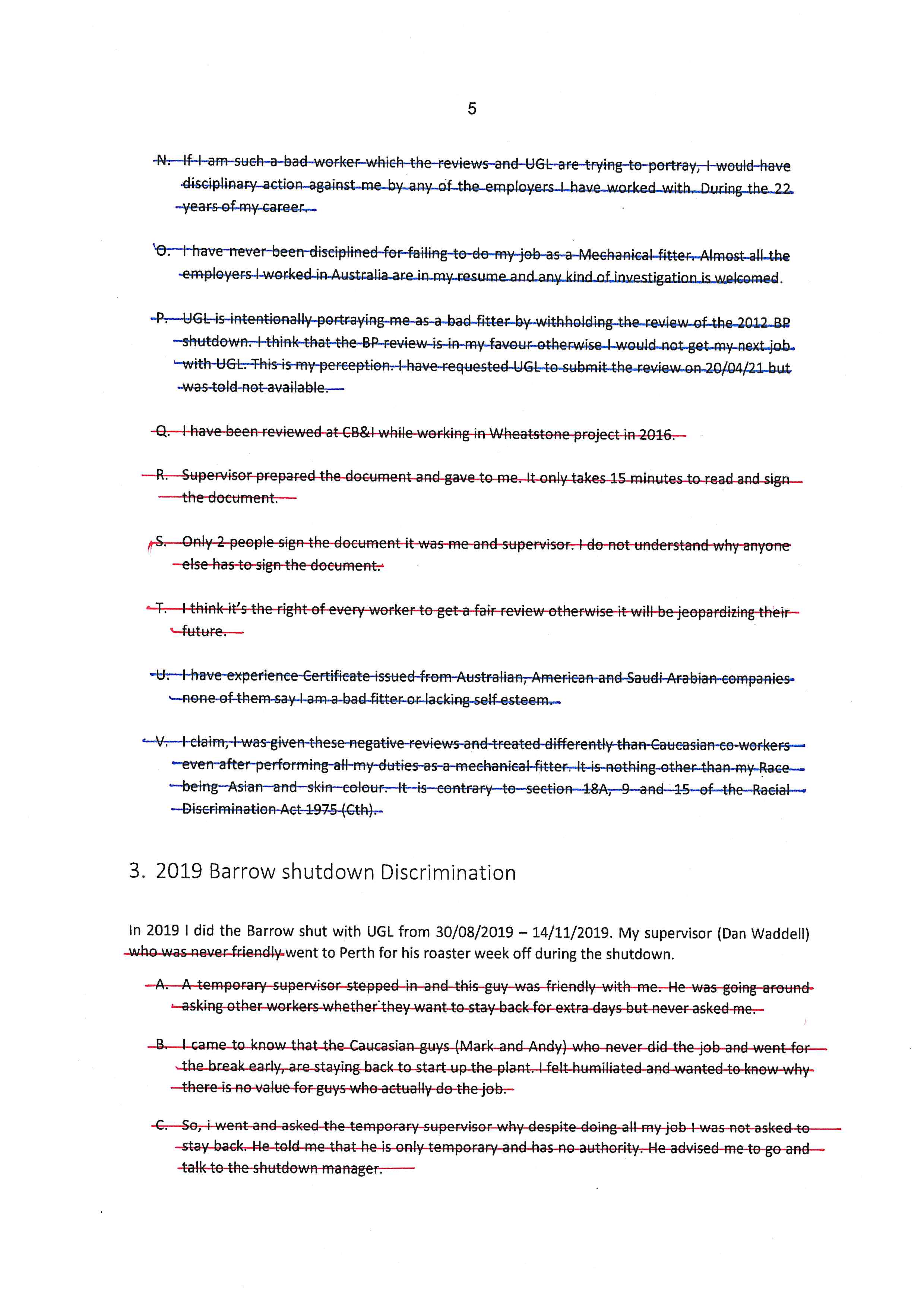
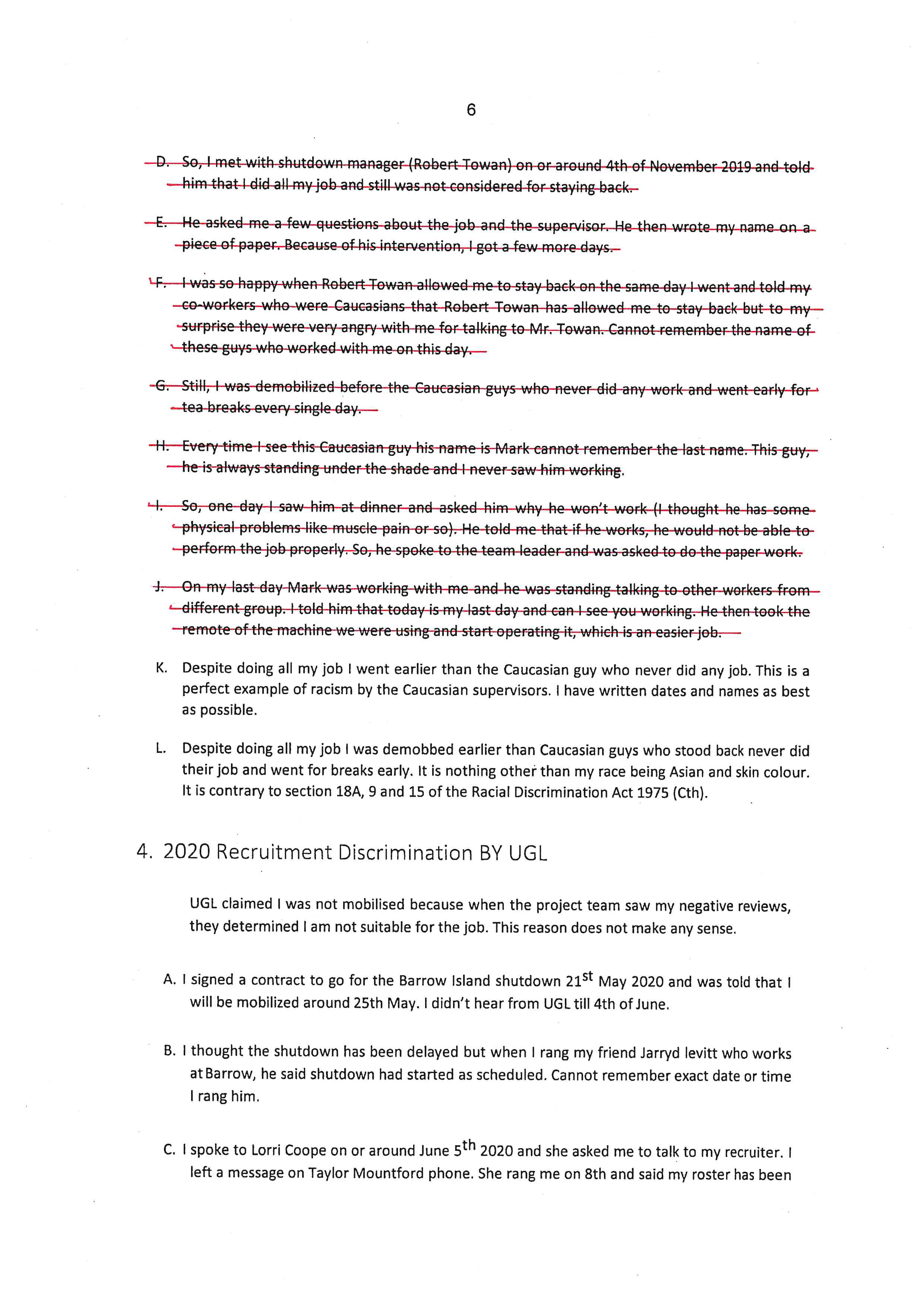
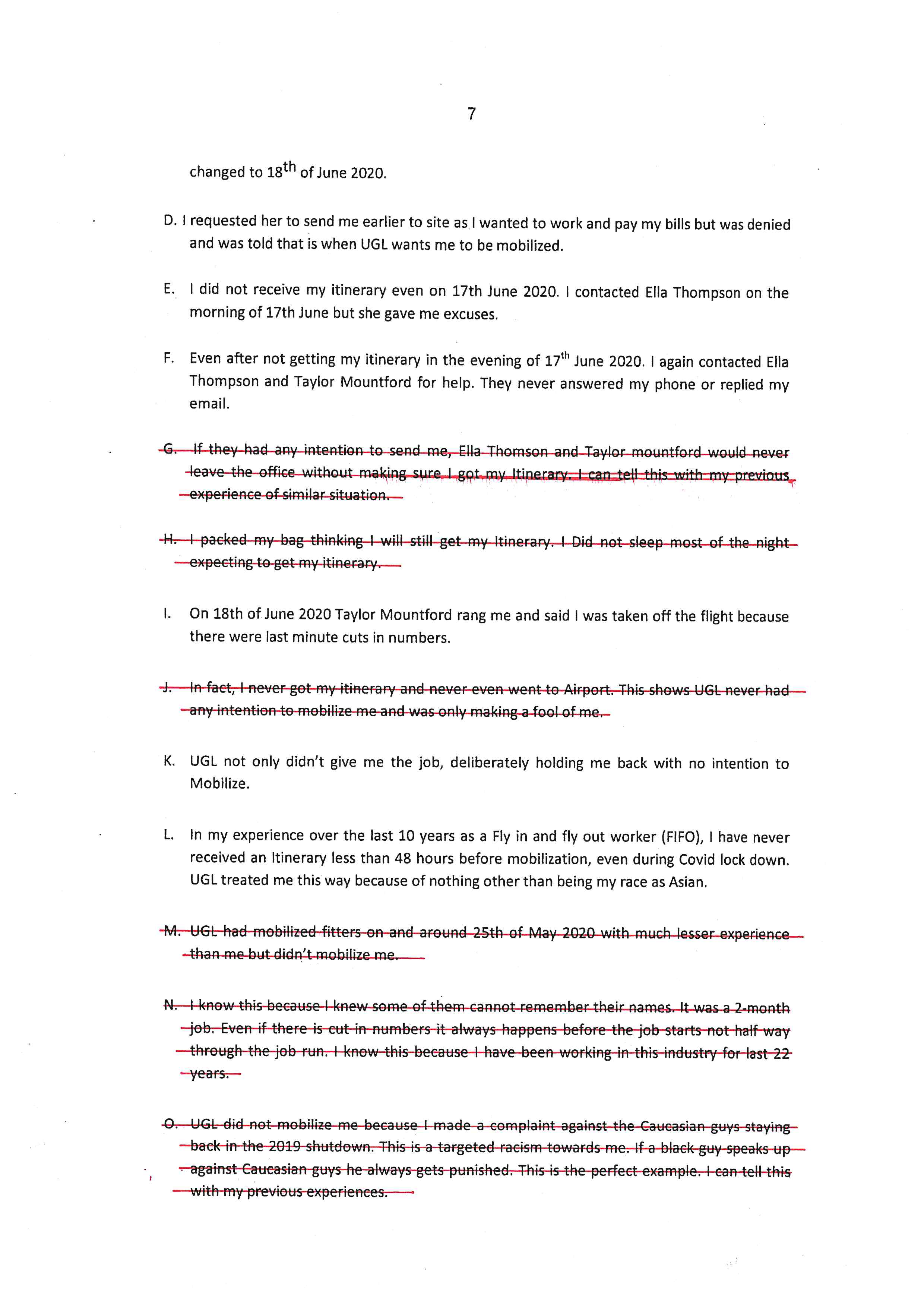
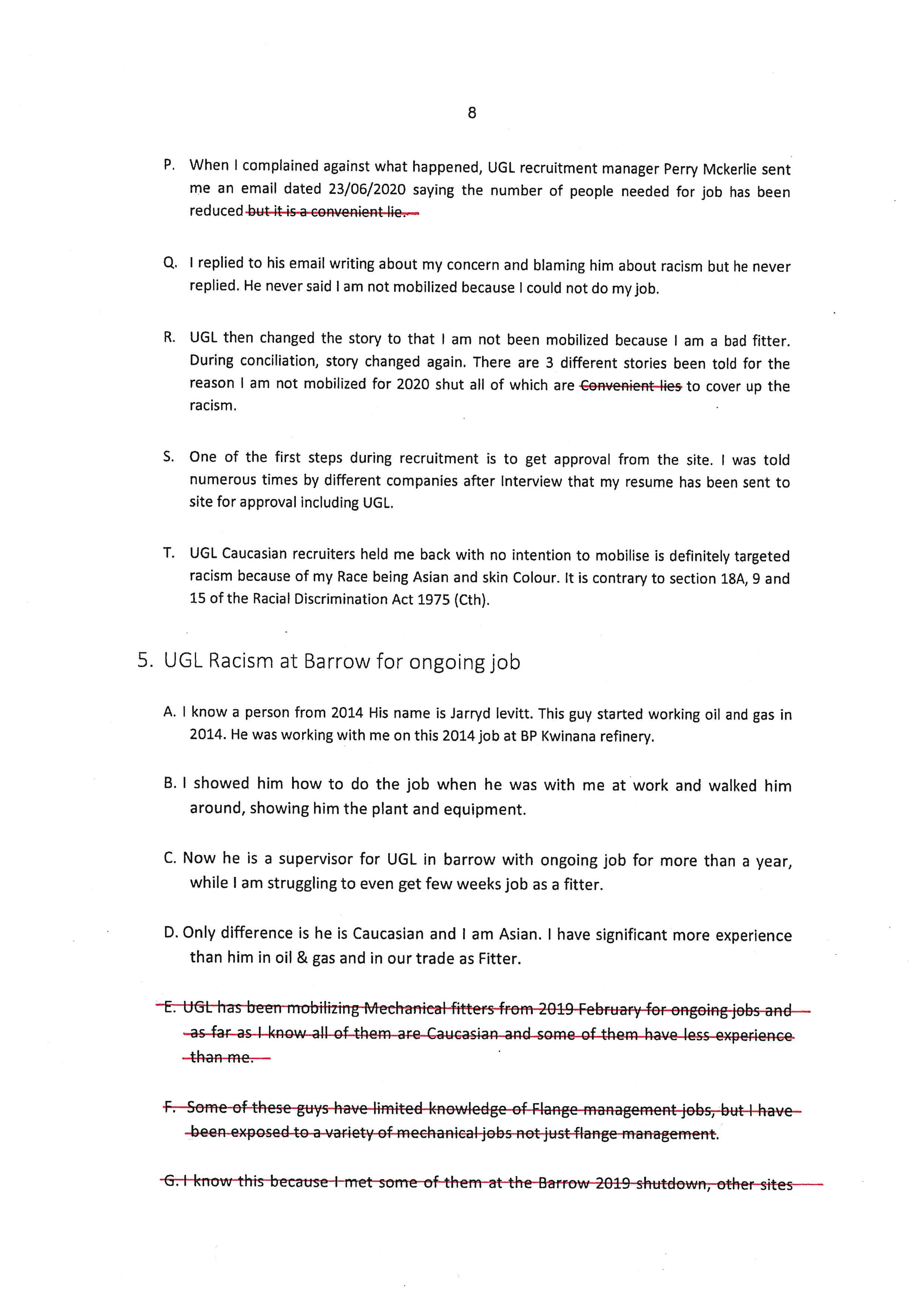
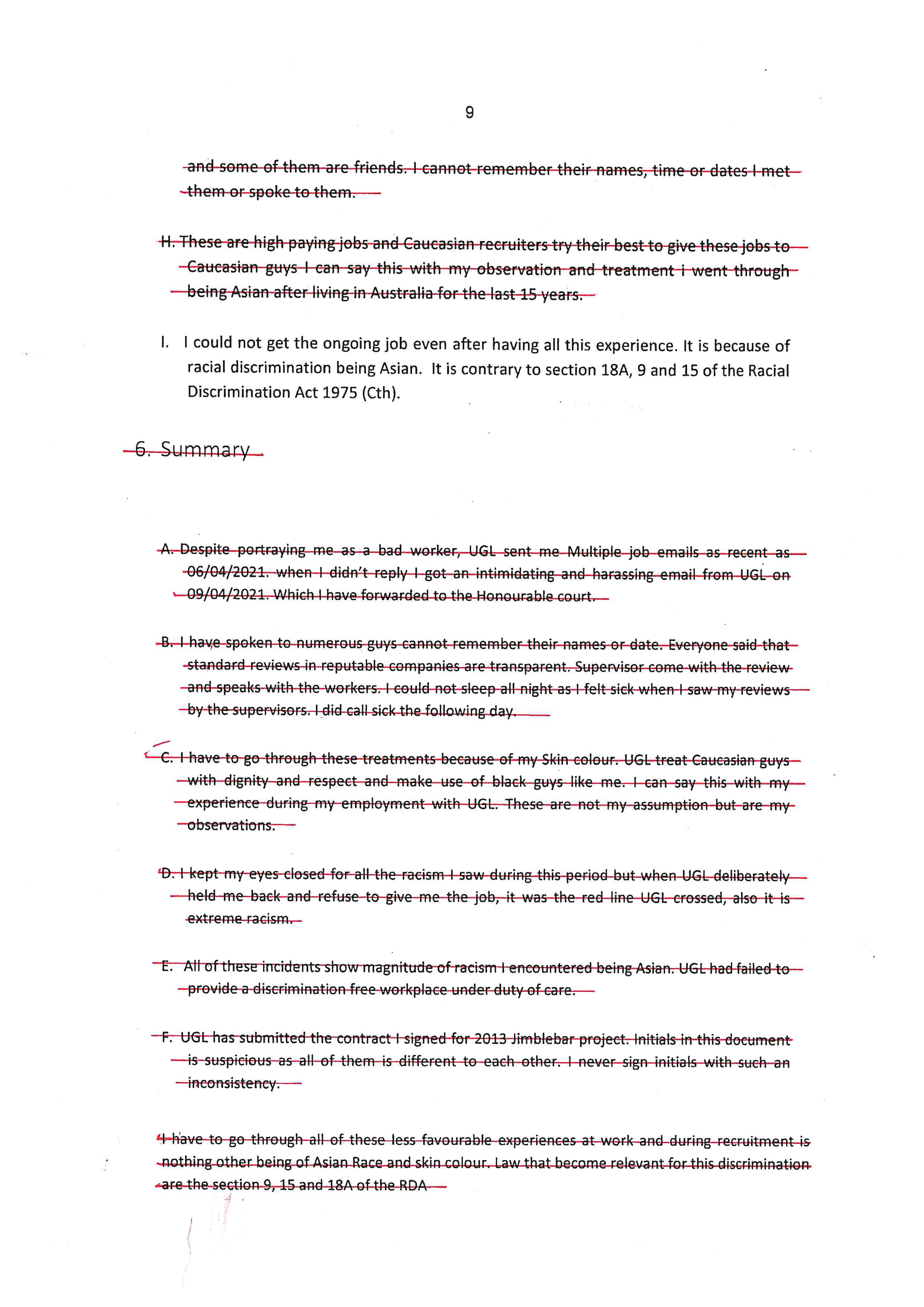
2 The most convenient way to consider the current state of the amended statement of claim is by reference to the annexures to these reasons. Annexure B to these reasons is a version of Mr Joy’s claim that UGL has struck through with red lines for each portion which it contends should either be dismissed or struck out. Annexure A to these reasons expresses my rulings on the application. In particular those:
(a) portions struck through with red lines are to be dismissed and/or struck out with no liberty to re-plead; and the
(b) portions struck through with blue lines are to be dismissed, but with liberty to re-plead those matters in conformity with these reasons.
3 Although portions of the pleading have survived the application, it is strongly advisable that Mr Joy re-draw the claim in its entirety.
RELEVANT LEGISLATION
4 The starting point is to consider the relevant provisions of the Racial Discrimination Act 1975 (Cth) (RDA) as relied upon in the pleading, being ss 9, 15 and 18A, which respectively and relevantly provide as follows:
9 Racial discrimination to be unlawful
(1) It is unlawful for a person to do any act involving a distinction, exclusion, restriction or preference based on race, colour, descent or national or ethnic origin which has the purpose or effect of nullifying or impairing the recognition, enjoyment or exercise, on an equal footing, of any human right or fundamental freedom in the political, economic, social, cultural or any other field of public life.
(1A) Where:
(a) a person requires another person to comply with a term, condition or requirement which is not reasonable having regard to the circumstances of the case; and
(b) the other person does not or cannot comply with the term, condition or requirement; and
(c) the requirement to comply has the purpose or effect of nullifying or impairing the recognition, enjoyment or exercise, on an equal footing, by persons of the same race, colour, descent or national or ethnic origin as the other person, of any human right or fundamental freedom in the political, economic, social, cultural or any other field of public life;
the act of requiring such compliance is to be treated, for the purposes of this Part, as an act involving a distinction based on, or an act done by reason of, the other person’s race, colour, descent or national or ethnic origin.
…
…
15 Employment
(1) It is unlawful for an employer or a person acting or purporting to act on behalf of an employer:
(a) to refuse or fail to employ a second person on work of any description which is available and for which that second person is qualified;
(b) to refuse or fail to offer or afford a second person the same terms of employment, conditions of work and opportunities for training and promotion as are made available for other persons having the same qualifications and employed in the same circumstances on work of the same description; or
(c) to dismiss a second person from his or her employment;
by reason of the race, colour or national or ethnic origin of that second person or of any relative or associate of that second person.
(2) It is unlawful for a person concerned with procuring employment for other persons or procuring employees for any employer to treat any person seeking employment less favourably than other persons in the same circumstances by reason of the race, colour or national or ethnic origin of the person so seeking employment or of any relative or associate of that person.
…
…
18A Vicarious liability
(1) Subject to subsection (2), if:
(a) an employee or agent of a person does an act in connection with his or her duties as an employee or agent; and
(b) the act would be unlawful under this Part if it were done by that person;
this Act applies in relation to that person as if that person had also done the act.
(2) Subsection (1) does not apply to an act done by an employee or agent of a person if it is established that the person took all reasonable steps to prevent the employee or agent from doing the act.
BACKGROUND
5 Mr Joy initially instituted a claim in the Australian Human Rights Commission. The complaint was terminated in the Commission, which resulted in Mr Joy issuing proceedings in this Court in respect of substantially the same amended complaints as were the subject of the amended complaint terminated in the Commission. That complaint was annexed to the originating application in this proceeding, but is conveniently summarised by the terminating letter from the Commission when it said that it understood the subject matter of the original complaint to be Mr Joy’s non-mobilisation with UGL in 2020. The Commission understood Mr Joy’s references to other alleged events, including in 2013 and 2019, to be background information only.
6 The Commission, however, granted leave to Mr Joy to amend his complaint to include the following:
(a) the circumstances in which UGL allegedly ended Mr Joy’s employment in 2013. Mr Joy said that no co-worker he knew of, was stood down in that way;
(b) a Caucasian co-worker who started working with Mr Joy in 2014, whom he had taught to do the job, has since been promoted to a supervisor position, whereas Mr Joy has more experience and is struggling to find work even as a fitter;
(c) Mr Joy being demobilised earlier than any of his Caucasian co-workers in 2019;
(d) performance reviews from Caucasian supervisors in 2013 and 2019 which were critical of Mr Joy’s performance, even though he had performed his job well, no performance concerns were raised with him at the time, and he went on to perform other periods of work for UGL;
(e) Caucasian and less-experienced co-workers being sent for ongoing jobs with UGL since February 2019, when Mr Joy was not;
(f) a Caucasian co-worker who never did any work in 2019 being mobilised to the May 2020 shutdown project, but Mr Joy was not; and
(g) further particulars were provided concerning non-mobilisation with UGL in 2020.
7 In this Court it also seems to be the case that the claims of discrimination are more numerous in the pleading and there are earlier and separate claims for discrimination over and above the 2020 experience. It would be very helpful if Mr Joy were able to marshal some legal expertise to frame his claims in a more conventional way. Nonetheless, the current pleading is to be dealt with as it presently stands.
SUMMARY OF THE PLEADING
8 The first section of the pleading relates to Mr Joy’s redundancy in 2013; the second relates to reviews by supervisors in 2013 and 2019; the third relates to his demobilisation from Barrow Island at a time in 2019 which he says was earlier than the ‘Caucasian guys who stood back never did their job and went for breaks early’. The fourth section is said to be recruitment discrimination in 2020 by UGL. The fifth section deals with suggested UGL racism at Barrow Island for the ‘ongoing job’. There is also a sixth section, which is a summary and the seventh section is a statement of loss Mr Joy contends that he has sustained.
9 It will be apparent to experienced lawyers that the pleading does not take a conventional form. It is somewhat discursive, narrative and contains a good deal of evidence, much of which would be inadmissible if it was sought to be adduced. Nonetheless, given that Mr Joy represents himself, he is entitled to a reasonable degree of latitude.
RELEVANT PRINCIPLES
10 As UGL asserts, this Court may give judgment for one party against another (of the whole or just part of the proceeding) if it is satisfied that the party has no reasonable prospect of successfully prosecuting the proceeding or that part of the proceeding: s 31A(2) of the Federal Court of Australia Act 1976 (Cth). It is well established that under the Federal Court Act the proceeding need not be hopeless or bound to fail for the purposes of summary judgment. Similarly, under the Federal Court Rules 2011 (Cth), the Court may also award summary judgment where, relevantly, an applicant has no reasonable prospect of successfully prosecuting the proceeding or part of the proceeding or no reasonable cause of action is disclosed: r 26.01 of the Federal Court Rules.
11 When considering whether an applicant has ‘no reasonable prospect of successfully prosecuting the proceeding or part of the proceeding’, the question is whether, on the material before the Court, it has been shown that there is no real question of law or fact which should be decided at trial, according to the particular circumstances of each case: see Australian Securities and Investments Commission v Cassimatis [2013] FCA 641; (2013) 220 FCR 256, where Reeves J said (at [46]-[50]):
46 It is apparent from these authorities that s 31A has lowered the bar, or softened the test, for summary judgment, or summary dismissal, as compared to that set by earlier summary judgment or summary dismissal regimes. At the same time, it sets a different inquiry from that required under those regimes. The critical question under s 31A in a summary dismissal application such as the present one is whether ASIC, the applicant, has “reasonable” prospects of successfully prosecuting these proceedings. As the moving party in this summary dismissal application, the Cassimatises bear the onus of persuading the Court of this criterion. These authorities reveal that the determination of a summary dismissal application therefore does not require a mini-trial based upon incomplete evidence to decide whether the proceedings are likely to succeed or fail at trial. Instead, it requires a critical examination of the available materials to determine whether there is a real question of law or fact that should be decided at trial. Each application for summary judgment or summary dismissal has to be determined according to its particular circumstances. What is required is a practical judgment of the case at hand. The relevant circumstances will partly depend upon the stage which the proceedings have reached. Among other things, this will affect the materials available to the Court considering the application, for example, whether pleadings have been exchanged, or discovery of documents has occurred.
47 Accepting there can be no “hard and fast” rule about this, as a general principle, these authorities show that the moving party on an application for summary dismissal of the present kind is likely to succeed on its persuasive onus if it is able to demonstrate to the Court that the applicant’s success in the proceedings relies upon a question of fact that can be truly described as fanciful, trifling, implausible, improbable, tenuous or one that is contradicted by all the available documents or other materials. Conversely, as a general principle, it is unlikely to succeed where, on a critical examination of all the available materials, the Court is satisfied that there appears to be a real question of fact to be determined between the parties. This is more likely to be the case where the available materials include pleadings that raise factual disputes that can be truly described as significant, substantial, plausible or weighty. A real question of fact is also more likely to exist where the question/s of fact concerned is/are complex, eg involving numerous different events or transactions over a long period of time.
…
50 Finally, these authorities show that there are at least two other factors that need to be borne in mind on a summary judgment application such as this. The first is that, in all the situations outlined above, the Court has a discretion as to whether to determine the proceedings summarily, or to refer them to trial. Of course, as with any such discretion, it has to be exercised judicially: see Latoudis v Casey (1990) 170 CLR 534 at 569 per McHugh J, quoting Donald Campbell & Company v Pollak [1927] AC 732 at 811-812 per Viscount Cave LC. Secondly, while s 31A sets a lower bar, or a softened test, for the summary determination of proceedings, any such summary determination still has to be approached with caution. This is so because a trial is the usual and accepted means by which disputed questions of fact are determined in this country.
(Emphasis added.)
12 The consideration of whether the prospect of success is real and is more than fanciful may be a judgement of law or fact or of mixed law and fact: Spencer v Commonwealth [2010] HCA 28; (2010) 241 CLR 118 (at [25]). In relation to there being no reasonable cause of action, this may arise where the material before the Court is such that the action should not be permitted to go to trial in the ordinary way because it is apparent that it must fail as there is no reasonable cause of action: Webster v Lampard [1993] HCA 57; (1993) 177 CLR 598 (at 602).
13 In relation to the strike out application in the alternative, the relevant principles are that the pleadings must state the party’s case sufficiently clearly so that the other party knows with clarity what is asserted against it: Singh v Khan (No 2) [2021] FCA 463 per Stewart J (at ([3]). All or part of a pleading can be struck out because, relevantly, the pleading contains scandalous material; is evasive or ambiguous; is likely to cause prejudice, embarrassment or delay in the proceeding; or discloses no reasonable cause of action.
14 In this instance, it is asserted that there is some scandalous material in the pleading. This can arise where an allegation ‘is unbecoming to the dignity of the Court to hear or is contrary to good manners or which charges some person with a crime not necessary to be shown in the cause’, or ‘any unnecessary (not relevant to the subject) allegation bearing purely upon the moral character of an individual’: Chandrasekaran v Commonwealth (No 3) [2020] FCA 1629 per Wigney J (at [104]).
15 A pleading is likely to cause embarrassment in the proceeding where the pleading is susceptible to various meanings or contains inconsistent allegations or irrelevant allegations which will increase expense. It also includes where the pleading is unintelligible, ambiguous, vague or too general so that the respondent does not know what is being alleged against it.
16 A pleading is evasive or ambiguous if it is unintelligible or so vague that it fails to identify the material factual allegations so that the other party does not have notice of the substance of the claim: Elston v Commonwealth [2013] FCA 108 per Logan J (at [29]-[30]).
17 If substantial parts of a pleading are struck out, the Court may strike out the entire pleading on the basis that the residue would be confusing: Faruqi v Latham [2018] FCA 1328 per Wigney J (at [98] and the authorities cited therein).
18 UGL has acknowledged that the Court will exercise caution when summarily dismissing pleadings of self-represented litigants. Courts should carefully examine what is put to it by a party to ensure the party has not, because of a lack of legal skills, failed to claim rights or put forward an argument which might otherwise have been advanced: Morton v Mitchell Products Pty Ltd [1996] FCA 828.
19 Nonetheless, an unrepresented party is still required to observe the rules with respect to pleadings. It is often in the public interest and in the interests of both parties, including the unrepresented party, that the hearing of a complaint which is shown to be so lacking in substance should be summarily terminated. This is especially so where an unsuccessful litigant may face the burden of a costs application: Travers v New South Wales [2000] FCA 1565 per Lehane J (at [19]).
20 It should also be noted that UGL does not seek to dismiss or strike out the entire claim. Even on its fairly robust attack, some of the claim would survive.
SUMMARY DISMISSAL OF 2013 REDUNANCY CLAIM?
21 It is necessary then to examine the pleading by reference to the principles set out above. UGL argues that Mr Joy has no reasonable prospect of successfully prosecuting the 2013 redundancy claim and has no reasonable cause of action. The essence of the allegation, which is pleaded in section one of the claim, is that from February 2013 to August 2013 Mr Joy was employed full-time by UGL and typically worked four or five weeks on-site followed by one week off. Employees were not paid during their week off (R&R break). Mr Joy says that as a full-time employee, UGL was required to give one week’s notice before ceasing an employee’s employment. If the notice was given while the employee was working on-site, they would be stood down immediately but still paid for the duration of the one-week notice period. Mr Joy says he was given notice by UGL at the start of his R&R break such that he was not paid during the notice period. Mr Joy alleges no one else was stood down in this way and that he was stood down in this because of his race.
22 UGL observes that in order to successfully prosecute a claim under s 9(1) of the RDA it must be shown that:
(a) the person did an act;
(b) the act involved a distinction, exclusion, restriction or preference;
(c) the act was based on race, colour, descent or national or ethnic origin; and
(d) the act had the purpose or effect of nullifying or impairing the recognition, enjoyment or exercise, on an equal footing, of any human right or fundamental freedom in the political, economic, social, cultural or any other field of public life.
23 In order for a claim to be successful under s 9(1) of the RDA, the act must be based on the person’s race or colour. UGL says Mr Joy’s claim fails to address this critical element.
24 Section 15 of the RDA, relevantly to this case, addresses:
(a) refusing or failing to employ a person;
(b) refusing or failing to offer or afford a person the same terms of employment, conditions of work and opportunities for training and promotion as are made available for other persons; and
(c) dismissing a person from his or her employment,
by reason of race, colour or national or ethnic origin of that person or any relative or associate of that person.
25 Again, UGL argues that for a claim under s 15 of the RDA to succeed, there must be a connection between the act alleged and the person’s race, that is, the person’s ethnicity or race played a causative part in the act: Commonwealth v McEvoy [1999] FCA 105; (1999) 94 FCR 341 per von Doussa J (at [39]).
26 UGL contends that Mr Joy has not pleaded any material facts to support the claim that he was made redundant in the manner alleged by reference to his race or colour, or that the redundancy was caused by his race or colour. There is a pleading that others have told Mr Joy no one else was demobilised in the way he was. Such a broad pleading is insufficient, UGL argues, to show that the act was done in reference to Mr Joy’s race. Additionally, in the pleading, it is pleaded that Mr Joy cannot remember the name, date or time of when others have told him this. UGL says that it follows that Mr Joy will be unable to produce any evidence on this point. UGL says there are no facts to support Mr Joy’s claim that he was made redundant in the way he alleges because of his race or skin colour. Accordingly, it is asserted that there is no reasonable prospect of successfully prosecuting the 2013 redundancy claim.
27 In addition, in relation to s 9(1A) of the RDA, if Mr Joy pursues his claim on this basis, UGL observes that it must be proven that:
(a) a term, condition or requirement is imposed on a complainant;
(b) the term, condition or requirement is not reasonable in the circumstances;
(c) the complainant does not or cannot comply with that term, condition or requirement; and
(d) the requirement has the effect of interfering with the recognition, enjoyment or exercise, on an equal footing, by persons of the same race, colour, descent or national or ethnic origin as the complainant of any relevant human right or fundamental freedom.
28 UGL argues that Mr Joy cannot have a valid claim under s 9(1A) of the RDA as it is not alleged that a term, condition or requirement was imposed on him. There being no reasonable prospect of successfully prosecuting a claim, UGL contends that the 2013 redundancy claim should be dismissed. I agree that Mr Joy has not set up a claim under s 9(1A) of the RDA.
29 In relation to this aspect of the application, Mr Joy says as far as he knows, he is the only person who has been made redundant while on their R&R break without getting paid. He says that if he was Caucasian that would never happen to him. He says in his written submissions that Caucasians are treated with respect and dignity on every site he has worked with UGL. Only Asians and Africans are mistreated, as he can tell from his observations. Mr Joy makes the point that UGL would certainly have the evidence if any Caucasian was made redundant during the R&R break without getting paid.
30 In my view, this claim should not be summarily dismissed. The case that Mr Joy sets up is that because he was not Caucasian, he alone was made redundant during the R&R break without getting paid. Whether this is a particularly significant claim in a financial sense is another question, but it is a claim that UGL can deal with. If his assertion is incorrect, UGL will have evidence of one or more Caucasians being treated in the same way. Even if UGL does not have such evidence, it is still incumbent on Mr Joy to prove his claim. He has the onus. But while this still remains a developing area of the law, I am not satisfied that of the claim that Mr Joy was made redundant prior to his R&R break, so that he did not receive payment during the notice period by reason of his race or colour is a claim that could not fall within s 9(1) of the RDA. I would not dismiss this relatively minor claim on this ground.
SUMMARY DISMISSAL OF 2013 AND 2019 PERFORMANE REVIEWS?
31 Broadly speaking, in section two of Mr Joy’s claim he describes three unfavourable performance reviews given to him by two supervisors in 2013 and one in 2019. He also describes what would appear to be contemporaneous conduct of those supervisors, referred to below as the Radich Conduct, Montgomery Conduct and the Waddell Conduct.
32 In relation to these various performance reviews, UGL argues that Mr Joy has no reasonable prospect of successfully prosecuting a reasonable cause of action in relation to a contravention of s 15 of the RDA. As noted, s 15 addresses refusing or failing to employ a person, dismissing a person or refusing or failing to offer or afford a person the same terms of employment, conditions of work and opportunities for training and promotion that are made available for other persons. UGL contends that it is clear that the various performance reviews do not relate to employment or dismissal of Mr Joy and they do not evidence UGL refusing or failing to offer or afford Mr Joy the same terms of employment, conditions of work and opportunities for training and promotion because they are performance reviews. They are not terms of employment, conditions of work or opportunities for training or promotion as required under s 15(1)(b) of the RDA.
33 UGL argues that s 15(1)(b) of the RDA requires some positive act of failing or refusing to offer or afford some specified benefit, being terms of employment, conditions of work or opportunities for training or promotion, and such performance reviews are not an act of offering or affording one of these benefits.
34 Similarly, the alleged Waddell Conduct is that Mr Waddell shouted at Mr Joy. Shouting would not fall within s 15(1)(b) of the RDA, UGL contends. I accept this contention.
35 The alleged Montgomery Conduct was that Mr Montgomery made Mr Joy clean the trade pit, saying to him that ‘it’s better you do it for your future with my crew’. Such conduct, UGL says, could not constitute Mr Montgomery, on behalf of UGL, failing or refusing to offer or afford terms of employment, conditions of work or opportunities for training and promotion as required under s 15(1)(b) of the RDA. There is therefore, UGL argues, no reasonable prospect of successfully prosecuting the part of the proceedings in relation to the allegations of the Montgomery Conduct and the Waddell Conduct under s 15 of the RDA and those sections should be dismissed. This contention is correct. The Waddell Conduct and the Montgomery Conduct will be summarily dismissed.
36 Mr Joy responds to UGL’s complaints about the performance review claims saying that the reason he was not employed for a project in 2020 was because of the ‘dishonest, Racist reviews by the Caucasian supervisors’. The difficulty is that Mr Joy has not pleaded this matter in any way which links the alleged negative reviews in 2013 and 2019 to the alleged employment discrimination in 2020. Section 4 deals with the 2020 recruitment discrimination by UGL, but does not expressly link that alleged discrimination to the performance reviews. Mr Joy contends in his written submissions that he was not employed due to the racist reviews given by supervisors, even though he had performed his work better than his colleagues.
37 The difficulty Mr Joy faces in this section of the pleading dealing specifically with the performance reviews, at least as far as a pleading goes, is that the only proper linkage between those reviews and his failure to regain employment in 2020 appears in his written submissions filed in response to this strike out application. I would strike out this section of the pleading pertaining to the reviews, but with liberty to re-plead, so that those issues are properly linked. There will be no liberty to re-plead in relation to the Montgomery Conduct or the Waddell Conduct.
38 In relation to the Radich Conduct, in his written submissions, Mr Joy contends that Mr Radich’s words and actions show that he has no respect, due to racial views about people like Mr Joy.
39 The pleading in relation to this assertion at para 2.1D alleges that:
[Mr Joy] was moved from Radich crew to Montgomery Crew because [Mr Radich] keeps on telling bad things about black people, like if anything goes missing you just have to go looking at black people house. So, I complained either to HR or the construction manager and was moved from Radich crew. I cannot remember the date or time as it happened long time back.
40 UGL contends that Mr Joy has no reasonable prospect of successfully prosecuting the Radich Conduct and has no reasonable cause of action in relation to it. Having regard to s 15 and s 9 of the RDA on which Mr Joy relies, UGL submits it is clear that the alleged Radich Conduct cannot fall within those sections. While it might be argued that the alleged Radich Conduct is an act for the purposes of s 9 of the RDA, there is no material ‘before the Court’, UGL says, to establish that the alleged Radich Conduct involved a distinction, exclusion, restriction or preference.
41 It has not been asserted that any real consequence was suffered as a result of such remarks. The moving to a different crew is perhaps a distinction or exclusion. But given the lack of any recollection of detail, I am not satisfied that the pleading at para 2.1D could be sustained as a contravention of the RDA. I would also dismiss this part of the claim, pertaining to the Radich Conduct, it has no relevant link to the alleged breaches.
STRIKE OUT IN THE ALTERNATIVE
42 In the alternative to summary dismissal, UGL submits that section one of the pleading, para 2.1D of the pleading and para 2.3V of the pleading should be struck out as disclosing no reasonable cause of action.
43 I cannot accept that section one (the 2013 redundancy claim) should be struck out, having already explained my reasoning for this. I do accept that para 2.1D should be struck out, but I have already ordered its dismissal.
44 The only question about para 2.3V is whether the reference to s 15 of the RDA should be struck out as disclosing no reasonable cause of action. I have indicated that I would strike out the pleadings concerning these performance reviews, but give leave to re-plead so as to link the performance reviews as asserted by Mr Joy in his written submissions to his inability to gain reemployment. The same ruling is relevant to this ground.
Pleading points
45 Alternatively, UGL advance a large number of somewhat pedantic pleading points, given the circumstances.
46 UGL submits that section one of the pleading should be struck out for the following reasons. UGL says:
(a) para 1A: as a result of the other paragraphs of section one being struck out, this paragraph would be confusing if it was retained;
(b) para 1B: this pleading is likely to cause embarrassment. It is vague, ambiguous and of a general evidentiary nature. UGL cannot properly plead to this as it cannot know what is being alleged against it;
(c) para 1C: as a result of the other paragraphs of section one being struck out, this paragraph would be confusing if it was retained;
(d) para 1D: the first sentence should be struck out because, as a result of the other paragraphs of section one being struck out, it would be confusing if it was retained. The second sentence should be struck out on the basis that it is likely to cause embarrassment on the basis that Mr Joy’s opinion of what has occurred at other sites is irrelevant to the matter;
(e) para 1E: this pleading is likely to cause embarrassment. It is vague, ambiguous and of a general evidentiary nature. UGL cannot properly plead to this as it does not plead any material facts that can be responded to; and
(f) para 1F: as a result of the other paragraphs of section one being struck out, this paragraph would be confusing if it was retained.
47 I generally disagree. I consider that most of this section can be retained. It is not a model of pleading of course, but I am not satisfied that UGL cannot respond adequately to it. If anything, it supplies more information than UGL needs in order to respond to it. I would, however, strike out the second sentence in para 1D and strike out para 1E, as this material, at least in its present form, is evidence rather than material facts.
48 UGL has then painstakingly set out the following complaints in tabular form. I have given my brief ruling in a further column to the table on the right-hand side with a heading ‘Ruling’. In considering the embarrassment objections in the table, I have had regard to the principles from the authorities I have set out above. Most importantly, the real question is whether UGL is able to sensibly plead in response. I have allowed considerably more latitude because Mr Joy is self-represented. As previously noted, the fact that these assertions are made, does not mean that similar latitude will be or should be given to the process of adducing evidence in support of the assertions:
No | Paragraph in [the pleading] | Ground | Submission | Ruling |
(a) | First paragraph on page 1 (unnumbered) | Pleading is likely to cause embarrassment. | This pleading is narrative material and mere “background” to the matter. Further, [Mr Joy’s] work at BP refinery in 2012 and his employment at Jimblebar are irrelevant as they are not the subject of the present application. | The rule against pleading background is highly discretionary. Generally speaking, a pleading will be embarrassing if it contains narrative to the point that it is not a pleading to which the other party is expected to or can plead. Material should not be allowed if it is ‘not easy to plead a defence’. It is very common in pleadings to have some background material which sets the scene. In this case, however, it is not clear how the entirety of the material is relevant to the pleading. The first two sentences are arguably relevant in showing that Mr Joy had previously been employed by UGL in flange management. Otherwise, the balance of this paragraph should be struck out. |
(b) | First paragraph of section 2 (unnumbered) | Pleading is likely to cause embarrassment and is ambiguous. | This pleading is narrative material and mere “background” to the matter. Further, [UGL’s] response to the Australian Human Rights Commission complaint is irrelevant to these proceedings before the Federal Court. The pleading that [Mr Joy] received unilateral racist reviews despite “doing all the job” is vague, ambiguous and too general to be responded to. The pleading that the reviews are the “ultimate betrayal of trust” is [Mr Joy’s] opinion and is irrelevant to the proceedings. The pleading that [UGL] let Caucasian supervisors exploit [Mr Joy], is [Mr Joy’s] opinion and is irrelevant to the proceedings. Further, it is vague and too general to be responded to. The pleading that [Mr Joy] has observed Caucasian supervisors over 15 years is [Mr Joy’s] opinion, which is irrelevant to the proceedings. Further, it is ambiguous, too general to be responded to, not specific to [UGL] and is outside of the time period of the matters the subject of these proceedings. | UGL’s complaint should be upheld. This paragraph will be struck out. |
(c) | 2.1B | Pleading is likely to cause embarrassment and is ambiguous. | The pleading that [Mr Joy’s] employment would have been terminated and/or he would have been subject to disciplinary action if he was a poor fitter is [Mr Joy’s] opinion and is irrelevant to the proceedings. Further, the pleading is vague and too general to be responded to. The pleading on industry standards is irrelevant to the proceedings. Further, it is vague, ambiguous and too general to be responded to. | UGL’s complaint should be upheld. This paragraph will be struck out. |
(d) | 2.1C | Pleading is likely to cause embarrassment and is ambiguous. | The first sentence of 2.1C is narrative material and [Mr Joy’s] opinion, which is irrelevant to the proceedings. [Mr Joy’s] opinion that it is a dishonest review to sideline him is irrelevant. Further it is vague, too general to be responded to and ambiguous. [Mr Joy’s] observations are irrelevant to the proceedings and the pleading is vague and too general to be responded to. | UGL’s complaint should be upheld. This paragraph will be struck out. |
(e) | 2.2B | Pleading is likely to cause embarrassment. | Whether [UGL] would have offered [Mr Joy] a job after he completed work in 2012 at BP is irrelevant to the matter. The matter of whether [Mr Joy] was offered further employment after 2012 is not in dispute. | UGL’s complaint should be upheld. This paragraph will be struck out. |
(f) | 2.2C | Pleading is likely to cause embarrassment and is ambiguous. | The matter of whether [Mr Joy] met the person who had sign off on the performance review is irrelevant to the proceedings. [UGL’s] processes around performance review sign off are not in dispute. Further, the pleading is ambiguous and too general to be responded to. | UGL’s complaint should be upheld. This paragraph will be struck out. |
(g) | 2.2D | Pleading is likely to cause embarrassment. | [Mr Joy’s] opinion on the March 2013 Review and the July 2013 Review contradicting each other is irrelevant to the proceedings. It also appears inconsistent with the pleaded assertion that the results of the March 2013 Review and July 2013 Review were because of [Mr Joy’s] skin colour and race, as stating they contradict suggests only one is incorrect. | I have already ruled that this paragraph should be dismissed but with liberty to re-plead in relation to the performance reviews. |
(h) | 2.2E | Pleading is likely to cause embarrassment. | [Mr Joy’s] pay level is irrelevant to the proceedings. | I have already ruled that this paragraph should be dismissed but with liberty to re-plead in relation to the performance reviews. |
(i) | 2.2F | Pleading is likely to cause embarrassment. | [Mr Joy] performing one task is irrelevant to the proceedings. | UGL’s complaint should be upheld. This paragraph will be struck out. |
(j) | 2.2G | Pleading is likely to cause embarrassment, is ambiguous and scandalous. | [Mr Joy’s] view that the performance reviews are dishonest is irrelevant to the matter. Further, it is a vague, ambiguous assertion and too general to be responded to as the pleadings do not identify how the reviews are dishonest. The pleading that the “Caucasian supervisors make use of black guys like me and look after Caucasian guys” is scandalous and irrelevant. Further it is vague, ambiguous and too general to be responded to. | I have already ruled that this paragraph should be dismissed but with liberty to re-plead in relation to the performance reviews. |
(k) | 2.2H and I | Pleading is likely to cause embarrassment and is scandalous. | The pleading that “A Caucasian guy who was caught sleeping was later on promoted to leading hand” is scandalous. It is also vague and too general to be responded to. | UGL’s complaint should be upheld. This paragraph will be struck out. |
(l) | Part of 2.3A | Pleading is likely to cause embarrassment. | [Mr Joy’s] opinion of Mr Waddell’s ability is irrelevant to the proceedings. | I have already ruled that this paragraph should be dismissed but with liberty to re-plead in relation to the performance reviews. |
(m) | 2.3B | Pleading is likely to cause embarrassment. | The matter of who signs the performance review is irrelevant. This pleading is also inconsistent with the pleading at 2.2C, where it is said that Mr Jackson signing the performance review is “mere ceremony.” The pleading is also unintelligible as it is unclear what is being plead in relation to “is not really relevant, as I have not seen it or signed it.” | UGL’s complaint should be upheld. This paragraph will be struck out. |
(n) | Part of 2.3C | Pleading is likely to cause embarrassment. | The pleading in relation to the work [Mr Joy] performed at BP with [UGL] is irrelevant to these proceedings. Work at BP in 2012 is not in dispute. | UGL’s complaint should be upheld. This paragraph will be struck out. |
(o) | 2.3D | Pleading is likely to cause embarrassment. | The pleading is irrelevant to these proceedings as it does not plead that this is in relation to race or skin colour. Further, the pleading is vague and too general to be responded too as “consistently arrogant” cannot be responded to. | UGL’s complaint should be upheld. This paragraph will be struck out. |
(p) | 2.3F | Pleading is likely to cause embarrassment and is ambiguous. | The pleading is ambiguous, vague and too general to be responded to. | I have already ruled that this paragraph should be dismissed. |
(q) | 2.3G | Pleading is likely to cause embarrassment and is ambiguous. | The pleading is ambiguous, vague and too general to be responded to. | This paragraph does not appear to have been struck through in Annexure B. In any event, I have already ruled that this paragraph should be dismissed but with liberty to re-plead in relation to the performance reviews. |
(r) | 2.3H | Pleading is likely to cause embarrassment. | [Mr Joy’s] opinion on what he undertook to get the job and why he got the job is irrelevant to the proceedings. | I have already ruled that this paragraph should be dismissed but with liberty to re-plead in relation to the performance reviews. |
(s) | 2.3I | Pleading is likely to cause embarrassment and is ambiguous. | [Mr Joy’s] performance in a competency workshop is irrelevant to the proceedings. Further, it is vague, ambiguous and too general to be responded to. | I have already ruled that this paragraph should be dismissed but with liberty to re-plead in relation to the performance reviews. |
(t) | 2.3J, K, N, O, U | Pleading is likely to cause embarrassment. | [Mr Joy’s] prior experience in the oil and gas industry is irrelevant to these proceedings. The matters in dispute in these proceedings relate to [Mr Joy’s] employment with [UGL]. | I have already ruled that these two paragraphs should be dismissed but with liberty to re-plead in relation to the performance reviews. |
(u) | 2.3L and M | Pleading is likely to cause embarrassment and is ambiguous. | Whether [Mr Joy] was provided with the opportunity to respond to the performance reviews is irrelevant to these proceedings. The matter in dispute is not whether [Mr Joy] was able to respond to the performance reviews. [Mr Joy’s] opinion on whether the reviews have value and are “racist lies” is irrelevant to the proceedings. Further this pleading is vague and ambiguous as it does not plead what the “racist lies” are. | UGL’s complaint should be upheld. This paragraph will be struck out. |
(v) | 2.3P | Pleading is likely to cause embarrassment. | The 2012 review is irrelevant to these proceedings as the 2012 review is not in dispute. | I have already ruled that this paragraph should be dismissed but with liberty to re-plead in relation to the performance reviews. |
(w) | 2.3 Q to S | Pleading is likely to cause embarrassment. | The processes undertaken by CB&I are irrelevant to these proceedings. Further, the pleading at 2.3S contradicts 2.3B where [Mr Joy] raises concerns with the review not being signed by two additional people. | UGL’s complaint should be upheld. This paragraph will be struck out. |
(x) | 2.3T | Pleading is likely to cause embarrassment. | [Mr Joy’s] opinion on the right to a fair review is irrelevant to the proceedings. | UGL’s complaint should be upheld. This paragraph will be struck out. |
(y) | First paragraph of section 3 (unnumbered) | Pleading is likely to cause embarrassment. | [Mr Joy’s] opinion on Mr Waddell’s never being “friendly” is irrelevant to the matter. Further, as a result of paragraphs 3A to 3F being struck out, this paragraph would be confusing if it was retained. | The words ‘who was never friendly’ will be struck out. |
(z) | 3A to 3F | Pleading is likely to cause embarrassment. | This pleading is unintelligible. It is unclear from the pleading what the detriment to [Mr Joy] was arising from these acts. Further, [Mr Joy] does not allege at 3L that this was a contravention of the [RDA]. As such, it appears irrelevant to the proceedings. | UGL’s complaint should be upheld. These paragraphs will be struck out. |
(aa) | 3G | Pleading is likely to cause embarrassment and is scandalous. | This pleading is scandalous. It is also vague, ambiguous and too general to be responded to. [Mr Joy] has provided no material facts of the employees who went early for tea breaks every day. | UGL’s complaint should be upheld. This paragraph will be struck out. |
(bb) | 3H to J | Pleading is likely to cause embarrassment and is scandalous. | The work undertaken by another employee is irrelevant to these proceedings, particularly where the pleading identifies that the employee is unable to perform the role. Further, the pleading is scandalous as it says [Mr Joy] “never” sees Mark working, which cannot be true, and whether Mark is working is irrelevant to the proceedings. | UGL’s complaint should be upheld. This paragraph will be struck out. |
(cc) | 3K | Pleading is likely to cause embarrassment. | This pleading is vague, ambiguous and too general to be responded to. [UGL] cannot respond to “the Caucasian guy who never did any job.” Further, [Mr Joy’s] opinion on this being “a perfect example of racism” is irrelevant to the proceedings. | There is no reason these words should not be retained. |
(dd) | 3L | Pleading is likely to cause embarrassment. | As a result of paragraphs 3A to 3K being struck out, this paragraph would be confusing if it was retained. | There is no reason these words should not be retained. |
(ee) | First paragraph of section 4 (unnumbered) | Pleading is likely to cause embarrassment. | This is narrative material and mere background. Further, [Mr Joy’s] opinion on whether it “makes sense” is irrelevant to these proceedings. | There is no reason these words should not be retained. |
(ff) | 4G | Pleading is likely to cause embarrassment. | [Mr Joy’s] opinion of what [UGL’s] employees would have done is irrelevant to these proceedings. | UGL’s complaint should be upheld. This paragraph will be struck out. |
(gg) | 4H | Pleading is likely to cause embarrassment. | This is narrative material. Further, [Mr Joy’s] actions in “packing his bag” and “not sleeping” are irrelevant to these proceedings. | UGL’s complaint should be upheld. This paragraph will be struck out. |
(hh) | Part of 4J | Pleading is likely to cause embarrassment and is ambiguous. | [Mr Joy’s] opinion that [UGL] had no intention to mobilise him and was “making a fool” of him is irrelevant to the proceedings. Further, it is narrative material, ambiguous and too general to be responded to. | UGL’s complaint should be upheld. This paragraph will be struck out. |
(ii) | Part of 4K | Pleading is likely to cause embarrassment and is ambiguous. | [Mr Joy’s] opinion that UGL deliberately held him back is irrelevant to the proceedings. Further, it is ambiguous and too general to be responded to. | There is no reason these words should not be retained. |
(jj) | Part of 4L | Pleading is likely to cause embarrassment. | The pleading in relation to [Mr Joy’s] experience on receiving itineraries is irrelevant to the proceedings. It is not in dispute that [Mr Joy] did not receive an itinerary and at 4J it is pleaded that [Mr Joy] did not receive an itinerary. | There is no reason these words should not be retained. |
(kk) | 4M and N | Pleading is likely to cause embarrassment and is ambiguous. | The pleading is vague, ambiguous and too general to be responded to. The pleading states that [Mr Joy] cannot remember who the relevant people were. [Mr Joy’s] opinion on “cuts in numbers” is irrelevant to the proceedings. This is based solely on his opinion. | UGL’s complaint should be upheld. This paragraph will be struck out. |
(ll) | Part of 4O | Pleading is likely to cause embarrassment and is ambiguous. | The pleading that “if a black guy speaks up…” is vague, ambiguous and too general to be responded to. Further, the pleading that “This is the perfect example…” and onwards is [Mr Joy’s] opinion. It is irrelevant to the proceedings. It is also too general to be responded to. | UGL’s complaint should be upheld. This paragraph will be struck out. |
(mm) | Part of 4P | Pleading is likely to cause embarrassment and is scandalous. | The pleading is scandalous as it alleges that Perry McKerlie is telling a “convenient lie” with no material facts to support this. [Mr Joy’s] opinion that “it is a convenient lie” is irrelevant to the proceedings. | The words ‘but it is a convenient lie’ will be struck out. |
(nn) | 4R | Pleading is likely to cause embarrassment and is scandalous. | What occurred in conciliation is irrelevant to the proceedings. Further, the pleading is scandalous as it asserts that [UGL] and its employees engaged in “convenient lies” without any material facts to support this. | There is no reason these words should not be retained, save for the words ‘convenient lies’, which will be struck out. |
(oo) | 5B | Pleading is likely to cause embarrassment and is ambiguous. | This pleading is vague, ambiguous and too general to be responded to. [Mr Joy] has not identified what occurred. | There is no reason these words should not be retained. |
(pp) | 5E to 5G | Pleading is likely to cause embarrassment and is ambiguous. | The pleading is vague, ambiguous and too general for [UGL] to respond to. [Mr Joy] has not provided any details of the employees who are engaged with less experience than him or with less knowledge than him. Further, it is pleaded that [Mr Joy] cannot remember any details of these employees. | UGL’s complaint should be upheld. These paragraphs will be struck out. |
(qq) | 5H | Pleading is likely to cause embarrassment and is ambiguous. | [Mr Joy’s] opinion is irrelevant to the matter and the pleading is not specific to [UGL]. Further, the pleading is vague, ambiguous and too general for [UGL] to respond to. | UGL’s complaint should be upheld. This paragraph will be struck out. |
(rr) | 6 | Pleading is likely to cause embarrassment and is ambiguous. | The pleadings are a narrative and are vague, generalised and ambiguous. [Mr Joy’s] opinions and purported observations are irrelevant to the proceedings. | This section is too generalised and vague. It is virtually impossible to respond to. Strike out succeeds. |
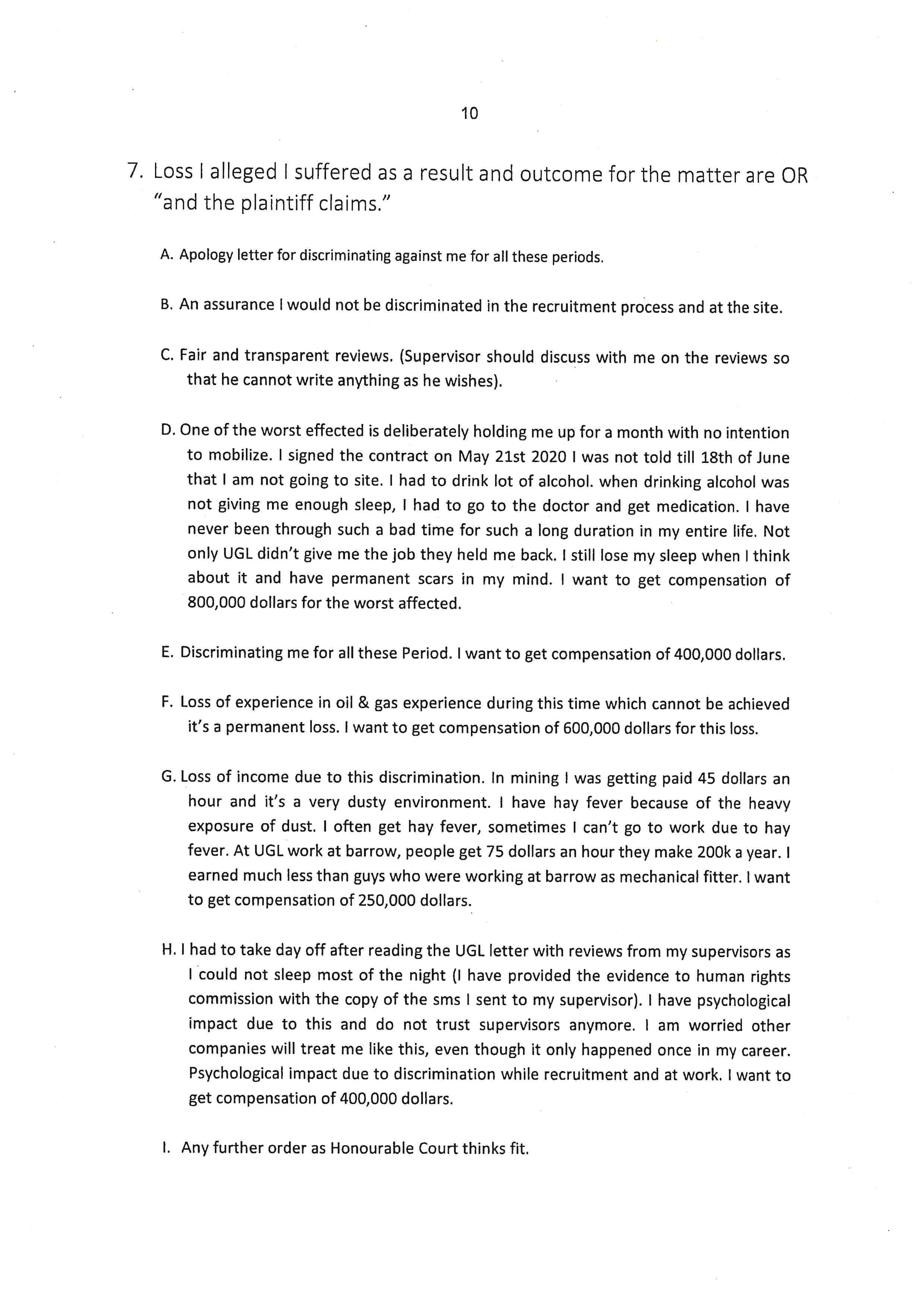
(ss) | Paragraph 7D | Pleading is likely to cause embarrassment | Whether [Mr Joy] has been through such a bad time in his life before is irrelevant to the proceedings. | There is no reason these words should not be retained. |
(tt) | Paragraph 7G | Pleading is likely to cause embarrassment | The hay fever experienced by [Mr Joy] is irrelevant to these proceedings. It is not alleged that the hay fever has been caused by [UGL]. | There is no reason these words should not be retained. |
49 In Annexure B, UGL has also sought the strike out of para 4S, however no submissions appear to have been made in support. I consider this paragraph should survive.
CONCLUSION
50 The outcome of all of this is that some parts of the pleading will be summarily dismissed, some parts will be struck out with no leave to re-plead and some parts will be dismissed with leave to re-plead. Those parts have been identified in these reasons. They are also expressed using red and blue lines to strike through those parts of Mr Joy’s claim at Annexure A. Those parts struck through with red are dismissed or struck out with no liberty to re-plead. Those struck through with blue may be re-pleaded.
51 It would be far better for the whole pleading to be re-drawn rather than any attempt be made to reconstruct the surviving parts together with parts to be re-pleaded. This is not an invitation to re-plead the parts which have been dismissed or struck out without leave to re-plead. The liberty to re-plead is to be confined to conform with the rulings in these reasons. Those paragraphs, which plead the allegedly discriminatory performance reviews leading to loss of employment or refusal to employ, should be re-pleaded. All other paragraphs, which have either been summarily dismissed in the substantive consideration above, or struck out per the table above, should not be re-pleaded.
52 There has been mixed success, so costs should be in the cause.
I certify that the preceding fifty-two (52) numbered paragraphs are a true copy of the Reasons for Judgment of the Honourable Justice McKerracher. |
Associate:
ANNEXURE A
ANNEXURE B