Federal Court of Australia
Rambaldi (Trustee) v Sumpton, in the matter of the Bankrupt Estate of Sumpton [2021] FCA 1199
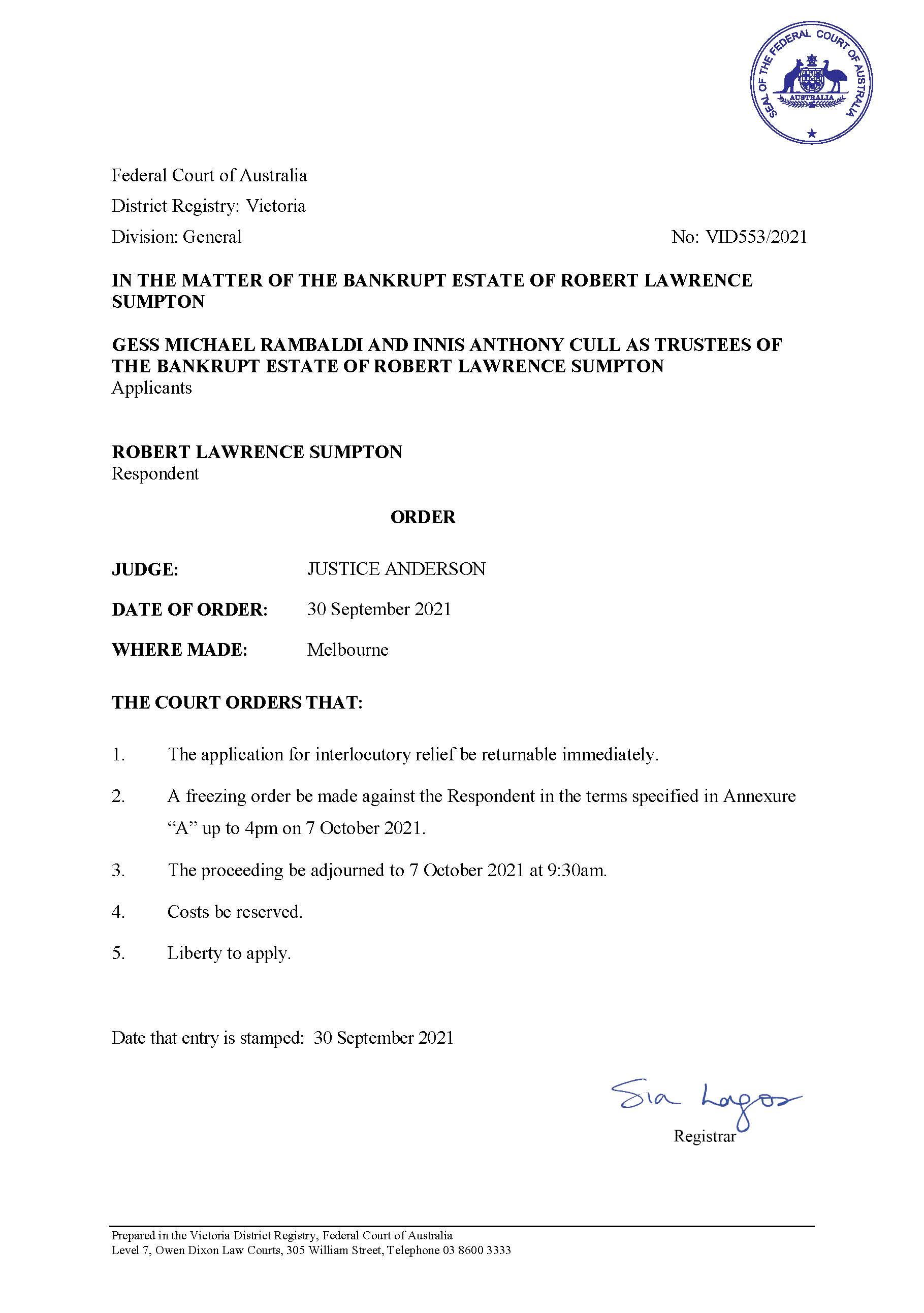
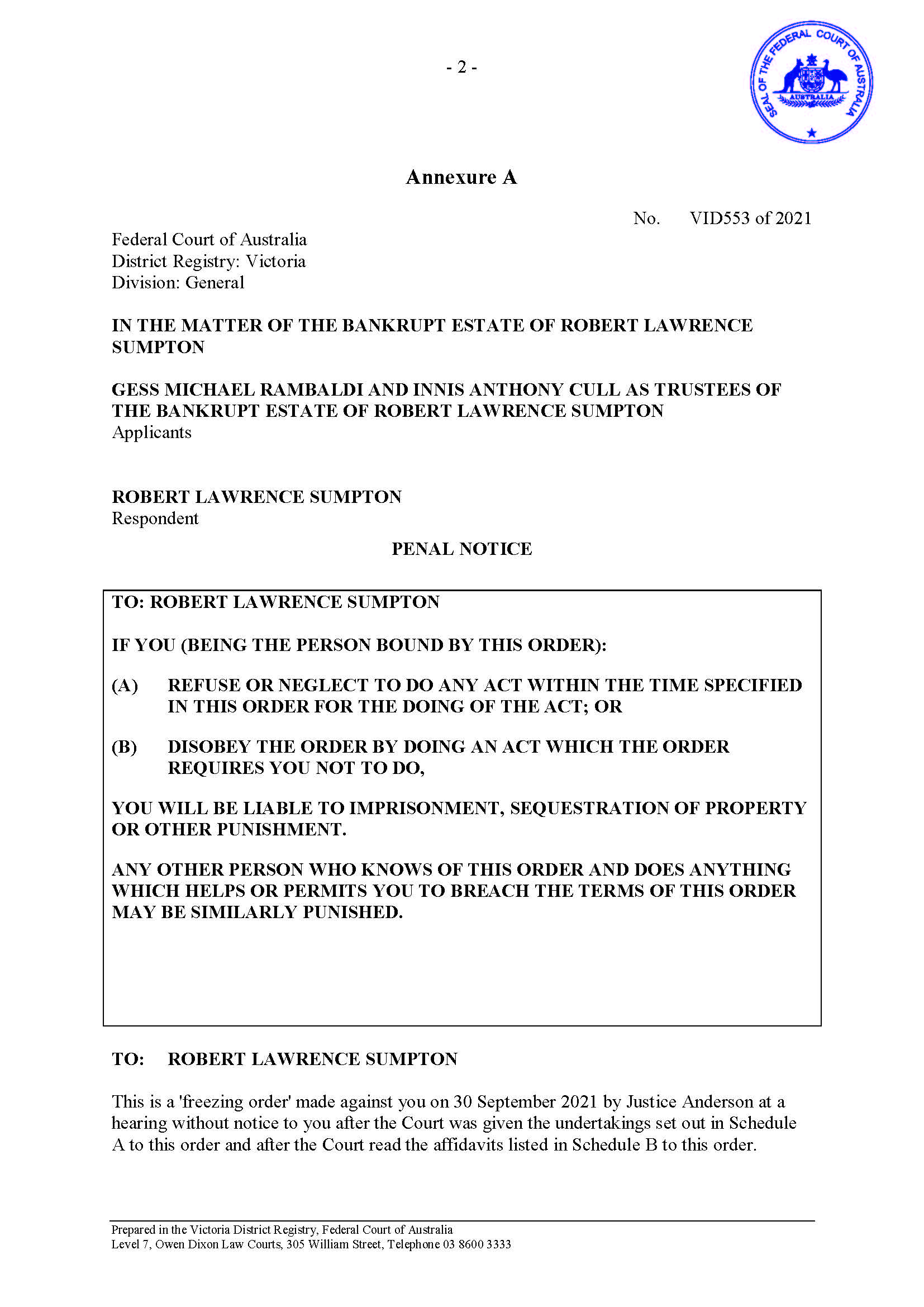
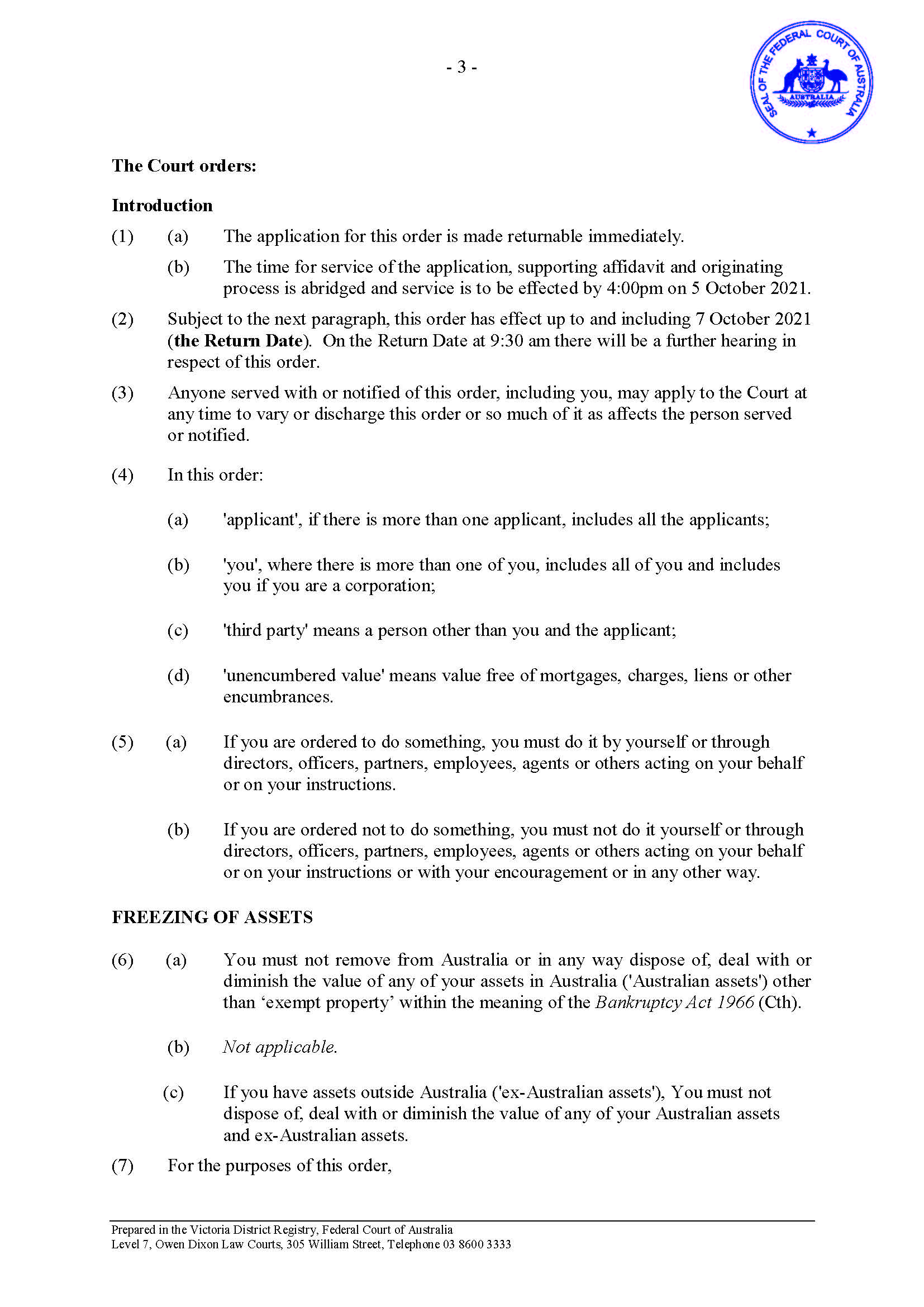
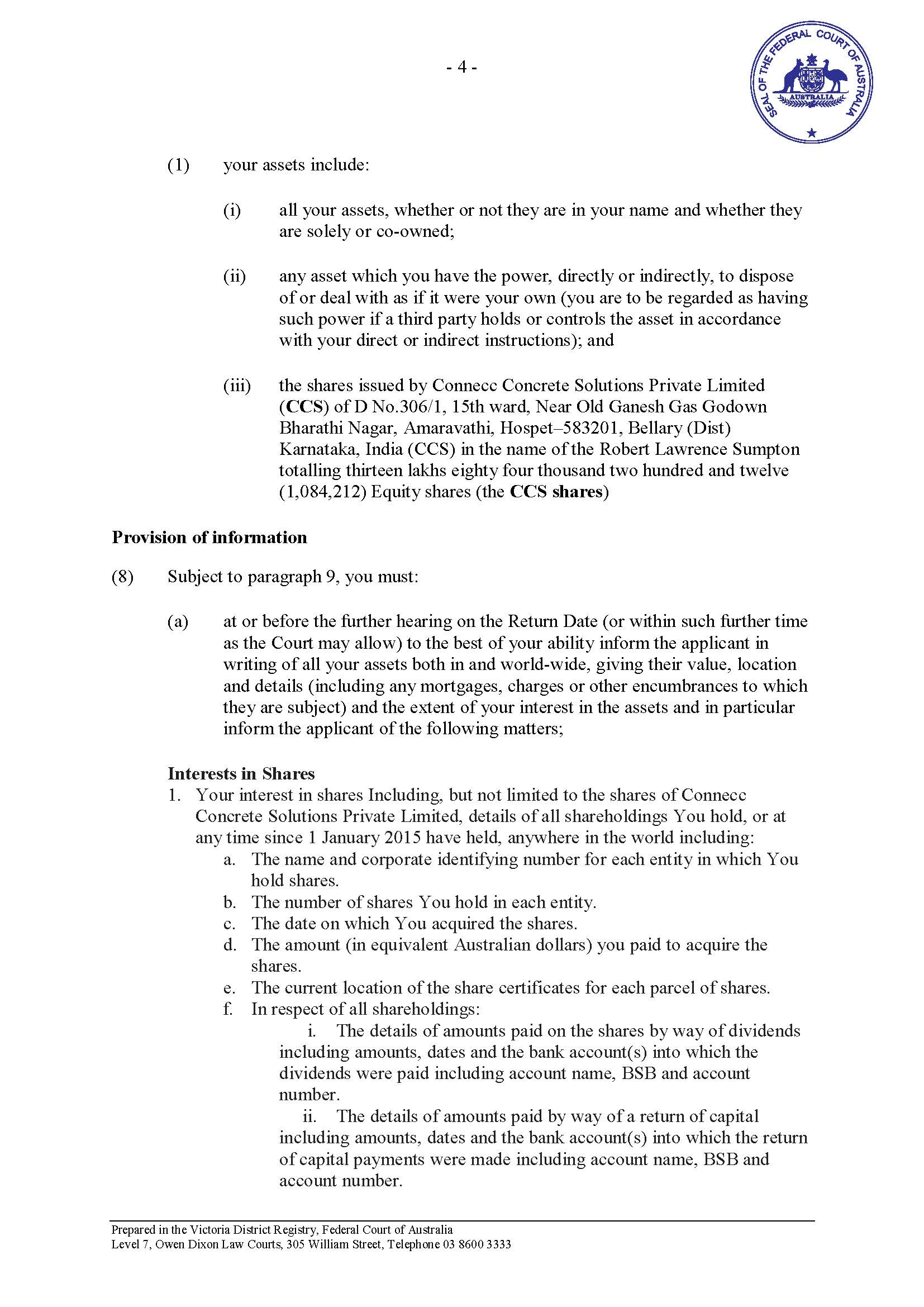
ORDERS
Anderson J | |
DATE OF ORDER: |
THE COURT ORDERS THAT:
1. The application for interlocutory relief be returnable immediately.
2. A freezing order be made against the Respondent in the terms specified in Annexure “A” up to 4pm on 7 October 2021.
3. The proceeding be adjourned to 7 October 2021 at 9:30am.
4. Costs be reserved.
5. Liberty to apply.
Note: Entry of orders is dealt with in Rule 39.32 of the Federal Court Rules 2011
ANDERSON J:
INTRODUCTION
1 The Applicants (Trustees) are the trustees of the bankrupt estate of the Respondent (Mr Sumpton). The Trustees seek orders for the transfer of shares in Conecc Concrete Solutions Private Ltd (CCS shares), being a foreign company located in India. The CCS shares are currently held in the name of Mr Sumpton, who it has been alleged, has not disclosed his interest in these CCS shares to the Trustees. .,
2 In the interim, and to reduce the risk of dissipation, the Trustees seek ex parte freezing orders and ancillary orders. A ‘freezing order’ is sought in order to prevent the frustration or inhibition of the Court’s process by seeking to preserve the Trustees’ interest in those shares for the benefit of the creditors of Mr Sumpton’s bankrupt estate. Orders are also sought that Mr Sumpton file and a serve an affidavit deposing his assets and income located both within Australia and overseas and in particular, his interest in CCS and any distributions paid to him by CCS.
3 In support of the application, the Trustees rely on the affidavit of Innis Anthony Cull sworn on 27 September 2021 (Cull Affidavit). As deposed in the Cull Affidavit, Mr Sumpton, who is an undischarged bankrupt, has failed to disclose his interest in CCS in his declared statement of affairs, in breach of his obligations under the Bankruptcy Act 1966 (Cth) (Bankruptcy Act).
4 By way of relevant background:
(a) On 23 March 2021, Mr Sumpton became bankrupt on the presentation of a debtor’s petition to the Official Receiver and the Official Trustee was appointed trustee of his bankrupt estate.
(b) On 14 May 2021, the Trustees replaced the Official Trustee as the trustees of Mr Sumpton’s bankrupt estate under s 181A of the Bankruptcy Act.
(c) On 18 March 2021, Mr Sumpton lodged his Statement of Affairs, but he did not disclose any interest in the CCS shares.
(d) The Trustees, since their appointment have undertaken investigations (which are continuing) into Mr Sumpton’s ‘examinable affairs’ (within the meaning of that term under s 5 of the Bankruptcy Act) and in accordance with their duties under s 19 of the Bankruptcy Act. Those investigations disclosed that Mr Sumpton has an interest in CCS, in the form of holding shares in that company.
CCS shares
5 On 25 July 2019, the Reserve Bank of India issued an Order against CCS concerning the reporting of a receipt of a foreign payment in relation to a subscription to its shares. The order relevantly noted that CCS received funds in Indian Rupees from a foreign investor, Robert Lawrence Sumpton of Australia (which the Trustees believe is a reference to Mr Sumpton) in respect of an application for the issue of its shares on 20 July 2017 in the amount of “(INR) 1,38,24,250” and 27 July 2017 in the amount of “(INR) 1,38,60,000” for a total on (INR) 2,76,84,250.00”.
6 The Standalone Financial Statements for the period 1 April 2019 to 31 March 2020 (at pages 8 and 25) relevantly record Mr Sumpton’s shareholding in CCS, as does a List of Allottees. It appears from an extract as at January 2021, that Mr Sumpton’s shareholding totalled “13,84,212” Equity shares in CCS, accounting for a 24.35% stake in CCS.
7 The Trustees have been able to match the payment for the subscription to the CCS shares to a transaction in Mr Sumpton’s bank account.
legal principles relating to freezing orders
8 The Federal Court of Australia has power to make a freezing order generally under s 23 of the Federal Court of Australia Act 1976 (Cth) and Division 7.4 of the Federal Court Rules 2011 (Cth) (Rules). Pursuant to r 7.32 of the Rules, the purpose of a freezing order is to prevent the frustration or inhibition of the Court’s process by seeking to meet a danger that a judgment or prospective judgment of the Court will be wholly or partly unsatisfied. Pursuant to r 7.33 of the Rules, the Court may make an order ancillary to a freezing order or a prospective freezing order, including an order made for the purpose of eliciting information relating to assets relevant to the freezing order or prospective freezing order.
9 The principles governing the grant of freezing orders are well-established. The applicant must show that:
(a) it has a good or reasonably arguable case;
(b) there is a danger that the prospective judgment will be wholly or partly unsatisfied because the assets of the prospective judgment debtor or another person will be removed from Australia or the assets will be disposed of, dealt with or diminished in value; and
(c) the balance of convenience favours granting the order.
10 The following observations about freezing orders should be made.
11 First, that a freezing order, by its very nature, is a drastic remedy and a court must exercise a high degree of caution before taking a step which will interfere with a party’s capacity to deal with his or her assets.
12 Second, the order is not designed to provide security for the applicant’s claim. It is solely directed to preserving assets from being dissipated, thereby frustrating the court process.
13 Third, the applicant bears the onus both in satisfying the Court that the order should be continued and in satisfying the Court as to the amount which is to be the subject of the order.
14 Fourth, an order can only be made on the basis of admissible evidence which supports the contentions made by the party seeking the order. Speculation and guesswork are no substitute for either the facts or inferences properly drawn from proven facts.
15 Finally, there may be discretionary considerations which militate against the granting of a freezing order, such as delay in bringing the application on before the court or a lack of candour in the materials placed before the Court.
Reasonably arguable case
16 Before a freezing order is made, the applicant must show that there is a reasonably arguable case on legal and factual matters or a sufficiently realistic prospect of success on the proceedings.
17 Here, the Trustees seek orders to give effect to the vesting provisions in the Bankruptcy Act. In particular, reference is made to the following provisions:
(a) The expression “the property of the bankrupt” is defined in s 5 of the Bankruptcy Act to mean, relevantly, “the property divisible among the bankrupt’s creditors” and “any rights and powers in relation to that property that would have been exercisable by the bankrupt if he or she had not become a bankrupt”.
(b) Section 116(1) of the Bankruptcy Act prescribes that “property divisible amongst the creditors of the bankrupt” is:
(i) all property that belonged to, or was vested in, a bankrupt at the commencement of the bankruptcy, or has been acquired or is acquired by him or her, or has devolved or devolves on him or her, after the commencement of the bankruptcy and before his or her discharge; and
(ii) the capacity to exercise, and to take proceedings for exercising all such powers in, over or in respect of property as might have been exercised by the bankrupt for his or her own benefit at the commencement of the bankruptcy or at any time after the commencement of the bankruptcy and before his or her discharge.
(c) Under s 58(1) of the Bankruptcy Act, where a debtor becomes bankrupt, “the property of the bankrupt” at the time of becoming bankrupt vests forthwith in the trustee of the bankrupt’s estate and “after-acquired property of the bankrupt” vests, as soon as it is acquired by, or devolves on, the bankrupt, in the trustee as the trustee of the bankrupt’s estate.
(d) The word “property” is also defined in s 5 of the Bankruptcy Act and means:
… real or personal property of every description, whether situate in Australia or elsewhere, and includes any estate, interest or profit, whether present or future, vested or contingent, arising out of or incident to any such real or personal property.
18 I find that the CCS shares fall within the description of property which vests in the Trustees following Mr Sumpton’s bankruptcy, and are required to be transferred to the Trustees.
Reasonable apprehension that assets will be dissipated
19 The applicant must also show that, unless the order is granted, there is a reasonable apprehension that assets will be dissipated so as to frustrate the action or execution. It is not essential for an applicant, in an application for a freezing order, to demonstrate a positive intention on the part of the respondent to frustrate a judgment. Nor is it necessary for the applicant to demonstrate that the risk of dissipation is more probable than not.
20 It is enough that the applicant establishes that, in the absence of relief, there is a danger or real risk that the assets will be dealt with in a way which would prevent the applicant from recovering judgment.
21 In Spotlight Pty Ltd v Mehta [2019] FCA 1796, I observed at [23], that:
[w]here, as here, allegations made against the respondents contain allegations of serious dishonesty, evidence of that nature is capable of satisfying the Court of the existence of the requisite danger to dispose of, deal with or dissipate assets
22 In that regard, the Trustees refer to the matters set out below and note that the failure of a bankrupt to fully and truly disclose all property of the bankrupt, and its value, is an offence under s 265 of the Bankruptcy Act which may result in a maximum penalty of one years’ imprisonment.
23 The Trustees are concerned that if a freezing order is not made, then their attempts to realise their interest in the CCS shares may be prevented by Mr Sumpton seeking to transfer their shares without recourse by the Trustees. The basis for these concerns is:
(a) Mr Sumpton has failed to lodge his taxation returns since 2018.
(b) There has been no disclosure by Mr Sumpton of his shareholding in CCS.
(c) Mr Sumpton’s failure to provide further information in relation to his examinable affairs and answer questions in relation to his property interests.
(d) The difficulties for the Trustees in realising their interest in, and taking transmission of the CCS shares.
24 In these circumstances, the Trustees have formed the view that it is necessary to obtain a court order, in the form of a “freezing order”, before engaging with CCS, so that they are able to engage with CCS in respect of realising the shares issued to Mr Sumpton which have vested in them as trustees of Mr Sumpton’s bankrupt estate.
Balance of convenience and delay
25 The Applicant must show that the balance of convenience favours the making of the order. Given the Trustees’ duties under the Bankruptcy Act and that the assets which are subject to the freezing order are assets which have vested in the Trustees, it is submitted that the balance of convenience favours making of the order.
26 There has been no material delay in bringing this application, as the Trustees have been gathering information and conducting their investigations.
Worldwide Freezing Order
27 The Trustees seek a worldwide freezing order out of an abundance of caution in circumstances where the CCS shares relate to an Indian foreign company. Given Mr Sumpton is located in Australia and is an undischarged bankrupt, all of his assets, whether they be local or international, vest in the Trustees. The Trustees do not foresee any issue in effecting the transfer of the CCS shares once Mr Sumpton executes the necessary documentation.
28 There is an issue as to whether it is a jurisdictional precondition to the granting of a freezing order, with respect to overseas assets, that there be a realistic possibility that any judgment obtained by the Applicant can be enforced against assets of the defendant in the place to which the proposed order relates: Huang v Deputy Commissioner of Taxation (2020) 280 FCR 160; [2020] FCAFC 141. On 11 February 2021, special leave to appeal was granted by the High Court of Australia; [2021] HCATrans 21. See also Huang v Deputy Commissioner of Taxation [2020] FCA 1518.
29 To the extent that the jurisdictional precondition applies, the Trustees anticipate that they will be able to obtain the transfer of the CCS shares once Mr Sumpton executes the necessary documentation or, alternatively, obtain a transfer based on the provisions of the Articles of Association and the Indian Companies Act.
disposition
30 I am satisfied for the reasons given that it is appropriate to make the freezing order in the terms sought upon the applicants giving the undertaking to the Court annexed to the orders.
I certify that the preceding thirty (30) numbered paragraphs are a true copy of the Reasons for Judgment of the Honourable Justice Anderson. |