

Federal Court of Australia
5G Networks Limited, in the matter of 5G Networks Limited [2021] FCA 1189
ORDERS
5G NETWORKS LIMITED (ACN 163 312 025) Plaintiff | ||
DATE OF ORDER: |
OTHER MATTERS:
A. The Court notes that ASIC was provided with at least 14 days’ notice of the hearing of this application.
B. The Court is satisfied that ASIC has had a reasonable opportunity to:
(i) examine the terms of the proposed scheme of arrangement to which the application relates and a draft explanatory statement relating to that arrangement; and
(ii) make submissions to the Court in relation to the proposed scheme of arrangement and the draft explanatory statement.
C. The Court notes the letter from ASIC to the directors of the plaintiff, 5G Networks Limited dated 30 September 2021 produced at the hearing.
THE COURT ORDERS THAT:
1. Pursuant to section 411(1) and section 1319 of the Corporations Act 2001 (Cth), 5G Networks Limited (the company) convene and hold a meeting of its shareholders (Scheme Meeting):
(a) for the purpose of considering and, if thought fit, agreeing (with or without modification) to the scheme of arrangement (Scheme) proposed to be made between the company and its shareholders (5GN Shareholders), the terms of which are set out in annexure A to these orders; and
(b) to be held on Monday, 8 November 2021 at 10.00 am (AEDT, being Melbourne time) and to be conducted electronically through an online platform, which is to be accessed in accordance with the instructions included in the Notice of Meeting to be sent to shareholders.
2. Pursuant to section 411(1) and section 1319 of the Act, the Scheme Meeting be convened by sending on or before Wednesday, 6 October 2021 to each 5GN Shareholder whose name is recorded in the company’s register of members as being a shareholder as at 7.00 pm (AEDT, being Melbourne time) on Friday, 1 October 2021:
(a) an email to each 5GN Shareholder who has nominated an electronic address for the purpose of receiving notices from the company (email shareholder) (or, in the case of joint holders, to the holder whose name appears first in the company’s register), such email to be substantially in the form of annexure GD-5 to the affidavit of Glen Alan Dymond sworn on 29 September 2021, and which contains hyperlinks to:
(i) an electronic copy of a document substantially in the form of the document which is annexure GD-1 to the Dymond affidavit (Scheme Booklet) (which contains, among other things, the proposed Scheme at annexure C and Notice of Scheme Meeting at annexure E);
(ii) an online portal or website that is accessible by the email shareholder and which enables the email shareholder to lodge proxy voting instructions for the Scheme Meeting online; and
(iii) an online portal or website that is accessible by the email shareholder to view, listen to and participate in the Scheme Meeting online;
(b) to each 5GN Shareholder who is not an email shareholder (or, in the case of joint holders, to the holder whose name appears first in the company’s register) (postal shareholder):
(i) a hard-copy document substantially in the form of annexure GD-6 to the Dymond affidavit setting out a URL which provides access to a website from which the postal shareholder:
A. can download an electronic copy of the Scheme Booklet (which contains, among other things, the proposed Scheme at annexure C and Notice of Scheme Meeting at annexure E); and
B. directed to an online portal or website that is accessible by the postal shareholder to view, listen to and participate in the Scheme Meeting online; and
(ii) a hard copy proxy form substantially in the form which is at annexure GD-7 of the Dymond affidavit and a reply paid envelope for the postal shareholder to lodge their proxy form and voting instructions for the Scheme Meeting.
3. The documents referred to in order 2(b) be sent:
(a) in the case of postal shareholders whose registered address is within Australia, by prepaid ordinary post addressed to the relevant addresses recorded in the company’s register; and
(b) in the case of postal shareholders whose registered address is outside Australia, by airmail or international courier service addressed to the relevant addresses recorded in the company’s register.
4. Compliance with r 2.15 of the Federal Court (Corporations) Rules 2000 (Cth) be dispensed with, except in so far as that rule applies rule 75-15(2) of the Insolvency Practice Rules (Corporations) 2016 (Cth).
5. Voting on the resolution to agree to the Scheme is to be conducted by way of a poll.
6. A proxy in respect of the Scheme Meeting will be valid and effective if, and only if, it is completed and delivered in accordance with its terms or a proxy is lodged online in accordance with the instructions on the online portal or website referred to in order 2(a)(ii) and received by the company by 10.00 am (AEDT, being Melbourne time) on Saturday, 6 November 2021.
7. Mr Albert Cheok or, failing him, Mr Jason Ashton, be chairperson of the Scheme Meeting.
8. The chairperson of the Scheme Meeting has the power to adjourn the Scheme Meeting to such time, date and at such place (including electronically) as the chairperson considers appropriate.
9. The company publish a notice of hearing in The Australian newspaper, in substantially the form that appears at annexure GD-9 to the Dymond affidavit, not later than 5 days prior to the date fixed for the hearing of any application to approve the Scheme, and the company be relieved from compliance with Rule 3.4 and Form 6 of the Rules to the extent necessary.
10. The further hearing of the originating process by Justice Beach is adjourned to 10.15 am (AEDT, being Melbourne time) on Thursday, 11 November 2021 or as soon thereafter as the business of the Court allows.
Note: Entry of orders is dealt with in Rule 39.32 of the Federal Court Rules 2011.
ANNEXURE A
Scheme of Arrangement
[The order entered is available on the Commonwealth Courts Portal, which attaches the Scheme]
BEACH J:
1 5G Networks Limited has applied for orders under s 411(1) of the Corporations Act 2001 (Cth) to convene and hold a meeting of its shareholders to consider a scheme of arrangement, with consequential orders sought under s 1319. The purpose of the scheme is to effect a merger of the company (5GN) with Webcentral Group Limited, which in essence involves a plain vanilla reverse takeover.
2 Webcentral, a controlled entity of 5GN, proposes to acquire all shares of 5GN on issue in return for the issue of shares in Webcentral to holders of 5GN shares, at a ratio of two Webcentral shares for one 5GN share. As a consequence, 5GN will become a wholly-owned subsidiary of Webcentral. Further, 5GN currently holds 45% of the issued capital of Webcentral. 5GN’s auditors consider that 5GN controls Webcentral within the meaning of s 50AA of the Act. If the scheme is implemented, these shares will be cancelled by Webcentral.
3 In essence there will be a reverse takeover of Webcentral. A scheme results in a reverse takeover if the consideration offered to members of the company proposing the scheme is shares in the offeror company, and the scheme results in a change in control of the offeror company. As I say, 5GN holds approximately 45% of the issued capital of Webcentral. If the scheme is implemented, those shares will be cancelled and scheme shareholders, who were shareholders of 5GN, will hold approximately 74% of Webcentral. The current Webcentral shareholders will hold approximately 26%.
4 In my view, the scheme is of such a nature that it would likely be approved at the second court hearing, and accordingly it is appropriate to make orders convening the scheme meeting.
5 Let me set out some relevant background.
6 5GN is a licensed telecommunications carrier operating across Australia providing data connectivity, cloud and data centre services to small and medium enterprises, government and large corporate enterprise customers. Webcentral is an Australian digital technology provider to small and medium sized enterprises. Both 5GN and Webcentral are public companies whose shares are listed on the ASX.
7 5GN has 120,661,123 ordinary shares and 8,000,000 performance rights on issue. 5GN does not now have any options, but as at July 2021 5GN had 8,200,000 options on issue. However, all 5GN options have since been exercised or cancelled.
8 In October 2020, pursuant to an off-market takeover bid, 5GN became the controlling shareholder of Webcentral. As I have said, 5GN holds approximately 45% of the issued capital of Webcentral and 5GN controls Webcentral within the meaning of s 50AA. Now s 259C(1) prohibits the transfer of shares in a company to an entity it controls. Accordingly, 5GN has obtained relief from ASIC to exempt 5GN from the operation of s 259C(1) so as to permit all of the 5GN shares to be transferred to Webcentral even though Webcentral is controlled by 5GN.
9 Further, if the scheme is implemented, the Webcentral shares held by 5GN will be bought back and cancelled by a reduction of capital by Webcentral within 12 months of the implementation date.
10 The directors of 5GN are Mr Albert Cheok (non-executive chairman), Mr Joseph Gangi (non-executive director), Mr Jason Ashton (non-executive director) and Mr Joseph Demase (managing director).
11 Each 5GN director has a relevant interest in 5GN shares. The aggregate number of 5GN shares in which 5GN directors have a relevant interest represents approximately 22% of the total number of 5GN shares on issue. In particular Mr Demase has a relevant interest in 18,386,996 5GN shares, representing approximately 15.2% of the total number of 5GN shares on issue. The remaining 5GN directors have a relevant interest in smaller parcels of 5GN shares, representing in aggregate approximately 6.7% of the total number of 5GN shares on issue.
12 Mr Demase also holds 8,000,000 5GN performance rights, which are proposed to be cashed out and cancelled immediately prior to the implementation date at market value for an amount that is expected to be $2.98 million. There are no other 5GN performance rights or options on issue.
13 Mr Demase and Mr Gangi are also directors and shareholders of Webcentral. Mr Demase is the managing director of Webcentral and has a relevant interest in 11,951,206 Webcentral shares, representing approximately 7.7% of the total number of Webcentral shares on issue. Mr Gangi is the chairman of the board of Webcentral and has a relevant interest in approximately 1.9% of the total number of Webcentral shares on issue.
14 Neither Mr Ashton nor Mr Cheok are directors of Webcentral. Mr Ashton has a relevant interest in approximately 0.4% of the total number of Webcentral shares on issue. Mr Cheok does not have a relevant interest in any Webcentral shares.
15 In light of Mr Demase’s roles as managing director of both 5GN and Webcentral and the size of his shareholding in each company, it is proposed to tag the votes cast at the scheme meeting in respect of any shares in which Mr Demase has a relevant interest.
16 The independent directors of 5GN have unanimously recommended that shareholders vote in favour of the scheme. This voting recommendation and the reasons for it are set out in the draft scheme booklet. All directors intend to vote any 5GN shares held or controlled by them at the time of the scheme meeting in favour of the scheme.
17 An independent expert has prepared a report which concludes that the scheme is fair and reasonable and in the best interests of 5GN shareholders. The basis for this conclusion is that the value of a parcel of two new Webcentral shares after the implementation of the scheme (assessed as $1.02 to $1.12) exceeds the value of one 5GN share prior to the announcement of the scheme (assessed as $0.87 to $0.96).
18 At this point let me say something about aspects of the conditions precedent.
19 A merger implementation agreement (MIA) was entered into between 5GN and Webcentral on 16 July 2021 under which 5GN and Webcentral agreed to merge by way of the scheme. There are a number of conditions precedent. Clause 3.1 of the MIA provides that the scheme will not become effective, and the respective obligations of the parties to implement the scheme are not binding, until each of the conditions precedent set out in clause 3.1(a) to (q) is satisfied or waived. These conditions include shareholder approval and court approval of the scheme, as well as certain steps having been taken in relation to 5GN performance rights and 5GN options. Notably it is also a condition precedent to the MIA that before 10.00 am on the date of the scheme meeting, Webcentral shareholders approve at an extraordinary general meeting a resolution approving the acquisition by Webcentral of a substantial asset (being 5GN shares) from a related party of Webcentral or an associate in connection with the scheme and a resolution permitting the issue of new Webcentral shares under the transaction constituting the reverse takeover of Webcentral in connection with the scheme. Further, clause 3.1 of the scheme itself provides for the usual conditions precedent.
20 If all conditions precedent are satisfied or waived, then the essential mechanism for the transfer of the scheme shares and the issue of the scheme consideration is as follows:
(a) the scheme will become effective on the effective date, which is currently expected to be 12 November 2021;
(b) at the close of trading on the ASX on the effective date, 5GN shares will be suspended from trading;
(c) on 15 November 2021, new Webcentral shares will commence trading on the ASX on a deferred settlement basis;
(d) on or before the implementation date, which is expected to be 23 November 2021, Webcentral will issue the new Webcentral shares as scheme consideration to the scheme shareholders or to the sale agent on behalf of ineligible foreign shareholders;
(e) on the implementation date and subject to the provision of the scheme consideration by Webcentral, all of the scheme shares will be transferred to Webcentral; and
(f) on 24 November 2021, the new Webcentral shares issued as scheme consideration will begin trading on the ASX on a normal settlement basis.
21 Let me say something about foreign shareholders. A scheme shareholder will be an ineligible foreign shareholder where their address as shown in the register is a place outside Australia and its external territories or New Zealand. Ineligible foreign shareholders will participate in the scheme on the same basis as all scheme shareholders who are not ineligible foreign shareholders, save that new Webcentral shares will not be issued to ineligible foreign shareholders. Instead, the scheme provides that Webcentral must issue the new Webcentral shares to which the ineligible foreign shareholders would otherwise have been entitled to a sale agent. Further, Webcentral must procure that as soon as reasonably practicable after implementation, the sale agent sells the new Webcentral shares issued to the sale agent on the ASX at a price reasonably determined by the sale agent, and remits the sale proceeds to 5GN. Further, after receiving the sale proceeds, 5GN must pay to each ineligible foreign shareholder the amount of the sale proceeds attributable to the new Webcentral shares to which they would otherwise have been entitled after appropriate deductions. I will return to whether this is class creating later.
Power and discretion
22 Section 411(1) confers a discretion to make an order convening a meeting if certain statutory pre-requisites are met. In my view these pre-requisites have been satisfied in this case and I do not need to linger on these requirements.
23 Now in exercising a discretion in deciding whether to convene a scheme meeting, the approach taken is that the court will not ordinarily so order unless the scheme is of such a nature and cast in such terms that, if it achieves the statutory majorities at the meeting, the court would be likely to approve it on the second hearing, assuming that hearing to be unopposed. But the court’s role is not to express a view on whether the proposed scheme should be approved. It should not usurp the shareholders’ decision whether to agree to a scheme by attempting to intrude its own commercial judgment.
24 Accordingly, the court’s function is generally confined to ensuring that all procedural and substantive requirements have been met. But the court may take into account the merits of a proposed scheme at the convening hearing if the scheme appears on its face so blatantly unfair or otherwise inappropriate that it should now be stopped in its tracks.
25 In my view, the scheme is fit for consideration by the members. In particular, there is no issue arising from the scheme which would unquestionably lead to a refusal by me to later approve the scheme. It cannot be said that the scheme is on its face so blatantly unfair or otherwise inappropriate that the process should now be guillotined.
26 Let me now address some specific matters that have been drawn to my attention.
Performance risk
27 Although Webcentral is to issue the scheme consideration, it is not party to the scheme and is not directly bound by it. As such, it is necessary to ensure that Webcentral is bound to perform the actions attributed to it under the scheme, in particular to issue the scheme consideration to scheme participants. I am so satisfied on this issue for three reasons. First, the terms of the scheme require that the scheme consideration be issued by Webcentral before there is any obligation upon scheme shareholders to transfer the scheme shares to Webcentral. This effectively removes any performance risk in so far as the transfer of scheme shares in return for the scheme consideration is concerned. Second, Webcentral has executed a deed poll in favour of scheme shareholders binding Webcentral to perform the actions attributed to it under the scheme, including issuing the scheme consideration. Third, as Webcentral is a controlled entity of 5GN, 5GN has the ability to ensure that Webcentral performs the actions attributed to it under the scheme.
Reimbursement fee
28 Clause 11.2 of the MIA provides that a reimbursement fee may be payable by 5GN to Webcentral in certain circumstances if the scheme is not implemented.
29 In summary, the reimbursement fee is payable by 5GN if there is a change of recommendation to vote in favour of the scheme by a member of the independent board committee, a competing proposal is announced prior to 8.00 am on the date of the second court hearing and within 12 months of the announcement the third party or its associates completes the competing proposal, or Webcentral terminates the MIA for material breach by Webcentral. But the reimbursement fee will not be payable if the scheme becomes effective. Further, the reimbursement fee is not payable if the scheme does not proceed merely because 5GN shareholders do not vote in favour of the scheme in sufficient numbers to pass the resolution at the scheme meeting.
30 Now the payment of a reimbursement fee or a “break fee” is a common feature associated with schemes such as the present scheme. And in my view the reimbursement fee in this case is neither excessive nor coercive in nature. Further, the terms requiring payment of the fee and the circumstances in which those terms were agreed are consistent with the requirements of the relevant authorities and do not represent a barrier to the convening of a meeting to consider the scheme. Moreover, the amount of the fee is not such that it would likely influence voting at the meeting. Further, the reimbursement fee is not payable if the scheme does not proceed merely because 5GN shareholders do not vote in favour of the scheme in sufficient numbers to pass the resolution at the scheme meeting. Further, the reimbursement fee is either $500,000, which is less than 1% of the value of the aggregate scheme consideration, or reasonable actual third party costs incurred by Webcentral, whichever is greater. The amount of the reimbursement fee will therefore either be within the Takeovers Panel’s 1% guideline or be justified by reference to the reasonable costs incurred by the offeror company. Moreover, the relevant provisions of the MIA are also consistent with the guidelines published by the Takeovers Panel which state that reasonable triggers for the payment of the fee might include a change of directors’ recommendation or a competing transaction that successfully completes.
31 Accordingly, the provisions for the reimbursement fee do not present any barrier to the convening of a meeting to consider the scheme.
5GN performance rights
32 As I have indicated, 5GN has 8,000,000 5GN performance rights on issue, which are all held by the managing director of 5GN, Mr Demase. 5GN also had 8,200,000 5GN options on issue at the time the MIA was executed, but these options have since been exercised or cancelled.
33 The proposed treatment of the 5GN performance rights is provided for in Schedule 6 of the MIA. In summary, Schedule 6 of the MIA in combination with clause 3.1 provides that it is a condition precedent to the MIA and to the scheme that the 5GN performance rights be either cashed out or exercised into 5GN shares prior to the scheme record date to allow participation in the scheme, or that they be cancelled pursuant to private treaty arrangements, either for no consideration where they are materially out of the money or for a cash payment determined by a valuer.
34 In the present case, the amount payable on cancellation of the 8,000,000 5GN performance rights is expected to be approximately $2.98 million.
35 Now there are two issues which arise for consideration: first, whether the proposed treatment of the performance rights gives rise to the need for separate classes; second, the appropriateness of any directors, who might receive a benefit from such arrangements, making a recommendation to shareholders to vote in favour of the proposed scheme. But in the present case the only holder of 5GN performance rights is not making a recommendation in relation to the scheme. Accordingly, the second issue does not arise.
36 As to the first issue, a question arises as to whether Mr Demase with the benefit of performance rights who is also a current 5GN shareholder should form a separate class from those 5GN shareholders who do not hold such rights because he will receive a benefit from the scheme. But in my view this is not necessary.
37 The legal rights of Mr Demase as a 5GN shareholder are not so dissimilar from the rights of other 5GN shareholders as to make it impossible for them to consult together with a view to their common interest. They will each participate in the scheme on the same basis and receive the same consideration as all other 5GN shareholders. All 5GN shareholders are being treated equally under the scheme. On this basis, the fact that a shareholder of the scheme company also holds performance rights does not give rise to a separate class. The differences in rights does not mean that any community of interest between them has been displaced for the purposes of them considering and voting upon the proposed scheme as one class.
38 In my view, separate class meetings are not necessary or desirable as a result of the proposed treatment of the 5GN performance rights.
Other potential class issues and tagging of votes
39 As I have said, some of the directors of 5GN are also directors of Webcentral and hold shares in both 5GN and in Webcentral. Now although the Act does not prohibit scheme proponents or their associates who hold target shares from voting in relation to an acquisition, it is appropriate to consider whether it is necessary for any 5GN director to be placed in a separate class for the purposes of voting their 5GN shares at the scheme meeting. It is also appropriate to consider whether, if there are no separate classes, the votes of any directors should be tagged.
40 In my view no separate class meetings are appropriate or necessary in respect of any 5GN directors, but it is appropriate to tag the votes cast in respect of Mr Demase’s shareholding in 5GN. The following table summarises the relevant shareholdings and directorships in respect of each of the 5GN directors:
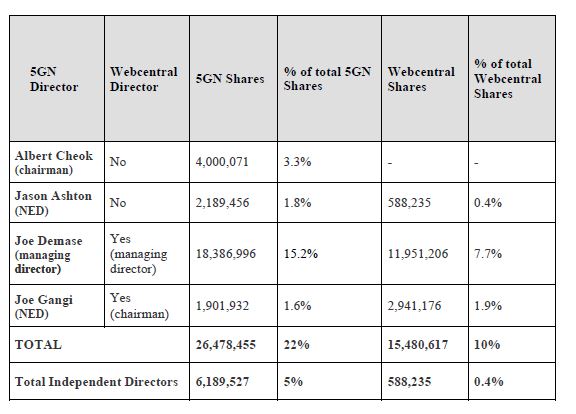
41 As appears from this table, the only 5GN director with a material shareholding in 5GN is Mr Demase, who holds approximately 15.2% of 5GN. Mr Demase also holds 7.7% of Webcentral, and is managing director of both Webcentral and 5GN.
42 Now notwithstanding these matters, it is not necessary for Mr Demase or any other director to be placed in a separate class for voting purposes.
43 In the first place, none of the 5GN directors could properly be said to have extraneous or divergent interests in the outcome of the scheme. None of the directors will receive a material collateral benefit from the bidder if the scheme proceeds.
44 Further, a person should not be excluded from a class merely because they hold equity securities in both the bidder and the target. So, where a director of a bidder holds shares in the target, provided that the director is to be treated the same as every other target member under the scheme, that director is not required to be placed in a separate class for voting purposes.
45 Further, the fact that the relevant member is a director of the bidder and therefore an associate of the bidder does not make it appropriate or necessary for that member to vote in a separate class. For example, in Re Choiseul Investments Ltd [2010] FCA 1189, Choiseul Investments Limited, which was the plaintiff scheme company and in essence the target, proposed to merge with Milton Corporation Limited, the proposed bidder, by way of a scheme of arrangement. The Choiseul Board comprised three directors, one of whom, Millner, was the non-executive chairman of both Choiseul and Milton. The board of directors of Choiseul resolved to delegate the powers in connection with the scheme to a committee comprised of the independent directors, being the directors apart from Millner. In addition, both Choiseul and Milton had cross-holdings in the other. Milton held 11,485,134 shares in the capital of Choiseul. Choiseul held 1,700,000 shares in the capital of Milton. The company secretary of Choiseul was also an executive of Milton. In addition to being the chairman of both bidder and target, Millner also held 17 million shares in the target, Choiseul, which holding was material. Other directors of the bidder also held shares in the target. Jacobson J concluded that no separate class meetings were necessary. In particular, his Honour said (at [23], [24] and [26] to [28]):
The first issue is whether certain persons who are associates of Milton who are Scheme participants ought to be considered to be a separate class.
These persons are, in particular, the Milton directors, including Mr Millner, who through his family company owns approximately 17 million shares in Choiseul.
…
It seems to me that the principle which has been applied for approximately 100 years, stated in Sovereign Life Assurance Company v Dodd [1892] 2 QB 573, is applicable here, so that the associates of Milton are treated in the same manner as all Scheme participants. They are, in those circumstances, able to consult in common with all other Scheme participants with a view to determining where their common interest lies. I therefore do not consider that it is appropriate or necessary to order a separate Scheme meeting to be attended by those persons.
However, it seems to me that the approach which I ought to adopt is that to which Mr Oakes referred this morning, namely, that there will be a separate tally of votes cast at the Scheme meeting by the holders of those shares, so that this issue can be considered at the second Court hearing on the question of fairness. That was the approach which was adopted by Emmett J in CCI Holdings Limited [2007] FCA 832 at [19].
For reasons similar to those referred to by his Honour, I would be disposed to conclude that there is no separate class constituted by the associates of Milton. However, as Mr Oakes indicated, it will be possible to establish at the second Court hearing what shares have been voted in favour and what shares have been voted against the proposal to agree to the Scheme. Accordingly, to the extent necessary, I can take this into account on the issue of fairness.
46 Adopting but adapting this reasoning to my case, there is no separate class constituted by the associates of Webcentral, being Mr Demase nor Mr Gangi. Although Mr Demase and Mr Gangi are shareholders in the bidder and directors of the bidder, they will participate in the scheme on the same basis and receive the same consideration as other 5GN shareholders who are neither holders of Webcentral shares nor directors of Webcentral. That is, all shareholders are being treated equally under the scheme, and there is no additional benefit being offered to Mr Demase or to Mr Gangi under or in connection with the scheme.
47 In light of the foregoing, no separate class meetings are appropriate or necessary in relation to any of the directors of 5GN. But in light of the size of Mr Demase’s shareholding in 5GN, I will require 5GN to tag the votes cast at the scheme meeting in respect of 5GN shares in which Mr Demase has a relevant interest, so that this can be considered at the second court hearing if necessary. In a clear case where I later take the view that the existence of any extraneous interest means that the outcome of the vote does not fairly represent the views of the class, I will be entitled to discount or disregard these votes.
Ineligible foreign shareholders
48 I have already set out the proposed treatment of ineligible foreign shareholders under the scheme which accords with the common practice adopted in schemes where scrip comprises the proposed scheme consideration.
49 Moreover, issuing to a sale agent scrip under a scheme of arrangement that would otherwise have been issued to ineligible foreign shareholders does not require those shareholders to meet together as a separate class for the purposes of considering the proposed scheme of arrangement. I have applied the principles discussed in Re Amcor Ltd [2019] FCA 346 at [39] to [44]. No separate class requirement arises as regards the ineligible foreign shareholders.
Information disclosure
50 Section 412(1) and Part 3 of Schedule 8 of the Corporations Regulations 2001 (Cth) set out the disclosure requirements of the explanatory statement, which is included within the scheme booklet. There are three aspects to these requirements.
51 First, the explanatory statement must explain the effect of the arrangement, and in particular state any material interest of the directors, and the effect on those interests of the arrangement so far as it is different from the effect on the like interests of other persons. In the present case the effect of the scheme is addressed in the scheme booklet, including the required information in relation to the material interests of directors. The relevant sections disclose that other than the shares in 5GN held by the directors and the proposed treatment of the 5GN performance rights, the 5GN directors do not have any material interests in relation to the scheme.
52 Second, the explanatory statement must set out the prescribed information, which requirement has been satisfied in the present case.
53 Third, the explanatory statement must set out any other information that is material to the making of a decision whether to agree to the arrangement. In this respect, the scheme booklet is clear and, together with the independent expert’s report annexed to the scheme booklet, contains a detailed evaluation of the scheme.
54 More generally, the information in the scheme booklet has been subject to thorough verification processes, such that it would seem that it is accurate and includes all material information.
55 Further, it is necessary that the scheme booklet be registered by ASIC before being sent to 5GN shareholders. And before registering the scheme booklet, ASIC must conclude that it appears to comply with the requirements of the Act, and must form the opinion that the scheme booklet does not contain any matter that is false in a material particular or materially misleading in the form and context where it appears. So, this provides further assurance as to the satisfaction of the relevant disclosure requirements. Indeed, ASIC’s comments have been addressed in the draft scheme booklet, and ASIC has stated that it has no further comments.
56 Finally on this aspect, s 411(1) provides that if the court has made an order convening a meeting of members, the court may approve the explanatory statement that is contained in the scheme booklet. But in Re RXP Services Ltd [2021] FCA 38 at [70], I said:
Now s 411(1) provides that if I have made an order convening a meeting of members, I may approve the explanatory statement. But I do not propose to formally do so. In view of the requirement for registration by ASIC and the criteria that ASIC must apply, it is more appropriate that the explanatory statement for a members’ scheme be dealt with in that fashion. But I should stress that not to so formally approve should not be seen as casting any doubt on the accuracy or adequacy of the Scheme Booklet which comprises the explanatory statement or that it is not suitable for registration by ASIC.
57 In the circumstances, 5GN has not sought my approval of the explanatory statement.
Conclusion
58 In my view, the scheme is of such a nature and cast in such terms that, if it achieves the statutory majorities at the scheme meeting, I would be likely to approve it. First, the terms of the proposed scheme are in a conventional form for an acquisition scheme in the nature of a reverse takeover. Second, there is no reason why the scheme, if considered and agreed to by the 5GN shareholders, is not of such a nature as would be likely to be approved by me at the second hearing. Third, 5GN shareholders are to be presented with an appropriately detailed explanation of the scheme in the scheme booklet, as well as an analysis of the scheme by an independent expert. Moreover, the scheme booklet meets all of the statutory requirements. Fourth, I have been provided with a copy of ASIC’s letter dated 30 September 2021 concerning its intention with respect to s 411(17)(b) which is in a satisfactory form.
59 It is for the foregoing reasons that I made the orders this morning under ss 411 and 1319.
I certify that the preceding fifty-nine (59) numbered paragraphs are a true copy of the Reasons for Judgment of the Honourable Justice Beach. |
Associate:


